EP1742457A1 - Digital image capture apparatus with image data format conversion capabilities and method therefor - Google Patents
Digital image capture apparatus with image data format conversion capabilities and method therefor Download PDFInfo
- Publication number
- EP1742457A1 EP1742457A1 EP20050106272 EP05106272A EP1742457A1 EP 1742457 A1 EP1742457 A1 EP 1742457A1 EP 20050106272 EP20050106272 EP 20050106272 EP 05106272 A EP05106272 A EP 05106272A EP 1742457 A1 EP1742457 A1 EP 1742457A1
- Authority
- EP
- European Patent Office
- Prior art keywords
- data
- sensing device
- digital image
- image sensing
- processing
- Prior art date
- Legal status (The legal status is an assumption and is not a legal conclusion. Google has not performed a legal analysis and makes no representation as to the accuracy of the status listed.)
- Granted
Links
Images

Classifications
-
- H—ELECTRICITY
- H04—ELECTRIC COMMUNICATION TECHNIQUE
- H04N—PICTORIAL COMMUNICATION, e.g. TELEVISION
- H04N1/00—Scanning, transmission or reproduction of documents or the like, e.g. facsimile transmission; Details thereof
- H04N1/00127—Connection or combination of a still picture apparatus with another apparatus, e.g. for storage, processing or transmission of still picture signals or of information associated with a still picture
-
- H—ELECTRICITY
- H04—ELECTRIC COMMUNICATION TECHNIQUE
- H04N—PICTORIAL COMMUNICATION, e.g. TELEVISION
- H04N1/00—Scanning, transmission or reproduction of documents or the like, e.g. facsimile transmission; Details thereof
- H04N1/32—Circuits or arrangements for control or supervision between transmitter and receiver or between image input and image output device, e.g. between a still-image camera and its memory or between a still-image camera and a printer device
- H04N1/333—Mode signalling or mode changing; Handshaking therefor
- H04N1/33307—Mode signalling or mode changing; Handshaking therefor prior to start of transmission, input or output of the picture signal only
-
- H—ELECTRICITY
- H04—ELECTRIC COMMUNICATION TECHNIQUE
- H04N—PICTORIAL COMMUNICATION, e.g. TELEVISION
- H04N23/00—Cameras or camera modules comprising electronic image sensors; Control thereof
- H04N23/60—Control of cameras or camera modules
- H04N23/66—Remote control of cameras or camera parts, e.g. by remote control devices
-
- H—ELECTRICITY
- H04—ELECTRIC COMMUNICATION TECHNIQUE
- H04N—PICTORIAL COMMUNICATION, e.g. TELEVISION
- H04N2201/00—Indexing scheme relating to scanning, transmission or reproduction of documents or the like, and to details thereof
- H04N2201/0008—Connection or combination of a still picture apparatus with another apparatus
- H04N2201/0015—Control of image communication with the connected apparatus, e.g. signalling capability
-
- H—ELECTRICITY
- H04—ELECTRIC COMMUNICATION TECHNIQUE
- H04N—PICTORIAL COMMUNICATION, e.g. TELEVISION
- H04N2201/00—Indexing scheme relating to scanning, transmission or reproduction of documents or the like, and to details thereof
- H04N2201/0008—Connection or combination of a still picture apparatus with another apparatus
- H04N2201/0015—Control of image communication with the connected apparatus, e.g. signalling capability
- H04N2201/002—Selecting or switching between an image communication channel and a non-image communication channel
-
- H—ELECTRICITY
- H04—ELECTRIC COMMUNICATION TECHNIQUE
- H04N—PICTORIAL COMMUNICATION, e.g. TELEVISION
- H04N2201/00—Indexing scheme relating to scanning, transmission or reproduction of documents or the like, and to details thereof
- H04N2201/0008—Connection or combination of a still picture apparatus with another apparatus
- H04N2201/0015—Control of image communication with the connected apparatus, e.g. signalling capability
- H04N2201/0027—Adapting to communicate with plural different types of apparatus
-
- H—ELECTRICITY
- H04—ELECTRIC COMMUNICATION TECHNIQUE
- H04N—PICTORIAL COMMUNICATION, e.g. TELEVISION
- H04N2201/00—Indexing scheme relating to scanning, transmission or reproduction of documents or the like, and to details thereof
- H04N2201/0008—Connection or combination of a still picture apparatus with another apparatus
- H04N2201/0065—Converting image data to a format usable by the connected apparatus or vice versa
-
- H—ELECTRICITY
- H04—ELECTRIC COMMUNICATION TECHNIQUE
- H04N—PICTORIAL COMMUNICATION, e.g. TELEVISION
- H04N2201/00—Indexing scheme relating to scanning, transmission or reproduction of documents or the like, and to details thereof
- H04N2201/0008—Connection or combination of a still picture apparatus with another apparatus
- H04N2201/0065—Converting image data to a format usable by the connected apparatus or vice versa
- H04N2201/0068—Converting from still picture data
-
- H—ELECTRICITY
- H04—ELECTRIC COMMUNICATION TECHNIQUE
- H04N—PICTORIAL COMMUNICATION, e.g. TELEVISION
- H04N2201/00—Indexing scheme relating to scanning, transmission or reproduction of documents or the like, and to details thereof
- H04N2201/32—Circuits or arrangements for control or supervision between transmitter and receiver or between image input and image output device, e.g. between a still-image camera and its memory or between a still-image camera and a printer device
- H04N2201/333—Mode signalling or mode changing; Handshaking therefor
- H04N2201/33307—Mode signalling or mode changing; Handshaking therefor of a particular mode
- H04N2201/33378—Type or format of data, e.g. colour or B/W, halftone or binary, computer image file or facsimile data
Definitions
- the present invention relates to multiple harmonized data streams.
- the invention relates to those data streams used in imaging and video applications.
- An image sensor is typically made to be incorporated within a digital image sensing device, and such digital image sensing devices can then furthermore be arranged to operate in conjunction with a host system.
- a "digital image sensing device” is taken to mean any image sensing device which provides a digital representation of a scene or an image.
- the host system can be running one or more applications which receive, interpret and perform operations on the image data obtained from the digital image sensing device.
- the raw image data gathered by a pixel array of the image sensor is post-processed by circuitry of the image sensor and/or the image sensing device, for example to be pleasing to the human eye, or to compress the data for storage.
- the type of post-processing that is applied depends on the type of digital image sensing device within which the image sensor is incorporated. Thus, at present, a digital image sensing device can only supply image data in a single format at any one time.
- the image sensing device is customised to transmit image data in the single format which is optimal for post-processing by a particular application on the host system.
- the host system can run more than one type of application, either simultaneously or individually, the supply of image data in only a single format may prove problematic. While the image data may be in a format that is ideal for a first application, the performance of the other applications or processing tasks that are running or that can run on the host system may be detrimentally affected by the post-processing.
- Each specific application can include an extra processing step to filter or otherwise manipulate the image data obtained.
- this increases the processing power required by the host system to run the applications, and also raises issues of interoperability between different image processing devices and different applications.
- a digital image sensing device comprising an image sensor and a processing means arranged to extract image data from the image sensor in a plurality of different data formats for subsequent transmission.
- the processing means comprises means for transmission of each data format in a specific data channel.
- a webcam and a digital still camera are provided which comprise the digital image sensing device of the first aspect.
- the invention also provides for an imaging system comprising the digital image sensing device of the first aspect together with a host system.
- the host system can for example be a personal computer (PC) or a mobile baseband.
- PC personal computer
- mobile baseband a mobile baseband
- a method of processing multiple image data streams comprising the steps of obtaining image data with an image sensor, processing the image data in a digital image sensing device, and simultaneously transmitting the processed data to a host system in a plurality of different formats.
- the step of processing the image data in a digital image sensing device comprises the step of preparing each different data format for transmission in a particular data channel.
- each data transmission channel is used to transmit data in a format and according to a communication protocol suitable for processing by a specific application on a receiving system.
- the present invention involves the transmission of multiple versions of image data from a digital image sensing device in order to improve, accelerate or otherwise aid the end-use task of a host system.
- the transmission of multiple versions of an image can therefore match, or harmonize with, the processing or display requirements of the application or applications running on the host system.
- USB1.1 In the field of digital image sensing devices, most webcams and digital still camera interfaces have used the USB1.1 standard for connecting devices. However, the newer USB2 standard offers 40 times the bandwidth of USB1.1. The bandwidth available in USB1.1 had meant that a single transmission of data was only just possible at a framerate high enough for image processing. Indeed, JPEG compression was often necessary on this single channel of data just to achieve transfer at 15 or 30 frames per second. The transmission of multiple versions of the data is enabled by the greater bandwidth of USB2. Similarly, LAN, Bluetooth and wireless versions thereof now provide suitable bandwidth for the transmission of image data.
- a digital image sensing device (incorporating an image sensor) is illustrated as a data transmitter 10 which sends information via a data transmission channel 12 to the host system, illustrated as a data receiving system 14.
- the receiving system 14 has a plurality of applications 16, and the input for each application 16 is provided by a data channel 18 which provides data in a format suitable for that application 16.
- One data channel 18 can provide the input to more than one application 16, or each application can have its own dedicated data channel 18.
- the data transmitter 10 can for example be a digital still camera or a web camera.
- the transmission channel 12 can for example be a wireless or physical USB2, wireless of physical LAN, or Bluetooth connection.
- the data receiving system 14 can for example be a host PC or a mobile base band. It is also to be appreciated that the data receiving system 14 may comprise a plurality of different receivers, optionally at different locations. In particular, a wireless LAN transmission channel could activate a number of different receivers, each one being activated by the data in the format that it requires for its particular processing task.
- Each data channel 18 can for example be an alternate colour format, or a compressed version of the image data, or a pre-processed form of the image (for example, including edge information).
- a web camera system could provide one data stream for direct display, another data stream for compressed capture, and perhaps a third for transmission over RTP. Because the image data is already supplied in a format suitable for use by the end-use applications, the processing overhead required by the end-use applications is reduced. This saves in the processing power that the host system needs to use, and also avoids any deterioration of image quality that results from the further processing of the image data by the end-use applications.
- a Digital Still Camera could output a VGA JPEG format for storage on a first data channel, and a QVGA YUV422 for preview on a second data channel; or a Web Camera could output QVGA RGB24 format on a first data channel for video display and VGA Bayer CFA on a second data channel for high quality stills processing on the host system.
- a value added web camera which emphasizes in head tracking could output QVGA RGB24 for display on a first data channel, and VGA CFA for a head tracking application on a second data channel for detection of motion and flesh tone, and a VGA pre-processed compressed edge information for head detection on a third data channel; or a web camera for video conferencing could output VGA compressed for video capture on a first data channel, VGA YUV422 for preview display on a second data channel, and QVGA compressed RGB for RTP on a third data channel.
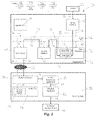
- a digital image sensing device 20 comprises an image sensor 22 and coprocessor 24, which supplies multiple harmonized data streams to a host system 26.
- the image sensor 22 and the coprocesssor 24 are illustrated in Fig. 2 as two logically distinct units. However, it is to be appreciated that this is not necessarily descriptive of the physical embodiments of these components.
- the image sensor 22 and coprocessor 24 could be realised together in a single device, or could be phsically separate.
- Each data stream is tailored to the specific requirements of the applications on the host, namely movement detection and video streaming for this example.
- the movement detection data stream is a Bayer data stream of reduced image size that contains only the required data and statistics from the imaging system in order to implement movement detection on the host, while the video streaming data stream is a fully colourised and reconstructed image stream in the format of YUV video data.
- VGA Bayer image data 28 is received at the sensor interface 30 and passed to a video processor 32 which comprises a first module 34 for extracting motion statistics and a second module 36 for performing image reconstruction.
- the first module 34 passes Bayer data and statistics 38 in QVGA format to the USB device 40 via the system memory 42
- the second module 36 passes YUV data 44 in VGA format to the USB device 40 via the system memory 42.
- the system is controlled by CPU 50 and system bus 46.
- CPU control data 48 is also shown.
- the USB device 40 then transmits the data 38,44 via a USB bus 52 to the host system 26.
- the data 38,44 is input to a system memory 54, and the Bayer data and statistics 38 are then processed by a movement detection algorithm 56 run in the host CPU 58, while the YUV data 44 are processed by a video streaming application 60 which then interfaces with display hardware 62 and an external display device 64.
- a feedback loop (not shown) can be provided between the host cpu 58 to the coprocessor 24 and ultimately to the sensor 22 itself, such that the results of host CPU 58 processing of the data may lead to modification in the control of the sensor 22 and/or the coprocessor 24.
- the feedback loop may also optionally include feedback from the coprocessor's system cpu 50 or video processor 32 or sensor interface 30.
- This implementation benefits the host system 26 as only the data that is required for specific tasks (movement detection and video display) is transmitted from the digital image sensing device 20 to the host 26, and the host 26 receives data tailored to each individual application.
Landscapes
- Engineering & Computer Science (AREA)
- Multimedia (AREA)
- Signal Processing (AREA)
- Studio Devices (AREA)
Abstract
Description
- The present invention relates to multiple harmonized data streams. In particular, the invention relates to those data streams used in imaging and video applications.
- An image sensor is typically made to be incorporated within a digital image sensing device, and such digital image sensing devices can then furthermore be arranged to operate in conjunction with a host system. A "digital image sensing device" is taken to mean any image sensing device which provides a digital representation of a scene or an image.
- In such a case, the host system can be running one or more applications which receive, interpret and perform operations on the image data obtained from the digital image sensing device.
- The raw image data gathered by a pixel array of the image sensor is post-processed by circuitry of the image sensor and/or the image sensing device, for example to be pleasing to the human eye, or to compress the data for storage. The type of post-processing that is applied depends on the type of digital image sensing device within which the image sensor is incorporated. Thus, at present, a digital image sensing device can only supply image data in a single format at any one time.
- In the case where a digital image sensing device is only used for a single purpose, the image sensing device is customised to transmit image data in the single format which is optimal for post-processing by a particular application on the host system.
- However, in the case where the host system can run more than one type of application, either simultaneously or individually, the supply of image data in only a single format may prove problematic. While the image data may be in a format that is ideal for a first application, the performance of the other applications or processing tasks that are running or that can run on the host system may be detrimentally affected by the post-processing.
- Each specific application can include an extra processing step to filter or otherwise manipulate the image data obtained. However, this increases the processing power required by the host system to run the applications, and also raises issues of interoperability between different image processing devices and different applications.
- According to a first aspect of the present invention there is provided a digital image sensing device comprising an image sensor and a processing means arranged to extract image data from the image sensor in a plurality of different data formats for subsequent transmission.
- Preferably, the processing means comprises means for transmission of each data format in a specific data channel.
- According to further aspects, a webcam and a digital still camera (DSC) are provided which comprise the digital image sensing device of the first aspect.
- The invention also provides for an imaging system comprising the digital image sensing device of the first aspect together with a host system.
- The host system can for example be a personal computer (PC) or a mobile baseband.
- According to a second aspect of the present invention, there is provided a method of processing multiple image data streams, comprising the steps of obtaining image data with an image sensor, processing the image data in a digital image sensing device, and simultaneously transmitting the processed data to a host system in a plurality of different formats.
- Preferably, the step of processing the image data in a digital image sensing device comprises the step of preparing each different data format for transmission in a particular data channel.
- Preferably, each data transmission channel is used to transmit data in a format and according to a communication protocol suitable for processing by a specific application on a receiving system.
- The present invention will now be described, by way of example only, with reference to the accompanying drawings, in which:
- Fig. 1 shows a first embodiment of the invention; and
- Fig. 2 shows a second embodiment of the invention.
- The present invention involves the transmission of multiple versions of image data from a digital image sensing device in order to improve, accelerate or otherwise aid the end-use task of a host system. The transmission of multiple versions of an image can therefore match, or harmonize with, the processing or display requirements of the application or applications running on the host system.
- In the field of digital image sensing devices, most webcams and digital still camera interfaces have used the USB1.1 standard for connecting devices. However, the newer USB2 standard offers 40 times the bandwidth of USB1.1. The bandwidth available in USB1.1 had meant that a single transmission of data was only just possible at a framerate high enough for image processing. Indeed, JPEG compression was often necessary on this single channel of data just to achieve transfer at 15 or 30 frames per second. The transmission of multiple versions of the data is enabled by the greater bandwidth of USB2. Similarly, LAN, Bluetooth and wireless versions thereof now provide suitable bandwidth for the transmission of image data.
- The invention is illustrated in Fig. 1. A digital image sensing device (incorporating an image sensor) is illustrated as a
data transmitter 10 which sends information via a data transmission channel 12 to the host system, illustrated as adata receiving system 14. Thereceiving system 14 has a plurality ofapplications 16, and the input for eachapplication 16 is provided by adata channel 18 which provides data in a format suitable for thatapplication 16. Onedata channel 18 can provide the input to more than oneapplication 16, or each application can have its owndedicated data channel 18. - The
data transmitter 10 can for example be a digital still camera or a web camera. The transmission channel 12 can for example be a wireless or physical USB2, wireless of physical LAN, or Bluetooth connection. Thedata receiving system 14 can for example be a host PC or a mobile base band. It is also to be appreciated that thedata receiving system 14 may comprise a plurality of different receivers, optionally at different locations. In particular, a wireless LAN transmission channel could activate a number of different receivers, each one being activated by the data in the format that it requires for its particular processing task. - Each
data channel 18 can for example be an alternate colour format, or a compressed version of the image data, or a pre-processed form of the image (for example, including edge information). - This principle can be embodied in various ways. For example, a web camera system could provide one data stream for direct display, another data stream for compressed capture, and perhaps a third for transmission over RTP. Because the image data is already supplied in a format suitable for use by the end-use applications, the processing overhead required by the end-use applications is reduced. This saves in the processing power that the host system needs to use, and also avoids any deterioration of image quality that results from the further processing of the image data by the end-use applications.
- In other exemplary implementations, a Digital Still Camera could output a VGA JPEG format for storage on a first data channel, and a QVGA YUV422 for preview on a second data channel; or a Web Camera could output QVGA RGB24 format on a first data channel for video display and VGA Bayer CFA on a second data channel for high quality stills processing on the host system.
- Similarly, a value added web camera which specialises in head tracking could output QVGA RGB24 for display on a first data channel, and VGA CFA for a head tracking application on a second data channel for detection of motion and flesh tone, and a VGA pre-processed compressed edge information for head detection on a third data channel; or a web camera for video conferencing could output VGA compressed for video capture on a first data channel, VGA YUV422 for preview display on a second data channel, and QVGA compressed RGB for RTP on a third data channel.
- A further specific embodiment is illustrated in Fig. 2. A digital
image sensing device 20 comprises animage sensor 22 andcoprocessor 24, which supplies multiple harmonized data streams to ahost system 26. - The
image sensor 22 and thecoprocesssor 24 are illustrated in Fig. 2 as two logically distinct units. However, it is to be appreciated that this is not necessarily descriptive of the physical embodiments of these components. Theimage sensor 22 andcoprocessor 24 could be realised together in a single device, or could be phsically separate. - Each data stream is tailored to the specific requirements of the applications on the host, namely movement detection and video streaming for this example.
- The movement detection data stream is a Bayer data stream of reduced image size that contains only the required data and statistics from the imaging system in order to implement movement detection on the host, while the video streaming data stream is a fully colourised and reconstructed image stream in the format of YUV video data.
- Within the
coprocessor 24, VGA Bayerimage data 28 is received at thesensor interface 30 and passed to avideo processor 32 which comprises afirst module 34 for extracting motion statistics and asecond module 36 for performing image reconstruction. Thefirst module 34 passes Bayer data andstatistics 38 in QVGA format to theUSB device 40 via thesystem memory 42, and thesecond module 36 passesYUV data 44 in VGA format to theUSB device 40 via thesystem memory 42. The system is controlled byCPU 50 andsystem bus 46.CPU control data 48 is also shown. - The
USB device 40 then transmits thedata host system 26. Within thehost system 26, thedata system memory 54, and the Bayer data andstatistics 38 are then processed by amovement detection algorithm 56 run in thehost CPU 58, while theYUV data 44 are processed by avideo streaming application 60 which then interfaces withdisplay hardware 62 and anexternal display device 64. - Also, a feedback loop (not shown) can be provided between the
host cpu 58 to thecoprocessor 24 and ultimately to thesensor 22 itself, such that the results ofhost CPU 58 processing of the data may lead to modification in the control of thesensor 22 and/or thecoprocessor 24. The feedback loop may also optionally include feedback from the coprocessor'ssystem cpu 50 orvideo processor 32 orsensor interface 30. - This implementation benefits the
host system 26 as only the data that is required for specific tasks (movement detection and video display) is transmitted from the digitalimage sensing device 20 to thehost 26, and thehost 26 receives data tailored to each individual application. - Various improvements and modifications can be made to the above without departing from the scope of the present invention.
Claims (10)
- A digital image sensing device (20) comprising an image sensor (22) and a processing means (24) arranged to extract image data from the image sensor (22) in a plurality of different data formats for subsequent transmission.
- The digital image sensing device (20) of claim 1, wherein the processing means (24) comprises means for transmission of each data format in a specific data channel.
- A webcam comprising a digital image sensing device according to claim 1 or claim 2.
- A digital still camera comprising a digital image sensing device according to claim 1 or claim 2.
- An imaging system comprising a digital image sensing device (20) according to claim 1 or claim 2 together with a host system (26).
- The imaging system of claim 5, wherein the host system is a personal computer (PC).
- The imaging system of claim 5, wherein the host system is a mobile baseband.
- A method of processing multiple image data streams, comprising the steps of obtaining image data with an image sensor (22), processing the image data in a digital image sensing device (20), and simultaneously transmitting the processed data to a host system (26) in a plurality of different formats.
- The method of claim 8, wherein the step of processing the image data in a digital image sensing device (20) comprises the step of preparing each different data format for transmission in a particular data channel.
- The method of claim 9, wherein each data transmission channel is used to transmit data in a format and according to a communication protocol suitable for processing by a specific application on a receiving system.
Priority Applications (2)
| Application Number | Priority Date | Filing Date | Title |
|---|---|---|---|
| EP05106272.7A EP1742457B1 (en) | 2005-07-08 | 2005-07-08 | Digital image capture apparatus with image data format conversion capabilities and method therefor |
| US11/482,659 US7805069B2 (en) | 2005-07-08 | 2006-07-07 | Imaging device, system and associated methods using multiple harmonized data streams |
Applications Claiming Priority (1)
| Application Number | Priority Date | Filing Date | Title |
|---|---|---|---|
| EP05106272.7A EP1742457B1 (en) | 2005-07-08 | 2005-07-08 | Digital image capture apparatus with image data format conversion capabilities and method therefor |
Publications (2)
| Publication Number | Publication Date |
|---|---|
| EP1742457A1 true EP1742457A1 (en) | 2007-01-10 |
| EP1742457B1 EP1742457B1 (en) | 2022-03-09 |
Family
ID=34981481
Family Applications (1)
| Application Number | Title | Priority Date | Filing Date |
|---|---|---|---|
| EP05106272.7A Expired - Lifetime EP1742457B1 (en) | 2005-07-08 | 2005-07-08 | Digital image capture apparatus with image data format conversion capabilities and method therefor |
Country Status (2)
| Country | Link |
|---|---|
| US (1) | US7805069B2 (en) |
| EP (1) | EP1742457B1 (en) |
Cited By (1)
| Publication number | Priority date | Publication date | Assignee | Title |
|---|---|---|---|---|
| EP2009876A3 (en) * | 2007-06-29 | 2009-03-11 | Honeywell International Inc. | Systems and method for publishing selectively altered sensor data in real time |
Families Citing this family (2)
| Publication number | Priority date | Publication date | Assignee | Title |
|---|---|---|---|---|
| TW200837606A (en) * | 2007-03-08 | 2008-09-16 | Genesys Logic Inc | Multi-streaming web camera controlling system and controlling methodology of the same |
| US9176608B1 (en) | 2011-06-27 | 2015-11-03 | Amazon Technologies, Inc. | Camera based sensor for motion detection |
Citations (7)
| Publication number | Priority date | Publication date | Assignee | Title |
|---|---|---|---|---|
| EP0881821A2 (en) * | 1997-05-27 | 1998-12-02 | Konica Corporation | Digital camera |
| GB2355613A (en) * | 1999-07-23 | 2001-04-25 | Hewlett Packard Co | Camera with still and motion image capabilities |
| EP1143694A2 (en) * | 2000-03-27 | 2001-10-10 | Symagery Microsystems Inc. | Image capture and processing accessory |
| US20020033970A1 (en) * | 2000-09-16 | 2002-03-21 | Frank Chen | Apparatus and method for directly activating an application for editing information of an image after format conversion |
| WO2002063451A1 (en) * | 2001-02-09 | 2002-08-15 | Nixvue Systems Pte. Ltd. | A portable storage medium for digital picture data |
| US20020171743A1 (en) * | 2001-05-16 | 2002-11-21 | Konica Corporation | Electronic device and digital still camera |
| WO2004025652A1 (en) * | 2002-09-16 | 2004-03-25 | Infinite Data Storage Ltd | Direct connection of a data storage device and a consumer electronic device |
Family Cites Families (9)
| Publication number | Priority date | Publication date | Assignee | Title |
|---|---|---|---|---|
| DE4114488C1 (en) | 1991-05-03 | 1992-09-24 | Mercedes-Benz Aktiengesellschaft, 7000 Stuttgart, De | |
| US5914787A (en) * | 1992-11-19 | 1999-06-22 | Olympus Optical Co., Ltd. | Electronic imaging apparatus |
| JPH10126796A (en) * | 1996-09-12 | 1998-05-15 | Eastman Kodak Co | Digital camera for moving images and still images using dual mode software processing |
| US6833863B1 (en) * | 1998-02-06 | 2004-12-21 | Intel Corporation | Method and apparatus for still image capture during video streaming operations of a tethered digital camera |
| US7405738B2 (en) * | 2002-10-22 | 2008-07-29 | Harris Canada Systems, Inc. | System and method for generating and processing a stream of video data having multiple data streams |
| ITPI20030101A1 (en) * | 2003-12-05 | 2005-06-06 | Cdc Srl | METHOD AND APPARATUS FOR THE MANAGEMENT OF GLOBALITY |
| US20060237427A1 (en) * | 2005-04-07 | 2006-10-26 | Logan James D | Smart cabinets |
| US7711047B2 (en) * | 2005-12-21 | 2010-05-04 | Microsoft Corporation | Determining intensity similarity in low-light conditions using the Poisson-quantization noise model |
| US20080007635A1 (en) * | 2005-12-30 | 2008-01-10 | Eastman Kodak Company | System and method for reducing the appearance of inherent random optical patterns in a light-diffusing screen |
-
2005
- 2005-07-08 EP EP05106272.7A patent/EP1742457B1/en not_active Expired - Lifetime
-
2006
- 2006-07-07 US US11/482,659 patent/US7805069B2/en active Active
Patent Citations (7)
| Publication number | Priority date | Publication date | Assignee | Title |
|---|---|---|---|---|
| EP0881821A2 (en) * | 1997-05-27 | 1998-12-02 | Konica Corporation | Digital camera |
| GB2355613A (en) * | 1999-07-23 | 2001-04-25 | Hewlett Packard Co | Camera with still and motion image capabilities |
| EP1143694A2 (en) * | 2000-03-27 | 2001-10-10 | Symagery Microsystems Inc. | Image capture and processing accessory |
| US20020033970A1 (en) * | 2000-09-16 | 2002-03-21 | Frank Chen | Apparatus and method for directly activating an application for editing information of an image after format conversion |
| WO2002063451A1 (en) * | 2001-02-09 | 2002-08-15 | Nixvue Systems Pte. Ltd. | A portable storage medium for digital picture data |
| US20020171743A1 (en) * | 2001-05-16 | 2002-11-21 | Konica Corporation | Electronic device and digital still camera |
| WO2004025652A1 (en) * | 2002-09-16 | 2004-03-25 | Infinite Data Storage Ltd | Direct connection of a data storage device and a consumer electronic device |
Cited By (1)
| Publication number | Priority date | Publication date | Assignee | Title |
|---|---|---|---|---|
| EP2009876A3 (en) * | 2007-06-29 | 2009-03-11 | Honeywell International Inc. | Systems and method for publishing selectively altered sensor data in real time |
Also Published As
| Publication number | Publication date |
|---|---|
| US20070009256A1 (en) | 2007-01-11 |
| EP1742457B1 (en) | 2022-03-09 |
| US7805069B2 (en) | 2010-09-28 |
Similar Documents
| Publication | Publication Date | Title |
|---|---|---|
| US12445570B2 (en) | Photographing method and electronic device | |
| US10402940B2 (en) | Method and system for accelerating video preview digital camera | |
| TWI415462B (en) | A system and method for selective image capture, transimission and reconstruction | |
| EP2629520B1 (en) | Apparatus and method for shooting moving picture in camera device | |
| US7492390B2 (en) | Dual spectral band network camera | |
| JP4182446B2 (en) | Information processing apparatus and method, program, and recording medium | |
| JP2011010331A (en) | Modular architecture having reusable front end for processing digital video data | |
| CN107920251A (en) | The method and system of video quality is adjusted based on the distance of beholder to display | |
| US6446155B1 (en) | Resource bus interface | |
| EP2421244B1 (en) | Endoscope for wireless image data transmission | |
| JP2008022403A (en) | Wavelet transform apparatus and method, wavelet inverse transform apparatus and method, program, and recording medium | |
| CN114063947B (en) | Screen display method, device, electronic equipment and computer storage medium | |
| US7805069B2 (en) | Imaging device, system and associated methods using multiple harmonized data streams | |
| KR101552070B1 (en) | Method and apparatus for transmitting video signal | |
| US9420218B2 (en) | Television system | |
| CN101340586B (en) | Vedio signal processing device, method and program | |
| US20230115097A1 (en) | System and method for implementation of region of interest based streaming | |
| CN120128673A (en) | Wireless multi-channel two-way video processing system | |
| CN110753229A (en) | Video acquisition device and method based on H.265 coding | |
| US11716544B2 (en) | Image capture module and electronic terminal | |
| KR100827680B1 (en) | Thumbnail data transmission method and device | |
| KR102137433B1 (en) | Apparatus and method for managing image | |
| CN118283402A (en) | Shooting method, shooting device and electronic device | |
| KR20030024250A (en) | Digital camera for mobile device | |
| CN103281510A (en) | Method for transmitting digital image of digital imaging apparatus to host |
Legal Events
| Date | Code | Title | Description |
|---|---|---|---|
| PUAI | Public reference made under article 153(3) epc to a published international application that has entered the european phase |
Free format text: ORIGINAL CODE: 0009012 |
|
| AK | Designated contracting states |
Kind code of ref document: A1 Designated state(s): AT BE BG CH CY CZ DE DK EE ES FI FR GB GR HU IE IS IT LI LT LU LV MC NL PL PT RO SE SI SK TR |
|
| AX | Request for extension of the european patent |
Extension state: AL BA HR MK YU |
|
| 17P | Request for examination filed |
Effective date: 20070627 |
|
| AKX | Designation fees paid |
Designated state(s): DE FR GB IT |
|
| 17Q | First examination report despatched |
Effective date: 20071005 |
|
| STAA | Information on the status of an ep patent application or granted ep patent |
Free format text: STATUS: EXAMINATION IS IN PROGRESS |
|
| GRAP | Despatch of communication of intention to grant a patent |
Free format text: ORIGINAL CODE: EPIDOSNIGR1 |
|
| STAA | Information on the status of an ep patent application or granted ep patent |
Free format text: STATUS: GRANT OF PATENT IS INTENDED |
|
| INTG | Intention to grant announced |
Effective date: 20210322 |
|
| GRAJ | Information related to disapproval of communication of intention to grant by the applicant or resumption of examination proceedings by the epo deleted |
Free format text: ORIGINAL CODE: EPIDOSDIGR1 |
|
| STAA | Information on the status of an ep patent application or granted ep patent |
Free format text: STATUS: EXAMINATION IS IN PROGRESS |
|
| INTC | Intention to grant announced (deleted) | ||
| GRAP | Despatch of communication of intention to grant a patent |
Free format text: ORIGINAL CODE: EPIDOSNIGR1 |
|
| STAA | Information on the status of an ep patent application or granted ep patent |
Free format text: STATUS: GRANT OF PATENT IS INTENDED |
|
| INTG | Intention to grant announced |
Effective date: 20211008 |
|
| GRAS | Grant fee paid |
Free format text: ORIGINAL CODE: EPIDOSNIGR3 |
|
| GRAA | (expected) grant |
Free format text: ORIGINAL CODE: 0009210 |
|
| STAA | Information on the status of an ep patent application or granted ep patent |
Free format text: STATUS: THE PATENT HAS BEEN GRANTED |
|
| AK | Designated contracting states |
Kind code of ref document: B1 Designated state(s): DE FR GB IT |
|
| REG | Reference to a national code |
Ref country code: GB Ref legal event code: FG4D |
|
| REG | Reference to a national code |
Ref country code: DE Ref legal event code: R096 Ref document number: 602005057368 Country of ref document: DE |
|
| REG | Reference to a national code |
Ref country code: DE Ref legal event code: R097 Ref document number: 602005057368 Country of ref document: DE |
|
| PLBE | No opposition filed within time limit |
Free format text: ORIGINAL CODE: 0009261 |
|
| STAA | Information on the status of an ep patent application or granted ep patent |
Free format text: STATUS: NO OPPOSITION FILED WITHIN TIME LIMIT |
|
| 26N | No opposition filed |
Effective date: 20221212 |
|
| GBPC | Gb: european patent ceased through non-payment of renewal fee |
Effective date: 20220708 |
|
| PG25 | Lapsed in a contracting state [announced via postgrant information from national office to epo] |
Ref country code: FR Free format text: LAPSE BECAUSE OF NON-PAYMENT OF DUE FEES Effective date: 20220731 |
|
| PG25 | Lapsed in a contracting state [announced via postgrant information from national office to epo] |
Ref country code: GB Free format text: LAPSE BECAUSE OF NON-PAYMENT OF DUE FEES Effective date: 20220708 |
|
| PG25 | Lapsed in a contracting state [announced via postgrant information from national office to epo] |
Ref country code: IT Free format text: LAPSE BECAUSE OF FAILURE TO SUBMIT A TRANSLATION OF THE DESCRIPTION OR TO PAY THE FEE WITHIN THE PRESCRIBED TIME-LIMIT Effective date: 20220309 |
|
| PGFP | Annual fee paid to national office [announced via postgrant information from national office to epo] |
Ref country code: DE Payment date: 20240619 Year of fee payment: 20 |
|
| REG | Reference to a national code |
Ref country code: DE Ref legal event code: R071 Ref document number: 602005057368 Country of ref document: DE |