EP1741728A1 - Catalyst systems based on aromatic diimine ligands. - Google Patents
Catalyst systems based on aromatic diimine ligands. Download PDFInfo
- Publication number
- EP1741728A1 EP1741728A1 EP05106165A EP05106165A EP1741728A1 EP 1741728 A1 EP1741728 A1 EP 1741728A1 EP 05106165 A EP05106165 A EP 05106165A EP 05106165 A EP05106165 A EP 05106165A EP 1741728 A1 EP1741728 A1 EP 1741728A1
- Authority
- EP
- European Patent Office
- Prior art keywords
- ligand
- groups
- unsubstituted
- substituted
- yield
- Prior art date
- Legal status (The legal status is an assumption and is not a legal conclusion. Google has not performed a legal analysis and makes no representation as to the accuracy of the status listed.)
- Withdrawn
Links
- 239000003446 ligand Substances 0.000 title claims abstract description 45
- 239000003054 catalyst Substances 0.000 title claims abstract description 29
- RAABOESOVLLHRU-UHFFFAOYSA-N diazene Chemical compound N=N RAABOESOVLLHRU-UHFFFAOYSA-N 0.000 title description 3
- 229910000071 diazene Inorganic materials 0.000 title description 3
- 125000003118 aryl group Chemical group 0.000 title description 2
- VGGSQFUCUMXWEO-UHFFFAOYSA-N Ethene Chemical compound C=C VGGSQFUCUMXWEO-UHFFFAOYSA-N 0.000 claims abstract description 12
- 239000005977 Ethylene Substances 0.000 claims abstract description 12
- 239000004711 α-olefin Substances 0.000 claims abstract description 9
- 229910052759 nickel Inorganic materials 0.000 claims description 23
- LIKMAJRDDDTEIG-UHFFFAOYSA-N 1-hexene Chemical compound CCCCC=C LIKMAJRDDDTEIG-UHFFFAOYSA-N 0.000 claims description 11
- 230000003213 activating effect Effects 0.000 claims description 11
- 238000000034 method Methods 0.000 claims description 10
- 239000002904 solvent Substances 0.000 claims description 10
- 125000002496 methyl group Chemical group [H]C([H])([H])* 0.000 claims description 9
- 239000003795 chemical substances by application Substances 0.000 claims description 7
- 238000006482 condensation reaction Methods 0.000 claims description 6
- 239000001257 hydrogen Substances 0.000 claims description 6
- 229910052739 hydrogen Inorganic materials 0.000 claims description 6
- 125000000956 methoxy group Chemical group [H]C([H])([H])O* 0.000 claims description 6
- 125000001997 phenyl group Chemical group [H]C1=C([H])C([H])=C(*)C([H])=C1[H] 0.000 claims description 6
- 150000001299 aldehydes Chemical class 0.000 claims description 5
- 229910052804 chromium Inorganic materials 0.000 claims description 4
- 125000001183 hydrocarbyl group Chemical group 0.000 claims description 4
- 150000002576 ketones Chemical class 0.000 claims description 4
- 239000000178 monomer Substances 0.000 claims description 4
- 229920000642 polymer Polymers 0.000 claims description 4
- 125000000547 substituted alkyl group Chemical group 0.000 claims description 4
- 125000003107 substituted aryl group Chemical group 0.000 claims description 4
- -1 ethylene, propylene Chemical group 0.000 claims description 3
- 229910052736 halogen Inorganic materials 0.000 claims description 3
- 150000002367 halogens Chemical group 0.000 claims description 3
- 230000000737 periodic effect Effects 0.000 claims description 3
- 150000003839 salts Chemical class 0.000 claims description 3
- 125000000524 functional group Chemical group 0.000 claims description 2
- 229910052735 hafnium Inorganic materials 0.000 claims description 2
- 229910052742 iron Inorganic materials 0.000 claims description 2
- 229910052748 manganese Inorganic materials 0.000 claims description 2
- 229910052751 metal Inorganic materials 0.000 claims description 2
- 239000002184 metal Substances 0.000 claims description 2
- 125000001624 naphthyl group Chemical group 0.000 claims description 2
- 229910052763 palladium Inorganic materials 0.000 claims description 2
- 229910052719 titanium Inorganic materials 0.000 claims description 2
- 229910052720 vanadium Inorganic materials 0.000 claims description 2
- 229910052726 zirconium Inorganic materials 0.000 claims description 2
- 150000002431 hydrogen Chemical class 0.000 claims 2
- LMBFAGIMSUYTBN-MPZNNTNKSA-N teixobactin Chemical compound C([C@H](C(=O)N[C@@H]([C@@H](C)CC)C(=O)N[C@@H](CO)C(=O)N[C@H](CCC(N)=O)C(=O)N[C@H]([C@@H](C)CC)C(=O)N[C@@H]([C@@H](C)CC)C(=O)N[C@@H](CO)C(=O)N[C@H]1C(N[C@@H](C)C(=O)N[C@@H](C[C@@H]2NC(=N)NC2)C(=O)N[C@H](C(=O)O[C@H]1C)[C@@H](C)CC)=O)NC)C1=CC=CC=C1 LMBFAGIMSUYTBN-MPZNNTNKSA-N 0.000 claims 1
- 150000004984 aromatic diamines Chemical class 0.000 abstract 1
- YXFVVABEGXRONW-UHFFFAOYSA-N Toluene Chemical compound CC1=CC=CC=C1 YXFVVABEGXRONW-UHFFFAOYSA-N 0.000 description 75
- YMWUJEATGCHHMB-DICFDUPASA-N dichloromethane-d2 Chemical compound [2H]C([2H])(Cl)Cl YMWUJEATGCHHMB-DICFDUPASA-N 0.000 description 62
- PXHVJJICTQNCMI-UHFFFAOYSA-N nickel Substances [Ni] PXHVJJICTQNCMI-UHFFFAOYSA-N 0.000 description 53
- IMNFDUFMRHMDMM-UHFFFAOYSA-N N-Heptane Chemical compound CCCCCCC IMNFDUFMRHMDMM-UHFFFAOYSA-N 0.000 description 48
- OKKJLVBELUTLKV-UHFFFAOYSA-N Methanol Chemical compound OC OKKJLVBELUTLKV-UHFFFAOYSA-N 0.000 description 21
- 239000007787 solid Substances 0.000 description 12
- YMWUJEATGCHHMB-UHFFFAOYSA-N Dichloromethane Chemical compound ClCCl YMWUJEATGCHHMB-UHFFFAOYSA-N 0.000 description 9
- HEDRZPFGACZZDS-MICDWDOJSA-N Trichloro(2H)methane Chemical compound [2H]C(Cl)(Cl)Cl HEDRZPFGACZZDS-MICDWDOJSA-N 0.000 description 8
- 239000000243 solution Substances 0.000 description 8
- 239000000203 mixture Substances 0.000 description 7
- QGZKDVFQNNGYKY-UHFFFAOYSA-N Ammonia Chemical compound N QGZKDVFQNNGYKY-UHFFFAOYSA-N 0.000 description 5
- VYPSYNLAJGMNEJ-UHFFFAOYSA-N Silicium dioxide Chemical group O=[Si]=O VYPSYNLAJGMNEJ-UHFFFAOYSA-N 0.000 description 5
- 238000006243 chemical reaction Methods 0.000 description 5
- 230000000694 effects Effects 0.000 description 5
- CPOFMOWDMVWCLF-UHFFFAOYSA-N methyl(oxo)alumane Chemical compound C[Al]=O CPOFMOWDMVWCLF-UHFFFAOYSA-N 0.000 description 5
- 239000011541 reaction mixture Substances 0.000 description 5
- XKRFYHLGVUSROY-UHFFFAOYSA-N Argon Chemical compound [Ar] XKRFYHLGVUSROY-UHFFFAOYSA-N 0.000 description 4
- CSNNHWWHGAXBCP-UHFFFAOYSA-L Magnesium sulfate Chemical compound [Mg+2].[O-][S+2]([O-])([O-])[O-] CSNNHWWHGAXBCP-UHFFFAOYSA-L 0.000 description 4
- OFBQJSOFQDEBGM-UHFFFAOYSA-N Pentane Chemical compound CCCCC OFBQJSOFQDEBGM-UHFFFAOYSA-N 0.000 description 4
- 238000004817 gas chromatography Methods 0.000 description 4
- 125000004435 hydrogen atom Chemical class [H]* 0.000 description 4
- 239000002808 molecular sieve Substances 0.000 description 4
- URGAHOPLAPQHLN-UHFFFAOYSA-N sodium aluminosilicate Chemical compound [Na+].[Al+3].[O-][Si]([O-])=O.[O-][Si]([O-])=O URGAHOPLAPQHLN-UHFFFAOYSA-N 0.000 description 4
- 125000001424 substituent group Chemical group 0.000 description 4
- XLYOFNOQVPJJNP-UHFFFAOYSA-N water Substances O XLYOFNOQVPJJNP-UHFFFAOYSA-N 0.000 description 4
- 0 *(*(C(c1ccccc1)c1ccccc1)c1ccc(cccc2)c2c1-c1c2ccc3c1cccc3)*2=C(c1ccccc1)c1ccccc1 Chemical compound *(*(C(c1ccccc1)c1ccccc1)c1ccc(cccc2)c2c1-c1c2ccc3c1cccc3)*2=C(c1ccccc1)c1ccccc1 0.000 description 3
- 230000015572 biosynthetic process Effects 0.000 description 3
- 239000007795 chemical reaction product Substances 0.000 description 3
- 150000004985 diamines Chemical class 0.000 description 3
- 238000003786 synthesis reaction Methods 0.000 description 3
- WMYGIKGHNLNPRD-UHFFFAOYSA-N 1-(1,3-dinaphthalen-1-ylnaphthalen-2-yl)ethanimine Chemical compound C1(=CC=CC2=CC=CC=C12)C=1C(=C(C2=CC=CC=C2C=1)C1=CC=CC2=CC=CC=C12)C(=N)C WMYGIKGHNLNPRD-UHFFFAOYSA-N 0.000 description 2
- JWAZRIHNYRIHIV-UHFFFAOYSA-N 2-naphthol Chemical compound C1=CC=CC2=CC(O)=CC=C21 JWAZRIHNYRIHIV-UHFFFAOYSA-N 0.000 description 2
- JBIJLHTVPXGSAM-UHFFFAOYSA-N 2-naphthylamine Chemical compound C1=CC=CC2=CC(N)=CC=C21 JBIJLHTVPXGSAM-UHFFFAOYSA-N 0.000 description 2
- VHUUQVKOLVNVRT-UHFFFAOYSA-N Ammonium hydroxide Chemical compound [NH4+].[OH-] VHUUQVKOLVNVRT-UHFFFAOYSA-N 0.000 description 2
- ZOXJGFHDIHLPTG-UHFFFAOYSA-N Boron Chemical compound [B] ZOXJGFHDIHLPTG-UHFFFAOYSA-N 0.000 description 2
- LFQSCWFLJHTTHZ-UHFFFAOYSA-N Ethanol Chemical compound CCO LFQSCWFLJHTTHZ-UHFFFAOYSA-N 0.000 description 2
- KFZMGEQAYNKOFK-UHFFFAOYSA-N Isopropanol Chemical compound CC(C)O KFZMGEQAYNKOFK-UHFFFAOYSA-N 0.000 description 2
- WYURNTSHIVDZCO-UHFFFAOYSA-N Tetrahydrofuran Chemical compound C1CCOC1 WYURNTSHIVDZCO-UHFFFAOYSA-N 0.000 description 2
- 239000012190 activator Substances 0.000 description 2
- 229910052786 argon Inorganic materials 0.000 description 2
- 229910052796 boron Inorganic materials 0.000 description 2
- 150000001875 compounds Chemical class 0.000 description 2
- 239000007789 gas Substances 0.000 description 2
- 238000010438 heat treatment Methods 0.000 description 2
- 229910052943 magnesium sulfate Inorganic materials 0.000 description 2
- 229920001296 polysiloxane Polymers 0.000 description 2
- 239000002244 precipitate Substances 0.000 description 2
- 239000002243 precursor Substances 0.000 description 2
- 238000002360 preparation method Methods 0.000 description 2
- 238000010992 reflux Methods 0.000 description 2
- 239000000377 silicon dioxide Substances 0.000 description 2
- 238000003756 stirring Methods 0.000 description 2
- 125000005346 substituted cycloalkyl group Chemical group 0.000 description 2
- VOITXYVAKOUIBA-UHFFFAOYSA-N triethylaluminium Chemical compound CC[Al](CC)CC VOITXYVAKOUIBA-UHFFFAOYSA-N 0.000 description 2
- MCULRUJILOGHCJ-UHFFFAOYSA-N triisobutylaluminium Chemical compound CC(C)C[Al](CC(C)C)CC(C)C MCULRUJILOGHCJ-UHFFFAOYSA-N 0.000 description 2
- IKTJTGWJQSDQDK-UHFFFAOYSA-N (4-chlorophenyl)methanimine Chemical compound ClC1=CC=C(C=N)C=C1 IKTJTGWJQSDQDK-UHFFFAOYSA-N 0.000 description 1
- 125000004209 (C1-C8) alkyl group Chemical group 0.000 description 1
- VHSVJTYBTJCDFL-UHFFFAOYSA-L 1,2-dimethoxyethane;nickel(2+);dibromide Chemical compound Br[Ni]Br.COCCOC VHSVJTYBTJCDFL-UHFFFAOYSA-L 0.000 description 1
- RGPNNRMAQFDAMQ-YEITWXIVSA-N COc1ccc(/C=N/c2ccc(cccc3)c3c2-c(c(cccc2)c2cc2)c2/N=C\c(cc2)ccc2OC)cc1 Chemical compound COc1ccc(/C=N/c2ccc(cccc3)c3c2-c(c(cccc2)c2cc2)c2/N=C\c(cc2)ccc2OC)cc1 RGPNNRMAQFDAMQ-YEITWXIVSA-N 0.000 description 1
- RWXQYTUVMYXHAA-NSQVWVJGSA-N Clc1ccc(/C=N/c2ccc(cccc3)c3c2-c(c(cccc2)c2cc2)c2/N=C\c(cc2)ccc2Cl)cc1 Chemical compound Clc1ccc(/C=N/c2ccc(cccc3)c3c2-c(c(cccc2)c2cc2)c2/N=C\c(cc2)ccc2Cl)cc1 RWXQYTUVMYXHAA-NSQVWVJGSA-N 0.000 description 1
- DDAPSNKEOHDLKB-UHFFFAOYSA-N Nc1ccc(cccc2)c2c1-c(c1ccccc1cc1)c1N Chemical compound Nc1ccc(cccc2)c2c1-c(c1ccccc1cc1)c1N DDAPSNKEOHDLKB-UHFFFAOYSA-N 0.000 description 1
- 239000004698 Polyethylene Substances 0.000 description 1
- POQKGIPYRUOMMU-UHFFFAOYSA-N [O-]B[O-].C1=CC=CC=C1[C+](C=1C=CC=CC=1)C1=CC=CC=C1.C1=CC=CC=C1[C+](C=1C=CC=CC=1)C1=CC=CC=C1 Chemical compound [O-]B[O-].C1=CC=CC=C1[C+](C=1C=CC=CC=1)C1=CC=CC=C1.C1=CC=CC=C1[C+](C=1C=CC=CC=1)C1=CC=CC=C1 POQKGIPYRUOMMU-UHFFFAOYSA-N 0.000 description 1
- 125000000217 alkyl group Chemical group 0.000 description 1
- 239000002168 alkylating agent Substances 0.000 description 1
- 229940100198 alkylating agent Drugs 0.000 description 1
- 239000004411 aluminium Substances 0.000 description 1
- 229910052782 aluminium Inorganic materials 0.000 description 1
- PNEYBMLMFCGWSK-UHFFFAOYSA-N aluminium oxide Inorganic materials [O-2].[O-2].[O-2].[Al+3].[Al+3] PNEYBMLMFCGWSK-UHFFFAOYSA-N 0.000 description 1
- 229910021529 ammonia Inorganic materials 0.000 description 1
- 238000004458 analytical method Methods 0.000 description 1
- 239000008346 aqueous phase Substances 0.000 description 1
- 229950011260 betanaphthol Drugs 0.000 description 1
- 125000004432 carbon atom Chemical group C* 0.000 description 1
- 150000007942 carboxylates Chemical class 0.000 description 1
- 239000003610 charcoal Substances 0.000 description 1
- 238000004587 chromatography analysis Methods 0.000 description 1
- XLJKHNWPARRRJB-UHFFFAOYSA-N cobalt(2+) Chemical class [Co+2] XLJKHNWPARRRJB-UHFFFAOYSA-N 0.000 description 1
- 230000000536 complexating effect Effects 0.000 description 1
- ORTQZVOHEJQUHG-UHFFFAOYSA-L copper(II) chloride Chemical compound Cl[Cu]Cl ORTQZVOHEJQUHG-UHFFFAOYSA-L 0.000 description 1
- 125000004122 cyclic group Chemical group 0.000 description 1
- 238000000605 extraction Methods 0.000 description 1
- 239000011521 glass Substances 0.000 description 1
- 238000002347 injection Methods 0.000 description 1
- 239000007924 injection Substances 0.000 description 1
- 238000010907 mechanical stirring Methods 0.000 description 1
- 125000000449 nitro group Chemical group [O-][N+](*)=O 0.000 description 1
- 239000012074 organic phase Substances 0.000 description 1
- AFDMODCXODAXLC-UHFFFAOYSA-N phenylmethanimine Chemical compound N=CC1=CC=CC=C1 AFDMODCXODAXLC-UHFFFAOYSA-N 0.000 description 1
- 239000012005 post-metallocene catalyst Substances 0.000 description 1
- 239000000843 powder Substances 0.000 description 1
- 229910001220 stainless steel Inorganic materials 0.000 description 1
- 239000010935 stainless steel Substances 0.000 description 1
- YLQBMQCUIZJEEH-UHFFFAOYSA-N tetrahydrofuran Natural products C=1C=COC=1 YLQBMQCUIZJEEH-UHFFFAOYSA-N 0.000 description 1
- 229910052723 transition metal Inorganic materials 0.000 description 1
- 150000003624 transition metals Chemical class 0.000 description 1
- 125000002023 trifluoromethyl group Chemical group FC(F)(F)* 0.000 description 1
Classifications
-
- C—CHEMISTRY; METALLURGY
- C07—ORGANIC CHEMISTRY
- C07F—ACYCLIC, CARBOCYCLIC OR HETEROCYCLIC COMPOUNDS CONTAINING ELEMENTS OTHER THAN CARBON, HYDROGEN, HALOGEN, OXYGEN, NITROGEN, SULFUR, SELENIUM OR TELLURIUM
- C07F11/00—Compounds containing elements of Groups 6 or 16 of the Periodic Table
- C07F11/005—Compounds containing elements of Groups 6 or 16 of the Periodic Table compounds without a metal-carbon linkage
-
- C—CHEMISTRY; METALLURGY
- C07—ORGANIC CHEMISTRY
- C07C—ACYCLIC OR CARBOCYCLIC COMPOUNDS
- C07C2/00—Preparation of hydrocarbons from hydrocarbons containing a smaller number of carbon atoms
- C07C2/02—Preparation of hydrocarbons from hydrocarbons containing a smaller number of carbon atoms by addition between unsaturated hydrocarbons
- C07C2/04—Preparation of hydrocarbons from hydrocarbons containing a smaller number of carbon atoms by addition between unsaturated hydrocarbons by oligomerisation of well-defined unsaturated hydrocarbons without ring formation
- C07C2/06—Preparation of hydrocarbons from hydrocarbons containing a smaller number of carbon atoms by addition between unsaturated hydrocarbons by oligomerisation of well-defined unsaturated hydrocarbons without ring formation of alkenes, i.e. acyclic hydrocarbons having only one carbon-to-carbon double bond
- C07C2/08—Catalytic processes
- C07C2/26—Catalytic processes with hydrides or organic compounds
- C07C2/32—Catalytic processes with hydrides or organic compounds as complexes, e.g. acetyl-acetonates
-
- C—CHEMISTRY; METALLURGY
- C07—ORGANIC CHEMISTRY
- C07C—ACYCLIC OR CARBOCYCLIC COMPOUNDS
- C07C251/00—Compounds containing nitrogen atoms doubly-bound to a carbon skeleton
- C07C251/02—Compounds containing nitrogen atoms doubly-bound to a carbon skeleton containing imino groups
- C07C251/20—Compounds containing nitrogen atoms doubly-bound to a carbon skeleton containing imino groups having carbon atoms of imino groups being part of rings other than six-membered aromatic rings
-
- C—CHEMISTRY; METALLURGY
- C07—ORGANIC CHEMISTRY
- C07C—ACYCLIC OR CARBOCYCLIC COMPOUNDS
- C07C251/00—Compounds containing nitrogen atoms doubly-bound to a carbon skeleton
- C07C251/02—Compounds containing nitrogen atoms doubly-bound to a carbon skeleton containing imino groups
- C07C251/24—Compounds containing nitrogen atoms doubly-bound to a carbon skeleton containing imino groups having carbon atoms of imino groups bound to carbon atoms of six-membered aromatic rings
-
- C—CHEMISTRY; METALLURGY
- C07—ORGANIC CHEMISTRY
- C07F—ACYCLIC, CARBOCYCLIC OR HETEROCYCLIC COMPOUNDS CONTAINING ELEMENTS OTHER THAN CARBON, HYDROGEN, HALOGEN, OXYGEN, NITROGEN, SULFUR, SELENIUM OR TELLURIUM
- C07F15/00—Compounds containing elements of Groups 8, 9, 10 or 18 of the Periodic Table
- C07F15/02—Iron compounds
- C07F15/025—Iron compounds without a metal-carbon linkage
-
- C—CHEMISTRY; METALLURGY
- C07—ORGANIC CHEMISTRY
- C07F—ACYCLIC, CARBOCYCLIC OR HETEROCYCLIC COMPOUNDS CONTAINING ELEMENTS OTHER THAN CARBON, HYDROGEN, HALOGEN, OXYGEN, NITROGEN, SULFUR, SELENIUM OR TELLURIUM
- C07F15/00—Compounds containing elements of Groups 8, 9, 10 or 18 of the Periodic Table
- C07F15/04—Nickel compounds
- C07F15/045—Nickel compounds without a metal-carbon linkage
-
- C—CHEMISTRY; METALLURGY
- C08—ORGANIC MACROMOLECULAR COMPOUNDS; THEIR PREPARATION OR CHEMICAL WORKING-UP; COMPOSITIONS BASED THEREON
- C08F—MACROMOLECULAR COMPOUNDS OBTAINED BY REACTIONS ONLY INVOLVING CARBON-TO-CARBON UNSATURATED BONDS
- C08F10/00—Homopolymers and copolymers of unsaturated aliphatic hydrocarbons having only one carbon-to-carbon double bond
-
- C—CHEMISTRY; METALLURGY
- C07—ORGANIC CHEMISTRY
- C07C—ACYCLIC OR CARBOCYCLIC COMPOUNDS
- C07C2603/00—Systems containing at least three condensed rings
- C07C2603/02—Ortho- or ortho- and peri-condensed systems
- C07C2603/04—Ortho- or ortho- and peri-condensed systems containing three rings
- C07C2603/06—Ortho- or ortho- and peri-condensed systems containing three rings containing at least one ring with less than six ring members
- C07C2603/10—Ortho- or ortho- and peri-condensed systems containing three rings containing at least one ring with less than six ring members containing five-membered rings
- C07C2603/12—Ortho- or ortho- and peri-condensed systems containing three rings containing at least one ring with less than six ring members containing five-membered rings only one five-membered ring
- C07C2603/18—Fluorenes; Hydrogenated fluorenes
-
- C—CHEMISTRY; METALLURGY
- C07—ORGANIC CHEMISTRY
- C07C—ACYCLIC OR CARBOCYCLIC COMPOUNDS
- C07C2603/00—Systems containing at least three condensed rings
- C07C2603/56—Ring systems containing bridged rings
- C07C2603/58—Ring systems containing bridged rings containing three rings
- C07C2603/70—Ring systems containing bridged rings containing three rings containing only six-membered rings
- C07C2603/74—Adamantanes
-
- C—CHEMISTRY; METALLURGY
- C08—ORGANIC MACROMOLECULAR COMPOUNDS; THEIR PREPARATION OR CHEMICAL WORKING-UP; COMPOSITIONS BASED THEREON
- C08F—MACROMOLECULAR COMPOUNDS OBTAINED BY REACTIONS ONLY INVOLVING CARBON-TO-CARBON UNSATURATED BONDS
- C08F110/00—Homopolymers of unsaturated aliphatic hydrocarbons having only one carbon-to-carbon double bond
- C08F110/02—Ethene
-
- C—CHEMISTRY; METALLURGY
- C08—ORGANIC MACROMOLECULAR COMPOUNDS; THEIR PREPARATION OR CHEMICAL WORKING-UP; COMPOSITIONS BASED THEREON
- C08F—MACROMOLECULAR COMPOUNDS OBTAINED BY REACTIONS ONLY INVOLVING CARBON-TO-CARBON UNSATURATED BONDS
- C08F110/00—Homopolymers of unsaturated aliphatic hydrocarbons having only one carbon-to-carbon double bond
- C08F110/14—Monomers containing five or more carbon atoms
Definitions
- the present invention relates to the field of single site catalyst systems based on diimine ligands and suitable for oligomerising or polymerising ethylene and alpha-olefins.
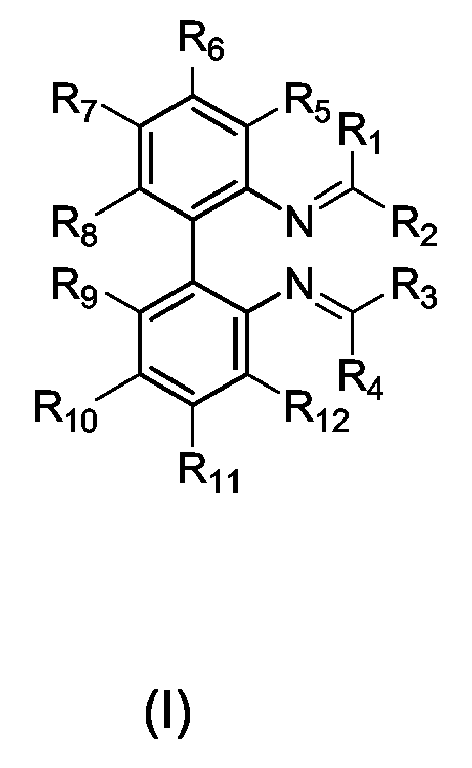
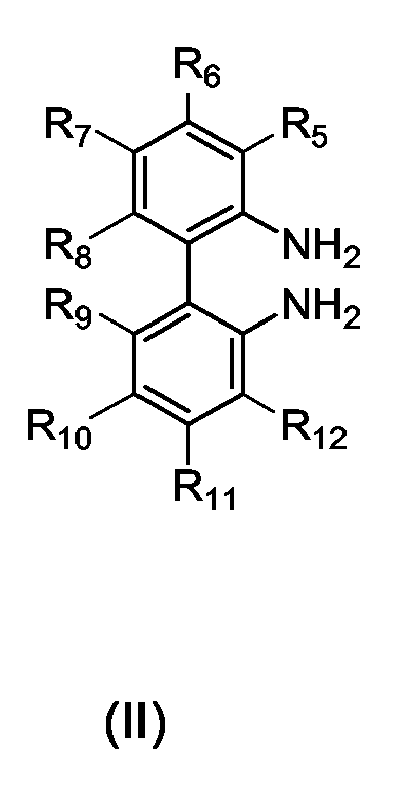
- the present invention discloses a ligand of general formula I resulting from the condensation reaction between diamine of formula (II) and a ketone or aldehyde of formula (III) wherein R 1 , R 2 , R 3 , R 4 , R 5 , R 6 , R 7 , R 8 , R 9 , R 10 , R 11 and R 12 are each independently selected from hydrogen, unsubstituted or substituted hydrocarbyl, or inert functional group. Two or more of those groups can themselves be linked together to form further ring or rings.
- R 5 , R 6 , R 7 , R 8 , R 9 , R 10 , R 11 and R 12 are each independently selected from hydrogen, unsubstituted or substituted alkyl groups, unsubstituted or substituted aryl groups, or unsubstituted or substituted cycloalkyl groups and if they are substituted, the substituents may be joined to form a closed structure.
- R 5 , R 6 , R 11 and R 12 are the same and they are hydrogen, and R 7 and R 8 together, as well as R 9 and R 10 together, are joined to form unsubstituted naphtyl groups.
- R 1 , R 2 , R 3 and R 4 are hydrogen, unsubstituted or substituted alkyl groups, unsubstituted or substituted aryl groups, or unsubstituted or substituted cycloalkyl groups, more preferably, they are unsubstituted or substituted phenyl groups and if they are substituted, the substituents may be joined to form a closed structure. If the phenyls are substituted, the substituents preferably occupy 2 and 6 positions.
- Some of the preferred substituents on the phenyl groups are one Cl in position 4 or two Cl respectively in positions 4 and 6, or two methyl groups respectively in positions 2 and 6, or three methyl groups respectively in positions 2, 4 and 6 or one methoxy group in position 4, or two methoxy groups respectively in positions 4 and 6, or two trifluoromethyl groups respectively in positions 2 and 5, or two nitro groups respectively in positions 2 and 6, or fluorenyl substituents.
- the most preferred substituted phenyl groups have two methyl groups respectively in positions 2 and 6, or three methyl groups respectively in positions 2, 4 and 6 or one methoxy group in position 4 or two methoxy groups respectively I, positions 4 and 6.
- the invention also discloses a catalyst component of formula IV that is the condensation reaction product of the ligand of formula I wherein R 1 , R 2 , R 3 , R 4 , R 5 , R 6 , R 7 , R 8 , R 9 , R 10 , R 11 and R 12 are as described hereabove, and a metallic salt of formula MX n in a solvent, wherein M is a metal Group 3 to 10 of the periodic Table, X is the same or different and can be an organic or inorganic monovalent ligand, preferably a halogen, alcoholate, carboxylate or substituted or unsubstituted hydrocarbyl and n is the valence of M and is 1, 2, 3 or 4.
- M is Ti, Zr, Hf, V, Cr, Mn, Fe, Co, Ni, Pd or rare earths. More preferably, it is Cr or Ni.
- the solvent may be selected from dichloromethane or tetrahydrofuran and the condensation reaction is carried out at room temperature or at reflux.
- the present invention also discloses an active catalyst system comprising the single site catalyst component of formula IV and an activating agent having an ionising action.
- the activating agent can be an aluminium alkyl represented by formula AIR + n X 3-n wherein R + is an alkyl having from 1 to 20 carbon atoms and X is a halogen.
- the preferred alkylating agents are triisobutyl aluminium (TIBAL) or triethyl aluminium (TEAL).
- it can be aluminoxane and comprise oligomeric linear and/or cyclic alkyl aluminoxanes represented by formula for oligomeric, linear aluminoxanes and by formula for oligomeric, cyclic aluminoxane, wherein n is 1-40, preferably 10-20, m is 3-40, preferably 3-20 and R* is a C 1 -C 8 alkyl group and preferably methyl.
- the amount of activating is selected to give an Al/M ratio of from 100 to 3000, preferably of about 2000.
- Suitable boron-containing activating agents may comprise a triphenylcarbenium boronate such as tetrakis-pentafluorophenyl-borato-triphenylcarbenium as described in EP-A-0427696 , or those of the general formula [L'-H] + [B Ar 1 Ar 2 X 3 X 4 ]- as described in EP-A-0277004 (page 6, line 30 to page 7, line 7).
- the amount of boron -containing activating agent is selected to give B/M ratio of from 0.5 to 5, preferably of about 1.
- the single site catalyst component of formula IV may be deposited on a conventional support.
- the conventional support is silica impregnated with MAO.
- it can be an activating support such as a fluorided alumina silica.
- the present invention further discloses a method for preparing an active catalyst system that comprises the steps of:
- the active catalyst system is used in the oligomerisation and in the polymerisation of ethylene and alpha-olefins.
- the present invention discloses a method for the oligomerisation or the homo- or copolymerisation of ethylene and alpha-olefins that comprises the steps of:
- the pressure in the reactor can vary from 0.5 to 50 bars, preferably from 5 to 25 bars.
- the polymerisation temperature can range from 10 to 100°C, preferably from 50 to 85°C.
- the monomer and optional comonomer are selected from ethylene, propylene or 1-hexene.
- the optional comonomer is a polar functionalised alpha-olefin.
- the aqueous phase was washed with 20 mL of toluene and neutralised by adding 10 mL of aqueous ammonia, followed by extraction with 3x40 mL of toluene at 70°C.
- the organic phase was washed with 40 mL of water, dried over MgSO 4 and concentrated. 3.29 g pink solid were obtained with a yield of 77%.
- Ligand L1 gave Ni complex 1 with a yield of 78 %.
- Ligand L2 gave Ni complex 2 with a yield of 78 %.
- Ligand L3 gave Ni complex 3 with a yield of 69 %.
- Ligand L4 gave Ni complex 4 with a yield of 72 %.
- Ligand L5 gave Ni complex 5 with a yield of 39 %.
- Ligand L6 gave Ni complex 6 with a yield of 62 %.
- Ligand L7 gave Ni complex 7 with a yield of 42 %.
- Ligand L8 gave Ni complex 8 with a yield of 77 %.
- Ligand L9 gave nickel complex 9 with a yield of 57 %.
- Ligand L10 gave nickel complex 10 with a yield of 51 %.
- Ligand L11 gave nickel complex 11 with a yield of 55 %.
- Ligand L12 gave nickel complex 12 with a yield of 9%.
- Ligand L13 gave nickel complex 13 with a yield of 43%.
- Ligand L14 gave nickel complex 14 with a yield of 60%.
- Ligand L15 gave nickel complex 15 with a yield of 82%.
- Ligand L16 gave nickel complex 16 with a yield of 80%.
- Ligand L17 gave nickel complex 17 with a yield of 69%.
- Ligand L18 gave nickel complex 18 with a yield of 99%.
- Ligand L19 gave nickel complex 19 with a yield of 74%.
- Ligand L20 gave nickel complex 20 with a yield of 91%.
- Ligand L21 gave nickel complex 21 with a yield of 77%.
- Ligand L22 gave nickel complex 22 with a yield of 71%.
- Ligand L23 gave nickel complex 23 with a yield of 87%.
- Ligand L24 gave nickel complex 24 with a yield of 76%.
- Ligand L25 gave nickel complex 25 with a yield of 86%.
- Ligand L26 gave nickel complex 26 with a yield of 61 %.
- Ethylene oligomerisation reactions were performed in a 20 mL stainless steel autoclave containing a glass insert, fitted with mechanical stirring, external thermocouple and pressure gauge and controlled by computer.
- 4 mL of dry solvent toluene or n-heptane
- 4 mg (5 ⁇ mol) of the appropriate catalyst were weighted, activated with methylaluminoxane (MAO) activator (30 % wt in toluene) in an amount appropriate to obtain a ratio [Al]:[Ni] of 2000 and diluted with toluene to obtain a final volume of 2 mL.
- MAO methylaluminoxane
- reaction mixture was quenched with MeOH / HCl and the polymer was filtered, washed with methanol and dried for a period of time of 24 hours under vacuum at a temperature of 50°C.
- the reaction conditions are displayed in Table I and the polymerisation and oligomerisation results are displayed in Table II, III and IV. TABLE I.
- the toluene layer was concentrated to dryness to provide oligomers.
- the gas chromatographic analysis of the reaction products was done on a Trace GC apparatus with a Petrocol capillary column (methyl silicone, 100 m long, i.d. 0.25 mm and film thickness of 0.5 ⁇ m) working at a temperature of 100°C for 4 min and then heating at a rate of 8°C per minute to a temperature of 250°C.
- the oligomerisation conditions and results are displayed in Table V. TABLE V.
Landscapes
- Chemical & Material Sciences (AREA)
- Organic Chemistry (AREA)
- Chemical Kinetics & Catalysis (AREA)
- Health & Medical Sciences (AREA)
- Medicinal Chemistry (AREA)
- Polymers & Plastics (AREA)
- Transition And Organic Metals Composition Catalysts For Addition Polymerization (AREA)
- Organic Low-Molecular-Weight Compounds And Preparation Thereof (AREA)
Abstract
The present invention discloses the use of aromatic diamine ligands to prepare catalyst systems suitable for the oligomerisation or polymerisation of ethylene and alpha-olefins.
Description
- The present invention relates to the field of single site catalyst systems based on diimine ligands and suitable for oligomerising or polymerising ethylene and alpha-olefins.
- There exists a multitude of catalyst systems available for polymerising or oligomerising ethylene and alpha-olefins, but there is a growing need for finding new systems capable to tailor polymers with very specific properties. More and more post-metallocene catalyst components based on early or late transition metals from Groups 3 to 10 of the Periodic Table have recently been investigated such as for example those disclosed in Gibson and al. review (Gibson, V.C.; Spitzmesser, S.K., Chem. Rev. 2003, 103, p. 283). But there is still a need to improve either the specificities or the performances of these systems.
- It is an aim of the present invention to provide a new catalyst components based on aromatic diimine ligands.
- It is another aim of the present invention to provide active catalyst systems based on these catalyst components.
- It is a further aim of the present invention to provide a process for polymerising or for oligomerising ethylene and alpha-olefins with these new catalyst systems.
- Accordingly, the present invention discloses a ligand of general formula I


- Preferably, R5, R6, R7, R8, R9, R10, R11 and R12 are each independently selected from hydrogen, unsubstituted or substituted alkyl groups, unsubstituted or substituted aryl groups, or unsubstituted or substituted cycloalkyl groups and if they are substituted, the substituents may be joined to form a closed structure. Most preferably, R5, R6, R11 and R12 are the same and they are hydrogen, and R7 and R8 together, as well as R9 and R10 together, are joined to form unsubstituted naphtyl groups.
- Preferably R1, R2, R3 and R4 are hydrogen, unsubstituted or substituted alkyl groups, unsubstituted or substituted aryl groups, or unsubstituted or substituted cycloalkyl groups, more preferably, they are unsubstituted or substituted phenyl groups and if they are substituted, the substituents may be joined to form a closed structure. If the phenyls are substituted, the substituents preferably occupy 2 and 6 positions. Some of the preferred substituents on the phenyl groups, according to the present invention, are one Cl in position 4 or two Cl respectively in positions 4 and 6, or two methyl groups respectively in positions 2 and 6, or three methyl groups respectively in positions 2, 4 and 6 or one methoxy group in position 4, or two methoxy groups respectively in positions 4 and 6, or two trifluoromethyl groups respectively in positions 2 and 5, or two nitro groups respectively in positions 2 and 6, or fluorenyl substituents. The most preferred substituted phenyl groups have two methyl groups respectively in positions 2 and 6, or three methyl groups respectively in positions 2, 4 and 6 or one methoxy group in position 4 or two methoxy groups respectively I, positions 4 and 6.
- The invention also discloses a catalyst component of formula IV


- Preferably, M is Ti, Zr, Hf, V, Cr, Mn, Fe, Co, Ni, Pd or rare earths. More preferably, it is Cr or Ni.
- The solvent may be selected from dichloromethane or tetrahydrofuran and the condensation reaction is carried out at room temperature or at reflux.
- The present invention also discloses an active catalyst system comprising the single site catalyst component of formula IV and an activating agent having an ionising action.
- Suitable activating agents are well known in the art. The activating agent can be an aluminium alkyl represented by formula AIR+ nX3-n wherein R+ is an alkyl having from 1 to 20 carbon atoms and X is a halogen. The preferred alkylating agents are triisobutyl aluminium (TIBAL) or triethyl aluminium (TEAL).
- Alternatively, it can be aluminoxane and comprise oligomeric linear and/or cyclic alkyl aluminoxanes represented by formula


wherein n is 1-40, preferably 10-20, m is 3-40, preferably 3-20 and R* is a C1-C8 alkyl group and preferably methyl. - The amount of activating is selected to give an Al/M ratio of from 100 to 3000, preferably of about 2000.
- Suitable boron-containing activating agents may comprise a triphenylcarbenium boronate such as tetrakis-pentafluorophenyl-borato-triphenylcarbenium as described in
EP-A-0427696 , or those of the general formula [L'-H] + [B Ar1 Ar2 X3 X4]- as described inEP-A-0277004 (page 6, line 30 to page 7, line 7). The amount of boron -containing activating agent is selected to give B/M ratio of from 0.5 to 5, preferably of about 1. - In an other embodiment, according to the present invention, the single site catalyst component of formula IV may be deposited on a conventional support. Preferably, the conventional support is silica impregnated with MAO. Alternatively and preferably, it can be an activating support such as a fluorided alumina silica.
- The present invention further discloses a method for preparing an active catalyst system that comprises the steps of:
- a) providing a diamine ligand precursor of formula II;
- b) carrying out a condensation reaction of diamine ligand precursor II of step a) with a ketone or aldehyde of formula III;
- c) complexing the ligand obtained in step b) with a metallic salt;
- d) retrieving a catalyst component of formula IV;
- e) activating with an activating agent having an ionising action;
- f) retrieving an active oligomerisation or polymerisation catalyst system.
- The active catalyst system is used in the oligomerisation and in the polymerisation of ethylene and alpha-olefins.
- The present invention discloses a method for the oligomerisation or the homo- or copolymerisation of ethylene and alpha-olefins that comprises the steps of:
- a) injecting the active catalyst system into the reactor;
- b) injecting the monomer and optional comonomer;
- c) maintaining under polymerisation conditions;
- d) retrieving the oligomer and/or polymer.
- The pressure in the reactor can vary from 0.5 to 50 bars, preferably from 5 to 25 bars.
- The polymerisation temperature can range from 10 to 100°C, preferably from 50 to 85°C.
- Preferably the monomer and optional comonomer are selected from ethylene, propylene or 1-hexene.
- In another preferred embodiment according to the present invention, the optional comonomer is a polar functionalised alpha-olefin.
-

- In a sealed reactor, 4.32 g (30 mmol, 1 eq) of 2-naphthol, 2.85 g (30 mmol, 1eq) of (NH4)2SO3 and 50 mL of aqueous ammonia were mixed. The mixture was heated to 150°C, the pressure was raised to 10 bars and the mixture wais stirred overnight. The mixture was then cooled down to room temperature.
The brown solid was filtered, washed with water, and dissolved in a mixture of 30 mL of EtOH, 20 mL of H2O and 7 mL of HCl 37% at a temperature of 70°C. The solution was treated with 1,5 g of charcoal at 70°C during one hour and then filtered. The aqueous phase was washed with 20 mL of toluene and neutralised by adding 10 mL of aqueous ammonia, followed by extraction with 3x40 mL of toluene at 70°C. The organic phase was washed with 40 mL of water, dried over MgSO4 and concentrated. 3.29 g pink solid were obtained with a yield of 77%. - 1H-RMN (500 MHz, CDCl3) results : δ= 3.87 (br s, 2H), 6.98 (dd, 1 H), 7.02 (d, 1 H), 7.25 (t, 1 H), 7.39 (t, 1 H), 7.62 (d, 1 H), 7.69 (d, 1 H), 7.72 (d, 1 H).
13C-RMN (125 MHz, CDCl3) results: δ= 109.0, 118.6, 122.8, 126.2, 126.7, 128.1, 128.3, 129.6, 135.31, 144.5 -

- 0,286 g (2 mmol, 1eq) of 2-naphthylamine and 0,402 g (3 mmol, 1.5eq) of copper chloride were dissolved in 10 mL of methanol. The reaction mixture was stirred at room temperature for 2 days.
The resulting solid was filtered off and washed with methanol, and then dissolved in 10mL of water. The solution was warmed to reflux to yield a white solid. Upon addition of a few drops of ammonia, the solution turned blue and a white precipitate appeared. The reaction mixture was cooled down to room temperature and stirring was stopped. The solid was filtered off, dissolved in dichloromethane and dried over MgSO4 and then concentrated to dryness.
0.183 g of pink solid were obtained with a yield of 64 %. - 1H-RMN (300 MHz, CDCl3) results: δ= 3.51 (br s, 4H), 7.08-7.27 (m, 8H), 7.80-7.85 (m, 4H).
13C-RMN (125 MHz, CDCl3) results: δ=111.3, 119.4, 121.9, 124.0, 126.9, 128.1, 128.9, 129.4 , 134.4, 144.9. - 1 mmol of bisnaphthyldiamine and 2 mmol of the desired aldehyde were dissolved in toluene. After addition of a 4 angström molecular sieves, the reaction mixture was stirred at a temperature of 110°C for a period of time of 2 days. Molecular sieves were filtered off and the solvent was removed in vacuum. The resulting solid was crystallised from MeOH to give a yellow solid. Depending upon the nature of the aldehyde utilised, various compounds were obtained and characterised by NMR.
- Bis-naphthyldi(benzaldimine) (L2)

1H-RMN (500 MHz, CD2Cl2) results: δ= 7.29-7.47 (m, 18H), 7.97 (d, 2H), 8.03 (d, 2H), 8.29 (s, 2H)
13C-RMN (125 MHz, CD2Cl2) results: δ=119.5, 126.7, 126.8, 127.5, 127.6, 128.4, 128.7 , 128.8, 129.5, 131.4, 132.0, 133.8, 136.7, 149.3, 161.1. - Bis-naphthyldi(2,6-dimethylbenzaldimine) (L3).

1H-RMN (500 MHz, CD2Cl2) results: δ= 1.98 (s, 12H), 6.90 (d, 4H), 7.06 (t, 2H), 7.31-7.44 (m, 8H), 7.96 (d, 2H), 8.05 (d, 2H), 8.79 (s, 2H).
13C-RMN (125 MHz, CD2Cl2) results: δ=20.6, 119.7, 125.2, 126.4, 126.8, 126.9, 128.4, 128.9, 129.4, 129.7, 132.2, 133.6, 133.9, 138.8, 149.7, 161.3. - Bis-naphthyldi(2, 4, 6-trimethylbenzaldimine) (L4).

1H-RMN (500 MHz, CD2Cl2) results: δ= 1.95 (s, 12H), 2.21 (s, 6H), 6.72 (s, 4H), 7.29-7.41 (m, 8H), 7.94 (d, 2H), 8.01 (d, 2H), 8.75 (s, 2H).
13C-RMN (125 MHz, CD2Cl2) results: δ=20.7, 21.2, 119.7, 125.0, 126.4, 126.7, 126.9, 128.2, 129.2, 129.8, 130.6, 132.1, 133.9, 138.7, 139.9, 149.9, 161.0. - Bis-naphthyldi(2, 4-dimethoxybenzaldimine) (L5).

1H-RMN (500 MHz, CD2Cl2) results: δ= 3.67 (s, 6H), 3.80 (s, 6H), 6.36 (d, 4H), 7.25-7.50 (m, 11 H), 7.93 (d, 2H), 7.99 (d, 2H), 8.59 (s, 2H)
13C-RMN (125 MHz, CD2Cl2) results: δ=55.7, 97.9, 105.7, 118.6, 120.3, 124.7, 126.4, 126.6, 126.8, 128.3, 128.7, 129.1, 131.7, 133.9, 150.3, 156.6, 161.1, 163.8. - Bis-naphthyldi(4-methoxybenzaldimine) (L6).

1H-RMN (500 MHz, CD2Cl2) results: δ= 3.82 (s, 6H), 6.84 (d, 4H), 7.26-7.43 (m, 12H), 7.95 (d, 2H), 8.01 (d, 2H), 8.18 (s, 2H).
13C-RMN (125 MHz, CD2Cl2) results: δ=55.7, 114.2, 119.7, 124.9, 126.4, 126.4, 126.7, 128.3, 129.3, 129.7, 130.3, 131.8, 133.8, 149.6, 160.4, 162.4. - Bis-naphthyldi(4-chlorobenzaldimine) (L7).

1H-RMN (500 MHz, CD2Cl2) results: δ= 7.28-7.45 (m, 16H), 7.93 (d, 2H), 7.98 (d, 2H), 8.19 (s, 2H)
13C-RMN (125 MHz, CD2Cl2) results: δ= 119.2, 125.3, 126.8, 126.9, 127.1, 128.4, 129.2, 129.7, 129.8, 129.9, 132.2, 133.7, 135.2, 137.3, 148.8, 159.6 - Bis-naphthyldi(2, 4-dichlorobenzaldimine) (L8).

1H-RMN (300 MHz, CD2Cl2) results: δ= 7.07 (d, 2H), 7.24-7.30 (m, 6H), 7.37 (d, 2H), 7.39 (t, 2H), 7.49 (d, 2H) 7.92 (d, 2H), 7.98 (d, 2H), 8.61 (s, 2H).
13C-RMN (75 MHz, CD2Cl2) results: δ= 120.8, 127.0, 128.4, 128.6, 129.4, 129.9, 130.1, 131.2, 131.3, 133.7, 133.8, 135.3, 138.1, 139.1, 150.0, 157.9. - Bis-naphthyldi(9-anthracenylaldimine) (L9)

1H-RMN (300 MHz, CD2Cl2) results: δ= 7.08 (t, 4H), 7.36 (m, 6H), 7.47 (m, 4H), 7.70 (d, 2H), 7.88 (d, 4H), 8.06 (m, 6H), 8.20 (d, 2H), 8.38 (s, 2H), 9.60 (s, 2H)
13C-RMN (75 MHz, CD2Cl2) results: δ= 120.2, 125.1, 125.7, 125.8, 126.8, 127.3, 127.5, 128.7, 129.2, 130.1, 130.8, 130.9, 131.6, 132.7, 149.8, 161.1 - Bis-naphthyldi(9-phenanthrylaldimine) (L10)

1H-RMN (300 MHz, CD2Cl2) results: δ= 7.0 (t, 2H), 7.36 (t, 2H), 7.45-7.69 (m, 12H), 7.7-7.8 (4H, m), 8.0 (d, 2H), 8.1 (d, 2H), 8.3 (d, 2H), 8.57 (d, 4H), 8.87 (s, 2H)
13C-RMN (75 MHz, CD2Cl2) results: δ= 118.9, 123.0, 123.1, 125.7, 126.7, 127.2, 127.4, 127.5, 127.9, 128.7, 128.9, 130.0, 131.0, 131.3, 132.7, 134.3, 134.4, 149.1, 149.8, 161.5 - Bis-naphthyldi(2,5-trifluoromethylbenzaldimine) (L11)

1H-RMN (300 MHz, CD2Cl2) results: δ= 7.31 (m, 4H), 7.43 (m, 4H), 7.5-7.76 (m, 6H), 7.94 (d, 2H), 8.03 (d, 2H), 8.69 (m, 2H)
13C-RMN (125 MHz, CD2Cl2) results: δ= 118.3, 122.3, 122.6, 125.7, 125.9, 126.8, 126.9, 127.1, 127.3, 128.1, 128.5, 129.9, 132.8, 133.8, 134.3, 135.6, 146.9, 154.5. - Bis-naphthyldi(2,6-nitrobenzaldimine) (L12)

1H-RMN (300 MHz, CD2Cl2) results: δ= 7.08 (d, 2H), 7.2 (t, 2H), 7.39-7.56 (m, 6H), 7.90-8.05 (m, 8H), 8.87 (s, 2H)
13C-RMN (125 MHz, CD2Cl2) results: δ= 98.2, 119.9, 127.3, 128.0, 128.2, 129.6, 129.9, 131.2, 131.6, 132.2, 134.4, 134.9, 148.4, 155.4 - 1 mmol of bisnaphthyldiamine and 2 mmol of ketone were dissolved in 10 nmL of anhydrous toluene. After addition of activated 4 angström molecular sieves by 10 g portions, the reaction mixture was stirred at a temperature of 110°C for a period of time of 2 days. Molecular sieves were filtered off and the solvent was removed in vacuum. The resulting solid was crystallised from MeOH to give the resulting solid. Several compounds were obtained and characterised.
- Bis-naphthyldi(9-fluorenylimine) (L13)

1H-RMN (300 MHz, CD2Cl2) results: δ= 6.0 (m, 4H), 6.41 (d, 4H), 6.73 (t, 8H), 7.0-7.50 (m, 24H), 7.85 (d, 4H), 7.94 (d, 4H).
13C-RMN (75 MHz, CD2Cl2) results: δ= 163.3, 149.0, 143.4, 142.2, 138.2, 133.6, 131.9, 131.6, 131.5, 129.5, 129.1, 128.7, 128.5, 128.1, 127.5, 127.2, 126.9, 126.4, 125.8, 125.2, 124.4, 123.4, 120.9, 119.8, 119.7 - Bis-naphthyldi(phenylmethyleneimine) (L1)
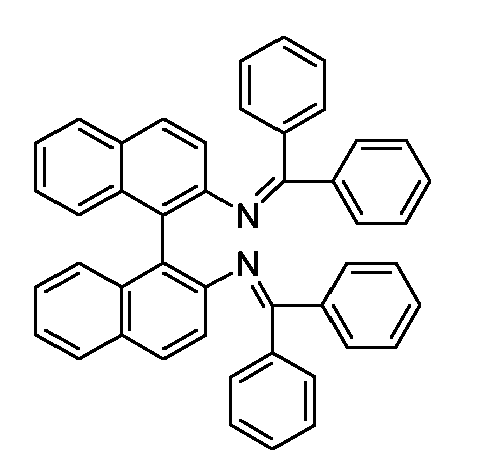
1H-RMN (300 MHz, CD2Cl2) results: δ= 6.64 (d, 2H), 6.74-6-78 (m, 8H), 6.93-6.97 (m, 4H), 7.05 (t, 2H), 7.19-7.48 (m, 6H), 7.50 (t, 2H), 7.68 (d, 6H), 7.77 (d, 2H)
13C-RMN (75 MHz, CD2Cl2) results: δ=122.2, 124.1, 124.2, 126.1, 126.5, 127.8, 127.9, 128.0, 128.2, 128.3, 128.9, 130.0, 130.2, 130.6, 130.7, 133.9, 136.6, 140.8, 147.6, 167.2 - Bis-naphthyldi(4-chlorophenylmethyleneimine) (L14)

1H-RMN (300 MHz, CD2Cl2) results: δ= 6.19 (d, 2H), 6.40 (d, 4H), 6.64 (d, 4H), 6.79 (t, 2H), 7.18 (t, 2H), 7.27 (d, 4H), 7.49 (d, 2H), 7.65-7.75 (m, 8H). - Bis-naphthyl(methyl-(2-naphthyl)methylenimine) (L15)

1H-RMN (300 MHz, CD2Cl2) results: δ= 2.27 (s, 6H), 7.06 (d, 2H), 7.28-7.46 (m, 12H), 7.58-7.65 (m, 4H), 7.75 (m, 4H), 7.87 (m, 4H)
13C-RMN (75 MHz, CD2Cl2) results: δ= 165.0, 148.1, 137.7, 134.6, 134.0, 133.301, 131.3, 129.2, 128.8, 128.5, 128.0, 128.0, 127.8, 127.5, 126.7, 126.6, 126.5, 124.7, 124.6, 123.7, 121.0 - Bis-naphthyldi(adamtylmethylenimine) (L16)

1H-RMN (300 MHz, CD2Cl2) results: δ= 0.99 (2H, m), 1.17-1.97 (22H, m), 2.26-2.68 (4H, m), 6.90-6.99 (2H, m), 7.13 (4H, m), 7.28 (2H, m), 7.77-7.82 (4H, m)
13C-RMN (75 MHz, CD2Cl2) results: δ= 28,25, 28.48, 36.89, 37.02, 39.78, 40.1, 43.19, 121.68, 124.10, 126.15, 126.46, 128.33, 128.39, 129.33, 130.91, 134.41, 147.56, 180.42. - 1 mmol of dialdimine or diketimine ligand was dissolved in 10 mL of dichloromethane, and 1 mmol of dibromide dimethoxyethane nickel (Ni(DME)Br2) complex was added to the mixture. After stirring overnight at room temperature, the mixture was filtered through a celite pad. The solution was concentrated and pentane was added to give a precipitate. Solvents were filtered off and the solid was washed twice with pentane. The resulting solid was dried under vacuum, to afford a powder of the nickel complex.
- Ligand L1 gave Ni complex 1 with a yield of 78 %.
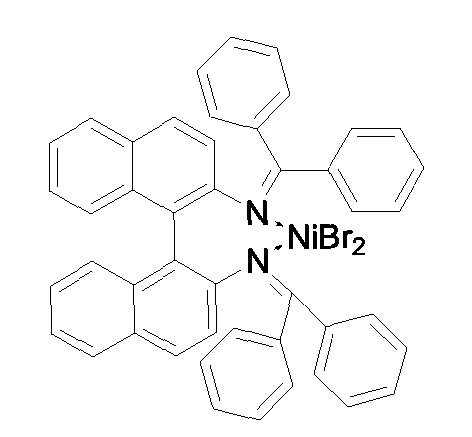
- Ligand L2 gave Ni complex 2 with a yield of 78 %.

- Ligand L3 gave Ni complex 3 with a yield of 69 %.

- Ligand L4 gave Ni complex 4 with a yield of 72 %.

- Ligand L5 gave Ni complex 5 with a yield of 39 %.

- Ligand L6 gave Ni complex 6 with a yield of 62 %.

- Ligand L7 gave Ni complex 7 with a yield of 42 %.

- Ligand L8 gave Ni complex 8 with a yield of 77 %.

- Ligand L9 gave nickel complex 9 with a yield of 57 %.

- Ligand L10 gave nickel complex 10 with a yield of 51 %.

- Ligand L11 gave nickel complex 11 with a yield of 55 %.

- Ligand L12 gave nickel complex 12 with a yield of 9%.

- Ligand L13 gave nickel complex 13 with a yield of 43%.

- Ligand L14 gave nickel complex 14 with a yield of 60%.

- Ligand L15 gave nickel complex 15 with a yield of 82%.

- Ligand L16 gave nickel complex 16 with a yield of 80%.

- Ligand L17 gave nickel complex 17 with a yield of 69%.

- Ligand L18 gave nickel complex 18 with a yield of 99%.

- Ligand L19 gave nickel complex 19 with a yield of 74%.

- Ligand L20 gave nickel complex 20 with a yield of 91%.

- Ligand L21 gave nickel complex 21 with a yield of 77%.
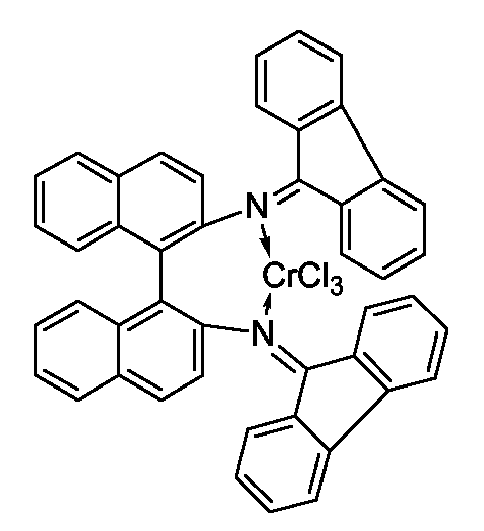
- Ligand L22 gave nickel complex 22 with a yield of 71%.

- Ligand L23 gave nickel complex 23 with a yield of 87%.
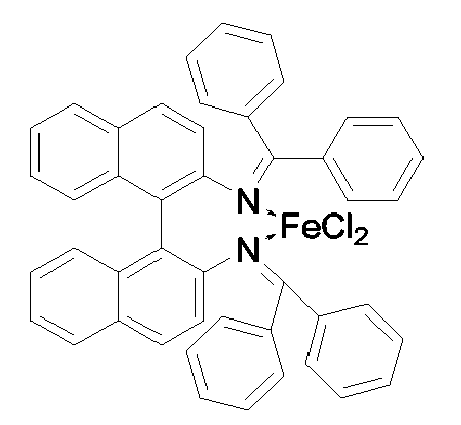
- Ligand L24 gave nickel complex 24 with a yield of 76%.

- Ligand L25 gave nickel complex 25 with a yield of 86%.

- Ligand L26 gave nickel complex 26 with a yield of 61 %.

- Ethylene oligomerisation reactions were performed in a 20 mL stainless steel autoclave containing a glass insert, fitted with mechanical stirring, external thermocouple and pressure gauge and controlled by computer. In a typical reaction run, 4 mL of dry solvent (toluene or n-heptane) were introduced into the reactor. In a argon-filled glove box, about 4 mg (5 µmol) of the appropriate catalyst were weighted, activated with methylaluminoxane (MAO) activator (30 % wt in toluene) in an amount appropriate to obtain a ratio [Al]:[Ni] of 2000 and diluted with toluene to obtain a final volume of 2 mL. 200µL of the solution of activated catalyst were placed inside the reactor. The injection loop was rinsed with 800 µL of solvent. The temperature was set to 50°C. The ethylene pressure was raised to 15 bar and continuously fed. After 1 h or an ethylene consumption of 12 mmol, the reaction was quenched with isopropanol and the solution analysed by gas chromatography. The gas chromatographic (GC) analysis of the reaction products was performed on a Trace GC apparatus with a Petrocol capillary column (methyl silicone, 100 m long, i.d. 0.25 mm and film thickness of 0.5 µm) working at a temperature of 35°C for 15 min and then heating at a rate of 5° per minute up to a temperature of 250°C. The remaining reaction mixture was quenched with MeOH / HCl and the polymer was filtered, washed with methanol and dried for a period of time of 24 hours under vacuum at a temperature of 50°C. The reaction conditions are displayed in Table I and the polymerisation and oligomerisation results are displayed in Table II, III and IV.
TABLE I. Run Ni complex Amt cata nmol Time min Solvent 1 1 510 54 toluene 2 2 498 43 toluene 3 3 531 41 toluene 4 4 526 38 toluene 7 5 526 37 toluene 6 6 501 43 toluene 5 8 490 60 toluene 8 9 512 39 toluene 9 10 512 46 toluene 10 11 505 60 toluene 11 13 532 60 toluene 12 1 529 60 n-heptane 13 2 515 60 n-heptane 14 3 463 60 n-heptane 15 4 511 60 n-heptane 16 5 469 61 n-heptane 17 6 541 60 n-heptane 18 8 490 60 n-heptane 19 9 500 60 n-heptane 20 10 505 60 n-heptane 21 11 505 60 n-heptane 22 13 496 60 n-heptane 23 17 542 60 toluene 24 18 485 60 toluene 25 17 508 60 n-heptane 26 18 485 60 n-heptane 27 19 501 29 toluene 28 20 493 34 toluene 29 19 501 60 n-heptane 30 20 493 60 n-heptane TABLE II: Oligomerisation results with Ni(II) Complexes Run Activity Kg/molNi/h % C4 % C6 %> C6 Total % α-C4 Total % α-C6 1 736 85 73 13 21 2 2 950 82 59 15 18 3 3 936 80 56 17 17 3 4 1012 78 53 18 16 4 5 1038 78 54 19 16 3 6 947 80 56 18 18 3 7 656 82 60 166 18 2 8 1022 78 51 19 17 3 9 848 79 54 18 18 3 10 523 84 64 14 21 2 11 318 89 77 10 25 1 12 138 86 81 10 25 4 13 167 86 81 10 26 4 14 150 88 82 10 27 2 15 194 85 78 11 23 4 16 158 85 80 11 25 4 17 136 85 84 10 33 5 18 93 88 83 10 28 2 19 139 87 81 10 25 3 20 167 87 79 10 25 3 21 92 90 85 9 28 1 22 76 traces - - - - - In all reactions, 0.5 µmol of catalyst were dissolved in 5 mL of solvent.
- The percentages of C4, C6 and >C6 were calculated by GC analysis as well as the percentages of α-C2n in C2n.
TABLE III: Oligomerisation results with Co(II) Complexes Run Activity Kg/molCo/h % C4 % C6 %> C6 Total % α-C4 Total % α-C6 23 28 traces traces traces traces traces 24 33 traces traces traces traces traces 25 27 traces traces traces traces traces 26 25 traces traces traces traces traces - The percentages of C4, C6 and >C6 were calculated by GC analysis as well as the percentages of α-C2n in C2n.
TABLE IV: Polymerisation results with Cr(II) Complexes Run Activity* Kg/molCr/h PE mg % C4 % C6 %> C6 Total % α-C4 Total % α-C6 27 1364 13 17 >99.5 26 96 58 28 1189 9 19 >99.5 27 96 55 29 120 64 9 >99.5 18 79 73 30 12 51 10 >99.5 18 84 72 * Activity is expressed as kg ethylene consumed per mol Cr per hour - The percentages of C4, C6 and >C6 were calculated by GC analysis as well as the percentages of α-C2n in C2n.
- In a argon-filled glove box, 6 mg (-7.5 µmol) of the appropriate catalyst were weighted, activated with methylaluminoxane (MAO) activator (30 % wt in toluene) in an amount appropriate to obtain a ratio [Al]:[Ni] of 2000 and diluted with toluene to obtain a final volume of 4.5 mL. 3 mL of the solution of the activated catalyst were placed in a Schlenk tube containing 5 mL of 1-hexene (5 mL). The solution was stirred at a temperature of 30°C for a period of time of 1 h. The mixture was quenched with methanol and slightly acidified water. The layers were separated. The toluene layer was concentrated to dryness to provide oligomers. The gas chromatographic analysis of the reaction products was done on a Trace GC apparatus with a Petrocol capillary column (methyl silicone, 100 m long, i.d. 0.25 mm and film thickness of 0.5 µm) working at a temperature of 100°C for 4 min and then heating at a rate of 8°C per minute to a temperature of 250°C. The oligomerisation conditions and results are displayed in Table V.
TABLE V. Ni complex Amt cata µmol Time min Yield mg Activity Kg/molNi/h %C12 %C18 %C24 1 5.0 60 46 9 63 36 1 2 5.1 60 142 28 77 23 0 4 5.0 60 177 35 85 15 0 5 5.1 60 45 9 67 33 0
Claims (15)
- A ligand of general formula I


- The ligand of claim 1 wherein R5, R6, R7, R8, R9, R10, R11 and R12 are each independently selected from hydrogen, unsubstituted or substituted alkyl groups, unsubstituted or substituted aryl groups or unsubstituted or substituted cyclalkyl groups.
- The ligand of claim 2 wherein R7 and R8, and R9 and R10 form naphtyl groups.
- The ligand of any one of claims 1 to 3 wherein R1, R2, R3 and R4 are unsubstituted or substituted alkyl groups, unsubstituted or substituted aryl groups or unsubstituted or substituted cyclalkyl groups.
- The ligand of claim 4 wherein R1, R2, R3 and R4 are unsubstituted or substituted phenyl groups.
- The ligand of claim 5 wherein R1, R2, R3 and R4 are phenyl groups substituted by two methyl groups respectively in positions 2 and 6, or by three methyl groups respectively in positipons 2, 4 and 6, or by one methoxy group in position 4 or by two methoxy groups respectively in positions 4 and 6.
- A method for preparing a catalyst component of formula IV

- The method of claim 7 wherein M is Ti, Zr, Hf, V, Cr, Mn, Fe, Co, Ni or Pd.
- The method of claim 8 wherein M is Cr or Ni.
- A catalyst component obtainable by the method of any one of claims 7 to 9.
- An active catalyst system comprising the catalyst component of claim 10 and an activating agent having an ionising action.
- An active catalyst system comprising the catalyst component of claim 10 and an activating support.
- A method for oligomerising or homo- or co-polymerising ethylene and alpha-olefins that comprises the steps of:a) injecting the active catalyst system of claim 11 or claim 12 into the reactor;b) injecting the monomer and optional comonomer;c) maintaining under polymerisation conditions;d) retrieving an oligomer or a polymer.
- The method of claim 13 wherein the monomer and optional comonomer are selected from ethylene, propylene or 1-hexene.
- The method of claim 13 or claim 14 wherein the optional comonomer is a polar functionalised alpha-olefin.
Priority Applications (4)
| Application Number | Priority Date | Filing Date | Title |
|---|---|---|---|
| EP05106165A EP1741728A1 (en) | 2005-07-07 | 2005-07-07 | Catalyst systems based on aromatic diimine ligands. |
| US11/994,960 US7842829B2 (en) | 2005-07-07 | 2006-07-06 | Catalyst systems based on aromatic diimine ligands |
| EP06777632A EP1899388B1 (en) | 2005-07-07 | 2006-07-06 | Catalyst systems based on aromatic diimine ligands |
| PCT/EP2006/063990 WO2007006737A1 (en) | 2005-07-07 | 2006-07-06 | Catalyst systems based on aromatic diamine ligands |
Applications Claiming Priority (1)
| Application Number | Priority Date | Filing Date | Title |
|---|---|---|---|
| EP05106165A EP1741728A1 (en) | 2005-07-07 | 2005-07-07 | Catalyst systems based on aromatic diimine ligands. |
Publications (1)
| Publication Number | Publication Date |
|---|---|
| EP1741728A1 true EP1741728A1 (en) | 2007-01-10 |
Family
ID=35445949
Family Applications (2)
| Application Number | Title | Priority Date | Filing Date |
|---|---|---|---|
| EP05106165A Withdrawn EP1741728A1 (en) | 2005-07-07 | 2005-07-07 | Catalyst systems based on aromatic diimine ligands. |
| EP06777632A Not-in-force EP1899388B1 (en) | 2005-07-07 | 2006-07-06 | Catalyst systems based on aromatic diimine ligands |
Family Applications After (1)
| Application Number | Title | Priority Date | Filing Date |
|---|---|---|---|
| EP06777632A Not-in-force EP1899388B1 (en) | 2005-07-07 | 2006-07-06 | Catalyst systems based on aromatic diimine ligands |
Country Status (3)
| Country | Link |
|---|---|
| US (1) | US7842829B2 (en) |
| EP (2) | EP1741728A1 (en) |
| WO (1) | WO2007006737A1 (en) |
Cited By (1)
| Publication number | Priority date | Publication date | Assignee | Title |
|---|---|---|---|---|
| CN109956979A (en) * | 2017-12-25 | 2019-07-02 | 杭州星庐科技有限公司 | Heat-resistant asymmetric α-diimine nickel olefin catalyst and preparation method and application thereof |
Families Citing this family (3)
| Publication number | Priority date | Publication date | Assignee | Title |
|---|---|---|---|---|
| EP1982975A1 (en) * | 2007-04-17 | 2008-10-22 | Total Petrochemicals Research Feluy | Polymerisation of ethylene and alpha-olefins with catalyst systems based on binam derived ligands |
| US8664461B2 (en) | 2012-03-19 | 2014-03-04 | Exxonmobil Chemical Patents Inc. | Catalysts for producing polyalpha-olefins and processes related thereto |
| CN118754917B (en) * | 2024-09-09 | 2025-01-17 | 安徽中科科乐化工科技有限责任公司 | Alpha-diimine ligand compound, nickel complex, composite complex, preparation method and application thereof |
-
2005
- 2005-07-07 EP EP05106165A patent/EP1741728A1/en not_active Withdrawn
-
2006
- 2006-07-06 EP EP06777632A patent/EP1899388B1/en not_active Not-in-force
- 2006-07-06 US US11/994,960 patent/US7842829B2/en not_active Expired - Fee Related
- 2006-07-06 WO PCT/EP2006/063990 patent/WO2007006737A1/en not_active Ceased
Non-Patent Citations (5)
| Title |
|---|
| BENAGLIA M ET AL: "Enantioselective addition of phenyl and alkyl acetylenes to imines catalyzed by chiral Cu(I) complexes", TETRAHEDRON LETTERS, ELSEVIER, AMSTERDAM, NL, vol. 45, no. 47, 15 November 2004 (2004-11-15), pages 8705 - 8708, XP004610889, ISSN: 0040-4039 * |
| KETTUNEN, VEDDER, BRINTZINGER, MUTIKAINEN, LESKELÄ, REPO: "Alternative Coordination Modes in Palladium(II)-Diimino-Bispyridine Complexes with an Axially Chiral Biphenyl Backbone", EUROPEAN JOURNAL OF INORGANIC CHEMISTRY, 25 March 2005 (2005-03-25), Weinheim, pages 1081 - 1089, XP002359056 * |
| REETZ, MANFRED T. ET AL: "Chiral Diketimines as Ligands in Pd-Catalyzed Reactions: Prediction of Catalyst Activity by the AMS Model", JOURNAL OF THE AMERICAN CHEMICAL SOCIETY , 122(5), 996-997 CODEN: JACSAT; ISSN: 0002-7863, 2000, XP002359055 * |
| SUGA, KAKEHI, ITO, IBATA, FUDO,WATANABE, KINOSHITA: "Asymmetric Cyclopropanation and Aziridination Reactions of Olefins Catalyzed by Cu(I)-Binaphtyldiimine Complexes", BULL.CHEM. SOC. JPN, 1 January 2003 (2003-01-01), pages 189 - 199, XP002359058 * |
| VEDDER, SCHAPER, BRINTZINGER, KETTUNEN, BABIK, FINK: "Chiral Iron and Cobalt Complexes with Biphenyl-Bridged Bis(pyridylimine) Ligands - Syntheses, Structures and Reactivities", EUROPEAN JOURNAL OF INORGANIC CHEMISTRY, 25 March 2005 (2005-03-25), Weinheim, pages 1071 - 1080, XP002359057 * |
Cited By (2)
| Publication number | Priority date | Publication date | Assignee | Title |
|---|---|---|---|---|
| CN109956979A (en) * | 2017-12-25 | 2019-07-02 | 杭州星庐科技有限公司 | Heat-resistant asymmetric α-diimine nickel olefin catalyst and preparation method and application thereof |
| CN109956979B (en) * | 2017-12-25 | 2023-04-07 | 杭州星庐科技有限公司 | Heat-resistant asymmetric alpha-diimine nickel olefin catalyst and preparation method and application thereof |
Also Published As
| Publication number | Publication date |
|---|---|
| EP1899388A1 (en) | 2008-03-19 |
| US7842829B2 (en) | 2010-11-30 |
| WO2007006737A1 (en) | 2007-01-18 |
| US20090131615A1 (en) | 2009-05-21 |
| EP1899388B1 (en) | 2012-06-13 |
Similar Documents
| Publication | Publication Date | Title |
|---|---|---|
| US6063881A (en) | Oligomerization of propylene | |
| EP1994006B1 (en) | Polymerisation of ethylene and alpha-olefins with imino-quinolinol complexes | |
| EP1994040B1 (en) | Polymerisation of ethylene and alpha-olefins with phosphino-iminophenol complexes | |
| EP1899388B1 (en) | Catalyst systems based on aromatic diimine ligands | |
| CA2726532C (en) | Sterically encumbered bidentate and tridentate naphthoxy-imine metallic complexes | |
| EP1849791A1 (en) | Polymerisation of ethylene and alpha-olefins with pyridino-iminophenol complexes | |
| US8420756B2 (en) | Polymerisation of ethylene and alpha-olefins with catalyst systems based on binam derived ligands | |
| WO2001030865A1 (en) | Catalysts for olefin polymerizations | |
| EP2089399B1 (en) | Polymerisation of ethylene and alpha olefins with single site catalysts having an anionic scorpion-like ligand | |
| EP2167517B1 (en) | Catalysts systems based on carbonylamino fulvenes | |
| US7973115B2 (en) | Catalyst systems based on macrocyclic ligands | |
| EP1746112A1 (en) | Polymerisation catalyst system based on monooxime ligands | |
| EP2167518B1 (en) | Catalyst components based on fulvene complexes | |
| CN1332949C (en) | Olefine oligomerization catalyst, and its preparation method and use | |
| EP1754723A1 (en) | Single site catalyst systems having a scorpion-like structure | |
| US20100144515A1 (en) | Fluorinated dialkoxy-diimino catalyst components | |
| CN116673069A (en) | Ethylene selective trimerization catalyst system and process for the selective trimerization of ethylene | |
| EP1746111A1 (en) | Polymerisation catalyst system based on dioxime ligands |
Legal Events
| Date | Code | Title | Description |
|---|---|---|---|
| PUAI | Public reference made under article 153(3) epc to a published international application that has entered the european phase |
Free format text: ORIGINAL CODE: 0009012 |
|
| AK | Designated contracting states |
Kind code of ref document: A1 Designated state(s): AT BE BG CH CY CZ DE DK EE ES FI FR GB GR HU IE IS IT LI LT LU LV MC NL PL PT RO SE SI SK TR |
|
| AX | Request for extension of the european patent |
Extension state: AL BA HR MK YU |
|
| AKX | Designation fees paid | ||
| REG | Reference to a national code |
Ref country code: DE Ref legal event code: 8566 |
|
| STAA | Information on the status of an ep patent application or granted ep patent |
Free format text: STATUS: THE APPLICATION IS DEEMED TO BE WITHDRAWN |
|
| 18D | Application deemed to be withdrawn |
Effective date: 20070711 |