EP1740524B1 - Process for the production of cyclic diketones - Google Patents
Process for the production of cyclic diketones Download PDFInfo
- Publication number
- EP1740524B1 EP1740524B1 EP05738471A EP05738471A EP1740524B1 EP 1740524 B1 EP1740524 B1 EP 1740524B1 EP 05738471 A EP05738471 A EP 05738471A EP 05738471 A EP05738471 A EP 05738471A EP 1740524 B1 EP1740524 B1 EP 1740524B1
- Authority
- EP
- European Patent Office
- Prior art keywords
- alkyl
- alkoxy
- formula
- halogen
- substituted
- Prior art date
- Legal status (The legal status is an assumption and is not a legal conclusion. Google has not performed a legal analysis and makes no representation as to the accuracy of the status listed.)
- Expired - Lifetime
Links
- 0 C*(C*C(OC(*)=O)=C1)C1=O Chemical compound C*(C*C(OC(*)=O)=C1)C1=O 0.000 description 12
- HZSAZNPWHKCGKO-UHFFFAOYSA-N CC(C(N1C)=O)=CC1=O Chemical compound CC(C(N1C)=O)=CC1=O HZSAZNPWHKCGKO-UHFFFAOYSA-N 0.000 description 1
- CBWXCSTUNPQORP-UHFFFAOYSA-N CC(N(C)N1[RnH])=CC1=O Chemical compound CC(N(C)N1[RnH])=CC1=O CBWXCSTUNPQORP-UHFFFAOYSA-N 0.000 description 1
- GJMOQRFSCLJMJT-UHFFFAOYSA-N CC(ON1C)=CC1=O Chemical compound CC(ON1C)=CC1=O GJMOQRFSCLJMJT-UHFFFAOYSA-N 0.000 description 1
Classifications
-
- C—CHEMISTRY; METALLURGY
- C07—ORGANIC CHEMISTRY
- C07C—ACYCLIC OR CARBOCYCLIC COMPOUNDS
- C07C45/00—Preparation of compounds having >C = O groups bound only to carbon or hydrogen atoms; Preparation of chelates of such compounds
- C07C45/56—Preparation of compounds having >C = O groups bound only to carbon or hydrogen atoms; Preparation of chelates of such compounds from heterocyclic compounds
- C07C45/57—Preparation of compounds having >C = O groups bound only to carbon or hydrogen atoms; Preparation of chelates of such compounds from heterocyclic compounds with oxygen as the only heteroatom
- C07C45/60—Preparation of compounds having >C = O groups bound only to carbon or hydrogen atoms; Preparation of chelates of such compounds from heterocyclic compounds with oxygen as the only heteroatom in six-membered rings
-
- C—CHEMISTRY; METALLURGY
- C07—ORGANIC CHEMISTRY
- C07D—HETEROCYCLIC COMPOUNDS
- C07D213/00—Heterocyclic compounds containing six-membered rings, not condensed with other rings, with one nitrogen atom as the only ring hetero atom and three or more double bonds between ring members or between ring members and non-ring members
- C07D213/02—Heterocyclic compounds containing six-membered rings, not condensed with other rings, with one nitrogen atom as the only ring hetero atom and three or more double bonds between ring members or between ring members and non-ring members having three double bonds between ring members or between ring members and non-ring members
- C07D213/04—Heterocyclic compounds containing six-membered rings, not condensed with other rings, with one nitrogen atom as the only ring hetero atom and three or more double bonds between ring members or between ring members and non-ring members having three double bonds between ring members or between ring members and non-ring members having no bond between the ring nitrogen atom and a non-ring member or having only hydrogen or carbon atoms directly attached to the ring nitrogen atom
- C07D213/60—Heterocyclic compounds containing six-membered rings, not condensed with other rings, with one nitrogen atom as the only ring hetero atom and three or more double bonds between ring members or between ring members and non-ring members having three double bonds between ring members or between ring members and non-ring members having no bond between the ring nitrogen atom and a non-ring member or having only hydrogen or carbon atoms directly attached to the ring nitrogen atom with hetero atoms or with carbon atoms having three bonds to hetero atoms with at the most one bond to halogen, e.g. ester or nitrile radicals, directly attached to ring carbon atoms
- C07D213/78—Carbon atoms having three bonds to hetero atoms, with at the most one bond to halogen, e.g. ester or nitrile radicals
- C07D213/79—Acids; Esters
- C07D213/80—Acids; Esters in position 3
-
- C—CHEMISTRY; METALLURGY
- C07—ORGANIC CHEMISTRY
- C07C—ACYCLIC OR CARBOCYCLIC COMPOUNDS
- C07C17/00—Preparation of halogenated hydrocarbons
- C07C17/093—Preparation of halogenated hydrocarbons by replacement by halogens
- C07C17/10—Preparation of halogenated hydrocarbons by replacement by halogens of hydrogen atoms
-
- C—CHEMISTRY; METALLURGY
- C07—ORGANIC CHEMISTRY
- C07C—ACYCLIC OR CARBOCYCLIC COMPOUNDS
- C07C17/00—Preparation of halogenated hydrocarbons
- C07C17/23—Preparation of halogenated hydrocarbons by dehalogenation
-
- C—CHEMISTRY; METALLURGY
- C07—ORGANIC CHEMISTRY
- C07C—ACYCLIC OR CARBOCYCLIC COMPOUNDS
- C07C23/00—Compounds containing at least one halogen atom bound to a ring other than a six-membered aromatic ring
- C07C23/18—Polycyclic halogenated hydrocarbons
- C07C23/20—Polycyclic halogenated hydrocarbons with condensed rings none of which is aromatic
- C07C23/32—Polycyclic halogenated hydrocarbons with condensed rings none of which is aromatic with a bicyclo ring system containing eight carbon atoms
-
- C—CHEMISTRY; METALLURGY
- C07—ORGANIC CHEMISTRY
- C07C—ACYCLIC OR CARBOCYCLIC COMPOUNDS
- C07C315/00—Preparation of sulfones; Preparation of sulfoxides
- C07C315/04—Preparation of sulfones; Preparation of sulfoxides by reactions not involving the formation of sulfone or sulfoxide groups
-
- C—CHEMISTRY; METALLURGY
- C07—ORGANIC CHEMISTRY
- C07C—ACYCLIC OR CARBOCYCLIC COMPOUNDS
- C07C67/00—Preparation of carboxylic acid esters
- C07C67/10—Preparation of carboxylic acid esters by reacting carboxylic acids or symmetrical anhydrides with ester groups or with a carbon-halogen bond
- C07C67/11—Preparation of carboxylic acid esters by reacting carboxylic acids or symmetrical anhydrides with ester groups or with a carbon-halogen bond being mineral ester groups
-
- C—CHEMISTRY; METALLURGY
- C07—ORGANIC CHEMISTRY
- C07D—HETEROCYCLIC COMPOUNDS
- C07D213/00—Heterocyclic compounds containing six-membered rings, not condensed with other rings, with one nitrogen atom as the only ring hetero atom and three or more double bonds between ring members or between ring members and non-ring members
- C07D213/02—Heterocyclic compounds containing six-membered rings, not condensed with other rings, with one nitrogen atom as the only ring hetero atom and three or more double bonds between ring members or between ring members and non-ring members having three double bonds between ring members or between ring members and non-ring members
- C07D213/04—Heterocyclic compounds containing six-membered rings, not condensed with other rings, with one nitrogen atom as the only ring hetero atom and three or more double bonds between ring members or between ring members and non-ring members having three double bonds between ring members or between ring members and non-ring members having no bond between the ring nitrogen atom and a non-ring member or having only hydrogen or carbon atoms directly attached to the ring nitrogen atom
- C07D213/24—Heterocyclic compounds containing six-membered rings, not condensed with other rings, with one nitrogen atom as the only ring hetero atom and three or more double bonds between ring members or between ring members and non-ring members having three double bonds between ring members or between ring members and non-ring members having no bond between the ring nitrogen atom and a non-ring member or having only hydrogen or carbon atoms directly attached to the ring nitrogen atom with substituted hydrocarbon radicals attached to ring carbon atoms
- C07D213/44—Radicals substituted by doubly-bound oxygen, sulfur, or nitrogen atoms, or by two such atoms singly-bound to the same carbon atom
- C07D213/46—Oxygen atoms
- C07D213/50—Ketonic radicals
Definitions
- the present invention relates to a process for the preparation of cyclic 1,3-diketone derivatives carbonylated in the 2-position.
- Beilstein Database reference XP002339791 discloses the preparation of trihaloderivatives.
- Beilstein Database references XP002339792 and XP002339793 disclose the preparation of haloketones.
- Beilstein Database reference XP002339794 discloses the preparation of carboxy ketones.
- Beilstein Database references XP002339795 to XP002339800 disclose various trihaloderivatives.
- the problem of the present invention is accordingly to make available a novel general process for the preparation of monocyclic and bicyclic 1,3-diketone derivatives, especially 2-benzoyl, 2-isonicotinoyl and 2-nicotinoyl derivatives, which makes it possible to prepare such compounds in high yields and good quality with a simple reaction procedure and little outlay without the above-mentioned disadvantages of the known processes.
- the present invention accordingly relates to a process for the preparation of compounds of formula I wherein Y is an organic substituent which is so selected that the compound of formula I has a pK value of from 1 to 5;
- a 1 is CR 1 R 2 ;
- a 2 is oxygen, C(O), SO 2 or (CR 3 R 4 ) n ;
- n is 1 or 2;
- a 3 is CR 5 R 6 ;
- R 1 , R 2 , R 3 , R 4 , R 5 and R 6 are each independently of the others C 1 -C 4 alkyl which may be mono-, di- or tri-substituted by C 1 -C 4 alkoxy, halogen, hydroxy, cyano, hydroxycarbonyl, C 1 -C 4 alkoxycarbonyl, C 1 -C 4 alkylthio, C 1 -C 4 alkylsulfinyl, C 1 -C 4 alkylsulfonyl, C 1 -C 4 al
- Y is especially an organic substituent which is so selected that the compound of formula I has a pK value of from 2.5 to 4.5.
- the organic substituent Y may be a substituent of any desired structure provided that it remains substantially inert under the reaction conditions of the process according to the invention.
- Y is preferably a mono-, di- or tri-substituted phenyl, pyridyl or heteroaryl group, especially a di- or tri-substituted phenyl group or a di-substituted 2-pyridyl or 3-pyridyl group; the substitution pattern of those groups being freely selectable provided that the groups remain substantially inert under the reaction conditions of the process according to the invention. Preference is given to phenyl, 3-pyridyl and heteroaryl groups which carry at least one substituent located, very especially, in the ortho position.
- alkyl groups appearing in the above substituent definitions may be straight-chain or branched and are, for example, methyl, ethyl, n-propyl, isopropyl, n-butyl, sec-butyl, isobutyl or tert-butyl.
- Alkoxy, alkenyl and alkynyl radicals are derived from the mentioned alkyl groups.
- the alkenyl and alkynyl groups may be mono- or poly-unsaturated.
- Alkoxy is, for example, methoxy, ethoxy, propoxy, isopropoxy, n-butoxy, isobutoxy, sec-butoxy or tert-butoxy.
- Alkoxycarbonyl is, for example, methoxycarbonyl, ethoxycarbonyl, propoxycarbonyl, isopropoxycarbonyl, n-butoxycarbonyl, isobutoxycarbonyl, sec-butoxycarbonyl or tert-butoxycarbonyl; preferably methoxycarbonyl or ethoxycarbonyl.
- Halogen is generally fluorine, chlorine, bromine or iodine. The same applies also to halogen in conjunction with other meanings, such as haloalkyl or halophenyl.
- Haloalkyl groups having a chain length of from 1 to 6 carbon atoms are, for example, fluoromethyl, difluoromethyl, chlorodifluoromethyl, trifluoromethyl, chloromethyl, dichloromethyl, trichloromethyl, 2,2,2-trifluoroethyl, 1-fluoroethyl, 2-fluoroethyl, 2-chloroethyl, 2-fluoroprop-2-yl, pentafluoroethyl, 1,1-difluoro-2,2,2-trichloroethyl, 2,2,3,3-tetrafluoroethyl and 2,2,2-trichloroethyl, pentafluoroethyl; heptafluoro-n-propyl and per
- Alkenyl and alkynyl groups may be mono- or poly-unsaturated, so that alkyl, alkenyl and alkynyl chains having one or more double or triple bonds are also included.
- An alkylene chain may also be substituted by one or more C 1 -C 3 alkyl groups, especially by methyl groups. Such alkylene chains and alkylene groups are preferably unsubstituted. The same applies also to all groups containing C 3 -C 6 cycloalkyl, C 3 -C 5 oxacycloalkyl, C 3 -C 5 thiacycloalkyl, C 3 -C 4 dioxacycloalkyl, C 3 -C 4 dithiacycloalkyl or C 3 -C 4 oxathiacycloalkyl which occur, for example, also as part of oxygen- and sulfur-containing heterocyclic ring systems of the radicals Ra 1 and Ra 2 .
- a heteroaryl group Y substituted at least in the ortho position is to be understood as being especially a 5- or 6-membered aromatic heteroaryl group as defined hereinbefore which is, in addition, substituted once or up to three times by substituents selected from the meanings of Ra 1 , Ra 2 , Ra 3 and Ra 4 and Ra 5 at the nitrogen and/or at the carbon atoms.
- R 1 and R 2 are hydrogen; Q is Q 1 , wherein A 4 is CRa 1 or N-(O) p ; p is 0; Ra 1 is hydrogen, C 1 -C 6 alkyl, hydroxy, C 1 -C 6 alkoxy, C 1 -C 6 haloalkoxy, C 3 -C 6 alkenyloxy, C 3 -C 6 haloalkenyloxy, C 3 -C 6 alkynyloxy, C 1 -C 4 alkoxy-C 1 -C 2 alkoxy, C 1 -C 4 alkoxy-C 1 -C 2 alkoxy-C 1 -C 2 alkoxy, (C 3 -C 6 cycloalkyl)-C 1 -C 2 alkoxy, (1,3-dioxolan-2-yl)-C 1 -C 2 alkoxy, (tetrahydrofuran-2-y
- Compounds of formula I that are especially highly suitable for preparation using the process according to the invention are those wherein R 2 and R 5 together are ethylene; (VI), R 1 and R 6 are hydrogen; A 2 is C(R 3 R 4 ) n , wherein R 3 and R 4 are hydrogen and n is 1.
- Suitable bromine and chlorine sources are bromine, chlorine, their succinimides such as N-bromosuccinimide (NBS), bromo- and chloro-acetamides and alkyl hypohalites.
- a preferred bromine source is bromine or NBS, and a preferred chlorine source is chlorine.
- an inert gas such as, for example, argon or nitrogen
- incorporación of the halogens into the reaction mixture can be carried out by dropwise addition or direct introduction beneath the surface of the reaction mixture. In the case of direct introduction, the halogens can be diluted with an inert gas such as, for example, argon or nitrogen.
- the reaction according to Reaction Step a) is preferably carried out in the presence of a free-radical initiator such as, for example, benzoyl peroxide or azoisobutyronitrile. Illumination of the reaction mixture is, moreover, advantageous.
- the halogenation is preferably carried out in the presence of azoisobutyronitrile.
- the reaction is preferably carried out in the presence of a solvent.
- Suitable solvents are chlorobenzene, hexane, acetonitrile, tetrahydrofuran, methylcyclohexane or CCl 4 and also mixtures thereof; special preference is given to chlorobenzene or CCl 4 .
- the temperatures are generally from 0°C to 150°C; preference is given to a range from 80°C to 130°C.
- Reaction Step b) is preferably carried out with acid- or base-catalysis, preferably acid-catalysis.
- Suitable acids are mineral acids such as sulfuric acid, hydrochloric acid or bromic acid or organic acids such as acetic acid. Special preference is given to sulfuric acid.
- bases there may be used organic or inorganic bases such as, for example, quaternary ammonium hydroxides or sodium hydroxide. For complete conversion at least 2 equivalents of water are used.
- first one equivalent of water is added to the compound of formula III until the monoketone of formula IV wherein A 1 , A 2 and A 3 are as defined hereinbefore and X is chlorine or bromine, is formed and then, as a result of the addition of the second equivalent of water, the diketone of formula I is formed.
- the selectivity of the reaction can be further increased using this preferred embodiment.
- Reaction Step c) is carried out in the absence of water and in the presence of a base, for example a tertiary amine, preferably triethylamine or diisopropylethylamine.
- a base for example a tertiary amine, preferably triethylamine or diisopropylethylamine.
- the reaction is preferably carried out in the presence of a solvent such as a hydrocarbon, acetonitrile, ether or dipolar aprotic solvent, preferably in the presence of acetonitrile, toluene, xylene or chlorobenzene, at temperatures of from 80°C to 130°C.
- reaction according to Reaction Step d) is carried out without isolation of intermediates, that is to say the compound of formula VI obtained according to Reaction Step c) is treated in situ with cyanide ions in the presence of a base.
- the cyanide ions are preferably used in amounts of from 0.01 % to 15 %.
- the reaction is preferably carried out at a temperature of from 50°C to 150°C, especially at from 50°C to 100°C, in the absence of water and in the presence of a base, for example from 0.1 to 2.5 equivalents of triethylamine, or Hünig's base.
- a suitable cyanide ion source is, for example, sodium cyanide, potassium cyanide, copper(I) cyanide, acetone cyanohydrin or trimethylsilyl cyanide, preferably potassium cyanide.
- Suitable solvents for Reaction Step c) are, for example, hydrocarbons, acetonitriles, ethers, chlorinated hydrocarbons and dipolar aprotic solvents. Such enol ester rearrangements are described, for example, in EP-A-0 186 117 .
- reaction steps are carried out in the form of a one-pot reaction.
- Very special preference is given to carrying out Reaction Steps c) and d) in the form of a one-pot reaction. It can also be advantageous to carry out the entire reaction (Reaction Steps a), b), c) and d)) in the form of a one-pot reaction, without isolation of intermediates.
- the possibility of carrying out the process according to the invention in a one-pot reaction constitutes a considerable advantage especially for large-scale application.
- reaction mixture is then heated up again and maintained at reflux temperature for 40 hours.
- the reaction mixture is then brought to ambient temperature and the solvent is removed in vacuo.
- 25 ml of dichloromethane and 0.35 g of 36 % hydrochloric acid in 5 ml of water are then added and the phases are separated.
- the organic phase is washed twice with 10 ml of water, dried using magnesium sulfate and concentrated in vacuo. 197 mg of 3-(2-nitro-4-methylsulfonyl-phenylcarbonyloxy)-cyclohex-2-en-1-one are obtained in the form of a brown oil.
Landscapes
- Chemical & Material Sciences (AREA)
- Organic Chemistry (AREA)
- Chemical Kinetics & Catalysis (AREA)
- Plural Heterocyclic Compounds (AREA)
- Organic Low-Molecular-Weight Compounds And Preparation Thereof (AREA)
- Agricultural Chemicals And Associated Chemicals (AREA)
- Low-Molecular Organic Synthesis Reactions Using Catalysts (AREA)
- Pyridine Compounds (AREA)
- Indole Compounds (AREA)
Description
- The present invention relates to a process for the preparation of cyclic 1,3-diketone derivatives carbonylated in the 2-position.
- Processes for the preparation of cyclic 1,3-diketones substituted in the 2-position by an arylcarbonyl group are described, for example, in
EP-A-1352901 ,WO/0015615 WO 00/37437 WO 01/66522 WO 01/94339 - Those known processes have the disadvantage, however, that certain cyclic 1,3-diketone starting compounds unsubstituted in the 2-position, especially the bicyclic 1,3-diketone starting compounds, are generally not readily accessible and their derivatives can usually be prepared only by means of a plurality of laborious synthesis steps and purification procedures.
- Furthermore, in the known processes the isolation of the end products, especially in the case of 2-benzoyl, 2-pyridycarbonyl and 2-heteroarylcarbonyl derivatives, involves a generally multi-step procedure which is highly laborious. The purity and yield of the cyclic 1,3-diketones prepared using the known processes are therefore often unsatisfactory.
- The problem of the present invention is accordingly to make available a novel general process for the preparation of monocyclic and bicyclic 1,3-diketone derivatives, especially 2-benzoyl, 2-isonicotinoyl and 2-nicotinoyl derivatives, which makes it possible to prepare such compounds in high yields and good quality with a simple reaction procedure and little outlay without the above-mentioned disadvantages of the known processes.
- The present invention accordingly relates to a process for the preparation of compounds of formula I

A1 is CR1R2;
A2 is oxygen, C(O), SO2 or (CR3R4)n;
n is 1 or 2;
A3 is CR5R6;
R1, R2, R3, R4, R5 and R6 are each independently of the others C1-C4alkyl which may be mono-, di- or tri-substituted by C1-C4alkoxy, halogen, hydroxy, cyano, hydroxycarbonyl, C1-C4alkoxycarbonyl, C1-C4alkylthio, C1-C4alkylsulfinyl, C1-C4alkylsulfonyl, C1-C4alkylcarbonyl, phenyl or by heteroaryl, it being possible for the phenyl and heteroaryl groups in turn to be mono-, di- or tri-substituted by C1-C4alkoxy, halogen, hydroxy, cyano, hydroxycarbonyl, C1-C4alkoxycarbonyl, C1-C4alkylsulfonyl or by C1-C4haloalkyl, the substituents on the nitrogen in the heterocyclic ring being other than halogen; and/or R1, R2, R3, R4, R5 and R6 are each independently of the others hydrogen, C1-C4alkoxy, halogen, hydroxy, cyano, hydroxycarbonyl, C1-C4alkoxycarbonyl, C1-C4alkylthio, C1-C4alkylsulfinyl, C1-C4alkylsulfonyl, C1-C4alkylcarbonyl, phenyl or heteroaryl, it being possible for the phenyl and heteroaryl groups in turn to be mono-, di- or tri-substituted by C1-C4alkoxy, halogen, hydroxy, cyano, hydroxycarbonyl, C1-C4alkoxycarbonyl, C1-C4alkylsulfonyl or by C1-C4haloalkyl, the substituents on the nitrogen in the heterocyclic ring being other than halogen; and/or R1 and R2 together form a 3- to 5-membered carbocyclic ring which may be substituted by C1-C4alkyl and/or interrupted by oxygen, sulfur, S(O), SO2, OC(O), NR7 or by C(O); and/or R2 and R4 together or R2 and R5 together form a C1-C3alkylene chain which may be interrupted by oxygen, sulfur, SO, SO2, OC(O), NR8 or by C(O); it being possible for that C1-C3alkylene chain in turn to be substituted by C1-C4alkyl; and R7 and R8 are each independently of the other C1-C4alkyl, C1-C4haloalkyl, C1-C4alkylsulfonyl, C1-C4alkylcarbonyl or C1-C4alkoxycarbonyl; in which process - a) a compound of formula II


- b) that compound is reacted with water to form the compound of formula IV

- c) that compound is converted, using a compound of formula V
M+-O--C(O)-Y (V),
wherein Y is as defined hereinbefore and M+ is the hydrogen cation or an alkali metal ion, alkaline earth metal ion or ammonium ion, into the compound of formula VI
- d) then that compound is treated with a cyanide source in the presence of a base.
- Y is especially an organic substituent which is so selected that the compound of formula I has a pK value of from 2.5 to 4.5.
- The organic substituent Y may be a substituent of any desired structure provided that it remains substantially inert under the reaction conditions of the process according to the invention.
- Y is preferably a mono-, di- or tri-substituted phenyl, pyridyl or heteroaryl group, especially a di- or tri-substituted phenyl group or a di-substituted 2-pyridyl or 3-pyridyl group; the substitution pattern of those groups being freely selectable provided that the groups remain substantially inert under the reaction conditions of the process according to the invention. Preference is given to phenyl, 3-pyridyl and heteroaryl groups which carry at least one substituent located, very especially, in the ortho position.
- Especially advantageously, it is possible, using the process according to the invention, to prepare compounds of formula I wherein Y is

A4 is CRa1 or =N-(O)p;
p is 0 or 1;
Ra1 is hydrogen, C1-C6alkyl, hydroxy, C1-C6alkoxy, C1-C6haloalkoxy, C3-C6alkenyloxy, C3-C6haloalkenyloxy, C3-C6alkynyloxy, C1-C4alkylcarbonyloxy, C1-C4alkylsulfonyloxy, phenylsulfonyloxy, C1-C6alkylthio, C1-C6alkylsulfinyl, C1-C6alkylsulfonyl, C1-C6alkylamino, di(C1-C6alkyl)amino, C1-C3alkoxy-C1-C3alkylamino, C1-C3alkoxy-C1-C3alkyl-N(C1-C3alkyl)-, C1-C4alkoxycarbonyl, C1-C6haloalkyl, formyl, cyano, halogen, phenyl or phenoxy, it being possible for the phenyl-containing groups in turn to be substituted by C1-C3alkyl, C1-C3haloalkyl, C1-C3alkoxy, C1-C3haloalkoxy, halogen, cyano or by nitro;
or Ra1 is a three- to ten-membered monocyclic or together with Ra2 or Ra5 annellated bicyclic ring system which may be interrupted once or up to three times by heterocyclic substituents selected from oxygen, sulfur, S(O), SO2, N(Ra6), carbonyl and C(=NORa7), the ring system, unless it is annellated, being bonded to the carbon atom of the substituent A4 either directly or by way of a C1-C4alkylene, C1-C4alkenylene or C2-C4alkynylene bridge which may be interrupted by oxygen, -N(C1-C4alkyl)-, sulfur, sulfinyl or by sulfonyl, and the ring system may contain not more than 2 oxygen atoms and not more than two sulfur atoms, and the ring system may in turn be mono-, di- or tri-substituted by C1-C6alkyl, C1-C6haloalkyl, C2-C6alkenyl, C2-C6haloalkenyl, C2-C6alkynyl, C2-C6haloalkynyl, C1-C6alkoxy, C1-C6haloalkoxy, C3-C6alkenyloxy, C3-C6alkynyloxy, C1-C6alkylthio, C1-C6haloalkylthio, C3-C6alkenylthio, C3-C6haloalkenylthio, C3-C6alkynylthio, C1-C4alkoxy-C1-C2alkylthio, C1-C4alkylcarbonyl-C1-C2alkylthio, C1-C4alkoxycarbonyl-C1-C2alkylthio, cyano-C1-C4alkylthio, C1-C6alkylsulfinyl, C1-C6haloalkylsulfinyl, C1-C3alkylsulfonyl, C1-C6haloalkylsulfonyl, aminosulfonyl, C1-C4alkylaminosulfonyl, di(C1-C4alkyl)aminosulfonyl, di(C1-C4alkyl)amino, halogen, cyano, nitro, phenyl, benzyloxy and/or by benzylthio, and it being possible for the phenyl-containing groups in turn to be substituted on the phenyl ring by C1-C3alkyl, C1-C3haloalkyl, C1-C3alkoxy, C1-C3haloalkoxy, halogen, cyano or by nitro, and substituents on the nitrogen in the heterocyclic ring are other than halogen;
or Ra1 is the group -X5-X7 or the group -X6-X5-X7; wherein
X5 is oxygen, -O(CO)-, -(CO)O-, -O(CO)O-, -N(C1-C4alkyl)-O-, -O-N(C1-C4alkyl)-, sulfur, sulfinyl, sulfonyl, -SO2N(C1-C4alkyl)-, -N(C1-C4alkyl)SO2-, -N(C1-C2alkoxy-C1-C2alkyl)SO2- or -N(C1-C4alkyl)-;
X6 is a C1-C6alkylene, C3-C6alkenylene or C3-C6alkynylene chain which may be mono- or poly-substituted by halogen or by X8, the unsaturated bonds of the chain not being bonded directly to the substituent X5;
Ra6 is hydrogen, C1-C4alkyl, C1-C4alkylthio-C1-C4alkylcarbonyl, C1-C4alkylsulfinyl-C1-C4alkylcarbonyl, C1-C4alkylsulfonyl-C1-C4alkylcarbonyl, C1-C4alkoxycarbonyl, C1-C4alkylcarbonyl, phenylcarbonyl or phenyl, it being possible for the phenyl groups in turn to be substituted by C1-C4alkyl, C1-C4haloalkyl, C1-C4alkoxy, C1-C4haloalkoxy, C1-C4alkylcarbonyl, C1-C4alkoxycarbonyl, C1-C4alkylamino, di(C1-C4alkyl)amino, C1-C4alkylthio, C1-C4alkylsulfinyl, C1-C4alkyl-SO2, C1-C4alkyl-S(O)2O, C1-C4haloalkylthio, C1-C4haloalkylsulfinyl, C1-C4haloalkyl-SO2, C1-C4haloalkyl-S(O)2O, C1-C4alkyl-S(O)2NH, C1-C4alkyl-S(O)2N(C1-C4alkyl)-, halogen, nitro or by cyano;
Ra7 is hydrogen, C1-C4alkyl, C3-C4alkenyl, C3-C4alkynyl or benzyl;
Ra2 is hydrogen, C1-C6alkyl, C1-C6haloalkyl, C2-C6alkenyl, C2-C6haloalkenyl; vinyl substituted by C1-C2alkoxycarbonyl or by phenyl; or C2-C6alkynyl, C2-C6haloalkynyl; or ethynyl substituted by trimethylsilyl, hydroxy, C1-C6alkoxy, C1-C4alkoxycarbonyl or by phenyl; C3-C6allenyl, C3-C6cycloalkyl or halo- or C1-C3alkoxymethyl-substituted C3-C6cycloalkyl; or C1-C6alkoxy, C3-C6alkenyloxy, C3-C6alkynyloxy, C1-C6haloalkoxy, C3-C6haloalkenyloxy, cyano-C1-C4alkoxy, C1-C4alkoxy-C1-C4alkoxy, C1-C4alkylthio-C1-C4alkoxy, C1-C4alkylsulfinyl-C1-C4alkoxy, C1-C4alkylsulfonyl-C1-C4alkoxy, C1-C4alkoxycarbonyl-C1-C4alkoxy, C1-C6alkylthio, C1-C6alkylsulfinyl, C1-C6alkylsulfonyl, C1-C6haloalkylthio, C1-C6haloalkylsulfinyl, C1-C6haloalkylsulfonyl, C1-C4alkoxycarbonyl-C1-C4alkylthio, C1-C4alkoxycarbonyl-C1-C4alkylsulfinyl, C1-C4alkoxycarbonyl-C1-C4alkylsulfonyl, C1-C6alkylamino, di(C1-C6-alkyl)amino, C1-C3alkoxy-C1-C3alkylamino, C1-C3alkoxy-C1-C3alkyl-N(C1-C3alkyl), C1-C6-alkylaminosulfonyl, di(C1-C6alkyl)aminosulfonyl, C1-C4alkylsulfonyloxy, C1-C4haloalkylsulfonyloxy, C1-C4alkylsulfonylamino, C1-C4alkylsulfonyl-N(C1-C4alkyl), cyano, carbamoyl, C1-C4alkoxycarbonyl, formyl, halogen, rhodano, amino, hydroxy-C1-C4alkyl, C1-C4alkoxy-C1-C4alkyl, C1-C4alkylthio-C1-C4alkyl, C1-C4alkylsulfinyl-C1-C4alkyl, C1-C4alkylsulfonyl-C1-C4alkyl, cyano-C1-C4alkyl, C1-C6alkylcarbonyloxy-C1-C4alkyl, C1-C4alkoxycarbonyl-C1-C4-alkyl, C1-C4alkoxycarbonyloxy-C1-C4alkyl, rhodano-C1-C4alkyl, phenyl-C1-C4alkyl, phenoxy-C1-C4alkyl, benzyloxy-C1-C4alkyl, benzoyloxy-C1-C4alkyl, (2-oxiranyl)-C1-C4alkyl, C1-C4-alkylamino-C1-C4alkyl, di(C1-C4alkyl)amino-C1-C4alkyl, C1-C12alkylthiocarbonyl-C1-C4alkyl or formyl-C1-C4alkyl, benzylthio, benzylsulfinyl, benzylsulfonyl, benzyloxy, benzyl, phenyl, phenoxy, phenylthio, phenylsulfinyl or phenylsulfonyl; it being possible for the phenyl-containing groups in turn to be substituted by C1-C3alkyl, C1-C3haloalkyl, C1-C3alkoxy, C1-C3haloalkoxy, halogen, cyano or by nitro; or
Ra2 is a three- to ten-membered monocyclic or annellated bicyclic ring system which may be aromatic, saturated or partially saturated and may contain from 1 to 4 hetero atoms selected from nitrogen, oxygen and sulfur, the ring system being bonded to the group Q1 or Q2 directly or by way of a C1-C4alkylene, C1-C4alkenylene or C2-C4alkynylene bridge which may be interrupted by oxygen, -N(C1-C4alkyl)-, sulfur, sulfinyl, sulfonyl or by carbonyl; and each ring system may contain not more than 2 oxygen atoms and not more than two sulfur atoms, and the ring system may in turn be mono-, di- or tri-substituted by C1-C6alkyl, C6-C6haloalkyl, C2-C6alkenyl, C2-C6haloalkenyl, C2-C6alkynyl, C2-C6haloalkynyl, C1-C6alkoxy, C1-C6haloalkoxy, C3-C6alkenyloxy, C3-C6alkynyloxy, hydroxy, mercapto, C1-C6alkylthio, C1-C6haloalkylthio, C3-C6alkenylthio, C3-C6haloalkenylthio, C3-C6alkynylthio, C1-C4alkoxy-C1-C3alkylthio, C1-C4alkylcarbonyl-C1-C3alkylthio, C1-C4alkoxycarbonyl-C1-C3alkylthio, cyano-C1-C3alkylthio, C1-C6alkylsulfinyl, C1-C6haloalkylsulfinyl, C1-C6alkylsulfonyl, C1-C6haloalkylsulfonyl, aminosulfonyl, C1-C4alkylaminosulfonyl, di(C1-C4alkyl)aminosulfonyl, di(C1-C4alkyl)amino, halogen, cyano, nitro, phenyl and/or by benzylthio; it being possible for phenyl and benzylthio in turn to be substituted on the phenyl ring by C1-C3alkyl, C1-C3haloalkyl, C1-C3alkoxy, C1-C3haloalkoxy, halogen, cyano or by nitro, and substituents on the nitrogen in the heterocyclic ring are other than halogen; or
Ra2 is the group -X1-X3 or the group -X2-X1-X3; wherein
X1 is oxygen, -O(CO)-, -(CO)O-, -O(CO)O-, -N(C1-C4alkyl)-O-, -O-N(C1-C4alkyl)-, thio, sulfinyl, sulfonyl, -SO2N(C1-C4alkyl)-, -N(C1-C4alkyl)SO2-, -N(C1-C2alkoxy-C1-C2alkyl)SO2- or -N(C1-C4alkyl)-;
X2 is a C1-C6alkylene, C3-C6alkenylene or C3-C6alkynylene chain which may be mono- or poly-substituted by halogen or by X4, the unsaturated bonds of the chain not being bonded directly to the substituent X1;
X3 and X7 are each independently of the other a C1-C8alkyl, C3-C6alkenyl or C3-C6alkynyl group which may be mono-, di- or tri-substituted by halogen, hydroxy, amino, formyl, nitro, cyano, mercapto, carbamoyl, C1-C6alkoxy, C1-C6alkoxycarbonyl, C2-C6alkenyl, C2-C6haloalkenyl, C2-C6alkynyl, C2-C6haloalkynyl, C3-C6cycloalkyl or halo-substituted C3-C6cycloalkyl; or by C3-C6alkenyloxy, C3-C6alkynyloxy, C1-C6haloalkoxy, C3-C6haloalkenyloxy, cyano-C1-C6-alkoxy, C1-C6alkoxy-C1-C6alkoxy, C1-C6alkoxy-C1-C6alkoxy-C1-C6alkoxy, C1-C6alkylthio-C1-C6alkoxy, C1-C6alkylsulfinyl-C1-C6alkoxy, C1-C6alkylsulfonyl-C1-C6alkoxy, C1-C6alkoxycarbonyl-C1-C6alkoxy, C1-C6alkoxycarbonyl, C1-C6alkylcarbonyl, C1-C6alkylthio, C1-C6alkylsulfinyl, C1-C6alkylsulfonyl, C1-C6haloalkylthio, C1-C6haloalkylsulfinyl, C1-C6haloalkylsulfonyl; oxiranyl which may in turn be substituted by C1-C6alkyl; (3-oxetanyl)-oxy which may in turn be substituted by C1-C6alkyl; benzyloxy, benzylthio, benzylsulfinyl, benzylsulfonyl, C1-C6alkylamino, di(C1-C6alkyl)amino, C1-C4alkyl-S(O)2O-, di(C1-C4alkyl)aminosulfonyl, rhodano, phenyl, phenoxy, phenylthio, phenylsulfinyl or by phenylsulfonyl; and it being possible for the phenyl- or benzyl-containing groups in turn to be substituted by one or more C1-C6alkyl, C1-C6haloalkyl, C1-C6alkoxy, C1-C6haloalkoxy, halogen, cyano, hydroxy or nitro groups; or X3 and X7 are phenyl which may be mono- or poly-substituted by C1-C6alkyl, C1-C6haloalkyl, C1-C6alkoxy, C1-C6haloalkoxy, halogen, cyano, hydroxy or by nitro; or
X3 and X7 are each independently of the other C3-C6cycloalkyl, C1-C6alkoxy- or C1-C6alkylsubstituted C3-C6cycloalkyl, 3-oxetanyl or C1-C6alkyl-substituted 3-oxetanyl; or
X3 and X7 are each independently of the other a three- to ten-membered monocyclic or annellated bicyclic ring system which may be aromatic, saturated or partially saturated and may contain from 1 to 4 hetero atoms selected from nitrogen, oxygen and sulfur, the ring system being bonded to the substituent X1 or X5 directly or by way of a C1-C4alkylene, C2-C4alkenylene, C2-C4alkynylene, -N(C1-C4alkyl)-C1-C4alkylene, -S(O)-C1-C4alkylene or -SO2-C1-C4alkylene group, and each ring system may contain not more than 2 oxygen atoms and not more than two sulfur atoms, and the ring system may in turn be mono-, di- or tri-substituted by C1-C6alkyl, C1-C6haloalkyl, C2-C6alkenyl, C2-C6haloalkenyl, C2-C6alkynyl, C2-C6haloalkynyl, C1-C6alkoxy, hydroxy, C1-C6haloalkoxy, C3-C6alkenyloxy, C3-C6alkynyloxy, mercapto, C1-C6alkylthio, C1-C6haloalkylthio, C3-C6alkenylthio, C3-C6haloalkenylthio, C3-C6-alkynylthio, C1-C3alkoxy-C1-C3alkylthio, C1-C4alkylcarbonyl-C1-C2alkylthio, C1-C4alkoxycarbonyl-C1-C2alkylthio, cyano-C1-C3alkylthio, C1-C6alkylsulfinyl, C1-C6haloalkylsulfinyl, C1-C6alkylsulfonyl, C1-C6haloalkylsulfonyl, aminosulfonyl, C1-C2alkylaminosulfonyl, di(C1-C2alkyl)aminosulfonyl, di(C1-C4alkyl)amino, C1-C6carbonylamino, halogen, cyano, nitro, phenyl, benzyloxy and/or by benzylthio, it being possible for the phenyl groups in turn to be substituted on the phenyl ring by C1-C3alkyl, C1-C3haloalkyl, C1-C3alkoxy, C1-C3haloalkoxy, halogen, cyano or by nitro, and the substituents on the nitrogen in the heterocyclic ring are other than halogen; and
X4 and X8 are each independently of the other hydroxy, C1-C6alkoxy, (C3-C6cycloalkyl)oxy, C1-C6alkoxy-C1-C6alkoxy, C1-C6alkoxy-C1-C6alkoxy-C1-C6alkoxy or C1-C6alkylsulfonyloxy; Ra3 is hydrogen, C1-C6alkyl, C1-C6haloalkyl, C2-C6alkenyl, C2-C6haloalkenyl, C2-C6alkynyl, C2-C6haloalkynyl, C3-C6cycloalkyl, C1-C6alkoxy, C1-C6haloalkoxy, C1-C6alkylthio, C1-C6alkylsulfinyl, C1-C6alkylsulfonyl, C1-C6haloalkylthio, C1-C6haloalkylsulfinyl, C1-C6haloalkylsulfonyl, amino, C1-C6alkylamino, di(C1-C6alkyl)amino, C1-C4alkylsulfonyl-N(C1-C4alkyl)-, C1-C6alkyl-aminosulfonyl, di(C1-C6alkyl)aminosulfonyl, cyano, halogen, C1-C4alkoxy-C1-C4alkyl, C1-C4alkylthio-C1-C4alkyl, C1-C4alkylsulfinyl-C1-C4alkyl, C1-C4alkylsulfonyl-C1-C4alkyl, phenyl, phenylthio, phenylsulfinyl, phenylsulfonyl or phenoxy, it being possible for the phenyl groups in turn to be substituted by C1-C3alkyl, C1-C3haloalkyl, C1-C3alkoxy, C1-C3haloalkoxy, halogen, cyano or by nitro;
Ra4 is hydrogen, C1-C6alkyl, hydroxy, C1-C6alkoxy, C1-C6haloalkoxy, C3-C6alkenyloxy, C3-C6haloalkenyloxy, C3-C6alkynyloxy, C1-C4alkylcarbonyloxy, C1-C4alkylsulfonyloxy, phenylsulfonyloxy, C1-C4alkylthio, C1-C4alkylsulfinyl, C1-C4alkylsulfonyl, C1-C4alkylamino, di(C1-C4alkyl)amino, C1-C4alkoxycarbonyl, C1-C4haloalkyl, formyl, cyano, halogen, phenyl or phenoxy; it being possible for the phenyl-containing groups in turn to be substituted by C1-C3alkyl, C1-C3haloalkyl, C1-C3alkoxy, C1-C3haloalkoxy, halogen, cyano or by nitro; or
Ra4 is a three- to ten-membered monocyclic or with Ra3 or Ra5 annellated bicyclic ring system which may contain from 1 to 4 hetero atoms selected from nitrogen, oxygen and sulfur, the ring system, unless it is annellated, being bonded to the group Q1 or Q2 either directly or by way of a C1-C4alkylene, C1-C4alkenylene or C2-C4alkynylene bridge which may be interrupted by oxygen, -N(C1-C4alkyl)-, sulfur, sulfinyl, sulfonyl or by carbonyl; and the ring system may contain not more than 2 oxygen atoms and not more than two sulfur atoms, and the ring system may in turn may be mono-, di- or tri-substituted by C1-C6alkyl, C1-C6haloalkyl, C2-C6alkenyl, C2-C6haloalkenyl, C2-C6alkynyl, C2-C6haloalkynyl, C1-C6alkoxy, C1-C6haloalkoxy, C3-C6alkenyloxy, C3-C6alkynyloxy, C1-C6alkylthio, C1-C6haloalkylthio, C3-C6alkenylthio, C3-C6haloalkenylthio, C3-C6alkynylthio, C1-C4alkoxy-C1-C2alkylthio, C1-C4alkylcarbonyl-C1-C2alkylthio, C1-C4alkoxycarbonyl-C1-C2alkylthio, cyano-C1-C4alkylthio, C1-C6alkylsulfinyl, C1-C6haloalkylsulfinyl, C1-C6alkylsulfonyl, C1-C6haloalkylsulfonyl, aminosulfonyl, C1-C4alkylaminosulfonyl, di(C1-C4alkyl)aminosulfonyl, amino, C1-C4alkylamino, di(C1-C4alkyl)amino, halogen, cyano, nitro, phenyl and/or by benzylthio; it being possible for phenyl and benzylthio in turn to be substituted on the phenyl ring by C1-C3alkyl, C1-C3haloalkyl, C1-C3alkoxy, C1-C3haloalkoxy, halogen, cyano or by nitro, and substituents on the nitrogen in the heterocyclic ring are other than halogen;
Ra5 is hydrogen, C1-C6alkyl, C1-C6haloalkyl, C2-C6alkenyl, C2-C6haloalkenyl, C2-C6alkynyl, C2-C6haloalkynyl, C3-C6cycloalkyl, C1-C6alkoxy, C1-C6haloalkoxy, C1-C6alkylthio, C1-C6alkylsulfinyl, C1-C6alkylsulfonyl, C1-C6haloalkylthio, C1-C6haloalkylsulfinyl, C1-C6haloalkylsulfonyl, C1-C6alkylsulfonyloxy, hydroxy, mercapto, amino, C1-C6alkylamino, di(C1-C6alkyl)amino, C1-C4alkylsulfonylamino, C1-C4alkylsulfonyl-N(C1-C4alkyl)-, C1-C6alkylaminosulfonyl, di(C1-C6alkyl)aminosulfonyl, cyano, halogen, C1-C4alkoxy-C1-C4alkyl, C1-C4alkylthio-C1-C4alkyl, C1-C4alkylsulfinyl-C1-C4alkyl, C1-C4alkylsulfonyl-C1-C4alkyl, triazolyl, phenyl, phenylthio, phenylsulfinyl, phenylsulfonyl or phenoxy; it being possible for the phenyl-containing groups to be substituted by C1-C3alkyl, C1-C3haloalkyl, C1-C3alkoxy, C1-C3haloalkoxy, halogen, cyano or by nitro; and agronomically acceptable salts/N-oxides/isomers/enantiomers of those compounds. - The alkyl groups appearing in the above substituent definitions may be straight-chain or branched and are, for example, methyl, ethyl, n-propyl, isopropyl, n-butyl, sec-butyl, isobutyl or tert-butyl. Alkoxy, alkenyl and alkynyl radicals are derived from the mentioned alkyl groups. The alkenyl and alkynyl groups may be mono- or poly-unsaturated. Alkoxy is, for example, methoxy, ethoxy, propoxy, isopropoxy, n-butoxy, isobutoxy, sec-butoxy or tert-butoxy. Alkoxycarbonyl is, for example, methoxycarbonyl, ethoxycarbonyl, propoxycarbonyl, isopropoxycarbonyl, n-butoxycarbonyl, isobutoxycarbonyl, sec-butoxycarbonyl or tert-butoxycarbonyl; preferably methoxycarbonyl or ethoxycarbonyl.
- Halogen is generally fluorine, chlorine, bromine or iodine. The same applies also to halogen in conjunction with other meanings, such as haloalkyl or halophenyl. Haloalkyl groups having a chain length of from 1 to 6 carbon atoms are, for example, fluoromethyl, difluoromethyl, chlorodifluoromethyl, trifluoromethyl, chloromethyl, dichloromethyl, trichloromethyl, 2,2,2-trifluoroethyl, 1-fluoroethyl, 2-fluoroethyl, 2-chloroethyl, 2-fluoroprop-2-yl, pentafluoroethyl, 1,1-difluoro-2,2,2-trichloroethyl, 2,2,3,3-tetrafluoroethyl and 2,2,2-trichloroethyl, pentafluoroethyl; heptafluoro-n-propyl and perfluoro-n-hexyl.
- Alkenyl and alkynyl groups may be mono- or poly-unsaturated, so that alkyl, alkenyl and alkynyl chains having one or more double or triple bonds are also included. Alkenyl is, for example, vinyl, allyl, isobuten-3-yl, CH2=CH-CH2-CH=CH-, CH2=CH-CH2-CH2-CH=CH- or CH3-CH=CH-CH2-CH=CH-. A preferred alkynyl is, for example, propargyl, and a preferred allenyl is CH2=C=CH2-.
- An alkylene chain may also be substituted by one or more C1-C3alkyl groups, especially by methyl groups. Such alkylene chains and alkylene groups are preferably unsubstituted. The same applies also to all groups containing C3-C6cycloalkyl, C3-C5oxacycloalkyl, C3-C5thiacycloalkyl, C3-C4dioxacycloalkyl, C3-C4dithiacycloalkyl or C3-C4oxathiacycloalkyl which occur, for example, also as part of oxygen- and sulfur-containing heterocyclic ring systems of the radicals Ra1 and Ra2.
- A C1-C4alkylene, C1-C4alkenylene or C2-C4alkynylene chain which may be interrupted by oxygen, -N(C1-C4alkyl)-, sulfur, sulfinyl or by sulfonyl, or in X2 or X6 in the meaning of a C1-C6alkylene, C3-C6alkenylene or C3-C6alkynylene chain which may be mono- or poly-substituted by halogen or by X4 or X8, and wherein the unsaturated bonds of the chain are not bonded directly to the substituent X1 or X5, is to be understood as being, for example
- CH2-, -CH2CH2-, -CH2CH2CH2-, -CH2CH2CH2CH2-, -CH(CH3)-, -CH2CH(CH3)-,
- CH2CH(CH3)CH2-, -CH2CH(Cl)CH2-, -CH2CH(OCH3)CH2-, -CH2O-, -OCH2-, -CH2OCH2-,
- OCH2CH2-, -OCH2CH2CH2-, -CH2OCH2CH2-, -CH2OCH(CH3)CH2-, -SCH2-, -SCH2CH2-,
- SCH2CH2CH2-, -CH2S-, -CH2SCH2-, -CH2S(O)CH2-, -CH2SO2CH2-, -CH2SCH2CH2-,
- CH2S(O)CH2CH2-, -CH2SO2CH2CH2-, -CH2SO2NH-, -CH2N(CH3)SO2CH2CH2-,
- N(SO2Me)CH2CH2-, -CH2C(O)NH- or -CH2NHC(O)CH2-. A C2-C4alkenylene chain which may be interrupted by oxygen is accordingly to be understood as being, for example,
- CH=CH-CH2-, -CH=CH-CH2CH2- or -CH=CHCH2OCH2-; and a C2-C4alkynylene chain which may be interrupted by oxygen is to be understood as being, for example, -C≡-C-, -C≡CCH2-,
- C≡CCH2O-, -C≡CCH2OCH2- or -OC≡CCH2-.
- A three- to ten-membered mono- or bi-cyclic ring system Ra1 or Ra2, which may be interrupted once or up to three times selected from oxygen, sulfur, S(O), SO2, N(Ra6), carbonyl and C(=NORa7) and which is bonded to the carbon atom of the substituent A4 or to the group Q1 or Q2 either directly or by way of a C1-C4alkylene, C1-C4alkenylene or C2-C4alkynylene bridge which may be interrupted by oxygen, -N(C1-C4alkyl)-, sulfur, sulfinyl or by sulfonyl, is to be understood as being, for example, 1-methyl-1 H-pyrazol-3-yl, 1-ethyl-1 H-pyrazol-3-yl, 1-propyl-1H-pyrazol-3-yl, 1H-pyrazol-3-yl, 1,5-dimethyl-1H-pyrazol-3-yl, 4-chloro-1-methyl-1H-pyrazol-3-yl, 1 H-pyrazol-1-yl, 3-methyl-1H-pyrazol-1-yl, 3,5-dimethyl-1 H-pyrazol-1-yl, 3-isoxazolyl, 5-methyl-3-isoxazolyl, 3-methyl-5-isoxazolyl, 5-isoxazolyl, 1 H-pyrrol-2-yl, 1-methyl-1H-pyrrol-2-yl, 1 H-pyrrol-1-yl, 1-methyl-1 H-pyrrol-3-yl, 2-furyl, 5-methyl-2-furyl, 3-furyl, 5-methyl-2-thienyl, 2-thienyl, 3-thienyl, 1-methyl-1H-imidazol-2-yl, 1 H-imidazol-2-yl, 1-methyl-1H-imidazol-4-yl, 1-methyl-1H-imidazol-5-yl, 4-methyl-2-oxazolyl, 5-methyl-2-oxazolyl, 2-oxazolyl, 2-methyl-5-oxazolyl, 2-methyl-4-oxazolyl, 4-methyl-2-thiazolyl, 5-methyl-2-thiazolyl, 2-thiazolyl, 2-methyl-5-thiazolyl, 2-methyl-4-thiazolyl, 3-methyl-4-isothiazolyl, 3-methyl-5-isothiazolyl, 5-methyl-3-isothiazolyl, 1-methyl-1 H-1,2,3-triazol-4-yl, 2-methyl-2H-1,2,3-triazol-4-yl, 4-methyl-2H-1,2,3-triazol-2-yl, 1-methyl-1H-1,2,4-triazol-3-yl, 1,5-dimethyl-1H-1,2,4-triazol-3-yl, 3-methyl-1H-1,2,4-triazol-1-yl, 5-methyl-1H-1,2,4-triazol-1-yl, 4,5-dimethyl-4H-1,2,4-triazol-3-yl, 4-methyl-4H-1,2,4-triazol-3-yl, 4H-1,2,4-triazol-4-yl, 5-methyl-1,2,3-oxadiazol-4-yl, 1,2,3-oxadiazol-4-yl, 3-methyl-1,2,4-oxadiazol-5-yl, 5-methyl-1,2,4-oxadiazol-3-yl, 4-methyl-3-furazanyl, 3-furazanyl, 5-methyl-1,2,4-oxadiazol-2-yl, 5-methyl-1,2,3-thiadiazol-4-yl, 1,2,3-thiadiazol-4-yl, 3-methyl-1,2,4-thiadiazol-5-yl, 5-methyl-1,2,4-thiadiazol-3-yl, 4-methyl-1,2,5-thiadiazol-3-yl, 5-methyl-1,3,4-thiadiazol-2-yl, 1-methyl-1H-tetrazol-5-yl, 1H-tetrazol-5-yl, 5-methyl-1 H-tetrazol-1-yl, 2-methyl-2H-tetrazol-5-yl, 2-ethyl-2H-tetrazol-5-yl, 5-methyl-2H-tetrazol-2-yl, 2H-tetrazol-2-yl, 2-pyridyl, 6-methyl-2-pyridyl, 4-pyridyl, 3-pyridyl, 6-methyl-3-pyridazinyl, 5-methyl-3-pyridazinyl, 3-pyridazinyl, 4,6-dimethyl-2-pyrimidinyl, 4-methyl-2-pyrimidinyl, 2-pyrimidinyl, 2-methyl-4-pyrimidinyl, 2-chloro-4-pyrimidinyl, 2,6-dimethyl-4-pyrimidinyl, 4-pyrimidinyl, 2-methyl-5-pyrimidinyl, 6-methyl-2-pyrazinyl, 2-pyrazinyl, 4,6-dimethyl-1,3,5-triazin-2-yl, 4,6-dichloro-1,3,5-triazin-2-yl, 1,3,5-triazin-2-yl, 4-methyl-1,3,5-triazin-2-yl, 3-methyl-1,2,4-triazin-5-yl, 3-methyl-1,2,4-triazin-6-yl,


- A further annellated (fused-on), monocyclic or bicyclic ring system which is formed, for example, by two adjacent substituents Ra1 and Ra2 or Ra1 and Ra5 and which is interrupted once or up to three times selected from oxygen, sulfur, S(O), SO2, -N(Ra6)-, carbonyl and C(=NORa7) and which may be additionally substituted by one or more substituents is to be understood as being, for example, an annellated, bidentate ring system of formula


- A heteroaryl group Y substituted at least in the ortho position is to be understood as being especially a 5- or 6-membered aromatic heteroaryl group as defined hereinbefore which is, in addition, substituted once or up to three times by substituents selected from the meanings of Ra1, Ra2, Ra3 and Ra4 and Ra5 at the nitrogen and/or at the carbon atoms.
- Using the process according to the invention it is possible, especially advantageously, to prepare the cyclohexanedione herbicides described in
WO 00/15615 WO 00/37437 WO 01/66522 WO 01/94339 - Compounds of formula I that are highly suitable for preparation using the process according to the invention are those wherein
R1 and R2 are hydrogen;
Q is Q1, wherein A4 is CRa1 or N-(O)p;
p is 0;
Ra1 is hydrogen, C1-C6alkyl, hydroxy, C1-C6alkoxy, C1-C6haloalkoxy, C3-C6alkenyloxy, C3-C6haloalkenyloxy, C3-C6alkynyloxy, C1-C4alkoxy-C1-C2alkoxy, C1-C4alkoxy-C1-C2alkoxy-C1-C2alkoxy, (C3-C6cycloalkyl)-C1-C2alkoxy, (1,3-dioxolan-2-yl)-C1-C2alkoxy, (tetrahydrofuran-2-yl)-C1-C2alkoxy, (tetrahydro-furan-3-yl)oxy, (oxetan-3-yl)oxy, (C3-C6cycloalkyl)oxy, C1-C4alkylsulfonyloxy, C1-C4alkylthio, C1-C4alkylsulfonyl, C1-C4alkylamino, di(C1-C4alkyl)-amino, C1-C2alkoxyethylamino, C1-C2alkoxyethyl-(N-methyl)amino, morpholino, C1-C4alkyl-carbonylaminoethoxy, C1-C4alkoxycarbonyl, hydroxymethyl, C1-C6alkoxymethyl, C1-C6halo-alkoxymethyl, C3-C6alkenyloxymethyl, C3-C6haloalkenyloxymethyl, C3-C6alkynyloxymethyl, C1-C4alkoxy-C1-C2alkoxymethyl, (C3-C6cycloalkyl)methoxymethyl, (1,3-dioxolan-2-yl)-methoxymethyl, (tetrahydro-furan-2-yl)methoxymethyl, (tetrahydro-furan-3-yl)oxymethyl, (oxetan-3-yl)oxymethyl, (C3-C6cycloalkyl)oxymethyl, C1-C4alkylcarbonylamino-C1-C2alkoxy, C1-C4haloalkyl, cyano, halogen, phenyl or benzyloxy, it being possible for a phenyl-containing group in turn to be substituted by C1-C3alkyl, C1-C3haloalkyl, C1-C3alkoxy, C1-C3haloalkoxy, halogen, cyano or by nitro;
Ra2 is C1-C6alkyl, C1-C6haloalkyl, C2-C6alkenyl, C2-C6haloalkenyl, C2-C6alkynyl, C3-C6-cycloalkyl, halo- or C1-C2alkoxymethyl-substituted C3-C6cycloalkyl, C1-C6alkoxy, C3-C6-alkenyloxy, C3-C6alkynyloxy, C1-C6haloalkoxy, C3-C6haloalkenyloxy, C1-C4alkoxy-C1-C4-alkoxy, C1-C4alkylthio-C1-C4alkoxy, C1-C4alkylsulfinyl-C1-C4alkoxy, C1-C4alkylsulfonyl-C1-C4-alkoxy, C1-C4alkoxycarbonyl-C1-C4alkoxy, C1-C6alkylthio, C1-C6alkylsulfinyl, C1-C6alkylsulfonyl, C1-C6haloalkylthio, C1-C6haloalkylsulfinyl, C1-C6haloalkylsulfonyl, C1-C6alkylamino-sulfonyl, di(C1-C6alkyl)aminosulfonyl, C1-C4alkylsulfonyloxy, C1-C4haloalkylsulfonyloxy, C1-C4alkylsulfonylamino, C1-C4alkylsulfonyl-N(C1-C4-alkyl), cyano, halogen, hydroxy-C1-C4-alkyl, C1-C4alkoxy-C1-C4alkyl, C1-C4alkylthio-C1-C4alkyl, C1-C4alkylsulfiny-C1-C4alkyl, C1-C4alkylsulfonyl-C1-C4alkyl, cyano-C1-C4alkyl, C1-C6alkylcarbonyloxy-C1-C4alkyl, C1-C4alkoxycarbonyl-C1-C4alkyl, C1-C4alkoxycarbonyloxy-C1-C4alkyl, phenoxy-C1-C4alkyl, benzyloxy-C1-C4alkyl, benzoyloxy-C1-C4alkyl, benzyloxy, benzylthio, phenoxy or phenylthio, it being possible for the phenyl-containing groups in turn to be substituted by C1-C3alkyl, C1-C3haloalkyl, C1-C3alkoxy, C1-C3haloalkoxy, halogen, cyano or by nitro; or
Ra2 is the group -X1-X3 or the group -X2-X1-X3, wherein X1, X2 and X3 are as defined hereinbefore; or
Ra3 is hydrogen; or
Ra4 is hydrogen or methyl; or
Ra5 is C1-C6haloalkyl, C2-C6haloalkenyl, C1-C6alkoxy, C1-C6haloalkoxy, C1-C6alkylthio, C1-C6alkylsulfinyl, C1-C6alkylsulfonyl, C1-C6haloalkylthio, C1-C6haloalkylsulfinyl, C1-C6halo-alkylsulfonyl, C1-C6alkylsulfonyloxy, C1-C4alkylaminosulfonyl, di(C1-C4-alkyl)aminosulfonyl, C1-C4alkylsulfonylamino, C1-C4alkylsulfonyl-N(C1-C4alkyl)-, cyano, halogen, C1-C4alkoxymethyl, C1-C4alkylthiomethyl, C1-C4alkylsulfinylmethyl, C1-C4alkylsulfonylmethyl or 1H-1,2,4-triazol-1-yl. - Compounds of formula I that are especially highly suitable for preparation using the process according to the invention are those wherein
R2 and R5 together are ethylene; (VI),
R1 and R6 are hydrogen;
A2 is C(R3R4)n, wherein R3 and R4 are hydrogen and n is 1. - Suitable bromine and chlorine sources are bromine, chlorine, their succinimides such as N-bromosuccinimide (NBS), bromo- and chloro-acetamides and alkyl hypohalites. A preferred bromine source is bromine or NBS, and a preferred chlorine source is chlorine. In the case of bromination it is advantageous for the HBr that is formed to be removed from the reaction mixture, which may be accomplished, for example, by introducing an inert gas such as, for example, argon or nitrogen, beneath the surface of the reaction mixture. Incorporation of the halogens into the reaction mixture can be carried out by dropwise addition or direct introduction beneath the surface of the reaction mixture. In the case of direct introduction, the halogens can be diluted with an inert gas such as, for example, argon or nitrogen.
- The reaction according to Reaction Step a) is preferably carried out in the presence of a free-radical initiator such as, for example, benzoyl peroxide or azoisobutyronitrile. Illumination of the reaction mixture is, moreover, advantageous. The halogenation is preferably carried out in the presence of azoisobutyronitrile.
- The reaction is preferably carried out in the presence of a solvent. Suitable solvents are chlorobenzene, hexane, acetonitrile, tetrahydrofuran, methylcyclohexane or CCl4 and also mixtures thereof; special preference is given to chlorobenzene or CCl4.
- The temperatures are generally from 0°C to 150°C; preference is given to a range from 80°C to 130°C.
- Compounds of formula II are known; they are commercially available in some cases or can be prepared by known methods.
- Reaction Step b) is preferably carried out with acid- or base-catalysis, preferably acid-catalysis. Suitable acids are mineral acids such as sulfuric acid, hydrochloric acid or bromic acid or organic acids such as acetic acid. Special preference is given to sulfuric acid. As bases there may be used organic or inorganic bases such as, for example, quaternary ammonium hydroxides or sodium hydroxide. For complete conversion at least 2 equivalents of water are used. In a preferred embodiment, first one equivalent of water is added to the compound of formula III until the monoketone of formula IV

- Reaction Step c) is carried out in the absence of water and in the presence of a base, for example a tertiary amine, preferably triethylamine or diisopropylethylamine. The reaction is preferably carried out in the presence of a solvent such as a hydrocarbon, acetonitrile, ether or dipolar aprotic solvent, preferably in the presence of acetonitrile, toluene, xylene or chlorobenzene, at temperatures of from 80°C to 130°C.
- In an especially preferred embodiment of the process according to the invention, the reaction according to Reaction Step d) is carried out without isolation of intermediates, that is to say the compound of formula VI obtained according to Reaction Step c) is treated in situ with cyanide ions in the presence of a base.
- The cyanide ions are preferably used in amounts of from 0.01 % to 15 %. The reaction is preferably carried out at a temperature of from 50°C to 150°C, especially at from 50°C to 100°C, in the absence of water and in the presence of a base, for example from 0.1 to 2.5 equivalents of triethylamine, or Hünig's base.
- A suitable cyanide ion source is, for example, sodium cyanide, potassium cyanide, copper(I) cyanide, acetone cyanohydrin or trimethylsilyl cyanide, preferably potassium cyanide. Suitable solvents for Reaction Step c) are, for example, hydrocarbons, acetonitriles, ethers, chlorinated hydrocarbons and dipolar aprotic solvents. Such enol ester rearrangements are described, for example, in
EP-A-0 186 117 . - In a preferred embodiment of the process according to the invention, some reaction steps are carried out in the form of a one-pot reaction. Very special preference is given to carrying out Reaction Steps c) and d) in the form of a one-pot reaction. It can also be advantageous to carry out the entire reaction (Reaction Steps a), b), c) and d)) in the form of a one-pot reaction, without isolation of intermediates. The possibility of carrying out the process according to the invention in a one-pot reaction constitutes a considerable advantage especially for large-scale application.
- The process according to the invention will be explained in greater detail in the following Preparation Examples:
- To a solution of 15 g (88.9 mmol) of bicyclo[3.2.1]oct-2-ene in 250 ml of CCl4 there are added, under a nitrogen atmosphere, 1.54 g (9.26 mmol) of azoisobutyronitrile. The reaction mixture is then illuminated with a strong lamp and heated to a temperature of 80°C, with stirring. 30 g (0.17 mol) of N-bromosuccinimide (NBS) are then added and stirring is carried out for 1.25 hours at a temperature of 80°C. Then, at intervals of about 1.5 hours, three further portions of 30 g (0.17 mol), 11.6 g (64.5 mmol) and 18.4 g (0.1 mol) of NBS are added and the reaction mixture is maintained at that temperature, with stirring, until conversion is complete. The reaction mixture is then cooled to ambient temperature and diluted with 100 ml of isohexane. After filtration and removal of the solvent in vacuo, 43.2 g (52 % of theory) of 2,4,4-tribromo-bicyclo[3.2.1]oct-2-ene are obtained as a red-brown oil.
MS: 265 (M+- Br), 237, 183, 156, 119, 105, 89, 77, 63, 51, 39.
1 H NMR (CDCl 3 ): 1.55-1.65 (m, 1 H), 1.85-2.20 (m, 4H), 2.55-2.60 (d, 1 H), 2.70-2.80 (d, 1H), 3.20 (d, 1H), 6.35 (s, 1 H). - To a solution of 89.9 g (7.9 %.w/w, 100 % = 7.1 g, 20.6 mmol) of 2,4,4-tribromo-bicyclo[3.2.1]oct-2-ene in chlorobenzene there are added 100 ml of acetonitrile and 100 ml of 10 % sulfuric acid and stirring is carried out for 50 minutes at ambient temperature. The pH is then adjusted to 7 using aqueous sodium hydroxide solution and the aqueous phase is separated off. The organic phase is washed with 50 ml of water and then dried using magnesium sulfate. After filtration and removal of the acetonitrile using a rotary evaporator, 57.8 g (88 % of theory) of 4-bromo-bicyclo[3.2.1]oct-3-en-2-one are obtained as a 6.3 % solution in chlorobenzene.
MS: 200(M+), 172, 159, 146, 131, 121, 91, 77, 65, 51, 39.
1 H NMR (CDCl 3 ): 1.60-1.70 (m, 2H), 1.85-1.95 (m, 1H), 1.95-2.10 (m, 1H), 2.10-2.25 (m, 2H), 2.95 (t, 1 H), 3.20 (t, 1 H), 6.20 (s, 1H). -

- To a mixture of 157 mg (1.15 mmol) of 3-chlorocyclohex-2-en-1-one (prepared as described in Synthesis (1974), (1), 47-8), 16 mg (0.12 mmol) of ZnCl2, 297 mg (1.15 mmol) of 2-nitro-4-methylsulfonylbenzoic acid and 3 ml of anhydrous acetonitrile there are added dropwise, under a nitrogen atmosphere, over the course of 15 minutes, 166 mg (1.27 mmol) of diisopropylethylamine. A further 2 ml of acetonitrile are then added and the reaction mixture is maintained at a temperature of 45°C for 18 hours in an oil bath, with stirring. The reaction mixture is then heated up again and maintained at reflux temperature for 40 hours. The reaction mixture is then brought to ambient temperature and the solvent is removed in vacuo. 25 ml of dichloromethane and 0.35 g of 36 % hydrochloric acid in 5 ml of water are then added and the phases are separated. The organic phase is washed twice with 10 ml of water, dried using magnesium sulfate and concentrated in vacuo. 197 mg of 3-(2-nitro-4-methylsulfonyl-phenylcarbonyloxy)-cyclohex-2-en-1-one are obtained in the form of a brown oil.
1 H NMR (CDCl 3 ): 2.10-2.20 (m, 2H), 2.45-2.50 (m, 2H), 2.70-2.75 (m, 2H), 3.20 (s, 3H, CH 3SO2), 6.10 (s, 1H, C=CH), 8.00 (d, 1H, ar. H), 8.35 (d, 1H, ar. H), 8.65 (s, 1H, ar. H). -

- To a mixture of 157 mg (1.15 mmol) of 3-chlorocyclohex-2-en-1-one, 16 mg (0.12 mmol) of ZnCl2, 324 mg (1.15 mmol) of 2-methoxyethoxymethyl-6-trifluoromethylnicotinic acid (preparation described in
WO 2001094339 ) and 2 ml of toluene there are added dropwise, under a nitrogen atmosphere, over the course of 15 minutes, 166 mg (1.27 mmol) of diisopropylethylamine. A further 2 ml of toluene are then added and the reaction mixture is maintained under moderate reflux for 18 hours in an oil bath, with stirring. The reaction mixture is then brought to ambient temperature and 30 ml of dichloromethane and 20 ml of water are added. The organic phase is separated off and washed twice with 0.1 M hydrochloric acid (20 ml) and twice with water (10 ml). After drying using magnesium sulfate and concentrating in vacuo, 226 mg of 3-(2-methoxyethoxymethyl-6-trifluoromethyl-pyridin-3-ylcarbonyloxy)-cyclohex-2-en-1-one are obtained in the form of an orange-brown oil.
MS: 373 (M+), 354, 328, 262, 230, 202, 187, 159, 139, 109, 95, 59, 45.
1 H NMR (CDCl 3 ): 2.10-2.20 (m, 2H), 2.45-2.50 (m, 2H), 2.70-2.75 (m, 2H), 3.35 (s, 3H, CH 3O), 3.50 (CH2CH 2O), 3.70 (OCH 2CH2), 5.00 (s, 2H, arCH 2), 6.10 (s, 1H, C=CH), 7.75 (d, 1 H, ar. H), 8.30 (d, 1 H, ar. H). -

- A mixture of 200 mg (1.15 mmol) of 4-chlorobicyclo[3.2.1]oct-3-en-2-one, 16 mg (0.12 mmol) of ZnCl2, 324 mg (1.15 mmol) of 2-methoxyethoxymethyl-6-trifluoromethylnicotinic acid, 166 mg (1.27 mmol) of diisopropylethylamine and 5 ml of toluene is stirred at room temperature under a nitrogen atmosphere until a clear brown solution having a white sediment is formed. With stirring, the reaction mixture is then maintained under moderate reflux for 26 hours in an oil bath. The reaction mixture is then cooled to ambient temperature and 30 ml of dichloromethane are added. The solution is then washed twice with water (20 ml each time), then twice with 0.1 M hydrochloric acid (20 ml each time) and again twice with water (15 ml each time). After drying the organic solution using magnesium sulfate and concentrating in vacuo, 284 mg of 4-(2-methoxyethoxymethyl-6-trifluoromethyl-pyridin-3-ylcarbonyloxy)-bicyclo[3.2.1]oct-3-en-2-one are obtained in the form of a brown oil.
MS: 399(M+), 380, 354, 262, 230, 204, 187, 159, 139, 121, 91.
1 H NMR (CDCl 3 ): 1.65-1.75 (m, 2H), 2.05-2.30 (m, 4H), 3.00 (br t, 1 H), 3.10 (br s, 1 H), 3.35. (s, 3H, OCH 3), 3.50 (m, 2H, CH2CH 2O), 3.70 (m, 2H, OCH 2CH2), 5.00 (s, 2H, ar. CH 2), 5.90 (s, 1H, C=CH), 7.75 (d, 1H, ar. H), 8.30 (d, 1H, ar. H). -

- A mixture of 500 mg of 4-chlorobicyclo[3.2.1]oct-3-en-2-one, 440 mg of ZnCl2, 400 mg of 4-chlorobenzoic acid, 1.05 g of diisopropylethylamine and 5 ml of toluene is stirred at room temperature under a nitrogen atmosphere at reflux temperature for 6 hours. After cooling, the reaction mixture is then diluted with dichloromethane and washed with 5 % aqueous sulfuric acid and 5 % aqueous sodium hydroxide. After concentration of the organic phase to dryness by evaporation, 0.6 g of 4-(4-chlorophenyl-carbonyloxy)-bicyclo[3.2.1]oct-3-en-2-one is obtained. 1 H NMR (CDCl 3 ): 1.65-1.8 (m, 2H), 2.0-2.4 (m, 4H), 2.95-3.1 (m, 2H, bridgehead), 5.85 (s, 1H, vinyl), 6.95-7.05 (m, 2H, aryl), 8.0-8.1 (m, 2H, aryl).
-

- A mixture of 500 mg of 4-chlorobicyclo[3.2.1]oct-3-en-2-one, 440 mg of ZnCl2, 400 mg of 4-benzoic acid, 1.05 g of diisopropylethylamine and 5 ml of toluene is stirred at room temperature under a nitrogen atmosphere at reflux temperature for 8 hours. After cooling, the reaction mixture is then diluted with dichloromethane and washed with 10 % aqueous sulfuric acid. After concentration of the organic phase to dryness by evaporation, 0.4 g of 4-phenyl-carbonyloxy-bicyclo[3.2.1]oct-3-en-2-one is obtained.
1 H NMR (CDCl 3 ): 1.65-1.8 (m, 2H), 2.0-2.4 (m, 4H), 2.95-3.1 (m, 2H, bridgehead), 5.85 (s, 1H, vinyl), 6.95-7.05 (m, 2H, aryl), 7.1-7.2 (m, 1H, aryl), 8.05-8.15 (m, 2H, aryl). -

- A mixture of 27 g of a 6.2 % solution of 4-bromobicyclo[3.2.1]oct-3-en-2-one in chlorobenzene, 110 mg of ZnCl2, 2.34 g of 2-methoxyethoxymethyl-6-trifluoromethylnicotinic acid and 1.2 g of Hunig's base is stirred at room temperature under a nitrogen atmosphere until a dark-brown solution is formed. With stirring, the reaction mixture is then maintained under moderate reflux for 19 hours in an oil bath. The mixture is then divided into 2 portions. To one portion there are added a further 1.12 g of 2-methoxyethoxymethyl-6-trifluoromethyl-nicotinic acid, 0.06 g of ZnCl2 and 0.6 g of Hünig's base. With stirring, the reaction mixture is then maintained under moderate reflux for 12 hours in an oil bath. The solution is then washed twice with 0.1 M hydrochloric acid (20 ml each time) and twice with water (20 ml each time). After drying the organic solution using magnesium sulfate and concentrating in vacuo, 3.9 g of 4-(2-methoxyethoxymethyl-6-trifluoromethyl-pyridin-3-ylcarbonyloxy)-bicyclo[3.2.1]-oct-3-en-2-one are obtained in the form of a brown oil.
MS: 399(M+), 380, 354, 262, 230, 202, 187, 159, 139, 121, 91.
1 H NMR (CDCl 3 ): 1.65-1.75 (m, 2H), 2.05-2.30 (m, 4H), 3.00 (br t, 1 H), 3.10 (br s, 1 H), 3.35 (s, 3H, OCH 3), 3.50 (m, 2H, CH2CH 2O), 3.70 (m, 2H, OCH 2CH2), 5.00 (s, 2H, ar. CH 2), 5.90 (s, 1 H, C=CH), 7.75 (d, 1 H, ar. H), 8.30 (d, 1 H, ar. H). -

- To a mixture of 200 mg (1.15 mmol) of 4-chlorobicyclo[3.2.1]oct-3-en-2-one, 16 mg (0.12 mmol) of ZnCl2, 324 mg (1.15 mmol) of 2-methoxyethoxymethyl-6-trifluoromethyl-nicotinic acid and 2 ml of toluene there are added dropwise, under a nitrogen atmosphere, over the course of 15 minutes, 166 mg (1.27 mmol) of diisopropylethylamine. A further 2 ml of toluene are then added and the reaction mixture is maintained under moderate reflux for 23 hours in an oil bath, with stirring. The reaction mixture is then cooled to ambient temperature, and 4 ml of acetonitrile, 2 drops of cyanohydrin, 465 mg of triethylamine and a further 1 ml of acetonitrile are added. After drying the organic phase using magnesium sulfate and concentrating in vacuo, 452 mg of 4-hydroxy-3-(2-methoxyethoxymethyl-6-trifluoromethyl-pyridin-3-ylcarbonyl)-bicyclo[3.2.1]oct-3-en-2-one are obtained in the form of a viscous oil.
MS: 399 (M+), 380, 356, 340, 310, 282, 256, 228, 202, 174, 152, 128, 67, 45.
1 H NMR (CDCl 3 ): 1.70-1.80 (m, 2H), 2.05-2.30 (m, 4H), 2.90 (br s, 1 H), 3.15 (br s, 1 H), 3.30 (s, 3H, OCH 3), 3.40 (m, 2H, CH2CH 2O), 3.50 (m, 2H, OCH 2CH2), 4.75 (s, 2H, ar. CH 2), 7.60 (s, 2H, ar. H).
Claims (1)
- A process for the preparation of a compound of formula I
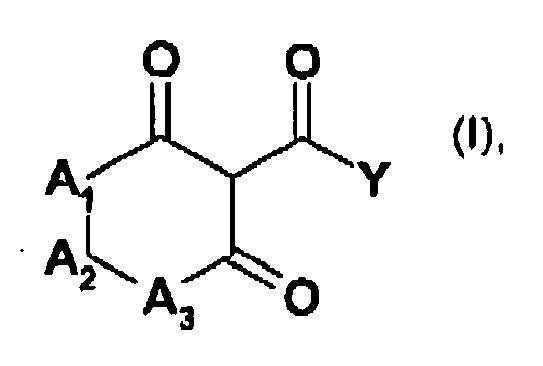
A1 is CR1R2;
A2 is oxygen, C(O), SO2 or (CR3R4)n;
n is 1 or 2;
A3 is CR5R6;
R1, R2, R3, R4, R5 and R6 are each independently of the others C1-C4alkyl which may be mono-, di- or tri-substituted by C1-C4alkoxy, halogen, hydroxy, cyano, hydroxycarbonyl, C1-C4alkoxycarbonyl, C1-C4alkylthio, C1-C4alkylsulfinyl, C1-C4alkylsulfonyl, C1-C4alkylcarbonyl, phenyl or by heteroaryl, it being possible for the phenyl and heteroaryl groups in turn to be mono-, di- or tri-substituted by C1-C4alkoxy, halogen, hydroxy, cyano, hydroxycarbonyl, C1-C4alkoxycarbonyl, C1-C4alkylsulfonyl or by C1-C4haloalkyl, the substituents on the nitrogen in the heterocyclic ring being other than halogen; and/or R1, R2, R3, R4, R5 and R6 are each independently of the others hydrogen, C1-C4alkoxy, halogen, hydroxy, cyano, hydroxycarbonyl, C1-C4alkoxycarbonyl, C1-C4alkylthio, C1-C4alkylsuMnyl, C1-C4alkylsulfonyl, C1-C4alkylcarbonyl, phenyl or heteroaryl, it being possible for the phenyl and heteroaryl groups in turn to be mono-, di- or tri-substituted by C1-C4alkoxy, halogen, hydroxy, cyano, hydroxycarbonyl, C1-C4alkoxycarbonyl, C1-C4alkylsulfonyl or by C1-C4haloalkyl, the substituents on the nitrogen in the heterocyclic ring being other than halogen; and/or
R1 and R2 together form a 3- to 5-membered carbocyclic ring which may be substituted by C1-C4alkyl and/or interrupted by oxygen, sulfur, S(O), SO2, OC(O), NR7 or by C(O); and/or R2 and R4 together or R2 and R5 together form a C1-C3alkylene chain which may be interrupted by oxygen, sulfur, SO, SO2, OC(O), NR8 or by C(O); it being possible for that C1-C3alkylene chain in turn to be substituted by C1-C4alkyl; and
R7 and R8 are each independently of the other C1-C4alkyl, C1-C4haloalkyl, C1-C4alkylsutfonyl, C1-C4alkylcarbonyl or C1-C4alkoxycarbonyl; in which processa) a compound of formula II
 b) that compound is reacted with water to form the compound of formula IV
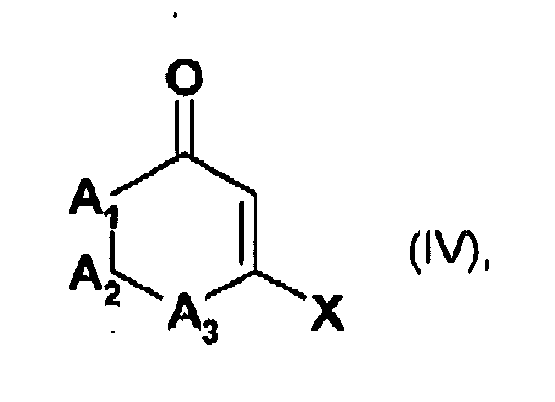 c) that compound is converted, using a compound of formula V
M+-O--C(O)-Y (V),
wherein Y is as defined hereinbefore and M+ is the hydrogen cation or an alkali metal ion, alkaline earth metal ion or ammonium ion, into the compound of formula VI d) then that compound is treated with a cyanide source in the presence of a base.
Applications Claiming Priority (2)
| Application Number | Priority Date | Filing Date | Title |
|---|---|---|---|
| CH7662004 | 2004-04-30 | ||
| PCT/EP2005/004680 WO2005105718A2 (en) | 2004-04-30 | 2005-04-29 | Process for the production of cyclic diketones |
Publications (2)
| Publication Number | Publication Date |
|---|---|
| EP1740524A2 EP1740524A2 (en) | 2007-01-10 |
| EP1740524B1 true EP1740524B1 (en) | 2012-12-12 |
Family
ID=34966622
Family Applications (1)
| Application Number | Title | Priority Date | Filing Date |
|---|---|---|---|
| EP05738471A Expired - Lifetime EP1740524B1 (en) | 2004-04-30 | 2005-04-29 | Process for the production of cyclic diketones |
Country Status (14)
| Country | Link |
|---|---|
| US (1) | US7893270B2 (en) |
| EP (1) | EP1740524B1 (en) |
| JP (1) | JP4819798B2 (en) |
| KR (1) | KR101147632B1 (en) |
| CN (1) | CN1950319B (en) |
| AU (1) | AU2005238194B2 (en) |
| BR (1) | BRPI0510492B1 (en) |
| CA (1) | CA2562152C (en) |
| IL (1) | IL178649A (en) |
| MX (1) | MXPA06012161A (en) |
| RU (1) | RU2384562C2 (en) |
| UA (1) | UA92585C2 (en) |
| WO (1) | WO2005105718A2 (en) |
| ZA (1) | ZA200608217B (en) |
Families Citing this family (1)
| Publication number | Priority date | Publication date | Assignee | Title |
|---|---|---|---|---|
| PY2456429A (en) | 2023-07-11 | 2025-03-19 | Syngenta Crop Protection Ag | CHEMICAL PROCESS |
Family Cites Families (6)
| Publication number | Priority date | Publication date | Assignee | Title |
|---|---|---|---|---|
| JP2002524554A (en) * | 1998-09-15 | 2002-08-06 | シンジェンタ パーティシペーションズ アクチェンゲゼルシャフト | Pyridine ketones useful as herbicides |
| BR9916396A (en) * | 1998-12-21 | 2001-09-11 | Syngenta Participations Ag | Herbicides |
| AR023071A1 (en) * | 1998-12-23 | 2002-09-04 | Syngenta Participations Ag | PIRIDINCETONE COMPOUNDS, INTERMEDIATE COMPOUNDS, HERBICITY AND INHIBITOR COMPOSITION OF PLANTAGE GROWTH, METHOD FOR CONTROLLING INDESATED VEGETATION, METHOD FOR INHIBITING GROWTH OF PLANTS, AND USE OF COMPOSITION TO GROW GROWTH. |
| AU2001242451A1 (en) * | 2000-03-09 | 2001-09-17 | Syngenta Participations Ag | Acylated phenyl or pyridine herbicides |
| GT200100103A (en) * | 2000-06-09 | 2002-02-21 | NEW HERBICIDES | |
| AU2003203482B2 (en) * | 2002-04-09 | 2005-06-02 | Syngenta Participations Ag | Process for the preparation of cyclic diketones |
-
2005
- 2005-04-29 US US11/568,077 patent/US7893270B2/en not_active Expired - Fee Related
- 2005-04-29 CN CN2005800138097A patent/CN1950319B/en not_active Expired - Fee Related
- 2005-04-29 AU AU2005238194A patent/AU2005238194B2/en not_active Ceased
- 2005-04-29 MX MXPA06012161A patent/MXPA06012161A/en active IP Right Grant
- 2005-04-29 RU RU2006142177/04A patent/RU2384562C2/en not_active IP Right Cessation
- 2005-04-29 CA CA2562152A patent/CA2562152C/en not_active Expired - Fee Related
- 2005-04-29 KR KR1020067022687A patent/KR101147632B1/en not_active Expired - Fee Related
- 2005-04-29 WO PCT/EP2005/004680 patent/WO2005105718A2/en not_active Ceased
- 2005-04-29 BR BRPI0510492-0A patent/BRPI0510492B1/en not_active IP Right Cessation
- 2005-04-29 EP EP05738471A patent/EP1740524B1/en not_active Expired - Lifetime
- 2005-04-29 JP JP2007509988A patent/JP4819798B2/en not_active Expired - Fee Related
- 2005-04-29 UA UAA200612359A patent/UA92585C2/en unknown
-
2006
- 2006-10-03 ZA ZA200608217A patent/ZA200608217B/en unknown
- 2006-10-16 IL IL178649A patent/IL178649A/en not_active IP Right Cessation
Also Published As
| Publication number | Publication date |
|---|---|
| HK1099277A1 (en) | 2007-08-10 |
| US7893270B2 (en) | 2011-02-22 |
| IL178649A0 (en) | 2007-02-11 |
| IL178649A (en) | 2011-09-27 |
| CA2562152A1 (en) | 2005-11-10 |
| WO2005105718A2 (en) | 2005-11-10 |
| CN1950319B (en) | 2010-12-15 |
| JP4819798B2 (en) | 2011-11-24 |
| JP2007535515A (en) | 2007-12-06 |
| US20080139816A1 (en) | 2008-06-12 |
| AU2005238194A1 (en) | 2005-11-10 |
| BRPI0510492B1 (en) | 2015-07-21 |
| RU2006142177A (en) | 2008-06-10 |
| UA92585C2 (en) | 2010-11-25 |
| WO2005105718A3 (en) | 2006-05-04 |
| KR20070008671A (en) | 2007-01-17 |
| BRPI0510492A (en) | 2007-11-13 |
| ZA200608217B (en) | 2008-05-28 |
| MXPA06012161A (en) | 2007-01-17 |
| CN1950319A (en) | 2007-04-18 |
| CA2562152C (en) | 2013-06-04 |
| KR101147632B1 (en) | 2012-05-23 |
| EP1740524A2 (en) | 2007-01-10 |
| RU2384562C2 (en) | 2010-03-20 |
| AU2005238194B2 (en) | 2011-03-31 |
Similar Documents
| Publication | Publication Date | Title |
|---|---|---|
| EP1756059B1 (en) | Process for the production of cyclic diketones | |
| EP1352901B1 (en) | Process for the preparation of cyclic diketones | |
| US7893270B2 (en) | Process for the production of cyclic diketones | |
| HK1099277B (en) | Process for the production of cyclic diketones |
Legal Events
| Date | Code | Title | Description |
|---|---|---|---|
| PUAI | Public reference made under article 153(3) epc to a published international application that has entered the european phase |
Free format text: ORIGINAL CODE: 0009012 |
|
| 17P | Request for examination filed |
Effective date: 20061013 |
|
| AK | Designated contracting states |
Kind code of ref document: A2 Designated state(s): AT BE BG CH CY CZ DE DK EE ES FI FR GB GR HU IE IS IT LI LT LU MC NL PL PT RO SE SI SK TR |
|
| DAX | Request for extension of the european patent (deleted) | ||
| REG | Reference to a national code |
Ref country code: HK Ref legal event code: DE Ref document number: 1099277 Country of ref document: HK |
|
| 17Q | First examination report despatched |
Effective date: 20090406 |
|
| GRAP | Despatch of communication of intention to grant a patent |
Free format text: ORIGINAL CODE: EPIDOSNIGR1 |
|
| GRAC | Information related to communication of intention to grant a patent modified |
Free format text: ORIGINAL CODE: EPIDOSCIGR1 |
|
| GRAS | Grant fee paid |
Free format text: ORIGINAL CODE: EPIDOSNIGR3 |
|
| GRAA | (expected) grant |
Free format text: ORIGINAL CODE: 0009210 |
|
| AK | Designated contracting states |
Kind code of ref document: B1 Designated state(s): AT BE BG CH CY CZ DE DK EE ES FI FR GB GR HU IE IS IT LI LT LU MC NL PL PT RO SE SI SK TR |
|
| REG | Reference to a national code |
Ref country code: GB Ref legal event code: FG4D |
|
| REG | Reference to a national code |
Ref country code: CH Ref legal event code: EP |
|
| REG | Reference to a national code |
Ref country code: AT Ref legal event code: REF Ref document number: 588257 Country of ref document: AT Kind code of ref document: T Effective date: 20121215 |
|
| REG | Reference to a national code |
Ref country code: IE Ref legal event code: FG4D |
|
| REG | Reference to a national code |
Ref country code: DE Ref legal event code: R096 Ref document number: 602005037397 Country of ref document: DE Effective date: 20130207 |
|
| PG25 | Lapsed in a contracting state [announced via postgrant information from national office to epo] |
Ref country code: ES Free format text: LAPSE BECAUSE OF FAILURE TO SUBMIT A TRANSLATION OF THE DESCRIPTION OR TO PAY THE FEE WITHIN THE PRESCRIBED TIME-LIMIT Effective date: 20130323 Ref country code: LT Free format text: LAPSE BECAUSE OF FAILURE TO SUBMIT A TRANSLATION OF THE DESCRIPTION OR TO PAY THE FEE WITHIN THE PRESCRIBED TIME-LIMIT Effective date: 20121212 Ref country code: FI Free format text: LAPSE BECAUSE OF FAILURE TO SUBMIT A TRANSLATION OF THE DESCRIPTION OR TO PAY THE FEE WITHIN THE PRESCRIBED TIME-LIMIT Effective date: 20121212 Ref country code: SE Free format text: LAPSE BECAUSE OF FAILURE TO SUBMIT A TRANSLATION OF THE DESCRIPTION OR TO PAY THE FEE WITHIN THE PRESCRIBED TIME-LIMIT Effective date: 20121212 |
|
| REG | Reference to a national code |
Ref country code: NL Ref legal event code: VDEP Effective date: 20121212 |
|
| REG | Reference to a national code |
Ref country code: HK Ref legal event code: GR Ref document number: 1099277 Country of ref document: HK |
|
| REG | Reference to a national code |
Ref country code: AT Ref legal event code: MK05 Ref document number: 588257 Country of ref document: AT Kind code of ref document: T Effective date: 20121212 |
|
| REG | Reference to a national code |
Ref country code: LT Ref legal event code: MG4D |
|
| PG25 | Lapsed in a contracting state [announced via postgrant information from national office to epo] |
Ref country code: SI Free format text: LAPSE BECAUSE OF FAILURE TO SUBMIT A TRANSLATION OF THE DESCRIPTION OR TO PAY THE FEE WITHIN THE PRESCRIBED TIME-LIMIT Effective date: 20121212 Ref country code: GR Free format text: LAPSE BECAUSE OF FAILURE TO SUBMIT A TRANSLATION OF THE DESCRIPTION OR TO PAY THE FEE WITHIN THE PRESCRIBED TIME-LIMIT Effective date: 20130313 |
|
| PG25 | Lapsed in a contracting state [announced via postgrant information from national office to epo] |
Ref country code: CZ Free format text: LAPSE BECAUSE OF FAILURE TO SUBMIT A TRANSLATION OF THE DESCRIPTION OR TO PAY THE FEE WITHIN THE PRESCRIBED TIME-LIMIT Effective date: 20121212 Ref country code: BE Free format text: LAPSE BECAUSE OF FAILURE TO SUBMIT A TRANSLATION OF THE DESCRIPTION OR TO PAY THE FEE WITHIN THE PRESCRIBED TIME-LIMIT Effective date: 20121212 Ref country code: IS Free format text: LAPSE BECAUSE OF FAILURE TO SUBMIT A TRANSLATION OF THE DESCRIPTION OR TO PAY THE FEE WITHIN THE PRESCRIBED TIME-LIMIT Effective date: 20130412 Ref country code: AT Free format text: LAPSE BECAUSE OF FAILURE TO SUBMIT A TRANSLATION OF THE DESCRIPTION OR TO PAY THE FEE WITHIN THE PRESCRIBED TIME-LIMIT Effective date: 20121212 Ref country code: SK Free format text: LAPSE BECAUSE OF FAILURE TO SUBMIT A TRANSLATION OF THE DESCRIPTION OR TO PAY THE FEE WITHIN THE PRESCRIBED TIME-LIMIT Effective date: 20121212 Ref country code: EE Free format text: LAPSE BECAUSE OF FAILURE TO SUBMIT A TRANSLATION OF THE DESCRIPTION OR TO PAY THE FEE WITHIN THE PRESCRIBED TIME-LIMIT Effective date: 20121212 Ref country code: BG Free format text: LAPSE BECAUSE OF FAILURE TO SUBMIT A TRANSLATION OF THE DESCRIPTION OR TO PAY THE FEE WITHIN THE PRESCRIBED TIME-LIMIT Effective date: 20130312 |
|
| PG25 | Lapsed in a contracting state [announced via postgrant information from national office to epo] |
Ref country code: PL Free format text: LAPSE BECAUSE OF FAILURE TO SUBMIT A TRANSLATION OF THE DESCRIPTION OR TO PAY THE FEE WITHIN THE PRESCRIBED TIME-LIMIT Effective date: 20121212 Ref country code: RO Free format text: LAPSE BECAUSE OF FAILURE TO SUBMIT A TRANSLATION OF THE DESCRIPTION OR TO PAY THE FEE WITHIN THE PRESCRIBED TIME-LIMIT Effective date: 20121212 Ref country code: NL Free format text: LAPSE BECAUSE OF FAILURE TO SUBMIT A TRANSLATION OF THE DESCRIPTION OR TO PAY THE FEE WITHIN THE PRESCRIBED TIME-LIMIT Effective date: 20121212 Ref country code: PT Free format text: LAPSE BECAUSE OF FAILURE TO SUBMIT A TRANSLATION OF THE DESCRIPTION OR TO PAY THE FEE WITHIN THE PRESCRIBED TIME-LIMIT Effective date: 20130412 |
|
| PLBE | No opposition filed within time limit |
Free format text: ORIGINAL CODE: 0009261 |
|
| STAA | Information on the status of an ep patent application or granted ep patent |
Free format text: STATUS: NO OPPOSITION FILED WITHIN TIME LIMIT |
|
| PG25 | Lapsed in a contracting state [announced via postgrant information from national office to epo] |
Ref country code: DK Free format text: LAPSE BECAUSE OF FAILURE TO SUBMIT A TRANSLATION OF THE DESCRIPTION OR TO PAY THE FEE WITHIN THE PRESCRIBED TIME-LIMIT Effective date: 20121212 |
|
| 26N | No opposition filed |
Effective date: 20130913 |
|
| PG25 | Lapsed in a contracting state [announced via postgrant information from national office to epo] |
Ref country code: CY Free format text: LAPSE BECAUSE OF FAILURE TO SUBMIT A TRANSLATION OF THE DESCRIPTION OR TO PAY THE FEE WITHIN THE PRESCRIBED TIME-LIMIT Effective date: 20121212 Ref country code: MC Free format text: LAPSE BECAUSE OF FAILURE TO SUBMIT A TRANSLATION OF THE DESCRIPTION OR TO PAY THE FEE WITHIN THE PRESCRIBED TIME-LIMIT Effective date: 20121212 |
|
| REG | Reference to a national code |
Ref country code: CH Ref legal event code: PL |
|
| GBPC | Gb: european patent ceased through non-payment of renewal fee |
Effective date: 20130429 |
|
| PG25 | Lapsed in a contracting state [announced via postgrant information from national office to epo] |
Ref country code: IT Free format text: LAPSE BECAUSE OF FAILURE TO SUBMIT A TRANSLATION OF THE DESCRIPTION OR TO PAY THE FEE WITHIN THE PRESCRIBED TIME-LIMIT Effective date: 20121212 |
|
| REG | Reference to a national code |
Ref country code: DE Ref legal event code: R097 Ref document number: 602005037397 Country of ref document: DE Effective date: 20130913 |
|
| REG | Reference to a national code |
Ref country code: IE Ref legal event code: MM4A |
|
| PG25 | Lapsed in a contracting state [announced via postgrant information from national office to epo] |
Ref country code: CH Free format text: LAPSE BECAUSE OF NON-PAYMENT OF DUE FEES Effective date: 20130430 Ref country code: LI Free format text: LAPSE BECAUSE OF NON-PAYMENT OF DUE FEES Effective date: 20130430 Ref country code: DE Free format text: LAPSE BECAUSE OF NON-PAYMENT OF DUE FEES Effective date: 20131101 Ref country code: GB Free format text: LAPSE BECAUSE OF NON-PAYMENT OF DUE FEES Effective date: 20130429 |
|
| REG | Reference to a national code |
Ref country code: FR Ref legal event code: ST Effective date: 20131231 |
|
| REG | Reference to a national code |
Ref country code: DE Ref legal event code: R119 Ref document number: 602005037397 Country of ref document: DE Effective date: 20131101 |
|
| PG25 | Lapsed in a contracting state [announced via postgrant information from national office to epo] |
Ref country code: FR Free format text: LAPSE BECAUSE OF NON-PAYMENT OF DUE FEES Effective date: 20130430 |
|
| PG25 | Lapsed in a contracting state [announced via postgrant information from national office to epo] |
Ref country code: IE Free format text: LAPSE BECAUSE OF NON-PAYMENT OF DUE FEES Effective date: 20130429 |
|
| PG25 | Lapsed in a contracting state [announced via postgrant information from national office to epo] |
Ref country code: TR Free format text: LAPSE BECAUSE OF FAILURE TO SUBMIT A TRANSLATION OF THE DESCRIPTION OR TO PAY THE FEE WITHIN THE PRESCRIBED TIME-LIMIT Effective date: 20121212 |
|
| PG25 | Lapsed in a contracting state [announced via postgrant information from national office to epo] |
Ref country code: LU Free format text: LAPSE BECAUSE OF NON-PAYMENT OF DUE FEES Effective date: 20130429 Ref country code: HU Free format text: LAPSE BECAUSE OF FAILURE TO SUBMIT A TRANSLATION OF THE DESCRIPTION OR TO PAY THE FEE WITHIN THE PRESCRIBED TIME-LIMIT; INVALID AB INITIO Effective date: 20050429 |