EP1739226A1 - Antistatic Spiral Fabric - Google Patents
Antistatic Spiral Fabric Download PDFInfo
- Publication number
- EP1739226A1 EP1739226A1 EP20060114212 EP06114212A EP1739226A1 EP 1739226 A1 EP1739226 A1 EP 1739226A1 EP 20060114212 EP20060114212 EP 20060114212 EP 06114212 A EP06114212 A EP 06114212A EP 1739226 A1 EP1739226 A1 EP 1739226A1
- Authority
- EP
- European Patent Office
- Prior art keywords
- antistatic
- fabric
- stuffer
- fabric according
- yarn
- Prior art date
- Legal status (The legal status is an assumption and is not a legal conclusion. Google has not performed a legal analysis and makes no representation as to the accuracy of the status listed.)
- Withdrawn
Links
- 239000004744 fabric Substances 0.000 title claims abstract description 62
- OKTJSMMVPCPJKN-UHFFFAOYSA-N Carbon Chemical compound [C] OKTJSMMVPCPJKN-UHFFFAOYSA-N 0.000 claims abstract description 9
- 229910052799 carbon Inorganic materials 0.000 claims abstract description 9
- 239000004952 Polyamide Substances 0.000 claims abstract description 5
- 229920002647 polyamide Polymers 0.000 claims abstract description 5
- 239000011248 coating agent Substances 0.000 claims description 11
- 238000000576 coating method Methods 0.000 claims description 11
- 230000035699 permeability Effects 0.000 claims description 11
- 239000006260 foam Substances 0.000 claims description 3
- 239000004816 latex Substances 0.000 claims description 3
- 229920000126 latex Polymers 0.000 claims description 3
- 239000002184 metal Substances 0.000 claims description 3
- 239000002245 particle Substances 0.000 claims description 3
- 229920000728 polyester Polymers 0.000 claims description 3
- 230000015572 biosynthetic process Effects 0.000 claims description 2
- 239000000853 adhesive Substances 0.000 description 7
- 230000001070 adhesive effect Effects 0.000 description 7
- 238000004519 manufacturing process Methods 0.000 description 5
- 239000000356 contaminant Substances 0.000 description 3
- 239000000835 fiber Substances 0.000 description 3
- 239000004753 textile Substances 0.000 description 3
- 230000005611 electricity Effects 0.000 description 2
- 239000004745 nonwoven fabric Substances 0.000 description 2
- 229920000642 polymer Polymers 0.000 description 2
- 230000003068 static effect Effects 0.000 description 2
- 239000000654 additive Substances 0.000 description 1
- 230000000996 additive effect Effects 0.000 description 1
- 238000004140 cleaning Methods 0.000 description 1
- 229910003460 diamond Inorganic materials 0.000 description 1
- 239000010432 diamond Substances 0.000 description 1
- 238000007688 edging Methods 0.000 description 1
- 238000010348 incorporation Methods 0.000 description 1
- 230000000977 initiatory effect Effects 0.000 description 1
- 238000009940 knitting Methods 0.000 description 1
- 239000000463 material Substances 0.000 description 1
- 239000004810 polytetrafluoroethylene Substances 0.000 description 1
- 229920001343 polytetrafluoroethylene Polymers 0.000 description 1
- 230000002269 spontaneous effect Effects 0.000 description 1
- 238000009941 weaving Methods 0.000 description 1
- 239000002759 woven fabric Substances 0.000 description 1
Images

Classifications
-
- D—TEXTILES; PAPER
- D21—PAPER-MAKING; PRODUCTION OF CELLULOSE
- D21F—PAPER-MAKING MACHINES; METHODS OF PRODUCING PAPER THEREON
- D21F1/00—Wet end of machines for making continuous webs of paper
- D21F1/0027—Screen-cloths
- D21F1/0072—Link belts
-
- Y—GENERAL TAGGING OF NEW TECHNOLOGICAL DEVELOPMENTS; GENERAL TAGGING OF CROSS-SECTIONAL TECHNOLOGIES SPANNING OVER SEVERAL SECTIONS OF THE IPC; TECHNICAL SUBJECTS COVERED BY FORMER USPC CROSS-REFERENCE ART COLLECTIONS [XRACs] AND DIGESTS
- Y10—TECHNICAL SUBJECTS COVERED BY FORMER USPC
- Y10T—TECHNICAL SUBJECTS COVERED BY FORMER US CLASSIFICATION
- Y10T428/00—Stock material or miscellaneous articles
- Y10T428/19—Sheets or webs edge spliced or joined
- Y10T428/192—Sheets or webs coplanar
-
- Y—GENERAL TAGGING OF NEW TECHNOLOGICAL DEVELOPMENTS; GENERAL TAGGING OF CROSS-SECTIONAL TECHNOLOGIES SPANNING OVER SEVERAL SECTIONS OF THE IPC; TECHNICAL SUBJECTS COVERED BY FORMER USPC CROSS-REFERENCE ART COLLECTIONS [XRACs] AND DIGESTS
- Y10—TECHNICAL SUBJECTS COVERED BY FORMER USPC
- Y10T—TECHNICAL SUBJECTS COVERED BY FORMER US CLASSIFICATION
- Y10T428/00—Stock material or miscellaneous articles
- Y10T428/24—Structurally defined web or sheet [e.g., overall dimension, etc.]
-
- Y—GENERAL TAGGING OF NEW TECHNOLOGICAL DEVELOPMENTS; GENERAL TAGGING OF CROSS-SECTIONAL TECHNOLOGIES SPANNING OVER SEVERAL SECTIONS OF THE IPC; TECHNICAL SUBJECTS COVERED BY FORMER USPC CROSS-REFERENCE ART COLLECTIONS [XRACs] AND DIGESTS
- Y10—TECHNICAL SUBJECTS COVERED BY FORMER USPC
- Y10T—TECHNICAL SUBJECTS COVERED BY FORMER US CLASSIFICATION
- Y10T428/00—Stock material or miscellaneous articles
- Y10T428/249921—Web or sheet containing structurally defined element or component
- Y10T428/249922—Embodying intertwined or helical component[s]
-
- Y—GENERAL TAGGING OF NEW TECHNOLOGICAL DEVELOPMENTS; GENERAL TAGGING OF CROSS-SECTIONAL TECHNOLOGIES SPANNING OVER SEVERAL SECTIONS OF THE IPC; TECHNICAL SUBJECTS COVERED BY FORMER USPC CROSS-REFERENCE ART COLLECTIONS [XRACs] AND DIGESTS
- Y10—TECHNICAL SUBJECTS COVERED BY FORMER USPC
- Y10T—TECHNICAL SUBJECTS COVERED BY FORMER US CLASSIFICATION
- Y10T442/00—Fabric [woven, knitted, or nonwoven textile or cloth, etc.]
- Y10T442/60—Nonwoven fabric [i.e., nonwoven strand or fiber material]
- Y10T442/608—Including strand or fiber material which is of specific structural definition
- Y10T442/609—Cross-sectional configuration of strand or fiber material is specified
- Y10T442/611—Cross-sectional configuration of strand or fiber material is other than circular
Definitions
- the invention relates to a fabric having an antistatic stuffer used in the manufacture of non-woven textiles.
- Non-woven textiles are broadly defined as sheet or web structures bonded together by entangling of the fibers mechanically, thermally or chemically.
- Non-woven textiles are not made by weaving or knitting.
- non-woven fabrics are engineered fabrics that may be a limited life, single-use fabric or a very durable fabric. These fabrics can imitate the appearance, texture and strength of a woven fabric.
- ESD spontaneous electrostatic discharge
- ESD ESD-filled polyamide antistatic yarns and conductive edging.
- These are generally endless or loop seamed.
- loop seams are weaker than the main body of the fabric, and they can place a seam mark on the finished product.
- endless fabrics are difficult and time-consuming to install, and cut warp ends at the seamed area become points of attachment for the non-woven fibers, resulting in "fibre picking.”
- the present invention is for a fabric used in products manufactured in the non-woven industry.
- the fabric is a spiral stuffed with anti-static yarn.
- the fabric is preferably a spiral fabric having a plurality of spirals, and each spiral is stuffed with anti-static yarn. In the event of localized damage to the fabric, only removal of the damaged portion of the fabric is required. Additional fabric can be attached if desired or needed.
- the spiral fabric may contain up to approximately 25%, preferably approximately 15%, contaminant release properties, that is, not a coating. Accordingly, as the spiral wears, the contaminant release properties remain. In this manner, "drips" of molten polymer can be removed easily with a cleaning system, for example, brushes, vacuum, and the like. If the fabric is damaged by the hot molten polymer drips, a section of the spiral can be removed and/or replaced.
- the contaminant release is part of the monofilament used to make the spiral, for example, the additive can be PTFE.
- a fabric used on the formation of material produced for the non-woven industry has a spiral link fabric, the spiral link fabric having a plurality of helical coils connected along a coiled perimeter to form a plurality of hinges, each hinge formed using one of a plurality of connecting rods, resulting in a spiral link fabric having a plurality of open channels between each of the plurality of hinges; at least one antistatic stuffer yarn, the at least one antistatic stuffer yarn situated in one of the open channels.
- the at least one antistatic stuffer yarn is removably attached to the spiral link fabric.
- the at least one antistatic stuffer yarn is at least one of a conductive monofilament, a conductive multifilament, a conductive metal, a conductive foam, and any other conductive stuffer that can be placed in one of the open channels.
- the antistatic stuffer yarn is a carbon impregnated polyamide.
- At least one permeability control yarn is collocated with the at least one antistatic stuffer yarn in the open channel.
- the at least one permeability control yarn is polyester, and is either a monofilament or a multifilament.
- the at least one antistatic stuffer yarn when the at least one antistatic stuffer yarn is a monofilament, it has a diameter between approximately 0.1 mm to approximately 1.0 mm. When the at least one antistatic stuffer yarn is a multifilament it has a range between approximately 22dTex and approximately 1500dTex. Still further, the cross section of the antistatic stuffer is either a round cross section or a profiled cross section.
- a coating can be applied that connects a first longitudinal end of the at least one antistatic stuffer yarn and a first longitudinal end of the helical coils.
- the coating electrically connects the at least one antistatic stuffer yarn to form a conductive grid, thereby dissipating the ESD.
- the coating in the preferred embodiment, is made from carbon particles suspended in latex.
- these antistatic stuffer yarns are regularly spaced among the open channels in the spiral fabric. In this manner the electrostatic buildup can be collected and dissipated along a larger portion of the fabric. It is also conceived that a plurality of the at least one antistatic stuffer yarns are placed in every open channel, thereby maximizing the collection and dissipation of electrostatic charge buildup.
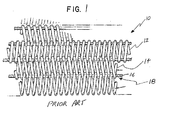
- Fig. 1 depicts a plan view of a prior art link fabric 10.
- individual coils 12, 14 are connected by interdigiting adjacent turns of the coils and inserting a connecting rod, or pintel 16 into the interdigited region 18.
- This prior art is disclosed, for example, in U.S. Patent No. 4,423,543 .
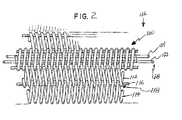
- Figure 2 depicts a plan view of a link fabric 100 according to the present invention.
- the individual link coils 112, 114 are connected in indigiting adjacent turns of the coils and inserting a connecting rod, or pintel 116 into the indigited region 118.
- An open channel 120 is thereby created between the connecting rods 116.
- the open channel, or region 120 located between the connecting rods 116 is stuffed with at least one antistatic stuffer yarn 122.
- This at least one antistatic stuffer yarn 122 is removably attached to the spiral link fabric 100.
- the at least one antistatic stuffer yarn 122 is at least one of a conductive monofilament, a conductive multifilament, a conductive metal, a conductive foam, and any other conductive stuffer that can be placed in one of the open channels.
- the antistatic stuffer yarn 122 is a carbon impregnated polyamide.
- the at least one antistatic stuffer yarn 122 When the at least one antistatic stuffer yarn 122 is a monofilament, it has a diameter between approximately 0.1 mm to approximately 1.0 mm. When the at least one antistatic stuffer yarn 122 is a multifilament, it has a range between approximately 22dTex and approximately 1500dTex. Still further, the cross section of the antistatic stuffer yarn 122 is either a round cross section or a profiled cross section. A profiled cross section is any geometric shape that is not round or circular. For example, a profiled cross section can be oval, square, diamond, and polygonal.
- these antistatic stuffer yarns 122 are regularly spaced among the open channels 120 in the spiral fabric 100.
- Adjacent to the antistatic stuffing yarn 122 is optionally placed a stuffing, or permeability control yarn 124.
- the at least one permeability control yarn 124 is collocated with the at least one antistatic stuffer yarn 122 in the open channel 120.
- the at least one permeability control yarn 124 can be placed side-by-side with the antistatic stuffer yarn 122, as shown in the figure, or the two yarns 122, 124 can be twisted or otherwise attached to each other.
- the at least one permeability control yarn 124 is polyester, and is either a monofilament or a multifilament. The diameter of the permeability control yarn 124 is selected to determine the permeability of the fabric 100.
- a coating or adhesive (not shown) can be applied that connects a first longitudinal end 126 of the at least one antistatic stuffer yarn 122 and a first longitudinal end of the helical coils 128.
- This coating or adhesive acts as a bus bar, electrically connecting the at least one antistatic stuffer yarn 122 to form a conductive grid, thereby dissipating the ESD.
- the coating or adhesive can be a heat seal adhesive that bonds the edges of the antistatic stuffer yarn 122 with the first longitudinal edge of the helical coils 128 of the fabric 100.
- This heat seal adhesive can be, for example, a carbon impregnated adhesive.
- the coating or adhesive in the preferred embodiment, is made from carbon particles suspended in latex.
Landscapes
- Woven Fabrics (AREA)
- Chemical Or Physical Treatment Of Fibers (AREA)
Abstract
Description
- The invention relates to a fabric having an antistatic stuffer used in the manufacture of non-woven textiles.
- Non-woven textiles are broadly defined as sheet or web structures bonded together by entangling of the fibers mechanically, thermally or chemically. Non-woven textiles are not made by weaving or knitting. Thus, non-woven fabrics are engineered fabrics that may be a limited life, single-use fabric or a very durable fabric. These fabrics can imitate the appearance, texture and strength of a woven fabric.
- During the fabrication of most nonwovens, static electricity can build-up. The result of static electricity build-up is the occasional spontaneous electrostatic discharge, or ESD. An ESD can not only damage the non-woven product in production, but it can also irreparably damage the fabric used in the fabrication of the non-woven product. This can lead to costly replacement of the fabric and down time for the manufacturing apparatus. In the worst case scenario, the machine fabricating the non-woven product can be damaged, or initiation of a fire could result.
- One way to avoid ESD is to use an antistatic fabric made with carbon-filled polyamide antistatic yarns and conductive edging. These are generally endless or loop seamed. However, loop seams are weaker than the main body of the fabric, and they can place a seam mark on the finished product. Still further, endless fabrics are difficult and time-consuming to install, and cut warp ends at the seamed area become points of attachment for the non-woven fibers, resulting in "fibre picking."
- Accordingly, there is a need for an antistatic fabric that is easy to install, is non-marking, and is non-picking, yet has effective anti-static qualities. The present invention is for a fabric used in products manufactured in the non-woven industry. In the preferred embodiment, the fabric is a spiral stuffed with anti-static yarn. The fabric is preferably a spiral fabric having a plurality of spirals, and each spiral is stuffed with anti-static yarn. In the event of localized damage to the fabric, only removal of the damaged portion of the fabric is required. Additional fabric can be attached if desired or needed.
- Additionally, the spiral fabric may contain up to approximately 25%, preferably approximately 15%, contaminant release properties, that is, not a coating. Accordingly, as the spiral wears, the contaminant release properties remain. In this manner, "drips" of molten polymer can be removed easily with a cleaning system, for example, brushes, vacuum, and the like. If the fabric is damaged by the hot molten polymer drips, a section of the spiral can be removed and/or replaced. The contaminant release is part of the monofilament used to make the spiral, for example, the additive can be PTFE.
- A fabric used on the formation of material produced for the non-woven industry has a spiral link fabric, the spiral link fabric having a plurality of helical coils connected along a coiled perimeter to form a plurality of hinges, each hinge formed using one of a plurality of connecting rods, resulting in a spiral link fabric having a plurality of open channels between each of the plurality of hinges; at least one antistatic stuffer yarn, the at least one antistatic stuffer yarn situated in one of the open channels.
- Still further, the at least one antistatic stuffer yarn is removably attached to the spiral link fabric.
- Additionally, the at least one antistatic stuffer yarn is at least one of a conductive monofilament, a conductive multifilament, a conductive metal, a conductive foam, and any other conductive stuffer that can be placed in one of the open channels. In the preferred embodiment, the antistatic stuffer yarn is a carbon impregnated polyamide.
- Still further, at least one permeability control yarn is collocated with the at least one antistatic stuffer yarn in the open channel. In the preferred embodiment, the at least one permeability control yarn is polyester, and is either a monofilament or a multifilament.
- Additionally, when the at least one antistatic stuffer yarn is a monofilament, it has a diameter between approximately 0.1 mm to approximately 1.0 mm. When the at least one antistatic stuffer yarn is a multifilament it has a range between approximately 22dTex and approximately 1500dTex. Still further, the cross section of the antistatic stuffer is either a round cross section or a profiled cross section.
- Still further, a coating can be applied that connects a first longitudinal end of the at least one antistatic stuffer yarn and a first longitudinal end of the helical coils. The coating electrically connects the at least one antistatic stuffer yarn to form a conductive grid, thereby dissipating the ESD. The coating, in the preferred embodiment, is made from carbon particles suspended in latex.
- Additionally, when a plurality of the antistatic stuffer yarns is used, these antistatic stuffer yarns are regularly spaced among the open channels in the spiral fabric. In this manner the electrostatic buildup can be collected and dissipated along a larger portion of the fabric. It is also conceived that a plurality of the at least one antistatic stuffer yarns are placed in every open channel, thereby maximizing the collection and dissipation of electrostatic charge buildup.
- These and other features and advantages of this invention are described in or are apparent from the following detailed description of the preferred embodiments.
- The preferred embodiments of the present inventions will be described in detail, with reference to the following figures, wherein:
- Fig. 1
- depicts a plan view of a prior art link fabric;
- Fig. 2
- depicts a plan view of a link fabric according to the present invention; and
- Fig.3
- depicts a partial cross-sectional view the link fabric according to the present invention.
- Fig. 1 depicts a plan view of a prior
art link fabric 10. Generally,individual coils 12, 14 are connected by interdigiting adjacent turns of the coils and inserting a connecting rod, orpintel 16 into the interdigitedregion 18. This prior art is disclosed, for example, inU.S. Patent No. 4,423,543 . - Figure 2 depicts a plan view of a link fabric 100 according to the present invention. The
individual link coils pintel 116 into theindigited region 118. Anopen channel 120 is thereby created between the connectingrods 116. - The open channel, or
region 120 located between the connectingrods 116 is stuffed with at least oneantistatic stuffer yarn 122. This at least oneantistatic stuffer yarn 122 is removably attached to the spiral link fabric 100. The at least oneantistatic stuffer yarn 122 is at least one of a conductive monofilament, a conductive multifilament, a conductive metal, a conductive foam, and any other conductive stuffer that can be placed in one of the open channels. In the preferred embodiment, theantistatic stuffer yarn 122 is a carbon impregnated polyamide. - When the at least one
antistatic stuffer yarn 122 is a monofilament, it has a diameter between approximately 0.1 mm to approximately 1.0 mm. When the at least oneantistatic stuffer yarn 122 is a multifilament, it has a range between approximately 22dTex and approximately 1500dTex. Still further, the cross section of theantistatic stuffer yarn 122 is either a round cross section or a profiled cross section. A profiled cross section is any geometric shape that is not round or circular. For example, a profiled cross section can be oval, square, diamond, and polygonal. - When a plurality of the antistatic
stuffer yarns 122 are used, these antistaticstuffer yarns 122 are regularly spaced among theopen channels 120 in the spiral fabric 100. - Adjacent to the
antistatic stuffing yarn 122 is optionally placed a stuffing, orpermeability control yarn 124. Still further, the at least onepermeability control yarn 124 is collocated with the at least oneantistatic stuffer yarn 122 in theopen channel 120. Stated differently, the at least onepermeability control yarn 124 can be placed side-by-side with theantistatic stuffer yarn 122, as shown in the figure, or the twoyarns permeability control yarn 124 is polyester, and is either a monofilament or a multifilament. The diameter of thepermeability control yarn 124 is selected to determine the permeability of the fabric 100. - Still further, a coating or adhesive (not shown) can be applied that connects a first
longitudinal end 126 of the at least oneantistatic stuffer yarn 122 and a first longitudinal end of thehelical coils 128. This coating or adhesive acts as a bus bar, electrically connecting the at least oneantistatic stuffer yarn 122 to form a conductive grid, thereby dissipating the ESD. The coating or adhesive can be a heat seal adhesive that bonds the edges of theantistatic stuffer yarn 122 with the first longitudinal edge of thehelical coils 128 of the fabric 100. This heat seal adhesive can be, for example, a carbon impregnated adhesive. The coating or adhesive, in the preferred embodiment, is made from carbon particles suspended in latex. - While the present invention has been particularly shown and described with reference to the foregoing preferred embodiments, those skilled in the art will understand that many variations may be made therein without departing from the spirit and scope of the invention as defined in the following claims. This description of the invention should be understood to include all novel and non-obvious combinations of elements described herein, and claims may be presented in this or a later application to any novel and non-obvious combination of these elements. The foregoing embodiments are illustrative, and no single feature or element is essential to all possible combinations that may be claimed in this or a later application. Where the claims recite "a" or "a first" element or the equivalent thereof, such claims should be understood to include incorporation of one or more such elements, neither requiring nor excluding two or more such elements.
Claims (17)
- A fabric comprising:a spiral link fabric, the spiral link fabric comprising a plurality of helical coils connected along a coiled perimeter to form a plurality of hinges, each hinge formed using one of a plurality of connecting rods, resulting in a spiral link fabric having a plurality of open channels between each of the plurality of hinges;at least one antistatic stuffer yarn, the at least one antistatic stuffer yarn situated in one of the plurality of open channels.
- The fabric according to claim 1, wherein the at least one antistatic stuffer yarn is removably attached to the spiral link fabric.
- The fabric according to claim 1 or 2, wherein the at least one antistatic stuffer yarn is at least one of a conductive monofilament, a conductive multifilament, a conductive metal, a conductive foam, and any other conductive stuffer that can be placed in one of the plurality of open channels.
- The fabric according to one of the claims 1 to 3, wherein the antistatic stuffer yarn is a carbon impregnated polyamide.
- The fabric according to one of the preceding claims, further comprising at least one permeability control yarn collocated with the at least one antistatic stuffer yarn in the one of the plurality of open channels.
- The fabric according to claim 5, wherein the at least one permeability control yarn is polyester.
- The fabric according to claim 5 or 6, wherein the at least one permeability control yarn is one of a monofilament and a multifilament.
- The fabric according to any of the preceding claims, wherein the at least one antistatic stuffer yarn is a monofilament having a diameter between approximately 0.1 mm to approximately 1.0 mm.
- The fabric according to any of the preceding claims, wherein the at least one antistatic stuffer yarn is a multifilament have a range between approximately 22dTex and approximately 1500dTex.
- The fabric according to any of the preceding claims, wherein the at least one antistatic stuffer has at least one of a round cross section and a profiled cross section.
- A fabric according to any of the preceding claims, further comprising a coating connecting a first longitudinal end of the at least one antistatic stuffer yarn and a first longitudinal end of the helical coils.
- The fabric according to claim 11, wherein the coating electrically connects the at least one antistatic stuffer yarn to form a conductive grid.
- The fabric according to claim 11 or 12, wherein the coating comprises carbon particles suspended in latex.
- The fabric according to any of the preceding claims, wherein a plurality of the at least one antistatic stuffer yarns are regularly spaced among the open channels.
- The fabric according to any of the preceding claims, wherein a plurality of the at least one antistatic stuffer yarns are places in every open channel.
- The fabric according to any of the preceding claims, wherein the fabric is for use in non-woven industry for the formation of a product.
- The fabric according to any of the preceding claims, wherein the fabric is for use in the dryer section in the papermaking industry.
Applications Claiming Priority (1)
| Application Number | Priority Date | Filing Date | Title |
|---|---|---|---|
| US11/173,028 US7425364B2 (en) | 2005-07-01 | 2005-07-01 | Antistatic spiral fabric |
Publications (1)
| Publication Number | Publication Date |
|---|---|
| EP1739226A1 true EP1739226A1 (en) | 2007-01-03 |
Family
ID=37249148
Family Applications (1)
| Application Number | Title | Priority Date | Filing Date |
|---|---|---|---|
| EP20060114212 Withdrawn EP1739226A1 (en) | 2005-07-01 | 2006-05-19 | Antistatic Spiral Fabric |
Country Status (2)
| Country | Link |
|---|---|
| US (1) | US7425364B2 (en) |
| EP (1) | EP1739226A1 (en) |
Cited By (1)
| Publication number | Priority date | Publication date | Assignee | Title |
|---|---|---|---|---|
| EP4375415A1 (en) * | 2022-11-24 | 2024-05-29 | Valmet Technologies, Inc. | Press felt |
Families Citing this family (6)
| Publication number | Priority date | Publication date | Assignee | Title |
|---|---|---|---|---|
| US7896034B2 (en) * | 2009-03-18 | 2011-03-01 | Voith Patent Gmbh | Heat- and corrosion-resistant fabric |
| US20110146913A1 (en) | 2009-12-23 | 2011-06-23 | William Harwood | Industrial fabric with wear resistant coating |
| US20110151735A1 (en) * | 2009-12-23 | 2011-06-23 | William Harwood | Industrial fabric with traction coating |
| SE537959C2 (en) | 2013-03-27 | 2015-12-08 | Valmet Aktiebolag | Wheelchair and method for rolling up a paper web from the edge of a paper machine |
| SE537744C2 (en) * | 2013-04-26 | 2015-10-13 | Valmet Aktiebolag | Wheelchair for rolling a paper web into a roll and method for rolling a paper web to form a roll |
| US9511968B2 (en) | 2013-09-09 | 2016-12-06 | Valmet Aktiebolag | Reel-up and a method for winding into a roll a paper web and for starting a new roll |
Citations (4)
| Publication number | Priority date | Publication date | Assignee | Title |
|---|---|---|---|---|
| US4423543A (en) * | 1979-05-26 | 1984-01-03 | T.T. Haaksbergen B.V. | Method for the production of a link-belt |
| US5534333A (en) * | 1995-04-07 | 1996-07-09 | Shakespeare | Spiral fabric |
| GB2346387A (en) * | 1999-02-03 | 2000-08-09 | Scapa Group Plc | Transfer fabric with reinforcing structure encapsulated in polymer matrix |
| WO2005059243A1 (en) * | 2003-12-15 | 2005-06-30 | Albany International Corp. | Pintle for spiral fabrics |
Family Cites Families (1)
| Publication number | Priority date | Publication date | Assignee | Title |
|---|---|---|---|---|
| US4061811A (en) * | 1975-03-05 | 1977-12-06 | Toray Industries Inc. | Antistatic carpet and production thereof |
-
2005
- 2005-07-01 US US11/173,028 patent/US7425364B2/en not_active Expired - Fee Related
-
2006
- 2006-05-19 EP EP20060114212 patent/EP1739226A1/en not_active Withdrawn
Patent Citations (5)
| Publication number | Priority date | Publication date | Assignee | Title |
|---|---|---|---|---|
| US4423543A (en) * | 1979-05-26 | 1984-01-03 | T.T. Haaksbergen B.V. | Method for the production of a link-belt |
| US4423543B1 (en) * | 1979-05-26 | 2000-10-03 | Siteg Siebtech Gmbh | Method for the production of a link-belt |
| US5534333A (en) * | 1995-04-07 | 1996-07-09 | Shakespeare | Spiral fabric |
| GB2346387A (en) * | 1999-02-03 | 2000-08-09 | Scapa Group Plc | Transfer fabric with reinforcing structure encapsulated in polymer matrix |
| WO2005059243A1 (en) * | 2003-12-15 | 2005-06-30 | Albany International Corp. | Pintle for spiral fabrics |
Cited By (1)
| Publication number | Priority date | Publication date | Assignee | Title |
|---|---|---|---|---|
| EP4375415A1 (en) * | 2022-11-24 | 2024-05-29 | Valmet Technologies, Inc. | Press felt |
Also Published As
| Publication number | Publication date |
|---|---|
| US7425364B2 (en) | 2008-09-16 |
| US20070003729A1 (en) | 2007-01-04 |
Similar Documents
| Publication | Publication Date | Title |
|---|---|---|
| EP1440196B1 (en) | Nonwovens forming or conveying fabrics with enhanced surface roughness and texture | |
| US2903021A (en) | Fourdrinier cloth | |
| US4533594A (en) | Batt-on-mesh felt employing polyurethane-coated multifilaments in the cross-machine direction | |
| EP2788546B1 (en) | Process for preparing a seam area in a paper machine clothing base fabric | |
| AU2002327789A1 (en) | Nonwovens forming or conveying fabrics with enhanced surface roughness and texture | |
| JPS6338467B2 (en) | ||
| EP2230340A2 (en) | Heat- and corrosion-resistant fabric | |
| RU2007139455A (en) | MULTI-AXIS FABRIC WITH REDUCED INTERFERENCE PATTERN | |
| US7425364B2 (en) | Antistatic spiral fabric | |
| EP2354299A1 (en) | Industrial fabric with wear resistant coating | |
| EP2900866B1 (en) | Method for preparing a seam area for a pmc base fabric | |
| EP2339065A1 (en) | Industrial fabric with traction coating | |
| US6223781B1 (en) | Joining loop for joining industrial belt and joining part of industrial belt using the loop | |
| CN100378270C (en) | On-machine-seamable industrial fabrics with seam reinforcement rings | |
| US5115582A (en) | Spiral fabric papermakers belt having adjustable permeability | |
| RU2646733C2 (en) | Industrial fabrics comprising infinity shape coils | |
| CN110662867A (en) | Needled press felt and method of making same | |
| US8317979B2 (en) | Papermaking pickup fabric | |
| CA1262669A (en) | Pin seamed fabric | |
| JP4079402B2 (en) | Industrial textile joints | |
| CN212097795U (en) | A cow's ear webbing | |
| US20040198118A1 (en) | Hydroentangling using a fabric having flat filaments | |
| JP3988807B2 (en) | Industrial textile joints | |
| JP2000290854A (en) | Joint part for industrial woven fabric |
Legal Events
| Date | Code | Title | Description |
|---|---|---|---|
| PUAI | Public reference made under article 153(3) epc to a published international application that has entered the european phase |
Free format text: ORIGINAL CODE: 0009012 |
|
| AK | Designated contracting states |
Kind code of ref document: A1 Designated state(s): AT BE BG CH CY CZ DE DK EE ES FI FR GB GR HU IE IS IT LI LT LU LV MC NL PL PT RO SE SI SK TR |
|
| AX | Request for extension of the european patent |
Extension state: AL BA HR MK YU |
|
| AKX | Designation fees paid | ||
| 17P | Request for examination filed |
Effective date: 20070903 |
|
| RBV | Designated contracting states (corrected) |
Designated state(s): AT BE BG CH CY CZ DE DK EE ES FI FR GB GR HU IE IS IT LI LT LU LV MC NL PL PT RO SE SI SK TR |
|
| 17Q | First examination report despatched |
Effective date: 20071005 |
|
| GRAP | Despatch of communication of intention to grant a patent |
Free format text: ORIGINAL CODE: EPIDOSNIGR1 |
|
| RTI1 | Title (correction) |
Free format text: ANTISTATIC SPIRAL FABRIC |
|
| GRAS | Grant fee paid |
Free format text: ORIGINAL CODE: EPIDOSNIGR3 |
|
| STAA | Information on the status of an ep patent application or granted ep patent |
Free format text: STATUS: THE APPLICATION IS DEEMED TO BE WITHDRAWN |
|
| 18D | Application deemed to be withdrawn |
Effective date: 20090421 |