EP1737136A2 - Wireless helmet communications system - Google Patents
Wireless helmet communications system Download PDFInfo
- Publication number
- EP1737136A2 EP1737136A2 EP06076194A EP06076194A EP1737136A2 EP 1737136 A2 EP1737136 A2 EP 1737136A2 EP 06076194 A EP06076194 A EP 06076194A EP 06076194 A EP06076194 A EP 06076194A EP 1737136 A2 EP1737136 A2 EP 1737136A2
- Authority
- EP
- European Patent Office
- Prior art keywords
- signal
- helmet
- transmitter
- motorcycle
- receiver
- Prior art date
- Legal status (The legal status is an assumption and is not a legal conclusion. Google has not performed a legal analysis and makes no representation as to the accuracy of the status listed.)
- Withdrawn
Links
Images


Classifications
-
- A—HUMAN NECESSITIES
- A42—HEADWEAR
- A42B—HATS; HEAD COVERINGS
- A42B3/00—Helmets; Helmet covers ; Other protective head coverings
- A42B3/04—Parts, details or accessories of helmets
- A42B3/30—Mounting radio sets or communication systems
-
- H—ELECTRICITY
- H04—ELECTRIC COMMUNICATION TECHNIQUE
- H04B—TRANSMISSION
- H04B1/00—Details of transmission systems, not covered by a single one of groups H04B3/00 - H04B13/00; Details of transmission systems not characterised by the medium used for transmission
- H04B1/38—Transceivers, i.e. devices in which transmitter and receiver form a structural unit and in which at least one part is used for functions of transmitting and receiving
- H04B1/3827—Portable transceivers
- H04B1/385—Transceivers carried on the body, e.g. in helmets
Definitions
- the present invention relates to a method and apparatus for a wireless communication system for a motorcycle and motorcycle helmets.
- One embodiment of the present invention includes a wireless helmet communication system comprising a transmitter configured to transmit a signal, a receiver coupled to a helmet and configured to receive the signal, a power source configured to supply power to the receiver, and a speaker positioned in the helmet and coupled to the receiver, the speaker configured to output sound corresponding to the signal.
- Another embodiment of the present invention includes a audio system for a motorcycle comprising an audio source supported by the motorcycle, the audio source configured to produce a first signal, a transmitter supported by the motorcycle, the transmitter configured to receive the first signal and transmit a second signal, a helmet configured to be worn by a motorcycle rider, a receiver supported by the helmet and configured to receive the second signal and transmit a third signal, and a least one speaker positioned in the helmet, the speaker configured to receive the third signal and produce sound corresponding to the third signal.
- Another embodiment of the present invention includes a wireless method of delivering signals from a motorcycle to a motorcycle helmet, the method including the steps of providing an audio source, a transmitter, a receiver, and a speaker, the audio source and the transmitter coupled to the motorcycle, the receiver and the speaker coupled to the motorcycle helmet, the speaker being coupled to the receiver, converting a first signal from the audio source to a second signal, transmitting the second signal from the transmitter, receiving the second signal at the receiver, converting the second signal to a third signal, the third signal being received by the speaker, and producing an audio signal from the speaker.
- System 10 includes audio source 16, audio output 18, infrared (IR) transmitter 20, and motorcycle helmets 12 and 14.
- Audio output 18 is an audio connector or coupler such as an RCA style output, audio jack, 1 ⁇ 8 inch audio jack, or 1 ⁇ 4 inch audio jack.
- Audio source 16 is coupled to the motorcycle and may include an AM/FM/XM radio, an MP3 player, a cellular phone, a portable handheld digital media device, a CD player, or any other suitable audio source. Audio output 18 is connected to audio source 16 to carry electrical signals from audio source 16 to IR transmitter 20.
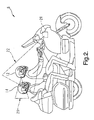
- Infrared transmitter 20 is coupled to the motorcycle at a position facing or directed at the motorcycle rider's helmet when the rider is in the riding position, as shown in Fig. 2.
- motorcycle helmet 12 is a full-face helmet and includes outer shell 15, visor 13, and vent 17.
- Shell 15 provides a hard exterior cover to protect the rider.
- the interior (not shown) of helmet 12 includes a soft padding material to cushion the wearer's head during an accident.
- Visor 13 is generally transparent and may be repositionable to allow the wearer to rotate visor 13 upward.
- Vent 17 allows air to pass through the interior of helmet 12 to cool the wearer's head.
- motorcycle helmet 12 may be an open-face helmet, i.e., not including a visor such as visor 13.
- Motorcycle helmet 12 also includes IR receiver 24, headphone speakers 26, infrared light pipe 27, and signal conveyor 28.
- IR receiver 24 is mounted on the chin portion of helmet 12 to receive IR signal 22 from IR transmitter 20 positioned on motorcycle 8.
- IR receiver 24 is mounted above the face shield of helmet 12.
- IR receiver 24 decodes IR signal 22 and outputs a signal to speakers 26.
- Speakers 26 are positioned in ear pockets within helmet 12.
- IR light pipe 27 and signal conveyor 28 function together as a re-transmitter or pass-thru for IR signal 22.
- IR signal 22 is received by IR receiver 24 and is delivered to signal conveyor 28 by IR light pipe 27.
- Signal 29 is then emitted from signal conveyor 28.
- motorcycle communication system 10 includes a second helmet 14 to allow a passenger on the motorcycle to listen to audio source 16 also.
- Helmet 14 includes IR receiver 30, headphone speakers 32, IR light pipe 31, and signal conveyor 34.
- Helmet 14 is similar to helmet 12 in this embodiment and performs the same functions.
- IR receiver 30 receives IR signal 29, decodes it, and outputs electrical signals to speakers 32.
- Speakers 32 convert the electrical signals into sound.
- Helmet 14 also includes an IR light pipe 31 and signal conveyor 34 to transmit the IR signal to any helmets positioned behind helmet 14.
- helmets 12 and 14 are prefabricated to incorporate IR receivers 24, 30 and speakers 26, 32. In other embodiments (not shown), the IR receiver and speakers may be added to existing helmets. Additionally, IR transmitter 20 may be factory installed or installed later as an after-market product.
- IR transmitter 20 is placed in the front of the motorcycle 8 facing rearward.
- IR transmitter 20 is placed in the instrument panel of motorcycle 8.
- IR transmitter 20 receives electrical signals through audio output 18 from audio source 16, encodes the electrical signals into IR signals, and transmits them as IR signal 22.
- IR transmitter 20 is positioned to provide IR light-emitting-diode (LED) coverage of approximately 50° by 50° or about 22 inches by 22 inches at about 24 inches from transmitter 20.
- LED IR light-emitting-diode
- the rider may rotate helmet 12 about 180° in either direction without losing contact with the IR signal 22.
- IR receiver 24 When IR signal 22 is received by receiver 24 in helmet 12 IR receiver 24 decodes IR signal 22 into electrical signals which are sent to speakers 26 that produce sound corresponding to the original audio source signals. IR receiver 24 and speakers 26 are powered by a power source (not shown) such as a battery positioned on the helmet. IR receiver 24 also directs IR signal 22 to signal conveyor 28 through light pipe 27. Signal conveyor 28 transmits IR signal 29 to IR receiver 30 in helmet 14. Receiver 30 operates in the same fashion as receiver 24 of helmet 12. In other embodiments (not shown), light pipe 27 may be replaced with a retransmitter or any other suitable transmission media.
- motorcycle communication system 10 In other embodiments (not shown) of motorcycle communication system 10, other radio-frequency wireless signals may be employed such as the BluetoothTM wireless protocol or another band and/or protocol instead of an IR signal.
- motorcycle communication system 10 also includes a microphone or microphones coupled to the receiver to allow the driver and passenger to speak with one another using an intercommunication (intercom) system.
- intercom intercommunication
Landscapes
- Engineering & Computer Science (AREA)
- Computer Networks & Wireless Communication (AREA)
- Signal Processing (AREA)
- Optical Communication System (AREA)
- Transceivers (AREA)
- Helmets And Other Head Coverings (AREA)
Abstract
Description
- The present invention relates to a method and apparatus for a wireless communication system for a motorcycle and motorcycle helmets.
- Current systems for listening to music while riding a motorcycle generally involve a factory installed or aftermarket radio and speaker system mounted on the motorcycle. The speaker system must be powerful enough to overcome road and wind noise to allow a rider or riders to listen to the music when the motorcycle is at highway speeds. Often the music must be relatively loud to allow the rider to hear it, especially if the rider is wearing a helmet. When the motorcycle reduces speed or is traveling in a city, the volume is often too loud and must be reduced manually. Another system for listening to music while riding includes a helmet with integrated speakers. In this system, the rider usually has a wire connecting the helmet to a radio mounted on the motorcycle or the helmet and the speakers. These systems may also include a microphone integrated into the helmet to allow a riders to communicate with each other.
- One embodiment of the present invention includes a wireless helmet communication system comprising a transmitter configured to transmit a signal, a receiver coupled to a helmet and configured to receive the signal, a power source configured to supply power to the receiver, and a speaker positioned in the helmet and coupled to the receiver, the speaker configured to output sound corresponding to the signal.
- Another embodiment of the present invention includes a audio system for a motorcycle comprising an audio source supported by the motorcycle, the audio source configured to produce a first signal, a transmitter supported by the motorcycle, the transmitter configured to receive the first signal and transmit a second signal, a helmet configured to be worn by a motorcycle rider, a receiver supported by the helmet and configured to receive the second signal and transmit a third signal, and a least one speaker positioned in the helmet, the speaker configured to receive the third signal and produce sound corresponding to the third signal.
- Another embodiment of the present invention includes a wireless method of delivering signals from a motorcycle to a motorcycle helmet, the method including the steps of providing an audio source, a transmitter, a receiver, and a speaker, the audio source and the transmitter coupled to the motorcycle, the receiver and the speaker coupled to the motorcycle helmet, the speaker being coupled to the receiver, converting a first signal from the audio source to a second signal, transmitting the second signal from the transmitter, receiving the second signal at the receiver, converting the second signal to a third signal, the third signal being received by the speaker, and producing an audio signal from the speaker.
- The above-mentioned and other features and objects of this invention, and the manner of attaining them, will become more apparent and the invention itself will be better understood by reference to the following description of embodiments of the invention taken in conjunction with the accompanying drawings, wherein:
- Fig. 1 is a partial schematic of one embodiment of a
motorcycle communication system 10; - Fig. 2 is a profile view of a
motorcycle 8 including themotorcycle communication system 10 shown in Fig. 1; and - Fig. 3 is a front view of the
motorcycle 8 shown in Fig. 2. - Corresponding reference characters indicate corresponding parts throughout the several views. Although the drawings represent embodiments of the present invention, the drawings are not necessarily to scale and certain features my be exaggerated in order to better illustrate and explain the present invention. The exemplifications set out herein illustrate embodiments of the invention in several forms and such exemplification is not to be construed as limiting the scope of the invention in any manner.
- The embodiments discussed below are not intended to be exhaustive or limit the invention to the precise forms disclosed in the following detailed description. Rather, the embodiments are chosen and described so that others skilled in the art may utilize their teachings.
- One embodiment of
motorcycle communication system 10 is shown in Fig. 1.System 10 includesaudio source 16,audio output 18, infrared (IR)transmitter 20, andmotorcycle helmets Audio output 18 is an audio connector or coupler such as an RCA style output, audio jack, ⅛ inch audio jack, or ¼ inch audio jack.Audio source 16 is coupled to the motorcycle and may include an AM/FM/XM radio, an MP3 player, a cellular phone, a portable handheld digital media device, a CD player, or any other suitable audio source.Audio output 18 is connected toaudio source 16 to carry electrical signals fromaudio source 16 toIR transmitter 20.Infrared transmitter 20 is coupled to the motorcycle at a position facing or directed at the motorcycle rider's helmet when the rider is in the riding position, as shown in Fig. 2. - In this embodiment,
motorcycle helmet 12 is a full-face helmet and includesouter shell 15,visor 13, and vent 17. Shell 15 provides a hard exterior cover to protect the rider. The interior (not shown) ofhelmet 12 includes a soft padding material to cushion the wearer's head during an accident.Visor 13 is generally transparent and may be repositionable to allow the wearer to rotatevisor 13 upward. Vent 17 allows air to pass through the interior ofhelmet 12 to cool the wearer's head. In other embodiments (not shown),motorcycle helmet 12 may be an open-face helmet, i.e., not including a visor such asvisor 13. -
Motorcycle helmet 12 also includesIR receiver 24,headphone speakers 26,infrared light pipe 27, andsignal conveyor 28. In this embodiment,IR receiver 24 is mounted on the chin portion ofhelmet 12 to receiveIR signal 22 fromIR transmitter 20 positioned onmotorcycle 8. In an alternative embodiment,IR receiver 24 is mounted above the face shield ofhelmet 12.IR receiver 24 decodesIR signal 22 and outputs a signal tospeakers 26.Speakers 26 are positioned in ear pockets withinhelmet 12.IR light pipe 27 andsignal conveyor 28 function together as a re-transmitter or pass-thru forIR signal 22.IR signal 22 is received byIR receiver 24 and is delivered tosignal conveyor 28 byIR light pipe 27.Signal 29 is then emitted fromsignal conveyor 28. - In this embodiment,
motorcycle communication system 10 includes asecond helmet 14 to allow a passenger on the motorcycle to listen toaudio source 16 also.Helmet 14 includesIR receiver 30,headphone speakers 32,IR light pipe 31, andsignal conveyor 34.Helmet 14 is similar tohelmet 12 in this embodiment and performs the same functions.IR receiver 30 receivesIR signal 29, decodes it, and outputs electrical signals tospeakers 32.Speakers 32 convert the electrical signals into sound.Helmet 14 also includes anIR light pipe 31 andsignal conveyor 34 to transmit the IR signal to any helmets positioned behindhelmet 14. - In the embodiment described above,
helmets IR receivers speakers IR transmitter 20 may be factory installed or installed later as an after-market product. - As shown in Figs. 2 and 3,
IR transmitter 20 is placed in the front of themotorcycle 8 facing rearward. In this embodiment,IR transmitter 20 is placed in the instrument panel ofmotorcycle 8. Whensystem 10 is activated by the rider,IR transmitter 20 receives electrical signals throughaudio output 18 fromaudio source 16, encodes the electrical signals into IR signals, and transmits them asIR signal 22. In this embodiment,IR transmitter 20 is positioned to provide IR light-emitting-diode (LED) coverage of approximately 50° by 50° or about 22 inches by 22 inches at about 24 inches fromtransmitter 20. WhenIR receiver 24 is placed on the chin region ofhelmet 12 or the forehead region andhelmet 12 is facing forward, the rider may rotatehelmet 12 about 180° in either direction without losing contact with theIR signal 22. WhenIR signal 22 is received byreceiver 24 inhelmet 12IR receiver 24 decodesIR signal 22 into electrical signals which are sent tospeakers 26 that produce sound corresponding to the original audio source signals.IR receiver 24 andspeakers 26 are powered by a power source (not shown) such as a battery positioned on the helmet.IR receiver 24 also directsIR signal 22 to signalconveyor 28 throughlight pipe 27.Signal conveyor 28 transmitsIR signal 29 toIR receiver 30 inhelmet 14.Receiver 30 operates in the same fashion asreceiver 24 ofhelmet 12. In other embodiments (not shown),light pipe 27 may be replaced with a retransmitter or any other suitable transmission media. - In other embodiments (not shown) of
motorcycle communication system 10, other radio-frequency wireless signals may be employed such as the Bluetooth™ wireless protocol or another band and/or protocol instead of an IR signal. In another alternative embodiment (not shown),motorcycle communication system 10 also includes a microphone or microphones coupled to the receiver to allow the driver and passenger to speak with one another using an intercommunication (intercom) system. - While this invention has been described as having exemplary design, the present invention may be further modified within the spirit and scope of this disclosure. This application is therefore intended to cover any variations, uses, or adaptations of the invention using its general principles. Further, this application is intended to cover such departures from the present disclosure as come within known or customary practice in the art of which this invention pertains.
Claims (26)
- A wireless helmet communication system (10) comprising:a transmitter (20) configured to transmit a signal (22);a receiver (24) coupled to a helmet (12) and configured to receive the signal (22);a power source configured to supply power to the receiver (24); anda speaker (26) positioned in the helmet (12) and coupled to the receiver (24), the speaker (26) configured to output sound corresponding to the signal (22).
- The wireless helmet communication system (10) of claim 1, wherein the transmitter(20) is one of an infrared transmitter, a radio frequency transmitter, a Bluetooth™ transmitter, and an optical transmitter.
- The wireless helmet communication system(10) of claim 1, further comprising a signal conveyor (18) coupled to the helmet (12), the signal conveyor (18) being configured to convey the signal (22) to a re-transmitter (28).
- The wireless helmet communication system (10) of claim 1, further comprising an audio source (16) and an audio-to-infrared converter configured to convert a first signal from the audio source (16) to an infrared signal.
- The wireless helmet communication system (10) of claim 4, wherein the audio source (16) is one of an AM/FM/XM radio, a portable handheld digital media device, a CD player, an intercommunication system, and an MP3 player.
- The wireless helmet communication system (10) of claim 1, further comprising a microphone coupled to the helmet (12).
- The wireless helmet communication system (10) of claim 1, further comprising a second helmet (14) including a receiver (30), a power source, and a speaker (32) positioned in the helmet (14).
- A audio system (10) for a motorcycle comprising:an audio source (16) supported by the motorcycle, the audio source (16) configured to produce a first signal;a transmitter(20) supported by the motorcycle, the transmitter (20) configured to receive the first signal and transmit a second signal (22);a helmet (12) configured to be worn by a motorcycle rider;a receiver (24) supported by the helmet (12) and configured to receive the second signal (22) and transmit a third signal; anda least one speaker (26) positioned in the helmet (12), the speaker (26) configured to receive the third signal and produce sound corresponding to the third signal.
- The audio system (10) of claim 8, further comprising a power source configured to supply power to the receiver (24) and the at least one speaker (26).
- The audio system (10) of claim 8, further comprising a signal conveyor (18) positioned on the helmet (12), the signal conveyor (18) configured to convey the second signal (22).
- The audio system (10) of claim 10, further comprising a second helmet (14) having a second receiver (30) and a second speaker (32), the second receiver (30) configured to receive second signal (22) and transmit a fourth signal to the second speaker (32), the speaker (32) configured to receive the fourth signal and produce sound corresponding to the fourth signal.
- The audio system (10) of claim 8, wherein the transmitter (20) is one of an infrared transmitter, a Bluetooth™ transmitter, a radio-frequency transmitter, and an optical transmitter.
- The audio system (10) of claim 8, wherein the audio source (16) is one of an AM/FM/XM radio, a CD player, a portable handheld digital media device, an intercom system, and an MP3 player.
- The audio system (10) of claim 8, further comprising a microphone positioned within the first helmet (12), the microphone configured to receive audio input from the motorcycle rider.
- The audio system (10) of claim 8, further comprising a converter configured to receive the first signal, convert it an IR signal, and output the IR signal to the transmitter (20).
- A wireless method of delivering signals from a motorcycle to a motorcycle helmet (12), the method including the steps of:providing an audio source (16), a transmitter (20), a receiver (24), and a speaker (26), the audio source (16) and the transmitter (20) coupled to the motorcycle, the receiver (24) and the speaker (26) coupled to the motorcycle helmet (12), the speaker (26) being coupled to the receiver (24);converting a first signal from the audio source (16) to a second signal (22);transmitting the second signal (22) from the transmitter (20);receiving the second signal (22) at the receiver (24);converting the second signal to a third signal, the third signal being received by the speaker (26); andproducing an audio signal from the speaker (26).
- The wireless method of claim 16, wherein the transmitter (20) is one of an infrared transmitter, a Bluetooth™ transmitter, a radio-frequency transmitter, and an optical transmitter.
- The wireless method of claim 16, wherein the audio source (16) is one of an AM/FM/XM radio, a CD player, a portable handheld digital media device, an intercom system, and an MP3 player.
- The wireless method of claim 16, further comprising the steps of:transmitting the second signal (22) to a second helmet (14) from a retransmitter (28) supported by the helmet (14).
- A motorcycle helmet (12) including a wireless audio system (10) configured to receive a signal (22) from a transmitter (20) positioned on a motorcycle, the motorcycle helmet (12) comprising:an outer shell (15);a receiver (24) coupled to a helmet (12) and configured to receive a signal (22);a power source configured to supply power to the receiver (24); anda speaker (26) positioned in the helmet (12) and coupled to the receiver (24), the speaker (26) configured to output sound corresponding to the signal.
- The motorcycle helmet (12) of claim 20, wherein the transmitter (20) is one of an infrared transmitter, a radio frequency transmitter, a Bluetooth™ transmitter, and an optical transmitter.
- The motorcycle helmet (12) of claim 20, further comprising a signal conveyor (18) coupled to the helmet (12), the signal conveyor (18) being configured to covey the signal to a re-transmitter (28).
- The motorcycle helmet (12) of claim 20, further comprising an audio source (16) and an audio-to-infrared converter configured to convert a first signal from the audio source (16) to an infrared signal.
- The motorcycle helmet (12) of claim 23, wherein the audio source (16) is one of an AM/FM/XM radio, a portable handheld digital media device, a CD player, an intercommunication system, and an MP3 player.
- The motorcycle helmet (12) of claim 20, further comprising a microphone coupled to the helmet (12).
- The motorcycle helmet (12) of claim 20, further comprising a second motorcycle helmet (14) including a receiver (30), a power source, and a speaker (32) positioned in the helmet (14).
Applications Claiming Priority (1)
| Application Number | Priority Date | Filing Date | Title |
|---|---|---|---|
| US11/159,904 US20060293092A1 (en) | 2005-06-23 | 2005-06-23 | Wireless helmet communications system |
Publications (2)
| Publication Number | Publication Date |
|---|---|
| EP1737136A2 true EP1737136A2 (en) | 2006-12-27 |
| EP1737136A3 EP1737136A3 (en) | 2007-12-26 |
Family
ID=36968496
Family Applications (1)
| Application Number | Title | Priority Date | Filing Date |
|---|---|---|---|
| EP06076194A Withdrawn EP1737136A3 (en) | 2005-06-23 | 2006-06-08 | Wireless helmet communications system |
Country Status (2)
| Country | Link |
|---|---|
| US (1) | US20060293092A1 (en) |
| EP (1) | EP1737136A3 (en) |
Families Citing this family (16)
| Publication number | Priority date | Publication date | Assignee | Title |
|---|---|---|---|---|
| AU2003903305A0 (en) * | 2003-06-24 | 2003-07-10 | Mark Ellis | A personal communication device |
| KR20110009678A (en) | 2008-04-22 | 2011-01-28 | 카르도 시스템즈, 인코퍼레이티드. | Neckpad communication system for helmet |
| US8334762B2 (en) * | 2008-08-22 | 2012-12-18 | Randall Gerald Szeljack | Communications assembly adapted for use with a helmet |
| WO2010088596A1 (en) | 2009-01-30 | 2010-08-05 | Alphamicron, Inc. | Attachable optical element arrangements and methods |
| US9398620B1 (en) * | 2009-12-09 | 2016-07-19 | John James Lazzeroni | Simultaneous voice and audio traffic between two devices on a wireless personal-area network |
| USD658812S1 (en) | 2010-02-12 | 2012-05-01 | Alphamicron, Inc. | Optical element for a helmet visor |
| US20120157243A1 (en) * | 2010-12-16 | 2012-06-21 | Gallo Christopher J | Football training aid and method |
| US20130167290A1 (en) * | 2011-12-30 | 2013-07-04 | Ariel BEN EZRA | Sensor activated ball and sport accessory with computer functionalities |
| US9918508B2 (en) | 2012-11-13 | 2018-03-20 | Alphamicron Incorporated | Attachable optical element arrangements and methods |
| US9288570B2 (en) * | 2013-08-27 | 2016-03-15 | Bose Corporation | Assisting conversation while listening to audio |
| US9190043B2 (en) | 2013-08-27 | 2015-11-17 | Bose Corporation | Assisting conversation in noisy environments |
| US9794386B2 (en) | 2014-02-18 | 2017-10-17 | Quiet, Inc. | Anechoic cup or secondary anechoic chamber comprising metallic flake mixed with sound attenuating or absorbing materials for use with a communication device and related methods |
| US11722871B2 (en) * | 2019-09-25 | 2023-08-08 | Anthony Livano | Bluetooth intercom accessory for helmets |
| US11967987B2 (en) * | 2021-05-25 | 2024-04-23 | eSTS, Inc. | System and method for configurable invisible light communications |
| CN113301527B (en) * | 2021-06-07 | 2021-10-15 | 浙江春风动力股份有限公司 | Vehicle and information interaction system thereof |
| US12501225B2 (en) | 2022-01-02 | 2025-12-16 | Poltorak Technologies Llc | Bluetooth enabled intercom with hearing aid functionality |
Citations (1)
| Publication number | Priority date | Publication date | Assignee | Title |
|---|---|---|---|---|
| EP1081872A2 (en) | 1999-09-06 | 2001-03-07 | Honda Giken Kogyo Kabushiki Kaisha | Rado communication system for vehicle |
Family Cites Families (43)
| Publication number | Priority date | Publication date | Assignee | Title |
|---|---|---|---|---|
| JPH0686229B2 (en) * | 1989-04-21 | 1994-11-02 | 川重岐阜エンジニアリング株式会社 | Data display device in vehicle |
| US6359547B1 (en) * | 1994-11-15 | 2002-03-19 | William D. Denison | Electronic access control device |
| US5615410A (en) * | 1996-01-16 | 1997-03-25 | Demars; Robert A. | Head wear communication system |
| US5943174A (en) * | 1998-06-16 | 1999-08-24 | Itt Manufacturing Enterprises, Inc. | Night vision monocular device |
| US20060294551A1 (en) * | 1998-08-07 | 2006-12-28 | Cholewinsky Norman D | Vehicle entertainment system |
| US6343217B1 (en) * | 1998-11-12 | 2002-01-29 | Legerity, Inc. | Digital cordless telephony with PCM coding |
| US7684570B2 (en) * | 1998-11-17 | 2010-03-23 | Aamp Of America | Vehicle remote control interface for controlling multiple electronic devices |
| JP3939040B2 (en) * | 1998-12-25 | 2007-06-27 | 本田技研工業株式会社 | Vehicle communication device |
| FI110296B (en) * | 2000-05-26 | 2002-12-31 | Nokia Corp | Hands free feature |
| US7150526B2 (en) * | 2000-06-02 | 2006-12-19 | Oakley, Inc. | Wireless interactive headset |
| US6714233B2 (en) * | 2000-06-21 | 2004-03-30 | Seiko Epson Corporation | Mobile video telephone system |
| US20020076060A1 (en) * | 2000-12-19 | 2002-06-20 | Hall Ronald W. | Programmable headset and programming apparatus and method |
| ITMI20011480A1 (en) * | 2001-07-11 | 2003-01-11 | Sitec Italia S R L | HIGH-FUNCTIONAL AUDIO COMMUNICATION SYSTEM FOR MOTOR VEHICLES |
| US6978162B2 (en) * | 2001-08-17 | 2005-12-20 | Hewlett-Packard Development Company, L.P. | Integrated portable entertainment, information and communication system linked to a wireless helmet |
| US7076204B2 (en) * | 2001-10-30 | 2006-07-11 | Unwired Technology Llc | Multiple channel wireless communication system |
| US7835530B2 (en) * | 2001-11-26 | 2010-11-16 | Cristiano Avigni | Systems and methods for determining sound of a moving object |
| GB2382952B (en) * | 2001-11-28 | 2005-12-07 | Sendo Int Ltd | Wireless headset-based communication |
| US7308202B2 (en) * | 2002-02-01 | 2007-12-11 | Cubic Corporation | Secure covert combat identification friend-or-foe (IFF) system for the dismounted soldier |
| EP1513299B1 (en) * | 2002-04-12 | 2009-06-10 | Honda Giken Kogyo Kabushiki Kaisha | Vehicle intercommunication apparatus |
| US20040208603A1 (en) * | 2002-05-03 | 2004-10-21 | Hekkel Steve D | Mobile infrared communication system |
| US20040203351A1 (en) * | 2002-05-15 | 2004-10-14 | Koninklijke Philips Electronics N.V. | Bluetooth control device for mobile communication apparatus |
| CN1682005A (en) * | 2002-07-13 | 2005-10-12 | 罗格·烘伯 | Authentication, identification, designation, location, locking and anti-theft security system (here also referred to as lock-ring DSS) |
| CA2457994A1 (en) * | 2003-02-24 | 2004-08-24 | Simon Treadwell | Apparatus and method for recording real time movements and experiences for subsequent replay in a virtual reality domain |
| US20040220922A1 (en) * | 2003-04-30 | 2004-11-04 | Lovison Sean R. | Systems and methods for meeting people via wireless communication among a plurality of wireless devices |
| US6784795B1 (en) * | 2003-05-06 | 2004-08-31 | Mar-Bruc, Inc. | Brake and signal light system |
| US7266301B2 (en) * | 2003-09-05 | 2007-09-04 | Speakercraft, Inc. | Interference resistant repeater systems including controller units |
| AU2003270226A1 (en) * | 2003-09-19 | 2005-04-11 | Telefonaktiebolaget Lm Ericsson (Publ) | Method and device for delivery or obtaining of a good |
| US6933836B2 (en) * | 2003-11-06 | 2005-08-23 | Richard Hsu | Bike braking warning control |
| JP4751338B2 (en) * | 2003-12-30 | 2011-08-17 | ユニバーシティ オブ フロリダ リサーチファウンデーション インコーポレイティッド | New and specially configured nasal pulse oximeter |
| GB0406091D0 (en) * | 2004-03-17 | 2004-04-21 | Koninkl Philips Electronics Nv | Radio repeater |
| US7049941B2 (en) * | 2004-07-01 | 2006-05-23 | Motorola, Inc. | Method and system for alerting a user of a mobile communication device |
| US7109857B2 (en) * | 2004-07-15 | 2006-09-19 | Ross Jr Herbert G | Brake light warning system for safety helmets and method of operation |
| US20060019605A1 (en) * | 2004-07-20 | 2006-01-26 | Jeng-Jye Shau | Wireless signal transfer by sound waves |
| US20060043937A1 (en) * | 2004-08-31 | 2006-03-02 | Joseph Patino | Method and system for obtaining ambient temperatures |
| US20060121950A1 (en) * | 2004-12-06 | 2006-06-08 | Chi-Cheng Lee | Wireless handfree headset device for a helmet |
| US20060148465A1 (en) * | 2004-12-30 | 2006-07-06 | Perdomo Jorge L | System and method for providing an adaptive disablement zone |
| US7203525B2 (en) * | 2005-02-25 | 2007-04-10 | Dieringer Michael D | Wireless control of helmet-mounted communications equipment |
| US7062301B1 (en) * | 2005-02-25 | 2006-06-13 | Dieringer Michael D | Wireless control of operating characteristics of microphone-including arrangement for users of power sports equipment |
| US7169067B2 (en) * | 2005-03-03 | 2007-01-30 | Gary Dale Town | Hand to eye coordination training aid |
| US7515935B2 (en) * | 2005-05-26 | 2009-04-07 | Broadcom Corporation | Method and system for flexible FM tuning |
| US20070044126A1 (en) * | 2005-08-18 | 2007-02-22 | Rockwell Collins, Inc. | Wireless video entertainment system |
| US8600483B2 (en) * | 2006-03-20 | 2013-12-03 | California Institute Of Technology | Mobile in vivo infra red data collection and diagnoses comparison system |
| US20080097632A1 (en) * | 2006-10-06 | 2008-04-24 | Logan Cullen A | Handheld device, integrated circuit and methods for playing sponsor information with the playback of program content |
-
2005
- 2005-06-23 US US11/159,904 patent/US20060293092A1/en not_active Abandoned
-
2006
- 2006-06-08 EP EP06076194A patent/EP1737136A3/en not_active Withdrawn
Patent Citations (1)
| Publication number | Priority date | Publication date | Assignee | Title |
|---|---|---|---|---|
| EP1081872A2 (en) | 1999-09-06 | 2001-03-07 | Honda Giken Kogyo Kabushiki Kaisha | Rado communication system for vehicle |
Also Published As
| Publication number | Publication date |
|---|---|
| EP1737136A3 (en) | 2007-12-26 |
| US20060293092A1 (en) | 2006-12-28 |
Similar Documents
| Publication | Publication Date | Title |
|---|---|---|
| US20060293092A1 (en) | Wireless helmet communications system | |
| US10743094B2 (en) | Helmet having dual mode headphone and method therefor | |
| US4977975A (en) | Vented motorcycle helmet speaker enclosure | |
| US5524058A (en) | Apparatus for performing noise cancellation in telephonic devices and headwear | |
| US7221966B2 (en) | Wireless communication systems for masks or helmets | |
| US4334315A (en) | Wireless transmitting and receiving systems including ear microphones | |
| US7862194B2 (en) | Baseball-style cap with amplified stereo speakers | |
| US6101256A (en) | Self-contained helmet communication system | |
| US4979586A (en) | Acoustically shielded motorcycle helmet speaker enclosure | |
| JP2004173018A (en) | Communication system for helmet | |
| JPH11501479A (en) | Portable speaker with improved low frequency response | |
| KR101382553B1 (en) | Receiver for recognizing external environment | |
| US5691514A (en) | Rearward sound enhancing apparatus | |
| US20100183182A1 (en) | Helmet and apparatus for active noise suppression | |
| WO2019239140A3 (en) | Audio system and headphone unit | |
| JP2006229373A (en) | Bone conduction headband or cap | |
| EP1461870B1 (en) | High performance audio communication system for motorcycles | |
| US20240406614A1 (en) | High fidelity bone conduction speakers and headphones | |
| US20090285421A1 (en) | Radio headset device for high noise environment | |
| US20220210539A1 (en) | Binaural hearing device with monaural ambient mode | |
| US11388498B1 (en) | Binaural hearing device with monaural ambient mode | |
| JP4072167B2 (en) | Hearing assistance device, signal transmission method thereof, and hearing assistance system | |
| JPH10304485A (en) | Information provision device | |
| CN201042021Y (en) | Mobile phone cover with frequency modulation transmission function | |
| JP2006207108A (en) | Helmet with speaker, and communication system |
Legal Events
| Date | Code | Title | Description |
|---|---|---|---|
| PUAI | Public reference made under article 153(3) epc to a published international application that has entered the european phase |
Free format text: ORIGINAL CODE: 0009012 |
|
| AK | Designated contracting states |
Kind code of ref document: A2 Designated state(s): AT BE BG CH CY CZ DE DK EE ES FI FR GB GR HU IE IS IT LI LT LU LV MC NL PL PT RO SE SI SK TR |
|
| AX | Request for extension of the european patent |
Extension state: AL BA HR MK YU |
|
| PUAL | Search report despatched |
Free format text: ORIGINAL CODE: 0009013 |
|
| AK | Designated contracting states |
Kind code of ref document: A3 Designated state(s): AT BE BG CH CY CZ DE DK EE ES FI FR GB GR HU IE IS IT LI LT LU LV MC NL PL PT RO SE SI SK TR |
|
| AX | Request for extension of the european patent |
Extension state: AL BA HR MK YU |
|
| RIC1 | Information provided on ipc code assigned before grant |
Ipc: A42B 3/30 20060101ALI20071121BHEP Ipc: H04B 1/38 20060101AFI20060920BHEP |
|
| 17P | Request for examination filed |
Effective date: 20080626 |
|
| 17Q | First examination report despatched |
Effective date: 20080724 |
|
| AKX | Designation fees paid |
Designated state(s): AT BE BG CH CY CZ DE DK EE ES FI FR GB GR HU IE IS IT LI LT LU LV MC NL PL PT RO SE SI SK TR |
|
| R17C | First examination report despatched (corrected) |
Effective date: 20080801 |
|
| STAA | Information on the status of an ep patent application or granted ep patent |
Free format text: STATUS: THE APPLICATION IS DEEMED TO BE WITHDRAWN |
|
| 18D | Application deemed to be withdrawn |
Effective date: 20110101 |