EP1736828A1 - Photoresist monomer, polymer thereof and photoresist composition including the same - Google Patents
Photoresist monomer, polymer thereof and photoresist composition including the same Download PDFInfo
- Publication number
- EP1736828A1 EP1736828A1 EP06012870A EP06012870A EP1736828A1 EP 1736828 A1 EP1736828 A1 EP 1736828A1 EP 06012870 A EP06012870 A EP 06012870A EP 06012870 A EP06012870 A EP 06012870A EP 1736828 A1 EP1736828 A1 EP 1736828A1
- Authority
- EP
- European Patent Office
- Prior art keywords
- formula
- photoresist
- polymer
- cyclic
- group
- Prior art date
- Legal status (The legal status is an assumption and is not a legal conclusion. Google has not performed a legal analysis and makes no representation as to the accuracy of the status listed.)
- Granted
Links
- 0 CCCC(CCC=C)CC(CC1)CCC1(C)*=S=C Chemical compound CCCC(CCC=C)CC(CC1)CCC1(C)*=S=C 0.000 description 6
- ZPYKRVYDEXXOGE-UHFFFAOYSA-N CC(C1)(C(CCC23)C2(C)[O]=C1C(C=C)=C)C3(C)OC(C(I)=C)=O Chemical compound CC(C1)(C(CCC23)C2(C)[O]=C1C(C=C)=C)C3(C)OC(C(I)=C)=O ZPYKRVYDEXXOGE-UHFFFAOYSA-N 0.000 description 1
- MIKUUNGUGORFRN-UHFFFAOYSA-N CC(CC1)(CC1(C)[O]=C)N=O Chemical compound CC(CC1)(CC1(C)[O]=C)N=O MIKUUNGUGORFRN-UHFFFAOYSA-N 0.000 description 1
- BXMWJSCJTSOQNV-UHFFFAOYSA-N O=C(C=C1)OC1=C1CC1 Chemical compound O=C(C=C1)OC1=C1CC1 BXMWJSCJTSOQNV-UHFFFAOYSA-N 0.000 description 1
Images

Classifications
-
- G—PHYSICS
- G03—PHOTOGRAPHY; CINEMATOGRAPHY; ANALOGOUS TECHNIQUES USING WAVES OTHER THAN OPTICAL WAVES; ELECTROGRAPHY; HOLOGRAPHY
- G03F—PHOTOMECHANICAL PRODUCTION OF TEXTURED OR PATTERNED SURFACES, e.g. FOR PRINTING, FOR PROCESSING OF SEMICONDUCTOR DEVICES; MATERIALS THEREFOR; ORIGINALS THEREFOR; APPARATUS SPECIALLY ADAPTED THEREFOR
- G03F7/00—Photomechanical, e.g. photolithographic, production of textured or patterned surfaces, e.g. printing surfaces; Materials therefor, e.g. comprising photoresists; Apparatus specially adapted therefor
- G03F7/004—Photosensitive materials
- G03F7/039—Macromolecular compounds which are photodegradable, e.g. positive electron resists
- G03F7/0392—Macromolecular compounds which are photodegradable, e.g. positive electron resists the macromolecular compound being present in a chemically amplified positive photoresist composition
- G03F7/0397—Macromolecular compounds which are photodegradable, e.g. positive electron resists the macromolecular compound being present in a chemically amplified positive photoresist composition the macromolecular compound having an alicyclic moiety in a side chain
-
- C—CHEMISTRY; METALLURGY
- C07—ORGANIC CHEMISTRY
- C07C—ACYCLIC OR CARBOCYCLIC COMPOUNDS
- C07C69/00—Esters of carboxylic acids; Esters of carbonic or haloformic acids
- C07C69/52—Esters of acyclic unsaturated carboxylic acids having the esterified carboxyl group bound to an acyclic carbon atom
- C07C69/533—Monocarboxylic acid esters having only one carbon-to-carbon double bond
- C07C69/54—Acrylic acid esters; Methacrylic acid esters
-
- C—CHEMISTRY; METALLURGY
- C08—ORGANIC MACROMOLECULAR COMPOUNDS; THEIR PREPARATION OR CHEMICAL WORKING-UP; COMPOSITIONS BASED THEREON
- C08F—MACROMOLECULAR COMPOUNDS OBTAINED BY REACTIONS ONLY INVOLVING CARBON-TO-CARBON UNSATURATED BONDS
- C08F220/00—Copolymers of compounds having one or more unsaturated aliphatic radicals, each having only one carbon-to-carbon double bond, and only one being terminated by only one carboxyl radical or a salt, anhydride ester, amide, imide or nitrile thereof
- C08F220/02—Monocarboxylic acids having less than ten carbon atoms; Derivatives thereof
- C08F220/10—Esters
- C08F220/12—Esters of monohydric alcohols or phenols
- C08F220/16—Esters of monohydric alcohols or phenols of phenols or of alcohols containing two or more carbon atoms
- C08F220/18—Esters of monohydric alcohols or phenols of phenols or of alcohols containing two or more carbon atoms with acrylic or methacrylic acids
- C08F220/1811—C10or C11-(Meth)acrylate, e.g. isodecyl (meth)acrylate, isobornyl (meth)acrylate or 2-naphthyl (meth)acrylate
-
- G—PHYSICS
- G03—PHOTOGRAPHY; CINEMATOGRAPHY; ANALOGOUS TECHNIQUES USING WAVES OTHER THAN OPTICAL WAVES; ELECTROGRAPHY; HOLOGRAPHY
- G03F—PHOTOMECHANICAL PRODUCTION OF TEXTURED OR PATTERNED SURFACES, e.g. FOR PRINTING, FOR PROCESSING OF SEMICONDUCTOR DEVICES; MATERIALS THEREFOR; ORIGINALS THEREFOR; APPARATUS SPECIALLY ADAPTED THEREFOR
- G03F7/00—Photomechanical, e.g. photolithographic, production of textured or patterned surfaces, e.g. printing surfaces; Materials therefor, e.g. comprising photoresists; Apparatus specially adapted therefor
- G03F7/004—Photosensitive materials
- G03F7/039—Macromolecular compounds which are photodegradable, e.g. positive electron resists
- G03F7/0392—Macromolecular compounds which are photodegradable, e.g. positive electron resists the macromolecular compound being present in a chemically amplified positive photoresist composition
- G03F7/0395—Macromolecular compounds which are photodegradable, e.g. positive electron resists the macromolecular compound being present in a chemically amplified positive photoresist composition the macromolecular compound having a backbone with alicyclic moieties
-
- C—CHEMISTRY; METALLURGY
- C07—ORGANIC CHEMISTRY
- C07C—ACYCLIC OR CARBOCYCLIC COMPOUNDS
- C07C2601/00—Systems containing only non-condensed rings
- C07C2601/06—Systems containing only non-condensed rings with a five-membered ring
- C07C2601/08—Systems containing only non-condensed rings with a five-membered ring the ring being saturated
-
- C—CHEMISTRY; METALLURGY
- C07—ORGANIC CHEMISTRY
- C07C—ACYCLIC OR CARBOCYCLIC COMPOUNDS
- C07C2601/00—Systems containing only non-condensed rings
- C07C2601/12—Systems containing only non-condensed rings with a six-membered ring
- C07C2601/14—The ring being saturated
-
- C—CHEMISTRY; METALLURGY
- C07—ORGANIC CHEMISTRY
- C07C—ACYCLIC OR CARBOCYCLIC COMPOUNDS
- C07C2602/00—Systems containing two condensed rings
- C07C2602/36—Systems containing two condensed rings the rings having more than two atoms in common
- C07C2602/42—Systems containing two condensed rings the rings having more than two atoms in common the bicyclo ring system containing seven carbon atoms
-
- C—CHEMISTRY; METALLURGY
- C07—ORGANIC CHEMISTRY
- C07C—ACYCLIC OR CARBOCYCLIC COMPOUNDS
- C07C2602/00—Systems containing two condensed rings
- C07C2602/36—Systems containing two condensed rings the rings having more than two atoms in common
- C07C2602/44—Systems containing two condensed rings the rings having more than two atoms in common the bicyclo ring system containing eight carbon atoms
-
- C—CHEMISTRY; METALLURGY
- C07—ORGANIC CHEMISTRY
- C07C—ACYCLIC OR CARBOCYCLIC COMPOUNDS
- C07C2603/00—Systems containing at least three condensed rings
- C07C2603/56—Ring systems containing bridged rings
- C07C2603/58—Ring systems containing bridged rings containing three rings
- C07C2603/70—Ring systems containing bridged rings containing three rings containing only six-membered rings
- C07C2603/74—Adamantanes
-
- Y—GENERAL TAGGING OF NEW TECHNOLOGICAL DEVELOPMENTS; GENERAL TAGGING OF CROSS-SECTIONAL TECHNOLOGIES SPANNING OVER SEVERAL SECTIONS OF THE IPC; TECHNICAL SUBJECTS COVERED BY FORMER USPC CROSS-REFERENCE ART COLLECTIONS [XRACs] AND DIGESTS
- Y10—TECHNICAL SUBJECTS COVERED BY FORMER USPC
- Y10S—TECHNICAL SUBJECTS COVERED BY FORMER USPC CROSS-REFERENCE ART COLLECTIONS [XRACs] AND DIGESTS
- Y10S430/00—Radiation imagery chemistry: process, composition, or product thereof
- Y10S430/1053—Imaging affecting physical property or radiation sensitive material, or producing nonplanar or printing surface - process, composition, or product: radiation sensitive composition or product or process of making binder containing
- Y10S430/1055—Radiation sensitive composition or product or process of making
- Y10S430/106—Binder containing
-
- Y—GENERAL TAGGING OF NEW TECHNOLOGICAL DEVELOPMENTS; GENERAL TAGGING OF CROSS-SECTIONAL TECHNOLOGIES SPANNING OVER SEVERAL SECTIONS OF THE IPC; TECHNICAL SUBJECTS COVERED BY FORMER USPC CROSS-REFERENCE ART COLLECTIONS [XRACs] AND DIGESTS
- Y10—TECHNICAL SUBJECTS COVERED BY FORMER USPC
- Y10S—TECHNICAL SUBJECTS COVERED BY FORMER USPC CROSS-REFERENCE ART COLLECTIONS [XRACs] AND DIGESTS
- Y10S430/00—Radiation imagery chemistry: process, composition, or product thereof
- Y10S430/1053—Imaging affecting physical property or radiation sensitive material, or producing nonplanar or printing surface - process, composition, or product: radiation sensitive composition or product or process of making binder containing
- Y10S430/1055—Radiation sensitive composition or product or process of making
- Y10S430/106—Binder containing
- Y10S430/111—Polymer of unsaturated acid or ester
-
- Y—GENERAL TAGGING OF NEW TECHNOLOGICAL DEVELOPMENTS; GENERAL TAGGING OF CROSS-SECTIONAL TECHNOLOGIES SPANNING OVER SEVERAL SECTIONS OF THE IPC; TECHNICAL SUBJECTS COVERED BY FORMER USPC CROSS-REFERENCE ART COLLECTIONS [XRACs] AND DIGESTS
- Y10—TECHNICAL SUBJECTS COVERED BY FORMER USPC
- Y10S—TECHNICAL SUBJECTS COVERED BY FORMER USPC CROSS-REFERENCE ART COLLECTIONS [XRACs] AND DIGESTS
- Y10S430/00—Radiation imagery chemistry: process, composition, or product thereof
- Y10S430/1053—Imaging affecting physical property or radiation sensitive material, or producing nonplanar or printing surface - process, composition, or product: radiation sensitive composition or product or process of making binder containing
- Y10S430/1055—Radiation sensitive composition or product or process of making
- Y10S430/114—Initiator containing
- Y10S430/115—Cationic or anionic
-
- Y—GENERAL TAGGING OF NEW TECHNOLOGICAL DEVELOPMENTS; GENERAL TAGGING OF CROSS-SECTIONAL TECHNOLOGIES SPANNING OVER SEVERAL SECTIONS OF THE IPC; TECHNICAL SUBJECTS COVERED BY FORMER USPC CROSS-REFERENCE ART COLLECTIONS [XRACs] AND DIGESTS
- Y10—TECHNICAL SUBJECTS COVERED BY FORMER USPC
- Y10S—TECHNICAL SUBJECTS COVERED BY FORMER USPC CROSS-REFERENCE ART COLLECTIONS [XRACs] AND DIGESTS
- Y10S430/00—Radiation imagery chemistry: process, composition, or product thereof
- Y10S430/1053—Imaging affecting physical property or radiation sensitive material, or producing nonplanar or printing surface - process, composition, or product: radiation sensitive composition or product or process of making binder containing
- Y10S430/1055—Radiation sensitive composition or product or process of making
- Y10S430/114—Initiator containing
- Y10S430/122—Sulfur compound containing
-
- Y—GENERAL TAGGING OF NEW TECHNOLOGICAL DEVELOPMENTS; GENERAL TAGGING OF CROSS-SECTIONAL TECHNOLOGIES SPANNING OVER SEVERAL SECTIONS OF THE IPC; TECHNICAL SUBJECTS COVERED BY FORMER USPC CROSS-REFERENCE ART COLLECTIONS [XRACs] AND DIGESTS
- Y10—TECHNICAL SUBJECTS COVERED BY FORMER USPC
- Y10S—TECHNICAL SUBJECTS COVERED BY FORMER USPC CROSS-REFERENCE ART COLLECTIONS [XRACs] AND DIGESTS
- Y10S430/00—Radiation imagery chemistry: process, composition, or product thereof
- Y10S430/1053—Imaging affecting physical property or radiation sensitive material, or producing nonplanar or printing surface - process, composition, or product: radiation sensitive composition or product or process of making binder containing
- Y10S430/1055—Radiation sensitive composition or product or process of making
- Y10S430/114—Initiator containing
- Y10S430/126—Halogen compound containing
Definitions
- This invention relates to a photoresist composition, and more particularly, to a photoresist monomer, a polymer thereof and a photoresist composition including the same, which can improve the resolution of a photolithography process, the process margin, and so on, because of the low activation energy of the deprotection reaction of the alcohol ester having saturated cyclic hydrocarbyl group.
- the photosensitive photoresist polymer should have a low activation energy in the deprotection reaction of the protecting group, in which the protecting group is adhered to the chain of the photoresist polymer for inhibiting the dissolution of the polymer against a basic solution.
- the photoresist polymer which can be used for ArF exposure light source include polyacrylate, cycloolefin-maleic anhydride copolymer, polynorbornene and so on, and they are classified into ( i ) a polymer having the high activation energy protecting group, such as a tertiary butyl group, (ii) a polymer having the medium activation energy protecting group, such as methyl adamantly group or an ethyl adamantly group, and (iii) a polymer having the low activation energy protecting group, such as an acetal group or ketal nobornene group, according to the magnitude of the activation energy of the deprotection reaction of the protecting group which is adhered to the chain of the polymer.
- a polymer having the high activation energy protecting group such as a tertiary butyl group
- a polymer having the medium activation energy protecting group such as methyl adamantly group or an ethyl
- poly(meth)acrylate having acetal groups which belong to the low activation energy protecting group
- U.S. Patent No. 4,975,519 U.S. Patent Publication No. 2002-0143130(2002.10.03 )
- the present invention provides a monomer represented by the following Formula 1.
- R* is a hydrogen or methyl group
- R 1 is saturated hydrocarbyl group of 1 to 5 carbon atoms
- R is mono-cyclic or multi-cyclic homo or hetero saturated hydrocarbyl group of 3 to 50 carbon atoms
- n is an integer of at least 2.
- the present invention also provides a photoresist polymer including a repeating unit represented by the following Formula 2.
- R*, R 1 , and R are as defined in Formula 1.
- the present invention also provides a photoresist polymer including a repeating unit represented by the following Formula 4.
- R* is a hydrogen or methyl group
- R 1 is saturated hydrocarbyl group of 1 to 5 carbon atoms
- R 2 is a chain type or ring type alkyl group of 1 to 20 carbon atoms
- R is mono-cyclic or multi-cyclic homo or hetero saturated hydrocarbyl group of 3 to 50 carbon atoms.
- the present invention also provides a photoresist composition including the polymer and a method of forming the photoresist pattern using the photoresist composition.
- the photoresist monomer having alcohol ester groups and a cyclic hydrocarbyl group according to the present invention can be represented by the following Formula 1.
- R* is a hydrogen or methyl group
- R 1 is saturated hydrocarbyl group of 1 to 5 carbon atoms
- R is mono-cyclic or multi-cyclic homo or hetero saturated hydrocarbyl group of 3 to 50 carbon atoms
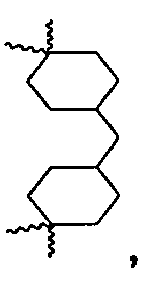
- R is selected from the group consisting of and
- n is an integer of at least 2, and preferably is from 2 to 4.
- Formula 1 a is an example of Formula 1 when n is 2.
- R*, R 1 , and R are as defined in Formula 1.
- the monomer having alcohol esters and a saturated cyclic hydrocarbyl group which is represented by Formula 1 according to the present invention, can be prepared by the reaction of (meth)acryloyl chloride and cyclic diol in the presence of a basic catalyst.
- the cyclic diol can be prepared by the reaction of alkylmagnesium and cyclic ketone having at least 2 ketone groups.
- the cyclic diol can be prepared by the reaction of a cyclic ketone and alkyl magnesium bromide (R 1 MgBr), wherein R 1 is an alkyl group of 1 to 5 carbon atoms.
- R 1 and R are as defined in Formula 1.
- the reaction can be carried out by preparing cyclic ketone having at least 2 ketone groups under inert atmosphere, such as nitrogen or argon atmosphere, and then dropping alkyl magnesium bromide at the temperature of -78 to 20°C and at room pressure, for 1 to 12 hours, in a conventional organic solvent, such as tetrahydrofuran(THF). Then, as shown in Reaction 1b, the monomer represented by Formula 1 can be prepared by the reaction of the obtained cyclic diol and (meth)acryloyl chloride in the presence of a basic catalyst.
- inert atmosphere such as nitrogen or argon atmosphere
- Reaction 1 b R*, R 1 and R are as defined in Formula 1.
- the basic catalyst conventional various basic catalysts can be used, and the representative example of the basic catalyst is triethylamine.
- the reaction can be carried out under inert atmosphere including nitrogen or argon, and so on, at the temperature of 0 to 60°C and at room pressure, for 1 to 24 hours, in the conventional organic solvent, such as tetrahydrofuran(THF).
- THF tetrahydrofuran
- the monomer having alcohol esters including a saturated cyclic hydrocarbyl group which is represented by Formula 1 according to the present invention, can be simply prepared by the one-step reaction of (meth)acryloyl chloride, alkylmagnesium and a cyclic ketone having at least 2 ketone groups.
- R*, R 1 and R are as defined in Formula 1.
- the reaction can be carried out by preparing cyclic ketone having at least 2 ketone groups under nitrogen or argon atmosphere, and then dropping alkyl magnesium bromide at the temperature of -78 to 20°C and at room pressure, for 1 to 12 hours, in a conventional organic solvent, such as tetrahydrofuran(THF).
- a conventional organic solvent such as tetrahydrofuran(THF).
- the monomer represented by Formula 1 can be prepared by dropping (meth)acryloyl chloride at the temperature of -20 to 60°C.
- the photoresist polymer having alcohol ester groups according to the present invention includes a repeating unit represented by the following Formula 2.
- R, R*, and R 1 are as defined in Formula 1.
- the preferable photoresist polymer having alcohol ester groups according to the present invention can be represented by the following Formula 3, and the more preferable polymer can be represented by the Formulas 3a to 3g.
- R*, R** are independently a hydrogen or methyl group
- R 1 is saturated hydrocarbyl group of 1 to 5 carbon atoms
- R 2 , R 3 are chain type or ring type alkyl group of 1 to 20 carbon atoms
- R is mono-cyclic or multi-cyclic homo or hetero saturated hydrocarbyl group
- a, b and c are mole% of the repeating units in the upper and lower polymer chains, and are respectively 1 ⁇ 95mole%, 1 ⁇ 95mole% and 1 ⁇ 95mole%, and preferably 2.5 ⁇ 95mole%, 2.5 ⁇ 95mole% and 2.5 ⁇ 95mole% in the upper or lower polymer chain.
- the photoresist polymer according to the present invention may include a repeating unit represented by the following Formula 4, which is formed by bonding (meth)acrylate crosslinking monomer having alcohol ester groups and (meth)acrylate monomer having chain type or ring type alkyl group.
- R, R*, and R 1 are as defined in Formula 1, and R 2 is chain type or ring type alkyl group of 1 to 20 carbon atoms.
- the preferable photoresist polymer having alcohol ester groups according to the present invention can be represented by the following Formula 5, and the more preferable polymers can be represented by the Formulas 5a to 5g.
- R* is independently a hydrogen or methyl group
- R 1 is saturated hydrocarbyl group of 1 to 5 carbon atoms
- R 2 , R 3 and R 4 are independently chain type or ring type alkyl group of 1 to 20 carbon atoms
- R is mono-cyclic or multi-cyclic homo or hetero saturated hydrocarbyl group of 3 to 50 carbon atoms
- a, b, c and d are mole% of the repeating units in the upper and lower polymer chains, and are respectively 1 ⁇ 95mole%, 1 ⁇ 95mole% and 1 ⁇ 95mole%, preferably 1.67 ⁇ 95mole%, 1.67 ⁇ 95mole% and 1.67 ⁇ 95mole% in the upper or lower polymer chain.
- the alcohol ester group which includes a saturated cyclic hydrocarbyl group and is adhered to the chain of polymer, is a protecting group for preventing the polymer and a photoresist composition including the same from being dissolved by a basic solution, such as a basic developing solution.
- the protecting group is deprotected by an acid catalyst(H + ) which is produced from a photo-acid generators when exposed to an exposure light. Then, the solubility of the exposed region increases, and the contrast of the photoresist composition is effectively improved.
- the alcohol ester group can improve the resolution of the resist pattern, and the process margin, such as an energy margin due to its low activation energy of the deprotection reaction.
- the alcohol ester group can improve the focus depth margin and the line edge roughness because the product of deprotection reaction is a bulky material of high molecular weight.
- the photoresist polymer according to the present invention is formed only by (meth)acrylate linkages, and thus, the next etching process can be performed even if the coating thickness of the polymer is low, for example is less than 2000 ⁇ . Therefore, the polymer can be used in the lithography process using an extreme short wavelength light source and an electron beam, and the polymerization yield highly increases compared with the conventional hybrid-type polymer. And also, the selectivity of the light exposed area to the light non-exposed area can be improved due to the partially crosslinked structure.
- the photoresist polymer including the repeating unit of Formula 2 or 4 can be prepared by the conventional polymerization reaction, for example, by the steps of (a) dissolving (meth)acrylate crosslinking monomer having alcohol ester groups, 1 to 5 kinds of (meth)acrylate monomers having a chain type or ring type alkyl group and a polymerization initiator in a polymerization solvent, and (b) reacting the reaction solution under the inert atmosphere of nitrogen, argon, and so on, at the temperature of 60 to 70°C for 4 to 72 hours.
- the polymerization reaction can be carried out by a radical polymerization reaction, a solution polymerization reaction using a metal catalyst.
- the polymerization method may further include the step of crystallizing and purifying the reaction product with diethyl ether, petroleum ether, a lower alcohol, such as methanol, ethanol or isopropanol, water, mixtures thereof, or so on.
- the photoresist polymer represented by Formula 3 can be prepared by the reaction of Formulas 1a, 1b, 1 c and maleic anhydride.
- R** and R 2 are as defined in Formula 3.
- R 3 is as defined in Formula 3.
- R*, R**, R 1 , R 2 , R 3 , R, a, b and c are as defined in Formula 3.
- the photoresist polymer represented by Formula 5 can be prepared by the polymerization reaction of the monomer of Formula 1 a and (meth)acrylate monomers having chain type or ring type alkyl group.
- R*, R**, R 1 , R 2 , R 3 , R, a, b, c and d are as defined in Formula 5.
- polymerization solvent conventional various polymerization solvents for producing a photoresist polymer can be used.
- exemplary polymerization solvents includes, but are not limited to, cyclohexanone, cyclopentanone, tetrahydrofuran, dimethylformaide, dimethylsulfoxide, dioxane, methylethylketone, benzene, toluene, xylene, and the mixtures thereof.
- Polymerization initiator also can be selected from conventional various polymerization initiators.
- Exemplary polymerization initiators include benzoylperoxide, 2,2'-azobisisobutyronitirile(AIBN), acetylperoxide, lauyl peroxide, t-butylperacetate, t-butylhydroperoxide, di-t-butylperoxide, and the mixtures thereof, which are well known to those skilled in the art.
- the preferable weight average molecular weight(Mw) of the photosensitive polymers of Formula 3 or 5 is from 3,000 to 100,000, and the preferable polydispersity(PD) of the polymers is from 1.0 to 5.0. If the weight average molecular weight(Mw) and the polydispersity(PD) of the polymers are out of the range, the property of photoresist layer and the contrast of patterns can be deteriorated or the photoresist layer cannot be formed.
- the photoresist composition according to the present invention includes the photosensitive polymer including the repeating unit of Formula 2 or 4, a photo-acid generator for producing an acid component, and an organic solvent. If necessary, the photoresist composition may further include various additives.
- the preferable amount of photosensitive polymer including the repeating unit of Formula 2 or 4 is 1 to 30 weight%, and more preferably 5 to 15 weight% with respect to the total photoresist composition. If the amount of the photosensitive polymer is less than 1 weight%, the formation of patterns having desired thickness is in trouble, because the resist layer becomes too thin. If the amount of the photosensitive polymer is more than 30 weight%, the uniformity of the coating layer may be deteriorated.
- the photo-acid generator produces an acid component such as H + when exposed to a light source. Therefore, the photo-acid generator deprotects the protection group of the photosensitive polymer.
- the photo-acid generator any compound, which can generate an acid component when exposed to light, can be used.
- the photo-acid generator include sulfonium compound such as organic sulfonic acid, onium compound such as onium salt, and the mixtures thereof.
- the non-limiting examples of the photo-acid generator include phthalimidofluoromethane sulfonate, which has a low light absorbance at 157nm and 193nm, dinitrobenzyltosylate, n-decyl disulfone, naphtylimido trifluoromethan sulfonate, diphenyliodonium hexafluorophosphate, diphenyliodonium hexafluoroarsenate, diphenyliodonium hexafluoroantimonate, diphenyl-p-methoxyphenylsulfonium triflate, diphenyl-p-toluenylsulfonium triflate, diphenyl-p-isobutylphenylsulfonium triflate, triphenylsulfonium hexafluoro arsenate, triphenylsulfonium hexafluoro antimon
- the preferable amount of the photo-acid generator is 0.05 to 10 weight% with respect to the total photoresist polymer. If the amount of the photo-acid generator is less than 0.05 weight%, the deprotection of the protection group may be in trouble, because the sensitivity of the photoresist composition against light decreases. If the amount of the photo-acid generator is more than 10 weight%, the profile of the resist patterns may be deteriorated because the photo-acid generator absorbs a lot of ultraviolet rays and a large quantity of acid is produced from the photo-acid generator.
- the remaining component of the photoresist composition according to the present invention is the organic solvent.
- the organic solvent can be selected from the conventional various solvents, which are used for the preparation of a photoresist composition.
- Exemplary organic solvent include, but are not limited to, ethyleneglycol monomethylether, ethyleneglycol monoethylether, ethyleneglycol monoacetate, diethyleneglycol, diethyleneglycol monoethylether, propyleneglycol monomethyletheracetate, propyleneglycol, propyleneglycol monoacetate, toluene, xylene, methylethylketone, methylisoamylketone, cyclohexanone, dioxane, methyl lactate, ethyl lactate, methylpyruvate, ethylpyruvate, methylmethoxy propionate, ethylethoxy propionate, N,N-dimethylformamide, N,N-dimethylacet
- the photoresist composition may further include organic base compound.
- organic base components include, but not limited to, triethylamine, triisobutylamine, triisooctylamine, diethanolamine, triethanolamine and the mixtures thereof.
- the preferable amount of the organic base is from 0.01 to 2.00 weight% with respect to the photoresist composition. If the amount of the organic base is less than 0.01 weight%, the undesirable T-top phenomenon may be occurred at the resist pattern. If the amount of the organic base is more than 2.00 weight%, the pattern forming rate may be lowered because the sensitivity of photoresist composition decreases.
- the photoresist composition according to the present invention can be prepared by mixing the photosensitive polymer, the photo-acid generator, the organic solvent, and, if necessary, various additives, and by filtering the mixture.
- the preferable concentration of the solid components in the composition is from 10 to 60 weight%. If the concentration of the solid components is less than 10 weight%, the formation of patterns having a desirable thickness may be in trouble, because the coated resist layer becomes too thin. If the concentration of the solid components is more than 60 weight%, the uniformity of the coating layer may be deteriorated.
- the photoresist composition is applied on a substrate such as silicon wafer, an aluminum substrate, and so on, for example, with a spin coater to form a photoresist layer.
- the photoresist layer is exposed to a light source to form a predetermined pattern.
- the photoresist pattern is thermally treated, which is referred to as a PEB(Post Exposure Bake) and is developed.
- PEB Post Exposure Bake
- alkali solution including alkali compounds such as sodium hydroxide, potassium hydroxide, sodium carbonate, tetramethylammonium hydroxide(TMAH) of the concentration of 0.1 to 10 weight% can be used.
- the developing solution may further include watersoluble organic solvent such as methanol, ethanol and surfactant with a proper amount.
- R* is a hydrogen
- R* is a hydrogen
- R* is a hydrogen
- R* is a hydrogen
- R* is a hydrogen
- R* is a hydrogen
- R* is a hydrogen
- R* is a hydrogen
- R* is a hydrogen
- R* is a hydrogen
- R* is a hydrogen
- R* is a hydrogen
- R* is a hydrogen
- R* is a hydrogen
- photoresist compositions were prepared in the same manner as described in Example 3-1 (Examples 3-2 to 3-14).
- the photoresist compositions prepared in Examples 3-1 to 3-14 were spin coated on the upper parts of silicon wafers to prepare thin-films of photoresist.
- the photoresist layer was pre-baked at a temperature of 90°C for 90 seconds in an oven or on a hot plate, and was exposed with an ArF excimer laser, and was post-baked at a temperature of 120°C for 90 seconds. Thereafter, the baked wafer was developed with 2.38 weight% of TMAH solution for about 40 seconds, thereby forming a 0.07 ⁇ m line/space patterns.
- the photoresist monomer having alcohol ester groups, a polymer thereof and a photoresist composition including the same according to the present invention can improve the resolution and the process margin due to the low activation energy of the deprotection reaction of the alcohol ester group, and also can produce fine photoresist patterns because they have a high dry etching resistance and stable PEB(Post Exposure Baking) temperature sensitivity. Further, the polymers thereof and photoresist compositions including the same can improve the focus depth margin and the line edge roughness of the resist layer.
- the photoresist polymer according to the present invention is formed only by (meth)acrylate linkages, and thus, the next etching process can be easily performed even if the coating thickness of the polymer is low, for example, is less than 2000 ⁇ . Therefore, the polymer can be used in the lithography process using an extreme short wavelength light source and an electron beam, and the polymerization yield highly increases compared with the conventional hybrid-type polymer. And also, the selectivity of the light exposed area to the light non-exposed area can be improved due to the partially crosslinked structure. While the present invention has been described in detail with reference to the preferred embodiments, those skilled in the art will appreciate that various modifications and substitutions can be made thereto without departing from the spirit and scope of the present invention as set for the in the appended claims.
Landscapes
- Physics & Mathematics (AREA)
- Spectroscopy & Molecular Physics (AREA)
- Chemical & Material Sciences (AREA)
- Organic Chemistry (AREA)
- General Physics & Mathematics (AREA)
- Health & Medical Sciences (AREA)
- Chemical Kinetics & Catalysis (AREA)
- Medicinal Chemistry (AREA)
- Polymers & Plastics (AREA)
- Addition Polymer Or Copolymer, Post-Treatments, Or Chemical Modifications (AREA)
- Materials For Photolithography (AREA)
Abstract

Description
- This application claims priorities of
Korean Patent Application Nos. 10-2005-0055190 filed on June 24, 2005 10-2005-0074435 filed on August 12, 2005 - This invention relates to a photoresist composition, and more particularly, to a photoresist monomer, a polymer thereof and a photoresist composition including the same, which can improve the resolution of a photolithography process, the process margin, and so on, because of the low activation energy of the deprotection reaction of the alcohol ester having saturated cyclic hydrocarbyl group.
- Recently, as the integration degree and the precision of semiconductor devices increase, the formation of ultra-fine photoresist patterns, which have a half pitch of less than 90nm, is needed in the photolithography process for producing the semiconductor devices. Consequently, the wavelength of an exposure light is reduced to less than 193nm in the photolithography process, and various technologies for optimizing the pattern forming process have been being developed. In order to form the fine photoresist patterns, it is also necessary to develop photosensitive materials having a low LER(Line Edge Roughness), a law PEB(Post Exposure Baking) temperature sensitivity, and a good dry etching resistance.
- In order to improve the resolution and the process margin in the process for forming the photoresist pattern, and to produce a more fine photoresist pattern, the photosensitive photoresist polymer should have a low activation energy in the deprotection reaction of the protecting group, in which the protecting group is adhered to the chain of the photoresist polymer for inhibiting the dissolution of the polymer against a basic solution. For example, the photoresist polymer which can be used for ArF exposure light source include polyacrylate, cycloolefin-maleic anhydride copolymer, polynorbornene and so on, and they are classified into ( i ) a polymer having the high activation energy protecting group, such as a tertiary butyl group, (ii) a polymer having the medium activation energy protecting group, such as methyl adamantly group or an ethyl adamantly group, and (iii) a polymer having the low activation energy protecting group, such as an acetal group or ketal nobornene group, according to the magnitude of the activation energy of the deprotection reaction of the protecting group which is adhered to the chain of the polymer.
- As the photoresist polymer for ArF exposure light source, poly(meth)acrylate having acetal groups, which belong to the low activation energy protecting group, is disclosed in
U.S. Patent No. 4,975,519 ,U.S. Patent Publication No. 2002-0143130(2002.10.03 ), and so on. However, it is not disclosed a monomer which have at least 2 (meth)acrylates, particulary, a (meth)acrylate monomer and polymer, which have at least 2 crosslinking alcohol esters as a protecting group for inhibiting the dissolution of the polymer against a basic solution. - Therefore, it is an object of the present invention to provide a photoresist monomer having alcohol ester groups, a polymer thereof and a photoresist composition including the same, which can improve the resolution of the photolithography process, and the process margin due to the low activation energy of the deprotection reaction of the alcohol ester groups, and which can produce fine photoresist patterns due to the low PEB(Post Exposure Baking) temperature sensitivity.
- It is other object of the present invention to provide a photoresist monomer having alcohol ester groups, a polymer thereof and a photoresist composition including the same, which can improve the focus depth margin and the line edge roughness of the photoresist patterns.
- It is another object of the present invention to provide methods of producing the monomer and the polymer thereof, and a method of forming the photoresist pattern using the photoresist composition.
- To accomplish these objects, the present invention provides a monomer represented by the following Formula 1.
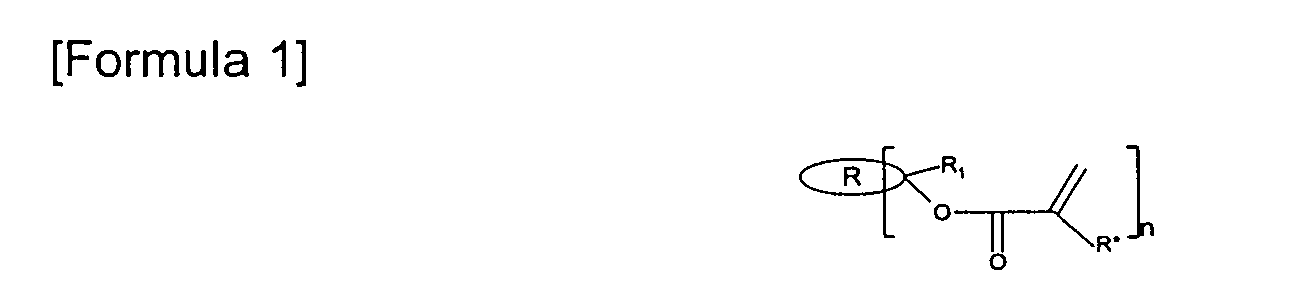
- In Formula 1, R* is a hydrogen or methyl group, R1 is saturated hydrocarbyl group of 1 to 5 carbon atoms, R is mono-cyclic or multi-cyclic homo or hetero saturated hydrocarbyl group of 3 to 50 carbon atoms, and n is an integer of at least 2.
- The present invention also provides a photoresist polymer including a repeating unit represented by the following Formula 2.

- In Formula 2, R*, R1, and R are as defined in Formula 1.
- The present invention also provides a photoresist polymer including a repeating unit represented by the following Formula 4.

- In Formula 4, R* is a hydrogen or methyl group, R1 is saturated hydrocarbyl group of 1 to 5 carbon atoms, R2 is a chain type or ring type alkyl group of 1 to 20 carbon atoms, and R is mono-cyclic or multi-cyclic homo or hetero saturated hydrocarbyl group of 3 to 50 carbon atoms.
- The present invention also provides a photoresist composition including the polymer and a method of forming the photoresist pattern using the photoresist composition.
-
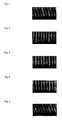
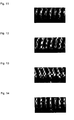
- Figs. 1 to 14 are SEM (Scanning Electron Microscopy) photographs of photoresist patterns which were formed with the photoresist compositions according to the examples of the present invention.
- A more complete appreciation of the invention, and many of the attendant advantages thereof, will be better appreciated by reference to the following detailed description.
- The photoresist monomer having alcohol ester groups and a cyclic hydrocarbyl group according to the present invention can be represented by the following Formula 1.

- In Formula 1, R* is a hydrogen or methyl group, R1 is saturated hydrocarbyl group of 1 to 5 carbon atoms, R is mono-cyclic or multi-cyclic homo or hetero saturated hydrocarbyl group of 3 to 50 carbon atoms, and preferably, R is selected from the group consisting of



- The following Formula 1 a is an example of Formula 1 when n is 2.

- In Formula 1a, R*, R1, and R are as defined in Formula 1.
- The monomer having alcohol esters and a saturated cyclic hydrocarbyl group, which is represented by Formula 1 according to the present invention, can be prepared by the reaction of (meth)acryloyl chloride and cyclic diol in the presence of a basic catalyst. The cyclic diol can be prepared by the reaction of alkylmagnesium and cyclic ketone having at least 2 ketone groups. For example, as shown in Reaction 1a, the cyclic diol can be prepared by the reaction of a cyclic ketone and alkyl magnesium bromide (R1MgBr), wherein R1 is an alkyl group of 1 to 5 carbon atoms.

- In Reaction 1a, R1 and R are as defined in Formula 1.
- The reaction can be carried out by preparing cyclic ketone having at least 2 ketone groups under inert atmosphere, such as nitrogen or argon atmosphere, and then dropping alkyl magnesium bromide at the temperature of -78 to 20°C and at room pressure, for 1 to 12 hours, in a conventional organic solvent, such as tetrahydrofuran(THF). Then, as shown in Reaction 1b, the monomer represented by Formula 1 can be prepared by the reaction of the obtained cyclic diol and (meth)acryloyl chloride in the presence of a basic catalyst.

- In Reaction 1 b, R*, R1 and R are as defined in Formula 1.
- As the basic catalyst, conventional various basic catalysts can be used, and the representative example of the basic catalyst is triethylamine. The reaction can be carried out under inert atmosphere including nitrogen or argon, and so on, at the temperature of 0 to 60°C and at room pressure, for 1 to 24 hours, in the conventional organic solvent, such as tetrahydrofuran(THF).
- Alternatively, the monomer having alcohol esters including a saturated cyclic hydrocarbyl group, which is represented by Formula 1 according to the present invention, can be simply prepared by the one-step reaction of (meth)acryloyl chloride, alkylmagnesium and a cyclic ketone having at least 2 ketone groups.

- In Reaction 2, R*, R1 and R are as defined in Formula 1.
- Particularly, the reaction can be carried out by preparing cyclic ketone having at least 2 ketone groups under nitrogen or argon atmosphere, and then dropping alkyl magnesium bromide at the temperature of -78 to 20°C and at room pressure, for 1 to 12 hours, in a conventional organic solvent, such as tetrahydrofuran(THF). Successively, the monomer represented by Formula 1 can be prepared by dropping (meth)acryloyl chloride at the temperature of -20 to 60°C.
- The photoresist polymer having alcohol ester groups according to the present invention includes a repeating unit represented by the following Formula 2.

- In Formula 2, R, R*, and R1 are as defined in Formula 1.
- The preferable photoresist polymer having alcohol ester groups according to the present invention can be represented by the following Formula 3, and the more preferable polymer can be represented by the Formulas 3a to 3g.


- In Formulas 3 and 3a to 3g, R*, R** are independently a hydrogen or methyl group, R1 is saturated hydrocarbyl group of 1 to 5 carbon atoms, R2, R3 are chain type or ring type alkyl group of 1 to 20 carbon atoms, R is mono-cyclic or multi-cyclic homo or hetero saturated hydrocarbyl group, a, b and c are mole% of the repeating units in the upper and lower polymer chains, and are respectively 1~95mole%, 1~95mole% and 1~95mole%, and preferably 2.5~95mole%, 2.5~95mole% and 2.5~95mole% in the upper or lower polymer chain.
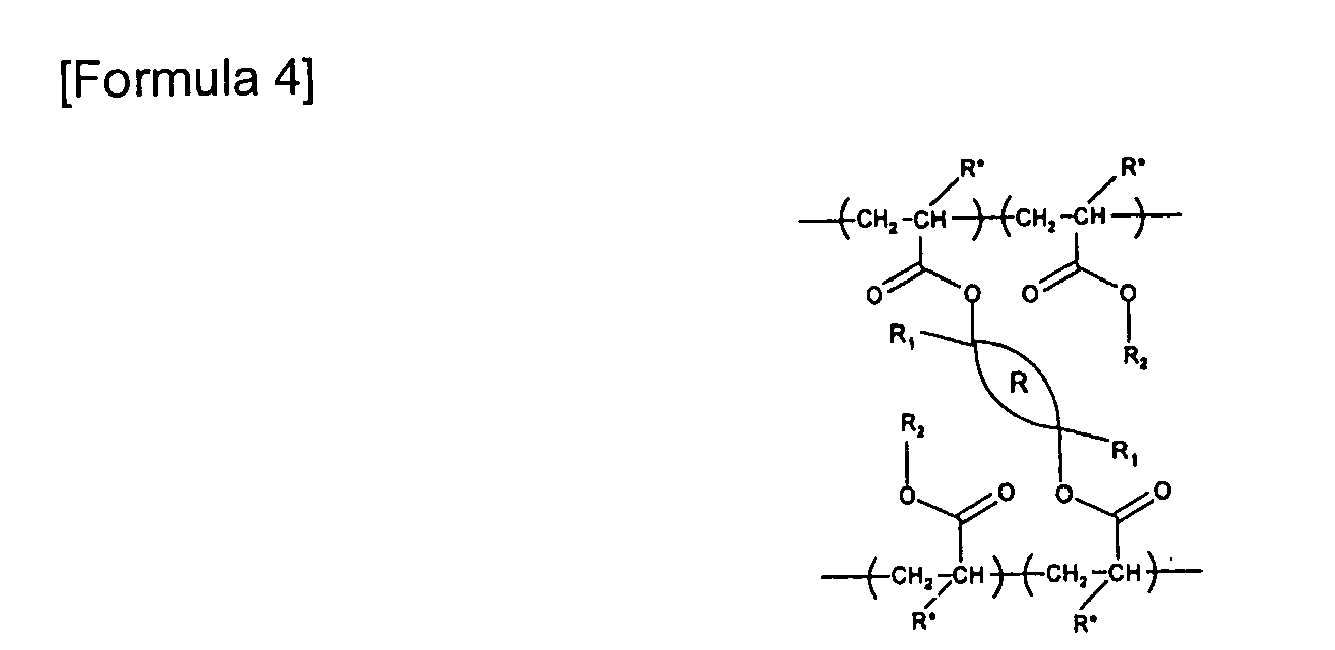
- In addition, the photoresist polymer according to the present invention may include a repeating unit represented by the following Formula 4, which is formed by bonding (meth)acrylate crosslinking monomer having alcohol ester groups and (meth)acrylate monomer having chain type or ring type alkyl group.

- In Formula 4, R, R*, and R1 are as defined in Formula 1, and R2 is chain type or ring type alkyl group of 1 to 20 carbon atoms.
- The preferable photoresist polymer having alcohol ester groups according to the present invention can be represented by the following Formula 5, and the more preferable polymers can be represented by the Formulas 5a to 5g.

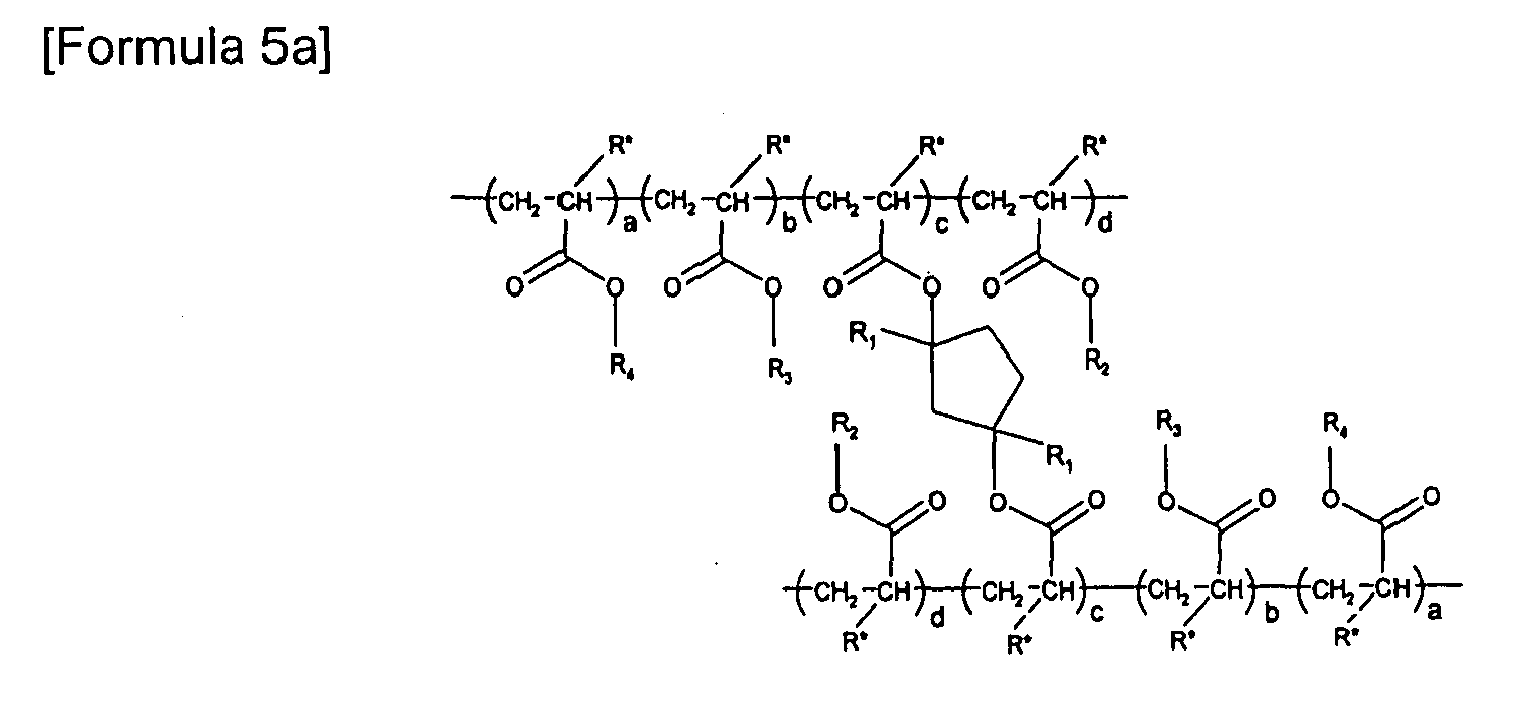


- In Formula 5 and 5a to 5g, R* is independently a hydrogen or methyl group, R1 is saturated hydrocarbyl group of 1 to 5 carbon atoms, R2, R3 and R4 are independently chain type or ring type alkyl group of 1 to 20 carbon atoms, R is mono-cyclic or multi-cyclic homo or hetero saturated hydrocarbyl group of 3 to 50 carbon atoms, and a, b, c and d are mole% of the repeating units in the upper and lower polymer chains, and are respectively 1~95mole%, 1~95mole% and 1~95mole%, preferably 1.67~95mole%, 1.67~95mole% and 1.67~95mole% in the upper or lower polymer chain.
- The alcohol ester group, which includes a saturated cyclic hydrocarbyl group and is adhered to the chain of polymer, is a protecting group for preventing the polymer and a photoresist composition including the same from being dissolved by a basic solution, such as a basic developing solution. The protecting group is deprotected by an acid catalyst(H+) which is produced from a photo-acid generators when exposed to an exposure light. Then, the solubility of the exposed region increases, and the contrast of the photoresist composition is effectively improved. Especially, the alcohol ester group can improve the resolution of the resist pattern, and the process margin, such as an energy margin due to its low activation energy of the deprotection reaction. In addition, the alcohol ester group can improve the focus depth margin and the line edge roughness because the product of deprotection reaction is a bulky material of high molecular weight. The photoresist polymer according to the present invention is formed only by (meth)acrylate linkages, and thus, the next etching process can be performed even if the coating thickness of the polymer is low, for example is less than 2000 Å. Therefore, the polymer can be used in the lithography process using an extreme short wavelength light source and an electron beam, and the polymerization yield highly increases compared with the conventional hybrid-type polymer. And also, the selectivity of the light exposed area to the light non-exposed area can be improved due to the partially crosslinked structure.
- The photoresist polymer including the repeating unit of Formula 2 or 4 can be prepared by the conventional polymerization reaction, for example, by the steps of (a) dissolving (meth)acrylate crosslinking monomer having alcohol ester groups, 1 to 5 kinds of (meth)acrylate monomers having a chain type or ring type alkyl group and a polymerization initiator in a polymerization solvent, and (b) reacting the reaction solution under the inert atmosphere of nitrogen, argon, and so on, at the temperature of 60 to 70°C for 4 to 72 hours. The polymerization reaction can be carried out by a radical polymerization reaction, a solution polymerization reaction using a metal catalyst. The polymerization method may further include the step of crystallizing and purifying the reaction product with diethyl ether, petroleum ether, a lower alcohol, such as methanol, ethanol or isopropanol, water, mixtures thereof, or so on.
- As shown in the following Reaction 3, the photoresist polymer represented by Formula 3 can be prepared by the reaction of Formulas 1a, 1b, 1 c and maleic anhydride.
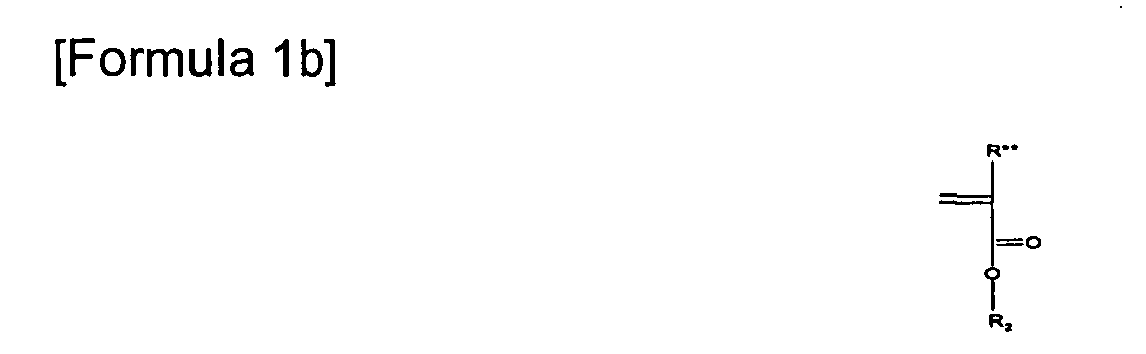
- In Formula 1b, R** and R2 are as defined in Formula 3.

- In Formula 1c, R3 is as defined in Formula 3.

- In Reaction 3, R*, R**, R1, R2, R3, R, a, b and c are as defined in Formula 3.
- As shown in the following Reaction 4, the photoresist polymer represented by Formula 5 can be prepared by the polymerization reaction of the monomer of Formula 1 a and (meth)acrylate monomers having chain type or ring type alkyl group.

- In Reaction 4, R*, R**, R1, R2, R3, R, a, b, c and d are as defined in Formula 5.
- As the polymerization solvent, conventional various polymerization solvents for producing a photoresist polymer can be used. Exemplary polymerization solvents includes, but are not limited to, cyclohexanone, cyclopentanone, tetrahydrofuran, dimethylformaide, dimethylsulfoxide, dioxane, methylethylketone, benzene, toluene, xylene, and the mixtures thereof. Polymerization initiator also can be selected from conventional various polymerization initiators. Exemplary polymerization initiators include benzoylperoxide, 2,2'-azobisisobutyronitirile(AIBN), acetylperoxide, lauyl peroxide, t-butylperacetate, t-butylhydroperoxide, di-t-butylperoxide, and the mixtures thereof, which are well known to those skilled in the art. The preferable weight average molecular weight(Mw) of the photosensitive polymers of Formula 3 or 5 is from 3,000 to 100,000, and the preferable polydispersity(PD) of the polymers is from 1.0 to 5.0. If the weight average molecular weight(Mw) and the polydispersity(PD) of the polymers are out of the range, the property of photoresist layer and the contrast of patterns can be deteriorated or the photoresist layer cannot be formed.
- The photoresist composition according to the present invention includes the photosensitive polymer including the repeating unit of Formula 2 or 4, a photo-acid generator for producing an acid component, and an organic solvent. If necessary, the photoresist composition may further include various additives. The preferable amount of photosensitive polymer including the repeating unit of Formula 2 or 4 is 1 to 30 weight%, and more preferably 5 to 15 weight% with respect to the total photoresist composition. If the amount of the photosensitive polymer is less than 1 weight%, the formation of patterns having desired thickness is in trouble, because the resist layer becomes too thin. If the amount of the photosensitive polymer is more than 30 weight%, the uniformity of the coating layer may be deteriorated.
- The photo-acid generator produces an acid component such as H+ when exposed to a light source. Therefore, the photo-acid generator deprotects the protection group of the photosensitive polymer. As the photo-acid generator, any compound, which can generate an acid component when exposed to light, can be used. Preferable examples of the photo-acid generator include sulfonium compound such as organic sulfonic acid, onium compound such as onium salt, and the mixtures thereof. The non-limiting examples of the photo-acid generator include phthalimidofluoromethane sulfonate, which has a low light absorbance at 157nm and 193nm, dinitrobenzyltosylate, n-decyl disulfone, naphtylimido trifluoromethan sulfonate, diphenyliodonium hexafluorophosphate, diphenyliodonium hexafluoroarsenate, diphenyliodonium hexafluoroantimonate, diphenyl-p-methoxyphenylsulfonium triflate, diphenyl-p-toluenylsulfonium triflate, diphenyl-p-isobutylphenylsulfonium triflate, triphenylsulfonium hexafluoro arsenate, triphenylsulfonium hexafluoro antimonate, triphenylsulfonium triflate, dibutyinaphtylsulfonium triflate, and the mixtures thereof.
- The preferable amount of the photo-acid generator is 0.05 to 10 weight% with respect to the total photoresist polymer. If the amount of the photo-acid generator is less than 0.05 weight%, the deprotection of the protection group may be in trouble, because the sensitivity of the photoresist composition against light decreases. If the amount of the photo-acid generator is more than 10 weight%, the profile of the resist patterns may be deteriorated because the photo-acid generator absorbs a lot of ultraviolet rays and a large quantity of acid is produced from the photo-acid generator.
- The remaining component of the photoresist composition according to the present invention is the organic solvent. The organic solvent can be selected from the conventional various solvents, which are used for the preparation of a photoresist composition. Exemplary organic solvent include, but are not limited to, ethyleneglycol monomethylether, ethyleneglycol monoethylether, ethyleneglycol monoacetate, diethyleneglycol, diethyleneglycol monoethylether, propyleneglycol monomethyletheracetate, propyleneglycol, propyleneglycol monoacetate, toluene, xylene, methylethylketone, methylisoamylketone, cyclohexanone, dioxane, methyl lactate, ethyl lactate, methylpyruvate, ethylpyruvate, methylmethoxy propionate, ethylethoxy propionate, N,N-dimethylformamide, N,N-dimethylacetamide, N-methyl-2-pyrollidone, 3-ethoxyethylpropionate, 2-heptanone, gamma-butyrolactone, ethyl 2-hydroxypropionate, ethyl 2-hydroxy-2-methyl propionate, ethoxyethyl acetate, hydroxylethyl acetate, methyl 2-hydroxy-3-methylbutanoate, methyl 3-methoxy-2-methylpropionate, ethyl 3-ethoxypropionate, ethyl 3-methoxy-2-methylpropionate, ethyl acetate, butyl acetate, and the mixtures thereof.
- If necessary, the photoresist composition may further include organic base compound. Exemplary organic base components include, but not limited to, triethylamine, triisobutylamine, triisooctylamine, diethanolamine, triethanolamine and the mixtures thereof. The preferable amount of the organic base is from 0.01 to 2.00 weight% with respect to the photoresist composition. If the amount of the organic base is less than 0.01 weight%, the undesirable T-top phenomenon may be occurred at the resist pattern. If the amount of the organic base is more than 2.00 weight%, the pattern forming rate may be lowered because the sensitivity of photoresist composition decreases.
- The photoresist composition according to the present invention can be prepared by mixing the photosensitive polymer, the photo-acid generator, the organic solvent, and, if necessary, various additives, and by filtering the mixture. Here, the preferable concentration of the solid components in the composition is from 10 to 60 weight%. If the concentration of the solid components is less than 10 weight%, the formation of patterns having a desirable thickness may be in trouble, because the coated resist layer becomes too thin. If the concentration of the solid components is more than 60 weight%, the uniformity of the coating layer may be deteriorated.
- In order to form the photoresist pattern with the photoresist composition according to the present invention, the following conventional photolithograph process can be carried out. First, the photoresist composition is applied on a substrate such as silicon wafer, an aluminum substrate, and so on, for example, with a spin coater to form a photoresist layer. Subsequently, the photoresist layer is exposed to a light source to form a predetermined pattern. After the exposure, if necessary, the photoresist pattern is thermally treated, which is referred to as a PEB(Post Exposure Bake) and is developed. The prepared photoresist pattern is used to produce a semiconductor having a predetermined circuit patterns. As the developing solution for the developing process, alkali solution including alkali compounds such as sodium hydroxide, potassium hydroxide, sodium carbonate, tetramethylammonium hydroxide(TMAH) of the concentration of 0.1 to 10 weight% can be used. If necessary, the developing solution may further include watersoluble organic solvent such as methanol, ethanol and surfactant with a proper amount. After carrying out the developing process, the cleaning process of the substrate can be carried out, in which the substrate is washed with purified water.
- Hereinafter, the preferable examples are provided for better understanding of the present invention. However, the present invention is not limited to the following examples.
- After using 9.8g(0.1mol) of cyclopentane-1,3-dione, 100g of THF into 500ml 3 necks round-bottom flask, the reaction mixture was cooled to the temperature of -78°C under nitrogen atmosphere. Thereafter, 66.67g(0.2mol) of 3.0M-methyl magnesium bromide was added to the reaction mixture with dropping funnel for 30 minutes. And then, the reaction mixture was heated to room temperature and stirred for 2 hours. After completion of the reaction, 100ml of water was added to the reaction solution. Thereafter, the reaction solution was placed in a separatory funnel, and extracted with ethylacetate for 3 times. The extract was purified by a column chromatography(hexane : ethylacetate = 1:1) to obtain 10.2g of 1,3-dimethyl-cyclopentane-1,3-diol represented by the following Formula 6a with 78% yield. {1H-NMR(CDCl3): δ(ppm), 3.45(OH, 2H), 1.55(CH2, 2H), 1.40(CH2, 4H), 0.89(CH3, 6H)}

- 13.02g of cyclic diol prepared in Example 1-1-A, which is represented by Formula 6a, was placed in 500ml 3 necks round-bottom flask, and diluted by 100g of THF. Then, the reactor was cooled to the temperature of 0°C. A mixture of 18.2g of acryloyl chloride and 50g of THF was added to the diluted reactant with dropping funnel. Thereafter, 10ml of triethylamine was added to the reactant, and the reactant was refluxed under nitrogen atmosphere for 12 hours. After completion of the reaction, the solvent was removed by vacuum distillation of the reactant. And then, the reactant was separated by a liquid chromatography (silica gel, hexane : ether = 6:1), and the solvent was removed again. The reactant, which did not contain solvent, was recrystallized by hexane, and then the recrystallized reactant was stayed at the room temperature to obtain 20.5g of monomer represented by the following Formula 7a with 77% yield. {1H-NMR(CDCl3): δ(ppm) 6.33(CH, 2H), 6.05(CH, 2H), 5.72(CH, 2H), 1.52(CH2, 2H), 1.38(CH2, 4H), 0.85(CH3, 6H)}.

- In Formula 7a, R* is a hydrogen.
- Except for using 11.2g(0.1mol) of cyclohexane-1,4-dione instead of 9.8g of cyclopentane-1,3-dione, 11.8g of cyclic diol, represented by the following Formula 6b, was obtained with 82% yield in the same manner as described in Example 1-1-A. {1H-NMR(CDCl3): δ(ppm) 3.51 (OH, 2H), 1.29(CH2, 8H), 0.84(CH3, 6H)}

- Except for using 14.4g(0.1mol) of cyclic diol of Formula 6b prepared in Example 1-2-A instead of 13.02g of cyclic diol of Formula 6a prepared in Example 1-1-A, 18.8g of monomer represented by the following Formula 7b was obtained with 67% yield in the same manner as described in Example 1-1-B. {1H-NMR(CDCl3): δ(ppm) 6.33(CH, 2H), 6.05(CH, 2H) 5.72(CH, 2H), 1.16(CH2, 8H), 0.82(CH3, 6H)}.

- In Formula 7b, R* is a hydrogen.
- Except for using 16.6g(0.1mol) of 1,5-dimethylbicyclo[3,3,0]octane-3,7-dione instead of 9.8g of cyclopentane-1,3-dione, 15.4g of cyclic diol, represented by the following Formula 6c, was obtained with 78% yield in the same manner as described in Example 1-1-A. {1H-NMR(CDCl3): δ(ppm) 3.46(OH, 2H), 1.31(CH2, 8H), 1.12(CH3, 6H), 0.78(CH3, 6H)}.

- Except for using 19.8g(0.1mol) of cyclic diol of Formula 6c prepared in Example 1-3-A instead of 13.02g of cyclic diol of Formula 6a prepared in Example 1-1-A, 16.9g of monomer represented by the following Formula 7c was obtained with 49% yield in the same manner as described in Example 1-1-B. {1H-NMR(CDCl3): δ(ppm) 6.33(CH, 2H), 6.05(CH, 2H), 5.72(CH, 2H), 1.26(CH2, 8H), 1.11 (CH3, 6H), 0.77(CH3, 6H)}.
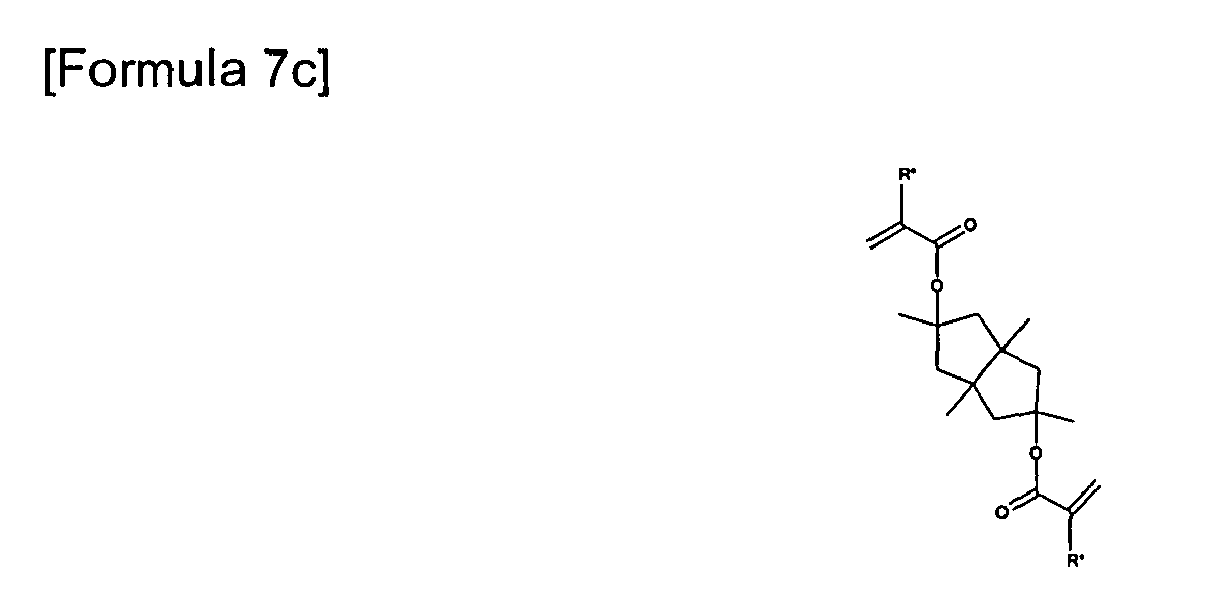
- In Formula 7c, R* is a hydrogen.
- Except for using 12.4g(0.1mol) of 7,7-dimethyl-bicyclo[2,2,1]heptane-2,3-dione instead of 9.8g of cyclopentane-1,3-dione, 10.4g of cyclic diol, represented by the following Formula 6d, was obtained with 67% yield in the same manner as described in Example 1-1-A. {1H-NMR(CDCl3): δ(ppm) 3.53(OH, 2H), 1.61(CH, 2H), 1.45(CH2, 4H), 1.14(CH3, 6H), 0.85(CH3, 6H)}.

- Except for using 15.6g(0.1mol) of cyclic diol of Formula 6d prepared in Example 1-4-A, instead of 13.02g of cyclic diol of Formula 6a prepared in Example 1-1-A, 17.4g of monomer represented by the following Formula 7d was obtained with 60% yield in the same manner as described in Example 1-1-B. {1H-NMR(CDCl3): δ(ppm) 6.33(CH, 2H), 6.05(CH, 2H), 5.72(CH, 2H), 1.54(CH, 2H), 1.44(CH2, 4H), 1.13(CH3, 6H), 0.81 (CH3, 6H)}.

- In Formula 7d, R* is a hydrogen.
- Except for using 16.4g(0.1mol) of adamantan-2,6-dione instead of 9.8g of cyclopentane-1,3-dione, 14.8g of cyclic diol, represented by the following Formula 6e, was obtained with 76% yield in the same manner as described in Example 1-1-A. {1H-NMR(CDCl3): δ(ppm) 3.44(OH, 2H), 1.58(CH, 4H), 1.40(CH2, 4H), 1.29(CH2, 4H), 0.80(CH3, 6H)}

- Except for using 19.6g(0.1mol) of cyclic diol of Formula 6e prepared in Example 1-5-A, instead of 13.02g of cyclic diol of Formula 6a prepared in Example 1-1-A, 18.4g of monomer represented by the following Formula 7e was obtained with 55% yield in the same manner as described in Example 1-1-B. {1H-NMR(CDCl3): δ(ppm) 6.33(CH, 2H), 6.05(CH, 2H), 5.72(CH, 2H), 1.61(CH, 4H), 1.44(CH2, 4H), 1.28(CH2, 4H), 0.82(CH3, 6H)}

- In Formula 7e, R* is a hydrogen.
- Except for using 23.6g(0.1mol) of 2,2'-bis-4,4'-carbonylcyclohexylpropane instead of 9.8g of cyclopentane-1,3-dione, 23.3g of cyclic diol, represented by the following Formula 6f, was obtained with 87% yield in the same manner as described in Example 1-1-A. {1H-NMR(CDCl3): δ(ppm) 3.44(OH, 2H), 1.56(CH, 2H), 1.38(CH2,8H), 1.28(CH2,8H), 1.19(CH3, 6H), 0.74(CH3,6H)}.

- Except for using 26.8g(0.1mol) of cyclic diol of Formula 6f prepared in Example 1-6-A, instead of 13.02g of cyclic diol of Formula 6a prepared in Example 1-1-A, 23.5g of monomer represented by the following Formula 7f was obtained with 58% yield in the same manner as described in Example 1-1-B. {1H-NMR(CDCl3): δ(ppm) 6.33(CH, 2H), 6.05(CH, 2H), 5.72(CH, 2H), 1.35(CH2, 8H), 1.27(CH2, 8H), 1.20(CH3, 6H), 0.75(CH3, 6H)}.

- In Formula 7f, R* is a hydrogen.
- Except for using 19.4g(0.1mol) of 2,2'-bis-4,4'-carbonylcyclohexyl instead of 9.8g of cyclopentane-1,3-dione, 18.5g of cyclic diol, represented by the following Formula 6g, was obtained with 83% yield in the same manner as described in Example 1-1-A.{ 1H-NMR(CDCl3): δ(ppm) 3.48(OH, 2H), 1.59(CH, 2H), 1.40(CH2, 8H), 1.27(CH2, 8H), 0.76(CH3, 6H)}.

- Except for using 22.6g(0.1mol) of cyclic diol of Formula 6g prepared in Example 1-7-A, instead of 13.02g of cyclic diol of Formula 6a prepared in Example 1-1-A, 17.2g of monomer represented by the following Formula 7g was obtained with 48% yield in the same manner as described in Example 1-1-B. {1H-NMR(CDCl3): δ(ppm) 6.32(CH, 2H), 6.04(CH, 2H), 5.70(CH, 2H), 1.56(CH, 2H), 1.37(CH2, 8H), 1.24(CH2, 8H), 0.74(CH3, 6H)}.

- In Formula 7g, R* is a hydrogen.
- After refluxing nitrogen in 500ml 3 necks round-bottom flask, 100.0g(0.3mol) of 3.0M-methyl magnesium bromide was added into the flask, and then the reactor was cooled to the temperature of 0°C. Thereafter, a solution of 9.8g(0.1mol) of cyclopentane-1,3-dione dissolved in 100g of THF was dropped into the reactor with dropping funnel for 30 minutes, and then the reactor was heated to room temperature and stirred for 2 hours. After cooling the reactor to the temperature of 0°C, a mixture solution of 18.2g of acryloyl chloride and 50g of THF was dropped into the reactor with dropping funnel slowly for 1 hour. Thereafter, the reaction mixture was stirred at the temperature of 0°C for 2 hours, and then stayed at the room temperature, and stirred for 24 hours. In order to complete the reaction, 100ml of cold water was added to the reactant. Thereafter, the reactant was placed in saparatory funnel, and extracted with diethylether for 3 times. And then, the extract was purified by a column chromatography(hexane : ethylacetate = 4:1) to obtain 18.1g of monomer represented by the following Formula 8a, with 68% yield. {1H-NMR(CDCl3): δ(ppm) 6.33(CH, 2H), 6.05(CH, 2H) 5.72(CH, 2H), 1.52(CH2, 2H), 1.38(CH2, 4H), 0.85(CH3, 6H)}.

- In Formula 8a, R* is a hydrogen.
- Except for using 11.2g of cyclohexane-1,4-dione(0.1mol) instead of 9.8g of cyclopentane-1,3-dione, 20.2g of monomer, represented by the following Formula 8b, was obtained with 72% yield in the same manner as described in Example 1-8. {1H-NMR(CDCl3): δ(ppm) 6.33(CH, 2H), 6.05(CH, 2H), 5.72(CH, 2H), 1.16(CH2, 8H), 0.82(CH3, 6H)}.

- In Formula 8b, R* is a hydrogen.
- Except for using 16.6g of 1,5-dimethyl-bicyclo[3,3,0]octane-3,7-dione (0.1mol) instead of 9.8g of cyclopentane-1,3-dione, 21.7g of monomer, represented by the following Formula 8c, was obtained with 65% yield in the same manner as described in Example 1-8. {1H-NMR(CDCl3): δ(ppm) 6.33(CH, 2H), 6.05(CH, 2H), 5.72(CH, 2H), 1.26(CH2, 8H), 1.11(CH3, 6H), 0.77(CH3, 6H)}.

- In Formula 8c, R* is a hydrogen.
- Except for using 15.2g of 7,7-dimethyl-nobornane-2,3-dione(0.1mol) instead of 9.8g of cyclopentane-1,3-dione, 15.2g of monomer, represented by the following Formula 8d, was obtained with 52% yield in the same manner as described in Example 1-8. {1H-NMR(CDCl3): δ(ppm) 6.33(CH, 2H), 6.05(CH, 2H), 5.72(CH, 2H), 1.54(CH, 2H), 1.44(CH2, 4H), 1.13(CH3, 6H), 0.81(CH3, 6H)}.

- In Formula 8d, R* is a hydrogen.
- Except for using 16.4g of adamantane-2,6-dione(0.1mol) instead of 9.8g of cyclopentane-1,3-dione, 19.6g of monomer, represented by the following Formula 8e, was obtained with 59% yield in the same manner as described in Example 1-8. {1H-NMR(CDCl3): δ(ppm) 6.33(CH, 2H), 6.05(CH, 2H), 5.72(CH, 2H), 1.61(CH, 4H), 1.44(CH2, 4H), 1.28(CH2, 4H), 0.82(CH3, 6H)}

- In Formula 8e, R* is a hydrogen.
- Except for using 23.6g of 2,2'-bis-4,4'-carbonylcyclohexylpropane(0.1mol) instead of 9.8g of cyclopentane-1,3-dione, 19.8g of monomer, represented by the following Formula 8f, was obtained with 49% yield in the same manner as described in Example 1-8. {1H-NMR(CDCl3): δ(ppm) 6.33(CH, 2H), 6.05(CH, 2H), 5.72(CH, 2H), 1.35(CH2, 8H), 1.27(CH2, 8H), 1.20(CH3, 6H), 0.75(CH3, 6H)}.

- In Formula 8f, R* is a hydrogen.
- Except for using 19.4g of 2,2'-bis-4,4'-carbonylcyclohexyl(0.1mol) instead of 9.8g of cyclopentane-1,3-dione, 19.6g of monomer, represented by the following Formula 8g, was obtained with 54% yield in the same manner as described in Example 1-8. {1H-NMR(CDCl3): δ(ppm) 6.32(CH, 2H), 6.04(CH, 2H) 5.70(CH, 2H), 1.56(CH, 2H), 1.37(CH2, 8H), 1.24(CH2, 8H), 0.74(CH3, 6H)}.


- In Formula 8g, R* is a hydrogen.
- 26.6g(0.1mol) of the monomer represented by Formula 7a, 14.3g(0.05mol) of 2-methyl-2-adamantyl-5-nobornyl-2-carboxylate, 4.9g(0.05mol) of maleic anhydride, 22.2g(0.1mol) of 2-methyl-2-adamantyl methacrylate and 0.7g of azobis(isobutyronitrile)(AIBN) were added into a reactor, and the reactant was dissolved in 25g of THF. Subsequently, the gas in the reactor was removed by a freezing method with an ampoule, and the polymerization was carried out at 68°C for 24 hours. After completion of the polymerization reaction, the reactant was slowly dropped to a lot of diethylether and was precipitated in diethylehter. Then, the precipitant was dissolved in THF again, and the dissolved reactant was reprecipitated in diethylether to obtain 42.8g of the polymer represented by Formula 3a with 62% yield (GPC(Gel Permeation Chromatography) analysis, Mn(=number average molecular weight): 5,326, Mw(=weight average molecular weight): 9,312, PD(=polydispersity): 1.75).
- Except for using 28.0g(0.1mol) of the monomer represented by Formula 7b, 14.3g(0.05mol) of 2-methyl-2-adamantyl-5-nobornyl-2-carboxylate, 4.9g(0.05mol) of maleic anhydride and 22.2g(0.1mol) of 2-methyl-2-adamantyl methacrylate, 46.8g of the polymer represented by Formula 3b was obtained with 67% yield in the same manner as described in Example 2-1 (Mn: 5,024, Mw: 8,958, PD: 1.78).
- Except for using 33.4g(0.1mol) of the monomer represented by Formula 7c, 14.3g(0.05mol) of 2-methyl-2-adamantyl-5-nobornyl-2-carboxylate, 4.9g(0.05mol) of maleic anhydride and 22.2g(0.1mol) of 2-methyl-2-adamantyl methacrylate, 41.1g of the polymer represented by Formula 3c was obtained with 55% yield in the same manner as described in Example 2-1 (Mn: 5,135, Mw: 9,626, PD: 1.87).
- Except for using 29.2g(0.1mol) of the monomer represented by Formula 7d, 14.3g(0.05mol) of 2-methyl-2-adamantyl-5-nobornyl-2-carboxylate, 4.9g(0.05mol) of maleic anhydride and 22.2g(0.1mol) of 2-methyl-2-adamantyl methacrylate, 40.8g of the polymer represented by Formula 3d was obtained with 57% yield in the same manner as described in Example 2-1 (Mn: 4,687, Mw: 8,679, PD: 1.85).
- Except for using 33.2g(0.1mol) of the monomer represented by Formula 7e, 14.3g(0.05mol) of 2-methyl-2-adamantyl-5-nobornyl-2-carboxylate, 4.9g(0.05mol) of maleic anhydride and 22.2g(0.1mol) of 2-methyl-2-adamantyl methacrylate, 48.5g of the polymer represented by Formula 3e was obtained with 65% yield in the same manner as described in Example 2-1(Mn: 5,621, Mw: 10,240, PD: 1.82).
- Except for using 40.4g(0.1mol) of the monomer represented by Formula 7f, 14.3g(0.05mol) of 2-methyl-2-adamantyl-5-nobornyl-2-carboxylate, 4.9g(0.05mol) of maleic anhydride and 22.2g(0.1mol) of 2-methyl-2-adamantyl methacrylate, 51.0g of the polymer represented by Formula 3f was obtained with 62% yield in the same manner as described in Example 2-1 (Mn: 4,793, Mw: 9,103, PD: 1.90).
- Except for using 36.2g(0.1mol) of the monomer represented by Formula 7g, 14.3g(0.05mol) of 2-methyl-2-adamantyl-5-nobornyl-2-carboxylate, 4.9g(0.05mol) of maleic anhydride and 22.2g(0.1mol) of 2-methyl-2-adamantyl methacrylate, 44.1g of the polymer represented by Formula 3g was obtained with 56% yield in the same manner as described in Example 2-1 (Mn: 4,933, Mw: 9,213, PD: 1.87).
- 26.6g(0.1mol) of the monomer represented by Formula 8a, 11.8g(0.05mol) of 9-methacryloyloxy-4-oxa-tricyclo[5,2,1,02,6]decane-3-one, 22.2g(0.1mol) of 2-methyl-2-adamantyl methacrylate, 11.8g(0.05mol) of 1-methacryloyl oxy-3-hydroxy adamantane and 0.7g of azobisisobutyronitrile(AIBN) were added into a reactor, and the reactant was dissolved in 25g of THF. Subsequently, the gas in the reactor was removed by a freezing method with an ampoule, and the polymerization was carried out at 68°C for 24 hours. After completion of the polymerization reaction, the reactant was slowly dropped to a lot of diethylether and was precipitated in diethylehter. Then, the precipitant was dissolved in THF again, and the dissolved reactant was reprecipitated in diethylether to obtain 54.3g of the polymer represented by Formula 5a with 75% yield(Mn: 5,231, Mw: 9,520, PD: 1.82).
- Except for using 28.0g(0.1mol) of the monomer represented by Formula 8b, 11.8g(0.05mol) of 9-methacryloyloxy-4-oxa-tricyclo[5,2,1,02,6]decane-3-one, 22.2g(0.1mol) of 2-methyl-2-adamantyl methacrylate, 11.8g(0.05mol) of 1-methacryloyl oxy-3-hydroxy adamantane, 52.4g of the polymer represented by Formula 5b was obtained with 71% yield in the same manner as described in Example 2-8(Mn: 4,885, Mw: 8,745, PD: 1.79).
- Except for using 33.4g(0.1mol) of the monomer represented by Formula 8b, 11.8g(0.05mol) of 9-methacryloyloxy-4-oxa-tricyclo[5,2,1,02,6]decane-3-one, 22.2g(0.1mol) of 2-methyl-2-adamantyl methacrylate, 11.8g(0.05mol) of 1-methacryloyl oxy-3-hydroxy adamantane, 53.9g of the polymer represented by Formula 5c was obtained with 68% yield in the same manner as described in Example 2-8(Mn: 5,728, Mw: 9,681, PD: 1.69).
- Except for using 29.2g(0.1mol) of the monomer represented by Formula 8d, 11.8g(0.05mol) of 9-methacryloyloxy-4-oxa-tricyclo[5,2,1,02,6]decane-3-one, 22.2g(0.1mol) of 2-methyl-2-adamantyl methacrylate, 11.8g(0.05mol) of 1-methacryloyl oxy-3-hydroxy adamantane, 55.5g of the polymer represented by Formula 5d was obtained with 74% yield in the same manner as described in Example 2-8(Mn: 4,432, Mw: 8,287, PD: 1.87).
- Except for using 33.2g(0.1mol) of the monomer represented by Formula 8e, 11.8g(0.05mol) of 9-methacryloyloxy-4-oxa-tricyclo[5,2,1,02,6]decane-3-one, 22.2g(0.1mol) of 2-methyl-2-adamantyl methacrylate, 11.8g(0.05mol) of 1-methacryloyl oxy-3-hydroxy adamantane, 49.8g of the polymer represented by Formula 5e was obtained with 63% yield in the same manner as described in Example 2-8(Mn: 5,218, Mw: 9,967, PD: 1.91).
- Except for using 40.4g(0.1mol) of the monomer represented by Formula 8f, 11.8g(0.05mol) of 9-methacryloyloxy-4-oxa-tricyclo[5,2,1,02,6]decane-3-one, 22.2g(0.1mol) of 2-methyl-2-adamantyl methacrylate, 11.8g(0.05mol) of 1-methacryloyl oxy-3-hydroxy adamantane, 53.4g of the polymer represented by Formula 5f was obtained with 62% yield in the same manner as described in Example 2-8(Mn: 5,967, Mw: 10,024, PD: 1.68).
- Except for using 36.2g(0.1mol) of the monomer represented by Formula 8g, 11.8g(0.05mol) of 9-methacryloyloxy-4-oxa-tricyclo[5,2,1,02,6]decane-3-one, 22.2g(0.1mol) of 2-methyl-2-adamantyl methacrylate, 11.8g(0.05mol) of 1-methacryloyl oxy-3-hydroxy adamantane, 57.4g of the polymer represented by Formula 5g was obtained with 70% yield in the same manner as described in Example 2-8(Mn: 5,324, Mw: 9,158, PD: 1.72).
- 2g of polymer obtained in Example 2-1, 0.024g of phthalimido trifluoromethane sulfonate and 0.06g of triphenylsulfonium triflate were dissolved in 20g of propyleneglycolmonomethyletheracetate(PGMEA), and then a photoresist composition was prepared by filtering the mixture with a filter of 0.20 µm pore size(Example 3-1).
- Except for using 2g of polymer prepared in Example 2-2 to 2-14 instead of 2g of polymer prepared in Example 2-1, photoresist compositions were prepared in the same manner as described in Example 3-1 (Examples 3-2 to 3-14).
- The photoresist compositions prepared in Examples 3-1 to 3-14 were spin coated on the upper parts of silicon wafers to prepare thin-films of photoresist. The photoresist layer was pre-baked at a temperature of 90°C for 90 seconds in an oven or on a hot plate, and was exposed with an ArF excimer laser, and was post-baked at a temperature of 120°C for 90 seconds. Thereafter, the baked wafer was developed with 2.38 weight% of TMAH solution for about 40 seconds, thereby forming a 0.07 µm line/space patterns. The properties of the produced photoresist patterns were shown in Table 1, SEM(Scanning Electron Microscopy) photographs of the photoresist patterns which were formed with the photoresist compositions of Examples 3-1 to 3-14 were shown in Figs. 1 to 14.
[Table 1] Resist composition Minimum resolution [µm] Focus depth [µm] Line Edge Roughness [nm] Energy process margin[%] Post exposure bake sensitivity [nm/°C] Dry etching resistance Example 3-1 0.065 0.40 5.8 13.4 2.5 Very good Example 3-2 0.065 0.30 4.9 12.8 3.0 Very good Example 3-3 0.065 0.35 4.2 16.1 1.5 Very good Example 3-4 0.065 0.45 6.1 15.6 1.5 Good Example 3-5 0.065 0.45 4.9 11.3 2.5 Good Example 3-6 0.065 0.35 5.3 12.3 1.0 Very good Example 3-7 0.065 0.40 4.5 12.3 2.0 Good Example 3-8 0.065 0.35 5.5 11.6 1.5 Very good Example 3-9 0.065 0.35 6.2 13.8 2.0 Very good Example 3-10 0.065 0.30 4.2 12.6 2.0 Good Example 3-11 0.065 0.40 5.1 15.4 1.5 Very good Example 3-12 0.065 0.45 4.8 16.1 3.0 Good Example 3-13 0.065 0.35 5.9 14.5 2.5 Good Example 3-14 0.065 0.45 5.6 16.3 1.5 Very good - The photoresist monomer having alcohol ester groups, a polymer thereof and a photoresist composition including the same according to the present invention can improve the resolution and the process margin due to the low activation energy of the deprotection reaction of the alcohol ester group, and also can produce fine photoresist patterns because they have a high dry etching resistance and stable PEB(Post Exposure Baking) temperature sensitivity. Further, the polymers thereof and photoresist compositions including the same can improve the focus depth margin and the line edge roughness of the resist layer. The photoresist polymer according to the present invention is formed only by (meth)acrylate linkages, and thus, the next etching process can be easily performed even if the coating thickness of the polymer is low, for example, is less than 2000 Å . Therefore, the polymer can be used in the lithography process using an extreme short wavelength light source and an electron beam, and the polymerization yield highly increases compared with the conventional hybrid-type polymer. And also, the selectivity of the light exposed area to the light non-exposed area can be improved due to the partially crosslinked structure. While the present invention has been described in detail with reference to the preferred embodiments, those skilled in the art will appreciate that various modifications and substitutions can be made thereto without departing from the spirit and scope of the present invention as set for the in the appended claims.
Claims (15)
- A monomer represented by the following Formula 1,

- The monomer according to claim 1, wherein R is selected from the group consisting of


- The monomer according to claim 1, wherein the monomer is prepared by the alkylmagnesium reaction of cyclic compound having at least 2 ketone groups.
- A photoresist polymer including a repeating unit represented by the following Formula 2,

- The photoresist polymer according to claim 4, wherein the photoresist polymer is represented by the following Formula 3,

- The photoresist polymer according to claim 4, wherein the photoresist polymer is selected from the group consisting of polymers of the following Formulas 3a to 3g,


- A photoresist polymer including a repeating unit represented by the following Formula 4,
- The photoresist polymer according to claim 7, wherein as a repeating monomer in the polymer of Formula 4, (meth)acrylate crosslinking monomer having alcohol ester groups including saturated cyclic hydrocarbyl group is prepared by the one-step reaction of (meth)acryloyl chloride, alkylmagnesium, and cyclic ketone compound having at least 2 ketone groups.
- The photoresist polymer according to claim 7, wherein the photoresist polymer is represented by the following Formula 5,

- The photoresist polymer according to claim 9, wherein the photoresist polymer is selected from the group consisting of polymers of the following Formulas 5a to 5g,


- A photoresist composition comprising:a photoresist polymer including the repeating unit of Formula 2 or 4;a photo-acid generator for generating a photo-acid; andan organic solvent.
- The photoresist composition according to claim 11, wherein the amount of the photoresist polymer is 1 to 30 weight% with respect to the total photoresist composition, and the amount of the photo-acid generator is 0.05 to 10 weight% with respect to the photoresist polymer.
- The photoresist composition according to claim 11, wherein the photo-acid generator is selected from the group consisting of phthalimidofluoromethane sulfonate, dinitrobenzyltosylate, n-decyl disulfone, naphtylimido trifluoromethan sulfonate, diphenyliodonium hexafluorophosphate, diphenyliodonium hexafluoroarsenate, diphenyliodonium hexafluoroantimonate, diphenyl-p-methoxyphenylsulfonium triflate, diphenyl-p-toluenylsulfonium triflate, diphenyl-p-isobutylphenylsulfonium triflate, triphenylsulfonium hexafluoro arsenate, triphenylsulfonium hexafluoro antimonate, triphenylsulfonium triflate, dibutylnaphtylsulfonium triflate, and the mixtures thereof.
- The photoresist composition according to claim 11, wherein the organic solvent is selected from the group consisting of ethyleneglycol monomethylether, ethyleneglycol monoethylether, ethyleneglycol monoacetate, diethyleneglycol, diethyleneglycol monoethylether, propyleneglycol monomethyletheracetate, propyleneglycol, propyleneglycol monoacetate, toluene, xylene, methylethylketone, methylisoamylketone, cyclohexanone, dioxane, methyl lactate, ethyl lactate, methylpyruvate, ethylpyruvate, methylmethoxy propionate, ethylethoxy propionate, N,N-dimethylformamide, N,N-dimethylacetamide, N-methyl-2-pyrollidone, 3-ethoxyethylpropionate, 2-heptanone, gamma-butyrolactone, ethyl 2-hydroxypropionate, ethyl 2-hydroxy-2-methyl propionate, ethoxyethyl acetate, hydroxylethyl acetate, methyl 2-hydroxy-3-methylbutanoate, methyl 3-methoxy-2-methylpropionate, ethyl 3-ethoxypropionate, ethyl 3-methoxy-2-methylpropionate, ethyl acetate, butyl acetate, and the mixtures thereof.
- A method of forming a photoresist pattern comprising the steps of:forming a photoresist layer by applying the photoresist composition including a photoresist polymer including the repeating unit of Formula 2 or 4; a photo-acid generator for producing an acid component; and an organic solvent on a substrate;forming a predetermined photoresist pattern by exposing the photoresist layer to a light source; andheating and developing the photoresist pattern.
Applications Claiming Priority (2)
| Application Number | Priority Date | Filing Date | Title |
|---|---|---|---|
| KR1020050055190A KR101156975B1 (en) | 2005-06-24 | 2005-06-24 | Polymer for photoresist and photoresist composition including the same |
| KR1020050074435A KR101190527B1 (en) | 2005-08-12 | 2005-08-12 | Polymer for photoresist and photoresist composition including the same |
Publications (2)
| Publication Number | Publication Date |
|---|---|
| EP1736828A1 true EP1736828A1 (en) | 2006-12-27 |
| EP1736828B1 EP1736828B1 (en) | 2010-11-24 |
Family
ID=36933418
Family Applications (1)
| Application Number | Title | Priority Date | Filing Date |
|---|---|---|---|
| EP06012870A Not-in-force EP1736828B1 (en) | 2005-06-24 | 2006-06-22 | Photoresist monomer, polymer thereof and photoresist composition including the same |
Country Status (4)
| Country | Link |
|---|---|
| US (1) | US7501222B2 (en) |
| EP (1) | EP1736828B1 (en) |
| DE (1) | DE602006018391D1 (en) |
| TW (1) | TW200702924A (en) |
Families Citing this family (7)
| Publication number | Priority date | Publication date | Assignee | Title |
|---|---|---|---|---|
| TW200736855A (en) * | 2006-03-22 | 2007-10-01 | Quanta Display Inc | Method of fabricating photoresist thinner |
| KR101482037B1 (en) * | 2008-06-16 | 2015-01-13 | 주식회사 동진쎄미켐 | Polymers for forming an organic antireflection film soluble in an alkali solution and compositions containing the same |
| US9255223B2 (en) * | 2010-01-21 | 2016-02-09 | Merck Patent Gmbh | Polymerizable compounds and liquid crystal media |
| JP6149656B2 (en) * | 2012-09-28 | 2017-06-21 | Jsr株式会社 | Photoresist composition, resist pattern forming method, polymer and compound |
| US9488913B2 (en) * | 2014-10-17 | 2016-11-08 | Taiwan Semiconductor Manufacturing Company, Ltd. | Photoresist having decreased outgassing |
| US10429738B2 (en) * | 2015-09-30 | 2019-10-01 | Tokyo Ohka Kogyo Co., Ltd. | Filtration filter, filtration method, production method of purified liquid chemical product for lithography, and method of forming resist pattern |
| US11957020B2 (en) | 2018-01-23 | 2024-04-09 | Toray Industries, Inc. | Light-emitting device, display and color conversion substrate |
Citations (4)
| Publication number | Priority date | Publication date | Assignee | Title |
|---|---|---|---|---|
| EP0930541A1 (en) | 1998-01-16 | 1999-07-21 | JSR Corporation | Radiation sensitive resin composition |
| EP1112995A1 (en) | 1998-09-11 | 2001-07-04 | Nissan Chemical Industries, Ltd. | Alicyclic compounds and curable resin composition |
| US6632586B1 (en) * | 1998-09-24 | 2003-10-14 | Fuji Photo Film Co., Ltd. | Positive resist composition |
| JP2006104171A (en) * | 2004-10-08 | 2006-04-20 | Honshu Chem Ind Co Ltd | Novel di (meth) acrylates |
Family Cites Families (3)
| Publication number | Priority date | Publication date | Assignee | Title |
|---|---|---|---|---|
| US4975519A (en) | 1989-05-12 | 1990-12-04 | Hoechst Celanese Corporation | Novel polyacetal terpolymers of trioxane and alpha, alpha- and alpha, beta-isomers of glycerol formal and functional derivatives thereof |
| US6569602B1 (en) * | 1998-10-05 | 2003-05-27 | E. I. Du Pont De Nemours And Company | Ionization radiation imageable photopolymer compositions |
| KR20020077948A (en) | 2001-04-03 | 2002-10-18 | 삼성에스디아이 주식회사 | Monomer for photoresist, polymer for photoresist, photoresist composition and phosphor composition for color cathode ray tube |
-
2006
- 2006-06-21 US US11/471,838 patent/US7501222B2/en not_active Expired - Fee Related
- 2006-06-21 TW TW095122366A patent/TW200702924A/en unknown
- 2006-06-22 EP EP06012870A patent/EP1736828B1/en not_active Not-in-force
- 2006-06-22 DE DE602006018391T patent/DE602006018391D1/en active Active
Patent Citations (4)
| Publication number | Priority date | Publication date | Assignee | Title |
|---|---|---|---|---|
| EP0930541A1 (en) | 1998-01-16 | 1999-07-21 | JSR Corporation | Radiation sensitive resin composition |
| EP1112995A1 (en) | 1998-09-11 | 2001-07-04 | Nissan Chemical Industries, Ltd. | Alicyclic compounds and curable resin composition |
| US6632586B1 (en) * | 1998-09-24 | 2003-10-14 | Fuji Photo Film Co., Ltd. | Positive resist composition |
| JP2006104171A (en) * | 2004-10-08 | 2006-04-20 | Honshu Chem Ind Co Ltd | Novel di (meth) acrylates |
Non-Patent Citations (1)
| Title |
|---|
| DATABASE WPI Section Ch Week 200632, Derwent World Patents Index; Class A41, AN 2006-301169, XP002398129 * |
Also Published As
| Publication number | Publication date |
|---|---|
| US20060292489A1 (en) | 2006-12-28 |
| TW200702924A (en) | 2007-01-16 |
| DE602006018391D1 (en) | 2011-01-05 |
| EP1736828B1 (en) | 2010-11-24 |
| US7501222B2 (en) | 2009-03-10 |
Similar Documents
| Publication | Publication Date | Title |
|---|---|---|
| JP3749674B2 (en) | Resist composition comprising photosensitive polymer containing lactone in backbone | |
| KR20110079556A (en) | Photosensitive composition | |
| JP3963736B2 (en) | Photosensitive monomer containing lactone group having protective group decomposable by acid, photosensitive polymer, and chemically amplified resist composition | |
| KR20020092169A (en) | Lactone Ring-Containing (Meth)acrylate, Polymer Thereof, Resist Composition and Patterning Process | |
| KR101156975B1 (en) | Polymer for photoresist and photoresist composition including the same | |
| KR101421175B1 (en) | Photoresist monomers, polymers and photoresist compositions containing them | |
| EP1736828B1 (en) | Photoresist monomer, polymer thereof and photoresist composition including the same | |
| CN1931858B (en) | Photoresist polymers comprising monomers with spiroketal groups and compositions thereof | |
| KR20090049862A (en) | Photosensitive compound and photoresist composition comprising the same | |
| US6596459B1 (en) | Photosensitive polymer and resist composition containing the same | |
| EP1637928B1 (en) | Photoresist monomer having spiro cyclic ketal group, polymer thereof and photoresist composition including the same | |
| KR20030087190A (en) | Photosensitive polymer and resist composition comprising the same | |
| JP4045210B2 (en) | Photosensitive polymer containing adamantyl alkyl vinyl ether copolymer and resist composition containing the same | |
| KR101155453B1 (en) | Polymer for photoresist and photoresist composition including the same | |
| KR101439951B1 (en) | Monomer for photoresist including sulfonyl group, polymer thereof and photoresist composition including the same | |
| KR101190527B1 (en) | Polymer for photoresist and photoresist composition including the same | |
| KR100732285B1 (en) | Photoresist monomers, polymers thereof and photoresist compositions containing them | |
| KR20060024223A (en) | Photosensitive polymer resin and chemically amplified photoresist composition comprising the same | |
| KR100787854B1 (en) | Acrylic photoresist monomer, polymer and photoresist composition comprising the same | |
| JP2000010286A (en) | Positive type photosensitive resin composition | |
| US6835529B2 (en) | Polymer having butadiene sulfone repeating unit and resist composition comprising the same | |
| KR20030055875A (en) | Derivatives of vinyl ether having linear or cyclic alcohol, photosensitive polymers using the same, photoresist compositions using the photosensitive polymers | |
| KR101158024B1 (en) | Polymer for photoresist and photoresist composition including the same | |
| KR20060108176A (en) | Photosensitive compound, photosensitive polymer resin and chemically amplified photoresist composition comprising the same | |
| KR20060009135A (en) | Photosensitive compound having a lactone group, photosensitive polymer resin and chemically amplified photoresist composition comprising the same |
Legal Events
| Date | Code | Title | Description |
|---|---|---|---|
| PUAI | Public reference made under article 153(3) epc to a published international application that has entered the european phase |
Free format text: ORIGINAL CODE: 0009012 |
|
| AK | Designated contracting states |
Kind code of ref document: A1 Designated state(s): AT BE BG CH CY CZ DE DK EE ES FI FR GB GR HU IE IS IT LI LT LU LV MC NL PL PT RO SE SI SK TR |
|
| AX | Request for extension of the european patent |
Extension state: AL BA HR MK YU |
|
| 17P | Request for examination filed |
Effective date: 20070212 |
|
| 17Q | First examination report despatched |
Effective date: 20070419 |
|
| AKX | Designation fees paid |
Designated state(s): BE DE IT |
|
| GRAP | Despatch of communication of intention to grant a patent |
Free format text: ORIGINAL CODE: EPIDOSNIGR1 |
|
| GRAS | Grant fee paid |
Free format text: ORIGINAL CODE: EPIDOSNIGR3 |
|
| GRAA | (expected) grant |
Free format text: ORIGINAL CODE: 0009210 |
|
| AK | Designated contracting states |
Kind code of ref document: B1 Designated state(s): BE DE IT |
|
| REF | Corresponds to: |
Ref document number: 602006018391 Country of ref document: DE Date of ref document: 20110105 Kind code of ref document: P |
|
| PGFP | Annual fee paid to national office [announced via postgrant information from national office to epo] |
Ref country code: IT Payment date: 20110623 Year of fee payment: 6 Ref country code: BE Payment date: 20110610 Year of fee payment: 6 |
|
| PLBE | No opposition filed within time limit |
Free format text: ORIGINAL CODE: 0009261 |
|
| STAA | Information on the status of an ep patent application or granted ep patent |
Free format text: STATUS: NO OPPOSITION FILED WITHIN TIME LIMIT |
|
| 26N | No opposition filed |
Effective date: 20110825 |
|
| PGFP | Annual fee paid to national office [announced via postgrant information from national office to epo] |
Ref country code: DE Payment date: 20110615 Year of fee payment: 6 |
|
| REG | Reference to a national code |
Ref country code: DE Ref legal event code: R097 Ref document number: 602006018391 Country of ref document: DE Effective date: 20110825 |
|
| BERE | Be: lapsed |
Owner name: DONGJIN SEMICHEM CO., LTD Effective date: 20120630 |
|
| PG25 | Lapsed in a contracting state [announced via postgrant information from national office to epo] |
Ref country code: IT Free format text: LAPSE BECAUSE OF NON-PAYMENT OF DUE FEES Effective date: 20120622 |
|
| REG | Reference to a national code |
Ref country code: DE Ref legal event code: R119 Ref document number: 602006018391 Country of ref document: DE Effective date: 20130101 |
|
| PG25 | Lapsed in a contracting state [announced via postgrant information from national office to epo] |
Ref country code: DE Free format text: LAPSE BECAUSE OF NON-PAYMENT OF DUE FEES Effective date: 20130101 Ref country code: BE Free format text: LAPSE BECAUSE OF NON-PAYMENT OF DUE FEES Effective date: 20120630 |