EP1736661A2 - Single position indicator gauge - Google Patents
Single position indicator gauge Download PDFInfo
- Publication number
- EP1736661A2 EP1736661A2 EP06016971A EP06016971A EP1736661A2 EP 1736661 A2 EP1736661 A2 EP 1736661A2 EP 06016971 A EP06016971 A EP 06016971A EP 06016971 A EP06016971 A EP 06016971A EP 1736661 A2 EP1736661 A2 EP 1736661A2
- Authority
- EP
- European Patent Office
- Prior art keywords
- base cap
- reset button
- locking extension
- hinge portion
- gauge
- Prior art date
- Legal status (The legal status is an assumption and is not a legal conclusion. Google has not performed a legal analysis and makes no representation as to the accuracy of the status listed.)
- Withdrawn
Links
Images




Classifications
-
- B—PERFORMING OPERATIONS; TRANSPORTING
- B01—PHYSICAL OR CHEMICAL PROCESSES OR APPARATUS IN GENERAL
- B01D—SEPARATION
- B01D46/00—Filters or filtering processes specially modified for separating dispersed particles from gases or vapours
- B01D46/0084—Filters or filtering processes specially modified for separating dispersed particles from gases or vapours provided with safety means
- B01D46/0086—Filter condition indicators
-
- B—PERFORMING OPERATIONS; TRANSPORTING
- B01—PHYSICAL OR CHEMICAL PROCESSES OR APPARATUS IN GENERAL
- B01D—SEPARATION
- B01D46/00—Filters or filtering processes specially modified for separating dispersed particles from gases or vapours
- B01D46/42—Auxiliary equipment or operation thereof
- B01D46/44—Auxiliary equipment or operation thereof controlling filtration
- B01D46/446—Auxiliary equipment or operation thereof controlling filtration by pressure measuring
-
- F—MECHANICAL ENGINEERING; LIGHTING; HEATING; WEAPONS; BLASTING
- F02—COMBUSTION ENGINES; HOT-GAS OR COMBUSTION-PRODUCT ENGINE PLANTS
- F02M—SUPPLYING COMBUSTION ENGINES IN GENERAL WITH COMBUSTIBLE MIXTURES OR CONSTITUENTS THEREOF
- F02M35/00—Combustion-air cleaners, air intakes, intake silencers, or induction systems specially adapted for, or arranged on, internal-combustion engines
- F02M35/02—Air cleaners
- F02M35/08—Air cleaners with means for removing dust, particles or liquids from cleaners; with means for indicating clogging; with by-pass means; Regeneration of cleaners
- F02M35/09—Clogging indicators ; Diagnosis or testing of air cleaners
-
- B—PERFORMING OPERATIONS; TRANSPORTING
- B01—PHYSICAL OR CHEMICAL PROCESSES OR APPARATUS IN GENERAL
- B01D—SEPARATION
- B01D2277/00—Filters specially adapted for separating dispersed particles from gases or vapours characterised by the position of the filter in relation to the gas stream
- B01D2277/20—Inclined, i.e. forming an angle of between 0° and 90°
-
- B—PERFORMING OPERATIONS; TRANSPORTING
- B01—PHYSICAL OR CHEMICAL PROCESSES OR APPARATUS IN GENERAL
- B01D—SEPARATION
- B01D2279/00—Filters adapted for separating dispersed particles from gases or vapours specially modified for specific uses
- B01D2279/60—Filters adapted for separating dispersed particles from gases or vapours specially modified for specific uses for the intake of internal combustion engines or turbines
-
- G—PHYSICS
- G01—MEASURING; TESTING
- G01N—INVESTIGATING OR ANALYSING MATERIALS BY DETERMINING THEIR CHEMICAL OR PHYSICAL PROPERTIES
- G01N15/00—Investigating characteristics of particles; Investigating permeability, pore-volume or surface-area of porous materials
- G01N15/08—Investigating permeability, pore-volume, or surface area of porous materials
- G01N2015/084—Testing filters
-
- Y—GENERAL TAGGING OF NEW TECHNOLOGICAL DEVELOPMENTS; GENERAL TAGGING OF CROSS-SECTIONAL TECHNOLOGIES SPANNING OVER SEVERAL SECTIONS OF THE IPC; TECHNICAL SUBJECTS COVERED BY FORMER USPC CROSS-REFERENCE ART COLLECTIONS [XRACs] AND DIGESTS
- Y10—TECHNICAL SUBJECTS COVERED BY FORMER USPC
- Y10S—TECHNICAL SUBJECTS COVERED BY FORMER USPC CROSS-REFERENCE ART COLLECTIONS [XRACs] AND DIGESTS
- Y10S116/00—Signals and indicators
- Y10S116/25—Air filter condition indicator
Definitions
- the present invention relates to a gauge for monitoring the filtering performance of a vehicle filter. More specifically, the present invention relates to a low cost, simplified gauge for helping vehicle owners determine whether their air filter needs replacement.
- Air filter restriction gauges are used in connection with an air filter for internal combustion engines. These devices typically sense the level of airflow restriction, and provide an indication of this restriction level by providing some type of display. When the air filter has become so loaded with contaminants that the supply of air required by the engine for its operating efficiency is not being drawn through the filter, the gauge will indicate this and thus alert the operator that the filter requires cleaning or replacement. Some existing devices will also lock themselves in various positions to provide a continuous indication as to how much useful life remains in the air filter before it should be cleaned or changed.
- Air filter restriction indicator gauges have been available for quite some time. Initially, these indicator gauges were simply a single stage type gauge where a warning button would pop-up once a predetermined restriction level was achieved. The pop-up type gauges were not believed to be reliable and typically not trusted. The design of these gauges was complex and prone to many variations in performance. Also, this pop-up type gauge was difficult to manufacture due to the number of parts required and the intricacies of their assembly.
- the present invention provides a more cost competitive product by dramatically simplifying the base cap design.
- a one piece base cap is provided which includes an integral reset button and lock up extension, thus eliminating the need for a separate lock pin assembly.
- the part is specifically designed to be injection moldable while also providing the necessary funetionality.
- a low cost economical restriction indicator gauge is thus provided with a lower part count and a simplified method of manufacturing.
- the restriction indicator gauge is used in internal combustion engines for helping owners, maintenance personnel and operators determine when new air filters are required.
- the gauge of this invention is attached to the engine between the filter and the air intake and monitors the air pressure signal existing at that point. As is clearly understood, the pressure is likely to be a vacuum as the intake is pulling air into the engine. Once the gauge experiences a vacuum signal of a predetermined level, the gauge will "set,” thus indicating that the vacuum is undesirably high. This then provides an indication that the air filter must be changed.
- the gauge of the present invention includes a housing which has an inlet in communication with the air intake system. Within the housing is attached a flexible diaphragm, forming an enclosed chamber inside the housing. As the flexible diaphragm is exposed to the vacuum signal, the diaphragm may be caused to move depending on the level of the vacuum. Attached to the flexible diaphragm is a sealing ring and alignment cup which help to maintain a seal between the internal chamber and the remainder of the gauge.
- the gauge further has a base cap which is attached to the housing such that it is on an opposite side of the diaphragm from the internal chamber. An integral locking extension in the base cap interacts with the sealing ring to provide the necessary lock up function.
- the base cap is a single piece molded structure which is attached to the housing by a snap fit connection.
- This base cap includes the aforementioned lock pin extension as an integral part thereof.
- the integral lock pin extension eliminates the need for separate lock pin mechanisms which have been used in prior gauges. As is necessary, this lock pin extension is formed into a hinged reset button structure. As such, the reset button is easily depressed causing appropriate movement of the lock pin to unlock the gauge.
- the hinge reset button structure of the present invention is again an integral part of the base cap.
- the base cap continues to be a single one-piece structure which is easily injection molded.
- the base cap however is specifically designed to avoid many problems typical to molded plastic parts. That is, the base cap is specifically designed to avoid the "setting" phenomena that may occur.
- the setting problem is avoided by specifically designing the base cap so that its hinging portion will not be permanently bent into an undesired configuration.
- the lock pin extension appropriately cooperate with other elements of the gauge, the reset button and the hinging element are held in their rest position for a majority of the time. As such, the only time the hinging element is stressed is when the gange is reset. Consequently, it is highly unlikely that the gauge hinge will take on a set.
- the housing additionally includes a clear window which is appropriately positioned to provide an appropriate visual indication.
- the vacuum signal creates forces on the flexible diaphragm. These forces can cause the flexible diaphragm to move toward the top of the housing. This causes related movement of the alignment cup and sealing ring.
- the alignment cup and housing window are specifically designed so that the alignment cup will become increasingly visible as it moves towards the top of the housing. Once the predetermined vacuum signal has been reached and the gauge is "set,” the alignment cup then becomes fully visible in the window. This is accomplished by having the lock pin extension interact with the sealing ring once a desired range of movement has been achieved,
- the base cap be a single molded part, the parts count for the gauge is reduced. Further, the locking mechanism is greatly simplified, which provides for a product which is much easier to manufacture.
- This indicator will include brightly colored portions which are brought into view once the predetermined vacuum levels have been achieved.
- This single piece base cap includes the components necessary to provide lock up and reset capabilities to the present invention.
- the device provides one or more locking positions to display appropriate indications to the users.
- a restriction indicator gauge is useful in providing a reliable indication of an air filter's performance.
- This restriction indicator attached to the air intake system of an internal combustion engine, owners and/or maintenance personnel can have a reliable indication regarding the operating condition of their air filters. Consequently, air filters are less likely to be changed prematurely thus saving costs for the engine owners.
- FIG. 1 there is shown a conceptual diagram of an engine's intake system.
- the engine 10 draws air through a filter 12. More specifically, air is drawn into a filter intake 14, through filter 12, and then on to the actual engine air intake 16.
- restriction indicator gauge 20 Attached to air intake 16, downstream from filter 12, is shown the restriction indicator gauge 20.
- two restriction indicator gauges 20 are shown in alternative locations, a first on the filter housing 22, and a second attached to intake coupling 24. Either location is acceptable as the same pressure or vacuum signal can be measured from either location.
- FIG. 2 shows a side view of restriction indicator gauge 20.
- restriction indicator gauge 20 includes a housing 30 and a coupled base cap 32. Also shown in Figure 2, housing 30 includes a window 33 for viewing a visual indicator.
- restriction indicator 20 includes housing 30 and base cap 32. These are the two major components which form the external structure of the gauge. Further included within the gauge are a label 34, a calibration spring 36 an indicator cup 38 (or alignment cup 38), a flexible diaphragm 40, a lock ring 42, and a reset cover 44. In operation, indicator cup 38, flexible diaphragm 40, and lock ring 42 all make up a diaphragm assembly 48 which is movable within housing 30.
- Figure 4 provides a cross sectional view of restriction indicator gauge 20 in its reset or rest position.
- Housing 30 has an inlet 50 at one end thereof.
- Inlet 50 is configured for attachment to the air intake system, and consequently allows the desired pressure or vacuum signal to enter an internal chamber 52 within housing 30.
- switch gauge 20 there are many different ways to attach switch gauge 20 to engine air intake 16.
- a threaded attachment could extend outwardly from air intake 16 which would accommodate attachment of switch gauge 20 thereto.
- a bayonet-type mount could be used which again would attach directly to air intake 16.
- any mechanism could be used which would physically connect switch gauge 20 so that inlet 50 is exposed to the pressure signals within the air intake 16.
- Housing 30 is attached to base cap 32 via a snap fitting. This snap fitting is accomplished by appropriate grooves 54 in housing 30 and related ridges 56 in base cap 32. This snap fitting between housing 30 and base cap 32 also captures an exterior edge 58 of flexible diaphragm 40. The interface is specifically configured to form an air tight seal between flexible diaphragm 40 and housing 30.
- indicator cup 38 and lock ring 42 are also attached to flexible diaphragm 40.
- An internal edge 60 of flexible diaphragm 40 is captured between lock ring 42 and indicator cup 38.
- Indicator cup 38 and lock ring 42 are specifically designed to interlock with one another, and form a seal with flexible diaphragm 40.
- Indicator cup 38 is configured to be within housing internal chamber 52 whereas lock ring 42 is positioned on the opposite side of flexible diaphragm 40. Thus, lock ring 42 is not contained within internal chamber 52.
- calibration spring 36 is also situated within internal chamber 52.
- Calibration spring 36 is in contact with housing 30 at one end, and indicator cup 38 at another end.
- calibration spring 36 is designed to bias indicator cup 38 away from the top of housing 30.
- indicator cup 38 and lock ring 42 are positioned in their reset or rest positions.
- a lower extension 62 of lock ring 42 is in contact with base cap 32.
- Diaphragm assembly 48 (again, including indicator cup 38, flexible diaphragm 40, and lock ring 42) will be held in this position by calibration spring 36 until additional forces are created to counteract the force of calibration spring 36.
- Base cap 32 is positioned immediately adjacent lock ring 42, and at times, in contact therewith.
- Base cap 32 includes a button portion 64 and an annular outer portion 66.
- a hinge element 68 connects button portion 64 and annular outer portion 66 to one another. Referring to Figure 7, there is shown a bottom view of base cap 32 (with base cap 32 removed), where button portion 64, annular outer portion 66, and hinge element 68 can be more easily seen.
- Base cap 32 also includes an integral locking extension 70 which extends upwardly from button portion 64.
- Locking extension 70 is specifically configured to interact with an upper portion 72 of lock ring 42.
- This upper portion 72 includes an opening or hole 74, through which locking extension 70 extends.
- Locking extension 70 extends upwardly through lock ring opening 74 and is situated immediately below indicator cup 38.
- Locking extension 70 includes a ramped, notched portion 76 at an upper end thereof. This ramped, notched portion 76 will interact with lock ring 42 when lock ring 42 is moved upwardly.
- Reset cover 44 is configured to snap into base cap 32, Outwardly extending extensions 46 of reset cover 44 are configured to interact with lips 47 and base cap 32. More specifically, locking tab 46 of reset cover 44 is shown to insert and interlock with structural tab 47. Consequently, reset cover 44 is held in place immediately beneath button portion 64.
- base cap 32 provides a snap fit attachment mechanism to housing 30. Referring to Figure 9, an enlarged portion of this joint can be seen. More specifically, outer edge 58 of flexible diaphragm 40 is shown sandwiched between base cap 32 and housing 30. Also situated immediately adjacent the inner wall of housing 30 is shown label 34.
- button portion 64 of base cap 32 is shown in two positions in Figure 9. First, shown in cross sectional form, button portion 64 is in its natural or rest position. Alternatively, shown in phantom outline, button portion 64 has been moved to a depressed position such that a portion has rotated about hinge portion 68.
- the engine to which restriction indicator gauge 20 is attached creates a vacuum signal downstream from the air filter.
- This vacuum signal is translated to internal chamber 52 via housing inlet 50.
- this vacuum signal creates a force on all walls thereof, including diaphragm assembly 48.
- flexible diaphragm 40 is allowed to freely move, the vacuum signal creates a translational force which urges diaphragm assembly 48 upward.
- This translational force opposes calibration spring 52 to create a controlled movement of diaphragm assembly 48.
- the force increases, thus causing compression of calibration spring 36.
- restriction indicator gauge 20 is shown after it has reached a predetermined vacuum signal level.
- the components are chosen so that this predetermined vacuum signal level will produce a very predictable range of motion for diaphragm assembly 48.
- diaphragm assembly 48 has moved to a position where it is now locked in its set or locked position. This locking is accomplished by having ramped notch 76 retain lock ring 42 in the set position. Stated alternatively, the annular surface surrounding lock ring opening 74 is in direct contact with an upper shelf portion 78 of ramp notch 76.
- button portion 64 is shown in its depressed orientation. More specifically, a force is applied to reset cover 44 in the direction of arrow A. This causes a hinging movement of button portion 64 about hinge element 68. This hinging action causes locking extension 70 to move laterally, thus sliding upper shelf portion 78 out from the holding surface 80 of lock ring 42.
- calibration spring 36 biases diaphragm assembly 48 away from the upper portion of housing 30. Consequently, when upper shelf portion 78 of locking extension 70 is pulled out from beneath lock ring 42, calibration spring 36 causes motion in the direction of arrow B. Lock ring 42 can then proceed downwardly in this direction until it contacts button portion 64 (provided no counteracting vacuum signal is present in internal chamber 52).
- button portion 64 the functional action of button portion 64 is shown. More specifically, Figure 14 shows how button portion 64 reacts to various forces.
- locking extension 70 is designed to extend upwardly from the button portion 64. This entire structure of locking extension 70 and button portion 64 is attached to annular outer portion 66 via hinge element 68. In each case, the hinge produces a desired reaction to forces presented by various elements.
- button portion 64 and locking extension 70 both rotate about hinge portion 68.
- This force would be presented to locking extension 70 in this manner as diaphragm assembly 48 travels upwardly. That is, as the vacuum signal within internal chamber 52 is increased, force is presented via flexible diaphragm 40 to the lock ring 42. Lock ring 42 slides along locking extension 70 until reaching ramp notch 76. Due to the configuration of ramp notch 76, a lateral force is then presented to locking extension 70 in the direction of arrow C. This force produces the aforementioned desired reaction of causing button 64 (and locking extension 70) to rotate about hinge element 68.
- button portion 64 is shown to an upward force presented from below in the direction of arrow D.
- Force in the direction of D represents the typical reset force which would be applied by the user to reset the restriction indicator gauge 20.
- the desired rotation motion about hinge element 68 is shown.
- button 64 is now exposed to a downward force in the direction of arrows E. As can be seen, this downward force causes button portion 64 to be moved back to its rest position.
- the force in direction of E represents that force that would be presented by calibration spring 36 as it biases diaphragm assembly 48 back down into contact with button portion 64. Specifically, this force would be presented by lock ring 42 as it contacts button portion 64.
- Figure 14D shows a force represented by arrow F in a downward direction which is applied to the top of locking extension 70. This again moves button portion 64 back into its rest position. This force would exist when a portion of indicator cup 38 is in contact with the top of locking extension 70.
- FIG. 8 there shown a top cross sectional view consistent with section lines 8-8 of Figure 5. Specifically, this figure shows the top surface of lock ring 42 and lock ring opening 74 situated therein. Locking extension 70 extends at least partially through lock ring opening 74. As can be seen by comparing Figure 5, this sectional diagram is shown with diaphragm assembly 48 in its locked position.
- base cap 32 and diaphragm assembly 48 specifically accommodates the use of a single base cap design.
- a problem or complication exists when molded plastic hinges are used. That is, due to the nature of the material, the hinging element tends to take on the configuration in which it spends most of its time. For example, if a plastic part is continually forced into some shape by an external source, the plastic part will ultimately take a "set” in that configuration.
- button portion 64 is configured to be in its natural or rest position when the hinge element 68 is not bent. However, when depressed to accomplish the reset function of restriction indicator gauge 20, button portion 64 is depressed and hinge element 68 is bent some distance. It would be highly undesirable to have base cap 32 take on a configuration where button element 64 is maintained in its depressed position due to continuous bending of hinge element 68.
- the present embodiment however specifically avoids this problem by appropriately configuring locking extension 70, with lock ring 42.
- locking extension 70 is specifically configured to extend through lock ring opening 74. As can be seen in Figure 4, when restriction indicator gauge 20 is in its reset configuration, locking extension 70 is contained by lock ring opening 74 such that the button portion 64 is retained or held in its rest position at almost all times. This is critical as it avoids any "setting" of the hinge element 68 in an undesired configuration.
- indicator cup 38 includes a cylindrical extension 82 which substantially covers locking extension 70.
- housing 30 includes a related substantially cylindrical housing 84 aligned with indicator cup cylindrical extension 82. Both cylindrical extension 82 and cylindrical housing 84 are coaxially aligned with one another such that movement of diaphragm assembly 48 is sufficiently contained within the restriction indicator gauge. This relationship provides proper alignment for diaphragm assembly 48. Referring specifically to Figure 8, this coaxial alignment can easily be seen.
- the restriction indicator gauge 20 has a visual indication of when a predetermined vacuum signal has been achieved. As shown above, this indication may simply include the existence or non-existence of indicator cup 38 in window 33. Referring now to Figures 10-13, an alternative two color visual indication is shown, In this embodiment, window 33 would display a first color when the gauge is in its reset or rest position, while showing a second color once the gauge has reached its set or locked position. During transitional periods, partial viewing of either color could be obtained.
- FIG. 10 there is shown one structure for achieving this multi-color display feature.
- the indicator cup 38 has been altered to accommodate a contrasting ring 90 which is seated within the previously existing indicator cup 38.
- a viewing extension 92 of contrasting ring 90 is specifically configured to extend above the remainder of indicator cup 38.
- housing 30 again has a view window 33 which could be either a clear portion of housing 30 or a clear portion of label 34.
- contrasting ring 90 and specifically viewing extension 92 is positioned immediately adjacent window 33.
- contrasting ring 90 could be fabricated from a green colored material, consequently a green indication would be shown through window 33.
- restriction indicator gauge 20 has reached its set position, both indicator cup 38 and contrasting ring 90 have been moved upwardly. In this set position, the side wall of indicator cup 38 is now positioned immediately adjacent window 33. As indicator cup 38 is colored differently from contrasting ring 90, a different color display will be present in window 33. Consequently, a two color display is achieved by adding contrasting ring 90.
- FIG. 12 An alternative embodiment for achieving this two color display feature is shown in Figures 12 and 13.
- an indicator cup 38 substantially similar to that shown in Figures 3-5 is used.
- a downwardly extending shield 96 is now attached to an upper portion of housing 30.
- shield 96 extends a sufficient distance downward so that it can be viewed through window 33. Consequently, when restriction indicator gauge 30 is in its set position, as shown in Figure 12, indicator cup 38 will be positioned below window 33 and shield 96 will be exposed.
- restriction indicator gauge 20 reaches its set position, however, indicator cup 38 has again been moved to a position immediately adjacent window 33. Thus, indicator cup 38 is now seen through window 33. Again, by fabricating indicator cup 38 and shield 96 from materials of different colors, the contrasting display capability is achieved.
- one embodiment provides a low cost air filter restriction indicator gauge attached to an air intake system of an engine for monitoring the performance of an air filter, comprising:
- the locking mechanism may include a post with a locking notch at one end for interacting with the diaphragm assembly to lock the diaphragm assembly in a locked position after the vacuum signal reaches the predetermined level.
- the diaphragm assembly may include a flexible diaphragm, a lock ring, and an indicator cup.
- the locking mechanism may include a post with a locking notch at one end for interacting with the lock ring to lock the diaphragm assembly in a locked position after the vacuum signal reaches the predetermined level.
- the post may include a plurality of locking notches for locking in multiple positions as the vacuum signal reaches a corresponding set of predetermined levels.
- the housing may include a connecting housing groove, and the base cap may include a related connection ridge which cooperate with one another to form a snap fit connection.
- the integral reset button may be a circular portion which is surrounded by an annular attachment ring, the integral resent button and annular attachment ring may be connected via a hinge portion.
- the base cap may include a related connection ridge and the housing may include a connecting housing groove, the connection ridge and the housing groove may cooperate with one another to form a snap fit connection.
- the lock ring may include a centrally located aperture for receiving and containing lock pin therein such that the reset button is held in its rest position any time the restriction indicator gauge is in its set or reset configuration.
- the reset button may be depressed to allow the restriction indicator gauge to transition from the set configuration back to the reset configuration.
- Another embodiment provides a low cost air filter restriction indicator gauge for use in detecting a filter pressure signal within an air intake system of an engine and providing an indication when the filter pressure signal is above a predetermined level thus suggesting that the air filter needs replacement, the low cost air filter restriction indicator gauge comprising:
Landscapes
- Chemical & Material Sciences (AREA)
- Engineering & Computer Science (AREA)
- Chemical Kinetics & Catalysis (AREA)
- Combustion & Propulsion (AREA)
- Mechanical Engineering (AREA)
- General Engineering & Computer Science (AREA)
- Measuring Fluid Pressure (AREA)
- Filtering Of Dispersed Particles In Gases (AREA)
- Lubrication Details And Ventilation Of Internal Combustion Engines (AREA)
Abstract
Description
- The present invention relates to a gauge for monitoring the filtering performance of a vehicle filter. More specifically, the present invention relates to a low cost, simplified gauge for helping vehicle owners determine whether their air filter needs replacement.
- Air filter restriction gauges are used in connection with an air filter for internal combustion engines. These devices typically sense the level of airflow restriction, and provide an indication of this restriction level by providing some type of display. When the air filter has become so loaded with contaminants that the supply of air required by the engine for its operating efficiency is not being drawn through the filter, the gauge will indicate this and thus alert the operator that the filter requires cleaning or replacement. Some existing devices will also lock themselves in various positions to provide a continuous indication as to how much useful life remains in the air filter before it should be cleaned or changed.
- The use of a gauge to monitor the filtering ability of a vehicle's air filter is known in the art. Earlier patents in this area include
U.S. Patent No. 4,369,728, issued to Nelson on January 25, 1983 , andU.S. Patent No. 4,445,456, issued to Nelson on May 1, 1984 . These devices provided an incremental visual display to the users or maintenance personnel. - Air filter restriction indicator gauges have been available for quite some time. Initially, these indicator gauges were simply a single stage type gauge where a warning button would pop-up once a predetermined restriction level was achieved. The pop-up type gauges were not believed to be reliable and typically not trusted. The design of these gauges was complex and prone to many variations in performance. Also, this pop-up type gauge was difficult to manufacture due to the number of parts required and the intricacies of their assembly.
- Additionally, prior art indicators have not always been easy to fully reset, sometimes resulting in a gauge that may give a false, premature signal that an air filter requires replacement. These false signals result in unnecessary filter maintenance -- precisely what the gauge is intended to avoid.
- In order to accommodate the locking features of prior indicator gauges, previous systems have required fairly involved and complex lock up mechanisms. Often these gauges comprise separate hinged locking pins which must be appropriately attached and aligned within the gauge. As expected, this has provided a manufacturing challenge to accomplish this necessary alignment. As can be easily appreciated, these types of structures also involve additional steps to assemble.
- As most gauges have a locking feature so as to indicate that the predetermined vacuum level has been achieved, it is also necessary to provide reset capabilities. This provides additional design challenges when the lock pin is configured, More specifically, the lock pin must be accessible from the back side. Ideally, the button is depressed to unlock the mechanism. This resetting feature of previous designs which have a separate hinged locking pin structure makes the gauges more complex and costly to fabricate.
- The present invention provides a more cost competitive product by dramatically simplifying the base cap design. In general, a one piece base cap is provided which includes an integral reset button and lock up extension, thus eliminating the need for a separate lock pin assembly. The part is specifically designed to be injection moldable while also providing the necessary funetionality. A low cost economical restriction indicator gauge is thus provided with a lower part count and a simplified method of manufacturing.
- The restriction indicator gauge is used in internal combustion engines for helping owners, maintenance personnel and operators determine when new air filters are required. The gauge of this invention is attached to the engine between the filter and the air intake and monitors the air pressure signal existing at that point. As is clearly understood, the pressure is likely to be a vacuum as the intake is pulling air into the engine. Once the gauge experiences a vacuum signal of a predetermined level, the gauge will "set," thus indicating that the vacuum is undesirably high. This then provides an indication that the air filter must be changed.
- The gauge of the present invention includes a housing which has an inlet in communication with the air intake system. Within the housing is attached a flexible diaphragm, forming an enclosed chamber inside the housing. As the flexible diaphragm is exposed to the vacuum signal, the diaphragm may be caused to move depending on the level of the vacuum. Attached to the flexible diaphragm is a sealing ring and alignment cup which help to maintain a seal between the internal chamber and the remainder of the gauge. The gauge further has a base cap which is attached to the housing such that it is on an opposite side of the diaphragm from the internal chamber. An integral locking extension in the base cap interacts with the sealing ring to provide the necessary lock up function.
- The base cap is a single piece molded structure which is attached to the housing by a snap fit connection. This base cap includes the aforementioned lock pin extension as an integral part thereof. The integral lock pin extension eliminates the need for separate lock pin mechanisms which have been used in prior gauges. As is necessary, this lock pin extension is formed into a hinged reset button structure. As such, the reset button is easily depressed causing appropriate movement of the lock pin to unlock the gauge.
- The hinge reset button structure of the present invention is again an integral part of the base cap. The base cap continues to be a single one-piece structure which is easily injection molded. The base cap however is specifically designed to avoid many problems typical to molded plastic parts. That is, the base cap is specifically designed to avoid the "setting" phenomena that may occur. The setting problem is avoided by specifically designing the base cap so that its hinging portion will not be permanently bent into an undesired configuration. By having the lock pin extension appropriately cooperate with other elements of the gauge, the reset button and the hinging element are held in their rest position for a majority of the time. As such, the only time the hinging element is stressed is when the gange is reset. Consequently, it is highly unlikely that the gauge hinge will take on a set.
- The housing additionally includes a clear window which is appropriately positioned to provide an appropriate visual indication. In operation, the vacuum signal creates forces on the flexible diaphragm. These forces can cause the flexible diaphragm to move toward the top of the housing. This causes related movement of the alignment cup and sealing ring. The alignment cup and housing window are specifically designed so that the alignment cup will become increasingly visible as it moves towards the top of the housing. Once the predetermined vacuum signal has been reached and the gauge is "set," the alignment cup then becomes fully visible in the window. This is accomplished by having the lock pin extension interact with the sealing ring once a desired range of movement has been achieved,
- By having the base cap be a single molded part, the parts count for the gauge is reduced. Further, the locking mechanism is greatly simplified, which provides for a product which is much easier to manufacture.
- It is an object of the present invention to provide a low cost restriction indicator gauge having a simplified design which is easy to manufacture.
- It is another object of the present invention to provide a reliable indicator gauge which will display indications that the gauge has experienced one or more predetermined vacuum levels at its input. This can then signal maintenance personnel that a new air filter is required.
- It is yet another object of the present invention to provide an indicator which is highly visible to service personnel. This indicator will include brightly colored portions which are brought into view once the predetermined vacuum levels have been achieved.
- It is a further object of the present invention to provide a simplified low cost gauge which includes a single piece molded base cap which is easily attached to the gauge. This single piece base cap includes the components necessary to provide lock up and reset capabilities to the present invention.
- It is another object of the present invention which utilizes a single piece molded base cap which avoids the setting problem which is common to many molded parts. This allows the use of a molded plastic hinge element which will remain in its normal or natural configuration.
- It is an additional object of the present invention to provide a lock up gauge which locks into an appropriate configuration upon experiencing a predetermined vacuum signal. The device provides one or more locking positions to display appropriate indications to the users.
- Further objects and advantages of the present invention can be seen by referring to the following detailed description, and the drawings in which:
- Figure 1 is a schematic drawing showing a simplified air intake system of an internal combustion engine;
- Figure 2 is a side view of the restriction indicator gauge of the present invention;
- Figure 3 is an exploded view showing the components of the restriction indicator gauge;
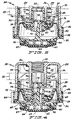
- Figure 4 is a cross sectional diagram of the restriction indicator gauge in its rest or reset position;
- Figure 5 is a partial cross sectional diagram of the restriction indicator gauge in its locked or set position;
- Figure 6 is a partial sectional diagram of the restriction indicator gauge illustrating the operation of the reset button;
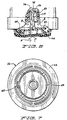
- Figure 7 is a bottom view of the restriction indicator gauge with the reset cover removed;
- Figure 8 is a partial sectional view along section line 8-8 as shown in Figure 5;
- Figure 9 is an enlarged partial sectional view of the restriction indicator gauge showing the connection between the housing and base cap;
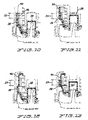
- Figures 10 and 11 are partial sectional diagrams showing the visual indicator feature in both the reset and set positions respectively;
- Figures 12 and 13 are partial sectional diagrams showing an alternative embodiment of the visual indicator feature in the reset and set positions respectively;
- Figure 14 is a schematic diagram of the base cap button portion; and
- Figure 15 is a cutaway sectional diagram showing an alternative embodiment of the present invention having multiple locking points and a grommet tip attachment structure.
- A restriction indicator gauge is useful in providing a reliable indication of an air filter's performance. By having this restriction indicator attached to the air intake system of an internal combustion engine, owners and/or maintenance personnel can have a reliable indication regarding the operating condition of their air filters. Consequently, air filters are less likely to be changed prematurely thus saving costs for the engine owners.
- Referring to Figure 1, there is shown a conceptual diagram of an engine's intake system. As is understood by those skilled in the art, the
engine 10 draws air through afilter 12. More specifically, air is drawn into afilter intake 14, throughfilter 12, and then on to the actualengine air intake 16. - Attached to
air intake 16, downstream fromfilter 12, is shown therestriction indicator gauge 20. Actually, two restriction indicator gauges 20 are shown in alternative locations, a first on thefilter housing 22, and a second attached tointake coupling 24. Either location is acceptable as the same pressure or vacuum signal can be measured from either location. - Figure 2 shows a side view of
restriction indicator gauge 20. As can be seen,restriction indicator gauge 20 includes ahousing 30 and a coupledbase cap 32. Also shown in Figure 2,housing 30 includes awindow 33 for viewing a visual indicator. - Referring now to Figure 3, the internal components making up
restriction indicator gauge 20 are shown in an exploded format. As previously mentioned,restriction indicator 20 includeshousing 30 andbase cap 32. These are the two major components which form the external structure of the gauge. Further included within the gauge are alabel 34, acalibration spring 36 an indicator cup 38 (or alignment cup 38), aflexible diaphragm 40, alock ring 42, and areset cover 44. In operation,indicator cup 38,flexible diaphragm 40, andlock ring 42 all make up adiaphragm assembly 48 which is movable withinhousing 30. - Referring now to Figure 4, the relationship of the various components when assembled, can be more easily seen. Figure 4 provides a cross sectional view of
restriction indicator gauge 20 in its reset or rest position.Housing 30 has aninlet 50 at one end thereof.Inlet 50 is configured for attachment to the air intake system, and consequently allows the desired pressure or vacuum signal to enter aninternal chamber 52 withinhousing 30. - With general reference back to Figure 1, it will be understood that there are many different ways to attach
switch gauge 20 toengine air intake 16. For example, a threaded attachment could extend outwardly fromair intake 16 which would accommodate attachment ofswitch gauge 20 thereto. Further, a bayonet-type mount could be used which again would attach directly toair intake 16. Generally speaking, any mechanism could be used which would physically connectswitch gauge 20 so thatinlet 50 is exposed to the pressure signals within theair intake 16. -
Housing 30 is attached tobase cap 32 via a snap fitting. This snap fitting is accomplished byappropriate grooves 54 inhousing 30 and relatedridges 56 inbase cap 32. This snap fitting betweenhousing 30 andbase cap 32 also captures anexterior edge 58 offlexible diaphragm 40. The interface is specifically configured to form an air tight seal betweenflexible diaphragm 40 andhousing 30. - Also attached to
flexible diaphragm 40 areindicator cup 38 andlock ring 42. Aninternal edge 60 offlexible diaphragm 40 is captured betweenlock ring 42 andindicator cup 38.Indicator cup 38 andlock ring 42 are specifically designed to interlock with one another, and form a seal withflexible diaphragm 40.Indicator cup 38 is configured to be within housinginternal chamber 52 whereaslock ring 42 is positioned on the opposite side offlexible diaphragm 40. Thus,lock ring 42 is not contained withininternal chamber 52. - Also situated within
internal chamber 52 iscalibration spring 36.Calibration spring 36 is in contact withhousing 30 at one end, andindicator cup 38 at another end. As is obvious from this positioning,calibration spring 36 is designed to biasindicator cup 38 away from the top ofhousing 30. In Figure 4,indicator cup 38 andlock ring 42 are positioned in their reset or rest positions. As can be seen, alower extension 62 oflock ring 42 is in contact withbase cap 32. Diaphragm assembly 48 (again, includingindicator cup 38,flexible diaphragm 40, and lock ring 42) will be held in this position bycalibration spring 36 until additional forces are created to counteract the force ofcalibration spring 36. -
Base cap 32 is positioned immediatelyadjacent lock ring 42, and at times, in contact therewith.Base cap 32 includes abutton portion 64 and an annularouter portion 66. Ahinge element 68 connectsbutton portion 64 and annularouter portion 66 to one another. Referring to Figure 7, there is shown a bottom view of base cap 32 (withbase cap 32 removed), wherebutton portion 64, annularouter portion 66, and hingeelement 68 can be more easily seen. -
Base cap 32 also includes anintegral locking extension 70 which extends upwardly frombutton portion 64. Lockingextension 70 is specifically configured to interact with anupper portion 72 oflock ring 42. Thisupper portion 72 includes an opening orhole 74, through which lockingextension 70 extends. When diaphragmassembly 48 is in its reset position, as shown in Figure 4, lockingextension 70 extends upwardly throughlock ring opening 74 and is situated immediately belowindicator cup 38. Lockingextension 70 includes a ramped, notchedportion 76 at an upper end thereof. This ramped, notchedportion 76 will interact withlock ring 42 whenlock ring 42 is moved upwardly. -
Reset cover 44 is configured to snap intobase cap 32, Outwardly extendingextensions 46 of reset cover 44 are configured to interact withlips 47 andbase cap 32. More specifically, lockingtab 46 of reset cover 44 is shown to insert and interlock withstructural tab 47. Consequently, resetcover 44 is held in place immediately beneathbutton portion 64. As previously mentioned,base cap 32 provides a snap fit attachment mechanism tohousing 30. Referring to Figure 9, an enlarged portion of this joint can be seen. More specifically,outer edge 58 offlexible diaphragm 40 is shown sandwiched betweenbase cap 32 andhousing 30. Also situated immediately adjacent the inner wall ofhousing 30 is shownlabel 34. - Referring to Figure 9, the hinging operation is also shown. Specifically,
button portion 64 ofbase cap 32 is shown in two positions in Figure 9. First, shown in cross sectional form,button portion 64 is in its natural or rest position. Alternatively, shown in phantom outline,button portion 64 has been moved to a depressed position such that a portion has rotated abouthinge portion 68. - As previously mentioned, the engine to which
restriction indicator gauge 20 is attached creates a vacuum signal downstream from the air filter. This vacuum signal is translated tointernal chamber 52 viahousing inlet 50. Asinternal chamber 52 is an air-tight enclosure, this vacuum signal creates a force on all walls thereof, includingdiaphragm assembly 48. Becauseflexible diaphragm 40 is allowed to freely move, the vacuum signal creates a translational force which urgesdiaphragm assembly 48 upward. This translational force opposescalibration spring 52 to create a controlled movement ofdiaphragm assembly 48. As the vacuum signal increases, the force also increases, thus causing compression ofcalibration spring 36. - Referring now to Figure 5,
restriction indicator gauge 20 is shown after it has reached a predetermined vacuum signal level. The components are chosen so that this predetermined vacuum signal level will produce a very predictable range of motion fordiaphragm assembly 48. As can be seen in Figure 5,diaphragm assembly 48 has moved to a position where it is now locked in its set or locked position. This locking is accomplished by having rampednotch 76retain lock ring 42 in the set position. Stated alternatively, the annular surface surroundinglock ring opening 74 is in direct contact with anupper shelf portion 78 oframp notch 76. - In order to reset
restriction indicator gauge 20, the locking or holding relationship between lockingextension 70 andlock ring 42 must be disturbed. To accomplish this,button portion 64 ofbase cap 32 is depressed, causing a related lateral movement of lockingextension 70. - Referring now to Figure 6,
button portion 64 is shown in its depressed orientation. More specifically, a force is applied to resetcover 44 in the direction of arrow A. This causes a hinging movement ofbutton portion 64 abouthinge element 68. This hinging action causes lockingextension 70 to move laterally, thus slidingupper shelf portion 78 out from the holdingsurface 80 oflock ring 42. - As previously mentioned,
calibration spring 36biases diaphragm assembly 48 away from the upper portion ofhousing 30. Consequently, whenupper shelf portion 78 of lockingextension 70 is pulled out from beneathlock ring 42,calibration spring 36 causes motion in the direction of arrowB. Lock ring 42 can then proceed downwardly in this direction until it contacts button portion 64 (provided no counteracting vacuum signal is present in internal chamber 52). - Referring now to Figure 14, the functional action of
button portion 64 is shown. More specifically, Figure 14 shows howbutton portion 64 reacts to various forces. In each case, lockingextension 70 is designed to extend upwardly from thebutton portion 64. This entire structure of lockingextension 70 andbutton portion 64 is attached to annularouter portion 66 viahinge element 68. In each case, the hinge produces a desired reaction to forces presented by various elements. - Referring now specifically to Figure 14A, when a lateral force is presented to locking
extension 70 in the direction shown by arrow C,button portion 64 and lockingextension 70 both rotate abouthinge portion 68. This force would be presented to lockingextension 70 in this manner asdiaphragm assembly 48 travels upwardly. That is, as the vacuum signal withininternal chamber 52 is increased, force is presented viaflexible diaphragm 40 to thelock ring 42.Lock ring 42 slides along lockingextension 70 until reachingramp notch 76. Due to the configuration oframp notch 76, a lateral force is then presented to lockingextension 70 in the direction of arrow C. This force produces the aforementioned desired reaction of causing button 64 (and locking extension 70) to rotate abouthinge element 68. - Referring to Figure 14B, the reaction of
button portion 64 is shown to an upward force presented from below in the direction of arrow D. Force in the direction of D represents the typical reset force which would be applied by the user to reset therestriction indicator gauge 20. Once again, the desired rotation motion abouthinge element 68 is shown. - Referring now to Figure 14C,
button 64 is now exposed to a downward force in the direction of arrows E. As can be seen, this downward force causesbutton portion 64 to be moved back to its rest position. The force in direction of E represents that force that would be presented bycalibration spring 36 as itbiases diaphragm assembly 48 back down into contact withbutton portion 64. Specifically, this force would be presented bylock ring 42 as itcontacts button portion 64. - Lastly, Figure 14D shows a force represented by arrow F in a downward direction which is applied to the top of locking
extension 70. This again movesbutton portion 64 back into its rest position. This force would exist when a portion ofindicator cup 38 is in contact with the top of lockingextension 70. - As can be appreciated, the different forces presented in Figure 14 represent those which would be typically encountered during in a normal operating cycle.
- Referring now to Figure 8 there shown a top cross sectional view consistent with section lines 8-8 of Figure 5. Specifically, this figure shows the top surface of
lock ring 42 andlock ring opening 74 situated therein. Lockingextension 70 extends at least partially throughlock ring opening 74. As can be seen by comparing Figure 5, this sectional diagram is shown withdiaphragm assembly 48 in its locked position. - The cooperation between
base cap 32 anddiaphragm assembly 48 specifically accommodates the use of a single base cap design. As is well known by those familiar with plastic moldings, a problem or complication exists when molded plastic hinges are used. That is, due to the nature of the material, the hinging element tends to take on the configuration in which it spends most of its time. For example, if a plastic part is continually forced into some shape by an external source, the plastic part will ultimately take a "set" in that configuration. In the case ofbase cap 32,button portion 64 is configured to be in its natural or rest position when thehinge element 68 is not bent. However, when depressed to accomplish the reset function ofrestriction indicator gauge 20,button portion 64 is depressed and hingeelement 68 is bent some distance. It would be highly undesirable to havebase cap 32 take on a configuration wherebutton element 64 is maintained in its depressed position due to continuous bending ofhinge element 68. The present embodiment however specifically avoids this problem by appropriately configuring lockingextension 70, withlock ring 42. - As has previously been described, locking
extension 70 is specifically configured to extend throughlock ring opening 74. As can be seen in Figure 4, whenrestriction indicator gauge 20 is in its reset configuration, lockingextension 70 is contained bylock ring opening 74 such that thebutton portion 64 is retained or held in its rest position at almost all times. This is critical as it avoids any "setting" of thehinge element 68 in an undesired configuration. - Referring now to both Figures 5 and 8,
indicator cup 38 includes acylindrical extension 82 which substantially covers lockingextension 70. Similarly,housing 30 includes a related substantiallycylindrical housing 84 aligned with indicator cupcylindrical extension 82. Bothcylindrical extension 82 andcylindrical housing 84 are coaxially aligned with one another such that movement ofdiaphragm assembly 48 is sufficiently contained within the restriction indicator gauge. This relationship provides proper alignment fordiaphragm assembly 48. Referring specifically to Figure 8, this coaxial alignment can easily be seen. - As previously indicated, the
restriction indicator gauge 20 has a visual indication of when a predetermined vacuum signal has been achieved. As shown above, this indication may simply include the existence or non-existence ofindicator cup 38 inwindow 33. Referring now to Figures 10-13, an alternative two color visual indication is shown, In this embodiment,window 33 would display a first color when the gauge is in its reset or rest position, while showing a second color once the gauge has reached its set or locked position. During transitional periods, partial viewing of either color could be obtained. - Referring now to Figures 10 and 11, there is shown one structure for achieving this multi-color display feature. In the device of Figure 10, the
indicator cup 38 has been altered to accommodate acontrasting ring 90 which is seated within the previously existingindicator cup 38. A viewing extension 92 of contrastingring 90 is specifically configured to extend above the remainder ofindicator cup 38. - In this embodiment,
housing 30 again has aview window 33 which could be either a clear portion ofhousing 30 or a clear portion oflabel 34. In this embodiment, when the gauge is in its reset condition, contrastingring 90 and specifically viewing extension 92 is positioned immediatelyadjacent window 33. For example, contrastingring 90 could be fabricated from a green colored material, consequently a green indication would be shown throughwindow 33. Alternatively, whenrestriction indicator gauge 20 has reached its set position, bothindicator cup 38 and contrastingring 90 have been moved upwardly. In this set position, the side wall ofindicator cup 38 is now positioned immediatelyadjacent window 33. Asindicator cup 38 is colored differently from contrastingring 90, a different color display will be present inwindow 33. Consequently, a two color display is achieved by adding contrastingring 90. - An alternative embodiment for achieving this two color display feature is shown in Figures 12 and 13. In this case, an
indicator cup 38 substantially similar to that shown in Figures 3-5 is used. Additionally, a downwardly extendingshield 96 is now attached to an upper portion ofhousing 30. Generally,shield 96 extends a sufficient distance downward so that it can be viewed throughwindow 33. Consequently, whenrestriction indicator gauge 30 is in its set position, as shown in Figure 12,indicator cup 38 will be positioned belowwindow 33 andshield 96 will be exposed. Whenrestriction indicator gauge 20 reaches its set position, however,indicator cup 38 has again been moved to a position immediatelyadjacent window 33. Thus,indicator cup 38 is now seen throughwindow 33. Again, by fabricatingindicator cup 38 and shield 96 from materials of different colors, the contrasting display capability is achieved. - While the above-described embodiment has been described as a dual position indicator (either set position or reset position), it is understood that a multi-position gauge could equally be achieved. Referring now to Figure 15, an
alternative locking extension 98 is shown. In this embodiment, multiple locking positions are shown, thus providing the gauge the ability to lock at multiple stages of its operation. - Those skilled in the art will further appreciate that the present invention may be embodied in other specific forms without departing from the spirit or central attributes thereof. In that the foregoing description of the present invention discloses only exemplary embodiments thereof, it is to be understood that other variations are contemplated as being within the scope of the present invention. Accordingly, the present invention is not limited to the particular embodiments which have been described in detail therein. Rather, reference should be made to the appended claims as indicative of the scope and content of the present invention.
- In more detail, one embodiment provides a low cost air filter restriction indicator gauge attached to an air intake system of an engine for monitoring the performance of an air filter, comprising:
- a housing attached to the air intake system having an inlet for communicating a pressure signal between the housing and the air intake system;
- a diaphragm assembly attached to the housing to create an enclosed chamber within the housing which is in communication with the inlet, the diaphragm assembly movable in response to a vacuum signal within the enclosed chamber; and
- a base cap attached to the housing and situated on the opposite side of the diaphragm assembly, the base cap including an integral reset button, the reset button having a locking mechanism for cooperating with the diaphragm assembly to lock the diaphragm assembly in a locked position when the vacuum signal reaches a predetermined level.
- The locking mechanism may include a post with a locking notch at one end for interacting with the diaphragm assembly to lock the diaphragm assembly in a locked position after the vacuum signal reaches the predetermined level.
- The diaphragm assembly may include a flexible diaphragm, a lock ring, and an indicator cup.
- The locking mechanism may include a post with a locking notch at one end for interacting with the lock ring to lock the diaphragm assembly in a locked position after the vacuum signal reaches the predetermined level.
- The post may include a plurality of locking notches for locking in multiple positions as the vacuum signal reaches a corresponding set of predetermined levels.
- The housing may include a connecting housing groove, and the base cap may include a related connection ridge which cooperate with one another to form a snap fit connection.
- The integral reset button may be a circular portion which is surrounded by an annular attachment ring, the integral resent button and annular attachment ring may be connected via a hinge portion.
- The base cap may include a related connection ridge and the housing may include a connecting housing groove, the connection ridge and the housing groove may cooperate with one another to form a snap fit connection.
- The lock ring may include a centrally located aperture for receiving and containing lock pin therein such that the reset button is held in its rest position any time the restriction indicator gauge is in its set or reset configuration.
- The reset button may be depressed to allow the restriction indicator gauge to transition from the set configuration back to the reset configuration.
- Another embodiment provides a low cost air filter restriction indicator gauge for use in detecting a filter pressure signal within an air intake system of an engine and providing an indication when the filter pressure signal is above a predetermined level thus suggesting that the air filter needs replacement, the low cost air filter restriction indicator gauge comprising:
- a substantially cylindrical housing attached to the air intake system, the housing having an inlet on one end thereof for receiving the filter pressure signal, the housing further having an indicator window located on a cylindrical wall for displaying when the filter pressure signal has reached a predetermined level;
- a base cap attached to the housing at an end opposite the inlet, the base cap including an annular connection ring attached to the housing and an integral reset button centrally located within base cap and surrounded by the annular connection ring, the reset button and the connection ring connected to on another by a hinge element, the base cap further having a locking post integral with the reset button which extends toward the housing; and
- a diaphragm assembly forming an enclosed chamber within the housing which is in communication with the inlet, the diaphragm assembly movable in response to a vacuum signal within the enclosed chamber, the diaphragm assembly also configured to cooperate with the locking post to cause the diaphragm assembly to be locked into a set position when the filter pressure signal is above a predetermined level thus providing a visual display through the indicator window.
Claims (10)
- Apparatus for indicating flow restriction in an air filter of an internal combustion engine, the apparatus comprising:an integrally molded base cap (32) that includes a reset button portion (64);a single locking extension (70) extending centrally from a major surface of the reset button portion (64);an annular portion (66) surrounding the reset button portion; anda single hinge portion (68) connecting the annular portion (66) to an edge of the reset button portion (64), wherein the reset button portion (64) can be pivoted at the single hinge portion (68) to rotate the single locking extension (70) relative to the annular portion (66).
- An apparatus according to claim 1, further comprising:a housing (30) attached to the annular portion (66) of the base cap (32) via a snap fitting and having an inlet (50) opposite the base cap (32) for coupling to an air intake system of the internal combustion engine;a diaphragm assembly (48) positioned within the housing (30) to define a chamber (52) between the inlet (50) and the base cap (32), with the chamber (50) in fluid communication with the inlet (50) and the diaphragm assembly (48) movable in response to sufficient vacuum signals within the chamber (52) to engage the locking extension (70) in a lock position which prevents further movement of the diaphragm assembly (48); anda calibration spring (36) within the chamber (52) for opposing movement of the diaphragm assembly (48) in response to vacuum signals within the chamber (52) and for urging the hinge portion (68) of the base cap (32) to a rest position where it may take on a thermal set during usage of the apparatus.
- An apparatus according to claim 2, wherein the diaphragm assembly (48) comprises a lock ring (42) having an aperture (74), the locking extension (70) includes a post with a locking notch (76) and extends through the aperture (74) of the lock ring (42) in the absence of a vacuum signal, and the lock ring (42) is operable to move to the locking extension (70) in the presence of a vacuum signal and the locking notch (76) is operable to interact with the lock ring (42) to lock the diaphragm assembly (48) in the locked position when the vacuum signal reaches a predetermined level.
- An apparatus according to claim 3, wherein the calibration spring is operable to urge lock ring (42) into contact with the reset button portion of the base cap in the absence of a vacuum signal in the absence of a vacuum signal in the chamber and thereby to urge the hinge portion of the base cap to rest position where it may take on a thermal set during usage of the apparatus.
- An apparatus according to any preceding claim, wherein the reset button portion (64) of the base cap (32) includes a plurality of projections opposite the locking extension (70) and a reset cover (44) that covers the projections and is attached to base cap (32) via a snap fitting.
- An apparatus according to any one of claims 1 to 4, wherein the single locking extension (70) includes a plurality of ramps and a plurality of notches.
- A method of operating an apparatus for indicating flow restriction in an air filter of an internal combustion engine, the method comprising biasing a hinge portion (68) of an integrally molded base cap (32) to a rest position in the absence of vacuum signals so that it may take a thermal set.
- A method according to claim 7, further comprising biasing the hinge portion (68) of the integrally molded base cap (32) to the rest position when the apparatus is in a lock position, which corresponds to a restricted flow condition so that the hinge portion (68) may take a thermal set.
- A method according to claim 7 or 8, further comprising rotating a single locking extension (70) about the hinge portion (68) in response to actuation of a reset button (64), wherein the single locking extension (70) is laterally offset from the hinge portion (68).
- A method according to any one of claims 7 to 9, wherein a calibration spring (36) biases the hinge portion (68) to the rest position.
Applications Claiming Priority (2)
| Application Number | Priority Date | Filing Date | Title |
|---|---|---|---|
| US09/344,737 US6327902B1 (en) | 1999-06-25 | 1999-06-25 | Air filter restriction indicator gauge |
| EP00941692A EP1190170B1 (en) | 1999-06-25 | 2000-06-23 | Single position indicator gauge |
Related Parent Applications (2)
| Application Number | Title | Priority Date | Filing Date |
|---|---|---|---|
| EP00941692.6 Division | 2000-06-23 | ||
| EP00941692A Division EP1190170B1 (en) | 1999-06-25 | 2000-06-23 | Single position indicator gauge |
Publications (2)
| Publication Number | Publication Date |
|---|---|
| EP1736661A2 true EP1736661A2 (en) | 2006-12-27 |
| EP1736661A3 EP1736661A3 (en) | 2010-11-10 |
Family
ID=23351802
Family Applications (2)
| Application Number | Title | Priority Date | Filing Date |
|---|---|---|---|
| EP00941692A Expired - Lifetime EP1190170B1 (en) | 1999-06-25 | 2000-06-23 | Single position indicator gauge |
| EP06016971A Withdrawn EP1736661A3 (en) | 1999-06-25 | 2000-06-23 | Single position indicator gauge |
Family Applications Before (1)
| Application Number | Title | Priority Date | Filing Date |
|---|---|---|---|
| EP00941692A Expired - Lifetime EP1190170B1 (en) | 1999-06-25 | 2000-06-23 | Single position indicator gauge |
Country Status (5)
| Country | Link |
|---|---|
| US (1) | US6327902B1 (en) |
| EP (2) | EP1190170B1 (en) |
| JP (1) | JP2003503627A (en) |
| DE (1) | DE60030116T2 (en) |
| WO (1) | WO2001000984A1 (en) |
Families Citing this family (19)
| Publication number | Priority date | Publication date | Assignee | Title |
|---|---|---|---|---|
| AU6633600A (en) | 1999-08-16 | 2001-03-13 | Donaldson Company Inc. | Restriction indicator |
| US7032573B2 (en) * | 2004-04-23 | 2006-04-25 | Ford Global Technologies, Llc | Method and apparatus for indicating air filter maintenance is required |
| US7124627B2 (en) * | 2004-08-12 | 2006-10-24 | Illinois Tool Works Inc | Air filter restriction sensor assembly |
| US7470360B2 (en) * | 2005-01-21 | 2008-12-30 | Engineered Products Company | Fluid flow restriction indicator |
| WO2006081564A1 (en) | 2005-01-28 | 2006-08-03 | Engineered Products Company | Non-locking switch for filter monitoring |
| US20070056888A1 (en) * | 2005-09-09 | 2007-03-15 | Williams Michael J | Filter change indicator |
| JP4703351B2 (en) * | 2005-10-14 | 2011-06-15 | 株式会社北電子 | Slot machine |
| WO2007149445A1 (en) * | 2006-06-16 | 2007-12-27 | Engineered Products Company | Dial-type flow-restriction gauges |
| US7635402B2 (en) | 2006-12-22 | 2009-12-22 | Nissan Technical Center North America, Inc. | Air filter status evaluator |
| US8336292B2 (en) * | 2008-11-12 | 2012-12-25 | Caterpillar Inc. | Exhaust component having permanently associated life indicator |
| CN103038491B (en) * | 2010-10-27 | 2016-01-20 | 康明斯过滤Ip公司 | The leaf filter that resistance reduces |
| JP2013071019A (en) * | 2011-09-26 | 2013-04-22 | Aoi Seiko:Kk | Clog indicating device for dust collector |
| US9260990B2 (en) * | 2012-09-14 | 2016-02-16 | Ford Global Technologies, Llc | Crankcase integrity breach detection |
| US10163652B2 (en) | 2014-03-13 | 2018-12-25 | Taiwan Semiconductor Manufacturing Company, Ltd. | Mechanisms for forming patterns using multiple lithography processes |
| CN110114127B (en) | 2017-01-04 | 2021-04-23 | 康明斯过滤Ip公司 | filter assembly with diffuser |
| CN115445332B (en) | 2017-10-24 | 2024-10-29 | 唐纳森公司 | Air cleaner assembly with obstruction indicator |
| CN108757237A (en) * | 2018-06-15 | 2018-11-06 | 新乡市新鹰机械有限公司 | A kind of air filter alarm |
| WO2020009899A1 (en) | 2018-07-02 | 2020-01-09 | Cummins Filtration Ip, Inc. | Restriction indictor device for filter assembly |
| US12188438B1 (en) * | 2023-10-30 | 2025-01-07 | Injen Technology Company, Ltd. | Air intake system having a detachable window for viewing the air filter |
Family Cites Families (26)
| Publication number | Priority date | Publication date | Assignee | Title |
|---|---|---|---|---|
| US2946222A (en) | 1955-05-04 | 1960-07-26 | Edward J Hujsak | Fluid pressure sensitive resistance bridge circuit |
| US3443365A (en) * | 1967-12-06 | 1969-05-13 | Donaldson Co Inc | Restriction indicator |
| US3465707A (en) * | 1968-03-05 | 1969-09-09 | Tsuchiya Seisakusho | Clogging indicator for air cleaners |
| US3594745A (en) | 1969-05-08 | 1971-07-20 | Norgren Co C A | Valve for signaling three conditions |
| US3696666A (en) | 1969-10-15 | 1972-10-10 | Donaldson Co Inc | Dust leak detector for air cleaner systems |
| US3654414A (en) | 1970-07-07 | 1972-04-04 | Marvel Eng Co | Indicator switch assembly |
| US3939457A (en) | 1974-11-07 | 1976-02-17 | Richard Donald Nelson | Air filter restriction indicating device |
| US4033733A (en) | 1976-02-23 | 1977-07-05 | Joseph N. Nelson | Air filter gauge |
| US4171962A (en) | 1976-03-23 | 1979-10-23 | Becton, Dickinson And Company | Bacteria filters with transparent housings |
| JPS5820870Y2 (en) | 1977-07-28 | 1983-05-02 | 株式会社東芝 | Dryer |
| US4445456A (en) | 1978-06-19 | 1984-05-01 | Engineered Products Company | Air filter restriction indicating device |
| US4279162A (en) | 1979-11-23 | 1981-07-21 | Kelsey-Hayes Company | Pressure transducer |
| US4423751A (en) | 1980-12-09 | 1984-01-03 | Cummins Engine Company, Inc. | Bypass valve and alarm assembly |
| US4369728A (en) | 1981-02-09 | 1983-01-25 | Engineered Products Company | Air filter restriction indicating device |
| DE3428307A1 (en) * | 1984-08-01 | 1986-02-13 | Filterwerk Mann & Hummel Gmbh, 7140 Ludwigsburg | DISPLAY DEVICE FOR THE POLLUTION LEVEL OF SUCTION AIR FILTERS |
| US5239861A (en) | 1988-12-23 | 1993-08-31 | Kabushiki Kaisha Komatsu Seisakusho | Device for indicating contamination degree of hydraulic circuit and method of judging the contamination degree |
| FR2650389B1 (en) | 1989-07-27 | 1993-03-26 | Sextant Avionique | DEVICE FOR MEASURING DEFORMATION OF A MEMBRANE |
| US4937557A (en) | 1990-01-02 | 1990-06-26 | Aqua-Tronics, Inc. | Monitoring and indicating circuit for reverse osmosis filter |
| DE4022782A1 (en) | 1990-07-18 | 1992-01-23 | Bosch Gmbh Robert | PRESSURE SENSOR FOR DETECTING PRINTERS IN THE COMBUSTION CHAMBER OF COMBUSTION ENGINES |
| DE4315577C2 (en) | 1992-06-04 | 2001-03-29 | Mann & Hummel Filter | Display device for detecting the degree of contamination of air filters |
| FR2705734B1 (en) | 1993-05-25 | 1995-06-30 | Snecma | Method and device for improving the safety of fluid filters. |
| US5850183A (en) * | 1995-02-24 | 1998-12-15 | Engineered Products Co. | Air filter restriction indicating device |
| DE19506452A1 (en) | 1995-02-24 | 1996-08-29 | Mann & Hummel Filter | Display device for displaying the negative pressure |
| CN1192799A (en) * | 1995-08-04 | 1998-09-09 | 唐纳森公司 | Restriction indicator for air cleaner |
| US5774056A (en) | 1996-05-30 | 1998-06-30 | Engineered Products Co. | Gauge for monitoring air filters |
| US6268791B1 (en) * | 1999-05-12 | 2001-07-31 | Engineered Products Company | Switch gauge |
-
1999
- 1999-06-25 US US09/344,737 patent/US6327902B1/en not_active Expired - Lifetime
-
2000
- 2000-06-23 WO PCT/US2000/017418 patent/WO2001000984A1/en not_active Ceased
- 2000-06-23 EP EP00941692A patent/EP1190170B1/en not_active Expired - Lifetime
- 2000-06-23 DE DE60030116T patent/DE60030116T2/en not_active Expired - Lifetime
- 2000-06-23 JP JP2001506373A patent/JP2003503627A/en not_active Abandoned
- 2000-06-23 EP EP06016971A patent/EP1736661A3/en not_active Withdrawn
Also Published As
| Publication number | Publication date |
|---|---|
| DE60030116D1 (en) | 2006-09-28 |
| EP1736661A3 (en) | 2010-11-10 |
| EP1190170B1 (en) | 2006-08-16 |
| DE60030116T2 (en) | 2006-12-07 |
| US6327902B1 (en) | 2001-12-11 |
| WO2001000984A1 (en) | 2001-01-04 |
| JP2003503627A (en) | 2003-01-28 |
| US20010049963A1 (en) | 2001-12-13 |
| EP1190170A1 (en) | 2002-03-27 |
Similar Documents
| Publication | Publication Date | Title |
|---|---|---|
| US6327902B1 (en) | Air filter restriction indicator gauge | |
| US6820647B1 (en) | Valve position monitor | |
| AU709849B2 (en) | Restriction indicator for air cleaners | |
| US4369728A (en) | Air filter restriction indicating device | |
| EP0010569B1 (en) | Magnetic pressure indicator with thermal lockout | |
| US6531960B1 (en) | Low tire pressure indicator | |
| US5014643A (en) | Tire pressure indicator | |
| US12030009B1 (en) | Air cleaner assembly with restriction indicator | |
| CA2209716A1 (en) | Visible restricted filter indicator | |
| US5437241A (en) | Differential pressure indicator | |
| EP1192350B1 (en) | Fuel filter gauge | |
| EP1192349B1 (en) | Two stage gauge with electrical signal output | |
| US6268791B1 (en) | Switch gauge | |
| US7635402B2 (en) | Air filter status evaluator | |
| US20050284802A1 (en) | Filtering device with integral filter status indicator | |
| CA1106705A (en) | Air filter restriction indicating device | |
| JPS628701Y2 (en) | ||
| JP2004232566A (en) | Oil bath type air cleaner |
Legal Events
| Date | Code | Title | Description |
|---|---|---|---|
| PUAI | Public reference made under article 153(3) epc to a published international application that has entered the european phase |
Free format text: ORIGINAL CODE: 0009012 |
|
| 17P | Request for examination filed |
Effective date: 20060822 |
|
| AC | Divisional application: reference to earlier application |
Ref document number: 1190170 Country of ref document: EP Kind code of ref document: P |
|
| AK | Designated contracting states |
Kind code of ref document: A2 Designated state(s): DE FR GB IT |
|
| PUAL | Search report despatched |
Free format text: ORIGINAL CODE: 0009013 |
|
| AK | Designated contracting states |
Kind code of ref document: A3 Designated state(s): DE FR GB IT |
|
| STAA | Information on the status of an ep patent application or granted ep patent |
Free format text: STATUS: THE APPLICATION HAS BEEN WITHDRAWN |
|
| 18W | Application withdrawn |
Effective date: 20101206 |