EP1736517A1 - Metal salts of maleimide compounds as conductivity promoters - Google Patents
Metal salts of maleimide compounds as conductivity promoters Download PDFInfo
- Publication number
- EP1736517A1 EP1736517A1 EP06012687A EP06012687A EP1736517A1 EP 1736517 A1 EP1736517 A1 EP 1736517A1 EP 06012687 A EP06012687 A EP 06012687A EP 06012687 A EP06012687 A EP 06012687A EP 1736517 A1 EP1736517 A1 EP 1736517A1
- Authority
- EP
- European Patent Office
- Prior art keywords
- acid
- maleimide
- metal salt
- conductive
- composition according
- Prior art date
- Legal status (The legal status is an assumption and is not a legal conclusion. Google has not performed a legal analysis and makes no representation as to the accuracy of the status listed.)
- Withdrawn
Links
Classifications
-
- H—ELECTRICITY
- H01—ELECTRIC ELEMENTS
- H01B—CABLES; CONDUCTORS; INSULATORS; SELECTION OF MATERIALS FOR THEIR CONDUCTIVE, INSULATING OR DIELECTRIC PROPERTIES
- H01B1/00—Conductors or conductive bodies characterised by the conductive materials; Selection of materials as conductors
- H01B1/20—Conductive material dispersed in non-conductive organic material
- H01B1/22—Conductive material dispersed in non-conductive organic material the conductive material comprising metals or alloys
-
- C—CHEMISTRY; METALLURGY
- C08—ORGANIC MACROMOLECULAR COMPOUNDS; THEIR PREPARATION OR CHEMICAL WORKING-UP; COMPOSITIONS BASED THEREON
- C08K—Use of inorganic or non-macromolecular organic substances as compounding ingredients
- C08K5/00—Use of organic ingredients
- C08K5/0091—Complexes with metal-heteroatom-bonds
-
- C—CHEMISTRY; METALLURGY
- C08—ORGANIC MACROMOLECULAR COMPOUNDS; THEIR PREPARATION OR CHEMICAL WORKING-UP; COMPOSITIONS BASED THEREON
- C08K—Use of inorganic or non-macromolecular organic substances as compounding ingredients
- C08K5/00—Use of organic ingredients
- C08K5/16—Nitrogen-containing compounds
- C08K5/34—Heterocyclic compounds having nitrogen in the ring
- C08K5/3412—Heterocyclic compounds having nitrogen in the ring having one nitrogen atom in the ring
- C08K5/3415—Five-membered rings
-
- H—ELECTRICITY
- H05—ELECTRIC TECHNIQUES NOT OTHERWISE PROVIDED FOR
- H05K—PRINTED CIRCUITS; CASINGS OR CONSTRUCTIONAL DETAILS OF ELECTRIC APPARATUS; MANUFACTURE OF ASSEMBLAGES OF ELECTRICAL COMPONENTS
- H05K1/00—Printed circuits
- H05K1/02—Details
- H05K1/09—Use of materials for the conductive, e.g. metallic pattern
- H05K1/092—Dispersed materials, e.g. conductive pastes or inks
- H05K1/095—Dispersed materials, e.g. conductive pastes or inks for polymer thick films, i.e. having a permanent organic polymeric binder
-
- H—ELECTRICITY
- H10—SEMICONDUCTOR DEVICES; ELECTRIC SOLID-STATE DEVICES NOT OTHERWISE PROVIDED FOR
- H10W—GENERIC PACKAGES, INTERCONNECTIONS, CONNECTORS OR OTHER CONSTRUCTIONAL DETAILS OF DEVICES COVERED BY CLASS H10
- H10W42/00—Arrangements for protection of devices
- H10W42/20—Arrangements for protection of devices protecting against electromagnetic or particle radiation, e.g. light, X-rays, gamma-rays or electrons
- H10W42/281—Arrangements for protection of devices protecting against electromagnetic or particle radiation, e.g. light, X-rays, gamma-rays or electrons characterised by their materials
- H10W42/284—Arrangements for protection of devices protecting against electromagnetic or particle radiation, e.g. light, X-rays, gamma-rays or electrons characterised by their materials shielding resins
-
- H—ELECTRICITY
- H05—ELECTRIC TECHNIQUES NOT OTHERWISE PROVIDED FOR
- H05K—PRINTED CIRCUITS; CASINGS OR CONSTRUCTIONAL DETAILS OF ELECTRIC APPARATUS; MANUFACTURE OF ASSEMBLAGES OF ELECTRICAL COMPONENTS
- H05K2203/00—Indexing scheme relating to apparatus or processes for manufacturing printed circuits covered by H05K3/00
- H05K2203/12—Using specific substances
- H05K2203/121—Metallo-organic compounds
-
- H—ELECTRICITY
- H10—SEMICONDUCTOR DEVICES; ELECTRIC SOLID-STATE DEVICES NOT OTHERWISE PROVIDED FOR
- H10W—GENERIC PACKAGES, INTERCONNECTIONS, CONNECTORS OR OTHER CONSTRUCTIONAL DETAILS OF DEVICES COVERED BY CLASS H10
- H10W40/00—Arrangements for thermal protection or thermal control
- H10W40/10—Arrangements for heating
-
- H—ELECTRICITY
- H10—SEMICONDUCTOR DEVICES; ELECTRIC SOLID-STATE DEVICES NOT OTHERWISE PROVIDED FOR
- H10W—GENERIC PACKAGES, INTERCONNECTIONS, CONNECTORS OR OTHER CONSTRUCTIONAL DETAILS OF DEVICES COVERED BY CLASS H10
- H10W42/00—Arrangements for protection of devices
- H10W42/20—Arrangements for protection of devices protecting against electromagnetic or particle radiation, e.g. light, X-rays, gamma-rays or electrons
-
- H—ELECTRICITY
- H10—SEMICONDUCTOR DEVICES; ELECTRIC SOLID-STATE DEVICES NOT OTHERWISE PROVIDED FOR
- H10W—GENERIC PACKAGES, INTERCONNECTIONS, CONNECTORS OR OTHER CONSTRUCTIONAL DETAILS OF DEVICES COVERED BY CLASS H10
- H10W72/00—Interconnections or connectors in packages
- H10W72/071—Connecting or disconnecting
- H10W72/074—Connecting or disconnecting of anisotropic conductive adhesives
-
- H—ELECTRICITY
- H10—SEMICONDUCTOR DEVICES; ELECTRIC SOLID-STATE DEVICES NOT OTHERWISE PROVIDED FOR
- H10W—GENERIC PACKAGES, INTERCONNECTIONS, CONNECTORS OR OTHER CONSTRUCTIONAL DETAILS OF DEVICES COVERED BY CLASS H10
- H10W72/00—Interconnections or connectors in packages
- H10W72/30—Die-attach connectors
- H10W72/321—Structures or relative sizes of die-attach connectors
- H10W72/325—Die-attach connectors having a filler embedded in a matrix
-
- H—ELECTRICITY
- H10—SEMICONDUCTOR DEVICES; ELECTRIC SOLID-STATE DEVICES NOT OTHERWISE PROVIDED FOR
- H10W—GENERIC PACKAGES, INTERCONNECTIONS, CONNECTORS OR OTHER CONSTRUCTIONAL DETAILS OF DEVICES COVERED BY CLASS H10
- H10W72/00—Interconnections or connectors in packages
- H10W72/30—Die-attach connectors
- H10W72/351—Materials of die-attach connectors
- H10W72/352—Materials of die-attach connectors comprising metals or metalloids, e.g. solders
-
- H—ELECTRICITY
- H10—SEMICONDUCTOR DEVICES; ELECTRIC SOLID-STATE DEVICES NOT OTHERWISE PROVIDED FOR
- H10W—GENERIC PACKAGES, INTERCONNECTIONS, CONNECTORS OR OTHER CONSTRUCTIONAL DETAILS OF DEVICES COVERED BY CLASS H10
- H10W72/00—Interconnections or connectors in packages
- H10W72/30—Die-attach connectors
- H10W72/351—Materials of die-attach connectors
- H10W72/353—Materials of die-attach connectors not comprising solid metals or solid metalloids, e.g. ceramics
- H10W72/354—Materials of die-attach connectors not comprising solid metals or solid metalloids, e.g. ceramics comprising polymers
Definitions
- This invention relates to conductive resin compositions and in particular to conductive resin compositions containing metal salts of maleimide compounds.
- Conductive fillers are added to resin compositions in order to make them either thermally or electrically conductive.
- Conductive resins compositions have a wide variety of uses, such as, replacement for solder, for example, in attaching a circuit component to a circuit board or a semiconductor die to a leadframe; shielding, for example, as a conductive coating to carry away stray current or static electricity; conductive ink, for example, as a polymer thick film ink or an RFID ink for a conductive antenna; tantalum capacitor; or thermal interface material, for example, as a silicon gel or grease for heat dissipation.
- conductive resins can be used as adhesives for attaching semiconductor dies or chips to a substrate.
- those that require a high level of electrical conductivity between the die and the substrate, for example in a power integrated circuit or as a replacement for solder enhanced conductivity is necessary.
- the obvious method for doing this is to increase the loading of the conductive filler in the resin composition or to utilize a more conductive filler. Either of these methods, however, may affect the rheology or other performance characteristics of the composition.
- metal salt of a maleimide acid a metal salt of a compound containing both carboxylic acid functionality and maleimide functionality
- a conductive resin composition comprising a resin and a conductive filler
- the improved conductive resin composition is thus commercially suitable for applications within the semiconductor packaging industry, and especially for applications that require a high level of electrical conductivity.
- This invention is a conductive resin composition
- a conductive resin composition comprising a resin, a conductive filler, and a metal salt of a maleimide.
- the metal salt of a maleimide acid shall mean the compound that is obtained by the conversion of an organic acid containing a maleimide moiety to the metal salt of that acid.
- the addition of the metal salt to the composition improves conductivity significantly.
- the metal salt is activated by heat generated from the operation of the device in which the conductive resin composition is utilized.
- the composition comprises a curable resin and a curing agent for the resin, a conductive filler, and a metal salt of a maleimide acid.
- This technology can be used in chemistries that cure via condensation, addition, and electron donor/electron acceptor reactions.
- the metal salt of a maleimide acid is activated by the heat of reaction or by the input of heat to initiate the reaction.
- the inventive metal salt of a maleimide acid is prepared by (i) reacting a molar equivalent of maleic anhydride with a molar equivalent of an amino acid to form an amic acid, (ii) dehydrating the amic acid to form a maleimide acid (as earlier defined), and (iii) converting the maleimide acid to the metal salt.
- Suitable amino acids can be aliphatic or aromatic, and include, but are not limited to, glycine, alanine, 2-aminoisobutyric acid, valine, tert-leucine, norvaline, 2-amino-4-pentenoic acid, isoleucine, leucine, norleucine, beta-alanine, 5-aminovaleric acid, 6-aminocaproic acid, 7-aminoheptanoic acid, 8-aminocaprylic acid, 11-amino-undecanoic acid, 12-aminododecanoic acid, 2-phenylglycine, 2,2'-diphenylglycine, phenylalanine, alpha-methyl-DL-phenylalanine, and homophenylalanine.
- the maleic anhydride is dissolved in an organic solvent, such as acetonitrile, and this solution added to a one mole equivalent of the amino acid.
- the mixture is allowed to react, typically for about three hours, at room temperature, until white crystals are formed.
- the white crystals are filtered off, washed with cold organic solvent (acetonitrile) and dried to produce the amic acid adduct.
- the amic acid adduct is mixed with base, typically triethylamine, in a solvent, such as toluene.
- the mixture is heated to 130°C for two hours to dehydrate the amic acid and form the maleimide ring.
- the organic solvent is evaporated and sufficient 2M HCL added to reach pH 2.
- the product is then extracted with ethyl acetate and dried, for example, over MgSO 4 , followed by evaporation of the solvent.
- maleimide acid a compound containing both maleimide and carboxylic acid functionalities
- hydrocarbon (aliphatic or aromatic) moiety separating the maleimide and acid functionalities is the derivative of the starting amino acid used to make the compound.
- the conversion of the maleimide acid to a metal salt is known art, and is accomplished by the methods disclosed in the examples. In general, the conversion of the carboxylic acid functionality is conducted by combining the maleimide acid with a metal nitrate or halide.
- the maleimide acid is mixed with water at 10°C or lower and sufficient base, for example, NH40H (assay 28-30 %), is added to raise the pH to about 7.0.
- a solution of a stoichiometric amount of metal nitrate or halide is prepared and is added to the reaction slurry over a short time (for example, five minutes) while maintaining the reaction temperature at or below 10°C.
- the reaction is held at that temperature and mixed for several hours, typically two to three hours, after which the mixture is allowed to return to room temperature and mixed for an additional 12 hours at room temperature.
- the precipitate product is filtered and washed with water (three times) and then with acetone (three times), and dried in a vacuum oven for 48 hours at about 45°C.
- the metal elements suitable for coordination with the acid functionality of the maleimide acid are selected from the group consisting of lithium (Li), sodium (Na), magnesium (Mg), potassium (K), calcium (Ca), scandium (Sc), titanium (Ti), vanadium (V), chromium (Cr), manganese (Mn), iron (Fe), cobalt (Co), nickel (Ni), copper (Cu), zinc (Zn), palladium (Pd), platinum (Pt), silver (Ag), gold (Au), mercury (Hg), aluminum (Al), and tin (Sn).
- the nitrate or halide salts of these metals are the preferred salts for reaction with the maleimide acid.
- the metal salts of maleimide are generally solid materials that can be milled into a fine powder for incorporating into the chosen resin composition.
- the metal salt will be present in the resin composition at a loading of 0.05% to 10% by weight of the composition. In one embodiment, the loading is around 0.1 % to 0.5% by weight.
- Exemplary resins suitable for use in these compositions include phenolics, epoxies, acrylates, maleimides, polyimides, polyurethanes, vinyl chlorides, vinyl acetates, polyesters, silicones, benzoxazines, oxetane, thio-ene, oxazolines, nitrones, vinyl ethers, styrenics, and cinnamics.
- the particular choice of resin is not critical to the invention and the practitioner may choose the resin for curing and adhesive performance as suits the end use application. Such performance characteristics for the resins will be known to those skilled in the art.
- the resin composition will also contain a conductive filler.
- conductive filler will be deemed to include (a) a metal in particle, flake, or powder form, and any combination of those, and (b) a nonconductive filler in particle, flake, or powder form, and any combination of those, onto which is coated a metallic surface.
- the size and shape of the particle, flake and powder are not critical to the invention. In general a combination of flake and powder is used in order to optimize the packing density of the filler.
- the conductive filler will be present in an amount from 20% to 95% by weight.
- the filler is a silver filler, and is present in an amount from 70% to 90% by weight.
- Suitable conductive fillers are metallic and include gold, silver, copper, cobalt, silver coated graphite, copper alloys, platinum, palladium, nickel, aluminum, silver coated copper, silver alloys with platinum or palladium, bronze or brass alloys.
- the choice of filler composition within the parameters disclosed in this specification for a specific end use application is within the expertise of one skilled in the art and is not critical to obtaining improved conductivity.
- maleimidocaproic acid was prepared as follows: a solution of one mole equivalent of maleic anhydride in acetonitrile was added to a one mole equivalent of 6-aminocaprioc acid in acetic acid. The mixture was allowed to react for three hours at room temperature. The formed white crystals were filtered off, washed with cold acetonitrile and dried to produce the amic acid adduct. Amic acid was mixed with triethylamine in toluene and the mixture heated to 130°C for two hours. The water of reaction was collected in a Dean-Stark trap. The organic solvent was evaporated off and sufficient 2M HCL added to reach pH 2. Extraction with ethyl acetate and drying over MgSO 4 followed by evaporating the solvent gave 6-maleimidocaproic acid (MCA).
- MCA 6-maleimidocaproic acid
- reaction solids formed a dark turquoise amorphous lump in a clear blue liquid.
- the liquid was decanted off and the solids were washed three times with water. Following the water washes, 300 mL of acetone was added to the solids, which had the effect of breaking up the lump.
- the blue colored acetone was decanted off and the step was repeated with 500 mL of acetone. With this wash, the solids were dispersed enough to allow stirring of the mixture for 30 minutes. Light turquoise solids were then filtered from the mixture leaving a light blue filtrate. This acetone wash was repeated twice more. The final acetone wash was clear and colorless.
- the reaction product was a light turquoise powder, which was dried in a vacuum oven over night at 45°C.
- NH 4 OH (assay 28-30 %) was added to raise the pH from 2.31 to ⁇ 7.0. During the add, the reaction temperature rose to 44°C and the reaction became a fairly clear orange-red color. Upon cooling to 25°C, the pH measured 6.64. At this temperature, the reaction became turbid and pink solids precipitated from the solution. Water, 50 mL, was added, and the addition of NH 4 OH was continueded to raise the pH to about 7.32. The reaction was cooled in an ice bath to a slurry. The copper (II) nitrate hemipentahydrate solution was added to the reaction slurry over five minutes while maintaining the reaction temperature to 10°C or less. A noticeable exotherm was not observed. The reaction was mixed for two hours while cooling. The ice bath was then removed and the resultant fine dark turquoise mixture was mixed over night.
- reaction was a turquoise mix of moderate viscosity.
- the blue-green reaction liquor was filtered off and the sky blue solids were mixed with 300 mL of water for 30 minutes and then filtered. This water wash was repeated twice more. Following the water washes, 300 mL of acetone was added to the solids. The mixture was stirred for 30 minutes and then filtered. This acetone wash was repeated twice more. The final acetone wash was clear and colorless.
- the reaction product was a light green-blue powder which was dried in a vacuum oven over two nights at 45°C. A yield of 28 grams was obtained from this reaction.
Landscapes
- Chemical & Material Sciences (AREA)
- Health & Medical Sciences (AREA)
- Chemical Kinetics & Catalysis (AREA)
- Medicinal Chemistry (AREA)
- Polymers & Plastics (AREA)
- Organic Chemistry (AREA)
- Dispersion Chemistry (AREA)
- Engineering & Computer Science (AREA)
- Microelectronics & Electronic Packaging (AREA)
- Physics & Mathematics (AREA)
- Spectroscopy & Molecular Physics (AREA)
- Compositions Of Macromolecular Compounds (AREA)
- Conductive Materials (AREA)
- Pyrrole Compounds (AREA)
Abstract
A conductive resin composition comprises a resin, a conductive filler, and the metal salt of a compound containing maleimide functionality.
Description
- This invention relates to conductive resin compositions and in particular to conductive resin compositions containing metal salts of maleimide compounds.
- Conductive fillers are added to resin compositions in order to make them either thermally or electrically conductive. Conductive resins compositions have a wide variety of uses, such as, replacement for solder, for example, in attaching a circuit component to a circuit board or a semiconductor die to a leadframe; shielding, for example, as a conductive coating to carry away stray current or static electricity; conductive ink, for example, as a polymer thick film ink or an RFID ink for a conductive antenna; tantalum capacitor; or thermal interface material, for example, as a silicon gel or grease for heat dissipation.
- In particular, conductive resins can be used as adhesives for attaching semiconductor dies or chips to a substrate. For some uses, those that require a high level of electrical conductivity between the die and the substrate, for example in a power integrated circuit or as a replacement for solder, enhanced conductivity is necessary. The obvious method for doing this is to increase the loading of the conductive filler in the resin composition or to utilize a more conductive filler. Either of these methods, however, may affect the rheology or other performance characteristics of the composition.
- The inventor has discovered that the addition of a metal salt of a compound containing both carboxylic acid functionality and maleimide functionality (hereinafter "metal salt of a maleimide acid") to a conductive resin composition comprising a resin and a conductive filler, improves the conductivity of the composition, particularly its electrical conductivity, without detriment to worklife or rheology. The improved conductive resin composition is thus commercially suitable for applications within the semiconductor packaging industry, and especially for applications that require a high level of electrical conductivity.
- This invention is a conductive resin composition comprising a resin, a conductive filler, and a metal salt of a maleimide. As used within this specification and claims, the metal salt of a maleimide acid shall mean the compound that is obtained by the conversion of an organic acid containing a maleimide moiety to the metal salt of that acid. The addition of the metal salt to the composition improves conductivity significantly. In this embodiment, the metal salt is activated by heat generated from the operation of the device in which the conductive resin composition is utilized.
- In another embodiment the composition comprises a curable resin and a curing agent for the resin, a conductive filler, and a metal salt of a maleimide acid. This technology can be used in chemistries that cure via condensation, addition, and electron donor/electron acceptor reactions. In this embodiment, the metal salt of a maleimide acid is activated by the heat of reaction or by the input of heat to initiate the reaction.
- The inventive metal salt of a maleimide acid is prepared by (i) reacting a molar equivalent of maleic anhydride with a molar equivalent of an amino acid to form an amic acid, (ii) dehydrating the amic acid to form a maleimide acid (as earlier defined), and (iii) converting the maleimide acid to the metal salt.
- Suitable amino acids can be aliphatic or aromatic, and include, but are not limited to, glycine, alanine, 2-aminoisobutyric acid, valine, tert-leucine, norvaline, 2-amino-4-pentenoic acid, isoleucine, leucine, norleucine, beta-alanine, 5-aminovaleric acid, 6-aminocaproic acid, 7-aminoheptanoic acid, 8-aminocaprylic acid, 11-amino-undecanoic acid, 12-aminododecanoic acid, 2-phenylglycine, 2,2'-diphenylglycine, phenylalanine, alpha-methyl-DL-phenylalanine, and homophenylalanine.
- The maleic anhydride is dissolved in an organic solvent, such as acetonitrile, and this solution added to a one mole equivalent of the amino acid. The mixture is allowed to react, typically for about three hours, at room temperature, until white crystals are formed. The white crystals are filtered off, washed with cold organic solvent (acetonitrile) and dried to produce the amic acid adduct. The amic acid adduct is mixed with base, typically triethylamine, in a solvent, such as toluene. The mixture is heated to 130°C for two hours to dehydrate the amic acid and form the maleimide ring. The organic solvent is evaporated and sufficient 2M HCL added to reach pH 2. The product is then extracted with ethyl acetate and dried, for example, over MgSO4, followed by evaporation of the solvent.
- The product from the above reaction is a compound containing both maleimide and carboxylic acid functionalities (hereinafter referred to as a "maleimide acid"). It will be understood by those skilled in the art that the hydrocarbon (aliphatic or aromatic) moiety separating the maleimide and acid functionalities is the derivative of the starting amino acid used to make the compound.
- The conversion of the maleimide acid to a metal salt is known art, and is accomplished by the methods disclosed in the examples. In general, the conversion of the carboxylic acid functionality is conducted by combining the maleimide acid with a metal nitrate or halide.
- The maleimide acid is mixed with water at 10°C or lower and sufficient base, for example, NH40H (assay 28-30 %), is added to raise the pH to about 7.0. A solution of a stoichiometric amount of metal nitrate or halide is prepared and is added to the reaction slurry over a short time (for example, five minutes) while maintaining the reaction temperature at or below 10°C. The reaction is held at that temperature and mixed for several hours, typically two to three hours, after which the mixture is allowed to return to room temperature and mixed for an additional 12 hours at room temperature.
- The precipitate product, the metal salt of a maleimide, is filtered and washed with water (three times) and then with acetone (three times), and dried in a vacuum oven for 48 hours at about 45°C.
- The metal elements suitable for coordination with the acid functionality of the maleimide acid are selected from the group consisting of lithium (Li), sodium (Na), magnesium (Mg), potassium (K), calcium (Ca), scandium (Sc), titanium (Ti), vanadium (V), chromium (Cr), manganese (Mn), iron (Fe), cobalt (Co), nickel (Ni), copper (Cu), zinc (Zn), palladium (Pd), platinum (Pt), silver (Ag), gold (Au), mercury (Hg), aluminum (Al), and tin (Sn). The nitrate or halide salts of these metals are the preferred salts for reaction with the maleimide acid.
- The metal salts of maleimide are generally solid materials that can be milled into a fine powder for incorporating into the chosen resin composition. The metal salt will be present in the resin composition at a loading of 0.05% to 10% by weight of the composition. In one embodiment, the loading is around 0.1 % to 0.5% by weight.
- Exemplary resins suitable for use in these compositions include phenolics, epoxies, acrylates, maleimides, polyimides, polyurethanes, vinyl chlorides, vinyl acetates, polyesters, silicones, benzoxazines, oxetane, thio-ene, oxazolines, nitrones, vinyl ethers, styrenics, and cinnamics. The particular choice of resin is not critical to the invention and the practitioner may choose the resin for curing and adhesive performance as suits the end use application. Such performance characteristics for the resins will be known to those skilled in the art.
- The resin composition will also contain a conductive filler. Within this specification and the claims, the words "conductive filler" will be deemed to include (a) a metal in particle, flake, or powder form, and any combination of those, and (b) a nonconductive filler in particle, flake, or powder form, and any combination of those, onto which is coated a metallic surface. The size and shape of the particle, flake and powder are not critical to the invention. In general a combination of flake and powder is used in order to optimize the packing density of the filler. Typically, the conductive filler will be present in an amount from 20% to 95% by weight. In one embodiment, the filler is a silver filler, and is present in an amount from 70% to 90% by weight.
- Suitable conductive fillers are metallic and include gold, silver, copper, cobalt, silver coated graphite, copper alloys, platinum, palladium, nickel, aluminum, silver coated copper, silver alloys with platinum or palladium, bronze or brass alloys. The choice of filler composition within the parameters disclosed in this specification for a specific end use application is within the expertise of one skilled in the art and is not critical to obtaining improved conductivity.
- EXAMPLE 1. PREPARATION OF MALEIMIDOCAPROIC ACID (2.1 MOL)/COPPER (II) NITRATE HEMIPENTAHYDRATE (1.0 MOL)
-

- The starting material, maleimidocaproic acid
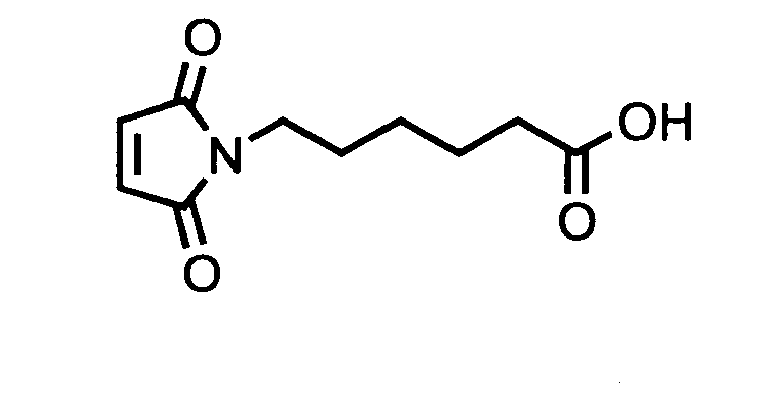
- MCA (76.83 g, 0.3641 mol) and 100 mL water were combined in a one liter, four-necked, round bottom flask equipped with a mechanical mixer, thermometer and pH probe. The reaction was heated with mixing to 60°C, which resulted in phasing-out. NH4OH (assay 28-30 %) was added to raise the pH from 2.53 to ~7.0. During the add, the reaction temperature remained at 60° to 70°C and the reaction became a homogeneous clear dark copper color. Upon cooling to 37°C, the reaction turned turbid and started oiling out. Water, 50 mL, was added, which cleared the opaque reaction slightly. Addition of NH4OH was continued until the pH reached about 7.25, at which point the reaction was an opaque gold mixture. The reaction was cooled to a slurry in an ice bath.
- Meanwhile, a solution of copper (II) nitrate hemipentahydrate (Aldrich, 223395, 98 %) (50.00 g, 0.2150 mol) in 50 mL of water was prepared. The salt readily dissolved to a clear dark blue solution. The copper (II) nitrate hemipentahydrate solution was added to the reaction slurry over 27 minutes while maintaining the reaction temperature </= 10°C. A noticeable exotherm was not observed. Water (200 mL) was then added to thin the thick turquoise reaction mixture. The ice bath was removed and the reaction was mixed over night.
- After 14 hours, the reaction solids formed a dark turquoise amorphous lump in a clear blue liquid. The liquid was decanted off and the solids were washed three times with water. Following the water washes, 300 mL of acetone was added to the solids, which had the effect of breaking up the lump. The blue colored acetone was decanted off and the step was repeated with 500 mL of acetone. With this wash, the solids were dispersed enough to allow stirring of the mixture for 30 minutes. Light turquoise solids were then filtered from the mixture leaving a light blue filtrate. This acetone wash was repeated twice more. The final acetone wash was clear and colorless. The reaction product was a light turquoise powder, which was dried in a vacuum oven over night at 45°C.
- EXAMPLE 2. PREPARATION OF MALEIMIDOPROPIONIC ACID (2.1 MOL)/COPPER (II) NITRATE HEMIPENTAHYDRATE (1.0 MOL)
-

- Maleimidopropionic acid (61.58 g, 0.3641 mol) and 100 mL water were combined in a 1 liter, four-necked, round bottom flask equipped with a mechanical mixer, thermometer and pH probe. The reaction was heated with mixing to 60°C, which resulted in a slightly hazy gold solution. While the reaction solution cooled to room temperature, a solution of copper (II) nitrate hemipentahydrate (Aldrich, 223395, 98 %) (50.00 g, 0.2150 mol in 50 mL of water) was prepared.
- NH4OH (assay 28-30 %) was added to raise the pH from 2.31 to ~7.0. During the add, the reaction temperature rose to 44°C and the reaction became a fairly clear orange-red color. Upon cooling to 25°C, the pH measured 6.64. At this temperature, the reaction became turbid and pink solids precipitated from the solution. Water, 50 mL, was added, and the addition of NH4OH was continuted to raise the pH to about 7.32. The reaction was cooled in an ice bath to a slurry. The copper (II) nitrate hemipentahydrate solution was added to the reaction slurry over five minutes while maintaining the reaction temperature to 10°C or less. A noticeable exotherm was not observed. The reaction was mixed for two hours while cooling. The ice bath was then removed and the resultant fine dark turquoise mixture was mixed over night.
- After 14 hours, the reaction was a turquoise mix of moderate viscosity. The blue-green reaction liquor was filtered off and the sky blue solids were mixed with 300 mL of water for 30 minutes and then filtered. This water wash was repeated twice more. Following the water washes, 300 mL of acetone was added to the solids. The mixture was stirred for 30 minutes and then filtered. This acetone wash was repeated twice more. The final acetone wash was clear and colorless. The reaction product was a light green-blue powder which was dried in a vacuum oven over two nights at 45°C. A yield of 28 grams was obtained from this reaction.
Claims (6)
- A conductive composition comprising a resin, a conductive filler, and a metal salt of a maleimide acid.
- The conductive composition according to claim 1 in which the metal salt of a maleimide is formed by(i) reacting a molar equivalent of maleic anhydride with a molar equivalent of an amino acid to form an amic acid,(ii) dehydrating the amic acid to form a maleimide acid, and(iii) converting the maleimide acid to its metal salt.
- The conductive resin composition according to claim 2 in which the amino acid is selected from the group consisting of glycine, alanine, 2-aminoisobutyric acid, valine, tert-leucine, norvaline, 2-amino-4-pentenoic acid, isoleucine, leucine, norleucine, beta-alanine, 5-aminovaleric acid, 6-aminocaproic acid, 7-aminoheptanoic acid, 8-aminocaprylic acid, 11-amino-undecanoic acid, 12-aminododecanoic acid, 2-phenylglycine, 2,2'-diphenylglycine, phenylalanine, alpha-methyl-DL-phenylalanine, and homophenylalanine.
- The conductive composition according to claim 2 in which the metal salt of a maleimide is derived from the salts of the metal elements selected from the group consisting of lithium (Li), sodium (Na), magnesium (Mg), potassium (K), calcium (Ca), scandium (Sc), titanium (Ti), vanadium (V), chromium (Cr), manganese (Mn), iron (Fe), cobalt (Co), nickel (Ni), copper (Cu), zinc (Zn), palladium (Pd), platinum (Pt), silver (Ag), gold (Au), mercury (Hg), aluminum (Al), and tin (Sn).
- The conductive composition according to claim 1 in which the maleimide metal salt will be present in the resin composition at a loading of 0.05% to 10% by weight of the composition.
- The conductive composition according to claim 1 in which the resin is selected from the group consisting of phenolics, epoxies, acrylates, maleimides, polyimides, polyurethanes, vinyl chlorides, vinyl acetates, polyesters, silicones, benzoxazines, oxetane, thio-ene, oxazolines, nitrones, vinyl ethers, styrenics, and cinnamics.
Applications Claiming Priority (1)
| Application Number | Priority Date | Filing Date | Title |
|---|---|---|---|
| US11/157,611 US20060284141A1 (en) | 2005-06-21 | 2005-06-21 | Metal salts of maleimide compounds as conductivity promoters |
Publications (1)
| Publication Number | Publication Date |
|---|---|
| EP1736517A1 true EP1736517A1 (en) | 2006-12-27 |
Family
ID=36928302
Family Applications (1)
| Application Number | Title | Priority Date | Filing Date |
|---|---|---|---|
| EP06012687A Withdrawn EP1736517A1 (en) | 2005-06-21 | 2006-06-20 | Metal salts of maleimide compounds as conductivity promoters |
Country Status (7)
| Country | Link |
|---|---|
| US (1) | US20060284141A1 (en) |
| EP (1) | EP1736517A1 (en) |
| JP (1) | JP2007002245A (en) |
| KR (1) | KR20060133913A (en) |
| CN (1) | CN1884353A (en) |
| SG (1) | SG128630A1 (en) |
| TW (1) | TW200712163A (en) |
Families Citing this family (3)
| Publication number | Priority date | Publication date | Assignee | Title |
|---|---|---|---|---|
| US6899960B2 (en) * | 2002-03-22 | 2005-05-31 | Intel Corporation | Microelectronic or optoelectronic package having a polybenzoxazine-based film as an underfill material |
| WO2010019832A2 (en) | 2008-08-13 | 2010-02-18 | Designer Molecules, Inc. | Amide-extended crosslinking compounds and methods for use thereof |
| US8398898B2 (en) * | 2008-02-23 | 2013-03-19 | Designer Molecules, Inc. | Soluble metal salts for use as conductivity promoters |
Citations (3)
| Publication number | Priority date | Publication date | Assignee | Title |
|---|---|---|---|---|
| EP0390565A2 (en) * | 1989-03-31 | 1990-10-03 | Mitsui Petrochemical Industries, Ltd. | Imide prepolymers, cured products, method for making the same, laminate preparation, and encapsulating compositions |
| EP0969065A2 (en) * | 1998-07-02 | 2000-01-05 | National Starch and Chemical Investment Holding Corporation | Die attach adhesives for use in microelectronic |
| EP1384737A2 (en) * | 2002-07-22 | 2004-01-28 | National Starch and Chemical Investment Holding Corporation | Cycloaliphatic epoxy compounds containing styrenic, cinnamyl, or maleimide functionality |
Family Cites Families (6)
| Publication number | Priority date | Publication date | Assignee | Title |
|---|---|---|---|---|
| US2313565A (en) * | 1939-10-31 | 1943-03-09 | Eastman Kodak Co | Resin and its preparation |
| US3208979A (en) * | 1961-11-30 | 1965-09-28 | Us Rubber Co | Treatment of fluorocarbon elastomer with alkali metal salt of maleimide |
| DE3922739A1 (en) * | 1989-07-11 | 1991-01-24 | Basf Ag | REINFORCED COLORED THERMOPLASTIC MOLDS BASED ON POLYPHENYLENE ETHERS AND POLYAMIDES |
| US5143953A (en) * | 1990-12-28 | 1992-09-01 | The B. F. Goodrich Company | N-alkyl maleimide thermal stabilizers for vinyl halide polymers |
| US5714535A (en) * | 1993-12-21 | 1998-02-03 | The Standard Oil Company | Stabilizers for high nitrile multipolymers |
| US20040127895A1 (en) * | 2002-05-20 | 2004-07-01 | Flock Stephen T. | Electromagnetic treatment of tissues and cells |
-
2005
- 2005-06-21 US US11/157,611 patent/US20060284141A1/en not_active Abandoned
-
2006
- 2006-06-19 CN CNA2006100930576A patent/CN1884353A/en active Pending
- 2006-06-20 KR KR1020060055386A patent/KR20060133913A/en not_active Withdrawn
- 2006-06-20 EP EP06012687A patent/EP1736517A1/en not_active Withdrawn
- 2006-06-20 TW TW095121971A patent/TW200712163A/en unknown
- 2006-06-20 SG SG200604198A patent/SG128630A1/en unknown
- 2006-06-20 JP JP2006170102A patent/JP2007002245A/en active Pending
Patent Citations (3)
| Publication number | Priority date | Publication date | Assignee | Title |
|---|---|---|---|---|
| EP0390565A2 (en) * | 1989-03-31 | 1990-10-03 | Mitsui Petrochemical Industries, Ltd. | Imide prepolymers, cured products, method for making the same, laminate preparation, and encapsulating compositions |
| EP0969065A2 (en) * | 1998-07-02 | 2000-01-05 | National Starch and Chemical Investment Holding Corporation | Die attach adhesives for use in microelectronic |
| EP1384737A2 (en) * | 2002-07-22 | 2004-01-28 | National Starch and Chemical Investment Holding Corporation | Cycloaliphatic epoxy compounds containing styrenic, cinnamyl, or maleimide functionality |
Also Published As
| Publication number | Publication date |
|---|---|
| US20060284141A1 (en) | 2006-12-21 |
| KR20060133913A (en) | 2006-12-27 |
| SG128630A1 (en) | 2007-01-30 |
| JP2007002245A (en) | 2007-01-11 |
| CN1884353A (en) | 2006-12-27 |
| TW200712163A (en) | 2007-04-01 |
Similar Documents
| Publication | Publication Date | Title |
|---|---|---|
| US8564140B2 (en) | Mono-acid hybrid conductive composition and method | |
| US5358992A (en) | Die-attach composition comprising polycyanate ester monomer | |
| CN101970525B (en) | Curable composition, anisotropic conductive material and connection structure | |
| US20030111519A1 (en) | Fluxing compositions | |
| JP5239191B2 (en) | Silver fine particles and method for producing the same | |
| WO2003042196A1 (en) | Benzoxazineshaving polymerizable side groups, thermosetting resi ns comprised thereof, and methods for use thereof | |
| EP1452535B1 (en) | Basic silane coupling agent-organic carboxylic acid salt composition, process for preparing the salt composition and epoxy resin compositions containing the same | |
| EP1736518B1 (en) | Use of metal salts of organic acids as conductivity promoters | |
| CN101724137A (en) | Method for preparing epoxy resin with biphenyl structure | |
| US20060284141A1 (en) | Metal salts of maleimide compounds as conductivity promoters | |
| JP6509770B2 (en) | Conductive metal powder paste | |
| HK1096701A (en) | Metal salts of maleimide compounds as conductivity promoters | |
| JP5381976B2 (en) | Liquid porphyrin derivative and method for producing the same | |
| JP5740830B2 (en) | Metal complex and compound useful therefor | |
| TW200823150A (en) | Inorganic anion exchanger composed of bismuth compound and resin composition for electronic component encapsulation using the same | |
| JP2003231734A (en) | Organic carboxylate composition, its production process and additive for epoxy resin | |
| KR20260067110A (en) | Ag complex compound for die attach paste and method for preparing the same | |
| JP4508572B2 (en) | Solid silane coupling agent and resin composition, cured product, powder coating, and sealing material containing the same | |
| JP7746515B1 (en) | Silane compounds and their uses | |
| KR100936433B1 (en) | Process for preparing potassium sulfate and zinc chloride from zinc sulfate and potassium chloride | |
| JP4747584B2 (en) | Liquid encapsulating resin composition for semiconductor and semiconductor device encapsulated using the same | |
| KR20230063160A (en) | Adhesive composition for semiconductor die bonding and method for manufacturing the same | |
| TWI434911B (en) | Conductive paste | |
| JP3192851B2 (en) | N-type conductive polymer and method for producing the same | |
| JP2013087330A (en) | Method for manufacturing metal composite superfine particle |
Legal Events
| Date | Code | Title | Description |
|---|---|---|---|
| PUAI | Public reference made under article 153(3) epc to a published international application that has entered the european phase |
Free format text: ORIGINAL CODE: 0009012 |
|
| AK | Designated contracting states |
Kind code of ref document: A1 Designated state(s): AT BE BG CH CY CZ DE DK EE ES FI FR GB GR HU IE IS IT LI LT LU LV MC NL PL PT RO SE SI SK TR |
|
| AX | Request for extension of the european patent |
Extension state: AL BA HR MK YU |
|
| AKX | Designation fees paid | ||
| STAA | Information on the status of an ep patent application or granted ep patent |
Free format text: STATUS: THE APPLICATION IS DEEMED TO BE WITHDRAWN |
|
| 18D | Application deemed to be withdrawn |
Effective date: 20071228 |
|
| REG | Reference to a national code |
Ref country code: DE Ref legal event code: 8566 |