EP1736462A1 - Recovery of optically active tartaric acid resolving agents - Google Patents
Recovery of optically active tartaric acid resolving agents Download PDFInfo
- Publication number
- EP1736462A1 EP1736462A1 EP05013394A EP05013394A EP1736462A1 EP 1736462 A1 EP1736462 A1 EP 1736462A1 EP 05013394 A EP05013394 A EP 05013394A EP 05013394 A EP05013394 A EP 05013394A EP 1736462 A1 EP1736462 A1 EP 1736462A1
- Authority
- EP
- European Patent Office
- Prior art keywords
- tartaric acid
- acid
- process according
- substituted tartaric
- substituted
- Prior art date
- Legal status (The legal status is an assumption and is not a legal conclusion. Google has not performed a legal analysis and makes no representation as to the accuracy of the status listed.)
- Withdrawn
Links
- FEWJPZIEWOKRBE-UHFFFAOYSA-N Tartaric acid Natural products [H+].[H+].[O-]C(=O)C(O)C(O)C([O-])=O FEWJPZIEWOKRBE-UHFFFAOYSA-N 0.000 title claims abstract description 20
- 235000002906 tartaric acid Nutrition 0.000 title claims abstract description 20
- 239000011975 tartaric acid Substances 0.000 title claims abstract description 19
- 239000003795 chemical substances by application Substances 0.000 title claims abstract description 11
- 238000011084 recovery Methods 0.000 title claims abstract description 8
- 150000003892 tartrate salts Chemical class 0.000 claims abstract description 48
- 150000003839 salts Chemical class 0.000 claims abstract description 37
- 238000000034 method Methods 0.000 claims abstract description 35
- 239000002253 acid Substances 0.000 claims abstract description 28
- 239000003960 organic solvent Substances 0.000 claims abstract description 18
- 150000001412 amines Chemical class 0.000 claims abstract description 16
- 239000008346 aqueous phase Substances 0.000 claims abstract description 16
- 230000002378 acidificating effect Effects 0.000 claims abstract description 12
- 238000012544 monitoring process Methods 0.000 claims abstract description 3
- 230000001376 precipitating effect Effects 0.000 claims abstract description 3
- XLYOFNOQVPJJNP-UHFFFAOYSA-N water Substances O XLYOFNOQVPJJNP-UHFFFAOYSA-N 0.000 claims description 29
- 150000002500 ions Chemical class 0.000 claims description 15
- QGZKDVFQNNGYKY-UHFFFAOYSA-N Ammonia Chemical compound N QGZKDVFQNNGYKY-UHFFFAOYSA-N 0.000 claims description 13
- VEXZGXHMUGYJMC-UHFFFAOYSA-N Hydrochloric acid Chemical compound Cl VEXZGXHMUGYJMC-UHFFFAOYSA-N 0.000 claims description 13
- 229910052500 inorganic mineral Inorganic materials 0.000 claims description 13
- 239000011707 mineral Substances 0.000 claims description 13
- 239000002904 solvent Substances 0.000 claims description 12
- 239000002585 base Substances 0.000 claims description 11
- NBIIXXVUZAFLBC-UHFFFAOYSA-N Phosphoric acid Chemical compound OP(O)(O)=O NBIIXXVUZAFLBC-UHFFFAOYSA-N 0.000 claims description 8
- 239000000203 mixture Substances 0.000 claims description 8
- 239000000243 solution Substances 0.000 claims description 8
- QAOWNCQODCNURD-UHFFFAOYSA-N Sulfuric acid Chemical compound OS(O)(=O)=O QAOWNCQODCNURD-UHFFFAOYSA-N 0.000 claims description 6
- 239000007864 aqueous solution Substances 0.000 claims description 6
- 229910021529 ammonia Inorganic materials 0.000 claims description 5
- BMYNFMYTOJXKLE-UHFFFAOYSA-N 3-azaniumyl-2-hydroxypropanoate Chemical compound NCC(O)C(O)=O BMYNFMYTOJXKLE-UHFFFAOYSA-N 0.000 claims description 4
- GRYLNZFGIOXLOG-UHFFFAOYSA-N Nitric acid Chemical compound O[N+]([O-])=O GRYLNZFGIOXLOG-UHFFFAOYSA-N 0.000 claims description 4
- 229910052784 alkaline earth metal Inorganic materials 0.000 claims description 4
- 229910000147 aluminium phosphate Inorganic materials 0.000 claims description 4
- 229910017604 nitric acid Inorganic materials 0.000 claims description 4
- 150000001768 cations Chemical class 0.000 claims description 3
- 229920001429 chelating resin Polymers 0.000 claims description 3
- BVKZGUZCCUSVTD-UHFFFAOYSA-L Carbonate Chemical compound [O-]C([O-])=O BVKZGUZCCUSVTD-UHFFFAOYSA-L 0.000 claims description 2
- 239000003513 alkali Substances 0.000 claims description 2
- 150000001342 alkaline earth metals Chemical class 0.000 claims description 2
- 150000001875 compounds Chemical class 0.000 claims description 2
- XLYOFNOQVPJJNP-UHFFFAOYSA-M hydroxide Chemical compound [OH-] XLYOFNOQVPJJNP-UHFFFAOYSA-M 0.000 claims description 2
- BVKZGUZCCUSVTD-UHFFFAOYSA-N carbonic acid Chemical class OC(O)=O BVKZGUZCCUSVTD-UHFFFAOYSA-N 0.000 claims 1
- KFZMGEQAYNKOFK-UHFFFAOYSA-N Isopropanol Chemical compound CC(C)O KFZMGEQAYNKOFK-UHFFFAOYSA-N 0.000 description 21
- 229960001367 tartaric acid Drugs 0.000 description 14
- YMWUJEATGCHHMB-UHFFFAOYSA-N Dichloromethane Chemical compound ClCCl YMWUJEATGCHHMB-UHFFFAOYSA-N 0.000 description 12
- 229960001270 d- tartaric acid Drugs 0.000 description 10
- BZLVMXJERCGZMT-UHFFFAOYSA-N Methyl tert-butyl ether Chemical compound COC(C)(C)C BZLVMXJERCGZMT-UHFFFAOYSA-N 0.000 description 8
- 238000002425 crystallisation Methods 0.000 description 5
- 230000008025 crystallization Effects 0.000 description 5
- 238000001914 filtration Methods 0.000 description 5
- IAZDPXIOMUYVGZ-WFGJKAKNSA-N Dimethyl sulfoxide Chemical compound [2H]C([2H])([2H])S(=O)C([2H])([2H])[2H] IAZDPXIOMUYVGZ-WFGJKAKNSA-N 0.000 description 4
- 238000003756 stirring Methods 0.000 description 4
- WMJNKBXKYHXOHC-WOJBJXKFSA-N (2R,3R)-2,3-dihydroxy-2,3-bis(2-methylbenzoyl)butanedioic acid Chemical compound C=1(C(=CC=CC=1)C(=O)[C@@]([C@@](C(=O)O)(O)C(=O)C=1C(=CC=CC=1)C)(O)C(=O)O)C WMJNKBXKYHXOHC-WOJBJXKFSA-N 0.000 description 3
- QGZKDVFQNNGYKY-UHFFFAOYSA-O Ammonium Chemical compound [NH4+] QGZKDVFQNNGYKY-UHFFFAOYSA-O 0.000 description 3
- LFQSCWFLJHTTHZ-UHFFFAOYSA-N Ethanol Chemical compound CCO LFQSCWFLJHTTHZ-UHFFFAOYSA-N 0.000 description 3
- HEMHJVSKTPXQMS-UHFFFAOYSA-M Sodium hydroxide Chemical compound [OH-].[Na+] HEMHJVSKTPXQMS-UHFFFAOYSA-M 0.000 description 3
- YXFVVABEGXRONW-UHFFFAOYSA-N Toluene Chemical compound CC1=CC=CC=C1 YXFVVABEGXRONW-UHFFFAOYSA-N 0.000 description 3
- 125000003236 benzoyl group Chemical group [H]C1=C([H])C([H])=C(C([H])=C1[H])C(*)=O 0.000 description 3
- 230000015572 biosynthetic process Effects 0.000 description 3
- 125000002091 cationic group Chemical group 0.000 description 3
- 238000006243 chemical reaction Methods 0.000 description 3
- 239000006184 cosolvent Substances 0.000 description 3
- 229910000069 nitrogen hydride Inorganic materials 0.000 description 3
- 230000009466 transformation Effects 0.000 description 3
- -1 (+)-di-O Chemical class 0.000 description 2
- CSCPPACGZOOCGX-UHFFFAOYSA-N Acetone Chemical compound CC(C)=O CSCPPACGZOOCGX-UHFFFAOYSA-N 0.000 description 2
- FEWJPZIEWOKRBE-JCYAYHJZSA-N Dextrotartaric acid Chemical compound OC(=O)[C@H](O)[C@@H](O)C(O)=O FEWJPZIEWOKRBE-JCYAYHJZSA-N 0.000 description 2
- ZLMJMSJWJFRBEC-UHFFFAOYSA-N Potassium Chemical compound [K] ZLMJMSJWJFRBEC-UHFFFAOYSA-N 0.000 description 2
- 150000001298 alcohols Chemical class 0.000 description 2
- 125000003545 alkoxy group Chemical group 0.000 description 2
- 125000003118 aryl group Chemical group 0.000 description 2
- 238000003556 assay Methods 0.000 description 2
- 238000007257 deesterification reaction Methods 0.000 description 2
- 239000000543 intermediate Substances 0.000 description 2
- 239000012452 mother liquor Substances 0.000 description 2
- 238000006386 neutralization reaction Methods 0.000 description 2
- 239000012044 organic layer Substances 0.000 description 2
- 239000012074 organic phase Substances 0.000 description 2
- 125000001997 phenyl group Chemical group [H]C1=C([H])C([H])=C(*)C([H])=C1[H] 0.000 description 2
- 229910052700 potassium Inorganic materials 0.000 description 2
- 239000011591 potassium Substances 0.000 description 2
- 238000002360 preparation method Methods 0.000 description 2
- 238000000746 purification Methods 0.000 description 2
- 238000000926 separation method Methods 0.000 description 2
- 238000007086 side reaction Methods 0.000 description 2
- 239000000725 suspension Substances 0.000 description 2
- 238000003786 synthesis reaction Methods 0.000 description 2
- 238000005809 transesterification reaction Methods 0.000 description 2
- 238000005406 washing Methods 0.000 description 2
- 238000001644 13C nuclear magnetic resonance spectroscopy Methods 0.000 description 1
- 238000005160 1H NMR spectroscopy Methods 0.000 description 1
- HBAQYPYDRFILMT-UHFFFAOYSA-N 8-[3-(1-cyclopropylpyrazol-4-yl)-1H-pyrazolo[4,3-d]pyrimidin-5-yl]-3-methyl-3,8-diazabicyclo[3.2.1]octan-2-one Chemical class C1(CC1)N1N=CC(=C1)C1=NNC2=C1N=C(N=C2)N1C2C(N(CC1CC2)C)=O HBAQYPYDRFILMT-UHFFFAOYSA-N 0.000 description 1
- BVKZGUZCCUSVTD-UHFFFAOYSA-M Bicarbonate Chemical compound OC([O-])=O BVKZGUZCCUSVTD-UHFFFAOYSA-M 0.000 description 1
- DGAQECJNVWCQMB-PUAWFVPOSA-M Ilexoside XXIX Chemical compound C[C@@H]1CC[C@@]2(CC[C@@]3(C(=CC[C@H]4[C@]3(CC[C@@H]5[C@@]4(CC[C@@H](C5(C)C)OS(=O)(=O)[O-])C)C)[C@@H]2[C@]1(C)O)C)C(=O)O[C@H]6[C@@H]([C@H]([C@@H]([C@H](O6)CO)O)O)O.[Na+] DGAQECJNVWCQMB-PUAWFVPOSA-M 0.000 description 1
- 239000007832 Na2SO4 Substances 0.000 description 1
- KEAYESYHFKHZAL-UHFFFAOYSA-N Sodium Chemical class [Na] KEAYESYHFKHZAL-UHFFFAOYSA-N 0.000 description 1
- PMZURENOXWZQFD-UHFFFAOYSA-L Sodium Sulfate Chemical compound [Na+].[Na+].[O-]S([O-])(=O)=O PMZURENOXWZQFD-UHFFFAOYSA-L 0.000 description 1
- 150000007513 acids Chemical class 0.000 description 1
- 125000002252 acyl group Chemical group 0.000 description 1
- 229910001413 alkali metal ion Inorganic materials 0.000 description 1
- 229910001420 alkaline earth metal ion Inorganic materials 0.000 description 1
- 125000000217 alkyl group Chemical group 0.000 description 1
- 150000004945 aromatic hydrocarbons Chemical class 0.000 description 1
- 125000002843 carboxylic acid group Chemical group 0.000 description 1
- 238000000975 co-precipitation Methods 0.000 description 1
- 239000013078 crystal Substances 0.000 description 1
- 125000004093 cyano group Chemical group *C#N 0.000 description 1
- 229910003460 diamond Inorganic materials 0.000 description 1
- 239000010432 diamond Substances 0.000 description 1
- WSEQXVZVJXJVFP-FQEVSTJZSA-N escitalopram Chemical compound C1([C@]2(C3=CC=C(C=C3CO2)C#N)CCCN(C)C)=CC=C(F)C=C1 WSEQXVZVJXJVFP-FQEVSTJZSA-N 0.000 description 1
- 229960004341 escitalopram Drugs 0.000 description 1
- 150000002170 ethers Chemical class 0.000 description 1
- 238000000605 extraction Methods 0.000 description 1
- 125000005843 halogen group Chemical group 0.000 description 1
- 125000002887 hydroxy group Chemical group [H]O* 0.000 description 1
- 150000002576 ketones Chemical class 0.000 description 1
- 239000010410 layer Substances 0.000 description 1
- 238000004519 manufacturing process Methods 0.000 description 1
- 238000002844 melting Methods 0.000 description 1
- 230000008018 melting Effects 0.000 description 1
- 125000000449 nitro group Chemical group [O-][N+](*)=O 0.000 description 1
- 230000003287 optical effect Effects 0.000 description 1
- 238000005191 phase separation Methods 0.000 description 1
- 230000005588 protonation Effects 0.000 description 1
- 238000001953 recrystallisation Methods 0.000 description 1
- 230000008929 regeneration Effects 0.000 description 1
- 238000011069 regeneration method Methods 0.000 description 1
- 239000011734 sodium Substances 0.000 description 1
- 229910052708 sodium Inorganic materials 0.000 description 1
- 229910052938 sodium sulfate Inorganic materials 0.000 description 1
- 239000012453 solvate Substances 0.000 description 1
- 238000000638 solvent extraction Methods 0.000 description 1
- 125000001424 substituent group Chemical group 0.000 description 1
- 238000000844 transformation Methods 0.000 description 1
Classifications
-
- C—CHEMISTRY; METALLURGY
- C07—ORGANIC CHEMISTRY
- C07C—ACYCLIC OR CARBOCYCLIC COMPOUNDS
- C07C69/00—Esters of carboxylic acids; Esters of carbonic or haloformic acids
- C07C69/76—Esters of carboxylic acids having a carboxyl group bound to a carbon atom of a six-membered aromatic ring
-
- C—CHEMISTRY; METALLURGY
- C07—ORGANIC CHEMISTRY
- C07C—ACYCLIC OR CARBOCYCLIC COMPOUNDS
- C07C67/00—Preparation of carboxylic acid esters
- C07C67/48—Separation; Purification; Stabilisation; Use of additives
- C07C67/52—Separation; Purification; Stabilisation; Use of additives by change in the physical state, e.g. crystallisation
-
- C—CHEMISTRY; METALLURGY
- C07—ORGANIC CHEMISTRY
- C07C—ACYCLIC OR CARBOCYCLIC COMPOUNDS
- C07C67/00—Preparation of carboxylic acid esters
- C07C67/48—Separation; Purification; Stabilisation; Use of additives
- C07C67/60—Separation; Purification; Stabilisation; Use of additives by treatment giving rise to chemical modification
-
- C—CHEMISTRY; METALLURGY
- C07—ORGANIC CHEMISTRY
- C07B—GENERAL METHODS OF ORGANIC CHEMISTRY; APPARATUS THEREFOR
- C07B2200/00—Indexing scheme relating to specific properties of organic compounds
- C07B2200/07—Optical isomers
Definitions
- This invention relates to a novel process for the recovery of optically active tartaric acid resolving agents from diastereomeric salts.
- the tartaric acid derivatives are obtained in very good to excellent yields and sufficient optical purity to be reused in the corresponding resolution process.
- Optically active acids such as (+)-di- O,O' -acyl tartaric acid or (-)-di- O,O' -acyl tartaric acid derivatives, are frequently employed for the synthesis of optically active compounds containing an arnino group.
- the separation of the enantiomeric amines is accomplished by salt formation with the resolving agent.
- One of the diastereomeric salts preferentially the salt containing the amine with the desired configuration, crystallizes due to a lower solubility.
- the required optically active amine can be regenerated by basification of the diastereomeric salt. Thereby, the tartaric acid derivative is obtained as a di-salt in aqueous solution.
- WO 03/042132 is related to a process which is based on a crystallization of di- O,O' -acyl tartaric acid derivatives from the aqueous phase in the presence of a mineral acid and an organic co-solvent.
- a mineral acid and an organic co-solvent By using C 1 to C 10 alcohols as co-solvent the free tartaric acid derivatives crystallize as a solvate with the corresponding alcohol.
- the mother liquor consists of a mixture of water with an organic solvent, which again complicates large scale operations.
- the crystallization af di- O,O' -toluoyl tartaric acid is carried out directly from the diastereomeric salt in water, in the presence of a mineral acid, and crystalline di- O,O' -toluoyl tartaric acid.
- the regeneration is performed in the presence of the amine and a strong mineral acid.
- the amine has to be stable under these conditions. Depeading on the nature of the amine co-precipitation with the tartaric acid can also occur. Therefore, this process is only applicable to a limited set of amines.
- Examples of resolving agents used in such resolution processes include (+)-di- O,O' -toluoyl-D-tartaric acid, (-)-di- O,O' -toluoyl-L-tartaric acid, (+)-di- O,O' -benzoyl-d-tartaric acid, (-)-di- O , O '-benzoyl-L-tartaric acid, (+)-di- O,O' -anisoyl-D-tartaric acid, (-)-di- O,O' -anisoyl-L-tartaric acid, or mixture of them. Examples of such structures are shown in figure 1.
- the present invention is directed to a novel process for the recovery of substituted tartaric acid resolving agents from resolution mother liquors or isolated diastereomeric salts.
- the process is characterized in that the diastereomeric salt of an enantiomerically enriched amine and the substituted tartaric acid derivative in an organic solvent is treated with a base, extracting said substituted tartaric acid derivative into an aqueous phase, adding an acid to the separated aqueous phase while monitoring the pH-value, precipitating mono salts of substituted tartaric acid derivatives, isolating said mono salts, and liberating the substituted tartaric acid derivative by an acidic treatment
- This process avoids the use of an additional solvent for the crystallization and yields sufficiently pure substituted tartaric acid derivatives in good to excellent yields.
- the diastereomeric salt consisting of a chiral amine and a substituted tartaric acid derivative is dissolved or suspended in an organic solvent immiscible or only poorly miscible with water, optionally in admixture with water.
- a base is added in order to set free the amine moiety.
- said diastereomeric salt is dissolved or suspended in water, treated with base, and an organic solvent immiscible or only poorly miscible with water is added. Partitioning results in an organic phase containing the chiral amine and an aqueous phase containing the di-anion of the substituted tartaric acid derivative.
- the substituted tartaric acid derivative can be precipitated from the aqueous phase as a substituted tartaric acid mono salt by careful addition of the corresponding quantity of mineral acid (scheme 1). Due to the controlled and mild reaction conditions no side reactions such as deesterification, transesterification or racemisation are observed.
- the mono salt of the substituted tartaric acid derivative is obtained in a crystalline form of suitable purity. Further purification of the isolated crystals may be effected by washing or recrystallization, if necessary. This mono salt is transformed into the free di-acid by reaction by an acidic ion exchanger in an organic solvent or organic solvent / water mixture.
- Separation of the ion exchanger by filtration gives a solution of the substituted tartaric acid derivative in the organic solvent or organic solvent / water mixture.
- the transformation of the substituted tartaric acid mono salt to the corresponding free acid can be performed using a mineral acid in water and a poorly water miscible or immiscible solvent.
- a solution of the liberated substituted tartaric acid derivative in a poorly water miscible or immiscible solvent is thereby obtained which is provided as a solution ready to use in subsequent resolution processes.
- the mono salts as intermediates of the inventive process have, according to the base used, a cationic counter ion which is an alkali metal ion, an alkaline earth metal ion, an ammonium or optionally substituted ammonium ion.
- the acyl moiety is a benzoyl or substituted benzoyl.
- Substituents of the benzoyl moiety are one or more allcyl, preferably C 1 - C 4 alkyl, alkoxy, preferably C 1 - C 4 alkoxy, hydroxy, nitro, cyano, halogeno, phenyl or substituted phenyl substituents.
- Resolution mother liquors typically comprise one or more organic solvents in addition to the resolving agent and the optically enriched amine.
- organic solvents used for the resolving process are alcohols such as for instance 2-propanol, ketones such as for instance acetone, ethers such as for instance methyl tert -butyl ether, aromatic hydrocarbons, such as for instance toluene, or mixtures thereof.
- the organic solvent is only poorly miscible with water or water immiscible. Water miscible solvents such as 2-propanol need to be removed and replaced by a poorly water miscible or immiscible solvent, e.g. methyl tert- butyl ether or methylene chloride.
- the salt After treatment with base, the salt is partitioned into an organic phase containing the chiral amine and an aqueous phase containing the di-anion of the substituted tartaric acid derivative.
- the base used for setting free the amine moiety of the diastereomeric salt may be ammonia, substituted ammonia, a hydroxide, carbonate or hydrogen carbonate of an alkali or alkaline earth metal.
- the base is ammonia.
- the base can be added in the form of an aqueous solution.
- the mineral acid used to obtain the mono salts of substituted tartaric acid derivatives may be any strong acid, such as hydrochloric, hydrobromic, sulphuric, nitric or phosphoric acid, preferably hydrochloric acid.
- the mineral acid is added in amounts sufficient to protonate only one of the carboxylic acid groups of the tartaric acid derivative.
- the substituted tartaric acid mono salt crystallizes in high yield and in a pure form suitable for further transformations.
- the pH-value of the aqueous phase has to be adjusted, according to the cationic counter ion present. If the counter ion is potassium, the pH value has to be adjusted to 2.0 - 5.0. If sodium is the counter ion, the pH value is adjusted to 2.0 - 4.0, or, if ammonium is the cationic counter ion, to 2.0 - 2.8, more preferably to 2,4 - 2.5.
- the recovery of the substituted tartaric acid mono salt is typically performed at 5°C to 50°C, more preferably at 20°C to 25°C.
- the product is filtered off and dried, typically under reduced pressure at 25°C.
- the wet product can be used directly for the subsequent steps.
- the substituted tartaric acid mono salt is obtained in >90% yield.
- the transformation of the substituted tartaric acid mono salt into the free di-acid is done by reaction with an acidic ion exchanger in an organic solvent or organic solvent / water mixture or by a mineral acid in water and a poorly water miscible or immiscible solvent.
- the ion exchanger can be any acidic cation exchanger, which is sufficiently strong to protonate the substituted tartaric acid mono salt, such as for instance Amberlite IR-120.
- the mineral acid used to liberate the substituted tartaric acid derivative may be any strong acid, such as hydrochloric, hydrobromic, sulphuric, nitric or phosphoric acid, preferably hydrochloric acid.
- a particular advantage of the present invention is that the tartaric acid derivative can be isolated in a pure form directly out of the aqueous phase without addition of a co-solvent.
- the protonation of the substituted tartaric acid mono salt can be performed in any solvent using an acidic ion exchanger thus giving a solution of the substituted tartaric acid in the required solvent.
- the process according to the present invention is particularly advantageous in the recovery of di- O,O' -toluoyl-tartartic acid from mother liquors and in the manufacture of optically pure 4-[( S )-4- N,N -Dimethylamino-1-(4-fluoro-phenyl)-1-hydroxy-butyl]-3-hydroxymethyl-benzonitrile, a key intermediate in the synthesis of escitalopram.
- (+)-di- O,O' -toluoyl-D-tartaric acid mono-NH 4 salt are suspended in 40ml of 2-propanol.
- 16.0g of Amberlite 1R 120 are washed with 40mL of 2-propanol and added to the suspension of (+)-di- O,O' -toluoyl-D-tartaric acid mono-NH 4 salt in 2-propanol. The mixture is stirred until the solution becomes clear.
- (+)-di- O,O' -toluoyl-D-tartaric acid mono-NH 4 salt are suspended in 130ml of water and 130ml of dichloromethane.
- the pH of the corresponding suspension is adjusted to a pH ⁇ 0.5 by addition of 6M aqueous HCL After phase separation the organic layer can directly be used for the subsequent resolutions.
Landscapes
- Chemical & Material Sciences (AREA)
- Organic Chemistry (AREA)
- Chemical Kinetics & Catalysis (AREA)
- General Chemical & Material Sciences (AREA)
- Crystallography & Structural Chemistry (AREA)
- Organic Low-Molecular-Weight Compounds And Preparation Thereof (AREA)
Abstract
A process for the recovery of substituted tartaric acid resolving agents from resolution mother liquors or isolated diastereomeric salts, characterized in that the diastereomeric salt of an enantiamerically enriched amine and the substituted tartaric acid derivative in an organic solvent is treated with a base, extracting said substituted tartaric acid derivative into an aqueous phase, adding an acid to the separated aqueous phase while monitoring the pH-value, precipitating mono salts of substituted tartaric acid derivatives, isolating said mono salts, and liberating the substituted tartaric acid derivative by an acidic treatment.
Description
- This invention relates to a novel process for the recovery of optically active tartaric acid resolving agents from diastereomeric salts. The tartaric acid derivatives are obtained in very good to excellent yields and sufficient optical purity to be reused in the corresponding resolution process.
- Optically active acids, such as (+)-di-O,O'-acyl tartaric acid or (-)-di-O,O'-acyl tartaric acid derivatives, are frequently employed for the synthesis of optically active compounds containing an arnino group. The separation of the enantiomeric amines is accomplished by salt formation with the resolving agent. One of the diastereomeric salts, preferentially the salt containing the amine with the desired configuration, crystallizes due to a lower solubility. The required optically active amine can be regenerated by basification of the diastereomeric salt. Thereby, the tartaric acid derivative is obtained as a di-salt in aqueous solution.
- Previous to this invention, methods used to recover substituted tartaric acid resolving agents from this aqueous phase have been found to give unsatisfying yields and insufficient purity. The purification of the resolving agent has to be done by crystallization in order to remove products which are formed due to base induced side reactions such as transesterification or deesterification. Previous recovery methods are based on the extraction of diacyl tartaric acids into water immiscible or poorly water miscible organic solvent by addition of an acid with subsequent crystallization from another solvent (Jacques, J.; Collet, A.; Wilen, S.H. Enantiomers, Racemates and Resolutions, John Wiley & Sons, New York, 1981). Such solvent exchange Operations are connected to extended preparative work.
-
WO 03/042132 - According to
WO 04/063141 - Examples of resolving agents used in such resolution processes include (+)-di-O,O'-toluoyl-D-tartaric acid, (-)-di-O,O'-toluoyl-L-tartaric acid, (+)-di-O,O'-benzoyl-d-tartaric acid, (-)-di-O,O'-benzoyl-L-tartaric acid, (+)-di-O,O'-anisoyl-D-tartaric acid, (-)-di-O,O'-anisoyl-L-tartaric acid, or mixture of them. Examples of such structures are shown in figure 1.

- The present invention is directed to a novel process for the recovery of substituted tartaric acid resolving agents from resolution mother liquors or isolated diastereomeric salts. The process is characterized in that the diastereomeric salt of an enantiomerically enriched amine and the substituted tartaric acid derivative in an organic solvent is treated with a base, extracting said substituted tartaric acid derivative into an aqueous phase, adding an acid to the separated aqueous phase while monitoring the pH-value, precipitating mono salts of substituted tartaric acid derivatives, isolating said mono salts, and liberating the substituted tartaric acid derivative by an acidic treatment
This process avoids the use of an additional solvent for the crystallization and yields sufficiently pure substituted tartaric acid derivatives in good to excellent yields. - The diastereomeric salt consisting of a chiral amine and a substituted tartaric acid derivative is dissolved or suspended in an organic solvent immiscible or only poorly miscible with water, optionally in admixture with water. A base is added in order to set free the amine moiety. Alternatively, said diastereomeric salt is dissolved or suspended in water, treated with base, and an organic solvent immiscible or only poorly miscible with water is added. Partitioning results in an organic phase containing the chiral amine and an aqueous phase containing the di-anion of the substituted tartaric acid derivative. Surprisingly it was found that the substituted tartaric acid derivative can be precipitated from the aqueous phase as a substituted tartaric acid mono salt by careful addition of the corresponding quantity of mineral acid (scheme 1). Due to the controlled and mild reaction conditions no side reactions such as deesterification, transesterification or racemisation are observed. The mono salt of the substituted tartaric acid derivative is obtained in a crystalline form of suitable purity. Further purification of the isolated crystals may be effected by washing or recrystallization, if necessary. This mono salt is transformed into the free di-acid by reaction by an acidic ion exchanger in an organic solvent or organic solvent / water mixture. Separation of the ion exchanger by filtration gives a solution of the substituted tartaric acid derivative in the organic solvent or organic solvent / water mixture. Alternatively, the transformation of the substituted tartaric acid mono salt to the corresponding free acid can be performed using a mineral acid in water and a poorly water miscible or immiscible solvent. A solution of the liberated substituted tartaric acid derivative in a poorly water miscible or immiscible solvent is thereby obtained which is provided as a solution ready to use in subsequent resolution processes.
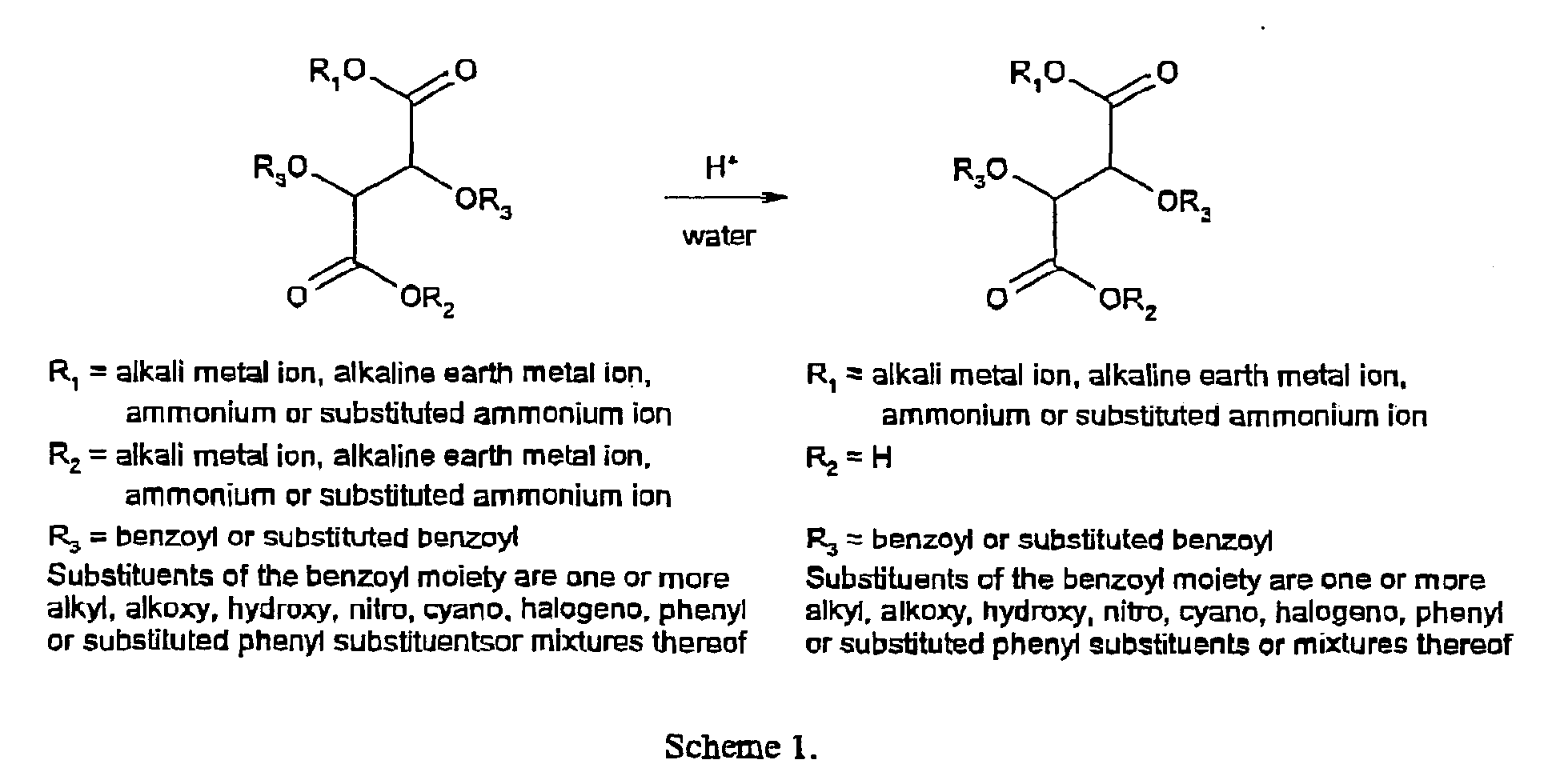
- The mono salts as intermediates of the inventive process have, according to the base used, a cationic counter ion which is an alkali metal ion, an alkaline earth metal ion, an ammonium or optionally substituted ammonium ion. The acyl moiety is a benzoyl or substituted benzoyl. Substituents of the benzoyl moiety are one or more allcyl, preferably C1 - C4 alkyl, alkoxy, preferably C1 - C4 alkoxy, hydroxy, nitro, cyano, halogeno, phenyl or substituted phenyl substituents.
- Resolution mother liquors typically comprise one or more organic solvents in addition to the resolving agent and the optically enriched amine. Typical organic solvents used for the resolving process are alcohols such as for instance 2-propanol, ketones such as for instance acetone, ethers such as for instance methyl tert-butyl ether, aromatic hydrocarbons, such as for instance toluene, or mixtures thereof. Preferably the organic solvent is only poorly miscible with water or water immiscible. Water miscible solvents such as 2-propanol need to be removed and replaced by a poorly water miscible or immiscible solvent, e.g. methyl tert-butyl ether or methylene chloride. After treatment with base, the salt is partitioned into an organic phase containing the chiral amine and an aqueous phase containing the di-anion of the substituted tartaric acid derivative.
The base used for setting free the amine moiety of the diastereomeric salt may be ammonia, substituted ammonia, a hydroxide, carbonate or hydrogen carbonate of an alkali or alkaline earth metal. Preferably the base is ammonia. The base can be added in the form of an aqueous solution. - The mineral acid used to obtain the mono salts of substituted tartaric acid derivatives may be any strong acid, such as hydrochloric, hydrobromic, sulphuric, nitric or phosphoric acid, preferably hydrochloric acid. The mineral acid is added in amounts sufficient to protonate only one of the carboxylic acid groups of the tartaric acid derivative. Unexpectedly, the substituted tartaric acid mono salt crystallizes in high yield and in a pure form suitable for further transformations. In order to achieve this, the pH-value of the aqueous phase has to be adjusted, according to the cationic counter ion present. If the counter ion is potassium, the pH value has to be adjusted to 2.0 - 5.0. If sodium is the counter ion, the pH value is adjusted to 2.0 - 4.0, or, if ammonium is the cationic counter ion, to 2.0 - 2.8, more preferably to 2,4 - 2.5.
- The recovery of the substituted tartaric acid mono salt is typically performed at 5°C to 50°C, more preferably at 20°C to 25°C. The product is filtered off and dried, typically under reduced pressure at 25°C. Optionally, the wet product can be used directly for the subsequent steps. The substituted tartaric acid mono salt is obtained in >90% yield.
- The transformation of the substituted tartaric acid mono salt into the free di-acid is done by reaction with an acidic ion exchanger in an organic solvent or organic solvent / water mixture or by a mineral acid in water and a poorly water miscible or immiscible solvent. The ion exchanger can be any acidic cation exchanger, which is sufficiently strong to protonate the substituted tartaric acid mono salt, such as for instance Amberlite IR-120. The mineral acid used to liberate the substituted tartaric acid derivative may be any strong acid, such as hydrochloric, hydrobromic, sulphuric, nitric or phosphoric acid, preferably hydrochloric acid.
- A particular advantage of the present invention is that the tartaric acid derivative can be isolated in a pure form directly out of the aqueous phase without addition of a co-solvent. The protonation of the substituted tartaric acid mono salt can be performed in any solvent using an acidic ion exchanger thus giving a solution of the substituted tartaric acid in the required solvent.
- The results obtained in resolution processes using as resolving agents recovered substituted tartaric acid derivatives prepared by the process of the present invention are equivalent to those obtained starting with previously unused substituted tartaric acid derivatives.
- The process according to the present invention is particularly advantageous in the recovery of di-O,O'-toluoyl-tartartic acid from mother liquors and in the manufacture of optically pure 4-[(S)-4-N,N-Dimethylamino-1-(4-fluoro-phenyl)-1-hydroxy-butyl]-3-hydroxymethyl-benzonitrile, a key intermediate in the synthesis of escitalopram.
- The invention is further described by reference to the following examples. These examples are provided for illustration purposes only and are not intended to be limiting the present invention in any way.
-
- 1) 40.09g of 4-[(R)-4-N,N-Dimethylamino-1-(4-fluoro-phenyl)-1-hydroxy-butyl]-3-hydroxymethyl-benzonitrile hemi-(+)-di-O,O'-toluoyl-D-tartaric acid (or the corresponding amount of a resolution mother liquor in a water immiscible solvent) are suspended in 400ml of methyl tert-butyl ether (or dichloromethane) and 280ml of H2O. Addition of 13.1ml of aqueous 25% NH3 (17.03g/mol, corresponds to 2.5 eq.) gives a homogenous solution after stirring for 10 minutes. The aqueous layer is washed with 120ml of methyl tert-butyl ether (or dichloromethane). The combined organic layer is dried over Na2SO4, filtered and concentrated under reduced pressure to give 4-[(R)-4-N,N-dimethylamino-1-(4-fluorophenyl)-1-hydroxy-butyl]-3-hydroxymethyl-benzonitrile.
The pH of the aqueous phase is adjusted to 2.4 by addition of 170 ml 1M aqueous HCl. Stirring is continued for 5h. The mono-NH4-salt of (+)-di-toluoyl-D-tartaric acid is collected by filtration (G3-suction filter, d=9.5cm) and washed with 50ml of H2O. The white product is dried under reduced pressure (20mbar) for 15h at 25°C to give 12.95g of (+)-di-O,O'-toluoyl-D-tartaric acid mono-NH4 salt (93.7% yield (assay: 93.4% of (+)-di-O,O'-toluoyl-D-tartaric acid; melting point 172-173°C; specific rotation (C=1, ethanol) +139°.
1H-NMR (DMSO-d6): δ: 2.36 (6H, 2x CH3), 5.66 (2H, 2x CH), 7.29 (4H, aromatic protons), 7-84 (4H, aromatic protons), 7.0-9.0 (m, 4H);
13C-NMR (DMSO-d6): δ: 167.9, 164.7, 143.5, 129.2, 129.0, 126.9, 71.8, 21.0).
IR (Diamond ATR cell): wave number cm-1 (intensity % T) 3255 (0.8), 3033 (0.85), 1703 (0.43), 1609 (0.62), 1577 (0.61), 1509 (0.72), 1409 (0.53), 1337 (0.69), 1266 (0.25), 1229 (0.42), 1211 (0.57), 1177 (0.42), 1122 (0.41), 1105 (0.2), 1021 (0.47), 954 (0.6), 933 (0.7), 860 (0.75), 838 (0.65), 786 (0.68), 753 (0.25), 703 (0.48), 636 (0.78). - 4.27g of (+)-di-O,O'-toluoyl-D-tartaric acid mono-NH4 salt are suspended in 40ml of 2-propanol. 16.0g of Amberlite 1R 120 are washed with 40mL of 2-propanol and added to the suspension of (+)-di-O,O'-toluoyl-D-tartaric acid mono-NH4 salt in 2-propanol. The mixture is stirred until the solution becomes clear. Removal of the ion exchanger by filtration and washing with 40ml of 2-propanol gives a solution of 4.05 g of (+)-di-O,O'-toluoyl-D-tartaruc acid in 2-propanol, which can be used directly for subsequent resolutions.
- 17.0g of (+)-di-O,O'-toluoyl-D-tartaric acid mono-NH4 salt are suspended in 130ml of water and 130ml of dichloromethane. The pH of the corresponding suspension is adjusted to a pH <0.5 by addition of 6M aqueous HCL After phase separation the organic layer can directly be used for the subsequent resolutions.
- 2) The preparation of DTTA-Mono-potassium salt is performed according to example one, but with the exception to use 10% KOH instead of 25% NH3 for the first neutralization. The pH of the aqueous phase is adjusted to 4,8 by addition of aqueous HCl. After stirring for additional 3h the mono-potassium-salt of (+)-di-toluoyl-D-tartaric acid is collected by filtration (G3-suction filter, d=9.5cm) and washed with H2O. The white product is dried under reduced pressure (20mbar) for 15h at 25°C. (assay 87,1% DTTA, 8,6% potassium; 3% H2O) Liberation of free acid DTTA may be performed according to Method A or B.
- 3) The preparation of DTTA-Mono-sodium salt is performed according to example one, but with the exception to use 20% NaOH instead of 25% NH3 for the first neutralization. The pH of the aqueous phase is adjusted to 3,7 by addition of aqueous HCl, After stirring for additional 3h the mono-sodium salt of (+)-di-toluoyl-D-tartaric acid is collected by filtration (G3-suction filter, d=9.5cm) and washed with H2O. The white product is dried under reduced pressure (20mbar) for 15h at 25°C.
Liberation of free acid DTTA may be performed according to Method A or B.
Claims (14)
- A process for the recovery of substituted tartaric acid resolving agents from resolution mother liquors or isolated diastereomeric salts, characterized in that the diastereomeric salt of an enantiomerically enriched amine and the substituted tartaric acid derivative in an organic solvent is treated with a base, extracting said substituted tartaric acid derivative into an aqueous phase, adding an acid to the separated aqueous phase while monitoring the pH-value, precipitating mono salts of substituted tartaric acid derivatives, isolating said mono salts, and liberating the substituted tartaric acid derivative by an acidic treatment.
- Compounds of the general formula

- The process according to claim 1, wherein the base is a hydroxide, carbonate or hydrogen carbonate salt of an alkali or alkaline earth metal or ammonia or optionally substituted ammonia.
- The process according to claim 1, wherein the pH value of the aqueous solution is adjusted to 2.0 to 5.0.
- The process according to claim 1, wherein the pH value of the aqueous solution is adjusted to 2.0 to 4.0.
- The process according to claim 1, wherein the pH value of the aqueous solution is adjusted to 2.0 to 2.8.
- A process according to any of the preceding claims, wherein the pH value of the aqueous solution is adjusted to 2.4 to 2.5.
- The process according to claim 1, wherein the acid used to obtain mono salts of substituted tartaric acid derivatives is a mineral acid such as hydrochloric acid, hydrobromic acid, sulfuric acid, nitric acid or phosphoric acid.
- The process according to claim 1, wherein the acidic treatment of the substituted tartaric acid mono salt is performed by an acidic ion exchanger or a mineral acid to give the corresponding free substituted tartaric acid derivative.
- The process according to claim 9, wherein the acidic treatment of the substituted tartaric acid mono salt is performed by an acidic ion exchanger or a mineral acid in an organic solvent or mixtures of an organic solvent and water.
- The process according to claims 9 and 10, wherein the mineral acid used to liberate the substituted tartaric acid derivative is hydrochloric acid, hydrobromic acid, sulfuric acid, nitric acid or phosphoric acid.
- The process according to claims 9 and 10, wherein the ion exchanger is an acidic cation exchanger.
- The process according claims 9 and 10, wherein the ion exchanger is an Amberlite IR 120 cation exchanger.
- The process according to claim 1, wherein the liberated substituted tartaric acid derivative is provided as a solution in a poorly water miscible or immiscible solvent ready to use in subsequent resolution processes.
Priority Applications (1)
| Application Number | Priority Date | Filing Date | Title |
|---|---|---|---|
| EP05013394A EP1736462A1 (en) | 2005-06-22 | 2005-06-22 | Recovery of optically active tartaric acid resolving agents |
Applications Claiming Priority (1)
| Application Number | Priority Date | Filing Date | Title |
|---|---|---|---|
| EP05013394A EP1736462A1 (en) | 2005-06-22 | 2005-06-22 | Recovery of optically active tartaric acid resolving agents |
Publications (1)
| Publication Number | Publication Date |
|---|---|
| EP1736462A1 true EP1736462A1 (en) | 2006-12-27 |
Family
ID=35169766
Family Applications (1)
| Application Number | Title | Priority Date | Filing Date |
|---|---|---|---|
| EP05013394A Withdrawn EP1736462A1 (en) | 2005-06-22 | 2005-06-22 | Recovery of optically active tartaric acid resolving agents |
Country Status (1)
| Country | Link |
|---|---|
| EP (1) | EP1736462A1 (en) |
Cited By (1)
| Publication number | Priority date | Publication date | Assignee | Title |
|---|---|---|---|---|
| US20110124909A1 (en) * | 2008-04-04 | 2011-05-26 | Vinayak Gore | Novel process |
Citations (4)
| Publication number | Priority date | Publication date | Assignee | Title |
|---|---|---|---|---|
| DD301797A7 (en) * | 1986-11-20 | 1994-02-10 | Dresden Arzneimittel | Process for the preparation of the optical isomers of 1- (4-nitrophenoxy) -2-hydroxy-3-tert-butylamino-propane |
| EP0648769A1 (en) * | 1993-09-14 | 1995-04-19 | Sterling Winthrop Inc. | 12-Hetero-substituted 6,11-ethano-6,11-dihydrobenzo[b] quinolizium salts and compositions and method of use thereof |
| US5962737A (en) * | 1997-01-08 | 1999-10-05 | West; Daniel David | 2-amino-1-phenylpropanols, stereospecific synthesis thereof, and method of optically resolving the same |
| WO2003042132A1 (en) * | 2001-11-14 | 2003-05-22 | Basf Aktiengesellschaft | Recovery and recycling of chiral tartaric acid resolving agents |
-
2005
- 2005-06-22 EP EP05013394A patent/EP1736462A1/en not_active Withdrawn
Patent Citations (4)
| Publication number | Priority date | Publication date | Assignee | Title |
|---|---|---|---|---|
| DD301797A7 (en) * | 1986-11-20 | 1994-02-10 | Dresden Arzneimittel | Process for the preparation of the optical isomers of 1- (4-nitrophenoxy) -2-hydroxy-3-tert-butylamino-propane |
| EP0648769A1 (en) * | 1993-09-14 | 1995-04-19 | Sterling Winthrop Inc. | 12-Hetero-substituted 6,11-ethano-6,11-dihydrobenzo[b] quinolizium salts and compositions and method of use thereof |
| US5962737A (en) * | 1997-01-08 | 1999-10-05 | West; Daniel David | 2-amino-1-phenylpropanols, stereospecific synthesis thereof, and method of optically resolving the same |
| WO2003042132A1 (en) * | 2001-11-14 | 2003-05-22 | Basf Aktiengesellschaft | Recovery and recycling of chiral tartaric acid resolving agents |
Non-Patent Citations (2)
| Title |
|---|
| C. H. EUGSTER ET AL.: "Die Spaltung von d,l-Muscarin in die optischen Antipoden", HELVETICA CHIMICA ACTA., vol. 41, 1958, VERLAG HELVETICA CHIMICA ACTA, BASEL., CH, pages 886 - 888, XP002353176 * |
| HENRICK, KIM ET AL: "Synthesis, separation into diastereoisomers, and resolution of o-phenylenebis(methylphenylarsine) and related studies of the o-phenylenediarsine moiety", JOURNAL OF THE CHEMICAL SOCIETY, DALTON TRANSACTIONS: INORGANIC CHEMISTRY (1972-1999) , (15), 1506-16.. CODEN: JCDTBI; ISSN: 0300-9246, 1975, XP002353063 * |
Cited By (1)
| Publication number | Priority date | Publication date | Assignee | Title |
|---|---|---|---|---|
| US20110124909A1 (en) * | 2008-04-04 | 2011-05-26 | Vinayak Gore | Novel process |
Similar Documents
| Publication | Publication Date | Title |
|---|---|---|
| JP4795435B2 (en) | Method for producing esomeprazole and salts thereof | |
| EA015426B1 (en) | Process for preparing n-alkylnaltrexone halides | |
| NO328627B1 (en) | Process for the preparation of iopamidol and the novel intermediates therein | |
| JP5899204B2 (en) | Process for producing chiral β-aminocarboxamide derivative | |
| WO2014009964A1 (en) | Process for enantiomeric enrichment of 2 ', 6 ' - pipecoloxylidide | |
| EP1736462A1 (en) | Recovery of optically active tartaric acid resolving agents | |
| EP1446372B1 (en) | Recovery and recycling of chiral tartaric acid resolving agents | |
| EP1242353A1 (en) | Process for the recovery and recycle of d-tartaric acid | |
| JP4603274B2 (en) | Process for producing 2'-deoxy-5-trifluoromethyluridine | |
| JP4392661B2 (en) | Method for recovering optically active diacyltartaric acid | |
| US6346649B1 (en) | Process for the recovery and recycle of D-tartaric acid | |
| EP1723107A2 (en) | Process for manufacture of racemic carvedilol | |
| WO1990008126A1 (en) | Resolution process | |
| JP4126921B2 (en) | Process for producing optically active β-phenylalanine derivative | |
| JP3061642B2 (en) | Purification method | |
| JP3316917B2 (en) | New phenylalanine salt crystals and their production | |
| JPWO2001017944A1 (en) | Method for producing optically active amino alcohols | |
| WO2001017944A1 (en) | Process for producing optically active aminoalcohol | |
| JPH10101629A (en) | Production of optically active butyric acid derivative | |
| JP2001064275A (en) | Optical resolution method for isocoumarin derivatives | |
| JP2770512B2 (en) | Method for purifying alkali metal salts of aminoethylsulfonic acid | |
| KR950014521B1 (en) | Method for preparing optically active glycidyl ether | |
| JPH08325262A (en) | Process for producing (+)-3-phenyl-5- {2- (1-pyrrolidinylmethyl) butyryl} isoxazole and salts thereof | |
| JP2000212135A (en) | Optical resolution of 3-methyl-2-phenylbutylamine | |
| JP2002105056A (en) | Method for purifying 2-chloro-4-(1-piperidinylmethyl) pyridine |
Legal Events
| Date | Code | Title | Description |
|---|---|---|---|
| PUAI | Public reference made under article 153(3) epc to a published international application that has entered the european phase |
Free format text: ORIGINAL CODE: 0009012 |
|
| AK | Designated contracting states |
Kind code of ref document: A1 Designated state(s): AT BE BG CH CY CZ DE DK EE ES FI FR GB GR HU IE IS IT LI LT LU MC NL PL PT RO SE SI SK TR |
|
| AX | Request for extension of the european patent |
Extension state: AL BA HR LV MK YU |
|
| AKX | Designation fees paid | ||
| REG | Reference to a national code |
Ref country code: DE Ref legal event code: 8566 |
|
| STAA | Information on the status of an ep patent application or granted ep patent |
Free format text: STATUS: THE APPLICATION IS DEEMED TO BE WITHDRAWN |
|
| 18D | Application deemed to be withdrawn |
Effective date: 20070628 |