EP1734470A1 - Real time estimation of rolling averages of cumulative data - Google Patents
Real time estimation of rolling averages of cumulative data Download PDFInfo
- Publication number
- EP1734470A1 EP1734470A1 EP06251746A EP06251746A EP1734470A1 EP 1734470 A1 EP1734470 A1 EP 1734470A1 EP 06251746 A EP06251746 A EP 06251746A EP 06251746 A EP06251746 A EP 06251746A EP 1734470 A1 EP1734470 A1 EP 1734470A1
- Authority
- EP
- European Patent Office
- Prior art keywords
- base interval
- interval
- cumulative
- rolling window
- datum
- Prior art date
- Legal status (The legal status is an assumption and is not a legal conclusion. Google has not performed a legal analysis and makes no representation as to the accuracy of the status listed.)
- Withdrawn
Links
Images



Classifications
-
- G—PHYSICS
- G06—COMPUTING OR CALCULATING; COUNTING
- G06Q—INFORMATION AND COMMUNICATION TECHNOLOGY [ICT] SPECIALLY ADAPTED FOR ADMINISTRATIVE, COMMERCIAL, FINANCIAL, MANAGERIAL OR SUPERVISORY PURPOSES; SYSTEMS OR METHODS SPECIALLY ADAPTED FOR ADMINISTRATIVE, COMMERCIAL, FINANCIAL, MANAGERIAL OR SUPERVISORY PURPOSES, NOT OTHERWISE PROVIDED FOR
- G06Q10/00—Administration; Management
- G06Q10/06—Resources, workflows, human or project management; Enterprise or organisation planning; Enterprise or organisation modelling
-
- G—PHYSICS
- G06—COMPUTING OR CALCULATING; COUNTING
- G06Q—INFORMATION AND COMMUNICATION TECHNOLOGY [ICT] SPECIALLY ADAPTED FOR ADMINISTRATIVE, COMMERCIAL, FINANCIAL, MANAGERIAL OR SUPERVISORY PURPOSES; SYSTEMS OR METHODS SPECIALLY ADAPTED FOR ADMINISTRATIVE, COMMERCIAL, FINANCIAL, MANAGERIAL OR SUPERVISORY PURPOSES, NOT OTHERWISE PROVIDED FOR
- G06Q10/00—Administration; Management
- G06Q10/06—Resources, workflows, human or project management; Enterprise or organisation planning; Enterprise or organisation modelling
- G06Q10/063—Operations research, analysis or management
- G06Q10/0631—Resource planning, allocation, distributing or scheduling for enterprises or organisations
- G06Q10/06311—Scheduling, planning or task assignment for a person or group
- G06Q10/063114—Status monitoring or status determination for a person or group
-
- G—PHYSICS
- G06—COMPUTING OR CALCULATING; COUNTING
- G06Q—INFORMATION AND COMMUNICATION TECHNOLOGY [ICT] SPECIALLY ADAPTED FOR ADMINISTRATIVE, COMMERCIAL, FINANCIAL, MANAGERIAL OR SUPERVISORY PURPOSES; SYSTEMS OR METHODS SPECIALLY ADAPTED FOR ADMINISTRATIVE, COMMERCIAL, FINANCIAL, MANAGERIAL OR SUPERVISORY PURPOSES, NOT OTHERWISE PROVIDED FOR
- G06Q10/00—Administration; Management
- G06Q10/06—Resources, workflows, human or project management; Enterprise or organisation planning; Enterprise or organisation modelling
- G06Q10/063—Operations research, analysis or management
- G06Q10/0639—Performance analysis of employees; Performance analysis of enterprise or organisation operations
Definitions
- the invention relates generally to contact centers and particularly to monitoring selected contact center objects to evaluate contact center operations.
- contact center supervisors In contact centers today, there is an increasing need for contact center supervisors to monitor the performance of agents in real time. This can be important not only to ensure that selected sets of customer contacts (e.g., gold, silver, and bronze customers) are receiving an appropriate level of service but also to reward and discipline agents based on their performance and to evaluate agent staffing needs by skill/split at any point during the day.
- customer contacts e.g., gold, silver, and bronze customers
- Ratcheting can have a number of problems.
- the measured object is the number of answered phone calls it would be valuable to know not only the number of calls answered since the most recent half hour boundary but also the number of calls answered in the last thirty minutes.
- the present invention is directed to techniques for determining a value of a cumulative datum during a selected interval.
- a contact center monitoring method includes the steps of:
- the weighting factor is assumed to vary over the partly spanned interval in a determined manner, such as linearly orquadratically.
- the weighting factor can produce a rolling average of cumulative data in real time from current and previous ratcheted data without having to save or use the detailed changes in the data.
- the present invention can provide a number of advantages.
- the present invention can solve the problem inherent in instantaneous ratcheted data by including a weighted contribution from previous ratcheted values.
- the result can contain no artificial resets to zero so ratios can be computed without incurring delays or spurious fluctuations after crossing an interval boundary.
- This permits meaningful thresholds to be set for triggering notifications or corrective actions in real time. It also can avoid the storing of the detailed arrival times of the underlying individual events.
- the preferred configuration of the present invention can use only the ratcheted summary values of the current and previous time intervals without further reference to or storage of the event details.
- the preferred configuration can also be well suited to database environments, such as used in contact center reporting products, in which millions of cumulative data items are being recorded in parallel.
- the rolling average of the preferred embodiment can be computed using industry standard data access commands in Structured Query Language (SQL) by creating a single database cell containing the time dependent weighting factor as a floating real point number. The same weighting factor is then used to compute rolling averages for millions of distinct cumulative data items.
- SQL Structured Query Language
- the arithmetic of the preferred embodiment is simple and readily adaptable to database or third party transformation or reporting tools. No additional database is commonly required to provide up-to-the-moment rolling averages, since existing contact center databases generally already provide current and previous interval data for cumulative items.
- the proposed invention can be ideally suited for retrofitting existing ratchet-based systems to provide rolling averages.
- ratcheting products of the prior art can provide an accurate moving average over a window completely spanning one or more intervals and not spanning only part of a prior interval, they provide sums that amount to running averages over windows that grow in size from zero width up to the width of the base interval (rather than the constant width of the present invention). Furthermore, the varying effective width of ratcheted data solutions can result in fluctuations that thwart the use of sensitive thresholds for triggering notifications or corrective actions.
- each of the expressions “at least one of A, B and C”, “at least one of A, B, or C”, “one or more of A, B, and C", “one or more of A, B, or C” and "A, B, and/or C” means A alone, B alone, C alone, A and B together, A and C together, B and C together, or A, B and C together.
- the invention will be illustrated below in conjunction with an exemplary communication system. Although well suited for use with, e.g ., a system having an ACD or other similar contact processing switch, the invention is not limited to use with any particular type of communication system switch or configuration of system elements. Those skilled in the art will recognize that the disclosed techniques may be used in any communication application in which it is desirable to provide improved contact processing.
- FIG. 1 shows an illustrative embodiment of the present invention.
- a contact center 100 comprises a central server 110, a set of data stores or databases 114 containing contact or customer related information and other enterprise information, and a plurality of servers, namely a voice mail server 118, an Interactive Voice Response unit or IVR 122, and other servers 126, a switch 130, a plurality of working agents operating packet-switched (first) telecommunication devices 134-1 to N (such as wired and/or wireless computer work stations or personal computers), and/or circuit-switched (second) telecommunication devices 138-1 to M (such as wired and/or wireless analog or digital telephones), all interconnected by a local area network LAN (or wide area network WAN) 142.
- first packet-switched
- N such as wired and/or wireless computer work stations or personal computers
- second telecommunication devices 138-1 to M such as wired and/or wireless analog or digital telephones
- the servers can be connected via optional communication lines 146 to the switch 130.
- the switch functionality may be integrated into the functionality of the server 110.
- the other servers 126 can also include a scanner (which is normally not connected to the server 110 or Web server), VoIP software, video contact software, voice messaging software, an IP voice server, a fax server, a web server, and an email server) and the like.
- the switch 130 is connected via a plurality of trunks 150 to the Public Switch Telecommunication Network or PSTN 154 and via link(s) 152 to the second telecommunication devices 138-1 to M.
- a gateway 158 (such as Avaya Inc.'s, G700 Media GatewayTM) is positioned between the server 110 and the packet-switched network 162 to process communications passing between the server 110 and the network 162.
- the media server 110 (which preferably includes the functionality of the switch 130) can be any converged architecture for directing circuit-switched and/or packet-switched customer contacts to one or more communication devices.
- the server is a stored-program-controlled system that conventionally includes interfaces to external communication links, a communications switching fabric, service circuits (e.g., tone detectors and generators, etc.), memory for storing control programs and data, and a processor (i.e., a computer) for executing the stored control programs to control the interfaces and the fabric and to provide automatic contact-distribution functionality.
- the media server typically includes not only telephony features and intelligent contact routing but also localization, collaboration, mobility, messaging, system management, attendant features, networking, and application programming interfaces.
- the server typically includes a network interface card (not shown) to provide services to the serviced telecommunication devices.
- the media server 110 can be a modified form of the following subscriber-premises equipment: Avaya Inc.'s DefinityTM Private-Branch Exchange (PBX)-based ACD system; Avaya Inc.'s IP600TM LAN-based ACD system, or an S8100TM, S8300TM, S8500TM, S8700TM, or S8710TM media server running a modified version of Avaya Inc.'s Communication ManagerTM voice-application software with call processing capabilities and contact center functions.
- PBX Private-Branch Exchange
- IP600TM LAN-based ACD system or an S8100TM, S8300TM, S8500TM, S8700TM, or S8710TM media server running a modified version of Avaya Inc.'s Communication ManagerTM voice-application software with call processing capabilities and contact center functions.
- Other types of known switches and servers are well known in the art and therefore not described in detail herein.
- the server 110 is in communication with a plurality of customer communication lines 200a-y (which are part of the packet-switched network 162 and can be one or more packet-switched links) and agent communication line 204 (which can be a voice-and-data transmission line such as LAN 142 and/or a circuit switched voice line).
- the server 110 includes a contact center reporting system 228, which is preferably a modified form of Avaya Inc.'s Operational AnalystTM or OA with On-Line Analytical Processing or OLAP technology, Basic Call Management SystemTM or BCMS, or Call Management SystemTM or CMS that gathers contact records and contact-center statistics for use in generating contact-center reports.
- a set of logical work item queues 208a-n and a separate set of physical agent queues 212a-n included among the data stored in the server 110 is a set of logical work item queues 208a-n and a separate set of physical agent queues 212a-n.
- Each logical work item queue 208a-n corresponds to a different set of agent skills, as does each agent queue 212a-n.
- Included among the control programs in the server 112 is a work item or contact vector 216. Contacts incoming to the contact center are assigned by work item vector 216 to different work item queues 208a-n based upon a number of known criteria. Agents who are available for handling contacts are assigned to agent queues 212a-n based upon the skills that they possess. Skills-based ACD is described in further detail in U.S. Patents 6,173,053 and 5,206,903 , each of which is incorporated herein by this reference.
- the packet-switched network 162 is in communication with an external customer telecommunication device 174 via a gateway 178, and the circuit-switched network 154 with an external customer telecommunication device 180.
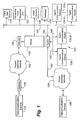
- Fig. 1 the configuration of the switch, server, user telecommunication devices, and other elements as shown in Fig. 1 is for purposes of illustration only and should not be construed as limiting the invention to any particular arrangement of elements.
- the contact center reporting system 228 includes a number of components.
- a reporting module 300 provides report presentation and delivery capabilities, retrieves data for historical reports directly from the database server 320, and receives real-time report data from an event processor 308.
- a management module 304 maintains the historical summary and detail data in the historical data store 324, persists detail and interval summary data from the event processor 308, rolls up data into daily summaries, and purges old data.
- the event processor 308 (which is in communication with the reporting module 300, management module 304, server 110 controller 312, and contact center predictive dialer 316) receives one or more event feeds (which provides details of activities in the contact center as they occur in real time, such as actions and state changes associated with an agent or a contact), maintains summaries of the reporting events in a real-time data store 328, provides access to that data for reporting and data export, and forwards the data to the management module 304 to be stored in the historical data store 324 for further processing.
- one or more event feeds which provides details of activities in the contact center as they occur in real time, such as actions and state changes associated with an agent or a contact
- the historical and real time data stores 324 and 328 are preferably configured as relational databases.
- the real-time data store 328 contains status and summary data about the managed entities and a subset of dimensional data to allow mapping between surrogate keys and natural keys.
- the data store 328 is organized around a number of base intervals, with exemplary intervals being 15, 30, or 60 minutes in duration.
- a current base interval contains tables with summary data of what has happened so far during the current interval and includes tables with current status of managed entities.
- a configurable number of previous base intervals is maintained. The immediately previous interval is transferred to the historical store 324 after the interval ends.
- the tracked objects include, for example, customer contacts including both inbound contacts from customers and outbound contacts to customers generated by the predictive dialer 316 (which may be circuit-switched and/or packet-switched calls, emails, instant messages, text chat, Short Message Service or SMS contacts, and Multimedia Message Service or MMS contacts), agents, contact queue 208, agent queue 212, split, skill, trunk, trunk group, Vector Directory Number, vector, and jobs.
- customer contacts including both inbound contacts from customers and outbound contacts to customers generated by the predictive dialer 316 (which may be circuit-switched and/or packet-switched calls, emails, instant messages, text chat, Short Message Service or SMS contacts, and Multimedia Message Service or MMS contacts)
- agents contact queue 208, agent queue 212, split, skill, trunk, trunk group, Vector Directory Number, vector, and jobs.
- Characteristics of the objects may be searched, such as time duration (e.g., average talk time, average after call work or ACW time, average speed of answer, average time to abandon, wait time (actual or expected, etc.), number or count during a specified time interval (e.g., staffing levels, type of agents staffed, queue length or membership, ACD calls, etc.), usage levels, performance, status or state (e.g., active or abandoned, idle or busy, etc.), age (e.g., oldest call waiting, etc.), and percentage of contacts handled within prescribed service limits.
- time duration e.g., average talk time, average after call work or ACW time, average speed of answer, average time to abandon, wait time (actual or expected, etc.
- number or count during a specified time interval e.g., staffing levels, type of agents staffed, queue length or membership, ACD calls, etc.
- usage levels e.g., performance, status or state (e.g., active or abandoned, idle or busy, etc.)
- age
- the event processor 308 is configured to provide actual and/or estimated real time cumulative data over a rolling, moving, or sliding window.
- a “rolling”, “moving” or “sliding” window refers to a measured interval of a selected width or duration that moves with the passage of time relative to a fixed or stationary scale.
- a rolling window is used to monitor and/or analyze behavior occurring in the last thirty minutes, with the absolute time (e.g., 1:00 pm, 1:30 pm, etc.) being the fixed or stationary temporal scale.
- objects are tracked precisely over defined intervals to produce an exact moving or rolling average using known mathematical techniques, i.e., the exact measure during, say, the most recent 30 minutes.
- objects are tracked precisely over defined intervals to produce an exponential moving average, a double exponential moving average, an adaptive moving average, and the like using known mathematical techniques.
- This configuration may not fully address the problems encountered in monitoring contact center objects.
- the various algorithms are commonly designed for an existing time series and attempt to smooth out noise or extrapolate to predict future elements of the series. They may not address real time scales shorter than the measurement interval, i.e., they may not be concerned with the moment-to-moment value of the accumulator that is counting during the thirty-minute interval and all of the smoothing results may be for periods longer than the base interval. Using the methods to extrapolate the ratcheted data points may produce a static estimate that ignores the currently accumulating value.
- a limitation of the above configurations can be the memory capacity required to effect the object tracking.
- tracking objects at this level of granularity can exceed the capacity of contact center software that is already sized to track millions of separate cumulative measures.
- a preferred configuration of the present invention produces an estimate of the cumulative datum value over the rolling window (which in some cases is an estimate of the exact moving average) by combining (a) ratcheted cumulative data values over base intervals, if any, fully spanned by the rolling window, (b) the currently accumulated value for the cumulative datum over the present base interval, and (c) an estimated datum value in a prior partly spanned base interval using a time dependent weighting factor. It is generally applicable whenever the width of the moving window is an integer multiple of the base interval length, and can provide up-to-the-moment results with the information at hand. Stated another way, the estimate has two components. The first component includes the ratcheted values saved for each historic base interval and the current base interval accumulator value. The remainder of the moving window is approximated by taking the appropriate portion of the previous (partly spanned) base interval's results.
- Fig. 5 This configuration will be illustrated with reference to Fig. 5 in which the base interval and rolling window widths are the same.
- the base interval is 30 minutes.
- the second component is required because the depicted rolling windows each span only part of an historic base interval (i.e., window t 1 spans only part of the base interval 0 to 30 minutes and window t 2 spans only part of the base interval 60 to 90 minutes).
- window t 1 spans only part of the base interval 0 to 30 minutes
- window t 2 spans only part of the base interval 60 to 90 minutes.
- the sloping straight line is dashed for each of windows t 1 and t 2 .
- the values "B 1 " and “B 2 " respectively represent the saved data at the end of the prior partly spanned base intervals.
- the values "V 1 " and “V 2 " respectively represent the point of intersection between a vertical line passing through the window's starting point and the corresponding dashed line.
- the base interval width (5 minutes) is less than but is an integer multiple of the rolling window width (30 minutes).
- the moving window which at one location is represented by the interval t, includes the current accumulator value (which for base interval 600 is 2) and the values in the base intervals 604 (6), 608 (5), 612 (3), 616 (4), and 620 (5) (or a value of 25 for the first component).
- the second component is required because the depicted rolling window spans only part of a historic base interval (i.e., window t 1 spans only two-thirds of the base interval 624).
- Figs. 8 and 9 are each a plot of average call length (seconds) against real time (minutes) for a rolling window of 30 minutes.
- the base interval width is 30 minutes, but in Fig. 9 the base interval width is 5 minutes.
- the actual rolling average is denoted by mathematical relationships 800 and 900 while the approximation produced by the above configuration is denoted by mathematical relationships 804 and 904. As can be seen from the two mathematical relationships, both approximations are quite close to the actual rolling average. It also shows that the approximation improves when multiple base intervals are used (904 is better than 804).
- approximations are further improved by using adjacent previous results (i.e., the N-1th and N+1th) to infer a nonuniform arrival rate for events in the Nth previous interval.
- arrival rates that grow or peak during the interval could be inferred from known interpolation and/or extrapolation techniques, such as polynomial interpolation or regression analysis, and the inferred arrival rate could be used to alter the time dependent weighting factor.
- This variation of the invention could apply best to situations in which adjacent previous values are expected to be correlated.
- a mathematical relationship characterizing the distribution of values over the base interval or subinterval is determined by known curve fitting mathematical techniques and a descriptor of the (best) fit mathematical relationship is saved along with the final value for the base interval or subinterval. This configuration can be used in connection with the prior configuration.
- Fig. 7 exemplifies this configuration.
- the base interval is 5 minutes.' Over the base interval 700 the "best fit" mathematical relationship is a straight line 750, over the interval 704 the "best fit” mathematical relationship is a parabolic curve 754, over the interval 708 the "best fit” mathematical relationship is a horizontal line 758, and over the interval 712 the “best fit” mathematical relationship is a parabolic curve 762. Additionally a key characteristic of the mathematical relationship may be saved, such as the slope and intercept of the straight line and the three coefficients of the parabola.
- the server and/or switch can be a software-controlled system including a processing unit (CPU), microprocessor, or other type of digital data processor executing software or an Application-Specific Integrated Circuit (ASIC) as well as various portions or combinations of such elements.
- the memory may be a random access memory (RAM), a read-only memory (ROM), a relational database value, or combinations of these and other types of electronic memory devices.
- the present invention is not limited to contact center objects but may be used to determine rolling average estimates for any situation in which cumulative data is monitored in real time.
- the present invention could be used to estimate the number of cars passing a particular traffic monitoring point, assembly line production controllers, financial forecasting, or the number of photons counted by a microscopic light detector.
- the present invention in various embodiments, includes components, methods, processes, systems and/or apparatus substantially as depicted and described herein, including various embodiments, subcombinations, and subsets thereof. Those of skill in the art will understand how to make and use the present invention after understanding the present disclosure.
- the present invention in various embodiments, includes providing devices and processes in the absence of items not depicted and/or described herein or in various embodiments hereof, including in the absence of such items as may have been used in previous devices or processes, e.g., for improving performance, achieving ease and ⁇ or reducing cost of implementation.
Landscapes
- Business, Economics & Management (AREA)
- Human Resources & Organizations (AREA)
- Engineering & Computer Science (AREA)
- Strategic Management (AREA)
- Economics (AREA)
- Entrepreneurship & Innovation (AREA)
- Development Economics (AREA)
- Educational Administration (AREA)
- Operations Research (AREA)
- Marketing (AREA)
- Game Theory and Decision Science (AREA)
- Quality & Reliability (AREA)
- Tourism & Hospitality (AREA)
- Physics & Mathematics (AREA)
- General Business, Economics & Management (AREA)
- General Physics & Mathematics (AREA)
- Theoretical Computer Science (AREA)
- Management, Administration, Business Operations System, And Electronic Commerce (AREA)
- Complex Calculations (AREA)
- Time Recorders, Dirve Recorders, Access Control (AREA)
- Telephonic Communication Services (AREA)
Abstract
(a) a plurality of agent and work item queues 212 and 208;
(b) a workflow server 312 for distributing work items to available agents; and
(c) an event processor 308 operable, for a selected a base time interval for accumulating a cumulative datum and a width of a rolling window, the width of the rolling window being at least one of (i) equal and (ii) greater than the base interval and being an integer multiple of the base interval:
(i) when the rolling window partly spans a prior base interval, to determine a rolling average for the cumulative datum over the width of the rolling window; and
(ii) when the rolling window partly spans a prior base interval, to estimate a value for the cumulative datum in the partly spanned prior base interval.
Description
- The invention relates generally to contact centers and particularly to monitoring selected contact center objects to evaluate contact center operations.
- In contact centers today, there is an increasing need for contact center supervisors to monitor the performance of agents in real time. This can be important not only to ensure that selected sets of customer contacts (e.g., gold, silver, and bronze customers) are receiving an appropriate level of service but also to reward and discipline agents based on their performance and to evaluate agent staffing needs by skill/split at any point during the day.
- To provide such monitoring, there are many products on the market including Operational Analyst™ and Call Management System™ by Avaya, Inc. To effectively monitor the contact center, these products must track a myriad of cumulative data objects, including the number of contacts handled by each agent, the amount of time required by each agent to service a contact, the wait time for sets of enqueued contacts and for individual contacts, and the like. A "cumulative datum" is a sum that grows and/or stays the same in magnitude over a selected measurement (e.g., time) interval; it commonly does not decrease in magnitude over the interval. Real time monitoring of these objects is made difficult by the limited memory available to store real time event information.
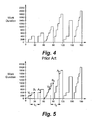
- To accommodate the limited memory and provide some level of meaningful object tracking, "ratcheting" is widely used by contact centers management systems to control the magnitude of cumulative data. Referring to Fig. 4, the basic measures are monitored continuously and reset to zero at each 30-minute time interval. In the next successive interval, the measure restarts the count from zero. In this way, the cumulative datum is converted into a series of summary measurements at fixed intervals of time.
- Ratcheting can have a number of problems.
- First, after being reset to zero following each measured time interval there is effectively no measurement available to administrators until additional events have been counted. This practice has been likened by administrators to piloting an airplane in which all of the instruments are periodically reset to zero. Administrators feel like they are flying blind until the real-time data begins to increase in magnitude.
- Second, the problem above is magnified whenever the ratio of two cumulative measures is being computed in real time. For example, if the administrator wants to monitor the average time agents are talking on a call that would be the ratio of cumulative talk time (numerator) to the cumulative number of calls (denominator).. But ratcheting resets both the numerator and denominator to zero periodically so (a) the ratio cannot even be computed until the denominator becomes non zero and (b) the ratio fluctuates wildly until both numerator and denominator accumulate sufficient counts to be representative. These spurious fluctuations severely limit the ability to set meaningful thresholds for automatic triggering of notifications or corrective actions.
- It would be desirable to provide to administrators the magnitude of the measured cumulative datum in a rolling window of time rather than since the datum was last reset to zero. For example, where the measured object is the number of answered phone calls it would be valuable to know not only the number of calls answered since the most recent half hour boundary but also the number of calls answered in the last thirty minutes.
- These and other needs are addressed by the various embodiments and configurations of the present invention. The present invention is directed to techniques for determining a value of a cumulative datum during a selected interval.
- In one embodiment, a contact center monitoring method is provided that includes the steps of:
- (a) selecting a base time interval for accumulating a cumulative datum and a width of a rolling window, the width of the rolling window being at least one of equal to and greater than the base interval and an integer multiple of the base interval;
- (b) performing at least one of the following steps:
- (b1) when the rolling window partly spans a prior base interval, determining a rolling average for the cumulative datum over the width of the rolling window; and
- (b2) when the rolling window partly spans a prior base interval, estimating a value for the cumulative datum in the partly spanned prior base interval.
- In one configuration, the estimating step is performed according to the equation: Cumulative datum value over rolling window = currently accumulated value + cumulative datum value(s) for any intermediate base interval (spanned fully by the rolling window) + (weighting factor)(cumulative datum value over the partly spanned prior base interval). The weighting factor is assumed to vary over the partly spanned interval in a determined manner, such as linearly orquadratically. The weighting factor can produce a rolling average of cumulative data in real time from current and previous ratcheted data without having to save or use the detailed changes in the data.
- The present invention can provide a number of advantages. For example, the present invention can solve the problem inherent in instantaneous ratcheted data by including a weighted contribution from previous ratcheted values. The result can contain no artificial resets to zero so ratios can be computed without incurring delays or spurious fluctuations after crossing an interval boundary. This permits meaningful thresholds to be set for triggering notifications or corrective actions in real time. It also can avoid the storing of the detailed arrival times of the underlying individual events. The preferred configuration of the present invention can use only the ratcheted summary values of the current and previous time intervals without further reference to or storage of the event details. The preferred configuration can also be well suited to database environments, such as used in contact center reporting products, in which millions of cumulative data items are being recorded in parallel. In such cases, the rolling average of the preferred embodiment can be computed using industry standard data access commands in Structured Query Language (SQL) by creating a single database cell containing the time dependent weighting factor as a floating real point number. The same weighting factor is then used to compute rolling averages for millions of distinct cumulative data items. The arithmetic of the preferred embodiment is simple and readily adaptable to database or third party transformation or reporting tools. No additional database is commonly required to provide up-to-the-moment rolling averages, since existing contact center databases generally already provide current and previous interval data for cumulative items. Thus, the proposed invention can be ideally suited for retrofitting existing ratchet-based systems to provide rolling averages.
- While the ratcheting products of the prior art can provide an accurate moving average over a window completely spanning one or more intervals and not spanning only part of a prior interval, they provide sums that amount to running averages over windows that grow in size from zero width up to the width of the base interval (rather than the constant width of the present invention). Furthermore, the varying effective width of ratcheted data solutions can result in fluctuations that thwart the use of sensitive thresholds for triggering notifications or corrective actions.
- These and other advantages will be apparent from the disclosure of the invention(s) contained herein.
- The above-described embodiments and configurations are neither complete nor exhaustive. As will be appreciated, other embodiments of the invention are possible utilizing, alone or in combination, one or more of the features set forth above or described in detail below.
- As used herein, " at least one ... and", "at least one ... or", "one or more of... and", "one or more of... or", and "and/or" are open-ended expressions that are both conjunctive and disjunctive in operation. For example, each of the expressions "at least one of A, B and C", "at least one of A, B, or C", "one or more of A, B, and C", "one or more of A, B, or C" and "A, B, and/or C" means A alone, B alone, C alone, A and B together, A and C together, B and C together, or A, B and C together.
-
- Fig. 1 is a block diagram of a contact center according to an embodiment of the present invention;
- Fig. 2 is a block diagram of a server in the contact center according to an embodiment of the present invention;
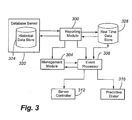
- Fig. 3 is a block diagram of a contact center reporting system according to an embodiment of the present invention;
- Fig. 4 is a plot of work duration (vertical axis) against time (minutes) (horizontal axis) showing the prior art practice of ratcheting;
- Fig. 5 is a plot of work duration (vertical axis) against time (minutes) (horizontal axis) showing an embodiment of the present invention;
- Fig. 6 is a plot of work count (vertical axis) against time (minutes) (horizontal axis) showing an embodiment of the present invention;
- Fig. 7 is a plot of work count (vertical axis) against time (minutes) (horizontal axis) showing an embodiment of the present invention;
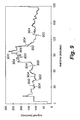
- Fig. 8 is a plot of average call length (seconds) (vertical axis) against time (minutes) (horizontal axis) contrasting an estimation technique of the present invention against a rolling average; and
- Fig. 9 is a plot of average call length (seconds) (vertical axis) against time (minutes) (horizontal axis) contrasting an estimation technique of the present invention against a rolling average.
- The invention will be illustrated below in conjunction with an exemplary communication system. Although well suited for use with, e.g., a system having an ACD or other similar contact processing switch, the invention is not limited to use with any particular type of communication system switch or configuration of system elements. Those skilled in the art will recognize that the disclosed techniques may be used in any communication application in which it is desirable to provide improved contact processing.
- Fig. 1 shows an illustrative embodiment of the present invention. A
contact center 100 comprises acentral server 110, a set of data stores ordatabases 114 containing contact or customer related information and other enterprise information, and a plurality of servers, namely avoice mail server 118, an Interactive Voice Response unit orIVR 122, andother servers 126, aswitch 130, a plurality of working agents operating packet-switched (first) telecommunication devices 134-1 to N (such as wired and/or wireless computer work stations or personal computers), and/or circuit-switched (second) telecommunication devices 138-1 to M (such as wired and/or wireless analog or digital telephones), all interconnected by a local area network LAN (or wide area network WAN) 142. The servers can be connected viaoptional communication lines 146 to theswitch 130. Alternatively, the switch functionality may be integrated into the functionality of theserver 110. As will be appreciated, theother servers 126 can also include a scanner (which is normally not connected to theserver 110 or Web server), VoIP software, video contact software, voice messaging software, an IP voice server, a fax server, a web server, and an email server) and the like. Theswitch 130 is connected via a plurality oftrunks 150 to the Public Switch Telecommunication Network orPSTN 154 and via link(s) 152 to the second telecommunication devices 138-1 to M. A gateway 158 (such as Avaya Inc.'s, G700 Media Gateway™) is positioned between theserver 110 and the packet-switchednetwork 162 to process communications passing between theserver 110 and thenetwork 162. - The media server 110 (which preferably includes the functionality of the switch 130) can be any converged architecture for directing circuit-switched and/or packet-switched customer contacts to one or more communication devices. Typically, the server is a stored-program-controlled system that conventionally includes interfaces to external communication links, a communications switching fabric, service circuits (e.g., tone detectors and generators, etc.), memory for storing control programs and data, and a processor (i.e., a computer) for executing the stored control programs to control the interfaces and the fabric and to provide automatic contact-distribution functionality. Features provided by the media server typically include not only telephony features and intelligent contact routing but also localization, collaboration, mobility, messaging, system management, attendant features, networking, and application programming interfaces. The server typically includes a network interface card (not shown) to provide services to the serviced telecommunication devices.
- Illustratively, the
media server 110 can be a modified form of the following subscriber-premises equipment: Avaya Inc.'s Definity™ Private-Branch Exchange (PBX)-based ACD system; Avaya Inc.'s IP600™ LAN-based ACD system, or an S8100™, S8300™, S8500™, S8700™, or S8710™ media server running a modified version of Avaya Inc.'s Communication Manager™ voice-application software with call processing capabilities and contact center functions. Other types of known switches and servers are well known in the art and therefore not described in detail herein. - Referring to Fig. 2, one possible configuration of the
server 110 is depicted. Theserver 110 is in communication with a plurality ofcustomer communication lines 200a-y (which are part of the packet-switchednetwork 162 and can be one or more packet-switched links) and agent communication line 204 (which can be a voice-and-data transmission line such asLAN 142 and/or a circuit switched voice line). Theserver 110 includes a contactcenter reporting system 228, which is preferably a modified form of Avaya Inc.'s Operational Analyst™ or OA with On-Line Analytical Processing or OLAP technology, Basic Call Management System™ or BCMS, or Call Management System™ or CMS that gathers contact records and contact-center statistics for use in generating contact-center reports. - Referring to Fig. 2, included among the data stored in the
server 110 is a set of logicalwork item queues 208a-n and a separate set ofphysical agent queues 212a-n. Each logicalwork item queue 208a-n corresponds to a different set of agent skills, as does eachagent queue 212a-n. Included among the control programs in the server 112 is a work item orcontact vector 216. Contacts incoming to the contact center are assigned bywork item vector 216 to differentwork item queues 208a-n based upon a number of known criteria. Agents who are available for handling contacts are assigned toagent queues 212a-n based upon the skills that they possess. Skills-based ACD is described in further detail inU.S. Patents 6,173,053 and5,206,903 , each of which is incorporated herein by this reference. - The packet-switched
network 162 is in communication with an externalcustomer telecommunication device 174 via agateway 178, and the circuit-switchednetwork 154 with an externalcustomer telecommunication device 180. - It should be emphasized that the configuration of the switch, server, user telecommunication devices, and other elements as shown in Fig. 1 is for purposes of illustration only and should not be construed as limiting the invention to any particular arrangement of elements.
- Referring now to Fig. 3, the contact
center reporting system 228 includes a number of components. Areporting module 300 provides report presentation and delivery capabilities, retrieves data for historical reports directly from thedatabase server 320, and receives real-time report data from anevent processor 308. Amanagement module 304 maintains the historical summary and detail data in thehistorical data store 324, persists detail and interval summary data from theevent processor 308, rolls up data into daily summaries, and purges old data. The event processor 308 (which is in communication with thereporting module 300,management module 304,server 110controller 312, and contact center predictive dialer 316) receives one or more event feeds (which provides details of activities in the contact center as they occur in real time, such as actions and state changes associated with an agent or a contact), maintains summaries of the reporting events in a real-time data store 328, provides access to that data for reporting and data export, and forwards the data to themanagement module 304 to be stored in thehistorical data store 324 for further processing. - The historical and real
time data stores time data store 328 contains status and summary data about the managed entities and a subset of dimensional data to allow mapping between surrogate keys and natural keys. Thedata store 328 is organized around a number of base intervals, with exemplary intervals being 15, 30, or 60 minutes in duration. A current base interval contains tables with summary data of what has happened so far during the current interval and includes tables with current status of managed entities. A configurable number of previous base intervals is maintained. The immediately previous interval is transferred to thehistorical store 324 after the interval ends. - A number of entities or objects are typically tracked. The tracked objects include, for example, customer contacts including both inbound contacts from customers and outbound contacts to customers generated by the predictive dialer 316 (which may be circuit-switched and/or packet-switched calls, emails, instant messages, text chat, Short Message Service or SMS contacts, and Multimedia Message Service or MMS contacts), agents, contact queue 208, agent queue 212, split, skill, trunk, trunk group, Vector Directory Number, vector, and jobs. Characteristics of the objects may be searched, such as time duration (e.g., average talk time, average after call work or ACW time, average speed of answer, average time to abandon, wait time (actual or expected, etc.), number or count during a specified time interval (e.g., staffing levels, type of agents staffed, queue length or membership, ACD calls, etc.), usage levels, performance, status or state (e.g., active or abandoned, idle or busy, etc.), age (e.g., oldest call waiting, etc.), and percentage of contacts handled within prescribed service limits.
- The
event processor 308 is configured to provide actual and/or estimated real time cumulative data over a rolling, moving, or sliding window. A "rolling", "moving" or "sliding" window refers to a measured interval of a selected width or duration that moves with the passage of time relative to a fixed or stationary scale. By way of an example, a rolling window is used to monitor and/or analyze behavior occurring in the last thirty minutes, with the absolute time (e.g., 1:00 pm, 1:30 pm, etc.) being the fixed or stationary temporal scale. ' - In one configuration, objects are tracked precisely over defined intervals to produce an exact moving or rolling average using known mathematical techniques, i.e., the exact measure during, say, the most recent 30 minutes.
- In another configuration, objects are tracked precisely over defined intervals to produce an exponential moving average, a double exponential moving average, an adaptive moving average, and the like using known mathematical techniques. This configuration may not fully address the problems encountered in monitoring contact center objects. The various algorithms are commonly designed for an existing time series and attempt to smooth out noise or extrapolate to predict future elements of the series. They may not address real time scales shorter than the measurement interval, i.e., they may not be concerned with the moment-to-moment value of the accumulator that is counting during the thirty-minute interval and all of the smoothing results may be for periods longer than the base interval. Using the methods to extrapolate the ratcheted data points may produce a static estimate that ignores the currently accumulating value.
- A limitation of the above configurations can be the memory capacity required to effect the object tracking. In contact centers, tracking objects at this level of granularity can exceed the capacity of contact center software that is already sized to track millions of separate cumulative measures.
- A preferred configuration of the present invention produces an estimate of the cumulative datum value over the rolling window (which in some cases is an estimate of the exact moving average) by combining (a) ratcheted cumulative data values over base intervals, if any, fully spanned by the rolling window, (b) the currently accumulated value for the cumulative datum over the present base interval, and (c) an estimated datum value in a prior partly spanned base interval using a time dependent weighting factor. It is generally applicable whenever the width of the moving window is an integer multiple of the base interval length, and can provide up-to-the-moment results with the information at hand. Stated another way, the estimate has two components. The first component includes the ratcheted values saved for each historic base interval and the current base interval accumulator value. The remainder of the moving window is approximated by taking the appropriate portion of the previous (partly spanned) base interval's results.
- This configuration will be illustrated with reference to Fig. 5 in which the base interval and rolling window widths are the same. In Fig. 5, the base interval is 30 minutes. The moving window, which at two different locations is represented by intervals t1 and t2, includes the current accumulator value (which for window t1 is A1=400 and for t2 is A2=1600) (or first component). Because the base interval and rolling window with are the same, there is no historic base interval value. If the window width were 180 minutes, for example, it would completely span, at any position, two historic base intervals, each with a corresponding (final) interval value. The second component is required because the depicted rolling windows each span only part of an historic base interval (i.e., window t1 spans only part of the
base interval 0 to 30 minutes and window t2 spans only part of thebase interval 60 to 90 minutes). To estimate the value to be used from the partially spanned interval, a linear or uniform rate of change of the base interval interval over the base interval are assumed. The sloping straight line is dashed for each of windows t1 and t2. The values "B1" and "B2" respectively represent the saved data at the end of the prior partly spanned base intervals. The values "V1" and "V2" respectively represent the point of intersection between a vertical line passing through the window's starting point and the corresponding dashed line. The differences "B1-V1" and "B2-V2" respectively constitute the second component of the estimation in a configuration of the invention. Stated another way, a weighting factor is multiplied against the final base interval value (which is B1=400 for window t1 and B2=1,000 for window t2). For window t1 the weighting factor is 0.5 (which provides a value of 200 and for window t2 is 0.35 (which provides a value of 350). The complete estimate (both components) is 600 and 2,050 respectively for t1 and t2. - Where the widths of the base interval and rolling window are the same, the following equation is employed:
- Cumulative Datum Value over Window = Current Base Interval Datum
- Value + Weighting Factor * Previous Base Interval Datum Value.
- This configuration will be further illustrated with reference to Fig. 6 in which the base interval and rolling window widths are different. The base interval width (5 minutes) is less than but is an integer multiple of the rolling window width (30 minutes). The moving window, which at one location is represented by the interval t, includes the current accumulator value (which for
base interval 600 is 2) and the values in the base intervals 604 (6), 608 (5), 612 (3), 616 (4), and 620 (5) (or a value of 25 for the first component). The second component is required because the depicted rolling window spans only part of a historic base interval (i.e., window t1 spans only two-thirds of the base interval 624). To estimate the value to be used from the partially spannedinterval 624, a straight line and a uniform rate of change of the base interval interval over the base interval are assumed. The straight line is dashed for the depicted rolling window. The value "V1" represents the point of intersection between a vertical line passing through the window's starting point and the corresponding dashed line. Stated another way, a weighting factor is multiplied against the final base interval value (which is B1=3 for the depicted window). For the depicted window, the weighting factor is 0.667 (which provides a value of 2 for the second component). The complete estimate is therefore 25+2=27. - Where the widths of the base interval and rolling window are different, the following equation is employed:
- Cumulative Datum Value over Rolling Window = Current Base Interval
- Datum Value + First Previous Base Interval Datum Value + Second
- Previous Base Interval Datum Value + ... + N-1th Previous Base Interval
- Datum Value + Weighting Factor * Nth Previous Base Interval Datum Value.
- The accuracy of the approximation is depicted with reference to Figs. 8 and 9 where the rolling average is determined overa 180 minute period. Figs. 8 and 9 are each a plot of average call length (seconds) against real time (minutes) for a rolling window of 30 minutes. In Fig. 8, the base interval width is 30 minutes, but in Fig. 9 the base interval width is 5 minutes. The actual rolling average is denoted by
mathematical relationships mathematical relationships - In yet another configuration, approximations are further improved by using adjacent previous results (i.e., the N-1th and N+1th) to infer a nonuniform arrival rate for events in the Nth previous interval. For example, arrival rates that grow or peak during the interval could be inferred from known interpolation and/or extrapolation techniques, such as polynomial interpolation or regression analysis, and the inferred arrival rate could be used to alter the time dependent weighting factor. This variation of the invention could apply best to situations in which adjacent previous values are expected to be correlated.
- In yet a further configuration, a mathematical relationship characterizing the distribution of values over the base interval or subinterval is determined by known curve fitting mathematical techniques and a descriptor of the (best) fit mathematical relationship is saved along with the final value for the base interval or subinterval. This configuration can be used in connection with the prior configuration.
- Fig. 7 exemplifies this configuration. The base interval is 5 minutes.' Over the
base interval 700 the "best fit" mathematical relationship is a straight line 750, over theinterval 704 the "best fit" mathematical relationship is aparabolic curve 754, over theinterval 708 the "best fit" mathematical relationship is ahorizontal line 758, and over theinterval 712 the "best fit" mathematical relationship is aparabolic curve 762. Additionally a key characteristic of the mathematical relationship may be saved, such as the slope and intercept of the straight line and the three coefficients of the parabola. - A number of variations and modifications of the invention can be used. It would be possible to provide for some features of the invention without providing others.
- For example, the server and/or switch can be a software-controlled system including a processing unit (CPU), microprocessor, or other type of digital data processor executing software or an Application-Specific Integrated Circuit (ASIC) as well as various portions or combinations of such elements. The memory may be a random access memory (RAM), a read-only memory (ROM), a relational database value, or combinations of these and other types of electronic memory devices.
- The present invention is not limited to contact center objects but may be used to determine rolling average estimates for any situation in which cumulative data is monitored in real time. For example, the present invention could be used to estimate the number of cars passing a particular traffic monitoring point, assembly line production controllers, financial forecasting, or the number of photons counted by a microscopic light detector.
- The present invention, in various embodiments, includes components, methods, processes, systems and/or apparatus substantially as depicted and described herein, including various embodiments, subcombinations, and subsets thereof. Those of skill in the art will understand how to make and use the present invention after understanding the present disclosure. The present invention, in various embodiments, includes providing devices and processes in the absence of items not depicted and/or described herein or in various embodiments hereof, including in the absence of such items as may have been used in previous devices or processes, e.g., for improving performance, achieving ease and\or reducing cost of implementation.
- The foregoing discussion of the invention has been presented for purposes of illustration and description. The foregoing is not intended to limit the invention to the form or forms disclosed herein. In the foregoing Detailed Description for example, various features of the invention are grouped together in one or more embodiments for the purpose of streamlining the disclosure. This method of disclosure is not to be interpreted as reflecting an intention that the claimed invention requires more features than are expressly recited in each claim. Rather, as the following claims reflect, inventive aspects lie in less than all features of a single foregoing disclosed embodiment. Thus, the following claims are hereby incorporated into this Detailed Description, with each claim standing on its own as a separate preferred embodiment of the invention.
- Moreover, though the description of the invention has included description of one or more embodiments and certain variations and modifications, other variations and modifications are within the scope of the invention, e.g., as may be within the skill and knowledge of those in the art, after understanding the present disclosure. It is intended to obtain rights which include alternative embodiments to the extent permitted, including alternate, interchangeable and/or equivalent structures, functions, ranges or steps to those claimed, whether or not such alternate, interchangeable and/or equivalent structures, functions, ranges or steps are disclosed herein, and without intending to publicly dedicate any patentable subject matter.
Claims (15)
- A contact center monitoring method, the contact center comprising a plurality of agents and work item queues and a workflow server for distributing work items to available agents, comprising:(a) selecting a base time interval for accumulating a cumulative datum and a width of a rolling window, the width of the rolling window being at least one of (i) equal and (ii) greater than the base interval and being an integer multiple of the base interval;(b) performing at least one of the following steps:(b1) when the rolling window partly spans a prior base interval, determining a rolling average for the cumulative datum over the width of the rolling window; and(b2) when the rolling window partly spans a prior base interval, estimating a value for the cumulative datum in the partly spanned prior base interval.
- The method of claim 1, wherein step (b1) is performed and wherein the rolling average is at least one of a moving average, an exponential moving average, a double exponential moving average, and an adaptive moving average.
- The method of claim 1, wherein step (b2) is performed and further comprising:maintaining the width of the rolling window constant in magnitude as it progressively spans a plurality of successive base intervals.
- The method of claim 3, wherein the rolling window partly spans a current base interval and the cumulative datum in the current base interval has a currently accumulated value and further comprising:determining an estimate for the cumulative datum over the rolling window according to the following equation:Cumulative datum value over rolling window = currently accumulated value + (weighting factor)(cumulative datum value over the partly spanned prior base interval).
- The method of claim 3, wherein the rolling window partly spans a current base interval and at least one intermediate base interval having a respective cumulative datum value and the cumulative datum in the current base interval has a currently accumulated value and further comprising:determining an estimate for the cumulative datum over the rolling window according to the following equation:Cumulative datum value over rolling window = currently accumulated value + cumulative datum value for the at least one intermediate base interval + (weighting factor)(cumulative datum value over the partly spanned prior base interval), wherein the weighting factor is related to an amount of time remaining in the current base interval and wherein the weighting factor is greater than zero and less than one.
- The method of claim 3, wherein the estimation is based, at least in part, on a cumulative datum value in at least one adjacent base interval and further comprising:at least one of interpolating and extrapolating a mathematical relationship indicating a distribution of datum values over a base interval; andstoring with the base interval's cumulative datum value, a descriptor of the mathematical relationship.
- The method of claim 1, wherein the datum is related to one or more of the following: customer contact(s), agent(s), contact queue(s), agent queue(s), split(s), skill(s), trunk(s), trunk group(s), Vector Directory Number(s), and vector(s).
- At least one of (a) a computer readable medium comprising processor-executable instructions and (b) a logic circuit operable to perform the steps of claim 1.
- A contact center, comprising:a plurality of agent and work item queues;a workflow server for distributing work items to available agents; andan event processor means operable, for a selected a base time interval for accumulating a cumulative datum and a width of a rolling window, the width of the rolling window being at least one of (i) equal and (ii) greater than the base interval and being an integer multiple of the base interval, to perform at least one of the following operations:(i) when the rolling window partly spans a prior base interval, determine a rolling average for the cumulative datum over the width of the rolling window; and(ii) when the rolling window partly spans a prior base interval, estimate a value for the cumulative datum in the partly spanned prior base interval.
- The contact center of claim 9, wherein operation (i) is performed and wherein the rolling average is at least one of a moving average, an exponential moving average, a double exponential moving average, and an adaptive moving average.
- The contact center of claim 9, wherein operation (ii) is performed.
- The contact center of claim 11, wherein the rolling window partly spans a current base interval and the cumulative datum in the current base interval has a currently accumulated value and wherein the event processor means is further operable to (iii) determine an estimate for the cumulative datum over the rolling window according to the following equation:Cumulative datum value over rolling window = currently accumulated value + (weighting factor)(cumulative datum value over the partly spanned prior base interval).
- The contact center of claim 11, wherein the rolling window partly spans a current base interval and at least one intermediate base interval having a respective cumulative datum value and the cumulative datum in the current base interval has a currently accumulated value and wherein the event processor means is further operable to (iii) determine an estimate for the cumulative datum over the rolling window according to the following equation:Cumulative datum value over rolling window = currently accumulated value + cumulative datum value for the at least one intermediate base interval + (weighting factor)(cumulative datum value over the partly spanned prior base interval), wherein the weighting factor is related to an amount of time remaining in the current base interval and wherein the weighting factor is greater than zero and less than one.
- The contact center of claim 11, wherein the estimation is based, at least in part, on a cumulative datum value in at least one adjacent base interval and wherein the event processor means is further operable to (iii) at least one of interpolate and extrapolate a mathematical relationship indicating a distribution of datum values over a base interval and (iv) store, with the base interval's cumulative datum value, a descriptor of the mathematical relationship.
- The contact center of claim 9, wherein the datum is related to one or more of the following: customer contact(s), agent(s), contact queue(s), agent queue(s), split(s), skill(s), trunk(s), trunk group(s), Vector Directory Number(s), and vector(s).
Applications Claiming Priority (1)
| Application Number | Priority Date | Filing Date | Title |
|---|---|---|---|
| US11/151,940 US7818196B2 (en) | 2005-06-13 | 2005-06-13 | Real time estimation of rolling averages of cumulative data |
Publications (1)
| Publication Number | Publication Date |
|---|---|
| EP1734470A1 true EP1734470A1 (en) | 2006-12-20 |
Family
ID=36808776
Family Applications (1)
| Application Number | Title | Priority Date | Filing Date |
|---|---|---|---|
| EP06251746A Withdrawn EP1734470A1 (en) | 2005-06-13 | 2006-03-30 | Real time estimation of rolling averages of cumulative data |
Country Status (4)
| Country | Link |
|---|---|
| US (1) | US7818196B2 (en) |
| EP (1) | EP1734470A1 (en) |
| JP (1) | JP2006352872A (en) |
| CA (1) | CA2535977A1 (en) |
Cited By (1)
| Publication number | Priority date | Publication date | Assignee | Title |
|---|---|---|---|---|
| US20140214826A1 (en) * | 2013-01-29 | 2014-07-31 | Tencent Technology (Shenzhen) Company Limited | Ranking method and system |
Families Citing this family (17)
| Publication number | Priority date | Publication date | Assignee | Title |
|---|---|---|---|---|
| US7779042B1 (en) * | 2005-08-08 | 2010-08-17 | Avaya Inc. | Deferred control of surrogate key generation in a distributed processing architecture |
| US20070116185A1 (en) * | 2005-10-21 | 2007-05-24 | Sbc Knowledge Ventures L.P. | Real time web-based system to manage trouble tickets for efficient handling |
| US7826608B1 (en) * | 2006-03-31 | 2010-11-02 | Verint Americas Inc. | Systems and methods for calculating workforce staffing statistics |
| JP4486657B2 (en) * | 2007-03-15 | 2010-06-23 | 富士通株式会社 | Staffing optimization program, staffing optimization method, and staffing optimization device |
| US9275353B2 (en) * | 2007-11-09 | 2016-03-01 | Oracle America, Inc. | Event-processing operators |
| US7870167B2 (en) * | 2007-11-09 | 2011-01-11 | Oracle America, Inc. | Implementing event processors |
| US8086625B2 (en) * | 2008-07-31 | 2011-12-27 | Simply Hired, Inc. | Automated method for re-attracting job seekers to job match site at more opportune times |
| US20130262035A1 (en) * | 2012-03-28 | 2013-10-03 | Michael Charles Mills | Updating rollup streams in response to time series of measurement data |
| US20110145032A1 (en) * | 2009-12-14 | 2011-06-16 | William Nathan Stearns | Workforce management system for forecasting and scheduling work items that cross intervals |
| WO2011152740A1 (en) * | 2010-06-03 | 2011-12-08 | Callao Mansueto B | A dynamic queuing management system |
| US11030560B1 (en) | 2012-10-31 | 2021-06-08 | Brandt Vx Llc | Dispatch system |
| US8788487B2 (en) | 2012-11-30 | 2014-07-22 | Facebook, Inc. | Querying features based on user actions in online systems |
| US9256628B2 (en) * | 2013-05-14 | 2016-02-09 | International Business Machines Corporation | Efficient logging of processing peaks in control systems |
| GB2518151A (en) | 2013-09-11 | 2015-03-18 | Ibm | Network anomaly detection |
| US11048581B2 (en) * | 2017-11-17 | 2021-06-29 | Samsung Electronics Co., Ltd. | Storage device telemetry for provisioning I/O |
| US10819584B2 (en) | 2018-05-03 | 2020-10-27 | Servicenow, Inc. | System and method for performing actions based on future predicted metric values generated from time-series data |
| US12073340B1 (en) * | 2021-03-29 | 2024-08-27 | Amazon Technologies, Inc. | Accurate individual queue level metric forecasting for virtual contact center queues with insufficient data, using models trained at higher granularity level |
Family Cites Families (12)
| Publication number | Priority date | Publication date | Assignee | Title |
|---|---|---|---|---|
| US5214688A (en) * | 1990-06-05 | 1993-05-25 | Inventions, Inc. | Method and apparatus for dynamic and interdependent processing of inbound calls and outbound calls |
| US5206903A (en) * | 1990-12-26 | 1993-04-27 | At&T Bell Laboratories | Automatic call distribution based on matching required skills with agents skills |
| US5420904A (en) * | 1992-07-21 | 1995-05-30 | Gulick; Dale E. | Signal averager |
| US5375201A (en) * | 1992-12-18 | 1994-12-20 | Borland International, Inc. | System and methods for intelligent analytical graphing |
| US5621789A (en) * | 1993-09-01 | 1997-04-15 | Teknekron Infoswitch Corporation | Method and system for integrating a plurality of call center agent performance enhancement modules |
| US5754449A (en) * | 1995-04-25 | 1998-05-19 | Instrumented Sensor Technology, Inc. | Method and apparatus for recording time history data of physical variables |
| US5926822A (en) * | 1996-09-06 | 1999-07-20 | Financial Engineering Associates, Inc. | Transformation of real time data into times series and filtered real time data within a spreadsheet application |
| US5948065A (en) * | 1997-03-28 | 1999-09-07 | International Business Machines Corporation | System for managing processor resources in a multisystem environment in order to provide smooth real-time data streams while enabling other types of applications to be processed concurrently |
| US6654780B1 (en) * | 1997-03-28 | 2003-11-25 | International Business Machines Corporation | System of managing processor resources in a non-dedicated computer system |
| US6173053B1 (en) * | 1998-04-09 | 2001-01-09 | Avaya Technology Corp. | Optimizing call-center performance by using predictive data to distribute calls among agents |
| US6526397B2 (en) * | 1998-06-19 | 2003-02-25 | Nortel Networks Limited | Resource management facilitation |
| JP4053293B2 (en) | 2001-12-28 | 2008-02-27 | 株式会社日立コミュニケーションテクノロジー | ACD system |
-
2005
- 2005-06-13 US US11/151,940 patent/US7818196B2/en not_active Expired - Fee Related
-
2006
- 2006-02-09 CA CA002535977A patent/CA2535977A1/en not_active Abandoned
- 2006-03-30 EP EP06251746A patent/EP1734470A1/en not_active Withdrawn
- 2006-06-13 JP JP2006163219A patent/JP2006352872A/en active Pending
Non-Patent Citations (1)
| Title |
|---|
| No Search * |
Cited By (1)
| Publication number | Priority date | Publication date | Assignee | Title |
|---|---|---|---|---|
| US20140214826A1 (en) * | 2013-01-29 | 2014-07-31 | Tencent Technology (Shenzhen) Company Limited | Ranking method and system |
Also Published As
| Publication number | Publication date |
|---|---|
| US20060282301A1 (en) | 2006-12-14 |
| JP2006352872A (en) | 2006-12-28 |
| CA2535977A1 (en) | 2006-12-13 |
| US7818196B2 (en) | 2010-10-19 |
Similar Documents
| Publication | Publication Date | Title |
|---|---|---|
| US7818196B2 (en) | Real time estimation of rolling averages of cumulative data | |
| JP4842529B2 (en) | Method and apparatus for evaluating work-waiting status for services | |
| Koole et al. | Queueing models of call centers: An introduction | |
| US10963122B2 (en) | System and method of communication analysis | |
| US7711104B1 (en) | Multi-tasking tracking agent | |
| US8811597B1 (en) | Contact center performance prediction | |
| US6754333B1 (en) | Wait time prediction arrangement for non-real-time customer contacts | |
| US6744878B1 (en) | Real-time transaction routing augmented with forecast data and agent schedules | |
| US6850613B2 (en) | Customer service request allocations based upon real-time data and forecast data | |
| US10467560B2 (en) | System and method for adaptive multiple contact assignment | |
| US9172810B2 (en) | System and method for calculating context-aware estimated wait time for customers | |
| US9338296B2 (en) | System and method for driving a virtual view of agents in a contact center | |
| US7949123B1 (en) | Wait time predictor for long shelf-life work | |
| US20060203991A1 (en) | System for managing employee performance in a complex environment | |
| US20160171422A1 (en) | Method and System for Generating Staffing Requirements for Deferred Work in a Contact Center Environment | |
| US20050129215A1 (en) | Payroll based on communication switch statistics | |
| US7826608B1 (en) | Systems and methods for calculating workforce staffing statistics | |
| US10356242B2 (en) | System and method for managing communication interrupts in an enterprise | |
| Soliman et al. | Studying the impact of abandonment on call centers system performance | |
| CN101621593B (en) | Customer service access control method, device and customer service system | |
| Gans et al. | Call Center Measurements, Data Models and Data Analysis |
Legal Events
| Date | Code | Title | Description |
|---|---|---|---|
| PUAI | Public reference made under article 153(3) epc to a published international application that has entered the european phase |
Free format text: ORIGINAL CODE: 0009012 |
|
| AK | Designated contracting states |
Kind code of ref document: A1 Designated state(s): AT BE BG CH CY CZ DE DK EE ES FI FR GB GR HU IE IS IT LI LT LU LV MC NL PL PT RO SE SI SK TR |
|
| AX | Request for extension of the european patent |
Extension state: AL BA HR MK YU |
|
| 17P | Request for examination filed |
Effective date: 20070620 |
|
| AKX | Designation fees paid |
Designated state(s): DE FR GB |
|
| RAP1 | Party data changed (applicant data changed or rights of an application transferred) |
Owner name: AVAYA INC. |
|
| 17Q | First examination report despatched |
Effective date: 20100716 |
|
| STAA | Information on the status of an ep patent application or granted ep patent |
Free format text: STATUS: THE APPLICATION IS DEEMED TO BE WITHDRAWN |
|
| 18D | Application deemed to be withdrawn |
Effective date: 20101127 |