EP1734246A1 - Stirling engine - Google Patents
Stirling engine Download PDFInfo
- Publication number
- EP1734246A1 EP1734246A1 EP04721726A EP04721726A EP1734246A1 EP 1734246 A1 EP1734246 A1 EP 1734246A1 EP 04721726 A EP04721726 A EP 04721726A EP 04721726 A EP04721726 A EP 04721726A EP 1734246 A1 EP1734246 A1 EP 1734246A1
- Authority
- EP
- European Patent Office
- Prior art keywords
- displacer
- piston
- rod
- hollow space
- space
- Prior art date
- Legal status (The legal status is an assumption and is not a legal conclusion. Google has not performed a legal analysis and makes no representation as to the accuracy of the status listed.)
- Withdrawn
Links
- 239000011796 hollow space material Substances 0.000 claims description 60
- 230000000149 penetrating effect Effects 0.000 claims 3
- 239000007789 gas Substances 0.000 description 78
- 238000007789 sealing Methods 0.000 description 9
- 230000006835 compression Effects 0.000 description 7
- 238000007906 compression Methods 0.000 description 7
- 238000005057 refrigeration Methods 0.000 description 5
- 238000002485 combustion reaction Methods 0.000 description 3
- 239000001307 helium Substances 0.000 description 3
- 229910052734 helium Inorganic materials 0.000 description 3
- SWQJXJOGLNCZEY-UHFFFAOYSA-N helium atom Chemical compound [He] SWQJXJOGLNCZEY-UHFFFAOYSA-N 0.000 description 3
- 238000010276 construction Methods 0.000 description 2
- 238000007710 freezing Methods 0.000 description 2
- 230000008014 freezing Effects 0.000 description 2
- IJGRMHOSHXDMSA-UHFFFAOYSA-N Atomic nitrogen Chemical compound N#N IJGRMHOSHXDMSA-UHFFFAOYSA-N 0.000 description 1
- UFHFLCQGNIYNRP-UHFFFAOYSA-N Hydrogen Chemical compound [H][H] UFHFLCQGNIYNRP-UHFFFAOYSA-N 0.000 description 1
- CBENFWSGALASAD-UHFFFAOYSA-N Ozone Chemical compound [O-][O+]=O CBENFWSGALASAD-UHFFFAOYSA-N 0.000 description 1
- 239000000853 adhesive Substances 0.000 description 1
- 230000001070 adhesive effect Effects 0.000 description 1
- 238000005452 bending Methods 0.000 description 1
- KYKAJFCTULSVSH-UHFFFAOYSA-N chloro(fluoro)methane Chemical compound F[C]Cl KYKAJFCTULSVSH-UHFFFAOYSA-N 0.000 description 1
- 238000009833 condensation Methods 0.000 description 1
- 230000005494 condensation Effects 0.000 description 1
- 238000001816 cooling Methods 0.000 description 1
- 229910001873 dinitrogen Inorganic materials 0.000 description 1
- 230000008020 evaporation Effects 0.000 description 1
- 238000001704 evaporation Methods 0.000 description 1
- 239000000446 fuel Substances 0.000 description 1
- 239000000383 hazardous chemical Substances 0.000 description 1
- 238000004519 manufacturing process Methods 0.000 description 1
- 239000003507 refrigerant Substances 0.000 description 1
- 230000000452 restraining effect Effects 0.000 description 1
- 238000004904 shortening Methods 0.000 description 1
- 239000007787 solid Substances 0.000 description 1
- 239000005437 stratosphere Substances 0.000 description 1
Images



Classifications
-
- F—MECHANICAL ENGINEERING; LIGHTING; HEATING; WEAPONS; BLASTING
- F02—COMBUSTION ENGINES; HOT-GAS OR COMBUSTION-PRODUCT ENGINE PLANTS
- F02G—HOT GAS OR COMBUSTION-PRODUCT POSITIVE-DISPLACEMENT ENGINE PLANTS; USE OF WASTE HEAT OF COMBUSTION ENGINES; NOT OTHERWISE PROVIDED FOR
- F02G1/00—Hot gas positive-displacement engine plants
- F02G1/04—Hot gas positive-displacement engine plants of closed-cycle type
- F02G1/043—Hot gas positive-displacement engine plants of closed-cycle type the engine being operated by expansion and contraction of a mass of working gas which is heated and cooled in one of a plurality of constantly communicating expansible chambers, e.g. Stirling cycle type engines
- F02G1/053—Component parts or details
-
- F—MECHANICAL ENGINEERING; LIGHTING; HEATING; WEAPONS; BLASTING
- F02—COMBUSTION ENGINES; HOT-GAS OR COMBUSTION-PRODUCT ENGINE PLANTS
- F02G—HOT GAS OR COMBUSTION-PRODUCT POSITIVE-DISPLACEMENT ENGINE PLANTS; USE OF WASTE HEAT OF COMBUSTION ENGINES; NOT OTHERWISE PROVIDED FOR
- F02G1/00—Hot gas positive-displacement engine plants
- F02G1/04—Hot gas positive-displacement engine plants of closed-cycle type
- F02G1/043—Hot gas positive-displacement engine plants of closed-cycle type the engine being operated by expansion and contraction of a mass of working gas which is heated and cooled in one of a plurality of constantly communicating expansible chambers, e.g. Stirling cycle type engines
- F02G1/0435—Hot gas positive-displacement engine plants of closed-cycle type the engine being operated by expansion and contraction of a mass of working gas which is heated and cooled in one of a plurality of constantly communicating expansible chambers, e.g. Stirling cycle type engines the engine being of the free piston type
-
- F—MECHANICAL ENGINEERING; LIGHTING; HEATING; WEAPONS; BLASTING
- F02—COMBUSTION ENGINES; HOT-GAS OR COMBUSTION-PRODUCT ENGINE PLANTS
- F02G—HOT GAS OR COMBUSTION-PRODUCT POSITIVE-DISPLACEMENT ENGINE PLANTS; USE OF WASTE HEAT OF COMBUSTION ENGINES; NOT OTHERWISE PROVIDED FOR
- F02G2243/00—Stirling type engines having closed regenerative thermodynamic cycles with flow controlled by volume changes
- F02G2243/30—Stirling type engines having closed regenerative thermodynamic cycles with flow controlled by volume changes having their pistons and displacers each in separate cylinders
- F02G2243/32—Regenerative displacers having parallel cylinder, e.g. "Lauberau" or "Schwartzkopff" engines
-
- F—MECHANICAL ENGINEERING; LIGHTING; HEATING; WEAPONS; BLASTING
- F02—COMBUSTION ENGINES; HOT-GAS OR COMBUSTION-PRODUCT ENGINE PLANTS
- F02G—HOT GAS OR COMBUSTION-PRODUCT POSITIVE-DISPLACEMENT ENGINE PLANTS; USE OF WASTE HEAT OF COMBUSTION ENGINES; NOT OTHERWISE PROVIDED FOR
- F02G2270/00—Constructional features
- F02G2270/30—Displacer assemblies
-
- F—MECHANICAL ENGINEERING; LIGHTING; HEATING; WEAPONS; BLASTING
- F02—COMBUSTION ENGINES; HOT-GAS OR COMBUSTION-PRODUCT ENGINE PLANTS
- F02G—HOT GAS OR COMBUSTION-PRODUCT POSITIVE-DISPLACEMENT ENGINE PLANTS; USE OF WASTE HEAT OF COMBUSTION ENGINES; NOT OTHERWISE PROVIDED FOR
- F02G2280/00—Output delivery
- F02G2280/10—Linear generators
Definitions
- the present invention relates to a free-piston Stirling engine.
- refrigerators and the like generally adopt a vapor compression refrigeration cycle which uses a chlorofluorocarbon refrigerant as a working gas to obtain intended cooling performance through evaporation and condensation thereof.
- chlorofluorocarbons are chemically highly stable, meaning that, once discharged into the atmosphere, they reach the stratosphere and destroy the ozone layer. For this reason, the use and production of specified chlorofluorocarbons are now restricted.
- a Stirling engine using a Stirling cycle is an external combustion engine, and thus offers the following advantages: it does not require any specific type of heat source; and it is less likely to produce hazardous substances because, even if a fuel is combusted, it is not combusted under high-temperature, high-pressure conditions.
- a Stirling engine as described above uses an environment-friendly gas, such as helium gas, hydrogen gas, or nitrogen gas, as a working gas.
- an environment-friendly gas such as helium gas, hydrogen gas, or nitrogen gas
- a Stirling refrigerating unit using a reverse Stirling refrigeration cycle is known as a type of compact cryogenic refrigerating unit.
- FIG. 7 is a side sectional view of a free-piston Stirling refrigerating unit as one example of a Stirling engine.
- the Stirling refrigerating unit B comprises a pressure container 1, a cylinder 2 secured inside the pressure container 1, a power piston 3 and a displacer 4 provided inside the cylinder 2.
- the power piston 3 and the displacer 4 are arranged on the same axis, and reciprocate linearly along the axis.
- the displacer 4 comprises a displacer piston 41 and a rod 42.
- the rod 42 is placed through a slide hole 31 formed at the center of the power piston 3, and the power piston 3 and the displacer piston 41 can slide smoothly along an inner circumferential surface 21 of the cylinder.
- the power piston 3 is elastically supported on the pressure container 1 with power piston supporting springs 5, and the displacer 4 is elastically supported on the pressure container 1 with a displacer supporting spring 6 via the rod 42.
- the space inside the pressure container 1 is divided by the power piston 3 into two spaces. Of these two spaces, one is a work space 7 located on the displacer 4 side of the power piston 3, and the other is a back-pressure space 8 located on the side of the power piston 3 opposite to the displacer 4. These spaces are filled with a working gas such as high-pressure helium gas.
- the power piston 3 is made to reciprocate with a predetermined cycle time by a piston drive body (here, a linear motor 9). This causes the working gas to be compressed and expanded in the work space 7.
- the displacer 4 is made to reciprocate linearly by the difference in pressure between in the work space 7 and in the back-pressure space 8.
- the power piston 3 and the displacer 4 are set so as to reciprocate with the same cycle time but with a predetermined phase difference.
- a reverse Stirling refrigeration cycle is achieved. So long as the operating conditions remain the same, the phase difference is determined by the mass of the displacer 4, the spring constant of the displacer supporting spring 6, and the operating frequency of the power piston 3.
- the work space 7 is further divided by the displacer piston 41 into two spaces. Of these two spaces, one is a compression space 71 surrounded by the power piston 3, the displacer piston 41, and the cylinder 2, and the other is an expansion space 72 surrounded by one end of the cylinder 2 and the displacer piston 41.
- the compression space 71 is where heat is produced, whereas the expansion space 72 is where cold is obtained.
- the displacer 4 uses the pressure difference between in the compression space 71 and in the back-pressure space 8 as a drive source for the linear reciprocating motion, and achieves the reciprocating motion by exploiting the resonance between the displacer 4 and the supporting spring 6.
- a flow of the working gas through the slide hole 31 between the work space 7 and the back-pressure space 8 causes a flow loss, which reduces the efficiency of the Stirling engine.
- the output (freezing performance) of a free-piston Stirling engine can be increased by increasing the resonance frequency of the displacer 4.
- the aforementioned operating frequency increases as the aforementioned resonance frequency increases, and this can be practically achieved by increasing the resonance frequency of the displacer.
- the resonance frequency is determined by the mass of the displacer 4 and the spring constant of the spring 6 elastically supporting the displacer 4.
- the displacer 4 uses the pressure difference between in the compression space 71 and in the back-pressure space 8 as a drive source for the linear reciprocating motion, and a force in the axial direction acts on the rod 42 facing the back-pressure space 8. Reducing the outer diameter of the rod 42 in an attempt to make the displacer 4 lighter results in reducing the stiffness of the rod 42. This makes the rod 42 likely, while reciprocating repeatedly, to be deformed by a force acting thereon in the axial direction. Even a slight deformation in the rod 42 may cause the rod 42 to come into contact with the slide hole 31 because of the small clearance between the rod 42 and the slide hole 31, producing sliding friction where they come into contact with each other. The sliding friction hinders stable reciprocating motion of the displacer 4 and the power piston 3, thereby reducing the efficiency and reliability of the Stirling engine, and shortening the life span thereof, for example.
- a Stirling engine is provided with: a pressure container filled with a working gas; a cylinder secured inside the pressure container; a power piston provided inside the cylinder; and a displacer provided inside the cylinder on the same axis as the power piston.
- the displacer is provided with: a displacer piston that slides inside the cylinder; and a rod which is connected and fixed to the displacer piston and placed through a slide hole formed at the center of the power piston.
- the rod is formed in the shape of a hollow pipe.
- the displacer piston has a hollow space inside.
- the displacer piston has formed therein: one or more than one inlet via which the working gas flows into the hollow space; and one more than one outlet via which the gas having flowed into the hollow space flows out of it.
- the inlet penetrates the wall surface to which the rod is connected, from outside the wall surface into the hollow space.
- the outlet penetrates the circumferential side wall of the displacer piston, from the hollow space to outside the outer circumferential surface of the displacer piston.
- the rod is provided with means for preventing a working gas that has flowed into the displacer piston via the rod from flowing between a work space located on the displacer side of the power piston inside the pressure container and a back-pressure space located on the side of the power piston opposite to the work space.
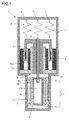
- FIG. 1 is a side sectional view of a free-piston Stirling refrigerating unit as one embodiment of a Stirling engine according to the invention.
- the Stirling refrigerating unit A comprises: a pressure container 1 filled with a working gas; a cylinder 2 secured inside the pressure container 1; a power piston 3 which is slidably disposed on an inner circumferential surface 21 of the cylinder 2; and a displacer 4a which is arranged on the same axis as the power piston 3.
- the power piston 3 is elastically supported with power piston supporting springs 5.
- the displacer 4a comprises: a displacer piston 41a which can slide smoothly along the inner circumferential surface 21 of the cylinder 2; and a rod 42a which is placed through a slide hole 31 formed at the center of the power piston 3.
- the displacer 4a is elastically supported on the pressure container 1 with a displacer supporting spring 6 via the rod 42a.
- the space inside the cylinder 2 is divided by the power piston 3 into two spaces. Of these two spaces, one is a work space 7 located on the displacer 4a side of the power piston 3, and the other is a back-pressure space 8 located on the side of the power piston 3 opposite to the displacer 4a. In the example under discussion, these spaces are filled with high-pressure helium gas, though not limited thereto, as the working gas.
- the power piston 3 is made to reciprocate with a predetermined cycle time by a piston drive body (here, a linear motor 9). This causes the working gas to be compressed and expanded in the work space 7.
- the displacer 4a is made to reciprocate linearly by the difference in pressure between in the work space 7 and in the back-pressure space 8.
- the power piston 3 and the displacer 4a are set so as to reciprocate with the same cycle time but with a predetermined phase difference.
- a reverse Stirling refrigeration cycle is achieved. So long as the operating conditions remain the same, the phase difference is determined by the mass of the displacer 4a, the spring constant of the displacer supporting springs 6, and the operating frequency of the power piston 3.
- the work space 7 is further divided by the displacer piston 41a into two spaces. Of these two spaces, one is a compression space 71 surrounded by the power piston 3, the displacer piston 41a, and the cylinder 2, and the other is an expansion space 72 surrounded by one end of the cylinder 2 and the displacer piston 41 a.
- the compression space 71 is where heat is produced, whereas the expansion space 72 is where cold is obtained.
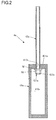
- FIG. 2 is a side sectional view illustrating an example of a displacer used in a Stirling engine according to the invention.
- the displacer 4a shown in FIG. 2 comprises: a displacer piston 41a; and a rod 42a connected on the same axis as the displacer piston 41a.
- the displacer piston 41a has a hollow space 410a inside.
- the rod 42a is formed in the shape of a hollow pipe.
- the rod 42a has, at one end thereof, a connecting portion 421a, at which the rod 42a is connected to the displacer piston 41 a.
- the connecting portion 421 a has an externally threaded portion 422a formed on the outer circumferential surface thereof.
- the displacer piston 41a has a rod connecting wall 411 a, which has an internally threaded portion 412a formed at the center thereof.
- the externally threaded portion 422a is screwed into the internally threaded portion 412a, and the end of the rod 42a that then appears in the hollow space 410a is locked with a lock nut Nt, which is then tightened with a washer W inserted in between. In this way, the rod 42a is fixed to the displacer piston 41 a.
- the hollow structure of the rod 42a permits it to be made lighter. Even then, the rod 42a, as compared with a smaller-diameter rod having the same mass, has a larger diameter and thus provides a greater section modulus. This helps secure sufficient bending stiffness against the axial force produced by reciprocating motion.
- the displacer piston 41 a has a hollow space 410a inside; in practice, a solid displacer piston may be used instead. From the viewpoint of making the displacer lighter, however, it is preferable to use one having a hollow space inside.
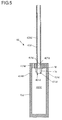
- FIG. 3 is a side sectional view illustrating another example of a displacer used in a Stirling engine according to the invention.
- the displacer 4b shown in FIG. 3 comprises: a displacer piston 41b; and a rod 42b having the shape of a hollow pipe.
- the displacer piston 41b has a hollow space 410b inside.
- the displacer piston 41b and the rod 42b are connected and fixed together in the same manner as in the first embodiment. Specifically, an externally threaded portion 422b of the rod 42b is screwed into an internally threaded portion 412b of the displacer piston 41 b, and the end of the rod 42b that then appears in the hollow space 410b is locked with a lock nut Nt, which is tightened with a washer W inserted in between. In this way, the rod 42b is connected to the displacer piston 41 b.
- the rod 42b has, at one end thereof, a displacer piston connecting portion 421b, and is fitted with, at the opposite end 423b thereof, a sealing member 424b for restraining gas flow.
- the displacer piston 41b which has the hollow space 410b inside, has formed therein a working gas inlet 413b and working gas outlets 414b.
- the working gas inlet 413b of which there is one, is formed in a rod connecting wall 411b of the displacer piston 41b.
- the gas outlets 414b of which there are two, are formed at equal angular intervals (here, 180 degrees) about the axis of the displacer piston 41 b in the circumferential side walls thereof.
- the working gas flows into the hollow space 41 0b inside the displacer piston via the gas inlet 413b.
- the working gas having flowed into the hollow space 410b flows out of it via the gas outlets 414b.
- the gas thus having flowed out forms a film of gas in a clearance t1 (see FIG. 1) between the cylinder 2 and the displacer piston 41b, and serves as a gas bearing.
- the working gas that has, with the sliding movement of the displacer 4b, flowed into the hollow space 410b inside the displacer piston further flows into a hollow space 420b inside the rod 42b, but it can not flow out of it beyond the gas sealing member 424b. In this way, the gas is prevented from flowing between the work space and the back-pressure space.
- only one gas inlet 413b is formed in the displacer piston 41b, and two gas outlets 414b are formed at equal angular intervals about the axis.
- two or more gas inlets may be provided instead, and any number of gas outlets may be provided in any manner so long as they can satisfactorily reduce the friction between the cylinder 2 and the displacer piston 41 b.
- the gas sealing member 424b is fitted at the end 423b of the rod 42b, but it may be fitted elsewhere than at the end 423b so long as it can prevent gas flow.
- FIG. 4 is a side sectional view illustrating a still another example of a displacer used in a Stirling engine according to the invention.
- the displacer 4c shown in FIG. 4 comprises: a displacer piston 41c; and a rod 42c having the shape of a hollow pipe.
- the displacer piston 41 c has a hollow space 410c inside, and has formed therein a working gas inlet 413c and working gas outlets 414c.
- the rod 42c has, at one end thereof, a connecting portion 421 c, at which the rod 42c is connected to the displacer piston 41c.
- the connecting portion 421 c has an internally threaded portion 425c formed on the inner circumferential surface thereof.
- the displacer piston 41c has a rod connecting wall 411 c, which has a rod connecting hole 415c formed therein. This rod connecting hole 415c extends from the outer surface of the rod connecting wall 411c and has a diameter approximately equal to the outer diameter of the rod 42c.
- the rod connecting wall 411c also has a bolt inserting hole 416c formed therein.
- This bolt inserting hole 416c extends from the inner surface of the rod connecting wall 411 c and has a diameter equal to or greater than the outer diameter of an externally threaded portion of a bolt 43c, which will be described later.
- the rod connecting hole 415c is so formed as to have an inner diameter larger than that of the bolt inserting hole 416c.
- the rod connecting hole 415c and the bolt inserting hole 416c connect together at substantially the middle of the thickness of the rod connecting wall 411c.
- the displacer piston 41c and the rod 42c are connected and fixed together in the following manner.
- the rod 42c is inserted into the rod connecting hole 415c.
- a bolt 43c having an externally threaded portion having a diameter equal to that of the internally threaded portion 425c is screwed into the internally threaded portion 425c with a washer W inserted in between.
- the displacer piston 41c and the rod 42c are connected together with the bolt 43c.
- the hollow space 420c inside the rod remains a dead space when the displacer 4c reciprocates. The gas in the work space 7 does not flow into the hollow space 420c, and this contributes to higher efficiency.
- the rod 42c is simply inserted into the rod connecting hole 415c, and is secured in position with the bolt 43c screwed in.
- the rod 42c may be press-fitted into the rod connecting hole 415c so as to be firmly secured in position with the bolt 43c screwed into the internally threaded portion 425c.
- the rod 42c may be inserted or press-fitted into the rod connecting hole 415c with adhesive applied to their contact surfaces.
- an external thread is formed on the inserted portion of the rod 42c, and an internal thread is formed on the inner surface of the rod connecting hole 415c so that the rod 42c can be screwed into the rod connecting hole 415c.
- the rod 42c and the rod connecting wall 411c of the displacer piston 41c may be welded together to ensure firm fitting.
- FIG. 5 is a side sectional view illustrating another example of the displacer in the third embodiment.
- the displacer 4d shown in FIG. 5 has a displacer piston 41d having the same shape as the displacer piston 41b shown in FIG. 2.
- a rod 42d has, at one end thereof, a connecting portion 421d, at which the rod 42d is connected to the displacer piston 41d.
- the connecting portion 421d has an externally threaded portion 422d formed on the outer circumferential surface thereof.
- the connecting portion 421d has a hollow space inside, in which a gas sealing member 427d is provided.
- the displacer piston 41d and the rod 42d are connected together in the same manner as in the second embodiment. Specifically, the externally threaded portion 422d of the rod 42d, which is here previously provided with the gas sealing member 427d, is screwed into the internally threaded portion 412d of the displacer piston 41d, and the end of the rod 42d that then appears in the hollow space 410d is locked with a lock nut Nt, which is then tightened with a washer W inserted in between. In this way, the rod 42d is connected to the displacer piston 41 d.
- the working gas having flowed into the hollow space 410d does not flow into the hollow space 420d inside the rod 42d, because it is blocked by the gas sealing member 427d, but instead flows out via the gas outlet 414d. In this way, the gas is prevented from flowing between the back-pressure space 8 and the work space 7 via the hollow space 420d inside the rod 42d.
- either the displacer piston 41 c and the rod 42c are connected together with one bolt 43c, or the rod is provided with the gas sealing member 427d in the connecting portion 421d thereof.
- any construction other than those specifically described above may be adopted so long as gas flow can be prevented between the hollow space inside the displacer piston and the hollow space inside the rod.
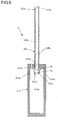
- FIG. 6 is a side sectional view illustrating a still another example of a displacer used in a Stirling engine according to the invention.
- the displacer 4e shown in FIG. 6 uses a displacer piston 41e having the same shape as the displacer piston 41b shown in the second embodiment.
- the displacer piston 41e has a hollow space inside, and has formed therein a gas inlet 413e and gas outlets 414e.
- the rod 42e is formed in the shape of a hollow pipe, and has a hollow space 420e inside.
- the rod 42e has two gas outlets 428e formed therein so as to penetrate it from the hollow space 420e to outside the outer circumferential surface thereof.
- the two gas outlets 428e are formed at angular intervals of 180 degrees.
- the rod 42e has, at one end thereof, a connecting portion 421e, at which the rod 42e is connected to the displacer piston 41e, and is fitted with, at the opposite end 423e thereof, a gas sealing member 424e.
- the displacer piston 41e and the rod 42e are connected together in the same manner as in the second embodiment. Specifically, the externally threaded portion 422e provided in the connecting portion 421e of the rod 42e, at which it is connected to the displacer piston 41 e, is screwed into the internally threaded portion 412e of the displacer piston 4e, and the end of the rod 42e that then appears in the hollow space 410e is locked with a lock nut Nt, which is tightened with a washer W inserted in between. In this way, the rod 42e is connected to the displacer piston 41 e.
- the rod 42e is fitted with the gas sealing member 424e at the end 423e thereof.
- any construction other than specifically described above may be adopted so long as it prevents gas flow via the hollow space 420e between the hollow space 410e inside the displacer piston and the back-pressure space 8 and it instead permits the gas having flowed from the hollow space 410e inside the piston into the hollow space 420 inside the rod to flow out via the gas outlets 428e into the clearance t2.
- the number of gas outlets 428e does not necessarily have to be two as specifically described above; in practice, any number of gas outlets may be provided so long as they can form a gas bearing that can reduce sliding friction between the circumferential side surface of the rod 42e and the slide hole 31.
- the rod of the displacer is formed in the shape of a hollow pipe. This makes the displacer lighter and thus increases the resonance frequency thereof. As a result, it is possible to increase the output (freezing performance) of the Stirling engine.
- the rod of the displacer is formed in the shape of a hollow pipe, the mass of the displacer can be reduced while minimizing the lowering of the stiffness of the rod. As a result, it is possible to provide a Stirling engine that offers high operation reliability, high efficiency, and a long life.
- gas flow can be prevented or reduced between the expansion space and the back-pressure space via the hollow space inside the rod.
- a film of gas having sufficient thickness to serve as a gas bearing is formed in a clearance between the slide hole of the power piston and the rod of the displacer. This helps reduce sliding friction between the slide hole and the rod. As a result, it is possible to provide a Stirling engine that offers accordingly high operation reliability and an accordingly long life.
Landscapes
- Engineering & Computer Science (AREA)
- Chemical & Material Sciences (AREA)
- Combustion & Propulsion (AREA)
- Mechanical Engineering (AREA)
- General Engineering & Computer Science (AREA)
- Compressors, Vaccum Pumps And Other Relevant Systems (AREA)
- Magnetic Bearings And Hydrostatic Bearings (AREA)
- Other Liquid Machine Or Engine Such As Wave Power Use (AREA)
Abstract
Description
- The present invention relates to a free-piston Stirling engine.
- Nowadays, internal combustion engines, for example, those using a heat cycle such as an Otto cycle or a Diesel cycle, are widely used as common mechanical power sources. The problem here is that such internal combustion engines, as by polluting the atmosphere with the exhaust gas they emit, and by producing noise, cause various public hazards, which have been provoking great social controversies.
- On the other hand, refrigerators and the like generally adopt a vapor compression refrigeration cycle which uses a chlorofluorocarbon refrigerant as a working gas to obtain intended cooling performance through evaporation and condensation thereof. The problem here is that chlorofluorocarbons are chemically highly stable, meaning that, once discharged into the atmosphere, they reach the stratosphere and destroy the ozone layer. For this reason, the use and production of specified chlorofluorocarbons are now restricted.
- It is under this background that, free from the problems mentioned above, Stirling engines using a Stirling cycle or a reverse Stirling cycle have been receiving increasing attention.
- A Stirling engine using a Stirling cycle is an external combustion engine, and thus offers the following advantages: it does not require any specific type of heat source; and it is less likely to produce hazardous substances because, even if a fuel is combusted, it is not combusted under high-temperature, high-pressure conditions.
- A Stirling engine as described above uses an environment-friendly gas, such as helium gas, hydrogen gas, or nitrogen gas, as a working gas.
- On the other hand, a Stirling refrigerating unit using a reverse Stirling refrigeration cycle is known as a type of compact cryogenic refrigerating unit.
- FIG. 7 is a side sectional view of a free-piston Stirling refrigerating unit as one example of a Stirling engine.
- The Stirling refrigerating unit B comprises a
pressure container 1, acylinder 2 secured inside thepressure container 1, apower piston 3 and adisplacer 4 provided inside thecylinder 2. Thepower piston 3 and thedisplacer 4 are arranged on the same axis, and reciprocate linearly along the axis. - The
displacer 4 comprises adisplacer piston 41 and arod 42. Therod 42 is placed through aslide hole 31 formed at the center of thepower piston 3, and thepower piston 3 and thedisplacer piston 41 can slide smoothly along an innercircumferential surface 21 of the cylinder. Thepower piston 3 is elastically supported on thepressure container 1 with powerpiston supporting springs 5, and thedisplacer 4 is elastically supported on thepressure container 1 with adisplacer supporting spring 6 via therod 42. - The space inside the
pressure container 1 is divided by thepower piston 3 into two spaces. Of these two spaces, one is awork space 7 located on thedisplacer 4 side of thepower piston 3, and the other is a back-pressure space 8 located on the side of thepower piston 3 opposite to thedisplacer 4. These spaces are filled with a working gas such as high-pressure helium gas. - The
power piston 3 is made to reciprocate with a predetermined cycle time by a piston drive body (here, a linear motor 9). This causes the working gas to be compressed and expanded in thework space 7. Thedisplacer 4 is made to reciprocate linearly by the difference in pressure between in thework space 7 and in the back-pressure space 8. Here, thepower piston 3 and thedisplacer 4 are set so as to reciprocate with the same cycle time but with a predetermined phase difference. As the result of thepower piston 3 and thedisplacer 4 reciprocating with a predetermined phase difference, a reverse Stirling refrigeration cycle is achieved. So long as the operating conditions remain the same, the phase difference is determined by the mass of thedisplacer 4, the spring constant of thedisplacer supporting spring 6, and the operating frequency of thepower piston 3. - The
work space 7 is further divided by thedisplacer piston 41 into two spaces. Of these two spaces, one is acompression space 71 surrounded by thepower piston 3, thedisplacer piston 41, and thecylinder 2, and the other is anexpansion space 72 surrounded by one end of thecylinder 2 and thedisplacer piston 41. Thecompression space 71 is where heat is produced, whereas theexpansion space 72 is where cold is obtained. - The principle of a reverse Stirling refrigeration cycle, including how it produces cold, is widely well-known, and therefore, in such regards, no description will be given in the present specification.
- The
displacer 4 uses the pressure difference between in thecompression space 71 and in the back-pressure space 8 as a drive source for the linear reciprocating motion, and achieves the reciprocating motion by exploiting the resonance between thedisplacer 4 and the supportingspring 6. A flow of the working gas through theslide hole 31 between thework space 7 and the back-pressure space 8 causes a flow loss, which reduces the efficiency of the Stirling engine. Thus, to prevent the engine efficiency from being reduced due to the working gas flowing through theslide hole 31, it is preferable that as small a diametral clearance as possible be left between the inner circumferential surface of theslide hole 31 and the outer circumferential surface of therod 42. - The output (freezing performance) of a free-piston Stirling engine can be increased by increasing the resonance frequency of the
displacer 4. - The aforementioned operating frequency increases as the aforementioned resonance frequency increases, and this can be practically achieved by increasing the resonance frequency of the displacer. The resonance frequency is determined by the mass of the
displacer 4 and the spring constant of thespring 6 elastically supporting thedisplacer 4. Thus, to increase the resonance frequency of the displacer, it is necessary, for example, to reduce the mass of thedisplacer 4 or to increase the spring constant of thespring 6. - The
displacer 4 uses the pressure difference between in thecompression space 71 and in the back-pressure space 8 as a drive source for the linear reciprocating motion, and a force in the axial direction acts on therod 42 facing the back-pressure space 8. Reducing the outer diameter of therod 42 in an attempt to make thedisplacer 4 lighter results in reducing the stiffness of therod 42. This makes therod 42 likely, while reciprocating repeatedly, to be deformed by a force acting thereon in the axial direction. Even a slight deformation in therod 42 may cause therod 42 to come into contact with theslide hole 31 because of the small clearance between therod 42 and theslide hole 31, producing sliding friction where they come into contact with each other. The sliding friction hinders stable reciprocating motion of thedisplacer 4 and thepower piston 3, thereby reducing the efficiency and reliability of the Stirling engine, and shortening the life span thereof, for example. - Even when the components are precisely produced, if the stiffness of the
rod 42 is low, because of the small clearance between therod 42 and theslide hole 31, therod 42 may come into contact with theslide hole 31 at the time of assembly or disassembly, producing sliding friction. - It is therefore an object of the present invention to provide a highly efficient, highly reliable, long-life Stirling engine.
- It is another object of the present invention to provide a Stirling engine that offers good workability by permitting easy assembly and disassembly.
- In order to achieve the above objects, according to one aspect of the present invention, a Stirling engine is provided with: a pressure container filled with a working gas; a cylinder secured inside the pressure container; a power piston provided inside the cylinder; and a displacer provided inside the cylinder on the same axis as the power piston. Here, the displacer is provided with: a displacer piston that slides inside the cylinder; and a rod which is connected and fixed to the displacer piston and placed through a slide hole formed at the center of the power piston. The rod is formed in the shape of a hollow pipe.
- According to another aspect of the present invention, the displacer piston has a hollow space inside. The displacer piston has formed therein: one or more than one inlet via which the working gas flows into the hollow space; and one more than one outlet via which the gas having flowed into the hollow space flows out of it. The inlet penetrates the wall surface to which the rod is connected, from outside the wall surface into the hollow space. The outlet penetrates the circumferential side wall of the displacer piston, from the hollow space to outside the outer circumferential surface of the displacer piston. The rod is provided with means for preventing a working gas that has flowed into the displacer piston via the rod from flowing between a work space located on the displacer side of the power piston inside the pressure container and a back-pressure space located on the side of the power piston opposite to the work space.
-
- FIG. 1 is a side sectional view of a Stirling engine according to the present invention;
- FIG. 2 is a side sectional view of a displacer used in a Stirling engine according to the present invention;
- FIG. 3 is a side sectional view of a displacer used in a Stirling engine according to the present invention;
- FIG. 4 is a side sectional view of a displacer used in a Stirling engine according to the present invention;
- FIG. 5 is a side sectional view of a displacer used in a Stirling engine according to the present invention;
- FIG. 6 is a side sectional view of a displacer used in a Stirling engine according to the present invention; and
- FIG. 7 is a side sectional view of a conventional Stirling engine.
- How the present invention is carried out will be described below with reference to the accompanying drawings. For the sake of convenience, in the following description, such members as are found also in the conventional example shown in FIG. 7 will be identified with common reference characters.
- FIG. 1 is a side sectional view of a free-piston Stirling refrigerating unit as one embodiment of a Stirling engine according to the invention.
- The Stirling refrigerating unit A comprises: a
pressure container 1 filled with a working gas; acylinder 2 secured inside thepressure container 1; apower piston 3 which is slidably disposed on an innercircumferential surface 21 of thecylinder 2; and adisplacer 4a which is arranged on the same axis as thepower piston 3. Thepower piston 3 is elastically supported with powerpiston supporting springs 5. Thedisplacer 4a comprises: adisplacer piston 41a which can slide smoothly along the innercircumferential surface 21 of thecylinder 2; and arod 42a which is placed through aslide hole 31 formed at the center of thepower piston 3. As with thepower piston 3, thedisplacer 4a is elastically supported on thepressure container 1 with adisplacer supporting spring 6 via therod 42a. - The space inside the
cylinder 2 is divided by thepower piston 3 into two spaces. Of these two spaces, one is awork space 7 located on thedisplacer 4a side of thepower piston 3, and the other is a back-pressure space 8 located on the side of thepower piston 3 opposite to thedisplacer 4a. In the example under discussion, these spaces are filled with high-pressure helium gas, though not limited thereto, as the working gas. - The
power piston 3 is made to reciprocate with a predetermined cycle time by a piston drive body (here, a linear motor 9). This causes the working gas to be compressed and expanded in thework space 7. Thedisplacer 4a is made to reciprocate linearly by the difference in pressure between in thework space 7 and in the back-pressure space 8. Here, thepower piston 3 and thedisplacer 4a are set so as to reciprocate with the same cycle time but with a predetermined phase difference. As a result of thepower piston 3 and thedisplacer 4a reciprocating with a predetermined phase difference, a reverse Stirling refrigeration cycle is achieved. So long as the operating conditions remain the same, the phase difference is determined by the mass of thedisplacer 4a, the spring constant of thedisplacer supporting springs 6, and the operating frequency of thepower piston 3. - The
work space 7 is further divided by thedisplacer piston 41a into two spaces. Of these two spaces, one is acompression space 71 surrounded by thepower piston 3, thedisplacer piston 41a, and thecylinder 2, and the other is anexpansion space 72 surrounded by one end of thecylinder 2 and thedisplacer piston 41 a. Thecompression space 71 is where heat is produced, whereas theexpansion space 72 is where cold is obtained. - Hereinafter, embodiments of the present invention will be described in detail. Note that the Stirling engines of all the examples presented below have the same structure as that shown in FIG. 1 except for the structure of the displacer, and therefore the drawings of the examples show their respective displacers alone.
- FIG. 2 is a side sectional view illustrating an example of a displacer used in a Stirling engine according to the invention.
- The
displacer 4a shown in FIG. 2 comprises: adisplacer piston 41a; and arod 42a connected on the same axis as thedisplacer piston 41a. Thedisplacer piston 41a has ahollow space 410a inside. - The
rod 42a is formed in the shape of a hollow pipe. Therod 42a has, at one end thereof, a connectingportion 421a, at which therod 42a is connected to thedisplacer piston 41 a. The connectingportion 421 a has an externally threadedportion 422a formed on the outer circumferential surface thereof. Thedisplacer piston 41a has a rod connecting wall 411 a, which has an internally threadedportion 412a formed at the center thereof. The externally threadedportion 422a is screwed into the internally threadedportion 412a, and the end of therod 42a that then appears in thehollow space 410a is locked with a lock nut Nt, which is then tightened with a washer W inserted in between. In this way, therod 42a is fixed to thedisplacer piston 41 a. - The hollow structure of the
rod 42a permits it to be made lighter. Even then, therod 42a, as compared with a smaller-diameter rod having the same mass, has a larger diameter and thus provides a greater section modulus. This helps secure sufficient bending stiffness against the axial force produced by reciprocating motion. - In this embodiment, the
displacer piston 41 a has ahollow space 410a inside; in practice, a solid displacer piston may be used instead. From the viewpoint of making the displacer lighter, however, it is preferable to use one having a hollow space inside. - FIG. 3 is a side sectional view illustrating another example of a displacer used in a Stirling engine according to the invention.
- The
displacer 4b shown in FIG. 3 comprises: adisplacer piston 41b; and arod 42b having the shape of a hollow pipe. Thedisplacer piston 41b has ahollow space 410b inside. Thedisplacer piston 41b and therod 42b are connected and fixed together in the same manner as in the first embodiment. Specifically, an externally threadedportion 422b of therod 42b is screwed into an internally threadedportion 412b of thedisplacer piston 41 b, and the end of therod 42b that then appears in thehollow space 410b is locked with a lock nut Nt, which is tightened with a washer W inserted in between. In this way, therod 42b is connected to thedisplacer piston 41 b. - The
rod 42b has, at one end thereof, a displacerpiston connecting portion 421b, and is fitted with, at theopposite end 423b thereof, a sealingmember 424b for restraining gas flow. Thedisplacer piston 41b, which has thehollow space 410b inside, has formed therein a workinggas inlet 413b and workinggas outlets 414b. The workinggas inlet 413b, of which there is one, is formed in arod connecting wall 411b of thedisplacer piston 41b. Thegas outlets 414b, of which there are two, are formed at equal angular intervals (here, 180 degrees) about the axis of thedisplacer piston 41 b in the circumferential side walls thereof. - When the
displacer 4b slides, the working gas flows into thehollow space 41 0b inside the displacer piston via thegas inlet 413b. The working gas having flowed into thehollow space 410b flows out of it via thegas outlets 414b. The gas thus having flowed out forms a film of gas in a clearance t1 (see FIG. 1) between thecylinder 2 and thedisplacer piston 41b, and serves as a gas bearing. The working gas that has, with the sliding movement of thedisplacer 4b, flowed into thehollow space 410b inside the displacer piston further flows into ahollow space 420b inside therod 42b, but it can not flow out of it beyond thegas sealing member 424b. In this way, the gas is prevented from flowing between the work space and the back-pressure space. - In this embodiment, only one
gas inlet 413b is formed in thedisplacer piston 41b, and twogas outlets 414b are formed at equal angular intervals about the axis. In practice, however, two or more gas inlets may be provided instead, and any number of gas outlets may be provided in any manner so long as they can satisfactorily reduce the friction between thecylinder 2 and thedisplacer piston 41 b. - In this embodiment, the
gas sealing member 424b is fitted at theend 423b of therod 42b, but it may be fitted elsewhere than at theend 423b so long as it can prevent gas flow. - FIG. 4 is a side sectional view illustrating a still another example of a displacer used in a Stirling engine according to the invention.
- The
displacer 4c shown in FIG. 4 comprises: adisplacer piston 41c; and arod 42c having the shape of a hollow pipe. As with thedisplacer piston 41b shown in FIG. 2, thedisplacer piston 41 c has ahollow space 410c inside, and has formed therein a workinggas inlet 413c and workinggas outlets 414c. - The
rod 42c has, at one end thereof, a connectingportion 421 c, at which therod 42c is connected to thedisplacer piston 41c. The connectingportion 421 c has an internally threadedportion 425c formed on the inner circumferential surface thereof. Thedisplacer piston 41c has arod connecting wall 411 c, which has arod connecting hole 415c formed therein. Thisrod connecting hole 415c extends from the outer surface of therod connecting wall 411c and has a diameter approximately equal to the outer diameter of therod 42c. Therod connecting wall 411c also has abolt inserting hole 416c formed therein. Thisbolt inserting hole 416c extends from the inner surface of therod connecting wall 411 c and has a diameter equal to or greater than the outer diameter of an externally threaded portion of abolt 43c, which will be described later. Therod connecting hole 415c is so formed as to have an inner diameter larger than that of thebolt inserting hole 416c. Therod connecting hole 415c and thebolt inserting hole 416c connect together at substantially the middle of the thickness of therod connecting wall 411c. - The
displacer piston 41c and therod 42c are connected and fixed together in the following manner. Therod 42c is inserted into therod connecting hole 415c. Then, from thehollow space 410c side of thedisplacer piston 41c, abolt 43c having an externally threaded portion having a diameter equal to that of the internally threadedportion 425c is screwed into the internally threadedportion 425c with a washer W inserted in between. In this way, thedisplacer piston 41c and therod 42c are connected together with thebolt 43c. This prevents gas flow between thedisplacer piston 41c and the back-pressure space 8 via ahollow space 420c inside therod 42c, and thus eventually prevents gas flow between thework space 7 and the back-pressure space 8. Thehollow space 420c inside the rod remains a dead space when thedisplacer 4c reciprocates. The gas in thework space 7 does not flow into thehollow space 420c, and this contributes to higher efficiency. - In the example described above, the
rod 42c is simply inserted into therod connecting hole 415c, and is secured in position with thebolt 43c screwed in. Alternatively, therod 42c may be press-fitted into therod connecting hole 415c so as to be firmly secured in position with thebolt 43c screwed into the internally threadedportion 425c. In either case, therod 42c may be inserted or press-fitted into therod connecting hole 415c with adhesive applied to their contact surfaces. - Alternatively, an external thread is formed on the inserted portion of the
rod 42c, and an internal thread is formed on the inner surface of therod connecting hole 415c so that therod 42c can be screwed into therod connecting hole 415c. - After the
rod 42c and thedisplacer piston 41c are connected together in one of the manners described above, therod 42c and therod connecting wall 411c of thedisplacer piston 41c may be welded together to ensure firm fitting. - FIG. 5 is a side sectional view illustrating another example of the displacer in the third embodiment.
- The
displacer 4d shown in FIG. 5 has adisplacer piston 41d having the same shape as thedisplacer piston 41b shown in FIG. 2. - A
rod 42d has, at one end thereof, a connectingportion 421d, at which therod 42d is connected to thedisplacer piston 41d. The connectingportion 421d has an externally threadedportion 422d formed on the outer circumferential surface thereof. The connectingportion 421d has a hollow space inside, in which agas sealing member 427d is provided. - The
displacer piston 41d and therod 42d are connected together in the same manner as in the second embodiment. Specifically, the externally threadedportion 422d of therod 42d, which is here previously provided with thegas sealing member 427d, is screwed into the internally threadedportion 412d of thedisplacer piston 41d, and the end of therod 42d that then appears in thehollow space 410d is locked with a lock nut Nt, which is then tightened with a washer W inserted in between. In this way, therod 42d is connected to thedisplacer piston 41 d. Here, unlike in the second embodiment, the working gas having flowed into thehollow space 410d does not flow into thehollow space 420d inside therod 42d, because it is blocked by thegas sealing member 427d, but instead flows out via thegas outlet 414d. In this way, the gas is prevented from flowing between the back-pressure space 8 and thework space 7 via thehollow space 420d inside therod 42d. - In this embodiment, in order to prevent gas flow between the
hollow space 410c (410d) inside the displacer piston and thehollow space 420c (420d) inside the rod, either thedisplacer piston 41 c and therod 42c are connected together with onebolt 43c, or the rod is provided with thegas sealing member 427d in the connectingportion 421d thereof. In practice, however, any construction other than those specifically described above may be adopted so long as gas flow can be prevented between the hollow space inside the displacer piston and the hollow space inside the rod. - FIG. 6 is a side sectional view illustrating a still another example of a displacer used in a Stirling engine according to the invention.
- The
displacer 4e shown in FIG. 6 uses adisplacer piston 41e having the same shape as thedisplacer piston 41b shown in the second embodiment. Specifically, thedisplacer piston 41e has a hollow space inside, and has formed therein agas inlet 413e andgas outlets 414e. Therod 42e is formed in the shape of a hollow pipe, and has ahollow space 420e inside. Therod 42e has twogas outlets 428e formed therein so as to penetrate it from thehollow space 420e to outside the outer circumferential surface thereof. The twogas outlets 428e are formed at angular intervals of 180 degrees. Therod 42e has, at one end thereof, a connectingportion 421e, at which therod 42e is connected to thedisplacer piston 41e, and is fitted with, at theopposite end 423e thereof, agas sealing member 424e. - The
displacer piston 41e and therod 42e are connected together in the same manner as in the second embodiment. Specifically, the externally threadedportion 422e provided in the connectingportion 421e of therod 42e, at which it is connected to thedisplacer piston 41 e, is screwed into the internally threadedportion 412e of thedisplacer piston 4e, and the end of therod 42e that then appears in thehollow space 410e is locked with a lock nut Nt, which is tightened with a washer W inserted in between. In this way, therod 42e is connected to thedisplacer piston 41 e. - Of the gas that has flowed into the
hollow space 410e from thework space 7 via thegas inlet 413e, part flows out of it via thegas outlets 414e into a clearance between thepiston 41e and thecylinder 2, and the rest flows into thehollow space 420e and then flows out of it via thegas outlets 428e, which are provided in therod 42e, into a clearance t2 (see FIG. 1) between theslide hole 31 and therod 42e, where the gas forms a film of gas. This film of gas serves as a so-called gas bearing for reducing the friction between the inner circumferential surface of theslide hole 31 and the outer circumferential surface of therod 42e when thedisplacer 4e slides. - When the
displacer 4e slides, the gas is prevented from flowing from the back-pressure space 8 into thehollow space 420e inside the rod. In this way, gas flow can be prevented between thework space 7 and the back-pressure space 8. - In this embodiment, the
rod 42e is fitted with thegas sealing member 424e at theend 423e thereof. In practice, however, any construction other than specifically described above may be adopted so long as it prevents gas flow via thehollow space 420e between thehollow space 410e inside the displacer piston and the back-pressure space 8 and it instead permits the gas having flowed from thehollow space 410e inside the piston into the hollow space 420 inside the rod to flow out via thegas outlets 428e into the clearance t2. - The number of
gas outlets 428e does not necessarily have to be two as specifically described above; in practice, any number of gas outlets may be provided so long as they can form a gas bearing that can reduce sliding friction between the circumferential side surface of therod 42e and theslide hole 31. - The first to fourth embodiments described above all deal with Stirling refrigerating units. It should be understood, however, that the present invention can be applied to heat engines such as Stirling engines.
- According to the present invention, the rod of the displacer is formed in the shape of a hollow pipe. This makes the displacer lighter and thus increases the resonance frequency thereof. As a result, it is possible to increase the output (freezing performance) of the Stirling engine.
- Moreover, according to the present invention, since the rod of the displacer is formed in the shape of a hollow pipe, the mass of the displacer can be reduced while minimizing the lowering of the stiffness of the rod. As a result, it is possible to provide a Stirling engine that offers high operation reliability, high efficiency, and a long life.
- Furthermore, according to the present invention, gas flow can be prevented or reduced between the expansion space and the back-pressure space via the hollow space inside the rod. As a result, it is possible to provide a Stirling engine that suffers accordingly less from the lowering of engine efficiency.
- According to the present invention, a film of gas having sufficient thickness to serve as a gas bearing is formed in a clearance between the slide hole of the power piston and the rod of the displacer. This helps reduce sliding friction between the slide hole and the rod. As a result, it is possible to provide a Stirling engine that offers accordingly high operation reliability and an accordingly long life.
Claims (5)
- A free-piston Stirling engine comprising:a pressure container filled with a working gas;a cylinder secured inside the pressure container;a power piston provided inside the cylinder; anda displacer provided inside the cylinder on a same axis as the power piston and elastically supported with a supporting spring,wherein the pressure container comprises: a work space located on a displacer piston side of the power piston; and a back-pressure space located on a side of the power piston opposite to the work space,wherein the displacer comprises: a displacer piston that slides inside the cylinder; and a rod which is connected and fixed to the displacer piston and placed through a slide hole formed at a center of the power piston, andwherein the rod is formed in a shape of a hollow pipe.
- A free-piston Stirling engine comprising:a pressure container filled with a working gas;a cylinder secured inside the pressure container;a power piston provided inside the cylinder; anda displacer provided inside the cylinder on a same axis as the power piston and elastically supported with a supporting spring,wherein the pressure container comprises: a work space located on a displacer piston side of the power piston; and a back-pressure space located on a side of the power piston opposite to the work space,wherein the displacer comprises: a displacer piston that slides inside the cylinder; and a rod which is connected and fixed to the displacer piston and placed through a slide hole formed at a center of the power piston, andwherein the rod is formed in a shape of a hollow pipe to make the displacer lighter and thereby increase a resonance frequency thereof.
- The Stirling engine according to claim 1 or 2,
wherein the displacer piston has a hollow space inside,
wherein the displacer piston has formed therein: one or more than one inlet via which the working gas flows into the hollow space inside the piston; and one or more than one outlet via which the gas having flowed into the hollow space flows out of the hollow space,
wherein the inlet is formed in a wall surface to which the rod is connected, the inlet penetrating the wall surface from outside the wall surface into the hollow space,
wherein the outlet is formed in a side circumferential wall of the displacer piston, the outlet penetrating the side circumferential wall from the hollow space to outside an outer circumferential surface of the displacer piston, and
wherein there is provided means for preventing the working gas from flowing between the work space and the back-pressure space via the hollow space inside the rod. - The Stirling engine according to claim 3,
wherein the means for preventing gas flow prevents gas flow between the hollow space inside the displacer piston and the hollow space inside the rod. - A free-piston Stirling engine comprising:a pressure container filled with a working gas;a cylinder secured inside the pressure container;a power piston provided inside the cylinder; anda displacer provided inside the cylinder on a same axis as the power piston and elastically supported with a supporting spring,wherein the pressure container comprises: a work space located on a displacer piston side of the power piston; and a back-pressure space located on a side of the power piston opposite to the work space,wherein the displacer comprises: a displacer piston sliding inside the cylinder and having a hollow space inside; and a rod which is placed through a slide hole formed at a center of the power piston,wherein the displacer piston has a hollow space inside,wherein the displacer piston has formed therein: one or more than one inlet via which the working gas flows into the hollow space inside the piston; and one or more than one outlet via which the gas having flowed into the hollow space flows out of the hollow space,wherein the inlet is formed in a wall surface to which the rod is connected, the inlet penetrating the wall surface from outside the wall into the hollow space,wherein the outlet is formed so as to penetrate the displacer piston from the hollow space inside the displacer piston to outside an outer circumferential surface thereof,wherein the rod is formed in a shape of a hollow pipe,wherein there is provided, in a part of the hollow space inside the rod located away from the outlet with respect to the displacer piston, means for preventing the working gas from flowing between the work space and the back-pressure space, andwherein there is provided, in a circumferential side wall of a part of the rod inserted in the slide hole, one or more than one gas outlet formed and penetrate, in a direction of a radius of the rod, the circumferential side wall from the hollow space to outside an outer circumferential surface thereof.
Applications Claiming Priority (1)
| Application Number | Priority Date | Filing Date | Title |
|---|---|---|---|
| PCT/JP2004/003700 WO2005090771A1 (en) | 2004-03-18 | 2004-03-18 | Stirling engine |
Publications (1)
| Publication Number | Publication Date |
|---|---|
| EP1734246A1 true EP1734246A1 (en) | 2006-12-20 |
Family
ID=34993764
Family Applications (1)
| Application Number | Title | Priority Date | Filing Date |
|---|---|---|---|
| EP04721726A Withdrawn EP1734246A1 (en) | 2004-03-18 | 2004-03-18 | Stirling engine |
Country Status (6)
| Country | Link |
|---|---|
| US (1) | US7571606B2 (en) |
| EP (1) | EP1734246A1 (en) |
| JP (1) | JPWO2005090771A1 (en) |
| CN (1) | CN100478558C (en) |
| BR (1) | BRPI0418656A (en) |
| WO (1) | WO2005090771A1 (en) |
Cited By (1)
| Publication number | Priority date | Publication date | Assignee | Title |
|---|---|---|---|---|
| NL2024831B1 (en) * | 2020-02-04 | 2021-09-13 | Jacobus Maria Schilder Johannes | Energy transfer apparatus and associated methods |
Families Citing this family (8)
| Publication number | Priority date | Publication date | Assignee | Title |
|---|---|---|---|---|
| CN102146856B (en) * | 2011-05-16 | 2013-12-18 | 南京航空航天大学 | Low-temperature efficient stirling power generation device |
| TWI499718B (en) * | 2013-09-11 | 2015-09-11 | Univ Nat Cheng Kung | Free-piston stirling engine |
| JP6157394B2 (en) * | 2014-03-25 | 2017-07-05 | 住友重機械工業株式会社 | Stirling refrigerator |
| CZ308665B6 (en) * | 2016-09-13 | 2021-02-03 | Jiří Mlček | Heat engine with dynamically controllable hydraulic output |
| CN107101409B (en) * | 2017-05-17 | 2018-01-23 | 宁利平 | Double acting α type sterlin refrigerators |
| CN108331679B (en) * | 2018-04-09 | 2023-09-22 | 杨厚成 | A sound energy generator that prevents radial deflection of the valve piston |
| US11209192B2 (en) * | 2019-07-29 | 2021-12-28 | Cryo Tech Ltd. | Cryogenic Stirling refrigerator with a pneumatic expander |
| CN118997944B (en) * | 2024-10-22 | 2025-02-25 | 湖南大学 | An active air-floating electromagnetic spring Stirling generator |
Family Cites Families (7)
| Publication number | Priority date | Publication date | Assignee | Title |
|---|---|---|---|---|
| US4404802A (en) * | 1981-09-14 | 1983-09-20 | Sunpower, Inc. | Center-porting and bearing system for free-piston stirling engines |
| US4945726A (en) * | 1989-08-23 | 1990-08-07 | Sunpower, Inc. | Leaky gas spring valve for preventing piston overstroke in a free piston stirling engine |
| US5461859A (en) * | 1994-09-08 | 1995-10-31 | Sunpower, Inc. | Centering system with one way valve for free piston machine |
| JPH0996454A (en) | 1995-09-29 | 1997-04-08 | Sanyo Electric Co Ltd | Gas compressing/expanding machine |
| JP3781560B2 (en) * | 1998-07-28 | 2006-05-31 | シャープ株式会社 | Stirling engine |
| US6327862B1 (en) * | 2000-04-26 | 2001-12-11 | Superconductor Technologies, Inc. | Stirling cycle cryocooler with optimized cold end design |
| JP3583770B2 (en) | 2002-09-19 | 2004-11-04 | シャープ株式会社 | Stirling Institution |
-
2004
- 2004-03-18 EP EP04721726A patent/EP1734246A1/en not_active Withdrawn
- 2004-03-18 BR BRPI0418656-7A patent/BRPI0418656A/en not_active IP Right Cessation
- 2004-03-18 US US10/582,785 patent/US7571606B2/en not_active Expired - Fee Related
- 2004-03-18 WO PCT/JP2004/003700 patent/WO2005090771A1/en not_active Ceased
- 2004-03-18 CN CNB2004800424906A patent/CN100478558C/en not_active Expired - Fee Related
- 2004-03-18 JP JP2006511095A patent/JPWO2005090771A1/en active Pending
Non-Patent Citations (1)
| Title |
|---|
| See references of WO2005090771A1 * |
Cited By (1)
| Publication number | Priority date | Publication date | Assignee | Title |
|---|---|---|---|---|
| NL2024831B1 (en) * | 2020-02-04 | 2021-09-13 | Jacobus Maria Schilder Johannes | Energy transfer apparatus and associated methods |
Also Published As
| Publication number | Publication date |
|---|---|
| US20070151239A1 (en) | 2007-07-05 |
| CN1926320A (en) | 2007-03-07 |
| WO2005090771A1 (en) | 2005-09-29 |
| BRPI0418656A (en) | 2007-05-29 |
| JPWO2005090771A1 (en) | 2008-09-18 |
| US7571606B2 (en) | 2009-08-11 |
| CN100478558C (en) | 2009-04-15 |
Similar Documents
| Publication | Publication Date | Title |
|---|---|---|
| EP1734246A1 (en) | Stirling engine | |
| WO2005008149A1 (en) | Stirling engine | |
| KR19980042401A (en) | Stirling Cycle Engine | |
| JP2011017457A (en) | Cold storage type refrigerator | |
| US7581393B2 (en) | Stirling engine | |
| JP3583770B2 (en) | Stirling Institution | |
| CN103017393B (en) | Cryogenic refrigerator | |
| KR100749207B1 (en) | Sterling agency | |
| US5737924A (en) | Gas compressor expander | |
| JP2004325070A (en) | Stirling Institution | |
| KR100314026B1 (en) | Driving system for lubricationless pulse tube refrigerator | |
| JPH11304271A (en) | Cool storage refrigerator and superconducting magnet system using the same | |
| JP6320142B2 (en) | Cryogenic refrigerator | |
| JP2002115652A (en) | Linear compressor | |
| CN1864001A (en) | Threaded sealing flange for use in an external combustion engine and method of sealing a pressure vessel | |
| JP2003021415A (en) | Displacer seal assembly of stirling device | |
| US11725854B2 (en) | Cryocooler | |
| Caughley et al. | Diaphragm pressure wave generator developments at Industrial Research Ltd | |
| Suess et al. | Development and performance measurements of a small compressor for transcritical CO2 applications | |
| JP2004019556A (en) | Stirling Institution | |
| WO2002023101A1 (en) | Structure of sliding part and structure of sliding part of stirling engine | |
| KR100314027B1 (en) | Driving system for lubricationless pulse tube refrigerator | |
| JP2877733B2 (en) | Gas compressor | |
| JP2001317825A (en) | Expander and Stirling refrigerator including the same | |
| KR100304567B1 (en) | Driving apparatus for oil-free pulse tube refrigerator |
Legal Events
| Date | Code | Title | Description |
|---|---|---|---|
| PUAI | Public reference made under article 153(3) epc to a published international application that has entered the european phase |
Free format text: ORIGINAL CODE: 0009012 |
|
| 17P | Request for examination filed |
Effective date: 20061012 |
|
| AK | Designated contracting states |
Kind code of ref document: A1 Designated state(s): AT BE BG CH CY CZ DE DK EE ES FI FR GB GR HU IE IT LI LU MC NL PL PT RO SE SI SK TR |
|
| RIN1 | Information on inventor provided before grant (corrected) |
Inventor name: YAMAGAMI, SHINJI Inventor name: KITAMURA, YOSHIYUKI Inventor name: YASUMURA, HIROSHI Inventor name: YOSHIMURA, KAZUSHI Inventor name: SAKAMOTO, JIN |
|
| DAX | Request for extension of the european patent (deleted) | ||
| STAA | Information on the status of an ep patent application or granted ep patent |
Free format text: STATUS: THE APPLICATION HAS BEEN WITHDRAWN |
|
| 18W | Application withdrawn |
Effective date: 20120403 |