EP1734058A1 - Ethylene and alpha-olefins polymerisation catalyst system based on fluorenyl ligand - Google Patents
Ethylene and alpha-olefins polymerisation catalyst system based on fluorenyl ligand Download PDFInfo
- Publication number
- EP1734058A1 EP1734058A1 EP05105160A EP05105160A EP1734058A1 EP 1734058 A1 EP1734058 A1 EP 1734058A1 EP 05105160 A EP05105160 A EP 05105160A EP 05105160 A EP05105160 A EP 05105160A EP 1734058 A1 EP1734058 A1 EP 1734058A1
- Authority
- EP
- European Patent Office
- Prior art keywords
- catalyst system
- group
- carbon atoms
- substituent
- chosen
- Prior art date
- Legal status (The legal status is an assumption and is not a legal conclusion. Google has not performed a legal analysis and makes no representation as to the accuracy of the status listed.)
- Withdrawn
Links
- 239000003054 catalyst Substances 0.000 title claims abstract description 60
- VGGSQFUCUMXWEO-UHFFFAOYSA-N Ethene Chemical compound C=C VGGSQFUCUMXWEO-UHFFFAOYSA-N 0.000 title claims abstract description 21
- 239000005977 Ethylene Substances 0.000 title claims abstract description 21
- 125000003983 fluorenyl group Chemical group C1(=CC=CC=2C3=CC=CC=C3CC12)* 0.000 title claims abstract description 11
- 239000003446 ligand Substances 0.000 title claims description 5
- 239000004711 α-olefin Substances 0.000 title claims description 5
- -1 cyclopentadienyl-fluorenyl Chemical group 0.000 claims abstract description 36
- 238000000034 method Methods 0.000 claims abstract description 28
- 125000001424 substituent group Chemical group 0.000 claims description 27
- 229920000573 polyethylene Polymers 0.000 claims description 23
- 239000004698 Polyethylene Substances 0.000 claims description 22
- 125000004432 carbon atom Chemical group C* 0.000 claims description 22
- UFHFLCQGNIYNRP-UHFFFAOYSA-N Hydrogen Chemical compound [H][H] UFHFLCQGNIYNRP-UHFFFAOYSA-N 0.000 claims description 20
- 239000001257 hydrogen Substances 0.000 claims description 20
- 229910052739 hydrogen Inorganic materials 0.000 claims description 20
- 230000003213 activating effect Effects 0.000 claims description 14
- 125000000058 cyclopentadienyl group Chemical group C1(=CC=CC1)* 0.000 claims description 14
- 239000003795 chemical substances by application Substances 0.000 claims description 12
- 125000001183 hydrocarbyl group Chemical group 0.000 claims description 12
- 230000000737 periodic effect Effects 0.000 claims description 12
- 239000012968 metallocene catalyst Substances 0.000 claims description 9
- 238000004519 manufacturing process Methods 0.000 claims description 8
- 125000002496 methyl group Chemical group [H]C([H])([H])* 0.000 claims description 8
- QQONPFPTGQHPMA-UHFFFAOYSA-N propylene Natural products CC=C QQONPFPTGQHPMA-UHFFFAOYSA-N 0.000 claims description 8
- 125000004805 propylene group Chemical group [H]C([H])([H])C([H])([*:1])C([H])([H])[*:2] 0.000 claims description 8
- 239000002904 solvent Substances 0.000 claims description 8
- 125000000217 alkyl group Chemical group 0.000 claims description 6
- 150000001875 compounds Chemical class 0.000 claims description 6
- ZSWFCLXCOIISFI-UHFFFAOYSA-N endo-cyclopentadiene Natural products C1C=CC=C1 ZSWFCLXCOIISFI-UHFFFAOYSA-N 0.000 claims description 5
- 229910052736 halogen Inorganic materials 0.000 claims description 5
- 239000000178 monomer Substances 0.000 claims description 5
- 229920013639 polyalphaolefin Polymers 0.000 claims description 5
- 150000002500 ions Chemical class 0.000 claims description 4
- 125000000999 tert-butyl group Chemical group [H]C([H])([H])C(*)(C([H])([H])[H])C([H])([H])[H] 0.000 claims description 4
- 230000002146 bilateral effect Effects 0.000 claims description 3
- 238000006467 substitution reaction Methods 0.000 claims description 3
- 229910052720 vanadium Inorganic materials 0.000 claims description 3
- GPPXJZIENCGNKB-UHFFFAOYSA-N vanadium Chemical compound [V]#[V] GPPXJZIENCGNKB-UHFFFAOYSA-N 0.000 claims description 3
- ZOXJGFHDIHLPTG-UHFFFAOYSA-N Boron Chemical compound [B] ZOXJGFHDIHLPTG-UHFFFAOYSA-N 0.000 claims description 2
- 235000010290 biphenyl Nutrition 0.000 claims description 2
- 239000004305 biphenyl Substances 0.000 claims description 2
- 125000006267 biphenyl group Chemical group 0.000 claims description 2
- 229910052796 boron Inorganic materials 0.000 claims description 2
- 150000001768 cations Chemical class 0.000 claims description 2
- 239000012442 inert solvent Substances 0.000 claims description 2
- 229910052744 lithium Inorganic materials 0.000 claims description 2
- ZUOUZKKEUPVFJK-UHFFFAOYSA-N phenylbenzene Natural products C1=CC=CC=C1C1=CC=CC=C1 ZUOUZKKEUPVFJK-UHFFFAOYSA-N 0.000 claims description 2
- 229910052700 potassium Inorganic materials 0.000 claims description 2
- 229910052708 sodium Inorganic materials 0.000 claims description 2
- 150000003624 transition metals Chemical group 0.000 claims description 2
- 125000005843 halogen group Chemical group 0.000 claims 2
- 125000003250 fulvenyl group Chemical class C1(=CC=CC1=C)* 0.000 claims 1
- 238000002360 preparation method Methods 0.000 abstract description 4
- VLKZOEOYAKHREP-UHFFFAOYSA-N n-Hexane Chemical compound CCCCCC VLKZOEOYAKHREP-UHFFFAOYSA-N 0.000 description 18
- 239000000243 solution Substances 0.000 description 15
- RTZKZFJDLAIYFH-UHFFFAOYSA-N Diethyl ether Chemical compound CCOCC RTZKZFJDLAIYFH-UHFFFAOYSA-N 0.000 description 12
- 229910007928 ZrCl2 Inorganic materials 0.000 description 12
- 230000015572 biosynthetic process Effects 0.000 description 12
- 150000003254 radicals Chemical class 0.000 description 12
- 239000011541 reaction mixture Substances 0.000 description 11
- 238000003786 synthesis reaction Methods 0.000 description 11
- 239000004743 Polypropylene Substances 0.000 description 9
- 229920001155 polypropylene Polymers 0.000 description 9
- VYPSYNLAJGMNEJ-UHFFFAOYSA-N Silicium dioxide Chemical group O=[Si]=O VYPSYNLAJGMNEJ-UHFFFAOYSA-N 0.000 description 8
- 229920000642 polymer Polymers 0.000 description 8
- 229910007926 ZrCl Inorganic materials 0.000 description 7
- 239000003085 diluting agent Substances 0.000 description 7
- 239000000047 product Substances 0.000 description 7
- LIKMAJRDDDTEIG-UHFFFAOYSA-N 1-hexene Chemical compound CCCCC=C LIKMAJRDDDTEIG-UHFFFAOYSA-N 0.000 description 6
- MZRVEZGGRBJDDB-UHFFFAOYSA-N N-Butyllithium Chemical compound [Li]CCCC MZRVEZGGRBJDDB-UHFFFAOYSA-N 0.000 description 6
- NNPPMTNAJDCUHE-UHFFFAOYSA-N isobutane Chemical compound CC(C)C NNPPMTNAJDCUHE-UHFFFAOYSA-N 0.000 description 6
- 239000000203 mixture Substances 0.000 description 6
- 229920000098 polyolefin Polymers 0.000 description 6
- 229920005989 resin Polymers 0.000 description 6
- 239000011347 resin Substances 0.000 description 6
- CPOFMOWDMVWCLF-UHFFFAOYSA-N methyl(oxo)alumane Chemical compound C[Al]=O CPOFMOWDMVWCLF-UHFFFAOYSA-N 0.000 description 5
- 239000000376 reactant Substances 0.000 description 5
- 229920001576 syndiotactic polymer Polymers 0.000 description 5
- LFQSCWFLJHTTHZ-UHFFFAOYSA-N Ethanol Chemical compound CCO LFQSCWFLJHTTHZ-UHFFFAOYSA-N 0.000 description 4
- CSNNHWWHGAXBCP-UHFFFAOYSA-L Magnesium sulfate Chemical compound [Mg+2].[O-][S+2]([O-])([O-])[O-] CSNNHWWHGAXBCP-UHFFFAOYSA-L 0.000 description 4
- OFBQJSOFQDEBGM-UHFFFAOYSA-N Pentane Chemical compound CCCCC OFBQJSOFQDEBGM-UHFFFAOYSA-N 0.000 description 4
- WYURNTSHIVDZCO-UHFFFAOYSA-N Tetrahydrofuran Chemical compound C1CCOC1 WYURNTSHIVDZCO-UHFFFAOYSA-N 0.000 description 4
- 238000005227 gel permeation chromatography Methods 0.000 description 4
- 239000003999 initiator Substances 0.000 description 4
- 239000000155 melt Substances 0.000 description 4
- 239000000377 silicon dioxide Substances 0.000 description 4
- MCULRUJILOGHCJ-UHFFFAOYSA-N triisobutylaluminium Chemical compound CC(C)C[Al](CC(C)C)CC(C)C MCULRUJILOGHCJ-UHFFFAOYSA-N 0.000 description 4
- VPKHRPKIKUFQDT-UHFFFAOYSA-N (2-tert-butyl-4-methylcyclopenta-2,4-dien-1-ylidene)methylbenzene Chemical compound CC(C)(C)C1=CC(C)=CC1=CC1=CC=CC=C1 VPKHRPKIKUFQDT-UHFFFAOYSA-N 0.000 description 3
- YBQNTUVAOZFVIR-UHFFFAOYSA-N 3-tert-butyl-9h-fluorene Chemical compound C1=CC=C2C3=CC(C(C)(C)C)=CC=C3CC2=C1 YBQNTUVAOZFVIR-UHFFFAOYSA-N 0.000 description 3
- 229910018965 MCl2 Inorganic materials 0.000 description 3
- OKKJLVBELUTLKV-UHFFFAOYSA-N Methanol Chemical compound OC OKKJLVBELUTLKV-UHFFFAOYSA-N 0.000 description 3
- 238000005481 NMR spectroscopy Methods 0.000 description 3
- YXFVVABEGXRONW-UHFFFAOYSA-N Toluene Chemical compound CC1=CC=CC=C1 YXFVVABEGXRONW-UHFFFAOYSA-N 0.000 description 3
- 229920001585 atactic polymer Polymers 0.000 description 3
- 229910052799 carbon Inorganic materials 0.000 description 3
- 229920001577 copolymer Polymers 0.000 description 3
- 238000009826 distribution Methods 0.000 description 3
- 235000013305 food Nutrition 0.000 description 3
- 150000002367 halogens Chemical group 0.000 description 3
- 229920001903 high density polyethylene Polymers 0.000 description 3
- 239000004700 high-density polyethylene Substances 0.000 description 3
- 229910052809 inorganic oxide Inorganic materials 0.000 description 3
- 239000001282 iso-butane Substances 0.000 description 3
- 229920001580 isotactic polymer Polymers 0.000 description 3
- 239000007788 liquid Substances 0.000 description 3
- 239000000463 material Substances 0.000 description 3
- 229920001179 medium density polyethylene Polymers 0.000 description 3
- 239000004701 medium-density polyethylene Substances 0.000 description 3
- 229920013716 polyethylene resin Polymers 0.000 description 3
- 239000002002 slurry Substances 0.000 description 3
- NLXLAEXVIDQMFP-UHFFFAOYSA-N Ammonia chloride Chemical compound [NH4+].[Cl-] NLXLAEXVIDQMFP-UHFFFAOYSA-N 0.000 description 2
- XKRFYHLGVUSROY-UHFFFAOYSA-N Argon Chemical compound [Ar] XKRFYHLGVUSROY-UHFFFAOYSA-N 0.000 description 2
- VYZAMTAEIAYCRO-UHFFFAOYSA-N Chromium Chemical compound [Cr] VYZAMTAEIAYCRO-UHFFFAOYSA-N 0.000 description 2
- YMWUJEATGCHHMB-UHFFFAOYSA-N Dichloromethane Chemical compound ClCCl YMWUJEATGCHHMB-UHFFFAOYSA-N 0.000 description 2
- IMNFDUFMRHMDMM-UHFFFAOYSA-N N-Heptane Chemical compound CCCCCCC IMNFDUFMRHMDMM-UHFFFAOYSA-N 0.000 description 2
- 239000011954 Ziegler–Natta catalyst Substances 0.000 description 2
- 229910007932 ZrCl4 Inorganic materials 0.000 description 2
- 150000001336 alkenes Chemical class 0.000 description 2
- 239000004411 aluminium Substances 0.000 description 2
- 229910052782 aluminium Inorganic materials 0.000 description 2
- HUMNYLRZRPPJDN-UHFFFAOYSA-N benzaldehyde Chemical compound O=CC1=CC=CC=C1 HUMNYLRZRPPJDN-UHFFFAOYSA-N 0.000 description 2
- 239000011230 binding agent Substances 0.000 description 2
- 238000006243 chemical reaction Methods 0.000 description 2
- 229910052804 chromium Inorganic materials 0.000 description 2
- 239000011651 chromium Substances 0.000 description 2
- 239000000706 filtrate Substances 0.000 description 2
- 239000002815 homogeneous catalyst Substances 0.000 description 2
- 238000005984 hydrogenation reaction Methods 0.000 description 2
- 125000000654 isopropylidene group Chemical group C(C)(C)=* 0.000 description 2
- 229920001684 low density polyethylene Polymers 0.000 description 2
- 239000004702 low-density polyethylene Substances 0.000 description 2
- 229910052943 magnesium sulfate Inorganic materials 0.000 description 2
- 238000002844 melting Methods 0.000 description 2
- 230000008018 melting Effects 0.000 description 2
- 229910052751 metal Inorganic materials 0.000 description 2
- 239000002184 metal Substances 0.000 description 2
- 239000012044 organic layer Substances 0.000 description 2
- 125000002524 organometallic group Chemical group 0.000 description 2
- 125000001997 phenyl group Chemical group [H]C1=C([H])C([H])=C(*)C([H])=C1[H] 0.000 description 2
- 239000000843 powder Substances 0.000 description 2
- 239000002244 precipitate Substances 0.000 description 2
- 229910052701 rubidium Inorganic materials 0.000 description 2
- 229910052710 silicon Inorganic materials 0.000 description 2
- 239000007787 solid Substances 0.000 description 2
- 238000012360 testing method Methods 0.000 description 2
- YLQBMQCUIZJEEH-UHFFFAOYSA-N tetrahydrofuran Natural products C=1C=COC=1 YLQBMQCUIZJEEH-UHFFFAOYSA-N 0.000 description 2
- VOITXYVAKOUIBA-UHFFFAOYSA-N triethylaluminium Chemical compound CC[Al](CC)CC VOITXYVAKOUIBA-UHFFFAOYSA-N 0.000 description 2
- 239000003039 volatile agent Substances 0.000 description 2
- DUNKXUFBGCUVQW-UHFFFAOYSA-J zirconium tetrachloride Chemical compound Cl[Zr](Cl)(Cl)Cl DUNKXUFBGCUVQW-UHFFFAOYSA-J 0.000 description 2
- 125000004209 (C1-C8) alkyl group Chemical group 0.000 description 1
- UJXXVGXQTXQALL-UHFFFAOYSA-N 1-cyclopenta-2,4-dien-1-ylidene-n,n-dimethylmethanamine Chemical compound CN(C)C=C1C=CC=C1 UJXXVGXQTXQALL-UHFFFAOYSA-N 0.000 description 1
- YBYIRNPNPLQARY-UHFFFAOYSA-N 1H-indene Natural products C1=CC=C2CC=CC2=C1 YBYIRNPNPLQARY-UHFFFAOYSA-N 0.000 description 1
- HDHYMLWPVAELKP-UHFFFAOYSA-N 2-methyl-5-propan-2-ylidenecyclopenta-1,3-diene Chemical compound CC(C)=C1C=CC(C)=C1 HDHYMLWPVAELKP-UHFFFAOYSA-N 0.000 description 1
- FFEXBNSBUHRMOY-UHFFFAOYSA-N 2-tert-butyl-5-propan-2-ylidenecyclopenta-1,3-diene Chemical compound CC(C)=C1C=CC(C(C)(C)C)=C1 FFEXBNSBUHRMOY-UHFFFAOYSA-N 0.000 description 1
- UNGLAWCETLUCRC-UHFFFAOYSA-N 3-tert-butyl-1-methyl-5-propan-2-ylidenecyclopenta-1,3-diene Chemical compound CC(C)=C1C=C(C(C)(C)C)C=C1C UNGLAWCETLUCRC-UHFFFAOYSA-N 0.000 description 1
- FSJVREFHLVPDCB-UHFFFAOYSA-N 3-tert-butyl-1-methylcyclopenta-1,3-diene Chemical compound CC1=CC(C(C)(C)C)=CC1 FSJVREFHLVPDCB-UHFFFAOYSA-N 0.000 description 1
- WXACXMWYHXOSIX-UHFFFAOYSA-N 5-propan-2-ylidenecyclopenta-1,3-diene Chemical compound CC(C)=C1C=CC=C1 WXACXMWYHXOSIX-UHFFFAOYSA-N 0.000 description 1
- 0 CCCC(C)*C(CC(C)C1CC2C3(C)C4C=CC=CC4C4C=C(C(C)(*)CCC)C=CC24)CC1*3(Cl)Cl Chemical compound CCCC(C)*C(CC(C)C1CC2C3(C)C4C=CC=CC4C4C=C(C(C)(*)CCC)C=CC24)CC1*3(Cl)Cl 0.000 description 1
- DNWDVSWSQOVWKR-UHFFFAOYSA-N CCCCc1cc(-c2c(C3)cccc2)c3cc1 Chemical compound CCCCc1cc(-c2c(C3)cccc2)c3cc1 DNWDVSWSQOVWKR-UHFFFAOYSA-N 0.000 description 1
- XDTMQSROBMDMFD-UHFFFAOYSA-N Cyclohexane Chemical compound C1CCCCC1 XDTMQSROBMDMFD-UHFFFAOYSA-N 0.000 description 1
- 239000004831 Hot glue Substances 0.000 description 1
- 229920010126 Linear Low Density Polyethylene (LLDPE) Polymers 0.000 description 1
- 206010034962 Photopsia Diseases 0.000 description 1
- XUIMIQQOPSSXEZ-UHFFFAOYSA-N Silicon Chemical group [Si] XUIMIQQOPSSXEZ-UHFFFAOYSA-N 0.000 description 1
- 238000002441 X-ray diffraction Methods 0.000 description 1
- NXFSPKRQHGRAAL-UHFFFAOYSA-L [Cl-].[Cl-].C(C)(C)[Zr+2](C1=CC=CC=2C3=CC=CC=C3CC1=2)C1C=CC=C1 Chemical compound [Cl-].[Cl-].C(C)(C)[Zr+2](C1=CC=CC=2C3=CC=CC=C3CC1=2)C1C=CC=C1 NXFSPKRQHGRAAL-UHFFFAOYSA-L 0.000 description 1
- POQKGIPYRUOMMU-UHFFFAOYSA-N [O-]B[O-].C1=CC=CC=C1[C+](C=1C=CC=CC=1)C1=CC=CC=C1.C1=CC=CC=C1[C+](C=1C=CC=CC=1)C1=CC=CC=C1 Chemical compound [O-]B[O-].C1=CC=CC=C1[C+](C=1C=CC=CC=1)C1=CC=CC=C1.C1=CC=CC=C1[C+](C=1C=CC=CC=1)C1=CC=CC=C1 POQKGIPYRUOMMU-UHFFFAOYSA-N 0.000 description 1
- BULLHRADHZGONG-UHFFFAOYSA-N [cyclopenta-2,4-dien-1-ylidene(phenyl)methyl]benzene Chemical compound C1=CC=CC1=C(C=1C=CC=CC=1)C1=CC=CC=C1 BULLHRADHZGONG-UHFFFAOYSA-N 0.000 description 1
- 239000000853 adhesive Substances 0.000 description 1
- 230000001070 adhesive effect Effects 0.000 description 1
- 150000001335 aliphatic alkanes Chemical class 0.000 description 1
- 125000001931 aliphatic group Chemical group 0.000 description 1
- 125000003342 alkenyl group Chemical group 0.000 description 1
- 125000002877 alkyl aryl group Chemical group 0.000 description 1
- 229940100198 alkylating agent Drugs 0.000 description 1
- 239000002168 alkylating agent Substances 0.000 description 1
- 125000002947 alkylene group Chemical group 0.000 description 1
- 125000001118 alkylidene group Chemical group 0.000 description 1
- XAGFODPZIPBFFR-UHFFFAOYSA-N aluminium Chemical compound [Al] XAGFODPZIPBFFR-UHFFFAOYSA-N 0.000 description 1
- 150000001412 amines Chemical group 0.000 description 1
- 229910052786 argon Inorganic materials 0.000 description 1
- 125000003710 aryl alkyl group Chemical group 0.000 description 1
- 125000003118 aryl group Chemical group 0.000 description 1
- 230000002902 bimodal effect Effects 0.000 description 1
- 230000009172 bursting Effects 0.000 description 1
- 125000000484 butyl group Chemical group [H]C([*])([H])C([H])([H])C([H])([H])C([H])([H])[H] 0.000 description 1
- 230000003197 catalytic effect Effects 0.000 description 1
- 230000001143 conditioned effect Effects 0.000 description 1
- 238000001816 cooling Methods 0.000 description 1
- 239000013078 crystal Substances 0.000 description 1
- 125000004122 cyclic group Chemical group 0.000 description 1
- 125000002704 decyl group Chemical group [H]C([H])([H])C([H])([H])C([H])([H])C([H])([H])C([H])([H])C([H])([H])C([H])([H])C([H])([H])C([H])([H])C([H])([H])* 0.000 description 1
- KPUWHANPEXNPJT-UHFFFAOYSA-N disiloxane Chemical group [SiH3]O[SiH3] KPUWHANPEXNPJT-UHFFFAOYSA-N 0.000 description 1
- 239000003814 drug Substances 0.000 description 1
- 229940079593 drug Drugs 0.000 description 1
- 230000009977 dual effect Effects 0.000 description 1
- HQQADJVZYDDRJT-UHFFFAOYSA-N ethene;prop-1-ene Chemical group C=C.CC=C HQQADJVZYDDRJT-UHFFFAOYSA-N 0.000 description 1
- 125000001495 ethyl group Chemical group [H]C([H])([H])C([H])([H])* 0.000 description 1
- 230000001747 exhibiting effect Effects 0.000 description 1
- 238000002474 experimental method Methods 0.000 description 1
- 150000002234 fulvenes Chemical class 0.000 description 1
- 229910052732 germanium Inorganic materials 0.000 description 1
- GNPVGFCGXDBREM-UHFFFAOYSA-N germanium atom Chemical group [Ge] GNPVGFCGXDBREM-UHFFFAOYSA-N 0.000 description 1
- 229910052735 hafnium Inorganic materials 0.000 description 1
- 238000010438 heat treatment Methods 0.000 description 1
- 125000003187 heptyl group Chemical group [H]C([*])([H])C([H])([H])C([H])([H])C([H])([H])C([H])([H])C([H])([H])C([H])([H])[H] 0.000 description 1
- 125000004051 hexyl group Chemical group [H]C([H])([H])C([H])([H])C([H])([H])C([H])([H])C([H])([H])C([H])([H])* 0.000 description 1
- 238000013537 high throughput screening Methods 0.000 description 1
- 229930195733 hydrocarbon Natural products 0.000 description 1
- 150000002430 hydrocarbons Chemical class 0.000 description 1
- 238000011065 in-situ storage Methods 0.000 description 1
- 125000003454 indenyl group Chemical group C1(C=CC2=CC=CC=C12)* 0.000 description 1
- 238000002347 injection Methods 0.000 description 1
- 239000007924 injection Substances 0.000 description 1
- 125000000959 isobutyl group Chemical group [H]C([H])([H])C([H])(C([H])([H])[H])C([H])([H])* 0.000 description 1
- 125000001972 isopentyl group Chemical group [H]C([H])([H])C([H])(C([H])([H])[H])C([H])([H])C([H])([H])* 0.000 description 1
- 125000001449 isopropyl group Chemical group [H]C([H])([H])C([H])(*)C([H])([H])[H] 0.000 description 1
- 235000020094 liqueur Nutrition 0.000 description 1
- 239000007791 liquid phase Substances 0.000 description 1
- IHLVCKWPAMTVTG-UHFFFAOYSA-N lithium;carbanide Chemical group [Li+].[CH3-] IHLVCKWPAMTVTG-UHFFFAOYSA-N 0.000 description 1
- 235000019341 magnesium sulphate Nutrition 0.000 description 1
- SYSQUGFVNFXIIT-UHFFFAOYSA-N n-[4-(1,3-benzoxazol-2-yl)phenyl]-4-nitrobenzenesulfonamide Chemical class C1=CC([N+](=O)[O-])=CC=C1S(=O)(=O)NC1=CC=C(C=2OC3=CC=CC=C3N=2)C=C1 SYSQUGFVNFXIIT-UHFFFAOYSA-N 0.000 description 1
- 125000000740 n-pentyl group Chemical group [H]C([H])([H])C([H])([H])C([H])([H])C([H])([H])C([H])([H])* 0.000 description 1
- 125000001400 nonyl group Chemical group [H]C([*])([H])C([H])([H])C([H])([H])C([H])([H])C([H])([H])C([H])([H])C([H])([H])C([H])([H])C([H])([H])[H] 0.000 description 1
- 125000002347 octyl group Chemical group [H]C([*])([H])C([H])([H])C([H])([H])C([H])([H])C([H])([H])C([H])([H])C([H])([H])C([H])([H])[H] 0.000 description 1
- 230000003287 optical effect Effects 0.000 description 1
- 238000004806 packaging method and process Methods 0.000 description 1
- 125000000913 palmityl group Chemical group [H]C([*])([H])C([H])([H])C([H])([H])C([H])([H])C([H])([H])C([H])([H])C([H])([H])C([H])([H])C([H])([H])C([H])([H])C([H])([H])C([H])([H])C([H])([H])C([H])([H])C([H])([H])C([H])([H])[H] 0.000 description 1
- QNGNSVIICDLXHT-UHFFFAOYSA-N para-ethylbenzaldehyde Natural products CCC1=CC=C(C=O)C=C1 QNGNSVIICDLXHT-UHFFFAOYSA-N 0.000 description 1
- 239000002245 particle Substances 0.000 description 1
- 229910000065 phosphene Inorganic materials 0.000 description 1
- 230000000704 physical effect Effects 0.000 description 1
- 229920005638 polyethylene monopolymer Polymers 0.000 description 1
- 238000006116 polymerization reaction Methods 0.000 description 1
- 239000011148 porous material Substances 0.000 description 1
- 125000001436 propyl group Chemical group [H]C([*])([H])C([H])([H])C([H])([H])[H] 0.000 description 1
- 239000002516 radical scavenger Substances 0.000 description 1
- 239000012047 saturated solution Substances 0.000 description 1
- 239000010703 silicon Chemical group 0.000 description 1
- 238000003756 stirring Methods 0.000 description 1
- 239000000126 substance Substances 0.000 description 1
- 239000000454 talc Substances 0.000 description 1
- 229910052623 talc Inorganic materials 0.000 description 1
- 229920005992 thermoplastic resin Polymers 0.000 description 1
- 229910052719 titanium Inorganic materials 0.000 description 1
- 238000012546 transfer Methods 0.000 description 1
- XLYOFNOQVPJJNP-UHFFFAOYSA-N water Substances O XLYOFNOQVPJJNP-UHFFFAOYSA-N 0.000 description 1
- 229910052726 zirconium Inorganic materials 0.000 description 1
Images

Classifications
-
- C—CHEMISTRY; METALLURGY
- C08—ORGANIC MACROMOLECULAR COMPOUNDS; THEIR PREPARATION OR CHEMICAL WORKING-UP; COMPOSITIONS BASED THEREON
- C08F—MACROMOLECULAR COMPOUNDS OBTAINED BY REACTIONS ONLY INVOLVING CARBON-TO-CARBON UNSATURATED BONDS
- C08F4/00—Polymerisation catalysts
- C08F4/42—Metals; Metal hydrides; Metallo-organic compounds; Use thereof as catalyst precursors
- C08F4/44—Metals; Metal hydrides; Metallo-organic compounds; Use thereof as catalyst precursors selected from light metals, zinc, cadmium, mercury, copper, silver, gold, boron, gallium, indium, thallium, rare earths or actinides
- C08F4/60—Metals; Metal hydrides; Metallo-organic compounds; Use thereof as catalyst precursors selected from light metals, zinc, cadmium, mercury, copper, silver, gold, boron, gallium, indium, thallium, rare earths or actinides together with refractory metals, iron group metals, platinum group metals, manganese, rhenium technetium or compounds thereof
- C08F4/62—Refractory metals or compounds thereof
- C08F4/64—Titanium, zirconium, hafnium or compounds thereof
- C08F4/642—Component covered by group C08F4/64 with an organo-aluminium compound
-
- C—CHEMISTRY; METALLURGY
- C08—ORGANIC MACROMOLECULAR COMPOUNDS; THEIR PREPARATION OR CHEMICAL WORKING-UP; COMPOSITIONS BASED THEREON
- C08F—MACROMOLECULAR COMPOUNDS OBTAINED BY REACTIONS ONLY INVOLVING CARBON-TO-CARBON UNSATURATED BONDS
- C08F10/00—Homopolymers and copolymers of unsaturated aliphatic hydrocarbons having only one carbon-to-carbon double bond
-
- C—CHEMISTRY; METALLURGY
- C08—ORGANIC MACROMOLECULAR COMPOUNDS; THEIR PREPARATION OR CHEMICAL WORKING-UP; COMPOSITIONS BASED THEREON
- C08F—MACROMOLECULAR COMPOUNDS OBTAINED BY REACTIONS ONLY INVOLVING CARBON-TO-CARBON UNSATURATED BONDS
- C08F4/00—Polymerisation catalysts
- C08F4/02—Carriers therefor
-
- C—CHEMISTRY; METALLURGY
- C08—ORGANIC MACROMOLECULAR COMPOUNDS; THEIR PREPARATION OR CHEMICAL WORKING-UP; COMPOSITIONS BASED THEREON
- C08F—MACROMOLECULAR COMPOUNDS OBTAINED BY REACTIONS ONLY INVOLVING CARBON-TO-CARBON UNSATURATED BONDS
- C08F4/00—Polymerisation catalysts
- C08F4/42—Metals; Metal hydrides; Metallo-organic compounds; Use thereof as catalyst precursors
- C08F4/44—Metals; Metal hydrides; Metallo-organic compounds; Use thereof as catalyst precursors selected from light metals, zinc, cadmium, mercury, copper, silver, gold, boron, gallium, indium, thallium, rare earths or actinides
- C08F4/60—Metals; Metal hydrides; Metallo-organic compounds; Use thereof as catalyst precursors selected from light metals, zinc, cadmium, mercury, copper, silver, gold, boron, gallium, indium, thallium, rare earths or actinides together with refractory metals, iron group metals, platinum group metals, manganese, rhenium technetium or compounds thereof
- C08F4/62—Refractory metals or compounds thereof
- C08F4/64—Titanium, zirconium, hafnium or compounds thereof
-
- C—CHEMISTRY; METALLURGY
- C08—ORGANIC MACROMOLECULAR COMPOUNDS; THEIR PREPARATION OR CHEMICAL WORKING-UP; COMPOSITIONS BASED THEREON
- C08F—MACROMOLECULAR COMPOUNDS OBTAINED BY REACTIONS ONLY INVOLVING CARBON-TO-CARBON UNSATURATED BONDS
- C08F4/00—Polymerisation catalysts
- C08F4/42—Metals; Metal hydrides; Metallo-organic compounds; Use thereof as catalyst precursors
- C08F4/44—Metals; Metal hydrides; Metallo-organic compounds; Use thereof as catalyst precursors selected from light metals, zinc, cadmium, mercury, copper, silver, gold, boron, gallium, indium, thallium, rare earths or actinides
- C08F4/60—Metals; Metal hydrides; Metallo-organic compounds; Use thereof as catalyst precursors selected from light metals, zinc, cadmium, mercury, copper, silver, gold, boron, gallium, indium, thallium, rare earths or actinides together with refractory metals, iron group metals, platinum group metals, manganese, rhenium technetium or compounds thereof
- C08F4/62—Refractory metals or compounds thereof
- C08F4/64—Titanium, zirconium, hafnium or compounds thereof
- C08F4/659—Component covered by group C08F4/64 containing a transition metal-carbon bond
- C08F4/65912—Component covered by group C08F4/64 containing a transition metal-carbon bond in combination with an organoaluminium compound
-
- C—CHEMISTRY; METALLURGY
- C08—ORGANIC MACROMOLECULAR COMPOUNDS; THEIR PREPARATION OR CHEMICAL WORKING-UP; COMPOSITIONS BASED THEREON
- C08F—MACROMOLECULAR COMPOUNDS OBTAINED BY REACTIONS ONLY INVOLVING CARBON-TO-CARBON UNSATURATED BONDS
- C08F4/00—Polymerisation catalysts
- C08F4/42—Metals; Metal hydrides; Metallo-organic compounds; Use thereof as catalyst precursors
- C08F4/44—Metals; Metal hydrides; Metallo-organic compounds; Use thereof as catalyst precursors selected from light metals, zinc, cadmium, mercury, copper, silver, gold, boron, gallium, indium, thallium, rare earths or actinides
- C08F4/60—Metals; Metal hydrides; Metallo-organic compounds; Use thereof as catalyst precursors selected from light metals, zinc, cadmium, mercury, copper, silver, gold, boron, gallium, indium, thallium, rare earths or actinides together with refractory metals, iron group metals, platinum group metals, manganese, rhenium technetium or compounds thereof
- C08F4/62—Refractory metals or compounds thereof
- C08F4/64—Titanium, zirconium, hafnium or compounds thereof
- C08F4/659—Component covered by group C08F4/64 containing a transition metal-carbon bond
- C08F4/65916—Component covered by group C08F4/64 containing a transition metal-carbon bond supported on a carrier, e.g. silica, MgCl2, polymer
Definitions
- the present invention relates to a metallocene catalyst component for use in preparing polyolefins.
- the invention further relates to a catalyst system that incorporates the metallocene catalyst component and a process for preparing polyolefins.
- Polyethylene is known for use in the manufacture of a wide variety of articles.
- the polyethylene polymerisation process can be varied in a number of respects to produce a wide variety of resultant polyethylene resins having different physical properties that render the various resins suitable for use in different applications.
- Medium density polyethylene resins are known for use in making films. Such medium density films are known to have good resin processability due to the presence of long chain branching in the polyethylene polymer molecules. It is known to produce such resins using chromium-based catalysts, which have been known for some time.
- ethylene monomer, and optionally an alpha-olefinic comonomer typically having from 3 to 10 carbon atoms are circulated under pressure around a loop reactor by a circulation pump.
- the ethylene monomer and optional comonomer are present in a liquid diluent, such as an alkane, for example isobutane.
- Hydrogen may also be added to the reactor.
- a catalyst is also fed to the loop reactor.
- the catalyst for producing polyethylene may typically comprise a chromium-based catalyst, a Ziegler-Natta catalyst or a metallocene catalyst.
- the reactants in the diluent and the catalyst are circulated at an elevated polymerisation temperature around the loop reactor thereby producing polyethylene homopolymer or copolymer depending on whether or not a comonomer is present.
- part of the reaction mixture including the polyethylene product suspended as slurry particles in the diluent, together with unreacted ethylene and comonomer, is removed from the loop reactor.
- a liquid diluent for example isobutane.
- a first reactor there is substantially homopolymerisation, optionally with a minor degree of copolymerisation, and hydrogen is introduced into the first reactor to achieve the required homopolymerisation.
- Copolymerisation is carried out in the second reactor.
- a hydrogenation catalyst is introduced into the reactants downstream of the first reactor. This process requires the use of an additional hydrogenation catalyst.
- the reaction mixture when removed from the loop reactor may be processed to remove the polyethylene product from the diluent and the unreacted reactants, with the diluent and unreacted reactants typically being recycled back into the loop reactor.
- the reaction mixture may be fed to a second loop reactor serially connected to the first loop reactor where a second polyethylene fraction may be produced.
- the resultant polyethylene product which comprises a first polyethylene fraction produced in the first reactor and a second polyethylene fraction produced in the second reactor, has a bimodal molecular weight distribution.
- the homo- or co-polymerisation of ethylene may also be carried out under high pressure of ethylene and optional comonomers by the radical route.
- Ethylene polymers are obtained by homopolymerising ethylene or by copolymerising it with at least one other comonomer in a polymerisation system which operates continuously under pressures of the order of 50 MPa to 500 MPa and at temperatures of between 50 and 300°C.
- the polymerisation is carried out in continuous tubular reactors or stirred autoclaves in the presence of initiators and optionally of transfer agents.
- the polymers are subsequently separated from the volatile substances after their departure from the reactor in separators.
- radical polymerisations can be controlled using stable free radicals, this control making it possible in particular to obtain polymers exhibiting narrow molecular mass distribution.
- US-A-5,449,724 discloses a radical polymerisation process that consists in heating, at a temperature of from 40°C to 500°C and under a pressure of from 50 MPa to 500 MPa, a mixture composed of a free radical initiator, of a stable free radical and of ethylene, in order to form a thermoplastic resin which has a molecular mass distribution of from 1.0 to 2.0.
- Olefins having 3 or more carbon atoms can be polymerised to produce a polymer with an isotactic stereochemical configuration.
- the isotactic structure is typically described as having methyl groups attached to the tertiary carbon atoms of successive monomeric units on the same side of a hypothetical plane through the main chain of the polymer. This can be described using the Fischer projection formula as follows:
- Bovey's NMR nomenclature for an isotactic pentad is ... mmmm with each "m” representing a “meso" diad or successive methyl groups on the same side in the plane.
- syndiotactic polymers are those in which the methyl groups attached to the tertiary carbon atoms of successive monomeric units in the chain lie on alternate sides of the plane of the polymer.
- Fischer projection formula the structure of a syndiotactic polymer is described as follows:
- an atactic polymer In contrast to isotactic and syndiotactic polymers, an atactic polymer exhibits no regular order of repeating unit. Unlike syndiotactic or isotactic polymers, an atactic polymer is not crystalline and forms essentially a waxy product.
- C2-symmetric metallocene catalysts are known in the production of the polyolefins.
- C2 symmetric bis indenyl type zirconocenes can produce high molecular weight, high melting temperature, isotactic polypropylene.
- the preparation of this metallocene catalyst is however costly and time-consuming.
- the final catalyst consists of a mixture of racemic and meso isomers in an often unfavourable ratio. The meso stereoisomer has to be separated to avoid the formation of atactic polypropylene during the polymerisation reaction.
- Cs-symmetric metallocene catalysts are known in the production of the syndiotactic polyolefins.
- EP-A-0426644 relates to syndiotactic copolymers of olefins such as propylene obtainable using as a catalyst component isopropyl (fluorenyl)(cyclopentadienyl) zirconium dichloride. Syndiotacticity, as measured by the amount of syndiotactic pentads, rrrr was found to be 73-80%.
- EP-A-577581 discloses the production of syndiotactic polypropylene using metallocene catalysts which have fluorenyl groups substituted in positions 2 and 7 and an unsubstituted cyclopentadienyl ring.
- the present invention discloses a catalyst system for homo- or co-polymerising ethylene and/or alpha-olefins based on a catalyst component of general formula I R" (CpR 1 R 2 R 3 )(FluR' m )MQ 2 (I) wherein Cp is a cyclopentadienyl ring, wherein R 1 is H or a substituent on the cyclopentadienyl ring which is distal to the bridge, which distal substituent comprises a group of the formula XR* 3 in which X is chosen from Group 14 of the periodic table, and each R* is the same or different and chosen from hydrogen or hydrocarbyl of from 1 to 20 carbon atoms, wherein R 2 is H or a substituent on the cyclopentadienyl ring which is proximal to the bridge and positioned non-vicinal to the distal substituent and is of the formula YR# 3 in which Y is chosen from group 14 of the Periodic Table
- the cyclopentadienyl When the cyclopentadienyl is substituted, it is preferably mono- or di-substituted. When it is mono-substituted, the preferred substituent is R 1 located at a position distal to the bridge. When it is di-substituted, the preferred substituents are R 1 and R 2 located respectively at a position distal to the bridge and at a position proximal to the bridge non-vicinal to the other substituent.
- R 1 is preferably C or Si.
- R* may be a hydrocarbyl such as alkyl, aryl, alkenyl, alkylaryl or aryl alkyl, preferably methyl, ethyl, propyl, isopropyl, butyl, isobutyl, amyl, isoamyl, hexyl, heptyl, octyl, nonyl, decyl, cetyl or phenyl.
- R 1 may comprise a hydrocarbyl which is attached to a single carbon atom in the cyclopentadienyl ring or may be bonded to two carbon atoms in that ring.
- R 1 is H, or methyl, or t-butyl or Me 3 Si, most preferably, R 1 is t-butyl.
- the proximal substituent R 2 is preferably H or Me.
- any position other than 3 or 6 may be occupied by a substituent. More preferably, there is a single substituent on the fluorenyl, most preferably located at position 6 as represented in Figure 1 a or at position 3, as represented in Figure 1 b.
- the structural bridge R" is preferably alkylidene having 1 to 20 aliphatic or aromatic carbon atoms, a dialkyl germanium or silicon or siloxane, alkyl phosphene or amine bridging the two Cp rings.
- R" is preferably isopropylidene in which the two Cp rings are bridged at position 2 of the isopropylidene or it comprises the moiety TR a R b , in which T is chosen from group 14 of the Periodic Table, and each of R a and R b is independently substituted or unsubstituted phenyl linked to T directly or by C 1 -C 4 alkylene. More preferably R" is a diphenyl or a dimethyl bridge.
- the metallocene catalyst component according to the present invention may have pseudo-Cs symmetry and be suitable for the production of syndiotactic polyolefins. Alternatively it can have C1 symmetry and be suitable for the preparation of isotactic polymers. The type of symmetry depends upon the position and nature of the substituents on the cyclopentadienyl and on the fluorenyl rings.
- M is Ti, Zr or Hf, more preferably, it is Zr.
- the fluorenyl may have additional substitution patterns such as for example additional substituents at positions 2 and/or 7, 4 and/or 5, 1 and/or 8.
- the substituents on the cyclopentadienyl play a major role in the polymerisation of ethylene as they favour the response to hydrogen and thus allow to better control the molecular weight and the melt flow of the final resin. They also play an important role in the polymerisation of propylene. No substituents or symmetrically substituted cyclopentadienyl provides syndiotactic polypropylene, whereas lack of bilateral symmetry generates isotactic polypropylene.
- the present invention also discloses a method for preparing the catalyst component described hereabove.
- the method is described in Alt et al. ( Alt H.G., Zenk R., Milius W., in J. Organom. Chem. 514, 257-270, 1996 ).
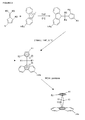
- the preferred scheme according to the present invention is represented in Figure 2.
- the method for preparing the catalyst component of the present invention comprises the steps of:
- all reactions are carried out at a temperature of from -10 to +10 °C, more preferably at a temperature of about 0 °C.
- the solvent of steps a) and b) is tetrahydrofuran (THF) and that of step c) is pentane.
- M'R is methyl-litium, and preferably X is Cl.
- the active catalyst system used for polymerising ethylene comprises the above-described catalyst component and a suitable activating agent having an ionising action.
- the activating agent can be an aluminium alkyl represented by formula AIR + n X 3-n wherein R + is an alkyl having from 1 to 20 carbon atoms and X is a halogen.
- the preferred alkylating agents are triisiobutyl aluminium (TIBAL) or triethyl aluminium (TEAL).
- an alumoxane can be used as activating agent.
- the alumoxanes are well known and preferably comprise oligomeric linear and/or cyclic alkyl alumoxanes represented by the formula: for oligomeric, linear alumoxanes and for oligomeric, cyclic alumoxane, wherein n is 1-40, preferably 10-20, m is 3-40, preferably 3-20 and R is a C 1 -C 8 alkyl group and preferably methyl.
- Suitable boron-containing activating agents may comprise a triphenylcarbenium boronate such as tetrakis-pentafluorophenyl-borato-triphenylcarbenium as described in EP-A-0427696 , or those of the general formula [L'-H] + [B Ar 1 Ar 2 X 3 X 4 ]- as described in EP-A-0277004 (page 6, line 30 to page 7, line 7).
- triphenylcarbenium boronate such as tetrakis-pentafluorophenyl-borato-triphenylcarbenium as described in EP-A-0427696 , or those of the general formula [L'-H] + [B Ar 1 Ar 2 X 3 X 4 ]- as described in EP-A-0277004 (page 6, line 30 to page 7, line 7).
- the catalyst component can be supported on a support.
- Preferred supports include a porous solid support such as talc, inorganic oxides and resinous support materials such as polyolefin.
- the support material is an inorganic oxide in its finely divided form.
- the support is a silica support having a surface area of from 200-700 m 2 /g and a pore volume of from 0.5-3 ml/g.
- the amount of activating agent and catalyst component usefully employed in the preparation of the solid support catalyst can vary over a wide range and depend upon the nature of the activating agent and of the metal. Typically, the ratio AI/M varies from 100 to 2000.
- the support may be an activating support as disclosed in EP-A-906920 .
- the present invention also discloses a method for homo- or co-polymerising ethylene or alpha-olefins that comprises the steps of:
- the comonomer can be prepared in situ by adding a suitable oligomerisation catalyst system.
- the catalyst system may be employed in a solution polymerisation process, which is homogeneous, or a slurry process, which is heterogeneous.
- typical solvents include hydrocarbons with 4 to 7 carbon atoms such as heptane, toluene or cyclohexane.
- a slurry process it is necessary to immobilise the catalyst system on an inert support.
- Polymerisation can be carried out in a single reactor or in two or more serially connected reactors.
- polymerisation of propylene is carried out at a temperature of from 50 to 100 °C, preferably of from 60 to 80 °C.
- the polymerisation of ethylene can be carried out at a temperature of from 70 to 105 °C, preferably from 70 to 90 °C and under a propylene pressure of from 2 to 20 bars, preferably of from 5 to 10 bars
- polymerisation can be carried out under high pressure similarly to the radical induced polymerisation of low density polyethylene (LDPE).
- LDPE low density polyethylene
- the use of the catalyst system according to the present invention allows reducing the high polymerisation pressure typical of the radical-induced polymerisation: It can be reduced from 1000 bars to pressures of the order of 200 bars.
- the polyethylene prepared with the catalyst system according to the present invention has a very high molecular weight and a very high melting temperature. Molecular weights are determined by gel permeation chromatography (GPC). Polyethylene prepared with the catalyst system of the present invention cover all density ranges,
- Density is measured following the method of standard test ASTM 1505 at a temperature of 23 °C and melt flow index is measured following the method of standard test ASTM D 1238 under a load of 2.16 kg for MI2 and under a load of 21.6 kg for HLMI, and at a temperature of 190 °C for polyethylene and of 230 °C for polypropylene.
- 3-t-butylfluorene was prepared according to the procedure disclosed by Alt et al, described in the Journal of Organometallic Chemistry 514 (1996) 257-270 .
- Step 3 Synthesis of 3-tert-butyl-9-[5-methyl-3-tert-butyl-cyclopentadienyl)-phenyl-ethyl]-9H-fluorene (4)
- 100 ml of 3,6-d-t-Bu-fluorenyl-lithium (2) were prepared from 5.14 g (22.9 mmol) of 3,6-d-t-butyl-fluorene and a 2.5 M solution of 9.16 mL (22.9 mmol) of n-butyl-lithium.
- To a solution of 5.139 g (22.9 mmol) of complex (3) in 100 ml of ether 100 ml of 3,6-d-t-Bu-fluorenyl-lithium were added at room temperature. The reaction mixture was stirred for 4 hours at ambient temperature (about 25 °C) and then quenched with 50 ml of a saturated solution of NH 4 Cl and diluted with 50 ml of diethyl ether.
- Step 4 Synthesis of the complex PhCH(5-Me-3-t-Bu-Cp)(3-t-Bu-Flu)ZrCl 2 (5)
- step 3 complex 3 is replaced by 6,6-dimethylfulvene.
- step 3 complex 3 is replaced by 3,6,6-trimethylfulvene.
- step 3 complex 3 is replaced by 2-tert-butyl-6,6-dimethylfulvene.
- step 3 complex 3 is replaced by 6,6-diphenylfulvene.
- step 3 complex 3 is replaced by 1,6,6-trimethyl-3-tert-butyl-fulvene.
- a first group of polymerisations was carried out in a high-throughput screening reactor with catalyst components supported on silica impregnated with methylaluminoxane.
- a second group of polymerisations was carried out in a pilot reactor with an homogeneous catalyst system.
- the first group of polymerisations showed roughly the potential of the catalyst system of the present invention whereas the he second group of polymerisations showed its excellent performance.
- the reactor was conditioned at a temperature of 95 °C, under argon and then started in program mode at a temperature of 100 °C. 11.5 mg of the catalyst, in 0.650 mL of an oily solution, were pre-contacted with 19.2 mg of triisobutylaluminium (TIBAL) as cocatalyst, and the optional comonomer and 6.4 mg of TIBAL as scavenger were added.
- TIBAL triisobutylaluminium
- the reactor was brought down to a temperature of 70 °C and the catalyst system was injected into the reactor with the optional hydrogen and with the propylene.
- the polymerisation was carried out at a temperature of 70 °C, under a pressure of 30 bars, during a period of time of 60 minutes and under stirring at a speed of 675 rotations per minutes.
- the comonomer was hexene and the amounts of hydrogen and hexene are specified in Tables I to III.
- Table I describes the properties of isotactic polypropylene obtained respectively with Me 2 C(3-t-bu-Cp)(3-t-bu-Flu)ZrCl 2 and with Me 2 C(5-Me-3-t-bu-Cp)(3-t-bu-Flu)ZrCl 2 .
- the polymerisation temperature and amount of hydrogen are also displayed in Table I. TABLE I. Cata* Polym.
- D represents the polydispersity index defined as the ratio Mw/Mn of the weight number molecular weight Mw over the number average molecular weight Mn.
- the molecular weights are determined by gel permeation chromatography (GPC).
- Table II describes the properties of syndiotactic polypropylene obtained respectively with Me 2 C(Cp)(3-t-bu-Flu)ZrCl 2 and with Ph 2 C(Cp)(3-t-bu-Flu)ZrCl 2 .
- the polymerisation temperature and amount of hydrogen are also displayed in Table II. TABLE II. Cata* Polym.
- Impact copolymers of ethylene-propylene can also be prepared with the catalyst system according to the present invention.
- Table IV relates to the use of Ph 2 C(Cp)(3-t-bu-Flu)ZrCl 2 supported on silica impregnated with methylaluminoxane (MAO), with various amounts of hexene as comonomer and with 0.25 NL of hydrogen.
- MAO methylaluminoxane
- Table VI relates to the use of Me 2 C(3-t-bu-Cp)(3-t-bu-Flu)ZrCl 2 supported on silica impregnated with methylaluminoxane (MAO), with various amounts of hexene as comonomer and with 0.25 NL of hydrogen.
- MAO methylaluminoxane
Landscapes
- Chemical & Material Sciences (AREA)
- Health & Medical Sciences (AREA)
- Chemical Kinetics & Catalysis (AREA)
- Medicinal Chemistry (AREA)
- Polymers & Plastics (AREA)
- Organic Chemistry (AREA)
- Engineering & Computer Science (AREA)
- Materials Engineering (AREA)
- Transition And Organic Metals Composition Catalysts For Addition Polymerization (AREA)
- Addition Polymer Or Copolymer, Post-Treatments, Or Chemical Modifications (AREA)
Abstract
The present invention discloses a catalyst system comprising a cyclopentadienyl-fluorenyl-based catalyst component wherein the fluorenyl is at least monosubstituted. It also discloses its method of preparation and its use in the polymerisation of ethylene.


Description
- The present invention relates to a metallocene catalyst component for use in preparing polyolefins. The invention further relates to a catalyst system that incorporates the metallocene catalyst component and a process for preparing polyolefins.
- Polyethylene is known for use in the manufacture of a wide variety of articles. The polyethylene polymerisation process can be varied in a number of respects to produce a wide variety of resultant polyethylene resins having different physical properties that render the various resins suitable for use in different applications. Medium density polyethylene resins are known for use in making films. Such medium density films are known to have good resin processability due to the presence of long chain branching in the polyethylene polymer molecules. It is known to produce such resins using chromium-based catalysts, which have been known for some time. Unfortunately, some medium density resins produced by such catalysts suffer from the problem that when the film is to be used for the packaging of foods for human consumption, it is required that the level of extractable or volatile compounds in the polyethylene resin is low so that the food is not inadvertently contaminated. For example, in the United States the Food and Drug Administration has set maximum limits for the amount of extractable or volatile compounds in polyethylene resins for food applications.
- It is also known to produce polyethylene in liquid phase loop reactors in which ethylene monomer, and optionally an alpha-olefinic comonomer typically having from 3 to 10 carbon atoms, are circulated under pressure around a loop reactor by a circulation pump. The ethylene monomer and optional comonomer are present in a liquid diluent, such as an alkane, for example isobutane. Hydrogen may also be added to the reactor. A catalyst is also fed to the loop reactor. The catalyst for producing polyethylene may typically comprise a chromium-based catalyst, a Ziegler-Natta catalyst or a metallocene catalyst. The reactants in the diluent and the catalyst are circulated at an elevated polymerisation temperature around the loop reactor thereby producing polyethylene homopolymer or copolymer depending on whether or not a comonomer is present. Either periodically or continuously, part of the reaction mixture, including the polyethylene product suspended as slurry particles in the diluent, together with unreacted ethylene and comonomer, is removed from the loop reactor. Such a process is described for example in
EP-A-0905153 that discloses a process for producing high density polyethylene in the presence of a Ziegler-Natta catalyst system in two liquid full loop reactors in series. The reactors are both operated with a liquid diluent, for example isobutane. In a first reactor there is substantially homopolymerisation, optionally with a minor degree of copolymerisation, and hydrogen is introduced into the first reactor to achieve the required homopolymerisation. Copolymerisation is carried out in the second reactor. In order to reduce or prevent hydrogen from entering the second reactor, a hydrogenation catalyst is introduced into the reactants downstream of the first reactor. This process requires the use of an additional hydrogenation catalyst. - The reaction mixture when removed from the loop reactor may be processed to remove the polyethylene product from the diluent and the unreacted reactants, with the diluent and unreacted reactants typically being recycled back into the loop reactor. Alternatively, the reaction mixture may be fed to a second loop reactor serially connected to the first loop reactor where a second polyethylene fraction may be produced. Typically, when two reactors in series are employed in this manner, the resultant polyethylene product, which comprises a first polyethylene fraction produced in the first reactor and a second polyethylene fraction produced in the second reactor, has a bimodal molecular weight distribution.
- The homo- or co-polymerisation of ethylene may also be carried out under high pressure of ethylene and optional comonomers by the radical route. This results in a large variety of products which have numerous applications, among which may be mentioned bases for adhesives, in particular hot melt adhesives, bituminous binders, wrapping films, coextrusion, binders, moulded items, and the like.
- Processes for the polymerisation of ethylene at high temperatures and pressures by means of free radical initiators have been known for a long time. Ethylene polymers are obtained by homopolymerising ethylene or by copolymerising it with at least one other comonomer in a polymerisation system which operates continuously under pressures of the order of 50 MPa to 500 MPa and at temperatures of between 50 and 300°C. The polymerisation is carried out in continuous tubular reactors or stirred autoclaves in the presence of initiators and optionally of transfer agents. The polymers are subsequently separated from the volatile substances after their departure from the reactor in separators.
- It is known that the polymerisation of ethylene in the presence or in the absence of comonomers can result in reaction runaways (see, for example, Chem. Eng. Proc., 1998, 37, 55-59). These runaways are reflected by a very marked rise in the temperature and in the pressure and thus by bursting of the safety devices of the plant. Consequently, the runaway must result in undesired shutdowns in production. It is very desirable to avoid these shutdowns as far as possible and one means for doing this is to carefully control the flow rates of the reactants entering the reactor, in particular the flow rate of the source of radicals, that is to say of the initiator. This is because the injection of an excessively large amount of radicals results in a localised runaway in one of the regions of the reactor, which runaway subsequently spreads very quickly to the whole of the reactor. The content of radicals should not exceed a predetermined threshold in order to avoid runaway of the polymerisation.
- It is generally known that radical polymerisations can be controlled using stable free radicals, this control making it possible in particular to obtain polymers exhibiting narrow molecular mass distribution. For example
US-A-5,449,724 discloses a radical polymerisation process that consists in heating, at a temperature of from 40°C to 500°C and under a pressure of from 50 MPa to 500 MPa, a mixture composed of a free radical initiator, of a stable free radical and of ethylene, in order to form a thermoplastic resin which has a molecular mass distribution of from 1.0 to 2.0. - Olefins having 3 or more carbon atoms can be polymerised to produce a polymer with an isotactic stereochemical configuration. For example, in the polymerisation of propylene to form polypropylene, the isotactic structure is typically described as having methyl groups attached to the tertiary carbon atoms of successive monomeric units on the same side of a hypothetical plane through the main chain of the polymer. This can be described using the Fischer projection formula as follows:

- Another way of describing the structure is through the use of NMR spectroscopy. Bovey's NMR nomenclature for an isotactic pentad is ... mmmm with each "m" representing a "meso" diad or successive methyl groups on the same side in the plane.
- In contrast to the isotactic structure, syndiotactic polymers are those in which the methyl groups attached to the tertiary carbon atoms of successive monomeric units in the chain lie on alternate sides of the plane of the polymer. Using the Fischer projection formula, the structure of a syndiotactic polymer is described as follows:

- In NMR nomenclature, a syndiotactic pentad is described as ...rrrr... in which "r" represents a "racemic" diad with successive methyl groups on alternate sides of the plane.
- In contrast to isotactic and syndiotactic polymers, an atactic polymer exhibits no regular order of repeating unit. Unlike syndiotactic or isotactic polymers, an atactic polymer is not crystalline and forms essentially a waxy product.
- While it is possible for a catalyst to produce all three types of polymer, it is desirable for a catalyst to produce predominantly either an isotactic or a syndiotactic polymer with very little atactic polymer. C2-symmetric metallocene catalysts are known in the production of the polyolefins. For example, C2 symmetric bis indenyl type zirconocenes can produce high molecular weight, high melting temperature, isotactic polypropylene. The preparation of this metallocene catalyst is however costly and time-consuming. Most importantly, the final catalyst consists of a mixture of racemic and meso isomers in an often unfavourable ratio. The meso stereoisomer has to be separated to avoid the formation of atactic polypropylene during the polymerisation reaction.
- Cs-symmetric metallocene catalysts are known in the production of the syndiotactic polyolefins.
-
EP-A-0426644 relates to syndiotactic copolymers of olefins such as propylene obtainable using as a catalyst component isopropyl (fluorenyl)(cyclopentadienyl) zirconium dichloride. Syndiotacticity, as measured by the amount of syndiotactic pentads, rrrr was found to be 73-80%. -
EP-A-577581 positions 2 and 7 and an unsubstituted cyclopentadienyl ring. - There is a need to develop new catalyst systems that are able to produce polyethylene or poly-alpha-olefins with ease and safety.
- It is an aim of the present invention to provide a catalyst system for the polymerisation of ethylene or alpha-olefins under mild conditions of temperature and pressure.
- It is another aim of the present invention to provide a catalyst system for preparing polyethylene or poly-alpha-olefins with controlled long chain branching.
- It is a further aim of the present invention to provide a catalyst system for preparing polyethylene with good optical properties.
- It is also an aim of the present invention to provide a catalyst system for preparing polyethylene or poly-alpha-olefins having good mechanical properties.
-
- Figure 1a is a schematic representation of complex R3 2(3-R1-5-R2-Cp)(6-t-Bu-Flu)MCl2 and figure 1b is a schematic representation of complex R3 2(3-R1-5-R2-Cp)(3-t-Bu-Flu)MCl2 according to the present invention.
- Figure 2 represents the scheme for preparing complex R3 2(3-R1-5-R2-Cp)(3-t-Bu-Flu)MCl2.
- Accordingly, the present invention discloses a catalyst system for homo- or co-polymerising ethylene and/or alpha-olefins based on a catalyst component of general formula I
R" (CpR1R2 R3)(FluR'm)MQ2 (I)
wherein Cp is a cyclopentadienyl ring,
wherein R1 is H or a substituent on the cyclopentadienyl ring which is distal to the bridge, which distal substituent comprises a group of the formula XR*3 in which X is chosen from Group 14 of the periodic table, and each R* is the same or different and chosen from hydrogen or hydrocarbyl of from 1 to 20 carbon atoms,
wherein R2 is H or a substituent on the cyclopentadienyl ring which is proximal to the bridge and positioned non-vicinal to the distal substituent and is of the formula YR#3 in which Y is chosen from group 14 of the Periodic Table, and each R# is the same or different and chosen from hydrogen or hydrocarbyl of 1 to 7 carbon atoms,
wherein R3 is H or a substituent on the cyclopentadienyl ring which is proximal to the bridge and positioned vicinal to the distal substituent and is of the formula YR#3 in which Y is chosen from group 14 of the Periodic Table, and each R# is the same or different and chosen from hydrogen or hydrocarbyl of 1 to 7 carbon atom,
wherein Flu is a fluorenyl group,
wherein each R' is independently selected from a group of formula AR'''3, in which A is chosen from Group 14 of the Periodic Table, and each R''' is independently hydrogen or a hydrocarbyl having 1 to 20 carbon atoms and wherein the substituents on the fluorenyl form a substitution pattern that lacks bilateral symmetry and m is at least 1;
wherein M is a transition metal Group 4 of the Periodic Table or vanadium;
wherein each Q is hydrocarbyl having 1 to 20 carbon atoms or is a halogen;
wherein R" is a structural bridge imparting stereorigidity to the component - When the cyclopentadienyl is substituted, it is preferably mono- or di-substituted. When it is mono-substituted, the preferred substituent is R1 located at a position distal to the bridge. When it is di-substituted, the preferred substituents are R1 and R2 located respectively at a position distal to the bridge and at a position proximal to the bridge non-vicinal to the other substituent.
- In the distal substituent group R1, X is preferably C or Si. R* may be a hydrocarbyl such as alkyl, aryl, alkenyl, alkylaryl or aryl alkyl, preferably methyl, ethyl, propyl, isopropyl, butyl, isobutyl, amyl, isoamyl, hexyl, heptyl, octyl, nonyl, decyl, cetyl or phenyl. R1 may comprise a hydrocarbyl which is attached to a single carbon atom in the cyclopentadienyl ring or may be bonded to two carbon atoms in that ring. Preferably, R1 is H, or methyl, or t-butyl or Me3Si, most preferably, R1 is t-butyl.
- The proximal substituent R2 is preferably H or Me.
- Preferably, there is a substituent on the fluorenyl either at position 3 or at position 6 and any position other than 3 or 6 may be occupied by a substituent. More preferably, there is a single substituent on the fluorenyl, most preferably located at position 6 as represented in Figure 1 a or at position 3, as represented in Figure 1 b.
- The structural bridge R" is preferably alkylidene having 1 to 20 aliphatic or aromatic carbon atoms, a dialkyl germanium or silicon or siloxane, alkyl phosphene or amine bridging the two Cp rings. R" is preferably isopropylidene in which the two Cp rings are bridged at
position 2 of the isopropylidene or it comprises the moiety TRaRb, in which T is chosen from group 14 of the Periodic Table, and each of Ra and Rb is independently substituted or unsubstituted phenyl linked to T directly or by C1-C4 alkylene. More preferably R" is a diphenyl or a dimethyl bridge. - The metallocene catalyst component according to the present invention may have pseudo-Cs symmetry and be suitable for the production of syndiotactic polyolefins. Alternatively it can have C1 symmetry and be suitable for the preparation of isotactic polymers. The type of symmetry depends upon the position and nature of the substituents on the cyclopentadienyl and on the fluorenyl rings.
- Preferably, M is Ti, Zr or Hf, more preferably, it is Zr.
- Optionally, the fluorenyl may have additional substitution patterns such as for example additional substituents at
positions 2 and/or 7, 4 and/or 5, 1 and/or 8. - The substituents on the cyclopentadienyl play a major role in the polymerisation of ethylene as they favour the response to hydrogen and thus allow to better control the molecular weight and the melt flow of the final resin. They also play an important role in the polymerisation of propylene. No substituents or symmetrically substituted cyclopentadienyl provides syndiotactic polypropylene, whereas lack of bilateral symmetry generates isotactic polypropylene.
- The present invention also discloses a method for preparing the catalyst component described hereabove. The method is described in Alt et al. (Alt H.G., Zenk R., Milius W., in J. Organom. Chem. 514, 257-270, 1996). The preferred scheme according to the present invention is represented in Figure 2.
- The method for preparing the catalyst component of the present invention comprises the steps of:
- a) reacting a substituted fulvene with an ion pair comprising the substituted fluorenyl anion and a cation in a solvent at a temperature of from - 70 to +70 °C to form a bridged ligand;
- b) reacting the bridged ligand obtained in step a) with compound M'R in a solvent at a temperature of from - 70 to +70 °C, wherein M' is Na, K or Li and R is an alkyl having from 1 to 6 carbon atoms;
- c) reacting the ion pair obtained in step b) with MX4 in an inert solvent, wherein X is a halogen or an alkyl having from 1 to 6 carbon atoms and wherein M is a metal group 4 of the periodic table or vanadium, to create the desired catalyst component.
- Preferably, all reactions are carried out at a temperature of from -10 to +10 °C, more preferably at a temperature of about 0 °C.
- Preferably, the solvent of steps a) and b) is tetrahydrofuran (THF) and that of step c) is pentane.
- Preferably M'R is methyl-litium, and preferably X is Cl.
- The active catalyst system used for polymerising ethylene comprises the above-described catalyst component and a suitable activating agent having an ionising action.
- Suitable activating agents are well known in the art. The activating agent can be an aluminium alkyl represented by formula AIR+ nX3-n wherein R+ is an alkyl having from 1 to 20 carbon atoms and X is a halogen. The preferred alkylating agents are triisiobutyl aluminium (TIBAL) or triethyl aluminium (TEAL).
- Alternatively, an alumoxane can be used as activating agent. The alumoxanes are well known and preferably comprise oligomeric linear and/or cyclic alkyl alumoxanes represented by the formula:

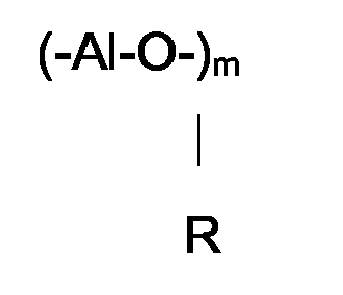
wherein n is 1-40, preferably 10-20, m is 3-40, preferably 3-20 and R is a C1-C8 alkyl group and preferably methyl. - Suitable boron-containing activating agents may comprise a triphenylcarbenium boronate such as tetrakis-pentafluorophenyl-borato-triphenylcarbenium as described in
EP-A-0427696 , or those of the general formula [L'-H] + [B Ar1 Ar2 X3 X4]- as described inEP-A-0277004 (page 6, line 30 to page 7, line 7). - Optionally, the catalyst component can be supported on a support. Preferred supports include a porous solid support such as talc, inorganic oxides and resinous support materials such as polyolefin. Preferably, the support material is an inorganic oxide in its finely divided form.
- Suitable inorganic oxide materials are well known in the art. Preferably, the support is a silica support having a surface area of from 200-700 m2/g and a pore volume of from 0.5-3 ml/g.
- The amount of activating agent and catalyst component usefully employed in the preparation of the solid support catalyst can vary over a wide range and depend upon the nature of the activating agent and of the metal. Typically, the ratio AI/M varies from 100 to 2000.
- In a preferred embodiment according to the present invention, the support may be an activating support as disclosed in
EP-A-906920 - The present invention also discloses a method for homo- or co-polymerising ethylene or alpha-olefins that comprises the steps of:
- a) injecting the active catalyst system described hereabove into the reactor;
- b) injecting the monomer and an optional comonomer in to the reactor;
- c) maintaining under poymerisation conditions;
- d) retrieving isotactic poypropylene.
- The comonomer can be prepared in situ by adding a suitable oligomerisation catalyst system.
- Polymerisation method and conditions are not particularly limited. The catalyst system may be employed in a solution polymerisation process, which is homogeneous, or a slurry process, which is heterogeneous. In a solution process, typical solvents include hydrocarbons with 4 to 7 carbon atoms such as heptane, toluene or cyclohexane. In a slurry process it is necessary to immobilise the catalyst system on an inert support. Polymerisation can be carried out in a single reactor or in two or more serially connected reactors.
- Typically, polymerisation of propylene is carried out at a temperature of from 50 to 100 °C, preferably of from 60 to 80 °C. The polymerisation of ethylene can be carried out at a temperature of from 70 to 105 °C, preferably from 70 to 90 °C and under a propylene pressure of from 2 to 20 bars, preferably of from 5 to 10 bars
- Alternatively, polymerisation can be carried out under high pressure similarly to the radical induced polymerisation of low density polyethylene (LDPE). The use of the catalyst system according to the present invention allows reducing the high polymerisation pressure typical of the radical-induced polymerisation: It can be reduced from 1000 bars to pressures of the order of 200 bars.
- The polyethylene prepared with the catalyst system according to the present invention has a very high molecular weight and a very high melting temperature. Molecular weights are determined by gel permeation chromatography (GPC). Polyethylene prepared with the catalyst system of the present invention cover all density ranges,
- linear low density polyethylene (LLDPE) having a density of from 0.900 to 0.925 g/cm3 and a melt flow index MI2 of from 0.1 to 10 dg/min;
- medium density polyethylene (MDPE) having a density of from 0.930 to 0.935 g/cm3 and a melt flow index MI2 of from 0.1 to 10 dg/min;
- high density polyethylene (HDPE) having a density of from 0.935 to 0.955 g/cm3 and a melt flow index MI2 of from 0.1 to 10 dg/min.
- Density is measured following the method of standard test ASTM 1505 at a temperature of 23 °C and melt flow index is measured following the method of standard test ASTM D 1238 under a load of 2.16 kg for MI2 and under a load of 21.6 kg for HLMI, and at a temperature of 190 °C for polyethylene and of 230 °C for polypropylene.
- 3-t-butylfluorene was prepared according to the procedure disclosed by Alt et al, described in the Journal of Organometallic Chemistry 514 (1996) 257-270.
- To a solution of 3.034 g (22.27 mmol) of 1-methyl-3-tert-butyl-cyclopentadiene (mixture of isomers) in 100 ml of diethyl ether, a 2.5 M solution of 13.9 mL (22.27 mmol) of buthyllithium in hexane was added at a temperature of 0°C. The reaction mixture was stirred for 2 hours and a solution of 2.26 ml (22.27 mmol) of benzaldehyde in 60 ml of ether was added dropwise. The reaction mixture turned orange. After 2 hours 100 ml of a concentrated solution of NH4Cl was added slowly. This mixture was stirred overnight. The organic layer was separated, dried over MgSO4 and all the volatiles were removed under vacuum. The orange residue was recrystallised from methanol at a temprarture of -30°C to give compound (3).
-


- 100 ml of 3,6-d-t-Bu-fluorenyl-lithium (2) were prepared from 5.14 g (22.9 mmol) of 3,6-d-t-butyl-fluorene and a 2.5 M solution of 9.16 mL (22.9 mmol) of n-butyl-lithium.To a solution of 5.139 g (22.9 mmol) of complex (3) in 100 ml of ether 100 ml of 3,6-d-t-Bu-fluorenyl-lithium were added at room temperature. The reaction mixture was stirred for 4 hours at ambient temperature (about 25 °C) and then quenched with 50 ml of a saturated solution of NH4Cl and diluted with 50 ml of diethyl ether. The organic layer was separated, washed with water and dried over MgSO4. All the volatiles were removed under vacuum and the residue was dissolved in hot EtOH. The solution was cooled to a temperature of -20°C and a white yellow precipitate formed. This latter was filtered and washed with cold ethanol at a temperature of - 50°C and dried under vacuum overnight to give 6.5 g (14.55 mmol) of product (4) with a yield of 63.53 %.
-

- To a solution of 2g (4.5 mmol) of complex (4) in 100 ml of Et2O was added a 2.5 M solution of 3.6 ml (9 mmol) of butyl-lithium in hexane at a temperature of 0°C. The reaction mixture was stirred for 4 h and 1.0434 g (4.5 mmol) of anhydrous ZrCl4 were added in a glove-box. This resulted pink reaction mixture was stirred at room temperature overnight. Then the solvent was evaporated under vacuum and 100 ml of hexane were condensed under reduced pressure. The resulting mixture was filtered off. The filtrate was evaporated under vacuum to give 2.39 g (3.9 mmol) of pink powder of crude complex (5) with a yield of 88%.
-

- The procedure is the same as in example 1 except that in step 3, complex 3 is replaced by 6,6-dimethylfulvene.
-

- The procedure is the same as in example 1 except that in step 3, complex 3 is replaced by 3,6,6-trimethylfulvene.
-
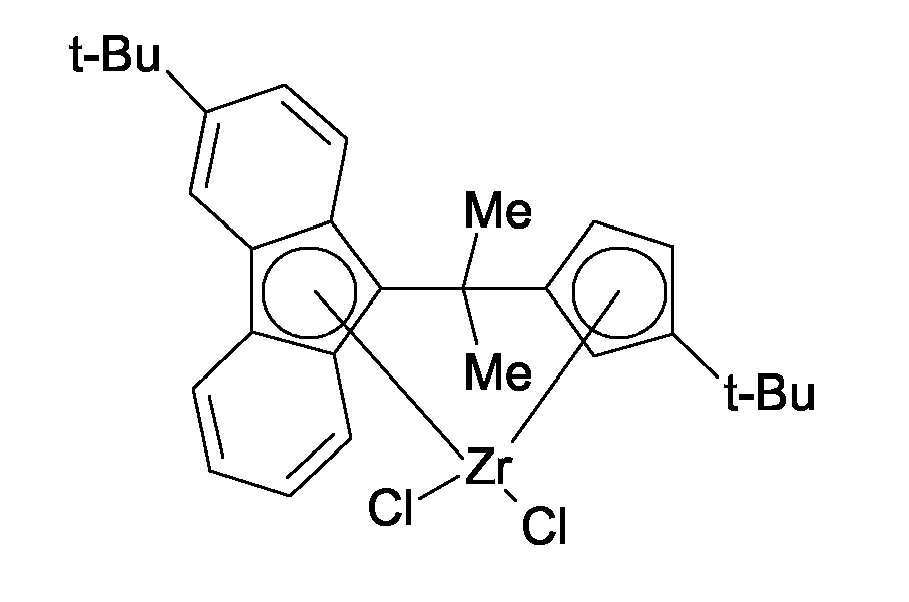
- The procedure is the same as in example 1 except that in step 3, complex 3 is replaced by 2-tert-butyl-6,6-dimethylfulvene.
-

- The procedure is the same as in example 1 except that in step 3, complex 3 is replaced by 6,6-diphenylfulvene.
-

- The procedure is the same as in example 1 except that in step 3, complex 3 is replaced by 1,6,6-trimethyl-3-tert-butyl-fulvene.
-

- The procedure follows a scheme similar to that developed by Alt et al. (in H.G. Alt and R. Zenk, in Journal of Organometallic Chemistry, 526, 295-301, 1996). To a solution of 1.67 g (3.91 mmol) of 6-dimethylamino-fulvene in 40 ml of Et2O were added 310 ml (7.82 mmol) of a 2.5 M solution of butyl-lithium in hexane at 0 °C. The reaction mixture was stirred for 4 h and the solvent was evaporated under reduced pressure. Then in a glovebox anhydrous 0.91 g (3.9 mmol) of ZrCl4 were added followed by theaddition of 50 mL of pentane. The resulting pink reaction mixture was stirred at room temperature overnight. The reaction mixture was then filtered off and the filtrate was evaporated in vacuum. A portion of about 30 mL of hexane was added and the resulting clear solution was kept at a temperature of -30 °C overnight to give a pink microcrystalline powder precipitate of complex CH2(5-Me-3-t-Bu-Cp)(3-t-Bu-Flu)ZrCl2. A second batch of the same complex was obtained from the mother liqueur upon cooling. A total amount of 1.48 g (2.52 mmol) of complex wereobtained with a yield of 64 % yield. Crystals, suitable for X-ray analysis, were obtained by slow concentration from a 3:7 mixture of CH2Cl2/hexane.
- Several polymerisations have bee carried out with some of these catalyst systems. A first group of polymerisations was carried out in a high-throughput screening reactor with catalyst components supported on silica impregnated with methylaluminoxane. A second group of polymerisations was carried out in a pilot reactor with an homogeneous catalyst system. The first group of polymerisations showed roughly the potential of the catalyst system of the present invention whereas the he second group of polymerisations showed its excellent performance.
- Polymerisations in the pilot were all carried according to the following method. The reactor was conditioned at a temperature of 95 °C, under argon and then started in program mode at a temperature of 100 °C. 11.5 mg of the catalyst, in 0.650 mL of an oily solution, were pre-contacted with 19.2 mg of triisobutylaluminium (TIBAL) as cocatalyst, and the optional comonomer and 6.4 mg of TIBAL as scavenger were added. The reactor was brought down to a temperature of 70 °C and the catalyst system was injected into the reactor with the optional hydrogen and with the propylene. The polymerisation was carried out at a temperature of 70 °C, under a pressure of 30 bars, during a period of time of 60 minutes and under stirring at a speed of 675 rotations per minutes. The comonomer was hexene and the amounts of hydrogen and hexene are specified in Tables I to III.
- Polymerisation results are also presented in Tables I to III.
- Table I describes the properties of isotactic polypropylene obtained respectively with Me2C(3-t-bu-Cp)(3-t-bu-Flu)ZrCl2 and with Me2C(5-Me-3-t-bu-Cp)(3-t-bu-Flu)ZrCl2. The polymerisation temperature and amount of hydrogen are also displayed in Table I.
TABLE I. Cata* Polym. T °C H2 L Mn kDa Mw kDa D Tf °C Tc °C mmmm 1 80 - 30 75 2.5 148 98 88 1 60 - 90 190 2.1 145 96 86 1 70 - 42 93 2.2 140 97 84 1 70 0.02 23 52 2.3 145 97 86 2 80 - 100 290 2.9 153 105 93 2 60 - 135 400 2.95 150 103 90 2 70 - 90 325 3.6 148 99 89 2 70 0.02 45 140 3.1 151 105 90 * cata 1 = Me2C(3-t-bu-Cp)(3-t-bu-Flu)ZrCl2
cata2 = Me2C(5-Me-3-t-bu-Cp)(3-t-bu-Flu)ZrCl2 - D represents the polydispersity index defined as the ratio Mw/Mn of the weight number molecular weight Mw over the number average molecular weight Mn. The molecular weights are determined by gel permeation chromatography (GPC).
- Table II describes the properties of syndiotactic polypropylene obtained respectively with Me2C(Cp)(3-t-bu-Flu)ZrCl2 and with Ph2C(Cp)(3-t-bu-Flu)ZrCl2. The polymerisation temperature and amount of hydrogen are also displayed in Table II.
TABLE II. Cata* Polym. T °C H2 L Mn kDa Mw kDa D Tf °C rrrr+rrrm 3 40 - 23 55 2.4 145 3 60 - 40 95 2.38 138 87.5 3 70 - 30 74 2.5 138 87 3 70 0.02 31 77 2.48 130 4 40 - 148 4 60 - 142 4 70 - 55 205 3.7 139 4 70 0.02 95 300 3.3 139 * cata3 = Me2C(Cp)(3-t-bu-Flu)ZrCl2
cata4 = Ph2C(Cp)(3-t-bu-Flu)ZrCl2 - It has been observed that for all examples, tacticity does not decrease when the temperature increases contrary to what was observed with other catalytic systems.
- The same experiments were carried out on the bench reactor with an homogeneous catalyst system, under similar polymerisation conditions. The results are displayed in Table III.
TABLE III. cata Polym. T °C H2 L Mn kDa Mw kDa D Tf °C mmmm 1 80 - 60 145 2.4 153 92 1 60 - 170 380 2.23 149 90 1 70 - 75 175 2.3 145 91 1 70 0.02 50 105 2.1 151 90 2 80 - 195 600 3.1 157 97 2 60 - 250 750 3.0 155 95 2 70 - 170 600 3.52 152 93 2 80 0.02 91 275 3.02 156 94 3 40 - 95 225 2.4 150 3 60 - 81 190 2.34 153 3 70 - 72 151 2.1 152 3 70 0.02 63 160 2.54 136 4 40 - 165 550 3.33 152 4 60 - 125 455 3.64 147 4 70 - 111 402 3.6 145 4 70 0.02 192 610 3.2 144 - Impact copolymers of ethylene-propylene can also be prepared with the catalyst system according to the present invention.
- Each polymerisation run was performed as described in the following Tables in a 41 autoclave type reactor. In all cases the polymerisation temperature was of 80°C and 2L of isobutane were used as diluent.
- It is apparent from Tables IV to VII, that polyethylene products of low density are obtainable according to the invention, especially in the presence of hexene comonomer. The polymers obtained also have a high molecular weight. The new catalyst system according to the present invention is thus very suitable as one component of a dual site catalyst system to prepare bi-modal polyethylene in a single reactor.
- Table IV relates to the use of Ph2C(Cp)(3-t-bu-Flu)ZrCl2 supported on silica impregnated with methylaluminoxane (MAO), with various amounts of hexene as comonomer and with 0.25 NL of hydrogen.
TABLE IV. C6/C2 wt % MI2 dg/m HLMI dg/m Density g/cm3 Mn kDa Mw kDa D 0 0.06 20.9 0.942 0.41 too low 0.32 0.914 0.61 too low 0.17 0.918 76 336 4.4 0.81 too low 0.36 0.912 81 307 3.8 1.22 0.06 2.74 0.908 - The same catalyst system was used to polymerise ethylene with hexene as comonomer with a ratio C6/C2 of 0.41 and with various amounts of hydrogen. The results are presented in Table V.
TABLE V. Hydrogen NL MI2 dg/m HLMI dg/m Density g/cm3 Mn kDa Mw kDa D 0 too low too low 0.913 0.25 too low 0.32 0.914 1.0 0.27 9.91 0.918 39 131 3.4 - Table VI relates to the use of Me2C(3-t-bu-Cp)(3-t-bu-Flu)ZrCl2 supported on silica impregnated with methylaluminoxane (MAO), with various amounts of hexene as comonomer and with 0.25 NL of hydrogen.
TABLE VI. C6/C2 % HLMI dg/m Density g/cm3 0.0 too low 0.930 0.41a 0.06 0.917 0.41 0.13 0.920 0.61a 0.03 0.913 0.61 0.01 0.913 0.81 0.16 0.913 1.22a 1.2 0.910 1.22 1.6 0.907 a: no prepolymerisation was carried out.
Claims (12)
- A catalyst system for homo- or co-polymerising ethylene or alpha-olefins comprisinga) a catalyst component of general formula I
R" (CpR1R2 R3)(FluR'm)MQ2 (I)
wherein Cp is a cyclopentadienyl,
wherein R1 is H or a substituent on the cyclopentadienyl ring which is distal to the bridge, which distal substituent comprises a group of the formula XR*3 in which X is chosen from Group 14 of the periodic table, and each R* is the same or different and chosen from hydrogen or hydrocarbyl of from 1 to 20 carbon atoms,
wherein R2 is H or a substituent on the cyclopentadienyl ring which is proximal to the bridge and positioned non-vicinal to the distal substituent and is of the formula YR#3 in which Y is chosen from group 14 of the Periodic Table, and each R# is the same or different and chosen from hydrogen or hydrocarbyl of 1 to 7 carbon atoms,
wherein R3 is H or a substituent on the cyclopentadienyl ring which is proximal to the bridge and positioned vicinal to the distal substituent and is of the formula YR#3 in which Y is chosen from group 14 of the Periodic Table, and each R# is the same or different and chosen from hydrogen or hydrocarbyl of 1 to 7 carbon atoms,
wherein Flu is a fluorenyl group,
wherein each R' is independently selected from a group of formula AR'''3, in which A is chosen from Group 14 of the Periodic Table, and each R''' is independently hydrogen or a hydrocarbyl having 1 to 20 carbon atoms and wherein the substituents on the fluorenyl form a substitution pattern that lacks bilateral symmetry, and m is an integer of at least 1;
wherein M is a transition metal Group 4 of the Periodic Table or vanadium;
wherein each Q is hydrocarbyl having 1 to 20 carbon atoms or is a halogen;
wherein R" is a structural bridge imparting stereorigidity to the component.b) an activating agent having an ionising action or an activating support. - The catalyst system of claim 1 wherein R1 is H, methyl, t-butyl or Me3Si.
- The catalyst system of claim 1 or claim 2 wherein R2 is H or Me.
- The catalyst system of any one of claims 1 to 3 wherein R3 is H or Me.
- The catalyst system of any one of claims 1 to 4 wherein m is 1 and R' is a single substituent at position 3 or at position 6.
- The catalyst system of claim 5 wherein R' is t-butyl.
- The catalyst system of any one of 1 to 6 wherein R" is a diphenyl or a dimethyl bridge.
- The catalyst system according to any one of claims 1 to 7 wherein the activating agent is an aluminoxane or a boron-based compound.
- The catalyst system according to any one of claims 1 to 7 wherein the activating agent is an activating support.
- A process for preparing the catalyst system of any one of claims 1 to 10 comprising the steps of:a. providing a metallocene catalyst component prepared by:i) reacting a substituted fulvene with an ion pair comprising the substituted fluorenyl anion and a cation in a solvent at a temperature of from - 70 to +70 °C to form a bridged ligand;ii) reacting the bridged ligand obtained in step a) with compound M'R in a solvent at a temperature of from - 70 to +70 °C, wherein M' is Na, K or Li and R is an alkyl having from 1 to 6 carbon atoms;iii)reacting the ion pair obtained in step b) with MX4 in an inert solvent, wherein X is a halogen or an alkyl having from 1 to 6 carbon atoms, to create the desired catalyst component.b. providing an activating agent having an ionising action.
- A method for preparing polyethylene or poly-alpha-olefins that comprises the steps of:a. injecting the active catalyst system of any one of claims 1 to 8 into the reactor;b. injecting the monomer and an optional comonomer in to the reactor;c. maintaining under poymerisation conditions;d. retrieving the polyethylene or poly-alpha-olefin.
- The method of claim 10 wherein the monomer is ethylene or propylene.
Priority Applications (9)
| Application Number | Priority Date | Filing Date | Title |
|---|---|---|---|
| EP05105160A EP1734058A1 (en) | 2005-06-13 | 2005-06-13 | Ethylene and alpha-olefins polymerisation catalyst system based on fluorenyl ligand |
| JP2008516298A JP5129129B2 (en) | 2005-06-13 | 2006-06-13 | Polymerization catalyst system of ethylene and α-olefin based on fluorenyl ligand |
| PCT/EP2006/063132 WO2007028664A1 (en) | 2005-06-13 | 2006-06-13 | Ethylene and alpha-olefins polymerisation catalyst system based on fluorenyl ligand |
| EP06819043A EP1891120A1 (en) | 2005-06-13 | 2006-06-13 | Ethylene and alpha-olefins polymerisation catalyst system based on fluorenyl ligand |
| CNA2006800211580A CN101198627A (en) | 2005-06-13 | 2006-06-13 | Catalyst system for ethylene and α-olefin polymerization based on fluorenyl ligands |
| EA201101233A EA201101233A1 (en) | 2005-06-13 | 2006-06-13 | CATALYTIC SYSTEM BASED ON FLUORENILIC LIGAND FOR POLYMERIZATION OF ETHYLENE AND ALPHA-OLEFINS |
| EA200702544A EA200702544A1 (en) | 2005-06-13 | 2006-06-13 | CATALYTIC SYSTEM BASED ON FLUORENILIC LIGAND FOR POLYMERIZATION OF ETHYLENE AND ALPHA-OLEFINS |
| KR1020077028968A KR20080024123A (en) | 2005-06-13 | 2006-06-13 | Polymerization System of Ethylene and Alpha-olefins Based on Fluorenyl Ligands |
| US11/922,159 US20100016528A1 (en) | 2005-06-13 | 2006-06-13 | Ethylene and alpha-olefins polymerisation catalyst system based on fluorenyl ligand |
Applications Claiming Priority (1)
| Application Number | Priority Date | Filing Date | Title |
|---|---|---|---|
| EP05105160A EP1734058A1 (en) | 2005-06-13 | 2005-06-13 | Ethylene and alpha-olefins polymerisation catalyst system based on fluorenyl ligand |
Publications (1)
| Publication Number | Publication Date |
|---|---|
| EP1734058A1 true EP1734058A1 (en) | 2006-12-20 |
Family
ID=35148872
Family Applications (2)
| Application Number | Title | Priority Date | Filing Date |
|---|---|---|---|
| EP05105160A Withdrawn EP1734058A1 (en) | 2005-06-13 | 2005-06-13 | Ethylene and alpha-olefins polymerisation catalyst system based on fluorenyl ligand |
| EP06819043A Withdrawn EP1891120A1 (en) | 2005-06-13 | 2006-06-13 | Ethylene and alpha-olefins polymerisation catalyst system based on fluorenyl ligand |
Family Applications After (1)
| Application Number | Title | Priority Date | Filing Date |
|---|---|---|---|
| EP06819043A Withdrawn EP1891120A1 (en) | 2005-06-13 | 2006-06-13 | Ethylene and alpha-olefins polymerisation catalyst system based on fluorenyl ligand |
Country Status (7)
| Country | Link |
|---|---|
| US (1) | US20100016528A1 (en) |
| EP (2) | EP1734058A1 (en) |
| JP (1) | JP5129129B2 (en) |
| KR (1) | KR20080024123A (en) |
| CN (1) | CN101198627A (en) |
| EA (2) | EA201101233A1 (en) |
| WO (1) | WO2007028664A1 (en) |
Cited By (1)
| Publication number | Priority date | Publication date | Assignee | Title |
|---|---|---|---|---|
| EP2204375A1 (en) * | 2008-12-12 | 2010-07-07 | Total Petrochemicals Research Feluy | Preparation of mono-aryl-substituted methylene-bridged substituted cyclopentadienyl-fluorenyl ligands and zirconium complexes derived thereof |
Families Citing this family (2)
| Publication number | Priority date | Publication date | Assignee | Title |
|---|---|---|---|---|
| US7514510B2 (en) * | 2006-07-25 | 2009-04-07 | Fina Technology, Inc. | Fluorenyl catalyst compositions and olefin polymerization process |
| US20150293379A1 (en) * | 2014-04-15 | 2015-10-15 | Tenacious Holdings, Inc. | Temple Vent Lock Clip |
Citations (5)
| Publication number | Priority date | Publication date | Assignee | Title |
|---|---|---|---|---|
| EP0577581A2 (en) * | 1992-06-22 | 1994-01-05 | Fina Technology, Inc. | Method for controlling the melting points and molecular weights of syndiotactic polyolefins using metallocene catalyst systems |
| EP0709405A1 (en) * | 1994-10-25 | 1996-05-01 | Tosoh Corporation | Process for the production of olefin polymers |
| US5594078A (en) * | 1991-07-23 | 1997-01-14 | Phillips Petroleum Company | Process for producing broad molecular weight polyolefin |
| EP0906920A1 (en) * | 1997-10-02 | 1999-04-07 | Elf Atochem S.A. | Activator solid support for metallocene catalysts in the polymerisation of olefins, its corresponding preparation process, catalytical system and polymerisation process |
| US6063725A (en) * | 1995-11-07 | 2000-05-16 | Mitsui Chemicals, Inc. | Olefin polymerization catalyst system |
Family Cites Families (10)
| Publication number | Priority date | Publication date | Assignee | Title |
|---|---|---|---|---|
| US5191132A (en) * | 1991-05-09 | 1993-03-02 | Phillips Petroleum Company | Cyclopentadiene type compounds and method for making |
| JP3446423B2 (en) * | 1994-10-25 | 2003-09-16 | 東ソー株式会社 | Method for producing olefin polymer |
| JP3479582B2 (en) * | 1995-11-07 | 2003-12-15 | 三井化学株式会社 | Olefin polymerization catalyst and olefin polymerization method |
| JP4864176B2 (en) * | 1999-02-19 | 2012-02-01 | トータル・ペトロケミカルズ・リサーチ・フエリユイ | Polyolefin production |
| US6515086B1 (en) * | 1999-02-19 | 2003-02-04 | Fina Research, S.A. | Polyolefin production |
| US6291382B1 (en) * | 1999-05-24 | 2001-09-18 | Phillips Petroleum Company | Metallocenes, polymerization catalyst systems, their preparation, and use |
| KR101087179B1 (en) * | 2003-03-28 | 2011-11-25 | 미쓰이 가가쿠 가부시키가이샤 | Polyolefin resin composition |
| US6855783B2 (en) * | 2003-04-11 | 2005-02-15 | Fina Technology, Inc. | Supported metallocene catalysts |
| CN100354322C (en) * | 2003-05-20 | 2007-12-12 | 三井化学株式会社 | Ethylene polymer |
| EP1734059A1 (en) * | 2005-06-13 | 2006-12-20 | Total Petrochemicals Research Feluy | Carbon-bridged cyclopentadienyl-fluorenyl ligands |
-
2005
- 2005-06-13 EP EP05105160A patent/EP1734058A1/en not_active Withdrawn
-
2006
- 2006-06-13 JP JP2008516298A patent/JP5129129B2/en not_active Expired - Fee Related
- 2006-06-13 EP EP06819043A patent/EP1891120A1/en not_active Withdrawn
- 2006-06-13 KR KR1020077028968A patent/KR20080024123A/en not_active Abandoned
- 2006-06-13 US US11/922,159 patent/US20100016528A1/en not_active Abandoned
- 2006-06-13 EA EA201101233A patent/EA201101233A1/en unknown
- 2006-06-13 EA EA200702544A patent/EA200702544A1/en unknown
- 2006-06-13 WO PCT/EP2006/063132 patent/WO2007028664A1/en not_active Ceased
- 2006-06-13 CN CNA2006800211580A patent/CN101198627A/en active Pending
Patent Citations (5)
| Publication number | Priority date | Publication date | Assignee | Title |
|---|---|---|---|---|
| US5594078A (en) * | 1991-07-23 | 1997-01-14 | Phillips Petroleum Company | Process for producing broad molecular weight polyolefin |
| EP0577581A2 (en) * | 1992-06-22 | 1994-01-05 | Fina Technology, Inc. | Method for controlling the melting points and molecular weights of syndiotactic polyolefins using metallocene catalyst systems |
| EP0709405A1 (en) * | 1994-10-25 | 1996-05-01 | Tosoh Corporation | Process for the production of olefin polymers |
| US6063725A (en) * | 1995-11-07 | 2000-05-16 | Mitsui Chemicals, Inc. | Olefin polymerization catalyst system |
| EP0906920A1 (en) * | 1997-10-02 | 1999-04-07 | Elf Atochem S.A. | Activator solid support for metallocene catalysts in the polymerisation of olefins, its corresponding preparation process, catalytical system and polymerisation process |
Cited By (1)
| Publication number | Priority date | Publication date | Assignee | Title |
|---|---|---|---|---|
| EP2204375A1 (en) * | 2008-12-12 | 2010-07-07 | Total Petrochemicals Research Feluy | Preparation of mono-aryl-substituted methylene-bridged substituted cyclopentadienyl-fluorenyl ligands and zirconium complexes derived thereof |
Also Published As
| Publication number | Publication date |
|---|---|
| CN101198627A (en) | 2008-06-11 |
| JP2008544006A (en) | 2008-12-04 |
| EA201101233A1 (en) | 2012-02-28 |
| EP1891120A1 (en) | 2008-02-27 |
| EA200702544A1 (en) | 2008-06-30 |
| US20100016528A1 (en) | 2010-01-21 |
| JP5129129B2 (en) | 2013-01-23 |
| KR20080024123A (en) | 2008-03-17 |
| WO2007028664A1 (en) | 2007-03-15 |
Similar Documents
| Publication | Publication Date | Title |
|---|---|---|
| CA2197848C (en) | Supported metallocene-alumoxane catalysts for the preparation of polyethylene having a broad monomodal molecular weight distribution | |
| RU2101296C1 (en) | Method of syndiotactic polyolefin synthesis | |
| US6541413B1 (en) | Process for producing polyolefins and polyolefin catalyst | |
| DE69127811T3 (en) | PROCESS FOR THE PRODUCTION OF OLEFIN POLYMERS | |
| US5700886A (en) | Process for the preparation of polyolefins | |
| DK174381B1 (en) | Olefin polymerization catalyst, a process for its preparation and a process for the preparation of polymers of ethylene and copolymers of ethylene and alpha-olefins or diolefins | |
| EP1283223B1 (en) | Use of a mixture of two metallocene regioisomers as catalyst component for preparing bimodal isotactic polyolefins | |
| KR20180048777A (en) | Polymerization using spiral heat exchangers | |
| WO1991004257A1 (en) | Monocyclopentadienyl transition metal olefin polymerization catalysts | |
| WO1995018158A1 (en) | Process for producing olefin polymer and ethylene polymer | |
| CZ235195A3 (en) | Catalytic systems and process for preparing olefins with a broad molecular weight | |
| DE69323096T2 (en) | METHOD FOR PRODUCING POLYALPHA OLEFINS WITH MONOCYCLOPENTADIENYL COMPLEXES OF TRANSITIONAL METALS | |
| EP3321293B2 (en) | High-stiffness and energy-reducing polypropylene for foaming | |
| EP0726271B1 (en) | Organoaluminoxy product, catalyst systems, preparation, and use | |
| CA2396670C (en) | High-molecular polypropylene with a broad distribution of the molecular weight and a short isotactic sequence length | |
| US9815917B2 (en) | Bridged metallocene complex for olefin polymerization | |
| Kashiwa et al. | Recent progress on olefin polymerization catalysts | |
| US5670436A (en) | Metallocene compound | |
| US6034192A (en) | Germanium bridged metallocenes producing polymers with increased melt strength | |
| DE19827328A1 (en) | Propene terpolymers with a low content of xylene-soluble material, useful for the production of film, fibers, molded products and sealing layer materials | |
| US20100016528A1 (en) | Ethylene and alpha-olefins polymerisation catalyst system based on fluorenyl ligand | |
| US6218330B1 (en) | Process for preparing and using a supported metallocene-alumoxane catalyst | |
| DE69215531T2 (en) | METHOD FOR PRODUCING POLYOLEFIN | |
| KR100332016B1 (en) | Polyolefin Production Method and Polyolefin Catalyst | |
| KR102912053B1 (en) | Catalyst for polymerization of polyolefin comprising metallocene compounds |
Legal Events
| Date | Code | Title | Description |
|---|---|---|---|
| PUAI | Public reference made under article 153(3) epc to a published international application that has entered the european phase |
Free format text: ORIGINAL CODE: 0009012 |
|
| AK | Designated contracting states |
Kind code of ref document: A1 Designated state(s): AT BE BG CH CY CZ DE DK EE ES FI FR GB GR HU IE IS IT LI LT LU MC NL PL PT RO SE SI SK TR |
|
| AX | Request for extension of the european patent |
Extension state: AL BA HR LV MK YU |
|
| AKX | Designation fees paid | ||
| REG | Reference to a national code |
Ref country code: DE Ref legal event code: 8566 |
|
| STAA | Information on the status of an ep patent application or granted ep patent |
Free format text: STATUS: THE APPLICATION IS DEEMED TO BE WITHDRAWN |
|
| 18D | Application deemed to be withdrawn |
Effective date: 20070621 |