EP1733934A2 - Seat belt retractor and seat belt apparatus employing the same - Google Patents
Seat belt retractor and seat belt apparatus employing the same Download PDFInfo
- Publication number
- EP1733934A2 EP1733934A2 EP06008310A EP06008310A EP1733934A2 EP 1733934 A2 EP1733934 A2 EP 1733934A2 EP 06008310 A EP06008310 A EP 06008310A EP 06008310 A EP06008310 A EP 06008310A EP 1733934 A2 EP1733934 A2 EP 1733934A2
- Authority
- EP
- European Patent Office
- Prior art keywords
- seat belt
- spool
- spring
- geneva wheel
- lever
- Prior art date
- Legal status (The legal status is an assumption and is not a legal conclusion. Google has not performed a legal analysis and makes no representation as to the accuracy of the status listed.)
- Withdrawn
Links
- 238000004804 winding Methods 0.000 claims abstract description 66
- 239000003638 chemical reducing agent Substances 0.000 claims abstract description 52
- 230000003139 buffering effect Effects 0.000 claims description 3
- 230000000452 restraining effect Effects 0.000 claims description 2
- 230000007246 mechanism Effects 0.000 description 7
- 230000009471 action Effects 0.000 description 6
- 206010040007 Sense of oppression Diseases 0.000 description 3
- 229910000831 Steel Inorganic materials 0.000 description 2
- 230000009467 reduction Effects 0.000 description 2
- 239000010959 steel Substances 0.000 description 2
- 230000004913 activation Effects 0.000 description 1
- 230000004323 axial length Effects 0.000 description 1
- 230000001595 contractor effect Effects 0.000 description 1
- 230000001419 dependent effect Effects 0.000 description 1
- 238000001514 detection method Methods 0.000 description 1
- 230000000694 effects Effects 0.000 description 1
- 230000006870 function Effects 0.000 description 1
- 230000001151 other effect Effects 0.000 description 1
- 238000005549 size reduction Methods 0.000 description 1
Images




Classifications
-
- B—PERFORMING OPERATIONS; TRANSPORTING
- B60—VEHICLES IN GENERAL
- B60R—VEHICLES, VEHICLE FITTINGS, OR VEHICLE PARTS, NOT OTHERWISE PROVIDED FOR
- B60R22/00—Safety belts or body harnesses in vehicles
- B60R22/34—Belt retractors, e.g. reels
- B60R22/44—Belt retractors, e.g. reels with means for reducing belt tension during use under normal conditions
-
- B—PERFORMING OPERATIONS; TRANSPORTING
- B60—VEHICLES IN GENERAL
- B60R—VEHICLES, VEHICLE FITTINGS, OR VEHICLE PARTS, NOT OTHERWISE PROVIDED FOR
- B60R22/00—Safety belts or body harnesses in vehicles
- B60R22/34—Belt retractors, e.g. reels
- B60R22/44—Belt retractors, e.g. reels with means for reducing belt tension during use under normal conditions
- B60R2022/442—Belt retractors, e.g. reels with means for reducing belt tension during use under normal conditions using one spring and one additional retraction device in parallel
- B60R2022/4426—Belt retractors, e.g. reels with means for reducing belt tension during use under normal conditions using one spring and one additional retraction device in parallel the additional retraction device being a second spring
- B60R2022/4433—Belt retractors, e.g. reels with means for reducing belt tension during use under normal conditions using one spring and one additional retraction device in parallel the additional retraction device being a second spring externally controlled
Definitions
- the present invention relates to the technical field of a seat belt retractor for use in a seat belt apparatus which is installed in a vehicle such as an automobile and is adapted to restrain and protect an occupant with a seat belt thereof and, more particularly, to the technical field of a seat belt retractor with a tension reducer which can control the tension on a seat belt by controlling the biasing force of a spring means for winding up the seat belt during the normally worn state of the seat belt, and also relates to the technical field of a seat belt apparatus employing the same.
- seat belt apparatuses are installed in vehicles such as automobiles.
- a seat belt apparatus restrains an occupant with a seat belt thereof so as to prevent inertia movement of the occupant from the seat, thereby protecting the occupant.
- the seat belt apparatus comprises a seat belt retractor which can wind and unwind the seat belt onto and from a spool thereof and can stop the seat belt from being unwound in the event of emergency.
- the spool is always biased in the belt winding direction by biasing force of a spring means so that the occupant feels oppression while the occupant wears the seat belt under the normal wearing condition.
- a spring with weak biasing force for reducing the oppression against the occupant.
- the spring with weak biasing force provides small winding force for winding up the seat belt.
- a seat belt retractor which is provided with a tension reducer for reducing the biasing force of a spring means for winding a seat belt while an occupant wears the seat belt under the normal wearing condition (for example, see Japanese Patent No. 3565596 ).
- Fig. 7 is a sectional view schematically showing a seat belt retractor disclosed in Japanese Patent No. 3565596 .
- numeral 100 designates a seat belt retractor
- 101 designates a spool for winding up a seat belt B
- 102 designates a base frame rotatably holding the spool 101
- Sm designates a main spring for always biasing the spool 101 in the belt winding direction
- Ss designates an additional spring for applying biasing force in the belt winding direction to the spool 101 selectively
- 103 designates a tape which is arranged inside a clutch gear 104 having a boss 104a connected to one end of the additional spring Ss and which is wound into a spiral to connect the main spring Sm and the additional spring Ss
- 105 designates a clutch pawl
- 106 designates a pivot lever
- 107 designates an electromagnetic solenoid
- 110 designates a connecting shaft
- 111 designates a main shaft
- 115 designates a
- the main spring Sm and the additional spring Ss are arranged in parallel to extend along planes perpendicular to the axial direction of the spool 101.
- the main spring Sm always biases the spool 101, on which the seat belt B is wound, in the belt winding direction via the connecting shaft 110 and the main shaft 111.
- the inner end of the main spring Sm is connected to an end of the connecting shaft 110 and the outer end of the main spring Sm is connected to a portion of the inner periphery of the spring housing 115.
- the inner end of the additional spring Ss is fixed to the boss 104a formed integrally with the clutch gear 104 having ratchet teeth.
- a clutch pawl 105 is arranged such that the clutch pawl 105 can engage the clutch gear 104 to prevent the return movement of the clutch gear 104 in a direction toward the non-operational position. The engagement between the clutch pawl 105 and the clutch gear 104 to prevent the return movement can be canceled by a pivot lever 106 and the electromagnetic solenoid 107.
- the memory tape 103 is disposed.
- Figs. 8(a)-8(c) are illustrations for explaining the action of the seat belt retractor, wherein Fig. 8(a) shows the non-operational state of the seat belt retractor, Fig. 8(b) shows the state in which the seat belt is withdrawn from the seat belt retractor for wearing the seat belt, and Fig. 8(c) shows the state in which the seat belt is normally worn by an occupant after the tongue is latched to the buckle.
- the electromagnetic solenoid 107 is excited by energization to move the pivot lever 106 to pivot in the clockwise direction so as to release the clutch pawl 105 from the clutch gear 104, thereby allowing the leftward movement (rotation) of the clutch gear 104.
- the clutch gear 104 rapidly moves (rotates) in such a direction as to wind up (tension) the tape 103 by the biasing force of the additional spring Ss.
- the tape 103 becomes tensioned, the seat belt B is biased by both the main spring Sm and the additional spring Ss such that the seat belt B is strongly wound onto the spool 101. That is, the tape 103 functions as a memory means for memorizing the rotational amount of the spool 101 relative to the clutch gear 104.
- a ball screw memory means having a clutch gear, a disk disposed parallel with the clutch gear in the axial direction, a spiral ball screw groove formed between the clutch gear and the disk, and a steel ball may be employed instead of the aforementioned memory tape 103.
- a seat belt retractor which comprises a main wind-up spring and a sub wind-up spring, a Geneva drive and a Geneva wheel which mesh with each other to rotate in the opposite directions and have special stoppers, respectively, wherein the stoppers are adapted to come in contact with each other (for example, see Japanese Unexamined Utility Model Publication No. H05-1632 ).
- the two stoppers are spaced apart from each other so that the main wind-up spring winds up the sub wind-up spring, thereby reducing the spring force of the main wind-up spring and thus reducing the belt tension while the seat belt is in the normally worn state.
- the two stoppers are in contact with each other so that the spring force of the main wind-up spring and the spring force of the sub wind-up spring are combined, thereby winding up the seat belt with a large combined spring force.
- the memory tape 103 is required to have a certain width (i.e., a certain length in the axial direction of the seat belt retractor) for the purpose of strength. Accordingly, the size in the axial direction of the seat belt retractor is inevitably large. To avoid this, there must be considered that the thickness of the tape 103 is increased to reduce the width of the tape 103. However, when the thickness of the tape 103 is increased, the size in the radial direction of a roll of the tape 103 must be increased because the tape 103 is wound in a spiral roll. Meanwhile, the size in the radial direction of the seat belt retractor should be inevitably large.
- the stoppers of the Geneva drive and the Geneva wheel are required to be arranged such that the stoppers can move apart from each other and come in contact with each other, the rotation of the Geneva drive and the Geneva wheel is limited to less than 360 degrees. Accordingly, it is difficult to effectively reduce the belt tension during the normally worn state of the seat belt. Further, there is also a problem that it is difficult to reliably and stably conduct the actuation of the tension reducer because the contact between the stoppers is not always ensured.
- the present invention was made under the aforementioned circumstances and an object of the present invention is to provide a seat belt retractor which can have smaller size in the axial direction and the radial direction even when the seat belt retractor is provided with a tension reducer, wherein the actuation of the tension reducer can be reliably and stably conducted, and which can have a simple structure having a smaller number of parts.
- Another object of the present invention is to provide a seat belt apparatus which comprises a seat belt retractor having a compact size in the axial direction so as to increase the effective space of a vehicle cabin, thereby making an occupant feel comfortable in the vehicle cabin.
- a seat belt retractor comprises at least: a spool for winding up a seat belt; a spring means capable of biasing said spool in the belt winding direction; and a tension reducer for controlling the biasing force of said spring means relative to the spool so as to control the tension on said seat belt
- said spring means includes a first spring having a spiral spring which always biases said spool in the belt winding direction and a second spring having a spiral spring which selectively biases said spool in the belt winding direction
- said tension reducer includes a rotation control member which can rotate together with said spool or relative to said spool selectively, said tension reducer does not allow said second spring to bias said spool in the belt winding direction when said rotation control member is prevented from rotating in the belt winding direction, and allows said second spring to bias said spool in the belt winding direction when said rotation control member is allowed to rotate in the belt winding direction
- the stopper may be formed by burring a groove between two adjacent teeth of the plurality of teeth of said Geneva wheel.
- the memory means may be adapted such that said lever is never engaged with the same tooth of said Geneva wheel at least during one turn of said Geneva wheel.
- the stopper may comprise an impact buffer means for buffering an impact by said lever when said lever collides with said stopper.
- the impact buffer means may be a spring arranged in a concavity formed in said stopper or an outer end of said stopper which is provided with elasticity by forming an opening in said stopper.
- a seat belt apparatus comprises at least: a seat belt for restraining an occupant; a seat belt retractor which winds up the seat belt and allows the seat belt to be withdrawn; a tongue slidably supported by said seat belt; and a buckle to which said tongue can be detachably latched, wherein the seat belt retractor is a seat belt retractor according to any one aspect or embodiment of the invention.
- the memory means is arranged in the rotational control member and the Geneva wheel, the strength of which is relatively large and the thickness of which may be thin as compared to the tape disclosed in Japanese Patent No. 3565596 , is employed, thereby preventing the sizes in the axial direction and in the radial direction of the tension reducer from increasing. Therefore, the seat belt retractor can be formed to be compact in the axial direction without increasing the size in the radial direction.
- the memory means is the Geneva stop mechanism having the lever of the rotary member and the Geneva wheel, thereby reducing the number of parts, providing a simple structure, and achieving secure and stable operation.
- the stopper is formed by burring a groove between Geneva wheel teeth, the stopper is a part of the Geneva wheel itself so that there is no need to provide a special stopper member.
- the rotational amount of the rotary member i.e. the rotational amount of the spool
- the rotational amount of the Geneva wheel is effectively increased. Therefore, when the tension reducer is actuated, the rotational amount of the spool in the belt withdrawing direction, i.e. the withdrawn amount of the seat belt can be increased, thereby effectively reducing the belt tension on the seat belt in the normally worn state. Since the lever is never engaged with the same tooth of the Geneva wheel at least during one turn of the Geneva wheel, the teeth of the Geneva wheel are prevented from being partially worn, thereby improving the durability of the Geneva wheel.
- the stopper comprises an impact buffer means for buffering an impact by the lever when the lever collides with the stopper, the impact by the lever can be buffered by the impact buffer means. Therefore, a damage of the lever can be securely prevented and the strength of the lever does not necessarily need to be set to be particularly large.
- the impact buffer means includes a spring arranged in a groove formed in the stopper or the outer end of the stopper which is provided with elasticity by forming an opening in the stopper, the impact buffer means can be formed with a simple structure.
- the impact buffer means includes the stopper of the Geneva wheel itself, thereby reducing the number of parts.
- the reduction in size of the seat belt retractor increases the effective space of a vehicle cabin, thereby making an occupant feel comfortable in the vehicle cabin.
- Fig. 1 is an illustration schematically showing an example of a seat belt apparatus provided with an embodiment of a seat belt retractor according to the present invention. It should be noted that the terms “left” and “right” in the following description correspond to “left” and “right” in the drawing used for the description.
- a seat belt apparatus 1 of this example comprises a seat belt retractor 3 fixed to a vehicle body such as a B pillar 2, a seat belt 6 which can be withdrawn from the seat belt retractor 3 and is provided at its tip end with a belt anchor 4 fixed to a vehicle floor or a vehicle seat 5, a guide anchor 7 which is fixed to a vehicle body such as a center pillar or the like to guide the seat belt 6 withdrawn from the seat belt retractor 3 to a shoulder of an occupant C, a tongue 8 which is slidably supported by the seat belt 6 guided by the guide anchor 7, and a buckle 9 which is fixed to the vehicle floor or the vehicle seat and to which the tongue 8 can be detachably inserted and latched.
- the seat belt retractor 3 of this embodiment is provided with a tension reducer.
- the components other than the tension reducer of the seat belt retractor 3 are similar to those of a conventional seat belt retractor such as the seat belt retractor disclosed in the aforementioned Japanese Patent No. 3565596 .
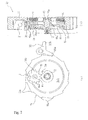
- Figs. 2(a) and 2(b) schematically show a spring means including the tension reducer used in the seat belt retractor of this embodiment, wherein Fig. 2(a) is a front view thereof and Fig. 2(b) is a sectional view taken along a line IIB-IIB of Fig. 2(a).
- the tension reducer 10 comprises a cover 11 which is fixed to a base frame of the seat belt retractor 3.
- a bush shaft 12 Accommodated in the cover 11 is a bush shaft 12.
- the bush shaft 12 has a lever 12a extending in the radial direction.
- the left end of the bush shaft 12 is connected to a spool (not shown) of the seat belt retractor 3 such that the bush shaft 12 rotates together with the spool.
- the right end of the bush shaft 12 is connected to and supported by a bush 13, for example, by means of spline connection, such that the bush 12 rotates together with the bush shaft 12.
- the bush 13 is integrally and rotatably supported by a cylindrical projection 11a of the cover 11.
- reducer spring 14 formed by a spiral spring is connected to the bush 13 and the other end of the reducer spring 14 is connected to the cover 11.
- the reducer spring 14 always biases the bush shaft 12 in the belt winding direction. That is, the reducer spring 14 always biases the spool, for winding up the seat belt 6, in the belt winding direction.
- an annular ratchet gear (corresponding to the rotation control member of the present invention) 15 is arranged on the outer periphery of an axially middle portion of the bush shaft 12.
- the ratchet gear 15 comprises a disk-like gear portion 15b having ratchet teeth 15a around the periphery thereof and a shaft portion 15c which is formed at the center of the gear portion 15b and which is coaxial with the gear portion 15b so that the ratchet gear 15 has a T-like section.
- main spring main SPG; corresponding to the second spring of the present invention
- the main spring 17 always biases the ratchet gear 15 in the belt winding direction. That is, the main spring 17 can bias the spool, for winding up the seat belt 6, in the belt winding direction. In this case, the reducer spring 14 and the main spring 17 bias the spool in the belt winding direction in parallel with each other.
- the ratchet gear 15 has a projection shaft 15d on which a Geneva wheel 18 is rotatably supported.
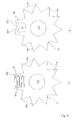
- the Geneva wheel 18 has nine teeth corresponding to nine of eleven teeth hypothetically formed circumferentially at equal intervals and a stopper 18b corresponding to the rest two of the eleven teeth with a buried V-like groove therebetween.
- the outer periphery 18b 1 of the stopper 18b is formed into a concave arc surface which has a diameter substantially equal to the outer diameter of a portion of the bush shaft 12 where the lever 12a is formed.
- the bush shaft 12 and the Geneva wheel 18 compose a Geneva stop mechanism.
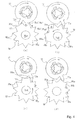
- the action of the Geneva stop mechanism will be described in detail.
- a groove A between the stopper 18b and a tooth 18a' adjacent to the stopper 18b in the clockwise direction faces the outer periphery of a portion other than the lever 12a of the bush shaft 12 as shown in Fig. 4(a) and, in addition, the lever 12a of the bush shaft 12 is in contact with the outer periphery 18b 1 of the stopper 18b.
- the bush shaft 12 is allowed to rotate in the clockwise direction.
- the lever 12a of the bush shaft 12 enters into a groove B (adjacent to the groove A in the clockwise direction) between the tooth 18a' and a tooth 18a" which is adjacent to the tooth 18a' in the clockwise direction so that the lever 12a is engaged with the tooth 18a'. Since the bush shaft 12 is rotated in the clockwise direction, the lever 12a rotates the Geneva wheel 18 via the tooth 18a' in the counter clockwise direction.
- the groove B comes to the position where the stopper 18b is located in Fig.
- the lever 12a is disengaged from the tooth 18a' and the bush shaft 12 continuously rotates in the clockwise direction, while the Geneva wheel 18 is stopped from rotating.
- the Geneva wheel 18 having the stopper 18b and the teeth 18a is rotated in the counter clockwise direction by an angle corresponding to two teeth 18a.
- the lever 12a enters into a groove C which is now located at the same position as the groove B shown in Fig. 4(a) so that the lever 12a is engaged with the tooth 18a as shown in Fig. 4(b). That is, the lever 12a skips one groove between the two adjacent teeth 18a to enter into the next groove.
- the lever 12a rotates the Geneva wheel 18 in the counter clockwise direction.
- the outer periphery 18b 1 of the stopper 18b faces the outer periphery of the portion of the bush shaft 12 other than the lever 12a and the lever 12a is engaged with the stopper 18b.
- the stopper 18b comes to the same position as the groove B shown in Fig. 4(a).
- the lever 12a comes in contact with the outer periphery 18b 1 of the stopper 18b. Therefore, even if the bush shaft 12 is biased to further rotate in the clockwise direction, the lever 12a can not rotate the Geneva wheel 18 in the counter clockwise direction so that the bush shaft 12 is stopped from rotating and the Geneva wheel 18 is continuously stopped.
- the Geneva wheel 18 While the bush shaft 12 continuously rotates to make eleven turns, the Geneva wheel 18 intermittently rotates to make about two turns (actually, less than two turns by an angle corresponding to two grooves between the adjacent teeth 18a and 18a).
- the number of teeth 18a of the Geneva wheel 18 is set to eleven, i.e. an odd number, and the stopper 18b is formed by burring a groove between two adjacent teeth 18a of the eleven teeth, and the Geneva wheel 18 is intermittently rotated by repeating that the lever 12a skips one groove to enter into the next groove, thereby efficiently increasing the rotational amount of the bush shaft 12 (that is, the rotational amount of the spool) and the rotational amount of the Geneva wheel 18.
- the lever 12a of the bush shaft 12 and the Geneva wheel 18 having the teeth 18a and the stopper 18b compose a memory means 19 for memorizing the rotational amount of the spool in the belt winding direction relative to the ratchet gear 15 for the time when the biasing action of the main spring 17 for rotating the spool in the belt winding direction is cancelled. Therefore, the memory means 19 is arranged within the ratchet gear 15 as shown in Figs. 2(a) and 2(b).
- a lever member 20 is pivotably supported on the cover 11.
- the lever member 20 has an engaging pawl 20a and an operational portion 20b which is formed to have a predetermined angle from the engaging pawl 20a.
- an electromagnetic solenoid 21 is arranged in the cover 11.
- the electromagnetic solenoid 21 has an actuator (not shown) which is connected to the operational portion 20b of the lever member 20. When the electromagnetic solenoid 21 is excited by energization, the electromagnetic solenoid 21 rotates the lever member 20 in the clockwise direction when seen in Fig.
- the ratchet gear 15 is allowed to rotate in the belt winding direction.
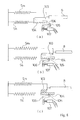
- Figs. 5(a)-5(f) are illustrations for explaining the works of the tension reducer of this embodiment.
- rotational motion, tightening action, and the loosening action are converted into (simulated as) linear motion, contracting action, and expanding action, respectively.
- the stopper 18b of the Geneva wheel 18 is set to a position shown in Fig. 4(a) and Fig. 5(a) and the lever 12a of the bush shaft 12 is in contact with the stopper 18b as shown in Fig. 4(a) and Fig. 5(a). Since the electromagnetic solenoid 21 is not excited, the engaging pawl 20a of the lever member 20 is set at a position where the engaging pawl 20a can not be engaged with any one of the ratchet teeth 15a of the ratchet gear 15. Accordingly, the seat belt 6 is wound up by relatively large winding force, i.e. the sum of the biasing force T 1 of the reducer spring 14 and the biasing force T 2 of the main spring 17 (T 1 + T 2 ).
- the ratchet gear 15, the bush shaft 12, and the Geneva wheel 18 move rightward together with the seat belt 6 (Actually, since the spool is rotated by the withdrawal of the seat belt 6 in the belt withdrawing direction, the bush shaft 12, the ratchet gear 15, and the Geneva wheel 18 are coincident with the spool to rotate together in the belt withdrawing direction.
- the Geneva wheel 18 moves around the bush shaft 12.), as shown in Fig. 5(b). Then, the reducer spring 14 and the main spring 17 both expand.
- the electromagnetic solenoid 21 is excited by energization so that the lever member 20 rotates in the clockwise direction when seen in Fig. 2(a) and the engaging pawl 20a of the lever member 20 is set to a position where the engaging pawl 20a can be engaged with one of the ratchet teeth 15a of the ratchet gear 15 as shown in Fig. 5(c).
- the engaging pawl 20a of the lever member 20 is engaged with the ratchet gear 15 as shown in Fig. S(d).
- the rotational amount of the spool relative to the ratchet gear 15 is memorized as the rotational amount of the Geneva wheel 18. That is, the rotational amount of the spool relative to the ratchet gear 15 is memorized by the memory means 19.
- the spool for winding up the seat belt 6 is not biased by the main spring 17, but is biased only by the reducer spring 14.
- the main spring 17 selectively biases the spool in the belt winding direction. Accordingly, in the normally worn state where the excessively withdrawn part of the seat belt 6 is wound after the tongue is latched to the buckle, the seat belt 6 is lightly tensioned only by the biasing force T 1 of the reducer spring 14 as shown in Fig. 5(e) so that the seat belt 6 lightly fits the occupant's body.
- the energization to the electromagnetic solenoid 21 is canceled so that the electromagnetic solenoid 21 is not excited and the lever member 20 rotates in the counter clockwise direction when seen in Fig. 2(a).
- the engaging pawl 20a of the lever member 20 comes off the ratchet teeth 15a of the ratchet gear 15 so that the engagement between the lever member 20 and the ratchet gear 15 is cancelled.
- the ratchet gear 15 is allowed to move leftward (rotate in the belt winding direction, i.e. rotate in the counter clockwise direction when seen in Fig. 2(a)), whereby the ratchet gear 15 rapidly rotates in the belt winding direction by the biasing force of the main spring 17.
- the Geneva wheel 18 rotates together with the ratchet gear 15 in the same direction and relative to the bush shaft 12 (moves around the bush shaft 12). Since, at this point, the spool does not rotate so that the bush shaft 12 also does not rotate, the Geneva wheel 18 is rotated in the reverse direction (the clockwise direction) by the lever 12a of the bush shaft 12 because of the rotation of the ratchet gear 15. During this, it is repeated that the lever 12a skips one groove and enters into the next groove, whereby the Geneva wheel 18 is intermittently rotated by the rotation of the ratchet gear 15.
- the Geneva wheel 18 is stopped from rotating relative to the bush shaft 12 so that the winding number of the reducer spring 14 and the winding number of the main spring 17 are returned to the initial state. Then, the biasing force T 2 of the main spring 17 is applied to the spool in the belt winding direction via the Geneva wheel 18, the ratchet gear 15, and the bush shaft 12. Accordingly, the seat belt 6 is wound up onto the spool by a relatively large winding force being equal to the sum (T 1 +T 2 ) of the biasing force T 1 of the reducer spring 14 and the biasing force T 2 of the main spring 17.
- the memory means 19 is arranged in the ratchet gear 15 and the Geneva wheel which can have larger strength and smaller thickness than the tape disclosed in the Japanese Patent No. 3565596 is employed, thereby preventing increase in axial length of the tension reducer and preventing increase in radial size of the tension reducer even with the memory means 19. That is, as shown in Fig. 2(b), the width W 1 of the spring means including the tension reducer can be effectively reduced as compared to the width W 2 of the conventional spring means including the tension reducer. Therefore, the seat belt retractor 3 can be formed to have a compact size in the axial direction without increasing the size in the radial direction.
- the memory means 19 is structured as a Geneva stop mechanism comprising the lever 12a of the bush shaft 12 and the Geneva wheel 18, the number of parts can be reduced, the structure is simplified, and reliable and stable operation is achieved.
- the number of teeth 18a of the Geneva wheel 18 is set to eleven, i.e. an odd number, and the stopper 18b is formed by burring a groove between two adjacent teeth 18a of the eleven teeth, and the Geneva wheel 18 is intermittently rotated by the lever 12a such that the lever 12a skips one groove to enter into the next groove every turn of the bush shaft 12, thereby efficiently increasing the rotational amount of the bush shaft 12 (that is, the rotational amount of the spool) and the rotational amount of the Geneva wheel 18. Therefore, when the tension reducer is actuated, the rotational amount of the spool in the belt withdrawing direction, i.e. the withdrawn amount of the seat belt 6 can be increased, thereby effectively reducing the belt tension on the seat belt 6 in the normally worn state.
- the stopper 18b includes the Geneva wheel 18 itself, there is no need to provide a special stopper member. Since the lever 12a is engaged with all of the teeth 18a of the Geneva wheel 18 for rotating the Geneva wheel 18 when the tension reducer is actuated, the teeth 18a of the Geneva wheel 18 are prevented from being partially worn, thereby improving the durability of the Geneva wheel 18.
- the reduction in size of the seat belt retractor 3 increases the effective space of a vehicle cabin, thereby making an occupant feel comfortable in the vehicle cabin.
- the number of teeth of the Geneva wheel 18 is set to eleven, i.e. an odd number and the intermittent rotation of the Geneva wheel 18 is achieved by skipping one groove (two teeth 18a) every time in the aforementioned embodiment, the present invention is not limited thereto.
- the number of teeth 18a may be three or more and the skipping number of grooves may be suitably set such that the lever 12a is never engaged with the same tooth at least during one turn of the Geneva wheel 18.
- the lever 12a of the bush shaft 12 comes in contact with the stopper 18b when the seat belt retractor 3 is in non-operation state as shown in Fig. 5(a) in the aforementioned embodiment, the lever 12a may be spaced apart from the stopper 18b when the seat belt retractor 3 is in non-operation state. In this case, when the spool and the bush shaft 12 are rotated in the belt withdrawing direction by withdrawal of the seat belt, the lever 12a promptly comes in contact with the stopper 18b.
- Figs. 6(a) and 6(b) are illustrations showing Geneva wheels of alternative examples for a seat belt retractor of an embodiment according to the present invention, respectively. It should be noted that the same components as the aforementioned example are marked with the same numerals in order to omit a detailed description.
- a Geneva wheel 18 has a U-like (substantially rectangular when seen along the axial direction of the Geneva wheel 18) concavity 18b 2 formed in a stopper 18b. Inside the concavity 18b 2 , a plate spring 22 folded in a meander shape is arranged as an impact buffer means of the present invention.
- a lever 12a of a bush shaft 12 is adapted to collide with the outer end 22a of the plate spring 22.
- the plate spring 22 is arranged in a location of the Geneva wheel 18 colliding with the lever 12a, the impact by the lever 12a when the lever 12a collides with the plate spring 22 can be buffered by the elasticity of the plate spring 22. Therefore, damage of the lever 12a can be securely prevented and the lever 12a is not necessarily set to have a large strength.
- a stopper 18b of a Geneva wheel 18 of an alternative example is provided with a trapezoidal opening 23 as shown in Fig. 6(b).
- the outer side of the opening 23 is formed into an arc coaxially with the arc of the outer surface 18b 1 of the stopper 18b so that the outer end 18b 3 of the stopper 18b is formed to have constant thickness and have predetermined elasticity. Therefore, the outer end 18b 3 of the stopper 18b composes the impact buffer means of the present invention.
- the opening 23 is formed in the stopper 18b so that the outer end 18b 3 of the Geneva wheel 18 colliding with the lever 12a has elasticity as mentioned above, the impact by the lever 12a when the lever 12a collides with the outer end 18b 3 can be buffered by the elasticity of the outer end 18b 3 . Since there is no need for the plate spring 22, the number of parts can be reduced in this example as compared to the example shown in Fig. 6(a).
- the seat belt retractor and the seat belt apparatus employing the same of the present invention are suitably used as a seat belt retractor which is provided with a tension reducer and a seat belt apparatus employing the same, wherein the tension reducer reduces the biasing force of a spring means for pulling the seat belt while the seat belt is normally worn.
Landscapes
- Engineering & Computer Science (AREA)
- Mechanical Engineering (AREA)
- Automotive Seat Belt Assembly (AREA)
Abstract
A seat belt retractor which is still compact in the axial direction and the radial direction even with a tension reducer has a reducer spring (14) that always biases a bush shaft (12), which rotates together with a spool, to rotate in the belt winding direction, and a main spring (17) that can selectively bias the spool in the belt winding direction. A lever (12a) of the bush shaft (12) and a Geneva wheel (18) compose a memory means (19) for memorizing the rotational amount of the spool in the belt winding direction relative to the ratchet gear (15) when the main spring (17) does not bias the spool in the belt winding direction. The memory means (19) is arranged in the ratchet gear (15) so that the retractor with the tension reducer is formed to be compact in the axial direction and the radial direction.
Description
- The present invention relates to the technical field of a seat belt retractor for use in a seat belt apparatus which is installed in a vehicle such as an automobile and is adapted to restrain and protect an occupant with a seat belt thereof and, more particularly, to the technical field of a seat belt retractor with a tension reducer which can control the tension on a seat belt by controlling the biasing force of a spring means for winding up the seat belt during the normally worn state of the seat belt, and also relates to the technical field of a seat belt apparatus employing the same.
- Conventionally, seat belt apparatuses are installed in vehicles such as automobiles. In the event of an emergency such as a vehicle collision or the like where a large deceleration acts on the vehicle, such a seat belt apparatus restrains an occupant with a seat belt thereof so as to prevent inertia movement of the occupant from the seat, thereby protecting the occupant. The seat belt apparatus comprises a seat belt retractor which can wind and unwind the seat belt onto and from a spool thereof and can stop the seat belt from being unwound in the event of emergency.
- In such a seat belt retractor, it is desired to retract an excessively drawn part of the seat belt when an occupant sits in the vehicle seat and latches a tongue to a buckle after withdrawing the seat belt and to give no feeling of unwanted oppression against the chest or the like of the occupant under the normal wearing condition. However, generally in the seat belt retractor, the spool is always biased in the belt winding direction by biasing force of a spring means so that the occupant feels oppression while the occupant wears the seat belt under the normal wearing condition. To avoid this, it may be considered to employ a spring with weak biasing force for reducing the oppression against the occupant. However, the spring with weak biasing force provides small winding force for winding up the seat belt.
- A seat belt retractor is known which is provided with a tension reducer for reducing the biasing force of a spring means for winding a seat belt while an occupant wears the seat belt under the normal wearing condition (for example, see
Japanese Patent No. 3565596 - Fig. 7 is a sectional view schematically showing a seat belt retractor disclosed in
Japanese Patent No. 3565596 numeral 100 designates a seat belt retractor, 101 designates a spool for winding up a seat belt B, 102 designates a base frame rotatably holding thespool 101, Sm designates a main spring for always biasing thespool 101 in the belt winding direction, Ss designates an additional spring for applying biasing force in the belt winding direction to thespool 101 selectively, 103 designates a tape which is arranged inside aclutch gear 104 having aboss 104a connected to one end of the additional spring Ss and which is wound into a spiral to connect the main spring Sm and the additional spring Ss, 105 designates a clutch pawl, 106 designates a pivot lever, 107 designates an electromagnetic solenoid, 110 designates a connecting shaft, 111 designates a main shaft, 115 designates a spring housing, and 116 designates a detection switch for detecting the engagement between a tongue and a buckle. - The main spring Sm and the additional spring Ss are arranged in parallel to extend along planes perpendicular to the axial direction of the
spool 101. The main spring Sm always biases thespool 101, on which the seat belt B is wound, in the belt winding direction via the connectingshaft 110 and themain shaft 111. The inner end of the main spring Sm is connected to an end of the connectingshaft 110 and the outer end of the main spring Sm is connected to a portion of the inner periphery of thespring housing 115. - On the other hand, the inner end of the additional spring Ss is fixed to the
boss 104a formed integrally with theclutch gear 104 having ratchet teeth. Aclutch pawl 105 is arranged such that theclutch pawl 105 can engage theclutch gear 104 to prevent the return movement of theclutch gear 104 in a direction toward the non-operational position. The engagement between theclutch pawl 105 and theclutch gear 104 to prevent the return movement can be canceled by apivot lever 106 and theelectromagnetic solenoid 107. - Between the main spring Sm and the additional spring Ss, the
memory tape 103 is disposed. - Figs. 8(a)-8(c) are illustrations for explaining the action of the seat belt retractor, wherein Fig. 8(a) shows the non-operational state of the seat belt retractor, Fig. 8(b) shows the state in which the seat belt is withdrawn from the seat belt retractor for wearing the seat belt, and Fig. 8(c) shows the state in which the seat belt is normally worn by an occupant after the tongue is latched to the buckle.
- When the seat belt retractor is in the non-operational state shown in Fig. 8(a), the main spring Sm and the additional spring Ss are in the fully contracted state and the
tape 103 is in the tensioned state. - As the seat belt B is withdrawn rightward from the seat belt retractor when the seat belt retractor is in the non-operational state, the
clutch gear 104 and thetape 103 both move rightward together with the seat belt B as shown in Fig. 8(b). Thus, the main spring Sm and the additional spring Ss are both stretched and theclutch pawl 105 engages theclutch gear 104. Accordingly, the return movement of theclutch gear 104 is prevented. - As the tongue is latched to the buckle so that the seat belt B is worn by the occupant, an excessively drawn part of the seat belt B is retracted slightly leftward. Since the return movement of the
clutch gear 104 is prevented, only the main spring Sm contracts and thetape 103 loosens as shown in Fig. 8(c). Accordingly, the seat belt B is biased only by the main spring Sm, but not by the additional spring Ss. Therefore, while the seat belt is in the normally worn state where the excessively drawn part of the seat belt B is retracted after the tongue is latched to the buckle, the seat belt B is lightly pulled only by the main spring Sm so that the seat belt B fits the occupant lightly. - When the seat belt B is in the normally worn state shown in Fig. 8(c), the
electromagnetic solenoid 107 is excited by energization to move thepivot lever 106 to pivot in the clockwise direction so as to release theclutch pawl 105 from theclutch gear 104, thereby allowing the leftward movement (rotation) of theclutch gear 104. Accordingly, theclutch gear 104 rapidly moves (rotates) in such a direction as to wind up (tension) thetape 103 by the biasing force of the additional spring Ss. As thetape 103 becomes tensioned, the seat belt B is biased by both the main spring Sm and the additional spring Ss such that the seat belt B is strongly wound onto thespool 101. That is, thetape 103 functions as a memory means for memorizing the rotational amount of thespool 101 relative to theclutch gear 104. - As the winding of the seat belt B onto the
spool 101 is terminated, theelectromagnetic solenoid 107 is no longer excited so that thepivot lever 106 pivots in the counter-clockwise direction and theclutch pawl 105 is set to the non-operational position where theclutch pawl 105 can engage theclutch gear 104 as shown in Fig. 8(a). - In the
Japanese Patent No. 3565596 spool 101 when the seat belt retractor is in a non-operation state, a ball screw memory means having a clutch gear, a disk disposed parallel with the clutch gear in the axial direction, a spiral ball screw groove formed between the clutch gear and the disk, and a steel ball may be employed instead of theaforementioned memory tape 103. - On the other hand, a seat belt retractor has been proposed which comprises a main wind-up spring and a sub wind-up spring, a Geneva drive and a Geneva wheel which mesh with each other to rotate in the opposite directions and have special stoppers, respectively, wherein the stoppers are adapted to come in contact with each other (for example, see
Japanese Unexamined Utility Model Publication No. H05-1632 - In the seat belt retractor disclosed in the
Japanese Patent No. 3565596 memory tape 103 is required to have a certain width (i.e., a certain length in the axial direction of the seat belt retractor) for the purpose of strength. Accordingly, the size in the axial direction of the seat belt retractor is inevitably large. To avoid this, there must be considered that the thickness of thetape 103 is increased to reduce the width of thetape 103. However, when the thickness of thetape 103 is increased, the size in the radial direction of a roll of thetape 103 must be increased because thetape 103 is wound in a spiral roll. Meanwhile, the size in the radial direction of the seat belt retractor should be inevitably large. - Even when the ball screw memory means is employed instead of the
tape 103, the size in the axial direction of the seat belt retractor is inevitably large because the disk and the steel ball are arranged parallel with each other in the axial direction. - However, in recent years, it is increasingly desired to reduce the sizes of parts used in a vehicle cabin for the purpose of increasing the space of the vehicle cabin without increasing the outer shape of the vehicle. Therefore, even seat belt retractors used in the vehicle cabin are desired to be smaller. Since the size in the axial direction of the aforementioned seat belt retractor is inevitably large as mentioned above, there is a problem that the seat belt retractor can not respond to the desire of size reduction.
- In the seat belt retractor disclosed in the aforementioned
Japanese Unexamined Utility Model Publication No. H05-1632 Japanese Patent No. 3565596 - The present invention was made under the aforementioned circumstances and an object of the present invention is to provide a seat belt retractor which can have smaller size in the axial direction and the radial direction even when the seat belt retractor is provided with a tension reducer, wherein the actuation of the tension reducer can be reliably and stably conducted, and which can have a simple structure having a smaller number of parts.
- Another object of the present invention is to provide a seat belt apparatus which comprises a seat belt retractor having a compact size in the axial direction so as to increase the effective space of a vehicle cabin, thereby making an occupant feel comfortable in the vehicle cabin.
- According to the present invention, these objects are achieved by a seat belt retractor according to claim 1 and a seat belt apparatus according to claim 9. The dependent claims define preferred or advantageous embodiments of the invention.
- To solve the aforementioned problems, a seat belt retractor according to an aspect of the invention comprises at least: a spool for winding up a seat belt; a spring means capable of biasing said spool in the belt winding direction; and a tension reducer for controlling the biasing force of said spring means relative to the spool so as to control the tension on said seat belt, wherein said spring means includes a first spring having a spiral spring which always biases said spool in the belt winding direction and a second spring having a spiral spring which selectively biases said spool in the belt winding direction, wherein said tension reducer includes a rotation control member which can rotate together with said spool or relative to said spool selectively, said tension reducer does not allow said second spring to bias said spool in the belt winding direction when said rotation control member is prevented from rotating in the belt winding direction, and allows said second spring to bias said spool in the belt winding direction when said rotation control member is allowed to rotate in the belt winding direction, said seat belt retractor further comprising a memory means for memorizing the rotational amount of said spool in the belt winding direction relative to said rotation control member when said second spring is not allowed to bias said spool in the belt winding direction, wherein said memory means includes a Geneva wheel which has a plurality of teeth and a stopper and which is rotatably attached to said rotation control member, and a rotary member which is rotatable together with said spool, which has a lever capable of engaging with the teeth of said Geneva wheel, and which intermittently rotates said Geneva wheel, said memory means memorizes the rotational amount of said spool in the belt winding direction relative to said rotation control member as the rotational amount of said Geneva wheel, and wherein, when said rotation control member is allowed to rotate in the belt winding direction, said lever collides with said stopper so that said spool is biased in the belt winding direction by both of said first and second springs.
- The stopper may be formed by burring a groove between two adjacent teeth of the plurality of teeth of said Geneva wheel.
- The memory means may be adapted such that said lever is never engaged with the same tooth of said Geneva wheel at least during one turn of said Geneva wheel.
- The stopper may comprise an impact buffer means for buffering an impact by said lever when said lever collides with said stopper.
- The impact buffer means may be a spring arranged in a concavity formed in said stopper or an outer end of said stopper which is provided with elasticity by forming an opening in said stopper.
- Moreover, a seat belt apparatus according to the invention comprises at least: a seat belt for restraining an occupant; a seat belt retractor which winds up the seat belt and allows the seat belt to be withdrawn; a tongue slidably supported by said seat belt; and a buckle to which said tongue can be detachably latched, wherein the seat belt retractor is a seat belt retractor according to any one aspect or embodiment of the invention.
- In the seat belt retractor according to the present invention having the aforementioned structure, the memory means is arranged in the rotational control member and the Geneva wheel, the strength of which is relatively large and the thickness of which may be thin as compared to the tape disclosed in
Japanese Patent No. 3565596 - The memory means is the Geneva stop mechanism having the lever of the rotary member and the Geneva wheel, thereby reducing the number of parts, providing a simple structure, and achieving secure and stable operation.
- If the stopper is formed by burring a groove between Geneva wheel teeth, the stopper is a part of the Geneva wheel itself so that there is no need to provide a special stopper member.
- Further, if the lever is never engaged with the same tooth of the Geneva wheel at least during one turn of the Geneva wheel, the rotational amount of the rotary member (i.e. the rotational amount of the spool) and the rotational amount of the Geneva wheel is effectively increased. Therefore, when the tension reducer is actuated, the rotational amount of the spool in the belt withdrawing direction, i.e. the withdrawn amount of the seat belt can be increased, thereby effectively reducing the belt tension on the seat belt in the normally worn state. Since the lever is never engaged with the same tooth of the Geneva wheel at least during one turn of the Geneva wheel, the teeth of the Geneva wheel are prevented from being partially worn, thereby improving the durability of the Geneva wheel.
- If the stopper comprises an impact buffer means for buffering an impact by the lever when the lever collides with the stopper, the impact by the lever can be buffered by the impact buffer means. Therefore, a damage of the lever can be securely prevented and the strength of the lever does not necessarily need to be set to be particularly large.
- Since the impact buffer means includes a spring arranged in a groove formed in the stopper or the outer end of the stopper which is provided with elasticity by forming an opening in the stopper, the impact buffer means can be formed with a simple structure. In addition, the impact buffer means includes the stopper of the Geneva wheel itself, thereby reducing the number of parts.
- Further, according to the seat belt apparatus having the seat belt retractor of the present invention, the reduction in size of the seat belt retractor increases the effective space of a vehicle cabin, thereby making an occupant feel comfortable in the vehicle cabin.
- Hereinafter, best modes for carrying out the present invention will be described with reference to the attached drawings.
- Fig. 1 is an illustration schematically showing an example of a seat belt apparatus employing a seat belt retractor of an embodiment according to the present invention.
- Figs. 2(a) and 2(b) schematically show a spring means including a tension reducer used in the seat belt retractor of the embodiment shown in Fig. 1, wherein Fig. 2(a) is a front view thereof and Fig. 2(b) is a sectional view taken along a line IIB-IIB of Fig. 2(a).
- Fig. 3 is an illustration showing a Geneva stop mechanism consisting of a lever of a bush shaft and a Geneva wheel shown in Fig. 2.
- Figs. 4(a)-4(d) are illustrations for explaining the operation of the Geneva stop mechanism shown in Fig. 3.
- Figs. 5(a)-5(f) are illustrations for explaining the operation of the tension reducer.
- Figs. 6(a) and 6(b) are illustrations showing Geneva wheels of alternative examples for a seat belt retractor of an embodiment according to the present invention, respectively.
- Fig. 7 is a sectional view schematically showing a conventional tension reducer.
- Fig. 8 is an illustration for explaining the operation of the conventional tension reducer.
- Fig. 1 is an illustration schematically showing an example of a seat belt apparatus provided with an embodiment of a seat belt retractor according to the present invention. It should be noted that the terms "left" and "right" in the following description correspond to "left" and "right" in the drawing used for the description.
- As shown in Fig. 1, a seat belt apparatus 1 of this example comprises a
seat belt retractor 3 fixed to a vehicle body such as a B pillar 2, aseat belt 6 which can be withdrawn from theseat belt retractor 3 and is provided at its tip end with a belt anchor 4 fixed to a vehicle floor or avehicle seat 5, a guide anchor 7 which is fixed to a vehicle body such as a center pillar or the like to guide theseat belt 6 withdrawn from theseat belt retractor 3 to a shoulder of an occupant C, a tongue 8 which is slidably supported by theseat belt 6 guided by the guide anchor 7, and a buckle 9 which is fixed to the vehicle floor or the vehicle seat and to which the tongue 8 can be detachably inserted and latched. - Like the aforementioned
Japanese Patent No. 3565596 seat belt retractor 3 of this embodiment is provided with a tension reducer. The components other than the tension reducer of theseat belt retractor 3 are similar to those of a conventional seat belt retractor such as the seat belt retractor disclosed in the aforementionedJapanese Patent No. 3565596 - Figs. 2(a) and 2(b) schematically show a spring means including the tension reducer used in the seat belt retractor of this embodiment, wherein Fig. 2(a) is a front view thereof and Fig. 2(b) is a sectional view taken along a line IIB-IIB of Fig. 2(a).
- As shown in Figs. 2(a) and 2(b), the
tension reducer 10 comprises acover 11 which is fixed to a base frame of theseat belt retractor 3. Accommodated in thecover 11 is abush shaft 12. Thebush shaft 12 has alever 12a extending in the radial direction. The left end of thebush shaft 12 is connected to a spool (not shown) of theseat belt retractor 3 such that thebush shaft 12 rotates together with the spool. The right end of thebush shaft 12 is connected to and supported by abush 13, for example, by means of spline connection, such that thebush 12 rotates together with thebush shaft 12. Thebush 13 is integrally and rotatably supported by acylindrical projection 11a of thecover 11. - One end of a reducer spring (reducer SPG: corresponding to the first spring of the present invention) 14 formed by a spiral spring is connected to the
bush 13 and the other end of thereducer spring 14 is connected to thecover 11. Thereducer spring 14 always biases thebush shaft 12 in the belt winding direction. That is, thereducer spring 14 always biases the spool, for winding up theseat belt 6, in the belt winding direction. - On the outer periphery of an axially middle portion of the
bush shaft 12, an annular ratchet gear (corresponding to the rotation control member of the present invention) 15 is arranged. As shown in Fig. 2(a), theratchet gear 15 comprises a disk-like gear portion 15b havingratchet teeth 15a around the periphery thereof and ashaft portion 15c which is formed at the center of thegear portion 15b and which is coaxial with thegear portion 15b so that theratchet gear 15 has a T-like section. - Fixed to the
cover 11 is aspring casing 16. Theshaft portion 15c of theratchet gear 15 is rotatably supported by thespring casing 16. Accommodated in thespring casing 16 is a main spring (main SPG; corresponding to the second spring of the present invention) 17 formed by a spiral spring. - One end of the
main spring 17 is connected to thespring casing 16 and the other end of themain spring 17 is connected to theshaft portion 15c of theratchet gear 15. Themain spring 17 always biases theratchet gear 15 in the belt winding direction. That is, themain spring 17 can bias the spool, for winding up theseat belt 6, in the belt winding direction. In this case, thereducer spring 14 and themain spring 17 bias the spool in the belt winding direction in parallel with each other. - The
ratchet gear 15 has aprojection shaft 15d on which aGeneva wheel 18 is rotatably supported. As shown in Fig. 3, theGeneva wheel 18 has nine teeth corresponding to nine of eleven teeth hypothetically formed circumferentially at equal intervals and astopper 18b corresponding to the rest two of the eleven teeth with a buried V-like groove therebetween. Theouter periphery 18b1 of thestopper 18b is formed into a concave arc surface which has a diameter substantially equal to the outer diameter of a portion of thebush shaft 12 where thelever 12a is formed. - As the
bush shaft 12 rotates in the clockwise direction when seen in Fig. 3, thelever 12a of thebush shaft 12 enters into one of the grooves between theteeth 18a or one of the grooves between theteeth 18a and thestopper 18b so that thelever 12a is engaged with one of theteeth 18a or thestopper 18b, thereby intermittently rotating theGeneva wheel 18 in the direction opposite to that of the bush shaft 12 (in the counter clockwise direction when seen in Fig. 3). - The
bush shaft 12 and theGeneva wheel 18 compose a Geneva stop mechanism. Hereinafter, the action of the Geneva stop mechanism will be described in detail. - It is assumed that a groove A between the
stopper 18b and atooth 18a' adjacent to thestopper 18b in the clockwise direction faces the outer periphery of a portion other than thelever 12a of thebush shaft 12 as shown in Fig. 4(a) and, in addition, thelever 12a of thebush shaft 12 is in contact with theouter periphery 18b1 of thestopper 18b. - Even when the
bush shaft 12 is biased to rotate in the counter-clockwise direction in this state, thebush shaft 12 does not rotate in the counter-clockwise direction and theGeneva wheel 18 also does not rotate because thelever 12a is in contact with theouter periphery 18b1 of thestopper 18b. - On the other hand, in the state shown in Fig. 4(a), the
bush shaft 12 is allowed to rotate in the clockwise direction. As thebush shaft 12 rotates in the clockwise direction from this state, thelever 12a of thebush shaft 12 enters into a groove B (adjacent to the groove A in the clockwise direction) between thetooth 18a' and atooth 18a" which is adjacent to thetooth 18a' in the clockwise direction so that thelever 12a is engaged with thetooth 18a'. Since thebush shaft 12 is rotated in the clockwise direction, thelever 12a rotates theGeneva wheel 18 via thetooth 18a' in the counter clockwise direction. When the groove B comes to the position where thestopper 18b is located in Fig. 4(a), thelever 12a is disengaged from thetooth 18a' and thebush shaft 12 continuously rotates in the clockwise direction, while theGeneva wheel 18 is stopped from rotating. At this point, theGeneva wheel 18 having thestopper 18b and theteeth 18a is rotated in the counter clockwise direction by an angle corresponding to twoteeth 18a. - As the
bush shaft 12 further rotates in the clockwise direction, thelever 12a enters into a groove C which is now located at the same position as the groove B shown in Fig. 4(a) so that thelever 12a is engaged with thetooth 18a as shown in Fig. 4(b). That is, thelever 12a skips one groove between the twoadjacent teeth 18a to enter into the next groove. In the same manner as mentioned above, since thebush shaft 12 is rotated in the clockwise direction, thelever 12a rotates theGeneva wheel 18 in the counter clockwise direction. As theGeneva wheel 18 having thestopper 18b and theteeth 18a is rotated in the counter clockwise direction by an angle corresponding to twoteeth 18a, thelever 12 is disengaged from thetooth 18a and thebush shaft 12 is continuously rotated in the clockwise direction, while theGeneva wheel 18 is stopped from rotating. - As the
bush shaft 12 rotates to make five turns after thelever 12a first rotates theGeneva wheel 18, as shown in Fig. 4(c), theouter periphery 18b1 of thestopper 18b faces the outer periphery of the portion of thebush shaft 12 other than thelever 12a and thelever 12a is engaged with thestopper 18b. - As the
bush shaft 12 further rotates in the clockwise direction to make ten turns in total, as shown in Fig. 4(d), thestopper 18b comes to the same position as the groove B shown in Fig. 4(a). As thebush shaft 12 further rotates about one turn in the clockwise direction, thelever 12a comes in contact with theouter periphery 18b1 of thestopper 18b. Therefore, even if thebush shaft 12 is biased to further rotate in the clockwise direction, thelever 12a can not rotate theGeneva wheel 18 in the counter clockwise direction so that thebush shaft 12 is stopped from rotating and theGeneva wheel 18 is continuously stopped. - While the
bush shaft 12 continuously rotates to make eleven turns, theGeneva wheel 18 intermittently rotates to make about two turns (actually, less than two turns by an angle corresponding to two grooves between theadjacent teeth teeth 18a of theGeneva wheel 18 is set to eleven, i.e. an odd number, and thestopper 18b is formed by burring a groove between twoadjacent teeth 18a of the eleven teeth, and theGeneva wheel 18 is intermittently rotated by repeating that thelever 12a skips one groove to enter into the next groove, thereby efficiently increasing the rotational amount of the bush shaft 12 (that is, the rotational amount of the spool) and the rotational amount of theGeneva wheel 18. - The
lever 12a of thebush shaft 12 and theGeneva wheel 18 having theteeth 18a and thestopper 18b compose a memory means 19 for memorizing the rotational amount of the spool in the belt winding direction relative to theratchet gear 15 for the time when the biasing action of themain spring 17 for rotating the spool in the belt winding direction is cancelled. Therefore, the memory means 19 is arranged within theratchet gear 15 as shown in Figs. 2(a) and 2(b). - As shown in Fig. 2(b), a
lever member 20 is pivotably supported on thecover 11. As shown in Fig. 2(a), thelever member 20 has an engagingpawl 20a and anoperational portion 20b which is formed to have a predetermined angle from the engagingpawl 20a. In addition, as shown in Fig. 2(b), anelectromagnetic solenoid 21 is arranged in thecover 11. Theelectromagnetic solenoid 21 has an actuator (not shown) which is connected to theoperational portion 20b of thelever member 20. When theelectromagnetic solenoid 21 is excited by energization, theelectromagnetic solenoid 21 rotates thelever member 20 in the clockwise direction when seen in Fig. 2(a) so as to set the engagingpawl 20a to such a position that the engagingpawl 20a can be engaged with one of theratchet teeth 15a. As the engagingpawl 20a is engaged with one of theratchet teeth 15a, theratchet gear 15 is stopped from rotating in the belt winding direction. When theelectromagnetic solenoid 21 is not excited, theelectromagnetic solenoid 21 rotates thelever member 20 in the counter clockwise direction when seen in Fig. 2(a) so as to set the engagingpawl 20a to such a position that the engagingpawl 20a can not be engaged with any one of theratchet teeth 15a. - Since the engaging
pawl 20a is not engaged with theratchet teeth 15a, theratchet gear 15 is allowed to rotate in the belt winding direction. - Hereinafter, the operation of the
tension reducer 10 having the aforementioned structure will be described. - Figs. 5(a)-5(f) are illustrations for explaining the works of the tension reducer of this embodiment. In Figs. 5(a)-5(f), rotational motion, tightening action, and the loosening action are converted into (simulated as) linear motion, contracting action, and expanding action, respectively.
- As shown in Fig. 5(a), when the
seat belt retractor 3 is in non-operation state, thereducer spring 14 and themain spring 17 are fully contracted. On the other hand, thestopper 18b of theGeneva wheel 18 is set to a position shown in Fig. 4(a) and Fig. 5(a) and thelever 12a of thebush shaft 12 is in contact with thestopper 18b as shown in Fig. 4(a) and Fig. 5(a). Since theelectromagnetic solenoid 21 is not excited, the engagingpawl 20a of thelever member 20 is set at a position where the engagingpawl 20a can not be engaged with any one of theratchet teeth 15a of theratchet gear 15. Accordingly, theseat belt 6 is wound up by relatively large winding force, i.e. the sum of the biasing force T1 of thereducer spring 14 and the biasing force T2 of the main spring 17 (T1 + T2). - As the
seat belt 6 is normally withdrawn rightward from the seat belt retractor from the non-operation state of the seat belt retractor, theratchet gear 15, thebush shaft 12, and theGeneva wheel 18 move rightward together with the seat belt 6 (Actually, since the spool is rotated by the withdrawal of theseat belt 6 in the belt withdrawing direction, thebush shaft 12, theratchet gear 15, and theGeneva wheel 18 are coincident with the spool to rotate together in the belt withdrawing direction. TheGeneva wheel 18 moves around thebush shaft 12.), as shown in Fig. 5(b). Then, thereducer spring 14 and themain spring 17 both expand. - As the tongue is latched to the buckle (buckle-up) so that the occupant wears the
seat belt 6, theelectromagnetic solenoid 21 is excited by energization so that thelever member 20 rotates in the clockwise direction when seen in Fig. 2(a) and the engagingpawl 20a of thelever member 20 is set to a position where the engagingpawl 20a can be engaged with one of theratchet teeth 15a of theratchet gear 15 as shown in Fig. 5(c). As theseat belt 6 is further withdrawn, the engagingpawl 20a of thelever member 20 is engaged with theratchet gear 15 as shown in Fig. S(d). - An excessively withdrawn part of the
seat belt 6 is slightly wound leftward by the reducer spring 14 (Actually, the spool is rotated in the belt winding direction by the biasing force of thereducer spring 14 so as to wind up the seat belt 6). Since, at this point, the engagingpawl 20a of thelever member 20 is engaged with theratchet gear 15, theratchet gear 15 is prevented from returning (rotating in the belt winding direction) so that themain spring 17 does not contract as shown in Fig. 5(e) and only thereducer spring 14 contracts. Since the spool rotates in the belt winding direction, thebush shaft 12 also rotates together with the spool, but theratchet gear 15 does not rotates. Accordingly, theGeneva wheel 18 does not move around the bush shaft 12 (i.e. does not revolve). - Then, the
bush shaft 12 rotates in the clockwise direction so that thelever 12a is engaged with one of theteeth 18a of theGeneva wheel 18 so as to intermittently rotate theGeneva wheel 18 in the counter clockwise direction. The rotational amount of the spool relative to theratchet gear 15 is memorized as the rotational amount of theGeneva wheel 18. That is, the rotational amount of the spool relative to theratchet gear 15 is memorized by the memory means 19. - Therefore, the spool for winding up the
seat belt 6 is not biased by themain spring 17, but is biased only by thereducer spring 14. In this manner, themain spring 17 selectively biases the spool in the belt winding direction. Accordingly, in the normally worn state where the excessively withdrawn part of theseat belt 6 is wound after the tongue is latched to the buckle, theseat belt 6 is lightly tensioned only by the biasing force T1 of thereducer spring 14 as shown in Fig. 5(e) so that theseat belt 6 lightly fits the occupant's body. - As the tongue is released from the buckle (buckle-release) in the normally worn state of the
seat belt 6 as shown in Fig. 5(e), the energization to theelectromagnetic solenoid 21 is canceled so that theelectromagnetic solenoid 21 is not excited and thelever member 20 rotates in the counter clockwise direction when seen in Fig. 2(a). Accordingly, the engagingpawl 20a of thelever member 20 comes off theratchet teeth 15a of theratchet gear 15 so that the engagement between thelever member 20 and theratchet gear 15 is cancelled. Then, theratchet gear 15 is allowed to move leftward (rotate in the belt winding direction, i.e. rotate in the counter clockwise direction when seen in Fig. 2(a)), whereby theratchet gear 15 rapidly rotates in the belt winding direction by the biasing force of themain spring 17. - Then, the
Geneva wheel 18 rotates together with theratchet gear 15 in the same direction and relative to the bush shaft 12 (moves around the bush shaft 12). Since, at this point, the spool does not rotate so that thebush shaft 12 also does not rotate, theGeneva wheel 18 is rotated in the reverse direction (the clockwise direction) by thelever 12a of thebush shaft 12 because of the rotation of theratchet gear 15. During this, it is repeated that thelever 12a skips one groove and enters into the next groove, whereby theGeneva wheel 18 is intermittently rotated by the rotation of theratchet gear 15. - As the
lever 12a comes in contact with thestopper 18b of theGeneva wheel 18 as shown in Fig. 5(f), theGeneva wheel 18 is stopped from rotating relative to thebush shaft 12 so that the winding number of thereducer spring 14 and the winding number of themain spring 17 are returned to the initial state. Then, the biasing force T2 of themain spring 17 is applied to the spool in the belt winding direction via theGeneva wheel 18, theratchet gear 15, and thebush shaft 12. Accordingly, theseat belt 6 is wound up onto the spool by a relatively large winding force being equal to the sum (T1 +T2) of the biasing force T1 of thereducer spring 14 and the biasing force T2 of themain spring 17. As the winding of theseat belt 6 onto the spool is terminated, theseat belt 6, thebush shaft 12, thereducer spring 14, theratchet gear 15, themain spring 17, and theGeneva wheel 18 return to their non-operation states as shown in Fig. 5(a). - According to the
seat belt retractor 3 of this embodiment, the memory means 19 is arranged in theratchet gear 15 and the Geneva wheel which can have larger strength and smaller thickness than the tape disclosed in theJapanese Patent No. 3565596 seat belt retractor 3 can be formed to have a compact size in the axial direction without increasing the size in the radial direction. - Since the memory means 19 is structured as a Geneva stop mechanism comprising the
lever 12a of thebush shaft 12 and theGeneva wheel 18, the number of parts can be reduced, the structure is simplified, and reliable and stable operation is achieved. - In the Geneva stop mechanism of this embodiment, the number of
teeth 18a of theGeneva wheel 18 is set to eleven, i.e. an odd number, and thestopper 18b is formed by burring a groove between twoadjacent teeth 18a of the eleven teeth, and theGeneva wheel 18 is intermittently rotated by thelever 12a such that thelever 12a skips one groove to enter into the next groove every turn of thebush shaft 12, thereby efficiently increasing the rotational amount of the bush shaft 12 (that is, the rotational amount of the spool) and the rotational amount of theGeneva wheel 18. Therefore, when the tension reducer is actuated, the rotational amount of the spool in the belt withdrawing direction, i.e. the withdrawn amount of theseat belt 6 can be increased, thereby effectively reducing the belt tension on theseat belt 6 in the normally worn state. - Since the
stopper 18b includes theGeneva wheel 18 itself, there is no need to provide a special stopper member. Since thelever 12a is engaged with all of theteeth 18a of theGeneva wheel 18 for rotating theGeneva wheel 18 when the tension reducer is actuated, theteeth 18a of theGeneva wheel 18 are prevented from being partially worn, thereby improving the durability of theGeneva wheel 18. - According to the seat belt apparatus 1 provided with the
seat belt retractor 3 of this embodiment, the reduction in size of theseat belt retractor 3 increases the effective space of a vehicle cabin, thereby making an occupant feel comfortable in the vehicle cabin. - Though the number of teeth of the
Geneva wheel 18 is set to eleven, i.e. an odd number and the intermittent rotation of theGeneva wheel 18 is achieved by skipping one groove (twoteeth 18a) every time in the aforementioned embodiment, the present invention is not limited thereto. The number ofteeth 18a may be three or more and the skipping number of grooves may be suitably set such that thelever 12a is never engaged with the same tooth at least during one turn of theGeneva wheel 18. - Though the
lever 12a of thebush shaft 12 comes in contact with thestopper 18b when theseat belt retractor 3 is in non-operation state as shown in Fig. 5(a) in the aforementioned embodiment, thelever 12a may be spaced apart from thestopper 18b when theseat belt retractor 3 is in non-operation state. In this case, when the spool and thebush shaft 12 are rotated in the belt withdrawing direction by withdrawal of the seat belt, thelever 12a promptly comes in contact with thestopper 18b. - Figs. 6(a) and 6(b) are illustrations showing Geneva wheels of alternative examples for a seat belt retractor of an embodiment according to the present invention, respectively. It should be noted that the same components as the aforementioned example are marked with the same numerals in order to omit a detailed description.
- As shown in Fig. 6(a), in the
seat belt retractor 3 of this embodiment, aGeneva wheel 18 has a U-like (substantially rectangular when seen along the axial direction of the Geneva wheel 18)concavity 18b2 formed in astopper 18b. Inside theconcavity 18b2, a plate spring 22 folded in a meander shape is arranged as an impact buffer means of the present invention. Alever 12a of abush shaft 12 is adapted to collide with the outer end 22a of the plate spring 22. - Since the plate spring 22 is arranged in a location of the
Geneva wheel 18 colliding with thelever 12a, the impact by thelever 12a when thelever 12a collides with the plate spring 22 can be buffered by the elasticity of the plate spring 22. Therefore, damage of thelever 12a can be securely prevented and thelever 12a is not necessarily set to have a large strength. - In the
seat belt retractor 3 of this embodiment, astopper 18b of aGeneva wheel 18 of an alternative example is provided with atrapezoidal opening 23 as shown in Fig. 6(b). In this case, the outer side of theopening 23 is formed into an arc coaxially with the arc of theouter surface 18b1 of thestopper 18b so that theouter end 18b3 of thestopper 18b is formed to have constant thickness and have predetermined elasticity. Therefore, theouter end 18b3 of thestopper 18b composes the impact buffer means of the present invention. - Since the
opening 23 is formed in thestopper 18b so that theouter end 18b3 of theGeneva wheel 18 colliding with thelever 12a has elasticity as mentioned above, the impact by thelever 12a when thelever 12a collides with theouter end 18b3 can be buffered by the elasticity of theouter end 18b3. Since there is no need for the plate spring 22, the number of parts can be reduced in this example as compared to the example shown in Fig. 6(a). - The other works and effects of this example are the same as those of the example shown in Fig. 6(a). The other structure, other works, and other effects of the
seat belt retractor 3 of the embodiment shown in Fig. 6(a) and 6(b) are the same as those of theseat belt retractor 3 of the aforementioned embodiment shown in Figs. 2(a), 2(b), and 3. - The seat belt retractor and the seat belt apparatus employing the same of the present invention are suitably used as a seat belt retractor which is provided with a tension reducer and a seat belt apparatus employing the same, wherein the tension reducer reduces the biasing force of a spring means for pulling the seat belt while the seat belt is normally worn.
Claims (9)
- A seat belt retractor comprising at least: a spool for winding up a seat belt (6); a spring means (14, 17) capable of biasing said spool in the belt winding direction; and a tension reducer (10) for controlling the biasing force of said spring means (14, 17) relative to the spool so as to control the tension on said seat belt,
wherein said spring means (14, 17) includes a first spring (14) comprising a spiral spring which always biases said spool in the belt winding direction and a second spring (17) comprising a spiral spring which selectively biases said spool in the belt winding direction,
wherein said tension reducer (10) includes a rotation control member (15) which can rotate together with said spool or relative to said spool selectively, said tension reducer (10) does not allow said second spring (17) to bias said spool in the belt winding direction when said rotation control member (15) is prevented from rotating in the belt winding direction, and allows said second spring (17) to bias said spool in the belt winding direction when said rotation control member (15) is allowed to rotate in the belt winding direction,
said seat belt retractor (3) further comprising a memory means (19) for memorizing the rotational amount of said spool in the belt winding direction relative to said rotation control member (15) when said second spring (17) is not allowed to bias said spool in the belt winding direction,
wherein said memory means (19) includes a Geneva wheel (18) which has a plurality of teeth (18a) and a stopper (18b) and which is rotatably attached to said rotation control member (15), and a rotary member (12, 12a) which is rotatable together with said spool, which has a lever (12a) capable of engaging with the teeth (18a) of said Geneva wheel (18), and which intermittently rotates said Geneva wheel (18), said memory means (19) memorizes the rotational amount of said spool in the belt winding direction relative to said rotation control member (15) as the rotational amount of said Geneva wheel (18), and
wherein, when said rotation control member (15) is allowed to rotate in the belt winding direction, said lever (12a) collides with said stopper (18b) so that said spool is biased in the belt winding direction by both said first spring (14) and second spring (17). - A seat belt retractor as claimed in claim 1, wherein said stopper (18b) is formed by burring a groove between two adjacent teeth (18a) of the plurality of teeth (18a) of said Geneva wheel (18).
- A seat belt retractor as claimed in claim 1 or 2, wherein said memory means (19) is adapted such that said lever (12a) is never engaged with the same tooth (18a) of said Geneva wheel (18) at least during one turn of said Geneva wheel (18).
- A seat belt retractor as claimed in any one of claims 1 through 3, wherein said Geneva wheel (18) has an odd number of teeth (18a).
- A seat belt retractor as claimed in claim 4, wherein said memory means (19) is adapted such that for each turn of said rotary member (12,12a) the lever (12a) rotates the Geneva wheel (18) by an angle corresponding to two teeth (18a) of the Geneva wheel (18).
- A seat belt retractor as claimed in any one of claims 1 through 5, wherein said stopper (18b) has an angular width corresponding to the angular width of two teeth (18a) of the Geneva wheel (18).
- A seat belt retractor as claimed in any one of claims 1 through 6, wherein said stopper (18b) comprises an impact buffer means (22; 23) for buffering an impact by said lever (12a) when said lever (12a) collides with said stopper (18b).
- A seat belt retractor as claimed in claim 7, wherein said impact buffer means (22; 23) is a spring (22) arranged in a concavity (18b2) formed in said stopper (18b) or an outer end of said stopper (18b) which is provided with elasticity by forming an opening (23) in said stopper (18b).
- A seat belt apparatus comprising at least: a seat belt (6) for restraining an occupant (C); a seat belt retractor (3) which winds up the seat belt (6) and allows the seat belt (6) to be withdrawn; a tongue (8) slidably supported by said seat belt (6); and a buckle (9) to which said tongue (8) can be detachably latched,
wherein said seat belt retractor (3) is a seat belt retractor (3) as claimed in any one of claims 1 through 8.
Applications Claiming Priority (1)
| Application Number | Priority Date | Filing Date | Title |
|---|---|---|---|
| JP2005172113A JP2006347199A (en) | 2005-06-13 | 2005-06-13 | Seat belt retractor and seat belt device provided with the same |
Publications (1)
| Publication Number | Publication Date |
|---|---|
| EP1733934A2 true EP1733934A2 (en) | 2006-12-20 |
Family
ID=36972832
Family Applications (1)
| Application Number | Title | Priority Date | Filing Date |
|---|---|---|---|
| EP06008310A Withdrawn EP1733934A2 (en) | 2005-06-13 | 2006-04-21 | Seat belt retractor and seat belt apparatus employing the same |
Country Status (4)
| Country | Link |
|---|---|
| US (1) | US20060278748A1 (en) |
| EP (1) | EP1733934A2 (en) |
| JP (1) | JP2006347199A (en) |
| CN (1) | CN1880131A (en) |
Families Citing this family (4)
| Publication number | Priority date | Publication date | Assignee | Title |
|---|---|---|---|---|
| JP2008213526A (en) * | 2007-02-28 | 2008-09-18 | Takata Corp | Seat belt retractor and seat belt device using it |
| JP2008213525A (en) * | 2007-02-28 | 2008-09-18 | Takata Corp | Seat belt retractor and seat belt device using it |
| DE102011085024B4 (en) * | 2011-02-25 | 2015-05-13 | Hugo Kern Und Liebers Gmbh & Co. Kg Platinen- Und Federnfabrik | webbing take |
| CN112565499B (en) * | 2020-11-26 | 2022-11-15 | 深圳市格林升科技有限公司 | Mobile phone shell installed in pneumatic mode |
Citations (2)
| Publication number | Priority date | Publication date | Assignee | Title |
|---|---|---|---|---|
| JPH051632U (en) | 1991-06-28 | 1993-01-14 | 富士オートリブ株式会社 | Safety belt retractor |
| JP3565596B2 (en) | 1994-12-16 | 2004-09-15 | タカタ株式会社 | Seat belt retractor |
Family Cites Families (3)
| Publication number | Priority date | Publication date | Assignee | Title |
|---|---|---|---|---|
| KR100249998B1 (en) * | 1992-03-24 | 2000-05-01 | 다카다 쥬이치로 | Seat Belt Retractor |
| JP3091383B2 (en) * | 1995-02-17 | 2000-09-25 | 株式会社東海理化電機製作所 | Gear mechanism and webbing take-up device |
| JP4295552B2 (en) * | 2003-05-16 | 2009-07-15 | 株式会社東海理化電機製作所 | Webbing take-up device |
-
2005
- 2005-06-13 JP JP2005172113A patent/JP2006347199A/en not_active Withdrawn
-
2006
- 2006-04-21 EP EP06008310A patent/EP1733934A2/en not_active Withdrawn
- 2006-06-08 US US11/448,730 patent/US20060278748A1/en not_active Abandoned
- 2006-06-13 CN CNA2006100926674A patent/CN1880131A/en active Pending
Patent Citations (2)
| Publication number | Priority date | Publication date | Assignee | Title |
|---|---|---|---|---|
| JPH051632U (en) | 1991-06-28 | 1993-01-14 | 富士オートリブ株式会社 | Safety belt retractor |
| JP3565596B2 (en) | 1994-12-16 | 2004-09-15 | タカタ株式会社 | Seat belt retractor |
Also Published As
| Publication number | Publication date |
|---|---|
| US20060278748A1 (en) | 2006-12-14 |
| CN1880131A (en) | 2006-12-20 |
| JP2006347199A (en) | 2006-12-28 |
Similar Documents
| Publication | Publication Date | Title |
|---|---|---|
| US4592520A (en) | Webbing tension device | |
| EP1918165B1 (en) | Seat belt retractor and seat belt apparatus comprising the same | |
| JP4521798B2 (en) | Seat belt retractor | |
| CN100577479C (en) | Seat belt retractor, method for controlling seat belt retractor, and vehicle | |
| EP1468883A1 (en) | Seat belt retractor | |
| CN110027502B (en) | Seatbelt retractor and seatbelt device for a motor vehicle | |
| EP1504971B1 (en) | Seat belt retractor | |
| EP0934856A1 (en) | Webbing winding device | |
| JP5706757B2 (en) | Seat belt retractor and seat belt device using the same | |
| WO2015037487A1 (en) | Seat belt retractor and seat belt device | |
| EP1992531A2 (en) | Locking member mounting structure of seat belt retractor | |
| US20060071111A1 (en) | Seat belt retractor and seat belt device | |
| JP2002509052A (en) | Automatic locking retractor with timing clutch mechanism | |
| US7431119B2 (en) | Seat belt retractor | |
| US20080203808A1 (en) | Seat belt retractor and seat belt apparatus employing the same | |
| JP5547737B2 (en) | Seat belt restraint device | |
| US20080093494A1 (en) | Seat belt retractor and seat belt apparatus employing the same | |
| JP2006327556A (en) | Seat belt retractor and seat belt device provided with this | |
| US20080203807A1 (en) | Seat belt retractor and seat belt apparatus employing the same | |
| EP1529699B1 (en) | Seat belt retractor | |
| JP5214413B2 (en) | Seat belt retractor and seat belt device using the same | |
| EP1690757B1 (en) | Seat belt retractor, seat belt apparatus, and vehicle with a seat belt apparatus | |
| EP1733934A2 (en) | Seat belt retractor and seat belt apparatus employing the same | |
| EP0542204B2 (en) | Webbing retractor | |
| US6889930B2 (en) | Seatbelt retractor of an automobile |
Legal Events
| Date | Code | Title | Description |
|---|---|---|---|
| PUAI | Public reference made under article 153(3) epc to a published international application that has entered the european phase |
Free format text: ORIGINAL CODE: 0009012 |
|
| AK | Designated contracting states |
Kind code of ref document: A2 Designated state(s): AT BE BG CH CY CZ DE DK EE ES FI FR GB GR HU IE IS IT LI LT LU LV MC NL PL PT RO SE SI SK TR |
|
| AX | Request for extension of the european patent |
Extension state: AL BA HR MK YU |
|
| STAA | Information on the status of an ep patent application or granted ep patent |
Free format text: STATUS: THE APPLICATION IS DEEMED TO BE WITHDRAWN |
|
| 18D | Application deemed to be withdrawn |
Effective date: 20081101 |