EP1733712A1 - Hair treating agent - Google Patents
Hair treating agent Download PDFInfo
- Publication number
- EP1733712A1 EP1733712A1 EP06007038A EP06007038A EP1733712A1 EP 1733712 A1 EP1733712 A1 EP 1733712A1 EP 06007038 A EP06007038 A EP 06007038A EP 06007038 A EP06007038 A EP 06007038A EP 1733712 A1 EP1733712 A1 EP 1733712A1
- Authority
- EP
- European Patent Office
- Prior art keywords
- group
- carbon atoms
- hair
- chain
- straight
- Prior art date
- Legal status (The legal status is an assumption and is not a legal conclusion. Google has not performed a legal analysis and makes no representation as to the accuracy of the status listed.)
- Granted
Links
Classifications
-
- A—HUMAN NECESSITIES
- A61—MEDICAL OR VETERINARY SCIENCE; HYGIENE
- A61Q—SPECIFIC USE OF COSMETICS OR SIMILAR TOILETRY PREPARATIONS
- A61Q5/00—Preparations for care of the hair
- A61Q5/12—Preparations containing hair conditioners
-
- A—HUMAN NECESSITIES
- A61—MEDICAL OR VETERINARY SCIENCE; HYGIENE
- A61K—PREPARATIONS FOR MEDICAL, DENTAL OR TOILETRY PURPOSES
- A61K8/00—Cosmetics or similar toiletry preparations
- A61K8/18—Cosmetics or similar toiletry preparations characterised by the composition
- A61K8/30—Cosmetics or similar toiletry preparations characterised by the composition containing organic compounds
- A61K8/40—Cosmetics or similar toiletry preparations characterised by the composition containing organic compounds containing nitrogen
- A61K8/41—Amines
-
- A—HUMAN NECESSITIES
- A61—MEDICAL OR VETERINARY SCIENCE; HYGIENE
- A61K—PREPARATIONS FOR MEDICAL, DENTAL OR TOILETRY PURPOSES
- A61K8/00—Cosmetics or similar toiletry preparations
- A61K8/18—Cosmetics or similar toiletry preparations characterised by the composition
- A61K8/30—Cosmetics or similar toiletry preparations characterised by the composition containing organic compounds
- A61K8/40—Cosmetics or similar toiletry preparations characterised by the composition containing organic compounds containing nitrogen
- A61K8/41—Amines
- A61K8/416—Quaternary ammonium compounds
-
- A—HUMAN NECESSITIES
- A61—MEDICAL OR VETERINARY SCIENCE; HYGIENE
- A61K—PREPARATIONS FOR MEDICAL, DENTAL OR TOILETRY PURPOSES
- A61K8/00—Cosmetics or similar toiletry preparations
- A61K8/18—Cosmetics or similar toiletry preparations characterised by the composition
- A61K8/30—Cosmetics or similar toiletry preparations characterised by the composition containing organic compounds
- A61K8/40—Cosmetics or similar toiletry preparations characterised by the composition containing organic compounds containing nitrogen
- A61K8/42—Amides
-
- A—HUMAN NECESSITIES
- A61—MEDICAL OR VETERINARY SCIENCE; HYGIENE
- A61K—PREPARATIONS FOR MEDICAL, DENTAL OR TOILETRY PURPOSES
- A61K8/00—Cosmetics or similar toiletry preparations
- A61K8/18—Cosmetics or similar toiletry preparations characterised by the composition
- A61K8/30—Cosmetics or similar toiletry preparations characterised by the composition containing organic compounds
- A61K8/40—Cosmetics or similar toiletry preparations characterised by the composition containing organic compounds containing nitrogen
- A61K8/44—Aminocarboxylic acids or derivatives thereof, e.g. aminocarboxylic acids containing sulfur; Salts; Esters or N-acylated derivatives thereof
Definitions
- the present invention relates to a hair treating agent.
- hair treating agents such as a shampoo, rinse, conditioner, treatment, hair dyeing agent and moose to impart softness, smoothness and oily feel to the hair, and smoothness and well-combing characteristics to the hair after the hair is dried with the view of protecting the hair and improving a feel to the touch when these agents are used.
- a quaternary ammonium salt or an amine salt is currently formulated.
- halogen ions such as Cl - and Br -
- short-chain alkylsulfuric acid ions such as methylsulfuric acid and ethylsulfuric acid ( JP-A 6-9346 )
- organic acid ions such as acetic acid, tartaric acid, lactic acid, malic acid, succinic acid and carboxylic acids or sulfonic acids having a long-chain alkyl group ( WO-A99/11226 and JP-A 9-118606 ) are reported.
- the present invention relates to a hair treating agent containing the following components (a) and (b):
- Any of the hair treating agents in the above prior technologies insufficiently satisfies a good feel in use when or after applied to the hair.
- the present invention relates to a hair treating agent that can impart softness, smoothness and an oily feel to the hair during the course of washing and rinsing after it is applied to the hair, and smoothness and well-combing characteristics to the hair after the hair is dried.
- softness, smoothness and an oily feel during the course of washing and rinsing after it is applied to the hair, and smoothness and well-combing characteristics after the hair is dried can be imparted to the hair by using a specified organic acid as the counter ion of a quaternary ammonium salt or a tertiary amine salt.
- the hair treating agent of the present invention can impart sufficient softness, smoothness and oily feel during the course of washing and rinsing after it is applied to the hair, and smoothness and well-combing characteristics to the hair after the hair is dried.
- the component (a) of the present invention is at least one compound selected from the organic acids (1) and (2) or their salts.
- R 1 and R 2 independently represent a straight-chain or branched alkyl or hydroxyalkyl group having 1 to 5 carbon atoms or -R 8 -COOH.
- R 1 and R 2 are independently preferably a straight-chain or branched alkyl or hydroxyalkyl group having 1 to 3 carbon atoms or -R 8 -COOH and more preferably a methyl group, an ethyl group or a hydroxyalkyl group having 1 to 3 carbon atoms.
- R 3 , R 4 and R 8 independently represent a straight-chain or branched alkylene group having 1 to 5 carbon atoms.
- R 3 , R 4 and R 8 are independently preferably a straight-chain or branched alkylene group having 1 to 3 carbon atoms and more preferably a methylene group.
- R 5 represent a straight-chain or branched alkyl or hydroxyalkyl group having 1 to 5 carbon atoms or -R 9 -COOH.
- R 5 is preferably a straight-chain or branched alkyl or hydroxyalkyl group having 1 to 3 carbon atoms or -R 9 -COOH and more preferably a methyl group, an ethyl group or a hydroxyalkyl group having 1 to 3 carbon atoms.
- a hydroxyethyl group, a 2,3-dihydroxypropyl group, a 1-methyl-2-hydroxyethyl group or a 2-hydroxypropyl group is preferable.
- R 6 , R 7 and R 9 independently represent a straight-chain or branched alkylene group having 1 to 5 carbon atoms.
- R 6 , R 7 and R 9 are independently preferably a straight-chain or branched alkylene group having 1 to 3 carbon atoms and more preferably a methylene group.
- Examples of the method of synthesizing the organic acids (1) and (2) include a method in which a carboxylic acid halide or a salt thereof is reacted with a corresponding amine and the by-produced inorganic salt is removed according to the need, a method in which a lower alkyl ester of a carboxylic acid halide is reacted with a corresponding amine and the reaction product is then hydrolyzed, a method in which an alkyl halogen or epoxides such as glycidol or ethylene oxide is reacted with an aminocarboxylic acid or a salt thereof and the by-produced inorganic salt is removed according to the need, a method in which a STRECKER's reaction of a corresponding amine is carried out, then the reaction product is hydrolyzed and the by-produced inorganic salt is removed according to the need as the method of obtaining the organic acid (2), and
- Examples of the salt of the organic acid (1) or (2) include salts of alkali metals such as Na and K and substituted or unsubstituted ammonium salts.
- the component (b) of the present invention is at least one compound selected from a quaternary ammonium salt and tertiary amine or a salt thereof.
- any compound may be used without any particular limitation insofar as it reacts with the organic acid (1) or (2) to form a salt to be a cationic surfactant.
- the component (b) is preferably a quaternary ammonium salt represented by the formula (3) or a tertiary amine represented by the formula (4) or a salt thereof. More preferably, the component (b) has at least one compound containing a tertiary amine represented by the formula (4) or a salt thereof and even more preferably has at least one compound containing a tertiary amine represented by the formula (4).
- R 10 represents a straight-chain or branched alkyl or alkenyl group having 8 to 30 carbon atoms wherein the alkyl or alkenyl group may be divided by an ester group, amide group or ether group
- R 11 represents a straight-chain or branched alkyl or alkenyl group having 8 to 30 carbon atoms wherein the alkyl or alkenyl group may be divided by an ester group, amide group or ether group, or a straight-chain or branched alkyl or hydroxyalkyl group having 1 to 3 carbon atoms
- R 12 and R 13 independently represent a straight-chain or branched alkyl or hydroxyalkyl group having 1 to 3 carbon atoms
- X - represents an anion.
- R 14 represents a straight-chain or branched alkyl group or alkenyl group having 8 to 30 carbon atoms wherein the alkyl or alkenyl group may be divided by an ester group, amide group or ether group
- R 15 represents a straight-chain or branched alkyl or alkenyl group having 8 to 30 carbon atoms wherein the alkyl or alkenyl group may be divided by an ester group, amide group or ether group, or a straight-chain or branched alkyl group or hydroxyalkyl group having 1 to 3 carbon atoms
- R 16 represents a straight-chain or branched alkyl or hydroxyalkyl group having 1 to 3 carbon atoms.
- R 10 is preferably a straight-chain or branched alkyl group having 10 to 28 carbon atoms wherein the alkyl group may be divided by an ester group, amide group or ether group and even more preferably a straight-chain or branched alkyl group having 14 to 24 carbon atoms wherein the alkyl group may be divided by an ester group, amide group or ether group.
- R 11 is preferably a straight-chain or branched alkyl group having 14 to 24 carbon atoms wherein the alkyl group may be divided by an ester group, amide group or ether group, or a straight-chain or branched alkyl or hydroxyalkyl group having 1 to 3 carbon atoms, more preferably a straight-chain or branched alkyl group having 1 to 3 carbon atoms and even more preferably a methyl group or an ethyl group.
- R 12 and R 13 are independently preferably a methyl group or an ethyl group.
- anion represented by X - examples include a halogen ions such as Cl - and Br - , short-chain alkylsulfuric acid ions such as a methylsulfuric acid ion and ethylsulfuric acid ion and ions of organic acids such as acetic acid, tartaric acid, lactic acid, malic acid and succinic acid.
- halogen ions and short-chain alkylsulfuric acid ions are preferable.
- R 14 is preferably a straight-chain or branched alkyl group having 10 to 28 carbon atoms wherein the alkyl group may be divided by an ester group, amide group or ether group and more preferably a straight-chain or branched alkyl group having 14 to 24 carbon atoms wherein the alkyl group may be divided by an ester group, amide group or ether group.
- R 15 is preferably a straight-chain or branched alkyl or alkenyl group having 14 to 24 carbon atoms wherein the alkyl or alkenyl group may be divided by an ester group, amide group or ether group, or a straight-chain or branched alkyl or hydroxyalkyl group having 1 to 3 carbon atoms and more preferably a straight-chain or branched alkyl or hydroxyalkyl group having 1 to 3 carbon atoms.
- R 16 is preferably a methyl group, an ethyl group or a hydroxyethyl group and more preferably a methyl group or an ethyl group.
- Examples of the salts of tertiary amines represented by the formula (4) are salts of inorganic acids such as hydrochloric acid, sulfuric acid and phosphoric acid and salts of organic acids such as acetic acid, tartaric acid, lactic acid, malic acid and succinic acid.
- the content of the component (a) in the hair treating agent of the present invention is preferably 0.1 to 20 moles, more preferably 0.3 to 10 moles, even more preferably 0.5 to 5 moles, to 1 mole of the component (b) from the viewpoint of giving the hair a good feel to the touch and suppressing layer separation and solidification to thereby obtaining the high stability of the product.
- the content of the component (b) in the hair treating agent is preferably 0.1 to 20% by weight, more preferably 0.2 to 15% by weight and even more preferably 0.5 to 10% by weight.
- the pH of the hair treating agent is preferably 2 to 12, more preferably 3 to 11 from the viewpoint of imparting a conditioning effect and even more preferably 3 to 6 from the viewpoint of imparting the hair a good feel to the touch and the stability of a product.
- the hair treating agent preferably further contains an oily component.
- oily component of the present invention include a higher alcohol, ester oil, silicone and hydrocarbons. Among these compounds, a higher alcohol, oil agent such as an ester oil and/or silicone are preferable and a higher alcohol and/or silicone are more preferable.
- Examples of the higher alcohols used in the present invention include higher alcohols having a straight-chain or branched alkyl or alkenyl group having 10 to 30 carbon atoms.
- higher alcohols having a straight-chain or branched alkyl or alkenyl group having 12 to 26 carbon atoms are preferable and cetanol, cetyl alcohol, stearyl alcohol, arachil alcohol, behenyl alcohol, caranaubil alcohol and ceryl alcohol are more preferable.
- ester oil examples include esters of fatty acids having 8 to 40 carbon atoms and straight-chain or branched alcohols having 1 to 4 carbon atoms.
- the ester is preferably esters of fatty acids having 10 to 24 carbon atoms and straight-chain or branched alcohols having 1 to 3 carbon atoms and more preferably esters of fatty acids having 12 to 22 carbon atoms and propyl alcohol or isopropyl alcohol.
- silicone to be used in the present invention examples include dimethylpolysiloxane, methylphenylpolysiloxane, amino-modified silicone, fatty acid-modified polysiloxane, alcohol-modified silicone, aliphatic alcohol-modified polysiloxane, polyethermodified silicone, epoxy-modified silicone, fluorinemodified silicone, cyclic silicone and alkyl-modified silicone.
- the content of the oily component in the hair treating agent of the present invention is preferably 0.1 to 30% by weight, more preferably 0.5 to 25% by weight and even more preferably 1 to 20% by weight from the viewpoint of the good feel of hair to the touch and emulsion/dispersion stability of the oily component.
- other surfactants such as anionic surfactants, nonionic surfactants and amphoteric surfactants, lanolin derivatives, higher fatty acid esters, higher fatty acids, fatty acids, glycerin, amino acid, humectant, cationic polymer, polysaccharides, polypeptide, pearling agent, solvent, liquid crystal forming agent, inorganic acid, organic acid, dyes, perfumes, ultraviolet absorber, antioxidant, propellant, chelating agent, pH regulator, antiseptic and antidandruff agent may be formulated to the extent that the object of the present invention is not impaired.
- surfactants such as anionic surfactants, nonionic surfactants and amphoteric surfactants, lanolin derivatives, higher fatty acid esters, higher fatty acids, fatty acids, glycerin, amino acid, humectant, cationic polymer, polysaccharides, polypeptide, pearling agent, solvent, liquid crystal forming agent, inorganic acid, organic acid, dyes
- the hair treating agent of the present invention may be made into a desired preparation form such as an aqueous solution, ethanol solution, emulsion, suspension, gel, liquid crystal and aerosol.
- the hair treating agent of the present invention may be used for a hair rinse, hair conditioner, hair treatment, hair pack, hair cream, conditioning moose, hair moose, hair spray, leave-on treatment, shampoo, hair lotion shampoo, hair dyeing agent and hair breaching agent.
- % means % by weight, unless otherwise specified.
- a four-neck flask equipped with a stirrer, a temperature gage and a cooling tube was charged with 180.3 g of an aqueous 50% dimethylamine solution (manufactured by Wako Pure Chemical Industries, Ltd.) and 400 g of ion exchange water. 475.4 g of sodium chloroacetate (manufactured by Wako Pure Chemical Industries, Ltd.) was added dropwise to the mixture at 20 to 30°C and the resulting mixture was reacted at 20 to 30°C for one hour. Next, 166.7 g of an aqueous 48% sodium hydroxide solution was added to the reaction mixture for 0. 5 hours while keeping the mixture at 20 to 30°C and the resulting mixture was further reacted at 35 to 40°C for 3 hours.
- a four-neck flask equipped with a stirrer, a temperature gage and a cooling tube was charged with 133.1 g of iminodiacetic acid (Wako pure Chemical Industries, Ltd.), 120 g of ion exchange water and 166.7 g of an 48% aqueous sodium hydroxide solution. 103.7 g of glycidol (obtained by refining a product of Wako pure Chemical Industries, Ltd. by distillation) was added to the mixture over one hour while the mixture was kept at 20 to 30°C and the resulting mixture was reacted at 30 to 40°C for 5 hours.
- Each of the organic acids A to D or, as the comparative acids, lactic acid, L-glutamic acid or hydrochloric acid was used as the component (a) and (b-1) was used as the component (b) to prepare hair rinsing agents having the compositions shown in Table 3 by the conventional method. With regard to these hair rinsing agents, the abilities of each agent when it was applied and rinsed and after it was dried were evaluated. The results are shown in Table 3.
- the composition of the shampoo had 15% of sodium polyoxyethylene alkyl (12 carbon atoms) ether sulfate (ethylene oxide average addition mol number: 2.5) and 3% of diethanolamide which was balanced with water.
- the softness and smoothness of the hair when the hair rinsing agent was applied and the hair was rinsed, an oily feel when the hair rinsing agent was applied, a smooth feel retentivity when the hair was rinsed and a smooth feel and a combing feel after the hair was dried were functionally evaluated by five expert panelists according to the following standard.
- the organic acids and the component (b) shown in Table 4 were used to produce hair rinsing agents having the compositions shown in Table 4 by the conventional method.
- the performances of these hair rinsing agents when these agents were applied to the hair, when the hair was rinsed and after the hair was dried were evaluated in the same manner as in Example 1. The results are shown in Table 4.
- a hair conditioner having the following composition was produced. This hair conditioner was good in hair softness, smoothness and oil feel when it was applied to hair and rinsed and then smoothness and combing after the hair was dried.
- a hair treatment having the following composition was produced. This hair treatment was good in hair softness, smoothness and oil feel when it was applied to hair and rinsed and then smoothness and combing after the hair was dried.
Landscapes
- Health & Medical Sciences (AREA)
- Life Sciences & Earth Sciences (AREA)
- Animal Behavior & Ethology (AREA)
- General Health & Medical Sciences (AREA)
- Public Health (AREA)
- Veterinary Medicine (AREA)
- Birds (AREA)
- Epidemiology (AREA)
- Dermatology (AREA)
- Cosmetics (AREA)
Abstract


Description
- The present invention relates to a hair treating agent.
- It is demanded of hair treating agents such as a shampoo, rinse, conditioner, treatment, hair dyeing agent and moose to impart softness, smoothness and oily feel to the hair, and smoothness and well-combing characteristics to the hair after the hair is dried with the view of protecting the hair and improving a feel to the touch when these agents are used. Based on such a demand, a quaternary ammonium salt or an amine salt is currently formulated. As the counter ions of these salts, for example, halogen ions such as Cl- and Br-, or short-chain alkylsulfuric acid ions such as methylsulfuric acid and ethylsulfuric acid (
JP-A 6-9346 WO-A99/11226 JP-A 9-118606 - The present invention relates to a hair treating agent containing the following components (a) and (b):
- (a) : at least one compound selected from an organic acid (hereinafter, referred to as an organic acid (1)) represented by the formula (1), an organic acid (hereinafter, referred to as an organic acid (2)) represented by the formula (2) or their salts;


- (b) : at least one compound selected from a quaternary ammonium salt and a tertiary amine or a salt thereof.
- Any of the hair treating agents in the above prior technologies insufficiently satisfies a good feel in use when or after applied to the hair.
- The present invention relates to a hair treating agent that can impart softness, smoothness and an oily feel to the hair during the course of washing and rinsing after it is applied to the hair, and smoothness and well-combing characteristics to the hair after the hair is dried.
- It has been found in the present invention that softness, smoothness and an oily feel during the course of washing and rinsing after it is applied to the hair, and smoothness and well-combing characteristics after the hair is dried can be imparted to the hair by using a specified organic acid as the counter ion of a quaternary ammonium salt or a tertiary amine salt.
- The hair treating agent of the present invention can impart sufficient softness, smoothness and oily feel during the course of washing and rinsing after it is applied to the hair, and smoothness and well-combing characteristics to the hair after the hair is dried.
- The component (a) of the present invention is at least one compound selected from the organic acids (1) and (2) or their salts.
- In the organic acid (1), R1 and R2 independently represent a straight-chain or branched alkyl or hydroxyalkyl group having 1 to 5 carbon atoms or -R8-COOH. R1 and R2 are independently preferably a straight-chain or branched alkyl or hydroxyalkyl group having 1 to 3 carbon atoms or -R8-COOH and more preferably a methyl group, an ethyl group or a hydroxyalkyl group having 1 to 3 carbon atoms. As the hydroxyalkyl group having 1 to 3 carbon atoms, a hydroxyethyl group, a 2,3-dihydroxypropyl group, a 1-methyl-2-hydroxyethyl group or a 2-hydroxypropyl group is preferable. R3, R4 and R8 independently represent a straight-chain or branched alkylene group having 1 to 5 carbon atoms. R3, R4 and R8 are independently preferably a straight-chain or branched alkylene group having 1 to 3 carbon atoms and more preferably a methylene group.
- In the organic acid (2), R5 represent a straight-chain or branched alkyl or hydroxyalkyl group having 1 to 5 carbon atoms or -R9-COOH. R5 is preferably a straight-chain or branched alkyl or hydroxyalkyl group having 1 to 3 carbon atoms or -R9-COOH and more preferably a methyl group, an ethyl group or a hydroxyalkyl group having 1 to 3 carbon atoms. As the hydroxyalkyl group having 1 to 3 carbon atoms, a hydroxyethyl group, a 2,3-dihydroxypropyl group, a 1-methyl-2-hydroxyethyl group or a 2-hydroxypropyl group is preferable. R6, R7 and R9 independently represent a straight-chain or branched alkylene group having 1 to 5 carbon atoms. R6, R7 and R9 are independently preferably a straight-chain or branched alkylene group having 1 to 3 carbon atoms and more preferably a methylene group.
- No particular limitation is imposed on a method of synthesizing the organic acids (1) and (2). Examples of the method of synthesizing the organic acids (1) and (2) include a method in which a carboxylic acid halide or a salt thereof is reacted with a corresponding amine and the by-produced inorganic salt is removed according to the need, a method in which a lower alkyl ester of a carboxylic acid halide is reacted with a corresponding amine and the reaction product is then hydrolyzed, a method in which an alkyl halogen or epoxides such as glycidol or ethylene oxide is reacted with an aminocarboxylic acid or a salt thereof and the by-produced inorganic salt is removed according to the need, a method in which a STRECKER's reaction of a corresponding amine is carried out, then the reaction product is hydrolyzed and the by-produced inorganic salt is removed according to the need as the method of obtaining the organic acid (2), and a method in which an alkyl halogen, oxides such as ethylene oxide, carboxylic acid halide or a salt thereof or lower alkyl ester is further reacted with the organic acid (2) and then, according to the need, the by-produced inorganic salt is removed and the ester is hydrolyzed as the method of obtaining the organic acid (1).
- Examples of the salt of the organic acid (1) or (2) include salts of alkali metals such as Na and K and substituted or unsubstituted ammonium salts.
- The component (b) of the present invention is at least one compound selected from a quaternary ammonium salt and tertiary amine or a salt thereof.
- As the component (b), any compound may be used without any particular limitation insofar as it reacts with the organic acid (1) or (2) to form a salt to be a cationic surfactant. The component (b) is preferably a quaternary ammonium salt represented by the formula (3) or a tertiary amine represented by the formula (4) or a salt thereof. More preferably, the component (b) has at least one compound containing a tertiary amine represented by the formula (4) or a salt thereof and even more preferably has at least one compound containing a tertiary amine represented by the formula (4).
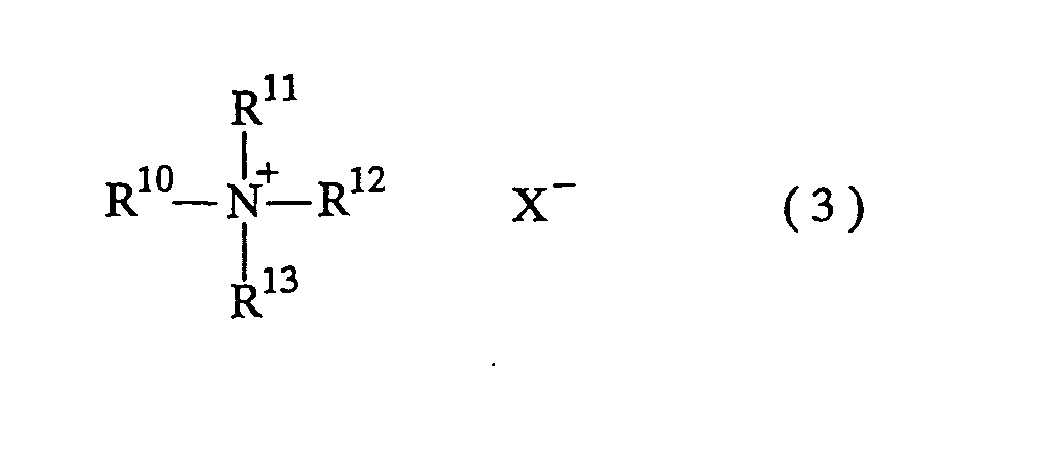
- In the formula, R10 represents a straight-chain or branched alkyl or alkenyl group having 8 to 30 carbon atoms wherein the alkyl or alkenyl group may be divided by an ester group, amide group or ether group, R11 represents a straight-chain or branched alkyl or alkenyl group having 8 to 30 carbon atoms wherein the alkyl or alkenyl group may be divided by an ester group, amide group or ether group, or a straight-chain or branched alkyl or hydroxyalkyl group having 1 to 3 carbon atoms, R12 and R13 independently represent a straight-chain or branched alkyl or hydroxyalkyl group having 1 to 3 carbon atoms and X- represents an anion.

- In the formula, R14 represents a straight-chain or branched alkyl group or alkenyl group having 8 to 30 carbon atoms wherein the alkyl or alkenyl group may be divided by an ester group, amide group or ether group, R15 represents a straight-chain or branched alkyl or alkenyl group having 8 to 30 carbon atoms wherein the alkyl or alkenyl group may be divided by an ester group, amide group or ether group, or a straight-chain or branched alkyl group or hydroxyalkyl group having 1 to 3 carbon atoms and R16 represents a straight-chain or branched alkyl or hydroxyalkyl group having 1 to 3 carbon atoms.
- In the formula (3), R10 is preferably a straight-chain or branched alkyl group having 10 to 28 carbon atoms wherein the alkyl group may be divided by an ester group, amide group or ether group and even more preferably a straight-chain or branched alkyl group having 14 to 24 carbon atoms wherein the alkyl group may be divided by an ester group, amide group or ether group. R11 is preferably a straight-chain or branched alkyl group having 14 to 24 carbon atoms wherein the alkyl group may be divided by an ester group, amide group or ether group, or a straight-chain or branched alkyl or hydroxyalkyl group having 1 to 3 carbon atoms, more preferably a straight-chain or branched alkyl group having 1 to 3 carbon atoms and even more preferably a methyl group or an ethyl group. R12 and R13 are independently preferably a methyl group or an ethyl group. Examples of the anion represented by X- include a halogen ions such as Cl- and Br-, short-chain alkylsulfuric acid ions such as a methylsulfuric acid ion and ethylsulfuric acid ion and ions of organic acids such as acetic acid, tartaric acid, lactic acid, malic acid and succinic acid. Among these ions, halogen ions and short-chain alkylsulfuric acid ions are preferable.
- In the formula (4), R14 is preferably a straight-chain or branched alkyl group having 10 to 28 carbon atoms wherein the alkyl group may be divided by an ester group, amide group or ether group and more preferably a straight-chain or branched alkyl group having 14 to 24 carbon atoms wherein the alkyl group may be divided by an ester group, amide group or ether group. R15 is preferably a straight-chain or branched alkyl or alkenyl group having 14 to 24 carbon atoms wherein the alkyl or alkenyl group may be divided by an ester group, amide group or ether group, or a straight-chain or branched alkyl or hydroxyalkyl group having 1 to 3 carbon atoms and more preferably a straight-chain or branched alkyl or hydroxyalkyl group having 1 to 3 carbon atoms. R16 is preferably a methyl group, an ethyl group or a hydroxyethyl group and more preferably a methyl group or an ethyl group.
- Examples of the salts of tertiary amines represented by the formula (4) are salts of inorganic acids such as hydrochloric acid, sulfuric acid and phosphoric acid and salts of organic acids such as acetic acid, tartaric acid, lactic acid, malic acid and succinic acid.
- The content of the component (a) in the hair treating agent of the present invention is preferably 0.1 to 20 moles, more preferably 0.3 to 10 moles, even more preferably 0.5 to 5 moles, to 1 mole of the component (b) from the viewpoint of giving the hair a good feel to the touch and suppressing layer separation and solidification to thereby obtaining the high stability of the product. Also, the content of the component (b) in the hair treating agent is preferably 0.1 to 20% by weight, more preferably 0.2 to 15% by weight and even more preferably 0.5 to 10% by weight. Also, the pH of the hair treating agent is preferably 2 to 12, more preferably 3 to 11 from the viewpoint of imparting a conditioning effect and even more preferably 3 to 6 from the viewpoint of imparting the hair a good feel to the touch and the stability of a product.
- The hair treating agent preferably further contains an oily component. Examples of the oily component of the present invention include a higher alcohol, ester oil, silicone and hydrocarbons. Among these compounds, a higher alcohol, oil agent such as an ester oil and/or silicone are preferable and a higher alcohol and/or silicone are more preferable.
- Examples of the higher alcohols used in the present invention include higher alcohols having a straight-chain or branched alkyl or alkenyl group having 10 to 30 carbon atoms. Among these alcohols, higher alcohols having a straight-chain or branched alkyl or alkenyl group having 12 to 26 carbon atoms are preferable and cetanol, cetyl alcohol, stearyl alcohol, arachil alcohol, behenyl alcohol, caranaubil alcohol and ceryl alcohol are more preferable.
- Examples of the ester oil include esters of fatty acids having 8 to 40 carbon atoms and straight-chain or branched alcohols having 1 to 4 carbon atoms. The ester is preferably esters of fatty acids having 10 to 24 carbon atoms and straight-chain or branched alcohols having 1 to 3 carbon atoms and more preferably esters of fatty acids having 12 to 22 carbon atoms and propyl alcohol or isopropyl alcohol.
- Examples of the silicone to be used in the present invention include dimethylpolysiloxane, methylphenylpolysiloxane, amino-modified silicone, fatty acid-modified polysiloxane, alcohol-modified silicone, aliphatic alcohol-modified polysiloxane, polyethermodified silicone, epoxy-modified silicone, fluorinemodified silicone, cyclic silicone and alkyl-modified silicone.
- The content of the oily component in the hair treating agent of the present invention is preferably 0.1 to 30% by weight, more preferably 0.5 to 25% by weight and even more preferably 1 to 20% by weight from the viewpoint of the good feel of hair to the touch and emulsion/dispersion stability of the oily component.
- In the hair treating agent of the present invention, for example, other surfactants such as anionic surfactants, nonionic surfactants and amphoteric surfactants, lanolin derivatives, higher fatty acid esters, higher fatty acids, fatty acids, glycerin, amino acid, humectant, cationic polymer, polysaccharides, polypeptide, pearling agent, solvent, liquid crystal forming agent, inorganic acid, organic acid, dyes, perfumes, ultraviolet absorber, antioxidant, propellant, chelating agent, pH regulator, antiseptic and antidandruff agent may be formulated to the extent that the object of the present invention is not impaired.
- The hair treating agent of the present invention may be made into a desired preparation form such as an aqueous solution, ethanol solution, emulsion, suspension, gel, liquid crystal and aerosol.
- The hair treating agent of the present invention may be used for a hair rinse, hair conditioner, hair treatment, hair pack, hair cream, conditioning moose, hair moose, hair spray, leave-on treatment, shampoo, hair lotion shampoo, hair dyeing agent and hair breaching agent.
- The following examples are examples of the present invention. These examples are described as to examples of the present invention and are not intended to be limiting of the present invention.
- In the following examples, "%" means % by weight, unless otherwise specified.
- A four-neck flask equipped with a stirrer, a temperature gage and a cooling tube was charged with 180.3 g of an aqueous 50% dimethylamine solution (manufactured by Wako Pure Chemical Industries, Ltd.) and 400 g of ion exchange water. 475.4 g of sodium chloroacetate (manufactured by Wako Pure Chemical Industries, Ltd.) was added dropwise to the mixture at 20 to 30°C and the resulting mixture was reacted at 20 to 30°C for one hour. Next, 166.7 g of an aqueous 48% sodium hydroxide solution was added to the reaction mixture for 0. 5 hours while keeping the mixture at 20 to 30°C and the resulting mixture was further reacted at 35 to 40°C for 3 hours. After the reaction was completed, 202.6 g of an aqueous 36% hydrochloric solution was added dropwise to the reaction mixture, which was then mixed at 10 to 20°C for 2 hours with stirring. Then, the precipitated crystals were collected by filtration, then washed with 440 g of water and dried to obtain 226.7 g of the organic acid A shown in Table 1.
- A four-neck flask equipped with a stirrer, a temperature gage and a cooling tube was charged with 133.1 g of iminodiacetic acid (Wako pure Chemical Industries, Ltd.), 120 g of ion exchange water and 166.7 g of an 48% aqueous sodium hydroxide solution. 103.7 g of glycidol (obtained by refining a product of Wako pure Chemical Industries, Ltd. by distillation) was added to the mixture over one hour while the mixture was kept at 20 to 30°C and the resulting mixture was reacted at 30 to 40°C for 5 hours. After the reaction was finished, the mixture was subjected to crystallization from ethanol, and the crystals were collected by filtration and dried to obtain 238 g of a white powder. Next, a beaker was charged with 226.0 g of the white powder and 452 g of ion exchange water and 182.5 g of an aqueous 36% hydrochloric solution was added to the mixture, which was then desalted by electrodialysis and then freeze-dried to obtain 168.1 g of the organic acid B shown in Table 1.
- The components (a) used in the following examples are listed in Table 1. The components (b) used in the following examples are listed in Table 2.
Table 1 Organic acid A 
Purity 99.0% (Others:NaCl, water and the like) Organic acid B 
Purity 96.1 % (Others:NaCl, iminodiacetic acid, water and the like) Organic acid C *1 Purity 99% Organic acid D*2 
Purity>98% *1: N-(2-hydroxyethyl)iminodiacetic acid manufactured by Tokyo Kasei Kogyo Co., Ltd.
*2: Methyliminodiacetic acid manufactured by Sigma Aldrich Japan Corp.Table 2 (b-1) 
NIKKOL amidoaminw MPS manufactured by Nikko Chemicals Co.,Ltd. (b-2) 
Purity 99.1% (Others: fatty acid, water and the like) (b-3) 
Farmine DM-E80 manufactured by Kao Corporation (b-4) 
Trimethylstearylammonium chloride manifactured by Tokyo Chemical Industry Co., Ltd. - Each of the organic acids A to D or, as the comparative acids, lactic acid, L-glutamic acid or hydrochloric acid was used as the component (a) and (b-1) was used as the component (b) to prepare hair rinsing agents having the compositions shown in Table 3 by the conventional method. With regard to these hair rinsing agents, the abilities of each agent when it was applied and rinsed and after it was dried were evaluated. The results are shown in Table 3.
- 20 g of the hair (length: 20 cm and average diameter: 60 µm) of a Japanese woman having no experience of chemical treatment such as a cold perm was tied up in a bundle, which was then washed with 5 g of a shampoo. The composition of the shampoo had 15% of sodium polyoxyethylene alkyl (12 carbon atoms) ether sulfate (ethylene oxide average addition mol number: 2.5) and 3% of diethanolamide which was balanced with water.
- After that, 2.0 g of a hair rinsing agent was uniformly applied to the hair and the hair was rinsed with a running water at 40°C for 30 seconds.
- The softness and smoothness of the hair when the hair rinsing agent was applied and the hair was rinsed, an oily feel when the hair rinsing agent was applied, a smooth feel retentivity when the hair was rinsed and a smooth feel and a combing feel after the hair was dried were functionally evaluated by five expert panelists according to the following standard.
- ⊙: Four or more panelists answered that the hair rinsing agent had an effect.
- ○: Three panelists answered that the hair rinsing agent had an effect.
- Δ: Two panelists answered that the hair rinsing agent had an effect.
- × : One or less panelist answered that the hair rinsing agent had an effect.
- The organic acids and the component (b) shown in Table 4 were used to produce hair rinsing agents having the compositions shown in Table 4 by the conventional method. The performances of these hair rinsing agents when these agents were applied to the hair, when the hair was rinsed and after the hair was dried were evaluated in the same manner as in Example 1. The results are shown in Table 4.

- A hair conditioner having the following composition was produced. This hair conditioner was good in hair softness, smoothness and oil feel when it was applied to hair and rinsed and then smoothness and combing after the hair was dried.
<Composition> Organic acid A 0.6% (b-2) 1.6% Stearyl alcohol*1 4.0% Glycerin 1.0% Benzyloxyethanol 0.3% Silicone*2 2.0% Amino-modified silicone-polyoxyalkylene block Copolymer*3 0.5% Dipentaerythritol fatty acid ester*4 0.2% Hydroxyethyl cellulose*5 0.2% Highly polymerized polyethylene glycol*6 0.05% Tocopherol acetate 0.1% Perfume, methyl parabene Proper amount Purified water Balance (pH 4.5) *1: Kalcol 8098 manufactured by Kao Corporation
*2: BY00-003 manufactured by Dow Corning Toray Silicone Co. , Ltd.
*3: FZ-3789, manufactured by Nihonunica Corporation
*4: Cosmol 168AR manufactured by Nisshin Seiyu Corp.
*5: SE-850 manufactured by Daicel Chemical Industries, Ltd.
*6: Polyox WSRN-60K manufactured by Union Carbide Corporation - A hair treatment having the following composition was produced. This hair treatment was good in hair softness, smoothness and oil feel when it was applied to hair and rinsed and then smoothness and combing after the hair was dried.
<Composition> Organic acid C 1.1% (b-3) 2.5% Stearyl alcohol 4.5% Behenyl alcohol*1 1.5% Isononyl isononanate*2 0.5% Silicone*3 1.0% Amino-modified silicone*4 0.5% Malic acid 0.1% Dipropylene glycol 3.0% Benzyl alcohol 0.3% Alginine 0.2% Pantotenyl ethyl ether 0.1% Perfume, methyl parabene Proper amount Purified water Balance (pH 4.0) *1: Kalcol 22080 manufactured by Kao Corporation
*2: Salakos 99 manufactured by Nisshin Seiyu Corp.
*3: SH200C-5000 cs manufactured by Dow Corning Toray Silicone Co., Ltd.
*4: SM8704C manufactured by Dow Corning Toray Silicone Co. , Ltd.

Claims (5)
- A hair treating agent comprising the following components (a) and (b):(a): at least one compound selected from the group consisting of an organic acid represented by the formula (1) and an organic acid represented by the formula (2) or a salt thereof:wherein R1 and R2 independently represent a straight-chain or branched alkyl or hydroxyalkyl group having 1 to 5 carbon atoms or -R8-COOH, R3, R4 and R8 independently represent a straight-chain or branched alkylene group having 1 to 5 carbon atoms, R5 represent a straight-chain or branched alkyl or hydroxyalkyl group having 1 to 5 carbon atoms or -R9-COOH and R6, R7 and R9 independently represent a straight-chain or branched alkylene group having 1 to 5 carbon atoms; and

 (b): at least one compound selected from the group consisting of a quaternary ammonium salt and a tertiary amine or a salt thereof.
 - The hair treating agent according to Claim 1, wherein the content of the component (a) is 0.1 to 20 moles to 1 mole of the component (b) and the content of the component (b) is 0.1 to 20% by weight based on the total amount of the hair treating agent.
- The hair treating agent according to Claim 1, wherein, in the formula (1) or (2), R1 and R2 are independently a straight-chain or branched alkyl or hydroxyalkyl group having 1 to 3 carbon atoms or -R8-COOH, R3, R4 and R8 are independently a methylene group, R5 is a straight-chain or branched alkyl or hydroxyalkyl group having 1 to 3 carbon atoms or -R9-COOH and R6, R7 and R9 are independently a methylene group.
- The hair treating agent according to any one of Claims 1 to 3, the agent further comprising an oily component.
- The hair treating agent according to any one of Claims 1 to 4, wherein at least one compound of the component (b) is a tertiary amine or a salt thereof.
Priority Applications (1)
| Application Number | Priority Date | Filing Date | Title |
|---|---|---|---|
| EP10185740A EP2332517A1 (en) | 2005-04-05 | 2006-04-03 | Hair treating agent |
Applications Claiming Priority (1)
| Application Number | Priority Date | Filing Date | Title |
|---|---|---|---|
| JP2005108943A JP4932175B2 (en) | 2005-04-05 | 2005-04-05 | Hair treatment agent |
Related Child Applications (1)
| Application Number | Title | Priority Date | Filing Date |
|---|---|---|---|
| EP10185740.7 Division-Into | 2010-10-01 |
Publications (2)
| Publication Number | Publication Date |
|---|---|
| EP1733712A1 true EP1733712A1 (en) | 2006-12-20 |
| EP1733712B1 EP1733712B1 (en) | 2011-06-15 |
Family
ID=36741315
Family Applications (2)
| Application Number | Title | Priority Date | Filing Date |
|---|---|---|---|
| EP06007038A Ceased EP1733712B1 (en) | 2005-04-05 | 2006-04-03 | Hair treating agent |
| EP10185740A Withdrawn EP2332517A1 (en) | 2005-04-05 | 2006-04-03 | Hair treating agent |
Family Applications After (1)
| Application Number | Title | Priority Date | Filing Date |
|---|---|---|---|
| EP10185740A Withdrawn EP2332517A1 (en) | 2005-04-05 | 2006-04-03 | Hair treating agent |
Country Status (5)
| Country | Link |
|---|---|
| US (1) | US8197800B2 (en) |
| EP (2) | EP1733712B1 (en) |
| JP (1) | JP4932175B2 (en) |
| CN (1) | CN1853604B (en) |
| TW (1) | TWI377069B (en) |
Families Citing this family (2)
| Publication number | Priority date | Publication date | Assignee | Title |
|---|---|---|---|---|
| JP4863408B2 (en) * | 2009-03-06 | 2012-01-25 | 株式会社 資生堂 | Hair treatment composition |
| CN109640944A (en) * | 2016-07-28 | 2019-04-16 | 拜尔斯道夫日化(武汉)有限公司 | Hair composition for hair care containing rosehip oil and use thereof |
Citations (6)
| Publication number | Priority date | Publication date | Assignee | Title |
|---|---|---|---|---|
| JPH06128202A (en) * | 1992-10-14 | 1994-05-10 | Kao Corp | Novel carboxybetaine, its production method and its use |
| DE19536420A1 (en) * | 1994-10-04 | 1996-04-11 | Kao Corp | Non-itchy anti dandruff shampoo conditioners with deodorant properties |
| EP0867168A2 (en) * | 1997-03-29 | 1998-09-30 | Beiersdorf Aktiengesellschaft | Topical compositions comprising oxidation-sensitive active ingredients |
| EP0885607A2 (en) * | 1997-06-19 | 1998-12-23 | Henkel Kommanditgesellschaft auf Aktien | Neutral brightening and emulsifying composition for treating hair or fibres |
| EP1462086A1 (en) * | 2003-03-25 | 2004-09-29 | L'oreal | Use of a particular carboxylic acid or its salts as a conditioning agent for keratin materials |
| EP1462087A2 (en) * | 2003-03-25 | 2004-09-29 | L'oreal | Composition for treating keratinous materials comprising a polycarboxylic acid and a protecting or conditioning agent. |
Family Cites Families (10)
| Publication number | Priority date | Publication date | Assignee | Title |
|---|---|---|---|---|
| US4954335A (en) * | 1989-05-31 | 1990-09-04 | Helene Curtis, Inc. | Clear conditioning composition and method to impart improved properties to the hair |
| ZA931613B (en) * | 1992-04-15 | 1993-11-15 | Curtis Helene Ind Inc | Conditioning shampoo composition and method of preparing and using the same |
| GB9208652D0 (en) | 1992-04-22 | 1992-06-10 | Unilever Plc | Hair care composition |
| JP3049413B2 (en) | 1995-10-24 | 2000-06-05 | 三洋化成工業株式会社 | Hair treatment agent |
| JP3620764B2 (en) * | 1997-03-29 | 2005-02-16 | 株式会社資生堂 | Hair cleanser |
| WO1999011226A1 (en) * | 1997-08-29 | 1999-03-11 | The Procter & Gamble Company | Hair conditioning compositions |
| JP3657909B2 (en) * | 2001-03-05 | 2005-06-08 | 花王株式会社 | Hair cosmetics |
| JP3740100B2 (en) * | 2001-08-06 | 2006-01-25 | 花王株式会社 | Conditioning agent |
| DE60325951D1 (en) * | 2002-04-08 | 2009-03-12 | Kao Corp | COSMETIC HAIR PREPARATION |
| US20040234489A1 (en) * | 2003-03-25 | 2004-11-25 | L'oreal S.A. | Use of a particular carboxylic acid or salts thereof as agents for conditioning keratin materials |
-
2005
- 2005-04-05 JP JP2005108943A patent/JP4932175B2/en not_active Expired - Fee Related
-
2006
- 2006-03-30 US US11/392,621 patent/US8197800B2/en not_active Expired - Fee Related
- 2006-04-03 EP EP06007038A patent/EP1733712B1/en not_active Ceased
- 2006-04-03 EP EP10185740A patent/EP2332517A1/en not_active Withdrawn
- 2006-04-04 TW TW095111929A patent/TWI377069B/en not_active IP Right Cessation
- 2006-04-05 CN CN2006100663819A patent/CN1853604B/en not_active Expired - Fee Related
Patent Citations (6)
| Publication number | Priority date | Publication date | Assignee | Title |
|---|---|---|---|---|
| JPH06128202A (en) * | 1992-10-14 | 1994-05-10 | Kao Corp | Novel carboxybetaine, its production method and its use |
| DE19536420A1 (en) * | 1994-10-04 | 1996-04-11 | Kao Corp | Non-itchy anti dandruff shampoo conditioners with deodorant properties |
| EP0867168A2 (en) * | 1997-03-29 | 1998-09-30 | Beiersdorf Aktiengesellschaft | Topical compositions comprising oxidation-sensitive active ingredients |
| EP0885607A2 (en) * | 1997-06-19 | 1998-12-23 | Henkel Kommanditgesellschaft auf Aktien | Neutral brightening and emulsifying composition for treating hair or fibres |
| EP1462086A1 (en) * | 2003-03-25 | 2004-09-29 | L'oreal | Use of a particular carboxylic acid or its salts as a conditioning agent for keratin materials |
| EP1462087A2 (en) * | 2003-03-25 | 2004-09-29 | L'oreal | Composition for treating keratinous materials comprising a polycarboxylic acid and a protecting or conditioning agent. |
Non-Patent Citations (1)
| Title |
|---|
| PATENT ABSTRACTS OF JAPAN vol. 018, no. 427 (C - 1235) 10 August 1994 (1994-08-10) * |
Also Published As
| Publication number | Publication date |
|---|---|
| JP2006290740A (en) | 2006-10-26 |
| TWI377069B (en) | 2012-11-21 |
| US20060233734A1 (en) | 2006-10-19 |
| CN1853604A (en) | 2006-11-01 |
| US8197800B2 (en) | 2012-06-12 |
| JP4932175B2 (en) | 2012-05-16 |
| CN1853604B (en) | 2012-04-04 |
| TW200719921A (en) | 2007-06-01 |
| EP2332517A1 (en) | 2011-06-15 |
| EP1733712B1 (en) | 2011-06-15 |
Similar Documents
| Publication | Publication Date | Title |
|---|---|---|
| EP1005321B1 (en) | Hair conditioner and 2-in-1 conditioning shampoo | |
| JP5325494B2 (en) | Hair cosmetics | |
| EP2229933A1 (en) | Hair cosmetic composition | |
| JP3526327B2 (en) | Rinse composition | |
| US20050013789A1 (en) | Preparation process of a hair cosmetic composition | |
| EP1238966B1 (en) | Hair cosmetic, aminocarboxylic acid amide and method for producing the same | |
| EP1733712B1 (en) | Hair treating agent | |
| JPH05286831A (en) | Hair cosmetic | |
| JP3880186B2 (en) | Hair treatment agent | |
| JP4183864B2 (en) | Method for producing quaternary ammonium salt | |
| JP4943990B2 (en) | Hair composition | |
| JP3043481B2 (en) | Hair cosmetics | |
| JP3871730B2 (en) | Novel quaternary ammonium salt, process for producing the same and surfactant composition, and hair cosmetic containing the same | |
| JP3657909B2 (en) | Hair cosmetics | |
| JP5111947B2 (en) | Hair composition | |
| JP5123594B2 (en) | Hair composition | |
| JPH1072331A (en) | Cosmetic and cleansing agent composition | |
| JP4663540B2 (en) | Hair treatment agent | |
| JP2002275035A (en) | Hair cosmetics | |
| JP3043486B2 (en) | Hair cosmetics | |
| JP2002114647A (en) | Hair cosmetics | |
| JP2001122740A (en) | Quaternary ammonium salt composition | |
| JP2003300837A (en) | Hair cosmetics | |
| JP4606617B2 (en) | Hair cosmetics | |
| JP5133611B2 (en) | Hair composition |
Legal Events
| Date | Code | Title | Description |
|---|---|---|---|
| PUAI | Public reference made under article 153(3) epc to a published international application that has entered the european phase |
Free format text: ORIGINAL CODE: 0009012 |
|
| AK | Designated contracting states |
Kind code of ref document: A1 Designated state(s): AT BE BG CH CY CZ DE DK EE ES FI FR GB GR HU IE IS IT LI LT LU LV MC NL PL PT RO SE SI SK TR |
|
| AX | Request for extension of the european patent |
Extension state: AL BA HR MK YU |
|
| 17P | Request for examination filed |
Effective date: 20070308 |
|
| 17Q | First examination report despatched |
Effective date: 20070416 |
|
| AKX | Designation fees paid |
Designated state(s): DE ES FR GB SE |
|
| GRAP | Despatch of communication of intention to grant a patent |
Free format text: ORIGINAL CODE: EPIDOSNIGR1 |
|
| GRAS | Grant fee paid |
Free format text: ORIGINAL CODE: EPIDOSNIGR3 |
|
| GRAA | (expected) grant |
Free format text: ORIGINAL CODE: 0009210 |
|
| AK | Designated contracting states |
Kind code of ref document: B1 Designated state(s): DE ES FR GB SE |
|
| REG | Reference to a national code |
Ref country code: GB Ref legal event code: FG4D |
|
| REG | Reference to a national code |
Ref country code: DE Ref legal event code: R096 Ref document number: 602006022469 Country of ref document: DE Effective date: 20110728 |
|
| PG25 | Lapsed in a contracting state [announced via postgrant information from national office to epo] |
Ref country code: SE Free format text: LAPSE BECAUSE OF FAILURE TO SUBMIT A TRANSLATION OF THE DESCRIPTION OR TO PAY THE FEE WITHIN THE PRESCRIBED TIME-LIMIT Effective date: 20110615 |
|
| PLBE | No opposition filed within time limit |
Free format text: ORIGINAL CODE: 0009261 |
|
| STAA | Information on the status of an ep patent application or granted ep patent |
Free format text: STATUS: NO OPPOSITION FILED WITHIN TIME LIMIT |
|
| 26N | No opposition filed |
Effective date: 20120316 |
|
| REG | Reference to a national code |
Ref country code: DE Ref legal event code: R097 Ref document number: 602006022469 Country of ref document: DE Effective date: 20120316 |
|
| PG25 | Lapsed in a contracting state [announced via postgrant information from national office to epo] |
Ref country code: ES Free format text: LAPSE BECAUSE OF FAILURE TO SUBMIT A TRANSLATION OF THE DESCRIPTION OR TO PAY THE FEE WITHIN THE PRESCRIBED TIME-LIMIT Effective date: 20110926 |
|
| REG | Reference to a national code |
Ref country code: FR Ref legal event code: PLFP Year of fee payment: 10 |
|
| REG | Reference to a national code |
Ref country code: FR Ref legal event code: PLFP Year of fee payment: 11 |
|
| REG | Reference to a national code |
Ref country code: FR Ref legal event code: PLFP Year of fee payment: 12 |
|
| REG | Reference to a national code |
Ref country code: FR Ref legal event code: PLFP Year of fee payment: 13 |
|
| PGFP | Annual fee paid to national office [announced via postgrant information from national office to epo] |
Ref country code: GB Payment date: 20220303 Year of fee payment: 17 |
|
| PGFP | Annual fee paid to national office [announced via postgrant information from national office to epo] |
Ref country code: FR Payment date: 20220308 Year of fee payment: 17 |
|
| PGFP | Annual fee paid to national office [announced via postgrant information from national office to epo] |
Ref country code: DE Payment date: 20220302 Year of fee payment: 17 |
|
| REG | Reference to a national code |
Ref country code: DE Ref legal event code: R119 Ref document number: 602006022469 Country of ref document: DE |
|
| GBPC | Gb: european patent ceased through non-payment of renewal fee |
Effective date: 20230403 |
|
| PG25 | Lapsed in a contracting state [announced via postgrant information from national office to epo] |
Ref country code: GB Free format text: LAPSE BECAUSE OF NON-PAYMENT OF DUE FEES Effective date: 20230403 |
|
| PG25 | Lapsed in a contracting state [announced via postgrant information from national office to epo] |
Ref country code: GB Free format text: LAPSE BECAUSE OF NON-PAYMENT OF DUE FEES Effective date: 20230403 Ref country code: FR Free format text: LAPSE BECAUSE OF NON-PAYMENT OF DUE FEES Effective date: 20230430 Ref country code: DE Free format text: LAPSE BECAUSE OF NON-PAYMENT OF DUE FEES Effective date: 20231103 |