EP1732933B1 - Compounds for treating dyslipidemia - Google Patents
Compounds for treating dyslipidemia Download PDFInfo
- Publication number
- EP1732933B1 EP1732933B1 EP05732643A EP05732643A EP1732933B1 EP 1732933 B1 EP1732933 B1 EP 1732933B1 EP 05732643 A EP05732643 A EP 05732643A EP 05732643 A EP05732643 A EP 05732643A EP 1732933 B1 EP1732933 B1 EP 1732933B1
- Authority
- EP
- European Patent Office
- Prior art keywords
- trifluoromethyl
- methyl
- bis
- amino
- tetrahydro
- Prior art date
- Legal status (The legal status is an assumption and is not a legal conclusion. Google has not performed a legal analysis and makes no representation as to the accuracy of the status listed.)
- Expired - Lifetime
Links
- 0 CC(C(***)N*)C1(O*)OC1 Chemical compound CC(C(***)N*)C1(O*)OC1 0.000 description 2
- GNTDSVVTAYBZJU-UHFFFAOYSA-N CC(C)OC(N(CCCC(OC)=O)c1cc(C(F)(F)F)c(C)nc1C(OC)=O)=O Chemical compound CC(C)OC(N(CCCC(OC)=O)c1cc(C(F)(F)F)c(C)nc1C(OC)=O)=O GNTDSVVTAYBZJU-UHFFFAOYSA-N 0.000 description 1
- ULBQZFUTWFNOHT-UHFFFAOYSA-N CC(C)OC(N(CCCC1N(Cc2cc(C(F)(F)F)cc(C(F)(F)F)c2)C(C)=O)c2c1nc(C)c(C(F)(F)F)c2)=O Chemical compound CC(C)OC(N(CCCC1N(Cc2cc(C(F)(F)F)cc(C(F)(F)F)c2)C(C)=O)c2c1nc(C)c(C(F)(F)F)c2)=O ULBQZFUTWFNOHT-UHFFFAOYSA-N 0.000 description 1
- KNFVMSIFZJDTTR-UHFFFAOYSA-N CCOc(c(Cl)c1)nc(C(CCC2)N(Cc3cc(C(F)(F)F)cc(C(F)(F)F)c3)C(C)=O)c1N2C(OC(C)C)=O Chemical compound CCOc(c(Cl)c1)nc(C(CCC2)N(Cc3cc(C(F)(F)F)cc(C(F)(F)F)c3)C(C)=O)c1N2C(OC(C)C)=O KNFVMSIFZJDTTR-UHFFFAOYSA-N 0.000 description 1
- PABUMHURFGMYPK-UHFFFAOYSA-O [BH+]c(nc1C(OC)=O)c(C)cc1N Chemical compound [BH+]c(nc1C(OC)=O)c(C)cc1N PABUMHURFGMYPK-UHFFFAOYSA-O 0.000 description 1
Classifications
-
- C—CHEMISTRY; METALLURGY
- C07—ORGANIC CHEMISTRY
- C07D—HETEROCYCLIC COMPOUNDS
- C07D495/00—Heterocyclic compounds containing in the condensed system at least one hetero ring having sulfur atoms as the only ring hetero atoms
- C07D495/02—Heterocyclic compounds containing in the condensed system at least one hetero ring having sulfur atoms as the only ring hetero atoms in which the condensed system contains two hetero rings
- C07D495/04—Ortho-condensed systems
-
- A—HUMAN NECESSITIES
- A61—MEDICAL OR VETERINARY SCIENCE; HYGIENE
- A61K—PREPARATIONS FOR MEDICAL, DENTAL OR TOILETRY PURPOSES
- A61K31/00—Medicinal preparations containing organic active ingredients
- A61K31/33—Heterocyclic compounds
- A61K31/395—Heterocyclic compounds having nitrogen as a ring hetero atom, e.g. guanethidine or rifamycins
- A61K31/435—Heterocyclic compounds having nitrogen as a ring hetero atom, e.g. guanethidine or rifamycins having six-membered rings with one nitrogen as the only ring hetero atom
-
- A—HUMAN NECESSITIES
- A61—MEDICAL OR VETERINARY SCIENCE; HYGIENE
- A61P—SPECIFIC THERAPEUTIC ACTIVITY OF CHEMICAL COMPOUNDS OR MEDICINAL PREPARATIONS
- A61P3/00—Drugs for disorders of the metabolism
-
- A—HUMAN NECESSITIES
- A61—MEDICAL OR VETERINARY SCIENCE; HYGIENE
- A61P—SPECIFIC THERAPEUTIC ACTIVITY OF CHEMICAL COMPOUNDS OR MEDICINAL PREPARATIONS
- A61P3/00—Drugs for disorders of the metabolism
- A61P3/04—Anorexiants; Antiobesity agents
-
- A—HUMAN NECESSITIES
- A61—MEDICAL OR VETERINARY SCIENCE; HYGIENE
- A61P—SPECIFIC THERAPEUTIC ACTIVITY OF CHEMICAL COMPOUNDS OR MEDICINAL PREPARATIONS
- A61P3/00—Drugs for disorders of the metabolism
- A61P3/06—Antihyperlipidemics
-
- A—HUMAN NECESSITIES
- A61—MEDICAL OR VETERINARY SCIENCE; HYGIENE
- A61P—SPECIFIC THERAPEUTIC ACTIVITY OF CHEMICAL COMPOUNDS OR MEDICINAL PREPARATIONS
- A61P43/00—Drugs for specific purposes, not provided for in groups A61P1/00-A61P41/00
-
- A—HUMAN NECESSITIES
- A61—MEDICAL OR VETERINARY SCIENCE; HYGIENE
- A61P—SPECIFIC THERAPEUTIC ACTIVITY OF CHEMICAL COMPOUNDS OR MEDICINAL PREPARATIONS
- A61P9/00—Drugs for disorders of the cardiovascular system
-
- A—HUMAN NECESSITIES
- A61—MEDICAL OR VETERINARY SCIENCE; HYGIENE
- A61P—SPECIFIC THERAPEUTIC ACTIVITY OF CHEMICAL COMPOUNDS OR MEDICINAL PREPARATIONS
- A61P9/00—Drugs for disorders of the cardiovascular system
- A61P9/10—Drugs for disorders of the cardiovascular system for treating ischaemic or atherosclerotic diseases, e.g. antianginal drugs, coronary vasodilators, drugs for myocardial infarction, retinopathy, cerebrovascula insufficiency, renal arteriosclerosis
-
- C—CHEMISTRY; METALLURGY
- C07—ORGANIC CHEMISTRY
- C07D—HETEROCYCLIC COMPOUNDS
- C07D471/00—Heterocyclic compounds containing nitrogen atoms as the only ring hetero atoms in the condensed system, at least one ring being a six-membered ring with one nitrogen atom, not provided for by groups C07D451/00 - C07D463/00
- C07D471/02—Heterocyclic compounds containing nitrogen atoms as the only ring hetero atoms in the condensed system, at least one ring being a six-membered ring with one nitrogen atom, not provided for by groups C07D451/00 - C07D463/00 in which the condensed system contains two hetero rings
- C07D471/04—Ortho-condensed systems
-
- C—CHEMISTRY; METALLURGY
- C07—ORGANIC CHEMISTRY
- C07D—HETEROCYCLIC COMPOUNDS
- C07D487/00—Heterocyclic compounds containing nitrogen atoms as the only ring hetero atoms in the condensed system, not provided for by groups C07D451/00 - C07D477/00
- C07D487/02—Heterocyclic compounds containing nitrogen atoms as the only ring hetero atoms in the condensed system, not provided for by groups C07D451/00 - C07D477/00 in which the condensed system contains two hetero rings
- C07D487/04—Ortho-condensed systems
Definitions
- the current invention relates to the fields of medicinal organic chemistry, pharmacology, and medicine. Further, the current invention relates to a group of compounds that demonstrate utility for treating pathological states due to dyslipidemia.
- Coronary heart disease is one of the major causes of morbidity and mortality worldwide. Despite attempts to modify risk factors such as obesity, smoking, lack of exercise, and treatment of dyslipidemia with dietary modification or drug therapy, CHD remains the most common cause of death in the U.S. Over 50% of all CHD deaths are due to underlying atherosclerotic coronary heart disease.
- Dyslipidemia is a major risk factor for CHD.
- Low plasma levels of high density lipoprotein (HDL) cholesterol with either normal or elevated levels of low density (LDL) cholesterol is a significant risk factor for developing atherosclerosis and associated coronary artery disease in humans.
- LDL low density lipoprotein
- lipoprotein profiles of CHD patients have shown that about 50% of the CHD patients have cholesterol levels that are considered to be in the normal range ( ⁇ 200 mg/dl).
- these studies found low HDL cholesterol in about 40% of the normo-cholesterolemic CHD patients as compared to the general population reported in the National Health and Nutrition Examination Survey. Since low levels of HDL cholesterol increase the risk of atherosclerosis, methods for elevating plasma HDL cholesterol would be therapeutically beneficial for the treatment of cardiovascular disease including, but not limited to, atherosclerosis, CHD, stroke, and peripheral vascular disease.
- CETP Cholesterol ester transfer protein
- Niacin can significantly increase HDL, but has serious toleration issues that reduce compliance. Fibrates and the HMG CoA reductase inhibitors raise HDL cholesterol only modestly ( ⁇ 10-12%). As a result, there is a significant unmet medical need for a well-tolerated agent that can significantly elevate plasma HDL levels, thereby reversing or slowing the progression of atherosclerosis.
- CETP is expressed in multiple tissues and secreted into plasma, where it associates with HDL ( X.C. Jiang et. al., (1991) Mammalian adipose tissue and muscle are major sources of lipid transfer protein mRNA. J. Biol. Chem. 266:4631-4639 ). Humans and monkeys, which express CETP, have relatively low HDL cholesterol, whereas mice and rats do not express CETP and carry nearly all their cholesterol in HDL. Further more, transgenic expression of CETP in mice results in significantly reduced HDL cholesterol levels and development of severe atherosclerosis compared to control mice ( K.R. Marotti et.
- Antibodies either directly injected into the plasma or generated through vaccine injection can effectively inhibit CETP activity in hamsters and rabbits resulting in elevated HDL cholesterol ( C. W. Rittershaus, (1999) Vaccine-induced antibodies inhibit CETP activity in vivo and reduce aortic lesions in a rabbit model of atherosclerosis. Furthermore, antibody neutralization of CETP in rabbits has been shown to be anti-atherogenic (Arterio. Thromb. Vasc. Biol. 20, 2106-2112 ; G.F.Evans et. at, (1994) Inhibition of cholesteryl ester transfer protein in normocholesterolemic and hypercholesterolemic hamsters: effects on HDL subspecies, quantity, and apolipoprotein distribution. J. Lipid Research. 35, 1634-1645 ). However, antibody and/or vaccine therapy is not currently a viable option for the treatment of large populations of patients in need of treatment for dyslipidemia and resultant or associated disease state manifestations.
- CETP Cholesterol ester transfer protein
- CETP inhibition leads to the formation of less-dense LDL particles-a benefit in addition to LDL cholesterol lowering ( Brousseau M. et al., New Engl. J. Med., 2004, Vol. 350:1505-1515 ).
- administration of CETP inhibitors to humans in need thereof would significantly elevate HDL cholesterol level and reduce LDL cholesterol levels and increase LDL particle size, all of which are believed to benefit patients exposed to atherosclerotic risks.
- 10287662-A describes polycyclic, non-amine containing, polyhydroxylic natural compounds possessing CETP inhibition properties.
- Lee et al. J. Antibiotics, 49, 693-96 (1996 )
- CETP inhibitors derived from an insect fungus.
- Busch et al. Lipids, 25, 216-220 (1990 )
- cholesteryl acetyl bromide as a CETP inhibitor.
- Morton and Zillversmit J. Lipid Res., 35, 836-47 (1982 ) describe that p-chloromercuriphenyl sulfonate, p-hydroxymercuribenzoate and ethyl mercurithiosalicylate inhibit CETP.
- United States patent No. 6,586,448 B1 describes 4-caboxamino-2-sub stituted-1,2,3,4-tetrahydroquinolines of formula I and prodrugs thereof, and pharmaceutically acceptable salts of said compounds and said prodrugs; wherein R 1 ,R 2 , R 3 , R 4 , R 5 , R 6 , R 7 and R 8 are as defined therein.
- European Patent Application No. 818448 by Schmidt et al . describes tetrahydroquinoline derivatives as cholesteryl ester transfer protein inhibitors.
- European Patent Application No. 818197, Schmek et al . describe pyridines with fused heterocycles as cholesteryl ester transfer protein inhibitors. Brandes et al. in German Patent Application No. 19627430 describe bicyclic condensed pyridine derivatives as cholesteryl ester transfer protein inhibitors.
- US Patent 6,207,671 Schmidt et al . describe substituted pyridine compounds as CETP inhibitors.
- WO Patent Application No. 09839299 and WO Patent application No.03028727 by Muller-gliemann et al. and Erfinder/Anmelder respectively, describe quinoline derivatives as cholesteryl ester transfer protein inhibitors.
- the present invention provides a us of a compound according to any one of claims 1 to 9, or a pharmaceutically acceptable salt, enantiomer, racemate, diastereomer or a mixture of diastereomers thereof, for the manufacture of a medicament for the treatment or prevention of dyslipidemia.
- the present invention provides a use of a compound according to any one of claims 1 to 9, or a pharmaceutically acceptable salt, enantiomer, racemate, diastereomer or a mixture of diastereomers thereof, for the manufacture of a medicament for the treatment of hyperlipidemia, atherosclerosis, coronary heart disease, elevated blood pressure, CHF, stroke, hypertension, hypertriglyceremia, diabetes, obesity, inflammatory diseases including dermatitis, arthritis and pain, and diseases of the central nervous system including dementia and cognitive disorders; and a use of a compound according to any one of claims 1 to 9, or a pharmaceutically acceptable salt, enantiomer, racemate, diastereomer or a mixture of diastereomers thereof, for the manufacture of a medicament for raising the level of plasma HDL cholesterol in a mammal; and a use of a compound according to any one of claims 1 to 9, or a pharmaceutically acceptable salt, enantiomer, racemate, diastereomer or a mixture of diastereomers thereof, for
- the present invention provides a compound according to any one of claims 1 to 9 or a pharmaceutically acceptable salt, enantiomer, racemate, diastereomer or a mixture of diastereomers thereof for use as a medicament.
- the present invention also provides: A compound according to any one of claims 1 to 9, or a pharmaceutically acceptable salt, enantiomer, racemate, diastereomer or a mixture of diastereomers thereof, for use in the treatment or prevention of dyslipidemia.
- the present invention also provides a pharmaceutical composition
- a pharmaceutical composition comprising a compound of formula I or a pharmaceutically acceptable salt, enantiomer, racemate, diastereomer or mixture of diastereomers thereof, and a carrier.
- the current invention provides novel compounds of formula I useful in modulating CETP activity.
- modulation or “regulating” would include, but not be limited to, up-regulation, down-regulation, inhibition, agonism, antagonism of the CETP receptor as appropriate to achieve HDL raising, or LDL lowering and the resulting biological sequelae from such intervention.
- diseases or “diseases related to abnormal activity CETP” or “diseases mediated by CETP activity” refers to pathological states where atherosclerosis and/or other cardiovascular diseases are prone because of dyslipidemia and/or other risk factors and are therefore beneficially affected by modulation, particularly down-regulation, of CETP activity.
- diseases include but are not limited to hyperlipidemia and its sequelae such as atherosclerosis, CHD, elevated blood pressure, CHF, stroke, hypertension, hypertriglyceremia, diabetes, obesity, inflammatory diseases including but not limited to dermatitis, arthritis, and pain, and diseases of the central nervous system including but not limited to dementia, cognitive disorders such as, for example, Alzheimer's disease.
- treatment bears its usual meaning which includes prohibiting, inhibiting, ameliorating, halting, restraining, slowing or reversing the progression, or reducing the severity of a pathological symptom related to or resultant from the modulation of CETP activity, especially as related to raising plasma levels of HDL, or lowering LDL-cholesterol levels or raising the HDL/LDL ratio or controlling atherosclerosis, hyperlipidemia and/or hypercholesterolemia.
- C 1-6 alkyl or “(C 1 -C 6 )alkyl” or “C 1 -C 6 alkyl” refers to a straight or branched aliphatic chain of 1 to 6 carbon atoms including but not limited to methyl, ethyl, propyl, iso-propyl, n-butyl, pentyl, and hexyl.
- alkyl means C 1 -C 6 alkyl.
- C 0 -C 6 alkyl implies an alkyl group as indicated wherein when the term C 0 applies, the alkyl group is not present, and the remaining groups attach directly to the substrate.
- C 0 -C 6 alkylcyano is the cyano group when C 0 applies.
- C 1 -C 6 alkyl or C 2 -C 6 alkenyl or similar terms also encompass the specified alkyl or alkenyl or similar group, which may be chiral, regio or steroisomeric. Such chiral or regio or stereoisomeric groups are also objects of the present invention.
- alkylaryl refers to an alkyl group substituted by an aryl group.
- C 1 -C 6 alkylaryl indicates that a C 1 -C 6 alkyl group is attached to the aryl group, and that the resulting C 1 -C 6 alkylaryl is attached to the nucleus via the alkyl group.
- Preferred alkylaryl groups include phenylethyl (phenethyl), and benzyl.
- substituted phenyl or “optionally substituted phenyl” refers to a phenyl group having one or more substituents selected from the group consisting of C 1 -C 6 alkyl, C 1 -C 6 alkoxy, hydroxy, COR 7 , -COOR 7 , C 0 -C 6 alkylNR 7 R 8 , nitro, chloro, fluoro, bromo, iodo, C 1 -C 6 haloalkyl, C 1 -C 6 haloalkoxyalkyl, and C 0 -C 6 alkylheterocyclic.
- optionally substituted carbocyclic or heterocyclic ring refers to a saturated or unsaturated, aromatic or non-aromatic five or six member ring having optional substituents selected from the group consisting of C 1 -C 6 alkyl, C 1 -C 6 alkoxy, hydroxy, COR 7 , -COOR 7 , C 0 -C 6 alkylNR 7 R 8 , nitro, chloro, fluoro, bromo, iodo, C 1 -C 6 haloalkyl, C 1 -C 6 haloalkoxyalkyl, and C 0 -C 6 alkylheterocyclic.
- aryl refers to a substituted or unsubstituted aromatic or beteroaromatic, or heterocyclic radical.
- Illustrative aryl groups include but is not limited to napthyl, quinolyl, tetrahydroquinolyl, indazolyl, pyrimidinyl, triazinyl, pyrazine, pyridazinyl, piperidyl, pyrrolidinyl, piperazinyl, morpholinyl, tetrahydrofuranyl, pyranyl, tetrazolyl, imidazolyl, 1,2,3-trazolyl, 1,2,4-triazolyl, oxadiazolyl, thiadiazolyl, thiazolyl, oxazolyl, isoxazolyl, isothiazolyl, pyrazolyl, imidazopyridine, benzimidazolyl, triazolone-yl, imidazolone-yl, imi
- C 3 -C 8 cycloalkyl or similar terms refer to a saturated carbocyclic ring having from 3 to 8 carbon atoms where the term “cycloalkyl” is used a carbocyclic ring having 3 to 8 carbon atoms is implied.
- carrier refers to a cyclic group having only carbon and appropriate number of hydrogen atoms.
- the term encompasses groups such as cycloalkyl, cycloalkene, cycloalkylene, naphthyl, phenyl and the like.
- heterocycle refers to a 5, 6, 7, 8, 9 or 10 member saturated, partially unsaturated, or aromatic, mono-cyclic or a bicyclic ring containing 1-5 heteroatoms selected from N, S or O, wherein said heterocycle is optionally substituted at carbon or nitrogen atom(s) unless otherwise specified.
- Most preferred heterocyclic groups include pyridinyl, pyrolidinyl, piperidinyl, hexamethyleneimmino, morpholino, thiophene, indolyl, quinolyl, isoquinolyl, and tetrazolyl.
- alkylheterocyclic or “alkylheterocycle” is understood to mean that the alkyl group is attached to the heterocycle and the point of attachment to the molecular backbone or nucleus is the alkyl group.
- alkyl without a qualifier implies a C 1 -C 6 alkyl group.
- haloalkoxyalkyl as used herein include for example trifluoromethoxy, pentafluoroethoxy, trifluoroethoxy (OCH 2 CF 3 ) and the like.
- Prodrugs describes derivatives of the compounds of the invention that have chemically or metabolically cleavable groups and become by solvolysis or under physiological conditions the compounds of the invention, which are pharmaceutically active, in vivo.
- Derivatives of the compounds of this invention have activity in both their acid and base derivative forms, but the acid derivative form often offers advantages of solubility, tissue compatibility, or delayed release in a mammalian organism (see, Bundgard, H., Design of Prodrugs, pp. 7-9, 21-24, Elsevier, Amsterdam 1985 ).
- Prodrugs include acid derivatives, such as, esters prepared by reaction of the parent acidic compound with a suitable alcohol, or amides prepared by reaction of the parent acid compound with a suitable amine.
- Simple aliphatic esters e.g., methyl, ethyl, propyl, isopropyl, butyl, sec-butyl, tert-butyl
- aromatic esters derived from acidic groups pendent on the compounds of this invention are preferred prodrugs.
- Other preferred esters include morpholinoethyloxy, diethylglycolamide and diethylaminocarbonylmethoxy.
- double ester type prodrugs such as (acyloxy) alkyl esters or ((alkoxycarbonyl)oxy)alkyl esters.
- protecting group refers to a group useful for masking reactive sites in a molecule to enhance the reactivity of another group or allow reaction at another desired site or sites following which the protecting group may be removed.
- Protecting groups are usually used to protect or mask groups including but not limited to -OH, -NH, and -COOH. Suitable protecting groups are known to one of skill in the art and are described in Protecting groups in Organic Synthesis, 3rd edition, Greene, T. W.; Wuts, P.G.M. Eds., John Wiley and Sons, New York, 1999 .
- solvate is a form of the compound of the invention wherein a crystal or crystals of a compound of the invention have been formed from a stoichiometric or non-stoichiometric amount of the compound of formula I and a solvent.
- Typical solvating solvents include for example, water, methanol, ethanol, acetone and dimethylformamide.
- salts may be formed which are more water soluble and/or more physiologically suitable than the parent compound.
- Representative pharmaceutically acceptable salts include but are not limited to, the alkali and alkaline earth salts such as lithium, sodium, potassium, calcium, magnesium, aluminum and the like. Salts are conveniently prepared from the free acid by treating the acid in solution with a base or by exposing the acid to an ion-exchange resin.
- Base addition salts include for example, ammonium, quaternary ammonium, and amine cations, derived from nitrogenous bases of sufficient basicity to form salts with the compounds of this invention (see, for example, S. M. Berge, et al., "Pharmaceutical Salts," J. Phar. Sci., 66: 1-19 (1977 )).
- the basic group(s) of the compound of the invention may be reacted with suitable organic or inorganic acids to form salts such as acetate, benzenesulfonate, benzoate, bicarbonate, bisulfate, bitartrate, borate, hydrobromide, camsylate, carbonate, clavulanate, citrate, chloride, edetate, edisylate, estolate, esylate, fluoride, fumarate, gluceptate, gluconate, glutamate, glycolylarsanilate, hexylresorcinate, hydrochloride, hydroxynaphthoate, hydroiodide, isothionate, lactate, lactobionate, laureate, maleate, mandelate, mesylate, methylbromide, methylnitrate, methylsulfate, mucate, napsylate, nitrate, oleate, oxalate, palmitate, pan
- Preferred salts for the purpose of the invention include the hydrochloride salt, the hydrobromide salt, the bisulfate salt, the methane sulfonic acid salt, the p -toluenesulfonic acid salt, bitartrate, the acetate and the citrate salt.
- a compound of the invention as illustrated by formula I may occur as any one of its positional isomers, stereochemical isomers or regio-isomers, all of which are objects of the invention.
- Certain compounds of the invention may possess one or more chiral centers, and thus, may exist in optically active forms.
- the compounds contain an alkenyl or alkenylene group, there exist the possibility of cis- and trans-isomeric forms of the compounds.
- the R- and S- isomers and mixtures thereof, including racemic mixtures as well as mixtures of enantiomers or cis- and trans- isomers, are contemplated by and within the purview of this invention. Additional asymmetric carbon atoms can be present in a substituent group such as an alkyl group.
- stereoisomer it can be prepared by methods well known in the art by using stereo-specific reactions with starting materials that contain the asymmetric centers and are already resolved.
- desired stereoisomers may be prepared by methods that lead to mixtures of the stereoisomers and subsequent resolution by known methods.
- a racemic mixture may be reacted with a single enantiomer of some other compound i.e. a chiral resolving agent. This changes the racemic form into a mixture of stereoisomers and diastereomers, because they have different melting points, different boiling points, and different solubilities and can be separated by conventional means, such as crystallization.
- n is 0, or 1.
- m is 0, 1, 2 or 3. More preferably m is 0, 1 or 2.
- p is 1, or 2.
- q is 0, 1 or 2. More preferably q is 0 or 1.
- a preferred a ring is selected from pyridine, pyrimidine, pyrazine, pyridazine, 1,2,5-triazine, thiophene, furan, pyrrole, pyrazole, isoxazole, isothiazole, imidazole, oxazole, thiazole, and 1,2,3-triazole. More preferred is an A ring selected from the group consisting of pyridine, pyrazine, thiophene, pyrazole, isoxazole, oxazole, and thiazole. Most preferred A-ring is pyridine.
- R 1 group selected from hydroxy, C 1 -C 6 alkyl, C 1 -C 6 alkylaryl, -C 1 -C 6 alkylcycloalkyl, -C 1 -C 6 alkylheterocyclic -OC 1 -C 6 alkyl, -OC 0 -C 6 alkylaryl, -OC 1 -C 6 alkylcycloalkyl, -OC 1 -C 6 alkylcyano, -OC 1 -C 6 alkylheterocyclic, -OC 1 -C 6 alkylhydroxy, -OC 1 -C 6 alkylNR 7 R 8 , -OC 1 -C 6 alkylCO 2 R 1 , heterocyclic, cycloalkyl, and -OC 0 -C 6 alkylcycloalkylNR 7 R 8 wherein each alkyl, cycloalkyl, heterocyclic and aryl groups are each optionally substituted as described herein.
- R 1 group
- R 2 group represented by hydrogen or C 1 -C 6 alkyl, or C 3 -C 8 cycloalkyl.
- each R 3 is hydrogen.
- R 5 is selected from hydrogen, halogen, hydroxy, C 1 -C 6 haloalkyl, C 1 -C 6 alkyl, C 2 -C 6 alkenyl, C 1 -C 6 alkylheterocyclic, C 1 -C 6 alkylaryl, aryl, -OC 1 -C 6 alkyl, aryloxy (-O-aryl), -OC 2 -C 6 alkenyl, -OC 1 -C 6 haloalkyl, -NR7R8 -CH 2 NR 7 R 8 , -CN, -COOH, and NO 2 ;
- R 5 is at each occurrence is independently selected from hydrogen, halogen, C 1 -C 6 alkyl and C 1 -C 3 haloalkyl.
- R 6 is preferably selected from hydrogen, C 1 -C 6 haloalkyl, C 1 -C 6 alkyl, C 2 -C 6 alkenyl, aryloxy, -OC 2 -C 6 alkenyl and -CH 2 NR 7 R 8 . More preferably, R 6 is at each occurrence independently selected from hydrogen and C 1 -C 6 alkyl.
- R 7 and R 8 are independently selected from hydrogen, C 1 -C 6 alkyl, C 2 -C 6 alkenyl, C 1 -C 6 alkylaryl, and C 1 -C 6 alkylheterocyclic, wherein each aryl group is optionally substituted with 1-3 groups independently selected from C 1 -C 6 alkyl, halo, and C 1 -C 6 haloalkyl.
- R 11 and R 12 are independently selected from hydrogen, C 1 -C 6 alkyl, C 2 -C 6 alkenyl and C 1 -C 6 alkylaryl, wherein each aryl group is optionally substituted with 1-3 groups independently selected from halo, and C 1 -C 6 haloalkyl.
- a most preferred compound of the invention is a compound selected from:
- positional isomers and geometric isomers associated with the asymmetric carbon atoms of compounds of formula I are also contemplated to be within the scope of the current invention as useful for the treatment of diseases related to CETP modulation.
- Aryl amino ester intermediates of Formula 1 can be chemically prepared, for example, by following the synthetic routes set forth in the Schemes below.
- the reagents and starting materials are readily available to one of ordinary skill in the art.
- Other necessary reagents and starting materials may be made by procedures which are selected from standard techniques of organic and heterocyclic chemistry, techniques which are analogous to the syntheses of known structurally similar intermediates or starting materials and the procedures described in the preparations and examples below, including any novel procedures.
- Synthetic scheme 1 shows preparation of compounds of formula I wherein n is 0.
- substituted heteroarylamino esters 1 that are either commercially available or prepared as set forth in the literature or in Schemes 1a to 1d can be protected with tosyl chloride, isopropyl chloroformate, or other suitable protecting group to provide 2.
- the compound 2 may in turn be alkylated with appropriately substituted, or unsubstituted 3-bromopropanoic acid esters 11 thus affording 3.
- N-acylation of 6 by treatment with an appropriately substituted aryl or alkyl chloroformate in the presence of an organic base such as pyridine affords carbamates of structure 7.
- an organic base such as pyridine
- treatment of 6 with an acid chloride or an appropriate activated ester, such as those generated in-situ from the reaction of an appropriately substituted aryl or alkyl carboxylic acid affords compounds of formula 7.
- urea derivatives from 6 is accomplished by treatment with a carbamoyl chloride in the presence of base such as pyridine and DMAP (dimethylamino pyridine) or an alternative base such as NaH in DMF.
- base such as pyridine and DMAP (dimethylamino pyridine) or an alternative base such as NaH in DMF.
- treatment with phosgene, or carbodiimide (CDI) reagent such as cyclohexylcarbodiimide or analog thereof, followed by the addition of an appropriately di-substituted amine will afford ureas of structure 7.
- Formation of sulfonamide derivatives from 6 can be accomplished by reaction with appropriately substituted sulfonyl chlorides in the presence of a base.
- ketone 7 to 10 may be performed through direct reductive amination with an appropriately substituted alkylamine or aryl amine to afford compound 9.
- compound 9 may be prepared through formation of the amine derivate 8 by reduction of an intermediate oxime, followed by alkylation with an appropriately substituted benzylic halide, mesylate or tosylate, or by reductive alkylation with the appropriate aldehyde or ketone in the presence of a reducing reagent such as NaCNBH 3 .
- Compound 9 is converted to 10 (a compound of the invention) by acylation with an appropriately substituted symmetrical anhydride or acid halides to afford amides.
- Reaction of compound 9 with chloroformates affords the corresponding carbamates
- Reaction of 9 with isocyanates, carbamoyl chlorides, or appropriately substituted sulfonyl chlorides affords the corresponding urea or sulfonamides respectively.
- the intermediate compound (1) may be prepared as shown and described in schemes la through 1d below:
- the nucleophilic aromatic substitution occurs by methods known in the art, ( Wells, K. M. et al. Tetrahedron Letters, 1996, 37(36), 6439-6442 ).
- the appropriately substituted amine 14, such as benzylamine is dissolved in a suitable solvent, such as DMF or DMSO.
- a base such as cesium carbonate is added.
- the reaction proceeds at 0 °C to elevated (up to about 150 °C) temperatures in anywhere from ten minutes to several days depending on the stability of the starting materials.
- the N-Aryl coupling occurs by methods known in the art, ( Hartwig, J. F. et al. Angew. Chem., Int. Ed. Engl. 1998,37,2046-2067 ).
- the appropriately substituted amine 14 is dissolved in a suitable solvent, such as DMF.
- a base such as cesium carbonate or sodium tert -butoxide
- a suitable catalyst complex such as palladium acetate and diphenyl phospino ferrocene ligand are added.
- reaction proceeds at 0 °C to elevated temperatures (up to 150 °C) in anywhere from ten minutes to several days depending on the stability of the starting materials.
- the reaction proceeds at -78 °C to room temperature in anywhere from about five minutes to several hours depending on the stability of the starting materials.
- the product of structure 1 can then be isolated by a standard aqueous workup, followed by normal phase chromatographic methods or recrystallization techniques commonly employed in the art.
- the ring nitrogen of compound 6 can be alkylated by methods known in the art ( Tetrahedron, 2002, 58 (43), 8719-8727 ) such as by treating the appropriately substituted heterobenzazapine, 6, with a base such as sodium carbonate or sodium hydride, and an alkylating agent, such as methyl bromoacetate or chloroacetonitrile, to afford the intermediate 18.
- a base such as sodium carbonate or sodium hydride
- an alkylating agent such as methyl bromoacetate or chloroacetonitrile
- amine 9 can be treated with for example cyanogen bromide or N-cyano imidazole in the presence or absence of base to form the N-cyano derivative 37.
- the synthesis of imidazole 38, tetrazole 39, triazole 40 and oxadiazole 41 is illustrated in the scheme.
- Tetrazole 39 can be alkylated using the appropriate alcohol under Mitsunobu conditions, or with the appropriate alkyl iodide, mesylate, or the like in the presence of base to provide 42.
- Triazole 40 can be alkylated using an appropriate alkyl iodide, mesylate, or the like in the presence of base to afford 43.
- compound 9 can be transformed to 44 by reaction with diketene or a ⁇ -haloketone, further treatment with hydroxylamine hydrochloride can afford isoxazole 45.
- 45 can react with hydrazine in a solvent such as ethanol to afford pyrazole 47 that can be alkylated or acylated to give rise compound 48.
- compound 45 can be converted into the oxazole 49 by treatment with sodium azide and methanesulfonic acid.
- secondary amine 9 can be transformed in the acyl chloride 50 by treatment with triphosgene.
- Compound 50 may be converted into the oxadiazole 51 by reaction with an appropriate amidoxime.
- 50 can be reacting with hydrazine to yield compound 53, that after treatment with an appropriate acyl chloride in a presence of ammonia can yield triazole 56 or in the presence of acid such as sulfuric acid and water can give rise the oxadiazole 57.
- Compound 50 can be treated with ammonia to yield the ureido derivative 53 that can be transformed into oxazole 55 by reaction with an ⁇ -haloketone in the presence of a base.
- compound 53 can be first converted to the corresponding thioamide with Lawesson's reagent and after reaction with a ⁇ -haloketone can afford the thiazole 54.
- compound 59 may be hydrolyzed to the corresponding amine 60, and may be further acylated using standard procedures by one skilled in the art to provide 64.
- 60 can be treated with triphosgene or trichloromethylchoroformate to provide 61.
- Compound 61 can afford compound 59 by reaction with the appropriate alcohols.
- SPA in vitro Scintillation proximity assay
- CETP sources can be used to mediate the transfer of radiolabeled cholesterol ester in this assay.
- Endogenous CETP from human plasma, CETP from mice made to express human CETP, and endogenous CETP from hamsters can be used as the CETP source in this assay.
- HEPES-NaCl based buffer that has been used in this assay
- human plasma, mouse plasma or a Tris-bufer that is high in albumin may be used as the buffer in which the transfer of radiolabeled cholesterol esters from HDL to LDL may occur.
- radiolabeled-LDL may be used in this assay.
- CETP activity is determined by a method similar to that described for the in vitro CETP activity assay, except that plasma from treated animals is used as the CETP source in the assay.
- a strain of transgenic mice that express human CETP (Taconic, Germantown, NY) are used to test compounds of this invention. Test compounds are administered orally in selected aqueous or oil based vehicles for up to one week. At various times after dosing, ranging from 4h to 48h, blood can be obtained.
- CETP activity is determined by a method similar to that described for the in vitro CETP activity assay, except that plasma from treated animals is used as the CETP source in the assay.
- a strain of transgenic mice that express both human CETP and human apolipoprotein A-1 (Taconic, Germantown, NY) are used to test compounds of this invention.
- Test compounds are administered orally in selected aqueous or oil based vehicles for up to one week. At various times after dosing, ranging from 4h to 48h, blood is obtained.
- CETP activity is determined by a method similar to that described for the in vitro CETP activity assay, except that plasma from treated animals is used as the CETP source in the assay.
- Activity of compounds of this invention in vivo can be determined by the level of elevation of HDL cholesterol relative to control by a given amount of compound in a CETP-containing animal species.
- a strain of transgenic mice that express both human CETP and human apolipoprotein A-1 (Taconic, Germantown, NY) is used to test compounds of this invention.
- Test compounds are administered once orally in selected aqueous or oil based vehicles. At various times after dosing, ranging from 4h to 24h, blood is obtained. Blood is allowed to clot and serum, is obtained by centrifugation.
- HDL cholesterol levels in the serum is determined by HDL-C plus reagents (Roche/Hitachi, Indianapolis, IN) with a clinical chemistry analyzer (Roche/Hitachi, Indianapolis, IN). Additional serum lipids can be analyzed by enzymatic methods. Lipids in the VLDL, LDL and HDL fractions are analyzed by enzymatic methods after precipitation or size exclusion chromatography. An example of the elevation of HDL cholesterol levels at 8hr are summarized in table 1 Table 1. Elevation of HDL cholesterol levels at 8 hr Compound of Example No. Single Oral Dose (mg/kg) % HDL cholesterol increase 14 30 91
- the efficacy of compounds of the invention in vivo can also be determined utilizing Syrian Golden Hamsters.
- the compounds can be tested in hamsters made hypercholesterolemic by feeding a high fat high cholesterol diet for a minimum of two weeks or in non-hypercholesterolemic hamsters fed normal chow for two weeks.
- Test compounds can be administered orally in selected aqueous or oil based vehicles for up to 1 week.
- Serum can be obtained and lipids can be analyzed by enzymatic methods. Lipids in the VLDL, LDL and HDL fractions are analyzed by enzymatic methods after precipitation or size exclusion chromatography.
- a strain of transgenic mice that express human CETP (Taconic, Germantown, NY) are used to test the efficacy of the compounds of this invention.
- the hCETP mice can be made hypercholesterolemic by feeding a high fat chow diet such as TD 88051, as described by Nishina et al. (J Lipid Res., 31, 859-869 (1990 )) for at least two weeks before the start of the study.
- Test compounds can be administered orally in selected aqueous or oil based vehicles for up to 1 week. Serum can be obtained and lipids can be analyzed by enzymatic methods. Lipids in the VLDL, LDL and HDL fractions are analyzed by enzymatic methods after precipitation or size exclusion chromatography.
- the term "effective amount” means an amount of compound of the present invention, i.e., formula I, which is capable of alleviating the symptoms of the various pathological conditions herein described.
- the specific dose of a compound administered according to this invention will, of course, be determined by the particular circumstances surrounding the case including, for example, the compound administered, the route of administration, the state of being of the patient, and the pathological condition being treated.
- a typical daily dose will contain a nontoxic dosage level of from about 0.01 mg to about 100 mg/day of a compound of the present invention.
- Preferred daily doses generally will be from about 1 mg to about 250 mg/day.
- the compounds of this invention can be administered by a variety of routes including oral, rectal, transdermal, subcutaneous, intravenous, intramuscular, and intranasal. These compounds preferably are formulated prior to administration, the selection of which will be decided by the attending physician.
- another aspect of the present invention is a pharmaceutical composition comprising an effective amount of a compound of Formula I, or a pharmaceutically acceptable salt thereof, solvate, prodrug, enantiomer or prodrug thereof, and a pharmaceutically acceptable carrier, diluent, or excipient.
- the total active ingredients in such formulations comprises from 0.1% to 99.9% by weight of the formulation.
- pharmaceutically acceptable it is meant the carrier, diluent, excipients and salt must be compatible with the other ingredients of the formulation, and not deleterious to the recipient thereof.
- compositions of the present invention can be prepared by procedures known in the art using well-known and readily available ingredients.
- the compounds of formula I can be formulated with common excipients, diluents, or carriers, and formed into tablets, capsules, suspensions, powders, and the like.
- excipients, diluents, and carriers that are suitable for such formulations include the following: fillers and extenders such as starch, sugars, mannitol, and silicic derivatives; binding agents such as carboxymethyl cellulose and other cellulose derivatives, alginates, gelatin, and polyvinyl-pyrrolidone; moisturizing agents such as glycerol; disintegrating agents such as calcium carbonate and sodium bicarb onate; agents for retarding dissolution such as paraffin; resorption accelerators such as quaternary ammonium compounds; surface active agents such as cetyl alcohol, glycerol monostearate; adsorptive carriers such as kaolin and bentonite; and lubricants such as talc, calcium and magnesium stearate, and solid polyethyl glycols.
- fillers and extenders such as starch, sugars, mannitol, and silicic derivatives
- binding agents such as carboxymethyl cellulose and other cellulose derivatives, algina
- the compounds also can be formulated as elixirs or solutions for convenient oral administration or as solutions appropriate for parenteral administration, for example, by intramuscular, subcutaneous or intravenous routes. Additionally, the compounds are well suited to formulation as sustained release dosage forms and the like.
- the formulations can be so constituted that they release the active ingredient only or preferably in a particular physiological location, possibly over a period of time.
- the coatings, envelopes, and protective matrices may be made, for example, from polymeric substances or waxes.
- Active Ingredient means a compound of formula I, a salt, solvate, racemate, enantiomer diastereomer or mixture of diastereomers, or prodrug thereof, or a combination of a compound of formula I and other effective agent for the treatment or prevention of dyslipidemia or atherosclerosis.
- Formulation 1 Gelatin Capsules Hard gelatin capsules are prepared using the following: Ingredient Quantity (mg/capsule) Active ingredient 0.1-1000 Starch, NF 0 - 650 Starch flowable powder 0 - 650 Silicone fluid 350 centistokes 0 - 15
- a tablet formulation is prepared using the ingredients below: Formulation 2: Tablets Ingredient Quantity (mg/tablet) Active ingredient 2.5 - 1000 Cellulose, microcrystalline 200 - 650 Silicon dioxide, fumed 10 - 650 Stearate acid 5-15 The components are blended and compressed to form tablets.
- Formulation 2 Tablets Ingredient Quantity (mg/tablet) Active ingredient 2.5 - 1000 Cellulose, microcrystalline 200 - 650 Silicon dioxide, fumed 10 - 650 Stearate acid 5-15 The components are blended and compressed to form tablets.
- tablets each containing 2.5 - 1000 mg of active ingredient are made up as follows: Formulation 3 : Tablets Ingredient Quantity (mg/tablet) Active ingredient 25-1000 Starch 45 Cellulose, microcrystalline 35 Polyvinylpyrrolidone (as 10% solution in water) 4 Sodium carboxymethyl cellulose 4.5 Magnesium stearate 0.5 Talc 1
- the active ingredient, starch, and cellulose are passed through a No. 45 mesh U.S. sieve and mixed thoroughly.
- the solution of polyvinylpyrrolidone is mixed with the resultant powders that are then passed through a No. 14 mesh U.S. sieve.
- the granules so produced are dried at 50-60 °C and passed through a No. 18 mesh U.S. sieve.
- the sodium carboxymethyl starch, magnesium stearate, and talc previously passed through a No. 60 U.S. sieve, are then added to the granules, which after mixing, are compressed on a tablet machine to yield tablets.
- Suspensions each containing 0.1 - 1000 mg of medicament per 5 ml dose are made as follows: Formulation 4: Suspensions Ingredient Quantity (mg/5 ml) Active ingredient 0.1-1000 mg Sodium carboxymethyl cellulose 50 mg Syrup 1.25 mg Benzoic acid solution 0.10 mL Flavor q.v. Color q.v. Purified water to 5 mL
- the medicament is passed through a No. 45 mesh U.S. sieve and mixed with the sodium carboxymethyl cellulose and syrup to form a smooth paste.
- the benzoic acid solution, flavor, and color are diluted with some of the water and added, with stirring. Sufficient water is then added to produce the required volume.
- Aerosol solution is prepared containing the following ingredients: Formulation 5: Aerosol Ingredient Quantity (% by weight) Active ingredient 0.25 Ethanol 25.75 Propellant 22 (Chlorodifluoromethane) 70.00
- Formulation 6 Intravenous Solution Ingredient Quantity Active ingredient 50 mg Isotonic saline 1,000 mL
- the solution of the above ingredients is intravenously administered to a patient at a rate of about 1 mL per minute.
Landscapes
- Chemical & Material Sciences (AREA)
- Organic Chemistry (AREA)
- Health & Medical Sciences (AREA)
- Pharmacology & Pharmacy (AREA)
- Engineering & Computer Science (AREA)
- Bioinformatics & Cheminformatics (AREA)
- Veterinary Medicine (AREA)
- Public Health (AREA)
- General Health & Medical Sciences (AREA)
- Animal Behavior & Ethology (AREA)
- Medicinal Chemistry (AREA)
- Life Sciences & Earth Sciences (AREA)
- Chemical Kinetics & Catalysis (AREA)
- Nuclear Medicine, Radiotherapy & Molecular Imaging (AREA)
- General Chemical & Material Sciences (AREA)
- Obesity (AREA)
- Hematology (AREA)
- Diabetes (AREA)
- Cardiology (AREA)
- Heart & Thoracic Surgery (AREA)
- Vascular Medicine (AREA)
- Urology & Nephrology (AREA)
- Child & Adolescent Psychology (AREA)
- Epidemiology (AREA)
- Pharmaceuticals Containing Other Organic And Inorganic Compounds (AREA)
- Acyclic And Carbocyclic Compounds In Medicinal Compositions (AREA)
- Nitrogen Condensed Heterocyclic Rings (AREA)
- Medicines Containing Plant Substances (AREA)
- Heterocyclic Carbon Compounds Containing A Hetero Ring Having Oxygen Or Sulfur (AREA)
- Steroid Compounds (AREA)
Abstract
Description
- The current invention relates to the fields of medicinal organic chemistry, pharmacology, and medicine. Further, the current invention relates to a group of compounds that demonstrate utility for treating pathological states due to dyslipidemia.
- Coronary heart disease (CHD) is one of the major causes of morbidity and mortality worldwide. Despite attempts to modify risk factors such as obesity, smoking, lack of exercise, and treatment of dyslipidemia with dietary modification or drug therapy, CHD remains the most common cause of death in the U.S. Over 50% of all CHD deaths are due to underlying atherosclerotic coronary heart disease.
- Dyslipidemia is a major risk factor for CHD. Low plasma levels of high density lipoprotein (HDL) cholesterol with either normal or elevated levels of low density (LDL) cholesterol is a significant risk factor for developing atherosclerosis and associated coronary artery disease in humans. Indeed, several studies on lipoprotein profiles of CHD patients have shown that about 50% of the CHD patients have cholesterol levels that are considered to be in the normal range (<200 mg/dl). Furthermore, these studies found low HDL cholesterol in about 40% of the normo-cholesterolemic CHD patients as compared to the general population reported in the National Health and Nutrition Examination Survey. Since low levels of HDL cholesterol increase the risk of atherosclerosis, methods for elevating plasma HDL cholesterol would be therapeutically beneficial for the treatment of cardiovascular disease including, but not limited to, atherosclerosis, CHD, stroke, and peripheral vascular disease.
- Cholesterol ester transfer protein (CETP) is a 74 KD glycoprotein that facilitates the exchange of cholesterol esters in HDL for triglycerides in triglyceride-rich lipoproteins (A. R. Tall et. al., (1999) 1999 George Lyman Duss Memorial Lecture: Lipid transfer proteins, HDL metabolism and athero genesis. Arterio. Thromb. Vasc. Biol. 20:1185-1188.). The net result of CETP activity is a lowering of HDL cholesterol and an increase in LDL cholesterol. This effect on lipoprotein profile is believed to be proatherogenic, especially in subjects whose lipid profile constitutes an increased risk for CHD. Niacin can significantly increase HDL, but has serious toleration issues that reduce compliance. Fibrates and the HMG CoA reductase inhibitors raise HDL cholesterol only modestly (~10-12%). As a result, there is a significant unmet medical need for a well-tolerated agent that can significantly elevate plasma HDL levels, thereby reversing or slowing the progression of atherosclerosis.
- CETP is expressed in multiple tissues and secreted into plasma, where it associates with HDL (X.C. Jiang et. al., (1991) Mammalian adipose tissue and muscle are major sources of lipid transfer protein mRNA. J. Biol. Chem. 266:4631-4639). Humans and monkeys, which express CETP, have relatively low HDL cholesterol, whereas mice and rats do not express CETP and carry nearly all their cholesterol in HDL. Further more, transgenic expression of CETP in mice results in significantly reduced HDL cholesterol levels and development of severe atherosclerosis compared to control mice (K.R. Marotti et. al., (1993) Severe atherosclerosis in trans genic mice expressing simian cholesteryl ester transfer protein. Nature:364, 73-75). Expression of human CETP in Dahl salt-sensitive hypertensive rats led to spontaneous combined hyperlipidemia, coronary heart disease and decreased survival (V.L.M. Herrera et. al., (1999) Spontaneous combined hyperlipidemia, coronary heart disease and decreased survival in DahI salt-sensitive hypertensive rats transgenic for human cholesteryl ester transfer protein. Nature Medicine: 5, 1383-1389).
- Antibodies either directly injected into the plasma or generated through vaccine injection can effectively inhibit CETP activity in hamsters and rabbits resulting in elevated HDL cholesterol (C. W. Rittershaus, (1999) Vaccine-induced antibodies inhibit CETP activity in vivo and reduce aortic lesions in a rabbit model of atherosclerosis. Furthermore, antibody neutralization of CETP in rabbits has been shown to be anti-atherogenic (Arterio. Thromb. Vasc. Biol. 20, 2106-2112;G.F.Evans et. at, (1994) Inhibition of cholesteryl ester transfer protein in normocholesterolemic and hypercholesterolemic hamsters: effects on HDL subspecies, quantity, and apolipoprotein distribution. J. Lipid Research. 35, 1634-1645). However, antibody and/or vaccine therapy is not currently a viable option for the treatment of large populations of patients in need of treatment for dyslipidemia and resultant or associated disease state manifestations.
- Cholesterol ester transfer protein (CETP) catalyzes the exchange of neutral lipid between HDL and apoB-containing lipoprotein particles. As a n et result of this exchange, HDL cholesterol is reduced and LDL particles are further enriched with cholesterol, resulting in LDL cholesterol elevation and formation of small dense LDL particles, which are believed to be more atherogenic. CETP inhibition (small molecule, antibody, antisense oligo etc.) effectively elevates HDL cholesterol and also reduces LDL cholesterol in animal models as well as in humans (Whitlock, M. et al., J. of Clin. Invest., 1989, Vol. 84, 129-137, Hirochi, O. et al., Nature, 2000, Vol. 406, 203-207, Grooth, G. et al., Circulation, 2002;105:2159-2165, Clark, R. et al., Arterioscler Thromb Vasc Biol. 2004;24:1-9, Brousseau M. et al., New Engl. J. Med., 2004, Vol. 350:1505-1515). Further, CETP inhibition leads to the formation of less-dense LDL particles-a benefit in addition to LDL cholesterol lowering (Brousseau M. et al., New Engl. J. Med., 2004, Vol. 350:1505-1515). Thus, administration of CETP inhibitors to humans in need thereof would significantly elevate HDL cholesterol level and reduce LDL cholesterol levels and increase LDL particle size, all of which are believed to benefit patients exposed to atherosclerotic risks.
- There have been several reports of small molecule CETP inhibitors. Barrret et. al. (J.Am Chem. Soc., 188, 7863, (1996)) and Kuo et al. (J. Am. Chem. Soc.,117,10629, (1995)) describe cyclopropan-containing CETP inhibitors. Pietzonka et al. (Biorg. Med. Chem. Lett. 6, 1951 (1996)) describe phosphanate-containing analogs as CETP inhibitors. Coval et al. (Bioorg. Med. Chem. Lett. 5, 605, (1995)) describe Wiedendiol-A and-B related sesquiterpines as CETP inhibitors. Japanese Patent Application No.
10287662-A 10287662 - United States patent No.
6,586,448 B1 describes 4-caboxamino-2-sub stituted-1,2,3,4-tetrahydroquinolines of formula I
WO 03/063868A1 WO 0017164 0017165 WO 0017166 U.S patent 6,586,448 B1 from which it derives or is a divisional application thereof. - European Patent Application No.
818448 by Schmidt et al 818197, Schmek et al 19627430 describe bicyclic condensed pyridine derivatives as cholesteryl ester transfer protein inhibitors. InUS Patent 6,207,671 Schmidt et al ., describe substituted pyridine compounds as CETP inhibitors. InWO Patent Application No. 09839299 WO Patent application No.03028727 by Muller-gliemann et al. and Erfinder/Anmelder - The above disclosures notwithstanding, a great need remains for effective compounds useful as CETP inhibitors to treat conditions caused by, associated with or exacerbated by dyslipidemia.
- The present invention provides a compound of formula I

n is 0, 1, 2, or 3;
m is 0, 1, 2, 3, 4, 5 or 6;
q is 0, 1, or 2;
W, X, Y and Z are each independently CH, C, N, S, or O with appropriate single or double bonds and/or hydrogen atoms to complete valency requirements; Ring A is a five or six member ring wherein one of W, X, Y or Z may be absent; provided that ring A is not phenyl;
K is a bond, C=O, or S(O)p;
p is 0, 1 or 2;
R1 is selected from hydroxy, C1-C6 alkyl, C2-C6 alkenyl, C1-C6 haloalkyl, C1-C6 alkylheterocyclic, C3-C8 cycloalkyl, C1-C6 alkylC3-C8cycloalkyl, C1-C6 alkylaryl, aryl, heterocyclyl, C2-C6 alkylalcohol, -OC1-C6 alkyl, -O-aryl, -OC2-C6 alkenyl, -OC1-C6 haloalkyl, -OC1-C6 alkylheterocyclic, -OC3-C8 cycloalkyl, -OC1-C6 alkylC3-C8cycloalkyl, -NR7R8, -OC1-C6 alkylaryl, -O-heterocyclic, -OC1-C6alkylCO2R11, -OC2-C6alkylalcohol, -OC1-C6alkylNR7R8, -OC2-C6alkylcyano, CONR11R12, NR11SO2R12, NR11COR12, C0-C3 alkylNR11R12, C1-C3 alkylCOR11 and C0-C6 alkylCOOR11; provided that R1 is not hydroxy when K is S(O)p, CO, and/or when n is zero and K is a bond; and wherein each cycloalkyl, aryl or heterocyclic group is optionally substituted with 1 to 3 groups independently selected from oxo, hydroxy, halo, C1-C6 alkyl, C2-C6 alkenyl, C2-C6 alkynyl, C1-C6 alkoxy, C1-C6 haloalkyl, C1-C6 alkylalcohol, -OC2-C6alkylalcohol, C1-C6 haloalkoxy, CONR11R12, NR11SO2R12, NR11COR12, C0-C3 alkylNR11R12, C1-C3 alkylCOR11, C0-C6 alkylCOOR11, C0-C6 alkylcyano, -OC2-C6alkylcyano, C1-C6 alkylC3-C8cycloalkyl, phenyl, -OC1-C6 alkylC3-C8cycloalkyl, -OC1-C6 alkylaryl, -OC1-C6 alkylheterocyclic, and C1-C6 alkylaryl;
R2 is independently selected from hydrogen, C1-C6alkyl and C3-C8cycloalkyl;
R3 is hydrogen, C1-C6 alkyl, aryl, C2-C6 alkenyl, C2-C6 alkynyl, C1-C6 alkylaryl, C1-C6 alkylheterocyclic, C3-C8 cycloalkyl, or C1-C6 alkylC3-C8cycloalkyl;
R5 is selected from hydrogen, halogen, hydroxy, C1-C6haloalkyl, C1-C6alkyl, C2-C6alkenyl, C1-C6alkylheterocyclic, C1-C6alkylaryl, aryl, -OC1-C6alkyl, -O-aryl, -OC2-C6alkenyl, -OC1-C6haloalkyl, NR7R8, -CH2NR7R8, -CN, -COOH and NO2;
R6 is independently selected from hydrogen, C1-C6 alkyl, C2-C6 alkenyl, hydroxy, -OC1-C6 alkyl, -O-aryl, -OC2-C6 alkenyl, C1-C6 haloalkyl, -OC1-C6 haloalkyl, C1-C6 alkylNR7R8, C3-C8 cycloalkyl, and C1-C6 alkylC3-C8cycloalkyl;
R7 and R8 are independently selected from hydrogen, C1-C6 alkyl, C2-C6 alkenyl, C3-C8 cycloalkyl, C1-C6 alkylC3-C8cycloalkyl, C1-C6 alkylheterocyclic, heterocyclic, aryl, C1-C6 alkylaryl, hydroxy, oxo, COOH, C(O)OC1-C4 alkyl, C2-C6 alkynyl, C1-C6 alkoxy, C1-C6 haloalkyl, C1-C6 alkylalcohol, C1-C6 alkylamine, C2-C6 alkenylaryl, C2-C6 alkynylaryl, C1-C6 alkyl-O-C1-C6 alkylaryl, C1-C6 alkyl-NR11-C1-C6 alkylaryl, C1-C6 alkylcyano, C1-C6 alkylCONR7R8, C1-C6 alkylNR7R8 and C1-C6alkylNR11COR12, wherein each alkyl, cycloalkyl, heterocyclic, or aryl group is optionally substituted with 1 to 3 groups independently selected from hydroxy, oxo, amino, halogen, C1-C6 alkylC3-C8cycloalkyl, C3-C8 cycloalkyl, C1-C6 alkylheterocyclic, C1-C6 haloalkyl, COOH, C(O)OC1-C4 alkyl, C1-C6 alkyl, C2-C6 alkenyl, C2-C6 alkynyl, C1-C6 alkoxy, C1-C6 alkylalcohol, C1-C6 alkylamine and NR11R12; or R7 and R8 combine to form a nitrogen containing heterocyclic ring which may have 0, 1, or 2 additional hetero-atoms selected from oxygen, nitrogen or sulfur and may be optionally substituted with oxo, or C1-C6 alkyl;
R9 is selected from C1-C6 alkyl, C2-C6 alkenyl, C3-C8 cycloalkyl, C1-C6 alkylcycloalkyl, aryl, heterocyclic, C1-C6 alkylheterocyclic, COR7, CO2R7, C0-C3 alkylCONR7R8, C0-C3 alkylS(O)pNR7R8 and C0-C3 alkylS(O)pR7 wherein R7 is as defined above, and wherein each alkyl, cycloalkyl, aryl, and heterocyclic is optionally substituted with one to two groups independently selected from halo, hydroxy, oxo, COOH, C(O)OC1-C4 alkyl, C1-C6 haloalkyl, C1-C6 alkyl, C2-C6 alkenyl, C2-C6 alkynyl, C1-C6 alkoxy, C1-C6 alkylalcohol, C1-C6 alkylamine, C1-C6 alkylaryl, C2-C6 alkenylaryl, C2-C6 alkynylaryl, C1-C6 alkylheterocyclic, -NR7R8, C3-C8 cycloalkyl, C1-C6 alkylC3-C8cycloalkyl, C1-C6 alkyl-O-C1-C6 alkylaryl, C1-C6 alkylcyano, C1-C6 alkylCONR7R8, C1-C6 alkylNR7R8, C1-C6alkylNR11COR12, and aryl, wherein each cycloalkyl or aryl group is optionally substituted with halo, hydroxy, oxo, amino, COOH, C(O)OC1-C4 alkyl, C1-C6 haloalkyl, C1-C6 alkyl, C2-C6 alkenyl, C2-C6 alkynyl, C1-C6 alkoxy, C1-C6 alkylalcohol, and C1-C6 alkylamine;
R10 is selected from aryl, C1-C6 alkylaryl, C2-C6 alkenylaryl, C2-C6 alkynylaryl, C1-C6 haloalkylaryl, C1-C6 alkylheterocyclic, C2-C6 alkenylheterocyclic, C1-C6 alkylC3-C8cycloalkyl, C3-C8cycloalkyl and C1-C6 alkyl-O-C1-C6 alkylaryl, wherein each cycloalkyl, aryl, or heterocyclic group is optionally substituted with 1 to 3 groups independently selected from hydroxy, oxo, -SC1-C6 alkyl, C1-C6 alkyl, C1-C6 alkenyl, C1-C6 alkynyl, C1-C6 haloalkyl, halogen, C1-C6 alkoxy, aryloxy, C1-C6 alkenyloxy, C1-C6 haloalkoxyalkyl, C0-C6 alkylNR11R12, -OC1-C6 alkylaryl, nitro, cyano, -OC1-C6 haloalkyl, C1-C6 haloalkylalcohol, and C1-C6 alkylalcohol;
R11 and R12 are independently selected from hydrogen, C1-C6 alkyl, C2-C6 alkenyl, C3-C8 cycloalkyl, heterocyclic, aryl, and C1-C6 alkylaryl, wherein each aryl group is optionally substituted with 1 to 3 groups independently selected from halogen, C1-C6 alkylheterocyclic, and C1-C6 haloalkyl, or R11 and R12 combine to form a nitrogen containing heterocyclic ring which may have 0, 1, or 2 additional heteroatoms selected from oxygen, nitrogen or sulfur and is optionally substituted with oxo, or C1-C6 alkyl; or a pharmaceutically acceptable salt, enantiomer, racemate, diastereomer or mixture of diastereomers thereof. - The present invention provides a us of a compound according to any one of claims 1 to 9, or a pharmaceutically acceptable salt, enantiomer, racemate, diastereomer or a mixture of diastereomers thereof, for the manufacture of a medicament for the treatment or prevention of dyslipidemia.
- The present invention provides a use of a compound according to any one of claims 1 to 9, or a pharmaceutically acceptable salt, enantiomer, racemate, diastereomer or a mixture of diastereomers thereof, for the manufacture of a medicament for the treatment of hyperlipidemia, atherosclerosis, coronary heart disease, elevated blood pressure, CHF, stroke, hypertension, hypertriglyceremia, diabetes, obesity, inflammatory diseases including dermatitis, arthritis and pain, and diseases of the central nervous system including dementia and cognitive disorders; and a use of a compound according to any one of claims 1 to 9, or a pharmaceutically acceptable salt, enantiomer, racemate, diastereomer or a mixture of diastereomers thereof, for the manufacture of a medicament for raising the level of plasma HDL cholesterol in a mammal; and a use of a compound according to any one of claims 1 to 9, or a pharmaceutically acceptable salt, enantiomer, racemate, diastereomer or a mixture of diastereomers thereof, for the manufacture of a medicament for lowering the level of plasma LDL cholesterol in a mammal.
- The present invention provides a compound according to any one of claims 1 to 9 or a pharmaceutically acceptable salt, enantiomer, racemate, diastereomer or a mixture of diastereomers thereof for use as a medicament.
- The present invention also provides: A compound according to any one of claims 1 to 9, or a pharmaceutically acceptable salt, enantiomer, racemate, diastereomer or a mixture of diastereomers thereof, for use in the treatment or prevention of dyslipidemia. A compound according to any one of claims 1 to 9, or a pharmaceutically acceptable salt, enantiomer, racemate, diastereomer or a mixture of diastereomers thereof, for use in the treatment of hyperlipidemia, atherosclerosis, coronary heart disease, elevated blood pressure, CHF, stroke, hypertension, hypertriglyceridemia, diabetes, obesity, inflammatory diseases including dermatitis, arthritis and pain, and diseases of the central nervous system including dementia and cognitive disorders; a compound according to any one of claims 1 to 9, or a pharmaceutically acceptable salt, enantiomer, racemate, diastereomer or a mixture of diastereomers thereof, for use in raising the level of plasma HDL cholesterol in a mammal; a compound according to any one of claims 1 to 9, or a pharmaceutically acceptable salt, enantiomer, racemate, diastereomer or a mixture of diastereomers thereof, for use in lowering the level of plasma LDL cholesterol in a mammal.
- The present invention also provides a pharmaceutical composition comprising a compound of formula I or a pharmaceutically acceptable salt, enantiomer, racemate, diastereomer or mixture of diastereomers thereof, and a carrier.
- The current invention provides novel compounds of formula I useful in modulating CETP activity.
- The terms "modulation" or "regulating" would include, but not be limited to, up-regulation, down-regulation, inhibition, agonism, antagonism of the CETP receptor as appropriate to achieve HDL raising, or LDL lowering and the resulting biological sequelae from such intervention.
- The phrase "diseases" or "diseases related to abnormal activity CETP" or "diseases mediated by CETP activity" refers to pathological states where atherosclerosis and/or other cardiovascular diseases are prone because of dyslipidemia and/or other risk factors and are therefore beneficially affected by modulation, particularly down-regulation, of CETP activity. These diseases include but are not limited to hyperlipidemia and its sequelae such as atherosclerosis, CHD, elevated blood pressure, CHF, stroke, hypertension, hypertriglyceremia, diabetes, obesity, inflammatory diseases including but not limited to dermatitis, arthritis, and pain, and diseases of the central nervous system including but not limited to dementia, cognitive disorders such as, for example, Alzheimer's disease.
- The term "treatment" bears its usual meaning which includes prohibiting, inhibiting, ameliorating, halting, restraining, slowing or reversing the progression, or reducing the severity of a pathological symptom related to or resultant from the modulation of CETP activity, especially as related to raising plasma levels of HDL, or lowering LDL-cholesterol levels or raising the HDL/LDL ratio or controlling atherosclerosis, hyperlipidemia and/or hypercholesterolemia.
- Generally, one of skill in the art is aware that valency must be conserved (complete) for all stable molecules. Therefore, the necessary implication that hydrogen atoms are necessary and available to complete valency in all structures including formula I unless expressly indicated otherwise, is imputed to the general knowledge of one of skill in the art.
- General chemical terms used in the description of compounds herein described bear their usual meanings. For example, the term "C1-6 alkyl," or "(C1-C6)alkyl" or "C1-C6 alkyl" refers to a straight or branched aliphatic chain of 1 to 6 carbon atoms including but not limited to methyl, ethyl, propyl, iso-propyl, n-butyl, pentyl, and hexyl. Unless otherwise stated, the term "alkyl" means C1-C6 alkyl. Similarly, the term "C0-C6 alkyl" implies an alkyl group as indicated wherein when the term C0 applies, the alkyl group is not present, and the remaining groups attach directly to the substrate. For example C0-C6 alkylcyano is the cyano group when C0 applies. The invention also contemplates that the term C1-C6 alkyl or C2-C6 alkenyl or similar terms also encompass the specified alkyl or alkenyl or similar group, which may be chiral, regio or steroisomeric. Such chiral or regio or stereoisomeric groups are also objects of the present invention.
- The term "alkylaryl" refers to an alkyl group substituted by an aryl group. For example, C1-C6 alkylaryl indicates that a C1-C6 alkyl group is attached to the aryl group, and that the resulting C1-C6 alkylaryl is attached to the nucleus via the alkyl group. Preferred alkylaryl groups include phenylethyl (phenethyl), and benzyl.
- The term "substituted phenyl" or "optionally substituted phenyl" refers to a phenyl group having one or more substituents selected from the group consisting of C1-C6 alkyl, C1-C6 alkoxy, hydroxy, COR7, -COOR7, C0-C6 alkylNR7R8, nitro, chloro, fluoro, bromo, iodo, C1-C6haloalkyl, C1-C6 haloalkoxyalkyl, and C0-C6 alkylheterocyclic.
- The term "optionally substituted carbocyclic or heterocyclic ring" refers to a saturated or unsaturated, aromatic or non-aromatic five or six member ring having optional substituents selected from the group consisting of C1-C6 alkyl, C1-C6 alkoxy, hydroxy, COR7, -COOR7, C0-C6 alkylNR7R8, nitro, chloro, fluoro, bromo, iodo, C1-C6haloalkyl, C1-C6 haloalkoxyalkyl, and C0-C6 alkylheterocyclic.
- The term "aryl" refers to a substituted or unsubstituted aromatic or beteroaromatic, or heterocyclic radical. Illustrative aryl groups include but is not limited to napthyl, quinolyl, tetrahydroquinolyl, indazolyl, pyrimidinyl, triazinyl, pyrazine, pyridazinyl, piperidyl, pyrrolidinyl, piperazinyl, morpholinyl, tetrahydrofuranyl, pyranyl, tetrazolyl, imidazolyl, 1,2,3-trazolyl, 1,2,4-triazolyl, oxadiazolyl, thiadiazolyl, thiazolyl, oxazolyl, isoxazolyl, isothiazolyl, pyrazolyl, imidazopyridine, benzimidazolyl, triazolone-yl, imidazolone-yl, imidazolidinone-yl, 2-furyl, 3-furyl, 2-thienyl 3- thienyl, 1-pyrrolyl, 2-pyrrolyl, 3-pyrrolyl, phenyl, 2-pyridyl, 3-pyridyl, 4-pyridyl, 1-naphthyl, 2-naphthyl, 2-benzofuryl, 3-benzofuryl, 4-benzofuryl, 5-benzofuryl, 6-benzofuryl, 7-benzofuryl, 2-benzothieny, 3-benzothienyl, 4-benzothienyl, 5-benzothienyl, 6-benzothienyl, 7-benzothienyl, 1-indolyl, 2-indolyl, 3-indolyl, 4-indolyl, 5-indolyl, 6-indolyl, tetrazole, imidazole, isoxazole, pyrazole, 7-indolyl, and isomers thereof. As used herein the term aryl also encompasses the benzyl group.
- The term "C3-C8 cycloalkyl" or similar terms refer to a saturated carbocyclic ring having from 3 to 8 carbon atoms where the term "cycloalkyl" is used a carbocyclic ring having 3 to 8 carbon atoms is implied.
- The term "carbocycle" as used herein refers to a cyclic group having only carbon and appropriate number of hydrogen atoms. The term encompasses groups such as cycloalkyl, cycloalkene, cycloalkylene, naphthyl, phenyl and the like.
- The term "heterocycle", "heterocyclyl", or "heterocyclic" refers to a 5, 6, 7, 8, 9 or 10 member saturated, partially unsaturated, or aromatic, mono-cyclic or a bicyclic ring containing 1-5 heteroatoms selected from N, S or O, wherein said heterocycle is optionally substituted at carbon or nitrogen atom(s) unless otherwise specified. Most preferred heterocyclic groups include pyridinyl, pyrolidinyl, piperidinyl, hexamethyleneimmino, morpholino, thiophene, indolyl, quinolyl, isoquinolyl, and tetrazolyl.
- As a corollary, the term "alkylheterocyclic" or "alkylheterocycle" is understood to mean that the alkyl group is attached to the heterocycle and the point of attachment to the molecular backbone or nucleus is the alkyl group. The term "alkyl" without a qualifier implies a C1-C6 alkyl group.
- The term "haloalkoxyalkyl" as used herein include for example trifluoromethoxy, pentafluoroethoxy, trifluoroethoxy (OCH2CF3) and the like.
- The term "Prodrugs" describes derivatives of the compounds of the invention that have chemically or metabolically cleavable groups and become by solvolysis or under physiological conditions the compounds of the invention, which are pharmaceutically active, in vivo. Derivatives of the compounds of this invention have activity in both their acid and base derivative forms, but the acid derivative form often offers advantages of solubility, tissue compatibility, or delayed release in a mammalian organism (see, Bundgard, H., Design of Prodrugs, pp. 7-9, 21-24, Elsevier, Amsterdam 1985). Prodrugs include acid derivatives, such as, esters prepared by reaction of the parent acidic compound with a suitable alcohol, or amides prepared by reaction of the parent acid compound with a suitable amine. Simple aliphatic esters (e.g., methyl, ethyl, propyl, isopropyl, butyl, sec-butyl, tert-butyl) or aromatic esters derived from acidic groups pendent on the compounds of this invention are preferred prodrugs. Other preferred esters include morpholinoethyloxy, diethylglycolamide and diethylaminocarbonylmethoxy. In some cases it is desirable to prepare double ester type prodrugs such as (acyloxy) alkyl esters or ((alkoxycarbonyl)oxy)alkyl esters.
- As used herein, the term "protecting group" refers to a group useful for masking reactive sites in a molecule to enhance the reactivity of another group or allow reaction at another desired site or sites following which the protecting group may be removed. Protecting groups are usually used to protect or mask groups including but not limited to -OH, -NH, and -COOH. Suitable protecting groups are known to one of skill in the art and are described in Protecting groups in Organic Synthesis, 3rd edition, Greene, T. W.; Wuts, P.G.M. Eds., John Wiley and Sons, New York, 1999.
- As used herein, the term "solvate" is a form of the compound of the invention wherein a crystal or crystals of a compound of the invention have been formed from a stoichiometric or non-stoichiometric amount of the compound of formula I and a solvent. Typical solvating solvents include for example, water, methanol, ethanol, acetone and dimethylformamide.
- In those instances where a compound of the invention possesses acidic or basic functional groups, various salts may be formed which are more water soluble and/or more physiologically suitable than the parent compound. Representative pharmaceutically acceptable salts, include but are not limited to, the alkali and alkaline earth salts such as lithium, sodium, potassium, calcium, magnesium, aluminum and the like. Salts are conveniently prepared from the free acid by treating the acid in solution with a base or by exposing the acid to an ion-exchange resin.
- Included within the definition of pharmaceutically acceptable salts are the relatively non-toxic, inorganic and organic base or acid addition salts of compounds of the present invention. Base addition salts include for example, ammonium, quaternary ammonium, and amine cations, derived from nitrogenous bases of sufficient basicity to form salts with the compounds of this invention (see, for example, S. M. Berge, et al., "Pharmaceutical Salts," J. Phar. Sci., 66: 1-19 (1977)). Moreover, the basic group(s) of the compound of the invention may be reacted with suitable organic or inorganic acids to form salts such as acetate, benzenesulfonate, benzoate, bicarbonate, bisulfate, bitartrate, borate, hydrobromide, camsylate, carbonate, clavulanate, citrate, chloride, edetate, edisylate, estolate, esylate, fluoride, fumarate, gluceptate, gluconate, glutamate, glycolylarsanilate, hexylresorcinate, hydrochloride, hydroxynaphthoate, hydroiodide, isothionate, lactate, lactobionate, laureate, maleate, mandelate, mesylate, methylbromide, methylnitrate, methylsulfate, mucate, napsylate, nitrate, oleate, oxalate, palmitate, pantothenate, phosphate, polygalacturonate, salicylate, stearate, subacetate, succinate, tannate, tartrate, tosylate, trifluoroacetate, trifluoromethane sulfonate, and valerate. Preferred salts for the purpose of the invention include the hydrochloride salt, the hydrobromide salt, the bisulfate salt, the methane sulfonic acid salt, the p-toluenesulfonic acid salt, bitartrate, the acetate and the citrate salt.
- A compound of the invention as illustrated by formula I may occur as any one of its positional isomers, stereochemical isomers or regio-isomers, all of which are objects of the invention. Certain compounds of the invention may possess one or more chiral centers, and thus, may exist in optically active forms. Likewise, when the compounds contain an alkenyl or alkenylene group, there exist the possibility of cis- and trans-isomeric forms of the compounds. The R- and S- isomers and mixtures thereof, including racemic mixtures as well as mixtures of enantiomers or cis- and trans- isomers, are contemplated by and within the purview of this invention. Additional asymmetric carbon atoms can be present in a substituent group such as an alkyl group. All such isomers as well as the mixtures thereof are intended to be included in the invention. If a particular stereoisomer is desired, it can be prepared by methods well known in the art by using stereo-specific reactions with starting materials that contain the asymmetric centers and are already resolved. Alternatively desired stereoisomers may be prepared by methods that lead to mixtures of the stereoisomers and subsequent resolution by known methods. For example, a racemic mixture may be reacted with a single enantiomer of some other compound i.e. a chiral resolving agent. This changes the racemic form into a mixture of stereoisomers and diastereomers, because they have different melting points, different boiling points, and different solubilities and can be separated by conventional means, such as crystallization.
- Preferred n, m, p, and q
Preferably n is 0, or 1.
Preferably m is 0, 1, 2 or 3. More preferably m is 0, 1 or 2.
Preferably p is 1, or 2.
Preferably, q is 0, 1 or 2. More preferably q is 0 or 1. - A preferred a ring is selected from pyridine, pyrimidine, pyrazine, pyridazine, 1,2,5-triazine, thiophene, furan, pyrrole, pyrazole, isoxazole, isothiazole, imidazole, oxazole, thiazole, and 1,2,3-triazole. More preferred is an A ring selected from the group consisting of pyridine, pyrazine, thiophene, pyrazole, isoxazole, oxazole, and thiazole. Most preferred A-ring is pyridine.
- A preferred R1 groups wherein n is 0 and K is C=O is selected from hydroxy, -C1-C6 alkyl, -C1-C6 alkylC3-C8cycloalkyl, -C1-C6 alkylheterocyclic, -C1-C6 haloalkyl, C1-C6 alkylaryl, -OC1-C6 alkyl , -OC3-C8 cycloalkyl, -OC1-C6 alkylC3-C8cycloalkyl, -OC1-C6 alkylaryl, -OC1-C6 haloalkyl, OC2-C6alkylcyano, OC1-C6aklCO2R11 ,-OC2-C6alkylalcohol, -OC1-C6 alkylNR7R8 and -OC1-C6 alkylheterocyclic ; and wherein each cycloalkyl, aryl, or heterocyclic is optionally substituted with 1 or 2 groups selected from halo, C1-C3 alkylalcohol, C0-C3 alkylamine, C0-C3 alkylCOOH, -CONH2 and Co-C3alkylcyano. More preferred is an R1 group selected from hydroxy, C1-C6 alkyl, C1-C6 alkylaryl, -C1-C6 alkylcycloalkyl, -C1-C6 alkylheterocyclic -OC1-C6 alkyl, -OC0-C6 alkylaryl, -OC1-C6 alkylcycloalkyl, -OC1-C6alkylcyano, -OC1-C6 alkylheterocyclic, -OC1-C6 alkylhydroxy, -OC1-C6 alkylNR7R8, -OC1-C6alkylCO2R1, heterocyclic, cycloalkyl, and -OC0-C6 alkylcycloalkylNR7R8 wherein each alkyl, cycloalkyl, heterocyclic and aryl groups are each optionally substituted as described herein. Most preferred is an R1 group represented by -OC1-C6 alkyl
- Most preferred is an R2 group represented by hydrogen or C1-C6 alkyl, or C3-C8 cycloalkyl.
- Preferably each R3 is hydrogen.
- Also preferred is the R9 group CO2R7 wherein R7 is as defined above.
- R5 is selected from hydrogen, halogen, hydroxy, C1-C6 haloalkyl, C1-C6 alkyl, C2-C6 alkenyl, C1-C6 alkylheterocyclic, C1-C6 alkylaryl, aryl, -OC1-C6 alkyl, aryloxy (-O-aryl), -OC2-C6 alkenyl, -OC1-C6 haloalkyl, -NR7R8 -CH2NR7R8, -CN, -COOH, and NO2;
- More preferably, R5 is at each occurrence is independently selected from hydrogen, halogen, C1-C6 alkyl and C1-C3 haloalkyl.
- R6 is preferably selected from hydrogen, C1-C6 haloalkyl, C1-C6 alkyl, C2-C6 alkenyl, aryloxy, -OC2-C6 alkenyl and -CH2NR7R8.
More preferably, R6 is at each occurrence independently selected from hydrogen and C1-C6 alkyl. - Preferred R7 and R8 are independently selected from hydrogen, C1-C6 alkyl, C2-C6 alkenyl, C1-C6 alkylaryl, and C1-C6alkylheterocyclic, wherein each aryl group is optionally substituted with 1-3 groups independently selected from C1-C6 alkyl, halo, and C1-C6 haloalkyl.
- Preferred R11 and R12 are independently selected from hydrogen, C1-C6 alkyl, C2-C6 alkenyl and C1-C6 alkylaryl, wherein each aryl group is optionally substituted with 1-3 groups independently selected from halo, and C1-C6 haloalkyl.
- A most preferred compound of the invention is a compound selected from:
- 5-[Acetyl-(3,5-bis-trifluoromethyl-benzyl)-amino]-2,3,4,5-tetrahydro-thieno[3,4-b]azepine-1-carboxylic acid isopropyl ester,
- 8-[Acetyl-(3,5-bis-trifluoromethyl-benzyl)-amino]-3-methyl-5,6,7,8-tetrahydrothieno[3,2-b]azepine-4-carboxylic acid isopropyl ester,
- 8-[Acetyl-(3,5-bis-trifluoromethyl-benzyl)-amino]-2-bromo-5,6,7,8-tetrahydrothieno[3,2-b]azepine-4-carboxylic acid isopropyl ester,
- 5-[Acetyl-(3,5-bis-trifluoromethyl-benzyl)-amino]-5,6,7,8-tetrahydro-pyrido[2,3-b]azepine-9-carboxylic acid isopropyl ester,
- 5-[Acetyl-(3,5-bis-trifluoromethyl-benzyl)-amino]-2,3,4,5-tetrahydro-pyrido[3,4-b]azepine-1-carboxylic acid isopropyl ester,
- 5-[Acetyl-(3,5-bis-trifluoromethyl-benzyl)-amino]-2,3,4,5-tetrahydro-pyrido[4,3-b]azepine-1-carboxylic acid isopropyl ester,
- 9-[Acetyl-(3,5-bis-trifluoromethyl-benzyl)-amino]-6,7,8,9-tetrahydro-pyrido[3,2-b]azepine-5-carboxylic acid isopropyl ester,
- 9-[Acetyl-(3,5-bis-trifluoromethyl-benzyl)-amino]-2-trifluoromethyl-6,7,8,9-tetrahydropyrido[3,2-b]azepine-5-carboxylic acid isopropyl ester,
- 9-[Acetyl-(3,5-bis-trifluoromethyl-benzyl)-amino]-3-trifluoromethyl-6,7,8,9-tetrahydropyrido[3,2-b]azepine-5-carboxylic acid isopropyl ester,
- 4-[Acetyl-(3,5-bis-trifluoromethyl-benzyl)-amino]-1-methyl-4,5,6,7-tetrahydro-1H-1,2,8-triaza-azulene-8-carboxylic acid isopropyl ester,
- 9-[acetyl-(3,5-bis-trifluoromethylbenzyl)amino]-2-chloro-6,7,8,9-tetrahydro-pyrido[3,2-b]azepine-5-carboxylic acid isopropyl ester,
- 9-[acetyl-(3,5-bis-trifluoromethylbenzyl)amino]-2-methoxy-6,7,8,9-tetrahydropyrido[3,2-b]azepine-5-carboxylic acid isopropyl ester,
- 9-[acetyl-(3,5-bis-trifluoromethylbenzyl)amino]-2-bromo-6,7,8,9-tetrahydro-pyrido[3,2-b]azepine-5-carboxylic acid isopropyl ester,
- 9-[Acetyl-(3,5-bis-trifluoromethylbenzyl)amino]-2-dimethylamino-6,7,8,9-tetrahydropyrido[3,2-b]azepine-5-carboxylic acid isopropyl ester,
- 9-[Acetyl-(3,5-bis-trifluoromethylbenzyl)amino]-2-methyl-6,7,8,9-tetrahydro-pyrido[3,2-b]azepine-5-carboxylic acid isopropyl ester,
- 9-[Acetyl-(3,5-bis-trifluoromethylbenzyl)amino]-2-cyano-6,7,8,9-tetrahydro-pyrido[3,2-b]azepine-5-carboxylic acid isopropyl ester,
- 9-[Acetyl-(3,5-bis-trifluoromethylbenzyl)amino]-3-chloro-2-methoxy-6,7,8,9-tetrahydropyrido[3,2-b]azepine-5-carboxylic acid isopropyl ester,
- 9-[Acetyl-(3,5-bis-trifluoromethylbenzyl)amino]-3-chloro-2-ethoxy-6,7,8,9-tetrahydropyrido[3,2-b]azepine-5-carboxylic acid isopropyl ester,
- 9-[Acetyl-(3,5-bis-trifluoromethyl-benzyl)amino]-2-methyl-3-trifluoromethyl-6,7,8,9-tetrahydro-pyrido[3,2-b]azepine-5-carboxylic acid isopropyl ester,
- 9-[Acetyl-(3,5-bis-trifluoromethyl-benzyl)amino]-2-methyl-3-trifluoromethyl-6,7,8,9-tetrahydro-pyrido[3,2-b]azepine-5-carboxylic acid tert-butyl ester,
- 9-[(3,5-Bis-trifluoromethyl-benzyl)-2-methyl-2H-tetrazol-5-yl)-amino]-2-methyl-3-trifluoromethyl-6,7,8,9-tetrahydro-pyrido[3,2-b]azepine-5-carboxylic acid isopropyl ester,
- 9-[(3,5-Bis-trifluoromethyl-benzyl)-2-methyl-2H-tetrazol-5-yl)-amino]-2-methyl-3-trifluoromethyl-6,7,8,9-tetrahydro-pyrido[3,2-b]azepine-5-carboxylic acid tert-butyl ester,
- (3,5-Bis-trifluoromethyl-benzyl)-(5-cyclopentylmethyl-2-methyl-3-trifluoromethyl-6,7,8,9-tetrahydro-5H-pyrido[3,2-b]azepin-9-yl)-(2-methyl-2H-tetrazol-5-yl)-amine,
- (3,5-Bis-trifluoromethyl-benzyl)-(5-cyclopropylmethyl-2-methyl-3-trifluoromethyl-6,7,8,9-tetrahydro-5H-pyrido[3,2-b]azepin-9-yl)-(2-methyl-2H-tetrazol-5-yl)-amine,
- (3,5-Bis-trifluoromethyl-benzyl)-(2-methyl-5-pyridin-3-ylmethyl-3-trifluoromethyl-6,7,8,9-tetrahydro-5H-pyrido[3,2-b]azepin-9-yl)-(2-methyl-2H-tetrazol-5-yl)-amine,
- (3,5-Bis-trifluoromethyl-benzyl)-(2-methyl-5-pyridin-4-ylmethyl-3-trifluoromethyl-6,7,8,9-tetrahydro-5H-pyrido[3,2-b]azepin-9-yl)-(2-methyl-2H-tetxazol-5-yl)-amine,
- 3-{9-[(3,5-Bis-trifluoromethyl-benzyl)-(2-methyl-2H-tetrazol-5-yl)-amino]-2-methyl-3-trifluoromethyl-6,7,8,9-tetrahydro-pyrido[3,2-b]azepin-5-ylmethyl}-benzoic acid,
- 4-{9-[(3,5-Bis-trifluoromethyl-benzyl)-(2-methyl-2H-tetrazol-5-yl)-amino]-2-methyl-3-trifluoromethyl-6,7,8,9-tetrahydro-pyrido[3,2-b]azepin-5-ylmethyl }-benzoic acid,
- 5-{9-[(3,5-Bis-trifluoromethyl-benzyl)-(2-methyl-2H-tetrazol-5-yl)-amino]-2-methyl-3-trifluoromethyl-6,7,8,9-tetrahydro-pyrido[3,2-b]azepin-5-yl}-3,3-dimethyl-pentanoic acid,
- (4-{9-[(3,5-Bis-trifluoromethyl-benzyl)-(2-methyl-2H-tetrazol-5-yl)-amino]-2-methyl-3-trifluoromethyl-6,7,8,9-tetrahydro-pyrido[3,2-b]azepin-5-ylmethyl }-cyclohexyl)-acedc acid,
- (3,5-Bis-trifluoromethyl-benzyl)-(5-ethyl-2-methyl-3-trifluorometl yl-6,7,8,9-tetrahydro-5H-pyrido[3,2-b]azepin-9-yl)-(2-methyl-2H-tetrazol-5-yl)-amine,
- 5-{9-[(3,5-Bis-trifluoromethyl-benzyl)-(2-methyl-2H-tetrazol-5-yl)-amino]-2-methyl-3-trifluoromethyl-6,7,8,9-tetrahydro-pyrido[3,2-b]azepin-5-ylmethyl}-thiophene-2-carboxylic acid,
- 2-{9-[(3,5-Bis-trifluoromethyl-benzyl)-(2-methyl-2H-tetrazol-5-yl)-amino]-2-methyl-3-trifluoromethyl-6,7,8,9-tetrahydro-pyrido[3,2-b]azepin-5-yl}-ethanol,
- (5-Benzyl-2-methyl-3-trifluoromethyl-6,7,8,9-tetrahydro-5H-pyrido[3,2-b]azepin-9-yl)-(3,5-bis-triflu oromethyl-benzyl)-(2-methyl-2H-tetrazol-5-yl)-amine,
- (3,5-Bis-trifluoromethyl-benzyl)-(2-methyl-2H-tetrazol-5-yl)-(2-methyl-5-thiazol-2-ylmethyl-3-trifluoromethyl-6,7,8,9-tetrahydro-5H-pyrido[3,2-b]azepin-9-yl)-amine,
- 9-[(3,5-Bis-trifluoromethyl-benzyl)-(2-methyl-2H-tetrazol-5-yl)-amino]-2-methyl-3-trifluoromethyl-6,7,8,9-tetrahydro-pyrido[3,2-b]azepine-5-carboxylic acid tetrahydrofuran-3-yl ester,
- (3,5-Bis-trifluoromethyl-benzyl)-(2-methyl-5-pyridin-4-ylmethyl-3-trifluoromethyl-6,7,8,9-tetrahydro-5H-pyrido[3,2-b]azepin-9-yl)-carbamic acid methyl ester,
- N-(3,5-Bis-trifluoromethyl-benzyl)-N-(2-methyl-5-pyridin-4-ylmethyl-3-trifluoromethyl-6,7,8,9-tetrahydro-5H-pyrido[3,2-b]azepin-9-yl)-acetamide
- The positional isomers and geometric isomers associated with the asymmetric carbon atoms of compounds of formula I are also contemplated to be within the scope of the current invention as useful for the treatment of diseases related to CETP modulation.
- The compounds of the instant invention can be synthesized as exemplified in the following schemes. Aryl amino ester intermediates of Formula 1 can be chemically prepared, for example, by following the synthetic routes set forth in the Schemes below. However, the following discussion is not intended to be limiting to the scope of the present invention in any way. The reagents and starting materials are readily available to one of ordinary skill in the art. Other necessary reagents and starting materials may be made by procedures which are selected from standard techniques of organic and heterocyclic chemistry, techniques which are analogous to the syntheses of known structurally similar intermediates or starting materials and the procedures described in the preparations and examples below, including any novel procedures. Such known procedures include, but are not limited to, esterification of a carboxylic acid, hydrolysis of a nitrile to a carboxylic acid, and subsequent esterification. In addition, one of ordinary skill will appreciate that many of the necessary reagents or starting materials can be readily obtained from commercial suppliers or custom synthesis groups. The R, R1, R2, R3, R5, R6, W, X, Y, Z, etc, used within this section for the purpose of illustrating the various methods of synthesizing compounds of the invention are not necessarily synonymous in scope or meaning with similar groups used in the generic structure for compounds of formula I, assuming W, X, Y, Z do not all equal carbon. However, groups in similar positions are co-extensive in scope and meaning compared to groups occupying similar positions as defined for the generic structure of compounds of formula I.

- N-acylation of 6 by treatment with an appropriately substituted aryl or alkyl chloroformate in the presence of an organic base such as pyridine affords carbamates of structure 7. Alternatively, treatment of 6 with an acid chloride or an appropriate activated ester, such as those generated in-situ from the reaction of an appropriately substituted aryl or alkyl carboxylic acid affords compounds of formula 7.
- Generation of urea derivatives from 6 is accomplished by treatment with a carbamoyl chloride in the presence of base such as pyridine and DMAP (dimethylamino pyridine) or an alternative base such as NaH in DMF. Alternatively, treatment with phosgene, or carbodiimide (CDI) reagent such as cyclohexylcarbodiimide or analog thereof, followed by the addition of an appropriately di-substituted amine will afford ureas of structure 7. Formation of sulfonamide derivatives from 6 can be accomplished by reaction with appropriately substituted sulfonyl chlorides in the presence of a base.
- Conversion of ketone 7 to 10 may be performed through direct reductive amination with an appropriately substituted alkylamine or aryl amine to afford compound 9. Alternatively, compound 9 may be prepared through formation of the amine derivate 8 by reduction of an intermediate oxime, followed by alkylation with an appropriately substituted benzylic halide, mesylate or tosylate, or by reductive alkylation with the appropriate aldehyde or ketone in the presence of a reducing reagent such as NaCNBH3. Compound 9 is converted to 10 (a compound of the invention) by acylation with an appropriately substituted symmetrical anhydride or acid halides to afford amides. Reaction of compound 9 with chloroformates affords the corresponding carbamates, Reaction of 9 with isocyanates, carbamoyl chlorides, or appropriately substituted sulfonyl chlorides affords the corresponding urea or sulfonamides respectively.
- The intermediate compound (1) may be prepared as shown and described in schemes la through 1d below:

- In scheme 1a, the nucleophilic aromatic substitution occurs by methods known in the art, (Wells, K. M. et al. Tetrahedron Letters, 1996, 37(36), 6439-6442). The appropriately substituted amine 14, such as benzylamine, is dissolved in a suitable solvent, such as DMF or DMSO. A base such as cesium carbonate is added. The appropriately substituted fluoro heterobenzoate or heterobenzonitrile 13 (R6 = CN or CO2R3), such as methyl fluoronicotinate ester is also added. The reaction proceeds at 0 °C to elevated (up to about 150 °C) temperatures in anywhere from ten minutes to several days depending on the stability of the starting materials. The product of structure 15 (R6 = CN) or 1 (R6 = CO2R3) can then be isolated by a standard aqueous workup, followed by normal phase chromatographic methods or recrystallization techniques commonly employed in the art.

- In scheme 1b, the N-Aryl coupling occurs by methods known in the art, (Hartwig, J. F. et al. Angew. Chem., Int. Ed. Engl. 1998,37,2046-2067). The appropriately substituted amine 14 is dissolved in a suitable solvent, such as DMF. A base, such as cesium carbonate or sodium tert-butoxide, the appropriately substituted halogenated heterobenzoate or heterobenzonitrile 16 (R6 = CN or CO2R3), and a suitable catalyst complex, such as palladium acetate and diphenyl phospino ferrocene ligand are added. The reaction proceeds at 0 °C to elevated temperatures (up to 150 °C) in anywhere from ten minutes to several days depending on the stability of the starting materials. The product of structure 15 (R6 = CN) or 1 (R6 = CO2R3) can then be isolated by a standard aqueous workup, followed by normal phase chromatographic methods or recrystallization techniques commonly employed in the art.

- In scheme 1c, the carbonylation occurs by methods known in the art, (Heck, Palladium Reagents in Organic Synthesis; Academic Press: New York, 1985, p. 348-358). The appropriately substituted heteroaryl bromide 17 is dissolved in a suitable solvent, such as DMF, followed by addition of a base, such as cesium carbonate or sodium tert-butoxide/ A suitable catalyst complex, such as palladium acetate and diphenyl phospino ferrocene, an appropriate alcohol (R3-OH) are added. The reaction mixture is then saturated with carbon monoxide. The reaction proceeds at 0 °C to elevated temperatures (up to about 150°C) in anywhere from ten minutes to several days depending on the stability of the starting materials. The reaction may also be preformed under pressure using procedures known to one of skill in the art. The product of structure 1 may then be isolated by a standard aqueous workup, optionally followed by normal phase chromatographic methods or recrystallization techniques commonly employed in the art.

- In scheme 1d, the aromatic carboxylation occurs by methods known in the art, (Boger, D. L. et al, Journal of Organic Chemistry, 1994, 59(17), 4943-4949, Volpin et al, Organomet. Reactions, 1975, 5, 313-386). The appropriately substituted heteroaryl bromide 17 is dissolved in a suitable solvent, such as diethyl ether or tetrahydrofuran. An alkyl lithium, such as n-butyl lithium or tert-butyl lithium or magnesium turnings is added. The resulting anion is quenched with a suitable carbon dioxide source, such as dry ice, or dimethyl carbonate. The reaction proceeds at -78 °C to room temperature in anywhere from about five minutes to several hours depending on the stability of the starting materials. The product of structure 1 can then be isolated by a standard aqueous workup, followed by normal phase chromatographic methods or recrystallization techniques commonly employed in the art.

- In scheme 2, the ring nitrogen of compound 6 can be alkylated by methods known in the art (Tetrahedron, 2002, 58 (43), 8719-8727) such as by treating the appropriately substituted heterobenzazapine, 6, with a base such as sodium carbonate or sodium hydride, and an alkylating agent, such as methyl bromoacetate or chloroacetonitrile, to afford the intermediate 18. The final product 21 can then be obtained according to the procedure described in scheme 1.
- Compounds of formula I wherein R3 is not hydrogen may also be prepared as shown below in scheme 5.

- Installation of substituents alpha to the carbonyl of 1-heterobenzazapin-5-one 5 can be accomplished for example according to the method outlined in scheme 5 by enolate formation followed by alkylation with an Appropriate alkyl halide. Conversion of 35 to 36 is as described, for example in Scheme 1.

- As shown in Scheme 6, amine 9 can be treated with for example cyanogen bromide or N-cyano imidazole in the presence or absence of base to form the N-cyano derivative 37. The synthesis of imidazole 38, tetrazole 39, triazole 40 and oxadiazole 41 is illustrated in the scheme. Tetrazole 39 can be alkylated using the appropriate alcohol under Mitsunobu conditions, or with the appropriate alkyl iodide, mesylate, or the like in the presence of base to provide 42. Triazole 40 can be alkylated using an appropriate alkyl iodide, mesylate, or the like in the presence of base to afford 43.

- As shown in scheme 7 compound 9 can be transformed to 44 by reaction with diketene or a α-haloketone, further treatment with hydroxylamine hydrochloride can afford isoxazole 45. Alternatively 45 can react with hydrazine in a solvent such as ethanol to afford pyrazole 47 that can be alkylated or acylated to give rise compound 48. Or alternatively compound 45 can be converted into the oxazole 49 by treatment with sodium azide and methanesulfonic acid.

- As shown in scheme 8, secondary amine 9 can be transformed in the acyl chloride 50 by treatment with triphosgene. Compound 50 may be converted into the oxadiazole 51 by reaction with an appropriate amidoxime. Alternatively 50 can be reacting with hydrazine to yield compound 53, that after treatment with an appropriate acyl chloride in a presence of ammonia can yield triazole 56 or in the presence of acid such as sulfuric acid and water can give rise the oxadiazole 57. Compound 50 can be treated with ammonia to yield the ureido derivative 53 that can be transformed into oxazole 55 by reaction with an α-haloketone in the presence of a base. Alternatively compound 53 can be first converted to the corresponding thioamide with Lawesson's reagent and after reaction with a α-haloketone can afford the thiazole 54.

- As shown in scheme 9, compound 59 may be hydrolyzed to the corresponding amine 60, and may be further acylated using standard procedures by one skilled in the art to provide 64. Alteratively, 60 can be treated with triphosgene or trichloromethylchoroformate to provide 61. Compound 61 can afford compound 59 by reaction with the appropriate alcohols.
- The following assay protocol and result(s) thereof demonstrating the utility and efficacy of the compounds and/or methods of the current invention are given for the purpose of illustration and are not meant to be limiting in any way.
- An in vitro Scintillation proximity assay (SPA) has been used to test the ability of compounds of this invention to inhibit the transfer of radiolabeled cholesterol esters between HDL and LDL. This assay monitors the inhibition of the transfer of [3H]cholesterol esters from HDL (Amersham) to biotinylated LDL (Amersham) by a CETP source. CETP produced by AV-12 cells that have been created to express human CETP has been used to mediate the transfer. After 30 minutes incubation in which the radiolabeled cholesterol ester is transferred in a HEPES-NaCl based buffer, the reaction is stopped and the biotinylated LDL is bound to streptavidin/scintillant coated SPA beads (Amersham). Then the radioactive signal is measured in a Packard 96-well scintillation TopCounter with window settings fully open. A decrease in radioactive signal represents the ability of compounds of the invention to inhibit the activity of CETP.
- Alternatively, additional CETP sources can be used to mediate the transfer of radiolabeled cholesterol ester in this assay. Endogenous CETP from human plasma, CETP from mice made to express human CETP, and endogenous CETP from hamsters can be used as the CETP source in this assay.
- Alternatively, other sources may be used as the buffer. In addition to the HEPES-NaCl based buffer that has been used in this assay, human plasma, mouse plasma or a Tris-bufer that is high in albumin may be used as the buffer in which the transfer of radiolabeled cholesterol esters from HDL to LDL may occur.
- Alternatively, other sources of radioactivity may be used to track the CETP activity in this assay. In yet another alternative, radiolabeled-LDL may be used in this assay.
- Compounds of the present invention tested have shown inhibition of CETP activity below about 100 micromolar when subjected to the SPA assay procedure above.
- Syrian Golden Hamsters, which express endogenous CETP, are used to assess the activity of the compounds in vivo. Test compounds are administered orally in selected aqueous or oil based vehicles for up to one week. At various times after dosing, ranging from 4h to 48h, blood can be obtained. CETP activity is determined by a method similar to that described for the in vitro CETP activity assay, except that plasma from treated animals is used as the CETP source in the assay.
- A strain of transgenic mice that express human CETP (Taconic, Germantown, NY) are used to test compounds of this invention. Test compounds are administered orally in selected aqueous or oil based vehicles for up to one week. At various times after dosing, ranging from 4h to 48h, blood can be obtained. CETP activity is determined by a method similar to that described for the in vitro CETP activity assay, except that plasma from treated animals is used as the CETP source in the assay.
- Alternatively, a strain of transgenic mice that express both human CETP and human apolipoprotein A-1 (Taconic, Germantown, NY) are used to test compounds of this invention. Test compounds are administered orally in selected aqueous or oil based vehicles for up to one week. At various times after dosing, ranging from 4h to 48h, blood is obtained. CETP activity is determined by a method similar to that described for the in vitro CETP activity assay, except that plasma from treated animals is used as the CETP source in the assay.
- Activity of compounds of this invention in vivo can be determined by the level of elevation of HDL cholesterol relative to control by a given amount of compound in a CETP-containing animal species. A strain of transgenic mice that express both human CETP and human apolipoprotein A-1 (Taconic, Germantown, NY) is used to test compounds of this invention. Test compounds are administered once orally in selected aqueous or oil based vehicles. At various times after dosing, ranging from 4h to 24h, blood is obtained. Blood is allowed to clot and serum, is obtained by centrifugation. HDL cholesterol levels in the serum is determined by HDL-C plus reagents (Roche/Hitachi, Indianapolis, IN) with a clinical chemistry analyzer (Roche/Hitachi, Indianapolis, IN). Additional serum lipids can be analyzed by enzymatic methods. Lipids in the VLDL, LDL and HDL fractions are analyzed by enzymatic methods after precipitation or size exclusion chromatography. An example of the elevation of HDL cholesterol levels at 8hr are summarized in table 1
Table 1. Elevation of HDL cholesterol levels at 8 hr Compound of Example No. Single Oral Dose (mg/kg) % HDL cholesterol increase 14 30 91 - The efficacy of compounds of the invention in vivo can also be determined utilizing Syrian Golden Hamsters. The compounds can be tested in hamsters made hypercholesterolemic by feeding a high fat high cholesterol diet for a minimum of two weeks or in non-hypercholesterolemic hamsters fed normal chow for two weeks. Test compounds can be administered orally in selected aqueous or oil based vehicles for up to 1 week. Serum can be obtained and lipids can be analyzed by enzymatic methods. Lipids in the VLDL, LDL and HDL fractions are analyzed by enzymatic methods after precipitation or size exclusion chromatography.
- Alternatively, a strain of transgenic mice that express human CETP (Taconic, Germantown, NY) are used to test the efficacy of the compounds of this invention. The hCETP mice can be made hypercholesterolemic by feeding a high fat chow diet such as TD 88051, as described by Nishina et al. (J Lipid Res., 31, 859-869 (1990)) for at least two weeks before the start of the study. Test compounds can be administered orally in selected aqueous or oil based vehicles for up to 1 week. Serum can be obtained and lipids can be analyzed by enzymatic methods. Lipids in the VLDL, LDL and HDL fractions are analyzed by enzymatic methods after precipitation or size exclusion chromatography.
- As used herein, the term "effective amount" means an amount of compound of the present invention, i.e., formula I, which is capable of alleviating the symptoms of the various pathological conditions herein described. The specific dose of a compound administered according to this invention will, of course, be determined by the particular circumstances surrounding the case including, for example, the compound administered, the route of administration, the state of being of the patient, and the pathological condition being treated. A typical daily dose will contain a nontoxic dosage level of from about 0.01 mg to about 100 mg/day of a compound of the present invention. Preferred daily doses generally will be from about 1 mg to about 250 mg/day.
- The compounds of this invention can be administered by a variety of routes including oral, rectal, transdermal, subcutaneous, intravenous, intramuscular, and intranasal. These compounds preferably are formulated prior to administration, the selection of which will be decided by the attending physician. Thus, another aspect of the present invention is a pharmaceutical composition comprising an effective amount of a compound of Formula I, or a pharmaceutically acceptable salt thereof, solvate, prodrug, enantiomer or prodrug thereof, and a pharmaceutically acceptable carrier, diluent, or excipient.
- The total active ingredients in such formulations comprises from 0.1% to 99.9% by weight of the formulation. By "pharmaceutically acceptable" it is meant the carrier, diluent, excipients and salt must be compatible with the other ingredients of the formulation, and not deleterious to the recipient thereof.
- Pharmaceutical formulations of the present invention can be prepared by procedures known in the art using well-known and readily available ingredients. For example, the compounds of formula I can be formulated with common excipients, diluents, or carriers, and formed into tablets, capsules, suspensions, powders, and the like. Examples of excipients, diluents, and carriers that are suitable for such formulations include the following: fillers and extenders such as starch, sugars, mannitol, and silicic derivatives; binding agents such as carboxymethyl cellulose and other cellulose derivatives, alginates, gelatin, and polyvinyl-pyrrolidone; moisturizing agents such as glycerol; disintegrating agents such as calcium carbonate and sodium bicarb onate; agents for retarding dissolution such as paraffin; resorption accelerators such as quaternary ammonium compounds; surface active agents such as cetyl alcohol, glycerol monostearate; adsorptive carriers such as kaolin and bentonite; and lubricants such as talc, calcium and magnesium stearate, and solid polyethyl glycols.
- The compounds also can be formulated as elixirs or solutions for convenient oral administration or as solutions appropriate for parenteral administration, for example, by intramuscular, subcutaneous or intravenous routes. Additionally, the compounds are well suited to formulation as sustained release dosage forms and the like. The formulations can be so constituted that they release the active ingredient only or preferably in a particular physiological location, possibly over a period of time. The coatings, envelopes, and protective matrices may be made, for example, from polymeric substances or waxes.
- Compounds of formula I, generally, will be administered in a convenient formulation as determined by the attending physician. The following formulation examples are only illustrative and are not intended to limit the scope of the present invention.
- In the formulations which follow, "Active Ingredient" means a compound of formula I, a salt, solvate, racemate, enantiomer diastereomer or mixture of diastereomers, or prodrug thereof, or a combination of a compound of formula I and other effective agent for the treatment or prevention of dyslipidemia or atherosclerosis.
Formulation 1: Gelatin Capsules Hard gelatin capsules are prepared using the following: Ingredient Quantity (mg/capsule) Active ingredient 0.1-1000 Starch, NF 0 - 650 Starch flowable powder 0 - 650 Silicone fluid 350 centistokes 0 - 15 - The formulation above may be changed in compliance with the reasonable variations provided.
- A tablet formulation is prepared using the ingredients below:
Formulation 2: Tablets Ingredient Quantity (mg/tablet) Active ingredient 2.5 - 1000 Cellulose, microcrystalline 200 - 650 Silicon dioxide, fumed 10 - 650 Stearate acid 5-15 - Alternatively, tablets each containing 2.5 - 1000 mg of active ingredient are made up as follows:
Formulation 3: Tablets Ingredient Quantity (mg/tablet) Active ingredient 25-1000 Starch 45 Cellulose, microcrystalline 35 Polyvinylpyrrolidone (as 10% solution in water) 4 Sodium carboxymethyl cellulose 4.5 Magnesium stearate 0.5 Talc 1 - The active ingredient, starch, and cellulose are passed through a No. 45 mesh U.S. sieve and mixed thoroughly. The solution of polyvinylpyrrolidone is mixed with the resultant powders that are then passed through a No. 14 mesh U.S. sieve. The granules so produced are dried at 50-60 °C and passed through a No. 18 mesh U.S. sieve. The sodium carboxymethyl starch, magnesium stearate, and talc, previously passed through a No. 60 U.S. sieve, are then added to the granules, which after mixing, are compressed on a tablet machine to yield tablets.
- Suspensions each containing 0.1 - 1000 mg of medicament per 5 ml dose are made as follows:
Formulation 4: Suspensions Ingredient Quantity (mg/5 ml) Active ingredient 0.1-1000 mg Sodium carboxymethyl cellulose 50 mg Syrup 1.25 mg Benzoic acid solution 0.10 mL Flavor q.v. Color q.v. Purified water to 5 mL - The medicament is passed through a No. 45 mesh U.S. sieve and mixed with the sodium carboxymethyl cellulose and syrup to form a smooth paste. The benzoic acid solution, flavor, and color are diluted with some of the water and added, with stirring. Sufficient water is then added to produce the required volume.
- An aerosol solution is prepared containing the following ingredients:
Formulation 5: Aerosol Ingredient Quantity (% by weight) Active ingredient 0.25 Ethanol 25.75 Propellant 22 (Chlorodifluoromethane) 70.00 - The active ingredient is mixed with ethanol and the mixture added to a portion of the propellant 22, cooled to 30 C, and transferred to a filling device. The required amount is then fed to a stainless steel container and diluted with the remaining propellant. The valve units are then fitted to the container.
Formulation 6: Intravenous Solution Ingredient Quantity Active ingredient 50 mg Isotonic saline 1,000 mL - The solution of the above ingredients is intravenously administered to a patient at a rate of about 1 mL per minute.
- The following examples are illustrative of compounds made or compounds that could be made by one of skill in the art following the teachings disclosed herein and known to one of skill in the art and requiring minimal experimentation. The disclosed examples should in no way limit the scope of the claims.
-

- Step 1. Preparation of 4-Isopropoxycarbonylamino-thiophene-3-carboxylic acid methyl, ester

- Step 2. Preparation of 4-[Isopropoxycarbonyl-(3-methoxycarbonyl-propyl)-amino]-thiophene-3-carboxylic acid methyl ester

- Step 3. Preparation of 5-Oxo-2,3,4,5-tetrahydro-thieno[3,4-b]azepine-1,4-dicarboxylic acid 1-isopropyl ester 4-methyl ester

- Step 4. Preparation of 5-Oxo-2,3,4,5-tetrahydro-thieno[3,4-b]azepine-1-carboxylic acid isopropyl ester
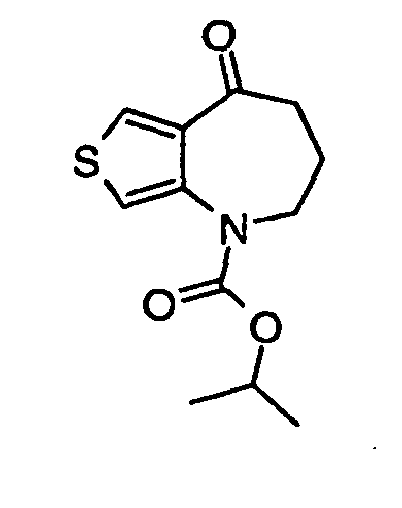
- Step 5. Preparation of 5-(3,5-Bis-trifluoromethyl-benzylamino)-2,3,4,5-tetrahydrothieno[3,4-b]azepine-1-carboxylic acid isopropyl ester
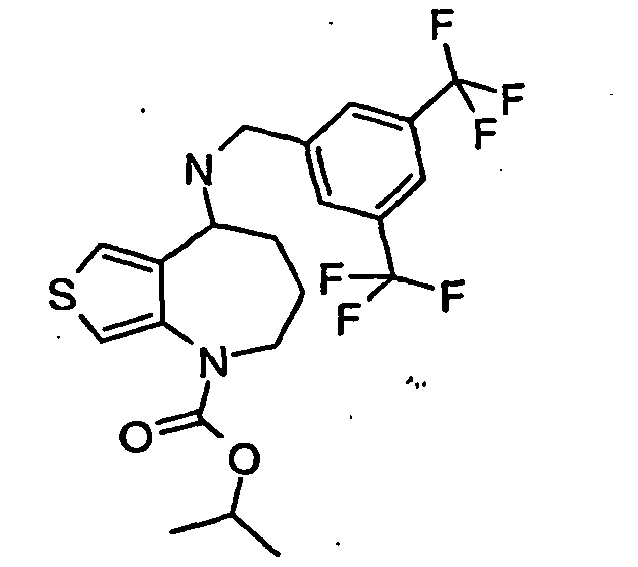
- Step 6. Preparation of 5-[Acetyl-(3,5-bis-trifluoromethyl-benzyl)-amino]-2,3,4,5-tetrahydro-thieno[3,4-b]azepine-1-carboxylic acid isopropyl ester

-

-
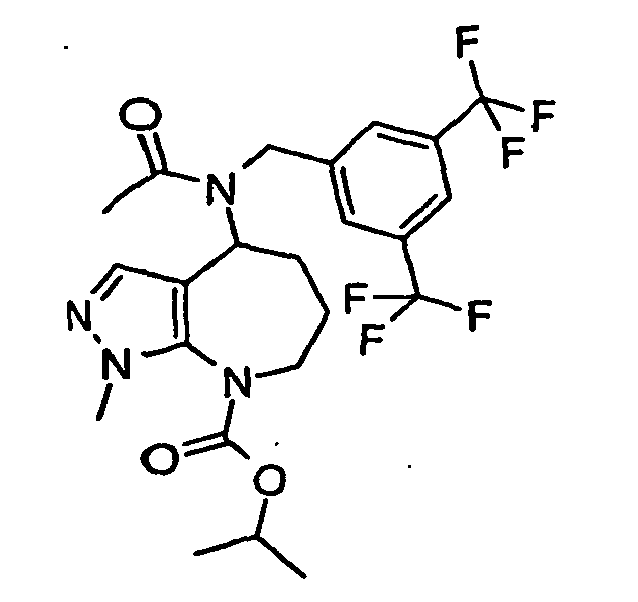
-

- Step 1. Preparation of 6-chloro-3-nitro-pyridine-2-carbonitrile

- Step 2. Preparation of 3-amino-6-chloro-pyridine-2-carboxylic acid amide

- Step 3. Preparation of 3-amino-6-chloro-pyridine-2-carboxylic acid methyl ester hydrochloride

- Step 4. Preparation of 6-chloro-3-isopropoxycarbonylamino-pyridine-2-carboxylic acid methyl ester

- Step 5. Preparation of 6-chloro-[(3-ethoxycarbonyl-propyl)-3-isopropoxycarbonylamino]-pyridine-2-carboxylic acid methyl ester

- Step 6. Preparation of 2-chloro-9-oxo-6,7,8,9-tetrahydro-pyrido[3,2-b]azepine-5-carboxylic acid isopropyl ester

- Step 7. Preparation of 9-[acetyl-(3,5-bis-trifluoromethyl-benzyl)amino]-2-chloro-6,7,8,9-tetrahydro-pyrido[3,2-b]azepine-5-carboxylic acid isopropyl ester -

-

-

- Step 1. Preparation of 3-amino-pyridine-2-carboxylic acid methyl ester

- Step 2. Preparation of 3-amino-6-bromo-pyridine-2-carboxylic acid methyl ester

- Step 3. Preparation of 6-bromo-3-isopropoxycarbonylamino-pyridine-2-carboxylic, acid methyl ester

- Step 4. Preparation of (+/-)-9-[Acetyl-(3,5-bis-trifluoromethylbenzyl)amino]-2-bromo-6,7,8,9-tetrahydro-pyrido[3,2-b]azepine-5-carboxylic acid isopropyl ester
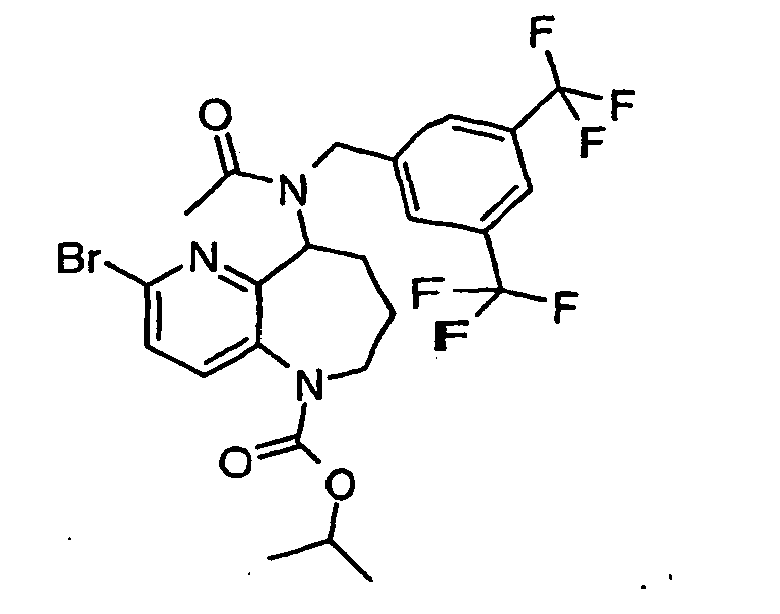
-

-

-

-

- Step 1. Preparation of 5-Chloro-3-nitro-pyridine-2-carbonitrile

- Step 2. Preparation of 3-Amino-5-chloro-pyridine-2-carboxylic acid methyl ester

- Step 3. Preparation of 3-Amino-6-bromo-5-chloro-pyridine-2-carboxylic acid methyl ester

- Step 4. Preparation of 6-Bromo-5-chloro-3-isopropoxycarbonylamino-pyridine-2-carboxylic acid methyl ester

- Step 5. Preparation of 6-Bromo-5-chloro-[(3-ethoxycarbonyl-propyl)-3-isopropoxycarbonyl-amino]-pyridine-2-carboxylic acid methyl ester

- Step 6. Preparation of 3-Chloro-2-methoxy-9-oxo-6,7,8,9-tetrahydro-pyrido[3,2-b]azepine-5-carboxylic acid isopropyl ester

- Step 7. Preparation of (+/-)-9-[Acetyl-(3,5-bis-trifluoromethylbenzyl)amino]-3-chloro-2-methoxy-6,7,8,9-tetrahydro-pyrido[3,2-b]azepine-5-carboxylic acid isopropyl ester

-

-
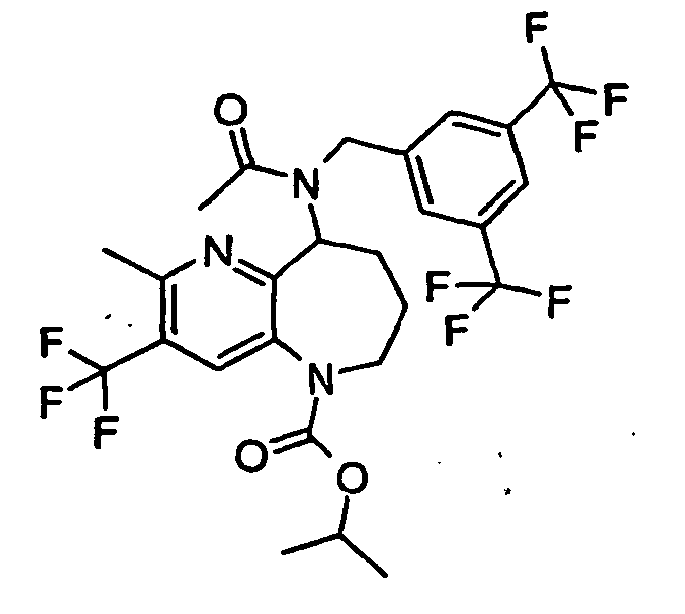
- Step 1. Preparation of 2-Chloro-3-nitro-5-trifluoromethyl-pyridine

- Step 2. Preparation of 3-Nitro-5-trifluoromethyl-pyridin-2-carbonitrile

- Step 3. Preparation of 3-Amino-5-trifluoromethyl-pyridine-2-carboxylic acid methyl ester
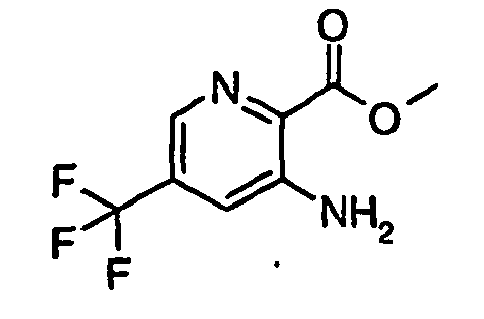
- Step 4. Preparation of 3-Amino-6-bromo-5-trifluoromethyl-pyridine-2-carboxylic acid methyl ester

- Step 5. Preparation of 3-Amino-6-methyl-5-trifluoromethyl-pyridine-2-carboxylic acid methyl ester

- Step 6. Preparation of 3-Isopropoxycarbonylamino-6-methyl-5-trifluoromethyl-pyridine-2-carboxylic acid methyl ester

- Step 7. Preparation of 3-[Isopropoxycarbonyl-(3-methoxycarbonyl-propyl)-amino]-6-methyl-5-trifluoromethyl-pyridine-2-carboxylic acid methyl ester

- Step 8. Preparation of 2-Methyl-9-oxo-3-trifluoromethyl-6,7,8,9-tetrahydro-pyrido[3,2-b]azepine-5-carboxylic acid isopropyl ester

- Step 9. (+/-)-9-[Acetyl-(3,5-bis-trifluoromethyl-benzyl)amino]-2-methyl-3-trifluoro methyl-6,7,8,9-tetrahydro-pyrido[3,2-b]azepine-5-carboxylic acid isopropyl ester

-

- Step 1. Preparation of 2-Methyl-9-oxo-3-trifluoromethyl-6,7,8,9-tetrahydro-pyrido[3,2-b]azepine
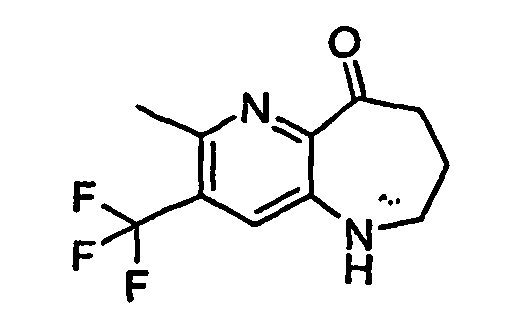
- Step 2. Preparation of 2-Methyl-9-oxo-3-trifluoromethyl-6,7,8,9-tetrahydro-pyrido[3,2-b]azepine-5-carboxylic acid tert-butyl ester

- Step 3. Preparation of (+/-)-9-(3,5-Bis-trifluoromethyl-benzyl)amino-2-methyl-3-trifluoromethyl-6,7,8,9-tetrahydro-pyrido[3,2-b]azepine-5-carboxylic acid tert-butyl ester

- Step 4. (+/-)-9-[Acetyl-(3,5-bis-trifluoromethyl-benzyl)amino]-2-methyl-3-trifluoromethyl-6,7,8,9-tetrahydro-pyrido[3,2-b]azepine-5-carboxylic acid tert-butyl ester

-

- Step 1. (+/-)-9-[(3,5-Bis-trifluoromethyl-benzyl)-cyano-amino]-2-methyl-3-trifluoromethyl-6,7,8,9-tetrahydro-pyrido[3,2-b]azepine-5-carboxylic acid isopropyl ester

- Step 2. Preparation of (+/-)-9-[(3,5-Bis-trifluoromethyl-benzyl)-2-methyl-2H-tetrazol-5-yl)-amino]-2-methyl-3-trifluoromethyl-6,7,8,9-tetrahydro-pyrido[3,2-b]azepine-5-carboxylic acid isopropyl ester

-

- Step 1. Preparation of (+/-)-9-[(3,5-Bis-trifluoromethyl-benzyl)-cyano-amino]-2-methyl-3-trifluoromethyl-6,7,8,9-tetrahydro-pyrido[3,2-b]azepine-5-carboxylic acid tert-butyl ester

- Step 2. (+/-)-9-[(3,5-Bis-trifluoromethyl-benzyl)-2-methyl-2H-tetrazol-5-yl)-amino]-2-methyl-3-trifluoromethyl-6,7,8,9-tetrahydro-pyrido[3,2-b]azepine-5-carboxylic acid tert-butyl ester

Claims (19)
- A compound of formula I

n is 0,1,2, or 3;
m is 0, 1, 2, 3, 4, 5 or 6;
q is 0, 1, or 2;
W, X, Y and Z are each independently CH, C, N, S, or O with appropriate single or double bonds and/or hydrogen atoms to complete valency requirements; Ring A is a five or six member ring wherein one of W, X, Y or Z may be absent; provided that ring A is not phenyl;
K is a bond, C=O, or S(O)p;
p is 0, 1 or 2;
R1 is selected from hydroxy, C1-C6 alkyl, C2-C6 alkenyl, C1-C6 haloalkyl, C1-C6 alkylheterocyclic, C3-C8 cycloalkyl, C1-C6 alkylC3-C8cycloalkyl, C1-C6 alkylaryl, aryl, heterocyclyl, C2-C6 alkylalcohol, -OC1-C6 alkyl, -O-aryl, -OC2-C6 alkenyl, -OC1-C6 haloalkyl, -OC1-C6 alkylheterocyclic, -OC3-C8 cycloalkyl, -OC1-C6 alkylC3-C8cycloalkyl, -NR7R8, -OC1-C6 alkylaryl, -O-heterocyclic, -OC1-C6alkylCO2R11, -OC2-C6alkylalcohol, -OC1-C6alkylNR7R8, -OC2-C6alkylcyano, CONR11R12, NR11SO2R12, NR11COR12, C0-C3 alkylNR11R12, C1-C3 alkylCOR11 and C0-C6 alkylCOOR11; provided that R1 is not hydroxy when K is S(O)p, CO, and/or when n is zero and K is a bond; and wherein each cycloalkyl, aryl or heterocyclic group is optionally substituted with 1 to 3 groups independently selected from oxo, hydroxy, halo, C1-C6 alkyl, C2-C6 alkenyl, C2-C6 alkynyl, C1-C6 alkoxy, C1-C6 haloalkyl, C1-C6 alkylalcohol, -OC2-C6alkylalcohol, C1-C6 haloalkoxy, CONR11R12, NR11SO2R12, NR11COR12, C0-C3 alkylNR11R12, C1-C3 alkylCOR11, C0-C6 alkylCOOR11, C0-C6 alkylcyano, -OC2-C6alkylcyano, C1-C6 alkylC3-C8cycloalkyl, phenyl, -OC1-C6 alkylC3-C8cycloalkyl, -OC1-C6 alkylaryl, -OC1-C6 alkylheterocyclic, and C1-C6 alkylaryl;
R2 is independently selected from hydrogen, C1-C6alkyl and C3-C8cycloalkyl;
R3 is hydrogen, C1-C6 alkyl, aryl, C2-C6 alkenyl, C2-C6 alkynyl, C1-C6 alkylaryl, C1-C6 alkylheterocyclic, C3-C8 cycloalkyl, or C1-C6 alkylC3-C8cycloalkyl;
R5 is selected from hydrogen, halogen, hydroxy, C1-C6haloalkyl, C1-C6alkyl, C2-C6alkenyl, C1-C6alkylheterocyclic, C1-C6alkylaryl, aryl, -OC1-C6alkyl, -O-aryl, -OC2-C6alkenyl, -OC1-C6haloalkyl, NR7R8, -CH2NR7R8, -CN, -COOH and NO2;
R6 is independently selected from hydrogen, C1-C6 alkyl, C2-C6 alkenyl, hydroxy, -OC1-C6 alkyl, -O-aryl, -OC2-C6 alkenyl, C1-C6 haloalkyl, -OC1-C6 haloalkyl, C1-C6 alkylNR7R8, C3-C8 cycloalkyl, and C1-C6 alkylC3-C8cycloalkyl;
R7 and R8 are independently selected from hydrogen, C1-C6 alkyl, C2-C6 alkenyl, C3-C8 cycloalkyl, C1-C6 alkylC3-C8cycloalkyl, C1-C6 alkylheterocyclic, heterocyclic, aryl, C1-C6 alkylaryl, hydroxy, oxo, COOH, C(O)OC1-C4 alkyl, C2-C6 alkynyl, C1-C6 alkoxy, C1-C6 haloalkyl, C1-C6 alkylalcohol, C1-C6 alkylamine, C2-C6 alkenylaryl, C2-C6 alkynylaryl, C1-C6 alkyl-O-C1-C6 alkylaryl, C1-C6 alkyl-NR11-C1-C6 alkylaryl, C1-C6 alkylcyano, C1-C6 alkylCONR7R8, C1-C6 alkylNR7R8 and C1-C6alkylNR11COR12, wherein each alkyl, cycloalkyl, heterocyclic, or aryl group is optionally substituted with 1 to 3 groups independently selected from hydroxy, oxo, amino, halogen, C1-C6 alkylC3-C8cycloalkyl, C3-C8 cycloalkyl, C1-C6 alkylheterocyclic, C1-C6 haloalkyl, COOH, C(O)OC1-C4 alkyl, C1-C6 alkyl, C2-C6 alkenyl, C2-C6 alkynyl, C1-C6 alkoxy, C1-C6 alkylalcohol, C1-C6 alkylamine and NR11R12; or R7 and R8 combine to form a nitrogen containing heterocyclic ring which may have 0, 1, or 2 additional hetero-atoms selected from oxygen, nitrogen or sulfur and may be optionally substituted with oxo, or C1-C6 alkyl;
R9 is selected from C1-C6 alkyl, C2-C6 alkenyl, C3-C8 cycloalkyl, C1-C6 alkylcycloalkyl, aryl, heterocyclic, C1-C6 alkylheterocyclic, COR7, CO2R7, C0-C3 alkylCONR7R8, C0-C3 alkylS(O)pNR7R8 and C0-C3 alkylS(O)pR7 wherein R7 is as defined above, and wherein each alkyl, cycloalkyl, aryl, and heterocyclic is optionally substituted with one to two groups independently selected from halo, hydroxy, oxo, COOH, C(O)OC1-C4 alkyl, C1-C6 haloalkyl, C1-C6 alkyl, C2-C6 alkenyl, C2-C6 alkynyl, C1-C6 alkoxy, C1-C6 alkylalcohol, C1-C6 alkylamine, C1-C6 alkylaryl, C2-C6 alkenylaryl, C2-C6 alkynylaryl, C1-C6 alkylheterocyclic, -NR7R8, C3-C8 cycloalkyl, C1-C6 alkylC3-C8cycloalkyl, C1-C6 alkyl-O-C1-C6 alkylaryl, C1-C6 alkylcyano, C1-C6 alkylCONR7R8, C1-C6 alkylNR7R8, C1-C6alkylNR11COR12, and aryl, wherein each cycloalkyl or aryl group is optionally substituted with halo, hydroxy, oxo, amino, COOH, C(O)OC1-C4 alkyl, C1-C6 haloalkyl, C1-C6 alkyl, C2-C6 alkenyl, C2-C6 alkynyl, C1-C6 alkoxy, C1-C6 alkylalcohol, and C1-C6 alkylamine;
R10 is selected from aryl, C1-C6 alkylaryl, C2-C6 alkenylaryl, C2-C6 alkynylaryl, C1-C6 haloalkylaryl, C1-C6 alkylheterocyclic, C2-C6 alkenylheterocyclic, C1-C6 alkylC3-C8cycloalkyl, C3-C8cycloalkyl and C1-C6 alkyl-O-C1-C6 alkylaryl, wherein each cycloalkyl, aryl, or heterocyclic group is optionally substituted with 1 to 3 groups independently selected from hydroxy, oxo, -SC1-C6 alkyl, C1-C6 alkyl, C1-C6 alkenyl, C1-C6 alkynyl, C1-C6 haloalkyl, halogen, C1-C6 alkoxy, aryloxy, C1-C6 alkenyloxy, C1-C6 haloalkoxyalkyl, C0-C6 alkylNR11R12, -OC1-C6 alkylaryl, nitro, cyano, -OC1-C6 haloalkyl, C1-C6 haloalkylalcohol, and C1-C6 alkylalcohol;
R11 and R12 are independently selected from hydrogen, C1-C6 alkyl, C2-C6 alkenyl, C3-C8 cycloalkyl, heterocyclic, aryl, and C1-C6 alkylaryl, wherein each aryl group is optionally substituted with 1 to 3 groups independently selected from halogen, C1-C6 alkylheterocyclic, and C1-C6 haloalkyl, or R11 and R12 combine to form a nitrogen containing heterocyclic ring which may have 0, 1, or 2 additional heteroatoms selected from oxygen, nitrogen or sulfur and is optionally substituted with oxo, or C1-C6 alkyl; or a pharmaceutically acceptable salt, enantiomer, racemate, diastereomer or mixture of diastereomers thereof. - A compound according to claim 1, or a pharmaceutically acceptable salt, enantiomer, racemate, diastereomer or mixture of diastereomers thereof, wherein n is 0, K is C=O and R1 is selected from hydroxy, C1-C6 alkyl, C1-C6 alkylC3-C8cycloalkyl, C1-C6 alkylheterocyclic, C1-C6 haloalkyl, C1-C6 alkylaryl, -OC1-C6 alkyl, -OC3-C8 cycloalkyl, - OC1-C6 alkylC3-C8cycloalkyl, -OC1-C6 alkylaryl, -OC1-C6 haloalkyl, -OC2-C6alkylcyano, -OC1-C6alkylCO2R11, -OC2-C6alkylalcohol, -OC1-C6 alkylNR7R8, and -OC1-C6 alkylheterocyclic and wherein each cycloalkyl, aryl, or heterocyclic is optionally substituted with 1 or 2 groups selected from halo, C1-C3 alkylalcohol, -C0-C3 alkylamine, C0-C3 alkylCOOH, -CONH2 and C0-C3alkylcyano.
- A compound according to claim 1, or a pharmaceutically acceptable salt, enantiomer, racemate, diastereomer or mixture of diastereomers thereof, wherein R9 is a heterocyclic group optionally substituted with one or two groups independently selected from hydroxy, halo, amino, C(O)OC1-C4 alkyl, C1-C6 haloalkyl, C1-C6 alkyl, C2-C6 alkenyl, C2-C6 alkynyl, C1-C6 alkoxy, C1-C6 alkylalcohol, C1-C6 alkylamine, C3-C8 cycloalkyl, C1-C6 alkylCONR7R8, C1-C6 alkylcyano, C1-C6 alkylNR7R8, and C1-C6 alkylC3-C8cydoalkyl.
- A compound according to claim 1, or a pharmaceutically acceptable salt, enantiomer, racemate, diastereomer or mixture of diastereomers thereof, wherein n, m, and q are independently 0 or 1.
- A compound according to claim 1, or a pharmaceutically acceptable salt, enantiomer, racemate, diastereomer or mixture of diastereomers thereof, wherein the A ring is selected from pyridine, pyrazine, thiophene, pyrazole, isoxazole, oxazole, and thiazole.
- A compound according to claim 1, or a pharmaceutically acceptable salt, enantiomer, racemate, diastereomer or mixture of diastereomers thereof, wherein the A ring is pyridine.
- A compound according to claim 1, or a pharmaceutically acceptable salt, enantiomer, racemate, diastereomer or mixture of diastereomers thereof, wherein the A ring is thiophene.
- A compound according to claim 1, or a pharmaceutically acceptable salt, enantiomer, racemate, diastereomer or mixture of diastereomers thereof, wherein R9 is COOR7.
- A compound according to claim 1 selected from:5-[Acetyl-(3,5-bis-trifluoromethyl-benzyl)-amino]-2,3,4,5-tetrahydro-thieno[3,4-b]azepine-1-carboxylic acid isopropyl ester,8-[Acetyl-(3,5-bis-trifluoromethyl-benzyl)-amino]-3-methyl-5,6,7,8-tetrahydrothieno[3,2-b]azepine-4-carboxylic acid isopropyl ester,8-[Acetyl-(3,5-bis-trifluoromethyl-benzyl)-amino]-2-bromo-5,6,7,8-tetrahydrothieno[3,2-b]azepine-4-carboxylic acid isopropyl ester,5-[Acetyl-(3,5-bis-trifluoromethyl-benzyl)-amino]-5,6,7,8-tetrahydro-pyrido[2,3-b]azepine-9-carboxylic acid isopropyl ester,5-[Acetyl-(3,5-bis-trifluoromethyl-benzyl)-amino]-2,3,4,5-tetrahydro-pyrido[3,4-b]azepine-1-carboxylic acid isopropyl ester,5-[Acetyl-(3,5-bis-trifluoromethyl-benzyl)-amino]-2,3,4,5-tetrahydro-pyrido[4,3-b]azepine-1-carboxylic acid isopropyl ester,9-[Acetyl-(3,5-bis-trifluoromethyl-benzyl)-amino]-6,7,8,9-tetrahydro-pyrido[3,2-b]azepine-5-carboxylic acid isopropyl ester,9-[Acetyl-(3,5-bis-trifluoromethyl-benzyl)-amino]-2-trifluoromethyl-6,7,8,9-tetrahydropyrido[3,2-b]azepine-5-carboxylic acid isopropyl ester,9-[Acetyl-(3,5-bis-trifluoromethyl-benzyl)-amino]-3-trifluoromethyl-6,7,8,9-tetrahydropyrido[3,2-b]azepine-5-carboxylic acid isopropyl ester,4-[Acetyl-(3,5-bis-trifluoromethyl-benzyl)-amino]-1-methyl-4,5,6,7-tetrahydro-1H-1,2,8-triaza-azulene-8-carboxylic acid isopropyl ester,9-[acetyl-(3,5-bis-trifluoromethylbenzyl)amino]-2-chloro-6,7,8,9-tetrahydro-pyrido[3,2-b]azepine-5-carboxylic acid isopropyl ester,9-[acetyl-(3,5-bis-trifluoromethylbenzyl)amino]-2-methoxy-6,7,8,9-tetrahydropyrido[3,2-b]azepine-5-carboxylic acid isopropyl ester,9-[acetyl-(3,5-bis-trifluoromethylbenzyl)amino]-2-bromo-6,7,8,9-tetrahydro-pyrido[3,2-b]azepine-5-carboxylic acid isopropyl ester,9-[Acetyl-(3,5-bis-trifluoromethylbenzyl)amino]-2-dimethylamino-6,7,8,9-tetrahydropyrido[3,2-b]azepine-5-carboxylic acid isopropyl ester,9-[Acetyl-(3,5-bis-trifluoromethylbenzyl)amino]-2-methyl-6,7,8,9-tetrahydro-pyrido[3,2-b]azepine-5-carboxylic acid isopropyl ester,9-[Acetyl-(3,5-bis-trifluoromethylbenzyl)amino]-2-cyano-6,7,8,9-tetrahydro-pyrido[3,2-b]azepine-5-carboxylic acid isopropyl ester,9-[Acetyl-(3,5-bis-trifluoromethylbenzyl)amino]-3-chloro-2-methoxy-6,7,8,9-tetrahydropyrido[3,2-b]azepine-5-carboxylic acid isopropyl ester,9-[Acetyl-(3,5-bis-trifluoromethylbenzyl)amino]-3-chloro-2-ethoxy-6,7,8,9-tetrahydropyrido[3,2-b]azepine-5-carboxylic acid isopropyl ester,9-[Acetyl-(3,5-bis-trifluoromethyl-benzyl)amino]-2-methyl-3-trifluoromethyl-6,7,8,9-tetrahydro-pyrido[3,2-b]azepine-5-carboxylic acid isopropyl ester,9-[Acetyl-(3,5-bis-trifluoromethyl-benzyl)amino]-2-methyl-3-trifluoromethyl-6,7,8,9-tetrahydro-pyrido[3,2-b]azepine-5-carboxylic acid tert-butyl ester,9-[(3,5-Bis-trifluoromethyl-benzyl)-2-methyl-2H-tetrazol-5-yl)-amino]-2-methyl-3-trifluoromethyl-6,7,8,9-tetrahydro-pyrido[3,2-b]azepine-5-carboxylic acid isopropyl ester,9-[(3,5-Bis-trifluoromethyl-benzyl)-2-methyl-2H-tetrazol-5-yl)-amino]-2-methyl-3-trifluoromethyl-6,7,8,9-tetrahydro-pyrido[3,2-b]azepine-5-carboxylic acid tert-butyl ester,(3,5-Bis-trifluoromethyl-benzyl)-(5-cyclopentylmethyl-2-methyl-3-trifluoromethyl-6,7,8,9-tetrahydro-5H-pyrido[3,2-b]azepin-9-yl)-(2-methyl-2H-tetrazol-5-yl)-amine,(3,5-Bis-trifluoromethyl-benzyl)-(5-cyclopropylmethyl-2-methyl-3-trifluoromethyl-6,7,8,9-tetrahydro-5H-pyrido[3,2-b]azepin-9-yl)-(2-methyl-2H-tetrazol-5-yl)-amine,(3,5-Bis-trifluoromethyl-benzyl)-(2-methyl-5-pyridin-3-ylmethyl-3-trifluoromethyl-6,7,8,9-tetrahydro-5H-pyrido[3,2-b]azepin-9-yl)-(2-methyl-2H-tetrazol-5-yl)-amine,(3,5-Bis-trifluoromethyl-benzyl)-(2-methyl-5-pyridin-4-ylmethyl-3-trifluoromethyl-6,7,8,9-tetrahydro-5H-pyrido[3,2-b]azepin-9-yl)-(2-methyl-2H-tetrazol-5-yl)-amine,3-{9-[(3,5-Bis-trifluoromethyl-benzyl)-(2-methyl-2H-tetrazol-5-yl)-amino]-2-methyl-3-trifluoromethyl-6,7,8,9-tetrahydro-pyrido[3,2-b]azepin-5-ylmethyl}-benzoic acid,4- {9-[(3,5-Bis-trifluoromethyl-benzyl)-(2-methyl-2H-tetrazol-5-yl)-amino]-2-methyl-3-trifluoromethyl-6,7,8,9-tetrahydro-pyrido[3,2-b]azepin-5-ylmethyl}-benzoic acid,5-{9-[(3,5-Bis-trifluoromethyl-benzyl)-(2-methyl-2H-tetrazol-5-yl)-amino]-2-methyl-3-trifluoromethyl-6,7,8,9-tetrahydro-pyrido[3,2-b]azepin-5-yl}-3,3-dimethyl-pentanoic acid,(4-{9-[(3,5-Bis-trifluoromethyl-benzyl)-(2-methyl-2H-tetrazol-5-yl)-amino]-2-methyl-3-trifluoromethyl-6,7,8,9-tetrahydro-pyrido[3,2-b]azepin-5-ylmethyl}-cyclohexyl)-acetic acid,(3,5-Bis-trifluoromethyl-benzyl)-(5-ethyl-2-methyl-3-trifluoromethyl-6,7,8,9-tetrahydro-5H-pyrido[3,2-b]azepin-9-yl)-(2-methyl-2H-tetrazol-5-yl)-amine,5-{9-[(3,5-Bis-trifluoromethyl-benzyl)-(2-methyl-2H-tetrazol-5-yl)-amino]-2-methyl-3-trifluoromethyl-6,7,8,9-tetrahydro-pyrido[3,2-b]azepin-5-ylmethyl }-thiophene-2-carboxylic acid,2-{9-[(3,5-Bis-trifluoromethyl-benzyl)-(2-methyl-2H-tetrazol-5-yl)-amino]-2-methyl-3-trifluoromethyl-6,7,8,9-tetrahydro-pyrido[3,2-b]azepin-5-yl }-ethanol,(5-Benzyl-2-methyl-3-trifluoromethyl-6,7,8,9-tetrahydro-5H-pyrido[3,2-b]azepin-9-yl)-(3,5-bis-trifluoromethyl-benzyl)-(2-methyl-2H-tetrazol-5-yl)-amine,(3,5-Bis-trifluoromethyl-benzyl)-(2-methyl-2H-tetrazol-5-yl)-(2-methyl-5-thiazol-2-ylmethyl-3-trifluoromettiyl-6,7,8,9-tetrahydro-5H-pyrido[3,2-b]azepin-9-yl)-amine,9-[(3,5-Bis-trifluoromethyl-benzyl)-(2-methyl-2H-tetrazol-5-yl)-amino]-2-methyl-3-trifluoromethyl-6,7,8,9-tetrahydro-pyrido[3,2-b]azepine-5-carboxylic acid tetrahydrofuran-3-yl ester,(3,5-Bis-trifluoromethyl-benzyl)-(2-methyl-5-pyridin-4-ylmethyl-3-trifluoromethyl-6,7,8,9-tetrahydro-5H-pyrido[3,2-b]azepin-9-yl)-carbamic acid methyl ester,N-(3,5-Bis-trifluoromethyl-benzyl)-N-(2-methyl-5-pyridin-4-ylmethyl-3-trifluoromethyl-6,7,8,9-tetrahydro-5H-pyrido[3,2-b]azepin-9-yl)-acetamideor a pharmaceutically acceptable salt, solvate enantiomer or diastereomer or mixture thereof.
- A pharmaceutical composition comprising a compound according to any one of claims 1 to 9, or a pharmaceutically acceptable salt, enantiomer, racemate, diastereomer or mixture of diastereomers thereof, and a carrier, diluent and/or excipient.
- A compound according to any one of claims 1 to 9, or a pharmaceutically acceptable salt, enantiomer, racemate, diastereomer or a mixture of diastereomers thereof, for use as a medicament.
- Use of a compound according to any one of claims 1 to 9, or a pharmaceutically acceptable salt, enantiomer, racemate, diastereomer or a mixture of diastereomers thereof, for the manufacture of a medicament for the treatment or prevention of dyslipidemia.
- Use of a compound according to any one of claims 1 to 9, or a pharmaceutically acceptable salt, enantiomer, racemate, diastereomer or a mixture of diastereomers thereof, for the manufacture of a medicament for the treatment of hyperlipidemia, atherosclerosis, coronary heart disease, elevated blood pressure, CHF, stroke, hypertension, hypertriglyceridemia, diabetes, obesity, inflammatory diseases including dermatitis, arthritis and pain, and diseases of the central nervous system including dementia and cognitive disorders.
- Use of a compound according to any one of claims 1 to 9, or a pharmaceutically acceptable salt, enantiomer, racemate, diastereomer or a mixture of diastereomers thereof, for the manufacture of a medicament for raising the level of plasma HDL cholesterol in a mammal.
- Use of a compound according to any one of claims 1 to 9, or a pharmaceutically acceptable salt, enantiomer, racemate, diastereomer or a mixture of diastereomers thereof, for the manufacture of a medicament for lowering the level of plasma LDL cholesterol in a mammal.
- A compound according to any one of claims 1 to 9, or a pharmaceutically acceptable salt, enantiomer, racemate, diastereomer or a mixture of diastereomers thereof, for use in the treatment or prevention of dyslipidemia.
- A compound according to any one of claims 1 to 9, or a pharmaceutically acceptable salt, enantiomer, racemate, diastereomer or a mixture of diastereomers thereof, for use in the treatment of hyperlipidemia, atherosclerosis, coronary heart disease, elevated blood pressure, CHF, stroke, hypertension, hypertriglyceridemia, diabetes, obesity, inflammatory diseases including dermatitis, arthritis and pain, and diseases of the central nervous system including dementia and cognitive disorders.
- A compound according to any one of claims 1 to 9, or a pharmaceutically acceptable salt, enantiomer, racemate, diastereomer or a mixture of diastereomers thereof, for use in raising the level of plasma HDL cholesterol in a mammal.
- A compound according to any one of claims 1 to 9, or a pharmaceutically acceptable salt, enantiomer, racemate, diastereomer or a mixture of diastereomers thereof, for use in lowering the level of plasma LDL cholesterol in a mammal.
Priority Applications (3)
| Application Number | Priority Date | Filing Date | Title |
|---|---|---|---|
| PL05732643T PL1732933T3 (en) | 2004-03-26 | 2005-03-17 | Compounds for treating dyslipidemia |
| SI200530352T SI1732933T1 (en) | 2004-03-26 | 2005-03-17 | Compounds for treating dyslipidemia |
| CY20081101030T CY1110398T1 (en) | 2004-03-26 | 2008-09-24 | UNIONS FOR THE DISEASE EDUCATION |
Applications Claiming Priority (3)
| Application Number | Priority Date | Filing Date | Title |
|---|---|---|---|
| US55713404P | 2004-03-26 | 2004-03-26 | |
| US62116204P | 2004-10-22 | 2004-10-22 | |
| PCT/US2005/009294 WO2005097805A1 (en) | 2004-03-26 | 2005-03-17 | Compounds and methods for treating dyslipidemia |
Publications (2)
| Publication Number | Publication Date |
|---|---|
| EP1732933A1 EP1732933A1 (en) | 2006-12-20 |
| EP1732933B1 true EP1732933B1 (en) | 2008-07-23 |
Family
ID=34963426
Family Applications (2)
| Application Number | Title | Priority Date | Filing Date |
|---|---|---|---|
| EP05732643A Expired - Lifetime EP1732933B1 (en) | 2004-03-26 | 2005-03-17 | Compounds for treating dyslipidemia |
| EP05725968A Expired - Lifetime EP1735320B1 (en) | 2004-03-26 | 2005-03-17 | Compounds and methods for treating dyslipidemia |
Family Applications After (1)
| Application Number | Title | Priority Date | Filing Date |
|---|---|---|---|
| EP05725968A Expired - Lifetime EP1735320B1 (en) | 2004-03-26 | 2005-03-17 | Compounds and methods for treating dyslipidemia |
Country Status (21)
| Country | Link |
|---|---|
| US (2) | US7470705B2 (en) |
| EP (2) | EP1732933B1 (en) |
| JP (1) | JP2007530550A (en) |
| KR (1) | KR20070007112A (en) |
| AT (2) | ATE433984T1 (en) |
| AU (1) | AU2005230915A1 (en) |
| BR (1) | BRPI0508966A (en) |
| CA (1) | CA2557010A1 (en) |
| CY (1) | CY1110398T1 (en) |
| DE (2) | DE602005014955D1 (en) |
| DK (1) | DK1732933T3 (en) |
| EA (1) | EA200601785A1 (en) |
| EC (1) | ECSP066886A (en) |
| ES (2) | ES2326326T3 (en) |
| IL (1) | IL177962A0 (en) |
| MA (1) | MA28550B1 (en) |
| NO (1) | NO20064763L (en) |
| PL (1) | PL1732933T3 (en) |
| PT (1) | PT1732933E (en) |
| SI (1) | SI1732933T1 (en) |
| WO (2) | WO2005097805A1 (en) |
Families Citing this family (43)
| Publication number | Priority date | Publication date | Assignee | Title |
|---|---|---|---|---|
| PL1670768T3 (en) * | 2003-10-08 | 2010-01-29 | Lilly Co Eli | Compounds and methods for treating dyslipidemia |
| EA200601785A1 (en) * | 2004-03-26 | 2007-02-27 | Эли Лилли Энд Компани | CONNECTIONS AND METHODS OF TREATMENT OF DYSLIPIDEMIA |
| MY139887A (en) | 2004-04-02 | 2009-11-30 | Mitsubishi Tanabe Pharma Corp | Tetrahydronaphthyridine derivatives and a process for preparing the same. |
| JP2008504266A (en) | 2004-06-24 | 2008-02-14 | イーライ リリー アンド カンパニー | Compounds and methods for treating dyslipidemia |
| WO2006069162A1 (en) | 2004-12-20 | 2006-06-29 | Reddy Us Therapeutics, Inc. | Novel heterocyclic compounds and their pharmaceutical compositions |
| DK1848430T3 (en) | 2004-12-31 | 2017-11-06 | Dr Reddys Laboratories Ltd | NEW BENZYLAMINE DERIVATIVES AS CETP INHIBITORS |
| US8604055B2 (en) | 2004-12-31 | 2013-12-10 | Dr. Reddy's Laboratories Ltd. | Substituted benzylamino quinolines as cholesterol ester-transfer protein inhibitors |
| GT200600381A (en) | 2005-08-25 | 2007-03-28 | ORGANIC COMPOUNDS | |
| JP4681526B2 (en) * | 2005-09-29 | 2011-05-11 | 田辺三菱製薬株式会社 | Pharmaceutical composition |
| US7652023B2 (en) | 2005-11-23 | 2010-01-26 | Bristol-Myers Squibb Company | Heterocyclic CETP inhibitors |
| US7790770B2 (en) | 2005-11-23 | 2010-09-07 | Bristol-Myers Squibb Company | Heterocyclic CETP inhibitors |
| US7888376B2 (en) | 2005-11-23 | 2011-02-15 | Bristol-Myers Squibb Company | Heterocyclic CETP inhibitors |
| TW200808731A (en) | 2006-03-30 | 2008-02-16 | Tanabe Seiyaku Co | A process for preparing tetrahydroquinoline derivatives |
| AR069165A1 (en) | 2007-11-05 | 2010-01-06 | Novartis Ag | DERIVATIVES OF 4-BENCILAMINO-1-CARBOXACILPIPERIDINA AS USEFUL CETP INHIBITORS FOR HYPERLIPIDEMIA TREATMENT |
| PT2404901E (en) | 2007-12-03 | 2013-08-29 | Novartis Ag | 1,2-disubstituted 4-benzylamino-pyrrolidine derivatives as cetp inhibitors useful for the treatment of diseases such as hyperlipidemia or arteriosclerosis |
| WO2009075857A2 (en) * | 2007-12-12 | 2009-06-18 | Amgen Inc. | Glycine transporter-1 inhibitors |
| WO2010110380A1 (en) * | 2009-03-27 | 2010-09-30 | 興和株式会社 | Fused piperidine compound and pharmaceutical agent comprising same |
| BRPI1010600A2 (en) | 2009-05-15 | 2016-03-15 | Novartis Ag | aryl pyridine as aldosterone synthase inhibitors |
| JP5654572B2 (en) | 2009-05-15 | 2015-01-14 | ノバルティス アーゲー | Benzoxazolone derivatives as aldosterone synthase inhibitors |
| JP5420761B2 (en) | 2009-05-28 | 2014-02-19 | ノバルティス アーゲー | Substituted aminopropionic acid derivatives as neprilysin inhibitors |
| SG176010A1 (en) | 2009-05-28 | 2011-12-29 | Novartis Ag | Substituted aminobutyric derivatives as neprilysin inhibitors |
| TWI450896B (en) | 2009-06-30 | 2014-09-01 | Lilly Co Eli | Trans-4-[[(5s)-5-[[[3,5-bis(trifluoromethyl)phenyl]methyl](2-methyl-2h-tetrazol-5-yl)amino]-2,3,4,5-tetrahydro-7,9-dimethyl-1h-1-benzazepin-1-yl]methyl]-cyclohexanecarboxylic acid |
| ES2663351T3 (en) | 2009-11-17 | 2018-04-12 | Novartis Ag | Aryl-pyridine derivatives as aldosterone synthase inhibitors |
| JO2967B1 (en) | 2009-11-20 | 2016-03-15 | نوفارتس ايه جي | Substituted carbamoylmethylamino acetic acid derivatives as novel NEP inhibitors |
| US8575160B2 (en) | 2009-11-30 | 2013-11-05 | Novartis Ag | Imidazole derivatives as aldosterone synthase inhibitors |
| CN106478948B (en) * | 2010-02-24 | 2019-05-07 | 瑞立普萨公司 | Polyimidazole as bile acid sequestrant |
| DK2566505T3 (en) | 2010-05-06 | 2020-01-20 | Alphacore Pharma Llc | APPLICATION OF CHOLESTERYLESTES TO THE STEROIDOGEN TISSUE |
| US8673974B2 (en) | 2010-11-16 | 2014-03-18 | Novartis Ag | Substituted amino bisphenyl pentanoic acid derivatives as NEP inhibitors |
| US8877815B2 (en) | 2010-11-16 | 2014-11-04 | Novartis Ag | Substituted carbamoylcycloalkyl acetic acid derivatives as NEP |
| PL2729142T3 (en) | 2011-07-08 | 2018-10-31 | Novartis Ag | Method of treating atherosclerosis in high triglyceride subjects |
| CA2845284C (en) | 2011-08-18 | 2018-03-06 | Dr. Reddy's Laboratories Ltd. | Substituted heterocyclic amine compounds as cholesteryl ester-transfer protein (cetp) inhibitors |
| JP6140168B2 (en) | 2011-09-27 | 2017-05-31 | ドクター レディズ ラボラトリーズ リミテッド | 5-Benzylaminomethyl-6-aminopyrazolo [3,4-B] pyridine derivatives as cholesteryl ester transfer protein (CETP) inhibitors useful for the treatment of atherosclerosis |
| JO3210B1 (en) | 2011-10-28 | 2018-03-08 | Merck Sharp & Dohme | Fusible inhibitor of the cholesterolester transporter oxazolidinone octahedral |
| WO2013080999A1 (en) | 2011-11-29 | 2013-06-06 | 興和株式会社 | Agent for inhibiting expression of npc1l1 and/or lipg mrna and agent for preventing and/or treating obesity |
| UY35144A (en) | 2012-11-20 | 2014-06-30 | Novartis Ag | APELINE SYNTHETIC LINEAR MIMETICS FOR THE CARDIAC INSUFFICIENCY TREATMENT |
| NZ710574A (en) | 2013-02-14 | 2017-11-24 | Novartis Ag | Substituted bisphenyl butanoic phosphonic acid derivatives as nep (neutral endopeptidase) inhibitors |
| BR112016001376A2 (en) | 2013-07-25 | 2017-10-24 | Novartis Ag | synthetic apelin polypeptide bioconjugates |
| US9266925B2 (en) | 2013-07-25 | 2016-02-23 | Novartis Ag | Cyclic polypeptides for the treatment of heart failure |
| CA2972871A1 (en) | 2015-01-23 | 2016-07-28 | Novartis Ag | Synthetic apelin fatty acid conjugates with improved half-life |
| JOP20190086A1 (en) | 2016-10-21 | 2019-04-18 | Novartis Ag | Naphthyridinone derivatives and their use in the treatment of arrhythmia |
| UY38072A (en) | 2018-02-07 | 2019-10-01 | Novartis Ag | COMPOSITIONS DERIVED FROM BUTANOIC ESTER SUBSTITUTED WITH BISPHENYL AS INHIBITORS OF NEP, COMPOSITIONS AND COMBINATIONS OF THE SAME |
| AR127698A1 (en) | 2021-11-23 | 2024-02-21 | Novartis Ag | NAFTYRIDINOONE DERIVATIVES FOR THE TREATMENT OF A DISEASE OR DISORDER |
| US20240391941A1 (en) | 2023-05-24 | 2024-11-28 | Novartis Ag | Naphthyridinone derivatives for the treatment of a disease or disorder |
Family Cites Families (22)
| Publication number | Priority date | Publication date | Assignee | Title |
|---|---|---|---|---|
| GB1515540A (en) | 1975-12-16 | 1978-06-28 | Labaz | 4-amino-trans-decahydroquinoline derivatives |
| US6207671B1 (en) | 1996-07-08 | 2001-03-27 | Bayer Aktiengesellschaft | Cycloalkano-pyridines |
| DE19627431A1 (en) * | 1996-07-08 | 1998-01-15 | Bayer Ag | Heterocyclically fused pyridines |
| DE19627430A1 (en) | 1996-07-08 | 1998-01-15 | Bayer Ag | Bicyclic condensed pyridines |
| HRP970330B1 (en) | 1996-07-08 | 2004-06-30 | Bayer Ag | Cycloalkano pyridines |
| AU6279598A (en) * | 1997-02-18 | 1998-09-08 | Neurocrine Biosciences, Inc. | Biazacyclic CRF antagonists |
| DE19709125A1 (en) | 1997-03-06 | 1998-09-10 | Bayer Ag | Substituted quinolines |
| JPH10287662A (en) | 1997-04-08 | 1998-10-27 | Kitasato Inst:The | FO-5637A and B substances and their production |
| GT199900147A (en) | 1998-09-17 | 1999-09-06 | 1, 2, 3, 4- TETRAHIDROQUINOLINAS 2-SUBSTITUTED 4-AMINO SUBSTITUTED. | |
| US6197786B1 (en) | 1998-09-17 | 2001-03-06 | Pfizer Inc | 4-Carboxyamino-2-substituted-1,2,3,4-tetrahydroquinolines |
| US6147090A (en) | 1998-09-17 | 2000-11-14 | Pfizer Inc. | 4-carboxyamino-2-methyl-1,2,3,4,-tetrahydroquinolines |
| US6147089A (en) * | 1998-09-17 | 2000-11-14 | Pfizer Inc. | Annulated 4-carboxyamino-2-methyl-1,2,3,4,-tetrahydroquinolines |
| DE10148436A1 (en) | 2001-10-01 | 2003-04-17 | Bayer Ag | Tetrahydroquinolines |
| US7507753B2 (en) * | 2001-12-28 | 2009-03-24 | Takeda Chemical Industries Ltd. | Biaryl compound and use thereof |
| PL371416A1 (en) | 2002-02-01 | 2005-06-13 | Pfizer Products Inc. | Controlled release pharmaceutical dosage forms of a cholesteryl ester transfer protein inhibitor |
| JP2003321472A (en) * | 2002-02-26 | 2003-11-11 | Takeda Chem Ind Ltd | Grk inhibitor |
| ES2277142T3 (en) * | 2002-08-30 | 2007-07-01 | Japan Tobacco Inc. | DIBENCILAMINE COMPOSITE AND ITS MEDICINAL USE. |
| PL376156A1 (en) * | 2002-10-04 | 2005-12-27 | Millennium Pharmaceuticals, Inc. | Pgd2 receptor antagonists for the treatment of inflammatory diseases |
| PL1670768T3 (en) * | 2003-10-08 | 2010-01-29 | Lilly Co Eli | Compounds and methods for treating dyslipidemia |
| EA200601785A1 (en) * | 2004-03-26 | 2007-02-27 | Эли Лилли Энд Компани | CONNECTIONS AND METHODS OF TREATMENT OF DYSLIPIDEMIA |
| MY139887A (en) | 2004-04-02 | 2009-11-30 | Mitsubishi Tanabe Pharma Corp | Tetrahydronaphthyridine derivatives and a process for preparing the same. |
| JP2008504266A (en) * | 2004-06-24 | 2008-02-14 | イーライ リリー アンド カンパニー | Compounds and methods for treating dyslipidemia |
-
2005
- 2005-03-17 EA EA200601785A patent/EA200601785A1/en unknown
- 2005-03-17 BR BRPI0508966-2A patent/BRPI0508966A/en not_active Application Discontinuation
- 2005-03-17 DE DE602005014955T patent/DE602005014955D1/en not_active Expired - Fee Related
- 2005-03-17 AT AT05725968T patent/ATE433984T1/en not_active IP Right Cessation
- 2005-03-17 ES ES05725968T patent/ES2326326T3/en not_active Expired - Lifetime
- 2005-03-17 SI SI200530352T patent/SI1732933T1/en unknown
- 2005-03-17 PL PL05732643T patent/PL1732933T3/en unknown
- 2005-03-17 AU AU2005230915A patent/AU2005230915A1/en not_active Abandoned
- 2005-03-17 EP EP05732643A patent/EP1732933B1/en not_active Expired - Lifetime
- 2005-03-17 US US10/598,473 patent/US7470705B2/en not_active Expired - Fee Related
- 2005-03-17 PT PT05732643T patent/PT1732933E/en unknown
- 2005-03-17 JP JP2007505054A patent/JP2007530550A/en active Pending
- 2005-03-17 KR KR1020067019800A patent/KR20070007112A/en not_active Ceased
- 2005-03-17 EP EP05725968A patent/EP1735320B1/en not_active Expired - Lifetime
- 2005-03-17 ES ES05732643T patent/ES2308477T3/en not_active Expired - Lifetime
- 2005-03-17 DK DK05732643T patent/DK1732933T3/en active
- 2005-03-17 US US10/598,686 patent/US20070208003A1/en not_active Abandoned
- 2005-03-17 WO PCT/US2005/009294 patent/WO2005097805A1/en not_active Ceased
- 2005-03-17 CA CA002557010A patent/CA2557010A1/en not_active Abandoned
- 2005-03-17 WO PCT/US2005/009301 patent/WO2005097806A1/en not_active Ceased
- 2005-03-17 AT AT05732643T patent/ATE402180T1/en not_active IP Right Cessation
- 2005-03-17 DE DE602005008416T patent/DE602005008416D1/en not_active Expired - Fee Related
-
2006
- 2006-09-07 IL IL177962A patent/IL177962A0/en unknown
- 2006-09-26 EC EC2006006886A patent/ECSP066886A/en unknown
- 2006-10-20 NO NO20064763A patent/NO20064763L/en not_active Application Discontinuation
- 2006-10-23 MA MA29410A patent/MA28550B1/en unknown
-
2008
- 2008-09-24 CY CY20081101030T patent/CY1110398T1/en unknown
Also Published As
| Publication number | Publication date |
|---|---|
| BRPI0508966A (en) | 2007-08-21 |
| US7470705B2 (en) | 2008-12-30 |
| PT1732933E (en) | 2008-10-20 |
| KR20070007112A (en) | 2007-01-12 |
| SI1732933T1 (en) | 2008-10-31 |
| EP1732933A1 (en) | 2006-12-20 |
| ECSP066886A (en) | 2006-11-24 |
| WO2005097806A1 (en) | 2005-10-20 |
| ES2308477T3 (en) | 2008-12-01 |
| EP1735320B1 (en) | 2009-06-17 |
| ATE402180T1 (en) | 2008-08-15 |
| MA28550B1 (en) | 2007-04-03 |
| PL1732933T3 (en) | 2008-12-31 |
| US20070173526A1 (en) | 2007-07-26 |
| DE602005008416D1 (en) | 2008-09-04 |
| DE602005014955D1 (en) | 2009-07-30 |
| EP1735320A1 (en) | 2006-12-27 |
| CY1110398T1 (en) | 2015-04-29 |
| IL177962A0 (en) | 2006-12-31 |
| CA2557010A1 (en) | 2005-10-20 |
| JP2007530550A (en) | 2007-11-01 |
| EA200601785A1 (en) | 2007-02-27 |
| WO2005097805A1 (en) | 2005-10-20 |
| DK1732933T3 (en) | 2008-10-27 |
| ES2326326T3 (en) | 2009-10-07 |
| US20070208003A1 (en) | 2007-09-06 |
| AU2005230915A1 (en) | 2005-10-20 |
| NO20064763L (en) | 2006-11-22 |
| ATE433984T1 (en) | 2009-07-15 |
Similar Documents
| Publication | Publication Date | Title |
|---|---|---|
| EP1735320B1 (en) | Compounds and methods for treating dyslipidemia | |
| CA2570673C (en) | Compounds and methods for treating dyslipidemia | |
| EP1490364B1 (en) | 7-azaindoles as inhibitors of c-jun n-terminal kinases for the treatment of neurodegenerative disorders | |
| JP5642963B2 (en) | Pyridinonyl PDK1 inhibitor | |
| JP2010521513A (en) | Aza-pyridopyrimidinone derivatives | |
| CN101747282A (en) | Phenyl pyrimidone compounds, pharmaceutical compositions and preparation methods and uses thereof | |
| CN114262322B (en) | A class of cell programmed necrosis inhibitors, their preparation methods and uses | |
| CZ16896A3 (en) | 9-substituted 2-(2-n-alkoxyphenyl) purin-6-ones, process of their preparation, pharmaceutical composition such compounds and their use | |
| EP1670768B1 (en) | Compounds and methods for treating dyslipidemia | |
| FR2593818A1 (en) | ACYLAMINOMETHYL-3 IMIDAZO (1,2-A) PYRIDINE DERIVATIVES, THEIR PREPARATION AND THEIR THERAPEUTIC USE | |
| MXPA06011047A (en) | Compounds and methods for treating dyslipidemia | |
| CN1938320A (en) | Compounds and methods for treating dyslipidemia | |
| ZA200610093B (en) | Compounds and methods for treating dyslipidemia | |
| CN109305957A (en) | Phenylpyridines and their application in DPP-4 enzyme inhibitors | |
| HK1153195B (en) | Compound with serotoninergic activity, process for preparing it and pharmaceutical composition comprising it | |
| HK1153195A1 (en) | Compound with serotoninergic activity, process for preparing it and pharmaceutical composition comprising it | |
| KR20070031950A (en) | Compounds and methods for treating dyslipidemia |
Legal Events
| Date | Code | Title | Description |
|---|---|---|---|
| PUAI | Public reference made under article 153(3) epc to a published international application that has entered the european phase |
Free format text: ORIGINAL CODE: 0009012 |
|
| 17P | Request for examination filed |
Effective date: 20061026 |
|
| AK | Designated contracting states |
Kind code of ref document: A1 Designated state(s): AT BE BG CH CY CZ DE DK EE ES FI FR GB GR HU IE IS IT LI LT LU MC NL PL PT RO SE SI SK TR |
|
| R17C | First examination report despatched (corrected) |
Effective date: 20070111 |
|
| DAX | Request for extension of the european patent (deleted) | ||
| GRAP | Despatch of communication of intention to grant a patent |
Free format text: ORIGINAL CODE: EPIDOSNIGR1 |
|
| RTI1 | Title (correction) |
Free format text: COMPOUNDS FOR TREATING DYSLIPIDEMIA |
|
| GRAS | Grant fee paid |
Free format text: ORIGINAL CODE: EPIDOSNIGR3 |
|
| GRAA | (expected) grant |
Free format text: ORIGINAL CODE: 0009210 |
|
| AK | Designated contracting states |
Kind code of ref document: B1 Designated state(s): AT BE BG CH CY CZ DE DK EE ES FI FR GB GR HU IE IS IT LI LT LU MC NL PL PT RO SE SI SK TR |
|
| REG | Reference to a national code |
Ref country code: GB Ref legal event code: FG4D |
|
| REG | Reference to a national code |
Ref country code: CH Ref legal event code: EP Ref country code: CH Ref legal event code: NV |
|
| REG | Reference to a national code |
Ref country code: IE Ref legal event code: FG4D |
|
| REF | Corresponds to: |
Ref document number: 602005008416 Country of ref document: DE Date of ref document: 20080904 Kind code of ref document: P |
|
| REG | Reference to a national code |
Ref country code: RO Ref legal event code: EPE |
|
| REG | Reference to a national code |
Ref country code: GR Ref legal event code: EP Ref document number: 20080402453 Country of ref document: GR |
|
| REG | Reference to a national code |
Ref country code: PT Ref legal event code: SC4A Free format text: AVAILABILITY OF NATIONAL TRANSLATION Effective date: 20081007 |
|
| REG | Reference to a national code |
Ref country code: SE Ref legal event code: TRGR |
|
| REG | Reference to a national code |
Ref country code: ES Ref legal event code: FG2A Ref document number: 2308477 Country of ref document: ES Kind code of ref document: T3 |
|
| REG | Reference to a national code |
Ref country code: EE Ref legal event code: FG4A Ref document number: E002528 Country of ref document: EE Effective date: 20080930 |
|
| REG | Reference to a national code |
Ref country code: PL Ref legal event code: T3 |
|
| REG | Reference to a national code |
Ref country code: HU Ref legal event code: AG4A Ref document number: E004193 Country of ref document: HU |
|
| PLBE | No opposition filed within time limit |
Free format text: ORIGINAL CODE: 0009261 |
|
| STAA | Information on the status of an ep patent application or granted ep patent |
Free format text: STATUS: NO OPPOSITION FILED WITHIN TIME LIMIT |
|
| 26N | No opposition filed |
Effective date: 20090424 |
|
| PGFP | Annual fee paid to national office [announced via postgrant information from national office to epo] |
Ref country code: EE Payment date: 20091215 Year of fee payment: 6 Ref country code: SE Payment date: 20091223 Year of fee payment: 6 |
|
| PGFP | Annual fee paid to national office [announced via postgrant information from national office to epo] |
Ref country code: CH Payment date: 20100218 Year of fee payment: 6 Ref country code: CZ Payment date: 20100219 Year of fee payment: 6 Ref country code: DK Payment date: 20100208 Year of fee payment: 6 Ref country code: ES Payment date: 20100322 Year of fee payment: 6 Ref country code: HU Payment date: 20100108 Year of fee payment: 6 Ref country code: IE Payment date: 20100114 Year of fee payment: 6 Ref country code: IS Payment date: 20100216 Year of fee payment: 6 Ref country code: LT Payment date: 20100209 Year of fee payment: 6 Ref country code: LU Payment date: 20100323 Year of fee payment: 6 Ref country code: MC Payment date: 20100105 Year of fee payment: 6 Ref country code: PT Payment date: 20100106 Year of fee payment: 6 Ref country code: RO Payment date: 20100301 Year of fee payment: 6 |
|
| PGFP | Annual fee paid to national office [announced via postgrant information from national office to epo] |
Ref country code: FI Payment date: 20100301 Year of fee payment: 6 Ref country code: FR Payment date: 20100318 Year of fee payment: 6 Ref country code: IT Payment date: 20100324 Year of fee payment: 6 Ref country code: PL Payment date: 20100108 Year of fee payment: 6 Ref country code: SI Payment date: 20100309 Year of fee payment: 6 Ref country code: SK Payment date: 20100218 Year of fee payment: 6 |
|
| PGFP | Annual fee paid to national office [announced via postgrant information from national office to epo] |
Ref country code: AT Payment date: 20100208 Year of fee payment: 6 Ref country code: GB Payment date: 20100208 Year of fee payment: 6 Ref country code: GR Payment date: 20091230 Year of fee payment: 6 Ref country code: TR Payment date: 20100114 Year of fee payment: 6 |
|
| PGFP | Annual fee paid to national office [announced via postgrant information from national office to epo] |
Ref country code: BG Payment date: 20100222 Year of fee payment: 6 |
|
| PGFP | Annual fee paid to national office [announced via postgrant information from national office to epo] |
Ref country code: DE Payment date: 20100331 Year of fee payment: 6 Ref country code: NL Payment date: 20100402 Year of fee payment: 6 |
|
| PGFP | Annual fee paid to national office [announced via postgrant information from national office to epo] |
Ref country code: BE Payment date: 20100504 Year of fee payment: 6 |
|
| PGFP | Annual fee paid to national office [announced via postgrant information from national office to epo] |
Ref country code: CY Payment date: 20100310 Year of fee payment: 6 |
|
| REG | Reference to a national code |
Ref country code: PT Ref legal event code: MM4A Free format text: LAPSE DUE TO NON-PAYMENT OF FEES Effective date: 20110919 |
|
| BERE | Be: lapsed |
Owner name: ELI LILLY AND CY Effective date: 20110331 |
|
| REG | Reference to a national code |
Ref country code: DE Ref legal event code: R119 Ref document number: 602005008416 Country of ref document: DE |
|
| REG | Reference to a national code |
Ref country code: NL Ref legal event code: V1 Effective date: 20111001 |
|
| PG25 | Lapsed in a contracting state [announced via postgrant information from national office to epo] |
Ref country code: MC Free format text: LAPSE BECAUSE OF NON-PAYMENT OF DUE FEES Effective date: 20110331 Ref country code: LT Free format text: LAPSE BECAUSE OF NON-PAYMENT OF DUE FEES Effective date: 20110317 Ref country code: PT Free format text: LAPSE BECAUSE OF NON-PAYMENT OF DUE FEES Effective date: 20110919 |
|
| REG | Reference to a national code |
Ref country code: DK Ref legal event code: EBP Ref country code: CH Ref legal event code: PL |
|
| REG | Reference to a national code |
Ref country code: SE Ref legal event code: EUG |
|
| GBPC | Gb: european patent ceased through non-payment of renewal fee |
Effective date: 20110317 |
|
| PG25 | Lapsed in a contracting state [announced via postgrant information from national office to epo] |
Ref country code: AT Free format text: LAPSE BECAUSE OF NON-PAYMENT OF DUE FEES Effective date: 20110317 Ref country code: FI Free format text: LAPSE BECAUSE OF NON-PAYMENT OF DUE FEES Effective date: 20110317 Ref country code: CY Free format text: LAPSE BECAUSE OF NON-PAYMENT OF DUE FEES Effective date: 20110317 |
|
| REG | Reference to a national code |
Ref country code: SI Ref legal event code: KO00 Effective date: 20111021 |
|
| REG | Reference to a national code |
Ref country code: SK Ref legal event code: MM4A Ref document number: E 4139 Country of ref document: SK Effective date: 20110317 |
|
| REG | Reference to a national code |
Ref country code: EE Ref legal event code: MM4A Ref document number: E002528 Country of ref document: EE Effective date: 20110331 |
|
| REG | Reference to a national code |
Ref country code: FR Ref legal event code: ST Effective date: 20111130 |
|
| PG25 | Lapsed in a contracting state [announced via postgrant information from national office to epo] |
Ref country code: BE Free format text: LAPSE BECAUSE OF NON-PAYMENT OF DUE FEES Effective date: 20110331 |
|
| REG | Reference to a national code |
Ref country code: IE Ref legal event code: MM4A |
|
| PG25 | Lapsed in a contracting state [announced via postgrant information from national office to epo] |
Ref country code: NL Free format text: LAPSE BECAUSE OF NON-PAYMENT OF DUE FEES Effective date: 20111001 Ref country code: IS Free format text: LAPSE BECAUSE OF FAILURE TO SUBMIT A TRANSLATION OF THE DESCRIPTION OR TO PAY THE FEE WITHIN THE PRESCRIBED TIME-LIMIT Effective date: 20111001 Ref country code: HU Free format text: LAPSE BECAUSE OF NON-PAYMENT OF DUE FEES Effective date: 20110318 Ref country code: FR Free format text: LAPSE BECAUSE OF NON-PAYMENT OF DUE FEES Effective date: 20110331 Ref country code: IE Free format text: LAPSE BECAUSE OF NON-PAYMENT OF DUE FEES Effective date: 20110317 Ref country code: LI Free format text: LAPSE BECAUSE OF NON-PAYMENT OF DUE FEES Effective date: 20110331 Ref country code: CH Free format text: LAPSE BECAUSE OF NON-PAYMENT OF DUE FEES Effective date: 20110331 Ref country code: EE Free format text: LAPSE BECAUSE OF NON-PAYMENT OF DUE FEES Effective date: 20110331 Ref country code: CZ Free format text: LAPSE BECAUSE OF NON-PAYMENT OF DUE FEES Effective date: 20110317 Ref country code: DE Free format text: LAPSE BECAUSE OF NON-PAYMENT OF DUE FEES Effective date: 20111001 |
|
| REG | Reference to a national code |
Ref country code: DE Ref legal event code: R082 Ref document number: 602005008416 Country of ref document: DE Representative=s name: DR. SCHOEN & PARTNER, DE Ref country code: DE Ref legal event code: R082 Ref document number: 602005008416 Country of ref document: DE Representative=s name: DR. SCHOEN, NEYMEYR & PARTNER MBB, DE |
|
| PG25 | Lapsed in a contracting state [announced via postgrant information from national office to epo] |
Ref country code: SK Free format text: LAPSE BECAUSE OF NON-PAYMENT OF DUE FEES Effective date: 20110317 Ref country code: SI Free format text: LAPSE BECAUSE OF NON-PAYMENT OF DUE FEES Effective date: 20110318 Ref country code: IT Free format text: LAPSE BECAUSE OF NON-PAYMENT OF DUE FEES Effective date: 20110317 Ref country code: GR Free format text: LAPSE BECAUSE OF NON-PAYMENT OF DUE FEES Effective date: 20111004 Ref country code: GB Free format text: LAPSE BECAUSE OF NON-PAYMENT OF DUE FEES Effective date: 20110317 |
|
| REG | Reference to a national code |
Ref country code: DE Ref legal event code: R119 Ref document number: 602005008416 Country of ref document: DE Effective date: 20111001 |
|
| REG | Reference to a national code |
Ref country code: ES Ref legal event code: FD2A Effective date: 20120424 |
|
| PG25 | Lapsed in a contracting state [announced via postgrant information from national office to epo] |
Ref country code: RO Free format text: LAPSE BECAUSE OF NON-PAYMENT OF DUE FEES Effective date: 20110317 |
|
| PG25 | Lapsed in a contracting state [announced via postgrant information from national office to epo] |
Ref country code: DK Free format text: LAPSE BECAUSE OF NON-PAYMENT OF DUE FEES Effective date: 20110331 |
|
| PG25 | Lapsed in a contracting state [announced via postgrant information from national office to epo] |
Ref country code: ES Free format text: LAPSE BECAUSE OF NON-PAYMENT OF DUE FEES Effective date: 20110318 |
|
| PG25 | Lapsed in a contracting state [announced via postgrant information from national office to epo] |
Ref country code: PL Free format text: LAPSE BECAUSE OF NON-PAYMENT OF DUE FEES Effective date: 20110317 |
|
| REG | Reference to a national code |
Ref country code: PL Ref legal event code: LAPE |
|
| PG25 | Lapsed in a contracting state [announced via postgrant information from national office to epo] |
Ref country code: SE Free format text: LAPSE BECAUSE OF NON-PAYMENT OF DUE FEES Effective date: 20110318 |
|
| PG25 | Lapsed in a contracting state [announced via postgrant information from national office to epo] |
Ref country code: LU Free format text: LAPSE BECAUSE OF NON-PAYMENT OF DUE FEES Effective date: 20110317 |
|
| PG25 | Lapsed in a contracting state [announced via postgrant information from national office to epo] |
Ref country code: BG Free format text: LAPSE BECAUSE OF NON-PAYMENT OF DUE FEES Effective date: 20111231 |
|
| PG25 | Lapsed in a contracting state [announced via postgrant information from national office to epo] |
Ref country code: TR Free format text: LAPSE BECAUSE OF NON-PAYMENT OF DUE FEES Effective date: 20110317 |