EP1731507A1 - New heterocyclic compounds, their preparation and their use as medicaments, in particular as anti-alzheimer agents - Google Patents
New heterocyclic compounds, their preparation and their use as medicaments, in particular as anti-alzheimer agents Download PDFInfo
- Publication number
- EP1731507A1 EP1731507A1 EP05290914A EP05290914A EP1731507A1 EP 1731507 A1 EP1731507 A1 EP 1731507A1 EP 05290914 A EP05290914 A EP 05290914A EP 05290914 A EP05290914 A EP 05290914A EP 1731507 A1 EP1731507 A1 EP 1731507A1
- Authority
- EP
- European Patent Office
- Prior art keywords
- dimethylcarbamate
- methyl
- stage
- dihydro
- ethyl
- Prior art date
- Legal status (The legal status is an assumption and is not a legal conclusion. Google has not performed a legal analysis and makes no representation as to the accuracy of the status listed.)
- Withdrawn
Links
- 238000002360 preparation method Methods 0.000 title claims abstract description 96
- 239000003814 drug Substances 0.000 title claims abstract description 15
- 239000003795 chemical substances by application Substances 0.000 title claims description 8
- 150000002391 heterocyclic compounds Chemical class 0.000 title abstract description 4
- 230000007131 anti Alzheimer effect Effects 0.000 title description 5
- 150000001875 compounds Chemical class 0.000 claims abstract description 290
- 239000008194 pharmaceutical composition Substances 0.000 claims abstract description 18
- 208000024827 Alzheimer disease Diseases 0.000 claims abstract description 16
- 229910052757 nitrogen Inorganic materials 0.000 claims abstract description 16
- 125000004433 nitrogen atom Chemical group N* 0.000 claims abstract description 14
- 150000003254 radicals Chemical class 0.000 claims abstract description 14
- 229910052717 sulfur Inorganic materials 0.000 claims abstract description 12
- 208000015122 neurodegenerative disease Diseases 0.000 claims abstract description 11
- 229910052760 oxygen Inorganic materials 0.000 claims abstract description 10
- 125000004432 carbon atom Chemical group C* 0.000 claims abstract description 7
- 229910052799 carbon Inorganic materials 0.000 claims abstract description 5
- 125000001495 ethyl group Chemical group [H]C([H])([H])C([H])([H])* 0.000 claims description 161
- 238000000034 method Methods 0.000 claims description 135
- 125000001797 benzyl group Chemical group [H]C1=C([H])C([H])=C(C([H])=C1[H])C([H])([H])* 0.000 claims description 103
- 125000001997 phenyl group Chemical group [H]C1=C([H])C([H])=C(*)C([H])=C1[H] 0.000 claims description 91
- 125000003118 aryl group Chemical group 0.000 claims description 46
- -1 aryl (C1-C8) alkyl Chemical group 0.000 claims description 37
- 230000009467 reduction Effects 0.000 claims description 25
- 238000005956 quaternization reaction Methods 0.000 claims description 24
- 125000004209 (C1-C8) alkyl group Chemical group 0.000 claims description 23
- 230000021235 carbamoylation Effects 0.000 claims description 23
- KXDHJXZQYSOELW-UHFFFAOYSA-N Carbamic acid Chemical group NC(O)=O KXDHJXZQYSOELW-UHFFFAOYSA-N 0.000 claims description 22
- 210000003169 central nervous system Anatomy 0.000 claims description 20
- 239000000544 cholinesterase inhibitor Substances 0.000 claims description 19
- 125000002877 alkyl aryl group Chemical group 0.000 claims description 17
- 125000001072 heteroaryl group Chemical group 0.000 claims description 17
- 230000008569 process Effects 0.000 claims description 17
- 229940100578 Acetylcholinesterase inhibitor Drugs 0.000 claims description 15
- 125000003545 alkoxy group Chemical group 0.000 claims description 13
- 125000003178 carboxy group Chemical group [H]OC(*)=O 0.000 claims description 13
- 229910052736 halogen Inorganic materials 0.000 claims description 13
- 239000002168 alkylating agent Substances 0.000 claims description 12
- 229940100198 alkylating agent Drugs 0.000 claims description 12
- 125000000217 alkyl group Chemical group 0.000 claims description 11
- 229940079593 drug Drugs 0.000 claims description 11
- 229910052739 hydrogen Inorganic materials 0.000 claims description 11
- 239000001257 hydrogen Substances 0.000 claims description 11
- 229940002612 prodrug Drugs 0.000 claims description 11
- 239000000651 prodrug Substances 0.000 claims description 11
- 241001465754 Metazoa Species 0.000 claims description 10
- 208000037265 diseases, disorders, signs and symptoms Diseases 0.000 claims description 10
- 210000001428 peripheral nervous system Anatomy 0.000 claims description 10
- 150000003839 salts Chemical class 0.000 claims description 10
- 125000004178 (C1-C4) alkyl group Chemical group 0.000 claims description 9
- IMSODMZESSGVBE-UHFFFAOYSA-N 2-Oxazoline Chemical compound C1CN=CO1 IMSODMZESSGVBE-UHFFFAOYSA-N 0.000 claims description 9
- 150000002367 halogens Chemical class 0.000 claims description 9
- 125000002023 trifluoromethyl group Chemical group FC(F)(F)* 0.000 claims description 9
- 230000004770 neurodegeneration Effects 0.000 claims description 8
- UFHFLCQGNIYNRP-UHFFFAOYSA-N Hydrogen Chemical compound [H][H] UFHFLCQGNIYNRP-UHFFFAOYSA-N 0.000 claims description 6
- 201000010099 disease Diseases 0.000 claims description 6
- JOXIMZWYDAKGHI-UHFFFAOYSA-N toluene-4-sulfonic acid Chemical compound CC1=CC=C(S(O)(=O)=O)C=C1 JOXIMZWYDAKGHI-UHFFFAOYSA-N 0.000 claims description 6
- AFVFQIVMOAPDHO-UHFFFAOYSA-N Methanesulfonic acid Chemical compound CS(O)(=O)=O AFVFQIVMOAPDHO-UHFFFAOYSA-N 0.000 claims description 5
- QAOWNCQODCNURD-UHFFFAOYSA-L Sulfate Chemical compound [O-]S([O-])(=O)=O QAOWNCQODCNURD-UHFFFAOYSA-L 0.000 claims description 5
- 125000006575 electron-withdrawing group Chemical group 0.000 claims description 5
- 150000002431 hydrogen Chemical class 0.000 claims description 5
- 150000001721 carbon Chemical group 0.000 claims description 4
- 239000003638 chemical reducing agent Substances 0.000 claims description 4
- 125000001559 cyclopropyl group Chemical group [H]C1([H])C([H])([H])C1([H])* 0.000 claims description 4
- 208000035475 disorder Diseases 0.000 claims description 4
- 238000004519 manufacturing process Methods 0.000 claims description 4
- 125000002373 5 membered heterocyclic group Chemical group 0.000 claims description 3
- 125000004070 6 membered heterocyclic group Chemical group 0.000 claims description 3
- JCXJVPUVTGWSNB-UHFFFAOYSA-N Nitrogen dioxide Chemical compound O=[N]=O JCXJVPUVTGWSNB-UHFFFAOYSA-N 0.000 claims description 3
- QGZKDVFQNNGYKY-UHFFFAOYSA-O ammonium group Chemical group [NH4+] QGZKDVFQNNGYKY-UHFFFAOYSA-O 0.000 claims description 3
- 125000002887 hydroxy group Chemical group [H]O* 0.000 claims description 3
- 230000000144 pharmacologic effect Effects 0.000 claims description 3
- 150000003863 ammonium salts Chemical group 0.000 claims description 2
- DJPOCYKXYSMTLZ-UHFFFAOYSA-N 1,2-dihydroquinoline Chemical compound [C]1=CC=C2C=CCNC2=C1 DJPOCYKXYSMTLZ-UHFFFAOYSA-N 0.000 claims 1
- 230000000626 neurodegenerative effect Effects 0.000 abstract description 3
- 229940124597 therapeutic agent Drugs 0.000 abstract description 2
- 239000000243 solution Substances 0.000 description 95
- YMWUJEATGCHHMB-UHFFFAOYSA-N Dichloromethane Chemical compound ClCCl YMWUJEATGCHHMB-UHFFFAOYSA-N 0.000 description 60
- ZMXDDKWLCZADIW-UHFFFAOYSA-N N,N-Dimethylformamide Chemical compound CN(C)C=O ZMXDDKWLCZADIW-UHFFFAOYSA-N 0.000 description 54
- CSCPPACGZOOCGX-UHFFFAOYSA-N Acetone Chemical compound CC(C)=O CSCPPACGZOOCGX-UHFFFAOYSA-N 0.000 description 45
- WEVYAHXRMPXWCK-UHFFFAOYSA-N Acetonitrile Chemical compound CC#N WEVYAHXRMPXWCK-UHFFFAOYSA-N 0.000 description 45
- LFQSCWFLJHTTHZ-UHFFFAOYSA-N Ethanol Chemical compound CCO LFQSCWFLJHTTHZ-UHFFFAOYSA-N 0.000 description 44
- 239000002904 solvent Substances 0.000 description 41
- XLYOFNOQVPJJNP-UHFFFAOYSA-N water Chemical compound O XLYOFNOQVPJJNP-UHFFFAOYSA-N 0.000 description 40
- 229910001868 water Inorganic materials 0.000 description 39
- CSNNHWWHGAXBCP-UHFFFAOYSA-L Magnesium sulfate Chemical compound [Mg+2].[O-][S+2]([O-])([O-])[O-] CSNNHWWHGAXBCP-UHFFFAOYSA-L 0.000 description 38
- XEKOWRVHYACXOJ-UHFFFAOYSA-N Ethyl acetate Chemical compound CCOC(C)=O XEKOWRVHYACXOJ-UHFFFAOYSA-N 0.000 description 28
- SMWDFEZZVXVKRB-UHFFFAOYSA-N Quinoline Chemical class N1=CC=CC2=CC=CC=C21 SMWDFEZZVXVKRB-UHFFFAOYSA-N 0.000 description 28
- 239000000126 substance Substances 0.000 description 28
- ITMCEJHCFYSIIV-UHFFFAOYSA-M triflate Chemical compound [O-]S(=O)(=O)C(F)(F)F ITMCEJHCFYSIIV-UHFFFAOYSA-M 0.000 description 21
- 229910052943 magnesium sulfate Inorganic materials 0.000 description 19
- 239000011541 reaction mixture Substances 0.000 description 19
- BWHMMNNQKKPAPP-UHFFFAOYSA-L potassium carbonate Chemical compound [K+].[K+].[O-]C([O-])=O BWHMMNNQKKPAPP-UHFFFAOYSA-L 0.000 description 18
- CDBYLPFSWZWCQE-UHFFFAOYSA-L Sodium Carbonate Chemical compound [Na+].[Na+].[O-]C([O-])=O CDBYLPFSWZWCQE-UHFFFAOYSA-L 0.000 description 16
- YWVYZMVYXAVAKS-UHFFFAOYSA-N pyridin-1-ium;trifluoromethanesulfonate Chemical compound C1=CC=[NH+]C=C1.[O-]S(=O)(=O)C(F)(F)F YWVYZMVYXAVAKS-UHFFFAOYSA-N 0.000 description 16
- 102100033639 Acetylcholinesterase Human genes 0.000 description 15
- 108010022752 Acetylcholinesterase Proteins 0.000 description 15
- 125000000118 dimethyl group Chemical group [H]C([H])([H])* 0.000 description 15
- 239000012044 organic layer Substances 0.000 description 15
- KJAMZCVTJDTESW-UHFFFAOYSA-N tiracizine Chemical compound C1CC2=CC=CC=C2N(C(=O)CN(C)C)C2=CC(NC(=O)OCC)=CC=C21 KJAMZCVTJDTESW-UHFFFAOYSA-N 0.000 description 15
- HEMHJVSKTPXQMS-UHFFFAOYSA-M Sodium hydroxide Chemical compound [OH-].[Na+] HEMHJVSKTPXQMS-UHFFFAOYSA-M 0.000 description 13
- 229940022698 acetylcholinesterase Drugs 0.000 description 13
- VEXZGXHMUGYJMC-UHFFFAOYSA-M Chloride anion Chemical compound [Cl-] VEXZGXHMUGYJMC-UHFFFAOYSA-M 0.000 description 12
- OKKJLVBELUTLKV-UHFFFAOYSA-N Methanol Chemical compound OC OKKJLVBELUTLKV-UHFFFAOYSA-N 0.000 description 12
- 230000015572 biosynthetic process Effects 0.000 description 12
- 239000000203 mixture Substances 0.000 description 12
- 239000000047 product Substances 0.000 description 12
- 239000008346 aqueous phase Substances 0.000 description 11
- 238000006243 chemical reaction Methods 0.000 description 11
- 238000010520 demethylation reaction Methods 0.000 description 11
- SMWDFEZZVXVKRB-UHFFFAOYSA-O hydron;quinoline Chemical compound [NH+]1=CC=CC2=CC=CC=C21 SMWDFEZZVXVKRB-UHFFFAOYSA-O 0.000 description 11
- 235000019341 magnesium sulphate Nutrition 0.000 description 11
- ADEBPBSSDYVVLD-UHFFFAOYSA-N donepezil Chemical compound O=C1C=2C=C(OC)C(OC)=CC=2CC1CC(CC1)CCN1CC1=CC=CC=C1 ADEBPBSSDYVVLD-UHFFFAOYSA-N 0.000 description 10
- 230000000694 effects Effects 0.000 description 10
- ASUTZQLVASHGKV-JDFRZJQESA-N galanthamine Chemical compound O1C(=C23)C(OC)=CC=C2CN(C)CC[C@]23[C@@H]1C[C@@H](O)C=C2 ASUTZQLVASHGKV-JDFRZJQESA-N 0.000 description 9
- 239000012074 organic phase Substances 0.000 description 9
- 229910000027 potassium carbonate Inorganic materials 0.000 description 9
- 238000003786 synthesis reaction Methods 0.000 description 9
- WYURNTSHIVDZCO-UHFFFAOYSA-N tetrahydrofuran Substances C1CCOC1 WYURNTSHIVDZCO-UHFFFAOYSA-N 0.000 description 9
- ROEQGIFOWRQYHD-UHFFFAOYSA-N (2-methoxyphenyl)boronic acid Chemical compound COC1=CC=CC=C1B(O)O ROEQGIFOWRQYHD-UHFFFAOYSA-N 0.000 description 8
- QTBSBXVTEAMEQO-UHFFFAOYSA-N Acetic acid Chemical compound CC(O)=O QTBSBXVTEAMEQO-UHFFFAOYSA-N 0.000 description 8
- ILAHWRKJUDSMFH-UHFFFAOYSA-N boron tribromide Chemical compound BrB(Br)Br ILAHWRKJUDSMFH-UHFFFAOYSA-N 0.000 description 8
- 229910000029 sodium carbonate Inorganic materials 0.000 description 8
- NFHFRUOZVGFOOS-UHFFFAOYSA-N Pd(PPh3)4 Substances [Pd].C1=CC=CC=C1P(C=1C=CC=CC=1)C1=CC=CC=C1.C1=CC=CC=C1P(C=1C=CC=CC=1)C1=CC=CC=C1.C1=CC=CC=C1P(C=1C=CC=CC=1)C1=CC=CC=C1.C1=CC=CC=C1P(C=1C=CC=CC=1)C1=CC=CC=C1 NFHFRUOZVGFOOS-UHFFFAOYSA-N 0.000 description 7
- 238000001704 evaporation Methods 0.000 description 7
- 230000008020 evaporation Effects 0.000 description 7
- 0 CN(C)C(OCc1c2N(C)C=C(*)Cc2ccc1)=S Chemical compound CN(C)C(OCc1c2N(C)C=C(*)Cc2ccc1)=S 0.000 description 6
- UIIMBOGNXHQVGW-UHFFFAOYSA-M Sodium bicarbonate Chemical compound [Na+].OC([O-])=O UIIMBOGNXHQVGW-UHFFFAOYSA-M 0.000 description 6
- HFHDHCJBZVLPGP-RWMJIURBSA-N alpha-cyclodextrin Chemical compound OC[C@H]([C@H]([C@@H]([C@H]1O)O)O[C@H]2O[C@@H]([C@@H](O[C@H]3O[C@H](CO)[C@H]([C@@H]([C@H]3O)O)O[C@H]3O[C@H](CO)[C@H]([C@@H]([C@H]3O)O)O[C@H]3O[C@H](CO)[C@H]([C@@H]([C@H]3O)O)O3)[C@H](O)[C@H]2O)CO)O[C@@H]1O[C@H]1[C@H](O)[C@@H](O)[C@@H]3O[C@@H]1CO HFHDHCJBZVLPGP-RWMJIURBSA-N 0.000 description 6
- 238000000605 extraction Methods 0.000 description 6
- FYSNRJHAOHDILO-UHFFFAOYSA-N thionyl chloride Chemical compound ClS(Cl)=O FYSNRJHAOHDILO-UHFFFAOYSA-N 0.000 description 6
- GFFIJCYHQYHUHB-UHFFFAOYSA-N 2-acetylsulfanylethyl(trimethyl)azanium Chemical compound CC(=O)SCC[N+](C)(C)C GFFIJCYHQYHUHB-UHFFFAOYSA-N 0.000 description 5
- VYPSYNLAJGMNEJ-UHFFFAOYSA-N Silicium dioxide Chemical compound O=[Si]=O VYPSYNLAJGMNEJ-UHFFFAOYSA-N 0.000 description 5
- 150000004657 carbamic acid derivatives Chemical class 0.000 description 5
- 229960003530 donepezil Drugs 0.000 description 5
- 238000001035 drying Methods 0.000 description 5
- 230000007062 hydrolysis Effects 0.000 description 5
- 238000006460 hydrolysis reaction Methods 0.000 description 5
- 230000005764 inhibitory process Effects 0.000 description 5
- 239000000543 intermediate Substances 0.000 description 5
- 230000002093 peripheral effect Effects 0.000 description 5
- 150000003248 quinolines Chemical class 0.000 description 5
- 238000010992 reflux Methods 0.000 description 5
- 239000000741 silica gel Substances 0.000 description 5
- 229910002027 silica gel Inorganic materials 0.000 description 5
- 229960001866 silicon dioxide Drugs 0.000 description 5
- JVBXVOWTABLYPX-UHFFFAOYSA-L sodium dithionite Chemical compound [Na+].[Na+].[O-]S(=O)S([O-])=O JVBXVOWTABLYPX-UHFFFAOYSA-L 0.000 description 5
- ROBKVGDBQLURAF-UHFFFAOYSA-N 1,4-dihydroquinoline Chemical class C1=CC=C2CC=CNC2=C1 ROBKVGDBQLURAF-UHFFFAOYSA-N 0.000 description 4
- DZGMGUOUXYHKDN-UHFFFAOYSA-N 6,8-dimethoxy-3-methylisoquinoline-4-carbonitrile Chemical class C1=NC(C)=C(C#N)C2=CC(OC)=CC(OC)=C21 DZGMGUOUXYHKDN-UHFFFAOYSA-N 0.000 description 4
- PWORQYXXJLYGSY-UHFFFAOYSA-N 6,8-dimethoxy-3-methylisoquinoline-4-carboxylic acid Chemical compound C1=NC(C)=C(C(O)=O)C2=CC(OC)=CC(OC)=C21 PWORQYXXJLYGSY-UHFFFAOYSA-N 0.000 description 4
- PNNUXNXZDJVGSB-UHFFFAOYSA-N 7-methoxyisoquinoline Chemical compound C1=CN=CC2=CC(OC)=CC=C21 PNNUXNXZDJVGSB-UHFFFAOYSA-N 0.000 description 4
- HHZGHKIHHIKUHK-UHFFFAOYSA-N 8-methoxyisoquinoline Chemical compound C1=NC=C2C(OC)=CC=CC2=C1 HHZGHKIHHIKUHK-UHFFFAOYSA-N 0.000 description 4
- IJGRMHOSHXDMSA-UHFFFAOYSA-N Atomic nitrogen Chemical compound N#N IJGRMHOSHXDMSA-UHFFFAOYSA-N 0.000 description 4
- 229910015845 BBr3 Inorganic materials 0.000 description 4
- WMFOQBRAJBCJND-UHFFFAOYSA-M Lithium hydroxide Chemical compound [Li+].[OH-] WMFOQBRAJBCJND-UHFFFAOYSA-M 0.000 description 4
- KDLHZDBZIXYQEI-UHFFFAOYSA-N Palladium Chemical compound [Pd] KDLHZDBZIXYQEI-UHFFFAOYSA-N 0.000 description 4
- KWYUFKZDYYNOTN-UHFFFAOYSA-M Potassium hydroxide Chemical compound [OH-].[K+] KWYUFKZDYYNOTN-UHFFFAOYSA-M 0.000 description 4
- JUJWROOIHBZHMG-UHFFFAOYSA-N Pyridine Chemical compound C1=CC=NC=C1 JUJWROOIHBZHMG-UHFFFAOYSA-N 0.000 description 4
- XUIMIQQOPSSXEZ-UHFFFAOYSA-N Silicon Chemical compound [Si] XUIMIQQOPSSXEZ-UHFFFAOYSA-N 0.000 description 4
- KEAYESYHFKHZAL-UHFFFAOYSA-N Sodium Chemical compound [Na] KEAYESYHFKHZAL-UHFFFAOYSA-N 0.000 description 4
- HEDRZPFGACZZDS-MICDWDOJSA-N Trichloro(2H)methane Chemical compound [2H]C(Cl)(Cl)Cl HEDRZPFGACZZDS-MICDWDOJSA-N 0.000 description 4
- SORGEQQSQGNZFI-UHFFFAOYSA-N [azido(phenoxy)phosphoryl]oxybenzene Chemical compound C=1C=CC=CC=1OP(=O)(N=[N+]=[N-])OC1=CC=CC=C1 SORGEQQSQGNZFI-UHFFFAOYSA-N 0.000 description 4
- 229940111121 antirheumatic drug quinolines Drugs 0.000 description 4
- 230000008499 blood brain barrier function Effects 0.000 description 4
- 210000001218 blood-brain barrier Anatomy 0.000 description 4
- 239000003054 catalyst Substances 0.000 description 4
- MVPPADPHJFYWMZ-UHFFFAOYSA-N chlorobenzene Chemical compound ClC1=CC=CC=C1 MVPPADPHJFYWMZ-UHFFFAOYSA-N 0.000 description 4
- 238000010511 deprotection reaction Methods 0.000 description 4
- DWLVWMUCHSLGSU-UHFFFAOYSA-N dimethylcarbamic acid Chemical compound CN(C)C(O)=O DWLVWMUCHSLGSU-UHFFFAOYSA-N 0.000 description 4
- 150000002148 esters Chemical class 0.000 description 4
- PSXRWZBTVAZNSF-UHFFFAOYSA-N hydron;quinoline;chloride Chemical compound Cl.N1=CC=CC2=CC=CC=C21 PSXRWZBTVAZNSF-UHFFFAOYSA-N 0.000 description 4
- AWJUIBRHMBBTKR-UHFFFAOYSA-N isoquinoline Chemical group C1=NC=CC2=CC=CC=C21 AWJUIBRHMBBTKR-UHFFFAOYSA-N 0.000 description 4
- 125000000956 methoxy group Chemical group [H]C([H])([H])O* 0.000 description 4
- PVNIIMVLHYAWGP-UHFFFAOYSA-M nicotinate Chemical compound [O-]C(=O)C1=CC=CN=C1 PVNIIMVLHYAWGP-UHFFFAOYSA-M 0.000 description 4
- 239000012299 nitrogen atmosphere Substances 0.000 description 4
- 239000003921 oil Substances 0.000 description 4
- XHXFXVLFKHQFAL-UHFFFAOYSA-N phosphoryl trichloride Chemical compound ClP(Cl)(Cl)=O XHXFXVLFKHQFAL-UHFFFAOYSA-N 0.000 description 4
- AOJFQRQNPXYVLM-UHFFFAOYSA-N pyridin-1-ium;chloride Chemical compound [Cl-].C1=CC=[NH+]C=C1 AOJFQRQNPXYVLM-UHFFFAOYSA-N 0.000 description 4
- QZZYYBQGTSGDPP-UHFFFAOYSA-N quinoline-3-carbonitrile Chemical class C1=CC=CC2=CC(C#N)=CN=C21 QZZYYBQGTSGDPP-UHFFFAOYSA-N 0.000 description 4
- DJXNJVFEFSWHLY-UHFFFAOYSA-M quinoline-3-carboxylate Chemical compound C1=CC=CC2=CC(C(=O)[O-])=CN=C21 DJXNJVFEFSWHLY-UHFFFAOYSA-M 0.000 description 4
- 229910052710 silicon Inorganic materials 0.000 description 4
- 239000010703 silicon Substances 0.000 description 4
- 239000012312 sodium hydride Substances 0.000 description 4
- 229910000104 sodium hydride Inorganic materials 0.000 description 4
- 239000007787 solid Substances 0.000 description 4
- QAEDZJGFFMLHHQ-UHFFFAOYSA-N trifluoroacetic anhydride Chemical compound FC(F)(F)C(=O)OC(=O)C(F)(F)F QAEDZJGFFMLHHQ-UHFFFAOYSA-N 0.000 description 4
- IOEPOEDBBPRAEI-UHFFFAOYSA-N 1,2-dihydroisoquinoline Chemical compound C1=CC=C2CNC=CC2=C1 IOEPOEDBBPRAEI-UHFFFAOYSA-N 0.000 description 3
- WZMJONYCQSTZSO-UHFFFAOYSA-N 1,4-dihydroquinoline-3-carboxylic acid;dimethylcarbamic acid Chemical compound CN(C)C(O)=O.C1=CC=C2CC(C(=O)O)=CNC2=C1 WZMJONYCQSTZSO-UHFFFAOYSA-N 0.000 description 3
- APOYTRAZFJURPB-UHFFFAOYSA-N 2-methoxy-n-(2-methoxyethyl)-n-(trifluoro-$l^{4}-sulfanyl)ethanamine Chemical compound COCCN(S(F)(F)F)CCOC APOYTRAZFJURPB-UHFFFAOYSA-N 0.000 description 3
- GNURDPNECHIYFK-UHFFFAOYSA-N 3-(trifluoromethyl)quinoline Chemical class C1=CC=CC2=CC(C(F)(F)F)=CN=C21 GNURDPNECHIYFK-UHFFFAOYSA-N 0.000 description 3
- ZWDNTOJIDPGGDV-UHFFFAOYSA-N 3-bromo-5-methoxyquinoline Chemical compound C1=C(Br)C=C2C(OC)=CC=CC2=N1 ZWDNTOJIDPGGDV-UHFFFAOYSA-N 0.000 description 3
- UVHPDPLPBOVQJO-UHFFFAOYSA-N 5-methoxy-3-(trifluoromethyl)quinoline Chemical compound C1=C(C(F)(F)F)C=C2C(OC)=CC=CC2=N1 UVHPDPLPBOVQJO-UHFFFAOYSA-N 0.000 description 3
- IQTWNFKXMYNHOP-UHFFFAOYSA-N 5-methoxyquinoline-3-carboxylic acid Chemical compound C1=C(C(O)=O)C=C2C(OC)=CC=CC2=N1 IQTWNFKXMYNHOP-UHFFFAOYSA-N 0.000 description 3
- RFVSBXGQVAGYJQ-UHFFFAOYSA-N 7-hydroxyquinoline-3-carboxylic acid Chemical compound C1=C(O)C=CC2=CC(C(=O)O)=CN=C21 RFVSBXGQVAGYJQ-UHFFFAOYSA-N 0.000 description 3
- NLXLAEXVIDQMFP-UHFFFAOYSA-N Ammonia chloride Chemical compound [NH4+].[Cl-] NLXLAEXVIDQMFP-UHFFFAOYSA-N 0.000 description 3
- KXDHJXZQYSOELW-UHFFFAOYSA-M Carbamate Chemical compound NC([O-])=O KXDHJXZQYSOELW-UHFFFAOYSA-M 0.000 description 3
- ZAMOUSCENKQFHK-UHFFFAOYSA-N Chlorine atom Chemical compound [Cl] ZAMOUSCENKQFHK-UHFFFAOYSA-N 0.000 description 3
- 102000003914 Cholinesterases Human genes 0.000 description 3
- 108090000322 Cholinesterases Proteins 0.000 description 3
- RTZKZFJDLAIYFH-UHFFFAOYSA-N Diethyl ether Chemical compound CCOCC RTZKZFJDLAIYFH-UHFFFAOYSA-N 0.000 description 3
- OAICVXFJPJFONN-UHFFFAOYSA-N Phosphorus Chemical compound [P] OAICVXFJPJFONN-UHFFFAOYSA-N 0.000 description 3
- NINIDFKCEFEMDL-UHFFFAOYSA-N Sulfur Chemical compound [S] NINIDFKCEFEMDL-UHFFFAOYSA-N 0.000 description 3
- DKGAVHZHDRPRBM-UHFFFAOYSA-N Tert-Butanol Chemical compound CC(C)(C)O DKGAVHZHDRPRBM-UHFFFAOYSA-N 0.000 description 3
- YXFVVABEGXRONW-UHFFFAOYSA-N Toluene Chemical compound CC1=CC=CC=C1 YXFVVABEGXRONW-UHFFFAOYSA-N 0.000 description 3
- ZMANZCXQSJIPKH-UHFFFAOYSA-N Triethylamine Chemical compound CCN(CC)CC ZMANZCXQSJIPKH-UHFFFAOYSA-N 0.000 description 3
- 239000002253 acid Substances 0.000 description 3
- 150000001412 amines Chemical class 0.000 description 3
- 239000007864 aqueous solution Substances 0.000 description 3
- 239000000460 chlorine Substances 0.000 description 3
- 229910052801 chlorine Inorganic materials 0.000 description 3
- 230000001713 cholinergic effect Effects 0.000 description 3
- 125000000753 cycloalkyl group Chemical group 0.000 description 3
- LFDNUOROKFFJLE-UHFFFAOYSA-N ethyl 5-hydroxypyridine-3-carboxylate Chemical compound CCOC(=O)C1=CN=CC(O)=C1 LFDNUOROKFFJLE-UHFFFAOYSA-N 0.000 description 3
- FQICAMFONSQQAM-UHFFFAOYSA-N ethyl 5-hydroxyquinoline-3-carboxylate Chemical compound C1=CC=C(O)C2=CC(C(=O)OCC)=CN=C21 FQICAMFONSQQAM-UHFFFAOYSA-N 0.000 description 3
- XONDRXDQBKBWSB-UHFFFAOYSA-N ethyl 5-methoxyquinoline-3-carboxylate Chemical compound C1=CC=C(OC)C2=CC(C(=O)OCC)=CN=C21 XONDRXDQBKBWSB-UHFFFAOYSA-N 0.000 description 3
- 238000000338 in vitro Methods 0.000 description 3
- WCRKBMABEPCYII-UHFFFAOYSA-N isoquinolin-7-ol Chemical compound C1=CN=CC2=CC(O)=CC=C21 WCRKBMABEPCYII-UHFFFAOYSA-N 0.000 description 3
- 125000002496 methyl group Chemical group [H]C([H])([H])* 0.000 description 3
- 229910052698 phosphorus Inorganic materials 0.000 description 3
- 239000011574 phosphorus Substances 0.000 description 3
- 150000003222 pyridines Chemical class 0.000 description 3
- 239000012279 sodium borohydride Substances 0.000 description 3
- 229910000033 sodium borohydride Inorganic materials 0.000 description 3
- LPXPTNMVRIOKMN-UHFFFAOYSA-M sodium nitrite Substances [Na+].[O-]N=O LPXPTNMVRIOKMN-UHFFFAOYSA-M 0.000 description 3
- 238000003756 stirring Methods 0.000 description 3
- 239000011593 sulfur Substances 0.000 description 3
- MMWRGWQTAMNAFC-UHFFFAOYSA-N 1,2-dihydropyridine Chemical compound C1NC=CC=C1 MMWRGWQTAMNAFC-UHFFFAOYSA-N 0.000 description 2
- IRFSXVIRXMYULF-UHFFFAOYSA-N 1,2-dihydroquinoline Chemical compound C1=CC=C2C=CCNC2=C1 IRFSXVIRXMYULF-UHFFFAOYSA-N 0.000 description 2
- YNGDWRXWKFWCJY-UHFFFAOYSA-N 1,4-Dihydropyridine Chemical compound C1C=CNC=C1 YNGDWRXWKFWCJY-UHFFFAOYSA-N 0.000 description 2
- LWOKZJRVMMZTRV-UHFFFAOYSA-N 1-(2-methoxyphenyl)isoquinoline Chemical compound COC1=CC=CC=C1C1=NC=CC2=CC=CC=C12 LWOKZJRVMMZTRV-UHFFFAOYSA-N 0.000 description 2
- CMNUYDSETOTBDE-UHFFFAOYSA-N 1-benzyl-4h-pyridine-3-carboxamide Chemical compound C1=CCC(C(=O)N)=CN1CC1=CC=CC=C1 CMNUYDSETOTBDE-UHFFFAOYSA-N 0.000 description 2
- YWWZASFPWWPUBN-UHFFFAOYSA-N 1-bromoisoquinoline Chemical compound C1=CC=C2C(Br)=NC=CC2=C1 YWWZASFPWWPUBN-UHFFFAOYSA-N 0.000 description 2
- AFWHVAFMAIDVTH-UHFFFAOYSA-N 1-methoxyisoquinoline Chemical class C1=CC=C2C(OC)=NC=CC2=C1 AFWHVAFMAIDVTH-UHFFFAOYSA-N 0.000 description 2
- YAZFRZHDOKOOJR-UHFFFAOYSA-N 2-(2-methoxyphenyl)-3-methylsulfonylpyridine Chemical compound COC1=CC=CC=C1C1=NC=CC=C1S(C)(=O)=O YAZFRZHDOKOOJR-UHFFFAOYSA-N 0.000 description 2
- RUNURDSURSIECS-UHFFFAOYSA-N 2-(2-methoxyphenyl)-n,n-dimethylpyridine-3-carboxamide Chemical compound COC1=CC=CC=C1C1=NC=CC=C1C(=O)N(C)C RUNURDSURSIECS-UHFFFAOYSA-N 0.000 description 2
- GMOVVYRMHNTAOL-UHFFFAOYSA-N 2-(2-methoxyphenyl)-n-methylpyridine-3-sulfonamide Chemical compound CNS(=O)(=O)C1=CC=CN=C1C1=CC=CC=C1OC GMOVVYRMHNTAOL-UHFFFAOYSA-N 0.000 description 2
- UNZASSQVRKKJQO-UHFFFAOYSA-N 2-(5-methoxypyridin-3-yl)-4,4-dimethyl-5h-1,3-oxazole Chemical compound COC1=CN=CC(C=2OCC(C)(C)N=2)=C1 UNZASSQVRKKJQO-UHFFFAOYSA-N 0.000 description 2
- UBWZVERRPVQBAF-UHFFFAOYSA-N 2-(7-methoxyquinolin-3-yl)-4,4-dimethyl-5h-1,3-oxazole Chemical compound C1=NC2=CC(OC)=CC=C2C=C1C1=NC(C)(C)CO1 UBWZVERRPVQBAF-UHFFFAOYSA-N 0.000 description 2
- AOAUEPFIIZOMHU-UHFFFAOYSA-N 3-(4,4-dimethyl-5H-1,3-oxazol-2-yl)quinolin-7-ol Chemical compound CC1(C)COC(C=2C=C3C=CC(O)=CC3=NC=2)=N1 AOAUEPFIIZOMHU-UHFFFAOYSA-N 0.000 description 2
- HGBMHMBJZXQPLF-UHFFFAOYSA-N 3-(4-methylphenyl)sulfonylquinolin-5-ol Chemical compound C1=CC(C)=CC=C1S(=O)(=O)C1=CN=C(C=CC=C2O)C2=C1 HGBMHMBJZXQPLF-UHFFFAOYSA-N 0.000 description 2
- WITKYAAQTYOHMS-UHFFFAOYSA-N 3-(trifluoromethyl)quinolin-5-ol Chemical compound C1=C(C(F)(F)F)C=C2C(O)=CC=CC2=N1 WITKYAAQTYOHMS-UHFFFAOYSA-N 0.000 description 2
- 150000005648 3-bromoquinolines Chemical class 0.000 description 2
- NHQDETIJWKXCTC-UHFFFAOYSA-N 3-chloroperbenzoic acid Chemical compound OOC(=O)C1=CC=CC(Cl)=C1 NHQDETIJWKXCTC-UHFFFAOYSA-N 0.000 description 2
- FWMPCZHJJWTOIP-UHFFFAOYSA-N 3-methoxy-5-(trifluoromethyl)pyridine Chemical compound COC1=CN=CC(C(F)(F)F)=C1 FWMPCZHJJWTOIP-UHFFFAOYSA-N 0.000 description 2
- UCDOKOCDUWQYSH-UHFFFAOYSA-N 3-methoxy-5-methylsulfonylpyridine Chemical compound COC1=CN=CC(S(C)(=O)=O)=C1 UCDOKOCDUWQYSH-UHFFFAOYSA-N 0.000 description 2
- PIBKKBBGCOGCCF-UHFFFAOYSA-N 3-methyl-4-(trifluoromethyl)isoquinoline-6,8-diol Chemical compound OC1=CC(O)=CC2=C(C(F)(F)F)C(C)=NC=C21 PIBKKBBGCOGCCF-UHFFFAOYSA-N 0.000 description 2
- JCOJUWYOVJTDQT-UHFFFAOYSA-N 3-nitroquinoline-6,7-diol Chemical compound [O-][N+](=O)C1=CN=C2C=C(O)C(O)=CC2=C1 JCOJUWYOVJTDQT-UHFFFAOYSA-N 0.000 description 2
- IVYJQHCEIKKOKC-UHFFFAOYSA-N 4-(2-methoxyphenyl)isoquinoline Chemical compound COC1=CC=CC=C1C1=CN=CC2=CC=CC=C12 IVYJQHCEIKKOKC-UHFFFAOYSA-N 0.000 description 2
- IGYYTRUJIIQGKC-UHFFFAOYSA-N 4-bromo-6,8-dimethoxy-3-methylisoquinoline Chemical compound C1=NC(C)=C(Br)C2=CC(OC)=CC(OC)=C21 IGYYTRUJIIQGKC-UHFFFAOYSA-N 0.000 description 2
- SCRBSGZBTHKAHU-UHFFFAOYSA-N 4-bromoisoquinoline Chemical compound C1=CC=C2C(Br)=CN=CC2=C1 SCRBSGZBTHKAHU-UHFFFAOYSA-N 0.000 description 2
- UORRNUZCUHWGLS-UHFFFAOYSA-N 5-methoxy-3-(4-methylphenyl)sulfonylquinoline Chemical compound C1=C2C(OC)=CC=CC2=NC=C1S(=O)(=O)C1=CC=C(C)C=C1 UORRNUZCUHWGLS-UHFFFAOYSA-N 0.000 description 2
- RAMDONPSMKMELB-UHFFFAOYSA-N 5-methoxy-3-methylsulfanylquinoline Chemical compound C1=C(SC)C=C2C(OC)=CC=CC2=N1 RAMDONPSMKMELB-UHFFFAOYSA-N 0.000 description 2
- PBZMXUWMFWYBNJ-UHFFFAOYSA-N 5-methoxy-3-methylsulfinylquinoline Chemical compound C1=C(S(C)=O)C=C2C(OC)=CC=CC2=N1 PBZMXUWMFWYBNJ-UHFFFAOYSA-N 0.000 description 2
- DMLPQTWDFZCDTJ-UHFFFAOYSA-N 5-methoxypyridine-3-carbonitrile Chemical compound COC1=CN=CC(C#N)=C1 DMLPQTWDFZCDTJ-UHFFFAOYSA-N 0.000 description 2
- KDYYYJVZXODKMA-UHFFFAOYSA-N 5-methoxyquinoline-3-thiol Chemical compound C1=C(S)C=C2C(OC)=CC=CC2=N1 KDYYYJVZXODKMA-UHFFFAOYSA-N 0.000 description 2
- MRVXZYICHASGDP-UHFFFAOYSA-N 5-phenylmethoxyquinoline-3-carboxylic acid Chemical compound C12=CC(C(=O)O)=CN=C2C=CC=C1OCC1=CC=CC=C1 MRVXZYICHASGDP-UHFFFAOYSA-N 0.000 description 2
- OUOACFNSSLNPPX-UHFFFAOYSA-N 6,8-dihydroxy-3-methyl-2h-isoquinoline-3-carboxylic acid Chemical compound OC1=CC(O)=CC2=CC(C)(C(O)=O)NC=C21 OUOACFNSSLNPPX-UHFFFAOYSA-N 0.000 description 2
- HLQGAQDLWLJSQX-UHFFFAOYSA-N 6,8-dimethoxy-3-methyl-4-(trifluoromethyl)isoquinoline Chemical compound C1=NC(C)=C(C(F)(F)F)C2=CC(OC)=CC(OC)=C21 HLQGAQDLWLJSQX-UHFFFAOYSA-N 0.000 description 2
- KAPVORTYBNQTSM-UHFFFAOYSA-N 6,8-dimethoxy-3-methyl-4-methylsulfanylisoquinoline Chemical compound C1=NC(C)=C(SC)C2=CC(OC)=CC(OC)=C21 KAPVORTYBNQTSM-UHFFFAOYSA-N 0.000 description 2
- REEIKCUSCFQLTM-UHFFFAOYSA-N 6,8-dimethoxy-3-methyl-4-methylsulfinylisoquinoline Chemical compound C1=NC(C)=C(S(C)=O)C2=CC(OC)=CC(OC)=C21 REEIKCUSCFQLTM-UHFFFAOYSA-N 0.000 description 2
- DSAGSROAFRQXKS-UHFFFAOYSA-N 6,8-dimethoxy-3-methyl-n-phenylisoquinoline-4-sulfonamide Chemical compound C12=CC(OC)=CC(OC)=C2C=NC(C)=C1S(=O)(=O)NC1=CC=CC=C1 DSAGSROAFRQXKS-UHFFFAOYSA-N 0.000 description 2
- ZOTMWDMWRYYITB-UHFFFAOYSA-N 6,8-dimethoxy-3-methylisoquinoline-4-thiol Chemical compound C1=NC(C)=C(S)C2=CC(OC)=CC(OC)=C21 ZOTMWDMWRYYITB-UHFFFAOYSA-N 0.000 description 2
- KEQBASFDBGDJLE-UHFFFAOYSA-N 6-(2-methoxyphenyl)pyridine-3-carbonitrile Chemical compound COC1=CC=CC=C1C1=CC=C(C#N)C=N1 KEQBASFDBGDJLE-UHFFFAOYSA-N 0.000 description 2
- BEVFOGIUYIGEEB-UHFFFAOYSA-N 7-methoxyquinoline-3-carbonitrile Chemical compound C1=C(C#N)C=NC2=CC(OC)=CC=C21 BEVFOGIUYIGEEB-UHFFFAOYSA-N 0.000 description 2
- 229940124810 Alzheimer's drug Drugs 0.000 description 2
- PAYRUJLWNCNPSJ-UHFFFAOYSA-N Aniline Chemical compound NC1=CC=CC=C1 PAYRUJLWNCNPSJ-UHFFFAOYSA-N 0.000 description 2
- YIIMEMSDCNDGTB-UHFFFAOYSA-N Dimethylcarbamoyl chloride Chemical compound CN(C)C(Cl)=O YIIMEMSDCNDGTB-UHFFFAOYSA-N 0.000 description 2
- 108090000371 Esterases Proteins 0.000 description 2
- XBLVHTDFJBKJLG-UHFFFAOYSA-N Ethyl nicotinate Chemical compound CCOC(=O)C1=CC=CN=C1 XBLVHTDFJBKJLG-UHFFFAOYSA-N 0.000 description 2
- YNQLUTRBYVCPMQ-UHFFFAOYSA-N Ethylbenzene Chemical compound CCC1=CC=CC=C1 YNQLUTRBYVCPMQ-UHFFFAOYSA-N 0.000 description 2
- 239000007818 Grignard reagent Substances 0.000 description 2
- MZRVEZGGRBJDDB-UHFFFAOYSA-N N-Butyllithium Chemical compound [Li]CCCC MZRVEZGGRBJDDB-UHFFFAOYSA-N 0.000 description 2
- BLTDCIWCFCUQCB-UHFFFAOYSA-N NC(c1cc(cccc2)c2nc1)=O Chemical compound NC(c1cc(cccc2)c2nc1)=O BLTDCIWCFCUQCB-UHFFFAOYSA-N 0.000 description 2
- 229910004878 Na2S2O4 Inorganic materials 0.000 description 2
- 229910020889 NaBH3 Inorganic materials 0.000 description 2
- NQRYJNQNLNOLGT-UHFFFAOYSA-N Piperidine Chemical compound C1CCNCC1 NQRYJNQNLNOLGT-UHFFFAOYSA-N 0.000 description 2
- 150000004661 S-thiocarbamates Chemical class 0.000 description 2
- 229910006124 SOCl2 Inorganic materials 0.000 description 2
- PMZURENOXWZQFD-UHFFFAOYSA-L Sodium Sulfate Chemical compound [Na+].[Na+].[O-]S([O-])(=O)=O PMZURENOXWZQFD-UHFFFAOYSA-L 0.000 description 2
- WQDUMFSSJAZKTM-UHFFFAOYSA-N Sodium methoxide Chemical compound [Na+].[O-]C WQDUMFSSJAZKTM-UHFFFAOYSA-N 0.000 description 2
- 150000008062 acetophenones Chemical class 0.000 description 2
- OIPILFWXSMYKGL-UHFFFAOYSA-N acetylcholine Chemical compound CC(=O)OCC[N+](C)(C)C OIPILFWXSMYKGL-UHFFFAOYSA-N 0.000 description 2
- 229960004373 acetylcholine Drugs 0.000 description 2
- 150000007513 acids Chemical class 0.000 description 2
- 239000004480 active ingredient Substances 0.000 description 2
- 150000001408 amides Chemical class 0.000 description 2
- 230000002647 anti-cholinesterasic effect Effects 0.000 description 2
- 150000001543 aryl boronic acids Chemical group 0.000 description 2
- 125000004429 atom Chemical group 0.000 description 2
- 150000003935 benzaldehydes Chemical class 0.000 description 2
- 125000002619 bicyclic group Chemical group 0.000 description 2
- 210000004369 blood Anatomy 0.000 description 2
- 239000008280 blood Substances 0.000 description 2
- 239000012267 brine Substances 0.000 description 2
- GDTBXPJZTBHREO-UHFFFAOYSA-N bromine Substances BrBr GDTBXPJZTBHREO-UHFFFAOYSA-N 0.000 description 2
- FJDQFPXHSGXQBY-UHFFFAOYSA-L caesium carbonate Chemical compound [Cs+].[Cs+].[O-]C([O-])=O FJDQFPXHSGXQBY-UHFFFAOYSA-L 0.000 description 2
- 150000001735 carboxylic acids Chemical class 0.000 description 2
- 230000003197 catalytic effect Effects 0.000 description 2
- 238000004891 communication Methods 0.000 description 2
- 238000001816 cooling Methods 0.000 description 2
- 238000006880 cross-coupling reaction Methods 0.000 description 2
- 238000006298 dechlorination reaction Methods 0.000 description 2
- 238000011161 development Methods 0.000 description 2
- HPNMFZURTQLUMO-UHFFFAOYSA-N diethylamine Chemical compound CCNCC HPNMFZURTQLUMO-UHFFFAOYSA-N 0.000 description 2
- WQOXQRCZOLPYPM-UHFFFAOYSA-N dimethyl disulfide Chemical compound CSSC WQOXQRCZOLPYPM-UHFFFAOYSA-N 0.000 description 2
- ZUOUZKKEUPVFJK-UHFFFAOYSA-N diphenyl Chemical compound C1=CC=CC=C1C1=CC=CC=C1 ZUOUZKKEUPVFJK-UHFFFAOYSA-N 0.000 description 2
- 229940088598 enzyme Drugs 0.000 description 2
- 210000003743 erythrocyte Anatomy 0.000 description 2
- XGBDHZJHWPVFPE-UHFFFAOYSA-N ethyl 2-(2-methoxyphenyl)quinoline-3-carboxylate Chemical compound CCOC(=O)C1=CC2=CC=CC=C2N=C1C1=CC=CC=C1OC XGBDHZJHWPVFPE-UHFFFAOYSA-N 0.000 description 2
- AHFHVMVXWINXKJ-UHFFFAOYSA-N ethyl 5-methoxypyridine-3-carboxylate Chemical compound CCOC(=O)C1=CN=CC(OC)=C1 AHFHVMVXWINXKJ-UHFFFAOYSA-N 0.000 description 2
- HOXMROAZNPCDQF-UHFFFAOYSA-N ethyl 5-phenylmethoxyquinoline-3-carboxylate Chemical compound C12=CC(C(=O)OCC)=CN=C2C=CC=C1OCC1=CC=CC=C1 HOXMROAZNPCDQF-UHFFFAOYSA-N 0.000 description 2
- HYOPZVNOLIPBFC-UHFFFAOYSA-N ethyl 7-methoxy-2,4-dimethylquinoline-3-carboxylate Chemical compound C1=C(OC)C=CC2=C(C)C(C(=O)OCC)=C(C)N=C21 HYOPZVNOLIPBFC-UHFFFAOYSA-N 0.000 description 2
- RRJRXPYCFNRBLR-UHFFFAOYSA-N ethyl 8-(2-methoxyphenyl)quinoline-3-carboxylate Chemical compound C=1C=CC2=CC(C(=O)OCC)=CN=C2C=1C1=CC=CC=C1OC RRJRXPYCFNRBLR-UHFFFAOYSA-N 0.000 description 2
- DLXHOFUJUQTKIU-UHFFFAOYSA-N ethyl 8-bromo-4-chloro-5-methoxyquinoline-3-carboxylate Chemical compound BrC1=CC=C(OC)C2=C(Cl)C(C(=O)OCC)=CN=C21 DLXHOFUJUQTKIU-UHFFFAOYSA-N 0.000 description 2
- GTEFIYMEQZHVDD-UHFFFAOYSA-N ethyl 8-bromoquinoline-3-carboxylate Chemical compound BrC1=CC=CC2=CC(C(=O)OCC)=CN=C21 GTEFIYMEQZHVDD-UHFFFAOYSA-N 0.000 description 2
- OTTDACPMYLDVTL-UHFFFAOYSA-N ethyl quinoline-3-carboxylate Chemical class C1=CC=CC2=CC(C(=O)OCC)=CN=C21 OTTDACPMYLDVTL-UHFFFAOYSA-N 0.000 description 2
- 238000001914 filtration Methods 0.000 description 2
- 150000004795 grignard reagents Chemical class 0.000 description 2
- 125000005843 halogen group Chemical group 0.000 description 2
- 125000000623 heterocyclic group Chemical group 0.000 description 2
- 238000001727 in vivo Methods 0.000 description 2
- 238000007918 intramuscular administration Methods 0.000 description 2
- NPDZTCFGRSYTPF-UHFFFAOYSA-N isoquinoline-4-carbonitrile Chemical class C1=CC=C2C(C#N)=CN=CC2=C1 NPDZTCFGRSYTPF-UHFFFAOYSA-N 0.000 description 2
- 150000002537 isoquinolines Chemical class 0.000 description 2
- 150000002576 ketones Chemical class 0.000 description 2
- HQKMJHAJHXVSDF-UHFFFAOYSA-L magnesium stearate Chemical compound [Mg+2].CCCCCCCCCCCCCCCCCC([O-])=O.CCCCCCCCCCCCCCCCCC([O-])=O HQKMJHAJHXVSDF-UHFFFAOYSA-L 0.000 description 2
- IUYHWZFSGMZEOG-UHFFFAOYSA-M magnesium;propane;chloride Chemical compound [Mg+2].[Cl-].C[CH-]C IUYHWZFSGMZEOG-UHFFFAOYSA-M 0.000 description 2
- GOMAQBGRXCIEBF-UHFFFAOYSA-N methyl isoquinoline-4-carboxylate Chemical class C1=CC=C2C(C(=O)OC)=CN=CC2=C1 GOMAQBGRXCIEBF-UHFFFAOYSA-N 0.000 description 2
- OIRDBPQYVWXNSJ-UHFFFAOYSA-N methyl trifluoromethansulfonate Chemical compound COS(=O)(=O)C(F)(F)F OIRDBPQYVWXNSJ-UHFFFAOYSA-N 0.000 description 2
- 125000000250 methylamino group Chemical group [H]N(*)C([H])([H])[H] 0.000 description 2
- UFEJKYYYVXYMMS-UHFFFAOYSA-N methylcarbamic acid Chemical compound CNC(O)=O UFEJKYYYVXYMMS-UHFFFAOYSA-N 0.000 description 2
- GQODRVBBEMPOFB-UHFFFAOYSA-N n,n-diethyl-5-methoxypyridine-3-sulfonamide Chemical compound CCN(CC)S(=O)(=O)C1=CN=CC(OC)=C1 GQODRVBBEMPOFB-UHFFFAOYSA-N 0.000 description 2
- PHWISQNXPLXQRU-UHFFFAOYSA-N n,n-dimethylcarbamothioyl chloride Chemical compound CN(C)C(Cl)=S PHWISQNXPLXQRU-UHFFFAOYSA-N 0.000 description 2
- NTYHMTZYVXRVDK-UHFFFAOYSA-N n,n-dimethylquinoline-3-sulfonamide Chemical compound C1=CC=CC2=CC(S(=O)(=O)N(C)C)=CN=C21 NTYHMTZYVXRVDK-UHFFFAOYSA-N 0.000 description 2
- 230000007935 neutral effect Effects 0.000 description 2
- 238000000655 nuclear magnetic resonance spectrum Methods 0.000 description 2
- CTSLXHKWHWQRSH-UHFFFAOYSA-N oxalyl chloride Chemical compound ClC(=O)C(Cl)=O CTSLXHKWHWQRSH-UHFFFAOYSA-N 0.000 description 2
- 230000003647 oxidation Effects 0.000 description 2
- 238000007254 oxidation reaction Methods 0.000 description 2
- 239000000546 pharmaceutical excipient Substances 0.000 description 2
- 239000000843 powder Substances 0.000 description 2
- 239000002244 precipitate Substances 0.000 description 2
- 230000002265 prevention Effects 0.000 description 2
- ODLMAHJVESYWTB-UHFFFAOYSA-N propylbenzene Chemical compound CCCC1=CC=CC=C1 ODLMAHJVESYWTB-UHFFFAOYSA-N 0.000 description 2
- 238000000746 purification Methods 0.000 description 2
- UMJSCPRVCHMLSP-UHFFFAOYSA-N pyridine Natural products COC1=CC=CN=C1 UMJSCPRVCHMLSP-UHFFFAOYSA-N 0.000 description 2
- JUJWROOIHBZHMG-UHFFFAOYSA-O pyridinium Chemical compound C1=CC=[NH+]C=C1 JUJWROOIHBZHMG-UHFFFAOYSA-O 0.000 description 2
- WDXARTMCIRVMAE-UHFFFAOYSA-N quinoline-2-carbonitrile Chemical class C1=CC=CC2=NC(C#N)=CC=C21 WDXARTMCIRVMAE-UHFFFAOYSA-N 0.000 description 2
- DJXNJVFEFSWHLY-UHFFFAOYSA-N quinoline-3-carboxylic acid Chemical class C1=CC=CC2=CC(C(=O)O)=CN=C21 DJXNJVFEFSWHLY-UHFFFAOYSA-N 0.000 description 2
- 239000011369 resultant mixture Substances 0.000 description 2
- HPALAKNZSZLMCH-UHFFFAOYSA-M sodium;chloride;hydrate Chemical compound O.[Na+].[Cl-] HPALAKNZSZLMCH-UHFFFAOYSA-M 0.000 description 2
- 238000002798 spectrophotometry method Methods 0.000 description 2
- 229940124530 sulfonamide Drugs 0.000 description 2
- 150000003456 sulfonamides Chemical class 0.000 description 2
- 150000003457 sulfones Chemical class 0.000 description 2
- KAGPMPDQLRSRMH-UHFFFAOYSA-N tert-butyl n-(5-methoxyquinolin-3-yl)carbamate Chemical compound C1=C(NC(=O)OC(C)(C)C)C=C2C(OC)=CC=CC2=N1 KAGPMPDQLRSRMH-UHFFFAOYSA-N 0.000 description 2
- 150000003573 thiols Chemical class 0.000 description 2
- FBZONXHGGPHHIY-UHFFFAOYSA-N xanthurenic acid Chemical compound C1=CC=C(O)C2=NC(C(=O)O)=CC(O)=C21 FBZONXHGGPHHIY-UHFFFAOYSA-N 0.000 description 2
- AKLWQLDKPYSCMT-UHFFFAOYSA-N (1-methoxynaphthalen-2-yl)boronic acid Chemical compound C1=CC=C2C(OC)=C(B(O)O)C=CC2=C1 AKLWQLDKPYSCMT-UHFFFAOYSA-N 0.000 description 1
- NHVWTZOWDLOBBS-UHFFFAOYSA-N (2-methoxynaphthalen-1-yl)boronic acid Chemical compound C1=CC=CC2=C(B(O)O)C(OC)=CC=C21 NHVWTZOWDLOBBS-UHFFFAOYSA-N 0.000 description 1
- MTCFGRXMJLQNBG-REOHCLBHSA-N (2S)-2-Amino-3-hydroxypropansäure Chemical compound OC[C@H](N)C(O)=O MTCFGRXMJLQNBG-REOHCLBHSA-N 0.000 description 1
- SEIWXMRNVBLGPH-UHFFFAOYSA-N (3-methoxynaphthalen-1-yl)boronic acid Chemical compound C1=CC=CC2=CC(OC)=CC(B(O)O)=C21 SEIWXMRNVBLGPH-UHFFFAOYSA-N 0.000 description 1
- RHNSMLZROCLQBJ-UHFFFAOYSA-N (3-methoxynaphthalen-2-yl)boronic acid Chemical compound C1=CC=C2C=C(B(O)O)C(OC)=CC2=C1 RHNSMLZROCLQBJ-UHFFFAOYSA-N 0.000 description 1
- NLLGFYPSWCMUIV-UHFFFAOYSA-N (3-methoxyphenyl)boronic acid Chemical compound COC1=CC=CC(B(O)O)=C1 NLLGFYPSWCMUIV-UHFFFAOYSA-N 0.000 description 1
- VOAAEKKFGLPLLU-UHFFFAOYSA-N (4-methoxyphenyl)boronic acid Chemical compound COC1=CC=C(B(O)O)C=C1 VOAAEKKFGLPLLU-UHFFFAOYSA-N 0.000 description 1
- GZFAVYWCPSMLCM-UHFFFAOYSA-N (6-methoxynaphthalen-2-yl)boronic acid Chemical compound C1=C(B(O)O)C=CC2=CC(OC)=CC=C21 GZFAVYWCPSMLCM-UHFFFAOYSA-N 0.000 description 1
- NAPPWIFDUAHTRY-XYDRQXHOSA-N (8r,9s,10r,13s,14s,17r)-17-ethynyl-17-hydroxy-13-methyl-1,2,6,7,8,9,10,11,12,14,15,16-dodecahydrocyclopenta[a]phenanthren-3-one;(8r,9s,13s,14s,17r)-17-ethynyl-13-methyl-7,8,9,11,12,14,15,16-octahydro-6h-cyclopenta[a]phenanthrene-3,17-diol Chemical compound O=C1CC[C@@H]2[C@H]3CC[C@](C)([C@](CC4)(O)C#C)[C@@H]4[C@@H]3CCC2=C1.OC1=CC=C2[C@H]3CC[C@](C)([C@](CC4)(O)C#C)[C@@H]4[C@@H]3CCC2=C1 NAPPWIFDUAHTRY-XYDRQXHOSA-N 0.000 description 1
- RHVYWYRETWKHDC-UHFFFAOYSA-N 1-(2-amino-3-methoxyphenyl)ethanone Chemical compound COC1=CC=CC(C(C)=O)=C1N RHVYWYRETWKHDC-UHFFFAOYSA-N 0.000 description 1
- KGKWXEGYKGTMAK-UHFFFAOYSA-N 1-(2-amino-4,5-dimethoxyphenyl)ethanone Chemical compound COC1=CC(N)=C(C(C)=O)C=C1OC KGKWXEGYKGTMAK-UHFFFAOYSA-N 0.000 description 1
- QCXBMKJBJGMFIY-UHFFFAOYSA-N 1-(2-aminophenyl)-2-methoxyethanone Chemical class COCC(=O)C1=CC=CC=C1N QCXBMKJBJGMFIY-UHFFFAOYSA-N 0.000 description 1
- CTTMGYRBPRMWPQ-UHFFFAOYSA-N 2-acetylsulfanyloxyethyl(trimethyl)azanium Chemical compound CC(=O)SOCC[N+](C)(C)C CTTMGYRBPRMWPQ-UHFFFAOYSA-N 0.000 description 1
- 229940058020 2-amino-2-methyl-1-propanol Drugs 0.000 description 1
- GDIYDPBHVKDDIR-UHFFFAOYSA-N 2-amino-3-methoxybenzaldehyde Chemical class COC1=CC=CC(C=O)=C1N GDIYDPBHVKDDIR-UHFFFAOYSA-N 0.000 description 1
- FLTCPRADVSSLDM-UHFFFAOYSA-N 2-amino-4,5-dimethoxybenzaldehyde Chemical compound COC1=CC(N)=C(C=O)C=C1OC FLTCPRADVSSLDM-UHFFFAOYSA-N 0.000 description 1
- OASRJXIYWZZNCH-UHFFFAOYSA-N 2-amino-5-methoxybenzaldehyde Chemical compound COC1=CC=C(N)C(C=O)=C1 OASRJXIYWZZNCH-UHFFFAOYSA-N 0.000 description 1
- LDZAAZUENSWIGU-UHFFFAOYSA-N 2-amino-6-methoxybenzaldehyde Chemical compound COC1=CC=CC(N)=C1C=O LDZAAZUENSWIGU-UHFFFAOYSA-N 0.000 description 1
- DYZDIWNRWSNVPT-UHFFFAOYSA-N 2-amino-6-methoxybenzoic acid Chemical compound COC1=CC=CC(N)=C1C(O)=O DYZDIWNRWSNVPT-UHFFFAOYSA-N 0.000 description 1
- KRGYYSGWNZRJPY-UHFFFAOYSA-N 2-chloro-3-methylsulfonylpyridine Chemical compound CS(=O)(=O)C1=CC=CN=C1Cl KRGYYSGWNZRJPY-UHFFFAOYSA-N 0.000 description 1
- QNZRJGJNLOMEGJ-UHFFFAOYSA-N 2-chloro-n,n-dimethylpyridine-3-carboxamide Chemical compound CN(C)C(=O)C1=CC=CN=C1Cl QNZRJGJNLOMEGJ-UHFFFAOYSA-N 0.000 description 1
- TXPOXFGONQEPTH-UHFFFAOYSA-N 2-chloro-n-methylpyridine-3-sulfonamide Chemical compound CNS(=O)(=O)C1=CC=CN=C1Cl TXPOXFGONQEPTH-UHFFFAOYSA-N 0.000 description 1
- UGTRDMPALMEDBU-UHFFFAOYSA-N 2-chloroquinoline-3-carbonitrile Chemical compound C1=CC=C2C=C(C#N)C(Cl)=NC2=C1 UGTRDMPALMEDBU-UHFFFAOYSA-N 0.000 description 1
- DWOZARUWGMZCHN-UHFFFAOYSA-N 2-iodopyridine-3-carbonitrile Chemical compound IC1=NC=CC=C1C#N DWOZARUWGMZCHN-UHFFFAOYSA-N 0.000 description 1
- YDAKIOMCDNROQZ-UHFFFAOYSA-N 2-isoquinolin-4-yl-4,4-dimethyl-5h-1,3-oxazole Chemical compound CC1(C)COC(C=2C3=CC=CC=C3C=NC=2)=N1 YDAKIOMCDNROQZ-UHFFFAOYSA-N 0.000 description 1
- WQDQLOXQQUFECI-UHFFFAOYSA-N 2-nitropropanedial Chemical compound [O-][N+](=O)C(C=O)C=O WQDQLOXQQUFECI-UHFFFAOYSA-N 0.000 description 1
- DZVPIWUWHZUEKF-UHFFFAOYSA-N 2-quinolin-3-yl-1,3-oxazole Chemical class C1=COC(C=2C=C3C=CC=CC3=NC=2)=N1 DZVPIWUWHZUEKF-UHFFFAOYSA-N 0.000 description 1
- JTZSFNHHVULOGJ-UHFFFAOYSA-N 3-(trifluoromethyl)pyridine Chemical compound FC(F)(F)C1=CC=CN=C1 JTZSFNHHVULOGJ-UHFFFAOYSA-N 0.000 description 1
- HEDHNDVPKRVQPN-UHFFFAOYSA-N 3-bromo-5-(trifluoromethyl)pyridine Chemical compound FC(F)(F)C1=CN=CC(Br)=C1 HEDHNDVPKRVQPN-UHFFFAOYSA-N 0.000 description 1
- ZWJYXJDEDLXUHU-UHFFFAOYSA-N 3-bromoisoquinoline Chemical compound C1=CC=C2C=NC(Br)=CC2=C1 ZWJYXJDEDLXUHU-UHFFFAOYSA-N 0.000 description 1
- NSGMXSYVZSIAOU-UHFFFAOYSA-N 3-methoxy-5-methylsulfinylpyridine Chemical compound COC1=CN=CC(S(C)=O)=C1 NSGMXSYVZSIAOU-UHFFFAOYSA-N 0.000 description 1
- ZXVRNZRQQRBDLX-UHFFFAOYSA-N 3-nitroquinoline Chemical class C1=CC=CC2=CC([N+](=O)[O-])=CN=C21 ZXVRNZRQQRBDLX-UHFFFAOYSA-N 0.000 description 1
- QTDZAELMOQHSRN-UHFFFAOYSA-N 3-sulfinyl-2h-quinoline Chemical class C1=CC=CC2=CC(=S=O)CN=C21 QTDZAELMOQHSRN-UHFFFAOYSA-N 0.000 description 1
- PLBUVLCSRFYRJE-UHFFFAOYSA-N 4,4-dimethyl-2-quinolin-3-yl-5h-1,3-oxazole Chemical compound CC1(C)COC(C=2C=C3C=CC=CC3=NC=2)=N1 PLBUVLCSRFYRJE-UHFFFAOYSA-N 0.000 description 1
- XYABHURTMBEOGW-UHFFFAOYSA-N 4,5-Dihydro-4,4-dimethyl-2-(3-pyridyl)oxazole Chemical compound CC1(C)COC(C=2C=NC=CC=2)=N1 XYABHURTMBEOGW-UHFFFAOYSA-N 0.000 description 1
- UJGRRVNELFZUBY-UHFFFAOYSA-N 4-chloro-5-methoxyquinoline-3-carbonitrile Chemical compound C1=C(C#N)C(Cl)=C2C(OC)=CC=CC2=N1 UJGRRVNELFZUBY-UHFFFAOYSA-N 0.000 description 1
- UKNZMNKPUCDVKC-UHFFFAOYSA-N 4-chloro-n,n-dimethylquinoline-3-sulfonamide Chemical compound C1=CC=CC2=C(Cl)C(S(=O)(=O)N(C)C)=CN=C21 UKNZMNKPUCDVKC-UHFFFAOYSA-N 0.000 description 1
- CJKHIIQONPNAIP-UHFFFAOYSA-N 4-iodopyridine-3-carbonitrile Chemical compound IC1=CC=NC=C1C#N CJKHIIQONPNAIP-UHFFFAOYSA-N 0.000 description 1
- YLJDLOSYHKKNLS-UHFFFAOYSA-N 5,7-dihydroxyquinoline-3-carboxylic acid Chemical compound C1=C(O)C=C(O)C2=CC(C(=O)O)=CN=C21 YLJDLOSYHKKNLS-UHFFFAOYSA-N 0.000 description 1
- TYKWGARCTJAQDN-UHFFFAOYSA-N 5,8-dihydroxyquinoline-3-carboxylic acid Chemical compound OC1=CC=C(O)C2=CC(C(=O)O)=CN=C21 TYKWGARCTJAQDN-UHFFFAOYSA-N 0.000 description 1
- DQNKCOVYVAAORN-UHFFFAOYSA-N 5-(4,4-dimethyl-5h-1,3-oxazol-2-yl)pyridin-3-ol Chemical compound CC1(C)COC(C=2C=C(O)C=NC=2)=N1 DQNKCOVYVAAORN-UHFFFAOYSA-N 0.000 description 1
- CYJZJGYYTFQQBY-UHFFFAOYSA-N 5-bromoisoquinoline Chemical compound N1=CC=C2C(Br)=CC=CC2=C1 CYJZJGYYTFQQBY-UHFFFAOYSA-N 0.000 description 1
- VHVCXRPJVSZARD-UHFFFAOYSA-N 5-chloropyridine-3-carbonitrile Chemical compound ClC1=CN=CC(C#N)=C1 VHVCXRPJVSZARD-UHFFFAOYSA-N 0.000 description 1
- OETRYXSDOUASFO-UHFFFAOYSA-N 5-hydroxy-N-phenylquinoline-3-sulfonamide Chemical compound C1=C2C(O)=CC=CC2=NC=C1S(=O)(=O)NC1=CC=CC=C1 OETRYXSDOUASFO-UHFFFAOYSA-N 0.000 description 1
- NRQNEMBSIAIKFB-UHFFFAOYSA-N 5-methoxyisoquinoline Chemical compound N1=CC=C2C(OC)=CC=CC2=C1 NRQNEMBSIAIKFB-UHFFFAOYSA-N 0.000 description 1
- VDZUWTLBWRZRTR-UHFFFAOYSA-N 5-methoxypyridine-3-carboxylic acid Chemical compound COC1=CN=CC(C(O)=O)=C1 VDZUWTLBWRZRTR-UHFFFAOYSA-N 0.000 description 1
- RCTBBAUFMPEBPE-UHFFFAOYSA-N 5-methoxyquinoline-3-carbonitrile Chemical compound C1=C(C#N)C=C2C(OC)=CC=CC2=N1 RCTBBAUFMPEBPE-UHFFFAOYSA-N 0.000 description 1
- NJUFEIBNPJJVJO-UHFFFAOYSA-N 6,7-dimethoxy-3-nitroquinoline Chemical compound [O-][N+](=O)C1=CN=C2C=C(OC)C(OC)=CC2=C1 NJUFEIBNPJJVJO-UHFFFAOYSA-N 0.000 description 1
- SXHGBALEKLYKCP-UHFFFAOYSA-N 6,7-dimethoxyisoquinoline-4-carbonitrile Chemical class N1=CC(C#N)=C2C=C(OC)C(OC)=CC2=C1 SXHGBALEKLYKCP-UHFFFAOYSA-N 0.000 description 1
- HVACPFCZZUDNGR-UHFFFAOYSA-N 6,8-dimethoxy-3-methylisoquinoline-4-carboxamide Chemical compound C1=NC(C)=C(C(N)=O)C2=CC(OC)=CC(OC)=C21 HVACPFCZZUDNGR-UHFFFAOYSA-N 0.000 description 1
- ZYZDUYGCVIYALW-UHFFFAOYSA-N 6-bromo-2-ethylpyridine-3-carbonitrile Chemical compound CCC1=NC(Br)=CC=C1C#N ZYZDUYGCVIYALW-UHFFFAOYSA-N 0.000 description 1
- ZTEATMVVGQUULZ-UHFFFAOYSA-N 6-bromoisoquinoline Chemical compound C1=NC=CC2=CC(Br)=CC=C21 ZTEATMVVGQUULZ-UHFFFAOYSA-N 0.000 description 1
- XHYGUDGTUJPSNX-UHFFFAOYSA-N 6-bromopyridine-3-carbonitrile Chemical compound BrC1=CC=C(C#N)C=N1 XHYGUDGTUJPSNX-UHFFFAOYSA-N 0.000 description 1
- XZNUJESLPUNSNO-UHFFFAOYSA-N 6-methoxyisoquinoline Chemical compound C1=NC=CC2=CC(OC)=CC=C21 XZNUJESLPUNSNO-UHFFFAOYSA-N 0.000 description 1
- KABRXLINDSPGDF-UHFFFAOYSA-N 7-bromoisoquinoline Chemical compound C1=CN=CC2=CC(Br)=CC=C21 KABRXLINDSPGDF-UHFFFAOYSA-N 0.000 description 1
- IVHJSNNMKJWPFW-UHFFFAOYSA-N 7-methoxyquinoline Chemical compound C1=CC=NC2=CC(OC)=CC=C21 IVHJSNNMKJWPFW-UHFFFAOYSA-N 0.000 description 1
- ZCYVEMRRCGMTRW-UHFFFAOYSA-N 7553-56-2 Chemical compound [I] ZCYVEMRRCGMTRW-UHFFFAOYSA-N 0.000 description 1
- DPRIHFQFWWCIGY-UHFFFAOYSA-N 8-bromoisoquinoline Chemical compound C1=NC=C2C(Br)=CC=CC2=C1 DPRIHFQFWWCIGY-UHFFFAOYSA-N 0.000 description 1
- ZLKGGEBOALGXJZ-UHFFFAOYSA-N 8-methoxyquinoline Chemical compound C1=CN=C2C(OC)=CC=CC2=C1 ZLKGGEBOALGXJZ-UHFFFAOYSA-N 0.000 description 1
- VHUUQVKOLVNVRT-UHFFFAOYSA-N Ammonium hydroxide Chemical compound [NH4+].[OH-] VHUUQVKOLVNVRT-UHFFFAOYSA-N 0.000 description 1
- 208000037259 Amyloid Plaque Diseases 0.000 description 1
- WKBOTKDWSSQWDR-UHFFFAOYSA-N Bromine atom Chemical compound [Br] WKBOTKDWSSQWDR-UHFFFAOYSA-N 0.000 description 1
- 108010053652 Butyrylcholinesterase Proteins 0.000 description 1
- GAUINMWGJJCORA-UHFFFAOYSA-N CC=1N=CC2=C(C=C(C=C2C1C#N)OC)OC.CC=1N=CC2=C(C=C(C=C2C1C(=O)N)OC)OC Chemical compound CC=1N=CC2=C(C=C(C=C2C1C#N)OC)OC.CC=1N=CC2=C(C=C(C=C2C1C(=O)N)OC)OC GAUINMWGJJCORA-UHFFFAOYSA-N 0.000 description 1
- UTMCSQMYHGQWDT-UHFFFAOYSA-N CCOC(C1=CN(C)c2cc(OC(N(C)C)=O)cc(OC(N(C)C)=O)c2C1)=O Chemical compound CCOC(C1=CN(C)c2cc(OC(N(C)C)=O)cc(OC(N(C)C)=O)c2C1)=O UTMCSQMYHGQWDT-UHFFFAOYSA-N 0.000 description 1
- ATCRMWQFKGNBBL-UHFFFAOYSA-N CCOC(C1=Cc(cccc2COC(N(C)C)=S)c2N(C)C1)=O Chemical compound CCOC(C1=Cc(cccc2COC(N(C)C)=S)c2N(C)C1)=O ATCRMWQFKGNBBL-UHFFFAOYSA-N 0.000 description 1
- YBACFNNTNCZBNT-UHFFFAOYSA-N CN(C)C(OC(C1)=CN(C)C=C1S(C)=O)=O Chemical compound CN(C)C(OC(C1)=CN(C)C=C1S(C)=O)=O YBACFNNTNCZBNT-UHFFFAOYSA-N 0.000 description 1
- PJPNYRPTLULQCP-UHFFFAOYSA-N CN(C)C(Oc(cc(CC([N+]([O-])=O)=CN1C)c1c1)c1OC(N(C)C)=O)=O Chemical compound CN(C)C(Oc(cc(CC([N+]([O-])=O)=CN1C)c1c1)c1OC(N(C)C)=O)=O PJPNYRPTLULQCP-UHFFFAOYSA-N 0.000 description 1
- DDXOCFLYGORHEH-UHFFFAOYSA-N CN(C)C(Oc1ccccc1CN(C=CC1)C=C1C(F)(F)F)=N Chemical compound CN(C)C(Oc1ccccc1CN(C=CC1)C=C1C(F)(F)F)=N DDXOCFLYGORHEH-UHFFFAOYSA-N 0.000 description 1
- HZSZINDRAHVJAA-UHFFFAOYSA-N CN(C)C(Oc1ccccc1CN1C=C(C(F)(F)F)c2ccccc2C1)=O Chemical compound CN(C)C(Oc1ccccc1CN1C=C(C(F)(F)F)c2ccccc2C1)=O HZSZINDRAHVJAA-UHFFFAOYSA-N 0.000 description 1
- MLUUHCSVANKMPS-UHFFFAOYSA-N CN(C)C(Oc1ccccc1CN1c2ccccc2CC(C(F)(F)F)=C1)=O Chemical compound CN(C)C(Oc1ccccc1CN1c2ccccc2CC(C(F)(F)F)=C1)=O MLUUHCSVANKMPS-UHFFFAOYSA-N 0.000 description 1
- OKTJSMMVPCPJKN-UHFFFAOYSA-N Carbon Chemical group [C] OKTJSMMVPCPJKN-UHFFFAOYSA-N 0.000 description 1
- 102100032404 Cholinesterase Human genes 0.000 description 1
- 229940122041 Cholinesterase inhibitor Drugs 0.000 description 1
- 229920000742 Cotton Polymers 0.000 description 1
- 238000006969 Curtius rearrangement reaction Methods 0.000 description 1
- 206010012289 Dementia Diseases 0.000 description 1
- 102000004190 Enzymes Human genes 0.000 description 1
- 108090000790 Enzymes Proteins 0.000 description 1
- PXGOKWXKJXAPGV-UHFFFAOYSA-N Fluorine Chemical compound FF PXGOKWXKJXAPGV-UHFFFAOYSA-N 0.000 description 1
- WHUUTDBJXJRKMK-UHFFFAOYSA-N Glutamic acid Natural products OC(=O)C(N)CCC(O)=O WHUUTDBJXJRKMK-UHFFFAOYSA-N 0.000 description 1
- 241000282412 Homo Species 0.000 description 1
- VEXZGXHMUGYJMC-UHFFFAOYSA-N Hydrochloric acid Chemical compound Cl VEXZGXHMUGYJMC-UHFFFAOYSA-N 0.000 description 1
- AVXURJPOCDRRFD-UHFFFAOYSA-N Hydroxylamine Chemical compound ON AVXURJPOCDRRFD-UHFFFAOYSA-N 0.000 description 1
- WHUUTDBJXJRKMK-VKHMYHEASA-N L-glutamic acid Chemical compound OC(=O)[C@@H](N)CCC(O)=O WHUUTDBJXJRKMK-VKHMYHEASA-N 0.000 description 1
- HNDVDQJCIGZPNO-YFKPBYRVSA-N L-histidine Chemical compound OC(=O)[C@@H](N)CC1=CN=CN1 HNDVDQJCIGZPNO-YFKPBYRVSA-N 0.000 description 1
- GUBGYTABKSRVRQ-QKKXKWKRSA-N Lactose Natural products OC[C@H]1O[C@@H](O[C@H]2[C@H](O)[C@@H](O)C(O)O[C@@H]2CO)[C@H](O)[C@@H](O)[C@H]1O GUBGYTABKSRVRQ-QKKXKWKRSA-N 0.000 description 1
- ZYVXHFWBYUDDBM-UHFFFAOYSA-N N-methylnicotinamide Chemical compound CNC(=O)C1=CC=CN=C1 ZYVXHFWBYUDDBM-UHFFFAOYSA-N 0.000 description 1
- 239000007832 Na2SO4 Substances 0.000 description 1
- 229910019213 POCl3 Inorganic materials 0.000 description 1
- 238000006778 Pummerer Sulfoxide rearrangement reaction Methods 0.000 description 1
- XSVMFMHYUFZWBK-NSHDSACASA-N Rivastigmine Chemical compound CCN(C)C(=O)OC1=CC=CC([C@H](C)N(C)C)=C1 XSVMFMHYUFZWBK-NSHDSACASA-N 0.000 description 1
- 229940124639 Selective inhibitor Drugs 0.000 description 1
- MTCFGRXMJLQNBG-UHFFFAOYSA-N Serine Natural products OCC(N)C(O)=O MTCFGRXMJLQNBG-UHFFFAOYSA-N 0.000 description 1
- VMHLLURERBWHNL-UHFFFAOYSA-M Sodium acetate Chemical compound [Na+].CC([O-])=O VMHLLURERBWHNL-UHFFFAOYSA-M 0.000 description 1
- 229920002472 Starch Polymers 0.000 description 1
- QAOWNCQODCNURD-UHFFFAOYSA-N Sulfuric acid Chemical compound OS(O)(=O)=O QAOWNCQODCNURD-UHFFFAOYSA-N 0.000 description 1
- 239000004809 Teflon Substances 0.000 description 1
- 229920006362 Teflon® Polymers 0.000 description 1
- MEHATBCGPGBHGS-UHFFFAOYSA-N [2-(2-methoxyphenyl)naphthalen-1-yl]boronic acid Chemical compound COC1=CC=CC=C1C1=CC=C(C=CC=C2)C2=C1B(O)O MEHATBCGPGBHGS-UHFFFAOYSA-N 0.000 description 1
- GYBCELGYEHVDKY-UHFFFAOYSA-N [2-(chloromethyl)-3,4-dimethylphenyl] carbamate Chemical compound CC1=CC=C(OC(N)=O)C(CCl)=C1C GYBCELGYEHVDKY-UHFFFAOYSA-N 0.000 description 1
- UWPJUSFAYWFRFB-UHFFFAOYSA-N [2-(chloromethyl)phenyl] carbonochloridate Chemical compound ClCC1=CC=CC=C1OC(Cl)=O UWPJUSFAYWFRFB-UHFFFAOYSA-N 0.000 description 1
- JMTDPPBQKGGYRG-UHFFFAOYSA-N [3-(chloromethyl)-2,4-dimethylphenyl] carbamate Chemical compound CC1=CC=C(OC(N)=O)C(C)=C1CCl JMTDPPBQKGGYRG-UHFFFAOYSA-N 0.000 description 1
- HTKPPYYBNUEPML-UHFFFAOYSA-N [3-(chloromethyl)phenyl] carbonochloridate Chemical compound ClCC1=CC=CC(OC(Cl)=O)=C1 HTKPPYYBNUEPML-UHFFFAOYSA-N 0.000 description 1
- HAQPGLNYCOYZLC-UHFFFAOYSA-N [4-(chloromethyl)-2,3-dimethylphenyl] carbamate Chemical compound CC1=C(C)C(OC(N)=O)=CC=C1CCl HAQPGLNYCOYZLC-UHFFFAOYSA-N 0.000 description 1
- SCBNOSPZFLKKSX-UHFFFAOYSA-N [4-(chloromethyl)phenyl] carbonochloridate Chemical compound ClCC1=CC=C(OC(Cl)=O)C=C1 SCBNOSPZFLKKSX-UHFFFAOYSA-N 0.000 description 1
- KYOIPUDHYRWSFO-UHFFFAOYSA-N [Br].[Li] Chemical group [Br].[Li] KYOIPUDHYRWSFO-UHFFFAOYSA-N 0.000 description 1
- 235000010489 acacia gum Nutrition 0.000 description 1
- 239000001785 acacia senegal l. willd gum Substances 0.000 description 1
- 229960000583 acetic acid Drugs 0.000 description 1
- 230000002378 acidificating effect Effects 0.000 description 1
- 230000009471 action Effects 0.000 description 1
- 150000001265 acyl fluorides Chemical class 0.000 description 1
- 230000010933 acylation Effects 0.000 description 1
- 238000005917 acylation reaction Methods 0.000 description 1
- 125000005073 adamantyl group Chemical group C12(CC3CC(CC(C1)C3)C2)* 0.000 description 1
- 150000001414 amino alcohols Chemical class 0.000 description 1
- CBTVGIZVANVGBH-UHFFFAOYSA-N aminomethyl propanol Chemical compound CC(C)(N)CO CBTVGIZVANVGBH-UHFFFAOYSA-N 0.000 description 1
- 239000000908 ammonium hydroxide Substances 0.000 description 1
- 150000001448 anilines Chemical class 0.000 description 1
- 125000005428 anthryl group Chemical group [H]C1=C([H])C([H])=C2C([H])=C3C(*)=C([H])C([H])=C([H])C3=C([H])C2=C1[H] 0.000 description 1
- 238000013459 approach Methods 0.000 description 1
- 239000008135 aqueous vehicle Substances 0.000 description 1
- 229940039856 aricept Drugs 0.000 description 1
- 125000003710 aryl alkyl group Chemical group 0.000 description 1
- 239000012298 atmosphere Substances 0.000 description 1
- AGEZXYOZHKGVCM-UHFFFAOYSA-N benzyl bromide Chemical compound BrCC1=CC=CC=C1 AGEZXYOZHKGVCM-UHFFFAOYSA-N 0.000 description 1
- 239000004305 biphenyl Substances 0.000 description 1
- 235000010290 biphenyl Nutrition 0.000 description 1
- ZADPBFCGQRWHPN-UHFFFAOYSA-N boronic acid Chemical compound OBO ZADPBFCGQRWHPN-UHFFFAOYSA-N 0.000 description 1
- 229910052794 bromium Inorganic materials 0.000 description 1
- 125000000484 butyl group Chemical group [H]C([*])([H])C([H])([H])C([H])([H])C([H])([H])[H] 0.000 description 1
- 229910000024 caesium carbonate Inorganic materials 0.000 description 1
- SSJSCJDUNGAUTK-UHFFFAOYSA-N carbamic acid;isoquinoline Chemical class NC(O)=O.C1=NC=CC2=CC=CC=C21 SSJSCJDUNGAUTK-UHFFFAOYSA-N 0.000 description 1
- 210000003710 cerebral cortex Anatomy 0.000 description 1
- 238000005660 chlorination reaction Methods 0.000 description 1
- 210000002932 cholinergic neuron Anatomy 0.000 description 1
- 230000000718 cholinopositive effect Effects 0.000 description 1
- 229940110456 cocoa butter Drugs 0.000 description 1
- 235000019868 cocoa butter Nutrition 0.000 description 1
- 230000003920 cognitive function Effects 0.000 description 1
- 239000006071 cream Substances 0.000 description 1
- 125000004093 cyano group Chemical group *C#N 0.000 description 1
- 125000006165 cyclic alkyl group Chemical group 0.000 description 1
- 125000004122 cyclic group Chemical group 0.000 description 1
- 125000001995 cyclobutyl group Chemical group [H]C1([H])C([H])([H])C([H])(*)C1([H])[H] 0.000 description 1
- 125000000582 cycloheptyl group Chemical group [H]C1([H])C([H])([H])C([H])([H])C([H])([H])C([H])(*)C([H])([H])C1([H])[H] 0.000 description 1
- 125000000113 cyclohexyl group Chemical group [H]C1([H])C([H])([H])C([H])([H])C([H])(*)C([H])([H])C1([H])[H] 0.000 description 1
- 125000000640 cyclooctyl group Chemical group [H]C1([H])C([H])([H])C([H])([H])C([H])([H])C([H])(*)C([H])([H])C([H])([H])C1([H])[H] 0.000 description 1
- 125000001511 cyclopentyl group Chemical group [H]C1([H])C([H])([H])C([H])([H])C([H])(*)C1([H])[H] 0.000 description 1
- 238000006264 debenzylation reaction Methods 0.000 description 1
- 238000013461 design Methods 0.000 description 1
- 125000004925 dihydropyridyl group Chemical group N1(CC=CC=C1)* 0.000 description 1
- 125000005044 dihydroquinolinyl group Chemical group N1(CC=CC2=CC=CC=C12)* 0.000 description 1
- 239000002270 dispersing agent Substances 0.000 description 1
- 239000008298 dragée Substances 0.000 description 1
- 239000003995 emulsifying agent Substances 0.000 description 1
- 230000002255 enzymatic effect Effects 0.000 description 1
- RHWAOWQSZIYIRF-UHFFFAOYSA-N ethyl 2-(2-methoxyphenyl)-1h-pyridine-2-carboxylate Chemical compound C=1C=CC=C(OC)C=1C1(C(=O)OCC)NC=CC=C1 RHWAOWQSZIYIRF-UHFFFAOYSA-N 0.000 description 1
- FUFINAAKOPMFNL-UHFFFAOYSA-N ethyl 2-(2-methoxyphenyl)pyridine-3-carboxylate Chemical compound CCOC(=O)C1=CC=CN=C1C1=CC=CC=C1OC FUFINAAKOPMFNL-UHFFFAOYSA-N 0.000 description 1
- PMIMPBYTPPRBGD-UHFFFAOYSA-N ethyl 2-chloropyridine-3-carboxylate Chemical compound CCOC(=O)C1=CC=CN=C1Cl PMIMPBYTPPRBGD-UHFFFAOYSA-N 0.000 description 1
- RDZRGYUIVNLMIC-UHFFFAOYSA-N ethyl 2-chloroquinoline-3-carboxylate Chemical compound C1=CC=C2N=C(Cl)C(C(=O)OCC)=CC2=C1 RDZRGYUIVNLMIC-UHFFFAOYSA-N 0.000 description 1
- NQLLDGKTBRTUGR-UHFFFAOYSA-N ethyl 5,7-dihydroxyquinoline-3-carboxylate Chemical compound C1=C(O)C=C(O)C2=CC(C(=O)OCC)=CN=C21 NQLLDGKTBRTUGR-UHFFFAOYSA-N 0.000 description 1
- OHURTKPPLDLEAO-UHFFFAOYSA-N ethyl 5,8-dihydroxyquinoline-3-carboxylate Chemical compound OC1=CC=C(O)C2=CC(C(=O)OCC)=CN=C21 OHURTKPPLDLEAO-UHFFFAOYSA-N 0.000 description 1
- QYLMFCYBFWVTLA-UHFFFAOYSA-N ethyl 5-(2-methoxyphenyl)pyridine-2-carboxylate Chemical compound C1=NC(C(=O)OCC)=CC=C1C1=CC=CC=C1OC QYLMFCYBFWVTLA-UHFFFAOYSA-N 0.000 description 1
- MYEZYVMOZSSLIT-UHFFFAOYSA-N ethyl 5-(2-methoxyphenyl)pyridine-3-carboxylate Chemical compound CCOC(=O)C1=CN=CC(C=2C(=CC=CC=2)OC)=C1 MYEZYVMOZSSLIT-UHFFFAOYSA-N 0.000 description 1
- PCPIANOJERKFJI-UHFFFAOYSA-N ethyl 5-bromopyridine-3-carboxylate Chemical compound CCOC(=O)C1=CN=CC(Br)=C1 PCPIANOJERKFJI-UHFFFAOYSA-N 0.000 description 1
- GPGUJGOPBUCQMY-UHFFFAOYSA-N ethyl 5-chloroquinoline-3-carboxylate Chemical compound C1=CC=C(Cl)C2=CC(C(=O)OCC)=CN=C21 GPGUJGOPBUCQMY-UHFFFAOYSA-N 0.000 description 1
- XEQCBLADOVMMPN-UHFFFAOYSA-N ethyl 5-methoxy-4-oxo-1h-quinoline-3-carboxylate Chemical compound C1=CC(OC)=C2C(=O)C(C(=O)OCC)=CNC2=C1 XEQCBLADOVMMPN-UHFFFAOYSA-N 0.000 description 1
- OYVUIUHFSQPCSG-UHFFFAOYSA-N ethyl 6-bromoquinoline-3-carboxylate Chemical compound C1=CC(Br)=CC2=CC(C(=O)OCC)=CN=C21 OYVUIUHFSQPCSG-UHFFFAOYSA-N 0.000 description 1
- WEDPSLVAMXVUCA-UHFFFAOYSA-N ethyl 7-chloroquinoline-3-carboxylate Chemical compound C1=C(Cl)C=CC2=CC(C(=O)OCC)=CN=C21 WEDPSLVAMXVUCA-UHFFFAOYSA-N 0.000 description 1
- BZIKWZHREHOEEN-UHFFFAOYSA-N ethyl 7-hydroxyquinoline-3-carboxylate Chemical compound C1=C(O)C=CC2=CC(C(=O)OCC)=CN=C21 BZIKWZHREHOEEN-UHFFFAOYSA-N 0.000 description 1
- IAJOSMDRWWWXIQ-UHFFFAOYSA-N ethyl 8-bromo-5-methoxy-4-oxo-1h-quinoline-3-carboxylate Chemical compound C1=CC(OC)=C2C(=O)C(C(=O)OCC)=CNC2=C1Br IAJOSMDRWWWXIQ-UHFFFAOYSA-N 0.000 description 1
- IFSCYCNNAIADLI-UHFFFAOYSA-N ethyl isoquinoline-3-carboxylate Chemical compound C1=CC=C2C=NC(C(=O)OCC)=CC2=C1 IFSCYCNNAIADLI-UHFFFAOYSA-N 0.000 description 1
- 229940064982 ethylnicotinate Drugs 0.000 description 1
- 239000000284 extract Substances 0.000 description 1
- 238000003818 flash chromatography Methods 0.000 description 1
- 239000011737 fluorine Substances 0.000 description 1
- 229910052731 fluorine Inorganic materials 0.000 description 1
- 229960003980 galantamine Drugs 0.000 description 1
- ASUTZQLVASHGKV-UHFFFAOYSA-N galanthamine hydrochloride Natural products O1C(=C23)C(OC)=CC=C2CN(C)CCC23C1CC(O)C=C2 ASUTZQLVASHGKV-UHFFFAOYSA-N 0.000 description 1
- 239000000499 gel Substances 0.000 description 1
- 239000007903 gelatin capsule Substances 0.000 description 1
- 239000012362 glacial acetic acid Substances 0.000 description 1
- 239000011521 glass Substances 0.000 description 1
- 235000013922 glutamic acid Nutrition 0.000 description 1
- 239000004220 glutamic acid Substances 0.000 description 1
- 150000002334 glycols Chemical class 0.000 description 1
- 239000008187 granular material Substances 0.000 description 1
- 210000004884 grey matter Anatomy 0.000 description 1
- 150000004820 halides Chemical class 0.000 description 1
- 125000006277 halobenzyl group Chemical group 0.000 description 1
- 125000004051 hexyl group Chemical group [H]C([H])([H])C([H])([H])C([H])([H])C([H])([H])C([H])([H])C([H])([H])* 0.000 description 1
- HNDVDQJCIGZPNO-UHFFFAOYSA-N histidine Natural products OC(=O)C(N)CC1=CN=CN1 HNDVDQJCIGZPNO-UHFFFAOYSA-N 0.000 description 1
- 238000007327 hydrogenolysis reaction Methods 0.000 description 1
- DOUHZFSGSXMPIE-UHFFFAOYSA-N hydroxidooxidosulfur(.) Chemical compound [O]SO DOUHZFSGSXMPIE-UHFFFAOYSA-N 0.000 description 1
- 230000002631 hypothermal effect Effects 0.000 description 1
- 238000011534 incubation Methods 0.000 description 1
- 125000003392 indanyl group Chemical group C1(CCC2=CC=CC=C12)* 0.000 description 1
- 239000003112 inhibitor Substances 0.000 description 1
- 238000002347 injection Methods 0.000 description 1
- 239000007924 injection Substances 0.000 description 1
- 238000001990 intravenous administration Methods 0.000 description 1
- 239000011630 iodine Substances 0.000 description 1
- 229910052740 iodine Inorganic materials 0.000 description 1
- INQOMBQAUSQDDS-UHFFFAOYSA-N iodomethane Chemical compound IC INQOMBQAUSQDDS-UHFFFAOYSA-N 0.000 description 1
- 125000001449 isopropyl group Chemical group [H]C([H])([H])C([H])(*)C([H])([H])[H] 0.000 description 1
- 239000008101 lactose Substances 0.000 description 1
- 239000010410 layer Substances 0.000 description 1
- 239000007788 liquid Substances 0.000 description 1
- 230000002934 lysing effect Effects 0.000 description 1
- 235000019359 magnesium stearate Nutrition 0.000 description 1
- NXPHGHWWQRMDIA-UHFFFAOYSA-M magnesium;carbanide;bromide Chemical compound [CH3-].[Mg+2].[Br-] NXPHGHWWQRMDIA-UHFFFAOYSA-M 0.000 description 1
- 210000004379 membrane Anatomy 0.000 description 1
- 239000012528 membrane Substances 0.000 description 1
- 230000007074 memory dysfunction Effects 0.000 description 1
- 229910052987 metal hydride Inorganic materials 0.000 description 1
- 150000004681 metal hydrides Chemical class 0.000 description 1
- YTJDBMFLRYQTPT-UHFFFAOYSA-N methyl 1-chloroisoquinoline-4-carboxylate Chemical compound C1=CC=C2C(C(=O)OC)=CN=C(Cl)C2=C1 YTJDBMFLRYQTPT-UHFFFAOYSA-N 0.000 description 1
- ITOCVSBRNCSBMT-UHFFFAOYSA-N methyl 6-methoxyisoquinoline-4-carboxylate Chemical compound C1=C(OC)C=C2C(C(=O)OC)=CN=CC2=C1 ITOCVSBRNCSBMT-UHFFFAOYSA-N 0.000 description 1
- 125000002950 monocyclic group Chemical group 0.000 description 1
- 210000004400 mucous membrane Anatomy 0.000 description 1
- SOVRYBORULIIGF-UHFFFAOYSA-N n,n-diethylisoquinoline-4-sulfonamide Chemical compound C1=CC=C2C(S(=O)(=O)N(CC)CC)=CN=CC2=C1 SOVRYBORULIIGF-UHFFFAOYSA-N 0.000 description 1
- JMILLCPEACTFNK-UHFFFAOYSA-N n,n-diethylpyridine-3-sulfonamide Chemical compound CCN(CC)S(=O)(=O)C1=CC=CN=C1 JMILLCPEACTFNK-UHFFFAOYSA-N 0.000 description 1
- SVKREWHUIAGKCV-UHFFFAOYSA-N n,n-dimethylquinoline-3-carboxamide Chemical compound C1=CC=CC2=CC(C(=O)N(C)C)=CN=C21 SVKREWHUIAGKCV-UHFFFAOYSA-N 0.000 description 1
- DEMOYZSLUXTEPM-UHFFFAOYSA-N n-(2-phenylethyl)isoquinoline-4-carboxamide Chemical compound C=1N=CC2=CC=CC=C2C=1C(=O)NCCC1=CC=CC=C1 DEMOYZSLUXTEPM-UHFFFAOYSA-N 0.000 description 1
- 125000001624 naphthyl group Chemical group 0.000 description 1
- 210000002682 neurofibrillary tangle Anatomy 0.000 description 1
- QJGQUHMNIGDVPM-UHFFFAOYSA-N nitrogen group Chemical group [N] QJGQUHMNIGDVPM-UHFFFAOYSA-N 0.000 description 1
- 239000002687 nonaqueous vehicle Substances 0.000 description 1
- 239000002674 ointment Substances 0.000 description 1
- 238000006053 organic reaction Methods 0.000 description 1
- 239000003960 organic solvent Substances 0.000 description 1
- 239000001301 oxygen Substances 0.000 description 1
- 229910052763 palladium Inorganic materials 0.000 description 1
- 239000012188 paraffin wax Substances 0.000 description 1
- 230000037361 pathway Effects 0.000 description 1
- 125000001147 pentyl group Chemical group C(CCCC)* 0.000 description 1
- 125000005561 phenanthryl group Chemical group 0.000 description 1
- 125000000286 phenylethyl group Chemical group [H]C1=C([H])C([H])=C(C([H])=C1[H])C([H])([H])C([H])([H])* 0.000 description 1
- 125000004344 phenylpropyl group Chemical group 0.000 description 1
- 125000003170 phenylsulfonyl group Chemical group C1(=CC=CC=C1)S(=O)(=O)* 0.000 description 1
- 230000003389 potentiating effect Effects 0.000 description 1
- 239000003755 preservative agent Substances 0.000 description 1
- 230000000750 progressive effect Effects 0.000 description 1
- 125000001436 propyl group Chemical group [H]C([*])([H])C([H])([H])C([H])([H])[H] 0.000 description 1
- 230000008707 rearrangement Effects 0.000 description 1
- 238000011160 research Methods 0.000 description 1
- 238000012552 review Methods 0.000 description 1
- 229960004136 rivastigmine Drugs 0.000 description 1
- 229920006395 saturated elastomer Polymers 0.000 description 1
- 238000000926 separation method Methods 0.000 description 1
- 125000003607 serino group Chemical group [H]N([H])[C@]([H])(C(=O)[*])C(O[H])([H])[H] 0.000 description 1
- 239000001632 sodium acetate Substances 0.000 description 1
- 235000017281 sodium acetate Nutrition 0.000 description 1
- 229910000030 sodium bicarbonate Inorganic materials 0.000 description 1
- 235000017557 sodium bicarbonate Nutrition 0.000 description 1
- 159000000000 sodium salts Chemical class 0.000 description 1
- 229910052938 sodium sulfate Inorganic materials 0.000 description 1
- 241000894007 species Species 0.000 description 1
- 239000008107 starch Substances 0.000 description 1
- 235000019698 starch Nutrition 0.000 description 1
- 239000007858 starting material Substances 0.000 description 1
- 239000008223 sterile water Substances 0.000 description 1
- 230000002739 subcortical effect Effects 0.000 description 1
- 239000000758 substrate Substances 0.000 description 1
- 239000007940 sugar coated tablet Substances 0.000 description 1
- YBBRCQOCSYXUOC-UHFFFAOYSA-N sulfuryl dichloride Chemical class ClS(Cl)(=O)=O YBBRCQOCSYXUOC-UHFFFAOYSA-N 0.000 description 1
- 239000000829 suppository Substances 0.000 description 1
- 230000001629 suppression Effects 0.000 description 1
- 239000000725 suspension Substances 0.000 description 1
- 239000000454 talc Substances 0.000 description 1
- 229910052623 talc Inorganic materials 0.000 description 1
- 102000013498 tau Proteins Human genes 0.000 description 1
- 108010026424 tau Proteins Proteins 0.000 description 1
- 238000012360 testing method Methods 0.000 description 1
- UGNWTBMOAKPKBL-UHFFFAOYSA-N tetrachloro-1,4-benzoquinone Chemical compound ClC1=C(Cl)C(=O)C(Cl)=C(Cl)C1=O UGNWTBMOAKPKBL-UHFFFAOYSA-N 0.000 description 1
- 125000001712 tetrahydronaphthyl group Chemical group C1(CCCC2=CC=CC=C12)* 0.000 description 1
- 230000001225 therapeutic effect Effects 0.000 description 1
- 238000002560 therapeutic procedure Methods 0.000 description 1
- 150000003558 thiocarbamic acid derivatives Chemical class 0.000 description 1
- 230000000699 topical effect Effects 0.000 description 1
- 125000002088 tosyl group Chemical group [H]C1=C([H])C(=C([H])C([H])=C1C([H])([H])[H])S(*)(=O)=O 0.000 description 1
- 230000007704 transition Effects 0.000 description 1
- 238000005199 ultracentrifugation Methods 0.000 description 1
- AQLJVWUFPCUVLO-UHFFFAOYSA-N urea hydrogen peroxide Chemical compound OO.NC(N)=O AQLJVWUFPCUVLO-UHFFFAOYSA-N 0.000 description 1
- 235000013311 vegetables Nutrition 0.000 description 1
- 239000003981 vehicle Substances 0.000 description 1
- 238000009736 wetting Methods 0.000 description 1
- 239000000080 wetting agent Substances 0.000 description 1
- 239000011592 zinc chloride Substances 0.000 description 1
- JIAARYAFYJHUJI-UHFFFAOYSA-L zinc dichloride Chemical compound [Cl-].[Cl-].[Zn+2] JIAARYAFYJHUJI-UHFFFAOYSA-L 0.000 description 1
Classifications
-
- C—CHEMISTRY; METALLURGY
- C07—ORGANIC CHEMISTRY
- C07D—HETEROCYCLIC COMPOUNDS
- C07D213/00—Heterocyclic compounds containing six-membered rings, not condensed with other rings, with one nitrogen atom as the only ring hetero atom and three or more double bonds between ring members or between ring members and non-ring members
- C07D213/02—Heterocyclic compounds containing six-membered rings, not condensed with other rings, with one nitrogen atom as the only ring hetero atom and three or more double bonds between ring members or between ring members and non-ring members having three double bonds between ring members or between ring members and non-ring members
- C07D213/04—Heterocyclic compounds containing six-membered rings, not condensed with other rings, with one nitrogen atom as the only ring hetero atom and three or more double bonds between ring members or between ring members and non-ring members having three double bonds between ring members or between ring members and non-ring members having no bond between the ring nitrogen atom and a non-ring member or having only hydrogen or carbon atoms directly attached to the ring nitrogen atom
- C07D213/60—Heterocyclic compounds containing six-membered rings, not condensed with other rings, with one nitrogen atom as the only ring hetero atom and three or more double bonds between ring members or between ring members and non-ring members having three double bonds between ring members or between ring members and non-ring members having no bond between the ring nitrogen atom and a non-ring member or having only hydrogen or carbon atoms directly attached to the ring nitrogen atom with hetero atoms or with carbon atoms having three bonds to hetero atoms with at the most one bond to halogen, e.g. ester or nitrile radicals, directly attached to ring carbon atoms
- C07D213/78—Carbon atoms having three bonds to hetero atoms, with at the most one bond to halogen, e.g. ester or nitrile radicals
- C07D213/79—Acids; Esters
- C07D213/80—Acids; Esters in position 3
-
- A—HUMAN NECESSITIES
- A61—MEDICAL OR VETERINARY SCIENCE; HYGIENE
- A61P—SPECIFIC THERAPEUTIC ACTIVITY OF CHEMICAL COMPOUNDS OR MEDICINAL PREPARATIONS
- A61P25/00—Drugs for disorders of the nervous system
- A61P25/28—Drugs for disorders of the nervous system for treating neurodegenerative disorders of the central nervous system, e.g. nootropic agents, cognition enhancers, drugs for treating Alzheimer's disease or other forms of dementia
-
- C—CHEMISTRY; METALLURGY
- C07—ORGANIC CHEMISTRY
- C07D—HETEROCYCLIC COMPOUNDS
- C07D211/00—Heterocyclic compounds containing hydrogenated pyridine rings, not condensed with other rings
- C07D211/04—Heterocyclic compounds containing hydrogenated pyridine rings, not condensed with other rings with only hydrogen or carbon atoms directly attached to the ring nitrogen atom
- C07D211/80—Heterocyclic compounds containing hydrogenated pyridine rings, not condensed with other rings with only hydrogen or carbon atoms directly attached to the ring nitrogen atom having two double bonds between ring members or between ring members and non-ring members
- C07D211/82—Heterocyclic compounds containing hydrogenated pyridine rings, not condensed with other rings with only hydrogen or carbon atoms directly attached to the ring nitrogen atom having two double bonds between ring members or between ring members and non-ring members with only hydrogen atoms, hydrocarbon or substituted hydrocarbon radicals, directly attached to ring carbon atoms
-
- C—CHEMISTRY; METALLURGY
- C07—ORGANIC CHEMISTRY
- C07D—HETEROCYCLIC COMPOUNDS
- C07D211/00—Heterocyclic compounds containing hydrogenated pyridine rings, not condensed with other rings
- C07D211/04—Heterocyclic compounds containing hydrogenated pyridine rings, not condensed with other rings with only hydrogen or carbon atoms directly attached to the ring nitrogen atom
- C07D211/80—Heterocyclic compounds containing hydrogenated pyridine rings, not condensed with other rings with only hydrogen or carbon atoms directly attached to the ring nitrogen atom having two double bonds between ring members or between ring members and non-ring members
- C07D211/84—Heterocyclic compounds containing hydrogenated pyridine rings, not condensed with other rings with only hydrogen or carbon atoms directly attached to the ring nitrogen atom having two double bonds between ring members or between ring members and non-ring members with hetero atoms or with carbon atoms having three bonds to hetero atoms, with at the most one bond to halogen directly attached to ring carbon atoms
-
- C—CHEMISTRY; METALLURGY
- C07—ORGANIC CHEMISTRY
- C07D—HETEROCYCLIC COMPOUNDS
- C07D211/00—Heterocyclic compounds containing hydrogenated pyridine rings, not condensed with other rings
- C07D211/04—Heterocyclic compounds containing hydrogenated pyridine rings, not condensed with other rings with only hydrogen or carbon atoms directly attached to the ring nitrogen atom
- C07D211/80—Heterocyclic compounds containing hydrogenated pyridine rings, not condensed with other rings with only hydrogen or carbon atoms directly attached to the ring nitrogen atom having two double bonds between ring members or between ring members and non-ring members
- C07D211/84—Heterocyclic compounds containing hydrogenated pyridine rings, not condensed with other rings with only hydrogen or carbon atoms directly attached to the ring nitrogen atom having two double bonds between ring members or between ring members and non-ring members with hetero atoms or with carbon atoms having three bonds to hetero atoms, with at the most one bond to halogen directly attached to ring carbon atoms
- C07D211/86—Oxygen atoms
-
- C—CHEMISTRY; METALLURGY
- C07—ORGANIC CHEMISTRY
- C07D—HETEROCYCLIC COMPOUNDS
- C07D213/00—Heterocyclic compounds containing six-membered rings, not condensed with other rings, with one nitrogen atom as the only ring hetero atom and three or more double bonds between ring members or between ring members and non-ring members
- C07D213/02—Heterocyclic compounds containing six-membered rings, not condensed with other rings, with one nitrogen atom as the only ring hetero atom and three or more double bonds between ring members or between ring members and non-ring members having three double bonds between ring members or between ring members and non-ring members
- C07D213/04—Heterocyclic compounds containing six-membered rings, not condensed with other rings, with one nitrogen atom as the only ring hetero atom and three or more double bonds between ring members or between ring members and non-ring members having three double bonds between ring members or between ring members and non-ring members having no bond between the ring nitrogen atom and a non-ring member or having only hydrogen or carbon atoms directly attached to the ring nitrogen atom
- C07D213/60—Heterocyclic compounds containing six-membered rings, not condensed with other rings, with one nitrogen atom as the only ring hetero atom and three or more double bonds between ring members or between ring members and non-ring members having three double bonds between ring members or between ring members and non-ring members having no bond between the ring nitrogen atom and a non-ring member or having only hydrogen or carbon atoms directly attached to the ring nitrogen atom with hetero atoms or with carbon atoms having three bonds to hetero atoms with at the most one bond to halogen, e.g. ester or nitrile radicals, directly attached to ring carbon atoms
- C07D213/78—Carbon atoms having three bonds to hetero atoms, with at the most one bond to halogen, e.g. ester or nitrile radicals
- C07D213/81—Amides; Imides
- C07D213/82—Amides; Imides in position 3
-
- C—CHEMISTRY; METALLURGY
- C07—ORGANIC CHEMISTRY
- C07D—HETEROCYCLIC COMPOUNDS
- C07D215/00—Heterocyclic compounds containing quinoline or hydrogenated quinoline ring systems
- C07D215/02—Heterocyclic compounds containing quinoline or hydrogenated quinoline ring systems having no bond between the ring nitrogen atom and a non-ring member or having only hydrogen atoms or carbon atoms directly attached to the ring nitrogen atom
- C07D215/12—Heterocyclic compounds containing quinoline or hydrogenated quinoline ring systems having no bond between the ring nitrogen atom and a non-ring member or having only hydrogen atoms or carbon atoms directly attached to the ring nitrogen atom with substituted hydrocarbon radicals attached to ring carbon atoms
- C07D215/14—Radicals substituted by oxygen atoms
-
- C—CHEMISTRY; METALLURGY
- C07—ORGANIC CHEMISTRY
- C07D—HETEROCYCLIC COMPOUNDS
- C07D215/00—Heterocyclic compounds containing quinoline or hydrogenated quinoline ring systems
- C07D215/02—Heterocyclic compounds containing quinoline or hydrogenated quinoline ring systems having no bond between the ring nitrogen atom and a non-ring member or having only hydrogen atoms or carbon atoms directly attached to the ring nitrogen atom
- C07D215/16—Heterocyclic compounds containing quinoline or hydrogenated quinoline ring systems having no bond between the ring nitrogen atom and a non-ring member or having only hydrogen atoms or carbon atoms directly attached to the ring nitrogen atom with hetero atoms or with carbon atoms having three bonds to hetero atoms with at the most one bond to halogen, e.g. ester or nitrile radicals, directly attached to ring carbon atoms
- C07D215/20—Oxygen atoms
-
- C—CHEMISTRY; METALLURGY
- C07—ORGANIC CHEMISTRY
- C07D—HETEROCYCLIC COMPOUNDS
- C07D215/00—Heterocyclic compounds containing quinoline or hydrogenated quinoline ring systems
- C07D215/02—Heterocyclic compounds containing quinoline or hydrogenated quinoline ring systems having no bond between the ring nitrogen atom and a non-ring member or having only hydrogen atoms or carbon atoms directly attached to the ring nitrogen atom
- C07D215/16—Heterocyclic compounds containing quinoline or hydrogenated quinoline ring systems having no bond between the ring nitrogen atom and a non-ring member or having only hydrogen atoms or carbon atoms directly attached to the ring nitrogen atom with hetero atoms or with carbon atoms having three bonds to hetero atoms with at the most one bond to halogen, e.g. ester or nitrile radicals, directly attached to ring carbon atoms
- C07D215/20—Oxygen atoms
- C07D215/24—Oxygen atoms attached in position 8
-
- C—CHEMISTRY; METALLURGY
- C07—ORGANIC CHEMISTRY
- C07D—HETEROCYCLIC COMPOUNDS
- C07D215/00—Heterocyclic compounds containing quinoline or hydrogenated quinoline ring systems
- C07D215/02—Heterocyclic compounds containing quinoline or hydrogenated quinoline ring systems having no bond between the ring nitrogen atom and a non-ring member or having only hydrogen atoms or carbon atoms directly attached to the ring nitrogen atom
- C07D215/16—Heterocyclic compounds containing quinoline or hydrogenated quinoline ring systems having no bond between the ring nitrogen atom and a non-ring member or having only hydrogen atoms or carbon atoms directly attached to the ring nitrogen atom with hetero atoms or with carbon atoms having three bonds to hetero atoms with at the most one bond to halogen, e.g. ester or nitrile radicals, directly attached to ring carbon atoms
- C07D215/36—Sulfur atoms
-
- C—CHEMISTRY; METALLURGY
- C07—ORGANIC CHEMISTRY
- C07D—HETEROCYCLIC COMPOUNDS
- C07D215/00—Heterocyclic compounds containing quinoline or hydrogenated quinoline ring systems
- C07D215/02—Heterocyclic compounds containing quinoline or hydrogenated quinoline ring systems having no bond between the ring nitrogen atom and a non-ring member or having only hydrogen atoms or carbon atoms directly attached to the ring nitrogen atom
- C07D215/16—Heterocyclic compounds containing quinoline or hydrogenated quinoline ring systems having no bond between the ring nitrogen atom and a non-ring member or having only hydrogen atoms or carbon atoms directly attached to the ring nitrogen atom with hetero atoms or with carbon atoms having three bonds to hetero atoms with at the most one bond to halogen, e.g. ester or nitrile radicals, directly attached to ring carbon atoms
- C07D215/48—Carbon atoms having three bonds to hetero atoms with at the most one bond to halogen
- C07D215/54—Carbon atoms having three bonds to hetero atoms with at the most one bond to halogen attached in position 3
-
- C—CHEMISTRY; METALLURGY
- C07—ORGANIC CHEMISTRY
- C07D—HETEROCYCLIC COMPOUNDS
- C07D217/00—Heterocyclic compounds containing isoquinoline or hydrogenated isoquinoline ring systems
- C07D217/12—Heterocyclic compounds containing isoquinoline or hydrogenated isoquinoline ring systems with radicals, substituted by hetero atoms, attached to carbon atoms of the nitrogen-containing ring
- C07D217/14—Heterocyclic compounds containing isoquinoline or hydrogenated isoquinoline ring systems with radicals, substituted by hetero atoms, attached to carbon atoms of the nitrogen-containing ring other than aralkyl radicals
-
- C—CHEMISTRY; METALLURGY
- C07—ORGANIC CHEMISTRY
- C07D—HETEROCYCLIC COMPOUNDS
- C07D217/00—Heterocyclic compounds containing isoquinoline or hydrogenated isoquinoline ring systems
- C07D217/22—Heterocyclic compounds containing isoquinoline or hydrogenated isoquinoline ring systems with hetero atoms or with carbon atoms having three bonds to hetero atoms with at the most one bond to halogen, e.g. ester or nitrile radicals, directly attached to carbon atoms of the nitrogen-containing ring
-
- C—CHEMISTRY; METALLURGY
- C07—ORGANIC CHEMISTRY
- C07D—HETEROCYCLIC COMPOUNDS
- C07D217/00—Heterocyclic compounds containing isoquinoline or hydrogenated isoquinoline ring systems
- C07D217/22—Heterocyclic compounds containing isoquinoline or hydrogenated isoquinoline ring systems with hetero atoms or with carbon atoms having three bonds to hetero atoms with at the most one bond to halogen, e.g. ester or nitrile radicals, directly attached to carbon atoms of the nitrogen-containing ring
- C07D217/24—Oxygen atoms
-
- C—CHEMISTRY; METALLURGY
- C07—ORGANIC CHEMISTRY
- C07D—HETEROCYCLIC COMPOUNDS
- C07D413/00—Heterocyclic compounds containing two or more hetero rings, at least one ring having nitrogen and oxygen atoms as the only ring hetero atoms
- C07D413/02—Heterocyclic compounds containing two or more hetero rings, at least one ring having nitrogen and oxygen atoms as the only ring hetero atoms containing two hetero rings
- C07D413/04—Heterocyclic compounds containing two or more hetero rings, at least one ring having nitrogen and oxygen atoms as the only ring hetero atoms containing two hetero rings directly linked by a ring-member-to-ring-member bond
Definitions
- the invention relates to new heterocyclic compounds, their preparation, to pharmaceutical compositions comprising them and to their use as therapeutic agents, particularly in the treatment of neurodegenerative or Alzheimer disease.
- the present invention relates to the prevention, treatment and amelioration of neurodegenerative or Alzheimer's disease, and more particularly to the prevention, treatment and amelioration of Alzheimer's disease with new heterocyclic compounds which acts as inhibitors of central cholinesterase enzyme following the indirect cholinomimetic pathway described in the following bibliographic references:
- AD Alzheimer's disease
- cerebral cortex and subcortical gray matter, which also contains amyloid and neurofibrillary tangles consisting of tau protein. While early-onset forms of AD account for 2%-7% of cases, the common form affects persons greater than 60 years old, and its incidence increases as age advances. Million of humans have AD, and the annual cost of the disease is very high.
- the compound is an acetylcholinesterase inhibitor, at least 500 or preferably at least 1000 times more active in central nervous system CNS than in peripheral nervous system PNS.
- the compound is an acetylcholinesterase inhibitor, at least 500 or preferably at least 1000 times more active in central nervous system CNS under its oxidized form than in peripheral nervous system PNS under its non oxidized form
- Another object of the invention is a compound of formula G wherein: the dotted circle line represents one double bond between CR 5 -CR 6 , and another double bond between either CR 2 -CR 3 or CR 3 -CR 4 ; and either
- Another object of the invention is a compound of formula G + optionally under a ammonium salt form G + W - wherein W is the leaving group of an alkylating agent of formula R1-W, W being preferably halogen, O -triflate, sulfate, tosylate, mesylate, or under a pharmacological acceptable salt; and wherein R 1 R 2 R 3 R 4 R 5 R 6 have the same meaning as defined above.
- the invention is related to a compound of formula G1a or G1b or G1 + wherein R 1 R 2 R 3 R 4 R 5 R 6 are defined as above.
- the invention is related to a compound of formula G2 or G2 + wherein R 1 R 2 R 3 R 6 Z Z 1 are defined as above.
- the invention is related to a compound of formula G3a or G3b or G3 + wherein R 1 R 2 R 3 R 4 R 6 Z Z 1 are defined as above.
- the compound of the invention comprises an electron withdrawing group being in the position of the R 3 group, and R 3 is selected from the group comprising COOR, CONRR', CN, CF 3 , -SO-R, -SO 2 -R, -SO 2 NRR', NO 2 , halogen, or oxazolin, R, R' being a group alkyl, aryl, heteroaryl.
- the compound of the invention is defined according to any one of the formula defined above wherein R 1 is (C 1 -C 4 ) alkyl, -(L) m -Z 1 wherein L is aryl, m is 1; R 2 is H, (C 1 -C 4 ) alkyl, phenyl, aryl; R 3 is COOR, CONRR', CN, CF 3 , -SO-R, -SO 2 -R, -SO 2 NRR', NO 2 halogen, or oxazolin, R, R' being a group (C 1 -C 4 ) alkyl, aryl; Z 1 is wherein X and Y are O, or X is O and Y is S or X is S and Y is O; R 7 , R 8 which may be identical or different are hydrogen, (C 1 -C 4 ) alkyl or (C 1 -C 4 ) alkyl aryl or phenyl.
- Another object of the invention is the compound of the following formula G'1, G'2, G'3. wherein R 2 R 3 R 4 R 5 R 6 Z, Z 1 have the same meaning as defined above.
- Another object of the invention is the process for the preparation of a compound as defined above, which comprises the step of reduction of a compound of formula (G + or G i + ) W - i being 1, 2 or 3, in the presence of a reducing agent.
- the invention concerns the process for the preparation of a compound of formula (G + or G i + )W - i being 1, 2 or 3 as defined above, which comprises a step of quaternization of the nitrogen atom of a compound of formula G'1, G'2, G'3, by an alkylating agent R 1 -W, R 1 being (C 1 -C 8 ) alkyl, aryl, (C 1 -C 8 ) alkylaryl, aryl(C 1 -C 8 ) alkyl, alkoxy, hydroxy(C 1 -C 8 ) alkyl, alkoxy(C 1 -C 8 ) alkyl, phenyl, (CH 2 ) n -COOH; W being a leaving group preferably selected from halogen, OTriflate, sulfate, tosylate, mesylate.
- the process for the preparation of a compound of formula G'1, G'2, G'3 comprises a step of carbamoylation of a compound of the following formula E1 or E2 or E3 wherein P is OH, (L) m OH and at least one R 5 or R 6 in formula E1 is OH or (L) m OH; with an agent of formula W'-Z or W'-Z' 1, wherein Z'1 is and W' is a leaving group selected from halogen, OTriflate, sulfate, tosylate, mesylate and R 2 R 3 R 4 R 5 R 6 L, m, Y, R 7 , R 8 have the same meaning as defined above.
- the process for the preparation of compound of formula G + W or G i + W - i being 1, 2 or 3 as defined above and with R 1 being Z comprises a step of quaternization of a compound of the formula E1, E2 or E3 with an alkylating agent bearing a carbamate group of formula W-Z, and R 2 R 3 R 4 R 5 , R 6 , Z and W have the same meaning as defined above.
- R 3 is hydrogen, alkyl, phenyl, (CH 2 ) n -COOH with n being ⁇ 1 or an electron withdrawing group selected from the group comprising COOR, CONRR', CN, CF 3 , -SO-R, -SO 2 -R, -SO 2 NRR', NO 2 halogen, or oxazolin, R, R' being a group alkyl, aryl, heteroaryl.
- the invention relates to a pharmaceutical composition
- a pharmaceutical composition comprising at least one compound of any one of formula G, G + , G1 + , G1a, G1b, G2 + , G2, G3a, G3b, G3 + and a pharmacologically acceptable carrier.
- the invention relates to the pharmaceutical composition comprising at least one compound of formula G, G + , G1 + , G1a, G1b, G2 + , G2, G3a, G3b, G3 + for its use as an acetylcholinesterase inhibitor in the CNS.
- the pharmaceutical composition according to the invention is used in the treatment of neurodegenerative diseases, preferably Alzheimer's disease in a human or other animal subject.
- the invention relates to the pharmaceutical composition
- a compound of formula G + , G1 + , G2 + or G3 + for its use as acetylcholinesterase inhibitor in the PNS, preferably for its use in the treatment of myasteny disease in a human or other animal subject.
- Another object of the invention is the use of a safe and effective amount of a compound of any one of formula G, G1a, G1b, G2, G3a, G3b as defined above to for the manufacture of a prodrug for the treatment of disorders associated to neurodegenerative diseases in a human or other animal subject, wherein said treatment comprises administering said prodrug to said subject.
- Another object of the invention is the use of a safe and effective amount of a compound of any one of formula G+, G1+, G2+, G3+ as defined above for the manufacture of a drug for the treatment of disorders associated to neurodegenerative diseases in a human or other animal subject, wherein said treatment comprises delivering said drug to the PNS of said subject.
- Another object of the invention is the compounds of formula G or G + as defined above, the names of which follow;
- One object of the invention is a compound which should be considered as a prodrug when it is in its oxidable and non protonable or neutral nitrogen form.
- This prodrug has no activity against central or peripheral acetylcholinesterase, because the oxidable nitrogen atom is non protonable at physiological pH.
- this prodrug is able to go from the blood to the central nervous system (CNS) through the blood brain barrier (BBB).
- CNS central nervous system
- BBB blood brain barrier
- the prodrug is converted into its oxidized form and the resultant charged form named drug, is active for action.
- the compounds of the invention will be inserted in the active site of the enzyme and recognized by the catalytic triad of serine, histidine and glutamic acid where the serine moiety mediates the esterase activity of the acetylcholine esterase.
- the drug is entrapped in the CNS and can not go back from CNS to periphery through the BBB.
- the compound of the invention is an acetylcholinesterase inhibitor, at least 500 times more active in central nervous system CNS than in peripheral nervous system PNS or preferably at least 1000 times more active in central nervous system CNS than in peripheral nervous system PNS.
- the compound of the invention is an acetylcholinesterase inhibitor, at least 500 times more active in central nervous system CNS under its oxidized form than in peripheral nervous system PNS under its non oxidized form or under the prodrug in its non oxidized form.
- the compound of the invention is an acetylcholinesterase inhibitor, at least 1000 times more active in central nervous system CNS under its oxidized form than in peripheral nervous system PNS under its non oxidized form or under the prodrug in its non oxidized form.
- the compound of the invention is selected for presenting the particular feature of having a distance d comprised between 0.3 and 0.8 nanometers preferably between 0.4 and 0.7 nanometers.
- This distance is calculated on the oxidized form of a defined compound from a modelisation Chemdraw or a Cerius software on a Silicon graphic station.
- the adequate distance d is defined from the structure of acetylcholinesterase enzyme active site reported in the literature (" Structure of acetylcholinesterase complexed with E2020 (Aricept®): implications for the design of new anti-Alzheimer drugs.” Structure Pages 297-307 Gitay Kryger, Israel Silman and Joel L Sussman ; " The rationale for E2020 as a potent acetylcholinesterase inhibitor” Bioorganic and Medicinal Chemistry.
- the present invention relates to compounds described by structural formula G wherein the dotted circle line represents one double bond between CR 5 -CR 6 , and another double bond between either CR 2 -CR 3 or CR 3 -CR 4 ; and either
- alkyl radical containing 1 to 8 carbon atoms is intended to mean methyl, ethyl, propyl, isopropyl, as well as butyl, pentyl or hexyl etc... linear or branched radical.
- aryl is intended to mean any stable monocyclic or bicyclic carbon ring of up to 7 atoms in each ring, wherein at least one ring is aromatic.
- aryl elements include, but are not limited to, phenyl, naphthyl, tetrahydro- naphthyl, indanyl, biphenyl, phenanthryl, anthryl or acenaphthyl.
- the aryl substituent is bicyclic and one ring is non-aromatic, it is understood that attachment is via the aromatic ring.
- arylakyl or "alkylaryl” radical, include an alkyl portion where alkyl is as defined above and aryl portion where aryl are as defined above.
- arylalkyl include, but are not limited to, benzyl, halobenzyl, phenylethyl, phenylpropyl, halophenylethyl, thienylethyl, thienylpropyl.
- Examplkes of alkylaryl include toluene, ethylbenzene, propylbenzene.
- halo or halogen radical or by halogen atom is intended to mean fluorine, chlorine, bromine or iodine.
- Cycloalkyl as used herein is intended to include non-aromatic cyclic hydrocarbon groups, having the specified number of carbon atoms, which may or may not be bridged or structurally constrained. Examples of such cycloalkyls include, but are not limited to, cyclopropyl, cyclobutyl, cyclopentyl, cyclohexyl, adamantyl, cyclooctyl, cycloheptyl.
- Alkoxy represents either a cyclic or non-cyclic alkyl group of indicated number of carbon atoms attached through an oxygen bridge. “Alkoxy” therefore encompasses the definitions of alkyl and cycloalkyl above.
- the invention concerns also stereoisomer or a mixture of stereoisomers of the compound of formula G as defined above in any ratio, or a physiologically acceptable salt thereof.
- the compound of the invention as cited above comprises an electron withdrawing group in beta position from the nitrogen atom in order to increase the stability of the final compound of formula G.
- group R 3 being in the position as defined above is selected from the group comprising COOR, CONRR', CN, COR, CF 3 , -SO-R, -SO 2 -R, -SO 2 NRR', NO 2 , halogen or oxazolin, R, R' being an alkyl, aryl, heteroaryl group.
- the compounds are selected from those of formula G1a or G1b: wherein R 1 R 2 R 3 R 4 R 5 R 6 have the same meaning as defined above.
- the compounds are selected from those of formula G2: wherein R 1 R 2 R 3 R 6 Z Z 1 have the same meaning as defined above.
- the compounds are selected from those of formula G3a or G3b: wherein R 1 R 2 R 3 R 4 R 6 Z Z 1 have the same meaning as defined above.
- a quite particular subject of the invention is the compounds the names of which follow Ethyl 1-methyl-7-( N,N -dimethylcarbamate)-1,2-dihydroquinoline-3-carboxylate ; Ethyl 1-methyl-( N,N -dimethylthiocarbamate)-1,2-dihydro-5- S -quinoline-3-carboxylate ; 1-Methyl-5-( N,N -dimethylcarbamate)-3-(4,5-dihydro-4,4-dimethyl-2-oxazolyl)-1,2-dihydroquinoline.
- Another object of the invention is the compound of formula G + or G + 1, G + 2, G + 3 wherein all the specific compounds cited above are in their corresponding positively charged form such as pyridinium or quinolinium or isoquinolinium form.
- R 1 R 2 R 6 R 3 R 5 R 6 Z Z 1 have the same meaning as defined above.
- These compounds are either the starting product for obtaining the compound of respectively formula G, G1a, G1b, G2, G2a, G2b by a step of reduction, or the active drug which is liberated in vivo in the CNS.
- Another object of the invention is the compounds of formula G' or G'1, G'2, G'3:
- Another object of the invention is a process allowing the preparation of the compounds of formula general G and the sub family of compound of formula G1a G1b, G2, G3a, G3b as defined above.
- This process comprises a stage of reduction of a compound of formula G i + W - is 1, 2 or 3 as defined above in the presence of a reducing agent.
- Another object of the invention is a process allowing the preparation of the compounds of formula G i + W - , i being 1, 2 or 3 as defined above which comprises a first step of carbamoylation of a compound of formula E1 or E2 or E3:
- Carbamoylation is carried out in the presence of metal hydride such as sodium hydride with an agent of formula W'-Z or W'-Z' 1 such as for example a dialkylcarbamoyl halide in a solvent. Also thiocarbamoylation is achieved in the presence of dialkylthiocarbamoyl halide.
- metal hydride such as sodium hydride
- W'-Z or W'-Z' 1 such as for example a dialkylcarbamoyl halide
- thiocarbamoylation is achieved in the presence of dialkylthiocarbamoyl halide.
- the process comprises a following step of quaternization of the nitrogen atom by treatment of the resulting carbamate with all type of alkylating agents R 1 -W in a solvant which provides the desired quinolinium salt.
- the desired carbamates, O -isoquinoline thiocarbamates and S -thiocarbamates of formula G1a or G1b substituted on the 3-position by an ester, a ketone, a trifluoromethyl, an amide, a sulfoxyde, a sulfone, a sulfonamide, an oxazoline are prepared following the same reaction sequence carbamoylation, quatemarization and reduction steps as that reported previously.
- the previous methoxy isoquinolines are transformed into the desired isoquinoline carbamates, O -isoquinoline thiocarbamates and S -isoquinoline thiocarbamates of formula G2 according to the previous reaction sequence above, O- demethylation, carbamoylation, thiocarbamoylation, quaternization and reductions steps.
- the desired 1-substituted isoquinolines are prepared by addition of an alkyllithium, a Grignard reagent or a cuprate on the corresponding isoquinolinium salts, affording the 1,2-dihydroisoquinolines.
- Carbamoylation is accomplished in the presence of sodium hydride with dimethylcarbamoyl chloride in THF. Treatment of the resulting carbamate with methyl triflate in dichloromethane provides the desired quinolinium salt.
- All type of alkylating agents can be used in the quaternization step (CH 3 I, PhCH 2 X, XCH 2 COOR).
- Regioselective 1,4-reduction is carried out with sodium dithionite in the presence of sodium carbonate (NaBH 3 CN and BNAH may be used in this step) providing the 1,4-dihydroqunolines.
- NaBH 3 CN and BNAH may be used in this step
- the use of sodium borohydride gives rise to the formation of a mixture of 1,2- and 1,4-dihydroquinolines.
- Thiocarbamoylation is achieved in the presence of dimethylthiocarbamoyl chloride. Quaternization and reduction of the corresponding O-quinoline thiocarbamates is accomplished as described above.
- the O -quinolinethiocarbamate derivatives underwent thermal rearrangement to give rise to the corresponding S -quinolinethiocarbamates. Quaternization and reduction of the corresponding S -quinolinethiocarbamates is accomplished as described above.
- Ethyl 5-methoxyquinoline-3-carboxylate is prepared by chlorination of ethyl 4-hydroxy-5-methoxyquinoline-3-carboxylate with phosphorus oxychloride. Dechlorination was performed by hydrogenolysis. The O -demethylation, carbamoylation, thiocarbamoylation, quaternization and reduction steps are performed as described above.
- 5-methoxy isomers can be prepared from 2-amino-6-methoxybenzoic acid following the general procedure reported in the Journal of Medicinal Chemistry, (2001), 44, 822-833 .
- Dechlorination of 4-chloro-5-methoxy quinoline-3-carbonitrile affords the desired 5-methoxyquinoline-3-carbonitrile.
- the O -demethylation, carbamoylation, thiocarbamoylation, quaternization and reduction steps are performed as described above.
- the 3-carboxamidoquinolines are prepared by amidification of 3-quinolinecarboxylic acid derivatives, followed by O -debenzylation.
- the carbamoylation, thiocarbamoylation, quaternization and reduction steps are performed as described above.
- 3-carboxamidoquinolines are prepared from 3-cyano quinolines by partial hydrolysis using H 2 O 2 in the presence of NaOH at 0°C.
- the deprotection of the methoxy group is achieved under mild conditions with BBr 3 in CH 2 Cl 2 .
- the carbamoylation, thiocarbamoylation, quaternization and reduction steps are performed as described above.
- 3-carboxamidoquinolines are prepared from 3-cyano quinolines by hydrolysis under basic conditions to furnish 3-quinolinecarboxylic acid derivatives which are treated with SOCl 2 followed by addition of various amines (aromatic and aliphatic amines, aminoalcohols, aminoesters) to give rise to the desired 3-carboxamidoquinolines.
- the deprotection of the methoxy group is achieved under mild conditions with BBr 3 in CH 2 Cl 2 .
- the carbamoylation, thiocarbamoylation, quaternization and reduction steps are performed as described above.
- the 3-oxazolylquinolines are obtained in a one step by reaction of the cyano derivatives and an appropriate aminoalcohol.
- the reaction is carried out in refluxing chlorobenzene in the presence of ZnCl 2 .
- Deprotection of the methoxy group is performed in the presence of BBr 3 in dichloromethane.
- the carbamoylation, thiocarbamoylation quatemisation and reductions steps are conducted as reported above.
- the 3-trifluoromethylquinoline derivatives are prepared in a one step by treatment of the carboxylic acids with Deoxo-Fluor.
- the O -demethylation, carbamoylation, thiocarbamoylation, quaternisation and reduction steps are conducted by the methods reported above.
- the 3-sulfinyl-substituted quinolines are prepared from the corresponding 3-bromoquinolines by lithium-bromine exchange using n-butyllithium followed by treatment of the resulting lithiated species with a suitable sulfinic ester.
- the 3-bromoquinolines were prepared via a Curtius rearrangement of the 3-carboxylic acids in the presence of diphenylphosphorazide (DPPA) in refluxing t -butanol.
- DPPA diphenylphosphorazide
- the resultant N-carbamates are diazotated with HBr-NaNO 2 followed by addition of molecular bromine.
- the O -demethylation, carbamoylation, thiocarbamoylation, quaternization and reductions steps are conducted as reported above.
- 3-sulfonamidoquinolines is performed from the 3-(alkylsulfinyl)quinolines by Pummerer rearrangement with TFAA providing the corresponding thiol after treatment with NEt 3 in MeOH.
- the resultant thiols derivatives are treated with chlorine in AcOH to give the sulfonyl chloride derivatives which are subsequently reacted with different amines to obtain the required 3-sulfonamides-substituted quinolines.
- the O -demethylation, carbamoylation, thiocarbamoylation, quaternization and reductions steps are conducted as reported above.
- the desired 2-and/or-4-substituted quinolines are prepared by Friedées or related methods ( Organic Reaction, vol 28, 1982, page 37-201 ) by reaction of methoxy ortho -aminoacetophenones or methoxy ortho -aminobenzaldehydes with appropriate ketones.
- the reaction is conducted in various solvent (THF, EtOH, H 2 O) under basic (KOH, NaOH, K 2 CO 3 , piperidine) or acidic condition (AcOH, p-TSA, HCl)
- THF, EtOH, H 2 O under basic (KOH, NaOH, K 2 CO 3 , piperidine) or acidic condition (AcOH, p-TSA, HCl)
- the O -demethylation, carbamoylation, thiocarbamoylation, quaternization and reductions steps are conducted as reported above.
- the 4-substituted quinolines can be prepared from the 3-carboxamide or 3-oxazolyl or 3-cyanoquinolines previously mentioned by regioselective addition of an alkyllithium, a Grignard reagent or a cuprate affording the 1,4-dihydroquinolines.
- Oxidation of these intermediates by chloranil furnishes the desired 4-substituted quinolines.
- the O -demethylation, carbamoylation, thiocarbamoylation, quaternization and reductions steps are conducted as reported above.
- R 1 is an aromatic ring bearing a carbamate function linked to the nitrogen atom.
- the process for the preparation of these compounds comprises a step of quaternarization of a compound of the formula E1, E2 or E3, with an alkylating agent bearing a carbamate function.
- carbamates are prepared by reaction of the carbonochloridic acid-2-(chloromethyl)phenyl ester, carbonochloridic acid-3-(chloromethyl)phenyl ester and carbonochloridic acid-4-(chloromethyl)phenyl ester with various amines.
- an aromatic ring bearing a carbamate function as described above is connected to the aromatic ring of formula G.
- This class of compounds makes use of a cross-coupling reaction between a heterocyclic aryl halide substrate (pyridine, quinoline, isoquinoline) and an aryl boronic acid substituted by an alkoxy group.
- the cross-coupling reaction takes place in the presence of palladium catalyst and a base (Na 2 CO 3 , K 2 CO 3 , Cs 2 CO 3 ...) in DMF/H 2 O.
- the reaction mixture is refluxed at 50-80°C for 12 hours.
- the products of general formula G have a very good in vitro activity as selective inhibitor of acetylcholinesterase.
- an object of the present invention is, as drugs and in particular anti-Alzheimer drugs, the products of formula G as defined above as well as their salts with pharmaceutically acceptable acids and bases.
- An object of the invention is also the pharmaceutical compositions containing as active ingredient in a safe an effective amount, at least one of the compounds according to the invention as defined above.
- compositions can be administered by buccal, rectal, parenteral, in particular intramuscular route or by local route as a topical application on the skin and the mucous membranes.
- compositions according to the invention can be solids or liquids and be presented in the pharmaceutical forms commonly used in human medicine, such as for example, plain or sugar-coated tablets, gelatin capsules, granules, suppositories, injectable preparations, ointments, creams, gels; they are prepared according to the usual methods.
- the active ingredient(s) can be incorporated with the excipients usually used in these pharmaceutical compositions, such as talc, arabic gum, lactose, starch, magnesium stearate, cocoa butter, aqueous or non aqueous vehicles, fatty substances of animal or vegetable origin, paraffin derivatives, glycols, various wetting, dispersing or emulsifying agents, preservatives.
- compositions can in particular be presented in the form of a powder intended to be dissolved extemporaneously in an appropriate vehicle, for example apyrogenic sterile water.
- the dose administered is variable according to the condition treated, the patient in question, the administration route and the product considered.
- a safe an effective amount can be, for example, comprised between 0.041 g and 1 g per day by oral route in adults with the product described in Example 1 or also comprised between 0.25 g and 10 g per day by intramuscular or intravenous route.
- Another object of the invention is a pharmaceutical composition
- a pharmaceutical composition comprising a compound of formula G+, G1+, G2+ or G3+ as described above for its use as a acetylcholinesterase inhibitor in the PNS.
- Such a pharmaceutical composition is unable to cross the BBB but can reach the PNS through the blood stream.
- Example 8 preparation of 1-methyl-7-( N,N -dimethylcarbamate)-3-(4,5-dihydro-4,4-dimethyl-2-oxazolyl)-1,4-dihydroquinoline;
- Example 50 Preparation of 1-[2-( N,N -dimethylcarbamate)benzyl]-3-trifluoromethyl)-1,2-dihydroisoquinoline.
- the title compound is prepared as reported in stage A of example 61 from ethyl 1-methyl 5-( N,N -dimethylthiocarbamate)-5- O -pyridinium-3-carboxylate prepared in stage B of example 29.
- the title compound is prepared as reported in stage A of example 61 from 1-methyl-3-( N,N -diethylcarboxamido)-5-( N,N -dimethylcarbamate)pyridinium triflate prepared in stage B of example 31.
- AChE was extracted from control human erythrocytes.
- the molecular form of AChE was separated by ultracentrifugation obtained by lysing of erythrocytes. The membranes were centrifuged at 38,000 rpm in a SW55B rotor in a Centrikon T-1055 (Kontron)ultracentrifuge for 2 hours.
- In vitro inhibition of AChE was determined by Ellman's spectrophotometric method using method using acetylthiocholine (ACThCh) ( Ellman, G.L., Courtney, K.KD., Andres, V., and Featherstone, R.M. A new and rapid colorimetric determination of acetylcholinesterase activity Biochem. Pharmacol. 1961, (7) 88-95 )
- a pharmaceutical composition was prepared for injection.
- This pharmaceutical composition contained:
Landscapes
- Organic Chemistry (AREA)
- Chemical & Material Sciences (AREA)
- Health & Medical Sciences (AREA)
- Neurosurgery (AREA)
- Engineering & Computer Science (AREA)
- Bioinformatics & Cheminformatics (AREA)
- Biomedical Technology (AREA)
- Neurology (AREA)
- Chemical Kinetics & Catalysis (AREA)
- Psychiatry (AREA)
- Hospice & Palliative Care (AREA)
- General Chemical & Material Sciences (AREA)
- Medicinal Chemistry (AREA)
- Nuclear Medicine, Radiotherapy & Molecular Imaging (AREA)
- Pharmacology & Pharmacy (AREA)
- Life Sciences & Earth Sciences (AREA)
- Animal Behavior & Ethology (AREA)
- General Health & Medical Sciences (AREA)
- Public Health (AREA)
- Veterinary Medicine (AREA)
- Pharmaceuticals Containing Other Organic And Inorganic Compounds (AREA)
Abstract
Description
- The invention relates to new heterocyclic compounds, their preparation, to pharmaceutical compositions comprising them and to their use as therapeutic agents, particularly in the treatment of neurodegenerative or Alzheimer disease.
- The present invention relates to the prevention, treatment and amelioration of neurodegenerative or Alzheimer's disease, and more particularly to the prevention, treatment and amelioration of Alzheimer's disease with new heterocyclic compounds which acts as inhibitors of central cholinesterase enzyme following the indirect cholinomimetic pathway described in the following bibliographic references:
- 1)- Kasa P, Rakonczay Z, Gulya K. The cholinergic system in Alzheimer's disease. Prog Neurobiol. 1997 Aug; 52(6):511-35.
- 2)- Francis PT, Palmer AM, Snape M, Wilcock GK. The cholinergic hypothesis of Alzheimer's disease: a review of progress.
- 3)- Davies P, Maloney AJF. Selective loss of central cholinergic neurones in Alzheimer's Disease.Lancet. 1976 ; ii : 1403.
- 4)- Bartus R. T., Dean R. L., Beer B and Lippa A.S. The cholinergic hypothesis of geriatric memory dysfunction.Science 1982 ; 217 : 408-17.
- 5)- Taylor P. Development of acetylcholinesterase inhibitors in the therapy of Alzheimer's Disease. Neurology 1998 ; 51(1): S30-S35
- Alzheimer's disease (AD) is characterised by a progressive, inexorable loss of cognitive function associated with an excessive number of senile plaques in the cerebral cortex and subcortical gray matter, which also contains amyloid and neurofibrillary tangles consisting of tau protein. While early-onset forms of AD account for 2%-7% of cases, the common form affects persons greater than 60 years old, and its incidence increases as age advances. Million of humans have AD, and the annual cost of the disease is very high.
- Today, only few cholinesterase inhibitors agent are known and used against AD. These agents are Donepezil (1), Galantamine (2) and Rivastigmine (3). However the major drawback with these molecules is the loss of their therapeutical effect with time.
- Thus the need of increasing the daily doses increases the side effects, until the interruption of the treatment. It is known that these side effects are specifically caused by the peripheral activity of these molecules on cholinesterase enzyme.
- There is a need for new cholinesterase inhibitors agent which could act against neurodegenerative diseases. There is a need for anti Alzheimer molecules which decrease or avoid the side effects of the known commercial drugs. Specifically there is a need for new compounds which could act as anti-Alzheimer agents without interacting with peripheral cholinesterase enzyme.
- The present invention relates to compound comprising at least one radical C=Y, Y being O or S, and an oxidable and non protonable nitrogen atom N wherein the distance (d) between the at least one carbon atom of the radical group C=Y and the nitrogen atom, when oxidized, is comprised between 0.3 and 0.8 nanometers, preferably between 0.4 and 0.7 nm.
- According to one aspect of the invention, the compound is an acetylcholinesterase inhibitor, at least 500 or preferably at least 1000 times more active in central nervous system CNS than in peripheral nervous system PNS.
- According a further aspect of the invention, the compound is an acetylcholinesterase inhibitor, at least 500 or preferably at least 1000 times more active in central nervous system CNS under its oxidized form than in peripheral nervous system PNS under its non oxidized form
- Another object of the invention is a compound of formula G

the dotted circle line represents one double bond between CR5-CR6, and another double bond between either CR2-CR3 or CR3-CR4 ; and either - a) R1 R2 R3 R4 R5 R6 which may be identical or different are hydrogen, OH, (C1-C8) alkyl, aryl, heteroaryl, (C1-C8) alkylaryl, aryl (C1-C8) alkyl, alkoxy, hydroxy (C1-C8) alkyl, alkoxy (C1-C8) alkyl, phenyl, (CH2)n-COOH, Z, Z1;
or - b) R4 and R5 or c) R5 and R6 taken together with the carbon atoms to which they are attached form a 6-membered aromatic ring or form a 5- or 6-membered heterocyclic ring being optionally substituted by one or more identical or different group defined as OH, (C1-C8) alkyl, aryl, heteroaryl, (C1-C8) alkylaryl, aryl (C1-C8) alkyl, alkoxy, hydroxy (C1-C8) alkyl, alkoxy (C1-C8) alkyl, phenyl, (CH2)n-COOH, Z, Z1; in all case a) and b) and c);
Z is a group defined by formula -(L)m-Z1, L is (C1-C8) alkyl, aryl, heteroaryl, phenyl, (C1-C8) alkylaryl, aryl(C1-C8) alkyl;
Z1 is defined by formula
wherein n and m are an integer ≥ 1, preferably m is comprised between 1 and 4 and n is comprised between 1 and 6; provided that at least one group R1 to R6 is Z or Z1 and that R1 is not H or Z1;
or a pharmaceutical salts or a stereoisomer thereof. - Another object of the invention is a compound of formula G+

- In one embodiment the invention is related to a compound of formula G1a or G1b or G1+

- In one embodiment the invention is related to a compound of formula G2 or G2+

- In one embodiment the invention is related to a compound of formula G3a or G3b or G3+

- In another embodiment the compound of the invention comprises an electron withdrawing group being in the position of the R3 group, and R3 is selected from the group comprising COOR, CONRR', CN, CF3, -SO-R, -SO2-R, -SO2NRR', NO2, halogen, or oxazolin, R, R' being a group alkyl, aryl, heteroaryl.
- In yet another embodiment the compound of the invention is defined according to any one of the formula defined above wherein
R1 is (C1-C4) alkyl, -(L)m-Z1 wherein L is aryl, m is 1;
R2 is H, (C1-C4) alkyl, phenyl, aryl;
R3 is COOR, CONRR', CN, CF3, -SO-R, -SO2-R, -SO2NRR', NO2 halogen, or oxazolin, R, R' being a group (C1-C4) alkyl, aryl;
Z1 is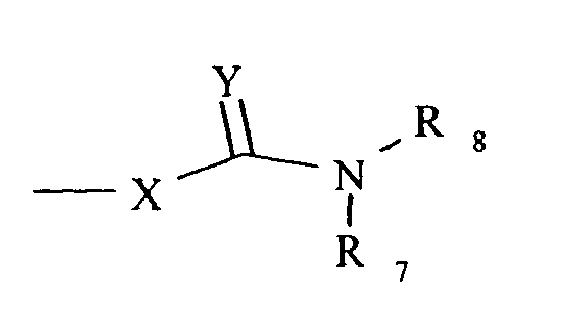
- Another object of the invention is the compound of the following formula G'1, G'2, G'3.

- Another object of the invention is the process for the preparation of a compound as defined above, which comprises the step of reduction of a compound of formula (G+ or Gi +) W- i being 1, 2 or 3, in the presence of a reducing agent.
- In an another embodiment, the invention concerns the process for the preparation of a compound of formula (G+ or Gi +)W- i being 1, 2 or 3 as defined above, which comprises a step of quaternization of the nitrogen atom of a compound of formula G'1, G'2, G'3, by an alkylating agent R1-W, R1 being (C1-C8) alkyl, aryl, (C1-C8) alkylaryl, aryl(C1-C8) alkyl, alkoxy, hydroxy(C1-C8) alkyl, alkoxy(C1-C8) alkyl, phenyl, (CH2)n-COOH; W being a leaving group preferably selected from halogen, OTriflate, sulfate, tosylate, mesylate.
- In a further embodiment of the invention the process for the preparation of a compound of formula G'1, G'2, G'3 comprises a step of carbamoylation of a compound of the following formula E1 or E2 or E3


- In yet another further embodiment the process for the preparation of compound of formula G+W or Gi + W- i being 1, 2 or 3 as defined above and with R1 being Z, comprises a step of quaternization of a compound of the formula E1, E2 or E3

- In a specific embodiment of the process, R3 is hydrogen, alkyl, phenyl, (CH2)n-COOH with n being ≥ 1 or an electron withdrawing group selected from the group comprising COOR, CONRR', CN, CF3, -SO-R, -SO2-R, -SO2NRR', NO2 halogen, or oxazolin, R, R' being a group alkyl, aryl, heteroaryl.
- The invention relates to a pharmaceutical composition comprising at least one compound of any one of formula G, G+, G1+, G1a, G1b, G2+, G2, G3a, G3b, G3+ and a pharmacologically acceptable carrier. In a specific embodiment, the invention relates to the pharmaceutical composition comprising at least one compound of formula G, G+, G1+, G1a, G1b, G2+, G2, G3a, G3b, G3+ for its use as an acetylcholinesterase inhibitor in the CNS.
- The pharmaceutical composition according to the invention is used in the treatment of neurodegenerative diseases, preferably Alzheimer's disease in a human or other animal subject.
- In another specific embodiment, the invention relates to the pharmaceutical composition comprising a compound of formula G+, G1+, G2+ or G3+ for its use as acetylcholinesterase inhibitor in the PNS, preferably for its use in the treatment of myasteny disease in a human or other animal subject.
- Another object of the invention is the use of a safe and effective amount of a compound of any one of formula G, G1a, G1b, G2, G3a, G3b as defined above to for the manufacture of a prodrug for the treatment of disorders associated to neurodegenerative diseases in a human or other animal subject, wherein said treatment comprises administering said prodrug to said subject.
- Another object of the invention is the use of a safe and effective amount of a compound of any one of formula G+, G1+, G2+, G3+ as defined above for the manufacture of a drug for the treatment of disorders associated to neurodegenerative diseases in a human or other animal subject, wherein said treatment comprises delivering said drug to the PNS of said subject.
- Another object of the invention is the compounds of formula G or G+ as defined above, the names of which follow;
- 1. Ethyl 1-methyl-7-(N,N-dimethylcarbamate)-1,4-dihydroquinoline-3-carboxylate;
- 2. Ethyl 1-methyl-5-(N,N-dimethylcarbamate)-1,4-dlhydroquinoline-3-carboxylate;
- 3. Ethyl 1-methyl-5,7-di(N,N-dimethylcarbamate)-1,4-dihydroquinoline-3-carboxylate;
- 4. Ethyl 1-methyl-5,8-di(N,N-dimethylcarbamate)-1,4-dihydroquinoline-3-carboxylate;
- 5. Ethyl 1-methyl-5-(N,N-dimethylthiocarbamate)-1,4-dihydro-5-O-quinoline-3-carboxylate;
- 6. Ethyl 1-methyl-5-(N,N-dimethylthiocarbamate)-1,4-dihydro-5-S-quinoline-3-carboxylate;
- 7. 1-Methyl-5-(N,N-dimethylcarbamate)-3-(N,N-diethylcarboxamido)-1,4-dihydroquinoline;
- 8. 1-Methyl-7-(N,N-dimethylcarbamate)-3-(4,5-dihydro-4,4-dimethyl-2-oxazolyl)-1,4-dihydroquinoline;
- 9. 1-Methyl-5-(N,N-dimethylcarbamate)-3-trifluoromethyl-1,4-dihydroquinoline;
- 10. (+/-)-1-Methyl-3-(4-methylphenylsulfinyl)-5-(N,N-dimethylcarbamate)-1,4-quinoline;
- 11. 1-Methyl-3-(4-methylphenylsulfonyl)-5-(N,N-dimethylcarbamate)-1,4-dihydroquinoline;
- 12. 1-Methyl-5-(N,N-dimethylcarbamate)-3-(N-phenylsulfomanide)-1,4-dihydroquinoline;
- 13. 1-Methyl-6,7-di(N,N-dimethylcarbamate)-3-nitro-1,4-dihydroquinoline;
- 14. Ethyl 1-methyl-2-phenyl-6,7-di(N,N-dimethylcarbamate)-1,4-dihydroquinoline-3-carboxylate;
- 15. Ethyl 1,2,4-trimethyl-7-(N,N-dimethylcarbamate)-1,4-dihydro-3-quinolinecarboxylate;
- 16. 2-Methyl-7-(N,N-dimethylcarbamate)-1,2-dihydroisoquinoline;
- 17. 2-Methyl-7-(N,N-dimethylthiocarbamate)-1,2-dihydro-7-O-isoquinoline;
- 18. 2-Methyl-7-(N,N-dimethylthiocarbamate)-1,2-dihydro-7-S-isoquinoline;
- 19. 1,2-Dimethyl-7-(N,N-dimethylthiocarbamate)-1,2-dihydro-7-O-isoquinoline;
- 20. Ethyl 2,3-dimethyl-6,8-di(N,N-dimethylcarbamate)-1,2-dihydro-4-isoquinolinecarboxylate;
- 21. 2,3-Dimethyl-6,8-di(N,N-dimethylcarbamate)-1,2-dihydro-4-isoquinolinecarboxamide;
- 22. 2,3-Dimethyl-4-(4,5-dihydro-4,4-dimethyl-2-oxazolyl)-6,8-di(N,N-dimethylcarbamate)-1,2-dihydroisoquinoline;
- 23. (+/-)-2,3-Dimethyl-4-(4-methylphenylsulfinyl)-6,8-di(N,N-dimethylcarbamate)-1,2-dihydroisoquinoline;
- 24. 2,3-Dimethyl-4-(methylphenylsulfonyl)-6,8-di(N,N-dimethylcarbamate)-1,2-dihydroisoquinoline;
- 25. 2,3-Dimethyl-4-(N-phenylsulfonamide)-6,8-di(N,N-dimethylcarbamate)-1,2-dihydroisoquinoline;
- 26. 2,3-Dimethyl-4-(trifluoromethyl)-6,8-di(N,N-dimethylcarbamate)-1,2-dihydroisoquinoline;
- 27. Ethyl 1-methyl-5-(N,N-dimethylcarbamate)-1,4-dihydropyridine-3-carboxylate
- 28. Ethyl 1-methyl-5-(N,N-dimethylthiocarbamate)-1,4-dihydro-5-O-pyridine-3-carboxylate;
- 29. Ethyl 1-methyl-5-(N,N-dimethylthiocarbamate)-1,4-dihydro-5-S-pyridine-3-carboxylate;
- 30. 1-Methyl-3-(methylsulfonyl)-5-(N,N-dimethylcarbamate)-1,4-dihydropyridine;
- 31. 1-Methyl-3-(N,N-diethylcarboxamide)-5-(N,N-dimethylcarbamate)-1,4-dihydropyridine;
- 32. (+/-)-1-Methyl-3-(methylsufinyl)-5-(N,N-dimethylcarbamate)-1,4-dihydropyridine;
- 33. 1-Methyl-3-(trifluoromethyl)-5-(N,N-dimethylcarbamate)-1,4-dihydropyridine;
- 34. 1-Methyl-3-(4,5-dihydro-4,4-dimethyl-2-oxazolyl)-5-(N,N-dimethylcarbamate)-1,4-dihydropyridine;
- 35. N,N-Diethyl-1-methyl-5-(N,N-dimethylcarbamate)-1,4-dihydro-3-pyridinesulfonamide;
- 36. Ethyl 1-[2-(N,N-dimethylcarbamate)benzyl]-1,4-dihydro-3-pyridinecarboxylate;
- 37. 1-[2-(N,N-dimethylcarbamate)benzyl]-3-(methylcarbamoyl)-1,4-dihydropyridine;
- 38. 1-[2-(N,N-dimethylcarbamate)benzyl]-3-(4,5-dihydro-4,4-dimethyl-2-oxazolyl)-1,4-dihydropyridine;
- 39. N,N-Diethyl-1-[2-(N,N-dimethylcarbamate)benzyl]-1,4-dihydro-3-pyridinesulfonamide;
- 40. Ethyl 1-[2-(N,N-dimethylcarbamate)benzyl]-1,4-dihydro-3-quinolinecarboxylate;
- 41. 1-[2-(N,N-dimethylcarbamate)benzyl]-1,4-dihydro-3-(dimethylcarbamoyl)-quinoline;
- 42. 1-[2-(N,N-dimethylcarbamate)benzyl]-1,4-dihydro-3-(4,5-dihydro-4,4-dimethyl-2-oxazolyl) quinoline;
- 43. N,N-Dimethyl-1-[2-(N,N-dimethylcarbamate)benzyl]-1,4-dihydro-3-quinolinesulfonamide;
- 44. Ethyl 2-[2-(N,N-dimethylcarbamate)benzyl]-1,2-dihydro-4-isoquinolinecarboxylate;
- 45. 2-[2-(N,N-dimethylcarbamate)benzyl]-4-(N-β-phenethylcarbamoyl)-1,2-dihydroisoquinoline;
- 46. 2-[2-(N,N-dimethylcarbamate)benzyl]-4-(4,5-dihydro-4,4-dimethyl-2-oxazolyl)-1,2-dihydroisoquinoline;
- 47. N,N-diethyl-2-[2-(N,N-dimethylcarbamate)benzyl]-1,2-dihydro-4-isoquinolinesulfonamide;
- 48. 1-[2-(N,N-dimethylcarbamate)benzyl]-3-(trifluoromethyl)-1,4-dihydropyridine;
- 49. 1-[2-(N,N-dimethylcarbamate)benzyl]-3-(trifluoromethyl)-1,4-dihydroquinoline;
- 50. 1-[2-(N,N-dimethylcarbamate)benzyl]-3-(trifluoromethyl)-1,2-dihydroisoquinoline;
- 51. Ethyl 1-methyl-2-[2-(N,N-dimethylcarbamate)phenyl]-1,4-dihydropyridine-3-carboxylate;
- 52. 1-Methyl-2-[2-(N,N-dimethylcarbamate)phenyl]-1,4-dihydro-N,N-dimethylnicotinamide;
- 53. 1-Methyl-2-[2-(N,N-dimethylcarbamate)phenyl]-3-(methylsulfonyl)-1,4-dihydropyridine;
- 54. N-Methyl 1-methyl-2-[2-(N,N-dimethylcarbamate)phenyl]-1,4-dihydro-3-pyridinesulfonamide;
- 55. Ethyl 1-methyl-6-[2-(N,N-dimethylcarbamate)phenyl]-1,4-dihydropyridine-3-carboxylate;
- 56. Ethyl 1-methyl-5-[2-(N,N-dimethylcarbamate)phenyl]-1,4-dihydropyridine-3-carboxylate;
- 57. Ethyl 1-methyl-2-[2-(N,N-dimethylcarbamate)phenyl]-1,4-dihydroquinoline-3-carboxylate;
- 58. Ethyl 1-methyl-8-[2-(N,N-dimethylcarbamate)phenyl]-1,4-dihydroquinoline-3-carboxylate;
- 59. 1-[2-(N,N-dimethylcarbamate)phenyl]-2-methyl-1,2-dihydroisoquinoline;
- 60. 2-Methyl-4-[2-(N,N-dimethylcarbamate)phenyl]-1,2-dihydroisoquinoline;
- 61. Ethyl 1-methyl-7-(N,N-dimethylcarbamate)-1,2-dihydroquinoline-3-carboxylate;
- 62. Ethyl 1-methyl-5-(N,N-dimethylthiocarbamate)-1,2-dihydro-5-S-quinoline -3-carboxylate;
- 63. 1-Methyl 5-(N,N-dimethylcarbamate)-3-(4,5-dihydro-4,4-dimethyl-2-oxazolyl)1,2-dihydroquinoline;
- 64. Ethyl 1-methyl-5-(N,N-dimethylcarbamate)-1,2-dihydropyridine-3-carboxylate;
- 65. Ethyl 1-methyl-5-(N,N-dimethylthiocarbamate)-1,2-dihydro-5-S-pyridine-3-carboxylate;
- 66. 1-Methyl-3-(N,N-diethylcarboxamido)-5-(N,N-dimethylcarbamate)-1,2-dihydropyridine
- One object of the invention is a compound which should be considered as a prodrug when it is in its oxidable and non protonable or neutral nitrogen form. This prodrug has no activity against central or peripheral acetylcholinesterase, because the oxidable nitrogen atom is non protonable at physiological pH.
- Indeed, in its neutral form only, this prodrug is able to go from the blood to the central nervous system (CNS) through the blood brain barrier (BBB).
- Then in vivo, in the CNS, the prodrug is converted into its oxidized form and the resultant charged form named drug, is active for action.
- Indeed, once oxidized, the prodrug is transformed into a cholinesterase inhibitor because the distance d between the at least one carbon atom of the radical group C=Y and the oxidized N+ atom is comprised between 0.3 and 0.8 nanometers. This distance allows the compound to be in the suitable form to block the active site of the central acetylcholinesterase.
- In fact, due to the presence of the oxidized N+ group and the radical group C=Y which belongs to a carbamate or thiocarbamate derivative, the compounds of the invention will be inserted in the active site of the enzyme and recognized by the catalytic triad of serine, histidine and glutamic acid where the serine moiety mediates the esterase activity of the acetylcholine esterase.
- Finally, due to its oxidized form in the CNS compartment, the drug is entrapped in the CNS and can not go back from CNS to periphery through the BBB.
- These particular features of the compound of the invention involve an effective central anticholinesterasic activity and reduction, or better suppression, of side effects due to a peripheral anticholinesterasic action.
- In addition, the compound of the invention is an acetylcholinesterase inhibitor, at least 500 times more active in central nervous system CNS than in peripheral nervous system PNS or preferably at least 1000 times more active in central nervous system CNS than in peripheral nervous system PNS.
- In one embodiment, the compound of the invention is an acetylcholinesterase inhibitor, at least 500 times more active in central nervous system CNS under its oxidized form than in peripheral nervous system PNS under its non oxidized form or under the prodrug in its non oxidized form.
- In another embodiment, the compound of the invention is an acetylcholinesterase inhibitor, at least 1000 times more active in central nervous system CNS under its oxidized form than in peripheral nervous system PNS under its non oxidized form or under the prodrug in its non oxidized form.
- The compound of the invention is selected for presenting the particular feature of having a distance d comprised between 0.3 and 0.8 nanometers preferably between 0.4 and 0.7 nanometers.
- This distance is calculated on the oxidized form of a defined compound from a modelisation Chemdraw or a Cerius software on a Silicon graphic station.
The adequate distance d is defined from the structure of acetylcholinesterase enzyme active site reported in the literature ("Structure of acetylcholinesterase complexed with E2020 (Aricept®): implications for the design of new anti-Alzheimer drugs." Structure Pages 297-307 Gitay Kryger, Israel Silman and Joel L Sussman; "The rationale for E2020 as a potent acetylcholinesterase inhibitor" Bioorganic and Medicinal Chemistry. Pages 1429-1446 Yoshiyuki Kawakami, Atsushi Inoue, Takatoshi Kawai, Misako Wakita, Hachiro Sugimoto and Anton J. Hopfinger; "Transition State Structure and Rate Determination for the Acylation Stage of Acetylcholinesterase Catalyzed Hydrolysis of (Acetylthio)choline" Siobhan Malany, Monali Sawai, R. Steven Sikorski, Javier Seravalli, Daniel M. Quinn, Zoran Radic, Palmer Taylor, Chanoch Kronman, Baruch Velan, and Avigdor Shafferman Journal of American Chemical Society. pp 2981 - 2987; "Direct determination of Acetyl-Enzyme Intermediate in the Acetylcholinesterase-catalysed Hydrolysis of Acetylcholine and acetylthiocholine" Harry C. Froede and Irwin B. Wilson The journal of Biological Chemistry, 1984, 259, pp 11010-11013.) - The present invention relates to compounds described by structural formula G

- a) R1 R2 R3 R4 R5 R6 which may be identical or different are hydrogen, OH, (C1-C8) alkyl, aryl, heteroaryl, (C1-C8) alkylaryl, aryl (C1-C8) alkyl, alkoxy, hydroxy (C1-C8) alkyl, alkoxy (C1-C8) alkyl, phenyl, (CH2)n-COOH, Z, Z1;
or - b) R4 and R5 or c) R5 and R6 taken together with the carbon atoms to which they are attached form a 6-membered aromatic ring or form a 5- or 6-membered heterocyclic ring being optionally substituted by one or more identical or different group defined as OH, (C1-C8) alkyl, aryl, heteroaryl, (C1-C8) alkylaryl, aryl (C1-C8) alkyl, alkoxy, hydroxy (C1-C8) alkyl, alkoxy (C1-C8) alkyl, phenyl, (CH2)n-COOH, Z, Z1; in all case a) and b) and c);
Z is a group defined by formula -(L)m-Z1, L is (C1-C8) alkyl, aryl, heteroaryl, phenyl, (C1-C8) alkylaryl, aryl(C1-C8) alkyl;
Z1 is defined by formula
wherein n and m are an integer ≥ 1, preferably m is comprised between 1 and 4 and n is comprised between 1 and 6;
provided that at least one group R1 to R6 is Z or Z1 and that R1 is not H or Z1; or a pharmaceutical salts or a stereoisomer thereof. - By "alkyl" radical containing 1 to 8 carbon atoms, is intended to mean methyl, ethyl, propyl, isopropyl, as well as butyl, pentyl or hexyl etc... linear or branched radical.
- As used herein, "aryl" is intended to mean any stable monocyclic or bicyclic carbon ring of up to 7 atoms in each ring, wherein at least one ring is aromatic.
Examples of such aryl elements include, but are not limited to, phenyl, naphthyl, tetrahydro- naphthyl, indanyl, biphenyl, phenanthryl, anthryl or acenaphthyl. In cases where the aryl substituent is bicyclic and one ring is non-aromatic, it is understood that attachment is via the aromatic ring. - The terms "arylakyl" or "alkylaryl" radical, include an alkyl portion where alkyl is as defined above and aryl portion where aryl are as defined above. Examples of arylalkyl include, but are not limited to, benzyl, halobenzyl, phenylethyl, phenylpropyl, halophenylethyl, thienylethyl, thienylpropyl. Examplkes of alkylaryl include toluene, ethylbenzene, propylbenzene.
- By "halo" or "halogen" radical or by halogen atom is intended to mean fluorine, chlorine, bromine or iodine.
- "Cycloalkyl" as used herein is intended to include non-aromatic cyclic hydrocarbon groups, having the specified number of carbon atoms, which may or may not be bridged or structurally constrained. Examples of such cycloalkyls include, but are not limited to, cyclopropyl, cyclobutyl, cyclopentyl, cyclohexyl, adamantyl, cyclooctyl, cycloheptyl.
- "Alkoxy" represents either a cyclic or non-cyclic alkyl group of indicated number of carbon atoms attached through an oxygen bridge. "Alkoxy" therefore encompasses the definitions of alkyl and cycloalkyl above.
- The invention concerns also stereoisomer or a mixture of stereoisomers of the compound of formula G as defined above in any ratio, or a physiologically acceptable salt thereof.
- In a preferred embodiment the compound of the invention as cited above comprises an electron withdrawing group in beta position from the nitrogen atom in order to increase the stability of the final compound of formula G. Thus the group R3 being in the position as defined above is selected from the group comprising COOR, CONRR', CN, COR, CF3, -SO-R, -SO2-R, -SO2NRR', NO2, halogen or oxazolin, R, R' being an alkyl, aryl, heteroaryl group.
- In a preferred embodiment of the invention, the compounds are selected from those of formula G1a or G1b:

- Among the compounds of formula G1a, a quite particular subject of the invention is the compounds the names of which follow:
- Ethyl 1-methyl 5-(N,N-dimethylcarbamate)-1,4-dihydropyridine-3-carboxylate;
- Ethyl 1-methyl-5-(N,N-dimethylthiocarbamate)-1,4-dihydro-5-O-pyridine-3-carboxylate;
- Ethyl 1-methyl-5-(N,N-dimethylthiocarbamate)-1,4-dihydro-5-S-pyridine-3-carboxylate;
- 1-Methyl-3-(methylsulfonyl)-5-(N,N-dimethylcarbamate)-1,4-dihydropyridine;
- 1-Methyl-3-(N,N-diethylcarboxamido)-5-(N,N-dimethylcarbamate)-1,4-dihydropyridine;
- (+/-)-1-Methyl-3-(methylsufinyl)-5-(N,N-dimethylcarbamate)-1,4-dihydropyridine;
- 1-Methyl-3-(trifluoromethyl)-5-(N,N-dimethylcarbamate)-1,4-dihydropyridine;
- 1-Methyl-3-(4,5-dihydro-4,4-dimethyl-2-oxazolyl)-5-(N,N-dimethylcarbamate)-1,4-dihydropyridine;
- N,N-diethyl-1-methyl-5-(N,N-dimethylcarbamate)-1,4-dihydro-3-pyridinesulfonamide;
- Ethyl 1-[2-(N,N-dimethylcarbamate)benzyl]-1,4-dihydro-3-pyridinecarboxylate;
- 1-[2-(N,N-dimethylcarbamate)benzyl]-3-(methylcarbamoyl)-1,4-dihydropyridine;
- 1-[2-(N,N-dimethylcarbamate)benzyl]-3-(4,5-dihydro-4,4-dimethyl-2-oxazolyl)-1,4-dihydropyridine;
- N,N-diethyl-1-[2-(N,N-dimethylcarbamate)benzyl]-1,4-dihydro-3-pyridinesulfonamide;
- 1-[2-(N,N-dimethylcarbamate)benzyl]-3-(trifluoromethyl)-1,4-dihydropyridine;
- Ethyl 1-methyl-2-[2-(N,N-dimethylcarbamate)phenyl]-1,4-dihydropyridine-3-carboxylate;
- 1-Methyl-2-[2-(N,N-dimethylcarbamate)phenyl]-1,4-dihydro-N,N-dimethylnicotinamide;
- 1-Methyl-2-[2-(N,N-dimethylcarbamate)phenyl]-3-(methylsulfonyl)-1,4-dihydropyridine;
- N-methyl-1-methyl-2-[2-(N,N-dimethylcarbamate)phenyl]-1,4-dihydro-3-pyridinesulfonamide;
- Ethyl 1-methyl-6-[2-(N,N-dimethylcarbamate)phenyl]-1,4-dihydropyridine-3-carboxylate;
- Ethyl 1-methyl-5-[2-(N,N-dimethylcarbamate)phenyl]-1,4-dihydropyridine-3-carboxylate.
- Among the compounds of formula G1b a quite particular subject of the invention is the compounds the names of which follow:
- Ethyl 1-methyl 5-(N,N-dimethylcarbamate)-1,2-dihydropyridine-3-carboxylate ;
- Ethyl 1-methyl-5-(N,N-dimethylthiocarbamate)-1,2-dihydro-5-S-pyridine-3-carboxylate;
- 1-Methyl-3-(N,N-diethylcarboxamido)-5-(N,N-dimethylcarbamate)-1,2-dihydropyridine.
- In a preferred embodiment of the invention, the compounds are selected from those of formula G2:

- Among the compounds of formula G2 a quite particular subject of the invention is the compounds the names of which follow:
- 2-Methyl-7-(N,N-dimethylcarbamate)-1,2-dihydroisoquinoline;
- 2-Methyl-7-(N,N-dimethylthiocarbamate)-1,2-dihydro-7-O-isoquinoline;
- 2-Methyl-7-(N,N-dimethylthiocarbamate)-1,2-dihydro-7-S-isoquinoline;
- 1,2-Dimethyl-7-(N,N-dimethylthiocarbamate)-1,2-dihydro-7-O-isoquinoline;
- Ethyl 2,3-dimethyl-6,8-di(N,N-dimethylcarbamate)-1,2-dihydro-4-isoquinolinecarboxylate;
- 2,3-Dimethyl-6,8-di(N,N-dimethylcarbamate)-1,2-dihydro-4-isoquinolinecarboxamide;
- 2,3-Dimethyl-4-(4,5-dihydro-4,4-dimethyl-2-oxazolyl)-6,8-di(N,N-dimethylcarbamate)-1,2-dihydroisoquinoline;
- (+/-)-2,3-Dimethyl-4-(4-methylphenylsulfinyl)-6,8-di(N,N-dimethylcarbamate)-1,2-dihydroisoquinoline;
- 2,3-Dimethyl-4-[(4-methylphenyl)sulfonyl]-6,8-di(N,N-dimethylcarbamate)-1,2-dihydroisoquinoline;
- 2,3-Dimethyl-4-[N-phenylsulfonamide]-6,8-di(N,N-dimethylcarbamate)-1,2-dihydroisoquinoline;
- 2,3-Dimethyl-4-(trifluoromethyl)-6,8-di(N,N-dimethylcarbamate)-1,2-dihydroisoquinoline;
- Ethyl 2-[2-(N,N-dimethylcarbamate)benzy]1,2-dihydro-4-isoquinolinecarboxylate;
- 2-[2-(N,N-dimethylcarbamate)benzyl]-4-(N-β-phenethylcarbamoyl)-1,2-dihydroisoquinoline;
- 2-[2-(N,N-dimethylcarbamate)benzyl]-4-(4,5-dihydro-4,4-dimethyl-2-oxazolyl)-1,2-dihydroisoquinoline;
- N,N-diethyl-2-[2-(N,N-dimethylcarbamate)benzyl]-1,2-dihydro-4-isoquinolinesulfonamide;
- 1-[2-(N,N-dimethylcarbamate)benzyl]-3-(trifluoromethyl)-1,2-dihydroisoquinoline;
- 1-[2-(N,N-dimethylcarbamate)phenyl]-2-methyl-1,2-dihydroisoquinoline;
- 2-Methyl-4-[2-(N,N-dimethylcarbamate)phenyl]-1,2-dihydroisoquinoline.
- In a preferred embodiment of the invention, the compounds are selected from those of formula G3a or G3b:

- Among the compounds of formula G3a a quite particular subject of the invention is the compounds the names of which follow:
- Ethyl 1-methyl-7-(N,N-dimethylcarbamate)-1,4-dihydroquinoline-3-carboxylate;
- Ethyl 1-methyl-5-(N,N-dimethylcarbamate)-1,4-dihydroquinoline-3-carboxylate.;
- Ethyl 1-methyl-5,7-di (N,N-dimethylcarbamate)-1,4-dihydroquinoline-3-carboxylate;
- Ethyl 1-methyl-5,8-di(N,N-dimethylcarbamate)-1,4-dihydroquinoline-3-carboxylate;
- Ethyl 1-methyl-1,4-dihydro-5-O-quinoline-N,N-dimethylthiocarbamate-3-carboxylate;
- Ethyl 1-methyl-1,4-dihydro-5-S-quinoline-N,N-dimethylthiocarbamate-3-carboxylate;
- 1-Methyl-5-(N,N-dimethylcarbamate)-3-(N,N-diethylcarboxamido)-1,4-dihydroquinoline;
- 1-Methyl-7-(N,N-dimethylcarbamate)-3-(4,5-dihydro-4,4-dimethyl-2-oxazolyl)-1,4-dihydroquinoline;
- 1-Methyl-5-(N,N-dimethylcarbamate)-3-trifluoromethyl-1,4-dihydroquinoline;
- (+/-)-1-Methyl-3-(4-methylphenylsulfinyl)-5-(N,N-dimethylcarbamate)-1,4-dihydroquinoline ;
- 1-Methyl-3-(4-methylphenylsulfonyl)-5-(N,N-dimethylcarbamate)-1,4-dihydroquinoline;
- 1-Methyl-5-(N,N-dimethylcarbamate)-3-(N-phenylsulfomanide)-1,4-dihydroquinoline;
- 1-Methyl-6,7-di(N,N-dimethylcarbamate)-3-nitro-1,4-dihydroquinoline;
- Ethyl 1-methyl-2-phenyl-6,7-di(N,N-dimethylcarbamate)-1,4-dihydroquinoline-3-carboxylate;
- Ethyl 1,2,4-trimethyl-7-(N,N-dimethylcarbamate)-1,4-dihydro-3-quinolinecarboxylate;
- Ethyl 1-[2-(N,N-dimethylcarbamate)benzyl]-1,4-dihydro-3-quinolinecarboxylate;
- 1-[2-(N,N-dimethylcarbamate)benzyl]-3-(dimethylcarbamoyl)-1,4-dihydroquinoline;
- 1-[2-(N,N-dimethylcarbamate)benzyl]-3-(4,5-dihydro-4,4-dimethyl-2-oxazolyl)-1,4-dihydroquinoline;
- N,N-dimethyl-1-[2-(N,N-dimethylcarbamate)benzyl]-1,4-dihydro-3-quinolinesulfonamide;
- 1-[2-(N,N-dimethylcarbamate)benzyl]-3-(trifluoromethyl)-1,4-dihydroquinoline;
- Ethyl 1-methyl-2-[2-(N,N-dimethylcarbamate)phenyl]-1,4-dihydroquinoline-3-carboxylate ;
- Ethyl 1-methyl-8-[2-(N,N-dimethylcarbamate)phenyl]-1,4-dihydroquinoline-3-carboxylate.
- Among the compounds of formula G3b a quite particular subject of the invention is the compounds the names of which follow
Ethyl 1-methyl-7-(N,N-dimethylcarbamate)-1,2-dihydroquinoline-3-carboxylate ;
Ethyl 1-methyl-(N,N-dimethylthiocarbamate)-1,2-dihydro-5-S-quinoline-3-carboxylate ;
1-Methyl-5-(N,N-dimethylcarbamate)-3-(4,5-dihydro-4,4-dimethyl-2-oxazolyl)-1,2-dihydroquinoline. - Another object of the invention is the compound of formula G+ or G+1, G+2, G+3 wherein all the specific compounds cited above are in their corresponding positively charged form such as pyridinium or quinolinium or isoquinolinium form.


- These compounds are either the starting product for obtaining the compound of respectively formula G, G1a, G1b, G2, G2a, G2b by a step of reduction, or the active drug which is liberated in vivo in the CNS.
- As starting product they are under a salt form G+ W- wherein W is the leaving group of the alkylating agent R1-W which is involved in the quaternization reaction step as explain below.
- As an active drug in the CNS, they are in an ammonium non salted form.
- As intermediate compounds for the preparation of compounds of formula G+, G+1, G+2, G+3 as described above, another object of the invention is the compounds of formula G' or G'1, G'2, G'3:

- These compounds are starting products for obtaining, by a step of quatemarization with an alkylating agent R1-W, the compounds of formula G+, G+1, G+2, G+3 according to the process explained below.
- Another object of the invention is a process allowing the preparation of the compounds of formula general G and the sub family of compound of formula G1a G1b, G2, G3a, G3b as defined above.
- This process comprises a stage of reduction of a compound of formula Gi + W- is 1, 2 or 3 as defined above in the presence of a reducing agent.
- Regioselective 1,4-reduction is carried out with sodium dithionite in the presence of sodium carbonate, but other reducing agents may be used in this step, for example NaBH3CN and BNAH, providing the 1,4-dihydropyridine of formula G1a or 1,4-dihydroquinolines of formula G3a. The use of sodium borohydride give rise to the formation of a pure 1,2-dihydroisoquinoline of formula G2 or a mixture of 1,2-and 1,4-dihydroquinolines or 1,2- and 1,4-dihydropyridines. Chemical separation give rise to the formation of pure 1,2-dihydropyridine of formula G1b or 1,2-dihydroquinolines of formula G3b
- Another object of the invention is a process allowing the preparation of the compounds of formula Gi +W-, i being 1, 2 or 3 as defined above which comprises a first step of carbamoylation of a compound of formula E1 or E2 or E3:

- Carbamoylation is carried out in the presence of metal hydride such as sodium hydride with an agent of formula W'-Z or W'-Z'1 such as for example a dialkylcarbamoyl halide in a solvent. Also thiocarbamoylation is achieved in the presence of dialkylthiocarbamoyl halide.
- In this step the reaction of carbamoylation is carried out on starting compounds wherein either R5 or R6 or P are a hydroxy group.
- The process comprises a following step of quaternization of the nitrogen atom by treatment of the resulting carbamate with all type of alkylating agents R1-W in a solvant which provides the desired quinolinium salt.
- The synthesis of the starting product of formula E1, E2, E3 is described below.
When the reaction sequence carbamoylation, quaternization and reduction steps is carried out on compounds of formula E1, E2, E3, the respective compound of formula G1a, G1b, G2, G3a, G3b are obtained. - The synthesis of the following pyridine derivatives of formula E1 is reported in the literature.
3-Methoxy-5-(methylsulfinyl)pyridine (Phosphorus, Sulfur and Silicon and the Related Elements, 1992, 66, 127-137);
3-Methoxy-5-(methylsulfonyl)pyridine (Tetrahedron, 1985, pages 173-1384)
Ethyl 5-methoxypyridine-3-carboxylate (Journal of medicinal chemistry, 2000, 43, 3168-3185);
3-Cyano-5-methoxypyridine (Journal of Medicinal Chemistry, 2000, 43, 3168-3185);
- From these available pyridines, the desired carbamates, O-isoquinoline thiocarbamates and S-thiocarbamates of formula G1a or G1b substituted on the 3-position by an ester, a ketone, a trifluoromethyl, an amide, a sulfoxyde, a sulfone, a sulfonamide, an oxazoline are prepared following the same reaction sequence carbamoylation, quatemarization and reduction steps as that reported previously.
- The synthesis of the isoquinolines derivatives of formula E2 are prepared as following:
- The preparation of the following methoxy isoquinolines is reported in the literature by Pommeranz-Fritsch cyclisation.
5-Methoxyisoquinoline (Bioorganic and Medicinal Chemistry, 1999, 2647-2666);
6-Methoxyisoquinoline (Bioorganic and Medicinal Chemistry Letters, 2003, 1345-1348);
7-Methoxyisoquinoline (Bioorganic and Medicinal Chemistry, 1999, 2647-2666);
8-Methoxyisoquinoline (Bioorganic and Medicinal Chemistry, 1999, 2647-2666);
5,7-Methoxyisoquinoline ((Tetrahedron, 37, 1981, pages 3977-3980);
5,8-Methoxyisoquinoline (Journal of Chemical Society, Perkin Transactions 1: Organic and Bio-organic Chemistry, 1974, 2185-2190);
6,8-Methoxyisoquinoline (Journal of Organic Chemistry, 32, 1967, page 2689-2692);
6,7-Methoxyisoquinoline (Tetrahedron, 37, 1981, 3977-3980);
7,8-Methoxyisoquinoline (Tetrahedron Letters, 38, 3159-3162);
- The previous methoxy isoquinolines are transformed into the desired isoquinoline carbamates, O-isoquinoline thiocarbamates and S-isoquinoline thiocarbamates of formula G2 according to the previous reaction sequence above, O-demethylation, carbamoylation, thiocarbamoylation, quaternization and reductions steps.
- The desired 1-substituted isoquinolines are prepared by addition of an alkyllithium, a Grignard reagent or a cuprate on the corresponding isoquinolinium salts, affording the 1,2-dihydroisoquinolines.
- The following 4-cyano isoquinolines and methyl isoquinoline-4-carboxylate derivatives are reported in the literature:
- 4-Cyano-6,7-dimethoxyisoquinolines (Canadian Journal of Chemistry, 1968, 46, 1160-1163);
- 3-Methyl 4-cyano-6,8-dimethoxyisoquinolines (Tetrahedron Letters, 1968, 44, 4631-4634);
- Methyl 6-methoxyisoquinoline-4-carboxylate (
EP1466604 );
- From these 4-cyanoisoquinolines and methyl isoquinoline-4-carboxylate, the desired carbamates, O-isoquinolinethiocarbamate and S-thiocarbamates of formula G2 substituted on the 4-position by an ester, a trifluoromethyl an amide, a sulfoxyde, a sulfone, a sulfonamide, an oxazoline are prepared following the same reaction sequence as that reported previously.
- The quinolines derivative of formula E3 are prepared as following:
- The synthesis of the following cyanoquinolines is reported in the literature (Tetrahedron Letters, 39, (1998) 4013-4016).

- The preparation of the following ethyl quinoline-3-carboxylates is reported in the literature (Journal of Medicinal Chemistry 1995, 38, 950-957).

- The cyanoquinolines cited above are treated with 48% HBr in aqueous solution to promote deprotection of the methoxy group and hydrolysis of the 3-cyano group. The corresponding carboxylic acids are then converted into esters with thionyl chloride in refluxing ethanol.

- Carbamoylation is accomplished in the presence of sodium hydride with dimethylcarbamoyl chloride in THF. Treatment of the resulting carbamate with methyl triflate in dichloromethane provides the desired quinolinium salt. All type of alkylating agents can be used in the quaternization step (CH3I, PhCH2X, XCH2COOR). Regioselective 1,4-reduction is carried out with sodium dithionite in the presence of sodium carbonate (NaBH3CN and BNAH may be used in this step) providing the 1,4-dihydroqunolines. The use of sodium borohydride gives rise to the formation of a mixture of 1,2- and 1,4-dihydroquinolines.


- Thiocarbamoylation is achieved in the presence of dimethylthiocarbamoyl chloride. Quaternization and reduction of the corresponding O-quinoline thiocarbamates is accomplished as described above.


- The O-quinolinethiocarbamate derivatives underwent thermal rearrangement to give rise to the corresponding S-quinolinethiocarbamates. Quaternization and reduction of the corresponding S-quinolinethiocarbamates is accomplished as described above.


- Ethyl 5-methoxyquinoline-3-carboxylate is prepared by chlorination of ethyl 4-hydroxy-5-methoxyquinoline-3-carboxylate with phosphorus oxychloride. Dechlorination was performed by hydrogenolysis. The O-demethylation, carbamoylation, thiocarbamoylation, quaternization and reduction steps are performed as described above.

- Otherwise, 5-methoxy isomers can be prepared from 2-amino-6-methoxybenzoic acid following the general procedure reported in the Journal of Medicinal Chemistry, (2001), 44, 822-833. Dechlorination of 4-chloro-5-methoxy quinoline-3-carbonitrile affords the desired 5-methoxyquinoline-3-carbonitrile. The O-demethylation, carbamoylation, thiocarbamoylation, quaternization and reduction steps are performed as described above.

- The 3-carboxamidoquinolines are prepared by amidification of 3-quinolinecarboxylic acid derivatives, followed by O-debenzylation. The carbamoylation, thiocarbamoylation, quaternization and reduction steps are performed as described above.

- Alternatively, 3-carboxamidoquinolines are prepared from 3-cyano quinolines by partial hydrolysis using H2O2 in the presence of NaOH at 0°C. The deprotection of the methoxy group is achieved under mild conditions with BBr3 in CH2Cl2. The carbamoylation, thiocarbamoylation, quaternization and reduction steps are performed as described above.

- On the other hand, 3-carboxamidoquinolines are prepared from 3-cyano quinolines by hydrolysis under basic conditions to furnish 3-quinolinecarboxylic acid derivatives which are treated with SOCl2 followed by addition of various amines (aromatic and aliphatic amines, aminoalcohols, aminoesters) to give rise to the desired 3-carboxamidoquinolines. The deprotection of the methoxy group is achieved under mild conditions with BBr3 in CH2Cl2. The carbamoylation, thiocarbamoylation, quaternization and reduction steps are performed as described above.

- The 3-oxazolylquinolines are obtained in a one step by reaction of the cyano derivatives and an appropriate aminoalcohol. The reaction is carried out in refluxing chlorobenzene in the presence of ZnCl2. Deprotection of the methoxy group is performed in the presence of BBr3 in dichloromethane. The carbamoylation, thiocarbamoylation quatemisation and reductions steps are conducted as reported above.

- The 3-trifluoromethylquinoline derivatives are prepared in a one step by treatment of the carboxylic acids with Deoxo-Fluor. The O-demethylation, carbamoylation, thiocarbamoylation, quaternisation and reduction steps are conducted by the methods reported above.

- The 3-sulfinyl-substituted quinolines are prepared from the corresponding 3-bromoquinolines by lithium-bromine exchange using n-butyllithium followed by treatment of the resulting lithiated species with a suitable sulfinic ester. The 3-bromoquinolines were prepared via a Curtius rearrangement of the 3-carboxylic acids in the presence of diphenylphosphorazide (DPPA) in refluxing t-butanol. The resultant N-carbamates are diazotated with HBr-NaNO2 followed by addition of molecular bromine. The O-demethylation, carbamoylation, thiocarbamoylation, quaternization and reductions steps are conducted as reported above.

- The synthesis of 3-alkylsulfonylquinolines is achieved by oxidation of the 3-sulfinylquinolines previously prepared using m-CPBA in dichloromethane. The O-demethylation, carbamoylation, thiocarbamoylation, quaternization and reductions steps are conducted as reported above.

- The preparation of 3-sulfonamidoquinolines is performed from the 3-(alkylsulfinyl)quinolines by Pummerer rearrangement with TFAA providing the corresponding thiol after treatment with NEt3 in MeOH. The resultant thiols derivatives are treated with chlorine in AcOH to give the sulfonyl chloride derivatives which are subsequently reacted with different amines to obtain the required 3-sulfonamides-substituted quinolines. The O-demethylation, carbamoylation, thiocarbamoylation, quaternization and reductions steps are conducted as reported above.

- The synthesis of 3-nitroquinolines is achieved from the sodium salt of nitromalonaldehyde and various anilines as described in Journal of Medicinal Chemistry, 1994, 37, 2129-2137. The O-demethylation, carbamoylation, thiocarbamoylation, quaternization and reductions steps are conducted as reported above.

- The desired 2-and/or-4-substituted quinolines are prepared by Friedländer or related methods (Organic Reaction, vol 28, 1982, page 37-201) by reaction of methoxy ortho-aminoacetophenones or methoxy ortho-aminobenzaldehydes with appropriate ketones. The reaction is conducted in various solvent (THF, EtOH, H2O) under basic (KOH, NaOH, K2CO3, piperidine) or acidic condition (AcOH, p-TSA, HCl) The O-demethylation, carbamoylation, thiocarbamoylation, quaternization and reductions steps are conducted as reported above.

- The required acetophenones and benzaldehydes used in this Friedländer approach are described in the following references. This list does not limit the scope of these acetophenones and benzaldehydes which can be used.
2-Amino-6-methoxyacetophenone (Eur. J. Org. Chem. (2001), 3247-3253);
2-Amino-5-methoxyacetophenone (Journal of Medicinal Chemistry (1987), 30(8), 1421-6);
2-Amino-4-methoxyacetophenone (Journal of Medicinal Chemistry (1989), 32(4), 807-26);
2-Amino-3-methoxyacetophenone (Journal of the Chemical Society, Abstracts (1945), 646-57);
2-Amino-4,6-dimethoxyacetophenone (Heterocycles, 2002, 57(1), 123-128);
2-Amino-4,5-dimethoxyacetophenone (Journal of Organic Chemistry (1954), 19 1117-23);
2-Amino-3,6-dimethoxyacetophenone (Journal of Medicinal Chemistry (1987), 30(8), 1421-6);
2-Amino-6-methoxybenzaldehyde (Journal of Medicinal Chemistry, 1993, 2689-22700);
2-Amino-4,5-dimethoxybenzaldehyde Tetrahedron 2001, 57, 3087-3098);
2-Amino-5-methoxybenzaldehyde (Tetrahedron Letters 2001, 42, 6589-6592); - Alternatively, the 4-substituted quinolines can be prepared from the 3-carboxamide or 3-oxazolyl or 3-cyanoquinolines previously mentioned by regioselective addition of an alkyllithium, a Grignard reagent or a cuprate affording the 1,4-dihydroquinolines. Oxidation of these intermediates by chloranil furnishes the desired 4-substituted quinolines. The O-demethylation, carbamoylation, thiocarbamoylation, quaternization and reductions steps are conducted as reported above.

- In another embodiment of the compound of formula G or G+ of the present invention, R1 is an aromatic ring bearing a carbamate function linked to the nitrogen atom.
- The process for the preparation of these compounds comprises a step of quaternarization of a compound of the formula E1, E2 or E3, with an alkylating agent bearing a carbamate function.
- The synthesis of an alkylating agent bearing a carbamate function, such as the following carbamates wherein an aromatic ring bearing a carbamate function is described in the literature (Chemical papers, 1985, 39, 413-427).
Carbamic acid dimethyl-2-(chloromethyl)phenyl ester, carbamic acid dimethyl-3-(chloromethyl)phenyl ester, carbamic acid dimethyl-4-(chloromethyl)phenyl ester.
- Other carbamates are prepared by reaction of the carbonochloridic acid-2-(chloromethyl)phenyl ester, carbonochloridic acid-3-(chloromethyl)phenyl ester and carbonochloridic acid-4-(chloromethyl)phenyl ester with various amines.

- The quaternization of pyridines E1, isoquinolines E2 and quinolines E3 with the previous carbamates affords respectively the desired pyridinium G1+, isoquinoliniun G2+ and quinolinium G3+ salts. The desired dihydropyridines, dihydroquinolines and dihydroisoquinolines corresponding respectively to the formula G1a, G1b, G2, G3a, G3b are obtained by reduction as previously mentioned.
- In another embodiment of the compound of the present invention, an aromatic ring bearing a carbamate function as described above is connected to the aromatic ring of formula G.
- The preparation of this class of compounds makes use of a cross-coupling reaction between a heterocyclic aryl halide substrate (pyridine, quinoline, isoquinoline) and an aryl boronic acid substituted by an alkoxy group. The cross-coupling reaction takes place in the presence of palladium catalyst and a base (Na2CO3, K2CO3, Cs2CO3...) in DMF/H2O. The reaction mixture is refluxed at 50-80°C for 12 hours.

- The O-demethylation, carbamoylation, thiocarbamoylation, quaternization and reduction steps are conducted as reported above.
- The preparation of the following heterocyclic aryl halide is reported in the literature.
2-Iodo-3-pyridinecarbonitrile (Journal of Organic Chemistry (2002), 67(26), 9276-9287);
4-Iodo-3-pyridinecarbonitrile (Journal of Organic Chemistry (2002), 67(26), 9276-9287);
5-Chloro-3-pyridinecarbonitrile (Journal of Organic Chemistry (1974), 39(13), 1802-7);
6-Bromo-3-pyridinecarbonitrile (Journal of Organic Chemistry, 2001, 66, 1500-1502);
2-Chloro-3-quinolinecarbonitrile (Tetrahedron 2001, 57, 3087-3098);
Ethyl 5-chloroquinoline-3-carboxylate (Tetrahedron Letters 2001, 42, 3737-3740);
Ethyl 6-bromoquinoline-3-carboxylate (Tetrahedron Letters 2002, 43, 6209-6211) ;
Ethyl 7-chloroquinoline-3-carboxylate (Tetrahedron Letters 2002, 43, 6209-6211) ;
Ethyl 8-bromoquinoline-3-carboxylate (NO PatentWO 2001047891 );
1-Bromoisoquinoline (Journal of Medicinal Chemistry 2002, 45, 740-743);
Methyl 1-chloroisoquinoline-4-carboxylate (Indian Journal of Chemistry (1972), 10(4), 341-3);
3-Bromoisoquinoline (Synthesis, 1987, 8, 693-6);
4-Bromoisoquinoline (Chemical & Pharmaceutical Bulletin (1997), 45(5), 928-931;
5-Bromoisoquinoline (Journal of Medicinal Chemistry (2002), 45(17), 3660-3668);
6-Bromoisoquinoline (Bioorganic & Medicinal Chemistry Letters (2002), 12(5), 827-832);
7-Bromoisoquinoline (Bioorganic & Medicinal Chemistry Letters (2002), 12(15), 2043-2046;
8-Bromoisoquinoline (ARKNOC [online computer file] (2000), 1(5), 823-842) ;
The preparation of the following arylboronic acids is reported in the literature;
2-Methoxyphenylboronic acid (New Journal of Chemistry (2002), 26(4), 373-375);
3-Methoxyphenylboronic acid (Organic Letters (2004), 6(21), 3711-3714);
4-Methoxyphenylboronic acid (Bioorganic & Medicinal Chemistry (2004), 12(10), 2553-2570);
4-Methoxy-1-naphthenyl boronate (Journal of the American Chemical Society (2000), 122(48), 12051-12052);
3-Methoxy-1-naphthylboronic acid (Journal of Organic Chemistry (1999), 64(26), 9430-9443);
2-(Methoxyphenyl)-1-naphthylboronic acid (Journal of Organic Chemistry (1999), 64(26), 9430-9443);
2-Methoxy-1-naphthylboronic acid (Organic Process Research & Development (2003), 7(3), 379-384);
1-Methoxy-2-naphthylboronic acid (Tetrahedron Letters (1999), 40(43), 9005-9007);
3-Methoxy-2-naphthylboronic acid (Tetrahedron Letters (1999), 40(43), 7599-7603);
6-Methoxy-2-naphthylboronic acid (Journal of Organic Chemistry (2004), 69(6), 2024-2032); - The products of general formula G have a very good in vitro activity as selective inhibitor of acetylcholinesterase.
- The enzymatic inhibition was measured after ten minutes incubation with the products of general formula G at different concentrations. An IC50 was determined and expressed by comparison with that of Donepezil (Donepezil is our reference). Inhibition of AChE was determined by Ellman's spectrophotometric method using acetylthiocholine (ACThCh) (Ellman, G.L., Courtney, K.KD., Andres, V., and Featherstone, R.M. A new and rapid colorimetric determination of acetylcholinesterase activity Biochem. Pharmacol. 1961, (7), 88-95).
- These properties make said products as well as their salts with pharmaceutically acceptable acids and bases suitable for use as drugs in the treatment of diseases related to neurodegenerative diseases such as Alzheimer's disease, myasteny disease, light and early dementia...
- Therefore an object of the present invention is, as drugs and in particular anti-Alzheimer drugs, the products of formula G as defined above as well as their salts with pharmaceutically acceptable acids and bases.
- An object of the invention is also the pharmaceutical compositions containing as active ingredient in a safe an effective amount, at least one of the compounds according to the invention as defined above.
- These compositions can be administered by buccal, rectal, parenteral, in particular intramuscular route or by local route as a topical application on the skin and the mucous membranes.
- The compositions according to the invention can be solids or liquids and be presented in the pharmaceutical forms commonly used in human medicine, such as for example, plain or sugar-coated tablets, gelatin capsules, granules, suppositories, injectable preparations, ointments, creams, gels; they are prepared according to the usual methods. The active ingredient(s) can be incorporated with the excipients usually used in these pharmaceutical compositions, such as talc, arabic gum, lactose, starch, magnesium stearate, cocoa butter, aqueous or non aqueous vehicles, fatty substances of animal or vegetable origin, paraffin derivatives, glycols, various wetting, dispersing or emulsifying agents, preservatives.
- These compositions can in particular be presented in the form of a powder intended to be dissolved extemporaneously in an appropriate vehicle, for example apyrogenic sterile water.
- The dose administered is variable according to the condition treated, the patient in question, the administration route and the product considered. A safe an effective amount can be, for example, comprised between 0.041 g and 1 g per day by oral route in adults with the product described in Example 1 or also comprised between 0.25 g and 10 g per day by intramuscular or intravenous route.
- Another object of the invention is a pharmaceutical composition comprising a compound of formula G+, G1+, G2+ or G3+ as described above for its use as a acetylcholinesterase inhibitor in the PNS.
- Such a pharmaceutical composition is unable to cross the BBB but can reach the PNS through the blood stream. The lack of undesirable central effects (confusion, hypothermia...), as well as the selective inhibition of the peripheral acetylcholinesterase enzyme compared to butyrylcholinesterase, make such a pharmaceutical composition a good candidate for the treatment of myasteny disease in a human or other animal subject.
- The compounds of the present invention have been prepared according to the procedures described below in the examples section.
- The distance d of the compounds of the invention has been measured and are reported in table I below.
Table 1 Exemple n° Distance d nm Exemple n° Distance d nm 1 5.9 35 0.46 2 6.1 36 0.41 3 5.87 (C5) -6.2 (C7) 37 0.41 4 6.1
4.138 0.41 5 6.1 39 0.41 6 6.1 40 0.41 7 6.1 41 0.41 8 5.8 42 0.41 9 6.1 43 0.41 10 6.05 44 0.41 11 6.1 45 0.41 12 6.1 46 0.41 13 6.6 (C6) -5.4 (C7) 47 0.41 14 6.6 (C6)- 5.4 (C7) 48 0.41 15 5.6 49 0.41 16 7.1 50 0.41 17 7.1 51 0.38 18 7.1 52 0.38 19 7.1 53 0.3.8 20 7.05 (C6) -4.6 (C8) 54 0.38 21 7.05 (C6) - 4.6 (C8) 55 0.38 22 7.05 (C6) -4.6 (C8) 56 0.56 23 7.05 (C6) -4.6 (C8) 57 0.39 24 7.05 (C6) -4.6 (C8) 58 0.61 25 7.05 (C6) -4.6 (C8) 59 0.43 26 7.05 (C6) -4.6 (C8) 60 0.56 27 4.6 61 0.52 28 4.6 62 0.64 29 4.6 63 0.52 30 4.6 64 0.47 31 0.46 65 0.47 32 0.46 66 0.47 33 0.46 34 0.46 -

- Stage A: 7-hydroxy 3-quinolinecarboxylic acid.
A solution of 3-cyano-7-methoxyquinoline (20g, 110 mmol) [described in Tetrahedron Letters, 39 (23), 4013-4016, 1998] in 48% aqueous solution bromhydric acid (300 ml) is stirred and heated under reflux for 12 hours. The reaction mixture was then cooled to room temperature and neutralised by adding 20% aqueous KOH. The resulting precipitate was filtrated and dried under vacuum.
In this way 15.2 g of the product of molecular formula C10H7NO3 (MW =189.2) is recovered. The corresponding yield is 73%. - Stage B: ethyl 7-hydroxyquinoline-3-carboxylate
To a solution of the compound obtained in stage A (15 g, 79 mmol) in EtOH (500 ml) was added dropwise SOCl2 (40 mL). The resulting mixture was stirred under reflux during 12 hours. After adding water (200 mL), the pH was adjusted to 7.0 with 20% aqueous Na2CO3. The aqueous solution was extracted with CH2Cl2 (mL).The combined organic layers were evaporated and dried (MgSO4) to afford 11g the product of molecular formula C12H11NO3 - Stage C: ethyl 7-(N,N-dimethylcarbamate)quinoline-3-carboxylate
To a solution of compound obtained in stage C (300 mg, 1.38 mmol) in dry THF was added sodium hydride (as an suspension in oil, 72 mg, 1.5 mmol). The mixture was stirred at room temperature for 1 hour after which time dimethylcarbamoyl chloride (140 mL, 1.5 mmol) was added. The resulting mixture was refluxed for 12 hours. After Addition of water (10 mL) and extraction with CH2Cl2 (3 x 15 mL), the resulting combined organic phases were dried and evaporated under vacuum to give 360 mg of compound of molecular formula C15H16N2O4 in 90% yield. - Stage D: ethyl 1-methyl-7-(N,N-dimethylcarbamate)quinolinium-3-carboxylate triflate
To a solution of compound obtained in stage C (300 mg, 1.0 mmol) in dry CH2Cl2 (25 mL) was added methyl triflate (130 µL, 1.1 mmol). The resulting solution was stirred at room temperature for 2h. Addition of Et2O(10 mL) furnished a white precipitate which was filtered to give the desired quinolinium salt of molecular formula C17H19F3N2O7S in a quantitative yield. Aspect: white powder.
NMR spectrum of the proton
In CDCl3, at 300MMz, Chemicals shifts (ppm) and multiplicity: 9.78 (s, 1H, H4), 9.44 (s, 1H, H2), 8.35 (d, J= 9Hz, 1H, H6), 8.28 (s, 1H, H8), 7.87 (d, J= 9Hz, 1H, H5), 4.74 (s, 3H, N-Me), 4.54 (q, 2H, CH 2-CH3), 3.19 (s, 3H, N-methyl carbamate), 3.07 (s, 3H, N-methyl carbamate), 1.47 (t, 3H, CH2-CH 3 ). - Stage E: ethyl N-methyl-7-(N,N-dimethylcarbamate-1,4-dihydroquinoline-3-carboxylate
To a solution of the compound prepared in stage D (100 mg, 0.22 mmol) in water (6 ml) and CH2Cl2 (6 mL), were added in one portion sodium dithionite (190 mg, 1.1 mmol) and sodium carbonate (70 mg, 0.66 mmol). After stirring for 1 hour under a nitrogen atmosphere, Na2S2O4 (190 mg, 1.1 mmol) and Na2CO3 (70 mg, 0.66 mmol) were added. After stirring for 1 hour, Na2S2O4 (190 mg, 1.1 mmol) and Na2CO3 (70 mg, 0.66 mmol) were added and stirring was continued for an additional 1 hour. The aqueous phase was extracted with CH2Cl2 (3 x 15 ml), the combined organic layers were dried over Na2SO4 and evaporated under vacuum to give the compound of the molecular formula C16H20N2O4 in 91% yield. Aspect: yellow oil.
NMR spectrum of the proton
In CDCl3, at 300MMz, Chemicals shifts (ppm) and multiplicity: 7.19 (s, 1H, H2), 7.00 (d, J= 8.5 Hz, 1H, H5), 6.67 (dd, J= 9Hz and 3 Hz, 1H, H6), 6.49 (d, J= 3 HZ,
1H, H8), 4.17 (q, 2H, CH 2 -CH3), 3.73 (s, 2H, H4), 3.18 (s, 3H, N-Me), 3.08 (s, 3H, N-methylcarbamate), 3.00 (s, 3H, N-methylcarbamate), 1.28 (t, 3H, CH2-CH 3 ). -

- Stage A: ethyl 8-bromo-4-chloro-5-methoxyquinoline-3-carboxylate
A solution of ethyl 8-bromo-4-hydroxy-5-methoxyquinoline-3-carboxylate (4.55 g, 14 mmol) [described in Journal of Medicinal Chemistry (1995), 38(6), 950-7] in POCl3 (2.11g, 24 mmol) is heated on a steam bath for 15 min. The mixture was cooled on an ice bath and 90 mL of diluted aqueous ammonium hydroxide was added. The aqueous layer was extracted with ether and the combined organic phases were washed with water, dried over MgSO4 and evaporated under vacuum. - Stage B: ethyl-5-methoxyquinoline-3-carboxylate.
A solution of ethyl 8-bromo-4-chloro-5-methoxy-quinoline-3-carboxylate (4.1 g, 12 mmol)obtained in stage B and sodium acetate (1g, 12 mmol) in 120 mL of glacial acetic acid was hydrogenated in a Parr bomb at 2.5 atm pressure over a 10% Pd/C catalyst (0.85g) for 8 hours. The catalyst was removed by filtration and the reaction mixture was concentrated under reduced pressure. The residue was dissolved in methylene chloride (200 mL). The solution was washed with aqueous sodium bicarbonate solution (15%, 100 mL) and then with water, dried (MgSO4) and filtered. Stage C: 5-hydroxy-3-carboxylic acid.
The title compound is prepared as described in stage A of Example 1. - Stage D: ethyl 5-hydroxyquinoline-3-carboxylate
The title compound is prepared as described in stage B of Example 1. - Stage E: preparation of ethyl 5-(N,N-dimethylcarbamate)quinoline-3-carboxylate
The title compound is prepared as described in stage C of Example 1. - Stage F: preparation of ethyl 1-methyl-5-(N,N-dimethylcarbamate)quinolinium-3-carboxylate triflate
The title compound is prepared as described in stage D of Example 1. - Stage G: preparation of ethyl 1-methyl-5-(N,N-dimethylcarbamate)-1,4-dihydroquinoline-3-carboxylate.
The title compound is prepared as described in stage E of Example 1. -

- Stage A: 5,7-dihydroxy-3-quinolinecarboxylic acid
A solution of 3-cyano-5,7-methoxyquinoline (20g, 110 mmol) [described in Tetrahedron Letters, 39 (23), 4013-4016, 1998] was treated as reported in stage A of Example 1. The compound of the molecular formula C10H7NO4 (MW = 205.17) is obtained in 80% yield. - Stage B: ethyl 5,7-dihydroxyquinoline-3-carboxylate.
The title compound is prepared as described in Stage B of Example 1 - Stage C: ethyl 5,7-di(N,N-dimethylcarbamate)quinoline-3-carboxylate. The title compound is prepared as described in Stage C of Example 1.
- Stage D: ethyl 1-methyl-5,7-di(N,N-dimethylcarbamate)quinolinium-3-carboxylate triflate
The title compound is prepared as described in Stage D of Example 1. - Stage E: ethyl 1-methyl-5,7-di(N,N-dimethylcarbamate-1,4-dihydroquinoline-3-carboxylate.
The title compound is synthesized as described in Stage E of Example 1. -

- Stage A: 5,8-dihydroxy-3-quinolinecarboxylic acid
A solution of 3-cyano-5,8-methoxyquinoline (20g, 110 mmol) [described in Tetrahedron Letters, 39 (23), 4013-4016, 1998] was treated as reported in stage A of Example 1. The compound of the molecular formula C10H7NO4 (MW = 205.17) is obtained in 80% yield. - Stage B: ethyl 5,8-dihydroxyquinoline-3-carboxylate.
The title compound is synthesized as described in Stage B of Example 1 - Stage C: ethyl 5,8-di(N,N-dimethylcarbamate)quinoline-3-carboxylate.
The title compound is prepared as described in Stage C of Example 1. - Stage D: ethyl 1-methyl-5,8-di(N,N-dimethylcarbamate)quinolinium-3-carboxylate triflate
The title compound is prepared as described in Stage D of Example 1. - Stage E: preparation of ethyl 1-methyl-5,8-di(N,N-dimethylcarbamate-1,4-dihydroquinoline-3-carboxylate.
The title compound is synthesized as described in Stage E of Example 1. -

- Stage A: ethyl N,N-(dimethylthiocarbamate)-5-O-quinoline-3-carboxylate
A solution of ethyl 5-hydroxyquinoline-3-carboxylate prepared in stage D of example 2 (21.7g, 10 mmol) in DMF (40 ml) was cooled to 0°-5°C and treated with 60% sodium hydride (300 mg, 12.5 mmol) and stirred 15 min. Dimethylthiocarbamoyl chloride (1.23g, 10 mmol) was then added and the solution was stirred for 10 min at 5°C and 30 min at room temperature then at 60°C for 1 hour. The solution was cooled, diluted with IN-sodium hydroxide solution and extracted with with AcOEt (3x25mL). The combined organic layers were washed with IN-sodium hydroxide, brine, water, then brine, and dried over Magnesium sulfate and evaporated under reduced pressure. The obtained residue was chromatographed over silica-gel. - Stage B: ethyl 1-methyl-5-O-quinoliniumdimethylthiocarbamate-3-carboxylate triflate.
The title compound is synthesized as described in stage D of Example 1. - Stage C: ethyl 1-methyl-1,4-dihydro-5-O-quinolinedimethylthiocarbamate-3-carboxylate
The title compound is prepared as described in stage E of Example 1. -

- Stage A: ethyl (N,N-dimethylthiocarbamate)-5-S-quinoline-3-carboxylate ethyl (N,N-dimethylthiocarbamate)-5-O-quinoline-3-carboxylate prepared in stage A of example 5 was placed on a preheated oil bath at 210°C and heated for 5 hours and cooled to room temperature. The solid residue was chromatographed on silica-gel.
- Stage B: ethyl 1-methyl-(N,N-dimethylthiocarbamate)-5-S-quinolinium-3-carboxylate triflate.
The title compound is prepared as described in stage D of Example 1. - Stage C: ethyl 1-methyl-(N,N-dimethylthiocarbamate)-1,4-dihydro-5-S-quinoline-3-carboxylate
The title compound is synthesized as described in stage E of Example 1. -

- Stage A: ethyl 5-benzyloxyquinoline-3-carboxylate
A solution of ethyl 5-hydroxyquinoline-3-carboxylate (2.17 g, 10 mmol) prepared in stage D of example 2, Na2CO3 (2.12 g, 20 mmol) and benzylbromide (1.71 g, 10 mmol) in DMF (20 mL) was stirred for 12 hours at room temperature. The reaction mixture was diluted with water (50 mL) and then extracted with with AcOEt (3x25mL). The combined organic layers were washed water, and dried over Magnesium sulfate and evaporated under reduced pressure. The obtained residue was chromatographed over silica-gel. - Stage B: 5-benzyloxy-3-quinolinecarboxylic acid.
A solution of ethyl 5-benzyloxyquinoline-3-carboxylate (3.07 g, 10 mmol) prepared in stage A and LiOH(0.4 g, 20 mmol) in THF (20 mL)and water (0.5 mL) was refluxed for 2 hours. After cooling, the solvents were evaporated under vacuum. The solid residue was used in the next step without further purification. - Stage C: 5-benzyloxy-3-(N,N-diethylcarboxamido)quinoline
A solution of 5-benzyloxy-3-quinolinecarboxylic acid (2.80 g, 10 mmol) prepared in stage B, oxalyl chloride (1.2 g, 10 mmol) in dichloromethane (50 mL) was added 2 drops of DMF. The resultant mixture was stirred for 2 hours at room temperature after which time diethylamine (2.19 g, 30 mmol) was added. The resulting solution was stirred for a further 3 hours. The reaction mixture was diluted with water (50 mL) and then extracted with with AcOEt (3x25mL). The combined organic layers were washed water, and dried over Magnesium sulfate and evaporated under reduced pressure. The obtained residue was chromatographed over silica-gel. - Stage D: 5-hydroxy-3-(N,N-diethylcarboxamido)quinoline.
A solution of 5-benzyloxy-3-(N,N-diethylcarboxamido)quinoline (3.34 g, 10 mmol) prepared in stage C in methanol (50 mL) was added 10% Pd/C (400 mg). The solution was stirred for 24 hours at room temperature under a hydrogen atmosphere. The catalyst was filtered through a plug of cotton and washed with methanol. Evaporation of methanol afforded the desired compound. - Stage E: 5-(N,N-dimethylcarbamate)-3-(N,N-diethylcarboxamido)quinoline.
The title compound is prepared according to the procedure described in stage C of example 1. - Stage F: 1-methyl-5-(N,N-dimethylcarbamate)-3-(N,N-ethylcarboxamido)quinolium triflate.
The title compound is synthesized as described in stage D of exemple 1 - Stage G: 1-methyl-5-(N,N-dimethylcarbamate)-3-(N,N-diethylcarboxamido)-1,4-dihydroquinoline.
- The title compound is prepared as described in stage E of exemple 1.
-

- Stage A: 7-methoxy-3-(4,5-dihydro-4,4-dimethyl-2-oxazolyl)quinoline
A solution of 7-methoxy-3-cyanoquinoline reported in Tetrahedron Letters 39, 1998, 4013-4016 (1.84 g, 10 mmol) and 2-amino-2-methyl-1-propanol (0.90 g, 10 mmol) in chlorobenzene under nitrogen atmosphere is refluxed for 2 days. The solvent is evaporated under vacuum to afford the desired compound - Stage B: 7-hydroxy-3-(4,5-dihydro-4,4-dimethyl-2-oxazolyl)quinoline
A solution of 7-methoxy-3-(4,5-dihydro-4,4-dimethyl-2-oxazolyl)quinoline (2.56 g, 10 mmol) prepared in stage A and BBr3 (7.41 g, 30 mmol) in dichloromethane (40 mL) are stirred for 12 hours at room temperature. The mixture was quenched with saturated sodium hydrogen carbonate. Extraction with dichloromethane, drying (MgSO4) and evaporation furnished the desired compound. - Stage C: 7-(N,N-dimethylcarbamate)-3-(4,5-dihydro-4,4-dimethyl-2-oxazolyl)quinoline
The title compound is synthesized according to the procedure reported in stage C of example 1 from 7-hydroxy-3-(4,5-dihydro-4,4-dimethyl-2-oxazolyl)quinoline prepared in stage B. - Stage D: 1-methyl-7-(N,N-dimethylcarbamate)-3-(4,5-dihydro-4,4-dimethyl-2-oxazolyl)quinolinium triflate
The title compound is prepared according to the procedure reported in stage D of example 1 from 7-(N,N-dimethylcarbamate)-3-(4,5-dihydro-4,4-dimethyl-2-oxazolyl)quinoline prepared in stage C. - Stage E 1-methyl-7-(N,N-dimethylcarbamate)-3-(4,5-dihydro-4,4-dimethyl-2-oxazolyl)-1,4-dihydroquinoline
The title compound is prepared according to the procedure reported in stage E of example 1 from 1-methyl-7-(N,N-dimethylcarbamate)-3-(4,5-dihydro-4,4-dimethyl-2-oxazolyl)quinolinium triflate prepared in stage D. -

- stage A: 5-methoxy-3-quinolinecarboxylic acid
A solution of ethyl 5-methoxyquinoline-3-carboxylate (2.31 g, 10 mmol) prepared in stage B of example 2 and LiOH(0.4 g, 20 mmol) in THF (20 mL)and water (0.5 mL) was refluxed for 2 hours. After cooling, the solvents were evaporated under vacuum. The solid residue was used in the next step without further purification. - stage B: 5-methoxy-3-trifluoromethylquinoline according to a procedure reported in the Journal of Organic chemistry, 1999, 64, 7053.
To a solution of 5-methoxy-3-quinolinecarboxylic acid (2 g, 10 mmol) prepared in stage A in dichloromethane was added bis(2-methoxyethyl)aminosulfur trifluoride (2.43 g, 11 mmol) under nitrogen and stirred for 16 hours at room temperature. The solution was poured into saturated NaHCO3 and after CO2 evolution ceased it was extracted with dichloromethane, dried, filtered and evaporated in vacuo. The resulting acyl fluoride intermediate (10 mmol) was added bis(2-methoxyethyl)aminosulfur trifluoride (4.42 g, 20 mmol)contained in a Teflon bottle equipped with a nitrogen inlet tube, and the mixture was heated at 85°C On completion, the solution was poured into saturated NaHCO3 and after CO2 evolution ceased it was extracted with dichloromethane, dried, filtered and evaporated in vacuo to give 5-methoxy-3-trifluoromethyl quinoline - Stage C: 5-hydroxy-3-trifluoromethylquinoline
The title compound is prepared according to the procedure reported in stage B of example 8 from 5-methoxy-3-trifluoromethylquinoline prepared in stage B. - Stage D: 5-(N,N-dimethylcarbamate)-3-trifluoromethylquinoline
The title compound is prepared according to the procedure reported in stage C of example 1 from 5-hydroxy-3-trifluoromethylquinoline synthesized in stage C. - Stage E: 1-methyl 5-(N,N-dimethylcarbamate)-3-trifluoromethylquinolinium triflate
The title compound is prepared according to the procedure reported in stage D of example 1 from 5-(N,N-dimethylcarbamate)-3-trifluoromethyl quinoline prepared in stage D. - Stage F: 1-methyl 5-(N,N-dimethylcarbamate)-3-trifluoromethyl-1,4-dihydroquinoline
The title compound is prepared according to the procedure reported in stage E of example 1 from 1-methyl-5-(N,N-dimethylcarbamate)-3-trifluoromethylquinolinium triflate prepared in stage E -

- Stage A: 3-(tert-butoxycarbonylamino)-5-methoxyquinoline
To a solution of 5-methoxy-3-quinolinecarboxylic acid (2 g, 10 mmol) prepared in stage A of example 9 in tert-BuOH (15 mL) was added NEt3 (1.2 g, 12 mmol) and diphenyl azidophosphonate (DPPA) (2.1 mL, 10 mmol). The reaction mixture is refluxed for 24 hours. The solvent is evaporated under vacuum and the residue is dissolved in AcOEt (50 mL) and washed with a saturated NaHCO3 solution. After drying, the solvent is evaporated under vacuum affording the title compound. - Stage B: 3-bromo-5-methoxyquinoline
To a solution of 3-(tert-butoxycarbonylamino)-5-methoxyquinoline (2.74 g, 10 mmol) in aqueous 48% HBr (40 mL), NaNO2 (2.1 g, 30 mmol) in water (20 mL) is added at 0°C. The reaction mixture is stirred 1 hour. The reaction mixture is extrated with CH2Cl2 (3 x 30 mL). After drying over MgSO4, dichloromethane is evaporated affording the title compound. - Stage C: (+/-)-3-(4-methylphenylsulfinyl)-5-methoxyquinoline
To a solution 3-bromo-5-methoxyquinoline (2.37, 10 mmol) prepared in stage B in dried THF (35 mL) is added a solution of isopropylmagnesium chloride (16.6 mL, 30 mmol) at -78°C. The solution is stirred at -78°C under nitrogen atmosphere for 3 hours. Menthyl sulfinate (8.8 g, 30 mmol) is added and the resulting solution is stirred for a further 24 hours. The reaction mixture is then hydrolysed with saturated aqueous NH4Cl solution. After extraction of the aqueous phase, the combined organic layers are dried (MgSO4), evaporated giving the title compound. - Stage D: (+/-)-3-(4-methylphenylsulfinyl)-5-hydroxyquinoline
The title compound is synthesized according to the procedure reported in stage B of Example 8 from (+/-)-3-(4-methylphenylsulfinyl)-5-methoxyquinoline prepared in stage C. - Stage E: (+/-)-3-(4-methylphenylsulfinyl-5-(N,N-dimethylcarbamate) quinoline
The title compound is prepared according to the procedure reported in stage C of example 1 from (+/-)-3-(4-methylphenylsulfinyl-5-hydroxyquinoline prepared in stage D - Stage F: (+/-)-1-methyl-3-(4-methylphenylsulfinyl)-5-(N,N-dimethylcarbamate)quinolinium triflate
The title compound is synthesized according to the procedure reported in stage D of example 1 from (+/-)-3-(4-methylpheny)sulfinyl)-5-(N,N-dimethylcarbamate) quinoline prepared in stage E. - Stage G: (+/-)-1-methyl-3-(4-methylphenylsulfinyl)-5-(N,N-dimethylcarbamate) 1,4-quinoline
The title compound is prepared according to the procedure reported in stage E of example 1 from (+/-)-3-(4-methylphenylsulfinyl)-5-(N,N-dimethylcarbamate)quinolinium triflate prepared in stage F -

- Stage A: 3-(4-methylphenylsulfonyl)-5-methoxyquinoline
To a solution of (+/-)-3-(4-methylphenylsulfinyl)-5-methoxyquinoline (2.97 g, 10 mmol) prepared in stage B of example 10 in CH2Cl2 is added m-CPBA (2.13 g, 80%, 10 mmol). The solution is stirred at room temperature for 12 hours. A solution of 1M NaOH is added. After extraction of the aqueous phase with CH2Cl2, the combined organic layers are dried (MgSO4) and the solvent evaporated giving the title compound. - Stage B: 3-(4-methylphenylsulfonyl)-5-hydroxyquinoline
The title compound is synthesized according to the procedure reported in stage B of Example 9 from 3-(4-methylphenylsulfonyl)-5-methoxyquinoline prepared in stage A. - Stage C: 3-(4-methylphenylsulfonyl)-5-(N,N-dimethylcarbamate)quinoline
The title compound is prepared according to the procedure reported in stage C of Example 1 from 3-(4-methylphenylsulfonyl)-5-hydroxyquinoline prepared in stage - Stage D: 1-methyl-3-(4-methylphenylsulfonyl)-5-(N,N-dimethylcarbamate)quinolinium triflate
The title compound is prepared according to the procedure reported in stage D of example 1 from 3-(4-methylphenylsulfonyl)-5-(N,N-dimethylcarbamate)quinoline prepared in stage C - Stage E: 1-methyl-3-(4-methylphenylsulfonyl)-5-(N,N-dimethylcarbamate)-1,4-dihydroquinoline.
The title compound is prepared according to the procedure reported in stage E of example 1 from 1-methyl-3-(4-methylphenylsulfonyl)5-(N,N-dimethylcarbamate)quinolinium triflate prepared in stage D. -

- Stage A: 5-methoxy-3-methylthioquinoline
To a solution of 3-bromo-5-methoxy quinoline (2,37 g, 10 mmol) prepared in stage B of example 10 in THF (25 mL) was added 2.5M n-buLi (4 mL, 10 mmol) at -78°C. The solution is stirred at -78°C for 45 min and dimethyl disulfide (1.8 g, 20 mmol) is added. The resultant solution is stirred for 3 hours and then quenched with saturated NH4Cl (30 mL). Extraction with dichloromethane, drying, filtering and evaporation in vacuo afford the title compound - Stage B: 3-(methylsulfinyl)-5-methoxyquinoline.
The title compound is prepared from 5-methoxy-3-methylthioquinoline (2.05 g, 10 mmol) prepared in stage A according the procedure reported in stage A of example 11. - Stage C: 5-methoxy-3-quinolinethiol.
To a solution of 3-(methylsulfinyl)-5-methoxyquinoline (2.21 g, 10 mmol) in CH2Cl2 (50 mL) is added TFAA. The resulting solution is stirred at 20-50°C for 1 hour. The solution is then treated with NEt3 affording the title compound. - Stage D: N-phenyl-5-methoxy-3-quinolinesulfomanide
A solution of 5-methoxy-3-quinolinethiol (1.91, 10mmol) in AcOH is treated with chlorine for a few minutes. The solution is then treated with aniline (0.93 g, 10 mmol) to afford the title compound. - Stage E: N-phenyl-5-hydroxy-3-quinolinesulfomanide
The title compound is synthesized according to the procedure reported in stage B of Example 8 from N-phenyl-5-methoxy-3-quinolinesulfomanide prepared in stage D. - Stage F: 3-(N-phenylsulfomanide)-5-(N,N-dimethyl carbamate)quinoline
The title compound is prepared according to the procedure reported in stage C of Example 1 from N-phenyl-5-hydroxy-3-quinolinesulfonamide prepared in stage E. - Stage G: 1-methyl-3-(N-phenylsulfomanide)-5-(N,N-dimethylcarbamate)quinolinium triflate
The title compound is prepared according to the procedure reported in stage D of Example 1 prepared from 3-(N-phenylsulfomanide)-5-(N,N-dimethyl carbamate)quinoline in stage F - Stage H: 1-methyl-5-(N,N-dimethylcarbamate)-3-(N-phenylsulfomanide)-1,4-dihydroquinoline
The title compound is prepared according to the procedure reported in stage E of Example 1 prepared from 1-methyl-3-(N-phenylsulfomanide)-5-(N,N-dimethyl carbamate)quinolinium triflate in stage G. -

- Stage A: 6,7-dihydroxy-3-nitroquinoline
The title compound is prepared according to the procedure reported in stage B of example 8 from 6,7-dimethoxy-3-nitroquinoline prepared according to a procedure described in the Journal of Medicinal Chemistry, 1994, 37, 2129. - Stage B: 1-methyl 6,7-di(N,N-dimethyl carbamate)-3-nitro-1,4-dihydroquinoline
The title compound is prepared from 6,7-dihydroxy-3-nitroquinoline prepared in stage A following the procedures in stage C, D and E of example 1. -

- Stage A: 2-phenyl-6,7-hydroxy-3-quinolinecarboxylic acid
The title compound is prepared according the procedure reported in stage A of example 1 from ethyl 2-phenyl-6,7-methoxyquinoline-3-carboxylate prepared as reported in Organic Letters, 2003, 5, 3061-3063. - Stage B: ethyl 1-methyl-2-phenyl-6,7-di(N,N-dimethylcarbamate)-1,4-dihydroquinoline-3-carboxylate
The title compound is prepared from 6,7-hydroxy-3-quinolinecarboxylic acid synthesized in stage A following the procedures in stage B, C, D and E of example 1. -

- Stage A: ethyl 2,4-dimethyl-7-methoxy-3-quinolinecarboxylate
To a solution of 2-amino-6-methoxyacetophenone (1.65 g, 10 mmol) prepared as reported in the Journal of Medicinal Chemistry (1989), 32, 807-26 in ethanol (75 mL) is added ethyl 2-acetoacetate (1.3 g, 10 mmol) and a catalytic amount of H2SO4. The resultant solution is refluxed for 12 hours. The title compound is obtained after evaporation of the solvent. - Stage B: ethyl 1,2,4-trimethyl-7-(N,N-dimethylcarbamate)-1,4-dihydroquinoline-3-carboxylate
The title compound is synthesized from ethyl 2,4-dimethyl-7-methoxyquinoline-3-carboxylate prepared in stage A following the procedures in stage A, B, C, D and E of example 1. -

- Stage A: 7-hydroxyisoquinoline
The title compound is prepared according to the procedure reported in stage A of Example 1 starting from 7-methoxyisoquinoline (1.6 g, 10 mmol) reported in Bioorganic and Medicinal Chemistry, 1999, 2647-2666. - Stage B: 2-methyl-7-(N,N-dimethylcarbamate)-1,2-dihydroisoquinoline
The title compound is prepared from 7-hydroxyisoquinoline prepared in stage A following the C, D and E of example 1. -

- Stage A: 7-(N,N-dimethylthiocarbamate)-7-O-isoquinoline
Starting from 7-hydroxyisoquinoline (1.45 g, 10 mmol) prepared in stage A of example 16, the title compound is prepared as described in stage A of example 5. - Stage B: 2-methyl-7-(N,N-dimethylthiocarbamate)-1,2-dihydro-7-O-isoquinoline
The title compound is synthesized from 7-(N,N-dimethylthiocarbamate)-7-O-isoquinoline described in stage A following the procedure of stages D and E of example 1. -

- Stage A: 7-(N,N-dimethylthiocarbamate)-7-O-isoquinoline
The title compound is prepared according to the procedure reported in stage A of example 6, from 7-(N,N-dimethylthiocarbamate)-7-O-isoquinoline (2.23 g, 10 mmol) described in stage A of example 17. - Stage B: 2-methyl-7-(N,N-dimethylthiocarbamate)-1,2-dihydro-7-S-isoquinoline
The title compound is prepared following the procedures reported in stages D and E of example 1 from 7-(N,N-dimethylthiocarbamate)-O-isoquinoline reported in stage A. -

- To a solution of 2-methyl-7-(N,N-dimethylthiocarbamate)-7-O-isoquinolinium triflate (3.8 g, 10 mmol), prepared in example 18, in THF (25 mL) is added a 2M solution of methylmagnesium bromide (5mL, 10 mmol) at -78°C under nitrogen atmosphere. The solution is stirred for 1 hour at this temperature. The solution is stirred a further 2 hours at 20°C. The reaction mixture is quenched with a saturated NH4Cl solution. After extraction with CH2Cl2, the combined organic layers are dried (MgSO4), the organic solvents are evaporated under vacuum affording the title compound.
-

- Stage A: 3-methyl 6,8-dihydroxy-3-isoquinolinecarboxylic acid
The title compound is prepared according the procedure reported in stage A of example 1 from 3-methyl-4-cyano-6,8-dimethoxyisoquinoline reported in Tetrahedron Letters, 1968, 44, 1160-1163. - Stage B: ethyl 2,3-dimethyl-6,8-di(N,N-dimethylcarbamate)-1,2-dihydro-4-isoquinolinecarboxylate
The title compound is prepared from 3-methyl-6,8-dihydroxy-3-isoquinolinecarboxylic acid prepared in stage A following the stages B, C, D and E of example 1. -

- Stage A: 3-methyl-6,8-dimethoxy-4-isoquinolinecarboxamide
3-methyl-4-cyano-6,8-dimethoxyisoquinoline (2.28 g, 20 mmol) reported in Tetrahedron Letters, 1968, 44, 1160-1163 is added to a finely powdered urea-hydrogen peroxide adduct (1.88 g, 20 mmol) in a glass tube, and the reaction mixture is placed in an oil bath at 85°C for 2 hours. After completion of the reaction, the reaction mixture is extracted with ethyl acetate and the combined extracts are washed with water and dried over anhydrous sodium sulfate. The solvent was removed under reduced pressure to afford the title compound. - Stage B: 2,3-dimethyl-6,8-di(N,N-dimethylcarbamate)-1,2-dihydro-4-isoquinolinecarboxamide
The title compound is prepared from 3-methyl-6,8-dimethoxy-4-isoquinolinecarboxamide prepared in stage A following the procedures reported in stages B of example 8 and stages C, D and E of Example 1. -

- The title compound is prepared from 3-methyl-4-cyano-6,8-dimethoxyisoquinoline (2.28 g, 20 mmol) reported in Tetrahedron Letters, 1968, 44, 1160-1163 following the procedures reported in stages A and B of example 8, and in stages C, D, E of example 1.
-

- Stage A: 3-methyl-6,8-dimethoxy-4-isoquinolinecarboxylic acid
The title compound is prepared from 3-methyl-4-cyano-6,8-dimethoxy isoquinoline (2.28 g, 20 mmol) reported in Tetrahedron Letters, 1968, 44, 1160-1163, following the procedure reported in stage A of example 9 - Stage B: (+/-)-3-methyl-(4-methylphenylsulfinyl)-6,8-dimethoxy-4-isoquinoline
The title compound is prepared from 3-methyl-6,8-dimethoxy-4-isoquinolinecarboxylic acid prepared in stage A following the procedures reported in stages A, B and C of example 10 - Stage C: (+/-)-2,3-dimethyl-4-(4-methylphenylsulfinyl)-6,8-di(N,N-dimethylcarbamate)-1,2-dihydroisoquinoline
The title compound is prepared from (+/-)-3-methyl-(4-methylphenylsulfinyl)-6,8-dimethoxy-4-isoquinoline prepared in stage B, following the procedures reported in stage B of example 8 and stage C, D and E of Example 1. -

- Stage A: (+/-)-3-methyl-(4-methylphenylsulfonyl)-6,8-dimethoxy-4-isoquinoline.
The title compound is prepared from (+/-)-3-methyl-(4-methylphenylsulfinyl)-6,8-dimethoxy-4-isoquinoline prepared in stage B of example 23 following the procedure reported in stage A of example 11. - Stage B: (+/-)-2,3-dimethyl-4-(4-methylphenylsulfonyl)-6,8-di(N,N-dimethylcarbamate)-1,2-dihydroisoquinoline.
The title compound is prepared from (+/-)-3-methyl-4-(4-methylphenylsulfonyl)-6,8-dimethoxyisoquinoline prepared in stage A, following the procedures reported in stages B of example 9, stages C, D, E of example 1. -

- Stage A: 3-methyl-4-bromo-6,8-dimethoxy isoquinoline
The title compound is prepared according the procedure reported in stage A of example 9 from 3-methyl-6,8-dimethoxy-4-isoquinolinecarboxylic acid prepared in stage A of example 23. - Stage B: 3-methyl-4-(methylthio)-6,8-dimethoxy isoquinoline
The title compound is prepared according the procedure reported in stage A of example 12 from 3-methyl-4-bromo-6,8-dimethoxy isoquinoline prepared in stage A - Stage C: 3-methyl-4-(methylsulfinyl)-6,8-dimethoxy isoquinoline
The title compound is prepared according the procedure reported in stage B of example 12 from 3-methyl-4-(methylthio)-6,8-dimethoxy isoquinoline prepared in stage B - Stage D: 3-methyl-6,8-dimethoxy-4-isoquinolinethiol
The title compound is prepared according the procedure reported in stage C of example 12 from 3-methyl-4-(methylsulfinyl)-6,8-dimethoxy isoquinoline prepared in stage C - Stage E: N-phenyl-3-methyl-6,8-dimethoxy-4-isoquinolinesulfonamide
The title compound is prepared from 3-methyl-6,8-dimethoxy-4-isoquinolinethiol of stage D according the procedure reported in stage D of example 12 - Stage F N-phenyl-3-methyl-6,8-hydroxy-4-isoquinolinesulfonamide
The title compound is prepared from N-phenyl-3-methyl-6,8-dimethoxy-4-isoquinolinesulfonamide of stage E according the procedure reported in stage B of example 8 - Stage G 2,3-dimethyl-4-(N-phenylsulfonamide)-6,8-di(N,N-dimethylcarbamate)-1,2-dihydroisoquinoline.
The title compound is prepared according to the procedures reported in stages C, D and E of example 1. -

- Stage A: 3-methyl-4(trifluoromethyl)-6,8-dimethoxy isoquinoline
The title compound is prepared from 3-methyl-6,8-dimethoxy-4-isoquinolinecarboxylic acid obtained in Stage A of example 23, according to the procedure reported in stage B of example 9. - Stage B: 3-methyl-4(trifluoromethyl)-6,8-dihydroxy isoquinoline
The title compound is synthesized according the procedure reported in stages B of example 8 from 3-methyl-4(trifluoromethyl)-6,8-dimethoxy isoquinoline obtained in stage A. - Stage C: 2,3-dimethyl-4-(trifluoromethyl)-6,8-di(N,N-dimethylcarbamate)-1,2-dihydroisoquinoline
The title compound is synthesized according the procedure reported in stages stage C, D and E of example 1 from 3-methyl-4(trifluoromethyl)-6,8-dihydroxy isoquinoline obtained in stage B. -

- Stage A: ethyl 5-hydroxypyridine-3-carboxylate
The title compound is synthesized according to the procedure reported in stage B of example 8 from 5-methoxypyridine-3-carboxylate described in the Journal of Medicinal Chemistry, 2000, 43, 3168-3185. - Stage B ethyl 5-(N,N-dimethylcarbamate) pyridine-3-carboxylate
The title compound is synthesized following the procedure reported in stage C of example 1 from ethyl 5-hydroxy pyridine-3-carboxylate obtained in stage A. - Stage C: ethyl 1-methyl-5-(N,N-dimethylcarbamate)pyridinium-3-carboxylate triflate The title compound is prepared according to the procedure described in stage D of example 1 from ethyl 5-(N,N-dimethylcarbamate)pyridine-3-carboxylate obtained in stage B.
- Stage D: ethyl 1-methyl-5-(N,N-dimethylcarbamate)-1,4-dihydropyridine-3-carboxylate
The title compound is prepared according to the procedure described in stage E of example 1 from Ethyl 1-methyl-5-(N,N-dimethylcarbamate)pyridinium-3-carboxylate triflate obtained in stage C. -

- Stage A: ethyl 5-(N,N-dimethylthiocarbamate)-5-O-pyridine-3-carboxylate
The title compound is prepared according to the procedure reported in stage A of example 5 from ethyl 5-hydroxypyridine-3-carboxylate obtained in stage A of example 27. - Stage B: ethyl 1-methyl-5-(N,N-dimethylthiocarbamate)-1,4-dihydro-5-O-pyridine-3-carboxylate
The title compound is synthesized according to the procedures reported in stage D and E of example 1 from ethyl 5-(N,N-dimethylthiocarbamate)-5-O-pyridine-3-carboxylate obtained in stage A. -

- Stage A: ethyl 5-(N,N-dimethylthiocarbamate)-5-S-pyridine-3-carboxylate
The title compound is synthesized according the procedure described in A of example 6 from ethyl 5-(N,N-dimethylthiocarbamate)-5-O-pyridine-3-carboxylate prepared in example 28. - Stage B: Ethyl 1-methyl-5-(N,N-dimethylthiocarbamate)-5-S-pyridinium-3-carboxylate triflate
The title compound is prepared following the procedure reported in stage D of example 1 from ethyl 1-methyl 5-(N,N-dimethylthiocarbamate)-5-S-pyridinium-3-carboxylate prepared in stage A - Stage C: preparation of ethyl 1-methyl-5-(N,N-dimethylthiocarbamate)-1,4-dihydro-5-S-pyridine-3-carboxylate
The title compound is prepared according the procedure reported in the stage E of example 1 from ethyl 1-methyl-5-(N,N-dimethylthiocarbamate)-5-S-pyridinium-3-carboxylate triflate prepared in stage B -

- Stage A: 1-methyl-3-(methylsulfonyl)-5-(N,N-dimethylcarbamate)pyridinium triflate
The title compound is synthesized according the procedures described in stages A, C and D of example 1 from 3-methoxy-5-(methylsulfonyl)pyridine reported in Tetrahedron, 1985, pages 173-1384. - Stage B : preparation of 1-methyl-3-(methylsulfonyl)-5-(N,N-dimethylcarbamate)-1,4-dihydropyridine
The title compound is synthesized according the procedure reported in stage E of example 1 from 1-methyl-3-(methylsulfonyl)-5-(N,N-dimethylcarbamate)pyridinium triflate prepared in stage 1. -

- Stage A: 3-(N,N-diethylcarboxamido)-5-methoxy pyridine
The title compound is synthesized according the procedure reported in stages B and C of example 7 from ethyl 5-methoxypyridine-3-carboxylate described in the Journal of medicinal chemistry, 2000, 43, 3168-3185. - Stage B: 1-methyl-3-(N,N-diethylcarboxamido)-5-(N,N-dimethylcarbamate) pyridinium triflate
The title compound is synthesized according the procedure described in stage B of example 8 and in stage C and D of example 1 from 3-(N,N-diethylcarboxamido)-5-methoxypyridine obtained in stage A. - Stage C: 1-methyl-3-(N,N-diethylcarboxamido)-5-(N,N-dimethylcarbamate)-1,4-dihydropyridine
The title compound is prepared following the procedure reported in stage E of example 1 from 1-methyl-3-(N,N-diethylcarboxamido)-5-(N,N-dimethylcarbamate)pyridinium triflate prepared in stage B -

- Stage A: (+/-)-1-methyl-3-(methylsufinyl)-5-(N,N-dimethylcarbamate) pyridinium triflate
The title compound is synthesized according the procedure reported in stage A, C and D of example 1 from (+/-)-3-methoxy-5-(methylsulfinyl) pyridine described in Phosphorus, Sulfur and Silicon and the Related Elements, 1992, 66, 127-137. - Stage B: (+/-)-1-methyl-3-(methylsufinyl)-5-(N,N-dimethylcarbamate)-1,4-dihydropyridine
The title compound is prepared according the procedure reported in stage E of example 1 from (+/-)-1-methyl-3-(methylsufinyl)-5-(N,N-dimethylcarbamate)pyridinium triflate obtained in stage A. -

- Stage A : 3-methoxy-5-trifluoromethylpyridine
To a solution of 3-bromo-5-trifluoromethylpyridine (2.25 g 10 mmol, prepared as described in Eur. J. Org. Chem. 2002,327-330, in DMF was added sodium methoxide (0.8 g, 15 mmol). The resultant solution is stirred for 20 hours at 40°C. The title compound is obtained after evaporation of the solvent under vacuum. - Stage B: 1-methyl-3-(trifluoromethyl)-5-(N,N-dimethylcarbamate)pyridinium triflate
The title compound is synthesized following the procedures reported in stage B of example 8 and in stages C and D of example 1 from 3-methoxy-5-trifluoromethylpyridine prepared in stage A - Stage C: 1-methyl-3-(trifluoromethyl)-5-(N,N-dimethylcarbamate)-1,4-dihydropyridine
The title compound is synthesized following the procedure in stage E of example 1 from 1-methyl-3-(trifluoromethyl)-5-(N,N-dimethylcarbamate)pyridinium triflate prepared in stage B. -

- Stage A. 3-(4,5-dihydro-4,4-dimethyl-2-oxazolyl)-5-methoxypyridine
The title compound is prepared according to the procedure reported in stage A of example 8 from 3-cyano-5-methoxypyridine prepared as reported in the Journal of Medicinal Chemistry, 2000, 43, 3168-3185. - Stage B: 1-methyl-3-(4,5-dihydro-4,4-dimethyl-2-oxazolyl)-5-(N,N-dimethylcarbamate)pyridinium triflate.
The title compound is synthesized as reported in stage B of example 8 from 3-(4,5-dihydro-4,4-dimethyl-2-oxazolyl)-5-methoxypyridine affording 3-(4,5-dihydro-4,4-dimethyl-2-oxazolyl)-5-hydroxypyridine as an intermediate which is subsequently treated as described in stage C and D of example 1 to furnish 1-methyl-3-(4,5-dihydro-4,4-dimethyl-2-oxazolyl)-5-(N,N-dimethylcarbamate)pyridinium triflate. - Stage C: 1-methyl-3-(4,5-dihydro-4,4-dimethyl-2-oxazolyl)-5-(N,N-dimethylcarbamate)-1,4-dihydropyridine
The title compound is obtained according to the procedure reported in stage E of example 1 from 1-methyl-3-(4,5-dihydro-4,4-dimethyl-2-oxazolyl)-5-(N,N-dimethylcarbamate)pyridinium triflate obtained in stage B. -

- Stage A: N,N-diethyl-5-methoxy-3-pyridinesulfonamide
The title compound is synthesized according to the procedures in stage C and D of example 12 from (+/-)-3-(methylsulfinyl)-5-methoxypyridine described in Phosphorus, Sulfur and Silicon and the Related Elements, 1992, 66, 127-137 and diethylamine. - Stage B: N,N-diethyl-1-methyl-5-(N,N-dimethylcarbamate)-3-pyridiniumsulfonamide triflate
The title compound is prepared following the procedures in stage B, C and D of example 1 from N,N-diethyl-5-methoxy-3-pyridinesulfonamide prepared in stage A. - Stage C: N,N-diethyl-1-methyl-5-(N,N-dimethylcarbamate)-1,4-dihydro-3-pyridinesulfonamide
The title compound is synthesized following the procedure in stage E of example 1 from N,N-diethyl-1-methyl-5-(N,N-dimethylcarbamate)-3-pyridiniumsulfonamide triflate obtained in stage B. -

- Stage A: ethyl 1-[2-(N,N-dimethylcarbamate)benzyl]-3-pyridiniumcarboxylate chloride
To a solution of ethyl nicotinate (1.51 g, 10 mmol) in a proper solvent (acetonitrile, DMF, EtOH, acetone) is added carbamic acid, dimethyl-, 2-(chloromethyl)phenyl ester (2.13 g, 10 mmol) reported in Chemical Papers 1985, 39, 413-27. The resultant solution is stirred for 24 hours at the correct temperature (25°C-120°C). The solvent is evaporated to furnish the title compound. - Stage B: ethyl 1-[2-(N,N-dimethylcarbamate)benzyl]-1,4-dihydro-3-pyridinecarboxylate
The title compound is synthesized according to the procedure reported in stage E of example 1 from ethyl 1-[2-(N,N-dimethylcarbamate)benzyl]-3-pyridiniumcarboxylate chloride prepared in stage A. -

- Stage A: 1-[2-(N,N-dimethylcarbamate)benzyl]-3-(methylcarbarnoyl)pyridinium chloride
To a solution of 3-(methylcarbamoyl)pyridine (1.36 g, 10 mmol) described in Synthetic Communication, 1982, 12, 989-993 in a proper solvent (acetonitrile, DMF, EtOH, acetone) is added carbamic acid, dimethyl-, 2-(chloromethyl)phenyl ester (2.13 g, 10 mmol) reported in Chemical Papers 1985, 39, 413-27. The resultant solution is stirred for 24 hours at the correct temperature (25°C-120°C). The solvent is evaporated to furnish the title compound. - Stage B: 1-[2-(N,N-dimethylcarbamate)benzyl]-3-(methylcarbamoyl)-1,4-dihydropyridine
The title compound is synthesized according to the procedure reported in stage E of example 1 from 1-[2-(N,N-dimethylcarbamate)benzyl]-3-(methylcarbamoyl)-pyridinium chloride prepared in stage A. -

- Stage A: 1-[2-(N,N-dimethylearbamate)benzyl]-3-(4,5-dihydro-4,4-dimethyl-2-oxazolyl)pyridinium chloride
To a solution of 3-(4,5-dihydro-4,4-dimethyl-2-oxazolyl)pyridine (1.76 g, 10 mmol) described in Tetrahedron Letters, 1998, 39, 459-462 in a proper solvent (acetonitrile, DMF, EtOH, acetone) is added carbamic acid, dimethyl-, 2-(chloromethyl)phenyl ester (2.13 g, 10 mmol) reported in Chemical Papers 1985, 39, 413-27. The resultant solution is stirred for 24 hours at the correct temperature (25°C-120°C). The solvent is evaporated to furnish the title compound. - Stage B: preparation of 1-[2-(N,N-dimethylcarbamate)benzyl]-3-(4,5-dihydro-4,4-dimethyl-2-oxazolyl)-1,4-dihydropyridine.
The title compound is synthesized according to the procedure reported in stage E of example 1 from 1-[2-(N,N-dimethylcarbamate)benzyl]-3-(4,5-dihydro-4,4-dimethyl-2-oxazolyl)-pyridinium chloride prepared in stage A. -

- Stage A: N,N-diethyl-1-(2-(N,N-dimethylcarbamate)benzyl]-3-pyridiniumsulfonamide chloride
To a solution of N,N-diethyl-3-pyridinesulfonamide (2.14 g, 10 mmol) described in the Journal of Organic Chemistry 2003, 68, 8274-8276 in a proper solvent (acetonitrile, DMF, EtOH, acetone) is added carbamic acid, dimethyl-, 2-(chloromethyl)phenyl ester (2.13 g, 10 mmol) reported in Chemical Papers 1985, 39, 413-27. The resultant solution is stirred for 24 hours at the correct temperature (25°C-120°C). The solvent is evaporated to furnish the title compound. - Stage B: N,N-diethyl-1-[2-(N,N-dimethylcarbamate)benzyl]-1,4-dihydro-3-pyridinesulfonamide
The title compound is synthesized according to the procedure reported in stage E of example 1 from N,N-diethyl-1-[2-(N,N-dimethylcarbamate)benzyl]-3-pyridiniumsulfonamide chloride prepared in stage A. -

- Stage A: ethyl 1-[2-(N,N-dimethylcarbamate)benzyl]-3-quinoliniumcarboxylate chloride
To a solution of ethyl 3-quinolinecarboxylate(2.01 g, 10 mmol) in a proper solvent (acetonitrile, DMF, EtOH, acetone) is added carbamic acid, dimethyl-, 2-(chloromethyl)phenyl ester (2.13 g, 10 mmol) reported in Chemical Papers 1985, 39, 413-27. The resultant solution is stirred for 24 hours at the correct temperature (25°C-120°C). The solvent is evaporated to furnish the title compound. - Stage B: ethyl 1-[2-(N,N-dimethylcarbamate)benzyl]-1,4-dihydro-3-quinolinecarboxylate
The title compound is synthesized according to the procedure reported in stage E of example 1 from ethyl 1-[2-(N,N-dimethylcarbamate)benzyl]-3-quinoliniumcarboxylate chloride prepared in stage A. -

- Stage A: 1-[2-(N,N-dimethylcarbamate)benzyl]-3-(dimethylcarbamoyl)quinolinium chloride
To a solution of 3-(dimethylcarbamoyl)quinoline (2.0 g, 10 mmol) in a proper solvent (acetonitrile, DMF, EtOH, acetone) is added carbamic acid, dimethyl-, 2-(chloromethyl)phenyl ester (2.13 g, 10 mmol) reported in Chemical Papers 1985, 39, 413-27. The resultant solution is stirred for 24 hours at the correct temperature (25°C-120°C). The solvent is evaporated to furnish the title compound. - Stage B: 1-[2-(N,N-dimethylcarbamate)benzyl]-1,4-dihydro-3-(methylcarbamoyl)quinoline
The title compound is synthesized according to the procedure reported in stage E of example 1 from 1-[2-(N,N-dimethylcarbamate)benzyl]-3-(dimethylcarbamoyl)quinolinium chloride prepared in stage A. -

- Stage A: 1-[2-(N,N-dimethylcarbamate)benzyl]-3-(4,5-dihydro-4,4-dimethyl-2-oxazolyl)quinolinium chloride.
To a solution of 3-(4,5-dihydro-4,4-dimethyl-2-oxazolyl) quinoline described in Synthesis, 1987, 693-696 (2.26 g, 10 mmol) in a proper solvent (acetonitrile, DMF, EtOH, acetone) is added carbamic acid, dimethyl-, 2-(chloromethyl)phenyl ester (2.13 g, 10 mmol) reported in Chemical Papers 1985, 39, 413-27. The resultant solution is stirred for 24 hours at the correct temperature (25°C-120°C). The solvent is evaporated to furnish the title compound. - Stage B: 1-[2-(N,N-dimethylcarbamate)benzyl]-1,4-dihydro-3-(4,5-dihydro-4,4-dimethyl-2-oxazolyl)quinoline
The title compound is synthesized according to the procedure reported in stage E of example 1 from 1-[2-(N,N-dimethylcarbamate)benzyl]-3-(4,5-dihydro-4,4-dimethyl-2-oxazolyl)quinolinium chloride prepared in stage A. -

- Stage A: N,N-dimethyl-3-quinolinesulfonamide
The title compound is synthesized according to the procedure reported in stage A of example 2 from N,N-dimethyl-4-chloro-3-quinolinesulfonamide reported in Heterocycle, 1997, 45, 2015-2021. - Stage B: N,N-dimethyl-1-[2-(N,N-dimethylcarbamate)benzyl]-3-quinolininiumsulfonamide chloride.
To a solution of N,N-dimethyl-3-quinolinesulfonamide, obtained in stage A, in a proper solvent (acetonitrile, DMF, EtOH, acetone) is added carbamic acid, dimethyl-, 2-(chloromethyl)phenyl ester (2.13 g, 10 mmol) reported in Chemical Papers 1985, 39, 413-27. The resultant solution is stirred for 24 hours at the correct temperature (25°C-120°C). The solvent is evaporated to furnish the title compound. - Stage C: N,N-dimethyl-1-[2-(N,N-dimethylcarbamate)benzyl]-1,4-dihydro-3-quinolinesulfonamide
The title compound is synthesized according to the procedure reported in stage E of example 1 from N,N-dimethyl-1-[2-(N,N-dimethvlcarbamate)benzyl]-3-quinolininiumsulfonamide chloride prepared in stage B. -

- Stage A: ethyl 2-[2-(N,N-dimethylcarbamate)benzyl]-4-isoquinoliniumcarboxylate chloride
To a solution of ethyl 3-isoquinolinecarboxylate described in Tetrahedron: Asymmetry, 2003, 14, 3469-3477 (2.01 g, 10 mmol) in a proper solvent (acetonitrile, DMF, EtOH, acetone) is added carbamic acid, dimethyl-, 2-(chloromethyl)phenyl ester (2.13 g, 10 mmol) reported in Chemical Papers 1985, 39, 413-27. The resultant solution is stirred for 24 hours at the correct temperature (25°C-120°C). The solvent is evaporated to furnish the title compound. - Stage B: ethyl 2-[2-(N,N-dimethylcarbamate)benzyl]-1,2-dihydro-4-isoquinolinecarboxylate
The title compound is synthesized according to the procedure reported in stage E of example 1 from ethyl 2-[2-(N,N-dimethylcarbamate)benzyl]-4-isoquinoliniumcarboxylate chloride prepared in stage A. -

- Stage A: 2-[2-(N,N-dimethylcarbamate)benzyl]-4-(N-β-phenethylcarbamoyl)isoquinolinium chloride.
To a solution of 4-(N-β-phenethylcarbamoyl)isoquinoline described in Arch. Pharm. Pharm. Med. Chem, 2003, 336, 258-263 in a proper solvent (acetonitrile, DMF, EtOH, acetone) is added carbamic acid, dimethyl-, 2-(chloromethyl)phenyl ester (2.13 g, 10 mmol) reported in Chemical Papers 1985, 39, 413-27. The resultant solution is stirred for 24 hours at the correct temperature (25°C-120°C). The solvent is evaporated to furnish the title compound. - Stage B: 2-[2-(N,N-dimethylcarbamate)benzyl]-4-(N-β-phenethylcarbamoyl)-1,2-dihydroisoquinoline
The title compound is synthesized according to the procedure reported in stage E of example 1 from 2-[2-(N,N-dimethylcarbamate)benzyl]-4-(N-β-phenethylcarbamoyl)isoquinolinium chloride prepared in stage A. -

- Stage A: 2-[2-(N,N-dimethylcarbamate)benzyl]-4-(4,5-dihydro-4,4-dimethyl-2-oxazolyl)isoquinolinium chloride
To a solution of 4-(4,5-dihydro-4,4-dimethyl-2-oxazolyl)isoquinoline described in Tetrahedron Letters , 1986, 27, 5269-5270 (2.26 g, 10 mmol) in a proper solvent (acetonitrile, DMF, EtOH, acetone) is added carbamic acid, dimethyl-, 2-(chloromethyl)phenyl ester (2.13 g, 10 mmol) reported in Chemical Papers 1985, 39, 413-27. The resultant solution is stirred for 24 hours at the correct temperature (25°C-120°C). The solvent is evaporated to furnish the title compound. - Stage B: 2-[2-(N,N-dimethylcarbamate)benzyl]-4-(4,5-dihydro-4,4-dimethyl-2-oxazolyl)-1,2-dihydroisoquinoline
The title compound is synthesized according to the procedure reported in stage E of example 1 from 2-[2-(N,N-dimethylcarbamate)benzyl]-4-(4,5-dihydro-4,4-dimethyl-2-oxazolyl)isoquinolinium chloride obtained in stage A. -

- Stage A: N,N-diethyl-2-[2-(N,N-dimethylcarbamate)benzyl]-4-isoquinolininiumsulphonamide
To a solution of N,N-diethyl-4-isoquinolinesulfonamide (2.64 g, 10 mmol) described in the Journal of Organic Chemistry 2003, 68, 8274-8276 in a proper solvent (acetonitrile, DMF, EtOH, acetone) is added carbamic acid, dimethyl-, 2-(chloromethyl)phenyl ester (2.13 g, 10 mmol) reported in Chemical Papers 1985, 39, 413-27. The resultant solution is stirred for 24 hours at the correct temperature (25°C-120°C). The solvent is evaporated to furnish the title compound. - Stage B: N,N-diethyl-2-[2-(N,N-dimethylcarbamate)benzyl]-1,2-dihydro-4-isoquinolinesulfonamide
The title compound is synthesized according to the procedure reported in stage E of example 1 from N,N-diethyl-2-[2-(N,N-dimethylcarbamate)benzyl]-4-isoquinolininiumsulphonamide obtained in stage A. -

- Stage A: 1-[2-(N,N-dimethylcarbamate)benzyl]-3-(trifluoromethyl)pyridinium chloride
To a solution of 3-(trifluoromethyl)pyridine (1.47 g, 10 mmol) described in Eur. J. Org. Chem. 2003, 327-330 in a proper solvent (acetonitrile, DMF, EtOH, acetone) is added carbamic acid, dimethyl-, 2-(chloromethyl)phenyl ester (2.13 g, 10 mmol) reported in Chemical Papers 1985, 39, 413-27. The resultant solution is stirred for 24 hours at the correct temperature (25°C-120°C). The solvent is evaporated to furnish the title compound. - Stage B: 1-[2-(N,N-dimethylcarbamate)benzyl]-3-(trifluoromethyl)-1,4-dihydropyridine.
The title compound is synthesized according to the procedure reported in stage E of example 1 from 1-[2-(N,N-dimethylcarbamate)benzyl]-3-(trifluoromethyl)pyridinium chloride obtained in stage A. -

- Stage A: 1-[2-(N,N-dimethylcarbamate)benzyl]-3-(trifluoromethyl)quinolininium chloride
To a solution of 3-(trifluoromethyl)quinoline (1.97 g, 10 mmol) described in Journal of the Chemical Society, Chemical Communications (1992),(1), 53-54, in a proper solvent (acetonitrile, DMF, EtOH, acetone) is added carbamic acid, dimethyl-, 2-(chloromethyl)phenyl ester (2.13 g, 10 mmol) reported in Chemical Papers 1985, 39, 413-27. The resultant solution is stirred for 24 hours at the correct temperature (25°C-120°C). The solvent is evaporated to furnish the title compound. - Stage B: 1-[2-(N,N-dimethylcarbamate)benzyl]-3-(trifluoromethyl)-1,4-dihydroquinoline.
The title compound is synthesized according to the procedure reported in stage E of example 1 from 1-[2-(N,N-dimethylcarbamate)benzyl]-3-(trifluoromethyl) quinolininium chloride obtained in stage A. -

- Stage A: 1-[2-(N,N-dimethylcarbamate)benzyl]-3-(trifluoromethyl)isoquinolinium chloride
To a solution of 3-(trifluoromethyl)quinoline (1.97 g, 10 mmol), described in Bulletin of the Chemical Society of Japan (1988), 61(10), 3531-7, in a proper solvent (acetonitrile, DMF, EtOH, acetone) is added carbamic acid, dimethyl-, 2-(chloromethyl)phenyl ester (2.13 g, 10 mmol) reported in Chemical Papers 1985, 39, 413-27. The resultant solution is stirred for 24 hours at the correct temperature (25°C-120°C). The solvent is evaporated to furnish the title compound. - Stage B: 1-[2-(N,N-dimethylcarbamate)benzyl]-3-(trifluoromethyl)-1,2-dihydroisoquinoline.
The title compound is synthesized according to the procedure reported in stage E of example 1 from 1-[2-(N,N-dimethylcarbamate)benzyl]-3-(trifluoromethyl)isoquinolinium chloride prepared in stage A. -

- Stage A: ethyl 2-(2-methoxyphenyl)pyridine-3-carboxylate
A solution of ethyl 2-chloronicotinate (1.85 g, 10 mmol), 2-methoxyphenylboronic acid (1.22 g, 10 mmol), Pd(PPh3)4 (5%mol), K2CO3 (5g) in DMF/water (3/1) is stirred at 50°C for 12 hours. The reaction mixture is then pored on water (150 mL). The aqueous phase is extracted with ethyl acetate (3x100mL). the combined organic layers are washed with water (3x200mL). The organic phase is dried over magnesium sulfate and evaporated under vacuum to afford the title compound. - Stage B: ethyl 1-methyl-2-[2-(N,N-dimethylcarbamate)phenyl)pyridininium-3-carboxylate triflate
The title compound is prepared according to the procedures in stages A, B, C, D of example 1 from ethyl 2-(2-methoxyphenyl)pyridine carboxylate prepared in stage A. - Stage C: ethyl 1-methyl-2-[2-(N,N-dimethylcarbamate)phenyl]-1,4-dihydropyridine-3-carboxylate
The title compound is prepared according to the procedure in stage E of example 1 from ethyl 1-methyl-2-[2-(N,N-dimethylcarbamate)phenyl] pyridininium-3-carboxylate triflate prepared in stage B. -

- Stage A: 2-(2-methoxyphenyl)-N,N-dimethylnicotinamide
The title compound is prepared according the procedure reported in stage A of example 51 from 2-chloro-N,N-dimethylnicotinamide described in the Journal of Medicinal Chemistry (1989), 32(9), 2178-99 - Stage B: 1-methyl-2-(2-(N,N-dimethylcarbamate)phenyl]-3-(N,N-dimethylcarbamoyl) pyridinium triflate.
The title compound is synthesized following the procedure reported in stage B of example 8 from 2-(2-methoxyphenyl)-N,N-dimethylnicotinamide and stages C and D of example 1. - Stage C: 1-methyl-2-[2-(N,N-dimethylcarbarnate)phenyl]-1,4-dihydro-N,N-dimethylnicotinamide.
The title compound is synthesized following the procedure reported in stage E of example 1 from 1-methyl-2-[2-(N,N-dimethylcarbamate)phenyl]-3-(N,N-dimethylcarbamoyl)pyridinium triflate prepared in stage B. -

- Stage A: 2-(2-methoxyphenyl)-3-(methylsulfonyl)pyridine
The title compound is synthesized following the procedure reported in stage A of example 51 from 2-chloro-3-(methylsulfonyl)pyridine described in the Journal of Organic Chemistry (1979), 44, 3080-3082. - Stage B: 1-methyl-2-[2-(N,N-dimethylcarbamate)phenyl]-3-(methylsulfonyl)pyridinium triflate
The title compound is prepared according to the procedures reported in stages A, B, C, D of example 1 from 2-(2-methoxyphenyl)-3-(methylsulfonyl)pyridine obtained in stage A. - Stage C: 1-methyl-2-[2-(N,N-dimethylcarbamate)phenyl]-3-(methylsulfonyl)-1,4-dihydropyridine
The title compound is prepared according to the procedure reported in stage E of example 1 from 1-methyl-2-[2-(N,N-dimethylcarbamate)phenyl]-3-(methylsulfonyl)pyridinium triflate obtained in stage A. -

- Stage A: N-methyl-2-(2-methoxyphenyl)-3-pyridinesulfonamide
The title compound is synthesized according the procedure described in stage A of example 51 from N-methyl-2-chloro-3-pyridinesulfonamide (1.72 g, 10 mmol) reported in Memoires de l'Academie Royale de Medecine de Belgique (1974), 47(3), 131-210. - Stage B: N-methyl-1-methyl-2-[2-(N,N-dimethylcarbamate)phenyl]-3-pyridiniumsulfonamide triflate
The title compound is prepared according to the procedures in stages A, B, C, D of example 1 from N-methyl-2-(2-methoxyphenyl)-3-pyridinesulfonamide prepared in stage A - Stage C: N-methyl-1-methyl-2-[2-(N,N-dimethylcarbamate)phenyl]-1,4-dihydro-3-pyridinesulfonamide
The title compound is synthtsized according the procedure described in stage E of example 1 from N-methyl-1-methyl-2-[2-(N,N-dimethylcarbamate)phenyl]-3-pyridiniumsulfonamide triflate prepared in stage B. -

- Stage A: 6-(2-methoxyphenyl)nicotinonitrile
A solution of ethyl 6-bromonicotinonitrile (1.81 g, 10 mmol) described in the Journal of Organic Chemistry 2001, 66, 1500-1502, 2-methoxyphenylboronic acid (1.22 g, 10 mmol), Pd(PPh3)4 (5%mol), K2CO3 (5g) in DMF/water (3/1) is stirred at 50°C for 12 hours. The reaction mixture is then pored on water (150 mL). The aqueous phase is extracted with ethyl acetate (3x100mL). The combined organic layers are washed with water (3x200mL). The organic phase is dried over magnesium sulfate and evaporated under vacuum to afford the title compound. - Stage B: ethyl 1-methyl-6-[2-(N,N-dimethylcarbamate)phenyl]pyridininium-3-carboxylate triflate
The title compound is prepared according to the procedures in stages A, B, C, D of example 1 from 6-(2-methoxyphenyl)nicotinonitrile prepared in stage A. - Stage C: ethyl 1-methyl-6-[2-(N,N-dimethylcarbamate)phenyl]-1,4-dihydropyridine-3-carboxylate
The title compound is prepared according to the procedure reported in stage E of example 1 from ethyl 1-methyl-6-[2-(N,N-dimethylcarbamate)phenyl]pyridininium-3-carboxylate triflate prepared in stage B. -

- Stage A: ethyl 5-(2-methoxyphenyl)pyridine-3-carboxylate
A solution of ethyl 5-bromonicotinate (2.29 g, 10 mmol), prepared as reported in the Journal of Medicinal Chemistry 1995, 38, 1608-28, 2-methoxy phenyl boronic acid (1.22 g, 10 mmol), Pd(PPh3)4 (5%mol), K2CO3 (5g) in DMF/water (3/1) is stirred at 50°C for 12 hours. The reaction mixture is then pored on water (150 mL). The aqueous phase is extracted with ethyl acetate (3x100mL). the combined organic layers are washed with water (3x200mL). The organic phase is dried over magnesium sulfate and evaporated under vacuum to afford the title compound. - Stage B: ethyl 1-methyl-5-[2-(N,N-dimethylcarbamate)phenyl]pyridininium-3-carboxylate triflate.
The title compound is prepared according to the procedures reported in stages A, B, C, D of example 1 from ethyl 5-(2-methoxyphenyl)pyridine carboxylate prepared in stage A. - Stage C: preparation of ethyl 1-methyl-5-[2-(N,N-dimethylcarbamate)phenyl]-1,4-dihydropyridine-3-carboxylate.
The title compound is prepared according to the procedure described in stage E of example 1 from ethyl 1-methyl-5-[2-(N,N-dimethylcarbamate)phenyl]pyridininium-3-carboxylate triflate prepared in stage B. -

- Stage A: ethyl 2-(2-methoxyphenyl)quinoline-3-carboxylate
A solution of ethyl 2-chloroquinoline-3-carboxylate (2.01 g, 10 mmol), prepared as described in the Journal of Organic Chemistry 2003, 68, 9517-9520, 2-methoxyphenylboronic acid (1.22 g, 10 mmol), Pd(PPh3)4 (5%mol), K2CO3 (5g) in DMF/water (3/1) is stirred at 50°C for 12 hours. The reaction mixture is then pored on water (150 mL). The aqueous phase is extracted with ethyl acetate (3x100mL). the combined organic layers are washed with water (3x200mL). The organic phase is dried over magnesium sulfate and evaporated under vacuum to afford the title compound. - Stage B: ethyl 1-methyl-2-[2-(N,N-dimethylcarbamate)phenyl]quinolinium-3-carboxylate triflate.
The title compound is prepared according to the procedures reported in stages A, B, C, D of example 1 from ethyl 2-(2-methoxyphenyl)quinoline-3-carboxylate prepared in stage A. - Stage C: preparation of ethyl 1-methyl-2-[2-(N,N-dimethylcarbamate)phenyl]-1,4-dihydroquinoline-3-carboxylate.
The title compound is prepared according to the procedure described in stage E of example 1 from ethyl 1-methyl-2-[2-(N,N-dimethylcarbamate)phenyl]quinolinium-3-carboxylate triflate prepared in stage B. -

- Stage A: ethyl 8-(2-methoxyphenyl)quinoline-3-carboxylate.
A solution of ethyl 8-bromoquinoline-3-carboxylate (2.01 g, 10 mmol), prepared as described in PatentWO 2001047891 , 2-methoxyphenylboronic acid (2.79 g, 10 mmol), Pd(PPh3)4 (5%mol), K2CO3 (5g) in DMF/water (3/1) is stirred at 50°C for 12 hours. The reaction mixture is then pored on water (150 mL). The aqueous phase is extracted with ethyl acetate (3x100mL). The combined organic layers are washed with water (3x200mL). The organic phase is dried over magnesium sulfate and evaporated under vacuum to afford the title compound. - Stage B: ethyl 1-methyl-8-[2-(N,N-dimethylcarbamate)phenyl]quinolinium-3-carboxylate triflate.
The title compound is prepared according to the procedures reported in stages A, B, C, D of example 1 from ethyl 8-(2-methoxyphenyl)quinoline-3-carboxylate prepared in stage A. - Stage C: ethyl 1-methyl-8-[2-(N,N-dimethylcarbamate)phenyl]-1,4-dihydroquinoline-3-carboxylate.
The title compound is prepared according to the procedure reported in stage E of example 1 from ethyl 1-methyl-8-[2-(N,N-dimethylcarbamate)phenyl]quinolinium-3-carboxylate triflate prepared in stage B. -

- Stage A: 1-(2-methoxyphenyl)isoquinoline.
A solution of 1-bromoisoquinoline (2.06 g, 10 mmol), prepared as described in European Journal of Organic Chemistry 2002, 4181-4184, 2-methoxyphenylboronic acid (2.79 g, 10 mmol), Pd(PPh3)4 (5%mol), K2CO3 (5g) in DMF/water (3/1) is stirred at 50°C for 12 hours. The reaction mixture is then pored on water (150 mL). The aqueous phase is extracted with ethyl acetate (3x100mL). The combined organic layers are washed with water (3x200mL). The organic phase is dried over magnesium sulfate and evaporated under vacuum to afford the title compound. - Stage B: 1-[2-(N,N-dimethylcarbamate)phenyl]-2-methylisoquinolinium triflate.
The title compound is prepared according to the procedures reported in stages A, B, C, D of example 1 from 1-(2-methoxyphenyl)isoquinoline prepared in stage A. - Stage C: 1-[2-(N,N-dimethylcarbamate)phenyl]-2-methyl-1,2-dihydroisoquinoline.
The title compound is prepared according to the procedure reported in stage E of example 1 from 1-[2-(N,N-dimethylcarbamate)phenyl]-2-methylisoquinolinium triflate prepared in stage B. -
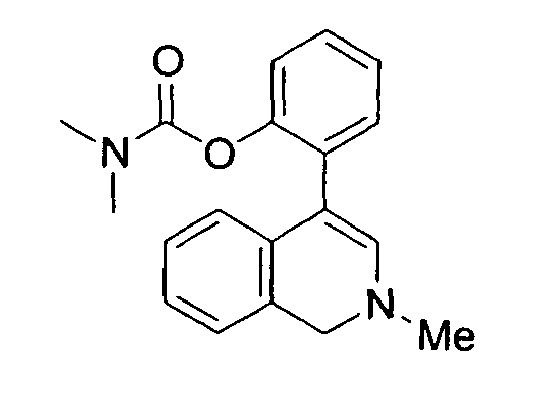
- Stage A: 4-(2-methoxyphenyl) isoquinoline.
A solution of 4-bromoisoquinoline (2.06 g, 10 mmol), prepared as described in the Journal of Organic Chemistry 2003, 68, 9412-9415, 2-methoxyphenylboronic acid (2.79 g, 10 mmol), Pd(PPh3)4 (5%mol), K2CO3 (5g) in DMF/water (3/1) is stirred at 50°C for 12 hours. The reaction mixture is then pored on water (150 mL). The aqueous phase is extracted with ethyl acetate (3x100mL). The combined organic layers are washed with water (3x200mL). The organic phase is dried over magnesium sulfate and evaporated under vacuum to afford the title compound. - Stage B: 4-[2-(N,N-dimethylcarbamate)phenyl]-2-methylisoquinolinium triflate.
The title compound is prepared according to the procedures reported in stages A, B, C, D of example 1 from 4-(2-methoxyphenyl) isoquinoline prepared in stage A. - Stage C: 4-[2-(N,N-dimethylcarbamate)phenyl]-2-methyl-1,2-dihydroisoquinoline.
The title compound is prepared according to the procedure reported in stage E of example 1 from 4-[2-(N,N-dimethylcarbamate)phenyl]-2-methylisoquinolinium triflate obtained in stage B. -

- To a solution of ethyl N-methyl-7-(N,N-dimethylcarbamate)quinolinium-3-carboxylate triflate (100 mg, 0.22 mmol) prepared in stage D of example 1 in EtOH (10 mL) was added NaBH4 (38 mg, 1 mmol). The resultant mixture was stirred for 3 hours at room temperature. After addition of water (2 mL) and evaporation of EtOH, the resulting aqueous phase was extracted twice with CH2C12 (2 x 10 mL). After drying (MgSO4) and evaporation, flash chromatography on silica gel afforded the title compound in 20-60% yield.
-

- The title compound is prepared as reported in stage A of example 61 from a solution of ethyl 1-methyl-5-(N,N-dimethylthiocarbamate)-5-O-quinolinium-3-carboxylate triflate prepared in stage B of example 5.
-

- The title compound is prepared as reported in stage A of example 61 from 1-methyl-5-(N,N-dimethylcarbamate)-3-(4,5-dihydro-4,4-dimethyl-2-oxazolyl)quinolinium triflate prepared in stage D of example 8.
-

- The title compound is prepared as reported in stage A of example 61 from ethyl 1-methyl-5-(N,N-dimethylcarbamate)pyridinium-3-carboxylate triflate prepared in stage C of example 27.
-

- The title compound is prepared as reported in stage A of example 61 from ethyl 1-methyl 5-(N,N-dimethylthiocarbamate)-5-O-pyridinium-3-carboxylate prepared in stage B of example 29.
-

- The title compound is prepared as reported in stage A of example 61 from 1-methyl-3-(N,N-diethylcarboxamido)-5-(N,N-dimethylcarbamate)pyridinium triflate prepared in stage B of example 31.
- AChE was extracted from control human erythrocytes. The molecular form of AChE was separated by ultracentrifugation obtained by lysing of erythrocytes. The membranes were centrifuged at 38,000 rpm in a SW55B rotor in a Centrikon T-1055 (Kontron)ultracentrifuge for 2 hours. In vitro inhibition of AChE was determined by Ellman's spectrophotometric method using method using acetylthiocholine (ACThCh) (Ellman, G.L., Courtney, K.KD., Andres, V., and Featherstone, R.M. A new and rapid colorimetric determination of acetylcholinesterase activity Biochem. Pharmacol. 1961, (7) 88-95)
- In this example, a pharmaceutical composition was prepared for injection.
- This pharmaceutical composition contained:
- the compound of Example 1: 500 mg
- a sterile aqueous excipient: 10 ml.
Claims (28)
- Compound comprising at least one radical C=Y, Y being O or S, and an oxidable and non protonable nitrogen atom N wherein the distance (d) between the at least one carbon atom of the radical group C=Y and the nitrogen atom, when oxidized, is comprised between 0.3 and 0.8 nanometers.
- Compound according to claim 1 wherein the distance d is between 0.4 and 0.7 nm.
- Compound which is an acetylcholinesterase inhibitor, at least 500, preferably at least 1000 times more active in central nervous system CNS than in peripheral nervous system PNS.
- Compound according to claim 3 which is an acetylcholinesterase inhibitor, at least 500 or at least 1000 times more active in central nervous system CNS under its oxidized form than in peripheral nervous system PNS under its non oxidized form
- Compound of formula G
 the dotted circle line represents one double bond between CR5-CR6, and another double bond between either CR2-CR3 or CR3-CR4 ; and eithera) R1 R2 R3 R4 R5 R6 which may be identical or different are hydrogen, OH, (C1-C8) alkyl, aryl, heteroaryl, (C1-C8) alkylaryl, aryl (C1-C8) alkyl, alkoxy, hydroxy (C1-C8) alkyl, alkoxy (C1-C8) alkyl, phenyl, (CH2)n-COOH, Z, Z1;
orb) R4 and R5 or c) R5 and R6 taken together with the carbon atoms to which they are attached form a 6-membered aromatic ring or form a 5- or 6-membered heterocyclic ring being optionally substituted by one or more identical or different group defined as OH, (C1-C8) alkyl, aryl, heteroaryl, (C1-C8) alkylaryl, aryl (C1-C8) alkyl, alkoxy, hydroxy (C1-C8) alkyl, alkoxy (C1-C8) alkyl, phenyl, (CH2)n-COOH, Z, Z1;wherein X, Y is O, S; R7, R8 which may be identical or different are hydrogen, (C1-C8) alkyl, aryl, heteroaryl, (C1-C8) alkylaryl, phenyl, cyclopropyl, (CH2)n-COOH;
in all case a) and b) and c);
Z is a group defined by formula -(L)m-Z1, L is (C1-C8) alkyl, aryl, heteroaryl, phenyl, (C1-C8) alkylaryl, aryl(C1-C8) alkyl;
Z1 is defined by formula
wherein n and m are an integer ≥ 1, preferably m is comprised between 1 and 4 and n is comprised between 1 and 6;
provided that at least one group R1 to R6 is Z or Z1 and that R1 is not H or Z1; or a pharmaceutical salts or a stereoisomer thereof. - Compound according to claim 5 of formula G+

- Compound according to claim 5 or 6 of formula G1a or G1b or G1+

- Compound according to claim 5 or 6 of formula G2 or G2+

- Compound according to claim 5 or 6 of formula G3a or G3b or G3+

- Compound according to any one of the claims 5 to 9 comprising an electron withdrawing group being in the position of the R3 group, and R3 is selected from the group comprising COOR, CONRR', CN, CF3, -SO-R, -SOz-R, -SO2NRR', NO2, halogen, or oxazolin, R, R' being a group alkyl, aryl, heteroaryl.
- Compound according to any one of the claims 5 to 10 wherein
R1 is (C1-C4) alkyl, -(L)m-Z1 wherein L is aryl, m is 1;
R2 is H, (C1-C4) alkyl, phenyl, aryl;
R3 is COOR, CONRR', CN, CF3, -SO-R, -SO2-R, -SO2NRR', NO2 halogen, or oxazolin, R, R' being a group (C1-C4) alkyl, aryl;
Z1 is
- Compound according to any one of the claims 5 to 11 comprising at least one radical C=Y, Y being O or S, and an oxidable and non protonable nitrogen atom N
wherein the distance d between the at least one carbon atom of the radical group C=Y and the nitrogen atom, when oxidized, is comprised between 0.3 and 0.8 nanometers, preferably 0,4 and 0,7 nanometers. - Compound according to any one of the claims 5 to 12 which is an acetylcholinesterase inhibitor, at least 500, preferably at least 1000 times more active in central nervous system CNS than in peripheral nervous system PNS.
- Compound according claim 13 which is an acetylcholinesterase inhibitor, at least 500, preferably at least 1000 times more active in central nervous system CNS under its oxidized form than in peripheral nervous system PNS under its non oxidized form.
- Compound according to any one of the claims 5 to 11 of the following formula G'1, G'2, G'3;

- Process for the preparation of a compound according to any one of the claims 5, 7 to 11, which comprises the step of reduction of a compound of formula (G+ or Gi +) W- i being 1, 2 or 3, in the presence of a reducing agent.
- Process for the preparation of a compound of formula (G+ or Gi +)W- i being 1, 2 or 3 as defined in any one of claims 6 to 11, which comprises a step of quaternization of the nitrogen atom of a compound of formula G'1, G'2, G'3 as defined in claim 15, by an alkylating agent R1-W, R1 being (C1-C8) alkyl, aryl, (C1-C8) alkylaryl, aryl(C1-C8) alkyl, alkoxy, hydroxy(C1-C8) alkyl, alkoxy(C1-C8) alkyl, phenyl, (CH2)n-COOH; W being a leaving group preferably selected from halogen, OTriflate, sulfate, tosylate, mesylate.
- Process for the preparation of a compound of formula G'1, G'2, G'3 according to claim 15 which comprise a step of carbamoylation of a compound of the following formula E l or E2 or E3


- Process for the preparation of compound of formula G+W or Gi + W- i being 1, 2 or 3 as defined in any one of claims 6 to 11 and with R1 being Z, which comprises a step of quaternization of a compound of the formula E1, E2 or E3

- Process according to any one of claims 16 to 19 wherein R3 is hydrogen, alkyl, phenyl, (CH2)n-COOH with n being ≥ 1 or an electron withdrawing group selected from the group comprising COOR, CONRR', CN, CF3, -SO-R, -SO2-R, -SO2NRR', NO2 halogen, or oxazolin, R, R' being a group alkyl, aryl, heteroaryl.
- A pharmaceutical composition comprising at least one compound according to any one of the claims 1 to 14, 28 and a pharmacologically acceptable carrier.
- A pharmaceutical composition according to claim 21 for its use as an acetylcholinesterase inhibitor in the CNS.
- A pharmaceutical composition according to claim 21 or 22 for its use in the treatment of neurodegenerative diseases, preferably Alzheimer's disease in a human or other animal subject.
- A pharmaceutical composition comprising a compound of formula G+, G1+, G2+ or G3+ according to any one of claims 6 to 12, 28 for its use as acetylcholinesterase inhibitor in the PNS.
- A pharmaceutical composition according to claim 24 for its use in the treatment of myasteny disease in a human or other animal subject.
- Use of a safe and effective amount of a compound of any one of formula G, G1a, G1b, G2, G3a, G3b as defined in any one of the claims 5 to 14, 28 for the manufacture of a prodrug for the treatment of disorders associated to neurodegenerative diseases in a human or other animal subject, wherein said treatment comprises administering said prodrug to said subject.
- Use of a safe and effective amount of a compound of any one of formula G+, G1+, G2+, G3+ as defined in any one of the claims 6 to 12, 28 for the manufacture of a drug for the treatment of disorders associated to neurodegenerative diseases in a human or other animal subject, wherein said treatment comprises delivering said drug to the PNS of said subject.
- Compound of formula G or G+ as defined in claims 5 or 6, the names of which follow;1. Ethyl 1-methyl-7-(N,N-dimethylcarbamate)-1,4-dihydroquinoline-3-carboxylate;2. Ethyl 1-methyl-5-(N,N-dimethylcarbamate)-1,4-dihydroquinoline-3-carboxylate;3. Ethyl 1-methyl-5,7-di(N,N-dimethylcarbamate)-1,4-dihydroquinoline-3-carboxylate;4. Ethyl 1-methyl-5,8-di(N,N-dimethylcarbamate)-1,4-dihydroquinoline-3-carboxylate;5. Ethyl 1-methyl-5-(N,N-dimethylthiocarbamate)-1,4-dihydro-5-O-quinoline-3-carboxylate;6. Ethyl 1-methyl-5-(N,N-dimethylthiocarbamate)-1,4-dihydro-5-S-quinoline-3-carboxylate;7. 1-Methyl-5-(N,N-dimethylcarbamate)-3-(N,N-diethylcarboxamido)-1,4-dihydroquinoline;8. 1-Methyl-7-(N,N-dimethylcarbamate)-3-(4,5-dihydro-4,4-dimethyl-2-oxazolyl)-1,4-dihydroquinoline;9. 1-Methyl-5-(N,N-dimethylcarbamate)-3-trifluoromethyl-1,4-dihydroquinoline;10. (+/-)-1-Methyl-3-(4-methylphenylsulfinyl)-5-(N,N-dimethylcarbamate)-1,4-quinoline;11. 1-Methyl-3-(4-methylphenylsulfonyl)-5-(N,N-dimethylcarbamate)-1,4-dihydroquinoline;12. 1-Methyl-5-(N,N-dimethylcarbamate)-3-(N-phenylsulfomanide)-1,4-dihydroquinoline;13. 1-Methyl-6,7-di(N,N-dimethylcarbamate)-3-nitro-1,4-dihydroquinoline;14. Ethyl 1-methyl-2-phenyl-6,7-di(N,N-dimethylcarbamate)-1,4-dihydroquinoline-3-carboxylate;15. Ethyl 1,2,4-trimethyl-7-(N,N-dimethylcarbamate)-1,4-dihydro-3-quinolinecarboxylate;16. 2-Methyl-7-(N,N-dimethylcarbamate)-1,2-dihydroisoquinoline;17. 2-Methyl-7-(N,N-dimethylthiocarbamate)-1,2-dihydro-7-O-isoquinoline;18. 2-Methyl-7-(N,N-dimethylthiocarbamate)-1,2-dihydro-7-S-isoquinoline;19. 1,2-Dimethyl-7-(N,N-dimethylthiocarbamate)-1,2-dihydro-7-O-isoquinoline;20. Ethyl 2,3-dimethyl-6,8-di(N,N-dimethylcarbamate)-1,2-dihydro-4-isoquinolinecarboxylate;21. 2,3-Dimethyl-6,8-di(N,N-dimethylcarbamate)-1,2-dihydro-4-isoquinolinecarboxamide;22. 2,3-Dimethyl-4-(4,5-dihydro-4,4-dimethyl-2-oxazolyl)-6,8-di(N,N-dimethylcarbamate)-1,2-dihydroisoquinoline;23. (+/-)-2,3-Dimethyl-4-(4-methylphenylsulfinyl)-6,8-di(N,N-dimethylcarbamate)-1,2-dihydroisoquinoline;24. 2,3-Dimethyl-4-(methylphenylsulfonyl)-6,8-di(N,N-dimethylcarbamate)-1,2-dihydroisoquinoline;25. 2,3-Dimethyl-4-(N-phenylsulfonamide)-6,8-di(N,N-dimethylcarbamate)-1,2-dihydroisoquinoline;26. 2,3-Dimethyl-4-(trifluoromethyl)-6,8-di(N,N-dimethylcarbamate)-1,2-dihydroisoquinoline;27. Ethyl 1-methyl-5-(N,N-dimethylcarbamate)-1,4-dihydropyhdine-3-carboxytate28. Ethyl 1-methyl-5-(N,N-dimethylthiocarbamate)-1,4-dihydro-5-O-pyridine-3-carboxylate;29. Ethyl 1-methyl-5-(N,N-dimethylthiocarbamate)-1,4-dihydro-5-S-pyridine-3-carboxylate;30. 1-Methyl-3-(methylsulfonyl)-5-(N,N-dimethylcarbamate)-1,4-dihydropyridine;31. 1-Methyl-3-(N,N-diethylcarboxamido)-5-(N,N-dimethylcarbamate)-1,4-dihydropyridine;32. (+/-)-1-Methyl-3-(methylsufinyl)-5-(N,N-dimethylcarbamate)-1,4-dihydropyridine;33. 1-Methyl-3-(trifluoromethyl)-5-(N,N-dimethylcarbamate)-1,4-dihydropyridine;34. 1-Methyl-3-(4,5-dihydro-4,4-dimethyl-2-oxazolyl)-5-(N,N-dimethylcarbamate)-1,4-dihydropyridine;35. N,N-Diethyl-1-methyl-5-(N,N-dimethylcarbamate)-1,4-dihydro-3-pyridinesulfonamide;36. Ethyl 1-[2-(N,N-dimethylcarbamate)benzyl]-1,4-dihydro-3-pyridinecarboxylate;37. 1-[2-(N,N-dimethylcarbamate)benzyl]-3-(methylcarbamoyl)-1,4-dihydropyridine;38. 1-[2-(N,N-dimethylcarbamate)benzyl]-3-(4,5-dihydro-4,4-dimethyl-2-oxazolyl)-1,4-dihydropyridine;39. N,N-Diethyl-1-[2-(N,N-dimethylcarbamate)benzyl]-1,4-dihydro-3-pyridinesulfonamide;40. Ethyl 1-[2-(N,N-dimethylcarbamate)benzyl]-1,4-dihydro-3-quinolinecarboxylate;41. 1-[2-(N,N-dimethylcarbamate)benzyl]-1,4-dihydro-3-(dimethylcarbamoyl)-quinoline;42. 1-[2-(N,N-dimethylcarbamate)benzyl]-1,4-dihydro-3-(4,5-dihydro-4,4-dimethyl-2-oxazolyl) quinoline;43. N,N-Dimethyl-1-[2-(N,N-dimethylcarbamate)benzyl]-1,4-dihydro-3-quinolinesulfonamide;44. Ethyl 2-[2-(N,N-dimethylcarbamate)benzyl]-1,2-dihydro-4-isoquinolinecarboxylate;45. 2-[2-(N,N-dimethylcarbamate)benzyl)-4-(N-β-phenethylcarbamoyl)-1,2-dihydroisoquinoline;46. 2-[2-(N,N-dimethylcarbamate)benzyl]-4-(4,5-dihydro-4,4-dimethyl-2-oxazolyl)-1,2-dihydroisoquinoline;47. N,N-diethyl-2-[2-(N,N-dimethylcarbamate)benzyl]-1,2-dihydro-4-isoquinolinesulfonamide;48. 1-[2-(N,N-dimethylcarbamate)benzyl]-3-(trifluoromethyl)-1,4-dihydropyridine;49. 1-[2-(N,N-dimethylcarbamate)benzyl]-3-(trifluoromethyl)-1,4-dihydroquinoline;50. 1-[2-(N,N-dimethylcarbamate)benzyl]-3-(trifluoromethyl)-1,2-dihydroisoquinoline;51. Ethyl 1-methyl-2-[2-(N,N-dimethylcarbamate)phenyl]-1,4-dihydropyridine-3-carboxylate;52. 1-Methyl-2-[2-(N,N-dimethylcarbamate)phenyl]-1,4-dihydro-N,N-dimethylnicotinamide;53. 1-Methyl-2-(2-(N,N-dimethylcarbamate)phenyl]-3-(methylsulfonyl)-1,4-dihydropyridine;54. N-Methyl 1-methyl-2-[2-(N,N-dimethylcarbamate)phenyl]-1,4-dihydro-3-pyridinesulfonamide;55. Ethyl 1-methyl-6-[2-(N,N-dimethylcarbamate)phenyl]-1,4-dihydropyridine-3-carboxylate;56. Ethyl 1-methyl-5-[2-(N,N-dimethylcarbamate)phenyl]-1,4-dihydropyridine-3-carboxylate;57. Ethyl 1-methyl-2-[2-(N,N-dimethylcarbamate)phenyl]-1,4-dihydroquinoline-3-carboxylate;58. Ethyl 1-methyl-8-[2-(N,N-dimethylcarbamate)phenyl]-1,4-dihydroquinoline-3-carboxylate;59. 1-[2-(N,N-dimethylcarbamate)phenyl]-2-methyl-1,2-dihydroisoquinoline;60. 2-Methyl-4-[2-(N,N-dimethylcarbamate)phenyl]-1,2-dihydroisoquinoline;61. Ethyl 1-methyl-7-(N,N-dimethylcarbamate)-1,2-dihydroquinoline-3-carboxylate;62. Ethyl 1-methyl-5-(N,N-dimethylthiocarbamate)-1,2-dihydro-5-S-quinoline -3-carboxylate;63. 1-Methyl 5-(N,N-dimethylcarbamate)-3-(4,5-dihydro-4,4-dimethyl-2-oxazolyl)1,2-dihydroquinoline;64. Ethyl 1-methyl-5-(N,N-dimethylcarbamate)-1,2-dihydropyridine-3-carboxylate;65. Ethyl 1-methyl-5-(N,N-dimethylthiocarbamate)-1,2-dihydro-5-S-pyridine-3-carboxylate;66. 1-Methyl-3-(N,N-diethylcarboxamido)-5-(N,N-dimethylcarbamate)-1,2-dihydropyridineor their corresponding ammonium form thereof.
Priority Applications (10)
| Application Number | Priority Date | Filing Date | Title |
|---|---|---|---|
| EP05290914A EP1731507A1 (en) | 2005-04-26 | 2005-04-26 | New heterocyclic compounds, their preparation and their use as medicaments, in particular as anti-alzheimer agents |
| NZ561953A NZ561953A (en) | 2005-04-01 | 2006-03-29 | New heterocyclic compounds, their preparation and their use as medicaments, in particular as anti-alzheimer agents |
| AU2006228683A AU2006228683B2 (en) | 2005-04-01 | 2006-03-29 | New heterocyclic compounds, their preparation and their use as medicaments, in particular as anti-Alzheimer agents |
| US11/909,911 US7977354B2 (en) | 2005-04-01 | 2006-03-29 | Heterocyclic compounds, their preparation and their use as medicaments, in particular as anti-alzheimer agents |
| PCT/EP2006/003787 WO2006103120A2 (en) | 2005-04-01 | 2006-03-29 | New heterocyclic compounds, their preparation and their use as medicaments, in particular as anti-alzheimer agents |
| EP06742673.4A EP1868998B1 (en) | 2005-04-01 | 2006-03-29 | New heterocyclic compounds, their preparation and their use as medicaments, in particular as anti-alzheimer agents |
| CA2603345A CA2603345C (en) | 2005-04-01 | 2006-03-29 | New heterocyclic compounds, their preparation and their use as medicaments, in particular as anti-alzheimer agents |
| DK06742673.4T DK1868998T3 (en) | 2005-04-01 | 2006-03-29 | NEW HETEROCYCLIC COMPOUNDS, MANUFACTURING THEM, AND USE THEREOF AS MEDICINES, IN PARTICULAR AS ANTI-ALZHEIMER AGENTS |
| SG201002269-7A SG161217A1 (en) | 2005-04-01 | 2006-03-29 | New heterocyclic compounds, their preparation and their use as medicaments, in particular as anti-alzheimer agents |
| IL186233A IL186233A (en) | 2005-04-01 | 2007-09-24 | Heterocyclic compound, inclusion complex, pharmaceutical composition, use of said compound for the manufacture of a drug and process for the preparation of said compound |
Applications Claiming Priority (1)
| Application Number | Priority Date | Filing Date | Title |
|---|---|---|---|
| EP05290914A EP1731507A1 (en) | 2005-04-26 | 2005-04-26 | New heterocyclic compounds, their preparation and their use as medicaments, in particular as anti-alzheimer agents |
Publications (1)
| Publication Number | Publication Date |
|---|---|
| EP1731507A1 true EP1731507A1 (en) | 2006-12-13 |
Family
ID=35044656
Family Applications (1)
| Application Number | Title | Priority Date | Filing Date |
|---|---|---|---|
| EP05290914A Withdrawn EP1731507A1 (en) | 2005-04-01 | 2005-04-26 | New heterocyclic compounds, their preparation and their use as medicaments, in particular as anti-alzheimer agents |
Country Status (1)
| Country | Link |
|---|---|
| EP (1) | EP1731507A1 (en) |
Cited By (1)
| Publication number | Priority date | Publication date | Assignee | Title |
|---|---|---|---|---|
| CN105121408A (en) * | 2013-01-25 | 2015-12-02 | 鲁昂国立应用科学学院 | Oxidisable pyridine derivatives, preparation thereof and use as anti-alzheimer agents |
Citations (4)
| Publication number | Priority date | Publication date | Assignee | Title |
|---|---|---|---|---|
| WO1997008146A1 (en) * | 1995-08-31 | 1997-03-06 | The State Of Israel | Pyridinium derivatives and pharmaceutical compositions containing them |
| US5714615A (en) * | 1994-02-08 | 1998-02-03 | Georgia Tech Research Corporation | Pyridinium compounds |
| WO2001047891A1 (en) | 1999-12-28 | 2001-07-05 | Eisai Co., Ltd. | Heterocyclic compounds having sulfonamide groups |
| EP1466604A1 (en) | 2003-04-09 | 2004-10-13 | Les Laboratoires Servier | Isoquinoline derivatives, process for their preparation and use thereof in the treatment of melatoninergic system problems |
-
2005
- 2005-04-26 EP EP05290914A patent/EP1731507A1/en not_active Withdrawn
Patent Citations (4)
| Publication number | Priority date | Publication date | Assignee | Title |
|---|---|---|---|---|
| US5714615A (en) * | 1994-02-08 | 1998-02-03 | Georgia Tech Research Corporation | Pyridinium compounds |
| WO1997008146A1 (en) * | 1995-08-31 | 1997-03-06 | The State Of Israel | Pyridinium derivatives and pharmaceutical compositions containing them |
| WO2001047891A1 (en) | 1999-12-28 | 2001-07-05 | Eisai Co., Ltd. | Heterocyclic compounds having sulfonamide groups |
| EP1466604A1 (en) | 2003-04-09 | 2004-10-13 | Les Laboratoires Servier | Isoquinoline derivatives, process for their preparation and use thereof in the treatment of melatoninergic system problems |
Non-Patent Citations (92)
| Title |
|---|
| "STRUCTURE", article "Structure of acetylcholinesterase complexed with E2020 (Aricept®): implications", pages: 297 - 307 |
| ARCH. PHARM. PHARM. MED. CHEM, vol. 336, 2003, pages 258 - 263 |
| ARKIVOC, vol. 1, no. 5, 2000, pages 823 - 842 |
| BADAWI A M ET AL: "NEW QUATERNARY CARBAMATES", ORIENTAL JOURNAL OF CHEMISTRY, IQBAL, BHOPAL,, IN, vol. 4, no. 1, 1988, pages 76 - 83, XP009060208, ISSN: 0970-020X * |
| BARTUS R. T. ET AL.: "The cholinergic hypothesis of geriatric memory dysfunction", SCIENCE, vol. 217, 1982, pages 408 - 17 |
| BIOORGANIC & MEDICINAL CHEMISTRY LETTERS, vol. 12, no. 15, 2002, pages 2043 - 2046 |
| BIOORGANIC & MEDICINAL CHEMISTRY LETTERS, vol. 12, no. 5, 2002, pages 827 - 832 |
| BIOORGANIC & MEDICINAL CHEMISTRY, vol. 12, no. 10, 2004, pages 2553 - 2570 |
| BIOORGANIC AND MEDICINAL CHEMISTRY LETTERS, 2003, pages 1345 - 1348 |
| BIOORGANIC AND MEDICINAL CHEMISTRY, 1999, pages 2647 - 2666 |
| BULLETIN OF THE CHEMICAL SOCIETY, vol. 61, no. 10, 1988, pages 3531 - 7 |
| CANADIAN JOURNAL OF CHEMISTRY, vol. 46, 1968, pages 1160 - 1163 |
| CHEMICAL & PHARMACEUTICAL BULLETIN, vol. 45, no. 5, 1997, pages 928 - 931 |
| CHEMICAL PAPERS, vol. 39, 1985, pages 413 - 27 |
| CHEMICAL PAPERS, vol. 39, 1985, pages 413 - 427 |
| DAVIES P; MALONEY AJF: "Selective loss of central cholinergic neurones in Alzheimer's Disease", LANCET, 1976, pages 1403 |
| ELLMAN, G.L. ET AL.: "A new and rapid colorimetric determination of acetylcholinesterase activity", BIOCHEM. PHARMACOL., no. 7, 1961, pages 88 - 95 |
| ELLMAN, G.L. ET AL.: "A new and rapid colorimetric determination of acetylcholinesterase activity", BIOCHEM. PHARMACOL., vol. 7, 1961, pages 88 - 95 |
| EUR. J. ORG. CHEM., 2001, pages 3247 - 3253 |
| EUR. J. ORG. CHEM., 2002, pages 327 - 330 |
| EUR. J. ORG. CHEM., 2003, pages 327 - 330 |
| EUROPEAN JOURNAL OF ORGANIC CHEMISTRY, 2002, pages 4181 - 4184 |
| FRANCIS PT ET AL., THE CHOLINERGIC HYPOTHESIS OF ALZHEIMER'S DISEASE: A REVIEW OF PROGRESS |
| HARRY C. FROEDE; IRWIN B. WILSON: "Direct determination of Acetyl- Enzyme Intermediate in the Acetylcholinesterase-catalysed Hydrolysis of Acetylcholine and acetylthiocholine", THE JOURNAL OF BIOLOGICAL CHEMISTRY, vol. 259, 1984, pages 11010 - 11013 |
| HETEROCYCLE, vol. 45, 1997, pages 2015 - 2021 |
| HETEROCYCLES, vol. 57, no. 1, 2002, pages 123 - 128 |
| INDIAN JOURNAL OF CHEMISTRY, vol. 10, no. 4, 1972, pages 341 - 3 |
| JOURNAL OF CHEMICAL SOCIETY, PERKIN TRANSACTIONS 1: ORGANIC AND BIO-ORGANIC CHEMISTRY, 1974, pages 2185 - 2190 |
| JOURNAL OF MEDICINAL CHEMISTRY, 1993, pages 2689 - 22700 |
| JOURNAL OF MEDICINAL CHEMISTRY, vol. 30, no. 8, 1987, pages 1421 - 6 |
| JOURNAL OF MEDICINAL CHEMISTRY, vol. 32, 1989, pages 807 - 26 |
| JOURNAL OF MEDICINAL CHEMISTRY, vol. 32, no. 4, 1989, pages 807 - 26 |
| JOURNAL OF MEDICINAL CHEMISTRY, vol. 32, no. 9, 1989, pages 2178 - 99 |
| JOURNAL OF MEDICINAL CHEMISTRY, vol. 37, 1994, pages 2129 |
| JOURNAL OF MEDICINAL CHEMISTRY, vol. 37, 1994, pages 2129 - 2137 |
| JOURNAL OF MEDICINAL CHEMISTRY, vol. 38, 1995, pages 1608 - 28 |
| JOURNAL OF MEDICINAL CHEMISTRY, vol. 38, 1995, pages 950 - 957 |
| JOURNAL OF MEDICINAL CHEMISTRY, vol. 38, no. 6, 1995, pages 950 - 7 |
| JOURNAL OF MEDICINAL CHEMISTRY, vol. 43, 2000, pages 3168 - 3185 |
| JOURNAL OF MEDICINAL CHEMISTRY, vol. 44, 2001, pages 822 - 833 |
| JOURNAL OF MEDICINAL CHEMISTRY, vol. 45, 2002, pages 740 - 743 |
| JOURNAL OF MEDICINAL CHEMISTRY, vol. 45, no. 17, 2002, pages 3660 - 3668 |
| JOURNAL OF ORGANIC CHEMISTRY, vol. 19, 1954, pages 1117 - 23 |
| JOURNAL OF ORGANIC CHEMISTRY, vol. 32, 1967, pages 2689 - 2692 |
| JOURNAL OF ORGANIC CHEMISTRY, vol. 39, no. 13, 1974, pages 1802 - 7 |
| JOURNAL OF ORGANIC CHEMISTRY, vol. 44, 1979, pages 3080 - 3082 |
| JOURNAL OF ORGANIC CHEMISTRY, vol. 64, 1999, pages 7053 |
| JOURNAL OF ORGANIC CHEMISTRY, vol. 64, no. 26, 1999, pages 9430 - 9443 |
| JOURNAL OF ORGANIC CHEMISTRY, vol. 66, 2001, pages 1500 - 1502 |
| JOURNAL OF ORGANIC CHEMISTRY, vol. 67, no. 26, 2002, pages 9276 - 9287 |
| JOURNAL OF ORGANIC CHEMISTRY, vol. 68, 2003, pages 8274 - 8276 |
| JOURNAL OF ORGANIC CHEMISTRY, vol. 68, 2003, pages 9412 - 9415 |
| JOURNAL OF ORGANIC CHEMISTRY, vol. 68, 2003, pages 9517 - 9520 |
| JOURNAL OF ORGANIC CHEMISTRY, vol. 69, no. 6, 2004, pages 2024 - 2032 |
| JOURNAL OF THE AMERICAN CHEMICAL SOCIETY, vol. 122, no. 48, 2000, pages 12051 - 12052 |
| JOURNAL OF THE CHEMICAL SOCIETY, ABSTRACTS, 1945, pages 646 - 57 |
| JOURNAL OF THE CHEMICAL SOCIETY, CHEMICAL COMMUNICATIONS, vol. 1, 1992, pages 53 - 54 |
| KASA P; RAKONCZAY Z; GULYA K: "The cholinergic system in Alzheimer's disease", PROG NEUROBIOL., vol. 52, no. 6, August 1997 (1997-08-01), pages 511 - 35 |
| KITZ RJ ET AL: "the reaction of acetylcholinesterase with o-dimethylcarbamyl esters of quaternary quinolinium compounds", BIOCHEMICAL PHARMACOLOGY, vol. 16, 1967, Great Britain, pages 2201 - 2209, XP002367405 * |
| MEMOIRES DE L'ACADEMIE ROYALE DE MEDECINE, vol. 47, no. 3, 1974, pages 131 - 210 |
| MISHRA N N ET AL: "HIGHLY SENSITIVE ASSAY FOR ANTICHOLINESTERASE COMPOUNDS USING 96 WELL PLATE FORMAT", ACS SYMPOSIUM SERIES, WASHINGTON, DC, US, vol. 806, 2002, pages 289 - 306, XP009033032, ISSN: 0097-6156 * |
| NEW JOURNAL OF CHEMISTRY, vol. 26, no. 4, 2002, pages 373 - 375 |
| ORGANIC LETTERS, vol. 5, 2003, pages 3061 - 3063 |
| ORGANIC LETTERS, vol. 6, no. 21, 2004, pages 3711 - 3714 |
| ORGANIC PROCESS RESEARCH & DEVELOPMENT, vol. 7, no. 3, 2003, pages 379 - 384 |
| ORGANIC REACTION, vol. 28, 1982, pages 37 - 201 |
| PHOSPHORUS, SULFUR AND SILICON AND THE RELATED ELEMENTS, vol. 66, 1992, pages 127 - 137 |
| RADIC Z ET AL: "EXPRESSION OF RECOMBINANT ACETYLCHOLINESTERASE IN A BACULOVIRUS SYSTEM: KINETIC PROPERTIES OF GLUTAMATE 199 MUTANTS", BIOCHEMISTRY, AMERICAN CHEMICAL SOCIETY. EASTON, PA, US, vol. 31, 1992, pages 9760 - 9767, XP001040344, ISSN: 0006-2960 * |
| SIOBHAN MALANY ET AL.: "Transition State Structure and Rate Determination for the Acylation Stage of Acetylcholinesterase Catalyzed Hydrolysis of (Acetylthio)choline", JOURNAL OF AMERICAN CHEMICAL SOCIETY, pages 2981 - 2987 |
| SYNTHESIS, 1987, pages 693 - 696 |
| SYNTHESIS, vol. 8, 1987, pages 693 - 6 |
| SYNTHETIC COMMUNICATION, vol. 12, 1982, pages 989 - 993 |
| TAYLOR P: "Development of acetylcholinesterase inhibitors in the therapy of Alzheimer's Disease", NEUROLOGY, vol. 51, no. 1, 1998, pages S30 - S35 |
| TETRAHEDRON LETTERS, vol. 27, 1986, pages 5269 - 5270 |
| TETRAHEDRON LETTERS, vol. 38, pages 3159 - 3162 |
| TETRAHEDRON LETTERS, vol. 39, 1998, pages 4013 - 4016 |
| TETRAHEDRON LETTERS, vol. 39, 1998, pages 459 - 462 |
| TETRAHEDRON LETTERS, vol. 39, no. 23, 1998, pages 4013 - 4016 |
| TETRAHEDRON LETTERS, vol. 40, no. 43, 1999, pages 7599 - 7603 |
| TETRAHEDRON LETTERS, vol. 40, no. 43, 1999, pages 9005 - 9007 |
| TETRAHEDRON LETTERS, vol. 42, 2001, pages 3737 - 3740 |
| TETRAHEDRON LETTERS, vol. 42, 2001, pages 6589 - 6592 |
| TETRAHEDRON LETTERS, vol. 43, 2002, pages 6209 - 6211 |
| TETRAHEDRON LETTERS, vol. 44, 1968, pages 1160 - 1163 |
| TETRAHEDRON LETTERS, vol. 44, 1968, pages 4631 - 4634 |
| TETRAHEDRON, 1985, pages 173 - 1384 |
| TETRAHEDRON, vol. 37, 1981, pages 3977 - 3980 |
| TETRAHEDRON, vol. 57, 2001, pages 3087 - 3098 |
| TETRAHEDRON: ASYMMETRY, vol. 14, 2003, pages 3469 - 3477 |
| WANG J-Q ET AL: "Facile synthesis and initial PET imaging of novel potential heart acetylcholinesterase imaging agents [<11>C]pyridostigmine and its analogs", NUCLEAR MEDICINE AND BIOLOGY, ELSEVIER SCIENCE PUBLISHERS, NEW YORK, NY, US, vol. 31, no. 7, October 2004 (2004-10-01), pages 957 - 964, XP004587529, ISSN: 0969-8051 * |
| WUEST HM ET AL: "Some derivatives of 3-pyridol with parasympathomimetic properties", JOURNAL OF THE AMERICAN CHEMICAL SOCIETY, vol. 73, 1951, pages 1210 - 1216, XP002348929 * |
| YOSHIYUKI KAWAKAMI ET AL.: "The rationale for E2020 as a potent acetylcholinesterase inhibitor", BIOORGANIC AND MEDICINAL CHEMISTRY, pages 1429 - 1446 |
Cited By (1)
| Publication number | Priority date | Publication date | Assignee | Title |
|---|---|---|---|---|
| CN105121408A (en) * | 2013-01-25 | 2015-12-02 | 鲁昂国立应用科学学院 | Oxidisable pyridine derivatives, preparation thereof and use as anti-alzheimer agents |
Similar Documents
| Publication | Publication Date | Title |
|---|---|---|
| IL186233A (en) | Heterocyclic compound, inclusion complex, pharmaceutical composition, use of said compound for the manufacture of a drug and process for the preparation of said compound | |
| US5985894A (en) | N-substituted quinolines | |
| EP0553191A1 (en) | PYRIDINE AND PYRIDINE N-OXIDE DERIVATIVES, PIPERIDINES, OR METHYL DIARYL PIPERAZINES, COMPOSITIONS AND METHODS OF USE THEREOF. | |
| JPS5826872A (en) | Cardiac contractility enhancer | |
| HUP0004006A2 (en) | New benzothiophene, benzofuran and indole derivatives, process for their preparation and pharmaceutical compositions containing them | |
| FI110940B (en) | Process for the preparation of therapeutically active quinolone and acridone derivatives | |
| JPS59219260A (en) | Novel naphthalene- and azanaphthalene-carboxamide derivatives, pharmaceutical compositions and manufacture | |
| JP2889056B2 (en) | Methanoanthracene compound, pharmaceutical preparation for treating psychosis containing the compound, method for producing the compound, and intermediate | |
| JPH05506216A (en) | Pyridine as a medicine | |
| AU608339B2 (en) | Sulphonamide-substituted isoquinolines | |
| US5512575A (en) | Methanoanthraceneyl methyl piperidinyl compounds | |
| HU182562B (en) | Process for preparing new 4-amino-2-piperidino-quinazoline derivatives | |
| US5622964A (en) | Heterocyclic derivatives | |
| CZ368897A3 (en) | Benzopyrans, process of their preparation,pharmaceutical compositions containing thereof and their use | |
| JP2001511799A (en) | Heterocyclic compounds useful as oxide-squalene cyclase inhibitors | |
| AU601946B2 (en) | 1,4-dihydropyridine derivatives useful for the treatment of cardiovascular disorders | |
| IE51542B1 (en) | Therapeutic agents | |
| EP0161917A2 (en) | Dihydropyridines | |
| HU194831B (en) | Process for preparing new quinolone derivatives and pharmaceuticals comprising the same | |
| NL8004003A (en) | QUINOLINE DERIVATIVES AND PHARMACEUTICAL PREPARATIONS CONTAINING SUCH A COMPOUND AND METHOD FOR PREPARING THESE COMPOUNDS. | |
| EP2759536A1 (en) | Oxidisable pyridine derivatives, their preparation and use as anti-Alzheimer agents | |
| EP0265947B1 (en) | Dihydropyridine derivatives, process for their preparation, pharmaceutical composition and use | |
| EP2205559A1 (en) | Renin inhibitors | |
| JPH05213885A (en) | Novel derivative of decahydroquinoline, preparation thereof, production intermediate, use thereof as medicine and composition containing same | |
| JPH05320160A (en) | Benzoisoxazole compound |
Legal Events
| Date | Code | Title | Description |
|---|---|---|---|
| PUAI | Public reference made under article 153(3) epc to a published international application that has entered the european phase |
Free format text: ORIGINAL CODE: 0009012 |
|
| AK | Designated contracting states |
Kind code of ref document: A1 Designated state(s): AT BE BG CH CY CZ DE DK EE ES FI FR GB GR HU IE IS IT LI LT LU MC NL PL PT RO SE SI SK TR |
|
| AX | Request for extension of the european patent |
Extension state: AL BA HR LV MK YU |
|
| 17P | Request for examination filed |
Effective date: 20070613 |
|
| AKX | Designation fees paid |
Designated state(s): AT BE BG CH CY CZ DE DK EE ES FI FR GB GR HU IE IS IT LI LT LU MC NL PL PT RO SE SI SK TR |
|
| 17Q | First examination report despatched |
Effective date: 20080916 |
|
| STAA | Information on the status of an ep patent application or granted ep patent |
Free format text: STATUS: THE APPLICATION IS DEEMED TO BE WITHDRAWN |
|
| 18D | Application deemed to be withdrawn |
Effective date: 20090127 |