EP1728618A1 - Methods of making platinum and platinum alloy catalysts with nanonetwork structures - Google Patents
Methods of making platinum and platinum alloy catalysts with nanonetwork structures Download PDFInfo
- Publication number
- EP1728618A1 EP1728618A1 EP05010974A EP05010974A EP1728618A1 EP 1728618 A1 EP1728618 A1 EP 1728618A1 EP 05010974 A EP05010974 A EP 05010974A EP 05010974 A EP05010974 A EP 05010974A EP 1728618 A1 EP1728618 A1 EP 1728618A1
- Authority
- EP
- European Patent Office
- Prior art keywords
- platinum
- methods
- nanospheres
- nanonetwork
- catalysts
- Prior art date
- Legal status (The legal status is an assumption and is not a legal conclusion. Google has not performed a legal analysis and makes no representation as to the accuracy of the status listed.)
- Ceased
Links
Images


Classifications
-
- H—ELECTRICITY
- H01—ELECTRIC ELEMENTS
- H01M—PROCESSES OR MEANS, e.g. BATTERIES, FOR THE DIRECT CONVERSION OF CHEMICAL ENERGY INTO ELECTRICAL ENERGY
- H01M4/00—Electrodes
- H01M4/86—Inert electrodes with catalytic activity, e.g. for fuel cells
- H01M4/90—Selection of catalytic material
- H01M4/92—Metals of platinum group
- H01M4/921—Alloys or mixtures with metallic elements
-
- B—PERFORMING OPERATIONS; TRANSPORTING
- B01—PHYSICAL OR CHEMICAL PROCESSES OR APPARATUS IN GENERAL
- B01J—CHEMICAL OR PHYSICAL PROCESSES, e.g. CATALYSIS OR COLLOID CHEMISTRY; THEIR RELEVANT APPARATUS
- B01J23/00—Catalysts comprising metals or metal oxides or hydroxides, not provided for in group B01J21/00
- B01J23/38—Catalysts comprising metals or metal oxides or hydroxides, not provided for in group B01J21/00 of noble metals
- B01J23/40—Catalysts comprising metals or metal oxides or hydroxides, not provided for in group B01J21/00 of noble metals of the platinum group metals
-
- B—PERFORMING OPERATIONS; TRANSPORTING
- B01—PHYSICAL OR CHEMICAL PROCESSES OR APPARATUS IN GENERAL
- B01J—CHEMICAL OR PHYSICAL PROCESSES, e.g. CATALYSIS OR COLLOID CHEMISTRY; THEIR RELEVANT APPARATUS
- B01J23/00—Catalysts comprising metals or metal oxides or hydroxides, not provided for in group B01J21/00
- B01J23/38—Catalysts comprising metals or metal oxides or hydroxides, not provided for in group B01J21/00 of noble metals
- B01J23/40—Catalysts comprising metals or metal oxides or hydroxides, not provided for in group B01J21/00 of noble metals of the platinum group metals
- B01J23/42—Platinum
-
- B—PERFORMING OPERATIONS; TRANSPORTING
- B01—PHYSICAL OR CHEMICAL PROCESSES OR APPARATUS IN GENERAL
- B01J—CHEMICAL OR PHYSICAL PROCESSES, e.g. CATALYSIS OR COLLOID CHEMISTRY; THEIR RELEVANT APPARATUS
- B01J23/00—Catalysts comprising metals or metal oxides or hydroxides, not provided for in group B01J21/00
- B01J23/38—Catalysts comprising metals or metal oxides or hydroxides, not provided for in group B01J21/00 of noble metals
- B01J23/40—Catalysts comprising metals or metal oxides or hydroxides, not provided for in group B01J21/00 of noble metals of the platinum group metals
- B01J23/46—Ruthenium, rhodium, osmium or iridium
- B01J23/462—Ruthenium
-
- B—PERFORMING OPERATIONS; TRANSPORTING
- B22—CASTING; POWDER METALLURGY
- B22F—WORKING METALLIC POWDER; MANUFACTURE OF ARTICLES FROM METALLIC POWDER; MAKING METALLIC POWDER; APPARATUS OR DEVICES SPECIALLY ADAPTED FOR METALLIC POWDER
- B22F3/00—Manufacture of workpieces or articles from metallic powder characterised by the manner of compacting or sintering; Apparatus specially adapted therefor ; Presses and furnaces
- B22F3/10—Sintering only
- B22F3/11—Making porous workpieces or articles
- B22F3/1121—Making porous workpieces or articles by using decomposable, meltable or sublimatable fillers
- B22F3/1137—Making porous workpieces or articles by using decomposable, meltable or sublimatable fillers by coating porous removable preforms
-
- B—PERFORMING OPERATIONS; TRANSPORTING
- B22—CASTING; POWDER METALLURGY
- B22F—WORKING METALLIC POWDER; MANUFACTURE OF ARTICLES FROM METALLIC POWDER; MAKING METALLIC POWDER; APPARATUS OR DEVICES SPECIALLY ADAPTED FOR METALLIC POWDER
- B22F3/00—Manufacture of workpieces or articles from metallic powder characterised by the manner of compacting or sintering; Apparatus specially adapted therefor ; Presses and furnaces
- B22F3/10—Sintering only
- B22F3/11—Making porous workpieces or articles
- B22F3/1146—After-treatment maintaining the porosity
-
- B—PERFORMING OPERATIONS; TRANSPORTING
- B29—WORKING OF PLASTICS; WORKING OF SUBSTANCES IN A PLASTIC STATE IN GENERAL
- B29C—SHAPING OR JOINING OF PLASTICS; SHAPING OF MATERIAL IN A PLASTIC STATE, NOT OTHERWISE PROVIDED FOR; AFTER-TREATMENT OF THE SHAPED PRODUCTS, e.g. REPAIRING
- B29C67/00—Shaping techniques not covered by groups B29C39/00 - B29C65/00, B29C70/00 or B29C73/00
- B29C67/20—Shaping techniques not covered by groups B29C39/00 - B29C65/00, B29C70/00 or B29C73/00 for porous or cellular articles, e.g. of foam plastics, coarse-pored
- B29C67/202—Shaping techniques not covered by groups B29C39/00 - B29C65/00, B29C70/00 or B29C73/00 for porous or cellular articles, e.g. of foam plastics, coarse-pored comprising elimination of a solid or a liquid ingredient
-
- H—ELECTRICITY
- H01—ELECTRIC ELEMENTS
- H01M—PROCESSES OR MEANS, e.g. BATTERIES, FOR THE DIRECT CONVERSION OF CHEMICAL ENERGY INTO ELECTRICAL ENERGY
- H01M4/00—Electrodes
- H01M4/86—Inert electrodes with catalytic activity, e.g. for fuel cells
- H01M4/90—Selection of catalytic material
- H01M4/92—Metals of platinum group
- H01M4/925—Metals of platinum group supported on carriers, e.g. powder carriers
-
- B—PERFORMING OPERATIONS; TRANSPORTING
- B01—PHYSICAL OR CHEMICAL PROCESSES OR APPARATUS IN GENERAL
- B01J—CHEMICAL OR PHYSICAL PROCESSES, e.g. CATALYSIS OR COLLOID CHEMISTRY; THEIR RELEVANT APPARATUS
- B01J25/00—Catalysts of the Raney type
-
- B—PERFORMING OPERATIONS; TRANSPORTING
- B01—PHYSICAL OR CHEMICAL PROCESSES OR APPARATUS IN GENERAL
- B01J—CHEMICAL OR PHYSICAL PROCESSES, e.g. CATALYSIS OR COLLOID CHEMISTRY; THEIR RELEVANT APPARATUS
- B01J35/00—Catalysts, in general, characterised by their form or physical properties
- B01J35/60—Catalysts, in general, characterised by their form or physical properties characterised by their surface properties or porosity
- B01J35/64—Pore diameter
- B01J35/651—50-500 nm
-
- B—PERFORMING OPERATIONS; TRANSPORTING
- B01—PHYSICAL OR CHEMICAL PROCESSES OR APPARATUS IN GENERAL
- B01J—CHEMICAL OR PHYSICAL PROCESSES, e.g. CATALYSIS OR COLLOID CHEMISTRY; THEIR RELEVANT APPARATUS
- B01J35/00—Catalysts, in general, characterised by their form or physical properties
- B01J35/60—Catalysts, in general, characterised by their form or physical properties characterised by their surface properties or porosity
- B01J35/66—Pore distribution
- B01J35/67—Pore distribution monomodal
-
- B—PERFORMING OPERATIONS; TRANSPORTING
- B22—CASTING; POWDER METALLURGY
- B22F—WORKING METALLIC POWDER; MANUFACTURE OF ARTICLES FROM METALLIC POWDER; MAKING METALLIC POWDER; APPARATUS OR DEVICES SPECIALLY ADAPTED FOR METALLIC POWDER
- B22F2998/00—Supplementary information concerning processes or compositions relating to powder metallurgy
-
- B—PERFORMING OPERATIONS; TRANSPORTING
- B22—CASTING; POWDER METALLURGY
- B22F—WORKING METALLIC POWDER; MANUFACTURE OF ARTICLES FROM METALLIC POWDER; MAKING METALLIC POWDER; APPARATUS OR DEVICES SPECIALLY ADAPTED FOR METALLIC POWDER
- B22F2998/00—Supplementary information concerning processes or compositions relating to powder metallurgy
- B22F2998/10—Processes characterised by the sequence of their steps
-
- H—ELECTRICITY
- H01—ELECTRIC ELEMENTS
- H01M—PROCESSES OR MEANS, e.g. BATTERIES, FOR THE DIRECT CONVERSION OF CHEMICAL ENERGY INTO ELECTRICAL ENERGY
- H01M8/00—Fuel cells; Manufacture thereof
- H01M8/10—Fuel cells with solid electrolytes
- H01M2008/1095—Fuel cells with polymeric electrolytes
-
- H—ELECTRICITY
- H01—ELECTRIC ELEMENTS
- H01M—PROCESSES OR MEANS, e.g. BATTERIES, FOR THE DIRECT CONVERSION OF CHEMICAL ENERGY INTO ELECTRICAL ENERGY
- H01M8/00—Fuel cells; Manufacture thereof
- H01M8/10—Fuel cells with solid electrolytes
- H01M8/1009—Fuel cells with solid electrolytes with one of the reactants being liquid, solid or liquid-charged
- H01M8/1011—Direct alcohol fuel cells [DAFC], e.g. direct methanol fuel cells [DMFC]
-
- Y—GENERAL TAGGING OF NEW TECHNOLOGICAL DEVELOPMENTS; GENERAL TAGGING OF CROSS-SECTIONAL TECHNOLOGIES SPANNING OVER SEVERAL SECTIONS OF THE IPC; TECHNICAL SUBJECTS COVERED BY FORMER USPC CROSS-REFERENCE ART COLLECTIONS [XRACs] AND DIGESTS
- Y02—TECHNOLOGIES OR APPLICATIONS FOR MITIGATION OR ADAPTATION AGAINST CLIMATE CHANGE
- Y02E—REDUCTION OF GREENHOUSE GAS [GHG] EMISSIONS, RELATED TO ENERGY GENERATION, TRANSMISSION OR DISTRIBUTION
- Y02E60/00—Enabling technologies; Technologies with a potential or indirect contribution to GHG emissions mitigation
- Y02E60/30—Hydrogen technology
- Y02E60/50—Fuel cells
Definitions
- This invention provides methods to the preparations of platinum and platinum alloy-based catalysts having nanonetwork structures on appropriate supports, e.g., carbon paper, glass carbon, graphite, ceramics, glass, metals, etc., having relatively smooth surfaces. More specifically, the invention relates to the use of nano-sized organic polymer, e.g., polystyrene (PS), poly(methyl methacrylate) (PMMA) or inorganic, e.g., silicon dioxide (SiO 2 ), nanospheres to form closely packed, layered structure by means of self-assembly. In general, a monolayer or a few layers of well-defined, face-centered cube lattices are desirable.
- PS polystyrene
- PMMA poly(methyl methacrylate)
- SiO 2 silicon dioxide
- Such formed compact, layered structure is heat-dried to remove solvents, in which the polystyrene or silicon dioxide nanospheres are originally dispersed, resulting a compact, robust, three-dimensional nano network with some void spaces. Then, in the void spaces of such a compact arrangement, catalyst metal ions in aqueous solution are filled and reduced chemically or catalyst metals are sputtering filled.
- polystyrene nanospheres as the starting material, the polymer particles are removed at a high temperature and the catalyst having a nanonetwork structure is obtained.
- silicon oxide nanospheres silicon oxide particles are dissolved with hydrofluoric acid solution and evaporated away leading to formation of a similar nanonetwork structure made of catalyst.
- the prepared catalysts have characteristics of three-dimensional (3-D) nano network with rigid structure, uniform hole-size and high surface area.
- Catalysts play key roles in most of the important chemical reactions, including syntheses of organic compounds, reforming production of hydrogen from methanol, natural gas and gasoline, catalytic conversion of carbon monoxide, nitrogen oxides and unburned fuels, etc.
- platinum and platinum alloys are indispensable catalysts for direct methanol and proton exchange membrane fuel cells with respect to electro-reduction of oxygen and electro-oxidation of fuel.
- suitable supports such as carbon blacks, ceramics and silica gels.
- the so-called nanocatalysts are those having particles prepared in nano-sizes, generally a few nanometers.
- high surface area carbon supports such as Cabot Vulcan XC-72 and Chevron Shawinigan
- Typical examples of state-of-the-art for making carbon black-supported platinum and platinum alloy catalysts are given by Cooper et al. U.S. Pat. 5,316,990 , Brand et al. U.S. Pat. 5,489,563 , Gunner et al. U.S. Pat. 5,939,220 and Auer et al. U.S. Pat. 6,007,934 .
- catalyst metal in ions or colloidal sols are adsorbed to carbon support surfaces and reduced by chemical reactions. High temperature reduction using hydrogen gas is also commonly used.
- a spaced-apart array of nanostructures is fabricated by providing a show mask having a plurality of spaced apart, relatively large apertures, reducing the size of the aperture to nanoscale dimensions, and depositing a material through the mask to form a plurality of spaced-apart nanostructures.
- these nanostructures are suitable for used as catalyst supports only rather than as catalysts. It would be very beneficial if a catalyst itself can be fabricated into a nanostructure with excellent resistances to recombination, recrystallization and sintering wile providing high surface area and high catalytic efficiency.
- nanomaterials e.g., polystyrene nanospheres and silicon dioxide nanospheres
- structure-directing agents do provide a new approach to achieve this goal.
- These nanospheres readily form closely packed, layered structures of one to several layers on a smooth support surface when applied at diluted conditions.
- this invention is able to prepare novel catalysts with nanonetwork structures on suitable supports that are totally different from those of the conventional nano catalysts.
- the advantages are to overcome the drawbacks encountered by conventional nanocatalysts.
- the platinum and platinum alloys catalysts prepared by the invented methods will significantly improve the performances of DMFCs and PEMFCs due to robust structure, resistant to recombination, and high catalytic surfaces.
- the present invention includes methods to prepare or produce platinum and platinum alloy-based catalysts having nanonetwork structures on supports.
- Polystyrene nanospheres or silicon dioxide nanospheres are used as the starting or structure-directing material to form a perfectly arranged, layered structure through a self-assembly process on a support.
- the catalyst is then formed and filled in the void spaces of the layered structure by chemical reduction or vacuum sputtering. Removing the starting material by means of thermal decomposition or chemical dissolution, a catalyst with nanonetwork structure is obtained.
- Self-assembly is one of the simplest ways to fabricate layered structures and, in particular, to form nano-sized structures. This process involves the interactions of several forces including van der Waals forces.
- organic polymers and inorganic materials now can be prepared into nanospheres and are commercially available. These nanomaterials can be used to form closely-packed, layered structures of one or several layers on suitable supports. For example, polystyrene nanospheres are first diluted in approximate solvents containing organics and water and applied to a smooth glass support, and then solvents are removed by evaporation. A compact, well-defined layer structure is readily formed.
- the void spaces of such a layered structure can be further filled with TiO 2 nanospheres of smaller sizes.
- this invention relates to the use of nano-sized polymer, such as, polystyrene, or inorganic, such as, silicon dioxide, spheres in dilute solutions (e.g., 0.1 wt%) to form closely packed, layered structure by means of self-assembly.
- Appropriate supports include carbon paper, glass carbon, graphite, ceramics, glass, metals etc., having relatively smooth surfaces.
- a monolayer or multilayer of well defined, face-centered cube (f.c.c.) lattice is formed by dispersing dilute solution of nanosphere to the support surface.
- the self-assembly formed compact, layered structure is heat-dried to remove solvents, in which the polystyrene or silicon spheric particles in nano-sizes are originally dispersed, resulting in a well-defined, three-dimensional nano network with some void spaces. Then, in the void spaces of such a compact arrangement, catalyst metal ions in aqueous solution are filled and reduced chemically or catalyst metals are filled.
- Suitable catalyst materials include platinum (Pt) and alloys of platinum with ruthenium (Ru), iridium (Ir), palladium (Pd), rhodium (Rh), and osmium (Os).
- the polymer nanoparticles When using polystyrene nanospheres as the starting material, the polymer nanoparticles are removed at a high temperature ( ⁇ 400 °C) and the catalyst having nanonetwork structure is obtained.
- SiO 2 nanospheres As the starting material, SiO 2 nanoparticles are dissolved with hydrofluoric acid (HF) aqueous solution and slightly heated ( ⁇ 100 °C) to evaporate away leading to formation of similar nanonetwork structure.
- HF hydrofluoric acid
- the prepared nanonetwork catalysts show robust structure, uniform hole-size, spacious voids and high catalytic surface areas.
- the loading of catalyst can be much lower than that obtained using carbon black powder as a support (e.g., ⁇ 0.1 mgPt/cm 2 ).
- These platinum and platinum alloy-based catalysts with nano network structures can be applied to direct methanol fuel cells (DMFCs) and proton exchange membrane fuel cells (PEMFCs) as well as chemical reactors, fuel reformers, and catalytic converters
Landscapes
- Chemical & Material Sciences (AREA)
- Engineering & Computer Science (AREA)
- Materials Engineering (AREA)
- Chemical Kinetics & Catalysis (AREA)
- Electrochemistry (AREA)
- General Chemical & Material Sciences (AREA)
- Organic Chemistry (AREA)
- Mechanical Engineering (AREA)
- Manufacturing & Machinery (AREA)
- Catalysts (AREA)
Abstract
Description
- This invention provides methods to the preparations of platinum and platinum alloy-based catalysts having nanonetwork structures on appropriate supports, e.g., carbon paper, glass carbon, graphite, ceramics, glass, metals, etc., having relatively smooth surfaces. More specifically, the invention relates to the use of nano-sized organic polymer, e.g., polystyrene (PS), poly(methyl methacrylate) (PMMA) or inorganic, e.g., silicon dioxide (SiO2), nanospheres to form closely packed, layered structure by means of self-assembly. In general, a monolayer or a few layers of well-defined, face-centered cube lattices are desirable. Such formed compact, layered structure is heat-dried to remove solvents, in which the polystyrene or silicon dioxide nanospheres are originally dispersed, resulting a compact, robust, three-dimensional nano network with some void spaces. Then, in the void spaces of such a compact arrangement, catalyst metal ions in aqueous solution are filled and reduced chemically or catalyst metals are sputtering filled. When using polystyrene nanospheres as the starting material, the polymer particles are removed at a high temperature and the catalyst having a nanonetwork structure is obtained. In the case of using silicon oxide nanospheres as the starting material, silicon oxide particles are dissolved with hydrofluoric acid solution and evaporated away leading to formation of a similar nanonetwork structure made of catalyst. The prepared catalysts have characteristics of three-dimensional (3-D) nano network with rigid structure, uniform hole-size and high surface area.
- Catalysts play key roles in most of the important chemical reactions, including syntheses of organic compounds, reforming production of hydrogen from methanol, natural gas and gasoline, catalytic conversion of carbon monoxide, nitrogen oxides and unburned fuels, etc. In particular, platinum and platinum alloys are indispensable catalysts for direct methanol and proton exchange membrane fuel cells with respect to electro-reduction of oxygen and electro-oxidation of fuel. So far, most of the catalysts are prepared using suitable supports, such as carbon blacks, ceramics and silica gels. The so-called nanocatalysts are those having particles prepared in nano-sizes, generally a few nanometers.
- In preparing catalysts for DMFC and PEMFC applications, high surface area carbon supports, such as Cabot Vulcan XC-72 and Chevron Shawinigan, are commonly used. Typical examples of state-of-the-art for making carbon black-supported platinum and platinum alloy catalysts are given by
Cooper et al. U.S. Pat. 5,316,990 ,Brand et al. U.S. Pat. 5,489,563 ,Gunner et al. U.S. Pat. 5,939,220 andAuer et al. U.S. Pat. 6,007,934 . In general, catalyst metal in ions or colloidal sols are adsorbed to carbon support surfaces and reduced by chemical reactions. High temperature reduction using hydrogen gas is also commonly used. However, such prepared nanocatalysts suffer from drawbacks of re-construction, re-crystallization and sintering when in use to form larger particles and substantially lose their catalytic surfaces. These give rise to significantly lower catalytic efficiencies and shorter service lives. Novel approaches are needed to prepare and stabilize catalysts under all application conditions. - Due to the advancement of nanotechnologies, nanostructures can be readily fabricated. In one example,
Billliet et al., U.S. Pat. No. 6,709,622 illustrates a method to fabricate nanostructures containing isotropically distributed, interconnected pores having cross-sectional diameters in the nanometer and Angstrom ranges. Briefly, inorganic nanoparticles are used as a precursor and mixed with organic polymer to form a homogeneous thermoplastics compound. The organic polymer is then removed by sintering at a high temperature and a nanostructure is formed. In another example shown byJin, U.S. Pat. No. 6,858,521 , a spaced-apart array of nanostructures is fabricated by providing a show mask having a plurality of spaced apart, relatively large apertures, reducing the size of the aperture to nanoscale dimensions, and depositing a material through the mask to form a plurality of spaced-apart nanostructures. However, in general these nanostructures are suitable for used as catalyst supports only rather than as catalysts. It would be very beneficial if a catalyst itself can be fabricated into a nanostructure with excellent resistances to recombination, recrystallization and sintering wile providing high surface area and high catalytic efficiency. - In fact, using some nanomaterials, e.g., polystyrene nanospheres and silicon dioxide nanospheres, as structure-directing agents do provide a new approach to achieve this goal. These nanospheres readily form closely packed, layered structures of one to several layers on a smooth support surface when applied at diluted conditions. With these unique characteristics of such nanomaterials, this invention is able to prepare novel catalysts with nanonetwork structures on suitable supports that are totally different from those of the conventional nano catalysts. The advantages are to overcome the drawbacks encountered by conventional nanocatalysts. In addition, the platinum and platinum alloys catalysts prepared by the invented methods will significantly improve the performances of DMFCs and PEMFCs due to robust structure, resistant to recombination, and high catalytic surfaces.
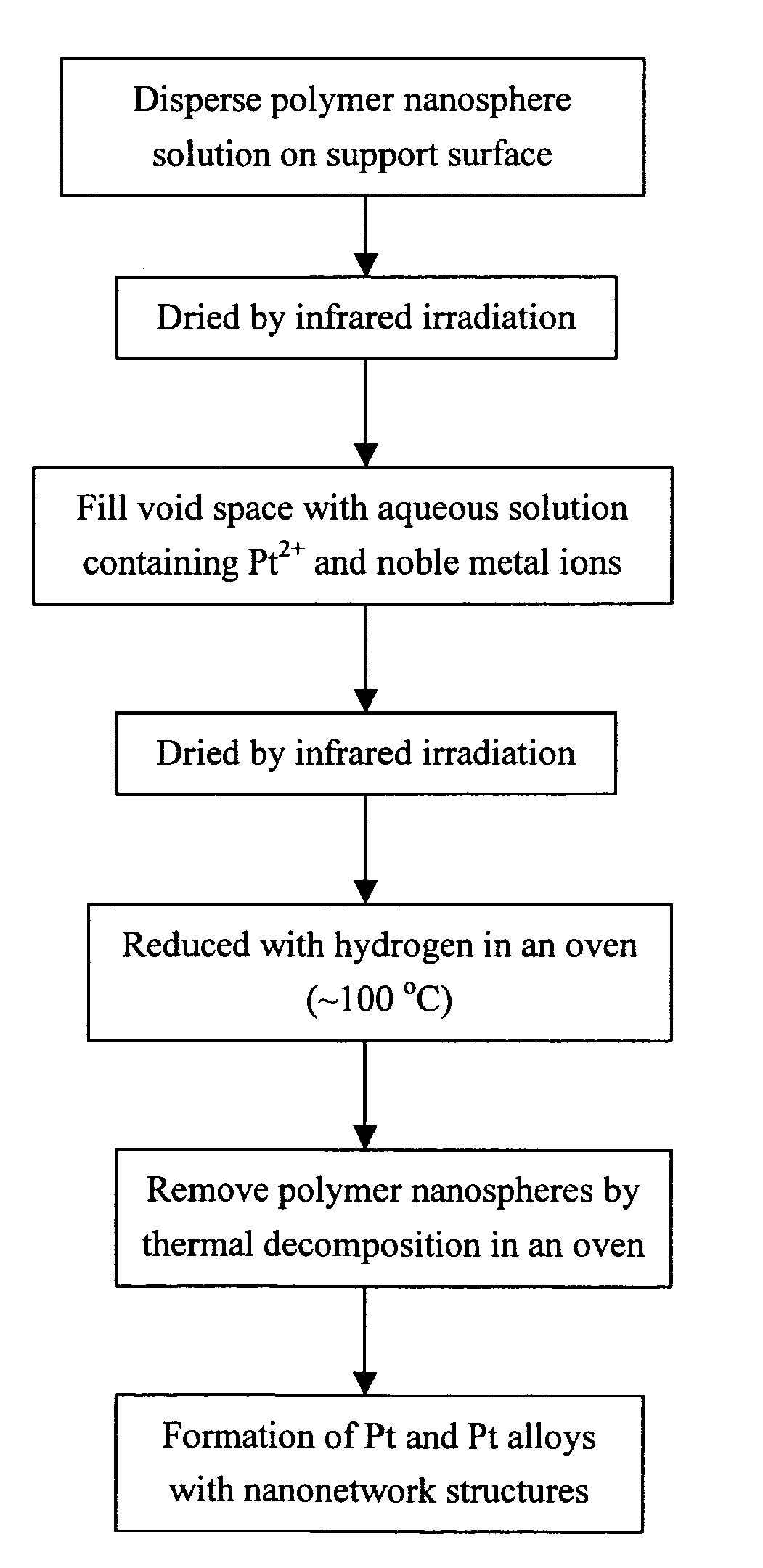
- The present invention includes methods to prepare or produce platinum and platinum alloy-based catalysts having nanonetwork structures on supports. Polystyrene nanospheres or silicon dioxide nanospheres are used as the starting or structure-directing material to form a perfectly arranged, layered structure through a self-assembly process on a support. The catalyst is then formed and filled in the void spaces of the layered structure by chemical reduction or vacuum sputtering. Removing the starting material by means of thermal decomposition or chemical dissolution, a catalyst with nanonetwork structure is obtained.
- The accompanying drawings serve to explain the principles of the invention and illustrate the embodiments of the present invention. In the drawings:
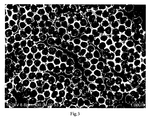
- FIG. 1 is a pictorial illustration of a platinum catalyst with nanonetwork structure prepared according to an exemplary embodiment (EXAMPLE 2) of the present invention. The staring material is SiO2 nanospheres and the support is carbon paper.
- FIG. 2 is a pictorial illustration of a platinum catalyst with nanonetwork structure prepared according to an exemplary embodiment (EXAMPLE 4) of the present invention. The staring material is PS nanospheres and the support is glass.
- FIG. 3 is a pictorial illustration of a platinum-ruthenium alloy catalyst with nanonetwork structure prepared according to an exemplary embodiment (EXAMPLE 4) of the present invention. The staring material is PS nanospheres and the support is glass.
- Self-assembly is one of the simplest ways to fabricate layered structures and, in particular, to form nano-sized structures. This process involves the interactions of several forces including van der Waals forces. Several organic polymers and inorganic materials now can be prepared into nanospheres and are commercially available. These nanomaterials can be used to form closely-packed, layered structures of one or several layers on suitable supports. For example, polystyrene nanospheres are first diluted in approximate solvents containing organics and water and applied to a smooth glass support, and then solvents are removed by evaporation. A compact, well-defined layer structure is readily formed. In addition, the void spaces of such a layered structure can be further filled with TiO2 nanospheres of smaller sizes. When the solvents are dried away and polystyrene nanospheres are burned and completely removed, a new nanonetwork structure made of TiO2 nanoparticles is formed. Such a nanonetwork structure provides a large void space and high surface areas. Obviously, if catalysts can be prepared into similar nanonetwork structures, they are expected to exhibit high catalyst stabilities and catalytic efficiencies.
- Inspired by this finding, novel methods to prepare platinum and platinum alloy-based catalysts having nanonetwork structures are developed. Thus, this invention relates to the use of nano-sized polymer, such as, polystyrene, or inorganic, such as, silicon dioxide, spheres in dilute solutions (e.g., 0.1 wt%) to form closely packed, layered structure by means of self-assembly. Appropriate supports include carbon paper, glass carbon, graphite, ceramics, glass, metals etc., having relatively smooth surfaces. In general, a monolayer or multilayer of well defined, face-centered cube (f.c.c.) lattice is formed by dispersing dilute solution of nanosphere to the support surface. The self-assembly formed compact, layered structure is heat-dried to remove solvents, in which the polystyrene or silicon spheric particles in nano-sizes are originally dispersed, resulting in a well-defined, three-dimensional nano network with some void spaces. Then, in the void spaces of such a compact arrangement, catalyst metal ions in aqueous solution are filled and reduced chemically or catalyst metals are filled. Suitable catalyst materials include platinum (Pt) and alloys of platinum with ruthenium (Ru), iridium (Ir), palladium (Pd), rhodium (Rh), and osmium (Os). When using polystyrene nanospheres as the starting material, the polymer nanoparticles are removed at a high temperature (<400 °C) and the catalyst having nanonetwork structure is obtained. In the case of using SiO2 nanospheres as the starting material, SiO2 nanoparticles are dissolved with hydrofluoric acid (HF) aqueous solution and slightly heated (<100 °C) to evaporate away leading to formation of similar nanonetwork structure. The prepared nanonetwork catalysts show robust structure, uniform hole-size, spacious voids and high catalytic surface areas. The loading of catalyst can be much lower than that obtained using carbon black powder as a support (e.g., < 0.1 mgPt/cm2). These platinum and platinum alloy-based catalysts with nano network structures can be applied to direct methanol fuel cells (DMFCs) and proton exchange membrane fuel cells (PEMFCs) as well as chemical reactors, fuel reformers, and catalytic converters.
- Method for making Pt and platinum alloy catalysts with nanonetwork structure using SiO2 nanospheres as the starting material and reduced with hydrogen gas in an oven.

- Method for making Pt and platinum alloy catalysts with nanonetwork structure using SiO2 nanospheres as the starting material and chemically reduced using chemical reducing agents, e.g., hydrazine, formaldehyde, formic acid, sodium sulfite, and sodium borohydride, etc. The resultant Pt catalyst with nanonetwork structure is shown in FIG. 1.

- Method for making Pt and platinum alloy catalysts with nanonetwork structure using SiO2 nanospheres as the starting material and fill catalyst by vacuum sputtering.

- Method for making Pt and platinum alloy catalysts with nanonetwork structure using organic polymer nanospheres as the starting material and chemically reduced using hydrogen gas. The resultant Pt catalyst with nanonetwork structure is shown in FIG. 2.
- Method for making Pt and platinum alloy catalysts with nanonetwork structure using organic polymer nanospheres as the starting material and chemically reduced using chemical reducing agents, e.g., hydrazine, formaldehyde, formic acid, sodium sulfite, and sodium borohydride, etc. The resultant Pt-Ru alloy catalyst with nanonetwork structure is shown in FIG. 3.

- Method for making Pt and platinum alloy catalysts with nanonetwork structure using organic polymer nanospheres as the as the starting material and fill catalyst by vacuum sputtering.

- U.S. Patent Documents
Claims (15)
- A method to prepare platinum and platinum alloy catalysts on supports with nanonetwork structures comprising steps:nanospheres of starting or structure-directing material are first dispersed on a support surface forming a compact, layered structure of a monolayer or a few layers through a self-assembly process, wherein the starting or structure-directing material is organic polymer nanospheres or inorganic oxide nanospheres;the platinum or platinum alloy catalyst is then formed and filled in the void spaces of the layered structure by chemical reduction from an aqueous solution containing metal ions or by vacuum ion-sputtering, andthe starting material is then removed by means of thermal decomposition or chemical dissolution and platinum or platinum alloy catalyst with a nanonetwork structure and high catalytic efficiency is obtained.
- The methods of claim 1, wherein the platinum and platinum alloy catalysts with nanonetwork structures are for uses in direct methanol fuels cells (DMFCs).
- The methods of claim 1, wherein the platinum and platinum alloy catalysts with nanonetwork structures are for uses in proton exchange membrane fuels cells (PEMFCs).
- The methods of claim 1, wherein the platinum and platinum alloy catalysts with nanonetwork structures are for uses in catalytic converters for automotive vehicles.
- The methods of claim 1, wherein the platinum and platinum alloy catalysts with nanonetwork structures are for uses in gaseous reactions of hydrogenation and dehydrogenation, and for hydrogen production through reforming of methanol, natural gas, gasoline and other hydrogen-containing fuels.
- The methods of claim 1, wherein the polymer nanospheres include polystyrene nanospheres and poly (methyl methacrylate) (PMMA) nanospheres having diameters ranging from 50 nanometers to several micrometers.
- The methods of claim 1, wherein the inorganic oxide nano spheres include silicon dioxide (SiO2) nanospheres having diameters ranging from 50 nanometers to several micrometers.
- The methods of claim 1, wherein the platinum and platinum alloy catalysts with nanonetwork structures can be monolayer or multilayer.
- The methods of claim 1, wherein metals filled in the void spaces of the layered structure include platinum (Pt) and mixtures of platinum with ruthenium (Ru), iridium (Ir), palladium (Pd), rhodium (Rh), and osmium (Os).
- The methods of claim 8, wherein metal ions filled in the void spaces of the layered structure include platinum ion and mixtures of platinum ion with one ion or several ions of ruthenium, iridium, palladium, rhodium and osmium.
- The methods of claim 10, wherein metal ions filled in the void spaces of the layered structure can be dried using infrared irradiation or other heating methods, followed by hydrogen reduction at high temperatures (< 300 °C).
- The methods of claim 10, wherein metal ions filled in the void spaces of the layered structure can be dried using infrared irradiation or other heating methods, followed by adding reducing agents including hydrazine (N2H4), formaldehyde, formic acid, sodium sulfite, sodium borohydride (NaBH4).
- The methods of claim 9, wherein metals filled in the void spaces of the layered structure can be achieved by vacuum spray and ion-sputtering methods.
- The methods of claim 1, wherein the organic polymer nanospheres used for the preparation of platinum and platinum alloy catalysts with nanonetwork structures can be removed by heating (<400 °C) with high temperature ovens and air-blowing oxidation ovens.
- The methods of claim 1, wherein the silicon dioxide nanospheres used for the preparation of platinum and platinum alloy catalysts with nanonetwork structures can be removed by adding hydrofluoric acid aqueous solution followed by slightly heating (<100 °C).
Priority Applications (1)
| Application Number | Priority Date | Filing Date | Title |
|---|---|---|---|
| EP05010974A EP1728618A1 (en) | 2005-05-20 | 2005-05-20 | Methods of making platinum and platinum alloy catalysts with nanonetwork structures |
Applications Claiming Priority (1)
| Application Number | Priority Date | Filing Date | Title |
|---|---|---|---|
| EP05010974A EP1728618A1 (en) | 2005-05-20 | 2005-05-20 | Methods of making platinum and platinum alloy catalysts with nanonetwork structures |
Publications (1)
| Publication Number | Publication Date |
|---|---|
| EP1728618A1 true EP1728618A1 (en) | 2006-12-06 |
Family
ID=35079221
Family Applications (1)
| Application Number | Title | Priority Date | Filing Date |
|---|---|---|---|
| EP05010974A Ceased EP1728618A1 (en) | 2005-05-20 | 2005-05-20 | Methods of making platinum and platinum alloy catalysts with nanonetwork structures |
Country Status (1)
| Country | Link |
|---|---|
| EP (1) | EP1728618A1 (en) |
Cited By (5)
| Publication number | Priority date | Publication date | Assignee | Title |
|---|---|---|---|---|
| EP1961481A2 (en) | 2007-02-09 | 2008-08-27 | Nissan Motor Company, Ltd. | Catalytic converter and manufacturing method thereof |
| US7700520B2 (en) * | 2005-04-22 | 2010-04-20 | Institute Of Nuclear Energy Research | Methods of making platinum and platinum alloy catalysts with nanonetwork structures |
| WO2010123896A3 (en) * | 2009-04-21 | 2011-03-24 | Washington University | Palladium-platinum nanostructures and methods for their preparation |
| EP2276691A4 (en) * | 2008-05-05 | 2013-08-28 | Jncasr Bangalore | METAL NANOPEPONENT WITHOUT TEMPLES AND WITHOUT POLYMER, AND METHOD FOR PRODUCING THE SAME |
| CN114849605A (en) * | 2022-06-02 | 2022-08-05 | 浙江理工大学 | A kind of thorn-shaped porous microsphere and its synthesis method |
Citations (4)
| Publication number | Priority date | Publication date | Assignee | Title |
|---|---|---|---|---|
| US3486928A (en) * | 1965-10-21 | 1969-12-30 | Int Nickel Co | Bath and process for platinum and platinum alloys |
| EP0838872A2 (en) * | 1996-10-25 | 1998-04-29 | Johnson Matthey Public Limited Company | Improved catalyst |
| US6680013B1 (en) * | 1999-04-15 | 2004-01-20 | Regents Of The University Of Minnesota | Synthesis of macroporous structures |
| US20040127012A1 (en) * | 2002-12-31 | 2004-07-01 | Sungho Jin | Method for fabricating spaced-apart nanostructures |
-
2005
- 2005-05-20 EP EP05010974A patent/EP1728618A1/en not_active Ceased
Patent Citations (4)
| Publication number | Priority date | Publication date | Assignee | Title |
|---|---|---|---|---|
| US3486928A (en) * | 1965-10-21 | 1969-12-30 | Int Nickel Co | Bath and process for platinum and platinum alloys |
| EP0838872A2 (en) * | 1996-10-25 | 1998-04-29 | Johnson Matthey Public Limited Company | Improved catalyst |
| US6680013B1 (en) * | 1999-04-15 | 2004-01-20 | Regents Of The University Of Minnesota | Synthesis of macroporous structures |
| US20040127012A1 (en) * | 2002-12-31 | 2004-07-01 | Sungho Jin | Method for fabricating spaced-apart nanostructures |
Non-Patent Citations (3)
| Title |
|---|
| A. STEIN ET AL.: "A Chemical Synthesis of Periodic Macroporous NiO and Metallic Ni", ADVANCED MATERIALS, vol. 11, no. 12, 1999, Weinheim, pages 1003-1006, XP002350697 * |
| STEIN A: "Sphere templating methods for periodic porous solids", 6 April 2001, MICROPOROUS AND MESOPOROUS MATERIALS, ELSEVIER SCIENCE PUBLISHING, NEW YORK, US, PAGE(S) 227-239, ISSN: 1387-1811, XP004247153 * |
| V, COLVIN ET AL.: "Preparation of Macroporous Metal Films from Colloidal Crystals", JOURNAL OF THE AMERICAN CHEMICAL SOCIETY, vol. 121, 1999, pages 7957 - 7958, XP002350698 * |
Cited By (8)
| Publication number | Priority date | Publication date | Assignee | Title |
|---|---|---|---|---|
| US7700520B2 (en) * | 2005-04-22 | 2010-04-20 | Institute Of Nuclear Energy Research | Methods of making platinum and platinum alloy catalysts with nanonetwork structures |
| EP1961481A2 (en) | 2007-02-09 | 2008-08-27 | Nissan Motor Company, Ltd. | Catalytic converter and manufacturing method thereof |
| EP1961481A3 (en) * | 2007-02-09 | 2008-10-22 | Nissan Motor Company, Ltd. | Catalytic converter and manufacturing method thereof |
| US8158195B2 (en) | 2007-02-09 | 2012-04-17 | Nissan Motor Co., Ltd. | Catalytic converter and manufacturing method thereof |
| EP2276691A4 (en) * | 2008-05-05 | 2013-08-28 | Jncasr Bangalore | METAL NANOPEPONENT WITHOUT TEMPLES AND WITHOUT POLYMER, AND METHOD FOR PRODUCING THE SAME |
| WO2010123896A3 (en) * | 2009-04-21 | 2011-03-24 | Washington University | Palladium-platinum nanostructures and methods for their preparation |
| CN114849605A (en) * | 2022-06-02 | 2022-08-05 | 浙江理工大学 | A kind of thorn-shaped porous microsphere and its synthesis method |
| CN114849605B (en) * | 2022-06-02 | 2023-02-14 | 浙江理工大学 | Thorn-shaped porous microsphere and synthesis method thereof |
Similar Documents
| Publication | Publication Date | Title |
|---|---|---|
| Peera et al. | Carbon nanofibers as potential catalyst support for fuel cell cathodes: A review | |
| Seselj et al. | Catalyst development for high‐temperature polymer electrolyte membrane fuel cell (HT‐PEMFC) applications | |
| Tong et al. | Metal‐based electrocatalysts for methanol electro‐oxidation: progress, opportunities, and challenges | |
| Wang et al. | Porous Pd‐PdO nanotubes for methanol electrooxidation | |
| Cai et al. | Promoting electrocatalysis upon aerogels | |
| Luo et al. | Ultrafine Core@ Shell Cu1Au1@ Cu1Pd3 nanodots synergized with 3D porous N-doped graphene nanosheets as a high-performance multifunctional electrocatalyst | |
| CN107959030B (en) | Nanostructured PEMFC electrodes | |
| US9214680B2 (en) | Platinum and platinum based alloy nanotubes as electrocatalysts for fuel cells | |
| Xue et al. | Au nanowires@ Pd-polyethylenimine nanohybrids as highly active and methanol-tolerant electrocatalysts toward oxygen reduction reaction in alkaline media | |
| Liu et al. | Probing ultrathin one-dimensional Pd–Ni nanostructures as oxygen reduction reaction catalysts | |
| Wang et al. | Carbon-supported Pt-based alloy electrocatalysts for the oxygen reduction reaction in polymer electrolyte membrane fuel cells: particle size, shape, and composition manipulation and their impact to activity | |
| KR100544886B1 (en) | Electrocatalyst for Fuel Cell and Manufacturing Method of Electrocatalyst Supported by HMC Carbon Capsule Structure | |
| Bhaskaran et al. | Recent advances in electrocatalysts, mechanism, and cell architecture for direct formic acid fuel cells | |
| Fu et al. | Enhanced electrocatalytic activities of PtCuCoNi three-dimensional nanoporous quaternary alloys for oxygen reduction and methanol oxidation reactions | |
| Lee et al. | Lens-shaped carbon particles with perpendicularly-oriented channels for high-performance proton exchange membrane fuel cells | |
| Cai et al. | PtCo3 nanoparticle-encapsulated carbon nanotubes as active catalysts for methanol fuel cell anodes | |
| US7700520B2 (en) | Methods of making platinum and platinum alloy catalysts with nanonetwork structures | |
| Deng et al. | Trimetallic Au@ PtPd mesoporous nanorods as efficient electrocatalysts for the oxygen reduction reaction | |
| Cheng et al. | High-entropy alloy PtCuNiCoMn nanoparticles on rGO for electrooxidation of methanol and formic acid | |
| Yang et al. | Designed formation of hollow Pt nanocrystals supported on MoO x-modified carbon for high-performance methanol electro-oxidation | |
| Chen et al. | Pd monolayer on the 3D-hollow-porous Au microsphere as an advanced electrocatalyst for the ethanol oxidation reaction | |
| Guo et al. | Ultrathin Pd‐based perforated nanosheets for fuel cells electrocatalysis | |
| Qin et al. | Ternary CuZnPd Nanoalloys Achieving the Synergy of an Electronic Interaction and Bifunctional Catalysis for Efficient Ethanol Electrooxidation | |
| EP1728618A1 (en) | Methods of making platinum and platinum alloy catalysts with nanonetwork structures | |
| Ghosh et al. | Recent Advances in Nanostructured Electrocatalysts for Low‐temperature Direct Alcohol Fuel Cells |
Legal Events
| Date | Code | Title | Description |
|---|---|---|---|
| PUAI | Public reference made under article 153(3) epc to a published international application that has entered the european phase |
Free format text: ORIGINAL CODE: 0009012 |
|
| 17P | Request for examination filed |
Effective date: 20060328 |
|
| AK | Designated contracting states |
Kind code of ref document: A1 Designated state(s): AT BE BG CH CY CZ DE DK EE ES FI FR GB GR HU IE IS IT LI LT LU MC NL PL PT RO SE SI SK TR |
|
| AX | Request for extension of the european patent |
Extension state: AL BA HR LV MK YU |
|
| AKX | Designation fees paid |
Designated state(s): CH DE FR GB LI |
|
| 17Q | First examination report despatched |
Effective date: 20140401 |
|
| STAA | Information on the status of an ep patent application or granted ep patent |
Free format text: STATUS: THE APPLICATION HAS BEEN REFUSED |
|
| 18R | Application refused |
Effective date: 20161118 |