EP1728565A2 - A device for washing containers and method therefor - Google Patents
A device for washing containers and method therefor Download PDFInfo
- Publication number
- EP1728565A2 EP1728565A2 EP20050014445 EP05014445A EP1728565A2 EP 1728565 A2 EP1728565 A2 EP 1728565A2 EP 20050014445 EP20050014445 EP 20050014445 EP 05014445 A EP05014445 A EP 05014445A EP 1728565 A2 EP1728565 A2 EP 1728565A2
- Authority
- EP
- European Patent Office
- Prior art keywords
- washing
- conduit
- washing liquid
- rotating body
- containers
- Prior art date
- Legal status (The legal status is an assumption and is not a legal conclusion. Google has not performed a legal analysis and makes no representation as to the accuracy of the status listed.)
- Withdrawn
Links
Images
Classifications
-
- B—PERFORMING OPERATIONS; TRANSPORTING
- B08—CLEANING
- B08B—CLEANING IN GENERAL; PREVENTION OF FOULING IN GENERAL
- B08B9/00—Cleaning hollow articles by methods or apparatus specially adapted thereto
- B08B9/08—Cleaning containers, e.g. tanks
- B08B9/20—Cleaning containers, e.g. tanks by using apparatus into or on to which containers, e.g. bottles, jars, cans are brought
- B08B9/28—Cleaning containers, e.g. tanks by using apparatus into or on to which containers, e.g. bottles, jars, cans are brought the apparatus cleaning by splash, spray, or jet application, with or without soaking
- B08B9/34—Arrangements of conduits or nozzles
Definitions
- the present invention relates to a device for washing containers, of the type containing a conduit for the passage of a washing liquid, a rotating body defining a plurality of nozzles, to inject the washing liquid into the containers, and means for connecting the rotating body to the conduit.
- the present invention further relates to a method for washing containers, in a continuous industrial process, by means of a washing device defining a passage for a washing liquid and a plurality of nozzles.
- the present invention finds application within industrial processes and devices for washing containers, in particular containers, such as bottles or jugs, used for bottling mineral waters or other alimentary products, but also vials, test tubes or other containers used in the pharmaceutical industry.
- containers such as bottles or jugs, used for bottling mineral waters or other alimentary products, but also vials, test tubes or other containers used in the pharmaceutical industry.
- the main risk is constituted by the fact that the liquids used for washing / rinsing the containers may be subject to contamination as they pass inside the washing device. In this case, every effort to use originally safe products, from the health viewpoint, for washing / rinsing, would be in vain.
- washing devices offer substantially no assurance with regard to the contamination of washing / rinsing liquids, as they pass inside the devices themselves.
- Said washing devices comprise a conduit in which is conveyed the washing liquid, which is then injected into the containers to be washed by means of a plurality of nozzles.
- rotating nozzles are used, to increase the effectiveness of the washing operation and to allow the nozzle to clean itself.
- conduits with square (or rectangular) cross section, to facilitate the coupling of the nozzles to the conduits, as described for example in the patent document DE2402630 .
- conduits when they include mutually welded different parts, internally have high porosity, as a result of the welds made on the outer part of the conduit.
- said washing devices necessarily define a plurality of dead points, corners and fissures, within the path travelled by the washing liquid, i.e. on the inner surface of the device that comes in contact with the washing liquid. Consequently, the contamination of the device, and hence of the washing liquid and, ultimately, of the container, is facilitated.
- the liquid present inside the device does not flow out completely, but remains partially trapped in the interstices present inside the device, along the inner surface in contact with the washing liquid, thereby promoting the development of bacterial cultures, especially during prolonged idle periods (e.g. at weekends).
- washing devices cannot be sterilised, since they comprise said dead spots in which bacterial cultures tend to nest, making it useless to employ fluids with chemical additives or at high temperature (e.g. about 160°C) to sterilise the conduit.
- washing devices derive evident advantages from the use of rotating jets, do not assure adequate safety in terms of hygiene, especially when the liquids used for washing do not include disinfecting additives.
- An object of the present invention is to eliminate the aforesaid drawbacks and to make available a device for washing glass containers, which is reliable and safe from the sanitary viewpoint, whilst maintaining the advantages associated to rotating jets.
- a further object of the present invention is to make available a method for washing containers, which is particularly safe and reliable from the hygiene viewpoint, hampering the contamination of the washing liquid.
- the reference number 1 designates a device for washing containers 2 according to the present invention.
- Said device 1 is applied in particular to containers 2 made of glass or plastic material, e.g. polycarbonate or PET.
- the device 1 in turn, is part of a washing apparatus which comprises means for handling the containers, according to the prior art.
- the device 1 comprises a conduit 3 for the passage of a liquid for washing / rinsing the containers 2.
- the conduit 3 originally has circular cross section, in order to avoid the presence of corners along an inner surface of the conduit in contact with the washing liquid.
- the conduit 3 is fastened to a known frame, comprised in said washing apparatus.
- the reference number 4 designates a cam, connected to said washing apparatus in such a way as to rotate, actuated by the motion of the containers 2, according to the prior art.
- the reference number 5 designates a rotating body integral with said cam 4.
- Said rotating body 5, in a preferred but not exclusive embodiment, consists of a radially holed cylinder.
- the rotating body 5 defines a plurality of nozzles 6, through which the washing liquid is injected into the containers 2.
- Each nozzle 6 consists of a through hole defined by the rotating body 5, having an inlet and an outlet; said hole having two flares, one at the inlet and one at the outlet.
- This configuration of the rotating body 5 and of the nozzles 6 allows the nozzles 6 to clean themselves during the washing operation, according to a substantially known technique.
- the conduit 3 is preferably made of 316L steel.
- the conduit 3 essentially constitutes a manifold, fed with the washing liquid so that the washing liquid is inside the conduit 3 at a certain pressure and it is distributed to the nozzles 6.
- the conduit 3 is connected to the rotating body 5 and hence to the nozzles 6 by means of junction elements 7.
- the device 1 comprises as many junction elements 7 as there are nozzles 6.
- the device 1 comprises two junction elements 7.
- Each junction element 7 internally defines a passage for the washing liquid; said passage has a smooth, polished surface.
- Each junction element 7 has a lateral surface, a surface for contact with the conduit 3 and a surface for sliding contact with the cylindrical body 5.
- each junction element 7 is so shaped that said sliding contact surface completely adheres to the outer surface of the rotating body 5.
- Each junction element 7 is fastened to the conduit 3 in such a way as to define therewith a passage, through which the washing fluid flows, having a rounded / polished surface, hence free of edges or dead spots.
- Each junction element 7 comprises a first portion 7a fastened to a second portion 7b.
- the first portion 7a of each junction element 7 is welded and joined to the conduit 3.
- said first portion 7a substantially consists of a conduit with circular cross section of the type in 3, preferably made of 316L steel.
- a second portion 7b of each junction element 7 consists of a body internally defining a passage having circular cross section.
- Said second portion 7b is made of a substantially elastic material, such as a fluoridated polymer for food products (PVDF).
- PVDF fluoridated polymer for food products
- said second portion 7b is made of Teflon.
- Said second portion 7b has a surface in sliding contact with the rotating body 5.
- the fastening of the first portion 7a to the second portion 7b of each junction element 7 comprises, in the illustrated embodiment, a contact surface, external to a surface in contact with the washing liquid, so shaped as to achieve a fluid tight set-in joint.
- the device 1 comprises anchoring means, active on the lateral surface of each junction element 7 to fasten the first portion 7a to the second portion 7b, said anchoring means not interfering with the passage of the washing liquid.
- the rotating body 5 is made to rotate by known actuating means, not shown in the figures.
- the rotating body 5 is pressed against the junction elements 7 by means of at least one blocking element 8, in such a way as to obtain a pressure at said sliding contact surface.
- the rotating body 5 achieves a seal, enabling or disabling the exit of the washing liquid through a given nozzle 6, depending on the angle of rotation of the rotating body 5 relative to the junction element 7 corresponding to that nozzle.
- the rotating body 5 is in a position that allows the exit of the washing liquid, whilst in Figure 3 said exit is inhibited.
- said seal is originally facilitated by the fact that the second portion 7b of the junction elements is made of a material that has a certain elasticity.
- the blocking element 8 in a preferred but not exclusive embodiment, has a first end fastened to a portion of the outer surface of the conduit 3 and a second end whereto is rotatably associated the rotating body 5.
- the blocking element 8 acts on the rotating body 5 in such a way as to press it against the junction elements 7, in order to establish a certain pressure on said sliding contact surfaces.
- the conduit 3 is internally polished, along its entire inner surface in contact with the washing liquid.
- the conduit 3 is welded to the junction elements 7, in particular to the first portion 7a of each junction element 7.
- Said welds are both external welds and internal welds, made using inert gas, and with tapered junction surfaces.
- the inner surface defined by the conduit 3 and by the junction elements 7 is free of porosities and rounded / polished in each of its portions. Therefore, the device 1 globally defines a passage for the washing liquid that is free of dead spots, edges or gaps.
- the washing device 1 defines a passage for the washing liquid, comprising the conduit 3 and the through holes of the junction elements 7, which originally has a smooth and rounded / polished surface in each of its portions.
- the washing liquid present inside the device 1 during the washing of the containers 2, flows out completely from said passage at the end of the washing, without residues of washing liquid in the device. Said outflow occurs through an opening, not shown, obtained at the base of the conduit 3.
- the device 1 is originally free of threaded members, rubber gaskets, dead spots, fissures or porous surfaces, which would promote the contamination of the device because of the formation of bacterial colonies, promoted by the stagnation of portions of washing / rinsing liquid inside the device.
- the washing device of the present invention is originally capable of being sterilised, by circulating a disinfecting or high temperature fluid, since the inner surface to be sterilised is built with suitable materials.
- the washing device of the present invention originally allows to spray any washing liquid into containers 2 through rotating nozzles 6, without said washing liquid being contaminated when passing inside the device 1.
- the present invention also makes available a method for washing containers, in a continuous industrial process, by means of a washing device 1 defining a passage for a washing liquid. Said method comprises the following steps:
- Said method further comprises a preliminary step of sterilising said passage, together with the through holes of the junction elements 7 and with the nozzles 6, by circulating a fluid at high temperature or chemical steriliser.
- the method of the present invention originally allows to wash or rinse containers 2 with any liquid, even without disinfecting additives, sprayed into the containers 3 through rotating nozzles 6, avoiding the contamination of the device and of the washing / rinsing liquid.
Landscapes
- Engineering & Computer Science (AREA)
- Mechanical Engineering (AREA)
- Filling Of Jars Or Cans And Processes For Cleaning And Sealing Jars (AREA)
- Cleaning By Liquid Or Steam (AREA)
Abstract
A device (1) for washing containers (2) comprises a conduit (3), with circular cross section and internally smooth and bevelled / polished, for the passage of a washing liquid, a rotating body (5) defining nozzles (6), for injecting the washing liquid into the containers (2), junction elements (7), defining passages with smooth surface, fastened to the conduit (3) and in sliding contact with the rotating body (5), and a blocking element (8) applied externally to said passage (3) to determine a pressure in said sliding contact surface between the junction elements (7) and the rotating body (5). Said device has an inner surface, operatively in contact with the washing liquid, that is smooth and rounded / polished in each of its parts and able to be sterilised with a fluid at high temperature. A method for washing containers, in a continuous industrial process.
Description
- The present invention relates to a device for washing containers, of the type containing a conduit for the passage of a washing liquid, a rotating body defining a plurality of nozzles, to inject the washing liquid into the containers, and means for connecting the rotating body to the conduit.
- The present invention further relates to a method for washing containers, in a continuous industrial process, by means of a washing device defining a passage for a washing liquid and a plurality of nozzles.
- The present invention finds application within industrial processes and devices for washing containers, in particular containers, such as bottles or jugs, used for bottling mineral waters or other alimentary products, but also vials, test tubes or other containers used in the pharmaceutical industry.
- In this field, there is a need to reach high levels of hygiene, to avoid using contaminated / polluted containers. In this light, there is an interest in making the washing devices ever safer from the bacteriological viewpoint. Specifically, a particularly delicate step of the washing process is the final rinsing of the container. With regard, in particular, to rinsing containers for mineral water, use of the product itself is known, i.e. mineral water of the type with which the containers are filled, in order not to alter the characteristics of the final bottled product. However, the use of washing / rinsing liquid that do not include disinfecting additives provides a safety problem from the hygienic viewpoint.
- In this context, the main risk is constituted by the fact that the liquids used for washing / rinsing the containers may be subject to contamination as they pass inside the washing device. In this case, every effort to use originally safe products, from the health viewpoint, for washing / rinsing, would be in vain.
- It should be noted that specific standard exist, such as the UNI EN 1672-2 standard, with respect to bacteriological / sanitary safety of devices having parts in contact with food products, i.e. filling machines.
- On the contrary, no similar standards exist in the sector of washing devices. In effect, known washing devices offer substantially no assurance with regard to the contamination of washing / rinsing liquids, as they pass inside the devices themselves.
- Said washing devices comprise a conduit in which is conveyed the washing liquid, which is then injected into the containers to be washed by means of a plurality of nozzles. In particular, rotating nozzles are used, to increase the effectiveness of the washing operation and to allow the nozzle to clean itself.
- To connect the conduit to the nozzles, sealing members and rubber gaskets are used, together with members coupled by means of threads. Moreover, known washing devices use conduits with square (or rectangular) cross section, to facilitate the coupling of the nozzles to the conduits, as described for example in the patent document
DE2402630 . It should also be noted that such conduits, when they include mutually welded different parts, internally have high porosity, as a result of the welds made on the outer part of the conduit. - Therefore, said washing devices necessarily define a plurality of dead points, corners and fissures, within the path travelled by the washing liquid, i.e. on the inner surface of the device that comes in contact with the washing liquid. Consequently, the contamination of the device, and hence of the washing liquid and, ultimately, of the container, is facilitated. At the end of the washing operation, the liquid present inside the device does not flow out completely, but remains partially trapped in the interstices present inside the device, along the inner surface in contact with the washing liquid, thereby promoting the development of bacterial cultures, especially during prolonged idle periods (e.g. at weekends).
- It should also be observed that known washing devices cannot be sterilised, since they comprise said dead spots in which bacterial cultures tend to nest, making it useless to employ fluids with chemical additives or at high temperature (e.g. about 160°C) to sterilise the conduit.
- Therefore, although washing devices derive evident advantages from the use of rotating jets, do not assure adequate safety in terms of hygiene, especially when the liquids used for washing do not include disinfecting additives.
- An object of the present invention is to eliminate the aforesaid drawbacks and to make available a device for washing glass containers, which is reliable and safe from the sanitary viewpoint, whilst maintaining the advantages associated to rotating jets.
- Said aims are fully achieved by the device of the present invention, which is characterised by the contents of the appended claims and in particular in that said connecting means comprise a plurality of junction elements fastened to the conduit without gaskets or interstices, defining therewith a passage with smooth / polished surface for the washing liquid.
- A further object of the present invention is to make available a method for washing containers, which is particularly safe and reliable from the hygiene viewpoint, hampering the contamination of the washing liquid.
- Said object is fully achieved by the method of the present invention, which is characterised by the contents of the claims set out below and in particular in that it comprises the following steps:
- feeding the device with a washing liquid, in order to inject said liquid into the containers to be cleaned through said rotating nozzles;
- complete outflow of the washing liquid from said passage, at the end of the washing operation, without residues of washing liquid in the device.
- This and other characteristics shall become more readily apparent from the following description of a preferred embodiment, illustrated purely by way of non limiting example in the accompanying drawing tables, in which:
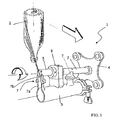
- Figure 1 is a perspective section view of a washing device according to the present invention;
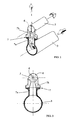
- Figure 2 shows an enlargement of a detail of Figure 1, with the nozzle open during the washing phase;
- Figure 3 shows a section view of the device of Figure 1, with the nozzle closed.
- In Figure 1, the
reference number 1 designates a device forwashing containers 2 according to the present invention. Saiddevice 1 is applied in particular tocontainers 2 made of glass or plastic material, e.g. polycarbonate or PET. Note that thedevice 1, in turn, is part of a washing apparatus which comprises means for handling the containers, according to the prior art. Thedevice 1 comprises aconduit 3 for the passage of a liquid for washing / rinsing thecontainers 2. Theconduit 3 originally has circular cross section, in order to avoid the presence of corners along an inner surface of the conduit in contact with the washing liquid. - The
conduit 3 is fastened to a known frame, comprised in said washing apparatus. Thereference number 4 designates a cam, connected to said washing apparatus in such a way as to rotate, actuated by the motion of thecontainers 2, according to the prior art. Thereference number 5 designates a rotating body integral with saidcam 4. Said rotatingbody 5, in a preferred but not exclusive embodiment, consists of a radially holed cylinder. The rotatingbody 5 defines a plurality ofnozzles 6, through which the washing liquid is injected into thecontainers 2. Eachnozzle 6 consists of a through hole defined by therotating body 5, having an inlet and an outlet; said hole having two flares, one at the inlet and one at the outlet. - This configuration of the
rotating body 5 and of thenozzles 6 allows thenozzles 6 to clean themselves during the washing operation, according to a substantially known technique. - The
conduit 3 is preferably made of 316L steel. Theconduit 3 essentially constitutes a manifold, fed with the washing liquid so that the washing liquid is inside theconduit 3 at a certain pressure and it is distributed to thenozzles 6. - The
conduit 3 is connected to the rotatingbody 5 and hence to thenozzles 6 by means ofjunction elements 7. Thedevice 1 comprises asmany junction elements 7 as there arenozzles 6. In the illustrated embodiment, thedevice 1 comprises twojunction elements 7. Eachjunction element 7 internally defines a passage for the washing liquid; said passage has a smooth, polished surface. Eachjunction element 7 has a lateral surface, a surface for contact with theconduit 3 and a surface for sliding contact with thecylindrical body 5. In particular, eachjunction element 7 is so shaped that said sliding contact surface completely adheres to the outer surface of the rotatingbody 5. Eachjunction element 7 is fastened to theconduit 3 in such a way as to define therewith a passage, through which the washing fluid flows, having a rounded / polished surface, hence free of edges or dead spots. - Each
junction element 7 comprises afirst portion 7a fastened to asecond portion 7b. Thefirst portion 7a of eachjunction element 7 is welded and joined to theconduit 3. In a preferred embodiment, saidfirst portion 7a substantially consists of a conduit with circular cross section of the type in 3, preferably made of 316L steel. Asecond portion 7b of eachjunction element 7 consists of a body internally defining a passage having circular cross section. Saidsecond portion 7b is made of a substantially elastic material, such as a fluoridated polymer for food products (PVDF). In a preferred embodiment, saidsecond portion 7b is made of Teflon. Saidsecond portion 7b has a surface in sliding contact with the rotatingbody 5. - The fastening of the
first portion 7a to thesecond portion 7b of eachjunction element 7 comprises, in the illustrated embodiment, a contact surface, external to a surface in contact with the washing liquid, so shaped as to achieve a fluid tight set-in joint. In a different embodiment, thedevice 1 comprises anchoring means, active on the lateral surface of eachjunction element 7 to fasten thefirst portion 7a to thesecond portion 7b, said anchoring means not interfering with the passage of the washing liquid. - The rotating
body 5 is made to rotate by known actuating means, not shown in the figures. The rotatingbody 5 is pressed against thejunction elements 7 by means of at least one blocking element 8, in such a way as to obtain a pressure at said sliding contact surface. In this way, therotating body 5 achieves a seal, enabling or disabling the exit of the washing liquid through a givennozzle 6, depending on the angle of rotation of therotating body 5 relative to thejunction element 7 corresponding to that nozzle. For example, in Figures 1 and 2 therotating body 5 is in a position that allows the exit of the washing liquid, whilst in Figure 3 said exit is inhibited. Note that said seal is originally facilitated by the fact that thesecond portion 7b of the junction elements is made of a material that has a certain elasticity. - The blocking element 8, in a preferred but not exclusive embodiment, has a first end fastened to a portion of the outer surface of the
conduit 3 and a second end whereto is rotatably associated therotating body 5. In particular, the blocking element 8 acts on therotating body 5 in such a way as to press it against thejunction elements 7, in order to establish a certain pressure on said sliding contact surfaces. - The
conduit 3 is internally polished, along its entire inner surface in contact with the washing liquid. In the illustrated embodiment, theconduit 3 is welded to thejunction elements 7, in particular to thefirst portion 7a of eachjunction element 7. Said welds are both external welds and internal welds, made using inert gas, and with tapered junction surfaces. In this way, the inner surface defined by theconduit 3 and by thejunction elements 7 is free of porosities and rounded / polished in each of its portions. Therefore, thedevice 1 globally defines a passage for the washing liquid that is free of dead spots, edges or gaps. - Therefore, the
washing device 1 defines a passage for the washing liquid, comprising theconduit 3 and the through holes of thejunction elements 7, which originally has a smooth and rounded / polished surface in each of its portions. In this way, the washing liquid, present inside thedevice 1 during the washing of thecontainers 2, flows out completely from said passage at the end of the washing, without residues of washing liquid in the device. Said outflow occurs through an opening, not shown, obtained at the base of theconduit 3. - The
device 1 is originally free of threaded members, rubber gaskets, dead spots, fissures or porous surfaces, which would promote the contamination of the device because of the formation of bacterial colonies, promoted by the stagnation of portions of washing / rinsing liquid inside the device. - Moreover, the washing device of the present invention is originally capable of being sterilised, by circulating a disinfecting or high temperature fluid, since the inner surface to be sterilised is built with suitable materials.
- Hence, the washing device of the present invention originally allows to spray any washing liquid into
containers 2 throughrotating nozzles 6, without said washing liquid being contaminated when passing inside thedevice 1. - The present invention also makes available a method for washing containers, in a continuous industrial process, by means of a
washing device 1 defining a passage for a washing liquid. Said method comprises the following steps: - feeding the device with the washing liquid, in order to inject said liquid into the containers (2) to be cleaned through said rotating nozzles (6);
- complete outflow of the washing liquid from said passage, at the end of the washing operation, without residues of washing liquid in the device.
- Said method further comprises a preliminary step of sterilising said passage, together with the through holes of the
junction elements 7 and with thenozzles 6, by circulating a fluid at high temperature or chemical steriliser. - The method of the present invention originally allows to wash or rinse
containers 2 with any liquid, even without disinfecting additives, sprayed into thecontainers 3 throughrotating nozzles 6, avoiding the contamination of the device and of the washing / rinsing liquid.
Claims (15)
- A device (1) for washing containers (2), comprising:- a conduit (3) for the passage of a washing liquid;- a rotating body (5) defining a plurality of nozzles (6), to inject the washing liquid into the containers (2);- means for connecting the rotating body to the conduit in sliding contact with the rotating body (5),characterised in that said connecting means comprise a plurality of junction element (7) fastened to the conduit (3) without gaskets or gaps, defining therewith a passage with smooth / polished surface for the washing liquid.
- Device as claimed in claim 1, wherein each junction element (7) comprises a first portion (7a) that is welded and joined to the conduit (3) and a second portion (7b) that is fastened to the first portion (7a) and defines a surface in sliding contact with the rotating body (5).
- Device as claimed in claim 2, characterised in that it comprises internal welds between said first portions (7a) of the junction elements and the conduit (3).
- Device as claimed in claim 2 or 3, characterised in that said second portions (7b) of the junction elements are made of a fluoridated polymer for food products.
- Device as claimed in any of the claims from 2 through 4, characterised in that it comprises anchoring means applied to an outer surface of each junction element (7) to fasten said first portion (7a) to said second portion (7b).
- Device as claimed in any of the claims from 2 through 4, characterised in that said first portion (7a) is fastened to said second portion (7b) by sealed set-in junction, along an outer contact surface and a surface in contact with the washing liquid.
- Device as claimed in any of the previous, characterised in that each portion of its inner surface operatively in contact with the washing liquid is smooth and rounded / polished.
- Device as claimed in claim 7, characterised in that each portion of said inner surface is able to be sterilised by circulation of a high temperature fluid.
- Device as claimed in any of the previous claims, characterised in that said passage defined by the conduit (3) and by the junction elements (7) has circular cross section.
- Device as claimed in any of the previous claims, wherein the conduit (3) has circular cross section and it is internally polished.
- Device as claimed in any of the previous claims, wherein said at least one nozzle (6) is of the self-cleaning type.
- Device as claimed in any of the previous claims, characterised in that it comprises at least one blocking element (8) applied externally to said conduit (3) to determine a pressure in a contact surface between said at least one junction element (7) and the rotating body (5).
- Device as claimed in claim 12, characterised in that said at least one blocking element (8) has a first end fastened to an external portion of the conduit (3) and a second end operatively active on the rotating body (5) or a support thereof.
- A method for washing containers, in a continuous industrial process, by means of a washing device defining a passage for a washing liquid and a plurality of rotating nozzles (6),
characterised in that it comprises the following steps:- feeding the device with the washing liquid, in order to inject said liquid into the containers (2) to be cleaned through said rotating nozzles (6);- complete outflow of the washing liquid from said passage, at the end of the washing operation, without residues of washing liquid in the device. - Method as claimed in claim 14, characterised in that it comprises a preliminary step of sterilising said passage, by circulating a fluid at high temperature or with chemical additives.
Applications Claiming Priority (1)
| Application Number | Priority Date | Filing Date | Title |
|---|---|---|---|
| ITPR20050025 ITPR20050025A1 (en) | 2005-05-31 | 2005-05-31 | CONTAINER WASHING DEVICE AND PROCEDURE. |
Publications (1)
| Publication Number | Publication Date |
|---|---|
| EP1728565A2 true EP1728565A2 (en) | 2006-12-06 |
Family
ID=36888660
Family Applications (1)
| Application Number | Title | Priority Date | Filing Date |
|---|---|---|---|
| EP20050014445 Withdrawn EP1728565A2 (en) | 2005-05-31 | 2005-07-04 | A device for washing containers and method therefor |
Country Status (2)
| Country | Link |
|---|---|
| EP (1) | EP1728565A2 (en) |
| IT (1) | ITPR20050025A1 (en) |
Cited By (4)
| Publication number | Priority date | Publication date | Assignee | Title |
|---|---|---|---|---|
| EP2289640A1 (en) * | 2009-09-01 | 2011-03-02 | Krones AG | Spraying device |
| EP2724793A1 (en) | 2012-10-24 | 2014-04-30 | Sidel S.p.A. Con Socio Unico | Spraying device |
| EP3124128A1 (en) | 2015-07-30 | 2017-02-01 | Gebo Packaging Solutions Italy SRL | Sprinkling device and corresponding washing unit |
| WO2019048142A1 (en) | 2017-09-09 | 2019-03-14 | Krones Ag | DEVICE AND METHOD FOR CLEANING BOTTLES |
Citations (1)
| Publication number | Priority date | Publication date | Assignee | Title |
|---|---|---|---|---|
| DE2402630A1 (en) | 1974-01-21 | 1975-07-24 | Orthmann & Herbst | Spray tube for bottle washing plant - perforated rod under jet holes rotates to reverse flow for cleaning |
-
2005
- 2005-05-31 IT ITPR20050025 patent/ITPR20050025A1/en unknown
- 2005-07-04 EP EP20050014445 patent/EP1728565A2/en not_active Withdrawn
Patent Citations (1)
| Publication number | Priority date | Publication date | Assignee | Title |
|---|---|---|---|---|
| DE2402630A1 (en) | 1974-01-21 | 1975-07-24 | Orthmann & Herbst | Spray tube for bottle washing plant - perforated rod under jet holes rotates to reverse flow for cleaning |
Cited By (4)
| Publication number | Priority date | Publication date | Assignee | Title |
|---|---|---|---|---|
| EP2289640A1 (en) * | 2009-09-01 | 2011-03-02 | Krones AG | Spraying device |
| EP2724793A1 (en) | 2012-10-24 | 2014-04-30 | Sidel S.p.A. Con Socio Unico | Spraying device |
| EP3124128A1 (en) | 2015-07-30 | 2017-02-01 | Gebo Packaging Solutions Italy SRL | Sprinkling device and corresponding washing unit |
| WO2019048142A1 (en) | 2017-09-09 | 2019-03-14 | Krones Ag | DEVICE AND METHOD FOR CLEANING BOTTLES |
Also Published As
| Publication number | Publication date |
|---|---|
| ITPR20050025A1 (en) | 2006-12-01 |
Similar Documents
| Publication | Publication Date | Title |
|---|---|---|
| US7404276B2 (en) | Beverage bottling plant for aseptic filling of beverage bottles with a liquid beverage filling material | |
| US7409808B2 (en) | Beverage bottling plant for filling bottles with a liquid beverage filling material | |
| US7383673B2 (en) | Beverage bottling plant for filling bottles with a liquid beverage filling material having a sealing system for sealing a transition between a movable portion and a stationary portion | |
| US9745183B2 (en) | Closing machine | |
| CN107265379A (en) | The purification method and device of filling machine | |
| JP2847590B2 (en) | Apparatus and method for sterilizing and / or cleaning bottles | |
| JP2014500830A (en) | System for producing aseptic beverages and containers using electrolyzed water | |
| KR20170075711A (en) | Butterfly valve, sterile powder delivery apparatus consisting of a plurality of butterfly valves, and method for use thereof | |
| CN105473493A (en) | Rotary feedthrough and device for treating and/or for transporting containers, device having such a rotary feedthrough | |
| US20200015932A1 (en) | Treatment machine of a medical apparatus | |
| JPH0110524Y2 (en) | ||
| CN102168777B (en) | Media distribution device and sealing device | |
| JP6914448B2 (en) | Plugs, machines and methods for high pressure processing | |
| MXPA04007981A (en) | METHOD FOR STORAGE ASEPTICALLY BULK STERILE PRODUCT. | |
| CN205362070U (en) | Automatic bottle lid cleaning machine | |
| CN107076138A (en) | Piston assembly for pumping liquids | |
| RU2466082C2 (en) | Method and device for processing disposable polymer containers | |
| JP2006326455A (en) | Container sterilization cleaning nozzle, container sterilization method, container cleaning method, and container sterilization cleaning device | |
| DE502004000112D1 (en) | Apparatus and method for treating smaller objects | |
| JP3574887B2 (en) | Rotary joint | |
| US20200407172A1 (en) | Head-type device for the dry cleaning and sanitisation of flat sanitary conveyor belts | |
| JP4002506B2 (en) | Cleaning room sterilization system and cleaning sterilization method | |
| CN102733472A (en) | Anti-pollution drain-off system for cleaning-sterilizing sewers in aseptic manufacturing processes and applications thereof | |
| CN220590509U (en) | Siliconizing device for infusion bottle gasket production | |
| Marinova et al. | Requirements for hygienic design of technological equipment in the food industry |
Legal Events
| Date | Code | Title | Description |
|---|---|---|---|
| PUAI | Public reference made under article 153(3) epc to a published international application that has entered the european phase |
Free format text: ORIGINAL CODE: 0009012 |
|
| AK | Designated contracting states |
Kind code of ref document: A2 Designated state(s): AT BE BG CH CY CZ DE DK EE ES FI FR GB GR HU IE IS IT LI LT LU LV MC NL PL PT RO SE SI SK TR |
|
| AX | Request for extension of the european patent |
Extension state: AL BA HR MK YU |
|
| STAA | Information on the status of an ep patent application or granted ep patent |
Free format text: STATUS: THE APPLICATION IS DEEMED TO BE WITHDRAWN |
|
| 18D | Application deemed to be withdrawn |
Effective date: 20080201 |