EP1727777B1 - Radiosynthesis of acid chlorides - Google Patents
Radiosynthesis of acid chlorides Download PDFInfo
- Publication number
- EP1727777B1 EP1727777B1 EP05732847A EP05732847A EP1727777B1 EP 1727777 B1 EP1727777 B1 EP 1727777B1 EP 05732847 A EP05732847 A EP 05732847A EP 05732847 A EP05732847 A EP 05732847A EP 1727777 B1 EP1727777 B1 EP 1727777B1
- Authority
- EP
- European Patent Office
- Prior art keywords
- radiolabelled
- formula
- solid
- chlorinating agent
- phase supported
- Prior art date
- Legal status (The legal status is an assumption and is not a legal conclusion. Google has not performed a legal analysis and makes no representation as to the accuracy of the status listed.)
- Expired - Lifetime
Links
- 0 *c(cc1)ccc1C(Cl)=O Chemical compound *c(cc1)ccc1C(Cl)=O 0.000 description 2
Classifications
-
- C—CHEMISTRY; METALLURGY
- C07—ORGANIC CHEMISTRY
- C07B—GENERAL METHODS OF ORGANIC CHEMISTRY; APPARATUS THEREFOR
- C07B59/00—Introduction of isotopes of elements into organic compounds ; Labelled organic compounds per se
- C07B59/001—Acyclic or carbocyclic compounds
Definitions
- the present invention relates to the field of radiosynthetic chemistry.
- the invention relates to a method for the radiosynthesis of a radiolabelled acid chloride intermediate, which can be used in the preparation of radiolabelled products such as radiolabelled amides, amines and esters.
- Luthra et al [1990 Appl. Radiat. Isot., 41(5) pp 471-476 ] heated the tubing between the reaction vessels and succeeded in isolating [ 11 C]-cyclobutanecarbonyl chloride (boiling point 140°C) from the reaction mixture in a radiochemical yield of between 35 and 60%.
- Time is therefore a reaction parameter of equal importance to chemical yield for such short-lived radiolabelled products.
- the relationship between time and concentration of reactants with respect to reaction kinetics is described in the literature [ L ⁇ ngström et al, 1981, J. Radionnal. Chem. 64 pp 273-80 ].
- the present invention relates to a method for the preparation of a radiolabelled acid chloride compound of formula (I): R-COCI (I) wherein R is C 1 -C 20 alkyl, C 2 -C 20 alkenyl, C 3 -C 10 cycloalkyl, C 3 -C 10 heterocyclyl, C 4 -C 10 aryl or C 4 -C 10 heteroaryl, any of which may optionally be substituted with NO 2 , -O(C 1 -C 6 alkyl), C 3 -C 10 cycloalkyl or C 4 -C 10 aryl ; the method comprising reacting a radiolabelled carboxylic acid of formula (II): R-COOH (II) wherein R is as defined for formula (I); with a solid-phase supported chlorinating agent in the presence of a base.
- C 1 -C 20 alkyl refers to a fully saturated straight or branched hydrocarbon chain containing from 1 to 20 carbon atoms. Examples include methyl, ethyl, isopropyl, t-butyl and n-decyl.
- C 3 -C 10 cycloalkyl refers to a cyclic fully saturated hydrocarbon group having from 3 to 6 ring carbon atoms.
- the cycloalkyl group may comrprise either a single ring or a fused system. Examples include cyclopropyl, and cyclohexyl.
- C 3 -C 10 heterocyclyl refers to a C 3 -C 10 cycloalkyl group as defined above but in which one of the ring carbon atoms is replaced by -S-, -O- or -NH-. Examples include tetrahydrofuranyl, morpholinyl and piperidyl.
- C 4 -C 10 aryl refers to a cyclic hydrocarbon having aromatic character and containing from 4 to 10 ring atoms.
- the aryl group may be a single ring, a fused aromatic system or an aromatic ring fused to a cycloalkyl or heterocyclic ring. Examples of aryl groups include phenyl, naphthyl and indolinyl,
- C 4 -C 10 heteroaryl refers to a C 4 -C 10 aryl group as defined above but in which one of the ring carbon atoms is replaced by -S-, -O- or -NH-. Examples include pyridyl, quinolyl and indolyl.
- halo refers to fluoro, chloro, bromo or iodo.
- radioactive isotope may be an inherent part of the compound structure, or may alternatively be chemically attached to the compound via a suitable chemical group which optionally comprises a linker.
- a compound which is "solid-phase supported” is chemically attached to any suitable solid-phase support which is insoluble in the solvents to be used in the radiosynthesis.
- solid phase supported chlorinating agents which are useful in the present invention comprise a chlorinating agent connected by a linker to a solid support.
- suitable solid supports include polymers such as polystyrene (which may be block grafted, for example with polyethylene glycol), polyacrylamide, or polypropylene or glass or silicon coated with such a polymer.
- the solid support may also be in the form of small discrete particles such as beads or pins, or a coating on the inner surface of a cartridge or on a microfabricated vessel.
- the solid-phase supported chlorinating agent may be, for example, a solid-phase supported acid chloride, or a solid-phase supported analogue of either thionyl chloride or oxalyl chloride.
- the chemical attachment of the chlorinating agent to the solid support must be such that its activity as a chlorinating agent is maintained.
- the solid-phase supported chlorinating agent is a solid-phase supported acyl chloride of Formula III: [solid support-linker-COCl (III) wherein the linker is a polyethylene glycol linker or comprises up to four groups selected from:
- any CH 2 group may be replaced by -O-, -S-, -SO 2 - or -NH 2 - and the linker groups may be substituted with one or more substituents chosen from OH, halo, amino, nitro and C 1 -C 6 alkoxy.
- a preferred solid-phase supported acyl chloride is of Formula IIIa:
- the above solid-phase supported acyl chloride can be prepared from commercially available polystyrene-supported carboxylic acid (Novabiochem Cat. No. 01-64-0111), by methods reported in the literature [ Leznoff et al 1977 Can. J. Chem. 55(19) pp 3351-3355 ; Meyers et al 1995 Molecular Diversity 1, pp 13 -]. These methods describe the transformation of polystyrene-supported carboxylic acid to polystyrene-supported acyl chloride by treatment with oxalyl chloride or thionyl chloride (see Figure 1).
- the solid phase supported chlorinating agent may be an integral part of a polymer.
- polymerisation of a monomer containing an acid anhydride group gives a polymer which also contains the anhydride group on every unit.
- Each of the anhydride groups may then be converted to two acid chloride groups by known processes, for example by heating the polymer in the presence of a chlorinating agent such as phosphorus pentachloride [ Hesse et al, 1982, Liebigs Ann. Chem., 11, 2079-2086 ], thionyl chloride [ Cantrell et al, 1977, J. Org. Chem., 42, 3562-3567 ] or zinc chloride [ Johnson et al, 1982, J. Am. Chem. Soc., 104, 2190-2198 ].
- a chlorinating agent such as phosphorus pentachloride [ Hesse et al, 1982, Liebigs Ann. Chem., 11, 2079-2086 ]
- thionyl chloride
- An example of this process for producing solid phase supported chlorinating agents of this type include the polymersiation of anhydride monomers of type (1) by radical initiated polymerisation or monomers of type (2) by transition metal catalysed ring-opening metathesis polymerisation (ROMP) followed by their conversion to the equivalent poly(acid anhydrides).
- anhydride monomers of type (1) by radical initiated polymerisation or monomers of type (2) by transition metal catalysed ring-opening metathesis polymerisation (ROMP) followed by their conversion to the equivalent poly(acid anhydrides).
- an ester-containing monomer can be polymerised and the ester groups on the polymer converted to acid chloride groups by reaction with a base such as potassium hydroxide followed by reaction with a chlorinating agent such as thionyl chloride [ Hagemann et al, 1997, Synth. Commun., 27, 2539-2546 ]
- reaction of the compound of formula (II) with the solid-phase supported chlorinating agent is carried out in the presence of a base.
- Suitable bases include pyridine derivatives, for example alkyl pyridines such as di- t butylpyridine.
- the base may, like the chlorinating agent, be immobilised on a solid support. This may be achieved, for example by polymersiation of a pyridine-substituted alkene monomer such as a vinyl-di- t butylpyridine monomer:
- the base may be immobilised in the same polymer chain as the acid chloride chlorinating agent. This may be achieved by polymerising a monomer which contains both an ester or anhydride functional group and a pyridine functional group. The anhydride or ester groups in the resulting polymer can be converted to acid chloride functional groups as described above. An example of this is shown below.
- Conversion of the radiolabelled carboxylic acid of formula (II) to the radiolabelled acid chloride compound of formula (I) is preferably conducted by contacting the solid-phase supported chlorinating agent with a solution of the carboxylic acid.
- the solution may contain a base or, alternatively, a base may immobilised on a solid support as described above.
- the radiolabelled acid chloride intermediate is radiolabelled with a radioactive imaging moiety.
- radioactive imaging moiety in the context of the present invention is taken to mean a radioactive isotope that may be detected external to the human body in a non-invasive manner following its administration in vivo. Examples of suitable radioactive imaging moieties of the present invention are:
- a preferred radioactive imaging moiety of the invention is a positron-emitting radioactive non-metal selected from 11 C, 13 N and 18 F.
- These radioactive imaging moieties are particularly well suited for use as radiopharmaceuticals due to their physical and biochemical characteristics.
- the relatively short half-lives of these radioactive imaging moieties means that radiation exposure to a patient undergoing a PET scan is minimised. It follows that shortening the time taken to produce radiopharmaceuticals comprising such radioactive imaging moieties is particularly advantageous.
- the radiolabelled carboxylic acid of formula (II) is preferably of the formula R- 11 COOH and the radiolabelled acid chloride compound of formula (I) is preferably of the formula R- 11 COCl.
- 11 C may be produced by proton bombardment of natural nitrogen through the 14 N(p, ⁇ ) 11 C nuclear reaction using a target gas mixture of 2% oxygen in nitrogen to produce radioactive carbon dioxide ( 11 CO 2 ).
- the 11 CO 2 may then be reacted with Grignard reagent to give R- 11 COOH and these steps may also form part of the process of the invention.
- the compound of formula (I) is useful as an intermediate in the preparation of radiolabelled products.
- the method of the invention may include the additional step of preparing a radiolabelled amide, amine or ester by reacting a radiolabelled acid chloride compound of formula (I) as described above with an appropriate reagent.
- reaction schemes below show reactions of 11 C-labelled acid chlorides of formula (I) but they are also applicable to reaction schemes below are also illustrative of the equivalent non-radioactive reactions.
- Radiolabelled amides may be obtained by the following reaction: R- 11 COCI + R'R"-NH ⁇ R- 11 CON-R'R" wherein R is as defined previously; and R' and R" are each independently hydrogen, C 1 -C 20 alkyl or C 2 -C 20 alkenyl, wherein alkyl or alkenyl groups may be substituted with one or more substitutents chosen from OH, halo, amino, nitro, C 1 -C 6 alkoxy, C 3 -C 10 cycloalkyl, C 3 -C 10 heterocyclyl, C 4 -C 10 aryl or C 4 -C 10 heteroaryl, and wherein one or more CH 2 groups of the alkyl or alkenyl chain may be replaced by an -S-, -O- or -NH- group; or R' and R" may be taken together with the N to which they are attached to form an aliphatic aromatic or partially aromatic N-containing heterocycle having 5 to 30 ring atoms and up to
- the corresponding radiolabelled amines can be formed by the reduction of the radiolabelled amides by lithium aluminium hydride (LiAlH 4 ) as follows: wherein R, R' and R" are as defined previously.
- Radiolabelled amines can be prepared directly from the R- 11 COCI, for example [ 11 C]-cyclopentyltheophyline [ Yorke et al 1994 J. Label. Compd. Radiopharm.35 pp 262-3 ]:
- Radiolabelled esters may be obtained by the following reaction: R- 11 COCl + R"'OH ⁇ R-CO 2 -R"' wherein R is as defined previously and R"' is a group as defined previously for R' and R".
- the radiolabelled product is a radiopharmaceutical, preferred examples [including references to prior art methods of synthesis] of which are given in Table 1.
- Table 1 Structures of preferred radiopharmaceuticals of the invention Radiopharmaceutical Structure Prior art reference [carbonyl- 11 C]-WAY-100635 McCarron et al 1996 J. Label. Compd. Radiopharm. 38 pp 941-53 [ 11 C]-propyl-norapomorphine Hwang et al 2000 Nucl Med Biol. 27(6) pp 533-9 [ 11 C]-diprenorphine Luthra et al 1985 J. Chem. Soc. Comm.
- the present invention relates to a kit for carrying out the method of the invention comprising:
- the dissolved radiolabelled carboxylic acid of formula (II) is passed through the cartridge wherein it reacts with the solid-phase supported chlorinating agent to form the radiolabelled acid chloride of formula (I).
- the solution for dissolving the radiolabelled carboxylic acid of formula (II) may also contain a base, for example a pyridine base such as di- t butoxypyridine.
- the first cartridge may contain a solid-phase supported base, which may be a polymer as defined above.
- Suitable solid-supported chlorinating agents and bases are as defined above in relation to the first aspect of the invention.
- the present invention relates to a kit for the radiosynthesis of a radiolabelled product comprising the kit for carrying out the method of the invention and:
- the radiolabelled acid chloride of formula I is passed through the second cartridge where it reacts with the solid-phase supported non-radioactive precursor of the radiolabelled product to form the radiolabelled product.
- Non-radioactive precursors of amines, amides and esters are described above.
- Example 1 describes how a polystyrene-supported acyl chloride is obtained.
- Example 2 describes the radiosynthesis of a [ 11 C]-acid chloride.
- Example 3 describes the radiosynthesis of a [ 11 C]-amide.
- Example 4 describes the radiosynthesis of a [ 11 C]-amine.
- Figure 1 illustrates the reactions involved in the preparation of the polystyrene-supported acyl chloride and also the radiosynthesis of the radiolabelled acid chloride intermediate.
- Polystyrene-supported carboxylic acid [Novabiochem Cat. No. 01-64-0111] is converted to polystyrene-supported acyl chloride by treatment with either oxalyl chloride or thionyl chloride by methods disclosed in the prior art [ Leznoff et al 1977 Can. J. Chem. 55 p 3351 -, Meyers et al 1995 Molecular Diversity 1 p 13 ].
- Figure 1 illustrates this reaction.
- a solution of [ 11 C]-labelled carboxylic acid and Grignard reagent is passed through a column containing polystyrene-supported acyl chloride.
- An exchange reaction occurs between the excess polystyrene-supported acyl chloride and the no carrier added carboxylic acid to produce a solution of [ 11 C]-labelled acid chloride.
- Figure 1 illustrates this reaction.
Landscapes
- Chemical & Material Sciences (AREA)
- Organic Chemistry (AREA)
- Organic Low-Molecular-Weight Compounds And Preparation Thereof (AREA)
- Medicines Containing Antibodies Or Antigens For Use As Internal Diagnostic Agents (AREA)
- Pharmaceuticals Containing Other Organic And Inorganic Compounds (AREA)
Abstract
Description
- The present invention relates to the field of radiosynthetic chemistry. In particular, the invention relates to a method for the radiosynthesis of a radiolabelled acid chloride intermediate, which can be used in the preparation of radiolabelled products such as radiolabelled amides, amines and esters.
- The established radiosynthesis of a radiolabelled acid chloride intermediate (illustrated as R-COCI. below) from CO2 is via the route:
- (i) CO2 + Grignard reagent → R-COOH
- (ii) R-COOH + chlorinating agent → R-COCl
- To resolve the issue of separating radiolabelled acid chloride intermediates of relatively high boiling point, Luthra et al [1990 Appl. Radiat. Isot., 41(5) pp 471-476] heated the tubing between the reaction vessels and succeeded in isolating [11C]-cyclobutanecarbonyl chloride (boiling point 140°C) from the reaction mixture in a radiochemical yield of between 35 and 60%.
- In another attempt to resolve the separation problems, e.g., McCarron et al [1996, J. Label Comp. Radiopharms, 38(10), pp 941-953] used immobilised Grignard reagent in the radiosynthesis of the relatively involatile acid chloride intermediate, [carbonyl-11C]cydohexanecarbonyl. This meant that only small quantities of all reagents were required, thereby simplifying the purification process.
- In addition to problems with removal of chlorinating agents, any separation step adds time to the radiosynthesis, leading to decay of the radioisotope, which would be desirably avoided. This is especially significant where the half-life of the radioisotope is relatively short, e.g. in the case of 15O (half-life = 2.07 minutes), 13N (half-life = 9.965 minutes), 11C (half-life = 20.4 minutes) and 18F (half-life = 109.7 minutes). Decay results in a reduction of the specific activity of the radiolabelled product overtime. Specific activity is particularly important when the radiolabelled products which are radiopharmaceuticals, as the non-radioactive cold carrier competes with the radiolabelled product. Time is therefore a reaction parameter of equal importance to chemical yield for such short-lived radiolabelled products. The relationship between time and concentration of reactants with respect to reaction kinetics is described in the literature [Långström et al, 1981, J. Radionnal. Chem. 64 pp 273-80].
- A method for the radiosynthesis of radiolabelled acid chloride intermediates that eliminated the need for a separation step would therefore be advantageous.
- The difficulties presented by the prior art methods have been surmounted by a method which uses a solid phase-supported chlorinating agent for the conversion of a radioactive carboxylic acid to a radioactive acid chloride intermediate. As the chlorinating agent is a solid reagent, there is no chlorinating agent in the final acid chloride solution. This avoids the necessity for an additional separation step such that there is no issue with residual non-radioactive chlorinating agent in the product. Furthermore, the method can be completed in less time than the prior art methods.
- In a first aspect the present invention relates to a method for the preparation of a radiolabelled acid chloride compound of formula (I):
R-COCI (I)
wherein R is C1-C20 alkyl, C2-C20 alkenyl, C3-C10 cycloalkyl, C3-C10 heterocyclyl, C4-C10 aryl or C4-C10 heteroaryl, any of which may optionally be substituted with NO2, -O(C1-C6 alkyl), C3-C10 cycloalkyl or C4-C10 aryl ;
the method comprising reacting a radiolabelled carboxylic acid of formula (II):
R-COOH (II)
wherein R is as defined for formula (I);
with a solid-phase supported chlorinating agent in the presence of a base. - In the context of the present invention, the term "C1-C20 alkyl" refers to a fully saturated straight or branched hydrocarbon chain containing from 1 to 20 carbon atoms. Examples include methyl, ethyl, isopropyl, t-butyl and n-decyl.
The term "C2-C20 alkenyl" refers to a straight or branched hydrocarbon chain containing from 2 to 20 carbon atoms and containing one or more C=C bonds. Examples include ethenyl, propenyl and 3-decenyl. - The term "C3-C10 cycloalkyl" refers to a cyclic fully saturated hydrocarbon group having from 3 to 6 ring carbon atoms. The cycloalkyl group may comrprise either a single ring or a fused system. Examples include cyclopropyl, and cyclohexyl.
- The term "C3-C10 heterocyclyl" refers to a C3-C10 cycloalkyl group as defined above but in which one of the ring carbon atoms is replaced by -S-, -O- or -NH-. Examples include tetrahydrofuranyl, morpholinyl and piperidyl.
- The term "C4-C10 aryl" refers to a cyclic hydrocarbon having aromatic character and containing from 4 to 10 ring atoms. The aryl group may be a single ring, a fused aromatic system or an aromatic ring fused to a cycloalkyl or heterocyclic ring. Examples of aryl groups include phenyl, naphthyl and indolinyl,
- The term "C4-C10 heteroaryl" refers to a C4-C10 aryl group as defined above but in which one of the ring carbon atoms is replaced by -S-, -O- or -NH-. Examples include pyridyl, quinolyl and indolyl.
- The term "halo" refers to fluoro, chloro, bromo or iodo.
- Where a compound is defined as "radiolabelled" in the present invention, this signifies that the compound comprises a radioactive isotope. The radioactive isotope may be an inherent part of the compound structure, or may alternatively be chemically attached to the compound via a suitable chemical group which optionally comprises a linker.
- In the context of the present invention, a compound which is "solid-phase supported" is chemically attached to any suitable solid-phase support which is insoluble in the solvents to be used in the radiosynthesis.
- Some of the solid phase supported chlorinating agents which are useful in the present invention comprise a chlorinating agent connected by a linker to a solid support. Examples of suitable solid supports include polymers such as polystyrene (which may be block grafted, for example with polyethylene glycol), polyacrylamide, or polypropylene or glass or silicon coated with such a polymer. The solid support may also be in the form of small discrete particles such as beads or pins, or a coating on the inner surface of a cartridge or on a microfabricated vessel.
- In this type of structure, the solid-phase supported chlorinating agent may be, for example, a solid-phase supported acid chloride, or a solid-phase supported analogue of either thionyl chloride or oxalyl chloride. The chemical attachment of the chlorinating agent to the solid support must be such that its activity as a chlorinating agent is maintained.
- Preferably, the solid-phase supported chlorinating agent is a solid-phase supported acyl chloride of Formula III:
[solid support-linker-COCl (III)
wherein the linker is a polyethylene glycol linker or comprises up to four groups selected from: - C4-C10 aryl or C4-C10 heteroaryl groups;
- (CH2)x groups where x is an integer from 1 to 20;
- (CH2)y-O-(CH2)z groups where y and z are integers from 1 to 20;
- In the linker groups, any CH2 group may be replaced by -O-, -S-, -SO2- or -NH2- and the linker groups may be substituted with one or more substituents chosen from OH, halo, amino, nitro and C1-C6 alkoxy.
- A preferred solid-phase supported acyl chloride is of Formula IIIa:

- The above solid-phase supported acyl chloride can be prepared from commercially available polystyrene-supported carboxylic acid (Novabiochem Cat. No. 01-64-0111), by methods reported in the literature [Leznoff et al 1977 Can. J. Chem. 55(19) pp 3351-3355; Meyers et al 1995 Molecular Diversity 1, pp 13-]. These methods describe the transformation of polystyrene-supported carboxylic acid to polystyrene-supported acyl chloride by treatment with oxalyl chloride or thionyl chloride (see Figure 1).
- Alternatively, the solid phase supported chlorinating agent may be an integral part of a polymer. For example, polymerisation of a monomer containing an acid anhydride group gives a polymer which also contains the anhydride group on every unit. Each of the anhydride groups may then be converted to two acid chloride groups by known processes, for example by heating the polymer in the presence of a chlorinating agent such as phosphorus pentachloride [Hesse et al, 1982, Liebigs Ann. Chem., 11, 2079-2086], thionyl chloride [Cantrell et al, 1977, J. Org. Chem., 42, 3562-3567] or zinc chloride [Johnson et al, 1982, J. Am. Chem. Soc., 104, 2190-2198].
- An example of this process for producing solid phase supported chlorinating agents of this type include the polymersiation of anhydride monomers of type (1) by radical initiated polymerisation or monomers of type (2) by transition metal catalysed ring-opening metathesis polymerisation (ROMP)


- In a similar manner an ester-containing monomer can be polymerised and the ester groups on the polymer converted to acid chloride groups by reaction with a base such as potassium hydroxide followed by reaction with a chlorinating agent such as thionyl chloride [Hagemann et al, 1997, Synth. Commun., 27, 2539-2546]
- An example of this is the radical intiated polymerisation of monomers of type (3) followed by activation of the ester to the corresponding solid phase supported acid chloride.

- The reaction of the compound of formula (II) with the solid-phase supported chlorinating agent is carried out in the presence of a base.
- Suitable bases include pyridine derivatives, for example alkyl pyridines such as di-tbutylpyridine.
- Alternatively, the base may, like the chlorinating agent, be immobilised on a solid support. This may be achieved, for example by polymersiation of a pyridine-substituted alkene monomer such as a vinyl-di-tbutylpyridine monomer:

- In another variation, the base may be immobilised in the same polymer chain as the acid chloride chlorinating agent. This may be achieved by polymerising a monomer which contains both an ester or anhydride functional group and a pyridine functional group. The anhydride or ester groups in the resulting polymer can be converted to acid chloride functional groups as described above. An example of this is shown below.

- Conversion of the radiolabelled carboxylic acid of formula (II) to the radiolabelled acid chloride compound of formula (I) is preferably conducted by contacting the solid-phase supported chlorinating agent with a solution of the carboxylic acid.
- It is greatly preferred to carry out the reaction by passing the solution of the compound of formula (II) through a column packed with a resin containing the solid phase supported chlorinating agent.
- The solution may contain a base or, alternatively, a base may immobilised on a solid support as described above.
- In a preferred embodiment of the invention, the radiolabelled acid chloride intermediate is radiolabelled with a radioactive imaging moiety. The term "radioactive imaging moiety" in the context of the present invention is taken to mean a radioactive isotope that may be detected external to the human body in a non-invasive manner following its administration in vivo. Examples of suitable radioactive imaging moieties of the present invention are:
- (i) a positron-emitting radioactive non-metal selected from 11C, 13N, 17F, 18F, 75Br, 76Br and 124I; or
- (ii) a gamma-emitting radioactive halogen selected from 123I, 125I, 131I or 77Br.
- A preferred radioactive imaging moiety of the invention is a positron-emitting radioactive non-metal selected from 11C, 13 N and 18F. These radioactive imaging moieties are particularly well suited for use as radiopharmaceuticals due to their physical and biochemical characteristics. In particular, the relatively short half-lives of these radioactive imaging moieties means that radiation exposure to a patient undergoing a PET scan is minimised. It follows that shortening the time taken to produce radiopharmaceuticals comprising such radioactive imaging moieties is particularly advantageous.
- When the radioactive imaging moiety of the invention is 11C, it is preferably an inherent part of the radiolabelled acid chloride intermediate. Thus, the radiolabelled carboxylic acid of formula (II) is preferably of the formula R-11COOH and the radiolabelled acid chloride compound of formula (I) is preferably of the formula R-11COCl.
- 11C may be produced by proton bombardment of natural nitrogen through the14N(p,α)11C nuclear reaction using a target gas mixture of 2% oxygen in nitrogen to produce radioactive carbon dioxide (11CO2). The 11CO2 may then be reacted with Grignard reagent to give R-11COOH and these steps may also form part of the process of the invention.
- Next, a solution comprising R-11COOH and any remaining Grignard reagent is passed through a column containing the solid-supported acyl chloride of Formula (III). This is illustrated in Figure 1, where the acyl chloride is immobilsed on a polystyrene support. An exchange reaction occurs between the excess solid-supported acyl chloride and the compound of formula (II), R-11COOH to produce a solution of the compound of formula (I), R-11COCI.
- The compound of formula (I) is useful as an intermediate in the preparation of radiolabelled products.
- Therefore, the method of the invention may include the additional step of preparing a radiolabelled amide, amine or ester by reacting a radiolabelled acid chloride compound of formula (I) as described above with an appropriate reagent.
- The reaction schemes below show reactions of 11C-labelled acid chlorides of formula (I) but they are also applicable to reaction schemes below are also illustrative of the equivalent non-radioactive reactions.
- Radiolabelled amides may be obtained by the following reaction:
R-11COCI + R'R"-NH → R-11CON-R'R"
wherein R is as defined previously; and
R' and R" are each independently hydrogen, C1-C20 alkyl or C2-C20 alkenyl, wherein alkyl or alkenyl groups may be substituted with one or more substitutents chosen from OH, halo, amino, nitro, C1-C6 alkoxy, C3-C10 cycloalkyl, C3-C10 heterocyclyl, C4-C10 aryl or C4-C10 heteroaryl, and wherein one or more CH2 groups of the alkyl or alkenyl chain may be replaced by an -S-, -O- or -NH- group; or
R' and R" may be taken together with the N to which they are attached to form an aliphatic aromatic or partially aromatic N-containing heterocycle having 5 to 30 ring atoms and up to 6 rings, which may contain one or more additional heteroatoms selected from N, O and S or in which a ring CH2 may be replaced by C=O and which may be substituted with one or more substituents selected from C1-C20 alkyl, C2-C20 alkenyl, OH, halo, amino, nitro, C1-C6 alkoxy, C3-C10 cycloalkyl, C3-C10 heterocyclyl, C4-C10 aryl or C4-C10 heteroaryl. - The corresponding radiolabelled amines can be formed by the reduction of the radiolabelled amides by lithium aluminium hydride (LiAlH4) as follows:

- Certain radiolabelled amines can be prepared directly from the R-11COCI, for example [11C]-cyclopentyltheophyline [Yorke et al 1994 J. Label. Compd. Radiopharm.35 pp 262-3]:

- Radiolabelled esters may be obtained by the following reaction:
R-11COCl + R"'OH → R-CO2-R"'
wherein R is as defined previously and R"' is a group as defined previously for R' and R". - Preferably, the radiolabelled product is a radiopharmaceutical, preferred examples [including references to prior art methods of synthesis] of which are given in Table 1.
Table 1: Structures of preferred radiopharmaceuticals of the invention Radiopharmaceutical Structure Prior art reference [carbonyl-11C]-WAY-100635 
McCarron et al 1996 J. Label. Compd. Radiopharm. 38 pp 941-53 [11C]-propyl-norapomorphine 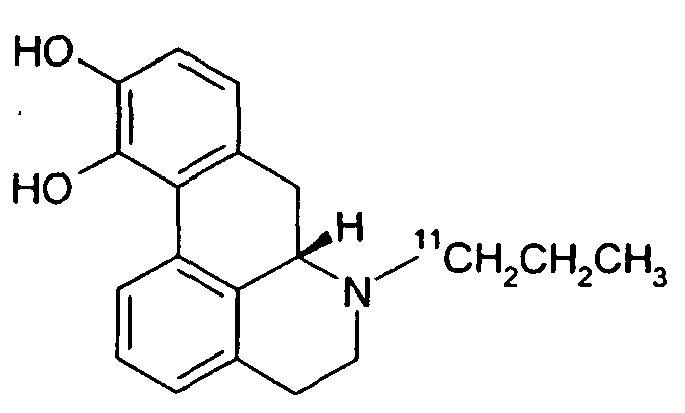
Hwang et al 2000 Nucl Med Biol. 27(6) pp 533-9 [11C]-diprenorphine 
Luthra et al 1985 J. Chem. Soc. Comm. 70 pp 1423-5 [11C]-buprenorphine 
Luthra et al 1987 Appl. Radiat. Isot. 38 pp 65-6 [11C]-cyclopentyltheophylline 
Yorke et al 1994 J. Label. Compd. Radiopharm. 35 pp 262-3 - In a further aspect the present invention relates to a kit for carrying out the method of the invention comprising:
- (i) a first cartridge containing a solid-phase supported chlorinating agent; and,
- (ii) a vial containing a solution suitable for dissolving the radiolabelled carboxylic acid of formula (II), or components which can be reconstituted to form such a solution.
- The dissolved radiolabelled carboxylic acid of formula (II) is passed through the cartridge wherein it reacts with the solid-phase supported chlorinating agent to form the radiolabelled acid chloride of formula (I).
- The solution for dissolving the radiolabelled carboxylic acid of formula (II) may also contain a base, for example a pyridine base such as di-tbutoxypyridine. Alternatively, the first cartridge may contain a solid-phase supported base, which may be a polymer as defined above.
- Suitable solid-supported chlorinating agents and bases are as defined above in relation to the first aspect of the invention.
- In another aspect, the present invention relates to a kit for the radiosynthesis of a radiolabelled product comprising the kit for carrying out the method of the invention and:
- i) a second cartridge containing a solid-phase supported non-radioactive precursor of the radiolabelled product.
- In use, the radiolabelled acid chloride of formula I is passed through the second cartridge where it reacts with the solid-phase supported non-radioactive precursor of the radiolabelled product to form the radiolabelled product.
- Non-radioactive precursors of amines, amides and esters are described above.
- Example 1 describes how a polystyrene-supported acyl chloride is obtained.
Example 2 describes the radiosynthesis of a [11C]-acid chloride.
Example 3 describes the radiosynthesis of a [11C]-amide.
Example 4 describes the radiosynthesis of a [11C]-amine. - Figure 1 illustrates the reactions involved in the preparation of the polystyrene-supported acyl chloride and also the radiosynthesis of the radiolabelled acid chloride intermediate.
- Polystyrene-supported carboxylic acid [Novabiochem Cat. No. 01-64-0111] is converted to polystyrene-supported acyl chloride by treatment with either oxalyl chloride or thionyl chloride by methods disclosed in the prior art [Leznoff et al 1977 Can. J. Chem. 55 p 3351-, Meyers et al 1995 Molecular Diversity 1 p 13]. Figure 1 illustrates this reaction.
- A solution of [11C]-labelled carboxylic acid and Grignard reagent is passed through a column containing polystyrene-supported acyl chloride. An exchange reaction occurs between the excess polystyrene-supported acyl chloride and the no carrier added carboxylic acid to produce a solution of [11C]-labelled acid chloride. Figure 1 illustrates this reaction.
- The solution of [11C]-labelled acid chloride produced in Example 2 is reacted with a secondary amine to obtain the respective [11C]-labelled amide product.
- The [11C]-labelled amide product obtained in Example 3 is reduced in the presence of lithium aluminium hydride (LiAlH4) to obtain the respective [11C]-labelled amine.
- The [11C]-labelled acid chloride of Example 2 is reacted with an alcohol in the presence of pyridine or NaOH to obtain the respective [11C]-labelled ester.
Claims (29)
- A method for the preparation of a radiolabelled acid chloride compound of formula (I):
R-COCl (I)
wherein R is C1-C20 alkyl, C2-C20 alkenyl, C3-C10 cycloalkyl, C3-C10 heterocyclyl, C4-C10 aryl or C4-C10 heteroaryl, any of which may optionally be substituted with NO2, -O(C1-C6 alkyl), C3-C10 cycloalkyl or C4-C10 aryl ;
the method comprising reacting a radiolabelled carboxylic acid of formula (II):
R-COOH (II)
wherein R is as defined for formula (I);
with a solid-phase supported chlorinating agent in the presence of a base. - A method as claimed in claim 1, wherein the solid phase supported chlorinating agent comprises a chlorinating agent connected by a linker to a solid support.
- A method as claimed in claim 2, wherein the solid support is a polymer or comprises small discrete particles.
- A method as claimed in claim 2 or claim 3 wherein the solid support comprises a coating on the inner surface of a cartridge or a microfabricated vessel.
- A method as claimed in claim 3 or claim 4, wherein the polymer is polystyrene, polyacrylamide or polypropylene.
- A method as claimed in any one of claims 2 to 6, wherein the solid-phase supported chlorinating agent is a solid-phase supported acid chloride, or a solid-phase supported analogue of either thionyl chloride or oxalyl chloride.
- A method as claimed in claim 6, wherein the solid-phase supported chlorinating agent is a solid-phase supported acyl chloride of Formula III:
[solid support]-tinker-COCl (III)
wherein the linker is a polyethylene glycol linker or comprises up to four groups selected from:C4-C10 aryl or C4-C10 heteroaryl groups;(CH2)x groups where x is an integer from 1 to 20;(CH2)y-O-(CH2)z groups where y and z are integers from 1 to 20;or combinations thereof;
wherein, in the linker groups, any CH2 group may be replaced by -O-, -S-, -SO2- or -NH2- and the linker groups may be substituted with one or more substituents chosen from OH, halo, amino, nitro and C1-C6 alkoxy. - A method as claimed in claim 7, wherein the solid-phase supported acyl chloride is of Formula IIIa:

- A method as claimed in claim 1, wherein the solid phase supported chlorinating agent is an integral part of a polymer.
- A method as claimed in claim 9 wherein the solid-phase supported chlorinating agent comprises a polymer having one or two acid chloride groups on every unit.
- A method as claimed in claim 10 wherein the solid-phase supported chlorinating agent is prepared by polymerisation of a monomer containing an acid anhydride or an ester group to give a polymer which contains an anhydride or ester group on every unit, followed by conversion of each of the anhydride or ester groups to acid chloride groups.
- A method as claimed in any one of claims 1 to 11, wherein the base is a pyridine derivative.
- A method as claimed in claim 12, wherein the base is immobilised on a solid support.
- A method as claimed in claim 13 wherein the base is prepared by polymersiation of a pyridine-substituted alkene monomer.
- A method as claimed in claim 14 wherein the acid chloride chlorinating agent and the base are immobilised in the same polymer chain.
- A method as claimed in any one of claims 1 to 15 wherein the solid-phase supported chlorinating agent is contacted with a solution of the radiolabelled carboxylic acid of formula (II).
- A method as claimed in claim 16, wherein the solution of the compound of formula (II) is passed through a column packed with a resin containing the solid phase supported chlorinating agent.
- A method as claimed in any one of claims 1 to 17 wherein the radiolabelled acid chloride of formula (I) is radiolabelled with a radioactive imaging moiety selected from:(i) a positron-emitting radioactive non-metal selected from 11C, 13N, 17F, 18F, 75Br, 76Br and 124I; or(ii) a gamma-emitting radioactive halogen selected from 123I, 125I, 131I or 77Br.
- A method as claimed in claim 18 wherein the radiolabelled acid chloride of formula (I) is radiolabelled with 11C, 13N or 18F.
- A method as claimed in claim 19 wherein the radiolabelled carboxylic acid of formula (II) is of the formula R-11COOH and the radiolabelled acid chloride compound of formula (I) is of the formula R-11COCI.
- A method as claimed in claim 20, further comprising the initial steps of:(i) producing 11CO2 by proton bombardment of natural nitrogen through the 14N(p,α)11C nuclear reaction using a target gas mixture of 2% oxygen in nitrogen; and(ii) reacting the 11CO2 with Grignard reagent to give R-11COOH.
- A method as claimed in any one of claims 1 to 21, further including the additional step of converting the radiolabelled acid chloride compound of formula (I) to a radiolabelled amide of formula:
R-11CONR'R"
wherein R is as defined in claim 1; and
R' and R" are each independently hydrogen, C1-C20 alkyl or C2-C20 alkenyl, wherein alkyl or alkenyl groups may be substituted with one or more substitutents chosen from OH, halo, amino, nitro, C1-C6 alkoxy, C3-C10 cycloalkyl, C3-C10 heterocyclyl, C4-C10 aryl or C4-C10 heteroaryl, and wherein one or more CH2 groups of the alkyl or alkenyl chain may be replaced by an -S-, -O- or -NH- group; or
R' and R" may be taken together with the N to which they are attached to form an aliphatic, aromatic or partially aromatic N-containing heterocycle having 5 to 30 ring atoms and up to 6 rings, which may contain one or more additional heteroatoms selected from N, O and S or in which a ring CH2 may be replaced by C=O and which may be substituted with one or more substituents selected from C1-C20 alkyl, C2-C20 alkenyl, OH, halo, amino, nitro, C1-C6 alkoxy, C3-C10 cycloalkyl, C3-C10 heterocyclyl, C4-C10 aryl or C4-C10 heteroaryl;
by reaction with an amine of formula:
R'R"-NH
wherein R' and R" are as defined above. - A method as claimed in claim 22, further comprising converting the radiolabelled amide to a radiolabelled amine of formula:
R-11CH2N-R'R"
wherein R is as defined in claim 1 and R' and R" are as defined in claim 23 by reduction with lithium aluminium hydride. - A method as claimed in any one of claims 1 to 21, further comprising the step of converting the radiolabelled acid chloride compound of formula (I) to a radiolabelled ester of formula:
R-11CO2R"'
wherein R is as defined in claim 1 and R'" is a group as defined in claim 23 for R' and R";
by reaction with a compound of the formula:
R-CO2R"'
wherein R is as defined in claim 1. - A kit for carrying out a method as claimed in any one of claims 1 to 24, the kit comprising:(i) a first cartridge containing a solid-phase supported chlorinating agent; and,(ii) a vial containing a solution suitable for dissolving the radiolabelled carboxylic acid of formula (II), or components which can be reconstituted to form such a solution.
- A kit as claimed in claim 25, wherein the solid-phase supported chlorinating agent is as defined in any one of claims 2 to 11.
- A kit as claimed in claim 25 or claim 26, wherein the solution for dissolving the radiolabelled carboxylic acid of formula (II) also contains a base.
- A kit as claimed in any one of claims 25 to 27 wherein the first cartridge contains a solid-phase supported base as defined in any one of claims 13 to 15.
- A kit for the radiosynthesis of a radiolabelled product comprising a kit as claimed in any one of claims 25 to 28 and:(iii) a second cartridge containing a solid-phase supported non-radioactive precursor of the radiolabelled product.
Applications Claiming Priority (2)
| Application Number | Priority Date | Filing Date | Title |
|---|---|---|---|
| GBGB0406315.2A GB0406315D0 (en) | 2004-03-20 | 2004-03-20 | Novel radiosynthesis |
| PCT/GB2005/001137 WO2005090266A1 (en) | 2004-03-20 | 2005-03-18 | Radiosynthesis of acid chlorides |
Publications (2)
| Publication Number | Publication Date |
|---|---|
| EP1727777A1 EP1727777A1 (en) | 2006-12-06 |
| EP1727777B1 true EP1727777B1 (en) | 2007-12-12 |
Family
ID=32118089
Family Applications (1)
| Application Number | Title | Priority Date | Filing Date |
|---|---|---|---|
| EP05732847A Expired - Lifetime EP1727777B1 (en) | 2004-03-20 | 2005-03-18 | Radiosynthesis of acid chlorides |
Country Status (7)
| Country | Link |
|---|---|
| US (2) | US7642375B2 (en) |
| EP (1) | EP1727777B1 (en) |
| AT (1) | ATE380783T1 (en) |
| DE (1) | DE602005003807T2 (en) |
| ES (1) | ES2297696T3 (en) |
| GB (1) | GB0406315D0 (en) |
| WO (1) | WO2005090266A1 (en) |
-
2004
- 2004-03-20 GB GBGB0406315.2A patent/GB0406315D0/en not_active Ceased
-
2005
- 2005-03-18 WO PCT/GB2005/001137 patent/WO2005090266A1/en not_active Ceased
- 2005-03-18 US US10/599,117 patent/US7642375B2/en not_active Expired - Fee Related
- 2005-03-18 ES ES05732847T patent/ES2297696T3/en not_active Expired - Lifetime
- 2005-03-18 AT AT05732847T patent/ATE380783T1/en not_active IP Right Cessation
- 2005-03-18 DE DE602005003807T patent/DE602005003807T2/en not_active Expired - Lifetime
- 2005-03-18 EP EP05732847A patent/EP1727777B1/en not_active Expired - Lifetime
-
2010
- 2010-01-04 US US12/651,494 patent/US20100105949A1/en not_active Abandoned
Also Published As
| Publication number | Publication date |
|---|---|
| DE602005003807T2 (en) | 2008-12-04 |
| US7642375B2 (en) | 2010-01-05 |
| WO2005090266A1 (en) | 2005-09-29 |
| GB0406315D0 (en) | 2004-04-21 |
| EP1727777A1 (en) | 2006-12-06 |
| ATE380783T1 (en) | 2007-12-15 |
| US20100105949A1 (en) | 2010-04-29 |
| DE602005003807D1 (en) | 2008-01-24 |
| US20070287837A1 (en) | 2007-12-13 |
| ES2297696T3 (en) | 2008-05-01 |
Similar Documents
| Publication | Publication Date | Title |
|---|---|---|
| Riss et al. | Cu (I)-catalyzed 11C-carboxylation of boronic acid esters: a rapid and convenient entry to 11C-labeled carboxylic acids, esters and amides | |
| Långström et al. | [11C] Carbon monoxide, a versatile and useful precursor in labelling chemistry for PET‐ligand development | |
| Dahl et al. | Radiosynthesis of a Bruton's tyrosine kinase inhibitor,[11C] Tolebrutinib, via palladium‐NiXantphos‐mediated carbonylation | |
| WO2015134467A1 (en) | Methods and compositions for direct radioactive labeling of bio-active molecules and building blocks | |
| US12312361B2 (en) | Methods for practical synthesis of deuterated amino acids | |
| Derdau | New trends and applications in cyanation isotope chemistry. | |
| Boscutti et al. | Use of carbon-11 labelled tool compounds in support of drug development | |
| Zhong et al. | Asymmetric catalytic alkylation of vinyl azides with 3-bromo oxindoles: water-assisted chemo-and enantiocontrol | |
| JP2011530572A (en) | Improved fluorination of iodonium salts | |
| EP2885271A1 (en) | Preparation of 18f-fluciclovine | |
| JP4989467B2 (en) | NOVEL ORGANIC COMPOUND AND METHOD FOR PRODUCING RADIO-halogen Labeled ORGANIC COMPOUND USING THE COMPOUND | |
| US7642375B2 (en) | Radiosynthesis of acid chlorides | |
| JP5397877B2 (en) | Method for producing deuterated imidazole derivatives | |
| Kaur et al. | Production Of 11C‐Labeled Amides Via “In‐Loop” 11C‐Carbonylation | |
| CN121181587A (en) | A key intermediate for 18F-FBPA, its synthesis method, and the synthesis method of 18F-FBPA. | |
| Kato et al. | Asymmetric nitroaldol reaction using nitromethane labeled with 11C | |
| Dubost et al. | Radioisotope Insertion Through Late‐Stage Functionalization | |
| Wang | Hydrogen bonding phase-transfer catalysis with sodium azide and potassium cyanide | |
| Mair | Preparation of 11C-Carbonyl Compounds and Radiotracer Validation for Cardiac PET Imaging | |
| Pickel | Synthesis of bulky 1, 4, 7-triazacylcononanes, including asymmetric derivatives; Esterification by aryl-diselenide catalyzed redox condensation; 1-amino-3, 4-difluorocyclopentane-1-carboxylic acids as PET imaging agents | |
| Meng | Organophotocatalytic Deuteration of Alpha-Amino/Oxy CH Bondsvia H/D Exchange With D2O | |
| Ye | Atroposelective Chiral-at-Rhodium Catalysis and Nitrene-Mediated Enantioselective Synthesis of Chiral α-Amino Acids with Ruthenium and Iron Catalysts | |
| Helbert et al. | Perspectives in 11C and 18F Radiochemistry | |
| CN114751801A (en) | Method for preparing deuterated amino acid esters by photocatalysis | |
| HK40111817A (en) | Production method for radiolabeled aryl compound |
Legal Events
| Date | Code | Title | Description |
|---|---|---|---|
| PUAI | Public reference made under article 153(3) epc to a published international application that has entered the european phase |
Free format text: ORIGINAL CODE: 0009012 |
|
| 17P | Request for examination filed |
Effective date: 20060907 |
|
| AK | Designated contracting states |
Kind code of ref document: A1 Designated state(s): AT BE BG CH CY CZ DE DK EE ES FI FR GB GR HU IE IS IT LI LT LU MC NL PL PT RO SE SI SK TR |
|
| DAX | Request for extension of the european patent (deleted) | ||
| GRAP | Despatch of communication of intention to grant a patent |
Free format text: ORIGINAL CODE: EPIDOSNIGR1 |
|
| GRAS | Grant fee paid |
Free format text: ORIGINAL CODE: EPIDOSNIGR3 |
|
| GRAA | (expected) grant |
Free format text: ORIGINAL CODE: 0009210 |
|
| AK | Designated contracting states |
Kind code of ref document: B1 Designated state(s): AT BE BG CH CY CZ DE DK EE ES FI FR GB GR HU IE IS IT LI LT LU MC NL PL PT RO SE SI SK TR |
|
| REG | Reference to a national code |
Ref country code: GB Ref legal event code: FG4D |
|
| RIN1 | Information on inventor provided before grant (corrected) |
Inventor name: ROBINS, EDWARD Inventor name: TURTON, DAVID ROBERT |
|
| REG | Reference to a national code |
Ref country code: CH Ref legal event code: EP |
|
| REG | Reference to a national code |
Ref country code: IE Ref legal event code: FG4D |
|
| REF | Corresponds to: |
Ref document number: 602005003807 Country of ref document: DE Date of ref document: 20080124 Kind code of ref document: P |
|
| REG | Reference to a national code |
Ref country code: SE Ref legal event code: TRGR |
|
| PG25 | Lapsed in a contracting state [announced via postgrant information from national office to epo] |
Ref country code: LI Free format text: LAPSE BECAUSE OF FAILURE TO SUBMIT A TRANSLATION OF THE DESCRIPTION OR TO PAY THE FEE WITHIN THE PRESCRIBED TIME-LIMIT Effective date: 20071212 Ref country code: CH Free format text: LAPSE BECAUSE OF FAILURE TO SUBMIT A TRANSLATION OF THE DESCRIPTION OR TO PAY THE FEE WITHIN THE PRESCRIBED TIME-LIMIT Effective date: 20071212 |
|
| REG | Reference to a national code |
Ref country code: ES Ref legal event code: FG2A Ref document number: 2297696 Country of ref document: ES Kind code of ref document: T3 |
|
| PG25 | Lapsed in a contracting state [announced via postgrant information from national office to epo] |
Ref country code: NL Free format text: LAPSE BECAUSE OF FAILURE TO SUBMIT A TRANSLATION OF THE DESCRIPTION OR TO PAY THE FEE WITHIN THE PRESCRIBED TIME-LIMIT Effective date: 20071212 Ref country code: LT Free format text: LAPSE BECAUSE OF FAILURE TO SUBMIT A TRANSLATION OF THE DESCRIPTION OR TO PAY THE FEE WITHIN THE PRESCRIBED TIME-LIMIT Effective date: 20071212 Ref country code: SI Free format text: LAPSE BECAUSE OF FAILURE TO SUBMIT A TRANSLATION OF THE DESCRIPTION OR TO PAY THE FEE WITHIN THE PRESCRIBED TIME-LIMIT Effective date: 20071212 Ref country code: PL Free format text: LAPSE BECAUSE OF FAILURE TO SUBMIT A TRANSLATION OF THE DESCRIPTION OR TO PAY THE FEE WITHIN THE PRESCRIBED TIME-LIMIT Effective date: 20071212 |
|
| NLV1 | Nl: lapsed or annulled due to failure to fulfill the requirements of art. 29p and 29m of the patents act | ||
| REG | Reference to a national code |
Ref country code: CH Ref legal event code: PL |
|
| PG25 | Lapsed in a contracting state [announced via postgrant information from national office to epo] |
Ref country code: AT Free format text: LAPSE BECAUSE OF FAILURE TO SUBMIT A TRANSLATION OF THE DESCRIPTION OR TO PAY THE FEE WITHIN THE PRESCRIBED TIME-LIMIT Effective date: 20071212 |
|
| PG25 | Lapsed in a contracting state [announced via postgrant information from national office to epo] |
Ref country code: IS Free format text: LAPSE BECAUSE OF FAILURE TO SUBMIT A TRANSLATION OF THE DESCRIPTION OR TO PAY THE FEE WITHIN THE PRESCRIBED TIME-LIMIT Effective date: 20080412 Ref country code: CZ Free format text: LAPSE BECAUSE OF FAILURE TO SUBMIT A TRANSLATION OF THE DESCRIPTION OR TO PAY THE FEE WITHIN THE PRESCRIBED TIME-LIMIT Effective date: 20071212 |
|
| ET | Fr: translation filed | ||
| PG25 | Lapsed in a contracting state [announced via postgrant information from national office to epo] |
Ref country code: BE Free format text: LAPSE BECAUSE OF FAILURE TO SUBMIT A TRANSLATION OF THE DESCRIPTION OR TO PAY THE FEE WITHIN THE PRESCRIBED TIME-LIMIT Effective date: 20071212 Ref country code: SK Free format text: LAPSE BECAUSE OF FAILURE TO SUBMIT A TRANSLATION OF THE DESCRIPTION OR TO PAY THE FEE WITHIN THE PRESCRIBED TIME-LIMIT Effective date: 20071212 Ref country code: RO Free format text: LAPSE BECAUSE OF FAILURE TO SUBMIT A TRANSLATION OF THE DESCRIPTION OR TO PAY THE FEE WITHIN THE PRESCRIBED TIME-LIMIT Effective date: 20071212 |
|
| PG25 | Lapsed in a contracting state [announced via postgrant information from national office to epo] |
Ref country code: PT Free format text: LAPSE BECAUSE OF FAILURE TO SUBMIT A TRANSLATION OF THE DESCRIPTION OR TO PAY THE FEE WITHIN THE PRESCRIBED TIME-LIMIT Effective date: 20080512 |
|
| PLBE | No opposition filed within time limit |
Free format text: ORIGINAL CODE: 0009261 |
|
| STAA | Information on the status of an ep patent application or granted ep patent |
Free format text: STATUS: NO OPPOSITION FILED WITHIN TIME LIMIT |
|
| PG25 | Lapsed in a contracting state [announced via postgrant information from national office to epo] |
Ref country code: DK Free format text: LAPSE BECAUSE OF FAILURE TO SUBMIT A TRANSLATION OF THE DESCRIPTION OR TO PAY THE FEE WITHIN THE PRESCRIBED TIME-LIMIT Effective date: 20071212 Ref country code: MC Free format text: LAPSE BECAUSE OF NON-PAYMENT OF DUE FEES Effective date: 20080331 |
|
| 26N | No opposition filed |
Effective date: 20080915 |
|
| PG25 | Lapsed in a contracting state [announced via postgrant information from national office to epo] |
Ref country code: IE Free format text: LAPSE BECAUSE OF NON-PAYMENT OF DUE FEES Effective date: 20080318 Ref country code: EE Free format text: LAPSE BECAUSE OF FAILURE TO SUBMIT A TRANSLATION OF THE DESCRIPTION OR TO PAY THE FEE WITHIN THE PRESCRIBED TIME-LIMIT Effective date: 20071212 Ref country code: GR Free format text: LAPSE BECAUSE OF FAILURE TO SUBMIT A TRANSLATION OF THE DESCRIPTION OR TO PAY THE FEE WITHIN THE PRESCRIBED TIME-LIMIT Effective date: 20080313 |
|
| PG25 | Lapsed in a contracting state [announced via postgrant information from national office to epo] |
Ref country code: BG Free format text: LAPSE BECAUSE OF FAILURE TO SUBMIT A TRANSLATION OF THE DESCRIPTION OR TO PAY THE FEE WITHIN THE PRESCRIBED TIME-LIMIT Effective date: 20080312 |
|
| PG25 | Lapsed in a contracting state [announced via postgrant information from national office to epo] |
Ref country code: CY Free format text: LAPSE BECAUSE OF FAILURE TO SUBMIT A TRANSLATION OF THE DESCRIPTION OR TO PAY THE FEE WITHIN THE PRESCRIBED TIME-LIMIT Effective date: 20071212 |
|
| PG25 | Lapsed in a contracting state [announced via postgrant information from national office to epo] |
Ref country code: HU Free format text: LAPSE BECAUSE OF FAILURE TO SUBMIT A TRANSLATION OF THE DESCRIPTION OR TO PAY THE FEE WITHIN THE PRESCRIBED TIME-LIMIT Effective date: 20080613 Ref country code: LU Free format text: LAPSE BECAUSE OF NON-PAYMENT OF DUE FEES Effective date: 20080318 |
|
| PG25 | Lapsed in a contracting state [announced via postgrant information from national office to epo] |
Ref country code: TR Free format text: LAPSE BECAUSE OF FAILURE TO SUBMIT A TRANSLATION OF THE DESCRIPTION OR TO PAY THE FEE WITHIN THE PRESCRIBED TIME-LIMIT Effective date: 20071212 |
|
| REG | Reference to a national code |
Ref country code: DE Ref legal event code: R082 Ref document number: 602005003807 Country of ref document: DE Representative=s name: J D REYNOLDS & CO., GB |
|
| PGFP | Annual fee paid to national office [announced via postgrant information from national office to epo] |
Ref country code: FI Payment date: 20140327 Year of fee payment: 10 Ref country code: SE Payment date: 20140327 Year of fee payment: 10 |
|
| PGFP | Annual fee paid to national office [announced via postgrant information from national office to epo] |
Ref country code: IT Payment date: 20140320 Year of fee payment: 10 Ref country code: FR Payment date: 20140317 Year of fee payment: 10 Ref country code: ES Payment date: 20140326 Year of fee payment: 10 |
|
| PGFP | Annual fee paid to national office [announced via postgrant information from national office to epo] |
Ref country code: GB Payment date: 20140327 Year of fee payment: 10 |
|
| PGFP | Annual fee paid to national office [announced via postgrant information from national office to epo] |
Ref country code: DE Payment date: 20140327 Year of fee payment: 10 |
|
| REG | Reference to a national code |
Ref country code: DE Ref legal event code: R119 Ref document number: 602005003807 Country of ref document: DE |
|
| PG25 | Lapsed in a contracting state [announced via postgrant information from national office to epo] |
Ref country code: FI Free format text: LAPSE BECAUSE OF NON-PAYMENT OF DUE FEES Effective date: 20150318 |
|
| GBPC | Gb: european patent ceased through non-payment of renewal fee |
Effective date: 20150318 |
|
| PG25 | Lapsed in a contracting state [announced via postgrant information from national office to epo] |
Ref country code: SE Free format text: LAPSE BECAUSE OF NON-PAYMENT OF DUE FEES Effective date: 20150319 |
|
| REG | Reference to a national code |
Ref country code: SE Ref legal event code: EUG |
|
| PG25 | Lapsed in a contracting state [announced via postgrant information from national office to epo] |
Ref country code: IT Free format text: LAPSE BECAUSE OF NON-PAYMENT OF DUE FEES Effective date: 20150318 |
|
| REG | Reference to a national code |
Ref country code: FR Ref legal event code: ST Effective date: 20151130 |
|
| PG25 | Lapsed in a contracting state [announced via postgrant information from national office to epo] |
Ref country code: GB Free format text: LAPSE BECAUSE OF NON-PAYMENT OF DUE FEES Effective date: 20150318 Ref country code: DE Free format text: LAPSE BECAUSE OF NON-PAYMENT OF DUE FEES Effective date: 20151001 |
|
| PG25 | Lapsed in a contracting state [announced via postgrant information from national office to epo] |
Ref country code: FR Free format text: LAPSE BECAUSE OF NON-PAYMENT OF DUE FEES Effective date: 20150331 |
|
| REG | Reference to a national code |
Ref country code: ES Ref legal event code: FD2A Effective date: 20160603 |
|
| PG25 | Lapsed in a contracting state [announced via postgrant information from national office to epo] |
Ref country code: ES Free format text: LAPSE BECAUSE OF NON-PAYMENT OF DUE FEES Effective date: 20150319 |