EP1727551B1 - Pharmaceutical composition comprising a benzodiazepine derivative and a inhibitor of the rsv fusion protein - Google Patents
Pharmaceutical composition comprising a benzodiazepine derivative and a inhibitor of the rsv fusion protein Download PDFInfo
- Publication number
- EP1727551B1 EP1727551B1 EP05728747A EP05728747A EP1727551B1 EP 1727551 B1 EP1727551 B1 EP 1727551B1 EP 05728747 A EP05728747 A EP 05728747A EP 05728747 A EP05728747 A EP 05728747A EP 1727551 B1 EP1727551 B1 EP 1727551B1
- Authority
- EP
- European Patent Office
- Prior art keywords
- dihydro
- phenyl
- alkyl
- oxo
- benzo
- Prior art date
- Legal status (The legal status is an assumption and is not a legal conclusion. Google has not performed a legal analysis and makes no representation as to the accuracy of the status listed.)
- Expired - Lifetime
Links
- 0 **c1nc(c(*)c(*)c(*)c2)c2[n]1** Chemical compound **c1nc(c(*)c(*)c(*)c2)c2[n]1** 0.000 description 1
Classifications
-
- A—HUMAN NECESSITIES
- A61—MEDICAL OR VETERINARY SCIENCE; HYGIENE
- A61K—PREPARATIONS FOR MEDICAL, DENTAL OR TOILETRY PURPOSES
- A61K45/00—Medicinal preparations containing active ingredients not provided for in groups A61K31/00 - A61K41/00
- A61K45/06—Mixtures of active ingredients without chemical characterisation, e.g. antiphlogistics and cardiaca
-
- A—HUMAN NECESSITIES
- A61—MEDICAL OR VETERINARY SCIENCE; HYGIENE
- A61K—PREPARATIONS FOR MEDICAL, DENTAL OR TOILETRY PURPOSES
- A61K31/00—Medicinal preparations containing organic active ingredients
- A61K31/33—Heterocyclic compounds
- A61K31/395—Heterocyclic compounds having nitrogen as a ring hetero atom, e.g. guanethidine or rifamycins
- A61K31/55—Heterocyclic compounds having nitrogen as a ring hetero atom, e.g. guanethidine or rifamycins having seven-membered rings, e.g. azelastine, pentylenetetrazole
- A61K31/551—Heterocyclic compounds having nitrogen as a ring hetero atom, e.g. guanethidine or rifamycins having seven-membered rings, e.g. azelastine, pentylenetetrazole having two nitrogen atoms, e.g. dilazep
- A61K31/5513—1,4-Benzodiazepines, e.g. diazepam or clozapine
-
- A—HUMAN NECESSITIES
- A61—MEDICAL OR VETERINARY SCIENCE; HYGIENE
- A61P—SPECIFIC THERAPEUTIC ACTIVITY OF CHEMICAL COMPOUNDS OR MEDICINAL PREPARATIONS
- A61P31/00—Antiinfectives, i.e. antibiotics, antiseptics, chemotherapeutics
- A61P31/12—Antivirals
-
- A—HUMAN NECESSITIES
- A61—MEDICAL OR VETERINARY SCIENCE; HYGIENE
- A61P—SPECIFIC THERAPEUTIC ACTIVITY OF CHEMICAL COMPOUNDS OR MEDICINAL PREPARATIONS
- A61P43/00—Drugs for specific purposes, not provided for in groups A61P1/00-A61P41/00
Definitions
- the present invention relates to a series of anti-viral benzodiazepine derivatives according to formula (V).
- V anti-viral benzodiazepine derivatives
- it relates to a series of benzodiazepine derivatives which interact with an inhibitor of the RSV fusion protein to provide an additive or synergistic therapeutic effect in treating or preventing an RSV infection.
- Respiratory Syncytial Virus is a major cause of respiratory illness in patients of all ages. In adults, it tends to cause mild cold symptoms. In school-aged children, it can cause a cold and bronchial cough. In infants and toddlers it can cause bronchiolitis (inflammation of the smaller airways of the lungs) or pneumonia. It has also been found to be a frequent cause of middle ear infections (otitis media) in pre-school children. RSV infection in the first year of life has been implicated in the development of asthma during childhood.
- palivizumab a monoclonal antibody to RSV
- palivizumab a monoclonal antibody to RSV
- This antibody is often effective, it is expensive. Indeed, its expense means that it is unavailable for many people in need of anti-RSV therapy. There is therefore an urgent need for effective alternatives to existing anti-RSV therapy.
- Small compounds which inhibit RSV replication by inhibiting the fusion (F) protein of RSV block the entry of the virus into the host cell and the exit from the host cell via syncytia formation. While these compounds have been shown to have high potency, RSV rapidly develops resistance to these compounds through mutations in the F protein ( Morton, C.J. et al, 2003.Virology 311, 275-288 ).
- PCT/GB03/04050 filed on 20 September 2003 discloses a series of benzodiazepine derivatives which inhibit RSV replication. Serial passaging experiments have indicated that resistance to these inhibitors is slow to develop and sequencing of resistant mutants did not reveal any significant changes in the F protein. It can therefore be assumed that these benzodiazepines have a common and novel mode of action, which does not involve inhibition of the F-protein.
- the present invention therefore provides, in a first embodiment, a pharmaceutical composition which comprises a pharmaceutically acceptable carrier or diluent and
- components (a) and (b) have at least an additive effect.
- the concepts of synergism and additivity are, of course, well known in the field of pharmacology. It is thus well established that a therapeutically useful additive combination is one in which the effect of the combination is greater than the larger of the effects produced by each of the components at the same concentrations as in the mixture.
- a given formulation containing x wt% of component (a) and y wt% of component (b) has an activity which is at least as great as the activity of a formulation containing, as sole active ingredient, either x wt% component (a) or y wt% component (b).
- the active ingredients are typically operating via different physiological pathways.
- component (a) and component (b) are believed to be inhibiting separate RSV proteins.
- An additive combination is therapeutically useful because it can achieve a therapeutically useful effect using lower concentrations of each active component. This enables the side-effects of the medication to be minimised.
- the additive combination can be formulated so that each active ingredient is present at a concentration which is subclinical in cells other than the target disease cells. The additive combination is nevertheless therapeutically effective in target cells which respond to both ingredients.
- an inhibitor of the RSV fusion protein can be identified by an assay comprising:
- any increase in fluorescence signifies a fusion event.
- 100% inhibition is achieved.
- a control of growth medium and solvent e.g., growth medium with 10% fetal bovine serum and DMSO
- 0% inhibition is achieved.
- the % inhibition achieved with the candidate fusion protein inhibitor can be determined by quantitative assessment of the fluorescence in step (f).
- component (a) is typically a compound which achieves at least 10%, more typically at least 30%, preferably at least 50% and most preferably at least 75%, inhibition of the RSV fusion protein as determined by the above assay.
- component (a) is a compound of formula (I), or a pharmaceutically acceptable salt thereof, wherein:
- R 1 , R 2 and R 3 are hydrogen, and the other is hydrogen or -C(NH)-NH 2 .
- all of R 1 , R 2 and R 3 are hydrogen.
- either -X-Y is H, or X is a C 1 -C 6 alkylene group which is unsubstituted or substituted by a hydroxy group and Y is H, OH, CN, -NR'R", -COR', -SO 2 R' or phenyl, wherein R' and R" are the same or different and represent a C 1 -C 4 alkyl group.
- Z is -CH 2 -.
- Q is a moiety wherein B is -CH- or -N-, A 1 is -C(O)- or -NH- and A 2 is -CH 2 -, -CHR'- or -NR"-, wherein R' is a halogen atom and R" represents a hydrogen atom or a C 1 -C 4 alkyl, C 2 -C 4 alkenyl, C 3 -C 6 cycloalkyl, -SO 2 -(C 1 -C 6 alkyl), -SO 2 -N(C 1 -C 6 alkyl) 2 or -(CO-NH) a -(C 1 -C 4 alkyl)-phenyl group, wherein a is 0 or 1, which group is unsubstituted or is substituted with a hydroxy or cyano substituent.
- Particularly preferred compounds of the invention are compounds of formula (Ia) and pharmaceutically acceptable salts thereof wherein
- Component (a) can also be a compound of formula (II), or a pharmaceutically acceptable salt thereof, wherein:
- L 1 is -CH 2 -.
- L 2 is -NH-.
- R 1 is methyl or hydroxy.
- n is 2.
- each R 1 is different.
- Y is C 1 -C 4 alkyl.
- Z is -NH 2 .
- Component (a) can also be a compound of formula (III), or a pharmaceutically acceptable salt thereof, wherein
- Component (a) can also be a compound of formula (IV), or a pharmaceutically acceptable salt thereof.
- the compound of formula (IV) is 4,4'-Bis-(4,6-bis- ⁇ 3-[bis-(2-carbamoyl-ethyl)-sulfamoyl]-phenylamino ⁇ -[1,3,5]triazin-2-ylamino)-biphenyl-2,2'-disulfonic acid.
- component (a) is:
- the composition contains an RSV fusion inhibitor, as described above, and a benzodiazepine identifiable as having anti-RSV activity by the method of Example 8.
- Component (b) is a compound of formula (V), or a pharmaceutically acceptable salt thereof, wherein:
- a C 1-6 alkyl group or moiety is a linear or branched alkyl group or moiety containing from 1 to 6 carbon atoms, such as a C 1-4 alkyl group or moiety.
- Examples of C 1-4 alkyl groups and moieties include methyl, ethyl, n-propyl, i -propyl, n -butyl, i -butyl and t-butyl.
- the alkyl moieties may be the same or different.
- a hydroxyalkyl group is typically a said alkyl group that is substituted by one or more hydroxy groups. Typically, it is substituted by one, two or three hydroxy groups. Preferably, it is substituted by a single hydroxy group.
- a preferred hydroxyalkyl group is -CH 2 -OH.
- an acyl group is a C 2-7 acyl group, for example a group -CO-R, wherein R is a said C 1-6 alkyl group.
- an aryl group is typically a C 6-10 aryl group such as phenyl or naphthyl. Phenyl is preferred. An aryl group may be unsubstituted or substituted at any position. Typically, it carries 0, 1, 2 or 3 substituents.
- Suitable substituents on an aryl group include halogen, C 1-6 alkyl, C 2-7 acyl, hydroxy, C 1-6 alkoxy, C 1-6 alkylthio, C 1-6 haloalkyl, C 1-6 haloalkoxy, nitro, cyano, carbamoyl, mono(C 1-6 alkyl)carbamoyl, di(C 1-6 alkyl)carbamoyl, amino, mono(C 1-6 alkyl)amino, di(C 1-6 alkyl)amino, -CO 2 R', -CONR'R", -S(O)R', -S(O) 2 R', -S(O)NR'R",-S(O) 2 NR'R" -NH-S(O) 2 R' or -NH-CO-R', wherein each R' and R" is the same or different and represents hydrogen or C 1-6 alkyl.
- Preferred substituents on an aryl group include halogen, C 1-6 alkyl, C 2-7 acyl, hydroxy, C 1-6 alkoxy, C 1-6 alkylthio, C 1-6 haloalkyl, C 1-6 haloalkoxy, amino, mono(C 1-6 alkyl)amino, di(C 1-6 alkyl)amino, nitro, cyano, -CO 2 R', -S(O)R', -S(O) 2 R' and -S(O) 2 NR'R", wherein each R' and R" is the same or different and represents hydrogen or C 1-4 alkyl.
- substituents include fluorine, chlorine, bromine, iodine, cyano, C 1-4 alkyl, C 2-4 acyl, hydroxy, C 1-4 alkoxy, C 1-4 alkylthio, C 1-4 haloalkyl, C 1-4 haloalkoxy, amino, mono(C 1-4 alkyl)amino, di(C 1-4 alkyl)amino, nitro, -CO 2 R', -S(O) 2 R' and -S(O) 2 NH 2 , wherein R' represents C 1-2 alkyl.
- Most preferred substituents are chlorine, fluorine, cyano, C 1 -C 4 alkyl and C 1 -C 4 haloalkyl substituents.
- references to an aryl group include fused ring systems in which an aryl group is fused to a monocyclic carbocyclyl, heterocyclyl or heteroaryl group or to a fused group which is a monocyclic carbocyclyl, heterocyclyl or heteroaryl group which is fused to a phenyl ring.
- said fused ring systems are systems in which an aryl group is fused to a monocyclic carbocyclyl, heterocyclyl or heteroaryl group.
- fused ring systems are those wherein an aryl group is fused to a monocyclic heterocyclyl or heteroaryl group or to a monocyclic carbocyclic group fused to a phenyl ring, in particular those wherein an aryl group is fused to a heterocyclyl or heteroaryl group.
- fused ring systems are groups in which a phenyl ring is fused to a thienyl group or to a tetrahydrofuranyl group to form a benzothienyl or dihydrobenzofuranyl group.
- fused rings are groups in which a phenyl ring is fused to a dioxanyl group, a pyrrolyl group or a 2,3-dihydroinden-1-one group to form a benzodioxinyl, indolyl or a 9H-fluoren-9-one group.
- an aryl group as used herein, is not fused to a monocyclic carbocyclyl, heterocyclyl or heteroaryl group or to a said fused group.
- a carbocyclyl group is a non-aromatic saturated or unsaturated monocyclic hydrocarbon ring, typically having from 3 to 6 carbon atoms.
- a saturated hydrocarbon ring i.e. a cycloalkyl group
- Examples include cyclopropyl, cyclobutyl, cyclopentyl and cyclohexyl. It is preferably cyclopropyl, cyclopentyl or cyclohexyl, most preferably cyclopropyl.
- a cycloalkyl group may be unsubstituted or substituted at any position. Typically, it carries 0, 1, 2 or 3 substituents.
- Suitable substituents on a carbocyclyl group include halogen, C 1-6 alkyl, C 2-7 acyl, hydroxy, C 1-6 alkoxy, C 1-6 alkylthio, C 1-6 haloalkyl, C 1-6 haloalkoxy, nitro, cyano, carbamoyl, mono(C 1-6 alkyl)carbamoyl, di(C 1-6 alkyl)carbamoyl, amino, mono(C 1-6 alkyl)amino, di(C 1-6 alkyl)amino, oxo, -CO 2 R', -CONR'R", -S(O)R', -S(O) 2 R', -S(O)NR'R", -S(O) 2 NR'R", -NH-S(O) 2 R' or -NH-CO-R', wherein each R' and R" is the same or different and represents hydrogen or C 1-6 alkyl.
- Preferred substituents on an carbocyclyl group include halogen, C 1-6 alkyl, C 1-6 alkoxy, C 1-6 alkylthio, C 1-6 haloalkyl, C 1-6 haloalkoxy, mono(C 1-6 alkyl)amino, di(C 1-6 alkyl)amino, nitro, cyano and oxo.
- Particularly preferred substituents include fluorine, chlorine, bromine, C 1-4 alkyl, C 1-4 alkoxy, C 1-4 haloalkyl, nitro and oxo.
- a carbocyclyl group is unsubstituted.
- a heterocyclyl group is a non-aromatic saturated or unsaturated carbocyclic ring, typically having from 5 to 10 carbon atoms, in which one or more, for example 1, 2 or 3, of the carbon atoms is replaced by a heteroatom selected from N, O and S. Saturated heterocyclyl groups are preferred.
- Examples include tetrahydrofuranyl, tetrahydrothienyl, pyrrolidinyl, imidazolidinyl, pyrazolidinyl, dioxolanyl, thiazolidinyl, tetrahydropyranyl, piperidinyl, dioxanyl, piperazinyl, morpholinyl, thiomorpholinyl and thioxanyl. Further examples include dithiolanyl, oxazolidinyl, tetrahydrothiopyranyl and dithianyl. Piperazinyl, piperidinyl, thiomorpholinyl, imidazolidinyl and morpholinyl groups are preferred.
- references to a heterocyclyl group include fused ring systems in which a heterocyclyl group is fused to a phenyl group.
- Preferred such fused ring systems are those wherein a 5- to 6-membered heterocyclyl group is fused to a phenyl group.
- fused ring system is a group wherein a 1H-imidazol-2(3 H )-onyl group or a imidazolidin-2-onyl group is fused to a phenyl ring or a pyridine ring, to form, for example, a 1 H -benzo[ d ]imidazol-2(3 H )-onyl group or a 1H-imidazo[4,5-b]pyridin-2(3H)-one group.
- a heterocyclyl group is monocyclic.
- a heterocyclic group may be unsubstituted or substituted at any position. Typically, it carries 0, 1 or 2 substituents.
- Suitable substituents on a heterocyclyl group include halogen, C 1-6 alkyl, C 2-7 acyl, hydroxy, C 1-6 alkoxy, C 1-6 alkylthio, C 1-6 haloalkyl, C 1-6 haloalkoxy, nitro, cyano, carbamoyl, mono(C 1-6 alkyl)carbamoyl, di(C 1-6 alkyl)carbomyl, amino, mono(C 1-6 alkyl)amino, di(C 1-6 alkyl)amino, oxo, -CO 2 R', -CONR'R", -S(O)R', -S(O) 2 R', -S(O)NR'R", -S(O) 2 N'R", -NH-S(O) 2 R' or -NH-CO-R', wherein each R' and R" is the same or different and represents hydrogen or C 1-6 alkyl.
- Preferred substituents on a heterocyclyl group include halogen, C 1-6 alkyl, C 1-6 alkoxy, C 1-6 alkylthio, C 1-6 haloalkyl, C 1-6 haloalkoxy, mono(C 1-6 alkyl)amino, di(C 1-6 alkyl)amino, nitro, cyano and oxo.
- Particularly preferred substituents include fluorine, chlorine, bromine, C 1-4 alkyl, C 1-4 alkoxy, C 1-4 haloalkyl, nitro and oxo.
- a heterocyclyl group is unsubstituted or substituted by one or two C 1-2 alkyl or oxo groups.
- An example of a substituted heterocyclic group is S,S-dioxothiomorpholino.
- a halogen is typically chlorine, fluorine, bromine or iodine. It is preferably chlorine, fluorine or bromine. It is more preferably chlorine or fluorine.
- an alkoxy group is typically a said alkyl group attached to an oxygen atom.
- An alkylthio group is typically a said alkyl group attached to a thio group.
- a haloalkyl or haloalkoxy group is typically a said alkyl or alkoxy group substituted by one or more said halogen atoms. Typically, it is substituted by 1, 2 or 3 said halogen atoms.
- Preferred haloalkyl and haloalkoxy groups include perhaloalkyl and perhaloalkoxy groups such as -CX 3 and -OCX 3 wherein X is a said halogen atom, for example chlorine or fluorine.
- Particularly preferred haloalkyl groups are -CF 3 and -CCl 3 .
- Particularly preferred haloalkoxy groups are -OCF 3 and -OCCl 3 .
- a heteroaryl group is typically a 5- to 10-membered aromatic ring, such as a 5- or 6-membered ring, containing at least one heteroatom, for example 1, 2 or 3 heteroatoms, selected from O, S and N.
- heteroatoms for example 1, 2 or 3 heteroatoms, selected from O, S and N.
- Examples include pyridyl, pyrazinyl, pyrimidinyl, pyridazinyl, furanyl, thienyl, pyrazolidinyl, pyrrolyl, oxadiazolyl, isoxazolyl, thiadiazolyl, thiazolyl, imidazolyl and pyrazolyl groups.
- Further examples include oxazolyl and isothiazolyl.
- Preferred heteroaryl groups are pyridyl, thienyl, oxazolyl, isoxazolyl, thiazolyl, furanyl and pyrazolyl.
- references to a heteroaryl group include fused ring systems in which a heteroaryl group is fused to a phenyl group or to a monocyclic heterocyclyl group.
- Preferred such fused ring systems are those wherein a 5- to 6-membered heteroaryl group is fused to a phenyl group or to a 5- to 6- membered heterocyclyl group.
- fused ring systems examples include benzofuranyl, benzothiophenyl, indolyl, benzimidazolyl, benzoxazolyl, quinolinyl, quinazolinyl, isoquinolinyl and 1H-imidazo[4,5-b]pyridin-2(3H)-one moieties.
- said fused ring system is a 1H-imidazo[4,5-b]pyridin-2(3H)-one moiety.
- a heteroaryl group may be unsubstituted or substituted at any position. Typically, it carries 0, 1, 2 or 3 substituents.
- Suitable substituents on a heteroaryl group include halogen, C 1-6 alkyl, C 2-7 acyl, hydroxy, C 1-6 alkoxy, C 1-6 alkylthio, C 1-6 haloalkyl, C 1-6 haloalkoxy, nitro, cyano, carbamoyl, mono(C 1-6 alkyl)carbamoyl, di(C 1-6 alkyl)carbamoyl, amino, mono(C 1-6 alkyl)amino, di(C 1-6 alkyl)amino, -CO 2 R', -CONR'R", -S(O)R', -S(O) 2 R', -S(O)NR'R",-S(O) 2 NR'R", -NH-S(O) 2 R' or -NH-CO-R', wherein each R' and R" is the same or different and represents hydrogen or C 1-6 alkyl.
- Preferred substituents on a heteroaryl group include halogen, C 1-6 alkyl, C 1-6 alkoxy, C 1-6 alkylthio, C 1-6 haloalkyl, C 1-6 haloalkoxy, mono(C 1-6 alkyl)amino, di(C 1-6 alkyl)amino, nitro and cyano.
- Particularly preferred substituents include fluorine, chlorine, bromine, C 1-4 alkyl, C 1-4 alkoxy, C 1-4 haloalkyl and nitro.
- Most preferred substituents include fluorine, chlorine, bromine, C 1-2 alkyl and C 1-2 haloalkyl substituents.
- R 1 in the formula (V) is an aryl or heteroaryl group it is typically unsubstituted or substituted by one, two or three substituents selected from halogen, C 1-6 alkyl, C 1-6 alkoxy, C 1-6 alkylthio, C 1-6 haloalkyl or C 1-6 haloalkoxy.
- it is unsubstituted or substituted by one or two substituents selected from fluorine, chlorine, bromine, C 1-4 alkyl, C 1-4 alkoxy, C 1-4 alkylthio, C 1-4 haloalkyl or C 1-4 haloalkoxy.
- R 1 in formula (V) is C 1-6 alkyl or aryl.
- R 1 is C 1-2 alkyl or aryl. More preferably, R 1 is C 1-2 alkyl or phenyl. More preferably, R 1 is an unsubstituted phenyl group.
- R 2 in formula (V) is hydrogen or C 1-4 alkyl.
- R 2 is hydrogen.
- R 3 in formula (V) is halogen, hydroxy, C 1-4 alkyl, C 1-4 alkoxy, C 1-4 alkylthio, C 1-4 haloalkyl, C 1-4 haloalkoxy, amino, mono(C 1-4 alkyl)amino or di(C 1-4 alkyl)amino.
- R 3 is fluorine, chlorine, bromine, C 1-2 alkyl, C 1-2 alkoxy, C 1-2 alkylthio, C 1-2 haloalkyl, C 1-2 haloalkoxy, amino, mono(C 1-2 alkyl)amino or di(C 1-2 alkyl) amino. More preferably, R 3 is methyl, trifluoromethyl, fluorine, chlorine or bromine. Most preferably, R 3 is methyl or chlorine.
- n in formula (V) is 0, 1 or 2.
- n is 0 or 1.
- n is 0.
- R 4 in formula (V) is hydrogen or C 1-4 alkyl.
- R 4 is hydrogen or C 1-2 alkyl. More preferably, R 4 is hydrogen or methyl. Most preferably, R 4 is hydrogen
- X in formula (V) is -CO-, -S(O) 2 - or -CO-NR'-, wherein R' represents hydrogen or a C 1 -C 2 alkyl group.
- X is -CO- or -CO-NR'-.
- R 5 in formula (V) is a heterocyclyl or heterocyclyl group which is substituted by a C 1 -C 6 hydroxyalkyl group or a -(C 1 -C 4 alkyl)-X 1 -(C 1 -C 4 alkyl)-X 2 -(C 1 -C 4 alkyl) group
- the heterocyclyl or heteroaryl group is typically a 5- or 6- membered ring.
- it is a 5- or 6- membered heteroaryl group, for example a furanyl group.
- the C 1 -C 6 hydroxyalkyl group in formula (V) is a -CH 2 -OH group.
- X 1 in the formula (V) is -NR'-, wherein R' is hydrogen or C 1 -C 2 alkyl.
- X 2 in formula (V) is -S(O) 2 -.
- a 1 in formula (V) is an aryl or heteroaryl group.
- a 1 is a monocyclic aryl or heteroaryl group, a naphthyl group or a heteroaryl group fused to a monocyclic oxo substituted heterocyclyl group.
- a 1 is a phenyl group, a monocyclic 5- or 6- membered heteroaryl group or a 5- to 6- membered heteroaryl group fused to a monocyclic oxo substituted 5- to 6- membered heterocyclyl group (for example an oxo substituted imidazolidine group).
- a 1 is a phenyl, pyridyl, furanyl, thiazolyl, oxazolyl, isoxazolyl, thienyl or 1H-imidazo[4,5-b]pyridin-2-(3H)-one moiety.
- the moiety A 1 in formula (V) is unsubstituted or substituted by 1 or 2 substituents selected from halogen, cyano, nitro, C 1 -C 4 alkyl, C 1 -C 4 haloalkyl and C 1 -C 4 alkoxy substituents.
- substituents are selected from halogen, cyano, C 1 -C 2 alkyl, C 1 -C 2 haloalkyl and C 1 -C 2 alkoxy substituents.
- Y in formula (V) represents a direct bond, a C 1 -C 2 alkylene group, -SO 2 - or -O-.
- a 2 in formula (V) is a phenyl, 5- to 6- membered heteroaryl, 5- to 6-membered heterocyclyl or C 3 -C 6 cycloalkyl group.
- a 2 is a piperazinyl, pyridyl, morpholinyl, thiomorpholinyl, pyrrolidinyl, piperidinyl, pyrazinyl, cyclopropyl or phenyl group.
- a 2 in formula (V) is a heterocyclyl group it is attached to the moiety Y via a N atom.
- the moiety A 2 in formula (V) is unsubstituted or substituted by one or two substituents which are selected from C 1 -C 4 alkyl and halogen substituents when A 2 is a heteroaryl or aryl group and which are selected from C 1 -C 4 alkyl, halogen and oxo substituents when A 2 is a carbocyclic or heterocyclyl group.
- a 2 in formula (V) is a piperazinyl, pyridyl, morpholinyl, pyrrolidinyl, piperidinyl, pyrazinyl, cyclopropyl, phenyl or S,S-dioxo-thiomorpholino group, which group is unsubstituted or is substituted by a C 1 -C 2 alkyl group.
- Preferred compounds of formula (V) are those in which:
- Particularly preferred compounds of the invention are compounds of formula (Va) and pharmaceutically acceptable salts thereof wherein:
- n is 0 and R 4 is hydrogen.
- a 1 is a phenyl or furanyl group which is unsubstituted or substituted by a chlorine atom.
- Y is a direct bond or a methylene group.
- a 2 is a morpholino or S,S-dioxo-thiomorpholino group.
- Preferred compounds of formula (V) are optically active isomers.
- preferred compounds of formula (V) containing only one chiral centre include an R enantiomer in substantially pure form, an S enantiomer in substantially pure form and enantiomeric mixtures which contain an excess of the R enantiomer or an excess of the S enantiomer.
- the compounds of the formula (V) can, if desired, be used in the form of solvates.
- a pharmaceutically acceptable salt is a salt with a pharmaceutically acceptable acid or base.
- Pharmaceutically acceptable acids include both inorganic acids such as hydrochloric, sulphuric, phosphoric, diphosphoric, hydrobromic or nitric acid and organic acids such as citric, fumaric, maleic, malic, ascorbic, succinic, tartaric, benzoic, acetic, methanesulphonic, ethanesulphonic, benzenesulphonic or p-toluenesulphonic acid.
- Pharmaceutical acceptable bases include alkali metal (e.g. sodium or potassium) and alkaline earth metal (e.g. calcium or magnesium) hydroxides and organic bases such as alkyl amines, aralkyl amines or heterocyclic amines.
- Particularly preferred compounds of formula (V) include:
- the compounds of formulae (I), (II), (III) and (IV) are known compounds. They are disclosed, for example, in WO 00/195910 , WO 00/004900 , WO 03/053344 , US-A-4324794 and WO 01/00612 , and can be prepared by the processes set out in those documents.
- WO 00/195910 WO 00/004900 , WO 03/053344 , US-A-4324794 and WO 01/00612 are incorporated herein by reference. Any of the compounds disclosed as fusion inhibitors in those documents can be used in the present invention.
- amino acid of formula (II') can then be reacted with a suitable chlorinating agent, such as oxalyl chloride, followed by reaction with a 2-aminobenzophenone of formula (III') to give the intermediate amide of formula (IV') which need not be characterized.
- a suitable chlorinating agent such as oxalyl chloride
- the compound of formula (IV') can then be subjected to ammonolysis followed by ring closure in acetic acid containing ammonium acetate to obtain the protected benzodiazepine of formula (V')
- the compound of formula (V') can then be deprotected using hydrogen bromide in acetic acid to yield the deprotected amine of formula (VI').
- Compounds of formula (V), in which X is -CO- or -CO-NR' can be prepared by reacting a compound of formula (VI'), as defined above, with an acid anhydride in a suitable solvent, preferably pyridine at ambient temperature, or with an acid chloride in a suitable solvent in the presence of a base, preferably in THF at ambient temperature with triethylamine present.
- a suitable solvent preferably pyridine at ambient temperature
- an acid chloride in a suitable solvent in the presence of a base, preferably in THF at ambient temperature with triethylamine present.
- the compounds can be produced by reaction of a compound of formula (VI') with an acid in a suitable solvent in the presence of a base and a coupling agent, preferably in THF at ambient temperature with triethylamine and O- benzotriazol-1-yl-N, N, N', N'-tetramethyluronium hexafluorophosphate (HBTU) present.
- a base and a coupling agent preferably in THF at ambient temperature
- triethylamine and O- benzotriazol-1-yl-N, N, N', N'-tetramethyluronium hexafluorophosphate (HBTU) present preferably in THF at ambient temperature
- the compound of formula (V) is a urea.
- R' in the X moiety is hydrogen
- such compounds may also be prepared by the reaction of a compound of formula (VI') with an isocyanate. This reaction is preferably carried out in THF at ambient temperature.
- the isocyanate may be prepared in situ from the relevant amine and phosgene, in the presence of a base, usually triethylamine, again in THF.
- R' is other than hydrogen
- R' is hydrogen
- an appropriate alkylating agent for example L-(C 1 -C 6 alkyl) wherein L is a leaving group, for example chlorine.
- Compounds of formula (VII') are known compounds or can be prepared by analogy with known methods. For example, they can be prepared from the reaction of isatoic anhydrides of formula (VIII') with N,O-dimethyl hydroxylamine under standard reaction conditions.
- DKR Dynamic Kinetic Resolution
- the optically amine thus formed may then be transformed into a desired derivative, such as an amide or urea.
- a desired derivative such as an amide or urea.
- the amide formations may be carried out using a suitable carboxylic acid and a coupling reagent, or a carbonyl chloride or other suitable reagent, and the ureas prepared using either a suitable isocyanate, or alternatively reaction with phosgene followed by a suitable amine.
- These derivatives thus formed may then have the protecting group removed. This may be carried out in the presence of a Lewis Acid, such as aluminium chloride, boron trifluoride, titanium tetrachloride, or the like. These reactions are carried out in a suitable inert solvent, such as dichloromethane. Reaction temperatures may range from -20 to 150°C, but are typically carried out at room temperature or below.
- a Lewis Acid such as aluminium chloride, boron trifluoride, titanium tetrachloride, or the like.
- a suitable inert solvent such as dichloromethane. Reaction temperatures may range from -20 to 150°C, but are typically carried out at room temperature or below.
- component (a) is 1-cyclopropyl-3-[1-(4-hydroxy-butyl)-1H-benzoimidazol-2-ylmethyl]-1,3-dihydro-imidazo[4,5-c]pyridin-2-one, 2-[2-(1,2-dihydro-benzotriazol-1-ylmethyl)-benzoimidazol-1-yl]]ethyl ⁇ -diethyl-anune, ⁇ 2-[2-(3-iodo-2,3-dihydro-indazol-1-ylmethyl)-benzimidazol-1-yl]-ethyl ⁇ -dimethyl-amine or a pharmaceutically acceptable salt thereof and component (b) is (S)-2-Chloro-4-morpholin-4-yl-N-(2-oxo-5-phenyl-2,3-dihydro-1H-benzo[e][1,4]diazepin-3-yi)-benzamide or 5-
- the present invention also provides a pharmaceutical composition according to the invention, for use in the treatment of the human or animal body. Also provided is the use of (a) a said RSV fusion protein inhibitor and (b) a said benzodiazepine derivative, in the manufacture of a medicament for use in treating or preventing an RSV infection.
- the present invention also provides a method of treating or preventing an RSV infection in a patient, which method comprises the administration to said patient of (a) a said RSV fusion protein inhibitor and (b) a said benzodiazepine derivative.
- the amount of component (a) in the composition of the invention is from 0.025 wt% to 10 wt%, preferably from 0.25 wt% to 5 wt%, more preferably from I wt% to 3.5 wt%, for example about 2.5 wt%, based on the total weight of the composition.
- the amount of component (b) in the composition of the invention is from 0.025 wt% to 10 wt%, preferably from 0.25 wt% to 5 wt%, more preferably from 1 wt% to 3.5 wt%, for example about 2.5 wt%, based on the total weight of the composition.
- the total amount of components (a) and (b) in the composition of the invention is from 0.05 to 20 wt%, preferably from 0.5 to 10 wt%, more preferably from 2 to 7 wt%, for example about 5 wt%, based on the total weight of the composition.
- RSV is prevalent among children younger than two years of age, adults suffering from asthma, chronic obstructive pulmonary disorder (COPD) or immunodeficiency and the elderly. It is a particularly serious risk amongst children who suffer from chronic lung disease. Accordingly, the said composition or medicament is typically for use in treating a patient who is a child under two years of age, patients with asthma, COPD or immunodeficiency the elderly or persons in long term care facilities. Typically, said child suffers from chronic lung disease.
- COPD chronic obstructive pulmonary disorder
- anti-RSV prophylaxis is recommended for infants bom at 32 weeks of gestation or earlier, until they reach 6 months of age, the elderly, persons with immunedeficiency and those in long term care facilities. Accordingly, the said composition or medicament is typically for use in preventing RSV infection in an infant less than 6 years of age, who was born after 32 weeks of gestation or less, the elderly, persons with immunosufficiency and those in long term care facilities.
- the benzodiazepine derivatives disclosed above are the first class of compounds with a novel mode of action. Accordingly, the compositions of the invention are characterized by a very low resistance profile, which makes them particularly suitable for therapeutic and prophylactic applications.
- component (a) and (b) are administered separately.
- component (a) can be administered up to 24 hours before component (b).
- component (b) can be administered up to 24 hours before component (a). More usually, when components (a) and (b) are administered separately, they are administered within 12 hours, preferably within 6 hours, of each other.
- the present invention therefore also provides a product comprising (a) a said RSV fusion protein inhibitor and (b) a said benzodiazepine derivative for separate, simultaneous or sequential use in the treatment of the human or animal body.
- a product comprising (a) a said RSV fusion protein inhibitor and (b) a said benzodiazepine derivative for separate, simultaneous or sequential use in the treatment of the human or animal body.
- said product is for separate, simultaneous or sequential use in treating or preventing an RSV infection.
- a said RSV fusion protein inhibitor in the manufacture of a medicament for use in treating or preventing an RSV infection by co-administration with a said benzodiazepine derivative.
- the present invention also provides the use of a said benzodiazepine derivative in the manufacture of a medicament for use in treating or preventing an RSV infection, by co-administration with a said RSV fusion protein inhibitor.
- a first formulation is typically provided which contains from 0.025 wt% to 10 wt%, preferably from 0.25 wt% to 5 wt%, more preferably from 1 wt% to 3.5 wt%, for example about 2.5 wt%, of a said RSV fusion protein inhibitor, based on the total weight of the formulation.
- a second formulation which contains from 0.025 wt% to 10 wt%, preferably from 0.25 wt% to 5 wt%, more preferably from 1 wt% to 3.5 wt%, for example around 2.5 wt%, of a said benzodiazepine derivative, based on the total weight of the formulation.
- the two formulations can be administered separately in any order.
- compositions and medicaments of the invention have an activity greater than the combined individual activities of compounds (a) and (b).
- components (a) and (b) typically interact synergistically.
- component (a) and component (b) are each present in an amount producing a synergistic therapeutic effect in treating or preventing an RSV infection.
- the anti-RSV compositions of the invention may be administered in a variety of dosage forms. Thus, they can be administered orally, for example as tablets, troches, lozenges, aqueous or oily suspensions, dispersible powders or granules.
- the compounds of the invention may also be administered parenterally, whether subcutaneously, intravenously, intramuscularly, intrasternally, transdermally or by infusion techniques.
- the compounds may also be administered as suppositories.
- administration is by intravenous, intranasal or intrabronchial means.
- formulations for treating or preventing RSV can advantageously be administered intranasally.
- the present invention therefore also provides an inhaler or nebuliser containing a medicament which comprises (i) a composition of the invention comprising component (a) and component (b), as defined above, and (ii) a pharmaceutically acceptable carrier or diluent.
- the anti-RSV compositions of the invention are typically formulated for administration with a pharmaceutically acceptable carrier or diluent.
- solid oral forms may contain, together with the active compound(s), diluents, e.g. lactose, dextrose, saccharose, cellulose, conn starch or potato starch; lubricants, e.g. silica, talc, stearic acid, magnesium or calcium stearate, and/or polyethylene glycols; binding agents; e.g. starches, arabic gums, gelatin, methylcellulose, carboxymethylcellulose or polyvinyl pyrrolidone; disaggregating agents, e.g.
- Such pharmaceutical preparations may be manufactured in known manner, for example, by means of mixing, granulating, tableting, sugar coating, or film coating processes.
- Liquid dispersions for oral administration may be syrups, emulsions and suspensions.
- the syrups may contain as carriers, for example, saccharose or saccharose with glycerine and/or mannitol and/or sorbitol.
- Suspensions and emulsions may contain as carrier, for example a natural gum, agar, sodium alginate, pectin, methylcellulose, carboxymethylcellulose, or polyvinyl alcohol.
- the suspension or solutions for intramuscular injections may contain, together with the active compound, a pharmaceutically acceptable carrier, e.g. sterile water, olive oil, ethyl oleate, glycols, e.g. propylene glycol, and if desired, a suitable amount of lidocaine hydrochloride.
- Solutions for injection or infusion may contain as carrier, for example, sterile water or preferably they may be in the form of sterile, aqueous, isotonic saline solutions.
- the anti-RSV compositions of the invention are solubilised in a earner containing (a) a pharmaceutically acceptable oil selected from esterification or polyether product of glycerides with vegetable oil fatty acids of chain length C 8 -C 10 and (b) a pharmaceutically acceptable surfactant selected from oleate and laurate esters of a polyalcohol copolymerized with ethylene oxide.
- a pharmaceutically acceptable oil selected from esterification or polyether product of glycerides with vegetable oil fatty acids of chain length C 8 -C 10
- a pharmaceutically acceptable surfactant selected from oleate and laurate esters of a polyalcohol copolymerized with ethylene oxide.
- Particularly preferred carriers contain Labrafil as the oil and Tween 20 or Tween 80 as the surfactant.
- the anti-RSV compositions of the invention may also be suspended in PEG 400 for oral administration.
- a therapeutically effective amount of an anti-RSV composition of the invention is administered to a patient.
- a typical dose is from about 0.001 to 50 mg, typically 0.5 to 30 mg, preferably 1 to 20 mg active ingredient per kg of body weight, according to the activity of the specific composition, the age, weight and conditions of the subject to be treated, the type and severity of the disease and the frequency and route of administration.
- daily dosage levels are from 5 mg to 2 g active ingredient.
- This material was prepared as described for Intermediate 7 except that piperidine was used as the nucleophile. As for Intermediate 7 the material was used crude.
- This material was prepared as described for Intermediate 7 except that morpholine was used as the nucleophile. As for Intermediate 7 the material was used crude.
- RSV enters the host cell via attachment to and fusion with the host cell membrane.
- the effect of an inhibitor on the specific virus-cell fusion event can be qualitatively determined by using a fluorescence de-quenching system.
- This assay takes advantage of the fact that RSV binds to cells at 4°C and at 37°C but that fusion may only occur at concentrations above 18°C.
- RSV labelled with octadecyl rhodamine dye (R18) is pre-incubated with Hep-2 cells seeded in a 6-well plate for 1 hour at 4°C to allow binding to occur. Unattached virus is removed by washing the cell monolayer. The inhibitor is then added to the virus-cell complexes prior to transferring the plates to 37°C for 1 hour in order to induce fusion.
- Virus-cell fusion can be observed directly under a fluorescence microscope. Fluorescence emission is quenched when 2 identical fluorophores are in close proximity. Upon fusion of the labelled virus with the cell membrane, the distance between fluorophores is increased due to dye spread and there is a decrease in quenching. This is observed as an increase in fluorescence intensity of R18. It therefore follows that inhibition of fusion would lead to a decrease in fluorescence of R18 compared to untreated control. Where the fluorescent yield of R18 in the presence of inhibitor is comparable to the untreated control this would suggest the inhibitor were not exerting its effects on the fusion protein.
- the inner 60 wells of 96 well tissue culture plates are seeded with Hep-2 cells at 4x10 4 cells/well for compound activity and toxicity studies in 100 ⁇ l of medium and incubated at 37°C overnight or until nearing confluency.
- Cells are infected with 25 ⁇ l RSV, e.g. the RSS strain, previously titrated to give 80% cell kill.
- 25 ⁇ M of test compound are added.
- the final DMSO concentration is 0.5%.
- Some 200 ⁇ l of sterile distilled water is added to the outer wells of the plate and incubated at 37°C for 6 days.
- Some 0.25 ⁇ l/ml PMS are added to stock XTT solution, final conc. 25 ⁇ M PMS. Then 25 ⁇ l warmed XTT/PMS solution is added to each well and incubated for 1 hour at 37°C.
- This assay was set up using all 96 wells of flat-bottomed 96-well plates. The outer wells were not subjected to any greater amount of evaporation than the inner wells during the 3 day assay period. (ie. No "edge effect” seen). Plates were set up one day before addition of virus and compounds. The assay then ran for 3 days with ELISA development taking place on the 4 th day.
- GM Growth Medium
- DMEM Dulbecco's MEM
- Glutamax-1 Dulbecco's MEM
- Sodium Pyruvate 1000 mg/l glucose and pyridoxine
- 10%FBS 10%FBS
- Cells were suspended in a small known volume of growth media and counted using a haemocytometer. The cell suspension was made up to the desired concentration in growth medium and added to wells by multichannel pipette. Brief, gentle shaking encouraged the cells to disperse more evenly across the well. Plate 1 cells cells cells cells cells cells cells cells cells cells cells cells cells cells cells cells cells cells cells cells cells cells cells cells cells cells cells cells cells cells cells cells cells cells cells cells cells cells cells cells cells cells cells cells cells cells cells cells cells cells cells cells cells cells cells cells cells cells cells cells cells cells cells cells cells cells cells cells cells cells cells cells cells cells cells cells cells cells cells cells cells cells cells cells cells cells cells cells cells cells cells cells cells cells cells cells cells cells cells cells cells cells cells cells cells cells cells cells cells cells cells cells cells cells cells cells cells cells cells cells cells cells cells cells cells cells cells cells cells cells cells cells cells cells cells cells cells cells cells cells cells cells cells cells cells cells cells cells cells cells cells cells cells cells cells cells cells cells cells cells cells cells cells cells cells cells cells cells cells cells cells cells cells cells cells cells cells cells cells cells cells cells
- a frozen vial of RSV (RSS strain provided by Virogen Ltd) stock solution was removed from the -80 freezer or liquid nitrogen store and diluted to a known Multiplicity of Infection (m.o.i) in Growth Medium.
- the m.o.i. was calculated by prior titration of the virus stock (by the ELISA assay method) as the virus input required to achieve a window of at least 0.8 OD units between infected and uninfected control wells.
- Multiplicity of Infection plaque forming units per well pfu / well number of cells per well
- Compound “A” was titrated horizontally across the plate and Compound “B” was titrated vertically down the plate, creating a chequerboard.
- the 2 compounds were titrated at either 1 ⁇ 2-log or doubling dilutions either across (horizontally) or down the plate (vertically) in the presence of virus.
- Each compound dilution was set up in duplicates or triplicates. For triplicates 3 identical plates were set up. Duplicates were set up as dublicate wells on the same plate. The dilution range covered concentrations from just above the compound IC50 to below the compound IC50 and included a 0 ⁇ M control for each compound.
- Virus infected, untreated wells served as the virus control (VC); Uninfected, untreated wells serve as the cell control (CC).
- CC cell control
- the difference in absorbance between CC and VC wells constitutes the assay window.
- Block solution was discarded down the sink and diluted primary antibody was added directly to wells (ie. no washing required).
- RSV mouse monoclonal antibody NCL-RSV3 (Novocastra ) was diluted 1/400 in PBS/2% Marvel/0.05% Tween and 50 ⁇ l was added per well. Plates were incubated at 37°C in a shaking incubator for 90mins.
- DAKo rabbit anti-mouse HRP conjugate (DAKO catalogue number P0260) was diluted 1/1000 in PBS/2% Marvel/0.05% Tween and 50 ⁇ l was added per well. Plates were incubated at 37°C in a shaking incubator for 60mins.
- Antibody was discarded down the sink and plates were washed 6 times by immersion in PBS/0.05% Tween.
- Substrate (SigmaFast OPD) was prepared in advance by dissolving 1 urea tablet in 20mL water. 1 OPD tablet was added to the urea solution just prior to use (NB. OPD was light sensitive) and vortexed to mix. 50 ⁇ l of substrate was added per well.
- reaction was stopped by addition of 25 ⁇ l/well of 20% sulphuric acid, once sufficient colour had developed but while cell control background was still low ( ⁇ 5 minutes).
- the wells were emptied, washed in tap water and the monolayers stained with 50 ⁇ l/well of 2% crystal violet in 20% methanol/water for at least 1 hour. The wells were then washed and air-dried and the monolayers examined under the microscope for indications of cell toxicity.
- the assay window was calculated by subtracting the meaned cell control (CC) from the meaned virus control (VC). For each compound, the meaned CC was subtracted from the meaned values for each concentration point. The % of control was then calculated for each concentration point as a percentage of the window. % of control was plotted against compound concentration. A straight line was fitted to the curve and the slope and intercept functions were used to calculate the IC50.
- the IC50 for Compound “A” was calculated for each background concentration of Compound “B”. Similarly, the IC50 for Compound “B” was calculated for each background concentration of Compound “A”.
- Compound A has an ELISA IC50 of 1.6 ⁇ M against the RSV RSS strain.
- Compound B has an ELISA IC50 of 0.015 ⁇ M against the RSV RSS strain.
- the IC50 of Compound B is reduced from 0.15 ⁇ M to at least 0.003 ⁇ M (5 -fold decrease).
- concentrations of Compound B below its IC50 the IC50 of Compound A is reduced from 1.6 ⁇ M to at least 1 ⁇ M (1.6-fold decrease).
- Compound A has an ELISA IC50 of 3.5 ⁇ M against the RSV RSS strain.
- Compound B has an ELISA IC50 of 0.06 ⁇ M against the RSV RSS strain.
- the IC50 of Compound B is reduced from 0.06 ⁇ M to at least 0.006 ⁇ M (10-fold decrease).
- concentrations of Compound B below its IC50 the IC50 of compound A is reduced from 3.5 ⁇ M to at least 0.312 ⁇ M (11.2-fold decrease).
Landscapes
- Health & Medical Sciences (AREA)
- Life Sciences & Earth Sciences (AREA)
- Chemical & Material Sciences (AREA)
- Veterinary Medicine (AREA)
- Public Health (AREA)
- Medicinal Chemistry (AREA)
- General Health & Medical Sciences (AREA)
- Animal Behavior & Ethology (AREA)
- Pharmacology & Pharmacy (AREA)
- Epidemiology (AREA)
- General Chemical & Material Sciences (AREA)
- Organic Chemistry (AREA)
- Nuclear Medicine, Radiotherapy & Molecular Imaging (AREA)
- Chemical Kinetics & Catalysis (AREA)
- Engineering & Computer Science (AREA)
- Virology (AREA)
- Communicable Diseases (AREA)
- Oncology (AREA)
- Bioinformatics & Cheminformatics (AREA)
- Pharmaceuticals Containing Other Organic And Inorganic Compounds (AREA)
- Medicines That Contain Protein Lipid Enzymes And Other Medicines (AREA)
- Medicinal Preparation (AREA)
Abstract
Description
- The present invention relates to a series of anti-viral benzodiazepine derivatives according to formula (V). In particular, it relates to a series of benzodiazepine derivatives which interact with an inhibitor of the RSV fusion protein to provide an additive or synergistic therapeutic effect in treating or preventing an RSV infection.
- Respiratory Syncytial Virus (RSV) is a major cause of respiratory illness in patients of all ages. In adults, it tends to cause mild cold symptoms. In school-aged children, it can cause a cold and bronchial cough. In infants and toddlers it can cause bronchiolitis (inflammation of the smaller airways of the lungs) or pneumonia. It has also been found to be a frequent cause of middle ear infections (otitis media) in pre-school children. RSV infection in the first year of life has been implicated in the development of asthma during childhood.
- Current anti-RSV therapy involves the use of a monoclonal antibody to RSV, called palivizumab. Such use of palivizumab is a prophylactic, rather than therapeutic, treatment of RSV. However, although this antibody is often effective, it is expensive. Indeed, its expense means that it is unavailable for many people in need of anti-RSV therapy. There is therefore an urgent need for effective alternatives to existing anti-RSV therapy.
- Small compounds which inhibit RSV replication by inhibiting the fusion (F) protein of RSV block the entry of the virus into the host cell and the exit from the host cell via syncytia formation. While these compounds have been shown to have high potency, RSV rapidly develops resistance to these compounds through mutations in the F protein (Morton, C.J. et al, 2003.Virology 311, 275-288).
-
PCT/GB03/04050 filed on 20 September 2003 - It has now surprisingly been shown that a combination of (a) an RSV fusion protein inhibitor and (b) an anti-RSV benzodiazepine according to formula (V) is highly active against RSV. Components (a) and (b) are found to have at least an additive effect. Further, it is also a finding of the invention that the two components interact synergistically, to provide a combined effect that is greater than the sum of the effects of the individual components.
- The present invention therefore provides, in a first embodiment, a pharmaceutical composition which comprises a pharmaceutically acceptable carrier or diluent and
- (a) an inhibitor of the RSV fusion protein; and:
- (b) a benzodiazepine derivative capable of inhibiting RSV replication.
- It is a finding of the present invention that components (a) and (b) have at least an additive effect. The concepts of synergism and additivity are, of course, well known in the field of pharmacology. It is thus well established that a therapeutically useful additive combination is one in which the effect of the combination is greater than the larger of the effects produced by each of the components at the same concentrations as in the mixture. Thus, in the present case, a given formulation containing x wt% of component (a) and y wt% of component (b) has an activity which is at least as great as the activity of a formulation containing, as sole active ingredient, either x wt% component (a) or y wt% component (b).
- In such additive combinations, the active ingredients are typically operating via different physiological pathways. In the present case, for example, component (a) and component (b) are believed to be inhibiting separate RSV proteins. An additive combination is therapeutically useful because it can achieve a therapeutically useful effect using lower concentrations of each active component. This enables the side-effects of the medication to be minimised. Thus, the additive combination can be formulated so that each active ingredient is present at a concentration which is subclinical in cells other than the target disease cells. The additive combination is nevertheless therapeutically effective in target cells which respond to both ingredients.
- As regards component (a), an inhibitor of the RSV fusion protein can be identified by an assay comprising:
- (a) labelling RSV with octadecyl rhodamine dye (R18);
- (b) pre-incubating the labelled virus with Hep-2 cells seeded in a 6-well plate at 1 hour for 4°C;
- (c) removing unattached virus;
- (d) adding the candidate fusion protein inhibitor;
- (e) incubating the 6-well plates at 37°C for 1 hour; and
- (f) determining any increase in fluorescence, typically using a fluorescence microscope.
- In the above assay, any increase in fluorescence signifies a fusion event. Thus, if no increase in fluorescence is detected, 100% inhibition is achieved. If the increase in fluorescence is equal to that observed with a corresponding assay in which a control of growth medium and solvent (e.g., growth medium with 10% fetal bovine serum and DMSO) is used in step (d) in place of the candidate fusion protein inhibitor, 0% inhibition is achieved. Accordingly the % inhibition achieved with the candidate fusion protein inhibitor can be determined by quantitative assessment of the fluorescence in step (f).
- As used herein, component (a) is typically a compound which achieves at least 10%, more typically at least 30%, preferably at least 50% and most preferably at least 75%, inhibition of the RSV fusion protein as determined by the above assay.
- Typically, component (a) is a compound of formula (I), or a pharmaceutically acceptable salt thereof,

- X is a direct link or C1-6 alkyl; said C1-6 alkyl being optionally substituted with halogen, oxo, cyano, hydroxyl, OCOR4 or S(O)n-C1-6 alkyl;
- Y is R4, NR4R5, NCOR4, =N-OR4, -CONHR4, COOR4, -OR4, aryl, heteroaryl, cyclyl or heterocyclyl, where R4 and R5 are H or C1-6 alkyl;
- Z is CR6R7, where R6 and R7 are independently H, or straight, branched or cyclic C1-6 alkyl;
- n is 1-2;
- R1 is CONR4R5, CO2R4 or C1-6 alkyl, said C1-6 alkyl can be optionally substituted with OR4 or NR8R9;
- R8 and R9 are each independently H, C1-6 alkyl, SO2R5, CO2R4 or COR4;
- R2 is selected from the group consisting of NH2, CONR6R7, heteroaryl, C2-6 alkenyl, CO2R4, N=CPh2, C(=NH)NH2 and C1-6 alkyl; said alkyl optionally substituted with a member selected from the group consisting of halogen, CN, NR10R11, OSO2R4 and OR4;
- R10 and R11 are each independently selected from the group consisting of H, C1-6 alkyl, C3-6 cycloalkyl, CO2R4, COR4 and SO2R4;
- R3 is selected from the group consisting of (1) CO2R9; (2) C1-6 alkyl optionally substituted with CN, OR4 or NR6R7; and (3) C2-6 alkenyl substituted with CN;
- Q is a member selected from the group consisting of

- Typically, at least two of R1, R2 and R3 are hydrogen, and the other is hydrogen or -C(NH)-NH2. Preferably, all of R1, R2 and R3 are hydrogen.
- Typically, either -X-Y is H, or X is a C1-C6 alkylene group which is unsubstituted or substituted by a hydroxy group and Y is H, OH, CN, -NR'R", -COR', -SO2R' or phenyl, wherein R' and R" are the same or different and represent a C1-C4 alkyl group.
- Typically, Z is -CH2-.
- Typically, Q is a moiety

- Particularly preferred compounds of the invention are compounds of formula (Ia) and pharmaceutically acceptable salts thereof

- B, X and Y are as described in formula (I) above
- D is cyclopropyl, ethyl, 4-cyanobutyl, isopropenyl, methylsulfonyl, dimethylsulfamoyl, benzylaminocarbamoyl or para-hydroxybenzyl
- Component (a) can also be a compound of formula (II), or a pharmaceutically acceptable salt thereof,

- L1 is -CH2- or -CHR2-CO-
- each X is the same or different and CH or N;
- each R1 is the same or different and is C1-6 alkyl, halogen, hydroxy, phenyl or (CH2)m=NH2;
- n is 1 or 2;
- R2 is C1-6 alkoxy or C1-6alkoxy-phenyl;
- R3 is C1-6alkyl;
- L2 is -CH2- or -NH-;
- Y is C1-6 alkyl or C1-6 alkenyl;
- Z is H, N(R4)2, -C(=O)-R5, -C(=CH2)-R5, -CH(OH)-R5, -CH(CH3)-Rs, -CH(OCH3)-R5;
- each R4 is the same or different and is H, C1-6 alkyl;
- R5 is C1-6 alkyl-carbonyl, amino, hydroxyl, aryl, heteroaryl, carbocyclyl, heterocyclyl; and
- m=1-6
- For the avoidance of doubt, when L1 is -CHR2-CO-, the carbonyl group is attached to the phenyl or pyridyl moiety.
- Typically, L1 is -CH2-.
- Typically, L2 is -NH-.
- Typically, R1 is methyl or hydroxy. Typically, n is 2. Typically, each R1 is different.
- Typically, Y is C1-C4 alkyl.
- Typically, Z is -NH2.
- Other preferred compounds of formula (II) are compounds of formula

- X is C or N;
- R1 is C1-6 alkyl, halogen, phenyl or (CH2)m=NH2;
- R2 is C1-6 alkoxy or C1-6alkoxy-phenyl;
- R3 is C1-6alkyl;
- Y is C1-6 alkyl or C1-6 alkenyl;
- Z is H, NR4, -C(=O)-R5, -C(=CH2)-R5, -CH(OH)-R5, -CH(CH3)-R5, -CH(OCH3)-R5;
- R4 is H, C1-6 alkyl.
- R5 is C1-6 alkyl-carbonyl, amino, hydroxyl, aryl, heteroaryl, carbocyclyl, heterocyclyl
- m=1-6
- Component (a) can also be a compound of formula (III), or a pharmaceutically acceptable salt thereof,

- X is -N=C- or -CH=CH-;
- R1 is H, hydroxyl, alkyl, halogen, nitro or alkoxy; said alkoxy being optionally monosubstituted with carboxy, amino, monoalkylamino, dialkylamino or acetoamino;
- R2 is pyrazolyl, triazolyl or tetrazolyl and optionally substituted by amino or alkyl.
- Component (a) can also be a compound of formula (IV), or a pharmaceutically acceptable salt thereof.

- The compound of formula (IV) is 4,4'-Bis-(4,6-bis-{3-[bis-(2-carbamoyl-ethyl)-sulfamoyl]-phenylamino}-[1,3,5]triazin-2-ylamino)-biphenyl-2,2'-disulfonic acid.
- Preferably, component (a) is:
- 1-Cyclopropyl-3-[1-(4-hydroxy-butyl)-1H-benzoimidazol-2-ylmethyl]-1,3-dihydro-imidazo[4,5-c]pyridin-2-one
- {2-[2-(1,2-Dihydro-benzotriazol-1-ylmethyl)-benzoimidazol-1-yl]]ethyl}-diethylamine
- {2-[2-(3-Iodo-2,3-dihydro-indazol-1-ylmethyl)-benzimidazol-1-yl]-ethyl}-dimethylamine
- 1-Isopropenyl-3-[1-(3-methyl-butyl)-1H-benzoimidazol-2-ylmethyl]-1,3-dihydro-benzoimidazol-2-one
- 1-(4-Hydroxy-benzyl)-3-[1-(3-methyl-butyl)-1H-benzoimidazol-2-ylmethyl]-1,3-dihydro-benzoimidazol-2-one
- 1-Isopropenyl-3-[1-(3-oxo-butyl)-1H-benzoimidazol-2-ylmethyl]-1,3-dihydro-benzoimidazol-2-one
- 1-Ethyl-3-[1-(2-hydroxy-2-phenyl-ethyl)-1H-benzoimidazol-2-ylmethyl]-1,3-dihydro-benzoimidazol-2-one
- 1-Ethyl-3-[1-(4-hydroxy-butyl)-1H-benzoimidazol-2-ylmethyl]-1,3-dihydro-benzoimidazol-2-one
- 7-[2-(3-Isopropenyl-2-oxo-2,3-dihydrobenzoimidazol-1-ylmethyl)-benzoimidazol-1-yl]-heptanenitril
- 5-{3-[1-(3-Methanesulfonyl-propyl)-1H-benzoimidazol-2-ylmethyl]-2-oxo-2,3-dihydro-benzoimidazol-1-yl}-pentanenitrile
- 3-[1-(3-Methyl-butyl)-1H-benzoimidazol-2-ylmethyl]-2-oxo-2,3-dihydro-benzoimidazol-1-carboxylic acid benzylamide
- 1-Methanesulfonyl-3-[1-(3-methyl-butyl)-1H-benzoimidazol-2-ylmethyl]-1,3-dihydro-benzoimidazol-2-one
- 3-[1-(3-Methyl-butyl)-1H-benzoimidazol-2-ylmethyl]-2-oxo-2,3-dihydro-benzoimidazol-1-sulfonic acid dimethylamide
- 1-Isopropenyl-3-(1-propyl-1H-benzoimidazol-2-ylmethyl)-1,3-dihydro-imidazo[4,5-c]pyridine-2-one
- Bis(5-amidino-2-benzimidazolyl)-methane
- 2-{2-[1-[1-(2-Amino-ethyl)-piperidin-4-ylamino]-4-methyl-benzoimidazol-1-ylmethyl}-6-methyl-pyridin-3-ol
- In a further embodiment, the composition contains an RSV fusion inhibitor, as described above, and a benzodiazepine identifiable as having anti-RSV activity by the method of Example 8.
- Component (b) is a compound of formula (V), or a pharmaceutically acceptable salt thereof,

- R1 represents C1-6 alkyl, aryl or heteroaryl;
- R2 represents hydrogen or C1-6 alkyl;
- each R3 is the same or different and represents halogen, hydroxy, C1-6 alkyl, C1-6 alkoxy, C1-6 alkylthio, C1-6 haloalkyl, C1-6 haloalkoxy, amino, mono(C1-6 alkyl)amino, di(C1-6 alkyl)amino, nitro, cyano, -CO2R', -CONR'R", -NH-CO-R', -S(O)R', -S(O)2R', -NH-S(O)2R', -S(O)NR'R" or -S(O)2NR'R", wherein each R' and R" is the same or different and represents hydrogen or C1-6 alkyl;
- n is from 0 to 3;
- R4 represents hydrogen or C1-6 alkyl;
- X represents -CO-, -CO-NR'-, -S(O)- or -S(O)2-, wherein R' is hydrogen or a C1-C6 alkyl group; and
- R5 represents an aryl, heteroaryl or heterocyclyl group which is substituted by a C1-C6 hydroxyalkyl group or a -(C1-C4 alkyl)-X1-(C1-C4 alkyl)-X2-(C1-C4 alkyl) group, wherein X1 represents -O-, -S- or -NR'-, wherein R' represents H or a C1-C4 alkyl group, and X2 represents -CO-, -SO- or -SO2-, or R5 represents -A1-Y-A2, wherein:
- A1 is an aryl, heteroaryl, carbocyclyl or heterocyclyl group;
- Y represents a direct bond or a C1-C4 alkylene, -SO2-, -CO-, -O-, -S- or -NR'-moiety, wherein R' is a C1-C6 alkyl group; and
- A2 is an aryl, heteroaryl, carbocyclyl or heterocyclyl group.
- As used herein, a C1-6 alkyl group or moiety is a linear or branched alkyl group or moiety containing from 1 to 6 carbon atoms, such as a C1-4 alkyl group or moiety. Examples of C1-4 alkyl groups and moieties include methyl, ethyl, n-propyl, i-propyl, n-butyl, i-butyl and t-butyl. For the avoidance of doubt, where two alkyl moieties are present in a group, the alkyl moieties may be the same or different.
- As used herein, a hydroxyalkyl group is typically a said alkyl group that is substituted by one or more hydroxy groups. Typically, it is substituted by one, two or three hydroxy groups. Preferably, it is substituted by a single hydroxy group. A preferred hydroxyalkyl group is -CH2-OH.
- As used herein, an acyl group is a C2-7 acyl group, for example a group -CO-R, wherein R is a said C1-6 alkyl group.
- As used herein, an aryl group is typically a C6-10 aryl group such as phenyl or naphthyl. Phenyl is preferred. An aryl group may be unsubstituted or substituted at any position. Typically, it carries 0, 1, 2 or 3 substituents.
- Suitable substituents on an aryl group include halogen, C1-6 alkyl, C2-7 acyl, hydroxy, C1-6 alkoxy, C1-6 alkylthio, C1-6 haloalkyl, C1-6 haloalkoxy, nitro, cyano, carbamoyl, mono(C1-6 alkyl)carbamoyl, di(C1-6 alkyl)carbamoyl, amino, mono(C1-6 alkyl)amino, di(C1-6 alkyl)amino, -CO2R', -CONR'R", -S(O)R', -S(O)2R', -S(O)NR'R",-S(O)2NR'R" -NH-S(O)2R' or -NH-CO-R', wherein each R' and R" is the same or different and represents hydrogen or C1-6 alkyl.
- Preferred substituents on an aryl group include halogen, C1-6 alkyl, C2-7 acyl, hydroxy, C1-6 alkoxy, C1-6 alkylthio, C1-6 haloalkyl, C1-6 haloalkoxy, amino, mono(C1-6 alkyl)amino, di(C1-6 alkyl)amino, nitro, cyano, -CO2R', -S(O)R', -S(O)2R' and -S(O)2NR'R", wherein each R' and R" is the same or different and represents hydrogen or C1-4 alkyl.
- Particularly preferred substituents include fluorine, chlorine, bromine, iodine, cyano, C1-4 alkyl, C2-4 acyl, hydroxy, C1-4 alkoxy, C1-4 alkylthio, C1-4 haloalkyl, C1-4 haloalkoxy, amino, mono(C1-4 alkyl)amino, di(C1-4 alkyl)amino, nitro, -CO2R', -S(O)2R' and -S(O)2NH2, wherein R' represents C1-2 alkyl. Most preferred substituents are chlorine, fluorine, cyano, C1-C4 alkyl and C1-C4 haloalkyl substituents.
- As used herein, references to an aryl group include fused ring systems in which an aryl group is fused to a monocyclic carbocyclyl, heterocyclyl or heteroaryl group or to a fused group which is a monocyclic carbocyclyl, heterocyclyl or heteroaryl group which is fused to a phenyl ring. Typically, said fused ring systems are systems in which an aryl group is fused to a monocyclic carbocyclyl, heterocyclyl or heteroaryl group.
- Preferred such fused ring systems are those wherein an aryl group is fused to a monocyclic heterocyclyl or heteroaryl group or to a monocyclic carbocyclic group fused to a phenyl ring, in particular those wherein an aryl group is fused to a heterocyclyl or heteroaryl group. Examples of such fused ring systems are groups in which a phenyl ring is fused to a thienyl group or to a tetrahydrofuranyl group to form a benzothienyl or dihydrobenzofuranyl group. Further examples of such fused rings are groups in which a phenyl ring is fused to a dioxanyl group, a pyrrolyl group or a 2,3-dihydroinden-1-one group to form a benzodioxinyl, indolyl or a 9H-fluoren-9-one group. Most preferably, however, an aryl group, as used herein, is not fused to a monocyclic carbocyclyl, heterocyclyl or heteroaryl group or to a said fused group.
- As used herein, a carbocyclyl group is a non-aromatic saturated or unsaturated monocyclic hydrocarbon ring, typically having from 3 to 6 carbon atoms. Preferably it is a saturated hydrocarbon ring (i.e. a cycloalkyl group) having from 3 to 6 carbon atoms. Examples include cyclopropyl, cyclobutyl, cyclopentyl and cyclohexyl. It is preferably cyclopropyl, cyclopentyl or cyclohexyl, most preferably cyclopropyl. A cycloalkyl group may be unsubstituted or substituted at any position. Typically, it carries 0, 1, 2 or 3 substituents.
- Suitable substituents on a carbocyclyl group include halogen, C1-6 alkyl, C2-7 acyl, hydroxy, C1-6 alkoxy, C1-6 alkylthio, C1-6 haloalkyl, C1-6 haloalkoxy, nitro, cyano, carbamoyl, mono(C1-6 alkyl)carbamoyl, di(C1-6 alkyl)carbamoyl, amino, mono(C1-6 alkyl)amino, di(C1-6 alkyl)amino, oxo, -CO2R', -CONR'R", -S(O)R', -S(O)2R', -S(O)NR'R", -S(O)2NR'R", -NH-S(O)2R' or -NH-CO-R', wherein each R' and R" is the same or different and represents hydrogen or C1-6 alkyl.
- Preferred substituents on an carbocyclyl group include halogen, C1-6 alkyl, C1-6 alkoxy, C1-6 alkylthio, C1-6 haloalkyl, C1-6 haloalkoxy, mono(C1-6 alkyl)amino, di(C1-6 alkyl)amino, nitro, cyano and oxo. Particularly preferred substituents include fluorine, chlorine, bromine, C1-4 alkyl, C1-4 alkoxy, C1-4 haloalkyl, nitro and oxo. Most preferably, a carbocyclyl group is unsubstituted.
- As used herein, a heterocyclyl group is a non-aromatic saturated or unsaturated carbocyclic ring, typically having from 5 to 10 carbon atoms, in which one or more, for example 1, 2 or 3, of the carbon atoms is replaced by a heteroatom selected from N, O and S. Saturated heterocyclyl groups are preferred. Examples include tetrahydrofuranyl, tetrahydrothienyl, pyrrolidinyl, imidazolidinyl, pyrazolidinyl, dioxolanyl, thiazolidinyl, tetrahydropyranyl, piperidinyl, dioxanyl, piperazinyl, morpholinyl, thiomorpholinyl and thioxanyl. Further examples include dithiolanyl, oxazolidinyl, tetrahydrothiopyranyl and dithianyl. Piperazinyl, piperidinyl, thiomorpholinyl, imidazolidinyl and morpholinyl groups are preferred.
- As used herein, references to a heterocyclyl group include fused ring systems in which a heterocyclyl group is fused to a phenyl group. Preferred such fused ring systems are those wherein a 5- to 6-membered heterocyclyl group is fused to a phenyl group. An example of such a fused ring system is a group wherein a 1H-imidazol-2(3H)-onyl group or a imidazolidin-2-onyl group is fused to a phenyl ring or a pyridine ring, to form, for example, a 1H-benzo[d]imidazol-2(3H)-onyl group or a 1H-imidazo[4,5-b]pyridin-2(3H)-one group. Most preferably, however, a heterocyclyl group is monocyclic.
- A heterocyclic group may be unsubstituted or substituted at any position. Typically, it carries 0, 1 or 2 substituents.
- Suitable substituents on a heterocyclyl group include halogen, C1-6 alkyl, C2-7 acyl, hydroxy, C1-6 alkoxy, C1-6 alkylthio, C1-6 haloalkyl, C1-6 haloalkoxy, nitro, cyano, carbamoyl, mono(C1-6 alkyl)carbamoyl, di(C1-6 alkyl)carbomyl, amino, mono(C1-6 alkyl)amino, di(C1-6 alkyl)amino, oxo, -CO2R', -CONR'R", -S(O)R', -S(O)2R', -S(O)NR'R", -S(O)2N'R", -NH-S(O)2R' or -NH-CO-R', wherein each R' and R" is the same or different and represents hydrogen or C1-6 alkyl.
- Preferred substituents on a heterocyclyl group include halogen, C1-6 alkyl, C1-6 alkoxy, C1-6 alkylthio, C1-6 haloalkyl, C1-6 haloalkoxy, mono(C1-6 alkyl)amino, di(C1-6 alkyl)amino, nitro, cyano and oxo. Particularly preferred substituents include fluorine, chlorine, bromine, C1-4 alkyl, C1-4 alkoxy, C1-4 haloalkyl, nitro and oxo. Most preferably, a heterocyclyl group is unsubstituted or substituted by one or two C1-2 alkyl or oxo groups. An example of a substituted heterocyclic group is S,S-dioxothiomorpholino.
- As used herein, a halogen is typically chlorine, fluorine, bromine or iodine. It is preferably chlorine, fluorine or bromine. It is more preferably chlorine or fluorine.
- As used herein, an alkoxy group is typically a said alkyl group attached to an oxygen atom. An alkylthio group is typically a said alkyl group attached to a thio group. A haloalkyl or haloalkoxy group is typically a said alkyl or alkoxy group substituted by one or more said halogen atoms. Typically, it is substituted by 1, 2 or 3 said halogen atoms. Preferred haloalkyl and haloalkoxy groups include perhaloalkyl and perhaloalkoxy groups such as -CX3 and -OCX3 wherein X is a said halogen atom, for example chlorine or fluorine. Particularly preferred haloalkyl groups are -CF3 and -CCl3. Particularly preferred haloalkoxy groups are -OCF3 and -OCCl3.
- As used herein, a heteroaryl group is typically a 5- to 10-membered aromatic ring, such as a 5- or 6-membered ring, containing at least one heteroatom, for example 1, 2 or 3 heteroatoms, selected from O, S and N. Examples include pyridyl, pyrazinyl, pyrimidinyl, pyridazinyl, furanyl, thienyl, pyrazolidinyl, pyrrolyl, oxadiazolyl, isoxazolyl, thiadiazolyl, thiazolyl, imidazolyl and pyrazolyl groups. Further examples include oxazolyl and isothiazolyl. Preferred heteroaryl groups are pyridyl, thienyl, oxazolyl, isoxazolyl, thiazolyl, furanyl and pyrazolyl.
- As used herein, references to a heteroaryl group include fused ring systems in which a heteroaryl group is fused to a phenyl group or to a monocyclic heterocyclyl group. Preferred such fused ring systems are those wherein a 5- to 6-membered heteroaryl group is fused to a phenyl group or to a 5- to 6- membered heterocyclyl group. Examples of such fused ring systems are benzofuranyl, benzothiophenyl, indolyl, benzimidazolyl, benzoxazolyl, quinolinyl, quinazolinyl, isoquinolinyl and 1H-imidazo[4,5-b]pyridin-2(3H)-one moieties. Most preferably, said fused ring system is a 1H-imidazo[4,5-b]pyridin-2(3H)-one moiety.
- A heteroaryl group may be unsubstituted or substituted at any position. Typically, it carries 0, 1, 2 or 3 substituents.
- Suitable substituents on a heteroaryl group include halogen, C1-6 alkyl, C2-7 acyl, hydroxy, C1-6 alkoxy, C1-6 alkylthio, C1-6 haloalkyl, C1-6 haloalkoxy, nitro, cyano, carbamoyl, mono(C1-6 alkyl)carbamoyl, di(C1-6 alkyl)carbamoyl, amino, mono(C1-6 alkyl)amino, di(C1-6 alkyl)amino, -CO2R', -CONR'R", -S(O)R', -S(O)2R', -S(O)NR'R",-S(O)2NR'R", -NH-S(O)2R' or -NH-CO-R', wherein each R' and R" is the same or different and represents hydrogen or C1-6 alkyl.
- Preferred substituents on a heteroaryl group include halogen, C1-6 alkyl, C1-6 alkoxy, C1-6 alkylthio, C1-6 haloalkyl, C1-6 haloalkoxy, mono(C1-6 alkyl)amino, di(C1-6 alkyl)amino, nitro and cyano. Particularly preferred substituents include fluorine, chlorine, bromine, C1-4 alkyl, C1-4 alkoxy, C1-4 haloalkyl and nitro. Most preferred substituents include fluorine, chlorine, bromine, C1-2 alkyl and C1-2 haloalkyl substituents.
- When R1 in the formula (V) is an aryl or heteroaryl group it is typically unsubstituted or substituted by one, two or three substituents selected from halogen, C1-6 alkyl, C1-6 alkoxy, C1-6 alkylthio, C1-6 haloalkyl or C1-6 haloalkoxy. Preferably, it is unsubstituted or substituted by one or two substituents selected from fluorine, chlorine, bromine, C1-4 alkyl, C1-4 alkoxy, C1-4 alkylthio, C1-4 haloalkyl or C1-4 haloalkoxy. More preferably, it is unsubstituted or substituted by a single fluorine, chlorine, C1-2 alkyl, C1-2 alkoxy, C1-2 alkylthio, C1-2 haloalkyl or C1-2 haloalkoxy substituent.
- Typically, R1 in formula (V) is C1-6 alkyl or aryl. Preferably, R1 is C1-2 alkyl or aryl. More preferably, R1 is C1-2 alkyl or phenyl. More preferably, R1 is an unsubstituted phenyl group.
- Typically, R2 in formula (V) is hydrogen or C1-4 alkyl. Preferably, R2 is hydrogen.
- Typically, R3 in formula (V) is halogen, hydroxy, C1-4 alkyl, C1-4 alkoxy, C1-4 alkylthio, C1-4 haloalkyl, C1-4 haloalkoxy, amino, mono(C1-4 alkyl)amino or di(C1-4 alkyl)amino. Preferably, R3 is fluorine, chlorine, bromine, C1-2 alkyl, C1-2 alkoxy, C1-2 alkylthio, C1-2 haloalkyl, C1-2 haloalkoxy, amino, mono(C1-2 alkyl)amino or di(C1-2 alkyl) amino. More preferably, R3 is methyl, trifluoromethyl, fluorine, chlorine or bromine. Most preferably, R3 is methyl or chlorine.
- Typically, n in formula (V) is 0, 1 or 2. Preferably, n is 0 or 1. Most preferably, n is 0.
- Typically, R4 in formula (V) is hydrogen or C1-4 alkyl. Preferably, R4 is hydrogen or C1-2 alkyl. More preferably, R4 is hydrogen or methyl. Most preferably, R4 is hydrogen
- Typically, X in formula (V) is -CO-, -S(O)2- or -CO-NR'-, wherein R' represents hydrogen or a C1-C2 alkyl group. Preferably, X is -CO- or -CO-NR'-.
- When R5 in formula (V) is a heterocyclyl or heterocyclyl group which is substituted by a C1-C6 hydroxyalkyl group or a -(C1-C4 alkyl)-X1-(C1-C4 alkyl)-X2-(C1-C4 alkyl) group, the heterocyclyl or heteroaryl group is typically a 5- or 6- membered ring. Preferably, it is a 5- or 6- membered heteroaryl group, for example a furanyl group.
- Typically, the C1-C6 hydroxyalkyl group in formula (V) is a -CH2-OH group. Typically, X1 in the formula (V) is -NR'-, wherein R' is hydrogen or C1-C2 alkyl. Typically, X2 in formula (V) is -S(O)2-.
- Typically, A1 in formula (V) is an aryl or heteroaryl group. Preferably, A1 is a monocyclic aryl or heteroaryl group, a naphthyl group or a heteroaryl group fused to a monocyclic oxo substituted heterocyclyl group. More preferably, A1 is a phenyl group, a monocyclic 5- or 6- membered heteroaryl group or a 5- to 6- membered heteroaryl group fused to a monocyclic oxo substituted 5- to 6- membered heterocyclyl group (for example an oxo substituted imidazolidine group). Most preferably, A1 is a phenyl, pyridyl, furanyl, thiazolyl, oxazolyl, isoxazolyl, thienyl or 1H-imidazo[4,5-b]pyridin-2-(3H)-one moiety.
- Typically, the moiety A1 in formula (V) is unsubstituted or substituted by 1 or 2 substituents selected from halogen, cyano, nitro, C1-C4 alkyl, C1-C4 haloalkyl and C1-C4 alkoxy substituents. Preferably, the substituents are selected from halogen, cyano, C1-C2 alkyl, C1-C2 haloalkyl and C1-C2 alkoxy substituents.
- Typically, Y in formula (V) represents a direct bond, a C1-C2 alkylene group, -SO2- or -O-.
- Typically, A2 in formula (V) is a phenyl, 5- to 6- membered heteroaryl, 5- to 6-membered heterocyclyl or C3-C6 cycloalkyl group. Preferably, A2 is a piperazinyl, pyridyl, morpholinyl, thiomorpholinyl, pyrrolidinyl, piperidinyl, pyrazinyl, cyclopropyl or phenyl group.
- Typically, when A2 in formula (V) is a heterocyclyl group it is attached to the moiety Y via a N atom.
- Typically, the moiety A2 in formula (V) is unsubstituted or substituted by one or two substituents which are selected from C1-C4 alkyl and halogen substituents when A2 is a heteroaryl or aryl group and which are selected from C1-C4 alkyl, halogen and oxo substituents when A2 is a carbocyclic or heterocyclyl group.
- Most preferably, A2 in formula (V) is a piperazinyl, pyridyl, morpholinyl, pyrrolidinyl, piperidinyl, pyrazinyl, cyclopropyl, phenyl or S,S-dioxo-thiomorpholino group, which group is unsubstituted or is substituted by a C1-C2 alkyl group.
- Preferred compounds of formula (V) are those in which:
- R1 is C1-6 alkyl or aryl;
- R2 is hydrogen or C1-4 alkyl;
- R3 is halogen, hydroxy, C1-4 alkyl, C1-4 alkoxy, C1-4 alkylthio, C1-4 haloalkyl, C1-4 haloalkoxy, amino, mono(C1-4 alkyl)amino or di(C1-4 alkyl)amino or, preferably, R3 is fluorine, chlorine, bromine, C1-2 alkyl, C1-2 alkoxy, C1-2 alkylthio, C1-2 haloalkyl, C1-2 haloalkoxy, amino, mono(C1-2 alkyl)amino or di (C1-2 alkyl)amino;
- h is 0, 1 or 2;
- R4 is hydrogen or C1-4 alkyl;
- X is -CO-, -CO-NR' or -S(O)2-, wherein R' is hydrogen or a C1-C2 alkyl group; and
- R5 is a 5- or 6- membered heterocyclyl or heteroaryl ring which is substituted by a C1-C6 hydroxyalkyl group or a -(C1-C4 alkyl)-X1-(C1-C4 alkyl)-X2-(C1-C4 alkyl) group, wherein X1 and X2 are as defined above, or R5 represents -A1-Y-A2, wherein:
- A1 is an aryl or heteroaryl group;
- Y is a direct bond, a C1-C2 alkylene group, -SO2- or -O-; and
- A2 is an aryl, heteroaryl, heterocyclyl or carbocyclyl group,
- Further preferred compounds of formula (V) are those wherein:
- R1 is C1-2 alkyl or phenyl;
- R2 is hydrogen or C1-4 alkyl;
- R3 is methyl, trifluoromethyl, fluorine, chlorine or bromine;
- n is 0 or 1;
- R4 is hydrogen or C1-2 alkyl;
- X is -CO-, -CO-NR'- or -S(O)2, wherein R' is hydrogen or a C1-C2 alkyl group; and
- R5 is a 5- or 6- membered heterocyclyl or heteroaryl group which is substituted by a C1-C6 hydroxyalkyl group or a -(C1-C4 alkyl)-NR'-(C1-C4 alkyl)-SO2-(C1-C4 alkyl) group, wherein R' is hydrogen or C1-C2 alkyl, or R5 represents
- A1-Y-A2, wherein:
- A1 is a phenyl group, a monocyclic 5- or 6- membered heteroaryl group or a 5- or 6- membered heteroaryl group fused to a monocyclic oxo-substituted 5- to 6-membered heterocyclyl group;
- Y represents a direct bond, a C1-C2 alkylene moiety, -SO2- or -O-; and
- A2 is a phenyl, 5- to 6- membered heteroaryl, 5- to 6- membered heterocyclyl or C3-C6 cycloalkyl group,
- Particularly preferred compounds of the invention are compounds of formula (Va) and pharmaceutically acceptable salts thereof
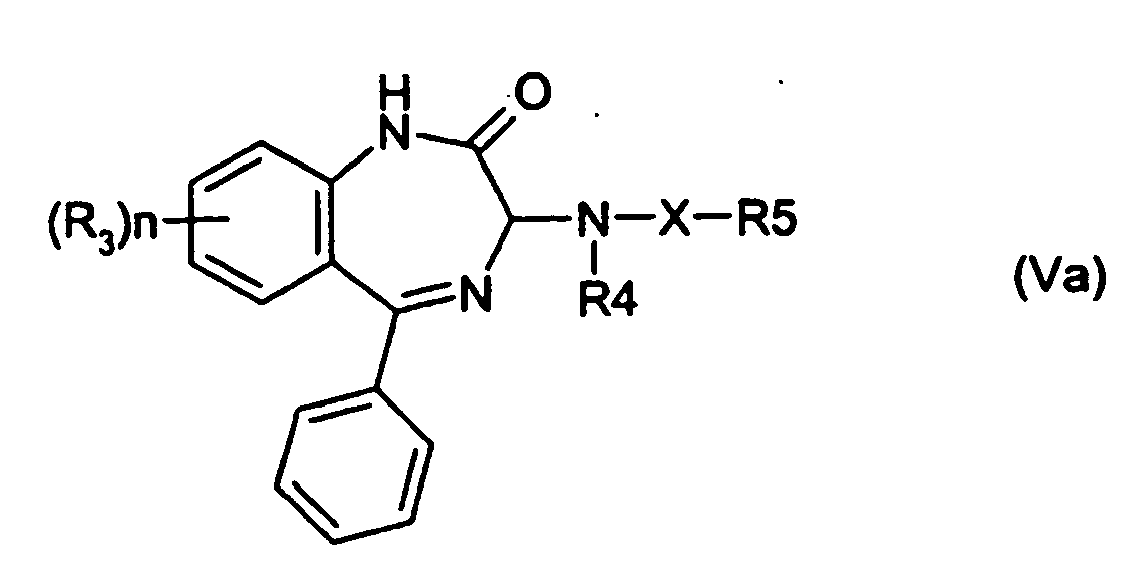
- X is -CO- or -CO-NH-; and
- R5 is a 5- to 6- membered heteroaryl group, for example a furanyl group,
- A1 is a phenyl, pyridyl, furanyl, thiazolyl, oxazolyl, isoxazolyl, thienyl or 1H-imidazo[4,5-b]pyridin-2-(3H)-one moiety, which is unsubstituted or substituted by 1 or 2 substituents selected from halogen, cyano, C1-C2 alkyl, C1-C2 haloalkyl and C1-C2 alkoxy substituents;
- Y is a direct bond, a C1-C2 alkylene group, -SO2- or -O-; and
- A2 is a piperazinyl, pyridyl, morpholinyl, pyrrolidinyl, piperidinyl, pyrazinyl, cyclopropyl, phenyl or S,S-dioxo-thiomorpholino group, which is unsubstituted or substituted by a C1-C2 alkyl group.
- In the compounds of formula (Va), typically n is 0 and R4 is hydrogen. Preferably, in the compounds of formula (Va), A1 is a phenyl or furanyl group which is unsubstituted or substituted by a chlorine atom. Preferably, Y is a direct bond or a methylene group. Preferably, A2 is a morpholino or S,S-dioxo-thiomorpholino group.
- Compounds of the formula (V) containing one or more chiral centre may be used in enantiomerically or diasteroisomerically pure form, or in the form of a mixture of isomers. For the avoidance of doubt, the chemical structures depicted herein are intended to embrace all stereoisomers of the compounds shown, including racemic and non-racemic mixtures and pure enantiomers and/or diastereoisomers.
- Preferred compounds of formula (V) are optically active isomers. Thus, for example, preferred compounds of formula (V) containing only one chiral centre include an R enantiomer in substantially pure form, an S enantiomer in substantially pure form and enantiomeric mixtures which contain an excess of the R enantiomer or an excess of the S enantiomer. For the avoidance of doubt, the compounds of the formula (V) can, if desired, be used in the form of solvates.
- As used herein, a pharmaceutically acceptable salt is a salt with a pharmaceutically acceptable acid or base. Pharmaceutically acceptable acids include both inorganic acids such as hydrochloric, sulphuric, phosphoric, diphosphoric, hydrobromic or nitric acid and organic acids such as citric, fumaric, maleic, malic, ascorbic, succinic, tartaric, benzoic, acetic, methanesulphonic, ethanesulphonic, benzenesulphonic or p-toluenesulphonic acid. Pharmaceutical acceptable bases include alkali metal (e.g. sodium or potassium) and alkaline earth metal (e.g. calcium or magnesium) hydroxides and organic bases such as alkyl amines, aralkyl amines or heterocyclic amines.
- Particularly preferred compounds of formula (V) include:
- 6-(4-Methyl-piperazin-1-yl)-N-(2-oxo-5-phenyl-2,3-dihydro-1H-benzo[e][1,4] diazepin-3-yl)-nicotinamide;
- 3,4,5,6-Tetrahydro-2H-[1,2']bipyridinyl-5'-carboxylic acid (2-oxo-5-phenyl-2,3-dihydro-1H-benzo[e] [1,4]diazepin-3-yl)-amide;
- (S)-2-(1,1,Dioxo-1λ6-thiomorpholin-4-yl)-N-(2-oxo-5-phenyl-2,3-dihydro-1H-benzo[e][1,4]diazepin-3-yl-benzamide;
- (S)-2-Chloro-4-morpholin-4-yl-N-(2-oxo-5-phenyl-2,3-dihydro-1H-benzo[e][1,4] diazepin-3-yl)-benzamide;
- (S)-2-(1,1-Dioxo-1λ6-thiomorpholin-4-yl)-4-fluoro-(2-oxo-5-phenyl-2,3-dihydro-1H-benzo[e][1,4]diazepin-3-yl-benzamide;
- (S)-5-Chloro-2-(1,1-dioxo-1λ6-thiomorpholin-4-yl)-N-(2-oxo-5-phenyl-2,3-dihydro-1H-benzo[e][1,4]diazepin-3-yl)-benzamide;
- (S)-2-(1,1-Dioxo-1λ6-thiomorpholin-4-yl)-5-fluoro-N-(2-oxo-5-phenyl-2,3-dihydro-1H-benzo[e][1,4]diazepin-3-yl)-benzamide;
- (S)-5-(4-Methyl-piperazin-1-ylmethyl)-furan-2-carboxylic acid (2-oxo-5-phenyl-2,3-dihydro-1H-benzo[e][1,4]diazepin-3-yl)-amide;
- (S)-5-Pyrrolidin-1-ylmethyl-furan-2-carboxylic acid (2-oxo-5-phenyl-2,3-dihydro-1H-benzo[e][1,4]diazepin-3-yl)-amide;
- (S)-5-Piperidin-1-ylmethyl-furan-2-carboxylic acid (2-oxo-5-phenyl-2,3-dihydro-1H-benzo[e][1,4]diazepin-3-yl)-amide;
- (S)-5-Dimethylaminomethyl-furan-2-carboxylic acid (2-oxo-5-phenyl-2,3-dihydro-1H-benzo[e][1,4]diazepin-3-yl)-amide;
- (S)-4-Fluoro-N-(2-oxo-5-phenyl-2,3-dihydro-1H-benzo[e][1,4]diazepin-3-yl)-2-piperidin-1-yl-benzamide;
- (S)-4-Fluoro-2-morpholino-4-yl-N-(2-oxo-5-phenyl-2,3-dihydro-1H-benzo[e][1,4] diazepin-3-yl)-benzamide;
- (S)-4-Cyano-N-(2-oxo-5-phenyl-2,3-dihydro-1H-benzo[e][1,4]diazepin-3-yl)-2-pyrrolidin-1-yl-benzamide;
- (S)-4-Cyano-N-(2-oxo-5-phenyl-2,3-dihydro-1H-benzo[e][1,4]diazepin-3-yl)-piperidine-1-yl-benzamide;
- (S)-N-(2-Oxo-5-phenyl-2,3-dihydro-1H-benzo[e][1,4]diazepin-3-yl)-2-pyrrolidin-1-yl-4-trifluoromethyl-benzamide;
- (S)-N-(2-Oxo-5-phenyl-2,3-dihydro-1H-benzo[e][1,4]diazepin-3-yl)-2-piperidin-1-yl-4-trifluoromethyl-benzamide;
- (S)-2-Morpholin-4-yl-N-(2-oxo-5-phenyl-2,3-dihydro-1H-benzo[e][1,4]diazepin-3-yl)-4-trifluoromethyl-benzamide;
- (S)-N-(2-Oxo-5-phenyl-2,3-dihydro-1H-benzo[e][1,4]diazepin-3-yl)-2-pyrrolidin-1-yl-5-trifluoromethyl-benzamide;
- (S)-2-Morpholin-4-yl-N-(2-oxo-5-phenyl-2,3-dihydro-1H-benzo[e][1,4]diazepin-3-yl)-5-trifluoromethyl-benzamide;
- (S)-2-Morpholin-4-yl-N-(2-oxo-5-phenyl-2,3-dihydro-1H-benzo[e][1,4]diazepin-3-yl)-nicotinamide;
- (S)-2-(1,1-Dioxo-1λ6-thiomorpholin-4-yl)-N-(2-oxo-5-phenyl-2,3-dihydro-1H-benzo[e][1,4]diazepin-3-yl)-nicotinamide;
- (S)-2-(1,1-Dioxo-1λ6-thiomorpholin-4-yl)-2-methyl-N-(2-oxo-5-phenyl-2,3-dihydro-1H-benzo[e][1,4]diazepin-3-yl)-benzamide;
- (S)-2-(1,1-Dioxo-1λ6-thiomorpholin-4-yl)-4-methyl-N-(2-oxo-5-phenyl-2,3-dihydro-1H-benzo[e][1,4]diazepin-3-yl)-benzamide;
- (S)-2-(1,1-Dioxo-1λ6-thiomorpholin-4-yl)-6-methyl-N-(2-oxo-5-phenyl-2,3-dihydro-1H-benzo[e][1,4]diazepin-3-yl)-benzamide;
- (S)-2-Chloro-6-(1,1-dioxo-1λ6-thiomorpholin-4-yl)-N-(2-oxo-5-phenyl-2,3-dihydro-1H-benzo[e][1,4]diazepin-3-yl)-benzamide;
- (S)-3-Cyclopropyl-2-oxo-2,3-dihydro-imidazo[4,5-b]pyridine-1-carboxylic acid (2-oxo-5-phenyl-2,3-dihydro-1H-benzo[e][1,4]diazepin-3-yl)-amide;
- (S)-3-(4-Methyl-piperazine-1-sulfonyl)-N-(2-oxo-5-phenyl-2,3-dihydro-1H-benzo[e][1,4]diazepin-3-yl)-benzamide;
- (S)-4-(4-Methyl-piperazin-1-yl)-N-(2-oxo-5-phenyl-2,3-dihydro-1H-benzo[e][1,4] diazepin-3-yl)-benzamide;
- (S)-N-(2-Oxo-5-phenyl-2,3-dihydro-1H-benzo[e][1,4]diazepin-3-yl)-3-(piperidine-1-sulfonyl)-benzamide;
- (S)-3-(Morpholine-4-sulfonyl)-N-(2-oxo-5-phenyl-2,3-dihydro-1H-benzo[e][1,4] diazepin-3-yl)-benzamide;
- (S)-5-Morpholin-4-ylmethyl-furan-2-carboxylic acid (2-oxo-5-phenyl-2,3-dihydro-1H-benzo[e][1,4]diazepin-3-yl)-amide;
- (S)-5-Hydroxymethyl-furan-2-carboxylic acid (2-oxo-5-phenyl-2,3-dihydro-1H-benzo[e][1,4]diazepin-3-yl)-amide;
- (S)-5-(1,1-Dioxo-1λ6-thiomorpholin-4-ylmethyl)-furan-2-carboxylic acid (2-oxo-5-phenyl-2,3-dihydro-1H-benzo[e][1,4]diazepin-3-yl)-amide;
- (S)-2-Chloro-4-(1,1-dioxo-1λ6-thiomorpholin-4-yl)-N-(2-oxo-5-phenyl-2,3-dihydro-1H-benzo[e][1,4]diazepin-3-yl)-benzamide;
- (S)-2-Chloro-5-(1,1-dioxo-1λ6-thiomorpholin-4-yl)-N-(2-oxo-5-phenyl-2,3-dihydro-1H-benzo[e][1,4]diazepin-3-yl)-benzamide;
- (S)-5-{[(2-Methanesulfonyl-ethyl)-methyl-amino]-methyl}-furan-2-carboxylic acid (2-oxo-5-phenyl-2,3-dihydro-1H-benzo[e][1,4]diazepin-3-yl-amide;
- (S)-2-Pyridin-3-yl-thiazole-4-carboxylic acid (2-oxo-5-phenyl-2,3-dihydro-1H-benzo[e][1,4]diazepin-3-yl)-amide;
- (S)-2-Pyridin-4-yl-thiazole-4-carboxylic acid (2-oxo-5-phenyl-2,3-dihydro-1H-benzo[e][1,4]diazepin-3-yl)-amide;
- (S)-4-Methyl-2-pyrazin-2-yl-thiazole-5-carboxylic acid (2-oxo-5-phenyl-2,3-dihydro-1H-benzo[e][1,4]diazepin-3-yl)-amide;
- (S)-2-Morpholin-4-ylmethyl-furan-3-carboxylic acid (2-oxo-5-phenyl-2,3-dihydro-1H-benzo[e][1,4]diazepin-3-yl)-amide;
- (S)-3-Morpholin-4-ylmethyl-N-(2-oxo-5-phenyl-2,3-dihydro-1H-benzo[e][1,4] diazepin-3-yl)-benzamide;
- (S)-5-Morpholin-4-ylmethyl-isoxazole-3-carboxylic acid (2-oxo-5-phenyl-2,3-dihydro-1H-benzo[e][1,4]diazepin-3-yl)-amide;
- (S)-3-Morpholin-4-ylmethyl-furan-2-carboxylic acid (2-oxo-5-phenyl-2,3-dihydro-1H-benzo[e][1,4]diazepin-3-yl)-amide;
- (S)-5-Pyridin-2-yl-thiophene-2-carboxylic acid (2-oxo-5-phenyl-2,3-dihydro-1H-benzo[e][1,4]diazepin-3-yl)-amide;
- (S)-2-Methyl-4-(morpholin-4-sulfonyl)-furan-3-carboxylic acid (2-oxo-5-phenyl-2,3-dihydro-1H-benzo[e][1,4]diazepin-3-yl)-amide;
- (S)-6-Morpholin-4-yl-N-(2-oxo-5-phenyl-2,3-dihydro-1H-benzo[e][1,4]diazepin-3-yl)-nicotinamide;
- (S)-3-Morpholin-4-ylmethyl-thiophene-2-carboxylic acid (2-oxo-5-phenyl-2,3-dihydro-1H-benzo[e][1,4]diazepin-3-yl)-amide;
- (S)-5-Morpholin-4-ylmethyl-thiophene-2-carboxylic acid (2-oxo-5-phenyl-2,3-dihydro-1H-benzo[e][1,4]diazepin-3-yl)-amide;
- 2-Morpholin-4-yl-N-(2-oxo-5-phenyl-2,3-dihydro-1H-benzo[e][1,4]diazepin-3-yl)-benzamide;
- (S)-5-Phenyl-oxazole-4 carboxylic acid (2-oxo-5-phenyl-2,3-dihydro-1H-benzo[e][1,4]diazepin-3-yl)-amide;
- 1-(2-Oxo-5-phenyl-2,3-dihydro-1H-benzo[e][1,4]diazepin-3-yl)-3-(4-phenoxy-phenyl)-urea; an N-oxide of any of the above compounds;
- The compounds of formulae (I), (II), (III) and (IV) are known compounds. They are disclosed, for example, in
WO 00/195910 WO 00/004900 WO 03/053344 US-A-4324794 andWO 01/00612 -
WO 00/195910 WO 00/004900 WO 03/053344 US-A-4324794 andWO 01/00612 - Compounds of formula (V) may be prepared by reacting glyoxylic acid (HCO-CO2H), benzotriazole and an appropriate benzyl carbamate at reflux in toluene, under Dean-Stark conditions giving the key protected amino acid of formula (II')

- The thus obtained amino acid of formula (II') can then be reacted with a suitable chlorinating agent, such as oxalyl chloride, followed by reaction with a 2-aminobenzophenone of formula (III')


- The compound of formula (IV') can then be subjected to ammonolysis followed by

- The compound of formula (V') can then be deprotected using hydrogen bromide in acetic acid to yield the deprotected amine of formula (VI').
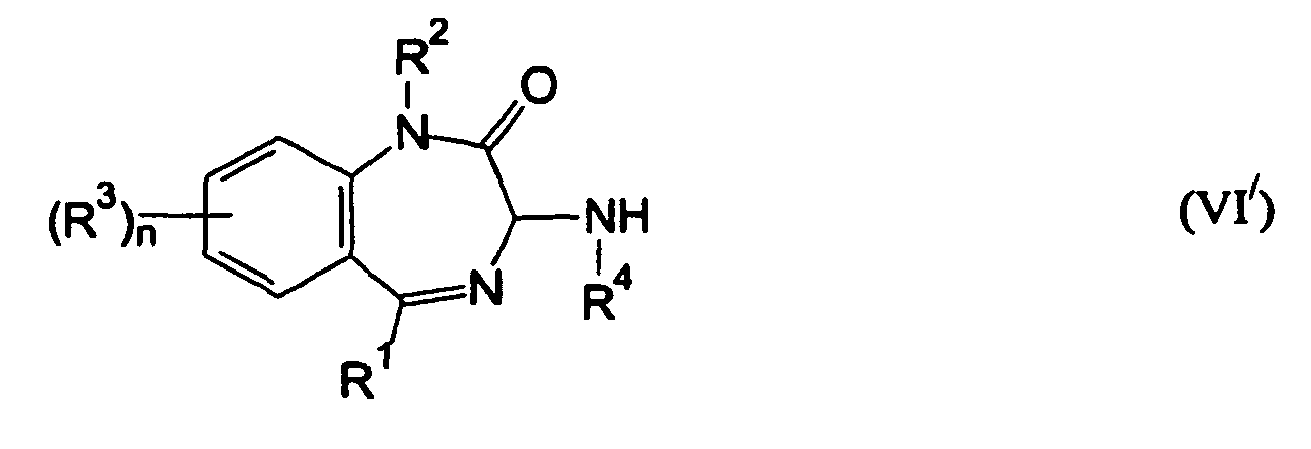
- Compounds of formula (V), in which X is -CO- or -CO-NR' can be prepared by reacting a compound of formula (VI'), as defined above, with an acid anhydride in a suitable solvent, preferably pyridine at ambient temperature, or with an acid chloride in a suitable solvent in the presence of a base, preferably in THF at ambient temperature with triethylamine present. Alternatively, the compounds can be produced by reaction of a compound of formula (VI') with an acid in a suitable solvent in the presence of a base and a coupling agent, preferably in THF at ambient temperature with triethylamine and O-benzotriazol-1-yl-N, N, N', N'-tetramethyluronium hexafluorophosphate (HBTU) present.
- If the acid chloride used is an amino carbonyl chloride, the compound of formula (V) is a urea. In the case where R' in the X moiety is hydrogen, such compounds may also be prepared by the reaction of a compound of formula (VI') with an isocyanate. This reaction is preferably carried out in THF at ambient temperature. Alternatively, the isocyanate may be prepared in situ from the relevant amine and phosgene, in the presence of a base, usually triethylamine, again in THF. Compounds in which R' is other than hydrogen can, of course, be prepared by reacting a corresponding compound in which R' is hydrogen with an appropriate alkylating agent, for example L-(C1-C6 alkyl) wherein L is a leaving group, for example chlorine.
- Compounds of formula (V), in which X is -S(O)2- may be prepared by the reaction of a compound of formula (VI') with a suitable sulfonyl chloride. Similarly, compounds of formula (V), in which X is -S(O)- may be prepared by the reaction of a compound of formula (VI') with a suitable sulfinyl chloride
- In the preparation of the benzodiazepine skeleton, commercially available aminobenzophenone compounds of formula (III') can be used where possible. Compounds of formula (III') which are not commercially available can be prepared by known methods, for example by reaction of a Weinreb type amide of formula (VII')

- Compounds of formula (VII') are known compounds or can be prepared by analogy with known methods. For example, they can be prepared from the reaction of isatoic anhydrides of formula (VIII')

- The starting materials of formula (II'), (III'), (VII'), and (VIII') are known compounds, or may be prepared by analogy with known methods.
- Further synthetic manipulation of the thus obtained compounds of formula (V) may be carried out by conventional methods to achieve further compounds of formula (V). The benzodiazepines of formula (V) can be salified by treatment with an appropriate acid or base.
- Although the described route to the claimed compounds of formula (V) provides an adequate synthesis for laboratory scale preparations, an alternative route was sought which has potential as a manufacturing route. The same starting material (2-amino-benzophenone) (1) is used in both, however in the alternative route, the benzodiazepine ring system is formed by reaction initially with bromoacetyl bromide (or an equivalent reagent) followed by ring closure with ammonia. These reactions are carried out in a suitable solvent, such as dichloromethane, and at a suitable temperature which may range from -20 to 150°C. In order to protect the NH functionality, at this stage the unsubstituted benzodiazepine is reacted with a base, and an alkylating agent. For instance sodium hydride in DMF followed by addition of 4-methoxy-benzyl chloride gives rise to the intermediate (2) shown below. Further reaction of this material with a base (e.g. potassium tert-butoxide ) in a suitable solvent (e.g. THF or DMF) followed by quenching with isoamyl nitrite (or an alternative similar reagent) furnishes the oxime intermediate (3) which may be converted into the racemic primary amine by methods which include the use of hydrogen and a suitable catalyst. This amine then undergoes a Dynamic Kinetic Resolution (DKR) procedure by which the racemic amine in the presence of a suitable optically active acid, and a suitable aldehyde gives rise to precipitation of the salt of the desired (S)-amine (4) in good yield and exceptionally high enantiomeric excess. A suitable acid for this conversion can be e.g. Camphorsulfonic acid, Boc-phenyl alanine or the like, and a suitable aldehyde may be a benzaldehyde such as 3,5-dichloro salicylaldehyde.
- The optically amine thus formed may then be transformed into a desired derivative, such as an amide or urea. The amide formations may be carried out using a suitable carboxylic acid and a coupling reagent, or a carbonyl chloride or other suitable reagent, and the ureas prepared using either a suitable isocyanate, or alternatively reaction with phosgene followed by a suitable amine.
- These derivatives thus formed may then have the protecting group removed. This may be carried out in the presence of a Lewis Acid, such as aluminium chloride, boron trifluoride, titanium tetrachloride, or the like. These reactions are carried out in a suitable inert solvent, such as dichloromethane. Reaction temperatures may range from -20 to 150°C, but are typically carried out at room temperature or below.

- In a particularly preferred embodiment of the invention, component (a) is 1-cyclopropyl-3-[1-(4-hydroxy-butyl)-1H-benzoimidazol-2-ylmethyl]-1,3-dihydro-imidazo[4,5-c]pyridin-2-one, 2-[2-(1,2-dihydro-benzotriazol-1-ylmethyl)-benzoimidazol-1-yl]]ethyl}-diethyl-anune, {2-[2-(3-iodo-2,3-dihydro-indazol-1-ylmethyl)-benzimidazol-1-yl]-ethyl}-dimethyl-amine or a pharmaceutically acceptable salt thereof and component (b) is (S)-2-Chloro-4-morpholin-4-yl-N-(2-oxo-5-phenyl-2,3-dihydro-1H-benzo[e][1,4]diazepin-3-yi)-benzamide or 5-(1,1-dioxo-1λ6-thiomorpholin-4-ylmethyl)-furan-2-carboxytic acid (2-oxo-5-phenyl-2,3-dihydro-1H-benzo[e][1,4]diazepin-3-yl)amide or a pharmaceutically acceptable salt thereof.
- The present invention also provides a pharmaceutical composition according to the invention, for use in the treatment of the human or animal body. Also provided is the use of (a) a said RSV fusion protein inhibitor and (b) a said benzodiazepine derivative, in the manufacture of a medicament for use in treating or preventing an RSV infection.
- The present invention also provides a method of treating or preventing an RSV infection in a patient, which method comprises the administration to said patient of (a) a said RSV fusion protein inhibitor and (b) a said benzodiazepine derivative.
- Typically, the amount of component (a) in the composition of the invention is from 0.025 wt% to 10 wt%, preferably from 0.25 wt% to 5 wt%, more preferably from I wt% to 3.5 wt%, for example about 2.5 wt%, based on the total weight of the composition.
- Typically, the amount of component (b) in the composition of the invention is from 0.025 wt% to 10 wt%, preferably from 0.25 wt% to 5 wt%, more preferably from 1 wt% to 3.5 wt%, for example about 2.5 wt%, based on the total weight of the composition.
- Typically, the total amount of components (a) and (b) in the composition of the invention is from 0.05 to 20 wt%, preferably from 0.5 to 10 wt%, more preferably from 2 to 7 wt%, for example about 5 wt%, based on the total weight of the composition.
- RSV is prevalent among children younger than two years of age, adults suffering from asthma, chronic obstructive pulmonary disorder (COPD) or immunodeficiency and the elderly. It is a particularly serious risk amongst children who suffer from chronic lung disease. Accordingly, the said composition or medicament is typically for use in treating a patient who is a child under two years of age, patients with asthma, COPD or immunodeficiency the elderly or persons in long term care facilities. Typically, said child suffers from chronic lung disease.
- Further, anti-RSV prophylaxis is recommended for infants bom at 32 weeks of gestation or earlier, until they reach 6 months of age, the elderly, persons with immunedeficiency and those in long term care facilities. Accordingly, the said composition or medicament is typically for use in preventing RSV infection in an infant less than 6 years of age, who was born after 32 weeks of gestation or less, the elderly, persons with immunosufficiency and those in long term care facilities.
- As described above, RSV strains upon exposure to fusion inhibitors known in the art rapidly develop resistance. In order to minimize the risk of development of resistance to fusion inhibitors it is desirable to combine them with another inhibitor of RSV replication with a different mode of action. To our knowledge, the benzodiazepine derivatives disclosed above are the first class of compounds with a novel mode of action. Accordingly, the compositions of the invention are characterized by a very low resistance profile, which makes them particularly suitable for therapeutic and prophylactic applications.
- The present invention also covers situations where components (a) and (b) are administered separately. Thus, for example, component (a) can be administered up to 24 hours before component (b). Alternatively, component (b) can be administered up to 24 hours before component (a). More usually, when components (a) and (b) are administered separately, they are administered within 12 hours, preferably within 6 hours, of each other.
- The present invention therefore also provides a product comprising (a) a said RSV fusion protein inhibitor and (b) a said benzodiazepine derivative for separate, simultaneous or sequential use in the treatment of the human or animal body. Typically, said product is for separate, simultaneous or sequential use in treating or preventing an RSV infection.
- Also provided is the use of a said RSV fusion protein inhibitor in the manufacture of a medicament for use in treating or preventing an RSV infection by co-administration with a said benzodiazepine derivative. The present invention also provides the use of a said benzodiazepine derivative in the manufacture of a medicament for use in treating or preventing an RSV infection, by co-administration with a said RSV fusion protein inhibitor.
- When components (a) and (b) are administered separately, they are typically formulated as described above. The amount of active ingredient in each separate formulation will, of course, correspond to the amount of component (a) or (b) given above for the combined formulation. Thus, when components (a) and (b) are administered separately, a first formulation is typically provided which contains from 0.025 wt% to 10 wt%, preferably from 0.25 wt% to 5 wt%, more preferably from 1 wt% to 3.5 wt%, for example about 2.5 wt%, of a said RSV fusion protein inhibitor, based on the total weight of the formulation. Similarly, a second formulation is typically provided which contains from 0.025 wt% to 10 wt%, preferably from 0.25 wt% to 5 wt%, more preferably from 1 wt% to 3.5 wt%, for example around 2.5 wt%, of a said benzodiazepine derivative, based on the total weight of the formulation. The two formulations can be administered separately in any order.
- Preferably, the compositions and medicaments of the invention have an activity greater than the combined individual activities of compounds (a) and (b). Thus, components (a) and (b) typically interact synergistically. Preferably, therefore, in the formulations and the medicaments of the invention, component (a) and component (b) are each present in an amount producing a synergistic therapeutic effect in treating or preventing an RSV infection.
- The anti-RSV compositions of the invention may be administered in a variety of dosage forms. Thus, they can be administered orally, for example as tablets, troches, lozenges, aqueous or oily suspensions, dispersible powders or granules. The compounds of the invention may also be administered parenterally, whether subcutaneously, intravenously, intramuscularly, intrasternally, transdermally or by infusion techniques. The compounds may also be administered as suppositories.
- In a preferred embodiment, administration is by intravenous, intranasal or intrabronchial means. In particular, formulations for treating or preventing RSV can advantageously be administered intranasally. The present invention therefore also provides an inhaler or nebuliser containing a medicament which comprises (i) a composition of the invention comprising component (a) and component (b), as defined above, and (ii) a pharmaceutically acceptable carrier or diluent.
- The anti-RSV compositions of the invention are typically formulated for administration with a pharmaceutically acceptable carrier or diluent. For example, solid oral forms may contain, together with the active compound(s), diluents, e.g. lactose, dextrose, saccharose, cellulose, conn starch or potato starch; lubricants, e.g. silica, talc, stearic acid, magnesium or calcium stearate, and/or polyethylene glycols; binding agents; e.g. starches, arabic gums, gelatin, methylcellulose, carboxymethylcellulose or polyvinyl pyrrolidone; disaggregating agents, e.g. starch, alginic acid, alginates or sodium starch glycolate; effervescing mixtures; dyestuffs; sweeteners; wetting agents, such as lecithin, polysorbates, laurylsulphates; and, in general, non toxic and pharmacologically inactive substances used in pharmaceutical formulations. Such pharmaceutical preparations may be manufactured in known manner, for example, by means of mixing, granulating, tableting, sugar coating, or film coating processes.
- Liquid dispersions for oral administration may be syrups, emulsions and suspensions. The syrups may contain as carriers, for example, saccharose or saccharose with glycerine and/or mannitol and/or sorbitol.
- Suspensions and emulsions may contain as carrier, for example a natural gum, agar, sodium alginate, pectin, methylcellulose, carboxymethylcellulose, or polyvinyl alcohol. The suspension or solutions for intramuscular injections may contain, together with the active compound, a pharmaceutically acceptable carrier, e.g. sterile water, olive oil, ethyl oleate, glycols, e.g. propylene glycol, and if desired, a suitable amount of lidocaine hydrochloride.
- Solutions for injection or infusion may contain as carrier, for example, sterile water or preferably they may be in the form of sterile, aqueous, isotonic saline solutions.
- Preferably, the anti-RSV compositions of the invention are solubilised in a earner containing (a) a pharmaceutically acceptable oil selected from esterification or polyether product of glycerides with vegetable oil fatty acids of chain length C8-C10 and (b) a pharmaceutically acceptable surfactant selected from oleate and laurate esters of a polyalcohol copolymerized with ethylene oxide. Particularly preferred carriers contain Labrafil as the oil and Tween 20 or Tween 80 as the surfactant.
- The anti-RSV compositions of the invention may also be suspended in PEG 400 for oral administration.
- A therapeutically effective amount of an anti-RSV composition of the invention is administered to a patient. A typical dose is from about 0.001 to 50 mg, typically 0.5 to 30 mg, preferably 1 to 20 mg active ingredient per kg of body weight, according to the activity of the specific composition, the age, weight and conditions of the subject to be treated, the type and severity of the disease and the frequency and route of administration. Preferably, daily dosage levels are from 5 mg to 2 g active ingredient.
- The following Examples illustrate the invention. They do not however, limit the invention in any way. In this regard, it is important to understand that the particular assays used in the Examples section are designed only to provide an indication of antiviral activity. There are many assays available to determine the activity of given compounds against RSV, and a negative result in any one particular assay is therefore not determinative.
- A mixture of 4-amino-2-chlorobenzoic acid (172mg) and ethenesulfonyl-ethene (0.15ml) in water (3ml) containing sodium carbonate (212mg) was heated to 100C for 18h. The mixture was allowed to cool and was acidified with 2N HCl. The off-white precipitate was collected and dried (263mg)
LC/MS RT= 4.09mins, ES- 288,290 - A mixture of 5-amino-2-chlorobenzoic acid (172mg) and ethenesulfonyl-ethene (0.15ml) in water (3ml) was heated to 100C for 18h. The mixture was allowed to cool and was extracted with dichloromethane. The dried extracts were evaporated giving a pale brown solid (265mg)
LC/MS RT= 4.13mins, ES- 288,290 - This material was prepared as described for Intermediate 1 except that 2-amino-nicotinic acid (138mg) was used. The title compound was isolated as an off-white solid (93mg)
- This material was prepared as described for Intermediate 2 except that 2-amino-3-methylbenzoic acid (302mg) was used. The title compound was isolated as a pale brown solid (486mg)
- This material was prepared as described for Intermediate 2 except that 2-amino-4-methylbenzoic acid (302mg) was used. The title compound was isolated as a brown solid (430mg)
- This material was prepared as described for Intermediate 2 except that 2-amino-6-methylbenzoic acid (302mg) was used. The title compound was isolated as a brown solid (490mg)
- A solution of 3-chlorosulfonyl-benzoic acid (89mg) 4-dimethylamino-pyridine (catalytic amount) and N-methylpiperazine (0.045ml) in dichloromethane (10ml) was heated to reflux for 2h. The solvent was then evaporated and the crude material used without purification or characterisation in the next synthetic step.
- This material was prepared as described for Intermediate 7 except that piperidine was used as the nucleophile. As for Intermediate 7 the material was used crude.
- This material was prepared as described for Intermediate 7 except that morpholine was used as the nucleophile. As for Intermediate 7 the material was used crude.
- This material was prepared as described for Intermediate 2 except that 2-amino-6-chlorobenzoic acid (343mg) was used. The title compound was isolated as a buff solid (405mg)
- This material was prepared as described for Intermediate 2 except that 2-amino-5-chlorobenzoic acid (200mg) was used. The title compound was isolated as a white solid (233mg) 1t NMR (DMSO, δ) 3.25 (brs, 4H) 3.47 (brs, 4H) 7.31 (d, 1H) 7.54 (dd, 1H) 7.71 (d, 1H) LC/MS RT = 4.66 min Found ES+ = 290,292
- This material was prepared as described for Intermediate 2 except that 2-amino-5-fluorobenzoic acid (200mg) was used. The title compound was isolated as a white solid (310mg) 1H NMR (DMSO, δ) 3.28 (m, 4H) 3.42 (m, 4H) 7.33-7.56 (m, 3H)
LC/MS RT = 4.28 min Found ES- = 272 - A mixture of 2,4-difluoro-benzoic acid (0.5g), thiomorpholine (0.33ml) and triethylamine (0.88ml) in acetonitrile (2ml) was heated to 200C in a microwave reactor for 20mins. The residue was partitioned between water and dichloromethane. The dried organic layer was evaporated and then purified on a silica gel SPE cartridge. Elution with dichloromethane followed by a gradient of dichloromethane:ethanol:0.880 ammonia; 800:8:1 to 200:8:1 gave the title material as a white solid (292mg)
1H NMR (DMSO, δ) 2.81 (m, 4H) 3.27 (m, 4H) 7.11 (m, 1H) 7.40 (dd, 1H) 7.95 (m, 1H) - Intermediate 11 (262mg) and potassium peroxymonosulfate (1.34g) in methanol (5ml) and water (2.5ml) was stirred at room temperature for 6h. The precipitate formed was collected by filtration then dissolved in aqueous sodium bicarbonate. Acidification to pH3 with 1M HC1 led to the formation of a white precipitate which was collected and dried (194mg)
1H NMR (DMSO, δ) 3.2-3.48 (brm, 4H) 3.59 (t, 2H) 3.89 (t, 2H) 6.96 (m, 1H) 7.30 (dd, 1H) 7.85 (m, 1H) - A mixture of racemic 3-amino-5-phenyl-1,3-dihydro-benzo[e][1,4]diazepin-2-one (1g), O-benzotriazol-1-yl-N,N,N',N'-tetramethyluronium hexafluorophosphate (1.51g), triethylamine (0.83ml) and 6-chloro-nicotinic acid (0.63g) in dry DMF (20ml) was stirred at room temperature for 1.5h. Water (200ml) was then added and the mixture stirred vigorously for 10mins. The colourless precipitate was collected by filtration and dried (1.1g)
1H NMR (DMSO, δ) 5.50 (d, 1H) 7.28-7.71 (m, 10H) 8.42 (dd, 1H) 9.01 (d, 1H) 9.99 (d, 1H) 10.95 (s, 1H)
LC/MS RT= 4.96mins, ES+ 391,393 - 9.98 g of thiomorpholine and 14.8 g of triflic anhydride were stirred together in DCM at room temperature for 2 hours. The reaction was then partitioned between 1 M K2CO3(aq) and DCM. The organic layer was separated and dried by passing through a hydrophobic frit, then concentrated in vacuo. 13.82 g of the resultant oil was stirred with 85.2 g of oxone in 50 mL of methanol and 50 mL of water for 18 h at room temperature. The reaction was then filtered and washed with methanol and the filtrate concentrated. This was then partitioned between water and EtOAc and the aqueous layer washed 3 times with EtOAc. The combined organic extracts were then dried (MgSO4) and concentrated to produce a white solid. This was then stirred at room temperature with 40 g of K2CO3 in 80 mL of methanol for 18 h. The methanol was then removed in vacuo and the remains partitioned between DCM and sat. K2CO3(aq). The combined organic extracts were passed through a hydrophobic frit and concentrated in vacuo to produce the title compound, 3.51 g.
1H NMR (CDCl3, δ) 1.54 (s, 1H), 2.93-2.97 (m, 4H), 3.24-3.28 (m, 4H). - 0.5 g of 5-chloromethyl-furan-2-carboxylic acid ethyl ester and 20 ml of 2 M methylamine solution in THF were stirred at room temperature for 5 days under nitrogen. The solution was then concentrated and purified by SPE. The resultant oil was heated at 200 °C in a microwave with 0.2mL of methanesulfonyl-ethene in 3 mL of acetonitrile for 1h. The solution was concentrated and purified by chromatography to produce the title compound as a colourless oil.
LC/MS RT = 3.55 min, Found ES+ = 290
1H NMR (CDCl3, δ) 1.29 (t, 3H), 2.25 (s, 3H), 2.92-2.88 (m, 2H), 2.99 (s, 3H), 3.06-2.99 (t, 2H), 3.6 (s, 2H), 4.26 (q, 2H), 6.28 (d, 1H), 7.04 (d, 1H). - 0.16ml of a 2 M solution of dimethylamine was added to a stirred suspension of 19.2 mg of sodium hydride in 2 mL of DMF under a nitrogen atmosphere at room temperature for 30 min. Then a solution of 5-chloromethyl-furan-2-carboxylic acid ethyl ester in 2 mL of DMF was added dropwise over a period of 30 min. The reaction was then allowed to stir for 2 days. The solvent was then removed in vacuo and 5 mL of EtOH and 0.35ml of 2 M NaOH added and stirred at 80°C for 40 min. Upon return the reaction was acidified below pH 5.0 and the solvent removed in vacuo to produce the title compound to be hydrolysed and then used crude in the next stage
- Intermediates 19-23 were prepared in an analogous manner and were used without characterisation in the next synthetic step
- A mixture of 2-chloro-3-nitro-pyridine (2g), cyclopropylamine (1.13ml) and potassium carbonate (3.48g) in acetonitrile (30ml) was stirred at room temperature for 18h. The mixture was then partitioned between water and ethyl acetate. The dried extracts were evaporated giving a bright yellow solid (2.1 g)
This material was then hydrogenated at atmospheric pressure in ethanol (150ml) over palladium on carbon catalyst (10%, 100mg). When hydrogen uptake had ceased the mixture was filtered through celite and evaporated giving a dark gum (1.7g)
This material was then dissolved in dry THF (40ml) and was treated with carbonyl diimidazole (2.2g) at reflux for 2.5h. The mixture was then partitioned between water and ethyl acetate. The dried organic extract was evaporated leaving a dark gum, which was crystallised from ethyl acetate/petrol giving a colourless solid (1.2g)
1H NMR (DMSO, δ) 0.97-1.04 (m, 4H) 2.92 (m, 1H) 6.97 (dd, 1H) 7.22 (dd,1H) 7.92 (dd, 1H) 10.95 (brs, 1H) - A mixture of 2-chloromethyl-furan-3-carboxylic acid methyl ester (100mg) and morpholine (0.08ml) in acetonitrile (4ml) was stirred at room temperature for 2h. The mixture was then partitioned between dichloromethane and aqueous sodium bicarbonate solution. The dried organic layer was evaporated giving a yellow oil (75mg)
1H NMR (CDCl3, δ) 2.57 (m, 4H) 3.74 (m, 4H) 3.86 (s, 3H) 3.97 (s, 2H) 6.70 (d, 1H) 7.38 (d, 1H) - This material was prepared as for Intermediate 25. The product was a colourless oil (210mg)
1H NMR (CDCl3, δ) 2.43 (m, 4H) 3.53 (s, 2H) 3.70 (m, 4H) 3.91 (s, 3H) 7.39 (t, 1 H) 7.42 (dd,1H) 7.93 (dt, 1H) 7.99 (brs, 1H) - 5-Methyl-isoxazole-3-carboxylic acid methyl ester (200mg), N-bromosuccinimide (252mg) and bezoyl peroxide (30mg) in dry chloroform (4ml) was stirred and heated to 85C for 5h. The solution was cooled to room temperature and was treated with morpholine (0.27ml). Stirring was continued for 20h and the mixture was then partitioned between water and dichloromethane. The dried organic extract was evaporated and the residue purified on a silica gel SPE cartridge. Elution with dichloromethane followed by dichloromethane:ethano1:0.880 ammonia; 200:8:1 gave a colourless oil (50mg)
1H NMR (CDCl3, δ) 2.46 (m, 4H) 3.64 (m, 4H) 3.67 (s, 2H) 3.90 (s, 3H) 6.55 (s, 1H) - Intermediates 28-30 were prepared in an analogous method to Intermediate 25
- This compound was isolated as a yellow oil (189mg)
1H NMR (CDCl3, δ) 2.45 (m, 4H) 3.65 (m, 4H) 3.71 (s, 2H) 3.85 (s, 3H) 6.56 (d, 1H) 7.45 (d, 1H) - This compound was isolated as yellow oil (197mg).
1H NMR (CDCl3, δ) 2.50 (m, 4H) 3.69 (s, 2H) 3.72 (m, 4H) 3.86 (s, 3H) 6.90 (d, 1H) 7.64 (d, 1H) - This compound was isolated as a yellow oil (214mg).
1H NMR (CDCl3, δ) 2.44 (m, 4H) 3.64 (m, 4H) 3.79 (s, 3H) 3.84 (s, 2H) 7.15 (d, 1H) 7.36 (d, 1H) - Intermediates 25-30 were hydrolysed to the corresponding carboxylic acids before use in the final coupling step of the synthetic sequence
- 2,4-Difluoro-benzoic acid (50mg) and morpholine (0.03ml) in acetonitrile (0.5ml) were heated in a microwave at 200C for 15mins. The solvent was evaporated leaving a dark gum which was used without purification in the next synthetic step.
- This was prepared in an analogous procedure to Intermediate 31.
- Intermediates 33-5 were prepared in an analogous procedure to Intermediate 31 except that 2-fluoro-4-trifluoromethyl-benzoic acid was used.
- Intermediates 36 and 37 were prepared in an analogous procedure to Intermediate 31 except that 2-fluoro-5-trifluoromethyl-benzoic acid was used.
- Intermediates 38 and 39 were prepared in an analogous procedure to Intermediate 31 except that 4-cyano-2-fluoro-benzoic acid was used.
- Intermediate 15 (50mg) and N-methylpiperazine (0.022ml) in acetonitrile (1ml) containing triethylamine (0.027ml) was heated in a microwave at 200°C for 1 Omins.The mixture was then partitioned between water and dichloromethane. The dried organic layer was evaporated and the residue purified on a silica gel SPE cartridge. Gradient elution with 5-10% methanol in dichloromethane gave a colourless solid (10mg)
1H NMR (DMSO, d) 2.28 (s, 3H) 2.45 (m, 4H) 3.68 (m, 4H) 5.56 (d, 1H) 6.93 (d, 1H) 7.32-7.72 (m, 10H) 8.20 (dd, 1 H) 8.82 (d, 1H) 9.42 (d, 1H) 10.94 (s, 1 H)
RT= 3.94mins, ES+ 455 - This material was prepared as for Example 1 except that piperidine was used as the nucleophile. The product was a colourless solid (15mg)
1H NMR (DMSO, d) 1.54-1.63 (brm, 6H) 3.65 (m, 4H) 5.48 (d, 1H) 6.86 (d, 1 H) 7.25-7.65 (m, 10H) 8.11 (dd, 1H) 8.75 (d, 1H) 9.32 (d, 1H)
RT= 4.54 mins, ES+ 440 - (S)-3-Amino-5-phenyl-1,3-dihydm-benzo[e][1,4]diazepin-2-one (100mg), O-benzotriazol-1-yl-N,N,N',N'-tetramethyluronium hexafluorophosphate (150mg), 2-(1,1-dioxo-1λ6-thiomorpholin-4-yl)-benzoic acid (102mg) and triethylamine (0.083ml) in dry DMF (1ml) was stirred at room temperature for 1 h. Water (10ml) was then added and stirring continued for 10mins. The colourless precipitate was collected by filtration and then partitioned between dichloromethane and water. The dried organic phase was evaporated and the residue purified on a silica gel SPE cartridge. Elution with ethyl acetate: petrol 1:1 gave the title compound as a colourless solid (140mg)
1H NMR (DMSO, δ) 3.49 (brs, 8H) 5.48 (d, 1H) 7.31-7.95 (m, 13H) 10.86 (d, 1H) 11.18 (s, 1H) - This material was prepared as for Example 3 except that 2-chloro-4-morpholin-4-yl-benzoic acid (86mg) was used. The title compound was a colourless solid (112mag).
1H NMR (DMSO, δ) 3.21 (m, 4H) 3.70 (t, 4H) 5.36 (d, 1H) 6.90-6.97 (m, 2H) 7.21-7.66 (m, 10H) 9.21 (d, 1H) 10.86 (s, 1H) - This material was prepared as for Example 3 except that 2-(1,1-dioxo-4-oxy-1λ6-thiomorpholin-4-yl)-benzoic acid (Intermediate 14, 30mg) was used. The title compound was a colourless solid (29mg).
1H NMR (DMSO, d) 3.32-3.98 (m, 8H) 5.34 (d, 1H) 6.99 (dt, 1H) 7.16-7.65 (m, 11H) 9.51 (d,1H) 10.98 (s, 1H)
RT= 5.09mins, ES+ 523 - This material was prepared as for Example 3 except that 5-Chloro-2-(1,1-dioxo-1λ6-thiomorpholin-4-yl)-benzoic acid (Intermediate 11, 58mg) was used. The title compound was a colourless solid (70mg).
1H NMR (DMSO, d) 3.54 (s, 8H) 5.53 (d, 1H) 7.37-7.75 (m, 11H) 7.90 (d, 1H) 10.84 (d, 1H) 11.24 (s,1H)
RT= 5.38mins, ES+ 523,525 - This material was prepared as for Example 3 except that 5-Fluoro-2-(1,1-dioxo-1λ6-thiomorpholin-4-yl)-benzoic acid (Intermediate 12, 54mg) was used. The title compound was a colourless solid (70mg).
1H NMR (DMSO, d) 3.49 (m,8H) 5.47 (d,1H) 7.34-7.69 (m, 12H) 11.12 (d,1H) 11.20 (s, 1H)
RT= 5.19mins, ES+ 507 - This material was prepared as for Example 3 except that 5-(4-Methyl-piperazin-1-ylmethyl)-furan-2-carboxylic acid (Intermediate 21) was used. The title compound was a colourless solid (15mg).
1H NMR (CDCl3, d) 2.23 (s, 3H), 2.43-2.51 (m, 8H), 3.56 (s, 2H), 5.65 (d, 1H), 6.29 (d, 1H), 7.05-7.51 (m, 11H), 7.92 (d, 1H).
RT=4.10mins,ES+ 458 - This material was prepared as for Example 3 except that 5-(pyrrolidin-1-ylmethyl)-furan-2-carboxylic acid (Intermediate 23) was used. The title compound was a colourless solid (52mg).
1H NMR (CDCI3, d) 1.76-1.77 (m, 4H), 2.60-2.62 (m, 4H), 3.71 (s, 2H), 5.64 (d, 1H), 6.31 (d, 1H), 7.05-7.50 (m, 10H), 7.98 (d, 1H), 8.04 (s, 1H).
RT = 4.09 mins, ES+ 403 - This material was prepared as for Example 3 except that 5-(piperidin-1-ylmethyl)-furan-2-carboxylic acid (Intermediate 22) was used. The title compound was a colourless solid (21 mg).
1H NMR (CDCI3, d) 1.36-1.45 (m, 2H), 1.53-1.60 (m, 4H), 2.45-2.55 (m, 4H), 3.62 (s, 2H), 5.65 (d, 1H), 6.34 (d, 1H), 7.06-5.52 (m, 10H), 7.81-7.89 (m, 1H), 7.96 (d, 1H).
RT = 4.16 mins, ES+ 443 - This material was prepared as for Example 3 except that 5-dimethylaminomethyl-furan-2-carboxylic acid (Intermediate 18) was used. The title compound was a colourless solid (5mg).
1H NMR (DMSO, d) 2.35 (s, 6H), 3.69 (s, 2H), 5.56 (d, 1H), 6.65 (d, 1H), 7.48-7.85 (m, 10H), 9.1 (d, 1H), 11.13 (s, 1H).
RT = 4.09 mins, ES+ 403 - This material was prepared as for Example 3 except that 4-fluoro-2-pipendin-l-yl-benzoic acid (Intermediate 32) was used. The title compound was a colourless solid (58mg).
1H NMR (DMSO, d) 1.62-1.67 (m, 2H) 1.91-1.99 (m, 4H) 3.08-3.16 (m, 4H) 5.56 (d, 1H) 7.15-7.79 (m, 11H) 8.10-8.13 (m, 1H) 11.08 (s and d, 2H)
RT= 6.02mins, ES+ 457 - This material was prepared as for Example 3 except that 4-fluoro-2-morpholin-4-yl-benzoic acid (Intermediate 31) was used. The title compound was a colourless solid (19mg).
1H NMR (DMSO, d) 2.94-3.00 (m, 4H) 3.71-3.82 (m, 4H) 5.35 (d, 1H) 6.98-7.85 (m, 12H) 10. 52 (d, 1H) 10.90 (s, 1H)
RT= 5.34mins, ES+ 459 - This material was prepared as for Example 3 except that 4-cyano-2-pyrrolidin-1-yl-benzoic acid (Intermediate 38) was used. The title compound was a colourless solid (13mg).
1H NMR (DMSO, d) 1.87 (brs, 4H) 3.29 (brs, 4H) 5.37(d, 1H) 7.01-7.65 (m, 12H) 9.60 (d, 1H) 10.88 (s, 1H)
RT= 5.45mins, ES+ 450 - This material was prepared as for Example 3 except that 4-cyano-2-piperidin-1-yl-benzoic acid (Intermediate 39) was used. The title compound was a colourless solid (27mg).
1H NMR (DMSO, d) 1.32-1.36 (m, 2H) 1.58-1.67 (m, 4H) 2.81-2.89 (m, 4H) 5.25 (d, 1H) 7.10-7.83 (m, 12H) 10.70 (d, 1H) 10.81 (s, 1H)
RT= 5.88mins, ES+ 464 - This material was prepared as for Example 3 except that 2-pyrrolidin-1-yl-4-trifluoromethylbenzoic acid (Intermediate 33) was used. The title compound was a colourless solid (5mg).
1H NMR (DMSO, d) 1.89-1.92 (brs, 4H) 3.29-3.32 (brs, 4H) 5.40 (d, 1H) 6.88 (s, 1H) 6.94 (d, 1H) 7.24-7.67 (m, 10H) 9.56 (d, 1H) 10.89 (s, 1H)
RT= 5.91mins, ES+ 493 - This material was prepared as for Example 3 except that 2-piperidin-1-yl-4-trifluoromethylbenzoic acid (Intermediate 34) was used. The title compound was a colourless solid (14mg).
1H NMR (DMSO, d) 1.53-1.57 (m, 2H) 1.80-1.91 (m, 4H) 3.00-3.14 (m, 4H) 5.46 (d, 1H) 7.30-7.72 (m, 11H) 8.09 (d, 1H) 10.98 (d, 1H) 10.99 (s, 1H)
RT=6.39mins, ES+ 507 - This material was prepared as for Example 3 except that 2-morpholin-4-yl-4-trifluoromethylbenzoic acid (Intermediate 35) was used. The title compound was a colourless solid (14mg).
1H NMR (DMSO, d) 3.18-3.24 (m, 4H) 3.90-3.96 (m, 4H) 5.52 (d, 1H) 7.36-8.10 (m, 12H) 10.59 (d, 1H) 11.10 (s, 1H)
RT= 5.72mins, ES+ 509 - This material was prepared as for Example 3 except that 2-pyrrolidin-1-yl-5-trifluoromethylbenzoic acid (Intermediate 36) was used. The title compound was a colourless solid (8mg).
1H NMR (DMSO, d) 2.00-2.02 (brs, 4H) 3.40-3.43 (brs, 4H) 5.48 (d, 1H) 6.90 (d, 1H) 7.34-7.74 (m, 11H) 9.71 (d, 1H) 10.98 (s, 1H)
RT= 5.84 mins, ES+ 493 - This material was prepared as for Example 3 except that 2-motpholin-4-yl-5-trifluommethyl-benzoic acid (Intermediate 37) was used. The title compound was a colourless solid (19mg).
1 H NMR (DMSO, d) 3.13-3.18 (m, 4H) 3.85-3.90 (m, 4H) 5.46 (d, 1H) 7.30-7.69 (m, 10H) 7.88 (dd, 1H) 8.04 (d, 1H) 10.37 (d, 1H) 11.04 (s, 1H)
RT= 5.72mins, ES+ 509 - This material was prepared as for Example 3 except that 2-morpholin-4-yl-nicotinic acid was used. The title compound was a colourless solid (45mg).
1H NMR (DMSO, d) 3.30-3.36 (m, 4H) 3.82-3.85 (m, 4H) 5.45 (d, 1H) 7.14-7.17 (m, 1 H) 7.19-7.71 (m, 9H) 8.07 (dd, 1H) 8.44 (dd, 1H) 10.00 (d, 1H) 11.05 (s, 1H)
RT= 4.86mins, ES+ 442 - This material was prepared as for Example 3 except that 2-(1,1-dioxo-1λ6-thiomorpholin-4-yl)-nicotinic acid (Intermediate 3) was used. The title compound was a colourless solid (10mg).
1H NMR (DMSO, d) 3.25 (t, 2H) 3.40 (t, 2H) 3.75-3.88 (m, 4H) 5.47 (d, 1H) 6.67-6.72 (m, 1H) 7.28-7.67 (m, 8H) 8.24- 8.38 (m, 3H) 9.56 (d, 1H) 10.92 (s, 1H)
RT= 4.43mins, ES+ 508 - This material was prepared as for Example 3 except that 2-(1,1-dioxo-1λ6-thiomorpholin-4-yl)-3-methyl-benzoic acid (Intermediate 4) was used. The title compound was a colourless solid (65mg).
1H NMR (DMSO, d) 2.36 (s, 3H) 3.24 (brs, 4H) 3.49 (brs, 4H) 5.43 (d, 1H) 7.11-7.68 (m, 12H) 9.61 (d, 1H) 10.99 (s, 1H)
RT= 5.04mins, ES+ 503 - This material was prepared as for Example 3 except that 2-(1,1-dioxo-1λ6-thiomorpholin-4-yl)-4-methyl-benzoic acid (Intermediate 5) was used. The title compound was a colourless solid (72mg).
1H NMR (DMSO, d) 2.39 (s, 3H) 3.44-3.54 (brm, 8H) 5.46 (d, 1H) 7.14 (d, 1H) 7.31-7.69 (m, 10H) 7.86 (d, 1H) 10.94 (d, 1H) 11.17 (s, 1H)
RT= 5.20mins, ES+ 503 - This material was prepared as for Example 3 except that 2-(1,1-dioxo-1λ6-thiomorpholin-4-yl)-6-methyl-benzoic acid (Intermediate 6) was used. The title compound was a colourless solid (32mg).
1H NMR (DMSO, d) 2.27 (s, 3H) 3.24-3.27 (m, 4H) 3.41-3.43 (m, 4H) 5.56 (d, 1H) 7.03 (d, 1H) 7.11 (d, 1H) 7.25-7.68 (m, 10H) 9.44 (d, 1H) 10.96 (s, 1H)
RT=5.03mins, ES+ 503 - This material was prepared as for Example 3 except that 2-chloro-6-(1,1-dioxo-1λ6-thiomorpholin-4-yl)-benzoic acid (Intermediate 10) was used. The title compound was a colourless solid (51mg).
1 H NMR (DMSO, d) 3.43-3.47 (m, 4H) 3.59-3.61 (m, 4H) 5.63 (d, 1H) 7.39-7.83 (m, 12H) 9.86 (d, 1H) 11.14 (s, 1H)
RT= 5.07mins, ES+ 523, 525 - 3-Cyclopropyl-1,3-dihydro[4,5-b]pyridin-2-one (Intermediate 24, 35mg), triethylamine (0.028ml) and triphosgene (20mg) were stirred at room temperature in dichloromethane (3ml) for 1h. (S)-3-Amino-5-phenyl-1,3-dihydro-benzo[e][1,4]diazepin-2-one (50mg) was then added, and stirring continued for 18h. The solvent was evaporated and the residue purified on a silica gel SPE cartridge. Elution with dichloromethane:ethano1:0.880 ammonia; 200:8:1 gave a colourless solid (3mg)
1H NMR (DMSO, d) 0.88-1.09 (m, 4H) 2.92 (m ,1H) 5.25 (d, 1H) 7.06-7.71 (m, 10H) 8.08 (m, 2H) 9.94 (d,1H) 11.08(s,1H)
RT= 4.90mins, ES+ 453 - This material was prepared as for Example 3 except that 3-(4-methyl-piperazine-1-sulfonyl)-benzoic acid (Intermediate 7) was used. The title compound was a pale yellow solid (23mg).
1H NMR (CDCl3, d) 2.19 (s, 3H), 2.39-2.43 (m, 4H), 2.95-3.05 (m, 4H), 5.68 (d, 1H), 6.5 (s, 1H), 7.13 (t, 2H), 7.19 (s, 1H), 7.32-7.83 (m, 8H), 8.08-8.11 (m, 2H), 8.28-8.29 (m, 1H).
RT = 4.25 mins, ES+ 518 - This material was prepared as for Example 3 except that 4-(4-methyl-piperazine-1-yl)-benzoic acid was used. The title compound was a colourless solid (46mg).
1H NMR (CDCl3, d) 2.30 (s, 3H), 2.50-2.54 (m, 4H), 3.26-3.30 (m, 4H), 5.70 (d, 1H), 6.86 (d, 2H), 7.14 (t, 1H), 7.17-7.50 (m, 8H), 7.74 (d, 1H), 7.80 (d, 2H), 8.25-8.40 (m, 1H).
RT = 4.16 mins, ES+ 454 - This material was prepared as for Example 3 except that 3-piperidine-1-sulfonyl-benzoic acid (Intermediate 8) was used. The title compound was a colourless solid (35mg).
1H NMR (CDCI3, d) 1.35-1.38 (m, 2H), 1.57-1.65 (m, 4H), 2.91-2.99 (m, 4H), 5.70 (d, 1H), 7.14 (t, 2H), 7.19 (s, 2H), 7.31-7.84 (m, 7H), 8.04-8.12 (m, 2H), 8.28-8.29 (m, 1H), 8.41 (s, 1H).
RT = 5.47 mins, ES+ 503 - This material was prepared as for Example 3 except that 3-(morpholine-4-sulfonyl)-benzoic acid (Intermediate 9) was used. The title compound was a colourless solid (29mg).
1H NMR (CDCI3, d) 2.97-3.00 (m, 4H), 3.66-3.70 (m, 4H), 5.68 (d, 1H), 7.10-8.18 (m, 13H), 8.29-8.31 (m, 2H).
RT = 5.06 mins, ES+ 505 - This material was prepared as for Example 3 except that 5-morpholin-4-ylmethyl-furan-2-carboxylic acid (Intermediate 19) was used. The title compound was a colourless solid (35mg).
1H NMR (CDCl3, d) 2.46-2.49 (m, 4H), 3.55 (s, 2H), 3.66-3.70 (m, 4H), 5.65 (d, 1H), 6.30 (d, 1H), 7.06-7.51 (m, 10H), 7.95 (d, 1H), 8.38 (s, 1H).
RT = 4.28 mins, ES+ 445 - This material was prepared as for Example 3 except that the hydrolysis product of 5-chloromethyl-furan-2-carboxlic acid ethyl ester was used. The title compound was a colourless solid (48mg).
1H NMR (CDCl3, d) 2.78 (s, 1H), 4.55-4.56 (m, 2H), 5.63 (d, 1H), 6.25 (d, 1H), 7.00 (d, 1H), 7.09 (t, 2H), 7.15-7.49 (m, 7H), 8.10 (d, 1H), 8.46 (s, 1H).
RT = 4.54 mins, ES+ 376 - This material was prepared as for Example 3 except that 5-(1,1-Dioxo-1λ6-thiomoipholin-4-ylmethyl)-furan-2-carboxylic acid (Intermediate 20) was used. The title compound was a colourless solid (192mg).
1H NMR (CDCl3, d) 3.00-3.10 (m, 8H), 3.68 (s, 2H), 5.65 (d, 1H), 6.32 (d, 1H), 7.06-7.50 (m, 10H), 7.95 (d, 1H), 8.08-8.16 (s, 1H).
RT = 4.65 mins, ES+ 493 - This material was prepared as for Example 3 except that 2-chloro-4-(1,1-dioxo-1λ6-thiomorpholin-4-yl)-benzoic acid (Intermediate 1) was used. The title compound was a colourless solid (41mg).
1H NMR (DMSO, d) 3.15 (brs, 4H) 3.92 (brs, 4H) 5.41 (d, 1H) 7.10-7.68 (m, 12H) 9.26 (d, 1H) 10.92 (s, 1H)
RT= 4.70mins, ES+ 523, 525 - This material was prepared as for Example 3 except that 2-chloro-5-(1,1-dioxo-1λ6-thiomotpholin-4-yl)-benzoic acid (Intermediate 2) was used. The title compound was a colourless solid (69mg).
1H NMR (DMSO, d) 3.14 (brs, 4H) 3.81 (brs, 4H) 5.37 (d, 1H) 7.08-7.63 (m, 12H) 9.56 (d, 1H) 10.84 (s, 1H)
RT= 4.76mins, ES+ 523,525 - This material was prepared as for Example 3 except that 5-{[(2-methanesulfonyl-ethyl)-methyl-amino]-methyl}-furan-2-carboxylic acid ethyl ester (Intermediate 17) was used. The title compound was a colourless solid (87mg).
1H NMR (DMSO, d) 2.05 (s, 3H), 2.61 (t, 2H), 2.84 (s, 3H), 3.12 (t, 2H), 3.48 (s, 2H), 5.21 (d, 1H), 6.34 (d, 1H), 7.05-7.39 (m, 9H), 7.50 (td, 1H), 8.77 (d, 1H), 10.78 (s, 1H).
RT = 4.78 mins, ES+ 495 - This material was prepared as for Example 3 except that 2-pyridin-3-yl-thiazole-4-carboxylic acid was used. The title compound was a colourless solid (55mg).
1H NMR (DMSO, d) 5.64 (d, 1H) 7.48-7.86 (m, 10H) 8.66 (dt, 1H) 8.73 (s, 1H) 8.93 (dd,1H) 9.31 (d, 1H) 9.47 (d, 1H) 11.28 (s, 1H)
RT=4.70mins, ES+ 440 - This material was prepared as for Example 3 except that 2-pyridin-4-yl-thiazole-4-carboxylic acid was used. The title compound was a colourless solid (54mg).
1H NMR (DMSO, d) 5.36 (d, 1H) 7.19-7.58 (m, 9H) 7.96 (dd, 2H) 8.53 (s, 1H) 8.69 (dd, 2H) 9.02 (d, 1H) 11.01 (s, 1H)
RT= 4.69mins, ES+ 440 - This material was prepared as for Example 3 except that 4-methyl-2-pyrazin-2-yl-thiazole-5-carboxylic acid was used. The title compound was a colourless solid (67mg).
1H NMR (DMSO, d) 2.56 (s, 3H) 5.25 (d, 1H) 7.10-7.49 (m, 9H) 8.58-8.63 (s+dd, 2H) 9.16 (d, 1H) 9.38 (d, 1H) 10.78 (s, 1H)
RT= 4.82mins, ES+ 455 - This material was prepared as for Example 3 except that 2-morpholin-4-ylmethyl-furan-3-carboxylic acid (Intermediate 25) was used. The title compound was a colourless solid (24mg).
1 H NMR (DMSO, d) 2.58 (brm, 4H) 3.67 (brm, 4H) 3.91 (s, 2H) 5.45 (d, 1H) 6.88 (d,1H) 7.33-7.75 (m, 10H) 10.95 (s, 1H) 11.01 (d, 1H)
RT= 5.04mins, ES+ 445 - This material was prepared as for Example 3 except that 3-morpholin-4-ylmethyl-benzoic acid (Intermediate 26) was used. The title compound was a colourless solid (24mg).
1H NMR (DMSO, d) 2.39 (brm, 4H) 3.55 (s, 2H) 3.60 (brm, 4H) 5.51 (d, 1H) 7.28-7.71(m, 11H) 7.93 (s, 1H) 7.97 (s, 1H) 9.50 (d, 1H) 10.93 (s, 1H)
RT= 4.86mins, ES+ 455 - This material was prepared as for Example 3 except that 5-morpholin-4-ylmethyl-isoxazole-3-carboxylic acid (Intermediate 27) was used. The title compound was a colourless solid (11mg).
1H NMR (DMSO, d) 2.93 (m, 4H) 3.46 (m, 4H) 3.66 (brs, 2H) 5.26 (d, 1H) 6.77 (s, 1H) 7.13-7.38 (m, 9H) 9.17 (d, 1H) 10.90 (s, 1H)
RT= 4.75mins, ES+ 446 - This material was prepared as for Example 3 except that 3-morpholin-4-ylmethyl-furan-2-carboxylic acid (Intermediate 28) was used. The title compound was a colourless solid (20mg).
1H NMR (DMSO, d) 2.52 (brm, 4H) 3.62 (brs, 4H) 3.67 (m, 2H) 5.39 (d, 1H) 6.67 (d, 1H) 7.25-7.71 (m, 9H) 7.84 (d, 1H) 10.93 (s, 1H) 11.34 (d, 1H)
RT= 4.96mins, ES+ 445 - This material was prepared as for Example 3 except that 5-pyridin-2-yl-thiophene-2-carboxylic acid was used. The title compound was a colourless solid (32mg).
1 H NMR (DMSO, d) 5.58 (d, 1H) 7.37-7.77 (m, 10H) 7.96-7.99 (m, 2H) 8.10 (d, 1H) 8.32 (d, 1H) 8.67 (d, 1H) 9.81 (d, 1H) 11.03 (s, 1H)
RT= 4.91 mins, ES+ 439 - This material was prepared as for Example 3 except that 2-methyl-4-(morpholin-4-sulfonyl)-furan-3-carboxylic acid was used. The title compound was a colourless solid (75mg).
1H NMR (DMSO, d) 2.77 (s, 3H) 3.26 (m, 4H) 3.85 (m, 4H) 5.60 (d, 1H) 7.43-7.83 (m, 9H) 8.23 (s, 1H) 9.68 (d, 1H) 11.07 (s, 1H)
RT= 4.90mins, ES+ 509 - This material was prepared as for Example 3 except that 6-morpholin-4-nicotinic acid was used. The title compound was a colourless solid (28mg).
1H NMR (DMSO, d) 3.58-3.61 (m, 4H) 3.70-3.73 (m, 4H) 5.51 (d, 1H) 6.89 (d, 1H) 7.24-7.71 (m, 9H) 8.19 (dd, 1H) 8.80 (d, 1H) 9.39 (d, 1H) 10.89 (s, 1H)
RT= 4.59mins, ES+ 442 - This material was prepared as for Example 3 except that 3-morpholin-4-ylmethyl-thiophene-2-carboxylic acid (Intermediate 29) was used. The title compound was a colourless solid (34mg).
1H NMR (DMSO, d) 2.43 (m, 4H) 3.59 (m, 4H) 3.70 (s, 2H) 5.45 (d, 1H) 7.05 (d, 1H) 7.24-7.70 (m, 9H) 8.05 (d, 1H) 9.54 (d, 1H) 10.92 (s, 1H)
RT= 5.02mins, ES+ 461 - This material was prepared as for Example 3 except that 5-morpholin-4-ylmethyl-thiophene-2-carboxylic acid (Intermediate 30) was used. The title compound was a colourless solid (41mg).
1H NMR (DMSO, d) 2.28 (brm, 4H) 3.38 (brm, 4H) 3.56 (s, 2H) 5.16 (d, 1H) 6.90 (d, 1H) 7.04-7.44 (m, 9H) 7.52 (d, 1H) 10.68 (s, 1H) 11.82 (d, 1H)
RT= 5.33mins, ES+ 461 - This material was prepared as for Intermediate 15 except that 2-morpholin-4-yl-benzoic acid (49mg) was used. The product was a colourless solid (33mg)
1H NMR (DMSO, d) 3.01-3.12 (m, 4H) 3.86-3.93 (m, 4H) 5.44 (d, 1H) 7.21-7.71 (m, 12H) 7.93 (dd, 1H) 10.99 (d, 1H) 11.02 (s, 1H)
RT=5.47, ES+441 - (S)-3-Amino-5-phenyl-1,3-dihydro-benzo[e][1,4]diazepin-2-one (60mg), triethylamine (0.037ml) and 5-phenyl-oxazole-4-carbonyl chloride (50mg) in THF (3ml) were stirred at room temperature for 2h. The mixture was then partitioned between water and dichloromethane. The dried organic phase was evaporated and the residue purified on a silica gel SPE cartridge. Elution with dichloromethane:ethano1:0.880 ammonia; 400:8:1 gave the title compound as a colourless solid (42mg).
1H NMR (DMSO, δ) 5.40 (d, 1H) 7.27-7.70 (m, 12H) 8.22-8.26 (m, 2H) 8.72 (s, 1H) 8.88 (d, 1H) 11.14 (s, 1H)
RT=5.22, ES+423.49 - Racemic 3-Amino-5-phenyl-1,3-dihydro-benzo[e][1,4]diazepin-2-one (30mg) and 1-isocyanato-4-phenoxy-benzene (0.022ml) in dry THF (4ml) was stirred at room temperature for 18h. The mixture was then partitioned between water and dichloromethane. The dried organic layer was evaporated and the residue triturated from dichloromethane/diethyl ether giving the title compound as a white solid (25mg)
1H NMR (DMSO, d) 5.23 (d, 1H) 6.98-7.03 (m ,3H) 7.11 (t, 1H) 7.33-7.58 (m ,13H) 7.71 (dt, 1H) 9.18 (s, 1H) 11.03 (brs, 1H)
RT=5.57, ES+463.45 - 3-[1-(3-Methyl-butyl)-1H-benzoimidazol-2-ylmethyl]-2-oxo-2,3-dihydro-benzoimidazol-1-sulfonic acid dimethylamide, 1-Methanesulfonyl-3-[1-(3-methyl-butyl)-1H-benzoimidazol-2-ylmethyl]-1,3-dihydro-benzoimidazol-2-one, 3-[1-(3-Methyl-butyl)-1H-benzoimidazol-2-ylmethyl]-2-oxo-2,3-dihydro-benzoimidazol-1-carboxylic acid benzylamide, 5-{3-[1-(3-Methanesulfonyl-propyl)-1H-benzoimidazol-2-ylmethyl]-2-oxo-2,3-dihydro-benzoimidazol-1-yl}-pentanenitrile, 7-[2-(3-Isopropenyl-2-oxo-2,3-dihydrobenzoimidazol-1-ylmemyl)-benzoimidazol-1-yl]-heptanenitril, 1-Ethyl-3-[1-(4-hydroxy-butyl)-1H-benzoimidazol-2-ylmethyl]-1,3-dihydro-benzoimidazol-2-one, 1-Ethyl-3-[1-(2-hydroxy-2-phenyl-ethyl)-1H-benzoimidazol-2-ylmethyl]-1,3-dihydro-benzoimidazol-2-one, 1-Isopropenyl-3-[1-(3-oxobutyl)-1H-benzoimidazol-2-ylmethyl]-1,3-dihydro-benzoimidazol-2-one, 1-(4-Hydroxybenzyl)-3-[1-(3-methyl-butyl)-1H-benzoimidazol-2-ylmethyl]-1,3-dihydro-benzoimidazol-2-one, 1-Isopropenyl-3-[1-(3-methyl-butyl)-1H-benzoimidazol-2-ylmethyl]-1,3-dihydro-benzoimidazol-2-one, 1-Cyclopropyl-3-[1-(4-hydroxy-butyl)-1H-benzoimidazol-2-ylmethyl]-1,3-dihydro-imidazo[4,5-c]pyridin-2-one and 1-Isopropenyl-3-(1-propyl-1H-benzoimidazol-2-ylmethyl)-1,3-dihydro-imidazo[4,5-c]pyridine-2-one are prepared as described in
WO00195910 - {2-[2-(1,2-Dihydro-benzotriazol-1-ylmethyl)-benzoimidazol-1-yl]]ethyl}-diethyl-amine is prepared as described in
WO00004900 - {2-[2-(3-Iodo-2,3-dihydro-indazol-1-ylmethyl)-benzimidazol-1-yl]-ethyl}-dimethyl-amine is prepared as described in
WO03053344 - Bis(5-amidino-2-benzimidazolyl)-methane is prepared as described in
US4,324794 . - 2-{2-[1-[1-(2-Amino-ethyl)-piperidin-4-ylamino]-4-methyl-benzoimidazol-1-ylmethyl}-6-methyl-pyridin-3-ol is prepared as described in
WO0100612 - RSV enters the host cell via attachment to and fusion with the host cell membrane. The effect of an inhibitor on the specific virus-cell fusion event can be qualitatively determined by using a fluorescence de-quenching system.
- The design of this assay takes advantage of the fact that RSV binds to cells at 4°C and at 37°C but that fusion may only occur at concentrations above 18°C.
- RSV labelled with octadecyl rhodamine dye (R18) is pre-incubated with Hep-2 cells seeded in a 6-well plate for 1 hour at 4°C to allow binding to occur. Unattached virus is removed by washing the cell monolayer. The inhibitor is then added to the virus-cell complexes prior to transferring the plates to 37°C for 1 hour in order to induce fusion.
- Virus-cell fusion can be observed directly under a fluorescence microscope. Fluorescence emission is quenched when 2 identical fluorophores are in close proximity. Upon fusion of the labelled virus with the cell membrane, the distance between fluorophores is increased due to dye spread and there is a decrease in quenching. This is observed as an increase in fluorescence intensity of R18. It therefore follows that inhibition of fusion would lead to a decrease in fluorescence of R18 compared to untreated control. Where the fluorescent yield of R18 in the presence of inhibitor is comparable to the untreated control this would suggest the inhibitor were not exerting its effects on the fusion protein.
- The inner 60 wells of 96 well tissue culture plates are seeded with Hep-2 cells at 4x10⁴ cells/well for compound activity and toxicity studies in 100µl of medium and incubated at 37°C overnight or until nearing confluency.
- Cells are infected with 25 µl RSV, e.g. the RSS strain, previously titrated to give 80% cell kill. To each well 25µM of test compound are added. The final DMSO concentration is 0.5%. Some 200 µl of sterile distilled water is added to the outer wells of the plate and incubated at 37°C for 6 days. Some 0.25 µl/ml PMS are added to stock XTT solution, final conc. 25 µM PMS. Then 25 µl warmed XTT/PMS solution is added to each well and incubated for 1 hour at 37°C.
- Maximum OD450nm reading (uninfected, untreated control cells) corresponds to 100% inhibition. Minimum OD450nm readings (infected control cells) corresponds to 0% inhibition. Log10 concentration is plotted against OD450nm and IC50 values are calculated from either reading 50% value from graph or using regression analysis.
- ELISA experiments were carried out on the combined effect of potent benzodiazepine RSV replication inhibitor 2-chloro-4-morpholin-4-yl-N-(2-oxo-5-phenyl-2,3-dihydro-1H-benzo[e][1,4]diazepin-3-yl)-benzamide or 5-(1,1-dioxo-1λ16-thiomorpholin-4-ylmethyl)-furan-2-carboxylic acid (2-oxo-5-phenyl-2,3-dihydro-1H-benzo[e][1,4]diazepin-3-yl)-amide (compound A) with one RSV fusion inhibitor selected from 1-cyclopropyl-3-[1-(4-hydroxybutyl)-1H-benzoimidazol-2-ylmethyl]-1,3-dihydro-imidazo[4,5-c]pyridin-2-one (compound B) or 1-isopropenyl-3-(1-propyl-1H-benzoimidazol-2-ylmethyl)-1,3-dihydro-imidazo[4,5-c]pyridine-2-one (compound B)
- Mouse monoclonal antibodies to the phosphoprotein (P), nucleocapsid (N) & fusion (F) proteins of RSV and a rabbit anti-mouse- horseradwash peroxidase (HRP) conjugated secondary antibody were used to demonstrate a reduction in RSV antigen via conversion of the o-phenylene diamine dihydrochloride (OPD) substrate to a coloured product. This was quantified by optical density (OD) measurement.
- This assay was set up using all 96 wells of flat-bottomed 96-well plates. The outer wells were not subjected to any greater amount of evaporation than the inner wells during the 3 day assay period. (ie. No "edge effect" seen).
Plates were set up one day before addition of virus and compounds. The assay then ran for 3 days with ELISA development taking place on the 4th day. - All 96 wells of a microtitre plate were seeded at a density of 5x10³ Hep-2 cells/well in 100µl/well of Growth Medium (GM) consisting of Dulbecco's MEM (DMEM) with Glutamax-1, Sodium Pyruvate, 1000 mg/l glucose and pyridoxine (Invitrogen, catalogue number 21885-025) and supplemented with 10%FBS. (See Plate 1).
In tissue culture, the cells adhere to the tissue culture flask and were grown at 37°C, 5% CO2 until 90% confluent.
Monolayers were washed with 20ml sterile PBS to remove serum and treated with 1ml trypsin to detach cells from the flask.
Cells were suspended in a small known volume of growth media and counted using a haemocytometer. The cell suspension was made up to the desired concentration in growth medium and added to wells by multichannel pipette. Brief, gentle shaking encouraged the cells to disperse more evenly across the well.Plate 1 cells cells cells cells cells cells cells cells cells cells cells cells cells cells cells cells cells cells cells cells cells cells cells cells cells cells cells cells cells cells cells cells cells cells cells cells cells cells cells cells cells cells cells cells cells cells cells cells cells cells cells cells cells cells cells cells cells cells cells cells cells cells cells cells cells cells cells cells cells cells cells cells cells cells cells cells cells cells cells cells cells cells cells cells cells cells cells cells cells cells cells cells cells cells cells cells - Plates were kept undisturbed at 37°C in a 5% CO2 atmosphere for 24hrs during which time the cells settle to form an even cell monolayer.
- A frozen vial of RSV (RSS strain provided by Virogen Ltd) stock solution was removed from the -80 freezer or liquid nitrogen store and diluted to a known Multiplicity of Infection (m.o.i) in Growth Medium.
The m.o.i. was calculated by prior titration of the virus stock (by the ELISA assay method) as the virus input required to achieve a window of at least 0.8 OD units between infected and uninfected control wells.
- 50µl of diluted virus was added to infected wells by multichannel pipette; 50µl of Growth Medium was added to uninfected, cell control wells by multichannel pipette.
- Sides of plates were marked with stripes to identify plates in the event of lids becoming separated.
- Plates were incubated at 37°C for 1hr to allow virus adsorption.
- Compound "A" was titrated horizontally across the plate and Compound "B" was titrated vertically down the plate, creating a chequerboard. The 2 compounds were titrated at either ½-log or doubling dilutions either across (horizontally) or down the plate (vertically) in the presence of virus. Each compound dilution was set up in duplicates or triplicates. For triplicates 3 identical plates were set up. Duplicates were set up as dublicate wells on the same plate. The dilution range covered concentrations from just above the compound IC50 to below the compound IC50 and included a 0µM control for each compound.
Compounds were made up in a separate microtitre plate at 8x strength in GM containing 2% DMSO (a final DMSO concentration in the assay of 0.5%). 25µl of the Compound "A" dilution series and 25µl of the Compound "B" dilution series were then transferred to the appropriate wells of the assay plate by multichannel pipette, according to the marked out chequerboard.
25µl of GM (containing 2% DMSO) was added to wells receiving 0µM Compound "A" or 0µM Compound "B". 50µl GM (containing 2% DMSO) was added to wells containing neither compound. - Virus infected, untreated wells served as the virus control (VC); Uninfected, untreated wells serve as the cell control (CC). The difference in absorbance between CC and VC wells constitutes the assay window.
- Plates were incubated at 37°C, 5% CO2 for 3 days.
- Media was tapped out from wells directly into Virkon (1% solution in water) and plates were washed by immersing in a plastic box containing PBS.
50µl/well of 75%/25% vol/vol acetone/methanol fixative was added by multichannel pipette and left for 3mins.
Acetone/methanol was discarded from wells into Virkon and wells were washed with PBS as above. - Some 200µl of blocking solution (2% Marvel in PBS containing 0.05% Tween) was added per well by multichannel pipette. Plates were incubated at 37°C in a shaking incubator for 60mins.
- Block solution was discarded down the sink and diluted primary antibody was added directly to wells (ie. no washing required).
RSV mouse monoclonal antibody NCL-RSV3 (Novocastra ) was diluted 1/400 in PBS/2% Marvel/0.05% Tween and 50µl was added per well. Plates were incubated at 37°C in a shaking incubator for 90mins. - Antibody was discarded down the sink and plates were washed 4 times by immersion in PBS/0.05% Tween.
DAKo rabbit anti-mouse HRP conjugate (DAKO catalogue number P0260) was diluted 1/1000 in PBS/2% Marvel/0.05% Tween and 50µl was added per well. Plates were incubated at 37°C in a shaking incubator for 60mins. - Antibody was discarded down the sink and plates were washed 6 times by immersion in PBS/0.05% Tween.
- Substrate (SigmaFast OPD) was prepared in advance by dissolving 1 urea tablet in 20mL water. 1 OPD tablet was added to the urea solution just prior to use (NB. OPD was light sensitive) and vortexed to mix. 50µl of substrate was added per well.
- The reaction was stopped by addition of 25µl/well of 20% sulphuric acid, once sufficient colour had developed but while cell control background was still low (∼5 minutes).
- Plates were read on a SpectraMax (Molecular Devices) spectrophotometer at wavelength 490nm and utilize the SOFTmax Pro software package.
- The wells were emptied, washed in tap water and the monolayers stained with 50µl/well of 2% crystal violet in 20% methanol/water for at least 1 hour. The wells were then washed and air-dried and the monolayers examined under the microscope for indications of cell toxicity.
- SOFTmax data files were exported to Excel. Data handling used Excel templates written in-house for plotting dose response curves graphically and calculating IC50 values from the curves obtained.
- All replicate wells were meaned. The assay window was calculated by subtracting the meaned cell control (CC) from the meaned virus control (VC). For each compound, the meaned CC was subtracted from the meaned values for each concentration point. The % of control was then calculated for each concentration point as a percentage of the window. % of control was plotted against compound concentration. A straight line was fitted to the curve and the slope and intercept functions were used to calculate the IC50.
- The IC50 for Compound "A" was calculated for each background concentration of Compound "B". Similarly, the IC50 for Compound "B" was calculated for each background concentration of Compound "A".
- Compound A has an ELISA IC50 of 1.6µM against the RSV RSS strain.
Compound B has an ELISA IC50 of 0.015µM against the RSV RSS strain. - In combination, at concentrations of Compound A below its IC50 the IC50 of Compound B is reduced from 0.15µM to at least 0.003µM (5 -fold decrease). At concentrations of Compound B below its IC50 the IC50 of Compound A is reduced from 1.6µM to at least 1µM (1.6-fold decrease).
- Compound A has an ELISA IC50 of 3.5µM against the RSV RSS strain.
Compound B has an ELISA IC50 of 0.06µM against the RSV RSS strain. - In combination, at concentrations of Compound A below its IC50, the IC50 of Compound B is reduced from 0.06µM to at least 0.006µM (10-fold decrease). At concentrations of Compound B below its IC50 the IC50 of compound A is reduced from 3.5µM to at least 0.312µM (11.2-fold decrease).
- The formula below can be used to identify a synergistic interaction.
- Compares the activity of a compound in combination (Compound A + Compound B) with the activity of the compound alone (Compound A or Compound B).

where FIC value < 0.5 SYNERGY 0.5-1.0 ADDITION 1.0-2.0 INDIFFERENCE >2.0 ANTAGONISM - FIC for 2-Chloro-4-morpholin-4-yl-N-(2-oxo-5-phenyl-2,3-dihydro-1H-benzo[e][1,4]diazepin-3-yl)-benzamide in combination with 1-cyclopropyl-3-[1-(4-hydroxybutyl)-1H-benzoimidazol-2-ylmethyl]-1,3-dihydro-imidazo[4,5-c]pyridin-2-one: 0.3
- FIC for 5-(1,1-Dioxo-1λ6-thiomoipholin-4-ylmethyl)-furan-2-carboxylic acid (2-oxo-5-phenyl-2,3-dihydro-1H-benzo[e][1,4]diazepin-3-yl)-amide (Compound A) in combination with 1-cyclopropyl-3-[1-(4-hydroxy-butyl)-1H-benzoimidazol-2-ylmethyl]-1,3-dihydro-imidazo[4,5-c]pyridin-2-one: 0.14
B is C or N; where B is C it may be optionally substituted by H, C1-6 alkyl, NO2, CN, halogen, COR4, COOR4, CONHR4C(=NH)NH2 or C(=NOH)NH2.
the A1 moiety being unsubstituted or substituted by 1 or 2 substituents selected from halogen, cyano, nitro, C1-C4 alkyl, C1-C4 haloalkyl and C1-C4 alkoxy substituents; and
the A2 moiety being unsubstituted or substituted by one or two substituents which are selected from C1-C4 alkyl and halogen substituents when A2 is a heteroaryl or aryl group and which are selected from C1-C4 alkyl, halogen and oxo substituents when A2 is a carbocyclic or heterocyclyl group.
the A1 moiety being unsubstituted or substituted by 1 or 2 substituents selected from halogen, cyano, nitro, C1-C4 alkyl, C1-C4 haloalkyl and C1-C4 alkoxy substituents; and
the A2 moiety being unsubstituted or substituted by 1 or 2 substituents which are selected from C1-C4 alkyl, halogen and oxo substituents when A2 is a heterocyclyl or cycloalkyl group and which are selected from C1-C4 alkyl and halogen substituents when A2 is a phenyl or heteroaryl group.
Claims (36)
- A pharmaceutical composition which comprises a pharmaceutically acceptable carrier or diluent and:(a) an inhibitor of the RSV fusion protein; and(b) a benzodiazepine derivative capable of inhibiting RSV replication,wherein component (b) is a compound of formula (V), or a pharmaceutically acceptable salt thereof,
 - R1 represents C1-6 alkyl, aryl or heteroaryl;- R2 represents hydrogen or C1-6 alkyl;- each R3 is the same or different and represents halogen, hydroxy, C1-6 alkyl, C1-6 alkoxy, C1-6 alkylthio, C1-6 haloalkyl, C1-6 haloalkoxy, amino, mono(C1-6 alkyl)amino, di(C1-6 alkyl)amino, nitro, cyano, -CO2R', -CONR'R", -NH-CO-R',- S(O)R', -S(O)2R', -NH-S(O)2R', -S(O)NR'R" or -S(O)2NR'R", wherein each R' and R" is the same or different and represents hydrogen or C1-6 alkyl;- n is from 0 to 3;- R4 represents hydrogen or C1-6 alkyl;- X represents -CO-, -CO-NR'-, -S(O)- or -S(O)2-, wherein R' is hydrogen or a C1-C6 alkyl group; and- R5 represents an aryl, heteroaryl or heterocyclyl group which is substituted by a C1-C6 hydroxyalkyl group or a -(C1-C4 alkyl)-X1-(C1-C4 alkyl)-X2-(C1-C4 alkyl) group, wherein X1 represents -O-, -S- or -NR'-, wherein R' represents H or a C1-C4 alkyl group and X2 represents -CO-, -SO- or -SO2-, or R5 represents -A1-Y-A2, wherein:- A1 is an aryl, heteroaryl, carbocyclyl or heterocyclyl group;- Y represents a direct bond or a C1-C4 alkylene, -SO2-, -CO-, -O-, -S- or -NR'-moiety, wherein R' is a C1-C6 alkyl group; and- A2 is an aryl, heteroaryl, carbocyclyl or heterocyclyl group.
 - A composition according to claim 1 wherein wherein R1 is C1-2 alkyl or phenyl.
- A composition according to either claim 1 or claim 2, wherein wherein R2 is hydrogen
- A composition according to any one of claims 1 to 3 wherein R3 is halogen, hydroxy, C1-4 alkyl, C1-4 alkoxy, C1-4 alkylthio, C1-4 haloalkyl, C1-4 haloalkoxy, amino, mono(C1-4 alkyl)amino or di(C1-4 alkyl)amino.
- A composition according to claim 4 wherein R3 is fluorine, chlorine, bromine, C1-2 alkyl, C1-2 alkoxy, C1-2 alkylthio, C1-2 haloalkyl, C1-2 haloalkoxy, amino, mono(C1-2 alkyl)amino or di (C1-2 alkyl)amino.
- A composition according to any of claims 1-5, wherein R4 is hydrogen or C1-2 alkyl.
- A composition according to any one of claims 1-6, wherein X is -CO- or -CO-NR'- wherein R' represents hydrogen or a C1-C2 alkyl group.
- A composition according to any one of claims 1-7, wherein R5 is a 5- or 6- membered heterocyclyl, aryl or heteroaryl ring which is substituted by a C1-C6 hydroxyalkyl group or a -(C1-C4 alkyl)-X1-(C1-C4 alkyl)-X2-(C1-C4 alkyl) group, wherein X1 and X2 are as defined in claim 1.
- A composition according to claim 8, wherein R5 is a 5- or 6- membered heteroaryl group which is substituted by a -CH2-OH or -(C1-C4 alkyl)-NR'-(C1-C4 alkyl)-S(O)2-(C1-C4 alkyl) substituent, wherein R' is hydrogen or C1-C2 alkyl.
- A composition according to claims 1-9, wherein A1 is an aryl or heteroaryl group.
- A composition according to claim 10, wherein A1 is a phenyl, group, a monocyclic 5- or 6- membered heteroaryl group or a 5- to 6- membered heteroaryl group fused to a monocyclic oxo-substituted 5- to 6- membered heterocyclyl group.
- A composition according to claims 1-11 wherein A1 is unsubstituted or substituted by 1 or 2 substituents selected from halogen, cyano, nitro, C1-C4 alkyl, C1-C4 haloalkyl and C1-C4 alkoxy substituents.
- A composition according to claims 1-12, wherein Y represents a direct bond, a C1-C2 alkylene group, -SO2- or -O-.
- A composition according to claims 1-13 wherein A2 is a phenyl, 5- to 6- membered heteroaryl, 5- to 6- membered heterocyclyl or C3-C6 cycloalkyl group.
- A composition according to claims 1-14, wherein when A2 is a heterocyclyl group it is attached to the moiety Y via a N atom.
- A composition according to claims 1-15, wherein A2 is unsubstituted or is substituted by 1 or 2 substituents which are selected from C1-C4 alkyl and halogen substituents when A2 is a heteroaryl or aryl group and which are selected from C1-C4 alkyl, halogen and oxo substituents when A2 is a carbocyclic or heterocyclyl group.
- A composition according to claims 1-16, wherein A2 is a piperazinyl, pyridyl, morpholinyl, pyrrolidinyl, piperidinyl, pyrazinyl, cyclopropyl, phenyl or S,S-dioxo-thiomorpholino group, which is unsubstituted or substituted by a C1-C2 alkyl group.
- A composition according to any one of claims 1-17 wherein the benzodiazepine derivative of formula (V) is a benzodiazepine derivative of formula (Va):
 - X is -CO- or -CO-NH-; and- R5 is a 5- to 6- membered heteroaryl group, for example a furanyl group, which is substituted by -CH2-OH or -(C1-C4 alkyl)-N(CH3)-(C1-C4 alkyl)-SO2-(C1-C4 alkyl) or R5 represents -A1-Y-A2, wherein:- A1 is a phenyl, pyridyl, furanyl, thiazolyl, oxazolyl, isoxazolyl, thienyl or 1H-imidazo[4,5-b]pyridin-2-(3H)-one moiety, which is unsubstituted or substituted by 1 or 2 substituents selected from halogen, cyano, C1-C2 alkyl, C1-C2 haloalkyl and C1-C2 alkoxy substituents;- Y is a direct bond, a C1-C2 alkylene group, -SO2- or -O-; and- A2 is a piperazinyl, pyridyl, morpholinyl, pyrrolidinyl, piperidinyl, pyrazinyl, cyclopropyl, phenyl or S,S-dioxo-thiomorpholino group, which is unsubstituted or substituted by a C1-C2 alkyl group.
 - A composition according to claim 1, wherein the benzodiazepine derivative of formula (V) is:6-(4-Methyl-piperazin-1-yl)-N-(2-oxo-5-phenyl-2,3-dihydro-1H-benzo[e][1,4] diazepin-3-yl)-nicotinamide;3,4,5,6-Tetrahydro-2H-[1,2']bipyridinyl-5'-carboxylic acid (2-oxo-5-phenyl-2,3-dihydro-1H-benzo[e][1,4]diazepin-3-yl)-amide;(S)-2-(1,1-Dioxo-1λ6-thiomorpholin-4-yl)-N-(2-oxo-5-phenyl-2,3-dihydro-1H-benzo[e][1,4]diazepin-3-yl-benzamide;(S)-2-Chloro-4-morpholin-4-yl-N-(2-oxo-5-phenyl-2,3-dihydro-1H-benzo[e][1,4] diazepin-3-yl)-benzamide;(S)-2-(1,1-Dioxo-1λ6-thiomorpholin-4-yl)-4-fluoro-(2-oxo-5-phenyl-2,3-dihydro-1H-benzo[e][1,4]diazepin-3-yl-benzamide;(S)-5-Chloro-2-(1,1-dioxo-1λ6-thiomorpholin-4-yl)-N-(2-oxo-5-phenyl-2,3-dihydro-1H-benzo[e][1,4]diazepin-3-yl)-benzamide;(S)-2-(1,1-Dioxo-1λ6-thiomorpholin-4-yl)-5-fluoro-N-(2-oxo-5-phenyl-2,3-dihydro-1H-benzo[e][1,4]diazepin-3-yl)-benzamide;(S)-5-(4-Methyl-piperazin-1-ylmethyl)-furan-2-carboxylic acid (2-oxo-5-phenyl-2,3-dihydro-1H-benzo[e][1,4]diazepin-3-yl)-amide;(S)-5-Pyrrolidin-1-ylmethyl-furan-2-carboxylic acid (2-oxo-5-phenyl-2,3-dihydro-1H-benzo[e][1,4]diazepin-3-yl)-amide;(S)-5-Piperidin-1-ylmethyl-furan-2-carboxylic acid (2-cxo-5-phenyl-2,3-dihydro-1H-benzo[e][1,4]diazepin-3-yl)-amide;(S)-5-Dimethylaminomethyl-furan-2-carboxylic acid (2-oxo-5-phenyl-2,3-dihydro-1H-benzo[e][1,4]diazepin-3-yl)-amide;(S)-4-Fluoro-N-(2-oxo-5-phenyl-2,3-dihydro-1H-benzo[e][1,4]diazepin-3-yl)-2-piperidin-1-yl-benzamide;(S)-4-Fluoro-2-morpholino-4-yl-N-(2-oxo-5-phenyl-2,3-dihydro-1H-benzo[e][1,4] diazepin-3-yl)-benzamide;(S)-4-Cyano-N-(2-oxo-5-phenyl-2,3-dihydro-1H-benzo[e][1,4]diazepin-3-yl)-2-pyrrolidin-1-yl-benzamide;(S)-4-Cyano-N-(2-oxo-5-phenyl-2,3-dihydro-1H-benzo[e][1,4]diazepin-3-yl)-piperidine-1-yl-benzamide;(S)-N-(2-Oxo-5-phenyl-2,3-dihydro-1H-benzo[e][1,4]diazepin-3-yl)-2-pyrrolidin-1-yl-4-trifluoromeflhyl-benzamide;(S)-N-(2-Oxo-5-phenyl-2,3-dihydro-1H-benao[e][1,4]diazepin-3-yl)-2-piperidin-1-yl-4-trifluoromethyl-benzamide;(S)-2-Morpholin-4-yl-N-(2-oxo-5-phenyl-2,3-dihydro-1H-benzo[e][1,4]diazepin-3-yl)-4-trifluoromethyl-benzamide;(S)-N-(2-Oxo-5-phenyl-2,3-dihydro-1H-benzo[e][1,4]diazepin-3-yl)-2-pyrrolidin-1-yl-5-trifluoromethyl-benzamide;(S)-2-Morpholin-4-yl-N-(2-oxo-5-phenyl-2,3-dihydro-1H-benzo[e][1,4]diazepin-3-yl)-5-trifluoromethyl-benzamide;(S)-2-Morpholin-4-yl-N-(2-oxo-5-phenyl-2,3-dihydro-1H-benzo[e][1,4]diazepin-3-yl)-nicotinamide;(S)-2-(1,1-Dioxo-1λ6-thiomorpholin-4-yl)-N-(2-oxo-5-phenyl-2,3-dihydro-1H-benzo[e][1,4]diazepin-3-yl)-nicotinamide;(S)-2-(1,1-Dioxo-1λ6-thiomorpholm-4-yl)-2-methyl-N-(2-oxo-5-phenyl-2,3-dihydro-1H-benzo[e][1,4]diazepin-3-yl)-benzamide;(S)-2-(1,1-Dioxo-1λ6-thiomorpholin-4-yl)-4-methyl-N-(2-oxo-5-phenyl-2,3-dihydro-1H-benzo[e][1,4]diazepin-3-yl)-benzamide;(S)-2-(1,1-Dioxo-1λ6-thiomorpholin-4-yl)-6-methyl-N-(2-oxo-5-phenyl-2,3-dihydro-1H-benzo[e][1,4]diazepin-3-yl)-benzamide;(S)-2-Chloro-6-(1,1-dioxo-1λ6-thiomorpholin-4-yl)-N-(2-oxo-5-phenyl-2,3-dihydro-1H-benzo[e][1,4]diazepin-3-yl)-benzamide;(S)-3-Cyclopropyl-2-oxo-2,3-dihydro-imidazo[4,5-b]pyridine-1-carboxylic acid (2-oxo-5-phenyl-2,3-dihydro-1H-benzo[e][1,4]diazepin-3-yl)-amide;(S)-3-(4-Methyl-piperazine-1-sulfonyl)-N-(2-oxo-5-phenyl-2,3-dihydro-1H-benzo[e][1,4]diazepin-3-yl)-benzamide;(S)-4-(4-Methyl-piperazin-1-yl)-N-(2-oxo-5-phenyl-2,3-dihydro-1H-benzo[e][1,4] diazepin-3-yl)-benzamide;(S)-N-(2-Oxo-5-phenyl-2,3-dihydro-1H-benzo[e][1,4]diazepin-3-yl)-3-(piperidine-1-sulfonyl)-benzamide;(S)-3-(Morpholine-4-sulfonyl)-N-(2-oxo-5-phenyl-2,3-dihydro-1H-benzo[e][1,4] diazepin-3-yl)-benzamide;(S)-5-Morpholin-4-ylmethyl-furan-2-carboxylic acid (2-oxo-5-phenyl-2,3-dihydro-1H-benzo[e][1,4]diazxpin-3-yl)-amide;(S)-5-Hydroxymethyl-furan-2-carboxylic acid (2-oxo-5-phenyl-2,3-dihydro-1H-benzo[e][1,4]diazepin-3-yl)-amide;(S)-5-(1,1-Dioxo-1λ6-thiomorpholin-4-ylmethyl)-furan-2-carboxylic acid (2-oxo-5-phenyl-2,3-dihydro-1H-benzo[e][1,4]diazepin-3-yl)-amide;(S)-2-chloro-4-(1,1-dioxo-1λ6-thiomorpholin-4-yl)-N-(2-oxo-5-phenyl-2,3-dihydro-1H-benzo[e][1,4]diazepin-3-yl)-benzamide;(S)-2-Chloro-5-(1,1-dioxo-1λ6-thiomorpholin-4-yl)-N-(2-oxo-5-phenyl-2,3-dihydro-1H-benzo[e][1,4]diazepin-3-yl)-benzamide;(S)-5-{[(2-Methanesulfonyl-ethyl)-methyl-amino]-methyl}-furan-2-carboxylic acid (2-oxo-5-phenyl-2,3-dihydro-1H-benzo[e][1,4]diazepin-3-yl-amide;(S)-2-Pyridin-3-yl-thiazole-4-carboxylic acid (2-oxo-5-phenyl-2,3-dihydro-1H-benzo[e][1,4]diazepin-3-yl)-amide;(S)-2-Pyridin-4-yl-thiazole-4-carboxylic acid (2-oxo-5-phenyl-2,3-dihydro-1H-benzo[e][1,4]diazepin-3-yl)-amide;(S)-4-Methyl-2-pyrazin-2-yl-thiazole-5-carboxylic acid (2-oxo-5-phenyl-2,3-dihydro-1H-benzo[e][1,4]diazepin-3-yl)-amide;(S)-2-Morpholin-4-ylmethyl-furan-3-carboxylic acid (2-oxo-5-phenyl-2,3-dihydro-1H. benzo[e][1,4]diazepin-3-yl)-amide;(S)-3-Morpholin-4-ylmethyl-N-(2-oxo-5-phenyl-2,3-dihydro-1H-benzo[e][1,4] diazepin-3-yl)-benzamide;(S)-5-Morpholin-4-ylmethyl-isoxazole-3-carboxylic acid (2-oxo-5-phenyl-2,3-dihydro-1H-benzo[e][1,4]diazepin-3-yl)-amide;(S)-3-Morpholin-4-ylmtethyl-furan-2-carboxylic acid (2-oxo-5-phenyl-2,3-dihydro-1H-benzo[e][1,4]diazepin-3-yl)-amide;(S)-5-Pyridin-2-yl-thiophene-2-carboxylic acid (2-oxo-5-phenyl-2,3-dihydro-1H-benzo[e][1,4]diazepin-3-yl)-amide;(S)-2-Methyl-4-(morpholin-4-sulfonyl)-furan-3-carboxylic acid (2-oxo-5-phenyl-2,3-dihydro-1H-benzo[e][1,4]diazepin-3-yl)-amide;(S)-6-Morpholin-4-yl-N-(2-oxo-5-phenyl-2,3-dihydro-1H-benzo[e][1,4]diazepin-3-yl)-nicotinamide;(S)-3-Morpholin-4-ylmethyl-thiophene-2-carboxylic acid (2-oxo-5-phenyl-2,3-dihydro-1H-benzo[e][1,4]diazepin-3-yl)-amide;(S)-S-Morpholin-4-ylmethyl-thiophene-2-carboxylic acid (2-oxo-5-phenyl-2,3-dihydro-1H-benzo[e][1,4]diazepin-3-yl)-amide;2-Morpholin-4-yl-N-(2-oxo-5-phenyl-2,3-dihydro-1H-benzo[e][1,4]diazepin-3-yl)-benzamide;(S)-5-Phenyl-oxazole-4 carboxylic acid (2-oxo-5-phenyl-2,3-dihydro-1H-benzo[e][1,4]diazepin-3-yl)-amide;1-(2-Oxo-5-phenyl-2,3-dihydro-1H-benzo[e][1,4]diazepin-3-yl)-3-(4-phenoxy-phenyl)-urea an N-oxide of any of the above compounds;or a pharmaceutically acceptable salt thereof.
- A composition according to claim 1, wherein the benzodiazepine derivative of formula (V) is (S)-5-(1,1-Dioxo-1λ6-thiomorpholin-4-ylmethyl)-furan-2-carboxylic acid (2-oxo-5-phenyl-2,3-dihydro-1H-benzo[e][1,4]diazepin-3-yl)-amide or(S)-2-Chloro-4-morpholin-4-yl-N-(2-oxo-5-phenyl-2,3-dihydro-1H-benzo[e][1,4]diazepin-3-yl)-benzamide or a pharmaceutically acceptable salt thereof.
- A composition according to claim 20, wherein the benzodiazepine derivative of formula (V) is (S)-5-(1,1-Dioxo-1λ6-thiomorpholin-4-ylmethyl)-furan-2-carboxylic acid (2-oxo-5-phenyl-2,3-dihydro-1H-benzo[e][1,4]diazepin-3-yl)-amide or a pharmaceutically acceptable salt thereof.
- A composition according to any one of the preceding claims wherein component (a) is a compound of formula (I), or a pharmaceutically acceptable salt thereof,
 - X is H or C1-6 alkyl; said C1-6 alkyl being optionally substituted with halogen, OCOR4 or S(O)n-C1-6 alkyl;- Y is R4, NR4R5, NCOR4, =N-OR4, -CONHR4, COOR4, -OR4, aryl, heteroaryl, cyclyl or heterocyclyl, where R4 and R5 are H or C1-6 alkyl;- Z is CR6R7, where R6 and R7 are independently H, or straight, branched or cyclic C1-6 alkyl;- n is 1-6;- R1 is CONR4R5. CO2R4 or C1-6 alkyl, said C1-6 alkyl can be optionally substituted with OR4 or NR8R9;- R8 and R9 are each independently H, C1-6 alkyl, SO2R5 CO2R4 or CON4;- R2 is selected from the group consisting of NH2, CONR6R7, heteroaryl, C2-6 alkenyl, CO2R4, N=CPh2, C(=NH)NH2 and C1-6 alkyl; said alkyl optionally substituted with a member selected from the group consisting of halogen, CN, NR10R11, OSO2R4 and OR4;- R10 and R11 are each independently selected from the group consisting of H, C1-6 alkyl, C3-6 cycloalkyl, CO2R4, COR4 and SO2R4;- R3 is selected from the group consisting of (1) CO2R9; (2) C1-6 alkyl optionally substituted with CN, OR4 or NR6R7; and (3) C2-6 alkenyl substituted with CN;- Q is a member selected from the group consisting ofA is C or N, optionally substituted with H, halogen, straight, branched or cyclic C1-6 alkyl, C2-6 alkenyl, CO2R4, aryl or C3-6 cycloalkyl. Where A is carbon, it may also be optionally substituted by O or S via a double bond;
B is C or N; where B is C it may be optionally substituted by H, C1-6 alkyl, NO2, CN, halogen, COR4, COOR4, CONHR4C(=NH)NH2 or C(=NOH)NH2. - A composition according to claim 22 wherein component (a) is a compound of general formula (I), as defined above, or a pharmaceutically acceptable salt thereof, wherein at least two of R1, R2 and R3 are hydrogen, and the other is hydrogen or -C(NH)-NH2 and/or -X-Y is H, or X is a C1-C6 alkylene group which is unsubstituted or substituted by a hydroxy group and Y is H, OH, CN, -NR'R", -COR', -SO2R' or phenyl, wherein R' and R" are the same or different and represent a C1-C4 alkyl group and/or Z is -CH2- and/or Q is a moiety

- A composition according to claims 1 to 21 wherein component (a) is a compound of formula (II), or a pharmaceutically acceptable salt thereof,
 - L1 is -CH2- or -CHR2-CO-- each X is the same or different and CH or N;- each R1 is the same or different and is C1-6 alkyl, halogen, hydroxy, phenyl or (CH2)m=NH2;- n is 1 or 2; 2;- R2 is C1-6 alkoxy or C1-6alkoxy-phenyl;- R3 is C1-6alkyl;- L2 is -CH2- or -NH-;- Y is C1-6alkyl or C1-6 alkenyl;- Z is H, N(R4)2, -C(=O)-R5, -C(=CH2)-R5, -CH(OH)-R5, -CH(CH3)-R5, -CH(OCH3)-R5;- each R4 is the same or different and is H, C1-6 alkyl;- R5 is C1-6 alkyl-carbonyl, amino, hydroxyl, aryl, heteroaryl, carbocyclyl, heterocyclyl; and- m=1-6
 - A composition according to anyone of claims 1 to 21, wherein component (a) is:1-Cyclopropyl-3-[1-(4-hydroxy-butyl)-1H-benzoimidazol-2-ylmethyl]-1,3-dihydro-imidazo[4,5-c]pyridin-2-one{2-[2-(1,2-Dihydro-benzotriazol-1-ylmethyl)-benzoimidazol-1-yl]]ethyl}-diethylamine{2-[2-(3-Iodo-2,3-dihydro-indazol-1-ylmethyl)-benamidazol-1-yl]-ethyl}-dimethylamine1-Isopropenyl-3-[1-(3-methyl-butyl)-1H-benzoimidazol-2-ylmethyl]-1,3-dihydro-benzoimidazol-2-one1-(4-Hydroxy-benzyl)-3-[1-(3-methyl-butyl)-1H-benzoimidazol-2-ylmethyl]-1,3-dihydro-benzoimidazol-2-one1-Isopmpenyl-3-[1-(3-oxo-butyl)-1H-benzoimidazol-2-ylmethyl]-1,3-dihydro-benzoimidazol-2-one1-Ethyl-3-[1-(2-hydroxy-2-phenyl-ethy)-1H-benzoimidazol-2-ylmethyl]-1,3-dibydro-benzoimidazol-2-one1-Ethyl-3-[1-(4-hydroxy-butyl)-1H-benzoimidazol-2-ylmethyl]-1,3-dihydro-benzoimidazol-2-one7-[2-(3-Isopropenyl-2-oxo-2,3-dihydrobenzoimidazol-1-ylmethyl)-benzoimidazol-1-yl]-heptanenitril5- {3-[1-(3-Methanesulfonyl-propyl)-1H-benzoimidazol-2-ylmethyl]-2-oxo-2,3-dihydro-benzoimidazol-1-yl}-pentanenitrile3-[1-(3-Methyl-butyl)-1H-benzoimidazol-2-ylmethyl]-2-oxo-2,3-dihydro-benzoimidazol-1-carboxylic acid benzylamide1-Methanesulfonyl-3-[1-(3-methyl-butyl)-1H-benzoimidazol-2-ylmethyl]-1,3-dihydro-benzoimidazol-2-one3-[1-(3-Methyl-butyl)-1H-benzoimidazol-2-ylmethyl]-2-oxo-2,3-dihydro-benzoimidazol-1-sulfonic acid dimethylamide1-Isopropenyl-3-(1-propyl-1H-benzoimidazol-2-ylmethyl)-1,3-dihydro-imidazo[4,5-c]pyridine-2-oneBis(5-amidino-2-benzimidazolyl)-methane2-{2-[1-[1-(2-Amino-ethyl)-piperidin-4-ylamino]-4-methyl-benzoimidazol-1-ylmethyl}-6-methyl-pyridin-3-olor a pharmaceutically acceptable salt thereof.
- A composition according to any one of claims 1 to 21, wherein component (a) is 1-cyclopropyl-3-[1-(4-hydroxy-butyl)-1H-benzoimidazol-2-ylmethyl]-1,3-dihydro-imidazo[4,5-c]pyridin-2-one, {2-[2-(1,2-dihydro-benzotriazol-1-ylmethyl)-benzoimidazol-1-yl]]ethyl}-diethyl-amine, {2-[2-(3-iodo-2,3-dihydro-indrol-1-ylmethyl)-benimidazol-1-yl]-ethyl}-dimethyl-amine or a pharmaceutically acceptable salt thereof.
- A composition according to any one of claims 1 to 21, wherein component (a) is 1-cyclopropyl-3-[1-(4-hydroxy-butyl)-1H-benzoimidazol-2-ylmethyl]-1,3-dihydro-imidazo[4,5-c]pyridin-2-one or 1-Isopropenyl-3-(1-propyl-1H-benzoimidazol-2-ylmethyl)-1,3-dihydro-inliduo[4,5-c]pyridine-2-one or a pharmaceutically acceptable salt thereof.
- A composition according to any one of the preceding claims wherein component (a) is present in an amount of from 0.025 wt% to 10 wt%.
- A composition according to any one of the preceding claims wherein component (b) is present in an amount of 0.025 wt% to 10 wt%.
- A composition according to any one of the preceding claims, for use in the treatment of the human or animal body.
- Use of:(a) an RSV fusion protein inhibitor as defined in any one of claims 1 and 22 to 28; and(b) a benzodiazepine derivative defined in any one of claims 1 to 21,in the manufacture of a medicament for use in treating or preventing an RSV infection.
- Use according to claim 31, wherein the medicament is a composition as defined in claim 28 or 29.
- A product comprising:(a) an RSV fusion protein inhibitor as defined in any one of claims 1 and 22 to 27; and(b) a benzodiazepine derivative as defined in any one of claims 1 to 21;for separate, simultaneous or sequential use in the treatment of the human or animal body.
- A product according to claim 33 for separate, simultaneous or sequential use in treating or preventing an RSV infection.
- Use of an RSV fusion protein inhibitor as defined in anyone of claims 22 to 27, in the manufacture of a medicament for use in treating or preventing an RSV infection, by co-administration with a benzodiazepine derivative as defined in any one of claims 1 to 21.
- Use of a benzodiazepine derivative as defined in any one of claims 1 to 21, in the manufacture of a medicament for use in treating or preventing an RSV infection, by co-administration with an RSV fusion protein inhibitor as defined in any one of claims 22 to 27.
Priority Applications (1)
| Application Number | Priority Date | Filing Date | Title |
|---|---|---|---|
| PL05728747T PL1727551T3 (en) | 2004-03-19 | 2005-03-18 | Pharmaceutical composition comprising a benzodiazepine derivative and a inhibitor of the rsv fusion protein |
Applications Claiming Priority (2)
| Application Number | Priority Date | Filing Date | Title |
|---|---|---|---|
| GBGB0406279.0A GB0406279D0 (en) | 2004-03-19 | 2004-03-19 | Therapeutic compounds |
| PCT/GB2005/001029 WO2005089771A1 (en) | 2004-03-19 | 2005-03-18 | Pharmaceutical composition comprising a benzodiazepine derivative and a inhibitor of the rsv fusion protein |
Publications (2)
| Publication Number | Publication Date |
|---|---|
| EP1727551A1 EP1727551A1 (en) | 2006-12-06 |
| EP1727551B1 true EP1727551B1 (en) | 2009-09-09 |
Family
ID=32118066
Family Applications (1)
| Application Number | Title | Priority Date | Filing Date |
|---|---|---|---|
| EP05728747A Expired - Lifetime EP1727551B1 (en) | 2004-03-19 | 2005-03-18 | Pharmaceutical composition comprising a benzodiazepine derivative and a inhibitor of the rsv fusion protein |
Country Status (17)
| Country | Link |
|---|---|
| US (1) | US20070185096A1 (en) |
| EP (1) | EP1727551B1 (en) |
| JP (1) | JP2007529491A (en) |
| KR (1) | KR20070009630A (en) |
| CN (1) | CN100496499C (en) |
| AT (1) | ATE442145T1 (en) |
| AU (1) | AU2005224159B2 (en) |
| BR (1) | BRPI0507652A (en) |
| CA (1) | CA2557931A1 (en) |
| DE (1) | DE602005016532D1 (en) |
| DK (1) | DK1727551T3 (en) |
| ES (1) | ES2331479T3 (en) |
| GB (1) | GB0406279D0 (en) |
| PL (1) | PL1727551T3 (en) |
| PT (1) | PT1727551E (en) |
| RU (1) | RU2006136881A (en) |
| WO (1) | WO2005089771A1 (en) |
Families Citing this family (33)
| Publication number | Priority date | Publication date | Assignee | Title |
|---|---|---|---|---|
| GB0406282D0 (en) * | 2004-03-19 | 2004-04-21 | Arrow Therapeutics Ltd | Therapeutic compounds |
| RU2009110254A (en) | 2006-08-24 | 2010-09-27 | Новартис АГ (CH) | 2- (PYRAZIN-2-IL) THIAZOLE DERIVATIVES AND 2- (1H-PYRAZOL-3-IL) THYRAZOL AND COMPOUNDS CONNECTED WITH IT AS STEAROIL-SOA INHIBERATOUS AND SMOKE |
| CN101516877B (en) | 2006-09-22 | 2013-09-11 | 诺瓦提斯公司 | Heterocyclic organic compounds |
| EP2121671A1 (en) | 2006-12-20 | 2009-11-25 | Novartis AG | 2-substituted 5-membered heterocycles as scd inhibitors |
| CN102083794A (en) * | 2008-05-05 | 2011-06-01 | 安姆根有限公司 | Urea compounds as gamma secretase modulators |
| US9556236B1 (en) | 2012-11-29 | 2017-01-31 | University Of South Florida | Compositions and methods for treating respiratory syncytial virus infection |
| MY197231A (en) | 2015-07-22 | 2023-06-06 | Enanta Pharm Inc | Benzodiazepine derivatives as rsv inhibitors |
| EP3402799B1 (en) | 2016-01-15 | 2022-05-04 | Enanta Pharmaceuticals, Inc. | Heterocyclic compounds as rsv inhibitors |
| GB201613942D0 (en) * | 2016-08-15 | 2016-09-28 | Univ Of Durham The | An antimicrobial compound |
| US10398706B2 (en) | 2017-01-06 | 2019-09-03 | Enanta Pharmaceuticals, Inc. | Heteroaryldiazepine derivatives as RSV inhibitors |
| AU2018221820B2 (en) * | 2017-02-16 | 2023-11-02 | Enanta Pharmaceuticals, Inc. | Processes for the preparation of benzodiazepine derivatives |
| US10752598B2 (en) | 2017-06-07 | 2020-08-25 | Enanta Pharmaceuticals, Inc. | Aryldiazepine derivatives as RSV inhibitors |
| WO2019006295A1 (en) | 2017-06-30 | 2019-01-03 | Enanta Pharmaceuticals, Inc. | Heterocyclic compounds as rsv inhibitors |
| WO2019006291A1 (en) | 2017-06-30 | 2019-01-03 | Enanta Pharmaceuticals, Inc. | Heterocyclic compounds as rsv inhibitors |
| WO2019046364A1 (en) * | 2017-08-29 | 2019-03-07 | Emory University | Inhibitors of rsv replication and applications thereof |
| WO2019067864A1 (en) * | 2017-09-29 | 2019-04-04 | Enanta Pharmaceuticals, Inc. | Combination pharmaceutical agents as rsv inhibitors |
| ES3043734T3 (en) | 2017-11-13 | 2025-11-25 | Enanta Pharm Inc | Processes for the resolution of benzodiazepin-2-one and benzoazepin-2-one derivatives |
| US10647711B2 (en) | 2017-11-13 | 2020-05-12 | Enanta Pharmaceuticals, Inc. | Azepin-2-one derivatives as RSV inhibitors |
| WO2019199908A1 (en) | 2018-04-11 | 2019-10-17 | Enanta Pharmaceuticals, Inc. | Heterocyclic compounds as rsv inhibitors |
| CA3133300A1 (en) * | 2019-03-18 | 2020-09-24 | Enanta Pharmaceuticals, Inc. | Benzodiazepine derivatives as rsv inhibitors |
| WO2020210246A1 (en) | 2019-04-09 | 2020-10-15 | Enanta Pharmaceuticals, Inc, | Heterocyclic compounds as rsv inhibitors |
| GB201911944D0 (en) * | 2019-08-20 | 2019-10-02 | Reviral Ltd | Pharmaceutical compounds |
| US11505558B1 (en) | 2019-10-04 | 2022-11-22 | Enanta Pharmaceuticals, Inc. | Antiviral heterocyclic compounds |
| IL291834B1 (en) | 2019-10-04 | 2026-02-01 | Enanta Pharm Inc | Antiviral heterocyclic compounds |
| GB201915273D0 (en) * | 2019-10-22 | 2019-12-04 | Reviral Ltd | Pharmaceutical compounds |
| GB201915932D0 (en) | 2019-11-01 | 2019-12-18 | Reviral Ltd | Pharmaceutical compounds |
| UY39032A (en) | 2020-01-24 | 2021-07-30 | Enanta Pharm Inc | HETEROCYCLIC COMPOUNDS AS ANTIVIRAL AGENTS |
| US11534439B2 (en) | 2020-07-07 | 2022-12-27 | Enanta Pharmaceuticals, Inc. | Dihydroquinoxaline and dihydropyridopyrazine derivatives as RSV inhibitors |
| WO2022086840A1 (en) | 2020-10-19 | 2022-04-28 | Enanta Pharmaceuticals, Inc. | Heterocyclic compounds as anti-viral agents |
| US12612412B2 (en) | 2021-02-26 | 2026-04-28 | Enanta Pharmaceuticals, Inc. | Antiviral heterocyclic compounds |
| IL305189A (en) | 2021-02-26 | 2023-10-01 | Enanta Pharm Inc | Antiviral heterocyclic compounds |
| AR129003A1 (en) | 2022-04-07 | 2024-07-03 | Enanta Pharm Inc | HETEROCYCLIC ANTIVIRAL COMPOUNDS |
| WO2023211997A1 (en) | 2022-04-27 | 2023-11-02 | Enanta Pharmaceuticals, Inc. | Antiviral compounds |
Family Cites Families (8)
| Publication number | Priority date | Publication date | Assignee | Title |
|---|---|---|---|---|
| US4324794A (en) * | 1980-08-26 | 1982-04-13 | Research Triangle Institute | Inhibition of respiratory syncytial virus-induced cell fusion by amidino compounds |
| US4820834A (en) * | 1984-06-26 | 1989-04-11 | Merck & Co., Inc. | Benzodiazepine analogs |
| EP0491218A1 (en) * | 1990-12-17 | 1992-06-24 | F. Hoffmann-La Roche Ag | Benzodiazepinones |
| US6489338B2 (en) * | 2000-06-13 | 2002-12-03 | Bristol-Myers Squibb Company | Imidazopyridine and imidazopyrimidine antiviral agents |
| JP2005511714A (en) * | 2001-12-10 | 2005-04-28 | ブリストル−マイヤーズ スクイブ カンパニー | Dihydrochloride monohydrate of RSV fusion inhibitor |
| US6919331B2 (en) * | 2001-12-10 | 2005-07-19 | Bristol-Myers Squibb Company | Substituted 2-methyl-benzimidazole respiratory syncytial virus antiviral agents |
| AU2003267587B2 (en) * | 2002-09-20 | 2010-05-20 | Arrow Therapeutics Limited | Benzodiazepine derivatives and pharmaceutical compositions containing them |
| GB0406282D0 (en) * | 2004-03-19 | 2004-04-21 | Arrow Therapeutics Ltd | Therapeutic compounds |
-
2004
- 2004-03-19 GB GBGB0406279.0A patent/GB0406279D0/en not_active Ceased
-
2005
- 2005-03-18 RU RU2006136881/15A patent/RU2006136881A/en not_active Application Discontinuation
- 2005-03-18 JP JP2007503412A patent/JP2007529491A/en not_active Withdrawn
- 2005-03-18 PL PL05728747T patent/PL1727551T3/en unknown
- 2005-03-18 EP EP05728747A patent/EP1727551B1/en not_active Expired - Lifetime
- 2005-03-18 PT PT05728747T patent/PT1727551E/en unknown
- 2005-03-18 BR BRPI0507652-8A patent/BRPI0507652A/en not_active IP Right Cessation
- 2005-03-18 DK DK05728747T patent/DK1727551T3/en active
- 2005-03-18 ES ES05728747T patent/ES2331479T3/en not_active Expired - Lifetime
- 2005-03-18 AU AU2005224159A patent/AU2005224159B2/en not_active Ceased
- 2005-03-18 US US10/593,382 patent/US20070185096A1/en not_active Abandoned
- 2005-03-18 CN CNB2005800089207A patent/CN100496499C/en not_active Expired - Fee Related
- 2005-03-18 CA CA002557931A patent/CA2557931A1/en not_active Abandoned
- 2005-03-18 WO PCT/GB2005/001029 patent/WO2005089771A1/en not_active Ceased
- 2005-03-18 KR KR1020067021651A patent/KR20070009630A/en not_active Withdrawn
- 2005-03-18 DE DE602005016532T patent/DE602005016532D1/en not_active Expired - Fee Related
- 2005-03-18 AT AT05728747T patent/ATE442145T1/en not_active IP Right Cessation
Also Published As
| Publication number | Publication date |
|---|---|
| JP2007529491A (en) | 2007-10-25 |
| GB0406279D0 (en) | 2004-04-21 |
| DK1727551T3 (en) | 2009-12-14 |
| BRPI0507652A (en) | 2007-07-10 |
| AU2005224159B2 (en) | 2009-05-21 |
| CN1933841A (en) | 2007-03-21 |
| KR20070009630A (en) | 2007-01-18 |
| PT1727551E (en) | 2009-10-08 |
| US20070185096A1 (en) | 2007-08-09 |
| ATE442145T1 (en) | 2009-09-15 |
| CN100496499C (en) | 2009-06-10 |
| DE602005016532D1 (en) | 2009-10-22 |
| WO2005089771A1 (en) | 2005-09-29 |
| RU2006136881A (en) | 2008-04-27 |
| PL1727551T3 (en) | 2010-02-26 |
| AU2005224159A1 (en) | 2005-09-29 |
| ES2331479T3 (en) | 2010-01-05 |
| EP1727551A1 (en) | 2006-12-06 |
| CA2557931A1 (en) | 2005-09-29 |
Similar Documents
| Publication | Publication Date | Title |
|---|---|---|
| AU2005224159B2 (en) | Pharmaceutical composition comprising a benzodiazepine derivative and a inhibitor of the RSV fusion protein | |
| RU2388476C2 (en) | Pharmaceutical composition containing benzodiazepine derivatives and rsv fusion protein inhibitor | |
| AU2005224158B2 (en) | Benzodiazepines for treating or preventing or preventing RSV infection | |
| AU2006203946B2 (en) | Compositions and methods relating to novel compounds and targets thereof | |
| WO2021046315A2 (en) | Inhibitors of encephalitic alphaviruses | |
| WO2017160069A1 (en) | Novel benzenesulfonamide derivative and use thereof | |
| MXPA06010709A (en) | Pharmaceutical composition comprising a benzodiazepine derivative and a inhibitor of the rsv fusion protein | |
| CA2660962A1 (en) | Novel pharmaceutical composition for treatment of schizophrenia | |
| US12630521B2 (en) | Arylamides and methods of use thereof | |
| HK1098372B (en) | Pharmaceutical composition comprising a benzodiazepine derivative and an inhibitor of the rsv fusion protein | |
| EP2436396A1 (en) | Novel pharmaceutical composition for prevention and/or treatment of attention deficit/hyperactivity disorder | |
| KR20070017357A (en) | Benzodiazepines for the treatment or prophylaxis of JR infection | |
| MXPA06010711A (en) | Pharmaceutical composition comprising a benzodiazepine derivative and an inhibit or of the rsv fusion protein | |
| AU2009201338A1 (en) | Novel pharmaceutical composition for treatment of schizophrenia |
Legal Events
| Date | Code | Title | Description |
|---|---|---|---|
| PUAI | Public reference made under article 153(3) epc to a published international application that has entered the european phase |
Free format text: ORIGINAL CODE: 0009012 |
|
| 17P | Request for examination filed |
Effective date: 20061019 |
|
| AK | Designated contracting states |
Kind code of ref document: A1 Designated state(s): AT BE BG CH CY CZ DE DK EE ES FI FR GB GR HU IE IS IT LI LT LU MC NL PL PT RO SE SI SK TR |
|
| 111Z | Information provided on other rights and legal means of execution |
Free format text: ATBEBGCHCYCZDEDKEEESFIFRGBGRHUIEISITLTLUMCNLPLPTROSESISKTR Effective date: 20061113 |
|
| DAX | Request for extension of the european patent (deleted) | ||
| REG | Reference to a national code |
Ref country code: HK Ref legal event code: DE Ref document number: 1098373 Country of ref document: HK |
|
| 17Q | First examination report despatched |
Effective date: 20071022 |
|
| GRAP | Despatch of communication of intention to grant a patent |
Free format text: ORIGINAL CODE: EPIDOSNIGR1 |
|
| GRAS | Grant fee paid |
Free format text: ORIGINAL CODE: EPIDOSNIGR3 |
|
| GRAA | (expected) grant |
Free format text: ORIGINAL CODE: 0009210 |
|
| AK | Designated contracting states |
Kind code of ref document: B1 Designated state(s): AT BE BG CH CY CZ DE DK EE ES FI FR GB GR HU IE IS IT LI LT LU MC NL PL PT RO SE SI SK TR |
|
| REG | Reference to a national code |
Ref country code: GB Ref legal event code: FG4D |
|
| REG | Reference to a national code |
Ref country code: CH Ref legal event code: EP |
|
| REG | Reference to a national code |
Ref country code: PT Ref legal event code: SC4A Free format text: AVAILABILITY OF NATIONAL TRANSLATION Effective date: 20090929 |
|
| REG | Reference to a national code |
Ref country code: IE Ref legal event code: FG4D |
|
| REG | Reference to a national code |
Ref country code: CH Ref legal event code: NV Representative=s name: NOVAGRAAF INTERNATIONAL SA |
|
| REF | Corresponds to: |
Ref document number: 602005016532 Country of ref document: DE Date of ref document: 20091022 Kind code of ref document: P |
|
| REG | Reference to a national code |
Ref country code: SE Ref legal event code: TRGR |
|
| REG | Reference to a national code |
Ref country code: RO Ref legal event code: EPE |
|
| REG | Reference to a national code |
Ref country code: DK Ref legal event code: T3 |
|
| REG | Reference to a national code |
Ref country code: GR Ref legal event code: EP Ref document number: 20090402983 Country of ref document: GR |
|
| REG | Reference to a national code |
Ref country code: ES Ref legal event code: FG2A Ref document number: 2331479 Country of ref document: ES Kind code of ref document: T3 |
|
| REG | Reference to a national code |
Ref country code: SK Ref legal event code: T3 Ref document number: E 6327 Country of ref document: SK |
|
| REG | Reference to a national code |
Ref country code: EE Ref legal event code: FG4A Ref document number: E003769 Country of ref document: EE Effective date: 20091120 |
|
| PG25 | Lapsed in a contracting state [announced via postgrant information from national office to epo] |
Ref country code: SI Free format text: LAPSE BECAUSE OF FAILURE TO SUBMIT A TRANSLATION OF THE DESCRIPTION OR TO PAY THE FEE WITHIN THE PRESCRIBED TIME-LIMIT Effective date: 20090909 |
|
| REG | Reference to a national code |
Ref country code: PL Ref legal event code: T3 |
|
| REG | Reference to a national code |
Ref country code: HU Ref legal event code: AG4A Ref document number: E006884 Country of ref document: HU |
|
| PGFP | Annual fee paid to national office [announced via postgrant information from national office to epo] |
Ref country code: CZ Payment date: 20100302 Year of fee payment: 6 Ref country code: EE Payment date: 20100202 Year of fee payment: 6 Ref country code: HU Payment date: 20100301 Year of fee payment: 6 Ref country code: IS Payment date: 20100203 Year of fee payment: 6 Ref country code: LT Payment date: 20100210 Year of fee payment: 6 Ref country code: PT Payment date: 20100224 Year of fee payment: 6 Ref country code: RO Payment date: 20100215 Year of fee payment: 6 |
|
| PGFP | Annual fee paid to national office [announced via postgrant information from national office to epo] |
Ref country code: SK Payment date: 20100226 Year of fee payment: 6 |
|
| PGFP | Annual fee paid to national office [announced via postgrant information from national office to epo] |
Ref country code: TR Payment date: 20100219 Year of fee payment: 6 |
|
| PLBE | No opposition filed within time limit |
Free format text: ORIGINAL CODE: 0009261 |
|
| STAA | Information on the status of an ep patent application or granted ep patent |
Free format text: STATUS: NO OPPOSITION FILED WITHIN TIME LIMIT |
|
| PGFP | Annual fee paid to national office [announced via postgrant information from national office to epo] |
Ref country code: BG Payment date: 20100225 Year of fee payment: 6 |
|
| 26N | No opposition filed |
Effective date: 20100610 |
|
| BERE | Be: lapsed |
Owner name: ARROW THERAPEUTICS LTD Effective date: 20100331 |
|
| REG | Reference to a national code |
Ref country code: NL Ref legal event code: V1 Effective date: 20101001 |
|
| PG25 | Lapsed in a contracting state [announced via postgrant information from national office to epo] |
Ref country code: MC Free format text: LAPSE BECAUSE OF NON-PAYMENT OF DUE FEES Effective date: 20100331 |
|
| REG | Reference to a national code |
Ref country code: CH Ref legal event code: PL |
|
| EUG | Se: european patent has lapsed | ||
| REG | Reference to a national code |
Ref country code: DK Ref legal event code: EBP |
|
| GBPC | Gb: european patent ceased through non-payment of renewal fee |
Effective date: 20100318 |
|
| PG25 | Lapsed in a contracting state [announced via postgrant information from national office to epo] |
Ref country code: FI Free format text: LAPSE BECAUSE OF NON-PAYMENT OF DUE FEES Effective date: 20100318 |
|
| REG | Reference to a national code |
Ref country code: FR Ref legal event code: ST Effective date: 20101130 |
|
| PG25 | Lapsed in a contracting state [announced via postgrant information from national office to epo] |
Ref country code: CY Free format text: LAPSE BECAUSE OF FAILURE TO SUBMIT A TRANSLATION OF THE DESCRIPTION OR TO PAY THE FEE WITHIN THE PRESCRIBED TIME-LIMIT Effective date: 20100505 |
|
| PGFP | Annual fee paid to national office [announced via postgrant information from national office to epo] |
Ref country code: GR Payment date: 20100216 Year of fee payment: 6 Ref country code: PL Payment date: 20100917 Year of fee payment: 6 |
|
| PG25 | Lapsed in a contracting state [announced via postgrant information from national office to epo] |
Ref country code: FR Free format text: LAPSE BECAUSE OF NON-PAYMENT OF DUE FEES Effective date: 20100331 Ref country code: IE Free format text: LAPSE BECAUSE OF NON-PAYMENT OF DUE FEES Effective date: 20100318 Ref country code: NL Free format text: LAPSE BECAUSE OF NON-PAYMENT OF DUE FEES Effective date: 20101001 |
|
| PG25 | Lapsed in a contracting state [announced via postgrant information from national office to epo] |
Ref country code: BE Free format text: LAPSE BECAUSE OF NON-PAYMENT OF DUE FEES Effective date: 20100331 Ref country code: LI Free format text: LAPSE BECAUSE OF NON-PAYMENT OF DUE FEES Effective date: 20100331 Ref country code: DE Free format text: LAPSE BECAUSE OF NON-PAYMENT OF DUE FEES Effective date: 20101001 Ref country code: CH Free format text: LAPSE BECAUSE OF NON-PAYMENT OF DUE FEES Effective date: 20100331 |
|
| PG25 | Lapsed in a contracting state [announced via postgrant information from national office to epo] |
Ref country code: GB Free format text: LAPSE BECAUSE OF NON-PAYMENT OF DUE FEES Effective date: 20100318 Ref country code: IT Free format text: LAPSE BECAUSE OF NON-PAYMENT OF DUE FEES Effective date: 20100318 |
|
| REG | Reference to a national code |
Ref country code: ES Ref legal event code: FD2A Effective date: 20110418 |
|
| PG25 | Lapsed in a contracting state [announced via postgrant information from national office to epo] |
Ref country code: DK Free format text: LAPSE BECAUSE OF NON-PAYMENT OF DUE FEES Effective date: 20100331 |
|
| PG25 | Lapsed in a contracting state [announced via postgrant information from national office to epo] |
Ref country code: ES Free format text: LAPSE BECAUSE OF NON-PAYMENT OF DUE FEES Effective date: 20110404 |
|
| PG25 | Lapsed in a contracting state [announced via postgrant information from national office to epo] |
Ref country code: AT Free format text: LAPSE BECAUSE OF NON-PAYMENT OF DUE FEES Effective date: 20100318 |
|
| REG | Reference to a national code |
Ref country code: PT Ref legal event code: MM4A Free format text: LAPSE DUE TO NON-PAYMENT OF FEES Effective date: 20110919 |
|
| PG25 | Lapsed in a contracting state [announced via postgrant information from national office to epo] |
Ref country code: ES Free format text: LAPSE BECAUSE OF NON-PAYMENT OF DUE FEES Effective date: 20100319 |
|
| PG25 | Lapsed in a contracting state [announced via postgrant information from national office to epo] |
Ref country code: PT Free format text: LAPSE BECAUSE OF NON-PAYMENT OF DUE FEES Effective date: 20110919 Ref country code: LT Free format text: LAPSE BECAUSE OF NON-PAYMENT OF DUE FEES Effective date: 20110318 |
|
| REG | Reference to a national code |
Ref country code: SK Ref legal event code: MM4A Ref document number: E 6327 Country of ref document: SK Effective date: 20110318 |
|
| REG | Reference to a national code |
Ref country code: EE Ref legal event code: MM4A Ref document number: E003769 Country of ref document: EE Effective date: 20110331 |
|
| PG25 | Lapsed in a contracting state [announced via postgrant information from national office to epo] |
Ref country code: EE Free format text: LAPSE BECAUSE OF NON-PAYMENT OF DUE FEES Effective date: 20110331 Ref country code: CZ Free format text: LAPSE BECAUSE OF NON-PAYMENT OF DUE FEES Effective date: 20110318 Ref country code: IS Free format text: LAPSE BECAUSE OF FAILURE TO SUBMIT A TRANSLATION OF THE DESCRIPTION OR TO PAY THE FEE WITHIN THE PRESCRIBED TIME-LIMIT Effective date: 20111001 Ref country code: HU Free format text: LAPSE BECAUSE OF NON-PAYMENT OF DUE FEES Effective date: 20110319 |
|
| PG25 | Lapsed in a contracting state [announced via postgrant information from national office to epo] |
Ref country code: SK Free format text: LAPSE BECAUSE OF NON-PAYMENT OF DUE FEES Effective date: 20110318 Ref country code: GR Free format text: LAPSE BECAUSE OF NON-PAYMENT OF DUE FEES Effective date: 20111004 |
|
| PG25 | Lapsed in a contracting state [announced via postgrant information from national office to epo] |
Ref country code: RO Free format text: LAPSE BECAUSE OF NON-PAYMENT OF DUE FEES Effective date: 20110318 |
|
| PG25 | Lapsed in a contracting state [announced via postgrant information from national office to epo] |
Ref country code: PL Free format text: LAPSE BECAUSE OF NON-PAYMENT OF DUE FEES Effective date: 20110318 |
|
| REG | Reference to a national code |
Ref country code: PL Ref legal event code: LAPE |
|
| PG25 | Lapsed in a contracting state [announced via postgrant information from national office to epo] |
Ref country code: LU Free format text: LAPSE BECAUSE OF NON-PAYMENT OF DUE FEES Effective date: 20100318 Ref country code: SE Free format text: LAPSE BECAUSE OF NON-PAYMENT OF DUE FEES Effective date: 20100319 |
|
| PG25 | Lapsed in a contracting state [announced via postgrant information from national office to epo] |
Ref country code: BG Free format text: LAPSE BECAUSE OF NON-PAYMENT OF DUE FEES Effective date: 20111231 |
|
| REG | Reference to a national code |
Ref country code: HK Ref legal event code: WD Ref document number: 1098373 Country of ref document: HK |
|
| PG25 | Lapsed in a contracting state [announced via postgrant information from national office to epo] |
Ref country code: TR Free format text: LAPSE BECAUSE OF NON-PAYMENT OF DUE FEES Effective date: 20110318 |