EP1727127A1 - Telephone with voice changer and control method and control program for the telephone - Google Patents
Telephone with voice changer and control method and control program for the telephone Download PDFInfo
- Publication number
- EP1727127A1 EP1727127A1 EP06010210A EP06010210A EP1727127A1 EP 1727127 A1 EP1727127 A1 EP 1727127A1 EP 06010210 A EP06010210 A EP 06010210A EP 06010210 A EP06010210 A EP 06010210A EP 1727127 A1 EP1727127 A1 EP 1727127A1
- Authority
- EP
- European Patent Office
- Prior art keywords
- telephone
- call
- voice
- origin
- changer
- Prior art date
- Legal status (The legal status is an assumption and is not a legal conclusion. Google has not performed a legal analysis and makes no representation as to the accuracy of the status listed.)
- Withdrawn
Links
- 238000000034 method Methods 0.000 title claims description 17
- 238000004891 communication Methods 0.000 claims description 22
- 230000006870 function Effects 0.000 description 12
- 230000008901 benefit Effects 0.000 description 4
- 230000008859 change Effects 0.000 description 4
- 238000010586 diagram Methods 0.000 description 2
- 230000002265 prevention Effects 0.000 description 2
- 230000001413 cellular effect Effects 0.000 description 1
- 238000006243 chemical reaction Methods 0.000 description 1
- 238000001514 detection method Methods 0.000 description 1
- 238000005516 engineering process Methods 0.000 description 1
- 239000000284 extract Substances 0.000 description 1
- 238000012986 modification Methods 0.000 description 1
- 230000004048 modification Effects 0.000 description 1
- 230000004044 response Effects 0.000 description 1
Images


Classifications
-
- H—ELECTRICITY
- H04—ELECTRIC COMMUNICATION TECHNIQUE
- H04M—TELEPHONIC COMMUNICATION
- H04M1/00—Substation equipment, e.g. for use by subscribers
- H04M1/60—Substation equipment, e.g. for use by subscribers including speech amplifiers
- H04M1/6008—Substation equipment, e.g. for use by subscribers including speech amplifiers in the transmitter circuit
-
- H—ELECTRICITY
- H04—ELECTRIC COMMUNICATION TECHNIQUE
- H04M—TELEPHONIC COMMUNICATION
- H04M1/00—Substation equipment, e.g. for use by subscribers
- H04M1/66—Substation equipment, e.g. for use by subscribers with means for preventing unauthorised or fraudulent calling
- H04M1/663—Preventing unauthorised calls to a telephone set
-
- H—ELECTRICITY
- H04—ELECTRIC COMMUNICATION TECHNIQUE
- H04M—TELEPHONIC COMMUNICATION
- H04M1/00—Substation equipment, e.g. for use by subscribers
- H04M1/72—Mobile telephones; Cordless telephones, i.e. devices for establishing wireless links to base stations without route selection
- H04M1/724—User interfaces specially adapted for cordless or mobile telephones
- H04M1/72448—User interfaces specially adapted for cordless or mobile telephones with means for adapting the functionality of the device according to specific conditions
-
- G—PHYSICS
- G10—MUSICAL INSTRUMENTS; ACOUSTICS
- G10L—SPEECH ANALYSIS TECHNIQUES OR SPEECH SYNTHESIS; SPEECH RECOGNITION; SPEECH OR VOICE PROCESSING TECHNIQUES; SPEECH OR AUDIO CODING OR DECODING
- G10L21/00—Speech or voice signal processing techniques to produce another audible or non-audible signal, e.g. visual or tactile, in order to modify its quality or its intelligibility
- G10L21/003—Changing voice quality, e.g. pitch or formants
- G10L21/007—Changing voice quality, e.g. pitch or formants characterised by the process used
- G10L21/013—Adapting to target pitch
- G10L2021/0135—Voice conversion or morphing
Definitions
- the present invention relates to a telephone and a control method for the telephone, and more particularly to a telephone with a voice changing function capable of allowing a speaker to converse with a conversation partner while changing the speaker's voice as necessary, and to a control method for the telephone.
- Devices such as mobile telephones are therefore provided with a function that realizes prescribed operations in the event of a call from predetermined telephone numbers.
- JP-A-H10-042036 discloses a mobile telephone that, in the event of an incoming call from a number that is to be denied termination and that has been registered in memory in advance, has a function for not ringing, a function for playing an automatic response message, or a function for cutting off communication immediately after automatically answering.
- a telephone has also been proposed in which the user can converse with a caller while the voice of the user that is received by the mouthpiece of the telephone is converted in real time (for example, see JP-A-S63-067950 ).
- the user by manipulating a switch, can switch the tone of his or her voice, and a woman's voice can thus be transmitted to the caller sounding as if it were a man's voice.
- a woman can therefore use a rough voice to more easily turn down a solicitation.
- a communication method has also been proposed that is blended with the "presence function” that uses "Push-to-Talk over Cellular" packet communication.
- a scheme which uses conversation by nickname, is proposed in addition to a function that uses conversation by one's real name that has been used in a mobile telephone. This scheme is similar to anonymously chatting or contributing to a bulletin board system that is used on the Internet.
- a mobile telephone of the prior art has a nuisance call prevention function for denying termination of specific numbers like the mobile telephone described in JP-A-H10-042036 .
- the caller may not realize that a setting has been made to deny connection, and in such cases, the caller may continue to call repeatedly. Such a method may therefore fail to prevent nuisance calls.
- the caller will determine information about the speaker such as the user's age or gender.
- the subsequent use of the switch to alter the user's voice will therefore be of little use.
- the user may of course use the switch from the start when responding to a call, but if the call is from an acquaintance of the user who is not making a nuisance call, there is a possibility for causing an awkward misunderstanding in which the acquaintance believes that he or she has mistaken the telephone number or address.
- the telephone according to the present invention converts the user's original voice and conveys this converted original vice to the caller, and comprises: a voice changer, an acquisition unit, a memory unit, and a determination unit.
- the voice changer converts the user's original voice.
- the acquisition unit acquires information of the call-origin telephone at the time of an incoming call. Conditions for using the voice changer are registered in advance in the memory.
- the determination unit determines whether to use the voice changer based on the information of the call-origin telephone that has been acquired by the acquisition unit and the conditions that have been registered in the memory, and based on these determination results, controls the voice changer.
- telephone numbers are registered as conditions in the memory; the acquisition unit, at the time of an incoming call, acquires the telephone number of the call-origin telephone; and the determination unit, when the telephone number of the call-origin telephone that has been acquired by the acquisition unit is already registered in the memory, determines to use the voice changer and causes the voice changer to operate.
- addresses are registered as conditions in the memory; the acquisition unit, at the time of an incoming call, acquires the address of the call-origin telephone; and the determination unit, when the address of the call-origin telephone that has been acquired by the acquisition unit is already registered in the memory, determines to use the voice changer and causes the voice changer to operate.
- a telephone directory information memory is further included in which telephone numbers are registered as telephone directory information; said acquisition unit, at the time of an incoming call, acquires the telephone number of the call-origin telephone; a condition, which the telephone number of a call-origin telephone that has been acquired by the acquisition unit is still unregistered in the telephone directory information memory, is registered as the condition in the memory; and the determination unit, when the telephone number of a call-origin telephone that has been acquired by the acquisition unit corresponds to the condition that is registered in the memory unit, determines to use the voice changer and causes the voice changer to operate.
- a telephone directory information memory is further included in which addresses are registered as telephone directory information; said acquisition unit, at the time of an incoming call, acquires the address of the call-origin telephone; a condition, which the address of a call-origin telephone that has been acquired by the acquisition unit is still unregistered in the telephone directory information memory, is registered as the condition in the memory; and the determination unit, when the address of the call-origin telephone that has been acquired by the acquisition unit corresponds to the condition that is registered in the memory, determines to use the voice changer and causes the voice changer to operate.
- a condition which the telephone number of a call-origin telephone is not reported, is registered as the condition in the memory; the acquisition unit, at the time of an incoming call, acquires the telephone number of the call-origin telephone; and the determination unit, when the acquisition unit has acquired an indication that the telephone number of the call-origin telephone is not reported, determines to use the voice changer and causes the voice changer to operate.
- a condition, which the address of a call-origin telephone is not reported, is registered as the condition in the memory; the acquisition unit, at the time of an incoming call, acquires the address of the call-origin telephone; and the determination unit, when the acquisition unit has acquired an indication that the address of the call-origin telephone is not reported, determines to use the voice changer and causes the voice changer to operate.
- this telephone includes a switch unit for switching the state of use of the voice changer during a conversation.
- this telephone further includes a receiver speaker that is connected to the voice changer for supplying the voice of the communication partner that has been converted by the voice changer.
- a voice that has been converted by the voice changer is sent to the communication partner.
- information such as the age or gender of the user can be concealed.
- the voice of a woman user is converted to a lower tone and the lower tone then conveys to the conversation partner, the conversation partner may easily mistake the user for a man. A woman user can therefore easily reject an annoying telephone call such as a solicitation.
- the determination unit automatically switches between use and non-use of the voice changer in accordance with conditions such as the telephone number of the call-origin telephone, the address of the call-origin telephone, or a condition of some other category. As a result, the user can make appropriate use of the voice changer from the start of the conversation.
- FIG. 1 shows a schematic view of the configuration of the first embodiment of the telephone according to the present invention.
- Telephone 1 is, for example, a mobile telephone, and comprises at least: display unit 11 such as an LCD; input unit 12 such as input keys; microphone 13 for acquiring the voice of the user of telephone 1; voice changer 14; control unit 15; and memory 16 for registering conditions for the use of voice changer 14.
- Control unit 15 is operated by a program, and comprises at least communication processor 17; call-origin determination unit 18; and voice switch unit 19.
- telephone 1 comprises other necessary functions, such as a speaker for supplying the incoming call alert and the voice of the communication partner, and a function that registers a telephone directory.
- telephone 1 registers, for example, telephone directory information in memory 16.
- the telephone directory information may be telephone numbers, addresses, or telephone numbers and addresses.
- Telephone 1 may be further provided with data communication processing capabilities for realizing, for example, electronic mail and web browsing.
- communication processor 17 of control unit 15 Upon detecting an incoming call, communication processor 17 of control unit 15 extracts the call-origin telephone number or the call-origin address that is contained in an incoming signal. Communication processor 17 then displays the call-origin telephone number or call-origin address on display unit 11, and reports the call-origin telephone number or call-origin address to call-origin determination unit 18.
- Call-origin determination unit 18 refers to memory 16 based on the call-origin telephone number or the call-origin address, and determines whether the call-origin telephone number or the call-origin address corresponds to conditions for the use of voice changer 14. Call-origin determination unit 18 then reports the results of this determination to voice switch unit 19.
- Voice switch unit 19 switches voice changer 14 ON and OFF based on this report. Voice switch unit 19 further switches voice changer 14 ON/OFF upon receiving instructions through the manipulation of input unit 12 by the user of telephone 1.
- Voice changer 14 electrically converts the voice that has been received as input, thereby converting the characteristics of the voice.
- Voice changer 14 comprises, for example, AD/DA converter and a write buffer. In this case, voice changer 14 changes the frequency of writing to write buffer and the frequency of reading from the write buffer to change the tone of the input voice.
- voice changer 14 itself is of a known technology that has been put to practical use by a variety of methods. Any of these known techniques may be adopted as voice changer 14.
- voice changer 14 may be constituted by hardware, or voice changer 14 that is realized by software may be incorporated in control unit 15.
- voice changer 14 is preferably set to change the user's voice to a lower tone.
- voice changer 14 may also allow setting by the manipulation of input unit 12 such that a low voice is converted to a higher tone, or may allow setting such that the conversed tone is a number of levels.
- Memory 16 registers ON/OFF information that shows whether voice changer 14 is to be used or not, and information of telephone numbers or addresses for which voice changer 14 is to be used.
- the information is registered in memory 16 as described below.
- control unit 15 When input unit 12 is operated in a prescribed manner by a user, control unit 15 displays a menu screen on display unit 11. In accordance with the menu screen, the user, for example, directly enters the call-origin telephone numbers and call-origin addresses for which voice changer 14 is to be used, or selects call-origin telephone numbers and call-origin addresses for which voice changer 14 is to be used from prescribed categories or groups that are indicated by the telephone directory information that is registered in memory 16.
- Categories that can be used include "cases in which the call-origin telephone number or call-origin address is not registered as telephone directory information," "cases in which the call-origin telephone number and the call-origin address are not reported,” and "a case of a public telephone.” This setting information (conditions for the use of voice changer 14) is registered in memory 16.
- step S1 when telephone 1 receives an incoming call, communication processor 17 detects the incoming call.
- step S2 communication processor 17 reports the call-origin telephone number information or call-origin address that is contained in the incoming signal to call-origin determination unit 18.
- Call-origin determination unit 18 uses the call-origin telephone number information or the call-origin address in order to refer to memory 16 and determines whether voice changer 14 is to be used or not.
- call-origin determination unit 18 determines that voice changer 14 is to be used when the call-origin telephone number or call-origin address is a telephone number or address, which is targeted for voice changer use, that has been registered in advance, when the call-origin telephone number or call-origin address is not registered in the telephone directory, or when the incoming call is from a call-origin telephone number that is not reported or from a call-origin address that is not reported.
- step S3 when the call-origin telephone number or call-origin address is a number or address for which voice changer 14 is to be used, call-origin determination unit 18 checks the ON/OFF information of voice changer 14 that is registered in memory 16.
- step S4 when the ON/OFF information of voice changer 14 indicates state of ON in memory 16, voice changer conversation is executed.
- step S6 voice switch unit 19 of control unit 15 sets voice changer 14 to ON.
- voice changer 14 is set to ON, the user's voice in this mode is converted, by voice changer 14, and this converted voice is transmitted from communication processor 17 to the partner.
- voice changer 14 If the user wishes to terminate the use of voice changer 14 during the conversation, the user performs prescribed input to input unit 12 (for example, pressing a voice change switch button).
- step S6 voice switch unit 19 of control unit 15 switches voice changer 14 to OFF, following which voice changer 14 turns OFF.
- step S7 or S11 and step S12 this state continues until the conversation ends.
- Receiver speaker (not shown) preferably supplies the user's conversed voice such that the user can verify his or her own conversed voice that is conveyed to the conversation partner.
- display unit 11 when a voice-changed conversation is carried out at the time of call incoming, display unit 11 preferably displays an indication of this state.
- step S2 when the call-origin telephone number or call-origin address that has been detected by communication processor 17 is not a telephone number or address that is targeted for using voice changer 14, or in step S3: "N", when the ON/OFF information of voice changer 14 indicates state of OFF, in step S8, conversation is executed without using voice changer 14.
- step S10 voice switch unit 19 sets voice changer 14 to OFF, and the user's speaking voice is transmitted to the partner without tone conversion.
- step S6 voice switch unit 19 of control unit 15 switches voice changer 14 ON, following which voice changer 14 turns ON.
- step S7 or S11 and step S12 This state then continues until the end of the conversation.
- control unit 15 determines whether the call-origin telephone number or call-origin address corresponds to a condition that has been registered in advance in memory 16.
- control unit 15 causes voice changer 14 to operate, the user's voice is converted, and this converted voice is transmitted to the conversation partner.
- a woman's high voice is conveyed to the conversation partner as a low voice.
- a woman can effectively deal with an annoying call.
- voice changer 14 when voice changer 14 has not been set for use, the setting of voice changer 14 can be switched during the conversation. As a result, if a situation develops during a conversation in which the user finds the caller a nuisance, the user can give the caller the false impression that the user has handed off the telephone to a third person that is with the user.
- FIG. 3 is a figure showing the configuration of the second embodiment of the telephone according to the present invention.
- receiver speaker 21 is connected to voice changer 22.
- voice changer 22 By changing the setting of voice changer 22, the user can be entertained by changing the voice of the communication partner by means of voice changer 22.
- This setting is assumed to be registered in memory 16 by way of input unit 12.
- the voice changer When the voice changer is set to ON, the received voice signal is converted by voice changer 22, whereby receiver speaker 21 supplies voice according to the converted voice signal.
- the other capabilities of this telephone 2 are the same as for telephone 1 shown in FIG. 1, and redundant explanation is here omitted.
- telephone 1 may be not only a mobile telephone, but may also be a fixed telephone that is installed in, for example, a typical household.
- voice that has been converted by the voice changer is sent to the communication partner.
- the present invention therefore has the advantage of allowing information such as the user's age and gender to be concealed.
- the conversation partner can be given the impression that the user is a man, and the present invention therefore has the advantage of enabling a woman user to easily reject annoying calls such as solicitations.
- control unit 15 automatically switches between the use or non-use of the voice changer at the time of an incoming call in accordance with the call-origin telephone number, the call-origin address, or a category of telephone numbers and addresses, whereby the voice changer can be used appropriately from the start of a conversation.
- the voice changer-equipped telephone and control method according to the present invention the ON/OFF control of the voice changer is determined automatically according to the call-origin telephone number or call-origin address.
- nuisance calls can be effectively rejected, and a variety of communication environments can be provided through trouble-free anonymous communication.
- the voice changer-equipped telephone and control method according to the present invention will therefore be of use in the communication and telephone industries.
Landscapes
- Engineering & Computer Science (AREA)
- Signal Processing (AREA)
- Computer Security & Cryptography (AREA)
- Human Computer Interaction (AREA)
- Computer Networks & Wireless Communication (AREA)
- Telephone Function (AREA)
Abstract
Description
- The present invention relates to a telephone and a control method for the telephone, and more particularly to a telephone with a voice changing function capable of allowing a speaker to converse with a conversation partner while changing the speaker's voice as necessary, and to a control method for the telephone.
- Fixed telephones or mobile telephones often receive annoying telephone calls such as solicitations. In such cases, when the user answers the call, the caller is able to make judgments regarding the user's age or gender based on the user's voice. If the user is young or female, the caller may attempt to take advantage of the user or otherwise to cause trouble for the user.
- Devices such as mobile telephones are therefore provided with a function that realizes prescribed operations in the event of a call from predetermined telephone numbers.
- For example,
JP-A-H10-042036 - A telephone has also been proposed in which the user can converse with a caller while the voice of the user that is received by the mouthpiece of the telephone is converted in real time (for example, see
JP-A-S63-067950 - With this telephone, the user, by manipulating a switch, can switch the tone of his or her voice, and a woman's voice can thus be transmitted to the caller sounding as if it were a man's voice. A woman can therefore use a rough voice to more easily turn down a solicitation.
- A communication method has also been proposed that is blended with the "presence function" that uses "Push-to-Talk over Cellular" packet communication. In this communication method, a scheme, which uses conversation by nickname, is proposed in addition to a function that uses conversation by one's real name that has been used in a mobile telephone. This scheme is similar to anonymously chatting or contributing to a bulletin board system that is used on the Internet.
- A mobile telephone of the prior art has a nuisance call prevention function for denying termination of specific numbers like the mobile telephone described in
JP-A-H10-042036 - However, in a method in which the alert signal is not sounded or in which communication is automatically cut off, the caller may not realize that a setting has been made to deny connection, and in such cases, the caller may continue to call repeatedly. Such a method may therefore fail to prevent nuisance calls.
- When the telephone described in
JP-A-S63-067950 - However, if the user first answers a call with his or her normal voice, the caller will determine information about the speaker such as the user's age or gender. The subsequent use of the switch to alter the user's voice will therefore be of little use. The user may of course use the switch from the start when responding to a call, but if the call is from an acquaintance of the user who is not making a nuisance call, there is a possibility for causing an awkward misunderstanding in which the acquaintance believes that he or she has mistaken the telephone number or address.
- It is an object of the present invention to provide a telephone and control method that can detect an incoming call from a number that has been set in advance or an incoming call from a number or address that differs from permitted numbers or permitted addresses, and based on the result of this detection, automatically switch between use and non-use of a voice changer to effectively deal with nuisance telephone calls or anonymous calls.
- To achieve the above-described object, the telephone according to the present invention converts the user's original voice and conveys this converted original vice to the caller, and comprises: a voice changer, an acquisition unit, a memory unit, and a determination unit. The voice changer converts the user's original voice. The acquisition unit acquires information of the call-origin telephone at the time of an incoming call. Conditions for using the voice changer are registered in advance in the memory. The determination unit determines whether to use the voice changer based on the information of the call-origin telephone that has been acquired by the acquisition unit and the conditions that have been registered in the memory, and based on these determination results, controls the voice changer.
- As an effective form of the invention: telephone numbers are registered as conditions in the memory; the acquisition unit, at the time of an incoming call, acquires the telephone number of the call-origin telephone; and the determination unit, when the telephone number of the call-origin telephone that has been acquired by the acquisition unit is already registered in the memory, determines to use the voice changer and causes the voice changer to operate.
- As an effective form of the invention: addresses are registered as conditions in the memory; the acquisition unit, at the time of an incoming call, acquires the address of the call-origin telephone; and the determination unit, when the address of the call-origin telephone that has been acquired by the acquisition unit is already registered in the memory, determines to use the voice changer and causes the voice changer to operate.
- As an effective form of the invention: a telephone directory information memory is further included in which telephone numbers are registered as telephone directory information; said acquisition unit, at the time of an incoming call, acquires the telephone number of the call-origin telephone; a condition, which the telephone number of a call-origin telephone that has been acquired by the acquisition unit is still unregistered in the telephone directory information memory, is registered as the condition in the memory; and the determination unit, when the telephone number of a call-origin telephone that has been acquired by the acquisition unit corresponds to the condition that is registered in the memory unit, determines to use the voice changer and causes the voice changer to operate.
- As an effective form of the invention: a telephone directory information memory is further included in which addresses are registered as telephone directory information; said acquisition unit, at the time of an incoming call, acquires the address of the call-origin telephone; a condition, which the address of a call-origin telephone that has been acquired by the acquisition unit is still unregistered in the telephone directory information memory, is registered as the condition in the memory; and the determination unit, when the address of the call-origin telephone that has been acquired by the acquisition unit corresponds to the condition that is registered in the memory, determines to use the voice changer and causes the voice changer to operate.
- As an effective form of the invention: a condition, which the telephone number of a call-origin telephone is not reported, is registered as the condition in the memory; the acquisition unit, at the time of an incoming call, acquires the telephone number of the call-origin telephone; and the determination unit, when the acquisition unit has acquired an indication that the telephone number of the call-origin telephone is not reported, determines to use the voice changer and causes the voice changer to operate.
- Further, as an effective form of the invention: a condition, which the address of a call-origin telephone is not reported, is registered as the condition in the memory; the acquisition unit, at the time of an incoming call, acquires the address of the call-origin telephone; and the determination unit, when the acquisition unit has acquired an indication that the address of the call-origin telephone is not reported, determines to use the voice changer and causes the voice changer to operate.
- Further, as an effective form of the invention: this telephone includes a switch unit for switching the state of use of the voice changer during a conversation.
- Further, as an effective form of the invention: this telephone further includes a receiver speaker that is connected to the voice changer for supplying the voice of the communication partner that has been converted by the voice changer.
- According to the present invention, a voice that has been converted by the voice changer is sent to the communication partner. As a result, information such as the age or gender of the user can be concealed. As an example, when the voice of a woman user is converted to a lower tone and the lower tone then conveys to the conversation partner, the conversation partner may easily mistake the user for a man. A woman user can therefore easily reject an annoying telephone call such as a solicitation.
- In addition, at the time of an incoming call, the determination unit automatically switches between use and non-use of the voice changer in accordance with conditions such as the telephone number of the call-origin telephone, the address of the call-origin telephone, or a condition of some other category. As a result, the user can make appropriate use of the voice changer from the start of the conversation.
- Further, even when indication has not been set for use of the voice changer, it is possible to switch to a setting for using the voice changer during a conversation. Thus, when for example a situation occurs in which the user encounters problems dealing with a caller during a conversation, the user can end the annoying call by giving the caller the false impression that the call has been transferred to a third person who is with the user. This function can also be used simply for the entertainment value of converting one's speaking voice when talking with a friend. This method of use can increase the enjoyment of a conversation.
- The above and other objects, features, and advantages of the present invention will become apparent from the following description with reference to the accompanying drawings which illustrate an example of the present invention.
- FIG. 1 is a block diagram showing the configuration of a working example of a telephone provided with voice changer according to the present invention;
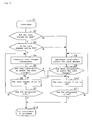
- FIG. 2 is a flow chart explaining an example of the control method of the telephone of the present invention; and
- FIG. 3 is a block diagram showing the configuration of another working example of the telephone according to the present invention.
- FIG. 1 shows a schematic view of the configuration of the first embodiment of the telephone according to the present invention.
-
Telephone 1 is, for example, a mobile telephone, and comprises at least:display unit 11 such as an LCD;input unit 12 such as input keys;microphone 13 for acquiring the voice of the user oftelephone 1;voice changer 14;control unit 15; andmemory 16 for registering conditions for the use ofvoice changer 14.Control unit 15 is operated by a program, and comprises at leastcommunication processor 17; call-origin determination unit 18; andvoice switch unit 19. - Although not shown in the figure,
telephone 1 comprises other necessary functions, such as a speaker for supplying the incoming call alert and the voice of the communication partner, and a function that registers a telephone directory. In addition,telephone 1 registers, for example, telephone directory information inmemory 16. The telephone directory information may be telephone numbers, addresses, or telephone numbers and addresses.Telephone 1 may be further provided with data communication processing capabilities for realizing, for example, electronic mail and web browsing. - Upon detecting an incoming call,
communication processor 17 ofcontrol unit 15 extracts the call-origin telephone number or the call-origin address that is contained in an incoming signal.Communication processor 17 then displays the call-origin telephone number or call-origin address ondisplay unit 11, and reports the call-origin telephone number or call-origin address to call-origin determination unit 18. - Call-
origin determination unit 18 refers tomemory 16 based on the call-origin telephone number or the call-origin address, and determines whether the call-origin telephone number or the call-origin address corresponds to conditions for the use ofvoice changer 14. Call-origin determination unit 18 then reports the results of this determination tovoice switch unit 19. -
Voice switch unit 19switches voice changer 14 ON and OFF based on this report.Voice switch unit 19 furtherswitches voice changer 14 ON/OFF upon receiving instructions through the manipulation ofinput unit 12 by the user oftelephone 1. -
Voice changer 14 electrically converts the voice that has been received as input, thereby converting the characteristics of the voice.Voice changer 14 comprises, for example, AD/DA converter and a write buffer. In this case,voice changer 14 changes the frequency of writing to write buffer and the frequency of reading from the write buffer to change the tone of the input voice. - The voice changer itself is of a known technology that has been put to practical use by a variety of methods. Any of these known techniques may be adopted as
voice changer 14. For example,voice changer 14 may be constituted by hardware, orvoice changer 14 that is realized by software may be incorporated incontrol unit 15. In addition, in the standpoint of the prevention of nuisance calls,voice changer 14 is preferably set to change the user's voice to a lower tone. However,voice changer 14 may also allow setting by the manipulation ofinput unit 12 such that a low voice is converted to a higher tone, or may allow setting such that the conversed tone is a number of levels. -
Memory 16 registers ON/OFF information that shows whethervoice changer 14 is to be used or not, and information of telephone numbers or addresses for whichvoice changer 14 is to be used. - The information is registered in
memory 16 as described below. - When
input unit 12 is operated in a prescribed manner by a user,control unit 15 displays a menu screen ondisplay unit 11. In accordance with the menu screen, the user, for example, directly enters the call-origin telephone numbers and call-origin addresses for whichvoice changer 14 is to be used, or selects call-origin telephone numbers and call-origin addresses for whichvoice changer 14 is to be used from prescribed categories or groups that are indicated by the telephone directory information that is registered inmemory 16. - Categories that can be used include "cases in which the call-origin telephone number or call-origin address is not registered as telephone directory information," "cases in which the call-origin telephone number and the call-origin address are not reported," and "a case of a public telephone." This setting information (conditions for the use of voice changer 14) is registered in
memory 16. - Using the flow chart of FIG. 2, explanation next regards the termination operations of the thus-constituted
telephone 1. - In step S1, when
telephone 1 receives an incoming call,communication processor 17 detects the incoming call. - In step S2,
communication processor 17 reports the call-origin telephone number information or call-origin address that is contained in the incoming signal to call-origin determination unit 18. Call-origin determination unit 18 uses the call-origin telephone number information or the call-origin address in order to refer tomemory 16 and determines whethervoice changer 14 is to be used or not. - According to the content of settings that are registered in
memory 16, call-origin determination unit 18 determines thatvoice changer 14 is to be used when the call-origin telephone number or call-origin address is a telephone number or address, which is targeted for voice changer use, that has been registered in advance, when the call-origin telephone number or call-origin address is not registered in the telephone directory, or when the incoming call is from a call-origin telephone number that is not reported or from a call-origin address that is not reported. - In step S3, when the call-origin telephone number or call-origin address is a number or address for which
voice changer 14 is to be used, call-origin determination unit 18 checks the ON/OFF information ofvoice changer 14 that is registered inmemory 16. - In step S4, when the ON/OFF information of
voice changer 14 indicates state of ON inmemory 16, voice changer conversation is executed. - In this case, in step S6
voice switch unit 19 ofcontrol unit 15 sets voicechanger 14 to ON. Whenvoice changer 14 is set to ON, the user's voice in this mode is converted, byvoice changer 14, and this converted voice is transmitted fromcommunication processor 17 to the partner. - If the user wishes to terminate the use of
voice changer 14 during the conversation, the user performs prescribed input to input unit 12 (for example, pressing a voice change switch button). - When
input unit 12 receives this prescribed input in step S5, in step S6voice switch unit 19 ofcontrol unit 15switches voice changer 14 to OFF, following whichvoice changer 14 turns OFF. - In step S7 or S11 and step S12, this state continues until the conversation ends.
- Receiver speaker (not shown) preferably supplies the user's conversed voice such that the user can verify his or her own conversed voice that is conveyed to the conversation partner.
- In addition, when a voice-changed conversation is carried out at the time of call incoming,
display unit 11 preferably displays an indication of this state. - In contrast, in step S2: "N", when the call-origin telephone number or call-origin address that has been detected by
communication processor 17 is not a telephone number or address that is targeted for usingvoice changer 14, or in step S3: "N", when the ON/OFF information ofvoice changer 14 indicates state of OFF, in step S8, conversation is executed without usingvoice changer 14. - In this case, in step S10,
voice switch unit 19 sets voicechanger 14 to OFF, and the user's speaking voice is transmitted to the partner without tone conversion. - When the user wishes to use
voice changer 14 midway through a conversation, the user performs prescribed input to input unit 12 (for example, pressing the voice change switch button). - When
input unit 12 receives this prescribed input in step S9, in step S6,voice switch unit 19 ofcontrol unit 15switches voice changer 14 ON, following whichvoice changer 14 turns ON. - In step S7 or S11 and step S12, This state then continues until the end of the conversation.
- As described in the foregoing explanation, according to the present invention, at the time of an incoming call,
control unit 15 determines whether the call-origin telephone number or call-origin address corresponds to a condition that has been registered in advance inmemory 16. - When the call-origin telephone number or call-origin address corresponds to a condition that has been registered in advance in
memory 16, and moreover, when the ON/OFF information ofvoice changer 14 indicates state of ON,control unit 15 causesvoice changer 14 to operate, the user's voice is converted, and this converted voice is transmitted to the conversation partner. In this way, for example, a woman's high voice is conveyed to the conversation partner as a low voice. As a result, a woman can effectively deal with an annoying call. - On the other hand, when
voice changer 14 has not been set for use, the setting ofvoice changer 14 can be switched during the conversation. As a result, if a situation develops during a conversation in which the user finds the caller a nuisance, the user can give the caller the false impression that the user has handed off the telephone to a third person that is with the user. - It is further possible to switch the setting of the voice changer to OFF during a voice-changed conversation, whereby the user can give the conversation partner the false impression that the user has again taken the telephone from the above-described (fictional) third person. These functions may also be used for changing one's speaking voice simply for entertainment, such as when conversing with friends or when conversing anonymously.
- FIG. 3 is a figure showing the configuration of the second embodiment of the telephone according to the present invention.
- As shown in FIG. 3, in
telephone 2 of the present embodiment,receiver speaker 21 is connected to voicechanger 22. Thus, by changing the setting ofvoice changer 22, the user can be entertained by changing the voice of the communication partner by means ofvoice changer 22. This setting is assumed to be registered inmemory 16 by way ofinput unit 12. When the voice changer is set to ON, the received voice signal is converted byvoice changer 22, wherebyreceiver speaker 21 supplies voice according to the converted voice signal. The other capabilities of thistelephone 2 are the same as fortelephone 1 shown in FIG. 1, and redundant explanation is here omitted. - Although explanation has been presented above regarding embodiments of the present invention, the technical scope of the present invention is not in any way limited to these embodiments, and the present invention can be realized as various other modifications within the scope and spirit described in the claims.
- For example,
telephone 1 may be not only a mobile telephone, but may also be a fixed telephone that is installed in, for example, a typical household. - According to the present invention, voice that has been converted by the voice changer is sent to the communication partner. The present invention therefore has the advantage of allowing information such as the user's age and gender to be concealed.
- For example, if the voice of a female user is converted to a lower tone and this lower voice then conveys to the conversation partner, the conversation partner can be given the impression that the user is a man, and the present invention therefore has the advantage of enabling a woman user to easily reject annoying calls such as solicitations.
- Further,
control unit 15 automatically switches between the use or non-use of the voice changer at the time of an incoming call in accordance with the call-origin telephone number, the call-origin address, or a category of telephone numbers and addresses, whereby the voice changer can be used appropriately from the start of a conversation. - The voice changer-equipped telephone and control method according to the present invention, the ON/OFF control of the voice changer is determined automatically according to the call-origin telephone number or call-origin address. As a result, nuisance calls can be effectively rejected, and a variety of communication environments can be provided through trouble-free anonymous communication. The voice changer-equipped telephone and control method according to the present invention will therefore be of use in the communication and telephone industries.
- While a preferred embodiment of the present invention has been described using specific terms, such description is for illustrative purposes only, and it is to be understood that changes and variations may be made without departing from the spirit or scope of the following claims.
Claims (13)
- A telephone for converting a user's original voice and conveying this converted original voice to a conversation partner; said telephone comprising:a voice changer for converting the original voice of said user;an acquisition unit for acquiring information of a call-origin telephone at a time of an incoming call;a memory in which conditions for using said voice changer are registered in advance; anda determination unit for determining whether to use said voice changer based on information of the call-origin telephone that has been acquired by said acquisition unit and conditions that have been registered in said memory, and for controlling said voice changer based on these determination results.
- The telephone according to claim 1, wherein:telephone numbers are registered as said conditions in said memory;said acquisition unit, at the time of an incoming call, acquires the telephone number of said call-origin telephone; andsaid determination unit, when the telephone number of said call-origin telephone that has been acquired by said acquisition unit is already registered in said memory, determines to use said voice changer and causes said voice changer to operate.
- The telephone according to claim 1 or 2, wherein:addresses are registered as said conditions in said memory;said acquisition unit, at the time of an incoming call, acquires the address of the call-origin telephone; andsaid determination unit, when the address of said call-origin telephone that has been acquired by said acquisition unit is already registered in said memory, determines to use said voice changer and causes said voice changer to operate.
- The telephone according to claim 1, 2 or 3, further comprising:a telephone directory information memory in which telephone numbers are registered as telephone directory information;wherein:said acquisition unit, at the time of an incoming call, acquires the telephone number of said call-origin telephone;a condition that the telephone number of a call-origin telephone that has been acquired by said acquisition unit is still unregistered in said telephone directory information memory is registered as said condition in said memory; andsaid determination unit, when the telephone number of a call-origin telephone that has been acquired by said acquisition unit corresponds to the condition that is registered in said memory, determines to use said voice changer and causes said voice changer to operate.
- The telephone according to claim 1, 2, 3 or 4, further comprising:a telephone directory information memory in which addresses are registered as telephone directory information;wherein:said acquisition unit, at the time of an incoming call, acquires the address of said call-origin telephone;a condition that the address of a call-origin telephone that has been acquired by said acquisition unit is still unregistered in said telephone directory information memory is registered as said condition in said memory; andsaid determination unit, when the address of a call-origin telephone that has been acquired by said acquisition unit corresponds to the condition that is registered in said memory, determines to use said voice changer and causes said voice changer to operate.
- The telephone according to claim 1, 2, 3, 4 or 5, wherein:a condition that the telephone number of a call-origin telephone is not reported is registered as said condition in said memory,said acquisition unit, at the time of an incoming call, acquires the telephone number of said call-origin telephone; andsaid determination unit, when said acquisition unit has acquired an indication that the telephone number of said call-origin telephone is not reported, determines to use said voice changer and causes said voice changer to operate.
- The telephone according to any one of claims 1 to 6, wherein:a condition that the address of a call-origin telephone is not reported is registered as said condition in said memory;said acquisition unit, at the time of an incoming call, acquires the address of said call-origin telephone; andsaid determination unit, when said acquisition unit has acquired an indication that the address of said call-origin telephone is not reported, determines to use said voice changer and causes said voice changer to operate.
- The telephone according to any one of claims 1 to 7, further comprising a switch unit for switching the state of use of said voice changer during a conversation.
- The telephone according to any one of claims 1 to 8, further comprising a receiver speaker that is connected to said voice changer for supplying the voice of the communication partner that has been converted by said voice changer.
- A control method performed by a telephone that includes a voice changer for converting an original voice of a user, said control method comprising the steps of:acquiring information of a call-origin telephone at a time of an incoming call;based on the information of said call-origin telephone, referring to a memory in which conditions for using said voice changer have been registered in advance to determine whether to use said voice changer; andupon determining to use said voice changer, converting the original voice of the user of the telephone and transmitting this converted original voice to a conversation partner.
- The control method according to claim 10, further comprising the step of:switching state of use of said voice changer upon receiving prescribed input from the user during a conversation.
- A control program that is installed in a telephone that includes a voice changer for converting an original voice of a user; said control program causing said telephone to execute the steps of:acquiring information of a call-origin telephone at a time of an incoming call to said telephone;based on the information of said call-origin telephone, referring to a memory in which conditions for using said voice changer have been registered in advance to determine whether to use said voice changer; andupon determining to use said voice changer, converting the original voice of the user of the telephone and transmitting this converted original voice to a conversation partner.
- The program according to claim 12 for causing said telephone to further execute the step of:switching a state of use of said voice changer upon receiving prescribed input from the user during a conversation on said telephone.
Applications Claiming Priority (1)
| Application Number | Priority Date | Filing Date | Title |
|---|---|---|---|
| JP2005153690A JP2006333057A (en) | 2005-05-26 | 2005-05-26 | Telephone set with voice changer, and control method and control program thereof |
Publications (1)
| Publication Number | Publication Date |
|---|---|
| EP1727127A1 true EP1727127A1 (en) | 2006-11-29 |
Family
ID=36933405
Family Applications (1)
| Application Number | Title | Priority Date | Filing Date |
|---|---|---|---|
| EP06010210A Withdrawn EP1727127A1 (en) | 2005-05-26 | 2006-05-17 | Telephone with voice changer and control method and control program for the telephone |
Country Status (4)
| Country | Link |
|---|---|
| US (1) | US20060268757A1 (en) |
| EP (1) | EP1727127A1 (en) |
| JP (1) | JP2006333057A (en) |
| CN (1) | CN1870666A (en) |
Cited By (2)
| Publication number | Priority date | Publication date | Assignee | Title |
|---|---|---|---|---|
| EP1913590A4 (en) * | 2005-07-28 | 2009-11-25 | Motorola Inc | Method and system for warping voice calls |
| US9330681B2 (en) | 2014-07-16 | 2016-05-03 | International Business Machines Corporation | Voice signal modulation service for geographic areas |
Families Citing this family (5)
| Publication number | Priority date | Publication date | Assignee | Title |
|---|---|---|---|---|
| US20080152111A1 (en) * | 2006-12-26 | 2008-06-26 | Motorola, Inc. | Handling of incoming calls |
| US8990071B2 (en) * | 2010-03-29 | 2015-03-24 | Microsoft Technology Licensing, Llc | Telephony service interaction management |
| CN108364638A (en) * | 2018-01-12 | 2018-08-03 | 咪咕音乐有限公司 | A kind of voice data processing method, device, electronic equipment and storage medium |
| CN108366172A (en) * | 2018-05-22 | 2018-08-03 | 维沃移动通信有限公司 | Method and device for processing incoming calls |
| CN117854521B (en) * | 2023-12-28 | 2026-04-07 | 南京硅基智能科技集团股份有限公司 | Sound information protection method and device, storage medium and electronic device |
Citations (5)
| Publication number | Priority date | Publication date | Assignee | Title |
|---|---|---|---|---|
| JPH07273841A (en) * | 1994-03-30 | 1995-10-20 | Nippon Telegr & Teleph Corp <Ntt> | Telephone with voice conversion means |
| US20030014246A1 (en) * | 2001-07-12 | 2003-01-16 | Lg Electronics Inc. | Apparatus and method for voice modulation in mobile terminal |
| US20030215085A1 (en) * | 2002-05-16 | 2003-11-20 | Alcatel | Telecommunication terminal able to modify the voice transmitted during a telephone call |
| EP1365564A1 (en) * | 2002-05-21 | 2003-11-26 | Hewlett-Packard Company | System and method for incoming communication management for a communication device |
| WO2005046191A1 (en) * | 2003-11-03 | 2005-05-19 | Qualcomm (Uk) Limited | Incoming call screening, control and prioritisation in a telephone device |
Family Cites Families (2)
| Publication number | Priority date | Publication date | Assignee | Title |
|---|---|---|---|---|
| US4823380A (en) * | 1987-03-27 | 1989-04-18 | Chaim Kohen | Voice changer |
| KR0164372B1 (en) * | 1995-08-23 | 1999-02-01 | 김광호 | How to implement automatic call in wireless |
-
2005
- 2005-05-26 JP JP2005153690A patent/JP2006333057A/en active Pending
-
2006
- 2006-05-17 EP EP06010210A patent/EP1727127A1/en not_active Withdrawn
- 2006-05-23 US US11/438,834 patent/US20060268757A1/en not_active Abandoned
- 2006-05-26 CN CNA2006100784620A patent/CN1870666A/en active Pending
Patent Citations (5)
| Publication number | Priority date | Publication date | Assignee | Title |
|---|---|---|---|---|
| JPH07273841A (en) * | 1994-03-30 | 1995-10-20 | Nippon Telegr & Teleph Corp <Ntt> | Telephone with voice conversion means |
| US20030014246A1 (en) * | 2001-07-12 | 2003-01-16 | Lg Electronics Inc. | Apparatus and method for voice modulation in mobile terminal |
| US20030215085A1 (en) * | 2002-05-16 | 2003-11-20 | Alcatel | Telecommunication terminal able to modify the voice transmitted during a telephone call |
| EP1365564A1 (en) * | 2002-05-21 | 2003-11-26 | Hewlett-Packard Company | System and method for incoming communication management for a communication device |
| WO2005046191A1 (en) * | 2003-11-03 | 2005-05-19 | Qualcomm (Uk) Limited | Incoming call screening, control and prioritisation in a telephone device |
Non-Patent Citations (1)
| Title |
|---|
| PATENT ABSTRACTS OF JAPAN vol. 1996, no. 02 29 February 1996 (1996-02-29) * |
Cited By (2)
| Publication number | Priority date | Publication date | Assignee | Title |
|---|---|---|---|---|
| EP1913590A4 (en) * | 2005-07-28 | 2009-11-25 | Motorola Inc | Method and system for warping voice calls |
| US9330681B2 (en) | 2014-07-16 | 2016-05-03 | International Business Machines Corporation | Voice signal modulation service for geographic areas |
Also Published As
| Publication number | Publication date |
|---|---|
| CN1870666A (en) | 2006-11-29 |
| US20060268757A1 (en) | 2006-11-30 |
| JP2006333057A (en) | 2006-12-07 |
Similar Documents
| Publication | Publication Date | Title |
|---|---|---|
| US7421270B2 (en) | Method of remotely changing operating characteristics of a communications device | |
| US5604786A (en) | Telephone with unified features for hearing and deaf users | |
| US9008301B2 (en) | System and method for modifying or disabling the ringtone for an incoming call based on the existence of nonexistence of previous calls from the same caller | |
| US20060252442A1 (en) | Method for establishing a PoC connection in a terminal device with a touch-screen display, an application used in the method and a terminal device | |
| JP2003319062A (en) | Handfree portable telephone and handfree switching program | |
| EP1727127A1 (en) | Telephone with voice changer and control method and control program for the telephone | |
| TWI242355B (en) | Method of handling a received telephone call | |
| KR100462751B1 (en) | Method for transmitting character message in mobile communication terminal | |
| CN108141496A (en) | A kind of call-waiting processing method | |
| CN106713595A (en) | Call processing method and device, and mobile terminal | |
| JP3376962B2 (en) | Mobile phone | |
| KR100703302B1 (en) | How to reject specific call messages on wired and wireless terminals | |
| JP2001298521A (en) | Hands-free device | |
| KR20030056051A (en) | Method for refusing call from specific phone number using caller ID and mobile phone implementing the same | |
| JPH09153946A (en) | Telephone system | |
| JP2005354320A (en) | COMMUNICATION PROCESSING DEVICE, COMMUNICATION PROCESSING SYSTEM, AND COMMUNICATION PROCESSING METHOD | |
| KR101266263B1 (en) | Method for offering information of emotion in mobile terminal | |
| KR101394278B1 (en) | Method for executing communication mode in mobile terminal | |
| KR100469695B1 (en) | Method for automatic calling as releasing manner mode of mobile phone | |
| KR20000063831A (en) | Internet phone/telephone/sound card/e-mail alarm system using serial connection between computer and telephone | |
| KR200289651Y1 (en) | Information apparatus rejection calling of portable terminal | |
| JP2002271483A (en) | Mobile phone | |
| CN101193151A (en) | Automatic response service method for portable terminal | |
| CN113873078A (en) | Call control method and call control device | |
| KR20030081584A (en) | The method for telephone communication, short message transmission and call number storing of call number using a plurality of call number in mobile terminal |
Legal Events
| Date | Code | Title | Description |
|---|---|---|---|
| PUAI | Public reference made under article 153(3) epc to a published international application that has entered the european phase |
Free format text: ORIGINAL CODE: 0009012 |
|
| AK | Designated contracting states |
Kind code of ref document: A1 Designated state(s): AT BE BG CH CY CZ DE DK EE ES FI FR GB GR HU IE IS IT LI LT LU LV MC NL PL PT RO SE SI SK TR |
|
| AX | Request for extension of the european patent |
Extension state: AL BA HR MK YU |
|
| 17P | Request for examination filed |
Effective date: 20070109 |
|
| AKX | Designation fees paid |
Designated state(s): DE FR GB IT |
|
| 17Q | First examination report despatched |
Effective date: 20160506 |
|
| STAA | Information on the status of an ep patent application or granted ep patent |
Free format text: STATUS: THE APPLICATION IS DEEMED TO BE WITHDRAWN |
|
| 18D | Application deemed to be withdrawn |
Effective date: 20160917 |