EP1725930B1 - System and method for remote service information - Google Patents
System and method for remote service information Download PDFInfo
- Publication number
- EP1725930B1 EP1725930B1 EP05722833.0A EP05722833A EP1725930B1 EP 1725930 B1 EP1725930 B1 EP 1725930B1 EP 05722833 A EP05722833 A EP 05722833A EP 1725930 B1 EP1725930 B1 EP 1725930B1
- Authority
- EP
- European Patent Office
- Prior art keywords
- remote service
- service link
- service
- link
- received
- Prior art date
- Legal status (The legal status is an assumption and is not a legal conclusion. Google has not performed a legal analysis and makes no representation as to the accuracy of the status listed.)
- Expired - Lifetime
Links
- 238000000034 method Methods 0.000 title claims description 39
- 230000005540 biological transmission Effects 0.000 claims description 9
- 238000004590 computer program Methods 0.000 claims description 9
- 230000004913 activation Effects 0.000 claims description 6
- 230000000977 initiatory effect Effects 0.000 claims description 4
- 230000010267 cellular communication Effects 0.000 claims description 3
- 230000004044 response Effects 0.000 claims description 2
- 238000010586 diagram Methods 0.000 description 11
- 230000001413 cellular effect Effects 0.000 description 7
- 238000005516 engineering process Methods 0.000 description 7
- 230000006870 function Effects 0.000 description 7
- 238000001914 filtration Methods 0.000 description 6
- 230000003993 interaction Effects 0.000 description 6
- 230000008569 process Effects 0.000 description 4
- 230000006855 networking Effects 0.000 description 2
- 238000009825 accumulation Methods 0.000 description 1
- 230000003213 activating effect Effects 0.000 description 1
- 230000004075 alteration Effects 0.000 description 1
- 230000003321 amplification Effects 0.000 description 1
- 230000008901 benefit Effects 0.000 description 1
- 230000000903 blocking effect Effects 0.000 description 1
- 230000008859 change Effects 0.000 description 1
- 239000003795 chemical substances by application Substances 0.000 description 1
- 230000008878 coupling Effects 0.000 description 1
- 238000010168 coupling process Methods 0.000 description 1
- 238000005859 coupling reaction Methods 0.000 description 1
- 238000012217 deletion Methods 0.000 description 1
- 230000037430 deletion Effects 0.000 description 1
- 230000008030 elimination Effects 0.000 description 1
- 238000003379 elimination reaction Methods 0.000 description 1
- 239000004973 liquid crystal related substance Substances 0.000 description 1
- 238000003199 nucleic acid amplification method Methods 0.000 description 1
- 229920001690 polydopamine Polymers 0.000 description 1
- 230000036962 time dependent Effects 0.000 description 1
- 230000000699 topical effect Effects 0.000 description 1
Images



Classifications
-
- H—ELECTRICITY
- H04—ELECTRIC COMMUNICATION TECHNIQUE
- H04L—TRANSMISSION OF DIGITAL INFORMATION, e.g. TELEGRAPHIC COMMUNICATION
- H04L67/00—Network arrangements or protocols for supporting network services or applications
- H04L67/01—Protocols
- H04L67/04—Protocols specially adapted for terminals or networks with limited capabilities; specially adapted for terminal portability
-
- H—ELECTRICITY
- H04—ELECTRIC COMMUNICATION TECHNIQUE
- H04W—WIRELESS COMMUNICATION NETWORKS
- H04W4/00—Services specially adapted for wireless communication networks; Facilities therefor
Definitions
- the present invention relates to wireless communications. More particularly, the present invention relates to techniques involving the access of information services across wireless networks.
- WO9907125A1 relates to a system for providing targeted internet information to mobile agents.
- Wireless communications devices can be used to obtain services from remote devices. These services may provide location-specific information regarding topics, such as weather forecasts, local dining and shopping, maps, transit schedules, etc. Various technologies, such as cellular and short-range networking technologies, may be employed in the retrieval of such services.
- Bluetooth provides a short-range radio network, originally intended as a cable replacement. It can be used to create ad hoc networks of up to eight devices, where one device is referred to as a master device. The other devices are referred to as slave devices. The slave devices can communicate with the master device and with each other via the master device. The devices operate in the 2.4 GHz radio band reserved for general use by Industrial, Scientific, and Medical (ISM) applications. Bluetooth devices are designed to find other Bluetooth devices within their communications range and to discover what services they offer.
- ISM Industrial, Scientific, and Medical
- WLANs are local area networks that employ high-frequency radio waves rather than wires to exchange information between devices.
- IEEE 802.11 refers to a family of WLAN standards developed by the IEEE.
- Ultra wideband UWB
- IR impulse radio
- IR impulse radio
- RF gating is a particular type of IR in which the impulse is a gated RF pulse. This gated pulse is a sine wave masked in the time domain with a certain pulse shape.
- a mobile device may store and display information that allows a user to initiate service sessions with various remote service providers. To reduce the amount of user interaction required for session initiation, the device's user interface may provide such information in the form of links. Because such services often pertain to particular locations, a device may collect a large amount of service related information over of relatively short period of time. Accordingly, techniques are needed for the storage and management of such information.
- the present invention provides techniques for the management of information regarding remote services. Accordingly a method and system of the present invention receives a remote service link across a short-range wireless communications network.
- the received remote service link corresponds to a service provided by a remote service provider.
- the system and method deletes a previously stored remote service link. At this point, the received remote service link may be stored.
- a further system and method of the present invention receives a remote service link and an identifier corresponding to the remote service link across a short-range wireless communications network.
- the system and method replace an earlier stored remote service link with the received remote service link.
- the above system and methods may display a representation of the received remote service link.
- This representation may be, for example, an icon for display by a graphical user interface.
- the present invention also provides computer program products. These computer program products include a computer useable medium having computer program logic recorded thereon. The computer program logic for instructing a processor in a wireless communications device to perform features of the methods and systems described above.
- the present invention provides a display for a wireless communications device.
- the display includes a dynamic menu, a recent menu, and a saved menu.
- the dynamic menu is for displaying representations of at least one remote service link received across a short-range wireless communications.
- the recent menu is for displaying representations of at least one remote service link that was used to establish a communications session with a remote service provider, wherein the communications session employs a cellular communications network.
- the saved menu is for displaying representations of at least one remote service link that was selected for storage by a user.
- FIG. 1 is a diagram of an exemplary operational environment in which a wireless communications device (WCD) 102 may collect and consume services according to techniques of the present invention.
- WCD wireless communications device
- WCD 102 is capable of engaging in various types of wireless communications. For instance, WCD 102 may engage in short-range communications, as well as longer range (e.g., cellular) communications. Examples of short-range communications include Bluetooth, WLAN (i.e., IEEE 802.11), and/or ultra wideband (UWB) transmission. As shown in FIG. 1 , WCD 102 may enter within communications range of an access point 104. This communications range is defined by a coverage area 106, which determines the locations at which these devices may communicate.
- WLAN i.e., IEEE 802.11
- UWB ultra wideband
- WCD 102 When WCD 102 is within coverage area 106 of access point 104, it may enter into a short-range communications connection with access point 104. Once this connection is established, access point 106 may provide information to WCD 102 regarding various services that are available within these areas. This information may include one or more links to such services. These links may be transmitted to WCD 102 in arrangements or data structures that are referred to herein as service bookmarks. Details regarding an exemplary service bookmark are described below with reference to FIG. 6 .
- WCD 102 is capable of employing radio frequency identification (RFID) communications with access point 104.
- access point 104 includes a transponder, which provides remote service links (e.g., service bookmarks) to WCD 102 in response to a transmission by WCD 102.
- remote service links e.g., service bookmarks
- Such communications may occur at a very close proximity (e.g., almost touching). Accordingly, for RFID communications, coverage area 106 may span a few feet.
- access point 104 may include one or more RFID tags.
- a user of WCD 102 may actively choose a preferred link (e.g., service bookmark) by selecting a corresponding RFID tag.
- the selected RFID tag may provide the link information directly.
- the selected RFID tag may provide necessary information for the terminal to fetch corresponding link information from the access point across another short-range (e.g., Bluetooth, WLAN, and/or UWB) connection.
- another short-range e.g., Bluetooth, WLAN, and/or UWB
- FIG. 1 shows that backbone network 110 includes a packet-based network 111 (e.g., the Internet) and a cellular network 112.
- Cellular network 112 includes base stations 120 and a mobile switching center 122.
- Backbone network 110 is also used for the accumulation of links by access point 106.
- each service provider 108 may transmit information regarding its services to access point 104 via backbone network 110. This information includes links that may be collected by WCD 102.
- backbone network 110 may be used by WCD 102 to obtain services from service providers 108 based on linlks received from access point 104.
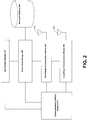
- FIG. 2 is a block diagram showing an exemplary wireless communications device architecture, which may be used for WCD 102. While FIG. 2 illustrates a particular device architecture, other architectures are within the scope of the present invention.
- the architecture of FIG. 2 includes a short-range communications module 202, a long-range communications module 204, a service guide manager 206, a bookmark database 208, a user interface manager 210, and a communications utilities module 212.
- Short-range communications module 202 is responsible for functions involving the exchange of information across short-range wireless connections via an antenna 214. As described above, examples of such connections include Bluetooth, WLAN, and UWB connections. Accordingly, module 202 performs functions related to the establishment of short-range connections, as well as processing related to the transmission and reception of information via such connections. Also, module 202 may perform functions related to RFID communications. For instance, module 202 may control the generation of RF signals for activating RFID transponders. In addition, module 202 may control the reception of signals from RFID transponders.
- Long-range communications module 204 performs functions related to the exchange of information across longer-range communications networks (such as cellular networks) via an antenna 216. Therefore, long-range communications module 204 may operate to establish data communications sessions, such as General Packet Radio Service (GPRS) sessions and/or Universal Mobile Telecommunications System (UMTS) sessions. Also, long-range communications module 204 may operate to transmit and receive messages, such as short messaging service (SMS) messages and/or multimedia messaging service (MMS) messages.
- SMS Short messaging service
- MMS multimedia messaging service
- FIG. 2 shows that service guide manager 206 is coupled to short-range communications module 202.
- Service guide manager 206 provides for the management and storage of links received from remote devices, such as access point 104. Such remote devices are referred to herein as service points. These received links may be in various forms. One such form is a service bookmark. However, other forms are within the scope of the present invention.
- Service guide manager 206 may operate as a background process. This allows for the collection of links (e.g., service bookmarks) to services without interrupting the user's operation of the device. Over time, the device collects new service links. However, in order to handle the device's memory constraints, new service links cannot be collected indefinitely without deleting older service links.
- links e.g., service bookmarks
- bookmark database 208 provides for the storage of links (such as service bookmarks). These links may be stored in various folders, where each folder corresponds to a particular menu.
- each folder may have a specified maximum number of service links (e.g., service bookmarks) that may be stored.
- An exemplary maximum number of service bookmarks is ten.
- bookmark database 208 may also store categorical information, such as keywords.
- the categorical information may be mapped to the stored links. This advantageously helps a user perform topical searches for particular links. Such categorical information may accompany links when they are received from service points.
- Service guide manager 206 is also coupled to a user interface manager 210.
- User interface manager 210 provides functionality, such as a graphical user interface, for the presentation of links to users. In addition, this functionality provides for user selection and activation of links.
- service guide manager 206 is also coupled to communications utilities module 212, which provides for the establishment of service sessions using long-range communications module 204 and/or short-range communications module 202.
- Communications utilities module 212 may include various components that allow the reception of services from remote devices according to protocols, such as the Wireless Application Protocol (WAP).
- WAP Wireless Application Protocol
- module 212 may include WAP client software having components, such as a Wireless Markup Language (WML) Browser, a WMLScript engine, a Push Subsystem, and a Wireless Protocol Stack.
- WML Wireless Markup Language
- WMLScript engine a WMLScript engine
- Push Subsystem a Wireless Protocol Stack
- Applications may interact with the WAP client software to provide a variety of communications services.
- communications services include the reception of Internet-based content, such as headline news, exchange rates, sports results, stock quotes, weather forecasts, multilingual phrase dictionaries, shopping and dining information, local transit (e.g., bus, train, and/or subway) schedules, personal online calendars, and online travel and banking services.
- Internet-based content such as headline news, exchange rates, sports results, stock quotes, weather forecasts, multilingual phrase dictionaries, shopping and dining information, local transit (e.g., bus, train, and/or subway) schedules, personal online calendars, and online travel and banking services.
- the WAP-enabled device may access small files called decks which each include smaller pages called cards. Cards are small enough to fit into a small display area that is referred to herein as a microbrowser.
- the small size of the microbrowser and the small file sizes are suitable for accommodating low memory devices and low-bandwidth communications constraints imposed by wireless links.
- WML Wireless Markup Language
- WML Wireless Markup Language
- WML is specifically devised for small screens and one-hand navigation without a keyboard.
- WML is scaleable so that it is compatible with a wide range of displays that covers two-line text displays, as well as large LCD screens found on devices, such as smart phones, PDAs, and personal communicators.
- WML cards may include programs written in WMLScript, which is similar to JavaScript. However, through the elimination of several unnecessary functions found in these other scripting languages, WMLScript reduces memory and processing demands.
- Device architectures such as the architecture of FIG. 2 may be implemented in hardware, software, firmware, or any combination thereof.
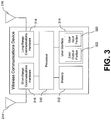
- FIG. 3 One such implementation is shown in FIG. 3 .
- This implementation includes a processor 310, a memory 312, a user interface 314, short-range communications hardware 316, and long-range communications hardware 318.
- the implementation of FIG. 3 includes antenna 212 and antenna 214.
- Processor 310 controls device operation. As shown in FIG. 3 , processor 310 is coupled to hardware portions 316 and 318. Processor 310 may be implemented with one or more microprocessors that are each capable of executing software instructions stored in memory 312.
- Memory 312 includes random access memory (RAM), read only memory (ROM), and/or flash memory, and stores information in the form of data and software components (also referred to herein as modules).
- RAM random access memory
- ROM read only memory
- flash memory stores information in the form of data and software components (also referred to herein as modules).
- the data stored by memory 312 may be associated with particular software components.
- this data may be associated with databases, such as bookmark database 208.
- the software components stored by memory 312 include instructions that can be executed by processor 310.
- Various types of software components may be stored in memory 312.
- memory 312 may store software components that control the operation of hardware portions 316 and 318.
- memory 312 may store software components that provide for the functionality of communications modules 202 and 204, service guide manager 206, bookmark database 208, user interface manager 210, and communications utilities module 212.
- user interface 314 is also coupled to processor 310.
- User interface 314 facilitates the exchange of information with a user.
- FIG. 3 shows that user interface 314 includes a user input portion 320 and a user output portion 322.
- User input portion 320 may include one or more components that allow a user to input information. Examples of such components include keypads, touch screens, and microphones.
- User output portion 322 allows a user to receive information from the device.
- user output portion 322 may include various components, such as a display, and one or more audio speakers.
- Exemplary displays include liquid crystal displays (LCDs), and video displays.
- Hardware portions 316 and 318 provide for the transmission and reception of signals. Accordingly, these portions may include components (e.g., electronics) that perform functions, such as modulation, demodulation, amplification, and filtering. These portions may be controlled by communications modules 202 and 204.
- FIG. 3 may be coupled according to various techniques.
- One such technique involves coupling hardware portions 316 and 318, processor 310, memory 312, and user interface 314 through one or more bus interfaces.
- each of these components is coupled to a power source, such as a removable and/or rechargeable battery pack (not shown).
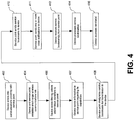
- FIG. 4 is a flowchart illustrating an operation according to an embodiment of the present invention. This operation is described with reference to a communications device, such as WCD 102, and a service point, such as access point 104.
- the device enters communicating range with the service point.
- this step may involve WCD 102 entering coverage area 106.
- the device and the service point establish a short-range wireless communications link.
- this link may employ technologies, such as Bluetooth, WLAN, or UWB.
- this link may employ RFID transmissions.
- the device may send category keyword / block identifiers to the service point.
- category keywords allows for the service point to filter out service bookmarks that does not interest the user.
- category keywords may be filtered with black lists and/or white lists.
- black lists specify categories of bookmarks to preclude (i.e., filter out) and such white lists specify categories of bookmarks that are permitted to be received.
- Block identifiers indicate particular service bookmarks that the user does not desire to receive.
- the block identifier includes service provider and service number identifiers.
- the device may send language identifiers to the service point.
- language identifiers specify the languages in which bookmarks may be received (i.e., white lists) and/or languages for which bookmarks are to be precluded (i.e., black lists).
- Such filtering advantageously provides a user with bookmarks for services in languages that the user can understand.
- the device may send filtering information (e.g., in the form of white lists and/or black lists) regarding the session types it will receive or preclude. For instance, as described below with reference to FIG. 7C , some services may be available through one or more session types (e.g., web, SMS. etc.) In embodiments, this feature provides for devices to receive bookmarks for services in sessions that it chooses (e.g., through user interaction) and/or supports.
- filtering information e.g., in the form of white lists and/or black lists
- some services may be available through one or more session types (e.g., web, SMS. etc.)
- this feature provides for devices to receive bookmarks for services in sessions that it chooses (e.g., through user interaction) and/or supports.
- the device may send information to the service point regarding its capabilities.
- step 407 may comprise the device informing the service point its model, display size, communications capabilities, etc. This information allows the service point to make a capability based filtering so that useless service links are not sent to the device. For example, if the device is not capable of WAP access, then there is no use in sending the device service links for WAP-based services.
- Steps 406 and 407 are optional. However, in embodiments of the present invention, one or both of these steps are performed. However, in some embodiments, step 406 is not performed. This advantageously allows the device to remain "incognito" to the service point because the service point does not receive any information regarding its preferences.
- the service point service designates service bookmarks for transmission to the device. This designation includes filtering and blocking according to any keywords and/or block identifiers sent by the device in step 406.
- a step 410 the service point sends service bookmarks to the device.
- a step 411 may also be performed.
- the service point sends one or more voice notifications to the device.
- a voice notification may be sent that corresponds to the service point.
- Such a voice notification may convey an advertisement such as "taste delicious food from the corner shop, taste delicious food from the corner shop.”
- one or more of these voice notifications may correspond to particular service bookmarks sent in step 410.
- the voice notification(s) may be received from the service point directly.
- the voice notification(s) are sent in the form of one or more local (e.g., fake) phone calls to the device. Accordingly, the device's user can either accept or reject these incoming "calls". If a "call" is accepted, the voice notification is played to the user as if it was a normal phone call from someone.
- the device receives these bookmarks in a step 412.
- the device processes the service bookmarks. Exemplary performances of this step are described below in greater detail with reference to FIG. 5 .
- the device may access one or more services through its links. As described above, this step may involve establishing a long range wireless communications session with a service provider. Step 416 involves user interaction with the device. In contrast, the other steps of FIG. 4 may be automatically performed by the device. This automatic performance, may be as a background process.
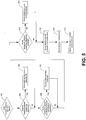
- FIG. 5 illustrates an operation of bookmark processing according to embodiments of the present invention. This operation may be performed for each service bookmark that the device receives from the service point. Accordingly, the steps of FIG. 5 are described with reference to a received service bookmark.
- This operation includes a step 502, which may be performed in conjunction with step 406 or as an alternative to step 406.
- the device determines whether the received service bookmark is blocked and/or filtered. If not, then operation proceeds to a step 504.
- step 504 the device determines whether the received service bookmark contains any new categories (i.e., one or more keywords). If so, then a step 506 is performed in which the device adds the new keyword(s) to its category list.
- the category list may be stored in bookmark database 208.
- a step 508 the device determines whether the received service bookmark has an identifier that is identical with an existing service bookmark currently being stored by the device. If so, then a step 510 is performed. Otherwise, operation proceeds to a step 512.
- the device updates (i.e., replaces) the existing service bookmark with the received service bookmark in a step 510. In embodiments, this replacement is performed regardless of the storage location (e.g., a saved folder, a recent folder, or a dynamic folder) of the existing service bookmark.
- step 512 the device determines whether storage of this new service bookmark would exceed a predetermined maximum number of service bookmarks.
- This maximum number may be associated with a particular menu, such as a dynamic menu for the presentation of the most recently received bookmarks. In embodiments, this maximum number may be user-defined.
- a step 513 is performed.
- a stored bookmark is removed from the device (i.e., deleted).
- the deleted bookmark may be based on one or more predetermined criteria. Examples of such criteria include such first in first out (FIFO), service link categories, and service bookmark validity times.
- the device displays the received service bookmark in a dynamic menu.
- the received service bookmark is displayed in a first position in the dynamic menu.
- the device stores the received bookmark in a manner that corresponds to its position in the menu.
- the device may alert its user if new or updated service bookmarks were added to the menu in either of steps 510 or 518. Additionally, when a service bookmark is received, the device may check the validity of its service (through, for example validity information 610). If the service is invalid, the device may delete the service bookmark and not display it.
- FIGs. 4 and 5 are described with reference to service bookmarks, the techniques of the present invention may be employed with other forms of data. For instance, these techniques may be performed with various arrangements of links and corresponding meta-data. Moreover, such techniques may be performed with bare links.
- FIG. 6 is a diagram of an exemplary service bookmark 600, according to an embodiment of the present invention.
- bookmark 600 includes various information.
- service bookmark 600 includes a service name 602, an icon 604, a description 606, a service provider identifier 608, validity information 610, a download time 612, a download place 614, a service category 616, a primary link type 617, link information 618, language 619, price per link type information 620, and a service number 622.
- This information may be encoded in various formats, such as in the extensible markup language (XML).
- XML extensible markup language
- Service name 602 provides a name of the service associated with service bookmark 600. This may be encoded as text.
- Icon 604 encodes a graphical representation that can be displayed by a device and activated by its user.
- Description 606 includes information (e.g., text and/or graphics) explaining the service associated with bookmark 600.
- a device may replace an existing stored service bookmark with a more recently received service bookmark. This replacement may be performed when the more recently received service bookmark has an identifier that is identical to the identifier of the existing service bookmark.
- a unique identifier can be implemented in various ways. For example, with reference to service bookmark 600, a unique identifier can be provided by service provider 608 and service number 622.
- Service provider identifier 608 is used to differentiate a particular service provider from other service providers in a manner that is similar to the way different domains are identified in an Internet Protocol environment.
- Service number 622 is an identifier of the service provided by the service provider indicated by identifier 608.
- a service provider can control which services are updated and which are presented as new ones. For example, a local weather report can be defined as unique for each location. Alternatively, by using the same identifier, a service provider may cause new weather report bookmarks to replace existing ones.
- Validity information 610 provides information regarding the validity of the service corresponding to bookmark 600.
- a device may use this information to check whether the a time-dependent service (e.g., a concert event) is still valid and to determine whether to obtain the service.
- Bookmarks that are no longer valid may be automatically displayed as invalid (e.g., in grey). Alternatively, bookmarks that are no longer valid may be automatically deleted.
- Download time 612 and download place 614 provide information regarding the time(s) and location(s) at which the service is available.
- certain services may use download place 614 to more clearly tailor the services to user needs. For example, if the service provider is a national weather forecasting service, the download place can be included in the service request to tailor the service for the current needs of the user.
- Service category 616 provides categorical information, such as one or more keywords, for the service of bookmark 600. For instance, if the service is a weather report, exemplary keywords include "weather" and "forecast".
- a device user may employ/activate filters that filter out all unwanted service categories so that service bookmarks from such filtered categories do not bother the user. This filtering may be based on black lists and/or white lists. Such black lists specify categories of bookmarks to preclude (i.e., filter out) and such white lists specify categories of bookmarks that are permitted to be received.
- Link information 618 provides one or more links (e.g., one or more addresses and/or identifiers) that a device may use to obtain the corresponding service from a remote service provider via a communications network.
- links e.g., one or more addresses and/or identifiers
- link information 618 may include various types of links. Examples of such links include telephony addresses (e.g., telephone numbers), messaging criteria (e.g., SMS message template and number), and resource identifiers (e.g., WAP and HTML addresses).
- Language 619 provides information regarding the one or more languages in which the service of bookmark 600 is expressed. As described above with reference to step 406, a user may specify the languages in which bookmarks may be received (i.e., white lists) and/or languages for which bookmarks are to be precluded (i.e., black lists).
- Price per link type information 620 provides cost information for obtaining the service of bookmark 600 according to the links provided by link information 618. For example, when multiple links are specified, a device or user may consider prices for each of the specified links to determine the most desirable link for obtaining the service.
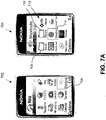
- FIG. 7A is a diagram of an exemplary user interface, according to an embodiment of the present invention.
- This user interface includes a high level menu 702 and a sub-menu 704.
- high-level menu 702 displays multiple graphical icons, such as a shortcuts icon 706.
- sub-menu 704 When a user activates shortcuts icon 706, sub-menu 704 is presented to the user.
- sub-menu 704 displays a saved folder 708, a recent folder 710, and multiple icons 712.
- Each of icons 712 represents a particular service bookmark.
- icon 714 represents a service bookmark for a weather reporting service.
- icons 712 are grouped in a dynamic folder. Hence, the display of these icons in sub-menu 704 constitutes a dynamic menu.
- the device may store the bookmarks of this dynamic folder, for example, in bookmark database 208.
- a user may activate saved folder 708 and/or recent folder 710.
- a menu of corresponding bookmarks (not shown) is presented to the user.
- the device may store the bookmarks of such folders, for example, in bookmark database 208.
- communications with a remote service provider such as one of service providers 108 is initiated.
- a remote service provider such as one of service providers 108
- communications may involve the initiation of a session with the service provider according to a link of the activated service bookmark (e.g., link 618).
- link 618 e.g., link 618
- communications involve the utilization of longer-range wireless (e.g., cellular) networks.
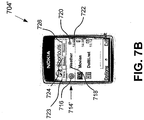
- FIG. 7B is a further diagram of an exemplary user interface, according to an embodiment of the present invention.
- Sub-menu 704' constitutes a dynamic menu (indicated as "here").
- This dynamic menu includes a service bookmark indicator 714', which represents a service bookmark for a weather reporting service.
- indicator 714' includes an icon 716, a textual service/bearer type description 718 (e.g., a keyword, such as "weather"), a session type indicator 720 (e.g., WAP, HTML, SMS, e-mail, etc.), and a time of bookmark receipt 722.
- sub-menu 714' includes tabs 723, 724, and 726. These tabs enable a user to navigate between displays of dynamic, recent, and saved menus.
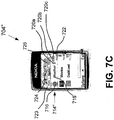
- FIG. 7C is a diagram of an exemplary user interface, according to yet a further embodiment of the present invention.
- the user interface of FIG. 7C is similar to the one of FIG. 7B .
- FIG. 7C shows a service bookmark indicator 714".
- Indicator 714" includes multiple session type indicators 720 (e.g., 720a-c).
- a bookmark can provide more than one session type indicator. This allows for the same service to be reachable through multiple session types (e.g., SMS or a web link).
- This feature advantageously provides the device user with an option to select a preferred session type upon activation of the service.
- this feature further allows the user to predefine/filter out unwanted session types (e.g., in step 406).
- having different service types for bookmarks also allows service providers to make certain preferred settings, so that whenever certain a service bookmark is used, it is encoded to select certain service type as a default service type unless the device user makes an alteration to the default setting.
- the user interfaces of FIGs. 7A-7C may display items, such as service bookmarks and folders, in the form of icons.
- items such as service bookmarks and folders
- other techniques may be employed to display such items. Examples of such techniques include the employment of text or alternative graphical representations. User activation of these items may be performed through, for example, interaction of a keypad, buttons, and/or a touch screen.
- FIG. 8 is a flowchart showing an exemplary processing of menu items according to embodiments of the present invention.
- this processing includes a step 802.
- a user selects a service bookmark through interaction with the device's user interface.
- a menu such as a dynamic menu, or a saved menu may display this service bookmark.
- the device may store the service bookmark in a folder corresponding to the menu in which it is displayed.
- a step 804 the device checks the validity of the service corresponding to the selected service bookmark. As indicated by a step 806, if this service is not valid, the selected bookmark is deleted. Otherwise, operation proceeds to a step 808.
- step 808 the user obtains the service corresponding to the selected bookmark through interaction with the device's user interface.
- This step comprises the device initiating a communications session with a remote service provider (such as one of service providers 108) using the link information provided by the selected service bookmark.
- the device may place a telephonic call to a particular number, send an short messaging service (SMS) message or a multimedia messaging service (MMS) message to a particular number in a specified format, establish a General Packet Radio Service (GPRS) session, and/or establish a Universal Mobile Telecommunications System (UMTS) session.
- the device may initiate a client-server session with the service provider, such as a WAP session, a web session, or the like.
- a step 812 the device determines whether the maximum size of its recent folder has been reached. If so, then a step 814 is performed. Otherwise, operation proceeds to a step 816.
- the device deletes one of the entries in its recent folder. In embodiments of the present invention, the oldest item in the recent menu is deleted.
- the device adds the service bookmark selected in step 802 to its recent folder.
- the device displays this bookmark in its recent menu.
- this bookmark is displayed as the first item in the recent menu.
- step 820 includes the user interacting with the device's user interface.
- step 821 the device stores the selected bookmark in its saved folder.
- step 822 the device displays this bookmark in its saved menu. In embodiments, this bookmark is displayed as the first item in the saved menu.
- FIG. 8 may include steps 830-834, which involve the deletion of service bookmarks.
- the user designates a service bookmark to be deleted from its folder in step 830.
- This designated bookmark may be in or more other folders (and displayed in their corresponding menus).
- step 830 includes the user interacting with the device's user interface.
- the device deletes this service bookmark from its folder.
- the display of this bookmark in the corresponding menu is removed
- steps 802-818, 820-822, and 830-834 are shown as being separate. These steps may be performed together in various sequential orders and/or in parallel. Moreover, variations from the sequential order of steps depicted in FIG. 8 are within the scope of the present invention.
Landscapes
- Engineering & Computer Science (AREA)
- Computer Networks & Wireless Communication (AREA)
- Signal Processing (AREA)
- Mobile Radio Communication Systems (AREA)
Description
- The present invention relates to wireless communications. More particularly, the present invention relates to techniques involving the access of information services across wireless networks.
-
WO9907125A1 - Wireless communications devices can be used to obtain services from remote devices. These services may provide location-specific information regarding topics, such as weather forecasts, local dining and shopping, maps, transit schedules, etc. Various technologies, such as cellular and short-range networking technologies, may be employed in the retrieval of such services.
- Examples of short-range networking technologies include Bluetooth and wireless local area networks (WLAN). Bluetooth provides a short-range radio network, originally intended as a cable replacement. It can be used to create ad hoc networks of up to eight devices, where one device is referred to as a master device. The other devices are referred to as slave devices. The slave devices can communicate with the master device and with each other via the master device. The devices operate in the 2.4 GHz radio band reserved for general use by Industrial, Scientific, and Medical (ISM) applications. Bluetooth devices are designed to find other Bluetooth devices within their communications range and to discover what services they offer.
- WLANs are local area networks that employ high-frequency radio waves rather than wires to exchange information between devices. IEEE 802.11 refers to a family of WLAN standards developed by the IEEE.
- Other short-range technologies are also applicable for the exchange of information at higher data rates. Ultra wideband (UWB) is an example of such a higher data rate technology. There are many UWB transmission techniques. One UWB technique is called impulse radio (IR). In IR, data is transmitted by employing short baseband pulses that are separated in time by gaps. Thus, IR does not use a carrier signal. These gaps make IR much more immune to multipath propagation problems than conventional continuous wave radios. RF gating is a particular type of IR in which the impulse is a gated RF pulse. This gated pulse is a sine wave masked in the time domain with a certain pulse shape.
- A mobile device may store and display information that allows a user to initiate service sessions with various remote service providers. To reduce the amount of user interaction required for session initiation, the device's user interface may provide such information in the form of links. Because such services often pertain to particular locations, a device may collect a large amount of service related information over of relatively short period of time. Accordingly, techniques are needed for the storage and management of such information.
- The present invention provides techniques for the management of information regarding remote services. Accordingly a method and system of the present invention receives a remote service link across a short-range wireless communications network. The received remote service link corresponds to a service provided by a remote service provider. When a maximum number of stored service links is reached, the system and method deletes a previously stored remote service link. At this point, the received remote service link may be stored.
- A further system and method of the present invention receives a remote service link and an identifier corresponding to the remote service link across a short-range wireless communications network. When the identifier corresponding to the received remote service link is the same as an identifier corresponding to the earlier stored remote service link, the system and method replace an earlier stored remote service link with the received remote service link.
- The above system and methods may display a representation of the received remote service link. This representation may be, for example, an icon for display by a graphical user interface.
- The present invention also provides computer program products. These computer program products include a computer useable medium having computer program logic recorded thereon. The computer program logic for instructing a processor in a wireless communications device to perform features of the methods and systems described above.
- In addition, the present invention provides a display for a wireless communications device. The display includes a dynamic menu, a recent menu, and a saved menu. The dynamic menu is for displaying representations of at least one remote service link received across a short-range wireless communications. The recent menu is for displaying representations of at least one remote service link that was used to establish a communications session with a remote service provider, wherein the communications session employs a cellular communications network. The saved menu is for displaying representations of at least one remote service link that was selected for storage by a user.
- Further features and advantages of the present invention will become apparent from the following description, claims, and accompanying drawings.
- In the drawings, like reference numbers generally indicate identical, functionally similar, and/or structurally similar elements. The drawing in which an element first appears is indicated by the leftmost digit(s) in the reference number. The present invention will be described with reference to the accompanying drawings, wherein:
-
FIG. 1 is a diagram of an exemplary operational environment; -
FIG. 2 is a block diagram of an exemplary communications device architecture; -
FIG. 3 is a block diagram of an exemplary communications device implementation; -
FIGs. 4 and5 are flowcharts illustrating operational sequences according to embodiments of the present invention; -
FIG. 6 is a diagram of an exemplary service bookmark; -
FIGs. 7A-7C are exemplary user interface diagrams; and -
FIG. 8 is a flowchart showing the processing of menu items according to embodiments of the present invention. - Before describing the invention in detail, it is helpful to describe an environment in which the invention may be used. Accordingly,
FIG. 1 is a diagram of an exemplary operational environment in which a wireless communications device (WCD) 102 may collect and consume services according to techniques of the present invention. - WCD 102 is capable of engaging in various types of wireless communications. For instance,
WCD 102 may engage in short-range communications, as well as longer range (e.g., cellular) communications. Examples of short-range communications include Bluetooth, WLAN (i.e., IEEE 802.11), and/or ultra wideband (UWB) transmission. As shown inFIG. 1 ,WCD 102 may enter within communications range of anaccess point 104. This communications range is defined by acoverage area 106, which determines the locations at which these devices may communicate. - When
WCD 102 is withincoverage area 106 ofaccess point 104, it may enter into a short-range communications connection withaccess point 104. Once this connection is established,access point 106 may provide information toWCD 102 regarding various services that are available within these areas. This information may include one or more links to such services. These links may be transmitted toWCD 102 in arrangements or data structures that are referred to herein as service bookmarks. Details regarding an exemplary service bookmark are described below with reference toFIG. 6 . - In addition,
WCD 102 is capable of employing radio frequency identification (RFID) communications withaccess point 104. For such communications,access point 104 includes a transponder, which provides remote service links (e.g., service bookmarks) toWCD 102 in response to a transmission byWCD 102. Such communications may occur at a very close proximity (e.g., almost touching). Accordingly, for RFID communications,coverage area 106 may span a few feet. - In such RFID implementations,
access point 104 may include one or more RFID tags. Thus, a user ofWCD 102 may actively choose a preferred link (e.g., service bookmark) by selecting a corresponding RFID tag. The selected RFID tag may provide the link information directly. Alternatively, the selected RFID tag may provide necessary information for the terminal to fetch corresponding link information from the access point across another short-range (e.g., Bluetooth, WLAN, and/or UWB) connection. - Various service providers 108 provide these services. In the environment of
FIG. 1 ,WCD 102 communicates with service providers 108 across abackbone network 110.FIG. 1 shows thatbackbone network 110 includes a packet-based network 111 (e.g., the Internet) and acellular network 112.Cellular network 112 includes base stations 120 and amobile switching center 122. However, these implementations are provided for purposes of illustration, In fact, other network types and arrangements are within the scope of the present invention. -
Backbone network 110 is also used for the accumulation of links byaccess point 106. For instance, each service provider 108 may transmit information regarding its services to accesspoint 104 viabackbone network 110. This information includes links that may be collected byWCD 102. In addition,backbone network 110 may be used byWCD 102 to obtain services from service providers 108 based on linlks received fromaccess point 104. -
FIG. 2 is a block diagram showing an exemplary wireless communications device architecture, which may be used forWCD 102. WhileFIG. 2 illustrates a particular device architecture, other architectures are within the scope of the present invention. The architecture ofFIG. 2 includes a short-range communications module 202, a long-range communications module 204, aservice guide manager 206, abookmark database 208, a user interface manager 210, and acommunications utilities module 212. - Short-
range communications module 202 is responsible for functions involving the exchange of information across short-range wireless connections via anantenna 214. As described above, examples of such connections include Bluetooth, WLAN, and UWB connections. Accordingly,module 202 performs functions related to the establishment of short-range connections, as well as processing related to the transmission and reception of information via such connections. Also,module 202 may perform functions related to RFID communications. For instance,module 202 may control the generation of RF signals for activating RFID transponders. In addition,module 202 may control the reception of signals from RFID transponders. - Long-
range communications module 204 performs functions related to the exchange of information across longer-range communications networks (such as cellular networks) via anantenna 216. Therefore, long-range communications module 204 may operate to establish data communications sessions, such as General Packet Radio Service (GPRS) sessions and/or Universal Mobile Telecommunications System (UMTS) sessions. Also, long-range communications module 204 may operate to transmit and receive messages, such as short messaging service (SMS) messages and/or multimedia messaging service (MMS) messages. -
FIG. 2 shows thatservice guide manager 206 is coupled to short-range communications module 202.Service guide manager 206 provides for the management and storage of links received from remote devices, such asaccess point 104. Such remote devices are referred to herein as service points. These received links may be in various forms. One such form is a service bookmark. However, other forms are within the scope of the present invention. -
Service guide manager 206 may operate as a background process. This allows for the collection of links (e.g., service bookmarks) to services without interrupting the user's operation of the device. Over time, the device collects new service links. However, in order to handle the device's memory constraints, new service links cannot be collected indefinitely without deleting older service links. - Upon receipt,
service guide manager 206 may process and store such links inbookmark database 208.Bookmark database 208 provides for the storage of links (such as service bookmarks). These links may be stored in various folders, where each folder corresponds to a particular menu. - Examples of such folders include a dynamic folder, a recent folder, and a saved folder. The dynamic folder is for storing received service bookmarks. The recent folder is for storing service bookmarks that were recently activated. The saved folder is for storing service bookmarks selected for storage by a user (e.g., favorites). In embodiments, of the present invention, each folder may have a specified maximum number of service links (e.g., service bookmarks) that may be stored. An exemplary maximum number of service bookmarks is ten.
- In addition to storing links,
bookmark database 208 may also store categorical information, such as keywords. The categorical information may be mapped to the stored links. This advantageously helps a user perform topical searches for particular links. Such categorical information may accompany links when they are received from service points. -
Service guide manager 206 is also coupled to a user interface manager 210. User interface manager 210 provides functionality, such as a graphical user interface, for the presentation of links to users. In addition, this functionality provides for user selection and activation of links. - As shown in
FIG. 2 ,service guide manager 206 is also coupled tocommunications utilities module 212, which provides for the establishment of service sessions using long-range communications module 204 and/or short-range communications module 202.Communications utilities module 212 may include various components that allow the reception of services from remote devices according to protocols, such as the Wireless Application Protocol (WAP). - When engaging in WAP communications with a remote server, the device functions as a WAP client. To provide this functionality,
module 212 may include WAP client software having components, such as a Wireless Markup Language (WML) Browser, a WMLScript engine, a Push Subsystem, and a Wireless Protocol Stack. - Applications (not shown) may interact with the WAP client software to provide a variety of communications services. Examples of such communications services include the reception of Internet-based content, such as headline news, exchange rates, sports results, stock quotes, weather forecasts, multilingual phrase dictionaries, shopping and dining information, local transit (e.g., bus, train, and/or subway) schedules, personal online calendars, and online travel and banking services.
- The WAP-enabled device may access small files called decks which each include smaller pages called cards. Cards are small enough to fit into a small display area that is referred to herein as a microbrowser. The small size of the microbrowser and the small file sizes are suitable for accommodating low memory devices and low-bandwidth communications constraints imposed by wireless links.
- Cards are written in the Wireless Markup Language (WML), which is specifically devised for small screens and one-hand navigation without a keyboard. WML is scaleable so that it is compatible with a wide range of displays that covers two-line text displays, as well as large LCD screens found on devices, such as smart phones, PDAs, and personal communicators. WML cards may include programs written in WMLScript, which is similar to JavaScript. However, through the elimination of several unnecessary functions found in these other scripting languages, WMLScript reduces memory and processing demands.
- Device architectures, such as the architecture of
FIG. 2 , may be implemented in hardware, software, firmware, or any combination thereof. One such implementation is shown inFIG. 3 . This implementation includes aprocessor 310, amemory 312, auser interface 314, short-range communications hardware 316, and long-range communications hardware 318. In addition, the implementation ofFIG. 3 includesantenna 212 andantenna 214. -
Processor 310 controls device operation. As shown inFIG. 3 ,processor 310 is coupled tohardware portions Processor 310 may be implemented with one or more microprocessors that are each capable of executing software instructions stored inmemory 312. -
Memory 312 includes random access memory (RAM), read only memory (ROM), and/or flash memory, and stores information in the form of data and software components (also referred to herein as modules). The data stored bymemory 312 may be associated with particular software components. In addition, this data may be associated with databases, such asbookmark database 208. - The software components stored by
memory 312 include instructions that can be executed byprocessor 310. Various types of software components may be stored inmemory 312. For instance,memory 312 may store software components that control the operation ofhardware portions memory 312 may store software components that provide for the functionality ofcommunications modules service guide manager 206,bookmark database 208, user interface manager 210, andcommunications utilities module 212. - As shown in
FIG. 3 ,user interface 314 is also coupled toprocessor 310.User interface 314 facilitates the exchange of information with a user.FIG. 3 shows thatuser interface 314 includes auser input portion 320 and auser output portion 322.User input portion 320 may include one or more components that allow a user to input information. Examples of such components include keypads, touch screens, and microphones.User output portion 322 allows a user to receive information from the device. Thus,user output portion 322 may include various components, such as a display, and one or more audio speakers. Exemplary displays include liquid crystal displays (LCDs), and video displays. -
Hardware portions communications modules - The elements shown in
FIG. 3 may be coupled according to various techniques. One such technique involvescoupling hardware portions processor 310,memory 312, anduser interface 314 through one or more bus interfaces. In addition, each of these components is coupled to a power source, such as a removable and/or rechargeable battery pack (not shown). -
FIG. 4 is a flowchart illustrating an operation according to an embodiment of the present invention. This operation is described with reference to a communications device, such asWCD 102, and a service point, such asaccess point 104. - In a
step 402, the device enters communicating range with the service point. For example, with reference to the environment ofFIG. 1 , this step may involveWCD 102 enteringcoverage area 106. In astep 404, the device and the service point establish a short-range wireless communications link. As described above, this link may employ technologies, such as Bluetooth, WLAN, or UWB. In addition, this link may employ RFID transmissions. - In a
step 406, the device may send category keyword / block identifiers to the service point. The sending of category keywords allows for the service point to filter out service bookmarks that does not interest the user. However, in embodiments, category keywords may be filtered with black lists and/or white lists. Such black lists specify categories of bookmarks to preclude (i.e., filter out) and such white lists specify categories of bookmarks that are permitted to be received. Block identifiers indicate particular service bookmarks that the user does not desire to receive. In embodiments, the block identifier includes service provider and service number identifiers. - In addition, in
step 406, the device may send language identifiers to the service point. Such language identifiers specify the languages in which bookmarks may be received (i.e., white lists) and/or languages for which bookmarks are to be precluded (i.e., black lists). Such filtering advantageously provides a user with bookmarks for services in languages that the user can understand. - Moreover, in
step 406, the device may send filtering information (e.g., in the form of white lists and/or black lists) regarding the session types it will receive or preclude. For instance, as described below with reference toFIG. 7C , some services may be available through one or more session types (e.g., web, SMS. etc.) In embodiments, this feature provides for devices to receive bookmarks for services in sessions that it chooses (e.g., through user interaction) and/or supports. - In a
step 407, the device may send information to the service point regarding its capabilities. For instance, step 407 may comprise the device informing the service point its model, display size, communications capabilities, etc. This information allows the service point to make a capability based filtering so that useless service links are not sent to the device. For example, if the device is not capable of WAP access, then there is no use in sending the device service links for WAP-based services. -
Steps step 406 is not performed. This advantageously allows the device to remain "incognito" to the service point because the service point does not receive any information regarding its preferences. - In a
step 408, the service point service designates service bookmarks for transmission to the device. This designation includes filtering and blocking according to any keywords and/or block identifiers sent by the device instep 406. - In a
step 410, the service point sends service bookmarks to the device. In embodiments, astep 411 may also be performed. In this step, the service point sends one or more voice notifications to the device. For instance, a voice notification may be sent that corresponds to the service point. Such a voice notification may convey an advertisement such as "taste delicious food from the corner shop, taste delicious food from the corner shop." Alternatively or additionally, one or more of these voice notifications may correspond to particular service bookmarks sent instep 410. - Moreover, in embodiments, the voice notification(s) may be received from the service point directly. However, in further embodiments, the voice notification(s) are sent in the form of one or more local (e.g., fake) phone calls to the device. Accordingly, the device's user can either accept or reject these incoming "calls". If a "call" is accepted, the voice notification is played to the user as if it was a normal phone call from someone.
- The device receives these bookmarks in a
step 412. In astep 414, the device processes the service bookmarks. Exemplary performances of this step are described below in greater detail with reference toFIG. 5 . - In a
step 416, the device may access one or more services through its links. As described above, this step may involve establishing a long range wireless communications session with a service provider. Step 416 involves user interaction with the device. In contrast, the other steps ofFIG. 4 may be automatically performed by the device. This automatic performance, may be as a background process. -
FIG. 5 illustrates an operation of bookmark processing according to embodiments of the present invention. This operation may be performed for each service bookmark that the device receives from the service point. Accordingly, the steps ofFIG. 5 are described with reference to a received service bookmark. - This operation includes a
step 502, which may be performed in conjunction withstep 406 or as an alternative to step 406. In this step, the device determines whether the received service bookmark is blocked and/or filtered. If not, then operation proceeds to astep 504. - In
step 504, the device determines whether the received service bookmark contains any new categories (i.e., one or more keywords). If so, then astep 506 is performed in which the device adds the new keyword(s) to its category list. With reference to the architecture ofFIG. 2 , the category list may be stored inbookmark database 208. - In a
step 508, the device determines whether the received service bookmark has an identifier that is identical with an existing service bookmark currently being stored by the device. If so, then astep 510 is performed. Otherwise, operation proceeds to astep 512. Instep 510, the device updates (i.e., replaces) the existing service bookmark with the received service bookmark in astep 510. In embodiments, this replacement is performed regardless of the storage location (e.g., a saved folder, a recent folder, or a dynamic folder) of the existing service bookmark. - In
step 512, the device determines whether storage of this new service bookmark would exceed a predetermined maximum number of service bookmarks. This maximum number may be associated with a particular menu, such as a dynamic menu for the presentation of the most recently received bookmarks. In embodiments, this maximum number may be user-defined. - If storage of the received service bookmark would exceed the maximum number, then a
step 513 is performed. Instep 513, a stored bookmark is removed from the device (i.e., deleted). The deleted bookmark may be based on one or more predetermined criteria. Examples of such criteria include such first in first out (FIFO), service link categories, and service bookmark validity times. - In a
step 514, the device displays the received service bookmark in a dynamic menu. In embodiments, the received service bookmark is displayed in a first position in the dynamic menu. In astep 516, the device stores the received bookmark in a manner that corresponds to its position in the menu. - In a
step 518, the device may alert its user if new or updated service bookmarks were added to the menu in either ofsteps - Although
FIGs. 4 and5 are described with reference to service bookmarks, the techniques of the present invention may be employed with other forms of data. For instance, these techniques may be performed with various arrangements of links and corresponding meta-data. Moreover, such techniques may be performed with bare links. -
FIG. 6 is a diagram of anexemplary service bookmark 600, according to an embodiment of the present invention. As shown inFIG. 6 , bookmark 600 includes various information. In particular,service bookmark 600 includes aservice name 602, anicon 604, adescription 606, aservice provider identifier 608,validity information 610, adownload time 612, adownload place 614, aservice category 616, aprimary link type 617, linkinformation 618,language 619, price perlink type information 620, and aservice number 622. This information may be encoded in various formats, such as in the extensible markup language (XML). -
Service name 602 provides a name of the service associated withservice bookmark 600. This may be encoded as text.Icon 604 encodes a graphical representation that can be displayed by a device and activated by its user.Description 606 includes information (e.g., text and/or graphics) explaining the service associated withbookmark 600. - As a device moves from location to location, the contents of service bookmarks that correspond to a particular service can change over time. However, from the user perspective, the service is still the same. In order to recognize which service bookmarks refer to same service, embodiments of the present invention provide for service bookmarks having the same unique identifiers when they are associated with the same service. Therefore, as described above with reference to
steps FIG. 5 , a device may replace an existing stored service bookmark with a more recently received service bookmark. This replacement may be performed when the more recently received service bookmark has an identifier that is identical to the identifier of the existing service bookmark. - Such a unique identifier can be implemented in various ways. For example, with reference to
service bookmark 600, a unique identifier can be provided byservice provider 608 andservice number 622.Service provider identifier 608 is used to differentiate a particular service provider from other service providers in a manner that is similar to the way different domains are identified in an Internet Protocol environment.Service number 622 is an identifier of the service provided by the service provider indicated byidentifier 608. - By using the unique identifier, a service provider can control which services are updated and which are presented as new ones. For example, a local weather report can be defined as unique for each location. Alternatively, by using the same identifier, a service provider may cause new weather report bookmarks to replace existing ones.
-
Validity information 610 provides information regarding the validity of the service corresponding to bookmark 600. A device may use this information to check whether the a time-dependent service (e.g., a concert event) is still valid and to determine whether to obtain the service. Bookmarks that are no longer valid may be automatically displayed as invalid (e.g., in grey). Alternatively, bookmarks that are no longer valid may be automatically deleted. -
Download time 612 and downloadplace 614 provide information regarding the time(s) and location(s) at which the service is available. In embodiments, certain services may usedownload place 614 to more clearly tailor the services to user needs. For example, if the service provider is a national weather forecasting service, the download place can be included in the service request to tailor the service for the current needs of the user. -
Service category 616 provides categorical information, such as one or more keywords, for the service ofbookmark 600. For instance, if the service is a weather report, exemplary keywords include "weather" and "forecast". In embodiments, a device user may employ/activate filters that filter out all unwanted service categories so that service bookmarks from such filtered categories do not bother the user. This filtering may be based on black lists and/or white lists. Such black lists specify categories of bookmarks to preclude (i.e., filter out) and such white lists specify categories of bookmarks that are permitted to be received. -
Link information 618 provides one or more links (e.g., one or more addresses and/or identifiers) that a device may use to obtain the corresponding service from a remote service provider via a communications network. As shown inFIG. 6 , linkinformation 618 may include various types of links. Examples of such links include telephony addresses (e.g., telephone numbers), messaging criteria (e.g., SMS message template and number), and resource identifiers (e.g., WAP and HTML addresses). -
Language 619 provides information regarding the one or more languages in which the service ofbookmark 600 is expressed. As described above with reference to step 406, a user may specify the languages in which bookmarks may be received (i.e., white lists) and/or languages for which bookmarks are to be precluded (i.e., black lists). - Price per
link type information 620 provides cost information for obtaining the service ofbookmark 600 according to the links provided bylink information 618. For example, when multiple links are specified, a device or user may consider prices for each of the specified links to determine the most desirable link for obtaining the service. -
FIG. 7A is a diagram of an exemplary user interface, according to an embodiment of the present invention. This user interface includes ahigh level menu 702 and asub-menu 704. As shown inFIG. 7A , high-level menu 702 displays multiple graphical icons, such as ashortcuts icon 706. - When a user activates
shortcuts icon 706,sub-menu 704 is presented to the user. In the exemplary interface ofFIG. 7A ,sub-menu 704 displays a savedfolder 708, arecent folder 710, andmultiple icons 712. Each oficons 712 represents a particular service bookmark. For instance,icon 714 represents a service bookmark for a weather reporting service. Collectively,icons 712 are grouped in a dynamic folder. Hence, the display of these icons insub-menu 704 constitutes a dynamic menu. The device may store the bookmarks of this dynamic folder, for example, inbookmark database 208. - From
sub-menu 704, a user may activate savedfolder 708 and/orrecent folder 710. Upon activation of either, a menu of corresponding bookmarks (not shown) is presented to the user. The device may store the bookmarks of such folders, for example, inbookmark database 208. - When a user activates a service bookmark, communications with a remote service provider (such as one of service providers 108) is initiated. In particular, such communications may involve the initiation of a session with the service provider according to a link of the activated service bookmark (e.g., link 618). In embodiments, such communications involve the utilization of longer-range wireless (e.g., cellular) networks.
-
FIG. 7B is a further diagram of an exemplary user interface, according to an embodiment of the present invention. In particular,FIG. 7B shows an alternative presentation ofsub-menu 704, which is shown as sub-menu 704'. Sub-menu 704' constitutes a dynamic menu (indicated as "here"). This dynamic menu includes a service bookmark indicator 714', which represents a service bookmark for a weather reporting service. As shown inFIG. 7B , indicator 714' includes anicon 716, a textual service/bearer type description 718 (e.g., a keyword, such as "weather"), a session type indicator 720 (e.g., WAP, HTML, SMS, e-mail, etc.), and a time ofbookmark receipt 722. In addition, sub-menu 714' includestabs -
FIG. 7C is a diagram of an exemplary user interface, according to yet a further embodiment of the present invention. The user interface ofFIG. 7C is similar to the one ofFIG. 7B . However, instead of service bookmark indicator 714',FIG. 7C shows aservice bookmark indicator 714".Indicator 714" includes multiple session type indicators 720 (e.g., 720a-c). - Thus, a bookmark can provide more than one session type indicator. This allows for the same service to be reachable through multiple session types (e.g., SMS or a web link). This feature advantageously provides the device user with an option to select a preferred session type upon activation of the service. In addition, this feature further allows the user to predefine/filter out unwanted session types (e.g., in step 406). Also, having different service types for bookmarks also allows service providers to make certain preferred settings, so that whenever certain a service bookmark is used, it is encoded to select certain service type as a default service type unless the device user makes an alteration to the default setting.
- As described above, the user interfaces of
FIGs. 7A-7C may display items, such as service bookmarks and folders, in the form of icons. However, other techniques may be employed to display such items. Examples of such techniques include the employment of text or alternative graphical representations. User activation of these items may be performed through, for example, interaction of a keypad, buttons, and/or a touch screen. -
FIG. 8 is a flowchart showing an exemplary processing of menu items according to embodiments of the present invention. As shown inFIG. 8 , this processing includes astep 802. In this step, a user selects a service bookmark through interaction with the device's user interface. A menu, such as a dynamic menu, or a saved menu may display this service bookmark. Accordingly, the device may store the service bookmark in a folder corresponding to the menu in which it is displayed. - In a
step 804, the device checks the validity of the service corresponding to the selected service bookmark. As indicated by astep 806, if this service is not valid, the selected bookmark is deleted. Otherwise, operation proceeds to astep 808. - In
step 808, the user obtains the service corresponding to the selected bookmark through interaction with the device's user interface. This step comprises the device initiating a communications session with a remote service provider (such as one of service providers 108) using the link information provided by the selected service bookmark. Accordingly, instep 808, the device may place a telephonic call to a particular number, send an short messaging service (SMS) message or a multimedia messaging service (MMS) message to a particular number in a specified format, establish a General Packet Radio Service (GPRS) session, and/or establish a Universal Mobile Telecommunications System (UMTS) session. Also, instep 808, the device may initiate a client-server session with the service provider, such as a WAP session, a web session, or the like. - In a
step 812, the device determines whether the maximum size of its recent folder has been reached. If so, then astep 814 is performed. Otherwise, operation proceeds to astep 816. Instep 814, the device deletes one of the entries in its recent folder. In embodiments of the present invention, the oldest item in the recent menu is deleted. Instep 816, the device adds the service bookmark selected instep 802 to its recent folder. - In a
step 818, the device displays this bookmark in its recent menu. In embodiments of the present invention, this bookmark is displayed as the first item in the recent menu. - In addition to the steps described above, the operation of
FIG. 8 may include steps 820-822, which involve the saving of service bookmarks. As shown inFIG. 8 , the user may designate a service bookmark to be saved in a saved folder instep 820. This designated bookmark may be in or more other folders (and displayed in their corresponding menus). Accordingly,step 820 includes the user interacting with the device's user interface. In astep 821, the device stores the selected bookmark in its saved folder. Instep 822, the device displays this bookmark in its saved menu. In embodiments, this bookmark is displayed as the first item in the saved menu. - Moreover, the operation of
FIG. 8 may include steps 830-834, which involve the deletion of service bookmarks. As shown inFIG. 8 , the user designates a service bookmark to be deleted from its folder instep 830. This designated bookmark may be in or more other folders (and displayed in their corresponding menus). Accordingly,step 830 includes the user interacting with the device's user interface. Instep 832, the device deletes this service bookmark from its folder. Accordingly, instep 834, the display of this bookmark in the corresponding menu is removed - Although steps 802-818, 820-822, and 830-834 are shown as being separate. These steps may be performed together in various sequential orders and/or in parallel. Moreover, variations from the sequential order of steps depicted in
FIG. 8 are within the scope of the present invention. - While various embodiments of the present invention have been described above, it should be understood that they have been presented by way of example only, and not in limitation. For instance, although examples have been described involving Bluetooth, WLAN, and UWB short-range communications and cellular longer range communications, other short-range and longer-range communications technologies are within the scope of the present invention.
- Accordingly, it will be apparent to persons skilled in the relevant art that various changes in form and detail can be made therein without departing from the spirit and scope of the invention. Thus, the breadth and scope of the present invention should not be limited by any of the above-described exemplary embodiments, but should be defined only in accordance with the following claims and their equivalents.
Claims (23)
- A method, comprising:(a) receiving a remote service link across a short-range wireless communications network, the service link corresponding to a service provided by a remote service provider, wherein the received remote service link is included in a data structure comprising an identifier of the service corresponding to the received remote service link,(b) determining whether the identifier corresponding to the received remote service link is the same as an identifier corresponding to an earlier stored remote service link;(c) replacing (510) the earlier stored remote service link with the received remote service link when the identifier corresponding to the received remote service link is the same as an identifier corresponding to the earlier stored remote service link; and(d) displaying a representation of the received remote service link.
- The method of claim 1, wherein step (c) comprises storing the received remote service link in a folder corresponding to received remote service links.
- The method of claim 2, wherein step (d) comprises displaying the representation of the received remote service link in a menu corresponding to the folder.
- The method of claim 1, further comprising:(e) accessing the service through a user-initiated activation of the remote service link.
- The method of claim 4, wherein step (e) comprises initiating a communications session with the remote service provider, wherein the communications session employs a cellular communications network.
- The method of claim 5, further comprising:(f) storing the received remote service link in a folder corresponding to recently activated remote service links in response to establishment of the communications session with the remote service provider.
- The method of claim 4, further comprising:(g) displaying the representation of the received remote service link in a menu corresponding to the folder.
- The method of claim 1, wherein the data structure comprises an identifier of the service provider.
- The method of claim 1, wherein step (d) comprises displaying an icon corresponding to the service.
- The method of claim 9, wherein step (d) further comprises displaying a service type description.
- The method of claim 1, wherein the remote service link includes at least one of a telephone number, a wireless access protocol (WAP) resource identifier, a hypertext markup language (HTML) resource identifier, and a short messaging service (SMS) message format and destination number.
- The method of claim 1, wherein the short-range wireless communications network is selected from the group consisting of: a Bluetooth network, a WLAN network, a network that employs ultra wideband (UWB) transmissions, and a network that employs radio frequency identification (RFID) transmissions.
- The method of claim 1, further comprising receiving a voice notification of the service provided by a remove service provider.
- The method of claim 13, wherein the voice notification is received as a phone call.
- The method of any preceding claim, wherein step (c) comprises otherwise deleting (513) an earlier stored remote service link when a maximum number of stored service links is reached and storing (516) the received remote service link.
- A mobile terminal (102), comprising:a memory (312) having program code stored therein;a processor (310) disposed in communications with the memory for carrying out instructions in accordance with the stored program code;wherein the stored program code, when executed by the processor, causes the processor to perform:receiving a remote service link across a short-range wireless communications network, the service link corresponding to a service provided by a remote service provider, wherein the received remote service link is included in a data structure comprising an identifier of the service corresponding to the received remote service link;determining whether the identifier corresponding to the received remote service link is the same as an identifier corresponding to an earlier stored remote service link;replacing the earlier stored remote service link with the received remote service link when the identifier corresponding to the received remote service link is the same as an identifier corresponding to the earlier stored remote service link; anddisplaying a representation of the received remote service link.
- The mobile terminal of claim 16, wherein the program code further causes the processor to store the received remote service link in a folder corresponding to received remote service links.
- The mobile terminal of claim 17, wherein the program code further causes the processor to display the representation of the received remote service link in a menu corresponding to the folder.
- The mobile terminal of claim 16, wherein the program code further causes the processor to access the service through a user-initiated activation of the remote service link.
- The mobile terminal of claim 19, wherein the program code further causes the processor to initiate a communications session with the remote service provider, wherein the communications session employs a cellular communications network.
- The mobile terminal of any one of claims 16 to 20, wherein the program code further causes the processor to delete an earlier stored remote service link when a maximum number of stored service links is reached and store the received remote service link, when the identifier corresponding to the received remote service link is not the same as an identifier corresponding to the earlier stored remote service link.
- A computer program product comprising a computer useable medium having computer program logic recorded thereon for instructing a processor (310) in a wireless communications device (102), the computer program logic comprising:program code for enabling the processor to receive a remote service link across a short-range wireless communications network, the service link corresponding to a service provided by a remote service provider, wherein the received remote service link is included in a data structure comprising an identifier of the service corresponding to the received remote service link;program code for enabling the processor to determine whether the identifier corresponding to the received remote service link is the same as an identifier corresponding to an earlier stored remote service link;program code for enabling the processor to replace the earlier stored remote service link with the received remote service link when the identifier corresponding to the received remote service link is the same as an identifier corresponding to the earlier stored remote service link; andprogram code for enabling the processor to display a representation of the received remote service link.
- The computer program product of claim 22, wherein the computer program logic comprises program code for enabling the processor to delete an earlier stored remote service link when a maximum number of stored service links is reached and store the received remote service link, when the identifier corresponding to the received remote service link is not the same as an identifier corresponding to the earlier stored remote service link.
Applications Claiming Priority (2)
| Application Number | Priority Date | Filing Date | Title |
|---|---|---|---|
| US10/801,598 US7263345B2 (en) | 2004-03-17 | 2004-03-17 | System and method for remote service information |
| PCT/US2005/003990 WO2005093964A1 (en) | 2004-03-17 | 2005-02-09 | System and method for remote service information |
Publications (3)
| Publication Number | Publication Date |
|---|---|
| EP1725930A1 EP1725930A1 (en) | 2006-11-29 |
| EP1725930A4 EP1725930A4 (en) | 2010-08-18 |
| EP1725930B1 true EP1725930B1 (en) | 2017-08-16 |
Family
ID=34986983
Family Applications (1)
| Application Number | Title | Priority Date | Filing Date |
|---|---|---|---|
| EP05722833.0A Expired - Lifetime EP1725930B1 (en) | 2004-03-17 | 2005-02-09 | System and method for remote service information |
Country Status (4)
| Country | Link |
|---|---|
| US (1) | US7263345B2 (en) |
| EP (1) | EP1725930B1 (en) |
| ES (1) | ES2644414T3 (en) |
| WO (1) | WO2005093964A1 (en) |
Families Citing this family (30)
| Publication number | Priority date | Publication date | Assignee | Title |
|---|---|---|---|---|
| US6169789B1 (en) * | 1996-12-16 | 2001-01-02 | Sanjay K. Rao | Intelligent keyboard system |
| US20030036352A1 (en) * | 2001-08-17 | 2003-02-20 | Sony Corporation | Embedded e-marker and communication system |
| US6909721B2 (en) | 2002-10-31 | 2005-06-21 | Nokia Corporation | Device detection and service discovery system and method for a mobile ad hoc communications network |
| US7545941B2 (en) | 2003-09-16 | 2009-06-09 | Nokia Corporation | Method of initializing and using a security association for middleware based on physical proximity |
| US7313120B2 (en) | 2003-09-16 | 2007-12-25 | Nokia Corporation | Application control in peer-to-peer ad-hoc communication networks |
| US7783256B2 (en) | 2004-09-15 | 2010-08-24 | Research In Motion Limited | Handheld electronic device including simplified enabling and disabling of short-range wireless communications element, and associated method |
| DE602005020845D1 (en) * | 2004-12-17 | 2010-06-02 | Nxp Bv | COMMUNICATION SYSTEM WITH PORTABLE MASTER AND SLAVE DEVICES |
| US7697894B2 (en) | 2005-03-01 | 2010-04-13 | Nokia Corporation | Method and system for tactile confirmation of service bookmarks |
| US7359674B2 (en) * | 2005-05-10 | 2008-04-15 | Nokia Corporation | Content distribution & communication system for enhancing service distribution in short range radio environment |
| JP4421517B2 (en) * | 2005-06-07 | 2010-02-24 | 株式会社東芝 | Information processing server, remote operation system, and remote operation method |
| WO2007036940A2 (en) * | 2005-09-30 | 2007-04-05 | Sandlinks Systems Ltd. | A wide area dynamic rfid system using uwb |
| US7412224B2 (en) * | 2005-11-14 | 2008-08-12 | Nokia Corporation | Portable local server with context sensing |
| CN1976246A (en) * | 2005-11-28 | 2007-06-06 | 国际商业机器公司 | Method, apparatus and mobile equipment for permiting mobile equipment presetting and obtaining service |
| JP4585479B2 (en) * | 2006-03-30 | 2010-11-24 | 株式会社東芝 | Server apparatus and video distribution method |
| US20070250707A1 (en) * | 2006-04-21 | 2007-10-25 | Sony Ericsson Mobile Communications Ab | Method and device for accessing data using near field communications |
| US20080009325A1 (en) * | 2006-07-10 | 2008-01-10 | Research In Motion Limited | Menu interface for mobile communications device |
| US8843853B1 (en) * | 2006-12-05 | 2014-09-23 | At&T Mobility Ii Llc | Home screen user interface for electronic device display |
| BRPI0810285A2 (en) * | 2007-05-18 | 2014-12-30 | Shorthand Mobile Inc | "SYSTEM AND PROCESS FOR IMPROVED COMMUNICATIONS VIA SMALL DATA RATE COMMUNICATION SYSTEMS" |
| WO2009057157A2 (en) * | 2007-11-04 | 2009-05-07 | Rajendra Kumar Khare | System and method for tagging of data/content for display on a display screen |
| US8364145B2 (en) * | 2008-01-09 | 2013-01-29 | Mediatek Inc. | Methods and devices for dynamic menu update |
| US8161160B2 (en) * | 2008-02-28 | 2012-04-17 | Microsoft Corporation | XML-based web feed for web access of remote resources |
| KR101466356B1 (en) * | 2008-08-12 | 2014-11-27 | 삼성전자주식회사 | Devices and methods for sharing bookmarks with other users within your home network |
| KR20100088953A (en) * | 2009-02-02 | 2010-08-11 | 삼성전자주식회사 | Method and system for sharing contents at internet broadcasting system |
| US20100197323A1 (en) * | 2009-02-05 | 2010-08-05 | Alcatel-Lucent Technologies Inc. | Proactive menu-driven links or triggers for location-based services and mobile advertising |
| US8644515B2 (en) | 2010-08-11 | 2014-02-04 | Texas Instruments Incorporated | Display authenticated security association |
| KR101957942B1 (en) | 2010-10-08 | 2019-03-15 | 삼성전자주식회사 | Service method, apparatus and server |
| WO2014032230A1 (en) * | 2012-08-29 | 2014-03-06 | Intel Corporation | Method, apparatus and system of recovering an operating system on a portable communication device |
| US9125014B2 (en) * | 2013-06-09 | 2015-09-01 | Apple Inc. | Location-based ticket books |
| JP6408602B2 (en) | 2014-03-24 | 2018-10-17 | 華為技術有限公司Huawei Technologies Co.,Ltd. | Method and communication unit for service implementation in an NFV system |
| CN105282765A (en) * | 2014-06-30 | 2016-01-27 | 中兴通讯股份有限公司 | Method and equipment for managing configuration information, and network element management system |
Family Cites Families (73)
| Publication number | Priority date | Publication date | Assignee | Title |
|---|---|---|---|---|
| US5251251A (en) | 1991-09-06 | 1993-10-05 | Greetings By Phoneworks | Telecommunications network-based greeting card method and system |
| FR2718553B1 (en) * | 1994-04-12 | 1996-06-14 | Metalogic | System and method for interactive dialogue between a user and a telematic server. |
| US6112103A (en) | 1996-12-03 | 2000-08-29 | Puthuff; Steven H. | Personal communication device |
| US6219696B1 (en) * | 1997-08-01 | 2001-04-17 | Siemens Corporate Research, Inc. | System for providing targeted internet information to mobile agents |
| US6901241B2 (en) | 1998-02-11 | 2005-05-31 | Telefonaktiebolaget L M Ericsson (Publ) | System, method and apparatus for secure transmission of confidential information |
| US6198941B1 (en) | 1998-08-07 | 2001-03-06 | Lucent Technologies Inc. | Method of operating a portable communication device |
| AU754644B2 (en) | 1998-08-21 | 2002-11-21 | Union Biometrica, Inc. | Instrument for selecting and depositing multicellular organisms and other large objects |
| US6757715B1 (en) | 1998-09-11 | 2004-06-29 | L.V. Partners, L.P. | Bar code scanner and software interface interlock for performing encrypted handshaking and for disabling the scanner in case of handshaking operation failure |
| EP1022876B1 (en) | 1999-01-25 | 2006-04-19 | International Business Machines Corporation | Service advertisements in wireless local networks |
| ES2316177T3 (en) | 1999-01-29 | 2009-04-01 | Wistron Corporation | DISCOVERY OF SERVICES ACCORDING TO A PROXIMITY CRITERIA. |
| US6577849B1 (en) * | 1999-02-03 | 2003-06-10 | Motorola, Inc. | Method and apparatus for providing additional information about a broadcast |
| CA2371329C (en) | 1999-05-21 | 2005-12-06 | International Business Machines Corporation | Method and apparatus for initializing secure communications among, and for exclusively pairing wireless devices |
| JP2003533071A (en) * | 1999-09-03 | 2003-11-05 | ノキア コーポレイション | Mobile Application Part (MAP) interface for exchanging short messages with SCP |
| US7028032B1 (en) * | 1999-09-28 | 2006-04-11 | International Business Machines Corporation | Method of updating network information addresses |
| US6751463B1 (en) * | 1999-10-04 | 2004-06-15 | Telecommunication Systems, Inc. | Intelligent queue for information teleservice messages with superceding updates |
| GB2355889A (en) | 1999-10-26 | 2001-05-02 | Endeavour Consulting Ltd | Controlling operation of a device within a restricted area by detecting the presence of the device and instructing it to restrict its operation |
| SE9904683L (en) | 1999-12-17 | 2001-06-18 | Ericsson Telefon Ab L M | Method and system for establishing a short-range radio connection |
| EP1242986B1 (en) | 1999-12-17 | 2004-03-17 | Gateway, Inc. | Method and device for controlling the operation of electronic devices in an aircraft |
| GB0007940D0 (en) * | 2000-04-01 | 2000-05-17 | Hewlett Packard Co | Gathering information from short-range portals |
| US6714797B1 (en) * | 2000-05-17 | 2004-03-30 | Nokia Corporation | System and method for the transfer of digital data to a mobile device |
| US20020044549A1 (en) | 2000-06-12 | 2002-04-18 | Per Johansson | Efficient scatternet forming |
| WO2002005517A2 (en) * | 2000-07-10 | 2002-01-17 | Viven Ltd. | Broadcast content over cellular telephones |
| US6591266B1 (en) * | 2000-07-14 | 2003-07-08 | Nec Corporation | System and method for intelligent caching and refresh of dynamically generated and static web content |
| FI113319B (en) | 2000-09-29 | 2004-03-31 | Nokia Corp | Selection of a service producing network element in a telecommunication system |
| ATE405110T1 (en) | 2000-11-17 | 2008-08-15 | Sony Deutschland Gmbh | INFORMATION TRANSMISSION VIA AN AD HOC NETWORK |
| US20020073204A1 (en) | 2000-12-07 | 2002-06-13 | Rabindranath Dutta | Method and system for exchange of node characteristics for DATA sharing in peer-to-peer DATA networks |
| US20040015403A1 (en) | 2000-12-21 | 2004-01-22 | International Business Machines Corporation | Method, system, and business method for wireless fast business |
| EP1419137A2 (en) | 2001-01-18 | 2004-05-19 | Cognis Deutschland GmbH & Co. KG | Method for producing acyl amino acids |
| AU2002234258A1 (en) | 2001-01-22 | 2002-07-30 | Sun Microsystems, Inc. | Peer-to-peer network computing platform |
| US7190961B2 (en) | 2001-10-18 | 2007-03-13 | Intel Corporation | Method for discovery and routing within mobile ad-hoc networks |
| US7668958B2 (en) | 2001-10-18 | 2010-02-23 | Intel Corporation | Method for discovery and routing using a priori knowledge in the form of application programme within mobile AD-HOC networks |
| US6981210B2 (en) * | 2001-02-16 | 2005-12-27 | International Business Machines Corporation | Self-maintaining web browser bookmarks |
| US8126982B2 (en) | 2001-02-16 | 2012-02-28 | International Business Machines Corporation | Method, network device and computer program product for performing service discovery in a pervasive network |
| US20020124046A1 (en) | 2001-02-20 | 2002-09-05 | Fischer William A. | Peripheral devices which manage application upload to computing devices |
| US7584269B2 (en) | 2001-03-09 | 2009-09-01 | International Business Machines Corporation | Method for providing kiosk service offerings in a personal area network |
| GB2373966B (en) | 2001-03-30 | 2003-07-09 | Toshiba Res Europ Ltd | Mode monitoring & identification through distributed radio |
| US6950646B2 (en) * | 2001-04-27 | 2005-09-27 | Hewlett-Packard Development Company, L.P. | Information acquisition decision making by devices in a wireless network |
| US7715533B2 (en) * | 2001-04-27 | 2010-05-11 | Hewlett-Packard Development Company, L.P. | Brokering of information acquisition by devices in a wireless network |
| US7099951B2 (en) | 2001-05-24 | 2006-08-29 | Vixs, Inc. | Method and apparatus for multimedia system |
| JP2003016347A (en) | 2001-07-02 | 2003-01-17 | Nec Corp | Method and system for distributing area advertisement information, and portable terminal installed with the system |
| US20030013483A1 (en) * | 2001-07-06 | 2003-01-16 | Ausems Michiel R. | User interface for handheld communication device |
| US20030054806A1 (en) | 2001-08-15 | 2003-03-20 | Raymond Ho | System and method for defining, creating and deploying wireless applications |
| US7089298B2 (en) | 2001-08-20 | 2006-08-08 | Nokia Corporation | Naming distribution method for ad hoc networks |
| US20030061364A1 (en) | 2001-09-26 | 2003-03-27 | International Business Machines Corporation | Method and system in electronic commerce for providing a secure wireless connection service for mobile personal area networks |
| US7020464B2 (en) | 2001-10-09 | 2006-03-28 | Microsoft Corporation | System and method for providing agent-free and no-packet overhead mobility support with transparent session continuity for mobile devices |
| US20030110218A1 (en) * | 2001-12-12 | 2003-06-12 | Stanley Randy P. | Local caching of images for on-line conferencing programs |
| US20030115415A1 (en) | 2001-12-18 | 2003-06-19 | Roy Want | Portable memory device |
| US7133663B2 (en) | 2001-12-20 | 2006-11-07 | Accenture Global Services, Gmbh | Determining the context of surroundings |
| US6985696B2 (en) | 2001-12-20 | 2006-01-10 | Motorola, Inc. | Method and apparatus for facilitating wireless communications with a nonautomotive roaming object |
| US20030131059A1 (en) * | 2002-01-08 | 2003-07-10 | International Business Machines Corporation | Method, system, and program for providing information on scheduled events to wireless devices |
| US7158176B2 (en) | 2002-03-01 | 2007-01-02 | Nokia Corporation | Prioritization of files in a memory |
| US7184423B2 (en) | 2002-04-23 | 2007-02-27 | Machine Talker Inc. | Self coordinated machine network |
| US7551930B2 (en) * | 2002-05-06 | 2009-06-23 | Nokia Corporation | Location-based services for mobile stations using short range wireless technology |
| US6631269B1 (en) | 2002-05-23 | 2003-10-07 | Interdigital Technology Corporation | Signaling connection admission control in a wireless network |
| US7103313B2 (en) * | 2002-06-05 | 2006-09-05 | Nokia Corporation | Automatic determination of access point content and services for short-range wireless terminals |
| US7254406B2 (en) | 2002-06-10 | 2007-08-07 | Suman Beros | Method and apparatus for effecting a detection of mobile devices that are proximate and exhibit commonalities between specific data sets, or profiles, associated with the persons transporting the mobile devices |
| US7047041B2 (en) * | 2002-06-17 | 2006-05-16 | Nokia Corporation | Method and device for storing and accessing personal information |
| US7455591B2 (en) | 2002-06-28 | 2008-11-25 | Igt | Redundant gaming network mediation |
| WO2004010306A1 (en) * | 2002-07-23 | 2004-01-29 | Research In Motion Limited | Data store management system and method for wireless devices |
| US20040038645A1 (en) | 2002-08-20 | 2004-02-26 | Jukka Rcunamaki | Carrier sensing multiple access with collision avoidance (CSMA/CA) scheme optimized for a priori known carrier usage for low duty cycle systems |
| US20040063498A1 (en) | 2002-09-30 | 2004-04-01 | Sony Corporation | System and method for flexibly implementing a wireless gaming network |
| US20040075675A1 (en) * | 2002-10-17 | 2004-04-22 | Tommi Raivisto | Apparatus and method for accessing services via a mobile terminal |
| US20040082383A1 (en) | 2002-10-24 | 2004-04-29 | Motorola, Inc | Methodology and wireless device for interactive gaming |
| US6909721B2 (en) | 2002-10-31 | 2005-06-21 | Nokia Corporation | Device detection and service discovery system and method for a mobile ad hoc communications network |
| US7421276B2 (en) | 2003-04-09 | 2008-09-02 | Nortel Networks Limited | Method, apparatus and system of configuring a wireless device based on location |
| US7209827B2 (en) * | 2003-03-07 | 2007-04-24 | Ntt Docomo, Inc. | Server apparatus, terminal device, and information providing system |
| JP4470415B2 (en) | 2003-08-05 | 2010-06-02 | 日本電気株式会社 | Portable information terminal device |
| US7545941B2 (en) | 2003-09-16 | 2009-06-09 | Nokia Corporation | Method of initializing and using a security association for middleware based on physical proximity |
| US20050058109A1 (en) | 2003-09-16 | 2005-03-17 | Jan-Erik Ekberg | Mechanism for improving connection control in peer-to-peer ad-hoc networks |
| US7313120B2 (en) | 2003-09-16 | 2007-12-25 | Nokia Corporation | Application control in peer-to-peer ad-hoc communication networks |
| US20050114756A1 (en) * | 2003-11-26 | 2005-05-26 | Nokia Corporation | Dynamic Internet linking system and method |
| GB2410153B (en) | 2004-01-19 | 2006-02-01 | Toshiba Res Europ Ltd | Network service information discovery method and communication device |
| US7697894B2 (en) | 2005-03-01 | 2010-04-13 | Nokia Corporation | Method and system for tactile confirmation of service bookmarks |
-
2004
- 2004-03-17 US US10/801,598 patent/US7263345B2/en not_active Expired - Lifetime
-
2005
- 2005-02-09 WO PCT/US2005/003990 patent/WO2005093964A1/en not_active Ceased
- 2005-02-09 ES ES05722833.0T patent/ES2644414T3/en not_active Expired - Lifetime
- 2005-02-09 EP EP05722833.0A patent/EP1725930B1/en not_active Expired - Lifetime
Non-Patent Citations (1)
| Title |
|---|
| None * |
Also Published As
| Publication number | Publication date |
|---|---|
| ES2644414T3 (en) | 2017-11-28 |
| WO2005093964A1 (en) | 2005-10-06 |
| US20050208892A1 (en) | 2005-09-22 |
| EP1725930A1 (en) | 2006-11-29 |
| US7263345B2 (en) | 2007-08-28 |
| EP1725930A4 (en) | 2010-08-18 |
| WO2005093964A8 (en) | 2006-08-31 |
Similar Documents
| Publication | Publication Date | Title |
|---|---|---|
| US7263345B2 (en) | System and method for remote service information | |
| US7945252B2 (en) | Customer service messaging, such as on mobile devices | |
| EP1964311B1 (en) | Method for closing a communication link | |
| EP1276338A2 (en) | Wireless transmission of electronic business cards | |
| US7697894B2 (en) | Method and system for tactile confirmation of service bookmarks | |
| US20130159842A1 (en) | Display placeholders for rich media content | |
| MXPA01012634A (en) | Method and system for fetching content from a server in a cellular communication system. | |
| US20090201908A1 (en) | System and method for flexible data retrieval for mobile communication devices | |
| KR100556530B1 (en) | How to Retrieve Wireless Internet Information | |
| WO2006126052A2 (en) | Initiation of communications based on contact information within a content item | |
| US20030022677A1 (en) | Transporting data | |
| WO2007095411A2 (en) | Method and system for operating a device | |
| KR101385107B1 (en) | Method and Apparatus for Managing Private Information through Association with Memo Application in Wireless Internet Browser of Mobile Station | |
| WO2003024023A1 (en) | Mobile information service displaying periodically headlines | |
| CN100377608C (en) | Method of distance matching cell phone browser bookmark and fast connecting WAP web for cell phone | |
| KR100850734B1 (en) | Method For Transmitting Message Of Portable Terminal | |
| KR100757757B1 (en) | Wireless Internet Information Retrieval Method and Wireless Internet Information Retrieval Device | |
| KR100669098B1 (en) | Wired and wireless interlocking portal system | |
| CA2730986C (en) | Display placeholders for rich media content | |
| KR100815240B1 (en) | Method for providing broadcast related information by interworking with DMB and communication terminal implementing the same | |
| KR100862514B1 (en) | Wireless Internet Information Retrieval Method and Wireless Internet Information Retrieval Device | |
| KR100687660B1 (en) | How to Retrieve Wireless Internet Information | |
| KR20020068784A (en) | Method for providing Information using Short Message Service in wireless communication network | |
| WO2002089403A2 (en) | Network communication management system and method using intermediate host |
Legal Events
| Date | Code | Title | Description |
|---|---|---|---|
| PUAI | Public reference made under article 153(3) epc to a published international application that has entered the european phase |
Free format text: ORIGINAL CODE: 0009012 |
|
| 17P | Request for examination filed |
Effective date: 20060803 |
|
| AK | Designated contracting states |
Kind code of ref document: A1 Designated state(s): AT BE BG CH CY CZ DE DK EE ES FI FR GB GR HU IE IS IT LI LT LU MC NL PL PT RO SE SI SK TR |
|
| DAX | Request for extension of the european patent (deleted) | ||
| A4 | Supplementary search report drawn up and despatched |
Effective date: 20100715 |
|
| RAP1 | Party data changed (applicant data changed or rights of an application transferred) |
Owner name: NOKIA CORPORATION |
|
| RAP1 | Party data changed (applicant data changed or rights of an application transferred) |
Owner name: III HOLDINGS 3 LLC |
|
| RAP1 | Party data changed (applicant data changed or rights of an application transferred) |
Owner name: III HOLDINGS 3, LLC |
|
| 17Q | First examination report despatched |
Effective date: 20150710 |
|
| GRAP | Despatch of communication of intention to grant a patent |
Free format text: ORIGINAL CODE: EPIDOSNIGR1 |
|
| RIC1 | Information provided on ipc code assigned before grant |
Ipc: H04B 5/00 20060101ALI20160831BHEP Ipc: H04M 3/42 20060101ALI20160831BHEP Ipc: G06F 17/30 20060101ALI20160831BHEP Ipc: H04B 7/00 20060101ALI20160831BHEP Ipc: G06F 7/00 20060101AFI20160831BHEP |
|
| INTG | Intention to grant announced |
Effective date: 20160923 |
|
| GRAJ | Information related to disapproval of communication of intention to grant by the applicant or resumption of examination proceedings by the epo deleted |
Free format text: ORIGINAL CODE: EPIDOSDIGR1 |
|
| GRAP | Despatch of communication of intention to grant a patent |
Free format text: ORIGINAL CODE: EPIDOSNIGR1 |
|
| INTC | Intention to grant announced (deleted) | ||
| INTG | Intention to grant announced |
Effective date: 20170220 |
|
| GRAS | Grant fee paid |
Free format text: ORIGINAL CODE: EPIDOSNIGR3 |
|
| GRAA | (expected) grant |
Free format text: ORIGINAL CODE: 0009210 |
|
| AK | Designated contracting states |
Kind code of ref document: B1 Designated state(s): AT BE BG CH CY CZ DE DK EE ES FI FR GB GR HU IE IS IT LI LT LU MC NL PL PT RO SE SI SK TR |
|
| REG | Reference to a national code |
Ref country code: GB Ref legal event code: FG4D |
|
| REG | Reference to a national code |
Ref country code: CH Ref legal event code: EP |
|
| REG | Reference to a national code |
Ref country code: IE Ref legal event code: FG4D |
|
| REG | Reference to a national code |
Ref country code: AT Ref legal event code: REF Ref document number: 919689 Country of ref document: AT Kind code of ref document: T Effective date: 20170915 |
|
| REG | Reference to a national code |
Ref country code: SE Ref legal event code: TRGR |
|
| REG | Reference to a national code |
Ref country code: DE Ref legal event code: R096 Ref document number: 602005052542 Country of ref document: DE |
|
| REG | Reference to a national code |
Ref country code: ES Ref legal event code: FG2A Ref document number: 2644414 Country of ref document: ES Kind code of ref document: T3 Effective date: 20171128 |
|
| REG | Reference to a national code |
Ref country code: NL Ref legal event code: FP |
|
| REG | Reference to a national code |
Ref country code: LT Ref legal event code: MG4D |
|
| REG | Reference to a national code |
Ref country code: AT Ref legal event code: MK05 Ref document number: 919689 Country of ref document: AT Kind code of ref document: T Effective date: 20170816 |
|
| REG | Reference to a national code |
Ref country code: FR Ref legal event code: PLFP Year of fee payment: 14 |
|
| PG25 | Lapsed in a contracting state [announced via postgrant information from national office to epo] |
Ref country code: LT Free format text: LAPSE BECAUSE OF FAILURE TO SUBMIT A TRANSLATION OF THE DESCRIPTION OR TO PAY THE FEE WITHIN THE PRESCRIBED TIME-LIMIT Effective date: 20170816 Ref country code: AT Free format text: LAPSE BECAUSE OF FAILURE TO SUBMIT A TRANSLATION OF THE DESCRIPTION OR TO PAY THE FEE WITHIN THE PRESCRIBED TIME-LIMIT Effective date: 20170816 |
|
| PG25 | Lapsed in a contracting state [announced via postgrant information from national office to epo] |
Ref country code: IS Free format text: LAPSE BECAUSE OF FAILURE TO SUBMIT A TRANSLATION OF THE DESCRIPTION OR TO PAY THE FEE WITHIN THE PRESCRIBED TIME-LIMIT Effective date: 20171216 Ref country code: PL Free format text: LAPSE BECAUSE OF FAILURE TO SUBMIT A TRANSLATION OF THE DESCRIPTION OR TO PAY THE FEE WITHIN THE PRESCRIBED TIME-LIMIT Effective date: 20170816 Ref country code: BG Free format text: LAPSE BECAUSE OF FAILURE TO SUBMIT A TRANSLATION OF THE DESCRIPTION OR TO PAY THE FEE WITHIN THE PRESCRIBED TIME-LIMIT Effective date: 20171116 Ref country code: GR Free format text: LAPSE BECAUSE OF FAILURE TO SUBMIT A TRANSLATION OF THE DESCRIPTION OR TO PAY THE FEE WITHIN THE PRESCRIBED TIME-LIMIT Effective date: 20171117 |
|
| PGFP | Annual fee paid to national office [announced via postgrant information from national office to epo] |
Ref country code: NL Payment date: 20180209 Year of fee payment: 14 |
|
| PG25 | Lapsed in a contracting state [announced via postgrant information from national office to epo] |
Ref country code: CZ Free format text: LAPSE BECAUSE OF FAILURE TO SUBMIT A TRANSLATION OF THE DESCRIPTION OR TO PAY THE FEE WITHIN THE PRESCRIBED TIME-LIMIT Effective date: 20170816 Ref country code: RO Free format text: LAPSE BECAUSE OF FAILURE TO SUBMIT A TRANSLATION OF THE DESCRIPTION OR TO PAY THE FEE WITHIN THE PRESCRIBED TIME-LIMIT Effective date: 20170816 Ref country code: DK Free format text: LAPSE BECAUSE OF FAILURE TO SUBMIT A TRANSLATION OF THE DESCRIPTION OR TO PAY THE FEE WITHIN THE PRESCRIBED TIME-LIMIT Effective date: 20170816 |
|
| PGFP | Annual fee paid to national office [announced via postgrant information from national office to epo] |
Ref country code: DE Payment date: 20180207 Year of fee payment: 14 Ref country code: ES Payment date: 20180302 Year of fee payment: 14 Ref country code: GB Payment date: 20180125 Year of fee payment: 14 Ref country code: FI Payment date: 20180126 Year of fee payment: 14 |
|
| REG | Reference to a national code |
Ref country code: DE Ref legal event code: R097 Ref document number: 602005052542 Country of ref document: DE |
|
| PG25 | Lapsed in a contracting state [announced via postgrant information from national office to epo] |
Ref country code: EE Free format text: LAPSE BECAUSE OF FAILURE TO SUBMIT A TRANSLATION OF THE DESCRIPTION OR TO PAY THE FEE WITHIN THE PRESCRIBED TIME-LIMIT Effective date: 20170816 Ref country code: SK Free format text: LAPSE BECAUSE OF FAILURE TO SUBMIT A TRANSLATION OF THE DESCRIPTION OR TO PAY THE FEE WITHIN THE PRESCRIBED TIME-LIMIT Effective date: 20170816 |
|
| PGFP | Annual fee paid to national office [announced via postgrant information from national office to epo] |
Ref country code: IT Payment date: 20180216 Year of fee payment: 14 Ref country code: SE Payment date: 20180207 Year of fee payment: 14 Ref country code: FR Payment date: 20180118 Year of fee payment: 14 |
|
| PLBE | No opposition filed within time limit |
Free format text: ORIGINAL CODE: 0009261 |
|
| STAA | Information on the status of an ep patent application or granted ep patent |
Free format text: STATUS: NO OPPOSITION FILED WITHIN TIME LIMIT |
|
| 26N | No opposition filed |
Effective date: 20180517 |
|
| PG25 | Lapsed in a contracting state [announced via postgrant information from national office to epo] |
Ref country code: SI Free format text: LAPSE BECAUSE OF FAILURE TO SUBMIT A TRANSLATION OF THE DESCRIPTION OR TO PAY THE FEE WITHIN THE PRESCRIBED TIME-LIMIT Effective date: 20170816 |
|
| REG | Reference to a national code |
Ref country code: CH Ref legal event code: PL |
|
| PG25 | Lapsed in a contracting state [announced via postgrant information from national office to epo] |
Ref country code: MC Free format text: LAPSE BECAUSE OF FAILURE TO SUBMIT A TRANSLATION OF THE DESCRIPTION OR TO PAY THE FEE WITHIN THE PRESCRIBED TIME-LIMIT Effective date: 20170816 |
|
| REG | Reference to a national code |
Ref country code: IE Ref legal event code: MM4A |
|
| REG | Reference to a national code |
Ref country code: BE Ref legal event code: MM Effective date: 20180228 |
|
| PG25 | Lapsed in a contracting state [announced via postgrant information from national office to epo] |
Ref country code: CH Free format text: LAPSE BECAUSE OF NON-PAYMENT OF DUE FEES Effective date: 20180228 Ref country code: LI Free format text: LAPSE BECAUSE OF NON-PAYMENT OF DUE FEES Effective date: 20180228 Ref country code: LU Free format text: LAPSE BECAUSE OF NON-PAYMENT OF DUE FEES Effective date: 20180209 |
|
| PG25 | Lapsed in a contracting state [announced via postgrant information from national office to epo] |
Ref country code: IE Free format text: LAPSE BECAUSE OF NON-PAYMENT OF DUE FEES Effective date: 20180209 |
|
| PG25 | Lapsed in a contracting state [announced via postgrant information from national office to epo] |
Ref country code: BE Free format text: LAPSE BECAUSE OF NON-PAYMENT OF DUE FEES Effective date: 20180228 |
|
| REG | Reference to a national code |
Ref country code: DE Ref legal event code: R119 Ref document number: 602005052542 Country of ref document: DE |
|
| REG | Reference to a national code |
Ref country code: SE Ref legal event code: EUG |
|
| REG | Reference to a national code |
Ref country code: NL Ref legal event code: MM Effective date: 20190301 |
|
| GBPC | Gb: european patent ceased through non-payment of renewal fee |
Effective date: 20190209 |
|
| PG25 | Lapsed in a contracting state [announced via postgrant information from national office to epo] |
Ref country code: FI Free format text: LAPSE BECAUSE OF NON-PAYMENT OF DUE FEES Effective date: 20190209 Ref country code: SE Free format text: LAPSE BECAUSE OF NON-PAYMENT OF DUE FEES Effective date: 20190210 |
|
| PG25 | Lapsed in a contracting state [announced via postgrant information from national office to epo] |
Ref country code: GB Free format text: LAPSE BECAUSE OF NON-PAYMENT OF DUE FEES Effective date: 20190209 Ref country code: NL Free format text: LAPSE BECAUSE OF NON-PAYMENT OF DUE FEES Effective date: 20190301 Ref country code: DE Free format text: LAPSE BECAUSE OF NON-PAYMENT OF DUE FEES Effective date: 20190903 |
|
| PG25 | Lapsed in a contracting state [announced via postgrant information from national office to epo] |
Ref country code: FR Free format text: LAPSE BECAUSE OF NON-PAYMENT OF DUE FEES Effective date: 20190228 Ref country code: IT Free format text: LAPSE BECAUSE OF NON-PAYMENT OF DUE FEES Effective date: 20190209 |
|
| REG | Reference to a national code |
Ref country code: ES Ref legal event code: FD2A Effective date: 20200330 |
|
| PG25 | Lapsed in a contracting state [announced via postgrant information from national office to epo] |
Ref country code: TR Free format text: LAPSE BECAUSE OF FAILURE TO SUBMIT A TRANSLATION OF THE DESCRIPTION OR TO PAY THE FEE WITHIN THE PRESCRIBED TIME-LIMIT Effective date: 20170816 |
|
| PG25 | Lapsed in a contracting state [announced via postgrant information from national office to epo] |
Ref country code: ES Free format text: LAPSE BECAUSE OF NON-PAYMENT OF DUE FEES Effective date: 20190210 |
|
| PG25 | Lapsed in a contracting state [announced via postgrant information from national office to epo] |
Ref country code: PT Free format text: LAPSE BECAUSE OF FAILURE TO SUBMIT A TRANSLATION OF THE DESCRIPTION OR TO PAY THE FEE WITHIN THE PRESCRIBED TIME-LIMIT Effective date: 20170816 Ref country code: HU Free format text: LAPSE BECAUSE OF FAILURE TO SUBMIT A TRANSLATION OF THE DESCRIPTION OR TO PAY THE FEE WITHIN THE PRESCRIBED TIME-LIMIT; INVALID AB INITIO Effective date: 20050209 |
|
| PG25 | Lapsed in a contracting state [announced via postgrant information from national office to epo] |
Ref country code: CY Free format text: LAPSE BECAUSE OF FAILURE TO SUBMIT A TRANSLATION OF THE DESCRIPTION OR TO PAY THE FEE WITHIN THE PRESCRIBED TIME-LIMIT Effective date: 20170816 |