EP1725498B1 - Synthesis of zsm-48 crystals with heterostructural, non zsm-48, seeding - Google Patents
Synthesis of zsm-48 crystals with heterostructural, non zsm-48, seeding Download PDFInfo
- Publication number
- EP1725498B1 EP1725498B1 EP05713365.4A EP05713365A EP1725498B1 EP 1725498 B1 EP1725498 B1 EP 1725498B1 EP 05713365 A EP05713365 A EP 05713365A EP 1725498 B1 EP1725498 B1 EP 1725498B1
- Authority
- EP
- European Patent Office
- Prior art keywords
- zsm
- sio
- crystals
- seeds
- mixture
- Prior art date
- Legal status (The legal status is an assumption and is not a legal conclusion. Google has not performed a legal analysis and makes no representation as to the accuracy of the status listed.)
- Expired - Lifetime
Links
Images

Classifications
-
- C—CHEMISTRY; METALLURGY
- C01—INORGANIC CHEMISTRY
- C01B—NON-METALLIC ELEMENTS; COMPOUNDS THEREOF; METALLOIDS OR COMPOUNDS THEREOF NOT COVERED BY SUBCLASS C01C
- C01B39/00—Compounds having molecular sieve and base-exchange properties, e.g. crystalline zeolites; Their preparation; After-treatment, e.g. ion-exchange or dealumination
- C01B39/02—Crystalline aluminosilicate zeolites; Isomorphous compounds thereof; Direct preparation thereof; Preparation thereof starting from a reaction mixture containing a crystalline zeolite of another type, or from preformed reactants; After-treatment thereof
- C01B39/46—Other types characterised by their X-ray diffraction pattern and their defined composition
- C01B39/48—Other types characterised by their X-ray diffraction pattern and their defined composition using at least one organic template directing agent
-
- C—CHEMISTRY; METALLURGY
- C01—INORGANIC CHEMISTRY
- C01B—NON-METALLIC ELEMENTS; COMPOUNDS THEREOF; METALLOIDS OR COMPOUNDS THEREOF NOT COVERED BY SUBCLASS C01C
- C01B39/00—Compounds having molecular sieve and base-exchange properties, e.g. crystalline zeolites; Their preparation; After-treatment, e.g. ion-exchange or dealumination
-
- C—CHEMISTRY; METALLURGY
- C01—INORGANIC CHEMISTRY
- C01F—COMPOUNDS OF THE METALS BERYLLIUM, MAGNESIUM, ALUMINIUM, CALCIUM, STRONTIUM, BARIUM, RADIUM, THORIUM, OR OF THE RARE-EARTH METALS
- C01F7/00—Compounds of aluminium
Definitions
- This invention relates generally to novel ZSM-48 crystals and their method of preparation. More specifically the invention relates to the use of non ZSM-48 seeding to prepare high activity, ZSM-48 crystals and to prepare cross morphology ZSM-48 crystals.
- Zeolitic materials may be both natural and synthetic materials. Zeolitic materials exhibit catalytic properties for various types of hydrocarbon reactions. Certain zeolitic materials are ordered, porous crystalline aluminosilicates having a definite crystalline structure as determined by X-ray diffraction. Within this structure there are a large number of smaller cavities which may be interconnected by a number of still smaller channels or pores. These cavities and pores tend to be uniform in size within a specific zeolitic material. Since the dimensions of these pores are such as to accept for adsorption molecules of certain dimensions while rejecting those of larger dimensions, these materials have come to be known as "molecular sieves" and are utilized in a variety of ways to take advantage of these properties.
- Zeolites typically have uniform pore diameters of about 3 angstroms to about 10 angstroms.
- the chemical composition of zeolites can vary widely and they typically consist of SiO 2 in which some of the silica atoms may be replaced by tetravalent atoms such as Ti or Ge, by trivalent ions such as Al, B, Ga, Fe, or by bivalent ions such as Be, or by a combination of any of the aforementioned ions.
- bivalent or trivalent ions such as Na, K, Ca, NH 4 or H are also present.
- Zeolites include a wide variety of positive ion-containing crystalline aluminosilicates. These aluminosilicates can be described as a rigid three-dimensional framework of SiO 4 and AlO 4 in which the tetrahedra are crosslinked by the sharing of oxygen atoms whereby the ratio of the total aluminum and silicon atoms to oxygen atoms is 1:2.
- the electrovalence of the tetrahedra containing aluminum is balanced by the inclusion in the crystal of a cation, for example, an alkali metal, an alkaline earth metal cation, or an organic species such as a quaternary ammonium cation.
- zeolite A U.S. Pat. No. 2,882,243
- zeolite X U.S. Pat. No. 2,882, 244
- zeolite Y U.S. Pat. No. 3,130,007
- zeolite ZK-5 U.S. Pat. No. 3, 247,195
- zeolite ZK-4 U.S. Pat. No. 3,314,752
- zeolite ZSM-5 U.S. Pat. No. 3,702,886
- zeolite ZSM-11 U.S. Pat. No. 3,709,979
- zeolite ZSM-12 U.S. Pat. No. 3,832,449
- the SiO 2 /Al 2 O 3 ratio of a given zeolite is often variable.
- zeolite X can be synthesized with SiO 2 /Al 2 O 3 ratio of from about 2 to about 3; zeolite Y, from about 3 to about 6.
- the upper limit of SiO 2 /Al 2 O 3 ratio is unbounded.
- ZSM-5 is one such example wherein SiO 2 /Al 2 O 3 ratio is at least five.
- U.S. Pat. No. 3,941,871 discloses a crystalline metal organosilicate essentially free of aluminum and exhibiting an x-ray diffraction pattern characteristic of ZSM-5 type aluminosilicates.
- U.S. Pat. Nos. 4,061,724 , 4,073,865 and 4,104,294 describe microporous, crystalline silicas or organosilicates of varying alumina and metal content.
- U.S. Pat. No. 4,423,021 to Rollmann et al describes a method for synthesizing silico-crystal ZSM-48 using a diamine having four to twelve carbons as the directing agent.
- the composition is described as a silico-crystal and it includes very little, if any aluminum.
- U.S. Pat. Nos. 4,397,827 and 4,448,675 to Chu also describes method for synthesizing a silico-crystal ZSM-48 including very little, if any, aluminum.
- the synthesis utilizes a mixture of an amine having from two to twelve carbons and tetramethylammonium compound as the directing agent.
- U.S. Pat. No. 5,075,269 to Degnan et al describes silico-crystal ZSM-48 prepared with organic linear diquaternary ammonium compound as a template.
- the crystal morphology is illustrated in Figures 3 and 4 of the '269 patent and is described as having platelet-like crystal morphology at high silica/alumina ratios and aggregates of small irregularly shaped crystals at silica/alumina ratios below 200.
- U.S. Pat. No. 5,075,269 this is compared with the crystal morphology of Rollmann et al (U.S. Pat. No. 4,423,021 ) in Figure 1 and Chu (U.S. Pat. No. 4,397,827 ) in Figure 2 .
- Figures 1 and 2 show a rod-like or needle-like crystal morphology which is random and dispersed.
- ZSM-48 is also described by R. Szostak, Handbook of Molecular Sieves, Van Nostrand Rheinhold, New York 1992, at pp. 551-553 .
- Organics are listed as diquat-6, bis (N-methylpyridyl) ethylinium, diethylenetriamine, triethylenetetramine, tetraethylenepentamine, 1, 4, 8, 11-tetra-aza-undecane, 1, 5, 9, 13-tetra-aza-undecane, 1, 5, 8, 12-tetra-aza-undecane, 1, 3-diaminopropane, n-propylamine/TMA + , hexane-diamine and triethylamine.
- U.S. Pat. No. 5,961,951 to Kennedy et al describes a method for making ZSM-48 by crystallizing a reaction mixture consisting of a source of silica, a source of trivalent metal oxide, an alkali metal oxide, ethylenediamine and water.
- EP 0 142 317 A2 to Valyocsik discloses the preparation of crystalline silicate ZSM-48 from a reaction mixture having a silica/alumina mole ratio of at least 100 and comprising a cation derived from a linear diquaternary ammonium compound such as Diquat-6.
- ZSM-48 has been synthesized under a broad range of ratios of SiO 2 /Al 2 O 3 generally ranging from about 150/1 to about 600/1. Synthesis of high activity non-fibrous ZSM-48 crystals with lower SiO 2 /Al 2 O 3 ratios is desirable for the developments of selective olefin isomerization catalysts, near linear olefin catalysts, and lube dewaxing catalysts.
- the present invention overcomes some of the aforementioned problems of the prior art. It provides a method for making a pure phase, highly active ZSM-48 crystals substantially without fibrous morphology crystals and any other impurities.
- One aspect of the invention provides cross morphology ZSM-48 crystals and a method for making them.
- the present invention provides pure phase ZSM-48 crystals having a XO 2 /Y 2 O 3 ratio of from 40/1 to 90/1, wherein X is Si and Y is Al; substantially free from ZSM-50 and Kenyaite impurities; having a diameter of less than 1 micron; and being substantially free of fibrous morphology.
- the present invention is also directed to a method for making a pure phase, high activity ZSM-48.
- the product can be prepared from a reaction mixture which includes sources of a tetravalent element such as a silica, a trivalent metal oxide, an alkali or alkaline earth metal oxide, a template (or directing agent) and heterostructural, zeolite seeds, other than ZSM-48 and ZSM-50 seeds, in a solvent phase which includes water.
- the mixture in terms of mole ratios of oxides, has the following composition:
- the reaction mixture is prepared and maintained under conditions effective for the crystallization of the porous ZSM-48.
- the method employs heterostructural, zeolite seeds, other than ZSM-48 and ZSM-50, in a hydrothermal reaction.
- suitable seeds include heterostructural zeolite ZSM-5, ZSM-11, ZSM-12, Beta, X and Y zeolites, and colloidal BEA seeds.
- the use of heterostructural seeds in the reaction promotes more aluminum incorporation into the framework of the ZSM-48 crystal. It also suppresses the formation of impurities and fibrous morphology, crystals.
- the resulting product exhibits highly pure ZSM-48 crystals with a ratio of SiO 2 /Al 2 O 3 of less than 90/1, preferably less than 70/1, and more preferably less than 50/1.
- the product is substantially free from impurities such as ZSM-50 and/or Kenyaite impurities typically found in products made using conventional methods. It is also substantially free of any fibrous morphology crystals, another prior art problem. It also has been discovered that when the non ZSM-48 seeds are colloidal BEA seeds, the inventive ZSM-48 crystals have a cross morphology.
- the preparation process comprises mixing in an aqueous medium: a source or an alkali or alkaline earth metal M, preferably sodium; at least one source of at least one tetravalent element X, preferably selected from silicon, and germanium, at least one source of at least one trivalent element Y, preferably selected from aluminum, gallium, boron, iron, titanium, vanadium, and zirconium, at least one template material R selected from linear nitrogen-containing organic compounds; and, heterostructural, non ZSM-48 zeolite seeds.
- suitable seeds are ZSM-5, ZSM-11, ZSM-12, Beta, X and Y zeolites, and colloidal BEA.
- the seeds may be used in amounts from 0.01 wt ppm to 5 wt%, preferably from 0.01 wt ppm to 2 wt%, and more preferably from 0.05 wt ppm to 1 wt% based on the total amount of the reaction mixture.
- colloidal BEA seeds it is especially preferred to use them in an amount ranging from 0.01 wt ppm to 0.1 wt%.
- Suitable template materials include organic linear nitrogen compounds, such as linear diamine alkanes, of which 1.6 diamino hexane and 1,8 diamino octane are representative examples and linear diquaternary alkyl ammonium compounds, of which hexamethonium salts are an example.
- organic linear nitrogen compounds such as linear diamine alkanes, of which 1.6 diamino hexane and 1,8 diamino octane are representative examples and linear diquaternary alkyl ammonium compounds, of which hexamethonium salts are an example.
- the reaction mixture is heated to a preferred temperature of from 212°F (100°C) to 482°F (250°C), more preferably from 302°F (150°C) to 338°F (170°C).
- the reaction pressure is preferably maintained from 1 atm to 15 atm, and more preferably 3 atm to 8 atm.
- the heating can be done using any conventional vessel, continuous or batch type, such as autoclaves or static or rocking bomb reactors.
- the mixture is stirred during the heating step via conventional stirring means. Sufficient mixing energy may be used to effectively mix the various components of the reaction mixture to form a macroscopically homogeneous mixture.
- the mixture is maintained under effective crystallization conditions until the ZSM-48 crystals are formed.
- the crystallization time may vary depending on a number of factors from a few minutes to many hours, typically from 20 to 500 hours and more typically from 40 to 240 hours, or until the reaction is over and zeolite crystals have formed.
- the product is filtered using suitable conventional filter means and washed with deionized water (DI). Subsequent operations may include drying, calcining and ion exchange.
- XRD analysis of the product shows a pure phase ZSM-48 topology substantially free of any impurities.
- Scanning electron microscopy analysis of the product shows that it is composed of agglomerates of small crystals with an average crystal size of from 0.01 to 1.0 microns, and more preferably from 0.01 to 0.05 microns.
- SEM analysis shows that the product has no detectable levels of fibrous morphology crystals.
- the method may further comprise converting the product crystals into their hydrogen form.
- this can be done by contacting the crystals with an ammonium nitrate solution, preferably at room temperature, followed by drying and calcinating steps.
- the drying and calcining steps include heating via conventional means to conventional temperatures.
- the inventive product ZSM-48 crystals have a XO 2 /Y 2 O 3 molar ratio of from 40 - 90 wherein X is Si and Y is Al.
- One embodiment of the invention is directed to a method for making pure phase, highly active ZSM-48 crystals.
- the method comprises mixing effective amounts of water, hexamethonium chloride, ultrasil PM, sodium aluminate, sodium hydroxide solution, and non-ZSM-48 and non-ZSM-50 crystal seeds.
- the effective amounts of the various components can be readily determined by a person skilled in this art to form a mixture having the desired composition.
- the seeds may be introduced at any point in the preparation. They may be introduced at the same time as the silicon and aluminum sources, or as the template. They may also be introduced first into an aqueous mixture, or they may be introduced after introducing the silicon and aluminum sources and/or the template. Preferably, the seeds may be added after at least partial homogenization of the aqueous mixture containing the aluminum and silicon sources and the template.
- seed particle size may have an influence on the synthesis process.
- seed particle means either a seed crystal or an agglomerate of seed crystals.
- size of at least a major portion of the seed particles introduced during preparation of the zeolitic material is in the range of from 0.01 to 5.0, preferably in the range of from 0.02 to 1.0 ⁇ m.
- Suitable silicon sources can be any one in normal use envisaged for zeolite synthesis, for example, solid powdered silica, silicic acid, colloidal silica or dissolved silica.
- Powdered silicas which can be used include precipitated silicas, in particular those obtained by precipitation from a solution of an alkali metal silicate such as "Zeosil” or “Tixosil” produced by Rhone-Poulenc, fumed silicas such as "Aerosil” produced by Degussa and "Cabosil” produced by Cabot, and silica gels.
- Colloidal silicas with a variety of granulometries can be used, such as those sold under trademarks "LUDOX” from Dupont, and "SYTON” from Monsanto.
- Suitable dissolved silicas that can be used are commercially available soluble glass or sodium silicates containing 0.5 to 6.0 preferably 2.0 to 4.0 moles of SiO 2 per mole of alkali metal oxide and silicates obtained by dissolving silica in an alkali metal hydroxide, a diquaternary hydroxide, ammonium hydroxide, ammonium halide or a mixture thereof.
- Suitable aluminum sources include sodium aluminates, aluminum salts, for example chloride, nitrate or sulfate aluminum salts, aluminum alcoholates or alumina preferably in a hydrated or hydratable form, such as colloidal alumina, pseudoboehemite, boehemite, gamma alumina or a trihydrate. Mixtures of the sources cited above may be used, as well as combined sources of silicon and aluminum such as amorphous silica-aluminas or certain clays.
- the inventive ZSM-48 crystals can be used in many catalyst applications including: dewaxing, olefin isomerizations, or near linear olefin catalyst systems. Their use is advantageous because of high activity, and their small, non-fibrous crystal morphology.
- a mixture was prepared from 1100 g of water, 32 g of hexamethonium chloride (56% solution) template, 225.5 g of Ultrasil PM, 14.2 of sodium aluminate solution (45%), and 45.1g of 50% sodium hydroxide solution. Then 10 g of ZSM-12 seed (SiO 2 /Al 2 O 3 ⁇ 49.2) was then added to the mixture.
- the mixture had the following molar composition:
- the mixture was reacted at 320°F (160°C) in a 2 liter autoclave with stirring at 250 RPM for 48 hours.
- the product was filtered, washed with deionized (DI) water and dried at 250°F (120°C).
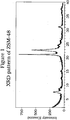
- the x-ray diffraction (XRD) pattern of the as-synthesized material shows pure phase ZSM-48 topology.
- the scanning electron microscope (SEM) of the as-synthesized material shows that the sample was composed of agglomerates of small crystals (with an average crystal size of about 0.05 microns) and trace of crystals with needle morphology.
- the as-synthesized crystals were converted into the hydrogen form by two ion exchanges with ammonium nitrate solution at room temperature, followed by drying at 250°F (120°C) and calcination at 1000°F (540°C) for 6 hours.
- the resulting ZSM-48 crystals had a SiO 2 /Al 2 O 3 molar ratio of 78/1.
- a mixture was prepared from 1000 g of water, 25 g of hexamethonium chloride(56% solution) template, 190 g of Ultrasil PM, 10 g of sodium aluminate solution (45%), and 33.33 g of 50% sodium hydroxide solution. Then 10 g of ZSM-11 seed (SiO 2 /Al 2 O 3 ⁇ 27/1) was then added the mixture.
- the mixture had the following molar composition:
- the mixture was reacted at 320°F (160°C) in a 2 liter autoclave with stirring at 250 RPM for 48 hours.
- the product was filtered, washed with deionized (DI) water and dried at 250°F (120°C).
- the XRD pattern of the as-synthesized material shows pure phase ZSM-48 topology.
- the SEM of the as-synthesized material shows that the material was composed of agglomerates of small crystals (with an average crystal size of about 0.05 microns).
- the as-synthesized crystals were converted into the hydrogen form by two ion exchanges with ammonium nitrate solution at room temperature, followed by drying at 250°F (120°C) and calcination at 1000°F (540°C) for 6 hours.
- the resulting ZSM-48 crystals had a SiO 2 /Al 2 O 3 molar ratio of 78.8.
- a mixture was prepared from 1000 g of water, 25 g of hexamethonium chloride (56% solution) template, 190 g of Ultrasil PM (a precipitated silica powder produced from Degussa), 10 g of sodium aluminate solution (45%), and 33.33 g of 50% sodium hydroxide solution. Then 10 g of Beta seed (SiO 2 /Al 2 O 3 ⁇ 35/1) was then added the mixture. The mixture had the following molar composition:
- the mixture was reacted at 320°F (160°C) in a 2 liter autoclave with stirring at 250 RPM for 48 hours.
- the product was filtered, washed with deionized (DI) water and dried at 250°F (120°C).
- the XRD pattern of the as-synthesized material shows pure phase of ZSM-48 topology.
- the SEM of the as-synthesized material shows that the material was composed of agglomerates of small crystals (with an average crystal size of about 0.05 microns).
- the as synthesized crystals were converted into the hydrogen form by two ion exchanges with ammonium nitrate solution at room temperature, followed by drying at 250°F (120°C) and calcination at 1000°F (540°C) for 6 hours.
- the resulting ZSM-48 crystals had a SiO 2 /Al 2 O 3 molar ratio of 87.2.
- a mixture was prepared from 11000g of water, 320 g of hexamethonium chloride (56% solution) template, 2255 g of Ultrasil PM, 126 g of sodium aluminate solution (45%), and 421 g of 50% sodium hydroxide solution.
- the 100 g of Beta seed (SiO 2 /Al 2 O 3 ⁇ 35/1) was then added the mixture.
- the mixture had the following molar composition:
- the mixture was reacted at 320°F (160°C) in a 5 gallon autoclave with stirring at 250 RPM for 28 hours.
- the product was filtered, washed with deionized (DI) water and dried at 250°F (120°C).
- the XRD pattern of the as-synthesized material shows pure phase ZSM-48 topology.
- the SEM of the as-synthesized material shows that the material was composed of agglomerates of small crystals (with an average crystal size of about 0.05 microns).
- the as-synthesized crystals were converted into the hydrogen form by two ion exchanges with ammonium nitrate solution at room temperature, followed by drying at 250°F (120°C) and calcination at 1000°F (540°C) for 6 hours.
- the resulting ZSM-48 crystals had a SiO 2 /Al 2 O 3 molar ratio of 81.32.
- a mixture was prepared from 1200 g of water, 40 g of hexamethonium chloride (56% solution) template, 228 g of Ultrasil PM, 16 g of sodium aluminate solution (45%), 1.3 g of 98% H 2 SO 4 solution, and 40 g of 50% sodium hydroxide solution. Then 10 g of Beta seed (SiO 2 /Al 2 O 3 - 35/1) was then added the mixture. The mixture had the following molar composition:
- the mixture was reacted at 320°F (160°C) in a 2 liter autoclave with stirring at 250 RPM for 72 hours.
- the product was filtered, washed with deionized (DI) water and dried at 250°F (120°C).
- the XRD pattern of the as-synthesized material shows the typical pure phase ZSM-48 topology.
- the SEM of the as-synthesized material shows that the material was shaped composed of agglomerates of mixed needle and small irregularly crystal crystals.
- the as-synthesized crystals were converted into the hydrogen form by two ion exchanges with ammonium nitrate solution at room temperature, followed by drying at 250°F (120°C) and calcination at 1000°F (540°C) for 6 hours.
- the resulting ZSM-48 crystals had a SiO 2 /Al 2 O 3 molar ratio of 67.7.
- Example 5 The same reactants and procedure as Example 5 were used, except that no Beta crystal was added as seeding agent.
- the XRD pattern of the as-synthesized material shows the typical ZSM-48 topology and the trace of ZSM-50 impurity was identified.
- a colloidal BEA slurry was prepared by combining 210.8 gm of tetraethylammonium hydroxide (40% solution) 13.88 gm Al(NO 3 ) 3 9H 2 O and 68.66 gm silica acid (10.2% water). The mixture was boiled for 10 mins and then heated at 70°C for 37 days. The product was washed with water to a pH of the last wash water of 11.2. After washing the crystals were re-dispersed in demineralized water and stored as such. Before use as seeds the slurry was freshly diluted with water.
- ZSM-48 crystals with cross morphology were prepared in three separate runs using very small and different seeding levels of colloidal BEA seeds.
- the composition of the synthesis mixture was:
- Figures 4 and 5 show the cross morphology of the ZSM-48 crystals.
- Example 7 After cooling to room temperature the product was washed with water until the wash water had a pH of about 9.5. The washed product was then dried at 120°C. XRD showed excellent crystallinity. Also, crystal size varied as in Example 7 depending upon the amount of colloidal seeds used.
Landscapes
- Chemical & Material Sciences (AREA)
- Organic Chemistry (AREA)
- Life Sciences & Earth Sciences (AREA)
- Geology (AREA)
- General Life Sciences & Earth Sciences (AREA)
- Inorganic Chemistry (AREA)
- Engineering & Computer Science (AREA)
- Chemical Kinetics & Catalysis (AREA)
- Materials Engineering (AREA)
- Silicates, Zeolites, And Molecular Sieves (AREA)
- Catalysts (AREA)
- Crystals, And After-Treatments Of Crystals (AREA)
Description
- This invention relates generally to novel ZSM-48 crystals and their method of preparation. More specifically the invention relates to the use of non ZSM-48 seeding to prepare high activity, ZSM-48 crystals and to prepare cross morphology ZSM-48 crystals.
- Zeolitic materials may be both natural and synthetic materials. Zeolitic materials exhibit catalytic properties for various types of hydrocarbon reactions. Certain zeolitic materials are ordered, porous crystalline aluminosilicates having a definite crystalline structure as determined by X-ray diffraction. Within this structure there are a large number of smaller cavities which may be interconnected by a number of still smaller channels or pores. These cavities and pores tend to be uniform in size within a specific zeolitic material. Since the dimensions of these pores are such as to accept for adsorption molecules of certain dimensions while rejecting those of larger dimensions, these materials have come to be known as "molecular sieves" and are utilized in a variety of ways to take advantage of these properties.
- Zeolites typically have uniform pore diameters of about 3 angstroms to about 10 angstroms. The chemical composition of zeolites can vary widely and they typically consist of SiO2 in which some of the silica atoms may be replaced by tetravalent atoms such as Ti or Ge, by trivalent ions such as Al, B, Ga, Fe, or by bivalent ions such as Be, or by a combination of any of the aforementioned ions. When there is substitution by bivalent or trivalent ions, cations such as Na, K, Ca, NH4 or H are also present.
- Zeolites include a wide variety of positive ion-containing crystalline aluminosilicates. These aluminosilicates can be described as a rigid three-dimensional framework of SiO4 and AlO4 in which the tetrahedra are crosslinked by the sharing of oxygen atoms whereby the ratio of the total aluminum and silicon atoms to oxygen atoms is 1:2. The electrovalence of the tetrahedra containing aluminum is balanced by the inclusion in the crystal of a cation, for example, an alkali metal, an alkaline earth metal cation, or an organic species such as a quaternary ammonium cation. This can be expressed wherein the ratio of aluminum to the number of various cations, such as Ca/2, Sr/2, Na, K or Li is equal to unity. One type of cation may be exchanged either entirely or partially by another type of cation utilizing ion exchange techniques in a conventional manner. By means of such cation exchange, it has been possible to vary the properties of a given aluminosilicate by suitable selection of the cation. The spaces between the tetrahedra are usually occupied by molecules of water prior to dehydration.
- Prior art techniques have resulted in the formation of a great variety of synthetic aluminosilicates. These aluminosilicates have come to be designated by letter or other convenient symbols, as illustrated by zeolite A (
U.S. Pat. No. 2,882,243 ), zeolite X (U.S. Pat. No. 2,882, 244 ), zeolite Y (U.S. Pat. No. 3,130,007 ), zeolite ZK-5 (U.S. Pat. No. 3, 247,195 ), zeolite ZK-4 (U.S. Pat. No. 3,314,752 ), zeolite ZSM-5 (U.S. Pat. No. 3,702,886 ), zeolite ZSM-11 (U.S. Pat. No. 3,709,979 ), and zeolite ZSM-12 (U.S. Pat. No. 3,832,449 ), merely to name a few. - The SiO2/Al2 O3 ratio of a given zeolite is often variable. For example, zeolite X can be synthesized with SiO2/Al2O3 ratio of from about 2 to about 3; zeolite Y, from about 3 to about 6. In some zeolites, the upper limit of SiO2/Al2O3 ratio is unbounded. ZSM-5 is one such example wherein SiO2/Al2O3 ratio is at least five.
U.S. Pat. No. 3,941,871 discloses a crystalline metal organosilicate essentially free of aluminum and exhibiting an x-ray diffraction pattern characteristic of ZSM-5 type aluminosilicates.U.S. Pat. Nos. 4,061,724 ,4,073,865 and4,104,294 describe microporous, crystalline silicas or organosilicates of varying alumina and metal content. -
U.S. Pat. No. 4,423,021 to Rollmann et al describes a method for synthesizing silico-crystal ZSM-48 using a diamine having four to twelve carbons as the directing agent. The composition is described as a silico-crystal and it includes very little, if any aluminum. -
U.S. Pat. Nos. 4,397,827 and4,448,675 to Chu also describes method for synthesizing a silico-crystal ZSM-48 including very little, if any, aluminum. The synthesis utilizes a mixture of an amine having from two to twelve carbons and tetramethylammonium compound as the directing agent. -
U.S. Pat. No. 5,075,269 to Degnan et al describes silico-crystal ZSM-48 prepared with organic linear diquaternary ammonium compound as a template. The crystal morphology is illustrated inFigures 3 and4 of the '269 patent and is described as having platelet-like crystal morphology at high silica/alumina ratios and aggregates of small irregularly shaped crystals at silica/alumina ratios below 200. InU.S. Pat. No. 5,075,269 this is compared with the crystal morphology ofRollmann et al (U.S. Pat. No. 4,423,021 ) inFigure 1 andChu (U.S. Pat. No. 4,397,827 ) inFigure 2 .Figures 1 and2 show a rod-like or needle-like crystal morphology which is random and dispersed. - ZSM-48 is also described by R. Szostak, Handbook of Molecular Sieves, Van Nostrand Rheinhold, New York 1992, at pp. 551-553. Organics are listed as diquat-6, bis (N-methylpyridyl) ethylinium, diethylenetriamine, triethylenetetramine, tetraethylenepentamine, 1, 4, 8, 11-tetra-aza-undecane, 1, 5, 9, 13-tetra-aza-undecane, 1, 5, 8, 12-tetra-aza-undecane, 1, 3-diaminopropane, n-propylamine/TMA+, hexane-diamine and triethylamine.
-
U.S. Pat. No. 5,961,951 to Kennedy et al describes a method for making ZSM-48 by crystallizing a reaction mixture consisting of a source of silica, a source of trivalent metal oxide, an alkali metal oxide, ethylenediamine and water. -
EP 0 142 317 A2 to Valyocsik - ZSM-48 has been synthesized under a broad range of ratios of SiO2/Al2O3 generally ranging from about 150/1 to about 600/1. Synthesis of high activity non-fibrous ZSM-48 crystals with lower SiO2/Al2O3 ratios is desirable for the developments of selective olefin isomerization catalysts, near linear olefin catalysts, and lube dewaxing catalysts.
- However, generally prior attempts to grow pure phase ZSM-48 at a ratio of SiO2/Al2O3 of less than 150/1 have been unsuccessful for the most part and result in the formation of impurities, such as ZSM-50 and Kenyaite.
- It is known that the crystallization of some zeolites proceeds only in the presence of seeds. Adding seed crystals to a crystallization system has typically resulted in increased crystallization rates. In other cases, the addition of seeds determines, to a great extent, the type of the crystallized zeolites and affects the resulting zeolite composition and changes the kinetics of the process. It is also known that pure phase ZSM-50 and ZSM-23 crystals can be synthesized from hydrothermal reactions with the addition of heterostructural seeds including ZSM-5, silicalite, X, Y and Mordenite as described in
EP 0 999 182 A1US Patent 6,342,200 B1 , andUS Patent 6,475,464 . - The present invention overcomes some of the aforementioned problems of the prior art. It provides a method for making a pure phase, highly active ZSM-48 crystals substantially without fibrous morphology crystals and any other impurities. One aspect of the invention provides cross morphology ZSM-48 crystals and a method for making them.
- In particular the present invention provides pure phase ZSM-48 crystals having a XO 2 /Y 2 O3 ratio of from 40/1 to 90/1, wherein X is Si and Y is Al; substantially free from ZSM-50 and Kenyaite impurities; having a diameter of less than 1 micron; and being substantially free of fibrous morphology.
- The present invention is also directed to a method for making a pure phase, high activity ZSM-48. The product can be prepared from a reaction mixture which includes sources of a tetravalent element such as a silica, a trivalent metal oxide, an alkali or alkaline earth metal oxide, a template (or directing agent) and heterostructural, zeolite seeds, other than ZSM-48 and ZSM-50 seeds, in a solvent phase which includes water. The mixture, in terms of mole ratios of oxides, has the following composition:
- XO2/Y2O3: 20/1 to 2500/1,
- OH-/XO2 : 0.1/1 to 2.0/1,
- R/XO2: 0.001/1 to 5.0/1,
- M+/XO2: 0/1 to 2.0/1, and
- H2O/XO2: 1/1 to 500/1, wherein Y is a trivalent metal, M+ is an alkali or alkaline earth metal, X is a tetravalent element, and R is an organic template.
- The reaction mixture is prepared and maintained under conditions effective for the crystallization of the porous ZSM-48.
- The method employs heterostructural, zeolite seeds, other than ZSM-48 and ZSM-50, in a hydrothermal reaction. Examples of suitable seeds include heterostructural zeolite ZSM-5, ZSM-11, ZSM-12, Beta, X and Y zeolites, and colloidal BEA seeds.
- It has been unexpectedly discovered that the use of heterostructural seeds in the reaction promotes more aluminum incorporation into the framework of the ZSM-48 crystal. It also suppresses the formation of impurities and fibrous morphology, crystals. The resulting product exhibits highly pure ZSM-48 crystals with a ratio of SiO2/Al2O3 of less than 90/1, preferably less than 70/1, and more preferably less than 50/1. The product is substantially free from impurities such as ZSM-50 and/or Kenyaite impurities typically found in products made using conventional methods. It is also substantially free of any fibrous morphology crystals, another prior art problem. It also has been discovered that when the non ZSM-48 seeds are colloidal BEA seeds, the inventive ZSM-48 crystals have a cross morphology.
-
-
Figure 1 is an x-ray diffraction pattern of a ZSM-48 prepared according to an embodiment of this invention. -
Figure 2 is a SEM of a ZSM-48 product having a SiO2/Al2O3 of from 70/1 to 90/1. The product is an agglomerate of small irregularly shaped crystals. -
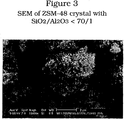
Figure 3 is a SEM of a ZSM-48 product having a SiO2/Al2O3 < 70/1. The product is an agglomerate of mixed needle and small crystals. -
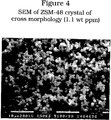
Figure 4 is a SEM of a cross morphology ZSM-48 crystals made according to an embodiment of the invention. -
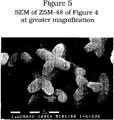
Figure 5 is a SEM of the cross morphology ZSM-48 crystals shown inFigure 4 shown at a greater magnification. - The preparation process comprises mixing in an aqueous medium: a source or an alkali or alkaline earth metal M, preferably sodium; at least one source of at least one tetravalent element X, preferably selected from silicon, and germanium, at least one source of at least one trivalent element Y, preferably selected from aluminum, gallium, boron, iron, titanium, vanadium, and zirconium, at least one template material R selected from linear nitrogen-containing organic compounds; and, heterostructural, non ZSM-48 zeolite seeds. Examples of suitable seeds are ZSM-5, ZSM-11, ZSM-12, Beta, X and Y zeolites, and colloidal BEA. Effective amounts of the various components are added to form a reaction mixture having the following molar composition:
TABLE 1 mol/mol Preferred Range More Preferred Range Most Preferred Range XO2/Y2O3 20 - 2500/1 30 - 500/1 40 - 200/1 H2O/XO2 1 - 500/1 10 - 100/1 15 - 60/1 OH-/XO2 0 - 2.0/1 0.02 - 0.5/1 0.1 - 0.5/1 M+/XO2 0 - 2.0/1 0.02 - 0.8/1 0.1 - 0.6/1 R/XO2 0.001 - 5.0/1 0.005 - 1.0/1 0.01 - 0.5/1 - The seeds may be used in amounts from 0.01 wt ppm to 5 wt%, preferably from 0.01 wt ppm to 2 wt%, and more preferably from 0.05 wt ppm to 1 wt% based on the total amount of the reaction mixture. When using colloidal BEA seeds it is especially preferred to use them in an amount ranging from 0.01 wt ppm to 0.1 wt%.
- Examples of suitable template materials include organic linear nitrogen compounds, such as linear diamine alkanes, of which 1.6 diamino hexane and 1,8 diamino octane are representative examples and linear diquaternary alkyl ammonium compounds, of which hexamethonium salts are an example.
- The reaction mixture is heated to a preferred temperature of from 212°F (100°C) to 482°F (250°C), more preferably from 302°F (150°C) to 338°F (170°C). The reaction pressure is preferably maintained from 1 atm to 15 atm, and more preferably 3 atm to 8 atm. The heating can be done using any conventional vessel, continuous or batch type, such as autoclaves or static or rocking bomb reactors. Preferably, the mixture is stirred during the heating step via conventional stirring means. Sufficient mixing energy may be used to effectively mix the various components of the reaction mixture to form a macroscopically homogeneous mixture. The mixture is maintained under effective crystallization conditions until the ZSM-48 crystals are formed. The crystallization time may vary depending on a number of factors from a few minutes to many hours, typically from 20 to 500 hours and more typically from 40 to 240 hours, or until the reaction is over and zeolite crystals have formed.
- The product is filtered using suitable conventional filter means and washed with deionized water (DI). Subsequent operations may include drying, calcining and ion exchange. XRD analysis of the product shows a pure phase ZSM-48 topology substantially free of any impurities. Scanning electron microscopy analysis of the product shows that it is composed of agglomerates of small crystals with an average crystal size of from 0.01 to 1.0 microns, and more preferably from 0.01 to 0.05 microns. Importantly, SEM analysis shows that the product has no detectable levels of fibrous morphology crystals. The method may further comprise converting the product crystals into their hydrogen form. For example, this can be done by contacting the crystals with an ammonium nitrate solution, preferably at room temperature, followed by drying and calcinating steps. The drying and calcining steps include heating via conventional means to conventional temperatures. The inventive product ZSM-48 crystals have a XO2/Y2O3 molar ratio of from 40 - 90 wherein X is Si and Y is Al.
- One embodiment of the invention is directed to a method for making pure phase, highly active ZSM-48 crystals. The method comprises mixing effective amounts of water, hexamethonium chloride, ultrasil PM, sodium aluminate, sodium hydroxide solution, and non-ZSM-48 and non-ZSM-50 crystal seeds. The effective amounts of the various components can be readily determined by a person skilled in this art to form a mixture having the desired composition.
- The seeds may be introduced at any point in the preparation. They may be introduced at the same time as the silicon and aluminum sources, or as the template. They may also be introduced first into an aqueous mixture, or they may be introduced after introducing the silicon and aluminum sources and/or the template. Preferably, the seeds may be added after at least partial homogenization of the aqueous mixture containing the aluminum and silicon sources and the template.
- The seed particle size may have an influence on the synthesis process. The term "seed particle" means either a seed crystal or an agglomerate of seed crystals. Thus, the size of at least a major portion of the seed particles introduced during preparation of the zeolitic material is in the range of from 0.01 to 5.0, preferably in the range of from 0.02 to 1.0 µm.
- Suitable silicon sources can be any one in normal use envisaged for zeolite synthesis, for example, solid powdered silica, silicic acid, colloidal silica or dissolved silica. Powdered silicas which can be used include precipitated silicas, in particular those obtained by precipitation from a solution of an alkali metal silicate such as "Zeosil" or "Tixosil" produced by Rhone-Poulenc, fumed silicas such as "Aerosil" produced by Degussa and "Cabosil" produced by Cabot, and silica gels. Colloidal silicas with a variety of granulometries can be used, such as those sold under trademarks "LUDOX" from Dupont, and "SYTON" from Monsanto.
- Suitable dissolved silicas that can be used are commercially available soluble glass or sodium silicates containing 0.5 to 6.0 preferably 2.0 to 4.0 moles of SiO2 per mole of alkali metal oxide and silicates obtained by dissolving silica in an alkali metal hydroxide, a diquaternary hydroxide, ammonium hydroxide, ammonium halide or a mixture thereof.
- Suitable aluminum sources include sodium aluminates, aluminum salts, for example chloride, nitrate or sulfate aluminum salts, aluminum alcoholates or alumina preferably in a hydrated or hydratable form, such as colloidal alumina, pseudoboehemite, boehemite, gamma alumina or a trihydrate. Mixtures of the sources cited above may be used, as well as combined sources of silicon and aluminum such as amorphous silica-aluminas or certain clays.
- The inventive ZSM-48 crystals can be used in many catalyst applications including: dewaxing, olefin isomerizations, or near linear olefin catalyst systems. Their use is advantageous because of high activity, and their small, non-fibrous crystal morphology.
- The following Examples are provided to further illustrate the inventive method and crystals and should not be construed as limiting the scope of the invention which is delineated in the appended claims.
- A mixture was prepared from 1100 g of water, 32 g of hexamethonium chloride (56% solution) template, 225.5 g of Ultrasil PM, 14.2 of sodium aluminate solution (45%), and 45.1g of 50% sodium hydroxide solution. Then 10 g of ZSM-12 seed (SiO2/Al2O3 ~ 49.2) was then added to the mixture. The mixture had the following molar composition:
- SiO2/Al2O3 = 89.9
- H2O/SiO2 = 18.75
- OH-/SiO2 = 0.178
- Na+/SiO2 = 0.178
- Template/SiO2 = 0.019
- The mixture was reacted at 320°F (160°C) in a 2 liter autoclave with stirring at 250 RPM for 48 hours. The product was filtered, washed with deionized (DI) water and dried at 250°F (120°C). The x-ray diffraction (XRD) pattern of the as-synthesized material shows pure phase ZSM-48 topology. The scanning electron microscope (SEM) of the as-synthesized material shows that the sample was composed of agglomerates of small crystals (with an average crystal size of about 0.05 microns) and trace of crystals with needle morphology. The as-synthesized crystals were converted into the hydrogen form by two ion exchanges with ammonium nitrate solution at room temperature, followed by drying at 250°F (120°C) and calcination at 1000°F (540°C) for 6 hours. The resulting ZSM-48 crystals had a SiO2/Al2O3 molar ratio of 78/1.
- A mixture was prepared from 1000 g of water, 25 g of hexamethonium chloride(56% solution) template, 190 g of Ultrasil PM, 10 g of sodium aluminate solution (45%), and 33.33 g of 50% sodium hydroxide solution. Then 10 g of ZSM-11 seed (SiO2/Al2O3 ~ 27/1) was then added the mixture. The mixture had the following molar composition:
- SiO2/Al2O3 = 106
- H2O/SiO2 = 20.08
- OH-/SiO2 = 0.165
- Na+/SiO2 = 0.165
- Template/SiO2 = 0.018
- The mixture was reacted at 320°F (160°C) in a 2 liter autoclave with stirring at 250 RPM for 48 hours. The product was filtered, washed with deionized (DI) water and dried at 250°F (120°C). The XRD pattern of the as-synthesized material shows pure phase ZSM-48 topology. The SEM of the as-synthesized material shows that the material was composed of agglomerates of small crystals (with an average crystal size of about 0.05 microns). The as-synthesized crystals were converted into the hydrogen form by two ion exchanges with ammonium nitrate solution at room temperature, followed by drying at 250°F (120°C) and calcination at 1000°F (540°C) for 6 hours. The resulting ZSM-48 crystals had a SiO2/Al2O3 molar ratio of 78.8.
- A mixture was prepared from 1000 g of water, 25 g of hexamethonium chloride (56% solution) template, 190 g of Ultrasil PM (a precipitated silica powder produced from Degussa), 10 g of sodium aluminate solution (45%), and 33.33 g of 50% sodium hydroxide solution. Then 10 g of Beta seed (SiO2/Al2O3 ~ 35/1) was then added the mixture. The mixture had the following molar composition:
- SiO2/Al2O3 = 106
- H2O/SiO2 = 20.08
- OH-/SiO2 = 0.165
- Na+/SiO2 = 0.165
- Template/SiO2 = 0.018
- The mixture was reacted at 320°F (160°C) in a 2 liter autoclave with stirring at 250 RPM for 48 hours. The product was filtered, washed with deionized (DI) water and dried at 250°F (120°C). The XRD pattern of the as-synthesized material shows pure phase of ZSM-48 topology. The SEM of the as-synthesized material shows that the material was composed of agglomerates of small crystals (with an average crystal size of about 0.05 microns). The as synthesized crystals were converted into the hydrogen form by two ion exchanges with ammonium nitrate solution at room temperature, followed by drying at 250°F (120°C) and calcination at 1000°F (540°C) for 6 hours. The resulting ZSM-48 crystals had a SiO2/Al2O3 molar ratio of 87.2.
- A mixture was prepared from 11000g of water, 320 g of hexamethonium chloride (56% solution) template, 2255 g of Ultrasil PM, 126 g of sodium aluminate solution (45%), and 421 g of 50% sodium hydroxide solution. The 100 g of Beta seed (SiO2/Al2O3 ~ 35/1) was then added the mixture. The mixture had the following molar composition:
- SiO2/Al2O3 = 100.4
- H2O/SiO2 = 18.73
- OH-/SiO2 = 0.175
- Na+/SiO2 = 0.175
- Template/SiO2 = 0.019
- The mixture was reacted at 320°F (160°C) in a 5 gallon autoclave with stirring at 250 RPM for 28 hours. The product was filtered, washed with deionized (DI) water and dried at 250°F (120°C). The XRD pattern of the as-synthesized material shows pure phase ZSM-48 topology. The SEM of the as-synthesized material shows that the material was composed of agglomerates of small crystals (with an average crystal size of about 0.05 microns). The as-synthesized crystals were converted into the hydrogen form by two ion exchanges with ammonium nitrate solution at room temperature, followed by drying at 250°F (120°C) and calcination at 1000°F (540°C) for 6 hours. The resulting ZSM-48 crystals had a SiO2/Al2O3 molar ratio of 81.32.
- A mixture was prepared from 1200 g of water, 40 g of hexamethonium chloride (56% solution) template, 228 g of Ultrasil PM, 16 g of sodium aluminate solution (45%), 1.3 g of 98% H2SO4 solution, and 40 g of 50% sodium hydroxide solution. Then 10 g of Beta seed (SiO2/Al2O3 - 35/1) was then added the mixture. The mixture had the following molar composition:
- SiO2/Al2O3 = 81
- H2O/SiO2 = 20
- OH-/SiO2 = 0.172
- Na+/SiO2 = 0.165
- Template/SiO2 = 0.022
- The mixture was reacted at 320°F (160°C) in a 2 liter autoclave with stirring at 250 RPM for 72 hours. The product was filtered, washed with deionized (DI) water and dried at 250°F (120°C). The XRD pattern of the as-synthesized material shows the typical pure phase ZSM-48 topology. The SEM of the as-synthesized material shows that the material was shaped composed of agglomerates of mixed needle and small irregularly crystal crystals. The as-synthesized crystals were converted into the hydrogen form by two ion exchanges with ammonium nitrate solution at room temperature, followed by drying at 250°F (120°C) and calcination at 1000°F (540°C) for 6 hours. The resulting ZSM-48 crystals had a SiO2/Al2O3 molar ratio of 67.7.
- The same reactants and procedure as Example 5 were used, except that no Beta crystal was added as seeding agent. The XRD pattern of the as-synthesized material shows the typical ZSM-48 topology and the trace of ZSM-50 impurity was identified.
- The above examples show that pure phase, high activity ZSM-48 crystals with SiO2/Al2O3 < 90/1 can be prepared with the addition of heterostructural, non ZSM-48 seed crystals, such as ZSM-5, ZSM-11, ZSM-12, beta zeolites in hydrothermal reactions. These added seeding crystals appear to change the kinetics of the crystallization process and promote the crystallization of the desirable ZSM-48 structure, while suppressing the formation of impurities such as ZSM-50. Also, substantially no detectable amounts of crystals with fibrous morphology were observed in the synthesized products. Crystal morphology varied based on SiO2/Al2O3 ratio. For crystals with ratios from 70/1 to 90/1, agglomerates of small irregularly shaped crystals were observed. SiO2/Al2O3 ratios below 70 produced agglomerates of mixed needle and small irregularly shaped crystals.
- A colloidal BEA slurry was prepared by combining 210.8 gm of tetraethylammonium hydroxide (40% solution) 13.88 gm Al(NO3)3 9H2O and 68.66 gm silica acid (10.2% water). The mixture was boiled for 10 mins and then heated at 70°C for 37 days. The product was washed with water to a pH of the last wash water of 11.2. After washing the crystals were re-dispersed in demineralized water and stored as such. Before use as seeds the slurry was freshly diluted with water.
- ZSM-48 crystals with cross morphology were prepared in three separate runs using very small and different seeding levels of colloidal BEA seeds. The composition of the synthesis mixture was:
- 0.71 Na2O/3 R*/10 SiO2/376 H2O
-
Figures 4 and5 show the cross morphology of the ZSM-48 crystals. - Three separate batches of ZSM-48 crystals with cross morphology were prepared using a mixture that was prepared from 10.51 gm NaOH, 2.26 gm Al2(SO4)3 18H2O, 252.27 gm Ludox AS-40 (40% SiO2 in H2O), 76.75
gm 1,8 diamino octane template and 358.8 gm H2O. Then the colloidal BEA slurry as prepared in Example 7 was freshly diluted with water and added in the same amounts as in Example 7. After mixing for about 5 min. the gel was heated in an autoclave from room temperature to 150°C in 2 hrs and then kept at that temperature for 20 hrs. After cooling to room temperature the product was washed with water until the wash water had a pH of about 9.5. The washed product was then dried at 120°C. XRD showed excellent crystallinity. Also, crystal size varied as in Example 7 depending upon the amount of colloidal seeds used.
| Run | Seeding Level (wtppm)① | Synthesis Time at 150°C | Crystal Size (µm) |
| 1 | -- | 72 hours | |
| 2 | 1.1 | 24 hours | 3.5 |
| 3 | 0.56 | 30 hours | 4.5 |
| 4 | 0.016 | 30 | 10 |
| ① colloidal BEA slurry ② still some amorphous material present |
Claims (8)
- Pure phase ZSM-48 crystals having a XO2/Y2O3 ratio of from 40/1 to 90/1, wherein X is Si and Y is Al; being substantially free from ZSM-50 and/or Kenyaite impurities; having a diameter of less than 1 micron; and being substantially free of fibrous morphology.
- A method for making ZSM-48 crystals, the method comprising:mixing at least one source of a tetravalent element X, at least one source of a trivalent element Y, an alkali or alkaline earth metal M, and at least one organic template material R which is an organic linear nitrogen compound;to form a reaction mixture having in terms of mole ratios of oxides the following composition:
XO2/Y2O3 20/1 - 2500/1 OH/XO2 0/1 - 2.0/1 H2O/XO2 1/1 - 500/1 M+/XO2 0/1 - 2.0/1 R/XO2 0.001/1 - 5.0/1
the reaction mixture also includes effective amounts of heterostructural zeolite seeds selected from the group consisting of ZSM-5, ZSM-11, ZSM-12, colloidal BEA, Beta, X and Y zeolites. - The method of claim 2 wherein the organic template is selected from organic linear diquaternary alkyl ammonium compounds and linear diamino alkanes.
- The method of claim 3 wherein the effective amount of heterostructural zeolite seeds is in the range of 0.01 wt ppm to 5 wt% based on the total weight reaction mixture.
- The method of claim 4 wherein said heterostructural zeolite seeds are selected from the group consisting of ZSM-5, ZSM-11, ZSM-12, Beta, X and Y zeolites.
- The method of claim 2 wherein the seeds are colloidal BEA seeds in an amount in the range of 0.01 wt ppm to 0.1 wt%, whereby the ZSM-48 crystals have a cross morphology and crystal size of 1 to 15 µm.
- A method as claimed in claim 2:wherein X is silicon, Y is aluminum, M is an alkali metal, and the reaction mixture comprises water, andwherein said mixture, in terms of mole ratios of oxides, has the following composition:
SiO2/Al2O3 : 30/1 to 500/1, M+/SiO2 : 0.02/1 to 0.8/1, OH-/SiO2 : 0.02/1 to 0.5/1, H2O/SiO2 : 10/1 to 100/1, and R/SiO2 : 0.005/1 to 1.0/1. - The method according to claim 7, wherein said mixture has the following composition ranges:
SiO2/Al2O3 : 40/1 to 200/1, M+/SiO2 : 0.1/1 to 0.6/1, OH-/SiO2 : 0.1/1 to 0.5/1, H2O/SiO2 : I5/1 to 60/1, and R/SiO2: 0.01/1-0.5/1.
Applications Claiming Priority (2)
| Application Number | Priority Date | Filing Date | Title |
|---|---|---|---|
| US10/795,108 US6923949B1 (en) | 2004-03-05 | 2004-03-05 | Synthesis of ZSM-48 crystals with heterostructural, non ZSM-48, seeding |
| PCT/US2005/004383 WO2005092792A1 (en) | 2004-03-05 | 2005-02-11 | Synthesis of zsm-48 crystals with heterostructural, non zsm-48, seeding |
Publications (3)
| Publication Number | Publication Date |
|---|---|
| EP1725498A1 EP1725498A1 (en) | 2006-11-29 |
| EP1725498A4 EP1725498A4 (en) | 2010-07-21 |
| EP1725498B1 true EP1725498B1 (en) | 2015-03-25 |
Family
ID=34795848
Family Applications (1)
| Application Number | Title | Priority Date | Filing Date |
|---|---|---|---|
| EP05713365.4A Expired - Lifetime EP1725498B1 (en) | 2004-03-05 | 2005-02-11 | Synthesis of zsm-48 crystals with heterostructural, non zsm-48, seeding |
Country Status (13)
| Country | Link |
|---|---|
| US (1) | US6923949B1 (en) |
| EP (1) | EP1725498B1 (en) |
| JP (1) | JP4919948B2 (en) |
| KR (1) | KR20070001216A (en) |
| CN (1) | CN100548879C (en) |
| AU (1) | AU2005226747A1 (en) |
| CA (1) | CA2558355A1 (en) |
| MY (1) | MY135086A (en) |
| NO (1) | NO20064497L (en) |
| RU (1) | RU2361812C2 (en) |
| TW (1) | TW200602266A (en) |
| WO (1) | WO2005092792A1 (en) |
| ZA (1) | ZA200607391B (en) |
Families Citing this family (42)
| Publication number | Priority date | Publication date | Assignee | Title |
|---|---|---|---|---|
| JP4744530B2 (en) * | 2004-11-12 | 2011-08-10 | ジュート−ヒェミー アクチェンゲゼルシャフト | Synthesis method of beta zeolite using diethylenetriamine |
| US7482300B2 (en) * | 2005-12-13 | 2009-01-27 | Exxonmobil Research And Engineering Company | High activity ZSM-48 and methods for dewaxing |
| TWI450762B (en) * | 2005-12-13 | 2014-09-01 | Exxonmobil Res & Eng Co | High activity zsm-48 and methods for dewaxing |
| EP2155840B1 (en) * | 2007-06-13 | 2018-03-21 | ExxonMobil Research and Engineering Company | Integrated hydroprocessing with high productivity catalysts |
| US8003074B2 (en) * | 2007-09-18 | 2011-08-23 | Exxonmobil Research And Engineering Company | Synthesis of high activity ZSM-48 |
| US8263519B2 (en) * | 2007-12-28 | 2012-09-11 | Exxonmobil Research And Engineering Company | Sour service dewaxing catalyst without separate hydrogenation function |
| US8263517B2 (en) * | 2007-12-28 | 2012-09-11 | Exxonmobil Research And Engineering Company | Hydroprocessing catalysts with low surface area binders |
| US8377286B2 (en) * | 2008-12-31 | 2013-02-19 | Exxonmobil Research And Engineering Company | Sour service hydroprocessing for diesel fuel production |
| US8212099B2 (en) * | 2009-11-05 | 2012-07-03 | Chevron U.S.A. Inc. | N-paraffin selective hydroconversion process using borosilicate ZSM-48 molecular sieves |
| US8142757B2 (en) | 2009-11-05 | 2012-03-27 | Chevron U.S.A. Inc. | Method for making borosilicate ZSM-48 molecular sieves |
| US10449525B2 (en) | 2010-10-25 | 2019-10-22 | Shell Oil Company | Hydrocarbon conversion catalyst composition |
| US20130064757A1 (en) * | 2011-09-09 | 2013-03-14 | Uop Llc | Methods for forming zeolites from homogeneous amorphous silica alumina |
| WO2013090534A1 (en) | 2011-12-16 | 2013-06-20 | Shell Oil Company | A titania-bound zsm-12 zeolite composition and method of making and using such composition |
| CN103803576B (en) * | 2012-11-07 | 2015-10-21 | 中国石油化工股份有限公司 | A kind of low silica-alumina ratio ZSM-48 molecular sieve and preparation method thereof |
| CN104418357B (en) * | 2013-08-22 | 2017-03-01 | 中国石油化工股份有限公司 | A kind of preparation method of ZSM-35 molecular sieve |
| KR102068312B1 (en) * | 2013-10-18 | 2020-01-20 | 에스케이이노베이션 주식회사 | Activated EU-2 Zeolite and Use Thereof |
| CN104549452B (en) * | 2013-10-22 | 2017-01-18 | 中国石油化工股份有限公司 | Toluene and methanol alkylation catalyst and preparation method and application thereof |
| JP6386562B2 (en) * | 2013-12-26 | 2018-09-05 | エクソンモービル リサーチ アンド エンジニアリング カンパニーExxon Research And Engineering Company | Synthesis of ZSM-48 crystals |
| US9433935B2 (en) | 2014-03-28 | 2016-09-06 | Exxonmobil Research And Engineering Company | Synthesis of framework modified ZSM-48 crystals |
| US10155665B2 (en) * | 2014-11-03 | 2018-12-18 | Exxonmobil Research And Engineering Company | Zeolite synthesis with dominant and secondary templates |
| WO2016073183A1 (en) | 2014-11-03 | 2016-05-12 | Exxonmobil Research And Engineering Company | Base stock production using a high activity catalyst |
| CN108137332A (en) | 2015-08-27 | 2018-06-08 | 雪佛龙美国公司 | The purposes of molecular sieve SSZ-91, the method for preparing SSZ-91 and SSZ-91 |
| CN105271293A (en) * | 2015-10-20 | 2016-01-27 | 复榆(张家港)新材料科技有限公司 | Synthetic method of high-silicon zeolite |
| CN105174282A (en) * | 2015-10-20 | 2015-12-23 | 上海复榆新材料科技有限公司 | Method for synthesizing pure silicon dioxide MRE zeolite |
| CN105967202B (en) * | 2016-05-03 | 2018-06-08 | 太原理工大学 | A kind of synthetic method of low silica-alumina ratio ZSM-48 molecular sieves |
| GB2556392B (en) | 2016-09-09 | 2021-04-14 | Johnson Matthey Plc | JMZ-5 zeolites having an SZR-type crystal structure, and methods of their preparation and use |
| PL3554693T3 (en) | 2016-12-16 | 2022-11-21 | Shell Internationale Research Maatschappij B.V. | Catalyst system for dewaxing |
| CN106830000A (en) * | 2017-01-20 | 2017-06-13 | 宁夏大学 | A kind of synthetic method of the molecular sieves of bundle shape HZSM 48 |
| KR102503693B1 (en) | 2017-04-28 | 2023-02-28 | 에스케이이노베이션 주식회사 | Hierarchical zeolite including micropores and mesopores, and preparation method thereof |
| EP3781308A1 (en) | 2018-04-17 | 2021-02-24 | Shell Internationale Research Maatschappij B.V. | Catalyst system for dewaxing |
| JP2021526496A (en) * | 2018-06-14 | 2021-10-07 | シェブロン ユー.エス.エー. インコーポレイテッド | Aluminum rich * MRE skeleton type molecular sieve |
| SG11202100060UA (en) | 2018-08-27 | 2021-03-30 | Exxonmobil Res & Eng Co | Dewaxing using a molecular sieve catalyst |
| US11111153B2 (en) * | 2018-08-27 | 2021-09-07 | Exxonmobil Research And Engineering Company | Process for making molecular sieves |
| CN112585092B (en) * | 2018-08-27 | 2025-03-04 | 埃克森美孚科技工程公司 | Molecular sieve and method for producing molecular sieve |
| CN110562999A (en) * | 2019-09-09 | 2019-12-13 | 大连理工大学 | Method for synthesizing ZSM-48 with low silica-alumina ratio by crystal seed assistance |
| CN113620309B (en) * | 2020-05-09 | 2023-05-05 | 中国石油化工股份有限公司 | ZSM-48 molecular sieve and synthesis method and application thereof |
| CA3198683A1 (en) | 2020-11-13 | 2022-05-19 | ExxonMobil Technology and Engineering Company | Method of synthesizing aluminum-rich molecular sieve of *mre framework type |
| CN115959682B (en) * | 2021-10-13 | 2025-09-26 | 中国石油化工股份有限公司 | A boron-containing ZSM-48 molecular sieve and its preparation method and application |
| US11964875B2 (en) * | 2022-03-24 | 2024-04-23 | Chevron U.S.A. Inc. | Synthesis of *MRE framework type molecular sieves |
| KR20240025192A (en) | 2022-08-18 | 2024-02-27 | 에스케이이노베이션 주식회사 | Zeolite with improved hydroisomerization activity |
| CN119390082A (en) * | 2024-09-08 | 2025-02-07 | 广东工业大学 | Tantalum titanium boride/MXenes bimetallic boride heterojunction material and preparation method and application thereof |
| WO2026059887A1 (en) | 2024-09-13 | 2026-03-19 | ExxonMobil Technology and Engineering Company | Methods of making molecular sieves of *mre framework type |
Citations (2)
| Publication number | Priority date | Publication date | Assignee | Title |
|---|---|---|---|---|
| EP0142317A2 (en) * | 1983-11-16 | 1985-05-22 | Mobil Oil Corporation | Crystalline silicate ZSM-48 and method for its preparation |
| US5961951A (en) * | 1998-01-12 | 1999-10-05 | Mobil Oil Corporation | Synthesis ZSM-48 |
Family Cites Families (20)
| Publication number | Priority date | Publication date | Assignee | Title |
|---|---|---|---|---|
| US2882243A (en) | 1953-12-24 | 1959-04-14 | Union Carbide Corp | Molecular sieve adsorbents |
| US2882244A (en) | 1953-12-24 | 1959-04-14 | Union Carbide Corp | Molecular sieve adsorbents |
| US3130007A (en) | 1961-05-12 | 1964-04-21 | Union Carbide Corp | Crystalline zeolite y |
| US3314752A (en) | 1961-08-30 | 1967-04-18 | Mobil Oil Corp | Synthetic zeolite |
| NL289199A (en) | 1962-02-21 | |||
| US3702886A (en) | 1969-10-10 | 1972-11-14 | Mobil Oil Corp | Crystalline zeolite zsm-5 and method of preparing the same |
| US3709979A (en) | 1970-04-23 | 1973-01-09 | Mobil Oil Corp | Crystalline zeolite zsm-11 |
| US3832449A (en) | 1971-03-18 | 1974-08-27 | Mobil Oil Corp | Crystalline zeolite zsm{14 12 |
| US3941871A (en) | 1973-11-02 | 1976-03-02 | Mobil Oil Corporation | Crystalline silicates and method of preparing the same |
| US4061724A (en) | 1975-09-22 | 1977-12-06 | Union Carbide Corporation | Crystalline silica |
| US4073865A (en) | 1976-09-27 | 1978-02-14 | Union Carbide Corporation | Silica polymorph and process for preparing same |
| US4104294A (en) | 1977-11-10 | 1978-08-01 | Union Carbide Corporation | Crystalline silicates and method for preparing same |
| US4397827A (en) | 1979-07-12 | 1983-08-09 | Mobil Oil Corporation | Silico-crystal method of preparing same and catalytic conversion therewith |
| US4423021A (en) * | 1979-08-08 | 1983-12-27 | Mobil Oil Corporation | Method of preparing silico-crystal ZSM-48 |
| US4448675A (en) | 1981-09-17 | 1984-05-15 | Mobil Oil Corporation | Silico-crystal ZSM-48 method of preparing same and catalytic conversion therewith |
| US4585747A (en) * | 1984-06-27 | 1986-04-29 | Mobil Oil Corporation | Synthesis of crystalline silicate ZSM-48 |
| US4855747A (en) * | 1987-08-17 | 1989-08-08 | Trustees Of The University Of Pennsylvania | Method of target imaging and identification |
| US5075269A (en) | 1988-12-15 | 1991-12-24 | Mobil Oil Corp. | Production of high viscosity index lubricating oil stock |
| DK0999182T3 (en) | 1998-11-02 | 2003-07-14 | Inst Francais Du Petrole | Process for the preparation of a structure type EUO zeolite by means of the germ of zeolite materials and its use as a catalyst for the isomerization of aromatic compounds with eight carbon atoms |
| FR2798922B1 (en) * | 1999-09-29 | 2001-12-14 | Inst Francais Du Petrole | PROCESS FOR THE PREPARATION OF A MTT STRUCTURAL TYPE ZEOLITE USING GERM OF ZEOLITHIC MATERIALS |
-
2004
- 2004-03-05 US US10/795,108 patent/US6923949B1/en not_active Expired - Lifetime
-
2005
- 2005-02-11 JP JP2007501800A patent/JP4919948B2/en not_active Expired - Lifetime
- 2005-02-11 KR KR1020067020608A patent/KR20070001216A/en not_active Withdrawn
- 2005-02-11 EP EP05713365.4A patent/EP1725498B1/en not_active Expired - Lifetime
- 2005-02-11 WO PCT/US2005/004383 patent/WO2005092792A1/en not_active Ceased
- 2005-02-11 AU AU2005226747A patent/AU2005226747A1/en not_active Abandoned
- 2005-02-11 CA CA002558355A patent/CA2558355A1/en not_active Abandoned
- 2005-02-11 RU RU2006132487/15A patent/RU2361812C2/en not_active IP Right Cessation
- 2005-02-11 CN CNB2005800071025A patent/CN100548879C/en not_active Expired - Lifetime
- 2005-02-17 MY MYPI20050588A patent/MY135086A/en unknown
- 2005-02-23 TW TW094105346A patent/TW200602266A/en unknown
-
2006
- 2006-09-04 ZA ZA2006/07391A patent/ZA200607391B/en unknown
- 2006-10-03 NO NO20064497A patent/NO20064497L/en not_active Application Discontinuation
Patent Citations (2)
| Publication number | Priority date | Publication date | Assignee | Title |
|---|---|---|---|---|
| EP0142317A2 (en) * | 1983-11-16 | 1985-05-22 | Mobil Oil Corporation | Crystalline silicate ZSM-48 and method for its preparation |
| US5961951A (en) * | 1998-01-12 | 1999-10-05 | Mobil Oil Corporation | Synthesis ZSM-48 |
Also Published As
| Publication number | Publication date |
|---|---|
| KR20070001216A (en) | 2007-01-03 |
| JP2007526870A (en) | 2007-09-20 |
| CA2558355A1 (en) | 2005-10-06 |
| WO2005092792A1 (en) | 2005-10-06 |
| MY135086A (en) | 2008-01-31 |
| TW200602266A (en) | 2006-01-16 |
| EP1725498A1 (en) | 2006-11-29 |
| EP1725498A4 (en) | 2010-07-21 |
| ZA200607391B (en) | 2008-04-30 |
| CN100548879C (en) | 2009-10-14 |
| AU2005226747A1 (en) | 2005-10-06 |
| NO20064497L (en) | 2006-12-01 |
| RU2361812C2 (en) | 2009-07-20 |
| CN1930083A (en) | 2007-03-14 |
| RU2006132487A (en) | 2008-04-10 |
| JP4919948B2 (en) | 2012-04-18 |
| US6923949B1 (en) | 2005-08-02 |
Similar Documents
| Publication | Publication Date | Title |
|---|---|---|
| US6923949B1 (en) | Synthesis of ZSM-48 crystals with heterostructural, non ZSM-48, seeding | |
| KR100282970B1 (en) | GS-5 Zeolite | |
| JP3417944B2 (en) | Nanometer-sized molecular sieve crystals or aggregates and methods for producing them | |
| US7208137B2 (en) | Aluminum-containing zeolite with IFR structure | |
| US11434140B2 (en) | Hierarchical zeolites and preparation method therefor | |
| EP0077624A2 (en) | Zeolite synthesis | |
| CN112678842B (en) | Synthesis method of nano Sn-Beta molecular sieve | |
| US20110117007A1 (en) | Method for making mfi-type molecular sieves | |
| EP4180396A2 (en) | Molecular sieves and a process for making molecular sieves | |
| JP2021500286A (en) | Molecular Sieve SZZ-112, its synthesis and use | |
| JP4623762B2 (en) | Method for producing medium pore size zeolite using neutral amine and medium pore size zeolite composition | |
| CN104812704B (en) | MFI with unusual morphology | |
| US4717560A (en) | Crystalline zeolite composition (ECR-5) having a cancrinite-like structure and process for its preparation | |
| AU2006285146A1 (en) | Processes for preparing MTT zeolites using nitrogen-containing organic compounds | |
| EP0130809B1 (en) | Method of preparing highly siliceous porous crystalline zeolites | |
| JP3547791B2 (en) | High heat water resistant high silica zeolite and method for producing the same | |
| CN101863492A (en) | Synthesis method of 4A-type zeolite | |
| US7544347B2 (en) | Method for synthesizing ZBM-30 zeolite from a mixture of amine compounds | |
| US8022003B2 (en) | Crystalline composition, preparation and use | |
| CN116947065A (en) | Synthesis method of hierarchical pore ZSM-5 molecular sieve | |
| US20250011177A1 (en) | Use of 1-methyl-6,7-dihydro-5h-cyclopenta[b]pyridine-1-ium cation as structure directing agent for the preparation of zeolites and zeolites obtained using the same | |
| US10710888B2 (en) | Beta zeolite and method for producing same | |
| MXPA06009055A (en) | Synthesis of zsm-48 crystals with heterostructural, non zsm-48, seeding | |
| JPH02160615A (en) | New crystalline metallic silicate | |
| JPH03285812A (en) | Production of crystalline aluminosilicate |
Legal Events
| Date | Code | Title | Description |
|---|---|---|---|
| PUAI | Public reference made under article 153(3) epc to a published international application that has entered the european phase |
Free format text: ORIGINAL CODE: 0009012 |
|
| 17P | Request for examination filed |
Effective date: 20060927 |
|
| AK | Designated contracting states |
Kind code of ref document: A1 Designated state(s): AT BE BG CH CY CZ DE DK EE ES FI FR GB GR HU IE IS IT LI LT LU MC NL PL PT RO SE SI SK TR |
|
| DAX | Request for extension of the european patent (deleted) | ||
| A4 | Supplementary search report drawn up and despatched |
Effective date: 20100617 |
|
| 17Q | First examination report despatched |
Effective date: 20101018 |
|
| TPAC | Observations filed by third parties |
Free format text: ORIGINAL CODE: EPIDOSNTIPA |
|
| REG | Reference to a national code |
Ref country code: DE Ref legal event code: R079 Ref document number: 602005046126 Country of ref document: DE Free format text: PREVIOUS MAIN CLASS: C01B0033360000 Ipc: C01B0039480000 |
|
| GRAP | Despatch of communication of intention to grant a patent |
Free format text: ORIGINAL CODE: EPIDOSNIGR1 |
|
| RIC1 | Information provided on ipc code assigned before grant |
Ipc: C01B 39/48 20060101AFI20140818BHEP |
|
| INTG | Intention to grant announced |
Effective date: 20140925 |
|
| GRAS | Grant fee paid |
Free format text: ORIGINAL CODE: EPIDOSNIGR3 |
|
| GRAA | (expected) grant |
Free format text: ORIGINAL CODE: 0009210 |
|
| AK | Designated contracting states |
Kind code of ref document: B1 Designated state(s): AT BE BG CH CY CZ DE DK EE ES FI FR GB GR HU IE IS IT LI LT LU MC NL PL PT RO SE SI SK TR |
|
| REG | Reference to a national code |
Ref country code: GB Ref legal event code: FG4D |
|
| REG | Reference to a national code |
Ref country code: CH Ref legal event code: EP |
|
| REG | Reference to a national code |
Ref country code: IE Ref legal event code: FG4D |
|
| REG | Reference to a national code |
Ref country code: DE Ref legal event code: R096 Ref document number: 602005046126 Country of ref document: DE Effective date: 20150430 |
|
| REG | Reference to a national code |
Ref country code: AT Ref legal event code: REF Ref document number: 717773 Country of ref document: AT Kind code of ref document: T Effective date: 20150515 |
|
| REG | Reference to a national code |
Ref country code: NL Ref legal event code: T3 |
|
| PG25 | Lapsed in a contracting state [announced via postgrant information from national office to epo] |
Ref country code: SE Free format text: LAPSE BECAUSE OF FAILURE TO SUBMIT A TRANSLATION OF THE DESCRIPTION OR TO PAY THE FEE WITHIN THE PRESCRIBED TIME-LIMIT Effective date: 20150325 Ref country code: FI Free format text: LAPSE BECAUSE OF FAILURE TO SUBMIT A TRANSLATION OF THE DESCRIPTION OR TO PAY THE FEE WITHIN THE PRESCRIBED TIME-LIMIT Effective date: 20150325 Ref country code: LT Free format text: LAPSE BECAUSE OF FAILURE TO SUBMIT A TRANSLATION OF THE DESCRIPTION OR TO PAY THE FEE WITHIN THE PRESCRIBED TIME-LIMIT Effective date: 20150325 |
|
| REG | Reference to a national code |
Ref country code: AT Ref legal event code: MK05 Ref document number: 717773 Country of ref document: AT Kind code of ref document: T Effective date: 20150325 |
|
| REG | Reference to a national code |
Ref country code: LT Ref legal event code: MG4D |
|
| PG25 | Lapsed in a contracting state [announced via postgrant information from national office to epo] |
Ref country code: GR Free format text: LAPSE BECAUSE OF FAILURE TO SUBMIT A TRANSLATION OF THE DESCRIPTION OR TO PAY THE FEE WITHIN THE PRESCRIBED TIME-LIMIT Effective date: 20150626 |
|
| PG25 | Lapsed in a contracting state [announced via postgrant information from national office to epo] |
Ref country code: ES Free format text: LAPSE BECAUSE OF FAILURE TO SUBMIT A TRANSLATION OF THE DESCRIPTION OR TO PAY THE FEE WITHIN THE PRESCRIBED TIME-LIMIT Effective date: 20150325 Ref country code: SK Free format text: LAPSE BECAUSE OF FAILURE TO SUBMIT A TRANSLATION OF THE DESCRIPTION OR TO PAY THE FEE WITHIN THE PRESCRIBED TIME-LIMIT Effective date: 20150325 Ref country code: EE Free format text: LAPSE BECAUSE OF FAILURE TO SUBMIT A TRANSLATION OF THE DESCRIPTION OR TO PAY THE FEE WITHIN THE PRESCRIBED TIME-LIMIT Effective date: 20150325 Ref country code: RO Free format text: LAPSE BECAUSE OF FAILURE TO SUBMIT A TRANSLATION OF THE DESCRIPTION OR TO PAY THE FEE WITHIN THE PRESCRIBED TIME-LIMIT Effective date: 20150325 Ref country code: PT Free format text: LAPSE BECAUSE OF FAILURE TO SUBMIT A TRANSLATION OF THE DESCRIPTION OR TO PAY THE FEE WITHIN THE PRESCRIBED TIME-LIMIT Effective date: 20150727 Ref country code: CZ Free format text: LAPSE BECAUSE OF FAILURE TO SUBMIT A TRANSLATION OF THE DESCRIPTION OR TO PAY THE FEE WITHIN THE PRESCRIBED TIME-LIMIT Effective date: 20150325 |
|
| PG25 | Lapsed in a contracting state [announced via postgrant information from national office to epo] |
Ref country code: AT Free format text: LAPSE BECAUSE OF FAILURE TO SUBMIT A TRANSLATION OF THE DESCRIPTION OR TO PAY THE FEE WITHIN THE PRESCRIBED TIME-LIMIT Effective date: 20150325 Ref country code: PL Free format text: LAPSE BECAUSE OF FAILURE TO SUBMIT A TRANSLATION OF THE DESCRIPTION OR TO PAY THE FEE WITHIN THE PRESCRIBED TIME-LIMIT Effective date: 20150325 Ref country code: IS Free format text: LAPSE BECAUSE OF FAILURE TO SUBMIT A TRANSLATION OF THE DESCRIPTION OR TO PAY THE FEE WITHIN THE PRESCRIBED TIME-LIMIT Effective date: 20150725 |
|
| REG | Reference to a national code |
Ref country code: DE Ref legal event code: R026 Ref document number: 602005046126 Country of ref document: DE |
|
| PLBI | Opposition filed |
Free format text: ORIGINAL CODE: 0009260 |
|
| 26 | Opposition filed |
Opponent name: SHELL INTERNATIONALE RESEARCH MAATSCHAPPIJ B.V. Effective date: 20151214 |
|
| REG | Reference to a national code |
Ref country code: FR Ref legal event code: PLFP Year of fee payment: 12 |
|
| PG25 | Lapsed in a contracting state [announced via postgrant information from national office to epo] |
Ref country code: DK Free format text: LAPSE BECAUSE OF FAILURE TO SUBMIT A TRANSLATION OF THE DESCRIPTION OR TO PAY THE FEE WITHIN THE PRESCRIBED TIME-LIMIT Effective date: 20150325 |
|
| PLAX | Notice of opposition and request to file observation + time limit sent |
Free format text: ORIGINAL CODE: EPIDOSNOBS2 |
|
| PG25 | Lapsed in a contracting state [announced via postgrant information from national office to epo] |
Ref country code: SI Free format text: LAPSE BECAUSE OF FAILURE TO SUBMIT A TRANSLATION OF THE DESCRIPTION OR TO PAY THE FEE WITHIN THE PRESCRIBED TIME-LIMIT Effective date: 20150325 |
|
| PLAF | Information modified related to communication of a notice of opposition and request to file observations + time limit |
Free format text: ORIGINAL CODE: EPIDOSCOBS2 |
|
| PLBB | Reply of patent proprietor to notice(s) of opposition received |
Free format text: ORIGINAL CODE: EPIDOSNOBS3 |
|
| PG25 | Lapsed in a contracting state [announced via postgrant information from national office to epo] |
Ref country code: LU Free format text: LAPSE BECAUSE OF FAILURE TO SUBMIT A TRANSLATION OF THE DESCRIPTION OR TO PAY THE FEE WITHIN THE PRESCRIBED TIME-LIMIT Effective date: 20160211 Ref country code: MC Free format text: LAPSE BECAUSE OF FAILURE TO SUBMIT A TRANSLATION OF THE DESCRIPTION OR TO PAY THE FEE WITHIN THE PRESCRIBED TIME-LIMIT Effective date: 20150325 |
|
| REG | Reference to a national code |
Ref country code: CH Ref legal event code: PL |
|
| PG25 | Lapsed in a contracting state [announced via postgrant information from national office to epo] |
Ref country code: CH Free format text: LAPSE BECAUSE OF NON-PAYMENT OF DUE FEES Effective date: 20160229 Ref country code: LI Free format text: LAPSE BECAUSE OF NON-PAYMENT OF DUE FEES Effective date: 20160229 |
|
| REG | Reference to a national code |
Ref country code: IE Ref legal event code: MM4A |
|
| PLCK | Communication despatched that opposition was rejected |
Free format text: ORIGINAL CODE: EPIDOSNREJ1 |
|
| REG | Reference to a national code |
Ref country code: FR Ref legal event code: PLFP Year of fee payment: 13 |
|
| PG25 | Lapsed in a contracting state [announced via postgrant information from national office to epo] |
Ref country code: IE Free format text: LAPSE BECAUSE OF NON-PAYMENT OF DUE FEES Effective date: 20160211 |
|
| APAH | Appeal reference modified |
Free format text: ORIGINAL CODE: EPIDOSCREFNO |
|
| APBM | Appeal reference recorded |
Free format text: ORIGINAL CODE: EPIDOSNREFNO |
|
| APBP | Date of receipt of notice of appeal recorded |
Free format text: ORIGINAL CODE: EPIDOSNNOA2O |
|
| APBQ | Date of receipt of statement of grounds of appeal recorded |
Free format text: ORIGINAL CODE: EPIDOSNNOA3O |
|
| REG | Reference to a national code |
Ref country code: FR Ref legal event code: PLFP Year of fee payment: 14 |
|
| PG25 | Lapsed in a contracting state [announced via postgrant information from national office to epo] |
Ref country code: CY Free format text: LAPSE BECAUSE OF FAILURE TO SUBMIT A TRANSLATION OF THE DESCRIPTION OR TO PAY THE FEE WITHIN THE PRESCRIBED TIME-LIMIT Effective date: 20150325 Ref country code: HU Free format text: LAPSE BECAUSE OF FAILURE TO SUBMIT A TRANSLATION OF THE DESCRIPTION OR TO PAY THE FEE WITHIN THE PRESCRIBED TIME-LIMIT; INVALID AB INITIO Effective date: 20050211 |
|
| PG25 | Lapsed in a contracting state [announced via postgrant information from national office to epo] |
Ref country code: TR Free format text: LAPSE BECAUSE OF FAILURE TO SUBMIT A TRANSLATION OF THE DESCRIPTION OR TO PAY THE FEE WITHIN THE PRESCRIBED TIME-LIMIT Effective date: 20150325 |
|
| PG25 | Lapsed in a contracting state [announced via postgrant information from national office to epo] |
Ref country code: BG Free format text: LAPSE BECAUSE OF FAILURE TO SUBMIT A TRANSLATION OF THE DESCRIPTION OR TO PAY THE FEE WITHIN THE PRESCRIBED TIME-LIMIT Effective date: 20150325 |
|
| REG | Reference to a national code |
Ref country code: DE Ref legal event code: R100 Ref document number: 602005046126 Country of ref document: DE |
|
| APBU | Appeal procedure closed |
Free format text: ORIGINAL CODE: EPIDOSNNOA9O |
|
| PLBN | Opposition rejected |
Free format text: ORIGINAL CODE: 0009273 |
|
| STAA | Information on the status of an ep patent application or granted ep patent |
Free format text: STATUS: OPPOSITION REJECTED |
|
| 27O | Opposition rejected |
Effective date: 20190221 |
|
| PGFP | Annual fee paid to national office [announced via postgrant information from national office to epo] |
Ref country code: IT Payment date: 20200218 Year of fee payment: 16 Ref country code: GB Payment date: 20200130 Year of fee payment: 16 |
|
| GBPC | Gb: european patent ceased through non-payment of renewal fee |
Effective date: 20210211 |
|
| PG25 | Lapsed in a contracting state [announced via postgrant information from national office to epo] |
Ref country code: GB Free format text: LAPSE BECAUSE OF NON-PAYMENT OF DUE FEES Effective date: 20210211 |
|
| PG25 | Lapsed in a contracting state [announced via postgrant information from national office to epo] |
Ref country code: IT Free format text: LAPSE BECAUSE OF NON-PAYMENT OF DUE FEES Effective date: 20210211 |
|
| P01 | Opt-out of the competence of the unified patent court (upc) registered |
Effective date: 20230518 |
|
| PGFP | Annual fee paid to national office [announced via postgrant information from national office to epo] |
Ref country code: NL Payment date: 20240226 Year of fee payment: 20 |
|
| PGFP | Annual fee paid to national office [announced via postgrant information from national office to epo] |
Ref country code: DE Payment date: 20240228 Year of fee payment: 20 |
|
| PGFP | Annual fee paid to national office [announced via postgrant information from national office to epo] |
Ref country code: FR Payment date: 20240226 Year of fee payment: 20 Ref country code: BE Payment date: 20240226 Year of fee payment: 20 |
|
| REG | Reference to a national code |
Ref country code: DE Ref legal event code: R071 Ref document number: 602005046126 Country of ref document: DE |
|
| REG | Reference to a national code |
Ref country code: NL Ref legal event code: MK Effective date: 20250210 |
|
| REG | Reference to a national code |
Ref country code: BE Ref legal event code: MK Effective date: 20250211 |