EP1725239B1 - 4-(sulfanyl-pyrimidin-4-ylmethyl)-morpholine derivatives and related compounds as gaba receptor ligands for the treatment of anxiety, depression and epilepsy - Google Patents
4-(sulfanyl-pyrimidin-4-ylmethyl)-morpholine derivatives and related compounds as gaba receptor ligands for the treatment of anxiety, depression and epilepsy Download PDFInfo
- Publication number
- EP1725239B1 EP1725239B1 EP05707562A EP05707562A EP1725239B1 EP 1725239 B1 EP1725239 B1 EP 1725239B1 EP 05707562 A EP05707562 A EP 05707562A EP 05707562 A EP05707562 A EP 05707562A EP 1725239 B1 EP1725239 B1 EP 1725239B1
- Authority
- EP
- European Patent Office
- Prior art keywords
- formula
- compounds
- methyl
- ylmethyl
- compound
- Prior art date
- Legal status (The legal status is an assumption and is not a legal conclusion. Google has not performed a legal analysis and makes no representation as to the accuracy of the status listed.)
- Expired - Lifetime
Links
- 0 *N(*)Cc1nc(S(*)(=O)=O)nc(*=C)c1 Chemical compound *N(*)Cc1nc(S(*)(=O)=O)nc(*=C)c1 0.000 description 4
Classifications
-
- C—CHEMISTRY; METALLURGY
- C07—ORGANIC CHEMISTRY
- C07D—HETEROCYCLIC COMPOUNDS
- C07D239/00—Heterocyclic compounds containing 1,3-diazine or hydrogenated 1,3-diazine rings
- C07D239/02—Heterocyclic compounds containing 1,3-diazine or hydrogenated 1,3-diazine rings not condensed with other rings
- C07D239/24—Heterocyclic compounds containing 1,3-diazine or hydrogenated 1,3-diazine rings not condensed with other rings having three or more double bonds between ring members or between ring members and non-ring members
- C07D239/28—Heterocyclic compounds containing 1,3-diazine or hydrogenated 1,3-diazine rings not condensed with other rings having three or more double bonds between ring members or between ring members and non-ring members with hetero atoms or with carbon atoms having three bonds to hetero atoms with at the most one bond to halogen, directly attached to ring carbon atoms
- C07D239/32—One oxygen, sulfur or nitrogen atom
- C07D239/38—One sulfur atom
-
- A—HUMAN NECESSITIES
- A61—MEDICAL OR VETERINARY SCIENCE; HYGIENE
- A61K—PREPARATIONS FOR MEDICAL, DENTAL OR TOILETRY PURPOSES
- A61K31/00—Medicinal preparations containing organic active ingredients
- A61K31/33—Heterocyclic compounds
- A61K31/395—Heterocyclic compounds having nitrogen as a ring hetero atom, e.g. guanethidine or rifamycins
- A61K31/495—Heterocyclic compounds having nitrogen as a ring hetero atom, e.g. guanethidine or rifamycins having six-membered rings with two or more nitrogen atoms as the only ring heteroatoms, e.g. piperazine or tetrazines
- A61K31/50—Pyridazines; Hydrogenated pyridazines
-
- A—HUMAN NECESSITIES
- A61—MEDICAL OR VETERINARY SCIENCE; HYGIENE
- A61P—SPECIFIC THERAPEUTIC ACTIVITY OF CHEMICAL COMPOUNDS OR MEDICINAL PREPARATIONS
- A61P25/00—Drugs for disorders of the nervous system
-
- A—HUMAN NECESSITIES
- A61—MEDICAL OR VETERINARY SCIENCE; HYGIENE
- A61P—SPECIFIC THERAPEUTIC ACTIVITY OF CHEMICAL COMPOUNDS OR MEDICINAL PREPARATIONS
- A61P25/00—Drugs for disorders of the nervous system
- A61P25/04—Centrally acting analgesics, e.g. opioids
-
- A—HUMAN NECESSITIES
- A61—MEDICAL OR VETERINARY SCIENCE; HYGIENE
- A61P—SPECIFIC THERAPEUTIC ACTIVITY OF CHEMICAL COMPOUNDS OR MEDICINAL PREPARATIONS
- A61P25/00—Drugs for disorders of the nervous system
- A61P25/08—Antiepileptics; Anticonvulsants
-
- A—HUMAN NECESSITIES
- A61—MEDICAL OR VETERINARY SCIENCE; HYGIENE
- A61P—SPECIFIC THERAPEUTIC ACTIVITY OF CHEMICAL COMPOUNDS OR MEDICINAL PREPARATIONS
- A61P25/00—Drugs for disorders of the nervous system
- A61P25/18—Antipsychotics, i.e. neuroleptics; Drugs for mania or schizophrenia
-
- A—HUMAN NECESSITIES
- A61—MEDICAL OR VETERINARY SCIENCE; HYGIENE
- A61P—SPECIFIC THERAPEUTIC ACTIVITY OF CHEMICAL COMPOUNDS OR MEDICINAL PREPARATIONS
- A61P25/00—Drugs for disorders of the nervous system
- A61P25/22—Anxiolytics
-
- A—HUMAN NECESSITIES
- A61—MEDICAL OR VETERINARY SCIENCE; HYGIENE
- A61P—SPECIFIC THERAPEUTIC ACTIVITY OF CHEMICAL COMPOUNDS OR MEDICINAL PREPARATIONS
- A61P25/00—Drugs for disorders of the nervous system
- A61P25/24—Antidepressants
-
- A—HUMAN NECESSITIES
- A61—MEDICAL OR VETERINARY SCIENCE; HYGIENE
- A61P—SPECIFIC THERAPEUTIC ACTIVITY OF CHEMICAL COMPOUNDS OR MEDICINAL PREPARATIONS
- A61P25/00—Drugs for disorders of the nervous system
- A61P25/28—Drugs for disorders of the nervous system for treating neurodegenerative disorders of the central nervous system, e.g. nootropic agents, cognition enhancers, drugs for treating Alzheimer's disease or other forms of dementia
-
- A—HUMAN NECESSITIES
- A61—MEDICAL OR VETERINARY SCIENCE; HYGIENE
- A61P—SPECIFIC THERAPEUTIC ACTIVITY OF CHEMICAL COMPOUNDS OR MEDICINAL PREPARATIONS
- A61P25/00—Drugs for disorders of the nervous system
- A61P25/30—Drugs for disorders of the nervous system for treating abuse or dependence
- A61P25/36—Opioid-abuse
-
- C—CHEMISTRY; METALLURGY
- C07—ORGANIC CHEMISTRY
- C07D—HETEROCYCLIC COMPOUNDS
- C07D239/00—Heterocyclic compounds containing 1,3-diazine or hydrogenated 1,3-diazine rings
- C07D239/02—Heterocyclic compounds containing 1,3-diazine or hydrogenated 1,3-diazine rings not condensed with other rings
- C07D239/24—Heterocyclic compounds containing 1,3-diazine or hydrogenated 1,3-diazine rings not condensed with other rings having three or more double bonds between ring members or between ring members and non-ring members
- C07D239/28—Heterocyclic compounds containing 1,3-diazine or hydrogenated 1,3-diazine rings not condensed with other rings having three or more double bonds between ring members or between ring members and non-ring members with hetero atoms or with carbon atoms having three bonds to hetero atoms with at the most one bond to halogen, directly attached to ring carbon atoms
- C07D239/32—One oxygen, sulfur or nitrogen atom
-
- C—CHEMISTRY; METALLURGY
- C07—ORGANIC CHEMISTRY
- C07D—HETEROCYCLIC COMPOUNDS
- C07D239/00—Heterocyclic compounds containing 1,3-diazine or hydrogenated 1,3-diazine rings
- C07D239/02—Heterocyclic compounds containing 1,3-diazine or hydrogenated 1,3-diazine rings not condensed with other rings
- C07D239/24—Heterocyclic compounds containing 1,3-diazine or hydrogenated 1,3-diazine rings not condensed with other rings having three or more double bonds between ring members or between ring members and non-ring members
- C07D239/28—Heterocyclic compounds containing 1,3-diazine or hydrogenated 1,3-diazine rings not condensed with other rings having three or more double bonds between ring members or between ring members and non-ring members with hetero atoms or with carbon atoms having three bonds to hetero atoms with at the most one bond to halogen, directly attached to ring carbon atoms
- C07D239/32—One oxygen, sulfur or nitrogen atom
- C07D239/42—One nitrogen atom
-
- C—CHEMISTRY; METALLURGY
- C07—ORGANIC CHEMISTRY
- C07D—HETEROCYCLIC COMPOUNDS
- C07D401/00—Heterocyclic compounds containing two or more hetero rings, having nitrogen atoms as the only ring hetero atoms, at least one ring being a six-membered ring with only one nitrogen atom
- C07D401/02—Heterocyclic compounds containing two or more hetero rings, having nitrogen atoms as the only ring hetero atoms, at least one ring being a six-membered ring with only one nitrogen atom containing two hetero rings
- C07D401/06—Heterocyclic compounds containing two or more hetero rings, having nitrogen atoms as the only ring hetero atoms, at least one ring being a six-membered ring with only one nitrogen atom containing two hetero rings linked by a carbon chain containing only aliphatic carbon atoms
-
- C—CHEMISTRY; METALLURGY
- C07—ORGANIC CHEMISTRY
- C07D—HETEROCYCLIC COMPOUNDS
- C07D403/00—Heterocyclic compounds containing two or more hetero rings, having nitrogen atoms as the only ring hetero atoms, not provided for by group C07D401/00
- C07D403/02—Heterocyclic compounds containing two or more hetero rings, having nitrogen atoms as the only ring hetero atoms, not provided for by group C07D401/00 containing two hetero rings
- C07D403/06—Heterocyclic compounds containing two or more hetero rings, having nitrogen atoms as the only ring hetero atoms, not provided for by group C07D401/00 containing two hetero rings linked by a carbon chain containing only aliphatic carbon atoms
-
- C—CHEMISTRY; METALLURGY
- C07—ORGANIC CHEMISTRY
- C07D—HETEROCYCLIC COMPOUNDS
- C07D413/00—Heterocyclic compounds containing two or more hetero rings, at least one ring having nitrogen and oxygen atoms as the only ring hetero atoms
- C07D413/02—Heterocyclic compounds containing two or more hetero rings, at least one ring having nitrogen and oxygen atoms as the only ring hetero atoms containing two hetero rings
- C07D413/04—Heterocyclic compounds containing two or more hetero rings, at least one ring having nitrogen and oxygen atoms as the only ring hetero atoms containing two hetero rings directly linked by a ring-member-to-ring-member bond
-
- C—CHEMISTRY; METALLURGY
- C07—ORGANIC CHEMISTRY
- C07D—HETEROCYCLIC COMPOUNDS
- C07D413/00—Heterocyclic compounds containing two or more hetero rings, at least one ring having nitrogen and oxygen atoms as the only ring hetero atoms
- C07D413/02—Heterocyclic compounds containing two or more hetero rings, at least one ring having nitrogen and oxygen atoms as the only ring hetero atoms containing two hetero rings
- C07D413/06—Heterocyclic compounds containing two or more hetero rings, at least one ring having nitrogen and oxygen atoms as the only ring hetero atoms containing two hetero rings linked by a carbon chain containing only aliphatic carbon atoms
-
- C—CHEMISTRY; METALLURGY
- C07—ORGANIC CHEMISTRY
- C07D—HETEROCYCLIC COMPOUNDS
- C07D471/00—Heterocyclic compounds containing nitrogen atoms as the only ring hetero atoms in the condensed system, at least one ring being a six-membered ring with one nitrogen atom, not provided for by groups C07D451/00 - C07D463/00
- C07D471/12—Heterocyclic compounds containing nitrogen atoms as the only ring hetero atoms in the condensed system, at least one ring being a six-membered ring with one nitrogen atom, not provided for by groups C07D451/00 - C07D463/00 in which the condensed system contains three hetero rings
- C07D471/14—Ortho-condensed systems
-
- C—CHEMISTRY; METALLURGY
- C07—ORGANIC CHEMISTRY
- C07D—HETEROCYCLIC COMPOUNDS
- C07D491/00—Heterocyclic compounds containing in the condensed ring system both one or more rings having oxygen atoms as the only ring hetero atoms and one or more rings having nitrogen atoms as the only ring hetero atoms, not provided for by groups C07D451/00 - C07D459/00, C07D463/00, C07D477/00 or C07D489/00
- C07D491/02—Heterocyclic compounds containing in the condensed ring system both one or more rings having oxygen atoms as the only ring hetero atoms and one or more rings having nitrogen atoms as the only ring hetero atoms, not provided for by groups C07D451/00 - C07D459/00, C07D463/00, C07D477/00 or C07D489/00 in which the condensed system contains two hetero rings
- C07D491/10—Spiro-condensed systems
Definitions
- the present invention relates to compounds of formula wherein
- the compounds of formula I and their salts are distinguished by valuable therapeutic properties. It has been found that the compounds are active on the GABA B receptor.
- GABA ⁇ -Aminobutyric acid
- GABA the most abundant inhibitory neurotransmitter, activates both ionotropic GABA A/C and metabotropic GABA B receptors ( Hill and Bowery, Nature, 290, 149-152, 1981 ).
- GABA B receptors that are present in most regions of the mammalian brain on presynaptic terminals and postsynaptic neurons are involved in the fine-tuning of inhibitory synaptic transmission. Presynaptic GABA B receptors through modulation of high-voltage activated Ca 2+ channels (P/Q- and N-type) inhibit the release of many neurotransmitters.
- GABA B receptors activates G-protein coupled inwardly rectifying K + (GIRK) channel and regulates adenylyl cyclase ( Billinton et al., Trends Neurosci., 24, 277-282, 2001 ; Bowery et al., Pharmacol. Rev.. 54, 247-264, 2002 ). Since the GABA B receptors are strategically located to modulate the activity of various neurotransmitter systems, GABA B receptor ligands hence could have potential use as therapeutics in the treatment of anxiety, depression, epilepsy, schizophrenia and cognitive disorders ( Vacher and Bettler, Curr. Drug Target, CNS Neurol. Disord. 2, 248-259, 2003 ; Bettler et al., Physiol Rev. 84, 835-867, 2004 ).
- GABA B receptors are heteromeric structures composed of two types of subunits, GABA B R1 and GABA B R2 subunits ( Kaupmann et al., Nature, 386, 239-246, 1997 and Nature, 396, 683-687, 1998 ).
- the structure of GABA B R1 and R2 show that they belong to a family of G-protein coupled receptors (GPCRs) called family 3.
- GPCRs G-protein coupled receptors
- Other members of the family 3 GPCRs include the metabotropic glutamate (mGlu1-8), calcium-sensing, vomeronasal, pheromone and putative taste receptors ( Pin et al., Pharmaco.. Ther. 98, 325-354, 2003 ).
- the family 3 receptors are characterized by two distinctly separated topological domains: an exceptionally long extracellular amino-terminal domain (ATD, 500-600 amino acids), which contains a venus flytrap module for the agonist binding (orthosteric site) ( Galvez et al., J. Biol. Chem., 275, 41166-41174, 2000 ) and the 7TM helical segments plus intracellular carboxyl-terminal domain that is involved in receptor activation and G-protein coupling.
- ATD extracellular amino-terminal domain
- a venus flytrap module for the agonist binding (orthosteric site)
- Galvez et al., J. Biol. Chem., 275, 41166-41174, 2000 Galvez et al., J. Biol. Chem., 275, 41166-41174, 2000
- the mechanism of receptor activation by agonist in GABA B R1R2 heterodimer is unique among the GPCRs.
- GABA B R1 subunit binds to GABA, while the GABA B R2 is responsible for coupling and activation of G-protein ( Havlickova et al., Mol. Pharmacol. 62, 343-350, 2002 ; Kniazeff et al., J. Neurosci., 22, 7352-7361, 2002 ).
- GABA B R1 knockout mice exhibit spontaneous seizures and hyperalgesia. These KO mice have lost all the biochemical and electrophysiological GABA B responses.
- the GABA B R1 KO mice were more anxious in two anxiety paradigm, namely the light-dark box (decreased time in light) and staircase tests (decreased rears and steps climbed). They showed a clear impairment of passive avoidance performance model indicating impaired memory processes.
- the GABA B R1 KO also displayed increased hyperlocomotion and hyperactivity in new environment.
- the GABA B R1 gene is mapped to chromosome 6p21.3, which is within the HLA class I, a region with linkage for schizophrenia, epilepsy and dyslexia ( Peters et al., Neurogenetics, 2, 47-54, 1998 ). Mondabon et al., Am. J. Med. Genet 122B/1, 134, 2003 have reported about a weak association of the Ala20Val polymorphism of GABA B R1 gene with schizophrenia. Moreover, Gassmann et al., J Neurosci. 24, 6086-6097, 2004 has shown that GABA B R2KO mice suffer from spontaneous seizures, hyperalgesia, hyperlocomotor activity and severe memory impairment, comparable to GABA B R1KO mice. Therefore, heteromeric GABA B R1R2 receptors are responsible for these phenotypes.
- baclofen was found to be an effective and well-tolerated treatment. It resulted in significant improvements in the overall symptoms of PTSD, most notably the avoidance, emotional numbing and hyperarousal symptoms and also in reduced accompanying anxiety and depression ( Drake et al., Ann. Pharmacother. 37, 1177-1181, 2003 ).
- baclofen was able to reverse the reduction in prepulse inhibition (PPI) of the acoustic startle response induced by dizocilpine, but not by apomorphine in rat PPI model of psychosis ( Bortolato et al., Psychopharmacology, 171, 322-330, 2004 ). Therefore, GABA B receptor agonist has a potential in the pharmacological therapy of psychotic disorders.
- PPI prepulse inhibition
- Baclofen has a number of side-effects disadvantages including the poor blood-brain-barrier penetration, very short duration of action and narrow therapeutic window (muscle relaxation, sedation and tolerance) that limit its utility.
- Urwyler et al., Mol. Pharmacol., 60, 963-971, 2001 have reported on a novel class of GABA B receptor ligands, called positive allosteric modulators, CGP7930 [2,6-di-tert-butyl-4-(3-hydroxy-2,2-dimethyl-propyl)-phenol] and its aldehyde analogue CGP13501.
- These ligands have no effect on their own at GABA B receptors, but in concert with endogenous GABA, they increase both the potency and maximal efficacy of GABA at the GABA B R1R2 ( Pin et al., Mol. Pharmacol., 60, 881-884, 2001 ).
- GS39783 exhibited anxiolytic-like effects in the elevated plus maze (rat), elevated zero maze (mice and rats), and the stress-induced hyperthermia (mice) test paradigms. Therefore, GS39783 represents a novel anxiolytic without side-effects associated with baclofen or benzodiazepines ( Cryan et al., J Pharmacol Exp Ther., 310, 952-963, 2004 ). The preclinical investigation with the CGP7930 and GS39783 has shown that both compounds were effective at deceasing cocaine self-administration in rats ( Smith et al., Psychopharmacology, 173, 105-111, 2004 ).
- CGP7930 has also been preclinically studied for the treatment of Gastro-Esophageal Reflux Disease (GERD) and was found to be effective ( WO 03/090731 , Use of GABA B receptor positive modulators in gastro-intestinal disorders).
- GABA B receptor positive modulators in gastro-intestinal disorders.
- mGlu2 receptor [LY487379, N -(4-(2-methoxyphenoxy)-phenyl- N -(2,2,2-trifluoroethylsulfonyl)-pyrid-3-ylmethylamine and its analogs] ( WO 01/56990 , Potentiators of glutamate receptors) and mGlu5 receptor (CPPHA, N - ⁇ 4-chloro-2-[(1,3-dioxo-1,3-dihydro-2 H -isoindol-2-yl)methyl] phenyl ⁇ -2-hydroxybenzamide) ( O'Brien et al., J.
- Objects of the invention are the compounds of formula I and pharmaceutically acceptable acid addition salts thereof, the preparation of the compounds of formula I and salts thereof, medicaments containing a compound of formula I or a pharmaceutically acceptable acid addition salt thereof, the manufacture of such medicaments and the use of the compounds of formula I and their pharmaceutically acceptable salts in the control or prevention of illnesses, especially of illnesses and disorders of the kind referred to earlier, such as anxiety, depression, epilepsy, schizophrenia, cognitive disorders, spasticity and skeletal muscle rigidity, spinal cord injury, multiple sclerosis, amyotrophic lateral sclerosis, cerebral palsy, neuropathic pain and craving associated with cocaine and nicotine, psychosis, panic disorder, posttraumatic stress disorders or gastro-intestinal disorders, and, respectively, for the manufacture of corresponding medicaments.
- illnesses and disorders of the kind referred to earlier such as anxiety, depression, epilepsy, schizophrenia, cognitive disorders, spasticity and skeletal muscle rigidity, spinal cord injury, multiple sclerosis, amyotrophic lateral sclerosis, cerebral palsy
- alkyl denotes a straight- or branched-carbon chain group containing from 1 to 12 carbon atoms, for example, methyl, ethyl, pentyl, hexyl, octyl, nonyl and the like.
- C 1-7 -alkyl denotes a straight- or branched-chain alkyl group containing from 1 to 7 carbon atoms. Preferred C 1-7 -alkyl groups contain from 1 to 4 carbon atoms.
- alkenyl denotes a straight- or branched-carbon chain group containing from 2 to 12 carbon atoms and at least one double bond, for example, ethenyl, propenyl, isopropenyl, butenyl and the like.
- arylalkyl or “arylalkenyl” denotes an unsaturated aromatic ring, for example phenyl or naphthyl, which binds to an alkyl or alkenyl carbon chain as defined above.
- halogen denotes chlorine, iodine, fluorine and bromine.
- halogen-alkyl denotes an alkyl group as defined above, which is substituted by one or more halogen atoms.
- C 1-7 - alkoxy denotes a group wherein the alkyl residue is as defined above and the alkyl group is connected via an oxygen atom.
- cycloalkyl denotes a carbon ring with 3 to 6 carbon atoms, preferred is cyclopropyl.
- 5, 6 or 7 membered ring which may contain in addition to the N-atom an additional heteroatom selected from the group consisting of O, S or N
- R 3 and R 4 form together with the N-atom a heterocyclic ring system, containing at least two rings and which may contain one or two additional heteroatoms, selected from the group consisting of N or O
- pharmaceutically acceptable acid addition salts embraces salts with inorganic and organic acids, such as hydrochloric acid, nitric acid, sulfuric acid, phosphoric acid, citric acid, formic acid, fumaric acid, maleic acid, acetic acid, succinic acid, tartaric acid, methane-sulfonic acid, p-toluenesulfonic acid and the like.
- Preferred compounds of the present invention are those, wherein X is -S-.
- Especially preferred compounds from this group are those, wherein R 1 is alkyl and R 3 and R 4 form together with the N-atom a five or six membered ring which may contain an additional O-heteroatom, and which is unsubstituted or substituted by lower alkyl.
- Preferred compounds from this group are those, wherein R 3 and R 4 form together with the N-atom a morpholine ring, for example the following compounds:
- Preferred compounds from this group are futher those, wherein R 3 and R 4 form together with the N-atom a pyrrolidine or piperidine ring, which is optionally substituted by lower alkyl, for example the following compounds:
- Preferred compounds of the present invention are further those, wherein R 1 is arylalkyl, optionally substituted by lower alkyl and R 3 and R 4 form together with the N-atom a five or six membered ring which may contain an additional O-heteroatom, for example the following compound:
- R 3 and R 4 form together with the N-atom a heterocyclic ring system, containing at least two rings and which may contain one or two additional heteroatoms, selected fro the group consisting of N or O", for example the following compound:
- a further object of the present invention are further compounds, wherein R 5 is methyl or X is -NH-.
- Step b
- a cyanide of formula R 1 CN and hydroxylamine hydrochloride are dissolved in an alcohol, for example in ethanol, and treated with triethylamine. After isolation and purification the corresponding N-hydroxy-amidine are obtained.
- step b To a solution of the N-hydroxy-amidine, obtained in step b and an alcohol, for example ethanol, is added fresh Raney Nickel and methanesulfonic acid (MsOH). The reaction mixture is stirred for about 3 h at room temperature in a hydrogen atmosphere. After isolation and purification the corresponding amidine mesylates are obtained.
- an alcohol for example ethanol
- N,O-dimethyl-hydroxylamine HCl is suspended under nitrogen in DCM and cooled in ice. Triethylamine is added slowly, then acetyl chloride is added slowly, the temperature reached about 20° despite ice cooling and slow addition. Stirring without cooling is continued for about 30 min. After extraction and purification N-methoxy-N-methyl-acetamide is obtained. or N,O-dimethyl-hydroxylamine HCl is suspended under nitrogen in DCM and cooled in ice. Triethylamine is added slowly, then cyclopropanecarbonyl chloride is added slowly. Stirring without cooling is continued for 1 h. Extraction: 2 x DCM, 1 x 1 N HCl, 1x NaCl. Distillation: 75 °C/20 mbar. One obtained cyclopropanecarboxylic acid methoxy-methyl-amide
- a compound of formula HNR 3 R 4 (II), for example morpholine, is dissolved in an alcohol, for example in MeOH and cooled in ice under nitrogen, then potassium carbonate and propargyl bromide are added while stirring in ice. Stirring without cooling was continued for about 4h.
- the obtained suspension is worked up in usual manner.
- step A1 The compound obtained in step A1 is dissolved under nitrogen in THF and cooled to about -40 °C. Then a solution of isopropyl magnesium chloride in THF is added while keeping the temperature below -20 °C. Stirring at -40 ° to -30 °C is continued for about 30 min.
- a compound of formula IV for example N-methoxy-N-methylacetamide is dissolved under nitrogen in THF and cooled to -10 °C in ice/MeOH.
- the Grignard solution prepared above was transferred to the Weinreb amide solution at - 10 °C via teflon tubing under slightly positive nitrogen pressure in vessel 1. Stirring at -10 ° to 0 °C is continued for about 2 h. The resulting suspension is worked up in usual manner.
- One obtained a compound of formula V for example 5-morpholin-4-yl-pent-3-yn-2-one.
- step A2 The compound obtained in step A2, for example 5-morpholin-4-yl-pent-3-yn-2-one, and a compound of formula VI-a, for example 2-hexyl-isothiourea hydrobromide are dissolved under nitrogen in DMF, then N,N-diisopropyl ethylamine is added and stirring at the room temperature continued for about 18 hours. The resulting suspension is worked up in usual manner.
- a compound of formula Ia for example 4-(2-hexylsulfanyl-6-methyl-pyrimidin-4-ylmethyl)-morpholine.
- step A3 The compound of formula Ia obtained in step A3, for example 4-(2-hexylsulfanyl-6-methyl-pyrimidin-4-ylmethyl)-morpholine is dissolved in MeOH and treated with potassium monopersulfate triple salt (OXONE ® ) for about 2h.
- a compound of formula VII, obtained in step A4, and an amine of formula R 1 NH 2 , dissolved in THF are stirred at 20 °C over night.
- Propargylaldehyde diethylacetal is dissolved in THF under argon and cooled to -70 °C. Then a solution of butyllithium in hexane is added and stirring continued for about 30 min at -30 °C. Then a corresponding compound of formula IV, for example N-methoxy-N-methylacetamide, in THF is added. After 30 min at -30 °C, the reaction was quenched by addition of saturated NH 4 Cl solution. After usual work up one obtained a corresponding compound of formula IX, for example 5,5-diethoxy-pent-3-yn-2-one.
- step B1 The compound obtained in step B1, for example 5,5-diethoxy-pent-3-yn-2-one, and a corresponding compound of formula VI-a, for example 2-hexyl-isothiourea hydrobromide are dissolved under nitrogen in THF. Then triethylamine is added slowly while cooling with an ice bath to keep the temperature at 20 °C. The suspension is stirred without cooling for about 5 h.
- the product obtained, for example 4-diethoxymethyl-2-hexylsulfanyl-6-methyl-pyrimidine is worked up in usual manner.
- a compound obtained in step B2 for example 4-diethoxymethyl-2-hexylsulfanyl-6-methyl-pyrimidine, is dissolved in THF and aqueous H 2 SO 4 and is heated at 50 °C for about 33 h. Then the solution is poured in cold Na 2 CO 3 solution and worked up in conventional manner.
- One obtained a compound of formula XI for example 2-hexylsulfanyl-6-methyl-pyrimidine-4-carbaldehyde.
- 5-Hydroxy-hex-3-yn-2-one and a compound of formula VI-a for example 2-hexyl-isothiourea hydrobromide are dissolved in THF. Then triethylamine is added and stirring continued for about 3 h. The obtained product is isolated and purified.
- a compound of formula XIII for example 1-(2-hexylsulfanyl-6-methyl-pyrimidin-4-yl)-ethanol.
- a compound, obtained in step C2, for example 1-(2-hexylsulfanyl-6-methyl-pyrimidin-4-yl)-ethanol is dissolved under nitrogen in acetone. Then Jones' reagent, prepared from 20 g CrO 3 in 100 mL 4 M H 2 SO 4 , is add dropwise. After stirring for about 2 h at 20°C, the resulting solution is isolated and purified in conventional manner.
- a compound of formula XIV for example 1-(2-hexylsulfanyl-6-methyl-pyrimidin-4-yl)-ethanone and a compound of formula II, for example morpholine, are dissolved in tetraisopropyl orthotitanate and heated at about 80 °C for 16 h. The solution is diluted with 2-propanol and treated with sodium cyanoborohydride at about 20 °C for 6 h.
- the obtained product of formula Ic for example 4-[1-(2-hexylsulfanyl-6-methyl-pyrimidin-4-yl)-ethyl]-morpholine is isolated and purified in conventional manner.
- the compounds of formula I and their pharmaceutically usable addition salts possess valuable pharmacological properties. It has been found that the compounds of the present invention have an affinity to the GABA B receptor.
- the Chinese Hamster Ovary (CHO) cells stably expressing human GABA B R1aR2a and G ⁇ 16 were seeded at 5x10 4 cells/well in the poly-D-lysine treated, 96-well, black/clear-bottomed plates (BD Biosciences, Palo Alto, CA). 24 h later, the cells were loaded for 90 min at 37°C with 4 ⁇ M Flou-4 acetoxymethyl ester (Catalog No. F-14202, Molecular Probes, Eugene, OR) in loading buffer (1xHBSS, 20 mM HEPES, 2.5 mM Probenecid). Hanks' Balanced Salt Solution (HBSS) (10X) (catalog No.
- HBSS Hanks' Balanced Salt Solution
- HEPES (1M) (catalog No. 15630-056) were purchased from Invitrogen, Carlsbad, CA. Probenecid (250 mM) (catalog No. P8761) was from Sigma, Buchs, Switzerland. The cells were washed five times with loading buffer to remove excess dye and intracellular calcium mobilization, [Ca 2+ ] i were measured using a Fluorometric Imaging Plate Reader (FLIPR, Molecular Devices, Menlo Park, CA) as described previously ( Porter et al., Br. J. Pharmacol., 128, 13-20, 1999 ). The enhancers were applied 15 min before the application of the GABA.
- FLIPR Fluorometric Imaging Plate Reader
- concentration-response curves of GABA were determined in the absence and presence of 10 ⁇ M enhancer.
- the GABA-shift is defined as Log [EC 50 (GABA + 10 ⁇ M enhancer) / EC 50 (GABA alone)].
- the % maximum enhancing effect (% E max ) and potency (EC 50 value) of each enhancer was determined from concentration-response curve of the enhancer (0.001-30 ⁇ M) in the presence of 10 nM GABA (EC 10 ).
- the compounds of formula I as well as their pharmaceutically usable acid addition salts can be used as medicaments, e.g. in the form of pharmaceutical preparations.
- the pharmaceutical preparations can be administered orally, e.g. in the form of tablets, coated tablets, dragées, hard and soft gelatine capsules, solutions, emulsions or suspensions.
- the administration can, however, also be effected rectally, e.g. in the form of suppositories, or parenterally, e.g. in the form of injection solutions.
- the compounds of formula I and their pharmaceutically usable acid addition salts can be processed with pharmaceutically inert, inorganic or organic excipients for the production of tablets, coated tablets, dragees and hard gelatine capsules. Lactose, corn starch or derivatives thereof, talc, stearic acid or its salts etc can be used as such excipients e.g. for tablets, dragées and hard gelatine capsules.
- Suitable excipients for soft gelatine capsules are e.g. vegetable oils, waxes, fats, semisolid and liquid polyols etc.
- Suitable excipients for the manufacture of solutions and syrups are e.g. water, polyols, saccharose, invert sugar, glucose etc.
- Suitable excipients for injection solutions are e.g. water, alcohols, polyols, glycerol, vegetable oils etc.
- Suitable excipients for suppositories are e.g. natural or hardened oils, waxes, fats, semi-liquid or liquid polyols etc.
- the pharmaceutical preparations can contain preservatives, solubilizers, stabilizers, wetting agents, emulsifiers, sweeteners, colorants, flavorants, salts for varying the osmotic pressure, buffers, masking agents or antioxidants. They can also contain still other therapeutically valuable substances.
- Tablet Formulation (Wet Granulation) Item Ingredients mg/tablet 5 mg 25 mg 100 mg 500 mg 1. Compound of formula IA or IB 5 25 100 500 2. Lactose Anhydrous DTG 125 105 30 150 3. Sta-Rx 1500 6 6 6 30 4. Microcrystalline Cellulose 30 30 150 5. Magnesium Stearate 1 1 1 1 Total 167 167 167 831 Manufacturing Procedure 1. Mix items 1, 2, 3 and 4 and granulate with purified water. 2.
- Capsule Formulation Item Ingredients mg/capsule 5 mg 25 mg 100 mg 500 mg 1. Compound of formula IA or IB 5 25 100 500 2. Hydrous Lactose 159 123 148 --- 3. Corn Starch 25 35 40 70 4. Talc 10 15 10 25 5. Magnesium Stearate 1 2 2 5 Total 200 200 300 600 Manufacturing Procedure 1. Mix items 1, 2 and 3 in a suitable mixer for 30 minutes. 2. Add items 4 and 5 and mix for 3 minutes. 3. Fill into a suitable capsule.
- N,O-dimethyl-hydroxylamine HCl (100 g, 1025 mmol) was suspended under nitrogen in DCM (1000 mL) and cooled in ice. Triethylamine (300 mL, 2152 mmol) was added slowly, then acetyl chloride (76.5 mL, 1076 mmol) was added slowly, the temperature reached 20° despite ice cooling and slow addition. Stirring without cooling was continued for 30 min. Extraction: 1 x DCM, 1 x 1 N HCl, 2 x saturated NaCl solution. Distillation at 42 °C/20 mbar gave 69 g (65 %) of a colorless oil.
- N,O-dimethyl-hydroxylamine HCl (40 g, 410 mmol) was suspended under nitrogen in DCM (400 mL) and cooled in ice. Triethylamine (63 mL, 451 mmol) was added slowly, then cyclopropanecarbonyl chloride (41 mL, 451 mmol) was added slowly. Stirring without cooling was continued for 1 h. Extraction: 2 x DCM, 1 x 1 N HCl, 1 x NaCl. Distillation: 75 °C/20 mbar. One obtained 32.5 g (61 %) of a colorless oil.
- Morpholine (100ml, 1.148mol) was dissolved in MeOH (1 L) and cooled in ice under nitrogen, then potassium carbonate (120 g, 0.63 mol) and propargyl bromide (124 mL, 1.148 mol) were added while stirring in ice. Stirring without cooling was continued for 4h. The white suspension was filtered through paper and the solids were washed with MeOH (100 ml) and the MeOH was carefully evaporated. The white precipitate was suspended in DCM (400 ml), filtered through paper, and carefully evaporated. Finally the oil was distilled at 60 °C/16 mbar. One obtained 100 g (70 %) of a colorless oil.
- the Grignard solution prepared above was transferred to the Weinreb amide solution at -10 °C via teflon tubing under slightly positive nitrogen pressure in vessel 1. There was no exotherm. Stirring at -10 °C to 0 °C was continued for 2 h. Ther resulting white suspension was poured on a 1:1-mixture of ice and saturated NH 4 Cl solution (400 mL). Extraction: 2 x AcOEt, 1 x saturated NaCl solution. One obtained a yellow oil (26.1 g, 89 %).
Landscapes
- Chemical & Material Sciences (AREA)
- Organic Chemistry (AREA)
- Health & Medical Sciences (AREA)
- Engineering & Computer Science (AREA)
- Bioinformatics & Cheminformatics (AREA)
- Public Health (AREA)
- Animal Behavior & Ethology (AREA)
- Neurosurgery (AREA)
- Biomedical Technology (AREA)
- Veterinary Medicine (AREA)
- General Health & Medical Sciences (AREA)
- Medicinal Chemistry (AREA)
- Neurology (AREA)
- Life Sciences & Earth Sciences (AREA)
- Pharmacology & Pharmacy (AREA)
- Nuclear Medicine, Radiotherapy & Molecular Imaging (AREA)
- General Chemical & Material Sciences (AREA)
- Chemical Kinetics & Catalysis (AREA)
- Psychiatry (AREA)
- Pain & Pain Management (AREA)
- Addiction (AREA)
- Hospice & Palliative Care (AREA)
- Epidemiology (AREA)
- Pharmaceuticals Containing Other Organic And Inorganic Compounds (AREA)
- Plural Heterocyclic Compounds (AREA)
- Nitrogen Condensed Heterocyclic Rings (AREA)
Abstract
Description
- The present invention relates to compounds of formula

- X
- is -S- or -NH-;
- R1
- is alkyl, alkenyl, arylalkyl, arylalkenyl or aryl-O-alkyl, wherein the aryl groups are optionally substituted by one or more substituents, selected from the group consisting of C1-7-alkyl, C1-7-alkoxy, halogen or C1-7-halogen-alkyl;
- R2
- is hydrogen, C1-7-alkyl or cycloalkyl;
- R3/R4
- may form together with the N-atom to which they are attached a non aromatic 5, 6 or 7 membered ring, which may contain in addition to the N-atom one additional heteroatom selected from the group consisting of O, S or N, and wherein the ring is optionally substituted by hydroxy, C1-7-alkyl, C1-7-alkoxy, -NR2, -CONR2, -CO- C1-7-alkyl or benzyl; or may form together with the N-atom to which they are attached a heterocyclic ring system, containing at least two rings and which may contain one or two additional heteroatoms, selected from the group consisting of N or O;
- R5
- is hydrogen or C1-7-alkyl;
- R
- is hydrogen or C1-7-alkyl;
- The compounds of formula I and their salts are distinguished by valuable therapeutic properties. It has been found that the compounds are active on the GABAB receptor.
- γ-Aminobutyric acid (GABA), the most abundant inhibitory neurotransmitter, activates both ionotropic GABAA/C and metabotropic GABAB receptors (Hill and Bowery, Nature, 290, 149-152, 1981 ). GABAB receptors that are present in most regions of the mammalian brain on presynaptic terminals and postsynaptic neurons are involved in the fine-tuning of inhibitory synaptic transmission. Presynaptic GABAB receptors through modulation of high-voltage activated Ca2+ channels (P/Q- and N-type) inhibit the release of many neurotransmitters. Postsynaptic GABAB receptors activates G-protein coupled inwardly rectifying K+ (GIRK) channel and regulates adenylyl cyclase (Billinton et al., Trends Neurosci., 24, 277-282, 2001 ; Bowery et al., Pharmacol. Rev.. 54, 247-264, 2002 ). Since the GABAB receptors are strategically located to modulate the activity of various neurotransmitter systems, GABAB receptor ligands hence could have potential use as therapeutics in the treatment of anxiety, depression, epilepsy, schizophrenia and cognitive disorders (Vacher and Bettler, Curr. Drug Target, CNS Neurol. Disord. 2, 248-259, 2003 ; Bettler et al., Physiol Rev. 84, 835-867, 2004 ).
- Native GABAB receptors are heteromeric structures composed of two types of subunits, GABABR1 and GABABR2 subunits (Kaupmann et al., Nature, 386, 239-246, 1997 and Nature, 396, 683-687, 1998 ). The structure of GABABR1 and R2 show that they belong to a family of G-protein coupled receptors (GPCRs) called family 3. Other members of the family 3 GPCRs include the metabotropic glutamate (mGlu1-8), calcium-sensing, vomeronasal, pheromone and putative taste receptors (Pin et al., Pharmaco.. Ther. 98, 325-354, 2003 ). The family 3 receptors (including GABAB receptors) are characterized by two distinctly separated topological domains: an exceptionally long extracellular amino-terminal domain (ATD, 500-600 amino acids), which contains a venus flytrap module for the agonist binding (orthosteric site) (Galvez et al., J. Biol. Chem., 275, 41166-41174, 2000 ) and the 7TM helical segments plus intracellular carboxyl-terminal domain that is involved in receptor activation and G-protein coupling. The mechanism of receptor activation by agonist in GABABR1R2 heterodimer is unique among the GPCRs. In the heteromer, only GABABR1 subunit binds to GABA, while the GABABR2 is responsible for coupling and activation of G-protein (Havlickova et al., Mol. Pharmacol. 62, 343-350, 2002 ; Kniazeff et al., J. Neurosci., 22, 7352-7361, 2002 ).
- Schuler et al., Neuron, 31, 47-58,2001 have demonstrated that the GABABR1 knockout (KO) mice exhibit spontaneous seizures and hyperalgesia. These KO mice have lost all the biochemical and electrophysiological GABAB responses. Interestingly, the GABABR1 KO mice were more anxious in two anxiety paradigm, namely the light-dark box (decreased time in light) and staircase tests (decreased rears and steps climbed). They showed a clear impairment of passive avoidance performance model indicating impaired memory processes. The GABABR1 KO also displayed increased hyperlocomotion and hyperactivity in new environment. The GABABR1 gene is mapped to chromosome 6p21.3, which is within the HLA class I, a region with linkage for schizophrenia, epilepsy and dyslexia (Peters et al., Neurogenetics, 2, 47-54, 1998 ). Mondabon et al., Am. J. Med. Genet 122B/1, 134, 2003 have reported about a weak association of the Ala20Val polymorphism of GABABR1 gene with schizophrenia. Moreover, Gassmann et al., J Neurosci. 24, 6086-6097, 2004 has shown that GABABR2KO mice suffer from spontaneous seizures, hyperalgesia, hyperlocomotor activity and severe memory impairment, comparable to GABABR1KO mice. Therefore, heteromeric GABAB R1R2 receptors are responsible for these phenotypes.
- Baclofen (Lioresalθ, β-chlorophenyl GABA), a selective GABAB receptor agonist with EC50 = 210 nM at native receptor, is the only ligand, which has been used since 1972 in clinical study for the treatment of spasticity and skeletal muscle rigidity in patients following spinal cord injury, multiple sclerosis, amyotrophic lateral sclerosis, cerebral palsy. Most of the preclinical and clinical studies conducted with baclofen and GABAB receptor agonists were for the treatment of neuropathic pain and craving associated with cocaine and nicotine (Misgeld et al., Prog. Neurobiol. 46, 423-462, 1995 ; Enna et al., Life Sci, 62, 1525-1530, 1998 ; McCarson and Enna, Neuropharmacology, 38, 1767-1773, 1999 ; Brebner et al., Neuropharmacology, 38, 1797-1804, 1999 ; Paterson et al., Psychopharmacology, 172, 179-186, 2004 ). In panic disorder patients, Baclofen was shown to be significantly effective in reducing the number of panic attacks and symptoms of anxiety as assessed with the Hamilton anxiety scale, Zung anxiety scale and Katz-R nervousness subscale (Breslow et al., Am. J. Psychiatry, 146, 353-356, 1989 ). In a study with a small group of veterans with chronic, combat-related posttraumatic stress disorder (PTSD), baclofen was found to be an effective and well-tolerated treatment. It resulted in significant improvements in the overall symptoms of PTSD, most notably the avoidance, emotional numbing and hyperarousal symptoms and also in reduced accompanying anxiety and depression (Drake et al., Ann. Pharmacother. 37, 1177-1181, 2003 ). In preclinical study, baclofen was able to reverse the reduction in prepulse inhibition (PPI) of the acoustic startle response induced by dizocilpine, but not by apomorphine in rat PPI model of psychosis (Bortolato et al., Psychopharmacology, 171, 322-330, 2004 ). Therefore, GABAB receptor agonist has a potential in the pharmacological therapy of psychotic disorders. Unfortunately, Baclofen has a number of side-effects disadvantages including the poor blood-brain-barrier penetration, very short duration of action and narrow therapeutic window (muscle relaxation, sedation and tolerance) that limit its utility.
- Urwyler et al., Mol. Pharmacol., 60, 963-971, 2001 have reported on a novel class of GABAB receptor ligands, called positive allosteric modulators, CGP7930 [2,6-di-tert-butyl-4-(3-hydroxy-2,2-dimethyl-propyl)-phenol] and its aldehyde analogue CGP13501. These ligands have no effect on their own at GABAB receptors, but in concert with endogenous GABA, they increase both the potency and maximal efficacy of GABA at the GABABR1R2 (Pin et al., Mol. Pharmacol., 60, 881-884, 2001 ). Interestingly, recent study with CGP7930 (Binet et al., J Biol Chem., 279, 29085-29091, 2004 ) has shown that this positive modulator activates directly the seven transmembrane domains (7TMD) of GABABR2 subunit. Mombereau et al., Neuropsychopharmacology, 1-13, 2004 have recently reported on the anxiolytic effects of acute and chronic treatment with the GABAB receptor positive modulator, GS39783 (N,N_-dicyclopentyl-2-methylsulfanyl-5-nitro-pyrimidine-4,6-diamine) (Urwyler et al., J. Pharmacol. Exp. Ther., 307, 322-330, 2003) in the light-dark box and elevated zero maze test models of anxiety. Because the GABAB enhancers have no effect on receptor activity in the absence of GABA, but do enhance allosterically the affinity of the GABAB receptor for the endogenous GABA, it is expected that these ligands should have an improved side effect profile as compared to baclofen. Indeed, GS39783 at 0.1-200 mg/kg, PO had no effect on spontaneous locomotor activity, rotarod, body temperature and traction test in comparison to baclofen, which showed these side effects at 2.5-15 mg/kg, PO. GS39783 did not have any effect on cognition performance as assessed by passive avoidance behavioral test in mice and rats. Furthermore, GS39783 exhibited anxiolytic-like effects in the elevated plus maze (rat), elevated zero maze (mice and rats), and the stress-induced hyperthermia (mice) test paradigms. Therefore, GS39783 represents a novel anxiolytic without side-effects associated with baclofen or benzodiazepines (Cryan et al., J Pharmacol Exp Ther., 310, 952-963, 2004 ). The preclinical investigation with the CGP7930 and GS39783 has shown that both compounds were effective at deceasing cocaine self-administration in rats ( Smith et al., Psychopharmacology, 173, 105-111, 2004 ). The positive modulator, CGP7930 has also been preclinically studied for the treatment of Gastro-Esophageal Reflux Disease (GERD) and was found to be effective (
WO 03/090731 - Positive allosteric modulators have been reported for other family 3 GPCRs including mGlu1 receptor (Knoflach et al., Proc. Natl. Acad. Sci., USA, 98, 13402-13407, 2001 ; Wichmann et al., Farmaco, 57, 989-992, 2002 ), Calcium-sensing receptor (NPS R-467 and NPS R-568) (Hammerland et al, Mol. Pharmacol., 53, 1083-1088, 1998 ) (
US 6,313 ,146 ), mGlu2 receptor [LY487379, N-(4-(2-methoxyphenoxy)-phenyl-N-(2,2,2-trifluoroethylsulfonyl)-pyrid-3-ylmethylamine and its analogs] (WO 01/56990 - Objects of the invention are the compounds of formula I and pharmaceutically acceptable acid addition salts thereof, the preparation of the compounds of formula I and salts thereof, medicaments containing a compound of formula I or a pharmaceutically acceptable acid addition salt thereof, the manufacture of such medicaments and the use of the compounds of formula I and their pharmaceutically acceptable salts in the control or prevention of illnesses, especially of illnesses and disorders of the kind referred to earlier, such as anxiety, depression, epilepsy, schizophrenia, cognitive disorders, spasticity and skeletal muscle rigidity, spinal cord injury, multiple sclerosis, amyotrophic lateral sclerosis, cerebral palsy, neuropathic pain and craving associated with cocaine and nicotine, psychosis, panic disorder, posttraumatic stress disorders or gastro-intestinal disorders, and, respectively, for the manufacture of corresponding medicaments.
- The following definitions of the general terms used in the present description apply irrespective of whether the terms in question appear alone or in combination.
- As used herein, the term "alkyl" denotes a straight- or branched-carbon chain group containing from 1 to 12 carbon atoms, for example, methyl, ethyl, pentyl, hexyl, octyl, nonyl and the like.
- The term" C1-7-alkyl" denotes a straight- or branched-chain alkyl group containing from 1 to 7 carbon atoms. Preferred C1-7-alkyl groups contain from 1 to 4 carbon atoms.
- As used herein, the term "alkenyl" denotes a straight- or branched-carbon chain group containing from 2 to 12 carbon atoms and at least one double bond, for example, ethenyl, propenyl, isopropenyl, butenyl and the like.
- As used herein, the term "arylalkyl" or "arylalkenyl" denotes an unsaturated aromatic ring, for example phenyl or naphthyl, which binds to an alkyl or alkenyl carbon chain as defined above.
- The term "halogen" denotes chlorine, iodine, fluorine and bromine.
- The term "halogen-alkyl" denotes an alkyl group as defined above, which is substituted by one or more halogen atoms.
- The term "C1-7- alkoxy" denotes a group wherein the alkyl residue is as defined above and the alkyl group is connected via an oxygen atom.
- The term "cycloalkyl" denotes a carbon ring with 3 to 6 carbon atoms, preferred is cyclopropyl.
- The term "5, 6 or 7 membered ring, which may contain in addition to the N-atom an additional heteroatom selected from the group consisting of O, S or N" denotes a non aromatic ring, for example pyrrolidin, piperidin, morpholin, thiomorpholin, 1-oxo-thiomorpholin, 1,1-dioxo-thiomorpholin, piperazin, 1,4-diazepane, 1,4-oxazepane or the like.
- The term "wherein R3 and R4 form together with the N-atom a heterocyclic ring system, containing at least two rings and which may contain one or two additional heteroatoms, selected from the group consisting of N or O" denotes for example the following groups:

- The term "pharmaceutically acceptable acid addition salts" embraces salts with inorganic and organic acids, such as hydrochloric acid, nitric acid, sulfuric acid, phosphoric acid, citric acid, formic acid, fumaric acid, maleic acid, acetic acid, succinic acid, tartaric acid, methane-sulfonic acid, p-toluenesulfonic acid and the like.
- Preferred compounds of the present invention are those, wherein X is -S-. Especially preferred compounds from this group are those, wherein R1 is alkyl and R3 and R4 form together with the N-atom a five or six membered ring which may contain an additional O-heteroatom, and which is unsubstituted or substituted by lower alkyl.
- Preferred compounds from this group are those, wherein R3 and R4 form together with the N-atom a morpholine ring, for example the following compounds:
- 4-(2-hexylsulfanyl-6-methyl-pyrimidin-4-ylmethyl)-morpholine,
- 4-(6-methyl-2-pentylsulfanyl-pyrimidin-4-ylmethyl)-morpholine,
- 4-(2-hextylsulfanyl-6-trifluoromethyl-pyrimidin-4-ylmethyl)-morpholine,
- 4-(2-hexylsulfanyl-6-ethyl-pyrimidin-4-ylmethyl)-morpholine and
- 4- [1-(2-hexylsulfanyl-6-methyl-pyrimidin-4-yl)-ethyl]-morpholine.
- Preferred compounds from this group are futher those, wherein R3 and R4 form together with the N-atom a pyrrolidine or piperidine ring, which is optionally substituted by lower alkyl, for example the following compounds:
- 2-hexylsulfanyl-4-methyl-6-pyrrolidin-1-ylmethyl-pyrimidine,
- 2-hexylsulfanyl-4-methyl-6-(2-methyl-piperidin-1-ylmethyl)-pyrimidine,
- 4-(2,6-dimethyl-piperidin-1-ylinethyl)-2-hexylsulfanyl-6-methyl-pyrimidine and
- 4-(cis-2,6-dimethyl-piperidin-1-ylmethyl)-2-hexylsulfanyl-6-methyl-pyrimidine.
- Preferred compounds of the present invention are further those, wherein R1 is arylalkyl, optionally substituted by lower alkyl and R3 and R4 form together with the N-atom a five or six membered ring which may contain an additional O-heteroatom, for example the following compound:
- 4- [2-(4-tert-butyl-benzylsulfanyl)-6-methyl-pyrimidin-4-ylmethyl] -morpholine.
- Further preferred are compounds, wherein R3 and R4 form together with the N-atom a heterocyclic ring system, containing at least two rings and which may contain one or two additional heteroatoms, selected fro the group consisting of N or O", for example the following compound:
- (1S,5S)-3-(2-Hexylsulfanyl-6-methyl-pyrimidin-4-ylmethyl)-1,2,3,4,5,6-hexahydro-1,5-methano-pyrido [1,2-a] [1,5] diazocin-8-one.
- Compounds of formula I, wherein R5 is hydrogen are most preferred.
- A further object of the present invention are further compounds, wherein R5 is methyl or X is -NH-.
- The afore-mentioned compounds of formula I can be manufactured in accordance with the invention by the following process variants:
- a) reacting a compound of formula


- b) reacting a compound of formula

R1NH2
to a compound of formula
- c) reacting a compound of formula

HNR3R4 II
to give a compound of formula
- d) reacting a compound of formula
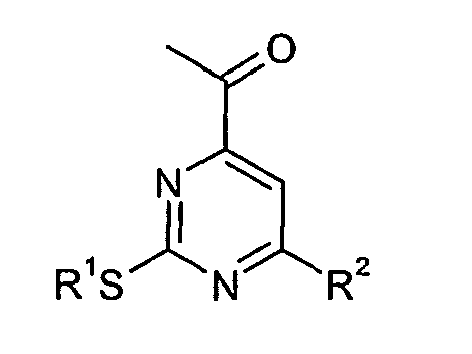
HNR3R4 II
to give a compound of formula
- In the following the preparation of compounds of formula I is described in more detail:
- In schemes 1- 4 are described processes for preparation of compound of formula I, starting from known compounds, from commercial products or from compounds, which can be prepared in conventional manner.
- The preparation of compounds of formula I are further described in detail in working examples 1-43.
- In the process description, the following abbreviations have been used:
- TEA = triethylamine
- THF = tetrahydrofuran
- OXONE® = potassium monopersulfate triple salt
- DCM = 4-(dicyanomethylene)-2-methyl-6-(4-dimethylaminostyryl)-4H-pyran
- DMF = N,N-dimethylformamide

- a) thiourea, EtOH, reflux, 24 h,
- b) NH2OH HCl, TEA, EtOH, reflux, 24 h,
- c) MsOH, RaNi, EtOH, H2,3 h.
- In accordance with scheme 1, the intermediates of formulas VI-a and VI-b may be prepared as follows:
- Thiourea and a corresponding compound of formula R1Br, for example 1-bromohexane are heated at reflux under nitrogen in an alcohol, for example ethanol, for about 20 h. The alcohol is evaporated, and after usual isolation and purification the corresponding isothiourea hydrobromide of formula VI-a is obtained.
- A cyanide of formula R1CN and hydroxylamine hydrochloride are dissolved in an alcohol, for example in ethanol, and treated with triethylamine. After isolation and purification the corresponding N-hydroxy-amidine are obtained.
- To a solution of the N-hydroxy-amidine, obtained in step b and an alcohol, for example ethanol, is added fresh Raney Nickel and methanesulfonic acid (MsOH). The reaction mixture is stirred for about 3 h at room temperature in a hydrogen atmosphere. After isolation and purification the corresponding amidine mesylates are obtained.

- A1) K2CO3, MeOH, 0-20 °C,
- A2) iPrMgCl, THF, -20 °C or BuLi, THF -70 °C,
- A3) TEA, THF, 20 °C or NaOMe, MeOH,
- A4) OXONE® (potassium monopersulfate triple salt), MeOH,
- A5) THF, 20 °C.
- In accordance with scheme 2, the intermediates of formulas VI-a and VI-b may be prepared as follows:
- N,O-dimethyl-hydroxylamine HCl is suspended under nitrogen in DCM and cooled in ice. Triethylamine is added slowly, then acetyl chloride is added slowly, the temperature reached about 20° despite ice cooling and slow addition. Stirring without cooling is continued for about 30 min. After extraction and purification N-methoxy-N-methyl-acetamide is obtained.
or
N,O-dimethyl-hydroxylamine HCl is suspended under nitrogen in DCM and cooled in ice. Triethylamine is added slowly, then cyclopropanecarbonyl chloride is added slowly. Stirring without cooling is continued for 1 h. Extraction: 2 x DCM, 1 x 1 N HCl, 1x NaCl. Distillation: 75 °C/20 mbar. One obtained cyclopropanecarboxylic acid methoxy-methyl-amide - A compound of formula HNR3R4 (II), for example morpholine, is dissolved in an alcohol, for example in MeOH and cooled in ice under nitrogen, then potassium carbonate and propargyl bromide are added while stirring in ice. Stirring without cooling was continued for about 4h. The obtained suspension is worked up in usual manner. One obtained a compound of formula III, for example 4-prop-2-ynyl-morpholine.
- The compound obtained in step A1 is dissolved under nitrogen in THF and cooled to about -40 °C. Then a solution of isopropyl magnesium chloride in THF is added while keeping the temperature below -20 °C. Stirring at -40 ° to -30 °C is continued for about 30 min. In a separate flask, a compound of formula IV, for example N-methoxy-N-methylacetamide is dissolved under nitrogen in THF and cooled to -10 °C in ice/MeOH. The Grignard solution prepared above was transferred to the Weinreb amide solution at - 10 °C via teflon tubing under slightly positive nitrogen pressure in vessel 1. Stirring at -10 ° to 0 °C is continued for about 2 h. The resulting suspension is worked up in usual manner. One obtained a compound of formula V, for example 5-morpholin-4-yl-pent-3-yn-2-one.
- The compound obtained in step A2, for example 5-morpholin-4-yl-pent-3-yn-2-one, and a compound of formula VI-a, for example 2-hexyl-isothiourea hydrobromide are dissolved under nitrogen in DMF, then N,N-diisopropyl ethylamine is added and stirring at the room temperature continued for about 18 hours. The resulting suspension is worked up in usual manner. One obtained a compound of formula Ia, for example 4-(2-hexylsulfanyl-6-methyl-pyrimidin-4-ylmethyl)-morpholine.
- The compound of formula Ia obtained in step A3, for example 4-(2-hexylsulfanyl-6-methyl-pyrimidin-4-ylmethyl)-morpholine is dissolved in MeOH and treated with potassium monopersulfate triple salt (OXONE®) for about 2h. One obtained a compound of formula VII, for example 4-(2-hexylsulfonyl-6-methyl-pyrimidin-4-ylmethyl)-morpholine.
- A compound of formula VII, obtained in step A4, and an amine of formula R1NH2, dissolved in THF are stirred at 20 °C over night. One obtained a compound of formula Ib.

- B1) BuLi, THF -70 °C to -30 °C,
- B2) TEA, THF, 20 °C,
- B3) 4N HCl or TFA/H2O,
- B4) NaBH3CN or pyBH3, EtOH/AcOH 10:1, 20°C or Ti(OiPr)4, neat, NaBH3CN, iPrOH
- In accordance with scheme 3,'compounds of formula Ia may be prepared as follows:
- Propargylaldehyde diethylacetal is dissolved in THF under argon and cooled to -70 °C. Then a solution of butyllithium in hexane is added and stirring continued for about 30 min at -30 °C. Then a corresponding compound of formula IV, for example N-methoxy-N-methylacetamide, in THF is added. After 30 min at -30 °C, the reaction was quenched by addition of saturated NH4Cl solution. After usual work up one obtained a corresponding compound of formula IX, for example 5,5-diethoxy-pent-3-yn-2-one.
- The compound obtained in step B1, for example 5,5-diethoxy-pent-3-yn-2-one, and a corresponding compound of formula VI-a, for example 2-hexyl-isothiourea hydrobromide are dissolved under nitrogen in THF. Then triethylamine is added slowly while cooling with an ice bath to keep the temperature at 20 °C. The suspension is stirred without cooling for about 5 h. The product obtained, for example 4-diethoxymethyl-2-hexylsulfanyl-6-methyl-pyrimidine is worked up in usual manner.
- A compound obtained in step B2, for example 4-diethoxymethyl-2-hexylsulfanyl-6-methyl-pyrimidine, is dissolved in THF and aqueous H2SO4 and is heated at 50 °C for about 33 h. Then the solution is poured in cold Na2CO3 solution and worked up in conventional manner. One obtained a compound of formula XI, for example 2-hexylsulfanyl-6-methyl-pyrimidine-4-carbaldehyde.
- A compound of formula XI, otained in step B3, for example 2-hexylsulfanyl-6-methylpyrimidine-4-carbaldehyde, is dissolved in ethanol and acetic acid. Then a compound of formula II, for example pyrrolidine and sodium cyanoborohydride are added slowly at 20 °C and stirring continued for about 24 h. The reaction mixture is worked up in conventional manner. One obtained a compound of formula Ia, for example 2-hexylsulfanyl-4-methyl-6-pyrrolidin-1-ylmethyl-pyrimidine.

- C1) CrO3 in 4 N H2SO4, acetone, 0-20 °C,
- C2) TEA, THF, 20 °C,
- C3) CrO3 in 4 N H2SO4, acetone, 0-20 °C
- C4) Ti(OiPr)4, NaBH3CN, iPrOH,
- In accordance with scheme 4, compounds of formula Ic may be prepared as follows:
- A solution of 3-hexyn-2,5-diol in acetone is cooled in ice under nitrogen. Jones' reagent (45 mmol, 2 M CrO3 in 4 M H2SO4) is added slowly at 5 °C over 2 h. The resulting green solution was decanted from the chromium salts and extracted with AcOEt and sat. NaCl solution. The crude product is purified. One obtained 5-hydroxy-hex-3-yn-2-one of formula XII.
- 5-Hydroxy-hex-3-yn-2-one and a compound of formula VI-a, for example 2-hexyl-isothiourea hydrobromide are dissolved in THF. Then triethylamine is added and stirring continued for about 3 h. The obtained product is isolated and purified. One obtained a compound of formula XIII, for example 1-(2-hexylsulfanyl-6-methyl-pyrimidin-4-yl)-ethanol.
- A compound, obtained in step C2, for example 1-(2-hexylsulfanyl-6-methyl-pyrimidin-4-yl)-ethanol is dissolved under nitrogen in acetone. Then Jones' reagent, prepared from 20 g CrO3 in 100 mL 4 M H2SO4, is add dropwise. After stirring for about 2 h at 20°C, the resulting solution is isolated and purified in conventional manner. One obtained a compound of formula XIV, for example 1-(2-hexylsulfanyl-6-methyl-pyrimidin-4-yl)-ethanone.
- A compound of formula XIV, for example 1-(2-hexylsulfanyl-6-methyl-pyrimidin-4-yl)-ethanone and a compound of formula II, for example morpholine, are dissolved in tetraisopropyl orthotitanate and heated at about 80 °C for 16 h. The solution is diluted with 2-propanol and treated with sodium cyanoborohydride at about 20 °C for 6 h. The obtained product of formula Ic, for example 4-[1-(2-hexylsulfanyl-6-methyl-pyrimidin-4-yl)-ethyl]-morpholine is isolated and purified in conventional manner.
- As mentioned earlier, the compounds of formula I and their pharmaceutically usable addition salts possess valuable pharmacological properties. It has been found that the compounds of the present invention have an affinity to the GABAB receptor.
- The compounds were investigated in accordance with the tests given hereinafter.
- The Chinese Hamster Ovary (CHO) cells stably expressing human GABABR1aR2a and Gα16 were seeded at 5x10⁴ cells/well in the poly-D-lysine treated, 96-well, black/clear-bottomed plates (BD Biosciences, Palo Alto, CA). 24 h later, the cells were loaded for 90 min at 37°C with 4 µM Flou-4 acetoxymethyl ester (Catalog No. F-14202, Molecular Probes, Eugene, OR) in loading buffer (1xHBSS, 20 mM HEPES, 2.5 mM Probenecid). Hanks' Balanced Salt Solution (HBSS) (10X) (catalog No. 14065-049) and HEPES (1M) (catalog No. 15630-056) were purchased from Invitrogen, Carlsbad, CA. Probenecid (250 mM) (catalog No. P8761) was from Sigma, Buchs, Switzerland. The cells were washed five times with loading buffer to remove excess dye and intracellular calcium mobilization, [Ca2+]i were measured using a Fluorometric Imaging Plate Reader (FLIPR, Molecular Devices, Menlo Park, CA) as described previously (Porter et al., Br. J. Pharmacol., 128, 13-20, 1999 ). The enhancers were applied 15 min before the application of the GABA. For GABA shift assay, concentration-response curves of GABA (0.0003-30 µM) were determined in the absence and presence of 10 µM enhancer. The GABA-shift is defined as Log [EC50 (GABA + 10 µM enhancer) / EC50 (GABA alone)]. The % maximum enhancing effect (% Emax) and potency (EC50 value) of each enhancer was determined from concentration-response curve of the enhancer (0.001-30 µM) in the presence of 10 nM GABA (EC10). Responses were measured as peak increase in fluorescence minus basal, normalized to the maximal stimulatory effect induced by 10 µM GABA alone (considered 100%) and 10 nM GABA alone (considered 0%). The data were fitted with the equation Y=100 + (Max-100)/(1+(EC50/[drug])n) where Max is the maximum effect, EC50 the concentration eliciting a half-maximum effect and n the Hill slope.
Example Intracellular Ca2+mobilization Assay in CHO-GABABR1aR2a-Gα16 cell GABA shift Emax (%) at 10nM GABA alone = 0% 10 µM GABA alone = 100% EC50 (µM) at 10nM GABA Log [EC50(GABA + 10 µM cp)/EC50(GABA alone)] 1 46 2.2 -0.75 2 52 1.7 -0.55 11 41 4.2 -0.60 16 48 8.5 -0.50 31 60 9.6 -0.69 35 62 1.8 -0.92 37 74.2 8.2 -0.76 38 61 6.3 -0.71 39 62 6.4 -0.48 41 60 4.1 -0.86 43 49 4.4 -0.70 - The compounds of formula I as well as their pharmaceutically usable acid addition salts can be used as medicaments, e.g. in the form of pharmaceutical preparations. The pharmaceutical preparations can be administered orally, e.g. in the form of tablets, coated tablets, dragées, hard and soft gelatine capsules, solutions, emulsions or suspensions. The administration can, however, also be effected rectally, e.g. in the form of suppositories, or parenterally, e.g. in the form of injection solutions.
- The compounds of formula I and their pharmaceutically usable acid addition salts can be processed with pharmaceutically inert, inorganic or organic excipients for the production of tablets, coated tablets, dragees and hard gelatine capsules. Lactose, corn starch or derivatives thereof, talc, stearic acid or its salts etc can be used as such excipients e.g. for tablets, dragées and hard gelatine capsules.
- Suitable excipients for soft gelatine capsules are e.g. vegetable oils, waxes, fats, semisolid and liquid polyols etc.
- Suitable excipients for the manufacture of solutions and syrups are e.g. water, polyols, saccharose, invert sugar, glucose etc.
- Suitable excipients for injection solutions are e.g. water, alcohols, polyols, glycerol, vegetable oils etc.
- Suitable excipients for suppositories are e.g. natural or hardened oils, waxes, fats, semi-liquid or liquid polyols etc.
- Moreover, the pharmaceutical preparations can contain preservatives, solubilizers, stabilizers, wetting agents, emulsifiers, sweeteners, colorants, flavorants, salts for varying the osmotic pressure, buffers, masking agents or antioxidants. They can also contain still other therapeutically valuable substances.
- The dosage can vary within wide limits and will, of course, be fitted to the individual requirements in each particular case. In general, in the case of oral administration a daily dosage of about 10 to 1000 mg per person of a compound of general formula I should be appropriate, although the above upper limit can also be exceeded when necessary.
Tablet Formulation (Wet Granulation) Item Ingredients mg/tablet 5 mg 25 mg 100 mg 500 mg 1. Compound of formula IA or IB 5 25 100 500 2. Lactose Anhydrous DTG 125 105 30 150 3. Sta-Rx 1500 6 6 6 30 4. Microcrystalline Cellulose 30 30 30 150 5. Magnesium Stearate 1 1 1 1 Total 167 167 167 831 Manufacturing Procedure
1. Mix items 1, 2, 3 and 4 and granulate with purified water.
2. Dry the granules at 50°C.
3. Pass the granules through suitable milling equipment.
4. Add item 5 and mix for three minutes; compress on a suitable press.Capsule Formulation Item Ingredients mg/capsule 5 mg 25 mg 100 mg 500 mg 1. Compound of formula IA or IB 5 25 100 500 2. Hydrous Lactose 159 123 148 --- 3. Corn Starch 25 35 40 70 4. Talc 10 15 10 25 5. Magnesium Stearate 1 2 2 5 Total 200 200 300 600 Manufacturing Procedure
1. Mix items 1, 2 and 3 in a suitable mixer for 30 minutes.
2. Add items 4 and 5 and mix for 3 minutes.
3. Fill into a suitable capsule. - The following Examples illustrate the present invention without limiting it. All temperatures are given in degrees Celsius.
- N,O-dimethyl-hydroxylamine HCl (100 g, 1025 mmol) was suspended under nitrogen in DCM (1000 mL) and cooled in ice. Triethylamine (300 mL, 2152 mmol) was added slowly, then acetyl chloride (76.5 mL, 1076 mmol) was added slowly, the temperature reached 20° despite ice cooling and slow addition. Stirring without cooling was continued for 30 min. Extraction: 1 x DCM, 1 x 1 N HCl, 2 x saturated NaCl solution. Distillation at 42 °C/20 mbar gave 69 g (65 %) of a colorless oil.
- N,O-dimethyl-hydroxylamine HCl (40 g, 410 mmol) was suspended under nitrogen in DCM (400 mL) and cooled in ice. Triethylamine (63 mL, 451 mmol) was added slowly, then cyclopropanecarbonyl chloride (41 mL, 451 mmol) was added slowly. Stirring without cooling was continued for 1 h. Extraction: 2 x DCM, 1 x 1 N HCl, 1 x NaCl. Distillation: 75 °C/20 mbar. One obtained 32.5 g (61 %) of a colorless oil.
- Thiourea (50 g, 657 mmol) and 1-bromohexane (119 mL, 723 mmol) were heated at reflux under nitrogen in ethanol (500 mL) for 20 h. Ethanol was evaporated, and the thick oil stirred in diethyl ether (500 mL). The product precipitated spontaneously. After filtration one obtained 144.5 g (91 %) of white crystals, m.p. 75 °C.
- In analogous manner using (2E,6E)-1-bromo-3,7,9-trimethyl-deca-2,6-diene.
- In analogous manner using 4-methyl-benzylbromide.
- In analogous manner using 1-((E)-3-bromo-propenyl)-3-methyl-benzene.
- In analogous manner using 4-tert-butyl-benzylbromide.
- In analogous manner using 1-bromo-3-phenylpropane. One obtained 25.9g (72 %) of a white solid, m.p. 96 °C.
- In analogous manner using 2-Bromo-4-methyl-pentane.
- In analogous manner using 1-iodobutane.
- In analogous manner using 4-phenoxybutyl bromide.
- Octyl cyanide (2 g, 14 mmol) and hydroxylamine hydrochloride (2.495 g, 36 mmol) were dissolved in EtOH (10 mL) and treated with triethylamine (5 mL, 36 mmol) at reflux over night. Extraction: AcOEt / water. Silica gel chromatography: heptane/ AcOEt 1:2 afforded a white solid (0.65 g, 26 %). MS: m/z = 173 (M + H).
- To a solution of N-hydroxy-nonanamidine (0.6 g, 3.48 mmol) in ethanol (5 mL) was added fresh Raney Nickel (0.05 g) and methanesulfonic acid (0.08 ml, 1.26 mmol). The reaction mixture was stirred for 3 h at 20 °C in a hydrogen atmosphere. Filtration over Celite and evaporation afforded a light green oil (0.5 g, 56 %). MS: m/z = 157 (M + H).
- Morpholine (100ml, 1.148mol) was dissolved in MeOH (1 L) and cooled in ice under nitrogen, then potassium carbonate (120 g, 0.63 mol) and propargyl bromide (124 mL, 1.148 mol) were added while stirring in ice. Stirring without cooling was continued for 4h. The white suspension was filtered through paper and the solids were washed with MeOH (100 ml) and the MeOH was carefully evaporated. The white precipitate was suspended in DCM (400 ml), filtered through paper, and carefully evaporated. Finally the oil was distilled at 60 °C/16 mbar. One obtained 100 g (70 %) of a colorless oil.
- 4-Prop-2-ynyl-morpholine (22 g, 176 mmol) was dissolved under nitrogen in THF (40 mL) and cooled to -40 °C. Then a 2 M solution of isopropyl magnesium chloride in THF (97 mL, 193 mmol) was added while keeping the temperature below -20 °C. Stirring at -40 °C to -30 °C was continued for 30 min. In a separate flask, N-methoxy-N-methylacetamide (20 g, 193 mmol) was dissolved under nitrogen in THF (40 mL) and cooled to -10 °C in ice/MeOH. The Grignard solution prepared above was transferred to the Weinreb amide solution at -10 °C via teflon tubing under slightly positive nitrogen pressure in vessel 1. There was no exotherm. Stirring at -10 °C to 0 °C was continued for 2 h. Ther resulting white suspension was poured on a 1:1-mixture of ice and saturated NH4Cl solution (400 mL). Extraction: 2 x AcOEt, 1 x saturated NaCl solution. One obtained a yellow oil (26.1 g, 89 %). Chromatography on silica gel in heptane/ ethyl acetate 1:2 gave 19.4 g (66 %) of a brown oil which was distilled in the Kugelrohr at 130 °C/0.2 mbar. One obtained 15.8 g (53 %) of a yellow oil.
- 5-Morpholin-4-yl-pent-3-yn-2-one (1 g, 6 mmol) and 2-hexyl-isothiourea hydrobromide_(1.06 g, 7 mmol) were dissolved under nitrogen in DMF (10 mL), then N,N-diisopropyl ethylamine (4.1 mL, 24 mmol) was added and stirring at the room temperature continued for 18 hours.
DMF was evaporated. The product was extracted with AcOEt (2 x 50 mL), saturated solution of NH4Cl (2 x 50 mL), dried and concentrated. The residue was purified by flash chromatography on an aminated silica gel column with a heptane/ethyl acetate gradient. One obtained 440 mg (24 %) of a yellow liquid. MS: m/z = 310 (M + H). - In analoguous manner using N-pentylisothiuronium hydrochloride. One obtained 260 mg (29 %) of a brown oil. MS: m/z = 296 (M+H).
- In analoguous manner using 2-thio-2-(3,7,9-trimethyl-2,6-decadienyl)pseudo-urea hydrobromide. One obtained 300 mg (35 %) of a colorless oil. MS: m/z = 404 (M+H).
- In analoguous manner using 2-((E)-3-phenyl-allyl)-isothiourea. One obtained 300 mg (34 %) of a colorless oil. MS: m/z = 342 (M+H).
- In analoguous manner using 2-(p-methoxybenzyl)-2-thiopseudourea. One obtained 414 mg (40 %) of a colorless oil. MS: m/z = 346 (M+H).
- In analoguous manner using 2-(4-methyl-benzyl)-isothiourea hydrobromide. One obtained 427 mg (48 %) of a colorless oil. MS: m/z = 330 (M+H).
- In analoguous manner using 2-((E)-3-m-tolyl-allyl)-isothiourea. One obtained 100 mg (20 %) of a yellow oil. MS: m/z = 356 (M+H).
- In analoguous manner using 2-(4-phenoxy-butyl)-isothiourea hydrobromide. One obtained 100 mg (18 %) of a yellow oil. MS: m/z = 374 (M+H).
- In analoguous manner using 2-butyl-isothiourea hydroiodide. One obtained 100 mg (23 %) of a yellow oil. MS: m/z = 282 (M+H).
- In analoguous manner using 2-(1,3-dimethyl-butyl)-isothiourea hydrobromide. One obtained 100 mg (20 %) of a yellow oil. MS: m/z = 310 (M+H).
- In analoguous manner using 2-(4-tert-butyl-benzyl)-isothiourea hydrobromide. One obtained 200 mg (32 %) of a yellow oil. MS: m/z = 372 (M+H).
- In analoguous manner using 2-(3-phenyl-propyl)-isothiourea hydrobromide. One obtained 300 mg (48 %) of a yellow oil. MS: m/z = 344 (M+H).
- In analoguous manner using 2-ethyl-2-thiopseudourea hydrobromide. One obtained 1.5 g (55 %) of a yellow oil. MS: m/z = 254 (M+H).
- 5-Morpholin-4-yl-pent-3-yn-2-one (0.2 g, 1.2 mmol) and nonanamidine mesylate (0.5 g, 3 mmol) were dissolved in MeOH (5ml) and treated with a 5.4 M solution of sodium methylate in MeOH (1.33 ml, 7 mmol) at reflux for 15 h. MeOH was evaporated, and the mixture extracted with AcOEt and water. The crude product was purified by chromatography on Si-amine with a heptane/AcOEt gradient of 100:0 to 80:20 affording a light yellow oil (0.2 g, 54 %). MS: m/z = 306.4 (M+H).
- 4-(2-Ethylsulfanyl-6-methyl-pyrimidin-4-ylmethyl)-morpholine (2 g, 6.4 mmol) was dissolved in MeOH (20 mL) and treated with potassium monopersulfate triple salt (5.57 g, 9 mmol) for 2 h. Filtered, filtrate stirred with 10 % aqueous NaHSO3 solution (10 mL) for 5 min and then extracted with AcOEt/H2O. Chromatography on silica gel with a gradient heptane/AcOEt 3:2 to 2:3 afforded a colorless oil (0.6 g, 36 %). MS: m/z = 286 (M+H).
- 4-(2-Ethanesulfonyl-6-methyl-pyrimidin-4-ylmethyl)-morpholine (0.2 g, 0.55 mmol) and 3,5-bis(trifluoromethyl)benzylamine (0.51 g, 2.1 mmol) dissolved in THF (2 mL) were stirred at 20 °C overnight. Evaporated and extracted with AcOEt (40 ml) and NaHCO3
(40 ml).
Chromathography on silica gel in AcOEt / heptane 2:1 gave a light yellow oil (60 mg, 20 %). MS: m/z = 435 (M+H). - Propargylaldehyde diethylacetal (40 g, 312 mmol) was dissolved in THF (200 mL) under argon and cooled to -70 °C. Then a 1.6 M solution of n-butyllithium in hexane (234 mL, 374 mmol) was added and stirring continued for 30 min at -30 °C. Then N-methoxy-N-methylacetamide (38.6 g, 374 mmol) in THF (10 mL) was added. After 30 min at -30 °C, the reaction was quenched by addition of saturated NH4Cl solution (20 mL). The product was extracted with AcOEt (2 x 200 mL), saturated solution of NH4Cl (2 x 200 mL), dried and concentrated. Chromatography on silica gel with a heptane / ethyl acetate gradient 100:0 to 95:5 gave 38.5 g (72 %) of a colorless oil. GC/MS: m/z = 232(M).
- 3,3-Diethoxy-1-propyne (10 mL, 70 mmol) was dissolved under argon in THF (200 mL) and cooled to -70 °C. Then a 1.6 M solution of n-butyllithium in hexane (48 mL, 77 mmol) was added slowly at -70 °C, then allowed to warm to -30 °C and stirred at -30 °C for 30 min, then cooled again to -70 °C. Ethyl trifluoroacetate (9.2 mL, 77 mmol) was added in one portion at -70 °C (the temperature rose to -50 °) then stirred without cooling until -30 °C was reached, then quenched with sat. NH4Cl solution (20 mL). Extraction: 2 x AcOEt, 1 x sat. NH4Cl sat., 1 x sat. NaCl. Chromatography on silica gel in heptane/ethyl acetate 5:1 afforded 4.94 g (31 %) of an orange oil. GC/MS: m/z = 223 (M-H).
- 3,3-Diethoxy-1-propyne (10 mL, 70 mmol) was dissolved under argon in THF (150 mL) and cooled to -70 °C. Then a 1.6 M solution of n-butyllithium in hexane (48 mL, 77 mmol) was added slowly at -70 °C, then allowed to warm to -30 °C and stirred at -30 °C for 30 min, then cooled again to -70 °C. Cyclopropanecarboxylic acid methoxy-methyl-amide (10 g, 77 mmol) was added at once at -70 °C (the temperature rose to -50 °) then stirred without cooling until 0 °C was reached, then quenched with sat. NH4Cl solution (20 mL). Extraction: 2 x AcOEt, 1 x sat. NH4Cl, 1 x sat. NaCl. The crude brown oil (15 g) was purified by chromatography on silica gel in heptane/ethyl acetate 10:1. One obtained 6 g (43 %) of a yellowish oil. MS: m/z =151 (M).
- 3,3-Diethoxy-1-propyne (10 mL, 70 mmol) was dissolved under argon in THF (50 mL) and cooled to -70 °C. Then a 1.6 M solution of n-butyllithium in hexane (48 mL, 77 mmol) was added slowly at -70 °C, then allowed to warm to -40 °C and stirred at -40 °C for 15 min, then cooled again to -70 °C. DMF (6 mL, 77 mmol) was added at -70 °C, then stirred without cooling until -10 °C were reached, then quenched with sat. NH4Cl solution (10 mL). Extraction: AcOEt, sat. NH4Cl solution. Chromatography: heptane/ethyl acetate 95:5. One obtained 300 mg (2.7 %) of a volatile colorless oil, which was directly used in the next step.
- 5,5-Diethoxy-pent-3-yn-2-one (15 g, 88 mmol) and 2-hexyl-isothiourea hydrobromide (23 g, 97 mmol) were dissolved under nitrogen in THF (150 mL). Then triethylamine (27 mL, 194 mmol) was added slowly while cooling with an ice bath to keep the temperature at 20 °C. The suspension was stirred without cooling for 5 h. The product was extracted with AcOEt, sat. NH4Cl solution, dried and concentrated. The residue was purified by silica gel chromatography in heptane/AcOEt 20:1. One obtained 22.3 g (80 %) of a colorless oil and 2.8 g of a yellow by-product.
- 5,5-Diethoxy-1,1,1-trifluoro-pent-3-yn-2-one_(2 g, 8.9 mmol) and 2-hexyl-isothiourea hydrobromide (2.4 g, 9.8 mmol) were dissolved under nitrogen in THF (20 mL). Then triethylamine (2.7 mL, 19.6 mmol) was added slowly. The reaction was exothermic (40 °C). The suspension was stirred for 4 h at 20 °C. The product was extracted with AcOEt, sat. NH4Cl solution, dried and concentrated. The residue was purified by silica gel chromatography in heptane/AcOEt 20:1. One obtained 2.5 g (76 %) of a colorless oil. MS: m/z = 367 (M+H).
- 1-Cyclopropyl-4,4-diethoxy-but-2-yn-1-one (2 g, 10 mmol) and 2-hexyl-isothiourea hydrobromide (2.7 g, 11.2 mmol) were dissolved under nitrogen in THF (20 mL). Then triethylamine (3.1 mL, 22.4 mmol) was added slowly. The reaction was slightly exothermic (28 °C). The suspension was stirred for 5 h at 20 °C. The product was extracted with AcOEt, sat. NH4Cl solution, dried and concentrated. The residue was purified by silica gel chromatography in heptane/ethyl acetate 95:5. One obtained 2.86 g (83 %) of a colorless oil. MS: m/z = 339 (M+H).
- (4,4-Diethoxy-but-2-ynal and 2-hexyl-isothiourea hydrobromide (300 mg, 1.9 mmol) (509 g, 2.1 mmol) were dissolved under nitrogen in THF (3 mL). Then triethylamine (0.6 mL, 4.2 mmol) was added. Then suspension was stirred at 20 °C overnight. The product was extracted with AcOEt, sat. NH4Cl solution, dried and concentrated. The residue was purified by silica gel chromatography in heptane/ethyl acetate 95:5. One obtained 260 mg (45 %) of a colorless oil. MS: m/z = 299 (M+H).
- 4-Diethoxymethyl-2-hexylsulfanyl-6-methyl-pyrimidine-(19 g, 60.8 mmol) was dissolved in THF (100 mL) and 4 N aqueous H2SO4 (100 mL) and heated at 50 °C for 33 h. Poured in cold 10 % Na2CO3 solution (400 mL) and extracted with ethyl acetate and a sat. solution of NaCl. The crude oil was purified by silica gel chromatography with a heptane/ DCM gradient of 100:0 to 67:33. One obtained 10.7 g (74 %) of a yellow oil. 2-Hexylsulfanyl-6-trifluoromethyl-pyrimidine-4-carbaldehyde 4-Diethoxymethyl-2-hexylsulfanyl-6-trifluoromethyl-pyrimidine-(1.6 g, 4.4 mmol) was stirred in trfluoroacetic acid (15 mL) and water (1.5 mL) for 10 h at 20 °C. The reaction mixture was evaporated to dryness and the residue extracted with ethyl acetate, sat. Na2CO3 solution and sat. NaCl solution. One obtained 1.18 g (92 %) of a yellow oil. MS: m/z = 311 (M+H+H2O, hydrate).
- 4-Cyclopropyl-6-diethoxymethyl-2-hexylsulfanyl-pyrimidine (2.7 g, 8 mmol) was dissolved in THF (13 mL) and 4 N HCl (13 mL) and stirred at 20 °C for 19 h. The reaction mixture was poured in cold 10 % Na2CO3 (100 mL) and extracted twice with AcOEt and once with sat. NaCl solution. The crude product was purified by chromatography on silica gel in heptane/ DCM with a gradient of 100:0 to 67:33. One obtained 2 g (94 %) of a yellow oil, which solidified upon standing in the fridge. MS: m/z = 264 (M).
- 4-Diethoxymethyl-2-hexylsulfanyl-pyrimidine (250 mg, 0.8 mmol) was stirred in THF (5 mL) and 4 N HCl (5 mL) at 20 °C for 64 h. The reaction mixture was poured in cold 10 % Na2CO3 and extracted twice with AcOEt and once with sat. NaCl solution. The crude product was purified by chromatography on silica gel in heptane/ AcOEt 10:1. One obtained 138 mg (73 %) of a yellow oil. MS: m/z = 224 (M).
- 2-Hexylsulfanyl-6-methyl-pyrimidine-4-carbaldehyde (0.1 g, 0.42 mmol) was dissolved in ethanol (1 mL) and acetic acid (0.1 mL). Then pyrrolidine (0.07 mL, 1 mmol) and sodium cyanoborohydride (26 mg, 0.4 mmol) were added slowly at 20 °C and stirring continued for 24 h. The reaction mixture was evaporated to dryness and dissolved in a minimal amount of DMF (0.8 mL) and directly purified by preparative HPLC chromatography on a YMC combiprep ODS-AQ column (75 x 20 mm iD, S-5 µM, 12 nm) with an acetonitrile-water gradient. One obtained 34.7 mg (28 %) of a yellow liquid. MS: m/z = 294 (M+H).
- In analoguous manner using 3-pyrrolidinol. MS: m/z = 310 (M+H).
- In analoguous manner using 3-(dimethylamino)pyrrolidine. MS: m/z = 337 (M+H).
- In analoguous manner using piperidine. MS: m/z = 308 (M+H).
- In analoguous manner using 1,4 dioxa-8-azaspiro(4.5)decane. MS: m/z = 366 (M+H).
- In analoguous manner using nipecotamide. MS: m/z = 351 (M+H).
- In analoguous manner using 3,5-dimethyl-piperidine. MS: m/z = 336 (M+H).
- In analoguous manner using 4-hydroxypiperidine. MS: m/z = 324 (M+H).
- In analoguous manner using decahydroisoquinoline. MS: m/z = 362 (M+H).
- In analoguous manner using N-methylhomopiperazine. MS: m/z = 337 (M+H).
- In analoguous manner using 1,2,3,4-tetrahydroisoquinoline. MS: m/z = 356 (M+H).
- In analoguous manner using hexamethyleneimine. MS: m/z = 322 (M+H).
- In analoguous manner using cis-2,6-dimethylmorpholine. MS: m/z = 338 (M+H).
- In analoguous manner using 3-hydroxypiperidine. MS: m/z = 324 (M+H).
- In analoguous manner using N-ethylpiperazine. MS: m/z = 337 (M+H).
- In analoguous manner using 2-methylpiperidine. MS: m/z = 322 (M+H).
- In analoguous manner using N-acetylhomopiperazine. MS: m/z = 365 (M+H).
- In analoguous manner using homomorpholine hydrochloride. MS: m/z = 323 (M+H).
- In analoguous manner using 2,6-dimethylpiperazine. MS: m/z = 337 (M+H).
- In analoguous manner using (-)-cytisine. MS: m/z = 413 (M+H).
- In analoguous manner using 1-benzyl-hexahydro-1,4diazepine. MS: m/z = 413 (M+H).
- 2-Hexylsulfanyl-6-methyl-pyrimidine-4-carbaldehyde (0.2 g, 1mmol) and 2,6-dimethylpiperidine (0.23 mL, 2mmol) were dissolved in tetraisopropyl orthotitanate (0.5 mL) and stirred at 20 °C for 1 h. The solution was diluted with 2-propanol (5 mL) and treated with sodium cyanoborohydride (105 mg, 2 mmol) at 20 °C for 20 h. Water (1 mL) was added, and the resulting precipitate filtered off and evaporated. The product was extracted with AcOEt, sat. NH4Cl solution, dried and concentrated. The residue was purified by preparative HPLC chromatography on a YMC combiprep ODS-AQ column (75 x 20 mm iD, S-5 µM, 12 nm) with an acetonitrile-water gradient. One obtained 37 mg (36 %) of a colorless liquid. MS: m/z = 336 (M+H).
- In analoguous manner using cis-2,6-dimethylpiperidine. MS: m/z = 336 (M+H).
- 2-Hexylsulfanyl-6-trifluoromethyl-pyrimidine-4-carbaldehyde (0.5 g, 1.7 mmol) and morpholine (0.16 mL, 1.9 mmol) were dissolved in ethanol (5 mL) and acetic acid (0.5 mL) and treated with borane-pyridine complex (0.19 mL, 1.9 mmol) for 4 h at 20 °C. The reaction mixture was evaporated to dryness. Extraction: 2 × AcOEt, 1 x 10 % aqueous Na2CO3. One obtained a mixture of the expected product and the reduced aldehyde which was more polar. This mixture was separated by chromatography on Si-amine from Silicycle with a gradient of heptane/ethyl acetate from 10:1 up to 1:1. Gave 220 mg (35 %) of a colorless oil. MS: m/z = 364 (M+H).
- in analogous manner from 6-cyclopropyl-2-hexylsulfanyl-pyrimidine-4-carbaldehyde. One obtained 342 mg (54%) of a colorless oil. MS: m/z = 336 (M+H).
- in analogous manner from 6-ethyl-2-hexylsulfanyl-pyrimidine-4-carbaldehyde. One obtained a colorless oil. MS: m/z = 324 (M+H).
- in analogous manner from 2-hexylsulfanyl-pyrimidine-4-carbaldehyde. One obtained 62 mg (36 %) of a colorless oil. MS: m/z = 296 (M+H).
- A solution of 3-hexyn-2,5-diol (5 mL, 45 mmol) in acetone (50 mL) was cooled in ice under nitrogen. Jones' reagent (22 ml, 45 mmol, 2 M CrO3 in 4 M H2SO4) was added slowly at 5 °C over 2 h. The resulting green solution was decanted from the chromium salts and extracted with AcOEt and sat. NaCl solution. The crude product was purified by chromatography on silica gel with a heptane/AcOEt gradient. One obtained 2.2 g (45 %) of a colorless oil.
- 5-Hydroxy-hex-3-yn-2-one (2 g, 18 mmol) and 2-hexyl-isothiourea hydrobromide (5.2 g, 21 mmol) were dissolved in THF (10 mL). Then the triethylamine (5.5 mL, 40 mmol) was added and stirring continued for 3 h. The reaction was slightly exothermic. The mixture was extracted with AcOEt and sat. NH4Cl solution. The crude product was purified by chromatography on silica gel with a heptane/AcOEt gradient. One obtained 2.8g (61%) of a light yellow oil. MS: m/z = 254 (M)
- 1-(2-Hexylsulfanyl-6-methyl-pyrimidin-4-yl)-ethanol (2.2 g, 8.65 mmol) was dissolved under nitrogen in acetone (20 mL). Then 2 M Jones' reagent prepared from 20 g CrO3 in 100 mL 4 M H2SO4 (6.5 mL, 13 mmol) was add dropwise. After stirring for 2 h at 20 °C, the resulting green solution was decanted from the chromium salts and extracted with AcOEt and sat. NaCl solution. The crude product was purified by chromatography on silica gel with a heptane/AcOEt gradient. One obtained 960 mg (44 %) of white crystals. MS: m/z = 252 (M).
- 1-(2-Hexylsulfanyl-6-methyl-pyrimidin-4-yl)-ethanone (200 mg, 0.79 mmol) and morpholine (138 µL, 1.58 mol) were dissolved in tetraisopropyl orthotitanate (0.5 mL) and heated at 80 °C for 16 h. The brown solution was diluted with 2-propanol (5 mL) and treated with sodium cyanoborohydride (32 mg, 0.5 mmol) at 20 °C for 6 h. Extraction: 2 x AcOEt, 2 x sat. NH4Cl solution. Chromatography: Si-amine, heptane/ethyl acetate 85:15. One obtained 86 mg (34 %) of a yellow oil. MS: m/z = 324 (M+H).
if desired, converting the compound of formula I obtained into a pharmaceutically acceptable salt.
Claims (18)
- Compounds of the general formula
 X is -S- or -NH-;R1 is alkyl, alkenyl, arylalkyl, arylalkenyl or aryl-O-alkyl, wherein the aryl groups are optionally substituted by one or more substituents, selected from the group consisting of C1-7- alkyl, C1-7-alkoxy, halogen or C1-7- halogen-alkyl;R2 is hydrogen, C1-7- alkyl or cycloalkyl;R3/R4 may form together with the N-atom to which they are attached a non aromatic 5, 6 or 7 membered ring, which may contain in addition to the N-atom one additional heteroatom selected from the group consisting of O, S or N, and wherein the ring is optionally substituted by hydroxy, C1-7- alkyl, C1-7-alkoxy,- NR2, -CONR2, -CO- C1-7-alkyl or benzyl; or
may form together with the N-atom to which they are attached a heterocyclic ring system, containing at least two rings and which may contain one or two additional heteroatoms, selected from the group consisting of N or O;R is hydrogen or C1-7- alkyl;R5 is hydrogen or C1-7-alkyl;and pharmaceutically suitable acid addition salts thereof. - Compounds in accordance with claim 1, wherein X is -S-.
- Compounds in accordance with claim 2, wherein R1 is alkyl and R3 and R4 form together with the N-atom a five or six membered ring which may contain an additional O-heteroatom, and which is unsubstituted or substituted by C1-7- alkyl.
- Compounds in accordance with claim 3, wherein R3 and R4 form together with the N-atom a morpholine ring.
- Compounds in accordance with claim 4, which compounds are4-(2-hexylsulfanyl-6-methyl-pyrimidin-4-ylmethyl)-morpholine,4-(6-methyl-2-pentylsulfanyl-pyrimidin-4-ylmethyl)-morpholine,4-(2-hexylsulfanyl-6-trifluoromethyl-pyrimidin-4-ylmethyl)-morpholine,4-(2-hexylsulfanyl-6-ethyl-pyrimidin-4-ylmethyl)-morpholine and4-[1-(2-hexylsulfanyl-6-methyl-pyrimidin-4-yl)-ethyl]-morpholine.
- Compounds in accordance with claim 3, wherein R3 and R4 form together with the N-atom a pyrrolidine or piperidine ring, which is optionally substituted by C1-7- alkyl.
- Compounds in accordance with claim 6, which compounds are 2-hexylsulfanyl-4-methyl-6-pyrrolidin-1-ylmethyl-pyrimidine,2-hexylsulfanyl-4-methyl-6-(2-methyl-piperidin-1-ylmethyl)-pyrimidine,4-(2,6-dimethyl-piperidin-1-ylmethyl)-2-hexylsulfanyl-6-methyl-pyrimidine and4-(cis-2,6-dimethyl-piperidin-1-ylmethyl)-2-hexylsulfanyl-6-methyl-pyrimidine.
- Compounds in accordance with claim 2, wherein R1 is arylalkyl, optionally substituted by C1-7- alkyl and R3 and R4 form together with the N-atom a five or six membered ring which may contain an additional O-heteroatom.
- Compounds in accordance with claim 8, wherein the compound is 4- [2-(4-tert-butyl-benzylsulfanyl)-6-methyl-pyrimidin-4-ylmethyl]-morpholine.
- Compounds in accordance with claim 2, wherein R3 and R4 form together with the N-atom a heterocyclic ring system, containing at least two rings and which may contain one or two heteroatoms, selected from the group consisting of N or O.
- Compounds in accordance with claim 10, wherein the compound is (1S,5S)-3-(2-hexylsulfanyl-6-methyl-pyrimidin-4-ylmethyl)-1,2,3,4,5,6-hexahydro-1,5-methanopyrido[1,2-a] [1,5]diazocin-8-one.
- Compounds of formula I in accordance with claim 1, wherein R5 is hydrogen.
- Compounds of formula I in accordance with claim 1, wherein R5 is methyl.
- Compounds of formula I in accordance with claim 1, wherein X is -NH-.
- A medicament containing one or more compounds of formula I of any one of claims 1 - 14 or a pharmaceutically acceptable salt thereof and an inert carrier for the treatment of diseases related to GABAB receptor.
- A medicament according to claim 15 for the treatment of anxiety, depression, epilepsy, schizophrenia, cognitive disorders, spasticity and skeletal muscle rigidity, spinal cord injury, multiple sclerosis, amyotrophic lateral sclerosis, cerebral palsy, neuropathic pain and craving associated with cocaine and nicotine, psychosis, panic disorders, posttraumatic stress disorders or gastro-intestinal disorders.
- A process for preparing a compound of formula I as defined in claim 1, which process comprisesa) reacting a compound of formula


 b) reacting a compound of formula
R1NH2
to a compound of formula b) reacting a compound of formula
HNR3R4 II
to give a compound of formula c) reacting a compound of formulaif desired, converting the compound of formula I obtained into a pharmaceutically acceptable salt.
HNR3R4 II
to give a compound of formula
- The use of a compound of formula I in accordance with any one of claims 1-14 for the manufacture of a medicament for the treatment of anxiety, depression, epilepsy, schizophrenia, cognitive disorders, spasticity and skeletal muscle rigidity, spinal cord injury, multiple sclerosis, amyotrophic lateral sclerosis, cerebral palsy, neuropathic pain and craving associated with cocaine and nicotine, psychosis, panic disorders, posttraumatic stress disorders or gastro-intestinal disorders.
Priority Applications (2)
| Application Number | Priority Date | Filing Date | Title |
|---|---|---|---|
| EP05707562A EP1725239B1 (en) | 2004-03-02 | 2005-02-22 | 4-(sulfanyl-pyrimidin-4-ylmethyl)-morpholine derivatives and related compounds as gaba receptor ligands for the treatment of anxiety, depression and epilepsy |
| PL05707562T PL1725239T3 (en) | 2004-03-02 | 2005-02-22 | 4-(sulfanyl-pyrimidin-4-ylmethyl)-morpholine derivatives and related compounds as gaba receptor ligands for the treatment of anxiety, depression and epilepsy |
Applications Claiming Priority (3)
| Application Number | Priority Date | Filing Date | Title |
|---|---|---|---|
| EP04100830 | 2004-03-02 | ||
| EP05707562A EP1725239B1 (en) | 2004-03-02 | 2005-02-22 | 4-(sulfanyl-pyrimidin-4-ylmethyl)-morpholine derivatives and related compounds as gaba receptor ligands for the treatment of anxiety, depression and epilepsy |
| PCT/EP2005/001814 WO2005094828A1 (en) | 2004-03-02 | 2005-02-22 | 4- (sulfanyl-pyrimidin-4-ylmethyl) -morpholine derivatives and related compounds as gaba receptor ligands for the treatment of anxiety, depression and epilepsy |
Publications (2)
| Publication Number | Publication Date |
|---|---|
| EP1725239A1 EP1725239A1 (en) | 2006-11-29 |
| EP1725239B1 true EP1725239B1 (en) | 2007-07-18 |
Family
ID=34896109
Family Applications (1)
| Application Number | Title | Priority Date | Filing Date |
|---|---|---|---|
| EP05707562A Expired - Lifetime EP1725239B1 (en) | 2004-03-02 | 2005-02-22 | 4-(sulfanyl-pyrimidin-4-ylmethyl)-morpholine derivatives and related compounds as gaba receptor ligands for the treatment of anxiety, depression and epilepsy |
Country Status (14)
| Country | Link |
|---|---|
| US (1) | US7351700B2 (en) |
| EP (1) | EP1725239B1 (en) |
| JP (1) | JP4563447B2 (en) |
| KR (1) | KR100802863B1 (en) |
| CN (1) | CN1925859B (en) |
| AT (1) | ATE367163T1 (en) |
| AU (1) | AU2005229505B2 (en) |
| BR (1) | BRPI0508310A (en) |
| CA (1) | CA2557719A1 (en) |
| DE (1) | DE602005001696T2 (en) |
| ES (1) | ES2290885T3 (en) |
| PL (1) | PL1725239T3 (en) |
| RU (1) | RU2382033C2 (en) |
| WO (1) | WO2005094828A1 (en) |
Families Citing this family (13)
| Publication number | Priority date | Publication date | Assignee | Title |
|---|---|---|---|---|
| RU2354647C2 (en) * | 2007-06-28 | 2009-05-10 | Общество С Ограниченной Ответственностью "Бионика" | New compounds with thrombin inhibiting function, and based pharmaceutical compositions |
| RU2353619C2 (en) | 2007-06-28 | 2009-04-27 | Общество С Ограниченной Ответственностью "Бионика" | Novel compounds possessing anticoagulant function, based on them pharmaceutical compositions for treatment of thrombotic conditions and plasma-substituting solution for correction of hypercoagulation disorders in hemodilution |
| BRPI0814818A2 (en) * | 2007-07-09 | 2019-09-10 | Astrazeneca Ab | compound, use of a compound, methods for producing an antiproliferative effect and a inhibitor effect of mtor kinase in a warm-blooded animal, method for treating disease, and, pharmaceutical composition |
| TW201623257A (en) | 2014-05-09 | 2016-07-01 | 奧利安公司 | Pharmacologically active quinazolinedione derivatives |
| KR102269132B1 (en) | 2014-06-10 | 2021-06-25 | 삼성디스플레이 주식회사 | Antiaromatic compounds and organic light-emitting device comprising the same |
| US10084141B2 (en) | 2014-06-13 | 2018-09-25 | Samsung Display Co., Ltd. | Antiaromatic compound and organic light-emitting device including the same |
| HU231058B1 (en) | 2017-03-13 | 2020-04-28 | Richter Gedeon Nyrt. | Pharmacologically active alicyclic-substituted pyrazolo[1,5-a]pyrimidine derivatives |
| TWI907472B (en) | 2020-08-05 | 2025-12-11 | 匈牙利商羅特格登公司 | Pharmacologically active heterocyclic-substituted pyrazolo〔1 ,5-a〕 pyrimidine derivatives |
| GB202414197D0 (en) | 2024-09-27 | 2024-11-13 | Addex Pharmaceuticals Sa | Novel compounds |
| GB202414199D0 (en) | 2024-09-27 | 2024-11-13 | Addex Pharmaceuticals Sa | Novel Compounds |
| GB202414200D0 (en) | 2024-09-27 | 2024-11-13 | Addex Pharmaceuticals Sa | Novel compounds |
| GB202414193D0 (en) | 2024-09-27 | 2024-11-13 | Addex Pharmaceuticals Sa | Novel compounds |
| GB202414192D0 (en) | 2024-09-27 | 2024-11-13 | Addex Pharmaceuticals Sa | Novel compounds |
Family Cites Families (5)
| Publication number | Priority date | Publication date | Assignee | Title |
|---|---|---|---|---|
| US6313146B1 (en) | 1991-08-23 | 2001-11-06 | Nps Pharmaceuticals, Inc. | Calcium receptor-active molecules |
| JP3398152B2 (en) * | 1993-10-12 | 2003-04-21 | ブリストル‐マイヤーズ・スクイブ・ファーマ・カンパニー | 1N-alkyl-N-arylpyrimidineamine and derivatives thereof |
| US6800651B2 (en) | 2000-02-03 | 2004-10-05 | Eli Lilly And Company | Potentiators of glutamate receptors |
| CA2444148A1 (en) * | 2001-04-11 | 2002-10-24 | Queen's University At Kingston | Pyrimidine compounds as anti-ictogenic and/or anti-epileptogenic agents |
| GB0209481D0 (en) | 2002-04-24 | 2002-06-05 | Novartis Ag | Organic compounds |
-
2005
- 2005-02-22 BR BRPI0508310-9A patent/BRPI0508310A/en not_active IP Right Cessation
- 2005-02-22 ES ES05707562T patent/ES2290885T3/en not_active Expired - Lifetime
- 2005-02-22 DE DE602005001696T patent/DE602005001696T2/en not_active Expired - Lifetime
- 2005-02-22 AT AT05707562T patent/ATE367163T1/en active
- 2005-02-22 EP EP05707562A patent/EP1725239B1/en not_active Expired - Lifetime
- 2005-02-22 AU AU2005229505A patent/AU2005229505B2/en not_active Ceased
- 2005-02-22 CN CN2005800066192A patent/CN1925859B/en not_active Expired - Fee Related
- 2005-02-22 PL PL05707562T patent/PL1725239T3/en unknown
- 2005-02-22 WO PCT/EP2005/001814 patent/WO2005094828A1/en not_active Ceased
- 2005-02-22 CA CA002557719A patent/CA2557719A1/en not_active Abandoned
- 2005-02-22 RU RU2006134632/04A patent/RU2382033C2/en not_active IP Right Cessation
- 2005-02-22 KR KR1020067017683A patent/KR100802863B1/en not_active Expired - Fee Related
- 2005-02-22 JP JP2007501167A patent/JP4563447B2/en not_active Expired - Fee Related
- 2005-02-23 US US11/064,046 patent/US7351700B2/en not_active Expired - Fee Related
Also Published As
| Publication number | Publication date |
|---|---|
| DE602005001696D1 (en) | 2007-08-30 |
| KR100802863B1 (en) | 2008-02-12 |
| JP4563447B2 (en) | 2010-10-13 |
| AU2005229505B2 (en) | 2010-07-15 |
| JP2007526266A (en) | 2007-09-13 |
| ATE367163T1 (en) | 2007-08-15 |
| RU2006134632A (en) | 2008-04-10 |
| KR20060116240A (en) | 2006-11-14 |
| ES2290885T3 (en) | 2008-02-16 |
| BRPI0508310A (en) | 2007-07-24 |
| US20050197337A1 (en) | 2005-09-08 |
| AU2005229505A1 (en) | 2005-10-13 |
| EP1725239A1 (en) | 2006-11-29 |
| CN1925859B (en) | 2010-11-24 |
| RU2382033C2 (en) | 2010-02-20 |
| CA2557719A1 (en) | 2005-10-13 |
| US7351700B2 (en) | 2008-04-01 |
| DE602005001696T2 (en) | 2008-04-10 |
| CN1925859A (en) | 2007-03-07 |
| WO2005094828A1 (en) | 2005-10-13 |
| PL1725239T3 (en) | 2007-12-31 |
Similar Documents
| Publication | Publication Date | Title |
|---|---|---|
| EP1828199B1 (en) | Thieno-pyridine derivatives as gaba-b allosteric enhancers | |
| DE60212841T2 (en) | 4 PIPERAZINYLINDOL DERIVATIVES WITH AFFINITY TO THE 5-HT6 RECEPTOR | |
| DE60208221T2 (en) | HETEROCYCLIC COMPOUNDS FOR THE TREATMENT OF RESPIRATORY DISORDERS | |
| DE60305484T2 (en) | COMPOUNDS AND THEIR USE AS 5-HT INHIBITORS | |
| JP2022081656A (en) | Morphinan derivative | |
| AU2005229505B2 (en) | 4- (sulfanyl-pyrimidin-4-ylmethyl) -morpholine derivatives and related compounds as GABA receptor ligands for the treatment of anxiety, depression and epilepsy | |
| EP1499598A1 (en) | Chemical compounds with dual activity, processes for their preparation and pharmaceutical compositions | |
| SK168499A3 (en) | 3-substituted 3,4 dihydro-thieno[2,3-d]pyrimidine derivatives and production and use of the same | |
| WO2017026516A1 (en) | Isothiazole derivative | |
| MX2011005119A (en) | Alkylcyclohexylethers of dihydrotetraazabenzoazulenes. | |
| US20120178738A1 (en) | Dibenzo [b,f] [1,4]oxazapine compounds | |
| EP1915357B1 (en) | 2-hydroxy-propionic acid derivatives and 3-hydroxy-benzofuran-2-one derivatives with affinity for the gaba-b-receptor | |
| US5334594A (en) | Amphoteric tricyclic compound | |
| DE602005006018T2 (en) | ARYLPIPERAZINE DERIVATIVES AND THEIR USE AS DOPAMINE D3 RECEPTOR SELECTIVE LIGANDS | |
| SK174399A3 (en) | 3-substituted pyrido [3',4':4,5] thieno [2,3-d] pyrimidine derivatives, and production and use of the same | |
| US7348332B2 (en) | (3,4-dihydro-quinazolin-2-yl)-indan-1-yl-amines | |
| MXPA06009949A (en) | 4- (sulfanyl-pyrimidin-4-ylmethyl) -morpholine derivatives and related compounds as gaba receptor ligands for the treatment of anxiety, depression and epilepsy | |
| DE4304806A1 (en) | 5-phenyl-pyrrolo-1,4-benzoxazine and -thiazine derivatives and methods and intermediates for their preparation and medicaments containing these compounds | |
| HU198932B (en) | Process for producing tetracyclic quinazolinones and pharmaceutical compositions comprising same as active ingredient | |
| EP0002512A1 (en) | Imino-bridged benzocycloheptapyridines, process for their preparation and pharmaceutical composition thereof | |
| KR20030019598A (en) | PYRROLO[2,1-b][1,3]BENZOTHIAZEPINES AND THEIR USE FOR THE PREPARATION OF MEDICAMENTS WITH ANTIPSYCHOTIC ACTIVITY |
Legal Events
| Date | Code | Title | Description |
|---|---|---|---|
| PUAI | Public reference made under article 153(3) epc to a published international application that has entered the european phase |
Free format text: ORIGINAL CODE: 0009012 |
|
| 17P | Request for examination filed |
Effective date: 20061002 |
|
| AK | Designated contracting states |
Kind code of ref document: A1 Designated state(s): AT BE BG CH CY CZ DE DK EE ES FI FR GB GR HU IE IS IT LI LT LU MC NL PL PT RO SE SI SK TR |
|
| GRAP | Despatch of communication of intention to grant a patent |
Free format text: ORIGINAL CODE: EPIDOSNIGR1 |
|
| DAX | Request for extension of the european patent (deleted) | ||
| GRAS | Grant fee paid |
Free format text: ORIGINAL CODE: EPIDOSNIGR3 |
|
| GRAA | (expected) grant |
Free format text: ORIGINAL CODE: 0009210 |
|
| AK | Designated contracting states |
Kind code of ref document: B1 Designated state(s): AT BE BG CH CY CZ DE DK EE ES FI FR GB GR HU IE IS IT LI LT LU MC NL PL PT RO SE SI SK TR |
|
| REG | Reference to a national code |
Ref country code: GB Ref legal event code: FG4D |
|
| REG | Reference to a national code |
Ref country code: CH Ref legal event code: EP |
|
| REF | Corresponds to: |
Ref document number: 602005001696 Country of ref document: DE Date of ref document: 20070830 Kind code of ref document: P |
|
| REG | Reference to a national code |
Ref country code: IE Ref legal event code: FG4D |
|
| REG | Reference to a national code |
Ref country code: SE Ref legal event code: TRGR |
|
| REG | Reference to a national code |
Ref country code: PL Ref legal event code: T3 |
|
| ET | Fr: translation filed | ||
| PG25 | Lapsed in a contracting state [announced via postgrant information from national office to epo] |
Ref country code: PT Free format text: LAPSE BECAUSE OF FAILURE TO SUBMIT A TRANSLATION OF THE DESCRIPTION OR TO PAY THE FEE WITHIN THE PRESCRIBED TIME-LIMIT Effective date: 20071218 Ref country code: LT Free format text: LAPSE BECAUSE OF FAILURE TO SUBMIT A TRANSLATION OF THE DESCRIPTION OR TO PAY THE FEE WITHIN THE PRESCRIBED TIME-LIMIT Effective date: 20070718 Ref country code: IS Free format text: LAPSE BECAUSE OF FAILURE TO SUBMIT A TRANSLATION OF THE DESCRIPTION OR TO PAY THE FEE WITHIN THE PRESCRIBED TIME-LIMIT Effective date: 20071118 Ref country code: FI Free format text: LAPSE BECAUSE OF FAILURE TO SUBMIT A TRANSLATION OF THE DESCRIPTION OR TO PAY THE FEE WITHIN THE PRESCRIBED TIME-LIMIT Effective date: 20070718 Ref country code: BG Free format text: LAPSE BECAUSE OF FAILURE TO SUBMIT A TRANSLATION OF THE DESCRIPTION OR TO PAY THE FEE WITHIN THE PRESCRIBED TIME-LIMIT Effective date: 20071018 |
|
| REG | Reference to a national code |
Ref country code: ES Ref legal event code: FG2A Ref document number: 2290885 Country of ref document: ES Kind code of ref document: T3 |
|
| PG25 | Lapsed in a contracting state [announced via postgrant information from national office to epo] |
Ref country code: DK Free format text: LAPSE BECAUSE OF FAILURE TO SUBMIT A TRANSLATION OF THE DESCRIPTION OR TO PAY THE FEE WITHIN THE PRESCRIBED TIME-LIMIT Effective date: 20070718 Ref country code: GR Free format text: LAPSE BECAUSE OF FAILURE TO SUBMIT A TRANSLATION OF THE DESCRIPTION OR TO PAY THE FEE WITHIN THE PRESCRIBED TIME-LIMIT Effective date: 20071019 |
|
| PLBE | No opposition filed within time limit |
Free format text: ORIGINAL CODE: 0009261 |
|
| STAA | Information on the status of an ep patent application or granted ep patent |
Free format text: STATUS: NO OPPOSITION FILED WITHIN TIME LIMIT |
|
| PG25 | Lapsed in a contracting state [announced via postgrant information from national office to epo] |
Ref country code: SK Free format text: LAPSE BECAUSE OF FAILURE TO SUBMIT A TRANSLATION OF THE DESCRIPTION OR TO PAY THE FEE WITHIN THE PRESCRIBED TIME-LIMIT Effective date: 20070718 Ref country code: CZ Free format text: LAPSE BECAUSE OF FAILURE TO SUBMIT A TRANSLATION OF THE DESCRIPTION OR TO PAY THE FEE WITHIN THE PRESCRIBED TIME-LIMIT Effective date: 20070718 |
|
| 26N | No opposition filed |
Effective date: 20080421 |
|
| PG25 | Lapsed in a contracting state [announced via postgrant information from national office to epo] |
Ref country code: RO Free format text: LAPSE BECAUSE OF FAILURE TO SUBMIT A TRANSLATION OF THE DESCRIPTION OR TO PAY THE FEE WITHIN THE PRESCRIBED TIME-LIMIT Effective date: 20070718 |
|
| PG25 | Lapsed in a contracting state [announced via postgrant information from national office to epo] |
Ref country code: MC Free format text: LAPSE BECAUSE OF NON-PAYMENT OF DUE FEES Effective date: 20080228 |
|
| PG25 | Lapsed in a contracting state [announced via postgrant information from national office to epo] |
Ref country code: EE Free format text: LAPSE BECAUSE OF FAILURE TO SUBMIT A TRANSLATION OF THE DESCRIPTION OR TO PAY THE FEE WITHIN THE PRESCRIBED TIME-LIMIT Effective date: 20070718 Ref country code: IE Free format text: LAPSE BECAUSE OF NON-PAYMENT OF DUE FEES Effective date: 20080222 |
|
| PG25 | Lapsed in a contracting state [announced via postgrant information from national office to epo] |
Ref country code: SI Free format text: LAPSE BECAUSE OF FAILURE TO SUBMIT A TRANSLATION OF THE DESCRIPTION OR TO PAY THE FEE WITHIN THE PRESCRIBED TIME-LIMIT Effective date: 20070718 |
|
| PG25 | Lapsed in a contracting state [announced via postgrant information from national office to epo] |
Ref country code: CY Free format text: LAPSE BECAUSE OF FAILURE TO SUBMIT A TRANSLATION OF THE DESCRIPTION OR TO PAY THE FEE WITHIN THE PRESCRIBED TIME-LIMIT Effective date: 20070718 |
|
| PG25 | Lapsed in a contracting state [announced via postgrant information from national office to epo] |
Ref country code: HU Free format text: LAPSE BECAUSE OF FAILURE TO SUBMIT A TRANSLATION OF THE DESCRIPTION OR TO PAY THE FEE WITHIN THE PRESCRIBED TIME-LIMIT Effective date: 20080119 Ref country code: LU Free format text: LAPSE BECAUSE OF NON-PAYMENT OF DUE FEES Effective date: 20080222 |
|
| PGFP | Annual fee paid to national office [announced via postgrant information from national office to epo] |
Ref country code: PL Payment date: 20101216 Year of fee payment: 7 |
|
| PGFP | Annual fee paid to national office [announced via postgrant information from national office to epo] |
Ref country code: NL Payment date: 20110216 Year of fee payment: 7 Ref country code: IT Payment date: 20110219 Year of fee payment: 7 Ref country code: FR Payment date: 20110201 Year of fee payment: 7 Ref country code: DE Payment date: 20110228 Year of fee payment: 7 Ref country code: AT Payment date: 20110124 Year of fee payment: 7 Ref country code: CH Payment date: 20110103 Year of fee payment: 7 Ref country code: TR Payment date: 20110207 Year of fee payment: 7 Ref country code: SE Payment date: 20110209 Year of fee payment: 7 |
|
| PGFP | Annual fee paid to national office [announced via postgrant information from national office to epo] |
Ref country code: GB Payment date: 20110124 Year of fee payment: 7 Ref country code: BE Payment date: 20110309 Year of fee payment: 7 Ref country code: ES Payment date: 20110222 Year of fee payment: 7 |
|
| BERE | Be: lapsed |
Owner name: F.HOFFMANN-LA ROCHE A.G. Effective date: 20120228 |
|
| REG | Reference to a national code |
Ref country code: NL Ref legal event code: V1 Effective date: 20120901 |
|
| REG | Reference to a national code |
Ref country code: CH Ref legal event code: PL |
|
| GBPC | Gb: european patent ceased through non-payment of renewal fee |
Effective date: 20120222 |
|
| PG25 | Lapsed in a contracting state [announced via postgrant information from national office to epo] |
Ref country code: CH Free format text: LAPSE BECAUSE OF NON-PAYMENT OF DUE FEES Effective date: 20120229 Ref country code: SE Free format text: LAPSE BECAUSE OF NON-PAYMENT OF DUE FEES Effective date: 20120223 Ref country code: LI Free format text: LAPSE BECAUSE OF NON-PAYMENT OF DUE FEES Effective date: 20120229 |
|
| REG | Reference to a national code |
Ref country code: FR Ref legal event code: ST Effective date: 20121031 |
|
| PG25 | Lapsed in a contracting state [announced via postgrant information from national office to epo] |
Ref country code: IT Free format text: LAPSE BECAUSE OF NON-PAYMENT OF DUE FEES Effective date: 20120222 |
|
| REG | Reference to a national code |
Ref country code: AT Ref legal event code: MM01 Ref document number: 367163 Country of ref document: AT Kind code of ref document: T Effective date: 20120222 |
|
| REG | Reference to a national code |
Ref country code: DE Ref legal event code: R119 Ref document number: 602005001696 Country of ref document: DE Effective date: 20120901 |
|
| PG25 | Lapsed in a contracting state [announced via postgrant information from national office to epo] |
Ref country code: BE Free format text: LAPSE BECAUSE OF NON-PAYMENT OF DUE FEES Effective date: 20120228 |
|
| PG25 | Lapsed in a contracting state [announced via postgrant information from national office to epo] |
Ref country code: GB Free format text: LAPSE BECAUSE OF NON-PAYMENT OF DUE FEES Effective date: 20120222 Ref country code: AT Free format text: LAPSE BECAUSE OF NON-PAYMENT OF DUE FEES Effective date: 20120222 Ref country code: FR Free format text: LAPSE BECAUSE OF NON-PAYMENT OF DUE FEES Effective date: 20120229 Ref country code: NL Free format text: LAPSE BECAUSE OF NON-PAYMENT OF DUE FEES Effective date: 20120901 |
|
| PG25 | Lapsed in a contracting state [announced via postgrant information from national office to epo] |
Ref country code: PL Free format text: LAPSE BECAUSE OF NON-PAYMENT OF DUE FEES Effective date: 20120222 |
|
| REG | Reference to a national code |
Ref country code: PL Ref legal event code: LAPE |
|
| PG25 | Lapsed in a contracting state [announced via postgrant information from national office to epo] |
Ref country code: DE Free format text: LAPSE BECAUSE OF NON-PAYMENT OF DUE FEES Effective date: 20120901 |
|
| REG | Reference to a national code |
Ref country code: ES Ref legal event code: FD2A Effective date: 20130709 |
|
| PG25 | Lapsed in a contracting state [announced via postgrant information from national office to epo] |
Ref country code: ES Free format text: LAPSE BECAUSE OF NON-PAYMENT OF DUE FEES Effective date: 20120223 |
|
| PG25 | Lapsed in a contracting state [announced via postgrant information from national office to epo] |
Ref country code: TR Free format text: LAPSE BECAUSE OF NON-PAYMENT OF DUE FEES Effective date: 20120222 |