EP1724337A1 - Method for preserving xanthophyll in algal cells - Google Patents
Method for preserving xanthophyll in algal cells Download PDFInfo
- Publication number
- EP1724337A1 EP1724337A1 EP06252541A EP06252541A EP1724337A1 EP 1724337 A1 EP1724337 A1 EP 1724337A1 EP 06252541 A EP06252541 A EP 06252541A EP 06252541 A EP06252541 A EP 06252541A EP 1724337 A1 EP1724337 A1 EP 1724337A1
- Authority
- EP
- European Patent Office
- Prior art keywords
- xanthophyll
- algal cells
- astaxanthin
- algal
- drying
- Prior art date
- Legal status (The legal status is an assumption and is not a legal conclusion. Google has not performed a legal analysis and makes no representation as to the accuracy of the status listed.)
- Withdrawn
Links
- KBPHJBAIARWVSC-XQIHNALSSA-N trans-lutein Natural products CC(=C/C=C/C=C(C)/C=C/C=C(C)/C=C/C1=C(C)CC(O)CC1(C)C)C=CC=C(/C)C=CC2C(=CC(O)CC2(C)C)C KBPHJBAIARWVSC-XQIHNALSSA-N 0.000 title claims abstract description 79
- 235000008210 xanthophylls Nutrition 0.000 title claims abstract description 79
- 229960005375 lutein Drugs 0.000 title claims abstract description 77
- FJHBOVDFOQMZRV-XQIHNALSSA-N xanthophyll Natural products CC(=C/C=C/C=C(C)/C=C/C=C(C)/C=C/C1=C(C)CC(O)CC1(C)C)C=CC=C(/C)C=CC2C=C(C)C(O)CC2(C)C FJHBOVDFOQMZRV-XQIHNALSSA-N 0.000 title claims abstract description 77
- KBPHJBAIARWVSC-RGZFRNHPSA-N lutein Chemical compound C([C@H](O)CC=1C)C(C)(C)C=1\C=C\C(\C)=C\C=C\C(\C)=C\C=C\C=C(/C)\C=C\C=C(/C)\C=C\[C@H]1C(C)=C[C@H](O)CC1(C)C KBPHJBAIARWVSC-RGZFRNHPSA-N 0.000 title claims abstract description 72
- 238000000034 method Methods 0.000 title claims abstract description 71
- 238000001035 drying Methods 0.000 claims abstract description 31
- 238000001694 spray drying Methods 0.000 claims abstract description 30
- 235000013793 astaxanthin Nutrition 0.000 claims description 64
- JEBFVOLFMLUKLF-IFPLVEIFSA-N Astaxanthin Natural products CC(=C/C=C/C(=C/C=C/C1=C(C)C(=O)C(O)CC1(C)C)/C)C=CC=C(/C)C=CC=C(/C)C=CC2=C(C)C(=O)C(O)CC2(C)C JEBFVOLFMLUKLF-IFPLVEIFSA-N 0.000 claims description 63
- 239000001168 astaxanthin Substances 0.000 claims description 63
- MQZIGYBFDRPAKN-ZWAPEEGVSA-N astaxanthin Chemical compound C([C@H](O)C(=O)C=1C)C(C)(C)C=1/C=C/C(/C)=C/C=C/C(/C)=C/C=C/C=C(C)C=CC=C(C)C=CC1=C(C)C(=O)[C@@H](O)CC1(C)C MQZIGYBFDRPAKN-ZWAPEEGVSA-N 0.000 claims description 63
- 229940022405 astaxanthin Drugs 0.000 claims description 63
- 241000168517 Haematococcus lacustris Species 0.000 claims description 13
- 241000251468 Actinopterygii Species 0.000 claims description 9
- 241000168525 Haematococcus Species 0.000 claims description 8
- 230000001965 increasing effect Effects 0.000 claims description 8
- 238000004519 manufacturing process Methods 0.000 claims description 8
- 235000013305 food Nutrition 0.000 claims description 6
- 238000004321 preservation Methods 0.000 claims description 3
- 230000007774 longterm Effects 0.000 abstract description 9
- 239000007921 spray Substances 0.000 abstract description 2
- CSCPPACGZOOCGX-UHFFFAOYSA-N Acetone Chemical compound CC(C)=O CSCPPACGZOOCGX-UHFFFAOYSA-N 0.000 description 15
- 238000003860 storage Methods 0.000 description 13
- 241000195493 Cryptophyta Species 0.000 description 12
- 238000000354 decomposition reaction Methods 0.000 description 11
- 239000011521 glass Substances 0.000 description 9
- 238000000605 extraction Methods 0.000 description 8
- 239000000654 additive Substances 0.000 description 5
- QVGXLLKOCUKJST-UHFFFAOYSA-N atomic oxygen Chemical compound [O] QVGXLLKOCUKJST-UHFFFAOYSA-N 0.000 description 5
- 238000010438 heat treatment Methods 0.000 description 5
- 239000000203 mixture Substances 0.000 description 5
- 239000001301 oxygen Substances 0.000 description 5
- 229910052760 oxygen Inorganic materials 0.000 description 5
- 125000000264 xanthophyll group Chemical group 0.000 description 5
- IAZDPXIOMUYVGZ-UHFFFAOYSA-N Dimethylsulphoxide Chemical compound CS(C)=O IAZDPXIOMUYVGZ-UHFFFAOYSA-N 0.000 description 4
- 241000500726 Haematococcus droebakensis Species 0.000 description 4
- VEXZGXHMUGYJMC-UHFFFAOYSA-N Hydrochloric acid Chemical compound Cl VEXZGXHMUGYJMC-UHFFFAOYSA-N 0.000 description 4
- OOUTWVMJGMVRQF-DOYZGLONSA-N Phoenicoxanthin Natural products CC(=C/C=C/C=C(C)/C=C/C=C(C)/C=C/C1=C(C)C(=O)C(O)CC1(C)C)C=CC=C(/C)C=CC2=C(C)C(=O)CCC2(C)C OOUTWVMJGMVRQF-DOYZGLONSA-N 0.000 description 4
- 150000001514 astaxanthins Chemical class 0.000 description 4
- FDSDTBUPSURDBL-LOFNIBRQSA-N canthaxanthin Chemical compound CC=1C(=O)CCC(C)(C)C=1/C=C/C(/C)=C/C=C/C(/C)=C/C=C/C=C(C)C=CC=C(C)C=CC1=C(C)C(=O)CCC1(C)C FDSDTBUPSURDBL-LOFNIBRQSA-N 0.000 description 4
- 235000021466 carotenoid Nutrition 0.000 description 4
- 150000001747 carotenoids Chemical class 0.000 description 4
- 239000002002 slurry Substances 0.000 description 4
- 238000005979 thermal decomposition reaction Methods 0.000 description 4
- QTBSBXVTEAMEQO-UHFFFAOYSA-N Acetic acid Chemical compound CC(O)=O QTBSBXVTEAMEQO-UHFFFAOYSA-N 0.000 description 3
- CURLTUGMZLYLDI-UHFFFAOYSA-N Carbon dioxide Chemical compound O=C=O CURLTUGMZLYLDI-UHFFFAOYSA-N 0.000 description 3
- LFQSCWFLJHTTHZ-UHFFFAOYSA-N Ethanol Chemical compound CCO LFQSCWFLJHTTHZ-UHFFFAOYSA-N 0.000 description 3
- 241000733385 Haematococcus capensis Species 0.000 description 3
- 241000500309 Haematococcus zimbabwiensis Species 0.000 description 3
- OKKJLVBELUTLKV-UHFFFAOYSA-N Methanol Chemical compound OC OKKJLVBELUTLKV-UHFFFAOYSA-N 0.000 description 3
- HEMHJVSKTPXQMS-UHFFFAOYSA-M Sodium hydroxide Chemical compound [OH-].[Na+] HEMHJVSKTPXQMS-UHFFFAOYSA-M 0.000 description 3
- 239000011324 bead Substances 0.000 description 3
- 238000005119 centrifugation Methods 0.000 description 3
- 150000001875 compounds Chemical class 0.000 description 3
- 238000002036 drum drying Methods 0.000 description 3
- 230000002708 enhancing effect Effects 0.000 description 3
- 238000004108 freeze drying Methods 0.000 description 3
- 238000007602 hot air drying Methods 0.000 description 3
- 230000014759 maintenance of location Effects 0.000 description 3
- 238000005259 measurement Methods 0.000 description 3
- VLKZOEOYAKHREP-UHFFFAOYSA-N n-Hexane Chemical compound CCCCCC VLKZOEOYAKHREP-UHFFFAOYSA-N 0.000 description 3
- 235000013970 phaffia yeast Nutrition 0.000 description 3
- 239000002244 precipitate Substances 0.000 description 3
- 238000002360 preparation method Methods 0.000 description 3
- 239000000725 suspension Substances 0.000 description 3
- DMASLKHVQRHNES-UPOGUZCLSA-N (3R)-beta,beta-caroten-3-ol Chemical compound C([C@H](O)CC=1C)C(C)(C)C=1/C=C/C(/C)=C/C=C/C(/C)=C/C=C/C=C(C)C=CC=C(C)C=CC1=C(C)CCCC1(C)C DMASLKHVQRHNES-UPOGUZCLSA-N 0.000 description 2
- JKQXZKUSFCKOGQ-JLGXGRJMSA-N (3R,3'R)-beta,beta-carotene-3,3'-diol Chemical compound C([C@H](O)CC=1C)C(C)(C)C=1/C=C/C(/C)=C/C=C/C(/C)=C/C=C/C=C(C)C=CC=C(C)C=CC1=C(C)C[C@@H](O)CC1(C)C JKQXZKUSFCKOGQ-JLGXGRJMSA-N 0.000 description 2
- MQZIGYBFDRPAKN-UHFFFAOYSA-N 13-cis-astaxanthin Natural products CC=1C(=O)C(O)CC(C)(C)C=1C=CC(C)=CC=CC(C)=CC=CC=C(C)C=CC=C(C)C=CC1=C(C)C(=O)C(O)CC1(C)C MQZIGYBFDRPAKN-UHFFFAOYSA-N 0.000 description 2
- YECXHLPYMXGEBI-DOYZGLONSA-N Adonixanthin Natural products CC(=C/C=C/C=C(C)/C=C/C=C(C)/C=C/C1=C(C)C(=O)C(O)CC1(C)C)C=CC=C(/C)C=CC2=C(C)CC(O)CC2(C)C YECXHLPYMXGEBI-DOYZGLONSA-N 0.000 description 2
- IJGRMHOSHXDMSA-UHFFFAOYSA-N Atomic nitrogen Chemical compound N#N IJGRMHOSHXDMSA-UHFFFAOYSA-N 0.000 description 2
- HEDRZPFGACZZDS-UHFFFAOYSA-N Chloroform Chemical compound ClC(Cl)Cl HEDRZPFGACZZDS-UHFFFAOYSA-N 0.000 description 2
- 241000195628 Chlorophyta Species 0.000 description 2
- 239000004212 Cryptoxanthin Substances 0.000 description 2
- MHAJPDPJQMAIIY-UHFFFAOYSA-N Hydrogen peroxide Chemical compound OO MHAJPDPJQMAIIY-UHFFFAOYSA-N 0.000 description 2
- 241000238070 Pandalus borealis Species 0.000 description 2
- OOUTWVMJGMVRQF-NWYYEFBESA-N Phoenicoxanthin Chemical compound C([C@H](O)C(=O)C=1C)C(C)(C)C=1\C=C\C(\C)=C\C=C\C(\C)=C\C=C\C=C(/C)\C=C\C=C(/C)\C=C\C1=C(C)C(=O)CCC1(C)C OOUTWVMJGMVRQF-NWYYEFBESA-N 0.000 description 2
- CDBYLPFSWZWCQE-UHFFFAOYSA-L Sodium Carbonate Chemical compound [Na+].[Na+].[O-]C([O-])=O CDBYLPFSWZWCQE-UHFFFAOYSA-L 0.000 description 2
- JKQXZKUSFCKOGQ-LQFQNGICSA-N Z-zeaxanthin Natural products C([C@H](O)CC=1C)C(C)(C)C=1C=CC(C)=CC=CC(C)=CC=CC=C(C)C=CC=C(C)C=CC1=C(C)C[C@@H](O)CC1(C)C JKQXZKUSFCKOGQ-LQFQNGICSA-N 0.000 description 2
- QOPRSMDTRDMBNK-RNUUUQFGSA-N Zeaxanthin Natural products CC(=C/C=C/C=C(C)/C=C/C=C(C)/C=C/C1=C(C)CCC(O)C1(C)C)C=CC=C(/C)C=CC2=C(C)CC(O)CC2(C)C QOPRSMDTRDMBNK-RNUUUQFGSA-N 0.000 description 2
- MCMNRKCIXSYSNV-UHFFFAOYSA-N Zirconium dioxide Chemical compound O=[Zr]=O MCMNRKCIXSYSNV-UHFFFAOYSA-N 0.000 description 2
- 238000002835 absorbance Methods 0.000 description 2
- YECXHLPYMXGEBI-ZNQVSPAOSA-N adonixanthin Chemical compound C([C@H](O)C(=O)C=1C)C(C)(C)C=1\C=C\C(\C)=C\C=C\C(\C)=C\C=C\C=C(/C)\C=C\C=C(/C)\C=C\C1=C(C)C[C@@H](O)CC1(C)C YECXHLPYMXGEBI-ZNQVSPAOSA-N 0.000 description 2
- JKQXZKUSFCKOGQ-LOFNIBRQSA-N all-trans-Zeaxanthin Natural products CC(=C/C=C/C=C(C)/C=C/C=C(C)/C=C/C1=C(C)CC(O)CC1(C)C)C=CC=C(/C)C=CC2=C(C)CC(O)CC2(C)C JKQXZKUSFCKOGQ-LOFNIBRQSA-N 0.000 description 2
- 230000003078 antioxidant effect Effects 0.000 description 2
- 239000007864 aqueous solution Substances 0.000 description 2
- 239000012298 atmosphere Substances 0.000 description 2
- 235000002360 beta-cryptoxanthin Nutrition 0.000 description 2
- DMASLKHVQRHNES-ITUXNECMSA-N beta-cryptoxanthin Natural products CC(=C/C=C/C=C(C)/C=C/C=C(C)/C=C/C1=C(C)CC(O)CC1(C)C)C=CC=C(/C)C=CC2=C(C)CCCC2(C)C DMASLKHVQRHNES-ITUXNECMSA-N 0.000 description 2
- 230000005587 bubbling Effects 0.000 description 2
- 235000012682 canthaxanthin Nutrition 0.000 description 2
- 239000001659 canthaxanthin Substances 0.000 description 2
- 229940008033 canthaxanthin Drugs 0.000 description 2
- 229910002092 carbon dioxide Inorganic materials 0.000 description 2
- UFMZWBIQTDUYBN-UHFFFAOYSA-N cobalt dinitrate Chemical compound [Co+2].[O-][N+]([O-])=O.[O-][N+]([O-])=O UFMZWBIQTDUYBN-UHFFFAOYSA-N 0.000 description 2
- 238000001816 cooling Methods 0.000 description 2
- 235000019244 cryptoxanthin Nutrition 0.000 description 2
- 230000003247 decreasing effect Effects 0.000 description 2
- 235000014113 dietary fatty acids Nutrition 0.000 description 2
- 239000008157 edible vegetable oil Substances 0.000 description 2
- 230000000694 effects Effects 0.000 description 2
- 239000000194 fatty acid Substances 0.000 description 2
- 229930195729 fatty acid Natural products 0.000 description 2
- 239000003365 glass fiber Substances 0.000 description 2
- 238000004128 high performance liquid chromatography Methods 0.000 description 2
- 239000000047 product Substances 0.000 description 2
- 238000000746 purification Methods 0.000 description 2
- VWDWKYIASSYTQR-UHFFFAOYSA-N sodium nitrate Chemical compound [Na+].[O-][N+]([O-])=O VWDWKYIASSYTQR-UHFFFAOYSA-N 0.000 description 2
- 239000000126 substance Substances 0.000 description 2
- 239000006228 supernatant Substances 0.000 description 2
- 239000004094 surface-active agent Substances 0.000 description 2
- XLYOFNOQVPJJNP-UHFFFAOYSA-N water Substances O XLYOFNOQVPJJNP-UHFFFAOYSA-N 0.000 description 2
- 150000003735 xanthophylls Chemical class 0.000 description 2
- 235000010930 zeaxanthin Nutrition 0.000 description 2
- 239000001775 zeaxanthin Substances 0.000 description 2
- 229940043269 zeaxanthin Drugs 0.000 description 2
- MQZIGYBFDRPAKN-QHKQXWLXSA-N (6S)-6-hydroxy-3-[(1E,3E,5E,7E,9E,11E,13E,15Z,17E)-18-[(4S)-4-hydroxy-2,6,6-trimethyl-3-oxocyclohexen-1-yl]-3,7,12,16-tetramethyloctadeca-1,3,5,7,9,11,13,15,17-nonaenyl]-2,4,4-trimethylcyclohex-2-en-1-one Chemical compound C/C(/C=C/C=C(/C)\C=C\C1=C(C)C(=O)[C@@H](O)CC1(C)C)=C\C=C\C=C(/C)\C=C\C=C(/C)\C=C\C1=C(C)C(=O)[C@@H](O)CC1(C)C MQZIGYBFDRPAKN-QHKQXWLXSA-N 0.000 description 1
- MQZIGYBFDRPAKN-SODZLZBXSA-N (6S)-6-hydroxy-3-[(1E,3E,5E,7Z,9E,11E,13E,15E,17E)-18-[(4S)-4-hydroxy-2,6,6-trimethyl-3-oxocyclohexen-1-yl]-3,7,12,16-tetramethyloctadeca-1,3,5,7,9,11,13,15,17-nonaenyl]-2,4,4-trimethylcyclohex-2-en-1-one Chemical compound C\C(\C=C\C=C(/C)\C=C\C1=C(C)C(=O)[C@@H](O)CC1(C)C)=C\C=C\C=C(/C)\C=C\C=C(/C)\C=C\C1=C(C)C(=O)[C@@H](O)CC1(C)C MQZIGYBFDRPAKN-SODZLZBXSA-N 0.000 description 1
- CIWBSHSKHKDKBQ-JLAZNSOCSA-N Ascorbic acid Chemical compound OC[C@H](O)[C@H]1OC(=O)C(O)=C1O CIWBSHSKHKDKBQ-JLAZNSOCSA-N 0.000 description 1
- UXVMQQNJUSDDNG-UHFFFAOYSA-L Calcium chloride Chemical compound [Cl-].[Cl-].[Ca+2] UXVMQQNJUSDDNG-UHFFFAOYSA-L 0.000 description 1
- OKTJSMMVPCPJKN-UHFFFAOYSA-N Carbon Chemical compound [C] OKTJSMMVPCPJKN-UHFFFAOYSA-N 0.000 description 1
- 241000238424 Crustacea Species 0.000 description 1
- 241000238557 Decapoda Species 0.000 description 1
- KCXVZYZYPLLWCC-UHFFFAOYSA-N EDTA Chemical compound OC(=O)CN(CC(O)=O)CCN(CC(O)=O)CC(O)=O KCXVZYZYPLLWCC-UHFFFAOYSA-N 0.000 description 1
- 241000238558 Eucarida Species 0.000 description 1
- 229910021380 Manganese Chloride Inorganic materials 0.000 description 1
- GLFNIEUTAYBVOC-UHFFFAOYSA-L Manganese chloride Chemical compound Cl[Mn]Cl GLFNIEUTAYBVOC-UHFFFAOYSA-L 0.000 description 1
- 229910004619 Na2MoO4 Inorganic materials 0.000 description 1
- 241000694540 Pluvialis Species 0.000 description 1
- 108010055297 Sterol Esterase Proteins 0.000 description 1
- 102000000019 Sterol Esterase Human genes 0.000 description 1
- ZVQOOHYFBIDMTQ-UHFFFAOYSA-N [methyl(oxido){1-[6-(trifluoromethyl)pyridin-3-yl]ethyl}-lambda(6)-sulfanylidene]cyanamide Chemical compound N#CN=S(C)(=O)C(C)C1=CC=C(C(F)(F)F)N=C1 ZVQOOHYFBIDMTQ-UHFFFAOYSA-N 0.000 description 1
- 238000010521 absorption reaction Methods 0.000 description 1
- 229910052782 aluminium Inorganic materials 0.000 description 1
- XAGFODPZIPBFFR-UHFFFAOYSA-N aluminium Chemical compound [Al] XAGFODPZIPBFFR-UHFFFAOYSA-N 0.000 description 1
- 239000003963 antioxidant agent Substances 0.000 description 1
- 235000006708 antioxidants Nutrition 0.000 description 1
- MQZIGYBFDRPAKN-UWFIBFSHSA-N astaxanthin Chemical compound C([C@H](O)C(=O)C=1C)C(C)(C)C=1\C=C\C(\C)=C\C=C\C(\C)=C\C=C\C=C(/C)\C=C\C=C(/C)\C=C\C1=C(C)C(=O)[C@@H](O)CC1(C)C MQZIGYBFDRPAKN-UWFIBFSHSA-N 0.000 description 1
- FRHBOQMZUOWXQL-UHFFFAOYSA-K azane;2-hydroxypropane-1,2,3-tricarboxylate;iron(3+) Chemical compound N.[Fe+3].[O-]C(=O)CC(O)(CC([O-])=O)C([O-])=O FRHBOQMZUOWXQL-UHFFFAOYSA-K 0.000 description 1
- 230000001580 bacterial effect Effects 0.000 description 1
- 238000010009 beating Methods 0.000 description 1
- 230000009286 beneficial effect Effects 0.000 description 1
- 239000001110 calcium chloride Substances 0.000 description 1
- 229910001628 calcium chloride Inorganic materials 0.000 description 1
- 229910052799 carbon Inorganic materials 0.000 description 1
- 239000001569 carbon dioxide Substances 0.000 description 1
- 239000006285 cell suspension Substances 0.000 description 1
- 229910052927 chalcanthite Inorganic materials 0.000 description 1
- KRKNYBCHXYNGOX-UHFFFAOYSA-N citric acid Chemical compound OC(=O)CC(O)(C(O)=O)CC(O)=O KRKNYBCHXYNGOX-UHFFFAOYSA-N 0.000 description 1
- 230000000052 comparative effect Effects 0.000 description 1
- 229920001577 copolymer Polymers 0.000 description 1
- 239000002537 cosmetic Substances 0.000 description 1
- 238000002425 crystallisation Methods 0.000 description 1
- 230000008025 crystallization Effects 0.000 description 1
- ZPWVASYFFYYZEW-UHFFFAOYSA-L dipotassium hydrogen phosphate Chemical compound [K+].[K+].OP([O-])([O-])=O ZPWVASYFFYYZEW-UHFFFAOYSA-L 0.000 description 1
- 229910000396 dipotassium phosphate Inorganic materials 0.000 description 1
- 239000006185 dispersion Substances 0.000 description 1
- 230000007613 environmental effect Effects 0.000 description 1
- 229910052564 epsomite Inorganic materials 0.000 description 1
- 150000002148 esters Chemical class 0.000 description 1
- -1 fatty acid esters Chemical class 0.000 description 1
- 150000004665 fatty acids Chemical class 0.000 description 1
- 238000005194 fractionation Methods 0.000 description 1
- 238000007710 freezing Methods 0.000 description 1
- 230000008014 freezing Effects 0.000 description 1
- 125000000524 functional group Chemical group 0.000 description 1
- 239000007789 gas Substances 0.000 description 1
- 230000012010 growth Effects 0.000 description 1
- 235000013402 health food Nutrition 0.000 description 1
- XLYOFNOQVPJJNP-ZSJDYOACSA-N heavy water Substances [2H]O[2H] XLYOFNOQVPJJNP-ZSJDYOACSA-N 0.000 description 1
- 235000003642 hunger Nutrition 0.000 description 1
- 239000004313 iron ammonium citrate Substances 0.000 description 1
- 235000000011 iron ammonium citrate Nutrition 0.000 description 1
- 150000002506 iron compounds Chemical class 0.000 description 1
- 238000006317 isomerization reaction Methods 0.000 description 1
- 239000011565 manganese chloride Substances 0.000 description 1
- 229910052751 metal Inorganic materials 0.000 description 1
- 239000002184 metal Substances 0.000 description 1
- 150000002739 metals Chemical class 0.000 description 1
- 238000002156 mixing Methods 0.000 description 1
- 229910052757 nitrogen Inorganic materials 0.000 description 1
- 239000012299 nitrogen atmosphere Substances 0.000 description 1
- 235000015097 nutrients Nutrition 0.000 description 1
- 239000003960 organic solvent Substances 0.000 description 1
- 230000003647 oxidation Effects 0.000 description 1
- 238000007254 oxidation reaction Methods 0.000 description 1
- 239000008363 phosphate buffer Substances 0.000 description 1
- 239000000049 pigment Substances 0.000 description 1
- 230000003389 potentiating effect Effects 0.000 description 1
- 238000010298 pulverizing process Methods 0.000 description 1
- 150000003839 salts Chemical class 0.000 description 1
- 229910000029 sodium carbonate Inorganic materials 0.000 description 1
- 239000011684 sodium molybdate Substances 0.000 description 1
- TVXXNOYZHKPKGW-UHFFFAOYSA-N sodium molybdate (anhydrous) Chemical compound [Na+].[Na+].[O-][Mo]([O-])(=O)=O TVXXNOYZHKPKGW-UHFFFAOYSA-N 0.000 description 1
- 239000007787 solid Substances 0.000 description 1
- 230000000087 stabilizing effect Effects 0.000 description 1
- 230000037351 starvation Effects 0.000 description 1
- 238000000194 supercritical-fluid extraction Methods 0.000 description 1
- 229920003002 synthetic resin Polymers 0.000 description 1
- 239000000057 synthetic resin Substances 0.000 description 1
- 230000009105 vegetative growth Effects 0.000 description 1
- 238000005406 washing Methods 0.000 description 1
- 238000005303 weighing Methods 0.000 description 1
- NWONKYPBYAMBJT-UHFFFAOYSA-L zinc sulfate Chemical compound [Zn+2].[O-]S([O-])(=O)=O NWONKYPBYAMBJT-UHFFFAOYSA-L 0.000 description 1
- 229910000368 zinc sulfate Inorganic materials 0.000 description 1
- 239000011686 zinc sulphate Substances 0.000 description 1
Images

Classifications
-
- C—CHEMISTRY; METALLURGY
- C12—BIOCHEMISTRY; BEER; SPIRITS; WINE; VINEGAR; MICROBIOLOGY; ENZYMOLOGY; MUTATION OR GENETIC ENGINEERING
- C12P—FERMENTATION OR ENZYME-USING PROCESSES TO SYNTHESISE A DESIRED CHEMICAL COMPOUND OR COMPOSITION OR TO SEPARATE OPTICAL ISOMERS FROM A RACEMIC MIXTURE
- C12P23/00—Preparation of compounds containing a cyclohexene ring having an unsaturated side chain containing at least ten carbon atoms bound by conjugated double bonds, e.g. carotenes
-
- A—HUMAN NECESSITIES
- A23—FOODS OR FOODSTUFFS; TREATMENT THEREOF, NOT COVERED BY OTHER CLASSES
- A23K—FODDER
- A23K20/00—Accessory food factors for animal feeding-stuffs
- A23K20/10—Organic substances
- A23K20/179—Colouring agents, e.g. pigmenting or dyeing agents
-
- A—HUMAN NECESSITIES
- A23—FOODS OR FOODSTUFFS; TREATMENT THEREOF, NOT COVERED BY OTHER CLASSES
- A23K—FODDER
- A23K30/00—Processes specially adapted for preservation of materials in order to produce animal feeding-stuffs
- A23K30/20—Dehydration
-
- A—HUMAN NECESSITIES
- A23—FOODS OR FOODSTUFFS; TREATMENT THEREOF, NOT COVERED BY OTHER CLASSES
- A23K—FODDER
- A23K50/00—Feeding-stuffs specially adapted for particular animals
- A23K50/80—Feeding-stuffs specially adapted for particular animals for aquatic animals, e.g. fish, crustaceans or molluscs
Definitions
- the present invention relates to a method for preserving xanthophyll in algal cells containing xanthophyll, in particular, astaxanthin. Furthermore, the present invention relates to a method for increasing the storage stability of xanthophyll in xanthophyll-containing dry algal cells.
- Xanthophyll e.g., astaxanthin, canthaxanthin, zeaxanthin, adonirubin, adonixanthin, cryptoxanthin, and the like
- astaxanthin which is a carotenoid imparting a red color
- the feeds containing astaxanthin include a feed obtained by treating Phaffia yeast with NaOH ( Japanese Laid-Open Patent Publication No. 6-105657 ) and a feed obtained by freeze-drying broken algal cells and pulverizing the freeze-dried algal cells ( Japanese Laid-Open Patent Publication No. 3-83577 ).
- Astaxanthin can be chemically synthesized or extracted from naturally occurring products, for example, from Eucarida such as euphausiids and Pandalus borealis, from Phaffia yeast, and from algae.
- Eucarida such as euphausiids and Pandalus borealis
- Phaffia yeast and from algae.
- astaxanthin is extracted from crustaceans, such as euphausiids, Pandalus borealis, and crabs, or from Phaffia yeast
- the yield is very low because of their low astaxanthin content.
- astaxanthin is generally extracted from algae, e.g., green algae belonging to the genus Haematococcus, having a high astaxanthin content.
- Astaxanthin is unstable to heat, oxygen, light, and the like, and a culture suspension of algal cells cannot be stored as it is. Thus, extraction of astaxanthin is often performed immediately after cultivation of algal cells (e.g., see Japanese Laid-Open Patent Publication Nos. 9-111139 and 53-38653 ). In this case, it is necessary that a culture apparatus and an extraction apparatus be located at the same place. If large quantities of algal cells are cultivated at one time, then it becomes necessary to temporarily store a culture suspension or an extract. It is required to store the culture suspension or the extract at a low temperature under a nitrogen atmosphere with shielding from light so as to prevent oxidation and decomposition of astaxanthin. Moreover, it also becomes necessary to prevent putrefaction, for example, due to bacterial growth. Thus, additional storage equipment is needed, which results in an increase in the cost of the extraction step.
- Japanese Laid-Open Patent Publication No. 7-8212 describes a method of drying algal cells containing a carotenoid and breaking up the dry algal cells in an edible vegetable oil.
- Japanese Laid-Open Patent Publication No. 2004-129504 describes a process of drying algal cells containing astaxanthin.
- Japanese Laid-Open Patent Publication Nos. 7-8212 and 2004-129504 mentioned above do not discuss the stability of astaxanthin itself in the presence of heat, oxygen, light, and the like during drying.
- WO 2002/077105 a method for improving long-term storage stability of astaxanthin by mixing broken algal cells with various types of additives to form a powdery composition.
- additives such as a surfactant and an antioxidant are required, so that the cost is increased.
- the surfactant plays a role in helping the additives to contaminate the extract, it is necessary to remove these additives from the extract thereafter. Therefore, the method by using the additives is not preferable.
- the present invention provides a method for preserving a xanthophyll in an algal cell, the method comprising:
- the present invention also provides a method for increasing the storage stability of a xanthophyll in xanthophyll-containing dry algal cells, the method comprising drying xanthophyll-containing algal cell so that the moisture content in the algal cells reaches a value of 3 wt% or less.
- the moisture content of the algal cells reaches a value of 2 wt% or less.
- the xanthophyll is astaxanthin.
- the algal cell is derived from a green alga belonging to the genus Haematococcus.
- the green alga is Haematococcus pluvialis.
- the drying is performed by spray drying.
- the spray drying is performed using a spray drying apparatus, and the temperature of air discharged in the spray drying apparatus is adjusted to 125°C or more.
- the present invention further provides a method for manufacturing a xanthophyll, the method comprising any one of the methods described above.
- the present invention further provides a dried algal cell containing xanthophyll, having a moisture content of 3 wt% or less.
- dried algal cells of the invention have a moisture content of 2 wt% or less.
- the present invention further provides a dried algal cell containing xanthophyll, as desribed above or as obtained by any one of the methods described above.
- the present invention further provides a fish food comprising dried algal cells containing xanthophyll, as described above or as obtained by any of the methods above.
- the present invention further provides the use of a dried algal cell containing xanthophyll, as described above or as obtained by any of the methods above, in manufacture of a fish food.
- xanthophyll in xanthophyll-containing dry algal cells can be kept stable over a long term at room temperature (i.e., without freezing or cooling).
- Xanthophyll-containing dry algal cells obtained by the method of the present invention can be preserved for a long term at room temperature, and may be suitably used for extraction with subsequent purification of xanthophyll, in particular, astaxanthin.
- the step of cultivating astaxanthin-containing algal cells and the step of extracting and purifying astaxanthin can be separated, and it becomes possible to manufacture astaxanthin efficiently at a low cost.
- astaxanthin in high concentrations can be preserved conveniently, so that astaxanthin can be extracted and collected efficiently. Furthermore, when astaxanthin-containing dry algal cells obtained by the method of the present invention are used as fish feeds, astaxanthin in the feeds can be preserved stably for a long term, so that an effect of enhancing the color of fish is improved.
- the algae used in the present invention there is no particular limitation on the algae used in the present invention, as long as the algae can produce xanthophyll.
- green algae e.g., unicellular algae belonging to the genus Haematococcus
- examples of the algae belonging to the genus Haematococcus include Haematococcus pluvialis ( H. pluvialis ), Haematococcus lacustris (H lacustris ), Haematococcus capensis (H capensis ), Haematococcus droebakensi ( H. droebakensi ), and Haematococcus zimbabwiensis ( H. zimbabwiensis ).
- Haematococcus pluvialis examples include the NIES144 strain deposited in the Independent Administrative Institution National Institute for Environmental Studies, the UTEX2505 strain deposited in the Culture Collection of Algae at the University of Texas, U.S.A., and the K0084 strain deposited in the Scandinavian Culture Center for Algae and Protozoa, Botanical Institute, at the University of Copenhagen, Denmark.
- Haematococcus lacustris examples include the ATCC30402 and ATCC30453 strains deposited in ATCC, the IAM C-392, IAM C-393, IAM C-394, and IAM C-339 strains deposited in the Institute of Applied Microbiology, University of Tokyo, or the UTEX16 and UTEX294 strains.
- Haematococcus capensis examples include the UTEX LB1023 strain.
- Haematococcus droebakensi examples include the UTEX55 strain.
- Haematococcus zimbabwiensis examples include the UTEX LB1758 strain.
- Haematococcus pluvialis is preferably used.
- Algal cells containing xanthophyll can be obtained by cultivating algal cells as described above under such conditions that the algal cells can produce xanthophyll.
- the conditions for the production of xanthophyll There is no particular limitation on the conditions for the production of xanthophyll.
- vegetative cells of the algae are grown in a medium containing a nitrogen source and trace metals under bright conditions while bubbling carbon dioxide into the medium, then the cells are subjected to at least one of the following stresses: physical stresses due to light irradiation, biological stresses due to nutrient starvation, and chemical substance stresses due to addition of hydrogen peroxide and/or an iron compound, and thereby encystment of the vegetative cells is induced.
- the obtained algal cells are collected, for example, by centrifugation, and washed with water, if necessary.
- the concentration of the algal cells is then adjusted so that the solid concentration is about 5 to 40%, preferably 10 to 30%, and the resultant algal cells are subjected to a drying step described below in greater detail.
- xanthophyll is a general term for a group of carotenoids having an oxygen-containing functional group, and does not refer to a particular compound.
- xanthophyll mainly refers to a xanthophyll produced by algae, and typical examples of such a xanthophyll include astaxanthin, canthaxanthin, zeaxanthin, adonirubin, adonixanthin, cryptoxanthin, and their fatty acid esters.
- Drying of the algal cells containing xanthophyll is performed so that the moisture content in the dry algal cells becomes 3 wt% or less. If the moisture content in the dry algal cells exceeds 3 wt%, then decomposition of xanthophyll in the dry algal cells proceeds during preservation, resulting in poor storage stability of xanthophyll.
- drum drying see WO 2000/057724 , for example
- hot air drying see Japanese Laid-Open Patent Publication No. 2002-119252 , for example
- freeze-drying see US Patent No. 6163979 , for example
- spray drying can be employed.
- low temperature drying such as freeze-drying is preferable in order to prevent thermal decomposition of xanthophyll
- xanthophyll may be decomposed by heating, so that the heating temperature and the heating time should be watched carefully.
- the drying temperature is preferably as low as possible so that xanthophyll (especially xanthophyll present in the form of an ester with a fatty acid) in the algal cells is prevented from being decomposed, and the temperature of the mixture of algal cells is preferably kept below 100°C.
- the temperature of the mixture of algal cells may increase to 100°C or more.
- spray drying since a slurry of the algal cells is sprayed, the sprayed algal cells may not form a lump.
- the algal cells are uniformly dried within a short range of time, so that thermal decomposition of xanthophylls in algal cells can be prevented. Therefore, in the present invention, spray drying is preferably employed.
- Spray drying can be performed using any spray drying apparatus.
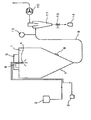
- Fig. 1 schematically shows a typical spray drying apparatus. The step of drying algal cells using such a spray drying apparatus will be described based on Fig. 1.
- a slurry containing algal cells is supplied from a slurry tank (2) to the chamber (1) of a spray drying apparatus.
- the slurry together with compressed air from a compressor (3) is sprayed into the chamber (1) from the tip of an atomizer (4).
- Air warmed by a heater (6) within a heater chamber (5) is supplied into the chamber (1), and the sprayed algal cells are dried.
- the algal cells fall while drying accumulate on a sloped portion (7) in the chamber (1).
- a hammer (8) provided in the sloped portion (7) gives an impact on the sloped portion (7), and the accumulated algal cells fall into the bottom of the chamber
- the temperature of the hot air introduced from the heater chamber (6) into the chamber (1) is preferably 200 to 400°C, more preferably 250 to 350°C, even more preferably about 300°C.
- the temperature of the discharged air in the channel (9) is preferably more than 120°C, more preferably 125°C or more, even more preferably 130°C or more.
- the temperature of the discharged air exceeds 150°C, then the temperature in the mixture of algal cells becomes too high, which may cause thermal decomposition of xanthophyll, so that the temperature of the discharged air is preferably less than 150°C, more preferably 140°C or less.
- the moisture content in the mixture of dry algal cells becomes 3 wt% or less in a relatively short period of time.
- the temperature of the discharged air it is preferable to keep the temperature of the discharged air at less than 150°C.
- spray drying is preferable because the moisture content in the dry algal cells can be adjusted almost independently of the concentration of the algal cells to be dried, by adjusting the temperature of the discharged air.
- the moisture content in the dry algal cells is brought to a value 3 wt% or less by the process described above, more preferably by employing spray drying to dry the algal cells while adjusting the temperature of the discharged air to a temperature of 125°C or more. Even when the obtained dry algal cells are, for example, placed in a glass bottle in air having a humidity of 30 to 40% and stored hermetically at room temperature with shielding from light, decomposition of xanthophyll is minimal. In one embodiment, when algal cells containing astaxanthin and having a moisture content of 3% or less are stored for 50 days at room temperature in air having a humidity of 30 to 40%, the decomposition of astaxanthin is less than 10%.
- the moisture content in the dry algal cells exceeds 3%, then the decomposition of astaxanthin reaches as high as 40% when the algal cells are stored for 50 days under the same conditions.
- the storage stability of xanthophyll in algal cells can be increased, and therefore xanthophyll can be preserved for a long term in the algal cells.
- the dry algal cells are preferably stored in a low oxygen atmosphere having a low humidity, e.g., in a vacuum package with aluminum film, so that the dry algal cells do not absorb moisture.
- the moisture content in the dry algal cells can be measured by the following method. First, a glass petri dish with a lid is placed in a low temperature drier in which the temperature is adjusted to a predetermined level, and is heated for one hour, and then transferred to a desiccator. The glass petri dish is allowed to cool, and as soon as the temperature of the dish reaches room temperature, the dish with the lid is weighed down to units of 0.1 milligrams. The operation of heating, cooling, and weighing is repeated again to obtain a constant weight (W 0 , in g). Then, 1 to 2 g of a sample are collected quickly and spread evenly on the glass petri dish, covered with the lid, and weighed accurately (W 1 , in g).
- the glass petri dish is then placed in the low temperature drier with the lid open. After the temperature in the low temperature drier reaches 105°C, drying is performed for 3 hours. Thereafter, the glass petri dish is covered quickly with the lid while still inside the drier, transferred to the desiccator, and allowed to cool. As soon as the dish reaches room temperature, the dish, still covered by the lid, is weighed (W 2 , in g).
- Xanthophyll can be extracted from the dry algal cells having a moisture content of 3 wt% or less and subsequently collected.
- a method usually used by those skilled in the art can be employed.
- chemical extraction using an organic solvent such as chloroform, hexane, acetone, methanol, or ethanol, or an edible oil or fat or physical extraction such as squeezing can be employed.
- xanthophyll may be extracted and collected using supercritical extraction. After the extraction, xanthophyll can be purified by a method such as concentration and crystallization, or fractionation using a synthetic resin (e.g., styrene-divinylbenzene copolymer).
- a synthetic resin e.g., styrene-divinylbenzene copolymer
- xanthophyll in algal cells in which the moisture content is adjusted to 3 wt% or less, xanthophyll can be preserved in high concentrations, so that the amount of astaxanthin that can be extracted and collected from these algal cells does not decrease with storage. Therefore, by utilizing the preservation method or the method for increasing the storage stability of the present invention, it is possible to efficiently collect and manufacture xanthophyll from large quantities of cultivated algae.
- a certain amount of a sample is collected into a microtube designed for exclusive use with a bead beater. After adding zirconia beads to the tube, acetone is added thereto, and the sample is beaten with the bead beater. After the beating step, the sample is separated into a supernatant and a precipitate by centrifugation, and the supernatant (i.e., an acetone fraction) is collected. Acetone is added again to the precipitate, and the same operation as described above is repeated until the color of the precipitate becomes almost completely white.
- the collected acetone fractions are combined and diluted 100-fold with dimethylsulfoxide (DMSO), and the absorbance at 492 nm (A 492 ) and the absorbance at 750 nm (A 750 ) are measured.
- the sample (collected acetone fractions) prepared for the measurement of xanthophyll described above is dissolved in a 0.15 M phosphate buffer (pH 7.0), and cholesterol esterase is added thereto to hydrolyze astaxanthin esters into astaxanthin.
- the hydrolyzate is analyzed by HPLC with a C18 column.
- a detector an UV detector or a photodiode array detector is used.
- the HPLC analysis conditions are the same as those described in Kyoko SATO et al., J. Food Hyg. Soc. Japan, Vol. 39, No. 6, pp. 368-374, 1998 .
- trans-astaxanthin retention time: about 7.9 minutes
- 9-cis-astaxanthin retention time: about 8.9 minutes
- 13-cis-astaxanthin retention time: about 9.3 minutes
- the ratio of each compound is obtained by comparing the area values in the chromatogram.
- the concentration of algal cells is measured in the following manner. First, a predetermined amount of the cell suspension is collected and filtered on a GC50 glass fiber filter (made by TOYO ⁇ ADVANTEC) by suction. The filter is washed twice with 5 mL of an aqueous solution of hydrochloric acid having a pH of 4 to dissolve inorganic salts. Then, the filter is dried for 3 hours in a thermostatic drier at 105°C and cooled in a vacuum desiccator for one hour to room temperature, and thereafter, the dry weight of the filter is measured. The weight of the GC50 glass fiber filter is preliminarily measured by drying the filter in the thermostatic drier at 105°C for one hour.
- the concentration of algal cells per unit volume or per unit weight can be calculated by subtracting the dry weight of the filter that was preliminarily measured from the weight of the dried filter to which the algal cells were adsorbed to obtain the dry weight of the algal cells. It should be noted that the concentration of the algal cells in a dispersion of the dry algal cells is measured by the same method as described above, except that washing with an aqueous solution of hydrochloric acid is not performed.
- Haematococcus pluvialis K0084 strain (hereinafter, simply referred to as the "K0084 strain") that produces astaxanthin was used.
- K0084 strain 1 L of a MBG-11 medium containing the components shown in Table 1 below was placed in a 1.5 L sealed flat culture flask having a light path of 25 mm, and the K0084 strain was inoculated into the medium so that the initial concentration was 0.6 g/L.
- the K0084 strain was cultivated for 5 days under the light irradiation conditions described below while bubbling a gas containing 3 vol% of CO 2 at a rate of 600 mL/minute (i.e., at 0.6 vvm) into the medium, adjusting the culture temperature to 25°C and the pH to between 6 and 8.
- a white fluorescent lamp made by Matsushita Electric Industrial Co. Ltd., FL40SSW/37 was used as the light source.
- the intensity of light irradiation was adjusted so that the PPFD in the light receiving direction of the culture tank measured using the LICOR-190SA flat-surface photon sensor was 100 ⁇ mol-p/m 2 s.
- the same medium (MBG-11 medium) was placed in the same flat culture flask as described above, and the encysted K0084 strain was inoculated so that the initial concentration was 0.6 g/L, and was cultivated for 200 hours under the same culture conditions as described above. By this cultivation, algal cells containing 4.2 wt% of astaxanthin were obtained.
- the algal cells obtained in the above-described preparation example were collected by centrifugation, washed with water, adjusted so that the amount of the algal cells was about 18 wt%, and dried by spray drying.
- a spray drier (Anhydro APV PSD52) in which the temperature of the hot air on the inlet side was set to 300°C and the temperature of the discharged air on the outlet side was set to 105°C, 120°C, 130°C, or 140°C, dry algal cells A, B, C, or D were obtained respectively.
- the moisture content, the astaxanthin concentration, and the concentrations of the astaxanthin isomers were measured. The results are shown in Table 2.
- xanthophyll (astaxanthin) in dry algal cells containing xanthophyll, in particular, astaxanthin that tends to be decomposed by heat, oxygen, light, and the like can be stored stably for a long term at room temperature in the air.
- the method of the present invention is useful in stabilizing and manufacturing xanthophyll, in particular, astaxanthin.
- astaxanthin-containing dry algal cells are used as fish feeds, the effect of enhancing the color of fishes is improved because astaxanthin in the feeds is preserved stably for a long term.
Landscapes
- Chemical & Material Sciences (AREA)
- Life Sciences & Earth Sciences (AREA)
- Polymers & Plastics (AREA)
- Zoology (AREA)
- Engineering & Computer Science (AREA)
- Organic Chemistry (AREA)
- Animal Husbandry (AREA)
- Food Science & Technology (AREA)
- Wood Science & Technology (AREA)
- Insects & Arthropods (AREA)
- Genetics & Genomics (AREA)
- Chemical Kinetics & Catalysis (AREA)
- General Chemical & Material Sciences (AREA)
- Microbiology (AREA)
- Marine Sciences & Fisheries (AREA)
- Biochemistry (AREA)
- Birds (AREA)
- Biotechnology (AREA)
- Bioinformatics & Cheminformatics (AREA)
- General Engineering & Computer Science (AREA)
- General Health & Medical Sciences (AREA)
- Health & Medical Sciences (AREA)
- Micro-Organisms Or Cultivation Processes Thereof (AREA)
Abstract
Description
- The present invention relates to a method for preserving xanthophyll in algal cells containing xanthophyll, in particular, astaxanthin. Furthermore, the present invention relates to a method for increasing the storage stability of xanthophyll in xanthophyll-containing dry algal cells.
- Xanthophyll (e.g., astaxanthin, canthaxanthin, zeaxanthin, adonirubin, adonixanthin, cryptoxanthin, and the like), which is a carotenoid, has been used for various purposes. For example, astaxanthin, which is a carotenoid imparting a red color, is known to have a potent antioxidative effect. Thus, it is used as a feed for enhancing the color of fish, a pigment in food, a cosmetic, a health food product, and the like. Examples of the feeds containing astaxanthin include a feed obtained by treating Phaffia yeast with NaOH (
Japanese Laid-Open Patent Publication No. 6-105657 Japanese Laid-Open Patent Publication No. 3-83577 - Astaxanthin can be chemically synthesized or extracted from naturally occurring products, for example, from Eucarida such as euphausiids and Pandalus borealis, from Phaffia yeast, and from algae. When astaxanthin is extracted from crustaceans, such as euphausiids, Pandalus borealis, and crabs, or from Phaffia yeast, the yield is very low because of their low astaxanthin content. For this reason, astaxanthin is generally extracted from algae, e.g., green algae belonging to the genus Haematococcus, having a high astaxanthin content.
- Astaxanthin is unstable to heat, oxygen, light, and the like, and a culture suspension of algal cells cannot be stored as it is. Thus, extraction of astaxanthin is often performed immediately after cultivation of algal cells (e.g., see
Japanese Laid-Open Patent Publication Nos. 9-111139 53-38653 - In order to solve the foregoing problem, there is a known method of drying algal cells containing astaxanthin.
Japanese Laid-Open Patent Publication No. 7-8212 Japanese Laid-Open Patent Publication No. 2004-129504 Japanese Laid-Open Patent Publication Nos. 7-8212 2004-129504 Japanese Laid-Open Patent Publication No. 2004-129504 - Furthermore, a method for improving long-term storage stability of astaxanthin by mixing broken algal cells with various types of additives to form a powdery composition is known (
WO 2002/077105 ). However, in this method, additives such as a surfactant and an antioxidant are required, so that the cost is increased. Alternatively, because the surfactant plays a role in helping the additives to contaminate the extract, it is necessary to remove these additives from the extract thereafter. Therefore, the method by using the additives is not preferable. - Thus, a method for preserving xanthophylls in algal cells stably for a long term in a simple manner has not yet been known.
- It is an object of the present invention to provide a method for preserving xanthophyll in xanthophyll-containing algal cells and thereby to provide a method for improving the storage stability of xanthophyll, in particular, astaxanthin, in xanthophyll-containing dry algal cells.
- The present invention provides a method for preserving a xanthophyll in an algal cell, the method comprising:
- cultivating algal cells containing a xanthophyll and then collecting the algal cells; and
- drying the collected algal cells so that the moisture content of the collected algal cells reaches a value of 3 wt% or less.
- The present invention also provides a method for increasing the storage stability of a xanthophyll in xanthophyll-containing dry algal cells, the method comprising drying xanthophyll-containing algal cell so that the moisture content in the algal cells reaches a value of 3 wt% or less.
- In a particular embodiment, the moisture content of the algal cells reaches a value of 2 wt% or less.
- In one embodiment, according to any of these methods, the xanthophyll is astaxanthin.
- In a further embodiment, according to any of these methods, the algal cell is derived from a green alga belonging to the genus Haematococcus.
- In a further embodiment, according to any of these methods, the green alga is Haematococcus pluvialis.
- In another embodiment, according to any of these methods, the drying is performed by spray drying.
- In a further embodiment, according to any of methods, the spray drying is performed using a spray drying apparatus, and the temperature of air discharged in the spray drying apparatus is adjusted to 125°C or more.
- The present invention further provides a method for manufacturing a xanthophyll, the method comprising any one of the methods described above.
- The present invention further provides a dried algal cell containing xanthophyll, having a moisture content of 3 wt% or less.
- In embodiments, dried algal cells of the invention have a moisture content of 2 wt% or less.
- The present invention further provides a dried algal cell containing xanthophyll, as desribed above or as obtained by any one of the methods described above.
- The present invention further provides a fish food comprising dried algal cells containing xanthophyll, as described above or as obtained by any of the methods above.
- The present invention further provides the use of a dried algal cell containing xanthophyll, as described above or as obtained by any of the methods above, in manufacture of a fish food.
- According to the method of the present invention, xanthophyll in xanthophyll-containing dry algal cells can be kept stable over a long term at room temperature (i.e., without freezing or cooling). Xanthophyll-containing dry algal cells obtained by the method of the present invention can be preserved for a long term at room temperature, and may be suitably used for extraction with subsequent purification of xanthophyll, in particular, astaxanthin. Thus, for example, the step of cultivating astaxanthin-containing algal cells and the step of extracting and purifying astaxanthin can be separated, and it becomes possible to manufacture astaxanthin efficiently at a low cost. Moreover, according to the method of the present invention, astaxanthin in high concentrations can be preserved conveniently, so that astaxanthin can be extracted and collected efficiently. Furthermore, when astaxanthin-containing dry algal cells obtained by the method of the present invention are used as fish feeds, astaxanthin in the feeds can be preserved stably for a long term, so that an effect of enhancing the color of fish is improved.
-
- Fig. 1 is a schematic view of a spray drying apparatus that can be used in the method of the present invention.
- Fig. 2 presents a graph showing the change in astaxanthin content over time in dry algal cells having various moisture contents.
- There is no particular limitation on the algae used in the present invention, as long as the algae can produce xanthophyll. Preferably, green algae, e.g., unicellular algae belonging to the genus Haematococcus, are used. Examples of the algae belonging to the genus Haematococcus include Haematococcus pluvialis (H. pluvialis), Haematococcus lacustris (H lacustris), Haematococcus capensis (H capensis), Haematococcus droebakensi (H. droebakensi), and Haematococcus zimbabwiensis (H. zimbabwiensis).
- Examples of Haematococcus pluvialis (H pluvialis) include the NIES144 strain deposited in the Independent Administrative Institution National Institute for Environmental Studies, the UTEX2505 strain deposited in the Culture Collection of Algae at the University of Texas, U.S.A., and the K0084 strain deposited in the Scandinavian Culture Center for Algae and Protozoa, Botanical Institute, at the University of Copenhagen, Denmark.
- Examples of Haematococcus lacustris (H. lacustris) include the ATCC30402 and ATCC30453 strains deposited in ATCC, the IAM C-392, IAM C-393, IAM C-394, and IAM C-339 strains deposited in the Institute of Applied Microbiology, University of Tokyo, or the UTEX16 and UTEX294 strains.
- Examples of Haematococcus capensis (H. capensis) include the UTEX LB1023 strain.
- Examples of Haematococcus droebakensi (H. droebakensi) include the UTEX55 strain.
- Examples of Haematococcus zimbabwiensis (H zimbabwiensis) include the UTEX LB1758 strain.
- Among these, Haematococcus pluvialis is preferably used.
- Algal cells containing xanthophyll can be obtained by cultivating algal cells as described above under such conditions that the algal cells can produce xanthophyll. There is no particular limitation on the conditions for the production of xanthophyll. For example, it is possible to employ a method in which vegetative cells of the algae are grown in a medium containing a nitrogen source and trace metals under bright conditions while bubbling carbon dioxide into the medium, then the cells are subjected to at least one of the following stresses: physical stresses due to light irradiation, biological stresses due to nutrient starvation, and chemical substance stresses due to addition of hydrogen peroxide and/or an iron compound, and thereby encystment of the vegetative cells is induced. It is also possible to cultivate the algal cells by adding acetic acid as a carbon source and under dark conditions for vegetative growth, and then encyst the algal cells (see
Japanese Laid-Open Patent Publication Nos. 3-83577 2004-129504 - The obtained algal cells are collected, for example, by centrifugation, and washed with water, if necessary. The concentration of the algal cells is then adjusted so that the solid concentration is about 5 to 40%, preferably 10 to 30%, and the resultant algal cells are subjected to a drying step described below in greater detail.
- In the present invention, "xanthophyll" is a general term for a group of carotenoids having an oxygen-containing functional group, and does not refer to a particular compound. In the present invention, "xanthophyll" mainly refers to a xanthophyll produced by algae, and typical examples of such a xanthophyll include astaxanthin, canthaxanthin, zeaxanthin, adonirubin, adonixanthin, cryptoxanthin, and their fatty acid esters.
- Drying of the algal cells containing xanthophyll is performed so that the moisture content in the dry algal cells becomes 3 wt% or less. If the moisture content in the dry algal cells exceeds 3 wt%, then decomposition of xanthophyll in the dry algal cells proceeds during preservation, resulting in poor storage stability of xanthophyll.
- There is no particular limitation on the method for drying. For example, drum drying (see
WO 2000/057724 , for example), hot air drying (seeJapanese Laid-Open Patent Publication No. 2002-119252 US Patent No. 6163979 , for example), and spray drying can be employed. Although low temperature drying such as freeze-drying is preferable in order to prevent thermal decomposition of xanthophyll, there are problems in that it takes much time for drying and the drying equipment is expensive. In the case of drum drying, hot air drying, or spray drying, xanthophyll may be decomposed by heating, so that the heating temperature and the heating time should be watched carefully. - The drying temperature is preferably as low as possible so that xanthophyll (especially xanthophyll present in the form of an ester with a fatty acid) in the algal cells is prevented from being decomposed, and the temperature of the mixture of algal cells is preferably kept below 100°C. In drum drying and hot air drying, when the heating temperature is set to 100°C or more, the temperature of the mixture of algal cells may increase to 100°C or more. In spray drying, since a slurry of the algal cells is sprayed, the sprayed algal cells may not form a lump. Thus, the algal cells are uniformly dried within a short range of time, so that thermal decomposition of xanthophylls in algal cells can be prevented. Therefore, in the present invention, spray drying is preferably employed.
- Spray drying can be performed using any spray drying apparatus. Fig. 1 schematically shows a typical spray drying apparatus. The step of drying algal cells using such a spray drying apparatus will be described based on Fig. 1.
- A slurry containing algal cells is supplied from a slurry tank (2) to the chamber (1) of a spray drying apparatus. The slurry together with compressed air from a compressor (3) is sprayed into the chamber (1) from the tip of an atomizer (4). Air warmed by a heater (6) within a heater chamber (5) is supplied into the chamber (1), and the sprayed algal cells are dried. The algal cells fall while drying accumulate on a sloped portion (7) in the chamber (1). A hammer (8) provided in the sloped portion (7) gives an impact on the sloped portion (7), and the accumulated algal cells fall into the bottom of the chamber
- (1). A fan (10) is provided at the rear end of a channel (9), and when the fan (10) is rotated, the air warmed by the heater (6) is introduced into the chamber (1) from the heater chamber (5) and guides the dry algal cells into a cyclone (collector) (11). A thermometer (12) provided in the channel (9) measures the temperature of the air containing the dry algal cells that are guided from the chamber (1) to the cyclone (collector) (11). In the cyclone (11), the dry algal cells accumulate on the bottom thereof, and the algal cells can be collected into a container (14) by opening a valve (13).
- In such a spray drying apparatus, the temperature of the hot air introduced from the heater chamber (6) into the chamber (1) is preferably 200 to 400°C, more preferably 250 to 350°C, even more preferably about 300°C. In the spray drying apparatus, the temperature of the discharged air in the channel (9) is preferably more than 120°C, more preferably 125°C or more, even more preferably 130°C or more. However, if the temperature of the discharged air exceeds 150°C, then the temperature in the mixture of algal cells becomes too high, which may cause thermal decomposition of xanthophyll, so that the temperature of the discharged air is preferably less than 150°C, more preferably 140°C or less. When drying is performed by spray drying as described above, the moisture content in the mixture of dry algal cells becomes 3 wt% or less in a relatively short period of time. In particular, when the xanthophyll is astaxanthin, it is preferable to keep the temperature of the discharged air at less than 150°C. Furthermore, spray drying is preferable because the moisture content in the dry algal cells can be adjusted almost independently of the concentration of the algal cells to be dried, by adjusting the temperature of the discharged air.
- The moisture content in the dry algal cells is brought to a
value 3 wt% or less by the process described above, more preferably by employing spray drying to dry the algal cells while adjusting the temperature of the discharged air to a temperature of 125°C or more. Even when the obtained dry algal cells are, for example, placed in a glass bottle in air having a humidity of 30 to 40% and stored hermetically at room temperature with shielding from light, decomposition of xanthophyll is minimal. In one embodiment, when algal cells containing astaxanthin and having a moisture content of 3% or less are stored for 50 days at room temperature in air having a humidity of 30 to 40%, the decomposition of astaxanthin is less than 10%. On the other hand, if the moisture content in the dry algal cells exceeds 3%, then the decomposition of astaxanthin reaches as high as 40% when the algal cells are stored for 50 days under the same conditions. As described above, according to the method of the present invention, the storage stability of xanthophyll in algal cells can be increased, and therefore xanthophyll can be preserved for a long term in the algal cells. After drying, in order to prevent further decomposition of xanthophyll, the dry algal cells are preferably stored in a low oxygen atmosphere having a low humidity, e.g., in a vacuum package with aluminum film, so that the dry algal cells do not absorb moisture. - The moisture content in the dry algal cells can be measured by the following method. First, a glass petri dish with a lid is placed in a low temperature drier in which the temperature is adjusted to a predetermined level, and is heated for one hour, and then transferred to a desiccator. The glass petri dish is allowed to cool, and as soon as the temperature of the dish reaches room temperature, the dish with the lid is weighed down to units of 0.1 milligrams. The operation of heating, cooling, and weighing is repeated again to obtain a constant weight (W0, in g). Then, 1 to 2 g of a sample are collected quickly and spread evenly on the glass petri dish, covered with the lid, and weighed accurately (W1, in g). The glass petri dish is then placed in the low temperature drier with the lid open. After the temperature in the low temperature drier reaches 105°C, drying is performed for 3 hours. Thereafter, the glass petri dish is covered quickly with the lid while still inside the drier, transferred to the desiccator, and allowed to cool. As soon as the dish reaches room temperature, the dish, still covered by the lid, is weighed (W2, in g). The moisture content in the sample can be calculated using the following equation:

- Xanthophyll can be extracted from the dry algal cells having a moisture content of 3 wt% or less and subsequently collected. There is no particular limitation on the method for extracting and collecting xanthophyll, and a method usually used by those skilled in the art can be employed. For example, chemical extraction using an organic solvent such as chloroform, hexane, acetone, methanol, or ethanol, or an edible oil or fat, or physical extraction such as squeezing can be employed. Alternatively, xanthophyll may be extracted and collected using supercritical extraction. After the extraction, xanthophyll can be purified by a method such as concentration and crystallization, or fractionation using a synthetic resin (e.g., styrene-divinylbenzene copolymer).
- According to the present invention, in algal cells in which the moisture content is adjusted to 3 wt% or less, xanthophyll can be preserved in high concentrations, so that the amount of astaxanthin that can be extracted and collected from these algal cells does not decrease with storage. Therefore, by utilizing the preservation method or the method for increasing the storage stability of the present invention, it is possible to efficiently collect and manufacture xanthophyll from large quantities of cultivated algae.
- Hereinafter, the present invention will be described in greater detail by means of examples in which algae belonging to the genus Haematococcus are used, but it should be appreciated that the present invention is not limited to these examples.
- First, a method for measuring xanthophyll, a method for measuring an astaxanthin isomer, and a method for measuring the dry mass of algal cells will be described.
- First, a certain amount of a sample is collected into a microtube designed for exclusive use with a bead beater. After adding zirconia beads to the tube, acetone is added thereto, and the sample is beaten with the bead beater. After the beating step, the sample is separated into a supernatant and a precipitate by centrifugation, and the supernatant (i.e., an acetone fraction) is collected. Acetone is added again to the precipitate, and the same operation as described above is repeated until the color of the precipitate becomes almost completely white. The collected acetone fractions are combined and diluted 100-fold with dimethylsulfoxide (DMSO), and the absorbance at 492 nm (A492) and the absorbance at 750 nm (A750) are measured. The concentration (in terms of free or unesterified form) of xanthophyll in the collected acetone fractions (sample) can be calculated using the following equation:

- Most of the xanthophyll produced by Haematococcus pluvialis in the examples below is astaxanthin. The above-described method for measuring xanthophyll is also used for measurement of astaxanthin.
- First, the sample (collected acetone fractions) prepared for the measurement of xanthophyll described above is dissolved in a 0.15 M phosphate buffer (pH 7.0), and cholesterol esterase is added thereto to hydrolyze astaxanthin esters into astaxanthin. The hydrolyzate is analyzed by HPLC with a C18 column. As a detector, an UV detector or a photodiode array detector is used. The HPLC analysis conditions are the same as those described in Kyoko SATO et al., J. Food Hyg. Soc. Japan, Vol. 39, No. 6, pp. 368-374, 1998. Under these conditions, trans-astaxanthin (retention time: about 7.9 minutes), 9-cis-astaxanthin (retention time: about 8.9 minutes), and 13-cis-astaxanthin (retention time: about 9.3 minutes) are eluted in this order. On the commonly accepted assumption that these compounds have the same molar absorption coefficient, the ratio of each compound is obtained by comparing the area values in the chromatogram.
- The concentration of algal cells is measured in the following manner. First, a predetermined amount of the cell suspension is collected and filtered on a GC50 glass fiber filter (made by TOYO·ADVANTEC) by suction. The filter is washed twice with 5 mL of an aqueous solution of hydrochloric acid having a pH of 4 to dissolve inorganic salts. Then, the filter is dried for 3 hours in a thermostatic drier at 105°C and cooled in a vacuum desiccator for one hour to room temperature, and thereafter, the dry weight of the filter is measured. The weight of the GC50 glass fiber filter is preliminarily measured by drying the filter in the thermostatic drier at 105°C for one hour. The concentration of algal cells per unit volume or per unit weight can be calculated by subtracting the dry weight of the filter that was preliminarily measured from the weight of the dried filter to which the algal cells were adsorbed to obtain the dry weight of the algal cells. It should be noted that the concentration of the algal cells in a dispersion of the dry algal cells is measured by the same method as described above, except that washing with an aqueous solution of hydrochloric acid is not performed.
- Haematococcus pluvialis K0084 strain (hereinafter, simply referred to as the "K0084 strain") that produces astaxanthin was used. First, 1 L of a MBG-11 medium containing the components shown in Table 1 below was placed in a 1.5 L sealed flat culture flask having a light path of 25 mm, and the K0084 strain was inoculated into the medium so that the initial concentration was 0.6 g/L.
Table 1 Medium MBG-11 Components g/L NaNO3 0.41 K2HPO4 0.04 MgSO4·7H2O 0.075 CaCl2·2H2O 0.036 Citric acid (anhydrous) 0.006 Ammonium iron (III) citrate 0.006 EDTA·2Na 0.001 Na2CO3 0.02 CuSO4·5H2O 0.00286 H3BO4 0.00181 MnCl2·4H2O 0.00022 ZnSO4·7H2O 0.00008 Na2MoO4 0.000021 Co(NO3)2·6H2O 0.000000494 - The K0084 strain was cultivated for 5 days under the light irradiation conditions described below while bubbling a gas containing 3 vol% of CO2 at a rate of 600 mL/minute (i.e., at 0.6 vvm) into the medium, adjusting the culture temperature to 25°C and the pH to between 6 and 8.
- For irradiation of light, a white fluorescent lamp (made by Matsushita Electric Industrial Co. Ltd., FL40SSW/37) was used as the light source. The intensity of light irradiation was adjusted so that the PPFD in the light receiving direction of the culture tank measured using the LICOR-190SA flat-surface photon sensor was 100 µmol-p/m2s.
- After the cultivation, the K0084 strain changed color from green to brown or blackish brown, and was confirmed to have been encysted.
- Then, the same medium (MBG-11 medium) was placed in the same flat culture flask as described above, and the encysted K0084 strain was inoculated so that the initial concentration was 0.6 g/L, and was cultivated for 200 hours under the same culture conditions as described above. By this cultivation, algal cells containing 4.2 wt% of astaxanthin were obtained.
- The algal cells obtained in the above-described preparation example were collected by centrifugation, washed with water, adjusted so that the amount of the algal cells was about 18 wt%, and dried by spray drying. By using a spray drier (Anhydro APV PSD52) in which the temperature of the hot air on the inlet side was set to 300°C and the temperature of the discharged air on the outlet side was set to 105°C, 120°C, 130°C, or 140°C, dry algal cells A, B, C, or D were obtained respectively. For each of the dry algal cells A to D, the moisture content, the astaxanthin concentration, and the concentrations of the astaxanthin isomers were measured. The results are shown in Table 2.
Table 2 Temperature of discharged air (°C) Dry algal cell Dry algal cell Astaxanthin Moisture Moisture content (%) Astaxanthin (%) trans(%) 9-cis(%) 13-cis(%) 105 Dry algal cell A 4.1 4.30 83.0 7.7 9.3 120 Dry algal cell B 3.3 4.29 79.3 11.1 9.6 130 Dry algal cell C 2.7 4.27 78.5 11.1 10.4 140 Dry algal cell D 1.9 4.18 77.8 12.0 10.2 - As can be seen from this table, the moisture content in the dry algal cells decreased as the temperature of the discharged air increased, and the moisture content was 1.9% when the temperature of the discharged air was 140°C. It is also seen that in almost all of astaxanthin in the algal cells, both of the double bonds at the 9- and 13-positions are inherently in the trans form. However, as the temperature of the discharged air increased, the 9-cis form and the 13-cis form, which are isomers, tended to increase. This indicates that isomerization of astaxanthin occurs because of heat.
- Next, the obtained dry algal cells A to D were placed in glass bottles so that they were present in an amount of 30 vol%. The glass bottles were sealed and stored under conditions of a humidity of 30 to 40% at room temperature, and the respective astaxanthin concentrations were measured over time and taken as indicators of the storage stability. The results are shown in Fig. 2.
- As can be seen from Fig. 2, in the dry algal cells C and D having a moisture content of 3 wt% or less, decomposition of astaxanthin was very slow in spite of the fact that those dry algal cells were stored in the glass bottles at room temperature in the ambient atmosphere. In particular, in the dry algal cells D having a moisture content of 2wt% or less, decomposition of astaxanthin hardly occurred even after 80 days or more. In the dry algal cells C, the decomposition rate was 10% or less even on day 50. On the other hand, in both of the dry algal cells A and B having a moisture content of more than 3 wt%, decomposition of astaxanthin occurred, and 30 to 40% of astaxanthin had been decomposed on day 50. In view of these results, it was clear that residual moisture in the dry algal cells has a greater influence on decomposition of astaxanthin than heat during drying of the algal cells. These findings showed that astaxanthin can be stored stably by controlling the moisture content in dry algal cells to be 3 wt% or less. Moreover, when comparing the dry algal cells C and D obtained according to the method of the present invention with the dry algal cells A and B which are comparative examples, there was a large difference in the amount of remaining astaxanthin on and after
day 20 from the start of storage. Therefore, the method of the present invention is particularly useful for a storage for 20 days or more. - From the foregoing, it was established that when spray drying is employed, it is most beneficial to set the moisture content of the dried algal cells to 3 wt% or less, which gives overall greater storage stability even when making allowance for some thermal decomposition of astaxanthin.
- According to the method of the present invention, xanthophyll (astaxanthin) in dry algal cells containing xanthophyll, in particular, astaxanthin that tends to be decomposed by heat, oxygen, light, and the like, can be stored stably for a long term at room temperature in the air. Thus, the method of the present invention is useful in stabilizing and manufacturing xanthophyll, in particular, astaxanthin. Moreover, according to the present invention, when astaxanthin-containing dry algal cells are used as fish feeds, the effect of enhancing the color of fishes is improved because astaxanthin in the feeds is preserved stably for a long term.
- The invention may be embodied in other forms without departing from the spirit or essential characteristics thereof. The embodiments disclosed in this application are to be considered in all respects as illustrative and not limiting. The scope of the invention is indicated by the appended claims rather than by the foregoing description, and all changes which come within the meaning and range of equivalency of the claims are intended to be embraced therein.
Claims (21)
- A method for preserving a xanthophyll in an algal cell, comprising:cultivating algal cells containing a xanthophyll and then collecting the algal cells; anddrying the collected algal cells so that they have a moisture content of about 3 wt% or less.
- The method of claim 1, wherein the xanthophyll is astaxanthin.
- The method of claim 1 or 2, wherein the algal cell is derived from a green alga belonging to the genus Haematococcus.
- The method of claim 3, wherein the green alga is Haematococcus pluvialis.
- The method of any one of claims 1 to 4, wherein the drying is performed by spray drying.
- The method of claim 5, wherein the spray drying is performed using a spray drying apparatus, and the temperature of air discharged in the spray drying apparatus is adjusted to about 125°C or more.
- A method for increasing the preservation stability of a xanthophyll in a xanthophyll-containing dry algal cell, comprising drying xanthophyll-containing algal cells so that they have a moisture content of about 3 wt% or less.
- The method of claim 7, wherein the xanthophyll is astaxanthin.
- The method of claim 7 or 8, wherein the drying is performed by spray drying.
- The method of claim 9, wherein the spray drying is performed using a spray drying apparatus, and the temperature of air discharged in the spray drying apparatus is adjusted to about 125°C or more.
- The method of any one of claims 7 to 10, wherein the algal cell is a green alga belonging to the genus Haematococcus.
- The method of claim 11, wherein the green alga is Haematococcus pluvialis.
- A method for manufacturing a xanthophyll, comprising the method of any one of claims 7 to 12.
- A dried algal cell, containing a xanthophyll and having a moisture content of about 3 wt% or less.
- The algal cell of claim 14, wherein the xanthophyll is astaxanthin.
- The algal cell of claim 14 or 15, wherein the algal cell is derived from a green alga belonging to the genus Haematococcus.
- The algal cell of claim 16, wherein the green alga is Haematococcus pluvialis.
- The cell of any of claims 14-17, having a moisture content of about 2 wt% or less.
- A dried algal cell, obtained by the method of any of claims 1 to 13.
- A fish food comprising the algal cells of any of claims 14 to 19 or obtained by the method of any of claims 1 to 13.
- Use of the algal cells of any of claims 14 to 19 or obtained by the method of any of claims 1 to 13, in manufacture of a fish food.
Applications Claiming Priority (1)
| Application Number | Priority Date | Filing Date | Title |
|---|---|---|---|
| JP2005143523 | 2005-05-17 |
Publications (1)
| Publication Number | Publication Date |
|---|---|
| EP1724337A1 true EP1724337A1 (en) | 2006-11-22 |
Family
ID=36788784
Family Applications (1)
| Application Number | Title | Priority Date | Filing Date |
|---|---|---|---|
| EP06252541A Withdrawn EP1724337A1 (en) | 2005-05-17 | 2006-05-16 | Method for preserving xanthophyll in algal cells |
Country Status (3)
| Country | Link |
|---|---|
| US (1) | US20060275863A1 (en) |
| EP (1) | EP1724337A1 (en) |
| CN (1) | CN1869194A (en) |
Cited By (2)
| Publication number | Priority date | Publication date | Assignee | Title |
|---|---|---|---|---|
| US9113607B1 (en) | 2015-03-25 | 2015-08-25 | Heliae Development, Llc | Methods for treating a culture of Haematococcus pluvialis for contamination using hydrogen peroxide |
| CN104893978A (en) * | 2015-05-11 | 2015-09-09 | 新奥科技发展有限公司 | Haematococcus pluvialis ENN71 and cultural method and application of haematococcus pluvialis ENN71 |
Citations (5)
| Publication number | Priority date | Publication date | Assignee | Title |
|---|---|---|---|---|
| WO1997028274A1 (en) * | 1996-02-01 | 1997-08-07 | Ben-Gurion University Of The Negev | A procedure for large-scale production of astaxanthin from haematococcus |
| EP1138208A1 (en) * | 1999-09-30 | 2001-10-04 | Nippon Mitsubishi Oil Corporation | Pigment-containing materials to be added to feeds |
| WO2003027267A1 (en) * | 2001-09-26 | 2003-04-03 | Parry Nutraceuticals Ltd. | Process to produce astaxanthin from haematococcus biomass |
| US20040091524A1 (en) * | 2001-03-22 | 2004-05-13 | Nobukazu Tanaka | Stable astaxanthin-containing powdery compositions and process for producing the same |
| US20040253664A1 (en) * | 2000-02-24 | 2004-12-16 | Long Thomas Veach | Process for production of carotenoids, xanthophylls and apo-carotenoids utilizing eukaryotic microorganisms |
Family Cites Families (2)
| Publication number | Priority date | Publication date | Assignee | Title |
|---|---|---|---|---|
| DE19719398A1 (en) * | 1997-05-07 | 1998-11-12 | Amsco Finn Aqua Gmbh | Process for controlling a freeze-drying process |
| PT996740E (en) * | 1997-08-01 | 2005-11-30 | Martek Biosciences Corp | NUTRIENT COMPOSITIONS CONTAINING DHA AND METHODS FOR ITS PRODUCTION |
-
2006
- 2006-05-15 US US11/433,625 patent/US20060275863A1/en not_active Abandoned
- 2006-05-16 EP EP06252541A patent/EP1724337A1/en not_active Withdrawn
- 2006-05-17 CN CNA2006100847812A patent/CN1869194A/en active Pending
Patent Citations (5)
| Publication number | Priority date | Publication date | Assignee | Title |
|---|---|---|---|---|
| WO1997028274A1 (en) * | 1996-02-01 | 1997-08-07 | Ben-Gurion University Of The Negev | A procedure for large-scale production of astaxanthin from haematococcus |
| EP1138208A1 (en) * | 1999-09-30 | 2001-10-04 | Nippon Mitsubishi Oil Corporation | Pigment-containing materials to be added to feeds |
| US20040253664A1 (en) * | 2000-02-24 | 2004-12-16 | Long Thomas Veach | Process for production of carotenoids, xanthophylls and apo-carotenoids utilizing eukaryotic microorganisms |
| US20040091524A1 (en) * | 2001-03-22 | 2004-05-13 | Nobukazu Tanaka | Stable astaxanthin-containing powdery compositions and process for producing the same |
| WO2003027267A1 (en) * | 2001-09-26 | 2003-04-03 | Parry Nutraceuticals Ltd. | Process to produce astaxanthin from haematococcus biomass |
Non-Patent Citations (2)
| Title |
|---|
| GOUVEIA L. AND EMPIS J.: "Relative Stabilities of microalgal carotenoids in microalgal extracts, biomass and fish feed: effect of storage conditions", vol. 4, no. 2, June 2003 (2003-06-01), pages 227 - 233 * |
| MENDES-PINTO M M ET AL: "Evaluation of different cell disruption processes on encysted cells of Haematococcus pluvialis: Effects on astaxanthin recovery and implications for bio-availability", JOURNAL OF APPLIED PHYCOLOGY, vol. 13, no. 1, February 2001 (2001-02-01), pages 19 - 24, XP002395326, ISSN: 0921-8971 * |
Cited By (9)
| Publication number | Priority date | Publication date | Assignee | Title |
|---|---|---|---|---|
| US9113607B1 (en) | 2015-03-25 | 2015-08-25 | Heliae Development, Llc | Methods for treating a culture of Haematococcus pluvialis for contamination using hydrogen peroxide |
| US9347035B1 (en) | 2015-03-25 | 2016-05-24 | Heliae Development Llc | Haematococcus pluvialis culture compositions |
| US9347034B1 (en) | 2015-03-25 | 2016-05-24 | Heliae Development Llc | Methods for preventing lysis in a culture of haematococcus pluvialis using hydrogen peroxide |
| US9392793B1 (en) | 2015-03-25 | 2016-07-19 | Heliae Development Llc | Methods for treating a culture of haematococcus pluvialis for contamination using salt |
| US9447373B1 (en) | 2015-03-25 | 2016-09-20 | Heliae Development Llc | Methods for treating a culture of haematococcus pluvialis for contamination using salt and hydrogen peroxide |
| US9447374B1 (en) | 2015-03-25 | 2016-09-20 | Heliae Development Llc | Methods for preventing a chytrid infection in a culture of Haematococcus pluvialis using hydrogen peroxide |
| US9447375B1 (en) | 2015-03-25 | 2016-09-20 | Heliae Development Llc | Methods for treating a culture of Haematococcus pluvialis for lysis using hydrogen peroxide |
| CN104893978A (en) * | 2015-05-11 | 2015-09-09 | 新奥科技发展有限公司 | Haematococcus pluvialis ENN71 and cultural method and application of haematococcus pluvialis ENN71 |
| CN104893978B (en) * | 2015-05-11 | 2017-12-08 | 新奥科技发展有限公司 | One plant of haematococcus pluvialis ENN71 and its cultural method and application |
Also Published As
| Publication number | Publication date |
|---|---|
| US20060275863A1 (en) | 2006-12-07 |
| CN1869194A (en) | 2006-11-29 |
Similar Documents
| Publication | Publication Date | Title |
|---|---|---|
| US5858700A (en) | Process for the isolation and purification of lycopene crystals | |
| Cheng et al. | Effects of storage time and temperature on polyphenolic content and qualitative characteristics of freeze-dried and spray-dried bayberry powder | |
| EP1138208B1 (en) | Pigment-containing materials to be added to feeds | |
| EP1760157B1 (en) | Green algae having a high astaxanthin content and method for producing the same | |
| JP5795572B2 (en) | Method for separating carotenoid crystals from various plants | |
| ES2336199T3 (en) | BLAKESLEA TRISPORA PRODUCER OF AN ELEGVED PERFORMANCE OF LICOPENO IN A SUITABLE ENVIRONMENT IN THE ABSENCE OF AN EXOGENOUS INHIBITOR OF CAROTENOGENESIS. | |
| EP0608172B1 (en) | Phaffia rhodozyma mutants, process for the production of beta-caroten and use of a beta-caroten rich biomass | |
| EP1676925B1 (en) | Process for producing zeaxanthin and beta-cryptoxanthin | |
| Renstrøm et al. | Esterified, optical pure (3S, 3′ S)-astaxanthin from flowers of Adonis annua | |
| JP3242531B2 (en) | Method for producing carotenoid pigment | |
| JPWO2007029627A1 (en) | Green alga extract with high astaxanthin content and method for producing the same | |
| US20040067550A1 (en) | Method for the production of beta-carotene | |
| JP2007254459A (en) | Green algae extract with high storage stability of astaxanthin | |
| JP2000063827A (en) | Method for producing antioxidant | |
| WO2002012183A1 (en) | Process for extracting astaxanthin pigment from blue-green algae and extracted pigment thereof | |
| Liu et al. | Composition and biosynthetic pathways of carotenoids in the astaxanthin-producing green alga Chlorococcum sp. | |
| US20060275863A1 (en) | Method for preserving xanthophyll in algal cell | |
| Zhang et al. | Determination of other related carotenoids substances in astaxanthin crystals extracted from Adonis amurensis | |
| US20080293097A1 (en) | Biological Production of Zeaxanthin and Carotenoid Biosynthesis Control | |
| Karanjgaokar et al. | Isolation of pigmented yeasts, extraction of pigment and study of antimicrobial property of its pigment | |
| JP2006348270A (en) | Method for preserving xanthophyll in algal cells | |
| KR102042363B1 (en) | Method for producing functional fermented materials containing astaxanthin and GABA by fermentation methods | |
| EP1806411A1 (en) | Process for obtaining zeaxanthin from algae | |
| JP4486883B2 (en) | How to make carotenoids | |
| KR20210119600A (en) | Method for Producing Egg Having Improved Lutein and Zeaxanthin Content, Egg Produced By Same, and Method for Preparing Egg Yolk Oil or Egg Yolk Powder |
Legal Events
| Date | Code | Title | Description |
|---|---|---|---|
| PUAI | Public reference made under article 153(3) epc to a published international application that has entered the european phase |
Free format text: ORIGINAL CODE: 0009012 |
|
| AK | Designated contracting states |
Kind code of ref document: A1 Designated state(s): AT BE BG CH CY CZ DE DK EE ES FI FR GB GR HU IE IS IT LI LT LU LV MC NL PL PT RO SE SI SK TR |
|
| AX | Request for extension of the european patent |
Extension state: AL BA HR MK YU |
|
| 17P | Request for examination filed |
Effective date: 20061124 |
|
| AKX | Designation fees paid |
Designated state(s): AT BE BG CH CY CZ DE DK EE ES FI FR GB GR HU IE IS IT LI LT LU LV MC NL PL PT RO SE SI SK TR |
|
| 17Q | First examination report despatched |
Effective date: 20071114 |
|
| STAA | Information on the status of an ep patent application or granted ep patent |
Free format text: STATUS: THE APPLICATION IS DEEMED TO BE WITHDRAWN |
|
| 18D | Application deemed to be withdrawn |
Effective date: 20090827 |