EP1722589A2 - Authentication method for wireless distributed system - Google Patents
Authentication method for wireless distributed system Download PDFInfo
- Publication number
- EP1722589A2 EP1722589A2 EP06009984A EP06009984A EP1722589A2 EP 1722589 A2 EP1722589 A2 EP 1722589A2 EP 06009984 A EP06009984 A EP 06009984A EP 06009984 A EP06009984 A EP 06009984A EP 1722589 A2 EP1722589 A2 EP 1722589A2
- Authority
- EP
- European Patent Office
- Prior art keywords
- base station
- target base
- unregistered
- hop
- station
- Prior art date
- Legal status (The legal status is an assumption and is not a legal conclusion. Google has not performed a legal analysis and makes no representation as to the accuracy of the status listed.)
- Granted
Links
Images



Classifications
-
- H—ELECTRICITY
- H04—ELECTRIC COMMUNICATION TECHNIQUE
- H04L—TRANSMISSION OF DIGITAL INFORMATION, e.g. TELEGRAPHIC COMMUNICATION
- H04L9/00—Cryptographic mechanisms or cryptographic arrangements for secret or secure communications; Network security protocols
- H04L9/32—Cryptographic mechanisms or cryptographic arrangements for secret or secure communications; Network security protocols including means for verifying the identity or authority of a user of the system or for message authentication, e.g. authorization, entity authentication, data integrity or data verification, non-repudiation, key authentication or verification of credentials
-
- H—ELECTRICITY
- H04—ELECTRIC COMMUNICATION TECHNIQUE
- H04L—TRANSMISSION OF DIGITAL INFORMATION, e.g. TELEGRAPHIC COMMUNICATION
- H04L63/00—Network architectures or network communication protocols for network security
- H04L63/06—Network architectures or network communication protocols for network security for supporting key management in a packet data network
-
- H—ELECTRICITY
- H04—ELECTRIC COMMUNICATION TECHNIQUE
- H04L—TRANSMISSION OF DIGITAL INFORMATION, e.g. TELEGRAPHIC COMMUNICATION
- H04L63/00—Network architectures or network communication protocols for network security
- H04L63/08—Network architectures or network communication protocols for network security for authentication of entities
-
- H—ELECTRICITY
- H04—ELECTRIC COMMUNICATION TECHNIQUE
- H04L—TRANSMISSION OF DIGITAL INFORMATION, e.g. TELEGRAPHIC COMMUNICATION
- H04L9/00—Cryptographic mechanisms or cryptographic arrangements for secret or secure communications; Network security protocols
- H04L9/32—Cryptographic mechanisms or cryptographic arrangements for secret or secure communications; Network security protocols including means for verifying the identity or authority of a user of the system or for message authentication, e.g. authorization, entity authentication, data integrity or data verification, non-repudiation, key authentication or verification of credentials
- H04L9/3271—Cryptographic mechanisms or cryptographic arrangements for secret or secure communications; Network security protocols including means for verifying the identity or authority of a user of the system or for message authentication, e.g. authorization, entity authentication, data integrity or data verification, non-repudiation, key authentication or verification of credentials using challenge-response
-
- H—ELECTRICITY
- H04—ELECTRIC COMMUNICATION TECHNIQUE
- H04W—WIRELESS COMMUNICATION NETWORKS
- H04W12/00—Security arrangements; Authentication; Protecting privacy or anonymity
- H04W12/04—Key management, e.g. using generic bootstrapping architecture [GBA]
- H04W12/043—Key management, e.g. using generic bootstrapping architecture [GBA] using a trusted network node as an anchor
- H04W12/0431—Key distribution or pre-distribution; Key agreement
-
- H—ELECTRICITY
- H04—ELECTRIC COMMUNICATION TECHNIQUE
- H04W—WIRELESS COMMUNICATION NETWORKS
- H04W12/00—Security arrangements; Authentication; Protecting privacy or anonymity
- H04W12/06—Authentication
- H04W12/069—Authentication using certificates or pre-shared keys
-
- H—ELECTRICITY
- H04—ELECTRIC COMMUNICATION TECHNIQUE
- H04L—TRANSMISSION OF DIGITAL INFORMATION, e.g. TELEGRAPHIC COMMUNICATION
- H04L2209/00—Additional information or applications relating to cryptographic mechanisms or cryptographic arrangements for secret or secure communication H04L9/00
- H04L2209/80—Wireless
-
- H—ELECTRICITY
- H04—ELECTRIC COMMUNICATION TECHNIQUE
- H04L—TRANSMISSION OF DIGITAL INFORMATION, e.g. TELEGRAPHIC COMMUNICATION
- H04L63/00—Network architectures or network communication protocols for network security
- H04L63/08—Network architectures or network communication protocols for network security for authentication of entities
- H04L63/0884—Network architectures or network communication protocols for network security for authentication of entities by delegation of authentication, e.g. a proxy authenticates an entity to be authenticated on behalf of this entity vis-à-vis an authentication entity
-
- H—ELECTRICITY
- H04—ELECTRIC COMMUNICATION TECHNIQUE
- H04W—WIRELESS COMMUNICATION NETWORKS
- H04W4/00—Services specially adapted for wireless communication networks; Facilities therefor
- H04W4/06—Selective distribution of broadcast services, e.g. multimedia broadcast multicast service [MBMS]; Services to user groups; One-way selective calling services
-
- H—ELECTRICITY
- H04—ELECTRIC COMMUNICATION TECHNIQUE
- H04W—WIRELESS COMMUNICATION NETWORKS
- H04W8/00—Network data management
- H04W8/26—Network addressing or numbering for mobility support
-
- H—ELECTRICITY
- H04—ELECTRIC COMMUNICATION TECHNIQUE
- H04W—WIRELESS COMMUNICATION NETWORKS
- H04W88/00—Devices specially adapted for wireless communication networks, e.g. terminals, base stations or access point devices
- H04W88/08—Access point devices
Definitions
- the present invention relates generally to a wireless distribution system and, in particular, to an authentication method for a multi-hop wireless distribution system.
- AAA system in networking to control what resources network devices can access is called an authentication, authorization and accounting (AAA) system.
- AAA authentication, authorization and accounting
- network devices that attempt to gain access to network resources are generally referred to as "supplicants.”
- supplicants network devices that attempt to gain access to network resources.
- system users cause supplicants to request access to particular resources.
- supplicants may also self-initiate access attempts for particular resources.
- These supplicants typically consist of laptops, desktop PCs, IP phones, virtual private network (VPN) clients, handheld devices, and any other device that may request access to a network resource.
- VPN virtual private network
- AAA systems include AAA clients and AAA servers.
- supplicants typically attempt to gain access to network resources through AAA clients.
- AAA clients normally reside on network elements such as network access servers (NAS), routers, switches, firewalls, virtual private network (VPN) concentrators, and wireless access points (WAPs).
- NAS network access servers
- VPN virtual private network
- WAPs wireless access points
- AAA clients can reside on any device that facilitates access to network resources.
- the supplicants attempts are sent to the AAA client, which in turn generates and issues access requests to an AAA server.
- AAA servers handle access requests sent by AAA clients to access network resources by maintaining a database of user profiles, querying the database against access requests to verify authenticity, determining resources authorized for use, and accounting for the use of network resources.
- Communication between the AAA client and AAA server is facilitated via an AAA message protocol such as a Remote Authentication Dial-In User Service (RADIUS) and a Terminal Access Controller Access Control Systems protocol (TACACS+).
- RADIUS Remote Authentication Dial
- FIG. 1 is a diagram illustrating a conventional AAA system, in which the base stations (BSs) 121 and 122 perform authentication procedures by exchanging messages with mobile stations (MSs) 131, 132, 133, and 134 and an AAA server 110 upon receiving access requests from the MSs 131, 132, 133, and 134.
- the authorization function is centralized to the AAA server 110 such that the BSs 121 and 122 do not involve the creation of keys for the MS 131, 132, 133, and 134.
- the conventional AAA protocol is not appropriate for multi-hop wireless distribution system since the additional relay base stations (RBSs) are required as the number of the MSs increases.
- the conventional AAA system has some drawbacks in that the MS should be registered to the central manager in initial registration, and the installment of the additional BS is complex since the MS should be registered to the central manager. Even in the system having no AAA server, the main BS suffers processing burden since the main BS should make the role of the central manager.
- the above objects are achieved with the authentication method of wireless distribution system including at least one base station providing access service to mobile stations in a coverage of the base station.
- the authentication method includes receiving, at an unregistered base station, an authentication request from a mobile station; multicasting over the wireless distribution system an identity request for identifying the mobile station; receiving identity responses from at least one base station in response to the identity request; and performing authentication of the mobile station based on the identity responses.
- the step of performing the authentication of the mobile station includes determining whether there are base stations one hop away from the unregistered base station and performing a neighbor-supported authentication if there is at least one one-hop-away base station.
- the step of performing the authentication of the mobile station further includes performing multi-hop-supported authentication if there is no one--hop-away base station.
- the step of performing the neighbor-supported authentication includes determining whether or not a number of the one-hop-away base stations is greater than 1, selecting one one-hop-away base station from among the one-hop-away base stations as a target base station if the number of the one-hop-away base stations is greater than 1, and creating a session key shared with the MS on the basis of the identity response received from the target base station.
- the step of performing the neighbor-supported authentication further includes determining the one-hop-away base station as a target base station if the number of the one-hop-away base stations is not greater than 1.
- the step of creating the session key includes forwarding the identity response received from the target base station to the mobile station, receiving a transaction request from the MS in response to the identity response, forwarding the transaction request to the target base station, receiving a transaction response from the target base station in response to the transaction request, forwarding the transaction response to the MS, and computing, at the unregistered base station and the mobile terminal, the session key using the transaction response.
- the transaction request includes a transaction identifier chosen by the mobile station, a mobile station identifier (ID), an unregistered base station ID, a target base station ID, and a secret shared between the target base station and the mobile station.
- the transaction identifier is 256 bits long.
- the secret shared between the target base station and the mobile station is encrypted with nonces chosen by the mobile terminal and the target base station, the transaction identifier, the mobile station ID, the unregistered base station ID, and the target base station ID.
- each nonce is 256 bits long.
- the transaction request further includes a secret shared between the target base station and the unregistered base station.
- the secret shared between the target base station and the unregistered base station is encrypted with nonces chosen by the unregistered base station and the target base station, the transaction identifier, the target base station ID, the mobile station ID, and the unregistered base station ID.
- the step of receiving the transaction response from the target base station includes computing, at the target base station, a session key, and transmitting the session key with the transaction response.
- the transaction response includes a secret shared between the target base station and the unregistered base station and a secret shared between the target base station and the mobile station.
- the secret between the target base station and the unregistered base station is encrypted with a nonce chosen by the mobile station, a target base station ID, a mobile station ID, and an unregistered base station ID.
- the secret between the target base station and the mobile station is encrypted with a nonce chosen by the unregistered base station, a target base station ID, a mobile station ID, and an unregistered base station ID.
- the transaction response includes a secret shared between the target base station and the mobile station.
- the secret between the target base station and the mobile station is encrypted with a nonce chosen by the unregistered base station, a target base station ID, a mobile station ID, an unregistered base station ID.
- the step of performing the multi-hop-supported authentication includes determining whether a number of the multi-hop-away base station is greater than 1, selecting the base station transmitting the identity response as the target base station if the multi-hop-away base station is not greater than 1, determining whether the target base station has a secret shared with the unregistered base station, and creating a session key shared with the mobile station on the basis of the identity response received from the target base station if the target base station has the secret shared with the unregistered base station.
- the step of performing the multi-hop-supported authentication further includes establishing a secret to be shared with the target base station if the multi-hop away base station has no secret shared with the unregistered base station.
- the step of performing the multi-hop-supported authentication further includes determining whether there is any base station having a secret sharing with the unregistered base station among the multi-hop-away base stations transmitted the identity responses if the number of multi-hop-away base station is greater than 1, and selecting one among the multi-hop-away base stations having the secret shared with the unregistered base stations as the target base station if there is at least one multi-hop-away base station sharing the secret with the unregistered base station.
- the step of performing the multi-hop-supported authentication further includes selecting a closest base station among the multi-hop-away base stations as the target base station if the there is no multi-hop-away base station sharing a secret with the unregistered base station.
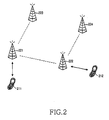
- FIG. 2 is a diagram illustrating a wireless distributed system according to an embodiment of the present invention.
- the wireless distributed system includes 4 base stations 221, 222, 223, and 224, and the mobile terminals 211 and 212 are registered to the nearest base stations 221 and 222, respectively, in an initial registration. That is, each base station as the authenticator such that the authentication functions are distributed acts among the base stations.
- the wireless distributed system of FIG. 2 two scenarios can be considered.
- the first is when the mobile station requests association with a base station with which it shares a security association which may be either a shared secret or a public key certificate derived from a common authority.
- the second is when the mobile station request association with a base station with which it doesn't share a secret.
- the 802.11i protocol or other key derivation protocol
- EAP extensible authentication protocol
- the authentication method of the present invention can be operated in conjunction with the 802.11 i protocol (or other key derivation protocol).
- the base station broadcasts the identification of the mobile station to the wireless distribution system (WDS) for identifying a base station sharing the secret within the WDS. If no base station is found, then the mobile station cannot be authenticated.
- the authenticating base station may be one-hop, i.e., at least a neighbor away from the requesting base station.
- the authentication procedure will be explained in two cases: the neighbor-supported authentication in which the authenticating base station is one-hop-away from requesting base station and the multi-hop-supported authentication in which the authenticating base station is more than one hop from the requesting base station.
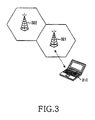
- FIG. 3 is a diagram illustrating a neighbor-supported authentication according to the present invention. As shown in FIG. 3, the base station 321 finds a neighbor base station 322 for authenticating the mobile station 310.
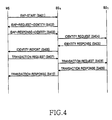
- FIG. 4 is a message flow diagram for illustrating the neighbor-supported authentication according to the present invention.
- a base station BS R having the relay function upon receiving an EAP-START message from the MS at step S401, a base station BS R having the relay function returns an EAP-REQUEST-IDENTITY message to the MS at step S402.
- the MS transmits EAP-RESPONSE-IDENTITY message to the BS R at step S403.
- the BS R Upon receiving the EAP-RESPONSE-IDENTITY message, the BS R multicasts an Identity Request message over the wireless distributed system (WDS) for finding a target base station BS T to which the MS is previously registered for sharing the secret with the MS at step S404.
- WDS wireless distributed system
- the BS T transmits Identity Response message including the ID of BS T , an encryption E K T ⁇ MS ( N T , T ) of a key shared between the BS T and the MS, and an encryption of key shared between the BS T and BS R E K T ⁇ R ( N T , T ) at step S405.
- E is an AES-CCM encryption
- K is a session key that is generated by BS T
- N T is 256 bit nonces chosen by BS T .
- the BS R After receiving the Identity Response message, the BS R transmits an Identity Report message to the MS at step S406.
- the Identity Reponse message includes the ID of BS T and the key encryption E K T ⁇ MS ( N T , T ) shared between the BS T and the MS.
- the MS transmits a Transaction Request message, to the BS T , including a 256 bit transaction identifier chosen by MS, MS ID, BS R ID, BS T ID, and the key encryption E K T ⁇ MS ( N MS ,N T ,M,MS,BS R ,BS T ,T ), at step S407.
- BS R forwards the Transaction Request message, to the BS T , together with the encryption E K T ⁇ R ( N MS ,N T ,M,T,MS,BS T ) of key between the BS R and BS T at step S408.
- the BS R forwards the transaction Response containing only the key encryption E K T ⁇ MS ( N R ,T,MS,BS T ) to MS at step S410.
- the BS R and MS After completion of the above procedure, the BS R and MS perform the IEEE 802.11 i fourway handshake to ensure that only the BS R and the MS know the derived session key.
- the BS R may use any algorithm to select the BS T .
- FIG. 5 is a diagram illustrating a multi-hop-supported authentication according to the present invention. As shown in FIG. 5, a BS T 522 is found at more than one-hop-away from the BS R 521 in a WDS 500.
- a secret K T « R between the BS T and the BS R must be established (if it does not exist) for deriving a new fresh secret between the BS R 521 and a MS 510.
- the MS and the BS T must share a secret K T « MS .
- the multi-hop-supported authentication algorithm works exactly as in the neighbor-supported authentication. If the two preconditions are not satisfied, the multi-hop-supported authentication algorithm must fail with the proper EAP failure message.
- the BS R When a BS R does not share a secret with an MS requesting authentication, the BS R must broadcast an identification of the MS to the neighbor BSs with a vendor dependent hop-count. Each neighbor BS in turn decrements the hop-count and forwards the message to its neighbors. If a member of the WDS receives a second duplicate of the message, it discards the message.
- the BS When a BS sharing a secret with the MS receives the broadcast message, the BS must responds to the requesting BS R . If the BS R receives the responses to its broadcast message, it selects the BS which already shares a secret as the BS T . On the other hand, if the BS R does not share a secret with any of the responding BSs, then it selects the closest BS responded to the broadcast message as the BS T and establishes a secret to be shared with the BS T before responding to the MS.
- the MS caches the result and transmits the request message in unicast rather than multicast. If the BS R see that some BSs shares a secret with the MS, the BS R caches the result and unicasts the request message to the BSs in next transmission. Also, the BS R can cashe the result of the authentication of the MS. When the MS attempts to access the BS R having the authentication result, the BS R can authenticate the MS directly via traditional EAP.
- Fig. 6 is a flowchart illustrating a distributed authentication method according to the present invention.
- the BS R receives an EAP-START message from a MS at step S601, it transmits an EAP Request message back to the MS at step S602 and receives an EAP Response message from the MS in response to the EAP Request message at step S603.
- the BS R multicasts an Identity Request message over WDS for locating a BS T at step S604.
- the BS R determines whether any Identity Response message is received at step S605. If there is no Identity response message in a predetermined period, the BS R retransmit the Identity Request message.
- the retransmission is executed out in predetermined times. If the Identity Response message is received from at least one BS, the BS R determines whether there is BS which is one-hop-away from BS R among the BSs transmitting the identity Response message, i.e., neighbor BS, at step S606. If there is a neighbor BS, the BS R performs a Neighbor-supported authentication procedure at step S607. Otherwise, the BS R performs Multi-hop-supported authentication procedure at step S608.
- FIG. 7 is a flowchart illustrating the neighbor-supported authentication procedure of FIG. 6 in detail.
- the BS R once the BS R enters the neighbor-supported authentication procedure, it counts the number N N of the neighbor BS transmitting the Identity Response and determines whether N N message is greater than 1 at step S701. If N N is greater than 1, the BS R selects one among the BSs as BS T at step S702. The BS T selection can be carried out with various selection algorithms. Once the BS T is selected, the BS R forwards the Identity Response received from the BS T to the MS at step S703.
- the BS R receives a Transaction Request message from the MS at step S704.
- the Transaction Request message includes a 256 bit transaction identifier chosen by MS, MS ID, BS R ID, BS T ID, and the key encryption E K T ⁇ MS ( N MS , N T ,M,MS, BS R , BS T ,T ).
- the BS R transmits the Transaction Request message to the BS T at step S705.
- the transmitted Transaction Request message further includes the encryption E K T ⁇ R ( N MS , N T ,M,T,MS,BS T ) of key between the BS R and BS T .
- the forwarded Transaction Response message includes only the key encryptions E K T ⁇ MS ( N R ,T,MS,BS T ).
- the BS R computes session key at step S708.
- FIG. 8 is a flowchart illustrating the multi-hop-supported authentication procedure of FIG. 6 in detail.
- the BS R determines whether the number N M of the multi-hop BS transmitting the Identity Response message is greater than 1 at step S801. If N M is greater than 1, the BS R determines whether there is any BS sharing a secret with itself at step S802. If there is any BS sharing a secret with the BS R , the BS R selects the BS sharing the secret with itself as the BS T at step S804 and then transmits the Identity Response message received from the BS T to the MS at step S806. In case that the number of BS sharing the secret is greater than 1, the BS R can select one of the BSs as BS T with a selection parameter such as hop count.
- the BS R selects a closest BS among the BSs transmitting the Identity Response message as BS T at step S803 and then establishes a secret shared with the BS T at step S805. After establishing the secret, the BS R forwards the Identity Response message received from the BS T which shares the secret to the MS at step S806.
- the BS R selects the only one BS transmitting the Identity Response message as the BS T at step S815 and then determines whether or not the BS T has a secret sharing with itself at step S816. If the BS T has a secret sharing with the BS R , the BS R forwards the Identity Response message received from the BS T to the MS at step S806.
- the BS R establish a secret to be shared with the BS T at step S805 and then forwards the Identity Response message received from the BS T to the MS at step S806.
- the BS R waits and receives a Transaction Request message from the MS at step S807.
- the Transaction Request message includes a 256 bit transaction identifier chosen by MS, MS ID, BS R ID, BS T ID, and the key encryption E K T ⁇ MS ( N MS , N T , M, MS, BS R , BS T , T ).
- the BS R forwards the Transaction Request message to the BS T at step S808.
- the forwarded Transaction Request message further includes the encryption E K T ⁇ R ( N MS , N T , M, T, MS, BS T ) of key between the BS R and BS T .
- the forwarded Transaction Response message includes only the key encryptions E K T ⁇ MS ( N R ,T,MS,BS T ).
- the BS R computes session key at step S811.
- the distributed authentication method of the present invention distributes the authentication management to the base stations such that it is possible to simplify the authentication procedure without a central manager such as AAA server.
- the distributed authentication method of the present invention is performed without AAA server when a new base station is installed or isolated base stations are joined, it is possible to extend the network in an easy manner without degradation of the security degree and additional labor burden of the operator.
- the distributed authentication method of the present invention can join at least two isolated systems within a wireless distributed system by establishing a single shared secret between the two base stations.
Landscapes
- Engineering & Computer Science (AREA)
- Computer Security & Cryptography (AREA)
- Computer Networks & Wireless Communication (AREA)
- Signal Processing (AREA)
- Computer Hardware Design (AREA)
- Computing Systems (AREA)
- General Engineering & Computer Science (AREA)
- Mobile Radio Communication Systems (AREA)
Abstract
Description
- The present invention relates generally to a wireless distribution system and, in particular, to an authentication method for a multi-hop wireless distribution system.
- A system in networking to control what resources network devices can access is called an authentication, authorization and accounting (AAA) system. In the context of AAA systems, network devices that attempt to gain access to network resources are generally referred to as "supplicants." Typically, system users cause supplicants to request access to particular resources. However, supplicants may also self-initiate access attempts for particular resources. These supplicants typically consist of laptops, desktop PCs, IP phones, virtual private network (VPN) clients, handheld devices, and any other device that may request access to a network resource.
- AAA systems include AAA clients and AAA servers. In AAA systems, supplicants typically attempt to gain access to network resources through AAA clients. AAA clients normally reside on network elements such as network access servers (NAS), routers, switches, firewalls, virtual private network (VPN) concentrators, and wireless access points (WAPs). However, AAA clients can reside on any device that facilitates access to network resources. The supplicants attempts are sent to the AAA client, which in turn generates and issues access requests to an AAA server. Typically, AAA servers handle access requests sent by AAA clients to access network resources by maintaining a database of user profiles, querying the database against access requests to verify authenticity, determining resources authorized for use, and accounting for the use of network resources. Communication between the AAA client and AAA server is facilitated via an AAA message protocol such as a Remote Authentication Dial-In User Service (RADIUS) and a Terminal Access Controller Access Control Systems protocol (TACACS+).
- FIG. 1 is a diagram illustrating a conventional AAA system, in which the base stations (BSs) 121 and 122 perform authentication procedures by exchanging messages with mobile stations (MSs) 131, 132, 133, and 134 and an
AAA server 110 upon receiving access requests from theMSs AAA server 110 such that theBSs MS - However, the conventional AAA protocol is not appropriate for multi-hop wireless distribution system since the additional relay base stations (RBSs) are required as the number of the MSs increases. Also, the conventional AAA system has some drawbacks in that the MS should be registered to the central manager in initial registration, and the installment of the additional BS is complex since the MS should be registered to the central manager. Even in the system having no AAA server, the main BS suffers processing burden since the main BS should make the role of the central manager.
- It is therefore an object of the present invention to solve the above problems. Accordingly, it is an object of the present invention to provide an authentication method of wireless distribution system which is capable of being supported by multi-hop-away base stations.
- It is another object of the present invention to provide an authentication method of wireless distribution system which is capable of establishing a shared secret between the base station and the mobile stations without involvement of the AAA server.
- It is still another object of the present invention to provide an authentication method of wireless distribution system, which allows for easily extending the network by adding base stations without loss of the security degree and additional labor burden for the operator.
- It is still yet another object of the present invention to provide an authentication method of wireless distribution system, which is capable of easily joining at least two isolated systems by establishing a single shared secret between the connecting base stations.
- The above objects are achieved with the authentication method of wireless distribution system including at least one base station providing access service to mobile stations in a coverage of the base station. The authentication method includes receiving, at an unregistered base station, an authentication request from a mobile station; multicasting over the wireless distribution system an identity request for identifying the mobile station; receiving identity responses from at least one base station in response to the identity request; and performing authentication of the mobile station based on the identity responses.
- Preferably, the step of performing the authentication of the mobile station includes determining whether there are base stations one hop away from the unregistered base station and performing a neighbor-supported authentication if there is at least one one-hop-away base station.
- Preferably, the step of performing the authentication of the mobile station further includes performing multi-hop-supported authentication if there is no one--hop-away base station.
- Preferably, the step of performing the neighbor-supported authentication includes determining whether or not a number of the one-hop-away base stations is greater than 1, selecting one one-hop-away base station from among the one-hop-away base stations as a target base station if the number of the one-hop-away base stations is greater than 1, and creating a session key shared with the MS on the basis of the identity response received from the target base station.
- Preferably, the step of performing the neighbor-supported authentication further includes determining the one-hop-away base station as a target base station if the number of the one-hop-away base stations is not greater than 1.
- Preferably, the step of creating the session key includes forwarding the identity response received from the target base station to the mobile station, receiving a transaction request from the MS in response to the identity response, forwarding the transaction request to the target base station, receiving a transaction response from the target base station in response to the transaction request, forwarding the transaction response to the MS, and computing, at the unregistered base station and the mobile terminal, the session key using the transaction response.
- Preferably, the transaction request includes a transaction identifier chosen by the mobile station, a mobile station identifier (ID), an unregistered base station ID, a target base station ID, and a secret shared between the target base station and the mobile station. Preferably, the transaction identifier is 256 bits long.
- Preferably, the secret shared between the target base station and the mobile station is encrypted with nonces chosen by the mobile terminal and the target base station, the transaction identifier, the mobile station ID, the unregistered base station ID, and the target base station ID. Preferably, each nonce is 256 bits long.
- Preferably, the transaction request further includes a secret shared between the target base station and the unregistered base station.
Preferably, the secret shared between the target base station and the unregistered base station is encrypted with nonces chosen by the unregistered base station and the target base station, the transaction identifier, the target base station ID, the mobile station ID, and the unregistered base station ID. - Preferably, the step of receiving the transaction response from the target base station includes computing, at the target base station, a session key, and transmitting the session key with the transaction response. Preferably, the transaction response includes a secret shared between the target base station and the unregistered base station and a secret shared between the target base station and the mobile station. Preferably, the secret between the target base station and the unregistered base station is encrypted with a nonce chosen by the mobile station, a target base station ID, a mobile station ID, and an unregistered base station ID.
- Preferably, the secret between the target base station and the mobile station is encrypted with a nonce chosen by the unregistered base station, a target base station ID, a mobile station ID, and an unregistered base station ID.
- Preferably, the transaction response includes a secret shared between the target base station and the mobile station.
- Preferably, the secret between the target base station and the mobile station is encrypted with a nonce chosen by the unregistered base station, a target base station ID, a mobile station ID, an unregistered base station ID.
- Preferably, the step of performing the multi-hop-supported authentication includes determining whether a number of the multi-hop-away base station is greater than 1, selecting the base station transmitting the identity response as the target base station if the multi-hop-away base station is not greater than 1, determining whether the target base station has a secret shared with the unregistered base station, and creating a session key shared with the mobile station on the basis of the identity response received from the target base station if the target base station has the secret shared with the unregistered base station.
- Preferably, the step of performing the multi-hop-supported authentication further includes establishing a secret to be shared with the target base station if the multi-hop away base station has no secret shared with the unregistered base station.
- Preferably, the step of performing the multi-hop-supported authentication further includes determining whether there is any base station having a secret sharing with the unregistered base station among the multi-hop-away base stations transmitted the identity responses if the number of multi-hop-away base station is greater than 1, and selecting one among the multi-hop-away base stations having the secret shared with the unregistered base stations as the target base station if there is at least one multi-hop-away base station sharing the secret with the unregistered base station.
- Preferably, the step of performing the multi-hop-supported authentication further includes selecting a closest base station among the multi-hop-away base stations as the target base station if the there is no multi-hop-away base station sharing a secret with the unregistered base station.
- The accompanying drawings, which are included to provide a further understanding of the invention and are incorporated in and constitute a part of this application, illustrate embodiment(s) of the invention and together with the description serve to explain the principle of the invention. In the drawings:
- FIG. 1 is a diagram illustrating a conventional AAA system;
- FIG. 2 is a diagram illustrating a wireless distributed authentication system according to the present invention;
- FIG. 3 is a diagram illustrating a neighbor-supported authentication according to the present invention;
- FIG. 4 is a message flow diagram for illustrating the neighbor-supported authentication method according to the present invention;
- FIG. 5 is a diagram illustrating a multi-hop-supported authentication according to the present invention;
- FIG. 6 is a flowchart illustrating a wireless distributed authentication method according to the present invention;
- FIG. 7 is a flowchart illustrating the neighbor-supported authentication procedure of FIG. 6 in detail; and
- FIG. 8 is a flowchart illustrating the multi-hop-supported authentication procedure of FIG. 6 in detail.
- Preferred embodiments of the present invention will be described below with reference to the accompanying drawings.. In the following description of the present invention, detailed descriptions of well-known functions and structures incorporated herein will be omitted when it may obscure the subject matter of the present invention in unnecessary detail.
- FIG. 2 is a diagram illustrating a wireless distributed system according to an embodiment of the present invention. As shown in FIG. 2, the wireless distributed system includes 4
base stations mobile terminals nearest base stations - In the wireless distributed system of FIG. 2, two scenarios can be considered. The first is when the mobile station requests association with a base station with which it shares a security association which may be either a shared secret or a public key certificate derived from a common authority. The second is when the mobile station request association with a base station with which it doesn't share a secret. In the first scenario, the 802.11i protocol (or other key derivation protocol) and the extensible authentication protocol (EAP) are used. In the second scenario, the authentication method of the present invention can be operated in conjunction with the 802.11 i protocol (or other key derivation protocol).
- Initially the authentication procedure without a common security association will be described. When the mobile station requires to associate with a base station which does not share a secret, the base station broadcasts the identification of the mobile station to the wireless distribution system (WDS) for identifying a base station sharing the secret within the WDS. If no base station is found, then the mobile station cannot be authenticated. In case that the base station sharing the secret is found, the authenticating base station may be one-hop, i.e., at least a neighbor away from the requesting base station. In this embodiment, the authentication procedure will be explained in two cases: the neighbor-supported authentication in which the authenticating base station is one-hop-away from requesting base station and the multi-hop-supported authentication in which the authenticating base station is more than one hop from the requesting base station.
- FIG. 3 is a diagram illustrating a neighbor-supported authentication according to the present invention. As shown in FIG. 3, the
base station 321 finds aneighbor base station 322 for authenticating themobile station 310. - When a
neighbor base station 322 shares a secret with themobile station 310 and themobile station 321 shares a secret with theneighbor base station 322 , a modified Otway-Reese protocol using EAP can be used for authenticating the mobile station and derive a new fresh secret between thebase station 321 and themobile station 310. FIG. 4 is a message flow diagram for illustrating the neighbor-supported authentication according to the present invention. - Referring to FIG. 4, upon receiving an EAP-START message from the MS at step S401, a base station BSR having the relay function returns an EAP-REQUEST-IDENTITY message to the MS at step S402. In response to the EAP-REQUEST-IDENTITY message, the MS transmits EAP-RESPONSE-IDENTITY message to the BSR at step S403.
- Upon receiving the EAP-RESPONSE-IDENTITY message, the BSR multicasts an Identity Request message over the wireless distributed system (WDS) for finding a target base station BST to which the MS is previously registered for sharing the secret with the MS at step S404.
- Once receiving the Identity Request message, the BST transmits Identity Response message including the ID of BST, an encryption E K
T↔MS (N T ,T) of a key shared between the BST and the MS, and an encryption of key shared between the BST and BSR E KT↔R (N T ,T) at step S405. E is an AES-CCM encryption, K is a session key that is generated by BST, NT is 256 bit nonces chosen by BST. - After receiving the Identity Response message, the BSR transmits an Identity Report message to the MS at step S406. The Identity Reponse message includes the ID of BST and the key encryption E K
T↔MS (N T ,T) shared between the BST and the MS. - Sequentially, the MS transmits a Transaction Request message, to the BST, including a 256 bit transaction identifier chosen by MS, MS ID, BSR ID, BST ID, and the key encryption E K
T↔MS (N MS ,N T ,M,MS,BS R ,BS T ,T), at step S407. BSR forwards the Transaction Request message, to the BST, together with the encryption E KT↔R (N MS ,N T ,M,T,MS,BS T ) of key between the BSR and BST at step S408. Upon receiving the Transaction Request message, BST computes the session key k with the TLS-PRF: k=TLS-PRF(M,NMS, NT, NR), and then transmits a Transaction Response message including the key encryptions E KT↔R (N MS ,T,MS,BS T ) and E KT↔MS (N R ,T,MS,BS T ) to BSR at step S409. The BSR forwards the transaction Response containing only the key encryption E KT↔MS (N R ,T,MS,BS T ) to MS at step S410. Consequentially, BSR and MS compute k: k= TLS-PRF(M,NMS, NT, NR). - After completion of the above procedure, the BSR and MS perform the IEEE 802.11 i fourway handshake to ensure that only the BSR and the MS know the derived session key.
- If more than one BSs response to the BSR, the BSR may use any algorithm to select the BST.
- FIG. 5 is a diagram illustrating a multi-hop-supported authentication according to the present invention. As shown in FIG. 5, a
BS T 522 is found at more than one-hop-away from theBS R 521 in a WDS 500. - When the authenticating BST is more than one-hop-away, a secret K T« R between the BST and the BSR must be established (if it does not exist) for deriving a new fresh secret between the
BS R 521 and aMS 510. As in the neighbor-supported authentication, the MS and the BST must share a secret K T« MS . - If these two preconditions are satisfied, then the multi-hop-supported authentication algorithm works exactly as in the neighbor-supported authentication. If the two preconditions are not satisfied, the multi-hop-supported authentication algorithm must fail with the proper EAP failure message.
- When a BSR does not share a secret with an MS requesting authentication, the BSR must broadcast an identification of the MS to the neighbor BSs with a vendor dependent hop-count. Each neighbor BS in turn decrements the hop-count and forwards the message to its neighbors. If a member of the WDS receives a second duplicate of the message, it discards the message.
- When a BS sharing a secret with the MS receives the broadcast message, the BS must responds to the requesting BSR. If the BSR receives the responses to its broadcast message, it selects the BS which already shares a secret as the BST. On the other hand, if the BSR does not share a secret with any of the responding BSs, then it selects the closest BS responded to the broadcast message as the BST and establishes a secret to be shared with the BST before responding to the MS.
- In case that the MS sees that some BSs share a secret with the BSR, the MS caches the result and transmits the request message in unicast rather than multicast. If the BSR see that some BSs shares a secret with the MS, the BSR caches the result and unicasts the request message to the BSs in next transmission. Also, the BSR can cashe the result of the authentication of the MS. When the MS attempts to access the BSR having the authentication result, the BSR can authenticate the MS directly via traditional EAP.
- Fig. 6 is a flowchart illustrating a distributed authentication method according to the present invention. Referring to FIG. 6, once the BSR receives an EAP-START message from a MS at step S601, it transmits an EAP Request message back to the MS at step S602 and receives an EAP Response message from the MS in response to the EAP Request message at step S603. Upon receiving the EAP Response message, the BSR multicasts an Identity Request message over WDS for locating a BST at step S604. After multicasting the Identity Request message, the BSR determines whether any Identity Response message is received at step S605. If there is no Identity response message in a predetermined period, the BSR retransmit the Identity Request message. The retransmission is executed out in predetermined times. If the Identity Response message is received from at least one BS, the BSR determines whether there is BS which is one-hop-away from BSR among the BSs transmitting the identity Response message, i.e., neighbor BS, at step S606. If there is a neighbor BS, the BSR performs a Neighbor-supported authentication procedure at step S607. Otherwise, the BSR performs Multi-hop-supported authentication procedure at step S608.
- FIG. 7 is a flowchart illustrating the neighbor-supported authentication procedure of FIG. 6 in detail. Referring to FIG. 7, once the BSR enters the neighbor-supported authentication procedure, it counts the number NN of the neighbor BS transmitting the Identity Response and determines whether NN message is greater than 1 at step S701. If NN is greater than 1, the BSR selects one among the BSs as BST at step S702. The BST selection can be carried out with various selection algorithms. Once the BST is selected, the BSR forwards the Identity Response received from the BST to the MS at step S703.
- Sequentially, the BSR receives a Transaction Request message from the MS at step S704. The Transaction Request message includes a 256 bit transaction identifier chosen by MS, MS ID, BSR ID, BST ID, and the key encryption E K
T↔MS (N MS , N T ,M,MS, BS R , BS T ,T). Thereafter, the BSR transmits the Transaction Request message to the BST at step S705. The transmitted Transaction Request message further includes the encryption E KT↔R (N MS , N T ,M,T,MS,BS T ) of key between the BSR and BST.
Upon receiving the Transaction Request message, BST computes the session key k with the TLS-PRF: k=TLS-PRF(M,NMS, NT, NR), and then transmits a Transaction Response message including the key encryptions E KT↔R (N MS ,T,MS,BS T ) and E KT↔MS (N R ,T,MS,BS T ), such that the BSR receives the Transaction Response message at step S706 and then forwards the Transaction Response message to the MS at step S707. The forwarded Transaction Response message includes only the key encryptions E KT↔MS (N R ,T,MS,BS T ). After transmitting the Transaction Response message, the BSR computes session key at step S708. The session key is computed by the BSR and MS at the same time as k= TLS-PRF(M,NMS, NT, NR). - FIG. 8 is a flowchart illustrating the multi-hop-supported authentication procedure of FIG. 6 in detail. Referring to FIG. 8, once the BSR enters the multi-hop-supported authentication procedure, it determines whether the number NM of the multi-hop BS transmitting the Identity Response message is greater than 1 at step S801. If NM is greater than 1, the BSR determines whether there is any BS sharing a secret with itself at step S802. If there is any BS sharing a secret with the BSR, the BSR selects the BS sharing the secret with itself as the BST at step S804 and then transmits the Identity Response message received from the BST to the MS at step S806. In case that the number of BS sharing the secret is greater than 1, the BSR can select one of the BSs as BST with a selection parameter such as hop count.
- If there is no BS sharing a secret with the BSR at step S802, the BSR selects a closest BS among the BSs transmitting the Identity Response message as BST at step S803 and then establishes a secret shared with the BST at step S805. After establishing the secret, the BSR forwards the Identity Response message received from the BST which shares the secret to the MS at step S806.
- If it is determined that the NM is not greater than 1 at step S801, the BSR selects the only one BS transmitting the Identity Response message as the BST at step S815 and then determines whether or not the BST has a secret sharing with itself at step S816. If the BST has a secret sharing with the BSR, the BSR forwards the Identity Response message received from the BST to the MS at step S806.
- On the other hand, if the BST does not have a secret sharing with the BSR, the BSR establish a secret to be shared with the BST at step S805 and then forwards the Identity Response message received from the BST to the MS at step S806.
- After forwarding the Identity Response message, the BSR waits and receives a Transaction Request message from the MS at step S807. The Transaction Request message includes a 256 bit transaction identifier chosen by MS, MS ID, BSR ID, BST ID, and the key encryption E K
T↔MS (N MS , N T , M, MS, BS R , BS T , T). Thereafter, the BSR forwards the Transaction Request message to the BST at step S808. The forwarded Transaction Request message further includes the encryption E KT↔R (N MS , N T , M, T, MS, BS T ) of key between the BSR and BST. Upon receiving the Transaction Request message, BST computes the session key k with the TLS-PRF: k=TLS-PRF(M,NMS, NT, NR), and then transmits a Transaction Response message including the key encryptions E KT↔R (N MS ,T,MS,BS T ) and E KT↔MS (N R ,T,MS,BS T ), such that the BSR receives the Transaction Response message at step S809 and then forwards the Transaction Response message to the MS at step S810. The forwarded Transaction Response message includes only the key encryptions E KT↔MS (N R ,T,MS,BS T ). After transmitting the Transaction Response message, the BSR computes session key at step S811. The session key is computed by the BSR and MS at the same as k= TLS-PRF(M,NMS, NT, NR). - While this invention has been described in connection with what is presently considered to be the most practical and preferred embodiments, it is to be understood that the invention is not limited to the disclosed embodiments, but, on the contrary, is intended to cover various modifications and equivalent arrangements included within the spirit and scope of the appended claims. As described above, the distributed authentication method of the present invention distributes the authentication management to the base stations such that it is possible to simplify the authentication procedure without a central manager such as AAA server.
- Also, since the distributed authentication method of the present invention is performed without AAA server when a new base station is installed or isolated base stations are joined, it is possible to extend the network in an easy manner without degradation of the security degree and additional labor burden of the operator.
- Furthermore, with the simplified authentication procedures without the central management device, the distributed authentication method of the present invention can join at least two isolated systems within a wireless distributed system by establishing a single shared secret between the two base stations.
Claims (35)
- An authentication method for wireless distribution system including at least one base station providing access service to mobile stations in a coverage area of the base station, comprising:receiving, at an unregistered base station an authentication request from a mobile station;multicasting over the wireless distribution system an identity request for identifying the mobile station;receiving identity responses from at least one base station in response to the identity request; andperforming authentication of the mobile station on the basis of the identity responses.
- The method of claim 1, wherein the step of performing the authentication of the mobile station includes:determining whether there are base stations one-hop-away from the unregistered base station; andperforming a neighbor-supported authentication if there is at least one one-hop-away base station.
- The method of claim 2, wherein the step of performing the authentication of the mobile station further includes:performing multi-hop-supported authentication with base stations more than two hops away if there is no one-hop-away base station.
- The method of claim 2, wherein the step of performing the neighbor-supported authentication includes:determining whether a number of the one-hop-away base stations is greater than 1;selecting one of the one-hop-away base station from among the one-hop-away base stations as a target base station if the number of the one-hop-away base stations is greater than 1; andcreating a session key shared with the MS on the basis of the identity response received from the target base station.
- The method of claim 4, wherein the step of performing the neighbor-supported authentication further includes:determining the one-hop-away base station as a target base station if the number of the one-hop-away base stations is not greater than 1.
- The method of claim 5, wherein the step of creating the session key includes:transmitting the identity response received from the target base station to the mobile station;receiving a transaction request from the MS in response to the identity response;transmitting the transaction request to the target base station;receiving a transaction response from the target base station in response to the transaction request;transmitting the transaction response to the MS; andcomputing, at the unregistered base station and the mobile terminal, the session key using the transaction response.
- The method of claim 6, wherein the transaction request includes a transaction identifier chosen by the mobile station, a mobile station ID, an unregistered base station ID, a target base station ID, and a secret shared between the target base station and the mobile station.
- The method of claim 7, wherein the transaction identifier is 256 bits long.
- The method of claim 7, wherein the secret shared between the target base station and the mobile station is encrypted with nonces chosen by the mobile terminal and the target base station, the transaction identifier, the mobile station ID, the unregistered base station ID, and the target base station ID.
- The method of claim 9, wherein each nonce is 256 bits long.
- The method of claim 7, wherein the transaction request further includes a secret shared between the target base station and the unregistered base station.
- The method of claim 11, wherein the secret shared between the target base station and the unregistered base station is encrypted with nonces chosen by the unregistered base station and the target base station, the transaction identifier, the target base station ID, the mobile station ID, and the unregistered base station ID.
- The method of claim 6, wherein the step of receiving the transaction response from the target base station includes:computing, at the target base station, a session key; andtransmitting the session key with the transaction response.
- The method of claim 13, wherein the transaction response includes a secret shared between the target base station and the unregistered base station and a secret shared between the target base station and the mobile station.
- The method of claim 14, wherein the secret shared between the target base station and the unregistered base station is encrypted with a nonce chosen by the mobile station, a target base station ID, a mobile station ID, and an unregistered base station ID.
- The method of claim 14, wherein the secret shared between the target base station and the mobile station is encrypted with a nonce chosen by the unregistered base station, a target base station ID, a mobile station ID, and an unregistered base station ID.
- The method of claim 13, wherein the transaction response includes a secret shared between the target base station and the mobile station.
- The method of claim 17, wherein the secret between the target base station and the mobile station is encrypted with a nonce chosen by the unregistered base station, a target base station ID, a mobile station ID, an unregistered base station ID.
- The method of claim 3, wherein the step of performing the multi-hop-supported authentication includes:determining whether a number of the multi-hop-away base station is greater than 1;selecting the base station transmitted the identity response as the target base station if the multi-hop-away base station is not greater than 1;determining whether the target base station has a secret shared with the unregistered base station; andcreating a session key shared with the mobile station on the basis of the identity response received from the target base station if the target base station has the secret shared with the unregistered base station.
- The method of claim 19, wherein the step of performing the multi-hop-supported authentication further cludes:establishing a secret to be shared with the target base station if the multi-hop away base station has no secret shared with the unregistered base station.
- The method of claim 20, wherein the step of performing the multi-hop-supported authentication further includes:determining whether there is any base station having a secret sharing with the unregistered base station among the multi-hop-away base stations transmitted the identity responses if the number of multi-hop-away base station is greater than 1; andselecting one of the multi-hop-away base stations from among the multi-hop-away base stations having the secret shared with the unregistered base stations as the target base station if there is at least one multi-hop-away base station sharing the secret with the unregistered base station.
- The method of claim 21, wherein the step of performing the multi-hop-supported authentication further includes:selecting a closest base station among the multi-hop-away base stations as the target base station if there is no multi-hop-away base station sharing a secret with the unregistered base station.
- The method of claim 22, wherein the step of creating the session key includes:forwarding the identity response received from the target base station to the mobile station;receiving a transaction request from the MS in response to the identity response;forwarding the transaction request to the target base station;receiving a transaction response from the target base station in response to the transaction request;forwarding the transaction response to the MS; andcomputing, at the unregistered base station and the mobile terminal, the session key using the transaction response.
- The method of claim 23, wherein the transaction request includes a transaction identifier chosen by the mobile station, a mobile station ID, an unregistered base station ID, a target base station ID, and a secret shared between the target base station and the mobile station.
- The method of claim 24, wherein the transaction identifier is 256 bits long.
- The method of claim 24, wherein the secret shared between the target base station and the mobile station is encrypted with nonces chosen by the MS and the target base station, the transaction identifier, the mobile station ID, the unregistered base station ID, and the target base station ID.
- The method of claim 26, wherein each nonce is 256 bits long.
- The method of claim 24, wherein the transaction request further includes a secret shared between the target base station and the unregistered base station.
- The method of claim 28, wherein the secret shared between the target base station and the unregistered base station is encrypted with nonces chosen by the unregistered base station and the target base station, the transaction identifier, the target base station ID, the mobile station ID, and the unregistered base station ID.
- The method of claim 23, wherein the step of receiving the transaction response from the target base station includes:computing, at the target base station, a session key; andtransmitting the session key with the transaction response.
- The method of claim 30, wherein the transaction response includes a secret shared between the target base station and the unregistered base station and a secret shared between the target base station and the mobile station.
- The method of claim 31, wherein the secret shared between the target base station and the unregistered base station is encrypted with a nonce chosen by the mobile station, a target base station ID, a mobile station ID, an unregistered base station ID.
- The method of claim 31, wherein the secret shared between the target base station and the mobile station is encrypted with a nonce chosen by the unregistered base station, a target base station ID, a mobile station ID, an unregistered base station ID.
- The method of claim 30, wherein the transaction response includes a secret shared between the target base station and the mobile station.
- The method of claim 34, wherein the secret shared between the target base station and the mobile station is encrypted with a nonce chosen by the unregistered base station, a target base station ID, a mobile station ID, an unregistered base station ID.
Applications Claiming Priority (2)
| Application Number | Priority Date | Filing Date | Title |
|---|---|---|---|
| US68058405P | 2005-05-13 | 2005-05-13 | |
| KR1020060041227A KR101253352B1 (en) | 2005-05-13 | 2006-05-08 | Authentication method for wireless distributed system |
Publications (3)
| Publication Number | Publication Date |
|---|---|
| EP1722589A2 true EP1722589A2 (en) | 2006-11-15 |
| EP1722589A3 EP1722589A3 (en) | 2014-05-14 |
| EP1722589B1 EP1722589B1 (en) | 2020-02-19 |
Family
ID=36940691
Family Applications (1)
| Application Number | Title | Priority Date | Filing Date |
|---|---|---|---|
| EP06009984.3A Expired - Lifetime EP1722589B1 (en) | 2005-05-13 | 2006-05-15 | Authentication method for wireless distributed system |
Country Status (2)
| Country | Link |
|---|---|
| EP (1) | EP1722589B1 (en) |
| WO (1) | WO2006121307A1 (en) |
Cited By (1)
| Publication number | Priority date | Publication date | Assignee | Title |
|---|---|---|---|---|
| WO2016208960A1 (en) * | 2015-06-22 | 2016-12-29 | Samsung Electronics Co., Ltd. | Method and apparatus for subscribing electronic device in mobile communication system |
Families Citing this family (1)
| Publication number | Priority date | Publication date | Assignee | Title |
|---|---|---|---|---|
| CN113094675B (en) * | 2021-04-29 | 2023-03-28 | 香港中文大学(深圳) | User authentication method and device based on distributed model training |
Family Cites Families (2)
| Publication number | Priority date | Publication date | Assignee | Title |
|---|---|---|---|---|
| US7346772B2 (en) * | 2002-11-15 | 2008-03-18 | Cisco Technology, Inc. | Method for fast, secure 802.11 re-association without additional authentication, accounting and authorization infrastructure |
| US7350077B2 (en) * | 2002-11-26 | 2008-03-25 | Cisco Technology, Inc. | 802.11 using a compressed reassociation exchange to facilitate fast handoff |
-
2006
- 2006-05-12 WO PCT/KR2006/001787 patent/WO2006121307A1/en not_active Ceased
- 2006-05-15 EP EP06009984.3A patent/EP1722589B1/en not_active Expired - Lifetime
Cited By (2)
| Publication number | Priority date | Publication date | Assignee | Title |
|---|---|---|---|---|
| WO2016208960A1 (en) * | 2015-06-22 | 2016-12-29 | Samsung Electronics Co., Ltd. | Method and apparatus for subscribing electronic device in mobile communication system |
| US9826564B2 (en) | 2015-06-22 | 2017-11-21 | Samsung Electronics Co., Ltd. | Method and apparatus for subscribing electronic device in mobile communication system |
Also Published As
| Publication number | Publication date |
|---|---|
| EP1722589A3 (en) | 2014-05-14 |
| WO2006121307A1 (en) | 2006-11-16 |
| EP1722589B1 (en) | 2020-02-19 |
Similar Documents
| Publication | Publication Date | Title |
|---|---|---|
| US7792527B2 (en) | Wireless network handoff key | |
| US7783756B2 (en) | Protection for wireless devices against false access-point attacks | |
| US8561200B2 (en) | Method and system for controlling access to communication networks, related network and computer program therefor | |
| US7421578B1 (en) | Method and apparatus for electing a leader node in a computer network | |
| US6879690B2 (en) | Method and system for delegation of security procedures to a visited domain | |
| US8893246B2 (en) | Method and system for authenticating a point of access | |
| US9027114B2 (en) | Changing group member reachability information | |
| US20090175454A1 (en) | Wireless network handoff key | |
| US8817757B2 (en) | Zero-configuration secure mobility networking technique with web-based authentication interface for large WLAN networks | |
| US8423772B2 (en) | Multi-hop wireless network system and authentication method thereof | |
| US8555345B2 (en) | User authentication and authorisation in a communications system | |
| JP2025515724A (en) | How to join a communication network | |
| JP2004201288A (en) | Fast authentication or re-authentication between layers for network communication | |
| JP2024507208A (en) | How to make a cellular network work | |
| US7756510B2 (en) | Authentication method for wireless distributed system | |
| WO2010065008A1 (en) | Method and system for pre-authentication | |
| KR20150084628A (en) | Security supporting method and system for proximity based service group communication or public safety in mobile telecommunication system environment | |
| JP2016501488A (en) | Group authentication in broadcast for MTC group of UE | |
| JP3792648B2 (en) | Wireless LAN high-speed authentication method and high-speed authentication method | |
| US9137661B2 (en) | Authentication method and apparatus for user equipment and LIPA network entities | |
| EP1722589B1 (en) | Authentication method for wireless distributed system | |
| JP2004266516A (en) | Network management server, communication terminal, edge switch device, communication program, and network system | |
| Shah et al. | A novel symmetric key cryptographic authentication for cooperative communication in cognitive radio networks | |
| Tawfiq et al. | Key Exchange Protocol Supporting Mobility and Multihoming |
Legal Events
| Date | Code | Title | Description |
|---|---|---|---|
| PUAI | Public reference made under article 153(3) epc to a published international application that has entered the european phase |
Free format text: ORIGINAL CODE: 0009012 |
|
| 17P | Request for examination filed |
Effective date: 20060515 |
|
| AK | Designated contracting states |
Kind code of ref document: A2 Designated state(s): AT BE BG CH CY CZ DE DK EE ES FI FR GB GR HU IE IS IT LI LT LU LV MC NL PL PT RO SE SI SK TR |
|
| AX | Request for extension of the european patent |
Extension state: AL BA HR MK YU |
|
| RAP1 | Party data changed (applicant data changed or rights of an application transferred) |
Owner name: THE UNIVERSITY OF MARYLAND COLLEGE PARK Owner name: SAMSUNG ELECTRONICS CO., LTD. |
|
| PUAL | Search report despatched |
Free format text: ORIGINAL CODE: 0009013 |
|
| AK | Designated contracting states |
Kind code of ref document: A3 Designated state(s): AT BE BG CH CY CZ DE DK EE ES FI FR GB GR HU IE IS IT LI LT LU LV MC NL PL PT RO SE SI SK TR |
|
| AX | Request for extension of the european patent |
Extension state: AL BA HR MK YU |
|
| RIC1 | Information provided on ipc code assigned before grant |
Ipc: H04W 12/06 20090101ALI20140407BHEP Ipc: H04W 8/26 20090101ALI20140407BHEP Ipc: H04W 4/06 20090101ALI20140407BHEP Ipc: H04L 29/06 20060101ALI20140407BHEP Ipc: H04L 9/32 20060101AFI20140407BHEP Ipc: H04W 88/08 20090101ALI20140407BHEP |
|
| AKX | Designation fees paid |
Designated state(s): DE FR GB IT SE |
|
| AXX | Extension fees paid |
Extension state: HR Extension state: AL Extension state: YU Extension state: MK Extension state: BA |
|
| 17Q | First examination report despatched |
Effective date: 20171128 |
|
| REG | Reference to a national code |
Ref country code: DE Ref legal event code: R079 Ref document number: 602006059135 Country of ref document: DE Free format text: PREVIOUS MAIN CLASS: H04Q0007380000 Ipc: H04L0009320000 |
|
| RIC1 | Information provided on ipc code assigned before grant |
Ipc: H04L 29/06 20060101ALI20190808BHEP Ipc: H04W 4/06 20090101ALI20190808BHEP Ipc: H04W 88/08 20090101ALI20190808BHEP Ipc: H04W 12/06 20090101ALI20190808BHEP Ipc: H04L 9/32 20060101AFI20190808BHEP Ipc: H04W 8/26 20090101ALI20190808BHEP Ipc: H04W 12/04 20090101ALI20190808BHEP |
|
| GRAP | Despatch of communication of intention to grant a patent |
Free format text: ORIGINAL CODE: EPIDOSNIGR1 |
|
| INTG | Intention to grant announced |
Effective date: 20190913 |
|
| RIN1 | Information on inventor provided before grant (corrected) |
Inventor name: SHIN, MIN-HO Inventor name: ARBAUGH, WILLIAM ALBERT Inventor name: LEE, IN-SUN Inventor name: CLANCY, T. CHARLES, Inventor name: YUN, SANG-BOH |
|
| GRAS | Grant fee paid |
Free format text: ORIGINAL CODE: EPIDOSNIGR3 |
|
| GRAA | (expected) grant |
Free format text: ORIGINAL CODE: 0009210 |
|
| AK | Designated contracting states |
Kind code of ref document: B1 Designated state(s): DE FR GB IT SE |
|
| REG | Reference to a national code |
Ref country code: GB Ref legal event code: FG4D |
|
| REG | Reference to a national code |
Ref country code: DE Ref legal event code: R096 Ref document number: 602006059135 Country of ref document: DE |
|
| PG25 | Lapsed in a contracting state [announced via postgrant information from national office to epo] |
Ref country code: SE Free format text: LAPSE BECAUSE OF FAILURE TO SUBMIT A TRANSLATION OF THE DESCRIPTION OR TO PAY THE FEE WITHIN THE PRESCRIBED TIME-LIMIT Effective date: 20200219 |
|
| REG | Reference to a national code |
Ref country code: DE Ref legal event code: R097 Ref document number: 602006059135 Country of ref document: DE |
|
| PLBE | No opposition filed within time limit |
Free format text: ORIGINAL CODE: 0009261 |
|
| STAA | Information on the status of an ep patent application or granted ep patent |
Free format text: STATUS: NO OPPOSITION FILED WITHIN TIME LIMIT |
|
| 26N | No opposition filed |
Effective date: 20201120 |
|
| PG25 | Lapsed in a contracting state [announced via postgrant information from national office to epo] |
Ref country code: IT Free format text: LAPSE BECAUSE OF FAILURE TO SUBMIT A TRANSLATION OF THE DESCRIPTION OR TO PAY THE FEE WITHIN THE PRESCRIBED TIME-LIMIT Effective date: 20200219 |
|
| PGFP | Annual fee paid to national office [announced via postgrant information from national office to epo] |
Ref country code: DE Payment date: 20250408 Year of fee payment: 20 |
|
| PGFP | Annual fee paid to national office [announced via postgrant information from national office to epo] |
Ref country code: GB Payment date: 20250410 Year of fee payment: 20 |
|
| PGFP | Annual fee paid to national office [announced via postgrant information from national office to epo] |
Ref country code: FR Payment date: 20250409 Year of fee payment: 20 |