EP1722375A1 - Method and device for measuring the power dissipated by a hydridation reaction in tubes and tubular claddings and the corresponding variation in electric resistance - Google Patents
Method and device for measuring the power dissipated by a hydridation reaction in tubes and tubular claddings and the corresponding variation in electric resistance Download PDFInfo
- Publication number
- EP1722375A1 EP1722375A1 EP05708109A EP05708109A EP1722375A1 EP 1722375 A1 EP1722375 A1 EP 1722375A1 EP 05708109 A EP05708109 A EP 05708109A EP 05708109 A EP05708109 A EP 05708109A EP 1722375 A1 EP1722375 A1 EP 1722375A1
- Authority
- EP
- European Patent Office
- Prior art keywords
- hydridation
- component
- hydrogen
- reaction
- dissipated
- Prior art date
- Legal status (The legal status is an assumption and is not a legal conclusion. Google has not performed a legal analysis and makes no representation as to the accuracy of the status listed.)
- Granted
Links
- 238000000034 method Methods 0.000 title claims abstract description 28
- 238000006243 chemical reaction Methods 0.000 title claims abstract description 23
- 238000005253 cladding Methods 0.000 title claims abstract description 22
- 230000000694 effects Effects 0.000 claims abstract description 8
- 239000000446 fuel Substances 0.000 claims abstract description 8
- 239000001257 hydrogen Substances 0.000 claims description 22
- 229910052739 hydrogen Inorganic materials 0.000 claims description 22
- UFHFLCQGNIYNRP-UHFFFAOYSA-N Hydrogen Chemical compound [H][H] UFHFLCQGNIYNRP-UHFFFAOYSA-N 0.000 claims description 21
- 239000000463 material Substances 0.000 claims description 16
- 238000005259 measurement Methods 0.000 claims description 13
- 150000004678 hydrides Chemical class 0.000 claims description 12
- 239000000203 mixture Substances 0.000 claims description 10
- 239000007789 gas Substances 0.000 claims description 9
- 229910052751 metal Inorganic materials 0.000 claims description 8
- 238000001556 precipitation Methods 0.000 claims description 8
- 238000010438 heat treatment Methods 0.000 claims description 6
- 229910001092 metal group alloy Inorganic materials 0.000 claims description 6
- 230000001681 protective effect Effects 0.000 claims description 6
- 238000004090 dissolution Methods 0.000 claims description 5
- 238000000691 measurement method Methods 0.000 claims description 3
- 238000003780 insertion Methods 0.000 claims description 2
- 230000037431 insertion Effects 0.000 claims description 2
- 230000007423 decrease Effects 0.000 abstract description 5
- 239000002699 waste material Substances 0.000 abstract description 2
- 230000002265 prevention Effects 0.000 abstract 1
- 238000013461 design Methods 0.000 description 6
- 229910045601 alloy Inorganic materials 0.000 description 4
- 239000000956 alloy Substances 0.000 description 4
- 230000015572 biosynthetic process Effects 0.000 description 3
- 238000002474 experimental method Methods 0.000 description 2
- 230000010354 integration Effects 0.000 description 2
- 239000002184 metal Substances 0.000 description 2
- XLYOFNOQVPJJNP-UHFFFAOYSA-N water Substances O XLYOFNOQVPJJNP-UHFFFAOYSA-N 0.000 description 2
- 229910001093 Zr alloy Inorganic materials 0.000 description 1
- 230000001154 acute effect Effects 0.000 description 1
- 238000009835 boiling Methods 0.000 description 1
- 238000010586 diagram Methods 0.000 description 1
- 238000010790 dilution Methods 0.000 description 1
- 239000012895 dilution Substances 0.000 description 1
- -1 hydrides ring Chemical group 0.000 description 1
- 150000002431 hydrogen Chemical class 0.000 description 1
- 238000011534 incubation Methods 0.000 description 1
- 238000012423 maintenance Methods 0.000 description 1
- 238000004519 manufacturing process Methods 0.000 description 1
- 150000002739 metals Chemical class 0.000 description 1
- 230000000877 morphologic effect Effects 0.000 description 1
- 239000003758 nuclear fuel Substances 0.000 description 1
- 230000001376 precipitating effect Effects 0.000 description 1
- 230000005855 radiation Effects 0.000 description 1
- 239000000243 solution Substances 0.000 description 1
- 238000002411 thermogravimetry Methods 0.000 description 1
Images


Classifications
-
- G—PHYSICS
- G01—MEASURING; TESTING
- G01N—INVESTIGATING OR ANALYSING MATERIALS BY DETERMINING THEIR CHEMICAL OR PHYSICAL PROPERTIES
- G01N27/00—Investigating or analysing materials by the use of electric, electrochemical, or magnetic means
- G01N27/02—Investigating or analysing materials by the use of electric, electrochemical, or magnetic means by investigating impedance
- G01N27/04—Investigating or analysing materials by the use of electric, electrochemical, or magnetic means by investigating impedance by investigating resistance
- G01N27/041—Investigating or analysing materials by the use of electric, electrochemical, or magnetic means by investigating impedance by investigating resistance of a solid body
-
- G—PHYSICS
- G01—MEASURING; TESTING
- G01N—INVESTIGATING OR ANALYSING MATERIALS BY DETERMINING THEIR CHEMICAL OR PHYSICAL PROPERTIES
- G01N27/00—Investigating or analysing materials by the use of electric, electrochemical, or magnetic means
- G01N27/02—Investigating or analysing materials by the use of electric, electrochemical, or magnetic means by investigating impedance
- G01N27/04—Investigating or analysing materials by the use of electric, electrochemical, or magnetic means by investigating impedance by investigating resistance
- G01N27/14—Investigating or analysing materials by the use of electric, electrochemical, or magnetic means by investigating impedance by investigating resistance of an electrically-heated body in dependence upon change of temperature
- G01N27/16—Investigating or analysing materials by the use of electric, electrochemical, or magnetic means by investigating impedance by investigating resistance of an electrically-heated body in dependence upon change of temperature caused by burning or catalytic oxidation of surrounding material to be tested, e.g. of gas
-
- G—PHYSICS
- G01—MEASURING; TESTING
- G01N—INVESTIGATING OR ANALYSING MATERIALS BY DETERMINING THEIR CHEMICAL OR PHYSICAL PROPERTIES
- G01N25/00—Investigating or analyzing materials by the use of thermal means
- G01N25/20—Investigating or analyzing materials by the use of thermal means by investigating the development of heat, i.e. calorimetry, e.g. by measuring specific heat, by measuring thermal conductivity
- G01N25/48—Investigating or analyzing materials by the use of thermal means by investigating the development of heat, i.e. calorimetry, e.g. by measuring specific heat, by measuring thermal conductivity on solution, sorption, or a chemical reaction not involving combustion or catalytic oxidation
- G01N25/4846—Investigating or analyzing materials by the use of thermal means by investigating the development of heat, i.e. calorimetry, e.g. by measuring specific heat, by measuring thermal conductivity on solution, sorption, or a chemical reaction not involving combustion or catalytic oxidation for a motionless, e.g. solid sample
-
- G—PHYSICS
- G21—NUCLEAR PHYSICS; NUCLEAR ENGINEERING
- G21C—NUCLEAR REACTORS
- G21C17/00—Monitoring; Testing ; Maintaining
- G21C17/06—Devices or arrangements for monitoring or testing fuel or fuel elements outside the reactor core, e.g. for burn-up, for contamination
-
- G—PHYSICS
- G21—NUCLEAR PHYSICS; NUCLEAR ENGINEERING
- G21C—NUCLEAR REACTORS
- G21C21/00—Apparatus or processes specially adapted to the manufacture of reactors or parts thereof
-
- Y—GENERAL TAGGING OF NEW TECHNOLOGICAL DEVELOPMENTS; GENERAL TAGGING OF CROSS-SECTIONAL TECHNOLOGIES SPANNING OVER SEVERAL SECTIONS OF THE IPC; TECHNICAL SUBJECTS COVERED BY FORMER USPC CROSS-REFERENCE ART COLLECTIONS [XRACs] AND DIGESTS
- Y02—TECHNOLOGIES OR APPLICATIONS FOR MITIGATION OR ADAPTATION AGAINST CLIMATE CHANGE
- Y02E—REDUCTION OF GREENHOUSE GAS [GHG] EMISSIONS, RELATED TO ENERGY GENERATION, TRANSMISSION OR DISTRIBUTION
- Y02E30/00—Energy generation of nuclear origin
- Y02E30/30—Nuclear fission reactors
Definitions
- control of these industrial components by means of the inventive method will permit the design and choice of the suitable composition of the different alloys used for the manufacture of those components, thereby avoiding their fracture.
Landscapes
- Physics & Mathematics (AREA)
- Engineering & Computer Science (AREA)
- Chemical & Material Sciences (AREA)
- Analytical Chemistry (AREA)
- General Health & Medical Sciences (AREA)
- General Engineering & Computer Science (AREA)
- Chemical Kinetics & Catalysis (AREA)
- Pathology (AREA)
- Health & Medical Sciences (AREA)
- Life Sciences & Earth Sciences (AREA)
- Plasma & Fusion (AREA)
- Biochemistry (AREA)
- High Energy & Nuclear Physics (AREA)
- General Physics & Mathematics (AREA)
- Immunology (AREA)
- Electrochemistry (AREA)
- Manufacturing & Machinery (AREA)
- Combustion & Propulsion (AREA)
- Monitoring And Testing Of Nuclear Reactors (AREA)
- Investigating Or Analyzing Materials By The Use Of Electric Means (AREA)
- Measurement Of Resistance Or Impedance (AREA)
- Physical Or Chemical Processes And Apparatus (AREA)
Abstract
Description
- Measurement of hydridation reactions and kinetics of tubes and tubular claddings of metallic elements, metal alloys and any other material with and without protective coverings.
- The massive hydridation of metallic industrial components is one of the causes of their becoming brittle and can lead to catastrophic fracture due to the formation of cracks. This process takes place in components in contact with water under pressure and/or boiling and at high temperature, and can become acute when the component is exposed to high concentrations of hydrogen as a consequence of other processes. A case that has been known for some years is the hydridation of tubular fuel claddings in the cores of nuclear reactors, which can take place massively from inside the cladding in the event of loss of airtightness as a result of a primary failure. Patent
W00223162 - So far, the determination of the hydridation kinetics of metals and alloys has been carried out by thermogravimetry and morphological studies of hydridation processes of pieces of material in an autoclave, which in some cases, as in the hydridation of fuel claddings, represents working conditions that are very different from those in which the hydridation of the component is produced.
- The present invention tackles the problem of providing new methods and tools for measuring the hydridation kinetics taking place in tubular components for industrial use.
- The solution provided by this invention permits measurement of the hydridation kinetics in the actual tubular components, generally multi-layer, and under the same conditions of working temperature in which the hydridation of the component takes place, which is of particular economic relevance since it permits the design and choice of the appropriate composition of the different alloys used. An optimisation of these components will be able to help prevent unplanned shutdowns of commercial reactors. This possible improvement will also allow greater exploitation of the fuel by making it more robust, and a decrease in the mass of high-activity nuclear waste for the same amount of energy generated. By eliminating a possible source of leakage of components in the reactor water, the dosage of radiation received by maintenance personnel and personnel having to perform operations in the exchange zone will be reduced.
- So, the first object of this invention consists of a new method for measuring hydridation kinetics at different temperatures, in industrial components, characterised in that it consists of measuring: a) the power dissipated by the hydridation reaction, hereinafter referred to as the dissipated hydridation power (DHP), as a function of time, along with its integral as a function of time hereinafter referred to as the dissipated hydridation energy (DHE), and b) the variation in electric resistance during that reaction, and in particular during the stage of dissolution of hydrogen in the component preceding the precipitation of hydrides in the material;
- The second object of this invention consists of a device (Figure 4) for carrying out the aforementioned measurement method consisting of:
- a) a high or ultra-high vacuum chamber in which the component to be analysed is inserted,
- b) a gas line for causing hydrogen or a mixture of hydrogen with other gas(es) to pass through the interior of the component,
- c) heating systems by the Joule effect, thermocouples and systems for temperature control in the component, and
- d) two electrodes in the form of a ring or other well-defined geometry, arranged on the component symmetrically and equidistant from the central thermocouple connected with the outside of the device where the measurements are going to be made.
- Finally, the third object of this invention consists of the use of the said method and device for making measurements of hydridation kinetics in industrial components of metallic elements, metal alloys and any other material with and without protective coverings, preferably tubular components such as tubes and tubular claddings for fuel in the cores of nuclear reactors.
- The first object of this invention consists of a new method for measuring hydridation kinetics, herein after the inventive method, at different temperatures, in industrial components of metallic elements, metal alloys and any other material with and without protective coverings, characterised in that it consists of measuring:
- a) the power dissipated by the hydridation reaction, hereinafter the dissipated hydridation power (DHP), as a function of time, along with its integral as a function of time hereinafter referred to as the dissipated hydridation energy (DHE),
- b) the variation in electric resistance during that reaction, and in particular during the stage of dissolution of hydrogen in the component preceding the precipitation of hydrides in the material;
- i) insertion of the tubular component in a high or ultra-high vacuum chamber,
- ii) circulation of hydrogen or a mixture of hydrogen with other gas(es) through the interior of the component, it being the permeation of the hydrogen via the wall of the component that causes the hydridation of the material,
- iii) heating of the component by the Joule effect,
- iv) determination of the dissipated hydridation power as a function of time, of the dissipated hydridation energy measured during the process, and of the electric resistance in the component by means of:
- iv.1) the voltage drop along the component, and
- iv.2) the variation in electric current applied for maintaining its temperature at the predetermined value for the hydridation reaction.
- As used in the present invention, the term "industrial components" refers to tubular components, with a wall consisting of a single element or with multi-layer wall, as are tubes and tubular claddings for fuel in the cores of nuclear reactors.
- The control of these industrial components by means of the inventive method will permit the design and choice of the suitable composition of the different alloys used for the manufacture of those components, thereby avoiding their fracture.
- During the precipitation reaction and formation of hydrides, the heat of reaction causes a drop in the electric current being applied in order to keep the temperature constant, which leads to a decrease in the power necessary for maintaining that temperature. The variation or difference in the necessary power corresponds to the dissipated hydridation power (DHP) and is roughly proportional to the hydride precipitated per unit time. This variation or decrease is measured as a function of time and permits a comparison to be made of the hydridation kinetics in components of different structure and composition, which permits a criterion to be had for the choice of materials and design. During the process and by means of integration with respect to time, one obtains the energy dissipated in the hydridation reaction which is roughly proportional to the quantity of hydride precipitated.
- The second object of this invention consists of a device (Figure 4), hereinafter the inventive device, for carrying out the inventive measurement method and which consists of:
- a) a high or ultra-high vacuum chamber in which the component to be analysed is inserted,
- b) a gas line for causing hydrogen or a mixture of hydrogen with other gas(es) to pass through the interior of the component,
- c) heating systems by the Joule effect, thermocouples and systems for temperature control in the component, and
- d) two electrodes in the form of a ring or other well-defined geometry, arranged on the component symmetrically and equidistant from the central thermocouple connected with the outside of the device where the measurements are going to be made.
- During the hydridation reaction, the temperature in the interior of the component has to remain constant, for which a thermocouple and a temperature control system is used which acts on the current applied for heating the component (c). Moreover, in order to measure the voltage drop, and consequently the variation in electric resistance and the power dissipated during the hydridation reaction along the component during said reaction, the two electrodes are used arranged on the component (d).
- Finally, the third object of this invention consists of the use of the inventive method and device for making measurements of hydridation kinetics in industrial components of metallic elements, metal alloys and any other material with and without protective coverings, preferably tubular components such as tubes and tubular claddings for fuel in the cores of nuclear reactors.
-
- Figure 1.- Variation in electric resistance during the hydridation process. Following the variation in electric resistance owing to the increase in temperature, the first stage of growth, and once the temperature of the experiment has been reached, a sharp growth takes place, marked between the arrows, due to the dissolution of H in the metal, and the final maximum of this stage roughly coincides with the start of the precipitation of H in the form of hydrides.
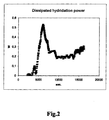
- Figure 2.- Variation in dissipated hydridation power. Once the temperature of the experiment has been reached, the DHP remains constant for a short interval, the incubation time, during which the H is dissolved without precipitating. Once that period has passed coinciding with the growth of electric resistance, the DHP grows rapidly, corresponding to the start of precipitation of H in the form of hydrides in the material.
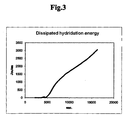
- Figure 3.- Variation in dissipated hydridation energy. This corresponds to the integral of Figure 2.
- Figure 4.- Diagram of the hydridation kinetics measurement device. This shows the position of the electrodes used for measuring the voltage drop in the tube.
- A method for measuring the dissipated power and the electric resistance and thereby obtain the hydridation kinetics in tubes or tubular claddings is embodied as stated below.
- A nuclear fuel cladding of Zircaloy 2 is inserted in a high or ultra-high vacuum chamber; hydrogen or mixtures of hydrogen with other gas(es) is made to circulate via the interior of the tube at a pressure of 1 atmosphere and a renewal stream of 200 cm3 per minute. The partial pressure in the vacuum zone is 10-9 Torr owing to the permeation of hydrogen through the walls of the cladding. The cladding is heated by the Joule effect and the temperature in the centre of the cladding is monitored and kept constant at 360°C (or other pre-established value) with a thermocouple and a temperature control system which acts on the current being applied in order to heat the cladding, the amount of current needed in order to maintain a constant temperature of 360°C in the absence of reaction being 30 A. The electrodes, located on both sides of the thermocouple, provide a measurement of the voltage drop in the cladding during the hydridation reaction. Together with the measurement of the current applied, this permits us to obtain the value of the power necessary for keeping the temperature constant, and to measure the electric resistance of the cladding. When the dilution of the hydrogen in the cladding starts, the electric resistance can grow up to 3% (Figure 1), though this variation can be less if the cladding previously contains a quantity of hydrogen, and no major changes are observed in the power necessary for keeping the temperature constant. When the precipitation and the formation of hydride starts, the heat of reaction means that the power necessary for keeping the temperature constant decreases, the difference in which gives us the value of DHP and, by integration, the dissipated hydridation energy or DHE. The DHP is roughly proportional to the hydride precipitated per unit time and the DHE to the total quantity of precipitated hydride. By stopping the process at different value of DHE, samples can be obtained with different thicknesses of the hydrides ring. These samples are very useful for mechanical studies and studies of the geometry of the precipitated hydrides. The comparison of the DHP curves permits a criterion to be had for selection of materials and design. Figure 1 shows the variation curve of electric resistance, in which the first maximum corresponds to the end of the dissolution process of hydrogen and the final maximum corresponds to the end of the hydridation process. Figure 2 shows the DHP curve, in which the maximum indicates that the precipitation reaction is very rapid at the start of the process. Figure 3 corresponds to the DHE curve.
Claims (4)
- Method for measuring hydridation kinetics, at different temperatures, in industrial components such as tubes and tubular claddings of metallic elements, metal alloys and any other material with and without protective coverings, characterised in that it consists of the measurement of:a) the power dissipated by the hydridation reaction, hereinafter dissipated hydridation power, as a function of time, and of the dissipated hydridation energy, measured during the process, andb) the variation in electric resistance during that reaction, and in particular during the stage of dissolution of hydrogen in the component preceding the precipitation of hydrides in the material.the stages making up this method being:i) insertion of the tubular component in a high or ultra-high vacuum chamber,ii) circulation of hydrogen or a mixture of hydrogen with other gas(es) through the interior of the component, it being the permeation of the hydrogen via the wall of the component that causes the hydridation of the material,iii) heating of the component by the Joule effect,iv) determination of the power dissipated by the hydridation reaction as a function of time, of the dissipated hydridation energy measured during the process, and of the electric resistance in the component by means of:iv.1) the voltage drop along the component, andiv.2) the variation in electric current applied for maintaining its temperature at the predetermined value for the hydridation reaction.
- Device for carrying out the measurement method of hydridation kinetics according to claim 1, characterised in that it comprises the following elements:a) a high or ultra-high vacuum chamber in which the component to be analysed is inserted,b) a gas line for causing hydrogen or a mixture of hydrogen with other gas(es) to pass through the interior of the component,c) heating systems by the Joule effect, thermocouples and systems for temperature control in the component, andd) two electrodes in the form of a ring or other well-defined geometry, arranged symmetrically and equidistant from the central thermocouple.
- Use of the method and device according to claims 1 and 2, respectively, for making measurements of hydridation kinetics in industrial components of metallic elements, metal alloys and any other material with and without protective coverings.
- Use according to claim 3, characterised in that the industrial components are tubular, among others, the tubes and tubular claddings for fuel in the cores of nuclear reactors.
Applications Claiming Priority (2)
| Application Number | Priority Date | Filing Date | Title |
|---|---|---|---|
| ES200400294A ES2238184B8 (en) | 2004-02-09 | 2004-02-09 | PROCEDURE AND DEVICE FOR MEASURING THE POWER DISSIPED BY THE HYDRURATION REACTION IN TUBULAR TUBES AND PODS AND THE CORRESPONDING VARIATION OF ELECTRICAL RESISTANCE. |
| PCT/ES2005/070011 WO2005076286A1 (en) | 2004-02-09 | 2005-02-01 | Method and device for measuring the power dissipated by a hydridation reaction in tubes and tubular claddings and the corresponding variation in electric resistance |
Publications (2)
| Publication Number | Publication Date |
|---|---|
| EP1722375A1 true EP1722375A1 (en) | 2006-11-15 |
| EP1722375B1 EP1722375B1 (en) | 2007-12-26 |
Family
ID=34833895
Family Applications (1)
| Application Number | Title | Priority Date | Filing Date |
|---|---|---|---|
| EP05708109A Expired - Lifetime EP1722375B1 (en) | 2004-02-09 | 2005-02-01 | Method and device for measuring the power dissipated by a hydridation reaction in tubes and tubular claddings and the corresponding variation in electric resistance |
Country Status (6)
| Country | Link |
|---|---|
| US (1) | US20070144625A1 (en) |
| EP (1) | EP1722375B1 (en) |
| AT (1) | ATE382185T1 (en) |
| DE (1) | DE602005004013D1 (en) |
| ES (1) | ES2238184B8 (en) |
| WO (1) | WO2005076286A1 (en) |
Families Citing this family (2)
| Publication number | Priority date | Publication date | Assignee | Title |
|---|---|---|---|---|
| US9723110B2 (en) * | 2014-04-28 | 2017-08-01 | Oracle International Corporation | System and method for supporting a proxy model for across-domain messaging in a transactional middleware machine environment |
| CN112086211B (en) * | 2020-09-15 | 2022-04-15 | 华北电力大学 | Experimental device and experimental method for simulating secondary hydrogen embrittlement phenomenon of zirconium alloy cladding |
Family Cites Families (10)
| Publication number | Priority date | Publication date | Assignee | Title |
|---|---|---|---|---|
| GB2138573B (en) * | 1981-01-26 | 1985-05-22 | Nat Res Dev | Catalytic gas detection systems |
| US4533520A (en) * | 1984-07-02 | 1985-08-06 | Mine Safety Appliances Company | Circuit for constant temperature operation of a catalytic combustible gas detector |
| JP2682402B2 (en) * | 1993-10-28 | 1997-11-26 | 日本電気株式会社 | Data processing device |
| US6483875B1 (en) * | 1997-06-19 | 2002-11-19 | Sony Corporation | Picture signal processing apparatus |
| ES2165823B8 (en) * | 2000-09-15 | 2014-06-05 | Consejo Superior De Investigaciones Cientificas | PROCEDURE AND DEVICE FOR MEASURING THE RESISTANCE HYDRURATION OF TUBES AND TUBULAR BEANS. |
| US7127117B2 (en) * | 2001-06-11 | 2006-10-24 | Ricoh Company, Ltd. | Image compression method and apparatus for suppressing quantization rate in particular region, image expansion method and apparatus therefor, and computer-readable storage medium storing program for the compression or expansion |
| JP2003303780A (en) * | 2002-04-11 | 2003-10-24 | Ulvac Japan Ltd | Method for controlling catalyst temperature |
| US6812708B2 (en) * | 2002-06-04 | 2004-11-02 | Scott Technologies, Inc. | Combustible-gas measuring instrument |
| JP4139633B2 (en) * | 2002-06-28 | 2008-08-27 | 株式会社リコー | Image processing device |
| WO2005039174A1 (en) * | 2003-10-20 | 2005-04-28 | Matsushita Electric Industrial Co., Ltd. | Multimedia data recording apparatus, monitor system, and multimedia data recording method |
-
2004
- 2004-02-09 ES ES200400294A patent/ES2238184B8/en not_active Expired - Fee Related
-
2005
- 2005-02-01 AT AT05708109T patent/ATE382185T1/en not_active IP Right Cessation
- 2005-02-01 DE DE602005004013T patent/DE602005004013D1/en not_active Expired - Lifetime
- 2005-02-01 WO PCT/ES2005/070011 patent/WO2005076286A1/en not_active Ceased
- 2005-02-01 EP EP05708109A patent/EP1722375B1/en not_active Expired - Lifetime
-
2006
- 2006-08-09 US US11/501,664 patent/US20070144625A1/en not_active Abandoned
Non-Patent Citations (1)
| Title |
|---|
| See references of WO2005076286A1 * |
Also Published As
| Publication number | Publication date |
|---|---|
| ES2238184B1 (en) | 2006-11-16 |
| ES2238184B8 (en) | 2014-06-05 |
| WO2005076286A1 (en) | 2005-08-18 |
| ES2238184A1 (en) | 2005-08-16 |
| ATE382185T1 (en) | 2008-01-15 |
| EP1722375B1 (en) | 2007-12-26 |
| DE602005004013D1 (en) | 2008-02-07 |
| US20070144625A1 (en) | 2007-06-28 |
Similar Documents
| Publication | Publication Date | Title |
|---|---|---|
| Cabet et al. | Corrosion of high temperature metallic materials in VHTR | |
| Rodgers et al. | Performance of pressure tubes in CANDU reactors | |
| Amayev et al. | Radiation Stability of WWER-440 Vessel | |
| Grossbeck et al. | Fatigue behavior of type 316 stainless steel irradiated in a mixed spectrum fission reactor forming helium | |
| Dominguez et al. | Investigation on boron carbide oxidation for nuclear reactor safety: Experiments in highly oxidising conditions | |
| EP1722375B1 (en) | Method and device for measuring the power dissipated by a hydridation reaction in tubes and tubular claddings and the corresponding variation in electric resistance | |
| McCoy Jr et al. | MATERIALS DEVELOPMENT FOR MOLTEN-SALT BREEDER REACTORS. | |
| Pan et al. | Effect of irradiation on the fracture properties of Zr-2.5 Nb pressure tubes at the end of design life | |
| McCoy Jr | EVALUATION OF THE MOLTEN-SALT REACTOR EXPERIMENT HASTELLOY N SURVEILLANCE SPECIMENS: FOURTH GROUP. | |
| Li et al. | Anisotropic thermal creep of internally pressurized Zr–2.5 Nb tubes | |
| Nikulina et al. | Impurities and their effect on the structure and properties of zirconium parts in nuclear reactors | |
| Kalilainen et al. | The measurement of Ag/In/Cd release under air-ingress conditions in the QUENCH-18 bundle test | |
| Majumdar et al. | Preparation and characterization of Nb-1Zr-0.1 C alloy suitable for liquid metal coolant channels of high temperature reactors | |
| Mieza et al. | Evaluation of variables affecting crack propagation by Delayed Hydride Cracking in Zr–2.5 Nb with different heat treatments | |
| Lundberg | High-temperature interdiffusion and phase equilibria in U-Mo | |
| Bloom et al. | EFFECT OF FAST NEUTRON IRRADIATION ON THE CREEP-RUPTURE PROPERTIES OF TYPE 304 STAINLESS STEEL AT 600$ sup 0$ C. | |
| Kajikawa et al. | Reassessment of liquid/solid equilibrium in Ni-rich side of Ni-Nb and Ni-Ti systems | |
| Gusev et al. | Results of pre-reactor and reactor tests of fuel claddings from E110M alloy | |
| Shields | Effects of fast-neutron irradiation and high temperature on beryllium oxide | |
| Riso | Mechanical characterization of alloy 709 stainless steel after high temperature aging for application in advanced reactors | |
| Hanlon | The Effect of Testing Direction on DHC Growth Rate Using Zr-2.5 Nb Plate | |
| Surenkov et al. | Experimental Study of Corrosion Resistance of Nickel-Molybdenum Alloys in the Melt of Lithium and Beryllium Fluoride Salts | |
| Lemmon Jr | The Reaction of Steam With Uranium and With Various Uranium-Niobium-Zirconium Alloys at High Temperatures | |
| Chapovaloff et al. | Influence of Al on the High Temperature corrosion behaviour of Inconel 617 in VHTR primary coolant atmosphere | |
| Markelov et al. | Temperature dependence of the velocity of delayed hydride cracking in Zr-2.5% Nb alloy |
Legal Events
| Date | Code | Title | Description |
|---|---|---|---|
| PUAI | Public reference made under article 153(3) epc to a published international application that has entered the european phase |
Free format text: ORIGINAL CODE: 0009012 |
|
| 17P | Request for examination filed |
Effective date: 20060901 |
|
| AK | Designated contracting states |
Kind code of ref document: A1 Designated state(s): AT BE BG CH CY CZ DE DK EE ES FI FR GB GR HU IE IS IT LI LT LU MC NL PL PT RO SE SI SK TR |
|
| DAX | Request for extension of the european patent (deleted) | ||
| GRAP | Despatch of communication of intention to grant a patent |
Free format text: ORIGINAL CODE: EPIDOSNIGR1 |
|
| GRAS | Grant fee paid |
Free format text: ORIGINAL CODE: EPIDOSNIGR3 |
|
| GRAA | (expected) grant |
Free format text: ORIGINAL CODE: 0009210 |
|
| RIN1 | Information on inventor provided before grant (corrected) |
Inventor name: SACEDON ADELANTADO, J.L.,INST. CIC. MAT. MADRID Inventor name: DIAZ MUNOZ, M.,INST. CIC. MAT. MADRID Inventor name: IZQUIERDO GOMEZ, JAIME,IBERDROLA GENERACION Inventor name: MOYA CORRAL, J.S.,INST. CIC. MAT. MADRID Inventor name: REMARTINEZ ZATO, BEGONA,IBERDROLA GENERACION |
|
| AK | Designated contracting states |
Kind code of ref document: B1 Designated state(s): AT BE BG CH CY CZ DE DK EE ES FI FR GB GR HU IE IS IT LI LT LU MC NL PL PT RO SE SI SK TR |
|
| REG | Reference to a national code |
Ref country code: GB Ref legal event code: FG4D |
|
| REG | Reference to a national code |
Ref country code: IE Ref legal event code: FG4D |
|
| REG | Reference to a national code |
Ref country code: CH Ref legal event code: EP |
|
| REF | Corresponds to: |
Ref document number: 602005004013 Country of ref document: DE Date of ref document: 20080207 Kind code of ref document: P |
|
| REG | Reference to a national code |
Ref country code: SE Ref legal event code: TRGR |
|
| PG25 | Lapsed in a contracting state [announced via postgrant information from national office to epo] |
Ref country code: CH Free format text: LAPSE BECAUSE OF FAILURE TO SUBMIT A TRANSLATION OF THE DESCRIPTION OR TO PAY THE FEE WITHIN THE PRESCRIBED TIME-LIMIT Effective date: 20071226 Ref country code: LI Free format text: LAPSE BECAUSE OF FAILURE TO SUBMIT A TRANSLATION OF THE DESCRIPTION OR TO PAY THE FEE WITHIN THE PRESCRIBED TIME-LIMIT Effective date: 20071226 |
|
| PG25 | Lapsed in a contracting state [announced via postgrant information from national office to epo] |
Ref country code: FI Free format text: LAPSE BECAUSE OF FAILURE TO SUBMIT A TRANSLATION OF THE DESCRIPTION OR TO PAY THE FEE WITHIN THE PRESCRIBED TIME-LIMIT Effective date: 20071226 Ref country code: SI Free format text: LAPSE BECAUSE OF FAILURE TO SUBMIT A TRANSLATION OF THE DESCRIPTION OR TO PAY THE FEE WITHIN THE PRESCRIBED TIME-LIMIT Effective date: 20071226 Ref country code: PL Free format text: LAPSE BECAUSE OF FAILURE TO SUBMIT A TRANSLATION OF THE DESCRIPTION OR TO PAY THE FEE WITHIN THE PRESCRIBED TIME-LIMIT Effective date: 20071226 Ref country code: NL Free format text: LAPSE BECAUSE OF FAILURE TO SUBMIT A TRANSLATION OF THE DESCRIPTION OR TO PAY THE FEE WITHIN THE PRESCRIBED TIME-LIMIT Effective date: 20071226 |
|
| NLV1 | Nl: lapsed or annulled due to failure to fulfill the requirements of art. 29p and 29m of the patents act | ||
| REG | Reference to a national code |
Ref country code: CH Ref legal event code: PL |
|
| PG25 | Lapsed in a contracting state [announced via postgrant information from national office to epo] |
Ref country code: AT Free format text: LAPSE BECAUSE OF FAILURE TO SUBMIT A TRANSLATION OF THE DESCRIPTION OR TO PAY THE FEE WITHIN THE PRESCRIBED TIME-LIMIT Effective date: 20071226 |
|
| PG25 | Lapsed in a contracting state [announced via postgrant information from national office to epo] |
Ref country code: CZ Free format text: LAPSE BECAUSE OF FAILURE TO SUBMIT A TRANSLATION OF THE DESCRIPTION OR TO PAY THE FEE WITHIN THE PRESCRIBED TIME-LIMIT Effective date: 20071226 Ref country code: ES Free format text: LAPSE BECAUSE OF FAILURE TO SUBMIT A TRANSLATION OF THE DESCRIPTION OR TO PAY THE FEE WITHIN THE PRESCRIBED TIME-LIMIT Effective date: 20080406 Ref country code: IS Free format text: LAPSE BECAUSE OF FAILURE TO SUBMIT A TRANSLATION OF THE DESCRIPTION OR TO PAY THE FEE WITHIN THE PRESCRIBED TIME-LIMIT Effective date: 20080426 Ref country code: LT Free format text: LAPSE BECAUSE OF FAILURE TO SUBMIT A TRANSLATION OF THE DESCRIPTION OR TO PAY THE FEE WITHIN THE PRESCRIBED TIME-LIMIT Effective date: 20071226 |
|
| PG25 | Lapsed in a contracting state [announced via postgrant information from national office to epo] |
Ref country code: SK Free format text: LAPSE BECAUSE OF FAILURE TO SUBMIT A TRANSLATION OF THE DESCRIPTION OR TO PAY THE FEE WITHIN THE PRESCRIBED TIME-LIMIT Effective date: 20071226 Ref country code: BE Free format text: LAPSE BECAUSE OF FAILURE TO SUBMIT A TRANSLATION OF THE DESCRIPTION OR TO PAY THE FEE WITHIN THE PRESCRIBED TIME-LIMIT Effective date: 20071226 Ref country code: RO Free format text: LAPSE BECAUSE OF FAILURE TO SUBMIT A TRANSLATION OF THE DESCRIPTION OR TO PAY THE FEE WITHIN THE PRESCRIBED TIME-LIMIT Effective date: 20071226 |
|
| ET | Fr: translation filed | ||
| PG25 | Lapsed in a contracting state [announced via postgrant information from national office to epo] |
Ref country code: PT Free format text: LAPSE BECAUSE OF FAILURE TO SUBMIT A TRANSLATION OF THE DESCRIPTION OR TO PAY THE FEE WITHIN THE PRESCRIBED TIME-LIMIT Effective date: 20080526 |
|
| PG25 | Lapsed in a contracting state [announced via postgrant information from national office to epo] |
Ref country code: MC Free format text: LAPSE BECAUSE OF NON-PAYMENT OF DUE FEES Effective date: 20080228 Ref country code: DE Free format text: LAPSE BECAUSE OF FAILURE TO SUBMIT A TRANSLATION OF THE DESCRIPTION OR TO PAY THE FEE WITHIN THE PRESCRIBED TIME-LIMIT Effective date: 20080403 Ref country code: DK Free format text: LAPSE BECAUSE OF FAILURE TO SUBMIT A TRANSLATION OF THE DESCRIPTION OR TO PAY THE FEE WITHIN THE PRESCRIBED TIME-LIMIT Effective date: 20071226 |
|
| PLBE | No opposition filed within time limit |
Free format text: ORIGINAL CODE: 0009261 |
|
| STAA | Information on the status of an ep patent application or granted ep patent |
Free format text: STATUS: NO OPPOSITION FILED WITHIN TIME LIMIT |
|
| 26N | No opposition filed |
Effective date: 20080929 |
|
| PG25 | Lapsed in a contracting state [announced via postgrant information from national office to epo] |
Ref country code: EE Free format text: LAPSE BECAUSE OF FAILURE TO SUBMIT A TRANSLATION OF THE DESCRIPTION OR TO PAY THE FEE WITHIN THE PRESCRIBED TIME-LIMIT Effective date: 20071226 Ref country code: IE Free format text: LAPSE BECAUSE OF NON-PAYMENT OF DUE FEES Effective date: 20080201 Ref country code: GR Free format text: LAPSE BECAUSE OF FAILURE TO SUBMIT A TRANSLATION OF THE DESCRIPTION OR TO PAY THE FEE WITHIN THE PRESCRIBED TIME-LIMIT Effective date: 20080327 |
|
| PG25 | Lapsed in a contracting state [announced via postgrant information from national office to epo] |
Ref country code: BG Free format text: LAPSE BECAUSE OF FAILURE TO SUBMIT A TRANSLATION OF THE DESCRIPTION OR TO PAY THE FEE WITHIN THE PRESCRIBED TIME-LIMIT Effective date: 20080326 |
|
| PG25 | Lapsed in a contracting state [announced via postgrant information from national office to epo] |
Ref country code: CY Free format text: LAPSE BECAUSE OF FAILURE TO SUBMIT A TRANSLATION OF THE DESCRIPTION OR TO PAY THE FEE WITHIN THE PRESCRIBED TIME-LIMIT Effective date: 20071226 |
|
| PG25 | Lapsed in a contracting state [announced via postgrant information from national office to epo] |
Ref country code: LU Free format text: LAPSE BECAUSE OF NON-PAYMENT OF DUE FEES Effective date: 20080201 Ref country code: HU Free format text: LAPSE BECAUSE OF FAILURE TO SUBMIT A TRANSLATION OF THE DESCRIPTION OR TO PAY THE FEE WITHIN THE PRESCRIBED TIME-LIMIT Effective date: 20080627 |
|
| PG25 | Lapsed in a contracting state [announced via postgrant information from national office to epo] |
Ref country code: TR Free format text: LAPSE BECAUSE OF FAILURE TO SUBMIT A TRANSLATION OF THE DESCRIPTION OR TO PAY THE FEE WITHIN THE PRESCRIBED TIME-LIMIT Effective date: 20071226 |
|
| PG25 | Lapsed in a contracting state [announced via postgrant information from national office to epo] |
Ref country code: IT Free format text: LAPSE BECAUSE OF NON-PAYMENT OF DUE FEES Effective date: 20080229 |
|
| REG | Reference to a national code |
Ref country code: FR Ref legal event code: PLFP Year of fee payment: 11 |
|
| PGFP | Annual fee paid to national office [announced via postgrant information from national office to epo] |
Ref country code: SE Payment date: 20150226 Year of fee payment: 11 Ref country code: FR Payment date: 20150217 Year of fee payment: 11 Ref country code: GB Payment date: 20150226 Year of fee payment: 11 |
|
| REG | Reference to a national code |
Ref country code: SE Ref legal event code: EUG |
|
| GBPC | Gb: european patent ceased through non-payment of renewal fee |
Effective date: 20160201 |
|
| REG | Reference to a national code |
Ref country code: FR Ref legal event code: ST Effective date: 20161028 |
|
| PG25 | Lapsed in a contracting state [announced via postgrant information from national office to epo] |
Ref country code: SE Free format text: LAPSE BECAUSE OF NON-PAYMENT OF DUE FEES Effective date: 20160202 |
|
| PG25 | Lapsed in a contracting state [announced via postgrant information from national office to epo] |
Ref country code: FR Free format text: LAPSE BECAUSE OF NON-PAYMENT OF DUE FEES Effective date: 20160229 Ref country code: GB Free format text: LAPSE BECAUSE OF NON-PAYMENT OF DUE FEES Effective date: 20160201 |