EP1719770A2 - Quinoline derivatives as antibacterials - Google Patents
Quinoline derivatives as antibacterials Download PDFInfo
- Publication number
- EP1719770A2 EP1719770A2 EP06076072A EP06076072A EP1719770A2 EP 1719770 A2 EP1719770 A2 EP 1719770A2 EP 06076072 A EP06076072 A EP 06076072A EP 06076072 A EP06076072 A EP 06076072A EP 1719770 A2 EP1719770 A2 EP 1719770A2
- Authority
- EP
- European Patent Office
- Prior art keywords
- alkyl
- hydroxy
- optionally substituted
- alkenyl
- amino
- Prior art date
- Legal status (The legal status is an assumption and is not a legal conclusion. Google has not performed a legal analysis and makes no representation as to the accuracy of the status listed.)
- Withdrawn
Links
- 230000000844 anti-bacterial effect Effects 0.000 title description 8
- 229940088710 antibiotic agent Drugs 0.000 title description 4
- 229940027991 antiseptic and disinfectant quinoline derivative Drugs 0.000 title 1
- 125000002943 quinolinyl group Chemical class N1=C(C=CC2=CC=CC=C12)* 0.000 title 1
- 238000000034 method Methods 0.000 claims abstract description 134
- 241000124008 Mammalia Species 0.000 claims abstract description 8
- 208000035143 Bacterial infection Diseases 0.000 claims abstract description 6
- 208000022362 bacterial infectious disease Diseases 0.000 claims abstract description 6
- -1 amino, piperidyl Chemical group 0.000 claims description 185
- 150000001875 compounds Chemical class 0.000 claims description 140
- 125000004178 (C1-C4) alkyl group Chemical group 0.000 claims description 101
- 125000004169 (C1-C6) alkyl group Chemical group 0.000 claims description 87
- 229910052739 hydrogen Inorganic materials 0.000 claims description 63
- 125000003917 carbamoyl group Chemical group [H]N([H])C(*)=O 0.000 claims description 50
- 239000001257 hydrogen Substances 0.000 claims description 48
- 125000000882 C2-C6 alkenyl group Chemical group 0.000 claims description 47
- LFQSCWFLJHTTHZ-UHFFFAOYSA-N EtOH Substances CCO LFQSCWFLJHTTHZ-UHFFFAOYSA-N 0.000 claims description 46
- 125000005090 alkenylcarbonyl group Chemical group 0.000 claims description 42
- 125000003277 amino group Chemical group 0.000 claims description 42
- 125000003178 carboxy group Chemical group [H]OC(*)=O 0.000 claims description 42
- HTLZVHNRZJPSMI-UHFFFAOYSA-N N-ethylpiperidine Chemical compound CCN1CCCCC1 HTLZVHNRZJPSMI-UHFFFAOYSA-N 0.000 claims description 41
- RAHZWNYVWXNFOC-UHFFFAOYSA-N sulfur dioxide Inorganic materials O=S=O RAHZWNYVWXNFOC-UHFFFAOYSA-N 0.000 claims description 41
- 125000005092 alkenyloxycarbonyl group Chemical group 0.000 claims description 40
- 125000004356 hydroxy functional group Chemical group O* 0.000 claims description 40
- 230000008569 process Effects 0.000 claims description 38
- 125000006656 (C2-C4) alkenyl group Chemical group 0.000 claims description 36
- 125000004390 alkyl sulfonyl group Chemical group 0.000 claims description 35
- 125000005843 halogen group Chemical group 0.000 claims description 34
- 125000004454 (C1-C6) alkoxycarbonyl group Chemical group 0.000 claims description 33
- 125000004916 (C1-C6) alkylcarbonyl group Chemical group 0.000 claims description 32
- 125000004453 alkoxycarbonyl group Chemical group 0.000 claims description 32
- 125000002887 hydroxy group Chemical group [H]O* 0.000 claims description 30
- 125000002023 trifluoromethyl group Chemical group FC(F)(F)* 0.000 claims description 27
- 125000003118 aryl group Chemical group 0.000 claims description 25
- UFHFLCQGNIYNRP-UHFFFAOYSA-N Hydrogen Chemical compound [H][H] UFHFLCQGNIYNRP-UHFFFAOYSA-N 0.000 claims description 24
- 125000004435 hydrogen atom Chemical group [H]* 0.000 claims description 24
- 125000001424 substituent group Chemical group 0.000 claims description 24
- 125000004414 alkyl thio group Chemical group 0.000 claims description 23
- 125000002924 primary amino group Chemical group [H]N([H])* 0.000 claims description 23
- 125000000229 (C1-C4)alkoxy group Chemical group 0.000 claims description 22
- 125000004448 alkyl carbonyl group Chemical group 0.000 claims description 22
- 125000001997 phenyl group Chemical group [H]C1=C([H])C([H])=C(*)C([H])=C1[H] 0.000 claims description 20
- 125000004093 cyano group Chemical group *C#N 0.000 claims description 18
- 125000000623 heterocyclic group Chemical group 0.000 claims description 18
- 125000004043 oxo group Chemical group O=* 0.000 claims description 17
- 125000004191 (C1-C6) alkoxy group Chemical group 0.000 claims description 15
- 229910052736 halogen Inorganic materials 0.000 claims description 15
- 125000002252 acyl group Chemical group 0.000 claims description 14
- 150000002367 halogens Chemical class 0.000 claims description 14
- 150000001408 amides Chemical class 0.000 claims description 13
- 229910052760 oxygen Inorganic materials 0.000 claims description 13
- 125000004211 3,5-difluorophenyl group Chemical group [H]C1=C(F)C([H])=C(*)C([H])=C1F 0.000 claims description 12
- 125000002485 formyl group Chemical group [H]C(*)=O 0.000 claims description 12
- 125000000449 nitro group Chemical group [O-][N+](*)=O 0.000 claims description 11
- 229910052721 tungsten Inorganic materials 0.000 claims description 11
- IAYPIBMASNFSPL-UHFFFAOYSA-N Ethylene oxide Chemical compound C1CO1 IAYPIBMASNFSPL-UHFFFAOYSA-N 0.000 claims description 9
- 229910002091 carbon monoxide Inorganic materials 0.000 claims description 9
- 125000004105 2-pyridyl group Chemical group N1=C([*])C([H])=C([H])C([H])=C1[H] 0.000 claims description 8
- 125000004429 atom Chemical group 0.000 claims description 8
- 125000000852 azido group Chemical group *N=[N+]=[N-] 0.000 claims description 8
- 125000002795 guanidino group Chemical group C(N)(=N)N* 0.000 claims description 8
- 125000005196 alkyl carbonyloxy group Chemical group 0.000 claims description 7
- 125000003739 carbamimidoyl group Chemical group C(N)(=N)* 0.000 claims description 7
- CBOIHMRHGLHBPB-UHFFFAOYSA-N hydroxymethyl Chemical group O[CH2] CBOIHMRHGLHBPB-UHFFFAOYSA-N 0.000 claims description 7
- 125000000956 methoxy group Chemical group [H]C([H])([H])O* 0.000 claims description 7
- 125000004180 3-fluorophenyl group Chemical group [H]C1=C([H])C(*)=C([H])C(F)=C1[H] 0.000 claims description 6
- PXQLVRUNWNTZOS-UHFFFAOYSA-N sulfanyl Chemical compound [SH] PXQLVRUNWNTZOS-UHFFFAOYSA-N 0.000 claims description 6
- 125000000391 vinyl group Chemical group [H]C([*])=C([H])[H] 0.000 claims description 6
- 125000001414 1,2,4-triazol-5-yl group Chemical group [H]N1N=C([H])N=C1[*] 0.000 claims description 5
- 125000004423 acyloxy group Chemical group 0.000 claims description 5
- 229910052799 carbon Inorganic materials 0.000 claims description 5
- 239000003814 drug Substances 0.000 claims description 5
- 229910052757 nitrogen Chemical group 0.000 claims description 5
- 239000008194 pharmaceutical composition Substances 0.000 claims description 5
- 125000003831 tetrazolyl group Chemical group 0.000 claims description 5
- 125000005035 acylthio group Chemical group 0.000 claims description 4
- 238000004519 manufacturing process Methods 0.000 claims description 4
- 229910052717 sulfur Inorganic materials 0.000 claims description 4
- GAWIXWVDTYZWAW-UHFFFAOYSA-N C[CH]O Chemical group C[CH]O GAWIXWVDTYZWAW-UHFFFAOYSA-N 0.000 claims description 3
- 125000005842 heteroatom Chemical group 0.000 claims description 3
- 125000002883 imidazolyl group Chemical group 0.000 claims description 3
- 125000000437 thiazol-2-yl group Chemical group [H]C1=C([H])N=C(*)S1 0.000 claims description 3
- 125000000876 trifluoromethoxy group Chemical group FC(F)(F)O* 0.000 claims description 3
- 229910052727 yttrium Inorganic materials 0.000 claims description 3
- FZSJMFXINFIFKJ-FQEVSTJZSA-N (1r)-1-(6-methoxy-1,5-naphthyridin-4-yl)-2-[4-(2-pyridin-2-yloxyethylamino)piperidin-1-yl]ethanol Chemical compound C([C@H](O)C1=CC=NC2=CC=C(N=C21)OC)N(CC1)CCC1NCCOC1=CC=CC=N1 FZSJMFXINFIFKJ-FQEVSTJZSA-N 0.000 claims description 2
- JECYNCQXXKQDJN-UHFFFAOYSA-N 2-(2-methylhexan-2-yloxymethyl)oxirane Chemical group CCCCC(C)(C)OCC1CO1 JECYNCQXXKQDJN-UHFFFAOYSA-N 0.000 claims description 2
- FEUYBXHLZPNFJK-NRFANRHFSA-N 2-[[1-[(2r)-2-hydroxy-2-(6-methoxy-1,5-naphthyridin-4-yl)ethyl]piperidin-4-yl]amino]-n-phenylacetamide Chemical compound C([C@H](O)C1=CC=NC2=CC=C(N=C21)OC)N(CC1)CCC1NCC(=O)NC1=CC=CC=C1 FEUYBXHLZPNFJK-NRFANRHFSA-N 0.000 claims description 2
- 125000001054 5 membered carbocyclic group Chemical group 0.000 claims description 2
- 125000004008 6 membered carbocyclic group Chemical group 0.000 claims description 2
- 125000005278 alkyl sulfonyloxy group Chemical group 0.000 claims description 2
- 125000004391 aryl sulfonyl group Chemical group 0.000 claims description 2
- 125000005110 aryl thio group Chemical group 0.000 claims description 2
- 125000004104 aryloxy group Chemical group 0.000 claims description 2
- 125000004432 carbon atom Chemical group C* 0.000 claims description 2
- 125000002057 carboxymethyl group Chemical group [H]OC(=O)C([H])([H])[*] 0.000 claims description 2
- 239000003937 drug carrier Substances 0.000 claims description 2
- 125000005844 heterocyclyloxy group Chemical group 0.000 claims description 2
- 125000004468 heterocyclylthio group Chemical group 0.000 claims description 2
- LWMPFIOTEAXAGV-UHFFFAOYSA-N piperidin-1-amine Chemical class NN1CCCCC1 LWMPFIOTEAXAGV-UHFFFAOYSA-N 0.000 abstract description 21
- YMWUJEATGCHHMB-UHFFFAOYSA-N Dichloromethane Chemical compound ClCCl YMWUJEATGCHHMB-UHFFFAOYSA-N 0.000 description 277
- 150000002500 ions Chemical class 0.000 description 120
- 239000000243 solution Substances 0.000 description 87
- 239000000203 mixture Substances 0.000 description 84
- VYPSYNLAJGMNEJ-UHFFFAOYSA-N Silicium dioxide Chemical compound O=[Si]=O VYPSYNLAJGMNEJ-UHFFFAOYSA-N 0.000 description 73
- OKKJLVBELUTLKV-UHFFFAOYSA-N Methanol Chemical compound OC OKKJLVBELUTLKV-UHFFFAOYSA-N 0.000 description 69
- HEDRZPFGACZZDS-MICDWDOJSA-N Trichloro(2H)methane Chemical compound [2H]C(Cl)(Cl)Cl HEDRZPFGACZZDS-MICDWDOJSA-N 0.000 description 65
- 239000003921 oil Substances 0.000 description 60
- 235000019198 oils Nutrition 0.000 description 60
- ZMXDDKWLCZADIW-UHFFFAOYSA-N N,N-Dimethylformamide Chemical compound CN(C)C=O ZMXDDKWLCZADIW-UHFFFAOYSA-N 0.000 description 57
- 238000006243 chemical reaction Methods 0.000 description 57
- 239000000741 silica gel Substances 0.000 description 56
- 229910002027 silica gel Inorganic materials 0.000 description 56
- XEKOWRVHYACXOJ-UHFFFAOYSA-N Ethyl acetate Chemical compound CCOC(C)=O XEKOWRVHYACXOJ-UHFFFAOYSA-N 0.000 description 54
- 150000001412 amines Chemical class 0.000 description 53
- NQRYJNQNLNOLGT-UHFFFAOYSA-N Piperidine Chemical compound C1CCNCC1 NQRYJNQNLNOLGT-UHFFFAOYSA-N 0.000 description 44
- WYURNTSHIVDZCO-UHFFFAOYSA-N Tetrahydrofuran Chemical compound C1CCOC1 WYURNTSHIVDZCO-UHFFFAOYSA-N 0.000 description 44
- MUBZPKHOEPUJKR-UHFFFAOYSA-N Oxalic acid Chemical compound OC(=O)C(O)=O MUBZPKHOEPUJKR-UHFFFAOYSA-N 0.000 description 41
- UIIMBOGNXHQVGW-UHFFFAOYSA-M Sodium bicarbonate Chemical compound [Na+].OC([O-])=O UIIMBOGNXHQVGW-UHFFFAOYSA-M 0.000 description 40
- 239000007787 solid Substances 0.000 description 40
- HEMHJVSKTPXQMS-UHFFFAOYSA-M Sodium hydroxide Chemical compound [OH-].[Na+] HEMHJVSKTPXQMS-UHFFFAOYSA-M 0.000 description 39
- XLYOFNOQVPJJNP-UHFFFAOYSA-N water Substances O XLYOFNOQVPJJNP-UHFFFAOYSA-N 0.000 description 39
- 239000012458 free base Substances 0.000 description 37
- 238000005160 1H NMR spectroscopy Methods 0.000 description 34
- 150000003839 salts Chemical class 0.000 description 34
- WGLUMOCWFMKWIL-UHFFFAOYSA-N dichloromethane;methanol Chemical compound OC.ClCCl WGLUMOCWFMKWIL-UHFFFAOYSA-N 0.000 description 33
- ZMANZCXQSJIPKH-UHFFFAOYSA-N Triethylamine Chemical compound CCN(CC)CC ZMANZCXQSJIPKH-UHFFFAOYSA-N 0.000 description 30
- 239000002253 acid Substances 0.000 description 27
- 150000001299 aldehydes Chemical class 0.000 description 25
- 238000004587 chromatography analysis Methods 0.000 description 25
- 235000019441 ethanol Nutrition 0.000 description 25
- 150000002148 esters Chemical class 0.000 description 24
- 150000002576 ketones Chemical class 0.000 description 24
- BWHMMNNQKKPAPP-UHFFFAOYSA-L potassium carbonate Chemical compound [K+].[K+].[O-]C([O-])=O BWHMMNNQKKPAPP-UHFFFAOYSA-L 0.000 description 24
- HIXDQWDOVZUNNA-UHFFFAOYSA-N 2-(3,4-dimethoxyphenyl)-5-hydroxy-7-methoxychromen-4-one Chemical compound C=1C(OC)=CC(O)=C(C(C=2)=O)C=1OC=2C1=CC=C(OC)C(OC)=C1 HIXDQWDOVZUNNA-UHFFFAOYSA-N 0.000 description 21
- WEVYAHXRMPXWCK-UHFFFAOYSA-N Acetonitrile Chemical compound CC#N WEVYAHXRMPXWCK-UHFFFAOYSA-N 0.000 description 21
- YXFVVABEGXRONW-UHFFFAOYSA-N Toluene Chemical compound CC1=CC=CC=C1 YXFVVABEGXRONW-UHFFFAOYSA-N 0.000 description 21
- RTZKZFJDLAIYFH-UHFFFAOYSA-N ether Substances CCOCC RTZKZFJDLAIYFH-UHFFFAOYSA-N 0.000 description 21
- 229910000030 sodium bicarbonate Inorganic materials 0.000 description 20
- 235000017557 sodium bicarbonate Nutrition 0.000 description 20
- 239000010410 layer Substances 0.000 description 19
- 235000019439 ethyl acetate Nutrition 0.000 description 18
- 229940093499 ethyl acetate Drugs 0.000 description 18
- 239000002904 solvent Substances 0.000 description 18
- VEXZGXHMUGYJMC-UHFFFAOYSA-N Hydrochloric acid Chemical compound Cl VEXZGXHMUGYJMC-UHFFFAOYSA-N 0.000 description 17
- YLQBMQCUIZJEEH-UHFFFAOYSA-N tetrahydrofuran Natural products C=1C=COC=1 YLQBMQCUIZJEEH-UHFFFAOYSA-N 0.000 description 17
- DTQVDTLACAAQTR-UHFFFAOYSA-N Trifluoroacetic acid Chemical compound OC(=O)C(F)(F)F DTQVDTLACAAQTR-UHFFFAOYSA-N 0.000 description 16
- 239000000047 product Substances 0.000 description 16
- TZRSKDVHKGYCON-LBPRGKRZSA-N 6-methoxy-4-[(2r)-oxiran-2-yl]quinoline Chemical compound C12=CC(OC)=CC=C2N=CC=C1[C@@H]1CO1 TZRSKDVHKGYCON-LBPRGKRZSA-N 0.000 description 14
- HEDRZPFGACZZDS-UHFFFAOYSA-N Chloroform Chemical compound ClC(Cl)Cl HEDRZPFGACZZDS-UHFFFAOYSA-N 0.000 description 14
- KDLHZDBZIXYQEI-UHFFFAOYSA-N Palladium Chemical compound [Pd] KDLHZDBZIXYQEI-UHFFFAOYSA-N 0.000 description 14
- 238000001704 evaporation Methods 0.000 description 14
- XHXFXVLFKHQFAL-UHFFFAOYSA-N phosphoryl trichloride Chemical compound ClP(Cl)(Cl)=O XHXFXVLFKHQFAL-UHFFFAOYSA-N 0.000 description 14
- 238000010992 reflux Methods 0.000 description 14
- 239000002585 base Substances 0.000 description 13
- 235000006408 oxalic acid Nutrition 0.000 description 13
- XKRFYHLGVUSROY-UHFFFAOYSA-N Argon Chemical compound [Ar] XKRFYHLGVUSROY-UHFFFAOYSA-N 0.000 description 12
- KWYUFKZDYYNOTN-UHFFFAOYSA-M Potassium hydroxide Chemical compound [OH-].[K+] KWYUFKZDYYNOTN-UHFFFAOYSA-M 0.000 description 12
- 230000015572 biosynthetic process Effects 0.000 description 12
- 230000008020 evaporation Effects 0.000 description 12
- 239000012280 lithium aluminium hydride Substances 0.000 description 12
- 229910000027 potassium carbonate Inorganic materials 0.000 description 12
- 230000009467 reduction Effects 0.000 description 12
- 238000006722 reduction reaction Methods 0.000 description 12
- 238000003786 synthesis reaction Methods 0.000 description 12
- 239000012279 sodium borohydride Substances 0.000 description 11
- 229910000033 sodium borohydride Inorganic materials 0.000 description 11
- 239000000284 extract Substances 0.000 description 10
- 238000005932 reductive alkylation reaction Methods 0.000 description 10
- CSCPPACGZOOCGX-UHFFFAOYSA-N Acetone Chemical compound CC(C)=O CSCPPACGZOOCGX-UHFFFAOYSA-N 0.000 description 9
- CDBYLPFSWZWCQE-UHFFFAOYSA-L Sodium Carbonate Chemical compound [Na+].[Na+].[O-]C([O-])=O CDBYLPFSWZWCQE-UHFFFAOYSA-L 0.000 description 9
- 125000003545 alkoxy group Chemical group 0.000 description 9
- 238000001914 filtration Methods 0.000 description 9
- 239000000543 intermediate Substances 0.000 description 9
- 150000003891 oxalate salts Chemical class 0.000 description 9
- 238000002360 preparation method Methods 0.000 description 9
- 229920006395 saturated elastomer Polymers 0.000 description 9
- 239000012321 sodium triacetoxyborohydride Substances 0.000 description 9
- JUJWROOIHBZHMG-UHFFFAOYSA-N Pyridine Chemical compound C1=CC=NC=C1 JUJWROOIHBZHMG-UHFFFAOYSA-N 0.000 description 8
- PMZURENOXWZQFD-UHFFFAOYSA-L Sodium Sulfate Chemical compound [Na+].[Na+].[O-]S([O-])(=O)=O PMZURENOXWZQFD-UHFFFAOYSA-L 0.000 description 8
- 125000000217 alkyl group Chemical group 0.000 description 8
- 238000005859 coupling reaction Methods 0.000 description 8
- OAYLNYINCPYISS-UHFFFAOYSA-N ethyl acetate;hexane Chemical compound CCCCCC.CCOC(C)=O OAYLNYINCPYISS-UHFFFAOYSA-N 0.000 description 8
- 125000002496 methyl group Chemical group [H]C([H])([H])* 0.000 description 8
- 239000000377 silicon dioxide Substances 0.000 description 8
- QGZKDVFQNNGYKY-UHFFFAOYSA-N Ammonia Chemical compound N QGZKDVFQNNGYKY-UHFFFAOYSA-N 0.000 description 7
- 238000005804 alkylation reaction Methods 0.000 description 7
- PFKFTWBEEFSNDU-UHFFFAOYSA-N carbonyldiimidazole Chemical compound C1=CN=CN1C(=O)N1C=CN=C1 PFKFTWBEEFSNDU-UHFFFAOYSA-N 0.000 description 7
- 230000008878 coupling Effects 0.000 description 7
- 238000010168 coupling process Methods 0.000 description 7
- 239000002027 dichloromethane extract Substances 0.000 description 7
- MHCFAGZWMAWTNR-UHFFFAOYSA-M lithium perchlorate Chemical compound [Li+].[O-]Cl(=O)(=O)=O MHCFAGZWMAWTNR-UHFFFAOYSA-M 0.000 description 7
- 229910001486 lithium perchlorate Inorganic materials 0.000 description 7
- 239000012044 organic layer Substances 0.000 description 7
- 230000003647 oxidation Effects 0.000 description 7
- 238000007254 oxidation reaction Methods 0.000 description 7
- 230000002829 reductive effect Effects 0.000 description 7
- 125000003258 trimethylene group Chemical group [H]C([H])([*:2])C([H])([H])C([H])([H])[*:1] 0.000 description 7
- 239000003981 vehicle Substances 0.000 description 7
- PHGNGVYUHOARGF-UHFFFAOYSA-N 6-methoxyquinolin-4-amine Chemical compound N1=CC=C(N)C2=CC(OC)=CC=C21 PHGNGVYUHOARGF-UHFFFAOYSA-N 0.000 description 6
- QTBSBXVTEAMEQO-UHFFFAOYSA-N Acetic acid Chemical compound CC(O)=O QTBSBXVTEAMEQO-UHFFFAOYSA-N 0.000 description 6
- UHOVQNZJYSORNB-UHFFFAOYSA-N Benzene Chemical compound C1=CC=CC=C1 UHOVQNZJYSORNB-UHFFFAOYSA-N 0.000 description 6
- OAKJQQAXSVQMHS-UHFFFAOYSA-N Hydrazine Chemical compound NN OAKJQQAXSVQMHS-UHFFFAOYSA-N 0.000 description 6
- PCLIMKBDDGJMGD-UHFFFAOYSA-N N-bromosuccinimide Chemical compound BrN1C(=O)CCC1=O PCLIMKBDDGJMGD-UHFFFAOYSA-N 0.000 description 6
- XSQUKJJJFZCRTK-UHFFFAOYSA-N Urea Chemical compound NC(N)=O XSQUKJJJFZCRTK-UHFFFAOYSA-N 0.000 description 6
- 230000029936 alkylation Effects 0.000 description 6
- 229910052786 argon Inorganic materials 0.000 description 6
- 125000006367 bivalent amino carbonyl group Chemical group [H]N([*:1])C([*:2])=O 0.000 description 6
- 238000007796 conventional method Methods 0.000 description 6
- 239000012043 crude product Substances 0.000 description 6
- 238000005755 formation reaction Methods 0.000 description 6
- CTSLXHKWHWQRSH-UHFFFAOYSA-N oxalyl chloride Chemical compound ClC(=O)C(Cl)=O CTSLXHKWHWQRSH-UHFFFAOYSA-N 0.000 description 6
- 150000002924 oxiranes Chemical class 0.000 description 6
- LEHBURLTIWGHEM-UHFFFAOYSA-N pyridinium chlorochromate Chemical compound [O-][Cr](Cl)(=O)=O.C1=CC=[NH+]C=C1 LEHBURLTIWGHEM-UHFFFAOYSA-N 0.000 description 6
- JQWHASGSAFIOCM-UHFFFAOYSA-M sodium periodate Chemical compound [Na+].[O-]I(=O)(=O)=O JQWHASGSAFIOCM-UHFFFAOYSA-M 0.000 description 6
- 229910052938 sodium sulfate Inorganic materials 0.000 description 6
- 239000000725 suspension Substances 0.000 description 6
- DYHSDKLCOJIUFX-UHFFFAOYSA-N tert-butoxycarbonyl anhydride Chemical compound CC(C)(C)OC(=O)OC(=O)OC(C)(C)C DYHSDKLCOJIUFX-UHFFFAOYSA-N 0.000 description 6
- MHCVCKDNQYMGEX-UHFFFAOYSA-N 1,1'-biphenyl;phenoxybenzene Chemical compound C1=CC=CC=C1C1=CC=CC=C1.C=1C=CC=CC=1OC1=CC=CC=C1 MHCVCKDNQYMGEX-UHFFFAOYSA-N 0.000 description 5
- VHYFNPMBLIVWCW-UHFFFAOYSA-N 4-Dimethylaminopyridine Chemical compound CN(C)C1=CC=NC=C1 VHYFNPMBLIVWCW-UHFFFAOYSA-N 0.000 description 5
- 241000283690 Bos taurus Species 0.000 description 5
- 238000006969 Curtius rearrangement reaction Methods 0.000 description 5
- 239000012267 brine Substances 0.000 description 5
- 125000002915 carbonyl group Chemical group [*:2]C([*:1])=O 0.000 description 5
- 239000003153 chemical reaction reagent Substances 0.000 description 5
- MKRTXPORKIRPDG-UHFFFAOYSA-N diphenylphosphoryl azide Chemical compound C=1C=CC=CC=1P(=O)(N=[N+]=[N-])C1=CC=CC=C1 MKRTXPORKIRPDG-UHFFFAOYSA-N 0.000 description 5
- 238000000605 extraction Methods 0.000 description 5
- 239000006260 foam Substances 0.000 description 5
- 238000005984 hydrogenation reaction Methods 0.000 description 5
- 239000012948 isocyanate Substances 0.000 description 5
- 150000002513 isocyanates Chemical class 0.000 description 5
- 229910052744 lithium Inorganic materials 0.000 description 5
- VHKMHIVLMVRJSL-UHFFFAOYSA-N n-(6-methoxyquinolin-4-yl)imidazole-1-carboxamide Chemical compound C12=CC(OC)=CC=C2N=CC=C1NC(=O)N1C=CN=C1 VHKMHIVLMVRJSL-UHFFFAOYSA-N 0.000 description 5
- 239000007800 oxidant agent Substances 0.000 description 5
- 235000011152 sodium sulphate Nutrition 0.000 description 5
- HPALAKNZSZLMCH-UHFFFAOYSA-M sodium;chloride;hydrate Chemical compound O.[Na+].[Cl-] HPALAKNZSZLMCH-UHFFFAOYSA-M 0.000 description 5
- LQQKDSXCDXHLLF-UHFFFAOYSA-N 1,3-dibromopropan-2-one Chemical class BrCC(=O)CBr LQQKDSXCDXHLLF-UHFFFAOYSA-N 0.000 description 4
- UZKWTJUDCOPSNM-UHFFFAOYSA-N 1-ethenoxybutane Chemical compound CCCCOC=C UZKWTJUDCOPSNM-UHFFFAOYSA-N 0.000 description 4
- LMDZBCPBFSXMTL-UHFFFAOYSA-N 1-ethyl-3-(3-dimethylaminopropyl)carbodiimide Chemical compound CCN=C=NCCCN(C)C LMDZBCPBFSXMTL-UHFFFAOYSA-N 0.000 description 4
- NGNBDVOYPDDBFK-UHFFFAOYSA-N 2-[2,4-di(pentan-2-yl)phenoxy]acetyl chloride Chemical compound CCCC(C)C1=CC=C(OCC(Cl)=O)C(C(C)CCC)=C1 NGNBDVOYPDDBFK-UHFFFAOYSA-N 0.000 description 4
- DCPLOIFDMMEBQZ-UHFFFAOYSA-N 2-bromo-n-phenylacetamide Chemical compound BrCC(=O)NC1=CC=CC=C1 DCPLOIFDMMEBQZ-UHFFFAOYSA-N 0.000 description 4
- GQQSFWQKKADDBB-UHFFFAOYSA-N 2-bromo-n-pyridin-2-ylacetamide Chemical compound BrCC(=O)NC1=CC=CC=N1 GQQSFWQKKADDBB-UHFFFAOYSA-N 0.000 description 4
- LSTRKXWIZZZYAS-UHFFFAOYSA-N 2-bromoacetyl bromide Chemical compound BrCC(Br)=O LSTRKXWIZZZYAS-UHFFFAOYSA-N 0.000 description 4
- VFUFXHFSNCESKR-VIFPVBQESA-N 2-methoxy-8-[(2r)-oxiran-2-yl]-1,5-naphthyridine Chemical compound C12=NC(OC)=CC=C2N=CC=C1[C@@H]1CO1 VFUFXHFSNCESKR-VIFPVBQESA-N 0.000 description 4
- FPQQSJJWHUJYPU-UHFFFAOYSA-N 3-(dimethylamino)propyliminomethylidene-ethylazanium;chloride Chemical compound Cl.CCN=C=NCCCN(C)C FPQQSJJWHUJYPU-UHFFFAOYSA-N 0.000 description 4
- FQYRLEXKXQRZDH-UHFFFAOYSA-N 4-aminoquinoline Chemical compound C1=CC=C2C(N)=CC=NC2=C1 FQYRLEXKXQRZDH-UHFFFAOYSA-N 0.000 description 4
- UUVDJIWRSIJEBS-UHFFFAOYSA-N 6-methoxypyridin-3-amine Chemical compound COC1=CC=C(N)C=N1 UUVDJIWRSIJEBS-UHFFFAOYSA-N 0.000 description 4
- XXLFLUJXWKXUGS-UHFFFAOYSA-N 6-methoxyquinoline-4-carboxylic acid Chemical compound N1=CC=C(C(O)=O)C2=CC(OC)=CC=C21 XXLFLUJXWKXUGS-UHFFFAOYSA-N 0.000 description 4
- PAYRUJLWNCNPSJ-UHFFFAOYSA-N Aniline Chemical compound NC1=CC=CC=C1 PAYRUJLWNCNPSJ-UHFFFAOYSA-N 0.000 description 4
- KXDHJXZQYSOELW-UHFFFAOYSA-M Carbamate Chemical compound NC([O-])=O KXDHJXZQYSOELW-UHFFFAOYSA-M 0.000 description 4
- 241000282414 Homo sapiens Species 0.000 description 4
- CSNNHWWHGAXBCP-UHFFFAOYSA-L Magnesium sulfate Chemical compound [Mg+2].[O-][S+2]([O-])([O-])[O-] CSNNHWWHGAXBCP-UHFFFAOYSA-L 0.000 description 4
- JGFZNNIVVJXRND-UHFFFAOYSA-N N,N-Diisopropylethylamine (DIPEA) Chemical compound CCN(C(C)C)C(C)C JGFZNNIVVJXRND-UHFFFAOYSA-N 0.000 description 4
- 150000001204 N-oxides Chemical class 0.000 description 4
- OFBQJSOFQDEBGM-UHFFFAOYSA-N Pentane Chemical compound CCCCC OFBQJSOFQDEBGM-UHFFFAOYSA-N 0.000 description 4
- SMWDFEZZVXVKRB-UHFFFAOYSA-N Quinoline Chemical compound N1=CC=CC2=CC=CC=C21 SMWDFEZZVXVKRB-UHFFFAOYSA-N 0.000 description 4
- PXIPVTKHYLBLMZ-UHFFFAOYSA-N Sodium azide Chemical compound [Na+].[N-]=[N+]=[N-] PXIPVTKHYLBLMZ-UHFFFAOYSA-N 0.000 description 4
- 238000005903 acid hydrolysis reaction Methods 0.000 description 4
- 150000007513 acids Chemical class 0.000 description 4
- 230000004913 activation Effects 0.000 description 4
- 125000003342 alkenyl group Chemical group 0.000 description 4
- 150000001732 carboxylic acid derivatives Chemical class 0.000 description 4
- 239000003638 chemical reducing agent Substances 0.000 description 4
- BULLHNJGPPOUOX-UHFFFAOYSA-N chloroacetone Chemical compound CC(=O)CCl BULLHNJGPPOUOX-UHFFFAOYSA-N 0.000 description 4
- 239000007822 coupling agent Substances 0.000 description 4
- 239000006071 cream Substances 0.000 description 4
- WBKFWQBXFREOFH-UHFFFAOYSA-N dichloromethane;ethyl acetate Chemical compound ClCCl.CCOC(C)=O WBKFWQBXFREOFH-UHFFFAOYSA-N 0.000 description 4
- 238000006735 epoxidation reaction Methods 0.000 description 4
- UREBWPXBXRYXRJ-UHFFFAOYSA-N ethyl acetate;methanol Chemical compound OC.CCOC(C)=O UREBWPXBXRYXRJ-UHFFFAOYSA-N 0.000 description 4
- 125000001153 fluoro group Chemical group F* 0.000 description 4
- 125000001072 heteroaryl group Chemical group 0.000 description 4
- IXCSERBJSXMMFS-UHFFFAOYSA-N hydrogen chloride Substances Cl.Cl IXCSERBJSXMMFS-UHFFFAOYSA-N 0.000 description 4
- 229910000041 hydrogen chloride Inorganic materials 0.000 description 4
- 230000007062 hydrolysis Effects 0.000 description 4
- 238000006460 hydrolysis reaction Methods 0.000 description 4
- 238000001727 in vivo Methods 0.000 description 4
- 239000007788 liquid Substances 0.000 description 4
- ZCSHNCUQKCANBX-UHFFFAOYSA-N lithium diisopropylamide Chemical compound [Li+].CC(C)[N-]C(C)C ZCSHNCUQKCANBX-UHFFFAOYSA-N 0.000 description 4
- 239000002808 molecular sieve Substances 0.000 description 4
- UHZYTMXLRWXGPK-UHFFFAOYSA-N phosphorus pentachloride Chemical compound ClP(Cl)(Cl)(Cl)Cl UHZYTMXLRWXGPK-UHFFFAOYSA-N 0.000 description 4
- UMJSCPRVCHMLSP-UHFFFAOYSA-N pyridine Natural products COC1=CC=CN=C1 UMJSCPRVCHMLSP-UHFFFAOYSA-N 0.000 description 4
- 239000011541 reaction mixture Substances 0.000 description 4
- URGAHOPLAPQHLN-UHFFFAOYSA-N sodium aluminosilicate Chemical compound [Na+].[Al+3].[O-][Si]([O-])=O.[O-][Si]([O-])=O URGAHOPLAPQHLN-UHFFFAOYSA-N 0.000 description 4
- 229910000029 sodium carbonate Inorganic materials 0.000 description 4
- 229910000104 sodium hydride Inorganic materials 0.000 description 4
- WJKHJLXJJJATHN-UHFFFAOYSA-N triflic anhydride Chemical compound FC(F)(F)S(=O)(=O)OS(=O)(=O)C(F)(F)F WJKHJLXJJJATHN-UHFFFAOYSA-N 0.000 description 4
- ONDSBJMLAHVLMI-UHFFFAOYSA-N trimethylsilyldiazomethane Chemical compound C[Si](C)(C)[CH-][N+]#N ONDSBJMLAHVLMI-UHFFFAOYSA-N 0.000 description 4
- RIOQSEWOXXDEQQ-UHFFFAOYSA-N triphenylphosphine Chemical compound C1=CC=CC=C1P(C=1C=CC=CC=1)C1=CC=CC=C1 RIOQSEWOXXDEQQ-UHFFFAOYSA-N 0.000 description 4
- 0 *Oc1cc2c(C(CN(CC3)CCC3NCC(Nc(cc3)ccc3C#N)=O)O)ccnc2cc1 Chemical compound *Oc1cc2c(C(CN(CC3)CCC3NCC(Nc(cc3)ccc3C#N)=O)O)ccnc2cc1 0.000 description 3
- FLBAYUMRQUHISI-UHFFFAOYSA-N 1,8-naphthyridine Chemical compound N1=CC=CC2=CC=CN=C21 FLBAYUMRQUHISI-UHFFFAOYSA-N 0.000 description 3
- OISVCGZHLKNMSJ-UHFFFAOYSA-N 2,6-dimethylpyridine Chemical compound CC1=CC=CC(C)=N1 OISVCGZHLKNMSJ-UHFFFAOYSA-N 0.000 description 3
- YMXZOQRAUCACRG-UHFFFAOYSA-N 2-bromo-n-(3,5-difluorophenyl)acetamide Chemical compound FC1=CC(F)=CC(NC(=O)CBr)=C1 YMXZOQRAUCACRG-UHFFFAOYSA-N 0.000 description 3
- VUHCPMIDSUGHNO-UHFFFAOYSA-N 6-methoxy-1,5-naphthyridin-4-amine Chemical compound N1=CC=C(N)C2=NC(OC)=CC=C21 VUHCPMIDSUGHNO-UHFFFAOYSA-N 0.000 description 3
- DLFVBJFMPXGRIB-UHFFFAOYSA-N Acetamide Chemical compound CC(N)=O DLFVBJFMPXGRIB-UHFFFAOYSA-N 0.000 description 3
- WFDIJRYMOXRFFG-UHFFFAOYSA-N Acetic anhydride Chemical compound CC(=O)OC(C)=O WFDIJRYMOXRFFG-UHFFFAOYSA-N 0.000 description 3
- FBPFZTCFMRRESA-FSIIMWSLSA-N D-Glucitol Natural products OC[C@H](O)[C@H](O)[C@@H](O)[C@H](O)CO FBPFZTCFMRRESA-FSIIMWSLSA-N 0.000 description 3
- FBPFZTCFMRRESA-JGWLITMVSA-N D-glucitol Chemical compound OC[C@H](O)[C@@H](O)[C@H](O)[C@H](O)CO FBPFZTCFMRRESA-JGWLITMVSA-N 0.000 description 3
- LYCAIKOWRPUZTN-UHFFFAOYSA-N Ethylene glycol Chemical compound OCCO LYCAIKOWRPUZTN-UHFFFAOYSA-N 0.000 description 3
- WHXSMMKQMYFTQS-UHFFFAOYSA-N Lithium Chemical compound [Li] WHXSMMKQMYFTQS-UHFFFAOYSA-N 0.000 description 3
- MZRVEZGGRBJDDB-UHFFFAOYSA-N N-Butyllithium Chemical compound [Li]CCCC MZRVEZGGRBJDDB-UHFFFAOYSA-N 0.000 description 3
- YGYAWVDWMABLBF-UHFFFAOYSA-N Phosgene Chemical compound ClC(Cl)=O YGYAWVDWMABLBF-UHFFFAOYSA-N 0.000 description 3
- DNIAPMSPPWPWGF-UHFFFAOYSA-N Propylene glycol Chemical compound CC(O)CO DNIAPMSPPWPWGF-UHFFFAOYSA-N 0.000 description 3
- 229960000583 acetic acid Drugs 0.000 description 3
- 230000010933 acylation Effects 0.000 description 3
- 238000005917 acylation reaction Methods 0.000 description 3
- 150000001350 alkyl halides Chemical class 0.000 description 3
- 229910021529 ammonia Inorganic materials 0.000 description 3
- 125000006615 aromatic heterocyclic group Chemical group 0.000 description 3
- 244000309464 bull Species 0.000 description 3
- 239000004202 carbamide Substances 0.000 description 3
- 238000005119 centrifugation Methods 0.000 description 3
- 239000003795 chemical substances by application Substances 0.000 description 3
- 125000000753 cycloalkyl group Chemical group 0.000 description 3
- NPOMSUOUAZCMBL-UHFFFAOYSA-N dichloromethane;ethoxyethane Chemical compound ClCCl.CCOCC NPOMSUOUAZCMBL-UHFFFAOYSA-N 0.000 description 3
- 238000001035 drying Methods 0.000 description 3
- 239000002024 ethyl acetate extract Substances 0.000 description 3
- 238000009472 formulation Methods 0.000 description 3
- 125000000524 functional group Chemical group 0.000 description 3
- 238000010438 heat treatment Methods 0.000 description 3
- RAXXELZNTBOGNW-UHFFFAOYSA-N imidazole Natural products C1=CNC=N1 RAXXELZNTBOGNW-UHFFFAOYSA-N 0.000 description 3
- OZOAXHQNOFIFGD-UHFFFAOYSA-N manganese(2+) oxygen(2-) Chemical compound [O-2].[O-2].[Mn+2].[Mn+2] OZOAXHQNOFIFGD-UHFFFAOYSA-N 0.000 description 3
- IMAKHNTVDGLIRY-UHFFFAOYSA-N methyl prop-2-ynoate Chemical compound COC(=O)C#C IMAKHNTVDGLIRY-UHFFFAOYSA-N 0.000 description 3
- VLKZOEOYAKHREP-UHFFFAOYSA-N n-Hexane Chemical compound CCCCCC VLKZOEOYAKHREP-UHFFFAOYSA-N 0.000 description 3
- 150000007530 organic bases Chemical class 0.000 description 3
- 125000002524 organometallic group Chemical group 0.000 description 3
- 229910052763 palladium Inorganic materials 0.000 description 3
- 238000005897 peptide coupling reaction Methods 0.000 description 3
- NLKNQRATVPKPDG-UHFFFAOYSA-M potassium iodide Chemical compound [K+].[I-] NLKNQRATVPKPDG-UHFFFAOYSA-M 0.000 description 3
- 239000003755 preservative agent Substances 0.000 description 3
- 238000001953 recrystallisation Methods 0.000 description 3
- YBCAZPLXEGKKFM-UHFFFAOYSA-K ruthenium(iii) chloride Chemical compound [Cl-].[Cl-].[Cl-].[Ru+3] YBCAZPLXEGKKFM-UHFFFAOYSA-K 0.000 description 3
- 239000000600 sorbitol Substances 0.000 description 3
- 235000010356 sorbitol Nutrition 0.000 description 3
- 238000003756 stirring Methods 0.000 description 3
- 229940124530 sulfonamide Drugs 0.000 description 3
- 239000006188 syrup Substances 0.000 description 3
- 235000020357 syrup Nutrition 0.000 description 3
- 239000003826 tablet Substances 0.000 description 3
- 125000003161 (C1-C6) alkylene group Chemical group 0.000 description 2
- DPZNOMCNRMUKPS-UHFFFAOYSA-N 1,3-Dimethoxybenzene Chemical compound COC1=CC=CC(OC)=C1 DPZNOMCNRMUKPS-UHFFFAOYSA-N 0.000 description 2
- LVEYOSJUKRVCCF-UHFFFAOYSA-N 1,3-bis(diphenylphosphino)propane Chemical compound C=1C=CC=CC=1P(C=1C=CC=CC=1)CCCP(C=1C=CC=CC=1)C1=CC=CC=C1 LVEYOSJUKRVCCF-UHFFFAOYSA-N 0.000 description 2
- JIKZRWFMSWZOLP-UHFFFAOYSA-N 1,3-dioxole-2-carboxylic acid Chemical compound OC(=O)C1OC=CO1 JIKZRWFMSWZOLP-UHFFFAOYSA-N 0.000 description 2
- ZOBPZXTWZATXDG-UHFFFAOYSA-N 1,3-thiazolidine-2,4-dione Chemical group O=C1CSC(=O)N1 ZOBPZXTWZATXDG-UHFFFAOYSA-N 0.000 description 2
- RYHBNJHYFVUHQT-UHFFFAOYSA-N 1,4-Dioxane Chemical compound C1COCCO1 RYHBNJHYFVUHQT-UHFFFAOYSA-N 0.000 description 2
- KPKNTUUIEVXMOH-UHFFFAOYSA-N 1,4-dioxa-8-azaspiro[4.5]decane Chemical compound O1CCOC11CCNCC1 KPKNTUUIEVXMOH-UHFFFAOYSA-N 0.000 description 2
- 150000005055 1,5-naphthyridines Chemical class 0.000 description 2
- YZUPZGFPHUVJKC-UHFFFAOYSA-N 1-bromo-2-methoxyethane Chemical compound COCCBr YZUPZGFPHUVJKC-UHFFFAOYSA-N 0.000 description 2
- QMNUDYFKZYBWQX-UHFFFAOYSA-N 1H-quinazolin-4-one Chemical compound C1=CC=C2C(=O)N=CNC2=C1 QMNUDYFKZYBWQX-UHFFFAOYSA-N 0.000 description 2
- NSPLFNGUPLZYHV-UHFFFAOYSA-N 1h-1,5-naphthyridin-4-one Chemical class C1=CN=C2C(O)=CC=NC2=C1 NSPLFNGUPLZYHV-UHFFFAOYSA-N 0.000 description 2
- ZYBZYDVRLQSWGG-UHFFFAOYSA-N 2,2-dimethyloct-7-enoic acid Chemical compound OC(=O)C(C)(C)CCCCC=C ZYBZYDVRLQSWGG-UHFFFAOYSA-N 0.000 description 2
- KZTWONRVIPPDKH-UHFFFAOYSA-N 2-(piperidin-1-yl)ethanol Chemical compound OCCN1CCCCC1 KZTWONRVIPPDKH-UHFFFAOYSA-N 0.000 description 2
- HZAXFHJVJLSVMW-UHFFFAOYSA-N 2-Aminoethan-1-ol Chemical compound NCCO HZAXFHJVJLSVMW-UHFFFAOYSA-N 0.000 description 2
- ICSNLGPSRYBMBD-UHFFFAOYSA-N 2-aminopyridine Chemical compound NC1=CC=CC=N1 ICSNLGPSRYBMBD-UHFFFAOYSA-N 0.000 description 2
- YOETUEMZNOLGDB-UHFFFAOYSA-N 2-methylpropyl carbonochloridate Chemical compound CC(C)COC(Cl)=O YOETUEMZNOLGDB-UHFFFAOYSA-N 0.000 description 2
- TUVONOFKFDJHBJ-UHFFFAOYSA-N 2-pyridin-2-yloxyethanamine Chemical compound NCCOC1=CC=CC=N1 TUVONOFKFDJHBJ-UHFFFAOYSA-N 0.000 description 2
- VZIRCHXYMBFNFD-HNQUOIGGSA-N 3-(2-Furanyl)-2-propenal Chemical compound O=C\C=C\C1=CC=CO1 VZIRCHXYMBFNFD-HNQUOIGGSA-N 0.000 description 2
- 125000004207 3-methoxyphenyl group Chemical group [H]C1=C([H])C(*)=C([H])C(OC([H])([H])[H])=C1[H] 0.000 description 2
- YGCZTXZTJXYWCO-UHFFFAOYSA-N 3-phenylpropanal Chemical compound O=CCCC1=CC=CC=C1 YGCZTXZTJXYWCO-UHFFFAOYSA-N 0.000 description 2
- 125000003349 3-pyridyl group Chemical group N1=C([H])C([*])=C([H])C([H])=C1[H] 0.000 description 2
- KNDOFJFSHZCKGT-UHFFFAOYSA-N 4-chloroquinoline Chemical compound C1=CC=C2C(Cl)=CC=NC2=C1 KNDOFJFSHZCKGT-UHFFFAOYSA-N 0.000 description 2
- AXCXHFKZHDEKTP-NSCUHMNNSA-N 4-methoxycinnamaldehyde Chemical compound COC1=CC=C(\C=C\C=O)C=C1 AXCXHFKZHDEKTP-NSCUHMNNSA-N 0.000 description 2
- SSMACLPPRSQXHH-UHFFFAOYSA-N 6-methoxy-1h-1,5-naphthyridin-4-one Chemical compound N1C=CC(=O)C2=NC(OC)=CC=C21 SSMACLPPRSQXHH-UHFFFAOYSA-N 0.000 description 2
- FEJUGLKDZJDVFY-UHFFFAOYSA-N 9-borabicyclo(3.3.1)nonane Chemical compound C1CCC2CCCC1B2 FEJUGLKDZJDVFY-UHFFFAOYSA-N 0.000 description 2
- NLXLAEXVIDQMFP-UHFFFAOYSA-N Ammonium chloride Substances [NH4+].[Cl-] NLXLAEXVIDQMFP-UHFFFAOYSA-N 0.000 description 2
- IJGRMHOSHXDMSA-UHFFFAOYSA-N Atomic nitrogen Chemical compound N#N IJGRMHOSHXDMSA-UHFFFAOYSA-N 0.000 description 2
- JXYACYYPACQCDM-UHFFFAOYSA-N Benzyl glycinate Chemical compound NCC(=O)OCC1=CC=CC=C1 JXYACYYPACQCDM-UHFFFAOYSA-N 0.000 description 2
- XFXPMWWXUTWYJX-UHFFFAOYSA-N Cyanide Chemical compound N#[C-] XFXPMWWXUTWYJX-UHFFFAOYSA-N 0.000 description 2
- OKKJLVBELUTLKV-MZCSYVLQSA-N Deuterated methanol Chemical compound [2H]OC([2H])([2H])[2H] OKKJLVBELUTLKV-MZCSYVLQSA-N 0.000 description 2
- 241000588724 Escherichia coli Species 0.000 description 2
- 241000495778 Escherichia faecalis Species 0.000 description 2
- 108010010803 Gelatin Proteins 0.000 description 2
- PEDCQBHIVMGVHV-UHFFFAOYSA-N Glycerine Chemical compound OCC(O)CO PEDCQBHIVMGVHV-UHFFFAOYSA-N 0.000 description 2
- 241000606768 Haemophilus influenzae Species 0.000 description 2
- 238000007341 Heck reaction Methods 0.000 description 2
- MHAJPDPJQMAIIY-UHFFFAOYSA-N Hydrogen peroxide Chemical compound OO MHAJPDPJQMAIIY-UHFFFAOYSA-N 0.000 description 2
- 235000010643 Leucaena leucocephala Nutrition 0.000 description 2
- 240000007472 Leucaena leucocephala Species 0.000 description 2
- AFVFQIVMOAPDHO-UHFFFAOYSA-N Methanesulfonic acid Chemical class CS(O)(=O)=O AFVFQIVMOAPDHO-UHFFFAOYSA-N 0.000 description 2
- RYFWNJVQMWFURV-UHFFFAOYSA-N OC(=O)C(O)=O.N1=CC=C(N)C2=CC(OC)=CC=C21 Chemical compound OC(=O)C(O)=O.N1=CC=C(N)C2=CC(OC)=CC=C21 RYFWNJVQMWFURV-UHFFFAOYSA-N 0.000 description 2
- DKGAVHZHDRPRBM-UHFFFAOYSA-N Tert-Butanol Chemical compound CC(C)(C)O DKGAVHZHDRPRBM-UHFFFAOYSA-N 0.000 description 2
- 230000002378 acidificating effect Effects 0.000 description 2
- 239000000654 additive Substances 0.000 description 2
- 150000004703 alkoxides Chemical class 0.000 description 2
- 150000008064 anhydrides Chemical class 0.000 description 2
- 238000013459 approach Methods 0.000 description 2
- 239000000010 aprotic solvent Substances 0.000 description 2
- 239000008346 aqueous phase Substances 0.000 description 2
- QVGXLLKOCUKJST-UHFFFAOYSA-N atomic oxygen Chemical compound [O] QVGXLLKOCUKJST-UHFFFAOYSA-N 0.000 description 2
- MJSHDCCLFGOEIK-UHFFFAOYSA-N benzyl (2,5-dioxopyrrolidin-1-yl) carbonate Chemical compound O=C1CCC(=O)N1OC(=O)OCC1=CC=CC=C1 MJSHDCCLFGOEIK-UHFFFAOYSA-N 0.000 description 2
- WGQKYBSKWIADBV-UHFFFAOYSA-N benzylamine Chemical compound NCC1=CC=CC=C1 WGQKYBSKWIADBV-UHFFFAOYSA-N 0.000 description 2
- RUEKPBLTWGFBOD-UHFFFAOYSA-N bromoethyne Chemical class BrC#C RUEKPBLTWGFBOD-UHFFFAOYSA-N 0.000 description 2
- 239000002775 capsule Substances 0.000 description 2
- 239000003054 catalyst Substances 0.000 description 2
- 238000006555 catalytic reaction Methods 0.000 description 2
- 238000004296 chiral HPLC Methods 0.000 description 2
- 125000001309 chloro group Chemical group Cl* 0.000 description 2
- PSEHHVRCDVOTID-YYNWCRCSSA-N chloro-bis[(1r,3s,4r,5r)-4,6,6-trimethyl-3-bicyclo[3.1.1]heptanyl]borane Chemical compound C([C@@H]([C@H]1C)B(Cl)[C@H]2C[C@@H]3C[C@@H](C3(C)C)[C@@H]2C)[C@H]2C(C)(C)[C@@H]1C2 PSEHHVRCDVOTID-YYNWCRCSSA-N 0.000 description 2
- XENVCRGQTABGKY-ZHACJKMWSA-N chlorohydrin Chemical compound CC#CC#CC#CC#C\C=C\C(Cl)CO XENVCRGQTABGKY-ZHACJKMWSA-N 0.000 description 2
- 239000012230 colorless oil Substances 0.000 description 2
- 238000009833 condensation Methods 0.000 description 2
- 230000005494 condensation Effects 0.000 description 2
- 230000018044 dehydration Effects 0.000 description 2
- 238000006297 dehydration reaction Methods 0.000 description 2
- 238000010511 deprotection reaction Methods 0.000 description 2
- SPWVRYZQLGQKGK-UHFFFAOYSA-N dichloromethane;hexane Chemical compound ClCCl.CCCCCC SPWVRYZQLGQKGK-UHFFFAOYSA-N 0.000 description 2
- ZBCBWPMODOFKDW-UHFFFAOYSA-N diethanolamine Chemical compound OCCNCCO ZBCBWPMODOFKDW-UHFFFAOYSA-N 0.000 description 2
- LTMHNWPUDSTBKD-UHFFFAOYSA-N diethyl 2-(ethoxymethylidene)propanedioate Chemical compound CCOC=C(C(=O)OCC)C(=O)OCC LTMHNWPUDSTBKD-UHFFFAOYSA-N 0.000 description 2
- 238000006073 displacement reaction Methods 0.000 description 2
- 230000000694 effects Effects 0.000 description 2
- 150000002081 enamines Chemical class 0.000 description 2
- 239000012259 ether extract Substances 0.000 description 2
- 125000001495 ethyl group Chemical group [H]C([H])([H])C([H])([H])* 0.000 description 2
- XIWBSOUNZWSFKU-UHFFFAOYSA-N ethyl piperidine-3-carboxylate Chemical compound CCOC(=O)C1CCCNC1 XIWBSOUNZWSFKU-UHFFFAOYSA-N 0.000 description 2
- 238000011049 filling Methods 0.000 description 2
- OXZOLXJZTSUDOM-UHFFFAOYSA-N fluoro 2,2,2-trifluoroacetate Chemical compound FOC(=O)C(F)(F)F OXZOLXJZTSUDOM-UHFFFAOYSA-N 0.000 description 2
- 239000008273 gelatin Substances 0.000 description 2
- 229920000159 gelatin Polymers 0.000 description 2
- 235000019322 gelatine Nutrition 0.000 description 2
- 235000011852 gelatine desserts Nutrition 0.000 description 2
- 238000007429 general method Methods 0.000 description 2
- 150000002391 heterocyclic compounds Chemical class 0.000 description 2
- 238000011905 homologation Methods 0.000 description 2
- 238000006197 hydroboration reaction Methods 0.000 description 2
- RCBVKBFIWMOMHF-UHFFFAOYSA-L hydroxy-(hydroxy(dioxo)chromio)oxy-dioxochromium;pyridine Chemical compound C1=CC=NC=C1.C1=CC=NC=C1.O[Cr](=O)(=O)O[Cr](O)(=O)=O RCBVKBFIWMOMHF-UHFFFAOYSA-L 0.000 description 2
- 125000002768 hydroxyalkyl group Chemical group 0.000 description 2
- 238000011065 in-situ storage Methods 0.000 description 2
- 239000003112 inhibitor Substances 0.000 description 2
- 239000006210 lotion Substances 0.000 description 2
- HQKMJHAJHXVSDF-UHFFFAOYSA-L magnesium stearate Chemical compound [Mg+2].CCCCCCCCCCCCCCCCCC([O-])=O.CCCCCCCCCCCCCCCCCC([O-])=O HQKMJHAJHXVSDF-UHFFFAOYSA-L 0.000 description 2
- 229910052943 magnesium sulfate Inorganic materials 0.000 description 2
- NUJOXMJBOLGQSY-UHFFFAOYSA-N manganese dioxide Chemical compound O=[Mn]=O NUJOXMJBOLGQSY-UHFFFAOYSA-N 0.000 description 2
- 229910052987 metal hydride Inorganic materials 0.000 description 2
- 150000004681 metal hydrides Chemical class 0.000 description 2
- UKVIEHSSVKSQBA-UHFFFAOYSA-N methane;palladium Chemical compound C.[Pd] UKVIEHSSVKSQBA-UHFFFAOYSA-N 0.000 description 2
- QARBMVPHQWIHKH-UHFFFAOYSA-N methanesulfonyl chloride Chemical compound CS(Cl)(=O)=O QARBMVPHQWIHKH-UHFFFAOYSA-N 0.000 description 2
- 239000012452 mother liquor Substances 0.000 description 2
- 150000002825 nitriles Chemical class 0.000 description 2
- 239000002674 ointment Substances 0.000 description 2
- 230000003287 optical effect Effects 0.000 description 2
- 239000012074 organic phase Substances 0.000 description 2
- 239000003960 organic solvent Substances 0.000 description 2
- 239000001301 oxygen Substances 0.000 description 2
- 125000004344 phenylpropyl group Chemical group 0.000 description 2
- 125000003386 piperidinyl group Chemical group 0.000 description 2
- 125000005936 piperidyl group Chemical group 0.000 description 2
- 239000002798 polar solvent Substances 0.000 description 2
- 239000012286 potassium permanganate Substances 0.000 description 2
- WGYKZJWCGVVSQN-UHFFFAOYSA-N propylamine Chemical compound CCCN WGYKZJWCGVVSQN-UHFFFAOYSA-N 0.000 description 2
- 125000004528 pyrimidin-5-yl group Chemical group N1=CN=CC(=C1)* 0.000 description 2
- 150000003246 quinazolines Chemical class 0.000 description 2
- 239000011347 resin Substances 0.000 description 2
- 229920005989 resin Polymers 0.000 description 2
- 238000006798 ring closing metathesis reaction Methods 0.000 description 2
- ODZPKZBBUMBTMG-UHFFFAOYSA-N sodium amide Chemical compound [NH2-].[Na+] ODZPKZBBUMBTMG-UHFFFAOYSA-N 0.000 description 2
- QDRKDTQENPPHOJ-UHFFFAOYSA-N sodium ethoxide Chemical compound [Na+].CC[O-] QDRKDTQENPPHOJ-UHFFFAOYSA-N 0.000 description 2
- LPXPTNMVRIOKMN-UHFFFAOYSA-M sodium nitrite Chemical compound [Na+].[O-]N=O LPXPTNMVRIOKMN-UHFFFAOYSA-M 0.000 description 2
- GEHJYWRUCIMESM-UHFFFAOYSA-L sodium sulfite Chemical compound [Na+].[Na+].[O-]S([O-])=O GEHJYWRUCIMESM-UHFFFAOYSA-L 0.000 description 2
- 239000012453 solvate Substances 0.000 description 2
- 238000000638 solvent extraction Methods 0.000 description 2
- 238000010561 standard procedure Methods 0.000 description 2
- KZNICNPSHKQLFF-UHFFFAOYSA-N succinimide Chemical compound O=C1CCC(=O)N1 KZNICNPSHKQLFF-UHFFFAOYSA-N 0.000 description 2
- FDDDEECHVMSUSB-UHFFFAOYSA-N sulfanilamide Chemical compound NC1=CC=C(S(N)(=O)=O)C=C1 FDDDEECHVMSUSB-UHFFFAOYSA-N 0.000 description 2
- VVLJVJSHANVSGD-UHFFFAOYSA-N tert-butyl n-piperidin-4-ylcarbamate;hydrochloride Chemical compound Cl.CC(C)(C)OC(=O)NC1CCNCC1 VVLJVJSHANVSGD-UHFFFAOYSA-N 0.000 description 2
- RQCNHUCCQJMSRG-UHFFFAOYSA-N tert-butyl piperidine-1-carboxylate Chemical compound CC(C)(C)OC(=O)N1CCCCC1 RQCNHUCCQJMSRG-UHFFFAOYSA-N 0.000 description 2
- FPGGTKZVZWFYPV-UHFFFAOYSA-M tetrabutylammonium fluoride Chemical compound [F-].CCCC[N+](CCCC)(CCCC)CCCC FPGGTKZVZWFYPV-UHFFFAOYSA-M 0.000 description 2
- 230000009466 transformation Effects 0.000 description 2
- AHZJKOKFZJYCLG-UHFFFAOYSA-K trifluoromethanesulfonate;ytterbium(3+) Chemical compound [Yb+3].[O-]S(=O)(=O)C(F)(F)F.[O-]S(=O)(=O)C(F)(F)F.[O-]S(=O)(=O)C(F)(F)F AHZJKOKFZJYCLG-UHFFFAOYSA-K 0.000 description 2
- 229920002554 vinyl polymer Polymers 0.000 description 2
- 239000008215 water for injection Substances 0.000 description 2
- 239000000080 wetting agent Substances 0.000 description 2
- DWYGUKGEQLDNPR-KRWDZBQOSA-N (1r)-2-[4-amino-4-(hydroxymethyl)piperidin-1-yl]-1-(6-methoxyquinolin-4-yl)ethanol Chemical compound C([C@H](O)C1=CC=NC2=CC=C(C=C21)OC)N1CCC(N)(CO)CC1 DWYGUKGEQLDNPR-KRWDZBQOSA-N 0.000 description 1
- CADQEVJCGCIBDZ-VIFPVBQESA-N (1r)-2-bromo-1-(6-methoxy-1,5-naphthyridin-4-yl)ethanol Chemical compound N1=CC=C([C@@H](O)CBr)C2=NC(OC)=CC=C21 CADQEVJCGCIBDZ-VIFPVBQESA-N 0.000 description 1
- RCIVUMDLBQZEHP-UHFFFAOYSA-N (2-methylpropan-2-yl)oxycarbamic acid Chemical compound CC(C)(C)ONC(O)=O RCIVUMDLBQZEHP-UHFFFAOYSA-N 0.000 description 1
- LNAZSHAWQACDHT-XIYTZBAFSA-N (2r,3r,4s,5r,6s)-4,5-dimethoxy-2-(methoxymethyl)-3-[(2s,3r,4s,5r,6r)-3,4,5-trimethoxy-6-(methoxymethyl)oxan-2-yl]oxy-6-[(2r,3r,4s,5r,6r)-4,5,6-trimethoxy-2-(methoxymethyl)oxan-3-yl]oxyoxane Chemical compound CO[C@@H]1[C@@H](OC)[C@H](OC)[C@@H](COC)O[C@H]1O[C@H]1[C@H](OC)[C@@H](OC)[C@H](O[C@H]2[C@@H]([C@@H](OC)[C@H](OC)O[C@@H]2COC)OC)O[C@@H]1COC LNAZSHAWQACDHT-XIYTZBAFSA-N 0.000 description 1
- ALSTYHKOOCGGFT-KTKRTIGZSA-N (9Z)-octadecen-1-ol Chemical compound CCCCCCCC\C=C/CCCCCCCCO ALSTYHKOOCGGFT-KTKRTIGZSA-N 0.000 description 1
- 125000004890 (C1-C6) alkylamino group Chemical group 0.000 description 1
- 125000004209 (C1-C8) alkyl group Chemical group 0.000 description 1
- KJPRLNWUNMBNBZ-QPJJXVBHSA-N (E)-cinnamaldehyde Chemical compound O=C\C=C\C1=CC=CC=C1 KJPRLNWUNMBNBZ-QPJJXVBHSA-N 0.000 description 1
- HZDGKHNJPKBPHP-OWOJBTEDSA-N (e)-3-(1,3-thiazol-2-yl)prop-2-enal Chemical compound O=C\C=C\C1=NC=CS1 HZDGKHNJPKBPHP-OWOJBTEDSA-N 0.000 description 1
- LTGHGWDPLZTILW-OWOJBTEDSA-N (e)-3-(3,5-difluorophenyl)prop-2-en-1-ol Chemical compound OC\C=C\C1=CC(F)=CC(F)=C1 LTGHGWDPLZTILW-OWOJBTEDSA-N 0.000 description 1
- VUJNIOGUAYENEA-OWOJBTEDSA-N (e)-3-(3,5-difluorophenyl)prop-2-enal Chemical compound FC1=CC(F)=CC(\C=C\C=O)=C1 VUJNIOGUAYENEA-OWOJBTEDSA-N 0.000 description 1
- MBAWRXICVNIUGY-OWOJBTEDSA-N (e)-3-(3,5-difluorophenyl)prop-2-enoic acid Chemical compound OC(=O)\C=C\C1=CC(F)=CC(F)=C1 MBAWRXICVNIUGY-OWOJBTEDSA-N 0.000 description 1
- LPHWILNHCQOCDJ-FHBQREIASA-N (e)-3-(furan-2-yl)-n-[1-[(2r)-2-hydroxy-2-(6-methoxyquinolin-4-yl)ethyl]piperidin-4-yl]prop-2-enamide;oxalic acid Chemical compound OC(=O)C(O)=O.C([C@H](O)C1=CC=NC2=CC=C(C=C21)OC)N(CC1)CCC1NC(=O)\C=C\C1=CC=CO1 LPHWILNHCQOCDJ-FHBQREIASA-N 0.000 description 1
- ZCJLOOJRNPHKAV-ONEGZZNKSA-N (e)-3-(furan-2-yl)prop-2-enoic acid Chemical compound OC(=O)\C=C\C1=CC=CO1 ZCJLOOJRNPHKAV-ONEGZZNKSA-N 0.000 description 1
- LKDFTXDJKHGCAC-SNAWJCMRSA-N (e)-3-pyridin-2-ylprop-2-enoic acid Chemical compound OC(=O)\C=C\C1=CC=CC=N1 LKDFTXDJKHGCAC-SNAWJCMRSA-N 0.000 description 1
- ZORQXIQZAOLNGE-UHFFFAOYSA-N 1,1-difluorocyclohexane Chemical compound FC1(F)CCCCC1 ZORQXIQZAOLNGE-UHFFFAOYSA-N 0.000 description 1
- KOMRHPHTMKCPCD-UHFFFAOYSA-N 1,2-dimethoxyethanol Chemical compound COCC(O)OC KOMRHPHTMKCPCD-UHFFFAOYSA-N 0.000 description 1
- 125000002030 1,2-phenylene group Chemical group [H]C1=C([H])C([*:1])=C([*:2])C([H])=C1[H] 0.000 description 1
- ZGTFNNUASMWGTM-UHFFFAOYSA-N 1,3-thiazole-2-carbaldehyde Chemical compound O=CC1=NC=CS1 ZGTFNNUASMWGTM-UHFFFAOYSA-N 0.000 description 1
- KFAJXZVDBVRZRC-UHFFFAOYSA-N 1,5-naphthyridin-4-amine Chemical compound C1=CN=C2C(N)=CC=NC2=C1 KFAJXZVDBVRZRC-UHFFFAOYSA-N 0.000 description 1
- JXPXPISBHJXLCH-UHFFFAOYSA-N 1-(2,2-dimethoxyethoxy)-3,5-difluorobenzene Chemical compound COC(OC)COC1=CC(F)=CC(F)=C1 JXPXPISBHJXLCH-UHFFFAOYSA-N 0.000 description 1
- IJJNLBNFUAMJEK-UHFFFAOYSA-N 1-(3,3-dimethoxypropyl)-5-fluoropyrimidine-2,4-dione Chemical compound COC(OC)CCN1C=C(F)C(=O)NC1=O IJJNLBNFUAMJEK-UHFFFAOYSA-N 0.000 description 1
- ASOKPJOREAFHNY-UHFFFAOYSA-N 1-Hydroxybenzotriazole Chemical compound C1=CC=C2N(O)N=NC2=C1 ASOKPJOREAFHNY-UHFFFAOYSA-N 0.000 description 1
- IHSWVSORYDACRV-UHFFFAOYSA-N 1-[(2-methylpropan-2-yl)oxycarbonyl]-4-(phenylmethoxycarbonylamino)piperidine-4-carboxylic acid Chemical compound C1CN(C(=O)OC(C)(C)C)CCC1(C(O)=O)NC(=O)OCC1=CC=CC=C1 IHSWVSORYDACRV-UHFFFAOYSA-N 0.000 description 1
- PTDYKILFXRTTNL-INIZCTEOSA-N 1-[(2r)-2-(8-fluoro-6-methoxyquinolin-4-yl)-2-hydroxyethyl]piperidin-4-one Chemical compound C([C@H](O)C1=CC=NC2=C(F)C=C(C=C21)OC)N1CCC(=O)CC1 PTDYKILFXRTTNL-INIZCTEOSA-N 0.000 description 1
- NWJWYZRYBHOYGQ-AWEZNQCLSA-N 1-[(2r)-2-hydroxy-2-(6-methoxy-1,5-naphthyridin-4-yl)ethyl]piperidin-4-one Chemical compound C([C@H](O)C1=CC=NC2=CC=C(N=C21)OC)N1CCC(=O)CC1 NWJWYZRYBHOYGQ-AWEZNQCLSA-N 0.000 description 1
- GXOGGPFTBGQMAF-QHCPKHFHSA-N 1-[(2r)-2-hydroxy-2-(6-methoxyquinolin-4-yl)ethyl]-4-(phenylmethoxycarbonylamino)piperidine-4-carboxylic acid Chemical compound C([C@H](O)C1=CC=NC2=CC=C(C=C21)OC)N(CC1)CCC1(C(O)=O)NC(=O)OCC1=CC=CC=C1 GXOGGPFTBGQMAF-QHCPKHFHSA-N 0.000 description 1
- VEWRQVFSSBWVQM-UHFFFAOYSA-N 1-[2-(2-butoxyethenoxy)ethenoxy]butane Chemical class CCCCOC=COC=COCCCC VEWRQVFSSBWVQM-UHFFFAOYSA-N 0.000 description 1
- SJZKULRDWHPHGG-UHFFFAOYSA-N 1-benzylpiperidin-4-one Chemical compound C1CC(=O)CCN1CC1=CC=CC=C1 SJZKULRDWHPHGG-UHFFFAOYSA-N 0.000 description 1
- HLVFKOKELQSXIQ-UHFFFAOYSA-N 1-bromo-2-methylpropane Chemical compound CC(C)CBr HLVFKOKELQSXIQ-UHFFFAOYSA-N 0.000 description 1
- OHPHKNLEHCVTPL-UHFFFAOYSA-N 1-chloroethyl 4-[(2-methylpropan-2-yl)oxycarbonyl-(2-oxo-2-phenylmethoxyethyl)amino]piperidine-1-carboxylate Chemical compound C1CN(C(=O)OC(Cl)C)CCC1N(C(=O)OC(C)(C)C)CC(=O)OCC1=CC=CC=C1 OHPHKNLEHCVTPL-UHFFFAOYSA-N 0.000 description 1
- ABBVAMUCDQETDO-UHFFFAOYSA-N 1-o-tert-butyl 3-o-ethyl 4-oxopiperidine-1,3-dicarboxylate Chemical compound CCOC(=O)C1CN(C(=O)OC(C)(C)C)CCC1=O ABBVAMUCDQETDO-UHFFFAOYSA-N 0.000 description 1
- MCWBZHDEUWKSOM-UHFFFAOYSA-N 1-o-tert-butyl 4-o-methyl 2-aminopiperidine-1,4-dicarboxylate Chemical compound COC(=O)C1CCN(C(=O)OC(C)(C)C)C(N)C1 MCWBZHDEUWKSOM-UHFFFAOYSA-N 0.000 description 1
- NXTVRVJNFQHSRD-UHFFFAOYSA-N 1-o-tert-butyl 4-o-methyl 4-(phenylmethoxycarbonylamino)piperidine-1,4-dicarboxylate Chemical compound C=1C=CC=CC=1COC(=O)NC1(C(=O)OC)CCN(C(=O)OC(C)(C)C)CC1 NXTVRVJNFQHSRD-UHFFFAOYSA-N 0.000 description 1
- WUVAMTQWBURPDQ-UHFFFAOYSA-N 1-o-tert-butyl 4-o-methyl 4-[(2-anilino-2-oxoethyl)amino]piperidine-1,4-dicarboxylate Chemical compound C=1C=CC=CC=1NC(=O)CNC1(C(=O)OC)CCN(C(=O)OC(C)(C)C)CC1 WUVAMTQWBURPDQ-UHFFFAOYSA-N 0.000 description 1
- XXXCGCRCPOFXDZ-UHFFFAOYSA-N 1-o-tert-butyl 5-o-ethyl 4-(benzylamino)-3,6-dihydro-2h-pyridine-1,5-dicarboxylate Chemical compound C1CN(C(=O)OC(C)(C)C)CC(C(=O)OCC)=C1NCC1=CC=CC=C1 XXXCGCRCPOFXDZ-UHFFFAOYSA-N 0.000 description 1
- IIZPXYDJLKNOIY-JXPKJXOSSA-N 1-palmitoyl-2-arachidonoyl-sn-glycero-3-phosphocholine Chemical compound CCCCCCCCCCCCCCCC(=O)OC[C@H](COP([O-])(=O)OCC[N+](C)(C)C)OC(=O)CCC\C=C/C\C=C/C\C=C/C\C=C/CCCCC IIZPXYDJLKNOIY-JXPKJXOSSA-N 0.000 description 1
- PVMNSAIKFPWDQG-UHFFFAOYSA-N 1-tert-butylpiperazine Chemical compound CC(C)(C)N1CCNCC1 PVMNSAIKFPWDQG-UHFFFAOYSA-N 0.000 description 1
- PMZDQRJGMBOQBF-UHFFFAOYSA-N 1H-quinolin-4-one Natural products C1=CC=C2C(O)=CC=NC2=C1 PMZDQRJGMBOQBF-UHFFFAOYSA-N 0.000 description 1
- KJUGUADJHNHALS-UHFFFAOYSA-N 1H-tetrazole Substances C=1N=NNN=1 KJUGUADJHNHALS-UHFFFAOYSA-N 0.000 description 1
- UFMBERDMCRCVSM-UHFFFAOYSA-N 1h-cinnolin-4-one Chemical compound C1=CC=C2C(O)=CN=NC2=C1 UFMBERDMCRCVSM-UHFFFAOYSA-N 0.000 description 1
- AAILEWXSEQLMNI-UHFFFAOYSA-N 1h-pyridazin-6-one Chemical compound OC1=CC=CN=N1 AAILEWXSEQLMNI-UHFFFAOYSA-N 0.000 description 1
- AVRPFRMDMNDIDH-UHFFFAOYSA-N 1h-quinazolin-2-one Chemical compound C1=CC=CC2=NC(O)=NC=C21 AVRPFRMDMNDIDH-UHFFFAOYSA-N 0.000 description 1
- 125000004215 2,4-difluorophenyl group Chemical group [H]C1=C([H])C(*)=C(F)C([H])=C1F 0.000 description 1
- FWTCRBXVUMRKOP-UHFFFAOYSA-N 2-(3,5-difluorophenoxy)acetaldehyde Chemical compound FC1=CC(F)=CC(OCC=O)=C1 FWTCRBXVUMRKOP-UHFFFAOYSA-N 0.000 description 1
- MBVIBJXCJACWQD-UHFFFAOYSA-N 2-(4-fluorophenyl)-3-phenylprop-2-enal Chemical compound C1=CC(F)=CC=C1C(C=O)=CC1=CC=CC=C1 MBVIBJXCJACWQD-UHFFFAOYSA-N 0.000 description 1
- CQCAYWAIRTVXIY-UHFFFAOYSA-N 2-(triphenyl-$l^{5}-phosphanylidene)acetaldehyde Chemical compound C=1C=CC=CC=1P(C=1C=CC=CC=1)(=CC=O)C1=CC=CC=C1 CQCAYWAIRTVXIY-UHFFFAOYSA-N 0.000 description 1
- VRPJIFMKZZEXLR-UHFFFAOYSA-N 2-[(2-methylpropan-2-yl)oxycarbonylamino]acetic acid Chemical compound CC(C)(C)OC(=O)NCC(O)=O VRPJIFMKZZEXLR-UHFFFAOYSA-N 0.000 description 1
- ZYHQGITXIJDDKC-UHFFFAOYSA-N 2-[2-(2-aminophenyl)ethyl]aniline Chemical group NC1=CC=CC=C1CCC1=CC=CC=C1N ZYHQGITXIJDDKC-UHFFFAOYSA-N 0.000 description 1
- SZPFNMHSRXBFCQ-UHFFFAOYSA-N 2-[3-(trifluoromethyl)phenoxy]ethanamine Chemical compound NCCOC1=CC=CC(C(F)(F)F)=C1 SZPFNMHSRXBFCQ-UHFFFAOYSA-N 0.000 description 1
- OPDVWNDEAYHVMK-FGJQBABTSA-N 2-[[1-[(2R)-2-hydroxy-2-(6-methoxy-1,5-naphthyridin-4-yl)ethyl]piperidin-4-yl]amino]-N-phenylacetamide oxalic acid Chemical compound OC(=O)C(O)=O.OC(=O)C(O)=O.COc1ccc2nccc([C@@H](O)CN3CCC(CC3)NCC(=O)Nc3ccccc3)c2n1 OPDVWNDEAYHVMK-FGJQBABTSA-N 0.000 description 1
- QOANTWYOYSEAPA-ASMAMLKCSA-N 2-[[1-[(2R)-2-hydroxy-2-(6-methoxyquinolin-4-yl)ethyl]piperidin-4-yl]amino]-N-(2-nitrophenyl)acetamide oxalic acid Chemical compound OC(=O)C(O)=O.OC(=O)C(O)=O.COc1ccc2nccc([C@@H](O)CN3CCC(CC3)NCC(=O)Nc3ccccc3[N+]([O-])=O)c2c1 QOANTWYOYSEAPA-ASMAMLKCSA-N 0.000 description 1
- NSOBFAKDDOXVDX-WLOLSGMKSA-N 2-[[1-[(2R)-2-hydroxy-2-(6-methoxyquinolin-4-yl)ethyl]piperidin-4-yl]amino]-N-methyl-N-phenylacetamide oxalic acid Chemical compound OC(=O)C(O)=O.OC(=O)C(O)=O.COc1ccc2nccc([C@@H](O)CN3CCC(CC3)NCC(=O)N(C)c3ccccc3)c2c1 NSOBFAKDDOXVDX-WLOLSGMKSA-N 0.000 description 1
- MMMMTNSUOFIXEW-ASMAMLKCSA-N 2-[[1-[(2R)-2-hydroxy-2-(6-methoxyquinolin-4-yl)ethyl]piperidin-4-yl]amino]-N-phenylacetamide oxalic acid Chemical compound OC(=O)C(O)=O.OC(=O)C(O)=O.COc1ccc2nccc([C@@H](O)CN3CCC(CC3)NCC(=O)Nc3ccccc3)c2c1 MMMMTNSUOFIXEW-ASMAMLKCSA-N 0.000 description 1
- HDWASAHKZHANDL-DEOSSOPVSA-N 2-[[1-[(2r)-2-(6-methoxyquinolin-4-yl)-2-[(2-methylpropan-2-yl)oxycarbonyloxy]ethyl]piperidin-4-yl]-[(2-methylpropan-2-yl)oxycarbonyl]amino]acetic acid Chemical compound C([C@@H](C1=CC=NC2=CC=C(C=C21)OC)OC(=O)OC(C)(C)C)N1CCC(N(CC(O)=O)C(=O)OC(C)(C)C)CC1 HDWASAHKZHANDL-DEOSSOPVSA-N 0.000 description 1
- XZHLYMXAPJSRJZ-UHFFFAOYSA-N 2-[[1-[2-(6-methoxyquinolin-4-yl)ethyl]piperidin-4-yl]-[(2-methylpropan-2-yl)oxycarbonyl]amino]acetic acid Chemical compound C12=CC(OC)=CC=C2N=CC=C1CCN1CCC(N(CC(O)=O)C(=O)OC(C)(C)C)CC1 XZHLYMXAPJSRJZ-UHFFFAOYSA-N 0.000 description 1
- QRKJNCRCYBKANP-UHFFFAOYSA-N 2-amino-n-phenylacetamide Chemical compound NCC(=O)NC1=CC=CC=C1 QRKJNCRCYBKANP-UHFFFAOYSA-N 0.000 description 1
- NXXABUJSPNTJNK-UHFFFAOYSA-N 2-bromo-1-(6-methoxy-1,5-naphthyridin-4-yl)ethanone Chemical compound N1=CC=C(C(=O)CBr)C2=NC(OC)=CC=C21 NXXABUJSPNTJNK-UHFFFAOYSA-N 0.000 description 1
- NCCRNXLQJQPQPJ-UHFFFAOYSA-N 2-bromo-1-(8-fluoro-6-methoxyquinolin-4-yl)ethanone Chemical compound N1=CC=C(C(=O)CBr)C2=CC(OC)=CC(F)=C21 NCCRNXLQJQPQPJ-UHFFFAOYSA-N 0.000 description 1
- WJAXXWSZNSFVNG-UHFFFAOYSA-N 2-bromoethanamine;hydron;bromide Chemical compound [Br-].[NH3+]CCBr WJAXXWSZNSFVNG-UHFFFAOYSA-N 0.000 description 1
- FZZMTSNZRBFGGU-UHFFFAOYSA-N 2-chloro-7-fluoroquinazolin-4-amine Chemical group FC1=CC=C2C(N)=NC(Cl)=NC2=C1 FZZMTSNZRBFGGU-UHFFFAOYSA-N 0.000 description 1
- SZIFAVKTNFCBPC-UHFFFAOYSA-N 2-chloroethanol Chemical compound OCCCl SZIFAVKTNFCBPC-UHFFFAOYSA-N 0.000 description 1
- OKDGRDCXVWSXDC-UHFFFAOYSA-N 2-chloropyridine Chemical compound ClC1=CC=CC=N1 OKDGRDCXVWSXDC-UHFFFAOYSA-N 0.000 description 1
- YWUVOJJHVFLNJA-UHFFFAOYSA-N 2-fluoro-4-methoxyaniline Chemical compound COC1=CC=C(N)C(F)=C1 YWUVOJJHVFLNJA-UHFFFAOYSA-N 0.000 description 1
- NEAQRZUHTPSBBM-UHFFFAOYSA-N 2-hydroxy-3,3-dimethyl-7-nitro-4h-isoquinolin-1-one Chemical compound C1=C([N+]([O-])=O)C=C2C(=O)N(O)C(C)(C)CC2=C1 NEAQRZUHTPSBBM-UHFFFAOYSA-N 0.000 description 1
- XYBYNVQWRLVUCY-UHFFFAOYSA-N 2-methoxy-1,5-naphthyridine Chemical class N1=CC=CC2=NC(OC)=CC=C21 XYBYNVQWRLVUCY-UHFFFAOYSA-N 0.000 description 1
- 125000004204 2-methoxyphenyl group Chemical group [H]C1=C([H])C(*)=C(OC([H])([H])[H])C([H])=C1[H] 0.000 description 1
- XWKFPIODWVPXLX-UHFFFAOYSA-N 2-methyl-5-methylpyridine Natural products CC1=CC=C(C)N=C1 XWKFPIODWVPXLX-UHFFFAOYSA-N 0.000 description 1
- VMSMELHEXDVEDE-HWKANZROSA-N 2-nitrocinnamaldehyde Chemical compound [O-][N+](=O)C1=CC=CC=C1\C=C\C=O VMSMELHEXDVEDE-HWKANZROSA-N 0.000 description 1
- XFFILAFLGDUMBF-UHFFFAOYSA-N 2-phenoxyacetaldehyde Chemical compound O=CCOC1=CC=CC=C1 XFFILAFLGDUMBF-UHFFFAOYSA-N 0.000 description 1
- IMLAIXAZMVDRGA-UHFFFAOYSA-N 2-phenoxyethanamine Chemical compound NCCOC1=CC=CC=C1 IMLAIXAZMVDRGA-UHFFFAOYSA-N 0.000 description 1
- ZNGINKJHQQQORD-UHFFFAOYSA-N 2-trimethylsilylethanol Chemical compound C[Si](C)(C)CCO ZNGINKJHQQQORD-UHFFFAOYSA-N 0.000 description 1
- PCJFEVUKVKQSSL-UHFFFAOYSA-N 2h-1,2,4-oxadiazol-5-one Chemical class O=C1N=CNO1 PCJFEVUKVKQSSL-UHFFFAOYSA-N 0.000 description 1
- 125000004361 3,4,5-trifluorophenyl group Chemical group [H]C1=C(F)C(F)=C(F)C([H])=C1* 0.000 description 1
- 125000004189 3,4-dichlorophenyl group Chemical group [H]C1=C([H])C(Cl)=C(Cl)C([H])=C1* 0.000 description 1
- KQOIBXZRCYFZSO-UHFFFAOYSA-N 3,5-difluoroaniline Chemical compound NC1=CC(F)=CC(F)=C1 KQOIBXZRCYFZSO-UHFFFAOYSA-N 0.000 description 1
- HJSSBIMVTMYKPD-UHFFFAOYSA-N 3,5-difluorophenol Chemical compound OC1=CC(F)=CC(F)=C1 HJSSBIMVTMYKPD-UHFFFAOYSA-N 0.000 description 1
- ZTEMYCSRCKXSON-UHFFFAOYSA-N 3-(5-fluoro-2,4-dioxopyrimidin-1-yl)propanal Chemical compound FC1=CN(CCC=O)C(=O)NC1=O ZTEMYCSRCKXSON-UHFFFAOYSA-N 0.000 description 1
- NJXPYZHXZZCTNI-UHFFFAOYSA-N 3-aminobenzonitrile Chemical compound NC1=CC=CC(C#N)=C1 NJXPYZHXZZCTNI-UHFFFAOYSA-N 0.000 description 1
- 150000003929 3-aminopyridines Chemical class 0.000 description 1
- ODZZAIFAQLODKN-UHFFFAOYSA-N 3-bromo-1,1-dimethoxypropane Chemical compound COC(OC)CCBr ODZZAIFAQLODKN-UHFFFAOYSA-N 0.000 description 1
- NHQDETIJWKXCTC-UHFFFAOYSA-N 3-chloroperbenzoic acid Chemical compound OOC(=O)C1=CC=CC(Cl)=C1 NHQDETIJWKXCTC-UHFFFAOYSA-N 0.000 description 1
- QZVQQUVWFIZUBQ-UHFFFAOYSA-N 3-fluoroaniline Chemical compound NC1=CC=CC(F)=C1 QZVQQUVWFIZUBQ-UHFFFAOYSA-N 0.000 description 1
- 125000004208 3-hydroxyphenyl group Chemical group [H]OC1=C([H])C([H])=C([H])C(*)=C1[H] 0.000 description 1
- AMVLEBHYELFWJT-UHFFFAOYSA-N 3-propan-2-yloxy-4-tributylstannylcyclobut-3-ene-1,2-dione Chemical compound CCCC[Sn](CCCC)(CCCC)C1=C(OC(C)C)C(=O)C1=O AMVLEBHYELFWJT-UHFFFAOYSA-N 0.000 description 1
- 125000001541 3-thienyl group Chemical group S1C([H])=C([*])C([H])=C1[H] 0.000 description 1
- YNHLVALLAURVJF-UHFFFAOYSA-N 4-amino-1-[(2-methylpropan-2-yl)oxycarbonyl]piperidine-4-carboxylic acid Chemical compound CC(C)(C)OC(=O)N1CCC(N)(C(O)=O)CC1 YNHLVALLAURVJF-UHFFFAOYSA-N 0.000 description 1
- JUMYBAINFMDYSA-INIZCTEOSA-N 4-amino-1-[(2r)-2-hydroxy-2-(6-methoxyquinolin-4-yl)ethyl]piperidine-4-carboxylic acid Chemical compound C([C@H](O)C1=CC=NC2=CC=C(C=C21)OC)N1CCC(N)(C(O)=O)CC1 JUMYBAINFMDYSA-INIZCTEOSA-N 0.000 description 1
- UNHKJEAIBIKMDZ-KRWDZBQOSA-N 4-amino-n-(2-amino-2-oxoethyl)-1-[(2r)-2-hydroxy-2-(6-methoxyquinolin-4-yl)ethyl]piperidine-4-carboxamide Chemical compound C([C@H](O)C1=CC=NC2=CC=C(C=C21)OC)N1CCC(N)(C(=O)NCC(N)=O)CC1 UNHKJEAIBIKMDZ-KRWDZBQOSA-N 0.000 description 1
- RWQZOAOBFZKJQV-UHFFFAOYSA-N 4-amino-n-(6-methoxy-1,5-naphthyridin-4-yl)piperidine-1-carboxamide Chemical compound C12=NC(OC)=CC=C2N=CC=C1NC(=O)N1CCC(N)CC1 RWQZOAOBFZKJQV-UHFFFAOYSA-N 0.000 description 1
- GVRRXASZZAKBMN-UHFFFAOYSA-N 4-chloroquinazoline Chemical compound C1=CC=C2C(Cl)=NC=NC2=C1 GVRRXASZZAKBMN-UHFFFAOYSA-N 0.000 description 1
- HFGHRUCCKVYFKL-UHFFFAOYSA-N 4-ethoxy-2-piperazin-1-yl-7-pyridin-4-yl-5h-pyrimido[5,4-b]indole Chemical compound C1=C2NC=3C(OCC)=NC(N4CCNCC4)=NC=3C2=CC=C1C1=CC=NC=C1 HFGHRUCCKVYFKL-UHFFFAOYSA-N 0.000 description 1
- KRZCOLNOCZKSDF-UHFFFAOYSA-N 4-fluoroaniline Chemical compound NC1=CC=C(F)C=C1 KRZCOLNOCZKSDF-UHFFFAOYSA-N 0.000 description 1
- 125000001255 4-fluorophenyl group Chemical group [H]C1=C([H])C(*)=C([H])C([H])=C1F 0.000 description 1
- LODIKMSUDZMCFF-UHFFFAOYSA-N 4-oxo-1h-1,5-naphthyridine-3-carboxylic acid Chemical compound C1=CN=C2C(=O)C(C(=O)O)=CNC2=C1 LODIKMSUDZMCFF-UHFFFAOYSA-N 0.000 description 1
- YYROPELSRYBVMQ-UHFFFAOYSA-N 4-toluenesulfonyl chloride Chemical compound CC1=CC=C(S(Cl)(=O)=O)C=C1 YYROPELSRYBVMQ-UHFFFAOYSA-N 0.000 description 1
- RVTLXJLNIDCHKT-UHFFFAOYSA-N 6-methoxy-1h-quinolin-4-one Chemical compound N1=CC=C(O)C2=CC(OC)=CC=C21 RVTLXJLNIDCHKT-UHFFFAOYSA-N 0.000 description 1
- GOHHMVPXJNVVMV-UHFFFAOYSA-N 6-methoxy-4-oxo-1h-1,5-naphthyridine-3-carboxylic acid Chemical compound N1C=C(C(O)=O)C(=O)C2=NC(OC)=CC=C21 GOHHMVPXJNVVMV-UHFFFAOYSA-N 0.000 description 1
- OPAVZRJSEDSFMQ-UHFFFAOYSA-N 8-chloro-2-methoxy-1,5-naphthyridine Chemical compound N1=CC=C(Cl)C2=NC(OC)=CC=C21 OPAVZRJSEDSFMQ-UHFFFAOYSA-N 0.000 description 1
- ROHNLVXQIAQBHB-UHFFFAOYSA-N 8-fluoro-6-methoxy-1h-quinolin-4-one Chemical compound N1C=CC(=O)C2=CC(OC)=CC(F)=C21 ROHNLVXQIAQBHB-UHFFFAOYSA-N 0.000 description 1
- 235000019489 Almond oil Nutrition 0.000 description 1
- DHMQDGOQFOQNFH-UHFFFAOYSA-M Aminoacetate Chemical compound NCC([O-])=O DHMQDGOQFOQNFH-UHFFFAOYSA-M 0.000 description 1
- VHUUQVKOLVNVRT-UHFFFAOYSA-N Ammonium hydroxide Chemical compound [NH4+].[OH-] VHUUQVKOLVNVRT-UHFFFAOYSA-N 0.000 description 1
- 241000416162 Astragalus gummifer Species 0.000 description 1
- IVRMZWNICZWHMI-UHFFFAOYSA-N Azide Chemical compound [N-]=[N+]=[N-] IVRMZWNICZWHMI-UHFFFAOYSA-N 0.000 description 1
- 241000894006 Bacteria Species 0.000 description 1
- JLSUHBFEBHGTJC-ASMAMLKCSA-N C(C(=O)O)(=O)O.C(C(=O)O)(=O)O.C(=O)(O)C1=C(C=CC=C1)NC(CNC1CCN(CC1)C[C@@H](C1=CC=NC2=CC=C(C=C12)OC)O)=O Chemical compound C(C(=O)O)(=O)O.C(C(=O)O)(=O)O.C(=O)(O)C1=C(C=CC=C1)NC(CNC1CCN(CC1)C[C@@H](C1=CC=NC2=CC=C(C=C12)OC)O)=O JLSUHBFEBHGTJC-ASMAMLKCSA-N 0.000 description 1
- YNEYEGHGIRXEHV-ASMAMLKCSA-N C(C(=O)O)(=O)O.C(C(=O)O)(=O)O.ClC=1C=C(C=C(C1)Cl)NC(CNC1CCN(CC1)C[C@@H](C1=CC=NC2=CC=C(C=C12)OC)O)=O Chemical compound C(C(=O)O)(=O)O.C(C(=O)O)(=O)O.ClC=1C=C(C=C(C1)Cl)NC(CNC1CCN(CC1)C[C@@H](C1=CC=NC2=CC=C(C=C12)OC)O)=O YNEYEGHGIRXEHV-ASMAMLKCSA-N 0.000 description 1
- DTBQQKMYVLLWKG-ASMAMLKCSA-N C(C(=O)O)(=O)O.C(C(=O)O)(=O)O.ClC=1C=C(C=CC1Cl)NC(CNC1CCN(CC1)C[C@@H](C1=CC=NC2=CC=C(C=C12)OC)O)=O Chemical compound C(C(=O)O)(=O)O.C(C(=O)O)(=O)O.ClC=1C=C(C=CC1Cl)NC(CNC1CCN(CC1)C[C@@H](C1=CC=NC2=CC=C(C=C12)OC)O)=O DTBQQKMYVLLWKG-ASMAMLKCSA-N 0.000 description 1
- FPTDJVQRURCNMC-ASMAMLKCSA-N C(C(=O)O)(=O)O.C(C(=O)O)(=O)O.FC1=C(C=C(C=C1)NC(CNC1CCN(CC1)C[C@@H](C1=CC=NC2=CC=C(C=C12)OC)O)=O)[N+](=O)[O-] Chemical compound C(C(=O)O)(=O)O.C(C(=O)O)(=O)O.FC1=C(C=C(C=C1)NC(CNC1CCN(CC1)C[C@@H](C1=CC=NC2=CC=C(C=C12)OC)O)=O)[N+](=O)[O-] FPTDJVQRURCNMC-ASMAMLKCSA-N 0.000 description 1
- BMUFPQIGKWMYLW-ASMAMLKCSA-N C(C(=O)O)(=O)O.C(C(=O)O)(=O)O.FC=1C=C(C=CC1F)NC(CNC1CCN(CC1)C[C@@H](C1=CC=NC2=CC=C(C=C12)OC)O)=O Chemical compound C(C(=O)O)(=O)O.C(C(=O)O)(=O)O.FC=1C=C(C=CC1F)NC(CNC1CCN(CC1)C[C@@H](C1=CC=NC2=CC=C(C=C12)OC)O)=O BMUFPQIGKWMYLW-ASMAMLKCSA-N 0.000 description 1
- SFEGHVLTBZADBY-UHFFFAOYSA-N C(C(=O)O)(=O)O.COC=1C=C2C(=CC=NC2=CC1)NC(=O)N1CCC(CC1)(NCC(NC1=CC=CC=C1)=O)CO Chemical compound C(C(=O)O)(=O)O.COC=1C=C2C(=CC=NC2=CC1)NC(=O)N1CCC(CC1)(NCC(NC1=CC=CC=C1)=O)CO SFEGHVLTBZADBY-UHFFFAOYSA-N 0.000 description 1
- MSZVIGWLPSFTIP-UHFFFAOYSA-N C(C(=O)O)(=O)O.COC=1N=C2C(=CC=NC2=CC1)NC(=O)N1CCC(CC1)NCC(NC1=CC=CC=C1)=O Chemical compound C(C(=O)O)(=O)O.COC=1N=C2C(=CC=NC2=CC1)NC(=O)N1CCC(CC1)NCC(NC1=CC=CC=C1)=O MSZVIGWLPSFTIP-UHFFFAOYSA-N 0.000 description 1
- FGNXJXOLWUDCCB-UHFFFAOYSA-N CN(C=CC=C1C#N)C1=O Chemical compound CN(C=CC=C1C#N)C1=O FGNXJXOLWUDCCB-UHFFFAOYSA-N 0.000 description 1
- OJVKIKBRGXYTEN-DIVJITEBSA-N CN(C=CS1)C1=C=CCNC1=CCN(C[C@@H](c2ccnc(cc3)c2nc3OC)O)CC1 Chemical compound CN(C=CS1)C1=C=CCNC1=CCN(C[C@@H](c2ccnc(cc3)c2nc3OC)O)CC1 OJVKIKBRGXYTEN-DIVJITEBSA-N 0.000 description 1
- CCYUPEWYRPEBTL-DEOSSOPVSA-N COc(cc1)cc2c1nccc2[C@H](CN(CC1)CCC1NCC(Nc1cc(F)cc(F)c1)=O)O Chemical compound COc(cc1)cc2c1nccc2[C@H](CN(CC1)CCC1NCC(Nc1cc(F)cc(F)c1)=O)O CCYUPEWYRPEBTL-DEOSSOPVSA-N 0.000 description 1
- JLCRCZQPTLOGJM-KOEQRZSOSA-N COc(ccc1ncc2)cc1c2NC(N(CC1)CCC1/C=N/CCCc1ccc[o]1)=O Chemical compound COc(ccc1ncc2)cc1c2NC(N(CC1)CCC1/C=N/CCCc1ccc[o]1)=O JLCRCZQPTLOGJM-KOEQRZSOSA-N 0.000 description 1
- PVLCWCVHXMTCRD-JFAKYYBVSA-N COc1cc2c([C@H](CN(CC3)CCC3NC/C=C/c(cccc3)c3[N+]([O-])=O)O)ccnc2cc1 Chemical compound COc1cc2c([C@H](CN(CC3)CCC3NC/C=C/c(cccc3)c3[N+]([O-])=O)O)ccnc2cc1 PVLCWCVHXMTCRD-JFAKYYBVSA-N 0.000 description 1
- 229920002134 Carboxymethyl cellulose Polymers 0.000 description 1
- VYZAMTAEIAYCRO-UHFFFAOYSA-N Chromium Chemical compound [Cr] VYZAMTAEIAYCRO-UHFFFAOYSA-N 0.000 description 1
- 229920002261 Corn starch Polymers 0.000 description 1
- QOSSAOTZNIDXMA-UHFFFAOYSA-N Dicylcohexylcarbodiimide Chemical compound C1CCCCC1N=C=NC1CCCCC1 QOSSAOTZNIDXMA-UHFFFAOYSA-N 0.000 description 1
- IAZDPXIOMUYVGZ-UHFFFAOYSA-N Dimethylsulphoxide Chemical compound CS(C)=O IAZDPXIOMUYVGZ-UHFFFAOYSA-N 0.000 description 1
- 239000004150 EU approved colour Substances 0.000 description 1
- VGGSQFUCUMXWEO-UHFFFAOYSA-N Ethene Chemical compound C=C VGGSQFUCUMXWEO-UHFFFAOYSA-N 0.000 description 1
- 239000005977 Ethylene Substances 0.000 description 1
- 235000004694 Eucalyptus leucoxylon Nutrition 0.000 description 1
- 244000166102 Eucalyptus leucoxylon Species 0.000 description 1
- GHASVSINZRGABV-UHFFFAOYSA-N Fluorouracil Chemical compound FC1=CNC(=O)NC1=O GHASVSINZRGABV-UHFFFAOYSA-N 0.000 description 1
- WQZGKKKJIJFFOK-GASJEMHNSA-N Glucose Natural products OC[C@H]1OC(O)[C@H](O)[C@@H](O)[C@@H]1O WQZGKKKJIJFFOK-GASJEMHNSA-N 0.000 description 1
- DHMQDGOQFOQNFH-UHFFFAOYSA-N Glycine Chemical compound NCC(O)=O DHMQDGOQFOQNFH-UHFFFAOYSA-N 0.000 description 1
- 241000282412 Homo Species 0.000 description 1
- 101000851181 Homo sapiens Epidermal growth factor receptor Proteins 0.000 description 1
- 239000004354 Hydroxyethyl cellulose Substances 0.000 description 1
- 229920000663 Hydroxyethyl cellulose Polymers 0.000 description 1
- DGAQECJNVWCQMB-PUAWFVPOSA-M Ilexoside XXIX Chemical compound C[C@@H]1CC[C@@]2(CC[C@@]3(C(=CC[C@H]4[C@]3(CC[C@@H]5[C@@]4(CC[C@@H](C5(C)C)OS(=O)(=O)[O-])C)C)[C@@H]2[C@]1(C)O)C)C(=O)O[C@H]6[C@@H]([C@H]([C@@H]([C@H](O6)CO)O)O)O.[Na+] DGAQECJNVWCQMB-PUAWFVPOSA-M 0.000 description 1
- GUBGYTABKSRVRQ-QKKXKWKRSA-N Lactose Natural products OC[C@H]1O[C@@H](O[C@H]2[C@H](O)[C@@H](O)C(O)O[C@@H]2CO)[C@H](O)[C@@H](O)[C@H]1O GUBGYTABKSRVRQ-QKKXKWKRSA-N 0.000 description 1
- 238000005684 Liebig rearrangement reaction Methods 0.000 description 1
- 235000019759 Maize starch Nutrition 0.000 description 1
- 239000012359 Methanesulfonyl chloride Substances 0.000 description 1
- 238000006751 Mitsunobu reaction Methods 0.000 description 1
- 241000588655 Moraxella catarrhalis Species 0.000 description 1
- UXQSBZGMBZCNKP-IFUPQEAVSA-N N-(2,3-dichlorophenyl)-2-[[1-[(2R)-2-hydroxy-2-(6-methoxyquinolin-4-yl)ethyl]piperidin-4-yl]amino]acetamide oxalic acid Chemical compound C(C(=O)O)(=O)O.C(C(=O)O)(=O)O.ClC1=C(C=CC=C1Cl)NC(CNC1CCN(CC1)C[C@@H](C1=CC=NC2=CC=C(C=C12)OC)O)=O UXQSBZGMBZCNKP-IFUPQEAVSA-N 0.000 description 1
- OJRPYRLFGOTXQB-WLOLSGMKSA-N N-(2-cyanophenyl)-2-[[1-[(2R)-2-hydroxy-2-(6-methoxyquinolin-4-yl)ethyl]piperidin-4-yl]amino]acetamide oxalic acid Chemical compound C(C(=O)O)(=O)O.C(C(=O)O)(=O)O.C(#N)C1=C(C=CC=C1)NC(CNC1CCN(CC1)C[C@@H](C1=CC=NC2=CC=C(C=C12)OC)O)=O OJRPYRLFGOTXQB-WLOLSGMKSA-N 0.000 description 1
- VRTVURRQBBZROO-ASMAMLKCSA-N N-(3,5-difluorophenyl)-2-[[1-[(2R)-2-hydroxy-2-(6-methoxyquinolin-4-yl)ethyl]piperidin-4-yl]amino]acetamide oxalic acid Chemical compound OC(=O)C(O)=O.OC(=O)C(O)=O.C([C@H](O)C1=CC=NC2=CC=C(C=C21)OC)N(CC1)CCC1NCC(=O)NC1=CC(F)=CC(F)=C1 VRTVURRQBBZROO-ASMAMLKCSA-N 0.000 description 1
- KCJWIQMQDGSZEF-ROPHLPQBSA-N N-(3-acetylphenyl)-2-[[1-[(2R)-2-hydroxy-2-(6-methoxyquinolin-4-yl)ethyl]piperidin-4-yl]amino]acetamide oxalic acid Chemical compound OC(=O)C(O)=O.OC(=O)C(O)=O.C([C@H](O)C1=CC=NC2=CC=C(C=C21)OC)N(CC1)CCC1NCC(=O)NC1=CC=CC(C(C)=O)=C1 KCJWIQMQDGSZEF-ROPHLPQBSA-N 0.000 description 1
- KMMKUIAKNOVLTG-WLOLSGMKSA-N N-(3-fluoro-2-methylphenyl)-2-[[1-[(2R)-2-hydroxy-2-(6-methoxyquinolin-4-yl)ethyl]piperidin-4-yl]amino]acetamide oxalic acid Chemical compound C(C(=O)O)(=O)O.C(C(=O)O)(=O)O.FC=1C(=C(C=CC1)NC(CNC1CCN(CC1)C[C@@H](C1=CC=NC2=CC=C(C=C12)OC)O)=O)C KMMKUIAKNOVLTG-WLOLSGMKSA-N 0.000 description 1
- OYHIFWMCOXYJRV-WLOLSGMKSA-N N-(4-cyanophenyl)-2-[[1-[(2R)-2-hydroxy-2-(6-methoxyquinolin-4-yl)ethyl]piperidin-4-yl]amino]acetamide oxalic acid Chemical compound OC(=O)C(O)=O.OC(=O)C(O)=O.C([C@H](O)C1=CC=NC2=CC=C(C=C21)OC)N(CC1)CCC1NCC(=O)NC1=CC=C(C#N)C=C1 OYHIFWMCOXYJRV-WLOLSGMKSA-N 0.000 description 1
- CEUGQMSXVRNDLA-ASMAMLKCSA-N N-(4-fluorophenyl)-2-[[1-[(2R)-2-hydroxy-2-(6-methoxyquinolin-4-yl)ethyl]piperidin-4-yl]amino]acetamide oxalic acid Chemical compound OC(=O)C(O)=O.OC(=O)C(O)=O.COc1ccc2nccc([C@@H](O)CN3CCC(CC3)NCC(=O)Nc3ccc(F)cc3)c2c1 CEUGQMSXVRNDLA-ASMAMLKCSA-N 0.000 description 1
- UJQMNPATBXFZGA-IFUPQEAVSA-N N-[2-(difluoromethoxy)phenyl]-2-[[1-[(2R)-2-hydroxy-2-(6-methoxyquinolin-4-yl)ethyl]piperidin-4-yl]amino]acetamide oxalic acid Chemical compound OC(=O)C(O)=O.OC(=O)C(O)=O.C([C@H](O)C1=CC=NC2=CC=C(C=C21)OC)N(CC1)CCC1NCC(=O)NC1=CC=CC=C1OC(F)F UJQMNPATBXFZGA-IFUPQEAVSA-N 0.000 description 1
- TYCKVAKOOYECDW-UDDWRUDKSA-N N-[3-(1-hydroxyethyl)phenyl]-2-[[1-[(2R)-2-hydroxy-2-(6-methoxyquinolin-4-yl)ethyl]piperidin-4-yl]amino]acetamide oxalic acid Chemical compound OC(=O)C(O)=O.OC(=O)C(O)=O.C([C@H](O)C1=CC=NC2=CC=C(C=C21)OC)N(CC1)CCC1NCC(=O)NC1=CC=CC(C(C)O)=C1 TYCKVAKOOYECDW-UDDWRUDKSA-N 0.000 description 1
- PHSPJQZRQAJPPF-UHFFFAOYSA-N N-alpha-Methylhistamine Chemical compound CNCCC1=CN=CN1 PHSPJQZRQAJPPF-UHFFFAOYSA-N 0.000 description 1
- 238000005481 NMR spectroscopy Methods 0.000 description 1
- 239000007832 Na2SO4 Substances 0.000 description 1
- 150000007930 O-acyl isoureas Chemical class 0.000 description 1
- PMTHJJGUMLFPMF-ASMAMLKCSA-N OC(=O)C(O)=O.OC(=O)C(O)=O.C([C@H](O)C1=CC=NC2=CC=C(C=C21)OC)N(CC1)CCC1(CO)NCC(=O)NC1=CC=CC=C1 Chemical compound OC(=O)C(O)=O.OC(=O)C(O)=O.C([C@H](O)C1=CC=NC2=CC=C(C=C21)OC)N(CC1)CCC1(CO)NCC(=O)NC1=CC=CC=C1 PMTHJJGUMLFPMF-ASMAMLKCSA-N 0.000 description 1
- UDORAZSFQJVEEC-WLOLSGMKSA-N OC(=O)C(O)=O.OC(=O)C(O)=O.C([C@H](O)C1=CC=NC2=CC=C(C=C21)OC)N(CC1)CCC1N(C)CC(=O)NC1=CC=CC=C1 Chemical compound OC(=O)C(O)=O.OC(=O)C(O)=O.C([C@H](O)C1=CC=NC2=CC=C(C=C21)OC)N(CC1)CCC1N(C)CC(=O)NC1=CC=CC=C1 UDORAZSFQJVEEC-WLOLSGMKSA-N 0.000 description 1
- IILLMOIZAVNYIS-IKXQUJFKSA-N OC(=O)C(O)=O.OC(=O)C(O)=O.C([C@H](O)C1=CC=NC2=CC=C(C=C21)OC)N(CC1)CCC1NCC(=O)NC1=CC(C)=NN1C Chemical compound OC(=O)C(O)=O.OC(=O)C(O)=O.C([C@H](O)C1=CC=NC2=CC=C(C=C21)OC)N(CC1)CCC1NCC(=O)NC1=CC(C)=NN1C IILLMOIZAVNYIS-IKXQUJFKSA-N 0.000 description 1
- MNAPQYNCPJOOIO-ASMAMLKCSA-N OC(=O)C(O)=O.OC(=O)C(O)=O.C([C@H](O)C1=CC=NC2=CC=C(C=C21)OC)N(CC1)CCC1NCC(=O)NC1=CC(F)=CC=C1Cl Chemical compound OC(=O)C(O)=O.OC(=O)C(O)=O.C([C@H](O)C1=CC=NC2=CC=C(C=C21)OC)N(CC1)CCC1NCC(=O)NC1=CC(F)=CC=C1Cl MNAPQYNCPJOOIO-ASMAMLKCSA-N 0.000 description 1
- FAIPDDYUKLSHHE-ASMAMLKCSA-N OC(=O)C(O)=O.OC(=O)C(O)=O.C([C@H](O)C1=CC=NC2=CC=C(C=C21)OC)N(CC1)CCC1NCC(=O)NC1=CC(F)=CC=C1F Chemical compound OC(=O)C(O)=O.OC(=O)C(O)=O.C([C@H](O)C1=CC=NC2=CC=C(C=C21)OC)N(CC1)CCC1NCC(=O)NC1=CC(F)=CC=C1F FAIPDDYUKLSHHE-ASMAMLKCSA-N 0.000 description 1
- FNDJKZAJYZZDAN-IFUPQEAVSA-N OC(=O)C(O)=O.OC(=O)C(O)=O.C([C@H](O)C1=CC=NC2=CC=C(C=C21)OC)N(CC1)CCC1NCC(=O)NC1=CC=CC(F)=C1F Chemical compound OC(=O)C(O)=O.OC(=O)C(O)=O.C([C@H](O)C1=CC=NC2=CC=C(C=C21)OC)N(CC1)CCC1NCC(=O)NC1=CC=CC(F)=C1F FNDJKZAJYZZDAN-IFUPQEAVSA-N 0.000 description 1
- GMPHKAMVOWSRJF-ASMAMLKCSA-N OC(=O)C(O)=O.OC(=O)C(O)=O.C([C@H](O)C1=CC=NC2=CC=C(C=C21)OC)N(CC1)CCC1NCC(=O)NC1=CC=CC([N+]([O-])=O)=C1 Chemical compound OC(=O)C(O)=O.OC(=O)C(O)=O.C([C@H](O)C1=CC=NC2=CC=C(C=C21)OC)N(CC1)CCC1NCC(=O)NC1=CC=CC([N+]([O-])=O)=C1 GMPHKAMVOWSRJF-ASMAMLKCSA-N 0.000 description 1
- HDOMGBBODITKPR-IKXQUJFKSA-N OC(=O)C(O)=O.OC(=O)C(O)=O.C([C@H](O)C1=CC=NC2=CC=C(C=C21)OC)N(CC1)CCC1NCC(=O)NC1=CC=CC=N1 Chemical compound OC(=O)C(O)=O.OC(=O)C(O)=O.C([C@H](O)C1=CC=NC2=CC=C(C=C21)OC)N(CC1)CCC1NCC(=O)NC1=CC=CC=N1 HDOMGBBODITKPR-IKXQUJFKSA-N 0.000 description 1
- MEUORKOEWFGWMK-IFUPQEAVSA-N OC(=O)C(O)=O.OC(=O)C(O)=O.C([C@H](O)C1=CC=NC2=CC=C(C=C21)OC)N(CC1)CCC1NCC(=O)NC1=CC=NC=C1 Chemical compound OC(=O)C(O)=O.OC(=O)C(O)=O.C([C@H](O)C1=CC=NC2=CC=C(C=C21)OC)N(CC1)CCC1NCC(=O)NC1=CC=NC=C1 MEUORKOEWFGWMK-IFUPQEAVSA-N 0.000 description 1
- LECMFRSQLZCLHR-FGJQBABTSA-N OC(=O)C(O)=O.OC(=O)C(O)=O.C([C@H](O)C1=CC=NC2=CC=C(C=C21)OC)N(CC1)CCC1NCC(=O)NC1=CC=NN1C Chemical compound OC(=O)C(O)=O.OC(=O)C(O)=O.C([C@H](O)C1=CC=NC2=CC=C(C=C21)OC)N(CC1)CCC1NCC(=O)NC1=CC=NN1C LECMFRSQLZCLHR-FGJQBABTSA-N 0.000 description 1
- XNSKHPDPLMPWAH-FJSYBICCSA-N OC(=O)C(O)=O.OC(=O)C(O)=O.C([C@H](O)C1=CC=NC2=CC=C(N=C21)OC)N(CC1)CCC1NCCOC1=CC=CC=N1 Chemical compound OC(=O)C(O)=O.OC(=O)C(O)=O.C([C@H](O)C1=CC=NC2=CC=C(N=C21)OC)N(CC1)CCC1NCCOC1=CC=CC=N1 XNSKHPDPLMPWAH-FJSYBICCSA-N 0.000 description 1
- SHZJTLFTBQLQAU-UHFFFAOYSA-N OC(=O)C(O)=O.OC(=O)C(O)=O.C12=CC(OC)=CC=C2N=CC=C1CCN(CC1)CCC1NCC(=O)NC1=CC=C(F)C=C1 Chemical compound OC(=O)C(O)=O.OC(=O)C(O)=O.C12=CC(OC)=CC=C2N=CC=C1CCN(CC1)CCC1NCC(=O)NC1=CC=C(F)C=C1 SHZJTLFTBQLQAU-UHFFFAOYSA-N 0.000 description 1
- JLQZJNKYJJMCHT-ASMAMLKCSA-N OC(=O)C(O)=O.OC(=O)C(O)=O.C1CN(C[C@H](O)C=2C3=CC(OC)=CC=C3N=CC=2)CCC1(C(=O)OC)NCC(=O)NC1=CC=CC=C1 Chemical compound OC(=O)C(O)=O.OC(=O)C(O)=O.C1CN(C[C@H](O)C=2C3=CC(OC)=CC=C3N=CC=2)CCC1(C(=O)OC)NCC(=O)NC1=CC=CC=C1 JLQZJNKYJJMCHT-ASMAMLKCSA-N 0.000 description 1
- PMEYBNXIDPUMJD-WLOLSGMKSA-N OC(=O)C(O)=O.OC(=O)C(O)=O.COC(=O)C1=CC=CC(NC(=O)CNC2CCN(C[C@H](O)C=3C4=CC(OC)=CC=C4N=CC=3)CC2)=C1 Chemical compound OC(=O)C(O)=O.OC(=O)C(O)=O.COC(=O)C1=CC=CC(NC(=O)CNC2CCN(C[C@H](O)C=3C4=CC(OC)=CC=C4N=CC=3)CC2)=C1 PMEYBNXIDPUMJD-WLOLSGMKSA-N 0.000 description 1
- BYCHCMZNTFBXDY-WLOLSGMKSA-N OC(=O)C(O)=O.OC(=O)C(O)=O.COC(=O)C1=CC=CC=C1NC(=O)CNC1CCN(C[C@H](O)C=2C3=CC(OC)=CC=C3N=CC=2)CC1 Chemical compound OC(=O)C(O)=O.OC(=O)C(O)=O.COC(=O)C1=CC=CC=C1NC(=O)CNC1CCN(C[C@H](O)C=2C3=CC(OC)=CC=C3N=CC=2)CC1 BYCHCMZNTFBXDY-WLOLSGMKSA-N 0.000 description 1
- 239000002202 Polyethylene glycol Substances 0.000 description 1
- QOSMNYMQXIVWKY-UHFFFAOYSA-N Propyl levulinate Chemical compound CCCOC(=O)CCC(C)=O QOSMNYMQXIVWKY-UHFFFAOYSA-N 0.000 description 1
- 229910006024 SO2Cl2 Inorganic materials 0.000 description 1
- KEAYESYHFKHZAL-UHFFFAOYSA-N Sodium Chemical compound [Na] KEAYESYHFKHZAL-UHFFFAOYSA-N 0.000 description 1
- DBMJMQXJHONAFJ-UHFFFAOYSA-M Sodium laurylsulphate Chemical compound [Na+].CCCCCCCCCCCCOS([O-])(=O)=O DBMJMQXJHONAFJ-UHFFFAOYSA-M 0.000 description 1
- 239000004141 Sodium laurylsulphate Substances 0.000 description 1
- 238000006619 Stille reaction Methods 0.000 description 1
- NINIDFKCEFEMDL-UHFFFAOYSA-N Sulfur Chemical compound [S] NINIDFKCEFEMDL-UHFFFAOYSA-N 0.000 description 1
- QAOWNCQODCNURD-UHFFFAOYSA-N Sulfuric acid Chemical compound OS(O)(=O)=O QAOWNCQODCNURD-UHFFFAOYSA-N 0.000 description 1
- 239000005864 Sulphur Substances 0.000 description 1
- FEWJPZIEWOKRBE-UHFFFAOYSA-N Tartaric Acid Chemical class [H+].[H+].[O-]C(=O)C(O)C(O)C([O-])=O FEWJPZIEWOKRBE-UHFFFAOYSA-N 0.000 description 1
- 229920001615 Tragacanth Polymers 0.000 description 1
- 238000007239 Wittig reaction Methods 0.000 description 1
- RUROFEVDCUGKHD-QPJJXVBHSA-N [(e)-3-bromoprop-1-enyl]benzene Chemical compound BrC\C=C\C1=CC=CC=C1 RUROFEVDCUGKHD-QPJJXVBHSA-N 0.000 description 1
- MZVQCMJNVPIDEA-UHFFFAOYSA-N [CH2]CN(CC)CC Chemical group [CH2]CN(CC)CC MZVQCMJNVPIDEA-UHFFFAOYSA-N 0.000 description 1
- DHKHKXVYLBGOIT-UHFFFAOYSA-N acetaldehyde Diethyl Acetal Natural products CCOC(C)OCC DHKHKXVYLBGOIT-UHFFFAOYSA-N 0.000 description 1
- 150000001241 acetals Chemical class 0.000 description 1
- 159000000021 acetate salts Chemical class 0.000 description 1
- 150000008065 acid anhydrides Chemical class 0.000 description 1
- 238000010306 acid treatment Methods 0.000 description 1
- 230000003213 activating effect Effects 0.000 description 1
- 239000004480 active ingredient Substances 0.000 description 1
- 239000011149 active material Substances 0.000 description 1
- 238000007259 addition reaction Methods 0.000 description 1
- 239000000443 aerosol Substances 0.000 description 1
- 125000003158 alcohol group Chemical group 0.000 description 1
- 150000001298 alcohols Chemical class 0.000 description 1
- 229910052783 alkali metal Inorganic materials 0.000 description 1
- 150000001340 alkali metals Chemical class 0.000 description 1
- 125000005194 alkoxycarbonyloxy group Chemical group 0.000 description 1
- 125000003282 alkyl amino group Chemical group 0.000 description 1
- 125000005103 alkyl silyl group Chemical group 0.000 description 1
- BHELZAPQIKSEDF-UHFFFAOYSA-N allyl bromide Chemical compound BrCC=C BHELZAPQIKSEDF-UHFFFAOYSA-N 0.000 description 1
- 239000008168 almond oil Substances 0.000 description 1
- NMPVEAUIHMEAQP-UHFFFAOYSA-N alpha-bromo-acetaldehyde Natural products BrCC=O NMPVEAUIHMEAQP-UHFFFAOYSA-N 0.000 description 1
- CEGOLXSVJUTHNZ-UHFFFAOYSA-K aluminium tristearate Chemical compound [Al+3].CCCCCCCCCCCCCCCCCC([O-])=O.CCCCCCCCCCCCCCCCCC([O-])=O.CCCCCCCCCCCCCCCCCC([O-])=O CEGOLXSVJUTHNZ-UHFFFAOYSA-K 0.000 description 1
- 125000006242 amine protecting group Chemical group 0.000 description 1
- 150000001414 amino alcohols Chemical class 0.000 description 1
- 235000011114 ammonium hydroxide Nutrition 0.000 description 1
- 239000003708 ampul Substances 0.000 description 1
- 230000003444 anaesthetic effect Effects 0.000 description 1
- 239000003125 aqueous solvent Substances 0.000 description 1
- ZTZTWQPPCCBBML-UHFFFAOYSA-N azane;ethyl acetate;methanol Chemical compound N.OC.CCOC(C)=O ZTZTWQPPCCBBML-UHFFFAOYSA-N 0.000 description 1
- 150000001540 azides Chemical class 0.000 description 1
- 230000001580 bacterial effect Effects 0.000 description 1
- 230000009286 beneficial effect Effects 0.000 description 1
- WPYMKLBDIGXBTP-UHFFFAOYSA-N benzoic acid group Chemical group C(C1=CC=CC=C1)(=O)O WPYMKLBDIGXBTP-UHFFFAOYSA-N 0.000 description 1
- JJBLNWHJJYTVHD-UHFFFAOYSA-N benzyl 2-[(1-benzylpiperidin-4-yl)-[(2-methylpropan-2-yl)oxycarbonyl]amino]acetate Chemical compound C1CN(CC=2C=CC=CC=2)CCC1N(C(=O)OC(C)(C)C)CC(=O)OCC1=CC=CC=C1 JJBLNWHJJYTVHD-UHFFFAOYSA-N 0.000 description 1
- OIQUHXSMSQQSST-UHFFFAOYSA-N benzyl 2-[(1-benzylpiperidin-4-yl)amino]acetate Chemical compound C=1C=CC=CC=1COC(=O)CNC(CC1)CCN1CC1=CC=CC=C1 OIQUHXSMSQQSST-UHFFFAOYSA-N 0.000 description 1
- RXHIMKKHKWFIJV-UHFFFAOYSA-N benzyl 2-[(2-methylpropan-2-yl)oxycarbonyl-piperidin-4-ylamino]acetate Chemical compound C1CNCCC1N(C(=O)OC(C)(C)C)CC(=O)OCC1=CC=CC=C1 RXHIMKKHKWFIJV-UHFFFAOYSA-N 0.000 description 1
- NRMKUKJXQVXWRT-HKBQPEDESA-N benzyl 2-[[1-[(2r)-2-(6-methoxyquinolin-4-yl)-2-[(2-methylpropan-2-yl)oxycarbonyloxy]ethyl]piperidin-4-yl]-[(2-methylpropan-2-yl)oxycarbonyl]amino]acetate Chemical compound C([C@@H](C1=CC=NC2=CC=C(C=C21)OC)OC(=O)OC(C)(C)C)N(CC1)CCC1N(C(=O)OC(C)(C)C)CC(=O)OCC1=CC=CC=C1 NRMKUKJXQVXWRT-HKBQPEDESA-N 0.000 description 1
- CFCHSAMRXLQPJO-VWLOTQADSA-N benzyl 2-[[1-[(2r)-2-hydroxy-2-(6-methoxyquinolin-4-yl)ethyl]piperidin-4-yl]amino]acetate Chemical compound C([C@H](O)C1=CC=NC2=CC=C(C=C21)OC)N(CC1)CCC1NCC(=O)OCC1=CC=CC=C1 CFCHSAMRXLQPJO-VWLOTQADSA-N 0.000 description 1
- 125000001797 benzyl group Chemical group [H]C1=C([H])C([H])=C(C([H])=C1[H])C([H])([H])* 0.000 description 1
- 125000001743 benzylic group Chemical group 0.000 description 1
- 125000001584 benzyloxycarbonyl group Chemical group C(=O)(OCC1=CC=CC=C1)* 0.000 description 1
- 239000003781 beta lactamase inhibitor Substances 0.000 description 1
- WQZGKKKJIJFFOK-VFUOTHLCSA-N beta-D-glucose Chemical compound OC[C@H]1O[C@@H](O)[C@H](O)[C@@H](O)[C@@H]1O WQZGKKKJIJFFOK-VFUOTHLCSA-N 0.000 description 1
- 229940126813 beta-lactamase inhibitor Drugs 0.000 description 1
- 239000011230 binding agent Substances 0.000 description 1
- 230000004071 biological effect Effects 0.000 description 1
- AZWXAPCAJCYGIA-UHFFFAOYSA-N bis(2-methylpropyl)alumane Chemical compound CC(C)C[AlH]CC(C)C AZWXAPCAJCYGIA-UHFFFAOYSA-N 0.000 description 1
- 150000001649 bromium compounds Chemical class 0.000 description 1
- 125000001246 bromo group Chemical group Br* 0.000 description 1
- 125000005997 bromomethyl group Chemical group 0.000 description 1
- 239000006172 buffering agent Substances 0.000 description 1
- HGXJOXHYPGNVNK-UHFFFAOYSA-N butane;ethenoxyethane;tin Chemical compound CCCC[Sn](CCCC)(CCCC)C(=C)OCC HGXJOXHYPGNVNK-UHFFFAOYSA-N 0.000 description 1
- 239000006227 byproduct Substances 0.000 description 1
- 239000001506 calcium phosphate Substances 0.000 description 1
- 229910000389 calcium phosphate Inorganic materials 0.000 description 1
- 235000011010 calcium phosphates Nutrition 0.000 description 1
- 125000002837 carbocyclic group Chemical group 0.000 description 1
- 239000001768 carboxy methyl cellulose Substances 0.000 description 1
- 235000010948 carboxy methyl cellulose Nutrition 0.000 description 1
- 150000001735 carboxylic acids Chemical class 0.000 description 1
- 239000008112 carboxymethyl-cellulose Substances 0.000 description 1
- 239000000969 carrier Substances 0.000 description 1
- 230000003197 catalytic effect Effects 0.000 description 1
- 230000004663 cell proliferation Effects 0.000 description 1
- KXZJHVJKXJLBKO-UHFFFAOYSA-N chembl1408157 Chemical compound N=1C2=CC=CC=C2C(C(=O)O)=CC=1C1=CC=C(O)C=C1 KXZJHVJKXJLBKO-UHFFFAOYSA-N 0.000 description 1
- 238000005660 chlorination reaction Methods 0.000 description 1
- 150000001805 chlorine compounds Chemical class 0.000 description 1
- PSEHHVRCDVOTID-UHFFFAOYSA-N chloro-bis(4,6,6-trimethyl-3-bicyclo[3.1.1]heptanyl)borane Chemical compound CC1C(C2(C)C)CC2CC1B(Cl)C(C1C)CC2C(C)(C)C1C2 PSEHHVRCDVOTID-UHFFFAOYSA-N 0.000 description 1
- QOPVNWQGBQYBBP-UHFFFAOYSA-N chloroethyl chloroformate Chemical compound CC(Cl)OC(Cl)=O QOPVNWQGBQYBBP-UHFFFAOYSA-N 0.000 description 1
- 229910052804 chromium Inorganic materials 0.000 description 1
- 239000011651 chromium Substances 0.000 description 1
- 229940117975 chromium trioxide Drugs 0.000 description 1
- WGLPBDUCMAPZCE-UHFFFAOYSA-N chromium trioxide Inorganic materials O=[Cr](=O)=O WGLPBDUCMAPZCE-UHFFFAOYSA-N 0.000 description 1
- VTHIKKVKIVQWHV-UHFFFAOYSA-N chromium(6+) oxygen(2-) pyridine Chemical compound [O-2].[O-2].[O-2].[Cr+6].C1=CC=NC=C1 VTHIKKVKIVQWHV-UHFFFAOYSA-N 0.000 description 1
- GAMDZJFZMJECOS-UHFFFAOYSA-N chromium(6+);oxygen(2-) Chemical compound [O-2].[O-2].[O-2].[Cr+6] GAMDZJFZMJECOS-UHFFFAOYSA-N 0.000 description 1
- 229940117916 cinnamic aldehyde Drugs 0.000 description 1
- KJPRLNWUNMBNBZ-UHFFFAOYSA-N cinnamic aldehyde Natural products O=CC=CC1=CC=CC=C1 KJPRLNWUNMBNBZ-UHFFFAOYSA-N 0.000 description 1
- DODZTSARNRLOKY-UHFFFAOYSA-N cinnolin-4-amine Chemical class C1=CC=C2C(N)=CN=NC2=C1 DODZTSARNRLOKY-UHFFFAOYSA-N 0.000 description 1
- 238000003776 cleavage reaction Methods 0.000 description 1
- 229940110456 cocoa butter Drugs 0.000 description 1
- 235000019868 cocoa butter Nutrition 0.000 description 1
- 239000012050 conventional carrier Substances 0.000 description 1
- 238000002425 crystallisation Methods 0.000 description 1
- 125000000000 cycloalkoxy group Chemical group 0.000 description 1
- 238000006114 decarboxylation reaction Methods 0.000 description 1
- 238000007269 dehydrobromination reaction Methods 0.000 description 1
- XXTZHYXQVWRADW-UHFFFAOYSA-N diazomethanone Chemical class [N]N=C=O XXTZHYXQVWRADW-UHFFFAOYSA-N 0.000 description 1
- KJOZJSGOIJQCGA-UHFFFAOYSA-N dichloromethane;2,2,2-trifluoroacetic acid Chemical compound ClCCl.OC(=O)C(F)(F)F KJOZJSGOIJQCGA-UHFFFAOYSA-N 0.000 description 1
- SQKZZFWTOOPCDQ-UHFFFAOYSA-N dichloromethane;ethyl acetate;hexane Chemical compound ClCCl.CCCCCC.CCOC(C)=O SQKZZFWTOOPCDQ-UHFFFAOYSA-N 0.000 description 1
- FAMRKDQNMBBFBR-BQYQJAHWSA-N diethyl azodicarboxylate Substances CCOC(=O)\N=N\C(=O)OCC FAMRKDQNMBBFBR-BQYQJAHWSA-N 0.000 description 1
- 125000006264 diethylaminomethyl group Chemical group [H]C([H])([H])C([H])([H])N(C([H])([H])*)C([H])([H])C([H])([H])[H] 0.000 description 1
- 238000007865 diluting Methods 0.000 description 1
- 229960001760 dimethyl sulfoxide Drugs 0.000 description 1
- 125000006222 dimethylaminomethyl group Chemical group [H]C([H])([H])N(C([H])([H])[H])C([H])([H])* 0.000 description 1
- 150000002009 diols Chemical class 0.000 description 1
- GPAYUJZHTULNBE-UHFFFAOYSA-N diphenylphosphine Chemical compound C=1C=CC=CC=1PC1=CC=CC=C1 GPAYUJZHTULNBE-UHFFFAOYSA-N 0.000 description 1
- 239000007884 disintegrant Substances 0.000 description 1
- DGAXIBVHZVLXHA-UHFFFAOYSA-L disodium;dichloromethane;carbonate Chemical compound [Na+].[Na+].ClCCl.[O-]C([O-])=O DGAXIBVHZVLXHA-UHFFFAOYSA-L 0.000 description 1
- 239000002552 dosage form Substances 0.000 description 1
- 239000006196 drop Substances 0.000 description 1
- 229940079593 drug Drugs 0.000 description 1
- 239000003221 ear drop Substances 0.000 description 1
- 229940047652 ear drops Drugs 0.000 description 1
- 239000008157 edible vegetable oil Substances 0.000 description 1
- 239000003480 eluent Substances 0.000 description 1
- 239000003974 emollient agent Substances 0.000 description 1
- 239000003995 emulsifying agent Substances 0.000 description 1
- 239000000839 emulsion Substances 0.000 description 1
- 125000004185 ester group Chemical group 0.000 description 1
- 230000032050 esterification Effects 0.000 description 1
- 238000005886 esterification reaction Methods 0.000 description 1
- ZRSDQBKGDNPFLT-UHFFFAOYSA-N ethanol;oxolane Chemical compound CCO.C1CCOC1 ZRSDQBKGDNPFLT-UHFFFAOYSA-N 0.000 description 1
- 150000002169 ethanolamines Chemical class 0.000 description 1
- BEFDCLMNVWHSGT-UHFFFAOYSA-N ethenylcyclopentane Chemical compound C=CC1CCCC1 BEFDCLMNVWHSGT-UHFFFAOYSA-N 0.000 description 1
- 238000006266 etherification reaction Methods 0.000 description 1
- 150000002170 ethers Chemical class 0.000 description 1
- DLLJVQNYBYOKGS-UHFFFAOYSA-N ethoxyethane;pentane Chemical compound CCCCC.CCOCC DLLJVQNYBYOKGS-UHFFFAOYSA-N 0.000 description 1
- ANQVKHGDALCPFZ-UHFFFAOYSA-N ethyl 2-[6-(4-methylpiperazin-1-yl)-1h-benzimidazol-2-yl]acetate Chemical compound C1=C2NC(CC(=O)OCC)=NC2=CC=C1N1CCN(C)CC1 ANQVKHGDALCPFZ-UHFFFAOYSA-N 0.000 description 1
- RIOSMHYBRAQVHD-UHFFFAOYSA-N ethyl 4-oxopiperidine-3-carboxylate Chemical compound CCOC(=O)C1CNCCC1=O RIOSMHYBRAQVHD-UHFFFAOYSA-N 0.000 description 1
- UQVDJAIJPVHGER-UHFFFAOYSA-N ethyl 6-methoxy-4-oxo-1h-1,5-naphthyridine-3-carboxylate Chemical compound C1=C(OC)N=C2C(=O)C(C(=O)OCC)=CNC2=C1 UQVDJAIJPVHGER-UHFFFAOYSA-N 0.000 description 1
- FAMRKDQNMBBFBR-UHFFFAOYSA-N ethyl n-ethoxycarbonyliminocarbamate Chemical compound CCOC(=O)N=NC(=O)OCC FAMRKDQNMBBFBR-UHFFFAOYSA-N 0.000 description 1
- 125000002534 ethynyl group Chemical group [H]C#C* 0.000 description 1
- 239000003889 eye drop Substances 0.000 description 1
- 229940012356 eye drops Drugs 0.000 description 1
- 239000003885 eye ointment Substances 0.000 description 1
- 239000003925 fat Substances 0.000 description 1
- 235000019197 fats Nutrition 0.000 description 1
- 239000000945 filler Substances 0.000 description 1
- 239000000706 filtrate Substances 0.000 description 1
- 239000000796 flavoring agent Substances 0.000 description 1
- 239000012530 fluid Substances 0.000 description 1
- 238000004108 freeze drying Methods 0.000 description 1
- 125000002541 furyl group Chemical group 0.000 description 1
- 239000000499 gel Substances 0.000 description 1
- 239000003193 general anesthetic agent Substances 0.000 description 1
- 239000012362 glacial acetic acid Substances 0.000 description 1
- 239000008103 glucose Substances 0.000 description 1
- 125000005456 glyceride group Chemical group 0.000 description 1
- 235000011187 glycerol Nutrition 0.000 description 1
- 150000002332 glycine derivatives Chemical class 0.000 description 1
- 239000008187 granular material Substances 0.000 description 1
- 229940093915 gynecological organic acid Drugs 0.000 description 1
- 150000004820 halides Chemical class 0.000 description 1
- 125000001188 haloalkyl group Chemical group 0.000 description 1
- 125000004051 hexyl group Chemical group [H]C([H])([H])C([H])([H])C([H])([H])C([H])([H])C([H])([H])C([H])([H])* 0.000 description 1
- 150000004677 hydrates Chemical class 0.000 description 1
- 230000036571 hydration Effects 0.000 description 1
- 238000006703 hydration reaction Methods 0.000 description 1
- JUINSXZKUKVTMD-UHFFFAOYSA-N hydrogen azide Chemical compound N=[N+]=[N-] JUINSXZKUKVTMD-UHFFFAOYSA-N 0.000 description 1
- XMBWDFGMSWQBCA-UHFFFAOYSA-N hydrogen iodide Chemical compound I XMBWDFGMSWQBCA-UHFFFAOYSA-N 0.000 description 1
- 150000002440 hydroxy compounds Chemical class 0.000 description 1
- NPZTUJOABDZTLV-UHFFFAOYSA-N hydroxybenzotriazole Substances O=C1C=CC=C2NNN=C12 NPZTUJOABDZTLV-UHFFFAOYSA-N 0.000 description 1
- 235000019447 hydroxyethyl cellulose Nutrition 0.000 description 1
- 150000004806 hydroxypyridines Chemical class 0.000 description 1
- 239000012442 inert solvent Substances 0.000 description 1
- 229910052500 inorganic mineral Inorganic materials 0.000 description 1
- PNDPGZBMCMUPRI-UHFFFAOYSA-N iodine Chemical compound II PNDPGZBMCMUPRI-UHFFFAOYSA-N 0.000 description 1
- 125000002346 iodo group Chemical group I* 0.000 description 1
- INQOMBQAUSQDDS-UHFFFAOYSA-N iodomethane Chemical compound IC INQOMBQAUSQDDS-UHFFFAOYSA-N 0.000 description 1
- 125000000959 isobutyl group Chemical group [H]C([H])([H])C([H])(C([H])([H])[H])C([H])([H])* 0.000 description 1
- 238000002955 isolation Methods 0.000 description 1
- 125000001449 isopropyl group Chemical group [H]C([H])([H])C([H])(*)C([H])([H])[H] 0.000 description 1
- 125000000686 lactone group Chemical group 0.000 description 1
- 239000008101 lactose Substances 0.000 description 1
- 239000000787 lecithin Substances 0.000 description 1
- 235000010445 lecithin Nutrition 0.000 description 1
- 229940067606 lecithin Drugs 0.000 description 1
- 125000005647 linker group Chemical group 0.000 description 1
- 239000007937 lozenge Substances 0.000 description 1
- 239000008176 lyophilized powder Substances 0.000 description 1
- 235000019359 magnesium stearate Nutrition 0.000 description 1
- 235000019341 magnesium sulphate Nutrition 0.000 description 1
- 239000000463 material Substances 0.000 description 1
- LULAYUGMBFYYEX-UHFFFAOYSA-N metachloroperbenzoic acid Natural products OC(=O)C1=CC=CC(Cl)=C1 LULAYUGMBFYYEX-UHFFFAOYSA-N 0.000 description 1
- 229910052751 metal Inorganic materials 0.000 description 1
- 239000002184 metal Substances 0.000 description 1
- 125000001160 methoxycarbonyl group Chemical group [H]C([H])([H])OC(*)=O 0.000 description 1
- WIRSVDBSQVMZPT-UHFFFAOYSA-N methyl 4-[(2-anilino-2-oxoethyl)amino]-1-[(6-methoxyquinolin-4-yl)carbamoyl]piperidine-4-carboxylate oxalic acid Chemical compound OC(=O)C(O)=O.C1CN(C(=O)NC=2C3=CC(OC)=CC=C3N=CC=2)CCC1(C(=O)OC)NCC(=O)NC1=CC=CC=C1 WIRSVDBSQVMZPT-UHFFFAOYSA-N 0.000 description 1
- FUXNIYZLQSFCQI-UHFFFAOYSA-N methyl 4-[(2-anilino-2-oxoethyl)amino]piperidine-4-carboxylate Chemical compound C=1C=CC=CC=1NC(=O)CNC1(C(=O)OC)CCNCC1 FUXNIYZLQSFCQI-UHFFFAOYSA-N 0.000 description 1
- 229920000609 methyl cellulose Polymers 0.000 description 1
- 150000004702 methyl esters Chemical class 0.000 description 1
- 239000004292 methyl p-hydroxybenzoate Substances 0.000 description 1
- 235000010270 methyl p-hydroxybenzoate Nutrition 0.000 description 1
- 239000001923 methylcellulose Substances 0.000 description 1
- 235000010981 methylcellulose Nutrition 0.000 description 1
- 235000010755 mineral Nutrition 0.000 description 1
- 239000011707 mineral Substances 0.000 description 1
- 150000007522 mineralic acids Chemical class 0.000 description 1
- KGPQKNJSZNXOPV-UHFFFAOYSA-N moniliformin Chemical group OC1=CC(=O)C1=O KGPQKNJSZNXOPV-UHFFFAOYSA-N 0.000 description 1
- 125000002950 monocyclic group Chemical group 0.000 description 1
- HDZGCSFEDULWCS-UHFFFAOYSA-N monomethylhydrazine Chemical compound CNN HDZGCSFEDULWCS-UHFFFAOYSA-N 0.000 description 1
- MMIBXGJOIQKFIV-UHFFFAOYSA-N n'-(3-fluorophenyl)ethane-1,2-diamine Chemical compound NCCNC1=CC=CC(F)=C1 MMIBXGJOIQKFIV-UHFFFAOYSA-N 0.000 description 1
- LYIXRFRBQFWQBI-UHFFFAOYSA-N n,n'-dichloromethanediimine Chemical compound ClN=C=NCl LYIXRFRBQFWQBI-UHFFFAOYSA-N 0.000 description 1
- JTQXSZCJDLJDDL-UHFFFAOYSA-N n-(6-methoxy-1,5-naphthyridin-4-yl)-4-(2-phenoxyethylamino)piperidine-1-carboxamide;oxalic acid Chemical compound OC(=O)C(O)=O.C12=NC(OC)=CC=C2N=CC=C1NC(=O)N(CC1)CCC1NCCOC1=CC=CC=C1 JTQXSZCJDLJDDL-UHFFFAOYSA-N 0.000 description 1
- SYSQUGFVNFXIIT-UHFFFAOYSA-N n-[4-(1,3-benzoxazol-2-yl)phenyl]-4-nitrobenzenesulfonamide Chemical class C1=CC([N+](=O)[O-])=CC=C1S(=O)(=O)NC1=CC=C(C=2OC3=CC=CC=C3N=2)C=C1 SYSQUGFVNFXIIT-UHFFFAOYSA-N 0.000 description 1
- 125000004108 n-butyl group Chemical group [H]C([H])([H])C([H])([H])C([H])([H])C([H])([H])* 0.000 description 1
- 125000004123 n-propyl group Chemical group [H]C([H])([H])C([H])([H])C([H])([H])* 0.000 description 1
- PSZYNBSKGUBXEH-UHFFFAOYSA-N naphthalene-1-sulfonic acid Chemical compound C1=CC=C2C(S(=O)(=O)O)=CC=CC2=C1 PSZYNBSKGUBXEH-UHFFFAOYSA-N 0.000 description 1
- 125000001624 naphthyl group Chemical group 0.000 description 1
- 230000007935 neutral effect Effects 0.000 description 1
- 125000002560 nitrile group Chemical group 0.000 description 1
- 125000004433 nitrogen atom Chemical group N* 0.000 description 1
- 239000002687 nonaqueous vehicle Substances 0.000 description 1
- 239000003883 ointment base Substances 0.000 description 1
- XMLQWXUVTXCDDL-UHFFFAOYSA-N oleyl alcohol Natural products CCCCCCC=CCCCCCCCCCCO XMLQWXUVTXCDDL-UHFFFAOYSA-N 0.000 description 1
- 229940055577 oleyl alcohol Drugs 0.000 description 1
- 238000005580 one pot reaction Methods 0.000 description 1
- 229940006093 opthalmologic coloring agent diagnostic Drugs 0.000 description 1
- 150000007524 organic acids Chemical class 0.000 description 1
- 235000005985 organic acids Nutrition 0.000 description 1
- 238000006053 organic reaction Methods 0.000 description 1
- 239000012285 osmium tetroxide Substances 0.000 description 1
- 229910000489 osmium tetroxide Inorganic materials 0.000 description 1
- 238000007248 oxidative elimination reaction Methods 0.000 description 1
- MUMZUERVLWJKNR-UHFFFAOYSA-N oxoplatinum Chemical compound [Pt]=O MUMZUERVLWJKNR-UHFFFAOYSA-N 0.000 description 1
- LXNAVEXFUKBNMK-UHFFFAOYSA-N palladium(II) acetate Substances [Pd].CC(O)=O.CC(O)=O LXNAVEXFUKBNMK-UHFFFAOYSA-N 0.000 description 1
- YJVFFLUZDVXJQI-UHFFFAOYSA-L palladium(ii) acetate Chemical compound [Pd+2].CC([O-])=O.CC([O-])=O YJVFFLUZDVXJQI-UHFFFAOYSA-L 0.000 description 1
- 238000007911 parenteral administration Methods 0.000 description 1
- 239000003182 parenteral nutrition solution Substances 0.000 description 1
- 230000035515 penetration Effects 0.000 description 1
- 125000001147 pentyl group Chemical group C(CCCC)* 0.000 description 1
- 239000000546 pharmaceutical excipient Substances 0.000 description 1
- 239000012071 phase Substances 0.000 description 1
- UYWQUFXKFGHYNT-UHFFFAOYSA-N phenylmethyl ester of formic acid Natural products O=COCC1=CC=CC=C1 UYWQUFXKFGHYNT-UHFFFAOYSA-N 0.000 description 1
- 235000011007 phosphoric acid Nutrition 0.000 description 1
- 150000003016 phosphoric acids Chemical class 0.000 description 1
- 125000005633 phthalidyl group Chemical group 0.000 description 1
- 125000000612 phthaloyl group Chemical group C(C=1C(C(=O)*)=CC=CC1)(=O)* 0.000 description 1
- 150000004885 piperazines Chemical class 0.000 description 1
- 150000003053 piperidines Chemical class 0.000 description 1
- BASFCYQUMIYNBI-UHFFFAOYSA-N platinum Substances [Pt] BASFCYQUMIYNBI-UHFFFAOYSA-N 0.000 description 1
- 229910003446 platinum oxide Inorganic materials 0.000 description 1
- 239000003495 polar organic solvent Substances 0.000 description 1
- 229920001223 polyethylene glycol Polymers 0.000 description 1
- 235000013855 polyvinylpyrrolidone Nutrition 0.000 description 1
- 239000001267 polyvinylpyrrolidone Substances 0.000 description 1
- 229920000036 polyvinylpyrrolidone Polymers 0.000 description 1
- NNFCIKHAZHQZJG-UHFFFAOYSA-N potassium cyanide Chemical compound [K+].N#[C-] NNFCIKHAZHQZJG-UHFFFAOYSA-N 0.000 description 1
- FYRHIOVKTDQVFC-UHFFFAOYSA-M potassium phthalimide Chemical compound [K+].C1=CC=C2C(=O)[N-]C(=O)C2=C1 FYRHIOVKTDQVFC-UHFFFAOYSA-M 0.000 description 1
- 229920001592 potato starch Polymers 0.000 description 1
- 239000000843 powder Substances 0.000 description 1
- 239000002244 precipitate Substances 0.000 description 1
- 238000001556 precipitation Methods 0.000 description 1
- 238000002953 preparative HPLC Methods 0.000 description 1
- 230000002335 preservative effect Effects 0.000 description 1
- 150000003141 primary amines Chemical class 0.000 description 1
- 239000004405 propyl p-hydroxybenzoate Substances 0.000 description 1
- 235000010232 propyl p-hydroxybenzoate Nutrition 0.000 description 1
- PYNUOAIJIQGACY-UHFFFAOYSA-N propylazanium;chloride Chemical compound Cl.CCCN PYNUOAIJIQGACY-UHFFFAOYSA-N 0.000 description 1
- 235000013772 propylene glycol Nutrition 0.000 description 1
- QELSKZZBTMNZEB-UHFFFAOYSA-N propylparaben Chemical compound CCCOC(=O)C1=CC=C(O)C=C1 QELSKZZBTMNZEB-UHFFFAOYSA-N 0.000 description 1
- 125000006239 protecting group Chemical group 0.000 description 1
- 238000000746 purification Methods 0.000 description 1
- 125000003373 pyrazinyl group Chemical group 0.000 description 1
- 125000005412 pyrazyl group Chemical group 0.000 description 1
- 150000004892 pyridazines Chemical class 0.000 description 1
- UBQKCCHYAOITMY-UHFFFAOYSA-N pyridin-2-ol Chemical compound OC1=CC=CC=N1 UBQKCCHYAOITMY-UHFFFAOYSA-N 0.000 description 1
- 125000004076 pyridyl group Chemical group 0.000 description 1
- 125000000246 pyrimidin-2-yl group Chemical group [H]C1=NC(*)=NC([H])=C1[H] 0.000 description 1
- 125000000714 pyrimidinyl group Chemical group 0.000 description 1
- 150000003242 quaternary ammonium salts Chemical class 0.000 description 1
- GPPZVGNHXBJPRM-UHFFFAOYSA-N quinolin-4-one Chemical compound C1=CC=C2C(=O)C=C=NC2=C1 GPPZVGNHXBJPRM-UHFFFAOYSA-N 0.000 description 1
- 125000006413 ring segment Chemical group 0.000 description 1
- 229910052701 rubidium Inorganic materials 0.000 description 1
- 230000007017 scission Effects 0.000 description 1
- 238000007789 sealing Methods 0.000 description 1
- 125000002914 sec-butyl group Chemical group [H]C([H])([H])C([H])([H])C([H])(*)C([H])([H])[H] 0.000 description 1
- 150000003333 secondary alcohols Chemical class 0.000 description 1
- 239000011734 sodium Substances 0.000 description 1
- 229910052708 sodium Inorganic materials 0.000 description 1
- 239000012312 sodium hydride Substances 0.000 description 1
- 235000019333 sodium laurylsulphate Nutrition 0.000 description 1
- 235000010288 sodium nitrite Nutrition 0.000 description 1
- 235000010265 sodium sulphite Nutrition 0.000 description 1
- 239000007790 solid phase Substances 0.000 description 1
- 239000004334 sorbic acid Substances 0.000 description 1
- 235000010199 sorbic acid Nutrition 0.000 description 1
- 229940075582 sorbic acid Drugs 0.000 description 1
- 239000001593 sorbitan monooleate Substances 0.000 description 1
- 235000011069 sorbitan monooleate Nutrition 0.000 description 1
- 229940035049 sorbitan monooleate Drugs 0.000 description 1
- 241000894007 species Species 0.000 description 1
- 229910000080 stannane Inorganic materials 0.000 description 1
- 230000000707 stereoselective effect Effects 0.000 description 1
- 230000001954 sterilising effect Effects 0.000 description 1
- 238000004659 sterilization and disinfection Methods 0.000 description 1
- 125000005415 substituted alkoxy group Chemical group 0.000 description 1
- 125000003107 substituted aryl group Chemical group 0.000 description 1
- 238000006467 substitution reaction Methods 0.000 description 1
- 229960002317 succinimide Drugs 0.000 description 1
- 235000000346 sugar Nutrition 0.000 description 1
- YBBRCQOCSYXUOC-UHFFFAOYSA-N sulfuryl dichloride Chemical compound ClS(Cl)(=O)=O YBBRCQOCSYXUOC-UHFFFAOYSA-N 0.000 description 1
- 239000001117 sulphuric acid Substances 0.000 description 1
- 235000011149 sulphuric acid Nutrition 0.000 description 1
- 239000000829 suppository Substances 0.000 description 1
- 239000002511 suppository base Substances 0.000 description 1
- 239000004094 surface-active agent Substances 0.000 description 1
- 239000000375 suspending agent Substances 0.000 description 1
- 238000010189 synthetic method Methods 0.000 description 1
- 229940066771 systemic antihistamines piperazine derivative Drugs 0.000 description 1
- 239000002278 tabletting lubricant Substances 0.000 description 1
- 239000000454 talc Substances 0.000 description 1
- 229910052623 talc Inorganic materials 0.000 description 1
- 235000002906 tartaric acid Nutrition 0.000 description 1
- SVIIHRQHMCAYOD-MBMZGMDYSA-N tert-butyl 3-(3-cyanoanilino)-2-[[1-[(2R)-2-hydroxy-2-(6-methoxyquinolin-4-yl)ethyl]piperidin-4-yl]amino]-3-oxopropanoate Chemical compound C([C@H](O)C1=CC=NC2=CC=C(C=C21)OC)N(CC1)CCC1NC(C(=O)OC(C)(C)C)C(=O)NC1=CC=CC(C#N)=C1 SVIIHRQHMCAYOD-MBMZGMDYSA-N 0.000 description 1
- JLGAICQSFTUWPA-PMERELPUSA-N tert-butyl [(1r)-2-[4-[[2-(4-fluoroanilino)-2-oxoethyl]-[(2-methylpropan-2-yl)oxycarbonyl]amino]piperidin-1-yl]-1-(6-methoxyquinolin-4-yl)ethyl] carbonate Chemical compound C([C@@H](C1=CC=NC2=CC=C(C=C21)OC)OC(=O)OC(C)(C)C)N(CC1)CCC1N(C(=O)OC(C)(C)C)CC(=O)NC1=CC=C(F)C=C1 JLGAICQSFTUWPA-PMERELPUSA-N 0.000 description 1
- 125000000999 tert-butyl group Chemical group [H]C([H])([H])C(*)(C([H])([H])[H])C([H])([H])[H] 0.000 description 1
- GUFIHFDKWYAPSJ-UHFFFAOYSA-N tert-butyl n-[1-[(6-methoxy-1,5-naphthyridin-4-yl)carbamoyl]piperidin-4-yl]carbamate Chemical compound C12=NC(OC)=CC=C2N=CC=C1NC(=O)N1CCC(NC(=O)OC(C)(C)C)CC1 GUFIHFDKWYAPSJ-UHFFFAOYSA-N 0.000 description 1
- 150000003509 tertiary alcohols Chemical class 0.000 description 1
- CIHOLLKRGTVIJN-UHFFFAOYSA-N tert‐butyl hydroperoxide Chemical compound CC(C)(C)OO CIHOLLKRGTVIJN-UHFFFAOYSA-N 0.000 description 1
- 238000012360 testing method Methods 0.000 description 1
- NZBUCABTIWJWAN-UHFFFAOYSA-N tetrabromomethane;triphenylphosphane Chemical compound BrC(Br)(Br)Br.C1=CC=CC=C1P(C=1C=CC=CC=1)C1=CC=CC=C1 NZBUCABTIWJWAN-UHFFFAOYSA-N 0.000 description 1
- OSBSFAARYOCBHB-UHFFFAOYSA-N tetrapropylammonium Chemical compound CCC[N+](CCC)(CCC)CCC OSBSFAARYOCBHB-UHFFFAOYSA-N 0.000 description 1
- XJPANWOKBWZVHC-UHFFFAOYSA-N tetrazol-2-amine Chemical compound NN1N=CN=N1 XJPANWOKBWZVHC-UHFFFAOYSA-N 0.000 description 1
- 150000003536 tetrazoles Chemical class 0.000 description 1
- 229940124597 therapeutic agent Drugs 0.000 description 1
- 125000000335 thiazolyl group Chemical group 0.000 description 1
- 125000001544 thienyl group Chemical group 0.000 description 1
- 125000003396 thiol group Chemical class [H]S* 0.000 description 1
- 150000003573 thiols Chemical class 0.000 description 1
- JOXIMZWYDAKGHI-UHFFFAOYSA-N toluene-4-sulfonic acid Chemical compound CC1=CC=C(S(O)(=O)=O)C=C1 JOXIMZWYDAKGHI-UHFFFAOYSA-N 0.000 description 1
- 230000000699 topical effect Effects 0.000 description 1
- 239000012049 topical pharmaceutical composition Substances 0.000 description 1
- 230000002110 toxicologic effect Effects 0.000 description 1
- 231100000759 toxicological effect Toxicity 0.000 description 1
- 239000000196 tragacanth Substances 0.000 description 1
- 235000010487 tragacanth Nutrition 0.000 description 1
- 229940116362 tragacanth Drugs 0.000 description 1
- 238000000844 transformation Methods 0.000 description 1
- 125000001425 triazolyl group Chemical group 0.000 description 1
- QORWJWZARLRLPR-UHFFFAOYSA-H tricalcium bis(phosphate) Chemical compound [Ca+2].[Ca+2].[Ca+2].[O-]P([O-])([O-])=O.[O-]P([O-])([O-])=O QORWJWZARLRLPR-UHFFFAOYSA-H 0.000 description 1
- ITMCEJHCFYSIIV-UHFFFAOYSA-M triflate Chemical compound [O-]S(=O)(=O)C(F)(F)F ITMCEJHCFYSIIV-UHFFFAOYSA-M 0.000 description 1
- 150000008648 triflates Chemical class 0.000 description 1
- ITMCEJHCFYSIIV-UHFFFAOYSA-N triflic acid Chemical class OS(=O)(=O)C(F)(F)F ITMCEJHCFYSIIV-UHFFFAOYSA-N 0.000 description 1
- PGAJYUDRKAPMPA-UHFFFAOYSA-N trimethylsilyl n-ethylcarbamate Chemical compound CCNC(=O)O[Si](C)(C)C PGAJYUDRKAPMPA-UHFFFAOYSA-N 0.000 description 1
- VFJYIHQDILEQNR-UHFFFAOYSA-M trimethylsulfanium;iodide Chemical compound [I-].C[S+](C)C VFJYIHQDILEQNR-UHFFFAOYSA-M 0.000 description 1
- UCPYLLCMEDAXFR-UHFFFAOYSA-N triphosgene Chemical compound ClC(Cl)(Cl)OC(=O)OC(Cl)(Cl)Cl UCPYLLCMEDAXFR-UHFFFAOYSA-N 0.000 description 1
- 238000001665 trituration Methods 0.000 description 1
- 239000005483 tyrosine kinase inhibitor Substances 0.000 description 1
- 238000009827 uniform distribution Methods 0.000 description 1
- 150000003952 β-lactams Chemical class 0.000 description 1
- 229940126085 β‑Lactamase Inhibitor Drugs 0.000 description 1
Classifications
-
- C—CHEMISTRY; METALLURGY
- C07—ORGANIC CHEMISTRY
- C07D—HETEROCYCLIC COMPOUNDS
- C07D401/00—Heterocyclic compounds containing two or more hetero rings, having nitrogen atoms as the only ring hetero atoms, at least one ring being a six-membered ring with only one nitrogen atom
- C07D401/02—Heterocyclic compounds containing two or more hetero rings, having nitrogen atoms as the only ring hetero atoms, at least one ring being a six-membered ring with only one nitrogen atom containing two hetero rings
- C07D401/06—Heterocyclic compounds containing two or more hetero rings, having nitrogen atoms as the only ring hetero atoms, at least one ring being a six-membered ring with only one nitrogen atom containing two hetero rings linked by a carbon chain containing only aliphatic carbon atoms
-
- A—HUMAN NECESSITIES
- A61—MEDICAL OR VETERINARY SCIENCE; HYGIENE
- A61K—PREPARATIONS FOR MEDICAL, DENTAL OR TOILETRY PURPOSES
- A61K31/00—Medicinal preparations containing organic active ingredients
- A61K31/33—Heterocyclic compounds
- A61K31/395—Heterocyclic compounds having nitrogen as a ring hetero atom, e.g. guanethidine or rifamycins
- A61K31/435—Heterocyclic compounds having nitrogen as a ring hetero atom, e.g. guanethidine or rifamycins having six-membered rings with one nitrogen as the only ring hetero atom
- A61K31/4353—Heterocyclic compounds having nitrogen as a ring hetero atom, e.g. guanethidine or rifamycins having six-membered rings with one nitrogen as the only ring hetero atom ortho- or peri-condensed with heterocyclic ring systems
- A61K31/4375—Heterocyclic compounds having nitrogen as a ring hetero atom, e.g. guanethidine or rifamycins having six-membered rings with one nitrogen as the only ring hetero atom ortho- or peri-condensed with heterocyclic ring systems the heterocyclic ring system containing a six-membered ring having nitrogen as a ring heteroatom, e.g. quinolizines, naphthyridines, berberine, vincamine
-
- A—HUMAN NECESSITIES
- A61—MEDICAL OR VETERINARY SCIENCE; HYGIENE
- A61K—PREPARATIONS FOR MEDICAL, DENTAL OR TOILETRY PURPOSES
- A61K31/00—Medicinal preparations containing organic active ingredients
- A61K31/33—Heterocyclic compounds
- A61K31/395—Heterocyclic compounds having nitrogen as a ring hetero atom, e.g. guanethidine or rifamycins
- A61K31/435—Heterocyclic compounds having nitrogen as a ring hetero atom, e.g. guanethidine or rifamycins having six-membered rings with one nitrogen as the only ring hetero atom
- A61K31/47—Quinolines; Isoquinolines
- A61K31/4709—Non-condensed quinolines and containing further heterocyclic rings
-
- A—HUMAN NECESSITIES
- A61—MEDICAL OR VETERINARY SCIENCE; HYGIENE
- A61K—PREPARATIONS FOR MEDICAL, DENTAL OR TOILETRY PURPOSES
- A61K31/00—Medicinal preparations containing organic active ingredients
- A61K31/33—Heterocyclic compounds
- A61K31/395—Heterocyclic compounds having nitrogen as a ring hetero atom, e.g. guanethidine or rifamycins
- A61K31/495—Heterocyclic compounds having nitrogen as a ring hetero atom, e.g. guanethidine or rifamycins having six-membered rings with two or more nitrogen atoms as the only ring heteroatoms, e.g. piperazine or tetrazines
- A61K31/505—Pyrimidines; Hydrogenated pyrimidines, e.g. trimethoprim
- A61K31/506—Pyrimidines; Hydrogenated pyrimidines, e.g. trimethoprim not condensed and containing further heterocyclic rings
-
- A—HUMAN NECESSITIES
- A61—MEDICAL OR VETERINARY SCIENCE; HYGIENE
- A61P—SPECIFIC THERAPEUTIC ACTIVITY OF CHEMICAL COMPOUNDS OR MEDICINAL PREPARATIONS
- A61P31/00—Antiinfectives, i.e. antibiotics, antiseptics, chemotherapeutics
- A61P31/04—Antibacterial agents
-
- C—CHEMISTRY; METALLURGY
- C07—ORGANIC CHEMISTRY
- C07D—HETEROCYCLIC COMPOUNDS
- C07D401/00—Heterocyclic compounds containing two or more hetero rings, having nitrogen atoms as the only ring hetero atoms, at least one ring being a six-membered ring with only one nitrogen atom
- C07D401/02—Heterocyclic compounds containing two or more hetero rings, having nitrogen atoms as the only ring hetero atoms, at least one ring being a six-membered ring with only one nitrogen atom containing two hetero rings
- C07D401/12—Heterocyclic compounds containing two or more hetero rings, having nitrogen atoms as the only ring hetero atoms, at least one ring being a six-membered ring with only one nitrogen atom containing two hetero rings linked by a chain containing hetero atoms as chain links
-
- C—CHEMISTRY; METALLURGY
- C07—ORGANIC CHEMISTRY
- C07D—HETEROCYCLIC COMPOUNDS
- C07D401/00—Heterocyclic compounds containing two or more hetero rings, having nitrogen atoms as the only ring hetero atoms, at least one ring being a six-membered ring with only one nitrogen atom
- C07D401/14—Heterocyclic compounds containing two or more hetero rings, having nitrogen atoms as the only ring hetero atoms, at least one ring being a six-membered ring with only one nitrogen atom containing three or more hetero rings
-
- C—CHEMISTRY; METALLURGY
- C07—ORGANIC CHEMISTRY
- C07D—HETEROCYCLIC COMPOUNDS
- C07D405/00—Heterocyclic compounds containing both one or more hetero rings having oxygen atoms as the only ring hetero atoms, and one or more rings having nitrogen as the only ring hetero atom
- C07D405/14—Heterocyclic compounds containing both one or more hetero rings having oxygen atoms as the only ring hetero atoms, and one or more rings having nitrogen as the only ring hetero atom containing three or more hetero rings
-
- C—CHEMISTRY; METALLURGY
- C07—ORGANIC CHEMISTRY
- C07D—HETEROCYCLIC COMPOUNDS
- C07D471/00—Heterocyclic compounds containing nitrogen atoms as the only ring hetero atoms in the condensed system, at least one ring being a six-membered ring with one nitrogen atom, not provided for by groups C07D451/00 - C07D463/00
- C07D471/02—Heterocyclic compounds containing nitrogen atoms as the only ring hetero atoms in the condensed system, at least one ring being a six-membered ring with one nitrogen atom, not provided for by groups C07D451/00 - C07D463/00 in which the condensed system contains two hetero rings
- C07D471/04—Ortho-condensed systems
Definitions
- This invention relates to novel compounds, compositions containing them and their use as antibacterials.
- WO99/37635 disclose piperidine and piperazine derivatives having antibacterial activity.
- WO9802434 , W09802438 , WO9703069 and WO9639145 disclose certain bicyclic heteroaromatic compounds having protein tyrosine kinase inhibitor, cell proliferation inhibitor and human epidermal growth factor receptor type 2 inhibitor activity.
- This invention provides a compound of formula (I) or a pharmaceutically acceptable derivative thereof: wherein: one of Z 1 , Z 2 , Z 3 , Z 4 and Z 5 is N, one is CR 1a and the remainder are CH , or one or two of Z 1 , Z 2 , Z 3 , Z 4 and Z 5 are independently CR 1a and the remainder are CH; R 1 and R 1a are independently hydrogen; hydroxy; (C 1-6 )alkoxy optionally substituted by (C 1-6 )alkoxy, amino, piperidyl, guanidino or amidino any of which is optionally N-substituted by one or two (C 1-6 )alkyl, acyl or (C 1-6 )alkylsulphonyl groups, CONH 2 , hydroxy, (C 1-6 )alkylthio, heterocyclylthio, heterocyclyloxy, arylthio, aryloxy, acylthio, acyloxy or (C 1-6 )al
- This invention also provides a method of treatment of bacterial infections in mammals, particularly in man, which method comprises the administration to a mammal in need of such treatment an effective amount of a compound of formula (I), or a pharmaceutically acceptable derivative thereof.
- the invention also provides the use of a compound of formula (I), or a pharmaceutically acceptable derivative thereof, in the manufacture of a medicament for use in the treatment of bacterial infections in mammals.
- the invention also provides a pharmaceutical composition
- a pharmaceutical composition comprising a compound of formula (I), or a pharmaceutically acceptable derivative thereof, and a pharmaceutically acceptable carrier.
- R 4 is not phenylpropyl or phenylpropenyl in which the phenyl group is optionally substituted by up to five groups R a wherein R a is halogen, mercapto, (C 1-4 )alkyl, phenyl, (C 1-4 )alkoxy, hydroxy(C 1-4 )alkyl, mercapto (C 1-4 )alkyl, halo(C 1-4 ) alkyl, hydroxy, optionally substituted amino, nitro, carboxy, (C 1-4 )alkylcarbonyloxy, (C 1-4 )alkoxycarbonyl, formyl, or (C 1-4 )alkylcarbonyl.
- R 4 is not optionally substituted phenylpropyl or phenylpropenyl.
- X 1 is CH 2
- X 4 is phenyl optionally substituted by up to five groups R a and X 2 and X 3 are each CR 14 R 15 one of R 14 and R 15 cannot be hydroxy when the remainder are hydrogen.
- X 1 is CH 2
- X 4 is optionally substituted phenyl and X 2 and X 3 are each CR 14 R 15 one of R 14 and R 15 cannot be hydroxy when the remainder are hydrogen.
- X 1 is CH 2
- X 4 is phenyl optionally substituted by up to five groups R a
- -X 1 -X 2 -X 3 - is not -(CH 3 ) 2 O-, or -(CH 3 ) 2 CO-.
- X 1 is CH 2
- X 4 is optionally substituted phenyl, -X 1 -X 2 -X 3 - is not -(CH 3 ) 2 O-, or -(CH 3 ) 2 CO-.
- R 4 is not a heteroaryl (C 1-3 )alkyl or heteroaroyl (C 1-2 )alkyl group in which the heteroaryl ring is optionally substituted by up to three groups R b selected from optionally substituted amino, halogen, (C 1-4 )alkyl, (C 1-4 )alkoxy, halo(C 1-4 ) alkyl, hydroxy, carboxy, carboxy salts, carboxy esters such as (C 1-4 )alkoxycarbonyl, (C 1-4 )alkoxycarbonyl(C 1-4 )alkyl, aryl, and oxo groups.
- R 4 is not an optionally substituted heteroaryl (C 1-3 )alkyl or heteroaroyl(C 1-2 ) alkyl group.
- Z 5 is CH or N
- Z 3 is CH or CF and Z 1 , Z 2 and Z 4 are each CH, or Z 1 is N, Z 3 is CH or CF and Z 2 , Z 4 and Z 5 are each CH.
- R 1 or R 1a When R 1 or R 1a is substituted alkoxy it is preferably (C 2-6 )alkoxy substitituted by optionally N-substituted amino, guanidino or amidino, or (C 1-6 )alkoxy substituted by piperidyl.
- Suitable examples of R 1 and R 1a alkoxy include methoxy, trifluoromethoxy, n-propyloxy, iso-butyloxy, aminoethyloxy, aminopropyloxy, aminobutyloxy, aminopentyloxy, guanidinopropyloxy, piperidin-4-ylmethyloxy, phthalimido pentyloxy or 2-aminocarbonylprop-2-oxy.
- R 1 and R 1a are independently methoxy, amino(C 3-5 )alkyloxy, guanidino(C 3-5 )alkyloxy, piperidyl(C 3-5 )alkyloxy, nitro or fluoro; R 1 is more preferably methoxy, amino(C 3-5 )alkyloxy or guanidino(C 3-5 )alkyloxy.
- R 1a is more preferably H or F. Most preferably R 1 is methoxy and R 1a is H or when Z 3 is CR 1a it may be C-F.
- R 1a is preferably hydrogen, cyano, hydroxymethyl or carboxy, most preferably hydrogen.
- n 0.
- R 2 is preferably hydrogen; (C 1-4 )alkyl substituted with carboxy, optionally substituted hydroxy, optionally substituted aminocarbonyl, optionally substituted amino or (C 1-4 )alkoxycarbonyl; or (C 2-4 )alkenyl substituted with (C 1-4 )alkoxycarbonyl or carboxy. More preferred groups for R 2 are hydrogen, carboxymethyl, hydroxyethyl, aminocarbonylmethyl, ethoxycarbonylmethyl, ethoxycarbonylallyl and carboxyallyl, most preferably hydrogen.
- R 3 include hydrogen; optionally substituted hydroxy; (C 1-4 ) alkyl; ethenyl; optionally substituted 1-hydroxy-(C 1-4 ) alkyl; optionally substituted aminocarbonyl; carboxy(C 1-4 )alkyl; optionally substituted aminocarbonyl(C 1-4 )alkyl; cyano(C 1-4 )alkyl; optionally substituted 2-oxo-oxazolidinyl and optionally substituted 2-oxo-oxazolidinyl(C 1-4 alkyl). More preferred R 3 groups are hydrogen; CONH 2 ; 1-hydroxyalkyl e.g.
- R 3 is hydrogen.
- R 3 is preferably in the 3- or 4-position.
- R 3 and R 6 , R 7 , R 8 or R 9 together form a cyclic ester or amide linkage, it is preferred that the resulting ring is 5-7 membered.
- A is NH, NCH 3 , CH 2 , CHOH, CH(NH 2 ), C(Me)(OH) or CH(Me).
- B is CH 2 or CO.
- A-B is CHOH-CH 2 , NR 11 -CH 2 or NR 11 -CO.
- Particularly preferred are those compounds where n 0, A is NH and B is CO, or A is CHOH and B is CH 2 , when more preferably A is the R-isomer of CHOH.
- R 11 is hydrogen or (C 1-4 )alkyl e.g. methyl, more preferably hydrogen.
- R 13 , R 14 and R 15 are preferably H or (C 1-4 )alkyl such as methyl, more preferably hydrogen.
- X 1 is preferably CH 2 .
- Monocyclic aromatic heterocyclic groups for X 4 include pyridyl, pyrazinyl, pyrimidinyl, triazolyl, tetrazolyl, thienyl, isoimidazolyl, thiazolyl, furanyl and imidazolyl, 2H-pyridazone, 1H-pyrid-2-one.
- Preferred aromatic heterocyclic groups include pyrid-2-yl, pyrid-3-yl, thiazole-2-yl, pyrimidin-2-yl, pyrimidin-5-yl and fur-2-yl.
- Preferred substituents on heterocyclic X 4 include halo especially fluoro, trifluoromethyl and nitro.
- Preferred substituents on phenyl X 4 include halo, especially fluoro, nitro, cyano, trifluoromethyl, methyl, methoxycarbonyl and methylcarbonylamino.
- X 4 is 2-pyridyl, 3-fluorophenyl, 3,5-difluorophenyl or thiazol-2-yl.
- alkyl includes groups having straight and branched chains, for instance, methyl, ethyl, n-propyl, iso-propyl, n-butyl, iso-butyl, sec-butyl, t-butyl, pentyl and hexyl.
- alkenyl' should be interpreted accordingly.
- Halo or halogen includes fluoro, chloro, bromo and iodo.
- Haloalkyl moieties include 1-3 halogen atoms.
- heterocyclic as used herein includes optionally substituted aromatic and non-aromatic, single and fused, rings suitably containing up to four hetero-atoms in each ring selected from oxygen, nitrogen and sulphur, which rings may be unsubstituted or C-substituted by, for example, up to three groups selected from (C 1-4 )alkylthio; halo; carboxy(C 1-4 )alkyl; halo(C 1-4 )alkoxy; halo(C 1-4 )alkyl; (C 1-4 )alkyl; (C 2-4 )alkenyl; (C 1-4 )alkoxycarbonyl; formyl; (C 1-4 ) alkylcarbonyl; (C 2-4 )alkenyloxycarbonyl; (C 2-4 )alkenylcarbonyl; (C 1-4 ) alkylcarbonyloxy; (C 1-4 )alkoxycarbonyl(C
- Each heterocyclic ring suitably has from 4 to 7, preferably 5 or 6, ring atoms.
- a fused heterocyclic ring system may include carbocyclic rings and need include only one heterocyclic ring.
- Compounds within the invention containing a heterocyclyl group may occur in two or more tautometric forms depending on the nature of the heterocyclyl group; all such tautomeric forms are included within the scope of the invention.
- suitable optional substituents in such substituted amino groups include H; trifluoromethyl; (C 1-4 )alkyl optionally substituted by hydroxy, (C 1-6 )alkoxy, (C 1-6 )alkylthio, halo or trifluoromethyl; (C 2-4 )alkenyl; aryl; aryl (C 1-4 )alkyl; (C 1-4 ) alkoxycarbonyl; (C 1-4 )alkylcarbonyl; formyl; (C 1-6 )alkylsulphonyl; or aminocarbonyl wherein the amino group is optionally substituted by (C 1-4 )alkoxycarbonyl, (C 1-4 ) alkylcarbonyl, (C 2-4 )alkenyloxycarbonyl, (C 2-4 )alkenylcarbonyl, (C 1-4 )alkyl or (C 2-4 )
- aryl includes optionally substituted phenyl and naphthyl.
- Aryl groups may be optionally substituted with up to five, preferably up to three, groups selected from (C 1-4 )alkylthio; halo; carboxy(C 1-4 )alkyl; halo(C 1-4 )alkoxy; halo(C 1-4 )alkyl; (C 1-4 )alkyl; (C 2-4 )alkenyl; (C 1-4 )alkoxycarbonyl; formyl; (C 1-4 ) alkylcarbonyl; (C 2-4 )alkenyloxycarbonyl; (C 2-4 )alkenylcarbonyl; (C 1-4 ) alkylcarbonyloxy; (C 1-4 )alkoxycarbonyl(C 1-4 )alkyl; hydroxy; hydroxy(C 1-4 )alkyl; mercapto(C 1-4 )alkyl; (C 1-4 )alkoxy; nitro; cyano, carboxy; amino or aminocarbonyl optionally substituted as for
- acyl includes formyl and (C 1-6 )alkylcarbonyl group.
- Preferred compounds of formula (I) include:
- Some of the compounds of this invention may be crystallised or recrystallised from solvents such as aqueous and organic solvents. In such cases solvates may be formed.
- This invention includes within its scope stoichiometric solvates including hydrates as well as compounds containing variable amounts of water that may be produced by processes such as lyophilisation.
- the compounds of formula (I) are intended for use in pharmaceutical compositions it will readily be understood that they are each preferably provided in substantially pure form, for example at least 60% pure, more suitably at least 75% pure and preferably at least 85%, especially at least 98% pure (% are on a weight for weight basis). Impure preparations of the compounds may be used for preparing the more pure forms used in the pharmaceutical compositions; these less pure preparations of the compounds should contain at least 1%, more suitably at least 5% and preferably from 10 to 59% of a compound of the formula (I) or pharmaceutically acceptable derivative thereof.
- Particular compounds according to the invention include those mentioned in the examples and their pharmaceutically acceptable derivatives.
- compositions of the above-mentioned compounds of formula (I) include the free base form or their acid addition or quaternary ammonium salts, for example their salts with mineral acids e.g. hydrochloric, hydrobromic, sulphuric nitric or phosphoric acids, or organic acids, e.g. acetic, fumaric, succinic, maleic, citric, benzoic, p-toluenesulphonic, methanesulphonic, naphthalenesulphonic acid or tartaric acids.
- Compounds of formula (I) may also be prepared as the N-oxide.
- Compounds of formula (I) having a free carboxy group may also be prepared as an in vivo hydrolysable ester. The invention extends to all such derivatives.
- Suitable pharmaceutically acceptable in vivo hydrolysable ester-forming groups include those forming esters which break down readily in the human body to leave the parent acid or its salt.
- Suitable groups of this type include those of part formulae (i), (ii), (iii), (iv) and (v): ⁇ CH 2 ⁇ OR f (iii) wherein R a is hydrogen, (C 1-6 ) alkyl, (C 3-7 ) cycloalkyl, methyl, or phenyl, R b is (C 1-6 ) alkyl, (C 1-6 ) alkoxy, phenyl, benzyl, (C 3-7 ) cycloalkyl, (C 3-7 ) cycloalkyloxy, (C 1-6 ) alkyl (C 3-7 ) cycloalkyl, 1-amino (C 1-6 ) alkyl, or 1-(C 1-6 alkyl)amino (C 1-6 ) alkyl; or R a
- Suitable in vivo hydrolysable ester groups include, for example, acyloxy(C 1-6 )alkyl groups such as acetoxymethyl, pivaloyloxymethyl, ⁇ -acetoxyethyl, ⁇ -pivaloyloxyethyl, 1-(cyclohexylcarbonyloxy)prop-1-yl, and (1-aminoethyl)carbonyloxymethyl; (C 1-6 )alkoxycarbonyloxy(C 1-6 )alkyl groups, such as ethoxycarbonyloxymethyl, ⁇ -ethoxycarbonyloxyethyl and propoxycarbonyloxyethyl; di(C 1-6 )alkylamino(C 1-6 )alkyl especially di(C 1-4 )alkylamino(C 1-4 )alkyl groups such as dimethylaminomethyl, dimethylaminoethyl, diethylaminomethyl or diethylaminoethyl;
- a further suitable pharmaceutically acceptable in vivo hydrolysable ester-forming group is that of the formula: wherein R k is hydrogen, C 1-6 alkyl or phenyl.
- R is preferably hydrogen.
- Certain of the compounds of formula (I) may exist in the form of optical isomers, e.g. diastereoisomers and mixtures of isomers in all ratios, e.g. racemic mixtures.
- the invention includes all such forms, in particular the pure isomeric forms.
- the invention includes compound in which an A-B group CH(OH)-CH 2 is in either isomeric configuration, the R-isomer is preferred.
- the different isomeric forms may be separated or resolved one from the other by conventional methods, or any given isomer may be obtained by conventional synthetic methods or by stereospecific or asymmetric syntheses.
- Process variant (i) initially produces compounds of formula (I) wherein A-B is A'-CO.
- Process variant (ii) initially produces compounds of formula (I) wherein A-B is CHR 6 -CR 8 R 9 .
- Process variant (iii) initially produces compounds of formula (I) wherein A-B is CR 6 (OH)-CR 8 R 9 .
- Process variant (iv) initially produces compounds of formula (I) where A-B is NH-CO.
- Process variant (v) initially produces compounds of formula (I) wherein A-B is CO-CH 2 or CH 2 -CO.
- Process variant (vi) initially produces compounds of formula (I) wherein A-B is CR 6 R 7 -CR 8 OH.
- Process variant (ix) initially produces compounds of formula (I) where A-B is CO-NR 11 or NR 11 -CO.
- Process variant (x) initially produces compounds of formula (I) wherein A-B is NR 11 -CHR 8 .
- Process variant (xi) initially produces compounds of formula (I) wherein A-B is NR 11 '-CR 8 R 9 .
- Process variant (xii) initially produces compounds of formula (I) wherein A-B is CR 6 R 7 - NR 11 ' or CR 6 R 7 -O.
- Process variant (xiii) initially produces compounds of formula (I) where A-B is CR 6 R 7 -SO 2 .
- Process variant (xiv) initially produces compounds of formula (I) wherein A-B is O-CH 2 .
- Process variant (xv) initially produces compounds where AB is NR 11 SO 2 .
- reaction is a standard amide or urea formation reaction involving e.g.:
- A' may be, for example. protected hydroxymethylene.
- the process variant (ii) is a standard addition reaction using methods well known to those skilled in the art.
- the process is preferably carried out in a polar organic solvent e.g. acetonitrile in the presence of an organic base e.g. triethylamine.
- the coupling may be effected in acetonitrile at room temperature in the presence of one equivalent of lithium perchlorate as catalyst (general method of J.E. Chateauneuf et al, J. Org. Chem., 56, 5939-5942, 1991 ) or more preferably with ytterbium triflate in dichloromethane.
- an elevated temperature such as 40 - 70 °C may be beneficial.
- the piperidine may be treated with a base, such as one equivalent of butyl lithium, and the resulting salt reacted with the oxirane in an inert solvent such as tetrahydrofuran, preferably at an elevated temperature such as 80°C.
- Use of a chiral epoxide will afford single diastereomers.
- mixtures of diastereomers may be separated by preparative HPLC or by conventional resolution through crystallisation of salts formed from chiral acids.
- the process variant (iv) is a standard urea formation reaction from the reaction of an isocyanate with an amine and is conducted by methods well known to those skilled in the art (for example see March, J; Advanced Organic Chemistry, Edition 3 (John Wiley and Sons, 1985), p802-3 ).
- the process is preferably carried out in a polar solvent such as N,N-dimethylformamide.
- the process is two step: firstly a condensation using a base, preferably sodium hydride or alkoxide, sodamide, alkyl lithium or lithium dialkylamide, preferably in an aprotic solvent e.g. ether, THF or benzene; secondly, hydrolysis using an inorganic acid, preferably HCl in aqueous organic solvent at 0-100°C.
- a base preferably sodium hydride or alkoxide, sodamide, alkyl lithium or lithium dialkylamide, preferably in an aprotic solvent e.g. ether, THF or benzene
- hydrolysis using an inorganic acid preferably HCl in aqueous organic solvent at 0-100°C.
- the reaction is carried out in the presence of a base, preferably organometallic or metal hydride e.g. NaH, lithium diisopropylamide or NaOEt, preferably in an aprotic solvent, preferably THF, ether or benzene at -78 to 25°C (analogous process in Gutswiller et al. (1978) J. Am. Chem. Soc. 100, 576 ).
- a base preferably organometallic or metal hydride e.g. NaH, lithium diisopropylamide or NaOEt
- an aprotic solvent preferably THF, ether or benzene
- a base is preferably NaH, KH, an alkyl lithium e.g. BuLi, a metal alkoxide e.g. NaOEt, sodamide or lithium dialkylamide e.g.di- isopropylamide.
- an analogous method is described in US 3989691 and M.Gates et. al. (1970) J. Amer.Chem.Soc., 92, 205 , as well as Taylor et al. (1972) JACS 94, 6218 .
- reaction is a standard reductive alkylation using, e.g., sodium borohydride or sodium triacetoxyborohydride (Gribble, G. W. in Encyclopedia of Reagents for Organic Synthesis (Ed. Paquette, L. A.) (John Wiley and Sons, 1995), p 4649 ).
- sodium borohydride or sodium triacetoxyborohydride Gribble, G. W. in Encyclopedia of Reagents for Organic Synthesis (Ed. Paquette, L. A.) (John Wiley and Sons, 1995), p 4649 ).
- reaction is a standard sulphonamide formation reaction well known to those skilled in the art. This may be e.g. the reaction of a sulphonyl halide with an amine.
- the hydroxy group in Y is preferably converted to an OM group where M is an alkali metal by treatment of an alcohol with a base.
- the base is preferably inorganic such as NaH, lithium diisopropylamide or sodium.
- X is OH
- the hydroxy group in Y is activated under Mitsunobu conditions ( Fletcher et.al. J Chem Soc. (1995), 623 ).
- reaction is conducted in the presence of an organic base such as triethylamine or pyridine such as described by Fuhrman et.al., J. Amer. Chem. Soc.; 67, 1245, 1945 .
- organic base such as triethylamine or pyridine
- reaction is an alkylation, examples of which are described in J. Med. chem. (1979) 22(10) 1171-6 .
- the compound of formula (IV) may be prepared from the corresponding compound where X is NHR 11' by acylation with an appropriate derivative of the acid WCH 2 COOH such as the acid chloride.
- Reduction of a carbonyl group A or B to CHOH can be readily accomplished using reducing agents well known to those skilled in the art, e.g. sodium borohydride in aqueous ethanol or lithium aluminium hydride in ethereal solution. This is analogous to methods described in EP53964 , US384556 and J. Gutzwiller et al, J. Amer. Chem. Soc., 1978, 100, 576 .
- the carbonyl group A or B may be reduced to CH 2 by treatment with a reducing agent such as hydrazine in ethylene glycol, at e.g. 130-160°C, in the presence of potassium hydroxide.
- a reducing agent such as hydrazine in ethylene glycol, at e.g. 130-160°C, in the presence of potassium hydroxide.
- Reaction of a carbonyl group A or B with an organometallic reagent yields a group where R 8 is OH and R 9 is alkyl.
- a hydroxy group on A or B may be oxidised to a carbonyl group by oxidants well known to those skilled in the art, for example, manganese dioxide, pyridinium chlorochromate or pyridinium dichromate.
- An amide carbonyl group may be reduced to the corresponding amine using a reducing agent such as lithium aluminium hydride.
- a hydroxy group in A or B may be converted to azido by activation and displacement e.g. under Mitsunobu conditions using hydrazoic acid or by treatment with diphenylphosphorylazide and base, and the azido group in turn may be reduced to amino by hydrogenation.
- a group Q 1 convertible to NR 2 R 4 is NR 2' R 4' or halogen.
- Halogen may be displaced by an amine HNR 2' R 4' by a conventional alkylation.
- the ketone of formula (VI) is reacted with an amine HNR 2' R 4' by conventional reductive alkylation as described above for process variant (x).
- Examples of groups Z 1' , Z 2' , Z 3' , Z 4' , Z 5' convertible to Z 1 , Z 2 , Z 3 , Z 4 and Z 5 include CR 1a' where R 1a' is a group convertible to R 1a .
- Z 1' , Z 2' , Z 3' , Z 4' and Z 5' are preferably Z 1 , Z 2 , Z 3 , Z 4 and Z 5 .
- R 1a' , R 1' and R 2' are preferably R 1a , R 1 and R 2 .
- R 1' is preferably methoxy.
- R 2' is preferably hydrogen.
- R 3' is R 3 or more preferably hydrogen, vinyl, alkoxycarbonyl or carboxy.
- R 4' is R 4 or more preferably H or an N-protecting group such as t-butoxycarbonyl, benzyloxycarbonyl or 9-fluorenylmethyloxycarbonyl.
- R 1' , R 2' , R 3' and R 4' and interconversions of R 1 , R 2 , R 3 and R 4 are conventional.
- suitable conventional hydroxy protecting groups which may be removed without disrupting the remainder of the molecule include acyl and alkylsilyl groups. N-protecting groups are removed by conventional methods.
- R 1' methoxy is convertible to R 1' hydroxy by treatment with lithium and diphenylphosphine (general method described in Ireland et al, J. Amer. Chem. Soc., 1973, 7829 ) or HBr.
- Alkylation of the hydroxy group with a suitable alkyl derivative bearing a leaving group such as halide and a protected amino, piperidyl, amidino or guanidino group or group convertible thereto yields, after conversion/deprotection, R 1 alkoxy substituted by optionally N-substituted amino, piperidyl, guanidino or amidino.
- R 3 alkenyl is convertible to hydroxyalkyl by hydroboration using a suitable reagent such as 9-borabicyclo[3.3.1]nonane, epoxidation and reduction or oxymercuration.
- R 3 1,2-dihydroxyalkyl can be prepared from R 3' alkenyl using osmium tetroxide or other reagents well known to those skilled in the art (see Advanced Organic Chemistry, Ed. March, J., John Wiley and Sons, 1985, p 732-737 and refs. cited therein) or epoxidation followed by hydrolysis (see Advanced Organic Chemistry, Ed. March, J. John Wiley and Sons, 1985, p 332,333 and refs. cited therein).
- R 3 vinyl can be chain extended by standard homologation, e.g. by conversion to hydroxyethyl followed by oxidation to the aldehyde, which is then subjected to a Wittig reaction.
- Opening an epoxide-containing R 3' group with azide anion yields an azide derivative which can be reduced to the amine. Conversion of the amine to a carbamate is followed by ring closure with base to give the 2-oxo-oxazolidinyl containing R 3 group.
- Substituted 2-oxo-oxazolidinyl containing R 3 groups may be prepared from the corresponding aldehyde by conventional reaction with a glycine anion equivalent, followed by cyclisation of the resulting amino alcohol ( M. Grauert et al, Ann. Chem., 1985, 1817 ; Rozenberg et al, Angew. Chem. Int. Ed. Engl., 1994, 33(1), 91 ).
- the resulting 2-oxo-oxazolidinyl group contains a carboxy group which can be converted to other R 10 groups by standard procedures.
- Carboxy groups within R 3 may be prepared by Jones' oxidation of the corresponding alcohols CH 2 OH using chromium acid and sulphuric acid in water/methanol ( E.R.H. Jones et al, J. Chem. Soc., 1946, 39 ).
- Other oxidising agents may be used for this transformation such as sodium periodate catalysed by ruthenium trichloride ( G.F. Tutwiler et al, J. Med. Chem., 1987, 30(6), 1094 ), chromium trioxidepyridine ( G. Just et al, Synth. Commun., 1979, 9(7), 613 ), potassium permanganate ( D.E. Reedich et al, J. Org. Chem.,1985, 50(19), 3535 ), and pyridinium chlorochromate ( D. Askin et al, Tetrahedron Lett., 1988, 29(3), 277 ).
- the carboxy group may alternatively be formed in a two stage process, with an initial oxidation of the alcohol to the corresponding aldehyde using for instance dimethyl sulphoxide activated with oxalyl chloride ( N.Cohen et al, J. Am. Chem. Soc., 1983, 105, 3661 ) or dicyclohexylcarbodiimide ( R.M.Wengler, Angew. Chim. Int. Ed. Eng., 1985, 24(2), 77 ), or oxidation with tetrapropylammonium perruthenate ( Ley et al, J. Chem.Soc. Chem Commun.,1987, 1625 ).
- dimethyl sulphoxide activated with oxalyl chloride N.Cohen et al, J. Am. Chem. Soc., 1983, 105, 3661
- dicyclohexylcarbodiimide R.M.Wengler, Angew. Chi
- the aldehyde may then be separately oxidised to the corresponding acid using oxidising agents such as silver (II) oxide ( R.Grigg et al, J. Chem. Soc. Perkin1,1983, 1929 ), potassium permanganate ( A.Zurcher, Helv. Chim. Acta., 1987, 70 (7), 1937 ), sodium periodate catalysed by ruthenium trichloride ( T.Sakata et al, Bull. Chem. Soc. Jpn., 1988, 61(6), 2025 ), pyridinium chlorochromate ( R.S.Reddy et al, Synth. Commun., 1988, 18(51), 545 ) or chromium trioxide ( R.M.Coates et al, J. Am. Chem. Soc.,1982, 104, 2198 ).
- oxidising agents such as silver (II) oxide ( R.Grigg et al, J. Chem. Soc. Perkin
- R 3 CO 2 H group may also be prepared from oxidative cleavage of the corresponding diol, CH(OH)CH 2 OH, using sodium periodate catalysed by ruthenium trichloride with an acetontrile-carbontetrachloride-water solvent system ( V.S.Martin et al, Tetrahedron Letters, 1988, 29(22), 2701 ).
- R 3 groups containing a cyano or carboxy group may be prepared by conversion of an alcohol to a suitable leaving group such as the corresponding tosylate by reaction with para-toluenesulphonyl chloride ( M.R. Bell, J. Med. Chem., 1970, 13, 389 ), or the iodide using triphenylphosphine, iodine, and imidazole ( G. Lange, Synth. Commun., 1990, 20, 1473 ).
- the second stage is the displacement of the leaving group with cyanide anion ( L.A. Paquette et al, J. Org. Chem.,1979, 44(25), 4603 ; P.A. Grieco et al, J. Org.
- R 3 Other functional groups in R 3 may be obtained by conventional conversions of carboxy or cyano groups.
- Tetrazoles are conveniently prepared by reaction of sodium azide with the cyano group (e.g. F. Thomas et al, Bioorg. Med. Chem. Lett., 1996, 6(6), 631 ; K. Kubo et al, J. Med. Chem., 1993, 36, 2182 ) or by reaction of azidotri-n-butyl stannane with the cyano group followed by acidic hydrolysis ( P.L. Ornstein, J. Org. Chem., 1994, 59, 7682 and J. Med. Chem, 1996, 39(11), 2219 ).
- the tetrazol-5-ylaminocarbonyl group may be prepared from the corresponding carboxylic acid and 2-aminotetrazole by dehydration with standard peptide coupling agents such as 1,1'-carbonyldiimidazole ( P.L. Ornstein et al, J. Med Chem, 1996, 39(11), 2232 ).
- alkyl- and alkenyl-sulphonylcarboxamides are similarly prepared from the corresponding carboxylic acid and the alkyl- or alkenyl-sulphonamide by dehydration with standard peptide coupling agents such as 1,1'-carbonyldiimidazole ( P.L. Ornstein et al, J. Med. Chem., 1996, 39(11), 2232 ).
- hydroxamic acid groups are prepared from the corresponding acids by standard amide coupling reactions e.g. N.R. Patel et al, Tetrahedron, 1987, 43(22), 5375 .
- 2,4-Thiazolidinedione groups may prepared from the aldehydes by condensation with 2,4-thiazolidinedione and subsequent removal of the olefinic double bond by hydrogenation.
- 1,2,4-Triazol-5-yl groups may be prepared from the corresponding nitrile by reaction with an alcohol under acid conditions followed by reaction with hydrazine and then an R 10 -substituted activated carboxylic acid (see J.B. Polya in "Comprehensive Heterocyclic Chemistry” Edition 1, p762, Ed A.R. Katritzky and C.W. Rees, Pergamon Press, Oxford, 1984 and J.J. Ares et al, J. Heterocyclic Chem., 1991, 28(5), 1197 ).
- R 3 alkyl or alkenyl may be interconverted by conventional methods, for example hydroxy may be derivatised by esterification, acylation or etherification. Hydroxy groups may be converted to halogen, thiol, alkylthio, azido, alkylcarbonyl, amino, aminocarbonyl, oxo, alkylsulphonyl, alkenylsulphonyl or aminosulphonyl by conversion to a leaving group and substitution by the required group or oxidation as appropriate or reaction with an activated acid, isocyanate or alkoxyisocyanate.
- Primary and secondary hydroxy groups can be oxidised to an aldehyde or ketone respectively and alkylated with a suitable agent such as an organometallic reagent to give a secondary or tertiary alcohol as appropriate.
- An NH 2 substituent on piperidine is converted to NR 2 R 4 by conventional means such as amide or sulphonamide formation with an acyl derivative X 4 -X 3 -X 2 -COW or X 4 -X 3 -X 2 -SO 2 W, for compounds where U is CO or SO 2 or, where U is CH 2 , alkylation with an alkyl halide R 4 -halide in the presence of base, acylation/reduction with an acyl derivative X 4 -X 3 -X 2 -COW or reductive alkylation with an aldehyde X 4 -X 3 -X 2 -CHO.
- R 3 and R 6 , R 7 , R 8 or R 9 contains a carboxy group and the other contains a hydroxy or amino group they may together form a cyclic ester or amide linkage. This linkage may form spontaneously during coupling of the compound of formula (IV) and the piperidine moiety or in the presence of standard peptide coupling agents.
- This reaction may be carried out on the compound of formula (V) or after coupling (IV) and (V). Cyclisation of the hydroxy and amino (R 14 and R 13 ) groups may be effected with phosgene in base.
- Interconversion of substituents on the aromatic group X 4 may be carried out conventionally at any appropriate point in the synthesis.
- pyridine may be oxidised to the the N-oxide with and oxidising agent such as meta-chloroperbenzoic acid, hydrogen peroxide or t-butyl hydroperoxide after protection of any other nitrogen atoms.
- N-oxides may be rearranged in trifluoroacetic acid to give the hydroxypyridines.
- the isocyanate of formula (IV) may be prepared conventionally from a 4-amino derivative such as 4-amino-quinoline, and phosgene, or phosgene equivalent (eg triphosgene) or it may be prepared more conveniently from a 4-carboxylic acid by a "one-pot" Curtius Reaction with diphenyl phosphoryl azide (DPPA) [see T. Shiori et al. Chem. Pharm. Bull. 35, 2698-2704 (1987 )].
- DPPA diphenyl phosphoryl azide
- the 4-amino derivatives are commercially available or may be prepared by conventional procedures from a corresponding 4-chloro or 4-trifluoromethanesulphonate derivative by treatment with ammonia ( O.G. Backeberg et. al., J. Chem Soc., 381, 1942 ) or propylamine hydrochloride ( R. Radinov et. al., Synthesis, 886, 1986 ).
- 4-Alkenyl compounds of formula (IV) may be prepared by conventional procedures from a corresponding 4-halogeno-derivative by e.g. a Heck synthesis as described in e.g. Organic Reactions, 1982, 27, 345 .
- 4-Halogeno derivatives of compounds of formula (IV) are commercially available, or may be prepared by methods known to those skilled in the art.
- a 4-chloroquinoline is prepared from the corresponding quinolin-4-one by reaction with phosphorus oxychloride (POCl 3 ) or phosphorus pentachloride, PCl 5 .
- a 4-chloroquinazoline is prepared from the corresponding quinazolin-4-one by reaction with phosphorus oxychloride (POCl 3 ) or phosphorus pentachloride, PCl 5 .
- a quinazolinone and quinazolines may be prepared by standard routes as described by T.A. Williamson in Heterocyclic Compounds, 6, 324 (1957) Ed. R.C. Elderfield .
- 4-Carboxy derivatives of compounds of formula (IV) are commercially available or may be prepared by conventional procedures for preparation of carboxy heteroaromatics well known to those skilled in the art.
- quinazolines may be prepared by standard routes as described by T.A. Williamson in Heterocyclic Compounds, 6, 324 (1957) Ed. R.C. Elderfield .
- These 4-carboxy derivatives may be activated by conventional means, e.g. by conversion to an acyl halide or anhydride.
- 4-Carboxy derivatives such as esters may be reduced to hydroxymethyl derivatives with for example lithium aluminium hydride. Reaction with mesyl chloride and triethylamine would give the mesylate derivative.
- a 4-oxirane derivative of compounds of formula (IV) is conveniently prepared from the 4-carboxylic acid by first conversion to the acid chloride with oxalyl chloride and then reaction with trimethylsilyldiazomethane to give the diazoketone derivative. Subsequent reaction with 5M hydrochloric acid gives the chloromethylketone. Reduction with sodium borohydride in aqueous methanol gives the chlorohydrin which undergoes ring closure to afford the epoxide on treatment with base, e.g. potassium hydroxide in ethanol-tetrahydrofuran.
- 4-oxirane derivatives can be prepared from bromomethyl ketones which can be obtained from 4-hydroxy compounds by other routes well known to those skilled in he art.
- hydroxy compounds can be converted to the corresponding 4-trifluoromethanesulphonates by reaction with trifluoromethanesulphonic anhydride under standard conditions (see K. Ritter, Synthesis, 1993, 735 ).
- Conversion into the corresponding butyloxyvinyl ethers can be achieved by a Heck reaction with butyl vinyl ether under palladium catalysis according to the procedure of W. Cabri et al, J. Org. Chem, 1992, 57 (5), 1481 .
- the 4-hydroxyderivatives can be prepared from an aminoaromatic by reaction with methylpropiolate and subsequent cyclisation, analogous to the method described in N. E. Heindel et al, J. Het. Chem., 1969, 6, 77 .
- 5-amino-2-methoxy pyridine can be converted to 4-hydroxy-6-methoxy-[1,5]naphthyridine using this method.
- the epoxide may be prepared from the 4-carboxaldehyde by a Wittig approach using trimethylsulfonium iodide [see G.A. Epling and K-Y Lin, J. Het. Chem., 1987, 24, 853-857 ], or by epoxidation of a 4-vinyl derivative.
- Pyridazines may be prepared by routes analogous to those described in Comprehensive Heterocyclic Chemistry, Volume 3, Ed A.J. Boulton and A. McKillop and napthyridines may be prepared by routes analogous to those described in Comprehensive Heterocyclic Chemistry, Volume 2, Ed A.J. Boulton and A. McKillop .
- 4-Hydroxy-1,5-naphthyridines can be prepared from 3-aminopyridine derivatives by reaction with diethyl ethoxymethylene malonate to produce the 4-hydroxy-3-carboxylic acid ester derivative with subsequent hydrolysis to the acid, followed by thermal decarboxylation in quinoline (as for example described for 4-Hydroxy-[1,5]naphthyridine-3-carboxylic acid, J. T. Adams et al., J.Amer.Chem.Soc., 1946, 68, 1317 ).
- a 4-hydroxy-[1,5]naphthyridine can be converted to the 4-chloro derivative by heating in phosphorus oxychloride, or to the 4-methanesulphonyloxy or 4-trifluoromethanesulphonyloxy derivative by reaction with methanesulphonyl chloride or trifluoromethanesulphonic anhydride, respectively, in the presence of an organic base.
- a 4-amino 1,5-naphthyridine can be obtained from the 4-chloro derivative by reaction with n-propylamine in pyridine.
- 6-methoxy-1,5-naphthyridine derivatives can be prepared from 3-amino-6-methoxypyridine.
- 1,5-Naphthyridines may be prepared by other methods well known to those skilled in the art (for examples see P.A. Lowe in “Comprehensive Heterocyclic Chemistry” Volume 2, p581-627, Ed A.R. Katritzky and C.W. Rees, Pergamon Press, Oxford, 1984 ).
- the 4-hydroxy and 4-amino-cinnolines may be prepared following methods well known to those skilled in the art [see A.R. Osborn and K. Schofield, J. Chem. Soc. 2100 (1955 )].
- a 2-aminoacetopheneone is diazotised with sodium nitrite and acid to produce the 4-hydroxycinnoline with conversion to chloro and amino derivatives as described for 1,5-naphthyridines.
- the compounds of formula (V) are either commercially available or may be prepared by conventional methods.
- an N-protected piperidine containing an acid bearing substituent can undergo a Curtius rearrangement and the intermediate isocyanate can be converted to a carbamate by reaction with an alcohol.
- Conversion to the amine may be achieved by standard methods well known to those skilled in the art used for amine protecting group removal.
- an acid substituted N-protected piperidine can undergo a Curtius rearrangement e.g.
- an N-protected piperidine containing an alcohol bearing substituent undergoes a Mitsunobu reaction (for example as reviewed in Mitsunobu, Synthesis, (1981), 1 ), for example with succinimide in the presence of diethyl azodicarboxylate and triphenylphosphine to give the phthalimidoethylpiperidine.
- a Mitsunobu reaction for example as reviewed in Mitsunobu, Synthesis, (1981), 1
- succinimide in the presence of diethyl azodicarboxylate and triphenylphosphine to give the phthalimidoethylpiperidine.
- diethyl azodicarboxylate diethyl azodicarboxylate and triphenylphosphine
- Addition of YCH 2 to piperidine may be via standard alkylations using for example an alkyl halide such as YCH 2 Br or reductive alkylation with an aldehyde YCHO.
- Addition of acyl groups Y to piperidine eg carbonyl or sulphonyl may be carried out by conventional amide/sulponamide formation.
- R 4 -halides, acyl derivative X 4 -X 3 -X 2 -COW and X 4 -X 3 -X 2 -SO 2 W or aldehydes X 4 -X 3 -X 2 -CHO are commercially available or are prepared conventionally.
- the aldehydes may be prepared by partial reduction of the corresponding ester (see Reductions by the Alumino- and Borohydrides in Organic Synthesis, 2nd ed., Wiley, N.Y., 1997 ; JOC, 3197, 1984 ; Org. Synth.
- the aldehydes may also be prepared from carboxylic acids in two stages by conversion to a mixed anhydride for example by reaction with isobutyl chloroformate followed by reduction with sodium borohydride ( R. J.
- amines R 2' R 4' NH are available commercially or prepared conventionally.
- amines X 4 -X 3 -X 2 -CH 2 NH 2 may be prepared from a bromomethyl derivative by reaction with sodium azide in dimethylformamide (DMF), followed by hydrogenation of the azidomethyl derivative over palladium-carbon.
- An alternative method is to use potassium phthalimide/DMF to give the phthalimidomethyl derivative, followed by reaction with hydrazine in DCM to liberate the primary amine.
- Amines where X 2 is CO and X 3 is NR 13 may be prepared by reacting an N-protected glycine derivative HO 2 C-X 1 -NH 2 with X 4 -NH 2 by conventional coupling using eg EDC.
- the compounds of formula (I) may be prepared singly or as compound libraries comprising at least 2, for example 5 to 1,000 compounds, and more preferably 10 to 100 compounds of formula (I).
- Libraries of compounds of formula (I) may be prepared by a combinatorial "split and mix” approach or by multiple parallel synthesis using either solution phase or solid phase chemistry, by procedures known to those skilled in the art.
- a compound library comprising at least 2 compounds of formula (I) or pharmaceutically acceptable derivatives thereof.
- Novel intermediates of formulae (IV) and (V) are also part of this invention.
- antibacterial compounds according to the invention may be formulated for administration in any convenient way for use in human or veterinary medicine, by analogy with other antibacterials.
- compositions of the invention include those in a form adapted for oral, topical or parenteral use and may be used for the treatment of bacterial infection in mammals including humans.
- compositions may be formulated for administration by any route.
- the compositions may be in the form of tablets, capsules, powders, granules, lozenges, creams or liquid preparations, such as oral or sterile parenteral solutions or suspensions.
- topical formulations of the present invention may be presented as, for instance, ointments, creams or lotions, eye ointments and eye or ear drops, impregnated dressings and aerosols, and may contain appropriate conventional additives such as preservatives, solvents to assist drug penetration and emollients in ointments and creams.
- the formulations may also contain compatible conventional carriers, such as cream or ointment bases and ethanol or oleyl alcohol for lotions.
- suitable conventional carriers such as cream or ointment bases and ethanol or oleyl alcohol for lotions.
- Such carriers may be present as from about 1% up to about 98% of the formulation. More usually they will form up to about 80% of the formulation.
- Tablets and capsules for oral administration may be in unit dose presentation form, and may contain conventional excipients such as binding agents, for example syrup, acacia, gelatin, sorbitol, tragacanth, or polyvinylpyrrolidone; fillers, for example lactose, sugar, maize-starch, calcium phosphate, sorbitol or glycine; tabletting lubricants, for example magnesium stearate, talc, polyethylene glycol or silica; disintegrants, for example potato starch; or acceptable wetting agents such as sodium lauryl sulphate.
- the tablets may be coated according to methods well known in normal pharmaceutical practice.
- Oral liquid preparations may be in the form of, for example, aqueous or oily suspensions, solutions, emulsions, syrups or elixirs, or may be presented as a dry product for reconstitution with water or other suitable vehicle before use.
- Such liquid preparations may contain conventional additives, such as suspending agents, for example sorbitol, methyl cellulose, glucose syrup, gelatin, hydroxyethyl cellulose, carboxymethyl cellulose, aluminium stearate gel or hydrogenated edible fats, emulsifying agents, for example lecithin, sorbitan monooleate, or acacia; non-aqueous vehicles (which may include edible oils), for example almond oil, oily esters such as glycerine, propylene glycol, or ethyl alcohol; preservatives, for example methyl or propyl p-hydroxybenzoate or sorbic acid, and, if desired, conventional flavouring or colouring agents.
- suspending agents for example sorbitol, methyl cellulose, glucose syrup, gelatin, hydroxyethyl cellulose, carboxymethyl cellulose, aluminium stearate gel or hydrogenated edible fats, emulsifying agents, for example lecithin, sorbitan monooleate, or
- Suppositories will contain conventional suppository bases, e.g. cocoa-butter or other glyceride.
- fluid unit dosage forms are prepared utilizing the compound and a sterile vehicle, water being preferred.
- the compound depending on the vehicle and concentration used, can be either suspended or dissolved in the vehicle.
- the compound can be dissolved in water for injection and filter sterilised before filling into a suitable vial or ampoule and sealing.
- agents such as a local anaesthetic, preservative and buffering agents can be dissolved in the vehicle.
- the composition can be frozen after filling into the vial and the water removed under vacuum.
- the dry lyophilized powder is then sealed in the vial and an accompanying vial of water for injection may be supplied to reconstitute the liquid prior to use.
- Parenteral suspensions are prepared in substantially the same manner except that the compound is suspended in the vehicle instead of being dissolved and sterilization cannot be accomplished by filtration.
- the compound can be sterilised by exposure to ethylene oxide before suspending in the sterile vehicle.
- a surfactant or wetting agent is included in the composition to facilitate uniform distribution of the compound.
- compositions may contain from 0.1% by weight, preferably from 10-60% by weight, of the active material, depending on the method of administration. Where the compositions comprise dosage units; each unit will preferably contain from 50-500 mg of the active ingredient.
- the dosage as employed for adult human treatment will preferably range from 100 to 3000 mg per day, for instance 1500 mg per day depending on the route and frequency of administration. Such a dosage corresponds to 1.5 to 50 mg/kg per day. Suitably the dosage is from 5 to 20 mg/kg per day.
- the compound of formula (I) may be the sole therapeutic agent in the compositions of the invention or a combination with other antibacterials. If the other antibacterial is a ⁇ -lactam then a ⁇ -lactamase inhibitor may also be employed.
- the ketal (1b) was cleaved by treatment with 5M HCl (10 ml) in acetone (20 ml) at 60°C overnight. The mixture was basified with sodium bicarbonate solution and concentrated. Extraction into dichloromethane, evaporation and chromatography on silica gel (dichloromethane then methanol-dichloromethane) gave a yellow gum (482 mg).
- ketone (1c) (0.113g), 2-amino-N-phenyl acetamide (prepared from N-t-Boc-glycine N-hydroxysuccinimide ester and aniline followed by deprotection in trifluoroacetic acid-dichloromethane) (0.065g) and sodium triacetoxyborohydride (0.08g) were added together to dry methanol (2ml), followed by 3A molecular sieves and the mixture was stirred slowly at room temperature for 18 hours. It was filtered, evaporated, and treated with sodium carbonate solution.
- Example 5 cis -3-(R/S)-Ethoxycarbonyl-4-(S/R)-(phenylcarbamoylmethyl-amino)-piperidine-1-carboxylic acid (6-methoxy-quinolin-4-yl)-amide oxalate.
- Example 6 cis -3-(R/S)-Hydroxymethyl-4-(S/R)-(phenylcarbamoylmethyl-amino)-piperidine-1-carboxylic acid (6-methoxy-quinolin-4-yl)-amide oxalate.
- the tert -butoxycarbonylamino compound (13b) (11.11 g, 27.7 mmol) was dissolved in dichloromethane (30ml), cooled in ice and treated with trifluoroacetic acid (30ml). The solution was stirred at room temperature for 1.5 hours, then evaporated in vacuo. After addition of toluene (50ml) and re-evaporation, the residue was treated with a 4M solution of hydrogen chloride in 1,4-dioxan (30ml). The resulting solid was triturated, filtered off and washed with ether.
- N-(2-Pyridyl)-2-bromo acetamide (13a) was dissolved in dimethylformamide (2ml).
- the amine (13c) 55mg, 0.18 mmol
- potassium carbonate 28mg, 0.20 mmol
- the residue was partitioned between dichloromethane (10ml) and water (10ml). The layers were separated and the aqueous layer was extracted with a further portion of dichloromethane (10ml).
- Example 30 4-(Phenylcarbamoylmethyl-amino)-piperidine-1-carboxylic acid (6-methoxy-[1,5]-naphthyridin-4-yl)-amide oxalate.
- the tert -butoxycarbonylamino compound (30e)(3.88g, 9.7 mmol) was treated with trifluoroacetic acid in dichloromethane and the solution was stirred at room temperature for 1.5 hours, then evaporated in vacuo. After addition of toluene and re-evaporation, the residue was treated with a 4M solution of hydrogen chloride in 1,4-dioxan (30ml). The resulting solid was triturated, filtered off and washed with ether. The crude hydrochloride was dissolved in water and washed twice with dichloromethane, basified to pH9 and evaporated to dryness. Extraction with 10% methanol-dichloromethane gave the free base (3.45g). MS (+ve ion electrospray) m/z 302 (MH+).
- the ketone Example (26) (23 mg, 0.05 mmol) was dissolved in methanol (1ml) and sodium borohydride (1.8mg, 0.05 mmol) was added. The mixture was stirred at room temperature for 30 minutes. The solvent was evaporated and the residue partitioned between dichloromethane (5ml) and sodium bicarbonate solution (5ml). The organic layer was dried (MgSO 4 ), filtered and evaporated to give a colourless oil (23mg). MS (+ve ion electrospray) m/z 479 (MH+) The dioxalate salt was prepared in the usual manner.
- the ester Example (27) (36mg, 0.07 mmol) was dissolved in tetrahydrofuran (1ml) and 2M sodium hydroxide solution (1ml, 0.2 mmol) followed by water (0.5ml) were added. The mixture was heated at 60°C for 1 hour, cooled to room temperature and 5M hydrochloric acid added until the solution was pH 4. The mixture was evaporated to dryness and methanol (5ml) was added. The methanolic solution was filtered to give a solid, in quantitative yield. MS (+ve ion electrospray) m/z 479 (MH+) The dioxalate salt was prepared in the usual manner.
- a portion was treated with oxalic acid to produce the dioxalate salt in the usual manner.
- the ester Example (37) (109mg, 0.22 mmol) was dissolved in tetrahydrofuran (2ml) under argon and cooled to 0°C. A 1M solution of lithium aluminium hydride in tetrahydrofuran (0.22ml, 0.22 mmol) was added and the mixture stirred for 1 hour. 2M Sodium hydroxide solution (10ml) was added carefully followed by dichloromethane (15ml).
- Example 39 4-Methoxycarbonyl-4-(phenylcarbamoylmethyl-amino)-piperidine-1-carboxylic acid (6-methoxy-quinolin-4-yl)-amide oxalate.
- Example 40 4-Hydroxymethyl-4-(phenylcarbamoylmethyl-amino)-piperidine-1-carboxylic acid (6-methoxy-quinolin-4-yl)-amide oxalate.
- Example 43 This was prepared by reductive alkylation with amine (45a) (70 mg) and ketone (1c) (0.15g) according to the same procedure as for Example (44), giving the title compound (free base) as a white foam (95 mg, 45%), which was converted to the dioxalate salt (120 mg) by the same procedure as for Example 43.
- Example 47 4-[ trans -1-(2-Furyl)-3-propenyl]amino-4-hydroxymethyl-1-(2-(R)-hydroxy-2-(6-methoxyquinolin-4-yl)]ethylpiperidine dioxalate
- Example 37a The acid intermediate described in Example 37a (9.62g) was esterified by treatment with allyl bromide (2.2ml), potassium carbonate (7.04g) and potassium iodide (catalytic) in acetone (100ml) under reflux for 20 hours. Evaporation, partitioning of the residue between dichloromethane and water and evaporation of the organic phase gave the allyl ester (10.2g). This was then treated with trifluoroacetic acid in dichloromethane for 1.5 hours at room temperature to give, after basification of the triflate salt and extraction with dichloromethane-methanol, the free base (6.58g).
- ester (47c) (0.52 g, 1.3 mmol) in tetrahydrofuran (8ml) was treated at 0°C with a solution of lithium aluminium hydride in tetrahydrofuran (1M; 1.4ml, 1.4 mmol). After 1 hour aqueous sodium hydroxide (2M, 20ml) was added and the mixture was extracted with dichloromethane (30ml). Drying, evaporation, and chromatography on silica gel (methanol-dichloromethane) afforded the product as an oil (0.24g). MS (+ve ion electrospray) m/z 332 (MH+).
- Example 48 4-[ trans -1-(2-Furyl)-3-propenyl]amino-1-[2-(R)-hydroxy-2-(6-methoxyquinolin-4-yl)]ethylpiperidine dioxalate
- Example 51 cis -3-(R/S)-Aminocarbonyl-4-(S/R)-[ trans -1-(2-furyl)-3-propenyl]amino-1-[2-(R)-hydroxy-2-(6-methoxyquinolin-4-yl)]ethylpiperidine dioxalate
- the 1- tert -butoxycarbonylpiperidine (51a) (1.06g) was treated with trifluoroacetic acid (5ml) and 1,3-dimethoxybenzene (3.12ml) in dichloromethane (1). After 1.5 hours at room temperature, the mixture was evaporated and the residue was triturated with ether, dissolved in aqueous sodium bicarbonate and extracted with dichloromethane. The extracts were dried and evaporated, and the crude product was chromatographed on silica gel (methanol-dichloromethane) to give the piperidine (0.34g). MS (+ve ion electrospray) m/z 279 (MH+).
- Example (48) 120mg in ethanol (10ml) was hydrogenated over 10% palladium/charcoal (20mg) for 3 hours. After filtration and evaporation of solvent, the crude product was chromatographed on silica gel (methanol-dichloromethane) to give the free base (80mg).
- Example 51b This was prepared from 4-amino-6-methoxyquinoline (Example 5a) and cis-3-(R/S)-Ethoxycarbonyl-4-(S/R)-[trans-1-(2-furyl)-3-propenyl]amino piperidine (Example 51b) by urea formation by the method of Example (5b,c). MS (+ve ion electrospray) m/z 479 (MH+).
- Example 54 4-[ trans -1-(2-Nitrophenyl)-3-propenyl]amino-1-[2-(R)-hydroxy-2-(6-methoxyquinolin-4-yl)]ethylpiperidine dioxalate
- Example 55 4-[ trans -3-(2-Aminophenyl)-propyl]amino-1-[2-(R)-hydroxy-2-(6-methoxyquinolin-4-yl)]ethylpiperidine dioxalate
- Example 63 4-[( trans -1-(4-Fluorophenyl)-3-propenyl]amino-1-[2-(R)-hydroxy-2-(6-methoxyquinolin-4-yl)]ethylpiperidine dioxalate
- Example 64 4-[ trans -1-(2-Methoxyphenyl)-3-propenyl]amino-1-[2-(R)-hydroxy-2-(6-methoxyquinolin-4-yl)]ethylpiperidine dioxalate
- Example 65 4-[ trans -1-(4-Methoxyphenyl)-3-propenyl]amino-1-[2-(R)-hydroxy-2-(6-methoxyquinotin-4-yl)]ethylpiperidine dioxalate
- Example 66 4- ⁇ trans -1-[3,5-Difluorophenyl]-3-propenyl ⁇ amino-1-[2-(R)-hydroxy-2-(6-methoxyquinolin-4-yl)]ethylpiperidine dioxalate
- Example 70 4-[2-(3,5-Difluorophenylamino)-ethyl]amino-1-[2-(R)-hydroxy-2-(6-methoxyquinolin-4-yl)]ethylpiperidine dioxalate
- Example 29 A solution of Example 29 (0.16g) in tetrahydrofuran (5 ml) was treated with a solution of lithium aluminium hydride in tetrahydrofuran (1M; 1.4 ml, 1.4 mmol). After 7h the mixture was treated with 8% aqueous sodium hydroxide solution, ethyl acetate, and sodium sulphate.
- the MIC ( ⁇ g/ml) of test compounds against various organisms was determined: S. aureus Oxford, S. aureus WCUH29, S. pneumoniae 1629, S. pneumoniae N1387, S. pneumoniae ERY 2, E. faecalis 1, E. faecalis 7, H. influenzae Q1, H. influenzae NEMC1, M. catarrhalis 1502, E. coli 7623, E.coli 120.
- Examples 1, 2 , 13, 17, 19, 20, 29, 43-52, 54, 56-58, 63, 66-71, 73, 74, 200-217, 219, 221, 222, 225, 300, 301 304, 310, 401, 404, 500, 501, 507, 601-604 have an MIC of less than or equal to 0.25 ⁇ g/ml; 3,4,11, 18,21-25, 38, 41, 42, 53, 55, 59, 62, 64, 72, 218, 220, 223, 224, 231, 302, 303, 402, 403, 405, 502-504, 506, 605, 606, 610-614 have an MIC of less than or equal to 2 ⁇ g/ml; 5,6, 12, 26-28, 34, 36, 37, 75, 226-230, 232, 311, 400, 505, 607-610 have an MIC less than or equal to 32 ⁇ g/ml; others have an MIC level >32ug/ml against one or more of the above range of gram positive and gram negative bacteria
Landscapes
- Chemical & Material Sciences (AREA)
- Organic Chemistry (AREA)
- Health & Medical Sciences (AREA)
- Veterinary Medicine (AREA)
- Medicinal Chemistry (AREA)
- Pharmacology & Pharmacy (AREA)
- Life Sciences & Earth Sciences (AREA)
- Animal Behavior & Ethology (AREA)
- General Health & Medical Sciences (AREA)
- Public Health (AREA)
- Epidemiology (AREA)
- Communicable Diseases (AREA)
- Oncology (AREA)
- Chemical Kinetics & Catalysis (AREA)
- General Chemical & Material Sciences (AREA)
- Nuclear Medicine, Radiotherapy & Molecular Imaging (AREA)
- Pharmaceuticals Containing Other Organic And Inorganic Compounds (AREA)
- Plural Heterocyclic Compounds (AREA)
- Nitrogen Condensed Heterocyclic Rings (AREA)
- Low-Molecular Organic Synthesis Reactions Using Catalysts (AREA)
- Hydrogenated Pyridines (AREA)
- Materials For Medical Uses (AREA)
Abstract
Description
- This invention relates to novel compounds, compositions containing them and their use as antibacterials.
-
WO99/37635 WO00/21948 WO00/21952 WO00/43383 WO0078748 WO01/07432 WO01/07433 -
WO9802434 W09802438 WO9703069 WO9639145 - We have now found a novel group of aminopiperidines which have antibacterial activity.
- This invention provides a compound of formula (I) or a pharmaceutically acceptable derivative thereof:

one of Z1, Z2, Z3, Z4 and Z5 is N, one is CR1a and the remainder are CH , or one or two of Z1, Z2, Z3, Z4 and Z5 are independently CR1a and the remainder are CH;
R1 and R1a are independently hydrogen; hydroxy; (C1-6)alkoxy optionally substituted by (C1-6)alkoxy, amino, piperidyl, guanidino or amidino any of which is optionally N-substituted by one or two (C1-6)alkyl, acyl or (C1-6)alkylsulphonyl groups, CONH2, hydroxy, (C1-6)alkylthio, heterocyclylthio, heterocyclyloxy, arylthio, aryloxy, acylthio, acyloxy or (C1-6)alkylsulphonyloxy; (C1-6)alkoxy-substituted(C1-6)alkyl; halogen; (C1-6) alkyl; (C1-6)alkylthio; trifluoromethyl; trifluoromethoxy; nitro; azido; acyl; acyloxy; acylthio; (C1-6)alkylsulphonyl; (C1-6)alkylsulphoxide; arylsulphonyl; arylsulphoxide or an amino, piperidyl, guanidino or amidino group optionally N-substituted by one or two (C1-6)alkyl, acyl or (C1-6)alkylsulphonyl groups;
provided that when Z1, Z2, Z3, Z4 and Z5 are CR1a or CH, then R1 is not hydrogen;
R2 is hydrogen, or (C1-4)alkyl or (C2-4)alkenyl optionally substituted with 1 to 3 groups selected from: - amino optionally substituted by one or two (C1-4)alkyl groups; carboxy; (C1-4) alkoxycarbonyl; (C1-4)alkylcarbonyl; (C2-4)alkenyloxycarbonyl; (C2-4) alkenylcarbonyl; aminocarbonyl wherein the amino group is optionally substituted by hydroxy, (C1-4)alkyl, hydroxy(C1-4)alkyl, aminocarbonyl(C1-4)alkyl, (C2-4)alkenyl, (C1-4)alkylsulphonyl, trifluoromethylsulphonyl, (C2-4)alkenylsulphonyl, (C1-4) alkoxycarbonyl, (C1-4)alkylcarbonyl, (C2-4)alkenyloxycarbonyl or (C2-4) alkenylcarbonyl; cyano; tetrazolyl; 2-oxo-oxazolidinyl optionally substituted by R10; 3-hydroxy-3-cyclobutene-1,2-dione-4-yl; 2,4-thiazolidinedione-5-yl; tetrazol-5-ylaminocarbonyl; 1,2,4-triazol-5-yl optionally substituted by R10; 5-oxo-1,2,4-oxadiazol-3-yl; halogen; (C1-4)alkylthio; trifluoromethyl; hydroxy optionally substituted by (C1-4) alkyl, (C2-4)alkenyl, (C1-4)alkoxycarbonyl, (C1-4)alkylcarbonyl, (C2-4) alkenyloxycarbonyl, (C2-4)alkenylcarbonyl; oxo; (C1-4)alkylsulphonyl; (C2-4) alkenylsulphonyl; or (C1-4)aminosulphonyl wherein the amino group is optionally substituted by (C1-4)alkyl or (C2-4)alkenyl;
- carboxy; (C1-6)alkoxycarbonyl; aminocarbonyl wherein the amino group is optionally substituted by hydroxy, (C1-6)alkyl, hydroxy(C1-6)alkyl, aminocarbonyl(C1-6)alkyl, (C2-6)alkenyl, (C1-6)alkylsulphonyl, trifluoromethylsulphonyl, (C2-6)alkenylsulphonyl, (C1-6)alkoxycarbonyl, (C1-6)alkylcarbonyl, (C2-6)alkenyloxycarbonyl or (C2-6) alkenylcarbonyl and optionally further substituted by (C1-6)alkyl, hydroxy(C1-6)alkyl, aminocarbonyl(C1-6)alkyl or (C2-6)alkenyl; cyano; tetrazolyl; 2-oxo-oxazolidinyl optionally substituted by R10; 3-hydroxy-3-cyclobutene-1,2-dione-4-yl; 2,4-thiazolidinedione-5-yl; tetrazol-5-ylaminocarbonyl; 1,2,4-triazol-5-yl optionally substituted by R10; or 5-oxo-1,2,4-oxadiazol-3-yl; or
- (C1-4)alkyl or ethenyl optionally substituted with any of the substituents listed above for R3 and/or 0 to 2 groups R12 independently selected from:
- halogen; (C1-6)alkylthio; trifluoromethyl; (C1-6)alkoxycarbonyl; (C1-6) alkylcarbonyl; (C2-6)alkenyloxycarbonyl; (C2-6)alkenylcarbonyl; hydroxy optionally substituted by (C1-6)alkyl, (C2-6)alkenyl, (C1-6)alkoxycarbonyl, (C1-6)alkylcarbonyl, (C2-6)alkenyloxycarbonyl, (C2-6)alkenylcarbonyl or aminocarbonyl wherein the amino group is optionally substituted by (C1-6)alkyl, (C2-6)alkenyl, (C1-6)alkylcarbonyl or (C2-6)alkenylcarbonyl; amino optionally mono- or disubstituted by (C1-6) alkoxycarbonyl, (C1-6)alkylcarbonyl, (C2-6)alkenyloxycarbonyl, (C2-6) alkenylcarbonyl, (C1-6)alkyl, (C2-6)alkenyl, (C1-6)alkylsulphonyl, (C2-6) alkenylsulphonyl or aminocarbonyl wherein the amino group is optionally substituted by (C1-6)alkyl or (C2-6)alkenyl; aminocarbonyl wherein the amino group is optionally substituted by (C1-6)alkyl, hydroxy(C1-6)alkyl, aminocarbonyl(C1-6)alkyl, (C2-6) alkenyl, (C1-6)alkoxycarbonyl, (C1-6)alkylcarbonyl, (C2-6)alkenyloxycarbonyl or (C2-6)alkenylcarbonyl and optionally further substituted by (C1-6)alkyl, hydroxy(C1-6) alkyl, aminocarbonyl(C1-6)alkyl or (C2-6)alkenyl; oxo; (C1-6)alkylsulphonyl; (C2-6) alkenylsulphonyl; or (C1-6)aminosulphonyl wherein the amino group is optionally substituted by (C1-6)alkyl or (C2-6)alkenyl; or when R3 is in the 3-position, hydroxy optionally substituted as described above;
- in addition when R3 is disubstituted with a hydroxy or amino containing substituent and carboxy containing substituent these may together form a cyclic ester or amide linkage, respectively;
- X1 is CH2, CO or SO2;
- X2 is CR14R15;
- X3 is NR13, O, S, SO2 or CR14R15; wherein:
- each of R14 and R15 is independently selected from: hydrogen; halo; (C1-4) alkoxy; (C1-4)alkylthio; trifluoromethyl; cyano; carboxy; nitro; (C1-4)alkyl; (C2-4) alkenyl; (C1-4)alkoxycarbonyl; formyl; (C1-4)alkylcarbonyl; (C2-4) alkenyloxycarbonyl; (C2-4)alkenylcarbonyl; carboxy(C1-4)alkyl; halo(C1-4)alkoxy; halo(C1-4)alkyl; (C1-4)alkylcarbonyloxy; (C1-4)alkoxycarbonyl(C1-4)alkyl; hydroxy(C1-4)alkyl; mercapto(C1-4)alkyl; (C1-4)alkoxy; hydroxy, amino or aminocarbonyl optionally substituted as for corresponding substituents in R3; (C1-4) alkylsulphonyl; (C2-4)alkenylsulphonyl; or aminosulphonyl wherein the amino group is optionally mono- or di-substituted by (C1-4)alkyl or (C2-4)alkenyl, provided that R14 and R15 on the same carbon atom are not both selected from optionally substituted hydroxy and optionally substituted amino; or
- R14 and R15 together represent oxo;
- R13 is hydrogen; trifluoromethyl; (C1-6)alkyl; (C2-6)alkenyl; (C1-6) alkoxycarbonyl; (C1-6)alkylcarbonyl; or aminocarbonyl wherein the amino group is optionally substituted by (C1-6)alkoxycarbonyl, (C1-6)alkylcarbonyl, (C2-6) alkenyloxycarbonyl, (C2-6)alkenylcarbonyl, (C1-6)alkyl or (C2-6)alkenyl and optionally further substituted by (C1-6)alkyl or (C2-6)alkenyl; or
- two R14 groups or an R13 and an R14 group on adjacent atoms together represent a bond and the remaining R13, R14 and R15 groups are as above defined;
- two R14 groups and two R15 groups on adjacent atoms together represent bonds such that X2 and X3 is triple bonded;
- two R14 groups or an R13 and an R14 group in X2 and X3 together with the atoms to which they are attached form a 5 or 6 membered carbocyclic or heterocyclic ring and the remaining R15a groups are as above defined;
- X4 is phenyl or C or N linked monocyclic aromatic 5- or 6-membered heterocycle containing up to four heteroatoms selected from O, S and N and optionally C-substituted by up to three groups selected from (C1-4)alkylthio; halo; carboxy(C1-4) alkyl; halo(C1-4)alkoxy; halo(C1-4)alkyl; (C1-4)alkyl; (C2-4)alkenyl; (C1-4) alkoxycarbonyl; formyl; (C1-4)alkylcarbonyl; (C2-4)alkenyloxycarbonyl; (C2-4) alkenylcarbonyl; (C1-4)alkylcarbonyloxy; (C1-4)alkoxycarbonyl(C1-4)alkyl; hydroxy; hydroxy(C1-4)alkyl; mercapto(C1-4)alkyl; (C1-4)alkoxy; nitro; cyano; carboxy; amino or aminocarbonyl optionally substituted as for corresponding substituents in R3; (C1-4) 4)alkylsulphonyl; (C2-4)alkenylsulphonyl; or aminosulphonyl wherein the amino group is optionally substituted by (C1-4)alkyl or (C2-4)alkenyl; aryl, aryl(C1-4)alkyl or aryl(C1-4)alkoxy; and
optionally N substituted by trifluoromethyl; (C1-4)alkyl optionally substituted by hydroxy, (C1-6)alkoxy, (C1-6)alkylthio, halo or trifluoromethyl; (C2-4)alkenyl; aryl; aryl(C1-4)alkyl; (C1-4)alkoxycarbonyl; (C1-4)alkylcarbonyl; formyl; (C1-6) 6)alkylsulphonyl; or aminocarbonyl wherein the amino group is optionally substituted by (C1-4)alkoxycarbonyl, (C1-4)alkylcarbonyl, (C2-4)alkenyloxycarbonyl, (C2-4)
alkenylcarbonyl, (C1-4)alkyl or (C2-4)alkenyl and optionally further substituted by (C1-4)alkyl or (C2-4)alkenyl;
n is 0 or 1;
A is NR11, O or CR6R7 and B is NR11, O, SO2 or CR8R9 and wherein:- each of R6, R7, R8 and R9 is independently selected from: hydrogen; (C1-6)alkoxy; (C1-6) alkylthio; halo; trifluoromethyl; azido; (C1-6)alkyl; (C2-6)alkenyl; (C1-6) alkoxycarbonyl; (C1-6)alkylcarbonyl; (C2-6)alkenyloxycarbonyl; (C2-6) alkenylcarbonyl; hydroxy, amino or aminocarbonyl optionally substituted as for corresponding substituents in R3; (C1-6)alkylsulphonyl; (C2-6)alkenylsulphonyl; or aminosulphonyl wherein the amino group is optionally substituted by (C1-6)alkyl or (C2-6) alkenyl;
- or when n=1 R6 and R8 together represent a bond and R7 and R9 are as above defined;
- or R6 and R7 or R8 and R9 together represent oxo;
- provided that:
- when A is NR11, B is not NR11 or O;
- when A is CO, B is not CO, O or SO2;
- when n is 0 and A is NR11, CR8R9 can only be CO;
- when A is CR6R7 and B is SO2, n is 0;
- when n is 0, B is not NR11 or O or R8 and R9 are not optionally substituted hydroxy or amino;
- when A is O, B is not NR11, O, SO2 or CO and n=1; and
- when A-B is CR7=CR9, n is 1
- This invention also provides a method of treatment of bacterial infections in mammals, particularly in man, which method comprises the administration to a mammal in need of such treatment an effective amount of a compound of formula (I), or a pharmaceutically acceptable derivative thereof.
- The invention also provides the use of a compound of formula (I), or a pharmaceutically acceptable derivative thereof, in the manufacture of a medicament for use in the treatment of bacterial infections in mammals.
- The invention also provides a pharmaceutical composition comprising a compound of formula (I), or a pharmaceutically acceptable derivative thereof, and a pharmaceutically acceptable carrier.
- In one aspect, R4 is not phenylpropyl or phenylpropenyl in which the phenyl group is optionally substituted by up to five groups Ra wherein Ra is halogen, mercapto, (C1-4)alkyl, phenyl, (C1-4)alkoxy, hydroxy(C1-4)alkyl, mercapto (C1-4)alkyl, halo(C1-4) alkyl, hydroxy, optionally substituted amino, nitro, carboxy, (C1-4)alkylcarbonyloxy, (C1-4)alkoxycarbonyl, formyl, or (C1-4)alkylcarbonyl. In a further aspect R4 is not optionally substituted phenylpropyl or phenylpropenyl.
- In another aspect, when X1 is CH2, X4 is phenyl optionally substituted by up to five groups Ra and X2 and X3 are each CR14R15 one of R14 and R15 cannot be hydroxy when the remainder are hydrogen. In a further aspect when X1 is CH2, X4 is optionally substituted phenyl and X2 and X3 are each CR14R15 one of R14 and R15 cannot be hydroxy when the remainder are hydrogen.
- In another aspect, when X1 is CH2, X4 is phenyl optionally substituted by up to five groups Ra, -X1-X2-X3- is not -(CH3)2O-, or -(CH3)2CO-. In a further aspect when X1 is CH2, X4 is optionally substituted phenyl, -X1-X2-X3- is not -(CH3)2O-, or -(CH3)2CO-.
- In another aspect, R4 is not a heteroaryl (C1-3)alkyl or heteroaroyl (C1-2)alkyl group in which the heteroaryl ring is optionally substituted by up to three groups Rb selected from optionally substituted amino, halogen, (C1-4)alkyl, (C1-4)alkoxy, halo(C1-4) alkyl, hydroxy, carboxy, carboxy salts, carboxy esters such as (C1-4)alkoxycarbonyl, (C1-4)alkoxycarbonyl(C1-4)alkyl, aryl, and oxo groups. In a further aspect, R4 is not an optionally substituted heteroaryl (C1-3)alkyl or heteroaroyl(C1-2) alkyl group.
- In one further aspect:
- one of Z1, Z2, Z3, Z4 and Z5 is N, one is CR1a and the remainder are CH , or one of Z1, Z2, Z3, Z4 and Z5 is CR1a and the remainder are CH;
- X3 is other than S;
- each of R14 and R15 is independently selected from: hydrogen; (C1-4)alkoxy; (C1-4)alkylthio; trifluoromethyl; cyano; (C1-4)alkyl; (C2-4)alkenyl; (C1-4) alkoxycarbonyl; (C1-4)alkylcarbonyl; (C2-4)alkenyloxycarbonyl; (C2-4) alkenylcarbonyl; hydroxy, amino or aminocarbonyl optionally substituted as for corresponding substituents in R3; (C1-4)alkylsulphonyl; (C2-4)alkenylsulphonyl; or aminosulphonyl wherein the amino group is optionally mono- or di-substituted by (C1-4) alkyl or (C2-4)alkenyl; or R14 and R15 together represent oxo;
- R13 is hydrogen; trifluoromethyl, (C1-6)alkyl; (C2-6)alkenyl; (C1-6) alkoxycarbonyl; (C1-6)alkylcarbonyl; aminocarbonyl wherein the amino group is optionally substituted by (C1-6)alkoxycarbonyl, (C1-6)alkylcarbonyl, (C2-6) alkenyloxycarbonyl, (C2-6)alkenylcarbonyl, (C1-6)alkyl or (C2-6)alkenyl and optionally further substituted by (C1-6)alkyl or (C2-6)alkenyl; or
- two R14 groups or an R13 and an R14 group on adjacent atoms together represent a bond and the remaining R13, R14 and R15 groups are as above defined;
- In another further aspect:
- one of Z1, Z2, Z3, Z4 and Z5 is N, one is CR1a and the remainder are CH, or one of Z1, Z2, Z3, Z4 and Z5 is CR1a and the remainder are CH;
- R1 and R1a are other than trifluoromethoxy;
- X1 is CH2;
- X3 is other than S;
- each of R14 and R15 is independently selected from: hydrogen; (C1-4)alkoxy; (C1-4)alkylthio; trifluoromethyl; cyano; (C1-4)alkyl; (C2-4)alkenyl; (C1-4) alkoxycarbonyl; (C1-4)alkylcarbonyl; (C2-4)alkenyloxycarbonyl; (C2-4) alkenylcarbonyl; hydroxy, amino or aminocarbonyl optionally substituted as for corresponding substituents in R3; (C1-4)alkylsulphonyl; (C2-4)alkenylsulphonyl; or aminosulphonyl wherein the amino group is optionally substituted by (C1-4)alkyl or (C2-4) alkenyl; or R14 and R15 together represent oxo;
- R13 is hydrogen; trifluoromethyl, (C1-6)alkyl; (C2-6)alkenyl; (C1-6) alkoxycarbonyl; (C1-6)alkylcarbonyl; aminocarbonyl wherein the amino group is optionally substituted by (C1-6)alkoxycarbonyl, (C1-6)alkylcarbonyl, (C2-6) alkenyloxycarbonyl, (C2-6)alkenylcarbonyl, (C1-6)alkyl or (C2-6)alkenyl and optionally further substituted by (C1-6)alkyl or (C2-6)alkenyl; or
- two R14 groups or an R13 and an R14 group on adjacent atoms together represent a bond and the remaining R13, R14 and R15 groups are as above defined;
- A is NR11 or CR6R7 and B is NR11, O, SO2 or CR8R9 and wherein:
- each of R6, R7, R8 and R9 is independently selected from: hydrogen; (C1-6)alkoxy; (C1-6) alkylthio; halo; trifluoromethyl; azido; (C1-6)alkyl; (C2-6)alkenyl; (C1-6) alkoxycarbonyl; (C1-6)alkylcarbonyl; (C2-6)alkenyloxycarbonyl; (C2-6) alkenylcarbonyl; hydroxy, amino or aminocarbonyl optionally substituted as for corresponding substituents in R3; (C1-6)alkylsulphonyl; (C2-6)alkenylsulphonyl; or aminosulphonyl wherein the amino group is optionally substituted by (C1-6)alkyl or (C2-6) alkenyl;
- or R6 and R8 together represent a bond and R7 and R9 are as above defined;
- or R6 and R7 or R8 and R9 together represent oxo;
- provided that:
- when A is NR11, B is not NR11, O or SO2;
- when A is CO, B is not CO, O or SO2;
- when n is 0 and A is NR11, CR8R9 can only be CO;
- when A is CR6R7 and B is SO2, n is 0;
- when n is 0, B is not NR11 or O or R8 and R9 are both hydrogen; and
- when A-B is CR7=CR9, n is 1;
- and when one of R3 and R6, R7, R8 or R9 contains a carboxy group and the other contains a hydroxy or amino group they do not together form a cyclic ester or amide linkage.
- Preferably Z5 is CH or N, Z3 is CH or CF and Z1, Z2 and Z4 are each CH, or Z1 is N, Z3 is CH or CF and Z2, Z4 and Z5 are each CH.
- When R1 or R1a is substituted alkoxy it is preferably (C2-6)alkoxy substitituted by optionally N-substituted amino, guanidino or amidino, or (C1-6)alkoxy substituted by piperidyl. Suitable examples of R1 and R1a alkoxy include methoxy, trifluoromethoxy, n-propyloxy, iso-butyloxy, aminoethyloxy, aminopropyloxy, aminobutyloxy, aminopentyloxy, guanidinopropyloxy, piperidin-4-ylmethyloxy, phthalimido pentyloxy or 2-aminocarbonylprop-2-oxy.
- Preferably R1 and R1a are independently methoxy, amino(C3-5)alkyloxy, guanidino(C3-5)alkyloxy, piperidyl(C3-5)alkyloxy, nitro or fluoro; R1 is more preferably methoxy, amino(C3-5)alkyloxy or guanidino(C3-5)alkyloxy. R1a is more preferably H or F. Most preferably R1 is methoxy and R1a is H or when Z3 is CR1a it may be C-F.
- When Z5 is CR1a, R1a is preferably hydrogen, cyano, hydroxymethyl or carboxy, most preferably hydrogen.
- Preferably n is 0.
- R2 is preferably hydrogen; (C1-4)alkyl substituted with carboxy, optionally substituted hydroxy, optionally substituted aminocarbonyl, optionally substituted amino or (C1-4)alkoxycarbonyl; or (C2-4)alkenyl substituted with (C1-4)alkoxycarbonyl or carboxy. More preferred groups for R2 are hydrogen, carboxymethyl, hydroxyethyl, aminocarbonylmethyl, ethoxycarbonylmethyl, ethoxycarbonylallyl and carboxyallyl, most preferably hydrogen.
- Preferred examples of R3 include hydrogen; optionally substituted hydroxy; (C1-4) alkyl; ethenyl; optionally substituted 1-hydroxy-(C1-4) alkyl; optionally substituted aminocarbonyl; carboxy(C1-4)alkyl; optionally substituted aminocarbonyl(C1-4)alkyl; cyano(C1-4)alkyl; optionally substituted 2-oxo-oxazolidinyl and optionally substituted 2-oxo-oxazolidinyl(C1-4alkyl). More preferred R3 groups are hydrogen; CONH2; 1-hydroxyalkyl e.g. CH2OH, CH(OH)CH2CN; CH2CO2H; CH2CONH2; -CONHCH2CONH2; 1,2-dihydroxyalkyl e.g. CH(OH)CH2OH; CH2CN; 2-oxo-oxazolidin-5-yl and 2-oxo-oxazolidin-5-yl(C1-4alkyl). Most preferably R3 is hydrogen.
- R3 is preferably in the 3- or 4-position.
- When R3 and R6, R7, R8 or R9 together form a cyclic ester or amide linkage, it is preferred that the resulting ring is 5-7 membered.
- When A is CH(OH) the R-stereochemistry is preferred.
- Preferably A is NH, NCH3, CH2, CHOH, CH(NH2), C(Me)(OH) or CH(Me).
- Preferably B is CH2 or CO.
- Preferably A-B is CHOH-CH2, NR11-CH2 or NR11-CO.
- Particularly preferred are those compounds where n=0, A is NH and B is CO, or A is CHOH and B is CH2, when more preferably A is the R-isomer of CHOH.
- Preferably R11 is hydrogen or (C1-4)alkyl e.g. methyl, more preferably hydrogen.
- R13, R14 and R15 are preferably H or (C1-4)alkyl such as methyl, more preferably hydrogen.
- X1 is preferably CH2.
- X2 is preferably CH2 or together with X3 forms a CH=CH group.
- X3 is preferably CH2, O or NH, or together with X2 forms a CH=CH group.
- Preferred linker groups -X1-X2-X3- include -(CH2)2-O-, -CH2-CH=CH-, -(CH2)3-, -(CH2)2-NH- or -CH2CONH-.
- Monocyclic aromatic heterocyclic groups for X4 include pyridyl, pyrazinyl, pyrimidinyl, triazolyl, tetrazolyl, thienyl, isoimidazolyl, thiazolyl, furanyl and imidazolyl, 2H-pyridazone, 1H-pyrid-2-one. Preferred aromatic heterocyclic groups include pyrid-2-yl, pyrid-3-yl, thiazole-2-yl, pyrimidin-2-yl, pyrimidin-5-yl and fur-2-yl.
- Preferred substituents on heterocyclic X4 include halo especially fluoro, trifluoromethyl and nitro.
- Preferred substituents on phenyl X4 include halo, especially fluoro, nitro, cyano, trifluoromethyl, methyl, methoxycarbonyl and methylcarbonylamino.
- Preferably X4 is 2-pyridyl, 3-fluorophenyl, 3,5-difluorophenyl or thiazol-2-yl.
- When used herein, the term "alkyl" includes groups having straight and branched chains, for instance, methyl, ethyl, n-propyl, iso-propyl, n-butyl, iso-butyl, sec-butyl, t-butyl, pentyl and hexyl. The term 'alkenyl' should be interpreted accordingly.
- Halo or halogen includes fluoro, chloro, bromo and iodo.
- Haloalkyl moieties include 1-3 halogen atoms.
- Unless otherwise defined, the term "heterocyclic" as used herein includes optionally substituted aromatic and non-aromatic, single and fused, rings suitably containing up to four hetero-atoms in each ring selected from oxygen, nitrogen and sulphur, which rings may be unsubstituted or C-substituted by, for example, up to three groups selected from (C1-4)alkylthio; halo; carboxy(C1-4)alkyl; halo(C1-4)alkoxy; halo(C1-4)alkyl; (C1-4)alkyl; (C2-4)alkenyl; (C1-4)alkoxycarbonyl; formyl; (C1-4) alkylcarbonyl; (C2-4)alkenyloxycarbonyl; (C2-4)alkenylcarbonyl; (C1-4) alkylcarbonyloxy; (C1-4)alkoxycarbonyl(C1-4)alkyl; hydroxy; hydroxy(C1-4)alkyl; mercapto(C1-4)alkyl; (C1-4)alkoxy; nitro; cyano; carboxy; amino or aminocarbonyl optionally substituted as for corresponding substituents in R3; (C1-4)alkylsulphonyl; (C2-4) alkenylsulphonyl; or aminosulphonyl wherein the amino group is optionally substituted by (C1-4)alkyl or (C2-4)alkenyl; optionally substituted aryl, aryl(C1-4)alkyl or aryl(C1-4) alkoxy and oxo groups.
- Each heterocyclic ring suitably has from 4 to 7, preferably 5 or 6, ring atoms. A fused heterocyclic ring system may include carbocyclic rings and need include only one heterocyclic ring. Compounds within the invention containing a heterocyclyl group may occur in two or more tautometric forms depending on the nature of the heterocyclyl group; all such tautomeric forms are included within the scope of the invention.
- Where an amino group forms part of a single or fused non-aromatic heterocyclic ring as defined above suitable optional substituents in such substituted amino groups include H; trifluoromethyl; (C1-4)alkyl optionally substituted by hydroxy, (C1-6)alkoxy, (C1-6)alkylthio, halo or trifluoromethyl; (C2-4)alkenyl; aryl; aryl (C1-4)alkyl; (C1-4) alkoxycarbonyl; (C1-4)alkylcarbonyl; formyl; (C1-6)alkylsulphonyl; or aminocarbonyl wherein the amino group is optionally substituted by (C1-4)alkoxycarbonyl, (C1-4) alkylcarbonyl, (C2-4)alkenyloxycarbonyl, (C2-4)alkenylcarbonyl, (C1-4)alkyl or (C2-4) alkenyl and optionally further substituted by (C1-4)alkyl or (C2-4)alkenyl.
- When used herein the term "aryl", includes optionally substituted phenyl and naphthyl.
- Aryl groups may be optionally substituted with up to five, preferably up to three, groups selected from (C1-4)alkylthio; halo; carboxy(C1-4)alkyl; halo(C1-4)alkoxy; halo(C1-4)alkyl; (C1-4)alkyl; (C2-4)alkenyl; (C1-4)alkoxycarbonyl; formyl; (C1-4) alkylcarbonyl; (C2-4)alkenyloxycarbonyl; (C2-4)alkenylcarbonyl; (C1-4) alkylcarbonyloxy; (C1-4)alkoxycarbonyl(C1-4)alkyl; hydroxy; hydroxy(C1-4)alkyl; mercapto(C1-4)alkyl; (C1-4)alkoxy; nitro; cyano, carboxy; amino or aminocarbonyl optionally substituted as for corresponding substituents in R3; (C1-4)alkylsulphonyl; (C2-4) 4)alkenylsulphonyl; or aminosulphonyl wherein the amino group is optionally substituted by (C1-4)alkyl or (C2-4)alkenyl; phenyl, phenyl(C1-4)alkyl or phenyl(C1-4)alkoxy
- The term "acyl" includes formyl and (C1-6)alkylcarbonyl group.
Preferred compounds of formula (I) include: - 2- {1-[(R)-2-Hydroxy-2-(6-methoxy-[1,5]-naphthyridine-4-yl)-ethyl]-piperidin-4-ylamino}-N-phenyl-acetamide;
- 4-{trans-1-[3,5-Difluorophenyl]-3-propenyl}amino-1-[2-(R)-hydroxy-2-(6-methoxyquinolin-4-yl)]ethylpiperidine;
- (R)-1-(6-Methoxy-[1,5]naphthyridin-4-yl)-2- {4-[2-(pyridin-2-yloxy)-ethylamino]-piperidin-1-yl}-ethanol;
- (R)-1-(6-Methoxy-[1,5]naphthyridin-4-yl)-2-[4-((E)-3-pyridin-2-yl-allylamino)-piperidin-1-yl]-ethanol;
- 4-[2-(3,5-Difluorophenylamino)-ethyl]amino-1-[2-(R)-hydroxy-2-(6-methoxyquinolin-4-yl)]ethylpiperidine;
- 4-[2-(3-Fluorophenylamino)-ethyl]amino-1-[2-(R)-hydroxy-2-(6-methoxyquinolin-4-yl)]ethylpiperidine; and
- 4-[trans-1-(2-thiazolyl)-3-propenyl]amino-1-[2-(R)-hydroxy-2-(6-methoxy-[1,5]-naphthyridin-4-yl)]ethylpiperidine
- Some of the compounds of this invention may be crystallised or recrystallised from solvents such as aqueous and organic solvents. In such cases solvates may be formed. This invention includes within its scope stoichiometric solvates including hydrates as well as compounds containing variable amounts of water that may be produced by processes such as lyophilisation.
- Since the compounds of formula (I) are intended for use in pharmaceutical compositions it will readily be understood that they are each preferably provided in substantially pure form, for example at least 60% pure, more suitably at least 75% pure and preferably at least 85%, especially at least 98% pure (% are on a weight for weight basis). Impure preparations of the compounds may be used for preparing the more pure forms used in the pharmaceutical compositions; these less pure preparations of the compounds should contain at least 1%, more suitably at least 5% and preferably from 10 to 59% of a compound of the formula (I) or pharmaceutically acceptable derivative thereof.
- Particular compounds according to the invention include those mentioned in the examples and their pharmaceutically acceptable derivatives.
- Pharmaceutically acceptable derivatives of the above-mentioned compounds of formula (I) include the free base form or their acid addition or quaternary ammonium salts, for example their salts with mineral acids e.g. hydrochloric, hydrobromic, sulphuric nitric or phosphoric acids, or organic acids, e.g. acetic, fumaric, succinic, maleic, citric, benzoic, p-toluenesulphonic, methanesulphonic, naphthalenesulphonic acid or tartaric acids. Compounds of formula (I) may also be prepared as the N-oxide. Compounds of formula (I) having a free carboxy group may also be prepared as an in vivo hydrolysable ester. The invention extends to all such derivatives.
- Examples of suitable pharmaceutically acceptable in vivo hydrolysable ester-forming groups include those forming esters which break down readily in the human body to leave the parent acid or its salt. Suitable groups of this type include those of part formulae (i), (ii), (iii), (iv) and (v):


― CH2―ORf (iii)


- Examples of suitable in vivo hydrolysable ester groups include, for example, acyloxy(C1-6)alkyl groups such as acetoxymethyl, pivaloyloxymethyl, α-acetoxyethyl, α-pivaloyloxyethyl, 1-(cyclohexylcarbonyloxy)prop-1-yl, and (1-aminoethyl)carbonyloxymethyl; (C1-6)alkoxycarbonyloxy(C1-6)alkyl groups, such as ethoxycarbonyloxymethyl, α-ethoxycarbonyloxyethyl and propoxycarbonyloxyethyl; di(C1-6)alkylamino(C1-6)alkyl especially di(C1-4)alkylamino(C1-4)alkyl groups such as dimethylaminomethyl, dimethylaminoethyl, diethylaminomethyl or diethylaminoethyl; 2-((C1-6)alkoxycarbonyl)-2-(C2-6)alkenyl groups such as 2-(isobutoxycarbonyl)pent-2-enyl and 2-(ethoxycarbonyl)but-2-enyl; lactone groups such as phthalidyl and dimethoxyphthalidyl.
- A further suitable pharmaceutically acceptable in vivo hydrolysable ester-forming group is that of the formula:

- R is preferably hydrogen.
- Compounds of formula (I) may also be prepared as the corresponding N-oxides.
- Certain of the compounds of formula (I) may exist in the form of optical isomers, e.g. diastereoisomers and mixtures of isomers in all ratios, e.g. racemic mixtures. The invention includes all such forms, in particular the pure isomeric forms. For example the invention includes compound in which an A-B group CH(OH)-CH2 is in either isomeric configuration, the R-isomer is preferred. The different isomeric forms may be separated or resolved one from the other by conventional methods, or any given isomer may be obtained by conventional synthetic methods or by stereospecific or asymmetric syntheses.
- In a further aspect of the invention there is provided a process for preparing compounds of formula (I), and pharmaceutically acceptable derivatives thereof, which process comprises:
- reacting a compound of formula (IV) with a compound of formula (V):


- (i) X is A'-COW, Y is H and n is 0;
- (ii) X is CR6=CR8R9, Y is H and n is 0;
- (iii) X is oxirane, Y is H and n is 0;
- (iv) X is N=C=O and Y is H and n is 0;
- (v) one of X and Y is CO2Ry and the other is CH2CO2Rx;
- (vi) X is CHR6R7 and Y is C(=O)R8;
- (vii) X is CR7=PRz 3 and Y is C(=O)R9 and n=1;
- (viii) X is C(=O)R7 and Y is CR9=PRz 3 and n=1;
- (ix) Y is COW and X is NHR11' or NCO or NR11'COW and n=0 or 1 or when n=1 X is COW and Y is NHR11', NCO or NR11'COW;
- (x) X is C(=O)R6 and Y is NHR11' or X is NHR11' and Y is C(=O)R8 and n=1;
- (xi) X is NHR11' and Y is CR8R9W and n=1;
- (xii) X is CR6R7W and Y is NHR11' or OH and n=1; or
- (xiii) X is CR6R7SO2W and Y is H and n=0;
- (xiv) X is W or OH and Y is CH2OH and n is 1;
- (xv) X is NHR11' and Y is SO2W or X is NR11'SO2W and Y is H, and n is 0;
- (xvi) X is NR11'COCH2W and Y is H and n=0;
- Process variant (i) initially produces compounds of formula (I) wherein A-B is A'-CO.
- Process variant (ii) initially produces compounds of formula (I) wherein A-B is CHR6-CR8R9.
- Process variant (iii) initially produces compounds of formula (I) wherein A-B is CR6(OH)-CR8R9.
- Process variant (iv) initially produces compounds of formula (I) where A-B is NH-CO.
- Process variant (v) initially produces compounds of formula (I) wherein A-B is CO-CH2 or CH2-CO.
- Process variant (vi) initially produces compounds of formula (I) wherein A-B is CR6R7-CR8OH.
- Process variant (vii) and (viii) initially produce compounds of formula (I) wherein A-B is CR7=CR9.
- Process variant (ix) initially produces compounds of formula (I) where A-B is CO-NR11 or NR11-CO.
- Process variant (x) initially produces compounds of formula (I) wherein A-B is NR11-CHR8.
- Process variant (xi) initially produces compounds of formula (I) wherein A-B is NR11'-CR8R9.
- Process variant (xii) initially produces compounds of formula (I) wherein A-B is CR6R7- NR11' or CR6R7-O.
- Process variant (xiii) initially produces compounds of formula (I) where A-B is CR6R7-SO2.
- Process variant (xiv) initially produces compounds of formula (I) wherein A-B is O-CH2.
- Process variant (xv) initially produces compounds where AB is NR11SO2.
- Process variant (xvi) initially produces compounds of formula (I) where A-B is NR11'-CO and n=1.
- In process variants (i) and (ix) the reaction is a standard amide or urea formation reaction involving e.g.:
- 1. Activation of a carboxylic acid (e.g. to an acid chloride, mixed anhydride, active ester, O-acyl-isourea or other species), and treatment with an amine (Ogliaruso, M.A.; Wolfe, J.F. in The Chemistry of Functional Groups (Ed. Patai, S.) Suppl. B: The Chemistry of Acid Derivatives, Pt. 1 (John Wiley and Sons, 1979), pp 442-8; Beckwith, A.L.J. in The Chemistry of Functional Groups (Ed. Patai, S.) Suppl. B: The Chemistry of Amides (Ed. Zabricky, J.) (John Wiley and Sons, 1970), p 73 ff. The acid and amide are preferably reacted in the presence of an activating agent such as 1-(dimethylaminopropyl)-3-ethylcarbodiimide hydrochloride (EDC) or 1-hydroxybenzotriazole (HOBT) or O-(7-azabenzotriazol-1-yl)-N,N,N',N'-tetramethyluronium hexafluorophosphate (HATU); or
- 2. The specific methods of:
- a. in situ conversion of an acid into the amine component by a modified Curtius reaction procedure (Shioiri, T., Murata, M., Hamada, Y., Chem. Pharm. Bull. 1987, 35, 2698)
- b. in situ conversion of the acid component into the acid chloride under neutral conditions (Villeneuve, G. B.; Chan, T. H., Tetrahedron. Lett. 1997, 38, 6489).
- A' may be, for example. protected hydroxymethylene.
- The process variant (ii) is a standard addition reaction using methods well known to those skilled in the art. The process is preferably carried out in a polar organic solvent e.g. acetonitrile in the presence of an organic base e.g. triethylamine.
- In process variant (iii) the coupling may be effected in acetonitrile at room temperature in the presence of one equivalent of lithium perchlorate as catalyst (general method of J.E. Chateauneuf et al, J. Org. Chem., 56, 5939-5942, 1991) or more preferably with ytterbium triflate in dichloromethane. In some cases an elevated temperature such as 40 - 70 °C may be beneficial. Alternatively, the piperidine may be treated with a base, such as one equivalent of butyl lithium, and the resulting salt reacted with the oxirane in an inert solvent such as tetrahydrofuran, preferably at an elevated temperature such as 80°C. Use of a chiral epoxide will afford single diastereomers. Alternatively, mixtures of diastereomers may be separated by preparative HPLC or by conventional resolution through crystallisation of salts formed from chiral acids.
- The process variant (iv) is a standard urea formation reaction from the reaction of an isocyanate with an amine and is conducted by methods well known to those skilled in the art (for example see March, J; Advanced Organic Chemistry, Edition 3 (John Wiley and Sons, 1985), p802-3). The process is preferably carried out in a polar solvent such as N,N-dimethylformamide.
- In process variant (v) the process is two step: firstly a condensation using a base, preferably sodium hydride or alkoxide, sodamide, alkyl lithium or lithium dialkylamide, preferably in an aprotic solvent e.g. ether, THF or benzene; secondly, hydrolysis using an inorganic acid, preferably HCl in aqueous organic solvent at 0-100°C. Analogous routes are described in
DE330945 ,EP31753 EP53964 - In process variant (vi) the reaction is carried out in the presence of a base, preferably organometallic or metal hydride e.g. NaH, lithium diisopropylamide or NaOEt, preferably in an aprotic solvent, preferably THF, ether or benzene at -78 to 25°C (analogous process in Gutswiller et al. (1978) J. Am. Chem. Soc. 100, 576).
- In process variants (vii) and (viii) if a base is used it is preferably NaH, KH, an alkyl lithium e.g. BuLi, a metal alkoxide e.g. NaOEt, sodamide or lithium dialkylamide e.g.di- isopropylamide. An analogous method is described in
US 3989691 and M.Gates et. al. (1970) J. Amer.Chem.Soc., 92, 205, as well as Taylor et al. (1972) JACS 94, 6218. - In process variant (x) where X or Y is CHO the reaction is a standard reductive alkylation using, e.g., sodium borohydride or sodium triacetoxyborohydride (Gribble, G. W. in Encyclopedia of Reagents for Organic Synthesis (Ed. Paquette, L. A.) (John Wiley and Sons, 1995), p 4649).
- The process variants (xi) and (xii) are standard alkylation reactions well known to those skilled in the art, for example where an alcohol or amine is treated with an alkyl halide in the presence of a base (for example see March, J; Advanced Organic Chemistry, Edition 3 (John Wiley and Sons, 1985), p364-366 and p342-343). The process is preferably carried out in a polar solvent such as N,N-dimethylformamide
- In process variant (xiii) the reaction is a standard sulphonamide formation reaction well known to those skilled in the art. This may be e.g. the reaction of a sulphonyl halide with an amine.
- In process variant (xiv) where X is W such as halogen, methanesulphonyloxy or trifluoromethanesulphonyloxy, the hydroxy group in Y is preferably converted to an OM group where M is an alkali metal by treatment of an alcohol with a base. The base is preferably inorganic such as NaH, lithium diisopropylamide or sodium. Where X is OH, the hydroxy group in Y is activated under Mitsunobu conditions (Fletcher et.al. J Chem Soc. (1995), 623). Alternatively the X=O and Y=CH2OH groups can be reacted directly by activation with dichlorocarbodiimide (DCC) (Chem. Berichte 1962, 95, 2997 or Angewante Chemie 1963 75, 377).
- In process variant (xv) the reaction is conducted in the presence of an organic base such as triethylamine or pyridine such as described by Fuhrman et.al., J. Amer. Chem. Soc.; 67, 1245, 1945. The X=NR11'SO2W or Y=SO2W intermediates can be formed from the requisite amine e.g. by reaction with SO2Cl2 analogously to the procedure described by the same authors Fuhrman et.al., J. Amer. Chem. Soc.; 67, 1245, 1945.
- In process variant (xvi) the reaction is an alkylation, examples of which are described in J. Med. chem. (1979) 22(10) 1171-6. The compound of formula (IV) may be prepared from the corresponding compound where X is NHR11' by acylation with an appropriate derivative of the acid WCH2COOH such as the acid chloride.
- Reduction of a carbonyl group A or B to CHOH can be readily accomplished using reducing agents well known to those skilled in the art, e.g. sodium borohydride in aqueous ethanol or lithium aluminium hydride in ethereal solution. This is analogous to methods described in
EP53964 US384556 and J. Gutzwiller et al, J. Amer. Chem. Soc., 1978, 100, 576. - The carbonyl group A or B may be reduced to CH2 by treatment with a reducing agent such as hydrazine in ethylene glycol, at e.g. 130-160°C, in the presence of potassium hydroxide.
- Reaction of a carbonyl group A or B with an organometallic reagent yields a group where R8 is OH and R9 is alkyl.
- A hydroxy group on A or B may be oxidised to a carbonyl group by oxidants well known to those skilled in the art, for example, manganese dioxide, pyridinium chlorochromate or pyridinium dichromate.
- A hydroxyalkyl A-B group CHR7CR9OH or CR7(OH)CHR9 may be dehydrated to give the group CR7=CR9 by treatment with an acid anhydride such as acetic anhydride.
- Methods for conversion of CR7=CR9 by reduction to CHR7CHR9 are well known to those skilled in the art, for example using hydrogenation over palladium on carbon as catalyst. Methods for conversion of CR7=CR9 to give the A-B group CR7(OH)CHR9 or CHR7CR9OH are well known to those skilled in the art for example by epoxidation and subsequent reduction by metal hydrides, hydration, hydroboration or oxymercuration.
- An amide carbonyl group may be reduced to the corresponding amine using a reducing agent such as lithium aluminium hydride.
- A hydroxy group in A or B may be converted to azido by activation and displacement e.g. under Mitsunobu conditions using hydrazoic acid or by treatment with diphenylphosphorylazide and base, and the azido group in turn may be reduced to amino by hydrogenation.
- An example of a group Q1 convertible to NR2R4 is NR2'R4' or halogen. Halogen may be displaced by an amine HNR2'R4' by a conventional alkylation.
- When Q1 Q2 together form a protected oxo group this may be an acetal such as ethylenedioxy which can subsequently be removed by acid treatment to give a compound of formula (VI):

- Intermediates of formula (VI) are novel and as such form part of the invention.
- The ketone of formula (VI) is reacted with an amine HNR2'R4' by conventional reductive alkylation as described above for process variant (x).
- Examples of groups Z1', Z2', Z3', Z4', Z5' convertible to Z1, Z2, Z3, Z4 and Z5 include CR1a' where R1a' is a group convertible to R1a. Z1', Z2', Z3', Z4' and Z5' are preferably Z1, Z2, Z3, Z4 and Z5.
- R1a', R1' and R2' are preferably R1a, R1 and R2. R1' is preferably methoxy. R2' is preferably hydrogen. R3' is R3 or more preferably hydrogen, vinyl, alkoxycarbonyl or carboxy. R4' is R4 or more preferably H or an N-protecting group such as t-butoxycarbonyl, benzyloxycarbonyl or 9-fluorenylmethyloxycarbonyl.
- Conversions of R1', R2', R3' and R4' and interconversions of R1, R2, R3 and R4 are conventional. In compounds which contain an optionally protected hydroxy group, suitable conventional hydroxy protecting groups which may be removed without disrupting the remainder of the molecule include acyl and alkylsilyl groups. N-protecting groups are removed by conventional methods.
- For example R1' methoxy is convertible to R1' hydroxy by treatment with lithium and diphenylphosphine (general method described in Ireland et al, J. Amer. Chem. Soc., 1973, 7829) or HBr. Alkylation of the hydroxy group with a suitable alkyl derivative bearing a leaving group such as halide and a protected amino, piperidyl, amidino or guanidino group or group convertible thereto, yields, after conversion/deprotection, R1 alkoxy substituted by optionally N-substituted amino, piperidyl, guanidino or amidino.
- R3 alkenyl is convertible to hydroxyalkyl by hydroboration using a suitable reagent such as 9-borabicyclo[3.3.1]nonane, epoxidation and reduction or oxymercuration.
- R3 1,2-dihydroxyalkyl can be prepared from R3' alkenyl using osmium tetroxide or other reagents well known to those skilled in the art (see Advanced Organic Chemistry, Ed. March, J., John Wiley and Sons, 1985, p 732-737 and refs. cited therein) or epoxidation followed by hydrolysis (see Advanced Organic Chemistry, Ed. March, J. John Wiley and Sons, 1985, p 332,333 and refs. cited therein).
- R3 vinyl can be chain extended by standard homologation, e.g. by conversion to hydroxyethyl followed by oxidation to the aldehyde, which is then subjected to a Wittig reaction.
- Opening an epoxide-containing R3' group with cyanide anion yields a CH(OH)-CH2CN group.
- Opening an epoxide-containing R3' group with azide anion yields an azide derivative which can be reduced to the amine. Conversion of the amine to a carbamate is followed by ring closure with base to give the 2-oxo-oxazolidinyl containing R3 group.
- Substituted 2-oxo-oxazolidinyl containing R3 groups may be prepared from the corresponding aldehyde by conventional reaction with a glycine anion equivalent, followed by cyclisation of the resulting amino alcohol (M. Grauert et al, Ann. Chem., 1985, 1817; Rozenberg et al, Angew. Chem. Int. Ed. Engl., 1994, 33(1), 91). The resulting 2-oxo-oxazolidinyl group contains a carboxy group which can be converted to other R10 groups by standard procedures.
- Carboxy groups within R3 may be prepared by Jones' oxidation of the corresponding alcohols CH2OH using chromium acid and sulphuric acid in water/methanol (E.R.H. Jones et al, J. Chem. Soc., 1946, 39). Other oxidising agents may be used for this transformation such as sodium periodate catalysed by ruthenium trichloride (G.F. Tutwiler et al, J. Med. Chem., 1987, 30(6), 1094), chromium trioxidepyridine (G. Just et al, Synth. Commun., 1979, 9(7), 613), potassium permanganate (D.E. Reedich et al, J. Org. Chem.,1985, 50(19), 3535), and pyridinium chlorochromate (D. Askin et al, Tetrahedron Lett., 1988, 29(3), 277).
- The carboxy group may alternatively be formed in a two stage process, with an initial oxidation of the alcohol to the corresponding aldehyde using for instance dimethyl sulphoxide activated with oxalyl chloride (N.Cohen et al, J. Am. Chem. Soc., 1983, 105, 3661) or dicyclohexylcarbodiimide (R.M.Wengler, Angew. Chim. Int. Ed. Eng., 1985, 24(2), 77), or oxidation with tetrapropylammonium perruthenate (Ley et al, J. Chem.Soc. Chem Commun.,1987, 1625). The aldehyde may then be separately oxidised to the corresponding acid using oxidising agents such as silver (II) oxide (R.Grigg et al, J. Chem. Soc. Perkin1,1983, 1929), potassium permanganate (A.Zurcher, Helv. Chim. Acta., 1987, 70 (7), 1937), sodium periodate catalysed by ruthenium trichloride (T.Sakata et al, Bull. Chem. Soc. Jpn., 1988, 61(6), 2025), pyridinium chlorochromate (R.S.Reddy et al, Synth. Commun., 1988, 18(51), 545) or chromium trioxide (R.M.Coates et al, J. Am. Chem. Soc.,1982, 104, 2198).
- An R3 CO2H group may also be prepared from oxidative cleavage of the corresponding diol, CH(OH)CH2OH, using sodium periodate catalysed by ruthenium trichloride with an acetontrile-carbontetrachloride-water solvent system (V.S.Martin et al, Tetrahedron Letters, 1988, 29(22), 2701).
- Other routes to the synthesis of carboxy groups within R3 are well known to those skilled in the art.
- R3 groups containing a cyano or carboxy group may be prepared by conversion of an alcohol to a suitable leaving group such as the corresponding tosylate by reaction with para-toluenesulphonyl chloride (M.R. Bell, J. Med. Chem., 1970, 13, 389), or the iodide using triphenylphosphine, iodine, and imidazole (G. Lange, Synth. Commun., 1990, 20, 1473). The second stage is the displacement of the leaving group with cyanide anion (L.A. Paquette et al, J. Org. Chem.,1979, 44(25), 4603; P.A. Grieco et al, J. Org. Chem., 1988, 53(16), 3658. Finally acidic hydrolysis of the nitrile group gives the desired acids (H.Rosemeyer et al, Heterocycles, 1985, 23 (10), 2669). The hydrolysis may also be carried out with base e.g. potassium hydroxide (H.Rapoport, J. Org. Chem., 1958, 23, 248) or enzymatically (T. Beard et al, Tetrahedron Asymmetry, 1993, 4 (6), 1085).
- Other functional groups in R3 may be obtained by conventional conversions of carboxy or cyano groups.
- Tetrazoles are conveniently prepared by reaction of sodium azide with the cyano group (e.g. F. Thomas et al, Bioorg. Med. Chem. Lett., 1996, 6(6), 631; K. Kubo et al, J. Med. Chem., 1993, 36, 2182) or by reaction of azidotri-n-butyl stannane with the cyano group followed by acidic hydrolysis (P.L. Ornstein, J. Org. Chem., 1994, 59, 7682 and J. Med. Chem, 1996, 39(11), 2219).
- The 3-hydroxy-3-cyclobutene-1,2-dion-4-yl group (e.g. R.M. Soll, Bioorg. Med. Chem. Lett., 1993, 3(4), 757 and W.A. Kinney, J. Med. Chem., 1992, 35(25), 4720) can be prepared by the following sequence:- (1) a compound where R3 is (CH2)nCHO (n = 0,1,2) is treated with triethylamine, carbon tetrabromide-triphenylphosphine to give initially (CH2)nCH=CHBr; (2) dehydrobromination of this intermediate to give the corresponding bromoethyne derivative (CH2)nC≡CBr (for this 2 stage sequence see D. Grandjean et al, Tetrahedron Lett., 1994, 35(21), 3529); (3) palladium-catalysed coupling of the bromoethyne with 4-(1-methylethoxy)-3-(tri-n-butylstannyl)cyclobut-3-ene-1,2-dione (Liebeskind et al, J. Org. Chem., 1990, 55, 5359); (4) reduction of the ethyne moiety to -CH2CH2- under standard conditions of hydrogen and palladium on charcoal catalysis(see Howard et al, Tetrahedron, 1980, 36, 171); and finally (4) acidic hydrolysis of the methyl ethoxyester to generate the corresponding 3-hydroxy-3-cyclobutene-1,2-dione group (R.M. Soll, Bioorg. Med. Chem. Lett., 1993, 3(4), 757).
- The tetrazol-5-ylaminocarbonyl group may be prepared from the corresponding carboxylic acid and 2-aminotetrazole by dehydration with standard peptide coupling agents such as 1,1'-carbonyldiimidazole (P.L. Ornstein et al, J. Med Chem, 1996, 39(11), 2232).
- The alkyl- and alkenyl-sulphonylcarboxamides are similarly prepared from the corresponding carboxylic acid and the alkyl- or alkenyl-sulphonamide by dehydration with standard peptide coupling agents such as 1,1'-carbonyldiimidazole (P.L. Ornstein et al, J. Med. Chem., 1996, 39(11), 2232).
- The hydroxamic acid groups are prepared from the corresponding acids by standard amide coupling reactions e.g. N.R. Patel et al, Tetrahedron, 1987, 43(22), 5375.
- 2,4-Thiazolidinedione groups may prepared from the aldehydes by condensation with 2,4-thiazolidinedione and subsequent removal of the olefinic double bond by hydrogenation.
- The preparation of 5-oxo-1,2,4-oxadiazoles from nitriles is decribed by Y. Kohara et al, Bioorg. Med. Chem. Lett., 1995, 5(17), 1903.
- 1,2,4-Triazol-5-yl groups may be prepared from the corresponding nitrile by reaction with an alcohol under acid conditions followed by reaction with hydrazine and then an R10-substituted activated carboxylic acid (see J.B. Polya in "Comprehensive Heterocyclic Chemistry" Edition 1, p762, Ed A.R. Katritzky and C.W. Rees, Pergamon Press, Oxford, 1984 and J.J. Ares et al, J. Heterocyclic Chem., 1991, 28(5), 1197).
- Other substituents on R3 alkyl or alkenyl may be interconverted by conventional methods, for example hydroxy may be derivatised by esterification, acylation or etherification. Hydroxy groups may be converted to halogen, thiol, alkylthio, azido, alkylcarbonyl, amino, aminocarbonyl, oxo, alkylsulphonyl, alkenylsulphonyl or aminosulphonyl by conversion to a leaving group and substitution by the required group or oxidation as appropriate or reaction with an activated acid, isocyanate or alkoxyisocyanate. Primary and secondary hydroxy groups can be oxidised to an aldehyde or ketone respectively and alkylated with a suitable agent such as an organometallic reagent to give a secondary or tertiary alcohol as appropriate.
- An NH2 substituent on piperidine is converted to NR2R4 by conventional means such as amide or sulphonamide formation with an acyl derivative X4-X3-X2-COW or X4-X3-X2-SO2W, for compounds where U is CO or SO2 or, where U is CH2, alkylation with an alkyl halide R4-halide in the presence of base, acylation/reduction with an acyl derivative X4-X3-X2-COW or reductive alkylation with an aldehyde X4-X3-X2-CHO.
- Where one of R3 and R6, R7, R8 or R9 contains a carboxy group and the other contains a hydroxy or amino group they may together form a cyclic ester or amide linkage. This linkage may form spontaneously during coupling of the compound of formula (IV) and the piperidine moiety or in the presence of standard peptide coupling agents.
- Examples of R4' convertible to R4 include -CH2-CO2H which may be reacted with an amine X4-NH2 in the presence of a coupling agent such as 1-(3-dimethylaminopropyl)-3-ethylcarbodiimide (EDC) to give R4=X4-NH-CO-CH2-. This reaction may be carried out on the compound of formula (V) or after coupling (IV) and (V). Cyclisation of the hydroxy and amino (R14 and R13) groups may be effected with phosgene in base.
- Interconversion of substituents on the aromatic group X4 may be carried out conventionally at any appropriate point in the synthesis. For example pyridine may be oxidised to the the N-oxide with and oxidising agent such as meta-chloroperbenzoic acid, hydrogen peroxide or t-butyl hydroperoxide after protection of any other nitrogen atoms. N-oxides may be rearranged in trifluoroacetic acid to give the hydroxypyridines.
- It will be appreciated that under certain circumstances interconversions may interfere, for example, hydroxy groups in A or B and the piperidine substituent NH2 will require protection e.g. as a carboxy- or silyl-ester group for hydroxy and as an acyl derivative for piperidine NH2, during conversion of R1', R2', R3' or R4', or during the coupling of the compounds of formulae (IV) and (V).
- Compounds of formulae (IV) and (V) are known compounds, (see for example Smith et al, J. Amer. Chem. Soc., 1946, 68, 1301) or prepared analogously.
- Compounds of formula (IV) where X is CR6R7SO2W may be prepared by a route analogous to that of Ahmed El Hadri et al, J. Heterocyclic Chem., 1993, 30(3), 631. Thus compounds of formula (IV) where X is CH2SO2OH may be prepared by reacting the corresponding 4-methyl compound with N-bromosuccinimide, followed by treatment with sodium sulfite. The leaving group W may be converted to another leaving group W, e.g. a halogen group, by conventional methods.
- The isocyanate of formula (IV) may be prepared conventionally from a 4-amino derivative such as 4-amino-quinoline, and phosgene, or phosgene equivalent (eg triphosgene) or it may be prepared more conveniently from a 4-carboxylic acid by a "one-pot" Curtius Reaction with diphenyl phosphoryl azide (DPPA) [see T. Shiori et al. Chem. Pharm. Bull. 35, 2698-2704 (1987)].
- The 4-amino derivatives are commercially available or may be prepared by conventional procedures from a corresponding 4-chloro or 4-trifluoromethanesulphonate derivative by treatment with ammonia (O.G. Backeberg et. al., J. Chem Soc., 381, 1942) or propylamine hydrochloride (R. Radinov et. al., Synthesis, 886, 1986).
- 4-Alkenyl compounds of formula (IV) may be prepared by conventional procedures from a corresponding 4-halogeno-derivative by e.g. a Heck synthesis as described in e.g. Organic Reactions, 1982, 27, 345.
- 4-Halogeno derivatives of compounds of formula (IV) are commercially available, or may be prepared by methods known to those skilled in the art. A 4-chloroquinoline is prepared from the corresponding quinolin-4-one by reaction with phosphorus oxychloride (POCl3) or phosphorus pentachloride, PCl5. A 4-chloroquinazoline is prepared from the corresponding quinazolin-4-one by reaction with phosphorus oxychloride (POCl3) or phosphorus pentachloride, PCl5. A quinazolinone and quinazolines may be prepared by standard routes as described by T.A. Williamson in Heterocyclic Compounds, 6, 324 (1957) Ed. R.C. Elderfield.
- Activated carboxy derivatives X=A'COW of formula (IV) may be prepared from X=A'CO2H derivatives in turn prepared from CO2H derivatives by conventional methods such as homologation.
- 4-Carboxy derivatives of compounds of formula (IV) are commercially available or may be prepared by conventional procedures for preparation of carboxy heteroaromatics well known to those skilled in the art. For example, quinazolines may be prepared by standard routes as described by T.A. Williamson in Heterocyclic Compounds, 6, 324 (1957) Ed. R.C. Elderfield. These 4-carboxy derivatives may be activated by conventional means, e.g. by conversion to an acyl halide or anhydride.
- 4-Carboxy derivatives such as esters may be reduced to hydroxymethyl derivatives with for example lithium aluminium hydride. Reaction with mesyl chloride and triethylamine would give the mesylate derivative.
- A 4-oxirane derivative of compounds of formula (IV) is conveniently prepared from the 4-carboxylic acid by first conversion to the acid chloride with oxalyl chloride and then reaction with trimethylsilyldiazomethane to give the diazoketone derivative. Subsequent reaction with 5M hydrochloric acid gives the chloromethylketone. Reduction with sodium borohydride in aqueous methanol gives the chlorohydrin which undergoes ring closure to afford the epoxide on treatment with base, e.g. potassium hydroxide in ethanol-tetrahydrofuran.
- Alternatively and preferably, 4-oxirane derivatives can be prepared from bromomethyl ketones which can be obtained from 4-hydroxy compounds by other routes well known to those skilled in he art. For example, hydroxy compounds can be converted to the corresponding 4-trifluoromethanesulphonates by reaction with trifluoromethanesulphonic anhydride under standard conditions (see K. Ritter, Synthesis, 1993, 735). Conversion into the corresponding butyloxyvinyl ethers can be achieved by a Heck reaction with butyl vinyl ether under palladium catalysis according to the procedure of W. Cabri et al, J. Org. Chem, 1992, 57 (5), 1481. (Alternatively, the same intermediates can be attained by Stille coupling of the trifluoromethanesulphonates or the analogous chloro derivatives with (1-ethoxyvinyl)tributyl tin, T. R. Kelly, J. Org. Chem., 1996, 61, 4623.) The alkyloxyvinyl ethers are then converted into the corresponding bromomethylketones by treatment with N-bromosuccinimide in aqueous tetrahydrofuran in a similar manner to the procedures of J. F. W. Keana, J. Org. Chem., 1983, 48, 3621 and T. R. Kelly, J. Org. Chem., 1996, 61, 4623.
- The 4-hydroxyderivatives can be prepared from an aminoaromatic by reaction with methylpropiolate and subsequent cyclisation, analogous to the method described in N. E. Heindel et al, J. Het. Chem., 1969, 6, 77. For example, 5-amino-2-methoxy pyridine can be converted to 4-hydroxy-6-methoxy-[1,5]naphthyridine using this method.
- If a chiral reducing agent such as (+) or (-)-B-chlorodiisopinocamphenylborane ['DIP-chloride'] is substituted for sodium borohydride, the prochiral chloromethylketone is converted into the chiral chlorohydrin with ee values generally 85-95% [see C. Bolm et al, Chem. Ber. 125, 1169-1190, (1992)]. Recrystallisation of the chiral epoxide gives material in the mother liquor with enhanced optical purity (typically ee 95%).
- The (R)-epoxide, when reacted with a piperidine derivative gives ethanolamine compounds as single diastereomers with (R)-stereochemistry at the benzylic position.
- Alternatively, the epoxide may be prepared from the 4-carboxaldehyde by a Wittig approach using trimethylsulfonium iodide [see G.A. Epling and K-Y Lin, J. Het. Chem., 1987, 24, 853-857], or by epoxidation of a 4-vinyl derivative.
- Pyridazines may be prepared by routes analogous to those described in Comprehensive Heterocyclic Chemistry, Volume 3, Ed A.J. Boulton and A. McKillop and napthyridines may be prepared by routes analogous to those described in Comprehensive Heterocyclic Chemistry, Volume 2, Ed A.J. Boulton and A. McKillop.
- 4-Hydroxy-1,5-naphthyridines can be prepared from 3-aminopyridine derivatives by reaction with diethyl ethoxymethylene malonate to produce the 4-hydroxy-3-carboxylic acid ester derivative with subsequent hydrolysis to the acid, followed by thermal decarboxylation in quinoline (as for example described for 4-Hydroxy-[1,5]naphthyridine-3-carboxylic acid, J. T. Adams et al., J.Amer.Chem.Soc., 1946, 68, 1317). A 4-hydroxy-[1,5]naphthyridine can be converted to the 4-chloro derivative by heating in phosphorus oxychloride, or to the 4-methanesulphonyloxy or 4-trifluoromethanesulphonyloxy derivative by reaction with methanesulphonyl chloride or trifluoromethanesulphonic anhydride, respectively, in the presence of an organic base. A 4-amino 1,5-naphthyridine can be obtained from the 4-chloro derivative by reaction with n-propylamine in pyridine.
- Similarly, 6-methoxy-1,5-naphthyridine derivatives can be prepared from 3-amino-6-methoxypyridine.
- 1,5-Naphthyridines may be prepared by other methods well known to those skilled in the art (for examples see P.A. Lowe in "Comprehensive Heterocyclic Chemistry" Volume 2, p581-627, Ed A.R. Katritzky and C.W. Rees, Pergamon Press, Oxford, 1984).
- The 4-hydroxy and 4-amino-cinnolines may be prepared following methods well known to those skilled in the art [see A.R. Osborn and K. Schofield, J. Chem. Soc. 2100 (1955)]. For example, a 2-aminoacetopheneone is diazotised with sodium nitrite and acid to produce the 4-hydroxycinnoline with conversion to chloro and amino derivatives as described for 1,5-naphthyridines.
- The compounds of formula (V) are either commercially available or may be prepared by conventional methods.
- For compounds of formula (V), suitable amines (Q1 = NH2 and Q2 = H) may be prepared from the corresponding 4-substituted piperidine acid or alcohol. In a first instance, an N-protected piperidine containing an acid bearing substituent, can undergo a Curtius rearrangement and the intermediate isocyanate can be converted to a carbamate by reaction with an alcohol. Conversion to the amine may be achieved by standard methods well known to those skilled in the art used for amine protecting group removal. For example, an acid substituted N-protected piperidine can undergo a Curtius rearrangement e.g. on treatment with diphenylphosphoryl azide and heating, and the intermediate isocyanate reacts in the presence of 2-trimethylsilylethanol to give the trimethylsilylethylcarbamate (T.L. Capson & C.D. Poulter, Tetrahedron Lett., 1984, 25, 3515). This undergoes cleavage on treatment with tetrabutylammonium fluoride to give the 4-amine substituted N-protected piperidine.
- In a second instance, an N-protected piperidine containing an alcohol bearing substituent undergoes a Mitsunobu reaction (for example as reviewed in Mitsunobu, Synthesis, (1981), 1), for example with succinimide in the presence of diethyl azodicarboxylate and triphenylphosphine to give the phthalimidoethylpiperidine. Removal of the phthaloyl group, for example by treatment with methylhydrazine, gives the amine of formula (V).
- Compounds of formula (V) containing an R3' in the 4-position may be made from the corresponding 4-amino, 4-alkoxycarbonyl piperidine derivative from the commercially available acid. Standard transformations on this ester or acid yield the required R3' group.
- Addition of YCH2 to piperidine may be via standard alkylations using for example an alkyl halide such as YCH2Br or reductive alkylation with an aldehyde YCHO. Addition of acyl groups Y to piperidine eg carbonyl or sulphonyl may be carried out by conventional amide/sulponamide formation.
- R4-halides, acyl derivative X4-X3-X2-COW and X4-X3-X2-SO2W or aldehydes X4-X3-X2-CHO are commercially available or are prepared conventionally. The aldehydes may be prepared by partial reduction of the corresponding ester (see Reductions by the Alumino- and Borohydrides in Organic Synthesis, 2nd ed., Wiley, N.Y., 1997; JOC, 3197, 1984; Org. Synth. Coll., 102, 1990; 136, 1998; JOC, 4260, 1990; TL, 995, 1988; JOC, 1721, 1999; Liebigs Ann./Recl., 2385, 1997; JOC, 5486, 1987).with lithium aluminium hydride or di-isobutylaluminium hydride or more preferably by reduction to the alcohol, with lithium aluminium hydride or sodium borohydride, followed by oxidation to the aldehyde with manganese (II) dioxide. The aldehydes may also be prepared from carboxylic acids in two stages by conversion to a mixed anhydride for example by reaction with isobutyl chloroformate followed by reduction with sodium borohydride (R. J. Alabaster et al., Synthesis, 598, 1989) to give the benzylic alcohols and then oxidation with a standard oxidising agent such as pyridinium dichromate or manganese (II) dioxide. Acyl derivative may be prepared by activation of the corresponding ester. R4-halides such as bromides may be prepared from the alcohol R4OH by reaction with phosphorus tribromide in DCM/triethylamine. Where X2 is CO and X3 is NR13 the R4-halide may be prepared by coupling an X4-NH2 amine and bromoacetyl bromide.
- The amines R2'R4'NH are available commercially or prepared conventionally. For example amines X4-X3-X2-CH2NH2 may be prepared from a bromomethyl derivative by reaction with sodium azide in dimethylformamide (DMF), followed by hydrogenation of the azidomethyl derivative over palladium-carbon. An alternative method is to use potassium phthalimide/DMF to give the phthalimidomethyl derivative, followed by reaction with hydrazine in DCM to liberate the primary amine. Amines where X2 is CO and X3 is NR13 may be prepared by reacting an N-protected glycine derivative HO2C-X1-NH2 with X4-NH2 by conventional coupling using eg EDC.
- Conversions of R1a', R1', R2', R3' and R4' may be carried out on the intermediates of formulae (IV), and (V) prior to their reaction to produce compounds of formula (I) in the same way as described above for conversions after their reaction.
- Further details for the preparation of compounds of formula (I) are found in the examples.
- The compounds of formula (I) may be prepared singly or as compound libraries comprising at least 2, for example 5 to 1,000 compounds, and more preferably 10 to 100 compounds of formula (I). Libraries of compounds of formula (I) may be prepared by a combinatorial "split and mix" approach or by multiple parallel synthesis using either solution phase or solid phase chemistry, by procedures known to those skilled in the art.
- Thus according to a further aspect of the invention there is provided a compound library comprising at least 2 compounds of formula (I) or pharmaceutically acceptable derivatives thereof.
- Novel intermediates of formulae (IV) and (V) are also part of this invention.
- The antibacterial compounds according to the invention may be formulated for administration in any convenient way for use in human or veterinary medicine, by analogy with other antibacterials.
- The pharmaceutical compositions of the invention include those in a form adapted for oral, topical or parenteral use and may be used for the treatment of bacterial infection in mammals including humans.
- The composition may be formulated for administration by any route. The compositions may be in the form of tablets, capsules, powders, granules, lozenges, creams or liquid preparations, such as oral or sterile parenteral solutions or suspensions.
- The topical formulations of the present invention may be presented as, for instance, ointments, creams or lotions, eye ointments and eye or ear drops, impregnated dressings and aerosols, and may contain appropriate conventional additives such as preservatives, solvents to assist drug penetration and emollients in ointments and creams.
- The formulations may also contain compatible conventional carriers, such as cream or ointment bases and ethanol or oleyl alcohol for lotions. Such carriers may be present as from about 1% up to about 98% of the formulation. More usually they will form up to about 80% of the formulation.
- Tablets and capsules for oral administration may be in unit dose presentation form, and may contain conventional excipients such as binding agents, for example syrup, acacia, gelatin, sorbitol, tragacanth, or polyvinylpyrrolidone; fillers, for example lactose, sugar, maize-starch, calcium phosphate, sorbitol or glycine; tabletting lubricants, for example magnesium stearate, talc, polyethylene glycol or silica; disintegrants, for example potato starch; or acceptable wetting agents such as sodium lauryl sulphate. The tablets may be coated according to methods well known in normal pharmaceutical practice. Oral liquid preparations may be in the form of, for example, aqueous or oily suspensions, solutions, emulsions, syrups or elixirs, or may be presented as a dry product for reconstitution with water or other suitable vehicle before use. Such liquid preparations may contain conventional additives, such as suspending agents, for example sorbitol, methyl cellulose, glucose syrup, gelatin, hydroxyethyl cellulose, carboxymethyl cellulose, aluminium stearate gel or hydrogenated edible fats, emulsifying agents, for example lecithin, sorbitan monooleate, or acacia; non-aqueous vehicles (which may include edible oils), for example almond oil, oily esters such as glycerine, propylene glycol, or ethyl alcohol; preservatives, for example methyl or propyl p-hydroxybenzoate or sorbic acid, and, if desired, conventional flavouring or colouring agents.
- Suppositories will contain conventional suppository bases, e.g. cocoa-butter or other glyceride.
- For parenteral administration, fluid unit dosage forms are prepared utilizing the compound and a sterile vehicle, water being preferred. The compound, depending on the vehicle and concentration used, can be either suspended or dissolved in the vehicle. In preparing solutions the compound can be dissolved in water for injection and filter sterilised before filling into a suitable vial or ampoule and sealing.
- Advantageously, agents such as a local anaesthetic, preservative and buffering agents can be dissolved in the vehicle. To enhance the stability, the composition can be frozen after filling into the vial and the water removed under vacuum. The dry lyophilized powder is then sealed in the vial and an accompanying vial of water for injection may be supplied to reconstitute the liquid prior to use. Parenteral suspensions are prepared in substantially the same manner except that the compound is suspended in the vehicle instead of being dissolved and sterilization cannot be accomplished by filtration. The compound can be sterilised by exposure to ethylene oxide before suspending in the sterile vehicle. Advantageously, a surfactant or wetting agent is included in the composition to facilitate uniform distribution of the compound.
- The compositions may contain from 0.1% by weight, preferably from 10-60% by weight, of the active material, depending on the method of administration. Where the compositions comprise dosage units; each unit will preferably contain from 50-500 mg of the active ingredient. The dosage as employed for adult human treatment will preferably range from 100 to 3000 mg per day, for instance 1500 mg per day depending on the route and frequency of administration. Such a dosage corresponds to 1.5 to 50 mg/kg per day. Suitably the dosage is from 5 to 20 mg/kg per day.
- No toxicological effects are indicated when a compound of formula (I) or a pharmaceutically acceptable derivative thereof is administered in the above-mentioned dosage range.
- The compound of formula (I) may be the sole therapeutic agent in the compositions of the invention or a combination with other antibacterials. If the other antibacterial is a β-lactam then a β-lactamase inhibitor may also be employed.
- Compounds of formula (I) are active against a wide range of organisms including both Gram-negative and Gram-positive organisms.
- All publications, including but not limited to patents and patent applications, cited in this specification are herein incorporated by reference as if each individual publication were specifically and individually indicated to be incorporated by reference herein as though fully set forth.
- The following examples illustrate the preparation of certain compounds of formula (I) and the activity of certain compounds of formula (I) against various bacterial organisms.
-

- A solution of 6-methoxyquinoline-4-carboxylic acid (10g) in dichloromethane was heated under reflux with oxalyl chloride (5ml) and dimethylformamide (2 drops) for 1 hour and evaporated to dryness. The residue, in dichloromethane (100ml) was treated with a 2M solution of trimethylsilyldiazomethane in hexane (50ml) and stirred at room temperature for 18 hours. 5M Hydrochloric acid (150ml) was added and the solution was stirred at room temperature for 3 hours. It was basified with sodium carbonate solution, extracted with ethyl acetate and chromatographed on silica gel eluting with ethyl acetate-hexane to give the chloromethyl ketone (4.2g). A batch of the chloromethyl ketone (20g) was reduced with (+)-B-chlorodiisopinocamphenylborane (40g) in dichloromethane (400ml) at room temperature for 18 hours followed by treatment with diethanolamine (30 g) for 3 hours. The product was chromatographed on silica gel eluting with ethyl acetate-hexane to give the chloroalcohol (16.8g), which was dissolved in tetrahydrofuran (100 ml) and reacted with sodium hydroxide (2.6g) in water (13ml) for 1.5 hours. The reaction mixture was evaporated to dryness and chromatographed on silica gel eluting with ethyl acetate - hexane to give the title compound as a solid (10.4 g) (84% ee by chiral HPLC). Recrystallisation from ether-pentane gave mother-liquor (7.0 g) (90% ee).
MS (+ve ion electrospray) m/z 202 (MH+)
The absolute stereochemistry was defined to be (R) by an NMR study on the Mosher's esters derived from the product obtained by reaction with 1-t-butylpiperazine. - [R]-2-(6-Methoxyquinolin-4-yl)oxirane (1a) (470 mg) and 1,4-dioxa-8-azaspiro-[4,5]-decane (0.33 ml) were dissolved in dry dichloromethane (5 ml) and ytterbium triflate (30 mol%) was added. The mixture was stirred for 6 hours, filtered through celite, evaporated and chromatographed on silica gel (dichloromethane then methanoldichloromethane).
MS (+ve ion electrospray) m/z 345 (MH+). - The ketal (1b) was cleaved by treatment with 5M HCl (10 ml) in acetone (20 ml) at 60°C overnight. The mixture was basified with sodium bicarbonate solution and concentrated. Extraction into dichloromethane, evaporation and chromatography on silica gel (dichloromethane then methanol-dichloromethane) gave a yellow gum (482 mg).
- The ketone (1c) (0.113g), 2-amino-N-phenyl acetamide (prepared from N-t-Boc-glycine N-hydroxysuccinimide ester and aniline followed by deprotection in trifluoroacetic acid-dichloromethane) (0.065g) and sodium triacetoxyborohydride (0.08g) were added together to dry methanol (2ml), followed by 3A molecular sieves and the mixture was stirred slowly at room temperature for 18 hours. It was filtered, evaporated, and treated with sodium carbonate solution. The mixture was extracted with dichloromethane, dried, evaporated and chromatographed on silica gel (ethyl acetate then methanol-dichloromethane) to afford the title compound (0.093g).
MS (+ve ion electrospray) m/z 435 (MH+).
1H NMR (CDCl3) δ: 1.50-2.90 (10H, m), 3,25 (2H, m), 3.40 (2H, s), 3.95 (3H, s), 5.45 (1H, m) 7.10 (1H, brt), 7.15 (1H, d), 7.30-7.70 (7H, m), 8.05 (1H, d), 8.78 (1H, d), 9.30 (1H, brs).
The free base in dichloromethane was treated with 2 molar equivalents of oxalic acid in ether and the resulting solid was collected, triturated with ether, to afford the dioxalate salt as a white solid. -

- A solution of 1-tert-butoxycarbonyl-3-ethoxycarbonylpiperidin-4-one (prepared from 3-ethoxycarbonylpiperidin-4-one and di-tert-butyl-dicarbonate in dichloromethane and triethylamine) (25g) and benzylamine (10.85g) in toluene was heated under reflux in a Dean and Stark apparatus for 18 hours and then evaporated to dryness to give an oil.
- The enamine (2a) (25g) in ethanol (300ml) was hydrogenated over platinum oxide (1.5g) for 4 days, filtered, and evaporated to dryness. It was chromatographed on silica gel (ethyl acetate-hexane) to afford the title compound as an oil.
MS (+ve ion electrospray) m/z 363 (MH+). - The amine (2b) (4g) in ethanol (80ml) containing acetic acid (0.73g) was hydrogenated at 50psi (Parr reaction vessel) over 10% palladium-carbon (1g) for 18 hours, filtered and evaporated to dryness to afford the acetate salt of the title compound as a white solid (3g).
MS (+ve ion electrospray) m/z 273 (MH+).
It was converted to the oily free base by extraction using dichloromethane-sodium carbonate and drying over sodium sulfate. - A solution of the amine (2c) (0.8g) in dry dimethylformamide (5ml) containing anhydrous potassium carbonate (1.5g) was treated with 2-bromo-N-phenylacetamide (0.664g) and the mixture was stirred at room temperature for 18 hours. The mixture was evaporated to dryness, brine was added and the solution was extracted with dichloromethane. The organic fraction was dried, evaporated, and chromatographed on silica gel (ethyl acetate-hexane) to afford an oil (0.82g).
MS (+ve ion electrospray) m/z 406 (MH+). - A solution of the acetamide (2d) (0.81g) in dichloromethane (30ml) was treated with trifluoroacetic acid (30ml) and the solution was left at room temperature for 2.5 hours. It was evaporated to dryness, sodium carbonate solution was added, and it was extracted with chloroform, dried, and evaporated to give an oil (0.6g).
MS (+ve ion electrospray) m/z 306 (MH+). - A solution of [R]-2-(6-methoxyquinolin-4-yl)oxirane (1a) (0.13g) and the piperidine (2e) (0.197g) in acetonitrile (3ml) containing lithium perchlorate (0.068g) was left at room temperature for 5 days and evaporated to dryness. The product was dissolved in dichloromethane, washed with sodium carbonate, dried over sodium sulfate, and chromatographed on silica gel (ethyl acetate-hexane) to afford a foam (0.162g).
MS (+ve ion electrospray) m/z 507 (MH+).
The free base was treated with 2 molar equivalents of oxalic acid in ether and the resulting solid was collected, triturated with ether, to afford the dioxalate salt as a white solid. -

- The ester Example (2) (0.095g) in dry tetrahydrofuran (3ml) at 0°C was treated with lithium aluminium hydride (0.36ml of a 1M solution in tetrahydrofuran) for 4 hours and then quenched by the addition of 2M sodium hydroxide. Dichloromethane and sodium sulfate were added and the solution was filtered and evaporated to dryness. The product was chromatographed on silica gel (methanol-dichloromethane) to afford the title compound (0.031 g), as the oily free base.
MS (+ve ion electrospray) m/z 464 (MH+).
1H NMR (CDCl3) δ: 1.70-3.10 (10H, m), 3,40 (2H, brs), 3.95 (3H, d), 4.10 (2H,m), 5.45 (1H, m) 7.15 (2H, m), 7.30 (4H, m), 7.60 (3H,m), 8.05 (1H, d), 8.76 (1H, d), 9.15 (1H, brd).
The free base was converted to the dioxalate salt in the normal manner, affording a white solid. -

- The ester Example (3) (0.035g) in methanol (2ml) was heated with ammonia (2ml) and sodium cyanide (1mg) at 50°C (sealed bomb) for 72 hours and evaporated to dryness. Chromatography on silica gel (ethyl-acetate then methanol-dichloromethane) gave the title compound (0.015g), as the free base.
MS (+ve ion electrospray) m/z 478 (MH+).
1H NMR (CDCl3) δ: 1.60-3.30 (10H, m), 3,50 (2H, m), 3.90 (3H, d), 5.45 (1H, m) 7.15 (2H, m), 7.30 (4H, m), 7.60 (3H,m), 8.0 (1H, m), 8.70 (1H, m), 9.40 (1H, brd).
The free base in dichloromethane-ether was converted to the dioxalate salt in the normal manner, affording a white solid. -

- Curtius rearrangement of 6-methoxyquinoline-4-carboxylic acid (4g, 20mmol) with diphenylphosphoryl azide (4.3ml, 20mmol) and triethylamine(3.5ml) in tert-butanol (25ml) at 85°C gave, after chromatography on silica gel (ethyl acetate-dichloromethane) the N-tert-butoxycarbamate (2.47g). Treatment with aqueous hydrochloric acid at reflux, followed by basification and extraction with ethyl acetate gave the 4-aminoquinoline (0.74g).
This compound may also be prepared from 4-hydroxy-6-methoxyquinoline by chlorination with phosphorus oxychloride, to give the 4-chloroquinoline, followed by treatment with n-propylamine hydrochloride. - A suspension of 4-amino-6-methoxyquinoline (5a) (2.0g, 11 mmol) in ethanol-free chloroform (60ml) was treated with 4-N,N-dimethylaminopyridine (1.4g, 11.4 mmol) and carbonyl diimidazole (2.6g, 15.9 mmol). The suspension became clear over 1 hour then precipitation occurred. After a further 2 hours, filtration afforded the product as a white solid which was dried in vacuo (1.8g, 59%).
- A solution of 4-(1-imidazolylcarbonyl)amino-6-methoxyquinoline (5b) and amine (2e) (0.211g) in dry DMF (0.5ml) was heated at 50°C for 3 hours and evaporated to dryness. Sodium carbonate and brine were added and the mixture was extracted with dichloromethane, washed with water, dried, evaporated and chromatographed on silica gel (ethyl acetate) to give an oil (0.092g).
MS (+ve ion electrospray) m/z 506 (MH+).
The free base in dichloromethane-ether was converted to the oxalate salt in the normal manner, affording a white solid. -

- This was prepared from ester Example (5c) (0.096g) by reduction with lithium aluminium hydride by the Method of Example 3 to give an oil (0.031g)
1H NMR (CDCl3) δ: 1.55 (1H, m), 1.85 (1H, m), 2.40 (1H, m), 2.80-3.15 (3H, m), 3.40 (2H, d), 3.75 (2H, brd), 3.85 (3H, s), 4.05 (1H, m), 4.37 (1H, brd), 4.50 (1H, brd), 7.10 (3H, m), 7.15 (1H, d), 7.30 (3H, t), 7.60 (2H, d), 8.05 (1H, d), 8.35 (1H, d), 9.00 (1H, brs).
MS (+ve ion electrospray) m/z 464 (MH+).
The free base in dichloromethane-ether was converted to the oxalate salt in the normal manner, affording a white solid. - The following Examples 7-12 were prepared by the Method of Example 1:
-

- To a solution of 2-aminopyridine (0.38 g, 4 mmol) in tetrahydrofuran (7ml) was added triethylamine (0.7ml, 5 mmol) and bromoacetyl bromide (0.44ml, 5 mmol) dropwise. The mixture was shaken overnight and then quenched with sodium bicarbonate solution( 20ml). Ethyl acetate (20ml) was added and the layers separated, the organic layer was evaporated and the residue chromatographed on silica gel (methanoldichloromethane) to give a tan solid (300mg; 35%).
- To a stirred solution of [R]-2-(6-methoxyquinolin-4-yl)oxirane (1a) (8.07g, 40.3 mmol) and lithium perchlorate (4.44g, 40.3 mmol) in anhydrous DMF (100ml) was added 4-tert-butoxycarbonylaminopiperidine hydrochloride (11.0g, 45.7 mmol) and potassium carbonate (6.72g, 48.4 mmol). The mixture was heated at 90°C for 26 hours , then cooled, filtered and evaporated. The residue was dissolved in ethyl acetate, washed with water, dried and evaporated. The crude product was chromatographed on silica gel (methanoldichloromethane) to give a gum (11.11g).
MS (+ve ion electrospray) m/z 402 (MH+). - The tert-butoxycarbonylamino compound (13b) (11.11 g, 27.7 mmol) was dissolved in dichloromethane (30ml), cooled in ice and treated with trifluoroacetic acid (30ml). The solution was stirred at room temperature for 1.5 hours, then evaporated in vacuo. After addition of toluene (50ml) and re-evaporation, the residue was treated with a 4M solution of hydrogen chloride in 1,4-dioxan (30ml). The resulting solid was triturated, filtered off and washed with ether. This was then recrystallised by dissolving in hot methanol, concentrating the solution and diluting with dichloromethane, to give the trihydrochloride salt (9.4g). This was dissolved in water, basified to pH9 and evaporated to dryness. The residue was extracted several times with 10% methanol-dichloromethane (total 600ml). The extracts were filtered and evaporated to give the free base as a semisolid foam (6.45g).
MS (+ve ion electrospray) m/z 302 (MH+). - N-(2-Pyridyl)-2-bromo acetamide (13a) (55mg, 0.18 mmol) was dissolved in dimethylformamide (2ml). The amine (13c) (55mg, 0.18 mmol) and potassium carbonate (28mg, 0.20 mmol) were added and the mixture was stirred at room temperature for 72 hours and then the solvent was removed in vacuo. The residue was partitioned between dichloromethane (10ml) and water (10ml). The layers were separated and the aqueous layer was extracted with a further portion of dichloromethane (10ml). The combined extracts were evaporated and the residue chromatographed on silica gel (methanoldichloromethane) to give a colorless oil (36mg; 45%).
MS (+ve ion electrospray) m/z 436 (MH+).
1H NMR (CDCl3) δ: 1.60 (2H, m), 2.0 (2H, m), 2.15 (1H, m), 2.40 (1H, m), 2.55 (2H, m), 2.85 (2H, m), 3.25 (1H, m), 3.45 (2H, s), 3.90 (3H, s), 5.40 (1H, dd), 7.05 (1H, dt), 7.15 (1H, dt), 7.35 (1H, dd), 7.65 (1H, d), 7.70 (1H, dt), 8.00 (1H, d), 8.25 (1H, d), 8.30 (1H, dd), 8.75 (1H, d), 9.8 (1H, brs)
The oil was treated with oxalic acid in the usual way to give the dioxalate salt.
The following Examples 14-28 were prepared by the Method of Example 13: -

1H NMR (CDCl3) δ: 1.55 (2H, m), 2.0 (2H, m), 2.25 (1H, m), 2.40 (1H, m), 2.55 (2H, m), 2.85 (2H, m), 3.30 (1H, m), 3.45 (2H, s), 3.90 (3H, s), 5.45 (1H, dd), 6.90 (1H, m), 7.10 (1H, m), 7.15 (1H, d), 7.40 (1H, dd), 7.60 (1H, d), 8.00 (1H, d), 8.15 (1H, t), 8.75 (1H, d), 9.85 (1H, brs). -

-

1H NMR (CDCl3) δ: 1.55 (2H, m), 2.0 (2H, m), 2.20 (1H, m), 2.40 (1H, m), 2.55 (2H, m), 2.85 (2H, m), 3.30 (1H, m), 3.45 (2H, s), 3.90 (3H, s), 5.40 (1H, dd), 6.75 (1H, m), 7.00 (1H, m), 7.15 (1H, d), 7.35 (1H, dd), 7.65 (1H, d), 8.00 (1H, d), 8.25 (1H, m), 8.80 (1H, d), 9.85 (1H, brs). -

-

-

-

-

-

-

-

-

-

-

- To a solution of 3,5-difluoroaniline (0.5g) in dichloromethane (10ml) at 0°C was added N,N-diisopropylethylamine (0.75ml) and bromoacetyl bromide (0.37ml), dropwise. The mixture was stirred for 3 hours and then quenched with sodium bicarbonate solution (20ml). Dichloromethane was added and the layers separated, the organic layer was evaporated and the residue chromatographed on silica gel (dichloromethane) to give a tan solid.
- 2-Bromo-N-(3,5-difluoro-phenyl)-acetamide (29a) (21.4mg) was dissolved in dimethylformamide (1ml). The amine (13c) (50mg) and potassium carbonate (25.2mg) were added and the mixture was stirred at room temperature for 3 hours and then the solvent was removed in vacuo. The residue was partitioned between dichloromethane (10ml) and water (10ml). The layers were separated and the aqueous layer was extracted with a further portion of dichloromethane (10ml). The combined extracts were evaporated and the residue chromatographed on silica gel (methanol-dichloromethane) to give a colourless oil (30mg).
MS (+ve ion electrospray) m/z 471 (MH+).
1H NMR (CDCl3) δ: 1.50 (2H, m), 1.98 (2H, brt), 2.25 (1H, brt), 2.41 (1H, brt), 2.55 (2H, brt), 2.85 (2H, dd), 3.30 (1H, brd), 3.40 (2H, s), 3.95 (3H, s), 5.45 (1H, m), 6.57 (1H, bt), 7.20 (3H, m) 7.45 (1H, dd), 7.62 (1H, d), 8.05 (1H, d), 8.78 (1H, d), 9.50 (1H, bs).
The oil was treated with oxalic acid in the usual way to give the dioxalate salt. -

- 3-Amino-6-methoxypyridine (12.41 g) and diethyl ethoxymethylene malonate (20.2 ml) in Dowtherm A (400 ml) were heated at reflux, under argon for 1 hour. The cooled reaction mixture was poured into pentane (1 litre). The precipitated solid was collected by filtration, washed with pentane and dried to afforded a solid (24.78 g, crude). MS (+ve ion electrospray) m/z 249 (MH+).
- The ester (30a) (0.642g) in 10% aqueous sodium hydroxide (115 ml) was heated at reflux for 1.5 hours. The reaction mixture was cooled then acidified with glacial acetic acid. The precipitated solid was collected by filtration, washed with water and dried in vacuo to afford a beige solid (0.542g).
MS (+ve ion electrospray) m/z 221 (MH+). - The acid (30b) (6.82 g) was heated in quinoline (20ml) at reflux for 2 hours; the mixture was cooled and poured into ether and the orange solid was filtered and washed with ether. A sample (3.87g) of the dried solid was treated with phosphorus oxychloride (30ml) at room temp for 3 hours, the solvent was removed in vacuo and the residue quenched with crushed ice (200g). The mixture was basified with ammonia solution and filtered. The solid was washed with dichloromethane (10 x 100ml), which was evaporated and chromatographed on silica gel (dichloromethane as eluent) to give a yellow solid (3.0g).
MS (+ve ion electrospray) m/z 195, 197 (MH+). - A solution of the chloro compound (30c) (2.0g) in pyridine (30ml) was treated with n-propylamine hydrochloride (6.0g) and the mixture heated at reflux for 16 hours. The reaction mixture was cooled and partitioned between water and ethyl acetate. The aqueous phase was washed with ethyl acetate, the combined organics dried (Na2SO4) and the solvent removed under reduced pressure. Purification by chromatography on silica gel (methanol in dichloromethane) afforded a yellow solid (1.0g).
1H NMR (CDCl3) δ: 4.05 (3H, s), 5.36 (2H, bs), 6.71 (1H, d, J=5 Hz), 7.08 (1H, d), 8.10 (1H, d), 8.40 (1H, d).
MS (+ve ion electrospray) m/z: 176 (MH+). - To a solution of 4-amino-6-methoxy-[1,5]-naphthyridine (30d) (2.1g,13.5 mmol) and 4-(dimethylamino)pyridine (1.62g) in anhydrous chloroform (45ml) was added N,N'-carbonyldiimidazole (3.28g, 20.1 mmol).The mixture was stirred for 4 hours at room temperature, then evporated and the residue was dissolved in anhydrous DMF (45ml). 4-tert-Butoxycarbonylaminopiperidine hydrochloride (3.34g, 13.5 mmol) and potassium carbonate (1.89g) were added, and the mixture was heated at 70°C overnight. The mixture was evaporated and the residue was mixed with water. The solid was filtered off and dried (3.89g).
MS (+ve ion electrospray) m/z 402 (MH+). - The tert-butoxycarbonylamino compound (30e)(3.88g, 9.7 mmol) was treated with trifluoroacetic acid in dichloromethane and the solution was stirred at room temperature for 1.5 hours, then evaporated in vacuo. After addition of toluene and re-evaporation, the residue was treated with a 4M solution of hydrogen chloride in 1,4-dioxan (30ml). The resulting solid was triturated, filtered off and washed with ether. The crude hydrochloride was dissolved in water and washed twice with dichloromethane, basified to pH9 and evaporated to dryness. Extraction with 10% methanol-dichloromethane gave the free base (3.45g).
MS (+ve ion electrospray) m/z 302 (MH+). - 2-Bromo-N-phenyl-acetamide [prepared from aniline and bromoacetyl bromide by the method of Example (13a)] (71mg) was dissolved in dimethylformamide (2ml). The amine (30f) (100mg) and potassium carbonate (50mg) were added and the mixture was stirred at room temperature for 24 hours and then the solvent was removed in vacuo. The residue was partitioned between dichloromethane and water. The layers were separated and the aqueous layer was extracted with a further portion of dichloromethane. The combined extracts were evaporated and the residue chromatographed on silica gel (methanol-ethyl acetate) to give a colourless oil.
MS (+ve ion electrospray) m/z 435 (MH+).
The oil was treated with oxalic acid in the usual way to give the oxalate salt. -

- 5-Amino-2-methoxypyridine (55g, 0.44mol) in methanol (1000ml) with methyl propiolate (40ml, 0.44mol) was stirred for 48 hours, then evaporated and the product purified by chromatography on silica gel (dichloromethane) followed by recrystallisation from dichloromethane-hexane (44.6g, 48%).
The unsaturated ester (10.5g, 0.05mol) in warm Dowtherm A (50ml) was added over 3 minutes to refluxing Dowtherm A, and after a further 20 minutes at reflux the mixture was cooled and poured into ether. The precipate was filtered to give the title compound (6.26g, 70%) - The naphthyridine (31a) (10g, 0.057mol) in dichloromethane (200ml) containing 2,6-lutidine (9.94ml, 0.086mol) and 4-dimethylaminopyridine (0.07g, 0.0057mol) was cooled in ice and treated with trifluoromethanesulfonic anhydride (10.5ml, 0.063mol). After stirring for 2.5 hours the mixture was washed with saturated ammonium chloride solution, dried, evaporated and purified on silica (dichloromethane). The triflate (13.2g, 0.044mol) in DMF (200ml) with triethylamine (12ml, 0.086mol) butyl vinyl ether (22ml, 0.17mol), palladium (II) acetate (0.97g, 0.0044mol) and 1,3-bis(diphenylphosphino)propane (1.77g, 0.0044mol) was heated at 60°C for 3 hours then evaporated and chromatographed on silica gel (dichloromethane) to give a yellow solid (10.7g, 95%). This was dissolved in THF (250ml), water (40ml) and treated with N-bromosuccinimide (7.4g, 0.042 mol) for 1 hour, then evaporated and chromatographed on silica gel (dichloromethane) to give the ketone (10.42g, 98%).
- The ketone (31b) (6.6g, 0.023mol) in toluene was treated with (+)-DIP-chloride (12g, 0.037mol) and stirred overnight, then diethanolamine (15g, 0.14mol) added and the mixture stirred for 3 hours, filtered and evaporated. Chromatography on silica gel (ethyl acetate-hexane)gave a white solid (4.73g, 73%).
- The alcohol (31c) (4.8g, 0.017mol) in methanol (20ml) was stirred with potassium carbonate (2.6g, 0.019 mol) for 1 hour, then evaporated and chromatographed on silica gel (ethyl acetate-hexane-dichloromethane) to give a solid (3.14g, 92%), (91% ee by chiral HPLC).
MS (+ve ion electrospray) m/z 203 (MH+). - This was prepared from [R]-2-(6-methoxy-[1,5]-naphthyridin -4-yl)oxirane (31d) (3.0g, 14.9mmol) by the method of Example (13b), to give a foam (5.34g).
MS (+ve ion electrospray) m/z 403 (MH+). - This was prepared from the tert-butoxycarbonylamino compound (31e) (5.15g) by the method of Example (13c), to give a solid (3.15g).
MS (+ve ion electrospray) m/z 303 (MH+). - This was prepared from the amine (31f) (0.1g) and 2-bromo-N-phenyl-acetamide (0.071g) by the method of Example (30g) to give the free base of the title compound (0.020g).
1H NMR (CDCl3) δ: 1.45-2.65 (9H, m), 2.85 (1H, m), 3.05 (1H, dd), 3.30 (1H, m), 3.45 (2H, s), 3.95 (3H, s), 5.70 (1H, m) 7.10 (2H, m), 7.35 (2H, t), 7.65 (2H, d), 7.78 (1H, m), 8.20 (1H, d), 8.78 (1H, d), 9.40 (1H, bs).
MS (+ve ion electrospray) m/z 436 (MH+). - This was converted to the dioxalate salt (0.027g) in the usual way
-

- The ketone Example (26) (23 mg, 0.05 mmol) was dissolved in methanol (1ml) and sodium borohydride (1.8mg, 0.05 mmol) was added. The mixture was stirred at room temperature for 30 minutes. The solvent was evaporated and the residue partitioned between dichloromethane (5ml) and sodium bicarbonate solution (5ml). The organic layer was dried (MgSO4), filtered and evaporated to give a colourless oil (23mg).
MS (+ve ion electrospray) m/z 479 (MH+)
The dioxalate salt was prepared in the usual manner. -
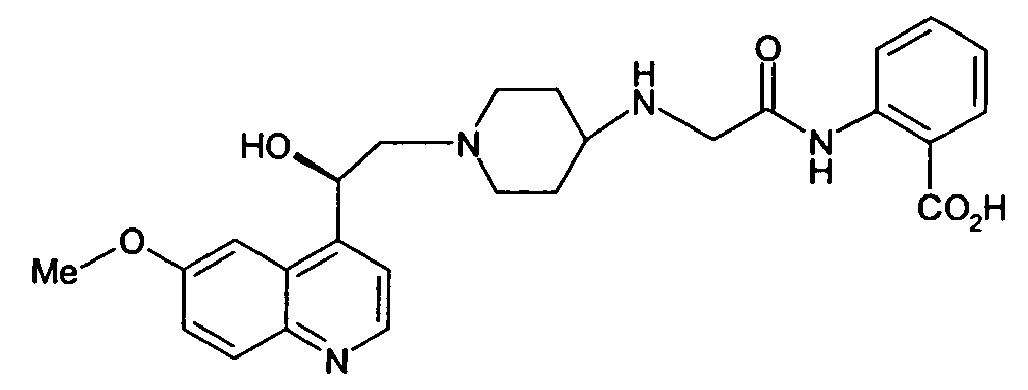
- The ester Example (27) (36mg, 0.07 mmol) was dissolved in tetrahydrofuran (1ml) and 2M sodium hydroxide solution (1ml, 0.2 mmol) followed by water (0.5ml) were added. The mixture was heated at 60°C for 1 hour, cooled to room temperature and 5M hydrochloric acid added until the solution was pH 4. The mixture was evaporated to dryness and methanol (5ml) was added. The methanolic solution was filtered to give a solid, in quantitative yield.
MS (+ve ion electrospray) m/z 479 (MH+)
The dioxalate salt was prepared in the usual manner. -

- 1-Benzyl-4-piperidone (23.5g, 124 mmol) and glycine benzyl ester (124 mmol) were stirred in dichloromethane (500ml) with 3A molecular sieves at 0°C for 1 hour and sodium triacetoxyborohydride (18.2g) was added portionwise over 15 minutes, and the mixture was stirred at room temperature for 1.5 hours. The mixture was cooled to 0°C and sodium bicarbonate solution was added, and the organic layer was separated, dried, evaporated and chromatographed on silica gel (ammonia-methanol-ethyl acetate) to afford an oil (29.21 g).
- The amine (34a) (29.21g) in dichloromethane (200ml) was treated with di-tert-butyl dicarbonate (20.66g) and 4-dimethylaminopyridine (0.10g) and the solution was stirred at room temperature for 2 hours, evaporated and chromatographed on silica gel (ethyl acetate-dichloromethaane) to afford an oil (28.1g).
- The piperidine (34b) (5.15g) in dichloromethane (50ml) at 0°C was treated with di-isopropylethylamine (1.8g) and 1-chloroethyl chloroformate (1.4ml) for 1 hour, evaporated, and chromatographed on silica gel (ethyl acetate-dichloromethaane) to afford an oil (4.3g).
- The carbamate (34c) (11.9g) in methanol (100ml) was left at room temperature for 4 days, evaporated, and partitioned between ethyl acetate and sodium bicarbonate solution. The organic fraction was dried, evaporated, and chromatographed on silica gel to afford an oil (1.2g).
- The piperidine (34d) (500mg, 1.44 mmol) in acetonitrile (5ml) under argon at room temperature was treated with [R]-2-(6-methoxyquinolin-4-yl)oxirane (1a) (290mg, 1.44 mmol) and lithium perchlorate (153mg, 1.44 mmol). The mixture was stirred at this temperature for 96 hours then the solvent was evaporated and the residue partitioned between dichloromethane and sodium bicarbonate solution. The layers were separated and the aqueous portion was extracted with dichloromethane. The combined organic layers were evaporated and the residue chromatographed on silica gel (methanol-dichloromethane) to give a colourless oil (529mg, 67%).
- The ester (34e) (520mg, 0.93 mmol) was dissolved in ethanol (50ml) and 10% palladium on charcoal (0.5g) was added. The mixture was hydrogenated for 4 hours, then filtered and evaporated. The colourless solid (427mg) obtained was used crude in the next step.
MS (+ve ion electrospray) m/z 460 (MH+) - The acid (34f) (100mg, 0.22 mmol) and 1-(3-dimethylaminopropyl)-3-ethyl carbodiimide hydrochloride (42mg, 0.22 mmol) were stirred at room temperature in dichloromethane for 10 minutes. 3-Cyanoaniline (26mg, 0.22 mmol) was added and the mixture stirred at room temperature for 12 hours. Dichloromethane and water were added and the layers separated. The aqueous phase was washed with dichloromethane and the combined organics were evaporated and the residue chromatographed on silica gel, (methanol-dichloromethane) to give a colorless oil (42mg, 34%).
MS (+ve ion electrospray) m/z 560 (MH+) - The piperidine (34g) (42mg, 0.07 mmol) was treated with dichloromethane (3ml) and trifluorofluoroacetic acid (1ml) for 1 hour. The solvents were evaporated and the residue treated with oxalic acid in the usual manner to give the dioxalate (43 mg).
MS (+ve ion electrospray) m/z 460 (MH+)
The following Examples 35-36 were prepared by the Method of Example 34: -

-
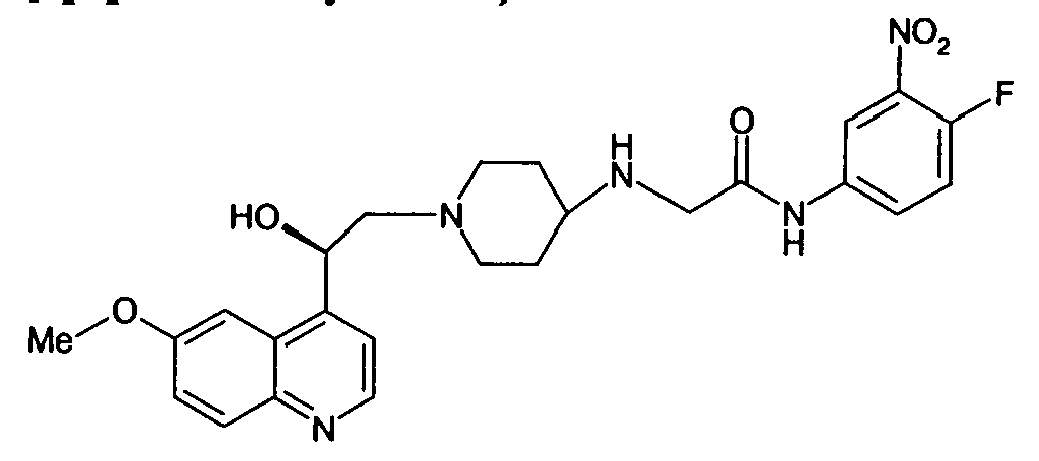
-

- 4-Amino-1-tert-butoxycarbonylpiperidine-4-carboxylic acid (18.0g) was dissolved in 0.03M aqueous sodium hydroxide (750ml), and 1,2-dimethoxyethanol (DME, 100ml). The pH was adjusted to 9.5 with dilute hydrochloric acid, and the suspension was added to an ice-cold solution of N-(benzyloxycarbonyloxy)succinimide (28.8g) in DME (100ml). The pH was kept at 9.5 by addition of aqueous sodium hydroxide, and the mixture was stirred at room temperature. More N-(benzyloxycarbonyloxy)succinimide (3g) was added after 7 hours, then stirring was continued overnight. After evaporation, the aqueous residue was extracted with ether then acidified to pH4 and extracted with ethyl acetate. This extract was washed with dilute hydrochloric acid, water and brine, dried and evaporated. Trituration of the oily residue gave 4-benzyloxycarbonylamino-1-tert-butoxycarbonylpiperidine-4-carboxylic acid (23g). This acid (23g) was esterified by treatment with methyl iodide (3.8ml), and potassium carbonate (16.6g) in acetone (200ml) at room temperature for 3 days. Filtration, evaporation, partitioning of the residue between dichloromethane and water and evaporation of the organic phase gave the methyl ester (21.05g).
MS (+ve ion electrospray) m/z 293 (MH+- t-BOC) - The piperidine (37a) (12.77g) was treated with ethanol (100ml) and 10% palladium on charcoal (2g). The mixture was hydrogenated for 72 hours, filtered and evaporated to give a colourless oil (5.66g, 65%).
- The amine (37b) (3.57g, 12.6 mmol) was dissolved in dimethylformamide (20ml). Potassium carbonate (1.79g, 13 mmol) and N-phenyl bromoacetamide (2.8g, 13 mmol) were added and the mixture was stirred at room temperature for 24 hours and then the solvent removed in vacuo. The residue was partitioned between dichloromethane and water. The layers were separated and the aqueous layer was extracted with a further portion of dichloromethane. The combined extracts were evaporated and the residue chromatographed on silica gel (methanol-dichloromethane) to give a colourless oil (4.35g, 93%).
MS (+ve ion electrospray) m/z 392 (MH+) - The piperidine (37c) (4.35g, 11.7 mmol) was treated with dichloromethane (20ml) and trifluorofluoroacetic acid (10ml) for 1 hour. The solvents were evaporated and the residue treated with sodium bicarbonate solution. The aqueous mixture was extracted with dichloromethane (100ml) which contained impure product (1.5g, discarded). The aqueous layer was treated with 2M sodium hydroxide solution until pH 11 and then extracted with dichloromethane (5 x 100 ml). The combined organic extracts were evaporated to give a colourless oil (1.86g, 55%).
MS (+ve ion electrospray) m/z 292 (MH+) - The piperidine (37d) (286mg, 1 mmol) in acetonitrile (2ml) under argon at room temperature was treated with [R]-2-(6-methoxyquinolin-4-yl)oxirane (1a) (201mg, 1 mmol) and lithium perchlorate (106.4mg, 1 mmol). The mixture was stirred at this temperature for 20 hours then the solvent was evaporated and the residue partitioned between dichloromethane and sodium bicarbonate solution. The layers were separated and the aqueous portion was extracted with dichloromethane. The combined organic layers were evaporated and the residue chromatographed on silica gel (methanol-dichloromethane) to give a colourless oil (258mg, 52%).
MS (+ve ion electrospray) m/z 493 (MH+) - A portion was treated with oxalic acid to produce the dioxalate salt in the usual manner.
-

- The ester Example (37) (109mg, 0.22 mmol) was dissolved in tetrahydrofuran (2ml) under argon and cooled to 0°C. A 1M solution of lithium aluminium hydride in tetrahydrofuran (0.22ml, 0.22 mmol) was added and the mixture stirred for 1 hour. 2M Sodium hydroxide solution (10ml) was added carefully followed by dichloromethane (15ml). The layers were separated and the aqueous layer was extracted with dichloromethane, the combined organics were evaporated and the residue chromatographed on silica gel (methanol-dichloromethane) to give a colourless oil (34mg, 31 %)
MS (+ve ion electrospray) m/z 465 (MH+)
1H NMR (CDCl3) δ: 1.70 (4H, m), 2.55 (3H, m), 2.85 (3H, m), 3.35 (2H, s), 3.50 (2H, s), 3.85 (3H, s), 5.45 (1H, dd), 7.15 (1H, d), 7.35 (3H, m), 7.40 (1H, dd), 7.60 (2H, d), 7.65 (1H, d), 8.05 (1H, d), 8.75 (1H, d), 9.30 (1H, brs).
It was treated with oxalic acid to produce the dioxalate salt in the usual manner. -

- The piperidine (37d) (291mg, 1 mmol) was heated in dimethylformamide (2ml) with 4-(1-imidazolylcarbonyl)amino-6-methoxyquinoline (5b) (268mg, 1 mmol) at 70°C for 12 hours. The solvent was evaporated and the residue partitioned between dichloromethane and sodium bicarbonate solution. The layers were separated and the aqueous portion was extracted with dichloromethane. The combined organic layers were evaporated and the residue chromatographed on silica gel (methanol-dichloromethane) to give a colourless oil (154mg, 31%)
MS (+ve ion electrospray) m/z 492 (MH+)
It was treated with oxalic acid to produce the oxalate salt in the usual manner. -

- The ester Example 39 (140mg, 0.28 mmol) was dissolved in tetrahydrofuran (2ml) under argon and cooled to 0°C. A 1M solution of lithium aluminium hydride (0.14ml, 0.14 mmol) was added and the mixture stirred for 10 minutes. Further lithium aluminium hydride (0.14ml) was added and the mixture stirred for 1 hour. 2M sodium hydroxide solution was added carefully followed by dichloromethane. The layers were separated and the aqueous layer was extracted with dichloromethane, the combined organics were evaporated and the residue chromatographed on silica gel (methanol-dichloromethane) to give a colourless oil (57mg, 44%).
MS (+ve ion electrospray) m/z 464 (MH+)
It was treated with oxalic acid to produce the oxalate salt in the usual manner. -

- A solution of ketone (1c) (0.5g) and benzyl glycinate (0.37g) in dichloromethane (5ml) was treated with sodium triacetoxyborohydride (0.47g). After 16 hours the mixture was partitioned between dichloromethane and saturated aqueous sodium bicarbonate solution. The dichloromethane extract was dried and evaporated to give a yellow solid. Chromatography on silica gel (methanol-dichloromethane) afforded the product as a white solid (0.27g)
MS (+ve ion electrospray) m/z 450 (MH+) - A solution of (41a) (0.27g) in chloroform (5ml) was treated with di-tert-butyl dicarbonate (0.4g) and 4-N,N-dimethylaminopyridine (40mg).for 16 hours The product was chromatography on silica gel (methanol/ethyl acetate) to afford an oil (0.16g)
MS (+ve ion electrospray) m/z 650 (MH+) - A solution of (41b) (0.16g) in ethanol (15ml) was hydrogenated over 10% palladium on charcol (0.2g) for 2 hours. Filtration and evaporation gave a mixture of (49c) and (tert-butoxycarbonyl-{1-[2-(6-methoxy-quinolin-4-yl)-ethyl]-piperidin-4-yl}-amino)-acetic acid as an oil (0.12g)
MS (+ve ion electrospray) m/z 560 (MH+) (41c)
MS (+ve ion electrospray) m/z 444 (MH+) (by-product) - A solution of (41c) (0.12g) in N,N-dimethylformamide (2ml) was treated with 4-fluoroaniline (30mg) and 1-(3-dimethylaminopropyl)-3-ethyl-carbodiimide hydrochloride (50mg). After 16 hours the mixture was partitioned between ethyl acetate and saturated aqueous sodium bicarbonate solution. The ethyl acetate extract was dried and evaporated to give a yellow oil. Chromatography on silica gel (methanol-ethyl acetate) afforded (41 d) as an oil (40mg).
The earlier fractions from the column gave [(4-fluoro-phenylcarbamoyl)-methyl)-{1-[2-(6-methoxy-quinolin-4-yl)-ethyl]-piperidin-4-yl}-carbamic acid tert-butyl ester as an oil (17mg). - A solution of (41d) (40mg) in trifluoroacetic acid (5ml) was stirred for 2.5 hours then evaporated to dryness. The residue was partitioned between ethyl acetate and saturated aqueous sodium bicarbonate solution. The ethyl acetate extract was dried and evaporated to give a yellow oil. Chromatography on silica gel (methanol-ethyl acetate) afforded the title compound as an oil (20mg).
MS (+ve ion electrospray) m/z 453 (MH+).
This was converted to the dioxalate salt in the usual way. -

- A solution of [(4-fluoro-phenylcarbamoyl)-methyl)-{1-[2-(6-methoxy-quinolin-4-yl)-ethyl]-piperidin-4-yl}-carbamic acid tert-butyl ester (17mg) (see earlier fraction in (41d) above) in trifluoroacetic acid (3ml) was stirred for 1 hour then evaporated to dryness. The residue was partitioned between ethyl acetate and saturated aqueous sodium bicarbonate solution. The ethyl acetate extract was dried and evaporated to give a yellow oil. Chromatography on silica gel (methanol-ethyl acetate) afforded the title compound as an oil (9mg).
MS (+ve ion electrospray) m/z 437 (MH+).
This was converted to the dioxalate salt in the usual way. -

- A solution of bromoacetaldehyde dimethyl acetal (1g) and 3,5-difluorophenol (0.8g) was treated with potassium carbonate (0.8g) and heated at 100 °C for 24hours. The mixture was partitioned between ether and 2N aqueous sodium hydroxide solution. The ether extract was dried and evaporated to afford 1-(2,2-dimethoxyethoxy)-3,5-difluorobenzene as an oil (0.2g) This was dissolved in a 2% solution of water in tetrahydrofuran (5 ml), treated with acidic Amberlyst-15 resin (0.75g) and heated at 60°C for 10 hours. The mixture was filtered and evaporated affording the title aldehyde as an oil (0.1g).
MS (+ve ion electrospray) m/z 173 (MH+) - A mixture of aldehyde (43a) (0.1g) and amine (13c) (0.09g) in dichloromethane-methanol (2 ml/0.2 ml) was treated with 3A molecular sieves (0.2g) then after 0.5 hours with sodium triacetoxyborohydride (0.2g). After 16 hours the mixture was partitioned between dichloromethane and saturated aqueous sodium bicarbonate solution. The dichloromethane extract was dried and evaporated to give a yellow solid. Chromatography on silica gel (methanol-dichloromethane) afforded the product as a white solid (0.075g, 55%).
1H NMR (CDCl3) δ: 1.60 (2H, m), 2.00 (2H, m), 2.25 (1H, m),) 2.50 (3H, m), 2.80 (2H, m), 3.00 (2H, t), 3.25 (1H, m), 3.90 (3H, m), 4.05 (2H, m), 5.45 (1H, dd), 6.45 (3H, m), 7.20 (1H, d), 7.35 (1H, dd), 7.65 (1H, d), 8.05 (1H, d), 8.80 (1H, d)
MS (+ve ion electrospray) m/z 458 (MH+)
This was converted to the dioxalate salt by treating a deuterochloroform solution with a solution of oxalic acid (36mg) in ether. The precipitate was isolated by centrifugation, resuspended in ether and again isolated by centrifugation. Drying in vacuo afforded the title compound as a white solid (66mg). -
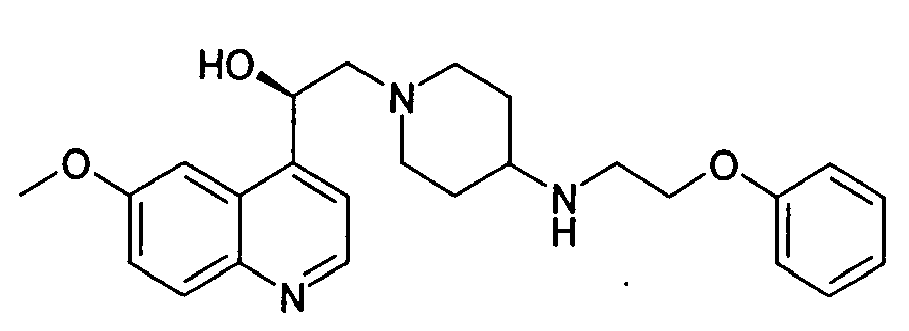
- A solution of the ketone (1c) (1.0g) and 2-phenoxyethylamine (0.5g) in dichloromethane was treated with 3A molecular sieves (0.5g) and shaken for 1 hour. Sodium triacetoxyborohydride (1.0g) was added and the mixture shaken for 24 hours. The mixture was partitioned between dichloromethane and saturated aqueous sodium bicarbonate solution. The dichloromethane extract was dried and evaporated to give a yellow oil. Chromatography on silica eluting with a methanol/dichloromethane gradient afforded the product as an oil (0.97g). This was converted to the dioxalate salt (0.9g) by the same procedure as for Example (43).
MS (+ve ion electrospray) m/z 422 (MH+)
1H NMR (CDCl3) δ: 1.60 (2H, m), 2.00 (2H, m), 2.05 (1H, m), 2.50 (3H, m), 2.80 (2H, m), 3.02 (2H, t), 3.25 (1H, m), 3.90 (3H, m), 4.08 (2H, m), 5.50 (1H, dd), 6.95 (3H, m), 7.20 (1H, d), 7.30 (2H,m), 7.35 (1H, dd), 7.65 (1H, d), 8.05 (1H, d), 8.80 (1H, d) -

- This was prepared in 71 % yield from 2-chloropyridine and ethanolamine according to the procedure of G. Tarrago et al, Tetrahedron, 1988, 44, 91.
MS (+ve ion electrospray) m/z 139 (MH+) - This was prepared by reductive alkylation with amine (45a) (70 mg) and ketone (1c) (0.15g) according to the same procedure as for Example (44), giving the title compound (free base) as a white foam (95 mg, 45%), which was converted to the dioxalate salt (120 mg) by the same procedure as for Example 43.
1H NMR (CDCl3) δ: 1.60 (2H, m), 1.95 (2H, m), 2.15 (1H, m), 2.50 (3H, m), 2.80 (2H, m), 3.08 (2H, t), 3.25 (1H, m), 3.90 (3H, m), 4.45 (2H, t), 5.45 (1H, dd), 6.78 (1H, d), 6.90 (1H, t), 7.25 (1H, d), 7.40 (1H, dd), 7.55 (1H, m), 7.65 (1H, d), 8.05 (1H, d), 8.20 (1H, m), 8.80 (1H, m).
MS (+ve ion electrospray) m/z 423 (MH+) -

- A solution of amine (30f) (0.1g) and phenoxyacetaldehyde (0.16g) in dichloromethane and methanol (1ml) was stirred for 0.5 hours, then sodium triacetoxyborohydride (0.11 g) was added. After 6 hours the mixture was partitioned between dichloromethane and saturated aqueous sodium bicarbonate solution. The dichloromethane extract was dried and evaporated to give a yellow oil. Chromatography on silica (methanol-dichloromethane) afforded the free base of the title compound as a solid (0.025g). This was converted to the oxalate salt (0.024g) by the same procedure as for Example (44).
1H NMR (CDCl3) δ: 1.50 (2H, m), 2.00 (2H, m), 2.85 (1H, m), 3.05 (2H, t), 4.10 (7H, m), 6.95 (3H, m), 7.15 (1H, d), 7.30 (2H, m), 8.20 (1h, d), 8.30 (1H, d), 8.65 (1H, d), 9.10 (1H, bs).
MS (+ve ion electrospray) m/z 422 (MH+).
This was converted to the oxalate salt (0.024g) by the same procedure as for Example 44. -

- The acid intermediate described in Example 37a (9.62g) was esterified by treatment with allyl bromide (2.2ml), potassium carbonate (7.04g) and potassium iodide (catalytic) in acetone (100ml) under reflux for 20 hours. Evaporation, partitioning of the residue between dichloromethane and water and evaporation of the organic phase gave the allyl ester (10.2g). This was then treated with trifluoroacetic acid in dichloromethane for 1.5 hours at room temperature to give, after basification of the triflate salt and extraction with dichloromethane-methanol, the free base (6.58g).
- A solution of piperidine (47a) (1.85g, 5.8 mmol) and oxirane (1a) (1.2g, 5.8 mmol) in acetonitrile (10ml) was treated with lithium perchlorate (0.62g, 5.8 mmol) and stirred at room temperature for 20 hours. The mixture was evaporated and the residue partitioned between dichloromethane and saturated aqueous sodium bicarbonate solution. The dichloromethane extract was dried and evaporated to give an oil. Chromatography on silica gel (methanol-dichloromethane) afforded the product as an oil (1.6g).
MS (+ve ion electrospray) m/z 520 (MH+). - A solution of (47b) (1.58g) in ethanol (100ml) was hydrogenated over 10% palladium on charcol (0.1g) for 16 hours. Filtration, evaporation, and chromatography on silica gel (methanol/dichloromethane) afforded the product as an oil (0.53g).
MS (+ve ion electrospray) m/z 388 (MH+). - A solution of ester (47c) (0.52 g, 1.3 mmol) in tetrahydrofuran (8ml) was treated at 0°C with a solution of lithium aluminium hydride in tetrahydrofuran (1M; 1.4ml, 1.4 mmol). After 1 hour aqueous sodium hydroxide (2M, 20ml) was added and the mixture was extracted with dichloromethane (30ml). Drying, evaporation, and chromatography on silica gel (methanol-dichloromethane) afforded the product as an oil (0.24g).
MS (+ve ion electrospray) m/z 332 (MH+). - A solution of the amine (47d) (0.14g) and trans-(2-furyl)-propenal (0.06g) in dichloromethane (5ml) was treated with sodium triacetoxyborohydride (0.1g). After 16 hours, methanol (1ml) was added followed by sodium borohydride (50mg). After 0.25 hours the mixture was partitioned between dichloromethane and saturated aqueous sodium bicarbonate solution. The dichloromethane extract was dried and evaporated to give an oil. Chromatography on silica (methanol-dichloromethane) afforded an oil (45 mg) which was converted to the dioxalate salt (58 mg) by the procedure of Example (43). 1H NMR (CDCl3) δ: 1.80 (4H, m), 2.70 (2H, m), 2.90 (2H, m), 3.30 (2H, d), 3.50 (2H, s), 3.95 (3H, s), 4.05 (2H, m), 5.55 (1H, dd), 6.15-6.25 (2H, m), 6.35-6.50 (2H, m), 7.18 (1H, d), 7.30-7.40 (2H, m), 7.65 (1H, d), 8.05 (1H, d), 8.78 (1H, d)
MS (+ve ion electrospray) m/z 462 (MH+). -

- The aminopiperidine (13c) (0.60g,1.99 mmol) and trans-3-(2-furyl)propenal (0.24g) were heated under reflux in chloroform (10ml) over magnesium sulphate (2.5g) for 19 hours. After filtation and evaporation of solvent, the residue was dissolved in methanol (10ml), cooled in ice and sodium borohydride (90 mg) was added. After 4 hours stirring at room temperature, the mixture was evaporated and the residue was dissolved in water and extracted with dichloromethane. The extract was dried and evaporated and the residue was chromatographed on silica gel (methanol-dichloromethane) to give an oil (0.63g).
1H NMR (CDCl3): δ 1.50 (2H, m), 1.97 (2H, broad t), 2.22 (1H, td), 2.37-2.67 (3H, m), 2.82 (2H, m), 3.26 (1H, m), 3.43 (2H, d), 3.93 (3H, s), 5.43 (1H, dd),
6.21 (1H, d), 6.26 (1H, t), 6.35 (1H, m), 6.39 (1H, d), 7.18 (1H, d), 7.34 (1H, s), 7.36 (1H, dd), 7.64 (1H, d), 8.03 (1H, d), 8.77 (1H, d).
MS (+ve ion electrospray) m/z 408 (MH+). - The free base (102mg) in dichloromethane was treated with 0.1 M oxalic acid in ether (5ml) to give the dioxalate salt (126mg).
-

- This was prepared from amine (13c) and cinnamaldehyde according to the same procedure as Example (43) affording an oil (11 mg, 15%).
1H NMR (CDCl3) δ: 1.50 (2H, m), 2.00 (2H, m), 2.20-2.60 (4H, m), 2.80 (2H, m), 3.25 (1H, m), 3.45 (2H, d), 3.95 (3H, s), 5.40 (1H, dd), 6.30 (1H, dt), 6.50 (1H, d), 7.20-7.40 (7H, m), 7.65 (1H, d), 8.05 (1H, d), 8.75 (1H, d).
MS (+ve ion electrospray) m/z 418 (MH+)
This was converted to the dioxalate (14 mg) by the same procedure as Example (1). -

- This was prepared from amine (13c) and 3-phenylpropionaldehyde according to the same procedure as Example (43) affording an oil (19mg, 14%), which was converted to the dioxalate salt (18mg) by the same procedure as Example (1).
1H NMR (CDCl3) δ: 1.50 (2H, m), 1.80-2.00 (4H, m), 2.20 (1H, t), 2.40 (1H, t), 2.55 (2H, m), 2.65 (4H, m), 2.85 (2H, m), 3.25 (1H, m), 3.90 (3H, s), 5.40 (1H, dd), 7.15 (3H, m), 7.25 (3H, m), 7.35 (1H, dd), 7.65 (1H, d), 8.00 (1H, d), 8.80 (1H, d).
MS (+ve ion electrospray) m/z 420 (MH+) -
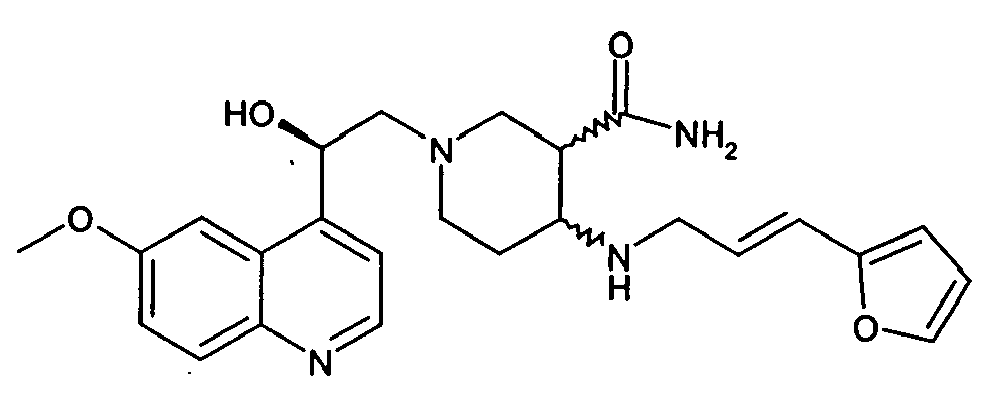
- The aminopiperidine(2c) (1.20g) was reductively alkyated with trans-3-(2-furyl)propenal (0.54g) by the method of Example (48). The crude product was chromatographed on silica gel (methanol-dichloromethane) to give the [trans-1-(2-furyl)-3-propenyl]amino compound (1.06g).
MS (+ve ion electrospray) m/z 379 (MH+). - The 1-tert-butoxycarbonylpiperidine (51a) (1.06g) was treated with trifluoroacetic acid (5ml) and 1,3-dimethoxybenzene (3.12ml) in dichloromethane (1). After 1.5 hours at room temperature, the mixture was evaporated and the residue was triturated with ether, dissolved in aqueous sodium bicarbonate and extracted with dichloromethane. The extracts were dried and evaporated, and the crude product was chromatographed on silica gel (methanol-dichloromethane) to give the piperidine (0.34g).
MS (+ve ion electrospray) m/z 279 (MH+). - The piperidine (51b) (0.17g), [R]-2-(6-methoxyquinolin-4-yl)oxirane (1a) (0.12g) and lithium perchlorate (64mg) were stirred in acetonitrile (1ml) at room temp. for 3 days. The solvent was evaporated and the residue was dissolved in ethyl acetate, washed with water and brine, dried and evaporated. The crude product was chromatographed on silica gel (methanol-dichloromethane) to give the hydroxyethylpiperidine (0.16g).
MS (+ve ion electrospray) m/z 480 (MH+) - The 3-ethoxycarbonylpiperidine (51c) (50mg) was heated with liquid ammonia (2ml) and potassium cyanide (1-2mg) in methanol (2 ml) at 60°C in a pressure bomb. After 48 hours, more ammonia was added and heating continued for 48 hours. The mixture was evaporated and the residue was dissolved in dichloromethane, washed with water, dried and evaporated. Chromatography on silica gel (methanol-dichloromethane) gave the free base (12mg).
1H NMR (CDCl3): δ 1.60 (0.5H, broad d), 1.7-2.0 (1.5H, m), 2.15 (0.5 H,d), 2.3-2.5 (2H, m), 2.5-2.65(2H, m), 2.65-2.8 (2H, m), 2.82 (0.5H, m), 2.96 (1H, m), 3.16 (0.5H, broad d), 3.35-3.6 (3H, m), 3.89 & 3.90 (3H, 2s), 5.40 & 5.54(1H,2 dd), 5.94 & 6.04 (1H, 2 broad s), 6.17 (1H, dt), 6.21 (1H, m), 6.37 (2H, m), 7.12 & 7.19(1H, 2d), 7.31 (1H, m), 7.35 (1H, s), 7.58 & 7.63(1H, 2d), 8.00(1H, dd), 8.72 (1H, m), 9.14 & 9.34(1H,2 broad s).
MS (+ve ion electrospray) m/z 451 (MH+).
The free base was converted into the dioxalate salt by the method of Example 1. -

- A solution of Example (48) (120mg) in ethanol (10ml) was hydrogenated over 10% palladium/charcoal (20mg) for 3 hours. After filtration and evaporation of solvent, the crude product was chromatographed on silica gel (methanol-dichloromethane) to give the free base (80mg).
1H NMR (CDCl3): δ 1.92(2H,m), 2.19(5H,m), 2.35(1H,t), 2.56(1H, dd), 2.76(2H,t), 2.89(4H,m), 3.35(1H,d), 3.93(3H,s), 5.46(1H,d), 6.07(1H,d), 6.28(1H,m), 7.16(1H,d), 7.31(d), 7.36(1H,dd), 7.63(1H,d), 8.03(1H,d), 8.77(1H,d).
MS (+ve ion electrospray) m/z 410 (MH+).
The free base was converted into the dioxalate salt by the method of Example 1 -

- This was prepared from 4-amino-6-methoxyquinoline (Example 5a) and cis-3-(R/S)-Ethoxycarbonyl-4-(S/R)-[trans-1-(2-furyl)-3-propenyl]amino piperidine (Example 51b) by urea formation by the method of Example (5b,c).
MS (+ve ion electrospray) m/z 479 (MH+). - The ester (53a) (90mg) in THF (2ml) was treated with lithium aluminium hydride (1M in THF, 0.4ml) at 0°C. After 4 hours the mixture was treated with dilute sodium hydroxide, diluted with ethyl acetate, dried, filtered and evaporated. Chromatography on silica gel (methanol-dichloromethane) gave a mixture of 1-(2-furyl)-3-propenylamino and 3-(2-furyl)propylamino compounds, which was hydrogenated in ethanol over 10% palladium-charcoal for 6 hours to give the title compound free base (26mg).
1H NMR (CD3OD): δ 1.59(2H,m), 1.87(3H,m), 2.29(1H, broad), 2.70(3H,m), 3.03(2H,m), 3.18(1H,d), 3.55-3.7(2H,m), 3.86(2H,m), 3.93(3H,s), 4.36(2H,t), 6.06(1H,d), 6.29(1H,d), 7.342H,m), 7.50(1H,d), 7.76(1H,d), 7.84(1H,d), 8.48(1H,d).
MS(+ve ion electrospray) m/z 439 (MH+).
The free base was converted into the oxalate salt by the method of Example 1 -

- This compound was prepared from the aminopiperidine (Example 13c) (0.6g) and trans-2-nitrocinnamaldehyde (0.25g) by the method of Example (43) to give the free base (0.65g).
1H NMR (CDCl3): δ 1.49 (2H, m), 2.00 (2H, broad t), 2.25 (1H, td), 2.39-2.70 (3H, m), 2.85 (2H, m), 3.29 (1H, m), 3.52 (2H, d), 3.94 (3H, s), 5.44 (1H, dd), 6.28 (1H, dt), 7.01 (1H, d), 7.19 (1H, d), 7.39 (2H, m), 7.59 (2H, m), 7.64 (1H, d), 7.93 (1H,d), 8.04(1H, d), 8.78 (1H, d).
MS (+ve ion electrospray) m/z 463 (MH+).
The free base was converted into the dioxalate salt by the method of Example 1. - This compound was prepared from Example (54) by hydrogenation over 10% palladium on charcoal, converting to the dioxalate salt (52mg) by the same procedure as for Example (1)
MS (+ve ion electrospray) m/z 435 (MH+) - This was prepared by the same procedure as for Example (43),
MS (+ve ion electrospray) m/z 440 (MH+) - This was prepared by the same procedure as for Example (43),
MS (+ve ion electrospray) m/z 440 (MH+) - This was prepared from ketone (1c) and 2-(3-trifluoromethylphenoxy)-ethylamine according to the same procedure as Example (44). The free base was converted to the dioxalate salt by the same procedure as Example (1).
MS (+ve ion electrospray) m/z 490 (MH+) - This was prepared by the same procedure as for Example (45).
MS (+ve ion electrospray) m/z 423 (MH+) - This was prepared by a similar procedure to Example (45).
MS (+ve ion electrospray) m/z 423 (MH+) - This was prepared by the same procedure as for Example (43).
MS (+ve ion electrospray) m/z 447 (MH+) - This was prepared by a similar procedure to Example (45).
MS (+ve ion electrospray) m/z 424 (MH+) - This was prepared from 4-fluorophenylcinnamaldehyde by the same procedure as for Example (48).
MS (+ve ion electrospray) m/z 436 (MH+) - This was prepared from 2-methoxycinamaldehyde by the same procedure as for Example (48).
MS (+ve ion electrospray) m/z 448 (MH+) - This was prepared using 4-methoxycinnamaldehyde by the same procedure as for Example (48).
MS (+ve ion electrospray) m/z 448 (MH+) -
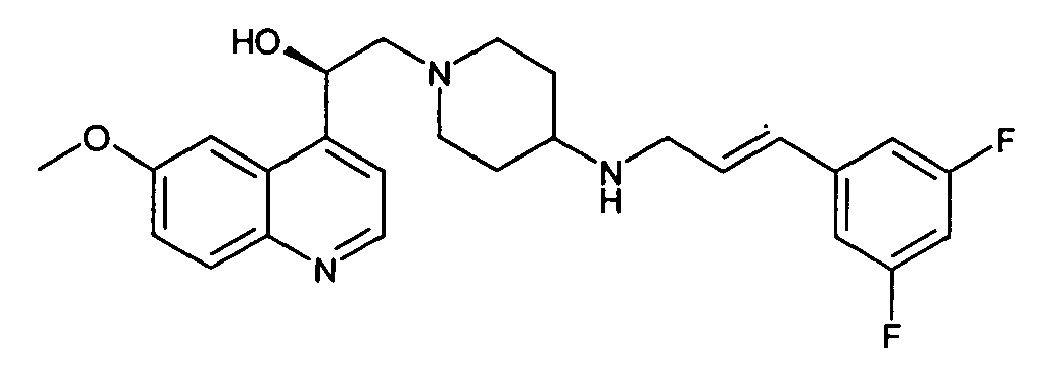
- A solution of (trans)-3-(3,5-difluorophenyl)-acrylic acid (1g) in tetrahydrofuran (10 ml) was treated at 0°C with triethylamine (0.9 ml), then isobutyl chloroformate (0.8 ml) was added dropwise. After 1 hour, the mixture was filtered and the filtrate diluted with ice/water (10 g). Sodium borohydride (0.5g) was added. After 3 hours, 2M aqueous hydrochloric acid was added. The mixture was partitioned between dichloromethane and brine. The organic extract was dried and evaporated. Chromatography on silica gel (ethyl acetate-hexane) afforded the alcohol as an oil (0.4g). (See R. J. Alabaster et al, Synthesis 1989, 598 for a related procedure.)
MS (+ve ion electrospray) m/z 171 (MH+) - A solution of (66a) (0.2g) in dichloromethane (3 ml) was treated with manganese (II) dioxide (0.52g). After 16 hours, the mixture was filtered and evaporated to give the aldehyde as a white solid (0.18g).
MS (+ve ion electrospray) m/z 169 (MH+) - This was prepared from aldehyde (66b) (0.73g) and amine (13c) (0.1g) by reductive alkylation using sodium borohydride using the same procedure as for Example 48, giving the title compound as an oil (0.08g) after chromatography.
1H NMR (CDCl3) δ: 1.55 (2H, m), 2.00 (2H, m), 2.25(1H, m), 2.40-2.65 (3H, m), 2.85(2H, m), 3.30 (1H, m), 3.50 (2H, d), 3.90 (3H, s), 5.45 (1H, dd), 6.30 (1H, m), 6.45 (1H, d),), 6.65 (1H, m),), 6.85 (2H, m),7.15 (1H, m), 7.35 (1H, dd), 7.65 (1H, d), 8.05 (1H, d), 8.75 (1H, d)
MS (+ve ion electrospray) m/z 454 (MH+)
The free base was converted to the dioxalate in the normal manner. -

- This was prepared from (trans)-3-pyridin-2-yl-acrylic acid by the same procedure as for Example (66).
1H NMR (CDCl3) δ: 1.55 (2H, m), 2.00 (2H, m), 2.25(1H, m), 2.35-2.70 (3H, m), 2.85(2H, m), 3.28 (1H, m), 3.55 (2H, d), 3.90 (3H, s), 5.45 (1H, dd), 6.68 (1H, m), 6.80 (1H, m),7.15 (2H, m), 7.25-7.40 (2H, m), 7.65 (2H, m), 8.05 (1H, d), 8.50 (1H, d) 8.78 (1H, d)
MS (+ve ion electrospray) m/z 419 (MH+)
The free base was converted to the dioxalate in the normal manner. -

- This was prepared by reaction of the naphthyridine oxirane (31d) with 1,4-dioxa-8-azaspiro-[4,5]-decane, followed by acidic hydrolysis of the ketal to give the ketone, by the same procedures as for Example (1c).
MS (+ve ion electrospray) m/z 302 (MH+). - This was prepared by reductive alkyation of the above ketone (68a) with 2-(pyridin-2-yloxy)-ethylamine according to the procedure for Example 45, affording the title compound as an oil (62 mg, 55%).
1H NMR (CDCl3) δ: 1.55 (2H, m), 2.00 (2H, m), 2.25(1H, m), 2.35-2.70 (3H, m), 2.85(2H, m), 3.05-3.15 (3H, m), 3.30 (1H, m), 3.95 (3H, s), 4.45 (2H, t),5.70 (1H, dd) 6.75 (1H, m), 6.85 (1H, m),7.15 (1H, d), 7.55 (1H, m), 7.85 (1H, d), 8.15 (1H, m), 8.20 (1H, d) 8.78 (1H, d)
MS (+ve ion electrospray) m/z 424 (MH+)
The free base was converted to the dioxalate in the normal manner. -

- This was prepared by reductive alkylation of the amine (31f) with aldehyde (66b) according to the procedures of Example 66, affording an oil (35 mg, 32%)
1H NMR (CDCl3) δ: 1.55 (2H, m), 2.00 (2H, m), 2.25(1H, m), 2.35-2.70 (3H, m), 2.85(2H, m), 3.28 (1H, m), 3.55 (2H, d), 4.00 (3H, s), 5.45 (1H, dd), 6.66 (1H, m), 6.75 (1H, m),7.15 (2H, m), 7.30 (1H, m), 7.65 (1H, dt), 7.80 (1H, d), 8.20 (1H, d), 8.55 (1H, d) 8.78 (1H, d)
MS (+ve ion electrospray) m/z 420 (MH+) The free base was converted to the dioxalate in the normal manner. -

- A solution of Example 29 (0.16g) in tetrahydrofuran (5 ml) was treated with a solution of lithium aluminium hydride in tetrahydrofuran (1M; 1.4 ml, 1.4 mmol). After 7h the mixture was treated with 8% aqueous sodium hydroxide solution, ethyl acetate, and sodium sulphate. Filtration, evaporation and chromatography on silica eluting with a methanol/dichloromethane gradient afforded an oil (38 mg, 25%)
1H NMR (CDCl3) δ: 1.5 (2H, m), 2.00 (2H, m), 2.23(1H, m), 2.35-2.60 (3H, m), 2.80-2.95(4H, m), 3.10-3.30 (3H, m), 3.92 (3H, s), 4.48 (1H, bs), 5.43 (1H, dd), 6.13 (3H, m), 7.19 (1H, d), 7.38 (1H, dd), 7.69 (1H, d), 8.04 (1H, d), 8.78 (1H, d)
MS (+ve ion electrospray) m/z 457 (MH+)
The free base was converted to the dioxalate in the normal manner. -

- A mixture of 3-fluoroaniline (1g, 9 mmol), 2-bromoethylamine hydrobromide (1.8g, 9 mmol) and toluene (10 ml) was heated to reflux under argon for 8h. The toluene was decanted off and the residue dissolved in water, basified with potassium hydroxide and extracted with dichloromethane. The dichloromethane extracts were dried (sodium sulphate) and evaporated to give an oil. Chromatography on silica eluting with a methanol/dichloromethane gradient afforded an oil (0.44g, 32%).
MS (+ve ion electrospray) m/z 155 (MH+)
(b) Title compound - This was prepared by reductive alkylation of amine (71c) and ketone (1c) using sodium triacetoxyborohydride according to the procedure of Example 44, affording the title compound as an oil (0.42g, 79%).
1H NMR (CDCl3) δ: 1.5 (2H, m), 2.00 (2H, m), 2.23(1H, m), 2.35-2.60 (3H, m), 2.80-2.95(4H, m), 3.10-3.30 (3H, m), 3.94 (3H, s), 4.40 (1H, bs), 5.45 (1H, dd), 6.30-6.50 (3H, m), 7.15(1H, m), 7.20(1H, d), 7.40 (1H, dd), 7.70 (1H, d), 8.08 (1H, d), 8.78 (1H, d)
MS (+ve ion electrospray) m/z 439 (MH+)
The free base was converted to the dioxalate in the normal manner. -

- To a solution of (E)-3-furan-2-ylacrylic acid (28mg, 0.2 mmol) and di-isopropylethylamine (0.07 ml, 0.4 mmol) in N,N-dimethylformamide (0.2 ml) were added 1-[3-(dimethylamino)propyl]-3-ethylcarbodiimide hydrochloride (38mg, 0.2mmol) in dry dichloromethane (1.5 ml) and aminopiperidine (13c), (50mg, 0.17mmol) in dry dichloromethane (1 ml). The mixture was shaken for a short period then allowed to stand overnight. The mixture was then washed well with water, dried and evaporated. The crude product was chromatographed on silica gel eluted with 0-5% methanol/dichloromethane to give the free base of title compound (46mg, 64%).
1H NMR (CDCl3) δ 1.6 (2H, m), 2.09 (2H, m), 2.34 (1H, m), 2.53 (2H, m), 2.82 (1H, m), 2.87 (1H, dd), 3.27 (1H,m) 3.93 (3H,s & 1H, m), 5.45 (1H, dd), 5.59 (1H, d), 6.29 (1H, d), 6.47 (1H, m), 6.56 (1H, d), 7.17 (1H, d), 7.38 (1H, dd), 7.44 (2H, m), 7.64 (1H, d), 8.04 (1H, d), 8.78 (1H, d)
MS (+ve ion electrospray) m/z 422 (MH+).
The free base in chloroform/dichloromethane was treated with one equivalent of oxalic acid in ether to give the oxalate salt. -

- A mixture of formylmethylene triphenylphosphorane (0.9g) and thiazole-2-carboxaldehyde (0.33g) in toluene (20 ml) was heated at 40°C for 4h. The mixture was chromatographed on silica eluting with an ethyl acetate-dichloromethane gradient affording a white solid (0.25g).
1H NMR (CDCl3): δ 6.90 (1H, dd), 7.55 (1H, d), 7.65 (1H, d), 8.00 (1H, d), 9.75 (1H, d) MS (+ve ion electrospray) m/z 140 (MH+) - This was prepared by reductive alkylation of amine (31f) and aldehyde (73a) according to the procedure of Example 48 affording the free base of the title compound as an oil (0.4g, 80%).
1H NMR (CDCl3): δ: 1.45-1.55 (2H, m), 1.90-2.05 (2H, m), 2.20 (1H, m), 2.40-3.10 (5H, m), 3.60 (2H, d), 4.05 (3H, s), 5.75 (1H, dd), 6.68 (1H, t), 6.80 (1H, s), 7.10 (1H, d), 7.20 (1H, d), 7.73 (1H, d), 7.80 (1H, d), 8.20 (1H, d), 8.78 (1H, d)
MS (+ve ion electrospray) m/z 426 (MH+) - This was converted to the dimethanesulphonate salt by adding an ether solution of methanesulphonic acid (2 equivalents) to a solution of the free base in chloroform, followed by isolation by centrifugation (0.45g).
-

- 2-Fluoro-4-methoxy-phenylamine (3.80g;26.7mmol) and methyl propiolate (2.37ml, 0.267mol) in methanol (100ml) was stirred for 72 hours at room temperature, then heated at 50°C for 24 hours. It was evaporated and the product purified by chromatography on silica gel (dichloromethane) to give a solid (1.66g), a portion of which was recrystallised from dichloromethane-hexane.
- The unsaturated ester (0.96g) in warm Dowtherm A (5ml) was added over 3 minutes to refluxing Dowtherm A (15ml), and after a further 20 minutes at reflux the mixture was cooled and poured into ether. The precipate was filtered to give the title compound (0.50g, 61%)
- This was prepared from (74a) by the method of Example (31b).
MS (+ve ion electrospray) m/z 298/300 (MH+). - The bromomethyl ketone (74b) (8.6g) was converted to the oxirane (1.04g) by the methods of Examples (31c,d).
MS (+ve ion electrospray) m/z 220 (MH+). - This was prepared from oxirane (74c) (1.04g) by the method of Example (1b,c) to give the ketone (1.1g) as a foam.
MS (+ve ion electrospray) m/z 319 (MH+). - This was prepared from ketone (74d) and amine (45a) according to the procedure of Example 45, affording the free base as an oil (84 mg, 65%).
1H NMR (CDCl3) δ: 1.60 (2H, m), 1.95 (2H, m), 2.15 (1H, m), 2.50 (3H, m), 2.80 (2H, m), 3.08 (2H, t), 3.25 (1H, m), 3.95 (3H, s), 4.45 (2H, t), 5.45 (1H, dd), 6.75 (1H, d), 6.85 (1H, m), 7.00 (1H, m), 7.15 (1H, m), 7.40 (1H, dd), 7.60 (1H, m), 7.70 (1H, m), 8.15 (1H, m), 8.80 (1H, d).
MS (+ve ion electrospray) m/z 441 (MH+). - This was converted to the dioxalate salt (112 mg) in the usual way
-

- A mixture of 5-fluoro-1H-pyrimidine-2,4-dione (1 g), potassium carbonate (1 g) and 3-bromo-1,1-dimethoxy-propane (1.4 g) in N,N-dimethylformamide (10 ml) was heated overnight at 70°C. The mixture was partitioned between ether and water. The ether extract was dried and evaporated to afford an oil (0.8gg).
MS (+ve ion electrospray) m/z 233 (MH+). - The above compound was dissolved in a 2% solution of water in tetrahydrofuran (5 ml), treated with acidic Amberlyst-15 resin (0.75g) and heated at 60°C for 10 hours. The mixture was filtered and evaporated affording the aldehyde as an oil (0.2g).
MS (+ve ion electrospray) m/z 187 (MH+) - This was prepared from aldehyde (75b) (0.2g) and aminopiperidine (13c) (0.15g) by reductive alkylation according to the procedure of Example 43b to give the title compound as an oil (23 mg)
1H NMR (d-6 MeOH) δ 1.6-1.8 (2H, m), 2.0-2.2 (4H, m), 2.3-2.4 (2H, m), 2.7-2.8 (2H, m), 2.9-3.0 (2H, m), 3.2-3.3 (2H, m), 3.7 (1H, m), 3.8 (2H, m), 3.95 (3H, s), 5.60 (1H, m), 7.30-7.40 (2H, m), 7.65 (1H, d, 7.85 (1H, d), 7.95 (1H, d), 8.65 (1H, d)
MS (+ve ion electrospray) m/z 472 (MH+) - This was converted to the dioxolate salt (30 mg) in the usual way
The following Examples of Table 1 were prepared by analogous methods.
A: by method of Example 43
B: by method of Example 55
C: by method of Example 62
D: by method of Example 48
E: by method of Example 52
F: by method of Example 44
G: by method of Example 71
H: by method of Example 45
I: by method of Example 70
J: by method of Example 13
K: by method of Example 1
L: by method of Example 33
M: Prepared in ca 2% yield by alkylation of 4-amino-1-[(R)-2-hydroxy-2-(6-methoxy-quinolin-4-yl)-ethyl]-piperidine-4-carboxylic acid carbamoylmethyl-amide with (E)-(3-bromo-propenyl)-benzene.
N: by method of Example 72
O: by method of Example 75
Salts: AY = dioxalate
DZ = dimesylate
G = oxalateTable 1 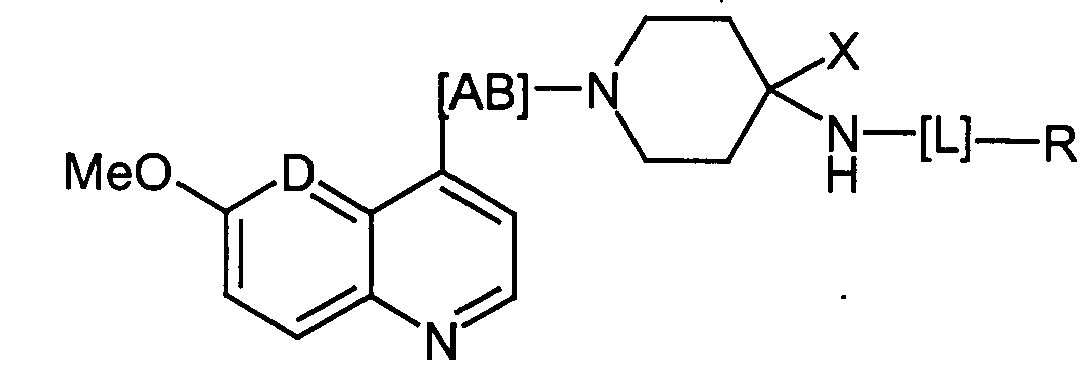
Example Method of Synthesis Isolated as salt D AB X L R 200 A AY CH (R)-CH(OH)CH2 H CH2CH2O 3-fluorophenyl 201 A AY CH (R)-CH(OH)CH2 H CH2CH2O 3,4-difluorophenyl 202 A AY CH (R)-CH(OH)CH2 H CH2CH2O 2,3-difluorophenyl 203 A AY CH (R)-CH(OH)CH2 H CH2CH2O 2,5-difluorophenyl 204 A AY CH (R)-CH(OH)CH2 H CH2CH2O 2,4-difluorophenyl 205 A AY CH (R)-CH(OH)CH2 H CH2CH2O 3,4,5-trifluorophenyl 206 A AY CH (R)-CH(OH)CH2 H CH2CH2O 2,3-difluoro-6-nitrophenyl 207 A AY CH (R)-CH(OH)CH2 H CH2CH2O 3,4-dichlorophenyl 208 A AY CH (R)-CH(OH)CH2 H CH2CH2O 2-fluoro-6-methylphenyl 209 A AY CH (R)-CH(OH)CH2 H CH2CH2O 2-bromo-5-fluorophenyl 210 A AY CH (R)-CH(OH)CH2 H CH2CH2O 2-chloro-4-fluorophenyl 211 A AY CH (R)-CH(OH)CH2 H CH2CH2O 2-chloro-3-trifluoromethylphenyl 212 A AY CH (R)-CH(OH)CH2 H CH2CH2O 2-cyanophenyl 213 A AY CH (R)-CH(OH)CH2 H CH2CH2O 2-chloro-3,5-difluorophenyl 214 A AY CH (R)-CH(OH)CH2 H CH2CH2O 2-fluoro-6-nitrophenyl 215 A AY CH (R)-CH(OH)CH2 H CH2CH2O 2-fluoro-5-trifluoromethylphenyl 216 A AY CH (R)-CH(OH)CH2 H CH2CH2O 4-fluoro-2-nitrophenyl 217 A AY CH (R)-CH(OH)CH2 H CH2CH2O 2-nitrophenyl 218 A AY CH (R)-CH(OH)CH2 H CH2CH2O 2-chloro-5-nitromethylphenyl 219 A AY CH (R)-CH(OH)CH2 H CH2CH2O 2-methyl-5-fluorophenyl 220 A AY CH (R)-CH(OH)CH2 H CH2CH2O 3-cyanophenyl 221 A AY CH (R)-CH(OH)CH2 H CH2CH2O 3-fluoro-2-nitrophenyl 222 B KT CH (R)-CH(OH)CH2 H CH2CH2O 2-aminophenyl 223 B KT CH (R)-CH(OH)CH2 H CH2CH2O 6-amino-3-fluorophenyl 224 A AY CH (R)-CH(OH)CH2 H CH2CH2O 2-methoxyphenyl 225 A AY CH (R)-CH(OH)CH2 H CH2CH2O 2-trifluoromethylphenyl 226 C AY CH (R)-CH(OH)CH2 H CH2CH2O pyrimidin-5-yl 227 A AY CH (R)-CH(OH)CH2 H CH2CH2O 2,6-difluorophenyl 228 A AY CH (R)-CH(OH)CH2 H CH2CH2O 3,5-dimethoxyphenyl 229 A AY CH (R)-CH(OH)CH2 H CH2CH2O 2,3-dimethoxyophenyl 230 A AY CH (R)-CH(OH)CH2 H CH2CH2O 3-methoxyphenyl 231 A AY CH (R)-CH(OH)CH2 H CH2CH2O 2-acetamidophenyl 232 A AY CH (R)-CH(OH)CH2 H CH2CH2O 3-methoxycarbonylphenyl 300 D DZ CH (R)-CH(OH)CH2 H (E)CH2CH=CH thiazol-2-yl 301 E AY CH (R)-CH(OH)CH2 H CH2CH2CH2 3,5-difluorophenyl 302 D DZ CH (R)-CH(OH)CH2 H (E)CH2CH=CH pyridin-3-yl 303 O AY CH (R)-CH(OH)CH2 H CH2CH2CH2 
304 O AY CH (R)-CH(OH)CH2 H CH2CH2CH2 
305 F AY CH (R)-CH(OH)CH2 H CH2CH2CH2 3-imidazol-1-yl 306 O AY CH (R)-CH(OH)CH2 H CH2CH2CH2 
307 D AY CH (R)-CH(OH)CH2 H (E)CH2CH=CH 4-dimethylaminophenyl 308 F AY CH (R)-CH(OH)CH2 H CH2CH2CH2 1-H-[1,2,4]triazol-5-yl 309 A AY CH (R)-CH(OH)CH2 H CH2CH2CH2 4-fluorophenyl 310 A AY N (R)-CH(OH)CH2 H CH2CH2O 3,5-difluorophenyl 311 M G CH (R)-CH(OH)CH2 CONHCH2CONH2 (E)CH2CH=CH phenyl 400 A s CH NHCO H CH2CH2O 3,5-difluorophenyl 401 A G N NHCO H CH2CH2O 3,5-difluorophenyl 402 H AY N NHCO H CH2CH2O pyridin-2-yl 403 D AY N NHCO H (E)CH2CH=CH pyridin-2-yl 404 I AY N NHCO H CH2CH2NH 3,5-difluorophenyl 405 G AY N NHCO H CH2CH2NH 3-fluorophenyl 500 F DZ CH (R)-CH(OH)CH2 H CH2CH2NH 6-fluoropyridin-2-yl 501 F AY CH (R)-CH(OH)CH2 H CH2CH2NH phenyl 502 F AY CH (R)-CH(OH)CH2 H CH2CH2NH 3-trifluoromethylpyridin-2-yl 503 F AY CH (R)-CH(OH)CH2 H CH2CHNH pyridin-2-yl 504 F G CH (R)-CH(OH)CH2 H CH2CH2NH 4-azido-2-nitrophenyl 505 F G CH (R)-CH(OH)CH2 H CH2CH2NH 5-nitropyridin-2-yl 506 F G CH (R)-CH(OH)CH2 H CH2CH2NH 6-nitropyridin-2-yl 507 F AY N (R)-CH(OH)CH2 H CH2CH2NH 3-fluorophenyl 601 J AY CH (R)-CH(OH)CH2 H CH2CONH 3-fluorophenyl 602 J AY N (R)-CH(OH)CH2 H CH2CONH pyrid-2-yl 603 J AY N (R)-CH(OH)CH2 H CH2CONH 3,5-difluorophenyl 604 K AY CH (R)-CH(OH)CH2 H CH2CONH pyrazyl 605 J AY CH (R)-CH(OH)CH2 H CH2CONH 6-methylpyrid-2-yl 606 J AY CH (R)-CH(OH)CH2 H CH2CONH 3-methoxyphenyl 607 J AY CH (R)-CH(OH)CH2 H CH2CONH 2-n-butylphenyl 608 J AY CH (R)-CH(OH)CH2 H CH2CONH 3-n-butylaminosulphonylphenyl 609 L AY CH (R)-CH(OH)CH2 H CH2CONH 3-carboxyphenyl 610 N AY CH (R)-CH(OH)CH2 H E-COCH=CH 3,5-difluorophenyl 611 N AY CH (R)-CH(OH)CH2 H E-COCH=CH 3-thienyl 612 N AY CH (R)-CH(OH)CH2 H E-COCH=CH 3-bromo-5-fluorophenyl 613 N AY CH (R)-CH(OH)CH2 H E-COCH=CH 3-fluoro-pyridin-2-yl 614 N G CH (R)-CH(OH)CH2 H E-COCH=CH 2-nitrophenyl 615 N -G CH (R)-CH(OH)CH2 H COCH2O phenyl 616 J DZ CH (R)-CH(OH)CH2 H CH2CONH 3-hydroxyphenyl - The MIC (µg/ml) of test compounds against various organisms was determined: S. aureus Oxford, S. aureus WCUH29, S. pneumoniae 1629, S. pneumoniae N1387, S. pneumoniae ERY 2, E. faecalis 1, E. faecalis 7, H. influenzae Q1, H. influenzae NEMC1, M. catarrhalis 1502, E. coli 7623, E.coli 120.
Examples 1, 2 , 13, 17, 19, 20, 29, 43-52, 54, 56-58, 63, 66-71, 73, 74, 200-217, 219, 221, 222, 225, 300, 301 304, 310, 401, 404, 500, 501, 507, 601-604 have an MIC of less than or equal to 0.25µg/ml; 3,4,11, 18,21-25, 38, 41, 42, 53, 55, 59, 62, 64, 72, 218, 220, 223, 224, 231, 302, 303, 402, 403, 405, 502-504, 506, 605, 606, 610-614 have an MIC of less than or equal to 2µg/ml; 5,6, 12, 26-28, 34, 36, 37, 75, 226-230, 232, 311, 400, 505, 607-610 have an MIC less than or equal to 32µg/ml; others have an MIC level >32ug/ml against one or more of the above range of gram positive and gram negative bacteria.
R3 is in the 2-, 3- or 4-position and is:
R11 is hydrogen; trifluoromethyl, (C1-6)alkyl; (C2-6)alkenyl; (C1-6)alkoxycarbonyl; (C1-6)alkylcarbonyl; or aminocarbonyl wherein the amino group is optionally substituted by (C1-6)alkoxycarbonyl, (C1-6)alkylcarbonyl, (C2-6)alkenyloxycarbonyl, (C2-6) alkenylcarbonyl, (C1-6)alkyl or (C2-6)alkenyl and optionally further substituted by (C1-6)alkyl or (C2-6)alkenyl;
or where one of R3 and R6, R7, R8 or R9 contains a carboxy group and the other contains a hydroxy or amino group they may together form a cyclic ester or amide linkage.
Q1 is NR2R4 or a group convertible thereto wherein R2' and R4' are R2 and R4 as defined in formula (I) or groups convertible thereto and Q2 is H or R3' or Q1 and Q2 together form an optionally protected oxo group;
and X and Y may be the following combinations:

and thereafter optionally or as necessary converting Q1 and Q2 to NR2'R4'; converting A', Z1', Z2', Z3', Z4', Z5', R1', R2', R3', R4' and NR11' to A, Z1, Z2, Z3, Z4, Z5, R1, R2, R3, R4 and NR11'; converting A-B to other A-B, interconverting R1, R2, R3 and/or R4, and/or forming a pharmaceutically acceptable derivative thereof.
Claims (14)
- A compound of formula (I) or a pharmaceutically acceptable derivative thereof:

one of Z1, Z2, Z3, Z4 and Z5 is N, one is CR1a and the remainder are CH , or one or two of Z1, Z2, Z3, Z4 and Z5 are independently CR1a and the remainder are CH;
R1 and R1a are independently hydrogen; hydroxy; (C1-6)alkoxy optionally substituted by (C1-6)alkoxy, amino, piperidyl, guanidino or amidino any of which is optionally N-substituted by one or two (C1-6)alkyl, acyl or (C1-6)alkylsulphonyl groups, CONH2, hydroxy, (C1-6)alkylthio, heterocyclylthio, heterocyclyloxy, arylthio, aryloxy, acylthio, acyloxy or (C1-6)alkylsulphonyloxy; (C1-6)alkoxy-substituted(C1-6)alkyl; halogen; (C1-6) alkyl; (C1-6)alkylthio; trifluoromethyl; trifluoromethoxy; nitro; azido; acyl; acyloxy; acylthio; (C1-6)alkylsulphonyl; (C1-6)alkylsulphoxide; arylsulphonyl; arylsulphoxide or an amino, piperidyl, guanidino or amidino group optionally N-substituted by one or two (C1-6)alkyl, acyl or (C1-6)alkylsulphonyl groups;
provided that when Z1, Z2, Z3, Z4 and Z5 are CR1a or CH, then R1 is not hydrogen;
R2 is hydrogen, or (C1-4)alkyl or (C2-4)alkenyl optionally substituted with 1 to 3 groups selected from:amino optionally substituted by one or two (C1-4)alkyl groups; carboxy; (C1-4) alkoxycarbonyl; (C1-4)alkylcarbonyl; (C2-4)alkenyloxycarbonyl; (C2-4) alkenylcarbonyl; aminocarbonyl wherein the amino group is optionally substituted by hydroxy, (C1-4)alkyl, hydroxy(C1-4)alkyl, aminocarbonyl(C1-4)alkyl, (C2-4)alkenyl, (C1-4)alkylsulphonyl, trifluoromethylsulphonyl, (C2-4)alkenylsulphonyl, (C1-4) alkoxycarbonyl, (C1-4)alkylcarbonyl, (C2-4)alkenyloxycarbonyl or (C2-4) alkenylcarbonyl; cyano; tetrazolyl; 2-oxo-oxazolidinyl optionally substituted by R10; 3-hydroxy-3-cyclobutene-1,2-dione-4-yl; 2,4-thiazolidinedione-5-yl; tetrazol-5-ylaminocarbonyl; 1,2,4-triazol-5-yl optionally substituted by R10; 5-oxo-1,2,4-oxadiazol-3-yl; halogen; (C1-4)alkylthio; trifluoromethyl; hydroxy optionally substituted by (C1-4) alkyl, (C2-4)alkenyl, (C1-4)alkoxycarbonyl, (C1-4)alkylcarbonyl, (C2-4) alkenyloxycarbonyl, (C2-4)alkenylcarbonyl; oxo; (C1-4)alkylsulphonyl; (C2-4) alkenylsulphonyl; or (C1-4)aminosulphonyl wherein the amino group is optionally substituted by (C1-4)alkyl or (C2-4)alkenyl;R3 is hydrogen; or
R3 is in the 2-, 3- or 4-position and is:carboxy; (C1-6)alkoxycarbonyl; aminocarbonyl wherein the amino group is optionally substituted by hydroxy, (C1-6)alkyl, hydroxy(C1-6)alkyl, aminocarbonyl(C1-6)alkyl, (C2-6)alkenyl, (C1-6)alkylsulphonyl, trifluoromethylsulphonyl, (C2-6)alkenylsulphonyl, (C1-6)alkoxycarbonyl, (C1-6)alkylcarbonyl, (C2-6)alkenyloxycarbonyl or (C2-6) alkenylcarbonyl and optionally further substituted by (C1-6)alkyl, hydroxy(C1-6)alkyl, aminocarbonyl(C1-6)alkyl or (C2-6)alkenyl; cyano; tetrazolyl; 2-oxo-oxazolidinyl optionally substituted by R10; 3-hydroxy-3-cyclobutene-1,2-dione-4-yl; 2,4-thiazolidinedione-5-yl; tetrazol-5-ylaminocarbonyl; 1,2,4-triazol-5-yl optionally substituted by R10; or 5-oxo-1,2,4-oxadiazol-3-yl; or(C1-4)alkyl or ethenyl optionally substituted with any of the substituents listed above for R3 and/or 0 to 2 groups R12 independently selected from:in addition when R3 is disubstituted with a hydroxy or amino containing substituent and carboxy containing substituent these may together form a cyclic ester or amide linkage, respectively;halogen; (C1-6)alkylthio; trifluoromethyl; (C1-6)alkoxycarbonyl; (C1-6) alkylcarbonyl; (C2-6)alkenyloxycarbonyl; (C2-6)alkenylcarbonyl; hydroxy optionally substituted by (C1-6)alkyl, (C2-6)alkenyl, (C1-6)alkoxycarbonyl, (C1-6)alkylcarbonyl, (C2-6)alkenyloxycarbonyl, (C2-6)alkenylcarbonyl or aminocarbonyl wherein the amino group is optionally substituted by (C1-6)alkyl, (C2-6)alkenyl, (C1-6)alkylcarbonyl or (C2-6)alkenylcarbonyl; amino optionally mono- or disubstituted by (C1-6) alkoxycarbonyl, (C1-6)alkylcarbonyl, (C2-6)alkenyloxycarbonyl, (C2-6) alkenylcarbonyl, (C1-6)alkyl, (C2-6)alkenyl, (C1-6)alkylsulphonyl, (C2-6) alkenylsulphonyl or aminocarbonyl wherein the amino group is optionally substituted by (C1-6)alkyl or (C2-6)alkenyl; aminocarbonyl wherein the amino group is optionally substituted by (C1-6)alkyl, hydroxy(C1-6)alkyl, aminocarbonyl(C1-6)alkyl, (C2-6) alkenyl, (C1-6)alkoxycarbonyl, (C1-6)alkylcarbonyl, (C2-6)alkenyloxycarbonyl or (C2-6)alkenylcarbonyl and optionally further substituted by (C1-6)alkyl, hydroxy(C1-6) alkyl, aminocarbonyl(C1-6)alkyl or (C2-6)alkenyl; oxo; (C1-6)alkylsulphonyl; (C2-6) alkenylsulphonyl; or (C1-6)aminosulphonyl wherein the amino group is optionally substituted by (C1-6)alkyl or (C2-6)alkenyl; or when R3 is in the 3-position, hydroxy optionally substituted as described above;
R4 is a group -X1-X2-X3-X4 in which:X1 is CH2, CO or SO2;X2 is CR14R15;X3 is NR13, O, S, SO2 or CR14R15; wherein:each of R14 and R15 is independently selected from: hydrogen; halo; (C1-4) alkoxy; (C1-4)alkylthio; trifluoromethyl; cyano; carboxy; nitro; (C1-4)alkyl; (C2-4) alkenyl; (C1-4)alkoxycarbonyl; formyl; (C1-4)alkylcarbonyl; (C2-4) alkenyloxycarbonyl; (C2-4)alkenylcarbonyl; carboxy(C1-4)alkyl; halo(C1-4)alkoxy; halo(C1-4)alkyl; (C1-4)alkylcarbonyloxy; (C1-4)alkoxycarbonyl(C1-4)alkyl; hydroxy(C1-4)alkyl; mercapto(C1-4)alkyl; (C1-4)alkoxy; hydroxy, amino or aminocarbonyl optionally substituted as for corresponding substituents in R3; (C1-4) alkylsulphonyl; (C2-4)alkenylsulphonyl; or aminosulphonyl wherein the amino group is optionally mono- or di-substituted by (C1-4)alkyl or (C2-4)alkenyl, provided that R14 and R15 on the same carbon atom are not both selected from optionally substituted hydroxy and optionally substituted amino; orR14 and R15 together represent oxo;R13 is hydrogen; trifluoromethyl; (C1-6)alkyl; (C2-6)alkenyl; (C1-6) alkoxycarbonyl; (C1-6)alkylcarbonyl; or aminocarbonyl wherein the amino group is optionally substituted by (C1-6)alkoxycarbonyl, (C1-6)alkylcarbonyl, (C2-6) alkenyloxycarbonyl, (C2-6)alkenylcarbonyl, (C1-6)alkyl or (C2-6)alkenyl and optionally further substituted by (C1-6)alkyl or (C2-6)alkenyl; ortwo R14 groups or an R13 and an R14 group on adjacent atoms together represent a bond and the remaining R13, R14 and R15 groups are as above defined;two R14 groups and two R15 groups on adjacent atoms together represent bonds such that X2 and X3 is triple bonded;two R14 groups or an R13 and an R14 group in X2 and X3 together with the atoms to which they are attached form a 5 or 6 membered carbocyclic or heterocyclic ring and the remaining R15a groups are as above defined;X4 is phenyl or C or N linked monocyclic aromatic 5- or 6-membered heterocycle containing up to four heteroatoms selected from O, S and N and optionally C-substituted by up to three groups selected from (C1-4)alkylthio; halo; carboxy(C1-4) alkyl; halo(C1-4)alkoxy; halo(C1-4)alkyl; (C1-4)alkyl; (C2-4)alkenyl; (C1-4) alkoxycarbonyl; formyl; (C1-4)alkylcarbonyl; (C2-4)alkenyloxycarbonyl; (C2-4) alkenylcarbonyl; (C1-4)alkylcarbonyloxy; (C1-4)alkoxycarbonyl(C1-4)alkyl; hydroxy; hydroxy(C1-4)alkyl; mercapto(C1-4)alkyl; (C1-4)alkoxy; nitro; cyano; carboxy; amino or aminocarbonyl optionally substituted as for corresponding substituents in R3; (C1-4) alkylsulphonyl; (C2-4)alkenylsulphonyl; or aminosulphonyl wherein the amino group is optionally substituted by (C1-4)alkyl or (C2-4)alkenyl; aryl, aryl(C1-4)alkyl or aryl(C1-4)alkoxy; andoptionally N substituted by trifluoromethyl; (C1-4)alkyl optionally substituted by hydroxy, (C1-6)alkoxy, (C1-6)alkylthio, halo or trifluoromethyl; (C2-4)alkenyl; aryl; aryl(C1-4)alkyl; (C1-4)alkoxycarbonyl; (C1-4)alkylcarbonyl; formyl; (C1-6) alkylsulphonyl; or aminocarbonyl wherein the amino group is optionally substituted by (C1-4)alkoxycarbonyl, (C1-4)alkylcarbonyl, (C2-4)alkenyloxycarbonyl, (C2-4) alkenylcarbonyl, (C1-4)alkyl or (C2-4)alkenyl and optionally further substituted by (C1-4)alkyl or (C2-4)alkenyl;
n is 0 or 1;
A is NR11, O or CR6R7 and B is NR11, O, SO2 or CR8R9 and wherein:each of R6, R7, R8 and R9 is independently selected from: hydrogen; (C1-6)alkoxy; (C1-6) alkylthio; halo; trifluoromethyl; azido; (C1-6)alkyl; (C2-6)alkenyl; (C1-6) alkoxycarbonyl; (C1-6)alkylcarbonyl; (C2-6)alkenyloxycarbonyl; (C2-6) alkenylcarbonyl; hydroxy, amino or aminocarbonyl optionally substituted as for corresponding substituents in R3; (C1-6)alkylsulphonyl; (C2-6)alkenylsulphonyl; or aminosulphonyl wherein the amino group is optionally substituted by (C1-6)alkyl or (C2-6) alkenyl;or when n=1 R6 and R8 together represent a bond and R7 and R9 are as above defined;or R6 and R7 or R8 and R9 together represent oxo;provided that:when A is NR11, B is not NR11 or O;when A is CO, B is not CO, O or SO2;when n is 0 and A is NR11, CR8R9 can only be CO;when A is CR6R7 and B is SO2, n is 0;when n is 0, B is not NR11 or O or R8 and R9 are not optionally substituted hydroxy or amino;when A is O, B is not NR11, O, SO2 or CO and n=1; andwhen A-B is CR7=CR9, n is 1R10 is selected from (C1-4)alkyl; (C2-4)alkenyl and aryl any of which may be optionally substituted by a group R12 as defined above; carboxy; aminocarbonyl wherein the amino group is optionally substituted by hydroxy, (C1-6)alkyl, (C2-6)alkenyl, (C1-6) alkylsulphonyl, trifluoromethylsulphonyl, (C2-6)alkenylsulphonyl, (C1-6) alkoxycarbonyl, (C1-6)alkylcarbonyl, (C2-6)alkenyloxycarbonyl or (C2-6) alkenylcarbonyl and optionally further substituted by (C1-6)alkyl or (C2-6)alkenyl; (C1-6)alkylsulphonyl; trifluoromethylsulphonyl; (C2-6)alkenylsulphonyl; (C1-6) alkoxycarbonyl; (C1-6)alkylcarbonyl; (C2-6)alkenyloxycarbonyl; and (C2-6) alkenylcarbonyl; and
R11 is hydrogen; trifluoromethyl, (C1-6)alkyl; (C2-6)alkenyl; (C1-6)alkoxycarbonyl; (C1-6)alkylcarbonyl; or aminocarbonyl wherein the amino group is optionally substituted by (C1-6)alkoxycarbonyl, (C1-6)alkylcarbonyl, (C2-6)alkenyloxycarbonyl, (C2-6) alkenylcarbonyl, (C1-6)alkyl or (C2-6)alkenyl and optionally further substituted by (C1-6)alkyl or (C2-6)alkenyl;
or where one of R3 and R6, R7, R8 or R9 contains a carboxy group and the other contains a hydroxy or amino group they may together form a cyclic ester or amide linkage. - A compound according to claim 1 wherein Z5 is CH or N, Z3 is CH or CF and Z1, Z2 and Z4 are each CH, or Z1 is N, Z3 is CH or CF and Z2, Z4 and Z5 are each CH.
- A compound according to any preceding claim wherein R1 is methoxy and R1a is H or when Z3 is CR1a it may be C-F.
- A compound according to any preceding claim wherein R2 is hydrogen, carboxymethyl, hydroxyethyl, aminocarbonylmethyl, ethoxycarbonylmethyl, ethoxycarbonylallyl or carboxyallyl.
- A compound according to any preceding claim wherein R3 is hydrogen; optionally substituted hydroxy; (C1-4) alkyl; ethenyl; optionally substituted 1-hydroxy-(C1-4) alkyl; optionally substituted aminocarbonyl; carboxy(C1-4)alkyl; optionally substituted aminocarbonyl(C1-4)alkyl; cyano(C1-4)alkyl; optionally substituted 2-oxo-oxazolidinyl and optionally substituted 2-oxo-oxazolidinyl(C1-4alkyl); in the 3- or 4-position.
- A compound according to any preceding claim wherein n is 0, A-B is CHOH-CH2, NR11-CH2 or NR11-CO and R11 is hydrogen or (C1-4)alkyl.
- A compound according to any preceding claim wherein -X1-X2-X3- is -(CH2)2-O-, -CH2-CH=CH-, -(CH2)3-, -(CH2)2-NH- or -CH2CONH-.
- A compound according to any preceding claim wherein X4 is 2-pyridyl, 3-fluorophenyl, 3,5-difluorophenyl or thiazol-2-yl.
- A compound according to claim 1 selected from:2- {1-[(R)-2-Hydroxy-2-(6-methoxy-[1,5]-naphthyridine-4-yl)-ethyl]-piperidin-4-ylamino}-N-phenyl-acetamide;4- {trans-1-[3,5-Difluorophenyl]-3-propenyl}amino-1-[2-(R)-hydroxy-2-(6-methoxyquinolin-4-yl)]ethylpiperidine;(R)-1-(6-Methoxy-[1,5]naphthyridin-4-yl)-2-{4-[2-(pyridin-2-yloxy)-ethylamino]-piperidin-1-yl}-ethanol;(R)-1-(6-Methoxy-[1,5]naphthyridin-4-yl)-2-[4-((E)-3-pyridin-2-yl-allylamino)-piperidin-1-yl]-ethanol;4-[2-(3,5-Difluorophenylamino)-ethyl]amino-1-[2-(R)-hydroxy-2-(6-methoxyquinolin-4-yl)]ethylpiperidine;4-[2-(3-Fluorophenylamino)-ethyl]amino-1-[2-(R)-hydroxy-2-(6-methoxyquinolin-4-yl)]ethylpiperidine; and4-[trans-1-(2-thiazolyl)-3-propenyl]amino-1-[2-(R)-hydroxy-2-(6-methoxy-[1,5]-naphthyridin-4-yl)]ethylpiperidineor a pharmaceutically acceptable derivative thereof
- A method of treatment of bacterial infections in mammals, particularly in man, which method comprises the administration to a mammal in need of such treatment an effective amount of a compound according to claim 1.
- The use of a compound according to claim 1, in the manufacture of a medicament for use in the treatment of bacterial infections in mammals.
- A pharmaceutical composition comprising a compound according to claim 1, and a pharmaceutically acceptable carrier.
- A process for preparing compounds according to claim 1, which process comprises:reacting a compound of formula (IV) with a compound of formula (V):wherein n is as defined in formula (I); Z1', Z2', Z3', Z4', Z5', R1' and R3' are Z1, Z2, Z3, Z4, Z5, R1 and R3 as defined in formula (I) or groups convertible thereto;

Q1 is NR2R4 or a group convertible thereto wherein R2' and R4' are R2 and R4 as defined in formula (I) or groups convertible thereto and Q2 is H or R3' or Q1 and Q2 together form an optionally protected oxo group;
and X and Y may be the following combinations:(i) X is A'-COW, Y is H and n is 0;(ii) X is CR6=CR8R9, Y is H and n is 0;(iii) X is oxirane, Y is H and n is 0;(iv) X is N=C=O and Y is H and n is 0;(v) one of X and Y is CO2Ry and the other is CH2CO2Rx;(vi) X is CHR6R7 and Y is C(=O)R8;(vii) X is CR7=PRz 3 and Y is C(=O)R9 and n=1;(viii) X is C(=O)R7 and Y is CR9=PRz 3 and n=1;(ix) Y is COW and X is NHR11' or NCO or NR11'COW and n=0 or 1 or when n=1 X is COW and Y is NHR11', NCO or NR11'COW;(x) X is C(=O)R6 and Y is NHR11' or X is NHR11' and Y is C(=O)R8 and n=1;(xi) X is NHR11' and Y is CR8R9W and n=1;(xii) X is CR6R7W and Y is NHR11' or OH and n=1; or(xiii) X is CR6R7SO2W and Y is H and n=0;(xiv) X is W or OH and Y is CH2OH and n is 1;(xv) X is NHR11' and Y is SO2W or X is NR11'SO2W and Y is H, and n is 0;(xvi) X is NR11'COCH2W and Y is H and n=0;in which W is a leaving group, e.g. halo or imidazolyl; Rx and Ry are (C1-6)alkyl; Rz is aryl or (C1-6)alkyl; A' and NR11' are A and NR11 as defined in formula (I), or groups convertible thereto; and oxirane is:
and thereafter optionally or as necessary converting Q1 and Q2 to NR2'R4'; converting A', Z1', Z2', Z3', Z4', Z5', R1', R2', R3', R4' and NR11' to A, Z1, Z2, Z3, Z4, Z5, R1, R2, R3, R4 and NR11'; converting A-B to other A-B, interconverting R1, R2, R3 and/or R4, and/or forming a pharmaceutically acceptable derivative thereof. - A compound of formula (VI):

Applications Claiming Priority (3)
| Application Number | Priority Date | Filing Date | Title |
|---|---|---|---|
| GB0023211A GB0023211D0 (en) | 2000-09-21 | 2000-09-21 | Compounds |
| GB0101628A GB0101628D0 (en) | 2001-01-22 | 2001-01-22 | Compounds |
| EP01985253A EP1320529B1 (en) | 2000-09-21 | 2001-09-19 | Quinoline derivatives as antibacterials |
Related Parent Applications (1)
| Application Number | Title | Priority Date | Filing Date |
|---|---|---|---|
| EP01985253A Division EP1320529B1 (en) | 2000-09-21 | 2001-09-19 | Quinoline derivatives as antibacterials |
Publications (2)
| Publication Number | Publication Date |
|---|---|
| EP1719770A2 true EP1719770A2 (en) | 2006-11-08 |
| EP1719770A3 EP1719770A3 (en) | 2008-03-05 |
Family
ID=26245037
Family Applications (2)
| Application Number | Title | Priority Date | Filing Date |
|---|---|---|---|
| EP06076072A Withdrawn EP1719770A3 (en) | 2000-09-21 | 2001-09-19 | Quinoline derivatives as antibacterials |
| EP01985253A Expired - Lifetime EP1320529B1 (en) | 2000-09-21 | 2001-09-19 | Quinoline derivatives as antibacterials |
Family Applications After (1)
| Application Number | Title | Priority Date | Filing Date |
|---|---|---|---|
| EP01985253A Expired - Lifetime EP1320529B1 (en) | 2000-09-21 | 2001-09-19 | Quinoline derivatives as antibacterials |
Country Status (8)
| Country | Link |
|---|---|
| US (1) | US20040053928A1 (en) |
| EP (2) | EP1719770A3 (en) |
| JP (1) | JP2004509885A (en) |
| AT (1) | ATE327231T1 (en) |
| AU (1) | AU2002218192A1 (en) |
| DE (1) | DE60119939T2 (en) |
| ES (1) | ES2260309T3 (en) |
| WO (1) | WO2002024684A1 (en) |
Families Citing this family (47)
| Publication number | Priority date | Publication date | Assignee | Title |
|---|---|---|---|---|
| US6803369B1 (en) | 2000-07-25 | 2004-10-12 | Smithkline Beecham Corporation | Compounds and methods for the treatment of neoplastic disease |
| EP1305308B1 (en) | 2000-07-26 | 2006-12-20 | Smithkline Beecham Plc | Aminopiperidine quinolines and their azaisosteric analogues with antibacterial activity |
| GB0031086D0 (en) * | 2000-12-20 | 2001-01-31 | Smithkline Beecham Plc | Medicaments |
| GB0031088D0 (en) * | 2000-12-20 | 2001-01-31 | Smithkline Beecham Plc | Medicaments |
| GB0101577D0 (en) | 2001-01-22 | 2001-03-07 | Smithkline Beecham Plc | Compounds |
| GB0112836D0 (en) * | 2001-05-25 | 2001-07-18 | Smithkline Beecham Plc | Medicaments |
| GB0112834D0 (en) | 2001-05-25 | 2001-07-18 | Smithkline Beecham Plc | Medicaments |
| GB0118238D0 (en) * | 2001-07-26 | 2001-09-19 | Smithkline Beecham Plc | Medicaments |
| US7312212B2 (en) | 2002-01-29 | 2007-12-25 | Glaxo Group Limited | Aminopiperidine derivatives |
| EP1470131A2 (en) | 2002-01-29 | 2004-10-27 | Glaxo Group Limited | Aminopiperidine compounds, process for their preparation, and pharmaceutical compositions containing them |
| US6924285B2 (en) | 2002-03-30 | 2005-08-02 | Boehringer Ingelheim Pharma Gmbh & Co. | Bicyclic heterocyclic compounds, pharmaceutical compositions containing these compounds, their use and process for preparing them |
| TW200406413A (en) | 2002-06-26 | 2004-05-01 | Glaxo Group Ltd | Compounds |
| AR040336A1 (en) | 2002-06-26 | 2005-03-30 | Glaxo Group Ltd | PIPERIDINE COMPOUND, USE OF THE SAME FOR THE MANUFACTURE OF A MEDICINAL PRODUCT, PHARMACEUTICAL COMPOSITION THAT INCLUDES IT AND PROCEDURE TO PREPARE SUCH COMPOUND |
| US6835841B2 (en) | 2002-09-13 | 2004-12-28 | Bristol-Myers Squibb Company | Asymmetric catalytic hydrogenation process for preparation of chiral cyclic β-aminoesters |
| EP1551829B1 (en) * | 2002-10-10 | 2010-04-07 | Morphochem Aktiengesellschaft Für Kombinatorische Chemie | Novel compounds with antibacterial activity |
| EP1560488B1 (en) | 2002-11-05 | 2010-09-01 | Glaxo Group Limited | Antibacterial agents |
| US7232832B2 (en) * | 2002-11-05 | 2007-06-19 | Smithkline Beecham Corporation | Antibacterial agents |
| WO2004050036A2 (en) | 2002-12-04 | 2004-06-17 | Glaxo Group Limited | Quinolines and nitrogenated derivatives thereof and their use as antibacterial agents |
| ATE395346T1 (en) | 2003-09-16 | 2008-05-15 | Astrazeneca Ab | QUINAZOLINE DERIVATIVES AS TYROSINE KINASE INHIBITORS |
| GB0322409D0 (en) | 2003-09-25 | 2003-10-29 | Astrazeneca Ab | Quinazoline derivatives |
| GB0326459D0 (en) | 2003-11-13 | 2003-12-17 | Astrazeneca Ab | Quinazoline derivatives |
| DE602005010824D1 (en) | 2004-02-03 | 2008-12-18 | Astrazeneca Ab | quinazoline derivatives |
| JP2008505920A (en) * | 2004-07-08 | 2008-02-28 | グラクソ グループ リミテッド | Antibacterial agent |
| JP2008528598A (en) | 2005-01-25 | 2008-07-31 | グラクソ グループ リミテッド | Antibacterial agent |
| JP2008528586A (en) | 2005-01-25 | 2008-07-31 | グラクソ グループ リミテッド | Antibacterial agent |
| WO2006081182A2 (en) | 2005-01-25 | 2006-08-03 | Glaxo Group Limited | Antibacterial agents |
| US7511035B2 (en) | 2005-01-25 | 2009-03-31 | Glaxo Group Limited | Antibacterial agents |
| EP1845995A4 (en) | 2005-01-25 | 2010-03-03 | Glaxo Group Ltd | Antibacterial agents |
| JP5023054B2 (en) | 2005-03-31 | 2012-09-12 | ジヤンセン・フアーマシユーチカ・ナームローゼ・フエンノートシヤツプ | Bicyclic pyrazole compounds as antibacterial agents |
| MX2007014507A (en) * | 2005-05-24 | 2008-02-07 | Astrazeneca Ab | Aminopiperidine quinolines and their azaisosteric analogues with antibacterial activity. |
| MY150958A (en) | 2005-06-16 | 2014-03-31 | Astrazeneca Ab | Compounds for the treatment of multi-drug resistant bacterial infections |
| WO2007098214A1 (en) * | 2006-02-21 | 2007-08-30 | Amgen Inc. | Cinnoline derivatives as phosphodiesterase 10 inhibitors |
| US20070287707A1 (en) * | 2006-02-28 | 2007-12-13 | Arrington Mark P | Phosphodiesterase 10 inhibitors |
| WO2007103554A1 (en) * | 2006-03-08 | 2007-09-13 | Amgen Inc. | Quinoline and isoquinoline derivatives as phosphodiesterase 10 inhibitors |
| EP2001478B1 (en) * | 2006-03-23 | 2010-06-02 | Actelion Pharmaceuticals Ltd. | Cyclohexyl or piperidinyl carboxamide antibiotic derivatives |
| WO2007118130A2 (en) | 2006-04-06 | 2007-10-18 | Glaxo Group Limited | Antibacterial agents |
| EP1921070A1 (en) | 2006-11-10 | 2008-05-14 | Boehringer Ingelheim Pharma GmbH & Co. KG | Bicyclic heterocycles, medicaments comprising them, their use and process for their preparation |
| AU2008212999A1 (en) | 2007-02-06 | 2008-08-14 | Boehringer Ingelheim International Gmbh | Bicyclic heterocycles, drugs containing said compounds, use thereof, and method for production thereof |
| US8497369B2 (en) | 2008-02-07 | 2013-07-30 | Boehringer Ingelheim International Gmbh | Spirocyclic heterocycles medicaments containing said compounds, use thereof and method for their production |
| TW200944529A (en) | 2008-04-15 | 2009-11-01 | Actelion Pharmaceuticals Ltd | Tricyclic antibiotics |
| JP5739802B2 (en) | 2008-05-13 | 2015-06-24 | アストラゼネカ アクチボラグ | 4- (3-Chloro-2-fluoroanilino) -7-methoxy-6-{[1- (N-methylcarbamoylmethyl) piperidin-4-yl] oxy} quinazoline fumarate |
| EP2313397B1 (en) | 2008-08-08 | 2016-04-20 | Boehringer Ingelheim International GmbH | Cyclohexyloxy substituted heterocycles, medicine containing these connections, their application and production method |
| AR089929A1 (en) | 2012-02-10 | 2014-10-01 | Actelion Pharmaceuticals Ltd | PROCESS TO MANUFACTURE A NAFTIRIDINE DERIVATIVE |
| WO2020169593A1 (en) * | 2019-02-19 | 2020-08-27 | Univerza V Ljubljani | Antibacterials based on monocyclic fragments coupled to aminopiperidine naphthyridine scaffold |
| KR20220087497A (en) | 2019-10-18 | 2022-06-24 | 더 리전츠 오브 더 유니버시티 오브 캘리포니아 | Compounds and methods for targeting pathogenic blood vessels |
| US12590298B2 (en) | 2019-10-18 | 2026-03-31 | The Regents Of The University Of California | Ex vivo tumor angiogenesis model |
| WO2021097475A1 (en) * | 2019-11-11 | 2021-05-20 | Southwest Research Institute | Recrystallized hi-6 dimethylsulfate |
Family Cites Families (22)
| Publication number | Priority date | Publication date | Assignee | Title |
|---|---|---|---|---|
| US14749A (en) * | 1856-04-22 | Completing the throw of the valves op direct-acting engines by the | ||
| HU195487B (en) * | 1985-06-04 | 1988-05-30 | Egyt Gyogyszervegyeszeti Gyar | Process for producing quinoline derivatives |
| EP0541486A1 (en) * | 1991-11-07 | 1993-05-12 | Ciba-Geigy Ag | Polycyclic conjugates |
| US5688960A (en) * | 1995-05-02 | 1997-11-18 | Schering Corporation | Substituted oximes, hydrazones and olefins useful as neurokinin antagonists |
| JP2000119271A (en) * | 1998-08-12 | 2000-04-25 | Hokuriku Seiyaku Co Ltd | 1H-imidazopyridine derivative |
| GB9822440D0 (en) * | 1998-10-14 | 1998-12-09 | Smithkline Beecham Plc | Medicaments |
| GB9822450D0 (en) * | 1998-10-14 | 1998-12-09 | Smithkline Beecham Plc | Medicaments |
| GB9914486D0 (en) * | 1999-06-21 | 1999-08-18 | Smithkline Beecham Plc | Medicaments |
| GB9917408D0 (en) * | 1999-07-23 | 1999-09-22 | Smithkline Beecham Plc | Compounds |
| GB9917406D0 (en) * | 1999-07-23 | 1999-09-22 | Smithkline Beecham Plc | Compounds |
| US6403610B1 (en) * | 1999-09-17 | 2002-06-11 | Aventis Pharma S.A. | Quinolylpropylpiperidine derivatives, their preparation and the compositions which comprise them |
| US6803369B1 (en) * | 2000-07-25 | 2004-10-12 | Smithkline Beecham Corporation | Compounds and methods for the treatment of neoplastic disease |
| EP1305308B1 (en) * | 2000-07-26 | 2006-12-20 | Smithkline Beecham Plc | Aminopiperidine quinolines and their azaisosteric analogues with antibacterial activity |
| US6603005B2 (en) * | 2000-11-15 | 2003-08-05 | Aventis Pharma S.A. | Heterocyclylalkylpiperidine derivatives, their preparation and compositions containing them |
| GB0031086D0 (en) * | 2000-12-20 | 2001-01-31 | Smithkline Beecham Plc | Medicaments |
| GB0031088D0 (en) * | 2000-12-20 | 2001-01-31 | Smithkline Beecham Plc | Medicaments |
| GB0101577D0 (en) * | 2001-01-22 | 2001-03-07 | Smithkline Beecham Plc | Compounds |
| US6602884B2 (en) * | 2001-03-13 | 2003-08-05 | Aventis Pharma S.A. | Quinolylpropylpiperidine derivatives, their preparation, and compositions containing them |
| GB0112834D0 (en) * | 2001-05-25 | 2001-07-18 | Smithkline Beecham Plc | Medicaments |
| GB0112836D0 (en) * | 2001-05-25 | 2001-07-18 | Smithkline Beecham Plc | Medicaments |
| US20030203917A1 (en) * | 2001-07-25 | 2003-10-30 | Smithkline Beecham Corporation And Smithkline Beecham P.L.C. | Compounds and methods for the treatment of neoplastic disease |
| GB0118238D0 (en) * | 2001-07-26 | 2001-09-19 | Smithkline Beecham Plc | Medicaments |
-
2001
- 2001-09-19 WO PCT/EP2001/010976 patent/WO2002024684A1/en not_active Ceased
- 2001-09-19 EP EP06076072A patent/EP1719770A3/en not_active Withdrawn
- 2001-09-19 AU AU2002218192A patent/AU2002218192A1/en not_active Abandoned
- 2001-09-19 US US10/380,915 patent/US20040053928A1/en not_active Abandoned
- 2001-09-19 EP EP01985253A patent/EP1320529B1/en not_active Expired - Lifetime
- 2001-09-19 JP JP2002529094A patent/JP2004509885A/en active Pending
- 2001-09-19 DE DE60119939T patent/DE60119939T2/en not_active Expired - Fee Related
- 2001-09-19 AT AT01985253T patent/ATE327231T1/en not_active IP Right Cessation
- 2001-09-19 ES ES01985253T patent/ES2260309T3/en not_active Expired - Lifetime
Also Published As
| Publication number | Publication date |
|---|---|
| JP2004509885A (en) | 2004-04-02 |
| US20040053928A1 (en) | 2004-03-18 |
| ES2260309T3 (en) | 2006-11-01 |
| EP1320529B1 (en) | 2006-05-24 |
| EP1320529A1 (en) | 2003-06-25 |
| ATE327231T1 (en) | 2006-06-15 |
| DE60119939D1 (en) | 2006-06-29 |
| WO2002024684A1 (en) | 2002-03-28 |
| AU2002218192A1 (en) | 2002-04-02 |
| DE60119939T2 (en) | 2006-11-30 |
| EP1719770A3 (en) | 2008-03-05 |
Similar Documents
| Publication | Publication Date | Title |
|---|---|---|
| EP1320529B1 (en) | Quinoline derivatives as antibacterials | |
| US6989447B2 (en) | Compounds | |
| EP1214314B1 (en) | Aminopiperidine derivatives as antibacterials | |
| ES2276744T3 (en) | QUINOLINAS AND ITS NITROGEN DERIVATIVES REPLACED IN POSITION 4 WITH A REST CONTAINING PIPERAZINE AND ITS USE AS ANTIBACTERIAL AGENTS. | |
| EP1305308B1 (en) | Aminopiperidine quinolines and their azaisosteric analogues with antibacterial activity | |
| EP1399443B1 (en) | Nitrogen-containing bicyclic heterocycles for use as antibacterials | |
| EP1359908B1 (en) | Quinolines and nitrogenated derivatives thereof substituted in 4-position by a piperidine-containing moiety and their use as antibacterial agents | |
| EP1187828B1 (en) | Quinoline derivatives as antibacterials | |
| AU2001289749A1 (en) | Aminopiperidine quinolines and their azaisosteric analogues with antibacterial activity | |
| WO2003064421A1 (en) | Aminopiperidine derivatives |
Legal Events
| Date | Code | Title | Description |
|---|---|---|---|
| PUAI | Public reference made under article 153(3) epc to a published international application that has entered the european phase |
Free format text: ORIGINAL CODE: 0009012 |
|
| 17P | Request for examination filed |
Effective date: 20060518 |
|
| AC | Divisional application: reference to earlier application |
Ref document number: 1320529 Country of ref document: EP Kind code of ref document: P |
|
| AK | Designated contracting states |
Kind code of ref document: A2 Designated state(s): AT BE CH CY DE DK ES FI FR GB GR IE IT LI LU MC NL PT SE TR |
|
| PUAL | Search report despatched |
Free format text: ORIGINAL CODE: 0009013 |
|
| AK | Designated contracting states |
Kind code of ref document: A3 Designated state(s): AT BE CH CY DE DK ES FI FR GB GR IE IT LI LU MC NL PT SE TR |
|
| RTI1 | Title (correction) |
Free format text: QUINOLINE DERIVATIVES AS ANTIBACTERIALS |
|
| STAA | Information on the status of an ep patent application or granted ep patent |
Free format text: STATUS: THE APPLICATION IS DEEMED TO BE WITHDRAWN |
|
| 18D | Application deemed to be withdrawn |
Effective date: 20080601 |