EP1718649B1 - Imidazo 1,2-c pyrimidinylacetic acid derivatives - Google Patents
Imidazo 1,2-c pyrimidinylacetic acid derivatives Download PDFInfo
- Publication number
- EP1718649B1 EP1718649B1 EP05706922A EP05706922A EP1718649B1 EP 1718649 B1 EP1718649 B1 EP 1718649B1 EP 05706922 A EP05706922 A EP 05706922A EP 05706922 A EP05706922 A EP 05706922A EP 1718649 B1 EP1718649 B1 EP 1718649B1
- Authority
- EP
- European Patent Office
- Prior art keywords
- alkyl
- optionally substituted
- halogen
- compound
- compounds
- Prior art date
- Legal status (The legal status is an assumption and is not a legal conclusion. Google has not performed a legal analysis and makes no representation as to the accuracy of the status listed.)
- Expired - Lifetime
Links
- 0 *C(c(cc1)ccc1N(*)*)c1nc(*)c(CC(O)=O)c2ncc[n]12 Chemical compound *C(c(cc1)ccc1N(*)*)c1nc(*)c(CC(O)=O)c2ncc[n]12 0.000 description 4
- AEIOYKKWHMHQIX-UHFFFAOYSA-N COC(CNc1nc(Cc(cc2)ccc2[N+]([O-])=O)ncc1CC(OC)=O)OC Chemical compound COC(CNc1nc(Cc(cc2)ccc2[N+]([O-])=O)ncc1CC(OC)=O)OC AEIOYKKWHMHQIX-UHFFFAOYSA-N 0.000 description 1
- DGUKVVVNECJJSS-UHFFFAOYSA-N COC(Cc1cnc(Cc(cc2)ccc2N)[n]2c1ncc2)=O Chemical compound COC(Cc1cnc(Cc(cc2)ccc2N)[n]2c1ncc2)=O DGUKVVVNECJJSS-UHFFFAOYSA-N 0.000 description 1
- FJRYRWBVOHCAJQ-UHFFFAOYSA-N COC(Cc1cnc(Cc(cc2)ccc2NC(c(cc2)cc(Cl)c2Cl)=O)[n]2c1ncc2)=O Chemical compound COC(Cc1cnc(Cc(cc2)ccc2NC(c(cc2)cc(Cl)c2Cl)=O)[n]2c1ncc2)=O FJRYRWBVOHCAJQ-UHFFFAOYSA-N 0.000 description 1
- CERFAZLWUPNVHZ-UHFFFAOYSA-N COC(Cc1cnc(Cc(cc2)ccc2[N+]([O-])=O)[n]2c1ncc2)=O Chemical compound COC(Cc1cnc(Cc(cc2)ccc2[N+]([O-])=O)[n]2c1ncc2)=O CERFAZLWUPNVHZ-UHFFFAOYSA-N 0.000 description 1
- MOIHFSIFNAJLPZ-UHFFFAOYSA-N COC(Cc1cnc(Cc(cc2)ccc2[N+]([O-])=O)nc1Cl)=O Chemical compound COC(Cc1cnc(Cc(cc2)ccc2[N+]([O-])=O)nc1Cl)=O MOIHFSIFNAJLPZ-UHFFFAOYSA-N 0.000 description 1
Classifications
-
- C—CHEMISTRY; METALLURGY
- C07—ORGANIC CHEMISTRY
- C07D—HETEROCYCLIC COMPOUNDS
- C07D487/00—Heterocyclic compounds containing nitrogen atoms as the only ring hetero atoms in the condensed system, not provided for by groups C07D451/00 - C07D477/00
- C07D487/02—Heterocyclic compounds containing nitrogen atoms as the only ring hetero atoms in the condensed system, not provided for by groups C07D451/00 - C07D477/00 in which the condensed system contains two hetero rings
- C07D487/04—Ortho-condensed systems
-
- A—HUMAN NECESSITIES
- A61—MEDICAL OR VETERINARY SCIENCE; HYGIENE
- A61K—PREPARATIONS FOR MEDICAL, DENTAL OR TOILETRY PURPOSES
- A61K31/00—Medicinal preparations containing organic active ingredients
- A61K31/33—Heterocyclic compounds
- A61K31/395—Heterocyclic compounds having nitrogen as a ring hetero atom, e.g. guanethidine or rifamycins
- A61K31/495—Heterocyclic compounds having nitrogen as a ring hetero atom, e.g. guanethidine or rifamycins having six-membered rings with two or more nitrogen atoms as the only ring heteroatoms, e.g. piperazine or tetrazines
- A61K31/505—Pyrimidines; Hydrogenated pyrimidines, e.g. trimethoprim
- A61K31/519—Pyrimidines; Hydrogenated pyrimidines, e.g. trimethoprim ortho- or peri-condensed with heterocyclic rings
-
- A—HUMAN NECESSITIES
- A61—MEDICAL OR VETERINARY SCIENCE; HYGIENE
- A61P—SPECIFIC THERAPEUTIC ACTIVITY OF CHEMICAL COMPOUNDS OR MEDICINAL PREPARATIONS
- A61P1/00—Drugs for disorders of the alimentary tract or the digestive system
- A61P1/04—Drugs for disorders of the alimentary tract or the digestive system for ulcers, gastritis or reflux esophagitis, e.g. antacids, inhibitors of acid secretion, mucosal protectants
-
- A—HUMAN NECESSITIES
- A61—MEDICAL OR VETERINARY SCIENCE; HYGIENE
- A61P—SPECIFIC THERAPEUTIC ACTIVITY OF CHEMICAL COMPOUNDS OR MEDICINAL PREPARATIONS
- A61P11/00—Drugs for disorders of the respiratory system
-
- A—HUMAN NECESSITIES
- A61—MEDICAL OR VETERINARY SCIENCE; HYGIENE
- A61P—SPECIFIC THERAPEUTIC ACTIVITY OF CHEMICAL COMPOUNDS OR MEDICINAL PREPARATIONS
- A61P11/00—Drugs for disorders of the respiratory system
- A61P11/02—Nasal agents, e.g. decongestants
-
- A—HUMAN NECESSITIES
- A61—MEDICAL OR VETERINARY SCIENCE; HYGIENE
- A61P—SPECIFIC THERAPEUTIC ACTIVITY OF CHEMICAL COMPOUNDS OR MEDICINAL PREPARATIONS
- A61P11/00—Drugs for disorders of the respiratory system
- A61P11/06—Antiasthmatics
-
- A—HUMAN NECESSITIES
- A61—MEDICAL OR VETERINARY SCIENCE; HYGIENE
- A61P—SPECIFIC THERAPEUTIC ACTIVITY OF CHEMICAL COMPOUNDS OR MEDICINAL PREPARATIONS
- A61P17/00—Drugs for dermatological disorders
-
- A—HUMAN NECESSITIES
- A61—MEDICAL OR VETERINARY SCIENCE; HYGIENE
- A61P—SPECIFIC THERAPEUTIC ACTIVITY OF CHEMICAL COMPOUNDS OR MEDICINAL PREPARATIONS
- A61P17/00—Drugs for dermatological disorders
- A61P17/04—Antipruritics
-
- A—HUMAN NECESSITIES
- A61—MEDICAL OR VETERINARY SCIENCE; HYGIENE
- A61P—SPECIFIC THERAPEUTIC ACTIVITY OF CHEMICAL COMPOUNDS OR MEDICINAL PREPARATIONS
- A61P17/00—Drugs for dermatological disorders
- A61P17/06—Antipsoriatics
-
- A—HUMAN NECESSITIES
- A61—MEDICAL OR VETERINARY SCIENCE; HYGIENE
- A61P—SPECIFIC THERAPEUTIC ACTIVITY OF CHEMICAL COMPOUNDS OR MEDICINAL PREPARATIONS
- A61P19/00—Drugs for skeletal disorders
- A61P19/02—Drugs for skeletal disorders for joint disorders, e.g. arthritis, arthrosis
-
- A—HUMAN NECESSITIES
- A61—MEDICAL OR VETERINARY SCIENCE; HYGIENE
- A61P—SPECIFIC THERAPEUTIC ACTIVITY OF CHEMICAL COMPOUNDS OR MEDICINAL PREPARATIONS
- A61P27/00—Drugs for disorders of the senses
- A61P27/02—Ophthalmic agents
-
- A—HUMAN NECESSITIES
- A61—MEDICAL OR VETERINARY SCIENCE; HYGIENE
- A61P—SPECIFIC THERAPEUTIC ACTIVITY OF CHEMICAL COMPOUNDS OR MEDICINAL PREPARATIONS
- A61P27/00—Drugs for disorders of the senses
- A61P27/02—Ophthalmic agents
- A61P27/14—Decongestants or antiallergics
-
- A—HUMAN NECESSITIES
- A61—MEDICAL OR VETERINARY SCIENCE; HYGIENE
- A61P—SPECIFIC THERAPEUTIC ACTIVITY OF CHEMICAL COMPOUNDS OR MEDICINAL PREPARATIONS
- A61P29/00—Non-central analgesic, antipyretic or antiinflammatory agents, e.g. antirheumatic agents; Non-steroidal antiinflammatory drugs [NSAID]
-
- A—HUMAN NECESSITIES
- A61—MEDICAL OR VETERINARY SCIENCE; HYGIENE
- A61P—SPECIFIC THERAPEUTIC ACTIVITY OF CHEMICAL COMPOUNDS OR MEDICINAL PREPARATIONS
- A61P35/00—Antineoplastic agents
-
- A—HUMAN NECESSITIES
- A61—MEDICAL OR VETERINARY SCIENCE; HYGIENE
- A61P—SPECIFIC THERAPEUTIC ACTIVITY OF CHEMICAL COMPOUNDS OR MEDICINAL PREPARATIONS
- A61P35/00—Antineoplastic agents
- A61P35/02—Antineoplastic agents specific for leukemia
-
- A—HUMAN NECESSITIES
- A61—MEDICAL OR VETERINARY SCIENCE; HYGIENE
- A61P—SPECIFIC THERAPEUTIC ACTIVITY OF CHEMICAL COMPOUNDS OR MEDICINAL PREPARATIONS
- A61P37/00—Drugs for immunological or allergic disorders
- A61P37/08—Antiallergic agents
-
- A—HUMAN NECESSITIES
- A61—MEDICAL OR VETERINARY SCIENCE; HYGIENE
- A61P—SPECIFIC THERAPEUTIC ACTIVITY OF CHEMICAL COMPOUNDS OR MEDICINAL PREPARATIONS
- A61P43/00—Drugs for specific purposes, not provided for in groups A61P1/00-A61P41/00
Definitions
- the present invention relates to a pyrimidinylacetic acid derivative which is useful as an active ingredient of pharmaceutical preparations.
- the pyrimidinylacetic acid derivative of the present invention has CRTH2 (G-protein-coupled chemoattractant receptor, expressed on Th2 cells) antagonistic activity and can be used for the prophylaxis and treatment of diseases associated with CRTH2 activity, in particular for the treatment of allergic diseases, such as asthma, allergic rhinitis, atopic dermatitis, and allergic conjunctivitis; eosinophil-related diseases, such as Churg-Strauss syndrome and sinusitis; basophil-related diseases, such as basophilic leukemia, chronic urticaria and basophilic leukocytosis in human and other mammals; and inflammatory diseases characterized by T lymphocytes and profuse leukocyte infiltrates such as psoriasis, eczema, inflammatory bowel disease, ulcerative colitis, Crohn's disease, COPD (
- CRTH2 is a G-protein-coupled chemoattractant receptor, expressed on Th2 cells ( Nagata et al. J. Immunol., 162, 1278-1286, 1999 ), eosinophils and basophils ( Hirai et al., J. Exp. Med., 193, 255-261,2001 ).
- Th2-polarization has been seen in allergic diseases, such as asthma, allergic rhinitis, atopic dermatitis and allergic conjunctivitis ( Romagnani S. Immunology Today, 18, 263-266, 1997 ; Hammad H. et al., Blood, 98, 1135-1141, 2001 ).
- Th2 cells regulate allergic diseases by producing Th2 cytokines, such as IL-4, TL-5 and IL-13 ( Oriss et al., J. Immunol., 162, 1999-2007, 1999 ; Viola et al., Blood, 91, 2223-2230, 1998 ; Webb et al., J. Immunol., 165, 108-113, 2000 ; Dumont F.J., Exp.
- Th2 cytokines directly or indirectly induce emigration, activation, priming and prolonged survival of effector cells, such as eosinophils and basophils, in allergic diseases ( Sanz et al., J. Immunol., 160, 5637-5645, 1998 ; Pope et al., J. Allergy Clin. Immunol., 108, 594-601, 2001 ; Teran L.M., Clin. Exp. Allergy, 29, 287-290, 1999 ).
- PGD 2 a ligand for CRTH2
- mast cells and other important effector cells in allergic diseases Nagata et al., FEBS Lett. 459, 195-199, 1999 ; Hirai et al., J. Exp. Med., 193, 255-261, 2001 ).
- PGD 2 induces migration and activation of Th2 cells, eosinophils, and basophils, in human cells via CRTH2 ( Hirai et al., J. Exp. Med., 193, 255-261, 2001 ; Gervais et al., J. Allergy Clin. Immunol., 108, 982-988, 2001 ; Sugimoto et al., J. Pharmacol. Exp. Ther., 305, (1), 347-52, 2003 ).
- antagonists which inhibit the binding of CRTH2 and PGD 2 should be useful for the treatment of allergic diseases, such as asthma, allergic rhinitis, atopic dermatitis and allergic conjunctivitis.
- CRTH2 antagonists are also useful for the treatment of other eosinophil-related diseases such as Churg-Strauss syndrome and sinusitis.
- CRTH2 antagonists can also be useful for the treatment of some basophil-related diseases such as basophilic leukemia, chronic urticaria and basophilic leukocytosis, because of high expression of CRTH2 on basophils.
- A. F. Kluge discloses the synthesis of imidazo[1,2-c]pyrimidine analog represented by the general formula: wherein Ra 1 represents ( Journal of Heterocyclic Chemistry (1978), 15(1), 119-21 ).
- compounds of the formula (I) are those wherein:
- compounds of the formula (I) are those wherein:
- the invention provides a compound that is an imidazo(1,2-c)pyrimidinylacetic acid derivative of the formula (I-i), a tautomer or stereoisomer, of said derivative, or a lower alkyl ester, hydrate, solvate or salt of said derivative, tautomer or stereoisomer, wherein the lower alkyl group of said lower alkyl ester is a linear or branched alkyl group having 1 to 6 carbon atoms: wherein
- the preferable compounds of the present invention are as follows:
- the imidazo[1,2-c]pyrimidinylacetic acid derivative of the formula (I) shows excellent CRTH2 antagonistic activity. They are, therefore, suitable especially for the prophylaxis and treatment of diseases associated with CRTH2 activity.
- imidazo[1,2-c]pyrimidinylacetic acid derivative of the formula (I) and (I-i) are effective for the treatment or prevention of allergic diseases such as asthma, allergic rhinitis, atopic dermatitis and allergic conjunctivitis.
- Compounds of the formula (I) and (I-i) are also useful for the treatment or prevention of diseases such as Churg-Strauss syndrome, sinusitis, basophilic leukemia, chronic urticaria and basophilic leukocytosis, since such diseases are also related to CRTH2 activity.
- diseases such as Churg-Strauss syndrome, sinusitis, basophilic leukemia, chronic urticaria and basophilic leukocytosis, since such diseases are also related to CRTH2 activity.
- a medicament comprising a compound according to the invention in its first aspect as an active ingredient, wherein said salt is a physiologically acceptable salt.
- the medicament may contain pharmaceutically acceptable excipients.
- a medicament according to the invention in its second aspect for the treatment and/or prevention of a disorder or disease selected from the group consisting of asthma, allergic rhinitis, atopic dermatitis and allergic conjunctivitis.
- a medicament according to the invention in its second aspect for the treatment and/or prevention of a disorder or disease selected from the group consisting of Churg-Strauss syndrome, sinusitis, basophilic leukemia, chronic urticaria, and basophilic leukocytosis.
- a unit dosage form comprising a compound according to the invention in its first aspect as an active ingredient.
- a compound according to the invention in its first aspect for the treatment and/or prevention of a disorder or disease, or for controlling a disorder or disease, wherein said disorder or disease is asthma, allergic rhinitis, atopic dermatitis or allergic conjunctivitis.
- a compound according to the invention in its first aspect for the treatment and/or prevention of a disorder or disease, or for controlling a disorder or disease, wherein said disorder or disease is Churg-Strauss syndrome, sinusitis, basophilic leukemia, chronic urticaria or basophilic leukocytosis.
- Alkyl per se and "alk” and “alkyl” in alkoxy, alkanoyl, alkylamino, alkylaminocarbonyl, alkylaminosulphonyl, alkylsulphonylamino, alkoxycarbonyl, alkoxycarbonylamino and alkanoylamino represent a linear or branched alkyl radical having generally 1 to 6, preferably 1 to 4 and particularly preferably 1 to 3 carbon atoms, representing illustratively and preferably methyl, ethyl, n-propyl, isopropyl, tert-butyl, n-pentyl and n-hexyl.
- Alkoxy illustratively and preferably represents methoxy, ethoxy, n-propoxy, isopropoxy, tert-butoxy, n-pentoxy and n-hexoxy.
- Alkanoyl illustratively and preferably represents acetyl and propanoyl.
- Alkylamino represents an alkylamino radical having one or two (independently selected) alkyl substituents, illustratively and preferably representing methylamino, ethylamino, n-propylamino, isopropylamino, tert-butylamino, n-pentylamino, n-hexyl-amino, N,N-dimethylamino, N,N-diethylamino, N-ethyl-N-methylamino, N-methyl-N-n-propylamino, N-isopropyl-N-n-propylamino, N-t-butyl-N-methylamino, N-ethyl-N-n-pentylaniino and N-n-hexyl-N-methylamino.
- Alkylaminocarbonyl or alkylcarbamoyl represents an alkylaminocarbonyl radical having one or two (independently selected) alkyl substituents, illustratively and preferably representing methylaminocarbonyl, ethylaminocarbonyl, n-propylaminocarbonyl, isopropylamino-carbonyl, tert-butylaminocarbonyl, n-pentylaminocarbonyl, n-hexylaminocarbonyl, N,N-dimethylaminocarbonyl, N,N-diethylaminocarbonyl, N-ethyl-N-methylaminocarbonyl, N-methyl-N-n-propylaminocarbonyl, N-isopropyl-N-n-propylaminocarbonyl, N-t-butyl-N-methylaminocarbonyl, N-ethyl-N-pentylamin
- Alkylaminosulphonyl represents an alkylaminosulphonyl radical having one or two (independently selected) alkyl substituents, illustratively and preferably representing methylaminosulphonyl, ethylaminosulphonyl, n-propylaminosulphonyl, isopropylaminosulphonyl, tert-butylamino-sulphonyl, n-pentylaminosulphonyl, n-hexyl-aminosulphonyl, N,N-dimethylaminosulphonyl, N,N-diethylaminosulphonyl, N-ethyl-N-methylamino-su1phonyl, N-methyl-N-n-propylaminosulphonyl, N-isopropyl-N-n-propylaminosulphonyl, N-t-butyl-N-methylaminosulphonyl, N-ethyl-N
- Alkylsulphonylamino illustratively and preferably represents methylsulphonylamino, ethyl-sulphonylamino, n-propylsulphonylamino, isopropylsulphonylamino, tert-butyl-sulphonylamino, n-pentylsulphonylamino and n-hexylsulphonylamino.
- Alkoxycarbonyl illustratively and preferably represents methoxycarbonyl, ethoxycarbonyl, n-propoxycarbonyl, isopropoxycarbonyl, tert-butoxycarbonyl, n-pentoxycarbonyl and n-hexoxycarbonyl.
- Alkoxycarbonylamino illustratively and preferably represents methoxycarbonylamino, ethoxy-carbonylamino, n-propoxycarbonylamino, isopropoxycarbonylamino, tert-butoxycarbonylamino, n-pentoxycarbonylamino and n-hexoxycarbonylamino.
- Alkanoylamino illustratively and preferably represents acetylamino and ethylcarbonylamino.
- Cycloalkyl per se and in cycloalkylamino and in cycloalkylcarbonyl represents a cycloalkyl group having generally 3 to 8 and preferably 5 to 7 carbon atoms, illustratively and preferably representing cyclopropyl, cyclobutyl, cyclopentyl, cyclohexyl and cycloheptyl.
- Cycloalkylamino means a cycloalkylamino radical having one or two (independently selected) cycloalkyl substituents, for instance cyclopropylamino, cyclobutylamino, cyclopentylamino, cyclohexylamino and cycloheptylamino.
- Aryl per se and in arylamino and in arylcarbonyl represents a mono- to tricyclic aromatic carbocyclic radical having generally 6 to 14 carbon atoms, illustratively and preferably representing phenyl, naphthyl and, phenanthrenyl.
- Arylamino means an arylamino radical having one or two (independently selected) aryl substituents, for instance phenylamino, diphenylamino and naphthylamino.
- Heteroaryl per se and in heteroarylamino and heteroarylcarbonyl represents an aromatic mono- or bicyclic radical having generally 5 to 10 and preferably 5 or 6 ring atoms and up to 5 and preferably up to 4 hetero atoms selected from the group consisting of S, O and N, illustratively and preferably representing thienyl, furyl, pyrrolyl, thiazolyl, oxazolyl, imidazolyl, pyridyl, pyrimidyl, pyridazinyl, indolyl, indazolyl, benzofuranyl, benzothiophenyl, quinolinyl, isoquinolinyl.
- Heteroarylamino represents an heteroarylamino radical having one or two (independently selected) heteroaryl substituents, illustratively and preferably representing thienylamino, furylamino, pyrrolylamino, thiazolylamino, oxazolylamino, imidazolyl-amino, pyridylamino, pyrimidylamino, pyridazinylamino, indolylamino, indazolylamino, benzofuranylamino, benzothiophenylamino, quinolinyl-amino, isoquinolinylamino.
- Heteroarylcarbonyl illustratively and preferably represents thienylcarbonyl, furylcarbonyl, pyrrolylcarbonyl, thiazolylcarbonyl, oxazolylcarbonyl, imidazolyl-carbonyl, pyridylcarbonyl, pyrimidylcarbonyl, pyridazinylcarbonyl, indolylcarbonyl, indazolylcarbonyl, benzofuranylcarbonyl, benzothiophenylcarbonyl, quinolinyl-carbonyl, isoquinolinylcarbonyl.
- Heterocyclyl per se and in heterocyclylcarbonyl represents a mono- or polycyclic, preferably mono- or bicyclic, nonaromatic heterocyclic radical having generally 4 to 10 and preferably 5 to 8 ring atoms and up to 3 and preferably up to 2 hetero atoms and/or hetero groups selected from the group consisting of N, O, S, SO and SO 2 .
- the heterocyclyl radicals can be saturated or partially unsaturated.
- Heterocyclylcarbonyl illustratively and preferably represents tetrahydrofuran-2-carbonyl, pyrrolidine-2-carbonyl, pyrrolidine-3-carbonyl, pyrrolinecarbonyl, piperidinecarbonyl, morpholinecarbonyl, perhydroazepinecarbonyl.
- Step A-1 compounds of the formula (IV) (wherein R 1a , R 3 and R 4 are the same as defined above and Z 1 is C 1-6 alkyl, benzyl, 4-methoxybenzyl or 3,4-dimethoxybenzyl) can be prepared by the reaction of compounds of the formula (II) (wherein R 3 , R 4 and Z 1 are the same as defined above) with compounds of the formula (III) (wherein R 1a is the same as defined above and L 1 represents a leaving group including, for instance, halogen atom such as chlorine, bromine and iodine atom, azole such as imidazole and triazole, and hydroxy)
- the reaction may be carried out in a solvent including, for instance, halogenated hydrocarbons such as dichloromethane, chloroform and 1,2-dichloroethane; ethers such as diethyl ether, isopropyl ether, dioxane and tetrahydrofuran (THF) and 1,2-dimethoxyethane; aromatic hydrocarbons such as benzene, toluene and xylene; nitriles such as acetonitrile; amides such as N, N-dimethylformamide (DMF), N, N-dimethylacetamide (DMAC) and N-methylpyrrolidone (NMP); urea such as 1,3-dimethyl-2-imidazolidinone (DMI); sulfoxides such as dimethylsulfoxide (DMSO); and others.
- a solvent including, for instance, halogenated hydrocarbons such as dichloromethane, chloroform and 1,2-dichloroethan
- the reaction temperature can be optionally set depending on the compounds to be reacted.
- the reaction temperature is usually, but not limited to, about 0°C to 180°C, preferably about 20°C to 100°C.
- the reaction may be conducted for, usually, 30 minutes to 24 hours and preferably 1 to 12 hours.
- the reaction can be advantageously conducted in the presence of a base including, for instance, sodium carbonate, potassium carbonate, pyridine, triethylamine and N,N-diisopropylethylamine, dimethylaniline, diethylaniline, and others.
- a base including, for instance, sodium carbonate, potassium carbonate, pyridine, triethylamine and N,N-diisopropylethylamine, dimethylaniline, diethylaniline, and others.
- the reaction may be carried out in a solvent including, for instance, halogenated hydrocarbons such as dichloromethane, chloroform and 1,2-dichloroethane; ethers such as diethyl ether, isopropyl ether, dioxane and tetrahydrofuran (THF) and 1,2-dimethoxyethane; aromatic hydrocarbons such as benzene, toluene and xylene; nitriles such as acetonitrile; amides such as N, N-dimethylformamide (DMF), N, N-dimethylacetamide (DMAC) and N-methylpyrrolidone (NMP); urea such as 1,3-dimethyl-2-imidazolidinone (DMI); sulfoxides such as dimethylsulfoxide (DMSO); and others.
- a solvent including, for instance, halogenated hydrocarbons such as dichloromethane, chloroform and 1,2-dichloroethan
- the reaction temperature can be optionally set depending on the compounds to be reacted.
- the reaction temperature is usually, but not limited to, about 0°C to 180°C, preferably about 20°C to 100°C.
- the reaction may be conducted for, usually, 30 minutes to 24 hours and preferably 1 to 12 hours.
- Step A-2 compounds of the formula (I-a) (wherein R 1a , R 3 and R 4 are the same as defined above) can be prepared by the removal of protective group Z 1 of compounds of the formula (IV) (wherein R 1a , R 3 , R 4 and Z 1 are the same as defined above).
- the removal of protective group Z 1 can be conducted by using a base including, for instance, sodium hydroxide, lithium hydroxide and potassium hydroxide, or an acid including, for instance, HCl, HBr, trifluoroacetic acid and BBr 3 .
- the deprotection can also be done by hydrogenation using a catalyst including, for instance, palladium on carbon and palladium hydroxide, when Z 1 is benzyl , 4-methoxybenzyl or 3,4-dimethoxybenzyl.
- the deprotection can be done by using a reagent such as ceric ammonium nitrate (CAN) or 2,3-dichloro-5,6-dicyano-1,4-benzoquinone (DDQ), when Z 1 is 4-methoxybenzyl or 3,4-dimethoxybenzyl.
- a reagent such as ceric ammonium nitrate (CAN) or 2,3-dichloro-5,6-dicyano-1,4-benzoquinone (DDQ), when Z 1 is 4-methoxybenzyl or 3,4-dimethoxybenzyl.
- the reaction can be carried out in a solvent including, for instance, halogenated hydrocarbons such as dichloromethane, chloroform and 1,2-dichloroethane; ethers such as diethyl ether, isopropyl ether, dioxane and tetrahydrofuran (THF) and 1,2-dimethoxyethane; aromatic hydrocarbons such as benzene, toluene and xylene; dimethylformamide (DMF), dimethylacetamide (DMAC), 1,3-dimethyl-3,4,5,6-tetrahydro-2(1H)-pyrimidinone (DMPU), 1,3-dimethyl-2-imidazolidinone (DMI), N-methylpyrrolidinone (NMP), sulfoxides such as dimethylsulfoxide (DMSO), alcohols such as methanol, ethanol, 1-propanol, isopropanol and tert-butanol, water and others.
- a solvent including,
- the reaction temperature can be optionally set depending on the compounds to be reacted.
- the reaction temperature is usually, but not limited to, about 0°C to 180°C, preferably about 20°C to 100°C.
- the reaction may be conducted for, usually, 30 minutes to 24 hours and preferably 1 to 12 hours.
- compounds of the formula (I-b) (wherein R 3 and R 4 are the same as defined above and Z 2 is in which n and Y are the same as defined above), which do not form part of the invention, can be, for instance, prepared by the following procedures in two steps.
- Step B-1 compounds of the formula (VI) (wherein R 3 , R 4 , Z 1 and Z 2 are the same as defined above) can be prepared by the reaction of compounds of the formula (II) (wherein R 3 , R 4 and Z 1 are the same as defined above) with compounds of the formula (V) (wherein Z 2 is the same as defmed above) using a reducing agent such as sodium triacetoxyborohydride.
- a reducing agent such as sodium triacetoxyborohydride.
- the reaction can be advantageously conducted in the presence of an acid such as acetic acid or hydrochloric acid, or a dehydrating agent such as molecular sieves.
- an acid such as acetic acid or hydrochloric acid
- a dehydrating agent such as molecular sieves.
- the reaction may be carried out in a solvent including, for instance, halogenated hydrocarbons such as 1,2-dichloroethane, ethers such as diethyl ether, isopropyl ether, dioxane and tetrahydrofuran (THF) and 1,2-dimethoxyethane; aromatic hydrocarbons such as benzene, toluene and xylene, and others:
- halogenated hydrocarbons such as 1,2-dichloroethane
- ethers such as diethyl ether, isopropyl ether, dioxane and tetrahydrofuran (THF) and 1,2-dimethoxyethane
- THF tetrahydrofuran
- 1,2-dimethoxyethane aromatic hydrocarbons
- two or more of the solvents selected from the listed above can be mixed and used.
- the reaction temperature can be optionally set depending on the compounds to be reacted.
- the reaction temperature is usually, but not limited to, about 0°C to 180°C, preferably about 20°C to 100°C.
- the reaction may be conducted for, usually, 30 minutes to 24 hours and preferably 1 to 12 hours.
- Step B-2 compounds of the formula (I-b) (wherein R 3 , R 4 and Z 2 are the same as defined above) can be prepared by the removal of protective group Z 1 of compounds of the formula (VI) (wherein R 3 , R 4 , Z 1 and Z 2 are the same as defined above) in a similar manner of Step A-2 for the preparation of compounds of the formula (I-a).
- Step C-1 Compounds of the formula (VIII) (wherein n, R 3 , R 4 , Y and Z 1 are the same as defined above) can be prepared by the reaction of compounds of the formula (II) (wherein R 3 , R 4 and Z 1 are the same as defined above) with compounds of the formula (VII) (wherein n and Y are the same as defined above)
- the reaction may be carried out in a solvent including, for instance, halogenated hydrocarbons such as dichloromethane, chloroform and 1,2-dichloroethane; ethers such as diethyl ether, isopropyl ether, dioxane and tetrahydrofuran (the) and 1,2-dimethoxyethane; aromatic hydrocarbons such as benzene, toluene and xylene; nitriles such as acetonitrile; amides such as N, N-dimethylformamide (DMF), N, N-dimethylacetamide (DMAC) and N-methylpyrrolidone (NMP); urea such as 1,3-dimethyl-2-imidazolidinone (DMI); sulfoxides such as dimethylsulfoxide (DMSO); and others.
- a solvent including, for instance, halogenated hydrocarbons such as dichloromethane, chloroform and 1,2-dichloroethane
- the reaction temperature can be optionally set depending on the compounds to be reacted.
- the reaction temperature is usually, but not limited to, about 0°C to 180°C, preferably about 20°C to 100°C.
- the reaction may be conducted for, usually, 30 minutes to 24 hours and preferably 1 to 12 hours.
- Step C-2 compounds of the formula (I-c) (wherein n, R 3 and Y are the same as defined above) can be prepared by the removal of protective group Z 1 of compounds of the formula (VIII) (wherein n, R 3 , R 4 , Y and Z 1 are the same as defined above) in a similar manner of Step A-2 for the preparation of compounds of the formula (I-a).
- Step D-1 Compounds of the formula (X) (wherein n, R 3 , R 4 , Y and Z 1 are the same as defined above) can be prepared by the reaction of compounds of the formula (II) (wherein R 3 , R 4 and Z 1 are the same as defined above) with compounds of the formula (IX) (wherein n and Y are the same as defined above and L 2 represents a leaving group including, for instance, halogen atom such as chlorine and bromine)
- the reaction may be carried out in a solvent including, for instance, halogenated hydrocarbons such as dichloromethane, chloroform and 1,2-dichloroethane; ethers such as diethyl ether, isopropyl ether, dioxane and tetrahydrofuran (THF) and 1,2-dimethoxyethane; aromatic hydrocarbons such as benzene, toluene and xylene; nitriles such as acetonitrile; amides such as N, N-dimethylformamide (DMF), N, N-dimethylacetamide (DMAC) and N-methylpyrrolidone (NMP); urea such as 1,3-dimethyl-2-imidazolidinone (DMI); sulfoxides such as dimethylsulfoxide
- ethers such as diethyl ether, isopropyl ether, dioxane and tetrahydrofuran (THF) and 1,2-d
- the reaction temperature can be optionally set depending on the compounds to be reacted.
- the reaction temperature is usually about 0°C to 180°C, preferably about 20°C to 100°C.
- the reaction may be conducted for, usually, 30 minutes to 24 hours and preferably 1 to 12 hours.
- Step C-2 compounds of the formula (I-d) (wherein n, R 3 , R 4 and Y are the same as defmed above) can be prepared by the removal of protective group Z 1 of compounds of the formula (VIII) (wherein n, R 3 , R 4 , Y and Z 1 are the same as defined above) in a similar manner of Step A-2 for the preparation of compounds of the formula (I-a).
- Step E-1 Compounds of the formula (XII) (wherein n, Q 1 , R 3 , R 4 , Y and Z 1 are the same as defined above) can be prepared by the reaction of compounds of the formula (II) (wherein R 3 , R 4 and Z 1 are the same as defined above), compounds of the formula (XI) (wherein n, Q 1 and Y are the same as defined above) and agent including, for instance, aryl formate derivative such as phenyl chloroformate; halocarbonyl derivative such as phosgene, diphosgene, and triphosgene; carbonyldiazole derivative such as 1,1-carbonyldiimidazole (CDI), and 1,1'-carbonyldi(1,2,4-triazole)(CDT)
- aryl formate derivative such as phenyl chloroformate
- halocarbonyl derivative such as phosgene, diphosgene, and triphosgene
- the reaction may be carried out in a solvent including, for instance, halogenated hydrocarbons such as dichloromethane, chloroform and 1,2-dichloroethane; ethers such as diethyl ether, isopropyl ether, dioxane and tetrahydrofuran (THF) and 1,2-dimethoxyethane; aromatic hydrocarbons such as benzene, toluene and xylene; nitriles such as acetonitrile; amides such as N, N-dimethylformamide (DMF), N, N-dimethylacetamide (DMAC) and N-methylpyrrolidone (NMP); urea such as 1,3-dimethyl-2-imidazolidinone (DMI); and others.
- halogenated hydrocarbons such as dichloromethane, chloroform and 1,2-dichloroethane
- ethers such as diethyl ether, isopropyl ether, dio
- the reaction temperature can be optionally set depending on the compounds to be reacted.
- the reaction temperature is usually, but not limited to, about 0°C to 180°C, preferably about 20°C to 100°C.
- the reaction may be conducted for, usually, 30 minutes to 24 hours and preferably 1 to 12 hours.
- the reaction can be advantageously carried out in the presence of a base including, for instance, organic amines such as pyridine, triethylamine and N,N-diisopropylethylamine, dimethylaniline, diethylaniline, 4-dimethylaminopyridine, and others.
- a base including, for instance, organic amines such as pyridine, triethylamine and N,N-diisopropylethylamine, dimethylaniline, diethylaniline, 4-dimethylaminopyridine, and others.
- Step E-2 compounds of the formula (I-e) (wherein n, Q 1 , R 3 , R 4 and Y are the same as defined above) can be prepared by the removal of protective group Z 1 of compounds of the formula (XII) (wherein n, Q 1 R 3 , R 4 , Y and Z 1 are the same as defined above) in a similar manner of Step A-2 for the preparation of compounds of the formula (I-a).
- Step F-1 compounds of the formula (XIII) (wherein R 1 , R 4 and Z 1 are the same as defined above) can be prepared by the reaction of compounds of the formula (II-a) (wherein R 4 and Z 1 are the same as defined above) in a similar manner described in Step A-1, B-1, C-1, D-1 and E-1.
- Step F-2 compounds of the formula (XIV) (wherein R 1 , R 4 and Z 1 are the same as defined above) can be prepared by the reduction of compounds of the formula (XIII) (wherein R 1 , R 4 and Z 1 are the same as defined above) by hydrogenation using a catalyst including, for instance, palladium on carbon and platinum on carbon in the presence of a base such as potassium acetate.
- a catalyst including, for instance, palladium on carbon and platinum on carbon in the presence of a base such as potassium acetate.
- the reaction can be carried out in a solvent including, for instance, ethers such as diethyl ether, isopropyl ether, dioxane, tetrahydrofuran (THF) and 1,2-dimethoxyethane, aromatic hydrocarbons such as benzene, toluene and xylene, alcohols such as methanol, ethanol, 1-propanol, isopropanol and tert-butanol, and water.
- ethers such as diethyl ether, isopropyl ether, dioxane, tetrahydrofuran (THF) and 1,2-dimethoxyethane
- aromatic hydrocarbons such as benzene, toluene and xylene
- alcohols such as methanol, ethanol, 1-propanol, isopropanol and tert-butanol, and water.
- the reaction temperature can be optionally set depending on the compounds to be reacted.
- the reaction temperature is usually about 0°C to 180°C, preferably about 20°C to 100°C.
- the reaction may be conducted for, usually, 30 minutes to 24 hours and preferably 1 to 12 hours.
- Step F-3 compounds of the formula (I-f) (wherein R 1 and R 4 are the same as defined above) can be prepared by the removal of protective group Z 1 of compounds of the formula (XIV) (wherein R 1 , R 4 and Z 1 are the same as defined above) in a similar manner of Step A-2 for the preparation of compounds of the formula (I-a).
- Step G-1 compounds of the formula (XVI) (wherein R 1 , R 3' , R 4 and Z 1 are the same as defined above) can be prepared by the reaction of compounds of the formula (XIII) (wherein R 1 , R 4 and Z 1 are the same as defined above) with compounds of the formula (XV) (wherein R 3' is the same as defined above).
- the reaction may be carried out without solvent or in a solvent including, for instance, ethers such as diethyl ether, isopropyl ether, dioxane and tetrahydrofuran (THF) and 1,2-dimethoxyethane; aromatic hydrocarbons such as benzene, toluene and xylene; nitriles such as acetonitrile; amides such as N, N-dimethylformamide (DMF), N, N-dimethylacetamide (DMAC) and N-methylpyrrolidone (NMP); urea such as 1,3-dimethyl-2-imidazodinone (DMI); and sulfoxides such as dimethylsulfoxide.
- ethers such as diethyl ether, isopropyl ether, dioxane and tetrahydrofuran (THF) and 1,2-dimethoxyethane
- aromatic hydrocarbons such as benzene, toluene and
- the reaction temperature can be optionally set depending on the compounds to be reacted.
- the reaction temperature is usually about 0°C to 180 °C, preferably about 20 °C to 100°C.
- the reaction may be conducted for, usually, 30 minutes to 24 hours and preferably 1 to 12 hours.
- the reaction can be advantageously carried out in the presence of a base including, for instance, organic amines such as pyridine, triethylamine, N,N-diisopropylethylamine, dimethylaniline, and diethylaniline.
- a base including, for instance, organic amines such as pyridine, triethylamine, N,N-diisopropylethylamine, dimethylaniline, and diethylaniline.
- Step G-2 compounds of the formula (I-g) (wherein R 1 , R 3' and R 4 are the same as defined above) can be prepared by the removal of protective group Z 1 of compounds of the formula (XVI) (wherein R 1 , R 3' , R 4 and Z 1 are the same as defined above) in a similar manner of Step A-2 for the preparation of compounds of the formula (I-a).
- Step H-1 compounds of the formula (XVIII) (wherein R 3 , R 4 , Z 1 and Z 3 are the same as defined above) can be prepared by the reaction of compounds of the formula (II) (wherein R 3 ,R 4 and Z 1 are the same as defined above) with compounds of the formula (XVII) (wherein Z 3 is the same as defined above) in a similar manner described in Step B-1 for the preparation of compounds of the formula (VI).
- Step H-2 compounds of the formula (XIX) (wherein R 1a , R 3 , R 4 , Z 1 and Z 3 are the same as defined above and represents) can be prepared by the reaction of compounds of the formula (XVIII) (wherein R 3 , R 4 , Z 1 and Z 3 are the same as defined above) with compounds of the formula (III) (wherein R 1a and L 1 are the same as defined above) in a similar manner described in Step A-1 for the preparation of compounds of the formula (IV).
- Step H-3 compounds of the formula (I-h) (wherein R 1a , R 3 , R 4 and Z 3 are the same as defined above) can be prepared by the removal of protective group Z 1 of compounds of the formula (XIX) (wherein R 1a , R 3 , R 4 , Z 1 and Z 3 are the same as defined above) in a similar manner of Step A-2 for the preparation of compounds of the formula (I-a).
- Step I-1 compounds of the formula (XXII) (wherein R 1 , R 2 , R 3 , R 4 and Z 1 are the same as defined above) can be prepared by the reaction of compounds of the formula (XX) (wherein R 1 , R 2 , R 3 , R 4 and Z 1 are the same as defined above) with compounds of the formula (XXI).
- the reaction may be carried out in a solvent including, for instance, halogenated hydrocarbons such as dichloromethane, chloroform and 1,2-dichloroethane; ethers such as diethyl ether, isopropyl ether, dioxane and tetrahydrofuran (THF) and 1,2-dimethoxyethane; aromatic hydrocarbons such as benzene, toluene and xylene; nitriles such as acetonitrile; amides such as N, N-dimethylformamide (DMF), N, N-dimethylacetamide (DMAC) and N-methylpyrrolidone (NMP); urea such as 1,3-dimethyl-2-imidazolidinone (DMI); and sulfoxides such as dimethylsulfoxide (DMSO).
- a solvent including, for instance, halogenated hydrocarbons such as dichloromethane, chloroform and 1,2-dichloroethane;
- the reaction can be advantageously carried out in the presence of a base including, for instance, organic amines such as triethylamine and N,N-diisopropylethylamine.
- a base including, for instance, organic amines such as triethylamine and N,N-diisopropylethylamine.
- the reaction temperature can be optionally set depending on the compounds to be reacted.
- the reaction temperature is usually about 0°C to 180°C, preferably about 20°C to 100°C.
- the reaction may be conducted for, usually, 30 minutes to 24 hours and preferably 1 to 12 hours.
- Step 1-2 compounds of the formula (XXIII) (wherein R 1 , R 2 , R 3 , R 4 and Z 1 are the same as defined above) can be prepared by the reaction of compounds of the formula (XXII) (wherein R 1 , R 2 , R 3 , R 4 and Z 1 are the same as defined above).
- the reaction can be carried out in the presence of an agent including, for instance, acid such as hydrochloric acid and trifluoroacetic acid, trifluoroacetic anhydride, or POCl 3 .
- an agent including, for instance, acid such as hydrochloric acid and trifluoroacetic acid, trifluoroacetic anhydride, or POCl 3 .
- the reaction temperature can be optionally set depending on the compounds to be reacted.
- the reaction temperature is usually about 0°C to 180°C, preferably about 20°C to 100°C.
- the reaction may be conducted for, usually, 30 minutes to 24 hours and preferably 1 to 12 hours.
- Step I-3 compounds of the formula (I) (wherein R 1 , R 2 , R 3 and R 4 are the same as defined above) can be prepared by the removal of protective group Z 1 of compounds of the formula (XXIII) (wherein R 1 , R 2 , R 3 , and Z 1 are the same as defined above) in a similar manner of Step A-2 for the preparation of compounds of the formula (I-a).
- Step i-1 compounds of the formula (XXIV) (wherein R 4 and Z 1 are the same as defined above) is reacted with compounds of the formula (XV) (wherein R 3' is the same as defined above) to give compounds of the formula (XXV) (wherein R 3' , R 4 and Z 1 are the same as defined above).
- the reaction may be carried out without solvent or in a solvent including, for instance, ethers such as diethyl ether, isopropyl ether, dioxane and tetrahydrofuran (THF) and 1,2-dimethoxyethane; aromatic hydrocarbons such as benzene, toluene and xylene; nitriles such as acetonitrile; amides such as N, N-dimethylformamide (DMF), N, N-dimethylacetamide (DMAC) and N-methylpyrrolidone (NMP); urea such as 1,3-dimethyl-2-imidazolidinone (DMI); and sulfoxides such as dimethylsulfoxide (DMSO).
- ethers such as diethyl ether, isopropyl ether, dioxane and tetrahydrofuran (THF) and 1,2-dimethoxyethane
- aromatic hydrocarbons such as benzene, tol
- the reaction temperature can be optionally set depending on the compounds to be reacted.
- the reaction temperature is usually about 0 °C to 180°C, preferably about 20 °C to 100°C.
- the reaction may be conducted for, usually, 30 minutes to 24 hours and preferably 1 to 12 hours.
- the reaction can be advantageously carried out in the presence of a base including, for instance, organic amines such as pyridine, triethylamine, N,N-diisopropylethylamine, dimethylaniline, diethylaniline, and others.
- a base including, for instance, organic amines such as pyridine, triethylamine, N,N-diisopropylethylamine, dimethylaniline, diethylaniline, and others.
- compounds of the formula (II-c) (wherein R 3' , R 4 and Z 1 are the same as defined above) can be prepared by reducing the nitro group of compounds of the formula (XXV) (wherein R 3' , R 4 and Z 1 are the same as defined above) using an agent including, for instance, metals such as zinc and iron in the presence of acid including, for instance, hydrochloric acid and acetic acid and stannous chloride, or by hydrogenation using a catalyst including, for instance, palladium on carbon and platinum on carbon.
- an agent including, for instance, metals such as zinc and iron in the presence of acid including, for instance, hydrochloric acid and acetic acid and stannous chloride, or by hydrogenation using a catalyst including, for instance, palladium on carbon and platinum on carbon.
- the reaction can be carried out in a solvent including, for instance, ethers such as diethyl ether, isopropyl ether, dioxane, tetrahydrofuran (THF) and 1,2-dimethoxyethane, aromatic hydrocarbons such as benzene, toluene and xylene, alcohols such as methanol, ethanol, 1-propanol, isopropanol and tert-butanol, and water.
- ethers such as diethyl ether, isopropyl ether, dioxane, tetrahydrofuran (THF) and 1,2-dimethoxyethane
- aromatic hydrocarbons such as benzene, toluene and xylene
- alcohols such as methanol, ethanol, 1-propanol, isopropanol and tert-butanol, and water.
- the reaction temperature can be optionally set depending on the compounds to be reacted.
- the reaction temperature is usually about 0°C to 180°C, preferably about 20°C to 100°C.
- the reaction may be conducted for, usually. 30 minutes to 24 hours and preferably 1 to 12 hours.
- the reaction can be carried out in a solvent including, for instance, ethers such as diethyl ether, isopropyl ether, dioxane, tetrahydrofuran (THF) and 1,2-dimethoxyethane, aromatic hydrocarbons such as benzene, toluene and xylene, alcohols such as methanol, ethanol, 1-propanol, isopropanol and tert-butanol, and water.
- ethers such as diethyl ether, isopropyl ether, dioxane, tetrahydrofuran (THF) and 1,2-dimethoxyethane
- aromatic hydrocarbons such as benzene, toluene and xylene
- alcohols such as methanol, ethanol, 1-propanol, isopropanol and tert-butanol, and water.
- the reaction temperature can be optionally set depending on the compounds to be reacted.
- the reaction temperature is usually about 0°C to 180°C, preferably about 20°C to 100°C.
- the reaction may be conducted for, usually, 30 minutes to 24 hours and preferably 1 to 12 hours.
- Step ii-1 compounds of the formula (XXVII) (wherein and Z 1 are the same as defined above) can be prepared by the reaction of compound of the formula (XXVI) (wherein R 4 and Z 1 are the same as defined above) with compounds of the formula (XXI) in a similar manner described in Step I-1 for the preparation of compounds of the formula (XXII).
- Step ii-2 compounds of the formula (XXIV) (wherein R 4 and Z 1 are the same as defined above) can be prepared by the reaction of compounds of the formula (XXVII) (wherein R 4 and Z 1 are the same as defined above) in a similar manner described in Step I-2 for the preparation of compounds of the formula (XXIII).
- Step iii-1 compounds of the formula (XXVIII) (wherein R 4 and Z 1 are the same as defined above) can be prepared by the reaction of compounds of the formula (XXIX) (wherein R 4 is the same as defined above) with compounds of the formula (XXX) (wherein Z 1 is the same as defined above) and Z 4 is C 1-6 alkyl)
- the reaction can be advantageously carried out in the presence of a base such as sodium methoxide.
- the reaction may be carried out in a solvent including, for instance, alcohols such as methanol, ethanol, 1-propanol, isopropanol and tert -butanol.
- a solvent including, for instance, alcohols such as methanol, ethanol, 1-propanol, isopropanol and tert -butanol.
- the reaction temperature can be optionally set depending on the compounds to be reacted.
- the reaction temperature is usually about 0°C to 180°C and preferably about 20°C to 100°C.
- the reaction may be conducted for, usually, 30 minutes to 24 hours and preferably 1 hour to 12 hours.
- Step iii-2 compounds of the formula (XXVI) (wherein R 4 and Z 1 are the same as defined above) can be prepared for instance, by the reaction of compounds of the formula (XXVIII) (wherein R 4 and Z 1 are the same as defined above) with an appropriate halogenating reagent including, for instance, POCl 3 and PCl 5 .
- the reaction may be carried out without solvent or in a solvent including, for instance, halogenated hydrocarbons such as dichloromethane, chloroform and 1,2-dichloroethane, aromatic hydrocarbons such as benzene, toluene, and xylene
- halogenated hydrocarbons such as dichloromethane, chloroform and 1,2-dichloroethane
- aromatic hydrocarbons such as benzene, toluene, and xylene
- two or more of the solvents selected from the listed above can be mixed and used.
- the reaction can be advantageously conducted in the presence of a base, including, for instance, pyridine, triethylamine and N, N-diisopropylethylamine, N,N-dimethylaniline, and diethylaniline.
- a base including, for instance, pyridine, triethylamine and N, N-diisopropylethylamine, N,N-dimethylaniline, and diethylaniline.
- the reaction temperature is usually about 40 °C to 200 °C and preferably about 20 °C to 180 °C.
- the reaction may be conducted for, usually, 30 minutes to 48 hours and preferably 2 hour to 12 hours.
- Typical salts of the compound shown by the formula (I) include salts prepared by reaction of the compounds of the present invention with a mineral or organic acid, or an organic or inorganic base. Such salts are known as acid addition and base addition salts, respectively.
- Acids to form acid addition salts include inorganic acids such as sulfuric acid, phosphoric acid, hydrochloric acid, hydrobromic acid, and hydriodic acid, and organic acids, such as p-toluenesulfonic acid, methanesulfonic acid, oxalic acid, p-bromophenylsulfonic acid, carbonic acid, succinic acid, citric acid, benzoic acid, and acetic acid.
- inorganic acids such as sulfuric acid, phosphoric acid, hydrochloric acid, hydrobromic acid, and hydriodic acid
- organic acids such as p-toluenesulfonic acid, methanesulfonic acid, oxalic acid, p-bromophenylsulfonic acid, carbonic acid, succinic acid, citric acid, benzoic acid, and acetic acid.
- Base addition salts include those derived from inorganic bases, such as ammonium hydroxide, alkaline metal hydroxide, alkaline earth metal hydroxides, carbonates, and bicarbonates, and organic bases, such as ethanolamine, triethylamine, and tris(hydroxymethyl)aminomethane.
- inorganic bases include, sodium hydroxide, potassium hydroxide, potassium carbonate, sodium carbonate, sodium bicarbonate, potassium bicarbonate, calcium hydroxide, and calcium carbonate.
- the compound of the present invention or salts thereof, depending on its substituents, may be modified to form lower alkylesters; and/or hydrates or other solvates.
- the lower alkyl group of these lower alkylesters is a linear or branched alkyl group having 1 to 6 carbon atoms. Those esters, hydrates, and solvates are included in the scope of the present invention.
- the compound of the present invention may be administered in oral forms, such as, without limitation, normal and enteric coated tablets, capsules, pills, powders, granules, elixirs, tinctures, solution, suspensions, syrups, solid and liquid aerosols and emulsions. They may also be administered in parenteral forms, such as intravenous, intraperitoneal, subcutaneous, or intramuscular forms, well-known to those of ordinary skill in the pharmaceutical arts.
- the compounds of the present invention can be administered in intranasal form via topical use of suitable intranasal vehicles, or via transdermal routes, using transdermal delivery systems well-known to those of ordinary skilled in the art.
- the dosage regimen with the use of the compounds of the present invention is selected by one of ordinary skill in the arts, in view of a variety of factors, including age, weight, sex, and medical condition of the recipient, the severity of the condition to be treated, the route of administration, the level of metabolic and excretory function of the recipient, the dosage form employed, the particular compound and salt thereof employed.
- the compounds of the present invention are preferably formulated prior to administration together with one or more pharmaceutically-acceptable excipients.
- Excipients are inert substances such as carriers, diluents, flavoring agents, sweeteners, lubricants, solubilizers, suspending agents, binders, tablet disintegrating agents and encapsulating material.
- compositions of the present invention are pharmaceutical formulation comprising a compound of the invention and one or more pharmaceutically-acceptable excipients that are compatible with the other ingredients of the formulation and not deleterious to the recipient thereof.
- Pharmaceutical formulations of the invention are prepared by combining a therapeutically effective amount of the compounds of the invention together with one or more pharmaceutically-acceptable excipients therefore.
- the active ingredient may be mixed with a diluent, or enclosed within a carrier, which may be in the form of a capsule, sachet, paper, or other container.
- the carrier may serve as a diluent, which may be solid, semi-solid, or liquid material which acts as a vehicle, or can be in the form of tablets, pills, powders, lozenges, elixirs, suspensions, emulsions, solutions, syrups, aerosols, ointments, containing, for example, up to 10% by weight of the active compound, soft and hard gelatin capsules, suppositories, sterile injectable solutions and sterile packaged powders.
- a diluent which may be solid, semi-solid, or liquid material which acts as a vehicle, or can be in the form of tablets, pills, powders, lozenges, elixirs, suspensions, emulsions, solutions, syrups, aerosols, ointments, containing, for example, up to 10% by weight of the active compound, soft and hard gelatin capsules, suppositories, sterile injectable solutions and sterile packaged powders.
- the active ingredient may be combined with an oral, and non-toxic, pharmaceutically-acceptable carrier, such as lactose, starch, sucrose, glucose, sodium carbonate, mannitol, sorbitol, calcium carbonate, calcium phosphate, calcium sulfate, or methyl cellulose; together with, optionally, disintegrating agents, such as maize, starch, methyl cellulose, agar bentonite, xanthan gum, or alginic acid; and optionally, binding agents, for example gelatin, natural sugars, beta-lactose, corn sweeteners, natural and synthetic gums, acacia, tragacanth, sodium alginate, carboxymethylcellulose, polyethylene glycol, or waxes; and, optionally, lubricating agents, for example magnesium stearate, sodium stearate, stearic acid, sodium oleate, sodium benzoate, sodium acetate, sodium chloride, or talc.
- the carrier may be a finely divided solid which is in admixture with the finely divided active ingredient.
- the active ingredient may be mixed with a carrier having binding properties in suitable proportions and compacted in the shape and size desired to produce tablets.
- the powders and tablets preferably contain from about 1 to about 99 weight percent of the active ingredient which is the novel composition of the present invention.
- Suitable solid carriers are magnesium carboxymethyl cellulose, low melting waxes, and cocoa butter.
- Sterile liquid formulations include suspensions, emulsions, syrups and elixirs.
- the active ingredient can be dissolved or suspended in a pharmaceutically acceptable carrier, such as sterile water, sterile organic solvent, or a mixture of both sterile water and sterile organic solvent.
- the active ingredient can also be dissolved in a suitable organic solvent, for example, aqueous propylene glycol.
- a suitable organic solvent for example, aqueous propylene glycol.
- Other compositions can be made by dispersing the finely divided active ingredient in aqueous starch or sodium carboxymethyl cellulose solution or in a suitable oil.
- the formulation may be in unit dosage form, which is a physically discrete unit containing a unit dose, suitable for administration in human or other mammals.
- a unit dosage form can be a capsule or tablets, or a number of capsules or tablets.
- a "unit dose" is a predetermined quantity of the active compound of the present invention, calculated to produce the desired therapeutic effect, in association with one or more excipients.
- the quantity of active ingredient in a unit dose may be varied or adjusted from about 0.1 to about 1000 milligrams or more according to the particular treatment involved.
- Typical oral dosages of the compound of the present invention when used for the indicated effects, will range from about 1 mg /kg/day to about 10 mg/kg/day.
- the compounds of the present invention may be administered in a single daily dose, or the total daily dose may be administered in divided doses, two, three, or more times per day. Where delivery is via transdermal forms, of curse, administration is continuous.
- Human CRTH2 cDNA was amplified from human eosinophil cDNA with gene specific primers containing restriction sites for cloning into pEAK vector (Edge Bio Systems). The human CRTH2 cDNA was cloned into the mammalian expression vector pEAK. This expression plasmid (40 ⁇ g) was transfected into L1.2 cells, at a cell density of 1x10 7 cells/500 ⁇ l, by using electroporation apparatus (Gene Pulser II, BioRad) at 250V/1,000 ⁇ F. One day after the transfection, puromycin (1 ⁇ g/ml, Sigma) was added into the cell culture plates. Two weeks after the transfection, grown cells were picked up for further growth.
- electroporation apparatus Gene Pulser II, BioRad
- Ca 2+ loading buffer was prepared by mixing 5 ⁇ l of Fluo-3AM (2 mM in DMSO, final 1 ⁇ M, Molecular Probes) and 10 ⁇ l of pluronic F-127 (Molecular Probes) and diluting the resulting mixture in 10 ml of Ca 2+ assay buffer (20 mM HEPES pH 7.6, 0.1% BSA, 1 mM probenecid, Hanks' solution).
- the CRTH2 transfected cells which were prepared in Example 1 were washed with PBS, resuspended in Ca 2+ loading buffer at 1 x 10 7 cells/ml, and incubated for 60 min at room temperature.
- CRTH2 transfectants were washed once with PBS and resuspended in binding buffer (50 mM Tris-HCl, pH7.4, 40 mM MgCl 2 , 0.1% BSA, 0.1% NaN 3 ). 100 ⁇ l of cell suspension (2 x 10 5 cells), [ 3 H]-labeled PGD 2 , and various concentrations of test compound were then mixed in a 96-well U-bottom polypropylene plate and incubated for 60 min at room temperature to allow binding to occur. After incubation, the cell suspension was transferred to a filtration plate (#MAFB, Millipore) and washed 3 times with binding buffer.
- binding buffer 50 mM Tris-HCl, pH7.4, 40 mM MgCl 2 , 0.1% BSA, 0.1% NaN 3 .
- Human polymorphonuclear cells were isolated from heparinized venous blood of healthy donors by laying the blood on Mono-Poly Resolving Medium (ICN Biomedicals, Co.Ltd) and centrifuging it at 400 x g for 30 min. at room temperature. After centrifugation, eosinophils were purified from the lower layer of polymorphonuclear cells by CD16-negative selection using anti-CD16-conjugated magnetic beads (Miltenyi Biotech GmbH).
- Human mononuclear cells were isolated from heparinized venous blood of healthy donors by laying the blood on Mono-Poly Resolving Medium (ICN Biomedicals, Co.Ltd) and centrifuging it at 400 x g for 30 min. at toom temperature. After centrifugation, CD4 + T lymphocytes were purified from mononuclear cells by using CD4 + T cell isolation kit (Miltenyi Biotec GmbH).
- Assay results in Assay 1 are shown in Examples and tables of the Examples below.
- the data corresponds to the compounds as yielded by solid phase synthesis and thus to levels of purity of about 40 to 90%.
- the compounds of the present invention also show excellent selectivity, and potent activity in Assays 2, 3 and 4 described above.
- Example 1-1 compounds in Example 1-2 to 1-5 as shown in Table 1 were synthesized.
- Table 1 example # Structure MW Exact Mass MS mp (°C) Activity class 1-2 489.75 488 489 180Z A 1-3 470.92 470 471 204Z B 1-4 446.90 446 447 184Z A 1-5 481.34 480 481 205Z B
- diethyl succinate 10 mL, 60.11 mmol
- ethyl formate 8.25 mL, 102.18 mmol
- the reaction mixture was refluxed for 5 hours.
- water was added to the mixture until the sodium salt was dissolved completely and aqueous layer was separated.
- the aqueous layer was neutralized by 6M hydrochloric acid (10.8 mL) and extracted with diethyl ether.
- the extracts were washed with sat.NaHCO 3 , dried over sodium sulfate, filtered and concentrated under reduced pressure.
- the crude product was purified by distillation (115-120°C, 10 mmHg) to give diethyl 2-formylsuccinate (6.55 g, 54%) as colorless oil.
Landscapes
- Health & Medical Sciences (AREA)
- Chemical & Material Sciences (AREA)
- Organic Chemistry (AREA)
- Veterinary Medicine (AREA)
- Public Health (AREA)
- General Health & Medical Sciences (AREA)
- Animal Behavior & Ethology (AREA)
- Life Sciences & Earth Sciences (AREA)
- Medicinal Chemistry (AREA)
- Pharmacology & Pharmacy (AREA)
- General Chemical & Material Sciences (AREA)
- Nuclear Medicine, Radiotherapy & Molecular Imaging (AREA)
- Chemical Kinetics & Catalysis (AREA)
- Bioinformatics & Cheminformatics (AREA)
- Engineering & Computer Science (AREA)
- Pulmonology (AREA)
- Dermatology (AREA)
- Rheumatology (AREA)
- Immunology (AREA)
- Ophthalmology & Optometry (AREA)
- Physical Education & Sports Medicine (AREA)
- Hematology (AREA)
- Pain & Pain Management (AREA)
- Orthopedic Medicine & Surgery (AREA)
- Oncology (AREA)
- Otolaryngology (AREA)
- Epidemiology (AREA)
- Pharmaceuticals Containing Other Organic And Inorganic Compounds (AREA)
- Nitrogen Condensed Heterocyclic Rings (AREA)
- Plural Heterocyclic Compounds (AREA)
- Nitrogen And Oxygen Or Sulfur-Condensed Heterocyclic Ring Systems (AREA)
Abstract
Description
- The present invention relates to a pyrimidinylacetic acid derivative which is useful as an active ingredient of pharmaceutical preparations. The pyrimidinylacetic acid derivative of the present invention has CRTH2 (G-protein-coupled chemoattractant receptor, expressed on Th2 cells) antagonistic activity and can be used for the prophylaxis and treatment of diseases associated with CRTH2 activity, in particular for the treatment of allergic diseases, such as asthma, allergic rhinitis, atopic dermatitis, and allergic conjunctivitis; eosinophil-related diseases, such as Churg-Strauss syndrome and sinusitis; basophil-related diseases, such as basophilic leukemia, chronic urticaria and basophilic leukocytosis in human and other mammals; and inflammatory diseases characterized by T lymphocytes and profuse leukocyte infiltrates such as psoriasis, eczema, inflammatory bowel disease, ulcerative colitis, Crohn's disease, COPD (chronic obstructive pulmonary disorder) and arthritis.
- CRTH2 is a G-protein-coupled chemoattractant receptor, expressed on Th2 cells (Nagata et al. J. Immunol., 162, 1278-1286, 1999), eosinophils and basophils (Hirai et al., J. Exp. Med., 193, 255-261,2001).
- Th2-polarization has been seen in allergic diseases, such as asthma, allergic rhinitis, atopic dermatitis and allergic conjunctivitis (Romagnani S. Immunology Today, 18, 263-266, 1997; Hammad H. et al., Blood, 98, 1135-1141, 2001). Th2 cells regulate allergic diseases by producing Th2 cytokines, such as IL-4, TL-5 and IL-13 (Oriss et al., J. Immunol., 162, 1999-2007, 1999; Viola et al., Blood, 91, 2223-2230, 1998; Webb et al., J. Immunol., 165, 108-113, 2000; Dumont F.J., Exp. Opin. Ther. Pat., 12, 341-367, 2002). These Th2 cytokines directly or indirectly induce emigration, activation, priming and prolonged survival of effector cells, such as eosinophils and basophils, in allergic diseases (Sanz et al., J. Immunol., 160, 5637-5645, 1998; Pope et al., J. Allergy Clin. Immunol., 108, 594-601, 2001; Teran L.M., Clin. Exp. Allergy, 29, 287-290, 1999).
- PGD2, a ligand for CRTH2, is produced from mast cells and other important effector cells in allergic diseases (Nagata et al., FEBS Lett. 459, 195-199, 1999; Hirai et al., J. Exp. Med., 193, 255-261, 2001). PGD2 induces migration and activation of Th2 cells, eosinophils, and basophils, in human cells via CRTH2 (Hirai et al., J. Exp. Med., 193, 255-261, 2001; Gervais et al., J. Allergy Clin. Immunol., 108, 982-988, 2001; Sugimoto et al., J. Pharmacol. Exp. Ther., 305, (1), 347-52, 2003).
- Therefore; antagonists which inhibit the binding of CRTH2 and PGD2 should be useful for the treatment of allergic diseases, such as asthma, allergic rhinitis, atopic dermatitis and allergic conjunctivitis.
- In addition, several lines of experimental evidence have demonstrated the contribution of eosinophils in sinusitis (Hamilos et al., Am. J. Respir. Cell and Mol. Biol., 15, 443-450, 1996; Fan et al., J. Allergy Clin. Immunol., 106, 551-558, 2000), and Churg-Strauss syndrome (Coffin et al., J. Allergy Clin. Immunol., 101, 116-123, 1998; Kurosawa et al., Allergy, 55, 785-787, 2000). In the tissues of these patients, mast cells can be observed to be colocalized with eosinophils (Khan et al., J. Allergy Clin. Immunol., 106, 1096-1101, 2000). It is suggested that PGD2 production from mast cells induces the recruitment of eosinophils. Therefore, CRTH2 antagonists are also useful for the treatment of other eosinophil-related diseases such as Churg-Strauss syndrome and sinusitis. CRTH2 antagonists can also be useful for the treatment of some basophil-related diseases such as basophilic leukemia, chronic urticaria and basophilic leukocytosis, because of high expression of CRTH2 on basophils.
- A. F. Kluge discloses the synthesis of imidazo[1,2-c]pyrimidine analog represented by the general formula:


- However, there is no disclosure of imidazo[1,2-c]pyrimidinylacetic acid derivatives having CRTH2 antagonistic activity.
- The development of a compound, which has effective CRTH2 antagonistic activity and can be used for the prophylaxis and treatment of diseases associated with CRTH2 activity, has been desired.
- In a first aspect of the invention there is provided a compound that is an imidazo[1,2-c]pyrimidinylacetic acid derivative of the formula (I), a tautomer or stereoisomer of said derivative, or a lower alkyl ester, hydrate, solvate or salt of said derivative, tautomer or stereoisomer, wherein the lower alkyl group of said lower alkyl ester is a linear or branched alkyl group having 1 to 6 carbon atoms:

- R1
- represents

- n
- represents an integer of 0 to 6;
Q1 represents -NH-, -N(C1-6 alkyl)-, or -O-;
Y represents C6-C14 aryl or C5-C10 heteroaryl, wherein said C5-C10 heteroaryl contains up to 5 heteroatoms selected from the group consisting of S, O and N, and wherein said C6-C14 aryl and C5-C10heteroaryl are optionally substituted at a suitable position with one or more substituents selected from the group consisting of cyano, halogen, nitro, guanidino, pyrrolyl, sulfamoyl, C1-6 alkylaminosulfonyl, di(C1-6 alkyl)aminosulfonyl, phenyloxy, phenyl, amino, C1-6alkylamino, di- (C1-6alkyl)amino, C1-6 alkoxycarbonyl, C1-6 alkanoyl, C1-6 alkanoylamino, carbamoyl, C1-6 alkylcarbamoyl, di-(C1-6alkyl)carbamoyl, C1-6 alkylsulfonyl, C1-6 alkyl optionally substituted by mono-, di-, or tri-halogen, C1-6 alkoxy optionally substituted by mono-, di-, or tri- halogen and C1-6 alkylthio optionally substituted by mono-, di-, or tri- halogen,
or C6-C14 aryl fused by 1,3-dioxolane; - R2
- represents hydrogen or C1-6 alkyl;
- R3
- represents hydrogen, halogen, C1-6 alkyl optionally substituted by mono-, di-, or tri- halogen, C1-6 alkoxy optionally substituted by mono-, di-, or tri- halogen,

R3a and R3b independently represent C3-8 cycloalkyl, or C1-6 alkyl optionally substituted by carboxy, C3-8 cycloalkyl, carbamoyl, C1-6 alkylcarbamoyl, C6-C14 aryl-substituted C1-6 alkylcarbamoyl, di(C1-6alkyl)- carbamoyl, C3-8 cycloalkylcarbamoyl, C3-8heterocyclocarbonyl, C1-6alkyl- amino, di(C1-6alkyl)amino or C1-6 alkoxy,
q represents an integer of 1 to 3;
R3c represents hydrogen, hydroxy, carboxy, or C1-6 alkyl optionally substituted by hydroxy, carboxy or (phenyl-substituted C1-6 alkyl)- carbamoyl; and
Xa represents -O-, -S- or -N(R3d)- in which
R3d represents hydrogen or C1-6 alkyl; and - R4
- represents hydrogen or C1-6 alkyl.
- In one embodiment, compounds of the formula (I) are those wherein:
- R1
- represents

n represents an integer of 0 to 2;
Q1 represents -NH-, -N(C1-6alkyl)-, or -O- ;
Y represents phenyl, naphthyl, indolyl, quinolyl, benzofuranyl, furanyl or pyridyl each of which is optionally substituted at a substitutable position with one or more substituents selected from the group consisting of cyano, halogen, nitro, pyrrolyl, sulfamoyl, C1-6 alkylaminosulfonyl, di(C1-6 alkyl)aminosulfonyl, phenyloxy, phenyl, C1-6alkylamino, di(C1-6alkyl)amino, C1-6 alkoxy- carbonyl, C1-6 alkanoylamino, carbamoyl, C1-6 alkylcarbamoyl, di-(C1-6 alkyl)carbamoyl, C1-6 alkylsulfonyl, C1-6 alkyl optionally substituted by mono-, di-, or tri-halogen, C1-6 alkoxy optionally substituted by mono-, di-, or tri- halogen and C1-6 alkylthio optionally substituted by mono-, di-, or tri- halogen; and
R2 represents hydrogen. - In another embodiment, compounds of the formula (I) are those wherein:
- R3
- represents hydrogen, halogen, C1-6 alkyl optionally substituted by mono-, di-, or tri- halogen, C1-6 alkoxy optionally substituted by mono-, di-, or tri- halogen,

R3a and R3b independently represents C1-6 alkyle optionally substituted by carboxy, C3-8 cycloalkyl, carbamoyl, C1-6 alkylcarbamoyl, di(C1-6 alkyl)carbamoyl, C3-8 cycloalkylcarbamoyl, C3-8 heterocyclo- carbonyl, C1-6alkylamino, di(C1-6alkyl)amino or C1-6 alkoxy,
R3c represents hydrogen, hydroxy, carboxy, or C1-6 alkyl optionally substituted by hydroxy, carboy or (phenyl-substituted C1-6 alkyl)- carbamoyl;
Xa represents -O-, -S- or -N(R3d)-,
in which
R3d represents C1-6 alkyl. - In another embodiment, the invention provides a compound that is an imidazo(1,2-c)pyrimidinylacetic acid derivative of the formula (I-i), a tautomer or stereoisomer, of said derivative, or a lower alkyl ester, hydrate, solvate or salt of said derivative, tautomer or stereoisomer, wherein the lower alkyl group of said lower alkyl ester is a linear or branched alkyl group having 1 to 6 carbon atoms:

- R1
- represents


n represents an integer of 0 to 2;
Q1 represents -NH-, -N(C1-6 alkyl)-, or -O- ; and
Y represents phenyl, naphthyl, indolyl, quinolyl, benzofuranyl, furanyl or pyridyl, wherein said phenyl, naphthyl, indolyl, quinolyl, benzofuranyl, furanyl and pyridyl are optionally substituted at a substitutable position with one or two substituents selected from the group consisting of cyano, halogen, nitro, phenyloxy, phenyl, C1-6alkyl optionally substituted by mono-, di-, or tri-halogen, C1-6 alkoxy optionally substituted by mono-, di-, or tri- halogen and C1-6 alkylthio optionally substituted by mono-, di-, or tri- halogen;
R2 represents hydrogen or C1-6 alkyl;
R3 represents hydrogen, halogen, C1-6 alkyl optionally substituted by mono-, di-, or tri- halogen, C1-6 alkoxy,
R3a and R3b independently represent C3-8 cycloalkyl, or C1-6 alkyl optionally substituted by C3-8 cycloalkyl, carbamoyl, C1-6 alkylcarbamoyl, phenyl- substituted C1-6 alkylcarbamoyl, di(C1-6alkyl)- carbamoyl, C3-8 cycloalkylcarbamoyl, C3-8heterocyclocarbonyl, C1-6alkyl- amino, di(C1-6alkyl)amino or C1-6 alkoxy,
R3c represents hydrogen, hydroxy, carboxy, or C1-6 alkyl optionally substituted by hydroxy, carboxy or (phenyl-substituted C1-6 alkyl)carbamoyl; and
R4 represents hydrogen, or methyl. - Preferred are compounds of the formula (I) in which R2 represents hydrogen.
- Preferred are compounds of the formula (I) in which R3 represents hydrogen and halogen preferably chlorine.
- Preferred are compounds of the formula (I) in which R4 represents hydrogen.
- Preferred are compounds of the formula (I) in which R1 represents one of the groups

- The preferable compounds of the present invention are as follows:
- [7-chloro-5-(4-{[4-(trifluoromethyl)benzoyl]amino}benzyl)imidazo[1,2-c]pyrimidin-8-yl]acetic acid;
- (7-chloro-5-{4-[(3,4-dichlorobenzoyl)amino]benzyl}imidazo[1,2-c]pyrimidin-8-yl)acetic acid;
- {7-chloro-5-[4-(2-naphthoylamino)benzyl]imidazo[1,2-c]pyrimidin-8-yl}acetic acid;
- [7-chloro-5-(4-{[(2E)-3-phenylprop-2-enoyl]amino}benzyl)imidazol[1,2-c]pyrimidin-8-yl]acetic acid;
- [7-chloro-5-(4-{([(2E)-3-(4-chlorophenyl)prop-2-enoyl]amino}benzyl)imidazo[1,2-c]pyrimidin-8-yl]acetic acid;
- (5-{4-[(3,4-dichlorobenzoyl)amino]benzyl}imidazo[1,2-c]pyrimidin-8 yl)acetic acid;
- [5-(4-{[4-(trifluoromethyl)benzoyl]amino}benzyl)imidazo[1,2-c]pyrimidin-8-yl]acetic acid;
- The imidazo[1,2-c]pyrimidinylacetic acid derivative of the formula (I) shows excellent CRTH2 antagonistic activity. They are, therefore, suitable especially for the prophylaxis and treatment of diseases associated with CRTH2 activity.
- More specifically, the imidazo[1,2-c]pyrimidinylacetic acid derivative of the formula (I) and (I-i) are effective for the treatment or prevention of allergic diseases such as asthma, allergic rhinitis, atopic dermatitis and allergic conjunctivitis.
- Compounds of the formula (I) and (I-i) are also useful for the treatment or prevention of diseases such as Churg-Strauss syndrome, sinusitis, basophilic leukemia, chronic urticaria and basophilic leukocytosis, since such diseases are also related to CRTH2 activity.
- In a second aspect of the invention, there is provided a medicament comprising a compound according to the invention in its first aspect as an active ingredient, wherein said salt is a physiologically acceptable salt. Optionally, the medicament may contain pharmaceutically acceptable excipients.
- In a third aspect of the invention, there is provider a medicament according to the invention in its second aspect for the treatment and/or prevention of a disorder or disease selected from the group consisting of asthma, allergic rhinitis, atopic dermatitis and allergic conjunctivitis.
- In a fourth aspect of the invention, there is provided a medicament according to the invention in its second aspect for the treatment and/or prevention of a disorder or disease selected from the group consisting of Churg-Strauss syndrome, sinusitis, basophilic leukemia, chronic urticaria, and basophilic leukocytosis.
- In a fifth aspect of the invention, there is provided a unit dosage form comprising a compound according to the invention in its first aspect as an active ingredient.
- In a sixth aspect of the invention, there is provided a compound according to the invention in its first aspect for the treatment and/or prevention of a disorder or disease, or for controlling a disorder or disease, wherein said disorder or disease is asthma, allergic rhinitis, atopic dermatitis or allergic conjunctivitis.
- In a seventh aspect of the invention, there is provided a compound according to the invention in its first aspect for the treatment and/or prevention of a disorder or disease, or for controlling a disorder or disease, wherein said disorder or disease is Churg-Strauss syndrome, sinusitis, basophilic leukemia, chronic urticaria or basophilic leukocytosis.
- Alkyl per se and "alk" and "alkyl" in alkoxy, alkanoyl, alkylamino, alkylaminocarbonyl, alkylaminosulphonyl, alkylsulphonylamino, alkoxycarbonyl, alkoxycarbonylamino and alkanoylamino represent a linear or branched alkyl radical having generally 1 to 6, preferably 1 to 4 and particularly preferably 1 to 3 carbon atoms, representing illustratively and preferably methyl, ethyl, n-propyl, isopropyl, tert-butyl, n-pentyl and n-hexyl.
- Alkoxy illustratively and preferably represents methoxy, ethoxy, n-propoxy, isopropoxy, tert-butoxy, n-pentoxy and n-hexoxy.
- Alkanoyl illustratively and preferably represents acetyl and propanoyl.
- Alkylamino represents an alkylamino radical having one or two (independently selected) alkyl substituents, illustratively and preferably representing methylamino, ethylamino, n-propylamino, isopropylamino, tert-butylamino, n-pentylamino, n-hexyl-amino, N,N-dimethylamino, N,N-diethylamino, N-ethyl-N-methylamino, N-methyl-N-n-propylamino, N-isopropyl-N-n-propylamino, N-t-butyl-N-methylamino, N-ethyl-N-n-pentylaniino and N-n-hexyl-N-methylamino.
- Alkylaminocarbonyl or alkylcarbamoyl represents an alkylaminocarbonyl radical having one or two (independently selected) alkyl substituents, illustratively and preferably representing methylaminocarbonyl, ethylaminocarbonyl, n-propylaminocarbonyl, isopropylamino-carbonyl, tert-butylaminocarbonyl, n-pentylaminocarbonyl, n-hexylaminocarbonyl, N,N-dimethylaminocarbonyl, N,N-diethylaminocarbonyl, N-ethyl-N-methylaminocarbonyl, N-methyl-N-n-propylaminocarbonyl, N-isopropyl-N-n-propylaminocarbonyl, N-t-butyl-N-methylaminocarbonyl, N-ethyl-N-n-pentylamino-carbonyl and N-n-hexyl-N-methylaminocarbonyl.
- Alkylaminosulphonyl represents an alkylaminosulphonyl radical having one or two (independently selected) alkyl substituents, illustratively and preferably representing methylaminosulphonyl, ethylaminosulphonyl, n-propylaminosulphonyl, isopropylaminosulphonyl, tert-butylamino-sulphonyl, n-pentylaminosulphonyl, n-hexyl-aminosulphonyl, N,N-dimethylaminosulphonyl, N,N-diethylaminosulphonyl, N-ethyl-N-methylamino-su1phonyl, N-methyl-N-n-propylaminosulphonyl, N-isopropyl-N-n-propylaminosulphonyl, N-t-butyl-N-methylaminosulphonyl, N-ethyl-N-n-pentylaminosulphonyl and N-n-hexyl-N-methylaminosulphonyl.
- Alkylsulphonylamino illustratively and preferably represents methylsulphonylamino, ethyl-sulphonylamino, n-propylsulphonylamino, isopropylsulphonylamino, tert-butyl-sulphonylamino, n-pentylsulphonylamino and n-hexylsulphonylamino.
- Alkoxycarbonyl illustratively and preferably represents methoxycarbonyl, ethoxycarbonyl, n-propoxycarbonyl, isopropoxycarbonyl, tert-butoxycarbonyl, n-pentoxycarbonyl and n-hexoxycarbonyl. Alkoxycarbonylamino illustratively and preferably represents methoxycarbonylamino, ethoxy-carbonylamino, n-propoxycarbonylamino, isopropoxycarbonylamino, tert-butoxycarbonylamino, n-pentoxycarbonylamino and n-hexoxycarbonylamino.
- Alkanoylamino illustratively and preferably represents acetylamino and ethylcarbonylamino.
- Cycloalkyl per se and in cycloalkylamino and in cycloalkylcarbonyl represents a cycloalkyl group having generally 3 to 8 and preferably 5 to 7 carbon atoms, illustratively and preferably representing cyclopropyl, cyclobutyl, cyclopentyl, cyclohexyl and cycloheptyl.
- Cycloalkylamino means a cycloalkylamino radical having one or two (independently selected) cycloalkyl substituents, for instance cyclopropylamino, cyclobutylamino, cyclopentylamino, cyclohexylamino and cycloheptylamino.
- Aryl per se and in arylamino and in arylcarbonyl represents a mono- to tricyclic aromatic carbocyclic radical having generally 6 to 14 carbon atoms, illustratively and preferably representing phenyl, naphthyl and, phenanthrenyl.
- Arylamino means an arylamino radical having one or two (independently selected) aryl substituents, for instance phenylamino, diphenylamino and naphthylamino.
- Heteroaryl per se and in heteroarylamino and heteroarylcarbonyl represents an aromatic mono- or bicyclic radical having generally 5 to 10 and preferably 5 or 6 ring atoms and up to 5 and preferably up to 4 hetero atoms selected from the group consisting of S, O and N, illustratively and preferably representing thienyl, furyl, pyrrolyl, thiazolyl, oxazolyl, imidazolyl, pyridyl, pyrimidyl, pyridazinyl, indolyl, indazolyl, benzofuranyl, benzothiophenyl, quinolinyl, isoquinolinyl.
- Heteroarylamino represents an heteroarylamino radical having one or two (independently selected) heteroaryl substituents, illustratively and preferably representing thienylamino, furylamino, pyrrolylamino, thiazolylamino, oxazolylamino, imidazolyl-amino, pyridylamino, pyrimidylamino, pyridazinylamino, indolylamino, indazolylamino, benzofuranylamino, benzothiophenylamino, quinolinyl-amino, isoquinolinylamino.
- Heteroarylcarbonyl illustratively and preferably represents thienylcarbonyl, furylcarbonyl, pyrrolylcarbonyl, thiazolylcarbonyl, oxazolylcarbonyl, imidazolyl-carbonyl, pyridylcarbonyl, pyrimidylcarbonyl, pyridazinylcarbonyl, indolylcarbonyl, indazolylcarbonyl, benzofuranylcarbonyl, benzothiophenylcarbonyl, quinolinyl-carbonyl, isoquinolinylcarbonyl.
- Heterocyclyl per se and in heterocyclylcarbonyl represents a mono- or polycyclic, preferably mono- or bicyclic, nonaromatic heterocyclic radical having generally 4 to 10 and preferably 5 to 8 ring atoms and up to 3 and preferably up to 2 hetero atoms and/or hetero groups selected from the group consisting of N, O, S, SO and SO2 . The heterocyclyl radicals can be saturated or partially unsaturated. Preference is given to 5- to 8-membered monocyclic saturated heterocyclyl radicals having up to two hetero atoms selected from the group consisting of O, N and S, such as illustratively and preferably tetrahydrofuran-2 yl, pyrrolidin-2-yl, pyrrolidin-3-yl, pyrrolinyl, piperidinyl, morpholinyl perhydroazepinyl.
- Heterocyclylcarbonyl illustratively and preferably represents tetrahydrofuran-2-carbonyl, pyrrolidine-2-carbonyl, pyrrolidine-3-carbonyl, pyrrolinecarbonyl, piperidinecarbonyl, morpholinecarbonyl, perhydroazepinecarbonyl.
- It is possible to prepare compounds of the formula (I) of the present invention by combining various known methods. For instance, one or more of the substituents, such as amino group, carboxyl group, and hydroxyl group of the compounds used as starting materials or intermediates may advantageously be protected by a protecting group known to those skilled in the art. Examples of the protecting groups are described in "protective Groups in Organic Synthesis (3rd Edition)" by Greene and Wuts, John Wiley and Sons, New York 1999.
- It is possible to prepare compounds of the formula (I) of the present invention by the Method [A], [C], [D], [E], [F], [G], [H] or [I] below.
-

- Compounds of the formula (I-a) (wherein R3 and R4 are the same as defined above and R1a is

- In Step A-1, compounds of the formula (IV) (wherein R1a, R3 and R4 are the same as defined above and Z1 is C1-6 alkyl, benzyl, 4-methoxybenzyl or 3,4-dimethoxybenzyl) can be prepared by the reaction of compounds of the formula (II) (wherein R3, R4 and Z1 are the same as defined above) with compounds of the formula (III) (wherein R1a is the same as defined above and L1 represents a leaving group including, for instance, halogen atom such as chlorine, bromine and iodine atom, azole such as imidazole and triazole, and hydroxy)
- The reaction may be carried out in a solvent including, for instance, halogenated hydrocarbons such as dichloromethane, chloroform and 1,2-dichloroethane; ethers such as diethyl ether, isopropyl ether, dioxane and tetrahydrofuran (THF) and 1,2-dimethoxyethane; aromatic hydrocarbons such as benzene, toluene and xylene; nitriles such as acetonitrile; amides such as N, N-dimethylformamide (DMF), N, N-dimethylacetamide (DMAC) and N-methylpyrrolidone (NMP); urea such as 1,3-dimethyl-2-imidazolidinone (DMI); sulfoxides such as dimethylsulfoxide (DMSO); and others. Optionally, two or more of the solvents selected from the listed above can be mixed and used.
- The reaction temperature can be optionally set depending on the compounds to be reacted. The reaction temperature is usually, but not limited to, about 0°C to 180°C, preferably about 20°C to 100°C. The reaction may be conducted for, usually, 30 minutes to 24 hours and preferably 1 to 12 hours.
- The reaction can be advantageously conducted in the presence of a base including, for instance, sodium carbonate, potassium carbonate, pyridine, triethylamine and N,N-diisopropylethylamine, dimethylaniline, diethylaniline, and others.
- In the case L1 in compounds of the formula (III) (wherein R1a is


- The reaction may be carried out in a solvent including, for instance, halogenated hydrocarbons such as dichloromethane, chloroform and 1,2-dichloroethane; ethers such as diethyl ether, isopropyl ether, dioxane and tetrahydrofuran (THF) and 1,2-dimethoxyethane; aromatic hydrocarbons such as benzene, toluene and xylene; nitriles such as acetonitrile; amides such as N, N-dimethylformamide (DMF), N, N-dimethylacetamide (DMAC) and N-methylpyrrolidone (NMP); urea such as 1,3-dimethyl-2-imidazolidinone (DMI); sulfoxides such as dimethylsulfoxide (DMSO); and others. Optionally, two or more of the solvents selected from the listed above can be mixed and used.
- The reaction temperature can be optionally set depending on the compounds to be reacted. The reaction temperature is usually, but not limited to, about 0°C to 180°C, preferably about 20°C to 100°C. The reaction may be conducted for, usually, 30 minutes to 24 hours and preferably 1 to 12 hours.
- In Step A-2, compounds of the formula (I-a) (wherein R1a, R3 and R4 are the same as defined above) can be prepared by the removal of protective group Z1 of compounds of the formula (IV) (wherein R1a, R3, R4 and Z1 are the same as defined above).
- The removal of protective group Z1 can be conducted by using a base including, for instance, sodium hydroxide, lithium hydroxide and potassium hydroxide, or an acid including, for instance, HCl, HBr, trifluoroacetic acid and BBr3. The deprotection can also be done by hydrogenation using a catalyst including, for instance, palladium on carbon and palladium hydroxide, when Z1 is benzyl , 4-methoxybenzyl or 3,4-dimethoxybenzyl. Also, the deprotection can be done by using a reagent such as ceric ammonium nitrate (CAN) or 2,3-dichloro-5,6-dicyano-1,4-benzoquinone (DDQ), when Z1 is 4-methoxybenzyl or 3,4-dimethoxybenzyl.
- The reaction can be carried out in a solvent including, for instance, halogenated hydrocarbons such as dichloromethane, chloroform and 1,2-dichloroethane; ethers such as diethyl ether, isopropyl ether, dioxane and tetrahydrofuran (THF) and 1,2-dimethoxyethane; aromatic hydrocarbons such as benzene, toluene and xylene; dimethylformamide (DMF), dimethylacetamide (DMAC), 1,3-dimethyl-3,4,5,6-tetrahydro-2(1H)-pyrimidinone (DMPU), 1,3-dimethyl-2-imidazolidinone (DMI), N-methylpyrrolidinone (NMP), sulfoxides such as dimethylsulfoxide (DMSO), alcohols such as methanol, ethanol, 1-propanol, isopropanol and tert-butanol, water and others. Optionally, two or more of the solvents selected from the listed above can be mixed and used.
- The reaction temperature can be optionally set depending on the compounds to be reacted. The reaction temperature is usually, but not limited to, about 0°C to 180°C, preferably about 20°C to 100°C. The reaction may be conducted for, usually, 30 minutes to 24 hours and preferably 1 to 12 hours.
- Compounds of the formula (III) are commercially available or can be synthesized by conventional methods.
-

- For comparison, compounds of the formula (I-b) (wherein R3 and R4 are the same as defined above and Z2 is

- In Step B-1, compounds of the formula (VI) (wherein R3, R4, Z1 and Z2 are the same as defined above) can be prepared by the reaction of compounds of the formula (II) (wherein R3, R4 and Z1 are the same as defined above) with compounds of the formula (V) (wherein Z2 is the same as defmed above) using a reducing agent such as sodium triacetoxyborohydride.
- The reaction can be advantageously conducted in the presence of an acid such as acetic acid or hydrochloric acid, or a dehydrating agent such as molecular sieves.
- The reaction may be carried out in a solvent including, for instance, halogenated hydrocarbons such as 1,2-dichloroethane, ethers such as diethyl ether, isopropyl ether, dioxane and tetrahydrofuran (THF) and 1,2-dimethoxyethane; aromatic hydrocarbons such as benzene, toluene and xylene, and others: Optionally, two or more of the solvents selected from the listed above can be mixed and used.
- The reaction temperature can be optionally set depending on the compounds to be reacted. The reaction temperature is usually, but not limited to, about 0°C to 180°C, preferably about 20°C to 100°C. The reaction may be conducted for, usually, 30 minutes to 24 hours and preferably 1 to 12 hours.
- In Step B-2, compounds of the formula (I-b) (wherein R3, R4 and Z2 are the same as defined above) can be prepared by the removal of protective group Z1 of compounds of the formula (VI) (wherein R3, R4, Z1 and Z2 are the same as defined above) in a similar manner of Step A-2 for the preparation of compounds of the formula (I-a).
- Compounds of the formula (V) are commercially available or can be synthesized by conventional methods.
-

- Compounds of the formula (I-c) (wherein n, R3, R4 and Y are the same as defined above) can be, for instance, prepared by the following procedures in two steps.
- In Step C-1, Compounds of the formula (VIII) (wherein n, R3, R4, Y and Z1 are the same as defined above) can be prepared by the reaction of compounds of the formula (II) (wherein R3, R4 and Z1 are the same as defined above) with compounds of the formula (VII) (wherein n and Y are the same as defined above)
- The reaction may be carried out in a solvent including, for instance, halogenated hydrocarbons such as dichloromethane, chloroform and 1,2-dichloroethane; ethers such as diethyl ether, isopropyl ether, dioxane and tetrahydrofuran (the) and 1,2-dimethoxyethane; aromatic hydrocarbons such as benzene, toluene and xylene; nitriles such as acetonitrile; amides such as N, N-dimethylformamide (DMF), N, N-dimethylacetamide (DMAC) and N-methylpyrrolidone (NMP); urea such as 1,3-dimethyl-2-imidazolidinone (DMI); sulfoxides such as dimethylsulfoxide (DMSO); and others. Optionally, two or more of the solvents selected from the listed above can be mixed and used.
- The reaction temperature can be optionally set depending on the compounds to be reacted. The reaction temperature is usually, but not limited to, about 0°C to 180°C, preferably about 20°C to 100°C. The reaction may be conducted for, usually, 30 minutes to 24 hours and preferably 1 to 12 hours.
- In Step C-2, compounds of the formula (I-c) (wherein n, R3 and Y are the same as defined above) can be prepared by the removal of protective group Z1 of compounds of the formula (VIII) (wherein n, R3, R4, Y and Z1 are the same as defined above) in a similar manner of Step A-2 for the preparation of compounds of the formula (I-a).
- Compounds of the formula (VII) are commercially available or can be synthesized by conventional methods.
-

- Compounds of the formula (I-d) (wherein n, R3, R4 and Y are the same as defined above) can be, for instance, prepared by the following procedures in two steps.
- In Step D-1, Compounds of the formula (X) (wherein n, R3, R4, Y and Z1 are the same as defined above) can be prepared by the reaction of compounds of the formula (II) (wherein R3, R4 and Z1 are the same as defined above) with compounds of the formula (IX) (wherein n and Y are the same as defined above and L2 represents a leaving group including, for instance, halogen atom such as chlorine and bromine)
- The reaction may be carried out in a solvent including, for instance, halogenated hydrocarbons such as dichloromethane, chloroform and 1,2-dichloroethane; ethers such as diethyl ether, isopropyl ether, dioxane and tetrahydrofuran (THF) and 1,2-dimethoxyethane; aromatic hydrocarbons such as benzene, toluene and xylene; nitriles such as acetonitrile; amides such as N, N-dimethylformamide (DMF), N, N-dimethylacetamide (DMAC) and N-methylpyrrolidone (NMP); urea such as 1,3-dimethyl-2-imidazolidinone (DMI); sulfoxides such as dimethylsulfoxide
- (DMSO); and others. Optionally, two or more of the solvents selected from the listed above can be mixed and used.
- The reaction temperature can be optionally set depending on the compounds to be reacted. The reaction temperature is usually about 0°C to 180°C, preferably about 20°C to 100°C. The reaction may be conducted for, usually, 30 minutes to 24 hours and preferably 1 to 12 hours.
- In Step C-2, compounds of the formula (I-d) (wherein n, R3, R4 and Y are the same as defmed above) can be prepared by the removal of protective group Z1 of compounds of the formula (VIII) (wherein n, R3, R4, Y and Z1 are the same as defined above) in a similar manner of Step A-2 for the preparation of compounds of the formula (I-a).
- Compounds of the formula (IX) are commercially available or can be synthesized by conventional methods.
-

- Compounds of the formula (I-e) (wherein n, R3, R4 and Y are the same as defined above and Q1 represents -NH-,-N(C1-6 alkyl)-, or -O-) can be, for instance, prepared by the following procedures in two steps.
- In Step E-1, Compounds of the formula (XII) (wherein n, Q1, R3, R4, Y and Z1 are the same as defined above) can be prepared by the reaction of compounds of the formula (II) (wherein R3, R4 and Z1 are the same as defined above), compounds of the formula (XI) (wherein n, Q1 and Y are the same as defined above) and agent including, for instance, aryl formate derivative such as phenyl chloroformate; halocarbonyl derivative such as phosgene, diphosgene, and triphosgene; carbonyldiazole derivative such as 1,1-carbonyldiimidazole (CDI), and 1,1'-carbonyldi(1,2,4-triazole)(CDT)
- The reaction may be carried out in a solvent including, for instance, halogenated hydrocarbons such as dichloromethane, chloroform and 1,2-dichloroethane; ethers such as diethyl ether, isopropyl ether, dioxane and tetrahydrofuran (THF) and 1,2-dimethoxyethane; aromatic hydrocarbons such as benzene, toluene and xylene; nitriles such as acetonitrile; amides such as N, N-dimethylformamide (DMF), N, N-dimethylacetamide (DMAC) and N-methylpyrrolidone (NMP); urea such as 1,3-dimethyl-2-imidazolidinone (DMI); and others. Optionally, two or more of the solvents selected from the listed above can be mixed and used.
- The reaction temperature can be optionally set depending on the compounds to be reacted. The reaction temperature is usually, but not limited to, about 0°C to 180°C, preferably about 20°C to 100°C. The reaction may be conducted for, usually, 30 minutes to 24 hours and preferably 1 to 12 hours.
- The reaction can be advantageously carried out in the presence of a base including, for instance, organic amines such as pyridine, triethylamine and N,N-diisopropylethylamine, dimethylaniline, diethylaniline, 4-dimethylaminopyridine, and others.
- In Step E-2, compounds of the formula (I-e) (wherein n, Q1, R3, R4 and Y are the same as defined above) can be prepared by the removal of protective group Z1 of compounds of the formula (XII) (wherein n, Q1 R3, R4, Y and Z1 are the same as defined above) in a similar manner of Step A-2 for the preparation of compounds of the formula (I-a).
- Compounds of the formula (XI) are commercially available or can be synthesized by conventional methods.
-

- Compounds of the formula (I-f) (wherein R1 and R4 are the same as defined above), can be prepared by the following procedures.
- In Step F-1, compounds of the formula (XIII) (wherein R1, R4 and Z1 are the same as defined above) can be prepared by the reaction of compounds of the formula (II-a) (wherein R4 and Z1 are the same as defined above) in a similar manner described in Step A-1, B-1, C-1, D-1 and E-1.
- In Step F-2, compounds of the formula (XIV) (wherein R1, R4 and Z1 are the same as defined above) can be prepared by the reduction of compounds of the formula (XIII) (wherein R1, R4 and Z1 are the same as defined above) by hydrogenation using a catalyst including, for instance, palladium on carbon and platinum on carbon in the presence of a base such as potassium acetate.
- The reaction can be carried out in a solvent including, for instance, ethers such as diethyl ether, isopropyl ether, dioxane, tetrahydrofuran (THF) and 1,2-dimethoxyethane, aromatic hydrocarbons such as benzene, toluene and xylene, alcohols such as methanol, ethanol, 1-propanol, isopropanol and tert-butanol, and water.
- The reaction temperature can be optionally set depending on the compounds to be reacted. The reaction temperature is usually about 0°C to 180°C, preferably about 20°C to 100°C. The reaction may be conducted for, usually, 30 minutes to 24 hours and preferably 1 to 12 hours.
- In Step F-3, compounds of the formula (I-f) (wherein R1 and R4 are the same as defined above) can be prepared by the removal of protective group Z1 of compounds of the formula (XIV) (wherein R1, R4 and Z1 are the same as defined above) in a similar manner of Step A-2 for the preparation of compounds of the formula (I-a).
-

- Compounds of the formula (I-g) (wherein R1 and R4 are the same as defined above and R3 has the same significance as R3 as defmed above excluding hydrogen and halogen), can be prepared by the following procedures.
- In Step G-1, compounds of the formula (XVI) (wherein R1, R3', R4 and Z1 are the same as defined above) can be prepared by the reaction of compounds of the formula (XIII) (wherein R1, R4 and Z1 are the same as defined above) with compounds of the formula (XV) (wherein R3' is the same as defined above).
- The reaction may be carried out without solvent or in a solvent including, for instance, ethers such as diethyl ether, isopropyl ether, dioxane and tetrahydrofuran (THF) and 1,2-dimethoxyethane; aromatic hydrocarbons such as benzene, toluene and xylene; nitriles such as acetonitrile; amides such as N, N-dimethylformamide (DMF), N, N-dimethylacetamide (DMAC) and N-methylpyrrolidone (NMP); urea such as 1,3-dimethyl-2-imidazodinone (DMI); and sulfoxides such as dimethylsulfoxide. Optionally, two or more of the solvents selected from those listed above can be mixed and used.
- The reaction temperature can be optionally set depending on the compounds to be reacted. The reaction temperature is usually about 0°C to 180 °C, preferably about 20 °C to 100°C. The reaction may be conducted for, usually, 30 minutes to 24 hours and preferably 1 to 12 hours.
- The reaction can be advantageously carried out in the presence of a base including, for instance, organic amines such as pyridine, triethylamine, N,N-diisopropylethylamine, dimethylaniline, and diethylaniline.
- In Step G-2, compounds of the formula (I-g) (wherein R1, R3' and R4 are the same as defined above) can be prepared by the removal of protective group Z1 of compounds of the formula (XVI) (wherein R1, R3', R4 and Z1 are the same as defined above) in a similar manner of Step A-2 for the preparation of compounds of the formula (I-a).
-

- Compounds of the formula (I-h) (wherein R3 and R4 are the same as defined above, R1a represents

- In Step H-1, compounds of the formula (XVIII) (wherein R3, R4, Z1 and Z3 are the same as defined above) can be prepared by the reaction of compounds of the formula (II) (wherein R3,R4 and Z1 are the same as defined above) with compounds of the formula (XVII) (wherein Z3 is the same as defined above) in a similar manner described in Step B-1 for the preparation of compounds of the formula (VI).
- In Step H-2, compounds of the formula (XIX) (wherein R1a, R3, R4, Z1 and Z3 are the same as defined above and represents) can be prepared by the reaction of compounds of the formula (XVIII) (wherein R3, R4, Z1 and Z3 are the same as defined above) with compounds of the formula (III) (wherein R1a and L1 are the same as defined above) in a similar manner described in Step A-1 for the preparation of compounds of the formula (IV).
- In Step H-3, compounds of the formula (I-h) (wherein R1a, R3, R4 and Z3 are the same as defined above) can be prepared by the removal of protective group Z1 of compounds of the formula (XIX) (wherein R1a, R3, R4, Z1 and Z3 are the same as defined above) in a similar manner of Step A-2 for the preparation of compounds of the formula (I-a).
- Compounds of the formula (XVII) are commercially available or can be synthesized by conventional methods.
-

- Compounds of the formula (I) (wherein R1, R2, R3 and R4 are the same as defined above) can be prepared by the following procedures.
- In Step I-1, compounds of the formula (XXII) (wherein R1, R2, R3, R4 and Z1 are the same as defined above) can be prepared by the reaction of compounds of the formula (XX) (wherein R1, R2, R3, R4 and Z1 are the same as defined above) with compounds of the formula (XXI).
- The reaction may be carried out in a solvent including, for instance, halogenated hydrocarbons such as dichloromethane, chloroform and 1,2-dichloroethane; ethers such as diethyl ether, isopropyl ether, dioxane and tetrahydrofuran (THF) and 1,2-dimethoxyethane; aromatic hydrocarbons such as benzene, toluene and xylene; nitriles such as acetonitrile; amides such as N, N-dimethylformamide (DMF), N, N-dimethylacetamide (DMAC) and N-methylpyrrolidone (NMP); urea such as 1,3-dimethyl-2-imidazolidinone (DMI); and sulfoxides such as dimethylsulfoxide (DMSO). Optionally, two or more of the solvents selected from those listed above can be mixed and used.
- The reaction can be advantageously carried out in the presence of a base including, for instance, organic amines such as triethylamine and N,N-diisopropylethylamine.
- The reaction temperature can be optionally set depending on the compounds to be reacted. The reaction temperature is usually about 0°C to 180°C, preferably about 20°C to 100°C. The reaction may be conducted for, usually, 30 minutes to 24 hours and preferably 1 to 12 hours.
- In Step 1-2, compounds of the formula (XXIII) (wherein R1, R2, R3, R4 and Z1 are the same as defined above) can be prepared by the reaction of compounds of the formula (XXII) (wherein R1, R2, R3, R4 and Z1 are the same as defined above).
- The reaction can be carried out in the presence of an agent including, for instance, acid such as hydrochloric acid and trifluoroacetic acid, trifluoroacetic anhydride, or POCl3.
- The reaction temperature can be optionally set depending on the compounds to be reacted. The reaction temperature is usually about 0°C to 180°C, preferably about 20°C to 100°C. The reaction may be conducted for, usually, 30 minutes to 24 hours and preferably 1 to 12 hours.
- In Step I-3, compounds of the formula (I) (wherein R1, R2, R3 and R4 are the same as defined above) can be prepared by the removal of protective group Z1 of compounds of the formula (XXIII) (wherein R1, R2, R3, and Z1 are the same as defined above) in a similar manner of Step A-2 for the preparation of compounds of the formula (I-a).
- Compounds of the formula (XX) and (XXI) are commercially available or can be synthesized by conventional methods.
-

- Compounds of the formula (II-c) (wherein R3', R4 and Z1 are the same as defined above) can be, for instance, prepared by the following procedures in two steps.
- In Step i-1, compounds of the formula (XXIV) (wherein R4 and Z1 are the same as defined above) is reacted with compounds of the formula (XV) (wherein R3' is the same as defined above) to give compounds of the formula (XXV) (wherein R3', R4 and Z1 are the same as defined above).
- The reaction may be carried out without solvent or in a solvent including, for instance, ethers such as diethyl ether, isopropyl ether, dioxane and tetrahydrofuran (THF) and 1,2-dimethoxyethane; aromatic hydrocarbons such as benzene, toluene and xylene; nitriles such as acetonitrile; amides such as N, N-dimethylformamide (DMF), N, N-dimethylacetamide (DMAC) and N-methylpyrrolidone (NMP); urea such as 1,3-dimethyl-2-imidazolidinone (DMI); and sulfoxides such as dimethylsulfoxide (DMSO). Optionally, two or more of the solvents selected from those listed above can be mixed and used.
- The reaction temperature can be optionally set depending on the compounds to be reacted. The reaction temperature is usually about 0 °C to 180°C, preferably about 20 °C to 100°C. The reaction may be conducted for, usually, 30 minutes to 24 hours and preferably 1 to 12 hours.
- The reaction can be advantageously carried out in the presence of a base including, for instance, organic amines such as pyridine, triethylamine, N,N-diisopropylethylamine, dimethylaniline, diethylaniline, and others.
- In Step i-2, compounds of the formula (II-c) (wherein R3', R4 and Z1 are the same as defined above) can be prepared by reducing the nitro group of compounds of the formula (XXV) (wherein R3', R4 and Z1 are the same as defined above) using an agent including, for instance, metals such as zinc and iron in the presence of acid including, for instance, hydrochloric acid and acetic acid and stannous chloride, or by hydrogenation using a catalyst including, for instance, palladium on carbon and platinum on carbon.
- The reaction can be carried out in a solvent including, for instance, ethers such as diethyl ether, isopropyl ether, dioxane, tetrahydrofuran (THF) and 1,2-dimethoxyethane, aromatic hydrocarbons such as benzene, toluene and xylene, alcohols such as methanol, ethanol, 1-propanol, isopropanol and tert-butanol, and water.
- The reaction temperature can be optionally set depending on the compounds to be reacted. The reaction temperature is usually about 0°C to 180°C, preferably about 20°C to 100°C. The reaction may be conducted for, usually. 30 minutes to 24 hours and preferably 1 to 12 hours.
- Compounds of the formula (II-a) (wherein R4 and Z1 are the same as defined above) can be prepared by reducing the nitro group of compounds of the formula (XXIV) (wherein R4 and Z1 are the same as defined above) in a similar manner described in Step i-2 for the preparation of compounds of the formula (II-c), as shown in Step i-3.
- Compounds of the formula (II-b) (wherein R4 and Z1 are the same as defined above) can be prepared by reducing the chloro group and nitro group of compounds of the formula (XXIV) (wherein R4 and Z1 are the same as defined above) by hydrogenation using a catalyst including, for instance, palladium on carbon and platinum on carbon in the presence of a base such as potassium acetate, as shown in Step i-4.
- The reaction can be carried out in a solvent including, for instance, ethers such as diethyl ether, isopropyl ether, dioxane, tetrahydrofuran (THF) and 1,2-dimethoxyethane, aromatic hydrocarbons such as benzene, toluene and xylene, alcohols such as methanol, ethanol, 1-propanol, isopropanol and tert-butanol, and water.
- The reaction temperature can be optionally set depending on the compounds to be reacted. The reaction temperature is usually about 0°C to 180°C, preferably about 20°C to 100°C. The reaction may be conducted for, usually, 30 minutes to 24 hours and preferably 1 to 12 hours.
-

- Compounds of the formula (XXIV) wherein R4 and Z1 are the same as defined above) can be, for instance, prepared by the following procedures.
- In Step ii-1, compounds of the formula (XXVII) (wherein and Z1 are the same as defined above) can be prepared by the reaction of compound of the formula (XXVI) (wherein R4 and Z1 are the same as defined above) with compounds of the formula (XXI) in a similar manner described in Step I-1 for the preparation of compounds of the formula (XXII).
- In Step ii-2, compounds of the formula (XXIV) (wherein R4 and Z1 are the same as defined above) can be prepared by the reaction of compounds of the formula (XXVII) (wherein R4 and Z1 are the same as defined above) in a similar manner described in Step I-2 for the preparation of compounds of the formula (XXIII).
-

- Compounds of the formula (XXVI) (wherein R4 and Z1 are the same as defined above) can be, for instance, prepared by the following procedures.
- In Step iii-1, compounds of the formula (XXVIII) (wherein R4 and Z1 are the same as defined above) can be prepared by the reaction of compounds of the formula (XXIX) (wherein R4 is the same as defined above) with compounds of the formula (XXX) (wherein Z1 is the same as defined above) and Z4 is C1-6 alkyl)
- The reaction can be advantageously carried out in the presence of a base such as sodium methoxide.
- The reaction may be carried out in a solvent including, for instance, alcohols such as methanol, ethanol, 1-propanol, isopropanol and tert-butanol.
- The reaction temperature can be optionally set depending on the compounds to be reacted. The reaction temperature is usually about 0°C to 180°C and preferably about 20°C to 100°C. The reaction may be conducted for, usually, 30 minutes to 24 hours and preferably 1 hour to 12 hours.
- In Step iii-2, compounds of the formula (XXVI) (wherein R4 and Z1 are the same as defined above) can be prepared for instance, by the reaction of compounds of the formula (XXVIII) (wherein R4 and Z1 are the same as defined above) with an appropriate halogenating reagent including, for instance, POCl3 and PCl5.
- The reaction may be carried out without solvent or in a solvent including, for instance, halogenated hydrocarbons such as dichloromethane, chloroform and 1,2-dichloroethane, aromatic hydrocarbons such as benzene, toluene, and xylene Optionally, two or more of the solvents selected from the listed above can be mixed and used.
- The reaction can be advantageously conducted in the presence of a base, including, for instance, pyridine, triethylamine and N, N-diisopropylethylamine, N,N-dimethylaniline, and diethylaniline.
- The reaction temperature is usually about 40 °C to 200 °C and preferably about 20 °C to 180 °C. The reaction may be conducted for, usually, 30 minutes to 48 hours and preferably 2 hour to 12 hours.
- Compounds of the formula (XXIX) is commercially available or can be synthesized by conventional methods.
- Typical salts of the compound shown by the formula (I) include salts prepared by reaction of the compounds of the present invention with a mineral or organic acid, or an organic or inorganic base. Such salts are known as acid addition and base addition salts, respectively.
- Acids to form acid addition salts include inorganic acids such as sulfuric acid, phosphoric acid, hydrochloric acid, hydrobromic acid, and hydriodic acid, and organic acids, such as p-toluenesulfonic acid, methanesulfonic acid, oxalic acid, p-bromophenylsulfonic acid, carbonic acid, succinic acid, citric acid, benzoic acid, and acetic acid.
- Base addition salts include those derived from inorganic bases, such as ammonium hydroxide, alkaline metal hydroxide, alkaline earth metal hydroxides, carbonates, and bicarbonates, and organic bases, such as ethanolamine, triethylamine, and tris(hydroxymethyl)aminomethane. Examples of inorganic bases include, sodium hydroxide, potassium hydroxide, potassium carbonate, sodium carbonate, sodium bicarbonate, potassium bicarbonate, calcium hydroxide, and calcium carbonate.
- The compound of the present invention or salts thereof, depending on its substituents, may be modified to form lower alkylesters; and/or hydrates or other solvates. The lower alkyl group of these lower alkylesters is a linear or branched alkyl group having 1 to 6 carbon atoms. Those esters, hydrates, and solvates are included in the scope of the present invention.
- The compound of the present invention may be administered in oral forms, such as, without limitation, normal and enteric coated tablets, capsules, pills, powders, granules, elixirs, tinctures, solution, suspensions, syrups, solid and liquid aerosols and emulsions. They may also be administered in parenteral forms, such as intravenous, intraperitoneal, subcutaneous, or intramuscular forms, well-known to those of ordinary skill in the pharmaceutical arts. The compounds of the present invention can be administered in intranasal form via topical use of suitable intranasal vehicles, or via transdermal routes, using transdermal delivery systems well-known to those of ordinary skilled in the art.
- The dosage regimen with the use of the compounds of the present invention is selected by one of ordinary skill in the arts, in view of a variety of factors, including age, weight, sex, and medical condition of the recipient, the severity of the condition to be treated, the route of administration, the level of metabolic and excretory function of the recipient, the dosage form employed, the particular compound and salt thereof employed.
- The compounds of the present invention are preferably formulated prior to administration together with one or more pharmaceutically-acceptable excipients. Excipients are inert substances such as carriers, diluents, flavoring agents, sweeteners, lubricants, solubilizers, suspending agents, binders, tablet disintegrating agents and encapsulating material.
- Yet another embodiment of the present invention is pharmaceutical formulation comprising a compound of the invention and one or more pharmaceutically-acceptable excipients that are compatible with the other ingredients of the formulation and not deleterious to the recipient thereof. Pharmaceutical formulations of the invention are prepared by combining a therapeutically effective amount of the compounds of the invention together with one or more pharmaceutically-acceptable excipients therefore. In making the compositions of the present invention, the active ingredient may be mixed with a diluent, or enclosed within a carrier, which may be in the form of a capsule, sachet, paper, or other container. The carrier may serve as a diluent, which may be solid, semi-solid, or liquid material which acts as a vehicle, or can be in the form of tablets, pills, powders, lozenges, elixirs, suspensions, emulsions, solutions, syrups, aerosols, ointments, containing, for example, up to 10% by weight of the active compound, soft and hard gelatin capsules, suppositories, sterile injectable solutions and sterile packaged powders.
- For oral administration, the active ingredient may be combined with an oral, and non-toxic, pharmaceutically-acceptable carrier, such as lactose, starch, sucrose, glucose, sodium carbonate, mannitol, sorbitol, calcium carbonate, calcium phosphate, calcium sulfate, or methyl cellulose; together with, optionally, disintegrating agents, such as maize, starch, methyl cellulose, agar bentonite, xanthan gum, or alginic acid; and optionally, binding agents, for example gelatin, natural sugars, beta-lactose, corn sweeteners, natural and synthetic gums, acacia, tragacanth, sodium alginate, carboxymethylcellulose, polyethylene glycol, or waxes; and, optionally, lubricating agents, for example magnesium stearate, sodium stearate, stearic acid, sodium oleate, sodium benzoate, sodium acetate, sodium chloride, or talc.
- In powder forms, the carrier may be a finely divided solid which is in admixture with the finely divided active ingredient. The active ingredient may be mixed with a carrier having binding properties in suitable proportions and compacted in the shape and size desired to produce tablets. The powders and tablets preferably contain from about 1 to about 99 weight percent of the active ingredient which is the novel composition of the present invention. Suitable solid carriers are magnesium carboxymethyl cellulose, low melting waxes, and cocoa butter.
- Sterile liquid formulations include suspensions, emulsions, syrups and elixirs. The active ingredient can be dissolved or suspended in a pharmaceutically acceptable carrier, such as sterile water, sterile organic solvent, or a mixture of both sterile water and sterile organic solvent.
- The active ingredient can also be dissolved in a suitable organic solvent, for example, aqueous propylene glycol. Other compositions can be made by dispersing the finely divided active ingredient in aqueous starch or sodium carboxymethyl cellulose solution or in a suitable oil.
- The formulation may be in unit dosage form, which is a physically discrete unit containing a unit dose, suitable for administration in human or other mammals. A unit dosage form can be a capsule or tablets, or a number of capsules or tablets. A "unit dose" is a predetermined quantity of the active compound of the present invention, calculated to produce the desired therapeutic effect, in association with one or more excipients. The quantity of active ingredient in a unit dose may be varied or adjusted from about 0.1 to about 1000 milligrams or more according to the particular treatment involved.
- Typical oral dosages of the compound of the present invention, when used for the indicated effects, will range from about 1 mg /kg/day to about 10 mg/kg/day. The compounds of the present invention may be administered in a single daily dose, or the total daily dose may be administered in divided doses, two, three, or more times per day. Where delivery is via transdermal forms, of curse, administration is continuous.
- Specific examples of the present invention will now be described.
- In the examples below, all quantitative data, if not stated otherwise, relate to percentages by weight.
- Mass spectra were obtained using electrospray (ES) ionization techniques (micromass Platform LC). Melting points are uncorrected. Liquid Chromatography - Mass spectroscopy (LC-MS) data were recorded on a Micromass Platform LC with Shimadzu Phenomenex ODS column(4.6 mmφ X 30 mm) flushing a mixture of acetonitrile-water (9:1 to 1:9) at 1 ml/min of the flow rate. TLC was performed on a precoated silica gel plate (Merck silica gel 60 F-254). Silica gel (WAKO-gel C-200 (75-150 µm)) was used for all column chromatography separations. All chemicals were reagent grade and were purchased from Sigma-Aldrich, Wako pure chemical industries, Ltd., Great Britain, Tokyo kasei kogyo Co., Ltd., Nacalai tesque, Inc., Watanabe Chemical Ind. Ltd., Maybridge plc, Lancaster Synthesis Ltd., Merck KgaA, Germany, Kanto Chemical Co., Ltd.
- 1H NMR spectra were recorded using either Bruker DRX-300 (300 MHz for 1H) spectrometer or Brucker 500 UltraShieled™ (500 MHz for 1H). Chemical shifts are reported in parts per million (ppm) with tetramethylsilane (TMS) as an internal standard at zero ppm. Coupling constant (J) are given in hertz and the abbreviations s, d, t, q, m, and br refer to singlet, doblet, triplet, quartet, multiplet, and broad, respectively. The mass determinations were carried out by MAT95 (Finnigan MAT).
- All starting materials are commercially available or can be prepared using methods cited in the literature.
- The effect of the present compounds was examined by the following assays and pharmacological tests.
- Human CRTH2 cDNA was amplified from human eosinophil cDNA with gene specific primers containing restriction sites for cloning into pEAK vector (Edge Bio Systems). The human CRTH2 cDNA was cloned into the mammalian expression vector pEAK. This expression plasmid (40 µg) was transfected into L1.2 cells, at a cell density of 1x10⁷ cells/500 µl, by using electroporation apparatus (Gene Pulser II, BioRad) at 250V/1,000 µF. One day after the transfection, puromycin (1 µg/ml, Sigma) was added into the cell culture plates. Two weeks after the transfection, grown cells were picked up for further growth.
- Ca2+ loading buffer was prepared by mixing 5 µl of Fluo-3AM (2 mM in DMSO, final 1 µM, Molecular Probes) and 10 µl of pluronic F-127 (Molecular Probes) and diluting the resulting mixture in 10 ml of Ca2+ assay buffer (20 mM HEPES pH 7.6, 0.1% BSA, 1 mM probenecid, Hanks' solution). The CRTH2 transfected cells which were prepared in Example 1 were washed with PBS, resuspended in Ca2+ loading buffer at 1 x 10⁷ cells/ml, and incubated for 60 min at room temperature. After incubation, cells were washed and resuspended in Ca2+ assay buffer, then dispensed into transparent-bottom 96-well plates (#3631, Costar) at 2 x 10⁵ cells/well. Cells were incubated with various concentrations of test compound for 5 minutes at room temperature. The emitted 480 nm fluorescence was measured on FDSS6000, a Ca2+ -measurement apparatus (Hamamatsu Photonics, Hamamatsu, Japan). The transfectant showed PGD2-induced Ca2+ mobilization in a concentration-dependent manner.
- CRTH2 transfectants were washed once with PBS and resuspended in binding buffer (50 mM Tris-HCl, pH7.4, 40 mM MgCl2, 0.1% BSA, 0.1% NaN3). 100 µl of cell suspension (2 x 10⁵ cells), [3H]-labeled PGD2, and various concentrations of test compound were then mixed in a 96-well U-bottom polypropylene plate and incubated for 60 min at room temperature to allow binding to occur. After incubation, the cell suspension was transferred to a filtration plate (#MAFB, Millipore) and washed 3 times with binding buffer. Scintillant was added to the filtration plate, and radioactivity remaining on the filter was measured by TopCount (Packard), a scintillation counter. Non-specific binding was determined by incubating the cell suspension and [3H]-labeled PGD2 in the presence of 1 µM of unlabeled PGD2. Puromycin-resistant L1.2 transfectants bound to [3H]-labeled PGD2 with high affinity (KD = 6.3 nM).
- Human polymorphonuclear cells were isolated from heparinized venous blood of healthy donors by laying the blood on Mono-Poly Resolving Medium (ICN Biomedicals, Co.Ltd) and centrifuging it at 400 x g for 30 min. at room temperature. After centrifugation, eosinophils were purified from the lower layer of polymorphonuclear cells by CD16-negative selection using anti-CD16-conjugated magnetic beads (Miltenyi Biotech GmbH).
- Human eosinophils were washed with PBS and resuspended in chemotaxis buffer (20 mM HEPES pH 7.6, 0.1% BSA, Hanks' solution) at 6 x 10⁶ cells/ml. Fifty µl of the cell suspension (3 x 10⁵ cells/well) was then dispensed into the upper chamber and 30 µl of ligand solution (PGD2, 1 nM, final concentration) was added to the lower chamber of a 96-well chemotaxis chamber (Diameter = 5 µm, #106-5, Neuro Probe). Cells were preincubated with various concentrations of test compound at 37°C for 10 minutes. Chemotaxis is then allowed to occur in a humidified incubator at 37°C, 5% CO2 for 2 hours. The number of cells migrating into the lower chamber was counted by FACScan (Becton-Dickinson).
- Human mononuclear cells were isolated from heparinized venous blood of healthy donors by laying the blood on Mono-Poly Resolving Medium (ICN Biomedicals, Co.Ltd) and centrifuging it at 400 x g for 30 min. at toom temperature. After centrifugation, CD4+ T lymphocytes were purified from mononuclear cells by using CD4+ T cell isolation kit (Miltenyi Biotec GmbH).
- Human CD4+ T lymphocytes were washed with PBS and resuspended in chemotaxis buffer (20 mM HEPES pH 7.6, 0.1% BSA, Hanks' solution) at 6 x 10⁶ cells/ml. Fifty µl of the cell suspension (3 x 10⁵ cells/well) was then dispensed into the upper chamber and 30 µl of ligand solution (PGD2, 10 nM, final concentration) was added to the lower chamber of a 96-well chemotaxis chamber (Diameter = 3 mm, #106-3, Neuro Probe). Cells were preincubated with various concentrations of test compound at 37°C for 10 minutes. Chemotaxis is then allowed to occur in a humidified incubator at 37°C, 5% CO2 for 4 hours. The number of cells migrating into the lower chamber was counted by FACScan (Becton-Dickinson).
- Assay results in Assay 1 are shown in Examples and tables of the Examples below. The data corresponds to the compounds as yielded by solid phase synthesis and thus to levels of purity of about 40 to 90%. For practical reasons, the compounds are grouped in four classes of activity as follows:

- The compounds of the present invention also show excellent selectivity, and potent activity in Assays 2, 3 and 4 described above.
- Z used in Melting point in the following section indicates decomposition. All inorganic acids and bases were aqueous solutions unless otherwise stated. Eluent concentrations are expressed as %vol./vol.
-

- 4-Nitrophenyl acetonitrile (81.07 g, 500 mmol) was suspended in EtOH (300 mL) and dioxane (300 mL) was added. After all solids had dissolved, dry HCl gas was bubbled through the reaction mixture for 1 hour and then stirred at room temperature for 15 hours. Et2O was then added and the separated solids were collected by suction and rinsed with Et2O. This intermediate was dissolved in NH3 saturated EtOH and the solution thus obtained was stirred at room temperature for 14 hours. Excess solvent was removed in vacuo to give 2-(4-nitrophenyl)ethanimidamide hydrochloride (73.65 g, 68% yield) as a white powder.
- To a mixture of triethyl 1,1,2-ethanetricarboxylate (3.51 mL, 15.30 mmol) and 2-(4-nitrophenyl)-ethanimidamide hydrochloride (46.95 g, 217.72 mmol) in anhydrous MeOH (300 mL) at room temperature was added NaOMe (3.8.82 g, 718.49 mmol) and the resulting suspension was refluxed for 16 hours. After cooling to room temperature, the reaction mixture was chilled to 0°C, acidified with 6N HCl, and the separated solids collected by suction and rinsed with cold water. Drying under high vacuum at 45°C for 6 hours then gave methyl [4,6-dihydroxy-2-(4-nitrobenzyl)-pyrimidin-5-yl]acetate (56.48 g, 81% yield) as a pale white powder.
- To a suspension of methyl [4,6-dihydroxy-2-(4-nitrobenzyl)pyrimidin-5-yl]acetate (4.12 g, 12.89 mmol) in POCl3 (24 mL) at room temperature and under Ar atmosphere was added N,N-dimethylaniline (8.17 mL, 64.44 mmol) and the resulting dark suspension was heated at reflux for 16 hours. After cooling to room temperature, excess POCl3 was evaporated and the remaining dark residue was dissolved in EtOAc. This organic layer was then washed sequentially with saturated NaHCO3, water, and brine, dried over anhydrous MgSO4, filtered, and concentrated in vacuo. The crude product thus obtained was dissolved in CH2Cl2 and passed through a short plug of silica gel to afford pure methyl [4,6-dichloro-2-(4-nitrobenzyl)pyrimidin-5-yl]acetate (2.98 g, 65% yield) as an off-white powder.
-
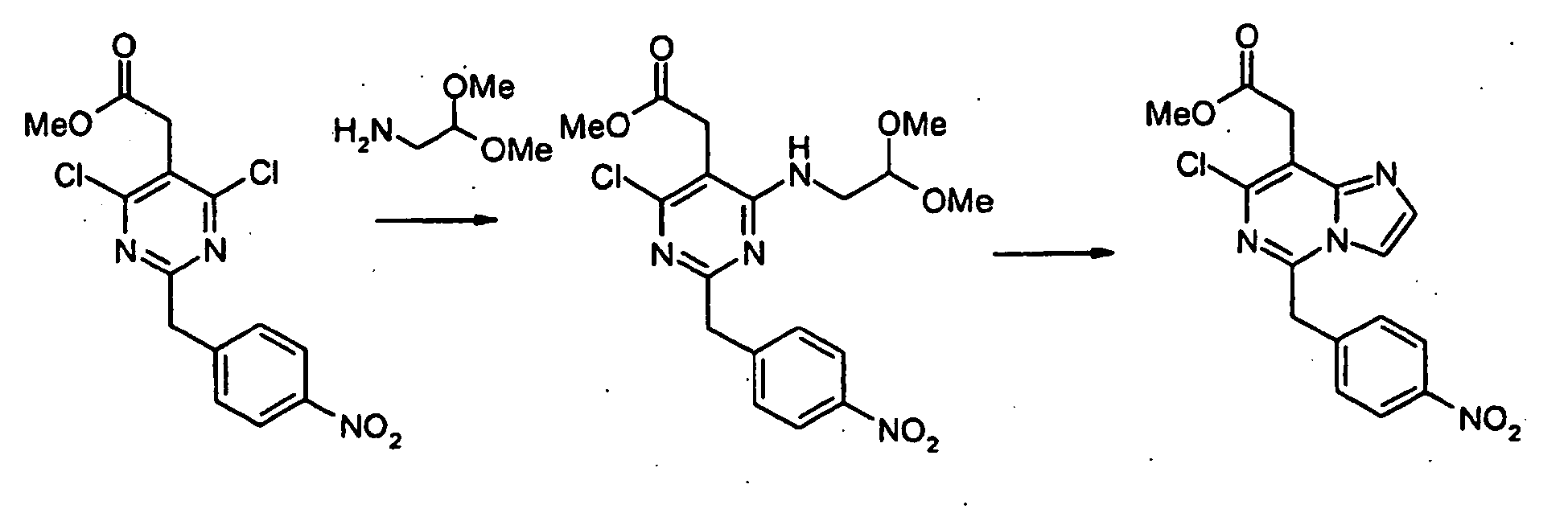
- A mixture of methyl [4,6-dichloro-2-(4-nitrobenzyl)pyrimidin-5-yl)acetate (2.0 g, 5.6 mmol), aminoacetaldehyde dimethylacetal (0.68 g, 6.5 mmol) and diisopropylethylamine (1.5 mL, 8.4 mmol) in 1,4-dioxane (50 mL) was stirred at 80°C for 2 hours. The mixture was concentrated under reduced pressure. The residue was extracted with ethylacetate. The extracts were washed with aq NaHCO3 and brine, dried over sodium sulfate, filtered and concentrated under reduced pressure. The crude product was purified by preparative MPLC (silicagel, hexane: ethylacetate, 2/1) to give methyl [4-chloro-6-[(2,2-dimethoxyethyl)amino]-2-(4-nitrobenzyl)pyrimidin-5-yl]-acetate (1.89 g, 79 %) as a gray solid.
- Methyl [4-chloco-6-[(2,2-dimethoxyethyl)amino]-2-(4-nitrobenzyl)pyrimidin-5-yl]acetate (100 mg, 0.19 mmol) was treated with 50% trifluoroacetic acid/ dichloromethane (5 mL) at room temperature overnight. The mixture was poured into water and extracted with dichloromethane. The extracts were washed with aq NaHCO3 and brine, dried over magnesium sulfate, filtered and concentrated under reduced pressure. The crude product was dissolved in dichloromethane (5 mL). To the solution was added trifluoroacetic anhydride (0.053 mL, 0.38 mmol). The mixture was stirred at room temperature for 3 hours. The mixture was poured into water and extracted with dichloromethane. The extracts were washed with aq NaHCO3 and brine, dried over magnesium sulfate, filtered and concentrated under reduced pressure. The crude product was purified by preparative TLC (silicagel, chloroform: ethanol, 19/1) to give methyl [7-chloro-5-(4-nitrobenzyl)imidazo[1,2-c]pyrimidin-8-yl]acetate (22 mg, 25 %) as a colorless film.
-
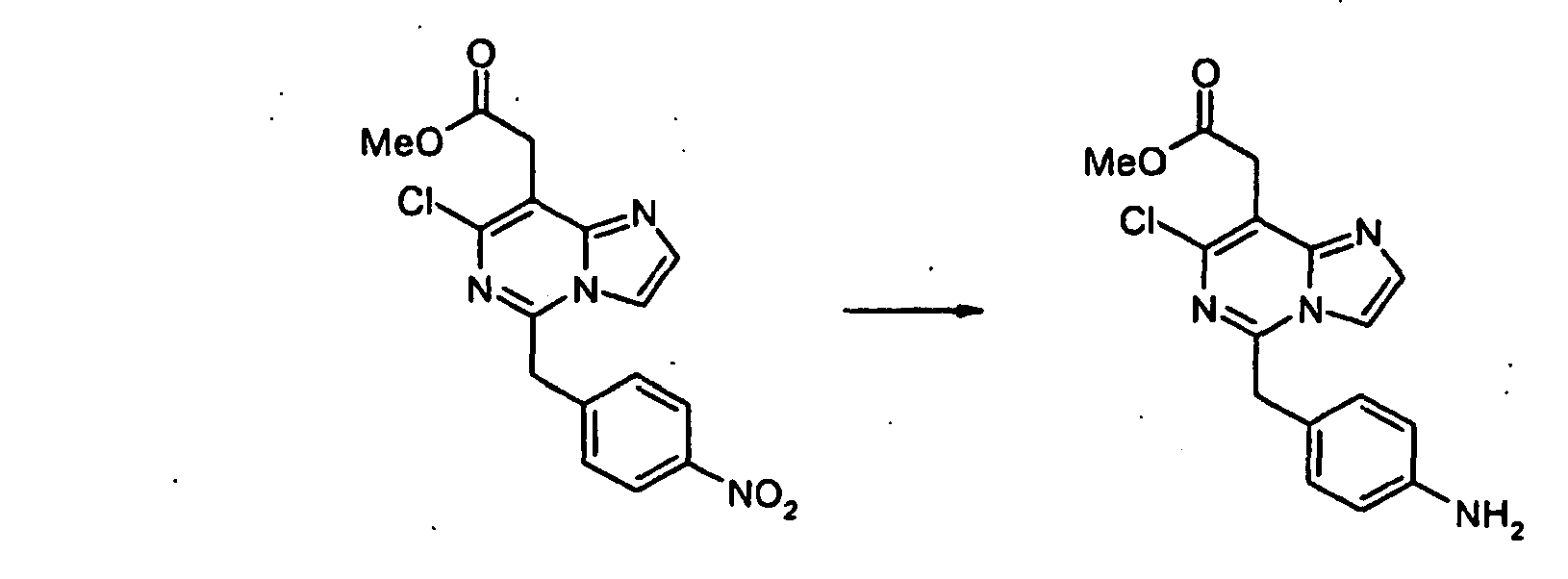
- A mixture of methyl [7-chloro-5-(4-nitrobenzyl)imidazo[1,2-c]pyrimidin-8-yl]acetate (0.383 g, 1.06 mmol) and SnCl2.2H2O (1.44 g, 6.37 mmol) in EtOH (5 mL) was heated at refluxing temperature for 1 hour. After cooling to room temperature, the reaction mixture was poured into sat. NaHCO3 aq. and EtOAc and the resulting white suspension was filtered through a pad of Celite. The aqueous layer was separated and extracted with EtOAc. The combined organic extracts was washed with brine, dried over anhydrous MgSO4, filtered, and concentrated in vacuo to give methyl [7-chloro-5-(4-aminobenzyl)imidazo[1,2-c]pyrimidin-8-yl]acetate (0.322 g, 92%).
-

- To a solution of methyl [7-chloro-5-(4-aminobenzyl)imidazo[1,2-c]pyrimidin-8-yl]acetate (0.081 g, 0.243 mmol), 3,4-dichlorobenzoic acid (0.070 g, 0.365 mmol), and WSCI (0.070 g, 0.365 mmol) in CH2Cl2 (5 mL) was added N,N-diisopropylethyl amine (0.127 mL, 0.730 mmol). After stirring at room temperature for 20 hours, the reaction mixture was condenced under reduced pressure to give the crude product as a thick oil which was purified by silica gel chromatography eluting with 30% EtOAc in CHCl3 to give methyl [7-Chloro-5-(4-{[4-(trifluoromethyl)benzoyl]-amino}benzyl)imidazo[1,2-c]pyrimidin-8-yl]acetate as a white solid (0.100 g, 82%).
- A solution of methyl [7-Chloro-5-(4-{[4-(trifluoromethyl)benzoyl]amino}benzyl)imidazo[1,2-c]-pyrimidin-8-yl]acetate (0.100 g, 0.199 mmol) in dioxane (1.00 mL) was added 6N HCl aq. (0.5 mL) and heated to 100°C for 22 hours. After cooling to room temperature, the volatiles was removed under reduced pressure to generate a precipitate which was suspended in water, collected by suction, rinsed with water and diethyl ether, and dried under high vacuum to give [7-chloro-5-(4-{[4-(trifluoromethyl)benzoyl]amino}benzyl)imidazo[1,2-c]pyrimidin-8-yl]acetic acid as a white powder (0.020 g, 20%).
1H-NMR (500 MHz, DMSO-d6): δ 3.96 (s, 2H), 4.52 (s, 2H), 7.39 (d, J = 8 Hz, 2H), 7.73 (d, J = 1.5 Hz, 1H), 7.74 (d, J = 8 Hz, 2H), 7.91 (d, J = 8 Hz, 2H), 8.13 (d, J = 8 Hz, 2H), 8.19 (d, J = 1.5 Hz, 1H), 10.48 (s, 1H), 12.71 (br s, 1H) - Melting point: 201Z °C
- Molecular weight: 488.85
- Mass spectrometry: 489
- In vitro activity grade: B
- In a similar manner as described in Example 1-1, compounds in Example 1-2 to 1-5 as shown in Table 1 were synthesized.
Table 1 example # Structure MW Exact Mass MS mp (°C) Activity class 1-2 
489.75 488 489 180Z A 1-3 
470.92 470 471 204Z B 1-4 
446.90 446 447 184Z A 1-5 
481.34 480 481 205Z B -

- A mixture of methyl [7-chloro-5-(4-nitrobenzyl)imidazo[1,2-c]pyrimidin-8-yl]acetate (150mg, 0.42 mmol) and Pd/C (wet, 45 mg) in methanol (10 mL) -THF (5 mL) was stirred under hydrogen atmosphere (0.4 MPa) for 2 days. After the removal of Pd/C by filtration through a Celite pad, the filtrate was concentrated in vacuo. The crude product was purified by preparative TLC (silica gel, chloroform: methanol, 95/5, 0.1% triethylamine) to give methyl [5-(4-aminobenzyl)imidazo[1,2-c]-pyrimidin-8-yl]acetate (16 mg, 13%) as slightly yellow solid.
-

- A mixture of methyl [5-(4-aminobenzyl)imidazo[1,2-c]pyrimidin-8-yl]acetate (17 mg, 0.06 mmol), p-trifluoromethylbenzoyl chloride (0.01 mL, 0.07 mmol) and triethylamine (0.016 mL, 0.11 mmol) in dichloromethan (1 mL) was stirred at room temperature for 1 hour. The reaction was quenched with water, and extracted with chloroform. The extracts were washed with water and brine, dried over sodium sulfate, filtered and concentrated under reduced pressure. The crude product was purified by preparative TLC (silica gel, chloroform: methanol, 95/5) to give methyl [5-(4-{[4-(trifluoromethyl)benzoyl]amino}benzyl)imidazo[1,2-c]pyrimidin-8-yl]acetate (21.5 mg, 80%) as slightly yellow solid.
- To a solution of methyl [5-(4-{[4-(trifluoromethyl)benzoyl]amino}benzyl)imidazo[1,2-c]-pyrimidin-8-yl]acetate (20 mg, 0.04 mmol) in methanol (1 mL) was added 1M NaOH aqueous solution (0.2 mL) at room temperature, and the mixture was stirred for 1 hour. After the removal of methanol under reduced pressure, water was added to the residue. The solution was washed with diethyl ether and neutralized by aqueous hydrochloric acid. The resulting precipitates were collected by filtration and dried under reduced pressure to give[5-(4-{[4-(trifluoromethyl)-benzoyl]amino}benzyl)imidazo[1,2-c]pyrimidin-8-yl]acetic acid (14.2 mg, 73%) as slightly brown solid.
1H-NMR (500 MHz, DMSO-d6): δ 3.82(2H, s), 4.48 (2H, s), 7.38 (2H, d, J = 8.5 Hz), 7.63 (1H, d, J = 1.6 Hz), 7.72 (2H, d, J = 8.5 Hz), 7.82 (1H, s), 7.91 (2H, d, J = 8.2 Hz), 8.08 (1H, d, J = 1.3 Hz), 8.12 (2H, d, J = 7.9 Hz), 10.45 (1H, s), 12.48 (1H, br s) - Melting point: 205-207°C
- Molecular weight: 454.41
- Mass spectrometry: 453 (M - H)-, 455 (M + H)+
- In vitro activity grade: B
-

- To a mixture of sodium (1.66 g, 72.13 mmol) in diethyl ether (35 mL) was added diethyl succinate (10 mL, 60.11 mmol) and ethyl formate (8.25 mL, 102.18 mmol) at room temperature, and the reaction mixture was refluxed for 5 hours. After the cooling to room temperature, water was added to the mixture until the sodium salt was dissolved completely and aqueous layer was separated. The aqueous layer was neutralized by 6M hydrochloric acid (10.8 mL) and extracted with diethyl ether. The extracts were washed with sat.NaHCO3, dried over sodium sulfate, filtered and concentrated under reduced pressure. The crude product was purified by distillation (115-120°C, 10 mmHg) to give diethyl 2-formylsuccinate (6.55 g, 54%) as colorless oil.
-

- To a mixture of 2-(4-nitrophenyl)ethanimidamide hydrochloride (6.06 g, 28.12 mmol) and diethyl 2-formylsuccinate (6.54 g, 32.34 mmol) in methanol (100 mL) was added sodium methoxide (28% in methanol, 11.2 mL, 56.25 mmol) at room temperature, and the reaction mixture was stirred at 90°C overnight. After the cooling to room temperature, the reaction was quenched with acetic acid (3.38 mL, 59.06 mmol) and water (100 mL) was added to. The resulting precipitates were collected by filtration and washed with water and acetone/diisopropyl ether (3/2) to give methyl [4-hydroxy-2-(4-nitrobenzyl)pyrimidin-5-yl]acetate (5.41 g, 64%) as brown solid.
-

- A mixture of methyl [4-hydroxy-2-(4-nitrobenzyl)pyrimidin-5-yl]acetate (4.0g, 13.19 mmol), phosphorus oxychloride (6.15 mL, 65.95 mmol) and N,N-dimethylaniline (2.51 mL, 19.78 mmol) was stirred at 150°C for 3 hours. After the removal of the excess phosphorus oxychloride, the residue was dissolved with ethyl acetate. The organic layer was washed with water and brine, dried over sodium sulfate, filtered and concentrated under reduced pressure. The crude product was purified by column chromatography on silica-gel, (hexane: ethyl acetate, 7/3) to give methyl [4-chloro-2-(4-nitrobenzyl)pyrimidin-5-yl]acetate (2.70 g, 64%) as orange solid.
-

- To a solution of methyl [4-chloro-2-(4-nitrobenzyl)pyrimidin-5-yl]acetate (2.70 g, 8.39 mmol) and aminoacetoaldehyde dimethyl acetal (1.83 mL, 16.78 mmol) in dioxane (40 mL) was added N,N-diisopropylethylamine (1.46 mL, 8.39 mmol). The mixture was stirred at 85°C for 1 day. After cooling to room temperature, the reaction was quenched with water, and extracted with ethyl acetate. The extracts were washed with water and brine, dried over sodium sulfate, filtered and concentrated under reduced pressure. The crude product was purified by column chromatography on silica-gel, (ethyl acetate) to give methyl [4-[(2,2-dimethoxyethyl)amino]-2-(4-nitrobenzyl)-pyrimidin-5-yl]acetate (2.41 g, 74%) as brown oil.
- A solution of methyl [4-[(2,2-dimethoxyethyl)amino]-2-(4-nitrobenzyl)pyrimidin-5-yl]acetate (1.00g, 2.56 mmol) and HCl (1.0 M in water, 3.84 mL, 3.85 mmol) in dioxane (10 mL) was stirred at 85°C for 1 hour. After the removal of the solvent in vacuo, water was added to the residue. The aqueous solution was neutralized by 1M NaOH and extracted with ethyl acetate. The extracts were washed with brine, dried over sodium sulfate, filtered and concentrated under reduced pressure. To the resulting crude product was added phosphorus oxychloride (1.4 mL) and the mixture was stirred at 85°C for 3 hours. After the removal of the excess phosphorus oxychloride, the residue was dissolved with ethyl acetate. The organic layer was washed with water, sat.NaHCO3 and brine, dried over sodium sulfate, filtered and concentrated under reduced pressure. The crude product was purified by column chromatography on silica-gel, (chloroform: methanol, 98/2) to give methyl [5-(4-nitrobenzyl)imidazo[1,2-c]pyrimidin-8-yl]acetate (28 mg, 3%) as brown oil.
-

- A mixture of methyl [5-(4-nitrobenzyl)imidazo[1,2-c]pyrimidin-8-yl]acetate (28 mg, 0.09 mmol) and Pd/C (wet, 3 mg) in methanol (1mL) was stirred under hydrogen atmosphere for 1 hour. After the removal of Pd/C by filtration through a Celite pad, the filtrate was concentrated in vacuo. The resulting crude methyl [5-(4-aminobenzyl)imidazo[1,2-c]pyrimidin-8-yl]acetate (26 mg, 0.09 mmol) was dissolved with dichloromethane (1 mL). To this solution was added 3,4-dichlorobenzoic acid (20.1 mg, 0.11 mmol), 1-hydroxybenzotriazole (14.2 mg, 0.11 mmol), triethylamine (0.037 mL, 0.26 mmol) and 1-ethyl-3-(3-dimethylaminopropyl)carbodiimide hydrochloride (21.9 mg, 0.11 mmol) at room temperature. The mixture was stirred at room temperature overnight, and diluted with ethyl acetate. The solution was washed with water and brine, dried over sodium sulfate, filtered and concentrated under reduced pressure. The crude product was purified by preparative TLC (silica gel, chloroform: methanol, 19:1) to give methyl (5-{4-[(3,4-dichlorobenzoyl)amino]benzyl}imidazo[1,2-c]pyrimidin-8-yl)acetate (29 mg, 70%) as slightly yellow oil.
-

- To a solution of methyl (5-{4-[(3,4-dichlorobenzoyl)amino]benzyl}imidazo[1,2-c]pyrimidin-8-yl)-acetate (25 mg, 0.05 mmol) in methanol (1 mL) was added 1M NaOH aqueous solution (0.2 mL) at room temperature, and the mixture was stirred for 1 hour. After the removal of methanol under reduced pressure, water was added to the residue. The solution was washed with diethyl ether and neutralized by aqueous hydrochloric acid. The resulting precipitates were collected by filtration and dried under reduced pressure to give (5-{4-[(3,4-dichlorobenzoyl)amino]benzyl}imidazo[1,2-c]pyrimidin-8-yl)acetic acid (17.2 mg, 71%) as slightly yellow solid.
1H-NMR (500 MHz, DMSO-d6): δ 3.83(2H, s), 4.48 (2H, s), 7.37 (2H, d, J = 8.5 Hz), 7.63 (1H, d, J = 1.3 Hz), 7.70 (2H, d, J = 8.5 Hz), 7.81 (1H, d, J = 8.5 Hz), 7.82 (1H, s), 7.92 (1H, dd, J = 1.9, 8.5 Hz), 8.08 (1H, d, J = 1.3 Hz), 8.19 (1H, d, J = 2.2 Hz), 10.38 (1H, s), 12.47 (1H, br s) - Melting point: 185-188°C
- Molecular weight: 455.30
- Mass spectrometry: 455 (M + H)+
- In vitro activity grade: C
Claims (29)
- A compound that is an imidazo[1,2-c]pyrimidinylacetic acid derivative of the formula (1), a tautomer or stereoisomer of said derivative, or a lower alkyl ester, hydrate, solvate or salt of said derivative, tautomer or stereoisomer, wherein the lower alkyl group of said lower alkyl ester is a linear or branched alkyl group having 1 to 6 carbon atoms:
 R1 represents
 n represents an integer of 0 to 6;Q1 represents -NH-, -N(C1-6 alkyl)-, or -O-;Y represents C6-C14 aryl or C5-C10 heteroaryl, wherein said C5-C10 heteroaryl contains up to 5 heteroatoms selected from the group consisting of S, O and N, and wherein said C6-C14 aryl and C5-C10 heteroaryl are optionally substituted at a substitutable position with one or more substituents selected from the group consisting of cyano, halogen, nitro, guanidino, pyrrolyl, sulfamoyl, C1-6 alkylaminosulfonyl, di(C1-6-alkyl)aminosulfonyl, phenyloxy, phenyl, amino, C1-6 alkylamino, di(C1-6 alkyl)amino, C1-6 alkoxycarbonyl, C1-6 alkanoyl, C1-6 alkanoylamino, carbamoyl, C1-6 alkylcarbamoyl, di-(C1-6alkyl)carbamoyl, C1-6 alkylsulfonyl, C1-6 alkyl optionally substituted by mono-, di-, or tri-halogen, C1-6 alkoxy optionally substituted by mono-, di-, or tri- halogen and C1-6 alkylthio optionally substituted by mono-, di-, or tri- halogen, or C6-C14 aryl fused by 1,3-dioxolane;R2 represents hydrogen or C1-6 alkyl;R3 represents hydrogen, halogen, C1-6 alkyl optionally substituted by mono-, di-, or tri- halogen, C1-6 alkoxy optionally substituted by mono-, di-, or tri- halogen,in which
 R3a and R3b independently represent C3-8 cycloalkyl, or C1-6 alkyl optionally substituted by carboxy, C3-8 cycloalkyl, carbamoyl, C1-6 alkylcarbamoyl, C6-C14 aryl-substituted C1-6 alkylcarbamoyl, di(C1-6 alkyl)carbamoyl, C3-8 cycloalkylcarbamoyl, C3-8 heterocyclocarbonyl, C1-6 alkylamino, di(C1-6 alkyl)amino or C1-6 alkoxy,in which
 q represents an integer of 1 to 3,R3c represents hydrogen, hydroxy, carboxy, or C1-6 alkyl optionally substituted by hydroxy, carboxy or (phenyl-substituted C1-6 alkyl)carbamoyl, andXa represents -O-, -S- or -N(R3d)-,in whichR3d represents hydrogen or C1-6 alkyl;andR4 represents hydrogen or C1-6 alkyl.
 - A compound as claimed in claim 1, wherein:R1 representsin which
 n represents an integer of 0 to 2;Q1 represents -NH-, -N(C1-6alkyl)-, or -O- ;Y represents phenyl, naphthyl, indolyl, quinolyl, benzofuranyl, furanyl or pyridyl, each of which is optionally substituted at a substitutable position with one or more substituents selected from the group consisting of cyano, halogen, nitro, pyrrolyl, sulfamoyl, C1-6 alkylaminosulfonyl, di(C1-6 alkyl)aminosulfonyl, phenyloxy, phenyl, C1-6alkylamino, di(C1-6alkyl)amino, C1-6 alkoxycarbonyl, C1-6 alkanoylamino, carbamoyl, C1-6 alkylcarbamoyl, di-(C1-6alkyl)carbamoyl, C1-6 alkylsulfonyl, C1-6 alkyl optionally substituted by mono-, di-, or tri-halogen, C1-6 alkoxy optionally substituted by mono-, di-, or tri- halogen and C1-6 alkylthio optionally substituted by mono-, di-, or tri- halogen;andR2 represents hydrogen.
 - A compound as claimed in claim 1, wherein:R3 represents hydrogen, halogen, C1-6 alkyl optionally substituted by mono-, di-, or tri- halogen, C1-6 alkoxy optionally substituted by mono-, di-, or tri- halogen,in which
 R3a and R3b independently represent C1-6 alkyl optionally substituted by carboxy, C3-8 cycloalkyl, carbamoyl, C1-6 alkylcarbamoyl, di(C1-6 alkyl)carbamoyl, C3-8 cycloalkylcarbamoyl, C3-8 heteroryclocarbonyl, C1-6 alkylamino, di(C1-6 alkyl)amino or C1-6 alkoxy,in which
 R3c represents hydrogen, hydroxy, carboxy, or C1-6 alkyl optionally substituted by hydroxy, carboxy or (phenyl-substituted C1-6 alkyl)carbamoyl; andXa represents -O-, -S- or -N(R3d)-,in whichR3d represents C1-6 alkyl.
 - A compound that is an imidazo[1,2-c]pyrimidinylacetic acid derivative of the formula (I-i), a tautomer or stereoisomer of said derivative, or a lower alkyl ester, hydrate, solvate or salt of said derivative, tautomer or stereoisomer, wherein the lower alkyl group of said lower alkyl ester is a linear or branched alkyl group having 1 to 6 carbon atoms:
 R1 representsin which
 n represents an integer of 0 to 2;Q1 represents -NH-, -N(C1-6 (alkyl)-, or -O- ; andY represents phenyl, naphthyl, indolyl, quinolyl, benzofuranyl, furanyl or pyridyl, wherein said phenyl, naphthyl, indolyl, quinolyl, benzofuranyl, furanyl and pyridyl are optionally substituted at a substitutable position with one or two substituents selected from the group consisting of cyano, halogen, nitro, phenyloxy, phenyl, C1-6 alkyl optionally substituted by mono-, di-, or tri-halogen, C1-6 alkoxy optionally substituted by mono-, di-, or tri- halogen and C1-6 alkylthio optionally substituted by mono-, di-, or tri- halogen;R2 represents hydrogen or C1-6 alkyl;R3 represents hydrogen, halogen, C1-6 alkyl optionally substituted by mono-, di-, or tri- halogen, C1-6 alkoxy,in which
 R3a and R3b independently represent C3-8 cycloalkyl, or C1-6 alkyl optionally substituted by C3-8 cycloalkyl, carbamoyl, C1-6 alkylcarbamoyl, (phenyl-substituted C1-6 alkyl)carbamoyl, di(C1-6 alkyl)carbamoyl, C3-8 cycloalkylcarbamoyl, C3-8 heterocyclocarbonyl, C1-6 alkylamino, di(C1-6 alkyl)amino or C1-6 alkoxy,in which
 R3c represents hydrogen, hydroxy, carboxy, or C1-6 alkyl optionally substituted by hydroxy, carboxy or (phenyl-substituted C1-6 alkyl)carbamoyl; andR4 represents hydrogen or methyl.
 - A compound as claimed in claim 1, wherein said imidazo[1,2-c]pyrimidinylacetic acid derivative of the formula (I) is selected from the group consisting of:[7-chloro-5-(4-{[4-(trifluoromethyl)benzoyl] amino}benzyl)imidazo[1,2-c]pyrimidin-8-yl]acetic acid;(7-chloro-5-{4-[(3,4-dichlorobenzoyl)amino]benzyl}imidazo[1,2-c]pyrimidin-8-yl)acetic acid;{7-chloro-5-[4-(2-naphthoylamino)benzyl]imidazo[1,2-c]pyrimidin-8-yl}acetic acid;[7-chloro-5-(4-{[(2E)-3-phenylprop-2-enoyl]amino}benzyl)imidazo[1,2-c]pyrimidin-8-yl]acetic acid;[7-chloro-5-(4-{[(2E)-3-(4-chlorophcnyl)prop-2-enoyl]amino}benzyl)imidazo[1,2-c]pyrimidin-8-yl]acetic acid;(5-{4-[(3,4-dichlorobenzoyl)amino]benzyl}imidazo[1,2-c]pyrimidin-8-yl)acetic acid; and[5-(4-{[4-(trifluoromethyl)benzoyl]amino}benzyl)imidazo[1,2-c]pyrimidin-8-yl]acetic acid.
- A compound as claimed in any of claims 1-5 for use in medicine.
- A compound that is the lower alkyl ester as claimed in any of claims 1-6.
- A compound as claimed in any of claims 1-7, wherein said lower alkyl group of said lower alkyl ester is a linear or branched alkyl group having 1 to 4 carbon atoms.
- A compound as claimed in claim 8, wherein said lower alkyl group of said lower alkyl ester is a linear or branched alkyl group having 1 to 3 carbon atoms.
- A compound that is the derivative, tautomer or stereoisomer as claimed in any of claims 1-6.
- A compound that is the salt as claimed in any of claims 1-6.
- A compound that is the solvate as claimed in any of claims 1-6.
- A compound that is the hydrate as claimed in any of claims 1-6.
- A medicament comprising a compound as claimed in any of claims 1-13 as an active ingredient, wherein said salt is a physiologically acceptable salt.
- A medicament as claimed in claim 14, wherein said compound is a CRTH2 antagonist.
- A medicament as claimed in claim 14 or 15 for the treatment and/or prevention of a disorder or disease selected from the group consisting of asthma, allergic rhinitis, atopic dermatitis and allergic conjunctivitis.
- A medicament as claimed in claim 14 or 15 for the treatment and/or prevention of a disorder or disease selected from the group consisting of Churg-Strauss syndrome, sinusitis, basophilic leukemia, chronic urticaria, and basophilic leukocytosis.
- A medicament as claimed in any of claims 14 to 17, further comprising one or more pharmaceutically acceptable excipients.
- A medicament as claimed in claim 18, wherein the excipient is selected from carriers, diluents, flavoring agents, sweeteners, lubricants, solubilizers, suspending agents, binders, tablet disintegrating agents and encapsulating materials.
- A medicament as claimed in claim 19, wherein the excipient is a carrier selected from lactose, starch, sucrose, glucose, sodium carbonate, mannitol, sorbitol, calcium carbonate, calcium phosphate, calcium sulfate and methyl cellulose.
- A medicament as claimed in claim 20, further comprising a tablet disintegrating agent selected from maize, starch, methyl cellulose, agar bentonite, xanthan gum and alginic acid.
- A medicament as claimed in claim 19, wherein the excipient is a binder selected from gelatin, natural sugars, beta-lactose, com sweeteners, natural and synthetic gums, acacia, tragacanth, sodium alginate, carboxymethylcellulose, polyethylene glycol and waxes.
- A medicament as claimed in claim 19, wherein the excipient is a lubricant selected from magnesium stearate, sodium stearate, stearic acid, sodium oleate, sodium benzoate, sodium acetate, sodium chloride and talc.
- A medicament as claimed in any of claims 14 to 23, which is in a form selected from tablets, pills, powders, lozenges, elixirs, suspensions, emulsions, solutions, syrups, aerosols, ointments, soft and hard gelatin capsules, suppositories, sterile injectable solutions and sterile packaged powders.
- A medicament as claimed in claim 24, which is in the form of a tablet or powder, wherein the amount of the active ingredient is from about 1 to about 99 weight percent, based on the total weight of the pharmaceutical composition.
- A unit dosage form comprising a compound as claimed in any of claims 1-13 as an active ingredient.
- A unit dosage form as claimed in claim 26, wherein the quantity of the active ingredient is from about 0.1 to about 1000 milligrams.
- A compound as claimed in any of claims 1-13 for the treatment and/or prevention of a disorder or disease, or for controlling a disorder or disease, wherein said disorder or disease is asthma, allergic rhinitis, atopic dermatitis or allergic conjunctivitis.
- A compound as claimed in any of claims 1-13 for the treatment and/or prevention of a disorder or disease, or for controlling a disorder or disease, wherein said disorder or disease is Churg-Strauss syndrome, sinusitis, basophilic leukemia, chronic urticaria or basophilic leukocytosis.
Priority Applications (4)
| Application Number | Priority Date | Filing Date | Title |
|---|---|---|---|
| EP05706922A EP1718649B1 (en) | 2004-01-31 | 2005-01-19 | Imidazo 1,2-c pyrimidinylacetic acid derivatives |
| SI200530724T SI1718649T1 (en) | 2004-01-31 | 2005-01-19 | Imidazo 1,2-c pyrimidinylacetic acid derivatives |
| PL05706922T PL1718649T3 (en) | 2004-01-31 | 2005-01-19 | Imidazo 1,2-c pyrimidinylacetic acid derivatives |
| CY20091100834T CY1109274T1 (en) | 2004-01-31 | 2009-08-06 | Imidazo [1,2-C] pyrimidinylacetic acid derivatives |
Applications Claiming Priority (3)
| Application Number | Priority Date | Filing Date | Title |
|---|---|---|---|
| EP04002144 | 2004-01-31 | ||
| EP05706922A EP1718649B1 (en) | 2004-01-31 | 2005-01-19 | Imidazo 1,2-c pyrimidinylacetic acid derivatives |
| PCT/EP2005/000475 WO2005073234A2 (en) | 2004-01-31 | 2005-01-19 | Imidazo[1,2-c]pyrimidinylacetic acid derivatives |
Publications (2)
| Publication Number | Publication Date |
|---|---|
| EP1718649A2 EP1718649A2 (en) | 2006-11-08 |
| EP1718649B1 true EP1718649B1 (en) | 2009-06-10 |
Family
ID=34814234
Family Applications (1)
| Application Number | Title | Priority Date | Filing Date |
|---|---|---|---|
| EP05706922A Expired - Lifetime EP1718649B1 (en) | 2004-01-31 | 2005-01-19 | Imidazo 1,2-c pyrimidinylacetic acid derivatives |
Country Status (23)
| Country | Link |
|---|---|
| US (1) | US7750014B2 (en) |
| EP (1) | EP1718649B1 (en) |
| JP (1) | JP4996257B2 (en) |
| KR (1) | KR101207428B1 (en) |
| CN (1) | CN100584844C (en) |
| AT (1) | ATE433452T1 (en) |
| AU (1) | AU2005209381B2 (en) |
| BR (1) | BRPI0507123A (en) |
| CA (1) | CA2551778C (en) |
| CY (1) | CY1109274T1 (en) |
| DE (1) | DE602005014849D1 (en) |
| DK (1) | DK1718649T3 (en) |
| ES (1) | ES2326896T3 (en) |
| IL (1) | IL177083A (en) |
| MX (1) | MXPA06007674A (en) |
| NO (1) | NO20063878L (en) |
| NZ (1) | NZ548396A (en) |
| PL (1) | PL1718649T3 (en) |
| PT (1) | PT1718649E (en) |
| RU (1) | RU2373208C2 (en) |
| SI (1) | SI1718649T1 (en) |
| WO (1) | WO2005073234A2 (en) |
| ZA (1) | ZA200605387B (en) |
Families Citing this family (31)
| Publication number | Priority date | Publication date | Assignee | Title |
|---|---|---|---|---|
| ES2369782T3 (en) | 2004-12-27 | 2011-12-05 | Actelion Pharmaceuticals Ltd. | DERIVATIVES OF 2,3,4,9-TETRAHIDRO-1H-CARBAZOL AS AN ANTHOGONIST OF THE CRTH2 RECEIVER. |
| MY147588A (en) | 2006-08-07 | 2012-12-31 | Actelion Pharmaceuticals Ltd | (3-amino-1,2,3,4-tetrahydro-9h-carbazol-9-yl)-acetic acid derivatives |
| MX2009010959A (en) * | 2007-04-13 | 2009-10-29 | Novartis Ag | Pyridazine-, pyridine- and pyrane-derivatives as gpbar1 agonisis. |
| WO2008156780A1 (en) * | 2007-06-21 | 2008-12-24 | Actimis Pharmaceuticals, Inc. | Particulates of a crth2 antagonist |
| CL2008002827A1 (en) * | 2007-09-25 | 2009-11-27 | Actimis Pharmaceuticals Inc | Compounds derived from 2-s-benzyl pyrimidine, antagonists of the crth2 receptor; pharmaceutical composition comprising them; and its use in the treatment of allergic diseases mediated by eosinophils and basophils, such as asthma, allergic rhinitis, atopic dermatitis, allergic conjunctivitis, sinusitis and psoriasis, among others. |
| ES2383249T3 (en) * | 2007-09-25 | 2012-06-19 | Actimis Pharmaceuticals, Inc. | Alkylthiopyrimidines as CRTH2 antagonists |
| EP2257536A4 (en) | 2008-02-14 | 2011-03-23 | Amira Pharmaceuticals Inc | Cyclic diaryl ether as antagonists of prostaglandin d2 receptors |
| US8426449B2 (en) | 2008-04-02 | 2013-04-23 | Panmira Pharmaceuticals, Llc | Aminoalkylphenyl antagonists of prostaglandin D2 receptors |
| US8541419B2 (en) | 2008-09-02 | 2013-09-24 | Actimis Pharmaceuticals, Inc. | Isotopically enriched pyrimidin-5-yl acetic acid derivatives as CRTH2 antagonists |
| WO2010057118A2 (en) | 2008-11-17 | 2010-05-20 | Amira Pharmaceuticals, Inc. | Heterocyclic antagonists of prostaglandin d2 receptors |
| CA2790139C (en) | 2010-03-22 | 2018-03-13 | Actelion Pharmaceuticals Ltd | 3-(heteroaryl-amino)-1,2,3,4-tetrahydro-9h-carbazole derivatives and their use as prostaglandin d2 receptor modulators |
| TW201201805A (en) | 2010-07-05 | 2012-01-16 | Actelion Pharmaceuticals Ltd | 1-phenyl-substituted heterocyclyl derivatives and their use as prostaglandin D2 receptor modulators |
| CA2804470A1 (en) | 2010-07-09 | 2012-01-12 | Bayer Intellectual Property Gmbh | Ring-fused pyrimidines and triazines and use thereof for the treatment and/or prophylaxis of cardiovascular diseases |
| DE102010031149A1 (en) | 2010-07-09 | 2012-01-12 | Bayer Schering Pharma Aktiengesellschaft | New 1H-pyrazolo(3,4-b)pyridine compounds are guanylate cyclase stimulators useful to treat and/or prevent heart failure, angina pectoris, hypertonia, pulmonary hypertonia, ischemia, and vascular disease |
| DE102011003315A1 (en) | 2011-01-28 | 2012-08-02 | Bayer Schering Pharma Aktiengesellschaft | New 1H-pyrazolo(3,4-b)pyridine compounds are guanylate cyclase stimulators useful for treating and/or preventing e.g. heart failure, angina pectoris, hypertonia, pulmonary hypertonia, ischemia, vascular disease, and fibrotic disorder |
| US8927559B2 (en) | 2010-10-11 | 2015-01-06 | Merck Sharp & Dohme Corp. | Quinazolinone-type compounds as CRTH2 antagonists |
| EP2457900A1 (en) | 2010-11-25 | 2012-05-30 | Almirall, S.A. | New pyrazole derivatives having CRTh2 antagonistic behaviour |
| JP5964945B2 (en) | 2011-04-14 | 2016-08-03 | アクテリオン ファーマシューティカルズ リミテッドActelion Pharmaceuticals Ltd | 7- (Heteroaryl-amino) -6,7,8,9-tetrahydropyrido [1,2-a] indoleacetic acid derivatives and their use as prostaglandin D2 receptor modulators |
| KR20140113667A (en) | 2011-12-16 | 2014-09-24 | 아토픽스 테라퓨릭스 리미티드 | Combination of a crth2 antagonist and a proton pump inhibitor for the treatment of eosinophilic esophagitis |
| CN104011021B (en) | 2011-12-21 | 2016-08-24 | 埃科特莱茵药品有限公司 | Heterocyclic derivatives and their use as prostaglandin D2 receptor modulators |
| DE102012200349A1 (en) | 2012-01-11 | 2013-07-11 | Bayer Intellectual Property Gmbh | Substituted fused pyrimidines and triazines and their use |
| DE102012200360A1 (en) | 2012-01-11 | 2013-07-11 | Bayer Intellectual Property Gmbh | Substituted triazines and their use |
| ES2644781T3 (en) | 2012-03-06 | 2017-11-30 | Bayer Intellectual Property Gmbh | Azabicycles substituted and their use |
| US9169270B2 (en) | 2012-07-05 | 2015-10-27 | Actelion Pharmaceuticals Ltd. | 1-phenyl-substituted heterocyclyl derivatives and their use as prostaglandin D2 receptor modulators |
| CA2939892C (en) | 2014-03-17 | 2020-03-31 | Idorsia Pharmaceuticals Ltd | Azaindole acetic acid derivatives and their use as prostaglandin d2 receptor modulators |
| CN106103437A (en) | 2014-03-18 | 2016-11-09 | 埃科特莱茵药品有限公司 | Azaindole acetogenin and the purposes as prostaglandin D 2 receptor regulator thereof |
| CN108026093B (en) | 2015-09-15 | 2021-11-16 | 爱杜西亚药品有限公司 | Crystalline forms |
| KR20190103507A (en) | 2018-02-12 | 2019-09-05 | 김강민 | The subway congestion notification system |
| WO2019139462A2 (en) * | 2019-02-21 | 2019-07-18 | 엘지전자 주식회사 | Method and user terminal for notifying user of alighting time point |
| TW202100015A (en) | 2019-02-28 | 2021-01-01 | 瑞士商先正達農作物保護公司 | Pesticidally active heterocyclic derivatives with sulfur containing substituents |
| CN114681438B (en) * | 2022-05-17 | 2024-03-19 | 中国医学科学院基础医学研究所 | Metformin and other guanidine-containing compounds are used to reverse the tendency of Gal-10 crystallization and alleviate related diseases. |
Family Cites Families (8)
| Publication number | Priority date | Publication date | Assignee | Title |
|---|---|---|---|---|
| BE790679A (en) | 1971-11-03 | 1973-04-27 | Ici Ltd | INDOLE DERIVATIVES |
| GB9125842D0 (en) | 1991-12-04 | 1992-02-05 | Ici Plc | Heterocyclic derivatives |
| RU2264403C2 (en) * | 1999-11-10 | 2005-11-20 | Орто-Макнейл Фармасьютикал, Инк. | Substituted 2-aryl-3-(heteroaryl)imidazo[1,2-a]-pyrimidines, pharmaceutical compositions comprising thereof and associated methods |
| JP2001302667A (en) * | 2000-04-28 | 2001-10-31 | Bayer Ag | Imidazopyrimidine derivative and triazolopyrimidine derivative |
| US6878522B2 (en) | 2000-07-07 | 2005-04-12 | Baiyong Li | Methods for the identification of compounds useful for the treatment of disease states mediated by prostaglandin D2 |
| EP1413306A1 (en) | 2002-10-21 | 2004-04-28 | Warner-Lambert Company LLC | Tetrahydroquinoline derivatives as CRTH2 antagonists |
| NZ541234A (en) | 2002-12-20 | 2008-06-30 | Amgen Inc | Asthma and allergic inflammation modulators |
| ES2257616T3 (en) | 2003-04-25 | 2006-08-01 | Actimis Pharmaceuticals, Inc. | USEFUL PYRIMIDINYLACETIC ACID DERIVATIVES FOR THE TREATMENT OF DISEASES MEDIATED BY CRTH2. |
-
2005
- 2005-01-19 WO PCT/EP2005/000475 patent/WO2005073234A2/en not_active Ceased
- 2005-01-19 ZA ZA200605387A patent/ZA200605387B/en unknown
- 2005-01-19 ES ES05706922T patent/ES2326896T3/en not_active Expired - Lifetime
- 2005-01-19 AT AT05706922T patent/ATE433452T1/en active
- 2005-01-19 AU AU2005209381A patent/AU2005209381B2/en not_active Ceased
- 2005-01-19 RU RU2006131304/04A patent/RU2373208C2/en not_active IP Right Cessation
- 2005-01-19 US US10/585,429 patent/US7750014B2/en not_active Expired - Fee Related
- 2005-01-19 CN CN200580010462A patent/CN100584844C/en not_active Expired - Fee Related
- 2005-01-19 DK DK05706922T patent/DK1718649T3/en active
- 2005-01-19 SI SI200530724T patent/SI1718649T1/en unknown
- 2005-01-19 PT PT05706922T patent/PT1718649E/en unknown
- 2005-01-19 EP EP05706922A patent/EP1718649B1/en not_active Expired - Lifetime
- 2005-01-19 NZ NZ548396A patent/NZ548396A/en not_active IP Right Cessation
- 2005-01-19 DE DE602005014849T patent/DE602005014849D1/en not_active Expired - Lifetime
- 2005-01-19 MX MXPA06007674A patent/MXPA06007674A/en active IP Right Grant
- 2005-01-19 CA CA2551778A patent/CA2551778C/en not_active Expired - Fee Related
- 2005-01-19 JP JP2006550019A patent/JP4996257B2/en not_active Expired - Fee Related
- 2005-01-19 PL PL05706922T patent/PL1718649T3/en unknown
- 2005-01-19 BR BRPI0507123-2A patent/BRPI0507123A/en not_active IP Right Cessation
-
2006
- 2006-07-25 IL IL177083A patent/IL177083A/en not_active IP Right Cessation
- 2006-08-29 KR KR1020067017478A patent/KR101207428B1/en not_active Expired - Fee Related
- 2006-08-31 NO NO20063878A patent/NO20063878L/en not_active Application Discontinuation
-
2009
- 2009-08-06 CY CY20091100834T patent/CY1109274T1/en unknown
Also Published As
| Publication number | Publication date |
|---|---|
| ZA200605387B (en) | 2008-05-28 |
| JP4996257B2 (en) | 2012-08-08 |
| PT1718649E (en) | 2009-08-06 |
| DK1718649T3 (en) | 2009-08-24 |
| PL1718649T3 (en) | 2009-11-30 |
| KR20060130187A (en) | 2006-12-18 |
| CA2551778A1 (en) | 2005-08-11 |
| BRPI0507123A (en) | 2007-06-19 |
| AU2005209381A1 (en) | 2005-08-11 |
| US7750014B2 (en) | 2010-07-06 |
| NO20063878L (en) | 2006-10-11 |
| DE602005014849D1 (en) | 2009-07-23 |
| CA2551778C (en) | 2013-10-22 |
| AU2005209381B2 (en) | 2011-06-30 |
| NZ548396A (en) | 2010-06-25 |
| US20090012102A1 (en) | 2009-01-08 |
| ES2326896T3 (en) | 2009-10-21 |
| CY1109274T1 (en) | 2014-07-02 |
| CN1938310A (en) | 2007-03-28 |
| SI1718649T1 (en) | 2009-10-31 |
| EP1718649A2 (en) | 2006-11-08 |
| RU2006131304A (en) | 2008-03-10 |
| JP2007519659A (en) | 2007-07-19 |
| KR101207428B1 (en) | 2012-12-04 |
| WO2005073234A3 (en) | 2005-10-06 |
| WO2005073234A2 (en) | 2005-08-11 |
| HK1101969A1 (en) | 2007-11-02 |
| IL177083A0 (en) | 2006-12-10 |
| MXPA06007674A (en) | 2006-09-04 |
| IL177083A (en) | 2011-10-31 |
| ATE433452T1 (en) | 2009-06-15 |
| RU2373208C2 (en) | 2009-11-20 |
| CN100584844C (en) | 2010-01-27 |
Similar Documents
| Publication | Publication Date | Title |
|---|---|---|
| US7750014B2 (en) | Imidazo[1,2-C]pyrimidinylacetic acid derivatives | |
| EP1471057B1 (en) | Pyrimidinylacetic acid derivatives useful for the treatment of diseases mediated by CRTH2 | |
| EP1505064A1 (en) | 2-Aminopyrimidine derivatives | |
| WO2003037898A1 (en) | Pyrimido [4,5-b] indole derivatives | |
| HK1095320B (en) | Pyrimidine derivatives useful for the treatment of diseases mediated by crth2 |
Legal Events
| Date | Code | Title | Description |
|---|---|---|---|
| PUAI | Public reference made under article 153(3) epc to a published international application that has entered the european phase |
Free format text: ORIGINAL CODE: 0009012 |
|
| 17P | Request for examination filed |
Effective date: 20060828 |
|
| AK | Designated contracting states |
Kind code of ref document: A2 Designated state(s): AT BE BG CH CY CZ DE DK EE ES FI FR GB GR HU IE IS IT LI LT LU MC NL PL PT RO SE SI SK TR |
|
| RIN1 | Information on inventor provided before grant (corrected) |
Inventor name: SHINTANI, TAKUYA Inventor name: YOSHINO, TAKASHI Inventor name: URBAHNS, KLAUS Inventor name: SUGIMOTO, HIROMI Inventor name: BACON, KEVIN B. Inventor name: TAKEKAWA, YUKI Inventor name: LY, TAI-WEI |
|
| 17Q | First examination report despatched |
Effective date: 20061213 |
|
| DAX | Request for extension of the european patent (deleted) | ||
| RAP1 | Party data changed (applicant data changed or rights of an application transferred) |
Owner name: ACTIMIS PHARMACEUTICALS, INC., |
|
| GRAP | Despatch of communication of intention to grant a patent |
Free format text: ORIGINAL CODE: EPIDOSNIGR1 |
|
| GRAJ | Information related to disapproval of communication of intention to grant by the applicant or resumption of examination proceedings by the epo deleted |
Free format text: ORIGINAL CODE: EPIDOSDIGR1 |
|
| GRAP | Despatch of communication of intention to grant a patent |
Free format text: ORIGINAL CODE: EPIDOSNIGR1 |
|
| GRAS | Grant fee paid |
Free format text: ORIGINAL CODE: EPIDOSNIGR3 |
|
| GRAA | (expected) grant |
Free format text: ORIGINAL CODE: 0009210 |
|
| AK | Designated contracting states |
Kind code of ref document: B1 Designated state(s): AT BE BG CH CY CZ DE DK EE ES FI FR GB GR HU IE IS IT LI LT LU MC NL PL PT RO SE SI SK TR |
|
| REG | Reference to a national code |
Ref country code: GB Ref legal event code: FG4D |
|
| REG | Reference to a national code |
Ref country code: CH Ref legal event code: EP |
|
| REG | Reference to a national code |
Ref country code: IE Ref legal event code: FG4D |
|
| REF | Corresponds to: |
Ref document number: 602005014849 Country of ref document: DE Date of ref document: 20090723 Kind code of ref document: P |
|
| REG | Reference to a national code |
Ref country code: PT Ref legal event code: SC4A Free format text: AVAILABILITY OF NATIONAL TRANSLATION Effective date: 20090731 |
|
| REG | Reference to a national code |
Ref country code: CH Ref legal event code: NV Representative=s name: KIRKER & CIE S.A. |
|
| REG | Reference to a national code |
Ref country code: RO Ref legal event code: EPE |
|
| REG | Reference to a national code |
Ref country code: DK Ref legal event code: T3 |
|
| REG | Reference to a national code |
Ref country code: SE Ref legal event code: TRGR |
|
| REG | Reference to a national code |
Ref country code: GR Ref legal event code: EP Ref document number: 20090402016 Country of ref document: GR |
|
| REG | Reference to a national code |
Ref country code: EE Ref legal event code: FG4A Ref document number: E003499 Country of ref document: EE Effective date: 20090804 |
|
| REG | Reference to a national code |
Ref country code: ES Ref legal event code: FG2A Ref document number: 2326896 Country of ref document: ES Kind code of ref document: T3 |
|
| REG | Reference to a national code |
Ref country code: PL Ref legal event code: T3 |
|
| REG | Reference to a national code |
Ref country code: SK Ref legal event code: T3 Ref document number: E 6162 Country of ref document: SK |
|
| REG | Reference to a national code |
Ref country code: HU Ref legal event code: AG4A Ref document number: E006338 Country of ref document: HU |
|
| PG25 | Lapsed in a contracting state [announced via postgrant information from national office to epo] |
Ref country code: IS Free format text: LAPSE BECAUSE OF FAILURE TO SUBMIT A TRANSLATION OF THE DESCRIPTION OR TO PAY THE FEE WITHIN THE PRESCRIBED TIME-LIMIT Effective date: 20091010 |
|
| PLBE | No opposition filed within time limit |
Free format text: ORIGINAL CODE: 0009261 |
|
| STAA | Information on the status of an ep patent application or granted ep patent |
Free format text: STATUS: NO OPPOSITION FILED WITHIN TIME LIMIT |
|
| 26N | No opposition filed |
Effective date: 20100311 |
|
| PGFP | Annual fee paid to national office [announced via postgrant information from national office to epo] |
Ref country code: TR Payment date: 20120214 Year of fee payment: 8 |
|
| PGFP | Annual fee paid to national office [announced via postgrant information from national office to epo] |
Ref country code: IT Payment date: 20120124 Year of fee payment: 8 Ref country code: RO Payment date: 20120104 Year of fee payment: 8 |
|
| PGFP | Annual fee paid to national office [announced via postgrant information from national office to epo] |
Ref country code: PL Payment date: 20121221 Year of fee payment: 9 Ref country code: LU Payment date: 20130125 Year of fee payment: 9 |
|
| PGFP | Annual fee paid to national office [announced via postgrant information from national office to epo] |
Ref country code: BG Payment date: 20130111 Year of fee payment: 9 Ref country code: CH Payment date: 20130123 Year of fee payment: 9 Ref country code: ES Payment date: 20130117 Year of fee payment: 9 Ref country code: FI Payment date: 20130111 Year of fee payment: 9 Ref country code: LT Payment date: 20130102 Year of fee payment: 9 Ref country code: CZ Payment date: 20130116 Year of fee payment: 9 Ref country code: HU Payment date: 20130122 Year of fee payment: 9 Ref country code: IE Payment date: 20130122 Year of fee payment: 9 Ref country code: MC Payment date: 20130111 Year of fee payment: 9 Ref country code: SE Payment date: 20130122 Year of fee payment: 9 Ref country code: DK Payment date: 20130121 Year of fee payment: 9 Ref country code: EE Payment date: 20130114 Year of fee payment: 9 |
|
| PGFP | Annual fee paid to national office [announced via postgrant information from national office to epo] |
Ref country code: BE Payment date: 20130128 Year of fee payment: 9 Ref country code: GR Payment date: 20130117 Year of fee payment: 9 Ref country code: CY Payment date: 20130111 Year of fee payment: 9 Ref country code: SI Payment date: 20130103 Year of fee payment: 9 Ref country code: SK Payment date: 20130116 Year of fee payment: 9 Ref country code: NL Payment date: 20130122 Year of fee payment: 9 |
|
| PGFP | Annual fee paid to national office [announced via postgrant information from national office to epo] |
Ref country code: AT Payment date: 20130111 Year of fee payment: 9 Ref country code: PT Payment date: 20130116 Year of fee payment: 9 |
|
| REG | Reference to a national code |
Ref country code: PT Ref legal event code: MM4A Free format text: LAPSE DUE TO NON-PAYMENT OF FEES Effective date: 20140721 |
|
| BERE | Be: lapsed |
Owner name: ACTIMIS PHARMACEUTICALS, INC., Effective date: 20140131 |
|
| REG | Reference to a national code |
Ref country code: NL Ref legal event code: V1 Effective date: 20140801 |
|
| REG | Reference to a national code |
Ref country code: LT Ref legal event code: MM4D Effective date: 20140119 |
|
| PG25 | Lapsed in a contracting state [announced via postgrant information from national office to epo] |
Ref country code: MC Free format text: LAPSE BECAUSE OF NON-PAYMENT OF DUE FEES Effective date: 20140131 Ref country code: LU Free format text: LAPSE BECAUSE OF NON-PAYMENT OF DUE FEES Effective date: 20140119 |
|
| REG | Reference to a national code |
Ref country code: CH Ref legal event code: PL |
|
| REG | Reference to a national code |
Ref country code: DK Ref legal event code: EBP Effective date: 20140131 |
|
| REG | Reference to a national code |
Ref country code: AT Ref legal event code: MM01 Ref document number: 433452 Country of ref document: AT Kind code of ref document: T Effective date: 20140119 |
|
| REG | Reference to a national code |
Ref country code: SE Ref legal event code: EUG |
|
| REG | Reference to a national code |
Ref country code: SK Ref legal event code: MM4A Ref document number: E 6162 Country of ref document: SK Effective date: 20140119 |
|
| REG | Reference to a national code |
Ref country code: GR Ref legal event code: ML Ref document number: 20090402016 Country of ref document: GR Effective date: 20140801 |
|
| REG | Reference to a national code |
Ref country code: EE Ref legal event code: MM4A Ref document number: E003499 Country of ref document: EE Effective date: 20140131 |
|
| REG | Reference to a national code |
Ref country code: SI Ref legal event code: KO00 Effective date: 20140909 |
|
| PG25 | Lapsed in a contracting state [announced via postgrant information from national office to epo] |
Ref country code: RO Free format text: LAPSE BECAUSE OF NON-PAYMENT OF DUE FEES Effective date: 20140119 Ref country code: CY Free format text: LAPSE BECAUSE OF NON-PAYMENT OF DUE FEES Effective date: 20140119 Ref country code: CZ Free format text: LAPSE BECAUSE OF NON-PAYMENT OF DUE FEES Effective date: 20140119 Ref country code: BG Free format text: LAPSE BECAUSE OF NON-PAYMENT OF DUE FEES Effective date: 20140930 Ref country code: FI Free format text: LAPSE BECAUSE OF NON-PAYMENT OF DUE FEES Effective date: 20140119 Ref country code: NL Free format text: LAPSE BECAUSE OF NON-PAYMENT OF DUE FEES Effective date: 20140801 Ref country code: EE Free format text: LAPSE BECAUSE OF NON-PAYMENT OF DUE FEES Effective date: 20140131 Ref country code: GR Free format text: LAPSE BECAUSE OF NON-PAYMENT OF DUE FEES Effective date: 20140801 Ref country code: LI Free format text: LAPSE BECAUSE OF NON-PAYMENT OF DUE FEES Effective date: 20140131 Ref country code: LT Free format text: LAPSE BECAUSE OF NON-PAYMENT OF DUE FEES Effective date: 20140119 Ref country code: CH Free format text: LAPSE BECAUSE OF NON-PAYMENT OF DUE FEES Effective date: 20140131 |
|
| REG | Reference to a national code |
Ref country code: IE Ref legal event code: MM4A |
|
| PG25 | Lapsed in a contracting state [announced via postgrant information from national office to epo] |
Ref country code: SK Free format text: LAPSE BECAUSE OF NON-PAYMENT OF DUE FEES Effective date: 20140119 Ref country code: SE Free format text: LAPSE BECAUSE OF NON-PAYMENT OF DUE FEES Effective date: 20140120 Ref country code: HU Free format text: LAPSE BECAUSE OF NON-PAYMENT OF DUE FEES Effective date: 20140120 Ref country code: SI Free format text: LAPSE BECAUSE OF NON-PAYMENT OF DUE FEES Effective date: 20140120 Ref country code: AT Free format text: LAPSE BECAUSE OF NON-PAYMENT OF DUE FEES Effective date: 20140119 |
|
| PG25 | Lapsed in a contracting state [announced via postgrant information from national office to epo] |
Ref country code: PT Free format text: LAPSE BECAUSE OF NON-PAYMENT OF DUE FEES Effective date: 20140721 |
|
| PG25 | Lapsed in a contracting state [announced via postgrant information from national office to epo] |
Ref country code: DK Free format text: LAPSE BECAUSE OF NON-PAYMENT OF DUE FEES Effective date: 20140131 Ref country code: IE Free format text: LAPSE BECAUSE OF NON-PAYMENT OF DUE FEES Effective date: 20140119 Ref country code: BE Free format text: LAPSE BECAUSE OF NON-PAYMENT OF DUE FEES Effective date: 20140131 |
|
| REG | Reference to a national code |
Ref country code: ES Ref legal event code: FD2A Effective date: 20150330 |
|
| PG25 | Lapsed in a contracting state [announced via postgrant information from national office to epo] |
Ref country code: ES Free format text: LAPSE BECAUSE OF NON-PAYMENT OF DUE FEES Effective date: 20140120 |
|
| REG | Reference to a national code |
Ref country code: PL Ref legal event code: LAPE |
|
| PG25 | Lapsed in a contracting state [announced via postgrant information from national office to epo] |
Ref country code: PL Free format text: LAPSE BECAUSE OF NON-PAYMENT OF DUE FEES Effective date: 20140119 |
|
| REG | Reference to a national code |
Ref country code: FR Ref legal event code: PLFP Year of fee payment: 12 |
|
| PG25 | Lapsed in a contracting state [announced via postgrant information from national office to epo] |
Ref country code: IT Free format text: LAPSE BECAUSE OF NON-PAYMENT OF DUE FEES Effective date: 20140119 |
|
| REG | Reference to a national code |
Ref country code: FR Ref legal event code: PLFP Year of fee payment: 13 |
|
| PG25 | Lapsed in a contracting state [announced via postgrant information from national office to epo] |
Ref country code: TR Free format text: LAPSE BECAUSE OF NON-PAYMENT OF DUE FEES Effective date: 20140119 |
|
| REG | Reference to a national code |
Ref country code: FR Ref legal event code: PLFP Year of fee payment: 14 |
|
| PGFP | Annual fee paid to national office [announced via postgrant information from national office to epo] |
Ref country code: DE Payment date: 20190123 Year of fee payment: 15 Ref country code: FR Payment date: 20190123 Year of fee payment: 15 Ref country code: GB Payment date: 20190121 Year of fee payment: 15 |
|
| REG | Reference to a national code |
Ref country code: DE Ref legal event code: R082 Ref document number: 602005014849 Country of ref document: DE Ref country code: DE Ref legal event code: R081 Ref document number: 602005014849 Country of ref document: DE Owner name: GB007, INC. (N. D. GES. D. STAATES DELAWARE), , US Free format text: FORMER OWNER: ACTIMIS PHARMACEUTICALS, INC., SAN DIEGO, CALIF., US |
|
| REG | Reference to a national code |
Ref country code: GB Ref legal event code: 732E Free format text: REGISTERED BETWEEN 20190815 AND 20190821 |
|
| REG | Reference to a national code |
Ref country code: DE Ref legal event code: R119 Ref document number: 602005014849 Country of ref document: DE |
|
| GBPC | Gb: european patent ceased through non-payment of renewal fee |
Effective date: 20200119 |
|
| PG25 | Lapsed in a contracting state [announced via postgrant information from national office to epo] |
Ref country code: FR Free format text: LAPSE BECAUSE OF NON-PAYMENT OF DUE FEES Effective date: 20200131 Ref country code: GB Free format text: LAPSE BECAUSE OF NON-PAYMENT OF DUE FEES Effective date: 20200119 Ref country code: DE Free format text: LAPSE BECAUSE OF NON-PAYMENT OF DUE FEES Effective date: 20200801 |