EP1717713A2 - Automated document localization and layout method - Google Patents
Automated document localization and layout method Download PDFInfo
- Publication number
- EP1717713A2 EP1717713A2 EP06113213A EP06113213A EP1717713A2 EP 1717713 A2 EP1717713 A2 EP 1717713A2 EP 06113213 A EP06113213 A EP 06113213A EP 06113213 A EP06113213 A EP 06113213A EP 1717713 A2 EP1717713 A2 EP 1717713A2
- Authority
- EP
- European Patent Office
- Prior art keywords
- document
- structures
- localized
- content
- constraints
- Prior art date
- Legal status (The legal status is an assumption and is not a legal conclusion. Google has not performed a legal analysis and makes no representation as to the accuracy of the status listed.)
- Ceased
Links
Images


Classifications
-
- G—PHYSICS
- G06—COMPUTING OR CALCULATING; COUNTING
- G06F—ELECTRIC DIGITAL DATA PROCESSING
- G06F40/00—Handling natural language data
- G06F40/10—Text processing
- G06F40/103—Formatting, i.e. changing of presentation of documents
-
- G—PHYSICS
- G06—COMPUTING OR CALCULATING; COUNTING
- G06F—ELECTRIC DIGITAL DATA PROCESSING
- G06F40/00—Handling natural language data
- G06F40/10—Text processing
- G06F40/166—Editing, e.g. inserting or deleting
-
- G—PHYSICS
- G06—COMPUTING OR CALCULATING; COUNTING
- G06F—ELECTRIC DIGITAL DATA PROCESSING
- G06F40/00—Handling natural language data
- G06F40/40—Processing or translation of natural language
Definitions
- the embodiments disclosed herein are directed to localizing documents and more specifically, to methods for preserving document aesthetics after a document is localized.
- localizing a document refers to altering the contents of a document for a particular recipient or class of recipients.
- text can be translated into a local language or the language of the recipient.
- particular text or pictures may be replaced to include material more appropriate for a particular audience.
- a road safety guide may use an image of a road or highway local to the intended recipients.
- the embodiments disclosed herein use techniques developed for localization, such as translation, and techniques for automated document layout to provide an end-to-end document localization service. As such, it enables complete documents to be automatically transformed into appropriate forms for different locales, while preserving their initial design.
- the embodiments disclosed herein include a method for localizing a document that includes localizing the content of the document, and automatically adjusting the format of the document after the document has been localized according to one or more quantified document constraints.
- automatically adjusting the layout of the document involves using a constraint optimization method, where the constraints include one or more quantized document parameters.
- replacing the structures is to be localized with new content is accomplished as part of the constraint optimization method, where the content to be replaced and the new content are also constraints
- automatically adjusting the layout occurs after replacing the structures with new content.
- the new content includes translated portions of the original document structures the document includes translating text of the document.
- Embodiments also include a method, which includes segmenting the content of the document into structures, determining a set of structures to be localized, replacing the structures to be localized with new content; and automatically adjusting the layout of the document with new content to generate a more aesthetically pleasing document.
- the method further comprises segmenting the document into high-level document structures prior to translating the document.
- the method further comprises translating only those structures that need translating.
- the method further comprises determining a set of the high-level document structures to be translated.
- the optimum values for at least some of the constraints are based upon the document parameters of the original document.
- the method further comprises determining a set of the high-level document structures to be localized, wherein localizing the content of the document is limited to localizing the content only of the set of structures to be localized. In a further embodiment localizing the content of the document includes translating the text of the document.
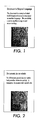
- Figure 1 is an image of an exemplary page having text and images.
- Figure 2 is an illustration of the exemplary page of Figure 1 after translation of the text.
- Figure 3 is another illustration of the exemplary page of Figure 1 after translation of the text, wherein the picture and images overlap.
- Figure 4 is an illustration of the elements of the translated page of Figure 2 adjusted to be more pleasing to the eye.
- Figure 5 is an illustration of the elements of the translated page of Figure 3 adjusted to be more pleasing to the eye.
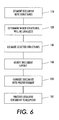
- Figure 6 is a flowchart detailing an exemplary method for localizing documents.
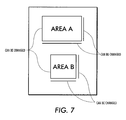
- Figure 7 illustrates a document template which specifies that there are two areas that should be filled with content: areaA and areaB, and which also specifies that the positions and sizes of areaA and areaB can be changed.
- This invention provides a method to automatically develop a localized version of a complete document that is aesthetically pleasing to the recipient.
- the localized document may include text, pictures, and layout information.
- the text, images and other data may be present in any of a variety of formats.
- Localizing a document may include, for example, translating text, using local terms or expressions, and replacing images with imagery more relevant to the recipient. While translation is a relatively common method of localizing a document, in many circumstances, one may wish to do more to localize a document than simply translate the document into another language. The complete localization of a document may involve not only translating the text, but also using local terms or expressions. Using local terms or expressions can encompass, for example, replacing a currency used in the document with a local currency by replacing currency units with appropriate local currency units (dollars ⁇ Euros) and changing the amount to reflect the current exchange rate. One may also wish to select appropriate localized content, whether that is text or images. For instance, a page in a textbook on geography that is for the Florida school system might include an image and/or text about the Everglades, while the same textbook for the California school system would include an image and/or text about the redwood forests.
- variable information documents contain "variable slots" that include a query, which can be instanced once the recipient is known.
- This same querying method can be used for localizing documents. For example, an original document containing an image of a forest is to be localized for a Florida recipient. The query may be ('forest" & 'image" & 'Florida"). The query would retrieve from the database an image of a Florida forest for the localized document.
- the image corresponding to the caption could be localized by retrieving a new image corresponding to the localized caption.
- the terms in the caption could be use in a query to automatically retrieve an image corresponding to those terms from a local or networked database.
- replacement images could be kept locally or remotely through a network and tagged in some manner so that they can be automatically inserted into a localized document. This would most likely be used in the case where area specific content changes were made (such as localized textbooks or safety guides), but could also be used where the caption is simply translated for a new locale. The translated words could be associated with a particular image.
- Localizing a document will often involve translating some or all of the document.
- the text of each paragraph and caption can be translated if the recipient's language differs from that of the original document.
- the translators will work on the translation, changing words and sentences, until the translated text fits into the same layout as the original text. This requires time as well as deep translation expertise, and is therefore not amenable to automated workflows.
- a variety of automated systems also exist to translate text today such as, for example, Babelfish. Text could be automatically sent to the translation software, which could send back the translated text to the local device after translation and reinsert the text into the document in place of the original text.
- Current state of the art for automated translation is to read in a series of text lines, and return the text lines in a different language. Standard translation software simply translates the text without any regard to the difference in length between the original text and the translated text.
- Automated document layout techniques can be applied to localized documents to produce a complete document that is localized and delivered in a completely laid-out and well-designed form.
- this invention could update the overlapped documents of Figures 2 and 4 into ones such as those shown in Figures 3 and 5, which is a much more feasible and aesthetically pleasing result, not requiring any human intervention.
- qualities such as segment size, margins, and symmetry can be treated as constraints to be optimized. These and other qualities can be quantized and measured and optimized in a constraint-based process. The qualities are solved for simultaneously.
- the constraint optimization formulation specifies that each problem variable has a value domain consisting of the possible values to assign to that variable.
- the value domains are the content pieces that are applicable to each area.
- the value domains are discretized ranges for those parameters, so that each potential value for the parameter appears in the value domain (e.g., 1... M, where M is some maximum value).
- the default domain is set up to be all possible content pieces in the associated content database, which is specified in the document template.
- the required constraints specify relationships between variables and/or values that must hold in order for the resulting document to be valid.
- the desired constraints specify relationships between variables and/or values that we would like to satisfy, but aren't required to satisfy in order for the resulting document to be valid.
- Constraints may be unary (apply to one value/variable), binary (apply to two values/variables), or n-ary (apply to n values/variables), and in our invention are entered by the user as part of the document template.
- An example of a required unary constraint in the document domain is: areaA must contain an image of a forest.
- An example of a required binary constraint could be that the height of areaA has be less than or equal to the height of areaB.
- constraints could also include customer attributes (e.g., areaA must contain an image that is appropriate for customer1).
- Desired constraints are represented as objective functions to maximize or minimize.
- the problem becomes a multi-criteria optimization problem. If it is a multi-criteria optimization problem, we sum the individual objective function scores to produce the overall optimization score for a particular solution. We can furthermore weight each of the desired constraints with a priority, so that the overall optimization score then becomes a weighted sum of the individual objective function scores. Any one of a number of known existing constraint optimization algorithms could then be applied to create the final output document.
- This relationship can be used to define the intents for both their inference and their application.
- the value functions associated with the document or component can be calculated.
- the vector of values V can then be multiplied by the matrix of weights A to obtain the quantified intents vector I.
- the resulting effects of localizing a document on its value properties may be determined by comparing intent vectors of the documents. Using a proper weight matrix, the value properties of the localized document can be converted to an intent vector and compared to the intent vector of the original document. A constraint optimization method may be used to minimize the difference between the intent vectors of the original and localized documents.
- the optimum values are not necessarily objective. Different creators or recipients of the translated documents may value certain features more than others, or they may have different preferences with regard to the optimum value of a parameter. Therefore, the optimized version of a document may vary based upon what either the creator or the recipient prefers for the optimum values for the document parameters. In some cases, these may be substantially different than the document parameters of the original document..
- Figure 6 outlines steps for localizing and reformatting text.
- the document may be segmented 110 into high-level structures or portions. These structures may include, for example, text in paragraphs, images, and captions to images. For some documents (such as a single picture, for example), the segment or portion may be the entire document.
- each of the segmented structures may then be localized 130 according to any of a variety of techniques automated or not.
- the layout of the localized document may be fixed automatically to improve the aesthetic appearance of the localized document 140. This step may occur after or during the localization step or steps 130 and 140 may be done as one step.
- the localization process could be incorporated into the constraint optimization process.
- the new content used to replace segments of the original document would be unary constraints in the optimization process.
- the retrieval of local content would be one more element or elements of a multiple constraint satisfaction problem.
- the document may also be converted into the desired output format (e.g. postscript, Quark file, etc.) 150.
- the final localized and formatted document may then be presented to the recipient 160.
- this invention provides an automated document localization and layout service.
Landscapes
- Engineering & Computer Science (AREA)
- Theoretical Computer Science (AREA)
- Audiology, Speech & Language Pathology (AREA)
- Health & Medical Sciences (AREA)
- Computational Linguistics (AREA)
- General Health & Medical Sciences (AREA)
- Physics & Mathematics (AREA)
- General Engineering & Computer Science (AREA)
- General Physics & Mathematics (AREA)
- Artificial Intelligence (AREA)
- Document Processing Apparatus (AREA)
- Processing Or Creating Images (AREA)
- Machine Translation (AREA)
Abstract
Description
- The embodiments disclosed herein are directed to localizing documents and more specifically, to methods for preserving document aesthetics after a document is localized.
- As used herein, localizing a document refers to altering the contents of a document for a particular recipient or class of recipients. For example, text can be translated into a local language or the language of the recipient. In other cases, particular text or pictures may be replaced to include material more appropriate for a particular audience. For example, a road safety guide may use an image of a road or highway local to the intended recipients.
- However, when elements of a document are altered (including replaced, removed, or added) the layout of the original work may be distorted or no longer aesthetically pleasing. The ability to preserve an appropriate or at least aesthetically pleasing layout after localization is a value-add for content management applications and services.
- Currently, automated document translation systems exist that can translate either text or a webpage that a user supplies into another language. The resulting "document" is simply either a text listing of the translated text or the web page with translated text. However, there is no notion of taking a completed document in any form (e.g. Word, PowerPoint, Quark, etc.) and localizing it, substituting appropriate text and images for the particular language and locale, and adjusting its layout to provide an equivalently well-designed document in another language or for a different locale.
- The embodiments disclosed herein use techniques developed for localization, such as translation, and techniques for automated document layout to provide an end-to-end document localization service. As such, it enables complete documents to be automatically transformed into appropriate forms for different locales, while preserving their initial design.
- The embodiments disclosed herein include a method for localizing a document that includes localizing the content of the document, and automatically adjusting the format of the document after the document has been localized according to one or more quantified document constraints.
In one embodiment of the method of claim 7, automatically adjusting the layout of the document involves using a constraint optimization method, where the constraints include one or more quantized document parameters.
In a further embodiment replacing the structures is to be localized with new content is accomplished as part of the constraint optimization method, where the content to be replaced and the new content are also constraints
In a further embodiment automatically adjusting the layout occurs after replacing the structures with new content.
In a further embodiment the new content includes translated portions of the original document structures the document includes translating text of the document. - Embodiments also include a method, which includes segmenting the content of the document into structures, determining a set of structures to be localized, replacing the structures to be localized with new content; and automatically adjusting the layout of the document with new content to generate a more aesthetically pleasing document.
In one embodiment of the method of claim 8, the method further comprises segmenting the document into high-level document structures prior to translating the document.
In a further embodiment the method further comprises translating only those structures that need translating.
In a further embodiment the method further comprises determining a set of the high-level document structures to be translated.
In a further embodiment the optimum values for at least some of the constraints are based upon the document parameters of the original document.
In a further embodiment the optimum values for at least some of the constraints are based upon the recipient's aesthetic preferences.
In one embodiment of the method of claim 10, the method further comprises determining a set of the high-level document structures to be localized,
wherein localizing the content of the document is limited to localizing the content only of the set of structures to be localized.
In a further embodiment localizing the content of the document includes translating the text of the document. - Various exemplary embodiments will be described in detail, with reference to the following figures, wherein:
- Figure 1 is an image of an exemplary page having text and images.
- Figure 2 is an illustration of the exemplary page of Figure 1 after translation of the text.
- Figure 3 is another illustration of the exemplary page of Figure 1 after translation of the text, wherein the picture and images overlap.
- Figure 4 is an illustration of the elements of the translated page of Figure 2 adjusted to be more pleasing to the eye.
- Figure 5 is an illustration of the elements of the translated page of Figure 3 adjusted to be more pleasing to the eye.
- Figure 6 is a flowchart detailing an exemplary method for localizing documents.
- Figure 7 illustrates a document template which specifies that there are two areas that should be filled with content: areaA and areaB, and which also specifies that the positions and sizes of areaA and areaB can be changed.
- This invention provides a method to automatically develop a localized version of a complete document that is aesthetically pleasing to the recipient. The localized document may include text, pictures, and layout information. The text, images and other data may be present in any of a variety of formats.
- Localizing a document may include, for example, translating text, using local terms or expressions, and replacing images with imagery more relevant to the recipient. While translation is a relatively common method of localizing a document, in many circumstances, one may wish to do more to localize a document than simply translate the document into another language. The complete localization of a document may involve not only translating the text, but also using local terms or expressions. Using local terms or expressions can encompass, for example, replacing a currency used in the document with a local currency by replacing currency units with appropriate local currency units (dollars → Euros) and changing the amount to reflect the current exchange rate. One may also wish to select appropriate localized content, whether that is text or images. For instance, a page in a textbook on geography that is for the Florida school system might include an image and/or text about the Everglades, while the same textbook for the California school system would include an image and/or text about the redwood forests.
- One way to localize content elements automatically is to query an existing content database using keywords associated with the element, and retrieve the localized content from the database. For example, variable information documents contain "variable slots" that include a query, which can be instanced once the recipient is known. This same querying method can be used for localizing documents. For example, an original document containing an image of a forest is to be localized for a Florida recipient. The query may be ('forest" & 'image" & 'Florida"). The query would retrieve from the database an image of a Florida forest for the localized document.
- Also, where a caption for an image is localized, the image corresponding to the caption could be localized by retrieving a new image corresponding to the localized caption. If the variable information type query process is used, the terms in the caption could be use in a query to automatically retrieve an image corresponding to those terms from a local or networked database. In embodiments, replacement images could be kept locally or remotely through a network and tagged in some manner so that they can be automatically inserted into a localized document. This would most likely be used in the case where area specific content changes were made (such as localized textbooks or safety guides), but could also be used where the caption is simply translated for a new locale. The translated words could be associated with a particular image.
- Localizing a document will often involve translating some or all of the document. The text of each paragraph and caption can be translated if the recipient's language differs from that of the original document. In people-based translation service environments, often the translators will work on the translation, changing words and sentences, until the translated text fits into the same layout as the original text. This requires time as well as deep translation expertise, and is therefore not amenable to automated workflows. A variety of automated systems also exist to translate text today such as, for example, Babelfish. Text could be automatically sent to the translation software, which could send back the translated text to the local device after translation and reinsert the text into the document in place of the original text. Current state of the art for automated translation is to read in a series of text lines, and return the text lines in a different language. Standard translation software simply translates the text without any regard to the difference in length between the original text and the translated text.
- However, these translation and image substitution techniques can worsen the appearance of a document. Localizing a document may cause a number of problems that include, for example, margins being left off, text and images overlapping, etc. If a totally automated workflow is attempted, by just substituting original text with translated text, or original images with localized images, the resulting document may no longer be aesthetically pleasing, as shown by the translation from the page in Figure 1 to that in Figure 2. Localizing a document may cause even more drastic problems such as overlaps. Figure 3 illustrates a case where translated text overlaps the image that is there. While the translated documents in Figures 2 and 3 are functional, they would look more pleasing if they were adjusted to look more like the documents shown in Figures 4 and 5 respectively. These examples show what happens when the text is translated (localized) and how the document layout needs to be adjusted afterwards. The same situations arise when a localized image is swapped in for an original image.
- Automated document layout techniques can be applied to localized documents to produce a complete document that is localized and delivered in a completely laid-out and well-designed form. For example, this invention could update the overlapped documents of Figures 2 and 4 into ones such as those shown in Figures 3 and 5, which is a much more feasible and aesthetically pleasing result, not requiring any human intervention.
- Using established techniques, qualities such as segment size, margins, and symmetry can be treated as constraints to be optimized. These and other qualities can be quantized and measured and optimized in a constraint-based process. The qualities are solved for simultaneously.
- The constraint optimization formulation specifies that each problem variable has a value domain consisting of the possible values to assign to that variable. For variables that are document areas to be filled with content (e.g., areaA and areaB of Fig. 7), the value domains are the content pieces that are applicable to each area. For variables that are document parameters, the value domains are discretized ranges for those parameters, so that each potential value for the parameter appears in the value domain (e.g., 1... M, where M is some maximum value). For variables whose value domains are content pieces, the default domain is set up to be all possible content pieces in the associated content database, which is specified in the document template.
- The required constraints specify relationships between variables and/or values that must hold in order for the resulting document to be valid. The desired constraints specify relationships between variables and/or values that we would like to satisfy, but aren't required to satisfy in order for the resulting document to be valid. Constraints may be unary (apply to one value/variable), binary (apply to two values/variables), or n-ary (apply to n values/variables), and in our invention are entered by the user as part of the document template. An example of a required unary constraint in the document domain is: areaA must contain an image of a forest. An example of a required binary constraint could be that the height of areaA has be less than or equal to the height of areaB. If we had another variable (areaC), an example of a required 3-ary constraint would be that the sum of the widths of areaA and areaB should be greater than the width of areaC. In a variable data situation, the constraints could also include customer attributes (e.g., areaA must contain an image that is appropriate for customer1).
- Desired constraints are represented as objective functions to maximize or minimize. For example, a desired binary constraint that the area of areaA be maximized might be represented by the objective function: f = areaA-width * areaA-height, which would then be maximized. If more than one objective function is defined for the problem, the problem becomes a multi-criteria optimization problem. If it is a multi-criteria optimization problem, we sum the individual objective function scores to produce the overall optimization score for a particular solution. We can furthermore weight each of the desired constraints with a priority, so that the overall optimization score then becomes a weighted sum of the individual objective function scores. Any one of a number of known existing constraint optimization algorithms could then be applied to create the final output document.
- Further, over 100 possible value properties have been identified that are commonly used in document design. These value properties can be measured, and a value function can be calculated to produce a measure of the property. It is these measurable value properties that allow the quantification of document intents. There is a functional relationship between intents and value properties that can be approximated as linear. There is thus a matrix A of weights that give the contribution of each value property to each intent coordinate, illustrated by:

- This relationship can be used to define the intents for both their inference and their application. To infer the intents associated with a document or document component, initially, the value functions associated with the document or component can be calculated. The vector of values V can then be multiplied by the matrix of weights A to obtain the quantified intents vector I.
- lt is possible that after segments of the document have been replaced that application of a constraint optimization program would lead to an appearance different from the original due to factors such as, for example, quantity of content in the replaced segments and image dimensions. In many cases, it may be desirable to have the localized document appear as much like the original document as possible, including the layout. In those cases, the value properties of the original document may be used to determine the optimization constraints for the layout of the localized version of the document to help preserve the appearance of the document.
- In embodiments, the resulting effects of localizing a document on its value properties may be determined by comparing intent vectors of the documents. Using a proper weight matrix, the value properties of the localized document can be converted to an intent vector and compared to the intent vector of the original document. A constraint optimization method may be used to minimize the difference between the intent vectors of the original and localized documents.
- In cases where the presentation of the localized version of the document remains the same and the original document was formatted using a particular set of aesthetic optimization targets prior to localization, the process could use those same optimum values again after or during localization.
- Also, while the constraints may be quantized, the optimum values are not necessarily objective. Different creators or recipients of the translated documents may value certain features more than others, or they may have different preferences with regard to the optimum value of a parameter. Therefore, the optimized version of a document may vary based upon what either the creator or the recipient prefers for the optimum values for the document parameters. In some cases, these may be substantially different than the document parameters of the original document..
- Figure 6 outlines steps for localizing and reformatting text. First, the document may be segmented 110 into high-level structures or portions. These structures may include, for example, text in paragraphs, images, and captions to images. For some documents (such as a single picture, for example), the segment or portion may be the entire document.
- Next, determine 120 which structures or portions of the document will be localized. Not all the segments of a document may need to be localized. For example, a document on water and land use in the Southwest may be translated from English to Spanish (or vice-versa) but still retain the same landscape images. Some documents will consist of only one segment.
- The content of each of the segmented structures may then be localized 130 according to any of a variety of techniques automated or not.
- The layout of the localized document may be fixed automatically to improve the aesthetic appearance of the
localized document 140. This step may occur after or during the localization step orsteps - If the result of the layout process is in a format other than the one desired, the document may also be converted into the desired output format (e.g. postscript, Quark file, etc.) 150. The final localized and formatted document may then be presented to the
recipient 160. - In this way, this invention provides an automated document localization and layout service.
Claims (10)
- A method comprising:segmenting the content of an original document into one or more original document structures;selecting a set of the one or more original document structures to be replaced;replacing the set of structures with new structures; andautomatically adjusting the layout of the document with new structures to generate a more aesthetically pleasing document.
- The method of claim 1 wherein automatically adjusting the layout of the document involves using a constraint optimization method, where the constraints include one or more quantized document parameters.
- The method of claim 2, wherein the optimum values for at least some of the constraints are based upon the document parameters of the original document.
- The method of claim 2, wherein the optimum values for at least some of the constraints are based upon the recipient's aesthetic preferences.
- The method of claim 2 wherein replacing the set of structures is to be localized with new content is accomplished as part of the constraint optimization method, where the content to be replaced and the new content are also constraints
- The method of claim 1, further comprising converting the format of the document with new structures into a different desired output format.
- A method comprising:segmenting the content of a document into one or more original document structures;determining which of the one or more original document structures are to be localized;replacing the original document structures to be localized with new content; andautomatically adjusting the layout of the document with new content to generate a more aesthetically pleasing document.
- A method for translating a document, comprising:translating at least some of the text of the document;automatically adjusting the layout of the revised document according to optimum desired values of one or more quantified document constraints.
- A method for localizing a document, comprising:localizing the content of the document;automatically adjusting the format of the document after the document has been localized according to one or more quantified document constraints.
- The method of claim 18, further comprising segmenting the document into high-level document structures prior to localizing the document.
Applications Claiming Priority (1)
| Application Number | Priority Date | Filing Date | Title |
|---|---|---|---|
| US11/117,555 US20060248071A1 (en) | 2005-04-28 | 2005-04-28 | Automated document localization and layout method |
Publications (2)
| Publication Number | Publication Date |
|---|---|
| EP1717713A2 true EP1717713A2 (en) | 2006-11-02 |
| EP1717713A3 EP1717713A3 (en) | 2007-08-22 |
Family
ID=36586032
Family Applications (1)
| Application Number | Title | Priority Date | Filing Date |
|---|---|---|---|
| EP06113213A Ceased EP1717713A3 (en) | 2005-04-28 | 2006-04-27 | Automated document localization and layout method |
Country Status (3)
| Country | Link |
|---|---|
| US (2) | US20060248071A1 (en) |
| EP (1) | EP1717713A3 (en) |
| JP (1) | JP2006309758A (en) |
Cited By (1)
| Publication number | Priority date | Publication date | Assignee | Title |
|---|---|---|---|---|
| EP2246808A3 (en) * | 2009-04-30 | 2016-04-06 | Xerox Corporation | Automated method for alignment of document objects |
Families Citing this family (28)
| Publication number | Priority date | Publication date | Assignee | Title |
|---|---|---|---|---|
| US7844897B1 (en) * | 2006-10-05 | 2010-11-30 | Adobe Systems Incorporated | Blog template generation |
| US8904340B2 (en) * | 2007-02-13 | 2014-12-02 | International Business Machines Corporation | Use of temporary optimized settings to reduce cycle time of automatically created spreadsheets |
| US8515728B2 (en) * | 2007-03-29 | 2013-08-20 | Microsoft Corporation | Language translation of visual and audio input |
| CA2638593A1 (en) * | 2007-08-16 | 2009-02-16 | Andrew Echenberg | Online magazine |
| AU2007254598B2 (en) * | 2007-12-20 | 2011-03-24 | Canon Kabushiki Kaisha | Map-based aesthetic evaluation of document layouts |
| US8307349B2 (en) * | 2008-01-31 | 2012-11-06 | International Business Machines Corporation | Methods, systems, and computer program products for internationalizing user interface control layouts |
| US8321435B2 (en) * | 2009-08-12 | 2012-11-27 | Apple Inc. | Quick find for data fields |
| US8762317B2 (en) * | 2010-11-02 | 2014-06-24 | Microsoft Corporation | Software localization analysis of multiple resources |
| US9645989B2 (en) | 2011-11-04 | 2017-05-09 | Sas Institute Inc. | Techniques to generate custom electronic forms using custom content |
| US8977956B2 (en) * | 2012-01-13 | 2015-03-10 | Hewlett-Packard Development Company, L.P. | Document aesthetics evaluation |
| US9595298B2 (en) | 2012-07-18 | 2017-03-14 | Microsoft Technology Licensing, Llc | Transforming data to create layouts |
| US20140281951A1 (en) * | 2013-03-14 | 2014-09-18 | Microsoft Corporation | Automated collaborative editor |
| US9256341B2 (en) | 2013-03-20 | 2016-02-09 | Microsoft Technology Licensing, Llc | Tracking changes in collaborative authoring environment |
| KR20150050947A (en) * | 2013-11-01 | 2015-05-11 | 삼성전자주식회사 | Method and apparatus for translation |
| US11514399B2 (en) | 2013-12-21 | 2022-11-29 | Microsoft Technology Licensing, Llc | Authoring through suggestion |
| US10824787B2 (en) | 2013-12-21 | 2020-11-03 | Microsoft Technology Licensing, Llc | Authoring through crowdsourcing based suggestions |
| US9626768B2 (en) | 2014-09-30 | 2017-04-18 | Microsoft Technology Licensing, Llc | Optimizing a visual perspective of media |
| US10282069B2 (en) | 2014-09-30 | 2019-05-07 | Microsoft Technology Licensing, Llc | Dynamic presentation of suggested content |
| US9965469B2 (en) * | 2016-03-23 | 2018-05-08 | International Business Machines Corporation | Dynamic token translation for network interfaces |
| US10380228B2 (en) | 2017-02-10 | 2019-08-13 | Microsoft Technology Licensing, Llc | Output generation based on semantic expressions |
| CN108287858B (en) * | 2017-03-02 | 2021-08-10 | 腾讯科技(深圳)有限公司 | Semantic extraction method and device for natural language |
| FI127955B (en) * | 2017-08-29 | 2019-06-14 | Crf Box Oy | Layout guidance for localization |
| US10439971B1 (en) * | 2017-11-27 | 2019-10-08 | Amazon Technologies, Inc. | System for detecting erroneous communications |
| US11494567B2 (en) * | 2020-03-03 | 2022-11-08 | Dell Products L.P. | Content adaptation techniques for localization of content presentation |
| US11455456B2 (en) * | 2020-03-03 | 2022-09-27 | Dell Products L.P. | Content design structure adaptation techniques for localization of content presentation |
| US11443122B2 (en) * | 2020-03-03 | 2022-09-13 | Dell Products L.P. | Image analysis-based adaptation techniques for localization of content presentation |
| JP7244882B2 (en) * | 2020-09-30 | 2023-03-23 | ナレッジオンデマンド株式会社 | Document preparation device |
| CN118133775B (en) * | 2024-05-08 | 2024-09-13 | 工业富联(杭州)数据科技有限公司 | Document generation method, electronic device and storage medium |
Family Cites Families (44)
| Publication number | Priority date | Publication date | Assignee | Title |
|---|---|---|---|---|
| US5649216A (en) * | 1991-05-17 | 1997-07-15 | Joseph S. Sieber | Method and apparatus for automated layout of text and graphic elements |
| US5381523A (en) * | 1992-04-06 | 1995-01-10 | Fuji Xerox Co., Ltd. | Document processing device using partial layout templates |
| JPH05334350A (en) * | 1992-06-04 | 1993-12-17 | Sharp Corp | Machine translation device |
| JPH0713969A (en) * | 1993-02-19 | 1995-01-17 | Matsushita Electric Ind Co Ltd | Machine translator |
| US5845303A (en) * | 1994-12-06 | 1998-12-01 | Netpodium, Inc. | Document processing using frame-based templates with hierarchical tagging |
| US6173286B1 (en) * | 1996-02-29 | 2001-01-09 | Nth Degree Software, Inc. | Computer-implemented optimization of publication layouts |
| JPH11175527A (en) * | 1997-12-15 | 1999-07-02 | Fujitsu Ltd | Output control device and output control method |
| US6623529B1 (en) * | 1998-02-23 | 2003-09-23 | David Lakritz | Multilingual electronic document translation, management, and delivery system |
| US6526426B1 (en) * | 1998-02-23 | 2003-02-25 | David Lakritz | Translation management system |
| US6492995B1 (en) * | 1999-04-26 | 2002-12-10 | International Business Machines Corporation | Method and system for enabling localization support on web applications |
| US7065497B1 (en) * | 1999-06-07 | 2006-06-20 | Hewlett-Packard Development Company, L.P. | Document delivery system for automatically printing a document on a printing device |
| US20020040375A1 (en) * | 2000-04-27 | 2002-04-04 | Simon Richard A. | Method of organizing digital images on a page |
| US6865716B1 (en) * | 2000-05-05 | 2005-03-08 | Aspect Communication Corporation | Method and apparatus for dynamic localization of documents |
| US20040205643A1 (en) * | 2000-06-22 | 2004-10-14 | Harrington Steven J. | Reproduction of documents using intent information |
| US7340676B2 (en) * | 2000-12-29 | 2008-03-04 | Eastman Kodak Company | System and method for automatic layout of images in digital albums |
| US6825844B2 (en) * | 2001-01-16 | 2004-11-30 | Microsoft Corp | System and method for optimizing a graphics intensive software program for the user's graphics hardware |
| US7120868B2 (en) * | 2002-05-30 | 2006-10-10 | Microsoft Corp. | System and method for adaptive document layout via manifold content |
| US20020107883A1 (en) * | 2001-02-08 | 2002-08-08 | Ofer Schneid | Distributed visual communications content development method and system |
| WO2002084475A1 (en) * | 2001-04-10 | 2002-10-24 | Quark, Inc. | Publication of documents by defining document object relationships |
| US20030004703A1 (en) * | 2001-06-28 | 2003-01-02 | Arvind Prabhakar | Method and system for localizing a markup language document |
| KR100444325B1 (en) * | 2001-07-16 | 2004-08-16 | 한국과학기술연구원 | Facilitated Olefin Transport Membranes containing Silver Salts having Improved Stability and Production Method for the Same |
| US20040205118A1 (en) * | 2001-09-13 | 2004-10-14 | Allen Yu | Method and system for generalized localization of electronic documents |
| US20030084401A1 (en) * | 2001-10-16 | 2003-05-01 | Abel Todd J. | Efficient web page localization |
| US20030160810A1 (en) * | 2002-02-28 | 2003-08-28 | Sun Microsystems, Inc. | Methods and systems for internationalizing messages using parameters |
| US7243303B2 (en) * | 2002-07-23 | 2007-07-10 | Xerox Corporation | Constraint-optimization system and method for document component layout generation |
| US7010746B2 (en) * | 2002-07-23 | 2006-03-07 | Xerox Corporation | System and method for constraint-based document generation |
| US7487445B2 (en) * | 2002-07-23 | 2009-02-03 | Xerox Corporation | Constraint-optimization system and method for document component layout generation |
| US7246312B2 (en) * | 2002-07-30 | 2007-07-17 | Xerox Corporation | System and method for fitness evaluation for optimization in document assembly |
| US7171617B2 (en) * | 2002-07-30 | 2007-01-30 | Xerox Corporation | System and method for fitness evaluation for optimization in document assembly |
| US20060005126A1 (en) * | 2002-10-07 | 2006-01-05 | Shaul Shapiro | Method for manipulation of objects within electronic graphic documents |
| JP2004157588A (en) * | 2002-11-01 | 2004-06-03 | Canon Inc | Image processing device |
| US7240047B2 (en) * | 2002-12-23 | 2007-07-03 | Hewlett-Packard Development Company, L.P. | Apparatus and method for market-based document layout selection |
| US7171618B2 (en) * | 2003-07-30 | 2007-01-30 | Xerox Corporation | Multi-versioned documents and method for creation and use thereof |
| US7689923B2 (en) * | 2003-08-22 | 2010-03-30 | Sap Ag | Framework for creating user interfaces for web application programs |
| GB0320278D0 (en) * | 2003-08-29 | 2003-10-01 | Hewlett Packard Development Co | Constrained document layout |
| JP4089655B2 (en) * | 2003-09-16 | 2008-05-28 | セイコーエプソン株式会社 | Layout system, layout program, and layout method |
| US7548334B2 (en) * | 2003-10-15 | 2009-06-16 | Canon Kabushiki Kaisha | User interface for creation and editing of variable data documents |
| US8661338B2 (en) * | 2004-01-14 | 2014-02-25 | Xerox Corporation | System and method for dynamic document layout |
| JP4059504B2 (en) * | 2004-01-30 | 2008-03-12 | キヤノン株式会社 | Document processing apparatus, document processing method, and document processing program |
| JP4165888B2 (en) * | 2004-01-30 | 2008-10-15 | キヤノン株式会社 | Layout control method, layout control apparatus, and layout control program |
| JP4250540B2 (en) * | 2004-01-30 | 2009-04-08 | キヤノン株式会社 | Layout adjustment method and apparatus, and layout adjustment program |
| US8566705B2 (en) * | 2004-12-21 | 2013-10-22 | Ricoh Co., Ltd. | Dynamic document icons |
| US20060236230A1 (en) * | 2005-04-15 | 2006-10-19 | Xiaofan Lin | Automatic layout adjustment for documents containing text |
| US7607082B2 (en) * | 2005-09-26 | 2009-10-20 | Microsoft Corporation | Categorizing page block functionality to improve document layout for browsing |
-
2005
- 2005-04-28 US US11/117,555 patent/US20060248071A1/en not_active Abandoned
-
2006
- 2006-04-21 JP JP2006118551A patent/JP2006309758A/en active Pending
- 2006-04-27 EP EP06113213A patent/EP1717713A3/en not_active Ceased
-
2011
- 2011-05-31 US US13/149,330 patent/US20110231754A1/en not_active Abandoned
Non-Patent Citations (1)
| Title |
|---|
| PURVIS LISA ET AL: "Creating personalized documents: An optimization approach", PROCEEDINGS OF THE 2003 ACM SYMPOSIUM ON DOCUMENT ENGINEERING; [ACM SYMPOSIUM ON DOCUMENT ENGINEERING], GRENOBLE, FRANCE, 1 January 2003 (2003-01-01), pages 68 - 77, XP008080893, ISBN: 978-1-58113-724-8 * |
Cited By (1)
| Publication number | Priority date | Publication date | Assignee | Title |
|---|---|---|---|---|
| EP2246808A3 (en) * | 2009-04-30 | 2016-04-06 | Xerox Corporation | Automated method for alignment of document objects |
Also Published As
| Publication number | Publication date |
|---|---|
| EP1717713A3 (en) | 2007-08-22 |
| US20060248071A1 (en) | 2006-11-02 |
| US20110231754A1 (en) | 2011-09-22 |
| JP2006309758A (en) | 2006-11-09 |
Similar Documents
| Publication | Publication Date | Title |
|---|---|---|
| US20110231754A1 (en) | Automated document localization and layout method | |
| US20220245336A1 (en) | Automatic template generation with inbuilt template logic interface | |
| US7260584B2 (en) | Document creation system and method using knowledge base, precedence, and integrated rules | |
| US7170519B2 (en) | Computer-implemented system and method for generating data graphical displays | |
| US7340673B2 (en) | System and method for browser document editing | |
| US20110276872A1 (en) | Dynamic font replacement | |
| US9043697B2 (en) | Displaying the same document in different contexts | |
| US20110191668A1 (en) | Extended cascading style sheets | |
| EP1667039A1 (en) | System and method for publishing collaboration items to a web site | |
| US20170364981A1 (en) | Brand-Based Product Management | |
| AU2010219430A1 (en) | Generation of electronic forms | |
| US20040034613A1 (en) | System and method for dynamically generating a style sheet | |
| US8756487B2 (en) | System and method for context sensitive content management | |
| CN112632950A (en) | PPT generation method, device, equipment and computer-readable storage medium | |
| Emmet et al. | Graphical notations, narratives and persuasion: a pliant systems approach to hypertext tool design | |
| US8074169B2 (en) | Document creation system and related methods | |
| Cerba et al. | Web services for thematic maps | |
| Pierrès et al. | PDF accessibility in international academic publishers | |
| US10891432B2 (en) | System and process for generating an internet application | |
| EP1079311A2 (en) | Method and system for creating web-quality online documentation from the same source file as printed documentation | |
| O’Keefe et al. | Structured authoring and XML | |
| Splendiani et al. | Do physicians make their articles readable for their blind or low-vision patients? An analysis of current image processing practices in biomedical journals from the point of view of accessibility | |
| Van Eycken | Writing a master thesis in LaTeX | |
| Woloszyn et al. | The Professional Practice of Type Designers in the Design of Variable Fonts | |
| JP2007316873A (en) | Content server and layout system |
Legal Events
| Date | Code | Title | Description |
|---|---|---|---|
| PUAI | Public reference made under article 153(3) epc to a published international application that has entered the european phase |
Free format text: ORIGINAL CODE: 0009012 |
|
| AK | Designated contracting states |
Kind code of ref document: A2 Designated state(s): AT BE BG CH CY CZ DE DK EE ES FI FR GB GR HU IE IS IT LI LT LU LV MC NL PL PT RO SE SI SK TR |
|
| AX | Request for extension of the european patent |
Extension state: AL BA HR MK YU |
|
| PUAL | Search report despatched |
Free format text: ORIGINAL CODE: 0009013 |
|
| AK | Designated contracting states |
Kind code of ref document: A3 Designated state(s): AT BE BG CH CY CZ DE DK EE ES FI FR GB GR HU IE IS IT LI LT LU LV MC NL PL PT RO SE SI SK TR |
|
| AX | Request for extension of the european patent |
Extension state: AL BA HR MK YU |
|
| 17P | Request for examination filed |
Effective date: 20080222 |
|
| AKX | Designation fees paid |
Designated state(s): DE FR GB |
|
| 17Q | First examination report despatched |
Effective date: 20090514 |
|
| STAA | Information on the status of an ep patent application or granted ep patent |
Free format text: STATUS: THE APPLICATION HAS BEEN REFUSED |
|
| 18R | Application refused |
Effective date: 20110908 |