EP1717345A1 - Coated article and preparation method - Google Patents
Coated article and preparation method Download PDFInfo
- Publication number
- EP1717345A1 EP1717345A1 EP20060008025 EP06008025A EP1717345A1 EP 1717345 A1 EP1717345 A1 EP 1717345A1 EP 20060008025 EP20060008025 EP 20060008025 EP 06008025 A EP06008025 A EP 06008025A EP 1717345 A1 EP1717345 A1 EP 1717345A1
- Authority
- EP
- European Patent Office
- Prior art keywords
- resin
- layer
- resin complex
- aluminum
- group
- Prior art date
- Legal status (The legal status is an assumption and is not a legal conclusion. Google has not performed a legal analysis and makes no representation as to the accuracy of the status listed.)
- Withdrawn
Links
- 238000002360 preparation method Methods 0.000 title 1
- 239000000463 material Substances 0.000 claims abstract description 137
- 229920005989 resin Polymers 0.000 claims abstract description 136
- 239000011347 resin Substances 0.000 claims abstract description 136
- 229910052782 aluminium Inorganic materials 0.000 claims abstract description 54
- XAGFODPZIPBFFR-UHFFFAOYSA-N aluminium Chemical compound [Al] XAGFODPZIPBFFR-UHFFFAOYSA-N 0.000 claims abstract description 54
- -1 triazin dithiol Chemical class 0.000 claims abstract description 49
- 239000007769 metal material Substances 0.000 claims abstract description 8
- 238000000034 method Methods 0.000 claims description 24
- 239000004734 Polyphenylene sulfide Substances 0.000 claims description 18
- 229920000069 polyphenylene sulfide Polymers 0.000 claims description 18
- 238000004519 manufacturing process Methods 0.000 claims description 16
- 238000000465 moulding Methods 0.000 claims description 13
- 230000008569 process Effects 0.000 claims description 11
- 239000000126 substance Substances 0.000 claims description 10
- 239000004696 Poly ether ether ketone Substances 0.000 claims description 6
- 229920002530 polyetherether ketone Polymers 0.000 claims description 6
- 229910052708 sodium Inorganic materials 0.000 claims description 5
- 150000001875 compounds Chemical class 0.000 claims description 4
- 229910052739 hydrogen Inorganic materials 0.000 claims description 4
- 229920006122 polyamide resin Polymers 0.000 claims description 4
- 239000004698 Polyethylene Substances 0.000 claims description 3
- 229910000831 Steel Inorganic materials 0.000 claims description 3
- 238000002848 electrochemical method Methods 0.000 claims description 3
- 229920000573 polyethylene Polymers 0.000 claims description 3
- 239000010959 steel Substances 0.000 claims description 3
- 239000004952 Polyamide Substances 0.000 claims description 2
- 239000004962 Polyamide-imide Substances 0.000 claims description 2
- 239000004743 Polypropylene Substances 0.000 claims description 2
- XECAHXYUAAWDEL-UHFFFAOYSA-N acrylonitrile butadiene styrene Chemical compound C=CC=C.C=CC#N.C=CC1=CC=CC=C1 XECAHXYUAAWDEL-UHFFFAOYSA-N 0.000 claims description 2
- 229920000122 acrylonitrile butadiene styrene Polymers 0.000 claims description 2
- 239000004676 acrylonitrile butadiene styrene Substances 0.000 claims description 2
- 125000003342 alkenyl group Chemical group 0.000 claims description 2
- 125000000217 alkyl group Chemical group 0.000 claims description 2
- 125000000304 alkynyl group Chemical group 0.000 claims description 2
- 125000003368 amide group Chemical group 0.000 claims description 2
- 125000003277 amino group Chemical group 0.000 claims description 2
- 150000003863 ammonium salts Chemical class 0.000 claims description 2
- 125000002915 carbonyl group Chemical group [*:2]C([*:1])=O 0.000 claims description 2
- 125000000753 cycloalkyl group Chemical group 0.000 claims description 2
- 239000008151 electrolyte solution Substances 0.000 claims description 2
- 125000004185 ester group Chemical group 0.000 claims description 2
- RTZKZFJDLAIYFH-UHFFFAOYSA-N ether Substances CCOCC RTZKZFJDLAIYFH-UHFFFAOYSA-N 0.000 claims description 2
- 125000001033 ether group Chemical group 0.000 claims description 2
- 125000002887 hydroxy group Chemical group [H]O* 0.000 claims description 2
- 239000004973 liquid crystal related substance Substances 0.000 claims description 2
- 229910052744 lithium Inorganic materials 0.000 claims description 2
- 125000001997 phenyl group Chemical group [H]C1=C([H])C([H])=C(*)C([H])=C1[H] 0.000 claims description 2
- 229920001643 poly(ether ketone) Polymers 0.000 claims description 2
- 229920002647 polyamide Polymers 0.000 claims description 2
- 229920002312 polyamide-imide Polymers 0.000 claims description 2
- 229920001707 polybutylene terephthalate Polymers 0.000 claims description 2
- 229920000139 polyethylene terephthalate Polymers 0.000 claims description 2
- 239000005020 polyethylene terephthalate Substances 0.000 claims description 2
- 229920001155 polypropylene Polymers 0.000 claims description 2
- 229910052700 potassium Inorganic materials 0.000 claims description 2
- XEEYBQQBJWHFJM-UHFFFAOYSA-N Iron Chemical compound [Fe] XEEYBQQBJWHFJM-UHFFFAOYSA-N 0.000 abstract description 38
- 229910052751 metal Inorganic materials 0.000 abstract description 28
- 239000002184 metal Substances 0.000 abstract description 28
- 239000000919 ceramic Substances 0.000 abstract description 20
- 229910052742 iron Inorganic materials 0.000 abstract description 19
- 238000012360 testing method Methods 0.000 description 29
- PXHVJJICTQNCMI-UHFFFAOYSA-N Nickel Chemical compound [Ni] PXHVJJICTQNCMI-UHFFFAOYSA-N 0.000 description 19
- 238000005406 washing Methods 0.000 description 12
- 239000010949 copper Substances 0.000 description 9
- 229910052759 nickel Inorganic materials 0.000 description 9
- XLYOFNOQVPJJNP-UHFFFAOYSA-N water Substances O XLYOFNOQVPJJNP-UHFFFAOYSA-N 0.000 description 9
- RYGMFSIKBFXOCR-UHFFFAOYSA-N Copper Chemical compound [Cu] RYGMFSIKBFXOCR-UHFFFAOYSA-N 0.000 description 8
- 229910052802 copper Inorganic materials 0.000 description 8
- 238000007747 plating Methods 0.000 description 8
- BASFCYQUMIYNBI-UHFFFAOYSA-N platinum Chemical compound [Pt] BASFCYQUMIYNBI-UHFFFAOYSA-N 0.000 description 8
- 230000000052 comparative effect Effects 0.000 description 7
- 230000003746 surface roughness Effects 0.000 description 7
- 229920000049 Carbon (fiber) Polymers 0.000 description 6
- OKKJLVBELUTLKV-UHFFFAOYSA-N Methanol Chemical compound OC OKKJLVBELUTLKV-UHFFFAOYSA-N 0.000 description 6
- HEMHJVSKTPXQMS-UHFFFAOYSA-M Sodium hydroxide Chemical compound [OH-].[Na+] HEMHJVSKTPXQMS-UHFFFAOYSA-M 0.000 description 6
- 239000000853 adhesive Substances 0.000 description 6
- 230000001070 adhesive effect Effects 0.000 description 6
- 239000007864 aqueous solution Substances 0.000 description 6
- 239000004917 carbon fiber Substances 0.000 description 6
- VNWKTOKETHGBQD-UHFFFAOYSA-N methane Chemical compound C VNWKTOKETHGBQD-UHFFFAOYSA-N 0.000 description 6
- 230000009257 reactivity Effects 0.000 description 6
- 239000002253 acid Substances 0.000 description 5
- 238000002203 pretreatment Methods 0.000 description 5
- 239000000243 solution Substances 0.000 description 5
- 239000003513 alkali Substances 0.000 description 4
- 230000015572 biosynthetic process Effects 0.000 description 4
- 238000009792 diffusion process Methods 0.000 description 4
- 238000007654 immersion Methods 0.000 description 4
- 230000008595 infiltration Effects 0.000 description 4
- 238000001764 infiltration Methods 0.000 description 4
- 229910000765 intermetallic Inorganic materials 0.000 description 4
- 229910052697 platinum Inorganic materials 0.000 description 4
- LPXPTNMVRIOKMN-UHFFFAOYSA-M sodium nitrite Chemical compound [Na+].[O-]N=O LPXPTNMVRIOKMN-UHFFFAOYSA-M 0.000 description 4
- VEXZGXHMUGYJMC-UHFFFAOYSA-N Hydrochloric acid Chemical compound Cl VEXZGXHMUGYJMC-UHFFFAOYSA-N 0.000 description 3
- ZMXDDKWLCZADIW-UHFFFAOYSA-N N,N-Dimethylformamide Chemical compound CN(C)C=O ZMXDDKWLCZADIW-UHFFFAOYSA-N 0.000 description 3
- 230000006872 improvement Effects 0.000 description 3
- 230000010354 integration Effects 0.000 description 3
- VLKZOEOYAKHREP-UHFFFAOYSA-N n-Hexane Chemical compound CCCCCC VLKZOEOYAKHREP-UHFFFAOYSA-N 0.000 description 3
- 239000011734 sodium Substances 0.000 description 3
- 239000002904 solvent Substances 0.000 description 3
- 239000003115 supporting electrolyte Substances 0.000 description 3
- QGZKDVFQNNGYKY-UHFFFAOYSA-N Ammonia Chemical compound N QGZKDVFQNNGYKY-UHFFFAOYSA-N 0.000 description 2
- LTPBRCUWZOMYOC-UHFFFAOYSA-N Beryllium oxide Chemical compound O=[Be] LTPBRCUWZOMYOC-UHFFFAOYSA-N 0.000 description 2
- 229910001369 Brass Inorganic materials 0.000 description 2
- 229910000906 Bronze Inorganic materials 0.000 description 2
- VTYYLEPIZMXCLO-UHFFFAOYSA-L Calcium carbonate Chemical compound [Ca+2].[O-]C([O-])=O VTYYLEPIZMXCLO-UHFFFAOYSA-L 0.000 description 2
- LFQSCWFLJHTTHZ-UHFFFAOYSA-N Ethanol Chemical compound CCO LFQSCWFLJHTTHZ-UHFFFAOYSA-N 0.000 description 2
- CPLXHLVBOLITMK-UHFFFAOYSA-N Magnesium oxide Chemical compound [Mg]=O CPLXHLVBOLITMK-UHFFFAOYSA-N 0.000 description 2
- KDLHZDBZIXYQEI-UHFFFAOYSA-N Palladium Chemical compound [Pd] KDLHZDBZIXYQEI-UHFFFAOYSA-N 0.000 description 2
- WCUXLLCKKVVCTQ-UHFFFAOYSA-M Potassium chloride Chemical compound [Cl-].[K+] WCUXLLCKKVVCTQ-UHFFFAOYSA-M 0.000 description 2
- VYPSYNLAJGMNEJ-UHFFFAOYSA-N Silicium dioxide Chemical compound O=[Si]=O VYPSYNLAJGMNEJ-UHFFFAOYSA-N 0.000 description 2
- FAPWRFPIFSIZLT-UHFFFAOYSA-M Sodium chloride Chemical compound [Na+].[Cl-] FAPWRFPIFSIZLT-UHFFFAOYSA-M 0.000 description 2
- GWEVSGVZZGPLCZ-UHFFFAOYSA-N Titan oxide Chemical compound O=[Ti]=O GWEVSGVZZGPLCZ-UHFFFAOYSA-N 0.000 description 2
- RTAQQCXQSZGOHL-UHFFFAOYSA-N Titanium Chemical compound [Ti] RTAQQCXQSZGOHL-UHFFFAOYSA-N 0.000 description 2
- MCMNRKCIXSYSNV-UHFFFAOYSA-N Zirconium dioxide Chemical compound O=[Zr]=O MCMNRKCIXSYSNV-UHFFFAOYSA-N 0.000 description 2
- 239000000654 additive Substances 0.000 description 2
- 239000010951 brass Substances 0.000 description 2
- 239000010974 bronze Substances 0.000 description 2
- KUNSUQLRTQLHQQ-UHFFFAOYSA-N copper tin Chemical compound [Cu].[Sn] KUNSUQLRTQLHQQ-UHFFFAOYSA-N 0.000 description 2
- 230000007547 defect Effects 0.000 description 2
- 238000005238 degreasing Methods 0.000 description 2
- ZOMNIUBKTOKEHS-UHFFFAOYSA-L dimercury dichloride Chemical class Cl[Hg][Hg]Cl ZOMNIUBKTOKEHS-UHFFFAOYSA-L 0.000 description 2
- 238000005516 engineering process Methods 0.000 description 2
- 238000002347 injection Methods 0.000 description 2
- 239000007924 injection Substances 0.000 description 2
- KWGKDLIKAYFUFQ-UHFFFAOYSA-M lithium chloride Chemical compound [Li+].[Cl-] KWGKDLIKAYFUFQ-UHFFFAOYSA-M 0.000 description 2
- 239000002674 ointment Substances 0.000 description 2
- FGIUAXJPYTZDNR-UHFFFAOYSA-N potassium nitrate Chemical compound [K+].[O-][N+]([O-])=O FGIUAXJPYTZDNR-UHFFFAOYSA-N 0.000 description 2
- 230000035939 shock Effects 0.000 description 2
- 235000010288 sodium nitrite Nutrition 0.000 description 2
- 239000006104 solid solution Substances 0.000 description 2
- 238000005382 thermal cycling Methods 0.000 description 2
- 229910052719 titanium Inorganic materials 0.000 description 2
- 239000010936 titanium Substances 0.000 description 2
- 238000011282 treatment Methods 0.000 description 2
- 0 *c1nc(*)nc(SC2N=C2)n1 Chemical compound *c1nc(*)nc(SC2N=C2)n1 0.000 description 1
- ZNQVEEAIQZEUHB-UHFFFAOYSA-N 2-ethoxyethanol Chemical compound CCOCCO ZNQVEEAIQZEUHB-UHFFFAOYSA-N 0.000 description 1
- NLHHRLWOUZZQLW-UHFFFAOYSA-N Acrylonitrile Chemical compound C=CC#N NLHHRLWOUZZQLW-UHFFFAOYSA-N 0.000 description 1
- 229910052582 BN Inorganic materials 0.000 description 1
- PZNSFCLAULLKQX-UHFFFAOYSA-N Boron nitride Chemical compound N#B PZNSFCLAULLKQX-UHFFFAOYSA-N 0.000 description 1
- OKTJSMMVPCPJKN-UHFFFAOYSA-N Carbon Chemical compound [C] OKTJSMMVPCPJKN-UHFFFAOYSA-N 0.000 description 1
- 229910000975 Carbon steel Inorganic materials 0.000 description 1
- VYZAMTAEIAYCRO-UHFFFAOYSA-N Chromium Chemical compound [Cr] VYZAMTAEIAYCRO-UHFFFAOYSA-N 0.000 description 1
- KMTRUDSVKNLOMY-UHFFFAOYSA-N Ethylene carbonate Chemical compound O=C1OCCO1 KMTRUDSVKNLOMY-UHFFFAOYSA-N 0.000 description 1
- FYYHWMGAXLPEAU-UHFFFAOYSA-N Magnesium Chemical compound [Mg] FYYHWMGAXLPEAU-UHFFFAOYSA-N 0.000 description 1
- PWHULOQIROXLJO-UHFFFAOYSA-N Manganese Chemical compound [Mn] PWHULOQIROXLJO-UHFFFAOYSA-N 0.000 description 1
- SECXISVLQFMRJM-UHFFFAOYSA-N N-Methylpyrrolidone Chemical compound CN1CCCC1=O SECXISVLQFMRJM-UHFFFAOYSA-N 0.000 description 1
- 229910021586 Nickel(II) chloride Inorganic materials 0.000 description 1
- 229910052581 Si3N4 Inorganic materials 0.000 description 1
- BQCADISMDOOEFD-UHFFFAOYSA-N Silver Chemical compound [Ag] BQCADISMDOOEFD-UHFFFAOYSA-N 0.000 description 1
- PMZURENOXWZQFD-UHFFFAOYSA-L Sodium Sulfate Chemical compound [Na+].[Na+].[O-]S([O-])(=O)=O PMZURENOXWZQFD-UHFFFAOYSA-L 0.000 description 1
- ATJFFYVFTNAWJD-UHFFFAOYSA-N Tin Chemical compound [Sn] ATJFFYVFTNAWJD-UHFFFAOYSA-N 0.000 description 1
- 239000012963 UV stabilizer Substances 0.000 description 1
- 241000030614 Urania Species 0.000 description 1
- HCHKCACWOHOZIP-UHFFFAOYSA-N Zinc Chemical compound [Zn] HCHKCACWOHOZIP-UHFFFAOYSA-N 0.000 description 1
- 229910026551 ZrC Inorganic materials 0.000 description 1
- OTCHGXYCWNXDOA-UHFFFAOYSA-N [C].[Zr] Chemical compound [C].[Zr] OTCHGXYCWNXDOA-UHFFFAOYSA-N 0.000 description 1
- 238000010306 acid treatment Methods 0.000 description 1
- 150000001298 alcohols Chemical class 0.000 description 1
- 229910045601 alloy Inorganic materials 0.000 description 1
- 239000000956 alloy Substances 0.000 description 1
- PNEYBMLMFCGWSK-UHFFFAOYSA-N aluminium oxide Inorganic materials [O-2].[O-2].[O-2].[Al+3].[Al+3] PNEYBMLMFCGWSK-UHFFFAOYSA-N 0.000 description 1
- 229910021529 ammonia Inorganic materials 0.000 description 1
- 229910052454 barium strontium titanate Inorganic materials 0.000 description 1
- 229910002113 barium titanate Inorganic materials 0.000 description 1
- JRPBQTZRNDNNOP-UHFFFAOYSA-N barium titanate Chemical compound [Ba+2].[Ba+2].[O-][Ti]([O-])([O-])[O-] JRPBQTZRNDNNOP-UHFFFAOYSA-N 0.000 description 1
- 238000007664 blowing Methods 0.000 description 1
- KGBXLFKZBHKPEV-UHFFFAOYSA-N boric acid Chemical compound OB(O)O KGBXLFKZBHKPEV-UHFFFAOYSA-N 0.000 description 1
- 239000004327 boric acid Substances 0.000 description 1
- 229910000019 calcium carbonate Inorganic materials 0.000 description 1
- 229910052799 carbon Inorganic materials 0.000 description 1
- 238000005266 casting Methods 0.000 description 1
- 239000011651 chromium Substances 0.000 description 1
- 229910052804 chromium Inorganic materials 0.000 description 1
- 229910017052 cobalt Inorganic materials 0.000 description 1
- 239000010941 cobalt Substances 0.000 description 1
- GUTLYIVDDKVIGB-UHFFFAOYSA-N cobalt atom Chemical compound [Co] GUTLYIVDDKVIGB-UHFFFAOYSA-N 0.000 description 1
- 238000012790 confirmation Methods 0.000 description 1
- 238000001816 cooling Methods 0.000 description 1
- 229920001577 copolymer Polymers 0.000 description 1
- 238000013461 design Methods 0.000 description 1
- 229910003460 diamond Inorganic materials 0.000 description 1
- 239000010432 diamond Substances 0.000 description 1
- PEVJCYPAFCUXEZ-UHFFFAOYSA-J dicopper;phosphonato phosphate Chemical compound [Cu+2].[Cu+2].[O-]P([O-])(=O)OP([O-])([O-])=O PEVJCYPAFCUXEZ-UHFFFAOYSA-J 0.000 description 1
- 239000012153 distilled water Substances 0.000 description 1
- 238000001035 drying Methods 0.000 description 1
- 238000009713 electroplating Methods 0.000 description 1
- 239000003822 epoxy resin Substances 0.000 description 1
- 238000005530 etching Methods 0.000 description 1
- LYCAIKOWRPUZTN-UHFFFAOYSA-N ethylene glycol Natural products OCCO LYCAIKOWRPUZTN-UHFFFAOYSA-N 0.000 description 1
- 239000000835 fiber Substances 0.000 description 1
- 239000000945 filler Substances 0.000 description 1
- 230000004907 flux Effects 0.000 description 1
- 230000004927 fusion Effects 0.000 description 1
- 239000011521 glass Substances 0.000 description 1
- PCHJSUWPFVWCPO-UHFFFAOYSA-N gold Chemical compound [Au] PCHJSUWPFVWCPO-UHFFFAOYSA-N 0.000 description 1
- 229910052737 gold Inorganic materials 0.000 description 1
- 239000010931 gold Substances 0.000 description 1
- 238000010438 heat treatment Methods 0.000 description 1
- WGCNASOHLSPBMP-UHFFFAOYSA-N hydroxyacetaldehyde Natural products OCC=O WGCNASOHLSPBMP-UHFFFAOYSA-N 0.000 description 1
- 238000011835 investigation Methods 0.000 description 1
- 150000002500 ions Chemical class 0.000 description 1
- 238000003475 lamination Methods 0.000 description 1
- 239000011133 lead Substances 0.000 description 1
- 239000004611 light stabiliser Substances 0.000 description 1
- 239000011777 magnesium Substances 0.000 description 1
- 229910052749 magnesium Inorganic materials 0.000 description 1
- 239000000395 magnesium oxide Substances 0.000 description 1
- 239000011572 manganese Substances 0.000 description 1
- 229910052748 manganese Inorganic materials 0.000 description 1
- 239000011259 mixed solution Substances 0.000 description 1
- 238000002156 mixing Methods 0.000 description 1
- 239000000178 monomer Substances 0.000 description 1
- QMMRZOWCJAIUJA-UHFFFAOYSA-L nickel dichloride Chemical compound Cl[Ni]Cl QMMRZOWCJAIUJA-UHFFFAOYSA-L 0.000 description 1
- LGQLOGILCSXPEA-UHFFFAOYSA-L nickel sulfate Chemical compound [Ni+2].[O-]S([O-])(=O)=O LGQLOGILCSXPEA-UHFFFAOYSA-L 0.000 description 1
- 229910000363 nickel(II) sulfate Inorganic materials 0.000 description 1
- 229910052763 palladium Inorganic materials 0.000 description 1
- 229920000647 polyepoxide Polymers 0.000 description 1
- 239000001103 potassium chloride Substances 0.000 description 1
- 235000011164 potassium chloride Nutrition 0.000 description 1
- 239000004323 potassium nitrate Substances 0.000 description 1
- 235000010333 potassium nitrate Nutrition 0.000 description 1
- OTYBMLCTZGSZBG-UHFFFAOYSA-L potassium sulfate Chemical compound [K+].[K+].[O-]S([O-])(=O)=O OTYBMLCTZGSZBG-UHFFFAOYSA-L 0.000 description 1
- 229910052939 potassium sulfate Inorganic materials 0.000 description 1
- 235000011151 potassium sulphates Nutrition 0.000 description 1
- 230000009467 reduction Effects 0.000 description 1
- HBMJWWWQQXIZIP-UHFFFAOYSA-N silicon carbide Chemical compound [Si+]#[C-] HBMJWWWQQXIZIP-UHFFFAOYSA-N 0.000 description 1
- 229910010271 silicon carbide Inorganic materials 0.000 description 1
- 239000000377 silicon dioxide Substances 0.000 description 1
- HQVNEWCFYHHQES-UHFFFAOYSA-N silicon nitride Chemical compound N12[Si]34N5[Si]62N3[Si]51N64 HQVNEWCFYHHQES-UHFFFAOYSA-N 0.000 description 1
- 229910052709 silver Inorganic materials 0.000 description 1
- 239000004332 silver Substances 0.000 description 1
- 239000011780 sodium chloride Substances 0.000 description 1
- BAZAXWOYCMUHIX-UHFFFAOYSA-M sodium perchlorate Chemical compound [Na+].[O-]Cl(=O)(=O)=O BAZAXWOYCMUHIX-UHFFFAOYSA-M 0.000 description 1
- 229910001488 sodium perchlorate Inorganic materials 0.000 description 1
- 229910052938 sodium sulfate Inorganic materials 0.000 description 1
- 235000011152 sodium sulphate Nutrition 0.000 description 1
- 238000004544 sputter deposition Methods 0.000 description 1
- VEALVRVVWBQVSL-UHFFFAOYSA-N strontium titanate Chemical compound [Sr+2].[O-][Ti]([O-])=O VEALVRVVWBQVSL-UHFFFAOYSA-N 0.000 description 1
- 239000000454 talc Substances 0.000 description 1
- 229910052623 talc Inorganic materials 0.000 description 1
- 238000009864 tensile test Methods 0.000 description 1
- RYCLIXPGLDDLTM-UHFFFAOYSA-J tetrapotassium;phosphonato phosphate Chemical compound [K+].[K+].[K+].[K+].[O-]P([O-])(=O)OP([O-])([O-])=O RYCLIXPGLDDLTM-UHFFFAOYSA-J 0.000 description 1
- ZCUFMDLYAMJYST-UHFFFAOYSA-N thorium dioxide Chemical compound O=[Th]=O ZCUFMDLYAMJYST-UHFFFAOYSA-N 0.000 description 1
- 229910052718 tin Inorganic materials 0.000 description 1
- 239000011135 tin Substances 0.000 description 1
- FCTBKIHDJGHPPO-UHFFFAOYSA-N uranium dioxide Inorganic materials O=[U]=O FCTBKIHDJGHPPO-UHFFFAOYSA-N 0.000 description 1
- 238000001291 vacuum drying Methods 0.000 description 1
- 229910052725 zinc Inorganic materials 0.000 description 1
- 239000011701 zinc Substances 0.000 description 1
Images
Classifications
-
- C—CHEMISTRY; METALLURGY
- C25—ELECTROLYTIC OR ELECTROPHORETIC PROCESSES; APPARATUS THEREFOR
- C25D—PROCESSES FOR THE ELECTROLYTIC OR ELECTROPHORETIC PRODUCTION OF COATINGS; ELECTROFORMING; APPARATUS THEREFOR
- C25D9/00—Electrolytic coating other than with metals
- C25D9/02—Electrolytic coating other than with metals with organic materials
-
- C—CHEMISTRY; METALLURGY
- C23—COATING METALLIC MATERIAL; COATING MATERIAL WITH METALLIC MATERIAL; CHEMICAL SURFACE TREATMENT; DIFFUSION TREATMENT OF METALLIC MATERIAL; COATING BY VACUUM EVAPORATION, BY SPUTTERING, BY ION IMPLANTATION OR BY CHEMICAL VAPOUR DEPOSITION, IN GENERAL; INHIBITING CORROSION OF METALLIC MATERIAL OR INCRUSTATION IN GENERAL
- C23C—COATING METALLIC MATERIAL; COATING MATERIAL WITH METALLIC MATERIAL; SURFACE TREATMENT OF METALLIC MATERIAL BY DIFFUSION INTO THE SURFACE, BY CHEMICAL CONVERSION OR SUBSTITUTION; COATING BY VACUUM EVAPORATION, BY SPUTTERING, BY ION IMPLANTATION OR BY CHEMICAL VAPOUR DEPOSITION, IN GENERAL
- C23C28/00—Coating for obtaining at least two superposed coatings either by methods not provided for in a single one of groups C23C2/00 - C23C26/00 or by combinations of methods provided for in subclasses C23C and C25C or C25D
-
- Y—GENERAL TAGGING OF NEW TECHNOLOGICAL DEVELOPMENTS; GENERAL TAGGING OF CROSS-SECTIONAL TECHNOLOGIES SPANNING OVER SEVERAL SECTIONS OF THE IPC; TECHNICAL SUBJECTS COVERED BY FORMER USPC CROSS-REFERENCE ART COLLECTIONS [XRACs] AND DIGESTS
- Y10—TECHNICAL SUBJECTS COVERED BY FORMER USPC
- Y10T—TECHNICAL SUBJECTS COVERED BY FORMER US CLASSIFICATION
- Y10T428/00—Stock material or miscellaneous articles
- Y10T428/26—Web or sheet containing structurally defined element or component, the element or component having a specified physical dimension
- Y10T428/269—Web or sheet containing structurally defined element or component, the element or component having a specified physical dimension including synthetic resin or polymer layer or component
-
- Y—GENERAL TAGGING OF NEW TECHNOLOGICAL DEVELOPMENTS; GENERAL TAGGING OF CROSS-SECTIONAL TECHNOLOGIES SPANNING OVER SEVERAL SECTIONS OF THE IPC; TECHNICAL SUBJECTS COVERED BY FORMER USPC CROSS-REFERENCE ART COLLECTIONS [XRACs] AND DIGESTS
- Y10—TECHNICAL SUBJECTS COVERED BY FORMER USPC
- Y10T—TECHNICAL SUBJECTS COVERED BY FORMER US CLASSIFICATION
- Y10T428/00—Stock material or miscellaneous articles
- Y10T428/31504—Composite [nonstructural laminate]
- Y10T428/31678—Of metal
-
- Y—GENERAL TAGGING OF NEW TECHNOLOGICAL DEVELOPMENTS; GENERAL TAGGING OF CROSS-SECTIONAL TECHNOLOGIES SPANNING OVER SEVERAL SECTIONS OF THE IPC; TECHNICAL SUBJECTS COVERED BY FORMER USPC CROSS-REFERENCE ART COLLECTIONS [XRACs] AND DIGESTS
- Y10—TECHNICAL SUBJECTS COVERED BY FORMER USPC
- Y10T—TECHNICAL SUBJECTS COVERED BY FORMER US CLASSIFICATION
- Y10T428/00—Stock material or miscellaneous articles
- Y10T428/31504—Composite [nonstructural laminate]
- Y10T428/31721—Of polyimide
-
- Y—GENERAL TAGGING OF NEW TECHNOLOGICAL DEVELOPMENTS; GENERAL TAGGING OF CROSS-SECTIONAL TECHNOLOGIES SPANNING OVER SEVERAL SECTIONS OF THE IPC; TECHNICAL SUBJECTS COVERED BY FORMER USPC CROSS-REFERENCE ART COLLECTIONS [XRACs] AND DIGESTS
- Y10—TECHNICAL SUBJECTS COVERED BY FORMER USPC
- Y10T—TECHNICAL SUBJECTS COVERED BY FORMER US CLASSIFICATION
- Y10T428/00—Stock material or miscellaneous articles
- Y10T428/31504—Composite [nonstructural laminate]
- Y10T428/31725—Of polyamide
-
- Y—GENERAL TAGGING OF NEW TECHNOLOGICAL DEVELOPMENTS; GENERAL TAGGING OF CROSS-SECTIONAL TECHNOLOGIES SPANNING OVER SEVERAL SECTIONS OF THE IPC; TECHNICAL SUBJECTS COVERED BY FORMER USPC CROSS-REFERENCE ART COLLECTIONS [XRACs] AND DIGESTS
- Y10—TECHNICAL SUBJECTS COVERED BY FORMER USPC
- Y10T—TECHNICAL SUBJECTS COVERED BY FORMER US CLASSIFICATION
- Y10T428/00—Stock material or miscellaneous articles
- Y10T428/31504—Composite [nonstructural laminate]
- Y10T428/31786—Of polyester [e.g., alkyd, etc.]
-
- Y—GENERAL TAGGING OF NEW TECHNOLOGICAL DEVELOPMENTS; GENERAL TAGGING OF CROSS-SECTIONAL TECHNOLOGIES SPANNING OVER SEVERAL SECTIONS OF THE IPC; TECHNICAL SUBJECTS COVERED BY FORMER USPC CROSS-REFERENCE ART COLLECTIONS [XRACs] AND DIGESTS
- Y10—TECHNICAL SUBJECTS COVERED BY FORMER USPC
- Y10T—TECHNICAL SUBJECTS COVERED BY FORMER US CLASSIFICATION
- Y10T428/00—Stock material or miscellaneous articles
- Y10T428/31504—Composite [nonstructural laminate]
- Y10T428/31855—Of addition polymer from unsaturated monomers
- Y10T428/31931—Polyene monomer-containing
-
- Y—GENERAL TAGGING OF NEW TECHNOLOGICAL DEVELOPMENTS; GENERAL TAGGING OF CROSS-SECTIONAL TECHNOLOGIES SPANNING OVER SEVERAL SECTIONS OF THE IPC; TECHNICAL SUBJECTS COVERED BY FORMER USPC CROSS-REFERENCE ART COLLECTIONS [XRACs] AND DIGESTS
- Y10—TECHNICAL SUBJECTS COVERED BY FORMER USPC
- Y10T—TECHNICAL SUBJECTS COVERED BY FORMER US CLASSIFICATION
- Y10T428/00—Stock material or miscellaneous articles
- Y10T428/31504—Composite [nonstructural laminate]
- Y10T428/31855—Of addition polymer from unsaturated monomers
- Y10T428/31938—Polymer of monoethylenically unsaturated hydrocarbon
Definitions
- a method for producing a resin complex comprising: (I) forming a mixed layer of other material and aluminum on the surface of other material, (II) forming a film of a layer coated with triazin dithiol derivative on the mixed layer, and (III) uniting the layer of a triazin dithiol derivative and resin material is provided.
- a multifunctional triazin dithiol derivative represented by chemical formula 1 enables to simply and conveniently form a layer of a triazin dithiol derivative on a mixed layer, by using an electrochemical method.
- the plate-like test piece of SPCC was put in a mold, and a outsert molding was carried out by casting a molten polyphenylene sulfide (PPS from Tosoh Corp., Trade name of Susteel CH-30) containing 30% by mass of carbon fiber, and a resin complex was obtained.
- Shape of a resin complex obtained is shown in Fig. 2.
- code 1 represents a layer of a triazin dithiol derivative
- code 2 represents a mixed layer of other material and aluminum
- code 10 represents resin material
- code 20 represents other material
- code 100 represents a brief plain view showing a resin complex
- code 200 represents a brief cross-sectional view showing a resin complex.
- a resin complex was obtained similarly as in Example 1, except that a copper plated layer was formed instead of a mixed layer of other material and aluminum.
- the copper plated layer was obtained by using an aqueous solution added with 80 g/L of copper pyrophosphate, 30 g/L of metal copper, 310 g/L of potassium pyrophosphate and 1 ml/L of ammonia, as a plating solution, and by immersing the plate-like test piece of SPCC in the plating solution kept at 50°C, followed by copper plating under an anode current density of 2 A/dm 2 . Using SEM, thickness of the copper plated layer, formed on the surface of the plate-like test piece of SPCC, was measured and found to be 10 ⁇ m.
Landscapes
- Chemical & Material Sciences (AREA)
- Chemical Kinetics & Catalysis (AREA)
- Engineering & Computer Science (AREA)
- Materials Engineering (AREA)
- Metallurgy (AREA)
- Organic Chemistry (AREA)
- Mechanical Engineering (AREA)
- Electrochemistry (AREA)
- Laminated Bodies (AREA)
Abstract
Description
- The present invention relates to a resin complex made by integration of resin material and a metal or ceramics, along with a production method therefore, and in particular, relates to a resin complex made by integration of resin material and a metal or ceramics, via two layers, along with a production method therefore.
- In view of weight saving, cost reduction, design freedom improvement and performance improvement, many resin complexes made by integration of resin material and other material, such as a metal or ceramics, have been used as automotive, electric appliances and industrial machinery parts, and the like.
- Conventionally, as a method for producing a complex between resin material and other material, a method for using adhesives and an insert molding or outsert molding which injects a molten resin into a mold inserted with other material, and the like have been used. However, a resin complex produced by these methods had a defect of weak junction interface strength, that is, junction strength at the interface of resin material and other material. Furthermore, a resin complex produced by these methods had a defect that j unction interface strength became further weaker when subjected to thermal load such as standing still at constant temperature, thermal cycle and heat shock.
- To solve the above problems, a complex obtained by junction of a conductive substance treated the surface with a triazin dithiol derivative and a resin, have been disclosed in
JP-A-2001-1445 - Chemical structure of a triazin dithiol derivative is shown by the following chemical formula 1. Triazin dithiol enables to bond covalently with resin material by appropriate selection of R in the following chemical formula 1, and bond covalently with a metal by appropriate selection of M1 and M2.

- However, a metal having high reactivity with a triazin dithiol derivative is limited to aluminum, bronze, brass and nickel, and thus to obtain a resin complex having practical junction interface strength using a method disclosed in the
JP-A-2001-1445 - To solve this problem, there is a challenge to improve junction interface strength by forming copper plating or nickel plating on the surface of iron-based metal material, as shown in
JP-A-5-330712 - However, a method disclosed in
JP-A-5-330712 - To solve the problems, an object of the present invention is to provide a resin complex having superior junction interface strength, even when ceramics or an iron-based metal is applied as other material.
- In addition, an object of the present invention is to provide a method for producing the resin complex.
- The present inventors have noticed the fact that reactivity between a triazin dithiol derivative and aluminum is very superior, and a plated layer generates concentrated stress under load, and by combined use of a layer of a triazin dithiol derivative and a mixed layer composed of other material and aluminum, the problems can be solved, and thus completed the present invention.
- That is, the present invention solves the problems by a resin complex composed of resin material and other material comprising metal material or ceramics material, comprising a layer of a triazin dithiol derivative, and a mixed layer of other material and aluminum, between the resin material and the other material.
-
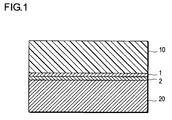
- Fig. 1 is a brief cross-sectional view showing an example of a resin complex of the present invention.
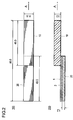
- Fig. 2 is a brief plain view and a brief cross-sectional view of resin complexes of Examples 1 to 3, Comparative Examples 1 to 3.
- In the first aspect of the present invention, a resin complex composed of resin material and other material comprising metal material or ceramics material, comprising a layer of a triazin dithiol derivative, and a mixed layer of other material and aluminum, between the resin material and the other material is provided.
- Cross-sectional view of the resin complex is shown in Fig. 1. In Fig. 1, by having a mixed
layer 2 of other material and aluminum, and a layer 1 coated with a triazin dithiol derivative at the surface ofother material 20, and by junction of the layer 1 coated with the triazin dithiol derivative andresin material 10, a resin complex having superior junction interface strength can be obtained, even when various materials such as ceramics or an iron-based metal are applied asother material 20. However, the present invention is by no means limited to Fig. 1, and shape of resin material, shape of other material, forming position of a mixed layer and lamination position of a layer of a triazin dithiol derivative can be determined, as appropriate, depending on objectives. - Other material is not especially limited, and various metal materials and various ceramics materials can be used, as appropriate.
- As metal material, an iron-based metal, copper, nickel, gold, silver, platinum, palladium, cobalt, zinc, lead, tin, titanium, chromium, magnesium, manganese and an alloy thereof are preferable and an iron-based metal is more preferable. As an iron-based metal, pure iron; plain steel such as SS, SC, SPC and SPCC; special steel such as SUS, SMn, SCr, SCM, SNCM, SWRH, SUH, SK, SKH, SKS, SKD, SKC, SUP, SWRS and SUJ, and the like are preferably included. In this connection, abbreviated symbols such as SS are in accordance with JIS symbols. In spite of an iron-based metal being versatile material superior in mechanical strength, and the like, a resin complex having practical junction interface strength was difficult to obtain using an iron-based metal by conventional technology, as described above, and thus the significance to select an iron-based metal as other material is large.
- As ceramics material, oxide-based ceramics such as alumina, zirconia, magnesia, beryllia, thoria, urania, silica, titania, barium titanate and strontium titanate; or nonoxide-based ceramics such as silicon nitride, silicon carbide, boron nitride, zirconium carbide and diamond, and the like are included.
- A mixed layer is one obtained by mixing aluminum and other material. As other material contained in a mixed layer, it is preferable to use the same material as other material which makes complex with resin material in a resin complex,.
- It is preferable that a layer composed of only aluminum is not present in the mixed layer. This is because, when a resin complex containing a layer composed of only aluminum is subjected to load, stress is concentrated to a layer composed of only aluminum, which increases in-layer-fracture in a layer composed of only aluminum, and thus may break a resin complex at the boundary of a layer composed of only aluminum.
- Aluminum concentration in a mixed layer can be determined, as appropriate, depending on adhesiveness of a layer of a triazin dithiol derivative, mechanical strength of a mixed layer or kind of other material used.
- A mixed layer is preferably a compound layer composed of other material and aluminum. The compound layer is preferably an intermetallic compound. An intermetallic compound is superior in mechanical strength compared with solid solution.
- Thickness of the mixed layer is not especially limited, preferably 1 to 100 µm, more preferably 10 to 50 µm and further preferably 20 to 40 µm. The thickness below 1 µm may bring about difficulty forming in view of fabrication method, while the thickness over 100 µm may bring about easy occurrence of brittle failure. The brittle failure may occur especially in the case when a mixed layer is a hard coated film.
- Average surface roughness (Ra) of a mixed layer is preferably not higher than 1.0 µm. The average surface roughness over 1.0 µm may lower junction interface strength between resin material and other material.
- In a resin complex, resin material and other material bond firmly via a layer of a triazin dithiol derivative and a mixed layer, because a triazin dithiol derivative is covalently bonded with resin material and a mixed layer. This results in improvement of resistance to thermal load of the junction interface between resin material and other material. Detailed explanation of a layer of a triazin dithiol derivative is described later in the item of a production method.
- In the case when other material is an iron-based metal, formation of a mixed layer on the surface of other material makes hardness of the mixed layer as high as a Vickers hardness of about 700 to 1000, and the mixed layer fulfils roles not only as an intermediate layer for junction but also as a protecting layer for an iron-based metal.
- Resin material is not especially limited, and can be selected, as appropriate, depending on objectives, and resin material with high reactivity with a triazin dithiol derivative is preferable. As resin material with high reactivity with a triazin dithiol derivative, at least one kind selected from the group consisting of polyethylene, polypropylene, acrylonitrile-butadiene-styrene resin, polyamide, polyethylene terephthalate, polybutylene terephthalate, polyphenylene sulfide, liquid crystal resin, polyether ether ketone, polyether ketone and polyamide imide, or a copolymer containing monomers of these resins is preferably included, and more preferable resin material is a polyamide resin or a polyphenylene sulfide resin. A polyamide resin and a polyphenylene sulfide resin are particularly superior in reactivity with a triazin dithiol derivative, and moreover superior in mechanical strength or heat resistance as a resin itself.
- Additives may be added to resin material, in accordance with on objectives. As additives, fiber-reinforced material such as carbon fiber, glass filler and ultra high-strength polyethylene fiber, UV stabilizer, light stabilizer, metallic whisker, calcium carbonate and talc, and the like are preferably included.
- As for a combination of resin material and other material, it is preferable that resin material is a polyamide resin or a polyphenylene sulfide resin, and a metal is steel. A resin complex with these combinations is superior in mechanical strength or heat resistance.
- In the second aspect of the present invention, a method for producing a resin complex, comprising: (I) forming a mixed layer of other material and aluminum on the surface of other material, (II) forming a film of a layer coated with triazin dithiol derivative on the mixed layer, and (III) uniting the layer of a triazin dithiol derivative and resin material is provided.
- As for resin material, other material, and a mixed layer of other material and aluminum, they are as described above.
- As the process (I), a metal diffusion method such as an infiltration method and a calorizing method, an ion injection method and a sputtering method are preferably included, and a metal diffusion method is more preferable, and an infiltration method is particularly preferable. By application of the metal diffusion method, a compound layer of other material and aluminum can be formed. By application of the infiltration method, an intermetallic compound can be formed, when other material is a metal. As described above, an intermetallic compound is superior in mechanical strength compared with solid solution.
- The infiltration method is a method to immerse other material into molten aluminum and to diffuse and infiltrate the aluminum from the surface of other material, and a molten aluminum temperature of 660 to 750°C is preferable. The temperature below 660°C may bring about insufficient fusion of aluminum in a bath, while the temperature over 750°C may bring about excessive promotion of aluminum diffusion and a layer composed of only aluminum may be formed. Time to immerse other material into aluminum can be determined, as appropriate, depending on other material used or molten aluminum temperature. When molten aluminum temperature is within the above range, 3 to 7 minutes of immersion, subsequent lifting once from the bath and re-immersion for 3 to 7 minutes are preferable. By carrying out immersion twice separately in the above immersion time, thickness of a mixed layer can be made to desirable range. Preferable thickness of a mixed layer is as described above.
- As post-treatment of the process (I), acid washing using a dilute hydrochloric acid, and the like may be adopted. By carrying out acid washing, flux adhered at the surface can be removed.
- The process (II) is not especially limited, and film formation is preferably carried out by an electrochemical method, comprising immersing the other material formed with the mixed layer, in an electrolytic solution including a multifunctional triazin dithiol derivative represented by chemical formula 1:

- A multifunctional triazin dithiol derivative represented by chemical formula 1 enables to simply and conveniently form a layer of a triazin dithiol derivative on a mixed layer, by using an electrochemical method.
- A specific example of the process (II) is shown below, however, the present invention is by no means limited thereto. Into a mixed solution of a triazin dithiol derivative and a solvent, other material formed with a mixed layer at the surface, and a cathode are immersed. Subsequently, using the other material as an anode, and by passing an electric current between the cathode and the anode, a layer of a triazin dithiol derivative is formed at the surface of a mixed layer.
- As the solvent, water; alcohols such as methanol or ethanol; carbitol; glycol ethers such as cellosolve; dimethylformamide; methylpyrrolidone; acrylonitrile; and ethylene carbonate, and the like are included. The solvent may contain supporting electrolytes, and as supporting electrolytes, sodium nitrite, potassium nitrate, sodium sulfate, potassium sulfate, sodium perchlorate, potassium chloride, sodium chloride, lithium chloride, and the like are included. As the cathode, a platinum plate, a titanium plate, a carbon plate, an aluminum plate, a stainless plate, and the like are included. A voltage of 1 to 3 V is preferable and an energization time of 3 to 10 minutes is preferable.
- As pre-treatment of the process (II), other material formed with a mixed layer at the surface may be subjected to alkali treatment or acid treatment, and washing with pure water. As described above, the average surface roughness of other material over 1.0 µm may lower adhesion between other material and a mixed layer, and this poor adhesion between other material and a mixed layer may bring about partial peeling of a mixed layer in the pre-treatment process.
- In the process (III), resin material and other material are preferably integrated in one piece in a molding die, and insert molding or outsert molding is more preferable. By applying insert molding or outsert molding, a resin complex can be produced at a low cost.
- Insert molding or outsert molding enables to promote a reaction between resin material and a layer of a triazin dithiol derivative, by effective utilization of heat and pressure on injection of resin material into a mold.
- In the third aspect of the present invention, automotive parts comprising the resin complex, or a resin complex produced by a method for producing the resin complex are provided.
- Since automotive parts are often subjected to thermal load such as standing still at constant temperature, thermal cycle and heat shock, component material of a resin complex is limited, when a resin complex is applied to automotive parts, and application of ceramics or an iron-basedmetal as other material was difficult. This is because junction interface strength was weak to thermal load, in the case when ceramics or an iron-based metal is used as other material in a conventional resin complex.
- However, a resin complex of the present invention has high resistance to thermal load and seldom lowers junction interface strength, even if ceramics or an iron-based metal is applied as other material. Therefore, a resin complex of the present invention can preferably be applied to automotive parts which are exposed to thermally harsh environment.
- In the fourth aspect of the present invention, slide member comprising the resin complex, or a resin complex produced by a method for producing the resin complex is provided.
- Since slide members, among various parts, are often subjected to mechanical load, component material of a resin complex is limited, when a resin complex is applied to slide members, and application of ceramics or an iron-based metal as other material was difficult. This is because junction strength with resin material was low and stress was concentrated to a junction part, in the case when ceramics or an iron-based metal is used as other material in a conventional resin complex.
- However, a resin complex of the present invention provides high junction strength between resin material and other material, and high resistance to mechanical load, even if ceramics or an iron-based metal isappliedasothermaterial. Therefore, a resin complex of the present invention can preferably be applied to slide members.
- The present invention is explained specifically using Examples, however, these Examples should by no means limit the present invention.
- As pre-treatment of a plate-like test piece of SPCC having an average surface roughness Ra=0.1 µm, a length of 49 mm, a width of 11.5 mm and a thickness of 1.2 mm, the test piece was immersed in an aqueous solution of sodium hydroxide at 60°C for 15 minutes, and subjected to alkali degreasing, washing with water, acid washing with 12% dilute hydrochloric acid, washing with water, washing with hot water and then drying by air blowing.
- Then, the plate-like test piece of SPCC was immersed in molten aluminum at 690°C for 5 minutes, subsequently lifted up once from molten aluminum and then immersed again in molten aluminum for 5 minutes . Then it was subjected to acid washing with 12% dilute hydrochloric acid and washing with water. Using SEM, thickness of a mixed layer of SPCC and aluminum, formed at the surface of the plate-like test piece of SPCC, was measured and found to be 30 µm.
- As pre-treatment to form a layer of a triazin dithiol derivative, the plate-like test piece of SPCC, formed with a mixed layer of SPCC and aluminum, was subjected to alkali etching, washing with water, acid washing, washing with water and vacuum drying. Then an aqueous solution of 1,3,5-triazine-2,4-dithiol-6-sodium thiolate (hereinafter referred to as TTN: Trade name of Zisnet N1 from Sankyo Kasei Co., Ltd.) with a concentration of 5 mmol/L, was prepared and the TTN aqueous solution of 5 mmol/L was poured into an immersing tank, and sodium nitrite was added so as to become 0.5% by mass as a supporting electrolyte.
- Subsequently, the plate-like test piece of SPCC, a platinum plate and a saturated calomel electrode were set in the immersing tank, a voltage of 2 V for 5 minutes to the anode-cathode was loaded, using the plate-like test piece of SPCC as an anode, the platinum plate as a cathode and the saturated calomel electrode as a reference electrode. Then, the test piece was washed with distilled water, washed with methanol and dried with warm air of 60°C. Using SEM, thickness of a layer coated with TTN film, formed on the mixed layer of SPCC and aluminum, was measured and found to be 50 nm.
- The plate-like test piece of SPCC was put in a mold, and a outsert molding was carried out by casting a molten polyphenylene sulfide (PPS from Tosoh Corp., Trade name of Susteel CH-30) containing 30% by mass of carbon fiber, and a resin complex was obtained. Shape of a resin complex obtained is shown in Fig. 2. In Fig. 2, code 1 represents a layer of a triazin dithiol derivative,
code 2 represents a mixed layer of other material and aluminum,code 10 represents resin material,code 20 represents other material,code 100 represents a brief plain view showing a resin complex andcode 200 represents a brief cross-sectional view showing a resin complex. - A resin complex was obtained similarly as in Example 1, except that polyether ether ketone (PEEK) containing 30% by mass of carbon fiber was used as resin material.
- A resin complex was obtained similarly as in Example 1, except that SPCC with an average surface roughness Ra=2.0 µm was used as resin material.
- A resin complex was obtained similarly as in Example 1, except that molding was carried out at a molten aluminum temperature of 830°C so that a mixed layer of SPCC and aluminum contained a layer composed of only aluminum. Using SEM, thickness of a mixed layer of SPCC and aluminum, containing a layer composed of only aluminum, formed on the surface of the plate-like test piece of SPCC, was measured and found to be 10 µm.
- A resin complex was obtained similarly as in Example 1, except that a nickel plated layer was formed instead of a mixed layer of other material and aluminum.
- The nickel plated layer was obtained by using an aqueous solution added with 400 g/L of nickel sulfate, 65 g/L of nickel chloride and 40 g/L of boric acid, as a plating solution, and by immersing the plate-like test piece of SPCC in the plating solution kept at 60°C, followed by nickel plating under an anode current density of 5 A/dm2. Using SEM, thickness of the nickel plated layer, formed on the surface of the plate-like test piece of SPCC, was measured and found to be 10 µm.
- A resin complex was obtained similarly as in Example 1, except that a copper plated layer was formed instead of a mixed layer of other material and aluminum.
- The copper plated layer was obtained by using an aqueous solution added with 80 g/L of copper pyrophosphate, 30 g/L of metal copper, 310 g/L of potassium pyrophosphate and 1 ml/L of ammonia, as a plating solution, and by immersing the plate-like test piece of SPCC in the plating solution kept at 50°C, followed by copper plating under an anode current density of 2 A/dm2. Using SEM, thickness of the copper plated layer, formed on the surface of the plate-like test piece of SPCC, was measured and found to be 10 µm.
- As pre-treatment of the plate-like test piece of SPCC, having an average surface roughness Ra=0.1 µm, a length of 49 mm, a width of 11.5 mm and a thickness of 1.2 mm, the test piece was immersed in an aqueous solution of sodium hydroxide at 60°C for 15 minutes and subjected to alkali degreasing. Then, the surface of a plate-like test piece made of PPS (from Tosoh Corp. ; Trade name of Susteel CH-30), containing 30% by mass of carbon fiber, having a length of 49 mm, a width of 11.5 mm and a thickness of 3 mm, was washed with hexane and degreased.
- The plate-like test piece of SPCC and the plate-like test piece of PPS, containing 30% by mass of carbon fiber, were adhered with epoxy resin-based adhesives (from Sumitomo 3M Co. , Ltd.: Trade name of DP-420) to obtain a resin complex shown in Fig. 2.
- It was attempted to obtain a resin complex similarly as in Example 1, except that a mixed layer of SPCC and aluminum was not formed. However, peeling was generated between SPPC and the PPS resin, on ejection of an outsert molded substance from a mold.
- By investigation of the causes, it is contemplated that SPCC corroded in an electrolytic plating solution, during the formation process of a film coated with the above TTN, and any bonding between SPCC and TTN was not formed, and formation of a film coated with TTN did not advance.
- To confirm the junction interface strength of resin complexes of Examples 1 to 4 and Comparative Examples 1 to 3, a shear test of resin complexes was carried out before and after a thermal cycling test.
- The thermal cycling test was carried out by holding a resin complex at -40°C for 3 hours, heating up to 150°C over 1.5 hours, holding at 150°C for 3 hours and cooling down to -40°C over 1.5 hours, and by making this cycle as one cycle (time required 9 hours), the test was repeated 200 cycles.
- The shear test was carried out by using a universal tensile testing machine and setting a test temperature at room temperature and a rate of elongation at 50 mm/min, and by fixing the other material and pulling a resin complex to the direction of code A in Fig. 2. As the results of these tests, a fracture stress that is a stress at fracture of a resin complex in the shear test carried out before and after thermal cycle test (TCT), and a difference in fracture strength before and after TCT, are shown in Table 1.
Table 1 Resin material TTN layer/ Adhesives Mixed layer/ Plated layer Other material Before TCT Fracture stress (MPa) After TCT Fracture stress (MPa) Fracture stress difference (MPa) Thickness (nm) Thickness (µm) Ra (µm) Fracture position Fracture position before and after TCT Example 1 PPS
*1TTN
50SPCC-Al Mixed layer
30SPCC
0.112.2
Resin material11.8
Resin material0.4 Example 2 PEEK
*1TTN
50SPCC-Al Mixed layer
30SPCC
0.16.8
*26.5
*20.3 Example 3 PPS
*1TTN
50SPCC-Al Mixed layer
30SPCC
29.7
Mixed layer9.5
Mixed layer0.2 Example 4 PPS
*1TTN
50SPCC-Al Mixed layer + *3
30SPCC
0.17.4
*36.2
*31.2 Comp. Exam. 1 PPS
*1TTN
50Ni plated layer
10SPCC
0.15.4
*43.4
*22.0 Comp. Exam. 2 PPS
*1TTN
50Cu plated layer
10SPCC
0.110.7
*58.2
*52.5 Comp. Exam. 3 PPS
*1Adhesives - SPCC
0.16.8
Adhesives1.8
Adhesives5.0 (Note)
*1: containing 30% by mass of carbon fiber
*2: interface between a layer of TTN and resin material
*3: a layer composed of only aluminum
*4: interface between a layer coated with TTN and a nickel plated layer
*5: interface between a layer coated with TTN and a copper plated layer - As is shown by Table 1, resin complexes of Examples 1 to 4 can be judged to provide high resistance to thermal load of junction interface between resin material and other material, because of having smaller decrease in fracture stress before and after the thermal cycle test (TCT) compared with those in Comparative Examples 1 to 3.
- Among resin complexes of Examples 1 to 4, fracture stress of a resin complex of Example 1 is the highest and the occurrence position of fracture is not at the j unction interface but resin material itself. Reasons are considered as follows: In comparison between Examples 1 and 2, PEEK has higher reactivity with a layer of TTN than PPS. In comparison between Examples 1 and 3, smaller average surface roughness of other material provides higher adhesion between other material and a mixed layer of other material and aluminum. In comparison between Examples 1 and 4, when a resin complex contains a layer composed of only aluminum, stress is concentrated at the layer composed of only aluminum and inner-layer-fracture is progressed in the layer composed of only aluminum.
- The entire disclosure of
Japanese Patent Application No. 2005-130420 filed on April 27, 2005
Claims (12)
- A resin complex, composed of resin material and other material comprising metal material, comprising a mixed layer of other material and aluminum, and a layer of a triazin dithiol derivative between the resin material and the other material.
- A resin complex according to claim 1, wherein a layer composed of only aluminum is not present in the mixed layer.
- A resin complex according to claim 1 or 2, wherein the mixed layer is a compound layer composed of the other material and the aluminum.
- A resin complex according to any one of claims 1 to 3, wherein thickness of the mixed layer is 1 to 100 µm.
- A resin complex according to any one of claims 1 to 4, wherein the resin material is at least one kind selected from the group consisting of polyethylene, polypropylene, acrylonitrile-butadiene-styrene, polyamide, polyethylene terephthalate, polybutylene terephthalate, polyphenylene sulfide, liquid crystal resin, polyether ether ketone, polyether ketone and polyamide imide.
- A resin complex according to any one of claims 1 to 5, wherein the resin material is a polyamide resin or a polyphenylene sulfide resin, and the other material is steel.
- A method for producing a resin complex, comprising: (I) forming a mixed layer of other material and aluminum on the surface of other material comprising metal material, (II) forming a film of a layer of a triazin dithiol derivative on the mixed layer, and (III) uniting the layer of a triazin dithiol derivative and resin material.
- A method for producing a resin complex according to claim 7, wherein the process (I) is carried out by immersing the other material in molten aluminum at a temperature of 660 to 750°C.
- A method for producing a resin complex according to claim 7 or 8, wherein in the process (II), a film of a layer of a triazin dithiol derivative is formed by electrochemical method, comprising immersing the other material formed with the mixed layer, in an electrolytic solution including a multifunctional triazin dithiol derivative represented by chemical formula 1:

- A method for producing a resin complex according to any one of claims 7 to 9, wherein the process (III) is insert molding or outsert molding.
- An automotive part, comprising a resin complex set forth in any one of claims 1 to 6, or a resin complex produced by a method for producing set forth in any one of claims 7 to 10.
- A slide member, comprising a resin complex set forth in any one of claims 1 to 6, or a resin complex produced by a method for producing set forth in any one of claims 7 to 10.
Applications Claiming Priority (1)
| Application Number | Priority Date | Filing Date | Title |
|---|---|---|---|
| JP2005130420A JP2006305838A (en) | 2005-04-27 | 2005-04-27 | Resin composite and method for producing the same |
Publications (1)
| Publication Number | Publication Date |
|---|---|
| EP1717345A1 true EP1717345A1 (en) | 2006-11-02 |
Family
ID=36936585
Family Applications (1)
| Application Number | Title | Priority Date | Filing Date |
|---|---|---|---|
| EP20060008025 Withdrawn EP1717345A1 (en) | 2005-04-27 | 2006-04-18 | Coated article and preparation method |
Country Status (3)
| Country | Link |
|---|---|
| US (1) | US20060244176A1 (en) |
| EP (1) | EP1717345A1 (en) |
| JP (1) | JP2006305838A (en) |
Cited By (4)
| Publication number | Priority date | Publication date | Assignee | Title |
|---|---|---|---|---|
| CN102358946A (en) * | 2011-08-05 | 2012-02-22 | 华南理工大学 | Preparation method for metal material surface antifriction and antiwear nano-composite film |
| CN104203543A (en) * | 2012-04-09 | 2014-12-10 | 帝人株式会社 | Manufacturing method of joining member and joining member |
| EP2832526A4 (en) * | 2012-03-29 | 2015-03-25 | Teijin Ltd | Method for manufacturing joint member, and joint member |
| EP2474645A4 (en) * | 2009-09-03 | 2016-04-20 | Advanced Technologies Inc | Aluminum alloy article, aluminum alloy member, and production method therefor |
Families Citing this family (2)
| Publication number | Priority date | Publication date | Assignee | Title |
|---|---|---|---|---|
| KR101134923B1 (en) * | 2011-08-10 | 2012-04-17 | 한국기초과학지원연구원 | Polymer resin-alumium bonded component and method for preparing the same |
| KR101283200B1 (en) | 2011-10-06 | 2013-07-05 | 이정화 | Composite of different materials and the method therefor |
Citations (3)
| Publication number | Priority date | Publication date | Assignee | Title |
|---|---|---|---|---|
| GB1402148A (en) * | 1971-07-24 | 1975-08-06 | Nissan Motor | Process of coating a metal article |
| EP0919363A1 (en) * | 1997-06-13 | 1999-06-02 | Nippon Petrochemicals Company, Limited | Bonded composite and sealing composition for use in the same |
| JP2001001445A (en) * | 1999-06-24 | 2001-01-09 | Toa Denka:Kk | Composite of conductive object and resin, and production thereof |
-
2005
- 2005-04-27 JP JP2005130420A patent/JP2006305838A/en active Pending
-
2006
- 2006-04-18 US US11/405,417 patent/US20060244176A1/en not_active Abandoned
- 2006-04-18 EP EP20060008025 patent/EP1717345A1/en not_active Withdrawn
Patent Citations (3)
| Publication number | Priority date | Publication date | Assignee | Title |
|---|---|---|---|---|
| GB1402148A (en) * | 1971-07-24 | 1975-08-06 | Nissan Motor | Process of coating a metal article |
| EP0919363A1 (en) * | 1997-06-13 | 1999-06-02 | Nippon Petrochemicals Company, Limited | Bonded composite and sealing composition for use in the same |
| JP2001001445A (en) * | 1999-06-24 | 2001-01-09 | Toa Denka:Kk | Composite of conductive object and resin, and production thereof |
Non-Patent Citations (1)
| Title |
|---|
| PATENT ABSTRACTS OF JAPAN vol. 2000, no. 16 8 May 2001 (2001-05-08) * |
Cited By (7)
| Publication number | Priority date | Publication date | Assignee | Title |
|---|---|---|---|---|
| EP2474645A4 (en) * | 2009-09-03 | 2016-04-20 | Advanced Technologies Inc | Aluminum alloy article, aluminum alloy member, and production method therefor |
| CN102358946A (en) * | 2011-08-05 | 2012-02-22 | 华南理工大学 | Preparation method for metal material surface antifriction and antiwear nano-composite film |
| CN102358946B (en) * | 2011-08-05 | 2013-11-13 | 华南理工大学 | Preparation method for metal material surface antifriction and antiwear nano-composite film |
| EP2832526A4 (en) * | 2012-03-29 | 2015-03-25 | Teijin Ltd | Method for manufacturing joint member, and joint member |
| US9527230B2 (en) | 2012-03-29 | 2016-12-27 | Teijin Limited | Method for manufacturing joint member and joint member |
| CN104203543A (en) * | 2012-04-09 | 2014-12-10 | 帝人株式会社 | Manufacturing method of joining member and joining member |
| EP2837491A4 (en) * | 2012-04-09 | 2015-02-25 | Teijin Ltd | Method for producing bonded member, and bonded member |
Also Published As
| Publication number | Publication date |
|---|---|
| US20060244176A1 (en) | 2006-11-02 |
| JP2006305838A (en) | 2006-11-09 |
Similar Documents
| Publication | Publication Date | Title |
|---|---|---|
| US8394503B2 (en) | Resin-metal bonded article and method for producing the same | |
| US7368047B2 (en) | Method of preparing copper plating layer having high adhesion to magnesium alloy using electroplating | |
| JP4600701B2 (en) | Resin metal bonded body and manufacturing method thereof | |
| US20050196634A1 (en) | Metal member and electric contact using same | |
| CN102672878A (en) | Stainless steel and resin compound and manufacturing method thereof | |
| EP3674052A1 (en) | Method for producing metal-polymer resin conjugate | |
| EP2295618A1 (en) | Composite material for electrical/electronic component and electrical/electronic component using the same | |
| CN1993501B (en) | Composite copper foil and method for producing same | |
| KR20200065334A (en) | Heterojunction type resin-metal composite and manufacturing method thereof | |
| KR20200085269A (en) | Resin metal joint and its manufacturing method | |
| US20060244176A1 (en) | Resin complex and method for producing the same | |
| JP2011189631A (en) | Insert molding, and manufacturing method therefor | |
| US8158269B2 (en) | Composite material for electrical/electronic part and electrical/electronic part using the same | |
| CN116745092B (en) | Die-cast metal parts - polymer resin composite materials and their preparation methods | |
| CN100567583C (en) | Method for direct electrodeposition of zinc-nickel alloy on the surface of magnesium alloy | |
| CN101255585B (en) | A Novel Surface Metallization Method for Carbon Fiber Reinforced Epoxy Resin Composites | |
| JP5540029B2 (en) | Composite of aluminum or aluminum alloy and resin and method for producing the same | |
| KR102327770B1 (en) | Metal-resin composite and method for manufacturing the same | |
| CN101460664B (en) | Use of phosphinic acids and/or phosphonic acids in redox processes | |
| CN108179447B (en) | Preparation method of cyanide-free cadmium plating layer structure on aluminum alloy substrate | |
| EP3748037A1 (en) | Surface treatment aqueous solution, surface-treated alloy manufacturing method, and composite and manufacturing method for same | |
| JP4662877B2 (en) | Composite material and method for producing the same | |
| JP2006239961A (en) | Metal resin composite and manufacturing method thereof | |
| CN217351579U (en) | Coating structure for gold plating on surface of neodymium iron boron | |
| CN110026705A (en) | A kind of coating and its preparation process of enhancing Sn base solder/Kovar alloy interconnection welding spot reliability |
Legal Events
| Date | Code | Title | Description |
|---|---|---|---|
| PUAI | Public reference made under article 153(3) epc to a published international application that has entered the european phase |
Free format text: ORIGINAL CODE: 0009012 |
|
| 17P | Request for examination filed |
Effective date: 20060418 |
|
| AK | Designated contracting states |
Kind code of ref document: A1 Designated state(s): AT BE BG CH CY CZ DE DK EE ES FI FR GB GR HU IE IS IT LI LT LU LV MC NL PL PT RO SE SI SK TR |
|
| AX | Request for extension of the european patent |
Extension state: AL BA HR MK YU |
|
| 17Q | First examination report despatched |
Effective date: 20070312 |
|
| AKX | Designation fees paid |
Designated state(s): DE FR GB |
|
| GRAP | Despatch of communication of intention to grant a patent |
Free format text: ORIGINAL CODE: EPIDOSNIGR1 |
|
| STAA | Information on the status of an ep patent application or granted ep patent |
Free format text: STATUS: THE APPLICATION IS DEEMED TO BE WITHDRAWN |
|
| 18D | Application deemed to be withdrawn |
Effective date: 20090414 |