EP1715646A1 - System and method for connecting applications to heterogeneous backend servers via a gateway server - Google Patents
System and method for connecting applications to heterogeneous backend servers via a gateway server Download PDFInfo
- Publication number
- EP1715646A1 EP1715646A1 EP05103097A EP05103097A EP1715646A1 EP 1715646 A1 EP1715646 A1 EP 1715646A1 EP 05103097 A EP05103097 A EP 05103097A EP 05103097 A EP05103097 A EP 05103097A EP 1715646 A1 EP1715646 A1 EP 1715646A1
- Authority
- EP
- European Patent Office
- Prior art keywords
- message
- connector
- schema
- description document
- accordance
- Prior art date
- Legal status (The legal status is an assumption and is not a legal conclusion. Google has not performed a legal analysis and makes no representation as to the accuracy of the status listed.)
- Granted
Links
Images

Classifications
-
- H—ELECTRICITY
- H04—ELECTRIC COMMUNICATION TECHNIQUE
- H04L—TRANSMISSION OF DIGITAL INFORMATION, e.g. TELEGRAPHIC COMMUNICATION
- H04L67/00—Network arrangements or protocols for supporting network services or applications
- H04L67/01—Protocols
- H04L67/02—Protocols based on web technology, e.g. hypertext transfer protocol [HTTP]
-
- H—ELECTRICITY
- H04—ELECTRIC COMMUNICATION TECHNIQUE
- H04L—TRANSMISSION OF DIGITAL INFORMATION, e.g. TELEGRAPHIC COMMUNICATION
- H04L69/00—Network arrangements, protocols or services independent of the application payload and not provided for in the other groups of this subclass
- H04L69/30—Definitions, standards or architectural aspects of layered protocol stacks
- H04L69/32—Architecture of open systems interconnection [OSI] 7-layer type protocol stacks, e.g. the interfaces between the data link level and the physical level
- H04L69/322—Intralayer communication protocols among peer entities or protocol data unit [PDU] definitions
- H04L69/329—Intralayer communication protocols among peer entities or protocol data unit [PDU] definitions in the application layer [OSI layer 7]
-
- H—ELECTRICITY
- H04—ELECTRIC COMMUNICATION TECHNIQUE
- H04W—WIRELESS COMMUNICATION NETWORKS
- H04W4/00—Services specially adapted for wireless communication networks; Facilities therefor
- H04W4/12—Messaging; Mailboxes; Announcements
-
- H—ELECTRICITY
- H04—ELECTRIC COMMUNICATION TECHNIQUE
- H04W—WIRELESS COMMUNICATION NETWORKS
- H04W80/00—Wireless network protocols or protocol adaptations to wireless operation
-
- H—ELECTRICITY
- H04—ELECTRIC COMMUNICATION TECHNIQUE
- H04W—WIRELESS COMMUNICATION NETWORKS
- H04W88/00—Devices specially adapted for wireless communication networks, e.g. terminals, base stations or access point devices
- H04W88/16—Gateway arrangements
-
- H—ELECTRICITY
- H04—ELECTRIC COMMUNICATION TECHNIQUE
- H04W—WIRELESS COMMUNICATION NETWORKS
- H04W88/00—Devices specially adapted for wireless communication networks, e.g. terminals, base stations or access point devices
- H04W88/18—Service support devices; Network management devices
Definitions
- This application relates generally to a system and method for facilitating communication between a wireless application and a backend server via a gateway server and specifically for facilitating communication with heterogeneous backend servers.
- wireless devices Due to the proliferation of wireless networks, there are a continually increasing number of wireless devices in use today. These devices include mobile telephones, personal digital assistance (PDAs) with wireless communication capabilities, two-way pagers and the like. Concurrently with the increase of available wireless devices, software applications running on such devices have increased their utility. For example, the wireless device may include an application that retrieves a weather report for a list of desired cities or an application that allows a user to shop for groceries. These software applications take advantage of the ability to transmit data of the wireless network in order to provide timely and useful services to users, often in addition to voice communication. However, due to a plethora of different types of devices, restricted resources of some devices, and complexity of delivering large amounts of data to the devices, developing software applications remains a difficult and time-consuming task.
- Browsers have the advantage of being adaptable to operate on a cross-platform basis for a variety of different devices, but have a disadvantage of requesting pages (screen definitions in HTML) from the Web Service, which hinders the persistence of data contained in the screens.
- a further disadvantage of Browsers is that the screens are rendered at runtime, which can be resource intensive.
- Applications for browsers are efficient tools for designing platform independent applications. Accordingly, different runtime environments, regardless of the platform, execute the same application.
- the application may not be executed or displayed as desired.
- browser based application often require significant transfer bandwidth to operate efficiently, which may be costly or even unavailable for some wireless devices.
- browsers offer very limited functionality without a live over the air (OTA) connection.
- OTA live over the air
- native applications are developed for a specific wireless device platform, thereby providing a relatively optimized application program for a runtime environment running on that platform.
- Such an application would allow organization and persistence of data collections in an optimized form on the device, which would be available even when the device is off-air.
- a platform dependent application introduces several drawbacks, including having to develop multiple versions of the same application and being relatively large in size, thereby taxing memory resources of the wireless device.
- application developers need experience with programming languages such as Java and C++ to construct such native applications.
- SOAP Simple Object Access Protocol
- SOAP Simple Object Access Protocol
- adding a Web Service solely as an interface to the backend server adds unnecessary complexity to the system and may limit its functionality.
- a connector for facilitating delivery of a message received from an application to one of a plurality of heterogeneous backend servers via a gateway server, the message being defined in a schema-based description document in accordance with a set of predefined criteria specific to the connector.
- the connector comprises of: a processor for encapsulating the message in accordance with a binding protocol defined by the schema-based description document; and a transceiver for transmitting the message in accordance a connection protocol defined by with the schema-based description document.
- the communication infrastructure 100 comprises a plurality of communication devices 102, or simply devices 102, a communication network 104, an application gateway 106, an application development environment 107 and a plurality of backend servers 108.
- the devices 102 include both wired and wireless computing devices such as a desktop computer, a laptop or other portable computer, a smart phone, a personal digital assistant (PDA), and the like.
- the devices 102 are in communication with the application gateway 106 via the communication network 104.
- the communication network 104 may include several components such as a wireless network 110, a relay 112, a corporate server 114 and/or a mobile data server 116 for relaying data between the devices 102 and the application gateway 106.
- the application gateway 106 comprises a gateway server 118 a provisioning server 120 and a discovery server 122.
- the gateway server 118 is in communication with both the provisioning server 120 and the discovery server 122.
- the gateway server 110 is further in communication with a plurality of the backend servers 108, such as web services 108a, database services 108b, as well as other enterprise services 108c, via a suitable link.
- the gateway server 110 is connected with the web services 108a and database services 108b via Simple Object Access Protocol (SOAP) and Java Database Connectivity (JDBC) respectively.
- SOAP Simple Object Access Protocol
- JDBC Java Database Connectivity
- Other types of backend servers 108 and their corresponding links will be apparent to a person of ordinary skill in the art. Accordingly, it can be seen that the gateway server 118 acts as a message broker between the devices 102 and the backend servers 108.
- Each wireless device 102 is initially provisioned with a service book establishing various protocols and settings, including connectivity information for the corporate server 114 and/or the mobile data server 116. These parameters may include a Uniform Resource Locator (URL) for the application gateway server 118 as well as its encryption key. Alternately, if the wireless device 102 is not initially provisioned with the URL and encryption key, they may be pushed to the wireless device 102 via the mobile data server 116. The mobile device 102 can then connect with the application gateway 106 via the URL of the application gateway server 118.
- URL Uniform Resource Locator
- the application gateway server 118 includes three layers of service; a base services layer 202, an application gateway services layer 204 and an application services layer 206.
- the application gateway server 118 further includes an administration service 208.
- a provisioning service 210 and a discovery service 212 are provided by the provisioning server 120 and discovery server 120, respectively.
- the application gateway services layer 204 provides wireless component application domain specific services. These services provide efficient message transformation and delivery to backend systems 108 and provide wireless device 102 and component application lifecycle management.
- the application gateway services layer 204 includes a lifecycle subsystem 220, a connector subsystem 222, a messaging subsystem 224, and a transformation subsystem 226.
- the application services layer 206 sits at the top of the architecture and provides external program interfaces and user interfaces using subsystems provided by the lower layers. For example, various applications such as a service provider lifecycle application, a packaging application and a message listening application provide external program interfaces since they communicate primarily with applications on external systems. Similarly, an administration application provides a user interface by providing a user with ability to access and potentially modify application gateway data and/or parameters.
- the administration service 208 is responsible for administrative system messages, administration of the wireless devices 102, runtime administration of the application gateway subsystems, support and display system diagnostics, and administration of default implementations of the provisioning and discovery services. Relevant portions of the application gateway are described in details as follows.
- the messaging listening application provides an interface for receiving messages from the devices 102 as well as external sources and forwarding them to the messaging subsystem. Further, the message listening application typically authenticates that the source of the message is valid.
- the message listening application includes several listeners; a notification listener 302, a compact message listener 304, and a mobile data service acknowledgement listener 306.
- the notification listener 302 receives notification and response messages from event sources 108c via a notification interface 303.
- the notification interface 303 may be implemented using Web Service (WS) Eventing.
- Web services often want to receive messages when events occur in other services, such as the event sources, and applications.
- a mechanism for registering interest is provided in the art by such standards as WS-Eventing and/or WS Subscription. These standards define a protocol for an application, referred to as a subscriber, to register interest in data offered by a standard compliant Web service, referred to as an Event Source for receiving messages about events, referred to as notifications. When the event source notifies the subscriber of an event, it is referred to as Notification.
- the compact message listener 304 receives messages from the devices 102 via a compact message interface 305.
- the mobile data service acknowledgment listener 306 receives and acknowledges notifications from the mobile data service 116 via a mobile data service interface 307.
- Each of the listeners 302, 304 and 306 receive administrative messages from the administration service 208 via a listener administrative interface 311.
- the listener interfaces 303, 305, 307 and 311 are configured using Hypertext Transfer Protocol/Hypertext Transfer Protocol over Secure Socket Layer (HTTP/HTTPS).
- HTTP/HTTPS Hypertext Transfer Protocol/Hypertext Transfer Protocol over Secure Socket Layer
- external systems transmit a HTTP/HTTPS request, which is received by the appropriate listener.
- the listener takes the message, makes minimal transformations, and forwards it to the messaging subsystem 224.
- the transformations include copying HTTP header information into message object fields.
- the HTTP header information may identify the mobile data service 116 and wireless device 102 from which the message originated.
- the message listening application authenticates that the source of the message is valid, be it the mobile date service 116, the wireless device 102 or event source 108. Further, if reliable messaging is required, service availability is ensured and the listeners deal with availability attack solutions.
- the messaging subsystem defines a threshold for a maximum number of messages and connections for a given time period from any backend server 108, component application or device 102. The administrator can modify this threshold as desired, as well as allow for specific exceptions via the administration service 208.
- a nonce is defined as parameter that varies with time.
- a nonce can be a timestamp or other special marker intended to limit or prevent the unauthorized replay or reproduction of a message. Because a nonce changes with time, it can be used to determine whether or not a message is original, or a replay or reproduction of the original message.
- the use of a nonce for preventing interception and replay attacks is known in the art and need not be described in detail, as standard implementations are utilized.
- the connector subsystem 222 provides transport services between the application gateway 106 and external destination systems using the required transport protocols. Further, the connector subsystem 222 receives synchronous responses from destination systems, and passes them to the message subsystem 224 for processing.
- the connector subsystem 222 includes a MDS connector 402, a system connector 404 and a set of backend connectors 406.
- the MDS connector 402 is coupled with the message subsystem 224 via a MDS connector interface 403.
- the system connector 404 and backend connectors 406 are coupled with the message subsystem 224 via a connector interface 405.
- the MDS connector interface 403 is an Application Program Interface (API ⁇ for message delivery to the devices 102 in the compact message format.
- the connector interface 405 is an API for message delivery to internal subsystems or backend systems. In the present embodiment, both APIs are implemented using Java.
- the MDS connector 402 delivers compact messages to the wireless device via the MDS 116.
- the MDS connector 402 works as push initiator to push messages to devices 102.
- the MDS connector 402 supports basic push as well as the reliable push to MDS through the Wireless Application Protocol (WAP) to Push (PAP) standard protocol, although other standards can be supported as they are developed.
- WAP Wireless Application Protocol
- PAP Push
- the system connector 402 delivers system messages to the lifecycle subsystem 220, the administration subsystem 208, or the messaging subsystem 224. Delivery of system messages to any of the specified subsystems is performed by direct API calls.
- the system connector receives the messages in the internal message format and performs Java API calls to the appropriate subsystem.
- the messages communicated between the message processor 224 and the connector interface 405 are in an internal message format.
- the internal message format may be, for example, DOM or any other tree data structure.
- the connector interface 405 transmits the message to an associated one of the backend connectors 806.
- the backend connector 806 encapsulates the message into the required format and opens a connection with a target backend server 106.
- WSDL is a document written in XML for describing a web service.
- a WSDL document specifies the location of the web service and the operations the web service exposes. Accordingly, it can be seen that WSDL provides a way to group messages into operations and operations into interfaces. It also provides a way to define bindings for each interface and protocol combination along with the endpoint address for each one.
- a complete WSDL definition includes all of the information used to invoke a web service. Developers that want to make it easy for others to access their web services publish their WSDL definitions.
- a WSDL document defines a web service using major elements including type, message, portType, binding and service.
- the first three elements are all abstract definitions of a web service interface. These elements constitute the programmatic interface that is typically interfaced with code.
- the last two elements describe the concrete details of how the abstract interface maps to messages on the wire. These details are typically handled by the underlying infrastructure.
- the type element defines the data type that is used by the web service.
- WSDL uses XML Schema syntax to define data types.
- the type definitions are referenced from higher-level message definitions in order to define the structural details of a message.
- the message element defines the data elements of an operation.
- Each message can consist of one or more parts.
- the parts can be compared to the parameters of a function call in a traditional programming language.
- a sample WSDL message element is provided below as Example 1.
- Example 1 a sample WSDL portion defining two messages is provided.
- a first message named 'getTermRequest', is defined as having a parameter named 'term' which is of the type string.
- a second message named 'getTermResponse', is defined as having a parameter named 'value' which of the type string.
- the portType element defines a group of operations also known as an interface in most environments, so this element is also referred to as the interface element. Accordingly, the portType element correlates a web service with the operations that can be performed and the messages that are involved.
- a sample WSDL portType element is provided below as Example 2.
- Example 2 the sample WSDL portion is provided for defining a portType element using the messages defined in Example 1.
- the portType element in Example 2 is named 'glossaryTerms'.
- the portType element includes an operation element for defining an operation of the web service. Although it is possible to have multiple operation elements for each portType element, the present example shows only one for ease of explanation.
- the operation element is name 'getTerm' and it uses the message 'getTermRequest' as its input and provides the message 'getTermResponse' as its output.
- the binding element describes the concrete details of using a particular portType element with a given transport protocol.
- the binding element specifies which portType element it's describing through a type attribute.
- a sample WSDL binding element is provided below as Example 3.
- Example 3 the sample WSDL portion is provided for defining a binding element using the portType element defined in Example 2.
- the binding element specifies that it is describing the 'glossaryTerms' portType.
- the soap:binding element indicates that the message data will be bound using SOAP.
- the style of the service for the binding is 'document', as opposed RPC, and the transport protocol 'http'.
- the soap:operation element defines an HTTP header value for each operation.
- the soap:body element defines how message parts appear inside of the SOAP body element. In the present embodiment, the message parts appear as 'literal', although they may also appear encoded.
- the service element defines a collection of ports, or endpoints, that expose a particular binding. Each of the ports is assigned a name and a binding.
- a sample WSDL service element is provided below as Example 4.
- Example 4 the sample WSDL portion is provided for defining a service element for exposing the binding element defined in Example 3.
- the binding 'b1' is to the address "http://localhost/getTerm/getTerm.asmx". Accordingly, the service element defines a web service destination and the binding element defines the transport protocol for communicating with the web service at destination.
- the web service receives a message but does not return a response.
- the web-service receives a request and returns a response.
- the web service sends a request and waits for a response.
- the web service sends a message but does not wait for a response.
- the messaging subsystem 224 receives a message named 'getTermRequest' and parses a message mapping.
- the message mapping correlates the message with the 'glossaryTerms' portType. Accordingly, the message is transmitted to the connector interface 405, which interfaces with the SOAP connector 410 in accordance with the 'glossary Terms' portType.
- the present embodiment includes message and portType elements for defining and identifying message so they can be mapped, it will be appreciated by a person of ordinary skill in the art that other methods of identifying and mapping messages may be implemented.
- the SOAP connector 410 encapsulates the message in accordance with the SOAP 1.1 transport protocol, using header and body definitions as provided by the binding element of the WSDL document.
- the SOAP connector 410 further opens a HTTP connection with http://localhost/getTerm/getTerm.asmx, as defined by the WSDL document.
- the SOAP connector 410 transmits the encapsulated 'getTermRequest' message to the web service and waits for the reply message.
- the SOAP connector 410 retrieves the relevant data from the encapsulated SOAP response in accordance with the WSDL definition for the response message 'getTermResponse', which transmitted to the messaging subsystem 224 for delivery to the device 102.
- the backend connectors 406 include connectors capable of interpreting extended WSDL in order to facilitate communication with non-web service back ends.
- Such a connector provides the advantage of not having to provide web services that are designed solely to act as an interface between a gateway server and a backend server.
- WSDL inherently provides extensibility that allows for customization of WSDL documents. Accordingly WSDL extensibility in both the binding element and the service element is used to facilitate communication with non-web service backend servers.
- the WSDL binding and service definitions are shown below in Example 5.
- the three specific WSDL extensibility elements that were manipulated in the present embodiment are highlighted in bold type. These extensibility elements include those for the input and output elements of the binding element as well as the extensibility element for the port element of the service element. The data structure of these extensibility elements as well as the systems and methods for implementing them are described below.
- the binding element in the present example includes binding name and type attributes.
- the type attribute 'workOrdersDbPort' identifies the portType to which the binding element corresponds.
- the input element identifies an input name 'sql'.
- the extensibility element of the input is prefaced by the prefix 'wica'. This prefix indicates that the element is not a standard WSDL element and is, otherwise, of little significance as will be appreciated by a person of ordinary skill in the art.
- the first extensibility element is a params element named 'ordered'. The params element is defined to indicate how the parameters are to be interpreted. In the present example, the parameters are ordered.
- a sql element is also provided for defining a Structured Query Language (SQL) statement to be submitted to the relational database.
- the sql element is of type 'select', which indicates that the SQL statement is a select statement.
- the sql element further includes a CDATA statement, which explicitly identifies the SQL statement to be executed against the relational database.
- a CDATA statement is used since the information contained therein is not parsed by an XML parser.
- Example 7 An example of a service element implementation illustrating how WSDL is extended to support access to a backend server comprising a relational database is show below in Example 7.
- Example 7 Similar to the sample service element in Example 4, the service is provided with a port name and a corresponding binding.
- the port name 'personnelAvailableIF' exposes the binding element 'personnelAvailableBinding' defined in Example 6.
- the extensibility element of the port is prefaced by the prefix 'wica'. Similarly to Example 6, this prefix indicates that the element is not a standard WSDL element.
- the extensibility element is used to define a connection to a backend server. The extensibility element indicates that the connection is for a database server by using element 'dbconnector'.
- the user name, password and uniform resource locator (URL) for locating and accessing the database are included as pre-programmed parameters of the 'dbconnector' element.
- the URL for the database server includes a communication protocol 'jdbc', a vendor 'microsoft', a driver 'sqlserver', a server '//bambi' and a port number '1433'.
- the dbconnector element also includes a pair of property keys, 'DatabaseName' and 'selectMethod', and associated values.
- the property key 'DatabaseName' identifies the name of the database to be accessed on the database server.
- the property key 'selectMethod' identifies the type of object into which the query result is placed.
- the remaining WSDL documentation for the JDBC example typically also includes message and portType elements as shown is Example 8.
- message and portType elements as shown is Example 8.
- the messaging subsystem 224 receives a message named 'PersonnelAvailableRequest' and parses a message mapping.
- the message mapping correlates the message with the 'workOrdersDbPort' portType. Accordingly, the message is transmitted to the connector interface 405, which interfaces with the JDBC connector 408 in accordance with the 'workOrdersDbPort' portType.
- message and portType elements are provided for defining and identifying message so they can be mapped, a person of ordinary skill in the art will appreciated that other methods of identifying and mapping messages may be implemented.
- binding element defines a select SQL statement for selecting a number of predefined fields from a database named 'orders' for a given predetermined field. Specifically, for a given PERSONNEL_NAME, the remaining database fields are retrieved.
- the SQL statement defines a where clause for PERSONNEL_NAME, with a target of the where clause left as a variable, or '?'. Accordingly, the corresponding input message includes the target of the where clause.
- the JDBC connector therefore, encapsulates the message for submission to the relational database by completing the SQL statement and replacing the '?' with the target data from the input message. The completed SQL statement is ready to be submitted to the relational database.
- the JDBC connector proceeds to open a connection to the appropriate backend server in accordance with the service element.
- the service element defines the location, user and password information of the relational database.
- Example 7 exposes the binding described in Example 6. Further, if other inputs and/or operations are added to the binding described in Example 6, they too will be exposed by the service element. Yet further, it is possible to expose other types of backend servers to the application gateway by providing a corresponding connector and defining the WSDL extensions for use therewith. Therefore, the system described above allows the connection with heterogeneous backend servers on an application or even message basis, which can provide flexibility for application designers.
- the JDBC connector is programmed with the knowledge of the extensibility elements for the binding and service elements.
- the JDBC connector is, therefore, capable of interpreting the binding element to encapsulate the incoming message and interpreting the service element to connect to the relational database. Therefore, as long as an application developer knows the available extensibility elements and how the connector implements them, they can be used to enhance the application to provide connectivity to the backend server. As long as a connecter is provided for a corresponding backend server, the application developer can develop an application that communicates with that backend server.
- a Rational Application Developer (RAD) tool plug-in creates a WSDL file to be published that does not include potential sensitive information. In its stead are dummy markers.
- the plug-in further creates a corresponding XML document (service-descriptor) that is not published, and includes the sensitive information left out of the published WSDL file.
- service-descriptor XML document
- a merge processor retrieves the data from the service-descriptor and overwrites in memory the corresponding dummy markers in the WSDL file, so that once loaded on the application gateway, the WSDL file includes all necessary information.
- the present embodiment limits concerns of published potentially sensitive information.
- WSDL provides a way to group messages into operations and operations into interfaces. It also provides a way to define bindings for each interface and protocol combination along with the endpoint address for each one.
- the WSDL document effectively decouples the messages for communicating with a backend server from the connectivity information required to make the connection. Accordingly, other structured schema-based languages that provide similar functionality to WSDL may be used, as desired.
- the system described above provides a solution for enabling connectivity to heterogeneous backend servers to support wireless applications, thus keeping the existing infrastructure intact while allowing a third party to extend connectivity to different backend servers as they become available.
Landscapes
- Engineering & Computer Science (AREA)
- Computer Networks & Wireless Communication (AREA)
- Signal Processing (AREA)
- Computer Security & Cryptography (AREA)
- Computer And Data Communications (AREA)
- Data Exchanges In Wide-Area Networks (AREA)
Abstract
Description
- This application relates generally to a system and method for facilitating communication between a wireless application and a backend server via a gateway server and specifically for facilitating communication with heterogeneous backend servers.
- Due to the proliferation of wireless networks, there are a continually increasing number of wireless devices in use today. These devices include mobile telephones, personal digital assistance (PDAs) with wireless communication capabilities, two-way pagers and the like. Concurrently with the increase of available wireless devices, software applications running on such devices have increased their utility. For example, the wireless device may include an application that retrieves a weather report for a list of desired cities or an application that allows a user to shop for groceries. These software applications take advantage of the ability to transmit data of the wireless network in order to provide timely and useful services to users, often in addition to voice communication. However, due to a plethora of different types of devices, restricted resources of some devices, and complexity of delivering large amounts of data to the devices, developing software applications remains a difficult and time-consuming task.
- Currently, devices are configured to communicate with Web Services through Internet based Browsers and/or native applications. Browsers have the advantage of being adaptable to operate on a cross-platform basis for a variety of different devices, but have a disadvantage of requesting pages (screen definitions in HTML) from the Web Service, which hinders the persistence of data contained in the screens. A further disadvantage of Browsers is that the screens are rendered at runtime, which can be resource intensive. Applications for browsers are efficient tools for designing platform independent applications. Accordingly, different runtime environments, regardless of the platform, execute the same application. However, since different wireless devices have different capabilities and form factors, the application may not be executed or displayed as desired. Further, browser based application often require significant transfer bandwidth to operate efficiently, which may be costly or even unavailable for some wireless devices. Also, browsers offer very limited functionality without a live over the air (OTA) connection.
- On the other hand, native applications are developed for a specific wireless device platform, thereby providing a relatively optimized application program for a runtime environment running on that platform. Such an application would allow organization and persistence of data collections in an optimized form on the device, which would be available even when the device is off-air. However, a platform dependent application introduces several drawbacks, including having to develop multiple versions of the same application and being relatively large in size, thereby taxing memory resources of the wireless device. Further, application developers need experience with programming languages such as Java and C++ to construct such native applications.
- Further, applications are currently designed to communicate with Web Services. However, more frequently other types of backend servers are being made available to the applications. In order to expose these backend servers to the applications, Web Service are developed to interface with the backend servers.
- Communication with the Web Service is typically achieved via Simple Object Access Protocol (SOAP). However, SOAP is big and complication without offering much in the way of service. Also, adding a Web Service solely as an interface to the backend server adds unnecessary complexity to the system and may limit its functionality. Yet further, it is preferable to be able to provide extensibility to different backend servers without having to have intimate a priori knowledge of the details of the backend server.
- Accordingly there is a need for a system to facilitate providing a system and method for accessing a plurality of different backend servers in order to overcome some of the disadvantages of the prior art.
- In accordance with one aspect of the present invention a connector is provided for facilitating delivery of a message received from an application to one of a plurality of heterogeneous backend servers via a gateway server, the message being defined in a schema-based description document in accordance with a set of predefined criteria specific to the connector. The connector comprises of: a processor for encapsulating the message in accordance with a binding protocol defined by the schema-based description document; and a transceiver for transmitting the message in accordance a connection protocol defined by with the schema-based description document.
- An embodiment of the invention will now be described by way of example only with reference to the following drawings in which:
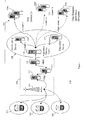
- Figure 1 is a block diagram of a network facilitating wireless component applications;
- Figure 2 is a detailed block diagram of the application gateway shown in figure 1;
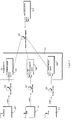
- Figure 3 is a block diagram of a message listening application
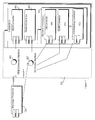
- Figure 4 is a block diagram of a connector subsystem;
- For convenience, like numerals in the description refer to like structures in the drawings. Referring to Figure 1, a communication infrastructure is illustrated generally by
numeral 100. Thecommunication infrastructure 100 comprises a plurality ofcommunication devices 102, or simplydevices 102, acommunication network 104, anapplication gateway 106, an application development environment 107 and a plurality ofbackend servers 108. - The
devices 102 include both wired and wireless computing devices such as a desktop computer, a laptop or other portable computer, a smart phone, a personal digital assistant (PDA), and the like. Thedevices 102 are in communication with theapplication gateway 106 via thecommunication network 104. Accordingly, thecommunication network 104 may include several components such as awireless network 110, arelay 112, acorporate server 114 and/or amobile data server 116 for relaying data between thedevices 102 and theapplication gateway 106. - The
application gateway 106 comprises a gateway server 118 aprovisioning server 120 and adiscovery server 122. Thegateway server 118 is in communication with both theprovisioning server 120 and thediscovery server 122. Thegateway server 110 is further in communication with a plurality of thebackend servers 108, such asweb services 108a,database services 108b, as well asother enterprise services 108c, via a suitable link. For example, thegateway server 110 is connected with theweb services 108a anddatabase services 108b via Simple Object Access Protocol (SOAP) and Java Database Connectivity (JDBC) respectively. Other types ofbackend servers 108 and their corresponding links will be apparent to a person of ordinary skill in the art. Accordingly, it can be seen that thegateway server 118 acts as a message broker between thedevices 102 and thebackend servers 108. - Each
wireless device 102 is initially provisioned with a service book establishing various protocols and settings, including connectivity information for thecorporate server 114 and/or themobile data server 116. These parameters may include a Uniform Resource Locator (URL) for theapplication gateway server 118 as well as its encryption key. Alternately, if thewireless device 102 is not initially provisioned with the URL and encryption key, they may be pushed to thewireless device 102 via themobile data server 116. Themobile device 102 can then connect with theapplication gateway 106 via the URL of theapplication gateway server 118. - Referring to Figure 2, a more detailed view of the
application gateway 106 is shown. Theapplication gateway server 118 includes three layers of service; abase services layer 202, an applicationgateway services layer 204 and anapplication services layer 206. Theapplication gateway server 118 further includes anadministration service 208. - A
provisioning service 210 and adiscovery service 212 are provided by theprovisioning server 120 anddiscovery server 120, respectively. - At the lowest level, the
base services layer 202 offers basic, domain independent system services to other components in higher levels. Thus, for example, all subsystems in the applicationgateway services layer 204 and theapplication services layer 206 can utilize and collaborate with the subsystems in thebase services layer 202. In the present embodiment, thebase services layer 202 includes autilities subsystem 210, asecurity subsystem 212, a configuration subsystem 214, and a logging subsystem 216. - The application
gateway services layer 204 provides wireless component application domain specific services. These services provide efficient message transformation and delivery tobackend systems 108 and providewireless device 102 and component application lifecycle management. In the present embodiment, the applicationgateway services layer 204 includes alifecycle subsystem 220, aconnector subsystem 222, amessaging subsystem 224, and atransformation subsystem 226. - The
application services layer 206 sits at the top of the architecture and provides external program interfaces and user interfaces using subsystems provided by the lower layers. For example, various applications such as a service provider lifecycle application, a packaging application and a message listening application provide external program interfaces since they communicate primarily with applications on external systems. Similarly, an administration application provides a user interface by providing a user with ability to access and potentially modify application gateway data and/or parameters. - The
administration service 208 is responsible for administrative system messages, administration of thewireless devices 102, runtime administration of the application gateway subsystems, support and display system diagnostics, and administration of default implementations of the provisioning and discovery services. Relevant portions of the application gateway are described in details as follows. - The messaging listening application provides an interface for receiving messages from the
devices 102 as well as external sources and forwarding them to the messaging subsystem. Further, the message listening application typically authenticates that the source of the message is valid. - Referring to Figure 3, the message listening application is shown in greater detail. The message listening application includes several listeners; a
notification listener 302, acompact message listener 304, and a mobile dataservice acknowledgement listener 306. Thenotification listener 302 receives notification and response messages fromevent sources 108c via anotification interface 303. - For example, the
notification interface 303 may be implemented using Web Service (WS) Eventing. Web services often want to receive messages when events occur in other services, such as the event sources, and applications. A mechanism for registering interest is provided in the art by such standards as WS-Eventing and/or WS Subscription. These standards define a protocol for an application, referred to as a subscriber, to register interest in data offered by a standard compliant Web service, referred to as an Event Source for receiving messages about events, referred to as notifications. When the event source notifies the subscriber of an event, it is referred to as Notification. - The
compact message listener 304 receives messages from thedevices 102 via acompact message interface 305. The mobile dataservice acknowledgment listener 306 receives and acknowledges notifications from themobile data service 116 via a mobiledata service interface 307. Each of thelisteners administration service 208 via a listener administrative interface 311. - In the present embodiment the listener interfaces 303, 305, 307 and 311 are configured using Hypertext Transfer Protocol/Hypertext Transfer Protocol over Secure Socket Layer (HTTP/HTTPS). However, it will be appreciated by a person skilled in the art that these protocols have been selected as a design choice and other protocols may be used when desired. Accordingly, external systems transmit a HTTP/HTTPS request, which is received by the appropriate listener. The listener takes the message, makes minimal transformations, and forwards it to the
messaging subsystem 224. The transformations include copying HTTP header information into message object fields. For example, the HTTP header information may identify themobile data service 116 andwireless device 102 from which the message originated. - As previously described, the message listening application authenticates that the source of the message is valid, be it the
mobile date service 116, thewireless device 102 orevent source 108. Further, if reliable messaging is required, service availability is ensured and the listeners deal with availability attack solutions. In order to facilitate this, the messaging subsystem defines a threshold for a maximum number of messages and connections for a given time period from anybackend server 108, component application ordevice 102. The administrator can modify this threshold as desired, as well as allow for specific exceptions via theadministration service 208. - Further, since message interception and replay attack is possible, the listeners detect and prohibit this attack using mechanisms that identify replayed messages. These mechanisms typically include the use of a nonce. A nonce is defined as parameter that varies with time. A nonce can be a timestamp or other special marker intended to limit or prevent the unauthorized replay or reproduction of a message. Because a nonce changes with time, it can be used to determine whether or not a message is original, or a replay or reproduction of the original message. The use of a nonce for preventing interception and replay attacks is known in the art and need not be described in detail, as standard implementations are utilized.
- Further, other technologies, such as sequencing, can also be used to prevent replay of application messages in addition to, or in lieu of, the time timestamp technique. Once again, such techniques are known in the art and need not be described in detail, as standard implementations are utilized.
- The
connector subsystem 222 provides transport services between theapplication gateway 106 and external destination systems using the required transport protocols. Further, theconnector subsystem 222 receives synchronous responses from destination systems, and passes them to themessage subsystem 224 for processing. - Referring to Figure 4, a more detailed view of the
connector subsystem 222 is shown. Theconnector subsystem 222 includes aMDS connector 402, asystem connector 404 and a set ofbackend connectors 406. TheMDS connector 402 is coupled with themessage subsystem 224 via aMDS connector interface 403. Thesystem connector 404 andbackend connectors 406 are coupled with themessage subsystem 224 via aconnector interface 405. - The
MDS connector interface 403 is an Application Program Interface (API} for message delivery to thedevices 102 in the compact message format. Theconnector interface 405 is an API for message delivery to internal subsystems or backend systems.
In the present embodiment, both APIs are implemented using Java. - The
MDS connector 402 delivers compact messages to the wireless device via theMDS 116. TheMDS connector 402 works as push initiator to push messages todevices 102. In the present embodiment theMDS connector 402 supports basic push as well as the reliable push to MDS through the Wireless Application Protocol (WAP) to Push (PAP) standard protocol, although other standards can be supported as they are developed. - The
system connector 402 delivers system messages to thelifecycle subsystem 220, theadministration subsystem 208, or themessaging subsystem 224. Delivery of system messages to any of the specified subsystems is performed by direct API calls. The system connector receives the messages in the internal message format and performs Java API calls to the appropriate subsystem. - The messages communicated between the
message processor 224 and theconnector interface 405 are in an internal message format. In the present embodiment, the internal message format may be, for example, DOM or any other tree data structure. Theconnector interface 405 transmits the message to an associated one of the backend connectors 806. The backend connector 806 encapsulates the message into the required format and opens a connection with atarget backend server 106. - WSDL is a document written in XML for describing a web service. A WSDL document specifies the location of the web service and the operations the web service exposes. Accordingly, it can be seen that WSDL provides a way to group messages into operations and operations into interfaces. It also provides a way to define bindings for each interface and protocol combination along with the endpoint address for each one. A complete WSDL definition includes all of the information used to invoke a web service. Developers that want to make it easy for others to access their web services publish their WSDL definitions.
- A WSDL document defines a web service using major elements including type, message, portType, binding and service. The first three elements (types, message, and portType) are all abstract definitions of a web service interface. These elements constitute the programmatic interface that is typically interfaced with code. The last two elements (binding and service) describe the concrete details of how the abstract interface maps to messages on the wire. These details are typically handled by the underlying infrastructure.
- The type element defines the data type that is used by the web service. For platform neutrality, WSDL uses XML Schema syntax to define data types. The type definitions are referenced from higher-level message definitions in order to define the structural details of a message.
- The message element defines the data elements of an operation. Each message can consist of one or more parts. The parts can be compared to the parameters of a function call in a traditional programming language. A sample WSDL message element is provided below as Example 1.

- In Example 1, a sample WSDL portion defining two messages is provided. A first message, named 'getTermRequest', is defined as having a parameter named 'term' which is of the type string. A second message, named 'getTermResponse', is defined as having a parameter named 'value' which of the type string.
- The portType element defines a group of operations also known as an interface in most environments, so this element is also referred to as the interface element. Accordingly, the portType element correlates a web service with the operations that can be performed and the messages that are involved. A sample WSDL portType element is provided below as Example 2.

- In Example 2, the sample WSDL portion is provided for defining a portType element using the messages defined in Example 1. The portType element in Example 2 is named 'glossaryTerms'. The portType element includes an operation element for defining an operation of the web service. Although it is possible to have multiple operation elements for each portType element, the present example shows only one for ease of explanation. The operation element is name 'getTerm' and it uses the message 'getTermRequest' as its input and provides the message 'getTermResponse' as its output.
- The binding element describes the concrete details of using a particular portType element with a given transport protocol. The binding element specifies which portType element it's describing through a type attribute. A sample WSDL binding element is provided below as Example 3.

- In Example 3, the sample WSDL portion is provided for defining a binding element using the portType element defined in Example 2. Through its type attribute, the binding element specifies that it is describing the 'glossaryTerms' portType. The soap:binding element indicates that the message data will be bound using SOAP. The style of the service for the binding is 'document', as opposed RPC, and the transport protocol 'http'. The soap:operation element defines an HTTP header value for each operation. The soap:body element defines how message parts appear inside of the SOAP body element. In the present embodiment, the message parts appear as 'literal', although they may also appear encoded.
- The service element defines a collection of ports, or endpoints, that expose a particular binding. Each of the ports is assigned a name and a binding. A sample WSDL service element is provided below as Example 4.

- In Example 4, the sample WSDL portion is provided for defining a service element for exposing the binding element defined in Example 3. In the present example, the binding 'b1' is to the address "http://localhost/getTerm/getTerm.asmx". Accordingly, the service element defines a web service destination and the binding element defines the transport protocol for communicating with the web service at destination.
- From the above, it will be appreciated that there are four types of communication that can be established between the application gateway and a backend server, including one-way communication, request response communication, solicit response communication and notification communication. Of the four, the request-response communication is typically the most common operation type.
- For one-way communication, the web service receives a message but does not return a response. For request-response communication, the web-service receives a request and returns a response. For solicit-response communication, the web service sends a request and waits for a response. For notification communication, the web service sends a message but does not wait for a response.
- Accordingly, for the WSDL document described above, the
messaging subsystem 224 receives a message named 'getTermRequest' and parses a message mapping. The message mapping correlates the message with the 'glossaryTerms' portType.
Accordingly, the message is transmitted to theconnector interface 405, which interfaces with theSOAP connector 410 in accordance with the 'glossary Terms' portType.
Although the present embodiment includes message and portType elements for defining and identifying message so they can be mapped, it will be appreciated by a person of ordinary skill in the art that other methods of identifying and mapping messages may be implemented. - The
SOAP connector 410 encapsulates the message in accordance with the SOAP 1.1 transport protocol, using header and body definitions as provided by the binding element of the WSDL document. TheSOAP connector 410 further opens a HTTP connection with http://localhost/getTerm/getTerm.asmx, as defined by the WSDL document. Once the connection is established, theSOAP connector 410 transmits the encapsulated 'getTermRequest' message to the web service and waits for the reply message. Once the reply message is received, theSOAP connector 410 retrieves the relevant data from the encapsulated SOAP response in accordance with the WSDL definition for the response message 'getTermResponse', which transmitted to themessaging subsystem 224 for delivery to thedevice 102. - However, the service as described above is provided exclusively for web services. Accordingly, the
backend connectors 406 include connectors capable of interpreting extended WSDL in order to facilitate communication with non-web service back ends. Such a connector provides the advantage of not having to provide web services that are designed solely to act as an interface between a gateway server and a backend server. - WSDL inherently provides extensibility that allows for customization of WSDL documents. Accordingly WSDL extensibility in both the binding element and the service element is used to facilitate communication with non-web service backend servers. The WSDL binding and service definitions are shown below in Example 5.
-

- The three specific WSDL extensibility elements that were manipulated in the present embodiment are highlighted in bold type. These extensibility elements include those for the input and output elements of the binding element as well as the extensibility element for the port element of the service element. The data structure of these extensibility elements as well as the systems and methods for implementing them are described below.
- An example of a binding element implementation illustrating how WSDL is extended to support access to a backend server comprising a relational database is show below in Example 6.

- Similarly to the binding element described in Example 3, the binding element in the present example includes binding name and type attributes. The type attribute 'workOrdersDbPort' identifies the portType to which the binding element corresponds.
The input element identifies an input name 'sql'. - The extensibility element of the input is prefaced by the prefix 'wica'. This prefix indicates that the element is not a standard WSDL element and is, otherwise, of little significance as will be appreciated by a person of ordinary skill in the art. The first extensibility element is a params element named 'ordered'. The params element is defined to indicate how the parameters are to be interpreted. In the present example, the parameters are ordered.
- A sql element is also provided for defining a Structured Query Language (SQL) statement to be submitted to the relational database. The sql element is of type 'select', which indicates that the SQL statement is a select statement. The sql element further includes a CDATA statement, which explicitly identifies the SQL statement to be executed against the relational database. A CDATA statement is used since the information contained therein is not parsed by an XML parser.
- An example of a service element implementation illustrating how WSDL is extended to support access to a backend server comprising a relational database is show below in Example 7.

- Similar to the sample service element in Example 4, the service is provided with a port name and a corresponding binding. In Example 7, the port name 'personnelAvailableIF' exposes the binding element 'personnelAvailableBinding' defined in Example 6.
- The extensibility element of the port is prefaced by the prefix 'wica'. Similarly to Example 6, this prefix indicates that the element is not a standard WSDL element. The extensibility element is used to define a connection to a backend server. The extensibility element indicates that the connection is for a database server by using element 'dbconnector'.
- The user name, password and uniform resource locator (URL) for locating and accessing the database are included as pre-programmed parameters of the 'dbconnector' element. The URL for the database server includes a communication protocol 'jdbc', a vendor 'microsoft', a driver 'sqlserver', a server '//bambi' and a port number '1433'.
- The dbconnector element also includes a pair of property keys, 'DatabaseName' and 'selectMethod', and associated values. The property key 'DatabaseName' identifies the name of the database to be accessed on the database server. The property key 'selectMethod' identifies the type of object into which the query result is placed.
- The remaining WSDL documentation for the JDBC example typically also includes message and portType elements as shown is Example 8. However, it will be appreciated by a person of ordinary skill in the art that there need not be anything added to these elements in order to facilitate accessing heterogeneous backend servers.

- Accordingly, for the WSDL document described above, the
messaging subsystem 224 receives a message named 'PersonnelAvailableRequest' and parses a message mapping. The message mapping correlates the message with the 'workOrdersDbPort' portType. Accordingly, the message is transmitted to theconnector interface 405, which interfaces with theJDBC connector 408 in accordance with the 'workOrdersDbPort' portType. Similarly to the previous embodiment, although message and portType elements are provided for defining and identifying message so they can be mapped, a person of ordinary skill in the art will appreciated that other methods of identifying and mapping messages may be implemented. - The JDBC connector encapsulates the message in accordance with the associated binding element. In the present example, binding element defines a select SQL statement for selecting a number of predefined fields from a database named 'orders' for a given predetermined field. Specifically, for a given PERSONNEL_NAME, the remaining database fields are retrieved. The SQL statement defines a where clause for PERSONNEL_NAME, with a target of the where clause left as a variable, or '?'. Accordingly, the corresponding input message includes the target of the where clause.
The JDBC connector, therefore, encapsulates the message for submission to the relational database by completing the SQL statement and replacing the '?' with the target data from the input message. The completed SQL statement is ready to be submitted to the relational database. - The JDBC connector proceeds to open a connection to the appropriate backend server in accordance with the service element. The service element defines the location, user and password information of the relational database. Once the JDBC connector has established a connection, it transmits the encapsulated SQL query and waits for a response. Once the reply message is received, the
JDBC Connector 408 retrieves the relevant data from the encapsulated response in accordance with the WSDL definition. The retrieved data is formatted in accordance with the response message 'PersonnelAvailableResponse', which is transmitted to themessaging subsystem 224 for delivery to thedevice 102. - Thus it can be seen that the service element described in Example 7 exposes the binding described in Example 6. Further, if other inputs and/or operations are added to the binding described in Example 6, they too will be exposed by the service element. Yet further, it is possible to expose other types of backend servers to the application gateway by providing a corresponding connector and defining the WSDL extensions for use therewith. Therefore, the system described above allows the connection with heterogeneous backend servers on an application or even message basis, which can provide flexibility for application designers.
- Accordingly, it will be appreciated that the JDBC connector is programmed with the knowledge of the extensibility elements for the binding and service elements. The JDBC connector is, therefore, capable of interpreting the binding element to encapsulate the incoming message and interpreting the service element to connect to the relational database. Therefore, as long as an application developer knows the available extensibility elements and how the connector implements them, they can be used to enhance the application to provide connectivity to the backend server. As long as a connecter is provided for a corresponding backend server, the application developer can develop an application that communicates with that backend server.
- Further, although the previous example relates specifically to a relational database server as the backend server, a person skilled in the art will appreciate that the system can be applied to any backend server for which a connector can be developed.
- As previously described, those developers that want to make it easy for others to access their web services publish their WSDL definitions. However, this may be a problem with the embodiment as described above. For example, in the JDBC example provided, the user's credentials, such as user name and password, are included as part of the WSDL definition. Similarly, the target URL of the database is also part of the WSDL definition. As such, this information may be subject to publication. For obvious reasons, it is often preferable that such information not be published.
- Accordingly, in the present embodiment a Rational Application Developer (RAD) tool plug-in creates a WSDL file to be published that does not include potential sensitive information. In its stead are dummy markers. The plug-in further creates a corresponding XML document (service-descriptor) that is not published, and includes the sensitive information left out of the published WSDL file. When the application is installed on the application gateway, both the WSDL file and the service-descriptor are retrieved from the application bundle, which was (optionally) signed and safely stored until its use in an application repository and registry. A merge processor retrieves the data from the service-descriptor and overwrites in memory the corresponding dummy markers in the WSDL file, so that once loaded on the application gateway, the WSDL file includes all necessary information. Thus, the present embodiment limits concerns of published potentially sensitive information.
- Yet further, although the present embodiment has been described with reference to WSDL, the invention need not be limited using WSDL. A person skilled in the art will appreciate that WSDL provides a way to group messages into operations and operations into interfaces. It also provides a way to define bindings for each interface and protocol combination along with the endpoint address for each one. Thus, the WSDL document effectively decouples the messages for communicating with a backend server from the connectivity information required to make the connection. Accordingly, other structured schema-based languages that provide similar functionality to WSDL may be used, as desired.
- Accordingly, the system described above provides a solution for enabling connectivity to heterogeneous backend servers to support wireless applications, thus keeping the existing infrastructure intact while allowing a third party to extend connectivity to different backend servers as they become available.
- Although preferred embodiments of the invention have been described herein, it will be understood by those skilled in the art that variations may be made thereto without departing from the spirit of the invention or the scope of the appended claims.
Claims (13)
- A connector for facilitating delivery of a message received from an application to one of a plurality of heterogeneous backend servers via a gateway server, the message being defined in a schema-based description document in accordance with a set of predefined criteria specific to the connector, the connector comprising:a processor for encapsulating the message in accordance with a binding protocol defined by the schema-based description document; anda transceiver for transmitting the message in accordance with a connection protocol defined by the schema-based description document.
- The connector of claim 1, wherein the schema-based description document is defined in accordance with the Web Services Definition Language (WSDL).
- The connector of claim 2, wherein the binding protocol is defined using extensibility of the WSDL binding element.
- The connector of claim 2 or claim 3, wherein the connection protocol is defined using extensibility of the WSDL service element.
- A gateway server for facilitating delivery of a message received from an application to one of a plurality of heterogeneous backend servers, the message being defined in a schema-based description document in accordance with a set of predefined criteria, the gateway server comprising:a message interface and receiving messages from and transmitting messages to the application; anda connector for communicating with the backend server, the connector comprising:a processor for encapsulating the message in accordance with a binding protocol defined by the schema-based description document, wherein the predefined criteria are specific to the connector; anda transceiver for transmitting the message to the backend server in accordance with a connection protocol defined by the schema-based description document.
- The gateway server of claim 5, wherein the schema-based description document is defined in accordance with the Web Services Definition Language (WSDL).
- The gateway server of claim 6, wherein the binding protocol is defined using extensibility of the WSDL binding element.
- The gateway server of claim 6 or claim 7, wherein the connection protocol is defined using extensibility of the WSDL service element.
- The gateway server of any one of claims 5 to 8, wherein the schema-based description document is publicly available before implementation on the gateway server and potentially sensitive data is separate from the schema-based description document and maintained as private.
- The gateway server of claim 9, further comprising a merge processor for merging the potentially sensitive data with the publicly available schema-based description document for execution on the gateway server.
- A method of facilitating delivery of a message from an application to one of a plurality of heterogeneous backend servers via a connector at a gateway server, the message being defined in a schema-based description document in accordance with a set of predefined criteria specific to the connector; the method comprising the steps of:encapsulating the message in accordance with a binding protocol defined by the schema-based description document; andtransmitting the message in accordance with a connection protocol defined by the schema-based description document.
- A computer program product for facilitating communication between a wireless application and a backend server, the computer program product comprising program code executable by a processor of a computer device, system or apparatus for implementing the method of claim 11.
- A communication infrastructure comprising at least one computing device capable of communicating via a communication network with an application gateway and at least one backend server, an application development environment hosted on said computing device and the connector of any one of claims 1 to 4.
Priority Applications (4)
| Application Number | Priority Date | Filing Date | Title |
|---|---|---|---|
| AT05103097T ATE549840T1 (en) | 2005-04-18 | 2005-04-18 | SYSTEM AND METHOD FOR CONNECTING APPLICATIONS TO HETEROGENEOUS BACKEND SERVERS USING A GATEWAY SERVER |
| EP05103097A EP1715646B1 (en) | 2005-04-18 | 2005-04-18 | System and method for connecting applications to heterogeneous backend servers via a gateway server |
| CA2544022A CA2544022C (en) | 2005-04-18 | 2006-04-18 | System and method for connecting wireless applications to heterogeneous backend servers via a gateway server |
| HK07103864.0A HK1096226B (en) | 2007-04-13 | System and method for connecting applications to heterogeneous backend servers via a gateway server |
Applications Claiming Priority (1)
| Application Number | Priority Date | Filing Date | Title |
|---|---|---|---|
| EP05103097A EP1715646B1 (en) | 2005-04-18 | 2005-04-18 | System and method for connecting applications to heterogeneous backend servers via a gateway server |
Publications (2)
| Publication Number | Publication Date |
|---|---|
| EP1715646A1 true EP1715646A1 (en) | 2006-10-25 |
| EP1715646B1 EP1715646B1 (en) | 2012-03-14 |
Family
ID=34939364
Family Applications (1)
| Application Number | Title | Priority Date | Filing Date |
|---|---|---|---|
| EP05103097A Expired - Lifetime EP1715646B1 (en) | 2005-04-18 | 2005-04-18 | System and method for connecting applications to heterogeneous backend servers via a gateway server |
Country Status (3)
| Country | Link |
|---|---|
| EP (1) | EP1715646B1 (en) |
| AT (1) | ATE549840T1 (en) |
| CA (1) | CA2544022C (en) |
Cited By (1)
| Publication number | Priority date | Publication date | Assignee | Title |
|---|---|---|---|---|
| US11237881B2 (en) | 2019-09-17 | 2022-02-01 | Kyndryl, Inc. | Message connector as a service to migrate streaming applications into cloud nativity |
Citations (1)
| Publication number | Priority date | Publication date | Assignee | Title |
|---|---|---|---|---|
| WO2004059939A2 (en) * | 2002-12-26 | 2004-07-15 | Research In Motion Limited | System and method of creating and communicating with component based wireless applications |
-
2005
- 2005-04-18 AT AT05103097T patent/ATE549840T1/en active
- 2005-04-18 EP EP05103097A patent/EP1715646B1/en not_active Expired - Lifetime
-
2006
- 2006-04-18 CA CA2544022A patent/CA2544022C/en not_active Expired - Lifetime
Patent Citations (1)
| Publication number | Priority date | Publication date | Assignee | Title |
|---|---|---|---|---|
| WO2004059939A2 (en) * | 2002-12-26 | 2004-07-15 | Research In Motion Limited | System and method of creating and communicating with component based wireless applications |
Non-Patent Citations (4)
| Title |
|---|
| CURBERA F ET AL.: "Unraveling the Web services web an introduction to SOAP, WSDL and UDDI", IEEE INTERNET COMPUTING, IEEE SERVICE CENTER, PISCATAWAY, NJ, US, vol. 6, no. 2, 2002, pages 86 - 93 |
| CURBERA F ET AL: "Unraveling the Web services web: an introduction to SOAP, WSDL, and UDDI", IEEE INTERNET COMPUTING, IEEE SERVICE CENTER, PISCATAWAY, NJ, US, vol. 6, no. 2, 2002, pages 86 - 93, XP002257200, ISSN: 1089-7801 * |
| HOANG PHAM HUY ET AL.: "Web service gateway - a step forward to e-business", PROCEEDINGS IEEE INTERNATIONAL CONFERENCE ON WEB SERVICES 2004, 6 July 2004 (2004-07-06), pages 648 - 655 |
| HOANG PHAM HUY ET AL: "Web service gateway - a step forward to e-business", WEB SERVICES, 2004. PROCEEDINGS. IEEE INTERNATIONAL CONFERENCE ON SAN DIEGO, CA, USA 6-9 JULY 2004, PISCATAWAY, NJ, USA,IEEE, 6 July 2004 (2004-07-06), pages 648 - 655, XP010709191, ISBN: 0-7695-2167-3 * |
Cited By (1)
| Publication number | Priority date | Publication date | Assignee | Title |
|---|---|---|---|---|
| US11237881B2 (en) | 2019-09-17 | 2022-02-01 | Kyndryl, Inc. | Message connector as a service to migrate streaming applications into cloud nativity |
Also Published As
| Publication number | Publication date |
|---|---|
| HK1096226A1 (en) | 2007-05-25 |
| ATE549840T1 (en) | 2012-03-15 |
| EP1715646B1 (en) | 2012-03-14 |
| CA2544022C (en) | 2013-08-27 |
| CA2544022A1 (en) | 2006-10-18 |
Similar Documents
| Publication | Publication Date | Title |
|---|---|---|
| US20100050167A1 (en) | System and method for facilitating development of an application and supporting access to a plurality of heterogeneous backend servers | |
| US8219970B2 (en) | XML push and remote execution of a wireless applications | |
| US7953102B2 (en) | System and method for generic data mapping between wireless component applications and application data sources | |
| US8446911B2 (en) | System and method for managing communication for component applications | |
| CA2604899C (en) | System and method for discovering component applications | |
| US7571208B2 (en) | Creating proxies from service description metadata at runtime | |
| CA2533608C (en) | System and method for provisioning component applications | |
| CA2604900C (en) | System and method for discovering wireless mobile applications | |
| EP1684482B1 (en) | System and method for managing communication for component applications | |
| US20060235978A1 (en) | System and method for connecting wireless applications to heterogeneous backend servers via a gateway server | |
| CA2544022C (en) | System and method for connecting wireless applications to heterogeneous backend servers via a gateway server | |
| CA2544116C (en) | System and method for facilitating development of an application and supporting access to a plurality of heterogeneous backend servers | |
| CA2543879C (en) | System and method for generic data mapping between wireless component applications and application data sources | |
| HK1096226B (en) | System and method for connecting applications to heterogeneous backend servers via a gateway server | |
| HK1095402A (en) | System and method for facilitating development of an application and supporting access to a plurality of heterogeneous backend servers | |
| HK1094929A1 (en) | System and method for generic data mapping between wireless component applications and application data sources | |
| HK1094929B (en) | System and method for generic data mapping between wireless component applications and application data sources | |
| HK1091067B (en) | System and method for managing communication for component applications |
Legal Events
| Date | Code | Title | Description |
|---|---|---|---|
| PUAI | Public reference made under article 153(3) epc to a published international application that has entered the european phase |
Free format text: ORIGINAL CODE: 0009012 |
|
| 17P | Request for examination filed |
Effective date: 20050428 |
|
| AK | Designated contracting states |
Kind code of ref document: A1 Designated state(s): AT BE BG CH CY CZ DE DK EE ES FI FR GB GR HU IE IS IT LI LT LU MC NL PL PT RO SE SI SK TR |
|
| AX | Request for extension of the european patent |
Extension state: AL BA HR LV MK YU |
|
| REG | Reference to a national code |
Ref country code: HK Ref legal event code: DE Ref document number: 1096226 Country of ref document: HK |
|
| AKX | Designation fees paid |
Designated state(s): AT BE BG CH CY CZ DE DK EE ES FI FR GB GR HU IE IS IT LI LT LU MC NL PL PT RO SE SI SK TR |
|
| AXX | Extension fees paid |
Extension state: YU Payment date: 20050428 Extension state: MK Payment date: 20050428 Extension state: AL Payment date: 20050428 Extension state: HR Payment date: 20050428 Extension state: LV Payment date: 20050428 Extension state: BA Payment date: 20050428 |
|
| 17Q | First examination report despatched |
Effective date: 20080218 |
|
| GRAP | Despatch of communication of intention to grant a patent |
Free format text: ORIGINAL CODE: EPIDOSNIGR1 |
|
| GRAS | Grant fee paid |
Free format text: ORIGINAL CODE: EPIDOSNIGR3 |
|
| GRAA | (expected) grant |
Free format text: ORIGINAL CODE: 0009210 |
|
| AK | Designated contracting states |
Kind code of ref document: B1 Designated state(s): AT BE BG CH CY CZ DE DK EE ES FI FR GB GR HU IE IS IT LI LT LU MC NL PL PT RO SE SI SK TR |
|
| AX | Request for extension of the european patent |
Extension state: AL BA HR LV MK YU |
|
| REG | Reference to a national code |
Ref country code: GB Ref legal event code: FG4D |
|
| REG | Reference to a national code |
Ref country code: AT Ref legal event code: REF Ref document number: 549840 Country of ref document: AT Kind code of ref document: T Effective date: 20120315 Ref country code: CH Ref legal event code: EP |
|
| REG | Reference to a national code |
Ref country code: IE Ref legal event code: FG4D |
|
| REG | Reference to a national code |
Ref country code: DE Ref legal event code: R096 Ref document number: 602005033118 Country of ref document: DE Effective date: 20120510 |
|
| REG | Reference to a national code |
Ref country code: NL Ref legal event code: T3 |
|
| REG | Reference to a national code |
Ref country code: HK Ref legal event code: GR Ref document number: 1096226 Country of ref document: HK |
|
| PG25 | Lapsed in a contracting state [announced via postgrant information from national office to epo] |
Ref country code: LT Free format text: LAPSE BECAUSE OF FAILURE TO SUBMIT A TRANSLATION OF THE DESCRIPTION OR TO PAY THE FEE WITHIN THE PRESCRIBED TIME-LIMIT Effective date: 20120314 |
|
| LTIE | Lt: invalidation of european patent or patent extension |
Effective date: 20120314 |
|
| PG25 | Lapsed in a contracting state [announced via postgrant information from national office to epo] |
Ref country code: FI Free format text: LAPSE BECAUSE OF FAILURE TO SUBMIT A TRANSLATION OF THE DESCRIPTION OR TO PAY THE FEE WITHIN THE PRESCRIBED TIME-LIMIT Effective date: 20120314 Ref country code: GR Free format text: LAPSE BECAUSE OF FAILURE TO SUBMIT A TRANSLATION OF THE DESCRIPTION OR TO PAY THE FEE WITHIN THE PRESCRIBED TIME-LIMIT Effective date: 20120615 |
|
| REG | Reference to a national code |
Ref country code: AT Ref legal event code: MK05 Ref document number: 549840 Country of ref document: AT Kind code of ref document: T Effective date: 20120314 |
|
| PG25 | Lapsed in a contracting state [announced via postgrant information from national office to epo] |
Ref country code: CY Free format text: LAPSE BECAUSE OF FAILURE TO SUBMIT A TRANSLATION OF THE DESCRIPTION OR TO PAY THE FEE WITHIN THE PRESCRIBED TIME-LIMIT Effective date: 20120314 |
|
| PG25 | Lapsed in a contracting state [announced via postgrant information from national office to epo] |
Ref country code: EE Free format text: LAPSE BECAUSE OF FAILURE TO SUBMIT A TRANSLATION OF THE DESCRIPTION OR TO PAY THE FEE WITHIN THE PRESCRIBED TIME-LIMIT Effective date: 20120314 Ref country code: RO Free format text: LAPSE BECAUSE OF FAILURE TO SUBMIT A TRANSLATION OF THE DESCRIPTION OR TO PAY THE FEE WITHIN THE PRESCRIBED TIME-LIMIT Effective date: 20120314 Ref country code: SE Free format text: LAPSE BECAUSE OF FAILURE TO SUBMIT A TRANSLATION OF THE DESCRIPTION OR TO PAY THE FEE WITHIN THE PRESCRIBED TIME-LIMIT Effective date: 20120314 Ref country code: BE Free format text: LAPSE BECAUSE OF FAILURE TO SUBMIT A TRANSLATION OF THE DESCRIPTION OR TO PAY THE FEE WITHIN THE PRESCRIBED TIME-LIMIT Effective date: 20120314 Ref country code: CZ Free format text: LAPSE BECAUSE OF FAILURE TO SUBMIT A TRANSLATION OF THE DESCRIPTION OR TO PAY THE FEE WITHIN THE PRESCRIBED TIME-LIMIT Effective date: 20120314 Ref country code: SI Free format text: LAPSE BECAUSE OF FAILURE TO SUBMIT A TRANSLATION OF THE DESCRIPTION OR TO PAY THE FEE WITHIN THE PRESCRIBED TIME-LIMIT Effective date: 20120314 Ref country code: PL Free format text: LAPSE BECAUSE OF FAILURE TO SUBMIT A TRANSLATION OF THE DESCRIPTION OR TO PAY THE FEE WITHIN THE PRESCRIBED TIME-LIMIT Effective date: 20120314 Ref country code: IS Free format text: LAPSE BECAUSE OF FAILURE TO SUBMIT A TRANSLATION OF THE DESCRIPTION OR TO PAY THE FEE WITHIN THE PRESCRIBED TIME-LIMIT Effective date: 20120714 |
|
| PG25 | Lapsed in a contracting state [announced via postgrant information from national office to epo] |
Ref country code: SK Free format text: LAPSE BECAUSE OF FAILURE TO SUBMIT A TRANSLATION OF THE DESCRIPTION OR TO PAY THE FEE WITHIN THE PRESCRIBED TIME-LIMIT Effective date: 20120314 Ref country code: PT Free format text: LAPSE BECAUSE OF FAILURE TO SUBMIT A TRANSLATION OF THE DESCRIPTION OR TO PAY THE FEE WITHIN THE PRESCRIBED TIME-LIMIT Effective date: 20120716 Ref country code: MC Free format text: LAPSE BECAUSE OF NON-PAYMENT OF DUE FEES Effective date: 20120430 |
|
| REG | Reference to a national code |
Ref country code: CH Ref legal event code: PL |
|
| REG | Reference to a national code |
Ref country code: IE Ref legal event code: MM4A |
|
| PLBE | No opposition filed within time limit |
Free format text: ORIGINAL CODE: 0009261 |
|
| STAA | Information on the status of an ep patent application or granted ep patent |
Free format text: STATUS: NO OPPOSITION FILED WITHIN TIME LIMIT |
|
| PG25 | Lapsed in a contracting state [announced via postgrant information from national office to epo] |
Ref country code: CH Free format text: LAPSE BECAUSE OF NON-PAYMENT OF DUE FEES Effective date: 20120430 Ref country code: IE Free format text: LAPSE BECAUSE OF NON-PAYMENT OF DUE FEES Effective date: 20120418 Ref country code: DK Free format text: LAPSE BECAUSE OF FAILURE TO SUBMIT A TRANSLATION OF THE DESCRIPTION OR TO PAY THE FEE WITHIN THE PRESCRIBED TIME-LIMIT Effective date: 20120314 Ref country code: LI Free format text: LAPSE BECAUSE OF NON-PAYMENT OF DUE FEES Effective date: 20120430 Ref country code: AT Free format text: LAPSE BECAUSE OF FAILURE TO SUBMIT A TRANSLATION OF THE DESCRIPTION OR TO PAY THE FEE WITHIN THE PRESCRIBED TIME-LIMIT Effective date: 20120314 |
|
| 26N | No opposition filed |
Effective date: 20121217 |
|
| PG25 | Lapsed in a contracting state [announced via postgrant information from national office to epo] |
Ref country code: IT Free format text: LAPSE BECAUSE OF FAILURE TO SUBMIT A TRANSLATION OF THE DESCRIPTION OR TO PAY THE FEE WITHIN THE PRESCRIBED TIME-LIMIT Effective date: 20120314 |
|
| REG | Reference to a national code |
Ref country code: DE Ref legal event code: R097 Ref document number: 602005033118 Country of ref document: DE Effective date: 20121217 |
|
| PG25 | Lapsed in a contracting state [announced via postgrant information from national office to epo] |
Ref country code: ES Free format text: LAPSE BECAUSE OF FAILURE TO SUBMIT A TRANSLATION OF THE DESCRIPTION OR TO PAY THE FEE WITHIN THE PRESCRIBED TIME-LIMIT Effective date: 20120625 |
|
| PG25 | Lapsed in a contracting state [announced via postgrant information from national office to epo] |
Ref country code: BG Free format text: LAPSE BECAUSE OF FAILURE TO SUBMIT A TRANSLATION OF THE DESCRIPTION OR TO PAY THE FEE WITHIN THE PRESCRIBED TIME-LIMIT Effective date: 20120614 |
|
| PG25 | Lapsed in a contracting state [announced via postgrant information from national office to epo] |
Ref country code: TR Free format text: LAPSE BECAUSE OF FAILURE TO SUBMIT A TRANSLATION OF THE DESCRIPTION OR TO PAY THE FEE WITHIN THE PRESCRIBED TIME-LIMIT Effective date: 20120314 |
|
| PG25 | Lapsed in a contracting state [announced via postgrant information from national office to epo] |
Ref country code: LU Free format text: LAPSE BECAUSE OF NON-PAYMENT OF DUE FEES Effective date: 20120418 |
|
| PG25 | Lapsed in a contracting state [announced via postgrant information from national office to epo] |
Ref country code: HU Free format text: LAPSE BECAUSE OF FAILURE TO SUBMIT A TRANSLATION OF THE DESCRIPTION OR TO PAY THE FEE WITHIN THE PRESCRIBED TIME-LIMIT Effective date: 20050418 |
|
| REG | Reference to a national code |
Ref country code: DE Ref legal event code: R082 Ref document number: 602005033118 Country of ref document: DE Representative=s name: MERH-IP MATIAS ERNY REICHL HOFFMANN, DE |
|
| REG | Reference to a national code |
Ref country code: DE Ref legal event code: R082 Ref document number: 602005033118 Country of ref document: DE Representative=s name: MERH-IP MATIAS ERNY REICHL HOFFMANN, DE Effective date: 20140925 Ref country code: DE Ref legal event code: R081 Ref document number: 602005033118 Country of ref document: DE Owner name: BLACKBERRY LIMITED, WATERLOO, CA Free format text: FORMER OWNER: RESEARCH IN MOTION LTD., WATERLOO, ONTARIO, CA Effective date: 20120319 Ref country code: DE Ref legal event code: R081 Ref document number: 602005033118 Country of ref document: DE Owner name: BLACKBERRY LIMITED, WATERLOO, CA Free format text: FORMER OWNER: RESEARCH IN MOTION LIMITED, WATERLOO, ONTARIO, CA Effective date: 20140925 Ref country code: DE Ref legal event code: R082 Ref document number: 602005033118 Country of ref document: DE Representative=s name: MERH-IP MATIAS ERNY REICHL HOFFMANN PATENTANWA, DE Effective date: 20140925 |
|
| REG | Reference to a national code |
Ref country code: FR Ref legal event code: PLFP Year of fee payment: 12 |
|
| REG | Reference to a national code |
Ref country code: FR Ref legal event code: PLFP Year of fee payment: 13 |
|
| REG | Reference to a national code |
Ref country code: FR Ref legal event code: PLFP Year of fee payment: 14 |
|
| REG | Reference to a national code |
Ref country code: DE Ref legal event code: R079 Ref document number: 602005033118 Country of ref document: DE Free format text: PREVIOUS MAIN CLASS: H04L0029060000 Ipc: H04L0065000000 |
|
| REG | Reference to a national code |
Ref country code: DE Ref legal event code: R082 Ref document number: 602005033118 Country of ref document: DE Ref country code: DE Ref legal event code: R081 Ref document number: 602005033118 Country of ref document: DE Owner name: MALIKIE INNOVATIONS LTD., IE Free format text: FORMER OWNER: BLACKBERRY LIMITED, WATERLOO, ONTARIO, CA |
|
| PGFP | Annual fee paid to national office [announced via postgrant information from national office to epo] |
Ref country code: NL Payment date: 20240425 Year of fee payment: 20 |
|
| PGFP | Annual fee paid to national office [announced via postgrant information from national office to epo] |
Ref country code: GB Payment date: 20240423 Year of fee payment: 20 |
|
| PGFP | Annual fee paid to national office [announced via postgrant information from national office to epo] |
Ref country code: DE Payment date: 20240429 Year of fee payment: 20 |
|
| PGFP | Annual fee paid to national office [announced via postgrant information from national office to epo] |
Ref country code: FR Payment date: 20240430 Year of fee payment: 20 |
|
| REG | Reference to a national code |
Ref country code: DE Ref legal event code: R071 Ref document number: 602005033118 Country of ref document: DE |
|
| REG | Reference to a national code |
Ref country code: NL Ref legal event code: MK Effective date: 20250417 |
|
| REG | Reference to a national code |
Ref country code: GB Ref legal event code: PE20 Expiry date: 20250417 |
|
| PG25 | Lapsed in a contracting state [announced via postgrant information from national office to epo] |
Ref country code: GB Free format text: LAPSE BECAUSE OF EXPIRATION OF PROTECTION Effective date: 20250417 |