EP1715412A1 - System and method for simplification of data structure in wireless communications - Google Patents
System and method for simplification of data structure in wireless communications Download PDFInfo
- Publication number
- EP1715412A1 EP1715412A1 EP05103043A EP05103043A EP1715412A1 EP 1715412 A1 EP1715412 A1 EP 1715412A1 EP 05103043 A EP05103043 A EP 05103043A EP 05103043 A EP05103043 A EP 05103043A EP 1715412 A1 EP1715412 A1 EP 1715412A1
- Authority
- EP
- European Patent Office
- Prior art keywords
- messages
- service
- simplified
- message
- computer executable
- Prior art date
- Legal status (The legal status is an assumption and is not a legal conclusion. Google has not performed a legal analysis and makes no representation as to the accuracy of the status listed.)
- Granted
Links
Images



Classifications
-
- G—PHYSICS
- G06—COMPUTING OR CALCULATING; COUNTING
- G06F—ELECTRIC DIGITAL DATA PROCESSING
- G06F40/00—Handling natural language data
- G06F40/10—Text processing
- G06F40/12—Use of codes for handling textual entities
- G06F40/151—Transformation
- G06F40/154—Tree transformation for tree-structured or markup documents, e.g. XSLT, XSL-FO or stylesheets
-
- H—ELECTRICITY
- H04—ELECTRIC COMMUNICATION TECHNIQUE
- H04L—TRANSMISSION OF DIGITAL INFORMATION, e.g. TELEGRAPHIC COMMUNICATION
- H04L67/00—Network arrangements or protocols for supporting network services or applications
- H04L67/50—Network services
- H04L67/56—Provisioning of proxy services
- H04L67/565—Conversion or adaptation of application format or content
-
- G—PHYSICS
- G06—COMPUTING OR CALCULATING; COUNTING
- G06F—ELECTRIC DIGITAL DATA PROCESSING
- G06F40/00—Handling natural language data
- G06F40/10—Text processing
- G06F40/12—Use of codes for handling textual entities
- G06F40/14—Tree-structured documents
-
- H—ELECTRICITY
- H04—ELECTRIC COMMUNICATION TECHNIQUE
- H04L—TRANSMISSION OF DIGITAL INFORMATION, e.g. TELEGRAPHIC COMMUNICATION
- H04L67/00—Network arrangements or protocols for supporting network services or applications
- H04L67/50—Network services
- H04L67/56—Provisioning of proxy services
- H04L67/561—Adding application-functional data or data for application control, e.g. adding metadata
Definitions
- This application relates generally to wireless communications and wireless communications devices and, in particular, to a method and apparatus for simplification of data structure in wireless communications.
- wireless devices as a preferred personal communications medium has created a growing demand for such devices. Users of such devices also increasingly expect more functionality and a broader range of services to be made available through such devices. Not only is there a demand for more functionality, there is also a demand for faster response times and more efficient access to remote services.
- a major challenge is faced in exposing wireless devices to complex data sources, such as web services, due to the size and complexity of the data structures communicated from such sources.
- complex data sources such as web services
- Fig. 1 is a block diagram of a prior art network in which wireless device users 10a, 10b operate wireless devices to send web service request messages via a public domain carrier 12 to an application gateway 14.
- the application gateway 14 forwards the web service request messages through the internet 16 to an appropriate web service 18a, 18b.
- the messages are processed by the appropriate web service 18a, 18b and returned through the internet 16 to the application gateway 14.
- the public domain carrier 12 forwards the response messages to the wireless device 10a, 10b which processes the response and displays response content to the wireless device users 10a, 10b.
- FIG. 2 is a schematic diagram of an exemplary web service data structure 28 in accordance with the prior art.
- FIG. 2 schematically represents an exemplary complex data structure 20 named "GetSenatorInfoResponse".
- the complex data structure 20 contains a referring field 22 named “GetSenatorInfoResult” having a field type of "ArrayofSenatorInfo".
- the referring field 22 refers to a data component 24 that contains a single field "SenatorInfo" having a field type of array.
- the referring field 26 refers to a candidate data component 28 "LocalAddress” having a field type of "ArrayofLocalAddress”).
- this complex data structure requires significant computing resources to store the structure in memory or retrieve it from memory at a rate that is acceptable to most users. Since wireless devices 10a, 10b also have limited available data transfer capacity commonly referred to as "bandwidth", they generally cannot send and receive complex data structures at a rate that is considered acceptable to most users.
- a system for simplification of data structure in wireless communications messages comprising: a developer toolkit comprising computer executable code for accepting as input a service message containing complex data structures with multiple levels of nesting and outputting a simplified service message which contains fewer levels of nesting, and further outputting a message map for transforming the simplified service message to the complex service message, and vice versa.
- a method for simplification of wireless communications messages comprising: provisioning an application developer toolkit with computer executable code for accepting as input a service message having a complex data structure and outputting a simplified service message with a simpler data structure for communicating and storing information associated with a remote service that utilizes the service messages for communicating information to wireless devices that access the remote service.
- the invention provides a system and method for the simplification of data structures used for wireless communications.
- Wireless devices are provisioned with user applications for accessing remote services, such as World Wide Web services.
- the user applications are conditioned to use a simplified data structure for storing information associated with a remote service that utilizes complex data structures for conveying the information to devices that access the remote service.
- An algorithm processes the complex data structures to simplify them by removing structure not utilized in the wireless device.
- Fig. 3 is a schematic diagram illustrating a process for creating and enabling a system in accordance with the invention.
- a remote service accessed by the wireless devices 10a, 10b shown in Fig. 1, such as web service 20 uses complex message structures to communicate information to users who access the remote service.
- the web service 20 likewise uses complex data structures for data storage and data retrieval.
- a wireless application developer 22 uses a specification of the web service 20 and an application developer toolkit to create wireless device applications 24 and message maps 26 for enabling a system in accordance with the invention.
- the wireless device applications 24 with simplified message formats and simplified data structures is created from a specification for the web service 20. As will be explained below with reference to FIG. 7, the simplified data structures are created by "flattening" data structures defined in the web service specification.
- the process of flattening the web service data structures involves removing any unnecessary structure from the complex data structures, such as the exemplary data structure 20 shown in FIG. 2.
- the flattening of the complex data structures is performed by the application developer 22 using an automated or semi-automated algorithm, as will be explained below with reference to FIGs. 7 and 8.
- the message mapping 26 is used by a proxy at an edge of the wireless network to convert the complex service messages to simplified wireless messages before the simplified wireless messages are sent wirelessly to the wireless device users 10a, 10b.
- the proxy that applies the data mapping 26 is an application gateway, as will be explained below with reference to Figs. 4 and 6.
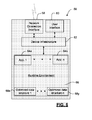
- FIG. 4 is a block diagram of proxy 40 in accordance with the invention.
- the proxy 40 is located in a communications path between the wireless device 10a, 10b and the remote service, for example, a worldwide web service 18a, 18b.
- the proxy 40 is an application gateway, and is hereinafter referred to as the application gateway 40.
- the application gateway 40 supports a wireless network interface 46 having a link 42 to the wireless network.
- a message transformation function 48 receives messages from the wireless network interface 46 and processes the messages before forwarding the messages to a service network interface 50.
- the service network interface 50 has a link to a service network 44 (the Internet, for example) over which it forwards the messages to an appropriate web service(s).
- the application gateway 40 is provisioned with a plurality of message maps 52, 54.
- the message maps 52, 54 are created by the wireless application developer 22 and used by the message transformation function 48 to process service request and service response messages, as will be explained below in more detail with reference to FIG. 6.
- One message map 52, 54 is created by the application developer 22 for each message type used by each web service 18a, 18b.
- FIG. 5 is a block diagram of a wireless device 56 in accordance with the invention.
- the wireless device 56 includes a network connection interface 58 that is well known in the art and used to communicate wirelessly with the public domain carrier 12.
- the wireless device 56 further includes a user interface 60, which may be a keypad, a touch sensitive screen, voice recognition software, or any other user interface for wireless devices.
- a device infrastructure 62 includes memory, processor(s), peripheral ports, keypad, display and other hardware components required to support the functionality of the wireless device 56.
- a run time environment 66 supports a plurality of simplified (optimized) data structures 68a, 68n that store corresponding application data in the simplified data structures, such as a simplified data structure 300, which will be explained below with reference to FIG. 8.
- FIG. 6 provides an overview of wireless messaging using simplified data structures in accordance with the invention.
- a wireless device 10a formulates a service request message in a simplified format when a user of the wireless device 10a requests a service from web service 18a.
- the service request message is forwarded to the application gateway (step 72) which performs service request message mapping in step 74 to transform the service request message in the simplified format into a web service request message format required by the web service 18a.
- the application gateway 40 forwards the web service request message to the web service 18a (step 76), which receives the web service request message and processes the message in a manner well known in the art (step 78).
- the web service 18a then formulates and returns a web service response message (step 80).
- the application gateway 40 receives the web service response message, correlates the web service response message with the web service request message sent earlier, and performs web service response message mapping in step 82 to transform the web service response message to a response message in the simplified format used by the wireless device 10a.
- the application gateway 40 forwards the response message in the simplified format to the wireless device 10a in step 84.
- the wireless device 10a receives the service response message and performs service response message processing in step 86.
- the wireless device 10a may generate a display of information to the user in step 88, depending on a content of the service response message processed in step 86.
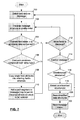
- FIG. 7 is a flow chart of an algorithm in accordance with the invention embodied in computer executable code for simplifying complex data structures by "flattening" the data structures. This is a post-mapping process in which general message mapping is performed in a manner that is not within the scope of the instant invention.
- the algorithm shown in FIG. 7 is, for example, a part of the application developer toolkit 22 (FIG. 3).
- the algorithm accepts complex web service messages as input and outputs a simplified service message for wireless messaging and a message map that permits the complex web service message to be reconstructed using the simplified service message and the message map.
- a web service message is selected in step 100.
- the selected message is, for example, a web service message that contains a complex data structure as shown in FIG. 2 with several levels of nesting that tax the resources of wireless transmission systems, as well as the limited processing power and storage memory of wireless devices 10a, 10b.
- the selected message is traversed in postfix order and each field of the message is examined (step 102). It is determined in step 104 whether a current field being examined refers to a candidate data component that permits the message to be flattened.
- a field that refers to a data structure that contains only a single field is a candidate data component.
- step 112 If the current field does not refer to a candidate data component, the algorithm checks to determine whether there are more fields in the message (step 112) and, if so, the algorithm returns to step 102. In step 106 it is determined whether the referring field and candidate data component are both of the array type. If both the referring field and the candidate data component are of the array type, the algorithm branches to step 112, and continues as described above.
- the algorithm copies field attributes of the candidate data component up a level into the referring field's structure.
- a message map 52 (FIG. 4) is then updated to add a path segment to identify the original location of the referring field (step 110). The algorithm then returns to step 112.
- step 114 When the entire message has been traversed in postfix order, it is determined in step 114 whether there is another message to process. If so, the algorithm returns to step 100. If not, the simplified (flattened) service messages are examined (step 116), to determine whether any of the simplified data structures are unreferenced in the data maps. For example, as shown in FIG. 8, and as will be explained below in detail with reference to FIG. 8, after flattening the GetSenatorInfoResult field 22 (FIG. 2) is changed to an array of CongressInfo 204 (FIG. 8). If the type ArrayOfSenatorInfo is not referenced by any of the messages in a wireless application with which the messages are associated, then the algorithm deletes the unreferenced data structure (step 118).
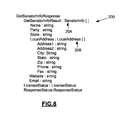
- FIG. 8 illustrates the effects of employing the algorithm shown in FIG. 7 for simplifying, i.e. flattening, a web service message that contains the complex data structure shown in FIG. 2.
- FIG. 8 schematically illustrates the complex data structure 20 shown in FIG. 2 after it has been simplified by flattening.
- the simplified data structure 200 does not contain the referring fields "GetSenatorInfoResult” 22 or "LocalAddress” 26. Rather, the field “GetSenatorInforesult" 204 and “LocalAddress” 206 are respectively copied up into the position formally occupied by the respective referring fields 22, 26.
- the simplified data structure shown in FIG. 8 is the same as the complex data structure shown in FIG. 7.
- the exemplary data structures shown in FIGs. 2 and 8 are not necessarily representative of the complexity of data structures used by web services 18a, 18b.
- the invention allows application developers to improve wireless device performance by reducing data processing overheads. It also allows application developers to reduce storage space requirements on the wireless devices 10a, 10b by reducing space-consuming complex data structures.
- the present invention also allows application developers to reduce bandwidth usage in the wireless leg of messaging required for accessing remote services, such as worldwide web services, while providing message maps for transparently delivering messages to the remote services in a native format that includes the complex data structures expected by the remote services.
Landscapes
- Engineering & Computer Science (AREA)
- Theoretical Computer Science (AREA)
- Audiology, Speech & Language Pathology (AREA)
- Health & Medical Sciences (AREA)
- Computational Linguistics (AREA)
- General Health & Medical Sciences (AREA)
- Physics & Mathematics (AREA)
- General Engineering & Computer Science (AREA)
- General Physics & Mathematics (AREA)
- Artificial Intelligence (AREA)
- Computer Networks & Wireless Communication (AREA)
- Signal Processing (AREA)
- Mobile Radio Communication Systems (AREA)
Abstract
Description
- This application relates generally to wireless communications and wireless communications devices and, in particular, to a method and apparatus for simplification of data structure in wireless communications.
- The acceptance of wireless devices as a preferred personal communications medium has created a growing demand for such devices. Users of such devices also increasingly expect more functionality and a broader range of services to be made available through such devices. Not only is there a demand for more functionality, there is also a demand for faster response times and more efficient access to remote services.
- A major challenge is faced in exposing wireless devices to complex data sources, such as web services, due to the size and complexity of the data structures communicated from such sources. In wired networks and devices where resources and efficiency are not a significant concern, it is permissible to transmit, process and store large and complex data structures.
- Complex data structures containing many levels of nesting introduce a significant memory overhead on wireless devices. This impacts performance when accessing such data in a memory store.
- Fig. 1 is a block diagram of a prior art network in which
wireless device users public domain carrier 12 to anapplication gateway 14. Theapplication gateway 14 forwards the web service request messages through theinternet 16 to anappropriate web service appropriate web service internet 16 to theapplication gateway 14. Thepublic domain carrier 12 forwards the response messages to thewireless device wireless device users - FIG. 2 is a schematic diagram of an exemplary web
service data structure 28 in accordance with the prior art. FIG. 2 schematically represents an exemplarycomplex data structure 20 named "GetSenatorInfoResponse". Thecomplex data structure 20 contains areferring field 22 named "GetSenatorInfoResult" having a field type of "ArrayofSenatorInfo". Thereferring field 22 refers to adata component 24 that contains a single field "SenatorInfo" having a field type of array. Likewise, the referringfield 26, refers to acandidate data component 28 "LocalAddress" having a field type of "ArrayofLocalAddress"). As will be appreciated by those skilled in the art, this complex data structure requires significant computing resources to store the structure in memory or retrieve it from memory at a rate that is acceptable to most users. Sincewireless devices - Consequently, there exists a need for a system and method that provides data and message optimization in order to ensure that wireless device response time and wireless messaging efficiency can keep up with demand, and that wireless device users remain satisfied with the performance of their wireless devices.
- It is therefore an object of the invention to provide a system and method for simplification of data structures used in wireless devices that promotes efficient data storage, efficient data access and retrieval, and transparent, efficient wireless messaging between wireless devices and remote services, such as worldwide web services.
- In accordance with a first aspect of the invention there is provided a system for simplification of data structure in wireless communications messages, comprising: a developer toolkit comprising computer executable code for accepting as input a service message containing complex data structures with multiple levels of nesting and outputting a simplified service message which contains fewer levels of nesting, and further outputting a message map for transforming the simplified service message to the complex service message, and vice versa.
- In accordance with a further aspect of the invention there is provided a method for simplification of wireless communications messages, comprising: provisioning an application developer toolkit with computer executable code for accepting as input a service message having a complex data structure and outputting a simplified service message with a simpler data structure for communicating and storing information associated with a remote service that utilizes the service messages for communicating information to wireless devices that access the remote service.
- Further features and advantages of the present invention will become apparent from the following detailed description, taken in combination with the appended drawings, in which:
- FIG. 1 is a block diagram of a prior art wireless network system;
- FIG. 2 is a schematic diagram of an exemplary prior art web service data structure;
- FIG. 3 is a schematic diagram illustrating a process for creating and enabling a system in accordance with the invention;
- FIG. 4 is a block diagram of a proxy in accordance with the invention;
- FIG. 5 is a block diagram of a wireless device in accordance with the invention;
- FIG. 6 is a high level overview of messaging between a wireless device and a remote service in a system in accordance with the invention;
- FIG. 7 is a flow chart of an algorithm in accordance with the invention for flattening complex data structures; and
- FIG. 8 is a schematic representation of the data structure shown in FIG. 2 after it has been flattened using the algorithm shown in FIG. 7.
- It will be noted that throughout the appended drawings, like features are identified by like reference numerals.
- The invention provides a system and method for the simplification of data structures used for wireless communications. Wireless devices are provisioned with user applications for accessing remote services, such as World Wide Web services. The user applications are conditioned to use a simplified data structure for storing information associated with a remote service that utilizes complex data structures for conveying the information to devices that access the remote service. An algorithm processes the complex data structures to simplify them by removing structure not utilized in the wireless device.
- Fig. 3 is a schematic diagram illustrating a process for creating and enabling a system in accordance with the invention.
- A remote service accessed by the
wireless devices web service 20 uses complex message structures to communicate information to users who access the remote service. Theweb service 20 likewise uses complex data structures for data storage and data retrieval. Awireless application developer 22 uses a specification of theweb service 20 and an application developer toolkit to createwireless device applications 24 andmessage maps 26 for enabling a system in accordance with the invention. Thewireless device applications 24 with simplified message formats and simplified data structures is created from a specification for theweb service 20. As will be explained below with reference to FIG. 7, the simplified data structures are created by "flattening" data structures defined in the web service specification. The process of flattening the web service data structures involves removing any unnecessary structure from the complex data structures, such as theexemplary data structure 20 shown in FIG. 2. The flattening of the complex data structures is performed by theapplication developer 22 using an automated or semi-automated algorithm, as will be explained below with reference to FIGs. 7 and 8. - After the simplified data structures and message mapping is created for converting complex service messages to simplified wireless messages. The
message mapping 26 is used by a proxy at an edge of the wireless network to convert the complex service messages to simplified wireless messages before the simplified wireless messages are sent wirelessly to thewireless device users data mapping 26 is an application gateway, as will be explained below with reference to Figs. 4 and 6. - FIG. 4 is a block diagram of
proxy 40 in accordance with the invention. Theproxy 40 is located in a communications path between thewireless device worldwide web service proxy 40 is an application gateway, and is hereinafter referred to as theapplication gateway 40. - The
application gateway 40 supports awireless network interface 46 having alink 42 to the wireless network. Amessage transformation function 48 receives messages from thewireless network interface 46 and processes the messages before forwarding the messages to aservice network interface 50. Theservice network interface 50 has a link to a service network 44 (the Internet, for example) over which it forwards the messages to an appropriate web service(s). In accordance with the invention, theapplication gateway 40 is provisioned with a plurality ofmessage maps message maps wireless application developer 22 and used by themessage transformation function 48 to process service request and service response messages, as will be explained below in more detail with reference to FIG. 6. Onemessage map application developer 22 for each message type used by eachweb service - FIG. 5 is a block diagram of a
wireless device 56 in accordance with the invention. Thewireless device 56 includes anetwork connection interface 58 that is well known in the art and used to communicate wirelessly with thepublic domain carrier 12. Thewireless device 56 further includes auser interface 60, which may be a keypad, a touch sensitive screen, voice recognition software, or any other user interface for wireless devices. Adevice infrastructure 62 includes memory, processor(s), peripheral ports, keypad, display and other hardware components required to support the functionality of thewireless device 56. Arun time environment 66 supports a plurality of simplified (optimized)data structures 68a, 68n that store corresponding application data in the simplified data structures, such as a simplified data structure 300, which will be explained below with reference to FIG. 8. - FIG. 6 provides an overview of wireless messaging using simplified data structures in accordance with the invention. In step 70 a
wireless device 10a formulates a service request message in a simplified format when a user of thewireless device 10a requests a service fromweb service 18a. The service request message is forwarded to the application gateway (step 72) which performs service request message mapping instep 74 to transform the service request message in the simplified format into a web service request message format required by theweb service 18a. Theapplication gateway 40 forwards the web service request message to theweb service 18a (step 76), which receives the web service request message and processes the message in a manner well known in the art (step 78). Theweb service 18a then formulates and returns a web service response message (step 80). Theapplication gateway 40 receives the web service response message, correlates the web service response message with the web service request message sent earlier, and performs web service response message mapping instep 82 to transform the web service response message to a response message in the simplified format used by thewireless device 10a. Theapplication gateway 40 forwards the response message in the simplified format to thewireless device 10a instep 84. Thewireless device 10a receives the service response message and performs service response message processing instep 86. Thewireless device 10a may generate a display of information to the user instep 88, depending on a content of the service response message processed instep 86. - Data Structure Simplification FIG. 7 is a flow chart of an algorithm in accordance with the invention embodied in computer executable code for simplifying complex data structures by "flattening" the data structures. This is a post-mapping process in which general message mapping is performed in a manner that is not within the scope of the instant invention.
- The algorithm shown in FIG. 7 is, for example, a part of the application developer toolkit 22 (FIG. 3). The algorithm accepts complex web service messages as input and outputs a simplified service message for wireless messaging and a message map that permits the complex web service message to be reconstructed using the simplified service message and the message map.
- As shown in FIG. 7, a web service message is selected in
step 100. The selected message is, for example, a web service message that contains a complex data structure as shown in FIG. 2 with several levels of nesting that tax the resources of wireless transmission systems, as well as the limited processing power and storage memory ofwireless devices step 104 whether a current field being examined refers to a candidate data component that permits the message to be flattened. A field that refers to a data structure that contains only a single field is a candidate data component. If the current field does not refer to a candidate data component, the algorithm checks to determine whether there are more fields in the message (step 112) and, if so, the algorithm returns to step 102. Instep 106 it is determined whether the referring field and candidate data component are both of the array type. If both the referring field and the candidate data component are of the array type, the algorithm branches to step 112, and continues as described above. - However, if both the referring field and the candidate data component are not of the array type, the algorithm copies field attributes of the candidate data component up a level into the referring field's structure. A message map 52 (FIG. 4) is then updated to add a path segment to identify the original location of the referring field (step 110). The algorithm then returns to step 112.
- When the entire message has been traversed in postfix order, it is determined in
step 114 whether there is another message to process. If so, the algorithm returns to step 100. If not, the simplified (flattened) service messages are examined (step 116), to determine whether any of the simplified data structures are unreferenced in the data maps. For example, as shown in FIG. 8, and as will be explained below in detail with reference to FIG. 8, after flattening the GetSenatorInfoResult field 22 (FIG. 2) is changed to an array of SenatorInfo 204 (FIG. 8). If the type ArrayOfSenatorInfo is not referenced by any of the messages in a wireless application with which the messages are associated, then the algorithm deletes the unreferenced data structure (step 118). The same applies to the ArrayOfLocalAddress type 208 (FIG. 8). After any unreferenced data structure(s) are deleted, the remaining simplified data structures are saved (step 120). All modified message maps are then saved (step 122), and the message flattening algorithm terminates. - FIG. 8 illustrates the effects of employing the algorithm shown in FIG. 7 for simplifying, i.e. flattening, a web service message that contains the complex data structure shown in FIG. 2.
- FIG. 8 schematically illustrates the
complex data structure 20 shown in FIG. 2 after it has been simplified by flattening. Thesimplified data structure 200 does not contain the referring fields "GetSenatorInfoResult" 22 or "LocalAddress" 26. Rather, the field "GetSenatorInforesult" 204 and "LocalAddress" 206 are respectively copied up into the position formally occupied by the respective referringfields web services - As will be appreciated by those skilled in the art, the invention allows application developers to improve wireless device performance by reducing data processing overheads. It also allows application developers to reduce storage space requirements on the
wireless devices - Although the invention has been explained with explicit reference to web services, those skilled in the art will appreciate that the invention can be used to efficiently access any remote service that uses complex data structures for request/response messaging.
- The embodiment(s) of the invention described above is(are) intended to be exemplary only. The scope of the invention is therefore intended to be limited solely by the scope of the appended claims.
Claims (21)
- A system for simplification of a data structure (20) in wireless communications messages (72,84), comprising:a developer toolkit (22) comprising computer executable code for accepting as input a service message (78,80) containing complex data structures (20) with multiple levels of nesting (22,26) and outputting a simplified service message containing simplified data structures (200) which contain fewer levels of nesting (204,208), and further outputting a message map for transforming the simplified service message to the complex service message, and vice versa.
- The system as claimed in claim 1 wherein the computer executable code traverses the service message (78, 80) in postfix order.
- The system as claimed in claim 2 wherein the computer executable code determines whether each current field encountered in the postfix order traverse refers to a candidate data component (22, 26) containing a single field (24,28).
- The system as claimed in claim 3 wherein the computer executable code determines whether each of the current field and the candidate data component (22, 26) are of an array type.
- The system as claimed in claim 4 wherein the computer executable code further copies single field attributes to a position occupied by the current field if only one of the current field (22,26) and the field referred to (24,28) are of an array type.
- The system as claimed in any one of claims 1 to 5 wherein the computer executable code further adds a path segment to the message map (52,54) to permit the input service message (76) to be restored from the simplified service message (72).
- The system as claimed in any one of claims 2 to 6 wherein the computer executable code further determines whether more fields (22,24,26,28) remain to be examined in the postfix traverse.
- The system as claimed in claim 7 wherein the computer executable code saves the simplified service messages (72,84) after all of the service messages have been examined.
- The system as claimed in claim 8 wherein the computer executable code further saves the message maps (52,54) that permits the service messages (80) to be converted to the simplified messages (84), and vice versa.
- A method for simplification of a data structure (20) in wireless communications messages (72,84), comprising the steps of:provisioning the application developer toolkit (22) with computer executable code for mapping complex service messages (76,80) used by the remote service (18a.18b) to simplified wireless messages (72,84) used by the application, and the simplified wireless messages to the complex service messages; andprovisioning a proxy (40) in a communications path (42,44) between the wireless device (56) and the remote service (18a,18b) with the mapping (52,54), to permit the proxy to convert the complex service messages to the simplified wireless messages and the simplified wireless messages to the complex service messages, to enable wireless communications between the wireless device and the remote service.
- The method as claimed in claim 10 further comprising provisioning the application developer toolkit (22) with computer executable code for removing nesting structure from the service messages (76,80) to output the simplified services messages (72,84).
- The method as claimed in claim 10 or claim 11 wherein provisioning the proxy (40) comprises provisioning an application gateway to serve as the proxy.
- The method as claimed in claim 12 wherein provisioning the application gateway (40) further comprises provisioning the application gateway with a message transformation function (48) for applying the mapping (52, 54) .
- The method as claimed in claim 13 further comprising conditioning the message transformation function (48) to apply the mapping (52,54) to the simplified wireless messages (72) to produce complex service messages (76) that are relayed via a wireline (44) to the remote service (18a,18b), and to apply the mapping to the complex service messages (80) to produce the simplified service messages (84) that are relayed wirelessly to the wireless device (56).
- The method as claimed in any one of claims 10 to 14 further comprising provisioning the application developer toolkit (22) with computer executable code for traversing the input service message (76,80) in a postfix order to remove complex structure (22,26) form the input service messages.
- The method as claimed in claim 16 further comprising provisioning the application developer toolkit (22) with computer executable code for examining each field (22,24,26,28) in the postfix order traverse to determine whether a current field refers (22) to a candidate data component (24).
- The method as claimed in claim 17 further comprising provisioning the application developer toolkit (22) with computer executable code for determining whether the current field (22) and the candidate data component (24) are both fields of an array type.
- The method as claimed in claim 17 further comprising provisioning the application developer toolkit (22) with computer executable code for copying single field attributes of the candidate data component (24) to a position occupied by the current field (22) if only one of the current field and the candidate data component are of the array type.
- The method as claimed in any one of claims 10 to 18 further comprising provisioning the application developer toolkit (22) with computer executable code for adding a path segment to a message map (52,54) to permit the service message (76,80) to be restored from the simplified data message (72,84).
- A machine readable medium comprising program code means executable on a computer having a programmable processor for implementing the method as claimed in any one of claims 10 to 19.
- A wireless communications system comprising the system of any one of claims 1 to 9.
Priority Applications (4)
| Application Number | Priority Date | Filing Date | Title |
|---|---|---|---|
| EP05103043A EP1715412B1 (en) | 2005-04-18 | 2005-04-18 | System and method for simplification of data structure in wireless communications |
| AT05103043T ATE377213T1 (en) | 2005-04-18 | 2005-04-18 | SYSTEM AND METHOD FOR SIMPLIFYING A DATA STRUCTURE IN WIRELESS COMMUNICATIONS |
| DE602005003105T DE602005003105T2 (en) | 2005-04-18 | 2005-04-18 | System and method for simplifying a data structure in wireless communications |
| CA2544032A CA2544032C (en) | 2005-04-18 | 2006-04-18 | System and method for simplification of data structure in wireless communications |
Applications Claiming Priority (1)
| Application Number | Priority Date | Filing Date | Title |
|---|---|---|---|
| EP05103043A EP1715412B1 (en) | 2005-04-18 | 2005-04-18 | System and method for simplification of data structure in wireless communications |
Publications (2)
| Publication Number | Publication Date |
|---|---|
| EP1715412A1 true EP1715412A1 (en) | 2006-10-25 |
| EP1715412B1 EP1715412B1 (en) | 2007-10-31 |
Family
ID=34939330
Family Applications (1)
| Application Number | Title | Priority Date | Filing Date |
|---|---|---|---|
| EP05103043A Expired - Lifetime EP1715412B1 (en) | 2005-04-18 | 2005-04-18 | System and method for simplification of data structure in wireless communications |
Country Status (4)
| Country | Link |
|---|---|
| EP (1) | EP1715412B1 (en) |
| AT (1) | ATE377213T1 (en) |
| CA (1) | CA2544032C (en) |
| DE (1) | DE602005003105T2 (en) |
Families Citing this family (1)
| Publication number | Priority date | Publication date | Assignee | Title |
|---|---|---|---|---|
| CN102063496B (en) * | 2010-01-07 | 2013-03-13 | 董福田 | Spatial data simplifying method and device |
Citations (7)
| Publication number | Priority date | Publication date | Assignee | Title |
|---|---|---|---|---|
| US6085196A (en) * | 1997-12-23 | 2000-07-04 | Ricoh Company, Ltd. | Object-oriented system and computer program product for mapping structured information to different structured information |
| US6128612A (en) * | 1998-06-30 | 2000-10-03 | International Business Machines Corporation | Method and system for translating an ad-hoc query language using common table expressions |
| WO2002019154A1 (en) * | 2000-08-29 | 2002-03-07 | Contivo, Inc. | Virtual groups |
| US20020156896A1 (en) * | 2001-02-09 | 2002-10-24 | Peter Lin | System and method for providing a gateway between mobile two-way messaging devices and remote computer networks |
| US20020184213A1 (en) * | 2001-06-01 | 2002-12-05 | International Business Machines Corporation | Data instance transformation tool for transforming a source instance to a target instance |
| US20040078424A1 (en) * | 2002-10-16 | 2004-04-22 | Nokia Corporation | Web services via instant messaging |
| WO2004059939A2 (en) * | 2002-12-26 | 2004-07-15 | Research In Motion Limited | System and method of creating and communicating with component based wireless applications |
-
2005
- 2005-04-18 DE DE602005003105T patent/DE602005003105T2/en not_active Expired - Lifetime
- 2005-04-18 EP EP05103043A patent/EP1715412B1/en not_active Expired - Lifetime
- 2005-04-18 AT AT05103043T patent/ATE377213T1/en not_active IP Right Cessation
-
2006
- 2006-04-18 CA CA2544032A patent/CA2544032C/en not_active Expired - Lifetime
Patent Citations (7)
| Publication number | Priority date | Publication date | Assignee | Title |
|---|---|---|---|---|
| US6085196A (en) * | 1997-12-23 | 2000-07-04 | Ricoh Company, Ltd. | Object-oriented system and computer program product for mapping structured information to different structured information |
| US6128612A (en) * | 1998-06-30 | 2000-10-03 | International Business Machines Corporation | Method and system for translating an ad-hoc query language using common table expressions |
| WO2002019154A1 (en) * | 2000-08-29 | 2002-03-07 | Contivo, Inc. | Virtual groups |
| US20020156896A1 (en) * | 2001-02-09 | 2002-10-24 | Peter Lin | System and method for providing a gateway between mobile two-way messaging devices and remote computer networks |
| US20020184213A1 (en) * | 2001-06-01 | 2002-12-05 | International Business Machines Corporation | Data instance transformation tool for transforming a source instance to a target instance |
| US20040078424A1 (en) * | 2002-10-16 | 2004-04-22 | Nokia Corporation | Web services via instant messaging |
| WO2004059939A2 (en) * | 2002-12-26 | 2004-07-15 | Research In Motion Limited | System and method of creating and communicating with component based wireless applications |
Also Published As
| Publication number | Publication date |
|---|---|
| DE602005003105T2 (en) | 2008-08-21 |
| ATE377213T1 (en) | 2007-11-15 |
| CA2544032A1 (en) | 2006-10-18 |
| EP1715412B1 (en) | 2007-10-31 |
| DE602005003105D1 (en) | 2007-12-13 |
| CA2544032C (en) | 2013-01-08 |
Similar Documents
| Publication | Publication Date | Title |
|---|---|---|
| EP3734933B1 (en) | Resource acquisition method, server and storage medium | |
| CN100483386C (en) | Information management system and method | |
| CN101902473B (en) | Method for synchronously updating data based on grid GIS (Geographic Information System) | |
| CN107203541A (en) | Page loading method and its page loading device | |
| CN112003945A (en) | Service request response method and device | |
| CN109104368B (en) | A method, device, server and computer-readable storage medium for requesting connection | |
| WO2021147668A1 (en) | Software upgrading method and device | |
| JP2003141002A (en) | Url length conversion system and program | |
| US8185911B2 (en) | System and method for simplification of data structure in wireless communications | |
| GB2410657A (en) | A data-retransmit timer based on network performance | |
| US7912984B2 (en) | System and method for generating a wireless application from a web service definition | |
| EP1715412B1 (en) | System and method for simplification of data structure in wireless communications | |
| CN105229990B (en) | The method and apparatus for loading webpage | |
| CN100465881C (en) | Method and apparatus for incrementally adapting an application | |
| EP1715655A1 (en) | System and method for data and message optimisation in wireless communications | |
| US8484182B1 (en) | Wireless device content searching | |
| US20060234681A1 (en) | System and method for data and message optimization in wireless communications | |
| CN114979308B (en) | Message processing method and device | |
| CN114650271B (en) | Global load DNS neighbor site learning method and device | |
| CN111314457B (en) | Method and apparatus for setting up virtual private cloud | |
| US8688857B1 (en) | Filtering messages based on pruning profile generated from pruning profile schema | |
| CN120705105A (en) | Data transmission method, electronic device and storage medium | |
| JP4457767B2 (en) | Structured document processing system, update method thereof, and recording medium recording the update program | |
| CN117216427A (en) | Loading of short links, methods, devices, equipment and media for obtaining short links | |
| CN119485226A (en) | Network service acquisition method and related equipment |
Legal Events
| Date | Code | Title | Description |
|---|---|---|---|
| PUAI | Public reference made under article 153(3) epc to a published international application that has entered the european phase |
Free format text: ORIGINAL CODE: 0009012 |
|
| 17P | Request for examination filed |
Effective date: 20050428 |
|
| AK | Designated contracting states |
Kind code of ref document: A1 Designated state(s): AT BE BG CH CY CZ DE DK EE ES FI FR GB GR HU IE IS IT LI LT LU MC NL PL PT RO SE SI SK TR |
|
| AX | Request for extension of the european patent |
Extension state: AL BA HR LV MK YU |
|
| GRAP | Despatch of communication of intention to grant a patent |
Free format text: ORIGINAL CODE: EPIDOSNIGR1 |
|
| AKX | Designation fees paid |
Designated state(s): AT BE BG CH CY CZ DE DK EE ES FI FR GB GR HU IE IS IT LI LT LU MC NL PL PT RO SE SI SK TR |
|
| AXX | Extension fees paid |
Extension state: HR Payment date: 20050428 Extension state: YU Payment date: 20050428 Extension state: AL Payment date: 20050428 Extension state: BA Payment date: 20050428 Extension state: MK Payment date: 20050428 Extension state: LV Payment date: 20050428 |
|
| GRAS | Grant fee paid |
Free format text: ORIGINAL CODE: EPIDOSNIGR3 |
|
| GRAA | (expected) grant |
Free format text: ORIGINAL CODE: 0009210 |
|
| AK | Designated contracting states |
Kind code of ref document: B1 Designated state(s): AT BE BG CH CY CZ DE DK EE ES FI FR GB GR HU IE IS IT LI LT LU MC NL PL PT RO SE SI SK TR |
|
| AX | Request for extension of the european patent |
Extension state: AL BA HR LV MK YU |
|
| REG | Reference to a national code |
Ref country code: GB Ref legal event code: FG4D |
|
| RIN1 | Information on inventor provided before grant (corrected) |
Inventor name: FRITSCH, BRINDUSA Inventor name: SHENFIELD, MICHAEL Inventor name: DEBRUIN, DAVID Inventor name: GORING, BRYAN R. Inventor name: BIBR, VIERA |
|
| REG | Reference to a national code |
Ref country code: IE Ref legal event code: FG4D |
|
| REG | Reference to a national code |
Ref country code: CH Ref legal event code: EP |
|
| REF | Corresponds to: |
Ref document number: 602005003105 Country of ref document: DE Date of ref document: 20071213 Kind code of ref document: P |
|
| NLV1 | Nl: lapsed or annulled due to failure to fulfill the requirements of art. 29p and 29m of the patents act | ||
| PG25 | Lapsed in a contracting state [announced via postgrant information from national office to epo] |
Ref country code: ES Free format text: LAPSE BECAUSE OF FAILURE TO SUBMIT A TRANSLATION OF THE DESCRIPTION OR TO PAY THE FEE WITHIN THE PRESCRIBED TIME-LIMIT Effective date: 20080211 Ref country code: LI Free format text: LAPSE BECAUSE OF FAILURE TO SUBMIT A TRANSLATION OF THE DESCRIPTION OR TO PAY THE FEE WITHIN THE PRESCRIBED TIME-LIMIT Effective date: 20071031 Ref country code: NL Free format text: LAPSE BECAUSE OF FAILURE TO SUBMIT A TRANSLATION OF THE DESCRIPTION OR TO PAY THE FEE WITHIN THE PRESCRIBED TIME-LIMIT Effective date: 20071031 Ref country code: SE Free format text: LAPSE BECAUSE OF FAILURE TO SUBMIT A TRANSLATION OF THE DESCRIPTION OR TO PAY THE FEE WITHIN THE PRESCRIBED TIME-LIMIT Effective date: 20080131 Ref country code: CH Free format text: LAPSE BECAUSE OF FAILURE TO SUBMIT A TRANSLATION OF THE DESCRIPTION OR TO PAY THE FEE WITHIN THE PRESCRIBED TIME-LIMIT Effective date: 20071031 |
|
| REG | Reference to a national code |
Ref country code: CH Ref legal event code: PL |
|
| PG25 | Lapsed in a contracting state [announced via postgrant information from national office to epo] |
Ref country code: IS Free format text: LAPSE BECAUSE OF FAILURE TO SUBMIT A TRANSLATION OF THE DESCRIPTION OR TO PAY THE FEE WITHIN THE PRESCRIBED TIME-LIMIT Effective date: 20080229 Ref country code: PL Free format text: LAPSE BECAUSE OF FAILURE TO SUBMIT A TRANSLATION OF THE DESCRIPTION OR TO PAY THE FEE WITHIN THE PRESCRIBED TIME-LIMIT Effective date: 20071031 Ref country code: LT Free format text: LAPSE BECAUSE OF FAILURE TO SUBMIT A TRANSLATION OF THE DESCRIPTION OR TO PAY THE FEE WITHIN THE PRESCRIBED TIME-LIMIT Effective date: 20071031 Ref country code: PT Free format text: LAPSE BECAUSE OF FAILURE TO SUBMIT A TRANSLATION OF THE DESCRIPTION OR TO PAY THE FEE WITHIN THE PRESCRIBED TIME-LIMIT Effective date: 20080331 Ref country code: SI Free format text: LAPSE BECAUSE OF FAILURE TO SUBMIT A TRANSLATION OF THE DESCRIPTION OR TO PAY THE FEE WITHIN THE PRESCRIBED TIME-LIMIT Effective date: 20071031 Ref country code: BG Free format text: LAPSE BECAUSE OF FAILURE TO SUBMIT A TRANSLATION OF THE DESCRIPTION OR TO PAY THE FEE WITHIN THE PRESCRIBED TIME-LIMIT Effective date: 20080131 |
|
| PG25 | Lapsed in a contracting state [announced via postgrant information from national office to epo] |
Ref country code: AT Free format text: LAPSE BECAUSE OF FAILURE TO SUBMIT A TRANSLATION OF THE DESCRIPTION OR TO PAY THE FEE WITHIN THE PRESCRIBED TIME-LIMIT Effective date: 20071031 |
|
| ET | Fr: translation filed | ||
| PG25 | Lapsed in a contracting state [announced via postgrant information from national office to epo] |
Ref country code: DK Free format text: LAPSE BECAUSE OF FAILURE TO SUBMIT A TRANSLATION OF THE DESCRIPTION OR TO PAY THE FEE WITHIN THE PRESCRIBED TIME-LIMIT Effective date: 20071031 Ref country code: CZ Free format text: LAPSE BECAUSE OF FAILURE TO SUBMIT A TRANSLATION OF THE DESCRIPTION OR TO PAY THE FEE WITHIN THE PRESCRIBED TIME-LIMIT Effective date: 20071031 |
|
| PG25 | Lapsed in a contracting state [announced via postgrant information from national office to epo] |
Ref country code: BE Free format text: LAPSE BECAUSE OF FAILURE TO SUBMIT A TRANSLATION OF THE DESCRIPTION OR TO PAY THE FEE WITHIN THE PRESCRIBED TIME-LIMIT Effective date: 20071031 Ref country code: RO Free format text: LAPSE BECAUSE OF FAILURE TO SUBMIT A TRANSLATION OF THE DESCRIPTION OR TO PAY THE FEE WITHIN THE PRESCRIBED TIME-LIMIT Effective date: 20071031 Ref country code: SK Free format text: LAPSE BECAUSE OF FAILURE TO SUBMIT A TRANSLATION OF THE DESCRIPTION OR TO PAY THE FEE WITHIN THE PRESCRIBED TIME-LIMIT Effective date: 20071031 |
|
| PLBE | No opposition filed within time limit |
Free format text: ORIGINAL CODE: 0009261 |
|
| STAA | Information on the status of an ep patent application or granted ep patent |
Free format text: STATUS: NO OPPOSITION FILED WITHIN TIME LIMIT |
|
| 26N | No opposition filed |
Effective date: 20080801 |
|
| PG25 | Lapsed in a contracting state [announced via postgrant information from national office to epo] |
Ref country code: MC Free format text: LAPSE BECAUSE OF NON-PAYMENT OF DUE FEES Effective date: 20080430 |
|
| PG25 | Lapsed in a contracting state [announced via postgrant information from national office to epo] |
Ref country code: GR Free format text: LAPSE BECAUSE OF FAILURE TO SUBMIT A TRANSLATION OF THE DESCRIPTION OR TO PAY THE FEE WITHIN THE PRESCRIBED TIME-LIMIT Effective date: 20080201 Ref country code: EE Free format text: LAPSE BECAUSE OF FAILURE TO SUBMIT A TRANSLATION OF THE DESCRIPTION OR TO PAY THE FEE WITHIN THE PRESCRIBED TIME-LIMIT Effective date: 20071031 |
|
| PG25 | Lapsed in a contracting state [announced via postgrant information from national office to epo] |
Ref country code: FI Free format text: LAPSE BECAUSE OF FAILURE TO SUBMIT A TRANSLATION OF THE DESCRIPTION OR TO PAY THE FEE WITHIN THE PRESCRIBED TIME-LIMIT Effective date: 20071031 |
|
| PG25 | Lapsed in a contracting state [announced via postgrant information from national office to epo] |
Ref country code: IE Free format text: LAPSE BECAUSE OF NON-PAYMENT OF DUE FEES Effective date: 20080418 |
|
| PG25 | Lapsed in a contracting state [announced via postgrant information from national office to epo] |
Ref country code: CY Free format text: LAPSE BECAUSE OF FAILURE TO SUBMIT A TRANSLATION OF THE DESCRIPTION OR TO PAY THE FEE WITHIN THE PRESCRIBED TIME-LIMIT Effective date: 20071031 |
|
| PG25 | Lapsed in a contracting state [announced via postgrant information from national office to epo] |
Ref country code: LU Free format text: LAPSE BECAUSE OF NON-PAYMENT OF DUE FEES Effective date: 20080418 Ref country code: HU Free format text: LAPSE BECAUSE OF FAILURE TO SUBMIT A TRANSLATION OF THE DESCRIPTION OR TO PAY THE FEE WITHIN THE PRESCRIBED TIME-LIMIT Effective date: 20080501 |
|
| PG25 | Lapsed in a contracting state [announced via postgrant information from national office to epo] |
Ref country code: TR Free format text: LAPSE BECAUSE OF FAILURE TO SUBMIT A TRANSLATION OF THE DESCRIPTION OR TO PAY THE FEE WITHIN THE PRESCRIBED TIME-LIMIT Effective date: 20071031 |
|
| PG25 | Lapsed in a contracting state [announced via postgrant information from national office to epo] |
Ref country code: IT Free format text: LAPSE BECAUSE OF NON-PAYMENT OF DUE FEES Effective date: 20080430 |
|
| REG | Reference to a national code |
Ref country code: DE Ref legal event code: R082 Ref document number: 602005003105 Country of ref document: DE Representative=s name: MERH-IP MATIAS ERNY REICHL HOFFMANN, DE |
|
| REG | Reference to a national code |
Ref country code: DE Ref legal event code: R081 Ref document number: 602005003105 Country of ref document: DE Owner name: BLACKBERRY LIMITED, WATERLOO, CA Free format text: FORMER OWNER: RESEARCH IN MOTION LTD., WATERLOO, ONTARIO, CA Effective date: 20140925 Ref country code: DE Ref legal event code: R082 Ref document number: 602005003105 Country of ref document: DE Representative=s name: MERH-IP MATIAS ERNY REICHL HOFFMANN, DE Effective date: 20140925 Ref country code: DE Ref legal event code: R082 Ref document number: 602005003105 Country of ref document: DE Representative=s name: MERH-IP MATIAS ERNY REICHL HOFFMANN PATENTANWA, DE Effective date: 20140925 |
|
| REG | Reference to a national code |
Ref country code: FR Ref legal event code: PLFP Year of fee payment: 12 |
|
| REG | Reference to a national code |
Ref country code: FR Ref legal event code: PLFP Year of fee payment: 13 |
|
| REG | Reference to a national code |
Ref country code: FR Ref legal event code: PLFP Year of fee payment: 14 |
|
| REG | Reference to a national code |
Ref country code: DE Ref legal event code: R082 Ref document number: 602005003105 Country of ref document: DE Ref country code: DE Ref legal event code: R081 Ref document number: 602005003105 Country of ref document: DE Owner name: MALIKIE INNOVATIONS LTD., IE Free format text: FORMER OWNER: BLACKBERRY LIMITED, WATERLOO, ONTARIO, CA |
|
| PGFP | Annual fee paid to national office [announced via postgrant information from national office to epo] |
Ref country code: GB Payment date: 20240423 Year of fee payment: 20 |
|
| PGFP | Annual fee paid to national office [announced via postgrant information from national office to epo] |
Ref country code: DE Payment date: 20240429 Year of fee payment: 20 |
|
| PGFP | Annual fee paid to national office [announced via postgrant information from national office to epo] |
Ref country code: FR Payment date: 20240430 Year of fee payment: 20 |
|
| REG | Reference to a national code |
Ref country code: DE Ref legal event code: R071 Ref document number: 602005003105 Country of ref document: DE |
|
| REG | Reference to a national code |
Ref country code: GB Ref legal event code: PE20 Expiry date: 20250417 |
|
| PG25 | Lapsed in a contracting state [announced via postgrant information from national office to epo] |
Ref country code: GB Free format text: LAPSE BECAUSE OF EXPIRATION OF PROTECTION Effective date: 20250417 |