EP1715005A1 - Curable fluoropolyether rubber compositions and rubber articles - Google Patents
Curable fluoropolyether rubber compositions and rubber articles Download PDFInfo
- Publication number
- EP1715005A1 EP1715005A1 EP06252171A EP06252171A EP1715005A1 EP 1715005 A1 EP1715005 A1 EP 1715005A1 EP 06252171 A EP06252171 A EP 06252171A EP 06252171 A EP06252171 A EP 06252171A EP 1715005 A1 EP1715005 A1 EP 1715005A1
- Authority
- EP
- European Patent Office
- Prior art keywords
- rubber
- composition
- component
- compound
- fluoropolyether
- Prior art date
- Legal status (The legal status is an assumption and is not a legal conclusion. Google has not performed a legal analysis and makes no representation as to the accuracy of the status listed.)
- Granted
Links
- 229920001971 elastomer Polymers 0.000 title claims abstract description 56
- 239000000203 mixture Substances 0.000 title claims abstract description 54
- 150000001875 compounds Chemical class 0.000 claims abstract description 25
- 150000003961 organosilicon compounds Chemical class 0.000 claims abstract description 17
- 239000000126 substance Substances 0.000 claims abstract description 13
- 239000003921 oil Substances 0.000 claims abstract description 12
- 125000003342 alkenyl group Chemical group 0.000 claims abstract description 11
- 239000003054 catalyst Substances 0.000 claims abstract description 9
- 239000010702 perfluoropolyether Chemical group 0.000 claims abstract description 9
- 125000005372 silanol group Chemical group 0.000 claims abstract description 9
- 238000006459 hydrosilylation reaction Methods 0.000 claims abstract description 8
- 238000002844 melting Methods 0.000 claims abstract description 8
- 230000008018 melting Effects 0.000 claims abstract description 8
- 239000006082 mold release agent Substances 0.000 claims description 10
- 238000004519 manufacturing process Methods 0.000 claims description 9
- 125000004435 hydrogen atom Chemical group [H]* 0.000 claims description 8
- 125000004432 carbon atom Chemical group C* 0.000 claims description 7
- 125000003903 2-propenyl group Chemical group [H]C([*])([H])C([H])=C([H])[H] 0.000 claims description 6
- 238000012856 packing Methods 0.000 claims description 6
- 125000001997 phenyl group Chemical group [H]C1=C([H])C([H])=C(*)C([H])=C1[H] 0.000 claims description 6
- 239000004065 semiconductor Substances 0.000 claims description 6
- 239000003795 chemical substances by application Substances 0.000 claims description 5
- 239000000446 fuel Substances 0.000 claims description 5
- 125000002496 methyl group Chemical group [H]C([H])([H])* 0.000 claims description 5
- XUIMIQQOPSSXEZ-UHFFFAOYSA-N Silicon Chemical group [Si] XUIMIQQOPSSXEZ-UHFFFAOYSA-N 0.000 claims description 4
- 125000002029 aromatic hydrocarbon group Chemical group 0.000 claims description 4
- 229910052739 hydrogen Inorganic materials 0.000 claims description 4
- 239000001257 hydrogen Substances 0.000 claims description 4
- 238000000034 method Methods 0.000 claims description 4
- 229910052710 silicon Inorganic materials 0.000 claims description 3
- 239000010703 silicon Substances 0.000 claims description 3
- 239000000758 substrate Substances 0.000 claims description 2
- 229920001973 fluoroelastomer Polymers 0.000 claims 1
- 125000001183 hydrocarbyl group Chemical group 0.000 claims 1
- XLYOFNOQVPJJNP-UHFFFAOYSA-N water Substances O XLYOFNOQVPJJNP-UHFFFAOYSA-N 0.000 abstract description 7
- VYPSYNLAJGMNEJ-UHFFFAOYSA-N Silicium dioxide Chemical compound O=[Si]=O VYPSYNLAJGMNEJ-UHFFFAOYSA-N 0.000 description 11
- 239000000463 material Substances 0.000 description 10
- 239000000654 additive Substances 0.000 description 9
- 238000007906 compression Methods 0.000 description 9
- 230000006835 compression Effects 0.000 description 9
- -1 p-dimethylsilylphenylene group Chemical group 0.000 description 9
- 230000000996 additive effect Effects 0.000 description 7
- 230000000704 physical effect Effects 0.000 description 6
- BASFCYQUMIYNBI-UHFFFAOYSA-N platinum Chemical compound [Pt] BASFCYQUMIYNBI-UHFFFAOYSA-N 0.000 description 6
- 239000002904 solvent Substances 0.000 description 6
- RIOQSEWOXXDEQQ-UHFFFAOYSA-N triphenylphosphine Chemical compound C1=CC=CC=C1P(C=1C=CC=CC=1)C1=CC=CC=C1 RIOQSEWOXXDEQQ-UHFFFAOYSA-N 0.000 description 6
- 239000002253 acid Substances 0.000 description 5
- 238000000576 coating method Methods 0.000 description 5
- 238000000465 moulding Methods 0.000 description 5
- 125000000391 vinyl group Chemical group [H]C([*])=C([H])[H] 0.000 description 5
- 229940045985 antineoplastic platinum compound Drugs 0.000 description 4
- 239000000945 filler Substances 0.000 description 4
- 229910021485 fumed silica Inorganic materials 0.000 description 4
- 229920002554 vinyl polymer Polymers 0.000 description 4
- 0 C*C(*C(F)(F)F)=O Chemical compound C*C(*C(F)(F)F)=O 0.000 description 3
- YXFVVABEGXRONW-UHFFFAOYSA-N Toluene Chemical compound CC1=CC=CC=C1 YXFVVABEGXRONW-UHFFFAOYSA-N 0.000 description 3
- 230000000052 comparative effect Effects 0.000 description 3
- 239000007788 liquid Substances 0.000 description 3
- 150000003058 platinum compounds Chemical class 0.000 description 3
- 229920000642 polymer Polymers 0.000 description 3
- 239000000377 silicon dioxide Substances 0.000 description 3
- 238000003860 storage Methods 0.000 description 3
- VTYYLEPIZMXCLO-UHFFFAOYSA-L Calcium carbonate Chemical compound [Ca+2].[O-]C([O-])=O VTYYLEPIZMXCLO-UHFFFAOYSA-L 0.000 description 2
- 150000002430 hydrocarbons Chemical group 0.000 description 2
- 239000003112 inhibitor Substances 0.000 description 2
- 230000035699 permeability Effects 0.000 description 2
- 229910052697 platinum Inorganic materials 0.000 description 2
- 238000004382 potting Methods 0.000 description 2
- 238000002360 preparation method Methods 0.000 description 2
- 239000012763 reinforcing filler Substances 0.000 description 2
- 239000000565 sealant Substances 0.000 description 2
- 229920002545 silicone oil Polymers 0.000 description 2
- 239000007787 solid Substances 0.000 description 2
- 239000004094 surface-active agent Substances 0.000 description 2
- 238000012360 testing method Methods 0.000 description 2
- HMVBQEAJQVQOTI-SOFGYWHQSA-N (e)-3,5-dimethylhex-3-en-1-yne Chemical compound CC(C)\C=C(/C)C#C HMVBQEAJQVQOTI-SOFGYWHQSA-N 0.000 description 1
- GRGVQLWQXHFRHO-AATRIKPKSA-N (e)-3-methylpent-3-en-1-yne Chemical compound C\C=C(/C)C#C GRGVQLWQXHFRHO-AATRIKPKSA-N 0.000 description 1
- QYLFHLNFIHBCPR-UHFFFAOYSA-N 1-ethynylcyclohexan-1-ol Chemical compound C#CC1(O)CCCCC1 QYLFHLNFIHBCPR-UHFFFAOYSA-N 0.000 description 1
- VGHJVWDOYZQIJK-UHFFFAOYSA-N 1-phenylbut-1-en-1-ol Chemical compound CCC=C(O)C1=CC=CC=C1 VGHJVWDOYZQIJK-UHFFFAOYSA-N 0.000 description 1
- CEBKHWWANWSNTI-UHFFFAOYSA-N 2-methylbut-3-yn-2-ol Chemical compound CC(C)(O)C#C CEBKHWWANWSNTI-UHFFFAOYSA-N 0.000 description 1
- NECRQCBKTGZNMH-UHFFFAOYSA-N 3,5-dimethylhex-1-yn-3-ol Chemical compound CC(C)CC(C)(O)C#C NECRQCBKTGZNMH-UHFFFAOYSA-N 0.000 description 1
- HFYAEUXHCMTPOL-UHFFFAOYSA-N 3-Methyl-1-penten-3-ol Chemical compound CCC(C)(O)C=C HFYAEUXHCMTPOL-UHFFFAOYSA-N 0.000 description 1
- OKTJSMMVPCPJKN-UHFFFAOYSA-N Carbon Chemical compound [C] OKTJSMMVPCPJKN-UHFFFAOYSA-N 0.000 description 1
- 239000004970 Chain extender Substances 0.000 description 1
- VYZAMTAEIAYCRO-UHFFFAOYSA-N Chromium Chemical compound [Cr] VYZAMTAEIAYCRO-UHFFFAOYSA-N 0.000 description 1
- VGGSQFUCUMXWEO-UHFFFAOYSA-N Ethene Chemical compound C=C VGGSQFUCUMXWEO-UHFFFAOYSA-N 0.000 description 1
- 239000005977 Ethylene Substances 0.000 description 1
- YCKRFDGAMUMZLT-UHFFFAOYSA-N Fluorine atom Chemical compound [F] YCKRFDGAMUMZLT-UHFFFAOYSA-N 0.000 description 1
- 239000005909 Kieselgur Substances 0.000 description 1
- AFCARXCZXQIEQB-UHFFFAOYSA-N N-[3-oxo-3-(2,4,6,7-tetrahydrotriazolo[4,5-c]pyridin-5-yl)propyl]-2-[[3-(trifluoromethoxy)phenyl]methylamino]pyrimidine-5-carboxamide Chemical compound O=C(CCNC(=O)C=1C=NC(=NC=1)NCC1=CC(=CC=C1)OC(F)(F)F)N1CC2=C(CC1)NN=N2 AFCARXCZXQIEQB-UHFFFAOYSA-N 0.000 description 1
- NFHFRUOZVGFOOS-UHFFFAOYSA-N Pd(PPh3)4 Substances [Pd].C1=CC=CC=C1P(C=1C=CC=CC=1)C1=CC=CC=C1.C1=CC=CC=C1P(C=1C=CC=CC=1)C1=CC=CC=C1.C1=CC=CC=C1P(C=1C=CC=CC=1)C1=CC=CC=C1.C1=CC=CC=C1P(C=1C=CC=CC=1)C1=CC=CC=C1 NFHFRUOZVGFOOS-UHFFFAOYSA-N 0.000 description 1
- KJTLSVCANCCWHF-UHFFFAOYSA-N Ruthenium Chemical compound [Ru] KJTLSVCANCCWHF-UHFFFAOYSA-N 0.000 description 1
- BLRPTPMANUNPDV-UHFFFAOYSA-N Silane Chemical compound [SiH4] BLRPTPMANUNPDV-UHFFFAOYSA-N 0.000 description 1
- 238000007259 addition reaction Methods 0.000 description 1
- 150000001298 alcohols Chemical class 0.000 description 1
- 150000001336 alkenes Chemical class 0.000 description 1
- HSFWRNGVRCDJHI-UHFFFAOYSA-N alpha-acetylene Natural products C#C HSFWRNGVRCDJHI-UHFFFAOYSA-N 0.000 description 1
- PNEYBMLMFCGWSK-UHFFFAOYSA-N aluminium oxide Inorganic materials [O-2].[O-2].[O-2].[Al+3].[Al+3] PNEYBMLMFCGWSK-UHFFFAOYSA-N 0.000 description 1
- 238000013459 approach Methods 0.000 description 1
- 125000003118 aryl group Chemical group 0.000 description 1
- 125000000732 arylene group Chemical group 0.000 description 1
- 125000004369 butenyl group Chemical group C(=CCC)* 0.000 description 1
- 229910000019 calcium carbonate Inorganic materials 0.000 description 1
- 229910052799 carbon Inorganic materials 0.000 description 1
- 239000006229 carbon black Substances 0.000 description 1
- NQZFAUXPNWSLBI-UHFFFAOYSA-N carbon monoxide;ruthenium Chemical compound [Ru].[Ru].[Ru].[O+]#[C-].[O+]#[C-].[O+]#[C-].[O+]#[C-].[O+]#[C-].[O+]#[C-].[O+]#[C-].[O+]#[C-].[O+]#[C-].[O+]#[C-].[O+]#[C-].[O+]#[C-] NQZFAUXPNWSLBI-UHFFFAOYSA-N 0.000 description 1
- 230000015556 catabolic process Effects 0.000 description 1
- 230000003197 catalytic effect Effects 0.000 description 1
- 229910052804 chromium Inorganic materials 0.000 description 1
- 239000011651 chromium Substances 0.000 description 1
- 238000010073 coating (rubber) Methods 0.000 description 1
- 239000011248 coating agent Substances 0.000 description 1
- 238000004132 cross linking Methods 0.000 description 1
- 239000003431 cross linking reagent Substances 0.000 description 1
- 238000001723 curing Methods 0.000 description 1
- 150000001923 cyclic compounds Chemical class 0.000 description 1
- 125000000392 cycloalkenyl group Chemical group 0.000 description 1
- 238000006731 degradation reaction Methods 0.000 description 1
- 230000001627 detrimental effect Effects 0.000 description 1
- OLLFKUHHDPMQFR-UHFFFAOYSA-N dihydroxy(diphenyl)silane Chemical compound C=1C=CC=CC=1[Si](O)(O)C1=CC=CC=C1 OLLFKUHHDPMQFR-UHFFFAOYSA-N 0.000 description 1
- 239000006185 dispersion Substances 0.000 description 1
- 239000000975 dye Substances 0.000 description 1
- 239000000806 elastomer Substances 0.000 description 1
- 238000011156 evaluation Methods 0.000 description 1
- 230000001747 exhibiting effect Effects 0.000 description 1
- 239000004744 fabric Substances 0.000 description 1
- 239000012530 fluid Substances 0.000 description 1
- 229910052731 fluorine Inorganic materials 0.000 description 1
- 239000011737 fluorine Substances 0.000 description 1
- 238000005187 foaming Methods 0.000 description 1
- 238000009472 formulation Methods 0.000 description 1
- 239000007789 gas Substances 0.000 description 1
- 238000010438 heat treatment Methods 0.000 description 1
- 125000006038 hexenyl group Chemical group 0.000 description 1
- 239000010720 hydraulic oil Substances 0.000 description 1
- YBNBOGKRCOCJHH-UHFFFAOYSA-N hydroxy-[4-[hydroxy(dimethyl)silyl]phenyl]-dimethylsilane Chemical compound C[Si](C)(O)C1=CC=C([Si](C)(C)O)C=C1 YBNBOGKRCOCJHH-UHFFFAOYSA-N 0.000 description 1
- 230000001771 impaired effect Effects 0.000 description 1
- 238000010348 incorporation Methods 0.000 description 1
- 238000001746 injection moulding Methods 0.000 description 1
- 229910052741 iridium Inorganic materials 0.000 description 1
- GKOZUEZYRPOHIO-UHFFFAOYSA-N iridium atom Chemical compound [Ir] GKOZUEZYRPOHIO-UHFFFAOYSA-N 0.000 description 1
- 125000000555 isopropenyl group Chemical group [H]\C([H])=C(\*)C([H])([H])[H] 0.000 description 1
- 238000005259 measurement Methods 0.000 description 1
- 229910052751 metal Inorganic materials 0.000 description 1
- 239000002184 metal Substances 0.000 description 1
- 150000002736 metal compounds Chemical class 0.000 description 1
- 229910044991 metal oxide Inorganic materials 0.000 description 1
- 150000004706 metal oxides Chemical class 0.000 description 1
- 239000010705 motor oil Substances 0.000 description 1
- 229910000510 noble metal Inorganic materials 0.000 description 1
- 150000002903 organophosphorus compounds Chemical class 0.000 description 1
- 150000002941 palladium compounds Chemical class 0.000 description 1
- 125000000843 phenylene group Chemical group C1(=C(C=CC=C1)*)* 0.000 description 1
- 239000000049 pigment Substances 0.000 description 1
- 238000011417 postcuring Methods 0.000 description 1
- 239000000843 powder Substances 0.000 description 1
- 230000001737 promoting effect Effects 0.000 description 1
- 125000004368 propenyl group Chemical group C(=CC)* 0.000 description 1
- 230000010349 pulsation Effects 0.000 description 1
- 230000009257 reactivity Effects 0.000 description 1
- 229910052703 rhodium Inorganic materials 0.000 description 1
- 239000010948 rhodium Substances 0.000 description 1
- MHOVAHRLVXNVSD-UHFFFAOYSA-N rhodium atom Chemical compound [Rh] MHOVAHRLVXNVSD-UHFFFAOYSA-N 0.000 description 1
- 229910052707 ruthenium Inorganic materials 0.000 description 1
- 239000003566 sealing material Substances 0.000 description 1
- 229910000077 silane Inorganic materials 0.000 description 1
- 239000000243 solution Substances 0.000 description 1
- NLSXASIDNWDYMI-UHFFFAOYSA-N triphenylsilanol Chemical compound C=1C=CC=CC=1[Si](C=1C=CC=CC=1)(O)C1=CC=CC=C1 NLSXASIDNWDYMI-UHFFFAOYSA-N 0.000 description 1
Classifications
-
- C—CHEMISTRY; METALLURGY
- C08—ORGANIC MACROMOLECULAR COMPOUNDS; THEIR PREPARATION OR CHEMICAL WORKING-UP; COMPOSITIONS BASED THEREON
- C08G—MACROMOLECULAR COMPOUNDS OBTAINED OTHERWISE THAN BY REACTIONS ONLY INVOLVING UNSATURATED CARBON-TO-CARBON BONDS
- C08G65/00—Macromolecular compounds obtained by reactions forming an ether link in the main chain of the macromolecule
- C08G65/002—Macromolecular compounds obtained by reactions forming an ether link in the main chain of the macromolecule from unsaturated compounds
- C08G65/005—Macromolecular compounds obtained by reactions forming an ether link in the main chain of the macromolecule from unsaturated compounds containing halogens
- C08G65/007—Macromolecular compounds obtained by reactions forming an ether link in the main chain of the macromolecule from unsaturated compounds containing halogens containing fluorine
-
- C—CHEMISTRY; METALLURGY
- C08—ORGANIC MACROMOLECULAR COMPOUNDS; THEIR PREPARATION OR CHEMICAL WORKING-UP; COMPOSITIONS BASED THEREON
- C08G—MACROMOLECULAR COMPOUNDS OBTAINED OTHERWISE THAN BY REACTIONS ONLY INVOLVING UNSATURATED CARBON-TO-CARBON BONDS
- C08G65/00—Macromolecular compounds obtained by reactions forming an ether link in the main chain of the macromolecule
- C08G65/02—Macromolecular compounds obtained by reactions forming an ether link in the main chain of the macromolecule from cyclic ethers by opening of the heterocyclic ring
- C08G65/32—Polymers modified by chemical after-treatment
- C08G65/329—Polymers modified by chemical after-treatment with organic compounds
- C08G65/336—Polymers modified by chemical after-treatment with organic compounds containing silicon
-
- C—CHEMISTRY; METALLURGY
- C08—ORGANIC MACROMOLECULAR COMPOUNDS; THEIR PREPARATION OR CHEMICAL WORKING-UP; COMPOSITIONS BASED THEREON
- C08L—COMPOSITIONS OF MACROMOLECULAR COMPOUNDS
- C08L71/00—Compositions of polyethers obtained by reactions forming an ether link in the main chain; Compositions of derivatives of such polymers
- C08L71/02—Polyalkylene oxides
Definitions
- This invention relates to curable fluoropolyether rubber compositions which cure into rubber products having good solvent resistance, chemical resistance, weather resistance, parting property, water repellency, oil repellency and heat resistance as well as good mold release and low sticking.
- JP-A 8-199070 discloses a composition comprising a straight-chain fluoropolyether compound having at least two alkenyl groups in a molecule and a perfluoropolyether structure in the backbone, an organosilicon compound having at least two silicon-bonded hydrogen atoms in a molecule, and a hydrosilylation catalyst, which cures into parts having a good profile of heat resistance, chemical resistance, solvent resistance, water repellency, oil repellency, weather resistance and the like.
- This fluoropolyether rubber composition can be readily formed into most shapes. In the case of complex shape parts or thin-wall parts like diaphragms, however, it is difficult to remove the molded composition from the mold because of tackiness. Since the difficulty of mold release leads to low production yields of molding step and an increased duration of molding cycle, there is a need for further improvement in processability.
- mold release agents of the internal addition type for rubber materials based on silicone oil and surfactant (known as internal mold release agents) are incorporated, they invite a rise of viscosity and a loss of fluidity, leading to molding difficulties.
- An aim herein is to provide new and useful curable fluoropolyether rubber compositions, methods of using them, and articles made from them.
- Desirable properties include heat resistance, chemical resistance, solvent resistance, water repellency, oil repellency, and weather resistance.
- improved mold release properties and minimized sticking are of interest.
- the invention provides a curable fluoropolyether rubber composition comprising
- the present invention provides a rubber article comprising the curable fluoropolyether rubber composition in the cured state.
- a third aspect is a method of making an article comprising or consisting of such rubber, by curing the composition e.g. in a mold.
- a fourth aspect is the use of component (C) as a mold release or anti-sticking agent in such a composition.
- the curable fluoropolyether rubber composition of the invention is improved in mold release and molding efficiency, enabling the molding cycle to be completed within a short time and parts of complex shape to be molded in an effective way. Since molded parts themselves are little tacky, sticking is prohibited.
- Advantages of the curable fluoropolyether rubber composition include solvent resistance and chemical resistance because of a high fluorine content; low moisture permeability; smooth parting and water repellency because of low surface energy.
- the cured parts find a variety of applications, for example, as rubber materials for automobiles and aircraft, sealing materials for semiconductor manufacture apparatus, tent film materials, sealants, molded parts, extruded parts, coatings, copier roll materials, electrical moisture-proof coatings, sensor potting materials, release paper materials, and the like, and perform well even where acid resistance and oil resistance are required.
- Other internal mold release agents silicone oil, surfactant may be omitted.
- Component (A) of the curable fluoropolyether rubber composition according to the invention is a straight-chain fluoropolyether compound having at least two alkenyl groups in a molecule and a perfluoropolyether structure in the backbone.
- the alkenyl groups may be attached to the backbone of the straight-chain fluoropolyether compound at opposite ends either directly or through divalent linkages such as -CH 2 -, -CH 2 O- or -Y-NR 1 -CO-.
- Y is -CH 2 - or (inclusive of o-, m- and p-positions) and R 1 is hydrogen, methyl, phenyl or allyl.
- component (A) at least two alkenyl groups must be contained per molecule.
- the straight-chain fluoropolyether compound (A) has a perfluoropolyether structure in its backbone, which is described later.
- component (A) is a polyfluorodialkenyl compound having the following general formula (2).
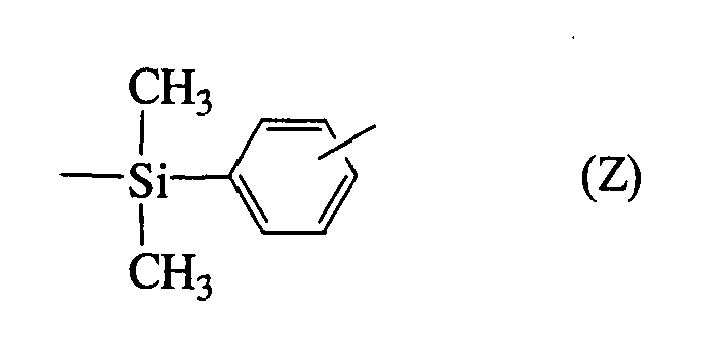
- X is -CH 2 -, -CH 2 O-, -CH 2 OCH 2 - or -Y-NR 1 -CO- wherein Y is -CH 2 - or an o-, m- or p-dimethylsilylphenylene group of the following structural formula (Z): and R 1 is hydrogen or a substituted or unsubstituted monovalent hydrocarbon group
- X' is -CH 2 -, -OCH 2 -, -CH 2 OCH 2 - or -CO-NR 1 -Y'- wherein Y' is -CH 2 - or an o-, m- or p-dimethylsilylphenylene group of the following structural formula (Z'): and R 1 is
- Rf 1 is a divalent perfluoropolyether structure, preferably having the following general formula (i) or (ii).
- p and q each are an integer of 1 to 150, the sum of p+q is 2 to 200 on average, r is an integer of 0 to 6, and t is 2 or 3.
- u is an integer of 1 to 200
- v is an integer of 1 to 50
- the sum of u+v is 10 to 250 on average
- t is as defined above.
- component (A) is a polyfluoromonoalkenyl compound having the following general formula (3).
- Rf 2 -(X') a -CH CH 2 (3)
- X' and "a" are as defined above
- Rf 2 is a monovalent perfluoropolyether group e.g. of the general formula (iii): wherein t is as defined above, and w is an integer of at least 1.
- component (A) are compounds having the following general formula (1).
- the invention favors use of a straight-chain fluoropolyether compound of formula (1) as component (A).
- X is -CH 2 -, -CH 2 O-, -CH 2 OCH 2 - or -Y-NR 1 -CO- wherein Y is -CH 2 - or a group of the following structural formula (Z): (o-, m- or p-position), and R 1 is hydrogen, methyl, phenyl or allyl
- X' is -CH 2 -, -OCH 2 -, -CH 2 OCH 2 - or -CO-NR 1 -Y'- wherein Y' is -CH 2 - or a group of the following structural formula (Z'): (o-, m- or p-position)
- R 1 is as defined above, "a” is independently 0 or 1, L is an integer of 2 to 6, and b and c each are an integer of 0
- Component (B) is an organosilicon compound having at least two silicon atom-bonded hydrogen atoms (i.e., SiH groups) in a molecule. It serves as a crosslinking agent and chain extender for component (A). When compatibility with and dispersion in component (A) and uniformity after curing are taken into account, the organosilicon compound should preferably have at least one fluorinated group in a molecule.
- Suitable fluorinated groups include those of the following general formulae. C g F 2g+1 - -C g F 2g -
- Letter g is an integer of 1 to 20, preferably 2 to 10.
- Letter f is an integer of 2 to 200, preferably 2 to 100, and h is an integer of 1 to 3.
- Letters i and j each are an integer of at least 1, and an average of i+j is from 2 to 200, preferably from 2 to 100.
- organosilicon compounds having such fluorinated groups are shown below. Note that Me is methyl and Ph is phenyl.
- organosilicon compounds may be used alone or in admixture of two or more.
- Component (B) is blended in an effective amount to cure component (A). Most often, component (B) having hydrosilyl (or SiH) groups is blended in such an amount as to provide 0.5 to 5 moles, and more preferably 1 to 2 moles of SiH groups per mole of alkenyl groups (e.g., vinyl, allyl or cycloalkenyl) in component (A). Outside the range, less amounts of component (B) may achieve an insufficient degree of crosslinking; and excessive amounts of component (B) may allow chain lengthening to become preferential, inviting under-curing, foaming, and degradation of heat resistance and compression set.
- alkenyl groups e.g., vinyl, allyl or cycloalkenyl
- Component (C) is an organosilicon compound having a silanol group in a molecule and a melting point of at least 60°C. It is found to serve as an internal mold release agent for imparting mold release and low sticking properties.
- liquid internal mold release agents are added to a polymer component, the compositions become thickened because most mold release agents are incompatible with the polymer component. Such a viscosity buildup is detrimental to workability like liquid injection molding system (LIMS) workability. So this approach is impractical. Additionally, some liquid internal mold release agents will separate from the compositions during shelf storage.
- LIMS liquid injection molding system
- the internal mold release agent (C) be solid during storage at room temperature.
- shelf stability requires the agent to have a melting point of at least 60°C and preferably in the range of 80 to 160°C.
- the compound (C) should have at least one silanol group, preferably two silanol groups, in a molecule.
- the silanol group is necessary in order that the compound (C) bleed out on the surface of the cured composition when the composition is heated above the melting point of the compound (C) during the curing or post-curing step.
- organosilicon compounds having one or two silicon atoms Typical of the solid organosilicon compound having at least one silanol group in a molecule and a melting point of at least 60°C are organosilicon compounds having one or two silicon atoms.
- Compounds having one or more aryl or arylene (e.g. phenyl or phenylene) moieties bonded to Si are useful.
- Ar 1 is a substituted or unsubstituted, monovalent aromatic hydrocarbon group of 6 to 12 carbon atoms
- Ar 2 is a substituted or unsubstituted, divalent aromatic hydrocarbon group of 6 to 12 carbon atoms
- R is a substituted or unsubstituted, monovalent hydrocarbon group of 1 to 10 carbon atoms
- m is 0, 1 or 2
- n is 1, 2 or 3, satisfying 1 ⁇ m+n ⁇ 3.
- component (C) is added to 100 parts by weight of component (A).
- the amount of component (C) added is more preferably 0.3 to 5.0 parts by weight when a balance of mold release and mechanical properties and stability are taken into account. Mold release might not be effective at less than 0.1 part of component (C) whereas more than 20 parts of component (C) may sometimes degrade mechanical properties.
- Component (D) is a hydrosilylation catalyst for promoting the addition reaction between alkenyl groups in component (A) and hydrosilyl groups in component (B).
- the hydrosilylation catalyst is often selected from noble metal compounds which are expensive. Platinum and platinum compounds are thus used because they are readily available.
- platinum compounds are chloroplatinic acid, complexes of chloroplatinic acid with olefins such as ethylene, complexes of chloroplatinic acid with alcohols and vinylsiloxanes, and metallic platinum supported on silica, alumina or carbon, though not limited thereto.
- Known platinum group metal compounds other than the platinum compounds include rhodium, ruthenium, iridium, and palladium compounds, for example, RhCl(PPh 3 ) 3 , RhCl(CO)(PPh 3 ) 2 , Ru 3 (CO) 12 , IrCl(CO)(PPh 3 ) 2 , and Pd(PPh 3 ) 4 wherein Ph denotes phenyl.
- the hydrosilylation catalyst may be used in a catalytic amount. It is preferably added in an amount to give 0.1 to 100 parts by weight of platinum group metal per million parts by weight of components (A), (B) and (C) combined.
- fillers typically reinforcing fillers may be added to the inventive composition for improving mechanical strength.
- Reinforcing fillers are added for the purposes of improving mechanical strength, thermal stability, weather resistance, chemical resistance and/or flame retardance, reducing thermal shrinkage upon curing, reducing the coefficient of thermal expansion of the cured elastomer, and/or lowering the gas permeability.
- the major purpose is to improve mechanical strength.
- Exemplary fillers include fumed silica, wet silica, ground silica, calcium carbonate, diatomaceous earth, carbon black and various metal oxide powders, which may be treated with surface treating agents, if desired.
- fumed silica is preferred from the standpoint of improving mechanical strength. Fumed silica treated with a silane base surface treating agent is especially preferred because it is effectively dispersible.
- the filler is preferably added in an amount of 5 to 200 parts by weight per 100 parts by weight of component (A).
- the amount of the filler preferred for the stability of mechanical properties is 10 to 60 parts by weight.
- pigments, dyes and the like may be compounded in the curable fluoropolyether rubber composition of the invention.
- various additives may be added to the inventive composition.
- Such optional additives include inhibitors of the hydrosilylation catalyst, for example, acetylene alcohols such as 1-ethynyl-1-hydroxycyclohexane, 3-methyl-1-butyn-3-ol, 3,5-dimethyl-1-hexyn-3-ol, 3-methyl-1-penten-3-ol, and phenylbutenol; 3-methyl-3-penten-1-yne, 3,5-dimethyl-3-hexen-1-yne, and the like; polymethylvinylsiloxane cyclic compounds; and organophosphorus compounds. Incorporation of such an inhibitor leads to a compromise between cure reactivity and storage stability.
- the method of preparing the curable fluoropolyether rubber composition of the invention is not critical.
- the composition may be formulated as a single composition by combining all the essential components.
- the rubber composition is formulated into two packs where the two packs are mixed together on use.
- Cured parts can be formed by prior art known techniques, for example, by feeding the inventive composition into a suitable mold and causing the composition to cure therein, or by applying the inventive composition onto a suitable substrate and causing the coating to cure. Often, the composition is cured simply by heating at a temperature of about 100 to 180°C for about 10 seconds to about 30 minutes.
- the fluoropolyether rubber composition of the invention in the cured state has good heat resistance, chemical resistance, solvent resistance, water repellency, oil repellency, weather resistance and the like.
- the molded (or cured) parts have satisfactory compression set and smooth parting properties, especially smooth mold release properties. Because of these features, the cured parts find a variety of applications.
- Rubber articles using the cured composition of the invention are suitable for use in automobiles, chemical plants, ink jet printers, semiconductor manufacturing lines, analytical or scientific instruments, medical equipment, aircraft or fuel cells and as rubber parts such as diaphragms, valves, O-rings, oil seals, gaskets, packings, joints and face seals.
- rubber articles comprising the cured composition of the invention are used as rubber parts for automobiles, rubber parts for chemical plants, rubber parts for ink jet printers, rubber parts for semiconductor manufacturing lines, rubber parts for analytical or scientific instruments, rubber parts for medical equipment, and rubber parts for aircraft, as well as tent film materials, sealants, molded parts, extruded parts, coatings, copier roll materials, electrical moisture-proof coatings, sensor potting materials, fuel cell seals, laminate rubber fabrics, and release paper materials.
- Rubber articles made of the cured composition of the invention include, but are not limited to, rubber parts for automobiles, for example, diaphragms such as fuel regulator diaphragms, pulsation damper diaphragms, oil pressure switch diaphragms, and EGR diaphragms, valves such as canister valves and power control valves, O-rings such as quick connector O-rings and injector O-rings, and seals such as oil seals and cylinder head gaskets; rubber parts for chemical plants, for example, pump diaphragms, valves, O-rings, packings, oil seals, and gaskets; rubber parts for ink jet printers and semiconductor manufacturing lines, for example, diaphragms, valves, O-rings, packings, and gaskets; rubber parts for analytical and scientific instruments and medical equipment, for example, pump diaphragms, O-rings, packings, valves, and joints; and rubber parts for aircraft, for example, O-rings,
- a rubber composition was deaerated in vacuum, cast into a rectangular frame of 2 mm thick, deaerated again, press-cured at 100 kg/cm 2 and 150°C for 10 minutes, and post-cured at 200°C for 4 hours.
- a test specimen was cut from the cured sample and measured for hardness, elongation, tensile strength and tear strength according to JIS K6251, K6252 and K6253. Note that tear strength was measured on crescent shaped specimens. Also the viscosity of a rubber composition was measured prior to cure according to JIS K7117.
- a rubber composition was molded under the same conditions as above except that a mold having six O-ring-forming cavities of JIS P-8 size (whose surface was chromium plated) was used. By examining how O-rings were removed from the mold, mold release was evaluated according to the following criterion.
- a rubber composition was molded integrally with a chromium-plated plate (25 ⁇ 100 ⁇ 0.3 mm) under the same conditions as in the measurement of rubber physical properties.
- the force needed to peel the rubber coating from the plate at an angle of 180° was measured by a strograph E-L (Toyo Seiki Co., Ltd.).
- a rubber composition was cast into an O-ring mold having an inner diameter of 25.0 mm and a ring cross-section diameter of 3.50 mm, press-cured at 150°C for 10 minutes, and post-cured at 200°C for 4 hours.
- the O-ring thus obtained was used as a test specimen.
- the specimen was held by a mold jig, compressed 25% at 200°C for 24 hours, cooled to room temperature, and released from the jig. From the thickness values of the specimen before and after the compression, a compression set was computed.
- diphenylsilane diol (Additive A), triphenylsilanol (Additive B), or 1,4-bis(hydroxydimethylsilyl)benzene (Additive C), identified below, was added in the amount shown in Table 1. They were dispersed on a three-roll mill to form a rubber composition, after which the rubber physical properties, mold release, peeling force and compression set were determined as above.
- compositions of Examples are significantly improved in mold release and peeling force, and approximately equal in viscosity, rubber physical properties and compression set. It is demonstrated that the addition of the specific internal mold release agents improves the mold release and peeling force of the composition without detracting from physical properties.
Landscapes
- Chemical & Material Sciences (AREA)
- Health & Medical Sciences (AREA)
- Chemical Kinetics & Catalysis (AREA)
- Medicinal Chemistry (AREA)
- Polymers & Plastics (AREA)
- Organic Chemistry (AREA)
- General Chemical & Material Sciences (AREA)
- Compositions Of Macromolecular Compounds (AREA)
- Gasket Seals (AREA)
Abstract
Description
- This invention relates to curable fluoropolyether rubber compositions which cure into rubber products having good solvent resistance, chemical resistance, weather resistance, parting property, water repellency, oil repellency and heat resistance as well as good mold release and low sticking.
-
Japanese Patent No. 2,990,646 JP-A 8-199070 - This fluoropolyether rubber composition can be readily formed into most shapes. In the case of complex shape parts or thin-wall parts like diaphragms, however, it is difficult to remove the molded composition from the mold because of tackiness. Since the difficulty of mold release leads to low production yields of molding step and an increased duration of molding cycle, there is a need for further improvement in processability.
- If customarily used mold release agents of the internal addition type for rubber materials based on silicone oil and surfactant (known as internal mold release agents) are incorporated, they invite a rise of viscosity and a loss of fluidity, leading to molding difficulties.
- An aim herein is to provide new and useful curable fluoropolyether rubber compositions, methods of using them, and articles made from them. Desirable properties include heat resistance, chemical resistance, solvent resistance, water repellency, oil repellency, and weather resistance. In particular, improved mold release properties and minimized sticking are of interest.
- It has been found that when an organosilicon compound having a silanol group in a molecule and a melting point of at least 60°C is incorporated in a fluoropolyether rubber composition, the resulting composition undergoes little viscosity buildup and cures into products exhibiting improved mold release and minimized sticking while retaining good heat resistance, chemical resistance, solvent resistance, water repellency, oil repellency and other properties, and that rubber articles comprising the cured composition are suited for use in many applications including automobiles, chemical plants, semiconductor manufacture apparatus and the like.
- In one aspect, the invention provides a curable fluoropolyether rubber composition comprising
- (A) a straight-chain fluoropolyether compound having at least two alkenyl groups in a molecule and a perfluoropolyether structure in the backbone,
- (B) an organosilicon compound having at least two silicon atom-bonded hydrogen atoms in a molecule,
- (C) an organosilicon compound having a silanol group in a molecule and a melting point of at least 60°C, and
- (D) a hydrosilylation catalyst.
- In a second aspect, the present invention provides a rubber article comprising the curable fluoropolyether rubber composition in the cured state.
- A third aspect is a method of making an article comprising or consisting of such rubber, by curing the composition e.g. in a mold.
- A fourth aspect is the use of component (C) as a mold release or anti-sticking agent in such a composition.
- The curable fluoropolyether rubber composition of the invention is improved in mold release and molding efficiency, enabling the molding cycle to be completed within a short time and parts of complex shape to be molded in an effective way. Since molded parts themselves are little tacky, sticking is prohibited. Advantages of the curable fluoropolyether rubber composition include solvent resistance and chemical resistance because of a high fluorine content; low moisture permeability; smooth parting and water repellency because of low surface energy. Because of these features, the cured parts find a variety of applications, for example, as rubber materials for automobiles and aircraft, sealing materials for semiconductor manufacture apparatus, tent film materials, sealants, molded parts, extruded parts, coatings, copier roll materials, electrical moisture-proof coatings, sensor potting materials, release paper materials, and the like, and perform well even where acid resistance and oil resistance are required. Other internal mold release agents (silicone oil, surfactant) may be omitted.
- Component (A) of the curable fluoropolyether rubber composition according to the invention is a straight-chain fluoropolyether compound having at least two alkenyl groups in a molecule and a perfluoropolyether structure in the backbone.
- The preferred alkenyl groups in the straight-chain fluoropolyether compound are alkenyl groups of 2 to 8 carbon atoms having a CH2=CH- structure at an end such as vinyl, allyl, propenyl, isopropenyl, butenyl and hexenyl groups, with the vinyl and allyl being preferred. The alkenyl groups may be attached to the backbone of the straight-chain fluoropolyether compound at opposite ends either directly or through divalent linkages such as -CH2-, -CH2O- or -Y-NR1-CO-. Herein Y is -CH2- or

- The straight-chain fluoropolyether compound (A) has a perfluoropolyether structure in its backbone, which is described later.
- One illustrative example of component (A) is a polyfluorodialkenyl compound having the following general formula (2).
CH2=CH-(X)a-Rf1-(X')a-CH=CH2 (2)
Herein X is -CH2-, -CH2O-, -CH2OCH2- or -Y-NR1-CO- wherein Y is -CH2- or an o-, m- or p-dimethylsilylphenylene group of the following structural formula (Z):
X' is -CH2-, -OCH2-, -CH2OCH2- or -CO-NR1-Y'- wherein Y' is -CH2- or an o-, m- or p-dimethylsilylphenylene group of the following structural formula (Z'):
Rf1 is a divalent perfluoropolyether group, and
"a" is independently 0 or 1. - In formula (2), Rf1 is a divalent perfluoropolyether structure, preferably having the following general formula (i) or (ii).


- Another illustrative example of component (A) is a polyfluoromonoalkenyl compound having the following general formula (3).
Rf 2 -(X') a -CH=CH 2 (3)
Herein X' and "a" are as defined above, Rf2 is a monovalent perfluoropolyether group e.g. of the general formula (iii):
- Preferred examples of component (A) are compounds having the following general formula (1). The invention favors use of a straight-chain fluoropolyether compound of formula (1) as component (A).

X' is -CH2-, -OCH2-, -CH2OCH2- or -CO-NR1-Y'- wherein Y' is -CH2- or a group of the following structural formula (Z'):
"a" is independently 0 or 1, L is an integer of 2 to 6, and b and c each are an integer of 0 to 200. - Component (B) is an organosilicon compound having at least two silicon atom-bonded hydrogen atoms (i.e., SiH groups) in a molecule. It serves as a crosslinking agent and chain extender for component (A). When compatibility with and dispersion in component (A) and uniformity after curing are taken into account, the organosilicon compound should preferably have at least one fluorinated group in a molecule.
- Suitable fluorinated groups include those of the following general formulae.
CgF2g+1-
-CgF2g-
- Letter g is an integer of 1 to 20, preferably 2 to 10.

- Letter f is an integer of 2 to 200, preferably 2 to 100, and h is an integer of 1 to 3.

- Letters i and j each are an integer of at least 1, and an average of i+j is from 2 to 200, preferably from 2 to 100.
- Examples of the organosilicon compounds having such fluorinated groups are shown below. Note that Me is methyl and Ph is phenyl.


- These organosilicon compounds may be used alone or in admixture of two or more.
- Component (B) is blended in an effective amount to cure component (A). Most often, component (B) having hydrosilyl (or SiH) groups is blended in such an amount as to provide 0.5 to 5 moles, and more preferably 1 to 2 moles of SiH groups per mole of alkenyl groups (e.g., vinyl, allyl or cycloalkenyl) in component (A). Outside the range, less amounts of component (B) may achieve an insufficient degree of crosslinking; and excessive amounts of component (B) may allow chain lengthening to become preferential, inviting under-curing, foaming, and degradation of heat resistance and compression set.
- Component (C) is an organosilicon compound having a silanol group in a molecule and a melting point of at least 60°C. It is found to serve as an internal mold release agent for imparting mold release and low sticking properties.
- If customary liquid internal mold release agents are added to a polymer component, the compositions become thickened because most mold release agents are incompatible with the polymer component. Such a viscosity buildup is detrimental to workability like liquid injection molding system (LIMS) workability. So this approach is impractical. Additionally, some liquid internal mold release agents will separate from the compositions during shelf storage.
- In this sense, it is crucial that the internal mold release agent (C) be solid during storage at room temperature. Specifically, shelf stability requires the agent to have a melting point of at least 60°C and preferably in the range of 80 to 160°C.
- In addition, the compound (C) should have at least one silanol group, preferably two silanol groups, in a molecule. The silanol group is necessary in order that the compound (C) bleed out on the surface of the cured composition when the composition is heated above the melting point of the compound (C) during the curing or post-curing step.
- Typical of the solid organosilicon compound having at least one silanol group in a molecule and a melting point of at least 60°C are organosilicon compounds having one or two silicon atoms. Compounds having one or more aryl or arylene (e.g. phenyl or phenylene) moieties bonded to Si are useful. Preferred are compounds having the general formulae (I) and (II).

- Illustrative examples of the compounds having formulae (I) and (II) are given below. Me is methyl.


- Preferably 0.1 to 20 parts by weight of component (C) is added to 100 parts by weight of component (A). The amount of component (C) added is more preferably 0.3 to 5.0 parts by weight when a balance of mold release and mechanical properties and stability are taken into account. Mold release might not be effective at less than 0.1 part of component (C) whereas more than 20 parts of component (C) may sometimes degrade mechanical properties.
- Component (D) is a hydrosilylation catalyst for promoting the addition reaction between alkenyl groups in component (A) and hydrosilyl groups in component (B). The hydrosilylation catalyst is often selected from noble metal compounds which are expensive. Platinum and platinum compounds are thus used because they are readily available.
- Exemplary platinum compounds are chloroplatinic acid, complexes of chloroplatinic acid with olefins such as ethylene, complexes of chloroplatinic acid with alcohols and vinylsiloxanes, and metallic platinum supported on silica, alumina or carbon, though not limited thereto. Known platinum group metal compounds other than the platinum compounds include rhodium, ruthenium, iridium, and palladium compounds, for example, RhCl(PPh3)3, RhCl(CO)(PPh3)2, Ru3(CO)12, IrCl(CO)(PPh3)2, and Pd(PPh3)4 wherein Ph denotes phenyl.
- The hydrosilylation catalyst may be used in a catalytic amount. It is preferably added in an amount to give 0.1 to 100 parts by weight of platinum group metal per million parts by weight of components (A), (B) and (C) combined.
- In addition to the foregoing components (A) to (D), fillers, typically reinforcing fillers may be added to the inventive composition for improving mechanical strength. Reinforcing fillers are added for the purposes of improving mechanical strength, thermal stability, weather resistance, chemical resistance and/or flame retardance, reducing thermal shrinkage upon curing, reducing the coefficient of thermal expansion of the cured elastomer, and/or lowering the gas permeability. The major purpose is to improve mechanical strength.
- Exemplary fillers include fumed silica, wet silica, ground silica, calcium carbonate, diatomaceous earth, carbon black and various metal oxide powders, which may be treated with surface treating agents, if desired. Among others, fumed silica is preferred from the standpoint of improving mechanical strength. Fumed silica treated with a silane base surface treating agent is especially preferred because it is effectively dispersible.
- The filler is preferably added in an amount of 5 to 200 parts by weight per 100 parts by weight of component (A). The amount of the filler preferred for the stability of mechanical properties is 10 to 60 parts by weight.
- If desired, pigments, dyes and the like may be compounded in the curable fluoropolyether rubber composition of the invention. Insofar as the benefits of the invention are not impaired, various additives may be added to the inventive composition. Such optional additives include inhibitors of the hydrosilylation catalyst, for example, acetylene alcohols such as 1-ethynyl-1-hydroxycyclohexane, 3-methyl-1-butyn-3-ol, 3,5-dimethyl-1-hexyn-3-ol, 3-methyl-1-penten-3-ol, and phenylbutenol; 3-methyl-3-penten-1-yne, 3,5-dimethyl-3-hexen-1-yne, and the like; polymethylvinylsiloxane cyclic compounds; and organophosphorus compounds. Incorporation of such an inhibitor leads to a compromise between cure reactivity and storage stability.
- The method of preparing the curable fluoropolyether rubber composition of the invention is not critical. The composition may be formulated as a single composition by combining all the essential components. Alternatively, the rubber composition is formulated into two packs where the two packs are mixed together on use.
- Cured parts can be formed by prior art known techniques, for example, by feeding the inventive composition into a suitable mold and causing the composition to cure therein, or by applying the inventive composition onto a suitable substrate and causing the coating to cure. Often, the composition is cured simply by heating at a temperature of about 100 to 180°C for about 10 seconds to about 30 minutes.
- The fluoropolyether rubber composition of the invention in the cured state has good heat resistance, chemical resistance, solvent resistance, water repellency, oil repellency, weather resistance and the like. In addition, the molded (or cured) parts have satisfactory compression set and smooth parting properties, especially smooth mold release properties. Because of these features, the cured parts find a variety of applications.
- Rubber articles using the cured composition of the invention are suitable for use in automobiles, chemical plants, ink jet printers, semiconductor manufacturing lines, analytical or scientific instruments, medical equipment, aircraft or fuel cells and as rubber parts such as diaphragms, valves, O-rings, oil seals, gaskets, packings, joints and face seals.
- More illustratively, rubber articles comprising the cured composition of the invention are used as rubber parts for automobiles, rubber parts for chemical plants, rubber parts for ink jet printers, rubber parts for semiconductor manufacturing lines, rubber parts for analytical or scientific instruments, rubber parts for medical equipment, and rubber parts for aircraft, as well as tent film materials, sealants, molded parts, extruded parts, coatings, copier roll materials, electrical moisture-proof coatings, sensor potting materials, fuel cell seals, laminate rubber fabrics, and release paper materials.
- Rubber articles made of the cured composition of the invention include, but are not limited to,
rubber parts for automobiles, for example, diaphragms such as fuel regulator diaphragms, pulsation damper diaphragms, oil pressure switch diaphragms, and EGR diaphragms, valves such as canister valves and power control valves, O-rings such as quick connector O-rings and injector O-rings, and seals such as oil seals and cylinder head gaskets;
rubber parts for chemical plants, for example, pump diaphragms, valves, O-rings, packings, oil seals, and gaskets;
rubber parts for ink jet printers and semiconductor manufacturing lines, for example, diaphragms, valves, O-rings, packings, and gaskets;
rubber parts for analytical and scientific instruments and medical equipment, for example, pump diaphragms, O-rings, packings, valves, and joints; and
rubber parts for aircraft, for example, O-rings, face seals, packings, gaskets, diaphragms, and valves in fluid piping for engine oil, jet fuel, hydraulic oil and Skydrol®. - Examples of the invention are given below by way of illustration and not by way of limitation. All parts are by weight.
- Preparation of a base compound and evaluation of rubber physical properties of cured compositions are described below.
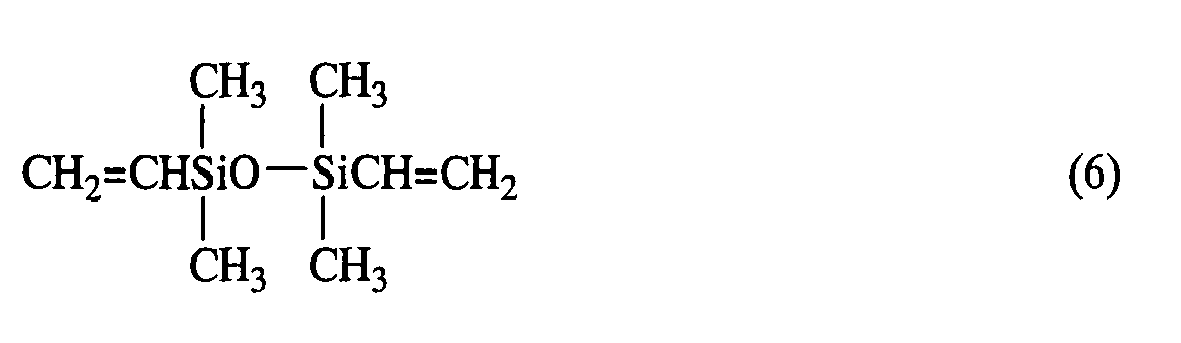
- To 100 parts of a polymer of the formula (4) shown below (viscosity 8,300 cs, weight average molecular weight 22,000, vinyl content 0.009 mole/100 g) was added 25 parts of fumed silica treated with dimethylsiloxy groups and having a specific surface area of 200 m2/g. They were mixed, heat treated and milled on a three-roll mill. To the mixture were added 2.74 parts of a fluorinated organosilicon compound of the formula (5) shown below, 0.2 part of a toluene solution of a catalyst in the form of chloroplatinic acid modified with a compound of the formula (6) shown below (platinum concentration 0.5 wt%) and 0.4 part of a fluorine-modified acetylene alcohol. They were mixed to form a base compound.


- A rubber composition was deaerated in vacuum, cast into a rectangular frame of 2 mm thick, deaerated again, press-cured at 100 kg/cm2 and 150°C for 10 minutes, and post-cured at 200°C for 4 hours. A test specimen was cut from the cured sample and measured for hardness, elongation, tensile strength and tear strength according to JIS K6251, K6252 and K6253. Note that tear strength was measured on crescent shaped specimens. Also the viscosity of a rubber composition was measured prior to cure according to JIS K7117.
- A rubber composition was molded under the same conditions as above except that a mold having six O-ring-forming cavities of JIS P-8 size (whose surface was chromium plated) was used. By examining how O-rings were removed from the mold, mold release was evaluated according to the following criterion.
- ⊚: very smooth
- ○: smooth
- △: fairly smooth
- ×: difficult
- A rubber composition was molded integrally with a chromium-plated plate (25 × 100 × 0.3 mm) under the same conditions as in the measurement of rubber physical properties. The force needed to peel the rubber coating from the plate at an angle of 180° was measured by a strograph E-L (Toyo Seiki Co., Ltd.).
- A rubber composition was cast into an O-ring mold having an inner diameter of 25.0 mm and a ring cross-section diameter of 3.50 mm, press-cured at 150°C for 10 minutes, and post-cured at 200°C for 4 hours. The O-ring thus obtained was used as a test specimen. The specimen was held by a mold jig, compressed 25% at 200°C for 24 hours, cooled to room temperature, and released from the jig. From the thickness values of the specimen before and after the compression, a compression set was computed.
- To the base compound, diphenylsilane diol (Additive A), triphenylsilanol (Additive B), or
1,4-bis(hydroxydimethylsilyl)benzene (Additive C), identified below, was added in the amount shown in Table 1. They were dispersed on a three-roll mill to form a rubber composition, after which the rubber physical properties, mold release, peeling force and compression set were determined as above.


Table 1 Formulation (pbw) Example Comparative Example 1 2 3 4 5 1 Base compound 100 100 100 100 100 100 Additive A 0.5 1 Additive B 0.5 1 Additive C 1 Properties Viscosity (Pa·s) 884 910 866 888 894 858 Hardness (Durometer A) 53 54 53 54 53 53 Elongation (%) 510 490 520 500 520 500 Tensile strength (MPa) 9.7 9.5 9.9 10.1 9.6 10.4 Tear strength (kN/m) 32 34 34 34 32 35 Mold release ○ ⊚ ⊚ ⊚ ⊚ × Peeling force (kgf/25 mm) 0.3 0.1 0.2 0.1 0.2 1.6 Compression set @200°C/24hr/25% compression (%) 18 20 19 18 20 18 - As compared with Comparative Example 1 having no additive added, the compositions of Examples are significantly improved in mold release and peeling force, and approximately equal in viscosity, rubber physical properties and compression set. It is demonstrated that the addition of the specific internal mold release agents improves the mold release and peeling force of the composition without detracting from physical properties.
Claims (9)
- A curable fluoropolyether rubber composition comprising(A) straight-chain fluoropolyether compound having at least two alkenyl groups per molecule and a perfluoropolyether structure in the backbone,(B) organosilicon compound having at least two silicon atom-bonded hydrogen atoms in a molecule,(C) organosilicon compound having a silanol group in a molecule and a melting point of at least 60°C, and(D) hydrosilylation catalyst.
- The composition of claim 1 wherein component (A) is a straight-chain fluoropolyether compound of the following general formula (1):


X' is -CH2-, -OCH2-, -CH2OCH2- or -CO-NR1-Y'- wherein Y' is -CH2- or a group of the following structural formula (Z'):
"a" is independently 0 or 1, L is an integer of 2 to 6, and b and c each are an integer of 0 to 200. - The composition of claim 1 or 2 wherein component (C) is an organosilicon compound of the general formula (I) or (II):

- A rubber article comprising the curable fluoropolyether rubber composition of claim 1, 2 or 3 in the cured state.
- The rubber article of claim 4 for use in automobiles, chemical plants, ink jet printers, semiconductor manufacturing lines, analytical or scientific instruments, medical equipment, aircraft or fuel cells.
- The rubber article of claim 4 or 5 which is a diaphragm, valve, O-ring, oil seal, gasket, packing, joint or face seal.
- A method of making an article comprising or consisting of a fluororubber, comprising curing a composition according to any one of claims 1 to 3.
- A method of claim 7 in which the composition is cured in contact with a mold or other forming substrate from which it is subsequently separated.
- In a composition according to any one of claims 1 to 3, the use of component (C) as a mold release agent or anti-sticking agent.
Applications Claiming Priority (1)
| Application Number | Priority Date | Filing Date | Title |
|---|---|---|---|
| JP2005123838A JP4446183B2 (en) | 2005-04-21 | 2005-04-21 | Curable fluoropolyether rubber composition and rubber product |
Publications (2)
| Publication Number | Publication Date |
|---|---|
| EP1715005A1 true EP1715005A1 (en) | 2006-10-25 |
| EP1715005B1 EP1715005B1 (en) | 2009-08-05 |
Family
ID=36636387
Family Applications (1)
| Application Number | Title | Priority Date | Filing Date |
|---|---|---|---|
| EP06252171A Expired - Lifetime EP1715005B1 (en) | 2005-04-21 | 2006-04-21 | Curable fluoropolyether rubber compositions and rubber articles |
Country Status (4)
| Country | Link |
|---|---|
| US (1) | US7718723B2 (en) |
| EP (1) | EP1715005B1 (en) |
| JP (1) | JP4446183B2 (en) |
| DE (1) | DE602006008204D1 (en) |
Cited By (1)
| Publication number | Priority date | Publication date | Assignee | Title |
|---|---|---|---|---|
| US7718723B2 (en) * | 2005-04-21 | 2010-05-18 | Shin-Etsu Chemical Co., Ltd. | Curable fluoropolyether rubber compositions and rubber articles |
Families Citing this family (5)
| Publication number | Priority date | Publication date | Assignee | Title |
|---|---|---|---|---|
| JP5141862B2 (en) * | 2006-12-01 | 2013-02-13 | 信越化学工業株式会社 | Curable fluoropolyether rubber composition for masking |
| JP2012211263A (en) | 2011-03-31 | 2012-11-01 | Wacker Asahikasei Silicone Co Ltd | Oil-repellent coating material composition |
| JP5799930B2 (en) * | 2012-10-19 | 2015-10-28 | 信越化学工業株式会社 | Curable fluoropolyether gel composition and gel product using the cured product |
| JP5869462B2 (en) * | 2012-11-02 | 2016-02-24 | 信越化学工業株式会社 | Curable composition for sealing optical semiconductor and optical semiconductor device using the same |
| JP6160540B2 (en) * | 2014-03-31 | 2017-07-12 | 信越化学工業株式会社 | Curable perfluoropolyether gel composition and gel product using the cured product |
Citations (4)
| Publication number | Priority date | Publication date | Assignee | Title |
|---|---|---|---|---|
| EP0967251A1 (en) * | 1998-06-22 | 1999-12-29 | Shin-Etsu Chemical Co., Ltd. | Fluororubber compositions and method of making |
| US20010008914A1 (en) * | 1999-12-06 | 2001-07-19 | Yasuhisa Osawa | Fluororubber compositions |
| JP2003292761A (en) * | 2002-04-01 | 2003-10-15 | Shin Etsu Chem Co Ltd | Curable fluoropolyether rubber composition and rubber product |
| EP1422260A2 (en) * | 2002-11-19 | 2004-05-26 | Shin-Etsu Chemical Co., Ltd. | Curable fluoropolyether rubber compositions and rubber articles |
Family Cites Families (11)
| Publication number | Priority date | Publication date | Assignee | Title |
|---|---|---|---|---|
| FR2603894B1 (en) * | 1986-09-11 | 1988-11-18 | Rhone Poulenc Chimie | ORGANOPOLYSILOXANE COMPOSITION COMPRISING A CURING ACCELERATOR |
| JPH0649348A (en) * | 1992-08-04 | 1994-02-22 | Shin Etsu Chem Co Ltd | Room temperature curing polyether composition |
| EP0725113B1 (en) | 1995-01-23 | 2000-09-27 | Shin-Etsu Chemical Co., Ltd. | Fluorinated amide silicone compounds and curable siloxane compositions |
| JP2990646B2 (en) | 1995-01-23 | 1999-12-13 | 信越化学工業株式会社 | Curable composition |
| EP0745604A3 (en) * | 1995-05-29 | 1998-07-29 | Shin-Etsu Chemical Co., Ltd. | Room temperature curable fluoropolymer composition; and fluorine-containing organosilicon compounds, a method of producing the same, and room temperature curable silicone composition containing the same |
| JP3239717B2 (en) * | 1995-09-29 | 2001-12-17 | 信越化学工業株式会社 | Curable composition |
| JP2000086897A (en) * | 1998-09-16 | 2000-03-28 | Dow Corning Toray Silicone Co Ltd | Curable silicone composition for seismic isolation laminate |
| JP3567973B2 (en) * | 1999-09-03 | 2004-09-22 | 信越化学工業株式会社 | Curable composition |
| US6461419B1 (en) * | 1999-11-01 | 2002-10-08 | 3M Innovative Properties Company | Curable inkjet printable ink compositions |
| JP2001220509A (en) * | 2000-02-07 | 2001-08-14 | Shin Etsu Chem Co Ltd | Curable composition |
| JP4446183B2 (en) * | 2005-04-21 | 2010-04-07 | 信越化学工業株式会社 | Curable fluoropolyether rubber composition and rubber product |
-
2005
- 2005-04-21 JP JP2005123838A patent/JP4446183B2/en not_active Expired - Fee Related
-
2006
- 2006-04-20 US US11/407,139 patent/US7718723B2/en not_active Expired - Fee Related
- 2006-04-21 DE DE602006008204T patent/DE602006008204D1/en not_active Expired - Fee Related
- 2006-04-21 EP EP06252171A patent/EP1715005B1/en not_active Expired - Lifetime
Patent Citations (4)
| Publication number | Priority date | Publication date | Assignee | Title |
|---|---|---|---|---|
| EP0967251A1 (en) * | 1998-06-22 | 1999-12-29 | Shin-Etsu Chemical Co., Ltd. | Fluororubber compositions and method of making |
| US20010008914A1 (en) * | 1999-12-06 | 2001-07-19 | Yasuhisa Osawa | Fluororubber compositions |
| JP2003292761A (en) * | 2002-04-01 | 2003-10-15 | Shin Etsu Chem Co Ltd | Curable fluoropolyether rubber composition and rubber product |
| EP1422260A2 (en) * | 2002-11-19 | 2004-05-26 | Shin-Etsu Chemical Co., Ltd. | Curable fluoropolyether rubber compositions and rubber articles |
Cited By (1)
| Publication number | Priority date | Publication date | Assignee | Title |
|---|---|---|---|---|
| US7718723B2 (en) * | 2005-04-21 | 2010-05-18 | Shin-Etsu Chemical Co., Ltd. | Curable fluoropolyether rubber compositions and rubber articles |
Also Published As
| Publication number | Publication date |
|---|---|
| EP1715005B1 (en) | 2009-08-05 |
| JP4446183B2 (en) | 2010-04-07 |
| US7718723B2 (en) | 2010-05-18 |
| JP2006299109A (en) | 2006-11-02 |
| DE602006008204D1 (en) | 2009-09-17 |
| US20060241223A1 (en) | 2006-10-26 |
Similar Documents
| Publication | Publication Date | Title |
|---|---|---|
| EP1389632B1 (en) | Curable fluoropolyether rubber compositions and rubber articles | |
| US20050159550A1 (en) | Injection molding fluoropolyether rubber compositions | |
| EP2368942B1 (en) | Fluorine-containing curable composition and rubber article | |
| US20020019483A1 (en) | Curable fluoropolyether base rubber compositions | |
| US6759468B2 (en) | Curable fluoropolyether base rubber compositions | |
| EP1614718A1 (en) | Curable fluoropolyether compositions, their preparation and use | |
| EP1422260B1 (en) | Curable fluoropolyether rubber compositions and rubber articles | |
| US20030225200A1 (en) | Curable fluoropolyether rubber compositions and rubber articles | |
| US6528562B2 (en) | Curable fluoropolyether rubber compositions | |
| EP1715005B1 (en) | Curable fluoropolyether rubber compositions and rubber articles | |
| JP2009149782A (en) | Curable fluoropolyether rubber composition | |
| US20060270791A1 (en) | Fluorine-containing material | |
| US20030232919A1 (en) | Fluororubber compositions and making method | |
| US20040229992A1 (en) | Curable fluoropolyether rubber compositions and rubber articles | |
| US6815492B2 (en) | Rubber parts for aircraft | |
| JP2003292761A (en) | Curable fluoropolyether rubber composition and rubber product | |
| JP2005097369A (en) | Curable fluoropolyether rubber composition and rubber product | |
| US20020137842A1 (en) | Curable fluoropolyether base rubber compositions | |
| US7332538B2 (en) | Heat-curable fluoropolyether rubber compositions and rubber articles | |
| JP2001354764A (en) | Curable fluoropolyether rubber composition | |
| US20020193503A1 (en) | FIPG fluoroelastomer compositions | |
| JP2006036973A (en) | Fluoropolyether rubber composition and rubber product comprising cured product thereof |
Legal Events
| Date | Code | Title | Description |
|---|---|---|---|
| PUAI | Public reference made under article 153(3) epc to a published international application that has entered the european phase |
Free format text: ORIGINAL CODE: 0009012 |
|
| AK | Designated contracting states |
Kind code of ref document: A1 Designated state(s): AT BE BG CH CY CZ DE DK EE ES FI FR GB GR HU IE IS IT LI LT LU LV MC NL PL PT RO SE SI SK TR |
|
| AX | Request for extension of the european patent |
Extension state: AL BA HR MK YU |
|
| 17P | Request for examination filed |
Effective date: 20070129 |
|
| 17Q | First examination report despatched |
Effective date: 20070402 |
|
| AKX | Designation fees paid |
Designated state(s): DE FR GB |
|
| GRAP | Despatch of communication of intention to grant a patent |
Free format text: ORIGINAL CODE: EPIDOSNIGR1 |
|
| GRAS | Grant fee paid |
Free format text: ORIGINAL CODE: EPIDOSNIGR3 |
|
| GRAA | (expected) grant |
Free format text: ORIGINAL CODE: 0009210 |
|
| AK | Designated contracting states |
Kind code of ref document: B1 Designated state(s): DE FR GB |
|
| REG | Reference to a national code |
Ref country code: GB Ref legal event code: FG4D |
|
| REF | Corresponds to: |
Ref document number: 602006008204 Country of ref document: DE Date of ref document: 20090917 Kind code of ref document: P |
|
| PLBE | No opposition filed within time limit |
Free format text: ORIGINAL CODE: 0009261 |
|
| STAA | Information on the status of an ep patent application or granted ep patent |
Free format text: STATUS: NO OPPOSITION FILED WITHIN TIME LIMIT |
|
| 26N | No opposition filed |
Effective date: 20100507 |
|
| GBPC | Gb: european patent ceased through non-payment of renewal fee |
Effective date: 20100421 |
|
| REG | Reference to a national code |
Ref country code: FR Ref legal event code: ST Effective date: 20101230 |
|
| PG25 | Lapsed in a contracting state [announced via postgrant information from national office to epo] |
Ref country code: DE Free format text: LAPSE BECAUSE OF NON-PAYMENT OF DUE FEES Effective date: 20101103 |
|
| PG25 | Lapsed in a contracting state [announced via postgrant information from national office to epo] |
Ref country code: GB Free format text: LAPSE BECAUSE OF NON-PAYMENT OF DUE FEES Effective date: 20100421 |
|
| PG25 | Lapsed in a contracting state [announced via postgrant information from national office to epo] |
Ref country code: FR Free format text: LAPSE BECAUSE OF NON-PAYMENT OF DUE FEES Effective date: 20100430 |