EP1714545A1 - Systemic non-nodular endosymbiotic nitrogen fixation in plants - Google Patents
Systemic non-nodular endosymbiotic nitrogen fixation in plants Download PDFInfo
- Publication number
- EP1714545A1 EP1714545A1 EP06013214A EP06013214A EP1714545A1 EP 1714545 A1 EP1714545 A1 EP 1714545A1 EP 06013214 A EP06013214 A EP 06013214A EP 06013214 A EP06013214 A EP 06013214A EP 1714545 A1 EP1714545 A1 EP 1714545A1
- Authority
- EP
- European Patent Office
- Prior art keywords
- plant
- bacteria
- diazotrophicus
- leguminous
- cells
- Prior art date
- Legal status (The legal status is an assumption and is not a legal conclusion. Google has not performed a legal analysis and makes no representation as to the accuracy of the status listed.)
- Granted
Links
- IJGRMHOSHXDMSA-UHFFFAOYSA-N Atomic nitrogen Chemical compound N#N IJGRMHOSHXDMSA-UHFFFAOYSA-N 0.000 title claims abstract description 131
- 229910052757 nitrogen Inorganic materials 0.000 title claims abstract description 64
- 230000009885 systemic effect Effects 0.000 title description 16
- 241000894006 Bacteria Species 0.000 claims abstract description 125
- 239000002689 soil Substances 0.000 claims abstract description 4
- 241001468096 Gluconacetobacter diazotrophicus Species 0.000 claims description 96
- 239000000758 substrate Substances 0.000 claims description 13
- 238000000034 method Methods 0.000 claims description 12
- 230000035784 germination Effects 0.000 claims description 10
- 239000002054 inoculum Substances 0.000 claims description 10
- 238000000576 coating method Methods 0.000 claims description 6
- 230000000644 propagated effect Effects 0.000 claims description 6
- 239000011248 coating agent Substances 0.000 claims description 5
- 230000001902 propagating effect Effects 0.000 claims description 2
- 241000196324 Embryophyta Species 0.000 abstract description 157
- 240000007594 Oryza sativa Species 0.000 abstract description 13
- 235000007164 Oryza sativa Nutrition 0.000 abstract description 12
- 235000021374 legumes Nutrition 0.000 abstract description 8
- 235000009566 rice Nutrition 0.000 abstract description 8
- 240000008042 Zea mays Species 0.000 abstract description 5
- 235000016383 Zea mays subsp huehuetenangensis Nutrition 0.000 abstract description 4
- 235000002017 Zea mays subsp mays Nutrition 0.000 abstract description 4
- 235000009973 maize Nutrition 0.000 abstract description 4
- QJGQUHMNIGDVPM-UHFFFAOYSA-N nitrogen group Chemical group [N] QJGQUHMNIGDVPM-UHFFFAOYSA-N 0.000 abstract description 4
- 239000000126 substance Substances 0.000 abstract description 4
- 240000000359 Triticum dicoccon Species 0.000 abstract description 2
- 230000001419 dependent effect Effects 0.000 abstract description 2
- 235000016709 nutrition Nutrition 0.000 abstract description 2
- 230000035764 nutrition Effects 0.000 abstract description 2
- 239000003337 fertilizer Substances 0.000 abstract 1
- 210000004027 cell Anatomy 0.000 description 73
- 241000219793 Trifolium Species 0.000 description 19
- QGZKDVFQNNGYKY-UHFFFAOYSA-N Ammonia Chemical compound N QGZKDVFQNNGYKY-UHFFFAOYSA-N 0.000 description 16
- 108010020943 Nitrogenase Proteins 0.000 description 14
- SEOVTRFCIGRIMH-UHFFFAOYSA-N indole-3-acetic acid Chemical compound C1=CC=C2C(CC(=O)O)=CNC2=C1 SEOVTRFCIGRIMH-UHFFFAOYSA-N 0.000 description 14
- 238000010186 staining Methods 0.000 description 13
- 210000003934 vacuole Anatomy 0.000 description 12
- 238000004458 analytical method Methods 0.000 description 11
- 230000003834 intracellular effect Effects 0.000 description 11
- 240000003768 Solanum lycopersicum Species 0.000 description 10
- 241000209140 Triticum Species 0.000 description 10
- 230000009545 invasion Effects 0.000 description 9
- 240000002791 Brassica napus Species 0.000 description 8
- VGGSQFUCUMXWEO-UHFFFAOYSA-N Ethene Chemical compound C=C VGGSQFUCUMXWEO-UHFFFAOYSA-N 0.000 description 8
- 239000005977 Ethylene Substances 0.000 description 8
- 235000021307 Triticum Nutrition 0.000 description 8
- 229920001817 Agar Polymers 0.000 description 7
- XEEYBQQBJWHFJM-UHFFFAOYSA-N Iron Chemical compound [Fe] XEEYBQQBJWHFJM-UHFFFAOYSA-N 0.000 description 7
- 235000007688 Lycopersicon esculentum Nutrition 0.000 description 7
- 239000008272 agar Substances 0.000 description 7
- 229910021529 ammonia Inorganic materials 0.000 description 7
- 230000000694 effects Effects 0.000 description 7
- 230000012010 growth Effects 0.000 description 7
- 239000003617 indole-3-acetic acid Substances 0.000 description 7
- 238000011081 inoculation Methods 0.000 description 7
- 108090000623 proteins and genes Proteins 0.000 description 7
- HSFWRNGVRCDJHI-UHFFFAOYSA-N alpha-acetylene Natural products C#C HSFWRNGVRCDJHI-UHFFFAOYSA-N 0.000 description 6
- 235000013339 cereals Nutrition 0.000 description 6
- 125000002534 ethynyl group Chemical group [H]C#C* 0.000 description 6
- AIHDCSAXVMAMJH-GFBKWZILSA-N levan Chemical compound O[C@H]1[C@H](O)[C@@H](CO)O[C@@]1(CO)OC[C@@H]1[C@@H](O)[C@H](O)[C@](CO)(CO[C@@H]2[C@H]([C@H](O)[C@@](O)(CO)O2)O)O1 AIHDCSAXVMAMJH-GFBKWZILSA-N 0.000 description 6
- PGSADBUBUOPOJS-UHFFFAOYSA-N neutral red Chemical compound Cl.C1=C(C)C(N)=CC2=NC3=CC(N(C)C)=CC=C3N=C21 PGSADBUBUOPOJS-UHFFFAOYSA-N 0.000 description 6
- 102000004169 proteins and genes Human genes 0.000 description 6
- 230000002792 vascular Effects 0.000 description 6
- XLYOFNOQVPJJNP-UHFFFAOYSA-N water Substances O XLYOFNOQVPJJNP-UHFFFAOYSA-N 0.000 description 6
- 108090000790 Enzymes Proteins 0.000 description 5
- 102000004190 Enzymes Human genes 0.000 description 5
- 238000004178 biological nitrogen fixation Methods 0.000 description 5
- 210000003763 chloroplast Anatomy 0.000 description 5
- 230000008635 plant growth Effects 0.000 description 5
- 241000219195 Arabidopsis thaliana Species 0.000 description 4
- 241000589152 Azotobacter chroococcum Species 0.000 description 4
- LFQSCWFLJHTTHZ-UHFFFAOYSA-N Ethanol Chemical compound CCO LFQSCWFLJHTTHZ-UHFFFAOYSA-N 0.000 description 4
- RFSUNEUAIZKAJO-ARQDHWQXSA-N Fructose Chemical compound OC[C@H]1O[C@](O)(CO)[C@@H](O)[C@@H]1O RFSUNEUAIZKAJO-ARQDHWQXSA-N 0.000 description 4
- 241000605016 Herbaspirillum Species 0.000 description 4
- COHYTHOBJLSHDF-UHFFFAOYSA-N Indigo Chemical compound N1C2=CC=CC=C2C(=O)C1=C1C(=O)C2=CC=CC=C2N1 COHYTHOBJLSHDF-UHFFFAOYSA-N 0.000 description 4
- 244000042324 Trifolium repens Species 0.000 description 4
- 244000098338 Triticum aestivum Species 0.000 description 4
- 238000003556 assay Methods 0.000 description 4
- 230000001580 bacterial effect Effects 0.000 description 4
- 239000008367 deionised water Substances 0.000 description 4
- 239000007789 gas Substances 0.000 description 4
- 230000001744 histochemical effect Effects 0.000 description 4
- WQYVRQLZKVEZGA-UHFFFAOYSA-N hypochlorite Chemical compound Cl[O-] WQYVRQLZKVEZGA-UHFFFAOYSA-N 0.000 description 4
- 238000005286 illumination Methods 0.000 description 4
- 230000009467 reduction Effects 0.000 description 4
- ZKHQWZAMYRWXGA-KQYNXXCUSA-J ATP(4-) Chemical compound C1=NC=2C(N)=NC=NC=2N1[C@@H]1O[C@H](COP([O-])(=O)OP([O-])(=O)OP([O-])([O-])=O)[C@@H](O)[C@H]1O ZKHQWZAMYRWXGA-KQYNXXCUSA-J 0.000 description 3
- ZKHQWZAMYRWXGA-UHFFFAOYSA-N Adenosine triphosphate Natural products C1=NC=2C(N)=NC=NC=2N1C1OC(COP(O)(=O)OP(O)(=O)OP(O)(O)=O)C(O)C1O ZKHQWZAMYRWXGA-UHFFFAOYSA-N 0.000 description 3
- 235000011293 Brassica napus Nutrition 0.000 description 3
- 235000006008 Brassica napus var napus Nutrition 0.000 description 3
- 108010074122 Ferredoxins Proteins 0.000 description 3
- 241000209504 Poaceae Species 0.000 description 3
- 240000000111 Saccharum officinarum Species 0.000 description 3
- 235000007201 Saccharum officinarum Nutrition 0.000 description 3
- 235000010729 Trifolium repens Nutrition 0.000 description 3
- QVGXLLKOCUKJST-UHFFFAOYSA-N atomic oxygen Chemical compound [O] QVGXLLKOCUKJST-UHFFFAOYSA-N 0.000 description 3
- 238000006243 chemical reaction Methods 0.000 description 3
- 210000000805 cytoplasm Anatomy 0.000 description 3
- 230000001336 diazotrophic effect Effects 0.000 description 3
- 229910001873 dinitrogen Inorganic materials 0.000 description 3
- 210000001339 epidermal cell Anatomy 0.000 description 3
- 239000001257 hydrogen Substances 0.000 description 3
- 229910052739 hydrogen Inorganic materials 0.000 description 3
- 239000012528 membrane Substances 0.000 description 3
- 239000001301 oxygen Substances 0.000 description 3
- 229910052760 oxygen Inorganic materials 0.000 description 3
- 229920000642 polymer Polymers 0.000 description 3
- 239000000243 solution Substances 0.000 description 3
- 241000894007 species Species 0.000 description 3
- 239000000725 suspension Substances 0.000 description 3
- JXCKZXHCJOVIAV-UHFFFAOYSA-N 6-[(5-bromo-4-chloro-1h-indol-3-yl)oxy]-3,4,5-trihydroxyoxane-2-carboxylic acid;cyclohexanamine Chemical compound [NH3+]C1CCCCC1.O1C(C([O-])=O)C(O)C(O)C(O)C1OC1=CNC2=CC=C(Br)C(Cl)=C12 JXCKZXHCJOVIAV-UHFFFAOYSA-N 0.000 description 2
- 241000208838 Asteraceae Species 0.000 description 2
- 241000219193 Brassicaceae Species 0.000 description 2
- 108010060309 Glucuronidase Proteins 0.000 description 2
- SXRSQZLOMIGNAQ-UHFFFAOYSA-N Glutaraldehyde Chemical compound O=CCCCC=O SXRSQZLOMIGNAQ-UHFFFAOYSA-N 0.000 description 2
- UFHFLCQGNIYNRP-UHFFFAOYSA-N Hydrogen Chemical compound [H][H] UFHFLCQGNIYNRP-UHFFFAOYSA-N 0.000 description 2
- 244000046052 Phaseolus vulgaris Species 0.000 description 2
- 235000010627 Phaseolus vulgaris Nutrition 0.000 description 2
- 240000004713 Pisum sativum Species 0.000 description 2
- 235000010582 Pisum sativum Nutrition 0.000 description 2
- 241000589194 Rhizobium leguminosarum Species 0.000 description 2
- 229930006000 Sucrose Natural products 0.000 description 2
- CZMRCDWAGMRECN-UGDNZRGBSA-N Sucrose Chemical compound O[C@H]1[C@H](O)[C@@H](CO)O[C@@]1(CO)O[C@@H]1[C@H](O)[C@@H](O)[C@H](O)[C@@H](CO)O1 CZMRCDWAGMRECN-UGDNZRGBSA-N 0.000 description 2
- 210000002421 cell wall Anatomy 0.000 description 2
- 239000002361 compost Substances 0.000 description 2
- 239000013078 crystal Substances 0.000 description 2
- 210000001723 extracellular space Anatomy 0.000 description 2
- 239000003630 growth substance Substances 0.000 description 2
- 210000004209 hair Anatomy 0.000 description 2
- -1 hydrogen ions Chemical class 0.000 description 2
- 238000007654 immersion Methods 0.000 description 2
- 238000004519 manufacturing process Methods 0.000 description 2
- 230000000442 meristematic effect Effects 0.000 description 2
- 229910000069 nitrogen hydride Inorganic materials 0.000 description 2
- 239000008363 phosphate buffer Substances 0.000 description 2
- 230000029553 photosynthesis Effects 0.000 description 2
- 238000010672 photosynthesis Methods 0.000 description 2
- 230000008569 process Effects 0.000 description 2
- 239000012192 staining solution Substances 0.000 description 2
- 239000008223 sterile water Substances 0.000 description 2
- UCSJYZPVAKXKNQ-HZYVHMACSA-N streptomycin Chemical compound CN[C@H]1[C@H](O)[C@@H](O)[C@H](CO)O[C@H]1O[C@@H]1[C@](C=O)(O)[C@H](C)O[C@H]1O[C@@H]1[C@@H](NC(N)=N)[C@H](O)[C@@H](NC(N)=N)[C@H](O)[C@H]1O UCSJYZPVAKXKNQ-HZYVHMACSA-N 0.000 description 2
- 239000005720 sucrose Substances 0.000 description 2
- 230000031068 symbiosis, encompassing mutualism through parasitism Effects 0.000 description 2
- 210000001519 tissue Anatomy 0.000 description 2
- RZVAJINKPMORJF-UHFFFAOYSA-N Acetaminophen Chemical compound CC(=O)NC1=CC=C(O)C=C1 RZVAJINKPMORJF-UHFFFAOYSA-N 0.000 description 1
- QGZKDVFQNNGYKY-UHFFFAOYSA-O Ammonium Chemical compound [NH4+] QGZKDVFQNNGYKY-UHFFFAOYSA-O 0.000 description 1
- 241000219194 Arabidopsis Species 0.000 description 1
- 241000219310 Beta vulgaris subsp. vulgaris Species 0.000 description 1
- 239000002028 Biomass Substances 0.000 description 1
- 240000007124 Brassica oleracea Species 0.000 description 1
- 235000003899 Brassica oleracea var acephala Nutrition 0.000 description 1
- 235000011301 Brassica oleracea var capitata Nutrition 0.000 description 1
- 235000001169 Brassica oleracea var oleracea Nutrition 0.000 description 1
- 235000000540 Brassica rapa subsp rapa Nutrition 0.000 description 1
- OKTJSMMVPCPJKN-UHFFFAOYSA-N Carbon Chemical compound [C] OKTJSMMVPCPJKN-UHFFFAOYSA-N 0.000 description 1
- 102000005575 Cellulases Human genes 0.000 description 1
- 108010084185 Cellulases Proteins 0.000 description 1
- 241000871189 Chenopodiaceae Species 0.000 description 1
- 229920000742 Cotton Polymers 0.000 description 1
- 241000221017 Euphorbiaceae Species 0.000 description 1
- 241000220485 Fabaceae Species 0.000 description 1
- 244000068988 Glycine max Species 0.000 description 1
- 235000010469 Glycine max Nutrition 0.000 description 1
- 102000018997 Growth Hormone Human genes 0.000 description 1
- 108010051696 Growth Hormone Proteins 0.000 description 1
- 238000009620 Haber process Methods 0.000 description 1
- 244000020551 Helianthus annuus Species 0.000 description 1
- 235000003222 Helianthus annuus Nutrition 0.000 description 1
- 240000008415 Lactuca sativa Species 0.000 description 1
- 235000003228 Lactuca sativa Nutrition 0.000 description 1
- 241000219071 Malvaceae Species 0.000 description 1
- 240000003183 Manihot esculenta Species 0.000 description 1
- 235000016735 Manihot esculenta subsp esculenta Nutrition 0.000 description 1
- 240000004658 Medicago sativa Species 0.000 description 1
- 235000017587 Medicago sativa ssp. sativa Nutrition 0.000 description 1
- 108010038629 Molybdoferredoxin Proteins 0.000 description 1
- 244000061176 Nicotiana tabacum Species 0.000 description 1
- 235000002637 Nicotiana tabacum Nutrition 0.000 description 1
- NHNBFGGVMKEFGY-UHFFFAOYSA-N Nitrate Chemical compound [O-][N+]([O-])=O NHNBFGGVMKEFGY-UHFFFAOYSA-N 0.000 description 1
- 241000588912 Pantoea agglomerans Species 0.000 description 1
- 108010059820 Polygalacturonase Proteins 0.000 description 1
- 241000589157 Rhizobiales Species 0.000 description 1
- 241000208292 Solanaceae Species 0.000 description 1
- 244000061456 Solanum tuberosum Species 0.000 description 1
- 235000002595 Solanum tuberosum Nutrition 0.000 description 1
- 235000021536 Sugar beet Nutrition 0.000 description 1
- 235000013540 Trifolium repens var repens Nutrition 0.000 description 1
- 235000007244 Zea mays Nutrition 0.000 description 1
- LGDAGYXJBDILKZ-UHFFFAOYSA-N [2-methyl-1,1-dioxo-3-(pyridin-2-ylcarbamoyl)-1$l^{6},2-benzothiazin-4-yl] 2,2-dimethylpropanoate Chemical compound CC(C)(C)C(=O)OC=1C2=CC=CC=C2S(=O)(=O)N(C)C=1C(=O)NC1=CC=CC=N1 LGDAGYXJBDILKZ-UHFFFAOYSA-N 0.000 description 1
- HBELESVMOSDEOV-UHFFFAOYSA-N [Fe].[Mo] Chemical compound [Fe].[Mo] HBELESVMOSDEOV-UHFFFAOYSA-N 0.000 description 1
- 230000002378 acidificating effect Effects 0.000 description 1
- 230000002776 aggregation Effects 0.000 description 1
- 238000004220 aggregation Methods 0.000 description 1
- 230000009286 beneficial effect Effects 0.000 description 1
- 230000015572 biosynthetic process Effects 0.000 description 1
- 239000002775 capsule Substances 0.000 description 1
- 229910052799 carbon Inorganic materials 0.000 description 1
- 239000003054 catalyst Substances 0.000 description 1
- 210000000170 cell membrane Anatomy 0.000 description 1
- 230000001413 cellular effect Effects 0.000 description 1
- 229930002875 chlorophyll Natural products 0.000 description 1
- 235000019804 chlorophyll Nutrition 0.000 description 1
- ATNHDLDRLWWWCB-AENOIHSZSA-M chlorophyll a Chemical compound C1([C@@H](C(=O)OC)C(=O)C2=C3C)=C2N2C3=CC(C(CC)=C3C)=[N+]4C3=CC3=C(C=C)C(C)=C5N3[Mg-2]42[N+]2=C1[C@@H](CCC(=O)OC\C=C(/C)CCC[C@H](C)CCC[C@H](C)CCCC(C)C)[C@H](C)C2=C5 ATNHDLDRLWWWCB-AENOIHSZSA-M 0.000 description 1
- 150000001875 compounds Chemical class 0.000 description 1
- 230000001054 cortical effect Effects 0.000 description 1
- 238000005520 cutting process Methods 0.000 description 1
- PAFZNILMFXTMIY-UHFFFAOYSA-N cyclohexylamine Chemical class NC1CCCCC1 PAFZNILMFXTMIY-UHFFFAOYSA-N 0.000 description 1
- 230000000593 degrading effect Effects 0.000 description 1
- 230000002939 deleterious effect Effects 0.000 description 1
- 230000018109 developmental process Effects 0.000 description 1
- 230000012202 endocytosis Effects 0.000 description 1
- 230000007613 environmental effect Effects 0.000 description 1
- 210000002615 epidermis Anatomy 0.000 description 1
- 108010093305 exopolygalacturonase Proteins 0.000 description 1
- 238000000855 fermentation Methods 0.000 description 1
- 230000004151 fermentation Effects 0.000 description 1
- 244000037666 field crops Species 0.000 description 1
- 229930182479 fructoside Natural products 0.000 description 1
- 238000004817 gas chromatography Methods 0.000 description 1
- 239000011521 glass Substances 0.000 description 1
- PCHJSUWPFVWCPO-UHFFFAOYSA-N gold Chemical compound [Au] PCHJSUWPFVWCPO-UHFFFAOYSA-N 0.000 description 1
- 239000010931 gold Substances 0.000 description 1
- 229910052737 gold Inorganic materials 0.000 description 1
- 239000000122 growth hormone Substances 0.000 description 1
- 101150054900 gus gene Proteins 0.000 description 1
- 238000003306 harvesting Methods 0.000 description 1
- 230000001939 inductive effect Effects 0.000 description 1
- 230000003993 interaction Effects 0.000 description 1
- 229910052742 iron Inorganic materials 0.000 description 1
- 210000000473 mesophyll cell Anatomy 0.000 description 1
- 238000007431 microscopic evaluation Methods 0.000 description 1
- 125000004433 nitrogen atom Chemical group N* 0.000 description 1
- 230000024121 nodulation Effects 0.000 description 1
- 231100000252 nontoxic Toxicity 0.000 description 1
- 230000003000 nontoxic effect Effects 0.000 description 1
- 230000003287 optical effect Effects 0.000 description 1
- 230000000149 penetrating effect Effects 0.000 description 1
- 238000012809 post-inoculation Methods 0.000 description 1
- 239000002244 precipitate Substances 0.000 description 1
- 239000000047 product Substances 0.000 description 1
- 230000035755 proliferation Effects 0.000 description 1
- 239000005297 pyrex Substances 0.000 description 1
- 239000011347 resin Substances 0.000 description 1
- 229920005989 resin Polymers 0.000 description 1
- 230000029058 respiratory gaseous exchange Effects 0.000 description 1
- 230000004044 response Effects 0.000 description 1
- 230000028327 secretion Effects 0.000 description 1
- 230000007226 seed germination Effects 0.000 description 1
- 230000001568 sexual effect Effects 0.000 description 1
- 230000011664 signaling Effects 0.000 description 1
- 230000007480 spreading Effects 0.000 description 1
- 238000003892 spreading Methods 0.000 description 1
- 229960005322 streptomycin Drugs 0.000 description 1
- 210000003462 vein Anatomy 0.000 description 1
Images







Classifications
-
- A—HUMAN NECESSITIES
- A01—AGRICULTURE; FORESTRY; ANIMAL HUSBANDRY; HUNTING; TRAPPING; FISHING
- A01H—NEW PLANTS OR NON-TRANSGENIC PROCESSES FOR OBTAINING THEM; PLANT REPRODUCTION BY TISSUE CULTURE TECHNIQUES
- A01H17/00—Symbiotic or parasitic combinations including one or more new plants, e.g. mycorrhiza
-
- Y—GENERAL TAGGING OF NEW TECHNOLOGICAL DEVELOPMENTS; GENERAL TAGGING OF CROSS-SECTIONAL TECHNOLOGIES SPANNING OVER SEVERAL SECTIONS OF THE IPC; TECHNICAL SUBJECTS COVERED BY FORMER USPC CROSS-REFERENCE ART COLLECTIONS [XRACs] AND DIGESTS
- Y10—TECHNICAL SUBJECTS COVERED BY FORMER USPC
- Y10S—TECHNICAL SUBJECTS COVERED BY FORMER USPC CROSS-REFERENCE ART COLLECTIONS [XRACs] AND DIGESTS
- Y10S435/00—Chemistry: molecular biology and microbiology
- Y10S435/8215—Microorganisms
- Y10S435/822—Microorganisms using bacteria or actinomycetales
-
- Y—GENERAL TAGGING OF NEW TECHNOLOGICAL DEVELOPMENTS; GENERAL TAGGING OF CROSS-SECTIONAL TECHNOLOGIES SPANNING OVER SEVERAL SECTIONS OF THE IPC; TECHNICAL SUBJECTS COVERED BY FORMER USPC CROSS-REFERENCE ART COLLECTIONS [XRACs] AND DIGESTS
- Y10—TECHNICAL SUBJECTS COVERED BY FORMER USPC
- Y10S—TECHNICAL SUBJECTS COVERED BY FORMER USPC CROSS-REFERENCE ART COLLECTIONS [XRACs] AND DIGESTS
- Y10S435/00—Chemistry: molecular biology and microbiology
- Y10S435/8215—Microorganisms
- Y10S435/822—Microorganisms using bacteria or actinomycetales
- Y10S435/823—Acetobacter
Definitions
- This invention relates to nitrogen fixation and in particular, but not exclusively, to nitrogen fixation in non-leguminous and leguminous plants, to a method of establishing nitrogen fixation in non-leguminous and leguminous plants and to a plant, without nodules, obtained by way of such a method.
- nitrogen gas (N 2 ) makes up 78% of the atmosphere, it is unavailable for use by plants and most other organisms because there is a triple bond between the two nitrogen atoms, making the molecule almost inert.
- nitrogen gas In order for nitrogen gas to be used for growth it must first be fixed (i.e., reduced by hydrogen to ammonia) and be available in the combined form of ammonium (NH 4 + ) or nitrate (NO 3 - ); certain types of bacteria can carry out this biological nitrogen fixation by reducing gaseous nitrogen to ammonia (NH 3 ) enzymatically utilizing the enzyme nitrogenase.
- NH 3 reducing gaseous nitrogen to ammonia
- the availability of fixed nitrogen is often the limiting factor for plant growth and biomass production in environments where there is a suitable climate and availability of water to support life.
- Biological nitrogen fixation can be represented by the following equation, in which two molecules of ammonia are produced from one molecule of nitrogen gas, at the expense of 16 molecules of adenosine triphosphate (ATP) and a supply of electrons and protons (hydrogen ions):- N 2 + 8H + + 8e - + 16ATP ⁇ 2NH 3 + H 2 + 16 ADP + 16 Pi
- This reaction is performed in bacteria, using an enzyme complex called nitrogenase.
- This enzyme consists of two proteins - an iron (Fe) protein and a Molybdenum-Iron (Mo-Fe) protein.
- the reaction occurs while N 2 is bound to the nitrogenase enzyme complex.
- the Fe protein is first reduced by electrons donated by ferredoxin.
- HN NH is reduced to H 2 N-NH 2 and this in turn is reduced to 2NH 3 .
- the reduced ferredoxin which supplies electrons for this process is generated by photosynthesis, respiration or fermentation.
- the most familiar examples of nitrogen fixing symbioses between plants and rhizobial bacteria are the root nodules of legumes (peas, beans, clover and the like).
- the rhizobia "invade” the plant via root hairs or crack entry sites (i.e. intercellularly between epidermal cells) and cause the formation of a nodule by inducing localised proliferation of the plant host cells.
- the rhizobia invade the cells of the nodule by penetrating the cell wall and being engulfed by invaginations from the plasma membrane (endocytosis).
- the rhizobia are enclosed in membrane bounded vesicles (small vacuoles) in which they fix nitrogen, utilising products of plant photosynthesis as carbon and energy sources, and supply biologically fixed nitrogen to the plant for growth and development (endosymbiosis).
- the bacterial microsymbiont is intracellular, but is always extra-cytoplasmic because of the integrity of the surrounding membrane.
- Non-legume crops which include the main cereals of the world e.g. wheat, maize and rice, do not form nodules and are dependent on fixed nitrogen from the soil for their nutrition, or from chemical/nitrogenous fertilisers.
- the present invention aims to provide non-leguminous plants and leguminous plants, including legumes that fail to nodulate with rhizobia, with bacteria that enable them to fix nitrogen endophytically, therefore addressing many of the problems associated with the use of chemical/nitrogenous fertilisers.
- the present invention in a first aspect, provides a non-leguminous or leguminous plant, containing nitrogen fixing bacteria, said bacteria being located intracellularly in living plant cells providing fixed nitrogen to said plant.
- the present invention further provides a method of inoculating a non-leguminous or a leguminous plant with nitrogen fixing bacteria, said bacteria being located intracellularly in living plant cells and providing fixed nitrogen to said plant.
- the non-leguminous plant is preferably selected from the grass family Gramineae (includes rice [ Oryza sativa ], wheat [Triticum aestivum ] and maize [ Zea mays ]).
- the non-leguminous plant may also be one selected from families such as: Solanaceae (includes tomato, potato and tobacco), Brassicaceae/Cruciferae (includes cabbages, turnips, oilseed rape and the model plant Arabidopsis thaliana), Malvaceae (includes cotton), Compositae/Asteraceae (includes sunflower and lettuce), Euphorbiaceae (includes cassava), Chenopodiaceae (includes sugar beet).
- the leguminous plant is preferably selected from the Leguminosae (includes soybean, clover, alfalfa, peas and other beans).
- the non-leguminous plant, or leguminous plant may be inoculated with between 1 to 1x10 7 bacteria per milliliter of inoculum.
- the non-leguminous plant or leguminous plant is preferably inoculated with between 1 to 100 bacteria per milliliter of inoculum.
- the non-leguminous plant, or leguminous plant is more preferably inoculated with 1-10 bacteria per millilitre of inoculum.
- the non-leguminous, or leguminous, plant is most preferably inoculated with 1-2 bacteria per millilitre of inoculum.
- the non leguminous, or leguminous, plant is most preferably inoculated with one bacterium per millilitre of inoculum.
- the non-leguminous, or leguminous, plant is preferably inoculated when germination occurs or up to about seven days thereafter.
- the nitrogen fixing bacterium used to inoculate the non-leguminous, or leguminous, plant is preferably Acetobacter diazotrophicus (syn. Gluconacetobacter diazotrophicus).
- the nitrogen fixing bacterium used for inoculation may be a species of Herbaspirillum .
- IAA indole acetic acid
- the nitrogen fixing bacteria may fix nitrogen in the presence of up to 10% oxygen.
- the bacteria fix nitrogen in the presence of between 2% to 7% oxygen.
- the nitrogen fixing bacteria are intracellular.
- the intracellular nitrogen fixing bacteria are more preferably present in membrane bounded vesicles and vacuoles within the cytoplasm of the plant cell.
- the nitrogen fixing bacteria are preferably found in colonies in vesicles and vacuoles.
- the colonies are preferably located in structures that are polyhedral in configuration. Most preferably the structures are substantially rhomboidal in shape.
- These structures are capsules of levan, an oligo fructoside polymer of ⁇ -D-fructose secreted by A. diazotrophicus .
- the present invention provides a systemic, non-nodular, intracellular symbiosis between the nitrogen fixing bacteria and a non-leguminous plant, said bacteria being located within the living cells of the plant. This has not been observed before. As mentioned previously, it is known that in other symbioses between nitrogen fixing bacteria and other non-leguminous plants, e.g., sugar cane, the bacteria exist in the intercellular spaces between cells (the apoplast) and within the dead cells of the xylem.
- the present invention provides a similar systemic, non-nodular intracellular symbiosis between nitrogen fixing bacteria and a leguminous, or non-leguminous plant, said bacteria being located within the living cells of the plant. This has not been observed before.
- nitrogen fixing bacteria are located intracellularly in living cells within vesicles and vacuoles in the cytoplasm in both a non-leguminous plant and a leguminous plant.
- the bacteria may spread from plant cell to plant cell by division of plant cells in the meristem and subsequent divisions thereof.
- the bacteria may become systemic by moving through the xylem. Alternatively they may become systemic by division of plant cells and subsequent divisions thereof. The bacteria may become systemic by combinations of the above.
- the present invention further provides, in a third aspect, a method of producing a leguminous or non-leguminous plant containing nitrogen fixing bacteria said bacteria being located intracellularly in living plant cells, wherein said bacteria have been introduced by inoculation and have become systemic by division of plant cells and subsequent divisions thereof.
- the present invention still further provides a leguminous or non-leguminous plant containing nitrogen fixing bacteria said bacteria being located intracellularly in living plant cells, said bacteria becoming systemic in the plant by division of plant cells and subsequent divisions thereof.
- the nitrogen fixing bacteria are introduced into the plant by inoculation.
- bacteria of systemically colonized plants may be propagated vegetatively to successive generations of non-leguminous plants or leguminous plants by vegetative propagation or by sexual propagation of the plant.
- the present invention in a fifth aspect, further provides a method of producing a leguminous or non-leguminous plant containing nitrogen fixing bacteria said bacteria being located intracellularly in living plant cells said method comprising propagating a first plant containing nitrogen fixing bacteria to provide successive generations of said plant containing nitrogen fixing bacteria.
- the nitrogen fixing bacteria are introduced into the first plant by inoculation.
- the present invention provides a plant containing nitrogen fixing bacteria said bacteria being located intracellularly in living plant cells, said plant, and concomitantly, said bacteria having been vegetatively propagated or sexually propagated.
- Said plant is preferably propagated from a first plant inoculated with nitrogen fixing bacteria or from progations of said first plant.
- the present invention provides seeds obtainable from a plant having nitrogen fixing bacteria according to the present invention, said seed being such that upon germination of the seed said bacteria are located intracellularly in living cells, and provide fixed nitrogen to said plant.
- the present invention provides a seed of a leguminous or non leguminous plant, said seed having a coat comprising nitrogen fixing bacteria in an effective amount such that upon germination said effective amount of bacteria enter the plant and are located intracellularly within living cells said bacteria providing fixed nitrogen to said plant.
- the seed coating will be one selected from seed coatings that are known in the art.
- the nitrogen fixing bacteria provided in the seed coat is preferably Acetobacter diazotrophicus ( syn. Gluconacetobacter diazotrophicus ).
- the nitrogen fixing bacterium is a species of Herbaspirillum.
- the effective amount of bacteria is between 1 to 1x10 7 bacteria per millilitre of seed coating.
- the effective amount of bacteria is preferably between 1 to 1x10 5 bacteria per millilitre of seed coating.
- Most preferably the effective amount of bacteria is between 1 to 1x10 3 bacteria per millilitre of seed coating.
- the present invention provides a seed of a leguminous or non-leguminous plant, said seed being located in a substrate, said substrate having nitrogen fixing bacteria in an effective amount such that upon germination said effective amount of bacteria enter the plant and are located intracellularly within living cells, said bacteria providing fixed nitrogen to said plant.
- the substrate is preferably a soil.
- a suitable substrate may be selected from those that are well known in the art.
- the nitrogen fixing bacteria provided in the substrate is preferably Acetobacter diazotrophicus (syn Gluconacetobacter diazotrophicus ).
- the nitrogen fixing bacterium is a species of Herbaspirillum.
- the effective amount of bacteria is between 1 to 1x10 7 bacteria per gram of substrate.
- the effective amount of bacteria is between 1 to 1x10 5 per gram of substrate.
- the effective amount of bacteria is between 1 to 1x10 3 per gram of substrate.
- Lycopersicon esculentum var. Ailsa Craig seeds Trifolium repens var. Kent seeds, Triticum aestivum var. Hereford seeds, Brassica napus var. Express seeds, Oryza sativa var. Lemont seeds and Arabidopsis thaliana var. Ecotype Col-O seeds were surface sterilised in 15% (v/v) hypochlorite (Domestos) solution for fifteen minutes.
- hypochlorite solution was drained off using a sterile sieve and the seeds were subsequently rinsed six times with sterile deionised water.
- the seeds were placed in a sterile 250ml conical flask containing 15ml of sterile deionised water. The flask was then placed in a shaker at 24-26°C in the dark and the seeds left to imbibe for three to four days.
- the seeds were then placed on the surface of sterile agar individually in jars (175 ml capacity containing 50 ml of Murashige and Skoog medium (Sigma M5519), 0.8% w/v agar and 3% w/v sucrose) using sterile forceps.
- Acetobacter diazotrophicus Two strains of Acetobacter diazotrophicus were used:
- Acetobacter diazotrophicus was streaked onto three 9cm diameter Petri plates of ATGUS medium containing streptomycin 45 ⁇ g/ml and incubated for four to six days at 28°C.
- Bacteria were scraped from the plate, using a sterile loop and transferred to sterile 250ml conical flasks containing 50ml sterile deionised water.
- a bacterial suspension was prepared which had an optical density of 0.5-0.6 at a wavelength of 600nm (5 x 10 8 bacteria/ml).
- the suspension was diluted 10 -9 (i.e. approx. 1 bacterium/ml).
- the plants were removed from the agar. Excess agar was removed by blotting with paper towels. The plants were then histochemically stained for bacterial GUS activity; the GUS gene encodes the enzyme ⁇ -glucoronidase, which hydrolyses X-gluc (5-bromo-4-chloro-3-indolyl- ⁇ -D-glucoronide cyclohexyl ammonium salt; Gold Biotech, USA) to form an indigo blue coloured compound.
- the plants were washed three times with 0.1 ml phosphate buffer pH7.0, and fixed with 2% (v/v) glutaraldehyde in 0.1 M phosphate buffer pH7.0 The plants were subsequently viewed for staining by direct light microscopic examination. Plants were dehydrated in an ethanol series and embedded in LR White Resin. Plant sections of 1 ⁇ m were prepared for viewing.
- Acetobacter diazotrophicus UAP5541/pRGS561 (constitutively expressing GUS) were assessed for endophytic colonisation 12 to 20 days post inoculation. Histochemically stained plants were examined to detect indigo blue precipitate-stained Acetobacter diazotrophicus bacteria by direct microscopic observation of glutaraldehyde fixed plants. For the purposes of this specification histochemically stained bacteria are indicated by black dots.
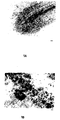
- Acetobacter diazotrophicus inoculated at an initial concentration of 1 bacterium/ml had invaded the meristematic region of lateral roots via the root tip (Figure 1A+B) including the meristematic cells and becoming established in vesicles (and then large vacuoles) in the cytoplasm of cells of the meristem, ( Figure 1C+ D).
- the bacteria are indicated as black dots.
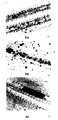
- Acetobacter diazotrophicus was also seen to have invaded the xylem (Figure 2A) of the lateral roots forming colonies (indicated by black dots) and also to have invaded cells of the cortex of the root near to the invaded xylem ( Figure 2B). The xylem of primary roots was also invaded by Acetobacter diazotrophicus ( Figure 2C).
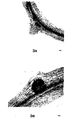
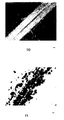
- FIG. 3A Invasion of emerging secondary lateral roots ( Figure 3A) by crack entry (Fig 3B) in the region of emergence was also observed. Extensive colonisation of cortex cells also occurred (Figs 4A and 4B). This is probably by spread of the bacteria (which are highly motile and known to secrete plant cell wall degrading enzymes such as, for example, cellulases and pectinases) from young xylem elements into neighbouring cells, including the phloem (Fig 4C).
- Figure 4D shows a large cortex cell of the root of the plant colonised by Acetobacter diazotrophicus (shown as black dots).
- Figure 6 shows a plant root tip inoculated at an initial concentration of 1 bacterium/ml. Bacteria can be seen as a black stain in the root tip. Bacteria also invaded emerging lateral roots (Figure 7).
- Figure 8A shows bacteria colonising meristem cells of a root and Fig 8B is an oil immersion picture showing black stained bacteria inside cells of the meristem.
- Figure 9 shows, using an oil immersion objective lens, cells from a root cortex of the plant. The bacteria (shown in black) are seen inside cells of the root cortex. It is interesting to note that the bacteria form uniform rhomboidal shaped colonies. These colonies are packages of bacteria probably embedded in the colourless oligofructoside polymer, levan.
- Acetobacter diazotrophicus is known to produce levan which could act to promote aggregation of bacteria into these crystalline-like clusters and provide thereby oxygen protection of their nitrogenase.
- Figure 10 shows the bacteria in the vascular system of the root and Fig 11 shows bacteria in the xylem and cells of the root cortex. The bacteria were also found in the vascular system of the stem as shown in Fig 12 which also shows the spread of bacteria from the xylem to the phloem region in the plant stem.
- Acetobacter diazotrophicus was also seen in chloroplast containing cells ( Figure 13) in the stem of the plant.
- Figures 14 to 19 show analysis on the legume clover plants inoculated with Acetobacter diazotrophicus UAP5541/pRGH562 (Nif H -GUS A ) in which the expression of the ⁇ -glucoronidase gene (GUS) is under the control of a Nif H promoter. Consequently, the bacteria will only stain blue in histochemical analysis if nitrogenase genes are being expressed.
- Figures 20, 21 and 22 show analysis of cereal wheat plants inoculated with Acetobacter diazotrophicus UAP5541/pRGH562 ( Nif H- GUS A) in which the expression of the ⁇ -glucuronidase gene ( GUS ) is under the control of a Nif H promoter. Consequently, the bacteria will only stain blue in the histochemical analysis if nitrogenase genes are being expressed.
- Figures 23, 24 and 25 show analysis on oilseed rape plants similarly inoculated with Acetobacter diazotrophicus UAP5541/pRGH562 (Nif H- GUS A ) . Intracellular invasion of living cells, systemic colonization of the plant and the staining of Acetobacter diazotrophicus UAP5541/pRGH562 (Nif H- GUS A ) was comparable to that observed in tomato, clover and wheat similarly inoculated.
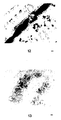
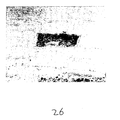
- Figures 26 and 27 show analysis of the cerial rice ( Oryza sativa ) similarly inoculated with Acetobacter diazotrophicus UAP 5541/pRGH 562 (Nif H-GUSA). Intracellular invasion of living cells, systemic colonisation of the plant and the staining of Acetobacter diazotrophicus UAP 5541/pRGH 562 (Nif H-GUSA) was comparable to that observed in tomato, clover, wheat and oilseed rape plants similarly inoculated.
- Figures 28 and 29 show analysis of the model plant Arabidopsis thaliana inoculated with Acetobacter diazotrophicus UAP 5541/pRGH562 (Nif H-GUSA) in accordance with the present invention. Intracellular invasion of living cell, systemic colonisation of the plant and the staining of Acetobacter diazotrophicus UAP 5541/pRGH562 (Nif H-GUSA) was comparable to that observed in tomato, clover, wheat, oilseed rape and cereal rice plants similarly inoculated.
- Neutral Red (Merck index No. 6571) is a biological stain which is nontoxic. Plant cells are still viable after staining with 0.01% W/V Neutral Red in water. Plants inoculated with Acetobacter diazotrophicus in accordance with the present invention were placed in a solution of neutral red (0.9% W/V in water) for 30 minutes. The plants were then washed and prepared for microscopic examination.
- Figure 30, 31A and 31B show analysis of Acetobacter diazotrophicus in living cells of clover. This analysis was performed to ensure that the Acetobacter diazotrophicus bacteria inoculated into clover in accordance with the present invention were actually present intracellularly in living cells. Neutral red was used for this purpose. At low pH (a pH less than 7.0) cellular compartments that are acidic stain red. At higher pH (a pH above 7.0) neutral red is presented as a yellow stain.
- Figures 30 and 31A show colonies (black dots) of Acetobacter diazotrophicus within a vacuole of a living cell of the root cortex of clover inoculated in accordance with the present invention.
- Figure 31B shows another region of the root cortex of clover with Acetobacter diazotrophicus (black dots) present in the vacuole of a living cell.
- Acetobacter diazotrophicus is present in living cells as polyhedral colonies. These polyhedral structures are caused by the secretion of a polymer of ⁇ -D-fructose called Levan. Crystals of Levan isolated from Erwinia herbicola (sigma cat. No. L8647) closely resemble the shape of colonies of Acetobacter diazotrophicus found in plants inoculated in accordance with the present invention ( Figure 32).
- the plants in pots were incubated under clean growth room conditions (25 ° C day temperature, 16 ° C night temperature, photoperiod of 250 ⁇ m E M -2 S -1 from 'Daylight' fluorescent tubes, 0600-2200) and watered with sterile water. Plants were assayed for nitrogenase activity using the acetylene reduction assay. Uninoculated controls were also similarly transferred from jars to compost and assayed for nitrogenase activity using the acetylene reduction assay.
- Plants were rinsed in sterile water and transferred to 75 ml Pyrex tubes which were then capped with gas tight SubasealsTM. 10% of the air volume was removed using a hypodermic syringe, and replaced with acetylene.
- samples were returned to the growth room and incubated for 24 hours under the same conditions used for the growth of plants inoculated with A. diazotrophicus (25°C, day temperature, 16°C, night temperature, photoperiod of 250 ⁇ Em -2 S -1 from "Daylight” fluorescent tubes, 0600-2200).
- Samples of gases (0.5ml) were removed in syringes and analysed for ethylene production with a Pye Unicam PU 4500 gas chromatograph with 183cm (2.0mm internal diameter) glass column containing 'Propack N' with a mesh size of 80-100.
- the mobile phase carrier was N 2 at a flow rate of 27 ml min -1 .
- the oven containing the column was set at 60°C and the flame detector set to 121°C.
- the instrument was calibrated (peak height: ethylene (number of nanomoles) per 0.5ml sample) using a standard curve.
- WHEAT nonomoles ethylene per 24 hours
- Inoculated Uninoculated (control) 31* 7 12* 6 6 7 6 7 15* 6 *
- CLOVER (nanomoles ethylene per 24 hours)
Landscapes
- Life Sciences & Earth Sciences (AREA)
- Botany (AREA)
- Microbiology (AREA)
- Mycology (AREA)
- Natural Medicines & Medicinal Plants (AREA)
- Tropical Medicine & Parasitology (AREA)
- Health & Medical Sciences (AREA)
- Developmental Biology & Embryology (AREA)
- Environmental Sciences (AREA)
- Breeding Of Plants And Reproduction By Means Of Culturing (AREA)
- Agricultural Chemicals And Associated Chemicals (AREA)
- Medicines Containing Material From Animals Or Micro-Organisms (AREA)
- Micro-Organisms Or Cultivation Processes Thereof (AREA)
- Fertilizers (AREA)
- Cultivation Of Plants (AREA)
Abstract
Description
- This invention relates to nitrogen fixation and in particular, but not exclusively, to nitrogen fixation in non-leguminous and leguminous plants, to a method of establishing nitrogen fixation in non-leguminous and leguminous plants and to a plant, without nodules, obtained by way of such a method.
- Although nitrogen gas (N2) makes up 78% of the atmosphere, it is unavailable for use by plants and most other organisms because there is a triple bond between the two nitrogen atoms, making the molecule almost inert. In order for nitrogen gas to be used for growth it must first be fixed (i.e., reduced by hydrogen to ammonia) and be available in the combined form of ammonium (NH4 +) or nitrate (NO3 -); certain types of bacteria can carry out this biological nitrogen fixation by reducing gaseous nitrogen to ammonia (NH3) enzymatically utilizing the enzyme nitrogenase. The availability of fixed nitrogen is often the limiting factor for plant growth and biomass production in environments where there is a suitable climate and availability of water to support life.
- Chemically most ammonia is produced industrially by the Haber-Bosch process by catalytically combining atmospheric nitrogen with hydrogen to form ammonia, using an iron-based catalyst at high temperature and very high pressure. A relatively very small amount of ammonia is produced as a result of lightning discharges in the atmosphere.
- The demand for increased crop yields in the 20th Century and into this Century has required biological nitrogen fixation by bacteria to be supplemented increasingly by the use of fixed nitrogen from chemical fertilisers.
- Biological nitrogen fixation can be represented by the following equation, in which two molecules of ammonia are produced from one molecule of nitrogen gas, at the expense of 16 molecules of adenosine triphosphate (ATP) and a supply of electrons and protons (hydrogen ions):-
N2 + 8H+ + 8e- + 16ATP ⇒ 2NH3 + H2 + 16 ADP + 16 Pi
- This reaction is performed in bacteria, using an enzyme complex called nitrogenase. This enzyme consists of two proteins - an iron (Fe) protein and a Molybdenum-Iron (Mo-Fe) protein.
- The reaction occurs while N2 is bound to the nitrogenase enzyme complex. The Fe protein is first reduced by electrons donated by ferredoxin. The reduced Fe - protein then binds ATP and reduces the Mo-Fe protein, which donates electrons to N2, producing HN = NH. In two further cycles of this process (each requiring electrons donated by ferredoxin) HN = NH is reduced to H2N-NH2 and this in turn is reduced to 2NH3.
- Depending on the type of bacteria, the reduced ferredoxin which supplies electrons for this process is generated by photosynthesis, respiration or fermentation.
- The most familiar examples of nitrogen fixing symbioses between plants and rhizobial bacteria are the root nodules of legumes (peas, beans, clover and the like). In these symbioses the rhizobia "invade" the plant via root hairs or crack entry sites (i.e. intercellularly between epidermal cells) and cause the formation of a nodule by inducing localised proliferation of the plant host cells. Subsequently, the rhizobia invade the cells of the nodule by penetrating the cell wall and being engulfed by invaginations from the plasma membrane (endocytosis). Consequently within the cells of the nodule the rhizobia are enclosed in membrane bounded vesicles (small vacuoles) in which they fix nitrogen, utilising products of plant photosynthesis as carbon and energy sources, and supply biologically fixed nitrogen to the plant for growth and development (endosymbiosis). The bacterial microsymbiont is intracellular, but is always extra-cytoplasmic because of the integrity of the surrounding membrane.
- Non-legume crops, which include the main cereals of the world e.g. wheat, maize and rice, do not form nodules and are dependent on fixed nitrogen from the soil for their nutrition, or from chemical/nitrogenous fertilisers.
- However, energy and environmental concerns arising from the overuse of nitrogenous fertilisers have highlighted a need for non-leguminous crops to obtain more of their nitrogen from the air by biological nitrogen fixation.
- It is known that an intercellular, systemic, endophytic nitrogen fixing interaction with Acetobacter diazotrophicus and Herbaspirillum spp., without the need for nodulation, occurs naturally in Brazilian varieties of sugar cane. Sugar cane is a member of the grass family, Gramineae, which also includes cereals. This non-nodular, intercellular, endophytic nitrogen fixing relationship may also be possible in rice, wheat, maize and in other non-legume crops.
- From several published, peer reviewed, academic papers in the art it is also known that there is no evidence that endophytic nitrogen fixation between diazotrophic bacteria and the host plant occurs intracellularly in living cells. For example, from Biological Nitrogen fixation for the 21st Century pp 685-692 states that there is no evidence for the presence of endophytic diazotrophic bacteria within living cells. James in "Field Crops Research 2000 pp 197-209" describes that "endophytic diazotrophs have been observed only within intercellular spaces, vascular tissue, aerenchyma and dead cells of their hosts and not in living cells". Egener et al., in "MPMI Vol. 12 (1999) pp 813-819" also describe that there is no evidence for endophytic diazotrophic bacteria inside living cells of plants.
- The present invention aims to provide non-leguminous plants and leguminous plants, including legumes that fail to nodulate with rhizobia, with bacteria that enable them to fix nitrogen endophytically, therefore addressing many of the problems associated with the use of chemical/nitrogenous fertilisers.
- Accordingly, the present invention, in a first aspect, provides a non-leguminous or leguminous plant, containing nitrogen fixing bacteria, said bacteria being located intracellularly in living plant cells providing fixed nitrogen to said plant.
- According to the second aspect, the present invention further provides a method of inoculating a non-leguminous or a leguminous plant with nitrogen fixing bacteria, said bacteria being located intracellularly in living plant cells and providing fixed nitrogen to said plant.
- The non-leguminous plant is preferably selected from the grass family Gramineae (includes rice [Oryza sativa], wheat [Triticum aestivum] and maize [Zea mays]). The non-leguminous plant may also be one selected from families such as: Solanaceae (includes tomato, potato and tobacco), Brassicaceae/Cruciferae (includes cabbages, turnips, oilseed rape and the model plant Arabidopsis thaliana), Malvaceae (includes cotton), Compositae/Asteraceae (includes sunflower and lettuce), Euphorbiaceae (includes cassava), Chenopodiaceae (includes sugar beet). The leguminous plant is preferably selected from the Leguminosae (includes soybean, clover, alfalfa, peas and other beans).
- The non-leguminous plant, or leguminous plant, may be inoculated with between 1 to 1x10⁷ bacteria per milliliter of inoculum. The non-leguminous plant or leguminous plant is preferably inoculated with between 1 to 100 bacteria per milliliter of inoculum.
- The non-leguminous plant, or leguminous plant, is more preferably inoculated with 1-10 bacteria per millilitre of inoculum. The non-leguminous, or leguminous, plant is most preferably inoculated with 1-2 bacteria per millilitre of inoculum. Ideally the non leguminous, or leguminous, plant is most preferably inoculated with one bacterium per millilitre of inoculum.
- The non-leguminous, or leguminous, plant is preferably inoculated when germination occurs or up to about seven days thereafter.
- The nitrogen fixing bacterium used to inoculate the non-leguminous, or leguminous, plant is preferably Acetobacter diazotrophicus (syn. Gluconacetobacter diazotrophicus). Alternatively the nitrogen fixing bacterium used for inoculation may be a species of Herbaspirillum.
- We have found that using a very low concentration of bacteria in the inoculum we can obtain plants that are healthier that those inoculated with higher concentrations of bacteria. We have also found that Acetobacter diazotrophicus secretes large amounts of indole acetic acid (IAA), a plant growth hormone. It is known that the response of various plant species to external (microbially released) IAA can vary from beneficial to deleterious effects, depending on the concentration of IAA in the plant root. In general, when IAA is present in higher concentrations than would normally be found in a plant, the increased concentration of IAA inhibits growth, and alters the phenotype of the plant. Also, at low concentrations IAA (or other plant growth substances) secreted by bacteria may be acting as a plant-bacterial (and other plant growth substances) signalling molecule for the intracellular endophytic establishment of Acetobacter diazotrophicus.
- The nitrogen fixing bacteria may fix nitrogen in the presence of up to 10% oxygen. Preferably the bacteria fix nitrogen in the presence of between 2% to 7% oxygen.
- The nitrogen fixing bacteria are intracellular. The intracellular nitrogen fixing bacteria are more preferably present in membrane bounded vesicles and vacuoles within the cytoplasm of the plant cell.
- The nitrogen fixing bacteria are preferably found in colonies in vesicles and vacuoles.
The colonies are preferably located in structures that are polyhedral in configuration. Most preferably the structures are substantially rhomboidal in shape. - These structures are capsules of levan, an oligo fructoside polymer of β-D-fructose secreted by A. diazotrophicus.
- It is a surprising and unexpected result that the present invention provides a systemic, non-nodular, intracellular symbiosis between the nitrogen fixing bacteria and a non-leguminous plant, said bacteria being located within the living cells of the plant. This has not been observed before. As mentioned previously, it is known that in other symbioses between nitrogen fixing bacteria and other non-leguminous plants, e.g., sugar cane, the bacteria exist in the intercellular spaces between cells (the apoplast) and within the dead cells of the xylem.
- It is also a surprising and unexpected result that the present invention provides a similar systemic, non-nodular intracellular symbiosis between nitrogen fixing bacteria and a leguminous, or non-leguminous plant, said bacteria being located within the living cells of the plant. This has not been observed before.
- Another surprising and unexpected result is that the nitrogen fixing bacteria, are located intracellularly in living cells within vesicles and vacuoles in the cytoplasm in both a non-leguminous plant and a leguminous plant.
- The bacteria may spread from plant cell to plant cell by division of plant cells in the meristem and subsequent divisions thereof.
- The bacteria may become systemic by moving through the xylem. Alternatively they may become systemic by division of plant cells and subsequent divisions thereof. The bacteria may become systemic by combinations of the above.
- Accordingly, the present invention further provides, in a third aspect, a method of producing a leguminous or non-leguminous plant containing nitrogen fixing bacteria said bacteria being located intracellularly in living plant cells, wherein said bacteria have been introduced by inoculation and have become systemic by division of plant cells and subsequent divisions thereof.
- According to a fourth aspect, the present invention still further provides a leguminous or non-leguminous plant containing nitrogen fixing bacteria said bacteria being located intracellularly in living plant cells, said bacteria becoming systemic in the plant by division of plant cells and subsequent divisions thereof.
- Preferably the nitrogen fixing bacteria are introduced into the plant by inoculation.
- Preferably the bacteria of systemically colonized plants may be propagated vegetatively to successive generations of non-leguminous plants or leguminous plants by vegetative propagation or by sexual propagation of the plant.
- Accordingly the present invention, in a fifth aspect, further provides a method of producing a leguminous or non-leguminous plant containing nitrogen fixing bacteria said bacteria being located intracellularly in living plant cells said method comprising propagating a first plant containing nitrogen fixing bacteria to provide successive generations of said plant containing nitrogen fixing bacteria.
- Preferably the nitrogen fixing bacteria are introduced into the first plant by inoculation.
- According to a sixth aspect, the present invention provides a plant containing nitrogen fixing bacteria said bacteria being located intracellularly in living plant cells, said plant, and concomitantly, said bacteria having been vegetatively propagated or sexually propagated. Said plant is preferably propagated from a first plant inoculated with nitrogen fixing bacteria or from progations of said first plant.
- According to a seventh aspect the present invention provides seeds obtainable from a plant having nitrogen fixing bacteria according to the present invention, said seed being such that upon germination of the seed said bacteria are located intracellularly in living cells, and provide fixed nitrogen to said plant.
- According to an eighth aspect the present invention provides a seed of a leguminous or non leguminous plant, said seed having a coat comprising nitrogen fixing bacteria in an effective amount such that upon germination said effective amount of bacteria enter the plant and are located intracellularly within living cells said bacteria providing fixed nitrogen to said plant.
- The seed coating will be one selected from seed coatings that are known in the art.
- The nitrogen fixing bacteria provided in the seed coat is preferably Acetobacter diazotrophicus (syn. Gluconacetobacter diazotrophicus). Alternatively the nitrogen fixing bacterium is a species of Herbaspirillum.
- The effective amount of bacteria is between 1 to 1x10⁷ bacteria per millilitre of seed coating. The effective amount of bacteria is preferably between 1 to 1x10⁵ bacteria per millilitre of seed coating. Most preferably the effective amount of bacteria is between 1 to 1x10³ bacteria per millilitre of seed coating.
- According to a ninth aspect the present invention provides a seed of a leguminous or non-leguminous plant, said seed being located in a substrate, said substrate having nitrogen fixing bacteria in an effective amount such that upon germination said effective amount of bacteria enter the plant and are located intracellularly within living cells, said bacteria providing fixed nitrogen to said plant.
- The substrate is preferably a soil. However it will be appreciated that various substrates for germinating seeds are known and a suitable substrate may be selected from those that are well known in the art.
- The nitrogen fixing bacteria provided in the substrate is preferably Acetobacter diazotrophicus (syn Gluconacetobacter diazotrophicus). Alternatively the nitrogen fixing bacterium is a species of Herbaspirillum.
- The effective amount of bacteria is between 1 to 1x10⁷ bacteria per gram of substrate. Preferably, the effective amount of bacteria is between 1 to 1x10⁵ per gram of substrate. Most preferably the effective amount of bacteria is between 1 to 1x10³ per gram of substrate.
The present invention will now be described, merely by way of example, with reference to the accompanying Figures, of which:-
Figures 1 to 13 relate to the present invention in a non-leguminous plant Lycopersicon esculentum; tomato). - Figure 1A and B shows A. diazotrophicus UAP 5541/pRGS561 GUS invading the meristem and root hairs (A) and meristem cells (B) of lateral roots of an inoculated plant in accordance with the present invention. Bar = 25µm (A) and 5µm (B)
- Figure 1C and D shows A. diazotrophicus UAP 5541/pRGS561 GUS in vesicles and vacuoles in thin sections of cells of the meristem of an inoculated plant in accordance with the present invention. Bar = 5µm (C and D)
- Figure 2A shows A. diazotrophicus UAP5541/pRGS561 GUS colonies in the xylem of lateral roots in an inoculated plant in accordance with the present invention. Bar = 5µm
- Figure 2B show A. diazotrophicus UAP5541/pRGS561 GUS in cells of the cortex near to invaded xylem in an inoculated plant in accordance with the present invention. Bar = 5µm.
- Figure 2C shows A. diazotrophicus UAP5541/pRGS561 GUS in the in the xylem of a primary root in an inoculated plant in accordance with the present invention. Bar = 5µm.
- Figure 3A shows A. diazotrophicus UAP5541/pRGS561 GUS invasion of an emerging secondary lateral root of an inoculated plant in accordance with the present invention. Bar = 50µm.
- Figure 3B shows A. diazotrophicus UAP5541/pRGS561 GUS invading an emerging secondary lateral root via a crack entry site in an inoculated plant in accordance with the present invention. Bar = 25µm.
- Figure 4A and B show A. diazotrophicus UAP 5541/pRGS561 GUS colonisation of the cortex and the xylem in the root of a plant according to the present invention. Bar = 25µm (A and B).
- Figure 4C shows A. diazotrophicus UAP5541/pRGS561 GUS colonisation from the xylem to the phloem and cortex cells of a root of a plant in accordance with the present invention. Bar = 5µm.
- Figure 4D shows colonies of A. diazotrophicus UAP5541/pRGS561 GUS inside a cortex cell of a root from a plant according to the present invention. Bar = 5µm.
- Figure 5 shows A. diazotrophicus UAP5541/pRGS561 GUS colonisation spreading from the xylem to the phloem in the stem of a plant according to the present invention. Bar = 5µm.
- Figure 6 shows A. diazotrophicus UAP 5541/pRGH562 (NifH-GUSA) in the root tip of a plant according to the present invention. (dark field illumination) Bar = 50µm.
- Figure 7 shows A. diazotrophicus UAP 5541/pRGH562 (NifH-GUSA) colonising an emerging secondary lateral root of a plant according to the present invention. (dark field illumination) Bar = 50µm.
- Figure 8A shows colonies of A. diazotrophicus UAP 5541/pRGH562 (NifH-GUSA) in the meristem of a root of a plant in accordance with the present invention. Bar = 25µm.
- Figure 8B shows colonies of A. diazotrophicus UAP5541/pRGH562 (NifH-GUSA) in cells of the root meristem of a plant in accordance with the present invention. Bar=5µm
- Figure 9 shows uniformly crystalline-like rhomboidal colonies of A. diazotrophicus UAP5541/pRGH562 (NifH-GUSA) in cells of the root cortex in a plant according to the present invention. Bar = 5µm.
- Figure 10 shows colonies of A. diazotrophicus UAP 5541/pRGH562 (NifH-GUSA) in the vascular system of the root of a plant according to the present invention. (Dark field illumination) Bar = 50µm. a plant according to the present invention. (Dark field illumination) Bar = 50µm.
- Figure 11 shows colonies of A. diazotrophicus UAP5541/pRGH562 (NifH-GUSA) in the xylem and cortex of the root of a plant according to the present invention. Bar = 5µm.
- Figure 12 shows the spread of A.diazotrophicus UAP 5541/pRGH562 (NifH-GUSA) from the xylem to the phloem region in the stem of a plant according to the present invention. Bar = 5µm.
- Figure 13 shows A. diazotrophicus UAP 5541/pRGH562 (NifH-GUSA) in chloroplast containing cells in the stem of a plant according to the present invention. Bar = 5µm
- Figure 14 shows A. diazotrophicus UAP 5541/pRGH562 (NifH-GUSA) in the vascular system and in cells of the cortex of the root of a plant according to the present invention. Bar = 25µm.
- Figure 15 shows A. diazotrophicus UAP 5541/pRGH562 (NifH-GUSA) in the xylem and phloem region of the root of a plant according to the present invention. Bar = 5µm.
- Figure 16 shows A. diazotrophicus UAP 5541/pRGH562 (NifH-GUSA) in the vascular system of the leaf of a plant according to the present invention. Bar = 50µm.
- Figure 17 shows A. diazotrophicus UAP 5541/pRGH562 (NifH-GUSA) in the xylem of a leaf vein of a plant according to the present invention. Bar = 5µm.
- Figure 18 shows spread of A. diazotrophicus UAP 5541/pRGH562 (NifH-GUSA) from the xylem to mesophyll (chloroplast containing cells) of the leaf of a plant according to the present invention. Bar= 25µm.
- Figure 19 shows A. diazotrophicus UAP 5541/pRGH562 (NifH-GUSA) in chloroplast containing mesophyll cells of a leaf of a plant according to the present invention. Bar = 5µm.
- Figures 20 to 22 relate to the present invention in the cereal wheat (Triticum aestivum)
- Figure 20 shows A. diazotrophicus UAP5541/pRGH562 (NifH-GUSA) invading cells of the young root cortex of a lateral root of an inoculated plant in accordance with the present invention. Bar= 25µm
- Figure 21 shows at high magnification colonies of A. diazotrophicus, as in Figure 20, in a cortical cell of the lateral root. Bar = 5 µm
- Figure 22 shows a cluster of colonies of A. diazotrophicus UAP5541/pRGH562 (NifH-GUSA) in the vacuole of a leaf epidermal cell, after treatment with ethanol to remove chlorophyll from the leaf. Bar=5 µm
- Figure 23 shows A. diazotrophicus UAP5541/pRGH562 (NifH-GUSA) in the xylem of the stem of an inoculated plant in accordance with the present invention. Bar= 5µm
- Figure 24 shows A. diazotrophicus UAP5541/pRGH562 (NifH-GUSA) in the xylem of the stem of an inoculated plant in accordance with the present invention. Bar = 25µm
- Figure 25 shows A. diazotrophicus UAP5541/pRGH562 (NifH-GUSA) in chloroplast containing cells of the stem of an inoculated plant in accordance with the present invention. Bar = 5µm
- Figure 26 shows A. diazotrophicus UAP5541/pRGH562 (NifH-GUSA) invading a cell of the root cortex of rice several cells below the epidermis of the young root of an inoculated plant in accordance with the present invention. Bar=5µm
- Figure 27 shows A. diazotrophicus UAP5541/pRGH562 (NifH-GUSA) invading cells of the cortex of a mature rice root of an inoculated plant in accordance with the present invention. Bar = 5µm
- Figure 28 shows A. diazotrophicus UAP5541/pRGH562 (NifH-GUSA) invading the meristem cells of a lateral root of an inoculated plant in accordance with the present invention. Bar = 25µm
- Figure 29 shows A. diazotrophicus UAP5541/pRGH562 (NifH-GUSA) invading cells of the cortex of a lateral root of an inoculated plant in accordance with the present invention. Bar=5µm
- Figure 30 shows colonies of A. diazotrophicus within the vacuole of a living cell of the root cortex of clover inoculated in accordance with the present invention. Bar=25µm
- Figure 31.A shows colonies of A. diazotrophicus at high magnification within the vacuole of a living cell of the root cortex of clover. Inoculation was in accordance with the present invention. Bar = 5µm
- Figure 31.B shows another region of the root cortex of clover showing numerous colonies of A. diazotrophicus within the vacuole of a living cell. Bar = 5µm
- Figure 32 shows a large crystal (crystallised from water) of Levan (Sigma L8674). Bar = 5µm
- Lycopersicon esculentum var. Ailsa Craig seeds, Trifolium repens var. Kent seeds, Triticum aestivum var. Hereford seeds, Brassica napus var. Express seeds, Oryza sativa var. Lemont seeds and Arabidopsis thaliana var. Ecotype Col-O seeds were surface sterilised in 15% (v/v) hypochlorite (Domestos) solution for fifteen minutes.
- The hypochlorite solution was drained off using a sterile sieve and the seeds were subsequently rinsed six times with sterile deionised water.
- The seeds were placed in a sterile 250ml conical flask containing 15ml of sterile deionised water. The flask was then placed in a shaker at 24-26°C in the dark and the seeds left to imbibe for three to four days.
- The seeds were then placed on the surface of sterile agar individually in jars (175 ml capacity containing 50 ml of Murashige and Skoog medium (Sigma M5519), 0.8% w/v agar and 3% w/v sucrose) using sterile forceps.
- Seedlings were grown for six to seven days under the following conditions:
Temperature Day 25° C Temperature Night 16°C Photoperiod 0600-2200 - Artificial daylight was provided by 250µEm-2S-1 "daylight" fluorescent tubes.
- Two strains of Acetobacter diazotrophicus were used:
- A.diazotrophicus UAP 5541/p RGS561 (GUS)
- A.diazotrophicus UAP 5541/p RGH562 (NifH-GUSA)
- Acetobacter diazotrophicus was streaked onto three 9cm diameter Petri plates of ATGUS medium containing streptomycin 45 µg/ml and incubated for four to six days at 28°C.
- Bacteria were scraped from the plate, using a sterile loop and transferred to sterile 250ml conical flasks containing 50ml sterile deionised water. A bacterial suspension was prepared which had an optical density of 0.5-0.6 at a wavelength of 600nm (5 x 10⁸ bacteria/ml). The suspension was diluted 10-9 (i.e. approx. 1 bacterium/ml).
- 1ml of 10-9 diluted bacterial suspension was added to the base of each plant, after germination of said plant after six to seven days of growth in jars.
- To the base of a control plant, 1ml of sterile deionised water was added.
- All plants were grown for a further twelve to twenty days.
- The plants were removed from the agar. Excess agar was removed by blotting with paper towels. The plants were then histochemically stained for bacterial GUS activity; the GUS gene encodes the enzyme β-glucoronidase, which hydrolyses X-gluc (5-bromo-4-chloro-3-indolyl-β-D-glucoronide cyclohexyl ammonium salt; Gold Biotech, USA) to form an indigo blue coloured compound.
- Two controls were set up to ensure that the GUS staining reaction was working, the first using a sample of bacteria taken from the edge of a Murashige and Skoog 8% w/v agar plate and the second was a sample of bacteria grown on ATGUS medium.
- Plants previously removed from agar were placed in a vessel such that a minimal amount of staining solution is needed. The staining solution containing X-gluc was added to said vessel, immersing said plants and stored in the dark overnight at 37°C under vacuum conditions.
- The plants were washed three times with 0.1 ml phosphate buffer pH7.0, and fixed with 2% (v/v) glutaraldehyde in 0.1 M phosphate buffer pH7.0 The plants were subsequently viewed for staining by direct light microscopic examination. Plants were dehydrated in an ethanol series and embedded in LR White Resin. Plant sections of 1µm were prepared for viewing.
- Plants inoculated with Acetobacter diazotrophicus UAP5541/pRGS561 (constitutively expressing GUS) were assessed for
endophytic colonisation 12 to 20 days post inoculation. Histochemically stained plants were examined to detect indigo blue precipitate-stained Acetobacter diazotrophicus bacteria by direct microscopic observation of glutaraldehyde fixed plants. For the purposes of this specification histochemically stained bacteria are indicated by black dots. - It was demonstrated from the results of microscopic analysis that Acetobacter diazotrophicus inoculated at an initial concentration of 1 bacterium/ml had invaded the meristematic region of lateral roots via the root tip (Figure 1A+B) including the meristematic cells and becoming established in vesicles (and then large vacuoles) in the cytoplasm of cells of the meristem, (Figure 1C+ D). The bacteria are indicated as black dots.
- Acetobacter diazotrophicus was also seen to have invaded the xylem (Figure 2A) of the lateral roots forming colonies (indicated by black dots) and also to have invaded cells of the cortex of the root near to the invaded xylem (Figure 2B). The xylem of primary roots was also invaded by Acetobacter diazotrophicus (Figure 2C).
- Invasion of emerging secondary lateral roots (Figure 3A) by crack entry (Fig 3B) in the region of emergence was also observed. Extensive colonisation of cortex cells also occurred (Figs 4A and 4B). This is probably by spread of the bacteria (which are highly motile and known to secrete plant cell wall degrading enzymes such as, for example, cellulases and pectinases) from young xylem elements into neighbouring cells, including the phloem (Fig 4C). Figure 4D shows a large cortex cell of the root of the plant colonised by Acetobacter diazotrophicus (shown as black dots).
- Further analysis was carried out on tomato plants inoculated with Acetobacter diazotrophicus UAP5541/pRGH562 (NifH-GUSA) in which the expression of the β-glucuronidase gene (GUS) is under the control of a NifH promoter. Consequently, the bacteria will only stain blue in histochemical analysis if nitrogenase genes are being expressed. Staining of Acetobacter diazotrophicus UAP5541/pRGH562 (NifH-GUSA) as shown in Figures 6 to 13, was comparable to the staining of constitutively expressed GUS in Acetobacter diazotrophicus UAP5541/pRGS561 GUS (Figures 1 to 5). The bacteria in these figures are indicated by black dots.
- Figure 6 shows a plant root tip inoculated at an initial concentration of 1 bacterium/ml. Bacteria can be seen as a black stain in the root tip. Bacteria also invaded emerging lateral roots (Figure 7). Figure 8A shows bacteria colonising meristem cells of a root and Fig 8B is an oil immersion picture showing black stained bacteria inside cells of the meristem. Figure 9 shows, using an oil immersion objective lens, cells from a root cortex of the plant. The bacteria (shown in black) are seen inside cells of the root cortex. It is interesting to note that the bacteria form uniform rhomboidal shaped colonies. These colonies are packages of bacteria probably embedded in the colourless oligofructoside polymer, levan. Acetobacter diazotrophicus is known to produce levan which could act to promote aggregation of bacteria into these crystalline-like clusters and provide thereby oxygen protection of their nitrogenase. Figure 10 shows the bacteria in the vascular system of the root and Fig 11 shows bacteria in the xylem and cells of the root cortex. The bacteria were also found in the vascular system of the stem as shown in Fig 12 which also shows the spread of bacteria from the xylem to the phloem region in the plant stem.
- Acetobacter diazotrophicus was also seen in chloroplast containing cells (Figure 13) in the stem of the plant.
- Figures 14 to 19 show analysis on the legume clover plants inoculated with Acetobacter diazotrophicus UAP5541/pRGH562 (NifH-GUSA) in which the expression of the β-glucoronidase gene (GUS) is under the control of a NifH promoter. Consequently, the bacteria will only stain blue in histochemical analysis if nitrogenase genes are being expressed. Intracellular invasion of living cells, systemic colonisation of the plant and staining of Acetobacter diazotrophicus UAP5541/pRGH562 (NifH-GUSA) as shown in Figures 14 to 19 was comparable to that shown in the non-legume, tomato plants, Figure 6 to Figure 13, similarly inoculated with Acetobacter diazotrophicus UAP5541/pRGH562 (NifH-GUSA) at an initial concentration of 1 bacterium/ml. Systemic invasion of the leaves was very evident (Figure 16 to Figure 19). The bacteria in the above figures are indicated by black dots.
- Figures 20, 21 and 22 show analysis of cereal wheat plants inoculated with Acetobacter diazotrophicus UAP5541/pRGH562 (NifH-GUSA) in which the expression of the β-glucuronidase gene (GUS) is under the control of a NifH promoter. Consequently, the bacteria will only stain blue in the histochemical analysis if nitrogenase genes are being expressed. Intracellular invasion of living cells, systemic colonisation of plant and staining of Acetobacter diazotrophicus UAP5541/pRGH562 (NifH-GUSA) as shown on Figures 20 to 22 was comparable to that shown in non-legume tomato (Figures 6 to 13) and legume clover plants (Figures 14 to 19) similarly inoculated with Acetobacter diazotrophicus UAP5541/pRGH562 (NifH-GUSA) at an initial concentration of 1 bacterium/ml. Systemic invasion of the epidermal cells of the leaves was very evident (Fig 22). The bacteria in the above figures are indicated by black dots.
- Figures 23, 24 and 25 show analysis on oilseed rape plants similarly inoculated with Acetobacter diazotrophicus UAP5541/pRGH562 (NifH-GUSA). Intracellular invasion of living cells, systemic colonization of the plant and the staining of Acetobacter diazotrophicus UAP5541/pRGH562 (NifH-GUSA) was comparable to that observed in tomato, clover and wheat similarly inoculated.
- Figures 26 and 27 show analysis of the cerial rice (Oryza sativa) similarly inoculated with Acetobacter diazotrophicus UAP 5541/pRGH 562 (Nif H-GUSA). Intracellular invasion of living cells, systemic colonisation of the plant and the staining of Acetobacter diazotrophicus UAP 5541/pRGH 562 (Nif H-GUSA) was comparable to that observed in tomato, clover, wheat and oilseed rape plants similarly inoculated.
- Figures 28 and 29 show analysis of the model plant Arabidopsis thaliana inoculated with Acetobacter diazotrophicus UAP 5541/pRGH562 (Nif H-GUSA) in accordance with the present invention. Intracellular invasion of living cell, systemic colonisation of the plant and the staining of Acetobacter diazotrophicus UAP 5541/pRGH562 (Nif H-GUSA) was comparable to that observed in tomato, clover, wheat, oilseed rape and cereal rice plants similarly inoculated.
- Neutral Red (Merck index No. 6571) is a biological stain which is nontoxic. Plant cells are still viable after staining with 0.01% W/V Neutral Red in water.Plants inoculated with Acetobacter diazotrophicus in accordance with the present invention were placed in a solution of neutral red (0.9% W/V in water) for 30 minutes. The plants were then washed and prepared for microscopic examination.
- Figure 30, 31A and 31B show analysis of Acetobacter diazotrophicus in living cells of clover. This analysis was performed to ensure that the Acetobacter diazotrophicus bacteria inoculated into clover in accordance with the present invention were actually present intracellularly in living cells. Neutral red was used for this purpose. At low pH (a pH less than 7.0) cellular compartments that are acidic stain red. At higher pH (a pH above 7.0) neutral red is presented as a yellow stain. Figures 30 and 31A show colonies (black dots) of Acetobacter diazotrophicus within a vacuole of a living cell of the root cortex of clover inoculated in accordance with the present invention. Figure 31B shows another region of the root cortex of clover with Acetobacter diazotrophicus (black dots) present in the vacuole of a living cell.
- Acetobacter diazotrophicus is present in living cells as polyhedral colonies. These polyhedral structures are caused by the secretion of a polymer of β-D-fructose called Levan. Crystals of Levan isolated from Erwinia herbicola (sigma cat. No. L8647) closely resemble the shape of colonies of Acetobacter diazotrophicus found in plants inoculated in accordance with the present invention (Figure 32).
- Wheat (Triticum aestivum) and clover (Trifolium repens), innoculated with A. diazotrophicus UAP 5541/pRGH562 (Nif H-GUSA) in accordance with the present invention, were transferred after two weeks inoculation in jars( 75 ml capacity containing 50 ml of Murashige and Skoog medium, 0.8% W/V agar and 3% W/V sucrose), to (seed and cutting) compost in pots for four weeks. The plants in pots were incubated under clean growth room conditions (25 ° C day temperature, 16 ° C night temperature, photoperiod of 250 µm E M-2S-1 from 'Daylight' fluorescent tubes, 0600-2200) and watered with sterile water. Plants were assayed for nitrogenase activity using the acetylene reduction assay. Uninoculated controls were also similarly transferred from jars to compost and assayed for nitrogenase activity using the acetylene reduction assay.
- Nitrogenase, the enzyme responsible for the reduction of gaseous nitrogen (N=N) to ammonia (NH3) (nitrogen fixation), was assayed by gas chromatography. In this assay, plants are incubated with excess acetylene gas (H-C = CH) which is reduced by nitrogenase acting on the triple bond of acetylene to yield ethylene (H2-C = C-H2). Plants were rinsed in sterile water and transferred to 75 ml Pyrex tubes which were then capped with gas tight Subaseals™. 10% of the air volume was removed using a hypodermic syringe, and replaced with acetylene. The samples were returned to the growth room and incubated for 24 hours under the same conditions used for the growth of plants inoculated with A. diazotrophicus (25°C, day temperature, 16°C, night temperature, photoperiod of 250 µ Em-2S-1 from "Daylight" fluorescent tubes, 0600-2200). Samples of gases (0.5ml) were removed in syringes and analysed for ethylene production with a Pye Unicam PU 4500 gas chromatograph with 183cm (2.0mm internal diameter) glass column containing 'Propack N' with a mesh size of 80-100. The mobile phase carrier was N2 at a flow rate of 27 ml min-1. The oven containing the column was set at 60°C and the flame detector set to 121°C. The instrument was calibrated (peak height: ethylene (number of nanomoles) per 0.5ml sample) using a standard curve.
WHEAT (nanomoles ethylene per 24 hours) Inoculated Uninoculated (control) 31* 7 12* 6 6 7 6 7 15* 6 * Nitrogenase activity of individual wheat plant (-control) 24, 6 & 9 nanomoles ethylene respectively. CLOVER (nanomoles ethylene per 24 hours) Inoculated Uninoculated (control) 4 6 6 7 5 5 3 3 5 6 15* 3 * Nitrogenase activity of individual clover plant (-control): 12, nanomoles ethylene. - When clover was inoculated with Rhizobium leguminosarum biovar Trifolii (RCR5), under these growth conditions, nodulated plants were produced and these had a mean nitrogenase activity per clover plant of 60 nanomoles ethylene per 24 hours.
Claims (7)
- A method of producing a leguminous or non-leguminous plant containing nitrogen fixing bacteria intracellularly in living plant cells said method comprising inoculating a first plant with between 1 and 100 Acetobacter diazotrophicus (syn. Gluconacetobacter diazotrophicus) as a nitrogen fixing bacteria per millilitre of inoculum when germination of said plant occurs or up to seven days thereafter and propagating said first plant to provide successive generations of said plant containing nitrogen fixing bacteria intracellularly in living plant cells.
- A plant containing nitrogen fixing bacteria located intracellularly in living plant cells, said plant, and concomitantly, said bacteria having been vegetatively propagated or sexually propagated from a first plant inoculated with between 1 and 100 Acetobacter diazotrophicus (syn. Gluconacetobacter diazotrophicus) as a nitrogen fixing bacteria per millilitre of inoculum when germination of said first plant occurs or up to seven days thereafter or from propagations of said first plant, said bacteria being located intracellularly in living plant cells of said first plant.
- A seed obtainable from a leguminous or non-leguminous plant containing an inoculum of the nitrogen fixing bacteria, Acetobacter diazotrophicus (syn. Gluconacetobacter diazotrophicus), in an amount of between 1 and 100 bacteria per millilitre of inoculum said bacteria being located intracellularly in living plant cells and providing fixed nitrogen to said plant.
- A seed as defined in claim 3, wherein said bacteria are inoculated when germination of said plant occurs or up to seven days thereafter.
- A seed of a leguminous or non-leguminous plant, said seed having a coat comprising Acetobacter diazotrophicus (syn. Gluconacetobacter diazotrophicus) as a nitrogen fixing bacteria in an amount of between 1 to 1 x 10³ bacteria per millilitre of seed coating such that upon germination of said plant said amount of bacteria enter the plant and are located intracellularly within living cells said bacteria providing fixed nitrogen to said plant.
- A seed of a leguminous or non-leguminous plant, said seed being located in a substrate, said substrate having Acetobacter diazotrophicus (syn. Gluconacetobacter diazotrophicus) as a nitrogen fixing bacteria in an amount of between 1 to 1 x 10³ bacteria per gram of substrate such that upon germination of said plant said amount of bacteria enter the plant and are located intracellularly within living cells said bacteria providing fixed nitrogen to said plant.
- A seed as claimed in claim 13 in which the substrate is a soil.
Applications Claiming Priority (2)
| Application Number | Priority Date | Filing Date | Title |
|---|---|---|---|
| GBGB0121126.7A GB0121126D0 (en) | 2001-08-31 | 2001-08-31 | Systemic non-nodular endosymbiotic nitrogen fixation in plants |
| EP02755280A EP1422997B1 (en) | 2001-08-31 | 2002-08-30 | Systemic non-nodular endosymbiotic nitrogen fixation in plants |
Related Parent Applications (2)
| Application Number | Title | Priority Date | Filing Date |
|---|---|---|---|
| EP02755280.1 Division | 2002-08-30 | ||
| EP02755280A Division EP1422997B1 (en) | 2001-08-31 | 2002-08-30 | Systemic non-nodular endosymbiotic nitrogen fixation in plants |
Publications (2)
| Publication Number | Publication Date |
|---|---|
| EP1714545A1 true EP1714545A1 (en) | 2006-10-25 |
| EP1714545B1 EP1714545B1 (en) | 2011-04-06 |
Family
ID=9921299
Family Applications (2)
| Application Number | Title | Priority Date | Filing Date |
|---|---|---|---|
| EP02755280A Expired - Lifetime EP1422997B1 (en) | 2001-08-31 | 2002-08-30 | Systemic non-nodular endosymbiotic nitrogen fixation in plants |
| EP06013214A Expired - Lifetime EP1714545B1 (en) | 2001-08-31 | 2002-08-30 | Systemic non-nodular endosymbiotic nitrogen fixation in plants |
Family Applications Before (1)
| Application Number | Title | Priority Date | Filing Date |
|---|---|---|---|
| EP02755280A Expired - Lifetime EP1422997B1 (en) | 2001-08-31 | 2002-08-30 | Systemic non-nodular endosymbiotic nitrogen fixation in plants |
Country Status (9)
| Country | Link |
|---|---|
| US (2) | US7470427B2 (en) |
| EP (2) | EP1422997B1 (en) |
| AT (2) | ATE399459T1 (en) |
| AU (1) | AU2002321575A1 (en) |
| CA (1) | CA2458933C (en) |
| DE (2) | DE60227384D1 (en) |
| ES (1) | ES2309191T3 (en) |
| GB (1) | GB0121126D0 (en) |
| WO (1) | WO2003020014A2 (en) |
Cited By (2)
| Publication number | Priority date | Publication date | Assignee | Title |
|---|---|---|---|---|
| US10793484B2 (en) | 2015-07-28 | 2020-10-06 | Azotic Technologies Ltd | Microorganisms and their use in agriculture |
| US11618720B2 (en) | 2014-07-28 | 2023-04-04 | Azotic Technologies Ltd. | Plant inoculation method |
Families Citing this family (30)
| Publication number | Priority date | Publication date | Assignee | Title |
|---|---|---|---|---|
| GB0121126D0 (en) * | 2001-08-31 | 2001-10-24 | Univ Nottingham | Systemic non-nodular endosymbiotic nitrogen fixation in plants |
| BRPI0721649B8 (en) * | 2007-05-07 | 2021-11-23 | Univ South Carolina | Methods of producing and maintaining a totipotent embryogenic cell culture from a monocot plant, of establishing a plant-microbe association, and of producing an elite plant line |
| US7863046B2 (en) | 2007-05-07 | 2011-01-04 | The University Of South Carolina | Method for micropropagation of monocots based on sustained totipotent cell cultures |
| CA2735269C (en) * | 2008-08-29 | 2018-10-16 | Saint Mary's University | Use of gluconacetobacter with reduced use of nitrogen fertilizer to improve beet crop production |
| PL2721153T3 (en) | 2011-06-16 | 2020-03-31 | The Regents Of The University Of California | Synthetic gene clusters |
| US10076579B2 (en) | 2012-01-13 | 2018-09-18 | Bell Biosystems, Inc. | Host cells with artificial endosymbionts |
| US8828681B2 (en) | 2012-01-13 | 2014-09-09 | Bell Biosystems, Inc. | Host cells with artificial endosymbionts |
| US8956873B2 (en) | 2012-01-13 | 2015-02-17 | Bell Biosystems, Inc. | Host cells with artificial endosymbionts |
| US9023612B2 (en) | 2012-01-13 | 2015-05-05 | Bell Biosystems, Inc. | Eukaryotic cells with artificial endosymbionts for multimodal detection |
| WO2014071182A1 (en) | 2012-11-01 | 2014-05-08 | Massachusetts Institute Of Technology | Directed evolution of synthetic gene cluster |
| WO2014145785A1 (en) | 2013-03-15 | 2014-09-18 | Bell Biosystems, Llc | Host cells with artificial endosymbionts |
| US9481869B2 (en) | 2013-09-03 | 2016-11-01 | Bell Biosystems, Inc. | Host cell modification with artificial endosymbionts |
| BR112018000729B1 (en) | 2015-07-13 | 2023-02-07 | Pivot Bio, Inc | METHOD OF INCREASING AN AMOUNT OF ATMOSPHERIC NITROGEN IN A CORN PLANT IN A FIELD |
| AU2016336328A1 (en) | 2015-10-05 | 2018-04-19 | Massachusetts Institute Of Technology | Nitrogen fixation using refactored nif clusters |
| AU2018207204B2 (en) | 2017-01-12 | 2023-11-30 | Pivot Bio, Inc. | Methods and compositions for improving plant traits |
| CN111587287B (en) | 2017-10-25 | 2025-02-18 | 皮沃特生物股份有限公司 | Methods and compositions for engineering microorganisms for improved nitrogen fixation |
| KR20200087166A (en) | 2017-10-25 | 2020-07-20 | 피벗 바이오, 인크. | Gene targeting for nitrogen fixation targeting to improve plant properties |
| FI20185412A1 (en) | 2018-05-03 | 2019-11-04 | Upm Kymmene Corp | Method for producing renewable fuels |
| FI20185411A1 (en) * | 2018-05-03 | 2019-11-04 | Upm Kymmene Corp | Procedure for the production of renewable fuel |
| BR112020026676A2 (en) | 2018-06-27 | 2021-08-03 | Pivot Bio, Inc. | guided microbial remodeling, a platform for the rational improvement of microbial species for agriculture |
| CN112739668A (en) | 2018-06-27 | 2021-04-30 | 皮沃特生物股份有限公司 | Agricultural compositions comprising reconstituted nitrogen-fixing microorganisms |
| CN112739202A (en) | 2018-07-11 | 2021-04-30 | 皮沃特生物股份有限公司 | Dynamic nitrogen delivery by remodeling microorganisms for temporal and spatial targeting |
| CN109554313B (en) * | 2018-12-25 | 2021-09-24 | 陕西师范大学 | Cultivation method of bacterial culture containing subspecies H.5-28 strain and its application |
| UY38538A (en) | 2019-01-07 | 2020-06-30 | Pivot Bio Inc | PLANT COLONIZATION TESTING WITH NATURAL MICROBIAL BAR CODES |
| WO2020190363A1 (en) | 2019-03-19 | 2020-09-24 | Massachusetts Institute Of Technology | Control of nitrogen fixation in rhizobia that associate with cereals |
| KR20220004047A (en) | 2019-04-25 | 2022-01-11 | 피벗 바이오, 인크. | A High-Throughput Method for Isolating and Characterizing Ammonium-Release Mutant Libraries Generated by Chemical Mutagenesis |
| CN113373074A (en) * | 2020-02-24 | 2021-09-10 | 刘�文 | Method for nodulation and nitrogen fixation of non-leguminous crops and method for cultivating microbial inoculum, preparation and application |
| BR112022021933A2 (en) | 2020-05-01 | 2022-12-13 | Pivot Bio Inc | AGRICULTURAL LIQUID COMPOSITION, AGRICULTURAL PLANT TISSUE, AND, METHODS FOR APPLYING A DIAZOTROPHIC BACTERIA, MAINTAINING A POPULATION OF A BACTERIA, INCREASE THE PRODUCTIVITY OF AGRICULTURAL VEGETABLE CROPS, PROVIDE ATMOSPHERIC NITROGEN, INCREASE CORN PRODUCTIVITY PER ACRE, REDUCED MAIZE VAPITY PRODUCTIVITY AND IMPROVE THE STABILITY OF AN AGRICULTURAL LIQUID COMPOSITION |
| BR112022021723A2 (en) | 2020-05-01 | 2022-12-06 | Pivot Bio Inc | PLANT CULTIVATION SYSTEM, METHODS FOR DETECTING NITROGEN INCORPORATION IN A PLANT AND FOR IDENTIFICATION OF A NITROGEN FIXING BACTERIAL STRAIN, GENETICALLY MODIFIED BACTERIA, AND COMPOSITION |
| US12643837B2 (en) | 2020-05-01 | 2026-06-02 | Pivot Bio, Inc. | Modified bacterial strains for improved fixation of nitrogen |
Citations (3)
| Publication number | Priority date | Publication date | Assignee | Title |
|---|---|---|---|---|
| EP0237683A1 (en) * | 1985-12-30 | 1987-09-23 | Sven-Erik Nielsen | Rhizobia which symbiotically fixes nitrogen in non-legumes, a material for treating seeds of a non legume seed, a non-legume seed, a non-legume plant and a method for producing Rhizobia transconjugants |
| WO1993020685A1 (en) * | 1992-04-10 | 1993-10-28 | PIACFEJLESZTÉSI, Alapítvány | Process for the development of novel type of plants with nitrogen-fixing capacity also in their leaves |
| WO2003020014A2 (en) * | 2001-08-31 | 2003-03-13 | The University Of Nottingham | Systemic non-nodular endosymbiotic nitrogen fixation in plants |
Family Cites Families (5)
| Publication number | Priority date | Publication date | Assignee | Title |
|---|---|---|---|---|
| US1909622A (en) * | 1923-01-02 | 1933-05-16 | Frank J Matchette | Process for the propagation of culture germs for the inoculation of nitrogen gathering plants, such as legumes |
| GB2259302A (en) * | 1991-09-09 | 1993-03-10 | Anil Kumar Bali | Mutant nitrogen fixing bacterium |
| AU5217599A (en) * | 1998-07-27 | 2000-02-21 | Genotypes, Inc. | Automatic eukaryotic artificial chromosome vector |
| TWI225890B (en) * | 1999-07-19 | 2005-01-01 | Food Industry Res & Dev Inst | A thermotolerant and high acetic acid-producing acetobacter bacterium |
| WO2002045513A2 (en) * | 2000-12-04 | 2002-06-13 | Wisconsin Alumni Research Foundation | Bacterial inoculants for enhancing plant growth |
-
2001
- 2001-08-31 GB GBGB0121126.7A patent/GB0121126D0/en not_active Ceased
-
2002
- 2002-08-30 AT AT02755280T patent/ATE399459T1/en not_active IP Right Cessation
- 2002-08-30 AU AU2002321575A patent/AU2002321575A1/en not_active Abandoned
- 2002-08-30 EP EP02755280A patent/EP1422997B1/en not_active Expired - Lifetime
- 2002-08-30 ES ES02755280T patent/ES2309191T3/en not_active Expired - Lifetime
- 2002-08-30 AT AT06013214T patent/ATE504204T1/en not_active IP Right Cessation
- 2002-08-30 CA CA2458933A patent/CA2458933C/en not_active Expired - Lifetime
- 2002-08-30 DE DE60227384T patent/DE60227384D1/en not_active Expired - Lifetime
- 2002-08-30 US US10/488,422 patent/US7470427B2/en not_active Expired - Lifetime
- 2002-08-30 EP EP06013214A patent/EP1714545B1/en not_active Expired - Lifetime
- 2002-08-30 WO PCT/GB2002/003978 patent/WO2003020014A2/en not_active Ceased
- 2002-08-30 DE DE60239713T patent/DE60239713D1/en not_active Expired - Lifetime
-
2008
- 2008-11-21 US US12/313,592 patent/US8137665B2/en not_active Expired - Lifetime
Patent Citations (3)
| Publication number | Priority date | Publication date | Assignee | Title |
|---|---|---|---|---|
| EP0237683A1 (en) * | 1985-12-30 | 1987-09-23 | Sven-Erik Nielsen | Rhizobia which symbiotically fixes nitrogen in non-legumes, a material for treating seeds of a non legume seed, a non-legume seed, a non-legume plant and a method for producing Rhizobia transconjugants |
| WO1993020685A1 (en) * | 1992-04-10 | 1993-10-28 | PIACFEJLESZTÉSI, Alapítvány | Process for the development of novel type of plants with nitrogen-fixing capacity also in their leaves |
| WO2003020014A2 (en) * | 2001-08-31 | 2003-03-13 | The University Of Nottingham | Systemic non-nodular endosymbiotic nitrogen fixation in plants |
Non-Patent Citations (10)
| Title |
|---|
| COCKING E C: "The rhizosphere and microbial plant interactions", TECHNICAL EXPERT MEETING ON INCREASING THE USE OF BIOLOGICAL NITROGEN FIXATION (BNF) IN AGRICULTURE. SUMMARY REPORT, 13 March 2001 (2001-03-13) - 15 March 2001 (2001-03-15), FAO, Rome, pages 1 - 38, XP002246567, Retrieved from the Internet <URL:http://www.iaea.or.at/programmes/nafa/d1/mtc/bnf-march2001.pdf> [retrieved on 20030704] * |
| EGENER ET AL., MPMI, vol. 12, 1999, pages 813 - 819 |
| FUENTES-RAMIREZ LUIS E ET AL: "Colonization of sugarcane by Acetobacter diazotrophicus is inhibited by high N-fertilization.", FEMS MICROBIOLOGY ECOLOGY, vol. 29, no. 2, June 1999 (1999-06-01), pages 117 - 128, XP002246475, ISSN: 0168-6496 * |
| GANTAR MIROSLAV: "Mechanical damage of roots provides enhanced colonization of the wheat endorhizosphere by the dinitrogen-fixing cyanobacterium Nostoc sp. strain 2S9B.", BIOLOGY AND FERTILITY OF SOILS, vol. 32, no. 3, November 2000 (2000-11-01), pages 250 - 255, XP002246566, ISSN: 0178-2762 * |
| GOPALASWAMY GANESAN ET AL: "The xylem of rice (Oryza sativa) is colonized by Azorhizobium caulinodans.", PROCEEDINGS OF THE ROYAL SOCIETY BIOLOGICAL SCIENCES SERIES B., vol. 267, no. 1439, 22 January 2000 (2000-01-22), pages 103 - 107, XP002246479, ISSN: 0962-8452 * |
| JAMES EUAN K ET AL: "Further observations on the interaction between sugar cane and Gluconacetobacter diazotrophicus under laboratory and greenhouse conditions.", JOURNAL OF EXPERIMENTAL BOTANY, vol. 52, no. 357, April 2001 (2001-04-01), pages 747 - 760, XP002246477, ISSN: 0022-0957 * |
| JAMES, FIELD CROPS RESEARCH, 2000, pages 197 - 209 |
| JHA P K ET AL: "ENCAPSULATION OF SEEDS OF SESBANIA SESBAN WITH POLYACRYLAMIDE AND ALGINATE GEL ENTRAPPED RHIZOBIA LEADS TO EFFECTIVE SYMBIOTIC NITROGEN FIXATION", INDIAN JOURNAL OF EXPERIMENTAL BIOLOGY, XX, XX, vol. 31, no. 2, 1 February 1993 (1993-02-01), pages 161 - 167, XP000675890, ISSN: 0019-5189 * |
| MYLONA PANAGIOTA ET AL: "Symbiotic nitrogen fixation.", PLANT CELL, vol. 7, no. 7, 1995, pages 869 - 885, XP002246473, ISSN: 1040-4651 * |
| RAI A N ET AL: "Cyanobacterium-plant symbioses.", NEW PHYTOLOGIST, vol. 147, no. 3, September 2000 (2000-09-01), pages 449 - 481, XP002246474, ISSN: 0028-646X * |
Cited By (2)
| Publication number | Priority date | Publication date | Assignee | Title |
|---|---|---|---|---|
| US11618720B2 (en) | 2014-07-28 | 2023-04-04 | Azotic Technologies Ltd. | Plant inoculation method |
| US10793484B2 (en) | 2015-07-28 | 2020-10-06 | Azotic Technologies Ltd | Microorganisms and their use in agriculture |
Also Published As
| Publication number | Publication date |
|---|---|
| WO2003020014A3 (en) | 2003-11-27 |
| US7470427B2 (en) | 2008-12-30 |
| DE60239713D1 (en) | 2011-05-19 |
| GB0121126D0 (en) | 2001-10-24 |
| US20040235663A1 (en) | 2004-11-25 |
| EP1714545B1 (en) | 2011-04-06 |
| US8137665B2 (en) | 2012-03-20 |
| ATE504204T1 (en) | 2011-04-15 |
| WO2003020014A2 (en) | 2003-03-13 |
| US20090106865A1 (en) | 2009-04-23 |
| EP1422997A2 (en) | 2004-06-02 |
| ES2309191T3 (en) | 2008-12-16 |
| CA2458933C (en) | 2019-06-18 |
| ATE399459T1 (en) | 2008-07-15 |
| DE60227384D1 (en) | 2008-08-14 |
| EP1422997B1 (en) | 2008-07-02 |
| CA2458933A1 (en) | 2003-03-13 |
| AU2002321575A1 (en) | 2003-03-18 |
Similar Documents
| Publication | Publication Date | Title |
|---|---|---|
| US8137665B2 (en) | Systemic non-nodular endosymbiotic nitrogen fixation in plants | |
| Neyra et al. | Nitrogen fixation in grasses | |
| Declerck et al. | In vitro mass-production of the arbuscular mycorrhizal fungus, Glomus versiforme, associated with Ri T-DNA transformed carrot roots | |
| US5229291A (en) | Rhizobia transformants which symbiotically fixes nitrogen in non-legumes, a material for treating seeds of a non-legume plant, non-legume seeds, a non-legume plant and a method for producing rhizobia transconjungants | |
| Al-Mallah et al. | Enzymatic treatment of clover root hairs removes a barrier to Rhizobium-host specificity | |
| AU603560B2 (en) | Rhizobia transformants which symbiotically fixes nitrogen in non-legumes, a material for treating seeds of a non-legume plant, non-legume seeds, a non-legume plant and a method for producing rhizobia transconjugants | |
| EP0106504A2 (en) | Method for screening bacteria and application thereof for field control of diseases caused by Gaeumannomyces graminis | |
| Dubrovsky et al. | Arabidopsis thaliana as a model system for the study of the effect of inoculation by Azospirillum brasilense Sp-245 on root hair growth | |
| US6576457B1 (en) | Fungal media and methods for continuous propagation of vesicular-arbuscular mycorrhizal (VAM) fungi in root organ culture | |
| Zafar-ul-Hye et al. | Preliminary screening of rhizobacteria containing ACC-deaminase for promoting growth of lentil seedlings under axenic condition | |
| Smith et al. | Symbiotic and free‐living denitrification by Bradyrhizobium japonicum | |
| Hussain et al. | Lotus japonicus nodulates and fixes nitrogen with the broad host range Rhizobium sp. NGR234 | |
| Joshil et al. | Ultrastructure of transfer cells in spontaneous nodules of alfalfa (Medicago sativa) | |
| KR20050118010A (en) | Bacillus megaterium kr076(kacc91049) promoting the growth of crops and the microbial agent containing the same | |
| Christiansen-Weniger | Ammonium-excreting Azospirillum brasilense C3: gusA inhabiting induced tumors along stem and roots of rice | |
| CN112625982A (en) | Rice straw returning and decomposing microbial inoculum as well as preparation method and application thereof | |
| Galiana et al. | Nitrogen-fixing potential of micropropagated clones of Acacia mangium inoculated with different Bradyrhizobium spp. strains | |
| Haggag et al. | Pilot-scale production and optimizing of cellulolytic Penicillium oxalicum for controlling of mango malformation | |
| Rasheed et al. | Root hair protoplasts of Lotus corniculatus L.(birdsfoot trefoil) express their totipotency | |
| Matiru et al. | Rhizobial infection of African landraces of sorghum (Sorghum bicolor L.) and finger millet (Eleucine coracana L.) promotes plant growth and alters tissue nutrient concentration under axenic conditions | |
| Kurdali et al. | Competition for nodulation and 15N2-fixation between a Sp+ and a Sp− Frankia strain in Alnus incana | |
| O'Hara et al. | Association between the nitrogen fixing bacterium Azospirillum brasilense and excised plant roots | |
| Koval'Skaya et al. | The formation of artificial nitrogen-fixing symbioses with rape (Brassica napusvar. Napus) plants in nonsterile soil | |
| Hernández et al. | Root exuded nod-gene inducing signals limit the nodulation capacity of different alfalfa varieties with Rhizobium meliloti | |
| Bednářová et al. | Microorganisms in the rhizosphere of wheat colonized by the fungus Gaeumannomyces graminis var. tritici |
Legal Events
| Date | Code | Title | Description |
|---|---|---|---|
| PUAI | Public reference made under article 153(3) epc to a published international application that has entered the european phase |
Free format text: ORIGINAL CODE: 0009012 |
|
| 17P | Request for examination filed |
Effective date: 20060627 |
|
| AC | Divisional application: reference to earlier application |
Ref document number: 1422997 Country of ref document: EP Kind code of ref document: P |
|
| AK | Designated contracting states |
Kind code of ref document: A1 Designated state(s): AT BE BG CH CY CZ DE DK EE ES FI FR GB GR IE IT LI LU MC NL PT SE SK TR |
|
| AX | Request for extension of the european patent |
Extension state: AL MK |
|
| AKX | Designation fees paid |
Designated state(s): AT BE BG CH CY CZ DE DK EE ES FI FR GB GR IE IT LI LU MC NL PT SE SK TR |
|
| AXX | Extension fees paid |
Extension state: MK Payment date: 20060720 Extension state: AL Payment date: 20060720 |
|
| 17Q | First examination report despatched |
Effective date: 20070820 |
|
| GRAP | Despatch of communication of intention to grant a patent |
Free format text: ORIGINAL CODE: EPIDOSNIGR1 |
|
| GRAS | Grant fee paid |
Free format text: ORIGINAL CODE: EPIDOSNIGR3 |
|
| DAX | Request for extension of the european patent (deleted) | ||
| GRAA | (expected) grant |
Free format text: ORIGINAL CODE: 0009210 |
|
| AC | Divisional application: reference to earlier application |
Ref document number: 1422997 Country of ref document: EP Kind code of ref document: P |
|
| AK | Designated contracting states |
Kind code of ref document: B1 Designated state(s): AT BE BG CH CY CZ DE DK EE ES FI FR GB GR IE IT LI LU MC NL PT SE SK TR |
|
| REG | Reference to a national code |
Ref country code: GB Ref legal event code: FG4D |
|
| REG | Reference to a national code |
Ref country code: CH Ref legal event code: EP |
|
| REG | Reference to a national code |
Ref country code: IE Ref legal event code: FG4D |
|
| REF | Corresponds to: |
Ref document number: 60239713 Country of ref document: DE Date of ref document: 20110519 Kind code of ref document: P |
|
| REG | Reference to a national code |
Ref country code: DE Ref legal event code: R096 Ref document number: 60239713 Country of ref document: DE Effective date: 20110519 |
|
| REG | Reference to a national code |
Ref country code: NL Ref legal event code: VDEP Effective date: 20110406 |
|
| PG25 | Lapsed in a contracting state [announced via postgrant information from national office to epo] |
Ref country code: PT Free format text: LAPSE BECAUSE OF FAILURE TO SUBMIT A TRANSLATION OF THE DESCRIPTION OR TO PAY THE FEE WITHIN THE PRESCRIBED TIME-LIMIT Effective date: 20110808 Ref country code: SE Free format text: LAPSE BECAUSE OF FAILURE TO SUBMIT A TRANSLATION OF THE DESCRIPTION OR TO PAY THE FEE WITHIN THE PRESCRIBED TIME-LIMIT Effective date: 20110406 |
|
| PG25 | Lapsed in a contracting state [announced via postgrant information from national office to epo] |
Ref country code: CY Free format text: LAPSE BECAUSE OF FAILURE TO SUBMIT A TRANSLATION OF THE DESCRIPTION OR TO PAY THE FEE WITHIN THE PRESCRIBED TIME-LIMIT Effective date: 20110406 Ref country code: GR Free format text: LAPSE BECAUSE OF FAILURE TO SUBMIT A TRANSLATION OF THE DESCRIPTION OR TO PAY THE FEE WITHIN THE PRESCRIBED TIME-LIMIT Effective date: 20110707 Ref country code: ES Free format text: LAPSE BECAUSE OF FAILURE TO SUBMIT A TRANSLATION OF THE DESCRIPTION OR TO PAY THE FEE WITHIN THE PRESCRIBED TIME-LIMIT Effective date: 20110717 Ref country code: FI Free format text: LAPSE BECAUSE OF FAILURE TO SUBMIT A TRANSLATION OF THE DESCRIPTION OR TO PAY THE FEE WITHIN THE PRESCRIBED TIME-LIMIT Effective date: 20110406 Ref country code: BE Free format text: LAPSE BECAUSE OF FAILURE TO SUBMIT A TRANSLATION OF THE DESCRIPTION OR TO PAY THE FEE WITHIN THE PRESCRIBED TIME-LIMIT Effective date: 20110406 Ref country code: AT Free format text: LAPSE BECAUSE OF FAILURE TO SUBMIT A TRANSLATION OF THE DESCRIPTION OR TO PAY THE FEE WITHIN THE PRESCRIBED TIME-LIMIT Effective date: 20110406 |
|
| PG25 | Lapsed in a contracting state [announced via postgrant information from national office to epo] |
Ref country code: NL Free format text: LAPSE BECAUSE OF FAILURE TO SUBMIT A TRANSLATION OF THE DESCRIPTION OR TO PAY THE FEE WITHIN THE PRESCRIBED TIME-LIMIT Effective date: 20110406 |
|
| PG25 | Lapsed in a contracting state [announced via postgrant information from national office to epo] |
Ref country code: CZ Free format text: LAPSE BECAUSE OF FAILURE TO SUBMIT A TRANSLATION OF THE DESCRIPTION OR TO PAY THE FEE WITHIN THE PRESCRIBED TIME-LIMIT Effective date: 20110406 Ref country code: EE Free format text: LAPSE BECAUSE OF FAILURE TO SUBMIT A TRANSLATION OF THE DESCRIPTION OR TO PAY THE FEE WITHIN THE PRESCRIBED TIME-LIMIT Effective date: 20110406 |
|
| PLBE | No opposition filed within time limit |
Free format text: ORIGINAL CODE: 0009261 |
|
| STAA | Information on the status of an ep patent application or granted ep patent |
Free format text: STATUS: NO OPPOSITION FILED WITHIN TIME LIMIT |
|
| PG25 | Lapsed in a contracting state [announced via postgrant information from national office to epo] |
Ref country code: SK Free format text: LAPSE BECAUSE OF FAILURE TO SUBMIT A TRANSLATION OF THE DESCRIPTION OR TO PAY THE FEE WITHIN THE PRESCRIBED TIME-LIMIT Effective date: 20110406 Ref country code: DK Free format text: LAPSE BECAUSE OF FAILURE TO SUBMIT A TRANSLATION OF THE DESCRIPTION OR TO PAY THE FEE WITHIN THE PRESCRIBED TIME-LIMIT Effective date: 20110406 |
|
| 26N | No opposition filed |
Effective date: 20120110 |
|
| PG25 | Lapsed in a contracting state [announced via postgrant information from national office to epo] |
Ref country code: MC Free format text: LAPSE BECAUSE OF NON-PAYMENT OF DUE FEES Effective date: 20110831 |
|
| REG | Reference to a national code |
Ref country code: CH Ref legal event code: PL |
|
| PG25 | Lapsed in a contracting state [announced via postgrant information from national office to epo] |
Ref country code: CH Free format text: LAPSE BECAUSE OF NON-PAYMENT OF DUE FEES Effective date: 20110831 Ref country code: LI Free format text: LAPSE BECAUSE OF NON-PAYMENT OF DUE FEES Effective date: 20110831 |
|
| REG | Reference to a national code |
Ref country code: DE Ref legal event code: R097 Ref document number: 60239713 Country of ref document: DE Effective date: 20120110 |
|
| REG | Reference to a national code |
Ref country code: IE Ref legal event code: MM4A |
|
| PG25 | Lapsed in a contracting state [announced via postgrant information from national office to epo] |
Ref country code: IE Free format text: LAPSE BECAUSE OF NON-PAYMENT OF DUE FEES Effective date: 20110830 |
|
| PG25 | Lapsed in a contracting state [announced via postgrant information from national office to epo] |
Ref country code: LU Free format text: LAPSE BECAUSE OF NON-PAYMENT OF DUE FEES Effective date: 20110830 |
|
| PG25 | Lapsed in a contracting state [announced via postgrant information from national office to epo] |
Ref country code: BG Free format text: LAPSE BECAUSE OF FAILURE TO SUBMIT A TRANSLATION OF THE DESCRIPTION OR TO PAY THE FEE WITHIN THE PRESCRIBED TIME-LIMIT Effective date: 20110706 |
|
| PG25 | Lapsed in a contracting state [announced via postgrant information from national office to epo] |
Ref country code: TR Free format text: LAPSE BECAUSE OF FAILURE TO SUBMIT A TRANSLATION OF THE DESCRIPTION OR TO PAY THE FEE WITHIN THE PRESCRIBED TIME-LIMIT Effective date: 20110406 |
|
| REG | Reference to a national code |
Ref country code: FR Ref legal event code: PLFP Year of fee payment: 15 |
|
| REG | Reference to a national code |
Ref country code: FR Ref legal event code: PLFP Year of fee payment: 16 |
|
| REG | Reference to a national code |
Ref country code: FR Ref legal event code: PLFP Year of fee payment: 17 |
|
| PGFP | Annual fee paid to national office [announced via postgrant information from national office to epo] |
Ref country code: FR Payment date: 20190822 Year of fee payment: 18 Ref country code: IT Payment date: 20190821 Year of fee payment: 18 Ref country code: DE Payment date: 20190822 Year of fee payment: 18 |
|
| REG | Reference to a national code |
Ref country code: GB Ref legal event code: 732E Free format text: REGISTERED BETWEEN 20191114 AND 20191120 |
|
| REG | Reference to a national code |
Ref country code: DE Ref legal event code: R088 Ref document number: 60239713 Country of ref document: DE |
|
| PGFP | Annual fee paid to national office [announced via postgrant information from national office to epo] |
Ref country code: GB Payment date: 20191007 Year of fee payment: 18 |
|
| REG | Reference to a national code |
Ref country code: DE Ref legal event code: R119 Ref document number: 60239713 Country of ref document: DE |
|
| GBPC | Gb: european patent ceased through non-payment of renewal fee |
Effective date: 20200830 |
|
| PG25 | Lapsed in a contracting state [announced via postgrant information from national office to epo] |
Ref country code: FR Free format text: LAPSE BECAUSE OF NON-PAYMENT OF DUE FEES Effective date: 20200831 Ref country code: DE Free format text: LAPSE BECAUSE OF NON-PAYMENT OF DUE FEES Effective date: 20210302 |
|
| PG25 | Lapsed in a contracting state [announced via postgrant information from national office to epo] |
Ref country code: GB Free format text: LAPSE BECAUSE OF NON-PAYMENT OF DUE FEES Effective date: 20200830 |
|
| PG25 | Lapsed in a contracting state [announced via postgrant information from national office to epo] |
Ref country code: IT Free format text: LAPSE BECAUSE OF NON-PAYMENT OF DUE FEES Effective date: 20200830 |