EP1713217A1 - IP multicasting with improved redundancy - Google Patents
IP multicasting with improved redundancy Download PDFInfo
- Publication number
- EP1713217A1 EP1713217A1 EP06300088A EP06300088A EP1713217A1 EP 1713217 A1 EP1713217 A1 EP 1713217A1 EP 06300088 A EP06300088 A EP 06300088A EP 06300088 A EP06300088 A EP 06300088A EP 1713217 A1 EP1713217 A1 EP 1713217A1
- Authority
- EP
- European Patent Office
- Prior art keywords
- router
- multicast group
- group
- eligible
- unicast
- Prior art date
- Legal status (The legal status is an assumption and is not a legal conclusion. Google has not performed a legal analysis and makes no representation as to the accuracy of the status listed.)
- Withdrawn
Links
- 238000000034 method Methods 0.000 claims abstract description 22
- 230000003068 static effect Effects 0.000 abstract description 5
- 230000011664 signaling Effects 0.000 abstract description 2
- 238000013507 mapping Methods 0.000 description 20
- 238000010586 diagram Methods 0.000 description 2
- ABEXEQSGABRUHS-UHFFFAOYSA-N 16-methylheptadecyl 16-methylheptadecanoate Chemical compound CC(C)CCCCCCCCCCCCCCCOC(=O)CCCCCCCCCCCCCCC(C)C ABEXEQSGABRUHS-UHFFFAOYSA-N 0.000 description 1
- 241000764238 Isis Species 0.000 description 1
- 238000005417 image-selected in vivo spectroscopy Methods 0.000 description 1
- 238000012739 integrated shape imaging system Methods 0.000 description 1
- 238000011084 recovery Methods 0.000 description 1
- 238000010187 selection method Methods 0.000 description 1
- 230000001960 triggered effect Effects 0.000 description 1
Images
Classifications
-
- H—ELECTRICITY
- H04—ELECTRIC COMMUNICATION TECHNIQUE
- H04L—TRANSMISSION OF DIGITAL INFORMATION, e.g. TELEGRAPHIC COMMUNICATION
- H04L12/00—Data switching networks
- H04L12/02—Details
- H04L12/16—Arrangements for providing special services to substations
- H04L12/18—Arrangements for providing special services to substations for broadcast or conference, e.g. multicast
- H04L12/185—Arrangements for providing special services to substations for broadcast or conference, e.g. multicast with management of multicast group membership
-
- H—ELECTRICITY
- H04—ELECTRIC COMMUNICATION TECHNIQUE
- H04L—TRANSMISSION OF DIGITAL INFORMATION, e.g. TELEGRAPHIC COMMUNICATION
- H04L45/00—Routing or path finding of packets in data switching networks
-
- H—ELECTRICITY
- H04—ELECTRIC COMMUNICATION TECHNIQUE
- H04L—TRANSMISSION OF DIGITAL INFORMATION, e.g. TELEGRAPHIC COMMUNICATION
- H04L45/00—Routing or path finding of packets in data switching networks
- H04L45/16—Multipoint routing
-
- H—ELECTRICITY
- H04—ELECTRIC COMMUNICATION TECHNIQUE
- H04L—TRANSMISSION OF DIGITAL INFORMATION, e.g. TELEGRAPHIC COMMUNICATION
- H04L45/00—Routing or path finding of packets in data switching networks
- H04L45/22—Alternate routing
-
- H—ELECTRICITY
- H04—ELECTRIC COMMUNICATION TECHNIQUE
- H04L—TRANSMISSION OF DIGITAL INFORMATION, e.g. TELEGRAPHIC COMMUNICATION
- H04L45/00—Routing or path finding of packets in data switching networks
- H04L45/28—Routing or path finding of packets in data switching networks using route fault recovery
Definitions
- the invention relates to multicasting within Internet Protocol networks, and more particularly to providing redundancy during PIM-SM multicasting.
- PIM-SM protocol independent multicasting sparse mode
- SPT shortest path tree
- RPs Rendezvous Points
- a router When a router receives either an IGMP-JOIN(*, G) message or a PIM-JOIN (*, G) message, the router establishes a route towards the RP associated with the group. As numerous routers establish routes to the RP, an RP Tree (RPT) is established. Similarly, the router which is connected to the multicast source (Source Router) has the same mapping between RP and multicast group G. When the source begins transmitting IP packets for a group, the source router registers the IP packets with the RP by encapsulating the IP packets and forwarding them to the RP.
- RPT RP Tree
- the routers connected to the multicast hosts receive the IP packets via the RPT, the routers learn of the identification of the source, create an SPT to the source, and tear down the multicast tree to the RP. The RPT tree is thereby converted into an SPT.
- each router must have the same view of the network and use the same RP for a particular group.
- Each router must have access to identical Group-RP mappings, so that for a given group each router establishes routes to the same RP.
- the Group-RP mappings of each router may be configured statically.
- the Group-RP mappings are configured manually by simply associating each group with an RP.
- each router that decides it wants to be an RP for a particular group notifies a Bootstrap Router (BSR).
- BSR Bootstrap Router
- the BSR decides which cRP is the best RP for the group (based on some criteria), and informs all routers in the network of the router that will be the RP for the group.
- the routers then update their Group-RP mappings to include the new association between the group and the RP selected by the BSR.
- the BSR can collect new bootstrap messages, determine a new cRP to be the RP for the group, and notify all the routers in the network of the identify of the new RP for the group. The routers can then establish connections to the new RP, as needed.
- both creation of the initial Group-RP mappings and the recovery following failure of an RP require much signaling between routers, cRPs, and the BSR.
- a redundant BSR may be needed in case the BSR itself fails.
- a method of configuring Group-RP mappings in routers which had the simplicity of existing static configuration and the flexibility of existing dynamic configuration methods would allow redundancy to be implemented in PIM-SM systems while avoiding the overhead and complications of bootstrap messaging.
- a method for selecting a Rendezvous Point (RP) for use by a router implementing PIM-SM connections.
- RP Rendezvous Point
- an RP for a particular multicast group is selected as the eligible RP which has the highest RP-priority for the particular multicast group and which is also unicast reachable.
- An RP for a particular multicast group may be selected in response to receipt at the router of unicast unreachability of a current RP.
- a router for implementing PIM-SM multicast connections includes instructions for accessing an identification of eligible RPs and corresponding RP-priorities for each multicast group.
- the router includes instructions for selecting as the RP for a particular multicast group the eligible RP which has the highest RP-priority for the particular multicast group and which is unicast reachable.
- the router is a source router connected to a source of the particular multicast group, a host router connected to a host of the particular multicast group, or an intermediate router within an RPT between a host router and the RP selected for the particular multicast group.
- a method for providing RP redundancy for a multicast group in a PIM-SM multicast connection.
- Each identification of eligible RPs are statically configured, along with a corresponding RP-priority for each eligible RP.
- a current RP is selected for the multicast group, the current RP being selected as the eligible RP having the highest RP-priority for the multicast group and which is also unicast reachable.
- a router for implementing a PIM-SM multicast connection includes instructions for accessing each identification of eligible RPs associated with multicast group, along with a corresponding RP-priority of each eligible RP.
- the router also includes instructions for selecting as the current RP of the multicast group the eligible RP having the highest RP-priority for the multicast group and which is also unicast reachable.
- the router includes instructions for selecting as an alternate RP for the multicast group the eligible RP which has the highest RP-priority for the multicast group and which is also unicast reachable, upon receipt of notification at the router that the current RP has become unicast unreachable.
- the router is a source router connected to a source of the multicast group, a host router connected to a host of the multicast group, or an intermediate router within an RPT between a host router and the RP selected for the multicast group.
- the methods and instructions may be stored in the form of software instructions stored on computer-readable media.
- the methods and apparatus of the present invention allow redundant RPs to be implemented in PIM-SM systems, without requiring the use of cRPs, BSRs, redundant BSRs, and associated messaging.
- each router can immediately establish a route to an alternate RP upon failure of the original RP, each router establishing a route to the same RP.
- the source router can immediately register source IP packets to the new RP.
- Dynamic RP redundancy is achieved by combining the dynamic behaviour of unicast reachability with static configuration of multiple RPs in each multicast group.
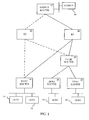
- FIG. 1 a block diagram of a portion of an example network in which PIM-SM multicasting is implemented is shown.
- a source 10 is connected to the network through a source router 12.
- the source 10 provides multicast traffic belonging to a multicast group G, and a plurality of hosts 14 desire access to the content of the group G.
- Each host 14 connects to the network through a host router 16.
- Each host router 16 connects to a first rendezvous point (RP) 20, either directly or through one or more intermediate routers 18.
- RP rendezvous point
- At least one alternate RP 22 is also present in the network. All the routers are unicast reachable either by using dynamic or static unicast.
- the network portion shown in FIG. 1 is an example only. More generally, there is at least one source, at least one source router, at least one alternate RP, a plurality of hosts, at least one host router (a host router may support more than one host), and any number (including none) of intermediate routers.
- All the routers in the network have the same view of the RP for the multicast group G.
- the source router 12, intermediate router 18, and host routers 16 each have an identical Group-RP mapping.
- the Group-RP mapping lists at least one multicast group, and for each multicast group in the mapping associates a corresponding set of a plurality of eligible RPs.
- the Group-RP mapping is configured manually by administrators.
- each corresponding eligible RP has an associated RP-priority which indicates the priority of selecting the particular RP as a Rendezvous Point for the group.
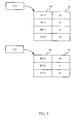
- the precise value of each RP-priority is immaterial, and may represent any type of quality (as examples, cost, delay, or simply operator preference), since only the relative values or ranking of the RPs is important. Referring to FIG.
- each RP identification 30 may be an IP address of an interface of the RP, a loopback IP address of the RP, or any other identification which allows such IP addresses to be determined.
- Each RP identification 30 has an associated RP-priority 32 for the group G1.
- the Group-RP mapping also identifies RPs associated with a second group G2.
- the RP identifications 30 associated with group G2 may be different from those associated with group G1, and for RPs associated with more than one group the RP-priority may be different for different groups.
- the source router 12, intermediate router 18, and host routers 16 use the Group-RP mapping to determine which RP is to be used for a given multicast group.
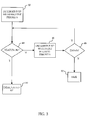
- FIG. 3 a method by which a router selects an RP for a multicast group according to one embodiment of the invention is shown.
- the router consults the Group-RP mapping and determines from the RPs associated with the group the RP having the highest RP-priority.
- the router determines whether the selected RP is unicast reachable. If the selected RP is unicast reachable, then the router designates the selected RP as the RP for the group at step 50.
- the router must attempt to select an alternate RP.
- the router determines the RP with the next highest RP-priority. If at step 48 such an RP exists, then the router determines whether the new selected RP is unicast reachable, and if so, selects the new selected RP as the RP for the group at step 50.
- the router continues to select RPs with progressively lower RP-priorities until either an alternate RP which is unicast reachable is selected, or there are no further RPs to select. In this way, the router designates for the group the RP which has the highest RP-priority for the group and which is unicast reachable. If the router determines at step 48 that there are no more alternate RPs, then there are no reachable RPs for the group and access to the content of the group fails at step 52.
- Every router carries out the same method, and since each router stores (or has access to) the same Group-RP mapping and has the same view of the network (that is, has knowledge of which RPs are reachable via unicast protocols), each router will select the identical RP.
- the method is carried out by host routers when selecting an RP for a group upon receipt of an IGMP-JOIN(*, G) message and intermediate routers when selecting an RP for a group upon receipt of a PIM-JOIN(*, G) message. Once an RP is selected, the router establishes a route towards the selected RP.
- the method is carried out by source routers when the multicast source begins transmitting IP packets for group G. Once an RP is selected the source router registers IP packets for the group with the selected RP.
- the method is also carried out by the source routers, intermediate routers, and host routers when the selected RP for a multicast group G loses its unicast reachability.
- unicast protocols such as OSPF, ISIS, or BGP
- the RP selection method described above with reference to FIG. 3 is triggered and the next best RP which is unicast reachable is selected.
- the host routers and intermediate routers establish a new RPT towards the newly selected RP, and the source router registers multicast IP packets with the newly selected RP.
- the selection of RPs is carried out by software instructions within a processor within each router, but may more generally be carried out by any combination of software or hardware, including hardware within an integrated circuit.
- the processor need not be a single device, but rather the instructions or could be located in more than one device.
Landscapes
- Engineering & Computer Science (AREA)
- Computer Networks & Wireless Communication (AREA)
- Signal Processing (AREA)
- Data Exchanges In Wide-Area Networks (AREA)
Abstract
Description
- The invention relates to multicasting within Internet Protocol networks, and more particularly to providing redundancy during PIM-SM multicasting.
- In protocol independent multicasting sparse mode (PIM-SM), point to multipoint multicast trees must be established between a source which provides multicasting content and hosts which desire the multicasting content. However, a shortest path tree (SPT) can not be created directly between the hosts and the source because the hosts are unaware of the identification of the source. The hosts can only identify the content, by a group. Rendezvous Points (RPs) are routers used as temporary waypoints in order to assist in creation of the SPT. All routers have access to an identical mapping between multicast Groups G and RPs, one RP being associated with each multicast Group. When a router receives either an IGMP-JOIN(*, G) message or a PIM-JOIN (*, G) message, the router establishes a route towards the RP associated with the group. As numerous routers establish routes to the RP, an RP Tree (RPT) is established. Similarly, the router which is connected to the multicast source (Source Router) has the same mapping between RP and multicast group G. When the source begins transmitting IP packets for a group, the source router registers the IP packets with the RP by encapsulating the IP packets and forwarding them to the RP. As the routers connected to the multicast hosts (Host Routers) receive the IP packets via the RPT, the routers learn of the identification of the source, create an SPT to the source, and tear down the multicast tree to the RP. The RPT tree is thereby converted into an SPT.
- In order to create the most efficient RPT and SPT, the routers must have the same view of the network and use the same RP for a particular group. Each router must have access to identical Group-RP mappings, so that for a given group each router establishes routes to the same RP. The Group-RP mappings of each router may be configured statically. The Group-RP mappings are configured manually by simply associating each group with an RP.
- If an RP fails or becomes unavailable, then routers configured statically are unable to establish routes to the RP and the multicasting is interrupted or unavailable. Another method of configuring the Group-RP mappings at each router uses bootstrap messaging. In bootstrap messaging, each router that decides it wants to be an RP for a particular group notifies a Bootstrap Router (BSR). As the BSR receives messages from the RPs, it designates each one as a candidate RPs (cRP) for the group. The BSR then decides which cRP is the best RP for the group (based on some criteria), and informs all routers in the network of the router that will be the RP for the group. The routers then update their Group-RP mappings to include the new association between the group and the RP selected by the BSR.
- If the RP for a group then becomes unavailable, the BSR can collect new bootstrap messages, determine a new cRP to be the RP for the group, and notify all the routers in the network of the identify of the new RP for the group. The routers can then establish connections to the new RP, as needed. However, both creation of the initial Group-RP mappings and the recovery following failure of an RP require much signaling between routers, cRPs, and the BSR. Furthermore, a redundant BSR may be needed in case the BSR itself fails.
- A method of configuring Group-RP mappings in routers which had the simplicity of existing static configuration and the flexibility of existing dynamic configuration methods would allow redundancy to be implemented in PIM-SM systems while avoiding the overhead and complications of bootstrap messaging.
- In accordance with one aspect of the invention, a method is provided for selecting a Rendezvous Point (RP) for use by a router implementing PIM-SM connections. For each of at least one multicast group, an identification of eligible RPs is statically configured, along with a corresponding RP-priority of each eligible RP. At the router, an RP for a particular multicast group is selected as the eligible RP which has the highest RP-priority for the particular multicast group and which is also unicast reachable. An RP for a particular multicast group may be selected in response to receipt at the router of unicast unreachability of a current RP.
- In accordance with another aspect of the invention, a router for implementing PIM-SM multicast connections is provided. The router includes instructions for accessing an identification of eligible RPs and corresponding RP-priorities for each multicast group. The router includes instructions for selecting as the RP for a particular multicast group the eligible RP which has the highest RP-priority for the particular multicast group and which is unicast reachable. The router is a source router connected to a source of the particular multicast group, a host router connected to a host of the particular multicast group, or an intermediate router within an RPT between a host router and the RP selected for the particular multicast group.
- In accordance with another aspect of the invention, a method is provided for providing RP redundancy for a multicast group in a PIM-SM multicast connection. Each identification of eligible RPs are statically configured, along with a corresponding RP-priority for each eligible RP. At a router, a current RP is selected for the multicast group, the current RP being selected as the eligible RP having the highest RP-priority for the multicast group and which is also unicast reachable.
- In accordance with another aspect of the invention, a router for implementing a PIM-SM multicast connection is provided. The router includes instructions for accessing each identification of eligible RPs associated with multicast group, along with a corresponding RP-priority of each eligible RP. The router also includes instructions for selecting as the current RP of the multicast group the eligible RP having the highest RP-priority for the multicast group and which is also unicast reachable. The router includes instructions for selecting as an alternate RP for the multicast group the eligible RP which has the highest RP-priority for the multicast group and which is also unicast reachable, upon receipt of notification at the router that the current RP has become unicast unreachable. The router is a source router connected to a source of the multicast group, a host router connected to a host of the multicast group, or an intermediate router within an RPT between a host router and the RP selected for the multicast group.
- The methods and instructions may be stored in the form of software instructions stored on computer-readable media.
- The methods and apparatus of the present invention allow redundant RPs to be implemented in PIM-SM systems, without requiring the use of cRPs, BSRs, redundant BSRs, and associated messaging. By configuring each router with a list of prioritized RPs, each router can immediately establish a route to an alternate RP upon failure of the original RP, each router establishing a route to the same RP. The source router can immediately register source IP packets to the new RP. Dynamic RP redundancy is achieved by combining the dynamic behaviour of unicast reachability with static configuration of multiple RPs in each multicast group.
- The features and advantages of the invention will become more apparent from the following detailed description of the preferred embodiment(s) with reference to the attached figures, wherein:
- FIG. 1 is a block diagram of a portion of an example network in which PIM-SM multicasting is implemented;
- FIG. 2 is a table of a Group-RP mapping according to one embodiment of the invention; and
- FIG. 3 is a flowchart of a method by which a router selects a rendezvous point according to one embodiment of the invention.
- It will be noted that in the attached figures, like features bear similar labels.
- Referring to FIG. 1, a block diagram of a portion of an example network in which PIM-SM multicasting is implemented is shown. A
source 10 is connected to the network through asource router 12. Thesource 10 provides multicast traffic belonging to a multicast group G, and a plurality ofhosts 14 desire access to the content of the group G. Eachhost 14 connects to the network through ahost router 16. Eachhost router 16 connects to a first rendezvous point (RP) 20, either directly or through one or moreintermediate routers 18. At least onealternate RP 22 is also present in the network. All the routers are unicast reachable either by using dynamic or static unicast. The network portion shown in FIG. 1 is an example only. More generally, there is at least one source, at least one source router, at least one alternate RP, a plurality of hosts, at least one host router (a host router may support more than one host), and any number (including none) of intermediate routers. - All the routers in the network have the same view of the RP for the multicast group G. The
source router 12,intermediate router 18, andhost routers 16 each have an identical Group-RP mapping. The Group-RP mapping lists at least one multicast group, and for each multicast group in the mapping associates a corresponding set of a plurality of eligible RPs. The Group-RP mapping is configured manually by administrators. For each multicast group, each corresponding eligible RP has an associated RP-priority which indicates the priority of selecting the particular RP as a Rendezvous Point for the group. The precise value of each RP-priority is immaterial, and may represent any type of quality (as examples, cost, delay, or simply operator preference), since only the relative values or ranking of the RPs is important. Referring to FIG. 2, an example Group-RP mapping according to one embodiment of the invention is shown. For a first group G1, four RPs are associated with group G1 and are listed in the mapping asRP identifications 30. EachRP identification 30 may be an IP address of an interface of the RP, a loopback IP address of the RP, or any other identification which allows such IP addresses to be determined. EachRP identification 30 has an associated RP-priority 32 for the group G1. The Group-RP mapping also identifies RPs associated with a second group G2. TheRP identifications 30 associated with group G2 may be different from those associated with group G1, and for RPs associated with more than one group the RP-priority may be different for different groups. - The
source router 12,intermediate router 18, andhost routers 16 use the Group-RP mapping to determine which RP is to be used for a given multicast group. Referring to FIG. 3, a method by which a router selects an RP for a multicast group according to one embodiment of the invention is shown. Atstep 40 the router consults the Group-RP mapping and determines from the RPs associated with the group the RP having the highest RP-priority. Atstep 44 the router determines whether the selected RP is unicast reachable. If the selected RP is unicast reachable, then the router designates the selected RP as the RP for the group atstep 50. - If at
step 44 the selected RP is not unicast reachable, then the router must attempt to select an alternate RP. Atstep 46 the router determines the RP with the next highest RP-priority. If atstep 48 such an RP exists, then the router determines whether the new selected RP is unicast reachable, and if so, selects the new selected RP as the RP for the group atstep 50. - If the new selected RP is not unicast reachable at
step 44, the router continues to select RPs with progressively lower RP-priorities until either an alternate RP which is unicast reachable is selected, or there are no further RPs to select. In this way, the router designates for the group the RP which has the highest RP-priority for the group and which is unicast reachable. If the router determines atstep 48 that there are no more alternate RPs, then there are no reachable RPs for the group and access to the content of the group fails atstep 52. - Every router carries out the same method, and since each router stores (or has access to) the same Group-RP mapping and has the same view of the network (that is, has knowledge of which RPs are reachable via unicast protocols), each router will select the identical RP.
- The method is carried out by host routers when selecting an RP for a group upon receipt of an IGMP-JOIN(*, G) message and intermediate routers when selecting an RP for a group upon receipt of a PIM-JOIN(*, G) message. Once an RP is selected, the router establishes a route towards the selected RP.
- The method is carried out by source routers when the multicast source begins transmitting IP packets for group G. Once an RP is selected the source router registers IP packets for the group with the selected RP.
- The method is also carried out by the source routers, intermediate routers, and host routers when the selected RP for a multicast group G loses its unicast reachability. In this way, the dynamic behaviour of unicast protocols (such as OSPF, ISIS, or BGP) is combined with static configuration of multiple RPs to achieve dynamic RP redundancy similar to BSR. When a router is notified that unicast reachability to a given RP has been lost (for example, by receipt of a new OSPF Update message), the RP selection method described above with reference to FIG. 3 is triggered and the next best RP which is unicast reachable is selected. Once the new RP is selected, the host routers and intermediate routers establish a new RPT towards the newly selected RP, and the source router registers multicast IP packets with the newly selected RP.
- In the preferred embodiment, the selection of RPs is carried out by software instructions within a processor within each router, but may more generally be carried out by any combination of software or hardware, including hardware within an integrated circuit. The processor need not be a single device, but rather the instructions or could be located in more than one device.
- The embodiments presented are exemplary only and persons skilled in the art would appreciate that variations to the embodiments described above may be made without departing from the spirit of the invention. Methods that are logically equivalent or similar to the method described above with reference to FIG. 3 may be used to implement the methods of the invention. The scope of the invention is solely defined by the appended claims.
Claims (8)
- A method for selecting a Rendezvous Point (RP) for use by a router implementing PIM-SM connections, comprising the steps of:statically configuring, for each of at least one multicast group, an identification of each of a plurality of eligible RPs and a corresponding RP-priority of each of the plurality of eligible RPs; andat the router, selecting as the RP for a particular multicast group the eligible RP which has the highest RP-priority for the particular multicast group and which is unicast reachable.
- The method of claim 1 wherein selecting the RP is carried out upon receipt, at the router, of a notification of unicast unreachability of a current RP.
- The method of claim 1 wherein the router is one of a source router connected to a source of the particular multicast group, a host router connected to a ho st of the particular multicast group, and an intermediate router within an RP Tree between a host router and the RP selected for the particular multicast group.
- A router for implementing PIM-SM multicast connections, comprising:instructions for, for each of at least one multicast group, accessing an identification of each of a plurality of eligible RPs and a corresponding RP-priority of each of the plurality of eligible RPs; andinstructions for selecting as the RP for a particular multicast group the eligible RP which has the highest RP-priority for the particular multicast group and which is unicast reachable,wherein the router is one of a source router connected to a source of the particular multicast group, a host router connected to a host of the particular multicast group, and an intermediate router within an RP Tree between a host router and the RP selected for the particular multicast group.
- The router of claim 4 further comprising:instructions for selecting as an alternate RP for the particular multicast group the eligible RP which has the highest RP-priority for the particular multicast group and which is unicast reachable, upon receipt of a notification at the router that a current RP of the particular multicast group has become unicast unreachable.
- A method of providing Rendezvous Point (RP) redundancy for a multicast group in a PIM-SM multicast connection, comprising the steps of:statically configuring in association with the multicast group an identification of each of a plurality of eligible RPs and a corresponding RP-priority of each of the plurality of eligible RPs;at a router, selecting as a current RP for the multicast group the eligible RP which has the highest RP-priority for the multicast group and which is unicast reachable; andupon receipt of a notification at the router that the current RP has become unicast unreachable, selecting as an alternate RP for the multicast group the eligible RP which has the highest RP-priority for the multicast group and which is unicast reachable.
- The method of claim 6 wherein the router is one of a source router connected to a source of the multicast group, a host router connected to a host of the multicast group, and an intermediate router within an RP Tree between a host router and the RP selected for the multicast group.
- A router for implementing a PIM-SM multicast connection, comprising:instructions for accessing an identification of each of a plurality of eligible RPs associated with a multicast group and a corresponding RP-priority of each of the plurality of eligible RPs;instructions for selecting as a current RP for the multicast group the eligible RP which has the highest RP-priority for the multicast group and which is unicast reachable; andinstructions for selecting as an alternate RP for the multicast group the eligible RP which has the highest RP-priority for the multicast group and which is unicast reachable, upon receipt of a notification at the router that the current RP has become unicast unreachable,wherein the router is one of a source router connected to a source of the multicast group, a host router connected to a host of the multicast group, and an intermediate router within an RP Tree between a host router and the RP selected for the multicast group.
Applications Claiming Priority (1)
| Application Number | Priority Date | Filing Date | Title |
|---|---|---|---|
| US11/045,151 US20060182049A1 (en) | 2005-01-31 | 2005-01-31 | IP multicasting with improved redundancy |
Publications (1)
| Publication Number | Publication Date |
|---|---|
| EP1713217A1 true EP1713217A1 (en) | 2006-10-18 |
Family
ID=36815503
Family Applications (1)
| Application Number | Title | Priority Date | Filing Date |
|---|---|---|---|
| EP06300088A Withdrawn EP1713217A1 (en) | 2005-01-31 | 2006-01-31 | IP multicasting with improved redundancy |
Country Status (3)
| Country | Link |
|---|---|
| US (1) | US20060182049A1 (en) |
| EP (1) | EP1713217A1 (en) |
| CN (1) | CN1855885A (en) |
Cited By (2)
| Publication number | Priority date | Publication date | Assignee | Title |
|---|---|---|---|---|
| CN103441871A (en) * | 2013-08-22 | 2013-12-11 | 杭州华三通信技术有限公司 | Method and device for automatically adding anycast rendezvous point members |
| CN103916905A (en) * | 2013-01-06 | 2014-07-09 | 中兴通讯股份有限公司 | Multicast source registering and multicast path establishing method and device |
Families Citing this family (18)
| Publication number | Priority date | Publication date | Assignee | Title |
|---|---|---|---|---|
| JP4881564B2 (en) * | 2005-02-04 | 2012-02-22 | 株式会社日立製作所 | Data transfer device, multicast system, and program |
| US20060291444A1 (en) * | 2005-06-14 | 2006-12-28 | Alvarez Daniel A | Method and apparatus for automatically selecting an RP |
| US7936702B2 (en) * | 2005-12-01 | 2011-05-03 | Cisco Technology, Inc. | Interdomain bi-directional protocol independent multicast |
| US7742475B2 (en) * | 2006-05-03 | 2010-06-22 | Cisco Technology, Inc. | Techniques for distributing replication points for traffic using point-to-point links |
| US7796597B2 (en) * | 2006-10-17 | 2010-09-14 | Hewlett-Packard Development Company, L.P. | Auto configuration of static rendezvous points using bootstrap router protocol messages from PIM SM |
| US8611254B2 (en) * | 2006-10-31 | 2013-12-17 | Hewlett-Packard Development Company, L.P. | Systems and methods for configuring a network for multicasting |
| US8576702B2 (en) * | 2007-02-23 | 2013-11-05 | Alcatel Lucent | Receiving multicast traffic at non-designated routers |
| CN101035009A (en) * | 2007-03-31 | 2007-09-12 | 华为技术有限公司 | Multicast traffic redundancy protection method and device |
| CN101060494A (en) * | 2007-05-17 | 2007-10-24 | 华为技术有限公司 | A route selection method, system and router |
| CN101442474B (en) * | 2007-11-23 | 2011-12-21 | 华为技术有限公司 | Bootstrap router and method and system for managing overtime time |
| US7708446B2 (en) * | 2008-02-26 | 2010-05-04 | Sabic Innovative Plastic Ip B.V. | Display film stacks and a method of modeling the films |
| US8526300B2 (en) * | 2008-03-31 | 2013-09-03 | Ericsson Ab | Method and apparatus for providing resiliency in multicast networks |
| US8918671B2 (en) * | 2008-09-16 | 2014-12-23 | Orange | Technique for protecting leaf nodes of a point-to-multipoint tree in a communications network in connected mode |
| CN103841030B (en) * | 2012-11-23 | 2018-02-23 | 华为技术有限公司 | A kind of convergent point convergence method and device |
| US9559854B2 (en) | 2014-06-23 | 2017-01-31 | Cisco Technology, Inc. | Managing rendezvous point redundancy in a dynamic fabric network architecture |
| US9674075B1 (en) * | 2014-12-22 | 2017-06-06 | Juniper Networks, Inc. | Multicast only fast re-route for PIM ASM mode |
| CN110971517B (en) * | 2019-11-07 | 2022-02-25 | 西安邮电大学 | An implementation method of rendezvous point election in PIM-SM |
| US11546184B2 (en) * | 2021-04-27 | 2023-01-03 | Hewlett Packard Enterprise Development Lp | Selecting a rendezvous point in an IP multicast-capable network |
Citations (1)
| Publication number | Priority date | Publication date | Assignee | Title |
|---|---|---|---|---|
| US20030193958A1 (en) * | 2002-04-11 | 2003-10-16 | Vidya Narayanan | Methods for providing rendezvous point router redundancy in sparse mode multicast networks |
Family Cites Families (10)
| Publication number | Priority date | Publication date | Assignee | Title |
|---|---|---|---|---|
| US6839348B2 (en) * | 1999-04-30 | 2005-01-04 | Cisco Technology, Inc. | System and method for distributing multicasts in virtual local area networks |
| US6594703B1 (en) * | 1999-06-02 | 2003-07-15 | Yunzhou Li | Apparatus and method of minimizing internal multicast traffic |
| JP3506092B2 (en) * | 2000-02-28 | 2004-03-15 | 日本電気株式会社 | Multicast packet transfer device, multicast packet transfer system and storage medium |
| US6771593B2 (en) * | 2001-05-31 | 2004-08-03 | Motorola, Inc. | Method for improving packet delivery in an unreliable environment |
| FI20011778A7 (en) * | 2001-09-07 | 2003-03-08 | Nokia Corp | Implementing group broadcasting |
| US7233987B2 (en) * | 2002-12-20 | 2007-06-19 | Alcatel Canada Inc. | System and method for converting requests between different multicast protocols in a communication network |
| JP4382528B2 (en) * | 2004-02-27 | 2009-12-16 | 富士通株式会社 | Multicast network device, multicast network system, and multicast method |
| JP4315850B2 (en) * | 2004-03-30 | 2009-08-19 | 富士通株式会社 | Multicast data communication system, data communication apparatus, multicast data communication method and program |
| US7447225B2 (en) * | 2004-07-23 | 2008-11-04 | Cisco Technology, Inc. | Multiple multicast forwarder prevention during NSF recovery of control failures in a router |
| US20060159091A1 (en) * | 2005-01-19 | 2006-07-20 | Arjen Boers | Active multicast information protocol |
-
2005
- 2005-01-31 US US11/045,151 patent/US20060182049A1/en not_active Abandoned
-
2006
- 2006-01-28 CN CNA2006100711526A patent/CN1855885A/en active Pending
- 2006-01-31 EP EP06300088A patent/EP1713217A1/en not_active Withdrawn
Patent Citations (1)
| Publication number | Priority date | Publication date | Assignee | Title |
|---|---|---|---|---|
| US20030193958A1 (en) * | 2002-04-11 | 2003-10-16 | Vidya Narayanan | Methods for providing rendezvous point router redundancy in sparse mode multicast networks |
Non-Patent Citations (4)
| Title |
|---|
| BISTA B B ET AL: "An efficient RP(rendezvous point) replacement mechanism for rendezvous-based multicast routing", MULTIMEDIA SIGNAL PROCESSING, 2002 IEEE WORKSHOP ON 9-11 DEC. 2002, PISCATAWAY, NJ, USA,IEEE, 19 May 2003 (2003-05-19), pages 514 - 518, XP010642423, ISBN: 0-7803-7713-3 * |
| ESTRIN ET AL: "RFC 2362: Protocol Independent Multicast-Sparese Mode (PIM-SM): Protocol Specification", REQUEST FOR COMMENTS: 2362, 1 June 1998 (1998-06-01), XP002211803 * |
| GULATI A ET AL: "Core discovery in Internet multicast routing protocol", PERFORMANCE, COMPUTING AND COMMUNICATIONS CONFERENCE, 1999 IEEE INTERNATIONAL SCOTTSDALE, AZ, USA 10-12 FEB. 1999, PISCATAWAY, NJ, USA,IEEE, US, 10 February 1999 (1999-02-10), pages 143 - 149, XP010323638, ISBN: 0-7803-5258-0 * |
| MUKHERJEE R ET AL: "Rendezvous point relocation in protocol independent multicast - sparse mode", TELECOMMUNICATIONS, 2003. ICT 2003. 10TH INTERNATIONAL CONFERENCE ON FEB. 23 - MAR. 1, 2003, PISCATAWAY, NJ, USA,IEEE, vol. 1, 23 February 2003 (2003-02-23), pages 469 - 475, XP010637850, ISBN: 0-7803-7661-7 * |
Cited By (3)
| Publication number | Priority date | Publication date | Assignee | Title |
|---|---|---|---|---|
| CN103916905A (en) * | 2013-01-06 | 2014-07-09 | 中兴通讯股份有限公司 | Multicast source registering and multicast path establishing method and device |
| CN103441871A (en) * | 2013-08-22 | 2013-12-11 | 杭州华三通信技术有限公司 | Method and device for automatically adding anycast rendezvous point members |
| CN103441871B (en) * | 2013-08-22 | 2016-06-01 | 杭州华三通信技术有限公司 | The method and equipment broadcasting and converge some member are appointed in a kind of automatic interpolation |
Also Published As
| Publication number | Publication date |
|---|---|
| US20060182049A1 (en) | 2006-08-17 |
| CN1855885A (en) | 2006-11-01 |
Similar Documents
| Publication | Publication Date | Title |
|---|---|---|
| EP1713217A1 (en) | IP multicasting with improved redundancy | |
| US7929420B2 (en) | Method and apparatus for learning VRRP backup routers | |
| EP3151488B1 (en) | Multicast only fast re-route over remote loop-free alternate backup path | |
| US9419817B2 (en) | Stitching multicast trees | |
| KR100310652B1 (en) | Method and System for Improving Communications in Data Communications Networks that provide Network Emulation | |
| US10050809B2 (en) | Adaptive load balancing for single active redundancy using EVPN designated forwarder election | |
| US7983153B2 (en) | Fast reroute (FRR) protection at the edge of a RFC 2547 network | |
| JP3850391B2 (en) | Router interface backup execution method using VRRP (Virtual Router Redundancy Protocol) | |
| EP1856862B1 (en) | System and method for network reachability detection | |
| US6885667B1 (en) | Redirection to a virtual router | |
| US8812664B2 (en) | Controlling an apparatus | |
| US6917983B1 (en) | Reverse path forwarding using a multicast routing table | |
| EP3343846B1 (en) | Method, device and system for processing packet | |
| CN114285794B (en) | Message forwarding control method, message transmission network, electronic equipment and storage medium | |
| EP3820089A1 (en) | Controller provided protection paths | |
| JP5625121B2 (en) | Prioritizing routing information updates | |
| MXPA04010567A (en) | Traffic network flow control using dynamically modified metrics for redundancy connections. | |
| US20140347976A1 (en) | Virtual router redundancy protocol for scalable distributed default routing gateway | |
| US6970920B2 (en) | Methods, systems and computer program products for communicating with unconfigured network devices on remote networks | |
| WO2021042674A1 (en) | Method for configuring port state and network device | |
| US7986695B1 (en) | Automatic selection of site-IDs for virtual private networks | |
| EP3923528B1 (en) | Neighbor relationship management method and apparatus, device and storage medium | |
| JP2004274112A (en) | Route switching device | |
| EP3817295A1 (en) | Layer-2 private wire network system and configuration method | |
| WO2021135472A1 (en) | Method and apparatus for processing routing information |
Legal Events
| Date | Code | Title | Description |
|---|---|---|---|
| PUAI | Public reference made under article 153(3) epc to a published international application that has entered the european phase |
Free format text: ORIGINAL CODE: 0009012 |
|
| AK | Designated contracting states |
Kind code of ref document: A1 Designated state(s): AT BE BG CH CY CZ DE DK EE ES FI FR GB GR HU IE IS IT LI LT LU LV MC NL PL PT RO SE SI SK TR |
|
| AX | Request for extension of the european patent |
Extension state: AL BA HR MK YU |
|
| RAP1 | Party data changed (applicant data changed or rights of an application transferred) |
Owner name: ALCATEL LUCENT |
|
| 17P | Request for examination filed |
Effective date: 20070418 |
|
| 17Q | First examination report despatched |
Effective date: 20070516 |
|
| AKX | Designation fees paid |
Designated state(s): AT BE BG CH CY CZ DE DK EE ES FI FR GB GR HU IE IS IT LI LT LU LV MC NL PL PT RO SE SI SK TR |
|
| STAA | Information on the status of an ep patent application or granted ep patent |
Free format text: STATUS: THE APPLICATION IS DEEMED TO BE WITHDRAWN |
|
| 18D | Application deemed to be withdrawn |
Effective date: 20071127 |