EP1713101A1 - Electrode for energy storage device and process for producing the same - Google Patents
Electrode for energy storage device and process for producing the same Download PDFInfo
- Publication number
- EP1713101A1 EP1713101A1 EP05709534A EP05709534A EP1713101A1 EP 1713101 A1 EP1713101 A1 EP 1713101A1 EP 05709534 A EP05709534 A EP 05709534A EP 05709534 A EP05709534 A EP 05709534A EP 1713101 A1 EP1713101 A1 EP 1713101A1
- Authority
- EP
- European Patent Office
- Prior art keywords
- group
- substituted
- och
- thienyl
- naphthyl
- Prior art date
- Legal status (The legal status is an assumption and is not a legal conclusion. Google has not performed a legal analysis and makes no representation as to the accuracy of the status listed.)
- Granted
Links
- 0 CC1(*c(cc2)ccc2C(*c2c(*3)cccc2*)=C3c2ccc(**)cc2)CC1 Chemical compound CC1(*c(cc2)ccc2C(*c2c(*3)cccc2*)=C3c2ccc(**)cc2)CC1 0.000 description 2
- YNANGXWUZWWFKX-UHFFFAOYSA-N COc(cc1)ccc1C(C(c(cc1)ccc1OC)=O)=O Chemical compound COc(cc1)ccc1C(C(c(cc1)ccc1OC)=O)=O YNANGXWUZWWFKX-UHFFFAOYSA-N 0.000 description 1
- QPUYECUOLPXSFR-UHFFFAOYSA-N Cc1c(cccc2)c2ccc1 Chemical compound Cc1c(cccc2)c2ccc1 QPUYECUOLPXSFR-UHFFFAOYSA-N 0.000 description 1
- IOCXBXZBNOYTLQ-UHFFFAOYSA-N Nc(cccc1[N+]([O-])=O)c1N Chemical compound Nc(cccc1[N+]([O-])=O)c1N IOCXBXZBNOYTLQ-UHFFFAOYSA-N 0.000 description 1
- WFQDTOYDVUWQMS-UHFFFAOYSA-N [O-][N+](c(cc1)ccc1F)=O Chemical compound [O-][N+](c(cc1)ccc1F)=O WFQDTOYDVUWQMS-UHFFFAOYSA-N 0.000 description 1
- VYOXAIYORLPSKT-UHFFFAOYSA-N [O-][N+](c(cc1)ccc1Nc1cccc2c1nc(c1ccccc1c1ccccc11)c1n2)=O Chemical compound [O-][N+](c(cc1)ccc1Nc1cccc2c1nc(c1ccccc1c1ccccc11)c1n2)=O VYOXAIYORLPSKT-UHFFFAOYSA-N 0.000 description 1
Classifications
-
- C—CHEMISTRY; METALLURGY
- C08—ORGANIC MACROMOLECULAR COMPOUNDS; THEIR PREPARATION OR CHEMICAL WORKING-UP; COMPOSITIONS BASED THEREON
- C08G—MACROMOLECULAR COMPOUNDS OBTAINED OTHERWISE THAN BY REACTIONS ONLY INVOLVING UNSATURATED CARBON-TO-CARBON BONDS
- C08G73/00—Macromolecular compounds obtained by reactions forming a linkage containing nitrogen with or without oxygen or carbon in the main chain of the macromolecule, not provided for in groups C08G12/00 - C08G71/00
-
- C—CHEMISTRY; METALLURGY
- C08—ORGANIC MACROMOLECULAR COMPOUNDS; THEIR PREPARATION OR CHEMICAL WORKING-UP; COMPOSITIONS BASED THEREON
- C08G—MACROMOLECULAR COMPOUNDS OBTAINED OTHERWISE THAN BY REACTIONS ONLY INVOLVING UNSATURATED CARBON-TO-CARBON BONDS
- C08G61/00—Macromolecular compounds obtained by reactions forming a carbon-to-carbon link in the main chain of the macromolecule
- C08G61/12—Macromolecular compounds containing atoms other than carbon in the main chain of the macromolecule
- C08G61/122—Macromolecular compounds containing atoms other than carbon in the main chain of the macromolecule derived from five- or six-membered heterocyclic compounds, other than imides
-
- C—CHEMISTRY; METALLURGY
- C08—ORGANIC MACROMOLECULAR COMPOUNDS; THEIR PREPARATION OR CHEMICAL WORKING-UP; COMPOSITIONS BASED THEREON
- C08G—MACROMOLECULAR COMPOUNDS OBTAINED OTHERWISE THAN BY REACTIONS ONLY INVOLVING UNSATURATED CARBON-TO-CARBON BONDS
- C08G73/00—Macromolecular compounds obtained by reactions forming a linkage containing nitrogen with or without oxygen or carbon in the main chain of the macromolecule, not provided for in groups C08G12/00 - C08G71/00
- C08G73/06—Polycondensates having nitrogen-containing heterocyclic rings in the main chain of the macromolecule
- C08G73/0683—Polycondensates containing six-membered rings, condensed with other rings, with nitrogen atoms as the only ring hetero atoms
- C08G73/0694—Polycondensates containing six-membered rings, condensed with other rings, with nitrogen atoms as the only ring hetero atoms with only two nitrogen atoms in the ring, e.g. polyquinoxalines
-
- H—ELECTRICITY
- H01—ELECTRIC ELEMENTS
- H01G—CAPACITORS; CAPACITORS, RECTIFIERS, DETECTORS, SWITCHING DEVICES, LIGHT-SENSITIVE OR TEMPERATURE-SENSITIVE DEVICES OF THE ELECTROLYTIC TYPE
- H01G11/00—Hybrid capacitors, i.e. capacitors having different positive and negative electrodes; Electric double-layer [EDL] capacitors; Processes for the manufacture thereof or of parts thereof
- H01G11/02—Hybrid capacitors, i.e. capacitors having different positive and negative electrodes; Electric double-layer [EDL] capacitors; Processes for the manufacture thereof or of parts thereof using combined reduction-oxidation reactions, e.g. redox arrangement or solion
-
- H—ELECTRICITY
- H01—ELECTRIC ELEMENTS
- H01G—CAPACITORS; CAPACITORS, RECTIFIERS, DETECTORS, SWITCHING DEVICES, LIGHT-SENSITIVE OR TEMPERATURE-SENSITIVE DEVICES OF THE ELECTROLYTIC TYPE
- H01G11/00—Hybrid capacitors, i.e. capacitors having different positive and negative electrodes; Electric double-layer [EDL] capacitors; Processes for the manufacture thereof or of parts thereof
- H01G11/22—Electrodes
- H01G11/30—Electrodes characterised by their material
- H01G11/48—Conductive polymers
-
- H—ELECTRICITY
- H01—ELECTRIC ELEMENTS
- H01G—CAPACITORS; CAPACITORS, RECTIFIERS, DETECTORS, SWITCHING DEVICES, LIGHT-SENSITIVE OR TEMPERATURE-SENSITIVE DEVICES OF THE ELECTROLYTIC TYPE
- H01G9/00—Electrolytic capacitors, rectifiers, detectors, switching devices, light-sensitive or temperature-sensitive devices; Processes of their manufacture
-
- H—ELECTRICITY
- H01—ELECTRIC ELEMENTS
- H01M—PROCESSES OR MEANS, e.g. BATTERIES, FOR THE DIRECT CONVERSION OF CHEMICAL ENERGY INTO ELECTRICAL ENERGY
- H01M4/00—Electrodes
- H01M4/02—Electrodes composed of, or comprising, active material
- H01M4/36—Selection of substances as active materials, active masses, active liquids
- H01M4/60—Selection of substances as active materials, active masses, active liquids of organic compounds
-
- H—ELECTRICITY
- H01—ELECTRIC ELEMENTS
- H01M—PROCESSES OR MEANS, e.g. BATTERIES, FOR THE DIRECT CONVERSION OF CHEMICAL ENERGY INTO ELECTRICAL ENERGY
- H01M4/00—Electrodes
- H01M4/02—Electrodes composed of, or comprising, active material
- H01M4/36—Selection of substances as active materials, active masses, active liquids
- H01M4/60—Selection of substances as active materials, active masses, active liquids of organic compounds
- H01M4/602—Polymers
- H01M4/606—Polymers containing aromatic main chain polymers
-
- H—ELECTRICITY
- H01—ELECTRIC ELEMENTS
- H01M—PROCESSES OR MEANS, e.g. BATTERIES, FOR THE DIRECT CONVERSION OF CHEMICAL ENERGY INTO ELECTRICAL ENERGY
- H01M4/00—Electrodes
- H01M4/02—Electrodes composed of, or comprising, active material
-
- Y—GENERAL TAGGING OF NEW TECHNOLOGICAL DEVELOPMENTS; GENERAL TAGGING OF CROSS-SECTIONAL TECHNOLOGIES SPANNING OVER SEVERAL SECTIONS OF THE IPC; TECHNICAL SUBJECTS COVERED BY FORMER USPC CROSS-REFERENCE ART COLLECTIONS [XRACs] AND DIGESTS
- Y02—TECHNOLOGIES OR APPLICATIONS FOR MITIGATION OR ADAPTATION AGAINST CLIMATE CHANGE
- Y02E—REDUCTION OF GREENHOUSE GAS [GHG] EMISSIONS, RELATED TO ENERGY GENERATION, TRANSMISSION OR DISTRIBUTION
- Y02E60/00—Enabling technologies; Technologies with a potential or indirect contribution to GHG emissions mitigation
- Y02E60/10—Energy storage using batteries
-
- Y—GENERAL TAGGING OF NEW TECHNOLOGICAL DEVELOPMENTS; GENERAL TAGGING OF CROSS-SECTIONAL TECHNOLOGIES SPANNING OVER SEVERAL SECTIONS OF THE IPC; TECHNICAL SUBJECTS COVERED BY FORMER USPC CROSS-REFERENCE ART COLLECTIONS [XRACs] AND DIGESTS
- Y02—TECHNOLOGIES OR APPLICATIONS FOR MITIGATION OR ADAPTATION AGAINST CLIMATE CHANGE
- Y02E—REDUCTION OF GREENHOUSE GAS [GHG] EMISSIONS, RELATED TO ENERGY GENERATION, TRANSMISSION OR DISTRIBUTION
- Y02E60/00—Enabling technologies; Technologies with a potential or indirect contribution to GHG emissions mitigation
- Y02E60/13—Energy storage using capacitors
Definitions
- This invention relates to an electrode for energy storage device and also to a method for making the same. More particularly, the invention relates to an electrode for energy storage devices containing an aminoquinoxaline polymer as an active material for the electrode and the manufacture thereof.
- An electric double layer capacitor that is known as one of energy storage devices is generally constituted of a pair of polarizable electrodes each containing a porous material, a separator, an electrolyte solution and the like.
- This electric double layer capacitor is a device which makes use, as a charge and discharge mechanism, of an electric energy ascribed to the electric double layer established through ionic movement at the interface between the electrodes. Because no electrochemical reaction of an electrode active material is involved, the capacitor does not have such a life as of secondary cells, along with characteristic features including excellent instantaneous charge and discharge characteristics, stable charge and discharge characteristics kept over a wide temperature range, and a reduced lowering of performance in repeated use.
- the electrostatic capacitance of an electric double layer capacitor has a proportional relation with surface areas of polarizable electrodes. Accordingly, porous materials having a large specific surface area have been studied for use as a polarizable electrode in order to increase the capacitance. More particularly, the polarizable electrode has been usually made by mixing a porous material such as a carbonaceous material or the like, acetylene black used as a conductive auxiliary agent, and a fluorine polymer or rubbery polymer to obtain an electrode composition, and applying the electrode composition onto a current collector.
- a porous material such as a carbonaceous material or the like, acetylene black used as a conductive auxiliary agent, and a fluorine polymer or rubbery polymer
- active carbon or a porous carbonaceous material that exhibits high electric conductivity
- a carbonaceous material such as coal, coal coke, coconut shell, wood flour, resins and the like
- an oxidative gas such as steam, air, oxygen, CO 2 or the like or by means of a chemical such as zinc chloride, potassium hydroxide or the like, thereby forming fine pores therein.
- an oxidative gas such as steam, air, oxygen, CO 2 or the like or by means of a chemical such as zinc chloride, potassium hydroxide or the like
- the electrostatic capacitance per unit weight of a porous material can be increased by using such a porous material with a large surface area as set out hereinabove.
- the specific surface area increases, the density (fill rate) of a porous material lowers.
- the electrostatic capacitance per unit volume is not always in proportional relation with an increase in specific surface area. In fact, it is known that when the specific surface area increases to or over a certain extent, the electrostatic capacitance per unit volume tends to lower.
- Patent Document 1 JP-A 11-317333 and Patent Document 4: JP-A 11-297577 .
- a polymer cell or capacitor has been already developed wherein different types of conductive polymers are used as positive and negative electrodes, respectively, in such a way that a conductive polymer more susceptible to oxidation is used as a positive electrode and a conductive polymer more susceptible to reduction is used as a negative electrode.
- the cell or capacitor is usable over a wide voltage range with the capacitance being high (see Patent Document 6: JP-A 2002-134162 ).
- poly-5-cyanoindole is used as a positive electrode active material
- polyphenylquinoxaline. is used as a negative electrode active material.
- the invention has been accomplished and has for its object the provision of an electrode for energy storage devices and a method for making same wherein an electric energy can be densified at a required level and thus, the device can be made small in size and lightweight.
- an electrode containing, as an electrode active material, a conductive polymer obtained by polymerizing a novel aminoquinoxaline compound enables the use, as an energy source, of the oxidation-reduction reaction of the polymer compound and the electric double layer occurring on the surface of the polymer compound.
- the device using such electrodes is able to store charges at a higher capacitance than a device using electrodes made mainly of known active carbon.
- the invention has been accomplished based on the above finding.
- the invention contemplates to provide the following electrodes for an energy storage device, energy storage devices including the electrodes, and methods for making the electrodes.
- the polyaminoquinoxaline compounds of the formulae (1a) to (1d) used as an electrode active material of an electrode for an energy storage device according to the invention have a good heat resistance and is readily controllable with respect to the electrochemical redox potential thereof involving proton movement, and have good cyclic properties. Moreover, these polyaminoquinoxaline compounds have an electron donative group and an electron acceptive group in one molecule, and are those conductive polymer compounds which not only can be used as either of a positive electrode or a negative electrode, but also exhibit a wide potential activity.
- the device that is arranged as having an electrode for an energy storage device of the invention using a polyaminoquinoxaline compound as an electrode active material ensures storage at high capacitance.
- the redox reaction of the electrode active material and the electric double layer occurring on the surface of the electrode both function as an energy source, so that storage of a higher capacitance is enabled than in a conventional electric double layer capacitor using active carbon alone.
- the electrode of an energy storage device is comprising, as an electrode active material, a polyaminoquinoxaline compound represented by any one of the afore-indicated formulae (1a)-(1d). Initially, the polyaminoquinoxaline compounds of the formulae (1a)-(1d) or the aminoquinoxaline compounds of the formulae (18a)-(18d) are described.
- R 1 and R 2 independently represent a hydrogen atom, a hydroxyl group, a C 1 -C 10 alkyl group, a C 1 -C 10 alkoxy group, a phenyl group which may be substituted with Y, a pyridyl group which may be substituted with Y, a biphenyl group which may be substituted with Y, a naphthyl group which may be substituted with Y, a thienyl group which may be substituted with Y, a pyrrolyl group which may be substituted with Y, a furyl group which may be substituted with Y or a condensed heteroaryl group which may be substituted with Y provided that when R 1 and R 2 are, respectively, the above-defined phenyl, pyridyl, biphenyl, naphthyl, thienyl, pyrrolyl, furyl or condensed heteroaryl group, these groups may be joined through a single bond
- R 1 , R 2 , R 1' and R 2' should preferably be substituted with substituent Y.
- the substituent Y should preferably be a C 1 -C 10 alkyl group or a C 1 -C 10 alkoxy group, more preferably a C 1 -C 5 alkyl group or a C 1 -C 5 alkoxy group.
- R 1 and R 2 should preferably be the group represented by the above formula (14) formed by bonding R 1 and R 2 through a single bond.
- a 2 in the formula (14), should preferably be carbon atom.
- R 3 and R 4 independently represent a hydrogen atom, a halogen atom, a cyano group, a nitro group, an amino group, a C 1 -C 10 alkyl group, a C 1 -C 10 alkoxy group, a phenyl group which may be substituted with Y, a pyridyl group which may be substituted with Y, a biphenyl group which may be substituted with Y, a naphthyl group which may be substituted with Y, a thienyl group which may be substituted with Y, a pyrrolyl group which may be substituted with Y, a furyl group which may be substituted with Y or a condensed heteroaryl group which may be substituted with Y provided that when R 3 and R 4 are, respectively, the above-defined phenyl, pyridyl, biphenyl, naphthyl, thienyl, pyrrolyl, furyl or
- R 3 and R 4 are, respectively, an alkyl group or an alkoxy group, these groups should preferably have 1 to 5 carbon atoms from the standpoint of conductivity.
- R 3 and R 4 should preferably be a phenyl group, a naphthyl group or a thienyl group.
- R 3 , R 4 , R 3' and R 4' should preferably be substituted with substituent Y.
- substituent Y preferably includes, a C 1 -C 10 alkyl group or a C 1 -C 10 alkoxy group, more preferably a C 1 -C 5 alkyl group or a C 1 -C 5 alkoxy group. Specific examples include, aside from those groups of the formulae (2) to (5) and (14) exemplified with respect to the R 1 , R 2 , R 1' and R 2' the groups of the following formulae (16) and (17).
- X 1 represents -NH-R 5 -NH- or -NH-R 6 - wherein R 5 and R 6 independently represent a C 1 -C 10 alkylene group, -C(O)CH 2 -, -CH 2 C(O)-, a divalent benzene ring which may be substituted with Y, a divalent pyridine ring which may be substituted with Y, a divalent biphenyl group which may be substituted with Y, a divalent naphthalene ring which may be substituted with Y, a divalent thiophene ring which may be substituted with Y, a pyrrole ring which may be substituted with Y, a furan ring which may be substituted with Y, or a condensed hetero ring which may be substituted with Y.
- R 5 and R 6 independently represent a C 1 -C 10 alkylene group, -C(O)CH 2 -, -CH 2 C(O)-
- X 2 represents -NH-R 73 -NH 2 or -NH-R 74 wherein R 73 a C 1 -C 10 alkylene group, -C(O)-CH 2 -, -CH 2 C(O)-, a divalent benzene ring which may be substituted with Y, a divalent pyridine ring which may be substituted with Y, a divalent biphenyl group which may be substituted with Y, a divalent naphthalene ring which may be substituted with Y, a divalent thiophene ring which may be substituted with Y, a pyrrole ring which may be substituted with Y, a furan ring which may be substituted with Y, or a condensed hetero ring which may be substituted with Y, and R 74 represents a C 1 -C 10 alkyl group, an acetyl group,
- R 5 , R 73 and R 74 should preferably be a divalent benzene ring, a divalent naphthalene ring or a divalent thiophene ring, respectively.
- these cyclic substituents should preferably be substituted further with substituent Y, respectively.
- R 6 should preferably be a phenyl group, a naphthyl group or thienyl group.
- R 5 , R 6 , R 73 and R 74 should preferably be substituted further with substituent Y, respectively.
- the substituent Y should preferably include a C 1 -C 10 alkyl group or a C 1 -C 10 alkoxy group, more preferably a C 1 -C 5 alkyl group or a C 1 -C 5 alkoxy group.
- the weight average molecular weight of the polyaminoquinoxaline compound represented by the formula (1) is not critical, the weight average molecular weight preferably ranges 1,000 to 100,000, more preferably 4,000 to 50,000.
- the C 1 -C 10 alkyl group may be linear, branched or cyclic and includes, for example, methyl, ethyl, n-propyl, i-propyl, n-butyl, i-butyl, t-butyl, s-butyl, n-pentyl, n-hexyl, 2-ethylpropyl, 2,2-dimethylpropyl, 1,2-dimethylpropyl, 1,1,2-trimethylpropyl, 1,2,2-trimethylpropyl, 1-ethyl-1-methylropyl, 1-ethyl-2-methylpropyl, 1-methylbutyl, 2-methylbtyl, 3-methylbutyl, 1,1-dimethylbutyl, 1,2-dimethylbutyl, 1,3-dimethylbutyl, 2,2-dimethylbutyl, 2,3-dimethylbutyl, 3,3-dimethylbutyl, 1-e
- C 1 -C 10 haloalkyl groups those groups wherein at least one hydrogen atom of the above-indicated alkyl groups is substituted with a halogen atom are mentioned.
- the halogen atom may be any of chlorine, bromine, iodine and fluorine atoms.
- C 1 -C 10 cyanoalkyl groups those groups wherein at least one hydrogen atom of the above-indicated alkyl groups is substituted with a cyano group are mentioned.
- the C 1 -C 10 alkoxy groups may be linear, branched or cyclic and include, for example, methoxy, ethoxy, n-propoxy, i-propoxy, n-butoxy, i-butoxy, s-butoxy, t-butoxy, n-pentyloxy, n-hexyloxy, 1,1-dimethylpropoxy, 1,2-dimethylrpoxy, 2,2-dimethylpropoxy, 1-ethylpropoxy, 1,1,2-trimethylpropoxy, 1,2,2-trimethylpropoxy, 1-ethyl-1-methylpropoxy, 1-ethyl-2-methylpropoxy, 1-methylbutoxy, 2-methylbutoxy, 3-methylbutoxy, 1-ethylbutoxy, 2-ethylbutoxy, 1,1-dimethylbutoxy, 1,2-dimethylbutoxy, 1,3-dimethylbutoxy, 2,2- dimethylbutoxy, 2,3-dimethylbutoxy, 3,3-dimethylbutoxy, 1-methylpentyloxy, 2-
- Examples of the compounds indicated by the formula (1a) to (1d) include those indicated below although not limitative.
- R 1 -R 4 respectively, have the same meanings as defined in the formula (1a).
- An intended compound having a thienyl group at R 6 can be prepared by dissolving a 5-aminoquinoxaline compound in an appropriate solvent, adding catalytic amounts of Pd 2 (dba) 3 and BINAP and reacting with 2-bromothiophene in the presence of an appropriate base.
- this polymer compound can be prepared by polymerizing an aminoquinoxaline compound of the formula (18a) by any arbitrary procedure.
- Such polymerizing procedures may include, for example, chemical oxidation polymerization, electrolytic oxidation polymerization, catalytic polymerization and the like.
- chemical oxidation polymerization and electrolytic oxidation polymerization are preferred, of which the electrolytic oxidation polymerization is more preferred.
- the oxidizing agent used for the chemical oxidation polymerization is not critical and includes, for example, ammonium persulfate, tetraammonium peroxide, iron chloride, cerium sulfate and the like.
- a specific procedure for the electrolytic oxidation polymerization is as follows: an oxidizing agent is added, for example, to a monomer of the formula (18a) and well agitated, to which an organic solvent is added thereto so as to make a uniform solution; and the resulting solution is subjected to electrolytic polymerization by use of a three-electrode beaker-shaped cell equipped with a platinum mesh counter electrode and the like.
- the electrolytic polymerization is carried out, for example, according to an electrochemical measuring system using, as a test electrode substrate, a platinum plate whose surface is abraded with an emery paper and, as a reference electrode, Ag/Ag + .
- a potential scanning process and a constant potential process may be used, for example. In this way, an intended polymer compound is obtained as deposited on the electrode in the form of a film.
- the oxidizing agents used for the electrolytic oxidation polymerization include, for example, hydrochloric acid, sulfuric acid, perchloric acid, trifluoromethanesulfonic acid, para-toluenesulfonic acid and the like, of which perchloric acid is preferred.
- the organic solvents include N,N-dimethylformamide, tetrahydrofuran, acetonitrile, dichloromethane, dimethylsulfoxide, methanol, ethanol and the like, of which N,N-dimethylformamide is preferred.
- the polyaminoquinoxaline compounds represented by the formulae (1a)-(1d) illustrated hereinbefore are conveniently applicable to as an active material of an energy storage device, particularly, as an electrode active material.
- the polyaminoquinoxaline per se is conductive in nature and an effect of lowering a contact resistance at an electrode interface can be expected.
- the procedure of making an electrode for an energy storage device using the polyaminoquinoxaline compounds represented by the formulae (1a)-(1d) is not critical.
- the monomer of any one of the foregoing formulae (18a)-(18d) is subjected to electrolytic oxidation polymerization on an electrode to deposit a film of a polymer compound of any one of the formulae (1a)-(1d), thereby making the electrode.
- the polyaminoquinoxaline compound can be readily converted to a film according to a vacuum deposition method, a spin coating method, a dipping method, a casting method, a screen printing method or the like. Using these methods, an electrode can be made by coverage with a polyaminoquinoxaline compound-containing film.
- an electrode containing a polyaminoquinoxaline compound as an electrode active material can be readily made by use of a method wherein a coating composition containing an electrode active material made of a polyaminoquinoxaline compound represented by any one of the formulae (1a) to (1d), and coating and built up on a current collector electrode.
- the components of the coating composition containing a polyaminoquinoxaline compound are not limitative.
- a composition comprising a polyaminoquinoxaline compound, a polymer material for improving film-forming properties, a dispersant and the like.
- the content of the polyaminoquinoxaline compound is, for example, in the range of about 50 to about 90 wt%. It will be noted that, if necessary, additives such as thermal stabilizers, light stabilizers, fillers, reinforcing agents and the like may be appropriately formulates.
- an electrode active material made of a polyaminoquinoxaline compound is deposited on an electrode surface such as by electrolytic polymerization or coating
- an electrode composition made by mixing with an electrode active material of a polyaminoquinoxaline compound beforehand is used to make an electrode.
- the electrode for energy storage devices can be favorably used in various types of energy storage devices such as electric double layer capacitors, lithium ion cells, proton polymer cells, nickel hydrogen cells, lead batteries and the like. It is preferred to use the electrode for electric double layer capacitors, lithium ion cells, and proton polymer cells. Especially, when the electrode is used for an electric double layer capacitor, both the redox reaction of the electrode active material and the electric double layer occurring on the electrode surfaces can be used as an energy source, so that storage at a higher capacitance is enabled than with the case of a conventional electric double layer capacitor using active carbon.
- the intended compound was synthesized by carrying out electrolytic oxidation according to the following potential scanning procedure. More particularly, there was used a solution of 0.19 mg (0.5 mmol) of 2,3-diphenyl-5-(4-aminophenyl)aminoquinoxaline and 1.05 ml (11 mmol) of perchloric acid dissolved in 6.5 g of N,N-dimethylformamide.
- Electrolytic polymerization was conducted in such a way that a test electrode substrate used was a platinum sheet (1.0 cm 2 per surface) abraded with an emery paper on the surface thereof, a reference electrode was Ag/Ag + , and an electrochemical measuring system (made by BAS Inc.) was used for carrying out potential scanning under conditions of a potential range of 400 to 700 mV, a scanning speed of 50 mVsec -1 and 30 potential scanning cycles. The intended compound polymerized on the electrode was obtained.
- the intended product was synthesized by carrying out electrolytic oxidation according to the following potential scanning procedure. More particularly, there was used a solution of 0.21 mg (0.5 mmol) of 2,3-di(4-methylphenyl)-5-(4-aminophenyl)-aminoquinoxaline and 1.05 ml (11 mmol) of perchloric acid dissolved in 6.5 g of N,N-dimethylformamide.
- Electrolytic polymerization was conducted in such a way that a test electrode substrate used was a platinum sheet (1.0 cm 2 per surface) abraded with an emery paper on the surface thereof, a reference electrode was Ag/Ag + , and an electrochemical measuring system (made by BAS Inc.) was used for carrying out potential scanning under conditions of a potential range of 1300 to 1600 mV, a scanning speed of 100 mVsec -1 and 30 potential scanning cycles. The intended polymerized compound polymerized on the electrode was obtained.
- the intended product was synthesized by carrying out electrolytic oxidation according to the following potential scanning procedure. More particularly, there was used a solution of 0.20 mg (0.5 mmol) of 2,3-di(4-thienyl)-5-(4-aminophenyl)-aminoquinoxaline and 1.05 ml (11 mmol) of perchloric acid dissolved in 6.5 g of N,N-dimethylformamide.
- Electrolytic polymerization was conducted in such a way that a test electrode substrate used was a platinum sheet (1.0 cm 2 per surface) abraded with an emery paper on the surface thereof, a reference electrode was Ag/Ag + , and an electrochemical measuring system (made by BAS Inc.) was used for carrying out potential scanning under conditions of a potential range of 400 to 700 mV, a scanning speed of 100 mVsec -1 and 30 potential scanning cycles. The intended polymerized compound polymerized on the electrode was obtained.
- the intended product was synthesized by carrying out electrolytic oxidation according to the following constant potential method. More particularly, there was used a solution of 0.19 mg (0.5 mmol) of N-4-aminophenyl-10-dibenzo(A,C)phenazine and 1.05 ml (11 mmol) of perchloric acid dissolved in 6.5 g of N,N-dimethylformamide.
- Electrolytic polymerization was conducted in such a way that a test electrode substrate used was a platinum sheet (1.0 cm 2 per surface) abraded with an emery paper on the surface thereof, a reference electrode was Ag/Ag + , and an electrochemical measuring system (made by BAS Inc.) was used. According to a constant potential method, polymerization was conducted at 0.7 V while regulating an electric quantity at 2.0 C/cm 2 , under which a black polymer film was obtained on the surface of the test electrode. The thus obtained film was washed on the surfaces thereof with N,N-dimethylformamide.
- Example 4 The electrode obtained in Example 4 was used to make a cell, and a charge and discharge test was carried out according to the following procedure to obtain an electrostatic capacitance, revealing that it was at 58 F/g. In more detail, a discharge capacitance of 48.5 F/g at the first cycle was obtained, and the capacitance was improved to 65.8 F/g at the fifth cycle. At the tenth cycle, the capacitance was kept at 58.5 F/g.
- a constant current charge and discharge test was effected under the following conditions.
- the above cell was set in an acetonitrile solution of 0.1 mol/liter of tetraethylammonium perchlorate and subjected to measurement at a current density of 0.5 mA/cm 2 and a cut off potential of 1.5 V to -0.5 V, thereby providing a value at a tenth cycle as a measurement.
- the intended product was synthesized by carrying out electrolytic oxidation according to the following constant potential method. More particularly, there was used a solution of 0.15 mg (0.5 mmol) of 10-aminodibenzo (A,C)phenazine and 1.05 ml (11 mmol) of perchloric acid dissolved in 6.5 g of N,N-dimethylformamide.
- Electrolytic polymerization was conducted in such a way that a test electrode substrate used was a platinum sheet (1.0 cm 2 per surface) abraded with an emery paper on the surface thereof, a reference electrode was Ag/Ag + , and an electrochemical measuring system (made by BAS Inc.) was used. According to the constant potential method, polymerization was conducted at 0.9 V while regulating an electric quantity at 2.0 C/cm 2 , under which a black polymer film was obtained on the surface of the test electrode. The thus obtained film was washed on the surfaces thereof with N,N-dimethylformamide.
- a discharge capacitance at a first cycle was at 83.5 F/g, was lowered to 62.0 F/g at a fifth cycle and further lowered to 47.0 F/g at a tenth cycle.
Landscapes
- Chemical & Material Sciences (AREA)
- Engineering & Computer Science (AREA)
- Chemical Kinetics & Catalysis (AREA)
- Power Engineering (AREA)
- Health & Medical Sciences (AREA)
- Microelectronics & Electronic Packaging (AREA)
- Medicinal Chemistry (AREA)
- Polymers & Plastics (AREA)
- Organic Chemistry (AREA)
- Electrochemistry (AREA)
- General Chemical & Material Sciences (AREA)
- Materials Engineering (AREA)
- Battery Electrode And Active Subsutance (AREA)
- Plural Heterocyclic Compounds (AREA)
Abstract

Description
- This invention relates to an electrode for energy storage device and also to a method for making the same. More particularly, the invention relates to an electrode for energy storage devices containing an aminoquinoxaline polymer as an active material for the electrode and the manufacture thereof.
- An electric double layer capacitor that is known as one of energy storage devices is generally constituted of a pair of polarizable electrodes each containing a porous material, a separator, an electrolyte solution and the like. This electric double layer capacitor is a device which makes use, as a charge and discharge mechanism, of an electric energy ascribed to the electric double layer established through ionic movement at the interface between the electrodes. Because no electrochemical reaction of an electrode active material is involved, the capacitor does not have such a life as of secondary cells, along with characteristic features including excellent instantaneous charge and discharge characteristics, stable charge and discharge characteristics kept over a wide temperature range, and a reduced lowering of performance in repeated use.
- It has been hitherto accepted that the electrostatic capacitance of an electric double layer capacitor has a proportional relation with surface areas of polarizable electrodes. Accordingly, porous materials having a large specific surface area have been studied for use as a polarizable electrode in order to increase the capacitance.
More particularly, the polarizable electrode has been usually made by mixing a porous material such as a carbonaceous material or the like, acetylene black used as a conductive auxiliary agent, and a fluorine polymer or rubbery polymer to obtain an electrode composition, and applying the electrode composition onto a current collector. For instance, attempts have been made to enhance the electrostatic capacitance by using, as a carbonaceous material, active carbon (or a porous carbonaceous material) that exhibits high electric conductivity, is relatively stable in electrochemical aspect and has a large specific surface area.
More particularly, a carbonaceous material, such as coal, coal coke, coconut shell, wood flour, resins and the like, is subjected activation (porous treatment) with an oxidative gas such as steam, air, oxygen, CO2 or the like or by means of a chemical such as zinc chloride, potassium hydroxide or the like, thereby forming fine pores therein. The resulting active carbon with a large surface area has been used. - In recent years, as developments in electronics devices, electric cars and the like are being in progress, the fundamental design of energy storage devices including an electric double layer capacitor is also being changed.
For instance, an electric double layer capacitor needs to have an energy highly densified and be small in size and light in weight. Hence, it becomes necessary to design the capacitor so that not only an electrostatic capacitance per unit weight (F/g) of porous material, but also an electrostatic capacitance per unit volume (F/cm3) is improved (see Patent Document 2:JP-A 2000-68164 JP-A 2000-100668 JP-A 11-214270 - The electrostatic capacitance per unit weight of a porous material (polarizable electrode) can be increased by using such a porous material with a large surface area as set out hereinabove.
However, as the specific surface area increases, the density (fill rate) of a porous material lowers. In this sense, the electrostatic capacitance per unit volume is not always in proportional relation with an increase in specific surface area. In fact, it is known that when the specific surface area increases to or over a certain extent, the electrostatic capacitance per unit volume tends to lower.
Thus, when using only the procedure of trying to increase the specific surface area of a porous material, limitation is placed on the increase of the electrostatic capacitance of an electric double layer capacitor, thus making it difficult to attain the high densification of an energy to a level required in recent years (see Patent Document 1:JP-A 11-317333 JP-A 11-297577 - On the other hand, developments have been made on energy storage devices such as polymer cells or capacitors using conductive polymers as an electrode active material.
Where positive and negative electrodes are, respectively, made of a conductive polymer of a similar type, it is limited to broaden a reaction potential depending on the oxidation-reduction potential of the positive and negative electrodes. Thus, it is generally difficult to make a polymer cell or capacitor which works at high voltage.
Polythiophene is a substance whose HOMO (highest occupied molecular orbital) and LUMO (lowest occupied molecular orbital) are, respectively, observed at oxidation side and reduction side positions of about 0.7 V and about 2.3 V when measuring by use of a silver/silver oxide electrode as a reference electrode. From this, it can be expected that this compound exhibits wide potential activity under conditions where a conductive polymer of a similar type is used for the positive and negative electrodes, respectively. Thus, studies have been made on an electrode using polythiophene to provide a wide voltage range (see Non-Patent Document 1: Journal Power Source). - Further, a polymer cell or capacitor has been already developed wherein different types of conductive polymers are used as positive and negative electrodes, respectively, in such a way that a conductive polymer more susceptible to oxidation is used as a positive electrode and a conductive polymer more susceptible to reduction is used as a negative electrode. The cell or capacitor is usable over a wide voltage range with the capacitance being high (see Patent Document 6:
JP-A 2002-134162
However, since this energy storage device needs to use different types of molecules in the positive and negative electrodes as set out hereinabove, this is defective from the standpoint of productivity. Thus, there is a demand for development of a conductive polymer compound that can be used as both positive and negative electrodes and can serve as an electrode active material showing wide potential activity. -
- Patent Document 1:
-
JP-A 11-317333 - Patent Document 2:
-
JP-A 2000-68164 - Patent Document 3:
-
JP-A 2000-100668 - Patent Document 4:
-
JP-A 11-297577 - Patent Document 5:
-
JP-A 11-214270 - Patent Document 6:
-
JP-A 2002-134162 - Non-Patent Document 1:
- Journal Power Source, Vol. 47, page 89, 1994
- Under these circumstances, the invention has been accomplished and has for its object the provision of an electrode for energy storage devices and a method for making same wherein an electric energy can be densified at a required level and thus, the device can be made small in size and lightweight.
- In order to achieve the above object, we made intensive studies and, as a result, found that an electrode containing, as an electrode active material, a conductive polymer obtained by polymerizing a novel aminoquinoxaline compound enables the use, as an energy source, of the oxidation-reduction reaction of the polymer compound and the electric double layer occurring on the surface of the polymer compound. Thus, the device using such electrodes is able to store charges at a higher capacitance than a device using electrodes made mainly of known active carbon. The invention has been accomplished based on the above finding.
- More particularly, the invention contemplates to provide the following electrodes for an energy storage device, energy storage devices including the electrodes, and methods for making the electrodes.
- [1] An electrode for an energy storage device including a polyaminoquinoxaline compound of the following formula (1a) as an electrode active material

- [2] The electrode as recited in 1 above, wherein R1 and R2 independently represent a group of the following formula (2)

- [3] The electrode as recited in 1 above, wherein R1 and R2 independently represent a group of the following formula (3)

- [4] The electrode as recited1 above, wherein R1 and R2 independently represent a group of the following formula (4)
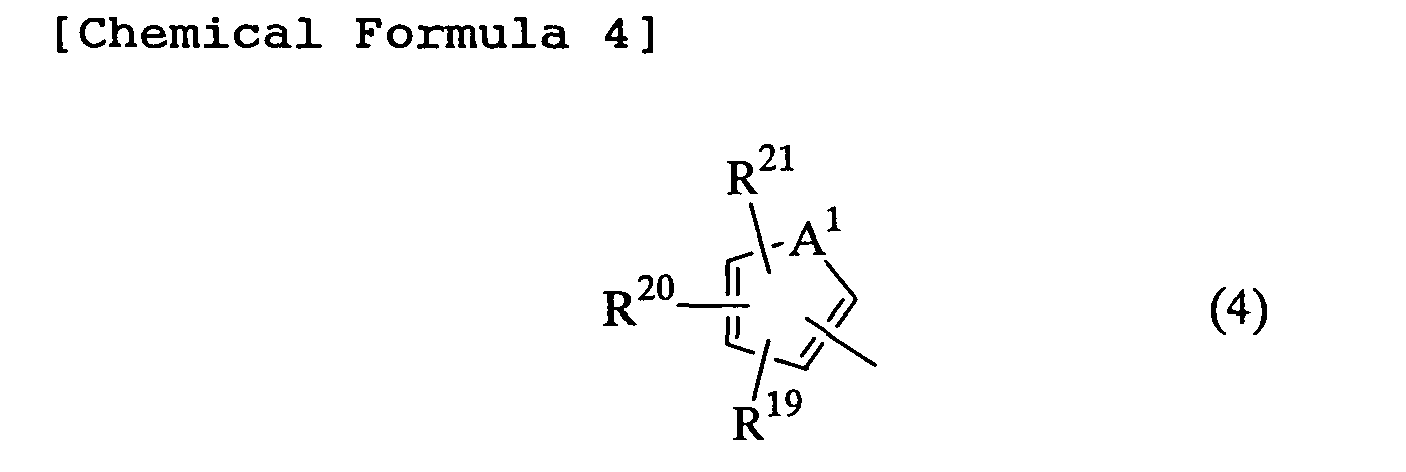
- [5] The electrode as recited in 1 above, wherein R1 and R2 independently represent a group of the following formula (5)

- [6] The electrode as recited in any one of 1 to 5 above, wherein R5 represents a group of the following formula (6)

- [7] The electrode as recited in any one of 1 to 5 above, wherein R5 represents a group of the following formula (7)

- [8] The electrode as recited in any one of 1 to 5 above, wherein R5 represents a group of the following formula (8)

- [9] The electrode as recited in any one of 1 to 5, wherein R5 represents a group of the following formula (9)

- [10] The electrode as recited in any one of 1 to 5 above, wherein R6 represents a group of the following formula (10)

- [11] The electrode as recited in any one of 1 to 5 above, wherein R6 represents a group of the following formula (11)

- [12] The electrode as recited in any one of 1 to 5 above, wherein R6 represents a group of the following formula (12)

- [13] The electrode as recited in any one of 1 to 5 above, wherein R6 represents a group of the following formula (13)

- [14] The electrode as recited in 1 above, wherein the group formed by bonding R1 and R2 through a singe bond is represented by the formula (14)

- [15] An electrode for an energy storage device comprising a polyaminoquinoxaline compound of the following formula (1b) as an electrode active material

- [16] An electrode for an energy storage device including a polyaminoquinoxaline compound of the following formula (1c) as an electrode active material

- [17] An electrode for an energy storage device including a polyaminoquinoxaline compound of the following formula (1d) as an electrode active material

- [18] The electrode as recited in 15 or 17 above, wherein the group formed by joining R1' and R2' together is of the formula (15)

- [19] The electrode as recited in to 16 or 17 above, wherein the group formed by joining R3' and R4' together is of the formula (16)

- [20] The electrode as recited in 16 or 17 above, wherein the group formed by joining R3' and R4' is of the formula (17)

- [21] An energy storage device comprising an electrode for an energy storage device as recited in any one of 1 to 20 above.
- [22] A method for making an electrode for an energy storage device as recited in 1, which method comprising applying and building up, on a current collector electrode, an electrode active material made of a polyaminoquinoxaline compound represented by the afore-indicated formula (1a).
- [23] A method for making an electrode for an energy storage device as recited in15 above, which method comprising applying and building up, on a current collector electrode, an electrode active material made of a polyaminoquinoxaline compound represented by the afore-indicated formula (1b).
- [24] A method for making an electrode for an energy storage device as recited in 16 above, which method comprising applying and building up, on a current collector electrode, an electrode active material made of a polyaminoquinoxaline compound represented by the afore-indicated formula (1c).
- [25] A method for making an electrode for an energy storage device as recited in 17 above, which method comprising applying and building up, on a current collector electrode, an electrode active material made of a polyaminoquinoxaline compound represented by the afore-indicated formula (1d).
- [26] A method for making an electrode for an energy storage device as recited in 1 above, which method comprising forming an aminoquinoxaline compound represented by the formula (18a) by electrolytic polymerization on a current collector electrode

R1, R2, R3, R4 and Y, respectively, have the same meanings as defined hereinbefore. - [27] A method for making an electrode for an energy storage device as recited in 15 above, which method comprising electrolytically polymerizing an aminoquinoxaline compound represented by the formula (18b) on a current collector electrode,

- [28] A method for making an electrode for an energy storage device as recited in 16 above, which method comprising electrolytically polymerizing an aminoquinoxaline compound represented by the formula (18c) on a current collector electrode,

- [29] A method for making an electrode for an energy storage device as recited in 17 above, which method comprising electrolytically polymerizing an aminoquinoxaline compound represented by the formula (18d) on a current collector electrode,

- The polyaminoquinoxaline compounds of the formulae (1a) to (1d) used as an electrode active material of an electrode for an energy storage device according to the invention have a good heat resistance and is readily controllable with respect to the electrochemical redox potential thereof involving proton movement, and have good cyclic properties.
Moreover, these polyaminoquinoxaline compounds have an electron donative group and an electron acceptive group in one molecule, and are those conductive polymer compounds which not only can be used as either of a positive electrode or a negative electrode, but also exhibit a wide potential activity.
The device that is arranged as having an electrode for an energy storage device of the invention using a polyaminoquinoxaline compound as an electrode active material ensures storage at high capacitance.
Especially, when the polyaminoquinoxaline compound is used as an electrode for an electric double layer capacitor, the redox reaction of the electrode active material and the electric double layer occurring on the surface of the electrode both function as an energy source, so that storage of a higher capacitance is enabled than in a conventional electric double layer capacitor using active carbon alone. - The invention is described in more detail below.
The electrode of an energy storage device according to the invention is comprising, as an electrode active material, a polyaminoquinoxaline compound represented by any one of the afore-indicated formulae (1a)-(1d).
Initially, the polyaminoquinoxaline compounds of the formulae (1a)-(1d) or the aminoquinoxaline compounds of the formulae (18a)-(18d) are described.
In these formulae, R1 and R2 independently represent a hydrogen atom, a hydroxyl group, a C1-C10 alkyl group, a C1-C10 alkoxy group, a phenyl group which may be substituted with Y, a pyridyl group which may be substituted with Y, a biphenyl group which may be substituted with Y, a naphthyl group which may be substituted with Y, a thienyl group which may be substituted with Y, a pyrrolyl group which may be substituted with Y, a furyl group which may be substituted with Y or a condensed heteroaryl group which may be substituted with Y provided that when R1 and R2 are, respectively, the above-defined phenyl, pyridyl, biphenyl, naphthyl, thienyl, pyrrolyl, furyl or condensed heteroaryl group, these groups may be joined through a single bond. - R1' and R2' join together to form -CH2CH2CH2-, -CH2CH2O-, -OCH2CH2-, -CH2OCH2-, -OCH2O- , -CH2CH2S-, -SCH2CH2-, -CH2SCH2-, -CH2CH2N(R')-, -N(R')CH2CH2-, -CH2N(R')CH2-, -CH2CH2CH2CH2-, -CH2CH2CH2O-, -OCH2CH2CH2-, -CH2CH2OCH2-, -CH2OCH2CH2-, -CH2OCH2O-, -OCH2CH2O-, -SCH2CH2S-, -OCH2CH2S-, -SCH2CH2O-, -CH2CH=CH-, -CH=CHCH2-, -OCH=CH-, -CH=CHO-, -SCH=CH-, -CH=CHS-, -N(R')CH=CH-, -CH=CHN(R')-, -OCH=N-, -N=CHO-, -SCH=N-, -N=CHS-, -N(R')CH=N-, -N=CHN(R')-, -N(R')N=CH-, -CH=N(R')N-, -CH=CHCH=CH-, -OCH2CH=CH-, -CH=CHCH2O-, -N=CHCH=CH-, -CH=CHCH=N-, -N=CHCH=N-, -N=CHN=CH-, or -CH=NCH=N- wherein a hydrogen atom bonded to a carbon atom of these groups may be substituted with Y, and R' represents a hydrogen atom, a C1-C10 alkyl group, a C1-C10 haloalkyl group, a C1-C10 cyanoalkyl group, a phenyl group which may be substituted with Z, a pyridyl group which may be substituted with Z, a biphenyl group which may be substituted with Z, a naphthyl group which may be substituted with Z, a thienyl group which may be substituted with Z, a pyrrolyl group which may be substituted with Z, a furyl group which may be substituted with Z, or a condensed heteroaryl group which may be substituted with Z.
More particularly, mention is made of those groups of the following formulae (2) to (5), (14) and (15): -

- When the solubility of the aminoquinoxaline compound is taken into account, R1, R2, R1' and R2' should preferably be substituted with substituent Y. The substituent Y should preferably be a C1-C10 alkyl group or a C1-C10 alkoxy group, more preferably a C1-C5 alkyl group or a C1-C5 alkoxy group.
When the electric property of the aminoquinoxaline compound is taken into account, R1 and R2 should preferably be the group represented by the above formula (14) formed by bonding R1 and R2 through a single bond. Especially, A2, in the formula (14), should preferably be carbon atom.
On the other hand, R3 and R4 independently represent a hydrogen atom, a halogen atom, a cyano group, a nitro group, an amino group, a C1-C10 alkyl group, a C1-C10 alkoxy group, a phenyl group which may be substituted with Y, a pyridyl group which may be substituted with Y, a biphenyl group which may be substituted with Y, a naphthyl group which may be substituted with Y, a thienyl group which may be substituted with Y, a pyrrolyl group which may be substituted with Y, a furyl group which may be substituted with Y or a condensed heteroaryl group which may be substituted with Y provided that when R3 and R4 are, respectively, the above-defined phenyl, pyridyl, biphenyl, naphthyl, thienyl, pyrrolyl, furyl or condensed heteroaryl group, these groups may be joined through a single bond. - R3' and R4' join together to form -CH2CH2CH2-, -CH2CH2O-, -OCH2CH2-, -CH2OCH2-, -OCH2O-, -CH2CH2S-, -SCH2CH2-, -CH2SCH2-, -CH2CH2N(R')-, -N(R')CH2CH2-, -CH2N(R')CH2-, -CH2CH2CH2CH2-, -CH2CH2CH2O-, -OCH2CH2CH2-, -CH2CH2OCH2-, -CH2OCH2CH2-, -CH2OCH2O-, -OCH2CH2O-, -SCH2CH2S-, -OCH2CH2S-, -SCH2CH2O-, -CH2CH=CH-, -CH=CHCH2-, -OCH=CH-, -CH=CHO-, -SCH=CH-, -CH=CHS-, -N(R')CH=CH-, -CH=CHN(R')-, -OCH=N-, -N=CHO-, -SCH=N-, -N=CHS-, -N(R')CH=N-, -N=CHN(R')-, -N(R')N=CH-, -CH=N(R')N-, -CH=CHCH=CH-, -OCH2CH=CH-, -CH=CHCH2O-, -N=CHCH=CH-, -CH=CHCH=N-, -N=CHCH=N-, -N=CHN=CH-, or -CH=NCH=N- wherein a hydrogen atom bonded to a carbon atom of these groups may be substituted with Y, and Z has the same meaning as defined above.
- When R3 and R4 are, respectively, an alkyl group or an alkoxy group, these groups should preferably have 1 to 5 carbon atoms from the standpoint of conductivity. In view of providing good redox potential, R3 and R4 should preferably be a phenyl group, a naphthyl group or a thienyl group. From the standpoint of electric characteristics, R3, R4, R3' and R4' should preferably be substituted with substituent Y. Such a substituent Y preferably includes, a C1-C10 alkyl group or a C1-C10 alkoxy group, more preferably a C1-C5 alkyl group or a C1-C5 alkoxy group. Specific examples include, aside from those groups of the formulae (2) to (5) and (14) exemplified with respect to the R1, R2, R1' and R2' the groups of the following formulae (16) and (17).
-

- In the formulae (1a)-(1d), X1 represents -NH-R5-NH- or -NH-R6- wherein R5 and R6 independently represent a C1-C10 alkylene group, -C(O)CH2-, -CH2C(O)-, a divalent benzene ring which may be substituted with Y, a divalent pyridine ring which may be substituted with Y, a divalent biphenyl group which may be substituted with Y, a divalent naphthalene ring which may be substituted with Y, a divalent thiophene ring which may be substituted with Y, a pyrrole ring which may be substituted with Y, a furan ring which may be substituted with Y, or a condensed hetero ring which may be substituted with Y. Specific examples are those groups of the following formulae (6) to (13):
-

- In the afore-indicated formulae (18a)-(18d), X2 represents -NH-R73-NH2 or -NH-R74 wherein R73 a C1-C10 alkylene group, -C(O)-CH2-, -CH2C(O)-, a divalent benzene ring which may be substituted with Y, a divalent pyridine ring which may be substituted with Y, a divalent biphenyl group which may be substituted with Y, a divalent naphthalene ring which may be substituted with Y, a divalent thiophene ring which may be substituted with Y, a pyrrole ring which may be substituted with Y, a furan ring which may be substituted with Y, or a condensed hetero ring which may be substituted with Y, and R74 represents a C1-C10 alkyl group, an acetyl group, a phenyl group which may be substituted with Y, a pyridyl group which may be substituted with Y, a biphenyl group which may be substituted with Y, a naphthyl which may be substituted with Y, a thienyl group which may be substituted with Y, a pyrrolyl group which may be substituted with Y, a furyl group which may be substituted with Y, or a condensed heteroaryl which may be substituted with Y.
- From the standpoint of providing good redox potential, R5, R73 and R74 should preferably be a divalent benzene ring, a divalent naphthalene ring or a divalent thiophene ring, respectively. In view of keeping stable electric characteristics such as of a film of a polyaminoquinoxaline compound, these cyclic substituents should preferably be substituted further with substituent Y, respectively.
From the standpoint of providing good redox potential, R6 should preferably be a phenyl group, a naphthyl group or thienyl group.
In view of keeping stable amorphousness such as of a film made of a polyaminoquinoxaline compound, R5, R6, R73 and R74 should preferably be substituted further with substituent Y, respectively. In this case, the substituent Y should preferably include a C1-C10 alkyl group or a C1-C10 alkoxy group, more preferably a C1-C5 alkyl group or a C1-C5 alkoxy group. - Although the molecular weight of the polyaminoquinoxaline compound represented by the formula (1) is not critical, the weight average molecular weight preferably ranges 1,000 to 100,000, more preferably 4,000 to 50,000. In view of this, although n in the formula (1) is a positive integer of 2 or more, n is preferably an integer sufficient to ensure the above-defined range of the weight average molecular weight, e.g., n = 2 to 400.
- In the above-indicated, respective formulae, the C1-C10 alkyl group may be linear, branched or cyclic and includes, for example, methyl, ethyl, n-propyl, i-propyl, n-butyl, i-butyl, t-butyl, s-butyl, n-pentyl, n-hexyl, 2-ethylpropyl, 2,2-dimethylpropyl, 1,2-dimethylpropyl, 1,1,2-trimethylpropyl, 1,2,2-trimethylpropyl, 1-ethyl-1-methylropyl, 1-ethyl-2-methylpropyl, 1-methylbutyl, 2-methylbtyl, 3-methylbutyl, 1,1-dimethylbutyl, 1,2-dimethylbutyl, 1,3-dimethylbutyl, 2,2-dimethylbutyl, 2,3-dimethylbutyl, 3,3-dimethylbutyl, 1-ethylbutyl, 2-ethylbutyl, 1-methylpentyl, 2-methylpentyl, 3-mthylpentyl, 4-methylpentyl and the like. It will be noted that for the C1-C10 alkylene groups, mention is made of those groups wherein one hydrogen atom is eliminated from the above-indicated alkyl groups.
- For the C1-C10 haloalkyl groups, those groups wherein at least one hydrogen atom of the above-indicated alkyl groups is substituted with a halogen atom are mentioned. It should be noted that the halogen atom may be any of chlorine, bromine, iodine and fluorine atoms.
For the C1-C10 cyanoalkyl groups, those groups wherein at least one hydrogen atom of the above-indicated alkyl groups is substituted with a cyano group are mentioned.
For the condensed heteroaryl group, mention is made of thieno[3,4-b]pyrazin-5-yl, furo[3,4-b]pyrazin-5-yl, 6H-pyrolo[3,4-b]pyrazin-5-yl, and the like. - The C1-C10 alkoxy groups may be linear, branched or cyclic and include, for example, methoxy, ethoxy, n-propoxy, i-propoxy, n-butoxy, i-butoxy, s-butoxy, t-butoxy, n-pentyloxy, n-hexyloxy, 1,1-dimethylpropoxy, 1,2-dimethylrpoxy, 2,2-dimethylpropoxy, 1-ethylpropoxy, 1,1,2-trimethylpropoxy, 1,2,2-trimethylpropoxy, 1-ethyl-1-methylpropoxy, 1-ethyl-2-methylpropoxy, 1-methylbutoxy, 2-methylbutoxy, 3-methylbutoxy, 1-ethylbutoxy, 2-ethylbutoxy, 1,1-dimethylbutoxy, 1,2-dimethylbutoxy, 1,3-dimethylbutoxy, 2,2- dimethylbutoxy, 2,3-dimethylbutoxy, 3,3-dimethylbutoxy, 1-methylpentyloxy, 2-methylpentyloxy, 3-methylpentyloxy, 4-methylpentyloxy and the like.
In the above-indicated groups, "n", "i", "s", and "t", respectively, mean normal, iso, secondary and tertiary. - Examples of the compounds indicated by the formula (1a) to (1d) include those indicated below although not limitative.
-

-

-

-

-

-

- Next, the process of synthesizing, for example, a compound represented the formula (18a) (formula (1a)) selected among those compounds of the formulae (18a)-(18d) (formulae (1a)-(1d)) is described. This compound can be prepared from a starting 5-aminoquinoxaline compound represented by the following formula (19)
-

- Although limitation is not placed on a specific manner of synthesis, there may be used processes set forth in Journal of the Chemical Society Perkin Transactions I (J. Chem. Soc. Perkin Trans. I) 1988, pp. 1331 to 1335, and also in Chemistry Letters (Chem. Lett.) 1997, pp. 1185 to 1186.
For example, a corresponding 5-aminoquinoxaline compound is dissolved in an appropriate solvent and is reacted with nitrofluorobenzene in the presence of an appropriate base at room temperature, followed by hydrogenation reaction in the presence of Pd/C to obtain an intended product wherein a phenyl ring has been introduced at the position of R5. An intended compound having a thienyl group at R6 can be prepared by dissolving a 5-aminoquinoxaline compound in an appropriate solvent, adding catalytic amounts of Pd2(dba)3 and BINAP and reacting with 2-bromothiophene in the presence of an appropriate base. - It will be noted that the synthesis of the 5-aminoquinoxaline compound of the above formula (19) is not limitative, there can be used a method set out, for example, in Journal of American Chemical Society (J. Am. Chem. Soc.), 1957, Vol. 79, pp. 2245 to 2248, and Journal of Organic Chemistry (J. Org. Chem.), 1966, Vol. 31, pp. 3384 to 3390.
- Although a process for preparing a polyaminoquinoxaline compound represented by the formula (1a) is not limitative, this polymer compound can be prepared by polymerizing an aminoquinoxaline compound of the formula (18a) by any arbitrary procedure. Such polymerizing procedures may include, for example, chemical oxidation polymerization, electrolytic oxidation polymerization, catalytic polymerization and the like. In most cases, in view of the fact that a polymer can be formed on an electrode surface, chemical oxidation polymerization and electrolytic oxidation polymerization are preferred, of which the electrolytic oxidation polymerization is more preferred.
The oxidizing agent used for the chemical oxidation polymerization is not critical and includes, for example, ammonium persulfate, tetraammonium peroxide, iron chloride, cerium sulfate and the like. - A specific procedure for the electrolytic oxidation polymerization is as follows: an oxidizing agent is added, for example, to a monomer of the formula (18a) and well agitated, to which an organic solvent is added thereto so as to make a uniform solution; and the resulting solution is subjected to electrolytic polymerization by use of a three-electrode beaker-shaped cell equipped with a platinum mesh counter electrode and the like.
The electrolytic polymerization is carried out, for example, according to an electrochemical measuring system using, as a test electrode substrate, a platinum plate whose surface is abraded with an emery paper and, as a reference electrode, Ag/Ag+. For a more specific procedure of electrolytic polymerization, a potential scanning process and a constant potential process may be used, for example. In this way, an intended polymer compound is obtained as deposited on the electrode in the form of a film. - The oxidizing agents used for the electrolytic oxidation polymerization include, for example, hydrochloric acid, sulfuric acid, perchloric acid, trifluoromethanesulfonic acid, para-toluenesulfonic acid and the like, of which perchloric acid is preferred.
Examples of the organic solvents include N,N-dimethylformamide, tetrahydrofuran, acetonitrile, dichloromethane, dimethylsulfoxide, methanol, ethanol and the like, of which N,N-dimethylformamide is preferred. - While making use of their good characteristics, the polyaminoquinoxaline compounds represented by the formulae (1a)-(1d) illustrated hereinbefore are conveniently applicable to as an active material of an energy storage device, particularly, as an electrode active material. In this connection, the polyaminoquinoxaline per se is conductive in nature and an effect of lowering a contact resistance at an electrode interface can be expected.
The procedure of making an electrode for an energy storage device using the polyaminoquinoxaline compounds represented by the formulae (1a)-(1d) is not critical. The monomer of any one of the foregoing formulae (18a)-(18d) is subjected to electrolytic oxidation polymerization on an electrode to deposit a film of a polymer compound of any one of the formulae (1a)-(1d), thereby making the electrode.
Further, the polyaminoquinoxaline compound can be readily converted to a film according to a vacuum deposition method, a spin coating method, a dipping method, a casting method, a screen printing method or the like. Using these methods, an electrode can be made by coverage with a polyaminoquinoxaline compound-containing film. - Especially, an electrode containing a polyaminoquinoxaline compound as an electrode active material can be readily made by use of a method wherein a coating composition containing an electrode active material made of a polyaminoquinoxaline compound represented by any one of the formulae (1a) to (1d), and coating and built up on a current collector electrode.
The components of the coating composition containing a polyaminoquinoxaline compound are not limitative. For instance, a composition comprising a polyaminoquinoxaline compound, a polymer material for improving film-forming properties, a dispersant and the like. The content of the polyaminoquinoxaline compound is, for example, in the range of about 50 to about 90 wt%.
It will be noted that, if necessary, additives such as thermal stabilizers, light stabilizers, fillers, reinforcing agents and the like may be appropriately formulates. - With the electrode for an energy storage device stated hereinbefore, only an embodiment where an electrode active material made of a polyaminoquinoxaline compound is deposited on an electrode surface such as by electrolytic polymerization or coating has been set forth, to which the invention is not limited. For instance, an electrode composition made by mixing with an electrode active material of a polyaminoquinoxaline compound beforehand is used to make an electrode.
- The electrode for energy storage devices can be favorably used in various types of energy storage devices such as electric double layer capacitors, lithium ion cells, proton polymer cells, nickel hydrogen cells, lead batteries and the like. It is preferred to use the electrode for electric double layer capacitors, lithium ion cells, and proton polymer cells.
Especially, when the electrode is used for an electric double layer capacitor, both the redox reaction of the electrode active material and the electric double layer occurring on the electrode surfaces can be used as an energy source, so that storage at a higher capacitance is enabled than with the case of a conventional electric double layer capacitor using active carbon. - The invention is more particularly described by way of Synthetic Examples and Examples, which should not be construed as limiting the invention thereto. Comparative Examples are also described.
- Prepared according to the following procedures (1) to (3).
-

- 14 g of commercially available 1-amino-2,5-dinitrobenzene was dissolved in 225 ml of methanol, to which a solution of 60 g of sodium sulfide and 21 g of sodium hydrogen carbonate dissolved in 240 g of water was added by use of a dropping funnel while keeping the reaction temperature at 60°C. After completion of the addition, agitation was continued at 60°C for 1 hour. After completion of the reaction, the mixture was cooled down to room temperature and filtered.
m/z: (FD+) 153 (calculated 153.1396)
1H-NMR: 7.7228, 7.7203, 7.7206, 7.2433, 6.9245, 6.6209, 6.6063, 6.6038, 6.5886, 5.9210, 3.3978 ppm
Yield: 7.79 g (66.5%)
Product aspect: Reddish brown fine crystals
Melting point: 140°C - (2) Synthesis of 2,3-dihydroxy-5-nitroquinoxaline

- 4 g (26.12 mmol) of 2,3-diaminonitrobenzene and 6.59 g (52.24 mmol) of commercially available oxalic dehydrate were dissolved in 50% acetic acid, followed by reaction at a boiling point thereof for 3 hours in a stream of argon.
After completion of the reaction, the mixture was cooled down to room temperature and the resulting precipitated crystals were filtered.
Yield: 3.01 g (55.6%)
Product aspect: Yellow fine crystals
m/z: 207 (calculated 207.144) - (3) Synthesis of 2,3-dihydroxy-5-aminoquinoxaline

- 2.00 g of 2,3-dihydroxy-5-nitroquinoxaline was dissolved in 100 g of a 1:1 methanol and dioxane solvent, after which the reaction system was well purged with argon, followed by further addition of 1.00 g of 5% Pd/C (hydrous). Thereafter, the system was purged with hydrogen, followed by reaction at room temperature for 20 hours. After completion of the reaction, the reaction product was dispersed in a solution of 6.00 g of potassium carbonate in 130 ml of water and then dissolved therein. 35% hydrochloric acid was gradually added to the solution obtained after filtration thereby obtaining a precipitate.
Yield: 1.10 g
Product aspect: Light yellow fine crystals
m/z: (FD+) 177 (calculated 177. 1616)
13C-NMR: 155.8030, 155.6504, 135.9570, 126.8390, 124.1303, 112.3265, 109.6025, 103.8418 ppm - Prepared according to the following procedures (1) and (2). (1) Synthesis of 2,3-diphenyl-5-aminoquinoxaline
-

- 1.53 g (10 mmol) of 2,3-diaminonitrobenzene and 2.00 g (9.6 mmol) of benzil were placed in four-necked flask, to which 30 g of a solvent of acetic acid and methanol at a mixing ratio of 1:1 was added for dissolution. Subsequently, the mixture was reacted at a reaction temperature of 70°C for 2 hours. After the reaction, the solvent was removed and the resulting product was extracted with a silica gel column (ethyl acetate: hexane = 1:1).
Yield: 2.11 g
Product aspect: Yellow fine crystals
m/z: 327 (calculated 327.24) - (2) Synthesis of 2,3-diphenyl-5-aminoquinoxaline

- 1.04 g of 2,3-diphenyl-5-nitroquinoxaline was dissolved in 30 g of dioxane, followed by purging with argon and further addition of 0.5 g of 5% Pd/C (hydrous). After sufficient purging with argon again, hydrogen was added and reacted at room temperature for 30 hours. After completion of the reaction, the reaction mixture was filtered and the solvent was removed, followed by isolation and purification with a silica gel column (ethyl acetate: hexane = 1:3).
Yield: 0.73 g
Product aspect: Yellow fine crystals
m/z: 297 (calculated M: 297.36)
13C-NMR: 153.6055, 150.1185, 144.2280, 141.9619, 139.4516, 139.3524, 131.1348, 130.0894, 129.9368, 128.7694, 128.6473, 128.3497, 128.1743, 117.2098, 110.2511 ppm - Prepared according to the following procedures (1) and (2).
-
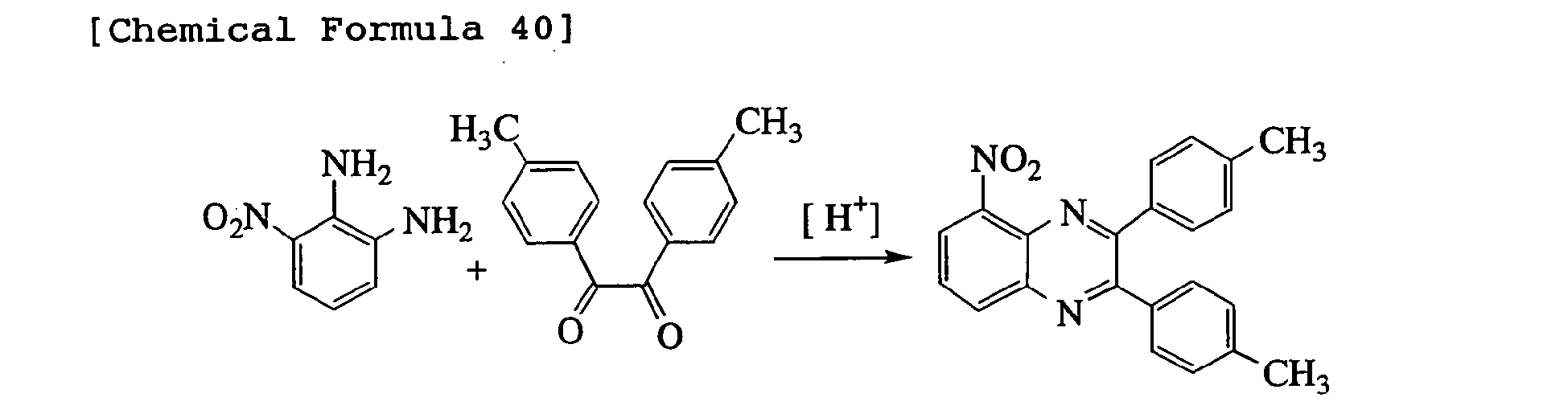
- 1.84 g (12 mmol) of 2,3-diaminonitrobenzene and 2.38 g (10 mmol) of 4,4'-dimethylbenzil were dissolved in 40 g of a mixed solvent of acetic acid and methanol (1:1) and reacted at a reaction temperature of 80°C for 4 hours. After completion of the reaction, the solvent was removed and the resulting reaction product was extracted by means of a silica gel column.
Yield: 1.30 g
Product aspect: Yellow fine crystals
m/z: 355 (calculated 355.39)
13C-NMR: 154.8950, 154.8339, 147.0894, 140.7563, 140.1307, 139.8636, 135.5984, 135.1253, 133.7061, 133.2254, 130.2725, 129.7003, 129.3188, 129.1204, 128.4108, 127.7470, 124.2142 ppm - (2) Synthesis of 2,3-di(4-methylphenyl)-5-aminoquinoxaline

- 2.02 g of 2,3-di(4-methylphenyl)-5-nitroquinoxaline was dissolved in 30 g of dioxane, followed by purging with argon and adding 0.6 g of 5% Pd/C (hydrous). After purging with argon again, the system was purged with hydrogen for reaction at room temperature for 18 hours. After completion of the reaction, the system was filtered. The filtration residue was washed with acetone and then with dioxane and filtered again. The solvent was removed from the resulting filtrate, followed by extracting a reaction product by use of a silica gel column.
Yield: 1.36 g
Product aspect: Yellow fine crystals
m/z: 325 (calculated 325.14)
13C -NMR: 153.6131, 150.1643, 144.0907, 141.8551, 138.6581, 138.5894, 136.7074, 136.6666, 131.2721, 130.7761, 129.9292, 129.7766, 129.0365, 128.9815, 117.2403, 110.0603 ppm - Prepared according to the following procedures (1) and (2).
-

- 1.54 g (10 mmol) of 2,3-diaminonitrobenzene and 2.25 g (8.3 mmol) of 4,4'-dimethoxybenzil were dissolved in 100 g of a mixed solvent (acetic acid : methanol = 1:1) and reacted at room temperature for 20 hours, and, after completion of the reaction, filtered. The resulting filtration residue was washed with acetone and dioxane, and again filtered. The solvent was removed from the resulting filtrate, and a reaction product was extracted by means of a silica gel column.
Yield: 1.24 g
Product aspect: Yellow fine crystals
m/z: 387 (calculated: 387.39)
13C-NMR: 161.0983, 160.9075, 154.3303, 154.2464, 146.9520, 140.6495, 133.5993, 133.1415, 131.9207, 130.8448, 130.4099, 127.5104, 124.0998, 114.1043, 113.8830 ppm - (2) Synthesis of 2,3-di(4-methoxyphenyl)-5-aminoquinoxaline

- 0.55 g of 2,3-(4-dimethoxyphenyl)-5-nitroquinoxaline was dissolved in 30 g of dioxane, followed by purging well with argon, adding 0.5 g of 5% Pd/C (hydrous) and purging satisfactorily with argon again. This system was purged with hydrogen and reacted at room temperature for 24 hours. After completion of the reaction, the system was filtered. The resulting filtration residue was washed with acetone and then with dioxane and filtered again. The solvent was removed from the resulting filtrate and a reaction product was extracted with a silica gel column.
Yield: 0.37 g
Product aspect: Yellow fine crystals
m/z: 325 (calculated: 325.43)
13C -NMR: 160.1369, 160.0606, 153.1324, 149.7370, 144.0144, 141.7483, 131.3942, 131.2874, 130.6235, 117.1640, 113.8296, 113.6618, 110.0145, 55.3828 ppm - Prepared according to the following procedures (1) and (2).
-

- 1.53 g (10 mmol) of 2,3-diaminonitrobenzene and 3.68 g (10 mmol) of 4,4'-dibromobenzil were dissolved in 80 g of a mixed solvent of acetic acid and methanol (1:1) and reacted at a reaction temperature of 70°C for 30 hours. After completion of the reaction, the solvent was removed and a reaction product was extracted by means of a silica gel.
Yield: 1.89 g
Product aspect: Yellow fine crystals
m/z: 485 (calculated 485.12)
13C-NMR: 153.4453, 153.3613, 147.0065, 140.7945, 136.8116, 136.3766, 133.7824, 133.2635, 132.0504, 131.8749, 131.8215, 131.3789, 128.5787, 124.9849, 124.8780, 124.7102 ppm - (2) Synthesis of 2,3-di(4-bromophenyl)-5-aminoquinoxaline

- 1.01 g (2.1 mmol) of 2,3-di(4-bromophenyl)-5-nitroquinoxaline was dissolved in 30 g of dioxane, followed by purging well with argon, adding 0.3 g of 5% Pd/C (hydrous) and purging well with argon again. This system was purged with a hydrogen gas and reacted at room temperature for 24 hours. After completion of the reaction, the system was filtered. The resulting filtration residue was washed with acetone and then with dioxane and filtered again. The solvent was removed from the resulting filtrate and a reaction product was extracted with a silica gel column.
Yield: 0.66 g
Product aspect: Yellow fine crystals
m/z: 455 (calculated: 455.12)
13C-NMR: 151.966, 148.493, 144.065, 141.897, 137.920, 137.820, 135.042, 131.706, 131.637, 131.492, 131.400, 131.248, 123.514, 123.377, 117.064, 110.452 ppm - Prepared according to the following procedures (1) and (2).
-

- 0.022 g (0.144 mmol) of 2,2'-diaminonitrobenzene and 0.01938 g (0.087 mmol) of 2,2'-thienyl were dissolved in 3 g of a mixed solvent of acetic acid and methanol (1:1) and reacted at a reaction temperature of 70°C for 30 hours. After completion of the reaction, the solvent was removed and the resulting reaction produced was extracted by means of a silica gel column.
Yield: 0.04 g
Product aspect: Yellow fine crystals
m/z: 339 (calculated: 339.40) - (2) Synthesis of 2,3-dithienyl-5-aminoquinoxaline

- 1.01 g (3.0 mmol) of 2,3-dithienyl-5-nitroquinoxaline was dissolved in 30 g of dioxane and the system was fully purged with argon. Thereafter, 0.3 g of 5% Pd/C (hydrous) was added, followed by purging satisfactorily with argon again. This system was purged with a hydrogen gas and reacted at room temperature for 24 hours. After completion of the reaction, the system was filtered. The resulting filtration residue was washed with acetone and then with dioxane, and was filtered again. The solvent was removed from the resulting filtrate, and a reaction product was extracted with a silica gel column.
Yield: 0.40 g
Product aspect: Yellowish brown fine crystals
m/z: 309 (calculated 309.42)
13C-NMR: 146.569, 143.752, 142.111, 141.546, 141.233, 131.232, 130.614, 129.064, 128.820, 128.553, 128.469, 127.530, 127.461, 116.911, 116.911, 110.422, 99.902 ppm - Prepared according to the following procedures (1) and (2).
-

- 15.0 g (82 mmol) of 2,6-dinitroaniline was dissolved in 150 g of THF and the reaction system was satisfactorily purged with nitrogen, to which 7.6 g of 5% Pd/C (hydrous) was added. Thereafter, the system was purged with hydrogen, followed by reaction at room temperature for 15 hours. After completion of the reaction, the reaction solution was filtered to remove Pd therefrom, and the resulting filtrate was condensed as it is to obtain the intended product. The thus obtained product was instable and was used as it is in a subsequent reaction.
- (2) Synthesis of 10-aminodibenzo(A,C)phenazine

- 10.1 g (82 mmol) of 1,2,3-triaminobenzene and 14.6 g (70 mmol) of 9,10-phenanthrenequinone were placed in a four-necked flask, to which 350 g of a solvent of acetic acid and methanol at 1:1 was added for dissolution, followed by reaction at a reaction temperature of 70°C for 2 hours. After the reaction, the solvent was removed and the resulting product was washed with methanol to obtain the intended product. Yield: 17.1 g
Product aspect: Ocher solid
m/z: 295 (calculated: 295.11)
13C-NMR: 146.932, 144.145, 143.084, 139.740, 133.473, 133.007, 132.656, 132.213, 131.602, 131.488, 130.847, 130.473, 128.465, 126.869, 126.831, 126.663, 123.900, 116.243, 108.647 ppm - Prepared according to the following procedures (1) and (2).
-

- While agitating 4.0 g (13.4 mmol) of 2,3-diphenyl)-5-aminoquinoxaline, 2.1 g (14.9 mmol) of 4-fluoronitrobenzene and 100 ml of dimethylsulfoxide, 5.0 g (44.6 mmol) of t-butoxy potassium was gently added. After completion of the addition, the reaction container was purged with nitrogen, followed by agitation at room temperature for 24 hours. After completion of the reaction, 100 ml of water was added while cooling, and an organic phase was extracted by use of a chloroform solvent, followed by concentration to obtain the intended product.
Yield: 5.4 g - (2) Synthesis of 2,3-diphenyl-5-(4-aminophenyl)aminoquinoxaline

- 5.4 g (2.9 mmol) of 2,3-diphenyl-5-(4-nitrophenyl)-aminoquinoxaline was dissolved in 100 ml of tetrahydrofuran, and a reaction container was purged with nitrogen. Thereafter, 5.0 g of 5% Pd/C (hydrous) was added, followed by sufficient purging with nitrogen again. This system was purged with hydrogen, followed by reaction at room temperature for 10 hours. After completion of the reaction, the system was filtered, and the resulting filtration residue was washed with tetrahydrofuran and filtered again. The solvent was removed from the resulting filtrate, and a reaction product was recrystallized from a mixed solvent of tetrahydrofuran/heptane.
Yield: 3.9 g
Product aspect: orange solid
m/z: 388 (calculated: 388.17)
13C-NMR: 153.597, 149.658, 142.978, 142.887, 142.009, 139.306, 139.199, 132.290, 131.283, 130.008, 129.825, 128.680, 128.588, 128.267, 128.130, 124.794, 116.198, 116.114, 106.648 ppm - Prepared according to the following procedures (1) and (2).
-
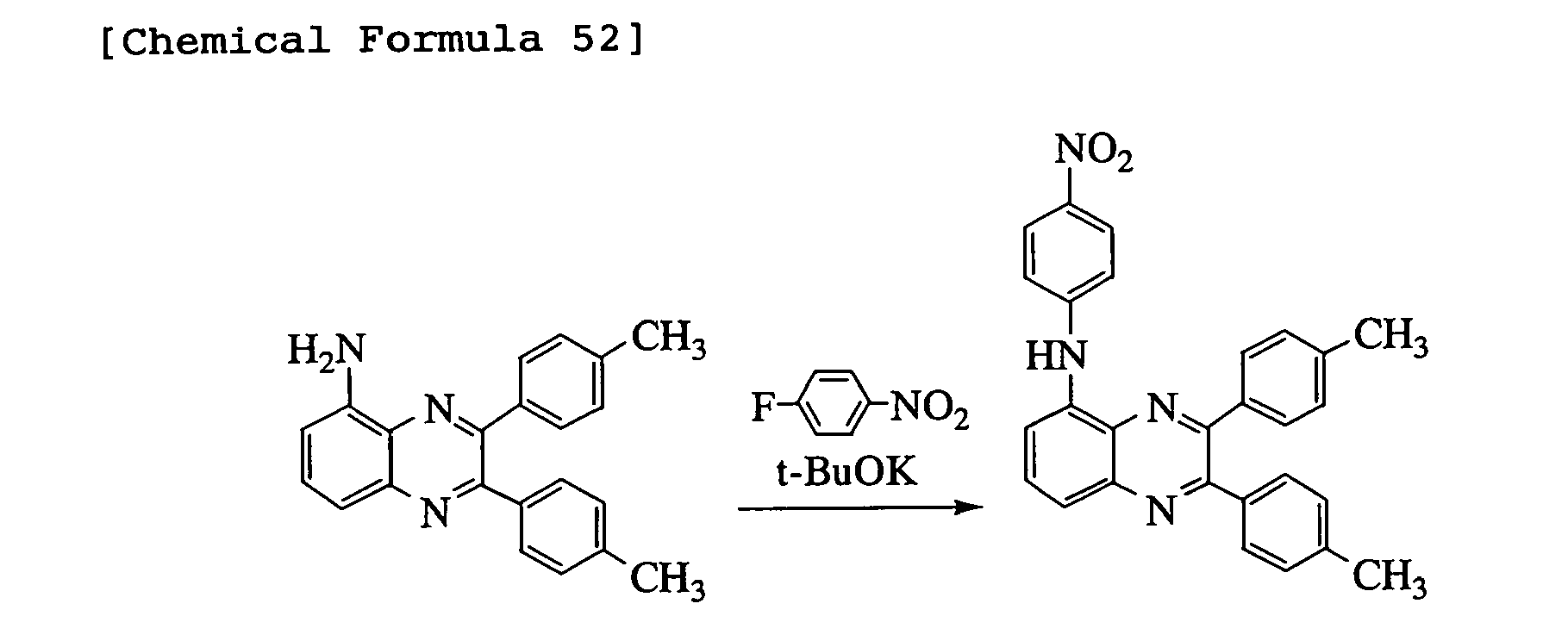
- While agitating 3.0 g (9.2 mmol) of 2,3-di(4-methylphenyl)-5-aminoquinoxaline, 1.4 g (9.9 mmol) of 4-fluoronitrobenzene and 100 ml of dimethylsulfoxide, 3.4 g (30.3 mmol) of t-butoxy potassium was gently added. After completion of the addition, the reaction container was purged with nitrogen, followed by agitation at room temperature for 20 hours. After completion of the reaction, 100 ml of water was added while cooling, and an organic phase was extracted by use of a chloroform solvent, followed by concentration to obtain the intended product.
Yield: 5.9 g
m/z: 446 (calculated: 446.17) - (2) Synthesis of 2,3-di(4-methylphenyl)-5-(4-aminophenyl)-aminoquinoxaline

- 5.9 g (13.2 mmol) of 2,3-di(4-methylphenyl)-5-(4-nitrophenyl)aminoquinoxaline was dissolved in 70 ml of tetrahydrofuran, and a reaction container was purged with nitrogen. Thereafter, 2.0 g of 5% Pd/C (hydrous) was added, followed by sufficient purging with nitrogen again. This system was purged with hydrogen, followed by reaction at room temperature for 13 hours. After completion of the reaction, the system was filtered, and the resulting filtration residue was washed with tetrahydrofuran and filtered again. The solvent was removed from the resulting filtrate, and a reaction product was extracted with a silica gel column.
Yield: 1.1 g
Product aspect: orange solid
m/z: 416 (calculated: 416.20)
13C-NMR: 153.605, 149.711, 142.719, 141.917, 138.573, 136.543, 132.542, 130.977, 129.863, 129.703, 128.970, 128.870, 124.664, 116.198, 106.480, 21.352 ppm - Prepared according to the following procedures (1) and (2).
-

- While agitating 5.0 g (14.0 mmol) of 2,3-di(4-methoxylphenyl)-5-aminoquinoxaline, 2.4 g (17.0 mmol) of 4-fluoronitrobenzene and 120 ml of dimethylsulfoxide, 5.7 g (50.8 mmol) of t-butoxy potassium was gently added. After completion of the addition, the reaction container was purged with nitrogen, followed by agitation at room temperature for 8 hours. After completion of the reaction, 100 ml of water was added while cooling, and an organic phase was extracted by use of a chloroform solvent, followed by concentration to obtain the intended product.
Yield: 8.3 g
Product aspect: brown solid - (2) Synthesis of 2,3-di(4-methoxylphenyl)-5-(4-aminophenyl)-aminoquinoxaline

- 8.3 g (17.3 mmol) of 2,3-di(4-methoxyphenyl)-5-(4-nitrophenyl)aminoquinoxaline was dissolved in 100 ml of tetrahydrofuran, and a reaction container was purged with nitrogen. Thereafter, 5.0 g f 5% Pd/C (hydrous) was added, followed by sufficient purging with nitrogen again. This system was purged with hydrogen, followed by reaction at room temperature for 10 hours. After completion of the reaction, the system was filtered, and the resulting filtration residue was washed with tetrahydrofuran and filtered again. The solvent was removed from the resulting filtrate, and a reaction product was recrystallized in hexane to obtain the intended product.
Yield: 4.5 g
Product aspect: orange solid
m/z: 448 (calculated: 448.119)
13C-NMR: 163.766, 159.994, 153.131, 148.872, 142.940, 142.688, 141.803, 132.420, 131.947, 131.329, 131.206, 130.779, 124.725, 116.076, 113.755, 113.625, 106.411, 98.953, 55.324 ppm - Prepared according to the following procedures (1) and (2).
-

- While agitating 3.1 g (9.9 mmol) of 2,3-di(2-thienyl)-5-aminoquinoxaline, 1.4 g (9.9 mmol) of 4-fluoronitrobenzene and 15 g of dimethylsulfoxide, 3.3 g (29.6 mmol) of t-butoxy potassium was gently added. After completion of the addition, the reaction container was purged with nitrogen, followed by agitation at room temperature for 14 hours. After completion of the reaction, 100 ml of water was added while cooling, and the resulting compound was filtered and dried, followed by purification with a silica gel column.
Yield: 2.6 g
Product aspect: yellow solid - (2) Synthesis of 2,3-di(2-thienyl)-5-(4-aminophenyl)aminoquinoxaline

- 2.2 g (5.1 mmol) of 2,3-di(2-thienyl)-5-(4-nitrophenyl)aminoquinoxaline was dissolved in 50 ml of tetrahydrofuran, and a reaction container was purged with nitrogen. Thereafter, 0.7 g of 5% Pd/C (hydrous) was added, followed by sufficient purging with nitrogen again. This system was purged with hydrogen, followed by reaction at room temperature for 5 hours. After completion of the reaction, the system was filtered, and the resulting filtration residue was washed with tetrahydrofuran and filtered again. The solvent was removed from the resulting filtrate, and a reaction product was extracted with a silica gel column.
Yield: 1.9 g
Product aspect: orange solid
m/z: 399 (calculated: 400.08)
13C-NMR: 146.665, 143.161, 143.009, 142.619, 142.009, 141.413, 132.084, 131.535, 130.443, 129.061, 128.840, 128.603, 128.473, 127.618, 127.512, 124.878, 116.068, 115.931, 106.930 ppm - Prepared according to the following procedures (1) and (2).
-

- While agitating 10.0 g (34 mmol) of 10-aminodibenzo(A,C)phenazine, 4.8 g (34 mmol) of 4-fluoronitrobenzene and 500 ml of dimethylsulfoxide, 19.4 g (173 mmol) of t-butoxy potassium was gently added. After completion of the addition, the reaction container was charged with nitrogen, followed by agitation at room temperature for 24 hours. After completion of the reaction, 500 ml of water was added while cooling, after which the reaction solution was filtered to obtain a filtration residue. The thus obtained residue was washed with methanol to obtain the intended product.
- (2) Synthesis of N-4-aminophenyl-10-aminodibenzo(A,C)phenazine

- 4.5 g (10.8 mmol) of N-4-nitrophenyl-10-amnodibenzo-(A,C)phenazine was dissolved in 200 ml of tetrahydrofuran, and the reaction container was purged with nitrogen. Thereafter, 4.6 g of 5% Pd/C (hydrous) was added, followed by sufficient purging with nitrogen again. This system was purged with hydrogen, followed by reaction at room temperature for 10 hours. After completion of the reaction, the system was filtered, and the resulting filtration residue was further washed with tetrahydrofuran and purified with a column to obtain the intended product.
Product aspect: purple crystals
m/z: 386 (calculated: 386.15)
13C-NMR: 146.771, 145.183, 144.191, 143.244, 139.687, 133.526, 133.022, 132.671, 132.236, 131.434, 131.389, 130.892, 130.587, 128.518, 126.877, 126.320, 125.892, 123.907, 116.319, 115,739, 105,960 ppm - Using a three-electrode beaker cell equipped with a platinum mesh counter electrode, the intended compound was synthesized by carrying out electrolytic oxidation according to the following potential scanning procedure.
More particularly, there was used a solution of 0.19 mg (0.5 mmol) of 2,3-diphenyl-5-(4-aminophenyl)aminoquinoxaline and 1.05 ml (11 mmol) of perchloric acid dissolved in 6.5 g of N,N-dimethylformamide. Electrolytic polymerization was conducted in such a way that a test electrode substrate used was a platinum sheet (1.0 cm2 per surface) abraded with an emery paper on the surface thereof, a reference electrode was Ag/Ag+, and an electrochemical measuring system (made by BAS Inc.) was used for carrying out potential scanning under conditions of a potential range of 400 to 700 mV, a scanning speed of 50 mVsec-1 and 30 potential scanning cycles. The intended compound polymerized on the electrode was obtained.
Product aspect: black solid
TOF-MS: m/z 415 (monomer), 772 (dimer), 1156 (trimer). - Using a three-electrode beaker cell equipped with a platinum mesh counter electrode, the intended product was synthesized by carrying out electrolytic oxidation according to the following potential scanning procedure.
More particularly, there was used a solution of 0.21 mg (0.5 mmol) of 2,3-di(4-methylphenyl)-5-(4-aminophenyl)-aminoquinoxaline and 1.05 ml (11 mmol) of perchloric acid dissolved in 6.5 g of N,N-dimethylformamide. Electrolytic polymerization was conducted in such a way that a test electrode substrate used was a platinum sheet (1.0 cm2 per surface) abraded with an emery paper on the surface thereof, a reference electrode was Ag/Ag+, and an electrochemical measuring system (made by BAS Inc.) was used for carrying out potential scanning under conditions of a potential range of 1300 to 1600 mV, a scanning speed of 100 mVsec-1 and 30 potential scanning cycles. The intended polymerized compound polymerized on the electrode was obtained.
Product aspect: Black solid
TOF-MS: m/z 429 (monomer), 826 (dimer), 1240 (trimer), 1667 (tetramer) - Using a three-electrode beaker cell equipped with a platinum mesh counter electrode, the intended product was synthesized by carrying out electrolytic oxidation according to the following potential scanning procedure.
More particularly, there was used a solution of 0.20 mg (0.5 mmol) of 2,3-di(4-thienyl)-5-(4-aminophenyl)-aminoquinoxaline and 1.05 ml (11 mmol) of perchloric acid dissolved in 6.5 g of N,N-dimethylformamide. Electrolytic polymerization was conducted in such a way that a test electrode substrate used was a platinum sheet (1.0 cm2 per surface) abraded with an emery paper on the surface thereof, a reference electrode was Ag/Ag+, and an electrochemical measuring system (made by BAS Inc.) was used for carrying out potential scanning under conditions of a potential range of 400 to 700 mV, a scanning speed of 100 mVsec-1 and 30 potential scanning cycles. The intended polymerized compound polymerized on the electrode was obtained.
Product aspect: black solid
TOF-MS: m/z 398 (monomer), 793 (dimer), 1192 (trimer), 1602 (tetramer), 1987 (pentamer) - Using a three-electrode beaker cell equipped with a platinum mesh counter electrode, the intended product was synthesized by carrying out electrolytic oxidation according to the following constant potential method.
More particularly, there was used a solution of 0.19 mg (0.5 mmol) of N-4-aminophenyl-10-dibenzo(A,C)phenazine and 1.05 ml (11 mmol) of perchloric acid dissolved in 6.5 g of N,N-dimethylformamide. Electrolytic polymerization was conducted in such a way that a test electrode substrate used was a platinum sheet (1.0 cm2 per surface) abraded with an emery paper on the surface thereof, a reference electrode was Ag/Ag+, and an electrochemical measuring system (made by BAS Inc.) was used. According to a constant potential method, polymerization was conducted at 0.7 V while regulating an electric quantity at 2.0 C/cm2, under which a black polymer film was obtained on the surface of the test electrode. The thus obtained film was washed on the surfaces thereof with N,N-dimethylformamide.
TOF-MS: m/z 781 (dimer), 1167 (trimer), 1552 (tetramer), 1940 (pentamer)
Oxidation and reduction peaks measured by cyclic voltammetry (measured in an acetonitrile solution of 0.1 mol/liter of tetraethylammonium perchlorate): oxidation peak at 700 mV, 1000 mV and reduction peak at 200 mV, 300 mV. - The electrode obtained in Example 4 was used to make a cell, and a charge and discharge test was carried out according to the following procedure to obtain an electrostatic capacitance, revealing that it was at 58 F/g. In more detail, a discharge capacitance of 48.5 F/g at the first cycle was obtained, and the capacitance was improved to 65.8 F/g at the fifth cycle. At the tenth cycle, the capacitance was kept at 58.5 F/g.
- Using a three electrode beaker cell wherein the platinum electrode formed with the polymer film thereon was provided as a test electrode, a platinum sheet provided as a counter electrode and Ag/Ag+ provided as a reference electrode, a constant current charge and discharge test was effected under the following conditions.
The above cell was set in an acetonitrile solution of 0.1 mol/liter of tetraethylammonium perchlorate and subjected to measurement at a current density of 0.5 mA/cm2 and a cut off potential of 1.5 V to -0.5 V, thereby providing a value at a tenth cycle as a measurement. - Using a three-electrode beaker cell equipped with a platinum mesh counter electrode, the intended product was synthesized by carrying out electrolytic oxidation according to the following constant potential method.
More particularly, there was used a solution of 0.15 mg (0.5 mmol) of 10-aminodibenzo (A,C)phenazine and 1.05 ml (11 mmol) of perchloric acid dissolved in 6.5 g of N,N-dimethylformamide. Electrolytic polymerization was conducted in such a way that a test electrode substrate used was a platinum sheet (1.0 cm2 per surface) abraded with an emery paper on the surface thereof, a reference electrode was Ag/Ag+, and an electrochemical measuring system (made by BAS Inc.) was used. According to the constant potential method, polymerization was conducted at 0.9 V while regulating an electric quantity at 2.0 C/cm2, under which a black polymer film was obtained on the surface of the test electrode. The thus obtained film was washed on the surfaces thereof with N,N-dimethylformamide. - TOF-MS: m/z 596.9 (dimer), 893.9 (trimer),
1192.3 (tetramer), 1488.5 (pentamer),
1788.7 (hexamer), 2088.9 (heptamer)
Oxidation and reduction peaks measured by cyclic voltammetry (measured in an acetonitrile solution of 0.1 mol/liter of tetraethylammonium perchlorate): oxidation peak at 1100 mV and reduction peak at 200 mV.
The electrode obtained in the above Comparative example 1 was used to make a cell, and the cell was subjected to a charge and discharge test under the same conditions as in Example 4. As a result, the electrostatic capacitance was found at 47 F/g. In more detail, a discharge capacitance at a first cycle was at 83.5 F/g, was lowered to 62.0 F/g at a fifth cycle and further lowered to 47.0 F/g at a tenth cycle.
Claims (29)
- An electrode for an energy storage device comprising a polyaminoquinoxaline compound of the following formula (1a) as an electrode active material,

R3 and R4 independently represent a hydrogen atom, a halogen atom, a cyano group, a nitro group, an amino group, a C1-C10 alkyl group, a C1-C10 alkoxy group, a phenyl group which may be substituted with Y, a pyridyl group which may be substituted with Y, a biphenyl group which may be substituted with Y, a naphthyl group which may be substituted with Y, a thienyl group which may be substituted with Y, a pyrrolyl group which may be substituted with Y, a furyl group which may be substituted with Y or a condensed heteroaryl group which may be substituted with Y provided that when R3 and R4 are, respectively, the above-defined phenyl, pyridyl, biphenyl, naphthyl, thienyl, pyrrolyl, furyl or condensed heteroaryl group, these groups may be joined through a single bond;
X1 represents -NH-R5-NH- or -NH-R6- wherein R5 and R6 independently represent a C1-C10 alkylene group, a -C(O)CH,-, -CH2C(O)-, a divalent benzene ring which may be substituted with Y, a divalent pyridine ring which may be substituted with Y, a divalent biphenyl group which may be substituted with Y, a divalent naphthalene ring which may be substituted with Y, a divalent thiophene ring which may be substituted with Y, a divalent pyrrole ring which may be substituted with Y, a furan ring which may be substituted with Y, or a condensed hetero ring which may be substituted with Y, in which Y represents a halogen atom, a cyano group, a nitro group, an amino group, an epoxy group, a vinyl group, a C1-C10 alkyl group, a C1-C10 haloalkyl group, a C1-C10 alkoxy group, a C1-C10 cyanoalkyl group, a phenyl group which may be substituted with Z, a pyridyl group which may be substituted with Z, a biphenyl group which may be substituted with Z, a naphthyl group which may be substituted with Z, a thienyl group which may be substituted with Z, a pyrrolyl group which may be substituted with Z, a furyl group which may be substituted with Z or a condensed heteroaryl group which may be substituted with Z provided that if Y is two or more in number, Y may be the same or different, in which Z represents a halogen atom, a cyano group, a nitro group, an amino group, an epoxy group, a vinyl group, a C1-C10 alkyl group, a C1-C10 haloalkyl group, a C1-C10 alkoxy group, a C1-C10 cyanoalkyl group, a phenyl group, a biphenyl group, a naphthyl group, a thienyl group, a pyrrolyl group, a furyl group or a condensed heteroaryl group provided that if Z is two or more in number, Z may be the same or different; and
n is an integer of 2 or over. - The electrode according to claim 1, wherein R1 and R2 independently represent a group of the following formula (2)

- The electrode according to claim 1, wherein R1 and R2 independently represent a group of the following formula (3)
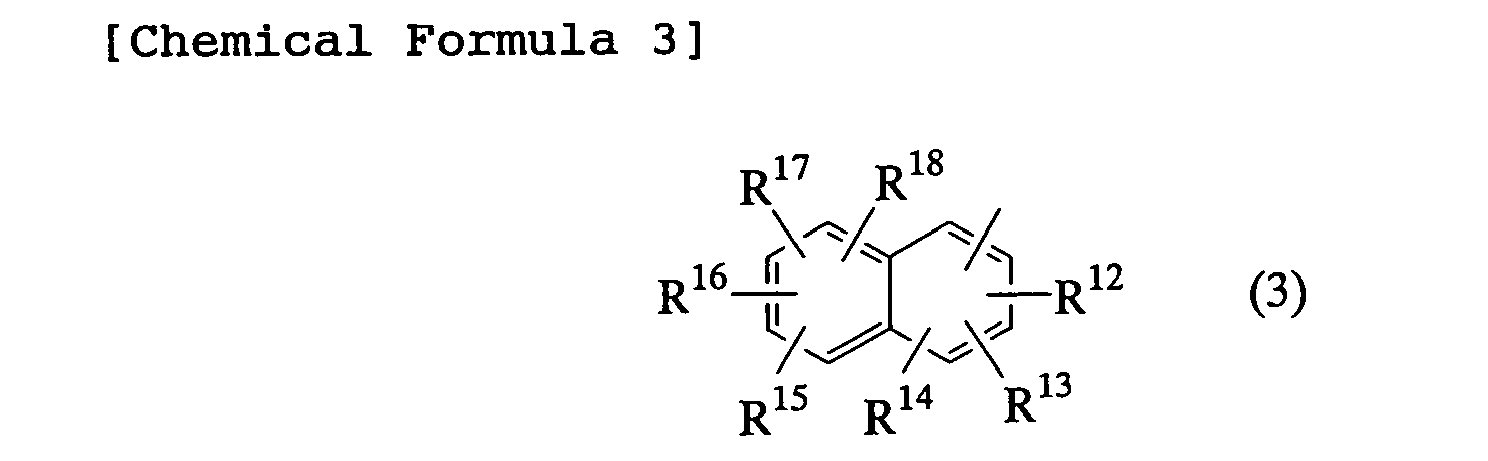
- The electrode according to claim 1, wherein R1 and R2 independently represent a group of the following formula (4)
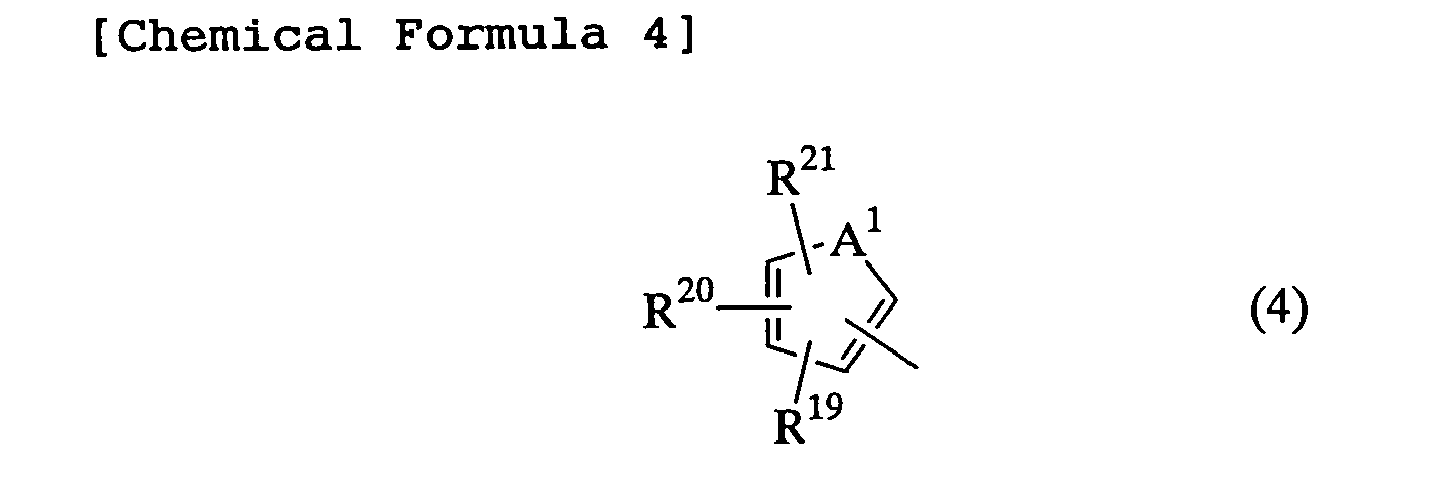
A1 represents NH, O or S. - The electrode according to claim 1, wherein R1 and R2 independently represent a group of the following formula (5)

R23-R26 independently represent a hydrogen atom, a halogen atom, a cyano group, a nitro group, an amino group, an epoxy group, a vinyl group, a C1-C10 alkyl group, a C1-C10 alkoxy group, a phenyl group which may be substituted with Z, a naphthyl group which may be substituted with Z or a thienyl group which may be substituted with Z, in which Z represents a halogen atom, a cyano group, a nitro group, an amino group, an epoxy group, a vinyl group, a C1-C10 alkyl group, a C1-C10 haloalkyl group, a C1-C10 alkoxy group, a C1-C10 cyanoalkyl group, a phenyl group, a biphenyl group, a naphthyl group, a thienyl group, a pyrrolyl group, a furyl group or a condensed heteroaryl group. - The electrode according to any one of claims 1 to 5, wherein R5 represents a group of the following formula (6)
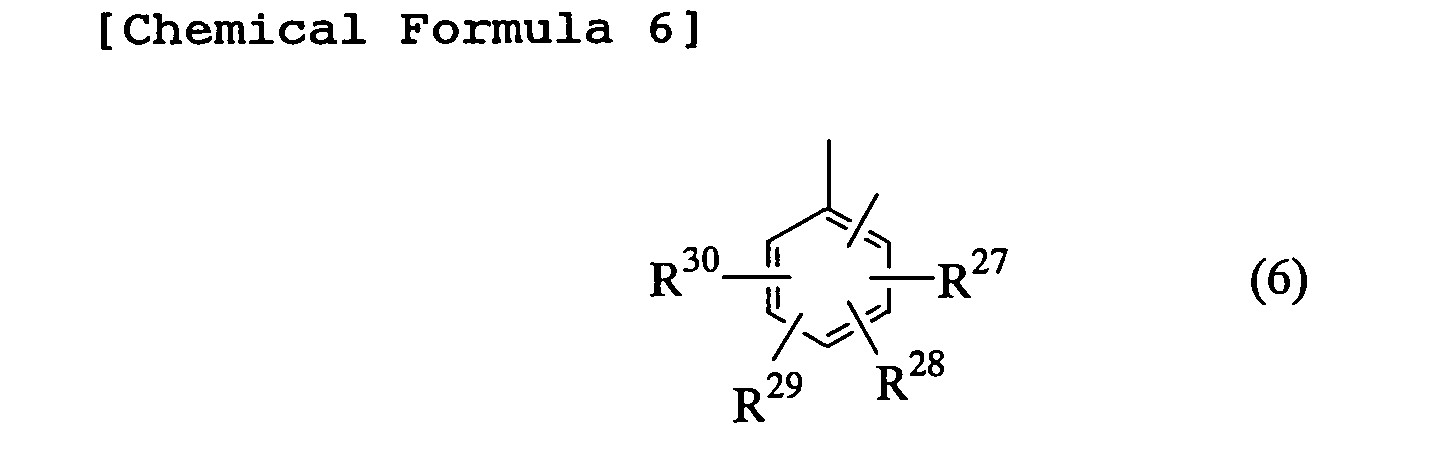
- The electrode according to any one of claims 1 to 5, wherein R5 represents a group of the following formula (7)

W1 represents NH, O or S. - The electrode according to any one of claims 1 to 5, wherein R5 represents a group of the following formula (8)

Q1 represents NH, O or S. - The electrode according to any one of claims 1 to 5, wherein R5 represents a group of the following formula (9)

- The electrode according to any one of claims 1 to 5, wherein R6 represents a group of the following formula (10)

- The electrode according to any one of claims 1 to 5, wherein R6 represents a group of the following formula (11)

W2 represents NH, O or S. - The electrode according to any one of claims 1 to 5, wherein R6 represents a group of the following formula (12)
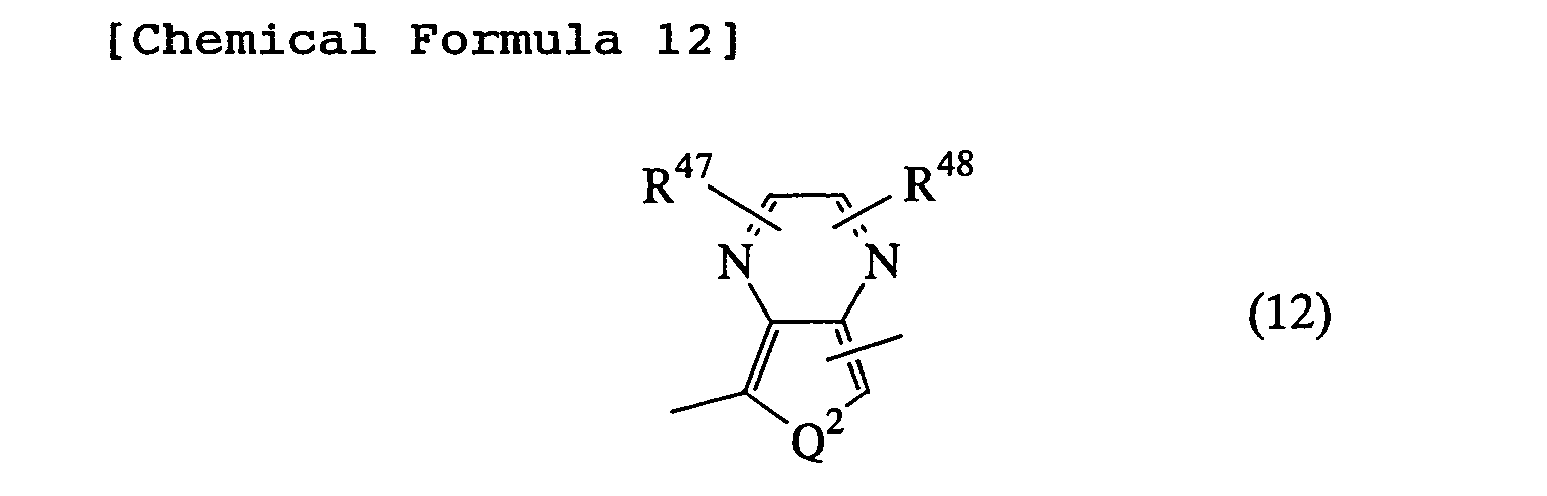
Q2 represents NH, O or S. - The electrode according to any one of claims 1 to 5, wherein R6 represents a group of the following formula (13)

- The electrode according to claim 1, wherein the group formed by bonding R1 and R2 through a single bond is represented by the formula (14)

- An electrode for an energy storage device comprising a polyaminoquinoxaline compound of the following formula (1b) as an electrode active material

R3 and R4 independently represent a hydrogen atom, a halogen atom, a cyano group, a nitro group, an amino group, a C1-C10 alkyl group, a C1-C10 alkoxy group, a phenyl group which may be substituted with Y, a pyridyl group which may be substituted with Y, a biphenyl group which may be substituted with Y, a naphthyl group which may be substituted with Y, a thienyl group which may be substituted with Y, a pyrrolyl group which may be substituted with Y, a furyl group which may be substituted with Y or a condensed heteroaryl group which may be substituted with Y provided that when R3 and R4 are, respectively, the above-defined phenyl, pyridyl, biphenyl, naphthyl, thienyl, pyrrolyl, furyl or condensed heteroaryl group, these groups may be joined through a single bond; and
X1 represents -NH-R5-NH- or -NH-R6- wherein R5 and R6 independently represent a C1-C10 alkylene group, a -C(O)CH2-, -CH2C(O)-, a divalent benzene ring which may be substituted with Y, a divalent pyridine ring which may be substituted with Y, a divalent biphenyl group which may be substituted with Y, a divalent naphthalene ring which may be substituted with Y, a divalent thiophene ring which may be substituted with Y, a divalent pyrrole ring which may be substituted with Y, a furan ring which may be substituted with Y, or a condensed hetero ring which may be substituted with Y;
Y represents a halogen atom, a cyano group, a nitro group, an amino group, an epoxy group, a vinyl group, a C1-C10 alkyl group, a C1-C10 haloalkyl group, a C1-C10 alkoxy group, a C1-C10 cyanoalkyl group, a phenyl group which may be substituted with Z, a pyridyl group which may be substituted with Z, a biphenyl group which may be substituted with Z, a naphthyl group which may be substituted with Z, a thienyl group which may be substituted with Z, a pyrrolyl group which may be substituted with Z, a furyl group which may be substituted with Z or a condensed heteroaryl group which may be substituted with Z provided that if Y is two or more in number, Y may be the same or different;
Z represents a halogen atom, a cyano group, a nitro group, an amino group, an epoxy group, a vinyl group, a C1-C10 alkyl group, a C1-C10 haloalkyl group, a C1-C10 alkoxy group, a C1-C10 cyanoalkyl group, a phenyl group, a biphenyl group, a naphthyl group, a thienyl group, a pyrrolyl group, a furyl group or a condensed heteroaryl group provided that if Z is two or more in number, Z may be the same or different; and
n is an integer of 2 or over. - An electrode for an energy storage device comprising a polyaminoquinoxaline compound of the following formula (1c) as an electrode active material

R3' and R4' join together to form -CH2CH2CH2-, -CH2CH2O-, -OCH2CH2-, -CH2OCH2-, -OCH2O-, -CH2CH2S-, -SCH2CH2-, -CH2SCH2-, -CH2CH2N(R')-, -N(R')CH2CH2-, -CH2N(R')CH2-, -CH2CH2CH2CH2-, -CH2CH2CH2O-, -OCH2CH2CH2-, -CH2CH2OCH2-, -CH2OCH2CH2-, -CH2OCH2O-, -OCH2CH2O-, -SCH2CH2S-, -OCH2CH2S-, -SCH2CH2O-, -CH2CH=CH-, -CH=CHCH2-, -OCH=CH-, -CH=CHO-, -SCH=CH-, -CH=CHS-, -N(R')CH=CH-, -CH=CHN(R')-, -OCH=N-, -N=CHO-, -SCH=N-, -N=CHS-, -N(R')CH=N-, -N=CHN(R')-, -N(R')N=CH-, -CH=N(R')N-, -CH=CHCH=CH-, -OCH2CH=CH-, -CH=CHCH2O-, -N=CHCH=CH-, -CH=CHCH=N-, -N=CHCH=N-, -N=CHN=CH-, or -CH=NCH=N- wherein a hydrogen atom bonded to a carbon atom of these groups may be substituted with Y, and R' represents a hydrogen atom, a C1-C10 alkyl group, a C1-C10 haloalkyl group, a C1-C10 cyanoalkyl group, a phenyl group which may be substituted with Z, a pyridyl group which may be substituted with Z, a biphenyl group which may be substituted with Z, a naphthyl group which may be substituted with Z, a thienyl group which may be substituted with Z, a pyrrolyl group which may be substituted with Z, a furyl group which may be substituted with Z, or a condensed heteroaryl group which may be substituted with Z;
X1 represents -NH-R5-NH- or -NH-R6- wherein R5 and R6 independently represent a C1-C10 alkylene group, a -C(O)CH2-, -CH2C(O)-, a divalent benzene ring which may be substituted with Y, a divalent pyridine ring which may be substituted with Y, a divalent biphenyl group which may be substituted with Y, a divalent naphthalene ring which may be substituted with Y, a divalent thiophene ring which may be substituted with Y, a divalent pyrrole ring which may be substituted with Y, a furan ring which may be substituted with Y, or a condensed hetero ring which may be substituted with Y;
Y represents a halogen atom, a cyano group, a nitro group, an amino group, an epoxy group, a vinyl group, a C1-C10 alkyl group, a C1-C10 haloalkyl group, a C1-C10 alkoxy group, a C1-C10 cyanoalkyl group, a phenyl group which may be substituted with Z, a pyridyl group which may be substituted with Z, a biphenyl group which may be substituted with Z, a naphthyl group which may be substituted with Z, a thienyl group which may be substituted with Z, a pyrrolyl group which may be substituted with Z, a furyl group which may be substituted with Z or a condensed heteroaryl group which may be substituted with Z provided that if Y is two or more in number, Y may be the same or different;
Z represents a halogen atom, a cyano group, a nitro group, an amino group, an epoxy group, a vinyl group, a C1-C10 alkyl group, a C1-C10 haloalkyl group, a C1-C10 alkoxy group, a C1-C10 cyanoalkyl group, a phenyl group, a biphenyl group, a naphthyl group, a thienyl group, a pyrrolyl group, a furyl group or a condensed heteroaryl group provided that if Z is two or more in number, Z may be the same or different; and
n is an integer of 2 or over. - An electrode for an energy storage device comprising a polyaminoquinoxaline compound of the following formula (1d) as an electrode active material

R3' and R4' join together to form -CH2CH2CH2-, -CH2CH2O-, -OCH2CH2-, -CH2OCH2-, -OCH2O-, -CH2CH2S-, -SCH2CH2-, -CH2SCH2-, -CH2CH2N(R')-, -N(R')CH2CH2-, -CH2N(R')CH2-, -CH2CH2CH2CH2-, -CH2CH2CH2O-, -OCH2CH2CH2-, -CH2CH2OCH2-, -CH2OCH2CH2-, -CH2OCH2O-, -OCH2CH2O-, -SCH2CH2S-, -OCH2CH2S-, -SCH2CH2O-, -CH2CH=CH-, -CH=CHCH2-, -OCH=CH-, -CH=CHO-, -SCH=CH-, -CH=CHS-, -N(R')CH=CH-, -CH=CHN(R')-, -OCH=N-, -N=CHO-, -SCH=N-, -N=CHS-, -N(R')CH=N-, -N=CHN(R')-, -N(R')N=CH-, -CH=N(R')N-, -CH=CHCH=CH-, -OCH2CH=CH-, -CH=CHCH2O-, -N=CHCH=CH-, -CH=CHCH=N-, -N=CHCH=N-, -N=CHN=CH-, or -CH=NCH=N- wherein a hydrogen atom bonded to a carbon atom of these groups may be substituted with Y, and R' represents a hydrogen atom, a C1-C10 alkyl group, a C1-C10 haloalkyl group, a C1-C10 cyanoalkyl group, a phenyl group which may be substituted with Z, a pyridyl group which may be substituted with Z, a biphenyl group which may be substituted with Z, a naphthyl group which may be substituted with Z, a thienyl group which may be substituted with Z, a pyrrolyl group which may be substituted with Z, a furyl group which may be substituted with Z, or a condensed heteroaryl group which may be substituted with Z;
X1 represents -NH-R5-NH- or -NH-R6- wherein R5 and R6 independently represent a C1-C10 alkylene group, a -C(O)CH2-, -CH2C(O)-, a divalent benzene ring which may be substituted with Y, a divalent pyridine ring which may be substituted with Y, a divalent biphenyl group which may be substituted with Y, a divalent naphthalene ring which may be substituted with Y, a divalent thiophene ring which may be substituted with Y, a divalent pyrrole ring which may be substituted with Y, a furan ring which may be substituted with Y, or a condensed hetero ring which may be substituted with Y;
Y represents a halogen atom, a cyano group, a nitro group, an amino group, an epoxy group, a vinyl group, a C1-C10 alkyl group, a C1-C10 haloalkyl group, a C1-C10 alkoxy group, a C1-C10 cyanoalkyl group, a phenyl group which may be substituted with Z, a pyridyl group which may be substituted with Z, a biphenyl group which may be substituted with Z, a naphthyl group which may be substituted with Z, a thienyl group which may be substituted with Z, a pyrrolyl group which may be substituted with Z, a furyl group which may be substituted with Z or a condensed heteroaryl group which may be substituted with Z provided that if Y is two or more in number, Y may be the same or different;
Z represents a halogen atom, a cyano group, a nitro group, an amino group, an epoxy group, a vinyl group, a C1-C10 alkyl group, a C1-C10 haloalkyl group, a C1-C10 alkoxy group, a C1-C10 cyanoalkyl group, a phenyl group, a biphenyl group, a naphthyl group, a thienyl group, a pyrrolyl group, a furyl group or a condensed heteroaryl group provided that if Z is two or more in number, Z may be the same or different; and
n is an integer of 2 or over. - The electrode according to claim 15 or 17, wherein the group formed by joining R1' and R2' together is of the formula (15)

- The electrode according to claim 16 or 17, wherein the group formed by joining R3' and R4' together is of the formula (16)

- The electrode according to claim 16 or 17, wherein the group formed by joining R3' and R4' is of the formula (17)
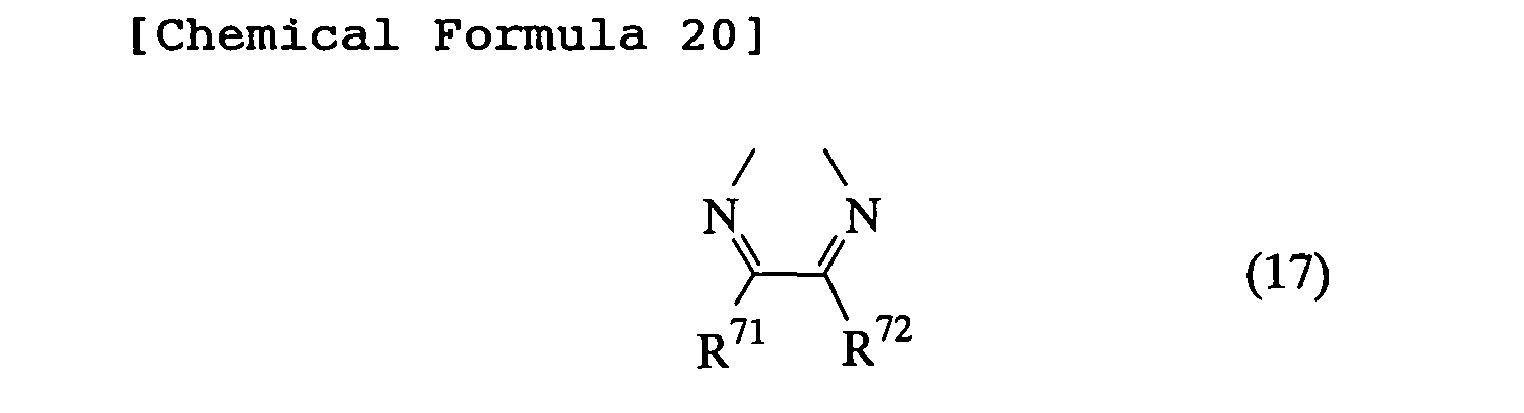
- An energy storage device comprising an electrode for an energy storage device according to any one of claims 1 to 20.
- A method for making an electrode for an energy storage device according to claim 1, which method comprising applying and building up, on a current collector electrode, an electrode active material made of a polyaminoquinoxaline compound represented by the afore-indicated formula (1a).
- A method for making an electrode for an energy storage device according to claim 15, which method comprising applying and building up, on a current collector electrode, an electrode active material made of a polyaminoquinoxaline compound represented by the afore-indicated formula (1b).
- A method for making an electrode for an energy storage device according to claim 16, which method comprising applying and building up, on a current collector electrode, an electrode active material made of a polyaminoquinoxaline compound represented by the afore-indicated formula (1c).
- A method for making an electrode for an energy storage device according to claim 17, which method comprising applying and building up, on a current collector electrode, an electrode active material made of a polyaminoquinoxaline compound represented by the afore-indicated formula (1d).
- A method for making an electrode for an energy storage device as recited in claim 1 above, which method comprising electrolytically polymerizing an aminoquinoxaline compound represented by the formula (18a) on a current collector electrode,

R3 and R4 independently represent a hydrogen atom, a halogen atom, a cyano group, a nitro group, an amino group, a C1-C10 alkyl group, a C1-C10 alkoxy group, a phenyl group which may be substituted with Y, a pyridyl group which may be substituted with Y, a biphenyl group which may be substituted with Y, a naphthyl group which may be substituted with Y, a thienyl group which may be substituted with Y, a pyrrolyl group which may be substituted with Y, a furyl group which may be substituted with Y or a condensed heteroaryl group which may be substituted with Y provided that when R3 and R4 are, respectively, the above-defined phenyl, pyridyl, biphenyl, naphthyl, thienyl, pyrrolyl, furyl or condensed heteroaryl group, these groups may be joined through a single bond;
X2 represents -NH-R73-NH2 or -NH-R74, in which R73 represents a C1-C10 alkylene group, a -C(O)CH2-, -CH2C(O)-, a divalent benzene ring which may be substituted with Y, a divalent pyridine ring which may be substituted with Y, a divalent biphenyl group which may be substituted with Y, a divalent naphthalene ring which may be substituted with Y, a divalent thiophene ring which may be substituted with Y, a divalent pyrrole ring which may be substituted with Y, a furan ring which may be substituted with Y, or a condensed hetero ring which may be substituted with Y, and R74 a C1-C10 alkyl group, an acetyl group, a phenyl group which may be substituted with Y, a pyridyl group which may be substituted with Y, a biphenyl group which may be substituted with Y, a naphthyl group which may be substituted with Y, a thienyl group which may be substituted with Y, a pyrrolyl group which may be substituted with Y, a furyl group which may be substituted with Y, or a condensed heteroaryl group which may be substituted with Y;
Y represents a halogen atom, a cyano group, a nitro group, an amino group, an epoxy group, a vinyl group, a C1-C10 alkyl group, a C1-C10 haloalkyl group, a C1-C10 alkoxy group, a C1-C10 cyanoalkyl group, a phenyl group which may be substituted with Z, a pyridyl group which may be substituted with Z, a biphenyl group which may be substituted with Z, a naphthyl group which may be substituted with Z, a thienyl group which may be substituted with Z, a pyrrolyl group which may be substituted with Z, a furyl group which may be substituted with Z or a condensed heteroaryl group which may be substituted with Z provided that if Y is two or more in number, Y may be the same or different; and
Z represents a halogen atom, a cyano group, a nitro group, an amino group, an epoxy group, a vinyl group, a C1-C10 alkyl group, a C1-C10 haloalkyl group, a C1-C10 alkoxy group, a C1-C10 cyanoalkyl group, a phenyl group, a biphenyl group, a naphthyl group, a thienyl group, a pyrrolyl group, a furyl group or a condensed heteroaryl group provided that if Z is two or more in number, Z may be the same or different. - A method for making an electrode for an energy storage device according to claim 15, which method comprising electrolytically polymerizing an aminoquinoxaline compound represented by the formula (18b) on a current collector electrode,

R3 and R4 independently represent a hydrogen atom, a halogen atom, a cyano group, a nitro group, an amino group, a C1-C10 alkyl group, a C1-C10 alkoxy group, a phenyl group which may be substituted with Y, a pyridyl group which may be substituted with Y, a biphenyl group which may be substituted with Y, a naphthyl group which may be substituted with Y, a thienyl group which may be substituted with Y, a pyrrolyl group which may be substituted with Y, a furyl group which may be substituted with Y or a condensed heteroaryl group which may be substituted with Y provided that when R3 and R4 are, respectively, the above-defined phenyl, pyridyl, biphenyl, naphthyl, thienyl, pyrrolyl, furyl or condensed heteroaryl group, these groups may be joined through a single bond;
X2 represents -NH-R73-NH2 or -NH-R74, in which R73 represents a C1-C10 alkylene group, a -C(O)CH2-, -CH2C(O)-, a divalent benzene ring which may be substituted with Y, a divalent pyridine ring which may be substituted with Y, a divalent biphenyl group which may be substituted with Y, a divalent naphthalene ring which may be substituted with Y, a divalent thiophene ring which may be substituted with Y, a divalent pyrrole ring which may be substituted with Y, a furan ring which may be substituted with Y, or a condensed hetero ring which may be substituted with Y, and R74 a C1-C10 alkyl group, an acetyl group, a phenyl group which may be substituted with Y, a pyridyl group which may be substituted with Y, a biphenyl group which may be substituted with Y, a naphthyl group which may be substituted with Y, a thienyl group which may be substituted with Y, a pyrrolyl group which may be substituted with Y, a furyl group which may be substituted with Y, or a condensed heteroaryl group which may be substituted with Y;
Y represents a halogen atom, a cyano group, a nitro group, an amino group, an epoxy group, a vinyl group, a C1-C10 alkyl group, a C1-C10 haloalkyl group, a C1-C10 alkoxy group, a C1-C10 cyanoalkyl group, a phenyl group which may be substituted with Z, a pyridyl group which may be substituted with Z, a biphenyl group which may be substituted with Z, a naphthyl group which may be substituted with Z, a thienyl group which may be substituted with Z, a pyrrolyl group which may be substituted with Z, a furyl group which may be substituted with Z or a condensed heteroaryl group which may be substituted with Z provided that if Y is two or more in number, Y may be the same or different; and
Z represents a halogen atom, a cyano group, a nitro group, an amino group, an epoxy group, a vinyl group, a C1-C10 alkyl group, a C1-C10 haloalkyl group, a C1-C10 alkoxy group, a C1-C10 cyanoalkyl group, a phenyl group, a biphenyl group, a naphthyl group, a thienyl group, a pyrrolyl group, a furyl group or a condensed heteroaryl group provided that if Z is two or more in number, Z may be the same or different. - A method for making an electrode for an energy storage device according to claim 16, which method comprising electrolytically polymerizing an aminoquinoxaline compound represented by the formula (18c) on a current collector electrode,

R3' and R4' join together to form -CH2CH2CH2-, -CH2CH2O-, -OCH2CH2-, -CH2OCH2-, -OCH2O-, -CH2CH2S-, -SCH2CH2-, -CH2SCH2-, -CH2CH2N(R')-, -N(R')CH2CH2-, -CH2N(R')CH2-, -CH2CH2CH2CH2-, -CH2CH2CH2O-, -OCH2CH2CH2-, -CH2CH2OCH2-, -CH2OCH2CH2-, -CH2OCH2O-, -OCH2CH2O-, -SCH2CH2S-, -OCH2CH2S-, -SCH2CH2O-, -CH2CH=CH-, -CH=CHCH2-, -OCH=CH-, -CH=CHO-, -SCH=CH-, -CH=CHS-, -N(R')CH=CH-, -CH=CHN(R')-, -OCH=N-, -N=CHO-, -SCH=N-, -N=CHS-, -N(R')CH=N-, -N=CHN(R')-, -N(R')N=CH-, -CH=N(R')N-, -CH=CHCH=CH-, -OCH2CH=CH-, -CH=CHCH2O-, -N=CHCH=CH-, -CH=CHCH=N-, -N=CHCH=N-, -N=CHN=CH-, or -CH=NCH=N- wherein a hydrogen atom bonded to a carbon atom of these groups may be substituted with Y, and R' represents a hydrogen atom, a C1-C10 alkyl group, a C1-C10 haloalkyl group, a C1-C10 cyanoalkyl group, a phenyl group which may be substituted with Z, a pyridyl group which may be substituted with Z, a biphenyl group which may be substituted with Z, a naphthyl group which may be substituted with Z, a thienyl group which may be substituted with Z, a pyrrolyl group which may be substituted with Z, a furyl group which may be substituted with Z, or a condensed heteroaryl group which may be substituted with Z;
X2 represents -NH-R73-NH2 or -NH-R74, in which R73 represents a C1-C10 alkylene group, a -C(O)CH2-, -CH2C(O)-, a divalent benzene ring which may be substituted with Y, a divalent pyridine ring which may be substituted with Y, a divalent biphenyl group which may be substituted with Y, a divalent naphthalene ring which may be substituted with Y, a divalent thiophene ring which may be substituted with Y, a divalent pyrrole ring which may be substituted with Y, a furan ring which may be substituted with Y, or a condensed hetero ring which may be substituted with Y, and R74 a C1-C10 alkyl group, an acetyl group, a phenyl group which may be substituted with Y, a pyridyl group which may be substituted with Y, a biphenyl group which may be substituted with Y, a naphthyl group which may be substituted with Y, a thienyl group which may be substituted with Y, a pyrrolyl group which may be substituted with Y, a furyl group which may be substituted with Y, or a condensed heteroaryl group which may be substituted with Y;
Y represents a halogen atom, a cyano group, a nitro group, an amino group, an epoxy group, a vinyl group, a C1-C10 alkyl group, a C1-C10 haloalkyl group, a C1-C10 alkoxy group, a C1-C10 cyanoalkyl group, a phenyl group which may be substituted with Z, a pyridyl group which may be substituted with Z, a biphenyl group which may be substituted with Z, a naphthyl group which may be substituted with Z, a thienyl group which may be substituted with Z, a pyrrolyl group which may be substituted with Z, a furyl group which may be substituted with Z or a condensed heteroaryl group which may be substituted with Z provided that if Y is two or more in number, Y may be the same or different; and
Z represents a halogen atom, a cyano group, a nitro group, an amino group, an epoxy group, a vinyl group, a C1-C10 alkyl group, a C1-C10 haloalkyl group, a C1-C10 alkoxy group, a C1-C10 cyanoalkyl group, a phenyl group, a biphenyl group, a naphthyl group, a thienyl group, a pyrrolyl group, a furyl group or a condensed heteroaryl group provided that if Z is two or more in number, Z may be the same or different. - A method for making an electrode for an energy storage device according to claim 17, which method comprising electrolytically polymerizing an aminoquinoxaline compound represented by the formula (18d) on a current collector electrode,
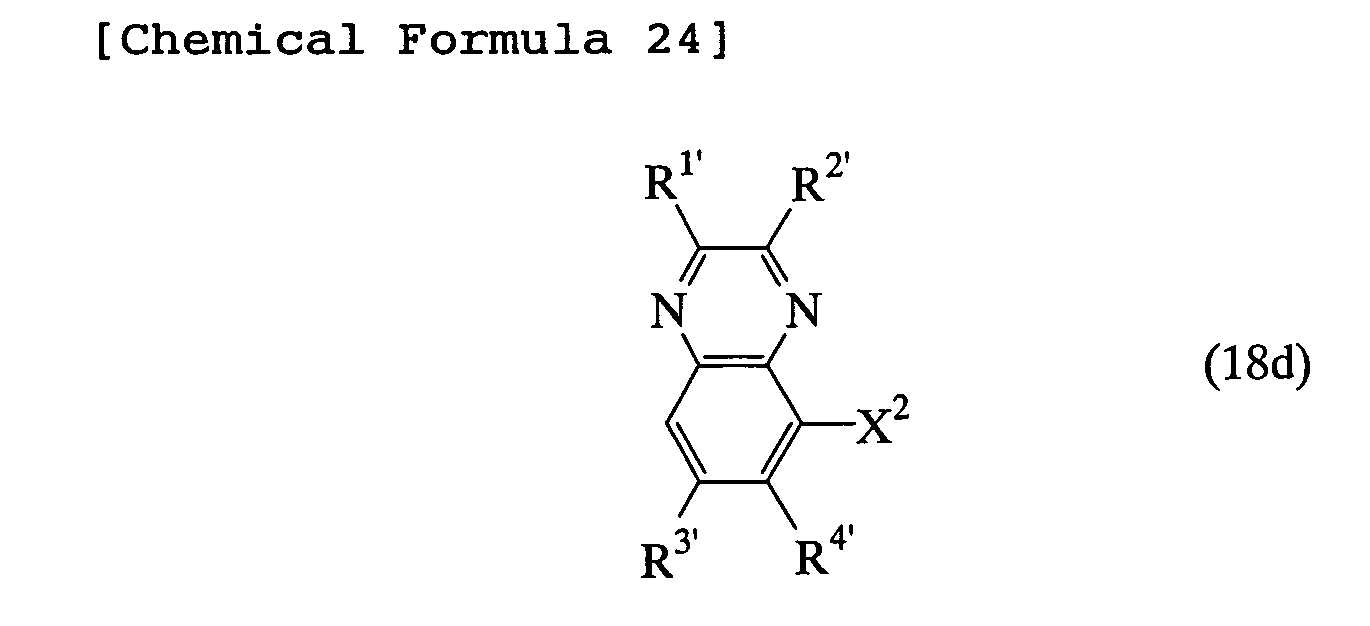
R3' and R4' join together to form -CH2CH2CH2-, -CH2CH2O-, -OCH2CH2-, -CH2OCH2-, -OCH2O-, -CH2CH2S-, -SCH2CH2-, -CH2SCH2-, -CH2CH2N(R')-, -N(R')CH2CH2-, -CH2N(R')CH2-, -CH2CH2CH2CH2-, -CH2CH2CH2O-, -OCH2CH2CH2-, -CH2CH2OCH2-, -CH2OCH2CH2-, -CH2OCH2O-, -OCH2CH2O-, -SCH2CH2S-, -OCH2CH2S-, -SCH2CH2O-, -CH2CH=CH-, -CH=CHCH2-, -OCH=CH-, -CH=CHO-, -SCH=CH-, -CH=CHS-, -N(R')CH=CH-, -CH=CHN(R')-, -OCH=N-, -N=CHO-, -SCH=N-, -N=CHS-, -N(R')CH=N-, -N=CHN(R')-, -N(R')N=CH-, -CH=N(R')N-, -CH=CHCH=CH-, -OCH2CH=CH-, -CH=CHCH2O-, -N=CHCH=CH-, -CH=CHCH=N-, -N=CHCH=N-, -N=CHN=CH-, or -CH=NCH=N- wherein a hydrogen atom bonded to a carbon atom of these groups may be substituted with Y, and R' represents a hydrogen atom, a C1-C10 alkyl group, a C1-C10 haloalkyl group, a C1-C10 cyanoalkyl group, a phenyl group which may be substituted with Z, a pyridyl group which may be substituted with Z, a biphenyl group which may be substituted with Z, a naphthyl group which may be substituted with Z, a thienyl group which may be substituted with Z, a pyrrolyl group which may be substituted with Z, a furyl group which may be substituted with Z, or a condensed heteroaryl group which may be substituted with Z;
X2 represents -NH-R73-NH2 or -NH-R74, in which R73 represents a C1-C10 alkylene group, a -C(O)CH2-, -CH2C(O)-, a divalent benzene ring which may be substituted with Y, a divalent pyridine ring which may be substituted with Y, a divalent biphenyl group which may be substituted with Y, a divalent naphthalene ring which may be substituted with Y, a divalent thiophene ring which may be substituted with Y, a divalent pyrrole ring which may be substituted with Y, a furan ring which may be substituted with Y, or a condensed hetero ring which may be substituted with Y, and R74 a C1-C10 alkyl group, an acetyl group, a phenyl group which may be substituted with Y, a pyridyl group which may be substituted with Y, a biphenyl group which may be substituted with Y, a naphthyl group which may be substituted with Y, a thienyl group which may be substituted with Y, a pyrrolyl group which may be substituted with Y, a furyl group which may be substituted with Y, or a condensed heteroaryl group which may be substituted with Y;
Y represents a halogen atom, a cyano group, a nitro group, an amino group, an epoxy group, a vinyl group, a C1-C10 alkyl group, a C1-C10 haloalkyl group, a C1-C10 alkoxy group, a C1-C10 cyanoalkyl group, a phenyl group which may be substituted with Z, a pyridyl group which may be substituted with Z, a biphenyl group which may be substituted with Z, a naphthyl group which may be substituted with Z, a thienyl group which may be substituted with Z, a pyrrolyl group which may be substituted with Z, a furyl group which may be substituted with Z or a condensed heteroaryl group which may be substituted with Z provided that if Y is two or more in number, Y may be the same or different; and
Z represents a halogen atom, a cyano group, a nitro group, an amino group, an epoxy group, a vinyl group, a C1-C10 alkyl group, a C1-C10 haloalkyl group, a C1-C10 alkoxy group, a C1-C10 cyanoalkyl group, a phenyl group, a biphenyl group, a naphthyl group, a thienyl group, a pyrrolyl group, a furyl group or a condensed heteroaryl group provided that if Z is two or more in number, Z may be the same or different.
Applications Claiming Priority (2)
| Application Number | Priority Date | Filing Date | Title |
|---|---|---|---|
| JP2004030014 | 2004-02-06 | ||
| PCT/JP2005/001388 WO2005076295A1 (en) | 2004-02-06 | 2005-02-01 | Electrode for energy storage device and process for producing the same |
Publications (3)
| Publication Number | Publication Date |
|---|---|
| EP1713101A1 true EP1713101A1 (en) | 2006-10-18 |
| EP1713101A4 EP1713101A4 (en) | 2010-05-26 |
| EP1713101B1 EP1713101B1 (en) | 2012-10-31 |
Family
ID=34835977
Family Applications (1)
| Application Number | Title | Priority Date | Filing Date |
|---|---|---|---|
| EP05709534A Expired - Lifetime EP1713101B1 (en) | 2004-02-06 | 2005-02-01 | Electrode for energy storage device and process for producing the same |
Country Status (8)
| Country | Link |
|---|---|
| US (1) | US7799894B2 (en) |
| EP (1) | EP1713101B1 (en) |
| JP (1) | JP4827173B2 (en) |
| KR (1) | KR101170995B1 (en) |
| CN (1) | CN1926647B (en) |
| MY (1) | MY147504A (en) |
| TW (1) | TWI348719B (en) |
| WO (1) | WO2005076295A1 (en) |
Cited By (2)
| Publication number | Priority date | Publication date | Assignee | Title |
|---|---|---|---|---|
| WO2008108105A1 (en) | 2007-03-08 | 2008-09-12 | Panasonic Corporation | Phenanthrenequinone compound, electrode active material, and electrical storage device |
| US8586740B2 (en) | 2007-11-30 | 2013-11-19 | Semiconductor Energy Laboratory Co., Ltd. | Quinoxaline derivative, and light-emitting element, light-emitting device, and electronic device using quinoxaline derivative |
Families Citing this family (9)
| Publication number | Priority date | Publication date | Assignee | Title |
|---|---|---|---|---|
| GB2424759A (en) * | 2005-04-01 | 2006-10-04 | Seiko Epson Corp | Inkjet deposition of polythiophene semiconductor material dissolved in halogenated aromatic solvents |
| US8138303B2 (en) * | 2006-02-10 | 2012-03-20 | Basf Se | Polymers |
| JPWO2007111070A1 (en) * | 2006-03-29 | 2009-08-06 | 日産化学工業株式会社 | Composition for electrode of energy storage device and method for producing the same |
| EP2393787B1 (en) | 2009-02-09 | 2018-01-24 | Georgetown University | Cadherin-11 inhibitors and methods of use thereof |
| JP5738984B2 (en) * | 2010-05-21 | 2015-06-24 | ▲海▼洋王照明科技股▲ふん▼有限公司 | Conjugated polymer containing dithienopyrrole-quinoxaline, method for producing the same, and polymer solar cell device |
| WO2013005564A1 (en) * | 2011-07-07 | 2013-01-10 | コニカミノルタホールディングス株式会社 | Conjugated polymer, and organic photoelectric conversion element using same |
| CN103456510B (en) * | 2012-06-01 | 2016-04-13 | 国家纳米科学中心 | A kind of electrode material of ultracapacitor |
| KR101930279B1 (en) * | 2017-01-10 | 2018-12-18 | 건국대학교 산학협력단 | Preparation of phenazine derivatives with increased solubility and conjugated polymers consisting of phenazine derivatives for organo photoelectric conversion device |
| KR102938358B1 (en) | 2019-03-22 | 2026-03-16 | 가부시키가이샤 한도오따이 에네루기 켄큐쇼 | Organic compounds, light-emitting devices, light-emitting devices, electronic devices, and lighting devices |
Family Cites Families (18)
| Publication number | Priority date | Publication date | Assignee | Title |
|---|---|---|---|---|
| SU592823A1 (en) | 1975-12-23 | 1978-02-15 | Ленинградский химико-фармацевтический институт | Method of preparing 5-amino-2,3-dimethylquinoxaline |
| US4356429A (en) * | 1980-07-17 | 1982-10-26 | Eastman Kodak Company | Organic electroluminescent cell |
| JPH0770306A (en) | 1993-09-07 | 1995-03-14 | Idemitsu Petrochem Co Ltd | Production of polycarbonate |
| GB9605027D0 (en) | 1996-03-09 | 1996-05-08 | Pfizer Ltd | Quinoxalinediones |
| CN1121403C (en) | 1997-02-27 | 2003-09-17 | 辉瑞大药厂 | Quinoxalinediones |
| JP4117056B2 (en) | 1998-01-20 | 2008-07-09 | 株式会社クレハ | Method for producing carbon material for electric double layer capacitor electrode |
| US6310762B1 (en) * | 1998-03-03 | 2001-10-30 | Jeol Ltd. | Carbon material for electric double layer capacitor, method of producing same, electric double layer capacitor and method of fabricating same |
| JPH11317333A (en) | 1998-03-03 | 1999-11-16 | Jeol Ltd | Carbon material for electric double layer capacitor, method for producing carbon material for electric double layer capacitor, electric double layer capacitor, and method for producing electric double layer capacitor |
| JP3846022B2 (en) | 1998-04-10 | 2006-11-15 | 三菱化学株式会社 | Electric double layer capacitor |
| JP3945032B2 (en) | 1998-08-10 | 2007-07-18 | 東洋インキ製造株式会社 | Luminescent material for organic electroluminescence device and organic electroluminescence device using the same |
| JP3522119B2 (en) | 1998-08-20 | 2004-04-26 | 株式会社岡村研究所 | Electric double layer capacitor and method of manufacturing the same |
| JP3973183B2 (en) | 1998-09-22 | 2007-09-12 | 株式会社パワーシステム | Manufacturing method of electric double layer capacitor |
| JP3565777B2 (en) * | 2000-10-25 | 2004-09-15 | Necトーキン株式会社 | Polymer battery |
| US6548670B1 (en) * | 2001-07-19 | 2003-04-15 | Air Products And Chemicals, Inc. | Methods for preparing 5- and 6-benzyl-functionalized quinoxalines |
| US6822069B2 (en) * | 2002-05-10 | 2004-11-23 | Nissan Chemical Industries, Ltd. | Poly (5-aminoquinoxalines) and use thereof |
| JP4479879B2 (en) | 2002-05-10 | 2010-06-09 | 日産化学工業株式会社 | Poly (5-aminoquinoxaline) and use thereof |
| EP1640402B1 (en) | 2003-06-17 | 2009-02-11 | Nissan Chemical Industries, Ltd. | Diamine having quinoxaline unit, polyimide precursor, polyimide and use thereof |
| MY145368A (en) * | 2004-01-13 | 2012-01-31 | Nissan Chemical Ind Ltd | Aminoquinoxaline compounds and polyaminoquinoxaline compounds, and use thereof |
-
2005
- 2005-02-01 EP EP05709534A patent/EP1713101B1/en not_active Expired - Lifetime
- 2005-02-01 US US10/588,232 patent/US7799894B2/en not_active Expired - Fee Related
- 2005-02-01 WO PCT/JP2005/001388 patent/WO2005076295A1/en not_active Ceased
- 2005-02-01 KR KR1020067015882A patent/KR101170995B1/en not_active Expired - Fee Related
- 2005-02-01 CN CN2005800067867A patent/CN1926647B/en not_active Expired - Fee Related
- 2005-02-01 JP JP2005517673A patent/JP4827173B2/en not_active Expired - Fee Related
- 2005-02-02 TW TW094103242A patent/TWI348719B/en not_active IP Right Cessation
- 2005-02-04 MY MYPI20050440A patent/MY147504A/en unknown
Non-Patent Citations (2)
| Title |
|---|
| KASAI M ET AL: "An Electrochemical Capacitor System using Polymeric Electrodes of Aminoquinoxalines" MEETING ABSTRACTS, 2004 JOINT INTERNATIONAL MEETING, 206TH MEETING OF THE ELECTROCHEMICAL SOCIETY/2004 FALL MEETING OF THE ELECTROCHEMICAL SOCIETY OF JAPAN,MA 2004-02, ELECTROCHEMICAL SOCIETY INC., US, 2004, page 647, XP008121477 ISSN: 1091-8213 * |
| See also references of WO2005076295A1 * |
Cited By (4)
| Publication number | Priority date | Publication date | Assignee | Title |
|---|---|---|---|---|
| WO2008108105A1 (en) | 2007-03-08 | 2008-09-12 | Panasonic Corporation | Phenanthrenequinone compound, electrode active material, and electrical storage device |
| EP2128121A4 (en) * | 2007-03-08 | 2012-07-04 | Panasonic Corp | PHENANTHRENNEQUINONE COMPOUND, ELECTRODE ACTIVE MATERIAL, AND ELECTRIC POWER STORAGE DEVICE |
| US8338027B2 (en) | 2007-03-08 | 2012-12-25 | Panasonic Corporation | Phenanthrenequinone compound, electrode active material, and power storage device |
| US8586740B2 (en) | 2007-11-30 | 2013-11-19 | Semiconductor Energy Laboratory Co., Ltd. | Quinoxaline derivative, and light-emitting element, light-emitting device, and electronic device using quinoxaline derivative |
Also Published As
| Publication number | Publication date |
|---|---|
| EP1713101A4 (en) | 2010-05-26 |
| TW200540893A (en) | 2005-12-16 |
| JPWO2005076295A1 (en) | 2007-10-18 |
| MY147504A (en) | 2012-12-14 |
| KR20060124693A (en) | 2006-12-05 |
| CN1926647A (en) | 2007-03-07 |
| US7799894B2 (en) | 2010-09-21 |
| EP1713101B1 (en) | 2012-10-31 |
| TWI348719B (en) | 2011-09-11 |
| CN1926647B (en) | 2010-04-14 |
| KR101170995B1 (en) | 2012-08-08 |
| WO2005076295A1 (en) | 2005-08-18 |
| JP4827173B2 (en) | 2011-11-30 |
| US20070120112A1 (en) | 2007-05-31 |
Similar Documents
| Publication | Publication Date | Title |
|---|---|---|
| Guerrero et al. | Preparation and characterization of poly (3-arylthiophene) s | |
| US11909047B2 (en) | Oligomer of N,N′-di(hetero)aryl-5,10-dihydrophenazine, cathode active material, cathode, battery thereof, and process for preparing same | |
| EP1713101B1 (en) | Electrode for energy storage device and process for producing the same | |
| EP2308912B1 (en) | Polymer, semiconductor film, electrode, electrode active material, electrochemical element and electricity storage device | |
| Chen et al. | Micro‐/Mesoporous conjugated polymer based on star‐shaped triazine‐functional triphenylamine framework as the performance‐improved cathode of Li‐organic battery | |
| Jähnert et al. | Synthesis and charge–discharge studies of poly (ethynylphenyl) galvinoxyles and their use in organic radical batteries with aqueous electrolytes | |
| JP2011517701A (en) | Selenophene and selenophene polymers, their preparation, and uses thereof | |
| KR20130119427A (en) | Electrochemical generator and method of producing such a generator | |
| US11155554B2 (en) | Rigid chiral redox-active isosceles triangular materials | |
| Xu et al. | Oxygen activity excited thiophene-diketopyrrolopyrrole-based organic molecules as anode for lithium-ion batteries with enhanced interfacial storage capacity and long cycling capability | |
| JP5663011B2 (en) | Fused polycyclic aromatic compound, method for producing the same, and positive electrode active material for lithium ion secondary battery containing the same | |
| JP4945784B2 (en) | Electrode active material containing indolocarbazole derivative | |
| CN111211327B (en) | Compound for lithium ion battery anode material and preparation method and application thereof | |
| JP4978005B2 (en) | Aminoquinoxaline compound and polyaminoquinoxaline compound and use thereof | |
| EP2423242A1 (en) | Electrically conductive polyrotaxane | |
| EP1361244B1 (en) | Poly(5-aminoquinoxalines); preparation and use thereof | |
| JPWO2007111070A1 (en) | Composition for electrode of energy storage device and method for producing the same | |
| CN119278518A (en) | Twisted macromolecular ladders for fast-charging, long-life lithium batteries | |
| JPS62290759A (en) | Composite material of metal complex and electrically conductive high-molecular material and production thereof | |
| CN118108603B (en) | Polynitroso compounds, their preparation and electrochemical use | |
| CN110606936A (en) | Poly[norbornene 1,4-dimethylbinaphthoquinone] and its preparation method and application | |
| KR20250179697A (en) | Electrode active material for redox flow battery, and redox flow battery comprising the same | |
| JPS62264561A (en) | Nonaqueous solvent secondary battery |
Legal Events
| Date | Code | Title | Description |
|---|---|---|---|
| PUAI | Public reference made under article 153(3) epc to a published international application that has entered the european phase |
Free format text: ORIGINAL CODE: 0009012 |
|
| 17P | Request for examination filed |
Effective date: 20060817 |
|
| AK | Designated contracting states |
Kind code of ref document: A1 Designated state(s): CH DE LI |
|
| DAX | Request for extension of the european patent (deleted) | ||
| RBV | Designated contracting states (corrected) |
Designated state(s): CH DE LI |
|
| A4 | Supplementary search report drawn up and despatched |
Effective date: 20100427 |
|
| 17Q | First examination report despatched |
Effective date: 20111019 |
|
| GRAP | Despatch of communication of intention to grant a patent |
Free format text: ORIGINAL CODE: EPIDOSNIGR1 |
|
| GRAS | Grant fee paid |
Free format text: ORIGINAL CODE: EPIDOSNIGR3 |
|
| GRAA | (expected) grant |
Free format text: ORIGINAL CODE: 0009210 |
|
| AK | Designated contracting states |
Kind code of ref document: B1 Designated state(s): CH DE LI |
|
| RAP1 | Party data changed (applicant data changed or rights of an application transferred) |
Owner name: NISSAN CHEMICAL INDUSTRIES, LTD. Owner name: YAMAGUCHI UNIVERSITY |
|
| REG | Reference to a national code |
Ref country code: CH Ref legal event code: EP |
|
| RAP2 | Party data changed (patent owner data changed or rights of a patent transferred) |
Owner name: YAMAGUCHI UNIVERSITY Owner name: NISSAN CHEMICAL INDUSTRIES, LTD. |
|
| RAP2 | Party data changed (patent owner data changed or rights of a patent transferred) |
Owner name: YAMAGUCHI UNIVERSITY Owner name: NISSAN CHEMICAL INDUSTRIES, LTD. |
|
| REG | Reference to a national code |
Ref country code: DE Ref legal event code: R096 Ref document number: 602005036780 Country of ref document: DE Effective date: 20130103 |
|
| PLBE | No opposition filed within time limit |
Free format text: ORIGINAL CODE: 0009261 |
|
| STAA | Information on the status of an ep patent application or granted ep patent |
Free format text: STATUS: NO OPPOSITION FILED WITHIN TIME LIMIT |
|
| 26N | No opposition filed |
Effective date: 20130801 |
|
| REG | Reference to a national code |
Ref country code: DE Ref legal event code: R097 Ref document number: 602005036780 Country of ref document: DE Effective date: 20130801 |
|
| PGFP | Annual fee paid to national office [announced via postgrant information from national office to epo] |
Ref country code: DE Payment date: 20140127 Year of fee payment: 10 Ref country code: CH Payment date: 20140127 Year of fee payment: 10 |
|
| REG | Reference to a national code |
Ref country code: DE Ref legal event code: R119 Ref document number: 602005036780 Country of ref document: DE |
|
| REG | Reference to a national code |
Ref country code: CH Ref legal event code: PL |
|
| PG25 | Lapsed in a contracting state [announced via postgrant information from national office to epo] |
Ref country code: LI Free format text: LAPSE BECAUSE OF NON-PAYMENT OF DUE FEES Effective date: 20150228 Ref country code: CH Free format text: LAPSE BECAUSE OF NON-PAYMENT OF DUE FEES Effective date: 20150228 |
|
| PG25 | Lapsed in a contracting state [announced via postgrant information from national office to epo] |
Ref country code: DE Free format text: LAPSE BECAUSE OF NON-PAYMENT OF DUE FEES Effective date: 20150901 |