EP1712413A2 - Transport vehicle as well as a method for ventilating a compartment of a transport vehicle - Google Patents
Transport vehicle as well as a method for ventilating a compartment of a transport vehicle Download PDFInfo
- Publication number
- EP1712413A2 EP1712413A2 EP06007918A EP06007918A EP1712413A2 EP 1712413 A2 EP1712413 A2 EP 1712413A2 EP 06007918 A EP06007918 A EP 06007918A EP 06007918 A EP06007918 A EP 06007918A EP 1712413 A2 EP1712413 A2 EP 1712413A2
- Authority
- EP
- European Patent Office
- Prior art keywords
- compartment
- air
- transport vehicle
- rear wall
- openings
- Prior art date
- Legal status (The legal status is an assumption and is not a legal conclusion. Google has not performed a legal analysis and makes no representation as to the accuracy of the status listed.)
- Granted
Links
- 238000000034 method Methods 0.000 title claims description 10
- 241000287828 Gallus gallus Species 0.000 claims abstract description 5
- 235000013330 chicken meat Nutrition 0.000 claims abstract description 5
- 241001465754 Metazoa Species 0.000 claims description 4
- 238000013022 venting Methods 0.000 claims description 4
- 239000000284 extract Substances 0.000 claims description 3
- 238000009423 ventilation Methods 0.000 abstract description 3
- 238000007664 blowing Methods 0.000 abstract 1
- 230000000694 effects Effects 0.000 description 1
- 230000001105 regulatory effect Effects 0.000 description 1
- 238000011144 upstream manufacturing Methods 0.000 description 1
Images

Classifications
-
- B—PERFORMING OPERATIONS; TRANSPORTING
- B60—VEHICLES IN GENERAL
- B60P—VEHICLES ADAPTED FOR LOAD TRANSPORTATION OR TO TRANSPORT, TO CARRY, OR TO COMPRISE SPECIAL LOADS OR OBJECTS
- B60P3/00—Vehicles adapted to transport, to carry or to comprise special loads or objects
- B60P3/20—Refrigerated goods vehicles
-
- B—PERFORMING OPERATIONS; TRANSPORTING
- B60—VEHICLES IN GENERAL
- B60P—VEHICLES ADAPTED FOR LOAD TRANSPORTATION OR TO TRANSPORT, TO CARRY, OR TO COMPRISE SPECIAL LOADS OR OBJECTS
- B60P3/00—Vehicles adapted to transport, to carry or to comprise special loads or objects
- B60P3/04—Vehicles adapted to transport, to carry or to comprise special loads or objects for transporting animals
Definitions
- the invention relates to a transport vehicle, in particular for transporting chickens, comprising a compartment with, as viewed in the direction of travel, a front wall and a rear wall, as well as a roof, a floor and two side walls, which transport vehicle, furthermore, comprises at least one ventilating fan, situated in or near an opening in the front wall, as well as at least one air vent in one of the compartment's walls, for taking in air, the ventilating fan is set up in such a way that it extracts air from the compartment.
- the front in this situation is the upstream side with respect to the flow of air during transport.
- a ventilating fan situated in or near an opening in the front wall is also meant a ventilating fan situated on the front wall and connected to the space in the compartment by means of an opening in the wall.
- Such a transport vehicle is known from WO 03/031224 A1 . It has been found that during cold weather the temperature in the rear of the compartment gets too cold for the animals so that a lot of the animals in the rear of the compartment will die.
- An objective of the invention is to provide a transport vehicle of the type described in the preamble in which ventilation of the compartment is improved.
- the transport vehicle according to the invention is characterized in that the transport vehicle comprises at least one further ventilating fan, situated in or near an opening in the rear wall of the compartment. Instead of exhausting air only through openings in the front wall, whereby the air is taken in through openings in the rear wall of the compartment, the air is alternately exhausted through openings in the front and rear wall whereby the air is alternately taken in through openings in the opposite wall.
- the air vents in the front and rear walls can be formed by the ventilating fans. Because of this the temperature in the compartment and especially in the rear of the compartment will be less low than in case air is only exhausted through openings in the front wall of the compartment.
- An embodiment of the transport vehicle according to the invention is characterized in that the ventilating fan is further set up in such a way that it exhausts the air to outside the transport vehicle in a direction at least substantially parallel to the direction of travel. Instead of exhausting air in a direction perpendicular to the direction of travel the air is exhausted in or at least substantially in the direction of travel. It has been found that in front of the compartment there is an area where the air pressure just outside the compartment is lower than it is inside. This underpressure has a suction effect on the air in the compartment. Extracting the air from the compartment at this place with a ventilating fan is supported by this natural suction as a result of which better ventilation is achieved or smaller ventilating fans can be used.
- a further embodiment of the transport vehicle according to the invention is characterized in that the transport vehicle comprises a cab which, as viewed in the direction of travel, is situated in front of as well as at a distance from the compartment, and the ventilating fan is situated behind the cab.
- the ventilating fan is situated behind the cab.
- Still a further embodiment is characterized in that there are a number of floors in the compartment and in addition to the ventilating fan mentioned, the transport vehicle comprises a number of additional ventilating fans which are distributed vertically in the front wall, and in addition to the further ventilating fan mentioned, a number of additional further ventilating fans, which are distributed vertically in the rear wall and which transport vehicle in addition to the air vent mentioned, comprises a number of additional air vents which are distributed vertically in the rear wall adjacent the further ventilating fans.
- the rear wall is executed preferably as one or more doors and there is a moveable closing device in the compartment at the rear for closing off a part of the rear from the floor upwards when the doors are open and a moving resistance device, through which the air flowing into the compartment encounters resistance, for covering a part of the rear from the roof downwards when the doors are open.
- the resistance device is preferably a perforated plastic covering.
- the uppermost floor where chickens are already situated would not be ventilated or would be insufficiently ventilated.
- the advantage of the resistance device, which will cover that part of the rear above the floor which is loaded, is that the air speed in the upper floors is not too high and sufficient air will be drawn in through the flood being loaded.
- the closing device comprises a plastic covering which can be rolled up and which extends over the entire width of the compartment.
- the invention also relates to a method for ventilating a compartment of a transport vehicle, which compartment as seen in the direction of travel, has a front wall and a rear wall, as well as a roof, a floor and two side walls, in which method air is extracted from the compartment through openings in the front wall of the compartment.
- the invention is characterized in that air is also extracted from the compartment through openings in the rear wall of the compartment, whereby the air is extracted alternately during a period through the openings in the front wall and a period through the openings in the rear wall.
- An embodiment of the method is characterized in that the air extracted from the compartment is exhausted to outside the transport vehicle in a direction at least substantially parallel to the direction of travel of the transport vehicle. This is particularly advantageous with transport vehicles having a cab which is situated in front of and at a distance from the compartment.
- a further embodiment of the method is characterized in that just after the compartment is filled with animals and the rear door or doors is/are closed first the air is exhausted through the openings in the rear wall during a longer period than during the alternately venting through the openings in the front and rear wall.
- FIG. 1 an embodiment of the transport vehicle 1 according to the invention is shown in a side view.
- the transport vehicle is suitable for transporting chickens and has a compartment 3 with a front wall 5, a rear wall 7, a roof 9, a floor 11 and two side walls 13.
- the compartment is shown here in cross-section.
- the transport vehicle 1 furthermore, has a cab 15 situated in front of and at a distance d from the compartment 3.
- These six further ventilating fans 18 have the same overall venting capacity as the eight ventilating fans 17 in the front wall 5.
- the ventilating fans are set up in such a way that they extract air from the compartment 3 and blow it outside.
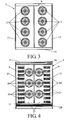
- the position of the ventilating fans 17 in the front wall 5 and in figure 4 the position of the further ventilating fans 18 in the rear wall 7 can be seen clearly.
- the rear wall 7 of the compartment 3 is made up of two doors 8, see Figures 1 and 4.
- the rear wall 7 there are a number of air vents 19 for letting fresh air in.
- the size of the air vents 19 can be adjusted by means of sliding devices 21 (see Figure 4), which can be slid in front of the air vents 19.
- the roof 9, the floor 11 and the side walls 13 are closed.
- This closing device 27 for closing off a part of the rear from the floor 11 upwards.
- This closing device 27 comprises a plastic covering 29 that can be rolled up and which extends over the entire width of the compartment 3.
- One end of the plastic covering 29 is attached to cables 31 near the side walls 13 of the compartment 3, which are led round two wheels 33 and 35 at the top and bottom of the compartment 3.
- One of the wheels 33 can be driven in order to raise or lower the plastic covering 29.
- a moving resistance device 36 made of a perforated plastic covering, through which the air flowing into the compartment 3 encounters resistance, for covering a part of the rear from the roof 9 downwards when the doors 8 are open.
- the air is only exhausted by the ventilating fans 17 in the front wall 5 of the compartment 3. In that case the openings in the rear wall 7 wherein the further ventilating fans 18 are present are closed and the air is taken in through the adjustable air vents 19 in the rear wall 7.
- the air is alternately, for example during periods of 3 minutes, exhausted through openings in the front and rear wall 5, 7 whereby the air is alternately taken in through openings in the opposite wall.
- the air vents in the front and rear walls 5, 7 are in that case formed by the openings in which the ventilating fans 17, 18 and the adjustable air vents 19 in the rear wall 7 are closed. Because of this the temperature in the compartment and especially in the rear of the compartment will be less low than in case air is only exhausted through openings in the front wall of the compartment 3.
- ventilating fans can also be situated in the side walls 13 near the front of the compartment 3.
Landscapes
- Engineering & Computer Science (AREA)
- Health & Medical Sciences (AREA)
- Public Health (AREA)
- Transportation (AREA)
- Mechanical Engineering (AREA)
- Physics & Mathematics (AREA)
- Thermal Sciences (AREA)
- Air-Conditioning For Vehicles (AREA)
Abstract
Description
- The invention relates to a transport vehicle, in particular for transporting chickens, comprising a compartment with, as viewed in the direction of travel, a front wall and a rear wall, as well as a roof, a floor and two side walls, which transport vehicle, furthermore, comprises at least one ventilating fan, situated in or near an opening in the front wall, as well as at least one air vent in one of the compartment's walls, for taking in air, the ventilating fan is set up in such a way that it extracts air from the compartment.
- The front in this situation is the upstream side with respect to the flow of air during transport. By a ventilating fan situated in or near an opening in the front wall is also meant a ventilating fan situated on the front wall and connected to the space in the compartment by means of an opening in the wall.
- Such a transport vehicle is known from
WO 03/031224 A1 - An objective of the invention is to provide a transport vehicle of the type described in the preamble in which ventilation of the compartment is improved. To this end, the transport vehicle according to the invention is characterized in that the transport vehicle comprises at least one further ventilating fan, situated in or near an opening in the rear wall of the compartment. Instead of exhausting air only through openings in the front wall, whereby the air is taken in through openings in the rear wall of the compartment, the air is alternately exhausted through openings in the front and rear wall whereby the air is alternately taken in through openings in the opposite wall. The air vents in the front and rear walls can be formed by the ventilating fans. Because of this the temperature in the compartment and especially in the rear of the compartment will be less low than in case air is only exhausted through openings in the front wall of the compartment.
- During circumstances when temperature is not low the air is only exhausted by the ventilating fan in the front wall of the compartment. In that case the openings in the rear wall wherein the further ventilating fans are present can be closed and the air is taken in through other adjustable venting openings in the rear wall.
- An embodiment of the transport vehicle according to the invention is characterized in that the ventilating fan is further set up in such a way that it exhausts the air to outside the transport vehicle in a direction at least substantially parallel to the direction of travel. Instead of exhausting air in a direction perpendicular to the direction of travel the air is exhausted in or at least substantially in the direction of travel. It has been found that in front of the compartment there is an area where the air pressure just outside the compartment is lower than it is inside. This underpressure has a suction effect on the air in the compartment. Extracting the air from the compartment at this place with a ventilating fan is supported by this natural suction as a result of which better ventilation is achieved or smaller ventilating fans can be used.
- A further embodiment of the transport vehicle according to the invention is characterized in that the transport vehicle comprises a cab which, as viewed in the direction of travel, is situated in front of as well as at a distance from the compartment, and the ventilating fan is situated behind the cab. There is an underpressure between the cab and the compartment during transport when using transport vehicles with a cab in front. That is why it is advantageous to place the ventilating fan behind the cab.
- Still a further embodiment is characterized in that there are a number of floors in the compartment and in addition to the ventilating fan mentioned, the transport vehicle comprises a number of additional ventilating fans which are distributed vertically in the front wall, and in addition to the further ventilating fan mentioned, a number of additional further ventilating fans, which are distributed vertically in the rear wall and which transport vehicle in addition to the air vent mentioned, comprises a number of additional air vents which are distributed vertically in the rear wall adjacent the further ventilating fans. In this embodiment the rear wall is executed preferably as one or more doors and there is a moveable closing device in the compartment at the rear for closing off a part of the rear from the floor upwards when the doors are open and a moving resistance device, through which the air flowing into the compartment encounters resistance, for covering a part of the rear from the roof downwards when the doors are open. The resistance device is preferably a perforated plastic covering. When the transport vehicle is being loaded and the uppermost floor is loaded first, the closing device can be used for the floors lying below. Because of this, the air drawn in flows through the uppermost floor. If the floors lying below were not closed off, all the air drawn in would be drawn in through these empty floors because the air encounters less resistance there. In that case, the uppermost floor where chickens are already situated would not be ventilated or would be insufficiently ventilated. The advantage of the resistance device, which will cover that part of the rear above the floor which is loaded, is that the air speed in the upper floors is not too high and sufficient air will be drawn in through the flood being loaded. Preferably the closing device comprises a plastic covering which can be rolled up and which extends over the entire width of the compartment.
- The invention also relates to a method for ventilating a compartment of a transport vehicle, which compartment as seen in the direction of travel, has a front wall and a rear wall, as well as a roof, a floor and two side walls, in which method air is extracted from the compartment through openings in the front wall of the compartment. As to the method, the invention is characterized in that air is also extracted from the compartment through openings in the rear wall of the compartment, whereby the air is extracted alternately during a period through the openings in the front wall and a period through the openings in the rear wall.
- An embodiment of the method is characterized in that the air extracted from the compartment is exhausted to outside the transport vehicle in a direction at least substantially parallel to the direction of travel of the transport vehicle. This is particularly advantageous with transport vehicles having a cab which is situated in front of and at a distance from the compartment.
- A further embodiment of the method is characterized in that just after the compartment is filled with animals and the rear door or doors is/are closed first the air is exhausted through the openings in the rear wall during a longer period than during the alternately venting through the openings in the front and rear wall.
- The invention will be elucidated more fully below on the basis of drawings in which an embodiment of the transport vehicle according to the invention is shown. In these drawings:
- Figure 1 is a side view of an embodiment of the transport vehicle according to the invention in which the compartment is shown in cross-section;
- Figure 2 is a view from above of a front part of the transport vehicle's compartment;
- Figure 3 is a front view of the compartment; and
- Figure 4 is a rear view of the compartment.
- In Figure 1 an embodiment of the
transport vehicle 1 according to the invention is shown in a side view. The transport vehicle is suitable for transporting chickens and has acompartment 3 with afront wall 5, arear wall 7, aroof 9, afloor 11 and twoside walls 13. For the sake of clarity, the compartment is shown here in cross-section. Thetransport vehicle 1, furthermore, has acab 15 situated in front of and at a distance d from thecompartment 3. There are eightventilating fans 17 in openings in thefront wall 5 of thecompartment 3, which are situated behind thecab 15 in openings in thefront wall 5. Further there are six further ventilatingfans 18 in openings in therear wall 7 of thecompartment 3. These six furtherventilating fans 18 have the same overall venting capacity as the eightventilating fans 17 in thefront wall 5. The ventilating fans are set up in such a way that they extract air from thecompartment 3 and blow it outside. In Figures 2 and 3, the position of theventilating fans 17 in thefront wall 5 and in figure 4 the position of the furtherventilating fans 18 in therear wall 7 can be seen clearly. - The
rear wall 7 of thecompartment 3 is made up of twodoors 8, see Figures 1 and 4. In therear wall 7 there are a number ofair vents 19 for letting fresh air in. The size of theair vents 19 can be adjusted by means of sliding devices 21 (see Figure 4), which can be slid in front of theair vents 19. There is asponge 23 made of plastic wire in front of theair vents 19 on the inner side of therear wall 7. Thissponge 23 is a resistance device through which the air flowing into the compartment encounters resistance. Theroof 9, thefloor 11 and theside walls 13 are closed. - There are a number of
floors 25 in the compartment, see Figure 1. In thecompartment 3 at the rear there is amoveable closing device 27 for closing off a part of the rear from thefloor 11 upwards. Thisclosing device 27 comprises aplastic covering 29 that can be rolled up and which extends over the entire width of thecompartment 3. One end of theplastic covering 29 is attached tocables 31 near theside walls 13 of thecompartment 3, which are led round twowheels compartment 3. One of thewheels 33 can be driven in order to raise or lower the plastic covering 29. - In the
compartment 3 at the rear there is further a movingresistance device 36, made of a perforated plastic covering, through which the air flowing into thecompartment 3 encounters resistance, for covering a part of the rear from theroof 9 downwards when thedoors 8 are open. - For regulating the ventilating
fans 17, there aretemperature sensors 41 on eachfloor 25 of thecompartment 3 as well as a sensor for theoutside temperature 43. - During circumstances when temperature is not low, for example above 5 degrees Celsius, the air is only exhausted by the ventilating
fans 17 in thefront wall 5 of thecompartment 3. In that case the openings in therear wall 7 wherein the further ventilatingfans 18 are present are closed and the air is taken in through theadjustable air vents 19 in therear wall 7. - During circumstances when temperature is low, for example below 5 degrees Celsius, the air is alternately, for example during periods of 3 minutes, exhausted through openings in the front and
rear wall rear walls fans adjustable air vents 19 in therear wall 7 are closed. Because of this the temperature in the compartment and especially in the rear of the compartment will be less low than in case air is only exhausted through openings in the front wall of thecompartment 3. - During loading of the compartment in case the outside temperature is low only the ventilating
fans 17 in thefront wall 5 are operative. After the compartiment is loaded thedoors 8 are closed and during a time longer than 3 minutes only the further ventilatingfans 18 in therear wall 7 are operative to increase the temperature in the rear of thecompartment 3. - Although in the above the invention is explained on the basis of the drawings, it should be noted that the invention is in no way limited to the embodiment shown in the drawings. The invention also extends to all embodiments deviating from the embodiment shown in the drawings within the context defined by the claims. Thus the ventilating fans can also be situated in the
side walls 13 near the front of thecompartment 3.
Claims (10)
- Transport vehicle (1), in particular for transporting chickens, comprising a compartment (3) with, as viewed in the direction of travel, a front wall (5) and a rear wall (7), as well as a roof (9), a floor (11) and two side walls (13), which transport vehicle (1), furthermore, comprises at least one ventilating fan (17), situated in or near an opening in the front wall (5), as well as at least one air vent (19) in one of the compartment's walls, for taking in air, the ventilating fan (17) is set up in such a way that it extracts air from the compartment (3), characterized in that the transport vehicle comprises at least one further ventilating fan (18), situated in or near an opening in the rear wall (7) of the compartment (3).
- Transport vehicle (1) according to claim 1, characterized in that the ventilating fan (17) is further set up in such a way that it exhausts the air to outside the transport vehicle in a direction at least substantially parallel to the direction of travel.
- Transport vehicle (1) according to claim 1 or 2, characterized in that the transport vehicle comprises a cab (15) which, as viewed in the direction of travel, is situated in front of as well as at a distance (d) from the compartment (3), and the ventilating fan (17) is situated behind the cab (15).
- Transport vehicle (1) according to one of the preceding claims, characterized in that there are a number of floors (25) in the compartment (3) and the transport vehicle (1) comprises in addition to the ventilating fan (17) mentioned, a number of additional ventilating fans (17) which are distributed vertically in the front wall (5), and in addition to the further ventilating fan (18) mentioned, a number of additional further ventilating fans (18), which are distributed vertically in the rear wall (17) and which transport vehicle comprises in addition to the air vent (19) mentioned, a number of additional air vents (19) which are distributed vertically in the rear wall (7) adjacent the further ventilating fans (18).
- Transport vehicle (1) according to claim 4, characterized in that the rear wall (7) is executed as one or more doors (8) and that there is a movable closing device (27) in the compartment (3) at the rear for closing off a part of the rear from the floor (11) upwards when the doors (8) are open, and a moving resistance device (36), through which the air flowing into the compartment (3) encounters resistance, for covering a part of the rear from the roof (9) downwards when the doors (8) are open.
- Transport vehicle according to claim 5, characterized in that the resistance device (36) is a perforated plastic covering.
- Transport vehicle (1) according to claim 5 or 6, characterized in that the closing device (27) comprises a plastic covering (29) that can be rolled up, which extends over the entire width of the compartment (3).
- Method for ventilating a compartment (3) of a transport vehicle (1), which compartment, as viewed in the direction of travel, has a front wall (5) and a rear wall (7), as well as a roof (9), a floor (11) and two side walls (13), in which method air is extracted from the compartment (3) through openings in the front wall (5) of the compartment (3), characterized in that air is also extracted from the compartment (3) through openings in the rear wall (7) of the compartment, whereby the air is extracted alternately during a period through the openings in the front wall (5) and a period through the openings in the rear wall (7).
- Method according to claim 8, characterized in that the air extracted from the compartment (3) is exhausted to outside the transport vehicle in a direction at least substantially parallel to the direction of travel of the transport vehicle.
- Method according to claim 8 or 9, characterized in that just after the compartment (3) is filled with animals and the rear door or doors (8) is/are closed first the air is exhausted through the openings in the rear wall (7) during a longer period than during the alternately venting through the openings in the front and rear wall (5, 7).
Applications Claiming Priority (1)
| Application Number | Priority Date | Filing Date | Title |
|---|---|---|---|
| US11/107,310 US20060234620A1 (en) | 2005-04-15 | 2005-04-15 | Transport vehicle for transporting chickens and method for ventilating a compartment thereof |
Publications (3)
| Publication Number | Publication Date |
|---|---|
| EP1712413A2 true EP1712413A2 (en) | 2006-10-18 |
| EP1712413A3 EP1712413A3 (en) | 2007-12-05 |
| EP1712413B1 EP1712413B1 (en) | 2009-09-02 |
Family
ID=36681888
Family Applications (1)
| Application Number | Title | Priority Date | Filing Date |
|---|---|---|---|
| EP06007918A Expired - Lifetime EP1712413B1 (en) | 2005-04-15 | 2006-04-14 | Transport vehicle as well as a method for ventilating a compartment of a transport vehicle |
Country Status (4)
| Country | Link |
|---|---|
| US (2) | US20060234620A1 (en) |
| EP (1) | EP1712413B1 (en) |
| AT (1) | ATE441553T1 (en) |
| DE (1) | DE602006008852D1 (en) |
Cited By (1)
| Publication number | Priority date | Publication date | Assignee | Title |
|---|---|---|---|---|
| EP2386444A1 (en) * | 2010-05-10 | 2011-11-16 | Parkhouse Country Estates Limited | Improvements in and relating to vent assemblies for transporters |
Families Citing this family (6)
| Publication number | Priority date | Publication date | Assignee | Title |
|---|---|---|---|---|
| US20110239952A1 (en) * | 2010-04-05 | 2011-10-06 | Covey Enterprises, Llc | Method and Apparatus for Brooding Game Birds |
| US9630472B2 (en) | 2011-09-23 | 2017-04-25 | LSP Trucking, LLC | System and method of ventilated transport |
| NL2010899C2 (en) * | 2013-05-31 | 2014-12-08 | Heering Group B V | Transport system and a method for transporting livestock. |
| KR101511053B1 (en) * | 2014-01-23 | 2015-04-10 | 김광수 | Ventilation of hygienic carriage container for livestock |
| CN108749695B (en) * | 2018-05-11 | 2021-04-13 | 丁道勇 | Cattle and sheep transport vehicle |
| US12604854B2 (en) | 2024-06-05 | 2026-04-21 | Koechner Mfg. Co., Inc. | Animal transport system |
Citations (1)
| Publication number | Priority date | Publication date | Assignee | Title |
|---|---|---|---|---|
| US6581544B1 (en) | 2001-10-24 | 2003-06-24 | Smithway, Inc. | Air conditioned trailer for transporting living fowl |
Family Cites Families (6)
| Publication number | Priority date | Publication date | Assignee | Title |
|---|---|---|---|---|
| US4454837A (en) * | 1982-11-12 | 1984-06-19 | Moore & Sons, Inc. | Truck for transporting boxes of poultry |
| GB0020492D0 (en) * | 2000-08-18 | 2000-10-11 | Parkhouse Country Estates Ltd | Improvements in and relating to livestock transporters |
| US6698212B2 (en) * | 2001-07-03 | 2004-03-02 | Thermo King Corporation | Cryogenic temperature control apparatus and method |
| NL1019156C2 (en) * | 2001-10-11 | 2003-04-14 | Adrianus Henricus Maria Mennen | Transport vehicle, in particular for transporting chickens, and method for ventilating a compartment of a transport vehicle. |
| US6694765B1 (en) * | 2002-07-30 | 2004-02-24 | Thermo King Corporation | Method and apparatus for moving air through a heat exchanger |
| US6817316B1 (en) * | 2003-12-03 | 2004-11-16 | Lucien Joseph Roussy | Hatchling transport trailer |
-
2005
- 2005-04-15 US US11/107,310 patent/US20060234620A1/en not_active Abandoned
-
2006
- 2006-04-14 AT AT06007918T patent/ATE441553T1/en not_active IP Right Cessation
- 2006-04-14 EP EP06007918A patent/EP1712413B1/en not_active Expired - Lifetime
- 2006-04-14 DE DE602006008852T patent/DE602006008852D1/en not_active Expired - Lifetime
-
2007
- 2007-12-12 US US11/954,559 patent/US20080110409A1/en not_active Abandoned
Patent Citations (1)
| Publication number | Priority date | Publication date | Assignee | Title |
|---|---|---|---|---|
| US6581544B1 (en) | 2001-10-24 | 2003-06-24 | Smithway, Inc. | Air conditioned trailer for transporting living fowl |
Cited By (1)
| Publication number | Priority date | Publication date | Assignee | Title |
|---|---|---|---|---|
| EP2386444A1 (en) * | 2010-05-10 | 2011-11-16 | Parkhouse Country Estates Limited | Improvements in and relating to vent assemblies for transporters |
Also Published As
| Publication number | Publication date |
|---|---|
| US20080110409A1 (en) | 2008-05-15 |
| EP1712413B1 (en) | 2009-09-02 |
| DE602006008852D1 (en) | 2009-10-15 |
| EP1712413A3 (en) | 2007-12-05 |
| ATE441553T1 (en) | 2009-09-15 |
| US20060234620A1 (en) | 2006-10-19 |
Similar Documents
| Publication | Publication Date | Title |
|---|---|---|
| US20080110409A1 (en) | Transport vehicle for transporting chickens and method for ventilating a compartment thereof | |
| KR101511053B1 (en) | Ventilation of hygienic carriage container for livestock | |
| EP0193300B1 (en) | Static vent device | |
| KR102188895B1 (en) | Cages for transporting livestock | |
| EP1436166B1 (en) | Transport vehicle and method for ventilating a transport vehicle | |
| US6817316B1 (en) | Hatchling transport trailer | |
| EP2372250A1 (en) | Method for aerating and deaerating an oven, and oven | |
| KR20180000559U (en) | Pig transport vehicle | |
| KR101851163B1 (en) | a green house including a ventilation device for preventing cold weather damage of agricultural products | |
| EP1361090B1 (en) | A motor vehicle with a system for ventilation of a compartment that is able to house a domestic animal | |
| WO2009087683A2 (en) | Fresh air duct for vehicle air conditioning system | |
| US20080034482A1 (en) | Ventilated toilet | |
| EP3392069B1 (en) | Ventilator and vehicle provided with a ventilator | |
| JP2012137043A (en) | Engine intake device | |
| EP0613796A1 (en) | Air-conditioned bus | |
| CN116674484A (en) | Foreign object entry prevention system and method for vehicles | |
| CN204623066U (en) | A kind of passenger vehicle | |
| US1956509A (en) | Apparatus for ventilating and cooling automobiles | |
| CA2452416C (en) | Hatchling transport trailer | |
| CN207836231U (en) | It is a kind of to connect warehousing system more | |
| CN223928979U (en) | Ventilating system of shallow circular bin | |
| CN215442442U (en) | Mothproof device for wood structure house | |
| CN210004560U (en) | ventilating device for school sports equipment storage | |
| KR200166248Y1 (en) | Suction duct for breeding domestic animals | |
| KR100568740B1 (en) | Bus air intake structure |
Legal Events
| Date | Code | Title | Description |
|---|---|---|---|
| PUAI | Public reference made under article 153(3) epc to a published international application that has entered the european phase |
Free format text: ORIGINAL CODE: 0009012 |
|
| AK | Designated contracting states |
Kind code of ref document: A2 Designated state(s): AT BE BG CH CY CZ DE DK EE ES FI FR GB GR HU IE IS IT LI LT LU LV MC NL PL PT RO SE SI SK TR |
|
| AX | Request for extension of the european patent |
Extension state: AL BA HR MK YU |
|
| PUAL | Search report despatched |
Free format text: ORIGINAL CODE: 0009013 |
|
| AK | Designated contracting states |
Kind code of ref document: A3 Designated state(s): AT BE BG CH CY CZ DE DK EE ES FI FR GB GR HU IE IS IT LI LT LU LV MC NL PL PT RO SE SI SK TR |
|
| AX | Request for extension of the european patent |
Extension state: AL BA HR MK YU |
|
| 17P | Request for examination filed |
Effective date: 20080605 |
|
| AKX | Designation fees paid |
Designated state(s): AT BE BG CH CY CZ DE DK EE ES FI FR GB GR HU IE IS IT LI LT LU LV MC NL PL PT RO SE SI SK TR |
|
| GRAP | Despatch of communication of intention to grant a patent |
Free format text: ORIGINAL CODE: EPIDOSNIGR1 |
|
| GRAS | Grant fee paid |
Free format text: ORIGINAL CODE: EPIDOSNIGR3 |
|
| GRAA | (expected) grant |
Free format text: ORIGINAL CODE: 0009210 |
|
| AK | Designated contracting states |
Kind code of ref document: B1 Designated state(s): AT BE BG CH CY CZ DE DK EE ES FI FR GB GR HU IE IS IT LI LT LU LV MC NL PL PT RO SE SI SK TR |
|
| REG | Reference to a national code |
Ref country code: CH Ref legal event code: EP |
|
| REG | Reference to a national code |
Ref country code: IE Ref legal event code: FG4D |
|
| REF | Corresponds to: |
Ref document number: 602006008852 Country of ref document: DE Date of ref document: 20091015 Kind code of ref document: P |
|
| PG25 | Lapsed in a contracting state [announced via postgrant information from national office to epo] |
Ref country code: LT Free format text: LAPSE BECAUSE OF FAILURE TO SUBMIT A TRANSLATION OF THE DESCRIPTION OR TO PAY THE FEE WITHIN THE PRESCRIBED TIME-LIMIT Effective date: 20090902 Ref country code: SE Free format text: LAPSE BECAUSE OF FAILURE TO SUBMIT A TRANSLATION OF THE DESCRIPTION OR TO PAY THE FEE WITHIN THE PRESCRIBED TIME-LIMIT Effective date: 20090902 Ref country code: FI Free format text: LAPSE BECAUSE OF FAILURE TO SUBMIT A TRANSLATION OF THE DESCRIPTION OR TO PAY THE FEE WITHIN THE PRESCRIBED TIME-LIMIT Effective date: 20090902 |
|
| LTIE | Lt: invalidation of european patent or patent extension |
Effective date: 20090902 |
|
| PG25 | Lapsed in a contracting state [announced via postgrant information from national office to epo] |
Ref country code: SI Free format text: LAPSE BECAUSE OF FAILURE TO SUBMIT A TRANSLATION OF THE DESCRIPTION OR TO PAY THE FEE WITHIN THE PRESCRIBED TIME-LIMIT Effective date: 20090902 Ref country code: LV Free format text: LAPSE BECAUSE OF FAILURE TO SUBMIT A TRANSLATION OF THE DESCRIPTION OR TO PAY THE FEE WITHIN THE PRESCRIBED TIME-LIMIT Effective date: 20090902 Ref country code: PL Free format text: LAPSE BECAUSE OF FAILURE TO SUBMIT A TRANSLATION OF THE DESCRIPTION OR TO PAY THE FEE WITHIN THE PRESCRIBED TIME-LIMIT Effective date: 20090902 |
|
| PG25 | Lapsed in a contracting state [announced via postgrant information from national office to epo] |
Ref country code: CY Free format text: LAPSE BECAUSE OF FAILURE TO SUBMIT A TRANSLATION OF THE DESCRIPTION OR TO PAY THE FEE WITHIN THE PRESCRIBED TIME-LIMIT Effective date: 20090902 |
|
| PG25 | Lapsed in a contracting state [announced via postgrant information from national office to epo] |
Ref country code: RO Free format text: LAPSE BECAUSE OF FAILURE TO SUBMIT A TRANSLATION OF THE DESCRIPTION OR TO PAY THE FEE WITHIN THE PRESCRIBED TIME-LIMIT Effective date: 20090902 Ref country code: CZ Free format text: LAPSE BECAUSE OF FAILURE TO SUBMIT A TRANSLATION OF THE DESCRIPTION OR TO PAY THE FEE WITHIN THE PRESCRIBED TIME-LIMIT Effective date: 20090902 Ref country code: ES Free format text: LAPSE BECAUSE OF FAILURE TO SUBMIT A TRANSLATION OF THE DESCRIPTION OR TO PAY THE FEE WITHIN THE PRESCRIBED TIME-LIMIT Effective date: 20091213 Ref country code: EE Free format text: LAPSE BECAUSE OF FAILURE TO SUBMIT A TRANSLATION OF THE DESCRIPTION OR TO PAY THE FEE WITHIN THE PRESCRIBED TIME-LIMIT Effective date: 20090902 Ref country code: PT Free format text: LAPSE BECAUSE OF FAILURE TO SUBMIT A TRANSLATION OF THE DESCRIPTION OR TO PAY THE FEE WITHIN THE PRESCRIBED TIME-LIMIT Effective date: 20100104 Ref country code: IS Free format text: LAPSE BECAUSE OF FAILURE TO SUBMIT A TRANSLATION OF THE DESCRIPTION OR TO PAY THE FEE WITHIN THE PRESCRIBED TIME-LIMIT Effective date: 20100102 |
|
| PG25 | Lapsed in a contracting state [announced via postgrant information from national office to epo] |
Ref country code: SK Free format text: LAPSE BECAUSE OF FAILURE TO SUBMIT A TRANSLATION OF THE DESCRIPTION OR TO PAY THE FEE WITHIN THE PRESCRIBED TIME-LIMIT Effective date: 20090902 |
|
| PG25 | Lapsed in a contracting state [announced via postgrant information from national office to epo] |
Ref country code: AT Free format text: LAPSE BECAUSE OF FAILURE TO SUBMIT A TRANSLATION OF THE DESCRIPTION OR TO PAY THE FEE WITHIN THE PRESCRIBED TIME-LIMIT Effective date: 20090902 Ref country code: BE Free format text: LAPSE BECAUSE OF FAILURE TO SUBMIT A TRANSLATION OF THE DESCRIPTION OR TO PAY THE FEE WITHIN THE PRESCRIBED TIME-LIMIT Effective date: 20090902 |
|
| PLBE | No opposition filed within time limit |
Free format text: ORIGINAL CODE: 0009261 |
|
| STAA | Information on the status of an ep patent application or granted ep patent |
Free format text: STATUS: NO OPPOSITION FILED WITHIN TIME LIMIT |
|
| PG25 | Lapsed in a contracting state [announced via postgrant information from national office to epo] |
Ref country code: DK Free format text: LAPSE BECAUSE OF FAILURE TO SUBMIT A TRANSLATION OF THE DESCRIPTION OR TO PAY THE FEE WITHIN THE PRESCRIBED TIME-LIMIT Effective date: 20090902 |
|
| PGFP | Annual fee paid to national office [announced via postgrant information from national office to epo] |
Ref country code: FR Payment date: 20100527 Year of fee payment: 5 |
|
| 26N | No opposition filed |
Effective date: 20100603 |
|
| PGFP | Annual fee paid to national office [announced via postgrant information from national office to epo] |
Ref country code: DE Payment date: 20100511 Year of fee payment: 5 |
|
| PG25 | Lapsed in a contracting state [announced via postgrant information from national office to epo] |
Ref country code: GR Free format text: LAPSE BECAUSE OF FAILURE TO SUBMIT A TRANSLATION OF THE DESCRIPTION OR TO PAY THE FEE WITHIN THE PRESCRIBED TIME-LIMIT Effective date: 20091203 |
|
| PG25 | Lapsed in a contracting state [announced via postgrant information from national office to epo] |
Ref country code: MC Free format text: LAPSE BECAUSE OF NON-PAYMENT OF DUE FEES Effective date: 20100430 |
|
| PGFP | Annual fee paid to national office [announced via postgrant information from national office to epo] |
Ref country code: GB Payment date: 20100519 Year of fee payment: 5 |
|
| REG | Reference to a national code |
Ref country code: CH Ref legal event code: PL |
|
| PG25 | Lapsed in a contracting state [announced via postgrant information from national office to epo] |
Ref country code: IE Free format text: LAPSE BECAUSE OF NON-PAYMENT OF DUE FEES Effective date: 20100414 |
|
| PG25 | Lapsed in a contracting state [announced via postgrant information from national office to epo] |
Ref country code: CH Free format text: LAPSE BECAUSE OF NON-PAYMENT OF DUE FEES Effective date: 20100430 Ref country code: LI Free format text: LAPSE BECAUSE OF NON-PAYMENT OF DUE FEES Effective date: 20100430 |
|
| PG25 | Lapsed in a contracting state [announced via postgrant information from national office to epo] |
Ref country code: IT Free format text: LAPSE BECAUSE OF FAILURE TO SUBMIT A TRANSLATION OF THE DESCRIPTION OR TO PAY THE FEE WITHIN THE PRESCRIBED TIME-LIMIT Effective date: 20090902 |
|
| PGFP | Annual fee paid to national office [announced via postgrant information from national office to epo] |
Ref country code: NL Payment date: 20110426 Year of fee payment: 6 |
|
| GBPC | Gb: european patent ceased through non-payment of renewal fee |
Effective date: 20110414 |
|
| REG | Reference to a national code |
Ref country code: FR Ref legal event code: ST Effective date: 20111230 |
|
| PG25 | Lapsed in a contracting state [announced via postgrant information from national office to epo] |
Ref country code: DE Free format text: LAPSE BECAUSE OF NON-PAYMENT OF DUE FEES Effective date: 20111101 Ref country code: FR Free format text: LAPSE BECAUSE OF NON-PAYMENT OF DUE FEES Effective date: 20110502 |
|
| REG | Reference to a national code |
Ref country code: DE Ref legal event code: R119 Ref document number: 602006008852 Country of ref document: DE Effective date: 20111101 |
|
| PG25 | Lapsed in a contracting state [announced via postgrant information from national office to epo] |
Ref country code: GB Free format text: LAPSE BECAUSE OF NON-PAYMENT OF DUE FEES Effective date: 20110414 |
|
| PG25 | Lapsed in a contracting state [announced via postgrant information from national office to epo] |
Ref country code: BG Free format text: LAPSE BECAUSE OF FAILURE TO SUBMIT A TRANSLATION OF THE DESCRIPTION OR TO PAY THE FEE WITHIN THE PRESCRIBED TIME-LIMIT Effective date: 20090902 Ref country code: LU Free format text: LAPSE BECAUSE OF NON-PAYMENT OF DUE FEES Effective date: 20100414 Ref country code: HU Free format text: LAPSE BECAUSE OF FAILURE TO SUBMIT A TRANSLATION OF THE DESCRIPTION OR TO PAY THE FEE WITHIN THE PRESCRIBED TIME-LIMIT Effective date: 20100303 |
|
| PG25 | Lapsed in a contracting state [announced via postgrant information from national office to epo] |
Ref country code: TR Free format text: LAPSE BECAUSE OF FAILURE TO SUBMIT A TRANSLATION OF THE DESCRIPTION OR TO PAY THE FEE WITHIN THE PRESCRIBED TIME-LIMIT Effective date: 20090902 |
|
| REG | Reference to a national code |
Ref country code: NL Ref legal event code: V1 Effective date: 20121101 |
|
| PG25 | Lapsed in a contracting state [announced via postgrant information from national office to epo] |
Ref country code: NL Free format text: LAPSE BECAUSE OF NON-PAYMENT OF DUE FEES Effective date: 20121101 |