EP1711526B1 - Treatment of viral infections - Google Patents
Treatment of viral infections Download PDFInfo
- Publication number
- EP1711526B1 EP1711526B1 EP04806232A EP04806232A EP1711526B1 EP 1711526 B1 EP1711526 B1 EP 1711526B1 EP 04806232 A EP04806232 A EP 04806232A EP 04806232 A EP04806232 A EP 04806232A EP 1711526 B1 EP1711526 B1 EP 1711526B1
- Authority
- EP
- European Patent Office
- Prior art keywords
- seq
- gin
- polypeptide
- peptide
- nucleic acid
- Prior art date
- Legal status (The legal status is an assumption and is not a legal conclusion. Google has not performed a legal analysis and makes no representation as to the accuracy of the status listed.)
- Expired - Lifetime
Links
- 208000036142 Viral infection Diseases 0.000 title claims description 11
- 230000009385 viral infection Effects 0.000 title claims description 11
- 238000011282 treatment Methods 0.000 title description 7
- 108090000765 processed proteins & peptides Proteins 0.000 claims description 206
- 102000004196 processed proteins & peptides Human genes 0.000 claims description 133
- 150000007523 nucleic acids Chemical group 0.000 claims description 67
- 229920001184 polypeptide Polymers 0.000 claims description 65
- 108020004707 nucleic acids Proteins 0.000 claims description 56
- 102000039446 nucleic acids Human genes 0.000 claims description 56
- 230000000840 anti-viral effect Effects 0.000 claims description 34
- 150000001413 amino acids Chemical group 0.000 claims description 32
- 239000004475 Arginine Substances 0.000 claims description 18
- ODKSFYDXXFIFQN-UHFFFAOYSA-N arginine Natural products OC(=O)C(N)CCCNC(N)=N ODKSFYDXXFIFQN-UHFFFAOYSA-N 0.000 claims description 17
- ROHFNLRQFUQHCH-YFKPBYRVSA-N L-leucine Chemical compound CC(C)C[C@H](N)C(O)=O ROHFNLRQFUQHCH-YFKPBYRVSA-N 0.000 claims description 13
- ROHFNLRQFUQHCH-UHFFFAOYSA-N Leucine Natural products CC(C)CC(N)C(O)=O ROHFNLRQFUQHCH-UHFFFAOYSA-N 0.000 claims description 13
- KDXKERNSBIXSRK-UHFFFAOYSA-N Lysine Natural products NCCCCC(N)C(O)=O KDXKERNSBIXSRK-UHFFFAOYSA-N 0.000 claims description 13
- 239000004472 Lysine Substances 0.000 claims description 13
- HNDVDQJCIGZPNO-UHFFFAOYSA-N histidine Natural products OC(=O)C(N)CC1=CN=CN1 HNDVDQJCIGZPNO-UHFFFAOYSA-N 0.000 claims description 13
- 239000003814 drug Substances 0.000 claims description 11
- DHMQDGOQFOQNFH-UHFFFAOYSA-N Glycine Chemical compound NCC(O)=O DHMQDGOQFOQNFH-UHFFFAOYSA-N 0.000 claims description 10
- QIVBCDIJIAJPQS-VIFPVBQESA-N L-tryptophane Chemical compound C1=CC=C2C(C[C@H](N)C(O)=O)=CNC2=C1 QIVBCDIJIAJPQS-VIFPVBQESA-N 0.000 claims description 9
- 108091028043 Nucleic acid sequence Proteins 0.000 claims description 9
- QIVBCDIJIAJPQS-UHFFFAOYSA-N Tryptophan Natural products C1=CC=C2C(CC(N)C(O)=O)=CNC2=C1 QIVBCDIJIAJPQS-UHFFFAOYSA-N 0.000 claims description 9
- 238000004519 manufacturing process Methods 0.000 claims description 6
- 239000004471 Glycine Substances 0.000 claims description 5
- AYFVYJQAPQTCCC-UHFFFAOYSA-N Threonine Natural products CC(O)C(N)C(O)=O AYFVYJQAPQTCCC-UHFFFAOYSA-N 0.000 claims description 5
- 239000004473 Threonine Substances 0.000 claims description 5
- 125000000539 amino acid group Chemical group 0.000 claims description 4
- 239000002773 nucleotide Substances 0.000 claims description 3
- 125000003729 nucleotide group Chemical group 0.000 claims description 3
- 101710145752 Serine recombinase gin Proteins 0.000 description 85
- 210000004027 cell Anatomy 0.000 description 53
- 241000700605 Viruses Species 0.000 description 32
- 235000001014 amino acid Nutrition 0.000 description 29
- 229940024606 amino acid Drugs 0.000 description 29
- 241000700588 Human alphaherpesvirus 1 Species 0.000 description 27
- 230000000694 effects Effects 0.000 description 21
- 241000725303 Human immunodeficiency virus Species 0.000 description 19
- 239000003981 vehicle Substances 0.000 description 18
- 239000000203 mixture Substances 0.000 description 17
- 238000000034 method Methods 0.000 description 15
- 101150037123 APOE gene Proteins 0.000 description 13
- 102000007592 Apolipoproteins Human genes 0.000 description 13
- 108010071619 Apolipoproteins Proteins 0.000 description 13
- HTTJABKRGRZYRN-UHFFFAOYSA-N Heparin Chemical compound OC1C(NC(=O)C)C(O)OC(COS(O)(=O)=O)C1OC1C(OS(O)(=O)=O)C(O)C(OC2C(C(OS(O)(=O)=O)C(OC3C(C(O)C(O)C(O3)C(O)=O)OS(O)(=O)=O)C(CO)O2)NS(O)(=O)=O)C(C(O)=O)O1 HTTJABKRGRZYRN-UHFFFAOYSA-N 0.000 description 13
- 241000701074 Human alphaherpesvirus 2 Species 0.000 description 13
- 229920000669 heparin Polymers 0.000 description 13
- 229960002897 heparin Drugs 0.000 description 13
- 239000007788 liquid Substances 0.000 description 13
- 239000013598 vector Substances 0.000 description 13
- 101100216294 Danio rerio apoeb gene Proteins 0.000 description 12
- ODKSFYDXXFIFQN-BYPYZUCNSA-P L-argininium(2+) Chemical compound NC(=[NH2+])NCCC[C@H]([NH3+])C(O)=O ODKSFYDXXFIFQN-BYPYZUCNSA-P 0.000 description 11
- 125000003275 alpha amino acid group Chemical group 0.000 description 11
- 102000005962 receptors Human genes 0.000 description 11
- 108020003175 receptors Proteins 0.000 description 11
- 238000012360 testing method Methods 0.000 description 11
- 101710095342 Apolipoprotein B Proteins 0.000 description 10
- 102100040202 Apolipoprotein B-100 Human genes 0.000 description 10
- 102100024640 Low-density lipoprotein receptor Human genes 0.000 description 10
- 238000003556 assay Methods 0.000 description 10
- 238000002474 experimental method Methods 0.000 description 10
- 239000002609 medium Substances 0.000 description 9
- 230000003612 virological effect Effects 0.000 description 9
- HNDVDQJCIGZPNO-YFKPBYRVSA-N L-histidine Chemical compound OC(=O)[C@@H](N)CC1=CN=CN1 HNDVDQJCIGZPNO-YFKPBYRVSA-N 0.000 description 8
- 239000002245 particle Substances 0.000 description 8
- 108090000623 proteins and genes Proteins 0.000 description 8
- 102000013918 Apolipoproteins E Human genes 0.000 description 7
- 108010025628 Apolipoproteins E Proteins 0.000 description 7
- KDXKERNSBIXSRK-YFKPBYRVSA-N L-lysine Chemical compound NCCCC[C@H](N)C(O)=O KDXKERNSBIXSRK-YFKPBYRVSA-N 0.000 description 7
- 108010001831 LDL receptors Proteins 0.000 description 7
- LOKCTEFSRHRXRJ-UHFFFAOYSA-I dipotassium trisodium dihydrogen phosphate hydrogen phosphate dichloride Chemical compound P(=O)(O)(O)[O-].[K+].P(=O)(O)([O-])[O-].[Na+].[Na+].[Cl-].[K+].[Cl-].[Na+] LOKCTEFSRHRXRJ-UHFFFAOYSA-I 0.000 description 7
- 230000003993 interaction Effects 0.000 description 7
- 239000002953 phosphate buffered saline Substances 0.000 description 7
- 239000000243 solution Substances 0.000 description 7
- 210000003501 vero cell Anatomy 0.000 description 7
- WEVYAHXRMPXWCK-UHFFFAOYSA-N Acetonitrile Chemical compound CC#N WEVYAHXRMPXWCK-UHFFFAOYSA-N 0.000 description 6
- 101150102415 Apob gene Proteins 0.000 description 6
- 102000004895 Lipoproteins Human genes 0.000 description 6
- 108090001030 Lipoproteins Proteins 0.000 description 6
- 230000004927 fusion Effects 0.000 description 6
- 208000015181 infectious disease Diseases 0.000 description 6
- 230000009467 reduction Effects 0.000 description 6
- 239000000725 suspension Substances 0.000 description 6
- 239000003826 tablet Substances 0.000 description 6
- 102100029470 Apolipoprotein E Human genes 0.000 description 5
- 101710095339 Apolipoprotein E Proteins 0.000 description 5
- 101000942697 Homo sapiens Clusterin Proteins 0.000 description 5
- 241000713772 Human immunodeficiency virus 1 Species 0.000 description 5
- 230000036436 anti-hiv Effects 0.000 description 5
- 230000037396 body weight Effects 0.000 description 5
- 230000001413 cellular effect Effects 0.000 description 5
- 102000056179 human CLU Human genes 0.000 description 5
- 239000007924 injection Substances 0.000 description 5
- 238000002347 injection Methods 0.000 description 5
- 230000004048 modification Effects 0.000 description 5
- 238000012986 modification Methods 0.000 description 5
- 239000008194 pharmaceutical composition Substances 0.000 description 5
- 239000000843 powder Substances 0.000 description 5
- 239000007787 solid Substances 0.000 description 5
- 102000018616 Apolipoproteins B Human genes 0.000 description 4
- 108010027006 Apolipoproteins B Proteins 0.000 description 4
- 101001051093 Homo sapiens Low-density lipoprotein receptor Proteins 0.000 description 4
- AYFVYJQAPQTCCC-GBXIJSLDSA-N L-threonine Chemical compound C[C@@H](O)[C@H](N)C(O)=O AYFVYJQAPQTCCC-GBXIJSLDSA-N 0.000 description 4
- 239000003443 antiviral agent Substances 0.000 description 4
- 239000003795 chemical substances by application Substances 0.000 description 4
- 150000001875 compounds Chemical class 0.000 description 4
- -1 gangcylovir Chemical compound 0.000 description 4
- 238000011081 inoculation Methods 0.000 description 4
- 150000002632 lipids Chemical class 0.000 description 4
- 239000012528 membrane Substances 0.000 description 4
- 238000007911 parenteral administration Methods 0.000 description 4
- 235000018102 proteins Nutrition 0.000 description 4
- 102000004169 proteins and genes Human genes 0.000 description 4
- 239000002904 solvent Substances 0.000 description 4
- 239000000375 suspending agent Substances 0.000 description 4
- 238000002560 therapeutic procedure Methods 0.000 description 4
- 235000008521 threonine Nutrition 0.000 description 4
- XLYOFNOQVPJJNP-UHFFFAOYSA-N water Substances O XLYOFNOQVPJJNP-UHFFFAOYSA-N 0.000 description 4
- CSCPPACGZOOCGX-UHFFFAOYSA-N Acetone Chemical compound CC(C)=O CSCPPACGZOOCGX-UHFFFAOYSA-N 0.000 description 3
- 102000009081 Apolipoprotein A-II Human genes 0.000 description 3
- 108010087614 Apolipoprotein A-II Proteins 0.000 description 3
- 102100030802 Beta-2-glycoprotein 1 Human genes 0.000 description 3
- 102100035875 C-C chemokine receptor type 5 Human genes 0.000 description 3
- 101710149870 C-C chemokine receptor type 5 Proteins 0.000 description 3
- 108020004414 DNA Proteins 0.000 description 3
- WSFSSNUMVMOOMR-UHFFFAOYSA-N Formaldehyde Chemical compound O=C WSFSSNUMVMOOMR-UHFFFAOYSA-N 0.000 description 3
- 241000234283 Galanthus nivalis Species 0.000 description 3
- 208000032612 Glial tumor Diseases 0.000 description 3
- 206010018338 Glioma Diseases 0.000 description 3
- OKKJLVBELUTLKV-UHFFFAOYSA-N Methanol Chemical compound OC OKKJLVBELUTLKV-UHFFFAOYSA-N 0.000 description 3
- 150000001412 amines Chemical class 0.000 description 3
- 230000000844 anti-bacterial effect Effects 0.000 description 3
- 108010023562 beta 2-Glycoprotein I Proteins 0.000 description 3
- 210000004899 c-terminal region Anatomy 0.000 description 3
- 239000002775 capsule Substances 0.000 description 3
- 239000001768 carboxy methyl cellulose Substances 0.000 description 3
- 239000000796 flavoring agent Substances 0.000 description 3
- 230000012010 growth Effects 0.000 description 3
- 238000004128 high performance liquid chromatography Methods 0.000 description 3
- 230000002401 inhibitory effect Effects 0.000 description 3
- 239000002054 inoculum Substances 0.000 description 3
- 239000002502 liposome Substances 0.000 description 3
- 239000003921 oil Substances 0.000 description 3
- 235000019198 oils Nutrition 0.000 description 3
- 230000008569 process Effects 0.000 description 3
- 230000010076 replication Effects 0.000 description 3
- 210000002966 serum Anatomy 0.000 description 3
- 238000009097 single-agent therapy Methods 0.000 description 3
- 239000008174 sterile solution Substances 0.000 description 3
- 238000006467 substitution reaction Methods 0.000 description 3
- 230000001225 therapeutic effect Effects 0.000 description 3
- 238000005406 washing Methods 0.000 description 3
- 108700028369 Alleles Proteins 0.000 description 2
- 208000024827 Alzheimer disease Diseases 0.000 description 2
- 101150104773 Apoh gene Proteins 0.000 description 2
- 102000005666 Apolipoprotein A-I Human genes 0.000 description 2
- 108010059886 Apolipoprotein A-I Proteins 0.000 description 2
- 102000018619 Apolipoproteins A Human genes 0.000 description 2
- 108010027004 Apolipoproteins A Proteins 0.000 description 2
- 229920002134 Carboxymethyl cellulose Polymers 0.000 description 2
- 108020004705 Codon Proteins 0.000 description 2
- 101100055841 Danio rerio apoa1 gene Proteins 0.000 description 2
- IAZDPXIOMUYVGZ-UHFFFAOYSA-N Dimethylsulphoxide Chemical compound CS(C)=O IAZDPXIOMUYVGZ-UHFFFAOYSA-N 0.000 description 2
- 239000006144 Dulbecco’s modified Eagle's medium Substances 0.000 description 2
- 108010010803 Gelatin Proteins 0.000 description 2
- 108010010234 HDL Lipoproteins Proteins 0.000 description 2
- 102000015779 HDL Lipoproteins Human genes 0.000 description 2
- 208000037952 HSV-1 infection Diseases 0.000 description 2
- 229920002971 Heparan sulfate Polymers 0.000 description 2
- 101000889953 Homo sapiens Apolipoprotein B-100 Proteins 0.000 description 2
- ZDXPYRJPNDTMRX-VKHMYHEASA-N L-glutamine Chemical compound OC(=O)[C@@H](N)CCC(N)=O ZDXPYRJPNDTMRX-VKHMYHEASA-N 0.000 description 2
- 108010007622 LDL Lipoproteins Proteins 0.000 description 2
- 102000007330 LDL Lipoproteins Human genes 0.000 description 2
- 241001465754 Metazoa Species 0.000 description 2
- 102000003992 Peroxidases Human genes 0.000 description 2
- 241000713311 Simian immunodeficiency virus Species 0.000 description 2
- FAPWRFPIFSIZLT-UHFFFAOYSA-M Sodium chloride Chemical compound [Na+].[Cl-] FAPWRFPIFSIZLT-UHFFFAOYSA-M 0.000 description 2
- 210000001744 T-lymphocyte Anatomy 0.000 description 2
- 101800001690 Transmembrane protein gp41 Proteins 0.000 description 2
- 102000004142 Trypsin Human genes 0.000 description 2
- 108090000631 Trypsin Proteins 0.000 description 2
- 108010062497 VLDL Lipoproteins Proteins 0.000 description 2
- 230000009471 action Effects 0.000 description 2
- 150000001298 alcohols Chemical class 0.000 description 2
- 125000003368 amide group Chemical group 0.000 description 2
- 239000000427 antigen Substances 0.000 description 2
- 108091007433 antigens Proteins 0.000 description 2
- 102000036639 antigens Human genes 0.000 description 2
- 239000011230 binding agent Substances 0.000 description 2
- 230000033228 biological regulation Effects 0.000 description 2
- 230000015572 biosynthetic process Effects 0.000 description 2
- 210000004556 brain Anatomy 0.000 description 2
- 244000309466 calf Species 0.000 description 2
- 235000010948 carboxy methyl cellulose Nutrition 0.000 description 2
- 239000008112 carboxymethyl-cellulose Substances 0.000 description 2
- 239000000969 carrier Substances 0.000 description 2
- 210000000170 cell membrane Anatomy 0.000 description 2
- 239000001913 cellulose Substances 0.000 description 2
- 229920002678 cellulose Polymers 0.000 description 2
- 235000010980 cellulose Nutrition 0.000 description 2
- 230000008859 change Effects 0.000 description 2
- 238000007906 compression Methods 0.000 description 2
- 230000006835 compression Effects 0.000 description 2
- 239000006071 cream Substances 0.000 description 2
- 238000012217 deletion Methods 0.000 description 2
- 230000037430 deletion Effects 0.000 description 2
- 238000011161 development Methods 0.000 description 2
- 238000010790 dilution Methods 0.000 description 2
- 239000012895 dilution Substances 0.000 description 2
- 229960001760 dimethyl sulfoxide Drugs 0.000 description 2
- 239000003937 drug carrier Substances 0.000 description 2
- 239000000839 emulsion Substances 0.000 description 2
- 210000003722 extracellular fluid Anatomy 0.000 description 2
- 235000013355 food flavoring agent Nutrition 0.000 description 2
- 235000003599 food sweetener Nutrition 0.000 description 2
- 239000000499 gel Substances 0.000 description 2
- 239000008273 gelatin Substances 0.000 description 2
- 229920000159 gelatin Polymers 0.000 description 2
- 235000019322 gelatine Nutrition 0.000 description 2
- 235000011852 gelatine desserts Nutrition 0.000 description 2
- 102000052249 human APOB Human genes 0.000 description 2
- 230000002209 hydrophobic effect Effects 0.000 description 2
- 238000011534 incubation Methods 0.000 description 2
- 238000001802 infusion Methods 0.000 description 2
- 239000003112 inhibitor Substances 0.000 description 2
- 230000005764 inhibitory process Effects 0.000 description 2
- 238000001990 intravenous administration Methods 0.000 description 2
- 125000001909 leucine group Chemical group [H]N(*)C(C(*)=O)C([H])([H])C(C([H])([H])[H])C([H])([H])[H] 0.000 description 2
- 239000000314 lubricant Substances 0.000 description 2
- HQKMJHAJHXVSDF-UHFFFAOYSA-L magnesium stearate Chemical compound [Mg+2].CCCCCCCCCCCCCCCCCC([O-])=O.CCCCCCCCCCCCCCCCCC([O-])=O HQKMJHAJHXVSDF-UHFFFAOYSA-L 0.000 description 2
- 238000004949 mass spectrometry Methods 0.000 description 2
- 239000000463 material Substances 0.000 description 2
- 239000002777 nucleoside Substances 0.000 description 2
- 150000003833 nucleoside derivatives Chemical class 0.000 description 2
- 239000002674 ointment Substances 0.000 description 2
- 108040007629 peroxidase activity proteins Proteins 0.000 description 2
- 230000007505 plaque formation Effects 0.000 description 2
- 238000002962 plaque-reduction assay Methods 0.000 description 2
- 239000003755 preservative agent Substances 0.000 description 2
- 230000002265 prevention Effects 0.000 description 2
- 238000000746 purification Methods 0.000 description 2
- 230000002441 reversible effect Effects 0.000 description 2
- 239000011780 sodium chloride Substances 0.000 description 2
- 239000008247 solid mixture Substances 0.000 description 2
- 238000010186 staining Methods 0.000 description 2
- UCSJYZPVAKXKNQ-HZYVHMACSA-N streptomycin Chemical compound CN[C@H]1[C@H](O)[C@@H](O)[C@H](CO)O[C@H]1O[C@@H]1[C@](C=O)(O)[C@H](C)O[C@H]1O[C@@H]1[C@@H](NC(N)=N)[C@H](O)[C@@H](NC(N)=N)[C@H](O)[C@H]1O UCSJYZPVAKXKNQ-HZYVHMACSA-N 0.000 description 2
- 238000007920 subcutaneous administration Methods 0.000 description 2
- 239000000126 substance Substances 0.000 description 2
- 239000006228 supernatant Substances 0.000 description 2
- 239000003765 sweetening agent Substances 0.000 description 2
- 239000006188 syrup Substances 0.000 description 2
- 235000020357 syrup Nutrition 0.000 description 2
- 239000008399 tap water Substances 0.000 description 2
- 235000020679 tap water Nutrition 0.000 description 2
- 210000001519 tissue Anatomy 0.000 description 2
- 230000000699 topical effect Effects 0.000 description 2
- 231100000331 toxic Toxicity 0.000 description 2
- 230000002588 toxic effect Effects 0.000 description 2
- 238000001890 transfection Methods 0.000 description 2
- 239000012588 trypsin Substances 0.000 description 2
- 241001529453 unidentified herpesvirus Species 0.000 description 2
- MTCFGRXMJLQNBG-REOHCLBHSA-N (2S)-2-Amino-3-hydroxypropansäure Chemical compound OC[C@H](N)C(O)=O MTCFGRXMJLQNBG-REOHCLBHSA-N 0.000 description 1
- JNYAEWCLZODPBN-JGWLITMVSA-N (2r,3r,4s)-2-[(1r)-1,2-dihydroxyethyl]oxolane-3,4-diol Chemical compound OC[C@@H](O)[C@H]1OC[C@H](O)[C@H]1O JNYAEWCLZODPBN-JGWLITMVSA-N 0.000 description 1
- HZLHRDBTVSZCBS-UVJJDBRNSA-N 4-[(e)-(4-aminophenyl)-(4-imino-3-methylcyclohexa-2,5-dien-1-ylidene)methyl]-2-methylaniline;hydrochloride Chemical compound Cl.C1=CC(=N)C(C)=C\C1=C(C=1C=C(C)C(N)=CC=1)/C1=CC=C(N)C=C1 HZLHRDBTVSZCBS-UVJJDBRNSA-N 0.000 description 1
- HIQIXEFWDLTDED-UHFFFAOYSA-N 4-hydroxy-1-piperidin-4-ylpyrrolidin-2-one Chemical compound O=C1CC(O)CN1C1CCNCC1 HIQIXEFWDLTDED-UHFFFAOYSA-N 0.000 description 1
- OPIFSICVWOWJMJ-AEOCFKNESA-N 5-bromo-4-chloro-3-indolyl beta-D-galactoside Chemical compound O[C@@H]1[C@@H](O)[C@@H](O)[C@@H](CO)O[C@H]1OC1=CNC2=CC=C(Br)C(Cl)=C12 OPIFSICVWOWJMJ-AEOCFKNESA-N 0.000 description 1
- LVXACIPXSUHNDE-CTNRBZHLSA-N 98805-74-4 Chemical compound C([C@@H](C(=O)N[C@@H](CC(O)=O)C(=O)N[C@@H](CCCCN)C(=O)N[C@H](C(=O)N[C@@H](C)C(=O)N[C@@H](CCC(O)=O)C(=O)N[C@@H](CCCCN)C(=O)N[C@@H](CC(C)C)C(=O)N[C@@H](CCCCN)C(=O)N[C@@H](CCC(O)=O)C(=O)N[C@@H](C)C(=O)N[C@@H](CC=1C=CC=CC=1)C(O)=O)C(C)C)NC(=O)[C@H](CC=1C=CC=CC=1)NC(=O)[C@H](C)NC(=O)[C@H](CCCCN)NC(=O)[C@H](CC(C)C)NC(=O)[C@H](CC=1C2=CC=CC=C2NC=1)NC(=O)[C@@H](N)CC(O)=O)C1=CC=C(O)C=C1 LVXACIPXSUHNDE-CTNRBZHLSA-N 0.000 description 1
- 208000030507 AIDS Diseases 0.000 description 1
- GUBGYTABKSRVRQ-XLOQQCSPSA-N Alpha-Lactose Chemical compound O[C@@H]1[C@@H](O)[C@@H](O)[C@@H](CO)O[C@H]1O[C@@H]1[C@@H](CO)O[C@H](O)[C@H](O)[C@H]1O GUBGYTABKSRVRQ-XLOQQCSPSA-N 0.000 description 1
- 102000018655 Apolipoproteins C Human genes 0.000 description 1
- 108010027070 Apolipoproteins C Proteins 0.000 description 1
- 235000003911 Arachis Nutrition 0.000 description 1
- 244000105624 Arachis hypogaea Species 0.000 description 1
- 241000712891 Arenavirus Species 0.000 description 1
- DCXYFEDJOCDNAF-UHFFFAOYSA-N Asparagine Natural products OC(=O)C(N)CC(N)=O DCXYFEDJOCDNAF-UHFFFAOYSA-N 0.000 description 1
- 241000323799 Bat Hepatitis B virus Species 0.000 description 1
- 102100031650 C-X-C chemokine receptor type 4 Human genes 0.000 description 1
- 241000282552 Chlorocebus aethiops Species 0.000 description 1
- 108090000197 Clusterin Proteins 0.000 description 1
- 102000003780 Clusterin Human genes 0.000 description 1
- 241000711573 Coronaviridae Species 0.000 description 1
- FBPFZTCFMRRESA-FSIIMWSLSA-N D-Glucitol Natural products OC[C@H](O)[C@H](O)[C@@H](O)[C@H](O)CO FBPFZTCFMRRESA-FSIIMWSLSA-N 0.000 description 1
- 102000053602 DNA Human genes 0.000 description 1
- 229920001353 Dextrin Polymers 0.000 description 1
- 239000004375 Dextrin Substances 0.000 description 1
- 239000006145 Eagle's minimal essential medium Substances 0.000 description 1
- LVGKNOAMLMIIKO-UHFFFAOYSA-N Elaidinsaeure-aethylester Natural products CCCCCCCCC=CCCCCCCCC(=O)OCC LVGKNOAMLMIIKO-UHFFFAOYSA-N 0.000 description 1
- 101800001466 Envelope glycoprotein E1 Proteins 0.000 description 1
- 102000004190 Enzymes Human genes 0.000 description 1
- 108090000790 Enzymes Proteins 0.000 description 1
- IAYPIBMASNFSPL-UHFFFAOYSA-N Ethylene oxide Chemical compound C1CO1 IAYPIBMASNFSPL-UHFFFAOYSA-N 0.000 description 1
- 241000711950 Filoviridae Species 0.000 description 1
- 241000710831 Flavivirus Species 0.000 description 1
- CEAZRRDELHUEMR-URQXQFDESA-N Gentamicin Chemical compound O1[C@H](C(C)NC)CC[C@@H](N)[C@H]1O[C@H]1[C@H](O)[C@@H](O[C@@H]2[C@@H]([C@@H](NC)[C@@](C)(O)CO2)O)[C@H](N)C[C@@H]1N CEAZRRDELHUEMR-URQXQFDESA-N 0.000 description 1
- 229930182566 Gentamicin Natural products 0.000 description 1
- WQZGKKKJIJFFOK-GASJEMHNSA-N Glucose Natural products OC[C@H]1OC(O)[C@H](O)[C@@H](O)[C@@H]1O WQZGKKKJIJFFOK-GASJEMHNSA-N 0.000 description 1
- WHUUTDBJXJRKMK-UHFFFAOYSA-N Glutamic acid Natural products OC(=O)C(N)CCC(O)=O WHUUTDBJXJRKMK-UHFFFAOYSA-N 0.000 description 1
- 102000003886 Glycoproteins Human genes 0.000 description 1
- 108090000288 Glycoproteins Proteins 0.000 description 1
- 241000696272 Gull adenovirus Species 0.000 description 1
- 108010027044 HIV Core Protein p24 Proteins 0.000 description 1
- 208000031886 HIV Infections Diseases 0.000 description 1
- 208000037357 HIV infectious disease Diseases 0.000 description 1
- 108700039791 Hepatitis C virus nucleocapsid Proteins 0.000 description 1
- 208000004898 Herpes Labialis Diseases 0.000 description 1
- 101000793425 Homo sapiens Beta-2-glycoprotein 1 Proteins 0.000 description 1
- 101000922348 Homo sapiens C-X-C chemokine receptor type 4 Proteins 0.000 description 1
- 241000430519 Human rhinovirus sp. Species 0.000 description 1
- 102100034343 Integrase Human genes 0.000 description 1
- 102000014150 Interferons Human genes 0.000 description 1
- 108010050904 Interferons Proteins 0.000 description 1
- XUJNEKJLAYXESH-REOHCLBHSA-N L-Cysteine Chemical compound SC[C@H](N)C(O)=O XUJNEKJLAYXESH-REOHCLBHSA-N 0.000 description 1
- ONIBWKKTOPOVIA-BYPYZUCNSA-N L-Proline Chemical compound OC(=O)[C@@H]1CCCN1 ONIBWKKTOPOVIA-BYPYZUCNSA-N 0.000 description 1
- QNAYBMKLOCPYGJ-REOHCLBHSA-N L-alanine Chemical compound C[C@H](N)C(O)=O QNAYBMKLOCPYGJ-REOHCLBHSA-N 0.000 description 1
- DCXYFEDJOCDNAF-REOHCLBHSA-N L-asparagine Chemical compound OC(=O)[C@@H](N)CC(N)=O DCXYFEDJOCDNAF-REOHCLBHSA-N 0.000 description 1
- CKLJMWTZIZZHCS-REOHCLBHSA-N L-aspartic acid Chemical compound OC(=O)[C@@H](N)CC(O)=O CKLJMWTZIZZHCS-REOHCLBHSA-N 0.000 description 1
- WHUUTDBJXJRKMK-VKHMYHEASA-N L-glutamic acid Chemical compound OC(=O)[C@@H](N)CCC(O)=O WHUUTDBJXJRKMK-VKHMYHEASA-N 0.000 description 1
- 229930182816 L-glutamine Natural products 0.000 description 1
- AGPKZVBTJJNPAG-WHFBIAKZSA-N L-isoleucine Chemical compound CC[C@H](C)[C@H](N)C(O)=O AGPKZVBTJJNPAG-WHFBIAKZSA-N 0.000 description 1
- FFEARJCKVFRZRR-BYPYZUCNSA-N L-methionine Chemical compound CSCC[C@H](N)C(O)=O FFEARJCKVFRZRR-BYPYZUCNSA-N 0.000 description 1
- COLNVLDHVKWLRT-QMMMGPOBSA-N L-phenylalanine Chemical compound OC(=O)[C@@H](N)CC1=CC=CC=C1 COLNVLDHVKWLRT-QMMMGPOBSA-N 0.000 description 1
- OUYCCCASQSFEME-QMMMGPOBSA-N L-tyrosine Chemical compound OC(=O)[C@@H](N)CC1=CC=C(O)C=C1 OUYCCCASQSFEME-QMMMGPOBSA-N 0.000 description 1
- KZSNJWFQEVHDMF-BYPYZUCNSA-N L-valine Chemical compound CC(C)[C@H](N)C(O)=O KZSNJWFQEVHDMF-BYPYZUCNSA-N 0.000 description 1
- GUBGYTABKSRVRQ-QKKXKWKRSA-N Lactose Natural products OC[C@H]1O[C@@H](O[C@H]2[C@H](O)[C@@H](O)C(O)O[C@@H]2CO)[C@H](O)[C@@H](O)[C@H]1O GUBGYTABKSRVRQ-QKKXKWKRSA-N 0.000 description 1
- 241000713666 Lentivirus Species 0.000 description 1
- 240000007472 Leucaena leucocephala Species 0.000 description 1
- 235000010643 Leucaena leucocephala Nutrition 0.000 description 1
- 241000124008 Mammalia Species 0.000 description 1
- 101100440173 Mus musculus Clu gene Proteins 0.000 description 1
- 206010067152 Oral herpes Diseases 0.000 description 1
- 241000713112 Orthobunyavirus Species 0.000 description 1
- 229930182555 Penicillin Natural products 0.000 description 1
- JGSARLDLIJGVTE-MBNYWOFBSA-N Penicillin G Chemical compound N([C@H]1[C@H]2SC([C@@H](N2C1=O)C(O)=O)(C)C)C(=O)CC1=CC=CC=C1 JGSARLDLIJGVTE-MBNYWOFBSA-N 0.000 description 1
- 102000002808 Pituitary adenylate cyclase-activating polypeptide Human genes 0.000 description 1
- 108010004684 Pituitary adenylate cyclase-activating polypeptide Proteins 0.000 description 1
- ONIBWKKTOPOVIA-UHFFFAOYSA-N Proline Natural products OC(=O)C1CCCN1 ONIBWKKTOPOVIA-UHFFFAOYSA-N 0.000 description 1
- 108010092799 RNA-directed DNA polymerase Proteins 0.000 description 1
- 206010061494 Rhinovirus infection Diseases 0.000 description 1
- IWUCXVSUMQZMFG-AFCXAGJDSA-N Ribavirin Chemical compound N1=C(C(=O)N)N=CN1[C@H]1[C@H](O)[C@H](O)[C@@H](CO)O1 IWUCXVSUMQZMFG-AFCXAGJDSA-N 0.000 description 1
- 239000006146 Roswell Park Memorial Institute medium Substances 0.000 description 1
- MTCFGRXMJLQNBG-UHFFFAOYSA-N Serine Natural products OCC(N)C(O)=O MTCFGRXMJLQNBG-UHFFFAOYSA-N 0.000 description 1
- 208000019802 Sexually transmitted disease Diseases 0.000 description 1
- 241000700584 Simplexvirus Species 0.000 description 1
- 229920002472 Starch Polymers 0.000 description 1
- QAOWNCQODCNURD-UHFFFAOYSA-N Sulfuric acid Chemical compound OS(O)(=O)=O QAOWNCQODCNURD-UHFFFAOYSA-N 0.000 description 1
- 241000711517 Torovirus Species 0.000 description 1
- 108091023040 Transcription factor Proteins 0.000 description 1
- 102000040945 Transcription factor Human genes 0.000 description 1
- 108010023795 VLDL receptor Proteins 0.000 description 1
- KZSNJWFQEVHDMF-UHFFFAOYSA-N Valine Natural products CC(C)C(N)C(O)=O KZSNJWFQEVHDMF-UHFFFAOYSA-N 0.000 description 1
- 108010019530 Vascular Endothelial Growth Factors Proteins 0.000 description 1
- 102000005789 Vascular Endothelial Growth Factors Human genes 0.000 description 1
- 241000251539 Vertebrata <Metazoa> Species 0.000 description 1
- 102100039066 Very low-density lipoprotein receptor Human genes 0.000 description 1
- 108010067390 Viral Proteins Proteins 0.000 description 1
- 238000002835 absorbance Methods 0.000 description 1
- 125000000218 acetic acid group Chemical group C(C)(=O)* 0.000 description 1
- DPXJVFZANSGRMM-UHFFFAOYSA-N acetic acid;2,3,4,5,6-pentahydroxyhexanal;sodium Chemical compound [Na].CC(O)=O.OCC(O)C(O)C(O)C(O)C=O DPXJVFZANSGRMM-UHFFFAOYSA-N 0.000 description 1
- 125000002777 acetyl group Chemical group [H]C([H])([H])C(*)=O 0.000 description 1
- 229960004150 aciclovir Drugs 0.000 description 1
- MKUXAQIIEYXACX-UHFFFAOYSA-N aciclovir Chemical compound N1C(N)=NC(=O)C2=C1N(COCCO)C=N2 MKUXAQIIEYXACX-UHFFFAOYSA-N 0.000 description 1
- 230000002378 acidificating effect Effects 0.000 description 1
- 239000012190 activator Substances 0.000 description 1
- 239000000654 additive Substances 0.000 description 1
- 239000000443 aerosol Substances 0.000 description 1
- 235000004279 alanine Nutrition 0.000 description 1
- 125000003277 amino group Chemical group 0.000 description 1
- 238000004458 analytical method Methods 0.000 description 1
- 150000008064 anhydrides Chemical class 0.000 description 1
- 230000001093 anti-cancer Effects 0.000 description 1
- 230000000845 anti-microbial effect Effects 0.000 description 1
- 238000002832 anti-viral assay Methods 0.000 description 1
- 229940124350 antibacterial drug Drugs 0.000 description 1
- 235000009582 asparagine Nutrition 0.000 description 1
- 229960001230 asparagine Drugs 0.000 description 1
- 235000003704 aspartic acid Nutrition 0.000 description 1
- 239000012298 atmosphere Substances 0.000 description 1
- 230000001580 bacterial effect Effects 0.000 description 1
- WQZGKKKJIJFFOK-VFUOTHLCSA-N beta-D-glucose Chemical compound OC[C@H]1O[C@@H](O)[C@H](O)[C@@H](O)[C@@H]1O WQZGKKKJIJFFOK-VFUOTHLCSA-N 0.000 description 1
- 102000005936 beta-Galactosidase Human genes 0.000 description 1
- 108010005774 beta-Galactosidase Proteins 0.000 description 1
- OQFSQFPPLPISGP-UHFFFAOYSA-N beta-carboxyaspartic acid Natural products OC(=O)C(N)C(C(O)=O)C(O)=O OQFSQFPPLPISGP-UHFFFAOYSA-N 0.000 description 1
- 239000003833 bile salt Substances 0.000 description 1
- 229940093761 bile salts Drugs 0.000 description 1
- 230000004071 biological effect Effects 0.000 description 1
- 210000004369 blood Anatomy 0.000 description 1
- 239000008280 blood Substances 0.000 description 1
- 230000008499 blood brain barrier function Effects 0.000 description 1
- 210000001218 blood-brain barrier Anatomy 0.000 description 1
- 239000000872 buffer Substances 0.000 description 1
- 239000001506 calcium phosphate Substances 0.000 description 1
- 229910000389 calcium phosphate Inorganic materials 0.000 description 1
- 235000011010 calcium phosphates Nutrition 0.000 description 1
- 125000003178 carboxy group Chemical group [H]OC(*)=O 0.000 description 1
- 150000001732 carboxylic acid derivatives Chemical class 0.000 description 1
- 125000002091 cationic group Chemical group 0.000 description 1
- 238000004113 cell culture Methods 0.000 description 1
- 230000007910 cell fusion Effects 0.000 description 1
- 239000013592 cell lysate Substances 0.000 description 1
- 238000006243 chemical reaction Methods 0.000 description 1
- 238000010367 cloning Methods 0.000 description 1
- 238000000576 coating method Methods 0.000 description 1
- 235000019864 coconut oil Nutrition 0.000 description 1
- 239000003240 coconut oil Substances 0.000 description 1
- 239000003086 colorant Substances 0.000 description 1
- 238000002648 combination therapy Methods 0.000 description 1
- 239000013078 crystal Substances 0.000 description 1
- 239000012228 culture supernatant Substances 0.000 description 1
- XUJNEKJLAYXESH-UHFFFAOYSA-N cysteine Natural products SCC(N)C(O)=O XUJNEKJLAYXESH-UHFFFAOYSA-N 0.000 description 1
- 235000018417 cysteine Nutrition 0.000 description 1
- 230000009089 cytolysis Effects 0.000 description 1
- 230000006378 damage Effects 0.000 description 1
- 230000003111 delayed effect Effects 0.000 description 1
- 239000003599 detergent Substances 0.000 description 1
- 235000019425 dextrin Nutrition 0.000 description 1
- 235000005911 diet Nutrition 0.000 description 1
- 230000037213 diet Effects 0.000 description 1
- 239000000539 dimer Substances 0.000 description 1
- 125000002147 dimethylamino group Chemical group [H]C([H])([H])N(*)C([H])([H])[H] 0.000 description 1
- 230000003292 diminished effect Effects 0.000 description 1
- 229940042399 direct acting antivirals protease inhibitors Drugs 0.000 description 1
- 201000010099 disease Diseases 0.000 description 1
- 208000037265 diseases, disorders, signs and symptoms Diseases 0.000 description 1
- 229940079593 drug Drugs 0.000 description 1
- 239000000975 dye Substances 0.000 description 1
- 239000003995 emulsifying agent Substances 0.000 description 1
- 230000012202 endocytosis Effects 0.000 description 1
- 230000001159 endocytotic effect Effects 0.000 description 1
- 230000002708 enhancing effect Effects 0.000 description 1
- 150000002148 esters Chemical class 0.000 description 1
- LVGKNOAMLMIIKO-QXMHVHEDSA-N ethyl oleate Chemical compound CCCCCCCC\C=C/CCCCCCCC(=O)OCC LVGKNOAMLMIIKO-QXMHVHEDSA-N 0.000 description 1
- 229940093471 ethyl oleate Drugs 0.000 description 1
- 239000003925 fat Substances 0.000 description 1
- 235000019197 fats Nutrition 0.000 description 1
- 230000002349 favourable effect Effects 0.000 description 1
- 239000000945 filler Substances 0.000 description 1
- 239000000834 fixative Substances 0.000 description 1
- 238000009472 formulation Methods 0.000 description 1
- 230000008014 freezing Effects 0.000 description 1
- 238000007710 freezing Methods 0.000 description 1
- 239000012737 fresh medium Substances 0.000 description 1
- 230000002068 genetic effect Effects 0.000 description 1
- 210000004392 genitalia Anatomy 0.000 description 1
- 229960002518 gentamicin Drugs 0.000 description 1
- 239000008103 glucose Substances 0.000 description 1
- 235000013922 glutamic acid Nutrition 0.000 description 1
- 239000004220 glutamic acid Substances 0.000 description 1
- ZDXPYRJPNDTMRX-UHFFFAOYSA-N glutamine Natural products OC(=O)C(N)CCC(N)=O ZDXPYRJPNDTMRX-UHFFFAOYSA-N 0.000 description 1
- 235000004554 glutamine Nutrition 0.000 description 1
- 150000002334 glycols Chemical class 0.000 description 1
- PCHJSUWPFVWCPO-UHFFFAOYSA-N gold Chemical compound [Au] PCHJSUWPFVWCPO-UHFFFAOYSA-N 0.000 description 1
- 239000010931 gold Substances 0.000 description 1
- 229910052737 gold Inorganic materials 0.000 description 1
- 239000008187 granular material Substances 0.000 description 1
- 239000001963 growth medium Substances 0.000 description 1
- 150000008282 halocarbons Chemical class 0.000 description 1
- 238000003306 harvesting Methods 0.000 description 1
- 230000006801 homologous recombination Effects 0.000 description 1
- 238000002744 homologous recombination Methods 0.000 description 1
- 208000033519 human immunodeficiency virus infectious disease Diseases 0.000 description 1
- 239000000017 hydrogel Substances 0.000 description 1
- 125000004435 hydrogen atom Chemical group [H]* 0.000 description 1
- 210000000987 immune system Anatomy 0.000 description 1
- 238000001727 in vivo Methods 0.000 description 1
- 238000011065 in-situ storage Methods 0.000 description 1
- 230000000415 inactivating effect Effects 0.000 description 1
- 230000002458 infectious effect Effects 0.000 description 1
- 230000000977 initiatory effect Effects 0.000 description 1
- 230000010354 integration Effects 0.000 description 1
- 229940079322 interferon Drugs 0.000 description 1
- 238000000185 intracerebroventricular administration Methods 0.000 description 1
- 238000007918 intramuscular administration Methods 0.000 description 1
- 238000007912 intraperitoneal administration Methods 0.000 description 1
- 238000007913 intrathecal administration Methods 0.000 description 1
- 239000003456 ion exchange resin Substances 0.000 description 1
- 229920003303 ion-exchange polymer Polymers 0.000 description 1
- 150000002500 ions Chemical class 0.000 description 1
- AGPKZVBTJJNPAG-UHFFFAOYSA-N isoleucine Natural products CCC(C)C(N)C(O)=O AGPKZVBTJJNPAG-UHFFFAOYSA-N 0.000 description 1
- 229960000310 isoleucine Drugs 0.000 description 1
- 210000003734 kidney Anatomy 0.000 description 1
- 239000008101 lactose Substances 0.000 description 1
- 238000004989 laser desorption mass spectroscopy Methods 0.000 description 1
- 230000003902 lesion Effects 0.000 description 1
- 238000004619 light microscopy Methods 0.000 description 1
- 230000037356 lipid metabolism Effects 0.000 description 1
- 238000011866 long-term treatment Methods 0.000 description 1
- 210000004698 lymphocyte Anatomy 0.000 description 1
- 125000003588 lysine group Chemical group [H]N([H])C([H])([H])C([H])([H])C([H])([H])C([H])([H])C([H])(N([H])[H])C(*)=O 0.000 description 1
- 235000019359 magnesium stearate Nutrition 0.000 description 1
- 238000012423 maintenance Methods 0.000 description 1
- 238000001840 matrix-assisted laser desorption--ionisation time-of-flight mass spectrometry Methods 0.000 description 1
- 230000035800 maturation Effects 0.000 description 1
- 230000008018 melting Effects 0.000 description 1
- 238000002844 melting Methods 0.000 description 1
- MYWUZJCMWCOHBA-VIFPVBQESA-N methamphetamine Chemical compound CN[C@@H](C)CC1=CC=CC=C1 MYWUZJCMWCOHBA-VIFPVBQESA-N 0.000 description 1
- 229930182817 methionine Natural products 0.000 description 1
- 125000001570 methylene group Chemical group [H]C([H])([*:1])[*:2] 0.000 description 1
- 239000000693 micelle Substances 0.000 description 1
- 244000005700 microbiome Species 0.000 description 1
- 238000000520 microinjection Methods 0.000 description 1
- VMGAPWLDMVPYIA-HIDZBRGKSA-N n'-amino-n-iminomethanimidamide Chemical compound N\N=C\N=N VMGAPWLDMVPYIA-HIDZBRGKSA-N 0.000 description 1
- 210000002569 neuron Anatomy 0.000 description 1
- 230000007935 neutral effect Effects 0.000 description 1
- 238000010899 nucleation Methods 0.000 description 1
- ZQPPMHVWECSIRJ-KTKRTIGZSA-N oleic acid Chemical class CCCCCCCC\C=C/CCCCCCCC(O)=O ZQPPMHVWECSIRJ-KTKRTIGZSA-N 0.000 description 1
- 239000003960 organic solvent Substances 0.000 description 1
- 239000008188 pellet Substances 0.000 description 1
- 230000035515 penetration Effects 0.000 description 1
- 229940049954 penicillin Drugs 0.000 description 1
- 108010028522 peptide 18A Proteins 0.000 description 1
- 239000000137 peptide hydrolase inhibitor Substances 0.000 description 1
- 210000001428 peripheral nervous system Anatomy 0.000 description 1
- 239000000546 pharmaceutical excipient Substances 0.000 description 1
- COLNVLDHVKWLRT-UHFFFAOYSA-N phenylalanine Natural products OC(=O)C(N)CC1=CC=CC=C1 COLNVLDHVKWLRT-UHFFFAOYSA-N 0.000 description 1
- 239000006187 pill Substances 0.000 description 1
- 239000013612 plasmid Substances 0.000 description 1
- 239000000244 polyoxyethylene sorbitan monooleate Substances 0.000 description 1
- 235000010482 polyoxyethylene sorbitan monooleate Nutrition 0.000 description 1
- 229920000053 polysorbate 80 Polymers 0.000 description 1
- 229940068968 polysorbate 80 Drugs 0.000 description 1
- 229920006316 polyvinylpyrrolidine Polymers 0.000 description 1
- 238000002360 preparation method Methods 0.000 description 1
- 125000002924 primary amino group Chemical group [H]N([H])* 0.000 description 1
- 239000000047 product Substances 0.000 description 1
- 230000035755 proliferation Effects 0.000 description 1
- 230000002035 prolonged effect Effects 0.000 description 1
- 125000006239 protecting group Chemical group 0.000 description 1
- 210000001938 protoplast Anatomy 0.000 description 1
- 230000007420 reactivation Effects 0.000 description 1
- BOLDJAUMGUJJKM-LSDHHAIUSA-N renifolin D Natural products CC(=C)[C@@H]1Cc2c(O)c(O)ccc2[C@H]1CC(=O)c3ccc(O)cc3O BOLDJAUMGUJJKM-LSDHHAIUSA-N 0.000 description 1
- 238000011160 research Methods 0.000 description 1
- 229960000329 ribavirin Drugs 0.000 description 1
- HZCAHMRRMINHDJ-DBRKOABJSA-N ribavirin Natural products O[C@@H]1[C@H](O)[C@@H](CO)O[C@H]1N1N=CN=C1 HZCAHMRRMINHDJ-DBRKOABJSA-N 0.000 description 1
- 150000003839 salts Chemical class 0.000 description 1
- 238000013207 serial dilution Methods 0.000 description 1
- 235000004400 serine Nutrition 0.000 description 1
- 235000019812 sodium carboxymethyl cellulose Nutrition 0.000 description 1
- 229920001027 sodium carboxymethylcellulose Polymers 0.000 description 1
- 239000000600 sorbitol Substances 0.000 description 1
- 241000894007 species Species 0.000 description 1
- 239000007921 spray Substances 0.000 description 1
- 239000003381 stabilizer Substances 0.000 description 1
- 239000008107 starch Substances 0.000 description 1
- 235000019698 starch Nutrition 0.000 description 1
- 239000008223 sterile water Substances 0.000 description 1
- 239000011550 stock solution Substances 0.000 description 1
- 229960005322 streptomycin Drugs 0.000 description 1
- 239000000758 substrate Substances 0.000 description 1
- 235000000346 sugar Nutrition 0.000 description 1
- 150000005846 sugar alcohols Polymers 0.000 description 1
- 150000008163 sugars Chemical class 0.000 description 1
- 230000001629 suppression Effects 0.000 description 1
- 239000000454 talc Substances 0.000 description 1
- 229910052623 talc Inorganic materials 0.000 description 1
- 235000012222 talc Nutrition 0.000 description 1
- 229940124597 therapeutic agent Drugs 0.000 description 1
- 239000002562 thickening agent Substances 0.000 description 1
- 231100000419 toxicity Toxicity 0.000 description 1
- 230000001988 toxicity Effects 0.000 description 1
- 231100000041 toxicology testing Toxicity 0.000 description 1
- 239000003053 toxin Substances 0.000 description 1
- 231100000765 toxin Toxicity 0.000 description 1
- 108700012359 toxins Proteins 0.000 description 1
- 230000037317 transdermal delivery Effects 0.000 description 1
- 238000012546 transfer Methods 0.000 description 1
- 230000009466 transformation Effects 0.000 description 1
- 230000001131 transforming effect Effects 0.000 description 1
- 230000001052 transient effect Effects 0.000 description 1
- 230000032258 transport Effects 0.000 description 1
- QORWJWZARLRLPR-UHFFFAOYSA-H tricalcium bis(phosphate) Chemical compound [Ca+2].[Ca+2].[Ca+2].[O-]P([O-])([O-])=O.[O-]P([O-])([O-])=O QORWJWZARLRLPR-UHFFFAOYSA-H 0.000 description 1
- OUYCCCASQSFEME-UHFFFAOYSA-N tyrosine Natural products OC(=O)C(N)CC1=CC=C(O)C=C1 OUYCCCASQSFEME-UHFFFAOYSA-N 0.000 description 1
- 241001430294 unidentified retrovirus Species 0.000 description 1
- 239000004474 valine Substances 0.000 description 1
- 230000007502 viral entry Effects 0.000 description 1
- 230000017613 viral reproduction Effects 0.000 description 1
- 239000013603 viral vector Substances 0.000 description 1
- 230000002618 waking effect Effects 0.000 description 1
- 239000001993 wax Substances 0.000 description 1
Images

Classifications
-
- C—CHEMISTRY; METALLURGY
- C07—ORGANIC CHEMISTRY
- C07K—PEPTIDES
- C07K14/00—Peptides having more than 20 amino acids; Gastrins; Somatostatins; Melanotropins; Derivatives thereof
- C07K14/435—Peptides having more than 20 amino acids; Gastrins; Somatostatins; Melanotropins; Derivatives thereof from animals; from humans
- C07K14/775—Apolipopeptides
-
- A—HUMAN NECESSITIES
- A61—MEDICAL OR VETERINARY SCIENCE; HYGIENE
- A61P—SPECIFIC THERAPEUTIC ACTIVITY OF CHEMICAL COMPOUNDS OR MEDICINAL PREPARATIONS
- A61P31/00—Antiinfectives, i.e. antibiotics, antiseptics, chemotherapeutics
- A61P31/12—Antivirals
-
- A—HUMAN NECESSITIES
- A61—MEDICAL OR VETERINARY SCIENCE; HYGIENE
- A61K—PREPARATIONS FOR MEDICAL, DENTAL OR TOILETRY PURPOSES
- A61K38/00—Medicinal preparations containing peptides
Definitions
- the present invention relates to polypeptides and to nucleic acids encoding the same with anti-viral activity.
- the invention further provides the use of such polypeptides or nucleic acids as medicaments.
- Antiviral agents may target one of six stages of the viral replication cycle, these being:
- replication is the target, which is most effectively influenced by conventional antiviral therapies.
- Attachment of the virus to the cell is however arguably a more attractive target, as the agent does not need to pass into the host cell.
- this remains an area where few successful therapies have been developed.
- Lipoproteins are globular macromolecular complexes present in serum and other extracellular fluids, consisting of lipid and protein, and are involved in the transport of lipid around the body. They have been categorised according to their density, with the main classes being high density lipoprotein (HDL), low density lipoprotein (LDL), and very low density lipoprotein (VLDL). Their proteins are referred to as apolipoproteins, and a number of these have been described, including apolipoproteins A, B, C, D, E, F, G, H, and J. In addition, several sub-types of apolipoproteins A, B and C have been documented.
- HDL high density lipoprotein
- LDL low density lipoprotein
- VLDL very low density lipoprotein
- LPs lipid-binding proteins
- LDL receptor cellular receptors for LPs
- endogenous antiviral agents for example a soluble form of the VLDL receptor is released into culture medium by HeLa cells and inhibits human rhinovirus infection.
- direct binding between certain apolipoproteins and viral proteins has also been reported. For example:
- HSV1 latent herpes simplex virus type 1
- APOE-e4 allele of the APOE gene increases the risk of development of Alzheimer's disease (AD).
- AD Alzheimer's disease
- Apolipoprotein E has been shown to have effects on the immune system (seemingly unrelated to its role in lipid metabolism) including suppression of T lymphocyte proliferation. Interactions between a number of peptides derived from residues 130-169 of apoE with lymphocytes have been examined ( Clay et al., Biochemistry, 34: 11142-11151 (1995 )). The region consisting of apoE residues 141-149 are predicted to be particularly important. Similar interactions of such peptides have been described in neuronal cell lines.
- WO 94/04177 discloses that administration of particles containing lipid and amphipathic helical peptides allows clearance of toxins produced by microorganisms, and may increase the effectiveness of antibacterial drugs via an effect on bacterial membranes.
- apoA-derived peptide containing particles may be used as antiviral medicines.
- administration of the peptides in particles which is a key component of the disclosed development (whether the particles are formed before administration or endogenously), would result in effective utilisation of any antiviral action of either component of the particle.
- Azuma et al. have reported that peptide derivatives of apoE have a strong antibacterial action, comparable with that of gentamicin ( Peptides, 21: 327-330 (2000 )). ApoE 133-162 was the most effective, with apoE 134-155 having little effect.
- the peptide according to the first aspect of the invention comprises a tandem repeat which is derived from an apolipoprotein B LDL receptor binding domain cluster B, as defined by Law and Scott (J Lipid Res. 1990; 31:1109-20 ) which may be located within the HSPG receptor binding region of apolipoprotein B.
- derivative or analogue thereof we mean a polypeptide within which amino acids residues are replaced by residues (whether natural amino acids, non-natural amino acids or amino acid mimics) with similar side chains or peptide backbone properties. Additionally, the terminals of such peptides may be protected by N and C-terminal protecting groups with similar properties to acetyl or amide groups.
- tandem repeat is reduced in size by removal of amino acids.
- the reduction of amino acids may be by removal of residues from the C or N terminal of the peptide or may be by deletion of one or more amino acids from within the core of the peptide.
- derived from is intended to describe or include a tandem repeat, which is a derivative or a modification of an amino sequence forming the HSPG receptor binding region of apolipoprotein B, or the apolipoprotein B LDL receptor binding domain cluster B therein.
- polypeptides, derivatives or analogues thereof according to the first aspect of the invention have been shown to exhibit antiviral activity.
- the inventor therefore examined whether heparin binding regions from a number of other apolipoproteins showed any antiviral activity. He examined, amongst others, the following:-
- the inventor examined a range of cationic amphipathic alpha helices derived from a number of human apolipoproteins for antiviral activity. For example, they investigated :-
- peptides according to the first aspect of the invention i.e. peptides comprising a tandem repeat region derived from an HSPG receptor binding region of apolipoprotein B, exhibited antiviral properties.
- tandem repeat peptides in accordance with the first aspect of the invention i.e. those which are derived from an HSPG receptor binding region of apolipoprotein B have antiviral activity.
- HSV1 virus and the apolipoprotein apoB are due to the fact that both of these use cellular heparan sulphate proteoglycan (HSPG) molecules as their initial site of binding to cells, before subsequent attachment to secondary receptors.
- HSPG heparan sulphate proteoglycan
- competition between HSV1 virus and apoB, which contains lipoproteins could occur at these HSPG sites, and that this may affect viral entry.
- This antiviral activity of GIN 16 may be due to either blockage of HSPG sites on cell surfaces, since some viruses use these as initial attachment sites (whereas only a limited number have been reported to use LDL receptors). Accordingly, the inventor suggested that this is one possible reason why peptides derived from an HSPG receptor binding region of apolipoprotein B in accordance with the first aspect of the present invention, exhibit anti-viral activity.
- the peptide according to the first aspect of the invention comprises a tandem repeat of apOB 3359-3367 of SEQ ID No.2, or a truncation thereof.
- tandem repeat of apoB 3359-3367 of SEQ ID No.2 we mean the peptide substantially comprises an amino acid sequence: RLTRKRGLKRLTRKRGLK, i.e. an 18-mer (SEQ ID No.2).
- the tandem repeat of apoB 3359-3367 of SEQ ID No.2 preferably, comprises a repeat of the amino acid sequence: RLTRKRGLK, i.e. a 9-mer (SEQ ID No.1).
- the tandem repeat of apoB 3359-3367 of SEQ ID No.2 (18-mer) is a dimer repeat (2x) of the amino acid sequence RLTRKRGLK of SEQ ID No.1 (9-mer).
- a truncation of SEQ ID No.2 we mean that the tandem repeat (e.g. the 18mer of SEQ ID No. 2) is reduced in size by removal of amino acids.
- the reduction of amino acids may be by removal of residues from the C or N terminal of the peptide or may be by deletion of one or more amino acids from within the core of the peptide (i.e. amino acids 2-17 of SEQ ID No. 2).
- Table 1 illustrates the amino acid sequence of apoB 3359-3367 (i.e the 9-mer of SEQ ID No.1), aligned with corresponding amino acids of other preferred peptides according to the first aspect of the invention (see the Examples). It will be appreciated that this 9-mer is repeated in peptides according to the present invention.
- peptides according to the present invention comprise two RKR motifs.
- the peptide according to the first aspect comprises a tandem repeat of apoB 3359-3367 of SEQ ID No.2 or a truncation thereof, characterised in that at least one amino acid residue, other than the RKR motifs, has been replaced by a Glycine (G), Threonine (T), Histidine (H), Tryptophan (W), Arginine (R) or Leucine (L) residue or derivatives thereof.
- G G
- H Histidine
- W Tryptophan
- R Arginine
- L Leucine
- one or more, more suitably, two or more, and even more suitably, three or more amino acid residues may be replaced by a Glycine (G), Threonine (T), Histidine (H), Tryptophan (W), Arginine (R) or Leucine (L) residue or derivative thereof.
- G Glycine
- T Threonine
- H Histidine
- W Tryptophan
- R Arginine
- L Leucine
- four or more, more preferably, five or more, and even more preferably, six or more amino acid residues may be replaced by these amino acids or derivative thereof.
- the replaced or substituted residue is the first, second, third, seventh, eighth, ninth, tenth, eleventh, twelfth, sixteenth, seventeenth or eighteenth residue of SEQ ID No. 2.
- the polypeptide according to the invention may comprise 18 amino acids and thereby correspond to the full length of SEQ ID No. 2 with or without the substitutions discussed above.
- the inventors have surprisingly found that truncated peptides based on SEQ ID No.2 also have efficacy as antiviral agents.
- preferred peptides or derivatives thereof may have less than 18 amino acids.
- some peptides according to the first aspect of the invention may be 17, 16, 15 or 14, 13 amino acids in length.
- Preferred peptides according to the first aspect of the invention comprise the amino acid sequence:-
- a polypeptide according to the first aspect of the invention for use as a medicament.
- a polypeptide according to the first aspect of the invention for the manufacture of a medicament for treating a viral infection.
- the virus may be any virus, and particularly an enveloped virus.
- Preferred viruses are poxviruses, ividoviruses togaviruses, or toroviruses.
- a more preferred virus is a filovirus, arenavirus, bunyavirus, or a rhabdovirus.
- An even more preferred virus is a paramyxovirus or an orthomyxovirus.
- the virus may preferably include a hepadnavirus, coronavirus, flavivirus, or a retrovirus.
- the virus includes a herpesvirus or a lentivirus.
- the virus may be Human Immunodeficiency Virus (HIV), Human herpes simplex virus type 2 (HSV2), or Human herpes simplex virus type 1 (HSV1).
- Polypeptides according to the invention may be used to treat viral infections as a monotherapy or in combination with other compounds or treatments used in antiviral therapy (e.g. acyclovir, gangcylovir, ribavirin, interferon, anti-HIV medicaments including nucleoside, nucleotide or non-nucleoside inhibitors of reverse transcriptase, protease inhibitors and fusion inhibitors.)
- antiviral therapy e.g. acyclovir, gangcylovir, ribavirin, interferon, anti-HIV medicaments including nucleoside, nucleotide or non-nucleoside inhibitors of reverse transcriptase, protease inhibitors and fusion inhibitors.
- Peptides according to the present invention preferably have an efficacy for inhibiting viral growth such that their IC 50 value is 30 ⁇ M or less. It is preferred that the IC 50 value is 20 ⁇ M or less and more preferred that the IC 50 value is 10 ⁇ M or less.
- Preferred peptides have similar IC 50 values between viral species. For instance preferred peptides have similar IC 50 values for inhibiting HSV1, HSV2 and HIV growth.
- modified amino acids may be substituted, into the tandem repeat of apoB according to the invention, with a number of amino acid variants that may be known to those skilled in the art.
- Such peptides will still have antiviral activity provided that the modification does not significantly alter its chemical characteristics.
- hydrogens on the side chain amines of R or K may be replaced with methylene groups (-NH 2 ⁇ -NH(Me) or -N(Me) 2 ).
- the N-terminal amino group of the peptides may be protected by reacting with a carboxylic acid and the C-terminal carboxyl group of the peptide may be protected by reacting with an amine:
- polypeptides of the invention represent products that may advantageously be expressed by biological cells.
- the present invention also provides, in a further aspect, a nucleic acid sequence encoding a polypeptide according to the first aspect of the invention.
- Preferred nucleic acids according to the fifth aspect of the invention encode apoB 3359-3367 , GIN 16, GIN 35, GIN 36, GIN 37, GIN 38 and GIN 33 with the respective nucleic acid sequences:
- nucleic acid sequences of other preferred peptides according to the present invention may be readily generated.
- nucleic acid sequence could be varied or changed without substantially affecting the sequence of the peptide encoded thereby, to provide a functional variant thereof.
- Suitable nucleotide variants are those having a sequence altered by the substitution of different codons that encode the same amino acid within the sequence, thus producing a silent change.
- Other suitable variants are those having homologous nucleotide sequences but comprising all, or portions of, sequence which are altered by the substitution of different codons that encode an amino acid with a side chain of similar biophysical properties to the amino acid it substitutes, to produce a conservative change.
- small non-polar, hydrophobic amino acids include glycine, alanine, leucine, isoleucine, valine, proline, and methionine.
- Large non-polar, hydrophobic amino acids include phenylalanine, tryptophan and tyrosine.
- the polar neutral amino acids include serine, threonine, cysteine, asparagine and glutamine.
- the positively charged (basic) amino acids include lysine, arginine and histidine.
- the negatively charged (acidic) amino acids include aspartic acid and glutamic acid.
- polypeptides according to the invention represent favourable agents to be administered by techniques involving cellular expression of nucleic acid sequences encoding such molecules. Such methods of cellular expression are particularly suitable for medical use in which the therapeutic effects of the polypeptides, derivatives and analogues are required over a prolonged period.
- nucleic acid sequence according to the invention for use as a medicament.
- the nucleic acid may preferably be an isolated or purified nucleic acid sequence.
- the nucleic acid sequence may preferably be a DNA sequence.
- the nucleic acid sequence may further comprise elements capable of controlling and/or enhancing its expression.
- the nucleic acid molecule may be contained within a suitable vector to form a recombinant vector.
- the vector may for example be a plasmid, cosmid or phage. Such recombinant vectors are highly useful in the delivery systems of the invention for transforming cells with the nucleic acid molecule.
- Recombinant vectors may also include other functional elements.
- recombinant vectors can be designed such that the vector will autonomously replicate in the cell. In this case elements that induce nucleic acid replication may be required in the recombinant vector.
- the recombinant vector may be designed such that the vector and recombinant nucleic acid molecule integrates into the genome of a cell. In this case nucleic acid sequences, which favour targeted integration (e.g. by homologous recombination) are desirable.
- Recombinant vectors may also comprise DNA coding for genes that may be used as selectable markers in the cloning process.
- the recombinant vector may also further comprise a promoter or regulator to control expression of the gene as required.
- the nucleic acid molecule may (but not necessarily) be one, which becomes incorporated in the DNA of cells of the subject being treated. Undifferentiated cells may be stably transformed leading to the production of genetically modified daughter cells (in which case regulation of expression in the subject may be required e.g. with specific transcription factors or gene activators). Alternatively, the delivery system may be designed to favour unstable or transient transformation of differentiated cells in the subject being treated. When this is the case, regulation of expression may be less important because expression of the DNA molecule will stop when the transformed cells die or stop expressing the protein (ideally when the required therapeutic effect has been achieved).
- the delivery system may provide the nucleic acid molecule to the subject without it being incorporated in a vector.
- the nucleic acid molecule may be incorporated within a liposome or virus particle.
- a "naked" nucleic acid molecule may be inserted into a subject's cells by a suitable means, e.g. direct endocytotic uptake.
- the nucleic acid molecule may be transferred to the cells of a subject to be treated by transfection, infection, microinjection, cell fusion, protoplast fusion or ballistic bombardment.
- transfer may be by ballistic transfection with coated gold particles, liposomes containing the nucleic acid molecule, viral vectors e.g. adenovirus) and means of providing direct nucleic acid uptake (e.g. endocytosis) by application of the nucleic acid molecule directly.
- polypeptides and nucleic acids according to the present invention may be used in a monotherapy (i.e. use of polypeptide, agents, nucleic acids or derivatives according to the invention alone to prevent and/or treat a viral infection).
- polypeptides and nucleic acids according to the invention may be used as an adjunct, or in combination with known therapies.
- compositions having a number of different forms depending, in particular, on the manner in which the composition is to be used.
- the composition may be in the form of a powder, tablet, capsule, liquid, ointment, cream, gel, hydrogel, aerosol, spray, micelle, transdermal patch, liposome or any other suitable form that may be administered to a person or animal.
- vehicle of the composition of the invention should be one which is well tolerated by the subject to whom it is given, and preferably enables delivery of the polypeptides and nucleic acids to the brain. It is preferred that the polypeptides and nucleic acids according to the invention be formulated in a manner that permits their passage across the blood brain barrier.
- compositions comprising polypeptides and nucleic acids according to the invention may be used in a number of ways.
- oral administration may be required in which case the compound may be contained within a composition that may, for example, be ingested orally in the form of a tablet, capsule or liquid.
- the composition may be administered by injection into the blood stream. Injections may be intravenous (bolus or infusion) or subcutaneous (bolus or infusion).
- the compounds may be administered by inhalation (e.g. intranasally).
- compositions may be formulated for topical use. For instance, ointments may be applied to the skin, areas in and around the mouth or genitals to treat specific viral infections. Topical application to the skin is particularly useful for treating viral infections of the skin or as a means of transdermal delivery to other tissues. Intravaginal administration is effective for treating sexually transmitted diseases (including AIDS).
- Polypeptides and nucleic acids may also be incorporated within a slow or delayed release device. Such devices may, for example, be inserted on or under the skin, and the compound may be released over weeks or even months. Such devices may be particularly advantageous when long term treatment with a polypeptide or nucleic acid according to the invention is required and which would normally require frequent administration (e.g. at least daily injection).
- the amount of a polypeptide or nucleic acid that is required is determined by its biological activity and bioavailability which in turn depends on the mode of administration, the physicochemical properties of the polypeptide or nucleic acid employed and whether the polypeptide or nucleic acid is being used as a monotherapy or in a combined therapy.
- the frequency of administration will also be influenced by the above-mentioned factors and particularly the half-life of the polypeptide or nucleic acid within the subj ect being treated.
- Optimal dosages to be administered may be determined by those skilled in the art, and will vary with the particular polypeptide or nucleic acid in use, the strength of the preparation, the mode of administration, and the advancement of the disease condition. Additional factors depending on the particular subject being treated will result in a need to adjust dosages, including subject age, weight, gender, diet, and time of administration.
- Known procedures such as those conventionally employed by the pharmaceutical industry (e.g. in vivo experimentation, clinical trials, etc.), may be used to establish specific formulations of polypeptides and nucleic acids according to the invention and precise therapeutic regimes (such as daily doses of the polypeptides and nucleic acids and the frequency of administration).
- a daily dose of between 0.01 ⁇ g/kg of body weight and 0.5 g/kg of body weight of polypeptides and nucleic acids according to the invention may be used for the prevention and/or treatment of a viral infection, depending upon which specific polypeptide or nucleic acid is used. More preferably, the daily dose is between 0.01 mg/kg of body weight and 200 mg/kg of body weight, and most preferably, between approximately 1mg/kg and 100 mg/kg.
- Daily doses may be given as a single administration (e.g. a single daily injection).
- the polypeptide or nucleic acid used may require administration twice or more times during a day.
- polypeptides and nucleic acids according to the invention may be administered as two (or more depending upon the severity of the condition) daily doses of between 25 mg and 7000 mg (i.e. assuming a body weight of 70kg).
- a patient receiving treatment may take a first dose upon waking and then a second dose in the evening (if on a two dose regime) or at 3 or 4 hourly intervals thereafter.
- a slow release device may be used to provide optimal doses to a patient without the need to administer repeated doses.
- This invention provides a pharmaceutical composition comprising a therapeutically effective amount of a polypeptide or nucleic acid according to the invention and optionally a pharmaceutically acceptable vehicle.
- the amount of the polypeptide or nucleic acid is an amount from about 0.01 mg to about 800 mg. In another embodiment, the amount of the polypeptide or nucleic acid is an amount from about 0.01 mg to about 500 mg. In another embodiment, the amount of the polypeptide or nucleic acid is an amount from about 0.01 mg to about 250 mg. In another embodiment, the amount of the polypeptide or nucleic acid is an amount from about 0.1 mg to about 60 mg. In another embodiment, the amount of the polypeptide or nucleic acid is an amount from about 0.1 mg to about 20 mg.
- This invention provides a process for making a pharmaceutical composition
- a pharmaceutical composition comprising combining a therapeutically effective amount of a polypeptide or nucleic acid according to the invention and a pharmaceutically acceptable vehicle.
- a “therapeutically effective amount” is any amount of a polypeptide or nucleic acid or according to the invention which, when administered to a subject provides prevention and/or treatment of a viral infection.
- a “subject” is a vertebrate, mammal, domestic animal or human being.
- a "pharmaceutically acceptable vehicle” as referred to herein is and physiological vehicle known to those of ordinary skill in the art useful in formulating pharmaceutical compositions.
- the pharmaceutical vehicle is a liquid and the pharmaceutical composition is in the form of a solution.
- the pharmaceutically acceptable vehicle is a solid and the composition is in the form of a powder or tablet.
- the pharmaceutical vehicle is a gel and the composition is in the form of a cream or the like.
- a solid vehicle can include one or more substances which may also act as flavouring agents, lubricants, solubilisers, suspending agents, fillers, glidants, compression aids, binders or tablet-disintegrating agents; it can also be an encapsulating material.
- the vehicle is a finely divided solid that is in admixture with the finely divided active polypeptide or nucleic acid.
- the active polypeptide or nucleic acid is mixed with a vehicle having the necessary compression properties in suitable proportions and compacted in the shape and size desired.
- the powders and tablets preferably contain up to 99% of the active polypeptide or nucleic acid.
- Suitable solid vehicles include, for example, calcium phosphate, magnesium stearate, talc, sugars, lactose, dextrin, starch, gelatin, cellulose, polyvinylpyrrolidine, low melting waxes and ion exchange resins.
- Liquid vehicles are used in preparing solutions, suspensions, emulsions, syrups, elixirs and pressurized compositions.
- the active polypeptide or nucleic acid can be dissolved or suspended in a pharmaceutically acceptable liquid vehicle such as water, an organic solvent, a mixture of both or pharmaceutically acceptable oils or fats.
- the liquid vehicle can contain other suitable pharmaceutical additives such as solubilisers, emulsifiers, buffers, preservatives, sweeteners, flavouring agents, suspending agents, thickening agents, colours, viscosity regulators, stabilizers or osmo-regulators.
- suitable examples of liquid vehicles for oral and parenteral administration include water (partially containing additives as above, e.g.
- cellulose derivatives preferably sodium carboxymethyl cellulose solution
- alcohols including monohydric alcohols and polyhydric alcohols, e.g. glycols) and their derivatives, and oils (e.g. fractionated coconut oil and arachis oil).
- the vehicle can also be an oily ester such as ethyl oleate and isopropyl myristate.
- Sterile liquid vehicles are useful in sterile liquid form compositions for parenteral administration.
- the liquid vehicle for pressurized compositions can be halogenated hydrocarbon or other pharmaceutically acceptable propellent.
- Liquid pharmaceutical compositions which are sterile solutions or suspensions can be utilized by for example, intramuscular, intrathecal, epidural, intraperitoneal, intravenous and particularly subcutaneous, intracerebral or intracerebroventricular injection.
- the polypeptide or nucleic acid may be prepared as a sterile solid composition that may be dissolved or suspended at the time of administration using sterile water, saline, or other appropriate sterile injectable medium.
- Vehicles are intended to include necessary and inert binders, suspending agents, lubricants, flavourants, sweeteners, preservatives, dyes, and coatings.
- Polypeptides and nucleic acids according to the invention can be administered orally in the form of a sterile solution or suspension containing other solutes or suspending agents (for example, enough saline or glucose to make the solution isotonic), bile salts, acacia, gelatin, sorbitan monoleate, polysorbate 80 (oleate esters of sorbitol and its anhydrides copolymerized with ethylene oxide) and the like.
- solutes or suspending agents for example, enough saline or glucose to make the solution isotonic
- bile salts for example, enough saline or glucose to make the solution isotonic
- acacia gelatin
- sorbitan monoleate sorbitan monoleate
- polysorbate 80 oleate esters of sorbitol and its anhydrides copolymerized with ethylene oxide
- compositions suitable for oral administration include solid forms, such as pills, capsules, granules, tablets, and powders, and liquid forms, such as solutions, syrups, elixirs, and suspensions.
- forms useful for parenteral administration include sterile solutions, emulsions, and suspensions.
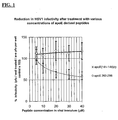
- Figure 1 and table 1 show typical results for the test for anti-HSV1 activity.
- the assay involved treating confluent Vero cells in 24-well plates with medium containing virus and varying amounts of peptide for one hour, followed by removal of this inoculum, and addition of viscous 'overlay' medium, containing 0.2% high viscosity carboxymethylcellulose.
- the overlay medium only allows infection of those cells immediately adjacent to an infected cell. After 2 days incubation and then fixation and staining, small patches of infected cells (or 'plaques') are visible, which are counted. Each of these corresponds to the infection of a single cell during the one hour inoculation.
- ApoE 141-149dp produced a 40% reduction in plaque number at a concentration of around 20 ⁇ M. Note the peptide was only present in the experimental system for 1 hour.
- Table 1 HSV1 plaque formation in Vero cells after inoculation with virus containing either apoE 141-149dp or apoE 263-286 . Values for untreated wells are underlined.
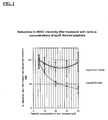
- Figure 2 and table 2 show typical results for the test for anti-HSV2 activity.
- the assay was carried out as for the anti-HSV1 assay, except Hep-2 cells were used rather than Vero cells.
- ApoE 141-149dp produced a 50% reduction in plaque number at a concentration of around 20 ⁇ M. Again note that the peptide was only present in the experimental system for 1 hour.
- Table 2 HSV2 plaque formation in HEp-2 cells after inoculation with virus containing either apoE 141-149dp or apoE 263-296 . Values for untreated wells are underlined.
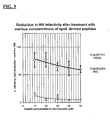
- Figure 3 and table 3 show typical results for the test for anti-HIV activity.
- the assay was carried out by incubating HIV infected U937 cells in the presence of various levels of peptide for 7 days, followed by assay for levels of the HIV protein p24 in the cells using an Enzyme Linked Immunoabsorbant Assay (ELISA) technique.
- ELISA Enzyme Linked Immunoabsorbant Assay
- ApoE 141-149dp produced a 95% reduction in infectivity at 20 ⁇ M.
- ApoE 263-286 produced a 20% reduction in infectivity at 20 ⁇ M.
- African Green Monkey Kidney (Vero) cells were maintained in Eagle's minimum essential medium with Earle's salt (EMEM) and supplemented with 10% foetal calf serum (heat-inactivated), 4 mM L-glutamine, and 1% (v/v) nonessential amino acids, plus penicillin and streptomycin (100 IU/ml and 100 ⁇ g/ml, respectively) (maintenance medium referred to as 10% EMEM). The cells were incubated at 37°C in a humidified atmosphere of air with 5% CO 2 .
- EMEM Eagle's minimum essential medium with Earle's salt
- HSV1 virus Three separate passages of HSV1 virus were prepared by infecting Vero cells, and preparing semi-pure suspensions of virus from tissue culture supernatant and cell lysates, before freezing aliquots of virus at -85°C. Viral infectivity was assessed by carrying out plaque assays on serial dilutions of thawed aliquots (expressed in pfu/ml).
- Peptides were obtained in lyophilised form from a commercial supplier (AltaBioscience, University of Birmingham or Advanced Biomedical), and were produced at 5 micromole scale. N-terminals were protected by addition of an acetyl group, and the C-terminals were protected by addition of an amide group.
- Vero cells were seeded at 125,000 cells per well in 10% EMEM, and were incubated overnight resulting in confluent monolayers. Peptides were diluted in 0.5% EMEM to give 2x final desired concentration, and 100 ⁇ l aliquots were arranged on 96-well plates in arrangement to be used for 24-well plate; control wells containing normal 0.5% EMEM were also prepared. Virus stocks (p3) were thawed, and diluted in 0.5% EMEM such that there were around 100 pfu in 100 ⁇ l. Each 24-well plate was inoculated separately. Firstly 100 ⁇ l of virus stock was added to the peptide or control medium arranged on a 96-well plate. This was incubated at 37°C for ten minutes before inoculation. Medium was removed from four wells of a 24-well plate containing confluent Vero, and the 200 ⁇ l inoculum added to the appropriate well.
- the 24-well plate was incubated for a further 60-80 minutes. Finally the peptide-containing inoculum was removed, and 1ml of 1%EMEM containing 1% carboxymethylcellulose was added to each well. Plates were incubated for a further 22 hours, before removal of overlay, and addition of 10% formaldehyde in PBS. After a further one hour incubation, fixative was removed, monolayers washed several times with tap water, and stained with carbol fuchsin solubilised in water. After 30 minutes stain was removed, and plates washed several times with tap water, before being air dried. Plaques were counted using an Olympus IX70 Inverting Microscope, and antiviral effect expressed as a percentage of the control value for each peptide concentration. The IC50 was calculated from plots of inhibitory effect against peptide concentration.
- Vero cells were seeded in 96-well plates at 30,000 cells per well in 10% EMEM, and were incubated overnight resulting in confluent monolayers.
- GIN peptides were diluted in 0.5% EMEM to give final desired concentration, and 100 ⁇ l aliquots were arranged on separate non-cell containing 96-well plates, prior to taking Vero 96-well plates, removing 10%EMEM, and adding 0.5% EMEM containing peptides. After incubating for 48 hours, 25 ⁇ l of 1.5mg/ml MTT solution (in 0.5% EMEM) was added per well, and plates returned to incubator for one hour.
- Figure 4 illustrates data obtained for five peptides identified as GIN 16 (SEQ ID No.2), GIN 17 (SEQ ID No.15), GIN 27 (SEQ ID No.16), GIN 28 (SEQ ID No.17), and GIN 30 (SEQ ID No.18).
- Figure 4 clearly shows that surprisingly only GIN 16 according to the first aspect showed antiviral activity, whereas GIN 17, GIN 27, GIN 28 and GIN 30 did not.
- Table 4 summarises data obtained for GIN peptides constructed from a range of human apolipoproteins.
- Table 4 Data obtained for GIN peptides constructed from a range of human apolipoproteins against HSV1.
- Peptide Sequence Source of peptide IC50 ( ⁇ M) GIN 16 LRTRKRGRKLRTRKRGRK (SEQ ID No.2) Human apolipoprotein B (3359-3367)repeat in which residues 3359 and 3360 reversed, and leucine residue at position 3366 replaced with an arginine.
- GIN 22 DWLKAFYDKVAEKLKEAF (SEQ ID No.20) Amphipathic alpha helical peptide with antiviral properties (derived from apolipoprotein A1 by Ananatharamiash supra and tested against HIV by Srinivas supra (also known as peptide 18A) 36 GIN 29 HMLDVMQDHFSRASSIIDEL (SEQ ID No.21) Amphipathic alpha helical region of human apolipoprotein J (apoJ 171-190) 38.5 GIN 13 RDADDLQKR RDADDLQKR (SEQ ID No.22) Tandem repeat peptide derived from one section of primary human apoE heparin binding region (apoE (150-158)repeat ) >40 GIN 14 GERLRARMEGERLRARME (SEQ ID No.19) Tandem repeat derived from second human apoE heparin binding region (211-219)repeat >40 GIN 15 RLRARM
- NA GIN 17 RALVDTLKFVTQAEGAK (SEQ ID No.15) Human apoB heparin binding region.
- NA GIN 18 PYLDDFQKKWQEEMELYRQKVE (SEQ ID No.25) Human apoA1 helical domain 4
- NA GIN 19 PLGEEMRDRARAHVDALRTHLA (SEQ ID No.26) Human apoA1 helical domain 6
- NA GIN 20 PYSDELRQRLAARLEALKENGG (SEQ ID No.27) Human apoA1 helical domain 7 NA GIN 21 ARLAEYHAKATEHLSTLSEKAK (SEQ ID No.28) Human apoA1 helical domain 8
- NA GIN 23 PVLDEFREKLNEELEALKQKMK (SEQ ID No.29) Consensus domain from human apoA1 (Ananatharamiah supra)
- NA GIN 24 VTDYGKDLMEKVKSPELQ (SEQ ID No
- NA GIN 26 NFHAMFQPFLEMIHEAQQ (SEQ ID No.32) Human apolipoprotein J amphipathic helix 3 (Bailey et al. supra) NA GIN 27 CKNKEKKCCKNKEKKC (SEQ ID No.16) Human apolipoprotein H heparin binding region (tandem repeat) ApoH (281-288)repeat NA GIN 28 LRKEKKRLLLRKEKKRLL (SEQ ID No.17) Modification of GIN 27 NA GIN 30 LQVAERLTRKYNELLKSYQ (SEQ ID No.18) Human apolipoprotein J amphipathic helix 4 (Bailey et al. 2001) NA GIN 31 KFMETVAEKALQEYRK (SEQ ID No.33) Human apolipoprotein J amphipathic helix 5 (Bailey et al. 2001) NA
- glioma cell line NP2 over-expressing both CD4 and the appropriate co-receptor (CCR5 or CXCR4) were maintained in DMEM supplemented with 10% FCS.
- 2 x 10 4 cells were plated per well of a 48-well plate 24h prior to infection and grown at 37C. The cells were then washed, and incubated in DMEM/FCS containing peptide concentrations ranging from 0.1 to 10 micromolar, at 37C for 30 minutes. 200 focus-forming units of HIV-1 stocks were then added to each well, and the cells incubated at 37C for a further 2 hours.
- the cells were then washed twice in PBS and fresh medium replaced. After 3 day's growth the cells were fixed in cold methanol:acetone, and stained in situ for expression of HIV-1 p24 using a monoclonal anti-p24 followed by a secondary anti-mouse beta-galactosidase conjugate. Expression was visualised by X-Gal staining and infectious foci enumerated by light-microscopy.
- Figure 6 illustrates the anti-HIV action of peptide GIN 33 (SEQ ID No.7) against HIV isolate SF162, grown in NP-2 glioma cells overexpressing CCR5 co-receptors.
- MU 35 was found to be active against HSV-1. However HSV activity was not reduced by 50% at concentrations up to 15 ⁇ M.
- Plaque assays were performed. The methodology was as described in previous Examples for HSV1 plaque assays (including usage of Vero cells) except HSV2 clinical isolates (provided by Prof. Anthony Hart of Liverpool University) were employed instead.
- Table 7 illustrates that peptides according to the present invention were effective against both HSV1 and HSV2. This illustrates that the peptides will have broad spectrum activity against viruses.
- Table 7 Peptide Code SEQ ID No. Sequence HSV2 IC50 ( ⁇ M) MU_27 (GIN 33) 7 WRWRKRWRKWRWRKRWRK 10 MU_32 38 RWRKRWRKWRWRKRWRK >20 MU_33 39 RRWRKRWRKRRWRKRWRK >20 MU_70 45 RTRKRWRKRTRKRGRK >20
- MU 32, 33 and 70 were found to be active against HSV-2. However HSV-2 activity was not reduced by 50% at concentrations up to 20 ⁇ M.
- Peptides prepared as described previously were diluted in 50 ⁇ l aliquots and mixed with T-cells (C8166) at 40,000 cells per well.
- HIV-1 111B was added at a multiplicity of infection (MOI) of 0.01, and the mixture incubated for 5 days at 37°C.
- MOI multiplicity of infection
- Syncytia formation was assessed visually using an inverting microscope, and viral gp120 levels in supernatants assessed by a gp120 ELISA using GNA for antigen capture.
- test sample supernatants were added to wells, along with dilutions of infected control samples.
- 50 ⁇ l of human anti-HIV sera was added, and plates incubated overnight.
- 50 ⁇ l of a 1000x dilution of anti-human Ig peroxidase conjugate was added, and plates incubated at 37°C for 90 min.
- 50ul peroxidase substrate was added to each well, and plates incubated for 10-30 min. Reaction was stopped with 25 ⁇ l 2M H 2 SO 4 , and A450 measured.
- Example 4 Further tests were conducted to support the data presented in Example 4 illustrating that peptides according to the present invention were effective against HIV as well as both HSV1 and HSV2.
- Table 8 Peptide Code SEQ ID No. Sequence HIV IC50 ( ⁇ M) MU_32 38 RWRKRWRKWRWRKRWRK 4.65 MU_33 39 RRWRKRWRKRRWRKRWRK 5.15
Landscapes
- Health & Medical Sciences (AREA)
- Chemical & Material Sciences (AREA)
- Life Sciences & Earth Sciences (AREA)
- Organic Chemistry (AREA)
- General Health & Medical Sciences (AREA)
- Medicinal Chemistry (AREA)
- Proteomics, Peptides & Aminoacids (AREA)
- Biophysics (AREA)
- Biochemistry (AREA)
- Genetics & Genomics (AREA)
- Gastroenterology & Hepatology (AREA)
- Molecular Biology (AREA)
- Zoology (AREA)
- Toxicology (AREA)
- Chemical Kinetics & Catalysis (AREA)
- Communicable Diseases (AREA)
- Oncology (AREA)
- Virology (AREA)
- General Chemical & Material Sciences (AREA)
- Nuclear Medicine, Radiotherapy & Molecular Imaging (AREA)
- Pharmacology & Pharmacy (AREA)
- Animal Behavior & Ethology (AREA)
- Public Health (AREA)
- Veterinary Medicine (AREA)
- Medicines That Contain Protein Lipid Enzymes And Other Medicines (AREA)
- Pharmaceuticals Containing Other Organic And Inorganic Compounds (AREA)
- Peptides Or Proteins (AREA)
Description
- The present invention relates to polypeptides and to nucleic acids encoding the same with anti-viral activity. The invention further provides the use of such polypeptides or nucleic acids as medicaments.
- Antiviral agents may target one of six stages of the viral replication cycle, these being:
- 1. Attachment of the virus to the cell;
- 2. Penetration (or fusion of the viral membrane with the cell membrane);
- 3. Uncoating of the virus;
- 4. Replication of the viral nucleic acids;
- 5. Maturation of progeny virus particles; and
- 6. Release of progeny virus into extracellular fluids.
- Of these six stages, replication (stage 4 above) is the target, which is most effectively influenced by conventional antiviral therapies. Attachment of the virus to the cell (
stage 1 above) is however arguably a more attractive target, as the agent does not need to pass into the host cell. However, this remains an area where few successful therapies have been developed. - It is therefore one object of the present invention to provide therapeutic agents that modulate viral activity including entry and attachment to cells.
- Lipoproteins (LPs) are globular macromolecular complexes present in serum and other extracellular fluids, consisting of lipid and protein, and are involved in the transport of lipid around the body. They have been categorised according to their density, with the main classes being high density lipoprotein (HDL), low density lipoprotein (LDL), and very low density lipoprotein (VLDL). Their proteins are referred to as apolipoproteins, and a number of these have been described, including apolipoproteins A, B, C, D, E, F, G, H, and J. In addition, several sub-types of apolipoproteins A, B and C have been documented.
- Various interactions have been described linking LPs with viruses. These mostly involving binding of viruses to lipoproteins, with this resulting in either diminished viral infectivity, or conversely providing a 'hitchhiker' method for the virus to enter cells. Additionally, several viruses make use of cellular receptors for LPs (e.g. the LDL receptor) as a means of entering cells, although these receptors can also be released by cells as endogenous antiviral agents (for example a soluble form of the VLDL receptor is released into culture medium by HeLa cells and inhibits human rhinovirus infection). Furthermore, direct binding between certain apolipoproteins and viral proteins has also been reported. For example:
- a. Hepatitis C virus core protein binds to apolipoprotein AII;
- b. Hepatitis B virus surface antigen binds apolipoprotein H; and
- c. Simian immunodeficiency virus (SIV) gp32 protein, and human immunodeficiency virus (HIV) gp41 protein binds to apolipoprotein A1.
- Work conducted in the laboratory of the inventor has shown that the presence of latent herpes simplex virus type 1 (HSV1) in brain and the possession of a particular allele of a specific gene, the APOE-e4 allele of the APOE gene, increases the risk of development of Alzheimer's disease (AD). Taken with the additional finding that APOE-e4 carriers are more likely to suffer from cold sores (which are lesions found after reactivation of HSV1 in the peripheral nervous system), these results suggested that APOE-e4 carriers are more likely to suffer damage from HSV1 infections, and suggests that there may be interactions between apolipoprotein E and certain viruses (although such interactions need not necessarily involve antiviral effects).
- Apolipoprotein E has been shown to have effects on the immune system (seemingly unrelated to its role in lipid metabolism) including suppression of T lymphocyte proliferation. Interactions between a number of peptides derived from residues 130-169 of apoE with lymphocytes have been examined (Clay et al., Biochemistry, 34: 11142-11151 (1995)). The region consisting of apoE residues 141-149 are predicted to be particularly important. Similar interactions of such peptides have been described in neuronal cell lines.
-
WO 94/04177 - An amphipathic helical peptide derived from apoA (described by Ananatharamiah in Meth. Enz., 128: 627-647(1986)) has been shown to prevent fusion of viral membranes with cell membranes, and furthermore prevent the fusion of membranes of infected cells (Srinivas et al. J. Cellular Biochem., 45: 224-237 (1991)). The peptide was also effective at preventing fusion for both HSV1 and HIV (Owens et al., J Clin. Invest., 86: 1142-1150 (1990)). However, the peptide had no effect at all on attachment of HSV1 at least to cells (Srinivas et al, supra).
- Azuma et al. have reported that peptide derivatives of apoE have a strong antibacterial action, comparable with that of gentamicin (Peptides, 21: 327-330 (2000)). ApoE 133-162 was the most effective, with apoE 134-155 having little effect.
-
WO99/24054 WO 91/09614 - In the light of the research described above, the inventor decided to conduct experiments to investigate the antiviral activity of polypeptides from a range of different apolipoproteins and derivatives thereof.
According to a first aspect of the invention there is provided a polypeptide with the amino acid sequence of formula (I):
abcRKRxyza'b'c'RKRx'y'z' (I)
wherein
a & a' = is independently selected from a positively charged residue, which may be selected from either Arginine (R) or Lysine (K) or Histidine (H); Leucine (L); Tryptophan (W); or is deleted
b & b' = is independently selected from Leucine (L); Arginine (R); Lysine (K); or is deleted;
c & c' = is independently selected from Threonine (T); Tryptophan (W); or a positively charged residue, which may be selected from Arginine (R) or Lysine (K) or Histidine (H);
x & x' = is independently selected from Glycine (G): Tryptophan (W); Leucine (L); or a positively charged residue, which may be selected from Arginine (R) or Lysine (K) or Histidine (H);
y & y' = is independently selected from Leucine (L); a positively charged residue, which may be selected from Arginine (R) or Lysine (K) or Histidine (H); or is deleted; and
z & z' = is independently selected from a positively charged residue, which may be
selected from Arginine (R) or Lysine (K) or Histidine (H); or Leucine; or is deleted; and
wherein the polypeptide is 14-18 amino acids in length;
wherein the polypeptide as a polypeptide other than (RK)7; and
wherein the polypeptide has antiviral activity. - It is preferred that the peptide according to the first aspect of the invention comprises a tandem repeat which is derived from an apolipoprotein B LDL receptor binding domain cluster B, as defined by Law and Scott (J Lipid Res. 1990; 31:1109-20) which may be located within the HSPG receptor binding region of apolipoprotein B.
- By "derivative or analogue thereof" we mean a polypeptide within which amino acids residues are replaced by residues (whether natural amino acids, non-natural amino acids or amino acid mimics) with similar side chains or peptide backbone properties. Additionally, the terminals of such peptides may be protected by N and C-terminal protecting groups with similar properties to acetyl or amide groups.
- By "a truncation thereof" we mean that the tandem repeat is reduced in size by removal of amino acids. The reduction of amino acids may be by removal of residues from the C or N terminal of the peptide or may be by deletion of one or more amino acids from within the core of the peptide.
- The term "derived from" as used herein is intended to describe or include a tandem repeat, which is a derivative or a modification of an amino sequence forming the HSPG receptor binding region of apolipoprotein B, or the apolipoprotein B LDL receptor binding domain cluster B therein. Surprisingly, polypeptides, derivatives or analogues thereof according to the first aspect of the invention have been shown to exhibit antiviral activity.
- The inventor decided to investigate the antiviral activity of tandem repeats from apolipoproteins when he realised that some peptides derived from a heparan sulphate proteoglycan (HSPG) / LDL receptor binding region of apolipoprotein E show some antiviral activity (e.g. a tandom repeat of apoE141-149). The inventor therefore examined whether heparin binding regions from a number of other apolipoproteins showed any antiviral activity. He examined, amongst others, the following:-
- (i) A heparin binding region within apolipoprotein B (ApoB 1000-1016 having amino acid sequence RALVDTLKFVTQAEGAK), referred to herein as GIN 17 (SEQ ID No.15).
GIN 17 is not linked to LDLR interactions (Shih et al. 1990 PNAS). As this was a 17-mer, a tandem repeat of GIN17 was not constructed; - (ii) A peptide referred to herein as GIN 16 (SEQ ID No. 2), which is a slightly modified form of a tandem repeat peptide of the LDLR receptor binding region B of apolipoprotein B, and constructed by the inventor.
GIN 16 consists of a human apolipoprotein B (3359-3367) repeat having amino acid sequence LRTRKRGRKLRTRKRGRK, in which residues 3359 and 3360 are reversed, and the leucine residue at position 3366 is replaced with an arginine; - (iii) A heparin binding region within apolipoprotein H, referred to herein as GIN 27 (SEQ ID No.16).
GIN 27 is a tandem repeat peptide, ApoH(281-288)repeat having amino acid sequence CKNKEKKCCKNKEKKC, constructed by the inventor based on the heparin binding region of apolipoprotein H (aka beta2 glycoprotein) Guerin et al. J Biol Chem. 2002 Jan 25;277(4):2644-9. - In addition, the inventor examined a range of cationic amphipathic alpha helices derived from a number of human apolipoproteins for antiviral activity. For example, they investigated :-
- (i) GIN 28 (SEQ ID No. 17) (LRKEKKRLLLRKEKKRLL), which is a form of
GIN 27 referred to above, which has been modified by the inventor, in which the positively charged lysine residues have been left in place, but some of the features of ApoE141-149 (the apoE derived peptide - see Example 1) have been added (notably an initiating LR sequence, and end RLL sequence); and - (ii) GIN 30 (SEQ ID No. 18), which is a peptide constructed from a region of apolipoprotein J, which has been reported to consist of an amphipathic alpha helix (Bailey et al., Biochemistry 2001; 40:11828-40), i.e. human apolipoprotein J 331-349 having amino acid sequence LQVAERLTRKYNELLKSYQ.
- As shown in
Figure 4 of the Example, none of thepeptides GIN 17,GIN 27,GIN 28 andGIN 30 showed any antiviral activity. However, to the inventor's surprise, he found that only the tandem repeat peptide modified from ApoB in accordance with the first aspect of the invention, i.e. GIN16, had any appreciable antiviral effect against herpes simplex virus type HSV1. This data was particularly surprising because blockage of LDL receptors would not be expected to inhibit HSV1 infection, as this virus is not considered to use LDL receptors to enter and thereby infect cells. - Therefore, following this surprising discovery of the antiviral properties of
GIN 16, the inventor produced and investigated the antiviral activity of a number of derivatives or modifications ofGIN 16. He was surprised to find that several of these also possessed antiviral properties, whereas some did not. Surprisingly, peptides according to the first aspect of the invention, i.e. peptides comprising a tandem repeat region derived from an HSPG receptor binding region of apolipoprotein B, exhibited antiviral properties. - There is further evidence to suggest that, surprisingly, simple usage of tandem repeats of any HSPG binding regions from any apolipoproteins do not necessarily result in a peptide, which exhibits antiviral activity. For example:-
- 1. GIN 14 is a tandem repeat derived from the second HSPG receptor binding region of apoE (SEQ ID No.19), but has no antiviral activity; and
- 2. Azuma et al. discussed supra, discloses anti-bacterial activity for apoE133-162, also describes how peptides from a range of heparin-binding regions (including apoB, VEGF, PACAP and Vn) did not have antibacterial activity. Thus, the broader antimicrobial properties ascribed to certain peptides derived from heparin binding regions by Azuma, does not apply to most examples of peptide derived from such regions.
- In conclusion, unexpectedly, tandem repeat peptides in accordance with the first aspect of the invention (i.e. those which are derived from an HSPG receptor binding region of apolipoprotein B) have antiviral activity.
- While the inventor does not wish to be bound by any hypothesis, he has realised that one possible mode of interaction between HSV1 virus and the apolipoprotein apoB is due to the fact that both of these use cellular heparan sulphate proteoglycan (HSPG) molecules as their initial site of binding to cells, before subsequent attachment to secondary receptors. Hence, the inventor has suggested that competition between HSV1 virus and apoB, which contains lipoproteins, could occur at these HSPG sites, and that this may affect viral entry. The inventor suggests that this antiviral activity of
GIN 16 may be due to either blockage of HSPG sites on cell surfaces, since some viruses use these as initial attachment sites (whereas only a limited number have been reported to use LDL receptors). Accordingly, the inventor suggested that this is one possible reason why peptides derived from an HSPG receptor binding region of apolipoprotein B in accordance with the first aspect of the present invention, exhibit anti-viral activity. - Hence, it is preferred that the peptide according to the first aspect of the invention comprises a tandem repeat of apOB3359-3367 of SEQ ID No.2, or a truncation thereof.
- By the expression "a tandem repeat of apoB3359-3367 of SEQ ID No.2", we mean the peptide substantially comprises an amino acid sequence: RLTRKRGLKRLTRKRGLK, i.e. an 18-mer (SEQ ID No.2). Hence, the tandem repeat of apoB3359-3367 of SEQ ID No.2 preferably, comprises a repeat of the amino acid sequence: RLTRKRGLK, i.e. a 9-mer (SEQ ID No.1). For the sake of clarity, the tandem repeat of apoB3359-3367 of SEQ ID No.2 (18-mer) is a dimer repeat (2x) of the amino acid sequence RLTRKRGLK of SEQ ID No.1 (9-mer).
- By "a truncation of SEQ ID No.2" we mean that the tandem repeat (e.g. the 18mer of SEQ ID No. 2) is reduced in size by removal of amino acids. The reduction of amino acids may be by removal of residues from the C or N terminal of the peptide or may be by deletion of one or more amino acids from within the core of the peptide (i.e. amino acids 2-17 of SEQ ID No. 2).
- Table 1 below illustrates the amino acid sequence of apoB3359-3367 (i.e the 9-mer of SEQ ID No.1), aligned with corresponding amino acids of other preferred peptides according to the first aspect of the invention (see the Examples). It will be appreciated that this 9-mer is repeated in peptides according to the present invention.

- In the light of this alignment data the inventor realised that there was a recurring amino acid motif in active peptides derived from SEQ ID No. 2. This motif corresponds to a tripeptide: Arginine-Lysine-Arginine (RKR), which is found at
amino acids 4,5,6 and 13,14,15 of SEQ ID.No 2. It is therefore preferred that peptides according to the present invention comprise two RKR motifs. - Preferably, the peptide according to the first aspect comprises a tandem repeat of apoB3359-3367 of SEQ ID No.2 or a truncation thereof, characterised in that at least one amino acid residue, other than the RKR motifs, has been replaced by a Glycine (G), Threonine (T), Histidine (H), Tryptophan (W), Arginine (R) or Leucine (L) residue or derivatives thereof.
- Suitably, one or more, more suitably, two or more, and even more suitably, three or more amino acid residues may be replaced by a Glycine (G), Threonine (T), Histidine (H), Tryptophan (W), Arginine (R) or Leucine (L) residue or derivative thereof. Preferably, four or more, more preferably, five or more, and even more preferably, six or more amino acid residues may be replaced by these amino acids or derivative thereof. Preferably, the replaced or substituted residue is the first, second, third, seventh, eighth, ninth, tenth, eleventh, twelfth, sixteenth, seventeenth or eighteenth residue of SEQ ID No. 2.
- The polypeptide according to the invention may comprise 18 amino acids and thereby correspond to the full length of SEQ ID No. 2 with or without the substitutions discussed above. However, the inventors have surprisingly found that truncated peptides based on SEQ ID No.2 also have efficacy as antiviral agents. Accordingly, preferred peptides or derivatives thereof may have less than 18 amino acids. For instance, some peptides according to the first aspect of the invention may be 17, 16, 15 or 14, 13 amino acids in length.
- Preferred peptides according to the first aspect of the invention comprise the amino acid sequence:-
- (a) LRTRKRGRKLRTRKRGRK (SEQ ID No.2). This peptide is designated
GIN 16 when referred to herein; - (b) RTRKRGRKRTRKRGRK (SEQ ID No.3). This peptide is designated
GIN 35 when referred to herein; - (c) RTRKRGRRTRKRGR (SEQ ID No.4). This peptide is designated GIN 36 when referred to herein;
- (d) LRKRKRLLRKRKRL (SEQ ID No.5). This peptide is designated
GIN 37 when referred to herein; and - (e) LRKRKRLRKLRKRKRLRK (SEQ ID No.6). This peptide is designated
GIN 38 when referred to herein; - (f) WRWRKRWRKWRWRKRWRK (SEQ ID No.7). This peptide is designated
GIN 33 when referred to herein. - (g) RRWRKRWRKWRWRKRWRK (SEQ ID No.34). This peptide is designated
MU 28 when referred to herein. - (h) KRWRKRWRKWRWRKRWRK (SEQ ID No.35). This peptide is designated MU 29 when referred to herein.
- (i) LRWRKRWRKWRWRKRWRK (SEQ ID No.36). This peptide is designated
MU 30 when referred to herein. - (j) HRWRKRWRKWRWRKRWRK (SEQ ID No.37). This peptide is designated MU 31 when referred to herein.
- (k) RWRKRWRKWRWRKRWRK (SEQ ID No.38). This peptide is designated MU 32 when referred to herein.
- (l) RRWRKRWRKRRWRKRWRK (SEQ ID No.39). This peptide is designated
MU 33 when referred to herein. - (m)KRWRKRWRKKRWRKRWRK (SEQ ID No.40). This peptide is designated
MU 34 when referred to herein. - (n) LRWRKRWRKLRWRKRWRK (SEQ ID No.41). This peptide is designated
MU 35 when referred to herein. - (o) HRWRKRWRKHRWRKRWRK (SEQ ID No.42). This peptide is designated MU 36 when referred to herein.
- (p) RWRKRWRKRWRKRWRK (SEQ END No.43). This peptide is designated
MU 37 when referred to herein. - (q) RWRKRGRKRWRKRGRK (SEQ ID No.44). This peptide is designated MU 69 when referred to herein.
- (r) RTRKRWRKRTRKRGRK (SEQ ID No.45). This peptide is designated MU 70 when referred to herein.
- (s) RWRKRWRKRWRKRWRK (SEQ ID No.46). This peptide is designated MU 71 when referred to herein.
- (t) RWRKRWRWRKRWRWRKRW (SEQ ID No.47). This peptide is designated MU 84 when referred to herein.
- According to a second aspect of the present invention, there is provided a polypeptide according to the first aspect of the invention, for use as a medicament.
- According to a third aspect of the invention, there is provided use of a polypeptide according to the first aspect of the invention, for the manufacture of a medicament for treating a viral infection.
- Polypeptides according to the invention may be used in the treatment of a number of viral infections. The virus may be any virus, and particularly an enveloped virus. Preferred viruses are poxviruses, ividoviruses togaviruses, or toroviruses. A more preferred virus is a filovirus, arenavirus, bunyavirus, or a rhabdovirus. An even more preferred virus is a paramyxovirus or an orthomyxovirus. It is envisaged that the virus may preferably include a hepadnavirus, coronavirus, flavivirus, or a retrovirus. Preferably, the virus includes a herpesvirus or a lentivirus. In preferred embodiments, the virus may be Human Immunodeficiency Virus (HIV), Human herpes simplex virus type 2 (HSV2), or Human herpes simplex virus type 1 (HSV1).
- Polypeptides according to the invention may be used to treat viral infections as a monotherapy or in combination with other compounds or treatments used in antiviral therapy (e.g. acyclovir, gangcylovir, ribavirin, interferon, anti-HIV medicaments including nucleoside, nucleotide or non-nucleoside inhibitors of reverse transcriptase, protease inhibitors and fusion inhibitors.)
- Peptides according to the present invention preferably have an efficacy for inhibiting viral growth such that their IC50 value is 30µM or less. It is preferred that the IC50 value is 20µM or less and more preferred that the IC50 value is 10µM or less.
- Preferred peptides have similar IC50 values between viral species. For instance preferred peptides have similar IC50 values for inhibiting HSV1, HSV2 and HIV growth.
- It will be appreciated that modified amino acids may be substituted, into the tandem repeat of apoB according to the invention, with a number of amino acid variants that may be known to those skilled in the art. Such peptides will still have antiviral activity provided that the modification does not significantly alter its chemical characteristics. For instance, hydrogens on the side chain amines of R or K may be replaced with methylene groups (-NH2 → -NH(Me) or -N(Me)2). Furthermore, the N-terminal amino group of the peptides may be protected by reacting with a carboxylic acid and the C-terminal carboxyl group of the peptide may be protected by reacting with an amine:
- The polypeptides of the invention represent products that may advantageously be expressed by biological cells.
- Thus, the present invention also provides, in a further aspect, a nucleic acid sequence encoding a polypeptide according to the first aspect of the invention.
- Preferred nucleic acids according to the fifth aspect of the invention encode apoB3359-3367,
GIN 16,GIN 35, GIN 36,GIN 37,GIN 38 andGIN 33 with the respective nucleic acid sequences: - cgtcttactc gtaaacgtgg tcttaaacgt cttactcgta aacgtggtct taaa (SEQ ID No.8);
- cttcgtactc gtaaacgtgg tcgtaaactt cgtactcgta aacgtggtcg taaa (SEQ ID No.9);
- cgtactcgta aacgtggtcg taaacgtact cgtaaacgtg gtcgtaaa (SEQ ID NO.10);
- cgtactcgta aacgtggtcg tcgtactcgt aaacgtggtc gt (SEQ ID No.11);
- cttcgtaaac gtaaacgtct tcttcgtaaa cgtaaacgtc tt (SEQ ID NO.12);
- cttcgtaaac gtaaacgtct tcgtaaactt cgtaaacgta aacgtcttcg taaa (SEQ ID No.13); and
- tggcgttggc gtaaacgttg gcgtaaatgg cgttggcgta aacgttggcg taaa (SEQ ID No.14).
- A skilled person will appreciate that the nucleic acid sequences of other preferred peptides according to the present invention may be readily generated.
- Due to the degeneracy of the genetic code, it is clear that any nucleic acid sequence could be varied or changed without substantially affecting the sequence of the peptide encoded thereby, to provide a functional variant thereof. Suitable nucleotide variants are those having a sequence altered by the substitution of different codons that encode the same amino acid within the sequence, thus producing a silent change. Other suitable variants are those having homologous nucleotide sequences but comprising all, or portions of, sequence which are altered by the substitution of different codons that encode an amino acid with a side chain of similar biophysical properties to the amino acid it substitutes, to produce a conservative change. For example small non-polar, hydrophobic amino acids include glycine, alanine, leucine, isoleucine, valine, proline, and methionine. Large non-polar, hydrophobic amino acids include phenylalanine, tryptophan and tyrosine. The polar neutral amino acids include serine, threonine, cysteine, asparagine and glutamine. The positively charged (basic) amino acids include lysine, arginine and histidine. The negatively charged (acidic) amino acids include aspartic acid and glutamic acid.
- It will be appreciated that polypeptides according to the invention represent favourable agents to be administered by techniques involving cellular expression of nucleic acid sequences encoding such molecules. Such methods of cellular expression are particularly suitable for medical use in which the therapeutic effects of the polypeptides, derivatives and analogues are required over a prolonged period.
- Thus according to a still further aspect of the present invention there is provided a nucleic acid sequence according to the invention for use as a medicament.
- The nucleic acid may preferably be an isolated or purified nucleic acid sequence. The nucleic acid sequence may preferably be a DNA sequence.
- The nucleic acid sequence may further comprise elements capable of controlling and/or enhancing its expression. The nucleic acid molecule may be contained within a suitable vector to form a recombinant vector. The vector may for example be a plasmid, cosmid or phage. Such recombinant vectors are highly useful in the delivery systems of the invention for transforming cells with the nucleic acid molecule.
- Recombinant vectors may also include other functional elements. For instance, recombinant vectors can be designed such that the vector will autonomously replicate in the cell. In this case elements that induce nucleic acid replication may be required in the recombinant vector. Alternatively, the recombinant vector may be designed such that the vector and recombinant nucleic acid molecule integrates into the genome of a cell. In this case nucleic acid sequences, which favour targeted integration (e.g. by homologous recombination) are desirable. Recombinant vectors may also comprise DNA coding for genes that may be used as selectable markers in the cloning process.
- The recombinant vector may also further comprise a promoter or regulator to control expression of the gene as required.
- The nucleic acid molecule may (but not necessarily) be one, which becomes incorporated in the DNA of cells of the subject being treated. Undifferentiated cells may be stably transformed leading to the production of genetically modified daughter cells (in which case regulation of expression in the subject may be required e.g. with specific transcription factors or gene activators). Alternatively, the delivery system may be designed to favour unstable or transient transformation of differentiated cells in the subject being treated. When this is the case, regulation of expression may be less important because expression of the DNA molecule will stop when the transformed cells die or stop expressing the protein (ideally when the required therapeutic effect has been achieved).
- The delivery system may provide the nucleic acid molecule to the subject without it being incorporated in a vector. For instance, the nucleic acid molecule may be incorporated within a liposome or virus particle. Alternatively a "naked" nucleic acid molecule may be inserted into a subject's cells by a suitable means, e.g. direct endocytotic uptake.
- The nucleic acid molecule may be transferred to the cells of a subject to be treated by transfection, infection, microinjection, cell fusion, protoplast fusion or ballistic bombardment. For example, transfer may be by ballistic transfection with coated gold particles, liposomes containing the nucleic acid molecule, viral vectors e.g. adenovirus) and means of providing direct nucleic acid uptake (e.g. endocytosis) by application of the nucleic acid molecule directly.
- It will be appreciated that the polypeptides and nucleic acids according to the present invention may be used in a monotherapy (i.e. use of polypeptide, agents, nucleic acids or derivatives according to the invention alone to prevent and/or treat a viral infection). Alternatively, polypeptides and nucleic acids according to the invention may be used as an adjunct, or in combination with known therapies.
- Polypeptides and nucleic acids according to the invention may be combined in compositions having a number of different forms depending, in particular, on the manner in which the composition is to be used. Thus, for example, the composition may be in the form of a powder, tablet, capsule, liquid, ointment, cream, gel, hydrogel, aerosol, spray, micelle, transdermal patch, liposome or any other suitable form that may be administered to a person or animal. It will be appreciated that the vehicle of the composition of the invention should be one which is well tolerated by the subject to whom it is given, and preferably enables delivery of the polypeptides and nucleic acids to the brain. It is preferred that the polypeptides and nucleic acids according to the invention be formulated in a manner that permits their passage across the blood brain barrier.
- Compositions comprising polypeptides and nucleic acids according to the invention may be used in a number of ways. For instance, oral administration may be required in which case the compound may be contained within a composition that may, for example, be ingested orally in the form of a tablet, capsule or liquid. Alternatively the composition may be administered by injection into the blood stream. Injections may be intravenous (bolus or infusion) or subcutaneous (bolus or infusion). The compounds may be administered by inhalation (e.g. intranasally).
- Compositions may be formulated for topical use. For instance, ointments may be applied to the skin, areas in and around the mouth or genitals to treat specific viral infections. Topical application to the skin is particularly useful for treating viral infections of the skin or as a means of transdermal delivery to other tissues. Intravaginal administration is effective for treating sexually transmitted diseases (including AIDS).
- Polypeptides and nucleic acids may also be incorporated within a slow or delayed release device. Such devices may, for example, be inserted on or under the skin, and the compound may be released over weeks or even months. Such devices may be particularly advantageous when long term treatment with a polypeptide or nucleic acid according to the invention is required and which would normally require frequent administration (e.g. at least daily injection).
- It will be appreciated that the amount of a polypeptide or nucleic acid that is required is determined by its biological activity and bioavailability which in turn depends on the mode of administration, the physicochemical properties of the polypeptide or nucleic acid employed and whether the polypeptide or nucleic acid is being used as a monotherapy or in a combined therapy. The frequency of administration will also be influenced by the above-mentioned factors and particularly the half-life of the polypeptide or nucleic acid within the subj ect being treated.
- Optimal dosages to be administered may be determined by those skilled in the art, and will vary with the particular polypeptide or nucleic acid in use, the strength of the preparation, the mode of administration, and the advancement of the disease condition. Additional factors depending on the particular subject being treated will result in a need to adjust dosages, including subject age, weight, gender, diet, and time of administration.
- Known procedures, such as those conventionally employed by the pharmaceutical industry (e.g. in vivo experimentation, clinical trials, etc.), may be used to establish specific formulations of polypeptides and nucleic acids according to the invention and precise therapeutic regimes (such as daily doses of the polypeptides and nucleic acids and the frequency of administration).
- Generally, a daily dose of between 0.01 µg/kg of body weight and 0.5 g/kg of body weight of polypeptides and nucleic acids according to the invention may be used for the prevention and/or treatment of a viral infection, depending upon which specific polypeptide or nucleic acid is used. More preferably, the daily dose is between 0.01 mg/kg of body weight and 200 mg/kg of body weight, and most preferably, between approximately 1mg/kg and 100 mg/kg.
- Daily doses may be given as a single administration (e.g. a single daily injection). Alternatively, the polypeptide or nucleic acid used may require administration twice or more times during a day. As an example, polypeptides and nucleic acids according to the invention may be administered as two (or more depending upon the severity of the condition) daily doses of between 25 mg and 7000 mg (i.e. assuming a body weight of 70kg). A patient receiving treatment may take a first dose upon waking and then a second dose in the evening (if on a two dose regime) or at 3 or 4 hourly intervals thereafter. Alternatively, a slow release device may be used to provide optimal doses to a patient without the need to administer repeated doses.
- This invention provides a pharmaceutical composition comprising a therapeutically effective amount of a polypeptide or nucleic acid according to the invention and optionally a pharmaceutically acceptable vehicle. In one embodiment, the amount of the polypeptide or nucleic acid is an amount from about 0.01 mg to about 800 mg. In another embodiment, the amount of the polypeptide or nucleic acid is an amount from about 0.01 mg to about 500 mg. In another embodiment, the amount of the polypeptide or nucleic acid is an amount from about 0.01 mg to about 250 mg. In another embodiment, the amount of the polypeptide or nucleic acid is an amount from about 0.1 mg to about 60 mg. In another embodiment, the amount of the polypeptide or nucleic acid is an amount from about 0.1 mg to about 20 mg.
- This invention provides a process for making a pharmaceutical composition comprising combining a therapeutically effective amount of a polypeptide or nucleic acid according to the invention and a pharmaceutically acceptable vehicle. A "therapeutically effective amount" is any amount of a polypeptide or nucleic acid or according to the invention which, when administered to a subject provides prevention and/or treatment of a viral infection. A "subject" is a vertebrate, mammal, domestic animal or human being.
- A "pharmaceutically acceptable vehicle" as referred to herein is and physiological vehicle known to those of ordinary skill in the art useful in formulating pharmaceutical compositions.
- In a preferred embodiment, the pharmaceutical vehicle is a liquid and the pharmaceutical composition is in the form of a solution. In another embodiment, the pharmaceutically acceptable vehicle is a solid and the composition is in the form of a powder or tablet. In a further embodiment, the pharmaceutical vehicle is a gel and the composition is in the form of a cream or the like.
- A solid vehicle can include one or more substances which may also act as flavouring agents, lubricants, solubilisers, suspending agents, fillers, glidants, compression aids, binders or tablet-disintegrating agents; it can also be an encapsulating material. In powders, the vehicle is a finely divided solid that is in admixture with the finely divided active polypeptide or nucleic acid. In tablets, the active polypeptide or nucleic acid is mixed with a vehicle having the necessary compression properties in suitable proportions and compacted in the shape and size desired. The powders and tablets preferably contain up to 99% of the active polypeptide or nucleic acid. Suitable solid vehicles include, for example, calcium phosphate, magnesium stearate, talc, sugars, lactose, dextrin, starch, gelatin, cellulose, polyvinylpyrrolidine, low melting waxes and ion exchange resins.
- Liquid vehicles are used in preparing solutions, suspensions, emulsions, syrups, elixirs and pressurized compositions. The active polypeptide or nucleic acid can be dissolved or suspended in a pharmaceutically acceptable liquid vehicle such as water, an organic solvent, a mixture of both or pharmaceutically acceptable oils or fats. The liquid vehicle can contain other suitable pharmaceutical additives such as solubilisers, emulsifiers, buffers, preservatives, sweeteners, flavouring agents, suspending agents, thickening agents, colours, viscosity regulators, stabilizers or osmo-regulators. Suitable examples of liquid vehicles for oral and parenteral administration include water (partially containing additives as above, e.g. cellulose derivatives, preferably sodium carboxymethyl cellulose solution), alcohols (including monohydric alcohols and polyhydric alcohols, e.g. glycols) and their derivatives, and oils (e.g. fractionated coconut oil and arachis oil). For parenteral administration, the vehicle can also be an oily ester such as ethyl oleate and isopropyl myristate. Sterile liquid vehicles are useful in sterile liquid form compositions for parenteral administration. The liquid vehicle for pressurized compositions can be halogenated hydrocarbon or other pharmaceutically acceptable propellent.
- Liquid pharmaceutical compositions which are sterile solutions or suspensions can be utilized by for example, intramuscular, intrathecal, epidural, intraperitoneal, intravenous and particularly subcutaneous, intracerebral or intracerebroventricular injection. The polypeptide or nucleic acid may be prepared as a sterile solid composition that may be dissolved or suspended at the time of administration using sterile water, saline, or other appropriate sterile injectable medium. Vehicles are intended to include necessary and inert binders, suspending agents, lubricants, flavourants, sweeteners, preservatives, dyes, and coatings.
- Polypeptides and nucleic acids according to the invention can be administered orally in the form of a sterile solution or suspension containing other solutes or suspending agents (for example, enough saline or glucose to make the solution isotonic), bile salts, acacia, gelatin, sorbitan monoleate, polysorbate 80 (oleate esters of sorbitol and its anhydrides copolymerized with ethylene oxide) and the like.
- Polypeptides and nucleic acids according to the invention can also be administered orally either in liquid or solid composition form. Compositions suitable for oral administration include solid forms, such as pills, capsules, granules, tablets, and powders, and liquid forms, such as solutions, syrups, elixirs, and suspensions. Forms useful for parenteral administration include sterile solutions, emulsions, and suspensions.
- All of the features described herein (including any accompanying claims, abstract and drawings), and/or all of the steps of any method or process so disclosed, may be combined with any of the above aspects in any combination, except combinations where at least some of such features and/or steps are mutually exclusive.
- Embodiments of the invention will now be further described, by way of example only, with reference to the following Examples and figures in which:-
-
Figure 1 shows the effect of apoE141-149dp and apoE263-286 on HSV1 infectivity. (points are derived from the average of up to four values) as described in Example 1; -
Figure 2 shows the effect of apoE141-149dp or apoE263-286 on HSV2 infectivity (points are derived from the average of up to four values) as described in Example 1; -
Figure 3 illustrates inhibition of HIV-1 p24 production, as measured by ELISA, by apoE141-149dp, and apoE263-286 in acutely infected U937 cells (values are the average of three experiments) as described in Example 1; -
Figure 4 illustrates the effect of five peptides (GIN 16,GIN 17,GIN 27,GIN 28, and GIN 30) on HSV1 infectivity as described in Example 2; -
Figure 5 illustrates the effect of five peptides (GIN 33,GIN 35, GIN 36,GIN 37, and GIN 38) on HSV1 infectivity as described in Example 2; -
Figure 6 illustrates the anti-HIV action of peptide GIN33 against HIV isolate SF162, grown in NP-2 glioma cells overexpressing CCR5 co-receptors as described in Example 4; -
Figure 7 shows typical mass spectrometry data for MU 27 (the expected mass ion value was 2939.5, which exactly matches the value obtained); and -
Figure 8 shows typical HPLC purification data forMU 27 and illustrates that the peptide generally >80% purity. - Experiments were initially conducted with: (i) a tandem repeat of ApoE141-149 (ApoE141-149dp) from a HSPG receptor binding region of apolipoprotein E; and (ii) ApoE263-286 from a region of apolipoprotein E that is not involved in HSPG receptor binding. These experiments were conducted to establish whether or not peptide (i) had any efficacy as an antiviral agent. The results from this body of work motivated the inventor to investigate the efficacy of other peptides - including peptides according to the present invention (see later Examples).
-
Figure 1 and table 1 show typical results for the test for anti-HSV1 activity. The assay involved treating confluent Vero cells in 24-well plates with medium containing virus and varying amounts of peptide for one hour, followed by removal of this inoculum, and addition of viscous 'overlay' medium, containing 0.2% high viscosity carboxymethylcellulose. The overlay medium only allows infection of those cells immediately adjacent to an infected cell. After 2 days incubation and then fixation and staining, small patches of infected cells (or 'plaques') are visible, which are counted. Each of these corresponds to the infection of a single cell during the one hour inoculation. ApoE141-149dp produced a 40% reduction in plaque number at a concentration of around 20µM. Note the peptide was only present in the experimental system for 1 hour.Table 1: HSV1 plaque formation in Vero cells after inoculation with virus containing either apoE141-149dp or apoE263-286. Values for untreated wells are underlined. Plaque number ApoE 141-149dp ApoE 263-286 [µM] 1 2 3 4 Mean ± sd 1 2 3 4 Mean ± sd 0 96 102 123 107 ±14.2 5. 129 106 103 100 110 ±13.2 113 119 122 126 120 ± 5.5 10 73 87 76 89 81 ±7.9 116 124 102 114 ±11.1 20 68 67 63 63 65 ±2.6 148 112 133 114 127 ±17.0 30 72 71 56 66 ±9.0 134 109 114 125 121 ±11.2 40 64 65 53 68 63 ±6.6 120 113 125 144 126 ±11.2 -
Figure 2 and table 2 show typical results for the test for anti-HSV2 activity. The assay was carried out as for the anti-HSV1 assay, except Hep-2 cells were used rather than Vero cells. ApoE141-149dp produced a 50% reduction in plaque number at a concentration of around 20µM. Again note that the peptide was only present in the experimental system for 1 hour.Table 2. HSV2 plaque formation in HEp-2 cells after inoculation with virus containing either apoE141-149dp or apoE263-296. Values for untreated wells are underlined. Plaque number ApoE 141-149dp ApoE 263-286 [µM] 1 2 3 4 Mean ± sd 1 2 3 4 Mean ± sd 0 156 137 162 152 152 ±10.7 5 160 134 140 130 141 ±13.3 135 160 161 152 152 ± 12.0 10 125 113 131 132 125 ±8.7 157 121 151 134 141 ± 16.1 20 82 72 73 81 77 ±5.2 118 150 182 134 146 ± 27.3 30 76 77 71 72 74 ±2.9 118 117 103 159 124 ± 24.2 40 51 59 69 49 57 ±9.1 132 144 125 124 131 ± 24.2 -
Figure 3 and table 3 show typical results for the test for anti-HIV activity. The assay was carried out by incubating HIV infected U937 cells in the presence of various levels of peptide for 7 days, followed by assay for levels of the HIV protein p24 in the cells using an Enzyme Linked Immunoabsorbant Assay (ELISA) technique. ApoE141-149dp produced a 95% reduction in infectivity at 20µM. ApoE263-286 produced a 20% reduction in infectivity at 20 µM. - The effect on HIV appears at lower peptide concentrations, though this may be due to peptide being in contact with cells for 7 days, as opposed to just 1 hour in plaque reduction assays with herpes viruses. Alternatively the different activities may be due to differences between assay systems.
Table 3: Inhibition of HIV-1 p24 production, as measured by ELISA, by apoE141-149dp, and apoE263-286 in acutely infected U937 cells. % Decrease in HIV p24 Production ApoE 141-149dp ApoE 263-286 [µM] Exp.1 Exp.2 Exp.3 Mean ± sd Exp.1 Exp.2 Exp.3 Mean ± sd 0 0 0 0 0 0 0 0 0 10 91.66 70.31 89.85 83.94 ± 11.84 31.75 8.50 29.38 23.21 ± 12.79 20 96.87 95.08 93.10 95.02 ± 1.89 7.69 29.71 30.91 22.77 ±13.07 30 95.94 88.63 87.77 90.78 ± 4.49 37.94 27.83 41.78 35.85 ± 7.21 40 96.80 95.47 95.33 95.87 ± 0.81 23.50 30.08 48.04 38.87 ± 12.70 50 95.73 93.25 95.38 94.79 ± 1.34 33.36 41.45 45.66 40.16 ± 6.25 - The results presented in 1.1 - 1.3 illustrate that ApoE141-149dp was more efficacious than ApoE263-286. In the light of these results, the inventors proceeded to test other peptides generated from apolipoproteins to investigate whether or not such peptides had antiviral activity (see Example 2).
- Given the knowledge gained by the inventors following the work reported in Example 1, experiments were conducted to evaluate the antiviral effects of a large number of peptides derived from apoB and other apolipoproteins. Regions tested included heparin binding regions, the LDLR binding region or apolipoprotein B, and amphipathic alpha helical regions. Where peptides were short, tandem repeats were constructed to increase likelihood of alpha helix formation.
- Surprisingly, the inventors found that only a minority of the peptides derived from other apolipoproteins had antiviral effects (see 2.2). Such peptides represent peptides according to the invention.
- African Green Monkey Kidney (Vero) cells were maintained in Eagle's minimum essential medium with Earle's salt (EMEM) and supplemented with 10% foetal calf serum (heat-inactivated), 4 mM L-glutamine, and 1% (v/v) nonessential amino acids, plus penicillin and streptomycin (100 IU/ml and 100µg/ml, respectively) (maintenance medium referred to as 10% EMEM). The cells were incubated at 37°C in a humidified atmosphere of air with 5% CO2.
- On harvesting, monolayers were washed in phosphate-buffered saline (PBS), and dislodged by incubating with trypsin in PBS for 30min, before inactivating trypsin by addition of an equal volume of 10% EMEM and centrifuging at 500g (5 min, 4°C). Cell pellets were resuspended in 10% EMEM, prior to cell counting and seeding of 24-well plates. For antiviral assays, medium containing only 0.5% FCS was used (referred to as 0.5% EMEM).
- Three separate passages of HSV1 virus were prepared by infecting Vero cells, and preparing semi-pure suspensions of virus from tissue culture supernatant and cell lysates, before freezing aliquots of virus at -85°C. Viral infectivity was assessed by carrying out plaque assays on serial dilutions of thawed aliquots (expressed in pfu/ml).
- Peptides were obtained in lyophilised form from a commercial supplier (AltaBioscience, University of Birmingham or Advanced Biomedical), and were produced at 5 micromole scale. N-terminals were protected by addition of an acetyl group, and the C-terminals were protected by addition of an amide group.
- Molecular weight of peptides was confirmed by laser desorption mass spectrometry using a Finnigan LASERMAT 2000 MALDI-time of flight mass analyzer or a Scientific Analysis Group MALDI-TOF mass spectrometer. HPLC purification of peptides was performed using a Vydac analytical C-4 reverse phase column, using 0.1 % TFA and 0.1% TFA / 80% acetonitrile as solvents, or for some peptides an ACE C18 Reverse Phase column, using 0.05% TFA and 60% acetonitrile as solvents. Typical mass spectrometry data and high performance liquid chromatography (HPLC) traces (purity >80%) for peptide MU 27 (SEQ ID No. 3) are shown in
Figures 7 and8 . - Small quantities of peptide were weighed in sterile Eppendorf tubes, before addition of sufficient 0.5% EMEM to produce a 1.5 mM stock solution, which was frozen at - 20°C in aliquots.
- Vero cells were seeded at 125,000 cells per well in 10% EMEM, and were incubated overnight resulting in confluent monolayers. Peptides were diluted in 0.5% EMEM to give 2x final desired concentration, and 100µl aliquots were arranged on 96-well plates in arrangement to be used for 24-well plate; control wells containing normal 0.5% EMEM were also prepared. Virus stocks (p3) were thawed, and diluted in 0.5% EMEM such that there were around 100 pfu in 100 µl. Each 24-well plate was inoculated separately. Firstly 100 µl of virus stock was added to the peptide or control medium arranged on a 96-well plate. This was incubated at 37°C for ten minutes before inoculation. Medium was removed from four wells of a 24-well plate containing confluent Vero, and the 200µl inoculum added to the appropriate well.
- Once all wells were treated, the 24-well plate was incubated for a further 60-80 minutes. Finally the peptide-containing inoculum was removed, and 1ml of 1%EMEM containing 1% carboxymethylcellulose was added to each well. Plates were incubated for a further 22 hours, before removal of overlay, and addition of 10% formaldehyde in PBS. After a further one hour incubation, fixative was removed, monolayers washed several times with tap water, and stained with carbol fuchsin solubilised in water. After 30 minutes stain was removed, and plates washed several times with tap water, before being air dried. Plaques were counted using an Olympus IX70 Inverting Microscope, and antiviral effect expressed as a percentage of the control value for each peptide concentration. The IC50 was calculated from plots of inhibitory effect against peptide concentration.
- Vero cells were seeded in 96-well plates at 30,000 cells per well in 10% EMEM, and were incubated overnight resulting in confluent monolayers. GIN peptides were diluted in 0.5% EMEM to give final desired concentration, and 100µl aliquots were arranged on separate non-cell containing 96-well plates, prior to taking Vero 96-well plates, removing 10%EMEM, and adding 0.5% EMEM containing peptides. After incubating for 48 hours, 25µl of 1.5mg/ml MTT solution (in 0.5% EMEM) was added per well, and plates returned to incubator for one hour. Finally, medium was removed from wells, and blue formazan crystals solubilised by addition of 100 µl of dimethylsulphoxide (DMSO). Absorbance of resulting solutions was then measured at 570 nm, and toxic effect expressed as a percentage of the control value for each peptide concentration. Where possible, the EC50 was calculated from plots of toxic effect against peptide concentration. Fortunately, no evidence of toxicity was found for the cell line tested, using peptide at 40µM exposed to cells for 2 days.
-
Figure 4 illustrates data obtained for five peptides identified as GIN 16 (SEQ ID No.2), GIN 17 (SEQ ID No.15), GIN 27 (SEQ ID No.16), GIN 28 (SEQ ID No.17), and GIN 30 (SEQ ID No.18).Figure 4 clearly shows that surprisingly onlyGIN 16 according to the first aspect showed antiviral activity, whereasGIN 17,GIN 27,GIN 28 andGIN 30 did not. - Table 4 below summarises data obtained for GIN peptides constructed from a range of human apolipoproteins.
Table 4 : Data obtained for GIN peptides constructed from a range of human apolipoproteins against HSV1. Peptide Sequence Source of peptide IC50 (µM) GIN 16LRTRKRGRKLRTRKRGRK (SEQ ID No.2) Human apolipoprotein B (3359-3367)repeat in which residues 3359 and 3360 reversed, and leucine residue at position 3366 replaced with an arginine. 22 Sequences where activity low: GIN 22DWLKAFYDKVAEKLKEAF (SEQ ID No.20) Amphipathic alpha helical peptide with antiviral properties (derived from apolipoprotein A1 by Ananatharamiash supra and tested against HIV by Srinivas supra (also known as peptide 18A) 36 GIN 29 HMLDVMQDHFSRASSIIDEL (SEQ ID No.21) Amphipathic alpha helical region of human apolipoprotein J (apoJ 171-190) 38.5 GIN 13 RDADDLQKR RDADDLQKR (SEQ ID No.22) Tandem repeat peptide derived from one section of primary human apoE heparin binding region (apoE (150-158)repeat) >40 GIN 14 GERLRARMEGERLRARME (SEQ ID No.19) Tandem repeat derived from second human apoE heparin binding region(211-219)repeat >40 GIN 15 RLRARMEEMRLRARMEEM (SEQ ID No.23) Tandem repeat derived from second human apoE heparin binding region (213-221)repeat >40 Sequences where activity not detectible apoE 141-149 LRKLRKRLL (SEQ ID No.24) Human apoE LDLR/ heparin binding region. NA GIN 17 RALVDTLKFVTQAEGAK (SEQ ID No.15) Human apoB heparin binding region. NA GIN 18 PYLDDFQKKWQEEMELYRQKVE (SEQ ID No.25) Human apoA1 helical domain 4 NA GIN 19 PLGEEMRDRARAHVDALRTHLA (SEQ ID No.26) Human apoA1 helical domain 6NA GIN 20 PYSDELRQRLAARLEALKENGG (SEQ ID No.27) Human apoA1 helical domain 7 NA GIN 21 ARLAEYHAKATEHLSTLSEKAK (SEQ ID No.28) Human apoA1 helical domain 8NA GIN 23 PVLDEFREKLNEELEALKQKMK (SEQ ID No.29) Consensus domain from human apoA1 (Ananatharamiah supra) NA GIN 24 VTDYGKDLMEKVKSPELQ (SEQ ID No.30) Human apolipoprotein AII amphipatliic alpha helical region (residues 18-35) NA GIN 25 VTDYGKDLMEKVKEWLNS (SEQ ID No.31) Human apolipoprotein AII amphipathic alpha helical region (residues 18-35) + modification by Bucko et al., Int J Pept Protein Res. 1996; 48:21-30 NA GIN 26 NFHAMFQPFLEMIHEAQQ (SEQ ID No.32) Human apolipoprotein J amphipathic helix 3 (Bailey et al. supra) NA GIN 27 CKNKEKKCCKNKEKKC (SEQ ID No.16) Human apolipoprotein H heparin binding region (tandem repeat) ApoH(281-288)repeat NA GIN 28 LRKEKKRLLLRKEKKRLL (SEQ ID No.17) Modification of GIN 27NA GIN 30 LQVAERLTRKYNELLKSYQ (SEQ ID No.18) Human apolipoprotein J amphipathic helix 4 (Bailey et al. 2001) NA GIN 31 KFMETVAEKALQEYRK (SEQ ID No.33) Human apolipoprotein J amphipathic helix 5 (Bailey et al. 2001) NA - A further set of experiments were conducted on expanded number of peptides to further evaluate the effect of peptides according to the invention against HSV-1. Table 5 below and
Figure 5 confirms that the peptides designated GIN 33 (SEQ ID No.7), GIN 35 (SEQ ID No.3), GIN 36 (SEQ ID No.4), GIN 37 (SEQ ID No.5), and GIN 38 (SEQ ID No.6) according to the first aspect of the present invention have antiviral activity.Table 5:summarises anti-HSV1data obtained for GIN peptides derived from GIN 16Peptide SEQ ID No. Sequence IC50 (µM) GIN 337 WRWRKRWRIKWRWRKRWRK 3 GIN 353 RTRKRGRKRTRKRGRK 9 GIN 36 4 RTRKRGRRTRKRGR 9 GIN 375 LRKRKRLLRKRKRL 9 GIN 386 LRKRKRLRKLRKRKRLRK 9 - Similar experiments to those described in Example 2 were conducted to test the efficacy of the peptides according to the invention against HIV infection. The glioma cell line NP2 over-expressing both CD4 and the appropriate co-receptor (CCR5 or CXCR4) were maintained in DMEM supplemented with 10% FCS. 2 x 10⁴ cells were plated per well of a 48-well plate 24h prior to infection and grown at 37C. The cells were then washed, and incubated in DMEM/FCS containing peptide concentrations ranging from 0.1 to 10 micromolar, at 37C for 30 minutes. 200 focus-forming units of HIV-1 stocks were then added to each well, and the cells incubated at 37C for a further 2 hours. The cells were then washed twice in PBS and fresh medium replaced. After 3 day's growth the cells were fixed in cold methanol:acetone, and stained in situ for expression of HIV-1 p24 using a monoclonal anti-p24 followed by a secondary anti-mouse beta-galactosidase conjugate. Expression was visualised by X-Gal staining and infectious foci enumerated by light-microscopy.
- It was found that peptides according to the invention had similar efficacy against HSV-1 and HIV.
Figure 6 illustrates the anti-HIV action of peptide GIN 33 (SEQ ID No.7) against HIV isolate SF162, grown in NP-2 glioma cells overexpressing CCR5 co-receptors. - Further experiments were conducted to test the efficacy of peptides according to the present invention against HSV1.
- The methods employed were as described in Examples 1 - 4 expect peptides were prepared as 400 µM stocks in phosphate buffered saline (PBS).
-
Table 6 Peptide Code SEQ ID No. Sequence HSV1 IC50 (µM) MU_27 (GIN 33) 7 WRWRKRWRKWRWRKRWRK 14 MU_28 34 RRWRKRWRKWRWRKRWRK 7.5 MU_29 35 KRWRKRWRKWRWRKRWRK 7.5 MU_30 36 LRWRKRWRKWRWRKRWRK 7.5 MU_31 37 HRWRKRWRKWRWRKRWRK 7.5 MU_32 38 RWRKRWRKWRWRKRWRK 7.5 MU_33 39 RRWRKRWRKRRWRKRWRK 6.5 MU_34 40 KRWRKRWRKKRWRKRWRK 9 MU_35 41 LRWRKRWRKLRWRKRWRK >15 MU_36 42 HRWRKRWRKHRWRKRWRK 10 MU_37 43 RWRKRWRKRWRKRWRK 12.5 MU_69 44 RWRKRGRKRWRKRGRK 13 MU_70 45 RTRKRWRKRTRKRGRK 9.5 MU_71 46 RWRKRWRKRWRKRWRK 16 MU_84 47 RWRKRWRWRKRWRWRKRW 10 -
MU 35 was found to be active against HSV-1. However HSV activity was not reduced by 50% at concentrations up to 15µM. - Further experiments were conducted to test the efficacy of peptides according to the present invention against HSV2.
- Plaque assays were performed. The methodology was as described in previous Examples for HSV1 plaque assays (including usage of Vero cells) except HSV2 clinical isolates (provided by Prof. Anthony Hart of Liverpool University) were employed instead.
- A number of peptides that were found to have efficacy against HSV1 were also tested against HSV2. Table 7 illustrates that peptides according to the present invention were effective against both HSV1 and HSV2. This illustrates that the peptides will have broad spectrum activity against viruses.
Table 7 Peptide Code SEQ ID No. Sequence HSV2 IC50 (µM) MU_27 (GIN 33) 7 WRWRKRWRKWRWRKRWRK 10 MU_32 38 RWRKRWRKWRWRKRWRK >20 MU_33 39 RRWRKRWRKRRWRKRWRK >20 MU_70 45 RTRKRWRKRTRKRGRK >20 -
MU 32, 33 and 70 were found to be active against HSV-2. However HSV-2 activity was not reduced by 50% at concentrations up to 20µM. - Further experiments were conducted to test the efficacy of peptides according to the present invention against Human Immunodeficiency Virus (HIV). The effect of a peptide according to the present invention was test against a different HIV strain to that tested in Example 4.
- Peptides (prepared as described previously) were diluted in 50 µl aliquots and mixed with T-cells (C8166) at 40,000 cells per well. Next HIV-1 111B was added at a multiplicity of infection (MOI) of 0.01, and the mixture incubated for 5 days at 37°C. Syncytia formation was assessed visually using an inverting microscope, and viral gp120 levels in supernatants assessed by a gp120 ELISA using GNA for antigen capture. 96-well plates coated with 50ul GNA (Galanthus nivalis) were washed, then treated with 100µl RPMI (10% foetal calf serum) and left for one hour. After further washing, 25µl test sample supernatants were added to wells, along with dilutions of infected control samples. After lysis by 3 hr treatment with 0.5% Empigen (detergent used to lyse virus) to all wells, and washing, 50µl of human anti-HIV sera was added, and plates incubated overnight. After further washing, 50µl of a 1000x dilution of anti-human Ig peroxidase conjugate was added, and plates incubated at 37°C for 90 min. After a final wash, 50ul peroxidase substrate was added to each well, and plates incubated for 10-30 min. Reaction was stopped with 25µl 2M H2SO4, and A450 measured.
- Further tests were conducted to support the data presented in Example 4 illustrating that peptides according to the present invention were effective against HIV as well as both HSV1 and HSV2.
Table 8 Peptide Code SEQ ID No. Sequence HIV IC50 (µM) MU_32 38 RWRKRWRKWRWRKRWRK 4.65 MU_33 39 RRWRKRWRKRRWRKRWRK 5.15
Claims (10)
- A polypeptide with the amino acid sequence of formula (I):
abcRKRxyza'b'c'RKRx'y'z' (I)
wherein
a & a' = is independently selected from a positively charged residue, which may be selected from either Arginine (R) or Lysine (K) or Histidine (H); Leucine (L); Tryptophan (W); or is deleted
b & b' = is independently selected from Leucine (L); Arginine (R); Lysine (K); or is deleted;
c & c' = is independently selected from Threonine (T); Tryptophan (W); or a positively charged residue, which may be selected from Arginine (R) or Lysine (K) or Histidine (H);
x & x' = is independently selected from Glycine (G): Tryptophan (W); Leucine (L); or a positively charged residue, which may be selected from Arginine (R) or Lysine (K) or Histidine (H);
y & y' = is independently selected from Leucine (L); a positively charged residue, which may be selected from Arginine (R) or Lysine (K) or Histidine (H); or is deleted; and
z & z' = is independently selected from a positively charged residue, which may be selected from Arginine (R) or Lysine (K) or Histidine (H); or Leucine; or is deleted; and
wherein the polypeptide is 14-18 amino acids in length;
wherein the polypeptide is a polypeptide other than (RK)7; and
wherein the polypeptide has antiviral activity. - A polypeptide according to claim 1 which is a tandem repeat of apoB3359-3367 or a truncation thereof.
- A polypeptide according to claim 1 or 2 wherein at least one of the first, second, eighth, ninth, tenth, eleventh, seventeenth or eighteenth amino acid residues is deleted.
- The polypeptide according to any one of claims 1-3 comprising the amino acid sequence: LRTKRGRKLRTRKRGRK (SEQ ID No.2); RTRKRGRKRTRKRGRK (SEQ ID No. 3); RTRKRGRRTRKRGR (SEQ ID No. 4); LRKRKRLLRKRKRL (SEQ ID No. 5); LRKRKRLRKLRKRKRLRK (SEQ ID No. 6); WRWRKRWRKWRWRKRWRK (SEQ ID No. 7); RRWRKRWRKWRWRKRWRK (SEQ ID No. 34); KRWRKRWRKWRWRKRWRK (SEQ ID No. 35); LRWRKRWRKWRWRKRWRK (SEQ ID No. 36); HRWRKRWRKWRWRKRWRK (SEQ ID No. 37); RWRKRWRKWRWRKRWRK (SEQ ID No. 38); RRWRKRWRKRRWRKRWRK (SEQ ID No. 39); KRWRKRWRKKRWRKRWRK SEQ ID No. 40); LRWRKRWRKLRWRKRWRK (SEQ ID No. 41); HRWRKRWRKHRWRKRWRK (SEQ ID No. 42); RWRKRWRKRWRKRWRK (SEQ ID No. 43); RWRKRGRKRWRKRGRK (SEQ ID No. 46); or RWRKRWRWRKRWRWRKRW (SEQ ID No. 47).
- A polypeptide according to any preceding claim for use as a medicament.
- Use of a polypeptide according any one of claims 1 - 4 for the manufacture of a medicament for treating a viral infection.
- A nucleic acid sequence encoding a polypeptide according to any one of claims 1 to 4.
- A nucleic acid according to claim 7 for use as a medicament.
- A nucleic acid according to claim 8 for use as a medicament for treating a viral infection.
- A nucleic acid according to any one of claims 7-9, wherein the nucleic acid comprises a nucleotide sequence as set out as SEQ ID No. 8, SEQ ID No. 9 (GIN 16), SEQ ID No. 10 (GIN 35); SEQ ID No. 11 (GIN 36), SEQ ID No. 12 (GIN 37), SEQ ID No. 13 (GIN 38), or SEQ ID No. 14 (GIN 33).
Applications Claiming Priority (2)
| Application Number | Priority Date | Filing Date | Title |
|---|---|---|---|
| GBGB0329958.3A GB0329958D0 (en) | 2003-12-24 | 2003-12-24 | Treatment of viral infections |
| PCT/GB2004/005438 WO2005061539A2 (en) | 2003-12-24 | 2004-12-20 | Treatment of viral infections |
Publications (2)
| Publication Number | Publication Date |
|---|---|
| EP1711526A2 EP1711526A2 (en) | 2006-10-18 |
| EP1711526B1 true EP1711526B1 (en) | 2012-09-12 |
Family
ID=30776474
Family Applications (1)
| Application Number | Title | Priority Date | Filing Date |
|---|---|---|---|
| EP04806232A Expired - Lifetime EP1711526B1 (en) | 2003-12-24 | 2004-12-20 | Treatment of viral infections |
Country Status (6)
| Country | Link |
|---|---|
| US (1) | US8017579B2 (en) |
| EP (1) | EP1711526B1 (en) |
| JP (1) | JP2007536910A (en) |
| CA (1) | CA2548740A1 (en) |
| GB (1) | GB0329958D0 (en) |
| WO (1) | WO2005061539A2 (en) |
Families Citing this family (11)
| Publication number | Priority date | Publication date | Assignee | Title |
|---|---|---|---|---|
| ATE546734T1 (en) | 2003-12-05 | 2012-03-15 | Cleveland Clinic Foundation | RISK MARKERS FOR CARDIOVASCULAR DISEASE |
| GB0404374D0 (en) * | 2004-02-27 | 2004-03-31 | Univ Manchester | Treatment of bacterial infections |
| WO2006020498A2 (en) * | 2004-08-11 | 2006-02-23 | The Cleveland Clinic Foundation | Therapeutic agents and methods for cardiovascular disease |
| ATE517176T1 (en) | 2004-10-15 | 2011-08-15 | Monell Chemical Senses Centre | METHOD FOR CULTIVATION OF MAMMAL TASTE CELLS |
| GB0513096D0 (en) | 2005-06-28 | 2005-08-03 | Strathclyde | Treatment of microbial infections |
| EP1937815B1 (en) * | 2005-09-13 | 2015-05-13 | National Research Council of Canada | Methods and compositions for modulating tumor cell activity |
| WO2011063523A1 (en) | 2009-11-24 | 2011-06-03 | Alethia Biotherapeutics Inc. | Anti-clusterin antibodies and antigen binding fragments and their use to reduce tumor volume |
| WO2013013187A1 (en) | 2011-07-21 | 2013-01-24 | University Of Pittsburgh - Of The Commonwealth System Of Higher Education | Apolipoprotein e polypeptides and their use |
| WO2013123588A1 (en) | 2012-02-22 | 2013-08-29 | Alethia Biotherapeutics Inc. | Co-use of a clusterin inhibitor with an egfr inhibitor to treat cancer |
| MY151307A (en) * | 2012-06-18 | 2014-05-05 | Univ Malaya | Peptides having antimicrobial activity |
| CN117547596A (en) * | 2023-11-20 | 2024-02-13 | 吉林越洋血浆蛋白研究院有限责任公司 | Application of human blood apolipoprotein A1 product in preparation of anti-enveloped virus medicine |
Citations (1)
| Publication number | Priority date | Publication date | Assignee | Title |
|---|---|---|---|---|
| WO2001075067A2 (en) * | 2000-03-31 | 2001-10-11 | Hyseq, Inc. | Novel nucleic acids and polypeptides |
Family Cites Families (15)
| Publication number | Priority date | Publication date | Assignee | Title |
|---|---|---|---|---|
| US5340727A (en) * | 1987-11-17 | 1994-08-23 | The Scripps Research Institute | GPIbα fragments and recombinant DNA expression vectors |
| US5344822A (en) | 1992-08-12 | 1994-09-06 | The Rogosin Institute | Methods useful in endotoxin prophylaxis and therapy |
| FR2697022B1 (en) * | 1992-10-19 | 1994-12-16 | Pasteur Institut | Plasmodium falciparum antigens capable of inducing protective antibodies with broad spectrum - Application to vaccination. |
| GB9620153D0 (en) * | 1996-09-27 | 1996-11-13 | Univ Strathclyde | Non-naturally occurring lipoprotein particle |
| GB9705831D0 (en) * | 1997-03-20 | 1997-05-07 | Univ Leicester | Oxidised ldl |
| AU756303B2 (en) * | 1997-11-06 | 2003-01-09 | Innogenetics N.V. | Host derived proteins binding HCV: medical, diagnostic and purification use |
| EP1062512A4 (en) * | 1998-03-10 | 2001-12-12 | Univ California | METHOD AND AUXILIARIES FOR IDENTIFYING COMPOUNDS THAT MODULE ATHEROSCLEROSIS BY INFLUENCING LDL PROTEOGLYKIC CONNECTIONS |
| US7205280B2 (en) * | 1998-03-11 | 2007-04-17 | Cognosci, Inc. | Methods of suppressing microglial activation |
| US6664230B1 (en) | 2000-08-24 | 2003-12-16 | The Regents Of The University Of California | Orally administered peptides to ameliorate atherosclerosis |
| US20040014955A1 (en) | 2001-12-17 | 2004-01-22 | Carlos Zamudio | Identification of essential genes of cryptococcus neoformans and methods of use |
| US20050208078A1 (en) * | 2003-11-20 | 2005-09-22 | Hoffman Stephen L | Methods for the prevention of malaria |
| JP4786538B2 (en) | 2003-10-01 | 2011-10-05 | チルドレンズ ホスピタル アンド リサーチ センター アット オークランド | Lipophilic drug delivery vehicle and methods of use thereof |
| GB0329254D0 (en) * | 2003-12-17 | 2004-01-21 | Univ Manchester | Treatment of viral infections |
| GB0404374D0 (en) * | 2004-02-27 | 2004-03-31 | Univ Manchester | Treatment of bacterial infections |
| GB0513096D0 (en) | 2005-06-28 | 2005-08-03 | Strathclyde | Treatment of microbial infections |
-
2003
- 2003-12-24 GB GBGB0329958.3A patent/GB0329958D0/en not_active Ceased
-
2004
- 2004-12-20 EP EP04806232A patent/EP1711526B1/en not_active Expired - Lifetime
- 2004-12-20 WO PCT/GB2004/005438 patent/WO2005061539A2/en not_active Ceased
- 2004-12-20 US US10/580,984 patent/US8017579B2/en not_active Expired - Fee Related
- 2004-12-20 CA CA002548740A patent/CA2548740A1/en not_active Abandoned
- 2004-12-20 JP JP2006546329A patent/JP2007536910A/en active Pending
Patent Citations (1)
| Publication number | Priority date | Publication date | Assignee | Title |
|---|---|---|---|---|
| WO2001075067A2 (en) * | 2000-03-31 | 2001-10-11 | Hyseq, Inc. | Novel nucleic acids and polypeptides |
Non-Patent Citations (3)
| Title |
|---|
| DATABASE REGISTRY [online] CHEMICAL ABSTRACTS SERVICE, COLUMBUS, OHIO, US; 13 June 2002 (2002-06-13), Database accession no. 429808-84-4 * |
| KELLY BRIDIE A ET AL: "Anti-infective activity of apolipoprotein domain derived peptides in vitro: identification of novel antimicrobial peptides related to apolipoprotein B with anti-HIV activity", BMC IMMUNOLOGY, BIOMED CENTRAL, LONDON, GB, vol. 11, no. 1, 18 March 2010 (2010-03-18), pages 13, XP021072943, ISSN: 1471-2172, DOI: 10.1186/1471-2172-11-13 * |
| LEE Y-H: "Food-processing approaches to aletring allergenic potential of milk-based formula", JOURNAL OF PEDIATRICS, MOSBY-YEAR BOOK, ST. LOUIS, MO, US, vol. 121, no. 5, PART 02, 1 November 1992 (1992-11-01), pages S47 - S50, XP002102943, ISSN: 0022-3476 * |
Also Published As
| Publication number | Publication date |
|---|---|
| WO2005061539A3 (en) | 2005-11-24 |
| US20090048171A1 (en) | 2009-02-19 |
| JP2007536910A (en) | 2007-12-20 |
| WO2005061539A2 (en) | 2005-07-07 |
| GB0329958D0 (en) | 2004-01-28 |
| CA2548740A1 (en) | 2005-07-07 |
| EP1711526A2 (en) | 2006-10-18 |
| US8017579B2 (en) | 2011-09-13 |
Similar Documents
| Publication | Publication Date | Title |
|---|---|---|
| US20100221273A1 (en) | Treatment of viral infections | |
| CN114736272B (en) | A method for optimizing viral membrane fusion inhibitor and broad-spectrum anti-coronavirus lipopeptide and application | |
| US7718610B2 (en) | Retrocyclins: antiviral and antimicrobial peptides | |
| US8017579B2 (en) | Treatment of viral infections | |
| AU2001237616A1 (en) | Antimicrobial compounds and formulations | |
| EP1263471A2 (en) | Antimicrobial compounds and formulations | |
| CN111643656A (en) | Broad-spectrum coronavirus membrane fusion inhibitor and its application against HIV | |
| WO1995015766A1 (en) | Antiviral peptides | |
| WO2009155789A1 (en) | Polypeptides and derivatives thereof that inhibit hiv infection | |
| HK1151185A (en) | Treatment of viral infections apo e | |
| NO315546B1 (en) | Inhibition of retroviral infection | |
| KR100438415B1 (en) | Novel antiviral peptide derived from Helicobacter pylori and use thereof | |
| AU2017373898A1 (en) | Antimicrobial peptides | |
| KR20250162880A (en) | Broad-spectrum viral membrane fusion inhibitors, methods for preparing the same, and uses thereof | |
| HK40069659A (en) | A method for optimizing viral membrane fusion inhibitors as well as broad-spectrum anti-coronavirus lipopeptides and the application thereof | |
| HK40069659B (en) | A method for optimizing viral membrane fusion inhibitors as well as broad-spectrum anti-coronavirus lipopeptides and the application thereof | |
| WO2021247882A2 (en) | Compounds and methods for treating, ameliorating, or preventing herpes ocular keratitis | |
| US20060258565A1 (en) | Methods of inhibiting viral infection | |
| WO2012101617A1 (en) | Antiviral peptides |
Legal Events
| Date | Code | Title | Description |
|---|---|---|---|
| PUAI | Public reference made under article 153(3) epc to a published international application that has entered the european phase |
Free format text: ORIGINAL CODE: 0009012 |
|
| 17P | Request for examination filed |
Effective date: 20060626 |
|
| AK | Designated contracting states |
Kind code of ref document: A2 Designated state(s): AT BE BG CH CY CZ DE DK EE ES FI FR GB GR HU IE IS IT LI LT LU MC NL PL PT RO SE SI SK TR |
|
| DAX | Request for extension of the european patent (deleted) | ||
| 17Q | First examination report despatched |
Effective date: 20070323 |
|
| RIN1 | Information on inventor provided before grant (corrected) |
Inventor name: DOBSON, CURTIS,FACULTY OF LIFE SCIENCES |
|
| GRAP | Despatch of communication of intention to grant a patent |
Free format text: ORIGINAL CODE: EPIDOSNIGR1 |
|
| GRAS | Grant fee paid |
Free format text: ORIGINAL CODE: EPIDOSNIGR3 |
|
| GRAA | (expected) grant |
Free format text: ORIGINAL CODE: 0009210 |
|
| AK | Designated contracting states |
Kind code of ref document: B1 Designated state(s): AT BE BG CH CY CZ DE DK EE ES FI FR GB GR HU IE IS IT LI LT LU MC NL PL PT RO SE SI SK TR |
|
| REG | Reference to a national code |
Ref country code: GB Ref legal event code: FG4D |
|
| REG | Reference to a national code |
Ref country code: CH Ref legal event code: EP |
|
| REG | Reference to a national code |
Ref country code: AT Ref legal event code: REF Ref document number: 575058 Country of ref document: AT Kind code of ref document: T Effective date: 20120915 |
|
| REG | Reference to a national code |
Ref country code: IE Ref legal event code: FG4D |
|
| REG | Reference to a national code |
Ref country code: DE Ref legal event code: R096 Ref document number: 602004039330 Country of ref document: DE Effective date: 20121108 |
|
| PG25 | Lapsed in a contracting state [announced via postgrant information from national office to epo] |
Ref country code: LT Free format text: LAPSE BECAUSE OF FAILURE TO SUBMIT A TRANSLATION OF THE DESCRIPTION OR TO PAY THE FEE WITHIN THE PRESCRIBED TIME-LIMIT Effective date: 20120912 Ref country code: FI Free format text: LAPSE BECAUSE OF FAILURE TO SUBMIT A TRANSLATION OF THE DESCRIPTION OR TO PAY THE FEE WITHIN THE PRESCRIBED TIME-LIMIT Effective date: 20120912 |
|
| REG | Reference to a national code |
Ref country code: NL Ref legal event code: VDEP Effective date: 20120912 |
|
| REG | Reference to a national code |
Ref country code: AT Ref legal event code: MK05 Ref document number: 575058 Country of ref document: AT Kind code of ref document: T Effective date: 20120912 |
|
| REG | Reference to a national code |
Ref country code: LT Ref legal event code: MG4D Effective date: 20120912 |
|
| PG25 | Lapsed in a contracting state [announced via postgrant information from national office to epo] |
Ref country code: GR Free format text: LAPSE BECAUSE OF FAILURE TO SUBMIT A TRANSLATION OF THE DESCRIPTION OR TO PAY THE FEE WITHIN THE PRESCRIBED TIME-LIMIT Effective date: 20121213 Ref country code: SE Free format text: LAPSE BECAUSE OF FAILURE TO SUBMIT A TRANSLATION OF THE DESCRIPTION OR TO PAY THE FEE WITHIN THE PRESCRIBED TIME-LIMIT Effective date: 20120912 Ref country code: SI Free format text: LAPSE BECAUSE OF FAILURE TO SUBMIT A TRANSLATION OF THE DESCRIPTION OR TO PAY THE FEE WITHIN THE PRESCRIBED TIME-LIMIT Effective date: 20120912 |
|
| PG25 | Lapsed in a contracting state [announced via postgrant information from national office to epo] |
Ref country code: EE Free format text: LAPSE BECAUSE OF FAILURE TO SUBMIT A TRANSLATION OF THE DESCRIPTION OR TO PAY THE FEE WITHIN THE PRESCRIBED TIME-LIMIT Effective date: 20120912 Ref country code: RO Free format text: LAPSE BECAUSE OF FAILURE TO SUBMIT A TRANSLATION OF THE DESCRIPTION OR TO PAY THE FEE WITHIN THE PRESCRIBED TIME-LIMIT Effective date: 20120912 Ref country code: BE Free format text: LAPSE BECAUSE OF FAILURE TO SUBMIT A TRANSLATION OF THE DESCRIPTION OR TO PAY THE FEE WITHIN THE PRESCRIBED TIME-LIMIT Effective date: 20120912 Ref country code: ES Free format text: LAPSE BECAUSE OF FAILURE TO SUBMIT A TRANSLATION OF THE DESCRIPTION OR TO PAY THE FEE WITHIN THE PRESCRIBED TIME-LIMIT Effective date: 20121223 Ref country code: NL Free format text: LAPSE BECAUSE OF FAILURE TO SUBMIT A TRANSLATION OF THE DESCRIPTION OR TO PAY THE FEE WITHIN THE PRESCRIBED TIME-LIMIT Effective date: 20120912 Ref country code: IS Free format text: LAPSE BECAUSE OF FAILURE TO SUBMIT A TRANSLATION OF THE DESCRIPTION OR TO PAY THE FEE WITHIN THE PRESCRIBED TIME-LIMIT Effective date: 20130112 Ref country code: CZ Free format text: LAPSE BECAUSE OF FAILURE TO SUBMIT A TRANSLATION OF THE DESCRIPTION OR TO PAY THE FEE WITHIN THE PRESCRIBED TIME-LIMIT Effective date: 20120912 |
|
| PG25 | Lapsed in a contracting state [announced via postgrant information from national office to epo] |
Ref country code: PL Free format text: LAPSE BECAUSE OF FAILURE TO SUBMIT A TRANSLATION OF THE DESCRIPTION OR TO PAY THE FEE WITHIN THE PRESCRIBED TIME-LIMIT Effective date: 20120912 Ref country code: SK Free format text: LAPSE BECAUSE OF FAILURE TO SUBMIT A TRANSLATION OF THE DESCRIPTION OR TO PAY THE FEE WITHIN THE PRESCRIBED TIME-LIMIT Effective date: 20120912 Ref country code: PT Free format text: LAPSE BECAUSE OF FAILURE TO SUBMIT A TRANSLATION OF THE DESCRIPTION OR TO PAY THE FEE WITHIN THE PRESCRIBED TIME-LIMIT Effective date: 20130114 Ref country code: CY Free format text: LAPSE BECAUSE OF FAILURE TO SUBMIT A TRANSLATION OF THE DESCRIPTION OR TO PAY THE FEE WITHIN THE PRESCRIBED TIME-LIMIT Effective date: 20120912 |
|
| PG25 | Lapsed in a contracting state [announced via postgrant information from national office to epo] |
Ref country code: AT Free format text: LAPSE BECAUSE OF FAILURE TO SUBMIT A TRANSLATION OF THE DESCRIPTION OR TO PAY THE FEE WITHIN THE PRESCRIBED TIME-LIMIT Effective date: 20120912 |
|
| PLBE | No opposition filed within time limit |
Free format text: ORIGINAL CODE: 0009261 |
|
| STAA | Information on the status of an ep patent application or granted ep patent |
Free format text: STATUS: NO OPPOSITION FILED WITHIN TIME LIMIT |
|
| PG25 | Lapsed in a contracting state [announced via postgrant information from national office to epo] |
Ref country code: MC Free format text: LAPSE BECAUSE OF NON-PAYMENT OF DUE FEES Effective date: 20121231 Ref country code: DK Free format text: LAPSE BECAUSE OF FAILURE TO SUBMIT A TRANSLATION OF THE DESCRIPTION OR TO PAY THE FEE WITHIN THE PRESCRIBED TIME-LIMIT Effective date: 20120912 Ref country code: BG Free format text: LAPSE BECAUSE OF FAILURE TO SUBMIT A TRANSLATION OF THE DESCRIPTION OR TO PAY THE FEE WITHIN THE PRESCRIBED TIME-LIMIT Effective date: 20121212 |
|
| REG | Reference to a national code |
Ref country code: CH Ref legal event code: PL |
|
| 26N | No opposition filed |
Effective date: 20130613 |
|
| PG25 | Lapsed in a contracting state [announced via postgrant information from national office to epo] |
Ref country code: IT Free format text: LAPSE BECAUSE OF FAILURE TO SUBMIT A TRANSLATION OF THE DESCRIPTION OR TO PAY THE FEE WITHIN THE PRESCRIBED TIME-LIMIT Effective date: 20120912 |
|
| REG | Reference to a national code |
Ref country code: DE Ref legal event code: R097 Ref document number: 602004039330 Country of ref document: DE Effective date: 20130613 |
|
| REG | Reference to a national code |
Ref country code: HU Ref legal event code: AG4A Ref document number: E017044 Country of ref document: HU |
|
| PG25 | Lapsed in a contracting state [announced via postgrant information from national office to epo] |
Ref country code: CH Free format text: LAPSE BECAUSE OF NON-PAYMENT OF DUE FEES Effective date: 20121231 Ref country code: LI Free format text: LAPSE BECAUSE OF NON-PAYMENT OF DUE FEES Effective date: 20121231 |
|
| PG25 | Lapsed in a contracting state [announced via postgrant information from national office to epo] |
Ref country code: TR Free format text: LAPSE BECAUSE OF FAILURE TO SUBMIT A TRANSLATION OF THE DESCRIPTION OR TO PAY THE FEE WITHIN THE PRESCRIBED TIME-LIMIT Effective date: 20120912 |
|
| PG25 | Lapsed in a contracting state [announced via postgrant information from national office to epo] |
Ref country code: LU Free format text: LAPSE BECAUSE OF NON-PAYMENT OF DUE FEES Effective date: 20121220 |
|
| PGFP | Annual fee paid to national office [announced via postgrant information from national office to epo] |
Ref country code: GB Payment date: 20141124 Year of fee payment: 11 Ref country code: DE Payment date: 20141209 Year of fee payment: 11 Ref country code: IE Payment date: 20141201 Year of fee payment: 11 |
|
| PGFP | Annual fee paid to national office [announced via postgrant information from national office to epo] |
Ref country code: HU Payment date: 20141125 Year of fee payment: 11 Ref country code: FR Payment date: 20141201 Year of fee payment: 11 |
|
| REG | Reference to a national code |
Ref country code: DE Ref legal event code: R119 Ref document number: 602004039330 Country of ref document: DE |
|
| GBPC | Gb: european patent ceased through non-payment of renewal fee |
Effective date: 20151220 |
|
| REG | Reference to a national code |
Ref country code: IE Ref legal event code: MM4A |
|
| REG | Reference to a national code |
Ref country code: FR Ref legal event code: ST Effective date: 20160831 |
|
| PG25 | Lapsed in a contracting state [announced via postgrant information from national office to epo] |
Ref country code: HU Free format text: LAPSE BECAUSE OF NON-PAYMENT OF DUE FEES Effective date: 20151221 Ref country code: IE Free format text: LAPSE BECAUSE OF NON-PAYMENT OF DUE FEES Effective date: 20151220 Ref country code: GB Free format text: LAPSE BECAUSE OF NON-PAYMENT OF DUE FEES Effective date: 20151220 Ref country code: DE Free format text: LAPSE BECAUSE OF NON-PAYMENT OF DUE FEES Effective date: 20160701 |
|
| PG25 | Lapsed in a contracting state [announced via postgrant information from national office to epo] |
Ref country code: FR Free format text: LAPSE BECAUSE OF NON-PAYMENT OF DUE FEES Effective date: 20151231 |