EP1710426A2 - Combi-supersonic-adjusting-nozzle - Google Patents
Combi-supersonic-adjusting-nozzle Download PDFInfo
- Publication number
- EP1710426A2 EP1710426A2 EP06005007A EP06005007A EP1710426A2 EP 1710426 A2 EP1710426 A2 EP 1710426A2 EP 06005007 A EP06005007 A EP 06005007A EP 06005007 A EP06005007 A EP 06005007A EP 1710426 A2 EP1710426 A2 EP 1710426A2
- Authority
- EP
- European Patent Office
- Prior art keywords
- nozzle
- supersonic
- engine
- flow
- ring
- Prior art date
- Legal status (The legal status is an assumption and is not a legal conclusion. Google has not performed a legal analysis and makes no representation as to the accuracy of the status listed.)
- Withdrawn
Links
Images




Classifications
-
- F—MECHANICAL ENGINEERING; LIGHTING; HEATING; WEAPONS; BLASTING
- F02—COMBUSTION ENGINES; HOT-GAS OR COMBUSTION-PRODUCT ENGINE PLANTS
- F02K—JET-PROPULSION PLANTS
- F02K7/00—Plants in which the working fluid is used in a jet only, i.e. the plants not having a turbine or other engine driving a compressor or a ducted fan; Control thereof
- F02K7/08—Plants in which the working fluid is used in a jet only, i.e. the plants not having a turbine or other engine driving a compressor or a ducted fan; Control thereof the jet being continuous
-
- F—MECHANICAL ENGINEERING; LIGHTING; HEATING; WEAPONS; BLASTING
- F02—COMBUSTION ENGINES; HOT-GAS OR COMBUSTION-PRODUCT ENGINE PLANTS
- F02K—JET-PROPULSION PLANTS
- F02K1/00—Plants characterised by the form or arrangement of the jet pipe or nozzle; Jet pipes or nozzles peculiar thereto
- F02K1/06—Varying effective area of jet pipe or nozzle
- F02K1/09—Varying effective area of jet pipe or nozzle by axially moving an external member, e.g. a shroud
-
- F—MECHANICAL ENGINEERING; LIGHTING; HEATING; WEAPONS; BLASTING
- F23—COMBUSTION APPARATUS; COMBUSTION PROCESSES
- F23R—GENERATING COMBUSTION PRODUCTS OF HIGH PRESSURE OR HIGH VELOCITY, e.g. GAS-TURBINE COMBUSTION CHAMBERS
- F23R3/00—Continuous combustion chambers using liquid or gaseous fuel
- F23R3/02—Continuous combustion chambers using liquid or gaseous fuel characterised by the air-flow or gas-flow configuration
- F23R3/04—Air inlet arrangements
-
- F—MECHANICAL ENGINEERING; LIGHTING; HEATING; WEAPONS; BLASTING
- F05—INDEXING SCHEMES RELATING TO ENGINES OR PUMPS IN VARIOUS SUBCLASSES OF CLASSES F01-F04
- F05D—INDEXING SCHEME FOR ASPECTS RELATING TO NON-POSITIVE-DISPLACEMENT MACHINES OR ENGINES, GAS-TURBINES OR JET-PROPULSION PLANTS
- F05D2260/00—Function
- F05D2260/50—Kinematic linkage, i.e. transmission of position
- F05D2260/53—Kinematic linkage, i.e. transmission of position using gears
-
- F—MECHANICAL ENGINEERING; LIGHTING; HEATING; WEAPONS; BLASTING
- F05—INDEXING SCHEMES RELATING TO ENGINES OR PUMPS IN VARIOUS SUBCLASSES OF CLASSES F01-F04
- F05D—INDEXING SCHEME FOR ASPECTS RELATING TO NON-POSITIVE-DISPLACEMENT MACHINES OR ENGINES, GAS-TURBINES OR JET-PROPULSION PLANTS
- F05D2260/00—Function
- F05D2260/60—Fluid transfer
-
- F—MECHANICAL ENGINEERING; LIGHTING; HEATING; WEAPONS; BLASTING
- F05—INDEXING SCHEMES RELATING TO ENGINES OR PUMPS IN VARIOUS SUBCLASSES OF CLASSES F01-F04
- F05D—INDEXING SCHEME FOR ASPECTS RELATING TO NON-POSITIVE-DISPLACEMENT MACHINES OR ENGINES, GAS-TURBINES OR JET-PROPULSION PLANTS
- F05D2260/00—Function
- F05D2260/60—Fluid transfer
- F05D2260/601—Fluid transfer using an ejector or a jet pump
-
- F—MECHANICAL ENGINEERING; LIGHTING; HEATING; WEAPONS; BLASTING
- F05—INDEXING SCHEMES RELATING TO ENGINES OR PUMPS IN VARIOUS SUBCLASSES OF CLASSES F01-F04
- F05D—INDEXING SCHEME FOR ASPECTS RELATING TO NON-POSITIVE-DISPLACEMENT MACHINES OR ENGINES, GAS-TURBINES OR JET-PROPULSION PLANTS
- F05D2260/00—Function
- F05D2260/96—Preventing, counteracting or reducing vibration or noise
-
- F—MECHANICAL ENGINEERING; LIGHTING; HEATING; WEAPONS; BLASTING
- F05—INDEXING SCHEMES RELATING TO ENGINES OR PUMPS IN VARIOUS SUBCLASSES OF CLASSES F01-F04
- F05D—INDEXING SCHEME FOR ASPECTS RELATING TO NON-POSITIVE-DISPLACEMENT MACHINES OR ENGINES, GAS-TURBINES OR JET-PROPULSION PLANTS
- F05D2300/00—Materials; Properties thereof
- F05D2300/20—Oxide or non-oxide ceramics
- F05D2300/22—Non-oxide ceramics
- F05D2300/226—Carbides
- F05D2300/2261—Carbides of silicon
-
- Y—GENERAL TAGGING OF NEW TECHNOLOGICAL DEVELOPMENTS; GENERAL TAGGING OF CROSS-SECTIONAL TECHNOLOGIES SPANNING OVER SEVERAL SECTIONS OF THE IPC; TECHNICAL SUBJECTS COVERED BY FORMER USPC CROSS-REFERENCE ART COLLECTIONS [XRACs] AND DIGESTS
- Y02—TECHNOLOGIES OR APPLICATIONS FOR MITIGATION OR ADAPTATION AGAINST CLIMATE CHANGE
- Y02T—CLIMATE CHANGE MITIGATION TECHNOLOGIES RELATED TO TRANSPORTATION
- Y02T50/00—Aeronautics or air transport
- Y02T50/60—Efficient propulsion technologies, e.g. for aircraft
Definitions
- the invention relates to the novel internal combustion engine with the name: Injector-Centrifuge-Turbine-Engine (ICT-Engine) for road vehicles, and Injector-Centrifuge-Jet-Engine (ICJ-Engine) for aircraft, in accordance with my foregoing application-for an US-Patent No.: 10/757,596 , and my foregoing application for a German patent No.: 103 02 041.1 - 13 , which are representing the basis conception of the engine.
- ICT-Engine Injector-Centrifuge-Turbine-Engine
- ICJ-Engine Injector-Centrifuge-Jet-Engine
- Brand new is the introduction of a gas-dynamic linear-compressor in the shape of a supersonic injector, which replaces the turbine and the rotary compressor. Added is also a gas-centrifuge, which decomposes the gases mixed in the injector, and which reduces the CO 2 - content.
- PHYSICAL CRITERION A supersonically flowing gas stream can on a curved wall only so long be continually turned round, as long as the flowing gas is expanding. - When however the expansion is finished, a supersonically flowing gas stream can solely by oblique shockwaves be sharp edged deflected. On this criterion are founded the hereinafter submitted inventive means of the present application.
- FIG. 11; FIG. 12 proceeds from the combi-supersonic-plug-nozzle of my novel Injector-Centrifuge-Turbine/Jet-Engine (Application No.: 10/757,596), and according to the present invention will be combined with:
- FIG. 3 after the gas has passed the ring throat of the nozzle, and is turned into the main flow direction of the nozzle, one portion of the flow 142 remains close upon the fillet wall of the adjusting slide-collet 182, due to the gas mass-inertia at supersonic speed, what results in the pressure-course 142 on the slide-collet wall, as shown in FIG. 4 resp. FIG. 5, whereas a second portion of the flow 143 more violent expands, and obliquelly flows outward.
- the outwardly flowing gas portion 143 forms himself an abrupt pressure drop, as shown in the cross-sectional profiles of FIG. 5. And from this pressure drop flows the gas outwardly with further increasing supersonic speed.
- This flow pattern is the virtual basis for shaping the package of the inventive means, because the outwardly flowing gas portion will be utilized, to boost the engine injector effect, and to increase the pressure in the engine. Additionally the outwardly flowing gas portion 143 expanses near of the gas discharge orifice 140 of the engine housing very suddenly and violently, and forms a narrow curved path 180 (like a toroidal vortex) with such a flowing speed that the gas-mass inertia - centrifugal forces produce in the center of said curved path 125 a pressure-free or depression zone (!)
- the coaxial inside wall inclination, and the inner inclinations of the small auxiliary nozzles 148 are triggering obl ique shockwaves 174b. Also the leading edge of the supersonic flow guide ring 146 trigers the shockwave 174a. All these schock-waves together are guiding the flow into the nozzle main flow direction.
- the supersonic flow guide shell 145 and the supersonic flow guide ring 146 are by means of radially arranged supporting stays 152 fastened to the operation ring 60/87, at which the middle portions of the stays, the s.f. guide ring 146, and the s.f. guide shell 145 are lying in the hot supersonic flow of the nozzle, whereas the outer portions of the stays 152, the small supersonic auxiliary nozzles 148 and the operation rings 60/87 are already lying in the cold subsonic air-flow.
- the whole above described aggregate is forward and rearward movable designed, by which the ring-throat of the nozzle is geometrically changeabl e, and the nozzle flow cross-section variable.
- an operation apparatus 6/88 consisting of at least three gear-spindles or at least three rack-and pinion gears, which is also-lying in the cold subsonic air-flow, and which handles and moves the operation rings 60/87 with the nozzle aggregates.
- the inflow-funnels 5/70 are made of technical ceramics, and are detachable fastened to the adjusting sl ide-collets 4/69.
- screw bolts 155 positioned parallel to the axis of the nozzle, and flow-conformal nuts 156, as shown in FIG. 9; FIG. 10 and FIG. 14.
- the additional swivelling device for a four-dimensional (4 - D) vectoring of the jet stream of the COMBI-SUPERSONIC-ADJUSTING-NOZZLE is provided to make the jet-stream of the Injector-Centrifuge-Jet-Engine deflectable to all lateral directions 162, in order to get an engine influencing the aircraft maneuverability.
- the inner nozzle aggregate consisting of the central plug 182, with the inflow funnel 70 and adjusting slider collet 69, supersonic flow guide-shell 145, supersonic flow guide-ring 146, and supporting stays 152, is flexibly joined with the operation ring 87.
- the specified aggregate is on its forward cold end connected with the operation ring 87 by means of at least three swivel arms 158 with spherical joint-ends; said swivel arms being arranged in the shape of a pyramid, with the pyramidal apex pointing against the flow direction.
- a twist-preventing device with two swivelling arms 159, of which each arm has on its one end a gearwheel-segment.
- Said gearwheel-segments are attached to the inward sides of the arms, and the two gearwheel-segments are meshing with each other; this occuring in a small housing, which is also fastened to the forward cold end of the supersonic flow guide-shell 145.
- the two swivelling arms 159 are so arranged that when one arm swings out like a clockwise rotation, the other arm swings out like an anticlockwise rotation, and vice versa.
- Said swivelling two arms 159 are on their outwardly pointing ends connected with compresion/tention struts 154 by means of spherical joints.
- the struts stand perpendicularly or near perpendicularly to the two said swivelling arms, and are at their other ends connected with the operation ring 87, also by means of spherical joints.
- the expanding hot gas-jet which is discharged by the end-housing 151 of the jet-engine, triggers shortly after the ring throat a narrow curved path 180, which due to the high speed and the mentioned gas mass-inertia produces in the center of said curved path a pressure-free or depression zone, as already specified in connection with FIG. 3; FIG. 4, and FIG. 5.
- said pressure-free zone will be intentionally placed between the mentioned immovable part and movable part of the nozzle, by which between the two said parts do not exist any outwardly urging pressure potential, and thus no fire-proof gasket is required!
- the ring throat of the nozzle is located on a spherical surface with the radius "R", which enables movements of the vectoring nozzle aggregate to all side directions; - on the contrary to presently known other vectoring nozzles, which are variable only within one plane.
- the hydraulic actuating cylinders 161 are on one side connected with the supersonic flow guide-shell 145, and on the other side with the end-housing 151 of the jet engine.
- Said cylinders are bilaterally effective.
- the hydraulic lines of the cylinders are crosswise connected 184, so that one piston side of one cyl inder is connected with the other piston side of the other cylinder FIG. 13.
- By said crosswise connection cooperate the two mentioned cylinders in this way that one piston rod has push-forces, and the other piston-rod pull-forces, or vice versa.
- This crosswise line-connections of the cylinders have the advantage that the lateral swivelling movements of the vectoring nozzle aggregate are independent of the linear adjustements of the thrust nozzle, accomplished by the operation apparatus 88.
- the conventional plug nozzle consists of: a housing 181 , which is integral with the engine, and cylindrical or slightly divergent in shape, but which has at the stream entrance a constriction, after which the inside diameter conically alters into said cylindrical or slightly divergent shape. Furthermore comprises said conventional plug nozzle a central nozzle plug 182, in the shape of a zeppelin, being round at the stream entrance and convergent at the stream exit. Between said entrance constriction of the housing and the entrance-rounding of said nozzle plug 182 is formed the nozzle-ring throat, with the flow direction through the throat conically from inside to outside, after which the flow is guided into the general axial flow direction of the nozzle, by said cylindrical or slightly divergent part of the housing 181 .
- the central nozzle plug get an axial Laval-nozzle, going straight through, from the stream entrance to the stream exit of the plug.
- the central plug will be devided in two parts, the forwardly positioned inflow funnel 70, with the inflow opening 183 for the Laval-nozzle, and the rearwardly positioned adjusting slider-collet 69.
- the Laval-nozzle is dimensioned for the idle-operation of the engine.
- the adjusting slider collet get radial supporting stays 152, which star-like are pointing to the outside, where they are attached to an also added operation ring 87, positioned round about of the nozzle, and which together keep the central plug in position.
- the outside contour of the adjusting slider collet 69 get at the starting points of said supporting stays, on both sides of each stay, local recessions 90, in accordance with the area rule of the dynamics of compressible fluids.
- the central plug and the radial inner portions of said stays are lying in the hot supersonic region of the jet, whereas the radial outer portions of the stays and the operation ring already are lying in the cold region of the inducted fresh air flow.
- To the operation ring 87 is attached an also newly added mechanical operation apparatus for the nozzle.
- the whole above specified aggregate is forwardly and rearwardly movable designed, in order to geometrically change the ring throat of the nozzle, and vary the gas flow area through the nozzle.
- the housing of the nozzle get, at the stream exit, a turbulence intensifier 150, with the shape of a rising corrugation, the corrugation grooves lying parallel to the flow.
- the additional small supersonic auxiliary nozzles 148 are fastened to the ends of small supersonic gas-ducts 147, which are star-like positioned round about on the outside of the nozzle housing 181.
- the small supersonic auxiliary nozzles 148 are of the same design as specified on sheet 10 of this description, and as shown in FIG. 6; FIG. 7; and FIG. 8.
- the auxiliary nozzles are behind their inside shockwaves increasing their cross-sections, to supersonically accelerating the flow, and are additionally widened sidewards, in order to correspond with the area rule of the gas dynamics, what reduces the shock losses.
- Said nozzles have also spiral-angle positions 176, augmenting the jet rotation.
- the function of the small supersonic nozzles 148 is to admit an initial suction-injector 149 in the shape of a ring-gap, round about the inventive nozzle, to intensify the suction effect of the engine.
- the small supersonic auxiliary nozzles 148 are also adopted for the propelling nozzle 85 at the rear end of the engine, in order to suppress the engine sound radiated from the engine, by producing a slower jacket-flow round about the jet stream.
- the inflow funnels 5/70 are made of technical ceramics, and are detachable fastened to the adjusting slider collets 4/69. For this purpose are used screw bolts 155, positioned parallel to the axis of the nozzles, and flow-conformal nuts 156, as schown in FIG. 14.
- the ceramic inflow funnels 5/70 should be made of a heat-conducting material, e.g. of SiC, by which the inflow funnels get the capacity to transport the absorbed heat to the rearwardly expanding gases, what thermodynamically increases the efficiency.
Landscapes
- Engineering & Computer Science (AREA)
- Chemical & Material Sciences (AREA)
- Combustion & Propulsion (AREA)
- Mechanical Engineering (AREA)
- General Engineering & Computer Science (AREA)
- Nozzles (AREA)
- Turbine Rotor Nozzle Sealing (AREA)
- Structures Of Non-Positive Displacement Pumps (AREA)
- Supercharger (AREA)
Abstract
This can be eliminated by the novel engine.
- But also the automobilists would have a profit, by ca. 30 % reduction in fuel consumption, arising from removal of the engine cooling and engine friction.
The herewith filed application improves an essential component of the above mentioned novel engine, which is the Combi-Supersonic-Adjusting-Plug-Nozzle, fixing for it the following aims:
1) focusing of the jet stream;
2) increasing of the suction effect;
3) improvement of the design;
4) addition of a four-dimensional (4 - D) vectoring;
5) suppression of the engine sound.
Description
- The invention relates to the novel internal combustion engine with the name: Injector-Centrifuge-Turbine-Engine (ICT-Engine) for road vehicles, and Injector-Centrifuge-Jet-Engine (ICJ-Engine) for aircraft, in accordance with my foregoing application-for an
US-Patent No.: 10/757,596 German patent No.: 103 02 041.1 - 13 , which are representing the basis conception of the engine. - Brand new is the introduction of a gas-dynamic linear-compressor in the shape of a supersonic injector, which replaces the turbine and the rotary compressor. Added is also a gas-centrifuge, which decomposes the gases mixed in the injector, and which reduces the CO2- content.
- In particular for aircraft, our presently used turbo-aero-engines suffer from fatal fatigue-crackings of the high-heated and-loaded turbine blades. When a blade cracks, it destroys the interior of the engine, and the aircraft often crashes, with hundreds of burnt to death people. -This can be eliminated by the new Injector-Centrifuge-Jet-Engine, which neither has turbine blades nor compressor blades in the engine main tract.
- But also the automobilists would have a profit, by ca. 30 % reduction in fuel consumption, arising from removal of the engine cooling and engine friction.
- Whereas the application in hand improves an essential component of the above mentioned basic conception engine: the COMBI-SUPER-SONIC-ADJUSTING-NOZZLE, which will be further developed by additional inventive means. This application has a Prior Foreign Application in
Germany No.: 10 2005 015 585.5 - 13, Day: April 5th, 2005
The combi-supersonic-adjusting-nozzle of said basic conception engine consists of a plug-nozzle and a Laval-nozzle, coaxially arranged in the nozzle plug. The ring-throat of the plug-nozzle is formed between the gas-jet discharge orifice 140 of thecombustion chamber 2 and thecentral plug 182 of the nozzle, with the flow-direction through the ring throat conically from outside to inside, and flow direction through the Laval-nozzle straight on. The central plug consists of an inflow-funnel, a behind it positioned adjusting slider collet 4, and the through both these parts leading Laval-nozzle. The adjusting slider collet has radial supportingstays 152 which star-like are pointing to the outside, up to an operation ring positioned round about of the nozzle, and which keeps the central-plug in position; at which the radial inner portions of the stays are lying in the hot supersonic region of the jet, whereas the radial outer portions of the stays and the operation ring already are lying in the cold region of the inducted fresh-air flow. To the operation ring is attached the,mechanical operation apparatus of the nozzle. The whole above described aggregate is forward and rearward movable designed, in order to change geometrically the ring throat of the nozzle, and vary the gas flow area through the nozzle.
(An information drawing of said basic conception , the Injector-Centrifuge-Jet-Engine, application No: 10/757,596, is enclosed as the last sheet of the drawings-FIG. X-, on which is supported this application).
Starting from the above described Combi-Supersonic-Adjusting-Nozzle of the basic conception engine, it is the object of the present invention to provide an improved COMBI-SUPERSONIC-ADJUSTING-NOZZLE resulting in an increased efficiency and output capacity for all derivatives of the novel internal combustion engine.
This object will be achieved by a closely cooperating package of inventive means, specified further below, for which will be fixed the following aims:- 1) focusing of the jet-stream, in order to get a higher compression;
- 2) increasing of the sucktion effect, in order to get an increased mass-flow through the engine;
- 3) design-improvement of the nozzle-operation apparatus;
- 4) design-extension of the Combi-Supersonic-Adjusting-Nozzle to a four-dimensional (4-D) vectoring thrust-nozzle, in order to get an engine influencing the aircraft-maneuverability;
- 5) suppression of the soundradiated from the engine, in order to get a more smooth running engine.
-
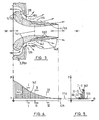
- FIG. 1 shows a long sectional view through the Combi-Supersonic-Adjusting-Nozzle in line with the foregoing application No.: 10/757,596, which according to the present invention is additionally provided with a supersonicflow guide-
shell 145, a supersonicflow guide-Ring 146, and small supersonicauxiliary nozzles 148. - FIG. 2 shows a cross sectional view through the Combi-Supersonic-Adjusting-Nozzle according to line S - S of FIG. 1.
- FIG. 3 shows the supersonic flow along the
central plug 182, of the Adjusting-Nozzle, i.e. along the inflow-funnel 3 and adjusting slider-collet 4, prior to the installation of the additional inventive means. - FIG. 4 shows the pressure course of the supersonically flowing gas along the outer wall of the
central plug 182, according to FIG. 3. - FIG. 5 shows three cross-sectional profiles of the supersonic flow along the bended central plug of the nozzle, FIG. 3.
- However, the flow-pattern of FIG. 3; FIG. 4; and FIG. 5 occurs only, when the supersonically flowing gas is simultaneously expanding! - FIG. 6 shows scaled up a long sectional view through the small supersonic
auxiliary nozzles 148, and the small supersonic gas-ducts 147 of the initial injector. - FIG. 7 shows the front end view of the small supersonic auxiliary nozzles of FIG. 6.
- FIG. 8 shows the plan view of the small supersonic auxiliary nozzles and the small supersonic gas-ducts of FIG. 6.
- FIG. 9 shows the long sectional view through the detachable
ceramic inflow funnel 5/70 from the metallic adjusting slider-collet 4/69. - FIG. 10 shows the cross sectional view through the end of the adjusting slider-collet of the
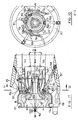
central plug 182, according to sectionline T-T of FIG.9. - FIG. 11 shows the long sectional view through the Combi-Supersonic-Adjusting-Nozzle according to FIG. 1, which additionally is equiped with a swivelling device for a four-dimensional (4-D) vectoring of the jet-stream.
- FIG. 12 shows the cross-sectional view through the Combi-Supersonic-Adjusting-Nozzle and the means for the four-dimensional (4-D) vectoring of FIG. 11, according to the section line U-U. Specially is shown the twist-preventing device.
- FIG. 13 shows the electro-hydraulic control scheme for the vectoring of the nozzle jet, according to FIG. 11 and FIG. 12. Shown is the control scheme e.g. for the elevator. For the rudder control serves an analogous second system, not shown here.
- FIG. 14 shows the long sectional view through a conventional plug nozzle with the flow direction through the ring throat conically from inside to outside, which is further developed and improved with the help of the same package of inventive means as the nozzle of FIG. 1, also ; transforming it into a Combi-Supersonic-Adjusting-Nozzle according to the present invention.
- FIG. 15 shows the cross sectional view through the conventional plug nozzle, which is further developed and improved, and transformed into a Combi-Supersonic-Adjusting-Nozzle according to the present invention, as ilustrated in FIG. 14. The sectional view is along the line V-V of FIG. 14.
- As a GUIDE through the complexity of the specification, refer the following list of parts and special signs more particularly to the drawings, wherein like reference numerals designate identical parts in each of the views from FIG. 1 through FIG. 15.
The reference numerals from 2 through 125 correspond with the reference numerals of the foregoingapplications USA No.: 10/757,596 Germany 103 02 041.1-13
Whereas the reference numerals beginning with 140 and the special signs are new numerals and signs of the present application. - 2. Combustion chamber of the engine;
- 3. Combi-Supersonic-Adjusting-Nozzle of 2;
- 4. Adjusting slider-collet of 3, with radially arranged outer supporting stays;
- 5. I nflow-funnel of 3;
- 6. Operation apparatus for the longitudinal adjustement of 4;
- 8. Supersonic jet;
- 10. Supersonic shockwave compressor;
- 25. Induction port and air intake into the engine;
- 26. Swirl vanes in the
induction port 25; - 60. Operation ring of the Combi-Supersonic-Adjusting-Nozzle 3, to which are fastened the supporting stays of the slider-collet 4;
- 69. Adjusting slider-collet of the Combi-Supersonic-Adjusting-Propelling-
Nozzle 85, with radially arranged outer supporting stays; - 70. Inflow-funnel of 85;
- 85. Combi-Supersonic-Adjusting-Fropelling-Nozzle for an air-jet-propulsion, consisting of a plug-nozzle, and in it through the plug co-axially arranged Laval-nozzle
- 86. Locally recessed outside contour of the adjusting slider-collet 4, in each case on both sides of the supporting stays, in accordance with the area rule of the dynamics of compressible fluids;
- 87. Operation ring of the Combi-Supersonic-Adjusting-Propelling-
Nozzle 85, to which are fastened the supporting stays of the sl ider-collet 69; - 88. Operation apparatus for the longitudinal adjustement of the slider-collet of the propelling
nozzle 85; - 90. Locally recessed outside contour of the adjusting slider-
collet 69; - 124. Parting plane between the pressure gas producer and pressure gas utilizers;
- 125. Depression resp. pressure-free zone;
-
- 140. Gas-jet discharge orifice of the
combustion chamber 2, resp. of the engine end housing; - 141. Throat of the nozzle and sonic gas flow;
- 142. Portion of the supersonic gas flow,which remains close upon the wall of the adjusting slider-collet 4/69;
- 143. Portion of the supersonic gas flow, which obliquely departs from the wall of the adjusting slider-collet;
- 144. Supersonic jetstream;
- 145. Supersonic flow guide-shell;
- 146. Supersonic flow guide-ring;
- 147. Small supersonic flow gas-ducts, on the outside of the guide-
shell 145; - 148. Small supersonic auxiliary nozzles of the initial suction-
injector 149; - 149. Initial suction-injector in the form of a ring-gap;
- 150. Turbulence intensifier in the form of a corrugation, corrugation parallel to the flow;
- 151. End-housing of the jet engine (ICJ-Engine);
- 152. Radially arranged outer supporting stays of the adjusting
slider collet 4 and 69; - 153. Sidewards directed evading flow, in accordance with the area rule of the dynamics of compressible fluids;
- 154. Compression / tension struts with spherical joint-ends, of the twist-preventing device;
- 155. Screw bolts of the detachable
ceramic inflow funnel - 156. F low-conformal nuts of the detachable
ceramic inflow funnel 5/70; 158. Swivel arms for the four-dimensional (4-D) vectoring of the jet-stream, three or more arms with spherical joint ends, the arms arranged in a pyramidal shape; - 159. Two swivelling arms of the twist-preventing device with gearwheel-segments. The arms are swivellingly fastened to the forward cold-end of the supersonicflow guide-
shell 145, and the two gearwheel-segments are meshing with themselves; - 160. Swivelling-center of the four-dimensional (4-D) vectoring of the thrust -nozzle;
- 161. Actuating-cylinders of the electro-hydraulic control system of the thrust-nozzle vectoring;
- 162. Swivelling angles of the four-dimensional (4-D) vectoring of the jet-stream;
- 163. Servomotors with brakes;
- 164. Hydraul ic pumps for the jet-stream vectoring;
- 165, Hydraulic oil-supply-,
- 166. Contact slide;
- 167. Relays;
- 168. Electric lines for the "Fly-by-Wire"- system;
- 170. Control stick of the pilot;
- 171. Connection to the elevator (resp. to the rudder);
- 172. Direction of flight;
- 173. 1 - Isobar = line of the environmental pressure;
- 174a.Conical shockwave (oblique shockwave in circular form) of the
guide ring 146; - 174b.Conical shockwave of the
guide shell 145, and oblique shockwaves in the smallauxiliary nozzles 148; - 175. Supersonic streamlines;
- 176. Augmentation of the jet-rotation;
- 177. Cylindrical wrapping, round about the longitudinal axes of the nozzle;
- 178. Sheetmetal insulation (eventual also aluminium-titanat insulation);
- 180. Jet-border being turned round in a narrow curved-path;
- 181. Housing of the conventional plug-nozzle, integral with the engine, being cylindrical or slightly divergent;
- 182. Central plug of the plug-
nozzle 181 , consisting of 4 and 5, or 69 and 70; - 183. Inflow opening of 182;
- 184. Cross-connection of the hydraulic lines;
- R. Radius of the spherical surface;
- ε Internal divergence-angle of the supersonicflow guide-
shell 145; - ξ External convergence angle of the trailing-edge of the
supersonicflow guide ring 146; - η Internal divergence angle of the
supersonicflow guide ring 164; - ℓ Radial coordinate;
- X - X Longitudinal axis of the nozzle and of the engine;
- Technical ceramics;

- Metal.

- PHYSICAL CRITERION: A supersonically flowing gas stream can on a curved wall only so long be continually turned round, as long as the flowing gas is expanding. - When however the expansion is finished, a supersonically flowing gas stream can solely by oblique shockwaves be sharp edged deflected. On this criterion are founded the hereinafter submitted inventive means of the present application.
- The Combi-Supersonic-Adjusting-Nozzle of FIG. 1; FIG. 2 respectively FIG. 11 and FIG. 12 proceeds from the combi-supersonic-plug-nozzle of my novel Injector-Centrifuge-Turbine/Jet-Engine (Application No.: 10/757,596), and according to the present invention will be combined with:
- a supersonic-flow guide-
shell 145, a supersonic-flow guide-ring 146, and several small supersonicauxiliary nozzles 148. The s.f-guide-shell * has preferred a round cross-section, surrounds the adjusting slider collet 4/69 of the central nozzle-plug 182, is at the stream entrance on the inside strongly divergent, after an inside coaxial wall-inclination cylindrical or slightly divergent, divergence angle ε , and has at the stream exit aturbulence intensifier 150 in the shape of a rising corrugation, the corrugation grooves parallel to the flow. The function of the s.f. guide-shell 145 is the focusing of the jet stream. The s.f.guide-ring 146 also surrounds the adjusting slider collet 4/69 of thecentral nozzle plug 182, has also preferred a round cross-section, is positioned inside of the s.f.guide-shell, and has in the longitudinal section the shape of a flat triangle: pointed at the leading edge, also pointed at the trailing edge, and blunt at the middle angle with a slightly rounding. The s.f. guide-ring is on its inside slightly divergent, divergence angle η on the leading autside edge also divergent, with a divergence angle nearly parellel to the arrivingsupersonic flow 143, and it is at the trailing edge convergent, convergence angle ξ. The function of the s.f.-guide-ring 146 is to support the focusing of the jet-stream, by catching the supersonic gas jet-part 143, which farther downward obliquely flows away from the adjusting slider collet 4/60; and both means: the s.f.guide-shell 145 and the s.f.guide-ring 146 are guiding more effective the jet into the nozzle-and engine main flow-direction. - The small supersonic
auxiliary nozzles 148 are fastened to the ends of small supersonic gas-ducts 147, which are star-like positioned round about on the outside of the s.f.guide-shell 145. The small supersonicauxiliary nozzles 148 are behind their inside shockwaves increasing the cross-sections, to supersonically accelerate the flow, and are additionally sidewards widened, in order to correspond with the area rule of the gas dynamics, what reduces the shock-losses. Said nozzles have also spiral-angle positions 176, augmenting the jet rotation. The function of the smallsupersonic nozzles 148 is to admit an initial suction-injector 149 in the shape of a ring-gap, round about the inventive nozzle, to intensify the suction effect. The same small supersonicauxiliary nozzles 148 are also adopted for the propellingnozzle 85 at the rear end of the engine, in order to suppress the engine sound radiated from the engine, by producing a slower jacket-flow round about the jet stream. - Hereinafter will be disclosed more particularly the flow characteristics and the operation mode of the above described nozzle means. The gas-flow in the nozzle, prior to the installation of the inventive means, is identified thereby that, FIG. 3, after the gas has passed the ring throat of the nozzle, and is turned into the main flow direction of the nozzle, one portion of the
flow 142 remains close upon the fillet wall of the adjusting slide-collet 182, due to the gas mass-inertia at supersonic speed, what results in the pressure-course 142 on the slide-collet wall, as shown in FIG. 4 resp. FIG. 5, whereas a second portion of theflow 143 more violent expands, and obliquelly flows outward. The outwardly flowinggas portion 143 forms himself an abrupt pressure drop, as shown in the cross-sectional profiles of FIG. 5. And from this pressure drop flows the gas outwardly with further increasing supersonic speed. - This flow pattern is the virtual basis for shaping the package of the inventive means, because the outwardly flowing gas portion will be utilized, to boost the engine injector effect, and to increase the pressure in the engine.
Additionally the outwardly flowinggas portion 143 expanses near of thegas discharge orifice 140 of the engine housing very suddenly and violently, and forms a narrow curved path 180 (like a toroidal vortex) with such a flowing speed that the gas-mass inertia - centrifugal forces produce in the center of said curved path 125 a pressure-free or depression zone (!) - In the supersonic
flow guide shell 145 the coaxial inside wall inclination, and the inner inclinations of the smallauxiliary nozzles 148 are triggering obl iqueshockwaves 174b. Also the leading edge of the supersonicflow guide ring 146 trigers theshockwave 174a. All these schock-waves together are guiding the flow into the nozzle main flow direction. - Since the s.f. guide
shell 145 and the s.f. guidering 146 have internal converging wall-angles ε and ζ, and the s.f. guide ring on the outside the diverging wall -angle ξ, and additionally theauxiliary nozzles 148 have also diverging endparts, the flow repeatedly expands after the shockwaves, what results in an additional nozzle thrust - The supersonic
flow guide shell 145 and the supersonicflow guide ring 146 are by means of radially arranged supportingstays 152 fastened to theoperation ring 60/87, at which the middle portions of the stays, the s.f. guidering 146, and the s.f. guideshell 145 are lying in the hot supersonic flow of the nozzle, whereas the outer portions of thestays 152, the small supersonicauxiliary nozzles 148 and the operation rings 60/87 are already lying in the cold subsonic air-flow.
The whole above described aggregate is forward and rearward movable designed, by which the ring-throat of the nozzle is geometrically changeabl e, and the nozzle flow cross-section variable. For this purpose serves anoperation apparatus 6/88, consisting of at least three gear-spindles or at least three rack-and pinion gears, which is also-lying in the cold subsonic air-flow, and which handles and moves the operation rings 60/87 with the nozzle aggregates. - The inflow-
funnels 5/70 are made of technical ceramics, and are detachable fastened to the adjusting sl ide-collets 4/69. For this purpose are usedscrew bolts 155, positioned parallel to the axis of the nozzle, and flow-conformal nuts 156, as shown in FIG. 9; FIG. 10 and FIG. 14. - The additional swivelling device for a four-dimensional (4 - D) vectoring of the jet stream of the COMBI-SUPERSONIC-ADJUSTING-NOZZLE, according to FIG. 11 and FIG. 12, is provided to make the jet-stream of the Injector-Centrifuge-Jet-Engine deflectable to all
lateral directions 162, in order to get an engine influencing the aircraft maneuverability. - For this purpose the inner nozzle aggregate, consisting of the
central plug 182, with theinflow funnel 70 and adjustingslider collet 69, supersonic flow guide-shell 145, supersonic flow guide-ring 146, and supportingstays 152, is flexibly joined with theoperation ring 87. The specified aggregate is on its forward cold end connected with theoperation ring 87 by means of at least threeswivel arms 158 with spherical joint-ends; said swivel arms being arranged in the shape of a pyramid, with the pyramidal apex pointing against the flow direction. There is also provided a twist-preventing device with two swivellingarms 159, of which each arm has on its one end a gearwheel-segment. Said gearwheel-segments are attached to the inward sides of the arms, and the two gearwheel-segments are meshing with each other; this occuring in a small housing, which is also fastened to the forward cold end of the supersonic flow guide-shell 145. The two swivellingarms 159 are so arranged that when one arm swings out like a clockwise rotation, the other arm swings out like an anticlockwise rotation, and vice versa. Said swivelling twoarms 159 are on their outwardly pointing ends connected with compresion/tention struts 154 by means of spherical joints. The struts stand perpendicularly or near perpendicularly to the two said swivelling arms, and are at their other ends connected with theoperation ring 87, also by means of spherical joints. - All these elements taken together form the vectoring nozzle aggregate which is able to be swiveled in all directions around the
swivelling center 160, without the pyramidal group of theswivel arms 158 would collapse. At which aggregate the small longitudinal oscillations of theswivelling center 160 will automatically be equalized by theoperation apparatus 88. - In the ring-gap between the end-housing. 151 of the jet engine and the supersonic flow guide-
shell 145, that is in the dividing slit between the immovible part and movible part of the vectoring nozzle, is no fire-proof gasket necessary!
This is an extraordinary advantage of the presented jet-vectoring nozzle, because all other, and hitherto known vectoring nozzles imperatively require such fire-proof gaskets, which are expensive and very troublesome in practical operation. - The inventive vectoring nozzle can dispense with said fire-proof gasket, originally utilizing the gas mass-inertia at supersonic flow. - At the inventive nozzle-design the expanding hot gas-jet, which is discharged by the end-
housing 151 of the jet-engine, triggers shortly after the ring throat a narrowcurved path 180, which due to the high speed and the mentioned gas mass-inertia produces in the center of said curved path a pressure-free or depression zone, as already specified in connection with FIG. 3; FIG. 4, and FIG. 5. Now, said pressure-free zone will be intentionally placed between the mentioned immovable part and movable part of the nozzle, by which between the two said parts do not exist any outwardly urging pressure potential, and thus no fire-proof gasket is required! I n addition, the ring throat of the nozzle is located on a spherical surface with the radius "R", which enables movements of the vectoring nozzle aggregate to all side directions; - on the contrary to presently known other vectoring nozzles, which are variable only within one plane. - For operation of the above specified Combi-Supersonic-Adjusting-Nozzle as a (4-D) vectoring nozzle, is provided an electro-hydraulic operation regime, working according to the "Fly-by-Wire"- principle. The
hydraulic actuating cylinders 161 are on one side connected with the supersonic flow guide-shell 145, and on the other side with the end-housing 151 of the jet engine. There are at least 4 actuating hydraulic cylinders, which are provided in two pairs of two cylinders, in each case on two planes going through the longitudinal axis of the nozzle. These planes are standing perpendicularly to each other. One pair of cylinders for swivelling the nozzle to the left and right side, and the second pair of cylinders for swivelling the nozzle upwards and downwards . Said cylinders are bilaterally effective. In each of said planes the hydraulic lines of the cylinders are crosswise connected 184, so that one piston side of one cyl inder is connected with the other piston side of the other cylinder FIG. 13. By said crosswise connection cooperate the two mentioned cylinders in this way that one piston rod has push-forces, and the other piston-rod pull-forces, or vice versa. This crosswise line-connections of the cylinders have the advantage that the lateral swivelling movements of the vectoring nozzle aggregate are independent of the linear adjustements of the thrust nozzle, accomplished by theoperation apparatus 88. - To complete the Combi-Supersonic-Adjusting-Nozzle, also the conventional plug nozzle has to be taken into consideration, making it compatible with the new Injector-Centrifuge-Turbine/Jet-Engine, by applying the same inventive package of means, as specified above.
- The conventional plug nozzle consists of: a
housing 181 , which is integral with the engine, and cylindrical or slightly divergent in shape, but which has at the stream entrance a constriction, after which the inside diameter conically alters into said cylindrical or slightly divergent shape. Furthermore comprises said conventional plug nozzle acentral nozzle plug 182, in the shape of a zeppelin, being round at the stream entrance and convergent at the stream exit. Between said entrance constriction of the housing and the entrance-rounding of saidnozzle plug 182 is formed the nozzle-ring throat, with the flow direction through the throat conically from inside to outside, after which the flow is guided into the general axial flow direction of the nozzle, by said cylindrical or slightly divergent part of thehousing 181 . - This basic design of the conventional plug nozzle will now be improved by addition of the above specified package of inventive means, to make it compatible with the new Injector-Centrifuge-Turbine/Jet-Engine, FIG. 14 and FIG. 15.
- The central nozzle plug get an axial Laval-nozzle, going straight through, from the stream entrance to the stream exit of the plug. The central plug will be devided in two parts, the forwardly positioned
inflow funnel 70, with theinflow opening 183 for the Laval-nozzle, and the rearwardly positioned adjusting slider-collet 69. The Laval-nozzle is dimensioned for the idle-operation of the engine. The adjusting slider collet get radial supporting stays 152, which star-like are pointing to the outside, where they are attached to an also addedoperation ring 87, positioned round about of the nozzle, and which together keep the central plug in position. The outside contour of the adjustingslider collet 69 get at the starting points of said supporting stays, on both sides of each stay,local recessions 90, in accordance with the area rule of the dynamics of compressible fluids.
At this design the central plug and the radial inner portions of said stays are lying in the hot supersonic region of the jet, whereas the radial outer portions of the stays and the operation ring already are lying in the cold region of the inducted fresh air flow. To theoperation ring 87 is attached an also newly added mechanical operation apparatus for the nozzle. The whole above specified aggregate is forwardly and rearwardly movable designed, in order to geometrically change the ring throat of the nozzle, and vary the gas flow area through the nozzle. - The housing of the nozzle get, at the stream exit, a
turbulence intensifier 150, with the shape of a rising corrugation, the corrugation grooves lying parallel to the flow. - The additional small supersonic
auxiliary nozzles 148 are fastened to the ends of small supersonic gas-ducts 147, which are star-like positioned round about on the outside of thenozzle housing 181. The small supersonicauxiliary nozzles 148 are of the same design as specified onsheet 10 of this description, and as shown in FIG. 6; FIG. 7; and FIG. 8. The auxiliary nozzles are behind their inside shockwaves increasing their cross-sections, to supersonically accelerating the flow, and are additionally widened sidewards, in order to correspond with the area rule of the gas dynamics, what reduces the shock losses. Said nozzles have also spiral-angle positions 176, augmenting the jet rotation. The function of the smallsupersonic nozzles 148 is to admit an initial suction-injector 149 in the shape of a ring-gap, round about the inventive nozzle, to intensify the suction effect of the engine. The small supersonicauxiliary nozzles 148 are also adopted for the propellingnozzle 85 at the rear end of the engine, in order to suppress the engine sound radiated from the engine, by producing a slower jacket-flow round about the jet stream. - The inflow funnels 5/70 are made of technical ceramics, and are detachable fastened to the adjusting slider collets 4/69. For this purpose are used
screw bolts 155, positioned parallel to the axis of the nozzles, and flow-conformal nuts 156, as schown in FIG. 14. The ceramic inflow funnels 5/70 should be made of a heat-conducting material, e.g. of SiC, by which the inflow funnels get the capacity to transport the absorbed heat to the rearwardly expanding gases, what thermodynamically increases the efficiency. - All above specified Combi-Supersonic-Adjusting-Nozzles are also provided for Rocket-Engines.
- Although preferred embodiments of the invention have been described in the foregoing detailed description and illustrated in the accompanying drawings, it will be understood that the invention is not limited to the embodiments disclosed, but is capable of numerous rearrangements, modifications and substitution of parts and elements without departing from the spirit of the invention. Accordingly, the present invention is intended to accomplish such rearrangements, modifications and substitution of parts and elements as fall within the spirit and scope of the appended claims.
Claims (4)
Applications Claiming Priority (1)
| Application Number | Priority Date | Filing Date | Title |
|---|---|---|---|
| DE102005015585A DE102005015585B3 (en) | 2005-04-05 | 2005-04-05 | Combination-supersonic-adjustment-nozzle for e.g. injector-centrifugal-turbines-engine, has nozzle stream bundling unit with small supersonic auxiliary nozzles to load initial-intake-injector to increase the intake effect of engines |
Publications (2)
| Publication Number | Publication Date |
|---|---|
| EP1710426A2 true EP1710426A2 (en) | 2006-10-11 |
| EP1710426A3 EP1710426A3 (en) | 2008-07-30 |
Family
ID=36602538
Family Applications (1)
| Application Number | Title | Priority Date | Filing Date |
|---|---|---|---|
| EP06005007A Withdrawn EP1710426A3 (en) | 2005-04-05 | 2006-03-11 | Combi-supersonic-adjusting-nozzle |
Country Status (3)
| Country | Link |
|---|---|
| US (1) | US20060277914A1 (en) |
| EP (1) | EP1710426A3 (en) |
| DE (1) | DE102005015585B3 (en) |
Cited By (1)
| Publication number | Priority date | Publication date | Assignee | Title |
|---|---|---|---|---|
| CN109931628A (en) * | 2019-03-27 | 2019-06-25 | 北京理工大学 | It is a kind of based on the ring cavity eddy flow of the combustion chamber RDE to spray structure |
Families Citing this family (7)
| Publication number | Priority date | Publication date | Assignee | Title |
|---|---|---|---|---|
| CN107989716B (en) * | 2018-01-02 | 2023-12-15 | 吉林大学 | A gas injection direction variable device in the air intake duct |
| US11211184B2 (en) | 2019-01-23 | 2021-12-28 | Pratt & Whitney Canada Corp. | System of harness and engine case for aircraft engine |
| CN112572811B (en) * | 2019-09-30 | 2022-07-15 | 林瑶章 | Aircraft and their propulsion |
| CN114794000B (en) * | 2022-04-15 | 2023-04-25 | 浙江省淡水水产研究所 | High-pressure screw rod aeration equipment suitable for greenhouse fish and shrimp standard seedling cultivation |
| CN116818179B (en) * | 2023-04-26 | 2026-03-17 | 天津大学 | Replaceable Laval tube differential pressure measuring device and its control method |
| CN118189224B (en) * | 2024-05-14 | 2026-04-21 | 清华大学 | Combustion chamber of aircraft engine and its air-fuel ratio regulation method |
| CN119665274B (en) * | 2024-12-24 | 2026-04-10 | 四川航天中天动力装备有限责任公司 | A fuel atomizing device for use in small-sized high-temperature combustion chambers |
Family Cites Families (6)
| Publication number | Priority date | Publication date | Assignee | Title |
|---|---|---|---|---|
| FR1496091A (en) * | 1966-04-20 | 1967-09-29 | Snecma | Ejection nozzle for thrusters with several motor flows, in particular with two motor flows |
| US4025007A (en) * | 1974-08-16 | 1977-05-24 | Herbert Kaniut | Shifting horizontal tail with helical motions |
| US5216878A (en) * | 1991-06-28 | 1993-06-08 | The Boeing Company | Mixed exhaust flow supersonic jet engine and method |
| US5419117A (en) * | 1993-07-30 | 1995-05-30 | The Boeing Company | Turbo jet/RAM jet propulsion system |
| US6948306B1 (en) * | 2002-12-24 | 2005-09-27 | The United States Of America As Represented By The Secretary Of The Navy | Apparatus and method of using supersonic combustion heater for hypersonic materials and propulsion testing |
| DE10302041B4 (en) * | 2003-01-21 | 2006-10-05 | Kaniut, Herbert, Dipl.-Ing. | Injector Centrifuge Turbine Engine and Injector Centrifuge Air Jet Engine |
-
2005
- 2005-04-05 DE DE102005015585A patent/DE102005015585B3/en not_active Expired - Fee Related
-
2006
- 2006-02-21 US US11/357,608 patent/US20060277914A1/en not_active Abandoned
- 2006-03-11 EP EP06005007A patent/EP1710426A3/en not_active Withdrawn
Cited By (1)
| Publication number | Priority date | Publication date | Assignee | Title |
|---|---|---|---|---|
| CN109931628A (en) * | 2019-03-27 | 2019-06-25 | 北京理工大学 | It is a kind of based on the ring cavity eddy flow of the combustion chamber RDE to spray structure |
Also Published As
| Publication number | Publication date |
|---|---|
| EP1710426A3 (en) | 2008-07-30 |
| DE102005015585B3 (en) | 2006-10-05 |
| US20060277914A1 (en) | 2006-12-14 |
Similar Documents
| Publication | Publication Date | Title |
|---|---|---|
| US10946976B2 (en) | Fluidic propulsive system and thrust and lift generator for aerial vehicles | |
| USRE43731E1 (en) | Integrated air inlet system for multi-propulsion aircraft engines | |
| US4372110A (en) | Noise suppressor for turbo fan jet engines | |
| EP1206384B1 (en) | Supersonic external-compression diffuser and method for designing same | |
| US20240150026A1 (en) | Fluidic propulsive system | |
| US5165227A (en) | Propelling nozzle for a hypersonic engine | |
| US6000635A (en) | Exhaust nozzle for a turbojet engine | |
| CN107013367B (en) | Turbine base double combustion chamber's punching press combined cycle engine | |
| CN106321246B (en) | intake port flow restrictor | |
| JPH04101053A (en) | Coupling propulsive engine high utilizable for aircraft or space aircraft | |
| JPS6339781B2 (en) | ||
| US3012400A (en) | Nozzle | |
| US5222359A (en) | Nozzle system and method for supersonic jet engine | |
| EP3088720A1 (en) | Nozzle for jet engines | |
| US3062003A (en) | Variable area exhaust nozzle | |
| EP1710426A2 (en) | Combi-supersonic-adjusting-nozzle | |
| JP2025000613A (en) | Streamline airframe with boundary ingestion fluidic propulsive elements | |
| US2934893A (en) | Air intake structure for an aircraft engine | |
| US3027714A (en) | Combined thrust reversing and noise suppressing device for turbo-jet engines | |
| US20040244357A1 (en) | Divergent chevron nozzle and method | |
| GB2164613A (en) | Vectorable exhaust nozzle for gas turbine engines | |
| US5154050A (en) | Thrust vector control using internal airfoils | |
| EP4274955A1 (en) | Jet vectoring apparatus | |
| US3572464A (en) | Method and apparatus for suppressing the noise of a fan-jet engine | |
| US2914914A (en) | Three dimensional variable exhaust nozzle |
Legal Events
| Date | Code | Title | Description |
|---|---|---|---|
| PUAI | Public reference made under article 153(3) epc to a published international application that has entered the european phase |
Free format text: ORIGINAL CODE: 0009012 |
|
| 17P | Request for examination filed |
Effective date: 20060322 |
|
| AK | Designated contracting states |
Kind code of ref document: A2 Designated state(s): AT BE BG CH CY CZ DE DK EE ES FI FR GB GR HU IE IS IT LI LT LU LV MC NL PL PT RO SE SI SK TR |
|
| AX | Request for extension of the european patent |
Extension state: AL BA HR MK YU |
|
| PUAL | Search report despatched |
Free format text: ORIGINAL CODE: 0009013 |
|
| AK | Designated contracting states |
Kind code of ref document: A3 Designated state(s): AT BE BG CH CY CZ DE DK EE ES FI FR GB GR HU IE IS IT LI LT LU LV MC NL PL PT RO SE SI SK TR |
|
| AX | Request for extension of the european patent |
Extension state: AL BA HR MK YU |
|
| AKX | Designation fees paid |
Designated state(s): AT FR GB IT SE |
|
| REG | Reference to a national code |
Ref country code: DE Ref legal event code: 8566 |
|
| STAA | Information on the status of an ep patent application or granted ep patent |
Free format text: STATUS: THE APPLICATION IS DEEMED TO BE WITHDRAWN |
|
| 18D | Application deemed to be withdrawn |
Effective date: 20090131 |