EP1710323A1 - Nickel coating - Google Patents
Nickel coating Download PDFInfo
- Publication number
- EP1710323A1 EP1710323A1 EP20060250511 EP06250511A EP1710323A1 EP 1710323 A1 EP1710323 A1 EP 1710323A1 EP 20060250511 EP20060250511 EP 20060250511 EP 06250511 A EP06250511 A EP 06250511A EP 1710323 A1 EP1710323 A1 EP 1710323A1
- Authority
- EP
- European Patent Office
- Prior art keywords
- applying
- thickness
- region
- content
- substrate
- Prior art date
- Legal status (The legal status is an assumption and is not a legal conclusion. Google has not performed a legal analysis and makes no representation as to the accuracy of the status listed.)
- Granted
Links
Images


Classifications
-
- C—CHEMISTRY; METALLURGY
- C23—COATING METALLIC MATERIAL; COATING MATERIAL WITH METALLIC MATERIAL; CHEMICAL SURFACE TREATMENT; DIFFUSION TREATMENT OF METALLIC MATERIAL; COATING BY VACUUM EVAPORATION, BY SPUTTERING, BY ION IMPLANTATION OR BY CHEMICAL VAPOUR DEPOSITION, IN GENERAL; INHIBITING CORROSION OF METALLIC MATERIAL OR INCRUSTATION IN GENERAL
- C23C—COATING METALLIC MATERIAL; COATING MATERIAL WITH METALLIC MATERIAL; SURFACE TREATMENT OF METALLIC MATERIAL BY DIFFUSION INTO THE SURFACE, BY CHEMICAL CONVERSION OR SUBSTITUTION; COATING BY VACUUM EVAPORATION, BY SPUTTERING, BY ION IMPLANTATION OR BY CHEMICAL VAPOUR DEPOSITION, IN GENERAL
- C23C18/00—Chemical coating by decomposition of either liquid compounds or solutions of the coating forming compounds, without leaving reaction products of surface material in the coating; Contact plating
- C23C18/16—Chemical coating by decomposition of either liquid compounds or solutions of the coating forming compounds, without leaving reaction products of surface material in the coating; Contact plating by reduction or substitution, e.g. electroless plating
- C23C18/1601—Process or apparatus
- C23C18/1633—Process of electroless plating
- C23C18/1646—Characteristics of the product obtained
- C23C18/165—Multilayered product
-
- H—ELECTRICITY
- H02—GENERATION; CONVERSION OR DISTRIBUTION OF ELECTRIC POWER
- H02J—ELECTRIC POWER NETWORKS; CIRCUIT ARRANGEMENTS OR SYSTEMS FOR SUPPLYING OR DISTRIBUTING ELECTRIC POWER; SYSTEMS FOR STORING ELECTRIC ENERGY
- H02J9/00—Circuit arrangements for emergency or stand-by power supply, e.g. for emergency lighting
- H02J9/04—Circuit arrangements for emergency or stand-by power supply, e.g. for emergency lighting in which the distribution system is disconnected from the normal source and connected to a standby source
- H02J9/06—Circuit arrangements for emergency or stand-by power supply, e.g. for emergency lighting in which the distribution system is disconnected from the normal source and connected to a standby source with automatic change-over, e.g. UPS systems
-
- C—CHEMISTRY; METALLURGY
- C23—COATING METALLIC MATERIAL; COATING MATERIAL WITH METALLIC MATERIAL; CHEMICAL SURFACE TREATMENT; DIFFUSION TREATMENT OF METALLIC MATERIAL; COATING BY VACUUM EVAPORATION, BY SPUTTERING, BY ION IMPLANTATION OR BY CHEMICAL VAPOUR DEPOSITION, IN GENERAL; INHIBITING CORROSION OF METALLIC MATERIAL OR INCRUSTATION IN GENERAL
- C23C—COATING METALLIC MATERIAL; COATING MATERIAL WITH METALLIC MATERIAL; SURFACE TREATMENT OF METALLIC MATERIAL BY DIFFUSION INTO THE SURFACE, BY CHEMICAL CONVERSION OR SUBSTITUTION; COATING BY VACUUM EVAPORATION, BY SPUTTERING, BY ION IMPLANTATION OR BY CHEMICAL VAPOUR DEPOSITION, IN GENERAL
- C23C10/00—Solid state diffusion of only metal elements or silicon into metallic material surfaces
- C23C10/28—Solid state diffusion of only metal elements or silicon into metallic material surfaces using solids, e.g. powders, pastes
- C23C10/34—Embedding in a powder mixture, i.e. pack cementation
- C23C10/52—Embedding in a powder mixture, i.e. pack cementation more than one element being diffused in one step
-
- C—CHEMISTRY; METALLURGY
- C23—COATING METALLIC MATERIAL; COATING MATERIAL WITH METALLIC MATERIAL; CHEMICAL SURFACE TREATMENT; DIFFUSION TREATMENT OF METALLIC MATERIAL; COATING BY VACUUM EVAPORATION, BY SPUTTERING, BY ION IMPLANTATION OR BY CHEMICAL VAPOUR DEPOSITION, IN GENERAL; INHIBITING CORROSION OF METALLIC MATERIAL OR INCRUSTATION IN GENERAL
- C23C—COATING METALLIC MATERIAL; COATING MATERIAL WITH METALLIC MATERIAL; SURFACE TREATMENT OF METALLIC MATERIAL BY DIFFUSION INTO THE SURFACE, BY CHEMICAL CONVERSION OR SUBSTITUTION; COATING BY VACUUM EVAPORATION, BY SPUTTERING, BY ION IMPLANTATION OR BY CHEMICAL VAPOUR DEPOSITION, IN GENERAL
- C23C10/00—Solid state diffusion of only metal elements or silicon into metallic material surfaces
- C23C10/60—After-treatment
-
- C—CHEMISTRY; METALLURGY
- C23—COATING METALLIC MATERIAL; COATING MATERIAL WITH METALLIC MATERIAL; CHEMICAL SURFACE TREATMENT; DIFFUSION TREATMENT OF METALLIC MATERIAL; COATING BY VACUUM EVAPORATION, BY SPUTTERING, BY ION IMPLANTATION OR BY CHEMICAL VAPOUR DEPOSITION, IN GENERAL; INHIBITING CORROSION OF METALLIC MATERIAL OR INCRUSTATION IN GENERAL
- C23C—COATING METALLIC MATERIAL; COATING MATERIAL WITH METALLIC MATERIAL; SURFACE TREATMENT OF METALLIC MATERIAL BY DIFFUSION INTO THE SURFACE, BY CHEMICAL CONVERSION OR SUBSTITUTION; COATING BY VACUUM EVAPORATION, BY SPUTTERING, BY ION IMPLANTATION OR BY CHEMICAL VAPOUR DEPOSITION, IN GENERAL
- C23C18/00—Chemical coating by decomposition of either liquid compounds or solutions of the coating forming compounds, without leaving reaction products of surface material in the coating; Contact plating
- C23C18/16—Chemical coating by decomposition of either liquid compounds or solutions of the coating forming compounds, without leaving reaction products of surface material in the coating; Contact plating by reduction or substitution, e.g. electroless plating
- C23C18/1601—Process or apparatus
- C23C18/1633—Process of electroless plating
- C23C18/1689—After-treatment
- C23C18/1692—Heat-treatment
-
- C—CHEMISTRY; METALLURGY
- C23—COATING METALLIC MATERIAL; COATING MATERIAL WITH METALLIC MATERIAL; CHEMICAL SURFACE TREATMENT; DIFFUSION TREATMENT OF METALLIC MATERIAL; COATING BY VACUUM EVAPORATION, BY SPUTTERING, BY ION IMPLANTATION OR BY CHEMICAL VAPOUR DEPOSITION, IN GENERAL; INHIBITING CORROSION OF METALLIC MATERIAL OR INCRUSTATION IN GENERAL
- C23C—COATING METALLIC MATERIAL; COATING MATERIAL WITH METALLIC MATERIAL; SURFACE TREATMENT OF METALLIC MATERIAL BY DIFFUSION INTO THE SURFACE, BY CHEMICAL CONVERSION OR SUBSTITUTION; COATING BY VACUUM EVAPORATION, BY SPUTTERING, BY ION IMPLANTATION OR BY CHEMICAL VAPOUR DEPOSITION, IN GENERAL
- C23C18/00—Chemical coating by decomposition of either liquid compounds or solutions of the coating forming compounds, without leaving reaction products of surface material in the coating; Contact plating
- C23C18/16—Chemical coating by decomposition of either liquid compounds or solutions of the coating forming compounds, without leaving reaction products of surface material in the coating; Contact plating by reduction or substitution, e.g. electroless plating
- C23C18/31—Coating with metals
- C23C18/32—Coating with nickel, cobalt or mixtures thereof with phosphorus or boron
- C23C18/34—Coating with nickel, cobalt or mixtures thereof with phosphorus or boron using reducing agents
-
- C—CHEMISTRY; METALLURGY
- C23—COATING METALLIC MATERIAL; COATING MATERIAL WITH METALLIC MATERIAL; CHEMICAL SURFACE TREATMENT; DIFFUSION TREATMENT OF METALLIC MATERIAL; COATING BY VACUUM EVAPORATION, BY SPUTTERING, BY ION IMPLANTATION OR BY CHEMICAL VAPOUR DEPOSITION, IN GENERAL; INHIBITING CORROSION OF METALLIC MATERIAL OR INCRUSTATION IN GENERAL
- C23C—COATING METALLIC MATERIAL; COATING MATERIAL WITH METALLIC MATERIAL; SURFACE TREATMENT OF METALLIC MATERIAL BY DIFFUSION INTO THE SURFACE, BY CHEMICAL CONVERSION OR SUBSTITUTION; COATING BY VACUUM EVAPORATION, BY SPUTTERING, BY ION IMPLANTATION OR BY CHEMICAL VAPOUR DEPOSITION, IN GENERAL
- C23C26/00—Coating not provided for in groups C23C2/00 - C23C24/00
-
- C—CHEMISTRY; METALLURGY
- C23—COATING METALLIC MATERIAL; COATING MATERIAL WITH METALLIC MATERIAL; CHEMICAL SURFACE TREATMENT; DIFFUSION TREATMENT OF METALLIC MATERIAL; COATING BY VACUUM EVAPORATION, BY SPUTTERING, BY ION IMPLANTATION OR BY CHEMICAL VAPOUR DEPOSITION, IN GENERAL; INHIBITING CORROSION OF METALLIC MATERIAL OR INCRUSTATION IN GENERAL
- C23C—COATING METALLIC MATERIAL; COATING MATERIAL WITH METALLIC MATERIAL; SURFACE TREATMENT OF METALLIC MATERIAL BY DIFFUSION INTO THE SURFACE, BY CHEMICAL CONVERSION OR SUBSTITUTION; COATING BY VACUUM EVAPORATION, BY SPUTTERING, BY ION IMPLANTATION OR BY CHEMICAL VAPOUR DEPOSITION, IN GENERAL
- C23C30/00—Coating with metallic material characterised only by the composition of the metallic material, i.e. not characterised by the coating process
-
- C—CHEMISTRY; METALLURGY
- C25—ELECTROLYTIC OR ELECTROPHORETIC PROCESSES; APPARATUS THEREFOR
- C25D—PROCESSES FOR THE ELECTROLYTIC OR ELECTROPHORETIC PRODUCTION OF COATINGS; ELECTROFORMING; APPARATUS THEREFOR
- C25D3/00—Electroplating: Baths therefor
- C25D3/02—Electroplating: Baths therefor from solutions
- C25D3/22—Electroplating: Baths therefor from solutions of zinc
-
- C—CHEMISTRY; METALLURGY
- C25—ELECTROLYTIC OR ELECTROPHORETIC PROCESSES; APPARATUS THEREFOR
- C25D—PROCESSES FOR THE ELECTROLYTIC OR ELECTROPHORETIC PRODUCTION OF COATINGS; ELECTROFORMING; APPARATUS THEREFOR
- C25D5/00—Electroplating characterised by the process; Pretreatment or after-treatment of workpieces
- C25D5/34—Pretreatment of metallic surfaces to be electroplated
-
- C—CHEMISTRY; METALLURGY
- C25—ELECTROLYTIC OR ELECTROPHORETIC PROCESSES; APPARATUS THEREFOR
- C25D—PROCESSES FOR THE ELECTROLYTIC OR ELECTROPHORETIC PRODUCTION OF COATINGS; ELECTROFORMING; APPARATUS THEREFOR
- C25D5/00—Electroplating characterised by the process; Pretreatment or after-treatment of workpieces
- C25D5/48—After-treatment of electroplated surfaces
- C25D5/50—After-treatment of electroplated surfaces by heat-treatment
-
- H—ELECTRICITY
- H02—GENERATION; CONVERSION OR DISTRIBUTION OF ELECTRIC POWER
- H02J—ELECTRIC POWER NETWORKS; CIRCUIT ARRANGEMENTS OR SYSTEMS FOR SUPPLYING OR DISTRIBUTING ELECTRIC POWER; SYSTEMS FOR STORING ELECTRIC ENERGY
- H02J3/00—Circuit arrangements for AC mains or AC distribution networks
- H02J3/38—Arrangements for feeding a single network from two or more generators or sources in parallel; Arrangements for feeding already energised networks from additional generators or sources in parallel
-
- H—ELECTRICITY
- H02—GENERATION; CONVERSION OR DISTRIBUTION OF ELECTRIC POWER
- H02J—ELECTRIC POWER NETWORKS; CIRCUIT ARRANGEMENTS OR SYSTEMS FOR SUPPLYING OR DISTRIBUTING ELECTRIC POWER; SYSTEMS FOR STORING ELECTRIC ENERGY
- H02J7/00—Circuit arrangements for charging or discharging batteries or for supplying loads from batteries
- H02J7/34—Parallel operation in networks using both storage and other DC sources, e.g. providing buffering
- H02J7/35—Parallel operation in networks using both storage and other DC sources, e.g. providing buffering with light sensitive cells
-
- Y—GENERAL TAGGING OF NEW TECHNOLOGICAL DEVELOPMENTS; GENERAL TAGGING OF CROSS-SECTIONAL TECHNOLOGIES SPANNING OVER SEVERAL SECTIONS OF THE IPC; TECHNICAL SUBJECTS COVERED BY FORMER USPC CROSS-REFERENCE ART COLLECTIONS [XRACs] AND DIGESTS
- Y02—TECHNOLOGIES OR APPLICATIONS FOR MITIGATION OR ADAPTATION AGAINST CLIMATE CHANGE
- Y02B—CLIMATE CHANGE MITIGATION TECHNOLOGIES RELATED TO BUILDINGS, e.g. HOUSING, HOUSE APPLIANCES OR RELATED END-USER APPLICATIONS
- Y02B10/00—Integration of renewable energy sources in buildings
- Y02B10/70—Hybrid systems, e.g. uninterruptible or back-up power supplies integrating renewable energies
-
- Y—GENERAL TAGGING OF NEW TECHNOLOGICAL DEVELOPMENTS; GENERAL TAGGING OF CROSS-SECTIONAL TECHNOLOGIES SPANNING OVER SEVERAL SECTIONS OF THE IPC; TECHNICAL SUBJECTS COVERED BY FORMER USPC CROSS-REFERENCE ART COLLECTIONS [XRACs] AND DIGESTS
- Y10—TECHNICAL SUBJECTS COVERED BY FORMER USPC
- Y10T—TECHNICAL SUBJECTS COVERED BY FORMER US CLASSIFICATION
- Y10T428/00—Stock material or miscellaneous articles
- Y10T428/12—All metal or with adjacent metals
- Y10T428/12493—Composite; i.e., plural, adjacent, spatially distinct metal components [e.g., layers, joint, etc.]
-
- Y—GENERAL TAGGING OF NEW TECHNOLOGICAL DEVELOPMENTS; GENERAL TAGGING OF CROSS-SECTIONAL TECHNOLOGIES SPANNING OVER SEVERAL SECTIONS OF THE IPC; TECHNICAL SUBJECTS COVERED BY FORMER USPC CROSS-REFERENCE ART COLLECTIONS [XRACs] AND DIGESTS
- Y10—TECHNICAL SUBJECTS COVERED BY FORMER USPC
- Y10T—TECHNICAL SUBJECTS COVERED BY FORMER US CLASSIFICATION
- Y10T428/00—Stock material or miscellaneous articles
- Y10T428/12—All metal or with adjacent metals
- Y10T428/12493—Composite; i.e., plural, adjacent, spatially distinct metal components [e.g., layers, joint, etc.]
- Y10T428/12535—Composite; i.e., plural, adjacent, spatially distinct metal components [e.g., layers, joint, etc.] with additional, spatially distinct nonmetal component
- Y10T428/12576—Boride, carbide or nitride component
-
- Y—GENERAL TAGGING OF NEW TECHNOLOGICAL DEVELOPMENTS; GENERAL TAGGING OF CROSS-SECTIONAL TECHNOLOGIES SPANNING OVER SEVERAL SECTIONS OF THE IPC; TECHNICAL SUBJECTS COVERED BY FORMER USPC CROSS-REFERENCE ART COLLECTIONS [XRACs] AND DIGESTS
- Y10—TECHNICAL SUBJECTS COVERED BY FORMER USPC
- Y10T—TECHNICAL SUBJECTS COVERED BY FORMER US CLASSIFICATION
- Y10T428/00—Stock material or miscellaneous articles
- Y10T428/12—All metal or with adjacent metals
- Y10T428/12493—Composite; i.e., plural, adjacent, spatially distinct metal components [e.g., layers, joint, etc.]
- Y10T428/12771—Transition metal-base component
-
- Y—GENERAL TAGGING OF NEW TECHNOLOGICAL DEVELOPMENTS; GENERAL TAGGING OF CROSS-SECTIONAL TECHNOLOGIES SPANNING OVER SEVERAL SECTIONS OF THE IPC; TECHNICAL SUBJECTS COVERED BY FORMER USPC CROSS-REFERENCE ART COLLECTIONS [XRACs] AND DIGESTS
- Y10—TECHNICAL SUBJECTS COVERED BY FORMER USPC
- Y10T—TECHNICAL SUBJECTS COVERED BY FORMER US CLASSIFICATION
- Y10T428/00—Stock material or miscellaneous articles
- Y10T428/26—Web or sheet containing structurally defined element or component, the element or component having a specified physical dimension
- Y10T428/263—Coating layer not in excess of 5 mils thick or equivalent
-
- Y—GENERAL TAGGING OF NEW TECHNOLOGICAL DEVELOPMENTS; GENERAL TAGGING OF CROSS-SECTIONAL TECHNOLOGIES SPANNING OVER SEVERAL SECTIONS OF THE IPC; TECHNICAL SUBJECTS COVERED BY FORMER USPC CROSS-REFERENCE ART COLLECTIONS [XRACs] AND DIGESTS
- Y10—TECHNICAL SUBJECTS COVERED BY FORMER USPC
- Y10T—TECHNICAL SUBJECTS COVERED BY FORMER US CLASSIFICATION
- Y10T428/00—Stock material or miscellaneous articles
- Y10T428/31504—Composite [nonstructural laminate]
- Y10T428/31678—Of metal
Definitions
- the invention relates to nickel coatings. More particularly, the invention relates to electroless nickel boron plating.
- U.S. Patent 6,756,134 discloses a zinc-diffused nickel alloy coating for corrosion and heat protection. Nickel and zinc layers are successively electroplated atop a substrate and then thermally diffused.
- electroless nickel (EN) coatings have been used for purposes including wear and corrosion protection.
- Electroless nickel phosphorous (ENP or e-NiP) plating may be achieved with use of sodium hypophosphite as a reducing agent.
- Electroless nickel boron (ENB or e-NiB) plating may be achieved with use of a compound such as sodium borohydride or dimethylami-noborane as the reducing agent.
- E-NiB coatings may have advantageous wear resistance properties relative to e-NiP coatings, but may not provide advantageous corrosion resistance.
- a Ni-based first material is applied atop a substrate by electroless plating.
- a Zn-based second material is applied atop the first material.
- One or more components of at least one of the first and second materials are diffused into the other. This may create a ZnNi alloy layer enhancing corrosion resistance.
- FIG. 1 is a flow chart of an exemplary coating process.
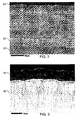
- FIG. 2 is an electron microprobe scan of a cross-section of a two layer Zn atop e-NiB coating on an Fe substrate before diffusion.
- FIG. 3 is an enlarged view of the coating of FIG. 2.
- FIG. 4 is a view of the coating of FIG. 3 after thermally induced diffusion of the coating layers.
- FIG. 5 is a zinc x-ray map of the coating of FIG. 4.
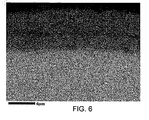
- FIG. 6 is a nickel x-ray map of the coating of FIG. 4.
- FIG. 7 is a line scan of the coating of FIG 3, showing Ni, B, and Zn contents.
- Corrosion resistance problems of e-NiB coatings are believed due to a micro-porous, columnar structure.
- a layer of zinc could be applied to the surface of the e-NiB-coated substrate via electroplating, slurry packing, or other method and then interdiffused with the NiB layer.
- a substrate may be formed.
- Exemplary substrates are titanium-based (e.g., titanium or a titanium alloy), formed by forging and/or machining.
- Exemplary substrates are for parts used in the aerospace industry (e.g., gas turbine engine compressor blades, vanes, and other components).
- a Ni-based first material is applied atop the substrate.
- the application may be directly atop or one or more intervening layers may have been applied.
- the application may be to first thickness at a first location. This may be an essentially uniform first thickness over a majority of a surface of the substrate.
- the first thickness may be substantially less than a local substrate thickness.
- An exemplary first thickness is at least 5 ⁇ m (e.g., 10-1000 ⁇ m). This thickness will be purpose dependent. For space-filling (e.g., in dimensional restoration) thicknesses of 500 ⁇ m to well in excess of 1000 ⁇ m may be appropriate. For wear and corrosion resistance, 10-100 ⁇ m may be sufficient. For mere corrosion protection, much thinner coatings are possible.
- the first material may be NiB and, as applied, may comprise 1-15% B, more narrowly, 1-10%. 1-5% may be appropriate for a low-mid-B coating and/or 9-14% for a high-B coating.
- a Zn-based second material is applied atop the first material.
- the application may, preferably, be directly atop or one or more intervening layers may have been applied (if such intermediate layers have sufficient permeability or diffusability to permit diffusion between the first and second materials).
- the application may be to second thickness at the first location. This may be an essentially uniform second thickness over a majority of a surface of the substrate. The second thickness may be less than the first thickness.
- An exemplary second thickness is 2-50 ⁇ m, more narrowly 5-20 ⁇ m.
- heating at an appropriate temperature causes one or more components of at least one of the first and/or second materials to diffuse into the other.
- This diffusion may create a layer of a ZnNi alloy.
- the heating may be performed in an ambient atmosphere or inert atmospheres. Vacuum or reactive atmospheres are also possible. Exemplary heating is to a temperature of at least 300°C for a duration of at least half an hour, more specifically 300-500°C for 0.5-3 hours.
- the diffusing may be effective to provide a degree of diffusion at least as high as degrees of diffusion obtained by heating to a temperature of 450°C for a duration of 1.5 hours or 300°C for two hours.
- the diffusion treatment may form an outer/outboard/upper region of essentially 10-25% Ni throughout a depth of at least 50% of said second thickness.
- the depth may be 100-200% of said second thickness and may span the original junction/boundary between the first and second materials.
- the Zn content may be at least 50% and the Ni content may be at least 10% in the region.
- the Zn content may be at least 70%.
- Inboard/below a shallow transition region there may be a region of the essentially unchanged first material.
- this base region may have an Ni content of at least 50% and a B content of at least 1%.
- An exemplary thickness is at least 10 ⁇ m, although there is substantial potential upside.
- the Ni content may be at least 80% and the B content may be at least 5% for a mid-high B material.
- a Cr-based third material may be applied after at least a major portion of the diffusing or may be applied before.
- An exemplary finish coating is a Cr-VI- or, more preferably, a Cr-III-based conversion coating applied after the diffusion and serving to further enhance the anti-corrosion properties of the diffused material.
- FIGS. 2 and 3 show a steel test substrate 20 after application of an e-NiB coating 22 and subsequent electroplating with a zinc coating 24.
- the exemplary NiB coating consists essentially of the nickel and boron and is fairly boron-rich, with a boron content of approximately 10% (all percentages by weight unless indicated otherwise).
- a thickness of the exemplary coating 22 is about 240 ⁇ m.
- the exemplary zinc coating 24 is electroplated zinc.
- a thickness of the exemplary coating 24 is about 10 ⁇ m.
- the exemplary substrate was placed in an air oven at 850°F (454°C) for two hours.
- the interdiffused coating is shown in FIG. 4.
- the original NiB/Zn interface can be seen as a dark line through the lighter colored layer that has dark spots peppered throughout.
- the interface is similarly visible in the x-ray maps of FIGS. 5 and 6.
- FIG. 7 shows line scan data indicating that Zn diffused about 4 ⁇ m inward into the e-NiB layer and that Ni, but not B, diffused outward throughout the Zn layer resulting in a layer that is essentially a ZnNi alloy with a near constant 18% Ni by weight. Corrosion resistance is enhanced due to the presence of sacrificial Zn (as ZnNi alloy) at or near (e.g., if a further coating layer is applied) the outer surface of the part. An intermediate transition region is relatively thin. The appearance of concentrations totaling other than 100% is due to sampling considerations and use of raw unnormalized data.
- Coating applications include those of existing e-NiB coatings on the one hand and electroplated diffused Ni/Zn coatings (e.g., of U.S. Patent 6,756,134 ) on the other hand. Relative to the latter, the present coatings' use of e-N-iB may offer the advantage of a harder and more highly conformal nickel layer than one obtained by standard electroplating.
Landscapes
- Chemical & Material Sciences (AREA)
- Engineering & Computer Science (AREA)
- Chemical Kinetics & Catalysis (AREA)
- Materials Engineering (AREA)
- Metallurgy (AREA)
- Organic Chemistry (AREA)
- Mechanical Engineering (AREA)
- General Chemical & Material Sciences (AREA)
- Electrochemistry (AREA)
- Power Engineering (AREA)
- Business, Economics & Management (AREA)
- Emergency Management (AREA)
- Other Surface Treatments For Metallic Materials (AREA)
- Chemically Coating (AREA)
- Electroplating Methods And Accessories (AREA)
- Optical Fibers, Optical Fiber Cores, And Optical Fiber Bundles (AREA)
- Insulated Conductors (AREA)
- Glass Compositions (AREA)
Abstract
Description
- The invention relates to nickel coatings. More particularly, the invention relates to electroless nickel boron plating.
-
U.S. Patent 6,756,134 discloses a zinc-diffused nickel alloy coating for corrosion and heat protection. Nickel and zinc layers are successively electroplated atop a substrate and then thermally diffused. - Separately, electroless nickel (EN) coatings have been used for purposes including wear and corrosion protection. Electroless nickel phosphorous (ENP or e-NiP) plating may be achieved with use of sodium hypophosphite as a reducing agent. Electroless nickel boron (ENB or e-NiB) plating may be achieved with use of a compound such as sodium borohydride or dimethylami-noborane as the reducing agent. E-NiB coatings may have advantageous wear resistance properties relative to e-NiP coatings, but may not provide advantageous corrosion resistance.
- A Ni-based first material is applied atop a substrate by electroless plating. A Zn-based second material is applied atop the first material. One or more components of at least one of the first and second materials are diffused into the other. This may create a ZnNi alloy layer enhancing corrosion resistance.
- Certain preferred embodiments of the invention will now be described by way of example only and with reference to the accompanying drawings in which:
- FIG. 1 is a flow chart of an exemplary coating process.
- FIG. 2 is an electron microprobe scan of a cross-section of a two layer Zn atop e-NiB coating on an Fe substrate before diffusion.
- FIG. 3 is an enlarged view of the coating of FIG. 2.
- FIG. 4 is a view of the coating of FIG. 3 after thermally induced diffusion of the coating layers.
- FIG. 5 is a zinc x-ray map of the coating of FIG. 4.
- FIG. 6 is a nickel x-ray map of the coating of FIG. 4.
- FIG. 7 is a line scan of the coating of FIG 3, showing Ni, B, and Zn contents.
- Like reference numbers and designations in the various drawings indicate like elements.
- Corrosion resistance problems of e-NiB coatings are believed due to a micro-porous, columnar structure. To enhance the corrosion resistance it was postulated that a layer of zinc could be applied to the surface of the e-NiB-coated substrate via electroplating, slurry packing, or other method and then interdiffused with the NiB layer.
- In an illustrative process outlined in FIG. 1, a substrate may be formed. Exemplary substrates are titanium-based (e.g., titanium or a titanium alloy), formed by forging and/or machining. Exemplary substrates are for parts used in the aerospace industry (e.g., gas turbine engine compressor blades, vanes, and other components). After any cleaning or other treatment, a Ni-based first material is applied atop the substrate. The application may be directly atop or one or more intervening layers may have been applied. The application may be to first thickness at a first location. This may be an essentially uniform first thickness over a majority of a surface of the substrate. The first thickness may be substantially less than a local substrate thickness. An exemplary first thickness is at least 5 µm (e.g., 10-1000µm). This thickness will be purpose dependent. For space-filling (e.g., in dimensional restoration) thicknesses of 500µm to well in excess of 1000µm may be appropriate. For wear and corrosion resistance, 10-100µm may be sufficient. For mere corrosion protection, much thinner coatings are possible. The first material may be NiB and, as applied, may comprise 1-15% B, more narrowly, 1-10%. 1-5% may be appropriate for a low-mid-B coating and/or 9-14% for a high-B coating.
- After any cleaning and/or other treatment, a Zn-based second material is applied atop the first material. The application may, preferably, be directly atop or one or more intervening layers may have been applied (if such intermediate layers have sufficient permeability or diffusability to permit diffusion between the first and second materials). The application may be to second thickness at the first location. This may be an essentially uniform second thickness over a majority of a surface of the substrate. The second thickness may be less than the first thickness. An exemplary second thickness is 2-50µm, more narrowly 5-20µm.
- After any cleaning and/or other treatment, including potential application of one or more additional layers, heating at an appropriate temperature causes one or more components of at least one of the first and/or second materials to diffuse into the other. This diffusion may create a layer of a ZnNi alloy. The heating may be performed in an ambient atmosphere or inert atmospheres. Vacuum or reactive atmospheres are also possible. Exemplary heating is to a temperature of at least 300°C for a duration of at least half an hour, more specifically 300-500°C for 0.5-3 hours. The diffusing may be effective to provide a degree of diffusion at least as high as degrees of diffusion obtained by heating to a temperature of 450°C for a duration of 1.5 hours or 300°C for two hours.
- The diffusion treatment may form an outer/outboard/upper region of essentially 10-25% Ni throughout a depth of at least 50% of said second thickness. The depth may be 100-200% of said second thickness and may span the original junction/boundary between the first and second materials. More broadly, the Zn content may be at least 50% and the Ni content may be at least 10% in the region. The Zn content may be at least 70%.
- Inboard/below a shallow transition region, there may be a region of the essentially unchanged first material. For an NiB material, this base region may have an Ni content of at least 50% and a B content of at least 1%. An exemplary thickness is at least 10µm, although there is substantial potential upside. The Ni content may be at least 80% and the B content may be at least 5% for a mid-high B material. There may be some B diffusion, but the content in the diffused region may be substantially less than that in the base region (e.g., less than one fifth).
- There may be further post-diffusion applications or treatments. If to be performed at elevated temperature, there may be an overlap with the diffusion. For example, a Cr-based third material may be applied after at least a major portion of the diffusing or may be applied before. An exemplary finish coating is a Cr-VI- or, more preferably, a Cr-III-based conversion coating applied after the diffusion and serving to further enhance the anti-corrosion properties of the diffused material.
- In a test example, only the first and second materials are applied, followed by diffusion and without additional treatments. FIGS. 2 and 3 show a
steel test substrate 20 after application of ane-NiB coating 22 and subsequent electroplating with azinc coating 24. The exemplary NiB coating consists essentially of the nickel and boron and is fairly boron-rich, with a boron content of approximately 10% (all percentages by weight unless indicated otherwise). A thickness of theexemplary coating 22 is about 240µm. Theexemplary zinc coating 24 is electroplated zinc. A thickness of theexemplary coating 24 is about 10µm. - To cause the diffusion, the exemplary substrate was placed in an air oven at 850°F (454°C) for two hours. The interdiffused coating is shown in FIG. 4. The original NiB/Zn interface can be seen as a dark line through the lighter colored layer that has dark spots peppered throughout. The interface is similarly visible in the x-ray maps of FIGS. 5 and 6.
- FIG. 7 shows line scan data indicating that Zn diffused about 4µm inward into the e-NiB layer and that Ni, but not B, diffused outward throughout the Zn layer resulting in a layer that is essentially a ZnNi alloy with a near constant 18% Ni by weight. Corrosion resistance is enhanced due to the presence of sacrificial Zn (as ZnNi alloy) at or near (e.g., if a further coating layer is applied) the outer surface of the part. An intermediate transition region is relatively thin. The appearance of concentrations totaling other than 100% is due to sampling considerations and use of raw unnormalized data.
- Coating applications include those of existing e-NiB coatings on the one hand and electroplated diffused Ni/Zn coatings (e.g., of
U.S. Patent 6,756,134 ) on the other hand. Relative to the latter, the present coatings' use of e-N-iB may offer the advantage of a harder and more highly conformal nickel layer than one obtained by standard electroplating. - One or more embodiments of the present invention have been described. Nevertheless, it will be understood that various modifications may be made without departing from the spirit and scope of the invention. For example, part operating conditions will influence any particular implementation. A wide variety of articles may use the coating and a wide variety of substrate materials may be used. These materials include metals (e.g., Ti-, Fe-, and A1-based) and non-metals (e.g., plastics and composites which may further include a basal metallic coating such as Au to permit overplating with the e-NiB). Accordingly, other embodiments are within the scope of the following claims.
Claims (22)
- A method for coating comprising:applying a Ni-based first material atop a substrate by electroless plating;applying a Zn-based second material atop the first material; anddiffusing one or more components of at least one of the first and second materials into the other.
- The method of claim 1 wherein:the first material is applied directly atop the substrate; andthe second material is applied directly atop the first material.
- The method of claim 1 or 2, wherein:essentially no additional materials are applied.
- The method of claim 1 or 2, further comprising:applying a Cr-based third material after at least a major portion of the diffusing.
- The method of claim 1 or 2, further comprising:applying a Cr-based third material before at least a major portion of the diffusing.
- The method of any preceding claim, wherein:the diffusing comprises heating to a temperature of at least 300°C for a duration of at least one half hour.
- The method of any preceding claim, wherein:the diffusing comprises heating to a temperature of 300-500°C for a duration of 0.5-3 hours.
- The method of any preceding claim, wherein:the diffusing is effective to provide a degree of diffusion at least as high as a degree of diffusion obtained by heating to a temperature of 450°C for a duration of 1.5 hours.
- The method of any of claims 1 to 7, wherein:the diffusing is effective to provide a degree of diffusion at least as high as a degree of diffusion obtained by heating to a temperature of 300°C for a duration of 2.0 hours.
- The method of any preceding claim, wherein:the substrate is Ti-based.
- The method of any preceding claim, wherein:the applying of the first material comprises electroless NiB plating.
- The method of any preceding claim, wherein:the applying of the first material comprises applying to a first thickness of 50-500µm at a first location; andthe applying of the second material comprises applying to a second thickness of 5-20µm at said first location.
- The method of any preceding claim, wherein:the applying of the first material comprises applying to an essentially uniform first thickness; andthe applying of the second material comprises applying to an essentially uniform second thickness less than the first thickness.
- The method of any preceding claim, wherein:the first material, as applied, comprises 1-10% B.
- The method of any preceding claim, wherein:the first material, as applied, comprises 2-6% B.
- The method of any preceding claim, wherein:the diffusing forms a region of essentially 10-25% Ni throughout a depth of at least 50% of said second thickness.
- A coated substrate formed by the method of any preceding claim,.
- A method for coating comprising:applying by electroless plating a Ni-based first material atop a substrate;applying a Zn-based second material atop the first material; anda step for forming a NiZn alloy from the first and second materials.
- The method of claim 18 wherein:the applying of the first material consists essentially of said electroless plating; andthe step for forming comprises heating to a temperature of at least 400°C for a duration of at least 1 hour
- A coated article comprising:a substrate; anda coating system having a compositional gradient having:a first region having:a Ni content of at least 50%;a B content of at least 1%; anda thickness of at least 10µm; anda second region outboard of the first region and having:a Zn content of at least 50%;a Ni content of at least 10%; anda thickness of at least 4µm.
- The article of claim 20 wherein:the substrate is Ti-based.
- The article of claim 20 or 21, wherein:the first region Ni content is at least 80%;the first region B content is at least 5%;the second region Zn content is at least 70%;the second region has a B content less than one fifth of the first region B content; andthe coating system has a transition region between the first and second regions having a thickness of no more than 10µm.
Applications Claiming Priority (1)
| Application Number | Priority Date | Filing Date | Title |
|---|---|---|---|
| US11/098,067 US20060222880A1 (en) | 2005-04-04 | 2005-04-04 | Nickel coating |
Publications (2)
| Publication Number | Publication Date |
|---|---|
| EP1710323A1 true EP1710323A1 (en) | 2006-10-11 |
| EP1710323B1 EP1710323B1 (en) | 2011-09-21 |
Family
ID=36264042
Family Applications (1)
| Application Number | Title | Priority Date | Filing Date |
|---|---|---|---|
| EP20060250511 Expired - Lifetime EP1710323B1 (en) | 2005-04-04 | 2006-01-31 | Nickel coating |
Country Status (8)
| Country | Link |
|---|---|
| US (2) | US20060222880A1 (en) |
| EP (1) | EP1710323B1 (en) |
| JP (1) | JP2006283191A (en) |
| KR (1) | KR100821397B1 (en) |
| CN (1) | CN1847452A (en) |
| AT (1) | ATE525492T1 (en) |
| SG (1) | SG126134A1 (en) |
| TW (1) | TW200639270A (en) |
Cited By (1)
| Publication number | Priority date | Publication date | Assignee | Title |
|---|---|---|---|---|
| CN102002691A (en) * | 2010-12-11 | 2011-04-06 | 大连大学 | Chemically plated Ni-Zn-P anode composite structure plating and preparation technique thereof |
Families Citing this family (9)
| Publication number | Priority date | Publication date | Assignee | Title |
|---|---|---|---|---|
| KR20150063172A (en) * | 2007-10-16 | 2015-06-08 | 미츠비시 마테리알 가부시키가이샤 | Process for manufacturing copper alloy wire |
| DE202013011800U1 (en) | 2013-07-24 | 2014-10-27 | GM Global Technology Operations LLC (n. d. Gesetzen des Staates Delaware) | Line-reinforced motor vehicle sheet, in particular body panel |
| EP3090075B1 (en) * | 2013-12-24 | 2018-12-05 | United Technologies Corporation | Hot corrosion-protected article and manufacture method therefor |
| US10266958B2 (en) | 2013-12-24 | 2019-04-23 | United Technologies Corporation | Hot corrosion-protected articles and manufacture methods |
| DE102014010661A1 (en) * | 2014-07-18 | 2016-01-21 | GM Global Technology Operations LLC (n. d. Ges. d. Staates Delaware) | Sheet metal and method for its treatment |
| CN104241025B (en) * | 2014-10-05 | 2016-08-24 | 青岛凯瑞电子有限公司 | A kind of multiple layer nickel plating method of relay1 case |
| DE102015014490A1 (en) | 2015-11-10 | 2017-05-11 | GM Global Technology Operations LLC (n. d. Ges. d. Staates Delaware) | Process for processing a sheet metal workpiece |
| KR101727282B1 (en) * | 2016-08-30 | 2017-04-26 | 건양테크(주) | Method for manufacturing semiconductor heat spreader improved abrasion resistant and electrical property and the semiconductor heat spreader thereby |
| US12031226B2 (en) | 2022-06-03 | 2024-07-09 | Rtx Corporation | Nickel phosphorous coating |
Citations (4)
| Publication number | Priority date | Publication date | Assignee | Title |
|---|---|---|---|---|
| EP0346265A1 (en) * | 1988-06-09 | 1989-12-13 | United Technologies Corporation | Ethylenethiourea wear resistant electroless nickel-boron coating compositions |
| US5494706A (en) * | 1993-06-29 | 1996-02-27 | Nkk Corporation | Method for producing zinc coated steel sheet |
| US6200636B1 (en) * | 1998-08-19 | 2001-03-13 | The University Of Cincinnati | Fluxing process for galvanization of steel |
| US20040058189A1 (en) * | 2002-09-23 | 2004-03-25 | Hodgens Henry M. | Zinc-diffused alloy coating for corrosion/heat protection |
Family Cites Families (9)
| Publication number | Priority date | Publication date | Assignee | Title |
|---|---|---|---|---|
| US3642457A (en) * | 1968-05-31 | 1972-02-15 | Chromalloy American Corp | Multimetal corrosion-resistant diffusion coatings |
| IT1070268B (en) * | 1976-10-19 | 1985-03-29 | Alfachimici Spa | COMPOSITION FOR THE ANELECTRIC DEPOSITION OF NICKEL-BASED ALLOYS |
| US4835066A (en) * | 1986-01-25 | 1989-05-30 | Nisshin Steel Co., Ltd. | Plated steel sheet having excellent coating performance |
| IT1225871B (en) * | 1987-03-02 | 1990-12-07 | Pirelli | METAL WIRES IMPROVEMENTS FOR ELASTOMERIC MATERIALS REINFORCEMENT |
| DE3850246T2 (en) * | 1987-10-26 | 1995-01-26 | Sumitomo Electric Industries | METAL AND COMPOSITE OF METAL WITH RUBBER. |
| US4837090A (en) * | 1987-11-05 | 1989-06-06 | Whyco Chromium Company, Inc. | Corrosion resistant coating for fasteners |
| US5246786A (en) * | 1988-10-29 | 1993-09-21 | Usui Kokusai Sangyo Kaisha Ltd. | Steel product with heat-resistant, corrosion-resistant plating layers |
| JP2517169B2 (en) * | 1990-10-09 | 1996-07-24 | 新日本製鐵株式会社 | Method for producing hot dip galvanized steel sheet |
| US5595831A (en) * | 1994-01-28 | 1997-01-21 | Clark; Eugene V. | Cadium-free corrosion protection for turbines |
-
2005
- 2005-04-04 US US11/098,067 patent/US20060222880A1/en not_active Abandoned
-
2006
- 2006-01-20 TW TW095102248A patent/TW200639270A/en unknown
- 2006-01-31 AT AT06250511T patent/ATE525492T1/en not_active IP Right Cessation
- 2006-01-31 EP EP20060250511 patent/EP1710323B1/en not_active Expired - Lifetime
- 2006-02-23 KR KR1020060017473A patent/KR100821397B1/en not_active Expired - Fee Related
- 2006-04-03 SG SG200602201A patent/SG126134A1/en unknown
- 2006-04-04 CN CNA2006100740849A patent/CN1847452A/en active Pending
- 2006-04-04 JP JP2006103305A patent/JP2006283191A/en active Pending
-
2007
- 2007-11-26 US US11/944,848 patent/US20080124542A1/en not_active Abandoned
Patent Citations (5)
| Publication number | Priority date | Publication date | Assignee | Title |
|---|---|---|---|---|
| EP0346265A1 (en) * | 1988-06-09 | 1989-12-13 | United Technologies Corporation | Ethylenethiourea wear resistant electroless nickel-boron coating compositions |
| US5494706A (en) * | 1993-06-29 | 1996-02-27 | Nkk Corporation | Method for producing zinc coated steel sheet |
| US6200636B1 (en) * | 1998-08-19 | 2001-03-13 | The University Of Cincinnati | Fluxing process for galvanization of steel |
| US20040058189A1 (en) * | 2002-09-23 | 2004-03-25 | Hodgens Henry M. | Zinc-diffused alloy coating for corrosion/heat protection |
| US6756134B2 (en) | 2002-09-23 | 2004-06-29 | United Technologies Corporation | Zinc-diffused alloy coating for corrosion/heat protection |
Cited By (2)
| Publication number | Priority date | Publication date | Assignee | Title |
|---|---|---|---|---|
| CN102002691A (en) * | 2010-12-11 | 2011-04-06 | 大连大学 | Chemically plated Ni-Zn-P anode composite structure plating and preparation technique thereof |
| CN102002691B (en) * | 2010-12-11 | 2013-07-10 | 大连大学 | Preparation technique of chemically plated Ni-Zn-P anode composite structure plating |
Also Published As
| Publication number | Publication date |
|---|---|
| US20060222880A1 (en) | 2006-10-05 |
| CN1847452A (en) | 2006-10-18 |
| KR20060106874A (en) | 2006-10-12 |
| US20080124542A1 (en) | 2008-05-29 |
| KR100821397B1 (en) | 2008-04-10 |
| JP2006283191A (en) | 2006-10-19 |
| ATE525492T1 (en) | 2011-10-15 |
| TW200639270A (en) | 2006-11-16 |
| EP1710323B1 (en) | 2011-09-21 |
| SG126134A1 (en) | 2006-10-30 |
Similar Documents
| Publication | Publication Date | Title |
|---|---|---|
| US20080124542A1 (en) | Nickel Coating | |
| CA1055326A (en) | Platinum-rhodium-containing high temperature alloy coating | |
| CN106661749B (en) | Chromium-containing coating, method for producing same and coated object | |
| CA1236351A (en) | Methods of forming a protective diffusion layer on nickel, cobalt and iron base alloys | |
| JP2023106154A (en) | Method for forming film | |
| EP2339045B1 (en) | Wear resistant device and process therefor | |
| JP2018532879A (en) | Chromium-based coating, method for producing a chrome-based coating and coated object | |
| JP2013155393A (en) | Coated member and method for producing same | |
| Vijayanand et al. | Effect of different pretreatments and heat treatment on wear properties of electroless Ni-B coatings on 7075-T6 aluminum alloy | |
| CN113574208B (en) | Object comprising a chromium-based coating on a substrate | |
| WO2008052169A1 (en) | Non-chromium containing black multi-layer coatings | |
| EP1123987A1 (en) | Repairable diffusion aluminide coatings | |
| TW200424364A (en) | Iron based part and production method for the same | |
| Suzuki et al. | Mechanical properties and metallography of aluminum matrix composites reinforced by the Cu-or Ni-plating carbon multifilament | |
| Pytel et al. | Structure of Pd-Zr and Pt-Zr modified aluminide coatings deposited by a CVD method on nickel superalloys. | |
| EP1871922B1 (en) | Coating, substrate provided with a coating and method for the application of a corrosion-resistant coating | |
| CN110423977B (en) | Gas nitriding method for aluminum material by taking chemical iron-immersion plating as pretreatment | |
| CN110408966B (en) | Diffusion synthesis of nickel alloyed Fe3Method for enhancing comprehensive performance of steel surface by Si composite layer | |
| TWI490344B (en) | Method for manufacturing roll member for molten metal bath | |
| Tue et al. | Microstructure and Oxidation Behavior of Pt and Pt–Ir Diffusion Coatings on Ni-Based Single Crystal Superalloy | |
| JPH05179420A (en) | Aluminum material having excellent wear resistance and method for producing the same | |
| Yuan et al. | The pack-cementation process of iron-aluminide coating on China low activation martensitic and 316L austenitic stainless steel | |
| EP2739760A1 (en) | Method for forming an improved thermal barrier coating (tbc), thermal-barrier-coated article and method for the repair thereof | |
| JP3220012B2 (en) | Hard plating film coated member and method of manufacturing the same | |
| TWI426138B (en) | Roller body parts for molten metal baths |
Legal Events
| Date | Code | Title | Description |
|---|---|---|---|
| PUAI | Public reference made under article 153(3) epc to a published international application that has entered the european phase |
Free format text: ORIGINAL CODE: 0009012 |
|
| AK | Designated contracting states |
Kind code of ref document: A1 Designated state(s): AT BE BG CH CY CZ DE DK EE ES FI FR GB GR HU IE IS IT LI LT LU LV MC NL PL PT RO SE SI SK TR |
|
| AX | Request for extension of the european patent |
Extension state: AL BA HR MK YU |
|
| 17P | Request for examination filed |
Effective date: 20070405 |
|
| AKX | Designation fees paid |
Designated state(s): AT BE BG CH CY CZ DE DK EE ES FI FR GB GR HU IE IS IT LI LT LU LV MC NL PL PT RO SE SI SK TR |
|
| 17Q | First examination report despatched |
Effective date: 20100401 |
|
| GRAP | Despatch of communication of intention to grant a patent |
Free format text: ORIGINAL CODE: EPIDOSNIGR1 |
|
| GRAS | Grant fee paid |
Free format text: ORIGINAL CODE: EPIDOSNIGR3 |
|
| GRAA | (expected) grant |
Free format text: ORIGINAL CODE: 0009210 |
|
| AK | Designated contracting states |
Kind code of ref document: B1 Designated state(s): AT BE BG CH CY CZ DE DK EE ES FI FR GB GR HU IE IS IT LI LT LU LV MC NL PL PT RO SE SI SK TR |
|
| REG | Reference to a national code |
Ref country code: GB Ref legal event code: FG4D |
|
| REG | Reference to a national code |
Ref country code: CH Ref legal event code: EP |
|
| REG | Reference to a national code |
Ref country code: DE Ref legal event code: R081 Ref document number: 602006024512 Country of ref document: DE Owner name: UNITED TECHNOLOGIES CORP. (N.D.GES.D. STAATES , US Free format text: FORMER OWNER: UNITED TECHNOLOGIES CORP. (N.D.GES.D. STAATES DELAWARE), HARTFORD, CONN., US |
|
| REG | Reference to a national code |
Ref country code: IE Ref legal event code: FG4D |
|
| REG | Reference to a national code |
Ref country code: DE Ref legal event code: R096 Ref document number: 602006024512 Country of ref document: DE Effective date: 20111124 |
|
| REG | Reference to a national code |
Ref country code: NL Ref legal event code: VDEP Effective date: 20110921 |
|
| PG25 | Lapsed in a contracting state [announced via postgrant information from national office to epo] |
Ref country code: FI Free format text: LAPSE BECAUSE OF FAILURE TO SUBMIT A TRANSLATION OF THE DESCRIPTION OR TO PAY THE FEE WITHIN THE PRESCRIBED TIME-LIMIT Effective date: 20110921 Ref country code: LT Free format text: LAPSE BECAUSE OF FAILURE TO SUBMIT A TRANSLATION OF THE DESCRIPTION OR TO PAY THE FEE WITHIN THE PRESCRIBED TIME-LIMIT Effective date: 20110921 Ref country code: SE Free format text: LAPSE BECAUSE OF FAILURE TO SUBMIT A TRANSLATION OF THE DESCRIPTION OR TO PAY THE FEE WITHIN THE PRESCRIBED TIME-LIMIT Effective date: 20110921 |
|
| LTIE | Lt: invalidation of european patent or patent extension |
Effective date: 20110921 |
|
| PG25 | Lapsed in a contracting state [announced via postgrant information from national office to epo] |
Ref country code: SI Free format text: LAPSE BECAUSE OF FAILURE TO SUBMIT A TRANSLATION OF THE DESCRIPTION OR TO PAY THE FEE WITHIN THE PRESCRIBED TIME-LIMIT Effective date: 20110921 Ref country code: GR Free format text: LAPSE BECAUSE OF FAILURE TO SUBMIT A TRANSLATION OF THE DESCRIPTION OR TO PAY THE FEE WITHIN THE PRESCRIBED TIME-LIMIT Effective date: 20111222 Ref country code: LV Free format text: LAPSE BECAUSE OF FAILURE TO SUBMIT A TRANSLATION OF THE DESCRIPTION OR TO PAY THE FEE WITHIN THE PRESCRIBED TIME-LIMIT Effective date: 20110921 Ref country code: AT Free format text: LAPSE BECAUSE OF FAILURE TO SUBMIT A TRANSLATION OF THE DESCRIPTION OR TO PAY THE FEE WITHIN THE PRESCRIBED TIME-LIMIT Effective date: 20110921 Ref country code: CY Free format text: LAPSE BECAUSE OF FAILURE TO SUBMIT A TRANSLATION OF THE DESCRIPTION OR TO PAY THE FEE WITHIN THE PRESCRIBED TIME-LIMIT Effective date: 20110921 |
|
| REG | Reference to a national code |
Ref country code: AT Ref legal event code: MK05 Ref document number: 525492 Country of ref document: AT Kind code of ref document: T Effective date: 20110921 |
|
| PG25 | Lapsed in a contracting state [announced via postgrant information from national office to epo] |
Ref country code: BE Free format text: LAPSE BECAUSE OF FAILURE TO SUBMIT A TRANSLATION OF THE DESCRIPTION OR TO PAY THE FEE WITHIN THE PRESCRIBED TIME-LIMIT Effective date: 20110921 |
|
| PG25 | Lapsed in a contracting state [announced via postgrant information from national office to epo] |
Ref country code: IS Free format text: LAPSE BECAUSE OF FAILURE TO SUBMIT A TRANSLATION OF THE DESCRIPTION OR TO PAY THE FEE WITHIN THE PRESCRIBED TIME-LIMIT Effective date: 20120121 Ref country code: SK Free format text: LAPSE BECAUSE OF FAILURE TO SUBMIT A TRANSLATION OF THE DESCRIPTION OR TO PAY THE FEE WITHIN THE PRESCRIBED TIME-LIMIT Effective date: 20110921 Ref country code: CZ Free format text: LAPSE BECAUSE OF FAILURE TO SUBMIT A TRANSLATION OF THE DESCRIPTION OR TO PAY THE FEE WITHIN THE PRESCRIBED TIME-LIMIT Effective date: 20110921 |
|
| PG25 | Lapsed in a contracting state [announced via postgrant information from national office to epo] |
Ref country code: PT Free format text: LAPSE BECAUSE OF FAILURE TO SUBMIT A TRANSLATION OF THE DESCRIPTION OR TO PAY THE FEE WITHIN THE PRESCRIBED TIME-LIMIT Effective date: 20120123 Ref country code: IT Free format text: LAPSE BECAUSE OF FAILURE TO SUBMIT A TRANSLATION OF THE DESCRIPTION OR TO PAY THE FEE WITHIN THE PRESCRIBED TIME-LIMIT Effective date: 20110921 Ref country code: PL Free format text: LAPSE BECAUSE OF FAILURE TO SUBMIT A TRANSLATION OF THE DESCRIPTION OR TO PAY THE FEE WITHIN THE PRESCRIBED TIME-LIMIT Effective date: 20110921 Ref country code: EE Free format text: LAPSE BECAUSE OF FAILURE TO SUBMIT A TRANSLATION OF THE DESCRIPTION OR TO PAY THE FEE WITHIN THE PRESCRIBED TIME-LIMIT Effective date: 20110921 Ref country code: RO Free format text: LAPSE BECAUSE OF FAILURE TO SUBMIT A TRANSLATION OF THE DESCRIPTION OR TO PAY THE FEE WITHIN THE PRESCRIBED TIME-LIMIT Effective date: 20110921 Ref country code: NL Free format text: LAPSE BECAUSE OF FAILURE TO SUBMIT A TRANSLATION OF THE DESCRIPTION OR TO PAY THE FEE WITHIN THE PRESCRIBED TIME-LIMIT Effective date: 20110921 |
|
| PLBE | No opposition filed within time limit |
Free format text: ORIGINAL CODE: 0009261 |
|
| STAA | Information on the status of an ep patent application or granted ep patent |
Free format text: STATUS: NO OPPOSITION FILED WITHIN TIME LIMIT |
|
| PG25 | Lapsed in a contracting state [announced via postgrant information from national office to epo] |
Ref country code: DK Free format text: LAPSE BECAUSE OF FAILURE TO SUBMIT A TRANSLATION OF THE DESCRIPTION OR TO PAY THE FEE WITHIN THE PRESCRIBED TIME-LIMIT Effective date: 20110921 |
|
| 26N | No opposition filed |
Effective date: 20120622 |
|
| PG25 | Lapsed in a contracting state [announced via postgrant information from national office to epo] |
Ref country code: MC Free format text: LAPSE BECAUSE OF NON-PAYMENT OF DUE FEES Effective date: 20120131 |
|
| REG | Reference to a national code |
Ref country code: CH Ref legal event code: PL |
|
| REG | Reference to a national code |
Ref country code: DE Ref legal event code: R097 Ref document number: 602006024512 Country of ref document: DE Effective date: 20120622 |
|
| REG | Reference to a national code |
Ref country code: FR Ref legal event code: ST Effective date: 20120928 |
|
| REG | Reference to a national code |
Ref country code: IE Ref legal event code: MM4A |
|
| PG25 | Lapsed in a contracting state [announced via postgrant information from national office to epo] |
Ref country code: LI Free format text: LAPSE BECAUSE OF NON-PAYMENT OF DUE FEES Effective date: 20120131 Ref country code: CH Free format text: LAPSE BECAUSE OF NON-PAYMENT OF DUE FEES Effective date: 20120131 |
|
| PG25 | Lapsed in a contracting state [announced via postgrant information from national office to epo] |
Ref country code: FR Free format text: LAPSE BECAUSE OF NON-PAYMENT OF DUE FEES Effective date: 20120131 |
|
| PG25 | Lapsed in a contracting state [announced via postgrant information from national office to epo] |
Ref country code: IE Free format text: LAPSE BECAUSE OF NON-PAYMENT OF DUE FEES Effective date: 20120131 |
|
| PG25 | Lapsed in a contracting state [announced via postgrant information from national office to epo] |
Ref country code: ES Free format text: LAPSE BECAUSE OF FAILURE TO SUBMIT A TRANSLATION OF THE DESCRIPTION OR TO PAY THE FEE WITHIN THE PRESCRIBED TIME-LIMIT Effective date: 20120101 |
|
| PG25 | Lapsed in a contracting state [announced via postgrant information from national office to epo] |
Ref country code: BG Free format text: LAPSE BECAUSE OF FAILURE TO SUBMIT A TRANSLATION OF THE DESCRIPTION OR TO PAY THE FEE WITHIN THE PRESCRIBED TIME-LIMIT Effective date: 20111221 |
|
| PG25 | Lapsed in a contracting state [announced via postgrant information from national office to epo] |
Ref country code: TR Free format text: LAPSE BECAUSE OF FAILURE TO SUBMIT A TRANSLATION OF THE DESCRIPTION OR TO PAY THE FEE WITHIN THE PRESCRIBED TIME-LIMIT Effective date: 20110921 |
|
| PG25 | Lapsed in a contracting state [announced via postgrant information from national office to epo] |
Ref country code: LU Free format text: LAPSE BECAUSE OF NON-PAYMENT OF DUE FEES Effective date: 20120131 |
|
| PG25 | Lapsed in a contracting state [announced via postgrant information from national office to epo] |
Ref country code: HU Free format text: LAPSE BECAUSE OF FAILURE TO SUBMIT A TRANSLATION OF THE DESCRIPTION OR TO PAY THE FEE WITHIN THE PRESCRIBED TIME-LIMIT Effective date: 20060131 |
|
| REG | Reference to a national code |
Ref country code: DE Ref legal event code: R082 Ref document number: 602006024512 Country of ref document: DE Representative=s name: SCHMITT-NILSON SCHRAUD WAIBEL WOHLFROM PATENTA, DE |
|
| REG | Reference to a national code |
Ref country code: DE Ref legal event code: R082 Ref document number: 602006024512 Country of ref document: DE Representative=s name: SCHMITT-NILSON SCHRAUD WAIBEL WOHLFROM PATENTA, DE Ref country code: DE Ref legal event code: R081 Ref document number: 602006024512 Country of ref document: DE Owner name: UNITED TECHNOLOGIES CORP. (N.D.GES.D. STAATES , US Free format text: FORMER OWNER: UNITED TECHNOLOGIES CORPORATION, HARTFORD, CONN., US |
|
| PGFP | Annual fee paid to national office [announced via postgrant information from national office to epo] |
Ref country code: DE Payment date: 20191218 Year of fee payment: 15 |
|
| REG | Reference to a national code |
Ref country code: DE Ref legal event code: R119 Ref document number: 602006024512 Country of ref document: DE |
|
| PG25 | Lapsed in a contracting state [announced via postgrant information from national office to epo] |
Ref country code: DE Free format text: LAPSE BECAUSE OF NON-PAYMENT OF DUE FEES Effective date: 20210803 |
|
| PGFP | Annual fee paid to national office [announced via postgrant information from national office to epo] |
Ref country code: GB Payment date: 20241219 Year of fee payment: 20 |
|
| REG | Reference to a national code |
Ref country code: GB Ref legal event code: PE20 Expiry date: 20260130 |