EP1709054B1 - Metallocene-based chiral phosphine or arsine ligands - Google Patents
Metallocene-based chiral phosphine or arsine ligands Download PDFInfo
- Publication number
- EP1709054B1 EP1709054B1 EP05701880A EP05701880A EP1709054B1 EP 1709054 B1 EP1709054 B1 EP 1709054B1 EP 05701880 A EP05701880 A EP 05701880A EP 05701880 A EP05701880 A EP 05701880A EP 1709054 B1 EP1709054 B1 EP 1709054B1
- Authority
- EP
- European Patent Office
- Prior art keywords
- substituted
- unsubstituted
- mmol
- chirality
- compound
- Prior art date
- Legal status (The legal status is an assumption and is not a legal conclusion. Google has not performed a legal analysis and makes no representation as to the accuracy of the status listed.)
- Expired - Lifetime
Links
- 0 C[C@@]1C(*)CCC1 Chemical compound C[C@@]1C(*)CCC1 0.000 description 15
- MYDKVEXLVBGVLK-UHFFFAOYSA-N C1C2=CC=C1C2 Chemical compound C1C2=CC=C1C2 MYDKVEXLVBGVLK-UHFFFAOYSA-N 0.000 description 1
- HNECRXXYKFCPPK-HQNRFAHOSA-N CC(C)P(C)C1=CCC=C1[C@@H](C)OC(C)=O Chemical compound CC(C)P(C)C1=CCC=C1[C@@H](C)OC(C)=O HNECRXXYKFCPPK-HQNRFAHOSA-N 0.000 description 1
- JFZPKTIPFQSYEI-UHFFFAOYSA-N CC1(CCCCC1)C=C Chemical compound CC1(CCCCC1)C=C JFZPKTIPFQSYEI-UHFFFAOYSA-N 0.000 description 1
- WIRGHFCBLQKCCU-DGCLKSJQSA-N C[C@H]([C@H](C=C1)C=C1C1=CCC=C1)N(C)C Chemical compound C[C@H]([C@H](C=C1)C=C1C1=CCC=C1)N(C)C WIRGHFCBLQKCCU-DGCLKSJQSA-N 0.000 description 1
- GCOOMLOWSGXONH-UHFFFAOYSA-N N[O]1=[O]c(ccc2c3cccc2)c3-c(c2ccccc2cc2)c2O1 Chemical compound N[O]1=[O]c(ccc2c3cccc2)c3-c(c2ccccc2cc2)c2O1 GCOOMLOWSGXONH-UHFFFAOYSA-N 0.000 description 1
Classifications
-
- B—PERFORMING OPERATIONS; TRANSPORTING
- B01—PHYSICAL OR CHEMICAL PROCESSES OR APPARATUS IN GENERAL
- B01J—CHEMICAL OR PHYSICAL PROCESSES, e.g. CATALYSIS OR COLLOID CHEMISTRY; THEIR RELEVANT APPARATUS
- B01J31/00—Catalysts comprising hydrides, coordination complexes or organic compounds
-
- B—PERFORMING OPERATIONS; TRANSPORTING
- B01—PHYSICAL OR CHEMICAL PROCESSES OR APPARATUS IN GENERAL
- B01J—CHEMICAL OR PHYSICAL PROCESSES, e.g. CATALYSIS OR COLLOID CHEMISTRY; THEIR RELEVANT APPARATUS
- B01J31/00—Catalysts comprising hydrides, coordination complexes or organic compounds
- B01J31/16—Catalysts comprising hydrides, coordination complexes or organic compounds containing coordination complexes
- B01J31/18—Catalysts comprising hydrides, coordination complexes or organic compounds containing coordination complexes containing nitrogen, phosphorus, arsenic or antimony as complexing atoms, e.g. in pyridine ligands, or in resonance therewith, e.g. in isocyanide ligands C=N-R or as complexed central atoms
- B01J31/1845—Catalysts comprising hydrides, coordination complexes or organic compounds containing coordination complexes containing nitrogen, phosphorus, arsenic or antimony as complexing atoms, e.g. in pyridine ligands, or in resonance therewith, e.g. in isocyanide ligands C=N-R or as complexed central atoms the ligands containing phosphorus
-
- B—PERFORMING OPERATIONS; TRANSPORTING
- B01—PHYSICAL OR CHEMICAL PROCESSES OR APPARATUS IN GENERAL
- B01J—CHEMICAL OR PHYSICAL PROCESSES, e.g. CATALYSIS OR COLLOID CHEMISTRY; THEIR RELEVANT APPARATUS
- B01J31/00—Catalysts comprising hydrides, coordination complexes or organic compounds
- B01J31/16—Catalysts comprising hydrides, coordination complexes or organic compounds containing coordination complexes
- B01J31/18—Catalysts comprising hydrides, coordination complexes or organic compounds containing coordination complexes containing nitrogen, phosphorus, arsenic or antimony as complexing atoms, e.g. in pyridine ligands, or in resonance therewith, e.g. in isocyanide ligands C=N-R or as complexed central atoms
- B01J31/1845—Catalysts comprising hydrides, coordination complexes or organic compounds containing coordination complexes containing nitrogen, phosphorus, arsenic or antimony as complexing atoms, e.g. in pyridine ligands, or in resonance therewith, e.g. in isocyanide ligands C=N-R or as complexed central atoms the ligands containing phosphorus
- B01J31/185—Phosphites ((RO)3P), their isomeric phosphonates (R(RO)2P=O) and RO-substitution derivatives thereof
- B01J31/186—Mono- or diamide derivatives thereof
-
- B—PERFORMING OPERATIONS; TRANSPORTING
- B01—PHYSICAL OR CHEMICAL PROCESSES OR APPARATUS IN GENERAL
- B01J—CHEMICAL OR PHYSICAL PROCESSES, e.g. CATALYSIS OR COLLOID CHEMISTRY; THEIR RELEVANT APPARATUS
- B01J31/00—Catalysts comprising hydrides, coordination complexes or organic compounds
- B01J31/16—Catalysts comprising hydrides, coordination complexes or organic compounds containing coordination complexes
- B01J31/18—Catalysts comprising hydrides, coordination complexes or organic compounds containing coordination complexes containing nitrogen, phosphorus, arsenic or antimony as complexing atoms, e.g. in pyridine ligands, or in resonance therewith, e.g. in isocyanide ligands C=N-R or as complexed central atoms
- B01J31/1845—Catalysts comprising hydrides, coordination complexes or organic compounds containing coordination complexes containing nitrogen, phosphorus, arsenic or antimony as complexing atoms, e.g. in pyridine ligands, or in resonance therewith, e.g. in isocyanide ligands C=N-R or as complexed central atoms the ligands containing phosphorus
- B01J31/1875—Phosphinites (R2P(OR), their isomeric phosphine oxides (R3P=O) and RO-substitution derivatives thereof)
- B01J31/188—Amide derivatives thereof
-
- B—PERFORMING OPERATIONS; TRANSPORTING
- B01—PHYSICAL OR CHEMICAL PROCESSES OR APPARATUS IN GENERAL
- B01J—CHEMICAL OR PHYSICAL PROCESSES, e.g. CATALYSIS OR COLLOID CHEMISTRY; THEIR RELEVANT APPARATUS
- B01J31/00—Catalysts comprising hydrides, coordination complexes or organic compounds
- B01J31/16—Catalysts comprising hydrides, coordination complexes or organic compounds containing coordination complexes
- B01J31/18—Catalysts comprising hydrides, coordination complexes or organic compounds containing coordination complexes containing nitrogen, phosphorus, arsenic or antimony as complexing atoms, e.g. in pyridine ligands, or in resonance therewith, e.g. in isocyanide ligands C=N-R or as complexed central atoms
- B01J31/189—Catalysts comprising hydrides, coordination complexes or organic compounds containing coordination complexes containing nitrogen, phosphorus, arsenic or antimony as complexing atoms, e.g. in pyridine ligands, or in resonance therewith, e.g. in isocyanide ligands C=N-R or as complexed central atoms containing both nitrogen and phosphorus as complexing atoms, including e.g. phosphino moieties, in one at least bidentate or bridging ligand
-
- B—PERFORMING OPERATIONS; TRANSPORTING
- B01—PHYSICAL OR CHEMICAL PROCESSES OR APPARATUS IN GENERAL
- B01J—CHEMICAL OR PHYSICAL PROCESSES, e.g. CATALYSIS OR COLLOID CHEMISTRY; THEIR RELEVANT APPARATUS
- B01J31/00—Catalysts comprising hydrides, coordination complexes or organic compounds
- B01J31/16—Catalysts comprising hydrides, coordination complexes or organic compounds containing coordination complexes
- B01J31/18—Catalysts comprising hydrides, coordination complexes or organic compounds containing coordination complexes containing nitrogen, phosphorus, arsenic or antimony as complexing atoms, e.g. in pyridine ligands, or in resonance therewith, e.g. in isocyanide ligands C=N-R or as complexed central atoms
- B01J31/1895—Catalysts comprising hydrides, coordination complexes or organic compounds containing coordination complexes containing nitrogen, phosphorus, arsenic or antimony as complexing atoms, e.g. in pyridine ligands, or in resonance therewith, e.g. in isocyanide ligands C=N-R or as complexed central atoms the ligands containing arsenic or antimony
-
- B—PERFORMING OPERATIONS; TRANSPORTING
- B01—PHYSICAL OR CHEMICAL PROCESSES OR APPARATUS IN GENERAL
- B01J—CHEMICAL OR PHYSICAL PROCESSES, e.g. CATALYSIS OR COLLOID CHEMISTRY; THEIR RELEVANT APPARATUS
- B01J31/00—Catalysts comprising hydrides, coordination complexes or organic compounds
- B01J31/16—Catalysts comprising hydrides, coordination complexes or organic compounds containing coordination complexes
- B01J31/22—Organic complexes
- B01J31/2282—Unsaturated compounds used as ligands
- B01J31/2295—Cyclic compounds, e.g. cyclopentadienyls
-
- B—PERFORMING OPERATIONS; TRANSPORTING
- B01—PHYSICAL OR CHEMICAL PROCESSES OR APPARATUS IN GENERAL
- B01J—CHEMICAL OR PHYSICAL PROCESSES, e.g. CATALYSIS OR COLLOID CHEMISTRY; THEIR RELEVANT APPARATUS
- B01J31/00—Catalysts comprising hydrides, coordination complexes or organic compounds
- B01J31/16—Catalysts comprising hydrides, coordination complexes or organic compounds containing coordination complexes
- B01J31/24—Phosphines, i.e. phosphorus bonded to only carbon atoms, or to both carbon and hydrogen atoms, including e.g. sp2-hybridised phosphorus compounds such as phosphabenzene, phosphole or anionic phospholide ligands
- B01J31/2404—Cyclic ligands, including e.g. non-condensed polycyclic ligands, the phosphine-P atom being a ring member or a substituent on the ring
-
- B—PERFORMING OPERATIONS; TRANSPORTING
- B01—PHYSICAL OR CHEMICAL PROCESSES OR APPARATUS IN GENERAL
- B01J—CHEMICAL OR PHYSICAL PROCESSES, e.g. CATALYSIS OR COLLOID CHEMISTRY; THEIR RELEVANT APPARATUS
- B01J31/00—Catalysts comprising hydrides, coordination complexes or organic compounds
- B01J31/16—Catalysts comprising hydrides, coordination complexes or organic compounds containing coordination complexes
- B01J31/24—Phosphines, i.e. phosphorus bonded to only carbon atoms, or to both carbon and hydrogen atoms, including e.g. sp2-hybridised phosphorus compounds such as phosphabenzene, phosphole or anionic phospholide ligands
- B01J31/2404—Cyclic ligands, including e.g. non-condensed polycyclic ligands, the phosphine-P atom being a ring member or a substituent on the ring
- B01J31/2409—Cyclic ligands, including e.g. non-condensed polycyclic ligands, the phosphine-P atom being a ring member or a substituent on the ring with more than one complexing phosphine-P atom
-
- B—PERFORMING OPERATIONS; TRANSPORTING
- B01—PHYSICAL OR CHEMICAL PROCESSES OR APPARATUS IN GENERAL
- B01J—CHEMICAL OR PHYSICAL PROCESSES, e.g. CATALYSIS OR COLLOID CHEMISTRY; THEIR RELEVANT APPARATUS
- B01J31/00—Catalysts comprising hydrides, coordination complexes or organic compounds
- B01J31/16—Catalysts comprising hydrides, coordination complexes or organic compounds containing coordination complexes
- B01J31/24—Phosphines, i.e. phosphorus bonded to only carbon atoms, or to both carbon and hydrogen atoms, including e.g. sp2-hybridised phosphorus compounds such as phosphabenzene, phosphole or anionic phospholide ligands
- B01J31/2404—Cyclic ligands, including e.g. non-condensed polycyclic ligands, the phosphine-P atom being a ring member or a substituent on the ring
- B01J31/2442—Cyclic ligands, including e.g. non-condensed polycyclic ligands, the phosphine-P atom being a ring member or a substituent on the ring comprising condensed ring systems
- B01J31/2447—Cyclic ligands, including e.g. non-condensed polycyclic ligands, the phosphine-P atom being a ring member or a substituent on the ring comprising condensed ring systems and phosphine-P atoms as substituents on a ring of the condensed system or on a further attached ring
- B01J31/2452—Cyclic ligands, including e.g. non-condensed polycyclic ligands, the phosphine-P atom being a ring member or a substituent on the ring comprising condensed ring systems and phosphine-P atoms as substituents on a ring of the condensed system or on a further attached ring with more than one complexing phosphine-P atom
-
- B—PERFORMING OPERATIONS; TRANSPORTING
- B01—PHYSICAL OR CHEMICAL PROCESSES OR APPARATUS IN GENERAL
- B01J—CHEMICAL OR PHYSICAL PROCESSES, e.g. CATALYSIS OR COLLOID CHEMISTRY; THEIR RELEVANT APPARATUS
- B01J31/00—Catalysts comprising hydrides, coordination complexes or organic compounds
- B01J31/16—Catalysts comprising hydrides, coordination complexes or organic compounds containing coordination complexes
- B01J31/24—Phosphines, i.e. phosphorus bonded to only carbon atoms, or to both carbon and hydrogen atoms, including e.g. sp2-hybridised phosphorus compounds such as phosphabenzene, phosphole or anionic phospholide ligands
- B01J31/2404—Cyclic ligands, including e.g. non-condensed polycyclic ligands, the phosphine-P atom being a ring member or a substituent on the ring
- B01J31/2442—Cyclic ligands, including e.g. non-condensed polycyclic ligands, the phosphine-P atom being a ring member or a substituent on the ring comprising condensed ring systems
- B01J31/2447—Cyclic ligands, including e.g. non-condensed polycyclic ligands, the phosphine-P atom being a ring member or a substituent on the ring comprising condensed ring systems and phosphine-P atoms as substituents on a ring of the condensed system or on a further attached ring
- B01J31/2452—Cyclic ligands, including e.g. non-condensed polycyclic ligands, the phosphine-P atom being a ring member or a substituent on the ring comprising condensed ring systems and phosphine-P atoms as substituents on a ring of the condensed system or on a further attached ring with more than one complexing phosphine-P atom
- B01J31/2457—Cyclic ligands, including e.g. non-condensed polycyclic ligands, the phosphine-P atom being a ring member or a substituent on the ring comprising condensed ring systems and phosphine-P atoms as substituents on a ring of the condensed system or on a further attached ring with more than one complexing phosphine-P atom comprising aliphatic or saturated rings, e.g. Xantphos
-
- B—PERFORMING OPERATIONS; TRANSPORTING
- B01—PHYSICAL OR CHEMICAL PROCESSES OR APPARATUS IN GENERAL
- B01J—CHEMICAL OR PHYSICAL PROCESSES, e.g. CATALYSIS OR COLLOID CHEMISTRY; THEIR RELEVANT APPARATUS
- B01J31/00—Catalysts comprising hydrides, coordination complexes or organic compounds
- B01J31/16—Catalysts comprising hydrides, coordination complexes or organic compounds containing coordination complexes
- B01J31/24—Phosphines, i.e. phosphorus bonded to only carbon atoms, or to both carbon and hydrogen atoms, including e.g. sp2-hybridised phosphorus compounds such as phosphabenzene, phosphole or anionic phospholide ligands
- B01J31/2495—Ligands comprising a phosphine-P atom and one or more further complexing phosphorus atoms covered by groups B01J31/1845 - B01J31/1885, e.g. phosphine/phosphinate or phospholyl/phosphonate ligands
-
- C—CHEMISTRY; METALLURGY
- C07—ORGANIC CHEMISTRY
- C07F—ACYCLIC, CARBOCYCLIC OR HETEROCYCLIC COMPOUNDS CONTAINING ELEMENTS OTHER THAN CARBON, HYDROGEN, HALOGEN, OXYGEN, NITROGEN, SULFUR, SELENIUM OR TELLURIUM
- C07F17/00—Metallocenes
-
- C—CHEMISTRY; METALLURGY
- C07—ORGANIC CHEMISTRY
- C07F—ACYCLIC, CARBOCYCLIC OR HETEROCYCLIC COMPOUNDS CONTAINING ELEMENTS OTHER THAN CARBON, HYDROGEN, HALOGEN, OXYGEN, NITROGEN, SULFUR, SELENIUM OR TELLURIUM
- C07F17/00—Metallocenes
- C07F17/02—Metallocenes of metals of Groups 8, 9 or 10 of the Periodic Table
-
- C—CHEMISTRY; METALLURGY
- C07—ORGANIC CHEMISTRY
- C07F—ACYCLIC, CARBOCYCLIC OR HETEROCYCLIC COMPOUNDS CONTAINING ELEMENTS OTHER THAN CARBON, HYDROGEN, HALOGEN, OXYGEN, NITROGEN, SULFUR, SELENIUM OR TELLURIUM
- C07F9/00—Compounds containing elements of Groups 5 or 15 of the Periodic Table
- C07F9/02—Phosphorus compounds
- C07F9/28—Phosphorus compounds with one or more P—C bonds
- C07F9/48—Phosphonous acids [RP(OH)2] including [RHP(=O)(OH)]; Thiophosphonous acids including [RP(SH)2], [RHP(=S)(SH)]; Derivatives thereof
-
- B—PERFORMING OPERATIONS; TRANSPORTING
- B01—PHYSICAL OR CHEMICAL PROCESSES OR APPARATUS IN GENERAL
- B01J—CHEMICAL OR PHYSICAL PROCESSES, e.g. CATALYSIS OR COLLOID CHEMISTRY; THEIR RELEVANT APPARATUS
- B01J2231/00—Catalytic reactions performed with catalysts classified in B01J31/00
- B01J2231/60—Reduction reactions, e.g. hydrogenation
- B01J2231/64—Reductions in general of organic substrates, e.g. hydride reductions or hydrogenations
- B01J2231/641—Hydrogenation of organic substrates, i.e. H2 or H-transfer hydrogenations, e.g. Fischer-Tropsch processes
- B01J2231/645—Hydrogenation of organic substrates, i.e. H2 or H-transfer hydrogenations, e.g. Fischer-Tropsch processes of C=C or C-C triple bonds
-
- B—PERFORMING OPERATIONS; TRANSPORTING
- B01—PHYSICAL OR CHEMICAL PROCESSES OR APPARATUS IN GENERAL
- B01J—CHEMICAL OR PHYSICAL PROCESSES, e.g. CATALYSIS OR COLLOID CHEMISTRY; THEIR RELEVANT APPARATUS
- B01J2531/00—Additional information regarding catalytic systems classified in B01J31/00
- B01J2531/02—Compositional aspects of complexes used, e.g. polynuclearity
- B01J2531/0202—Polynuclearity
- B01J2531/0205—Bi- or polynuclear complexes, i.e. comprising two or more metal coordination centres, without metal-metal bonds, e.g. Cp(Lx)Zr-imidazole-Zr(Lx)Cp
-
- B—PERFORMING OPERATIONS; TRANSPORTING
- B01—PHYSICAL OR CHEMICAL PROCESSES OR APPARATUS IN GENERAL
- B01J—CHEMICAL OR PHYSICAL PROCESSES, e.g. CATALYSIS OR COLLOID CHEMISTRY; THEIR RELEVANT APPARATUS
- B01J2531/00—Additional information regarding catalytic systems classified in B01J31/00
- B01J2531/80—Complexes comprising metals of Group VIII as the central metal
- B01J2531/82—Metals of the platinum group
-
- B—PERFORMING OPERATIONS; TRANSPORTING
- B01—PHYSICAL OR CHEMICAL PROCESSES OR APPARATUS IN GENERAL
- B01J—CHEMICAL OR PHYSICAL PROCESSES, e.g. CATALYSIS OR COLLOID CHEMISTRY; THEIR RELEVANT APPARATUS
- B01J2531/00—Additional information regarding catalytic systems classified in B01J31/00
- B01J2531/80—Complexes comprising metals of Group VIII as the central metal
- B01J2531/82—Metals of the platinum group
- B01J2531/822—Rhodium
-
- B—PERFORMING OPERATIONS; TRANSPORTING
- B01—PHYSICAL OR CHEMICAL PROCESSES OR APPARATUS IN GENERAL
- B01J—CHEMICAL OR PHYSICAL PROCESSES, e.g. CATALYSIS OR COLLOID CHEMISTRY; THEIR RELEVANT APPARATUS
- B01J2531/00—Additional information regarding catalytic systems classified in B01J31/00
- B01J2531/80—Complexes comprising metals of Group VIII as the central metal
- B01J2531/84—Metals of the iron group
- B01J2531/842—Iron
-
- B—PERFORMING OPERATIONS; TRANSPORTING
- B01—PHYSICAL OR CHEMICAL PROCESSES OR APPARATUS IN GENERAL
- B01J—CHEMICAL OR PHYSICAL PROCESSES, e.g. CATALYSIS OR COLLOID CHEMISTRY; THEIR RELEVANT APPARATUS
- B01J2531/00—Additional information regarding catalytic systems classified in B01J31/00
- B01J2531/80—Complexes comprising metals of Group VIII as the central metal
- B01J2531/84—Metals of the iron group
- B01J2531/847—Nickel
Definitions
- This invention relates to novel metallocene-based phosphine ligands incorporating up to four elements of chirality, planar chirality, chirality at phosphorus, and optionally chirality at carbon and axial chirality, and methods for their preparation.
- this invention relates to the metal-ligand complexes that can be used as catalysts or precatalysts for asymmetric transformation reactions to generate products of high enantiomeric excess.
- structured arsines are also within the scope of this invention.
- Ferrocene as a backbone for diphosphine ligands was introduced by Kumada and Hayashi based on the pioneering work of Ugi related to the synthesis of enantiopure substituted metallocenes 1 .
- a number of these ligands are shown below: Ppfa as well as bppfa and bppfoh proved to be effective ligands for the catalysis of a variety of asymmetric transformations. From this starting point, many chiral ferrocene-based bisphosphine ligands with a range of structural variation have been developed in the last few years.
- Josiphos-type ligands are in widespread commercial use, having been found effective for Rh-catalyzed hydrogenation of ⁇ -acetamidocinnamate, dimethyl itaconate, and ⁇ -ketoesters. Because the two phosphine groups are introduced into the ligand in consecutive steps with high yields, a variety of ligands are available with widely differing steric and electronic properties. The ligands have already been applied in three production processes 3 , several pilot processes and many other syntheses.
- PPF-tBu2 a Josiphos type ligand with a di-(tert-butyl)phosphino group
- XyliPhos is another notable example.
- Bophoz 6 is a combination of a phosphine and an aminophosphine and is prepared in 3 steps from ppfa with high overall yields.
- the ligand is air stable and effective for the hydrogenation of enamides, itaconates and ⁇ -keto acid derivatives. As observed for several ligands forming seven-membered chelates, high activities can be reached and TONs up to 10,000 have been claimed. The full scope of this modular ligand class has not yet been explored.
- Taniaphos A class of non-C 2 -symmetrical, ferrocene-based 1,5-diphosphine ligands, Taniaphos, has been developed by Knochel 7,8 . Compared to the Josiphos ligands, Taniaphos has an additional phenyl ring inserted at the side chain of the Ugi amine. Taniaphos gave excellent results in Rh- and Ru-catalyzed asymmetric hydrogenation. The configuration of ⁇ -position of Taniaphos plays an important role in the enantioselectivities and activities. The Taniaphos 1b with ⁇ S configuration leads to higher enantioselectivities and activities than 1a with ⁇ R configuration in a wide range of asymmetric transformations.
- Mandyphos is a bidentate version of ppfa with C 2 symmetry, where in addition to the PPh 2 moieties, R and R' can be used for fine tuning the functionality of the ligand 10 .
- the scope of this ligand family has not yet been fully explored, but preliminary results indicate high enantioselectivities for the Rh-catalyzed hydrogenation of enamides, itaconates and enol acetates.
- the TRAP ligands developed by Ito 11 form 9-membered metallocycles. However, it is not clear whether the cis-isomer, present in small amounts, or the major trans-isomer is responsible for the catalytic activity. Up to now only a few different PR2 fragments have been tested, but it is clear that the choice of R strongly affects the catalytic performance.
- the Rh complexes work best at very low pressures of 0.5 ⁇ 1 bar and effectively reduces indole-derivatives, enamides and itaconic acid derivatives.
- Kang 12 reported the C 2 -symmetry FerroPHOS with only planar chirality. FerroPHOS ligands are air-stable and are very efficient for the asymmetric hydrogenation of various dehydroamino acid derivitives (up to 99% ee).
- JAFAPhos Another C 2 -symmetry planar chiral diphosphine, JAFAPhos, has been developed by Jendralla 13 . JAFAPhos gave excellent results in asymmetric hydrogenation, allylic alkylation, Grignard cross coupling and aldol reactions.
- Kagan 14 reported plane chiral ferrocene-based bisphosphorus ligands 2 and 3, and up to 95% ee's have been obtained in asymmetric hydrogenation of dimethyl itaconate using these ligands as catalyst.
- diphosphine ligands exhibit chirality only at the phosphorus atoms:
- FerroTANE chiral 1,1'-bis(phosphetano) ferrocenes
- Mezzetti 18 and van Leeuwen 19 have independently reported P-chiral ferrocenyl bisphosphines 4a and 4b. These two ligands have shown excellent enantioselectivities (up to 99% ee) for asymmetric hydrogenation of ⁇ -dehydroamino acid derivatives.
- Zhang has reported a 1,1'-bis(Phospholanyl) ferrocene ligand 5 with ketal substitutes at the 3 and 4 positions. 20 The ligand has shown excellent enantioselectivities in hydrogenation of ⁇ -dehydroamino acid derivatives. The ketal groups of the ligand are important for achieving the high enantioselectivity, since the corresponding ligand without ketal groups only provides moderate ee's. Zhang has also developed a 1,1'-bis(dinaphthophosphepinyl) ferrocene ligand, f-binaphane, which has been successfully applied in the Ir-catalyzed hydrogenation of acyclic aryl imines. 21
- Reetz has developed a binaphthol-derived ferrocene-based bisphosphonite ligand 6 22 , which has shown excellent reactivities and enantioselectivities in Rh-catalyzed hydrogenation of itaconates and ⁇ -dehydroamino acid derivatives.
- Another class of known ligands exhibits both planar and phosphorus chirality:
- Van Leeuwen has reported ferrocene-based bisphosphines combining planar and phosphorus chirality 4a and 4b 23 . These two ligands have shown excellent enantioselectivities (up to 99% ee) for asymmetric allylic alkylations.
- bisphosphine ligands incorporating up to three elements of chirality, planar chirality, chirality at phosphorus, and chirality at carbon for use in enantioselective catalysis. It would also be advantageous to design ligands that exhibit three different types of chirality; carbon, planar and phosphorus.
- a metallocene-based phosphine having up to three or four elements of chirality; planar chirality, chirality at phosphorus, and optionally chirality at carbon and axial chirality.
- the invention also provides a metallocene-based arsine having up to three elements of chirality; planar chirality, chirality at arsenic, and optionally chirality at carbon.
- a metallocene-based arsine having up to three elements of chirality; planar chirality, chirality at arsenic, and optionally chirality at carbon.
- ferrocene based ligands are preferred, other suitable metals may be used in the ligands of the invention, and hence reference is made herein to metallocenes generally.
- the invention further provides a metallocene-based diphosphine having planar, phosphorus and carbon chirality.
- Ligands according to the invention have particular advantages over prior art ligands because the provision of up to three or four chiralities allows the designer of a ligand greater scope than has hitherto been the case to design ligands for a particular purpose.
- Preferred ligands in accordance with the invention are selected from ligands having Formula (I), (II) or (III): wherein W is phosphorus or arsenic; M is a metal; R 1 and R 2 are different from each other, and are independently selected from from substituted and unsubstituted, branched- and straight-chain alkyl, alkoxy, alkylamino, substituted and unsubstituted cycloalkyl, substituted and unsubstituted cycloalkoxy, substituted and unsubstituted cycloalkylamino, substituted and unsubstituted carbocyclic aryl, substituted and unsubstituted carbocyclic aryloxy, substituted and unsubstituted heteroaryl, substituted and unsubstituted heteroaryloxy, substituted and unsubstituted carbocyclic arylamino and substituted and unsubstituted heteroarylamino, wherein the or each heteroatom
- R 18 ) 2 O
- the invention also relates to the enantiomers of the ligands described above, the enantiomers having the Formulae (IV), (V) and (VI): wherein each of W, M, R 1-19 , Q, G, n, m, n' and m' have the same meanings as assigned above, with chirality changes in the substituent groups where required.
- phosphorus chirality may enhance the chiral discrimination produced by the catalyst when a matching among the planar chirality, carbon chirality, axial chirality and the chirality of phosphorus can be achieved.
- Examples 59 to 67 below demonstrate that a matching catalyst may give high ee and a mismatching one may give low ee.
- transition metal complex containing transition metal coordinated to the ligand of the invention.
- the metal is preferably a Group Vlb or a Group VIII metal, especially rhodium, ruthenium, iridium, palladium, platinum and nickel.
- Synthesis of ferrocene-based phosphorus chiral phosphines may be effected with the use of a suitable chiral ortho -directing group, for example in accordance with the following schemes: (Similar schemes may be used to synthesise the corresponding arsines, and other metallocenes.)
- the invention provides a method for preparing a phosphine ligand chiral at phosphorus comprising providing a metallocene-based substrate having a chiral or achiral directing substituent on one or both rings, and subjecting the substituted metallocene to an ortho-lithiation step before subsequently converting the ortho-lithiated substrate to a phosphine chiral at phosphorus.
- one such method comprises providing a compound of the Formula (X) (optionally substituted on one or both cyclopentadiene rings with R 3 n (top ring) and/or R 4 m (bottom ring)): wherein X* is chiral directing group, and is preferably selected from the group consisting of : wherein R, R a and R b are same or different, and are independently selected from hydrogen, substituted and unsubstituted, branched- and straight-chain alkyl, substituted and unsubstituted cycloalkyl, substituted and unsubstituted carbocyclic aryl, and substituted and unsubstituted heteroaryl wherein the or each heteroatom is independently selected from sulphur, nitrogen, and oxygen; ortho-lithiating the substrate; reacting the ortholithiated substrate with an R 1 substituted phosphine or arsine, and then with an R 2 -bearing Grignard reagent or organolithium compound, and converting
- One particularly preferred X* group is
- the ortho-lithiation step is preferably a mono-ortho-lithiation step using n-butyllithium, sec-butyllithium or tert- butyllithium.
- the resulting monolithium compound is preferably reacted in situ with a dichlorophosphine of the formula R 1 PCl 2 followed by reacting with an organometallic reagent of the formula R 2 Z, wherein R 1 and R 2 are as defined above; Z is Li or MgY wherein Y is a halide.
- the synthesis preferably proceeds by converting compound (XI) to compound XII, XIII, or XIV: wherein R 19 is an acyl group, and R 1 , R 2 are as previously defined; and then:
- Compound XVI may be reacted with a halophosphine of the formula R 6 R 7 PY wherein R 6 , R 7 are, as previously defined, and Y is chlorine, bromine or iodine, to obtain compound XXIII:
- compound XVI may be reacted with an acid derivative of the formula R 10 COY wherein R 10 is, as previously defined, and Y is a halide, a sulphate, an imidazole, R 10 COO- or hydrogen, to obtain compound XXIV:
- compound XVI (in which R 9 is hydrogen) may be reacted with an aldehyde of the formula OHC-R*-CHO or OHC-R-CHO wherein R* and R are, as previously defined, to obtain the compounds having Formulae XXV and XXVI:
- compound XVI may be reacted with an acid derivative of the formula YOC-R*-COY and YOC-R-COY wherein R*, R and Y are, as previously defined, to obtain the compounds having Formulae XXVII and XXVIII:
- the invention provides a method for preparing a chiral diphosphine ligand comprising a metallocene-based substrate having an achiral directing substituent on one or both rings, and subjecting the substituted metallocene to an enantioselective ortho-lithiation step before subsequently converting the ortho-lithiated substrate to phosphorus chiral phosphines.
- one method for preparing the ligand of Formula (I) or (III) comprises providing a compound of the formula XXXVII: wherein X is an achiral directing group, and is preferably selected from: and subjecting the compound to enantioselective mono-ortho-lithiation using n-butyllithium or sec-butyllithium or tert- butyllithium in the presence of a homochiral tertiary amine, and reacting the resulting chiral monolithium compound in situ with a dichlorophosphine of the formula R 1 PCl 2 followed by reacting with an organometallic reagent of the formula R 2 M, wherein R 1 and R 2 are as defined hereinabove; M is Li or MgX wherein X is a halide, to obtain phosphorus chiral compound having formula XXXVIII: and converting compound XXXVIII to compound (I) or(III).
- One method according to the invention for preparing the ligand of Formula (II) comprises providing a compound of the Formula XXXIX: wherein X* is as previously defined; and subjecting the compound to bis-ortholithiation using n-butyllithium, sec-butyllithium or tert- butyllithium, and reacting the resulting bislithium compound in situ with a dichlorophosphine of the formula R 1 PCl 2 followed by reacting with an organometallic reagent of the formula R 2 Z, wherein R 1 and R 2 are as previously defined; Z is Li or MgY wherein Y is a halide, to obtain a phosphorus chiral compound having formula XXXX: and converting compound XXXX to compound (II).
- Methy 2-acetamidoacrylate (143 mg, 1.0 mmol) was hydrogenated according to General Procedure under 50psi of hydrogen in THF using bis(1,5-cyclooctadiene)rhodium trifluoromethanesulfonate (2.3 mg; 5 umol; 0.01 equiv) and ligand (R c , S Fe , S P )- 23 (3.8 mg; 6 umol; 0.012 equiv) for 2.5 hour to afford 18.6% conversion to amino acid derivative with 88.6% ee as determined by chiral GC analysis.
- Methy 2-acetamidoacrylate (143 mg, 1.0 mmol) was hydrogenated according to General Procedure under 50psi of hydrogen in THF using bis(1,5-cyclooctadiene)rhodium trifluoromethanesulfonate (2.3 mg; 5 umol; 0.01 equiv) and ligand (R c , S Fe , S P )- 24 (4.0 mg; 6 umol; 0.012 equiv) for 2.5 hour to afford 100% conversion to amino acid derivative with 98.3% ee as determined by chiral GC analysis.
- Methy 2-acetamidoacrylate (143 mg, 1.0 mmol) was hydrogenated according to General Procedure under 50psi of hydrogen in THF using bis(1,5-cyclooctadiene)rhodium trifluoromethanesulfonate (2.3 mg; 5 umol; 0.01 equiv) and ligand (R c , S Fe , R P )- 25 (4.0 mg; 6 umol; 0.012 equiv) for 2.5 hour to afford 100% conversion to amino acid derivative with 92.3% ee as determined by chiral GC analysis.
- Methy 2-acetamidoacrylate (143 mg, 1.0 mmol) was hydrogenated according to General Procedure under 50psi of hydrogen in MeOH using bis(1,5-cyclooctadiene)rhodium trifluoromethanesulfonate (2.3 mg; 5 umol; 0.01 equiv) and ligand (R c , S Fe , S P )- 24 (4.0 mg; 6 mumol; 0.012 equiv) for 2.5 hour to afford 100% conversion to amino acid derivative with >99% ee as determined by chiral GC analysis.
- Methy 2-acetamidoacrylate (143 mg, 1.0 mmol) was hydrogenated according to General Procedure under 50psi of hydrogen in THF using bis(1,5-cyclooctadiene)rhodium trifluoromethanesulfonate (2.3 mg; 5 umol; 0.01 equiv) and ligand (R c , S Fe )-BoaPhoz (3.7 mg; 6 umol; 0.012 equiv) for 2.5 hour to afford 99% conversion to amino acid derivative with 94.5% ee as determined by chiral GC analysis.
- Methy 2-acetamidocinnamate (219 mg, 1.0 mmol) was hydrogenated according to General Procedure under 100 psi of hydrogen in THF using bis(1,5-cyclooctadiene)rhodium trifluoromethanesulfonate (2.3 mg; 5 umol; 0.01 equiv) and ligand (R c , S Fe , S P )- 23 (3.8 mg; 6 umol; 0.012 equiv) for 2 hour to afford 100% conversion to amino acid derivative with 88.0% ee as determined by chiral GC analysis.
- Methy 2-acetamidocinnamate (219 mg, 1.0 mmol) was hydrogenated according to General Procedure under 100 psi of hydrogen in THF using bis(1,5-cyclooctadiene)rhodium trifluoromethanesulfonate (2.3 mg; 5 umol; 0.01 equiv) and ligand (R c , S Fe , S P )- 24 (4.0 mg; 6 mumol; 0.012 equiv) for 2 hour to afford 100% conversion to amino acid derivative with 97.0% ee as determined by chiral GC analysis.
- Methy 2-acetamidocinnamate (219 mg, 1.0 mmol) was hydrogenated according to General Procedure under 100 psi of hydrogen in THF using bis(1,5-cyclooctadiene)rhodium trifluoromethanesulfonate (2.3 mg; 5 umol; 0.01 equiv) and ligand (R c , S Fe , R P )- 25 (4.0 mg; 6 mumol; 0.012 equiv) for 2 hour to afford 100% conversion to amino acid derivative with 92.4% ee as determined by chiral GC analysis.
- Methy 2-acetamidocinnamate (219 mg, 1.0 mmol) was hydrogenated according to General Procedure under 100 psi of hydrogen in THF using bis(1,5-cyclooctadiene)rhodium trifluoromethanesulfonate (2.3 mg; 5 umol; 0.01 equiv) and ligand (R c , S Fe )-BoaPhoz (3.7 mg; 6 umol; 0.012 equiv) for 2 hour to afford . 100% conversion to amino acid derivative with 95.7% ee as determined by chiral GC analysis.
Landscapes
- Chemical & Material Sciences (AREA)
- Organic Chemistry (AREA)
- Engineering & Computer Science (AREA)
- Chemical Kinetics & Catalysis (AREA)
- Materials Engineering (AREA)
- Inorganic Chemistry (AREA)
- Biochemistry (AREA)
- Molecular Biology (AREA)
- General Health & Medical Sciences (AREA)
- Life Sciences & Earth Sciences (AREA)
- Health & Medical Sciences (AREA)
- Catalysts (AREA)
- Organic Low-Molecular-Weight Compounds And Preparation Thereof (AREA)
- Led Devices (AREA)
- Led Device Packages (AREA)
- Control Of Eletrric Generators (AREA)
Abstract
Description
- This invention relates to novel metallocene-based phosphine ligands incorporating up to four elements of chirality, planar chirality, chirality at phosphorus, and optionally chirality at carbon and axial chirality, and methods for their preparation. In addition, this invention relates to the metal-ligand complexes that can be used as catalysts or precatalysts for asymmetric transformation reactions to generate products of high enantiomeric excess. Similarly structured arsines are also within the scope of this invention.
- Ferrocene as a backbone for diphosphine ligands was introduced by Kumada and Hayashi based on the pioneering work of Ugi related to the synthesis of enantiopure substituted metallocenes1. A number of these ligands are shown below:

- Certain types of known ligands exhibit both planar and carbon chirality:
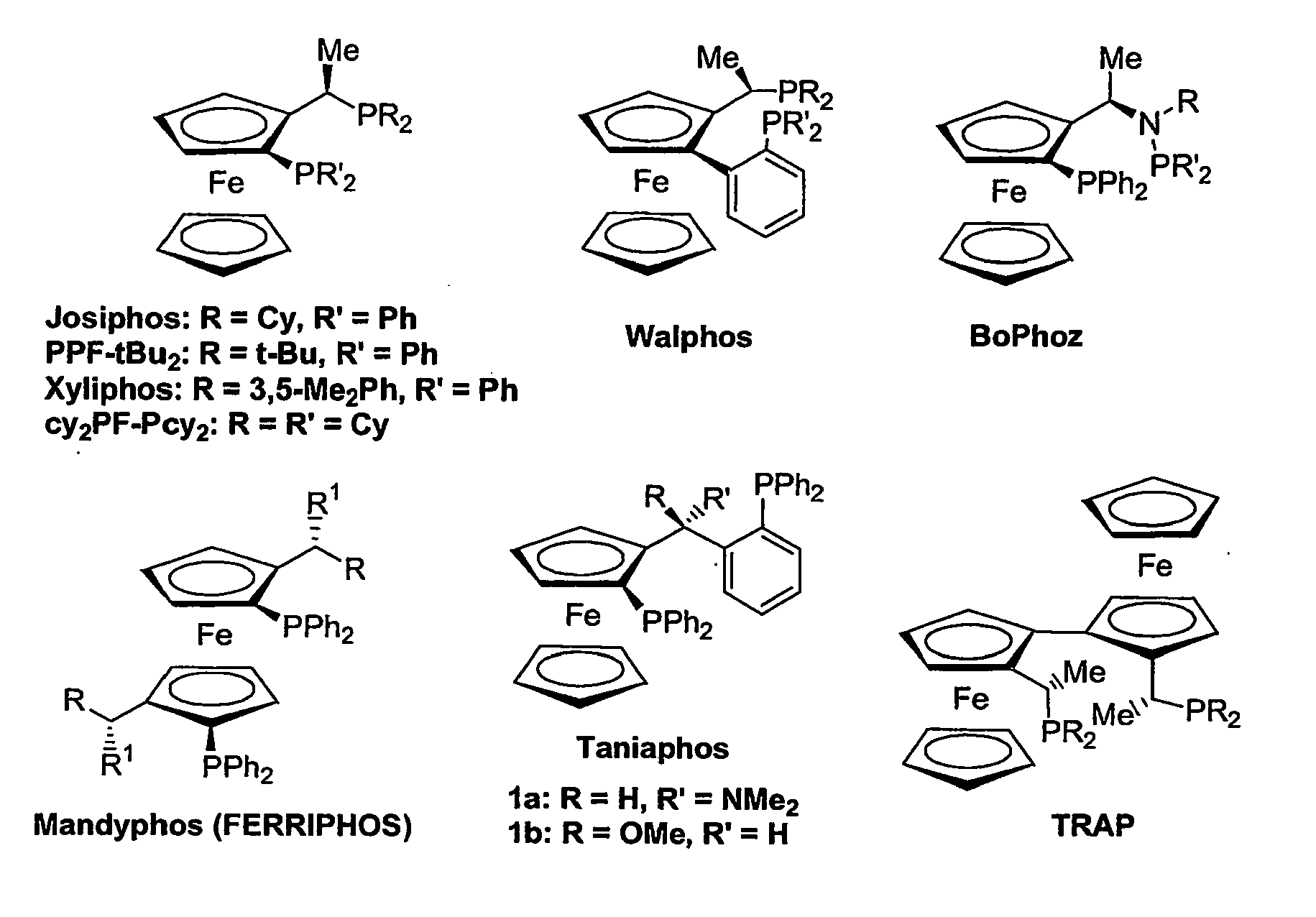
- Togni and Spindler2 have reported a class of non-C2-symmetrical ferrocene-based bisphosphines: the Josiphos-type ligands. Josiphos ligands are in widespread commercial use, having been found effective for Rh-catalyzed hydrogenation of α-acetamidocinnamate, dimethyl itaconate, and β-ketoesters. Because the two phosphine groups are introduced into the ligand in consecutive steps with high yields, a variety of ligands are available with widely differing steric and electronic properties. The ligands have already been applied in three production processes3, several pilot processes and many other syntheses. For example, PPF-tBu2, a Josiphos type ligand with a di-(tert-butyl)phosphino group, has been applied as the ligand in asymmetric hydrogenation for commercial synthesis of (+)-biotin.4 Another notable example is the application of XyliPhos in the Ir-catalyzed hydrogenation of imines for the synthesis of the herbicide (S)-metolachlor5.
- Bophoz6 is a combination of a phosphine and an aminophosphine and is prepared in 3 steps from ppfa with high overall yields. The ligand is air stable and effective for the hydrogenation of enamides, itaconates and α-keto acid derivatives. As observed for several ligands forming seven-membered chelates, high activities can be reached and TONs up to 10,000 have been claimed. The full scope of this modular ligand class has not yet been explored.
- A class of non-C2-symmetrical, ferrocene-based 1,5-diphosphine ligands, Taniaphos, has been developed by Knochel7,8. Compared to the Josiphos ligands, Taniaphos has an additional phenyl ring inserted at the side chain of the Ugi amine. Taniaphos gave excellent results in Rh- and Ru-catalyzed asymmetric hydrogenation. The configuration of α-position of Taniaphos plays an important role in the enantioselectivities and activities. The Taniaphos 1b with αS configuration leads to higher enantioselectivities and activities than 1a with αR configuration in a wide range of asymmetric transformations.
- Weissensteiner and Spindler9 have reported a series of structurally different ferrocene-based 1,5-diphosphine ligands, Walphos. Like Josiphos, Walphos is modular and is also made from the Ugi amine. It shows promise for the enantioselective hydrogenation of olefins and ketones.
- Mandyphos is a bidentate version of ppfa with C2 symmetry, where in addition to the PPh2 moieties, R and R' can be used for fine tuning the functionality of the ligand10. The scope of this ligand family has not yet been fully explored, but preliminary results indicate high enantioselectivities for the Rh-catalyzed hydrogenation of enamides, itaconates and enol acetates.
- The TRAP ligands developed by Ito11 form 9-membered metallocycles. However, it is not clear whether the cis-isomer, present in small amounts, or the major trans-isomer is responsible for the catalytic activity. Up to now only a few different PR2 fragments have been tested, but it is clear that the choice of R strongly affects the catalytic performance. The Rh complexes work best at very low pressures of 0.5 ± 1 bar and effectively reduces indole-derivatives, enamides and itaconic acid derivatives.
- Another class of known ligands exhibit only planar chirality:

- Kang12 reported the C2-symmetry FerroPHOS with only planar chirality. FerroPHOS ligands are air-stable and are very efficient for the asymmetric hydrogenation of various dehydroamino acid derivitives (up to 99% ee).
- Another C2-symmetry planar chiral diphosphine, JAFAPhos, has been developed by Jendralla13. JAFAPhos gave excellent results in asymmetric hydrogenation, allylic alkylation, Grignard cross coupling and aldol reactions.
- Kagan14 reported plane chiral ferrocene-based bisphosphorus ligands 2 and 3, and up to 95% ee's have been obtained in asymmetric hydrogenation of dimethyl itaconate using these ligands as catalyst.
- Another class of known diphosphine ligands exhibit chirality only at the phosphorus atoms:

- The synthesis of chiral 1,1'-bis(phosphetano) ferrocenes (FerroTANE) has been independently reported by Marinetti15 and Burk16. FerroTANE has been successfully applied in Rh-catalyzed hydrogenation of itaconates and (E)-β-(acylamino) acrylates17.
- Mezzetti18 and van Leeuwen19 have independently reported P-chiral ferrocenyl bisphosphines 4a and 4b. These two ligands have shown excellent enantioselectivities (up to 99% ee) for asymmetric hydrogenation of α-dehydroamino acid derivatives.
- Zhang has reported a 1,1'-bis(Phospholanyl) ferrocene ligand 5 with ketal substitutes at the 3 and 4 positions. 20 The ligand has shown excellent enantioselectivities in hydrogenation of β-dehydroamino acid derivatives. The ketal groups of the ligand are important for achieving the high enantioselectivity, since the corresponding ligand without ketal groups only provides moderate ee's. Zhang has also developed a 1,1'-bis(dinaphthophosphepinyl) ferrocene ligand, f-binaphane, which has been successfully applied in the Ir-catalyzed hydrogenation of acyclic aryl imines.21
- Reetz has developed a binaphthol-derived ferrocene-based bisphosphonite ligand 622, which has shown excellent reactivities and enantioselectivities in Rh-catalyzed hydrogenation of itaconates and α-dehydroamino acid derivatives.
- Another class of known ligands exhibits both planar and phosphorus chirality:

- Van Leeuwen has reported ferrocene-based bisphosphines combining planar and phosphorus chirality 4a and 4b23. These two ligands have shown excellent enantioselectivities (up to 99% ee) for asymmetric allylic alkylations.
- Thus, most of the known ferrocene-based diphosphines contain planar and carbon chirality, only planar chirality or only phosphorus chirality. More recently, Togni reported the first tridentate ferrocene-based phosphine ligand 12 combining planar, phosphorus and carbon chirality. 24

- It would be advantageous to design bisphosphine ligands incorporating up to three elements of chirality, planar chirality, chirality at phosphorus, and chirality at carbon for use in enantioselective catalysis. It would also be advantageous to design ligands that exhibit three different types of chirality; carbon, planar and phosphorus.
- According to the present invention there is provided a metallocene-based phosphine having up to three or four elements of chirality; planar chirality, chirality at phosphorus, and optionally chirality at carbon and axial chirality.
- The invention also provides a metallocene-based arsine having up to three elements of chirality; planar chirality, chirality at arsenic, and optionally chirality at carbon. In the following description reference will be made for convenience to phosphine ligands. It should be understood that although phosphines are the preferred ligands in accordance with the invention, the corresponding arsines are also within the scope of the invention.
- Similarly, whilst ferrocene based ligands are preferred, other suitable metals may be used in the ligands of the invention, and hence reference is made herein to metallocenes generally.
- The invention further provides a metallocene-based diphosphine having planar, phosphorus and carbon chirality.
- Ligands according to the invention have particular advantages over prior art ligands because the provision of up to three or four chiralities allows the designer of a ligand greater scope than has hitherto been the case to design ligands for a particular purpose.
- Preferred ligands in accordance with the invention are selected from ligands having Formula (I), (II) or (III):

W is phosphorus or arsenic;
M is a metal;
R1 and R2 are different from each other, and are independently selected from from substituted and unsubstituted, branched- and straight-chain alkyl, alkoxy, alkylamino, substituted and unsubstituted cycloalkyl, substituted and
unsubstituted cycloalkoxy, substituted and unsubstituted cycloalkylamino, substituted and unsubstituted carbocyclic aryl, substituted and unsubstituted carbocyclic aryloxy, substituted and unsubstituted heteroaryl, substituted and
unsubstituted heteroaryloxy, substituted and unsubstituted carbocyclic arylamino and substituted and unsubstituted heteroarylamino, wherein the or each heteroatom is independently selected from sulphur, nitrogen, and oxygen; R3 and R4 are the same or different, and are independently selected from substituted and unsubstituted, branched- and straight-chain alkyl, substituted and unsubstituted cycloalkyl, substituted and unsubstituted carbocyclic aryl, and
substituted and unsubstituted heteroaryl wherein the or each heteroatom is independently selected from sulphur, nitrogen, and oxygen;
n is 0 to 3;
m is 0 to 5;
Q is selected from:
R6 and R7 are the same or different, and are independently selected from substituted and unsubstituted, branched- and straight-chain alkyl, alkoxy, alkylamino, substituted and unsubstituted cycloalkyl, substituted and
unsubstituted cycloalkoxy, substituted and unsubstituted cycloalkylamino, substituted and unsubstituted carbocyclic aryl, substituted and unsubstituted carbocyclic aryloxy, substituted and unsubstituted heteroaryl, substituted and
unsubstituted heteroaryloxy, substituted and unsubstituted carbocyclic arylamino and substituted and unsubstituted heteroarylamino, wherein the or each heteroatom is independently selected from sulphur, nitrogen, and oxygen; and R8 is selected from hydrogen, substituted and unsubstituted, branched- and straight-chain alkyl, substituted and unsubstituted cycloalkyl, substituted and unsubstituted carbocyclic aryl, and substituted and unsubstituted heteroaryl wherein the or each heteroatom is independently selected from sulphur, nitrogen, and oxygen; or
Q is selected from:
R6, R7 and R8 are, independently, as previously defined; and R9 is selected from hydrogen, substituted and unsubstituted, branched- and straight-chain alkyl, substituted and unsubstituted cycloalkyl, substituted and unsubstituted carbocyclic aryl, and substituted and unsubstituted heteroaryl wherein the or each heteroatom is independently selected from sulphur, nitrogen, and oxygen;
or
Q is selected from:
unsubstituted carbocyclic aryl, and substituted and unsubstituted heteroaryl wherein the or each heteroatom is independently selected from sulphur, nitrogen, and oxygen; or
Q is selected from:
R6, R7 are, as previously defined; R11 is selected from OR13, SR13, NHR13, NR13R14, wherein R13 and R14 are the same or different and are independently selected from hydrogen, substituted and unsubstituted, branched- and straight-chain alkyl, substituted and unsubstituted cycloalkyl, substituted and
unsubstituted carbocyclic aryl, and substituted and unsubstituted heteroaryl
wherein the or each heteroatom is independently selected from sulphur, nitrogen, and oxygen; R12 is selected from hydrogen, halogen, OR13, SR13, NR13R14, substituted and unsubstituted, branched- and straight-chain alkyl, substituted and unsubstituted cycloalkyl, substituted and unsubstituted carbocyclic aryl, and substituted and unsubstituted heteroaryl wherein the or each heteroatom is independently selected from sulphur, nitrogen, and oxygen; wherein R13, R14 are, as previously defined and n' is 0 to 4;
or Q is selected from:
R5 is selected from:
unsubstituted heteroaryl wherein the or each heteroatom is independently selected from sulphur, nitrogen, and oxygen; wherein R13, R14 are, as previously defined; or
R5 is selected from:
G is selected from the group consisting of:
-CONH-R*-NHCO-, -CO-OR*O-CO-, -CO-R*CO-, -CH=N-R*-N=CH-, -CH2NH-R*-NHCH2-, -CH2NHCO-R*-CONHCH2-, -CH(R8)NH-R*-NH(CH(R8)-,-CH(R8)NHCO-R*-CONHCH(R8)-, -CONH-R-NHCO-, -CO-ORO-CO-, -CO-RCO-, -CH=N-R-N=CH-, -CH2NH-R-NHCH2-, -CH2NHCO-R-CONHCH2-, -CH(R8)NH-R-NH(CH(R8)-, -CH(R8)NHCO-R-CONHCH(R8)-; wherein R8 is, independently, as previously defined; -R*- and -R- are selected from the group consisting of:
- The invention also relates to the enantiomers of the ligands described above, the enantiomers having the Formulae (IV), (V) and (VI):

- Also provided in accordance with the invention are diastereomers of the ligands described above, the diastereomers having the Formulae (VII), (VIII) and (IX):

- The introduction of phosphorus chirality may enhance the chiral discrimination produced by the catalyst when a matching among the planar chirality, carbon chirality, axial chirality and the chirality of phosphorus can be achieved.
(Examples 59 to 67 below demonstrate that a matching catalyst may give high ee and a mismatching one may give low ee.) - Also provided in accordance with the invention is a transition metal complex containing transition metal coordinated to the ligand of the invention. The metal is preferably a Group Vlb or a Group VIII metal, especially rhodium, ruthenium, iridium, palladium, platinum and nickel.
- Synthesis of ferrocene-based phosphorus chiral phosphines may be effected with the use of a suitable chiral ortho-directing group, for example in accordance with the following schemes:

- Accordingly, the invention provides a method for preparing a phosphine ligand chiral at phosphorus comprising providing a metallocene-based substrate having a chiral or achiral directing substituent on one or both rings, and subjecting the substituted metallocene to an ortho-lithiation step before subsequently converting the ortho-lithiated substrate to a phosphine chiral at phosphorus.
- Methods for the preparation of ligands having Formula (I) and (III) will now be more particularly described.
- For example, one such method comprises providing a compound of the Formula (X) (optionally substituted on one or both cyclopentadiene rings with R3 n (top ring) and/or R4 m (bottom ring)):


R, Ra and Rb are same or different, and are independently selected from hydrogen, substituted and unsubstituted, branched- and straight-chain alkyl, substituted and unsubstituted cycloalkyl, substituted and unsubstituted carbocyclic aryl, and substituted and unsubstituted heteroaryl wherein the or each heteroatom is independently selected from sulphur, nitrogen, and oxygen; ortho-lithiating the substrate; reacting the ortholithiated substrate with an R1 substituted phosphine or arsine, and then with an R2-bearing Grignard reagent or organolithium compound, and converting X* to Q or G as appropriate. - One particularly preferred X* group is

- The ortho-lithiation step is preferably a mono-ortho-lithiation step using n-butyllithium, sec-butyllithium or tert- butyllithium. The resulting monolithium compound is preferably reacted in situ with a dichlorophosphine of the formula R1PCl2 followed by reacting with an organometallic reagent of the formula R2Z, wherein R1 and R2 are as defined above; Z is Li or MgY wherein Y is a halide. These steps are performed to obtain phosphorus chiral compound having formula XI (optionally substituted on one or both cyclopentadiene rings with R3 n (top ring) and/or R4 m (bottom ring)):

- The synthesis preferably proceeds by converting compound (XI) to compound XII, XIII, or XIV:

and then: - reacting compound XII with a secondary phosphine of the formula R6R7PH wherein R6, R7 are, as previously defined, to obtain the diphosphine combining planar, phosphorus and carbon chirality having formula XV:

- reacting compound XII with an amine of the formula R9NH2 wherein R9 is, as previously defined, to obtain compound XVI:

- reacting compound XII with an amine of the formula XVII:


- reacting compound XII with an amine of the formula H2N-R*-NH2 or H2N-R-NH2 wherein R* and R are, as previously defined, to obtain compound XIX and XX:

- reacting compound XIII with an amine of the formula H2N-R*-NH2 or H2N-R-NH2 wherein R* and R are, as previously defined, to obtain compound XXI and XXII:
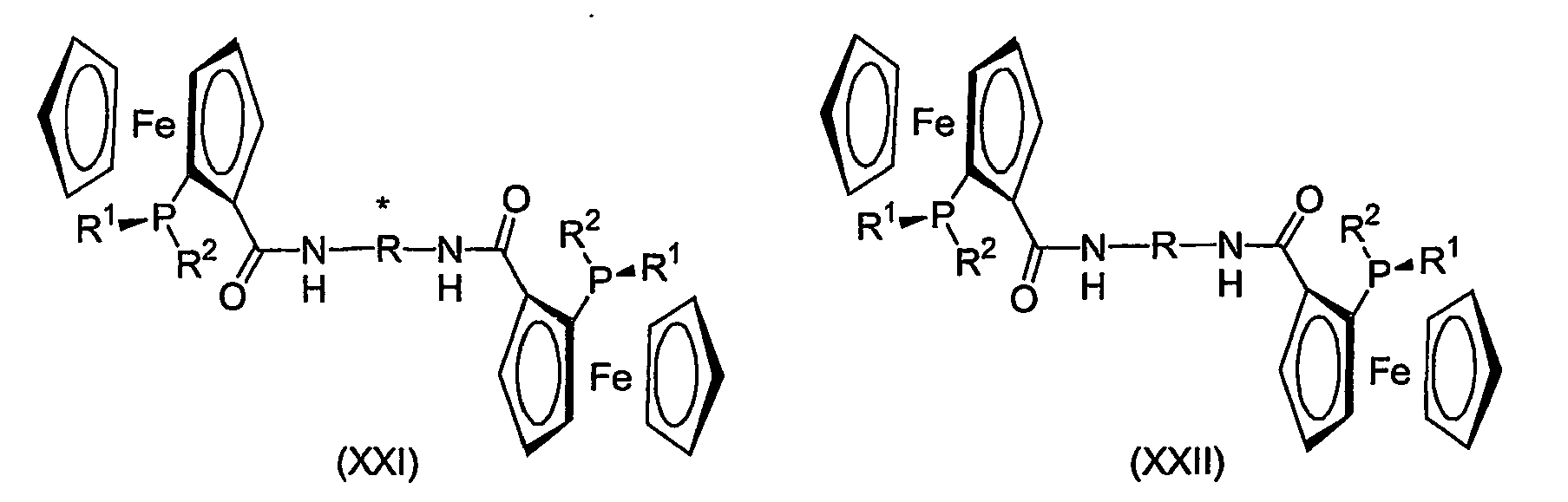
- Compound XVI may be reacted with a halophosphine of the formula R6R7PY wherein R6, R7 are, as previously defined, and Y is chlorine, bromine or iodine, to obtain compound XXIII:

- Alternatively, compound XVI may be reacted with an acid derivative of the formula R10COY wherein R10 is, as previously defined, and Y is a halide, a sulphate, an imidazole, R10COO- or hydrogen, to obtain compound XXIV:

- Alternatively compound XVI (in which R9 is hydrogen) may be reacted with an aldehyde of the formula OHC-R*-CHO or OHC-R-CHO wherein R* and R are, as previously defined, to obtain the compounds having Formulae XXV and XXVI:

- Alternatively compound XVI may be reacted with an acid derivative of the formula YOC-R*-COY and YOC-R-COY wherein R*, R and Y are, as previously defined, to obtain the compounds having Formulae XXVII and XXVIII:
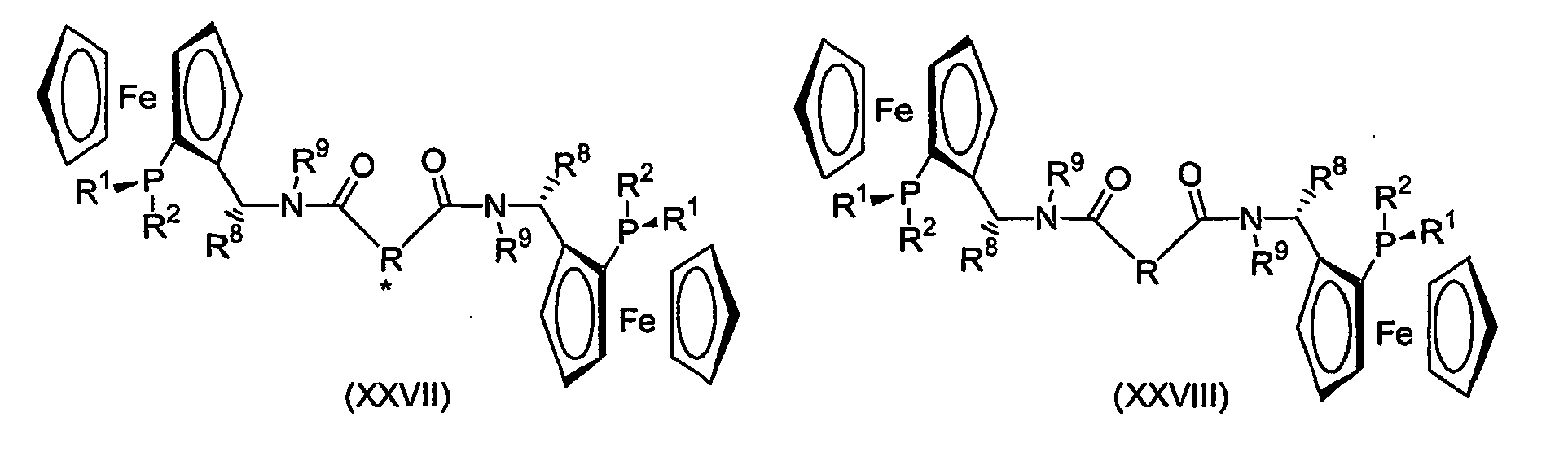
- Compound XVIII may be converted into compound XXIX:

- Compounds XIX, XX, XXI, XXII, XXV, XXVI, XXVII, XXVIII may be reduced to obtain respective compounds XXX, XXXI, XXXII, XXXIII, XXXIV, XXXV, XXXVI, XXXVII:

- Synthesis of metallocene-based phosphines chiral at phosphorus may be also effected with the use of enantioselective ortho-lithiation:

- Accordingly, the invention provides a method for preparing a chiral diphosphine ligand comprising a metallocene-based substrate having an achiral directing substituent on one or both rings, and subjecting the substituted metallocene to an enantioselective ortho-lithiation step before subsequently converting the ortho-lithiated substrate to phosphorus chiral phosphines.
- Thus, one method according to the present invention for preparing the ligand of Formula (I) or (III) comprises providing a compound of the formula XXXVII:


- One method according to the invention for preparing the ligand of Formula (II) comprises providing a compound of the Formula XXXIX:


- The invention will now be more particularly illustrated with reference to the following Examples.
-

- To a solution of (R)-N,N-dimethyl-1-ferrocenylethylamine [(R)-Ugi's amine, (R)-1] (3.86 g, 15 mmol) in Et2O (50 mL) was added 1.7 M t-BuLi solution in pentane (9.7 mL, 16.5 mmol) over 10 min via a syringe at -78°C. After addition was completed, the mixture was warmed to room temperature, and stirred for 1.5 h at room temperature. The resulting red solution was cooled to -78°C again, and dichlorophenylphosphine (2.24 mL, 16.5 mmol) was added in one portion. After stirring for 10 min at -78°C, the mixture was slowly warmed to room temperature, and stirred for 1.5 h at room temperature. The mixture was then cooled to -78°C again, and a solution of (2-methoxy)phenyllithium [prepared from 2-bromoanisole (3.32 g, 17.7 mmol) and 1.7 M t-BuLi solution in pentane (20.8 mL, 35.4 mmol) in Et2O (90 mL) at -78°C] was added slowly via a cannula. The mixture was warmed to room temperature overnight, and filtered through a pad of Celite. The filtrate was concentrated, and the residue was purified by chromatography (SiO2, hexane-EtOAc-Et3N = 85:10:5) to afford the title compound (6.50 g, 92%) as orange crystals. 1H NMR (CDCl3, 400.13 MHz): δ 1.29 (d, 3H, J = 6.5 Hz); 1.80 (s, 6H); 3.91 (s, 3H); 3.97 (s, 6H, overlap); 4.11 (m, 1H), 4.25 (t, 1H, J = 2.2 Hz); 4.37 (br. s, 1H); 6.87 (m, 1H); 6.94 (dd, 1H, J = 8.3 and 6.7 Hz); 7.12 ∼ 7.23 (m, 6H); 7.31 (m, 1H); 31P NMR (CDCl3, 162 MHz): δ -38.82. The absolute configuration of (Rc, SFe, SP)-2 was determined by single-crystal X-ray diffraction analysis.
-

- To a solution of (R)-N,N-dimethyl-1-ferrocenylethylamine [(R)-Ugi's amine, (R)-1] (5.15 g, 20 mmol) in Et2O (60 mL) was added 1.7 M t-BuLi solution in pentane (12.94 mL, 22 mmol) over 10 min via a syringe at -78°C. After addition was completed, the mixture was warmed to room temperature, and stirred for 1.5 h at room temperature. The resulting red solution was cooled to -78 °C again, and dichlorophenylphosphine (2.99 mL, 22 mmol) was added in one portion. After stirring for 10 min at -78 °C, the mixture was slowly warmed to room temperature, and stirred for 1.5 h at room temperature. The mixture was then cooled to -78 °C again, and a solution of 1-naphthyllithium [prepared from 1-bromonaphthalene (5.38 g, 26 mmol) and 1.7 M t-BuLi solution in pentane (30.6 mL, 52 mmol) in Et2O (120 mL) at -78°C] was added slowly via a cannula. The mixture was warmed to room temperature overnight, and filtered through a pad of Celite. The filtrate was concentrated, and the residue was purified by chromatography (SiO2 hexane-EtOAc-Et3N = 90:6:4) to afford the title compound (8.75 g, 89%) as orange crystals. 1H NMR (CDCl3, 400.13 MHz): δ 1.33 (d, 3H, J = 6.8 Hz); 1.91 (s, 6H); 3.59 (s, 5H); 4.00 (m, 1H); 4.17 (m, 1H); 4.26 (t, 1H, J = 2.2 Hz); 4.38 (m, 1H); 7.13 ∼ 7.2 (m, 5H); 7.39 (t, 1H, J = 6.7 Hz); 7.43 ∼7.54 (m, 2H); 7.60 ∼7.63 (m, 1 H); 7.87 (dd, 2H, J = 9.7 and 9.2 Hz), 9.33 (dd, 1H, J = 7.6 and 7.0 Hz). 31P NMR (CDCl3, 162 MHz): δ -38.73.
-

- To a solution of (R)-N,N-dimethyl-1-ferrocenylethylamine [(R)-Ugi's amine, (R)-1] (1.29 g, 5 mmol) in Et2O (15 mL) was added 1.7 M t-BuLi solution in pentane (3.2 mL, 5.5 mmol) over 10 min via a syringe at -78°C. After addition was completed, the mixture was warmed to room temperature, and stirred for 1.5 h at room temperature. The resulting red solution was cooled to -78 °C again, and dichlorophenylphosphine (0.75 mL, 5.5 mmol) was added in one portion. After stirring for 10 min at -78°C, the mixture was slowly warmed to room temperature, and stirred for 1.5 h at room temperature. Then to the mixture a solution of 1-naphthyllithium [prepared from 1-bromonaphthalene (1.35 g, 6.5 mmol) and 1.7 M t-BuLi solution in pentane (7.6 mL, 13 mmol) in Et2O (30 mL) at -78°C] was added via a cannula at room temperature. The mixture was stirred overnight at room temperature and filtered through a pad of Celite. The filtrate was concentrated, and the residue was purified by chromatography (SiO2, hexane-EtOAc-Et3N = 85:10:5) to afford the title compound (2.21 g, 90%) as a mixture of two isomers. The ratio of (Rc, SFe, SP)-3 to (Rc, SFe, RP)-4 is about 5:1. As (Rc, SFe, RP)-4 is insoluble in cold hexane and (Rc, SFe, SP)-3 is very soluble in cold hexane, the two isomers can be easily separated by crystallization from hexane. (Rc, SFe, RP)-4 : 1H NMR (CDCl3, 400.13 MHz): δ 1.25 (d, 3H, J = 6.8 Hz); 1.60 (s, 6H); 3.88 (br. s, 1H); 4.00 (s, 5H); 4.16 (m, 1H), 4.29 (t, 1H, J = 2.2 Hz); 4.42 (br. s, , 1H); 7.16 ∼ 7.19 (m, 1H); 7.28 ∼ 7.29 (m, 5H), 7.32 ∼ 7.35 (m, 1H); 7.59 ∼ 7.63 (m, 2H); 7.69 (d, J = 8.2 Hz); 7.76 (d, J = 7.6 Hz); 8.45 (m, 1H). 31P NMR (CDCl3, 162 MHz): δ-31.36. The absolute configuration of (Rc, SFe, RP)-4 was determined by single-crystal X-ray diffraction analysis.
-

- A solution of (Rc, SFe, SP)-3 (491 mg, 1.0 mmol) in hexane (5 mL) was refluxed overnight. After cooling to room temperature, the precipitate was filtered and washed with cold hexane to give the pure (Rc, SFe, RP)-4.
-

- To a solution of (R)-N,N-dimethyl-1-ferrocenylethylamine [(R)-Ugi's amine, (R)-1] (2.57 g, 5 mmol) in Et2O (15 mL) was added 1.7 M t-BuLi solution in pentane (6.4 mL, 11 mmol) over 10 min via a syringe at -78 °C. After addition was completed, the mixture was warmed to room temperature, and stirred for 1.5 h at room temperature. The resulting red solution was cooled to -78 °C again, and dichlorophenylphosphine (1.5 mL, 11 mmol) was added in one portion. After stirring for 10 min at -78 °C, the mixture was slowly warmed to room temperature, and stirred for 1.5 h at room temperature. Then the mixture was cooled to -78 °C again, and a suspension of 2-naphthyllithium [prepared from 2-bromonaphthalene (2.69 g, 13 mmol) and 1.7 M t-BuLi solution in pentane (15.2 mL, 26 mmol) in Et2O (60 mL) at -78 °C] was added via a cannula at -78 °C. The mixture was warmed to room temperature overnight and filtered through a pad of Celite. The filtrate was concentrated, and the residue was purified by chromatography (SiO2 hexane-EtOAc-Et3N = 85:10:5) to afford the title compound (4.42 g, 90%) as a mixture of two isomers. The ratio of (Rc, SFe, SP)-5 to (Rc, SFe, RP)-6 is about 5:1. Fractional crystallization from hexane gave (Rc, SFe, SP)-5 (3.10 g, 63%) and (Rc, SFe, RP)-6 (687 mg, 14%). (Rc, SFe, SP)-5 : 1H NMR (CDCl3, 400.13 MHz): δ 1.28 (d, 3H, J= 6.2 Hz); 1.80 (s, 6H); 3.90 (br. s, 1H); 3.92 (s, 5H); 4.20 (m, 1H), 4.22 (t, 1H, J = 2.2 Hz); 4.38 (br. s, , 1H); 7.18 - 7.26 (m, 5H); 7.48 (m, 2H), 7.58 (ddd, 1H, J = 8.4, 5.6 and 1.6 Hz); 7.79 (d, 1H, J = 8.4 Hz); 7.83 (m, 2H); 8.18 (d, 1H, J = 9.5 Hz);. 31P NMR (CDCl3, 162 MHz): δ -20.88. (Rc, SFe, RP)-6 : 1H NMR (CDCl3, 400.13 MHz): δ 1.27 (d, 3H, J = 5.7Hz); 1.76 (s, 6H); 3.90 (br. s, 1H); 3.96 (s, 5H); 4.18 (m, 1H), 4.29 (t, 1H, J = 2.2 Hz); 4.41 (br. s, , 1H); 7.29 (ddd, 1H, J = 8.3, 7.0 and 1.6 Hz); 7.34 (m, 3H); 7.39 (m, 2H); 7.59~7.67 (m, 5H), 7.74 (m, 1H);. 31P NMR (CDCl3, 162 MHz): δ -20.57.
-

- To a solution of (R)-N,N-dimethyl-1-ferrocenylethylamine [(R)-Ugi's amine, (R)-1] (2.06 g, 8 mmol) in Et2O (15 mL) was added 1.5 M t-BuLi solution in pentane (6.0 mL, 9 mmol) over 10 min via a syringe at -78°C. After addition was completed, the mixture was warmed to room temperature, and stirred for 1.5 h at room temperature. The resulting red solution was cooled to -78°C again, and dichlorophenylphosphine (1.22 mL, 9 mmol) was added in one portion. After stirring for 10 min at -78°C, the mixture was slowly warmed to room temperature, and stirred for 1.5 h at room temperature. Then the mixture was cooled to -78°C again, and a solution of 2-naphthylmagnesium bromide [prepared from 2-bromonaphthalene (2.20 g, 10.6 mmol) and magnesium (258 mg, 10.6 mmol) in Et2O (20 mL)] was added via a cannula at -78 °C. The mixture was warmed to room temperature overnight. The reaction was quenched with saturated NH4Cl solution (20 mL). The organic layer was separated, and the aqueous layer was extracted with Et2O (20 mL). The combined organic layers were washed with brine (20 mL), dried (MgSO4), and concentrated. The residue was purified by chromatography (SiO2, hexane-EtOAc-Et3N = 85:10:5) to afford the title compound (3.42 g, 87%) as single diastereomer. 1H NMR (CDCl3, 400.13 MHz): δ 1.28 (d, 3H, J= 6.2 Hz); 1.80 (s, 6H); 3.90 (br. s, 1H); 3.92 (s, 5H); 4.20 (m, 1H), 4.22 (t, 1H, J = 2.2 Hz); 4.38 (br. s, , 1H); 7.18~7.26 (m, 5H); 7.48 (m, 2H), 7.58 (ddd, 1H, J = 8.4, 5.6 and 1.6 Hz); 7.79 (d, 1H, J = 8.4 Hz); 7.83 (m, 2H); 8.18 (d, 1H, J = 9.5 Hz);. 31P NMR (CDCl3, 162 MHz): δ-20.88.
-

- To a solution of (R)-N,N-dimethyl-1-ferrocenylethylamine [(R)-Ugi's amine, (R)-1] (2.57 g, 10 mmol) in Et2O (20 mL) was added 1.5 M t-BuLi solution in pentane (7.33 mL, 11 mmol) over 10 min via a syringe at -78°C. After addition was completed, the mixture was warmed to room temperature, and stirred for 1.5 h at room temperature. The resulting red solution was cooled to -78°C again, and dichlorophenylphosphine (1.50 mL, 11 mmol) was added in one portion. After stirring for 10 min at -78°C, the mixture was slowly warmed to room temperature, and stirred for 1.5 h at room temperature. Then the mixture was cooled to -78°C again, and a suspension of 2-biphenyllithium [prepared from 2-bromobiphenyl (2.24 mL, 13 mmol) and 1.5 M t-BuLi solution in pentane (17.3 mL, 26 mmol) in Et2O (30 mL) at -78°C] was added via a cannula at -78 °C. The mixture was warmed to room temperature overnight and filtered through a pad of Celite. The filtrate was concentrated, and the residue was purified by chromatography (SiO2 hexane-EtOAc-Et3N = 85:10:5) to afford the title compound (4.87 g, 94%) as single diastereomer. 1H NMR (CDCl3, 400.13 MHz): δ 1.25 (d, 3H, J = 6.7Hz); 1.85 (s, 6H); 3.69 (s, 5H); 3.76 (m, 1H), 4.17 (m, 1H), 4.29 (t, 1H, J = 2.4 Hz); 4.32 (m, 1H); 7.10 ∼ 7.19 (m, 5H); 7.31 (m, 1H), 7.37~7.48 (m, 5H), 7.64 (m, 1H); 7.69 (m, 1H); 7.71 (m, 1H). 31P NMR (CDCl3, 162 MHz): δ -32.96
-
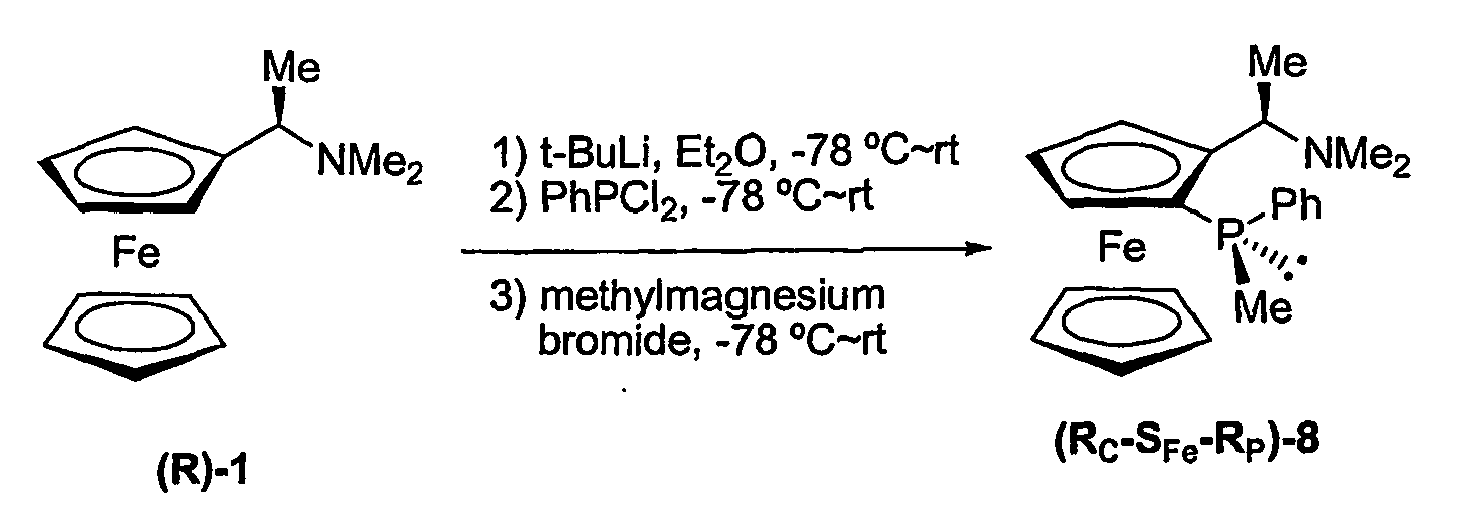
- To a solution of (R)-N,N-dimethyl-1-ferrocenylethylamine [(R)-Ugi's amine, (R)-1] (2.57 g, 10 mmol) in Et2O (20 mL) was added 1.5 M t-BuLi solution in pentane (7.33 mL, 11 mmol) over 10 min via a syringe at -78 °C. After addition was completed, the mixture was warmed to room temperature, and stirred for 1.5 h at room temperature. The resulting red solution was cooled to -78 °C again, and dichlorophenylphosphine (1.50 mL, 11 mmol) was added in one portion. After stirring for 10 min at -78 °C, the mixture was slowly warmed to room temperature, and stirred for 1.5 h at room temperature. Then the mixture was cooled to -78 °C again, and 3.0 M solution of MeMgBr in Et2O (4.0 mL, 12 mmol) was added via a syringe at -78 °C. The mixture was warmed to room temperature overnight. The reaction was quenched with saturated NH4Cl solution (20 mL). The organic layer was separated, and the aqueous layer was extracted with Et2O (20 mL). The combined organic layers were washed with brine (20 mL), dried (MgSO4), and concentrated. The residue was purified by chromatography (SiO2, hexane-EtOAc-Et3N = 85:10:5) to afford the title compound (3.36 g, 89%) as red oil. 1H NMR (CDCl3, 400.13 MHz): δ 1.24 (d, 3H, J = 6.7Hz); 1.56 (d, 3H, J = 4.4 Hz); 1.72 (s, 6H); 4.07 (m, 1H), 4.13 (s, 5H); 4.30 (m, 1H), 4.34 (m, 2H); 7.14~7.20 (m, 3H); 7.30~7.37 (m, 2H). 31P NMR (CDCl3, 162 MHz): δ -43.47
-

- To a solution of (R)-N,N-dimethyl-1-ferrocenylethylamine [(R)-Ugi's amine, (R)-1] (2.57 g, 10 mmol) in Et2O (20 mL) was added 1.5 M t-BuLi solution in pentane (7.35 mL, 11 mmol) over 10 min via a syringe at -78°C. After addition was completed, the mixture was warmed to room temperature, and stirred for 1.5 h at room temperature. The resulting red solution was cooled to -78°C again, and dichlorophenylphosphine (1.50 mL, 11 mmol) was added in one portion. After stirring for 10 min at -78°C, the mixture was slowly warmed to room temperature, and stirred for 1.5 h at room temperature. Then the mixture was cooled to -78°C again, and 2.0 M solution of cyclohexymagnesium chloride in Et2O (6.0 mL, 12 mmol) was added via a syringe at -78°C. The mixture was warmed to room temperature overnight. The reaction was quenched with saturated NH4Cl solution (20 mL). The organic layer was separated, and the aqueous layer was extracted with Et2O (20 mL). The combined organic layers were washed with brine (20 mL), dried (MgSO4), and concentrated. The residue was purified by chromatography (SiO2 hexane-EtOAc-Et3N = 90:5:5) to afford the title compound (4.09 g, 92%) as red oil. 1H NMR (CDCl3, 400.13 MHz): δ 1.16 (d, 3H, J = 6.7Hz); 1.19∼2.03 (m, 11H); 1.50 (s, 6H); 3.99(m, 1H), 4.11 (s, 5H); 4.30 (m, 1H), 4.32 (t, 1H, J = 2.5 Hz); 4.37 (m, 1H), 7.12 ∼ 7.150 (m, 3H); 7.18~7.23 (m, 2H). 31P NMR (CDCl3, 162 MHz): δ-14.86
-

- To a solution of (R)-N,N-dimethyl-1-ferrocenylethylamine [(R)-Ugi's amine, (R)-1] (1.29 g, 5 mmol) in Et2O (15 mL) was added 1.5 M t-BuLi solution in pentane (3.7mL, 5.5 mmol) over 10 min via a syringe at -78°C. After addition was completed, the mixture was warmed to room temperature, and stirred for 1.5 h at room temperature. The resulting red solution was cooled to -78°C again, and tert-butyldichlorophosphine (875 mg, 5.5 mmol) was added in one portion. After stirring for 10 min at -78°C, the mixture was slowly warmed to room temperature, and stirred for 1.5 h at room temperature. Then to the mixture a 1.6 M solution of methyllithium in Et2O (3.75 mL, 6.0 mmol) was added via a syringe at -78°C. The mixture was warmed to room temperature overnight and filtered through a pad of Celite. The filtrate was concentrated, and the residue was purified by chromatography (SiO2, hexane-EtOAc-Et3N = 90:5:5) to afford the title compound (1.54 g, 86%) as red oil. 1H NMR (CDCl3, 250.13 MHz): δ 1.09 (d, 9H, J = 12.0 Hz), 1.27 (d, 3H, J = 6.7Hz); 1.45 (d, 3H, J = 3.3 Hz); 2.08 (s, 6H); 3.92 (m, 1H). 4.10 (s, 5H);, 4.28 (m, 3H). 31P NMR (CDCl3, 101 MHz): δ -6.47
-

- A solution of (Rc, SFe, SP)-2 (1.18 g, 2.5 mmol) in acetic anhydride (10 mL) was stirred for 60 h at room temperature. The excess acetic anhydride was removed under reduced pressure (<1 Torr, <30°C) to give the title compound (1.21 g, 100%) as yellow solid, which is pure enough for the use in the next reaction. 1H NMR (CDCl3, 400.13 MHz): δ 1.19 (s, 3H); 1.64 (d, 3H, J = 6.5 Hz); 3.90 (s, 3H); 3.92 (m, 1H); 4.07 (s, 5H); 4.34 (t, 1H, J = 2.6 Hz); 5.55 (m, 1H);6.15 (m, 1H); 6.87 (td, 1H, J = 7.4 and 0.9 Hz); 6.95 (q, 1H, J = 4.8 Hz); 7.08 ~ 7.21 (m, 6H); 7.35 (m, 1H); 31P NMR (CDCl3, 162 MHz): δ-39.30.
-

- A solution of (Rc, SFe, SP)-3 (1.47 g, 3.0 mmol) in acetic anhydride (20 mL) was stirred for 60 h at room temperature. The excess acetic anhydride was removed under reduced pressure (<1 Torr, <30°C) to give the title compound (1.52 g, 100%) as yellow solid, which is pure enough for the use in the next reaction. 1H NMR (CDCl3, 400.13 MHz): δ 1.29 (s, 3H); 1.67 (d, 3H, J = 6.5 Hz); 3.72 (s, 5H); 3.94 (m, 1H); 4.35 (t, 1H, J = 2.6 Hz); 4 .57 (m, 1H); 6.28 (m, 1H); 7.13 ∼ 7.22 (m, 5H); 7.38∼7.43 (m, 2H), 7.53 (ddd, 1H, J = 8.0, 6.7 and 1.1 Hz), 7.64(ddd, 1H, J = 8.4, 6.8 and 1.4 Hz), 7.89 (t, 2H, J = 7.0 Hz); 9.28 (t, 1H, J = 7.0 Hz); 31P NMR (CDCl3, 162 MHz): δ -39.81.
-

- A solution of (Rc, SFe, RP)-4 (1.47 g, 3.0 mmol) in acetic anhydride (20 mL) was stirred for 60 h at room temperature. The excess acetic anhydride was removed under reduced pressure (<1 Torr, <30°C) to give the title compound (1.52 g, 100%) as yellow solid, which is pure enough for the use in the next reaction. 1H NMR (CDCl3, 400.13 MHz): δ 0.83 (s, 3H); 1.62 (d, 3H, J = 6.5 Hz); 3.83 (m, 1H); 4.10 (s, 5H); 4.40 (t, 1H, J = 2.6 Hz); 5.61 (m, 1H); 6.21 (m, 1H); 7.11 (ddd, 1H, J = 7.0, 4.6 and 1.1 Hz), 7.28 ∼ 7.41 (m, 6H); 7.55∼7.43 (m, 2H), 7.75 (m, 2H), 8.29 (m, 1H); 31P NMR (CDCl3, 162 MHz): δ -31.33.
-

- A solution of (Rc, SFe, SP)-5 (1.47 g, 3.0 mmol) in acetic anhydride (20 mL) was stirred for 60 h at room temperature. The excess acetic anhydride was removed under reduced pressure (<1 Torr, <30°C) to give the title compound (1.52 g, 100%) as yellow solid, which is pure enough for the use in the next reaction. 1H NMR (CDCl3, 400.13 MHz): δ 1.21 (s, 3H); 1.65 (d, 3H, J = 6.5 Hz); 3.83 (m, 1H); 4.03 (s, 5H); 4.33 (t, 1H, J = 2.6 Hz); 4.57 (m, 1H); 6.24 (m, 1H); 7.19 ∼ 7.27(m, 5H); 7.46-7.51 (m, 3H), 7.81 (m, 3H), 8.11 (d, 1H, J = 10.4 Hz); 31P NMR (CDCl3, 162 MHz): δ -22.89.
-

- A solution of (Rc, SFe, RP)-6 (1.47 g, 3.0 mmol) in acetic anhydride (20 mL) was stirred for 60 h at room temperature. The excess acetic anhydride was removed under reduced pressure (<1 Torr, <30°C) to give the title compound (1.52 g, 100%) as yellow solid, which is pure enough for the use in the next reaction. 1H NMR (CDCl3, 400.13 MHz): δ 0.92 (s, 3H); 1.64 (d, 3H, J = 6.4 Hz); 3.87 (m, 1H); 4.07 (s, 5H); 4.40 (t, 1H, J = 2.6 Hz); 5.61 (m, 1H); 6.23 (m, 1H); 7.27 (ddd, 1H, J = 8.2, 6.8 and 1.4 Hz), 7.32 ∼ 7.38(m, 3H); 7.39∼7.44 (m, 2H), 7.53∼7.57 (m, 2H), 7.60 (d, 1H, J = 8.0 Hz), 7.69 (m, 2H), 7.74 (m, 1H); 31P NMR (CDCl3, 162 MHz): δ -22.58.
-

- A solution of (Rc, SFe, SP)-7 (1.47 g, 3.0 mmol) in acetic anhydride (20 mL) was stirred for 60 h at room temperature. The excess acetic anhydride was removed under reduced pressure (<1 Torr, <30°C) to give the title compound (1.52 g, 100%) as yellow solid, which is pure enough for the use in the next reaction. 1H NMR (CDCl3, 400.13 MHz): δ 1.25 (s, 3H); 1.52 (d, 3H, J = 6.5 Hz); 3.73 (s, 5H); 3.96 (m, 1H); 4.33 (t, 1H, J = 2.6 Hz); 4.48 (m, 1H); 5.81 (m, 1H); 7.16∼ 7.27(m, 6H); 7.38~7.51 (m, 6H), 7.70∼7.73 (m, 2H). 31P NMR (CDCl3, 162 MHz): δ -35.03.
-

- A solution of (Rc, SFe, SP)-11 (1.21 g, 2.5 mmol) and 40% methylamine aqueous solution (6.0 mL) in THF (20 mL) and MeOH (5 mL) was stirred for 3 days at 40 °C, and concentrated. The residue was dissolved in Et2O (20 mL), washed with brine (10 mL), dried (Na2SO4), and evaporated under reduced pressure. The crude product was purified by chromatography (SiO2, hexane-EtOAc-Et3N = 80:15:5) to give the title compound (1.07 g, 94%) as orange crystals. 1H NMR (CDCl3, 250.13 MHz): δ 1.44 (d, 3H, J = 6.5 Hz); 1.94 (s, 3H); 3.91 (m, 2H); 3.95 (s, 3H); 4.05 (s, 5H); 4.29 (t, 1H, J = 2.5 Hz); 4.46 (m, 1H); 7.90 (dt, 1H, J = 7.3 and 1.0 Hz), 6.97 (ddd, 1H, J = 8.3, 5.0 and 1.0 Hz), 7.15 (ddd, 1H, J = 7.3, 5.5 and 1.8 Hz),7.23 (m, 5H); 7.36 (ddd, 1H, J = 8.3, 7.3 and 1.8 Hz),. 31P NMR (CDCl3, 101 MHz): δ -41.43.
-

- A solution of (Rc, SFe, SP)-12 (633 mg, 1.25 mmol) and 40% methylamine aqueous solution (3.0 mL) in THF (10 mL) and MeOH (2.5 mL) was stirred for 3 days at 40°C, and concentrated. The residue was dissolved in Et2O (20 mL), washed with brine (10 mL), dried (Na2SO4), and evaporated under reduced pressure. The crude product was purified by chromatography (SiO2, hexane-EtOAc-Et3N = 85:10:5) to give the title compound (549 mg, 92%) as orange crystals. 1H NMR (CDCl3, 400.13 MHz): δ 1.49 (d, 3H, J = 6.6 Hz); 2.07 (s, 3H); 3.69 (s, 5H); 3.95 (m, 1H); 4.01 (m, 1 H); 4.31 (t, 1H, J = 2.5 Hz); 4.48 (m, 1H); 7.23 (m, 5H); 7.39 ∼ 7.47 (m, 2H); 7.54 (m, 1H); 7.66 (m, 1H); 7.90 (t, 2H, J = 7.9 Hz), 9.25 (dd, 1H, J = 7.9 and 6.7 Hz). 31P NMR (CDCl3, 162 MHz): δ - 39.91.
-

- A solution of (Rc, SFe, RP)-7 (633 mg, 1.25 mmol) and 40% methylamine aqueous solution (3.0 mL) in THF (10 mL) and MeOH (2.5 mL) was stirred for 3 days at 40°C, and concentrated. The residue was dissolved in Et2O (20 mL), washed with brine (10 mL), dried (Na2SO4), and evaporated under reduced pressure. The crude product was purified by chromatography (SiO2, hexane-EtOAc-Et3N = 85:10:5) to give the title compound (537 mg, 90%) as orange crystals. 1H NMR (CDCl3, 400.13 MHz): δ 1.45 (d, 3H, J = 6.5 Hz); 1.83 (s, 3H); 3.82 (m, 1H); 3.97 (m, 1H); 4.07 (s, 5H); 3 4.35 (t, 1H, J = 2.5 Hz); 4.53 (m, 1H); 7.20 (m, 1H); 7.30 ∼ 7.36 (m, 5H); 7.40 (m, 1H); 7.56 ∼ 7.61 (m, 2H); 7.78 (t, 2H, J = 8.2 Hz), 8.38 (m, 1H). 31P NMR (CDCl3, 162 MHz): δ -32.25.
-

- A solution of (Rc, SFe, SP)-14 (633 mg, 1.25 mmol) and 40% methylamine aqueous solution (3.0 mL) in THF (10 mL) and MeOH (2.5 mL) was stirred for 3 days at 40°C, and concentrated. The residue was dissolved in Et2O (20 mL), washed with brine (10 mL), dried (Na2SO4), and evaporated under reduced pressure. The crude product was purified by chromatography (SiO2, hexane-EtOAc-Et3N = 85:10:5) to give the title compound (513 mg, 86%) as orange crystals. 1H NMR (CDCl3, 400.13 MHz): δ 1.47 (d, 3H, J = 6.7 Hz); 1.98 (s, 3H); 3.82 (m, 1H); 3.98 (m, 1H); 4.02 (s, 5H); 4.27 (t, 1H, J = 2.5 Hz); 4.47 (m, 1H); 7.27∼7.34 (m, 5H); 7.50 (m, 2H); 7.55 (m, 1H); 7.83 (m, 3H); 8.12 (d, 1H, J = 10.0 Hz). 31P NMR (CDCl3, 162 MHz): δ-22.68.
-

- A solution of (Rc, SFe, RP)-15 (633 mg, 1.25 mmol) and 40% methylamine aqueous solution (3.0 mL) in THF (10 mL) and MeOH (2.5 mL) was stirred for 3 days at room temperature, and concentrated. The residue was dissolved in Et2O (20 mL), washed with brine (10 mL), dried (Na2SO4), and evaporated under reduced pressure. The crude product was purified by chromatography (SiO2, hexane-EtOAc-Et3N = 85:10:5) to give the title compound (537 mg, 90%) as orange crystals.
-

- A solution of (Rc, SFe, SP)-16 (1.063 g, 2 mmol) and 40% methylamine aqueous solution (5.0 mL) in THF (10 mL) and MeOH (2.5 mL) was stirred for 2 days at 40°C, and concentrated. The residue was dissolved in Et2O (20 mL), washed with brine (10 mL), dried (Na2SO4), and evaporated under reduced pressure. The residue was recrystallized from hexane to give the title compound (621 mg, 62%) as orange crystals. 1H NMR (CDCl3, 400.13 MHz): δ 1.34 (d, 3H, J = 6.6 Hz); 1.93 (s, 3H); 3.60 (m, 1H); 3.74 (s, 5H); 4.08 (m, 1H); 4.30 (t, 1H, J = 2.5 Hz); 4.39 (m, 1H); 7.19∼7.24 (m, 5H); 7.31 (m, 1H); 7.38-7.50 (m, 5H), 7.59 (ddt, 1H, J = 7.6, 3.5 and 1.0 Hz); 7.67 (m, 2H). 31P NMR(CDCl3, 162 MHz): δ -34.29.
-

- To a solution of (Rc, SFe, SP)-17 (457 mg, 1.0 mmol) and Et3N (0.28 mL, 2.0 mmol) in toluene (2.5 mL) was added dropwise chlorodiphenylphosphine (188 uL, 1.05 mmol) at 0 °C. Then the mixture was warmed to room temperature, and stirred overnight (16 h) at room temperature, and filtered through a pad of neutral aluminium oxide and eluted with hexane-EtOAc (9:1) to afford the title compound (570 mg, 89%) as orange foam. 1H NMR (CDCl3, 400.13 MHz): δ 1.55 (d, 3H, J = 6.9 Hz); 2.17 (d, 3H, J = 3.4 Hz); 3.87 (s, 8H, overlap); 4.24 (m, 1H); 4.38 (t, 1H, J = 2.4 Hz); 4.53 (m, 1H); 4.88 (m, 1H); 6.88 ~ 6.96 (m, 6H); 7.03 ∼ 7.14 (m, 6H); 7.20 ∼ 7.37 (m, 7H). 31P NMR (CDCl3, 162 MHz): δ 56.93, -38.64.
-

- To a solution of (Rc, SFe, SP)-18 (477 mg, 1.0 mmol) and Et3N (0.28 mL, 2.0 mmol) in toluene (2.5 mL) was added dropwise chlorodiphenylphosphine (188 uL, 1.05 mmol) at 0 °C. Then the mixture was warmed to room temperature, and stirred overnight (16 h) at room temperature, and filtered through a pad of neutral aluminium oxide and eluted with hexane-EtOAc (9:1) to afford the title compound (595 mg, 90%) as orange foam. 1H NMR (CDCl3, 400.13 MHz): δ 1.53 (d, 3H, J = 6.8 Hz); 2.22 (d, 3H, J = 3.3 Hz); 3.44 (s, 5H); 4.26 (m, 1H); 4.39 (t, 1H, J = 2.4 Hz); 4.50 (m, 1H); 5.03 (m, 1H); 6.85 ∼ 6.94 (m, 4H); 7.04 (tt, 1H, J = 7.2 and 1.4 Hz); 7.09 ∼ 7.19 (m, 4H); 7.27 ∼ 7.31 (m, 4H); 7.37 ~ 7.43 (m, 3H); 7.48 ∼ 7.56 (m, 2H); 7.68 (m, 1H); 7.89 (dd, 2H, J = 8.1 and 4.8 Hz); 9.44 (t, 1H, J = 7.6 Hz). 31P NMR (CDCl3, 162 MHz): δ 59.59,-41.03.
-

- To a solution of (Rc, SFe, RP)-19 (239 mg, 0.5 mmol) and Et3N (0.14 mL, 1.0 mmol) in toluene (2.0 mL) was added dropwise chlorodiphenylphosphine (89 uL, 0.50 mmol) at 0 °C. Then the mixture was warmed to room temperature, and stirred overnight (16 h) at room temperature, and filtered through a pad of neutral aluminium oxide and eluted with hexane-EtOAc (9:1) to afford the title compound (304 mg, 92%) as orange foam. 1H NMR (CDCl3, 400.13 MHz): δ 1.51 (d, 3H, J = 6.8 Hz); 2.08 (d, 3H, J = 3.5 Hz); 3.90 (s, 5H); 4.15 (m, 1H); 4.44 (t, 1H, J = 2.4 Hz); 4.58 (m, 1H); 5.02 (m, 1H); 6.44 (td, 2H, J = 8.0 and 1.8 Hz); 6.62 (td, 2H, J = 8.0 and 1.2 Hz); 6.80 (tt, 1H, J = 7.4 and 1.2 Hz); 7.20 (m, 1H); 7.15 ∼ 7.30 (m, H); 7.58 ∼ 7.64 (m, H); 7.70 (dd, 1H, J = 6.8 and 1.8 Hz); 7.79 (d, 1H, J = 8.0 Hz); 8.20 (dd, 1H, J = 8.2 and 2.4 Hz). 31P NMR (CDCl3, 162 MHz): δ 58.81, -31.16.
-

- To a solution of (Rc, SFe, SP)-22 (XX mg, 1.0 mmol) and Et3N (0.28 mL, 2.0 mmol) in toluene (2.5 mL) was added dropwise chlorodiphenylphosphine (188 uL, 1.05 mmol) at 0 °C. Then the mixture was warmed to room temperature, and stirred overnight (16 h) at room temperature, and filtered through a pad of neutral aluminium oxide and eluted with hexane-EtOAc (9:1) to afford the title compound (XX mg, X%) as orange foam. 1H NMR (CDCl3, 250 MHz): δ 1.50 (d, 3H, J = 6.6 Hz); 2.16 (d, 3H, J = 3.0 Hz); 3.68 (s, 5H); 4.08 (m, 1H); 4.33 (m, 1H); 4.42 (m, 2H); 4.56 (m, 1H); 6.98-7.75 (m, 24H). 31P NMR (CDCl3, 101 MHz): δ 50.70, -35.51.
-

- To a solution of (Rc, SFe, SP)-17 (229 mg, 0.5 mmol) and Et3N (209 uL, 1.5 mmol) in toluene (4 mL) was added (R)-4-chloro-3,5-dioxa-4-phosphacyclohepta[2,1-a:3,4-a']binaphthalene (175 mg, 0.5 mmol) at 0 °C. Then the mixture was warmed to room temperature, and stirred overnight (16 h) at room temperature, and filtered through a pad of neutral aluminium oxide and eluted with hexane-EtOAc (9:1) to afford the title compound (359 mg, 93%) as orange foam. 1H NMR (CDCl3, 250 MHz): δ 1.73 (d, 3H, J = 3.5 Hz); 1.79 (d, 3H, J = 7.0 Hz); 3.71 (s, 3H), 3.80 (m, 1H); 4.00 (s, 5H); 4.31 (t, 1H, J = 2.3 Hz); 4.46 (m, 1H); 5.34 (m, 1H); 6.60 (ddd, 1H, J = 7.5, 4.5 and 1.8 Hz), 6.72 (t, 1H, J = 7.5 Hz), 6.82 (dd, 1H, J = 8.8 and 0.8 Hz), 6.91 (ddd, 1H, J = 8.8, 4.5 and 0.8 Hz), 7.15∼7.38 (m, 11H), 7.58 (m, 2H), 7.77-7.87 (m, 4H). 31P NMR (CDCl3, 101 MHz): δ 148.51 (d, J = 53.4 Hz); -35.37 (d, J = 53.4 Hz).
-

- To a solution of (Rc, SFe, SP)-18(239 mg, 0.5 mmol) and Et3N (209 uL, 1.5 mmol) in toluene (4 mL) was added (R)-4-chloro-3,5-dioxa-4-phosphacyclohepta[2,1-a:3,4-a']binaphthalene (175 mg, 0.5 mmol) at 0 °C. Then the mixture was warmed to room temperature, and stirred overnight (16 h) at room temperature, and filtered through a pad of neutral aluminium oxide and eluted with hexane-EtOAc (9:1) to afford the title compound (376 mg, 95%) as orange foam. 1H NMR (CDCl3, 250 MHz): δ 0.87 (d, 3H, J = 7.0 Hz); 1.82 (d, 3H, J = 3.5 Hz); 3.62 (s, 5H); 4.06 (m, 1H); 4.33 (t, 1H, J = 2.3 Hz); 4.46 (m, 1H); 5.43 (m, 1H); 6.69 (dd, 1H, J = 8.8 and 0.8 Hz), 7.07~7.93 (m, 22H), 9.39 (m, 1H). 31P NMR (CDCl3, 101 MHz): δ 148.37 (d, J = 61.8 Hz); -41.59 (d, J = 61.8 Hz).
-

- To a solution of (Rc, SFe, SP)-18(239 mg, 0.5 mmol) and Et3N (209 uL, 1.5 mmol) in toluene (4 mL) was added (S)-4-chloro-3,5-dioxa-4-phosphacyclohepta[2,1-a:3,4-a']binaphthalene (175 mg, 0.5 mmol) at 0 °C. Then the mixture was warmed to room temperature, and stirred overnight (16 h) at room temperature, and filtered through a pad of neutral aluminium oxide and eluted with hexane-EtOAc (9:1) to afford the title compound (373 mg, 95%) as orange foam. 1H NMR (CDCl3, 250 MHz): δ 1.71 (d, 3H, J = 7.0 Hz); 1.99 (d, 3H, J = 3.3 Hz); 3.51 (s, 5H); 4.27 (m, 1H); 4.42 (t, 1H, J = 2.3 Hz); 4.51 (m, 1H); 5.28 (m, 1H); 5.98 (d, 1H, J = 8.5 Hz), 7.10∼7.95 (m, 22H), 9.42 (m, 1H). 31P NMR (CDCl3, 101 MHz): δ 150.23 (d, J = 34.3 Hz); -4.4.84 (d, J = 34.3 Hz).
-

- To a solution of (Rc, SFe, RP)-19(239 mg, 0.5 mmol) and Et3N (209 uL, 1.5 mmol) in toluene (4 mL) was added (R)-4-chloro-3,5-dioxa-4-phosphacyclohepta[2,1-a:3,4-a']binaphthalene (175 mg, 0.5 mmol) at 0 °C. Then the mixture was warmed to room temperature, and stirred overnight (16 h) at room temperature, and filtered through a pad of neutral aluminium oxide and eluted with hexane-EtOAc (9:1) to afford the title compound (371 mg, 95%) as orange foam. 1H NMR (CDCl3, 250 MHz): δ 1.64 (d, 3H, J = 3.5 Hz); 1.79 (d, 3H, J = 7.0 Hz); 4.88 (m, 1H); 4.07 (s, 5H); 4.38 (t, 1H, J = 2.3 Hz); 4.52 (m, 1H); 4.91 (dd, 1H, J = 8.5 and 0.8 Hz), 5.37 (m, 1H); 6.91 (m, 1H); 7.10∼7.90 (m, 21H), 8.44 (m, 1H). 31P NMR (CDCl3, 101 MHz): δ 148.18 (d, J = 54.5 Hz); -32.43 (d, J = 54.5 Hz).
-

- To a solution of (Rc, SFe, RP)-19(239 mg, 0.5 mmol) and Et3N (209 uL, 1.5 mmol) in toluene (4 mL) was added (S)-4-chloro-3,5-dioxa-4-phosphacyclohepta[2,1-a:3,4-a']binaphthalene (175 mg, 0.5 mmol) at 0 °C. Then the mixture was warmed to room temperature, and stirred overnight (16 h) at room temperature, and filtered through a pad of neutral aluminium oxide and eluted with hexane-EtOAc (9:1) to afford the title compound (377 mg, 95%) as orange foam. 1H NMR (CDCl3, 250 MHz): δ 1.69 (d, 3H, J = 6.8 Hz); 1.86 (d, 3H, J = 3.5 Hz); 3.97 (s, 5H); 4.07 (m, 1H); 4.43 (t, 1H, J = 2.3 Hz); 4.58 (m, 1H); 5.15 (m, 1H); 5.88 (dd, 1H, J = 8.5 and 0.8 Hz), 6.91 (m, 1H); 7.10∼7.92 (m, 22H), 8.31 (m, 1H). 31P NMR (CDCl3, 101 MHz): δ 150.64 (d, J = 21.8 Hz); -33.31 (d, J = 21.8 Hz).
-

- To a solution of (Rc, SFe, SP)-22(252 mg, 0.5 mmol) and Et3N (209 uL, 1.5 mmol) in toluene (4 mL) was added (R)-4-chloro-3,5-dioxa-4-phosphacyclohepta[2,1-a:3,4-a']binaphthalene (175 mg, 0.5 mmol) at 0 °C. Then the mixture was warmed to room temperature, and stirred overnight (16 h) at room temperature, and filtered through a pad of neutral aluminium oxide and eluted with hexane-EtOAc (9:1) to afford the title compound (392 mg, 96%) as orange foam. 1H NMR (CDCl3, 250 MHz): δ 1.63 (d, 3H, J = 7.0 Hz); 1.76 (d, 3H, J = 3.5 Hz); 3.69 (s, 5H); 4.09 (m, 1H); 4.30 (t, 1H, J = 2.3 Hz); 4.34 (m, 1H); 4.89 (m, 1H); 6.71 (dd, 1H, J = 8.5 and 0.8 Hz), 7.07~7.84 (m, 25H). 31P NMR (CDCl3, 101 MHz): δ 149.07 (d, J = 60.5 Hz); -36.59 (d, J = 60.5Hz).
-

- A solution of (Rc, SFe, SP)-11 (486 mg, 1.0 mmol) and dicyclohexylphosphine (243 uL, 1.2 mmol) in acetic acid (3 mL) was stirred overnight at room temperature, and poured into 10% K2CO3 aqueous solution (60 mL) with stirring, extracted with Et2O (2×25 mL). The combined ether layers were dried (MgSO4) and concentrated. The residue was purified by chromatography (SiO2, hexane-EtOAc = 9:1) to afford the title compound (601 mg, 96%) as orange crystals. 1H NMR (CDCl3, 250.13 MHz): δ 1.08∼1.68 (m, 25H), 3.12 (m, 1H), 3.91 (s, 5H), 4.07 (m, 1H), 4.29 (t, 1H, J = 2.3 Hz); 4.38 (m, 1H), 6.87-6.98 (m, 2H), 7.15∼7.25 (m, 6H), 7.35 (t, 1H, J = 7.3 Hz); 31P NMR (CDCl3, 101.25 MHz): δ 15.58 (d, J = 23.2 Hz); -42.23 (d, J = 23.2 Hz).
-

- A solution of (Rc, SFe, SP)-12 (506 mg, 1.0 mmol) and dicyclohexylphosphine (243 uL, 1.2 mmol) in acetic acid (3 mL) was stirred overnight at room temperature, and poured into 10% K2CO3 aqueous solution (60 mL) with stirring, extracted with Et2O (2×25 mL). The combined ether layers were dried (MgSO4) and concentrated. The residue was purified by chromatography (SiO2 hexane-EtOAc = 9:1) to afford the title compound (613 mg, 95%) as orange crystals. 1H NMR (CDCl3, 400.13 MHz): δ 1.14 ∼1.57 (m, 25H); 3.22 (m, 1H); 3.40 (s, 5H); 4.08 (m, 1H); 4.23 (t, 1H, J = 2.4 Hz); 4.31 (m, 1H); 7.16 ∼ 7.22 (m, 5H); 7.36 (dd, 1H, J = 8.0 and 7.2 Hz); 7.45 - 7.49 (m, 2H); 7.60 (ddd, 1H, J = 8.5, 6.8 and 1.4 Hz); 7.82 (t, 2H, J = 8.1 Hz); 9.28 (dd, 1H, J = 7.6 and 6.8 Hz). 31P NMR (CDCl3, 162 MHz): δ 17.46 (d, J = 27.7 Hz); -42.43 (d, J = 27.7 Hz).
-

- A solution of (Rc, SFe, SP)-13 (506 mg, 1.0 mmol) and dicyclohexylphosphine (243 uL, 1.2 mmol) in acetic acid (3 mL) was stirred overnight at room temperature, and poured into 10% K2CO3 aqueous solution (60 mL) with stirring, extracted with Et2O (2×25 mL). The combined ether layers were dried (MgSO4) and concentrated. The residue was purified by chromatography (SiO2, hexane-EtOAc = 9:1) to afford the title compound (618 mg, 95%) as orange crystals. 1H NMR (CDCl3, 250.13 MHz): δ 0.84∼1.85 (m, 25H), 3.16 (m, 1H), 3.96 (s, 5H), 4.00 (m, 1H), 4.35 (t, 1H, J = 2.3 Hz); 4.41 (m, 1H), 7.29-7.40 (m, 7H), 7.62-7.79 (m, 4 H), 8.33 (m, 1H); 31P NMR (CDCl3, 101.25 MHz): δ 14.93 (d, J = 22.8 Hz); -34.80 (d, J = 22.8 Hz).
-

- A solution of (Rc, SFe, SP)-14 (506 mg, 1.0 mmol) and dicyclohexylphosphine (243 uL, 1.2 mmol) in acetic acid (3 mL) was stirred overnight at room temperature, and poured into 10% K2CO3 aqueous solution (60 mL) with stirring, extracted with Et2O (2×25 mL). The combined ether layers were dried (MgSO4) and concentrated. The residue was purified by chromatography (SiO2, hexane-EtOAc = 9:1) to afford the title compound (599 mg, 93%) as orange crystals. 1H NMR (CDCl3, 250.13 MHz): δ 1.15∼1.71 (m, 25H), 3.26 (m, 1H), 3.79 (s, 5H), 4.10 (m, 1H), 4.29 (t, 1H, J = 2.3 Hz); 4.37 (m, 1H), 7.17∼7.24 (m, 5H), 7.34 (m, 1H), 7.50 (d, 1H, J = 9.5 Hz); 7.50 (dd, 1H, J = 3.0 and 1.5 Hz); 7.57 (ddd, 1H, J = 8.3, 5.0 and 1.5 Hz); 7.81 (d, 1H, J = 8.5 Hz); 7.87 (m, 1H), 8.31 (d, 1H, J = 9.5 Hz); 31P NMR (CDCl3, 101.25 MHz): δ 15.67 (d, J = 30.9 Hz); -34.20 (d, J = 30.9Hz).
-

- A solution of (Rc, SFe, SP)-15 (506 mg, 1.0 mmol) and dicyclohexylphosphine (243 uL, 1.2 mmol) in acetic acid (3 mL) was stirred overnight at room temperature, and poured into 10% K2CO3 aqueous solution (60 mL) with stirring, extracted with Et2O (2×25 mL). The combined ether layers were dried (MgSO4) and concentrated. The residue was purified by chromatography (SiO2 hexane-EtOAc = 9:1) to afford the title compound (608 mg, 94%) as orange crystals. 1H NMR (CDCl3, 250.13 MHz): δ 1.07∼1.68 (m, 25 H), 3.26 (m, 1H), 3.85 (s, 5H), 4.07 (m, 1H), 4.34 (t, 1H, J = 2.3 Hz); 4.40 (m, 1H), 7.30~7.77 (m, 12H); 31P NMR (CDCl3, 101.25 MHz): δ 15.56 (d, J = 33.1 Hz); -25.12 (d, J = 33.1 Hz).
-
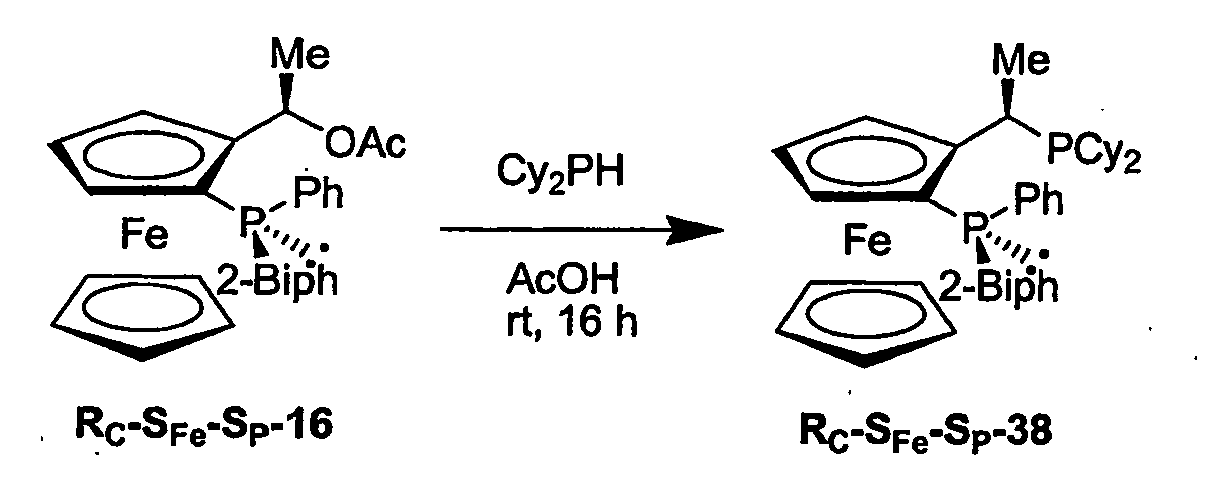
- A solution of (Rc, SFe, SP)-16 (531 mg, 1.0 mmol) and dicyclohexylphosphine (243 uL, 1.2 mmol) in acetic acid (3 mL) was stirred overnight at room temperature, and poured into 10% K2CO3 aqueous solution (60 mL) with stirring, extracted with Et2O (2×25 mL). The combined ether layers were dried (MgSO4) and concentrated. The residue was purified by chromatography (SiO2, hexane-EtOAc = 9:1) to afford the title compound (650 mg, 97%) as orange crystals. 1H NMR (CDCl3, 250.13 MHz): δ 1.02∼1.72 (m, 25H), 2.93 (m, 1H), 3.66 (s, 5H), 3.76 (m, 1H), 4.29 (t, 1H, J = 2.3 Hz); 4.32 (m, 1H), 7.14∼7.69 (m, 14 H); 31P NMR (CDCl3, 101.25 MHz): δ 18.44 (d, J = 36.7 Hz); -37.67 (d, J = 36.7 Hz).
-

- To a solution of (R,R)-1,1'-bis(1-N,N-dimethylaminoethyl)ferrocene [(R,R)-20] (986 mg, 3.0 mmol) in Et2O (30 mL) was added 1.5 M t-BuLi solution in pentane (6.0 mL, 9 mmol) over 10 min via a syringe at -78°C. After addition was completed, the mixture was warmed to room temperature, and stirred for 1.5 h at room temperature. The resulting red solution was cooled to -78°C again, and dichlorophenylphosphine (1.22 mL, 9.0 mmol) was added in one portion. After stirring for 10 min at -78°C, the mixture was slowly warmed to room temperature, and stirred for 1.5 h at room temperature. The mixture was then cooled to -78°C again, and a solution of (2-methoxy)phenyllithium [prepared from 2-bromoanisole (1.87 g, 10 mmol) and 1.5 M t-BuLi solution in pentane (13.3 mL, 20 mmol) in Et2O (50 mL) at-78°C] was added slowly via a cannula. The mixture was warmed to room temperature overnight, and filtered through a pad of Celite. The filtrate was concentrated. The residue was purified by chromatography (SiO2, hexane-EtOAc-Et3N = 80:15:5) to afford the title compound (1.10 g, 48%) as yellow foam. 1H NMR (CDCl3, 400.13 MHz): δ 1.28 (d, 6H, J = 6.7 Hz); 1.71 (s, 12H); 3.16 (m, 2H); 3.84 (s, 6H); 4.05 (m, 2H); 4.16 (m, 2H); 4.53 (t, 2H, J = 2.3 Hz); 6.62 (t, 2H, J = 7.4 Hz); 6.73 (dd, 2H, J = 8.1 and 4.6 Hz); 6.85 (ddd, 2H, J = 7.4, 5.3 and 1.8 Hz); 7.03 ∼ 7.11 (m, 10H); 7.17 (td, 2H, J = 8.5 and 1.6 Hz); 31P NMR (CDCl3, 162 MHz): δ -39.53 (s).
-

- To a solution of (R,R)-1,1'-bis(1-N,N-dimethylaminoethyl)ferrocene [(R,R)-20] (986 mg, 3.0 mmol) in Et2O (30 mL) was added 1.5 M t-BuLi solution in pentane (6.0 mL, 9 mmol) over 10 min via a syringe at -78°C. After addition was completed, the mixture was warmed to room temperature, and stirred for 1.5 h at room temperature. The resulting red solution was cooled to -78°C again, and dichlorophenylphosphine (1.22 mL, 9.0 mmol) was added in one portion. After stirring for 10 min at -78°C, the mixture was slowly warmed to room temperature, and stirred for 1.5 h at room temperature. The mixture was then cooled to -78°C again, and a solution of 1-naphthyllithium [prepared from 1-bromonaphthalene (2.07 g, 10 mmol) and 1.5 M t-BuLi solution in pentane (13.3 mL, 20 mmol) in Et2O (50 mL) at -78°C] was added slowly via a cannula. The mixture was warmed to room temperature overnight, and filtered through a pad of Celite. The filtrate was concentrated. The residue was purified by chromatography (SiO2, hexane-EtOAc-Et3N = 80:15:5) to afford the title compound (827 mg, 35%) as yellow crystals. 1H NMR (CDCl3, 400.13 MHz): δ 1.28 (d, 6H, J = 6.8 Hz); 1.74 (s, 12H); 2.49 (m, 2H); 4.01 (t, 2H, J = 2.3 Hz); 4.06 (m, 2H); 4.08 (m, 2H); 6.87 ~ 6.93 (m, 4H); 6.99 ~ 7.09 (m, 10H); 7.50 (td, 2H, J = 8.1 and 1.1 Hz); 7.53 (td, 2H, J = 6.8 and 1.3 Hz); 7.70 (d, 2H, J = 8.1 Hz); 7.83 (d, 2H, J = 8.1 Hz); 9.16 (t, 2H, J = 7.1 Hz); 31P NMR (CDCl3, 162 MHz): δ -39.47 (s).
-

- To a solution of (R,R)-1,1'-bis[(α-N,N-dimethylamino)phenylmethyl]ferrocene [(R,R)-23] (903 mg, 2.0 mmol) in Et2O (20 mL) was added 1.5 M t-BuLi solution in pentane (4.0 mL, 6 mmol) over 10 min via a syringe at -78°C. After addition was completed, the mixture was warmed to room temperature, and stirred for 1.5 h at room temperature. The resulting red solution was cooled to -78°C again, and dichlorophenylphosphine (814 uL, 6.0 mmol) was added in one portion. After stirring for 10 min at -78°C, the mixture was slowly warmed to room temperature, and stirred for 1.5 h at room temperature. The mixture was then cooled to -78°C again, and a solution of 1-naphthyllithium [prepared from 1-bromonaphthalene (1.45 g, 7 mmol) and 1.5 M t-BuLi solution in pentane (9.3 mL, 14 mmol) in Et2O (40 mL) at -78°C] was added slowly via a cannula. The mixture was warmed to room temperature overnight, and filtered through a pad of Celite. The filtrate was concentrated. The residue was purified by chromatography (SiO2, hexane-EtOAc = 3:1) to afford the title compound (369 mg, 20%) as orange crystals. 1H NMR (CDCl3, 250.13 MHz): δ 1.54 (s, 12H); 2.46 (m, 2H); 3.01 (m, 2H); 3.96 (t, 2H, J = 2.5 Hz); 4.42 (d, 2H, J = 5.3 Hz); 6.69 (ddd, 2H, J = 7.3, 4.3 and 1.0 Hz); 6.96 ∼ 7.34 (m, 22H); 7.55 (d, 2H, J = 8.3 Hz); 7.66 (d, 4H, J = 8.3 Hz); 7.81 (d, 2H, J = 7.8 Hz); 9.20 (t, 2H, J = 7.8 Hz); 31P NMR (CDCl3, 162 MHz): δ - 41.73 (s).
-

- To a solution of (2S,4S)-4-(methoxymethyl)-2-ferrocenyl-1,3-dioxane [(2S,4S)-45] (1.58 g, 5 mmol) in Et2O (20 mL) was added 1.7 Mt-BuLi solution in pentane (3.23 mL, 5.5 mmol) at -40 °C. After stirring for 10 min, the cooling bath was removed and the mixture was warmed to room temperature, and stirred for 1.5 h at room temperature. The resulting orange suspension was cooled to -78 °C, and dichlorophenylphosphine (750 uL, 5.5 mmol) was added in one portion. After stirring for 10 min, the cooling bath was removed and the mixture was warmed to room temperature, and stirred for 1.5 h at room temperature. The mixture was cooled to -78 °C again, a solution of 2-methoxyphenyllithium [prepared from 2-bromoanisole (1.22 mL, 6.5 mmol) and 1.7 M t-BuLi solution in pentane (7.6 mL, 13 mmol) in Et2O (40 mL) at -78°C] was added slowly via a cannula. The mixture was warmed to room temperature overnight, and filtered through a pad of Celite. The filtrate was concentrated. The residue was purified by chromatography (SiO2, hexane-EtOAc = 6:1) to afford the title compound (2.41 g, 91 %) as a mixture of two diastereomers (in about 3.3:1 ratio). Recrystallising from hexane, the major product [(2'S, 4'S, SFe, RP)-46] (1.41 g, 53%) was obtained. The absolute configuration of (2'S, 4'S, SFe, RP)-46 was determined by single-crystal X-ray diffraction analysis. 1H NMR (CDCl3, 400.13 MHz): δ 1.42 (dm, 1H, J = 13.3 Hz); 1.74 (m, 1H,); 2.89 (d, 2H, J = 5.1 Hz); 3.03 (s, 3H); 3.59 (m, 1H); 3.60 (s, 3H); 3.74 (m, 1H); 3.91 (td, 1H, J = 12.2 and 2.5 Hz); 4.08 (s, 5H); 4.24 -4.27 (m, 2H); 4.70 (m, 1 H); 5.71 (d, 1H, J = 2.5 Hz); 6.74 (dd, 1H, J = 7.9 and 4.6 Hz); 6.80 ∼ 6.86 (m, 2H); 7.22 (m, 1H); 7.31 - 7.35 (m, 3H); 7.51 -7.56 (m, 2H). 31P NMR (CDCl3, 162 MHz): δ - 31.46 (s).
-

- To a solution of (2S,4S)-4-(methoxymethyl)-2-ferrocenyl-1,3-dioxane [(2S,4S)-45] (3.16 g, 10 mmol) in Et2O (40 mL) was added 1.5 M t-BuLi solution in pentane (7.4 mL, 11 mmol) at -40 °C. After stirring for 10 min, the cooling bath was removed and the mixture was warmed to room temperature, and stirred for 1.5 h at room temperature. The resulting orange suspension was cooled to -78 °C, and dichlorophenylphosphine (1.49 mL, 11 mmol) was added in one portion. After stirring for 10 min, the cooling bath was removed and the mixture was warmed to room temperature, and stirred for 1.5 h at room temperature. The mixture was cooled to -78 °C again, a solution of 1-naphthyllithium [prepared from 1-bromonaphthalene (1.67 mL, 12 mmol) and 1.5 M t-BuLi solution in pentane (16 mL, 24 mmol) in Et2O (60 mL) at -78 °C] was added slowly via a cannula. The mixture was warmed to room temperature overnight, and filtered through a pad of Celite. The filtrate was concentrated. The residue was purified by chromatography (SiO2, hexane-EtOAc = 6:1) to afford the title compound (4.95 g, 90%) as a mixture of two diastereomers (in about 3.4:1 ratio), which was recrystallised from hexane to give the pure major product [(2'S, 4'S, SFe, RP)-47 ](2.53 g, 51 %) as yellow needles. The absolute configuration of (2'S, 4'S, SFe, RP)-47 was determined by single-crystal X-ray diffraction analysis. 1H NMR (CDCl3, 400.13 MHz): δ 1.33 (dm, 1H, J = 13.3 Hz); 1.63 (m, 1H); 2.56 (dd, 1H, J = 10.3 and 4.8 Hz); 2.67 (dd, 1H, J =10.3 and 5.6 Hz); 2.76 (s, 3H); 3.58 (m, 1H); 3.67 (m, 1H); 3.86 (td, 1H, J =12.2 and 2.5 Hz); 4.15 (s, 5H); 3.74 (m, 1H); 4.21 (ddd, 1H, J =11.4, 5.1 and 1.0 Hz); 4.31 (t, 1H, J = 2.5 Hz); 4.74 (m, 1H); 5.69 (d, 1H, J = 2.5 Hz); 7.16 (ddd, 1 H, J = 7.1, 5.1 and 1.2 Hz); 7.29 ∼ 7.40 (m, 6H); 7.54 ∼ 7.58 (m, 2H); 7.74 (d, 1H, J = 8.3 Hz); 7.78 (d, 1H, J = 8.0 Hz); 8.25 -8.28 (m, 1H). 31 P NMR (CDCl3, 162 MHz): δ - 28.03 (s).
-

- A mixture of acetal [(2'S, 4'S, SFe, RP)-46] (4.0 g, 7.5 mmol), p-TsOH.H2O (2.0 g), CH2Cl2 (50 mL) and H2O (30 mL) was stirred for 24 h at room temperature. The organic layer was separated, washed with saturated NaHCO3 solution (20 mL), dried (MgSO4), and evaporated under reduced pressure to give the crude product (3.20 g, 100%) as red crystals, which was used directly in next step. 1H NMR (CDCl3, 250.13 MHz): δ 3.66 (s, 3H); 3.96 (m, 1H); 4.22 (s, 5H); 4.71 (t, 1H, J = 2.3Hz); 5.13 (m, 1H); 6.72 (m, 1H); 6.78 ∼ 6.87 (m, 2H); 7.29 (m, 1H); 7.41 (m, 3H); 7.54 (m, 2H); 10.24 (d, 1H, J = 3.3 Hz). 31P NMR (CDCl3, 101 MHz): δ - 34.66 (s).
-

- A mixture of acetal [(2'S, 4'S, SFe, RP)-46] (4.73 g, 7.5 mmol), p-TsOH.H2O (2.0 g), CH2Cl2 (50 mL) and H2O (30 mL) was stirred for 24 h at room temperature. The organic layer was separated, washed with saturated NaHCO3 solution (20 mL), dried (MgSO4), and evaporated under reduced pressure to give the crude product (3.36 g, 100%) as red crystals, which was used directly in next step. 1H NMR (CDCl3, 250.13 MHz): δ 4.04 (m, 1H); 4.28 (s, 5H); 4.76 (t, 1H, J = 2.3Hz); 5.17 (m, 1H); 7.02 (m, 1H); 7.29 ∼ 7.48 (m, 6H); 7.52∼7.59 (m, 2H); 7.80 (t, 2H, J = 7.5 Hz); 8.26 (m, 1H); 10.20 (d, 1H, J = 3.0 Hz). 31P NMR (CDCl3, 101 MHz): δ - 30.50 (s).
-

- A suspension of magnesium turnings (63 mg, 2.6 mmol) and 2-bromophenyl)diphenylphosphine 50 (887 mg, 2.6 mmol) in THF (10 mL) was refluxed until magnesium was dissolved (about 30 min). The resulting Gragnard reagent solution was cooled to -78 °C, and a solution of (SFe, RP)-2-[(2-methoxyphenyl)phenylphosphino]ferrocenecarbaoxaldehyde [(SFe, RP)-48] (856 mg, 2.0 mmol) in THF (10 mL) was added slowly via a syringe. After stirring for 5 h at -78 °C, the mixture was allowed to warm to room temperature and stirred overnight at room temperature. The reaction was quenched with saturated NH4Cl solution, and extracted with CH2Cl2 (2×20 mL). The combined extracts were washed with brine (20 mL), dried (MgSO4), and evaporated under reduced pressure. The residue was purified by flash chromatography (SiO2, hexane-EtOAc = 6:1) to give yellow crystals (1.297 g, 96%) as a mixture of two diastereomers (∼9:1). Major product: 1H NMR (CDCl3, 250 MHz): δ 2.91 (br. s, 1H), 3.57 (m, 1H), 3.59 (s, 3H), 4.05 (m, 1H), 4.14 (t, 1H, J = 2.4 Hz), 4.18(s, 5H), 4.22 (m, 1H), 6.48∼4.56 (m, 2H), 6.68∼6.80 (m, 2H), 7.02 ∼ 7.37 (m, 13H); 7.49∼7.58 (m, 2H), 7.67 (m, 1H). 31 P NMR (CDCl3, 101 MHz): δ -18.69 (d, J = 14.6 Hz), -32.85 (d, J = 14.6 Hz).
-

- A suspension of magnesium turnings (63 mg, 2.6 mmol) and 2-bromophenyl)diphenylphosphine 50 (887 mg, 2.6 mmol) in THF (10 mL) was refluxed until magnesium was dissolved (about 30 min). The resulting Gragnard reagent solution was cooled to -78°C, and a solution of (SFe, RP)-2-[(1-naphthyl)phenylphosphino]ferrocenecarbaoxaldehyde [(SFe, RP)-49] (897 mg, 2.0 mmol) in THF (10 mL) was added slowly via a syringe. After stirring for 5 h at -78 °C, the mixture was allowed to warm to room temperature and stirred overnight at room temperature. The reaction was quenched with saturated NH4Cl solution, and extracted with CH2Cl2 (2×20 mL). The combined extracts were washed with brine (20 mL), dried (MgSO4), and evaporated under reduced pressure. The residue was purified by flash chromatography (SiO2, hexane-EtOAc = 6:1) to give yellow crystals (1.322 g, 93%) as a mixture of two diastereomers (∼9:1). Major product: 1H NMR (CDCl3, 250 MHz): δ 2.39 (br. s, 1H), 3.66 (m, 1H), 4.24(s, 5H), 4.29 (t, 1H, J = 2.4 Hz), 4.57 (m, 1H), 4.22 (m, 2H), 6.40∼4.49(m, 3H), 6.61∼6.67 (m, 2H), 6.83 ~ 7.01 (m, 4H); 7.10∼7.59 (m, H), 7.75 (br. D, 1H, J = 7.8 Hz), 8.28 (m, 1H). 31P NMR (CDCl3, 101 MHz): δ - 18.54 (d, J = 21.0 Hz), -29.56 (d, J = 21.0 Hz).
-

- To a suspension of KH (30%, 174 mg, 1.3 mmol washed with hexane) in THF (10 mL) was added alcohol [(SP,αS)-51] (690 g, 1.0 mmol) at 0 °C. After stirring for 2 h at 0 °C, iodomethane (68 uL, 1.1 mmoL) was added via a syringe, then the mixture was stirred for 2 h at 0 °C. The reaction was quenched with MeOH (0.5 mL), and the solvents were removed under reduced pressure. The residue was dissolved in CH2Cl2 (20 mL), washed with water (10 mL) and brine (10 mL), dried (MgSO4), and evaporated under reduced pressure. The residue was purified by flash chromatography (SiO2, hexane-EtOAc = 10:1) to give yellow crystals (463 mg, 66%). 1H NMR (CDCl3, 250 MHz): δ 2.82 (s, 3H), 3.50 (m, 1H), 3.57 (s, 3H), 4.11 (t, 1H, J = 2.3 Hz), 4.17 (s, 5H), 4.19 (m, 1H), 5.79 (d, 1H, J = 6.8 Hz), 6.54~6.64 (m, 2H), 6.69 (m; 1H), 6.84 (ddd, 1H, J =7.8, 4.3 and 1.5 Hz), 7.02~7.37 (m, 12H), 7.52 (m, 2H), 7.66 (m, 1H); 31P NMR (CDCl3, 101 MHz): δ -18.44 (d, J = 18.7 Hz), -31.19 (d, J =18.7 Hz).
-

- A suspension of Mg (729 mg, 30 mmol) in THF (10 mL) was added dropwise a solution of 2-bromophenyldiphenylphosphine (50) (9.42 g, 27.6 mmol) in THF (30 mL) at about 50°C. After addition, the mixture was refluxed for 1 h, cooled room temperature, and added to a solution of (SFe)-2-bromoferrocenecarboxaldehyde [(SFe)-54](6.74 g, 23 mmol) in Et2O (20 mL) at-78 °C. After stirring for 6 h at -78 °C, the mixture was warmed to room temperature, and stirred overnight at room temperature. The reaction was quenched with saturated NH4Cl solution (50 mL), and diluted with EtOAc (100 mL). The organic layer was separated, washed with brine (50 mL), dried (Na2SO4), and evaporated under reduced pressure. The residue was purified by chromatography (SiO2, hexane-EtOAc = 5:1) to give yellow crystals (12.51 g, 98%) as a single diastereomer. 1H NMR (CDCl3, 250 MHz): δ 2.67 (dd, 1H, J = 3.5 and 2.0 Hz), 4.04 (t, 1H, J = 2.5 Hz), 4.18 (m, 1H), 4.27 (s, 5H), 4.40 (m, 1H), 6.47 (dd, 1H, J = 6.5 and 3.5 Hz), 7.00 (m, 1H), 7.18 (m, 1H), 7.15 ∼ 7.37 (m, 12H); 31P NMR (CDCl3, 101 MHz): δ -17.30.
-

- To a suspension of KH (30%, 3.75 g, 28.1 mmol), washed with hexane) in THF (20 mL) was added a solution of (SP,αS)-2-Bromo-1-[α-(2-diphenylphosphinophenyl)]ferrocenemethanol [(SFe,αS)-55] (12.00 g, 21.6 mmol) in THF (180 mL) at 0 °C. After stirring for 2 h at 0 °C, iodomethane (1.48 mL, 23.8 mmoL) was added via a syringe, then the mixture was stirred for 1 h at 0 °C. The reaction was quenched with MeOH (5 mL), and the solvents were removed under reduced pressure. The residue was dissolved in EtOAc (150 mL), washed with water (100 mL) and brine (10o mL), dried (MgSO4), and evaporated under reduced pressure. The residue was purified by flash chromatography (SiO2, hexane-EtOAc = 5:1) to give yellow crystals (12.10 g, 98%). 1H NMR (CDCl3, 250 MHz): δ 3.29 (s, 3H), 3.96 (t, 1H, J = 2.5 Hz), 4.01 (m, 1H), 4.27 (s, 5H), 4.33 (m, 1H), 6.09 (d, 1H, J = 7.8 Hz), 7.04 (m, 1H), 7.15 ~ 7.37 (m, 12H), 7.44 (m, 1H); 31P NMR (CDCl3, 101 MHz): δ -18.46.
-

- To a solution of bromide [(SFe,αS)-56] (2.85 g, 5 mmol) in THF (30 mL) was added slowly 1.7 M t-BuLi (6.5 mL, 11 mmol) via a syringe at -78 °C. After stirring for 10 min at -78 °C, PhPCl2 (746 uL, 5.5 mmoL) was added via a syringe, After stirring for 30 min at -78°C, the mixture was warmed to room temperature and stirred for 1 h at room temperature. the mixture was cooled to-78°C again, and a suspension of o-AnLi [prepared from 2-bromoanisole (805 uL, 6.5 mmol) and 1.7 M t-BuLi (7.6 mL, 13 mmol) in Et2O (30 mL) at -78°C] was added via a cannula, then the mixture was stirred overnight at -78 °C to room temperature. The reaction was quenched with water (20 mL), The organic layer was separated, washed with brine (30 mL), dried (MgSO4), and evaporated under reduced pressure. The residue was purified by flash chromatography (SiO2, hexane-EtOAc = 10:1) to give yellow crystals (3.21 g, 91%) as a single diastereomer. 1H NMR (CDCl3, 250 MHz): δ 2.71 (s, 3H), 3.67 (m, 1H), 3.90 (m, 1H), 3.96 (s, 3H), 4.06 (t, 1H, J = 2.3 Hz), 4.22 (s, 5H), 5.52 (d, 1H, J = 6.5 Hz), 6.80∼6.98 (m, 4H), 7.08∼7.36 (m, 14H), 7.76 (m, 1H); 31P NMR (CDCl3, 101 MHz): δ -17.98 (d, J = 10.0 Hz), -33.15 (d, J =10.0 Hz).
-

- To a solution of bromide [(SFe,αS)-56] (2.85 g, 5 mmol) in THF (30 mL) was added slowly 1.7 M t-BuLi (6.5 mL, 11 mmol) via a syringe at -78 °C. After stirring for 10 min at -78 °C, PhPCl2 (746 uL, 5.5 mmoL) was added via a syringe, After stirring for 30 min at -78 °C, the mixture was warmed to room temperature and stirred for 1 h at room temperature. Tthe mixture was cooled to -78 °C again, and a suspension of o-AnLi [prepared from 1-bromonaphthalene (900 uL, 6.5 mmol) and 1.7 M t-BuLi (7.6 mL, 13 mmol) in Et2O (30 mL) at -78 °C] was added via a cannula, then the mixture was stirred overnight at -78 °C to room temperature. The reaction was quenched with water (20 mL), The organic layer was separated, washed with brine (30 mL), dried (MgSO4), and evaporated under reduced pressure. The residue was purified by flash chromatography (SiO2, hexane-EtOAc =10:1) to give yellow crystals (3.30 g, 91 %) as a mixture of two diastereomers (ratio: ∼9:1), which was recrystallised from hexane to give pure major product [(SFe,SP,αS)-58] (2.83 g, 78%) as yellow crystals. The mother liquor was concentrated, and the residue was recrystallized from MeOH to afford pure minor product [(SFe,RP,αS)-59] (217 mg, 6%) as yellow crystals. Major product [(SFe,SP,αS)-58] : 1H NMR (CDCl3, 250 MHz): δ 2.96 (s, 3H), 3.74 (m, 1H), 3.84 (s, 5H), 4.13 (t, 1H, J = 2.5 Hz), 4.20 (m, 1H), 6.04 (d, 1H, J = 7.3 Hz), 6.89∼7.41 (m, 20H), 7.55 (ddd, 1H, J = 8.0, 6.8 and 1.3 Hz), 7.64 (dd, 1H, J = 6.8 and 1.5 Hz), 7.69 (ddd, 1H, J = 5.3, 3.5 and 1.7 Hz), 7.89 (t, 2H, J = 8.0 Hz), 9.32 (dd, 1H, J = 7.5 and 6.8 Hz). 31P NMR (CDCl3, 101 MHz): δ -18.83 (d, J = 21.3 Hz), -35.08 (d, J = 21.3 Hz). Minor product [(SFe,RP,αS)-59]: 1H NMR (CDCl3, 250 MHz): δ 2.73 (s, 3H), 3.61 (m, 1H), 4.21 (t, 1H, J = 2.5 Hz), 4.22 (s, 5H), 4.28 (m, 1H), 5.86 (d, 1H, J = 7.3 Hz), 6.67 (ddd, 1H, J = 7.8, 4.3 and 1.3 Hz), 6.79~7.61 (m, 23H), 7.75 (br. d, 1H, J = 8.0 Hz), 8.29 (m, 1H). 31P NMR (CDCl3, 101 MHz): δ -18.52 (d, J =18.4 Hz), -27.69 (d, J = 18.4 Hz).
-

- To a solution of aldehyde [(SFe, RP)-48] (856 mg, 2.0 mmol) in THF (10 mL) was added NaBH4 (38 mg, 1.0 mmol) at 0 °C, then MeOH (2 mL) was added. After stirring for 2 h at 0 °C, the mixture was warmed to room temperature and stirred overnight at room temperature. The reaction was quenched with saturated NH4Cl solution (5 mL), and diluted with EtOAc (10 mL). The organic layer was separated, washed with brine (10 mL), dried (MgSO4), and evaporated under reduced pressure to give the crude product (857 mg, 100%) as yellow crystals, which was used directly in next step. 1H NMR (CDCl3, 250 MHz): δ 3.63 (m, 1H), 3.66 (s, 3H), 4.10 (s, 5H), 4.29 (t, 1H, J = 2.0 Hz), 4.41 (d, 1H, J = 12.5 Hz), 4.53 (m, 1H), 4.58 (dd, 1H, J = 12.5 and 2.0 Hz), 6.77∼6.90 (m, 3H), 7.28 (m, 1H), 7.34∼7.41 (m, 3H), 7.48∼7.55 (m, 2H). 31P NMR (CDCl3, 101 MHz): δ - 35.05.
-

- To a solution of aldehyde [(SFe, RP)-49] (897 mg, 2.0 mmol) in THF (10 mL) was added NaBH4 (38 mg, 1.0 mmol) at 0 °C, then MeOH (2 mL) was added. After stirring for 2 h at 0 °C, the mixture was warmed to room temperature and stirred overnight at room temperature. The reaction was quenched with saturated NH4Cl solution (5 mL), and diluted with EtOAc (10 mL). The organic layer was separated, washed with brine (10 mL), dried (MgSO4), and evaporated under reduced pressure to give the crude product (900 mg, 100%) as yellow crystals, which was used directly in next step. 1H NMR (CDCl3, 250 MHz): δ 3.71 (m, 1H), 4.16 (s, 5H), 4.36 (t, 1H, J = 2.5 Hz), 4.41 (d, 1H, J = 12.5 Hz), 4.54 (dd, 1H, J = 12.5 and 1.3 Hz), 4.58 (m, 1H), 7.11 (ddd, 1H, J = 7.0, 4.5 and 1.3 Hz), 7.30∼7.57 (m, 8H), 7.80 (m, 2H), 8.26 (m, 1H). 31P NMR (CDCl3, 101 MHz): δ - 31.14.
-

- A solution of alcohol [(SFe, RP)-60] (857 mg, 2.0 mmol), Ac2O (2 mL) and pyridine (2 mL) in CH2Cl2 (10 mL) was stirred overnight at room temperature. The volatile matters were removed under reduced pressure below 35°C to give the crude product (880 mg, 100%) as yellow crystals, which was used directly in next step. 1H NMR (CDCl3, 250 MHz): δ 1.62 (s, 3H), 3.64(s, 4H, overlapped), 4.10 (s, 5H), 4.30 (t, 1H, J = 2.5 Hz), 4.54 (m, 1H), 5.01 (d, 1H, J = 12.0 Hz), 5.12 (dd, 1H, J = 12.0 and 2.3 Hz), 6.77 (m, 2H), 6.83 (t, 1H, J = 7.5 Hz), 7.25 (m, 1H), 7.37 (m, 3H), 7.51 (m, 2H). 31P NMR (CDCl3, 101 MHz): δ -34.60.
-

- A solution of alcohol [(SFe, RP)-61] (900 mg, 2.0 mmol), Ac2O (2 mL) and pyridine (2 mL) in CH2Cl2 (10 mL) was stirred overnight at room temperature. The volatile matters were removed under reduced pressure below 35 °C to give the crude product (983 mg, 100%) as yellow crystals, which was used directly in next step. 1H NMR (CDCl3, 250 MHz): 51.46 (s, 3H), 3.74(m, 1H), 4.15 (s, 5H), 4.38(t, 1H, J = 2.5 Hz), 4.59 (m, 1H), 5.00 (d, 1H, J 1.3.5 Hz), 7.28∼7.45 (m, 5H), 7.54 (m, 1H), 7.69 (tt, 1H, J = 7.8 and 1.8 Hz), 7.78 (m, 2H), 8.23 (m, 1H), 8.64 (m, 2H). 31P NMR (CDCl3, 101 MHz): δ -30.85.
-

- A solution of (SFe, RP)-62 (472 mg, 1.0 mmol) and dicyclohexylphosphine (243 uL, 1.2 mmol) in acetic acid (3 mL) was stirred for 7 days at room temperature, and poured into 10% K2CO3 aqueous solution (60 mL) with stirring, extracted with Et2O (2×25 mL). The combined ether layers were dried (MgSO4) and concentrated. The residue was purified by chromatography (SiO2, hexane-EtOAc = 9:1) to afford the title compound (573 mg, 94%) as orange crystals. 1H NMR (CDCl3, 250.13 MHz): δ 0.99∼1.79 (m, 22H), 2.56 (br. d, 1H, J = 12.5 Hz), 2.73 (br. d, 1H, J =12.5 Hz), 3.58 (m, 1H), 4.00 (s, 5H), 4.20 (m, 1H), 4.57 (m, 1H); 4.32 (m, 1H), 6.74∼7.58 (m, 9H); 31P NMR (CDCl3, 101.25 MHz): δ - 2.93; -35.19.
-

- A solution of (SFe, RP)-63 (492 mg, 1.0 mmol) and dicyclohexylphosphine (243 uL, 1.2 mmol) in acetic acid (3 mL) was stirred for 7 days at room temperature, and poured into 10% K2CO3 aqueous solution (60 mL) with stirring, extracted with Et2O (2×25 mL). The combined ether layers were dried (MgSO4) and concentrated. The residue was purified by chromatography (SiO2, hexane-EtOAc = 9:1) to afford the title compound (599 mg, 95%) as orange crystals. 1H NMR (CDCl3, 250.13 MHz): δ 0.83∼1.76(m, 22 H), 2.57 (dm, 1H, J = 12.5 Hz), 2.70 (dm, 1H, J = 12.5 Hz), 3.67 (m, 1H), 4.06 (s, 5H), 4.27 (t, 1H, J = 2.5 Hz), 4.60 (m, 1 H); 7.12 (m, 1H), 7.31~7.82 (m, 10 H);8.28 (m, 1H). 31P NMR (CDCl3, 101.25 MHz): δ -2.19; -31.85.
-

- To a solution of (S)-66 (1.56 g, 5 mmol) and TMEDA (1.0 mL, 6.5 mmol) in Et2O (50 mL) was added 2.5 M n-BuLi (2.6 mL, 6.5 mmol) at -78 °C, After stirring for 3 h at -78 °C, PhPCl2 (0.95 mL, 7.0 mmol) was added, After stirring for 20 min at -78 °C, the mixture was warmed to room temperature and stirred for 1.5 h at room temperature. The mixture was cooled to -78 °C again, and a suspension of 1-NpLi [prepared from 1-bromonaphthalene (1.39 mL, 10 mmol) and 1.7 M t-BuLi (11.8 mL, 20 mmol) in Et2O (40 mL) at -78 °C] was added via a cannula. The mixture was stirred and warmed to room temperature overnight. The reaction was quenched by water (40 mL). The organic layer was separated, washwd with brine (40 mL), dried (MgSO4), and concentrated. The residue was purified by chromatography (SiO2, EtOAc-hexane = 1:5∼1:3) to give the product (2.25 g, 85%) as an orange crystals. 1H NMR and 31P NMR analysis show the de is about 9:1. Major product: 1H NMR (CDCl3, 400.13 MHz): δ 0.58 (d, 3H, J = 6.7 Hz); 0.73 (d, 3H, J = 6.7 Hz); 1.58 (m, 1 H), 3.45 3.52 (m, 2H), 3.61 (m, 1H), 3.78 (m, 1H), 4.29 (s, 5H); 4.44 (t, 1H, J = 2.6 Hz); 5.05 (m, 1H); 7.08(dd, 1H, J = 7.0 and 4.4 Hz); 7.24 - 7.48 (m, 8H); 7.74 (d, 1H, J = 8.0 Hz); 7.80 (d, 1H, J = 8.0 Hz); 8.37 (dd, 1H, J = 8.3 and 4.3 Hz). 31P NMR (CDCl3, 162 MHz): δ - 23.52 (s).
- Bis(1,5-cyclooctadiene)rhodium trifluoromethanesulfonate [Rh(COD)2TfO] (2.3 mg, 5 umol) and the desired ligand (6 umol)) were placed in a vessel which was purged with argon. The desired solvent was degassed with Ar for 15 minutes, then 5.0 mL was added to the reaction vessel via syringe. This solution was stirred at 25 °C. under argon for 15 minutes. The desired substrate (1.0 mmol) was then added to the catalyst solution. The solution was then purged five times with argon and pressurized with hydrogen to the desired pressure and stirred at room temperature. The reactions were run for the desired time at the desired pressure, and then depressurized. Samples were taken and analyzed for enantiomeric excess using standard analytical techniques.
-

- Methy 2-acetamidoacrylate (143 mg, 1.0 mmol) was hydrogenated according to General Procedure under 50psi of hydrogen in THF using bis(1,5-cyclooctadiene)rhodium trifluoromethanesulfonate (2.3 mg; 5 umol; 0.01 equiv) and ligand (Rc, SFe, SP)-23 (3.8 mg; 6 umol; 0.012 equiv) for 2.5 hour to afford 18.6% conversion to amino acid derivative with 88.6% ee as determined by chiral GC analysis.
-
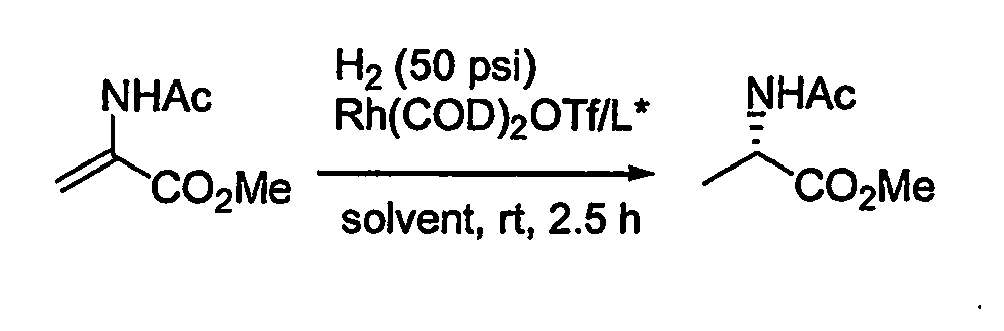
- Methy 2-acetamidoacrylate (143 mg, 1.0 mmol) was hydrogenated according to General Procedure under 50psi of hydrogen in THF using bis(1,5-cyclooctadiene)rhodium trifluoromethanesulfonate (2.3 mg; 5 umol; 0.01 equiv) and ligand (Rc, SFe, SP)-24 (4.0 mg; 6 umol; 0.012 equiv) for 2.5 hour to afford 100% conversion to amino acid derivative with 98.3% ee as determined by chiral GC analysis.
-

- Methy 2-acetamidoacrylate (143 mg, 1.0 mmol) was hydrogenated according to General Procedure under 50psi of hydrogen in THF using bis(1,5-cyclooctadiene)rhodium trifluoromethanesulfonate (2.3 mg; 5 umol; 0.01 equiv) and ligand (Rc, SFe, RP)-25 (4.0 mg; 6 umol; 0.012 equiv) for 2.5 hour to afford 100% conversion to amino acid derivative with 92.3% ee as determined by chiral GC analysis.
-

- Methy 2-acetamidoacrylate (143 mg, 1.0 mmol) was hydrogenated according to General Procedure under 50psi of hydrogen in MeOH using bis(1,5-cyclooctadiene)rhodium trifluoromethanesulfonate (2.3 mg; 5 umol; 0.01 equiv) and ligand (Rc, SFe, SP)-24 (4.0 mg; 6 mumol; 0.012 equiv) for 2.5 hour to afford 100% conversion to amino acid derivative with >99% ee as determined by chiral GC analysis.
-

- Methy 2-acetamidoacrylate (143 mg, 1.0 mmol) was hydrogenated according to General Procedure under 50psi of hydrogen in THF using bis(1,5-cyclooctadiene)rhodium trifluoromethanesulfonate (2.3 mg; 5 umol; 0.01 equiv) and ligand (Rc, SFe)-BoaPhoz (3.7 mg; 6 umol; 0.012 equiv) for 2.5 hour to afford 99% conversion to amino acid derivative with 94.5% ee as determined by chiral GC analysis.
-

- Methy 2-acetamidocinnamate (219 mg, 1.0 mmol) was hydrogenated according to General Procedure under 100 psi of hydrogen in THF using bis(1,5-cyclooctadiene)rhodium trifluoromethanesulfonate (2.3 mg; 5 umol; 0.01 equiv) and ligand (Rc, SFe, SP)-23 (3.8 mg; 6 umol; 0.012 equiv) for 2 hour to afford 100% conversion to amino acid derivative with 88.0% ee as determined by chiral GC analysis.
-

- Methy 2-acetamidocinnamate (219 mg, 1.0 mmol) was hydrogenated according to General Procedure under 100 psi of hydrogen in THF using bis(1,5-cyclooctadiene)rhodium trifluoromethanesulfonate (2.3 mg; 5 umol; 0.01 equiv) and ligand (Rc, SFe, SP)-24 (4.0 mg; 6 mumol; 0.012 equiv) for 2 hour to afford 100% conversion to amino acid derivative with 97.0% ee as determined by chiral GC analysis.
-

- Methy 2-acetamidocinnamate (219 mg, 1.0 mmol) was hydrogenated according to General Procedure under 100 psi of hydrogen in THF using bis(1,5-cyclooctadiene)rhodium trifluoromethanesulfonate (2.3 mg; 5 umol; 0.01 equiv) and ligand (Rc, SFe, RP)-25 (4.0 mg; 6 mumol; 0.012 equiv) for 2 hour to afford 100% conversion to amino acid derivative with 92.4% ee as determined by chiral GC analysis.
-

- Methy 2-acetamidocinnamate (219 mg, 1.0 mmol) was hydrogenated according to General Procedure under 100 psi of hydrogen in THF using bis(1,5-cyclooctadiene)rhodium trifluoromethanesulfonate (2.3 mg; 5 umol; 0.01 equiv) and ligand (Rc, SFe)-BoaPhoz (3.7 mg; 6 umol; 0.012 equiv) for 2 hour to afford . 100% conversion to amino acid derivative with 95.7% ee as determined by chiral GC analysis.
-
- 1. T. Hayashi, in Ferrocenes, (Eds.: A. Togni, T. Hayashi), VCH, Weinheim, 1995, p. 105.
- 2. 2. Togni, A.; Breutel, C.; Schnyder, A.; Spindler, F.; Landert, H.; Tijani, A. J. Am. Chem. Soc. 1994, 116, 4062.
- 3. 3. a. H. U. Blaser,W. Brieden, B. Pugin, F. Spindler, M. Studer, A. Togni, Topics in Catalysis 2002,19, 3; b. H. U. Blaser, F.Spindler, M. Studer, Applied Catal. A: General 2001, 221, 119.
- 4. 4.
McGarrity, J.; Spindler, F.; Fuchs, R.; Eyer, M. (LONZA AG), EP-A 624587 A2, 1995 - 5. 5. a. Blaser, H.-U. Adv. Synth. Catal. 2002, 344, 17. b. Blaser, H.-U.; Buser, H.-P.; Coers, K.; Hanreich, R.; Jalett, H.-P.; Jelsch, E.; Pugin, B.; Schneider, H.-D.; Spindler, F.; Wegmann, A. Chimia 1999, 53, 275.
- 6. 6. a. N. W. Boaz, S. D. Debenham, E. B. Mackenzie, S. E. Large, Org. Lett. 2002, 4, 2421. b.
Boaz, N. W.; Debenham, S. D. US 2002/0065417 (2002 ) - 7. a) T. Ireland, G. Grossheimann, C. Wieser-Jeunesse, P. Knochel, Angew. Chem. Int. Ed. 1999, 38, 3212. b) T. Ireland, K. Tappe, G. Grossheimann, P. Knochel, Chem. Eur. J. 2002, 8, 843;
- 8. a) M. Lotz, K. Polborn, P. Knochel, Angew. Chem. Int. Ed. 2002, 41, 4708. b) K. Tappe; P. Knochel, Tetrahedron: Asymmetry 2004, 15, 12; c)
M. Lotz, P. Knochel, A. Monsees, T. Riermeier, R. Kadyrov, J. J. Almena Perea, Ger. Pat. No. DE 10219490 (Degussa AG). - 9. a) T. Sturm, L. Xiao, W. Weissensteiner, Chimia 2001,55, 688; b) W. Weissensteiner, T. Sturm, F. Spindler, Adv. Synth. Catal. 2003, 345, 160; c)
Weissensteiner, T. Sturm, F. Spindler, US2003212284 . - 10. a. Perea, A. J. J.; Borner, A.; Knochel, P. Tetrahedron Lett. 1998, 39, 8073. b. Perea, A. J. J.; Lotz, M.; Knochel, P. Tetrahedron: Asymmetry 1999, 10, 375. c.Lotz, M.; Ireland, T.; Perea, A. J. J.; Knochel, P. Tetrahedron: Asymmetry 1999, 10, 1839. d.
Knochel, P.; Perea, A. J. J.; Drauz, K.; Klement, I. US 6,284,925 (2001 ). - 11. (a) Sawamura, M.; Hamashima, H.; Sugawara, M.; Kuwano, N.; Ito, Y. Organometallics 1995, 14, 4549. (b) Sawamura, M.;Kuwano, R.; Ito, Y. J. Am. Chem. Soc. 1995, 117, 9602. (c) Kuwano, R.; Sawamura, M.; Ito, Y. Tetrahedron: Asymmetry 1995, 6, 2521. (d) Kuwano, R.; Okuda, S.; Ito, Y. Tetrahedron: Asymmetry 1998, 9, 2773. (e) Kuwano, R.; Okuda, S.; Ito, Y. J. Org. Chem. 1998, 63, 3499. (f) Kuwano, R.; Ito, Y. J. Org. Chem. 1999, 64, 1232. (g) Kuwano, R.; Sato, K.; Kurokawa, T.; Karube, D.; Ito, Y. J. Am. Chem. Soc. 2000,122, 7614.
- 12. a) Kang, J.; Lee, J. H.; Ahn, S. H.; Choi, J. S. Tetrahedron Lett. 1998, 39, 5523. b) Kang, J.; Lee, J. H.; Kim, J. B.; Kim, G. J. Chirality 2000, 12, 378.
- 13. a) Jendralla, H. ; Paulus, E. Synlett, 1997, 471. b)
Jendralla, J. H. US 5,856,540 (1999 ) - 14. a) Argouarch, G.; Samuel, O.; Kagan, H. B. Eur. J. Org. Chem. 2000, 2891. b) Argouarch, G.; Samuel, O.; Riant, O.; Daran, J.-C.; .Kagan, H. B. Eur. J. Org. Chem. 2000, 2893.
- 15. Marinetti, A.; Labrue, F.; Gene^t, J.-P. Synlett 1999, 1975.
- 16. Berens, U.; Burk, M. J.; Gerlach, A.; Hems, W. Angew. Chem., Int. Ed. Engl. 2000, 39, 1981.
- 17. You, J.; Drexler, H.-J.; Zhang, S.; Fischer, C.; Heller, D. Angew. Chem., Int. Ed. Engl. 2003, 42, 913.
- 18. Maienza, F.; Wo¨rle, M.; Steffanut, P.; Mezzetti, A. Organometallics 1999, 18, 1041.
- 19. (a) Nettekoven, U.; Widhalm, M.; Kamer, P. C. J.; van Leeuwen, P. W. N. M. Tetrahedron: Asymmetry 1997, 8, 3185. (b) Nettekoven, U.; Kamer, P. C. J.; van Leeuwen, P. W. N. M.; Widhalm, M.; Spek, A. L.; Lutz, M. J. Org. Chem. 1999, 64, 3996.
- 20. Liu, D.; Li, W.; Zhang, X. Org. Lett. 2002, 4, 4471.
- 21. Xiao, D.; Zhang, X. Angew. Chem., Int. Ed. Engl. 2001, 40, 3425.
- 22. a) M. T. Reetz, A. Gosberg, R. Goddard, S.-H. Kyung, Chem. Commun. 1998, 2077; b)
M. T. Reetz, A. Gosberg, WO 0014096 1998 - 23. a. Nettekoven, U.; Widhalm, M.; Kamer, P. C. J.; van Leeuwen, P. W. N. M.; Mereiter, K.; Lutz, M.; Spek, A. L. Organometallics 2000, 19, 2299. b. Nettekoven, U.; Kamer, P. C. J.; Widhalm, M.; van Leeuwen, P. W. N. M. Organometallics 2000, 19, 4596. c. Nettekoven, U.; Widhalm, M.; Kalchhauser, H.; Kamer, P. C. J.; van Leeuwen, P. W. N. M.; Lutz, M.; Spek, A. L. J. Org. Chem. 2001, 66, 759-770.
- 24. Barbaro, P.; Bianchini, C.; Giambastiani, G.; Togni, A. Chem. Commun. 2002, 2672.
- 25. (a) Marquarding, D.; Klusacek, H.; Gokel, G.; Hoffmann, P.; Ugi, I. J. Am. Chem. Soc. 1970, 92, 5389. (b) Marquarding, D.; Klusacek, H.; Gokel, G.; Hoffmann, P.; Ugi, I. Angew. Chem. Int. Ed. Engl. 1970, 9, 371. (c) Hayashi, T.; Yamamoto, K.; Kumada, M. Tetrahedron Lett. 1974,15, 405. (d) Hayashi, T.; Mise, T.; Fukushima, M.; Kagotani, M.; Nagashima, N.; Hamada, Y.; Matsumoto, A.; Kawakami, S.; Konishi, M. M.; Yamamoto, K.; Kumada, M. Bull. Chem. Chem. Soc. Jpn. 1980, 53, 1138
- 26. Riant, O.; Argouarch, G.; Guillaneux, D.; Samuel, O.; Kagan, H. B. J. Org. Chem. 1998, 63, 3511.
- 27. (a) Riant, O.; Samuel, O.; Flessner, T.; Taudien, S.; Kagan, H. B. J. Org. Chem. 1997, 62, 6733. (b) Riant, O.; Samuel, O.; Kagan,H. B. J. Am. Chem. Soc. 1993, 115, 5835.
- 28. (a) Richards, J.; Damalidis, T.; Hibbs D. E.; Hursthouse, M. B. Synlett 1995, 74. (b) Sammakai, T.; Latham H. A.; Schaad, D. R. J. Org. Chem. 1995, 60, 10. (c) Nishibayashi, Y.; Uemura, S. Synlett 1995, 79. (d) Sammakai, T.; Latham, H. A. J. Org. Chem. 1995, 60, 6002.
- 29. Ganter, C.; Wagner, T. Chem. Ber. 1995, 128, 1157.
- 30. (a) Enders, D.; Peters, R.; Lochtman, R.; Runsink, J. Synlett 1997, 1462. (b) Enders, D.; Peters, R.; Lochtman, R.; Runsink, J. Eur. J. Org. Chem. 2000, 2839.
- 31. Lotz, M.; Ireland T.; Tappe, K.; Knochel, P. Chirality, 2000, 12, 389.
- 32. Kitzler, R.; Xiao, L.; Weissensteiner, W. Tetrahedron: Asymmetry 2000, 11,3459.
- 33. Widhalm, M.; Mereiter, K.; Bourghida, M. Tetrahedron: Asymmetry 1998,9,2983.
- 34. Nishibayashi, Y.; Arikawa, Y.; Ohe, K.; Uemura, S. J. Org. Chem. 1996, 61, 1172.
- 35. (a) Tsukazaki, M.; Tinkl, M.; Roglans, A.; Chapell, B. J.; Taylor, N. J.; Snieckus, V. J. Am. Chem. Soc. 1996, 118, 685. (b) Jendralla, H.; Paulus, E. Synlett 1997, 471.
- 36. Price, D.; Simpkins, N. S. Tetrahedron Lett. 1995, 36, 6135.
Claims (21)
- A metallocene-based phosphine or arsine ligand chiral at phosphorus or arsenic having the Formula (I), (II) or (III):

W is phosphorus or arsenic;
M is a metal;
R1 and R2 are different from each other, and are independently selected from substituted and unsubstituted, branched- and straight-chain alkyl, alkoxy, alkylamino, substituted and unsubstituted cycloalkyl, substituted and unsubstituted cycloalkoxy, substituted and unsubstituted cycloalkylamino, substituted and unsubstituted carbocyclic aryl, substituted and unsubstituted carbocyclic aryloxy, substituted and unsubstituted heteroaryl, substituted and unsubstituted heteroaryloxy, substituted and unsubstituted carbocyclic arylamino and substituted and unsubstituted heteroarylamino, wherein the or each heteroatom is independently selected from sulphur, nitrogen, and oxygen;
R3 and R4 are the same or different, and are independently selected from substituted and unsubstituted, branched- and straight-chain alkyl, substituted and unsubstituted cycloalkyl, substituted and
unsubstituted carbocyclic aryl, and substituted and unsubstituted heteroaryl wherein the or each heteroatom is independently selected from sulphur, nitrogen, and oxygen;
n is 0 to 3;
m is 0 to 5;
Q is selected from:
R6 and R7 are the same or different, and are independently selected from substituted and unsubstituted, branched- and straight-chain alkyl, alkoxy, alkylamino, substituted and unsubstituted cycloalkyl, substituted and unsubstituted cycloalkoxy, substituted and
unsubstituted cycloalkylamino, substituted and unsubstituted carbocyclic aryl, substituted and unsubstituted carbocyclic aryloxy, substituted and unsubstituted heteroaryl, substituted and
unsubstituted heteroaryloxy, substituted and unsubstituted carbocyclic arylamino and substituted and unsubstituted heteroarylamino, wherein the or each heteroatom is independently selected from sulphur, nitrogen, and oxygen; and R8 is selected from hydrogen, substituted and unsubstituted, branched- and straight-chain alkyl, substituted and unsubstituted cycloalkyl, substituted and
unsubstituted carbocyclic aryl, and substituted and unsubstituted heteroaryl wherein the or each heteroatom is independently selected from sulphur, nitrogen, and oxygen; or
Q is selected from:
R6, R7 and R8 are, independently, as previously defined; and R9 is selected from hydrogen, substituted and unsubstituted, branched-and straight-chain alkyl, substituted and unsubstituted cycloalkyl, substituted and unsubstituted carbocyclic aryl, and substituted and
unsubstituted heteroaryl wherein the or each heteroatom is independently selected from sulphur, nitrogen, and oxygen; or
Q is selected from:
substituted and unsubstituted heteroaryl wherein the or each heteroatom is independently selected from sulphur, nitrogen, and
oxygen; or
Q is selected from:
substituted and unsubstituted heteroaryl wherein the or each heteroatom is independently selected from sulphur, nitrogen, and
oxygen; or
Q is selected from:
R6, R7 are, as previously defined; R11 is selected from OR13, SR13, NHR13, NR13R14, wherein R13 and R14 are the same or different and are independently selected from hydrogen, substituted and
unsubstituted, branched- and straight-chain alkyl, substituted and
unsubstituted cycloalkyl, substituted and unsubstituted carbocyclic aryl, and substituted and unsubstituted heteroaryl wherein the or each heteroatom is independently selected from sulphur, nitrogen, and
oxygen; R12 is selected from hydrogen, halogen, OR13, SR13, NR13R14, substituted and unsubstituted, branched- and straight-chain alkyl, substituted and unsubstituted cycloalkyl, substituted and
unsubstituted carbocyclic aryl, and substituted and unsubstituted heteroaryl wherein the or each heteroatom is independently selected from sulphur, nitrogen, and oxygen; wherein R13, R14 are, as previously defined and n' is 0 to 4;
or Q is selected from:
R5 is selected from:
unsubstituted carbocyclic aryl, and substituted and unsubstituted heteroaryl wherein the or each heteroatom is independently selected from sulphur, nitrogen, and oxygen; wherein R13, R14 are, as previously defined; or
R5 is selected from:
G is selected from the group consisting of:
-CONH-R*-NHCO-, -CO-OR*O-CO-, -CO-R*CO-, -CH=N-R*-N=CH-, -CH2NH-R*-NHCH2-, -CH2NHCO-R*-CONHCH2, -CH(R8)NH-R*-NH(CH(R8)-, -CH(R8)NHCO-R*-CONHCH(R8)-, -CONH-R-NHCO-,-CO-ORO-CO-, -CO-RCO-, -CH=N-R-N=CH-, -CH2NH-R-NHCH2-,-CH2NHCO-R-CONHCH2-, -CH(R8)NH-R-NH(CH(R8)-, -CH(R8)NHCO-R-CONHCH(R8)-; wherein R8 is, independently, as previously defined; -R*- and -R- are selected from the group consisting of:
substituted and unsubstituted cycloalkyl, substituted and
unsubstituted carbocyclic aryl, and substituted and unsubstituted heteroaryl wherein the or each heteroatom is independently selected from sulphur, nitrogen, and oxygen; or (R19)2 is -(CH2)m'-, n' is 0 to 4; and m' is 1 to 8; - Enantiomers of the ligands according to claim 1 having the Formulae (IV), (V) and (VI):
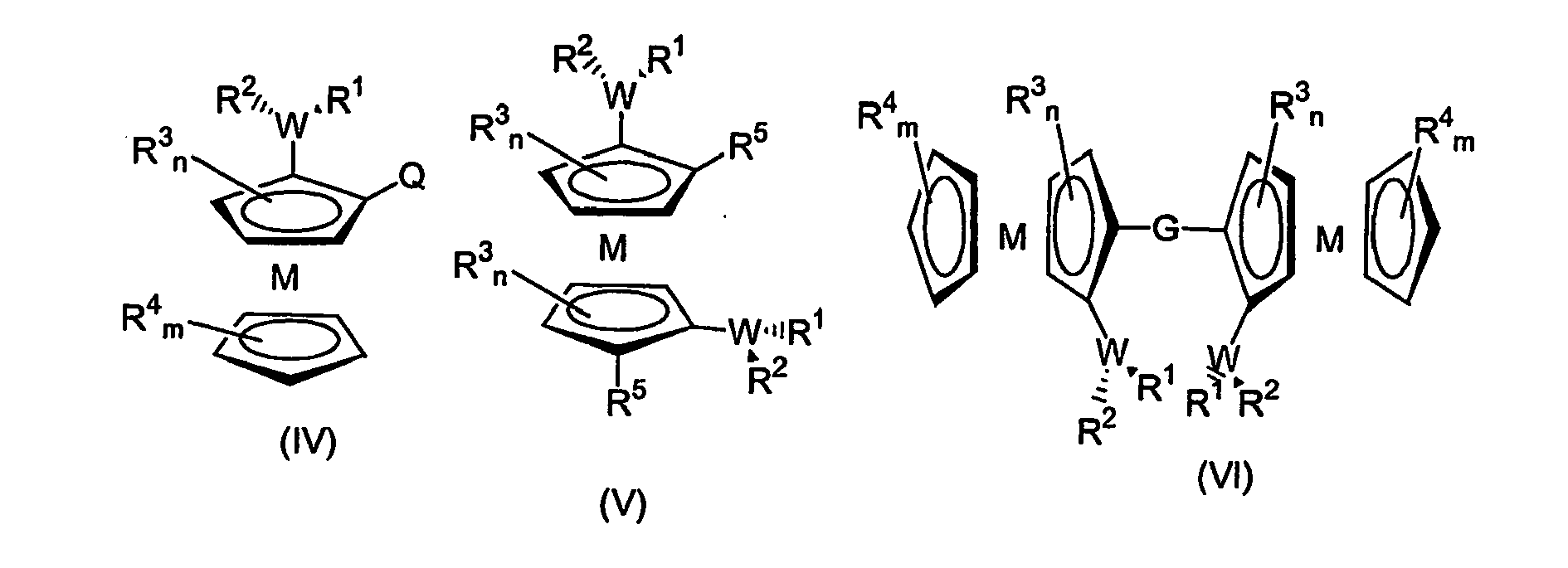
- Diastereomers of the ligands according to claim 1 having the Formulae (VII), (VIII) and (IX):
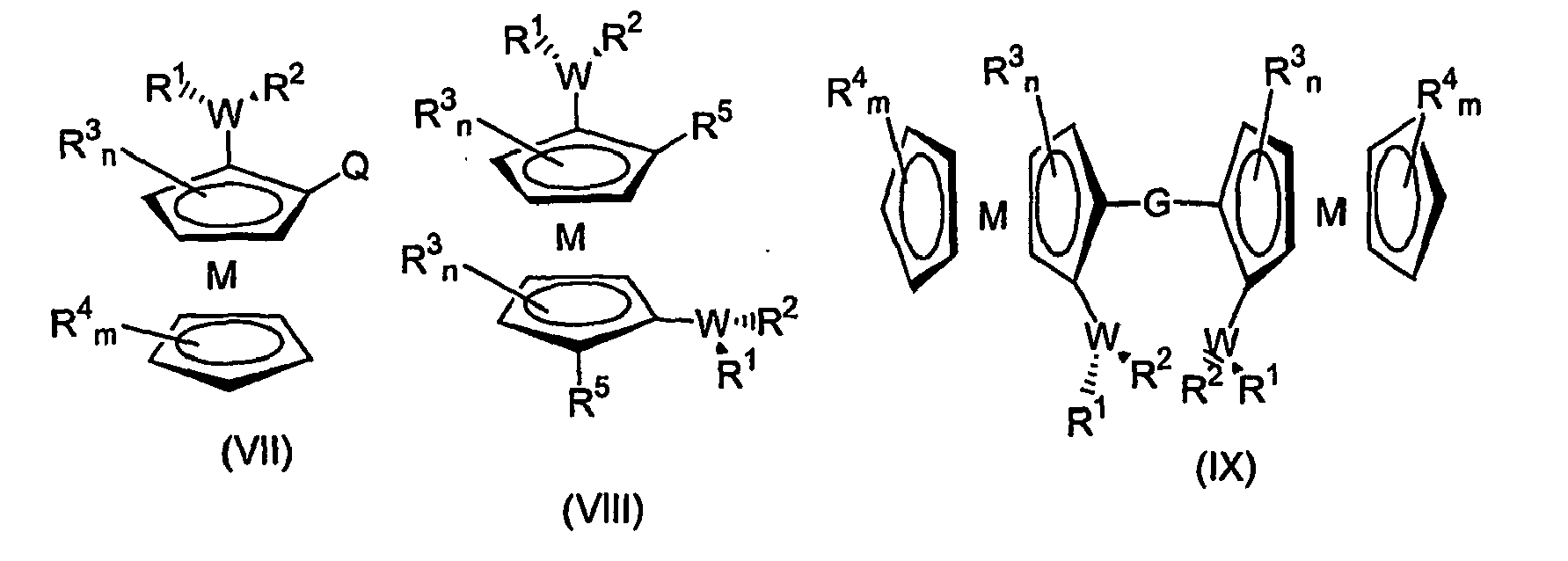
- A metallocene-based phosphine according to any one of claims 1 to 3 having chirality at phosphorus (or arsenic) and at least one other element of chirality (planar chirality and/or chirality at carbon and/or axial chirality).
- A metallocene-based diphosphine or diarsine ligand according to any one of claims 1 to 4 having three elements of chirality, namely planar chirality, chirality at phosphorus (or arsenic), and chirality at carbon.
- A metallocene-based diphosphine or diarsine ligand according to any one of claims 1 to 4 having four elements of chirality, namely planar chirality, chirality at phosphorus (or arsenic), chirality at carbon and axial chirality.
- A ligand according to any one of claims 1 to 6 wherein the metallocene is ferrocene.
- A ligand according to any one of claims 1 to 7 wherein W is phosphorus.
- Use of the ligand of any one of claims 1 to 8 as a catalyst or catalyst precursor in asymmetric transformation reactions to generate high enantiomeric excesses of formed compounds.
- A transition metal complex containing a transition metal coordinated to a ligand according to any one of claims 1 to 8.
- A transition metal catalyst according to claim 10 wherein the transition metal is a Group Vlb or a Group VIII metal.
- A method for preparing a ligand according to any one of claims 1 to 8 comprising providing a metallocene-based substrate having a chiral directing substituent on one or both rings, and subjecting the substituted metallocene to ortho-lithiation followed by converting the ortho-lithiated substituted metallocene to a phosphine chiral at phosphorus (or to an arsine chiral at arsenic).
- A method according to claim 12 for preparing the ligand of Formula (I) or (III) comprising providing a compound of the formula (X) (optionally substituted on one or both cyclopentadiene rings with R3 n (top ring) and/or R4 m (bottom ring)):

ortho-lithiating the substrate; reacting the ortholithiated substrate with an R1 substituted phosphine or arsine, and with an R2-bearing Grignard reagent or organolithium compound, and converting X* to Q or G as desired. - A method according to claim 13 wherein X* is selected from the group consisting of :

Ra and Rb are same or different, and are independently selected from hydrogen, substituted and unsubstituted, branched- and straight-chain alkyl, substituted and unsubstituted cycloalkyl, substituted and
unsubstituted carbocyclic aryl, and substituted and unsubstituted heteroaryl wherein the or each heteroatom is independently selected from sulphur, nitrogen, and oxygen. - A method according to claim 13 or claim 14 wherein the ortholithiation step is conducted using n-butyllithium, sec-butyllithium and/or tert- butyllithium.
- A method according to claim 15 wherein the resulting monolithium compound is reacted in situ with a dichlorophosphine of the formula R1PCl2 wherein R1 is as defined in claim 1 to yield an intermediate product.
- A method according to claim 16 comprising reacting the intermediate product with an organometal reagent of the formula R2Z, wherein R2 is as defined in claim 1; Z is Li or MgY wherein Y is a halide, to obtain phosphorus chiral compound having formula (XI):

- A method according to claims 17 comprising converting compound XI to compound (I) or (III).
- A method for preparing the ligand of Formula (I) or (III) comprising providing a compound of the formula XXXVII:

wherein Y is a halide, to obtain a phosphorus chiral compound having formula XXXVIII:
- A method according to claim 19 wherein X is selected from:

Ra and Rb are same or different, and are independently selected from hydrogen, substituted and unsubstituted, branched- and straight-chain alkyl, substituted and unsubstituted cycloalkyl, substituted and unsubstituted carbocyclic aryl, and substituted and unsubstituted heteroaryl wherein the or each heteroatom is independently selected from sulphur, nitrogen, and oxygen; - A method for preparing the ligand of Formula (II) comprising providing a compound of the Formula XXXIX:


Applications Claiming Priority (2)
| Application Number | Priority Date | Filing Date | Title |
|---|---|---|---|
| GBGB0400720.9A GB0400720D0 (en) | 2004-01-14 | 2004-01-14 | Novel ferrocene-based phosphorus chiral phosphines |
| PCT/GB2005/000112 WO2005068477A1 (en) | 2004-01-14 | 2005-01-14 | Metallocene-based chiral phosphine or arsine ligands |
Publications (2)
| Publication Number | Publication Date |
|---|---|
| EP1709054A1 EP1709054A1 (en) | 2006-10-11 |
| EP1709054B1 true EP1709054B1 (en) | 2009-03-04 |
Family
ID=31726125
Family Applications (2)
| Application Number | Title | Priority Date | Filing Date |
|---|---|---|---|
| EP05701893A Expired - Lifetime EP1725570B1 (en) | 2004-01-14 | 2005-01-14 | Process for the production of asymmetric transformation catalysts |
| EP05701880A Expired - Lifetime EP1709054B1 (en) | 2004-01-14 | 2005-01-14 | Metallocene-based chiral phosphine or arsine ligands |
Family Applications Before (1)
| Application Number | Title | Priority Date | Filing Date |
|---|---|---|---|
| EP05701893A Expired - Lifetime EP1725570B1 (en) | 2004-01-14 | 2005-01-14 | Process for the production of asymmetric transformation catalysts |
Country Status (11)
| Country | Link |
|---|---|
| US (2) | US7994355B2 (en) |
| EP (2) | EP1725570B1 (en) |
| JP (2) | JP2007517850A (en) |
| CN (2) | CN1914217A (en) |
| AT (2) | ATE424404T1 (en) |
| AU (2) | AU2005205229B2 (en) |
| CA (2) | CA2553607A1 (en) |
| DE (2) | DE602005013062D1 (en) |
| ES (2) | ES2313282T3 (en) |
| GB (4) | GB0400720D0 (en) |
| WO (2) | WO2005068477A1 (en) |
Families Citing this family (21)
| Publication number | Priority date | Publication date | Assignee | Title |
|---|---|---|---|---|
| GB0400720D0 (en) * | 2004-01-14 | 2004-02-18 | Stylacats Ltd | Novel ferrocene-based phosphorus chiral phosphines |
| RU2006143155A (en) * | 2004-05-07 | 2008-06-20 | Умикоре Аг Энд Ко. Кг (De) | Ferrocenyl Ligands for Homogeneous Enantioselective Hydrogenation Catalysts |
| US6906212B1 (en) * | 2004-06-25 | 2005-06-14 | Eastman Chemical Company | Phosphine-phosphoramidite compounds |
| US6906213B1 (en) * | 2004-06-25 | 2005-06-14 | Eastman Chemical Company | Preparation of aminophosphines |
| US20060135804A1 (en) * | 2004-12-21 | 2006-06-22 | Boaz Neil W | Tetradentate ligands and metal complexes thereof for asymmetric catalysis |
| GB0500702D0 (en) * | 2005-01-14 | 2005-02-23 | Stylacats Ltd | Novel metallocene-based phosphorus chiral phosphines |
| GB0500700D0 (en) * | 2005-01-14 | 2005-02-23 | Stylacats Ltd | Process for the manufacture of 2-alkyl-3-phenylpropionic acids and alcohols |
| CN101421285B (en) * | 2006-04-12 | 2013-02-06 | 索尔维亚斯股份公司 | Ferrocenediphosphines |
| JP5209611B2 (en) * | 2006-05-23 | 2013-06-12 | ソルヴィーアス アクチェンゲゼルシャフト | Chiral ligands used as transition metal catalysts in asymmetric addition reactions, especially in hydrogenation |
| JP5232989B2 (en) * | 2006-07-18 | 2013-07-10 | 国立大学法人豊橋技術科学大学 | Optically active 2,6-bisaminomethylpyridine derivative, production method thereof and use thereof |
| JP5493346B2 (en) * | 2008-12-11 | 2014-05-14 | 東ソー株式会社 | Ferrocene derivatives and uses thereof |
| WO2011080736A1 (en) | 2009-12-29 | 2011-07-07 | Mapi Pharma Hk Limited | Intermediate compounds and processes for the preparation of tapentadol and related compounds |
| CN102775418B (en) * | 2012-06-11 | 2014-12-24 | 中国人民解放军第四军医大学 | Synthesis and application of novel chiral quaternary ammonium salt phase-transfer catalyst |
| CN104592313B (en) * | 2014-12-30 | 2017-08-25 | 陕西师范大学 | Difunctional hydrogen bond organic catalyst based on ferrocene and its preparation method and application |
| CN104861001B (en) * | 2015-06-11 | 2017-08-04 | 河南省科学院化学研究所有限公司 | A kind of preparation method of ferrocene biphosphine ligand |
| CN106397484A (en) * | 2015-07-23 | 2017-02-15 | 赢创德固赛有限公司 | Butyl‑bridged diphosphine ligands for alkoxycarbonylation |
| PT3272759T (en) * | 2016-07-19 | 2019-07-17 | Evonik Degussa Gmbh | 1,1 -bis (phosphino) ferrocene ligands for alkoxycarbonylation |
| CN109078653A (en) * | 2018-10-08 | 2018-12-25 | 浙江工业大学上虞研究院有限公司 | Chiral ferrocene phosphoric acid catalyst and its application in asymmetric Friedel-Crafts reaction |
| CN112824422B (en) * | 2019-11-21 | 2023-01-13 | 中国科学院大连化学物理研究所 | Chiral ferrocene-indole diphosphine ligand as well as preparation method and application thereof |
| CN114560893B (en) * | 2022-03-16 | 2024-02-06 | 中国科学院上海有机化学研究所 | Planar chiral metallocene compound, and synthetic method and application thereof |
| CN116178455B (en) * | 2023-04-26 | 2023-08-18 | 江苏欣诺科催化剂股份有限公司 | A kind of preparation method of ferrocene chiral phosphine ligand |
Family Cites Families (19)
| Publication number | Priority date | Publication date | Assignee | Title |
|---|---|---|---|---|
| DE59410267D1 (en) * | 1993-02-26 | 2003-05-15 | Syngenta Participations Ag | Ferrocenyldiphosphines as ligands for homogeneous catalysts |
| CA2122511A1 (en) * | 1993-05-14 | 1994-11-15 | John Mcgarrity | Asymmetric hydrogenation of furoimidazole derivatives |
| DE59408655D1 (en) * | 1993-10-01 | 1999-09-30 | Novartis Ag | Ferrocenyldiphosphines substituted with fluoroalkyl as ligands for homogeneous catalysts |
| CZ291280B6 (en) * | 1995-04-11 | 2003-01-15 | Syngenta Participations Ag | Ferrocenes and processes of their preparation |
| ES2183036T3 (en) | 1996-04-25 | 2003-03-16 | Hoechst Ag | 2,2 '- DISUSTITUIDOS-FERROCENOS 2,2`-DISUSTITUIDOS and 1-PHOSPHINO-FERROCENOS 1`, 2-DISUSTITUIDOS, PROCEDURE FOR THEIR PREPARATION, ITS USE, AS WELL AS COMPLEXES OF TRANSITION METALS CONTAINING THEM. |
| CZ292412B6 (en) * | 1996-10-07 | 2003-09-17 | Syngenta Participations Ag | Chiral ferrocenyl compounds, process of their preparation and their use |
| EP0967015B1 (en) * | 1998-06-19 | 2005-01-12 | Degussa AG | Use of ferrocenyl ligands in catalytic enantioselective hydrogenation |
| DE19840279A1 (en) | 1998-09-04 | 2000-03-09 | Studiengesellschaft Kohle Mbh | New ferrocene-based chiral diphosphonites for asymmetric catalysis |
| DE19952348A1 (en) * | 1998-12-19 | 2000-06-21 | Degussa | New bisphosphinyl-ferrocene ligand components for new metal complexes useful as catalysts in asymmetric hydrogenations |
| US6258979B1 (en) * | 1999-11-22 | 2001-07-10 | Henri Kagan | Chiral ferrocene phosphines active in asymmetric catalysis |
| US6194593B1 (en) * | 2000-01-28 | 2001-02-27 | Nippon Chemical Industrial Co., Ltd. | 1, 2-bis(dialkylphosphino) benzene derivates having optical activites, process for producing same, and rhodium metal complexes containing same as ligands |
| CA2400183A1 (en) * | 2000-02-10 | 2001-08-16 | The Penn State Research Foundation | Chiral ferrocene phosphines and their use in asymmetric catalytic reactions |
| JP5185485B2 (en) | 2000-07-03 | 2013-04-17 | ソルヴィーアス アクチェンゲゼルシャフト | Ferrocenyl diphosphine and uses thereof |
| US6590115B2 (en) | 2000-09-29 | 2003-07-08 | Eastman Chemical Company | Phosphino-aminophosphines |
| DE60230817D1 (en) * | 2001-10-05 | 2009-02-26 | Solvias Ag | LIGANDS FOR ASYMMETRIC REACTIONS |
| DE10211250A1 (en) * | 2002-03-13 | 2003-10-23 | Degussa | Ferrocenyl ligands and their use in catalysis |
| DE10219490A1 (en) | 2002-04-30 | 2003-11-13 | Degussa | Ferrocenyl ligands and a process for the preparation of such ligands |
| GB0400720D0 (en) * | 2004-01-14 | 2004-02-18 | Stylacats Ltd | Novel ferrocene-based phosphorus chiral phosphines |
| US20080076937A1 (en) * | 2004-07-05 | 2008-03-27 | Benoit Pugin | Tetradentate Ferrocene Ligands And Their Use |
-
2004
- 2004-01-14 GB GBGB0400720.9A patent/GB0400720D0/en not_active Ceased
-
2005
- 2005-01-14 GB GB0500701A patent/GB2410950B/en not_active Expired - Fee Related
- 2005-01-14 GB GB0500704A patent/GB2410951B/en not_active Expired - Fee Related
- 2005-01-14 CN CNA2005800037217A patent/CN1914217A/en active Pending
- 2005-01-14 US US10/586,287 patent/US7994355B2/en not_active Expired - Fee Related
- 2005-01-14 CN CNA2005800037221A patent/CN1914218A/en active Pending
- 2005-01-14 JP JP2006548403A patent/JP2007517850A/en active Pending
- 2005-01-14 CA CA002553607A patent/CA2553607A1/en not_active Abandoned
- 2005-01-14 CA CA002553608A patent/CA2553608A1/en not_active Abandoned
- 2005-01-14 DE DE602005013062T patent/DE602005013062D1/en not_active Expired - Lifetime
- 2005-01-14 ES ES05701893T patent/ES2313282T3/en not_active Expired - Lifetime
- 2005-01-14 EP EP05701893A patent/EP1725570B1/en not_active Expired - Lifetime
- 2005-01-14 WO PCT/GB2005/000112 patent/WO2005068477A1/en not_active Ceased
- 2005-01-14 US US10/586,204 patent/US20080281106A1/en not_active Abandoned
- 2005-01-14 AU AU2005205229A patent/AU2005205229B2/en not_active Ceased
- 2005-01-14 JP JP2006548397A patent/JP2007517849A/en active Pending
- 2005-01-14 AT AT05701880T patent/ATE424404T1/en active
- 2005-01-14 EP EP05701880A patent/EP1709054B1/en not_active Expired - Lifetime
- 2005-01-14 AT AT05701893T patent/ATE404573T1/en active
- 2005-01-14 ES ES05701880T patent/ES2323717T3/en not_active Expired - Lifetime
- 2005-01-14 DE DE602005008917T patent/DE602005008917D1/en not_active Expired - Lifetime
- 2005-01-14 AU AU2005205224A patent/AU2005205224B2/en not_active Ceased
- 2005-01-14 WO PCT/GB2005/000125 patent/WO2005068478A1/en not_active Ceased
-
2009
- 2009-03-26 GB GBGB0905212.7A patent/GB0905212D0/en not_active Ceased
Also Published As
| Publication number | Publication date |
|---|---|
| ES2323717T3 (en) | 2009-07-23 |
| ES2313282T3 (en) | 2009-03-01 |
| WO2005068477A1 (en) | 2005-07-28 |
| GB2410951A (en) | 2005-08-17 |
| GB2410950A (en) | 2005-08-17 |
| GB2410951B (en) | 2009-07-22 |
| WO2005068478A1 (en) | 2005-07-28 |
| CN1914217A (en) | 2007-02-14 |
| EP1709054A1 (en) | 2006-10-11 |
| GB0500704D0 (en) | 2005-02-23 |
| GB0400720D0 (en) | 2004-02-18 |
| ATE404573T1 (en) | 2008-08-15 |
| AU2005205224A1 (en) | 2005-07-28 |
| CA2553607A1 (en) | 2005-07-28 |
| DE602005013062D1 (en) | 2009-04-16 |
| AU2005205229B2 (en) | 2010-03-04 |
| AU2005205229A1 (en) | 2005-07-28 |
| US7994355B2 (en) | 2011-08-09 |
| JP2007517849A (en) | 2007-07-05 |
| EP1725570A1 (en) | 2006-11-29 |
| ATE424404T1 (en) | 2009-03-15 |
| CA2553608A1 (en) | 2005-07-28 |
| DE602005008917D1 (en) | 2008-09-25 |
| CN1914218A (en) | 2007-02-14 |
| AU2005205224B2 (en) | 2009-04-23 |
| JP2007517850A (en) | 2007-07-05 |
| GB0500701D0 (en) | 2005-02-23 |
| GB0905212D0 (en) | 2009-05-13 |
| US20080281106A1 (en) | 2008-11-13 |
| US20070161762A1 (en) | 2007-07-12 |
| EP1725570B1 (en) | 2008-08-13 |
| GB2410950B (en) | 2009-05-20 |
Similar Documents
| Publication | Publication Date | Title |
|---|---|---|
| EP1725570B1 (en) | Process for the production of asymmetric transformation catalysts | |
| Togni et al. | A novel easily accessible chiral ferrocenyldiphosphine for highly enantioselective hydrogenation, allylic alkylation, and hydroboration reactions | |
| Weber | Phosphorus heterocycles: From laboratory curiosities to ligands in highly efficient catalysts | |
| AU2008318239B2 (en) | Cationic transition metal catalysts | |
| EP0667350B1 (en) | Water-soluble phosphine-derivatives | |
| JPH11189600A (en) | Ruthenium complex and method for producing alcohol compound using the same as catalyst | |
| Akotsi et al. | Versatile precursor to ruthenium‐bis (phosphine) hydrogenation catalysts | |
| CA2524902C (en) | Substituted ferrocenyldiphosphines as ligands for homogeneous hydrogenation catalysts | |
| CA2540473A1 (en) | Process for preparing cationic rhodium complexes | |
| US6727377B2 (en) | Asymmetric catalysis based on chiral phospholanes and hydroxyl phospholanes | |
| JP2004517901A (en) | Ligand and its use | |
| CA2740500A1 (en) | Method for preparing a metal catalyst | |
| Xia et al. | Asymmetric hydrogenations of ketones catalyzed by Ru–achiral phosphine-enantiopure diamine complexes | |
| CA2594893C (en) | Metallocene-based chiral phosphines and arsines | |
| Hofmann et al. | NHCP ligands for catalysis | |
| JP3478838B2 (en) | Ruthenium catalyst and its use in asymmetric hydrogenation of weakly coordinating substrates | |
| CN114085251A (en) | Chiral ferrocene-spiro skeleton diphosphine ligand and preparation method thereof | |
| Ojima et al. | Product Class 5: Organometallic complexes of rhodium | |
| CA2309193A1 (en) | Catalysts for asymmetric syntheses containing rigid chiral ligands | |
| JP5009613B2 (en) | Chiral ligands for use in asymmetric synthesis | |
| Mauduit et al. | Asymmetric Catalysis with Metal N-Heterocyclic Carbene Complexes | |
| Pugin et al. | Twinphos: A New Family of Chiral Ferrocene Tetra-Phosphine Ligands for Asymmetric Catalytic Transformations | |
| Liu | Asymmetric synthesis of chiral phosphines and arsines promoted by organometallic complexes | |
| AU2014221245A1 (en) | Cationic transition metal catalysts |
Legal Events
| Date | Code | Title | Description |
|---|---|---|---|
| PUAI | Public reference made under article 153(3) epc to a published international application that has entered the european phase |
Free format text: ORIGINAL CODE: 0009012 |
|
| 17P | Request for examination filed |
Effective date: 20060710 |
|
| AK | Designated contracting states |
Kind code of ref document: A1 Designated state(s): AT BE BG CH CY CZ DE DK EE ES FI FR GB GR HU IE IS IT LI LT LU MC NL PL PT RO SE SI SK TR |
|
| AX | Request for extension of the european patent |
Extension state: AL BA HR LV MK YU |
|
| RIN1 | Information on inventor provided before grant (corrected) |
Inventor name: CHEN, WEI-PING Inventor name: WHITTALL, JOHN |
|
| GRAP | Despatch of communication of intention to grant a patent |
Free format text: ORIGINAL CODE: EPIDOSNIGR1 |
|
| GRAS | Grant fee paid |
Free format text: ORIGINAL CODE: EPIDOSNIGR3 |
|
| GRAA | (expected) grant |
Free format text: ORIGINAL CODE: 0009210 |
|
| AK | Designated contracting states |
Kind code of ref document: B1 Designated state(s): AT BE BG CH CY CZ DE DK EE ES FI FR GB GR HU IE IS IT LI LT LU MC NL PL PT RO SE SI SK TR |
|
| AX | Request for extension of the european patent |
Extension state: AL BA HR LV MK YU |
|
| REG | Reference to a national code |
Ref country code: GB Ref legal event code: FG4D |
|
| REG | Reference to a national code |
Ref country code: CH Ref legal event code: EP |
|
| REG | Reference to a national code |
Ref country code: IE Ref legal event code: FG4D |
|
| REF | Corresponds to: |
Ref document number: 602005013062 Country of ref document: DE Date of ref document: 20090416 Kind code of ref document: P |
|
| RAP2 | Party data changed (patent owner data changed or rights of a patent transferred) |
Owner name: SOLVIAS AG |
|
| REG | Reference to a national code |
Ref country code: ES Ref legal event code: FG2A Ref document number: 2323717 Country of ref document: ES Kind code of ref document: T3 |
|
| PG25 | Lapsed in a contracting state [announced via postgrant information from national office to epo] |
Ref country code: SI Free format text: LAPSE BECAUSE OF FAILURE TO SUBMIT A TRANSLATION OF THE DESCRIPTION OR TO PAY THE FEE WITHIN THE PRESCRIBED TIME-LIMIT Effective date: 20090304 Ref country code: LT Free format text: LAPSE BECAUSE OF FAILURE TO SUBMIT A TRANSLATION OF THE DESCRIPTION OR TO PAY THE FEE WITHIN THE PRESCRIBED TIME-LIMIT Effective date: 20090304 Ref country code: FI Free format text: LAPSE BECAUSE OF FAILURE TO SUBMIT A TRANSLATION OF THE DESCRIPTION OR TO PAY THE FEE WITHIN THE PRESCRIBED TIME-LIMIT Effective date: 20090304 |
|
| PG25 | Lapsed in a contracting state [announced via postgrant information from national office to epo] |
Ref country code: PL Free format text: LAPSE BECAUSE OF FAILURE TO SUBMIT A TRANSLATION OF THE DESCRIPTION OR TO PAY THE FEE WITHIN THE PRESCRIBED TIME-LIMIT Effective date: 20090304 Ref country code: SE Free format text: LAPSE BECAUSE OF FAILURE TO SUBMIT A TRANSLATION OF THE DESCRIPTION OR TO PAY THE FEE WITHIN THE PRESCRIBED TIME-LIMIT Effective date: 20090604 |
|
| NLT2 | Nl: modifications (of names), taken from the european patent patent bulletin |
Owner name: SOLVIAS AG Effective date: 20090701 |
|
| PG25 | Lapsed in a contracting state [announced via postgrant information from national office to epo] |
Ref country code: PT Free format text: LAPSE BECAUSE OF FAILURE TO SUBMIT A TRANSLATION OF THE DESCRIPTION OR TO PAY THE FEE WITHIN THE PRESCRIBED TIME-LIMIT Effective date: 20090818 Ref country code: EE Free format text: LAPSE BECAUSE OF FAILURE TO SUBMIT A TRANSLATION OF THE DESCRIPTION OR TO PAY THE FEE WITHIN THE PRESCRIBED TIME-LIMIT Effective date: 20090304 Ref country code: CZ Free format text: LAPSE BECAUSE OF FAILURE TO SUBMIT A TRANSLATION OF THE DESCRIPTION OR TO PAY THE FEE WITHIN THE PRESCRIBED TIME-LIMIT Effective date: 20090304 |
|
| REG | Reference to a national code |
Ref country code: FR Ref legal event code: TP |
|
| PG25 | Lapsed in a contracting state [announced via postgrant information from national office to epo] |
Ref country code: IS Free format text: LAPSE BECAUSE OF FAILURE TO SUBMIT A TRANSLATION OF THE DESCRIPTION OR TO PAY THE FEE WITHIN THE PRESCRIBED TIME-LIMIT Effective date: 20090704 Ref country code: RO Free format text: LAPSE BECAUSE OF FAILURE TO SUBMIT A TRANSLATION OF THE DESCRIPTION OR TO PAY THE FEE WITHIN THE PRESCRIBED TIME-LIMIT Effective date: 20090304 Ref country code: SK Free format text: LAPSE BECAUSE OF FAILURE TO SUBMIT A TRANSLATION OF THE DESCRIPTION OR TO PAY THE FEE WITHIN THE PRESCRIBED TIME-LIMIT Effective date: 20090304 |
|
| NLS | Nl: assignments of ep-patents |
Owner name: SOLVIAS AG Effective date: 20091015 |
|
| PLBE | No opposition filed within time limit |
Free format text: ORIGINAL CODE: 0009261 |
|
| STAA | Information on the status of an ep patent application or granted ep patent |
Free format text: STATUS: NO OPPOSITION FILED WITHIN TIME LIMIT |
|
| PG25 | Lapsed in a contracting state [announced via postgrant information from national office to epo] |
Ref country code: DK Free format text: LAPSE BECAUSE OF FAILURE TO SUBMIT A TRANSLATION OF THE DESCRIPTION OR TO PAY THE FEE WITHIN THE PRESCRIBED TIME-LIMIT Effective date: 20090304 Ref country code: BG Free format text: LAPSE BECAUSE OF FAILURE TO SUBMIT A TRANSLATION OF THE DESCRIPTION OR TO PAY THE FEE WITHIN THE PRESCRIBED TIME-LIMIT Effective date: 20090604 |
|
| 26N | No opposition filed |
Effective date: 20091207 |
|
| PG25 | Lapsed in a contracting state [announced via postgrant information from national office to epo] |
Ref country code: MC Free format text: LAPSE BECAUSE OF NON-PAYMENT OF DUE FEES Effective date: 20100131 |
|
| REG | Reference to a national code |
Ref country code: IE Ref legal event code: MM4A |
|
| PG25 | Lapsed in a contracting state [announced via postgrant information from national office to epo] |
Ref country code: GR Free format text: LAPSE BECAUSE OF FAILURE TO SUBMIT A TRANSLATION OF THE DESCRIPTION OR TO PAY THE FEE WITHIN THE PRESCRIBED TIME-LIMIT Effective date: 20090605 |
|
| PG25 | Lapsed in a contracting state [announced via postgrant information from national office to epo] |
Ref country code: IE Free format text: LAPSE BECAUSE OF NON-PAYMENT OF DUE FEES Effective date: 20100114 |
|
| PGFP | Annual fee paid to national office [announced via postgrant information from national office to epo] |
Ref country code: AT Payment date: 20110113 Year of fee payment: 7 Ref country code: NL Payment date: 20110117 Year of fee payment: 7 Ref country code: FR Payment date: 20110202 Year of fee payment: 7 Ref country code: IT Payment date: 20110121 Year of fee payment: 7 |
|
| PGFP | Annual fee paid to national office [announced via postgrant information from national office to epo] |
Ref country code: BE Payment date: 20110104 Year of fee payment: 7 |
|
| REG | Reference to a national code |
Ref country code: CH Ref legal event code: NV Representative=s name: SOLVIAS AG |
|
| PGFP | Annual fee paid to national office [announced via postgrant information from national office to epo] |
Ref country code: ES Payment date: 20110125 Year of fee payment: 7 |
|
| PGFP | Annual fee paid to national office [announced via postgrant information from national office to epo] |
Ref country code: CH Payment date: 20120123 Year of fee payment: 8 |
|
| PGFP | Annual fee paid to national office [announced via postgrant information from national office to epo] |
Ref country code: DE Payment date: 20120123 Year of fee payment: 8 |
|
| PGFP | Annual fee paid to national office [announced via postgrant information from national office to epo] |
Ref country code: GB Payment date: 20120120 Year of fee payment: 8 |
|
| BERE | Be: lapsed |
Owner name: SOLVIAS A.G. Effective date: 20120131 |
|
| REG | Reference to a national code |
Ref country code: NL Ref legal event code: V1 Effective date: 20120801 |
|
| PG25 | Lapsed in a contracting state [announced via postgrant information from national office to epo] |
Ref country code: CY Free format text: LAPSE BECAUSE OF FAILURE TO SUBMIT A TRANSLATION OF THE DESCRIPTION OR TO PAY THE FEE WITHIN THE PRESCRIBED TIME-LIMIT Effective date: 20090304 |
|
| PG25 | Lapsed in a contracting state [announced via postgrant information from national office to epo] |
Ref country code: HU Free format text: LAPSE BECAUSE OF FAILURE TO SUBMIT A TRANSLATION OF THE DESCRIPTION OR TO PAY THE FEE WITHIN THE PRESCRIBED TIME-LIMIT Effective date: 20090905 Ref country code: LU Free format text: LAPSE BECAUSE OF NON-PAYMENT OF DUE FEES Effective date: 20100114 |
|
| REG | Reference to a national code |
Ref country code: FR Ref legal event code: ST Effective date: 20120928 |
|
| PG25 | Lapsed in a contracting state [announced via postgrant information from national office to epo] |
Ref country code: TR Free format text: LAPSE BECAUSE OF FAILURE TO SUBMIT A TRANSLATION OF THE DESCRIPTION OR TO PAY THE FEE WITHIN THE PRESCRIBED TIME-LIMIT Effective date: 20090304 |
|
| PG25 | Lapsed in a contracting state [announced via postgrant information from national office to epo] |
Ref country code: IT Free format text: LAPSE BECAUSE OF NON-PAYMENT OF DUE FEES Effective date: 20120114 |
|
| REG | Reference to a national code |
Ref country code: AT Ref legal event code: MM01 Ref document number: 424404 Country of ref document: AT Kind code of ref document: T Effective date: 20120114 |
|
| PG25 | Lapsed in a contracting state [announced via postgrant information from national office to epo] |
Ref country code: BE Free format text: LAPSE BECAUSE OF NON-PAYMENT OF DUE FEES Effective date: 20120131 Ref country code: FR Free format text: LAPSE BECAUSE OF NON-PAYMENT OF DUE FEES Effective date: 20120131 |
|
| PG25 | Lapsed in a contracting state [announced via postgrant information from national office to epo] |
Ref country code: AT Free format text: LAPSE BECAUSE OF NON-PAYMENT OF DUE FEES Effective date: 20120114 Ref country code: NL Free format text: LAPSE BECAUSE OF NON-PAYMENT OF DUE FEES Effective date: 20120801 |
|
| REG | Reference to a national code |
Ref country code: ES Ref legal event code: FD2A Effective date: 20130708 |
|
| PG25 | Lapsed in a contracting state [announced via postgrant information from national office to epo] |
Ref country code: ES Free format text: LAPSE BECAUSE OF NON-PAYMENT OF DUE FEES Effective date: 20120115 |
|
| REG | Reference to a national code |
Ref country code: CH Ref legal event code: PL |
|
| GBPC | Gb: european patent ceased through non-payment of renewal fee |
Effective date: 20130114 |
|
| PG25 | Lapsed in a contracting state [announced via postgrant information from national office to epo] |
Ref country code: LI Free format text: LAPSE BECAUSE OF NON-PAYMENT OF DUE FEES Effective date: 20130131 Ref country code: DE Free format text: LAPSE BECAUSE OF NON-PAYMENT OF DUE FEES Effective date: 20130801 Ref country code: CH Free format text: LAPSE BECAUSE OF NON-PAYMENT OF DUE FEES Effective date: 20130131 |
|
| REG | Reference to a national code |
Ref country code: DE Ref legal event code: R119 Ref document number: 602005013062 Country of ref document: DE Effective date: 20130801 |
|
| PG25 | Lapsed in a contracting state [announced via postgrant information from national office to epo] |
Ref country code: GB Free format text: LAPSE BECAUSE OF NON-PAYMENT OF DUE FEES Effective date: 20130114 |