EP1708425A1 - Tunnelling of multicast data - Google Patents
Tunnelling of multicast data Download PDFInfo
- Publication number
- EP1708425A1 EP1708425A1 EP05252028A EP05252028A EP1708425A1 EP 1708425 A1 EP1708425 A1 EP 1708425A1 EP 05252028 A EP05252028 A EP 05252028A EP 05252028 A EP05252028 A EP 05252028A EP 1708425 A1 EP1708425 A1 EP 1708425A1
- Authority
- EP
- European Patent Office
- Prior art keywords
- access router
- mobile node
- multicast
- new access
- data
- Prior art date
- Legal status (The legal status is an assumption and is not a legal conclusion. Google has not performed a legal analysis and makes no representation as to the accuracy of the status listed.)
- Withdrawn
Links
Images

Classifications
-
- H—ELECTRICITY
- H04—ELECTRIC COMMUNICATION TECHNIQUE
- H04L—TRANSMISSION OF DIGITAL INFORMATION, e.g. TELEGRAPHIC COMMUNICATION
- H04L12/00—Data switching networks
- H04L12/02—Details
- H04L12/16—Arrangements for providing special services to substations
- H04L12/18—Arrangements for providing special services to substations for broadcast or conference, e.g. multicast
- H04L12/1863—Arrangements for providing special services to substations for broadcast or conference, e.g. multicast comprising mechanisms for improved reliability, e.g. status reports
- H04L12/1877—Measures taken prior to transmission
-
- H—ELECTRICITY
- H04—ELECTRIC COMMUNICATION TECHNIQUE
- H04L—TRANSMISSION OF DIGITAL INFORMATION, e.g. TELEGRAPHIC COMMUNICATION
- H04L12/00—Data switching networks
- H04L12/02—Details
- H04L12/16—Arrangements for providing special services to substations
- H04L12/18—Arrangements for providing special services to substations for broadcast or conference, e.g. multicast
- H04L12/189—Arrangements for providing special services to substations for broadcast or conference, e.g. multicast in combination with wireless systems
-
- H—ELECTRICITY
- H04—ELECTRIC COMMUNICATION TECHNIQUE
- H04L—TRANSMISSION OF DIGITAL INFORMATION, e.g. TELEGRAPHIC COMMUNICATION
- H04L12/00—Data switching networks
- H04L12/28—Data switching networks characterised by path configuration, e.g. LAN [Local Area Networks] or WAN [Wide Area Networks]
- H04L12/46—Interconnection of networks
- H04L12/4633—Interconnection of networks using encapsulation techniques, e.g. tunneling
-
- H—ELECTRICITY
- H04—ELECTRIC COMMUNICATION TECHNIQUE
- H04W—WIRELESS COMMUNICATION NETWORKS
- H04W36/00—Hand-off or reselection arrangements
- H04W36/0005—Control or signalling for completing the hand-off
- H04W36/0007—Control or signalling for completing the hand-off for multicast or broadcast services, e.g. MBMS
-
- H—ELECTRICITY
- H04—ELECTRIC COMMUNICATION TECHNIQUE
- H04W—WIRELESS COMMUNICATION NETWORKS
- H04W36/00—Hand-off or reselection arrangements
- H04W36/0005—Control or signalling for completing the hand-off
- H04W36/0011—Control or signalling for completing the hand-off for data sessions of end-to-end connection
- H04W36/0019—Control or signalling for completing the hand-off for data sessions of end-to-end connection adapted for mobile IP [MIP]
-
- H—ELECTRICITY
- H04—ELECTRIC COMMUNICATION TECHNIQUE
- H04W—WIRELESS COMMUNICATION NETWORKS
- H04W36/00—Hand-off or reselection arrangements
- H04W36/02—Buffering or recovering information during reselection ; Modification of the traffic flow during hand-off
- H04W36/026—Multicasting of data during hand-off
-
- H—ELECTRICITY
- H04—ELECTRIC COMMUNICATION TECHNIQUE
- H04W—WIRELESS COMMUNICATION NETWORKS
- H04W4/00—Services specially adapted for wireless communication networks; Facilities therefor
- H04W4/06—Selective distribution of broadcast services, e.g. multimedia broadcast multicast service [MBMS]; Services to user groups; One-way selective calling services
-
- H—ELECTRICITY
- H04—ELECTRIC COMMUNICATION TECHNIQUE
- H04W—WIRELESS COMMUNICATION NETWORKS
- H04W8/00—Network data management
- H04W8/02—Processing of mobility data, e.g. registration information at HLR [Home Location Register] or VLR [Visitor Location Register]; Transfer of mobility data, e.g. between HLR, VLR or external networks
- H04W8/08—Mobility data transfer
- H04W8/087—Mobility data transfer for preserving data network PoA address despite hand-offs
-
- H—ELECTRICITY
- H04—ELECTRIC COMMUNICATION TECHNIQUE
- H04W—WIRELESS COMMUNICATION NETWORKS
- H04W80/00—Wireless network protocols or protocol adaptations to wireless operation
- H04W80/04—Network layer protocols, e.g. mobile IP [Internet Protocol]
Definitions
- the present invention relates to mobile communications and in particular it relates to the use of tunnelling to forward multicast packets.
- a known standard mobile IPv6 (MIPv6), enables a mobile node to maintain a current session when moving from one access router to another, a process referred to as handover.
- handover there is a period when the mobile node is unable to send or receive packets due to both link switching delay and IP protocol operations.
- This handover latency results from standard mobile IPv6 procedures, namely movement detection, new care-of address configuration and binding update, is often unacceptable to real-time traffic such as Voice over IP.
- FMIPv6 has specified a protocol to improve mobile IPv6 handover latency.
- RtSoIPr proxy gateway advertisement
- PrRtAdv proxy router advertisement
- a mobile node confirms a prospective new care-of address while still present on the previous access router's link. This prospective address can be used immediately after attaching to the new subnet link (i.e., the new access router's link) when the mobile mode has received a fast binding acknowledgment message prior to its movement.
- the mobile node may still use the new care-of address after announcing its attachment through a fast neighbour advertisement message.
- the new care-of address may already be in use, in which case a negative acknowledgment will be received and another new care-of address generated.
- the protocol specifies a tunnel between the previous care-of address and the new care-of address.
- the mobile node sends a fast binding update message to its previous access router to establish this tunnel.
- the mobile node sends the fast binding update from the previous access router's link. Otherwise, it sends it immediately after detecting attachment to the new access router.
- the fast binding update triggers the creation of a tunnel between the new access router and the previous access router.
- the previous access router begins tunneling packets arriving for the previous care-of address to the new care-of address.
- Such a FMIPv6 tunnel remains active until the mobile node completes the binding update with its correspondents.
- the mobile node reverses tunnel packets to the previous access route, until it completes the binding update and the previous access router forwards the inner packet in the tunnel to its destination (i.e., to the mobile node's correspondent).
- This default FMIPv6 relies on the tunneling of unicast packets addressed to the mobile node's previous care-of address.
- a unicast packet is delivered to the unique interface, identified by that address.
- the default FMIPv6 does not handle the delivery of packets addressed to a multicast address (a multicast address being an "identifier" of several interfaces). Consequently FMIPv6 does not provide any tunneling of multicast data from the previous access router to the new access router.
- a mobile node receiving multicast traffic will experience packet loss as handover takes place, even if FMIPv6 is used.
- Mid-session packet loss can degrade the quality of a multicast application such as video conferences.
- lost multicast packets may contain re-keying information, thus leading to lengthy delays in recovering the keys and retrieving contents of received packets. Hence, multicast packet loss needs to be avoided.
- a method of routing multicast data packets to a mobile node the mobile node forming part of a data transmission system comprising at least two access routers for providing data from at least one data source, the access routers being arranged to be capable of wireless communication with the mobile node, the method comprising the steps of:
- the mobile node 1 then reports the multicast address (es) it is accessing to a new access router 3. Fourthly, the previous access router 2 sends theses addresses to the candidate access routers through a Handover initiative (HI), as in the first example.
- HI Handover initiative
Landscapes
- Engineering & Computer Science (AREA)
- Computer Networks & Wireless Communication (AREA)
- Signal Processing (AREA)
- Mobile Radio Communication Systems (AREA)
Abstract
A method of routing multicast data packets to a mobile node (1). The mobile node (1) forms part of a data transmission system comprising at least two access routers (2, 3) for providing data from at least one data source (4). the access routers (2, 3) are arranged to be capable of wireless communication with the mobile node (1). The method comprises the steps of: determining that the mobile node (1) is to start communicating with a new access router (3) and to stop communicating with a previous access router (2); reporting to the previous address router (2), the multicast addresses currently being received by the mobile node, together with filtering rules associated therewith; providing to the mobile node (1) the new access router address (3); advising the previous access router (2) of the address of the next access router (3); controlling the previous access router (2) to initiate a handover to the new access router, the initiating including data representing the multicast addresses and associated filtering rules that the mobile node (1) is currently using; controlling the previous access router (2) to capture and buffer multicast packets of data which conform to the address and filtering rules; forwarding the buffered multicast packets to the new access router (3) from the previous access router confirming connection between the new access router (3) and the mobile node (1); and forwarding from the new access router to the mobile node the buffered multicast packets.
Description
- The present invention relates to mobile communications and in particular it relates to the use of tunnelling to forward multicast packets.
- A known standard mobile IPv6 (MIPv6), enables a mobile node to maintain a current session when moving from one access router to another, a process referred to as handover. During handover, there is a period when the mobile node is unable to send or receive packets due to both link switching delay and IP protocol operations. This handover latency results from standard mobile IPv6 procedures, namely movement detection, new care-of address configuration and binding update, is often unacceptable to real-time traffic such as Voice over IP.
- FMIPv6 has specified a protocol to improve mobile IPv6 handover latency. Through router solicitation for proxy (RtSoIPr) messages and proxy router advertisement (PrRtAdv) messages, a mobile node confirms a prospective new care-of address while still present on the previous access router's link. This prospective address can be used immediately after attaching to the new subnet link (i.e., the new access router's link) when the mobile mode has received a fast binding acknowledgment message prior to its movement.
- If the mobile node moves without receiving a fast binding acknowledgment, the mobile node may still use the new care-of address after announcing its attachment through a fast neighbour advertisement message. The new care-of address may already be in use, in which case a negative acknowledgment will be received and another new care-of address generated.
- To avoid loss of data packet during transition from one access router to another the protocol specifies a tunnel between the previous care-of address and the new care-of address. The mobile node sends a fast binding update message to its previous access router to establish this tunnel. When feasible, the mobile node sends the fast binding update from the previous access router's link. Otherwise, it sends it immediately after detecting attachment to the new access router. In any case, the fast binding update triggers the creation of a tunnel between the new access router and the previous access router. The previous access router begins tunneling packets arriving for the previous care-of address to the new care-of address. Such a FMIPv6 tunnel remains active until the mobile node completes the binding update with its correspondents. In the opposite direction, the mobile node reverses tunnel packets to the previous access route, until it completes the binding update and the previous access router forwards the inner packet in the tunnel to its destination (i.e., to the mobile node's correspondent).
- This default FMIPv6 relies on the tunneling of unicast packets addressed to the mobile node's previous care-of address. A unicast packet is delivered to the unique interface, identified by that address. The default FMIPv6 does not handle the delivery of packets addressed to a multicast address (a multicast address being an "identifier" of several interfaces). Consequently FMIPv6 does not provide any tunneling of multicast data from the previous access router to the new access router. Hence, a mobile node receiving multicast traffic will experience packet loss as handover takes place, even if FMIPv6 is used. Mid-session packet loss can degrade the quality of a multicast application such as video conferences. Moreover, lost multicast packets may contain re-keying information, thus leading to lengthy delays in recovering the keys and retrieving contents of received packets. Hence, multicast packet loss needs to be avoided.
- It has been proposed to use the home agent to tunnel multicast packets to the mobile node's new care-of address as the mobile node moves. However, several problems arise when encapsulating multicast data through the Mobile IP tunnel. Several users in the same foreign network will be using different tunnels to their home agent while receiving the same multicast traffic. Thus, the benefit of using a shared multicast tree for native multicast traffic transport is removed.
- An additional drawback is that non-optimal routing of multicast traffic through the tunnel might result in higher packets delivery delays.
- Thus neither MIPv6 nor FMIPv6 is suitable to provide packet loss free handover in support of multicast applications. The present invention aims to overcome this problem.
- According to the present invention there is provided a method of routing multicast data packets to a mobile node, the mobile node forming part of a data transmission system comprising at least two access routers for providing data from at least one data source, the access routers being arranged to be capable of wireless communication with the mobile node, the method comprising the steps of:
- determining that the mobile node is to start communicating with a new access router and to stop communicating with a previous access router;
- reporting to the previous address router, the multicast addresses currently being received by the mobile node, together with filtering rules associated therewith;
- providing to the mobile node the new access router address;
- advising the previous access router of the address of the next access router;
- controlling the previous access router to initiate a handover to the new access router, the initiating including data representing the multicast addresses and associated filtering rules that the mobile node is currently using;
- controlling the previous access router to capture and buffer multicast packets of data which conform to the address and filtering rules;
- forwarding the buffered multicast packets to the new access router from the previous access router;
- confirming connection between the new access router and the mobile node; and
- forwarding from the new access router to the mobile node the buffered multicast packet.
- In the method of the present invention, a mobile node explicitly uses a protocol such as the FMIPv6 protocol and the associated tunneling from the previous access router (PAR) to the new access router-(NAR) to forward to the mobile node the multicast packets that were delivered whilst the mobile node was performing the handover and to minimize duplication of multicast packet delivery to the mobile node once multicast routing to the new network has been established.
- The mobile node (MN) detects that it might soon handover from one access router to another and informs its previous access router (PAR), through a FMIP signaling, about the filtering rules and multicast address of the multicast traffic it is receiving. The previous access router (PAR) starts listening for these packets and buffers them.
- The information about the multicast packets that the mobile node (MN) is listening to can be passed on to the new access router (NAR), using a Handover Initiate (HI).
- The new access router (NAR) will use this information to prevent duplication by asking for buffering of new multicast packets by the previous access router (PAR) to stop once the fast neighbour advertisement (FNA) has been received and once the designated multicast packets are flowing on the new access router (NAR)'s subnet. By waiting until both the designated multicast packets are flowing on the new access router and the fast neighbor advertisement (FNA) has been received it can be certain that no data is lost whilst ensuring that duplication is avoided.
- On arrival to the new access router (NAR), the mobile node (MN) can send a fast neighbour advertisement message to its new access router (NAR). At the NAR, after receiving the fast neighbour advertisement (FNA), and as soon as the new access router (NAR) receives multicast packets for the mobile node (MN) through the native multicast tree, it initiates the stopping of the FMIP tunnel multicast packets forwarding. This technique reduces the number of duplicate multicast packets for the mobile node coming through both the FMIP tunnel and the native multicast tree.
- Another way to reduce the handover latency and avoid duplication of multicast packets for the mobile node is for the new access router (NAR) to detect if the designated multicast packets are already present on its link before the mobile node (MN) performs its handover. This could occur when the multicast packets that the mobile node (MN) is listening to are already flowing on the new subnet as a result of another node having requested them. If the new access router (NAR) detects that the designated multicast packets are present on its link, it starts buffering them and notifies the previous access router (PAR) not to buffer them.
- The present invention also provides a mobile communication system employing the above methods.
- A description of the embodiments of the present invention is now provided with reference to the accompanying drawings, in which:
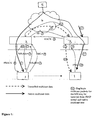
- Figure 1 is a schematic block diagram of a system employing the present invention; and schematically the method of the present invention; and
- Figure 2 illustrates the time line of the method of figure 1.
- Referring to figure 1, a
mobile node 1 which forms part of a system according to the present invention is arranged to communicate, via an access router 2 (which may be fixed or mobile) with amulticast data source 5 which may be, for example, accessed via an internet server ornetwork 4. Themobile node 1 may be part of a hand held device, or could be part of a mobile communication device fixed in a vehicle (not shown). In either case, as themobile node 1 moves it moves out of range of theaccess router 2, but within the range of afurther access router 3 with which it is now appropriate for it to communicate. A system of the present invention may comprise one or moremobile nodes 1 realised on one of a number of components, such as a mobile telephone, handheld device, or other similar components, and may further comprise any number ofaccess routers - Referring to figure 1, the method of the invention will now be described in figure 1 the circled numbers show the steps in sequence. In a first step, multicast data packets are initially being received at
mobile node 1 via its link with a previous access router (PAR) 2. In a second step themobile node 1 sends a Router solicitation for proxy (RtSolPr) message. As part of this stage, any multicast addresses that themobile node 1 is listening to are reported, along with associated filtering rules, to the previous access router (PAR) 2. Themobile node 1 receives a Proxy router advertisement (PrRtAdv) message containing the new access router (NAR) 3 IP address. The Mobile node sends a Fast Binding Update (FBU) to theprevious access router 2 in which it reports the new care-of address (new care-of address (nCoA)) it has generated. Theprevious access router 2 then sends a Handover Initiate (HI) message to themobile node 1new access router 3. This message contains the multicast address(es) that themobile node 1 is listening to and the associated filtering rules. Thenew access router 3 replies by sending a Handover Acknowledge (HACK). Theprevious access router 2 captures multicast packets of interest to themobile node 1 to tunnel them to the mobile node's new location. The previous access router sends a Fast Binding Acknowledgment (FBACK) to theMobile node 1 confirming the mobile node new care-of address (CoA). Theprevious access router 2 then forwards encapsulated multicast packets to thenew access router 3. - Following on from this the
mobile node 1 sends a Fast neighbour advertisement (FNA) when contact with the new subnet is established. Thenew access router 3 forwards encapsulating the buffered packets to themobile node 1. Themobile node 1 triggers the procedure for multicast routing to the mobile node's new subnet, and multicast routing to the new subnet is established. Thenew access router 3 receives native multicast traffic for themobile node 1 that meets the preferences indicated in the associated filtering rules sent in the Handover initiate (HI) message. As the Fast neighbour advertisement (FNA) has been received at thenew access router 3 AND the native multicast traffic has arrived at thenew access router 3, thenew access router 3 sends a message to inform theprevious access router 2 to stop buffering the multicast traffic. This minimizes multicast packet duplication coming from the FMIP tunnel and along the native multicast tree. - The message sent by the
new access router 3 to theprevious access router 2 contains information identifying the multicast traffic destined for the mobile node. This information is used to inform theprevious access router 2 to stop the FMIP buffering. Theprevious access router 2 then stops tunneling multicast packets through the tunnel. Finally, the handover is complete and themobile node 1 receives native multicast traffic from the new link. - In a second example, an approach is taken for the situation when multicast routing for the
mobile node 1 has already been established on the new link before theMobile node 1 actually handovers. This happens when, or example, there is already another listener for the multicast group of interest on the new link or when a protocol had established in advance the multicast tree to the new link. In this example after thenew access router 3 receives a Fast neighbour advertisement (FNA), thenew access router 3 immediately sends a message to theprevious access router 2 to stop any multicast forwarding through the FMIP tunnel. - In this second example the following steps occur.
- Firstly, as with the first example, multicast data packets are initially being received at the
mobile node 1 on the link of theprevious access router 2. Secondly, themobile node 1 receives an indication of a new link coming up. Themobile node 1 resolves through its access router the IP address or addresses of any candidate access router to which it might handover. - The
mobile node 1 then reports the multicast address (es) it is accessing to anew access router 3. Fourthly, theprevious access router 2 sends theses addresses to the candidate access routers through a Handover initiative (HI), as in the first example. - The new access router or routers then establish whether or not such packets are already routed on their link and the
new access router 3 then starts buffering the packets Thenew access router 3 can then use a HACK message to ask theprevious access router 2 not to perform FMIP buffering. - After the
mobile node 1 arrives on the new link, it sends a Fast neighbour advertisement (FNA). The new access router (NAR) then forwards any buffered multicast packets to theMobile node 1 and stops further buffering. - In a final stage the
mobile node 1 receives directly its received multicast packets from thenew access router 3.
Claims (7)
- A method of routing multicast data packets to a mobile node (1), the mobile node (1) forming part of a data transmission system comprising at least two access routers (2, 3) and for providing multicast data from at least one data source (4), the access routers (2, 3) being arranged to be capable of wireless communication with the mobile node (1), the method comprising the steps of:determining that the mobile node (1) is to start communicating with a new access router (3) and to stop communicating with a previous access router (2);reporting to the previous address router (2), the multicast addresses currently being received by the mobile node, together with filtering rules associated therewith;providing to the mobile node (1) the new access router address (3);advising the previous access router (2) of the address of the next access router (3);controlling the previous access router (2) to initiate a handover to the new access router, the initiating including data representing the multicast addresses and associated filtering rules that the mobile node (1) is currently using;controlling the previous access router (2) to capture-and buffer multicast packets of data which conform to the address and filtering rules;forwarding the buffered multicast packets to the new access router (3) from the previous access router;confirming connection between the new access router (3) and the mobile node (1); andforwarding from the new access router to the mobile node the buffered multicast packets.
- A method according to claim 1, wherein, once the buffered multicast packets have started to be transferred from the new access router (3) to the mobile node (1) and the new access router is receiving further packets from the at least one data source (4), a message is sent from the new access router (3) to the previous access router (2) to stop it buffering further multicast packets.
- A method of routing multicast data packets to a mobile node (1), the mobile node (1) forming part of a data transmission system comprising at least two access routers (2, 3) for providing data from at least one data source (4), the access routers (2, 3) being arranged to be capable of wireless communication with the mobile mode (1), the method comprising the steps of:determining that the mobile node is to start communicating with a new access router (3) and to stop communicating with a previous access router (2);reporting to the new access router (3), the multicast addresses currently being received by the mobile node (1), together with the filtering rules associated therewith;determining whether the new access router (3) is already receiving multicast packets of data which confirm to the multicast addresses currently being received by node (1), and if this is the case buffering the packets of data at the new access router.
- A method according to claim 1, 2 or 3, wherein the method conforms with the FMIPv6 communication protocol.
- A method according to claim 4, wherein the buffered multicast packets are forwarded through an FMIPv6 tunnel to the new access router.
- A method according to claim 4 or claim 5, wherein the data relating to the multicast addresses and associated filtering rules is passed to the new access router (3) from the previous access router (2) using the handover initiate of the FMIPv6 protocol.
- A mobile communication system comprising at least one mobile node 1 and at least two access routers (2, 3) and further comprising control means configured to control the mobile node 1 and access routers (2, 3) to perform the method of any preceding claim.
Priority Applications (4)
| Application Number | Priority Date | Filing Date | Title |
|---|---|---|---|
| EP05252028A EP1708425A1 (en) | 2005-03-31 | 2005-03-31 | Tunnelling of multicast data |
| EP06726366A EP1864448A1 (en) | 2005-03-31 | 2006-03-13 | Tunnelling of multicast data |
| CNA2006800038375A CN101112058A (en) | 2005-03-31 | 2006-03-13 | tunnel for multicast data |
| PCT/GB2006/000870 WO2006103389A1 (en) | 2005-03-31 | 2006-03-13 | Tunnelling of multicast data |
Applications Claiming Priority (1)
| Application Number | Priority Date | Filing Date | Title |
|---|---|---|---|
| EP05252028A EP1708425A1 (en) | 2005-03-31 | 2005-03-31 | Tunnelling of multicast data |
Publications (1)
| Publication Number | Publication Date |
|---|---|
| EP1708425A1 true EP1708425A1 (en) | 2006-10-04 |
Family
ID=34940678
Family Applications (2)
| Application Number | Title | Priority Date | Filing Date |
|---|---|---|---|
| EP05252028A Withdrawn EP1708425A1 (en) | 2005-03-31 | 2005-03-31 | Tunnelling of multicast data |
| EP06726366A Withdrawn EP1864448A1 (en) | 2005-03-31 | 2006-03-13 | Tunnelling of multicast data |
Family Applications After (1)
| Application Number | Title | Priority Date | Filing Date |
|---|---|---|---|
| EP06726366A Withdrawn EP1864448A1 (en) | 2005-03-31 | 2006-03-13 | Tunnelling of multicast data |
Country Status (3)
| Country | Link |
|---|---|
| EP (2) | EP1708425A1 (en) |
| CN (1) | CN101112058A (en) |
| WO (1) | WO2006103389A1 (en) |
Cited By (5)
| Publication number | Priority date | Publication date | Assignee | Title |
|---|---|---|---|---|
| JP2009017545A (en) * | 2007-06-13 | 2009-01-22 | Ntt Docomo Inc | Seamless handover method and apparatus in mobile entity communication |
| EP2067372A4 (en) * | 2006-10-10 | 2009-10-14 | Huawei Tech Co Ltd | Multicast fast handover |
| WO2010023432A3 (en) * | 2008-08-26 | 2010-07-01 | Nomad Spectrum Limited | Method of providing data communication to a vehicle |
| CN101729271B (en) * | 2008-10-27 | 2013-06-05 | 华为技术有限公司 | Method, mobile node and system for maintaining state of multicast group member |
| CN114884964A (en) * | 2022-07-11 | 2022-08-09 | 上海富友支付服务股份有限公司 | Service wind control method and system based on Tuxedo architecture |
Families Citing this family (3)
| Publication number | Priority date | Publication date | Assignee | Title |
|---|---|---|---|---|
| CN101599841A (en) * | 2008-06-03 | 2009-12-09 | 华为技术有限公司 | Method, router and system for realizing multicast |
| CN101753424B (en) * | 2008-11-28 | 2012-07-04 | 华为技术有限公司 | Data communication system, router, data sending and mobility management method |
| CN112511991A (en) * | 2020-11-27 | 2021-03-16 | 锐捷网络股份有限公司 | On-demand method, equipment and storage medium |
Citations (2)
| Publication number | Priority date | Publication date | Assignee | Title |
|---|---|---|---|---|
| WO2000054475A1 (en) * | 1999-03-09 | 2000-09-14 | Telefonaktiebolaget Lm Ericsson (Publ) | Multicast handover for mobile internet protocol |
| GB2400269A (en) * | 2003-03-29 | 2004-10-06 | King S College London | Method of handoff in a packet-switched data communication network |
-
2005
- 2005-03-31 EP EP05252028A patent/EP1708425A1/en not_active Withdrawn
-
2006
- 2006-03-13 WO PCT/GB2006/000870 patent/WO2006103389A1/en not_active Ceased
- 2006-03-13 CN CNA2006800038375A patent/CN101112058A/en active Pending
- 2006-03-13 EP EP06726366A patent/EP1864448A1/en not_active Withdrawn
Patent Citations (2)
| Publication number | Priority date | Publication date | Assignee | Title |
|---|---|---|---|---|
| WO2000054475A1 (en) * | 1999-03-09 | 2000-09-14 | Telefonaktiebolaget Lm Ericsson (Publ) | Multicast handover for mobile internet protocol |
| GB2400269A (en) * | 2003-03-29 | 2004-10-06 | King S College London | Method of handoff in a packet-switched data communication network |
Cited By (9)
| Publication number | Priority date | Publication date | Assignee | Title |
|---|---|---|---|---|
| EP2067372A4 (en) * | 2006-10-10 | 2009-10-14 | Huawei Tech Co Ltd | Multicast fast handover |
| US8279829B2 (en) | 2006-10-10 | 2012-10-02 | Futurewei Technologies, Inc. | Multicast fast handover |
| EP3780737A1 (en) * | 2006-10-10 | 2021-02-17 | Huawei Technologies Co. Ltd. | Multicast fast handover |
| JP2009017545A (en) * | 2007-06-13 | 2009-01-22 | Ntt Docomo Inc | Seamless handover method and apparatus in mobile entity communication |
| EP2111073A1 (en) | 2007-06-13 | 2009-10-21 | NTT DoCoMo, Inc. | Method and apparatus for performing a seamless handover of a mobile entity |
| WO2010023432A3 (en) * | 2008-08-26 | 2010-07-01 | Nomad Spectrum Limited | Method of providing data communication to a vehicle |
| EP2372977A1 (en) * | 2008-08-26 | 2011-10-05 | Nomad Spectrum Limited | Method of providing data communication to a vehicle |
| CN101729271B (en) * | 2008-10-27 | 2013-06-05 | 华为技术有限公司 | Method, mobile node and system for maintaining state of multicast group member |
| CN114884964A (en) * | 2022-07-11 | 2022-08-09 | 上海富友支付服务股份有限公司 | Service wind control method and system based on Tuxedo architecture |
Also Published As
| Publication number | Publication date |
|---|---|
| WO2006103389A1 (en) | 2006-10-05 |
| CN101112058A (en) | 2008-01-23 |
| EP1864448A1 (en) | 2007-12-12 |
Similar Documents
| Publication | Publication Date | Title |
|---|---|---|
| EP2067372B1 (en) | Multicast fast handover | |
| US10841858B2 (en) | Data processing method and system | |
| US6990088B2 (en) | Handoff in radio telecommunications networks | |
| US20030104814A1 (en) | Low latency mobile initiated tunneling handoff | |
| US20060240825A1 (en) | Mobile communication method, mobile communication apparatus, home agent apparatus, access router information server apparatus, and mobile communication system | |
| US20090097453A1 (en) | Method and system for fast handovers using dynamic router advertisements | |
| JP4177370B2 (en) | Method for providing a multicast service according to a source node handoff in a mobile internet protocol communication system | |
| US20080259871A1 (en) | Method of performing vertical handover between different wireless networks | |
| KR20150074220A (en) | System and protocols for inter-mobility access gateway tunneling for fast handoff transition | |
| WO2000054475A1 (en) | Multicast handover for mobile internet protocol | |
| EP2208380B1 (en) | Method for controlling proxy binding of a mobile node | |
| US7693109B2 (en) | System and method for performing fast handoff in mobile network | |
| CN101005444B (en) | Method and device for quick switching | |
| WO2006103389A1 (en) | Tunnelling of multicast data | |
| US20070248083A1 (en) | Access Router Apparatus, Communication Handover System Using the Same, and Communication Handover Method Using the Same | |
| CN1926823B (en) | Communication system, mobile terminal and access router | |
| KR100687748B1 (en) | Method and system for fast handover independent of mobile terminal | |
| CN102882788A (en) | Message forwarding processing method, net element and system | |
| EP2073483A1 (en) | Method and apparatus for a fast mobile IP handover | |
| KR20090050396A (en) | Multicast Handover Method in Communication System | |
| KR20080011003A (en) | Handoff Method and System for Wireless Communication System Using Mobile IP | |
| KR20090052927A (en) | A handover method using a network-based ISP in a portable Internet system and a portable Internet system performing a network-based IPv6 handover. |
Legal Events
| Date | Code | Title | Description |
|---|---|---|---|
| PUAI | Public reference made under article 153(3) epc to a published international application that has entered the european phase |
Free format text: ORIGINAL CODE: 0009012 |
|
| AK | Designated contracting states |
Kind code of ref document: A1 Designated state(s): AT BE BG CH CY CZ DE DK EE ES FI FR GB GR HU IE IS IT LI LT LU MC NL PL PT RO SE SI SK TR |
|
| AX | Request for extension of the european patent |
Extension state: AL BA HR LV MK YU |
|
| AKX | Designation fees paid | ||
| REG | Reference to a national code |
Ref country code: DE Ref legal event code: 8566 |
|
| STAA | Information on the status of an ep patent application or granted ep patent |
Free format text: STATUS: THE APPLICATION IS DEEMED TO BE WITHDRAWN |
|
| 18D | Application deemed to be withdrawn |
Effective date: 20070701 |