EP1708084A2 - Parallel archiving for a messaging system - Google Patents
Parallel archiving for a messaging system Download PDFInfo
- Publication number
- EP1708084A2 EP1708084A2 EP06006554A EP06006554A EP1708084A2 EP 1708084 A2 EP1708084 A2 EP 1708084A2 EP 06006554 A EP06006554 A EP 06006554A EP 06006554 A EP06006554 A EP 06006554A EP 1708084 A2 EP1708084 A2 EP 1708084A2
- Authority
- EP
- European Patent Office
- Prior art keywords
- messages
- archiving
- archive
- state
- messaging system
- Prior art date
- Legal status (The legal status is an assumption and is not a legal conclusion. Google has not performed a legal analysis and makes no representation as to the accuracy of the status listed.)
- Ceased
Links
Images


Classifications
-
- G—PHYSICS
- G06—COMPUTING OR CALCULATING; COUNTING
- G06F—ELECTRIC DIGITAL DATA PROCESSING
- G06F9/00—Arrangements for program control, e.g. control units
- G06F9/06—Arrangements for program control, e.g. control units using stored programs, i.e. using an internal store of processing equipment to receive or retain programs
- G06F9/46—Multiprogramming arrangements
- G06F9/50—Allocation of resources, e.g. of the central processing unit [CPU]
- G06F9/5005—Allocation of resources, e.g. of the central processing unit [CPU] to service a request
- G06F9/5027—Allocation of resources, e.g. of the central processing unit [CPU] to service a request the resource being a machine, e.g. CPUs, Servers, Terminals
-
- G—PHYSICS
- G06—COMPUTING OR CALCULATING; COUNTING
- G06F—ELECTRIC DIGITAL DATA PROCESSING
- G06F9/00—Arrangements for program control, e.g. control units
- G06F9/06—Arrangements for program control, e.g. control units using stored programs, i.e. using an internal store of processing equipment to receive or retain programs
- G06F9/46—Multiprogramming arrangements
- G06F9/54—Interprogram communication
-
- G—PHYSICS
- G06—COMPUTING OR CALCULATING; COUNTING
- G06F—ELECTRIC DIGITAL DATA PROCESSING
- G06F2209/00—Indexing scheme relating to G06F9/00
- G06F2209/50—Indexing scheme relating to G06F9/50
- G06F2209/5018—Thread allocation
Definitions
- a messaging system is a collection of hardware and software that is configured to facilitate message communication between two or more entities.
- One example of a messaging system is a message exchange infrastructure for transmitting messages from one or more sending applications to one or more receiving applications.
- Messaging systems must be compatible with the format and protocols used by each of the applications that communicates through it. Further, messaging systems must keep track of message traffic in case of a failed message transmission, to facilitate fault recovery processes, and to ensure adequate message transmission success rates.
- Most messaging systems employ a database for short-term message persistency and processing, and an archive for long-term storage of message data.
- An archive is particularly useful to prevent the database from being completely filled, which can cause loss of message data and/or a slowing of message processing and transmissions.
- Systems and methods are disclosed that provide configurable parallel archiving process with flat workload distribution onto available archive processes.
- the number of running parallel processes can be changed at runtime for dynamic reconfigurability.
- the systems and methods described herein enable a scalable archiving process, with the number of work-processes to be configurable at runtime to accommodate high message-throughput.
- a method of archiving messages processed by a messaging system includes starting a message archiving process, and receiving an instruction whether to increase or decrease a parallelization degree of the message archiving process.
- a method of archiving messages processed by a messaging system includes generating a parallelization number p.
- the method further includes storing p random numbers in a control table, the random numbers selected from a range (M, N) where N > M, each random number initially being state-free in the control table, and generating p archive processes, each archive process configured to store one or more messages being processed by the messaging system to an archive.
- the method further includes assigning state-free random numbers to messages being processed by the messaging system, and dividing the messages being processed by the messaging system among the p archive processes according to the assigned state-free random numbers.
- FIG. 1 is block diagram of a messaging system.
- FIG. 2 is a block diagram of a runtime environment of a messaging system having parallel archiving.
- FIG. 3 is a flowchart a method for parallel archiving in a messaging system.
- FIG. 4 illustrates an exemplary embodiment of a control table
- FIG. 5 is a flowchart of a method for increasing or decreasing a parallelization degree of an archiving process.
- This document discloses a configurable parallel archiving process and system.
- the systems and methods described herein provide a flat workload distribution onto a configurable number of available archive processes. Accordingly, a workload of messages to be archived is divided into separate but substantially same sized parts. These parts can be archived in parallel using separate archive processes for each part. In one implementation, the number of running parallel archive processes can be changed at runtime for dynamic reconfigurability.
- FIG. 1 is a functional block diagram of a messaging system 100 configured to receive incoming messages 102 from one or more sending applications and transmit them as outgoing messages 104 to one or more receiving applications.
- the messaging system 100 includes one or more active runtime engines 106 that is configured for processing messages sent through the messaging system 100.
- Each runtime engine 106 is generated according to a workload that defines a business process, such as a type and sequence of a messaging process between two applications, and handles business rules, mapping messages to receiving applications, message routing, and other tasks.
- the runtime engine 106 is connected with an input 108 of the messaging system, where messages are assigned a random number from one or more random number control tables 110.
- [(i, j, k) ⁇ 0;n-m>] means that i, j, k are numbers within interval ⁇ 0; n-m>.
- Msg[m] means all messages with random number m
- Msg1 [m+i] means message 1 with random number m+i.
- the runtime engine 106 temporarily stores or persists in a database 112 each message passing through the messaging system 100. These messages must be removed from the database 112 and stored in an archive 116 for efficient continued message processing capabilities by the messaging system.
- a parallelization factor p generated by the runtime engine 106, a p number of archive processes 114 are created. Each archive process 114 handles a 1/p part of the messages in a workload, for storage of those messages in an archive.
- the p archive processes 114 enable a uniform division of the messages for archiving. Thus, processing resource requirements for dividing and archiving the messages of a workload are minimized.
- Each incoming message to a messaging system receives a random number between m and n, where m ⁇ n.
- Each of the random numbers used are stored in a separate control table with a related process-state.
- a parallelization degree p is set for the messaging system 100, such that p archive processes 114 start in parallel at the beginning of the archiving, and where each archive process 114 starts with a particular random number. Accordingly, for each archive process 114, only a part of the messages from the workload is selected, related to one random number.
- Archive processes 114 are activated and proceed with working on not-processed numbers until all numbers in the control table are used.
- the number used by an archive process 114 is regulated by the control table 110, where all random numbers are stored with their related state.
- the control table 110 enables the parallelization degree (i.e. the amount of archive processes 114 running) to be changed at the runtime of archiving, and keeps control of running archive processes 114. If the parallelization degree changes at runtime from lower to higher, additional archive processes 114 are started to work on the unprocessed numbers from the control table 110.
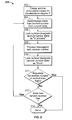
- FIG. 2 illustrates an archiving process 200 for a messaging system.
- archive processes are created according to a configurable parallelization degree p.
- each archive process selects or is assigned a state-free number from a control table in the messaging system, and then locks it (e.g. by writing "in process" into a state field in the control table) at 206.
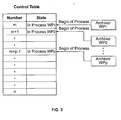
- FIG. 3 illustrates an example of this step and activity of the control table.
- each archive process then processes messages with the selected/assigned number.
- an archive process that finishes processing messages with a certain number then locks the number in the control table with a final state (e.g. writing "done” into the state field of the control table), and picks another state-tree number (if it exists) from the control table as exemplified in FIG. 4.
- a determination is made whether a stop-state if found for a random number in the control table. If so, the state is cleared for that number and the process 200 is finished at 214. If not, the process 200 continues at 212, where a determination is made whether any state-free numbers still exist in the control table. If so, the archiving process 200 continues again at 204. If not, the archiving process 200 is done at 214.
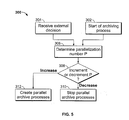
- FIG. 5 illustrates a method 300 for archiving messages from a messaging system in accordance with an embodiment.
- the archiving process is started.
- the control table is initialized, where if the state for all random numbers in the control table are "done,” then the states are cleared.
- a signal representing an external decision is received for changing the parallelization degree p, to execute 306.
Landscapes
- Engineering & Computer Science (AREA)
- Software Systems (AREA)
- Theoretical Computer Science (AREA)
- Physics & Mathematics (AREA)
- General Engineering & Computer Science (AREA)
- General Physics & Mathematics (AREA)
- Devices For Executing Special Programs (AREA)
- Information Retrieval, Db Structures And Fs Structures Therefor (AREA)
Abstract
Description
- A messaging system is a collection of hardware and software that is configured to facilitate message communication between two or more entities. One example of a messaging system is a message exchange infrastructure for transmitting messages from one or more sending applications to one or more receiving applications. Messaging systems must be compatible with the format and protocols used by each of the applications that communicates through it. Further, messaging systems must keep track of message traffic in case of a failed message transmission, to facilitate fault recovery processes, and to ensure adequate message transmission success rates.
- Most messaging systems employ a database for short-term message persistency and processing, and an archive for long-term storage of message data. An archive is particularly useful to prevent the database from being completely filled, which can cause loss of message data and/or a slowing of message processing and transmissions.
- In a messaging system with high message throughput, archiving can fall short of database inflow rate despite using large amounts of processing resources. This still leads to overfilling of the database and the problems of lower message throughput and/or service quality.
- Systems and methods are disclosed that provide configurable parallel archiving process with flat workload distribution onto available archive processes. In one implementation, the number of running parallel processes can be changed at runtime for dynamic reconfigurability. The systems and methods described herein enable a scalable archiving process, with the number of work-processes to be configurable at runtime to accommodate high message-throughput.
- In one aspect, a method of archiving messages processed by a messaging system includes starting a message archiving process, and receiving an instruction whether to increase or decrease a parallelization degree of the message archiving process.
- In another aspect, a method of archiving messages processed by a messaging system includes generating a parallelization number p. The method further includes storing p random numbers in a control table, the random numbers selected from a range (M, N) where N > M, each random number initially being state-free in the control table, and generating p archive processes, each archive process configured to store one or more messages being processed by the messaging system to an archive. The method further includes assigning state-free random numbers to messages being processed by the messaging system, and dividing the messages being processed by the messaging system among the p archive processes according to the assigned state-free random numbers.
- The details of one or more embodiments are set forth in the accompanying drawings and the description below. Other features and advantages will be apparent from the description and drawings, and from the claims.
- These and other aspects will now be described in detail with reference to the following drawings.
- FIG. 1 is block diagram of a messaging system.
- FIG. 2 is a block diagram of a runtime environment of a messaging system having parallel archiving.
- FIG. 3 is a flowchart a method for parallel archiving in a messaging system.
- FIG. 4 illustrates an exemplary embodiment of a control table
- FIG. 5 is a flowchart of a method for increasing or decreasing a parallelization degree of an archiving process.
- Like reference symbols in the various drawings indicate like elements.
- This document discloses a configurable parallel archiving process and system. The systems and methods described herein provide a flat workload distribution onto a configurable number of available archive processes. Accordingly, a workload of messages to be archived is divided into separate but substantially same sized parts. These parts can be archived in parallel using separate archive processes for each part. In one implementation, the number of running parallel archive processes can be changed at runtime for dynamic reconfigurability.
- FIG. 1 is a functional block diagram of a
messaging system 100 configured to receiveincoming messages 102 from one or more sending applications and transmit them asoutgoing messages 104 to one or more receiving applications. Themessaging system 100 includes one or moreactive runtime engines 106 that is configured for processing messages sent through themessaging system 100. Eachruntime engine 106 is generated according to a workload that defines a business process, such as a type and sequence of a messaging process between two applications, and handles business rules, mapping messages to receiving applications, message routing, and other tasks. - The
runtime engine 106 is connected with aninput 108 of the messaging system, where messages are assigned a random number from one or more random number control tables 110. In thesystem 100, [(i, j, k) <0;n-m>] means that i, j, k are numbers within interval <0; n-m>. Msg[m] means all messages with random number m, and Msg1 [m+i] meansmessage 1 with random number m+i. - The
runtime engine 106 temporarily stores or persists in adatabase 112 each message passing through themessaging system 100. These messages must be removed from thedatabase 112 and stored in anarchive 116 for efficient continued message processing capabilities by the messaging system. In accordance with a parallelization factor p generated by theruntime engine 106, a p number ofarchive processes 114 are created. Eacharchive process 114 handles a 1/p part of the messages in a workload, for storage of those messages in an archive. Thep archive processes 114 enable a uniform division of the messages for archiving. Thus, processing resource requirements for dividing and archiving the messages of a workload are minimized. - The division of the workload happens dynamically at the runtime. Each incoming message to a messaging system receives a random number between m and n, where m<n. Each of the random numbers used are stored in a separate control table with a related process-state. A parallelization degree p is set for the
messaging system 100, such that p archive processes 114 start in parallel at the beginning of the archiving, and where eacharchive process 114 starts with a particular random number. Accordingly, for eacharchive process 114, only a part of the messages from the workload is selected, related to one random number. -
Archive processes 114 are activated and proceed with working on not-processed numbers until all numbers in the control table are used. The number used by anarchive process 114 is regulated by the control table 110, where all random numbers are stored with their related state. The control table 110 enables the parallelization degree (i.e. the amount ofarchive processes 114 running) to be changed at the runtime of archiving, and keeps control of runningarchive processes 114. If the parallelization degree changes at runtime from lower to higher,additional archive processes 114 are started to work on the unprocessed numbers from the control table 110. - FIG. 2 illustrates an
archiving process 200 for a messaging system. At 202, archive processes are created according to a configurable parallelization degree p. At 204, each archive process selects or is assigned a state-free number from a control table in the messaging system, and then locks it (e.g. by writing "in process" into a state field in the control table) at 206. FIG. 3 illustrates an example of this step and activity of the control table. At 208, each archive process then processes messages with the selected/assigned number. - At 210, an archive process that finishes processing messages with a certain number then locks the number in the control table with a final state (e.g. writing "done" into the state field of the control table), and picks another state-tree number (if it exists) from the control table as exemplified in FIG. 4. At 211, a determination is made whether a stop-state if found for a random number in the control table. If so, the state is cleared for that number and the
process 200 is finished at 214. If not, theprocess 200 continues at 212, where a determination is made whether any state-free numbers still exist in the control table. If so, thearchiving process 200 continues again at 204. If not, thearchiving process 200 is done at 214. - FIG. 5 illustrates a
method 300 for archiving messages from a messaging system in accordance with an embodiment. At 302, the archiving process is started. The control table is initialized, where if the state for all random numbers in the control table are "done," then the states are cleared. At 304, at any time, a signal representing an external decision is received for changing the parallelization degree p, to execute 306. - At 308, a determination is made whether to increment or decrement the parallelization degree p, based on the external decision. If the decision is to increase, then at 312 a new number of parallel archive processes are created. If the decision is to decrease, at 310 a number of parallel archive processes are stopped. Also at 310, the stop-state record is created for any state-free random number in the control table, and so a query is executed whether a state-free number exists in the control table. If yes, a stop-state is created for that number. The query should run for abs(d) times, where (d) is a difference between the new parallelization and the former parallelization.
- Although a few embodiments have been described in detail above, other modifications are possible. The logic flows depicted in FIGS. 2 and 5 need not be executed in the exact order shown. Other embodiments may be within the scope of the following claims.
Claims (11)
- A method of archiving messages processed by a messaging system, the method comprising:generating a parallelization number p;storing p random numbers in a control table, the random numbers selected from a range (M, N) where N > M, each random number initially being state-free in the control table;generating p archive processes, each archive process configured to store one or more messages being processed by the messaging system to an archive;assigning state-free random numbers to messages being processed by the messaging system; anddividing the messages being processed by the messaging system among the p archive processes according to the assigned state-free random numbers.
- A method in accordance with claim 1, further comprising archiving the messages using the p archive processes.
- A method in accordance with claim 1 or 2, wherein assigning the state-free random numbers further includes designating each random number in a state field of the control table as being in-process.
- A method in accordance with anyone of the preceding claims, wherein archiving the messages further includes designating each random number in a state field of the control table as being done.
- A method in accordance with anyone of the preceding claims, further comprising determining whether any other state-free random numbers are in the control table.
- A method in accordance with claim 5, further comprising stopping archiving the messages when no other state-free random numbers are in the control table.
- A messaging system, comprising:one or more runtime engines, each runtime engine configured to receive and transmit messages from a sending application to one or more receiving applications based on a workload;a database configured for persistence of the messages; andan archive configured for long-term archive of the messages from the database, the archive receiving the messages from a number p parallel archive processes created based at least in part on a size of the workload.
- A method of archiving messages processed by a messaging system, the method comprising:starting a message archiving process;receiving an instruction whether to increase or decrease a parallelization degree of the message archiving process.
- A method in accordance with claim 8, wherein if the instruction indicates to increase the parallelization degree, creating a number of new parallel archiving processes in the message archiving process.
- A method in accordance with claim 8 or 9, wherein if the instruction indicates to decrease the parallelization degree, stopping a number of parallel archiving process in the message archiving process.
- A method in accordance with claim 10, further comprising creating a stop-state record for a random number in a control table associated with each stopped parallel archiving process.
Applications Claiming Priority (1)
| Application Number | Priority Date | Filing Date | Title |
|---|---|---|---|
| US11/097,041 US7844578B2 (en) | 2005-03-31 | 2005-03-31 | Parallel archiving for a messaging system |
Publications (2)
| Publication Number | Publication Date |
|---|---|
| EP1708084A2 true EP1708084A2 (en) | 2006-10-04 |
| EP1708084A3 EP1708084A3 (en) | 2007-02-21 |
Family
ID=36694144
Family Applications (1)
| Application Number | Title | Priority Date | Filing Date |
|---|---|---|---|
| EP06006554A Ceased EP1708084A3 (en) | 2005-03-31 | 2006-03-29 | Parallel archiving for a messaging system |
Country Status (2)
| Country | Link |
|---|---|
| US (1) | US7844578B2 (en) |
| EP (1) | EP1708084A3 (en) |
Families Citing this family (2)
| Publication number | Priority date | Publication date | Assignee | Title |
|---|---|---|---|---|
| EP2722774B1 (en) * | 2012-10-18 | 2015-12-09 | Siemens Aktiengesellschaft | Long term archiving of data in a MES system |
| CN111611061A (en) * | 2020-04-03 | 2020-09-01 | 金东纸业(江苏)股份有限公司 | Task management method, management terminal, management system and memory |
Citations (1)
| Publication number | Priority date | Publication date | Assignee | Title |
|---|---|---|---|---|
| US6078933A (en) | 1999-01-05 | 2000-06-20 | Advanced Micro Devices, Inc. | Method and apparatus for parallel processing for archiving and retrieval of data |
Family Cites Families (7)
| Publication number | Priority date | Publication date | Assignee | Title |
|---|---|---|---|---|
| US6665684B2 (en) * | 1999-09-27 | 2003-12-16 | Oracle International Corporation | Partition pruning with composite partitioning |
| US6549931B1 (en) * | 1999-09-27 | 2003-04-15 | Oracle Corporation | Distributing workload between resources used to access data |
| US7058687B2 (en) * | 2001-04-03 | 2006-06-06 | Sendmail, Inc. | E-mail system with methodology for accelerating mass mailings |
| WO2003027891A1 (en) * | 2001-09-28 | 2003-04-03 | Commvault Systems, Inc. | System and method for archiving objects in an information store |
| WO2004025504A1 (en) * | 2002-09-09 | 2004-03-25 | Sap Aktiengesellschaft | Methods and systems for data moving using locks |
| US20040143822A1 (en) * | 2003-01-17 | 2004-07-22 | Jager James De | Method and system for compiling a visual representation of a website |
| US7523314B2 (en) * | 2003-12-22 | 2009-04-21 | Voltage Security, Inc. | Identity-based-encryption message management system |
-
2005
- 2005-03-31 US US11/097,041 patent/US7844578B2/en active Active
-
2006
- 2006-03-29 EP EP06006554A patent/EP1708084A3/en not_active Ceased
Patent Citations (1)
| Publication number | Priority date | Publication date | Assignee | Title |
|---|---|---|---|---|
| US6078933A (en) | 1999-01-05 | 2000-06-20 | Advanced Micro Devices, Inc. | Method and apparatus for parallel processing for archiving and retrieval of data |
Non-Patent Citations (2)
| Title |
|---|
| INTRODUCTION TO PARALLEL COMPUTING, 11 October 2004 (2004-10-11), Retrieved from the Internet <URL:URL:http://web.archive.org/web/20041 011 094500/http://www.llnl.gov/computing/tutor ials/parallel-comp/>> |
| SCHAARSCHMIDT R.: "Wirtschaftsinformatik", vol. 39, 1997, VIEWEG VERLAGSGESELLSCHAFT, article "Datenbankbasiertes Archivieren im SAP System R/3", pages: 469 - 477 |
Also Published As
| Publication number | Publication date |
|---|---|
| US20060224641A1 (en) | 2006-10-05 |
| EP1708084A3 (en) | 2007-02-21 |
| US7844578B2 (en) | 2010-11-30 |
Similar Documents
| Publication | Publication Date | Title |
|---|---|---|
| US5987502A (en) | Workload management in an asynchronous client/server computer system | |
| US10462262B2 (en) | Middleware abstraction layer (MAL) | |
| US20060047666A1 (en) | Control of publish/subscribe messaging | |
| EP1903750A1 (en) | Load distributing apparatus | |
| CN110471651B (en) | Method and server for realizing control inversion based on C++ | |
| JP2005521945A (en) | Optimal server in common work queue environment | |
| SG11202108352TA (en) | User code running method for programming platform, platform, node, device and medium | |
| EP0676693B1 (en) | Method and system for dynamically selecting a communication mode | |
| CN111949417A (en) | Message transmission method and storage medium | |
| CN112698929B (en) | Information acquisition method and device | |
| US7844578B2 (en) | Parallel archiving for a messaging system | |
| CN113703826A (en) | Method, apparatus, device and storage medium for responding to data processing request | |
| CN104780120A (en) | Method and device for transmitting files in local area network | |
| US6580725B1 (en) | Method and apparatus for dynamic allocation of a messaging system resource | |
| CN112491903B (en) | Account checking method, device and system among multiple systems | |
| CN111756844B (en) | A multi-language message agent method and device | |
| JP4257857B2 (en) | Data processing system and data processing method | |
| CN111176799B (en) | A service scheduling method, device and storage medium | |
| CN119440819A (en) | Task allocation method, device, medium, equipment and product | |
| CN114253747B (en) | Distributed message management system and method | |
| CN118381776A (en) | Message publishing method, consumption method, processing method and related products | |
| CN112306541B (en) | Incremental upgrading method of avionics system facing task adding and refitting requirements | |
| US10958526B2 (en) | Methods for managing bandwidth allocation in a cloud-based system and related bandwidth managers and computer program products | |
| CN114598662A (en) | Message queue cluster federal management system and method | |
| KR19990053527A (en) | Client-server communication method using multilevel priority queue |
Legal Events
| Date | Code | Title | Description |
|---|---|---|---|
| PUAI | Public reference made under article 153(3) epc to a published international application that has entered the european phase |
Free format text: ORIGINAL CODE: 0009012 |
|
| 17P | Request for examination filed |
Effective date: 20060329 |
|
| AK | Designated contracting states |
Kind code of ref document: A2 Designated state(s): AT BE BG CH CY CZ DE DK EE ES FI FR GB GR HU IE IS IT LI LT LU LV MC NL PL PT RO SE SI SK TR |
|
| AX | Request for extension of the european patent |
Extension state: AL BA HR MK YU |
|
| PUAL | Search report despatched |
Free format text: ORIGINAL CODE: 0009013 |
|
| AK | Designated contracting states |
Kind code of ref document: A3 Designated state(s): AT BE BG CH CY CZ DE DK EE ES FI FR GB GR HU IE IS IT LI LT LU LV MC NL PL PT RO SE SI SK TR |
|
| AX | Request for extension of the european patent |
Extension state: AL BA HR MK YU |
|
| RIC1 | Information provided on ipc code assigned before grant |
Ipc: G06F 9/46 20060101AFI20070118BHEP |
|
| AKX | Designation fees paid |
Designated state(s): AT BE BG CH CY CZ DE DK EE ES FI FR GB GR HU IE IS IT LI LT LU LV MC NL PL PT RO SE SI SK TR |
|
| 17Q | First examination report despatched |
Effective date: 20080128 |
|
| STAA | Information on the status of an ep patent application or granted ep patent |
Free format text: STATUS: THE APPLICATION HAS BEEN REFUSED |
|
| 18R | Application refused |
Effective date: 20111117 |