EP1707787A2 - Reduced radar cross section exhaust nozzle assembly - Google Patents
Reduced radar cross section exhaust nozzle assembly Download PDFInfo
- Publication number
- EP1707787A2 EP1707787A2 EP06251069A EP06251069A EP1707787A2 EP 1707787 A2 EP1707787 A2 EP 1707787A2 EP 06251069 A EP06251069 A EP 06251069A EP 06251069 A EP06251069 A EP 06251069A EP 1707787 A2 EP1707787 A2 EP 1707787A2
- Authority
- EP
- European Patent Office
- Prior art keywords
- assembly
- flap
- recited
- divergent
- wing
- Prior art date
- Legal status (The legal status is an assumption and is not a legal conclusion. Google has not performed a legal analysis and makes no representation as to the accuracy of the status listed.)
- Withdrawn
Links
- 230000000712 assembly Effects 0.000 claims abstract description 56
- 238000000429 assembly Methods 0.000 claims abstract description 56
- 230000001419 dependent effect Effects 0.000 claims 1
- 239000007789 gas Substances 0.000 claims 1
- 230000003068 static effect Effects 0.000 abstract description 3
- 239000011800 void material Substances 0.000 abstract 1
- 239000000463 material Substances 0.000 description 4
- 230000015572 biosynthetic process Effects 0.000 description 3
- 230000008901 benefit Effects 0.000 description 2
- 230000000903 blocking effect Effects 0.000 description 1
- 230000008859 change Effects 0.000 description 1
- 239000002131 composite material Substances 0.000 description 1
- 230000008602 contraction Effects 0.000 description 1
- 238000001816 cooling Methods 0.000 description 1
- 230000007613 environmental effect Effects 0.000 description 1
- 238000004519 manufacturing process Methods 0.000 description 1
- 230000007246 mechanism Effects 0.000 description 1
- 239000002184 metal Substances 0.000 description 1
- 238000000034 method Methods 0.000 description 1
- 239000000203 mixture Substances 0.000 description 1
- 238000012986 modification Methods 0.000 description 1
- 230000004048 modification Effects 0.000 description 1
- 230000008569 process Effects 0.000 description 1
- 239000000126 substance Substances 0.000 description 1
- 230000007704 transition Effects 0.000 description 1
- 238000003466 welding Methods 0.000 description 1
Images


Classifications
-
- F—MECHANICAL ENGINEERING; LIGHTING; HEATING; WEAPONS; BLASTING
- F02—COMBUSTION ENGINES; HOT-GAS OR COMBUSTION-PRODUCT ENGINE PLANTS
- F02K—JET-PROPULSION PLANTS
- F02K1/00—Plants characterised by the form or arrangement of the jet pipe or nozzle; Jet pipes or nozzles peculiar thereto
- F02K1/06—Varying effective area of jet pipe or nozzle
- F02K1/12—Varying effective area of jet pipe or nozzle by means of pivoted flaps
- F02K1/1207—Varying effective area of jet pipe or nozzle by means of pivoted flaps of one series of flaps hinged at their upstream ends on a fixed structure
-
- F—MECHANICAL ENGINEERING; LIGHTING; HEATING; WEAPONS; BLASTING
- F02—COMBUSTION ENGINES; HOT-GAS OR COMBUSTION-PRODUCT ENGINE PLANTS
- F02K—JET-PROPULSION PLANTS
- F02K1/00—Plants characterised by the form or arrangement of the jet pipe or nozzle; Jet pipes or nozzles peculiar thereto
- F02K1/78—Other construction of jet pipes
- F02K1/80—Couplings or connections
- F02K1/805—Sealing devices therefor, e.g. for movable parts of jet pipes or nozzle flaps
Definitions
- This invention relates generally to an exhaust nozzle assembly for a gas turbine engine. More particularly this invention relates to interfitting flap assemblies for a variable exhaust nozzle assembly.
- An exhaust nozzle for a gas turbine engine accelerates gas flow exiting the engine increasing thrust.
- a fixed exhaust nozzle including a fixed exhaust opening provides optimal performance for a single operating condition.
- a variable exhaust nozzle opens and closes to provide differing opening sizes to optimize performance for many operating conditions.
- Such exhaust nozzles typically include a plurality of flap sections moveable radially to change the opening area of the exhaust nozzle.
- a seal is provided on a hot side of the flaps for blocking a portion of a gap created between adjacent flaps during movement of the exhaust nozzle assembly.
- such seals cannot block or control all gaps created between adjacent flap assemblies during movement of the exhaust nozzle assembly.
- This invention is an exhaust nozzle assembly including a plurality of interfitting flap assemblies having a wing portion and a slot portion.
- the wing portion of one flap fits within a slot portion of an adjacent flap to minimize and control formation of gaps between each of the flap assemblies.
- the exhaust nozzle assembly includes a plurality of interfitting flap assemblies defining a variable cross-section opening. Pivoting of the flap assemblies about a fixed pivot varies the cross-sectional area of the opening.
- Each of the flap assemblies includes a divergent element, a flap element, and a seal. The seal is disposed between adjacent flap assemblies on an interior surface of the exhaust assembly to block gaps between adjacent flap assemblies.
- Each of the flap assemblies interfits into an adjacent flap assembly to provide a substantially uniform and continuous, faceted outer surface of the exhaust nozzle assembly.
- Each of the seals includes a tented portion extending rearward from a trailing edge.
- the trailing edge of the seal includes a notch.
- the tented portion is disposed along a plane different than the substantial planar surface of the remaining portions of the seal.
- the tented portion is bent outwardly away from the interior surface of the flap assemblies.
- the notched and tented portions are disposed substantially at the trailing edge of the exhaust nozzle assembly to reduce and control formation of gaps between adjacent flap assemblies during articulation.
- the exhaust nozzle assembly of this invention provides an improved flap assembly that reduces and controls gaps generated during articulation of a variable exhaust nozzle assembly.
- an exhaust nozzle assembly 10 includes a plurality of interfitting flap assemblies 16 defining an opening 14. Each of the flap assemblies 16 is pivotally attached to a static structure at pivots 18. An actuator illustrated schematically at 17 is attached to move each of the flap assemblies 16. Pivoting of the flap assemblies 16 varies the cross-sectional area of the opening 14.
- Each of the flap assemblies 16 includes a divergent element 20, a flap element 22, and a seal 24.
- the seal 24 is disposed between adjacent flap assemblies 16 on an interior surface 15 of the exhaust nozzle assembly 10 to substantially prevent leakage of exhaust gasses therethrough.
- Each of the flap assemblies 16 interfits into an adjacent flap assembly 16 to provide a substantially uniform and continuous, faceted outer surface 11 of the exhaust nozzle assembly 10.
- the opening 14 includes a serrated trailing edge 21 defined by the divergent elements 20 of each flap assembly 16.
- the serrated trailing edge 21 includes a plurality of aft most portions 28 and trailing edge surfaces 26 defined by the divergent elements 20. The aft most portions 28 alternate with the trailing edge surfaces 26 creating the trailing edge 21 having a plurality of peaks and valleys.
- each of the flap assemblies 16 includes the flap element 22 that is attached to the divergent element 20.
- the divergent element 20 includes a wing segment 34 and the flap element 22 also includes a wing segment 32.
- the wing segments 32, 34 combine to form a common wing 30.
- the wing 30 extends from one side of the flap element 22 and a slot 39 is provided within each flap assembly 16 on a side opposite the wing 30.
- Each flap assembly 16 defines a portion of the outer surface 11 and includes a crest 23 between tapered surfaces 25.
- the tapered surface 25 gradually transition upward toward the crest 23.
- the wing 30 is disposed on a separate plane below the tapered surface 25 of each flap assembly 16.
- each wing 30 fits within the slot 39 of an adjacent flap assembly 16. As the nozzle opening 14 expands and contracts, the wing 30 moves progressively into and out of the slot 39 formed in an adjacent flap assembly 16 such that no gap is formed therebetween.
- An interface 38 between adjacent flap assemblies 16 moves along the wing 30 during expansion. During contraction the interface 38 is at a position such that the tapered surfaces 25 of adjacent flap assemblies 16 abut to form the faceted outer surface 11.
- the interface 38 between each flap assembly 16 moves, but is always covered by the wing 30 to provide the substantially continuous and uninterrupted faceted outer surface 11.
- the interface 38 forms a visible seam between adjacent flap assemblies 16, there are no gaps exposed along adjoining flap assemblies 16 through the full range of motion of each of the plurality of flap assemblies 16.
- each of the flap assemblies 16 includes the divergent element 20 and the flap element 22.
- the flap element 22 includes the crest 23 and the tapered surfaces 25 to form a portion of the outer surface 11.
- the flap element 22 is attached by way of the pivot 18 to a static structure of the engine 12 at one end and to the divergent element 20 on an end opposite the pivot 18. Attachment of the flap element 22 to the divergent element 20 is as known and can include welding or the use of mechanical fasteners.
- the divergent element 20 includes the wing segment 34 that interfits within an adjacent divergent element 20.
- the divergent element 20 defines the trailing edge surface 26 that is angled outwardly towards the aft point 28.
- Each divergent element 20 includes bosses 36 for attaching to articulating mechanisms of the actuator 17 ( Figure 1) utilized for actuating the flap assemblies 16.
- the divergent element 20 is shown and is formed to include a desired geometric shape that combines with adjacent divergent elements 20 to define the serrated trailing edge 21 for the exhaust nozzle assembly 10.
- the divergent element 20 includes a sweep angle 40 and a plane length 41.
- the plane length 41 in conjunction with the sweep angle 40 combined with adjacent divergent elements 20 provides desired performance characteristics and minimizes and controls the formation of gaps in the trailing edge 21.
- the example divergent element 20 is a single cast piece.
- the material that is utilized to fabricate the divergent element 20 is compatible with the temperatures and the chemical composition of the exhaust gasses that are emitted from the gas turbine engine through the exhaust nozzle assembly 10.
- the example divergent element 20 is a cast piece, a worker skilled in the art with the benefit of this disclosure would understand that the divergent element 20 may be fabricated utilizing other known manufacturing processes.
- the wing segment 34 of the divergent element 20 deviates from the overall shape of the divergent element 20 and extends rearward of the trailing edge surface 26.
- the wing segment 34 is shaped to interfit within an adjacent divergent element 20 such that when the exhaust nozzle assembly 10 is at its maximum opening, the wing segment 34 will remain within a slot 35 of an adjacent divergent element 20 thereby providing the substantially continuous outer surface 11 between adjacent flap assemblies 16.
- the divergent element 20 is shown in a side view to illustrate the wedge surface 46 and the wedge angle 42.
- the sweep angle 40 and wedge angle 42 along with the surface wedge 46 and length 41 act in concert to provide desired operating characteristics and the desired serrated trailing edge 21.
- two divergent elements 20 are shown from a rear view with the flap element 22 omitted for clarity.
- the wing segment 34 of one divergent element 20 is disposed within the slot 35 of the adjacent divergent element 20.
- the divergent elements 20 include a lip portion 48 that is provided to conform to assembly of the flap element 22.
- the lip portion 48 accommodates the configuration of the flap element 22 to provide a substantially continuous outer surface of the flap assembly 16.
- the wing segment 34 fits within the accompanying slot 35 of the adjacent divergent element 20; however, the wing segment 34 does not contact the adjacent divergent element 20 during movement. Instead the wing segment 34 moves within the slot 35 of the adjacent divergent element 20. Because there is no contact between the wing segment 34 and the adjacent divergent element 20, undesirable wear and friction between adjacent divergent elements 20 are substantially eliminated.
- a cross-section of adjacent flap elements 22 is shown to illustrate the relationship between the wing segment 32 and the slot 37. As in the divergent element 20, the wing segment 32 of the flap element 22 is disposed within a slot 37 of an adjacent flap element 22. The wing segment 32 does not contact any portion or surface of the adjacent flap element 22. Interfitting wings 30 of each flap assembly 16 produces the continuous outer surface 11 of the exhaust nozzle assembly 10.
- Each of the flap elements 22 includes ribbed portions 50.
- the ribbed portions 50 strengthen the flap elements 22 and provide for the inclusion of cooling features or articulation features that are utilized to move each of the flap assemblies 16.
- FIG. 9 an enlarged view of the interface 38 between the flap assemblies 16 is shown at the intersection between adjacent flap elements 22.
- the wing segment 32 of each flap element 22 fits within the slotted portion 37 of the adjacent flap element 22.
- the wing segment 32 recedes within the slot 37 of the adjacent flap element 22 during articulation and movement of each of the flap assemblies 16. Because the wing segment 32 does not contact the adjacent flap element 22 frictional forces are not introduced, however, the gaps between adjacent flap assemblies 16 are substantially eliminated providing the desirable continuous surface of the exhaust nozzle assembly 10.
- flap element 22 is attached to the divergent element 20 such that the two form a substantially continuous exterior surface.
- the flap element 22 and the divergent element 20 of the illustrated example are formed as a single composite piece.
- the material utilized can be of any material compatible with the environmental conditions experienced by the exhaust nozzle assembly 10. A worker skilled in the art with the benefit of this disclosure would understand what types of materials and processes are required to fabricate elements consistent and compatible with operation in the extreme conditions of the exhaust nozzle assembly.
- the interface between adjacent flap assemblies 16 may result in a gap 52 along the trailing edge 21 for some exhaust nozzle openings.
- the gap 52 is minimized by geometric configuration of the wings 30 of the flap assemblies 16 and the fit between adjacent divergent elements 20.
- the seal 24 is disposed on the interior surface 15 between adjacent flap assemblies 16 for covering the gap 52.
- the seal 24 is comprised of sheet metal that is attached to move and maintain a position relative to the flap assemblies 16 through the range of motion.
- the seal 24 disposed on the interior surface 15 of each of the flap assemblies 16 is shown.
- the seal 24 includes a notch 54.
- the notch 54 conforms to the geometry of adjacent divergent elements 20 such that a portion of the seal 24 can be positioned further towards the trailing edge 21.
- Each of the seals 24 includes a tented portion 56.
- the tented portion 56 is rearward of the notch 54 along a plane different than the substantial planar surface 58 of the remaining portions of the seal 24.
- the tented portion 56 is bent outwardly away from the interior surface 15 of the flap assemblies 16. This provides the flexibility of the seal 24 to not only block gaps produced during articulation of the exhaust nozzle assembly 10, but also provides a desired geometry for reducing and substantially eliminating potential gaps through trailing edge 21 resulting from articulation of adjacent flap assemblies 16.
Landscapes
- Engineering & Computer Science (AREA)
- Chemical & Material Sciences (AREA)
- Combustion & Propulsion (AREA)
- Mechanical Engineering (AREA)
- General Engineering & Computer Science (AREA)
- Supercharger (AREA)
- Aerials With Secondary Devices (AREA)
Abstract
Description
- This invention relates generally to an exhaust nozzle assembly for a gas turbine engine. More particularly this invention relates to interfitting flap assemblies for a variable exhaust nozzle assembly.
- An exhaust nozzle for a gas turbine engine accelerates gas flow exiting the engine increasing thrust. A fixed exhaust nozzle including a fixed exhaust opening provides optimal performance for a single operating condition. A variable exhaust nozzle opens and closes to provide differing opening sizes to optimize performance for many operating conditions. Such exhaust nozzles typically include a plurality of flap sections moveable radially to change the opening area of the exhaust nozzle.
- Typically, a seal is provided on a hot side of the flaps for blocking a portion of a gap created between adjacent flaps during movement of the exhaust nozzle assembly. Disadvantageously, such seals cannot block or control all gaps created between adjacent flap assemblies during movement of the exhaust nozzle assembly.
- Accordingly, it is desirable to design and develop a variable exhaust nozzle assembly that minimizes gaps throughout all positions of the exhaust nozzle assembly.
- This invention is an exhaust nozzle assembly including a plurality of interfitting flap assemblies having a wing portion and a slot portion. The wing portion of one flap fits within a slot portion of an adjacent flap to minimize and control formation of gaps between each of the flap assemblies.
- The exhaust nozzle assembly includes a plurality of interfitting flap assemblies defining a variable cross-section opening. Pivoting of the flap assemblies about a fixed pivot varies the cross-sectional area of the opening. Each of the flap assemblies includes a divergent element, a flap element, and a seal. The seal is disposed between adjacent flap assemblies on an interior surface of the exhaust assembly to block gaps between adjacent flap assemblies. Each of the flap assemblies interfits into an adjacent flap assembly to provide a substantially uniform and continuous, faceted outer surface of the exhaust nozzle assembly.
- Each of the seals includes a tented portion extending rearward from a trailing edge. The trailing edge of the seal includes a notch. The tented portion is disposed along a plane different than the substantial planar surface of the remaining portions of the seal. The tented portion is bent outwardly away from the interior surface of the flap assemblies. The notched and tented portions are disposed substantially at the trailing edge of the exhaust nozzle assembly to reduce and control formation of gaps between adjacent flap assemblies during articulation.
- Accordingly, the exhaust nozzle assembly of this invention provides an improved flap assembly that reduces and controls gaps generated during articulation of a variable exhaust nozzle assembly.
- These and other features of the present invention can be best understood from the following specification and drawings, the following of which is a brief description.
-
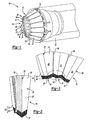
- Figure 1 is a perspective view of an exhaust nozzle assembly for a gas turbine engine.
- Figure 2 is a plan view of a flap assembly according to this invention.
- Figure 3 is a plan view of several flap assemblies interfit with one another.
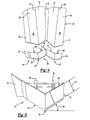
- Figure 4 is an exploded view of two flap assemblies according to this invention.
- Figure 5 is a top view of a divergent element.
- Figure 6 is a side view of the divergent element shown in Figure 5.
- Figure 7 is a rear perspective view of two divergent elements interfit into one another.
- Figure 8 is a rear cross sectional view of two-flap elements interfit into one another.
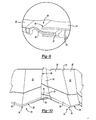
- Figure 9 is an enlarged view of the interface between two flap elements.
- Figure 10 is a perspective view of interfit flap assemblies viewed from the trailing edge.
- Figure 11 is a plane view of an interior surface of adjacent flap assemblies including a seal.
- Figure 12 is a perspective view of the seal.
- Referring to Figure 1, an
exhaust nozzle assembly 10 includes a plurality of interfittingflap assemblies 16 defining anopening 14. Each of theflap assemblies 16 is pivotally attached to a static structure atpivots 18. An actuator illustrated schematically at 17 is attached to move each of theflap assemblies 16. Pivoting of theflap assemblies 16 varies the cross-sectional area of the opening 14. - Each of the
flap assemblies 16 includes adivergent element 20, aflap element 22, and aseal 24. Theseal 24 is disposed betweenadjacent flap assemblies 16 on aninterior surface 15 of theexhaust nozzle assembly 10 to substantially prevent leakage of exhaust gasses therethrough. Each of the flap assemblies 16 interfits into anadjacent flap assembly 16 to provide a substantially uniform and continuous, facetedouter surface 11 of theexhaust nozzle assembly 10. Theopening 14 includes a serratedtrailing edge 21 defined by thedivergent elements 20 of eachflap assembly 16. The serratedtrailing edge 21 includes a plurality of aftmost portions 28 andtrailing edge surfaces 26 defined by thedivergent elements 20. The aftmost portions 28 alternate with thetrailing edge surfaces 26 creating thetrailing edge 21 having a plurality of peaks and valleys. - Referring to Figure 2, each of the
flap assemblies 16 includes theflap element 22 that is attached to thedivergent element 20. Thedivergent element 20 includes awing segment 34 and theflap element 22 also includes awing segment 32. Thewing segments common wing 30. Thewing 30 extends from one side of theflap element 22 and aslot 39 is provided within eachflap assembly 16 on a side opposite thewing 30. - Each
flap assembly 16 defines a portion of theouter surface 11 and includes acrest 23 betweentapered surfaces 25. Thetapered surface 25 gradually transition upward toward thecrest 23. Thewing 30 is disposed on a separate plane below thetapered surface 25 of eachflap assembly 16. - Referring to Figure 3,
several flap assemblies 16 are shown interfit with each other. Eachwing 30 fits within theslot 39 of anadjacent flap assembly 16. As the nozzle opening 14 expands and contracts, thewing 30 moves progressively into and out of theslot 39 formed in anadjacent flap assembly 16 such that no gap is formed therebetween. Aninterface 38 betweenadjacent flap assemblies 16 moves along thewing 30 during expansion. During contraction theinterface 38 is at a position such that thetapered surfaces 25 of adjacent flap assemblies 16 abut to form the facetedouter surface 11. Theinterface 38 between eachflap assembly 16 moves, but is always covered by thewing 30 to provide the substantially continuous and uninterrupted facetedouter surface 11. Although theinterface 38 forms a visible seam betweenadjacent flap assemblies 16, there are no gaps exposed alongadjoining flap assemblies 16 through the full range of motion of each of the plurality offlap assemblies 16. - Referring to Figure 4, each of the
flap assemblies 16 includes thedivergent element 20 and theflap element 22. Theflap element 22 includes thecrest 23 and thetapered surfaces 25 to form a portion of theouter surface 11. Theflap element 22 is attached by way of thepivot 18 to a static structure of theengine 12 at one end and to thedivergent element 20 on an end opposite thepivot 18. Attachment of theflap element 22 to thedivergent element 20 is as known and can include welding or the use of mechanical fasteners. - The
divergent element 20 includes thewing segment 34 that interfits within an adjacentdivergent element 20. Thedivergent element 20 defines the trailingedge surface 26 that is angled outwardly towards theaft point 28. Eachdivergent element 20 includesbosses 36 for attaching to articulating mechanisms of the actuator 17 (Figure 1) utilized for actuating theflap assemblies 16. - Referring to Figure 5, the
divergent element 20 is shown and is formed to include a desired geometric shape that combines with adjacentdivergent elements 20 to define theserrated trailing edge 21 for theexhaust nozzle assembly 10. Thedivergent element 20 includes asweep angle 40 and aplane length 41. Theplane length 41 in conjunction with thesweep angle 40 combined with adjacentdivergent elements 20 provides desired performance characteristics and minimizes and controls the formation of gaps in the trailingedge 21. - The example
divergent element 20 is a single cast piece. The material that is utilized to fabricate thedivergent element 20 is compatible with the temperatures and the chemical composition of the exhaust gasses that are emitted from the gas turbine engine through theexhaust nozzle assembly 10. Although, the exampledivergent element 20 is a cast piece, a worker skilled in the art with the benefit of this disclosure would understand that thedivergent element 20 may be fabricated utilizing other known manufacturing processes. - The
wing segment 34 of thedivergent element 20 deviates from the overall shape of thedivergent element 20 and extends rearward of the trailingedge surface 26. Thewing segment 34 is shaped to interfit within an adjacentdivergent element 20 such that when theexhaust nozzle assembly 10 is at its maximum opening, thewing segment 34 will remain within aslot 35 of an adjacentdivergent element 20 thereby providing the substantially continuousouter surface 11 betweenadjacent flap assemblies 16. - Referring to Figure 6, the
divergent element 20 is shown in a side view to illustrate thewedge surface 46 and thewedge angle 42. Thesweep angle 40 andwedge angle 42 along with thesurface wedge 46 andlength 41 act in concert to provide desired operating characteristics and the desiredserrated trailing edge 21. - Referring to Figure 7, two
divergent elements 20 are shown from a rear view with theflap element 22 omitted for clarity. Thewing segment 34 of onedivergent element 20 is disposed within theslot 35 of the adjacentdivergent element 20. Thedivergent elements 20 include alip portion 48 that is provided to conform to assembly of theflap element 22. Thelip portion 48 accommodates the configuration of theflap element 22 to provide a substantially continuous outer surface of theflap assembly 16. - The
wing segment 34 fits within the accompanyingslot 35 of the adjacentdivergent element 20; however, thewing segment 34 does not contact the adjacentdivergent element 20 during movement. Instead thewing segment 34 moves within theslot 35 of the adjacentdivergent element 20. Because there is no contact between thewing segment 34 and the adjacentdivergent element 20, undesirable wear and friction between adjacentdivergent elements 20 are substantially eliminated. Referring to Figure 8, a cross-section ofadjacent flap elements 22 is shown to illustrate the relationship between thewing segment 32 and theslot 37. As in thedivergent element 20, thewing segment 32 of theflap element 22 is disposed within aslot 37 of anadjacent flap element 22. Thewing segment 32 does not contact any portion or surface of theadjacent flap element 22.Interfitting wings 30 of eachflap assembly 16 produces the continuousouter surface 11 of theexhaust nozzle assembly 10. - Each of the
flap elements 22 includesribbed portions 50. Theribbed portions 50 strengthen theflap elements 22 and provide for the inclusion of cooling features or articulation features that are utilized to move each of theflap assemblies 16. - Referring to Figure 9, an enlarged view of the
interface 38 between theflap assemblies 16 is shown at the intersection betweenadjacent flap elements 22. Thewing segment 32 of eachflap element 22 fits within the slottedportion 37 of theadjacent flap element 22. Thewing segment 32 recedes within theslot 37 of theadjacent flap element 22 during articulation and movement of each of theflap assemblies 16. Because thewing segment 32 does not contact theadjacent flap element 22 frictional forces are not introduced, however, the gaps betweenadjacent flap assemblies 16 are substantially eliminated providing the desirable continuous surface of theexhaust nozzle assembly 10. - Referring to Figure 10, two
adjacent flap assemblies 16 are shown in a view looking toward the trailingedge surface 26. Theflap element 22 is attached to thedivergent element 20 such that the two form a substantially continuous exterior surface. Theflap element 22 and thedivergent element 20 of the illustrated example are formed as a single composite piece. The material utilized can be of any material compatible with the environmental conditions experienced by theexhaust nozzle assembly 10. A worker skilled in the art with the benefit of this disclosure would understand what types of materials and processes are required to fabricate elements consistent and compatible with operation in the extreme conditions of the exhaust nozzle assembly. - The interface between
adjacent flap assemblies 16 may result in agap 52 along the trailingedge 21 for some exhaust nozzle openings. Thegap 52 is minimized by geometric configuration of thewings 30 of theflap assemblies 16 and the fit between adjacentdivergent elements 20. Further, theseal 24 is disposed on theinterior surface 15 betweenadjacent flap assemblies 16 for covering thegap 52. Theseal 24 is comprised of sheet metal that is attached to move and maintain a position relative to theflap assemblies 16 through the range of motion. - Referring to Figure 11, the
seal 24 disposed on theinterior surface 15 of each of theflap assemblies 16 is shown. Theseal 24 includes anotch 54. Thenotch 54 conforms to the geometry of adjacentdivergent elements 20 such that a portion of theseal 24 can be positioned further towards the trailingedge 21. Each of theseals 24 includes atented portion 56. Thetented portion 56 is rearward of thenotch 54 along a plane different than the substantialplanar surface 58 of the remaining portions of theseal 24. Thetented portion 56 is bent outwardly away from theinterior surface 15 of theflap assemblies 16. This provides the flexibility of theseal 24 to not only block gaps produced during articulation of theexhaust nozzle assembly 10, but also provides a desired geometry for reducing and substantially eliminating potential gaps through trailingedge 21 resulting from articulation ofadjacent flap assemblies 16. - Although a preferred embodiment of this invention has been disclosed, a worker of ordinary skill in this art would recognize that certain modifications would come within the scope of this invention. For that reason, the following claims should be studied to determine the true scope and content of this invention.
Claims (23)
- An exhaust nozzle assembly (10) comprising:a plurality of interfitting flap assemblies (16) movable between a maximum area position and a minimum area position, each of said plurality of flap assemblies (16) including a slot (39) and wing (30), said wing (30) fitting within said slot (39) of an adjacent one of said plurality of interfitting flap assemblies (16).
- The assembly (10) as recited in claim 1, wherein each of said plurality of flap assemblies (16) includes a divergent element (20) attached to a flap element (22), wherein said divergent element (20) and said flap element (22) includes a portion of said wing (30).
- The assembly (10) as recited in claim 2, wherein said divergent element (20) defines a trailing edge (21) including an aft most portion (28) and sweep surfaces (26) extending from said aft most portion (28) at a sweep angle (40).
- The assembly (10) as recited in claim 2 or 3, wherein said divergent element (20) includes a top surface (46) extending upwardly from said aft most portion (28) at a wedge angle (42).
- The assembly (10) as recited in claim 2, 3 or 4, wherein said divergent element (20) includes a slot side (35) and a wing side (34), wherein said slot slide (35) is configured for receiving a wing side (34) of an adjacent divergent element (20).
- The assembly (10) as recited in any of claims 2 to 5, wherein said divergent element (20) includes an attachment segment (36) for connection to a linkage element.
- The assembly (10) as recited in any of claims 2 to 6, wherein said flap element (22) includes a slotted side (37) and a wing segment (32), said wing segment (32) received within a slotted side (37) of an adjacent flap assembly (16).
- The assembly (10) as recited in any preceding claim, including a seal (24) disposed between adjacent flap assemblies (16).
- The assembly (10) as recited in claim 8, wherein said seal (24) is disposed on a surface (15) of said plurality of flap assemblies (16) exposed to exhaust gases.
- The assembly (10) as recited in claim 8 or 9 when dependent directly or indirectly on claim 2, wherein said seal (24) includes a notch (54) corresponding to trailing edges (21) of adjacent divergent elements (20).
- The assembly (10) as recited in claim 10, wherein said notch (54) is V-shaped.
- The assembly (10) as recited in any of claims 8 to 11, wherein said seal (24) includes a first surface (58) and a tented surface (56) disposed on a plane different than said first surface (58), said tented surface (56) extending outward from said first surface (58).
- The assembly (10) as recited in any preceding claim, wherein said wing (30) disposed within an adjacent slot (39) does not contact said adjacent flap assembly (16).
- An exhaust nozzle assembly (10) comprising:a variable opening (14) defining a serrated trailing edge (21); anda plurality of flap assemblies (16) including a corresponding plurality of divergent elements (20), wherein each of said divergent elements (20) defines a portion of said serrated trailing edge (21).
- The assembly (10) as recited in claim 14, wherein each of said plurality of divergent elements (20) comprises an aft most segment (28) forming a point of said serrated trailing edge (21).
- The assembly (10) as recited in claim 14 or 15, wherein each of said plurality of divergent elements (20) includes an exterior surface (26) extending radially outwardly from said aft most segment (28).
- The assembly (10) as recited in claim 14, 15 or 16, wherein each of said plurality of divergent elements (20) includes a wing (34) and a slot (35), wherein said wing (34) is disposed within a slot (35) of an adjacent divergent element (20).
- The assembly (10) as recited in any of claims 14 to 17, wherein said plurality of flap assemblies (16) includes a corresponding plurality of flap elements (22) attached to said corresponding plurality of divergent elements (20).
- The assembly (10) as recited in any of claims 14 to 18, including a seal (24) disposed on an inner surface (15) of said exhaust nozzle assembly (10).
- The assembly (10) as recited in claim 19, wherein said seal (24) includes a notch (54) corresponding to a portion of said serrated trailing edge (21).
- The assembly (10) as recited in claim 20, wherein said notch (54) is substantially V-shaped.
- The assembly (10) as recited in claim 20 or 21, wherein said seal (24) includes an angled surface between a substantially planar region and an edge of said notch (54).
- The assembly (10) as recited in claim 20, 21 or 22, wherein said seal (24) includes a first substantially flat segment (58) and a second tented portion (56) angled outwardly from said first substantially flat segment (58), and said notch (54) is disposed within said second tented portion (56).
Applications Claiming Priority (1)
| Application Number | Priority Date | Filing Date | Title |
|---|---|---|---|
| US11/091,120 US7578133B2 (en) | 2005-03-28 | 2005-03-28 | Reduced radar cross section exhaust nozzle assembly |
Publications (2)
| Publication Number | Publication Date |
|---|---|
| EP1707787A2 true EP1707787A2 (en) | 2006-10-04 |
| EP1707787A3 EP1707787A3 (en) | 2010-03-17 |
Family
ID=36102223
Family Applications (1)
| Application Number | Title | Priority Date | Filing Date |
|---|---|---|---|
| EP06251069A Withdrawn EP1707787A3 (en) | 2005-03-28 | 2006-02-28 | Reduced radar cross section exhaust nozzle assembly |
Country Status (3)
| Country | Link |
|---|---|
| US (1) | US7578133B2 (en) |
| EP (1) | EP1707787A3 (en) |
| JP (1) | JP2006275043A (en) |
Cited By (1)
| Publication number | Priority date | Publication date | Assignee | Title |
|---|---|---|---|---|
| EP2626541A3 (en) * | 2012-02-09 | 2017-10-25 | The Boeing Company | Variable area mechanism with angular trailing edges |
Families Citing this family (13)
| Publication number | Priority date | Publication date | Assignee | Title |
|---|---|---|---|---|
| US7543452B2 (en) * | 2005-08-10 | 2009-06-09 | United Technologies Corporation | Serrated nozzle trailing edge for exhaust noise suppression |
| US7624567B2 (en) * | 2005-09-20 | 2009-12-01 | United Technologies Corporation | Convergent divergent nozzle with interlocking divergent flaps |
| US7757482B2 (en) * | 2007-02-21 | 2010-07-20 | Gm Global Technology Operations, Inc. | Variable geometry exhaust cooler |
| US7963099B2 (en) * | 2007-05-21 | 2011-06-21 | General Electric Company | Fluted chevron exhaust nozzle |
| US7926285B2 (en) | 2007-07-18 | 2011-04-19 | General Electric Company | Modular chevron exhaust nozzle |
| US7762086B2 (en) * | 2008-03-12 | 2010-07-27 | United Technologies Corporation | Nozzle extension assembly for ground and flight testing |
| US7716932B2 (en) * | 2008-07-24 | 2010-05-18 | Spirit Aerosystems, Inc. | Dilating fan duct nozzle |
| US8166752B2 (en) * | 2008-11-26 | 2012-05-01 | GM Global Technology Operations LLC | Apparatus and method for cooling an exhaust gas |
| JP5673405B2 (en) * | 2011-07-12 | 2015-02-18 | 株式会社Ihi | Variable exhaust nozzle for jet engine |
| RU2685168C1 (en) * | 2017-11-08 | 2019-04-16 | Публичное акционерное общество "ОДК-Уфимское моторостроительное производственное объединение" (ПАО "ОДК-УМПО") | Turbojet engine flat nozzle |
| CN113530705A (en) * | 2021-08-18 | 2021-10-22 | 中国航发贵阳发动机设计研究所 | Retractable limiting device for outer adjusting piece of adjustable jet pipe of aircraft engine |
| CN116104661B (en) * | 2023-03-17 | 2023-08-25 | 南京航空航天大学 | Depth-adjustable lobe spray pipe structure and adjusting method |
| US20260055741A1 (en) * | 2024-08-22 | 2026-02-26 | Pratt & Whitney Canada Corp. | Jet nozzle effective area control system for gas turbine engine |
Citations (2)
| Publication number | Priority date | Publication date | Assignee | Title |
|---|---|---|---|---|
| US3622076A (en) | 1969-01-03 | 1971-11-23 | Thiokol Chemical Corp | Variable area nozzle |
| US20020036241A1 (en) | 1999-12-29 | 2002-03-28 | Johnson James Steven | Throat configuration for axisymmetric nozzle |
Family Cites Families (13)
| Publication number | Priority date | Publication date | Assignee | Title |
|---|---|---|---|---|
| US4128208A (en) | 1977-07-11 | 1978-12-05 | General Electric Company | Exhaust nozzle flap seal arrangement |
| EP0723075B1 (en) * | 1991-05-16 | 2001-11-21 | General Electric Company | Thermal shield for axisymmetric vectoring nozzle |
| US5115979A (en) * | 1991-05-28 | 1992-05-26 | General Electric Company | Conforming plunger seal assembly |
| US5720434A (en) * | 1991-11-05 | 1998-02-24 | General Electric Company | Cooling apparatus for aircraft gas turbine engine exhaust nozzles |
| US5199643A (en) * | 1992-04-13 | 1993-04-06 | Rozmus Walter J | Model aircraft variable geometry nozzle |
| EP0750107B1 (en) | 1995-06-21 | 1999-10-27 | Volvo Aero Corporation | Exhaust nozzle flap |
| US5833139A (en) | 1995-09-06 | 1998-11-10 | United Technologies Corporation | Single variable flap exhaust nozzle |
| US5680755A (en) * | 1995-09-25 | 1997-10-28 | General Electric Company | Convertible ejector selectively cooled thrust vectoring exhaust nozzle |
| US5893518A (en) * | 1995-11-30 | 1999-04-13 | United Technologies Corporation | Attachment means for flaps of variable exhaust nozzle |
| US5839663A (en) | 1996-07-23 | 1998-11-24 | United Technologies Corporation | Gas turbine exhaust nozzle flap and flap seal apparatus |
| US6360528B1 (en) * | 1997-10-31 | 2002-03-26 | General Electric Company | Chevron exhaust nozzle for a gas turbine engine |
| US7240493B2 (en) * | 2003-12-01 | 2007-07-10 | The University Of Mississippi | Method and device for reducing engine noise |
| US6983602B2 (en) * | 2004-04-21 | 2006-01-10 | General Electric Company | Ejector cooled nozzle |
-
2005
- 2005-03-28 US US11/091,120 patent/US7578133B2/en active Active
-
2006
- 2006-01-25 JP JP2006015814A patent/JP2006275043A/en active Pending
- 2006-02-28 EP EP06251069A patent/EP1707787A3/en not_active Withdrawn
Patent Citations (2)
| Publication number | Priority date | Publication date | Assignee | Title |
|---|---|---|---|---|
| US3622076A (en) | 1969-01-03 | 1971-11-23 | Thiokol Chemical Corp | Variable area nozzle |
| US20020036241A1 (en) | 1999-12-29 | 2002-03-28 | Johnson James Steven | Throat configuration for axisymmetric nozzle |
Cited By (1)
| Publication number | Priority date | Publication date | Assignee | Title |
|---|---|---|---|---|
| EP2626541A3 (en) * | 2012-02-09 | 2017-10-25 | The Boeing Company | Variable area mechanism with angular trailing edges |
Also Published As
| Publication number | Publication date |
|---|---|
| US7578133B2 (en) | 2009-08-25 |
| US20060213198A1 (en) | 2006-09-28 |
| JP2006275043A (en) | 2006-10-12 |
| EP1707787A3 (en) | 2010-03-17 |
Similar Documents
| Publication | Publication Date | Title |
|---|---|---|
| US7578133B2 (en) | Reduced radar cross section exhaust nozzle assembly | |
| US11434813B2 (en) | Valve assembly for a multi-scroll turbine | |
| EP0683859B1 (en) | Turbine engine equipped with thrust reverser | |
| US8052085B2 (en) | Thrust reverser for a turbofan gas turbine engine | |
| JP2596443B2 (en) | Seal assembly | |
| EP2037083B1 (en) | Seal for gas turbine engine component | |
| EP1798383B1 (en) | Bleed system for axial rotary machine | |
| EP1873426A2 (en) | A seal assembly | |
| CA2902812C (en) | Turbine assembly and system for preventing leakage, corresponding methods of assembling and preventing air leakage | |
| US20110174899A1 (en) | Nacelle with a variable nozzle section | |
| CN114174662A (en) | Aircraft seal | |
| US5899059A (en) | Pivoting door thrust reverser with translatable auxiliary panel | |
| US6082669A (en) | System for the admission of air into a working section of a gas turbine engine | |
| US5897120A (en) | Outer flap elastic seal assembly | |
| US9556737B2 (en) | Air separator for gas turbine engine | |
| RU2344307C2 (en) | Controlled hot flap of turbojet engine axisymmetric nozzle | |
| CN112996998B (en) | Sealing joints for aircraft turbojet engine nacelles | |
| EP3008322B1 (en) | Variable-geometry exhaust nozzle for a jet engine and a method for varying the nozzle | |
| US7721550B2 (en) | Aircraft engine exhaust flap curved strut slot | |
| EP3008320B1 (en) | Variable-geometry convergent-divergent exhaust nozzle for a jet engine and method for varying the nozzle | |
| US12158122B2 (en) | Nacelle for an aircraft propulsion assembly comprising a flap for closing a recess for the passage of an actuator | |
| CA2156089C (en) | Turbine engine equipped with thrust reverser |
Legal Events
| Date | Code | Title | Description |
|---|---|---|---|
| PUAI | Public reference made under article 153(3) epc to a published international application that has entered the european phase |
Free format text: ORIGINAL CODE: 0009012 |
|
| AK | Designated contracting states |
Kind code of ref document: A2 Designated state(s): AT BE BG CH CY CZ DE DK EE ES FI FR GB GR HU IE IS IT LI LT LU LV MC NL PL PT RO SE SI SK TR |
|
| AX | Request for extension of the european patent |
Extension state: AL BA HR MK YU |
|
| PUAL | Search report despatched |
Free format text: ORIGINAL CODE: 0009013 |
|
| AK | Designated contracting states |
Kind code of ref document: A3 Designated state(s): AT BE BG CH CY CZ DE DK EE ES FI FR GB GR HU IE IS IT LI LT LU LV MC NL PL PT RO SE SI SK TR |
|
| AX | Request for extension of the european patent |
Extension state: AL BA HR MK YU |
|
| 17P | Request for examination filed |
Effective date: 20100805 |
|
| 17Q | First examination report despatched |
Effective date: 20100914 |
|
| AKX | Designation fees paid |
Designated state(s): DE GB |
|
| STAA | Information on the status of an ep patent application or granted ep patent |
Free format text: STATUS: THE APPLICATION IS DEEMED TO BE WITHDRAWN |
|
| 18D | Application deemed to be withdrawn |
Effective date: 20130903 |