EP1707559A1 - Method of enanthio-selective nucleophilic addition reaction for conversion of enamide to imine and method of synthesizing alpha amino-gamma-keto acid ester - Google Patents
Method of enanthio-selective nucleophilic addition reaction for conversion of enamide to imine and method of synthesizing alpha amino-gamma-keto acid ester Download PDFInfo
- Publication number
- EP1707559A1 EP1707559A1 EP05704279A EP05704279A EP1707559A1 EP 1707559 A1 EP1707559 A1 EP 1707559A1 EP 05704279 A EP05704279 A EP 05704279A EP 05704279 A EP05704279 A EP 05704279A EP 1707559 A1 EP1707559 A1 EP 1707559A1
- Authority
- EP
- European Patent Office
- Prior art keywords
- compound
- addition reaction
- nucleophilic addition
- enamide
- group
- Prior art date
- Legal status (The legal status is an assumption and is not a legal conclusion. Google has not performed a legal analysis and makes no representation as to the accuracy of the status listed.)
- Granted
Links
- 0 *C([C@@](CC1c2ccccc2)C*1(C(*)=O)C(OCc1ccccc1)=O)=O Chemical compound *C([C@@](CC1c2ccccc2)C*1(C(*)=O)C(OCc1ccccc1)=O)=O 0.000 description 2
Classifications
-
- C—CHEMISTRY; METALLURGY
- C07—ORGANIC CHEMISTRY
- C07B—GENERAL METHODS OF ORGANIC CHEMISTRY; APPARATUS THEREFOR
- C07B53/00—Asymmetric syntheses
-
- B—PERFORMING OPERATIONS; TRANSPORTING
- B01—PHYSICAL OR CHEMICAL PROCESSES OR APPARATUS IN GENERAL
- B01J—CHEMICAL OR PHYSICAL PROCESSES, e.g. CATALYSIS OR COLLOID CHEMISTRY; THEIR RELEVANT APPARATUS
- B01J31/00—Catalysts comprising hydrides, coordination complexes or organic compounds
- B01J31/16—Catalysts comprising hydrides, coordination complexes or organic compounds containing coordination complexes
- B01J31/18—Catalysts comprising hydrides, coordination complexes or organic compounds containing coordination complexes containing nitrogen, phosphorus, arsenic or antimony as complexing atoms, e.g. in pyridine ligands, or in resonance therewith, e.g. in isocyanide ligands C=N-R or as complexed central atoms
- B01J31/1805—Catalysts comprising hydrides, coordination complexes or organic compounds containing coordination complexes containing nitrogen, phosphorus, arsenic or antimony as complexing atoms, e.g. in pyridine ligands, or in resonance therewith, e.g. in isocyanide ligands C=N-R or as complexed central atoms the ligands containing nitrogen
-
- C—CHEMISTRY; METALLURGY
- C07—ORGANIC CHEMISTRY
- C07C—ACYCLIC OR CARBOCYCLIC COMPOUNDS
- C07C231/00—Preparation of carboxylic acid amides
- C07C231/16—Preparation of optical isomers
- C07C231/18—Preparation of optical isomers by stereospecific synthesis
-
- C—CHEMISTRY; METALLURGY
- C07—ORGANIC CHEMISTRY
- C07D—HETEROCYCLIC COMPOUNDS
- C07D207/00—Heterocyclic compounds containing five-membered rings not condensed with other rings, with one nitrogen atom as the only ring hetero atom
- C07D207/02—Heterocyclic compounds containing five-membered rings not condensed with other rings, with one nitrogen atom as the only ring hetero atom with only hydrogen or carbon atoms directly attached to the ring nitrogen atom
- C07D207/18—Heterocyclic compounds containing five-membered rings not condensed with other rings, with one nitrogen atom as the only ring hetero atom with only hydrogen or carbon atoms directly attached to the ring nitrogen atom having one double bond between ring members or between a ring member and a non-ring member
- C07D207/22—Heterocyclic compounds containing five-membered rings not condensed with other rings, with one nitrogen atom as the only ring hetero atom with only hydrogen or carbon atoms directly attached to the ring nitrogen atom having one double bond between ring members or between a ring member and a non-ring member with hetero atoms or with carbon atoms having three bonds to hetero atoms with at the most one bond to halogen, e.g. ester or nitrile radicals, directly attached to ring carbon atoms
- C07D207/24—Oxygen or sulfur atoms
- C07D207/26—2-Pyrrolidones
- C07D207/273—2-Pyrrolidones with hetero atoms or with carbon atoms having three bonds to hetero atoms with at the most one bond to halogen, e.g. ester or nitrile radicals, directly attached to other ring carbon atoms
-
- B—PERFORMING OPERATIONS; TRANSPORTING
- B01—PHYSICAL OR CHEMICAL PROCESSES OR APPARATUS IN GENERAL
- B01J—CHEMICAL OR PHYSICAL PROCESSES, e.g. CATALYSIS OR COLLOID CHEMISTRY; THEIR RELEVANT APPARATUS
- B01J2231/00—Catalytic reactions performed with catalysts classified in B01J31/00
- B01J2231/30—Addition reactions at carbon centres, i.e. to either C-C or C-X multiple bonds
- B01J2231/34—Other additions, e.g. Monsanto-type carbonylations, addition to 1,2-C=X or 1,2-C-X triplebonds, additions to 1,4-C=C-C=X or 1,4-C=-C-X triple bonds with X, e.g. O, S, NH/N
- B01J2231/341—1,2-additions, e.g. aldol or Knoevenagel condensations
-
- B—PERFORMING OPERATIONS; TRANSPORTING
- B01—PHYSICAL OR CHEMICAL PROCESSES OR APPARATUS IN GENERAL
- B01J—CHEMICAL OR PHYSICAL PROCESSES, e.g. CATALYSIS OR COLLOID CHEMISTRY; THEIR RELEVANT APPARATUS
- B01J2531/00—Additional information regarding catalytic systems classified in B01J31/00
- B01J2531/10—Complexes comprising metals of Group I (IA or IB) as the central metal
- B01J2531/16—Copper
-
- C—CHEMISTRY; METALLURGY
- C07—ORGANIC CHEMISTRY
- C07B—GENERAL METHODS OF ORGANIC CHEMISTRY; APPARATUS THEREFOR
- C07B2200/00—Indexing scheme relating to specific properties of organic compounds
- C07B2200/07—Optical isomers
Definitions
- the present invention relates to a method of an enantioselective nucleophilic addition reaction of enamide to an imine which enables an asymmetric synthesis of a compound which is useful as a raw material or a synthesis intermediate for producing a pharmaceutical preparation, an agricultural chemical, a fragrance, a functional polymer or the like and, as an application thereof, a synthesis method of an ⁇ -amino- ⁇ -keto acid ester or the like.
- the present inventors have developed and disclosed a method for synthesizing an N-acylated amino acid derivative by a nucleophilic addition reaction to an N-acylimino ester compound by using a polymer-carrying catalyst ( Journal of Combinatorial Chemistry, 2001, Vol. 3, No. 5, 401 to 403 ) and, further, a method for enantioselectively synthesizing these compounds by using a chiral copper catalyst ( Org. Lett. Vol. 4, No. 1, 2002, 143 to 145 ; J. Am. Chem. Soc. Vol. 125, No. 9, 2003, 2507 to 2515 ).
- nucleophilic addition reaction on which the present inventors have studied is limited to such nucleophilic reactants as a silyl enol ether and an alkyl vinyl ether and, accordingly, a subject to which the nucleophilic addition reaction is applied and such application thereof have inevitably been restricted.
- the present invention has an object of providing a method of an enantioselective nucleophilic addition reaction to an imine compound which enables an asymmetric synthesis of an amino acid compound or the like which is useful as a raw material or a synthesis intermediate for producing a pharmaceutical preparation, an agricultural chemical, a fragrance, a functional polymer or the like and, further, as an application thereof, a novel synthesis method of the amino acid compound or the like.
- the method of the enantioselective nucleophilic addition reaction of enamide which is characterized in that the chiral copper catalyst is constituted by a copper compound which is a salt of an organic or inorganic acid or a complex or composite of the salt, and a chiral diamine ligand and, according to a third aspect of the invention, there is provided the method of the enantioselective nucleophilic addition reaction of enamide which is characterized in that the chiral diamine ligand has an ethylene diamine structure as a portion thereof.
- a method for synthesizing an optically active ⁇ -amino- ⁇ -imino acid ester which is characterized in that the imine compound is represented by the following formula (1): (wherein R 1 represents a hydrocarbon group which may have a substituent; R 2 represents an R 0 -CO- or R 0 -O-CO- group, wherein R 0 represents a hydrocarbon group which may have a substituent); and the enamide compound is represented by the following formula (2): (wherein R 3 represents a hydrocarbon group which may have a substituent or a hydrocarbon group which may have a substituent to be bonded via an oxygen atom; R 4 represents a hydrocarbon group which may have a substituent; and R 5 and R 6 may be same with or different from each other and each represent a hydrogen atom or a hydrocarbon group which may have a substituent, wherein at least one of them represents a hydrogen atom) and generate
- a method for synthesizing an optically active ⁇ -amino- ⁇ -keto acid ester which is characterized in that, after the above-described nucleophilic addition reaction, an acid treatment is performed, to thereby generate a compound represented by at least one of the following formulae (4): (wherein R 1 , R 2 , R 4 , R 5 and R 6 each represent same article as described above) and, further, according to a sixth aspect of the invention, there is provided a method for synthesizing an optically active ⁇ -amino- ⁇ -keto acid ester which is characterized in that, after the above-described nucleophilic addition reaction, a reduction treatment is performed, to thereby generate a compound represented by at least one of the following formulae (5): (wherein R 1 , R 2 , R 3 , R 4 , R 5 and R 6 each represent same article as described above) and, further, according to a seventh aspect of the invention, there is provided a method for synthesizing an optically active ⁇ -
- the present invention has characteristics as described above and is, further, described with reference to embodiments thereof.
- a chiral copper catalyst is used as a catalyst.
- the chiral copper catalyst on this occasion, various types of such chiral catalysts in each of which a copper atom is indispensable for a constitution thereof and to each of which a chiral organic molecular structure is attached are considered.
- the chiral copper catalyst is constituted by a copper compound and a chiral organic compound and, more practically, from the standpoint of reaction yield and enantioselectivity, the chiral copper catalyst constituted by a copper compound and a chiral diamine ligand compound is favorably considered.
- the copper compound may be selected from among various types of salts, complex salts, organic metal compounds and the like as a monovalent or bivalent copper compound and, among other things, a salt with an organic or inorganic acid, a complex or organic composite of the salt is favorably mentioned.
- a salt with a strong acid for example, a salt of (per)fluoroalkyl sulfonic acid, perchloric acid or sulfonic acid, a complex or an organic composite of the salt is favorably illustrated.
- Cu(OTf) 2 , CuClO 4 , CuClO 4 ⁇ 4CH 3 CN are mentioned.
- an article having an ethylene diamine structure in a molecular constitution as a portion thereof is favorably used.
- an amino group may contain an imine bond.
- various types represented by the following formulae are illustrated:
- R in the formulae represents a hydrocarbon group which may have a substituent.
- the hydrocarbon may be any one of various types in a chain state or a cyclic state and may have, as a substituent, a halogen atom, a hydrocarbon group of an alkyl group or the like, an alkoxy group or the like.
- Ph (phenyl group) in the formulae may have a substituent.
- a complex may previously be prepared by using a copper compound and a chiral organic molecule and, then, used as a catalyst, or the copper compound and the chiral organic molecule may be mixed with each other in a reaction system and, then, used.
- the copper compound or the complex of the copper compound and the chiral organic molecule is used at a rate of ordinarily from about 0.5 to about 30% by mol against the imine compound.
- the imine compound to be used in the reaction may have any one of various types of structures.
- such imine compound as this is represented by the above-described formula (1).
- This article has an ester bond portion and reference mark R 1 in the formula represents a hydrocarbon group which may have a substituent.
- the hydrocarbon group may be any one of various types of hydrocarbon groups, for example, a chain or an alicyclic hydrocarbon group, an aromatic hydrocarbon group and mixtures thereof.
- the hydrocarbon group may appropriately have any one of various types of substituents such as a hydrocarbon group such as an alkyl group, an alkoxy group, a sulfide group, a cyano group, a nitro group, and an ester group.
- a hydrocarbon group such as an alkyl group, an alkoxy group, a sulfide group, a cyano group, a nitro group, and an ester group.
- reference mark R 3 may be, as described above, R 0 -CO- or R 0 -O-CO-, in which R° may appropriately be selected from among hydrocarbon groups which each may have a substituent.
- the enamide compound as a counterpart can, for example, be represented by the above-described formula (2). As for characteristics thereof, it has an amide bond or a carbamate bond.
- R 3 represents a hydrocarbon group which may have a substituent or a hydrocarbon group which may have a substituent to be bonded via an oxygen atom; and R 5 and R 6 may be same with or different from each other and each represent a hydrogen atom or a hydrocarbon group which may have a substituent, in which at least one of them represents a hydrogen atom.
- the hydrocarbon group may be any one of various types of hydrocarbon groups in a same manner as described above, for example, an aliphatic hydrocarbon group, an alicyclic hydrocarbon group, an aromatic hydrocarbon group and mixtures thereof.
- substituents various types of substituents such as a hydrocarbon group such as an alkyl group, a halogen atom, an alkoxy group, a sulfide group, a cyano group, a nitro group, and an ester group are appropriately be considered.
- a hydrocarbon group which is bonded via an oxygen atom such as -OEt, -O t Bu, or -OBn is appropriately illustrated.
- an article having a substituent such as a phenyl group, a naphthyl group, or any one of these groups each having a substituent such as a halogen atom, an alkyl group, or an alkoxy group is favorably illustrated.
- an appropriate organic solvent for example, a halogenated hydrocarbon, any one of nitriles, or any one of ethers may be used and, in a reaction temperature, a range of from about -20°C to about 40°C can appropriately be adopted.
- a ratio of the imine compound to the enamide compound to be used in an atmosphere of the air or in an inert atmosphere can appropriately be set to be in the range of from about 0.1 to about 10 in terms of a molar ratio.
- an acid treatment for example, an acid treatment by using an aqueous solution of HCl, HBr or the like is performed, to thereby obtain the optically active ⁇ -amino- ⁇ -keto acid ester represented by the above-described formula (4) at high yield and with excellent enantioselectivity.
- the ⁇ , ⁇ -diamino acid ester represented by the above-described formula (5) can be obtained at high yield and with excellent enantioselectivity in a same manner as described above.
- the reduction treatment on this occasion can use, for example, a boron reducing agent compound, any one of other metal hydrides or a metallic hydrogen complex compound.
- the thus-generated ⁇ , ⁇ -diamino acid ester can favorably be converted into any one of ⁇ -lactams as represented by the above-described formula (6) by removing an acyl group on an amino group by an appropriate method (for example, catalytic hydrogen reduction or the like, when the acyl group is a benzyloxycarbonyl group).
- the resultant mixed solution was added with a CH 2 Cl 2 (0.8 ml) solution of enamide represented by the formula (2) shown in Table 1 and, then, gradually added with a CH 2 Cl 2 (2.0 ml) solution of an imine compound (0.20 mmol) represented by the formula (1) consuming 30 minutes and, thereafter, stirred for 15 minutes at 0°C.
- the resultant reaction mixed solution was added with a saturated aqueous solution of NaHCO 3 , to thereby terminate the reaction. Thereafter, the reaction mixed solution was allowed to have room temperature and subjected to extraction by using CH 2 Cl 2 . After the resultant organic phase was rinsed with a saturated saline solution, it was dried by dried magnesium sulfate anhydrous.
- the resultant reaction solution was added with an aqueous sodium hydrogen carbonate solution under an ice-cooled condition, it was subjected to extraction by using CH 2 Cl 2 and, then, the resultant organic phase was subjected to a saturation rinse by using a saturated saline solution and, thereafter, dried by using magnesium sulfate anhydrous. Next, the solvent was evaporated therefrom to obtain a crude product.
- the crude product was purified by using silica gel chromatography.
- the yield of the product of No. 1 was 92% and ee (%) was 93.
- the yield of the product was 78% and ee (%) was 87.
- the yield of the product of No. 11 was 81 % and ee (%) was 84.
- the product was isolated without performing an acid treatment using aqueous HBr solution.
- a treatment as described below was performed in place of the acid treatment by using the aqueous HBr solution in Example 1.
- the residue was added with Et 2 O (7.2 ml) and, then, cooled to -45°C and, thereafter, added with LiI (133.8 mg, 1.0 mmol) and, subsequently, stirred for 30 minutes.
- the resultant mixed solution was added with LiAlH (O t Bu) 3 (254.3 mg, 1.0 mmol) and, then, stirred for 37 hours at -45°C.
- a novel method of an enantioselective nucleophilic addition reaction to an imine compound which enables an asymmetric synthesis of an ⁇ -amino- ⁇ -keto acid ester, an ⁇ , ⁇ -diamino acid ester or the like which is useful as a raw material or a synthesis intermediate for producing a pharmaceutical preparation, an agricultural chemical, a fragrance, a functional polymer or the like.
- a novel method for synthesizing any one of optically active ⁇ -Iactams as an application thereof.
Landscapes
- Chemical & Material Sciences (AREA)
- Organic Chemistry (AREA)
- Inorganic Chemistry (AREA)
- Engineering & Computer Science (AREA)
- Materials Engineering (AREA)
- Chemical Kinetics & Catalysis (AREA)
- Organic Low-Molecular-Weight Compounds And Preparation Thereof (AREA)
- Low-Molecular Organic Synthesis Reactions Using Catalysts (AREA)
- Pyrrole Compounds (AREA)
Abstract
Description
- The present invention relates to a method of an enantioselective nucleophilic addition reaction of enamide to an imine which enables an asymmetric synthesis of a compound which is useful as a raw material or a synthesis intermediate for producing a pharmaceutical preparation, an agricultural chemical, a fragrance, a functional polymer or the like and, as an application thereof, a synthesis method of an α-amino-γ-keto acid ester or the like.
- Conventionally, a method of a nucleophilic addition reaction to an imino group of an imine compound has been studied and, in recent years, this nucleophilic addition reaction has drawn attention as a measure for efficiently and asymmetrically synthesizing an amino acid derivative as a raw material or an intermediate for producing a pharmaceutical preparation, an agricultural chemical, a fragrance, a functional polymer or the like.
- Under these circumstances, the present inventors have developed and disclosed a method for synthesizing an N-acylated amino acid derivative by a nucleophilic addition reaction to an N-acylimino ester compound by using a polymer-carrying catalyst (Journal of Combinatorial Chemistry, 2001, Vol. 3, No. 5, 401 to 403) and, further, a method for enantioselectively synthesizing these compounds by using a chiral copper catalyst (Org. Lett. Vol. 4, No. 1, 2002, 143 to 145; J. Am. Chem. Soc. Vol. 125, No. 9, 2003, 2507 to 2515).
- However, the nucleophilic addition reaction on which the present inventors have studied is limited to such nucleophilic reactants as a silyl enol ether and an alkyl vinyl ether and, accordingly, a subject to which the nucleophilic addition reaction is applied and such application thereof have inevitably been restricted.
- Then, under these circumstances, the present invention has an object of providing a method of an enantioselective nucleophilic addition reaction to an imine compound which enables an asymmetric synthesis of an amino acid compound or the like which is useful as a raw material or a synthesis intermediate for producing a pharmaceutical preparation, an agricultural chemical, a fragrance, a functional polymer or the like and, further, as an application thereof, a novel synthesis method of the amino acid compound or the like.
- In order to solve these problems, according to a first aspect of the present invention, there is provided a method of an enantioselective nucleophilic addition reaction of enamide which is a method of a nucleophilic addition reaction of an enamide compound accompanied by generation of an amino group to an imino group (-CH=N-) of an imine compound and which is characterized by allowing the reaction to be performed in the presence of a chiral copper catalyst.
- Then, with reference to the above-described method, according to a second aspect of the invention, there is provided the method of the enantioselective nucleophilic addition reaction of enamide which is characterized in that the chiral copper catalyst is constituted by a copper compound which is a salt of an organic or inorganic acid or a complex or composite of the salt, and a chiral diamine ligand and, according to a third aspect of the invention, there is provided the method of the enantioselective nucleophilic addition reaction of enamide which is characterized in that the chiral diamine ligand has an ethylene diamine structure as a portion thereof.
- Further, according to a fourth aspect of the invention, with reference to the above-described method, there is provided a method for synthesizing an optically active α-amino-γ-imino acid ester which is characterized in that the imine compound is represented by the following formula (1):


- According to a fifth aspect of the invention, there is provided a method for synthesizing an optically active α-amino-γ-keto acid ester which is characterized in that, after the above-described nucleophilic addition reaction, an acid treatment is performed, to thereby generate a compound represented by at least one of the following formulae (4):


- The present invention has characteristics as described above and is, further, described with reference to embodiments thereof.
- In a method of an enantioselective nucleophilic addition reaction of enamide to an imine compound according to the invention, a chiral copper catalyst is used as a catalyst. As for the chiral copper catalyst on this occasion, various types of such chiral catalysts in each of which a copper atom is indispensable for a constitution thereof and to each of which a chiral organic molecular structure is attached are considered. Ordinarily, the chiral copper catalyst is constituted by a copper compound and a chiral organic compound and, more practically, from the standpoint of reaction yield and enantioselectivity, the chiral copper catalyst constituted by a copper compound and a chiral diamine ligand compound is favorably considered.
- The copper compound may be selected from among various types of salts, complex salts, organic metal compounds and the like as a monovalent or bivalent copper compound and, among other things, a salt with an organic or inorganic acid, a complex or organic composite of the salt is favorably mentioned. Among these compounds, a salt with a strong acid, for example, a salt of (per)fluoroalkyl sulfonic acid, perchloric acid or sulfonic acid, a complex or an organic composite of the salt is favorably illustrated. For example, Cu(OTf)2, CuClO4, CuClO4·4CH3CN are mentioned.
- As for the chiral diamine ligand as a counterpart, an article having an ethylene diamine structure in a molecular constitution as a portion thereof is favorably used. On this occasion, an amino group may contain an imine bond. For example, as representatives, various types represented by the following formulae are illustrated:


- On this occasion, R in the formulae represents a hydrocarbon group which may have a substituent. The hydrocarbon may be any one of various types in a chain state or a cyclic state and may have, as a substituent, a halogen atom, a hydrocarbon group of an alkyl group or the like, an alkoxy group or the like. Further, Ph (phenyl group) in the formulae may have a substituent.
- With reference to the chiral copper catalyst as described above according to the invention, a complex may previously be prepared by using a copper compound and a chiral organic molecule and, then, used as a catalyst, or the copper compound and the chiral organic molecule may be mixed with each other in a reaction system and, then, used. As far as a ratio in use as a catalyst is concerned, the copper compound or the complex of the copper compound and the chiral organic molecule is used at a rate of ordinarily from about 0.5 to about 30% by mol against the imine compound.
- The imine compound to be used in the reaction may have any one of various types of structures. For example, such imine compound as this is represented by the above-described formula (1). This article has an ester bond portion and reference mark R1 in the formula represents a hydrocarbon group which may have a substituent. The hydrocarbon group may be any one of various types of hydrocarbon groups, for example, a chain or an alicyclic hydrocarbon group, an aromatic hydrocarbon group and mixtures thereof. As for such substituents, so long as they do not interfere with the nucleophilic addition reaction, the hydrocarbon group may appropriately have any one of various types of substituents such as a hydrocarbon group such as an alkyl group, an alkoxy group, a sulfide group, a cyano group, a nitro group, and an ester group.
- Further, reference mark R3 may be, as described above, R0-CO- or R0-O-CO-, in which R° may appropriately be selected from among hydrocarbon groups which each may have a substituent.
- The enamide compound as a counterpart can, for example, be represented by the above-described formula (2). As for characteristics thereof, it has an amide bond or a carbamate bond. As for reference marks in the formula, R3 represents a hydrocarbon group which may have a substituent or a hydrocarbon group which may have a substituent to be bonded via an oxygen atom; and R5 and R6 may be same with or different from each other and each represent a hydrogen atom or a hydrocarbon group which may have a substituent, in which at least one of them represents a hydrogen atom.
- The hydrocarbon group may be any one of various types of hydrocarbon groups in a same manner as described above, for example, an aliphatic hydrocarbon group, an alicyclic hydrocarbon group, an aromatic hydrocarbon group and mixtures thereof. As for such substituents, various types of substituents such as a hydrocarbon group such as an alkyl group, a halogen atom, an alkoxy group, a sulfide group, a cyano group, a nitro group, and an ester group are appropriately be considered.
- Further, as for reference mark R3, a hydrocarbon group which is bonded via an oxygen atom such as -OEt, -OtBu, or -OBn is appropriately illustrated. As for reference mark R4, an article having a substituent such as a phenyl group, a naphthyl group, or any one of these groups each having a substituent such as a halogen atom, an alkyl group, or an alkoxy group is favorably illustrated.
- In the nucleophilic addition reaction of the imine compound to imino (-CH=N-), an appropriate organic solvent, for example, a halogenated hydrocarbon, any one of nitriles, or any one of ethers may be used and, in a reaction temperature, a range of from about -20°C to about 40°C can appropriately be adopted. A ratio of the imine compound to the enamide compound to be used in an atmosphere of the air or in an inert atmosphere can appropriately be set to be in the range of from about 0.1 to about 10 in terms of a molar ratio.
- In the nucleophilic addition reaction of the enamide compound, when a reaction between the imine compound represented by the above-described formula (1) and the enamide compound represented by the above-described formula (2) is taken as an example, an optically active α-amino-γ-imino acid ester represented by the above-described formula (3) is enantioselectively generated.
- By either without isolating or isolating this compound, an acid treatment, for example, an acid treatment by using an aqueous solution of HCl, HBr or the like is performed, to thereby obtain the optically active α-amino-γ-keto acid ester represented by the above-described formula (4) at high yield and with excellent enantioselectivity.
- Further, on the other hand, without performing the acid treatment but performing a reduction treatment, the α, γ-diamino acid ester represented by the above-described formula (5) can be obtained at high yield and with excellent enantioselectivity in a same manner as described above. The reduction treatment on this occasion can use, for example, a boron reducing agent compound, any one of other metal hydrides or a metallic hydrogen complex compound. Then, the thus-generated α, γ-diamino acid ester can favorably be converted into any one of γ-lactams as represented by the above-described formula (6) by removing an acyl group on an amino group by an appropriate method (for example, catalytic hydrogen reduction or the like, when the acyl group is a benzyloxycarbonyl group).
- Hereinafter, the present invention is described in detail with reference to embodiments. It goes without saying that the present invention is not limited to these embodiments.
- Cu(OTf)2 (7.2 mg, 0.020 mmol) was dried for 2 hours at 100°C under a vacuum and, then, added with a chiral diamine ligand (10.8 mg, 0.022 mmol) represented by the following formula:

- Next, the resultant mixed solution was added with a CH2Cl2 (0.8 ml) solution of enamide represented by the formula (2) shown in Table 1 and, then, gradually added with a CH2Cl2 (2.0 ml) solution of an imine compound (0.20 mmol) represented by the formula (1) consuming 30 minutes and, thereafter, stirred for 15 minutes at 0°C.
- The resultant reaction mixed solution was added with a saturated aqueous solution of NaHCO3, to thereby terminate the reaction. Thereafter, the reaction mixed solution was allowed to have room temperature and subjected to extraction by using CH2Cl2. After the resultant organic phase was rinsed with a saturated saline solution, it was dried by dried magnesium sulfate anhydrous.
- After the solvent was evaporated, the resultant residue was dissolved in EtOH (3.0 ml), added with a 48% aqueous HBr solution (0.3 ml) and, then, stirred for 1.5 minute at room temperature.
- After the resultant reaction solution was added with an aqueous sodium hydrogen carbonate solution under an ice-cooled condition, it was subjected to extraction by using CH2Cl2 and, then, the resultant organic phase was subjected to a saturation rinse by using a saturated saline solution and, thereafter, dried by using magnesium sulfate anhydrous. Next, the solvent was evaporated therefrom to obtain a crude product. The crude product was purified by using silica gel chromatography.
- In Table 1, reaction yield and ee (%) in accordance with the type of enamide are shown. On this occasion, the ee (%) was determined by an HPLC analysis.
Table 1 No. Imine compound Enamide compound Yield (%) ee (%) R 1 R 2 R 3 R 4 R 5 1 Et COC 11 H 23 BnO Ph H, H 94 93 2 Et COCH 3 BnO Ph H, H 72 94 3 Bn COC 11 H 23 BnO Ph H, H 89 91 4 Et COC 11 H 23 Me Ph H, H 83 85 5 Et COC 11 H 23 BnO 4-MeO-Ph H, H 97 90 6 Et COCH 3 BnO 4-MeO-Ph H, H 76 92 7 Et COC 11 H 23 BnO 4-Cl-Ph H, H 89 90 8 Et COC 11 H 23 BnO 4-Me-Ph H, H 93 91 9 Et COC 11 H 23 BnO 2-naphthyl H, H 83 88 10 Et COCH 3 BnO 2-naphthyl H, H 76 91 11 Bn COC 11 H 23 EtO Me H, H 84 83 - Identification values of products of Nos. 6, 8, 9 and 10 are shown below.

- Found 293.1273; HPLC, Daicel Chiralcel AD+AD+AD, hexane/ i PrOH = 4/1, flow rate = 0.75 mL/min : t R = 66.5 min (S), t R = 70.4 min (R).


- In the synthesis of the product of No. 1 in Example 1, a chiral ligand in which R in the above-described formula represents 3,5-di-tBuC6H3 was used.
- The yield of the product of No. 1 was 92% and ee (%) was 93.
- In the synthesis of the product of No. 1 in Example 1, a reaction was performed by using a compound in which R1=Et and R2=OC(CH3)3 as an imine compound and a chiral diamine ligand in which R represents a 2-MeO-C6H4 group in the above-described formula.
- The yield of the product was 78% and ee (%) was 87.
- In the synthesis of the product of No. 11 in Example 1, a chiral diamine ligand in which R represents a 3,5-ditBuC6H3 group in the above-described formula was used.
- The yield of the product of No. 11 was 81 % and ee (%) was 84.
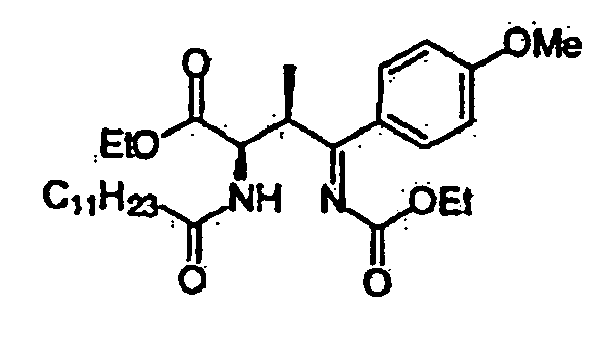
- A nucleophilic addition reaction was performed in a same manner as in Example 1 by using an imine compound in which R1=Et, and R2=COC11H23 in the formula (1) and an enamide compound in which R3=Et, R4=4MeO-Ph, R5=H, R6=Me(E/Z=>99/<1) in the formula (2). The product was isolated without performing an acid treatment using aqueous HBr solution.
- The compound described below was obtained with results of yield of 77%, syn/anti of 86/14 and 94% ee (syn).
- A treatment as described below was performed in place of the acid treatment by using the aqueous HBr solution in Example 1.
- Namely, the residue was added with Et2O (7.2 ml) and, then, cooled to -45°C and, thereafter, added with LiI (133.8 mg, 1.0 mmol) and, subsequently, stirred for 30 minutes. The resultant mixed solution was added with LiAlH (OtBu)3 (254.3 mg, 1.0 mmol) and, then, stirred for 37 hours at -45°C.
- Then, a reaction was terminated by being added with water and, then, further added with a 1N hydrochloric acid. The resultant solution was subjected to extraction by using ether and the resultant organic phase was rinsed with a saturated aqueous solution of sodium hydrogen carbonate and, subsequently, a saturated saline solution and, then, dried by using magnesium sulfate anhydrous.
- The compound described below was obtained in an amount of 93.6 mg at a yield of 87%. A ratio of syn/anti was 14/86.


- γ-Iactams were synthesized from the product represented by the following formula in Example 6:
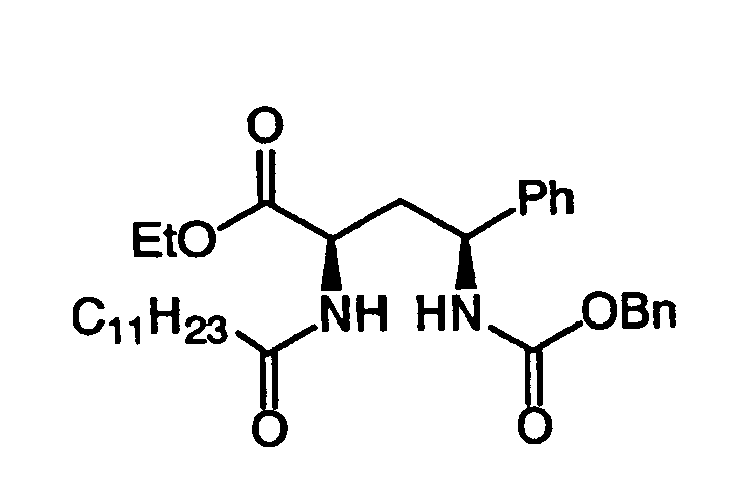
- Namely, an AcOEt (2.0 ml) solution of the product (26.5 mg, 0.0492 mmol) was added with 5% Pd/C (10.5 mg, 10% by mol) at room temperature. An argon gas in the atmosphere was replaced with an H2 gas and the resultant mixed solution was stirred for from 15 to 24 hours. Pd/C was filtered out and, then, a filtrate was subjected to vacuum concentration, to thereby obtain a crude product. The thus-obtained crude product was purified by using silica gel chromatography and, as a result, a compound as described below was obtained.
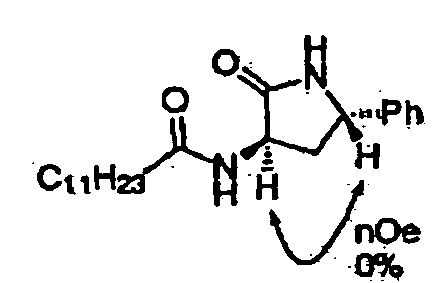
- Further, a compound as described below was obtained from another product in Example 6 in a same manner as described above.

- As has been described above in detail, according to the present invention, there is provided a novel method of an enantioselective nucleophilic addition reaction to an imine compound which enables an asymmetric synthesis of an α-amino-γ-keto acid ester, an α, γ-diamino acid ester or the like which is useful as a raw material or a synthesis intermediate for producing a pharmaceutical preparation, an agricultural chemical, a fragrance, a functional polymer or the like. Further, there is provided a novel method for synthesizing any one of optically active γ-Iactams as an application thereof.
Claims (7)
- A method of an enantioselective nucleophilic addition reaction of enamide, which is a method of a nucleophilic addition reaction of an enamide compound accompanied by generation of an amino group to an imino group (-CH=N-) of an imine compound, being characterized by allowing the reaction to be performed in the presence of a chiral copper catalyst.
- The method of the enantioselective nucleophilic addition reaction of enamide according to Claim 1, being characterized in that the chiral copper catalyst is constituted by a copper compound which is a salt of an organic or inorganic acid or a complex or composite of the salt, and a chiral diamine ligand.
- The method of the enantioselective nucleophilic addition reaction of enamide according to Claim 2, being characterized in that the chiral diamine ligand has an ethylene diamine structure as a portion thereof.
- A method for synthesizing an optically active α-amino-γ-imino acid ester, which is the method of the enantioselective nucleophilic addition reaction of enamide according to any one of Claims 1 to 3, being characterized in that the imine compound is represented by the following formula (1):


- A method for synthesizing an optically active α-amino-γ-keto acid ester, being characterized in that, after the nucleophilic addition reaction according to Claim 4, an acid treatment is performed, to thereby generate a compound represented by at least one of the following formulae (4):

- A method for synthesizing an optically active α, γ-diamino acid ester, being characterized in that, after the nucleophilic addition reaction according to Claim 4, a reduction treatment is performed, to thereby generate a compound represented by at least one of the following formulae (5):

- A method for synthesizing optically active γ-lactams, being characterized in that an acyl group of a γ-amino group of the optically active α, γ-diamino acid ester synthesized by the method according to Claim 6 is removed, to thereby generate a compound represented by at least one of the following formulae (6):

Applications Claiming Priority (2)
| Application Number | Priority Date | Filing Date | Title |
|---|---|---|---|
| JP2004016407 | 2004-01-23 | ||
| PCT/JP2005/001282 WO2005070876A1 (en) | 2004-01-23 | 2005-01-24 | METHOD OF ENANTHIO-SELECTIVE NUCLEOPHILIC ADDITION REACTION FOR CONVERSION OF ENAMIDE TO IMINE AND METHOD OF SYNTHESIZING α-AMINO-Ϝ-KETO ACID ESTER |
Publications (3)
| Publication Number | Publication Date |
|---|---|
| EP1707559A1 true EP1707559A1 (en) | 2006-10-04 |
| EP1707559A4 EP1707559A4 (en) | 2007-11-21 |
| EP1707559B1 EP1707559B1 (en) | 2012-06-13 |
Family
ID=34805488
Family Applications (1)
| Application Number | Title | Priority Date | Filing Date |
|---|---|---|---|
| EP05704279A Expired - Lifetime EP1707559B1 (en) | 2004-01-23 | 2005-01-24 | Method of enantioselective nucleophilic addition reaction of an enamide to an imine and method of synthesizing alpha-amino-gamma-keto acid ester |
Country Status (4)
| Country | Link |
|---|---|
| US (1) | US7754898B2 (en) |
| EP (1) | EP1707559B1 (en) |
| JP (1) | JP4827531B2 (en) |
| WO (1) | WO2005070876A1 (en) |
Families Citing this family (4)
| Publication number | Priority date | Publication date | Assignee | Title |
|---|---|---|---|---|
| US9745105B2 (en) | 2011-09-21 | 2017-08-29 | Hydros Bottle, Llc | Water bottle |
| EP3353081A4 (en) | 2015-09-24 | 2019-06-12 | Hydros Bottle, LLC | SEVERE FLOW FILTER ASSEMBLY |
| USD877565S1 (en) | 2017-03-23 | 2020-03-10 | Hydros Bottle, Llc | Container with a cap and filter assembly |
| US12110156B2 (en) | 2017-03-23 | 2024-10-08 | Hydros Bottle, Llc | Gravity-flow filter assembly |
Family Cites Families (4)
| Publication number | Priority date | Publication date | Assignee | Title |
|---|---|---|---|---|
| JP3824950B2 (en) * | 2002-03-08 | 2006-09-20 | 独立行政法人科学技術振興機構 | Process for producing β-aminoketone |
| JP3738225B2 (en) * | 2002-03-11 | 2006-01-25 | 独立行政法人科学技術振興機構 | Novel chiral copper catalyst and method for producing N-acylated amino acid derivative using the same |
| JP3780218B2 (en) * | 2002-03-11 | 2006-05-31 | 独立行政法人科学技術振興機構 | Novel chiral copper catalyst and method for producing N-acylated amino acid derivative using the same |
| WO2005000792A1 (en) * | 2003-06-27 | 2005-01-06 | Japan Science And Technology Agency | Process for producing n-acylated amino acid derivative |
-
2005
- 2005-01-24 EP EP05704279A patent/EP1707559B1/en not_active Expired - Lifetime
- 2005-01-24 US US10/587,075 patent/US7754898B2/en not_active Expired - Fee Related
- 2005-01-24 JP JP2005517334A patent/JP4827531B2/en not_active Expired - Fee Related
- 2005-01-24 WO PCT/JP2005/001282 patent/WO2005070876A1/en not_active Ceased
Non-Patent Citations (5)
| Title |
|---|
| KOBAYASHI, SHU ET AL: "Catalytic, Asymmetric Mannich-Type Reactions of N-Acylimino Esters for Direct Formation of N-Acylated Amino Acid Derivatives. Efficient Synthesis of a Novel Inhibitor of Ceramide Trafficking, HPA-12" ORGANIC LETTERS , 4(1), 143-145 CODEN: ORLEF7; ISSN: 1523-7060, 2002, XP002987199 * |
| KOBAYASHI, SHU ET AL: "Catalytic, Asymmetric Mannich-type Reactions of N-Acylimino Esters: Reactivity, Diastereo- and Enantioselectivity, and Application to Synthesis of N-Acylated Amino Acid Derivatives" JOURNAL OF THE AMERICAN CHEMICAL SOCIETY , 125(9), 2507-2515 CODEN: JACSAT; ISSN: 0002-7863, 2003, XP002987784 * |
| MATSUBARA, RYOSUKE ET AL: "Copper(II)-catalyzed highly enantioselective addition of enamides to imines: The use of enamides as nucleophiles in asymmetric catalysis" ANGEWANDTE CHEMIE, INTERNATIONAL EDITION , 43(13), 1679-1681 CODEN: ACIEF5; ISSN: 1433-7851, 2004, XP002454096 * |
| See also references of WO2005070876A1 * |
| Z.-Q. TIAN, B. B. BROWN, D. P. MACK, C. A. HUTTON, P. A. BARTLETT: "Potentially Macrocyclic Peptidyl Boronic Acids as Chymotrypsin Inhibitors", JOURNAL OF ORGANIC CHEMISTRY, vol. 62, 7 February 1997 (1997-02-07), pages 514-522, DOI: 10.1021/jo9615007 * |
Also Published As
| Publication number | Publication date |
|---|---|
| JPWO2005070876A1 (en) | 2007-09-13 |
| WO2005070876A1 (en) | 2005-08-04 |
| JP4827531B2 (en) | 2011-11-30 |
| US7754898B2 (en) | 2010-07-13 |
| EP1707559B1 (en) | 2012-06-13 |
| EP1707559A4 (en) | 2007-11-21 |
| US20070161804A1 (en) | 2007-07-12 |
Similar Documents
| Publication | Publication Date | Title |
|---|---|---|
| KR100870227B1 (en) | Alanine Rasmaze Mimic Chiral Binaphthol Derivatives Having Strong Hydrogen Bonding Groups and Optical Segmentation and Conversion Methods | |
| EP2123661A1 (en) | Chiral iridium aqua complex and method for producing optically active hydroxy compound by using the same | |
| KR100661280B1 (en) | Binaphthol Derivatives and Their Use for Optical Resolution or Optical Transformation | |
| EP1707559B1 (en) | Method of enantioselective nucleophilic addition reaction of an enamide to an imine and method of synthesizing alpha-amino-gamma-keto acid ester | |
| KR101130818B1 (en) | Method for preparing chiral amino acid from azlactones using bifunctional bis-cinchona alkaloid thiourea organo catalysts | |
| CN108554456B (en) | Application of rare earth imidazolium salt compound as catalyst | |
| EP1707556B1 (en) | Method of enantioselective nucleophilic addition reaction of an enamide to a glyoxylic acid ester | |
| CN103910676B (en) | A kind of synthetic method of polysubstituted tetrahydro isoquinoline derivative | |
| CN113754605B (en) | A kind of nitrogen-containing ligand and its preparation method and application | |
| JP3738225B2 (en) | Novel chiral copper catalyst and method for producing N-acylated amino acid derivative using the same | |
| JP2013129650A (en) | Novel synthesis process for ivabradine and addition salt thereof with pharmaceutically acceptable acid | |
| JP5471069B2 (en) | Tetrahydropyridine derivative and method for producing the same | |
| KR102590897B1 (en) | Method for producing chiral gamma-lactam compound and metal complex therefor | |
| EP2065371A1 (en) | Chiral organic catalysts for the stereoselective reduction of carbon-nitrogen double bonds for the preparation of enantiomerically enriched amines | |
| KR101881215B1 (en) | Compound, manufacturing method of compound through asymmetric michael addition using the compound and manufacturing method of phenibut using the compound | |
| JP4529419B2 (en) | Optically active fluorine-containing compounds and methods for producing them | |
| CN116283672B (en) | A synthesis method and application of β-allylphenylethylamine derivatives | |
| CN107474090A (en) | Carbohydrate diazaheterocyclic carbene precursor salt and its preparation method and use | |
| KR102193321B1 (en) | Method for preparation of β-trifluoromethyl ketone derivatives. | |
| EP1885688B1 (en) | Asymmetric hydrogenation for the preparation of diphenylalanine derivatives | |
| US7348290B2 (en) | Arene-ruthenium complexes immobilized on polymers, catalysts consisting of the complexes, and processes for organic syntheses with the same | |
| JP2006151839A (en) | Method for preparing enantioselective β-cyanocarboxylic acid derivative from α, β-unsaturated carboxylic acid derivative and catalyst used in the method | |
| JP5330706B2 (en) | Process for producing optically active 3-quinuclidinol | |
| CN108456172A (en) | A kind of chiral aza ring carbene precursor compound and its preparation method and application with benzimidazole skeleton | |
| CN120943767A (en) | Asymmetric hydrogenation kinetics for the resolution of racemic multisubstituted three-membered cyclic imines |
Legal Events
| Date | Code | Title | Description |
|---|---|---|---|
| PUAI | Public reference made under article 153(3) epc to a published international application that has entered the european phase |
Free format text: ORIGINAL CODE: 0009012 |
|
| 17P | Request for examination filed |
Effective date: 20060731 |
|
| AK | Designated contracting states |
Kind code of ref document: A1 Designated state(s): DE FR GB |
|
| DAX | Request for extension of the european patent (deleted) | ||
| RBV | Designated contracting states (corrected) |
Designated state(s): DE FR GB |
|
| A4 | Supplementary search report drawn up and despatched |
Effective date: 20071022 |
|
| 17Q | First examination report despatched |
Effective date: 20110316 |
|
| GRAP | Despatch of communication of intention to grant a patent |
Free format text: ORIGINAL CODE: EPIDOSNIGR1 |
|
| RTI1 | Title (correction) |
Free format text: METHOD OF ENANTIOSELECTIVE NUCLEOPHILIC ADDITION REACTION OF AN ENAMIDE TO AN IMINE AND METHOD OF SYNTHESIZING ALPHA-AMINO-GAMMA-KETO ACID ESTER |
|
| GRAS | Grant fee paid |
Free format text: ORIGINAL CODE: EPIDOSNIGR3 |
|
| GRAA | (expected) grant |
Free format text: ORIGINAL CODE: 0009210 |
|
| AK | Designated contracting states |
Kind code of ref document: B1 Designated state(s): DE FR GB |
|
| REG | Reference to a national code |
Ref country code: GB Ref legal event code: FG4D |
|
| REG | Reference to a national code |
Ref country code: DE Ref legal event code: R096 Ref document number: 602005034651 Country of ref document: DE Effective date: 20120809 |
|
| PLBE | No opposition filed within time limit |
Free format text: ORIGINAL CODE: 0009261 |
|
| STAA | Information on the status of an ep patent application or granted ep patent |
Free format text: STATUS: NO OPPOSITION FILED WITHIN TIME LIMIT |
|
| 26N | No opposition filed |
Effective date: 20130314 |
|
| REG | Reference to a national code |
Ref country code: DE Ref legal event code: R097 Ref document number: 602005034651 Country of ref document: DE Effective date: 20130314 |
|
| REG | Reference to a national code |
Ref country code: FR Ref legal event code: PLFP Year of fee payment: 12 |
|
| PGFP | Annual fee paid to national office [announced via postgrant information from national office to epo] |
Ref country code: GB Payment date: 20151214 Year of fee payment: 12 |
|
| PGFP | Annual fee paid to national office [announced via postgrant information from national office to epo] |
Ref country code: FR Payment date: 20151214 Year of fee payment: 12 |
|
| PGFP | Annual fee paid to national office [announced via postgrant information from national office to epo] |
Ref country code: DE Payment date: 20151211 Year of fee payment: 12 |
|
| REG | Reference to a national code |
Ref country code: DE Ref legal event code: R119 Ref document number: 602005034651 Country of ref document: DE |
|
| GBPC | Gb: european patent ceased through non-payment of renewal fee |
Effective date: 20170124 |
|
| REG | Reference to a national code |
Ref country code: FR Ref legal event code: ST Effective date: 20170929 |
|
| PG25 | Lapsed in a contracting state [announced via postgrant information from national office to epo] |
Ref country code: FR Free format text: LAPSE BECAUSE OF NON-PAYMENT OF DUE FEES Effective date: 20170131 |
|
| PG25 | Lapsed in a contracting state [announced via postgrant information from national office to epo] |
Ref country code: GB Free format text: LAPSE BECAUSE OF NON-PAYMENT OF DUE FEES Effective date: 20170124 Ref country code: DE Free format text: LAPSE BECAUSE OF NON-PAYMENT OF DUE FEES Effective date: 20170801 |