EP1705613A1 - Lane marker projection method for a motor vehicle vision system - Google Patents
Lane marker projection method for a motor vehicle vision system Download PDFInfo
- Publication number
- EP1705613A1 EP1705613A1 EP06075584A EP06075584A EP1705613A1 EP 1705613 A1 EP1705613 A1 EP 1705613A1 EP 06075584 A EP06075584 A EP 06075584A EP 06075584 A EP06075584 A EP 06075584A EP 1705613 A1 EP1705613 A1 EP 1705613A1
- Authority
- EP
- European Patent Office
- Prior art keywords
- lane marker
- coordinate data
- generated video
- marker coordinate
- world
- Prior art date
- Legal status (The legal status is an assumption and is not a legal conclusion. Google has not performed a legal analysis and makes no representation as to the accuracy of the status listed.)
- Withdrawn
Links
Images


Classifications
-
- G—PHYSICS
- G06—COMPUTING OR CALCULATING; COUNTING
- G06T—IMAGE DATA PROCESSING OR GENERATION, IN GENERAL
- G06T7/00—Image analysis
- G06T7/70—Determining position or orientation of objects or cameras
- G06T7/73—Determining position or orientation of objects or cameras using feature-based methods
-
- G—PHYSICS
- G06—COMPUTING OR CALCULATING; COUNTING
- G06V—IMAGE OR VIDEO RECOGNITION OR UNDERSTANDING
- G06V20/00—Scenes; Scene-specific elements
- G06V20/50—Context or environment of the image
- G06V20/56—Context or environment of the image exterior to a vehicle by using sensors mounted on the vehicle
- G06V20/588—Recognition of the road, e.g. of lane markings; Recognition of the vehicle driving pattern in relation to the road
-
- G—PHYSICS
- G06—COMPUTING OR CALCULATING; COUNTING
- G06T—IMAGE DATA PROCESSING OR GENERATION, IN GENERAL
- G06T7/00—Image analysis
- G06T7/20—Analysis of motion
- G06T7/246—Analysis of motion using feature-based methods, e.g. the tracking of corners or segments
-
- B—PERFORMING OPERATIONS; TRANSPORTING
- B60—VEHICLES IN GENERAL
- B60T—VEHICLE BRAKE CONTROL SYSTEMS OR PARTS THEREOF; BRAKE CONTROL SYSTEMS OR PARTS THEREOF, IN GENERAL; ARRANGEMENT OF BRAKING ELEMENTS ON VEHICLES IN GENERAL; PORTABLE DEVICES FOR PREVENTING UNWANTED MOVEMENT OF VEHICLES; VEHICLE MODIFICATIONS TO FACILITATE COOLING OF BRAKES
- B60T2201/00—Particular use of vehicle brake systems; Special systems using also the brakes; Special software modules within the brake system controller
- B60T2201/08—Lane monitoring; Lane Keeping Systems
-
- B—PERFORMING OPERATIONS; TRANSPORTING
- B60—VEHICLES IN GENERAL
- B60T—VEHICLE BRAKE CONTROL SYSTEMS OR PARTS THEREOF; BRAKE CONTROL SYSTEMS OR PARTS THEREOF, IN GENERAL; ARRANGEMENT OF BRAKING ELEMENTS ON VEHICLES IN GENERAL; PORTABLE DEVICES FOR PREVENTING UNWANTED MOVEMENT OF VEHICLES; VEHICLE MODIFICATIONS TO FACILITATE COOLING OF BRAKES
- B60T2201/00—Particular use of vehicle brake systems; Special systems using also the brakes; Special software modules within the brake system controller
- B60T2201/08—Lane monitoring; Lane Keeping Systems
- B60T2201/089—Lane monitoring; Lane Keeping Systems using optical detection
Definitions
- the present invention relates to motor vehicle vision system applications that track or display the location of the vehicle relative to roadway lane markers, and more particularly to a method of consolidating lane marker position information from successively generated video images.
- Motor vehicle forward vision data generated by a video camera mounted at or near the driver's eye level can be processed to identify various items of interest such as roadway lane markers.
- the vision system can then determine the location of the vehicle relative to the lane markers, for displaying video information to the driver or for detecting lane changing and/or driving patterns indicative of a drowsy driver.
- Most of these applications require lane marker detection in a region of about 5-30 meters forward of the vehicle, where the lane markers can be reliably approximated as straight lines.
- dashed or periodic lane markers can have relatively large gaps, and frequently only a fraction of a lane marker is visible to the camera in any given video frame, particularly in mechanizations where a portion of the roadway within the video frame is obscured by the hood or fenders of the vehicle. Since this can degrade the ability of the lane tracking system to perform the intended functions, it would be beneficial if the information obtained from successively generated video images could be consolidated to provide more complete lane marker data, either for display or lane detection purposes.
- the present invention is directed to a method of consolidating lane marker position information by projecting lane marker information from a previously generated video frame into a current video frame.
- Projecting the lane marker information involves transforming the detected markers from the previous frame to world coordinates, and predicting their position in the current video frame based on measured vehicle rotation and translation parameters.
- the projected marker coordinates can be combined with world coordinates of lane markers from the current video frame for lane detection applications, or converted to image plane coordinates and combined with lane marker image plane coordinates of the current video frame for driver display purposes.
- FIG. 1A is a real world or overhead view of a host vehicle 10 equipped with a video camera 12 mounted in the passenger compartment, in the vicinity of an interior rearview mirror, for example.
- the vehicle 10 is traveling in the direction of arrow 14 down a two-lane roadway 16.
- FIG. 1B presents an image plane view forward of the vehicle 10 as seen by the camera 12. As illustrated in the figure, the image plane view does not include areas alongside or just forward of the vehicle 10 due to the placement of the camera 12 and obstruction of the vehicle's hood and fenders, designated in FIG. 1B by the reference numeral 10'.
- the principle region of interest for purposes of lane marker identification and tracking comprises the portions of the roadway approximately 5-30 meters forward of the vehicle 10.
- the outside boundary of this region within the real world and image plane views of FIGS. 1A and 1B is depicted by the line 22. Due to the limited depth of the region of interest, the vision system can utilize straight line approximation for lane marker tracking, even on a curved roadway such as depicted in FIG. 1B.
- the obstructed portion of this region i.e., the portion just forward of the vehicle 10) can often include useful lane marker information, particularly in cases where the center lane marker is dashed.
- the present invention enhances the available information by projecting lane marker coordinate data from a previous video frame into the current video frame and consolidating the projected and current lane marker coordinate data to provide a more complete representation of the lane markers and their position with respect to the host vehicle, whether the lane marker data is used for display purposes or lane tracking algorithms.
- Projection of the previously captured lane marker coordinate data involves characterizing the vehicle's movement in terms of its speed (translation) and yaw rate (rotation) or similar parameters.
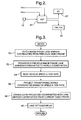
- a system for carrying out the method of the present invention is represented by the block diagram of FIG. 2, where video data from the camera 12 is supplied along with vehicle speed (VS) and yaw rate (YR) data to a video signal processor (VSP) 30.
- VSP video signal processor
- the VSP 30 analyzes the region of interest in each successive video frame produced by camera 12, identifies lane marker coordinates in the region, and forms a straight-line approximation of the identified markers. According to the method of this invention, the VSP 30 additionally utilizes the measured vehicle movement parameters (VS and YR) to generate the projected lane marker coordinate data and to consolidate it with the lane marker coordinate data from the current video frame.
- the consolidated lane marker coordinate data can be supplied in image frame format to the video display (VD) 32, and in world format to the block 34, which represents a drowsy driver (DD) and/or collision avoidance (CA) algorithm executed either by VSP 30 or another processor of the system.
- the method of the present invention involves, for each successive video frame acquired from camera 12, fetching lane marker coordinates identified in the previous fame of video data (block 50), transforming the prior lane marker coordinates to world coordinates (block 52), obtaining the vehicle movement parameters (block 54), projecting the transformed coordinates based on the obtained vehicle movement parameters (block 56), and consolidating the projected and current lane marker coordinates (block 58).
- the consolidated coordinates may then be transformed back to the image plane for driver display and/or supplied directly to a lane tracking/fitting algorithm (block 60). While the preferred approach is to consolidate the projected and current lane marker data using world coordinates, the data may alternatively be consolidated using image plane coordinates.
- the projection of lane marker coordinates from a given video frame to the next successive video frame involves translating the coordinates based on vehicle speed VS and rotating the coordinates based on yaw rate YR.
- the starting point is the world coordinate pair (x, y) of a previously identified lane marker, where the x-coordinate represents down-range distance from the vehicle 10 and the y-coordinate represents cross-range distance from the vehicle's central longitudinal axis (as may be represented by the arrow 14 in FIG. 1A).
- the measured vehicle movement parameters ultimately define the distance traveled d and change in heading ⁇ between successive video frames.
- FIGS. 4A and 4B respectively depict image plane and world representations of the consolidated lane marker coordinates, where current coordinates are designated by the plus signs, projected coordinates are designated by the small triangles, and regions of coordinate overlap are designated by the asterisks.
- the format of FIG. 4A is most useful for display applications, while the format of FIG. 4B is most useful for video processing applications such as lane tracking.
- the present invention provides simple and cost-effective method of consolidating identified coordinates of images successively generated by a vehicle vision system.
- the consolidated coordinates provide enhanced display and improved lane marker tracking.
Landscapes
- Engineering & Computer Science (AREA)
- Physics & Mathematics (AREA)
- General Physics & Mathematics (AREA)
- Theoretical Computer Science (AREA)
- Multimedia (AREA)
- Computer Vision & Pattern Recognition (AREA)
- Image Processing (AREA)
- Traffic Control Systems (AREA)
- Image Analysis (AREA)
Abstract
Description
- The present invention relates to motor vehicle vision system applications that track or display the location of the vehicle relative to roadway lane markers, and more particularly to a method of consolidating lane marker position information from successively generated video images.
- Motor vehicle forward vision data generated by a video camera mounted at or near the driver's eye level can be processed to identify various items of interest such as roadway lane markers. The vision system can then determine the location of the vehicle relative to the lane markers, for displaying video information to the driver or for detecting lane changing and/or driving patterns indicative of a drowsy driver. Most of these applications require lane marker detection in a region of about 5-30 meters forward of the vehicle, where the lane markers can be reliably approximated as straight lines. However, dashed or periodic lane markers can have relatively large gaps, and frequently only a fraction of a lane marker is visible to the camera in any given video frame, particularly in mechanizations where a portion of the roadway within the video frame is obscured by the hood or fenders of the vehicle. Since this can degrade the ability of the lane tracking system to perform the intended functions, it would be beneficial if the information obtained from successively generated video images could be consolidated to provide more complete lane marker data, either for display or lane detection purposes.
- The present invention is directed to a method of consolidating lane marker position information by projecting lane marker information from a previously generated video frame into a current video frame. Projecting the lane marker information involves transforming the detected markers from the previous frame to world coordinates, and predicting their position in the current video frame based on measured vehicle rotation and translation parameters. The projected marker coordinates can be combined with world coordinates of lane markers from the current video frame for lane detection applications, or converted to image plane coordinates and combined with lane marker image plane coordinates of the current video frame for driver display purposes.
-
- FIG. 1A and FIG. 1B respectively depict world coordinate and image plane coordinate representations of first and second video frames generated by a vehicle-mounted video camera;
- FIG 2 is a block diagram of a system for carrying out the method of the present invention;
- FIG. 3 is a flow diagram depicting the method of this invention; and
- FIG. 4A and 4B respectively depict image plane coordinate and world coordinate representations of lane marker information consolidated from the first and second video frames of FIGS. 1A and 1B according to the method of this invention;.
- The method of the present invention is carried out in a vehicle-mounted vision system designed, among other things, to capture video images of a scene in the forward path of the vehicle for analysis and/or display to the driver. One of the principle objectives of the video image analysis is to identify lane markers painted on the roadway and the location of the host vehicle relative to the markers. FIG. 1A is a real world or overhead view of a
host vehicle 10 equipped with avideo camera 12 mounted in the passenger compartment, in the vicinity of an interior rearview mirror, for example. Thevehicle 10 is traveling in the direction ofarrow 14 down a two-lane roadway 16. Thereference numeral 18 designates a continuous lane marker for the edge ofroadway 16, and thereference numerals roadway 16. FIG. 1B presents an image plane view forward of thevehicle 10 as seen by thecamera 12. As illustrated in the figure, the image plane view does not include areas alongside or just forward of thevehicle 10 due to the placement of thecamera 12 and obstruction of the vehicle's hood and fenders, designated in FIG. 1B by the reference numeral 10'. - The principle region of interest for purposes of lane marker identification and tracking comprises the portions of the roadway approximately 5-30 meters forward of the
vehicle 10. The outside boundary of this region within the real world and image plane views of FIGS. 1A and 1B is depicted by theline 22. Due to the limited depth of the region of interest, the vision system can utilize straight line approximation for lane marker tracking, even on a curved roadway such as depicted in FIG. 1B. However, the obstructed portion of this region (i.e., the portion just forward of the vehicle 10) can often include useful lane marker information, particularly in cases where the center lane marker is dashed. - The present invention enhances the available information by projecting lane marker coordinate data from a previous video frame into the current video frame and consolidating the projected and current lane marker coordinate data to provide a more complete representation of the lane markers and their position with respect to the host vehicle, whether the lane marker data is used for display purposes or lane tracking algorithms. Projection of the previously captured lane marker coordinate data involves characterizing the vehicle's movement in terms of its speed (translation) and yaw rate (rotation) or similar parameters. Thus, a system for carrying out the method of the present invention is represented by the block diagram of FIG. 2, where video data from the
camera 12 is supplied along with vehicle speed (VS) and yaw rate (YR) data to a video signal processor (VSP) 30. TheVSP 30 analyzes the region of interest in each successive video frame produced bycamera 12, identifies lane marker coordinates in the region, and forms a straight-line approximation of the identified markers. According to the method of this invention, theVSP 30 additionally utilizes the measured vehicle movement parameters (VS and YR) to generate the projected lane marker coordinate data and to consolidate it with the lane marker coordinate data from the current video frame. The consolidated lane marker coordinate data can be supplied in image frame format to the video display (VD) 32, and in world format to theblock 34, which represents a drowsy driver (DD) and/or collision avoidance (CA) algorithm executed either byVSP 30 or another processor of the system. - Referring to the flow diagram of FIG. 3, the method of the present invention involves, for each successive video frame acquired from
camera 12, fetching lane marker coordinates identified in the previous fame of video data (block 50), transforming the prior lane marker coordinates to world coordinates (block 52), obtaining the vehicle movement parameters (block 54), projecting the transformed coordinates based on the obtained vehicle movement parameters (block 56), and consolidating the projected and current lane marker coordinates (block 58). The consolidated coordinates may then be transformed back to the image plane for driver display and/or supplied directly to a lane tracking/fitting algorithm (block 60). While the preferred approach is to consolidate the projected and current lane marker data using world coordinates, the data may alternatively be consolidated using image plane coordinates. At any rate, the video processing techniques involved in identifying lane marker coordinates in a given video frame and transforming image plane coordinates to corresponding world coordinates, and vice-versa, are well understood to those skilled in the video processing art, and therefore are not specifically described herein. - As mentioned above, the projection of lane marker coordinates from a given video frame to the next successive video frame according to this invention involves translating the coordinates based on vehicle speed VS and rotating the coordinates based on yaw rate YR. The starting point is the world coordinate pair (x, y) of a previously identified lane marker, where the x-coordinate represents down-range distance from the
vehicle 10 and the y-coordinate represents cross-range distance from the vehicle's central longitudinal axis (as may be represented by thearrow 14 in FIG. 1A). The measured vehicle movement parameters ultimately define the distance traveled d and change in heading φ between successive video frames. Given the vehicle speed s (n) in m/sec and yaw rate χ (n) in radian/sec at time n, the distance d (n) is given by the product d (n) = T* s (n) , where T is the inverse image frame rate of thecamera 12 in seconds, and the change in heading φ (n) is given by the product φ (n) = -T*χ (n) . Moving at speed s, and yaw rate χ between successive video frames, thehost vehicle 10 will translate from coordinate (0, 0) to coordinate (Δx (n), Δy (n)), and change its relative heading by φ(n), where the translation coordinates Δx (n) and Δy (n) are given by:
and
This frame-to-frame origin shift of the vehicle is applied tot he lane marker coordinates of the prior video frame. For any such coordinate pair


and
The terms

- FIGS. 4A and 4B respectively depict image plane and world representations of the consolidated lane marker coordinates, where current coordinates are designated by the plus signs, projected coordinates are designated by the small triangles, and regions of coordinate overlap are designated by the asterisks. The format of FIG. 4A is most useful for display applications, while the format of FIG. 4B is most useful for video processing applications such as lane tracking.
- In summary, the present invention provides simple and cost-effective method of consolidating identified coordinates of images successively generated by a vehicle vision system. The consolidated coordinates provide enhanced display and improved lane marker tracking. While the method of the present invention has been described with respect to the illustrated embodiment, it is recognized that numerous modifications and variations in addition to those mentioned herein will occur to those skilled in the art. Accordingly, it is intended that the invention not be limited to the disclosed embodiment, but that it have the full scope permitted by the language of the following claims.
Claims (6)
- A method of operation for a vision system (12, 30) that identifies lane marker coordinates in successively generated video images of a roadway (16) in a travel path of a vehicle (10), comprising the steps of:obtaining world lane marker coordinate data from a previously generated video image (50);determining a speed and a yaw rate of the vehicle (54);projecting the obtained world lane marker coordinate data into asubsequently generated video image based on the determined speed and yaw rate and a time interval between the previously and subsequently generated video images (56);consolidating the projected lane marker coordinate data with lane marker coordinate data from the subsequently generated video image (58); andprocessing the consolidated lane marker coordinate data (60).
- The method of claim 1, wherein the vision system (12, 30) identifies image frame lane marker coordinates, and the step of obtaining world lane marker coordinate data includes the step of:transforming the identified image frame lane marker coordinates from the previously generated video image to corresponding world coordinates (52).
- The method of claim 1, including the step of:consolidating the projected world lane marker coordinate data with world lane marker coordinate data from the subsequently generated video image (58).
- The method of claim 1, including the steps of:transforming the projected world lane marker coordinate data to corresponding image frame coordinate data for consolidation with image frame coordinate data from the subsequently generated video image (58).
- The method of claim 1, where the step of projecting the obtained world lane marker coordinate data into a subsequently generated video image includes the steps of:determining a translation dn of the vehicle between the previously and subsequently generated video images based on a product of the determined speed and said time interval (56); anddetermining a change in relative heading ϕn of the vehicle between the previously and subsequently generated video images based on a product of the determined yaw rate and said time interval (56).
- The method of claim 5, wherein the projected world lane marker coordinate data (xn+1, yn+1) is given by

and
where (xn, yn) is the obtained world lane marker coordinate data, Δxn is given by a product of dn and cosϕn, and Δyn is given by a product of dn and sinϕn (56).
Applications Claiming Priority (1)
| Application Number | Priority Date | Filing Date | Title |
|---|---|---|---|
| US11/087,041 US7050908B1 (en) | 2005-03-22 | 2005-03-22 | Lane marker projection method for a motor vehicle vision system |
Publications (1)
| Publication Number | Publication Date |
|---|---|
| EP1705613A1 true EP1705613A1 (en) | 2006-09-27 |
Family
ID=36423935
Family Applications (1)
| Application Number | Title | Priority Date | Filing Date |
|---|---|---|---|
| EP06075584A Withdrawn EP1705613A1 (en) | 2005-03-22 | 2006-03-10 | Lane marker projection method for a motor vehicle vision system |
Country Status (2)
| Country | Link |
|---|---|
| US (1) | US7050908B1 (en) |
| EP (1) | EP1705613A1 (en) |
Families Citing this family (42)
| Publication number | Priority date | Publication date | Assignee | Title |
|---|---|---|---|---|
| US5910854A (en) | 1993-02-26 | 1999-06-08 | Donnelly Corporation | Electrochromic polymeric solid films, manufacturing electrochromic devices using such solid films, and processes for making such solid films and devices |
| US5668663A (en) | 1994-05-05 | 1997-09-16 | Donnelly Corporation | Electrochromic mirrors and devices |
| US6124886A (en) | 1997-08-25 | 2000-09-26 | Donnelly Corporation | Modular rearview mirror assembly |
| US6326613B1 (en) | 1998-01-07 | 2001-12-04 | Donnelly Corporation | Vehicle interior mirror assembly adapted for containing a rain sensor |
| US6172613B1 (en) | 1998-02-18 | 2001-01-09 | Donnelly Corporation | Rearview mirror assembly incorporating vehicle information display |
| US8294975B2 (en) | 1997-08-25 | 2012-10-23 | Donnelly Corporation | Automotive rearview mirror assembly |
| US8288711B2 (en) | 1998-01-07 | 2012-10-16 | Donnelly Corporation | Interior rearview mirror system with forwardly-viewing camera and a control |
| US6445287B1 (en) | 2000-02-28 | 2002-09-03 | Donnelly Corporation | Tire inflation assistance monitoring system |
| US6693517B2 (en) | 2000-04-21 | 2004-02-17 | Donnelly Corporation | Vehicle mirror assembly communicating wirelessly with vehicle accessories and occupants |
| US6329925B1 (en) | 1999-11-24 | 2001-12-11 | Donnelly Corporation | Rearview mirror assembly with added feature modular display |
| US6477464B2 (en) | 2000-03-09 | 2002-11-05 | Donnelly Corporation | Complete mirror-based global-positioning system (GPS) navigation solution |
| US7167796B2 (en) | 2000-03-09 | 2007-01-23 | Donnelly Corporation | Vehicle navigation system for use with a telematics system |
| US7370983B2 (en) | 2000-03-02 | 2008-05-13 | Donnelly Corporation | Interior mirror assembly with display |
| WO2001064481A2 (en) | 2000-03-02 | 2001-09-07 | Donnelly Corporation | Video mirror systems incorporating an accessory module |
| US7195381B2 (en) | 2001-01-23 | 2007-03-27 | Donnelly Corporation | Vehicle interior LED lighting system |
| US7581859B2 (en) | 2005-09-14 | 2009-09-01 | Donnelly Corp. | Display device for exterior rearview mirror |
| GB0111979D0 (en) * | 2001-05-17 | 2001-07-04 | Lucas Industries Ltd | Sensing apparatus for vehicles |
| US6918674B2 (en) | 2002-05-03 | 2005-07-19 | Donnelly Corporation | Vehicle rearview mirror system |
| WO2003105099A1 (en) | 2002-06-06 | 2003-12-18 | Donnelly Corporation | Interior rearview mirror system with compass |
| US7329013B2 (en) | 2002-06-06 | 2008-02-12 | Donnelly Corporation | Interior rearview mirror system with compass |
| US7274501B2 (en) | 2002-09-20 | 2007-09-25 | Donnelly Corporation | Mirror reflective element assembly |
| US7310177B2 (en) | 2002-09-20 | 2007-12-18 | Donnelly Corporation | Electro-optic reflective element assembly |
| US7446924B2 (en) | 2003-10-02 | 2008-11-04 | Donnelly Corporation | Mirror reflective element assembly including electronic component |
| US7308341B2 (en) | 2003-10-14 | 2007-12-11 | Donnelly Corporation | Vehicle communication system |
| JP3945494B2 (en) * | 2004-05-11 | 2007-07-18 | トヨタ自動車株式会社 | Travel lane recognition device |
| EP1883855B1 (en) | 2005-05-16 | 2011-07-20 | Donnelly Corporation | Vehicle mirror assembly with indicia at reflective element |
| CN101535087B (en) | 2005-11-01 | 2013-05-15 | 唐纳利公司 | Interior rearview mirror with display |
| US8154418B2 (en) | 2008-03-31 | 2012-04-10 | Magna Mirrors Of America, Inc. | Interior rearview mirror system |
| JP4656456B2 (en) * | 2008-10-22 | 2011-03-23 | 日本電気株式会社 | Lane marking device, lane marking detection method, and lane marking detection program |
| US8237909B2 (en) * | 2009-02-06 | 2012-08-07 | Gentex Corporation | Vehicular rearview mirror assembly including integrated backlighting for a liquid crystal display (LCD) |
| US8411245B2 (en) * | 2009-02-06 | 2013-04-02 | Gentex Corporation | Multi-display mirror system and method for expanded view around a vehicle |
| FR2942342B1 (en) * | 2009-02-13 | 2011-03-18 | Peugeot Citroen Automobiles Sa | DEVICE FOR PROVIDING IMAGES REPRESENTATIVE OF THE FRONT AREA SITUATED IN FRONT OF A VEHICLE AND THE POSITION OF THE VEHICLE IN THE AREA SITUATED DOWNSTREAM OF THIS FRONT AREA, AND ASSOCIATED METHOD |
| EP2473871B1 (en) | 2009-09-01 | 2015-03-11 | Magna Mirrors Of America, Inc. | Imaging and display system for vehicle |
| US8350684B2 (en) | 2009-12-14 | 2013-01-08 | Delphi Technologies, Inc. | Vehicle lane departure warning system having trailer mode and method |
| FR2969099B1 (en) * | 2010-12-21 | 2014-09-12 | Peugeot Citroen Automobiles Sa | METHOD FOR MONITORING A FUNCTION OF AID FOR MONITORING A CIRCULATION PATH COMPRISING TWO LINES |
| US9264672B2 (en) | 2010-12-22 | 2016-02-16 | Magna Mirrors Of America, Inc. | Vision display system for vehicle |
| US9098751B2 (en) * | 2011-07-27 | 2015-08-04 | Gentex Corporation | System and method for periodic lane marker identification and tracking |
| US9516277B2 (en) * | 2012-05-02 | 2016-12-06 | GM Global Technology Operations LLC | Full speed lane sensing with a surrounding view system |
| US9595017B2 (en) * | 2012-09-25 | 2017-03-14 | International Business Machines Corporation | Asset tracking and monitoring along a transport route |
| WO2017165627A1 (en) * | 2016-03-23 | 2017-09-28 | Netradyne Inc. | Advanced path prediction |
| CN112435276B (en) * | 2020-11-13 | 2024-08-23 | 鹏城实验室 | Vehicle tracking method, device, intelligent terminal and storage medium |
| JP7766227B2 (en) | 2021-08-20 | 2025-11-10 | ジェンテックス コーポレイション | Illumination assembly and illumination system having an illumination assembly - Patents.com |
Citations (3)
| Publication number | Priority date | Publication date | Assignee | Title |
|---|---|---|---|---|
| EP0697641B1 (en) * | 1994-07-12 | 1998-10-07 | Honda Giken Kogyo Kabushiki Kaisha | Lane image processing system for vehicle |
| JP2000059764A (en) * | 1998-08-07 | 2000-02-25 | Mazda Motor Corp | Vehicle position detection device |
| US6292752B1 (en) * | 1997-11-06 | 2001-09-18 | Daimlerchrysler Ag | Device for acquiring lane path indicative data |
Family Cites Families (23)
| Publication number | Priority date | Publication date | Assignee | Title |
|---|---|---|---|---|
| US4970653A (en) * | 1989-04-06 | 1990-11-13 | General Motors Corporation | Vision method of detecting lane boundaries and obstacles |
| DE69330513D1 (en) * | 1992-03-20 | 2001-09-06 | Commw Scient Ind Res Org | OBJECT MONITORING SYSTEM |
| US5467634A (en) * | 1993-07-22 | 1995-11-21 | Minnesota Mining And Manufacturing Company | Method and apparatus for calibrating three-dimensional space for machine vision applications |
| EP0710387B1 (en) * | 1993-07-22 | 1997-12-03 | Minnesota Mining And Manufacturing Company | Method and apparatus for calibrating three-dimensional space for machine vision applications |
| US6720920B2 (en) * | 1997-10-22 | 2004-04-13 | Intelligent Technologies International Inc. | Method and arrangement for communicating between vehicles |
| KR960042490A (en) * | 1995-11-09 | 1996-12-21 | 모리 하루오 | Vehicle navigation device and recording medium therefor |
| JP3430832B2 (en) * | 1997-01-27 | 2003-07-28 | 日産自動車株式会社 | Road curvature estimator |
| US6587573B1 (en) * | 2000-03-20 | 2003-07-01 | Gentex Corporation | System for controlling exterior vehicle lights |
| GB9804112D0 (en) * | 1998-02-27 | 1998-04-22 | Lucas Ind Plc | Road profile prediction |
| AU4690899A (en) * | 1998-06-18 | 2000-01-05 | Kline & Walker Llc | Automated devices to control equipment and machines with remote control and accountability worldwide |
| US20010035880A1 (en) * | 2000-03-06 | 2001-11-01 | Igor Musatov | Interactive touch screen map device |
| US6977630B1 (en) * | 2000-07-18 | 2005-12-20 | University Of Minnesota | Mobility assist device |
| US7375728B2 (en) * | 2001-10-01 | 2008-05-20 | University Of Minnesota | Virtual mirror |
| JP3675330B2 (en) * | 2000-11-07 | 2005-07-27 | 日産自動車株式会社 | Vehicle display device and automobile having display device |
| US6819779B1 (en) * | 2000-11-22 | 2004-11-16 | Cognex Corporation | Lane detection system and apparatus |
| JP3736346B2 (en) * | 2000-12-26 | 2006-01-18 | 日産自動車株式会社 | Lane detection device |
| TWI246665B (en) * | 2001-07-12 | 2006-01-01 | Ding-Jang Tzeng | Method for aiding the driving safety of road vehicle by monocular computer vision |
| US7552008B2 (en) * | 2001-07-18 | 2009-06-23 | Regents Of The University Of Minnesota | Populating geospatial database for onboard intelligent vehicle applications |
| JP4019736B2 (en) * | 2002-02-26 | 2007-12-12 | トヨタ自動車株式会社 | Obstacle detection device for vehicle |
| JP2003322522A (en) * | 2002-05-07 | 2003-11-14 | Daihatsu Motor Co Ltd | Inter-vehicle distance detection device and detection method |
| JP4374211B2 (en) * | 2002-08-27 | 2009-12-02 | クラリオン株式会社 | Lane marker position detection method, lane marker position detection device, and lane departure warning device |
| DE10251357A1 (en) * | 2002-11-05 | 2004-05-13 | Daimlerchrysler Ag | Automatic operating method for automobile trafficator display with evaluation of data for identification of turning or lane changing maneuver |
| US7446798B2 (en) * | 2003-02-05 | 2008-11-04 | Siemens Corporate Research, Inc. | Real-time obstacle detection with a calibrated camera and known ego-motion |
-
2005
- 2005-03-22 US US11/087,041 patent/US7050908B1/en not_active Expired - Lifetime
-
2006
- 2006-03-10 EP EP06075584A patent/EP1705613A1/en not_active Withdrawn
Patent Citations (3)
| Publication number | Priority date | Publication date | Assignee | Title |
|---|---|---|---|---|
| EP0697641B1 (en) * | 1994-07-12 | 1998-10-07 | Honda Giken Kogyo Kabushiki Kaisha | Lane image processing system for vehicle |
| US6292752B1 (en) * | 1997-11-06 | 2001-09-18 | Daimlerchrysler Ag | Device for acquiring lane path indicative data |
| JP2000059764A (en) * | 1998-08-07 | 2000-02-25 | Mazda Motor Corp | Vehicle position detection device |
Non-Patent Citations (4)
| Title |
|---|
| DICKMANNS E D ET AL: "RELATIVE 3D-STATE ESTIMATION FOR AUTONOMOUS VISUAL GUIDANCE OF ROAD VEHICLES*", ROBOTICS AND AUTONOMOUS SYSTEMS, ELSEVIER SCIENCE PUBLISHERS, AMSTERDAM, NL, vol. 7, no. 2 / 3, 1 August 1991 (1991-08-01), pages 113 - 123, XP000219094, ISSN: 0921-8890 * |
| HEIMES F ET AL: "Real-time tracking of intersections in image sequences of a moving camera", ENGINEERING APPLICATIONS OF ARTIFICIAL INTELLIGENCE, vol. 11, no. 2, 1 April 1998 (1998-04-01), pages 215 - 227, XP027087569, ISSN: 0952-1976, [retrieved on 19980401] * |
| OUSSALAH, ZAATRI, VAN BRUSSEL: "Kalman Filter Approach for Lane Extraction and Following", JOURNAL OF INTELLIGENT AND ROBOTIC SYSTEMS, vol. 34, no. 2, June 2002 (2002-06-01), pages 195 - 218, XP002389147 * |
| PATENT ABSTRACTS OF JAPAN vol. 2000, no. 05 14 September 2000 (2000-09-14) * |
Also Published As
| Publication number | Publication date |
|---|---|
| US7050908B1 (en) | 2006-05-23 |
Similar Documents
| Publication | Publication Date | Title |
|---|---|---|
| US7050908B1 (en) | Lane marker projection method for a motor vehicle vision system | |
| US6191704B1 (en) | Run environment recognizing apparatus | |
| JP4426535B2 (en) | Vehicle periphery monitoring device | |
| US10857942B2 (en) | Image generating device, image generating method, and program | |
| JP3580475B2 (en) | Perimeter monitoring device | |
| JP4615139B2 (en) | Vehicle periphery monitoring device | |
| EP2993654B1 (en) | Method and system for forward collision warning | |
| JP3463858B2 (en) | Perimeter monitoring device and method | |
| Li et al. | IVS 05: New developments and research trends for intelligent vehicles | |
| US20210070288A1 (en) | Driving assistance device | |
| JP5503728B2 (en) | Vehicle periphery monitoring device | |
| US9126533B2 (en) | Driving support method and driving support device | |
| US20210042540A1 (en) | Method for recognizing parking space for vehicle and parking assistance system using the method | |
| US20110169957A1 (en) | Vehicle Image Processing Method | |
| JP6415583B2 (en) | Information display control system and information display control method | |
| JP2007228448A (en) | Imaging environment recognition device | |
| JP2009071836A (en) | A device having a system capable of capturing a stereoscopic image to assist driving of an automobile | |
| JP2002314989A (en) | Peripheral monitor for vehicle | |
| US7388476B2 (en) | Vehicle surroundings monitoring apparatus | |
| Cualain et al. | Multiple-camera lane departure warning system for the automotive environment | |
| Kim et al. | An intelligent and integrated driver assistance system for increased safety and convenience based on all-around sensing | |
| JP3916930B2 (en) | Approach warning device | |
| US10730434B2 (en) | Vehicular display control device, vehicular display system, vehicular display control method, and non-transitory storage medium | |
| JP3949628B2 (en) | Vehicle periphery monitoring device | |
| Khalifa et al. | A hyperbola-pair based lane detection system for vehicle guidance |
Legal Events
| Date | Code | Title | Description |
|---|---|---|---|
| PUAI | Public reference made under article 153(3) epc to a published international application that has entered the european phase |
Free format text: ORIGINAL CODE: 0009012 |
|
| AK | Designated contracting states |
Kind code of ref document: A1 Designated state(s): AT BE BG CH CY CZ DE DK EE ES FI FR GB GR HU IE IS IT LI LT LU LV MC NL PL PT RO SE SI SK TR |
|
| AX | Request for extension of the european patent |
Extension state: AL BA HR MK YU |
|
| 17P | Request for examination filed |
Effective date: 20070327 |
|
| 17Q | First examination report despatched |
Effective date: 20070425 |
|
| AKX | Designation fees paid |
Designated state(s): AT BE BG CH CY CZ DE DK EE ES FI FR GB GR HU IE IS IT LI LT LU LV MC NL PL PT RO SE SI SK TR |
|
| STAA | Information on the status of an ep patent application or granted ep patent |
Free format text: STATUS: THE APPLICATION IS DEEMED TO BE WITHDRAWN |
|
| 18D | Application deemed to be withdrawn |
Effective date: 20110621 |