EP1705198A1 - Antistatic resin-made chain for article conveyance - Google Patents
Antistatic resin-made chain for article conveyance Download PDFInfo
- Publication number
- EP1705198A1 EP1705198A1 EP06004613A EP06004613A EP1705198A1 EP 1705198 A1 EP1705198 A1 EP 1705198A1 EP 06004613 A EP06004613 A EP 06004613A EP 06004613 A EP06004613 A EP 06004613A EP 1705198 A1 EP1705198 A1 EP 1705198A1
- Authority
- EP
- European Patent Office
- Prior art keywords
- antistatic
- resin
- top plate
- chain
- antistatic agent
- Prior art date
- Legal status (The legal status is an assumption and is not a legal conclusion. Google has not performed a legal analysis and makes no representation as to the accuracy of the status listed.)
- Withdrawn
Links
- 239000002216 antistatic agent Substances 0.000 claims abstract description 54
- 229920003002 synthetic resin Polymers 0.000 claims abstract description 23
- 239000000057 synthetic resin Substances 0.000 claims abstract description 23
- 239000000463 material Substances 0.000 claims abstract description 22
- 239000003795 chemical substances by application Substances 0.000 claims abstract description 15
- 229920005989 resin Polymers 0.000 claims description 12
- 239000011347 resin Substances 0.000 claims description 12
- 229920000642 polymer Polymers 0.000 claims description 11
- -1 fatty acid esters Chemical class 0.000 claims description 9
- 239000004721 Polyphenylene oxide Substances 0.000 claims description 8
- 229920000570 polyether Polymers 0.000 claims description 8
- 229920006146 polyetheresteramide block copolymer Polymers 0.000 claims description 7
- 235000014113 dietary fatty acids Nutrition 0.000 claims description 4
- 239000000194 fatty acid Substances 0.000 claims description 4
- 229930195729 fatty acid Natural products 0.000 claims description 4
- YCKRFDGAMUMZLT-UHFFFAOYSA-N Fluorine atom Chemical compound [F] YCKRFDGAMUMZLT-UHFFFAOYSA-N 0.000 claims description 3
- 229910052731 fluorine Inorganic materials 0.000 claims description 3
- 239000011737 fluorine Substances 0.000 claims description 3
- 229920000098 polyolefin Polymers 0.000 claims description 3
- 239000000853 adhesive Substances 0.000 claims description 2
- 230000001070 adhesive effect Effects 0.000 claims description 2
- 229920002050 silicone resin Polymers 0.000 claims description 2
- 230000000694 effects Effects 0.000 abstract description 15
- 230000007613 environmental effect Effects 0.000 abstract description 8
- 239000012298 atmosphere Substances 0.000 abstract description 7
- 238000005406 washing Methods 0.000 abstract description 5
- 238000004064 recycling Methods 0.000 abstract description 4
- 229920003023 plastic Polymers 0.000 abstract description 3
- 239000004033 plastic Substances 0.000 abstract description 3
- 230000001747 exhibiting effect Effects 0.000 abstract description 2
- 238000000465 moulding Methods 0.000 abstract description 2
- 238000005421 electrostatic potential Methods 0.000 description 18
- 229920006324 polyoxymethylene Polymers 0.000 description 16
- 206010014357 Electric shock Diseases 0.000 description 7
- 239000011521 glass Substances 0.000 description 7
- 238000005259 measurement Methods 0.000 description 7
- 239000004699 Ultra-high molecular weight polyethylene Substances 0.000 description 5
- 229910001220 stainless steel Inorganic materials 0.000 description 5
- 239000010935 stainless steel Substances 0.000 description 5
- 238000012360 testing method Methods 0.000 description 5
- 229920000785 ultra high molecular weight polyethylene Polymers 0.000 description 5
- 229910000831 Steel Inorganic materials 0.000 description 4
- 125000000129 anionic group Chemical group 0.000 description 4
- 239000000428 dust Substances 0.000 description 4
- 239000002184 metal Substances 0.000 description 4
- 239000004417 polycarbonate Substances 0.000 description 4
- 229920000515 polycarbonate Polymers 0.000 description 4
- 230000003068 static effect Effects 0.000 description 4
- 239000010959 steel Substances 0.000 description 4
- 241000894006 Bacteria Species 0.000 description 3
- 241000233866 Fungi Species 0.000 description 3
- 229930182556 Polyacetal Natural products 0.000 description 3
- 239000004952 Polyamide Substances 0.000 description 3
- 230000003213 activating effect Effects 0.000 description 3
- 239000013543 active substance Substances 0.000 description 3
- 230000005611 electricity Effects 0.000 description 3
- 239000000835 fiber Substances 0.000 description 3
- 229920002647 polyamide Polymers 0.000 description 3
- XLYOFNOQVPJJNP-UHFFFAOYSA-N water Substances O XLYOFNOQVPJJNP-UHFFFAOYSA-N 0.000 description 3
- OKTJSMMVPCPJKN-UHFFFAOYSA-N Carbon Chemical compound [C] OKTJSMMVPCPJKN-UHFFFAOYSA-N 0.000 description 2
- 239000004677 Nylon Substances 0.000 description 2
- 239000004698 Polyethylene Substances 0.000 description 2
- 239000004743 Polypropylene Substances 0.000 description 2
- 230000015572 biosynthetic process Effects 0.000 description 2
- 229910052799 carbon Inorganic materials 0.000 description 2
- 230000000052 comparative effect Effects 0.000 description 2
- 235000013305 food Nutrition 0.000 description 2
- 238000002844 melting Methods 0.000 description 2
- 230000008018 melting Effects 0.000 description 2
- 229920001778 nylon Polymers 0.000 description 2
- 230000035515 penetration Effects 0.000 description 2
- 229920001707 polybutylene terephthalate Polymers 0.000 description 2
- 229920000573 polyethylene Polymers 0.000 description 2
- 229920001155 polypropylene Polymers 0.000 description 2
- 229920001343 polytetrafluoroethylene Polymers 0.000 description 2
- 239000004810 polytetrafluoroethylene Substances 0.000 description 2
- 239000002994 raw material Substances 0.000 description 2
- 241000251468 Actinopterygii Species 0.000 description 1
- 229920000049 Carbon (fiber) Polymers 0.000 description 1
- 241000209140 Triticum Species 0.000 description 1
- 235000021307 Triticum Nutrition 0.000 description 1
- 239000000654 additive Substances 0.000 description 1
- 235000008429 bread Nutrition 0.000 description 1
- 239000004917 carbon fiber Substances 0.000 description 1
- 125000002091 cationic group Chemical group 0.000 description 1
- 238000011109 contamination Methods 0.000 description 1
- 239000013078 crystal Substances 0.000 description 1
- 230000006866 deterioration Effects 0.000 description 1
- 239000002270 dispersing agent Substances 0.000 description 1
- 239000003814 drug Substances 0.000 description 1
- 229940079593 drug Drugs 0.000 description 1
- 229920006351 engineering plastic Polymers 0.000 description 1
- 239000000945 filler Substances 0.000 description 1
- 239000010419 fine particle Substances 0.000 description 1
- 235000019688 fish Nutrition 0.000 description 1
- 230000009477 glass transition Effects 0.000 description 1
- 238000005470 impregnation Methods 0.000 description 1
- 238000002347 injection Methods 0.000 description 1
- 239000007924 injection Substances 0.000 description 1
- 239000011810 insulating material Substances 0.000 description 1
- 239000003273 ketjen black Substances 0.000 description 1
- 235000013372 meat Nutrition 0.000 description 1
- 238000013508 migration Methods 0.000 description 1
- 230000005012 migration Effects 0.000 description 1
- 238000012986 modification Methods 0.000 description 1
- 230000004048 modification Effects 0.000 description 1
- 239000000615 nonconductor Substances 0.000 description 1
- 235000012149 noodles Nutrition 0.000 description 1
- 229920002493 poly(chlorotrifluoroethylene) Polymers 0.000 description 1
- 239000005023 polychlorotrifluoroethylene (PCTFE) polymer Substances 0.000 description 1
- 239000000843 powder Substances 0.000 description 1
- 238000012545 processing Methods 0.000 description 1
- 230000002035 prolonged effect Effects 0.000 description 1
- 239000000243 solution Substances 0.000 description 1
- 239000003381 stabilizer Substances 0.000 description 1
- 239000004094 surface-active agent Substances 0.000 description 1
- 238000003786 synthesis reaction Methods 0.000 description 1
- 239000004753 textile Substances 0.000 description 1
- 235000013311 vegetables Nutrition 0.000 description 1
Images

Classifications
-
- B—PERFORMING OPERATIONS; TRANSPORTING
- B65—CONVEYING; PACKING; STORING; HANDLING THIN OR FILAMENTARY MATERIAL
- B65G—TRANSPORT OR STORAGE DEVICES, e.g. CONVEYORS FOR LOADING OR TIPPING, SHOP CONVEYOR SYSTEMS OR PNEUMATIC TUBE CONVEYORS
- B65G17/00—Conveyors having an endless traction element, e.g. a chain, transmitting movement to a continuous or substantially-continuous load-carrying surface or to a series of individual load-carriers; Endless-chain conveyors in which the chains form the load-carrying surface
- B65G17/06—Conveyors having an endless traction element, e.g. a chain, transmitting movement to a continuous or substantially-continuous load-carrying surface or to a series of individual load-carriers; Endless-chain conveyors in which the chains form the load-carrying surface having a load-carrying surface formed by a series of interconnected, e.g. longitudinal, links, plates, or platforms
- B65G17/08—Conveyors having an endless traction element, e.g. a chain, transmitting movement to a continuous or substantially-continuous load-carrying surface or to a series of individual load-carriers; Endless-chain conveyors in which the chains form the load-carrying surface having a load-carrying surface formed by a series of interconnected, e.g. longitudinal, links, plates, or platforms the surface being formed by the traction element
- B65G17/086—Conveyors having an endless traction element, e.g. a chain, transmitting movement to a continuous or substantially-continuous load-carrying surface or to a series of individual load-carriers; Endless-chain conveyors in which the chains form the load-carrying surface having a load-carrying surface formed by a series of interconnected, e.g. longitudinal, links, plates, or platforms the surface being formed by the traction element specially adapted to follow a curved path
-
- C—CHEMISTRY; METALLURGY
- C08—ORGANIC MACROMOLECULAR COMPOUNDS; THEIR PREPARATION OR CHEMICAL WORKING-UP; COMPOSITIONS BASED THEREON
- C08L—COMPOSITIONS OF MACROMOLECULAR COMPOUNDS
- C08L51/00—Compositions of graft polymers in which the grafted component is obtained by reactions only involving carbon-to-carbon unsaturated bonds; Compositions of derivatives of such polymers
- C08L51/04—Compositions of graft polymers in which the grafted component is obtained by reactions only involving carbon-to-carbon unsaturated bonds; Compositions of derivatives of such polymers grafted on to rubbers
-
- C—CHEMISTRY; METALLURGY
- C08—ORGANIC MACROMOLECULAR COMPOUNDS; THEIR PREPARATION OR CHEMICAL WORKING-UP; COMPOSITIONS BASED THEREON
- C08L—COMPOSITIONS OF MACROMOLECULAR COMPOUNDS
- C08L53/00—Compositions of block copolymers containing at least one sequence of a polymer obtained by reactions only involving carbon-to-carbon unsaturated bonds; Compositions of derivatives of such polymers
-
- B—PERFORMING OPERATIONS; TRANSPORTING
- B65—CONVEYING; PACKING; STORING; HANDLING THIN OR FILAMENTARY MATERIAL
- B65G—TRANSPORT OR STORAGE DEVICES, e.g. CONVEYORS FOR LOADING OR TIPPING, SHOP CONVEYOR SYSTEMS OR PNEUMATIC TUBE CONVEYORS
- B65G2207/00—Indexing codes relating to constructional details, configuration and additional features of a handling device, e.g. Conveyors
- B65G2207/10—Antistatic features
Definitions
- the present invention generally relates to an antistatic resin-made chain for conveying articles.
- the instant invention relates to an antistatic resin-made chain for article conveyance comprising a plurality of links having a top plate formed of a synthetic resin material containing at least one high-molecular antistatic agent and, optionally, at least one sliding agent.
- a conveyor chain is generally used to move the articles on a top plate with a flat surface.
- An article conveying resin-made chain formed by mutually connecting a plurality of links with a top plate formed of a synthetic resin material by connecting pins is presented in Japanese Patent Application Laid-Open No. 7-309417 .
- a penetration layer may be formed on the top plate of a link by impregnation of a solution containing fluorine-based resin fine particles.
- the formation of the penetration layer can provide an antistatic effect of some degree.
- the layer can provide improved sliding performance by reducing the friction of the link with top plate.
- the antistatic effect of the layer may not be sufficient.
- the resin-made chain is charged with static electricity caused by the sliding or rubbing of an article, a receiving rail, a guide or the like during the conveyance of articles.
- the article itself may also becomes charged by the rubbing with the top plate or guide. Indeed, even metallic articles can be become charged without being earthed as the conveyance system typically is made of resin to protect the articles from being scratched by metal parts.
- a charged electrostatic potential of 2 kV or less is free of problems such as electric shock and dust attraction.
- the static electricity of the resin-made chain is10 kV or more, there is a risk of an electric shock if discharged to a human body and there may be a fire hazard depending on the surrounding environment.
- the article is a glass bottle or plastic bottle of a nonconductor (insulating material)
- the charged static electricity may also cause contamination of the article by causing the adhesion of dust, fungi, bacteria or the like, although the danger of electric shock may be eliminated because of creepage discharge.
- the link with the top plate was conventionally formed from a synthetic resin material comprising a surfactant, i.e., a low-molecular weight antistatic agent (anionic activating agent, cationic activating agent, nonionic activating agent, etc.), in order to increase the antistatic properties of the resin-made chain.
- a surfactant i.e., a low-molecular weight antistatic agent (anionic activating agent, cationic activating agent, nonionic activating agent, etc.), in order to increase the antistatic properties of the resin-made chain.
- low-molecular weight antistatic agents are readily affected by environmental factors such as humidity. Indeed, the effectiveness of the low-molecular weight antistatic agents is reduced in different humidity conditions such as in a low humidity environment (dry atmosphere such as during the winter). Furthermore, low-molecular weight antistatic agents are inferior for prolonged use because they can easily be removed by water washing or wiping of the belt. Additionally, low-molecular weight antistatic agents tend to bleed out to the surface of the resin-made chain over time and may contaminate the surrounding area and cause the deterioration of the surrounding surfaces.
- the low-molecular weight antistatic agent in these chains is present within the resin and it migrates to the surface while avoiding crystals and the like of the resin.
- the resin has high crystallinity, such as, e,g., a polyacetal based resin, a long time is needed for the antistatic effect to emerge.
- the low-molecular antistatic agent is also not suitable with a polyamide with a high Tg (glass transition temperature) because its migration speed to the surface is greatly influenced by the Tg of the resin.
- a resin-made chain containing the low-molecular antistatic agent is not horizontally recyclable (i.e., recyclable in the same quality level) and is subjected to cascade recycling (i.e., low-quality level recycle) with a reduced recycling ratio of raw material.
- the present invention solves the problems and shortcomings of the - conveyor belts described above and provides an antistatic resin-made chain for article conveyance capable of exhibiting a stable antistatic effect in a dry or low-humidity environmental atmosphere or the like with minimized environmental dependency.
- the antistatic effect helps prevent electric shock or adhesion of dust, fungi, bacteria or the like.
- the antistatic effect is kept in the antistatic resin-made chains of the instant invention even during washing (e.g., water washing).
- the antistatic resin-made chains of the instant invention also can be horizontally recycled and recycled chains will maintain their antistatic properties.
- An antistatic resin-made chain for article conveyance comprises a plurality of links having a top plate mutually connected through connecting pins.
- the link comprising a top plate is formed of a synthetic resin material containing a high-molecular weight antistatic agent.
- the high-molecular weight antistatic agent is based on a polyether.
- the high-molecular antistatic agent is a polyether ester amide block polymer or a polyether polyolefin block polymer.
- the synthetic resin material of the antistatic resin-made chain also contains a sliding agent. Accordingly, the sliding and antistatic characteristics of the chain are improved. As a result, the static charging to the chain is suppressed while the contact sliding of the chain with the receiving rail is smoothed during conveyance. Additionally, when an article under conveyance is stopped and stood by a stop bar or the like, the friction of the resin-made chain against the article is minimized to ensure its smooth slippage without the creation of electrostatic potential in the article.
- the link with top plate constituting the resin-made chain is formed of a synthetic resin material containing a high-molecular weight antistatic agent
- the antistatic resin-made chain exhibits a stable antistatic effect even if used in a dry or low-humidity environmental atmosphere. Furthermore, electric shock and the adhesion of dust, fungi, bacteria or the like to articles is prevented in any environmental atmosphere.
- the antistatic effect is also stable through washings, such as with water, of the resin-made chain or part thereof.
- the high-molecular weight antistatic agent can be considered to be a permanent antistatic agent, recycled or re-used chains retain the antistatic effect. Consequently, the chain can be subjected to horizontal recycling to avoid loss of raw material.
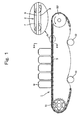
- Figure 1 is a side view of an antistatic resin-made chain for article conveyance that is a preferred embodiment of the present invention.
- W articles; 1: antistatic resin-made chain for article conveyance; 2: link with top plate; 3: link body; 7: top plate; 9: receiving rail;. 10: return roller; S1, S2: sprockets.
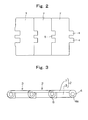
- Figure 2 is a top view showing a part of the antistatic resin-made chain. 4, 5: hinge parts.
- Figure 3 is a side view showing a part of the antistatic resin-made chain. 4a: pin hole; 8: connecting pin.
- Figure 4 is a partial back view having a part of the antistatic resin-made chain as a section. 6: hinge part; 5a, 6a: pin hole.
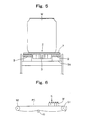
- Figure 5 is a perspective view taken along the line X-X of Fig. 1.
- 9 receiving rail; 9a: support block.
- Figure 6 is an illustrative view showing a manner for measuring the electrostatic potential of a resin-made chain.
- PC resin made chain
- K measuring point.
- Figure 1 is a side view showing a setting state of an antistatic resin-made chain for article conveyance
- Figure 2 is a plan view showing a part of the antistatic resin-made chain
- Figure 3 is a side view showing a part of the antistatic resin-made chain
- Figure 4 is a sectional back view having a part of the antistatic resin-made chain 1 as a Section
- Figure 5 is a perspective view taken along the line X-X of Figure 1.
- the antistatic resin-made chain for article conveyance 1 may be formed endlessly, as described hereinbelow, by connecting a number of links with top plate 2 through synthetic resin-made or metallic connecting pins 8.
- the link with top plate 2 comprises a link body 3 and a top plate 7 located on the upper part thereof which may be made of plastics by integral molding of a synthetic resin material. If the width of the top plate (the longitudinal width in an advancing direction) is gradually narrowed from the center toward both outer sides or formed in a broad crescent form, then curved traveling on a horizontal plane is facilitated.
- the top plate 7 has a hinge part 4 having a pin hole 4a on one side of the link body 3 and a hinge part 5 having a pin hole 5a and a hinge part 6 having a pin hole 6a on the other side.
- the antistatic resin-made chain for article conveyance 1 may be created by forming hinges by inserting a connecting pin 8 to each pin hole 4a, 5a, and 6a of the respective hinge parts 4, 5, and 6 of the adjacent links with top plate 2.
- the above hinge placements are merely exemplary of a particular embodiment and can be placed in different arrangements on the links to facilitate the hinging of the links.
- the antistatic resin-made chain for article conveyance 1 may be laid around sprockets S1 and S2 as shown in Figure 1 and run on a receiving rail 9 supported by a support block 9a (see Figure 5) while sliding in contact therewith to convey articles W placed on the chain.
- a return roller 10 may be present to support the return route-side chain.
- the link with top plate 2 constituting the antistatic resin-made chain for article conveyance 1 may be integrally molded of a synthetic resin material containing a high-molecular weight antistatic agent and, optionally, a sliding agent.
- the material of the synthetic resin of the resin-made chain of the present invention can be any synthetic resin of the art.
- the synthetic resin can be, without limitation, an engineering plastic such as polyacetal (POM), polyamide (PA), polybutylene terephthalate (PBT), polycarbonate (PC), polypropylene (PP), polyethylene (PE) and the like.
- POM polyacetal
- PA polyamide
- PBT polybutylene terephthalate
- PC polycarbonate
- PP polypropylene
- PE polyethylene
- additives such as processing stabilizers, fillers, and/or dispersing agents can be added to the synthetic resin material.
- the antistatic resin-made chain of the instant invention comprises at least one high-molecular weight antistatic agent.
- the high molecular weight antistatic agent has a molecular weight greater than about 10,000.
- the melting point and/or melting viscosity of the agent may be considered.
- a polyether-based high-molecular weight antistatic agent is used. Examples of the polyether-based high-molecular weight antistatic agent include, without limitation, a polyether polyolefin block polymer, a polyether ester amide block polymer, and the like.
- the antistatic resin-made chain of the instant invention optionally comprises at least one sliding agent.
- Sliding agents include, without limitation, fluorine-based resins (e.g., polytetrafluoroethylene (PTFE) and polychlorotrifluoroethylene), silicone resins, fatty acid esters and the like.
- the sliding agent is a fatty acid ester.
- the link with top plate 2 may be formed of a synthetic resin material obtained by adding about 5 to 30% by weight of a polyether-based high-molecular antistatic agent to about 95 to 70% by weight of a synthetic resin, optionally, containing about 1 to 3% by weight of at least one sliding agent.
- the mixing quantity of the high-molecular weight antistatic agent is preferably set to 5% by weight or more to insure antistatic performance and set to less than or about 30% by wait due to considerations of the injection moldability (productivity) and the mechanical characteristics of the resultant chain.
- the upper limit is also considered to be about 30% by weight because higher levels of antistatic agent do not result in an appreciable gain in antistatic effect.
- the link with top plate is integrally molded of a synthetic resin material containing a high-molecular weight antistatic agent in the preferred embodiment, it is only the top plate of the link that needs to be formed of the synthetic resin material containing the high-molecular weight antistatic agent.
- the link body can be made of stainless steel or formed or integrally molded of a synthetic resin material different from that of the top plate and attached to the top plate by any means such as a small screw, pins, or an adhesive.
- Electrostatic potential measurement tests were carried out to determine the electrostatic potential for a resin-made chain comprising polyacetal (POM)-made links with top plate which were mutually connected through stainless steel connecting pins.
- a resin-made chain PC was wrapped around reinforced polyamide-made sprockets S1 and S2 and run at a fixed speed.
- the electrostatic potential of the resin-made chain PC was measured at a measuring point K in the vicinity of the driving sprocket S1 after the lapse of a fixed time. Since the resin-made chain is influenced by the material of the receiving rail with which the chain makes slide contact, the test was carried out using various kinds of receiving rails generally used for conveyance chains.
- High-molecular antistatic agent Polyether ester amide block polymer (10 wt%)
- High-molecular antistatic agent Polyether ester amide block polymer (10 wt%) Table 3: Measurement Value of Electrostatic Potential (Conveyance of glass bottle) [Antistatic Agent Mixed] High-polymer antistatic agent: Polyether ester amide block polymer Resin-made chain POM + High-molecular antistatic agent High-molecular antistatic agent 5 wt% 10 wt% Rail R1 3.4 kV 2.0 kV Rail R2 1.9 kV 0.2 kV Rail R3 2.0 kV 0.1 kV Rail R4 1.1 kV 0.4 kV Table 4: Measurement Value of Resin; PAA; High-molecular antistatic agent; Polyether ester amide block polymer Volume Resistivity ( ⁇ .cm) JIS K6911 Half-life (see) JIS L1094 Genera POM 1.0 ⁇ 10 16 120 or more POM + Anionic active agent 1.1 ⁇ 10 15 86 or more POM + PAA (5 wt%) 4.4 ⁇ 10 14 3.3 POM
- Table 1 shows that the charged electrostatic potential of the antistatic resin-made chain of the present invention is extremely low in the use of every rail (R1-R4) compared with the charged electrostatic potential of the resin-made chains of the comparative example and the conventional example.
- the charged electrostatic potential of the antistatic resin-made chain of the present invention is of a low enough voltage as to not present an electric shock risk.
- the rails was made of MC nylon (R2), stainless steel (R3), or ultrahigh-molecular weight polyethylene containing low-molecular antistatic agent (R4) the electrostatic potential was 0.4 kV or less regardless of the item conveyed. Even when the rail was made of ultrahigh-molecular weight polyethylene (R1), the electrostatic potential was about 2.1 kV.
- Table 2 shows that the resin-made chain comprising a synthetic resin material containing a high-molecular antistatic agent of the present invention can exhibit the antistatic effect in every environmental atmosphere.
- the charged electrostatic potential in the inventive example was as low as about 1/10 to about 1/20 of that in the conventional example, even in an environmental atmosphere with low humidity (25-30%RH).
- Table 3 demonstrates that the antistatic resin-made chain of the present invention never causes electric shocks. Indeed, a charged electrostatic potential of only about 2.0 kV or less is seen in the use of the rails R2 to R4 by mixing only 5 wt% of the high-molecular weight antistatic agent and a charged electrostatic potential of only about 2.0 kV was observed in the use of the ultrahigh-molecular weight polyethylene-made rail R1 by using 10 wt% of the high-molecular weight antistatic agent.
Landscapes
- Chemical & Material Sciences (AREA)
- Health & Medical Sciences (AREA)
- Chemical Kinetics & Catalysis (AREA)
- Medicinal Chemistry (AREA)
- Polymers & Plastics (AREA)
- Organic Chemistry (AREA)
- Engineering & Computer Science (AREA)
- Mechanical Engineering (AREA)
- Chain Conveyers (AREA)
- Compositions Of Macromolecular Compounds (AREA)
Abstract
Description
- This application claims priority under 35 U.S.C. §119(a) to
Japanese Patent Application No. 2005-083891, filed March 23, 2005 - The present invention generally relates to an antistatic resin-made chain for conveying articles. Particularly, the instant invention relates to an antistatic resin-made chain for article conveyance comprising a plurality of links having a top plate formed of a synthetic resin material containing at least one high-molecular antistatic agent and, optionally, at least one sliding agent.
- As a means for conveying articles such as, without limitation, foods (e.g., vegetable, fresh fish, bread, wheat noodle, and meat), medicines, containers (e.g., cans, bottles, and glass bottles), electronics, textiles, resin molded products and the like, a conveyor chain is generally used to move the articles on a top plate with a flat surface. An article conveying resin-made chain formed by mutually connecting a plurality of links with a top plate formed of a synthetic resin material by connecting pins is presented in
Japanese Patent Application Laid-Open No. 7-309417 - In the course of using such an article conveying resin-made chain, the flow of articles is often stopped during conveyance by a stop bar. In order to increase the ease of slipping and standing the articles at the stop bar when stopped, it is desirable for the top plate to have improved sliding characteristics. Therefore, in the above-referenced article conveying resin-made chain, a penetration layer may be formed on the top plate of a link by impregnation of a solution containing fluorine-based resin fine particles. The formation of the penetration layer can provide an antistatic effect of some degree. Additionally, the layer can provide improved sliding performance by reducing the friction of the link with top plate. However, the antistatic effect of the layer may not be sufficient.
- Generally, the resin-made chain is charged with static electricity caused by the sliding or rubbing of an article, a receiving rail, a guide or the like during the conveyance of articles. The article itself may also becomes charged by the rubbing with the top plate or guide. Indeed, even metallic articles can be become charged without being earthed as the conveyance system typically is made of resin to protect the articles from being scratched by metal parts.
- In general, a charged electrostatic potential of 2 kV or less is free of problems such as electric shock and dust attraction. However, when the static electricity of the resin-made chain is10 kV or more, there is a risk of an electric shock if discharged to a human body and there may be a fire hazard depending on the surrounding environment. When the article is a glass bottle or plastic bottle of a nonconductor (insulating material), the charged static electricity may also cause contamination of the article by causing the adhesion of dust, fungi, bacteria or the like, although the danger of electric shock may be eliminated because of creepage discharge.
- In order to make the conveyor resin-made chain more antistatic or conductive, carbon fibers, carbon powders (e.g., ketjen black), metal fibers or the like have been added to the synthetic resin material. However, these chains are not preferred because carbon-based chains are blackened and metal fiber-based chains involve the danger of inclusion of the metal fiber as a foreign matter, particularly in the conveyance of food or drink.
- As an alternative measure for addressing the above issues, the link with the top plate was conventionally formed from a synthetic resin material comprising a surfactant, i.e., a low-molecular weight antistatic agent (anionic activating agent, cationic activating agent, nonionic activating agent, etc.), in order to increase the antistatic properties of the resin-made chain.
- However, low-molecular weight antistatic agents are readily affected by environmental factors such as humidity. Indeed, the effectiveness of the low-molecular weight antistatic agents is reduced in different humidity conditions such as in a low humidity environment (dry atmosphere such as during the winter). Furthermore, low-molecular weight antistatic agents are inferior for prolonged use because they can easily be removed by water washing or wiping of the belt. Additionally, low-molecular weight antistatic agents tend to bleed out to the surface of the resin-made chain over time and may contaminate the surrounding area and cause the deterioration of the surrounding surfaces.
- The low-molecular weight antistatic agent in these chains is present within the resin and it migrates to the surface while avoiding crystals and the like of the resin. However, if the resin has high crystallinity, such as, e,g., a polyacetal based resin, a long time is needed for the antistatic effect to emerge. The low-molecular antistatic agent is also not suitable with a polyamide with a high Tg (glass transition temperature) because its migration speed to the surface is greatly influenced by the Tg of the resin. Further, a resin-made chain containing the low-molecular antistatic agent is not horizontally recyclable (i.e., recyclable in the same quality level) and is subjected to cascade recycling (i.e., low-quality level recycle) with a reduced recycling ratio of raw material.
- The present invention solves the problems and shortcomings of the - conveyor belts described above and provides an antistatic resin-made chain for article conveyance capable of exhibiting a stable antistatic effect in a dry or low-humidity environmental atmosphere or the like with minimized environmental dependency. The antistatic effect helps prevent electric shock or adhesion of dust, fungi, bacteria or the like. Furthermore, the antistatic effect is kept in the antistatic resin-made chains of the instant invention even during washing (e.g., water washing). The antistatic resin-made chains of the instant invention also can be horizontally recycled and recycled chains will maintain their antistatic properties.
- An antistatic resin-made chain for article conveyance according to a first embodiment of the present invention comprises a plurality of links having a top plate mutually connected through connecting pins. The link comprising a top plate is formed of a synthetic resin material containing a high-molecular weight antistatic agent.
- In accordance with a particular embodiment of the present invention, the high-molecular weight antistatic agent is based on a polyether.
- According to yet another embodiment of the instant invention, the high-molecular antistatic agent is a polyether ester amide block polymer or a polyether polyolefin block polymer.
- In another embodiment of the instant invention, the synthetic resin material of the antistatic resin-made chain also contains a sliding agent. Accordingly, the sliding and antistatic characteristics of the chain are improved. As a result, the static charging to the chain is suppressed while the contact sliding of the chain with the receiving rail is smoothed during conveyance. Additionally, when an article under conveyance is stopped and stood by a stop bar or the like, the friction of the resin-made chain against the article is minimized to ensure its smooth slippage without the creation of electrostatic potential in the article.
- Inasmuch as the link with top plate constituting the resin-made chain is formed of a synthetic resin material containing a high-molecular weight antistatic agent, the antistatic resin-made chain exhibits a stable antistatic effect even if used in a dry or low-humidity environmental atmosphere. Furthermore, electric shock and the adhesion of dust, fungi, bacteria or the like to articles is prevented in any environmental atmosphere. The antistatic effect is also stable through washings, such as with water, of the resin-made chain or part thereof. Inasmuch as the high-molecular weight antistatic agent can be considered to be a permanent antistatic agent, recycled or re-used chains retain the antistatic effect. Consequently, the chain can be subjected to horizontal recycling to avoid loss of raw material.
- Figure 1 is a side view of an antistatic resin-made chain for article conveyance that is a preferred embodiment of the present invention. W: articles; 1: antistatic resin-made chain for article conveyance; 2: link with top plate; 3: link body; 7: top plate; 9: receiving rail;. 10: return roller; S1, S2: sprockets.
- Figure 2 is a top view showing a part of the antistatic resin-made chain. 4, 5: hinge parts.
- Figure 3 is a side view showing a part of the antistatic resin-made chain. 4a: pin hole; 8: connecting pin.
- Figure 4 is a partial back view having a part of the antistatic resin-made chain as a section. 6: hinge part; 5a, 6a: pin hole.
- Figure 5 is a perspective view taken along the line X-X of Fig. 1. 9: receiving rail; 9a: support block.
- Figure 6 is an illustrative view showing a manner for measuring the electrostatic potential of a resin-made chain. PC: resin made chain; K: measuring point.
- A preferred embodiment of the present invention is described in Figures 1 to 5. Figure 1 is a side view showing a setting state of an antistatic resin-made chain for article conveyance 1, Figure 2 is a plan view showing a part of the antistatic resin-made chain 1, Figure 3 is a side view showing a part of the antistatic resin-made chain 1, Figure 4 is a sectional back view having a part of the antistatic resin-made chain 1 as a Section, and Figure 5 is a perspective view taken along the line X-X of Figure 1.
- The antistatic resin-made chain for article conveyance 1 may be formed endlessly, as described hereinbelow, by connecting a number of links with
top plate 2 through synthetic resin-made or metallic connecting pins 8. The link withtop plate 2 comprises alink body 3 and atop plate 7 located on the upper part thereof which may be made of plastics by integral molding of a synthetic resin material. If the width of the top plate (the longitudinal width in an advancing direction) is gradually narrowed from the center toward both outer sides or formed in a broad crescent form, then curved traveling on a horizontal plane is facilitated. - The
top plate 7 has ahinge part 4 having apin hole 4a on one side of thelink body 3 and ahinge part 5 having apin hole 5a and ahinge part 6 having apin hole 6a on the other side. The antistatic resin-made chain for article conveyance 1 may be created by forming hinges by inserting a connecting pin 8 to eachpin hole respective hinge parts top plate 2. The above hinge placements are merely exemplary of a particular embodiment and can be placed in different arrangements on the links to facilitate the hinging of the links. - The antistatic resin-made chain for article conveyance 1 may be laid around sprockets S1 and S2 as shown in Figure 1 and run on a receiving
rail 9 supported by asupport block 9a (see Figure 5) while sliding in contact therewith to convey articles W placed on the chain. Areturn roller 10 may be present to support the return route-side chain. - The link with
top plate 2 constituting the antistatic resin-made chain for article conveyance 1 may be integrally molded of a synthetic resin material containing a high-molecular weight antistatic agent and, optionally, a sliding agent. The material of the synthetic resin of the resin-made chain of the present invention can be any synthetic resin of the art. For example, the synthetic resin can be, without limitation, an engineering plastic such as polyacetal (POM), polyamide (PA), polybutylene terephthalate (PBT), polycarbonate (PC), polypropylene (PP), polyethylene (PE) and the like. Generally used additives such as processing stabilizers, fillers, and/or dispersing agents can be added to the synthetic resin material. - The antistatic resin-made chain of the instant invention comprises at least one high-molecular weight antistatic agent. In a particular embodiment, the high molecular weight antistatic agent has a molecular weight greater than about 10,000. When selecting a high-molecular weight antistatic agent to be used in the synthesis of the antistatic resin-made chains of the present invention, the melting point and/or melting viscosity of the agent may be considered. In a preferred embodiment, a polyether-based high-molecular weight antistatic agent is used. Examples of the polyether-based high-molecular weight antistatic agent include, without limitation, a polyether polyolefin block polymer, a polyether ester amide block polymer, and the like.
- The antistatic resin-made chain of the instant invention optionally comprises at least one sliding agent. Sliding agents include, without limitation, fluorine-based resins (e.g., polytetrafluoroethylene (PTFE) and polychlorotrifluoroethylene), silicone resins, fatty acid esters and the like. In a preferred embodiment, the sliding agent is a fatty acid ester.
- The link with
top plate 2 may be formed of a synthetic resin material obtained by adding about 5 to 30% by weight of a polyether-based high-molecular antistatic agent to about 95 to 70% by weight of a synthetic resin, optionally, containing about 1 to 3% by weight of at least one sliding agent. The mixing quantity of the high-molecular weight antistatic agent is preferably set to 5% by weight or more to insure antistatic performance and set to less than or about 30% by wait due to considerations of the injection moldability (productivity) and the mechanical characteristics of the resultant chain. The upper limit is also considered to be about 30% by weight because higher levels of antistatic agent do not result in an appreciable gain in antistatic effect. - Although the link with top plate is integrally molded of a synthetic resin material containing a high-molecular weight antistatic agent in the preferred embodiment, it is only the top plate of the link that needs to be formed of the synthetic resin material containing the high-molecular weight antistatic agent. In this case, for example, the link body can be made of stainless steel or formed or integrally molded of a synthetic resin material different from that of the top plate and attached to the top plate by any means such as a small screw, pins, or an adhesive.
- Electrostatic potential measurement tests were carried out to determine the electrostatic potential for a resin-made chain comprising polyacetal (POM)-made links with top plate which were mutually connected through stainless steel connecting pins. In this test, as shown in Figure 6, a resin-made chain PC was wrapped around reinforced polyamide-made sprockets S1 and S2 and run at a fixed speed. The electrostatic potential of the resin-made chain PC was measured at a measuring point K in the vicinity of the driving sprocket S1 after the lapse of a fixed time. Since the resin-made chain is influenced by the material of the receiving rail with which the chain makes slide contact, the test was carried out using various kinds of receiving rails generally used for conveyance chains. The following apparatuses were used for the test: STATTRON DX (Shishido Electrostatic, Ltd.; Tokyo, Japan) to measure electrostatic potential and TR-72U Logger (T&D; Nagano, Japan) to measure temperature and humidity. The test results are shown in Tables 1 to 3. Table 4 shows measurement values of the resistivity of the synthetic resin material which gives an index of its insulating properties.
Table 1: Measurement Value of Charged Electrostatic Potential Comparative Example Conventional Example Inventive Example Resin-made chain POM POM + Low- molecular antistatic agent POM + High-molecular antistatic agent Conveying article Steel can Glass bottle Steel can Glass bottle Steel can Glass bottle Rail R1 10.0 kV 9.3 kV 5.7 kV 10.9 kV 2.1kV 2.0 kV Rail R2 4.8 kV 7.1 kV 3.6 kV 6.9 kV 0.3 kV 0.2 kV Rail R3 7.9 kV 6.8 kV 2.7 kV 7.1 kV 0.2 kV 0.2 kV Rail R4 7.2 kV 6.6 kV 5.8 kV 8.8 kV 0.4 kV 0.3 kV - Low-molecular antistatic agent: Anionic active agent (3 wt%)
- High-molecular antistatic agent: Polyether ester amide block polymer (10 wt%)
-
- Rail R1: Ultrahigh-molecular weight polyethylene
- Rail R2: MC nylon
- Rail R3: Stainless steel
- Rail R4: Ultrahigh-molecular weight polyethylene containing low-molecular antistatic agent
- Steel can: 40-55%RH
- Glass bottle: 30-40%RH
Rail R3: Made of stainless steel Conventional Example Inventive Example Resin-made chain POM + Low-molecular antistatic agent POM + High-molecular antistatic agent Relative Humidity 55%RH 30%RH 50%RH 28%RH Table 2: Effect of Humidity on Charged Electrostatic Potential Chain Charged Potential 2.4 kV 7.3 kV 0.1 kV 0.7 kV Rail R4: Made of ultrahigh-molecular weight polyethylene containing lo-molecular antistatic agent Conventional Example Inventive Example Resin-made chain POM + Low-molecular antistatic agent POM + High-molecular antistatic agent Relative Humidity 45%RH 25%RH 42%RH 25%RH Chain Charged Potential 5.8 kV 9.1 kV 0.2 kV 1.9 kV - Low-molecular antistatic agent: Anionic active agent (3 wt%)
- High-molecular antistatic agent: Polyether ester amide block polymer (10 wt%)
Table 3: Measurement Value of Electrostatic Potential (Conveyance of glass bottle) [Antistatic Agent Mixed] High-polymer antistatic agent: Polyether ester amide block polymer Resin-made chain POM + High-molecular antistatic agent High-molecular antistatic agent 5 wt% 10 wt% Rail R1 3.4 kV 2.0 kV Rail R2 1.9 kV 0.2 kV Rail R3 2.0 kV 0.1 kV Rail R4 1.1 kV 0.4 kV Table 4: Measurement Value of Resin; PAA; High-molecular antistatic agent; Polyether ester amide block polymer Volume Resistivity (Ω.cm) JIS K6911 Half-life (see) JIS L1094 Genera POM 1.0×10¹⁶ 120 or more POM + Anionic active agent 1.1×10¹⁵ 86 or more POM + PAA (5 wt%) 4.4×10¹⁴ 3.3 POM + PAA (10 wt%) 9.3×10¹³ 0.7 - Resistivity: Temperature 23±2°C /Humidity 50±5%RH
- Half-life: Temperature 23±2°C /Humidity 50±5%RH
- Table 1 shows that the charged electrostatic potential of the antistatic resin-made chain of the present invention is extremely low in the use of every rail (R1-R4) compared with the charged electrostatic potential of the resin-made chains of the comparative example and the conventional example. Particularly, the charged electrostatic potential of the antistatic resin-made chain of the present invention is of a low enough voltage as to not present an electric shock risk. Indeed, when the rails was made of MC nylon (R2), stainless steel (R3), or ultrahigh-molecular weight polyethylene containing low-molecular antistatic agent (R4) the electrostatic potential was 0.4 kV or less regardless of the item conveyed. Even when the rail was made of ultrahigh-molecular weight polyethylene (R1), the electrostatic potential was about 2.1 kV.
- Table 2 shows that the resin-made chain comprising a synthetic resin material containing a high-molecular antistatic agent of the present invention can exhibit the antistatic effect in every environmental atmosphere. The charged electrostatic potential in the inventive example was as low as about 1/10 to about 1/20 of that in the conventional example, even in an environmental atmosphere with low humidity (25-30%RH).
- Further, Table 3 demonstrates that the antistatic resin-made chain of the present invention never causes electric shocks. Indeed, a charged electrostatic potential of only about 2.0 kV or less is seen in the use of the rails R2 to R4 by mixing only 5 wt% of the high-molecular weight antistatic agent and a charged electrostatic potential of only about 2.0 kV was observed in the use of the ultrahigh-molecular weight polyethylene-made rail R1 by using 10 wt% of the high-molecular weight antistatic agent.
- While certain of the preferred embodiments of the present invention have been described and specifically exemplified above, it is not intended that the invention be limited to such embodiments. Various modifications may be made thereto without departing from the scope and spirit of the present invention, as set forth in the following claims.
- A patent document is cited in the foregoing specification in order to describe the state of the art to which this invention pertains. The entire disclosure of this citation is incorporated by reference herein.
Claims (9)
- A conveyor chain comprising a plurality of links, wherein said link is connected to a top plate, wherein said top plate comprises a synthetic resin material and at least one high-molecular weight antistatic agent.
- The conveyor chain according to claim 1, wherein said high-molecular antistatic agent is based on a polyether.
- The conveyor chain according to claim 2, wherein said high-molecular weight antistatic agent is selected from the group consisting of a polyether ester amide block polymer and a polyether polyolefin block polymer.
- The conveyor chain according to claim 1, wherein the synthetic resin material comprises at least one sliding agent.
- The conveyor chain according to claim 4, wherein said sliding agent is selected from the group consisting of fluorine-based resins, silicone resins, and fatty acid esters.
- The conveyor chain according to claim 5, wherein said sliding agent is a fatty acid ester.
- The conveyor chain according to claim 1, wherein said top plate and link are connected by at least one of the group consisting of screws, pins, and adhesives.
- The conveyor chain according to claim 1, wherein said top plate and link are integrally molded.
- The conveyor chain according to claim 1, wherein said top plate comprises about 5% to about 30% of said high-molecular weight antistatic agent by weight.
Applications Claiming Priority (1)
| Application Number | Priority Date | Filing Date | Title |
|---|---|---|---|
| JP2005083891A JP2006264847A (en) | 2005-03-23 | 2005-03-23 | Antistatic resin chain for conveying article |
Publications (1)
| Publication Number | Publication Date |
|---|---|
| EP1705198A1 true EP1705198A1 (en) | 2006-09-27 |
Family
ID=36579445
Family Applications (1)
| Application Number | Title | Priority Date | Filing Date |
|---|---|---|---|
| EP06004613A Withdrawn EP1705198A1 (en) | 2005-03-23 | 2006-03-07 | Antistatic resin-made chain for article conveyance |
Country Status (5)
| Country | Link |
|---|---|
| US (1) | US20060213752A1 (en) |
| EP (1) | EP1705198A1 (en) |
| JP (1) | JP2006264847A (en) |
| CN (1) | CN1836997A (en) |
| TW (1) | TW200633911A (en) |
Cited By (4)
| Publication number | Priority date | Publication date | Assignee | Title |
|---|---|---|---|---|
| WO2008113194A1 (en) * | 2007-03-20 | 2008-09-25 | Habasit Ag | Electroconductive modular belt |
| WO2011147684A1 (en) * | 2010-05-27 | 2011-12-01 | Neuhäuser GmbH | Magnetic conveying device |
| DE102012103078A1 (en) | 2012-04-10 | 2013-10-10 | Krones Ag | Chain conveyor for plastic preforms |
| US9162818B2 (en) | 2011-11-24 | 2015-10-20 | Rexnord Flattop Europe B.V. | Modular conveyor mat and conveyor provided with a modular conveyor mat |
Families Citing this family (6)
| Publication number | Priority date | Publication date | Assignee | Title |
|---|---|---|---|---|
| JP2008032218A (en) * | 2006-06-30 | 2008-02-14 | Ntn Corp | Heat/oil resistant rolling bearing and compressor rolling bearing for refrigerator |
| EP2579798B1 (en) * | 2010-06-11 | 2019-07-31 | CareFusion 2200, Inc. | Reduced backlash joint and method of making same |
| JP5089743B2 (en) * | 2010-09-28 | 2012-12-05 | 株式会社椿本チエイン | Conveyor chain |
| DE102014118244A1 (en) * | 2014-12-09 | 2016-06-09 | Hauni Maschinenbau Ag | Tragförderkettenglied, Tragförderkette and transfer and / or storage system for rod-shaped articles of the tobacco processing industry |
| JP6860966B2 (en) * | 2015-09-08 | 2021-04-21 | サッポロビール株式会社 | Foreign matter removal method and foreign matter removal device |
| CN112124853B (en) * | 2020-09-21 | 2021-11-19 | 合肥市经纬烟草机械配件有限公司 | Homopolymerized resin chain plate and manufacturing method thereof |
Citations (7)
| Publication number | Priority date | Publication date | Assignee | Title |
|---|---|---|---|---|
| EP0063533A1 (en) * | 1981-04-02 | 1982-10-27 | Rexnord Inc. | Anti-static chain |
| US5197591A (en) * | 1992-02-11 | 1993-03-30 | Ashworth Bros., Inc. | Replaceable snap-on modular overlay for rod and link turn-curve conveyor belts |
| US5309705A (en) * | 1993-07-06 | 1994-05-10 | Tsubakimoto Chain Co. | Flat top conveyor chain |
| US5439097A (en) * | 1991-10-29 | 1995-08-08 | Tsubakimoto Chain Co. | Link for conveyor chains |
| JPH07309417A (en) | 1994-05-13 | 1995-11-28 | Natl Kinzoku Kogyo Kk | Plastic made conveyor and chain, and carrying method thereof |
| EP0987200A2 (en) * | 1998-08-31 | 2000-03-22 | Tsubakimoto Chain Co. | Low friction coefficient plastic conveyor chain |
| US20040122168A1 (en) * | 2002-12-18 | 2004-06-24 | General Electric Company | Static dissipating resin composition and methods for manufacture thereof |
Family Cites Families (2)
| Publication number | Priority date | Publication date | Assignee | Title |
|---|---|---|---|---|
| US4915547A (en) * | 1987-02-27 | 1990-04-10 | Molins Plc | Article transport system |
| EP0831038A4 (en) * | 1996-03-29 | 1999-08-25 | Toray Industries | Conveyor chain |
-
2005
- 2005-03-23 JP JP2005083891A patent/JP2006264847A/en active Pending
-
2006
- 2006-02-10 CN CNA2006100074547A patent/CN1836997A/en active Pending
- 2006-02-14 TW TW095104847A patent/TW200633911A/en unknown
- 2006-02-17 US US11/356,539 patent/US20060213752A1/en not_active Abandoned
- 2006-03-07 EP EP06004613A patent/EP1705198A1/en not_active Withdrawn
Patent Citations (7)
| Publication number | Priority date | Publication date | Assignee | Title |
|---|---|---|---|---|
| EP0063533A1 (en) * | 1981-04-02 | 1982-10-27 | Rexnord Inc. | Anti-static chain |
| US5439097A (en) * | 1991-10-29 | 1995-08-08 | Tsubakimoto Chain Co. | Link for conveyor chains |
| US5197591A (en) * | 1992-02-11 | 1993-03-30 | Ashworth Bros., Inc. | Replaceable snap-on modular overlay for rod and link turn-curve conveyor belts |
| US5309705A (en) * | 1993-07-06 | 1994-05-10 | Tsubakimoto Chain Co. | Flat top conveyor chain |
| JPH07309417A (en) | 1994-05-13 | 1995-11-28 | Natl Kinzoku Kogyo Kk | Plastic made conveyor and chain, and carrying method thereof |
| EP0987200A2 (en) * | 1998-08-31 | 2000-03-22 | Tsubakimoto Chain Co. | Low friction coefficient plastic conveyor chain |
| US20040122168A1 (en) * | 2002-12-18 | 2004-06-24 | General Electric Company | Static dissipating resin composition and methods for manufacture thereof |
Non-Patent Citations (1)
| Title |
|---|
| PATENT ABSTRACTS OF JAPAN vol. 1996, no. 03 29 March 1996 (1996-03-29) * |
Cited By (10)
| Publication number | Priority date | Publication date | Assignee | Title |
|---|---|---|---|---|
| WO2008113194A1 (en) * | 2007-03-20 | 2008-09-25 | Habasit Ag | Electroconductive modular belt |
| CN101636335B (en) * | 2007-03-20 | 2012-09-05 | 哈伯西有限公司 | Tape module, modular tape, and method of forming a modular tape capable of dissipating static electricity |
| WO2011147684A1 (en) * | 2010-05-27 | 2011-12-01 | Neuhäuser GmbH | Magnetic conveying device |
| CN102985345A (en) * | 2010-05-27 | 2013-03-20 | 诺伊豪泽尔有限公司 | Magnetic conveying device |
| CN102985345B (en) * | 2010-05-27 | 2015-03-25 | 诺伊豪泽尔有限公司 | Magnetic conveying device |
| US9162818B2 (en) | 2011-11-24 | 2015-10-20 | Rexnord Flattop Europe B.V. | Modular conveyor mat and conveyor provided with a modular conveyor mat |
| DE102012103078A1 (en) | 2012-04-10 | 2013-10-10 | Krones Ag | Chain conveyor for plastic preforms |
| WO2013153100A1 (en) | 2012-04-10 | 2013-10-17 | Krones Ag | Chain conveyor for plastic containers |
| CN104245289A (en) * | 2012-04-10 | 2014-12-24 | 克朗斯股份公司 | Chain conveyor for plastic containers |
| US9718619B2 (en) | 2012-04-10 | 2017-08-01 | Krones Ag | Chain conveyor for plastics material pre-forms |
Also Published As
| Publication number | Publication date |
|---|---|
| US20060213752A1 (en) | 2006-09-28 |
| CN1836997A (en) | 2006-09-27 |
| TW200633911A (en) | 2006-10-01 |
| JP2006264847A (en) | 2006-10-05 |
Similar Documents
| Publication | Publication Date | Title |
|---|---|---|
| EP1705198A1 (en) | Antistatic resin-made chain for article conveyance | |
| US6250458B1 (en) | Low friction coefficient plastic conveyor chain | |
| KR100649796B1 (en) | Fiber Filling Chain Links For Modular Conveyor Chains | |
| US12577355B2 (en) | Polyester polymer compositions | |
| US8991595B2 (en) | Modular belt module | |
| EP1726541A1 (en) | Conveyor chain with freely rotating balls | |
| US6648129B2 (en) | Abrasion-resistant two-material hinge pin in a modular plastic conveyor belt | |
| US20160177219A1 (en) | Polyoxymethylene polymer composition having low friction | |
| BR112017019745B1 (en) | Curable rubber formulation | |
| CA1180905A (en) | Anti-static chain | |
| US7781555B2 (en) | Microcontact printing stamp | |
| US20190225424A1 (en) | Conveyor belt pulley cover combining low rolling resistance with enhanced ozone resistance | |
| US8356708B2 (en) | Modular belt link with an EC edge | |
| CN105686072B (en) | Carrier conveyor chain link, carrier conveyor chain and transport and/or storage system for rod-shaped articles of the tobacco processing industry | |
| US5309705A (en) | Flat top conveyor chain | |
| US20210009355A1 (en) | Guiding device for bulk goods conveyors | |
| KR100210267B1 (en) | Tear Sheet and Manufacturing Method | |
| US9126760B2 (en) | Installation for conveying items consisting of a thermoplastic material | |
| CN102070824A (en) | Antistatic polypropylene composition and preparation method thereof | |
| US20220380143A1 (en) | Diverting equipment | |
| JP2009184764A (en) | Conveying system | |
| WO2020104619A1 (en) | Conveyor belt system | |
| DE102012103963A1 (en) | Conveyor with improved energy requirements | |
| JP2012046259A (en) | Conveying apparatus | |
| JPS6169603A (en) | Conveyor |
Legal Events
| Date | Code | Title | Description |
|---|---|---|---|
| PUAI | Public reference made under article 153(3) epc to a published international application that has entered the european phase |
Free format text: ORIGINAL CODE: 0009012 |
|
| 17P | Request for examination filed |
Effective date: 20060809 |
|
| AK | Designated contracting states |
Kind code of ref document: A1 Designated state(s): AT BE BG CH CY CZ DE DK EE ES FI FR GB GR HU IE IS IT LI LT LU LV MC NL PL PT RO SE SI SK TR |
|
| AX | Request for extension of the european patent |
Extension state: AL BA HR MK YU |
|
| 17Q | First examination report despatched |
Effective date: 20061103 |
|
| AKX | Designation fees paid |
Designated state(s): DE IT NL |
|
| 17Q | First examination report despatched |
Effective date: 20061103 |
|
| STAA | Information on the status of an ep patent application or granted ep patent |
Free format text: STATUS: THE APPLICATION IS DEEMED TO BE WITHDRAWN |
|
| 18D | Application deemed to be withdrawn |
Effective date: 20071024 |