EP1705175A1 - Process for preparing C5 products and their use for Atorvastatin synthesis - Google Patents
Process for preparing C5 products and their use for Atorvastatin synthesis Download PDFInfo
- Publication number
- EP1705175A1 EP1705175A1 EP05006577A EP05006577A EP1705175A1 EP 1705175 A1 EP1705175 A1 EP 1705175A1 EP 05006577 A EP05006577 A EP 05006577A EP 05006577 A EP05006577 A EP 05006577A EP 1705175 A1 EP1705175 A1 EP 1705175A1
- Authority
- EP
- European Patent Office
- Prior art keywords
- compound
- formula
- protecting group
- optionally
- residues
- Prior art date
- Legal status (The legal status is an assumption and is not a legal conclusion. Google has not performed a legal analysis and makes no representation as to the accuracy of the status listed.)
- Withdrawn
Links
- 238000004519 manufacturing process Methods 0.000 title claims abstract description 4
- XUKUURHRXDUEBC-KAYWLYCHSA-N Atorvastatin Chemical compound C=1C=CC=CC=1C1=C(C=2C=CC(F)=CC=2)N(CC[C@@H](O)C[C@@H](O)CC(O)=O)C(C(C)C)=C1C(=O)NC1=CC=CC=C1 XUKUURHRXDUEBC-KAYWLYCHSA-N 0.000 title claims description 12
- XUKUURHRXDUEBC-UHFFFAOYSA-N Atorvastatin Natural products C=1C=CC=CC=1C1=C(C=2C=CC(F)=CC=2)N(CCC(O)CC(O)CC(O)=O)C(C(C)C)=C1C(=O)NC1=CC=CC=C1 XUKUURHRXDUEBC-UHFFFAOYSA-N 0.000 title claims description 11
- 229960005370 atorvastatin Drugs 0.000 title claims description 11
- 230000015572 biosynthetic process Effects 0.000 title abstract description 12
- 238000003786 synthesis reaction Methods 0.000 title description 6
- 238000000034 method Methods 0.000 claims abstract description 50
- 238000002360 preparation method Methods 0.000 claims abstract description 16
- 150000003233 pyrroles Chemical class 0.000 claims abstract description 15
- 150000001875 compounds Chemical class 0.000 claims description 137
- 125000006239 protecting group Chemical group 0.000 claims description 30
- 125000003178 carboxy group Chemical group [H]OC(*)=O 0.000 claims description 22
- 125000002887 hydroxy group Chemical group [H]O* 0.000 claims description 22
- 125000003118 aryl group Chemical group 0.000 claims description 16
- -1 tert-butoxycarbonyl (Boc) Chemical class 0.000 claims description 15
- 125000000008 (C1-C10) alkyl group Chemical group 0.000 claims description 14
- 150000003839 salts Chemical class 0.000 claims description 12
- 239000003054 catalyst Substances 0.000 claims description 9
- 125000001495 ethyl group Chemical group [H]C([H])([H])C([H])([H])* 0.000 claims description 8
- 229910052739 hydrogen Inorganic materials 0.000 claims description 8
- 239000001257 hydrogen Substances 0.000 claims description 8
- 125000000999 tert-butyl group Chemical group [H]C([H])([H])C(*)(C([H])([H])[H])C([H])([H])[H] 0.000 claims description 8
- 229910052736 halogen Inorganic materials 0.000 claims description 7
- 150000002367 halogens Chemical class 0.000 claims description 7
- 125000001997 phenyl group Chemical group [H]C1=C([H])C([H])=C(*)C([H])=C1[H] 0.000 claims description 7
- 239000010948 rhodium Substances 0.000 claims description 7
- QVGXLLKOCUKJST-UHFFFAOYSA-N atomic oxygen Chemical compound [O] QVGXLLKOCUKJST-UHFFFAOYSA-N 0.000 claims description 6
- 125000004432 carbon atom Chemical group C* 0.000 claims description 6
- 238000005984 hydrogenation reaction Methods 0.000 claims description 6
- 229910052760 oxygen Inorganic materials 0.000 claims description 6
- 239000001301 oxygen Substances 0.000 claims description 6
- 125000002924 primary amino group Chemical group [H]N([H])* 0.000 claims description 6
- 150000003863 ammonium salts Chemical class 0.000 claims description 5
- 125000004122 cyclic group Chemical group 0.000 claims description 5
- GXHFUVWIGNLZSC-UHFFFAOYSA-N meldrum's acid Chemical compound CC1(C)OC(=O)CC(=O)O1 GXHFUVWIGNLZSC-UHFFFAOYSA-N 0.000 claims description 5
- 229920006395 saturated elastomer Chemical group 0.000 claims description 5
- 125000000217 alkyl group Chemical group 0.000 claims description 4
- 150000001450 anions Chemical class 0.000 claims description 4
- PFKFTWBEEFSNDU-UHFFFAOYSA-N carbonyldiimidazole Chemical compound C1=CN=CN1C(=O)N1C=CN=C1 PFKFTWBEEFSNDU-UHFFFAOYSA-N 0.000 claims description 4
- 125000005843 halogen group Chemical group 0.000 claims description 4
- 125000004356 hydroxy functional group Chemical group O* 0.000 claims description 4
- 229910052741 iridium Inorganic materials 0.000 claims description 4
- 125000004433 nitrogen atom Chemical group N* 0.000 claims description 4
- 125000004430 oxygen atom Chemical group O* 0.000 claims description 4
- 229910052703 rhodium Inorganic materials 0.000 claims description 4
- KAESVJOAVNADME-UHFFFAOYSA-N Pyrrole Chemical class C=1C=CNC=1 KAESVJOAVNADME-UHFFFAOYSA-N 0.000 claims description 3
- 125000003277 amino group Chemical group 0.000 claims description 3
- 125000003710 aryl alkyl group Chemical group 0.000 claims description 3
- 125000004435 hydrogen atom Chemical group [H]* 0.000 claims description 3
- 125000001449 isopropyl group Chemical group [H]C([H])([H])C([H])(*)C([H])([H])[H] 0.000 claims description 3
- 125000002496 methyl group Chemical group [H]C([H])([H])* 0.000 claims description 3
- OFOBLEOULBTSOW-UHFFFAOYSA-L Malonate Chemical compound [O-]C(=O)CC([O-])=O OFOBLEOULBTSOW-UHFFFAOYSA-L 0.000 claims description 2
- GKOZUEZYRPOHIO-UHFFFAOYSA-N iridium atom Chemical compound [Ir] GKOZUEZYRPOHIO-UHFFFAOYSA-N 0.000 claims description 2
- 159000000003 magnesium salts Chemical class 0.000 claims description 2
- MHOVAHRLVXNVSD-UHFFFAOYSA-N rhodium atom Chemical compound [Rh] MHOVAHRLVXNVSD-UHFFFAOYSA-N 0.000 claims description 2
- 150000003303 ruthenium Chemical class 0.000 claims description 2
- WMOVHXAZOJBABW-UHFFFAOYSA-N tert-butyl acetate Chemical compound CC(=O)OC(C)(C)C WMOVHXAZOJBABW-UHFFFAOYSA-N 0.000 claims description 2
- 239000000543 intermediate Substances 0.000 abstract description 20
- HVYWMOMLDIMFJA-DPAQBDIFSA-N cholesterol Chemical compound C1C=C2C[C@@H](O)CC[C@]2(C)[C@@H]2[C@@H]1[C@@H]1CC[C@H]([C@H](C)CCCC(C)C)[C@@]1(C)CC2 HVYWMOMLDIMFJA-DPAQBDIFSA-N 0.000 abstract description 14
- 235000012000 cholesterol Nutrition 0.000 abstract description 7
- FHIOSLNOSUZMOA-UHFFFAOYSA-N 3,5-dihydroxy-7-pyrrol-1-ylheptanoic acid Chemical class OC(=O)CC(O)CC(O)CCN1C=CC=C1 FHIOSLNOSUZMOA-UHFFFAOYSA-N 0.000 abstract description 5
- 230000002401 inhibitory effect Effects 0.000 abstract description 5
- 239000007858 starting material Substances 0.000 abstract description 4
- 238000010189 synthetic method Methods 0.000 abstract description 3
- HEDRZPFGACZZDS-MICDWDOJSA-N Trichloro(2H)methane Chemical compound [2H]C(Cl)(Cl)Cl HEDRZPFGACZZDS-MICDWDOJSA-N 0.000 description 26
- 238000006243 chemical reaction Methods 0.000 description 24
- 239000000243 solution Substances 0.000 description 23
- 239000000203 mixture Substances 0.000 description 16
- QTBSBXVTEAMEQO-UHFFFAOYSA-N Acetic acid Chemical compound CC(O)=O QTBSBXVTEAMEQO-UHFFFAOYSA-N 0.000 description 14
- RTZKZFJDLAIYFH-UHFFFAOYSA-N Diethyl ether Chemical compound CCOCC RTZKZFJDLAIYFH-UHFFFAOYSA-N 0.000 description 13
- YMWUJEATGCHHMB-UHFFFAOYSA-N Dichloromethane Chemical compound ClCCl YMWUJEATGCHHMB-UHFFFAOYSA-N 0.000 description 12
- WYURNTSHIVDZCO-UHFFFAOYSA-N Tetrahydrofuran Chemical compound C1CCOC1 WYURNTSHIVDZCO-UHFFFAOYSA-N 0.000 description 12
- YXFVVABEGXRONW-UHFFFAOYSA-N Toluene Chemical compound CC1=CC=CC=C1 YXFVVABEGXRONW-UHFFFAOYSA-N 0.000 description 12
- 239000002904 solvent Substances 0.000 description 12
- XEKOWRVHYACXOJ-UHFFFAOYSA-N Ethyl acetate Chemical compound CCOC(C)=O XEKOWRVHYACXOJ-UHFFFAOYSA-N 0.000 description 11
- XLYOFNOQVPJJNP-UHFFFAOYSA-N water Substances O XLYOFNOQVPJJNP-UHFFFAOYSA-N 0.000 description 11
- UCMIRNVEIXFBKS-UHFFFAOYSA-N beta-alanine Chemical compound NCCC(O)=O UCMIRNVEIXFBKS-UHFFFAOYSA-N 0.000 description 10
- 125000001424 substituent group Chemical group 0.000 description 10
- LFQSCWFLJHTTHZ-UHFFFAOYSA-N Ethanol Chemical compound CCO LFQSCWFLJHTTHZ-UHFFFAOYSA-N 0.000 description 9
- 238000001644 13C nuclear magnetic resonance spectroscopy Methods 0.000 description 8
- 238000005160 1H NMR spectroscopy Methods 0.000 description 8
- OKKJLVBELUTLKV-MZCSYVLQSA-N Deuterated methanol Chemical compound [2H]OC([2H])([2H])[2H] OKKJLVBELUTLKV-MZCSYVLQSA-N 0.000 description 8
- DKGAVHZHDRPRBM-UHFFFAOYSA-N Tert-Butanol Chemical compound CC(C)(C)O DKGAVHZHDRPRBM-UHFFFAOYSA-N 0.000 description 8
- 238000000746 purification Methods 0.000 description 8
- 239000000047 product Substances 0.000 description 7
- NGGGZUAEOKRHMA-UHFFFAOYSA-N 3-[(2-methylpropan-2-yl)oxy]-3-oxopropanoic acid Chemical compound CC(C)(C)OC(=O)CC(O)=O NGGGZUAEOKRHMA-UHFFFAOYSA-N 0.000 description 6
- MHAJPDPJQMAIIY-UHFFFAOYSA-N Hydrogen peroxide Chemical compound OO MHAJPDPJQMAIIY-UHFFFAOYSA-N 0.000 description 6
- 239000007832 Na2SO4 Substances 0.000 description 6
- PMZURENOXWZQFD-UHFFFAOYSA-L Sodium Sulfate Chemical compound [Na+].[Na+].[O-]S([O-])(=O)=O PMZURENOXWZQFD-UHFFFAOYSA-L 0.000 description 6
- HEMHJVSKTPXQMS-UHFFFAOYSA-M Sodium hydroxide Chemical compound [OH-].[Na+] HEMHJVSKTPXQMS-UHFFFAOYSA-M 0.000 description 6
- ZMANZCXQSJIPKH-UHFFFAOYSA-N Triethylamine Chemical compound CCN(CC)CC ZMANZCXQSJIPKH-UHFFFAOYSA-N 0.000 description 6
- 229960000583 acetic acid Drugs 0.000 description 6
- HUMNYLRZRPPJDN-UHFFFAOYSA-N benzaldehyde Chemical compound O=CC1=CC=CC=C1 HUMNYLRZRPPJDN-UHFFFAOYSA-N 0.000 description 6
- 125000000168 pyrrolyl group Chemical group 0.000 description 6
- 229910052938 sodium sulfate Inorganic materials 0.000 description 6
- JOXIMZWYDAKGHI-UHFFFAOYSA-N toluene-4-sulfonic acid Chemical compound CC1=CC=C(S(O)(=O)=O)C=C1 JOXIMZWYDAKGHI-UHFFFAOYSA-N 0.000 description 6
- CABVTRNMFUVUDM-VRHQGPGLSA-N (3S)-3-hydroxy-3-methylglutaryl-CoA Chemical compound O[C@@H]1[C@H](OP(O)(O)=O)[C@@H](COP(O)(=O)OP(O)(=O)OCC(C)(C)[C@@H](O)C(=O)NCCC(=O)NCCSC(=O)C[C@@](O)(CC(O)=O)C)O[C@H]1N1C2=NC=NC(N)=C2N=C1 CABVTRNMFUVUDM-VRHQGPGLSA-N 0.000 description 5
- 239000004912 1,5-cyclooctadiene Substances 0.000 description 5
- BCJVBDBJSMFBRW-UHFFFAOYSA-N 4-diphenylphosphanylbutyl(diphenyl)phosphane Chemical compound C=1C=CC=CC=1P(C=1C=CC=CC=1)CCCCP(C=1C=CC=CC=1)C1=CC=CC=C1 BCJVBDBJSMFBRW-UHFFFAOYSA-N 0.000 description 5
- VEXZGXHMUGYJMC-UHFFFAOYSA-N Hydrochloric acid Chemical compound Cl VEXZGXHMUGYJMC-UHFFFAOYSA-N 0.000 description 5
- IMNFDUFMRHMDMM-UHFFFAOYSA-N N-Heptane Chemical compound CCCCCCC IMNFDUFMRHMDMM-UHFFFAOYSA-N 0.000 description 5
- 229940000635 beta-alanine Drugs 0.000 description 5
- 239000012267 brine Substances 0.000 description 5
- 230000002829 reductive effect Effects 0.000 description 5
- 238000010992 reflux Methods 0.000 description 5
- HPALAKNZSZLMCH-UHFFFAOYSA-M sodium;chloride;hydrate Chemical compound O.[Na+].[Cl-] HPALAKNZSZLMCH-UHFFFAOYSA-M 0.000 description 5
- HEDRZPFGACZZDS-UHFFFAOYSA-N Chloroform Chemical compound ClC(Cl)Cl HEDRZPFGACZZDS-UHFFFAOYSA-N 0.000 description 4
- VGMFHMLQOYWYHN-UHFFFAOYSA-N Compactin Natural products OCC1OC(OC2C(O)C(O)C(CO)OC2Oc3cc(O)c4C(=O)C(=COc4c3)c5ccc(O)c(O)c5)C(O)C(O)C1O VGMFHMLQOYWYHN-UHFFFAOYSA-N 0.000 description 4
- UFHFLCQGNIYNRP-UHFFFAOYSA-N Hydrogen Chemical compound [H][H] UFHFLCQGNIYNRP-UHFFFAOYSA-N 0.000 description 4
- 229930194542 Keto Natural products 0.000 description 4
- PCZOHLXUXFIOCF-UHFFFAOYSA-N Monacolin X Natural products C12C(OC(=O)C(C)CC)CC(C)C=C2C=CC(C)C1CCC1CC(O)CC(=O)O1 PCZOHLXUXFIOCF-UHFFFAOYSA-N 0.000 description 4
- AJLFOPYRIVGYMJ-UHFFFAOYSA-N SJ000287055 Natural products C12C(OC(=O)C(C)CC)CCC=C2C=CC(C)C1CCC1CC(O)CC(=O)O1 AJLFOPYRIVGYMJ-UHFFFAOYSA-N 0.000 description 4
- 238000003776 cleavage reaction Methods 0.000 description 4
- SZJOIGNHMKHMSN-UHFFFAOYSA-N ethyl 2-benzylidene-4-methyl-3-oxopentanoate Chemical compound CCOC(=O)C(C(=O)C(C)C)=CC1=CC=CC=C1 SZJOIGNHMKHMSN-UHFFFAOYSA-N 0.000 description 4
- 239000012362 glacial acetic acid Substances 0.000 description 4
- 239000003446 ligand Substances 0.000 description 4
- 229960004844 lovastatin Drugs 0.000 description 4
- PCZOHLXUXFIOCF-BXMDZJJMSA-N lovastatin Chemical compound C([C@H]1[C@@H](C)C=CC2=C[C@H](C)C[C@@H]([C@H]12)OC(=O)[C@@H](C)CC)C[C@@H]1C[C@@H](O)CC(=O)O1 PCZOHLXUXFIOCF-BXMDZJJMSA-N 0.000 description 4
- QLJODMDSTUBWDW-UHFFFAOYSA-N lovastatin hydroxy acid Natural products C1=CC(C)C(CCC(O)CC(O)CC(O)=O)C2C(OC(=O)C(C)CC)CC(C)C=C21 QLJODMDSTUBWDW-UHFFFAOYSA-N 0.000 description 4
- AJLFOPYRIVGYMJ-INTXDZFKSA-N mevastatin Chemical compound C([C@H]1[C@@H](C)C=CC2=CCC[C@@H]([C@H]12)OC(=O)[C@@H](C)CC)C[C@@H]1C[C@@H](O)CC(=O)O1 AJLFOPYRIVGYMJ-INTXDZFKSA-N 0.000 description 4
- BOZILQFLQYBIIY-UHFFFAOYSA-N mevastatin hydroxy acid Natural products C1=CC(C)C(CCC(O)CC(O)CC(O)=O)C2C(OC(=O)C(C)CC)CCC=C21 BOZILQFLQYBIIY-UHFFFAOYSA-N 0.000 description 4
- 239000003960 organic solvent Substances 0.000 description 4
- 230000007017 scission Effects 0.000 description 4
- SNPBHOICIJUUFB-UHFFFAOYSA-N 2-[2-(4-fluorophenyl)-2-oxo-1-phenylethyl]-4-methyl-3-oxo-n-phenylpentanamide Chemical compound C=1C=CC=CC=1NC(=O)C(C(=O)C(C)C)C(C=1C=CC=CC=1)C(=O)C1=CC=C(F)C=C1 SNPBHOICIJUUFB-UHFFFAOYSA-N 0.000 description 3
- PDBMVYIMAMQDCW-UHFFFAOYSA-N 3,5-dihydroxyheptanoic acid Chemical class CCC(O)CC(O)CC(O)=O PDBMVYIMAMQDCW-UHFFFAOYSA-N 0.000 description 3
- UOQXIWFBQSVDPP-UHFFFAOYSA-N 4-fluorobenzaldehyde Chemical compound FC1=CC=C(C=O)C=C1 UOQXIWFBQSVDPP-UHFFFAOYSA-N 0.000 description 3
- OKKJLVBELUTLKV-UHFFFAOYSA-N Methanol Chemical compound OC OKKJLVBELUTLKV-UHFFFAOYSA-N 0.000 description 3
- UIIMBOGNXHQVGW-UHFFFAOYSA-M Sodium bicarbonate Chemical class [Na+].OC([O-])=O UIIMBOGNXHQVGW-UHFFFAOYSA-M 0.000 description 3
- 239000002253 acid Substances 0.000 description 3
- 125000001246 bromo group Chemical group Br* 0.000 description 3
- 125000005594 diketone group Chemical group 0.000 description 3
- 238000004821 distillation Methods 0.000 description 3
- 230000007613 environmental effect Effects 0.000 description 3
- 229940093499 ethyl acetate Drugs 0.000 description 3
- 235000019439 ethyl acetate Nutrition 0.000 description 3
- 238000001704 evaporation Methods 0.000 description 3
- 230000008020 evaporation Effects 0.000 description 3
- 238000010438 heat treatment Methods 0.000 description 3
- VLKZOEOYAKHREP-UHFFFAOYSA-N n-Hexane Chemical compound CCCCCC VLKZOEOYAKHREP-UHFFFAOYSA-N 0.000 description 3
- 239000012044 organic layer Substances 0.000 description 3
- QNGNSVIICDLXHT-UHFFFAOYSA-N para-ethylbenzaldehyde Natural products CCC1=CC=C(C=O)C=C1 QNGNSVIICDLXHT-UHFFFAOYSA-N 0.000 description 3
- 239000011541 reaction mixture Substances 0.000 description 3
- 238000007363 ring formation reaction Methods 0.000 description 3
- GVVCHDNSTMEUCS-UAFMIMERSA-N (2r,5r)-1-[2-[(2r,5r)-2,5-diethylphospholan-1-yl]phenyl]-2,5-diethylphospholane Chemical compound CC[C@@H]1CC[C@@H](CC)P1C1=CC=CC=C1P1[C@H](CC)CC[C@H]1CC GVVCHDNSTMEUCS-UAFMIMERSA-N 0.000 description 2
- AJNZWRKTWQLAJK-KLHDSHLOSA-N (2r,5r)-1-[2-[(2r,5r)-2,5-dimethylphospholan-1-yl]phenyl]-2,5-dimethylphospholane Chemical compound C[C@@H]1CC[C@@H](C)P1C1=CC=CC=C1P1[C@H](C)CC[C@H]1C AJNZWRKTWQLAJK-KLHDSHLOSA-N 0.000 description 2
- 125000004169 (C1-C6) alkyl group Chemical group 0.000 description 2
- UBOXGVDOUJQMTN-UHFFFAOYSA-N 1,1,2-trichloroethane Chemical compound ClCC(Cl)Cl UBOXGVDOUJQMTN-UHFFFAOYSA-N 0.000 description 2
- LCRWHZJEVSNHGN-UHFFFAOYSA-M 2-(4-ethyl-3-methyl-1,3-thiazol-3-ium-2-yl)ethanol;bromide Chemical compound [Br-].CCC1=CSC(CCO)=[N+]1C LCRWHZJEVSNHGN-UHFFFAOYSA-M 0.000 description 2
- HBAQYPYDRFILMT-UHFFFAOYSA-N 8-[3-(1-cyclopropylpyrazol-4-yl)-1H-pyrazolo[4,3-d]pyrimidin-5-yl]-3-methyl-3,8-diazabicyclo[3.2.1]octan-2-one Chemical class C1(CC1)N1N=CC(=C1)C1=NNC2=C1N=C(N=C2)N1C2C(N(CC1CC2)C)=O HBAQYPYDRFILMT-UHFFFAOYSA-N 0.000 description 2
- CSCPPACGZOOCGX-UHFFFAOYSA-N Acetone Chemical compound CC(C)=O CSCPPACGZOOCGX-UHFFFAOYSA-N 0.000 description 2
- WKBOTKDWSSQWDR-UHFFFAOYSA-N Bromine atom Chemical compound [Br] WKBOTKDWSSQWDR-UHFFFAOYSA-N 0.000 description 2
- XTHFKEDIFFGKHM-UHFFFAOYSA-N Dimethoxyethane Chemical compound COCCOC XTHFKEDIFFGKHM-UHFFFAOYSA-N 0.000 description 2
- 229940121710 HMGCoA reductase inhibitor Drugs 0.000 description 2
- OFOBLEOULBTSOW-UHFFFAOYSA-N Malonic acid Chemical compound OC(=O)CC(O)=O OFOBLEOULBTSOW-UHFFFAOYSA-N 0.000 description 2
- 238000005481 NMR spectroscopy Methods 0.000 description 2
- NQRYJNQNLNOLGT-UHFFFAOYSA-N Piperidine Chemical compound C1CCNCC1 NQRYJNQNLNOLGT-UHFFFAOYSA-N 0.000 description 2
- TUZYXOIXSAXUGO-UHFFFAOYSA-N Pravastatin Natural products C1=CC(C)C(CCC(O)CC(O)CC(O)=O)C2C(OC(=O)C(C)CC)CC(O)C=C21 TUZYXOIXSAXUGO-UHFFFAOYSA-N 0.000 description 2
- JUJWROOIHBZHMG-UHFFFAOYSA-N Pyridine Chemical compound C1=CC=NC=C1 JUJWROOIHBZHMG-UHFFFAOYSA-N 0.000 description 2
- RYMZZMVNJRMUDD-UHFFFAOYSA-N SJ000286063 Natural products C12C(OC(=O)C(C)(C)CC)CC(C)C=C2C=CC(C)C1CCC1CC(O)CC(=O)O1 RYMZZMVNJRMUDD-UHFFFAOYSA-N 0.000 description 2
- VYPSYNLAJGMNEJ-UHFFFAOYSA-N Silicium dioxide Chemical compound O=[Si]=O VYPSYNLAJGMNEJ-UHFFFAOYSA-N 0.000 description 2
- FWXAUDSWDBGCMN-DNQXCXABSA-N [(2r,3r)-3-diphenylphosphanylbutan-2-yl]-diphenylphosphane Chemical compound C=1C=CC=CC=1P([C@H](C)[C@@H](C)P(C=1C=CC=CC=1)C=1C=CC=CC=1)C1=CC=CC=C1 FWXAUDSWDBGCMN-DNQXCXABSA-N 0.000 description 2
- 230000002378 acidificating effect Effects 0.000 description 2
- 238000010533 azeotropic distillation Methods 0.000 description 2
- GDTBXPJZTBHREO-UHFFFAOYSA-N bromine Substances BrBr GDTBXPJZTBHREO-UHFFFAOYSA-N 0.000 description 2
- 229910052794 bromium Inorganic materials 0.000 description 2
- 239000006227 byproduct Substances 0.000 description 2
- 125000002915 carbonyl group Chemical group [*:2]C([*:1])=O 0.000 description 2
- 125000001309 chloro group Chemical group Cl* 0.000 description 2
- 238000001816 cooling Methods 0.000 description 2
- 150000002148 esters Chemical class 0.000 description 2
- TVCFAOBYBROOFR-UHFFFAOYSA-N ethyl 2-[2-(4-fluorophenyl)-2-oxo-1-phenylethyl]-4-methyl-3-oxopentanoate Chemical compound C=1C=CC=CC=1C(C(C(=O)OCC)C(=O)C(C)C)C(=O)C1=CC=C(F)C=C1 TVCFAOBYBROOFR-UHFFFAOYSA-N 0.000 description 2
- MHYCRLGKOZWVEF-UHFFFAOYSA-N ethyl acetate;hydrate Chemical compound O.CCOC(C)=O MHYCRLGKOZWVEF-UHFFFAOYSA-N 0.000 description 2
- 239000002471 hydroxymethylglutaryl coenzyme A reductase inhibitor Substances 0.000 description 2
- 239000012442 inert solvent Substances 0.000 description 2
- 239000003112 inhibitor Substances 0.000 description 2
- 230000005764 inhibitory process Effects 0.000 description 2
- 239000011777 magnesium Substances 0.000 description 2
- 125000001624 naphthyl group Chemical group 0.000 description 2
- TUZYXOIXSAXUGO-PZAWKZKUSA-N pravastatin Chemical compound C1=C[C@H](C)[C@H](CC[C@@H](O)C[C@@H](O)CC(O)=O)[C@H]2[C@@H](OC(=O)[C@@H](C)CC)C[C@H](O)C=C21 TUZYXOIXSAXUGO-PZAWKZKUSA-N 0.000 description 2
- 229960002965 pravastatin Drugs 0.000 description 2
- 239000002243 precursor Substances 0.000 description 2
- 238000012216 screening Methods 0.000 description 2
- 229910002027 silica gel Inorganic materials 0.000 description 2
- 239000000741 silica gel Substances 0.000 description 2
- 229960001866 silicon dioxide Drugs 0.000 description 2
- 229960002855 simvastatin Drugs 0.000 description 2
- RYMZZMVNJRMUDD-HGQWONQESA-N simvastatin Chemical compound C([C@H]1[C@@H](C)C=CC2=C[C@H](C)C[C@@H]([C@H]12)OC(=O)C(C)(C)CC)C[C@@H]1C[C@@H](O)CC(=O)O1 RYMZZMVNJRMUDD-HGQWONQESA-N 0.000 description 2
- WBHQBSYUUJJSRZ-UHFFFAOYSA-M sodium bisulfate Chemical compound [Na+].OS([O-])(=O)=O WBHQBSYUUJJSRZ-UHFFFAOYSA-M 0.000 description 2
- 229910000342 sodium bisulfate Inorganic materials 0.000 description 2
- 239000007787 solid Substances 0.000 description 2
- 238000003756 stirring Methods 0.000 description 2
- VZGDMQKNWNREIO-UHFFFAOYSA-N tetrachloromethane Chemical compound ClC(Cl)(Cl)Cl VZGDMQKNWNREIO-UHFFFAOYSA-N 0.000 description 2
- 238000005406 washing Methods 0.000 description 2
- SCYULBFZEHDVBN-UHFFFAOYSA-N 1,1-Dichloroethane Chemical compound CC(Cl)Cl SCYULBFZEHDVBN-UHFFFAOYSA-N 0.000 description 1
- WSLDOOZREJYCGB-UHFFFAOYSA-N 1,2-Dichloroethane Chemical compound ClCCCl WSLDOOZREJYCGB-UHFFFAOYSA-N 0.000 description 1
- LZDKZFUFMNSQCJ-UHFFFAOYSA-N 1,2-diethoxyethane Chemical compound CCOCCOCC LZDKZFUFMNSQCJ-UHFFFAOYSA-N 0.000 description 1
- VYXHVRARDIDEHS-UHFFFAOYSA-N 1,5-cyclooctadiene Chemical compound C1CC=CCCC=C1 VYXHVRARDIDEHS-UHFFFAOYSA-N 0.000 description 1
- YFYKGCQUWKAFLW-UHFFFAOYSA-N 1-(4-fluorophenyl)-2-phenylethanone Chemical compound C1=CC(F)=CC=C1C(=O)CC1=CC=CC=C1 YFYKGCQUWKAFLW-UHFFFAOYSA-N 0.000 description 1
- 125000004204 2-methoxyphenyl group Chemical group [H]C1=C([H])C(*)=C(OC([H])([H])[H])C([H])=C1[H] 0.000 description 1
- KRWVHJOWLJRKRP-UHFFFAOYSA-N 5-amino-3-hydroxypentanoic acid Chemical compound NCCC(O)CC(O)=O KRWVHJOWLJRKRP-UHFFFAOYSA-N 0.000 description 1
- NLXLAEXVIDQMFP-UHFFFAOYSA-N Ammonium chloride Substances [NH4+].[Cl-] NLXLAEXVIDQMFP-UHFFFAOYSA-N 0.000 description 1
- VHUUQVKOLVNVRT-UHFFFAOYSA-N Ammonium hydroxide Chemical compound [NH4+].[OH-] VHUUQVKOLVNVRT-UHFFFAOYSA-N 0.000 description 1
- 108010027006 Apolipoproteins B Proteins 0.000 description 1
- 102000018616 Apolipoproteins B Human genes 0.000 description 1
- UXVMQQNJUSDDNG-UHFFFAOYSA-L Calcium chloride Chemical compound [Cl-].[Cl-].[Ca+2] UXVMQQNJUSDDNG-UHFFFAOYSA-L 0.000 description 1
- XDTMQSROBMDMFD-UHFFFAOYSA-N Cyclohexane Chemical compound C1CCCCC1 XDTMQSROBMDMFD-UHFFFAOYSA-N 0.000 description 1
- 108090000790 Enzymes Proteins 0.000 description 1
- 102000004190 Enzymes Human genes 0.000 description 1
- OTMSDBZUPAUEDD-UHFFFAOYSA-N Ethane Chemical compound CC OTMSDBZUPAUEDD-UHFFFAOYSA-N 0.000 description 1
- PIICEJLVQHRZGT-UHFFFAOYSA-N Ethylenediamine Chemical compound NCCN PIICEJLVQHRZGT-UHFFFAOYSA-N 0.000 description 1
- 108010023302 HDL Cholesterol Proteins 0.000 description 1
- 102000004286 Hydroxymethylglutaryl CoA Reductases Human genes 0.000 description 1
- 108090000895 Hydroxymethylglutaryl CoA Reductases Proteins 0.000 description 1
- 208000035150 Hypercholesterolemia Diseases 0.000 description 1
- 208000031226 Hyperlipidaemia Diseases 0.000 description 1
- 238000006000 Knoevenagel condensation reaction Methods 0.000 description 1
- 108010028554 LDL Cholesterol Proteins 0.000 description 1
- 238000006086 Paal-Knorr synthesis reaction Methods 0.000 description 1
- 241000228143 Penicillium Species 0.000 description 1
- GYKMEKRMASHMIH-VSJLXWSYSA-N [(3r,4r)-1-benzyl-4-diphenylphosphanylpyrrolidin-3-yl]-diphenylphosphane Chemical compound C=1C=CC=CC=1P([C@H]1[C@@H](CN(C1)CC=1C=CC=CC=1)P(C=1C=CC=CC=1)C=1C=CC=CC=1)C1=CC=CC=C1 GYKMEKRMASHMIH-VSJLXWSYSA-N 0.000 description 1
- VCHDBLPQYJAQSQ-LOYHVIPDSA-N [(4s,5s)-5-(diphenylphosphanylmethyl)-2,2-dimethyl-1,3-dioxolan-4-yl]methyl-diphenylphosphane Chemical compound C([C@H]1OC(O[C@@H]1CP(C=1C=CC=CC=1)C=1C=CC=CC=1)(C)C)P(C=1C=CC=CC=1)C1=CC=CC=C1 VCHDBLPQYJAQSQ-LOYHVIPDSA-N 0.000 description 1
- IOPQYDKQISFMJI-UHFFFAOYSA-N [1-[2-bis(4-methylphenyl)phosphanylnaphthalen-1-yl]naphthalen-2-yl]-bis(4-methylphenyl)phosphane Chemical compound C1=CC(C)=CC=C1P(C=1C(=C2C=CC=CC2=CC=1)C=1C2=CC=CC=C2C=CC=1P(C=1C=CC(C)=CC=1)C=1C=CC(C)=CC=1)C1=CC=C(C)C=C1 IOPQYDKQISFMJI-UHFFFAOYSA-N 0.000 description 1
- 238000007171 acid catalysis Methods 0.000 description 1
- 238000007259 addition reaction Methods 0.000 description 1
- 150000001335 aliphatic alkanes Chemical class 0.000 description 1
- 125000003545 alkoxy group Chemical group 0.000 description 1
- 150000001412 amines Chemical class 0.000 description 1
- 235000011114 ammonium hydroxide Nutrition 0.000 description 1
- 125000002490 anilino group Chemical group [H]N(*)C1=C([H])C([H])=C([H])C([H])=C1[H] 0.000 description 1
- 238000013459 approach Methods 0.000 description 1
- 125000004104 aryloxy group Chemical group 0.000 description 1
- 238000009876 asymmetric hydrogenation reaction Methods 0.000 description 1
- 230000001580 bacterial effect Effects 0.000 description 1
- 125000001797 benzyl group Chemical group [H]C1=C([H])C([H])=C(C([H])=C1[H])C([H])([H])* 0.000 description 1
- MUALRAIOVNYAIW-UHFFFAOYSA-N binap Chemical compound C1=CC=CC=C1P(C=1C(=C2C=CC=CC2=CC=1)C=1C2=CC=CC=C2C=CC=1P(C=1C=CC=CC=1)C=1C=CC=CC=1)C1=CC=CC=C1 MUALRAIOVNYAIW-UHFFFAOYSA-N 0.000 description 1
- 230000031709 bromination Effects 0.000 description 1
- 238000005893 bromination reaction Methods 0.000 description 1
- 239000001110 calcium chloride Substances 0.000 description 1
- 229910001628 calcium chloride Inorganic materials 0.000 description 1
- 125000003917 carbamoyl group Chemical group [H]N([H])C(*)=O 0.000 description 1
- 150000001732 carboxylic acid derivatives Chemical class 0.000 description 1
- 239000003153 chemical reaction reagent Substances 0.000 description 1
- 239000007810 chemical reaction solvent Substances 0.000 description 1
- 238000010960 commercial process Methods 0.000 description 1
- 230000002860 competitive effect Effects 0.000 description 1
- 229940126214 compound 3 Drugs 0.000 description 1
- 229940125898 compound 5 Drugs 0.000 description 1
- 150000001923 cyclic compounds Chemical class 0.000 description 1
- 125000000113 cyclohexyl group Chemical group [H]C1([H])C([H])([H])C([H])([H])C([H])(*)C([H])([H])C1([H])[H] 0.000 description 1
- 230000037213 diet Effects 0.000 description 1
- 235000005911 diet Nutrition 0.000 description 1
- QKZWXPLBVCKXNQ-ROJLCIKYSA-N dipamp Chemical compound COC1=CC=CC=C1[P@@](C=1C=CC=CC=1)CC[P@@](C=1C(=CC=CC=1)OC)C1=CC=CC=C1 QKZWXPLBVCKXNQ-ROJLCIKYSA-N 0.000 description 1
- 238000007323 disproportionation reaction Methods 0.000 description 1
- CLPHAYNBNTVRDI-UHFFFAOYSA-N ditert-butyl propanedioate Chemical compound CC(C)(C)OC(=O)CC(=O)OC(C)(C)C CLPHAYNBNTVRDI-UHFFFAOYSA-N 0.000 description 1
- 229940079593 drug Drugs 0.000 description 1
- 239000003814 drug Substances 0.000 description 1
- 238000001035 drying Methods 0.000 description 1
- 230000000694 effects Effects 0.000 description 1
- 150000002170 ethers Chemical class 0.000 description 1
- XCLDSQRVMMXWMS-UHFFFAOYSA-N ethyl 4-methyl-3-oxopentanoate Chemical compound CCOC(=O)CC(=O)C(C)C XCLDSQRVMMXWMS-UHFFFAOYSA-N 0.000 description 1
- URARCLSKGKDNGI-UHFFFAOYSA-N ethyl 5-amino-3-hydroxypentanoate Chemical compound CCOC(=O)CC(O)CCN URARCLSKGKDNGI-UHFFFAOYSA-N 0.000 description 1
- 229940012017 ethylenediamine Drugs 0.000 description 1
- 238000000855 fermentation Methods 0.000 description 1
- 230000004151 fermentation Effects 0.000 description 1
- 239000000706 filtrate Substances 0.000 description 1
- 125000001153 fluoro group Chemical group F* 0.000 description 1
- 238000004817 gas chromatography Methods 0.000 description 1
- 230000002140 halogenating effect Effects 0.000 description 1
- 230000026030 halogenation Effects 0.000 description 1
- 238000005658 halogenation reaction Methods 0.000 description 1
- 125000001072 heteroaryl group Chemical group 0.000 description 1
- 238000004128 high performance liquid chromatography Methods 0.000 description 1
- 230000000887 hydrating effect Effects 0.000 description 1
- 150000002431 hydrogen Chemical group 0.000 description 1
- 230000007062 hydrolysis Effects 0.000 description 1
- 238000006460 hydrolysis reaction Methods 0.000 description 1
- 238000011065 in-situ storage Methods 0.000 description 1
- 239000013067 intermediate product Substances 0.000 description 1
- 125000002346 iodo group Chemical group I* 0.000 description 1
- 125000000959 isobutyl group Chemical group [H]C([H])([H])C([H])(C([H])([H])[H])C([H])([H])* 0.000 description 1
- 150000002596 lactones Chemical class 0.000 description 1
- 230000000670 limiting effect Effects 0.000 description 1
- 239000000463 material Substances 0.000 description 1
- 238000012544 monitoring process Methods 0.000 description 1
- SYSQUGFVNFXIIT-UHFFFAOYSA-N n-[4-(1,3-benzoxazol-2-yl)phenyl]-4-nitrobenzenesulfonamide Chemical class C1=CC([N+](=O)[O-])=CC=C1S(=O)(=O)NC1=CC=C(C=2OC3=CC=CC=C3N=2)C=C1 SYSQUGFVNFXIIT-UHFFFAOYSA-N 0.000 description 1
- 125000004108 n-butyl group Chemical group [H]C([H])([H])C([H])([H])C([H])([H])C([H])([H])* 0.000 description 1
- 125000001280 n-hexyl group Chemical group C(CCCCC)* 0.000 description 1
- 125000004123 n-propyl group Chemical group [H]C([H])([H])C([H])([H])C([H])([H])* 0.000 description 1
- 229910000069 nitrogen hydride Inorganic materials 0.000 description 1
- 231100000252 nontoxic Toxicity 0.000 description 1
- 230000003000 nontoxic effect Effects 0.000 description 1
- 238000006384 oligomerization reaction Methods 0.000 description 1
- 239000012074 organic phase Substances 0.000 description 1
- 230000036961 partial effect Effects 0.000 description 1
- 239000002245 particle Substances 0.000 description 1
- 125000001147 pentyl group Chemical group C(CCCC)* 0.000 description 1
- IUGYQRQAERSCNH-UHFFFAOYSA-N pivalic acid Chemical compound CC(C)(C)C(O)=O IUGYQRQAERSCNH-UHFFFAOYSA-N 0.000 description 1
- 229940096701 plain lipid modifying drug hmg coa reductase inhibitors Drugs 0.000 description 1
- 238000001556 precipitation Methods 0.000 description 1
- 150000003141 primary amines Chemical class 0.000 description 1
- 239000003586 protic polar solvent Substances 0.000 description 1
- UMJSCPRVCHMLSP-UHFFFAOYSA-N pyridine Natural products COC1=CC=CN=C1 UMJSCPRVCHMLSP-UHFFFAOYSA-N 0.000 description 1
- 229910052704 radon Inorganic materials 0.000 description 1
- 239000000376 reactant Substances 0.000 description 1
- 238000001953 recrystallisation Methods 0.000 description 1
- 229910052707 ruthenium Inorganic materials 0.000 description 1
- 239000012258 stirred mixture Substances 0.000 description 1
- 238000006467 substitution reaction Methods 0.000 description 1
- 230000002194 synthesizing effect Effects 0.000 description 1
- JKUYRAMKJLMYLO-UHFFFAOYSA-N tert-butyl 3-oxobutanoate Chemical compound CC(=O)CC(=O)OC(C)(C)C JKUYRAMKJLMYLO-UHFFFAOYSA-N 0.000 description 1
- 125000005931 tert-butyloxycarbonyl group Chemical group [H]C([H])([H])C(OC(*)=O)(C([H])([H])[H])C([H])([H])[H] 0.000 description 1
- 231100000331 toxic Toxicity 0.000 description 1
- 230000002588 toxic effect Effects 0.000 description 1
- 150000003626 triacylglycerols Chemical class 0.000 description 1
- 239000003039 volatile agent Substances 0.000 description 1
- 238000010626 work up procedure Methods 0.000 description 1
Classifications
-
- C—CHEMISTRY; METALLURGY
- C07—ORGANIC CHEMISTRY
- C07C—ACYCLIC OR CARBOCYCLIC COMPOUNDS
- C07C69/00—Esters of carboxylic acids; Esters of carbonic or haloformic acids
- C07C69/34—Esters of acyclic saturated polycarboxylic acids having an esterified carboxyl group bound to an acyclic carbon atom
- C07C69/38—Malonic acid esters
-
- C—CHEMISTRY; METALLURGY
- C07—ORGANIC CHEMISTRY
- C07C—ACYCLIC OR CARBOCYCLIC COMPOUNDS
- C07C229/00—Compounds containing amino and carboxyl groups bound to the same carbon skeleton
- C07C229/02—Compounds containing amino and carboxyl groups bound to the same carbon skeleton having amino and carboxyl groups bound to acyclic carbon atoms of the same carbon skeleton
- C07C229/04—Compounds containing amino and carboxyl groups bound to the same carbon skeleton having amino and carboxyl groups bound to acyclic carbon atoms of the same carbon skeleton the carbon skeleton being acyclic and saturated
- C07C229/22—Compounds containing amino and carboxyl groups bound to the same carbon skeleton having amino and carboxyl groups bound to acyclic carbon atoms of the same carbon skeleton the carbon skeleton being acyclic and saturated the carbon skeleton being further substituted by oxygen atoms
-
- C—CHEMISTRY; METALLURGY
- C07—ORGANIC CHEMISTRY
- C07C—ACYCLIC OR CARBOCYCLIC COMPOUNDS
- C07C271/00—Derivatives of carbamic acids, i.e. compounds containing any of the groups, the nitrogen atom not being part of nitro or nitroso groups
- C07C271/06—Esters of carbamic acids
- C07C271/08—Esters of carbamic acids having oxygen atoms of carbamate groups bound to acyclic carbon atoms
- C07C271/10—Esters of carbamic acids having oxygen atoms of carbamate groups bound to acyclic carbon atoms with the nitrogen atoms of the carbamate groups bound to hydrogen atoms or to acyclic carbon atoms
- C07C271/22—Esters of carbamic acids having oxygen atoms of carbamate groups bound to acyclic carbon atoms with the nitrogen atoms of the carbamate groups bound to hydrogen atoms or to acyclic carbon atoms to carbon atoms of hydrocarbon radicals substituted by carboxyl groups
-
- C—CHEMISTRY; METALLURGY
- C07—ORGANIC CHEMISTRY
- C07C—ACYCLIC OR CARBOCYCLIC COMPOUNDS
- C07C67/00—Preparation of carboxylic acid esters
- C07C67/03—Preparation of carboxylic acid esters by reacting an ester group with a hydroxy group
-
- C—CHEMISTRY; METALLURGY
- C07—ORGANIC CHEMISTRY
- C07C—ACYCLIC OR CARBOCYCLIC COMPOUNDS
- C07C67/00—Preparation of carboxylic acid esters
- C07C67/48—Separation; Purification; Stabilisation; Use of additives
- C07C67/60—Separation; Purification; Stabilisation; Use of additives by treatment giving rise to chemical modification
Definitions
- the present invention relates to a process for preparing C5 intermediates useful for preparing pyrrole derivatives of a class that is effective at inhibiting the biosynthesis of cholesterol in humans, and more particularly to improved synthetic methods for preparing 3,5-dihydroxy-7-pyrrol-1-yl heptanoic acids from 1,4-diketo starting materials.
- the invention further relates to intermediates in this process.
- HMG-CoA 3-hydroxy-3-methyl-glutaryl-coenzyme A
- the first HMG-CoA inhibitor to be described is compactin ([1 S-[1 ⁇ ( R *), 7 ⁇ , 8 ⁇ (2 S *, 4 S *),8 ⁇ ]]-1,2,3,7,8a-hexahydro-7-methyl-8-[2-(tetrahydro-4-hydroxy-6-oxo-2 H -pyran-2-yl)ethyl]-1-naphthalenyl 2-methylbutanoate), which was isolated from cultures of Penicillium in 1976.
- lovastatin [1S-[1 ⁇ ( R *),3 ⁇ , 7 ⁇ , 8 ⁇ (2 S *, 4 S *),8 ⁇ ]]-1,2,3,7,8,8a-hexahydro-3,7-dimethyl-8-[2-(tetrahydro-4-hydroxy-6-oxo-2 H -pyran-2-yl)ethyl]-1-naphthalenyl 2-methylbutanoiate
- FDA Food and Drug Administration
- Both compactin and lovastatin are derived from bacterial cultures.
- Two other naturally-derived HMG-CoA reductase inhibitors, simvastatin and pravastatin are structurally related to compactin and lovastatin.
- lovastatin In contrast to compactin, lovastatin, simvastatin and pravastatin, there is no known fermentation culture that produces atorvastatin. It, and other 3,5-dihydroxy-7-pyrrol-1-yl heptanoic acids, must be synthesized by traditional synthetic methods.
- a number of processes for the synthesis of 3,5-trihydroxy-7-pyrrol-1-yl heptanoic acids and in particular atorvastatin are known. Some of the processes are concerned with the synthesis of the 3,5-dihydroxy heptanoic acid side chain of the pyrrole ring while others are concerned with the formation of the pyrrole ring.
- EP-A-0 330 172 teaches that the pyrrole ring can be formed by the Paal-Knorr reaction between an 1,4-diketone and a primary amine being a precursor of the 3,5-dihydroxy heptanoic acid side chain.
- the 1,4-diketone already bears those substituents required at the pyrrole ring of atorvastatin and in particular the (phenylamino)carbonyl group required at position 4 of the pyrrole ring.
- 1,4-diketone comprising the amino carbonyl moiety in good yield and purity.
- 1,4-diketone precursor comprising the required (phenylamino)carbonyl side chain
- EP-A-0 409 281 suggests to first prepare the required 2,3,4,5-substituted pyrrole derivative bearing a C3 substituent on position 1. This C3 substituent is then converted in a C5 substituent and subsequently into the desired C7 substituent. This has, however, the disadvantage that the chain extension has to be carried out on the pyrrole derivative with its various other substituents making the reaction difficult to handle and bearing the risk of a potential partial loss of the valuable pyrrole derivative.
- the present invention relates to a process for the preparation of a compound of the formula I or a salt thereof, wherein Z is H or an amino protecting group, X is H or an hydroxy protection group, and Y is H or a carboxy protecting group, which process comprises the steps of
- protecting groups for the optionally protected hydroxy groups the optionally protected carboxy groups and the optionally protected amino groups usual protecting groups known to the person skilled in the art may be used. Suitable protecting groups are exemplified in WO 03/044011 , the content of which in incorporated by reference herein.
- a preferred protecting group for Z and Z' is tert-butoxycarbonyl (Boc).
- Preferred protecting groups for Y and Y' are alkyl, aryl and aralkyl, such as straight, branched or cyclic C 1-10 alkyl, preferably C 1-6 alkyl, more preferably methyl, ethyl, iso-propyl or tert-butyl.
- Aryl can be for example phenyl or napththyl.
- Aralkyl can be for example aryl such as phenyl or naphthyl linked via a C 1-10 alkylen, preferably C 1-6 alkylen, such as benzyl.
- the reduction step (b) in the process of the present invention which preferably is a hydrogenation step, can be carried out under chiral or achiral conditions. Under achiral conditions a mixture of the two enantiomers of the compound of formula I is obtained. If it is desired to obtain the compound in its chiral form comprising mainly only one of its enantiomers, the reduction step (b) can be carried out under chiral conditions, for example in the presence of a chiral catalyst.
- the hydrogenation is carried out under homogenous achiral or chiral enantioselective conditions.
- the ligand in the Rh, Rn and Ir complexes should be chiral.
- the following ligands can be used for Rh, Ru and Ir catalyzed asymmetric hydrogenation:
- Ru-BINAP catalysts as described in Tetrahedron Lett. 1991, 32, 4163 and WO 95/18784 , the content of these documents is incorporated herein by reference.
- the hydrogenation can be carried out under usual conditions, for example in the presence of hydrogen at about room temperature, such as 25°C, under elevated pressure for example in the range of 20 - 80 bar, preferably 30 - 70 bar and in particular 40 - 50 bar.
- the reaction can be carried out in a suitable solvent, preferably a polar protic solvent, in particular a C 1-6 alcohol, such as methanol or ethanol, or an ester, such as ethyl acetate.
- the reaction can be carried out until hydrogen consumption is finished.
- the compound of the formula I prepared by the process of the present invention is intended as intermediate for the preparation of pyrrole derivatives.
- These derivatives can be prepared by reacting the compound of the formula I with a diketone in a cyclization reaction to obtain the desired pyrrole derivative as described in more detail below.
- Y in the compound of the formula I is ethyl oligomerization may occur under specific cyclization conditions (elevated temperature, carboxylic acid catalysis). Surprisingly this problem does not occur with the corresponding tert-butyl ester. Therefore, Y in the compound of the formula I is preferably tert-butyl.
- the present invention also comprises a process for the preparation of a compound of the formula VI wherein Y' is a carboxy protecting group, which process comprises the steps of reacting Meldrum's acid with a compound of the formula Y'OH, wherein Y' is defined as above, and purifying the obtained mono protected malonate via its ammonium salt.
- Y' preferably is tert-butyl.
- reaction step (a) for the preparation of the compound of the formula I reaction step (a) can be carried out under conditions as described for example in T. Honore, et al., Eur. J. Med. Chem. Chim. Ther., 1978, 13, 429-34 .
- the compounds of the formula I are intended as intermediates for the preparation of pyrrole derivatives for example by cyclization of a diketone.
- the process of the present invention therefore comprises the further step of reacting the compound of the formula I, wherein Z is H, with a compound of the formula VII wherein R 2 is -OR 3 , -NR 4 R 5 , -NR 10 CONR 11 R 12 , -NR 13 OR 14 , -ONR 15 R 16 or halogen, R 3 , R 4 , R 5 , R 6 , R 7 , R 8 , R 9 , R 10 , R 11 , R 12 , R 13 , R 14 , R 15 and R 16 are independently selected from hydrogen or a straight, branched and/or cyclic, saturated or unsaturated C 1-10 alkyl residue or aryl residue, both residues being optionally substituted with 1-3 optionally protected hydroxy or carboxy groups, 1-3 -OR 7 residues, 1-3 -NR 8 R 9 residues and
- One advantage of the process of the present invention is that if R 2 is -OR 3 or halogen the compound of the formula VII is easy to produce in good yield and purity.
- a further advantage is that if R 2 is -OR 3 or halogen the intermediate compound of the formula VII provides the possibility of easy substitution of the R 2 residue, thereby providing higher flexibility for example for screening substituted pyrrole compounds for their pharmaceutical activity.
- This finding is particularly unexpected, since the corresponding known diketone anilide (2-[2-(4-fluorophenyl)-2-oxo-1-phenyl-ethyl]-4-methyl-3-oxo-pentanoic acid phenylamide) turned out to be stable to hydrolysis. It reacts with base and hydrogen peroxide not to the expected acid but it breaks to 1-(4-fluorophenyl)-2-phenylethan-1-one.
- the alkyl residue is preferably a straight or branched, saturated or unsaturated C 1-6 alkyl residue or a cyclic C 3-6 alkyl residue, such as methyl, ethyl, n-propyl, iso-propyl, n-butyl, iso-butyl, tert-butyl, pentyl, n-hexyl or cyclohexyl.
- Preferred aryl residues are phenyl and naphthyl, particularly preferred phenyl.
- the aryl residue furthermore includes heteroaryl residues such as pyrrole or pyridine.
- R 2 preferably is -OR 3 or halogen, in particular -OR 3 .
- halogen stands for fluoro, chloro, bromo or iodo, preferably chloro or bromo.
- the reaction between the diketo ester of the formula VII and the amine of the formula I can be carried out in any common inert solvent such as THF, preferably at elevated temperatures, such as, for example, under reflux. Further detailed reaction conditions can for example be found in WO 2004/046105 , WO 94/20492 and EP-A-0 330 172 .
- the reaction can be conducted under heating with azeotropical water removed in an appropriate solvent or mixture of solvents catalyzed with an acid, such as, for example, pivalic acid.
- an acid such as, for example, pivalic acid.
- suitable solvents n-heptane, toluene and THF or mixtures thereof can be mentioned.
- the reaction can be conducted without any solvent (neat) under heating the reactants to for example about 120°C to 140°C.
- the compound of the formula VII can be obtained by:
- reaction route a) has the advantage that the compound of the formula XXIV wherein R 2 is -OR 3 can be easily purified by distillation.
- this intermediate can be employed in the following reaction in a highly pure form.
- the above reaction route b) has the advantage that the compound of the formula XXV can easily be obtained from the commercially available 2-[2-(4-fluorophenyl)-2-oxo-1-phenylethyl]-4-methyl-3-oxo-pentanoic acid phenylamide by cleavage with hydrogen peroxide in the presence of a base such as NaOH.
- reaction a) can for example be carried out under solvent-free conditions catalyzed by 2-(2-hydroxyethyl)-3-methyl-4-ethylthiazolium bromide in the presence of triethylamine under heating to for example to a temperature of about 60°C to about 80°C.
- the compound of the formula XXIV can be obtained by reacting a compound of the formula XXVII wherein R 2 is defined as above with benzaldehyde.
- This reaction can be carried out in the presence of a catalyst such as, for example, piperidine and glacial acetic acid, ethylene diamine and glacial acetic acid, ⁇ -alanine and glacial acetic acid, and the like in an inert solvent such as, for example, toluene, heptane, hexane, and the like for about 24 to about 36 hours at about 60°C to about 120°C with the removal of water to afford a compound of the formula XXIV.
- a catalyst such as, for example, piperidine and glacial acetic acid, ethylene diamine and glacial acetic acid, ⁇ -alanine and glacial acetic acid, and the like
- an inert solvent such as, for example, toluene, heptane, hexane,
- this compound is heat-stable and can be distilled as to separate the desired compound of the formula XXIV from undesired byproducts of the reaction.
- the reaction between the compound of the formula XXVII and benzaldehyde is catalyzed with ⁇ -alanine in the presence of acetic acid, preferably glacial acetic acid, in toluene.
- acetic acid preferably glacial acetic acid
- the compound of the formula VII is obtained by reacting the compounds of the formula XXV and XXVI with each other.
- This addition reaction can be carried out in any suitable inert organic solvent, preferably anhydrous inert organic solvent, such as, for example, ethers, e.g. diethyl ether, 1,2-diethoxyethane, 1,2-dimethoxyethane, THF or mixtures thereof.
- ethers e.g. diethyl ether, 1,2-diethoxyethane, 1,2-dimethoxyethane
- THF 1,2-dimethoxyethane
- the reaction is carried out in THF.
- the reaction temperature may be in the range of for example about 0°C to about 40°C, preferably from about 0°C to about room temperature.
- the compound of the formula XXVI is prepared in situ.
- the compound of the formula XXV can be obtained by halogenating the compound of the formula XXVIII
- Halogenation, preferably bromination of the compound of the formula XXVIII can be carried out with for example bromine in an inert organic solvent, preferably an anhydrous inert organic solvent, such as, for example, halogenated lower alkane solvents, e.g. CCl 4 , CHCl 3 , 1,1-dichloroethane, 1,2-dichloroethane, methylene chloride, 1,1,2-trichloroethane or mixtures thereof.
- a preferred solvent is CHCl 3 .
- the reaction can be carried out for example at a temperature of about 0°C to about 40°C.
- the compound of the formula XXVIII can be obtained by cleavage of, for example, the commercially available 2-[2-(4-fluorophenyl)-2-oxo-1-phenyl-ethyl]-4-methyl-3-oxo-pentanoic acid phenylamide.
- the cleavage can be carried out for example with hydrogen peroxide in the presence of a base such as NaOH.
- the present invention also relates to a process which further comprises the step of converting the compound of the formula VIII into a compound of the formula IX wherein X and Y are defined as above, by either
- the compound of the formula XI preferably is tert-butyl acetate.
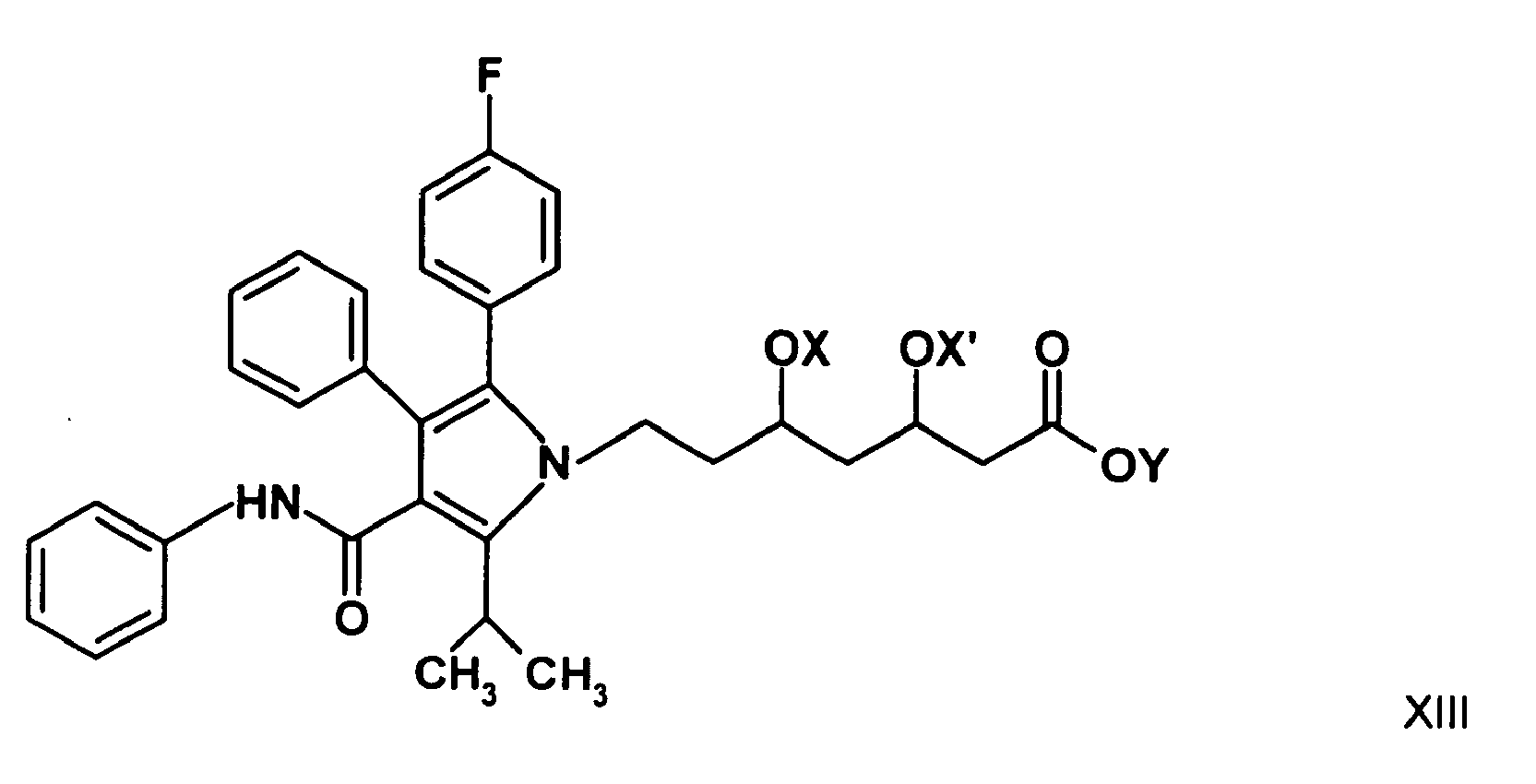
- the process of the present invention preferably further comprises the step of reducing, in particular hydrating the compound of the formula IX to obtain a compound of the formula XIII wherein X and Y are defined as above, X' is a hydroxy protecting group or X and X' taken together may form a ring with the oxygen and intermediate carbon atoms to which they are attached, optionally deprotecting any protected groups, and optionally converting the compound of the formula XIII into a salt thereof.
- the compound of the formula I has preferably the formula I'
- the present invention further relates to compounds of the formula XIV wherein Y' is a carboxy protecting group; of the formula XV wherein X is H or a hydroxy protecting group and A - is an anion; of the formula XVI wherein X is H or a hydroxy protecting group; and of the formula XVII wherein X is H or a hydroxy protecting group and A - is an anion.
- the process of the present invention is a process for the preparation of a pyrrole derivative of the formula XVIII or a salt thereof, wherein R 1 is selected from hydrogen, branched and/or cyclic, saturated or unsaturated C 1-10 alkyl residue or aryl residue, both residues being optionally substituted with 1-3 optionally protected hydroxy or carboxy groups, 1-3 - OR 2 residues, 1-3 -NR 3 R 4 residues and/or 1-3 halogen atoms, the C 1-10 alkyl residue optionally comprising 1-3 oxygen atoms, 1-3 nitrogen atoms and/or 1-3 - NR 5 - residues, the C 1-10 alkyl residue further optionally comprising or being substituted with 1 or 2 aryl residues, R 2 , R 3 , R 4 and R 5 are independently selected from R 1 as defined above, X and X' are independently H or a hydroxy protecting group or X and X' taken together may form a ring with the oxygen and intermediate carbon
- the compound of the formula XX can be obtained by reacting a compound of the formula XXI wherein X" is a hydroxy protecting group and Y' is a carboxy protecting group, with a compound of the formula XI wherein Y' is defined as above, to obtain a compound of the formula XXII wherein X is H or a hydroxy protecting group and Y' is defined as above, reducing, preferably hydrogenating the compound of formula XXII to obtain a compound of the formula XXIII wherein X and X' are independently H or a hydroxy protecting group or X and X' taken together may form a ring with the oxygen and intermediate carbon atoms to which they are attached; and converting the NC- residue in the compound of formula XXIII into a H 2 N- residue.
- the compound of formula XXIII is wherein R' is C 1-10 alkyl or aryl, preferably phenyl.
- the obtained pyrrole derivative of the formula XVIII may subsequently be converted into astorvastatin.
Landscapes
- Chemical & Material Sciences (AREA)
- Organic Chemistry (AREA)
- Chemical Kinetics & Catalysis (AREA)
- General Chemical & Material Sciences (AREA)
- Pyrrole Compounds (AREA)
- Organic Low-Molecular-Weight Compounds And Preparation Thereof (AREA)
Abstract
Description
- The present invention relates to a process for preparing C5 intermediates useful for preparing pyrrole derivatives of a class that is effective at inhibiting the biosynthesis of cholesterol in humans, and more particularly to improved synthetic methods for preparing 3,5-dihydroxy-7-pyrrol-1-yl heptanoic acids from 1,4-diketo starting materials. The invention further relates to intermediates in this process.
- It is known that certain 3,5-dihydroxy heptanoic acid derivatives are competitive inhibitors of the 3-hydroxy-3-methyl-glutaryl-coenzyme A ("HMG-CoA"). HMG-CoA is a key enzyme in the biosynthesis of cholesterol in humans. Its inhibition leads to a reduction in the rate of biosynthesis of cholesterol. The first HMG-CoA inhibitor to be described is compactin ([1 S-[1α(R*), 7β, 8β(2S*, 4S*),8αβ]]-1,2,3,7,8a-hexahydro-7-methyl-8-[2-(tetrahydro-4-hydroxy-6-oxo-2H-pyran-2-yl)ethyl]-1-naphthalenyl 2-methylbutanoate), which was isolated from cultures of Penicillium in 1976. In 1987, lovastatin ([1S-[1α(R*),3α, 7β, 8β(2S*, 4S*),8αβ]]-1,2,3,7,8,8a-hexahydro-3,7-dimethyl-8-[2-(tetrahydro-4-hydroxy-6-oxo-2H-pyran-2-yl)ethyl]-1-naphthalenyl 2-methylbutanoiate) became the first HMG-CoA reductase inhibitor approved by the Food and Drug Administration (FDA) for treatment of hypercholesterolemia. Both compactin and lovastatin are derived from bacterial cultures. Two other naturally-derived HMG-CoA reductase inhibitors, simvastatin and pravastatin are structurally related to compactin and lovastatin.
- In 1987, it was reported in
U.S. patent No. 4,681,893 that compounds within a certain class of 3,5-dihydroxy-7-pyrrol-1-yl heptanoic acid (and the corresponding lactones) also were effective at inhibiting the HMG-CoA reductase enzyme. One such compound is [R(R*,R*)]-2-(4-fluorophenyl)-β,δ-dihydroxy-5-(1-methylethyl)-3-phenyl-4-[(phenylamino)carbonyl]-1H-pyrrole-1-heptanoic acid ("atorvastatin"), which was said to provide surprising inhibition inU.S. patent No. 5,273,995 . Atorvastatin later received FDA approval as an adjunct to a low cholesterol diet to reduce elevated levels of total cholesterol, low density lipoprotein cholesterol, apo B and triglycerides and to increase levels of high density lipoprotein cholesterol in patients with hyperlipidemia. - In contrast to compactin, lovastatin, simvastatin and pravastatin, there is no known fermentation culture that produces atorvastatin. It, and other 3,5-dihydroxy-7-pyrrol-1-yl heptanoic acids, must be synthesized by traditional synthetic methods.
- A number of processes for the synthesis of 3,5-trihydroxy-7-pyrrol-1-yl heptanoic acids and in particular atorvastatin are known. Some of the processes are concerned with the synthesis of the 3,5-dihydroxy heptanoic acid side chain of the pyrrole ring while others are concerned with the formation of the pyrrole ring.
- For example,
EP-A-0 330 172 teaches that the pyrrole ring can be formed by the Paal-Knorr reaction between an 1,4-diketone and a primary amine being a precursor of the 3,5-dihydroxy heptanoic acid side chain. The 1,4-diketone already bears those substituents required at the pyrrole ring of atorvastatin and in particular the (phenylamino)carbonyl group required at position 4 of the pyrrole ring. - It is, however, difficult to obtain the required 1,4-diketone comprising the amino carbonyl moiety in good yield and purity. Moreover, even when starting from a commercially available 1,4-diketone precursor comprising the required (phenylamino)carbonyl side chain, it turned out to be difficult, if not impossible, to replace the phenylamino residue by other residues such as alkoxy or aryloxy residues without cleavage of the diketone. This limits the possible variation of the substituents and makes a screening for new compounds for inhibiting the biosynthesis of cholesterol in humans difficult.
- Moreover, several approaches have been published to synthesize the C7 side chain on the 1 position of the pyrrole ring in atorvastatin. For example
EP-A-0 409 281 suggests to first prepare the required 2,3,4,5-substituted pyrrole derivative bearing a C3 substituent on position 1. This C3 substituent is then converted in a C5 substituent and subsequently into the desired C7 substituent. This has, however, the disadvantage that the chain extension has to be carried out on the pyrrole derivative with its various other substituents making the reaction difficult to handle and bearing the risk of a potential partial loss of the valuable pyrrole derivative. - Therefore, there is still a need for further methods of synthesizing pyrrole derivatives and in particular intermediates for the preparation of 3,5-dihydroxy-7-pyrrole-1-yl heptanoic acids having HMG-CoA inhibitory activity.
- It has now been found that several of the prior art problems can surprisingly be overcome by certain C5 intermediates, the reaction of these C5 intermediates with certain 1,4-diketones to pyrroles having a C5 substituent on position 1 and subsequent chain extension of the C5 substituents to the desired C7 substituent. In particular it has been found that the required C5 intermediates can be synthesized in preparative scale starting from β-alanine or Boc-β-AlaOH according to the following reaction scheme 1.

- The advantage of this sequence is avoiding of additional purification of intermediate products. All reactions can be carried out at ambient conditions. The intermediate and final compounds have high purity (NMR).
- Therefore, the present invention relates to a process for the preparation of a compound of the formula I

- a) reacting a compound of the formula II


- b) reducing the compound of the formula IV to obtain a compound of the formula V

- c) optionally deprotecting the amino group and/or the carboxy group of the compound of the formula V, optionally protecting the hydroxy group of the compound of the formula V and/or optionally converting the resulting compound into a salt thereof.
- As protecting groups for the optionally protected hydroxy groups, the optionally protected carboxy groups and the optionally protected amino groups usual protecting groups known to the person skilled in the art may be used. Suitable protecting groups are exemplified in
WO 03/044011 - A preferred protecting group for Z and Z' is tert-butoxycarbonyl (Boc). Preferred protecting groups for Y and Y' are alkyl, aryl and aralkyl, such as straight, branched or cyclic C1-10 alkyl, preferably C1-6 alkyl, more preferably methyl, ethyl, iso-propyl or tert-butyl. Aryl can be for example phenyl or napththyl. Aralkyl can be for example aryl such as phenyl or naphthyl linked via a C1-10 alkylen, preferably C1-6 alkylen, such as benzyl.
- The reduction step (b) in the process of the present invention, which preferably is a hydrogenation step, can be carried out under chiral or achiral conditions. Under achiral conditions a mixture of the two enantiomers of the compound of formula I is obtained. If it is desired to obtain the compound in its chiral form comprising mainly only one of its enantiomers, the reduction step (b) can be carried out under chiral conditions, for example in the presence of a chiral catalyst. Preferably the hydrogenation is carried out under homogenous achiral or chiral enantioselective conditions.
- Suitable catalysts may be selected from iridium, rhodium and ruthenium complexes, such as Rh[(dppb)COD]BF4 (wherein dppb = 1,4-bis(diphenylphosphino)butane and COD = 1,5-cyclooctadiene).
- Preferably the ligand in the Rh, Rn and Ir complexes should be chiral. For example the following ligands can be used for Rh, Ru and Ir catalyzed asymmetric hydrogenation:
- (R)-NORPHOS - (2R,3R)-(-)-2,3-bis(diphenylphosphanyl)-bicyclo[2.2.1]hept-5-ene.
- (R,R)-CHIRAPHOS = (2R,3R)-(-)Bis(diphenylphosphanyl)butane
- (R,R)-DEGUPHOS = (3R,4R)-(+)-1-Benzyl-3,4-bis(diphenylphosphanyl)pyrrolidine
- (R,R)-Me-DUPHOS = (-)-1,2-Bis[(2R,5R)-2,5-dimethylphospholanyl]benzene
- (R,R)-Et-DUPHOS = (-)-1,2-Bis[(2R,5R)-2,5-diethylphospholanyl]benzene
- (R,R)-DIPAMP = (1R,2R)-Bis[(2-methoxyphenyl)phenylphosphanyl]ethane
- (R,R)-bdpch = (1R,2R)-(trans)-1,2-Bis(diphenylphosphanyloxy)cyclohexane
- (S,S)-DIOP = (4S,5S)-(+)-4,5-Bis(diphenylphosphanylmyrthyl)-2,2-dimethyl-1,3-dioxolane
- Ph-β-Glup = Phenyl 4,6-O-benzylidene-2,3-bis(O-diphenylphosphanyl)-β-D-glucopyranoside
- (R)-BINAP = (R)-2,2'-Bis(diphenylphosphanyl)-1,1'-binapthyl
- (R)-Tol-BINAP = (R)-2,2'-Bis(di-p-tolylphosphanyl)-1,1'-binapthyl.
- For example Ru-BINAP catalysts as described in Tetrahedron Lett. 1991, 32, 4163 and
WO 95/18784 - In the above ligands the configuration is given as example only. It is understood that the skilled person will choose the configuration of the ligand such that the obtained hydrogenated product has the desired configuration.
- The hydrogenation can be carried out under usual conditions, for example in the presence of hydrogen at about room temperature, such as 25°C, under elevated pressure for example in the range of 20 - 80 bar, preferably 30 - 70 bar and in particular 40 - 50 bar. The reaction can be carried out in a suitable solvent, preferably a polar protic solvent, in particular a C1-6 alcohol, such as methanol or ethanol, or an ester, such as ethyl acetate. The reaction can be carried out until hydrogen consumption is finished.
- The compound of the formula I prepared by the process of the present invention is intended as intermediate for the preparation of pyrrole derivatives. These derivatives can be prepared by reacting the compound of the formula I with a diketone in a cyclization reaction to obtain the desired pyrrole derivative as described in more detail below. It has now surprisingly been found that if Y in the compound of the formula I is ethyl oligomerization may occur under specific cyclization conditions (elevated temperature, carboxylic acid catalysis). Surprisingly this problem does not occur with the corresponding tert-butyl ester. Therefore, Y in the compound of the formula I is preferably tert-butyl.
- However, when trying to synthesize the required tert-butyl ketoester of the formula IV starting from commercially available β-AlaOEtxHCl using traditional Knoevenagel reaction in the last step, while the desired ketoester was formed it was contaminated with about 15% tert-butyl acetoacetate. No reasonable method of purification was found.
- While the mono tert-butyl malonate required in the preparation of the intermediate compound of the formula III is commercially available, this compound is expensive and therefore not feasible for use in a commercial process. Therefore, the inventors tried to obtain the required mono tert-butyl malonate by reaction of Meldrum's acid with tert-butanol according to D.W. Brooks, et al., Tedrahedron Lett., 1984, 25, 4623-26 and S. Masayuki, et al., Tetrahedron Lett., 1997, 38, 4623-26 (see reaction scheme 2). It was found that refluxing of Meldrum's acid in excess of tert-butanol gives the desired mono tert-butyl malonate as the main product but also the cyclic compound depicted in scheme 2 as the side product in a ratio of about 30:1.

- Purification of mono tert-butyl malonate by distillation was unsuccessful since disproportionation of the material to di-tert-butyl malonate and malonic acid was observed.
- Surprisingly it was found that a fast purification of mono tert-butyl malonate via its ammonium salt is possible. This salt can be isolated with a yield of 86.7%. Treatment of this salt with hydrochloric acid affords pure (NMR) mono tert-butyl malonate with a yield of 94.3%.
- Therefore, the present invention also comprises a process for the preparation of a compound of the formula VI
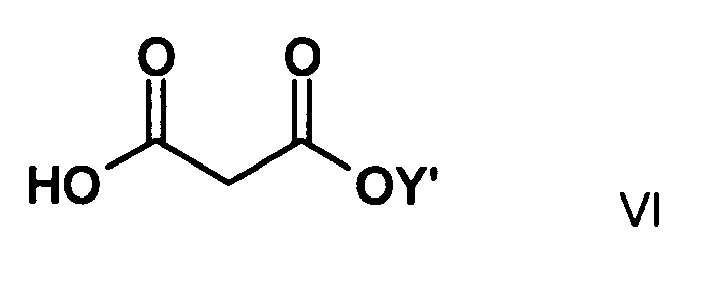

- In this process Y' preferably is tert-butyl.
- Advantageously this process is combined with the above process for the preparation of a compound of the formula I by converting the compound of the formula IV into its magnesium salt which is then used as intermediate of the formula III.
- In the process of the present invention for the preparation of the compound of the formula I reaction step (a) can be carried out under conditions as described for example in T. Honore, et al., Eur. J. Med. Chem. Chim. Ther., 1978, 13, 429-34.
- The compounds of the formula I are intended as intermediates for the preparation of pyrrole derivatives for example by cyclization of a diketone. Preferably the process of the present invention therefore comprises the further step of reacting the compound of the formula I, wherein Z is H, with a compound of the formula VII
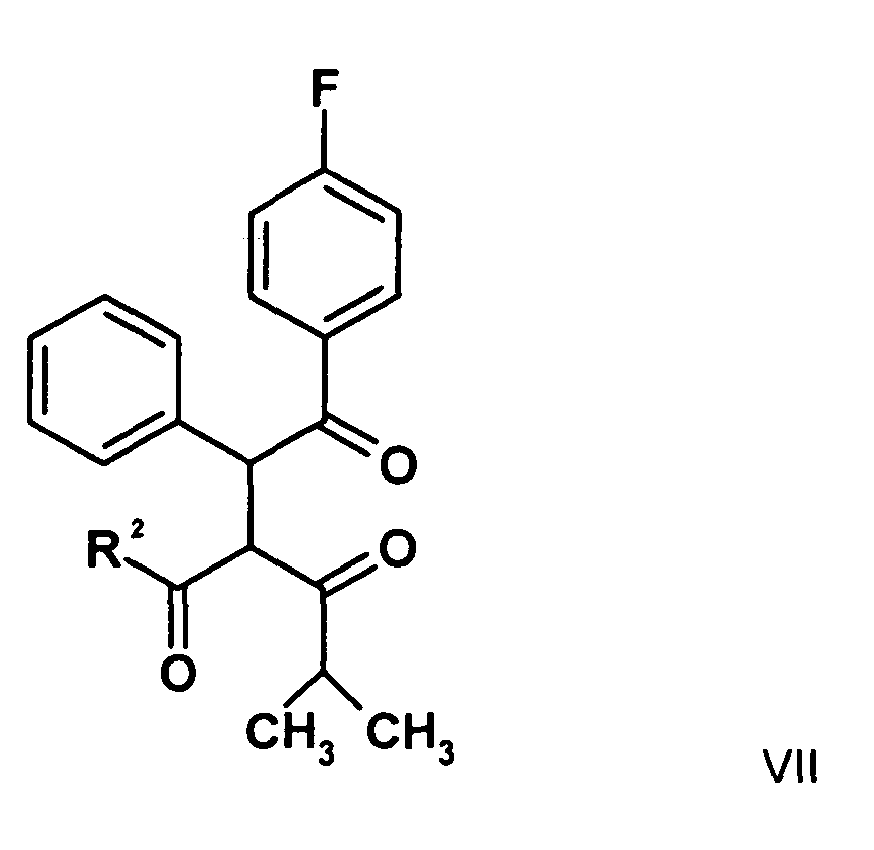

- One advantage of the process of the present invention is that if R2 is -OR3 or halogen the compound of the formula VII is easy to produce in good yield and purity. A further advantage is that if R2 is -OR3 or halogen the intermediate compound of the formula VII provides the possibility of easy substitution of the R2 residue, thereby providing higher flexibility for example for screening substituted pyrrole compounds for their pharmaceutical activity. This finding is particularly unexpected, since the corresponding known diketone anilide (2-[2-(4-fluorophenyl)-2-oxo-1-phenyl-ethyl]-4-methyl-3-oxo-pentanoic acid phenylamide) turned out to be stable to hydrolysis. It reacts with base and hydrogen peroxide not to the expected acid but it breaks to 1-(4-fluorophenyl)-2-phenylethan-1-one.
- This problem does not arise when using the corresponding diketone ester or acid halogenide.
- For R1, R3, R4, R5, R6, R7, R8, R9, R10, R11, R12, R13, R14, R15 and R16 the alkyl residue is preferably a straight or branched, saturated or unsaturated C1-6 alkyl residue or a cyclic C3-6 alkyl residue, such as methyl, ethyl, n-propyl, iso-propyl, n-butyl, iso-butyl, tert-butyl, pentyl, n-hexyl or cyclohexyl. Preferred aryl residues are phenyl and naphthyl, particularly preferred phenyl. The aryl residue furthermore includes heteroaryl residues such as pyrrole or pyridine.
- R2 preferably is -OR3 or halogen, in particular -OR3.
- In the present application halogen stands for fluoro, chloro, bromo or iodo, preferably chloro or bromo.
- The reaction between the diketo ester of the formula VII and the amine of the formula I can be carried out in any common inert solvent such as THF, preferably at elevated temperatures, such as, for example, under reflux. Further detailed reaction conditions can for example be found in
WO 2004/046105 ,WO 94/20492 EP-A-0 330 172 . For example, the reaction can be conducted under heating with azeotropical water removed in an appropriate solvent or mixture of solvents catalyzed with an acid, such as, for example, pivalic acid. As suitable solvents n-heptane, toluene and THF or mixtures thereof can be mentioned. Alternatively the reaction can be conducted without any solvent (neat) under heating the reactants to for example about 120°C to 140°C. - The compound of the formula VII can be obtained by
- a) reacting a compound of the formula XXIV

with 4-fluorobenzaldehyde or - b) reacting a compound of the formula XXV


- The above reaction route a) has the advantage that the compound of the formula XXIV wherein R2 is -OR3 can be easily purified by distillation. Thus, this intermediate can be employed in the following reaction in a highly pure form.
- The above reaction route b) has the advantage that the compound of the formula XXV can easily be obtained from the commercially available 2-[2-(4-fluorophenyl)-2-oxo-1-phenylethyl]-4-methyl-3-oxo-pentanoic acid phenylamide by cleavage with hydrogen peroxide in the presence of a base such as NaOH.
- Above reaction a) can for example be carried out under solvent-free conditions catalyzed by 2-(2-hydroxyethyl)-3-methyl-4-ethylthiazolium bromide in the presence of triethylamine under heating to for example to a temperature of about 60°C to about 80°C.
- In reaction route a) the compound of the formula XXIV can be obtained by reacting a compound of the formula XXVII

- If in the compound of the formula XXIV R2 is -OR3, this compound is heat-stable and can be distilled as to separate the desired compound of the formula XXIV from undesired byproducts of the reaction. In a preferred embodiment the reaction between the compound of the formula XXVII and benzaldehyde is catalyzed with β-alanine in the presence of acetic acid, preferably glacial acetic acid, in toluene. The reaction mixture is heated under reflux with azeotropic removal of water for about 24 hours. After usual workup the product can be distilled under reduced pressure.
- In the alternative embodiment according to above route b) the compound of the formula VII is obtained by reacting the compounds of the formula XXV and XXVI with each other. This addition reaction can be carried out in any suitable inert organic solvent, preferably anhydrous inert organic solvent, such as, for example, ethers, e.g. diethyl ether, 1,2-diethoxyethane, 1,2-dimethoxyethane, THF or mixtures thereof. Preferably the reaction is carried out in THF. The reaction temperature may be in the range of for example about 0°C to about 40°C, preferably from about 0°C to about room temperature.
- In a preferred embodiment the compound of the formula XXVI is prepared in situ.
- The compound of the formula XXV can be obtained by halogenating the compound of the formula XXVIII

- Halogenation, preferably bromination of the compound of the formula XXVIII can be carried out with for example bromine in an inert organic solvent, preferably an anhydrous inert organic solvent, such as, for example, halogenated lower alkane solvents, e.g. CCl4, CHCl3, 1,1-dichloroethane, 1,2-dichloroethane, methylene chloride, 1,1,2-trichloroethane or mixtures thereof. A preferred solvent is CHCl3. The reaction can be carried out for example at a temperature of about 0°C to about 40°C.
- The compound of the formula XXVIII can be obtained by cleavage of, for example, the commercially available 2-[2-(4-fluorophenyl)-2-oxo-1-phenyl-ethyl]-4-methyl-3-oxo-pentanoic acid phenylamide. The cleavage can be carried out for example with hydrogen peroxide in the presence of a base such as NaOH.
- A particularly advantageous route for the synthesis of a compound of the formula VII is shown in the following scheme 3:

- Advantages of the synthesis of diketone ethyl ester by this route are:
- no need of reaction solvent in step 2 (environmental, economic);
- no need of recrystallization process in step 1 (environmental, economic), product is isolated by distillation;
- this is the shortest synthetic route (only 2 steps) in comparison with other known processes (3-5 steps required);
- in the process for the step 1 nontoxic catalyst (β-alanine) is used (environmental);
- no need of toxic a corrosive reagents (like bromine in alternative route);
- all starting materials are commercially available.
- The obtained pyrrole derivatives of the formula VIII are useful intermediates in the preparation of atorvastatin. Therefore, the present invention also relates to a process which further comprises the step of converting the compound of the formula VIII into a compound of the formula IX

by either - a) converting the compound of the formula VIII into a compound of the formula X


- b) reacting the compound of the formula VIII with a compound of the formula XI to obtain a compound of the formula XII

- In this process the compound of the formula XI preferably is tert-butyl acetate.
- As the next step the process of the present invention preferably further comprises the step of reducing, in particular hydrating the compound of the formula IX to obtain a compound of the formula XIII
- In the process of the present invention the compound of the formula I has preferably the formula I'

- The present invention further relates to compounds of the formula XIV

of the formula XV
of the formula XVI
of the formula XVII
- These compounds are useful intermediates in the preparation of atorvastatin.
- In an alternative embodiment the process of the present invention is a process for the preparation of a pyrrole derivative of the formula XVIII

R2, R3, R4 and R5 are independently selected from R1 as defined above,
X and X' are independently H or a hydroxy protecting group or X and X' taken together may form a ring with the oxygen and intermediate carbon atoms to which they are attached; and
Y is H or a carboxy protecting group; which process comprises the steps of reacting a compound of the formula IXX

- In this alternative process the compound of the formula XX can be obtained by reacting a compound of the formula XXI


- Preferably the compound of formula XXIII is

- The obtained pyrrole derivative of the formula XVIII may subsequently be converted into astorvastatin.
- The present invention will now be further illustrated by the following examples which are not intended to be limiting.
- To a solution of 9.24 g (0.0489 mol) of Boc-β-AlaOH (1) in 110 ml of THF 8.72 g (0.0538 mol) of Im2CO were added by portions with stirring. The resulted solution was stirred for 2 h at RT after which 15.7 g (0.0548 mol) of Mg(O2CCH2CO2Et)2 were added. The mixture was stirred at RT overnight. It was concentrated on rotatory evaporator, and the residue was dissolved in AcOEt-water mixture. Water was separated and organic layer was washed with the excess of 2N NaHSO4 solution (till acidic washings), brine and dried over Na2SO4. Evaporation of the solution afforded 12.47 g (98.3 %) of keto ester 2 as yellowish oil which was used in the next stage without additional purification.
- 1H NMR, δ (ppm, CDCl3): 1.28 (t, 3H, J = 7.1 Hz, OCH2CH3), 1.43 (s, 9H, Me3), 2.79 (t, 2H, J = 5.8 Hz, 4-CH2), 3.32-3.42 (m, 2H, 5-CH2), 3.46 (s, 2H, 2-CH2), 4.2 (q, 2H, J = 7.1 Hz, OCH2CH3), 5.09 (broad s, 1H, NH).
- 13C NMR, δ (ppm, CDCl3): 14.26 (OCH2CH3), 28.54 (CMe3), 35.20 (4-CH2), 43.24 (2-CH2), 49.52 (5-CH2), 61.63 (OCH2CH3), 79.46 (CMe3), 156.02 (NCOO), 167.11 (COO), 202.57 (>C=O).
- Autoclave (30ml) was charged with 5.2 g (0.020 mol) of keto ester 2 and 7.3 mg (0.0101 mmol) of [Rh(dppb)COD]BF4 catalyst. The autoclave was deoxygenated by 4 vacuum-Ar cycles. Oxygen-free, dry AcOEt was added followed by H2 (50 bar initial pressure). During hydrogenation H2 was added maintaining the pressure in interval 40-50 bar. After 20 h hydrogen consumption finished. The resulted solution was evaporated and dried in vacuum affording 5.24 g (100%) of hydroxy ester 3 as yellowish oil which was used in the next stage without additional purification.
- 1H NMR, δ (ppm, CDCl3): 1.27 (t, 3H, J = 7.1 Hz, OCH2CH3), 1.44 (s, 9H, Me3), 1.51-1.72 (m, 2H, 4-CH2), 2.41-2.55 (m, 2H, 2-CH2), 2.99-3.27 (m, 1H, 5-CHaHb), 3.31-3.49 (m, 1 H, 5-CHaHb), 3.80 (broad s, 1 H, OH), 4.05-4.15 (m, 1 H, 3-CH), 4.16 (q, 2H, J = 7.1 Hz, OCH2CH3), 5.11 (broad s, 1H, NH).
- 13C NMR, δ (ppm, CDCl3): 14.39 (OCH2CH3), 28. 63 (CMe3), 36.85 (CH2), 37.53 (CH2), 41.73 (5-CH2), 60.91 (OCH2CH3), 66.18 (3-CH), 79.59 (CMe3), 156.94 (NCOO), 172.80 (COO).
- A solution of 5 g (0.0216 mol) of above compound 3 and 5 g (0.0263 mol) of p-TsOHxH2O in 20 ml of EtOH was kept at 70°C for 1 h. The solvent was evaporated. The residue was washed with Et2O and dried in vacuum to give 6.75 g (93.7%) of amino ester salt 4 as yellowish oil.
- 1H NMR, δ (ppm, CDCl3): 1.17 (t, 3H, J = 7.1 Hz, OCH2CH3), 1.59-1.71 (m, 2H, 4-CH2), 2.17-2.42 (m, 2H, 2-CH2), 2.31 (s, 3H, Me), 2.94-3.17 (m, 2H, 5-CH2), 4.01-4.14 8m, 1H, 3-CH), 4.04 (q, 2H, J = 7.1 Hz, OCH2CH3), 7.09 (d, 2H, J = 8 Hz, ArH), 7.25 (broad s, 1 H, OH), 7.37 (broad s, 2H, NH3), 7.70 (d, 2H, J = 8 Hz, ArH).
- 13C NMR, δ (ppm, CDCl3): 14.34 (OCH2CH3), 21.59 (Me), 32.94 (CH2), 38.46 (CH2), 41.89 (5-CH2), 60.93 (OCH2CH3), 66.98 (3-CH), 126.34 (CH), 129.40 (CH), 140.53 (C), 141.41 (C), 172.15 (COO).
- To a solution of 5.52 g (0.0292 mol) of Boc-β-AlaOH (1) in 60 ml of THF 5.21 g (0.0321 mol) of Im2CO were added by portions with stirring. The resulted solution was stirred for 2 h at RT after which 11.2 g (0.0327 mol) of Mg(O2CCH2CO2Bu-t)2 were added. The mixture was stirred at RT overnight. It was concentrated on rotatory evaporator, and the residue was dissolved in AcOEt-water mixture. Water was separated and organic layer was washed with the excess of 2N NaHSO4 solution (till acidic washings), brine and dried over Na2SO4. Evaporation of the solution afforded 7.80 g (93.0 %) of keto ester 5 as yellowish oil which was used in the next stage without additional purification.
- 1H NMR, δ (ppm, CDCl3): 1.47 (t, 9H, Me3), 1.43 (s, 9H, Me3), 2.77 (t, 2H, J = 5.6 Hz 4-CH2), 3.34-3.42 (m, 2H, 5-CH2), 3.38 (s, 2H, 2-CH2), 5.12 (broad s, 1H, NH).
13C NMR, δ (ppm, CDCl3): 28.16 (CMe3), 28.57 (CMe3), 35.21 (4-CH2), 43.14 (2-CH2), 50.84 (5-CH2), 82.43 (CMe3), 82.73 (CMe3), 166.49 (COO), 203.22 (>C=O). - Autoclave (30 ml) was charged with 2.9 g (0.0101 mol) of keto ester 5 and 7.3 mg (0.0101 mmol) of [Rh(dppb)COD]BF4 catalyst. The autoclave was deoxygenated by 4 vacuum-Ar cycles. Oxygen-free, dry AcOEt was added followed by H2 (50 bar initial pressure). During hyrogenation H2 was added maintaining the pressure in interval 40-50 bar. After 24 h hydrogen consumption finished. The resulted solution was evaporated and dried in vacuum affording 2.9 g (100 %) of hydroxy ester 6 as yellowish oil which was used in the next stage without additional purification.
- 1H NMR, δ (ppm, CDCl3): 1.44 (s, 9H, Me3), 1.46 (s, 9H, Me3), 1.48-1.72 (m, 2H, 4-CH2), 2.36-2.43 (m, 2H, 2-CH2), 3.11-3.26 (m, 1H, 5-CHaHb), 3.30-3.47 (m, 1 H, 5-CHaHb), 3.72 (broad s, 1H, OH), 4.00-4.10 (m, 1H, 3-CH), 5.07 (broad s, 1H, NH).
13C NMR, δ (ppm, CDCl3): 28.37 (CMe3), 28.69 (CMe3), 36.68 (CH2), 37.71 (CH2), 42.69 (5-CH2), 66.54 (3-CH), 79.54 (CMe3), 81.47 (CMe3), 156.83 (NCOO), 172.37 (COO). - A solution of 0.7 g (0.00242 mol) of above compound 6 and 0.56 g (0.00294 mol) of p-TsOHxH2O in 20 ml of EtOH was kept at 70°C for 1 h. The solvent was evaporated. The residue was washed with Et2O and dried in vacuum to give 0.87 g (99.5 %) of amino ester salt 7 as yellowish oil.
- 1H NMR, δ (ppm, CD3OD): 1.7-1.96 (m, 2H, 4-CH2), 2.40 (s, 3H, Me), 2.48-2.56 (m, 2H, 2-CH2), 3.03-3.17 (m, 2H, 5-CH2), 4.09-4.20 (m, 1 H, 3-CH), 7.28 (d, 2H, J = 8 Hz, ArH), 7.75 (d, 2H, J = 8 Hz, ArH).
13C NMR, δ (ppm, CDCl3): 21.17 (Me), 35.46 (CH2), 39.37 (CH2), 43.78 (5-CH2), 68.24 (3-CH), 127.75 (CH), 130.73 (CH), 142.72 (C), 144.09 (C), 174.15 (COO). - A mixture of benzaldehyde (33.8 g, 319 mmol), ethyl isobutyrylacetate (50.4 g, 319 mmol), β-alanine (1.0 g) and acetic acid (10 ml) in 600 ml of toluene was stirred and heated under reflux with azeotropic removal of water (Dean-Stark adapter) until GC analysis showed no presence of starting material (24 h). The solution was cooled, poured into ethylacetate (400 ml), washed with 1 M HCl solution (2 x 100 ml), saturated NaHCO3 solution (2 x 100 ml) and brine (100 ml) and dried over anhydrous Na2SO4. The solvent was removed under reduced pressure to yield 76.3 g of brown oil which was further distilled under reduced pressure (bp 105 - 120°C/0.06 mm Hg) to afford 58.9 g (75%) of ethyl 2-benzylidene-4-methyl-3-oxopentanoate as a mixture of isomers (major ~ 70%).
- To a stirred mixture of ethyl 2-benzylidene-4-methyl-3-oxopentanoate (52.5 g, 0.213 mol), 4-fluorobenzaldehyde (39.7 g, 0.320 mol) and 2-(2-hydroxyethyl)-3-methyl-4-ethylthiazolium bromide (8.11 g, 0.032 mol) was added dropwise triethylamine (21.3 ml). The solution turned dark and precipitation of solid particles was observed. A mixture was then heated at 70°C until the reaction mixture did not contain starting ethyl 2-benzylidene-4-methyl-3-oxopentanoate (HPLC monitoring). After cooling to room temperature, the mixture was diluted with ethylacetate (500 ml) and water (100 ml). The organic phase was washed with 1 M HCl solution (2 x 100 ml), saturated NaHCO3 solution (2 x 100 ml) and brine (100 ml) and dried over anhydrous Na2SO4. The solvent was removed under reduced pressure to yield 100.2 g of impure oily product which was then dissolved in dichloromethane (400 ml) and silicagel (50 g) was added. The mixture was stirred for 10 minutes and the silicagel was filtered off and washed with dichloromethane (500 ml). Air was bubbled through the combined filtrates for 24 hours in order to oxidize remaining 4-fluorobenzaldehyde. Additional 200 ml of dichloromethane was added to the reaction mixture to compensate losses due to evaporation and the solution was washed with saturated NaHCO3 solution (2 x 100 ml) and water (100 ml) and dried over anhydrous Na2SO4. The solvent was removed under reduced pressure to yield 87 g yellow oily product which slowly solidified. The oily product contains 85% of ethyl 2-[2-(4-fluorophenyl)-2-oxo-1-phenyl-ethyl]-4-methyl-3-oxopentanoate and the calculated yield was then 94%.
- A mixture of 50 g (0.347 mol) of Meldrum's acid and 100 ml of t-BuOH (Merck, for synthesis quality) was gently refluxed for 5 h with CaCl2 tube on the head of the reflux condenser. After cooling excess of t-BuOH and formed acetone were removed on rotatory evaporator. The residue was dissolved in ca. 200 ml of absolute EtOH, the solution was cooled in ice bath, and 26 ml of 25% ammonia solution (0.348 mol) were added. The volatiles were evaporated on rotor evaporater until solid residue was formed. This was triturated under 200 ml of ether, filtered and washed with the same volume of ether. Drying on air afforded 53.9 g (87.6%) of ammonium salt 7, m.p. 93-97°C. In CD3OD H-D exchange in CH2 group is observed. 1H NMR (CD3OD), δ (ppm): 1.49 (t-Bu); 3.09-3.31 (residual CH2 and CHD), 5.19 (H2O, DOH). 13C NMR (CD3OD), δ (ppm): 29.19 (Me), 47-48 (m, residual CHD), 82.6 (Me3 C), 171.5 and 175.3 (COO). Anal. Calcd for C7H15NO4: C, 47.45; H, 8.53; N, 7.90. Found: C, 47.01; H, 8.50; N, 8.03.
- A mixture of 50 g of ammonium salt 7 and 300 ml of ether was cooled in ice bath, and 100 ml of ca. 9% HCl solution was slowly added. After 30 min organic layer was separated and washed with brine (3x100 ml). Ether solution was dried over Na2SO4 and evaporated. The residue was dried in high vacuum till constant pressure. Yield 42.6 g (94.3%). 1H NMR (CDCl3), δ (ppm): 1.49 (s, 9H, Me3), 3.36 (s, 2H, CH2) 11.59 (broad s, 1H, COOH). 13C NMR (CDCl3), δ (ppm): 28.11 (Me), 42.32 (CH2), 83.12 (Me3 C), 166.43 and 172.47 (COO). Anal. Calcd for C7H12O4: C, 52.49; H, 7.55. Found: C, 51.81; H, 7.35.
Claims (22)
- Process for the preparation of a compound of the formula I
 a) reacting a compound of the formula II

 b) reducing the compound of the formula IV to obtain a compound of the formula V
 c) optionally deprotecting the amino group and/or the carboxy group of the compound of the formula V, optionally protecting the hydroxy group of the compound of the formula V and/or optionally converting the resulting compound into a salt thereof.
 - Process according to claim 1, wherein Z' is tert-butoxycarbonyl (Boc) and Y' is alkyl, aryl or aralkyl, preferably methyl, ethyl, iso-propyl or tert-butyl.
- Process according to any of the preceding claims, wherein the reduction step (b) is a hydrogenation which preferably is carried out in the presence of a chiral catalyst.
- Process according to claim 3, wherein the chiral catalyst is selected from chiral iridium, rhodium and ruthenium complexes.
- Process for the preparation of a compound of the formula VI


- Process according to any of claims 1-4, wherein the compound of the formula III is obtained by a process comprising the steps of claim 5 and converting the compound of the formula VI into the magnesium salt thereof.
- Process for preparing a compound of the formula I


- Process according to any of claims 1-4 or 6, which comprises the steps of claim 7.
- Process according to any of claims 1-4, 6 or 8, further comprising the step of reacting the compound of the formula I, wherein Z is H, with a compound of the formula VII

R3, R4, R5, R6, R7, R8, R9, R10, R11, R12, R13, R14, R15 and R16 are independently selected from hydrogen or a straight, branched and/or cyclic, saturated or unsaturated C1-10 alkyl residue or aryl residue, both residues being optionally substituted with 1-3 optionally protected hydroxy or carboxy groups, 1-3 -OR7 residues, 1-3 -NR8R9 residues and/or 1-3 halogen atoms, the C1-10 alkyl residue optionally comprising 1-3 oxygen atoms, 1-3 nitrogen atoms and/or 1-3 -NR6- residues, the C1-10 alkyl residue further optionally comprising or being substituted with 1 or 2 aryl residues, to obtain a compound of the formula VIII
- Process according to claim 9 further comprising the step of converting the compound of the formula VIII into a compound of the formula IX

by eithera) converting the compound of the formula VIII into a compound of the formula X
 b) reacting the compound of the formula VIII with a compound of the formula XI to obtain a compound of the formula XII
- Process of claim 10, wherein the compound of the formula XI is tert-butyl acetate.
- Process of claim 10 or 11, further comprising the step of reducing the compound of the formula IX to obtain a compound of the formula XIII

- Process according to any of claims 1-4, 6 and 8-12, wherein the compound of the formula I has the formula I'

- Compound of the formula XIV

- Compound of the formula XV

- Compound of the formula XVI

- Compound of the formula XVII

- Use of a compound of any of claims 14-17 for the preparation of atorvastatin.
- Process for the preparation of a pyrrole derivative of the formula XVIII

R2, R3, R4 and R5 are independently selected from R1 as defined above,
X and X' are independently H or a hydroxy protecting group or X and X' taken together may form a ring with the oxygen and intermediate carbon atoms to which they are attached; and
Y is H or a carboxy protecting group; which process comprises the steps of reacting a compound of the formula IXX

- Process according to claim 19, wherein the compound of the formula XX is obtained by reacting a compound of the formula XXI


- Process according to claim 20, wherein the compound of formula XXIII is

- Process according to any of claims 19-21, wherein the pyrrol derivative of formula XVIII is converted into atorvastatin.
Priority Applications (1)
| Application Number | Priority Date | Filing Date | Title |
|---|---|---|---|
| EP05006577A EP1705175A1 (en) | 2005-03-24 | 2005-03-24 | Process for preparing C5 products and their use for Atorvastatin synthesis |
Applications Claiming Priority (1)
| Application Number | Priority Date | Filing Date | Title |
|---|---|---|---|
| EP05006577A EP1705175A1 (en) | 2005-03-24 | 2005-03-24 | Process for preparing C5 products and their use for Atorvastatin synthesis |
Publications (1)
| Publication Number | Publication Date |
|---|---|
| EP1705175A1 true EP1705175A1 (en) | 2006-09-27 |
Family
ID=35355840
Family Applications (1)
| Application Number | Title | Priority Date | Filing Date |
|---|---|---|---|
| EP05006577A Withdrawn EP1705175A1 (en) | 2005-03-24 | 2005-03-24 | Process for preparing C5 products and their use for Atorvastatin synthesis |
Country Status (1)
| Country | Link |
|---|---|
| EP (1) | EP1705175A1 (en) |
Cited By (2)
| Publication number | Priority date | Publication date | Assignee | Title |
|---|---|---|---|---|
| KR100763770B1 (en) | 2006-05-29 | 2007-10-08 | 조동옥 | Method for preparing optically active intermediates useful for atorvastatin synthesis |
| WO2007131528A1 (en) * | 2006-05-15 | 2007-11-22 | Ratiopharm Gmbh | Process for preparing c5 intermediates and their use in the preparation of n-substituted pyrrole derivatives |
Citations (5)
| Publication number | Priority date | Publication date | Assignee | Title |
|---|---|---|---|---|
| EP0652213A1 (en) * | 1993-10-06 | 1995-05-10 | SUMIKA FINE CHEMICALS Co., Ltd. | Method for producing alkyl 3-phthalidylideneacetate |
| US5599954A (en) * | 1995-01-27 | 1997-02-04 | Takasago International Corporation | N-substituted-7-amino-5-hydroxy-3-oxoheptanoic acid derivatives and method for producing the same |
| WO2002055519A2 (en) * | 2001-01-09 | 2002-07-18 | Warner Lambert Co | Novel process for the synthesis of 5-(4-fluorophenyl)-1-[2-((2r, 4r)-4-hydroxy -6-oxo-tetrahydro-pyran-2-yl)-ethyl]-2-isopropyl-4-phenyl-1h-pyrrole-3-carboxylic acid phenylamide |
| US20040072893A1 (en) * | 2001-01-19 | 2004-04-15 | Sumitra Srinath | Process for the synthesis of atorvastatin form v and phenylboronates as intermediate compounds |
| WO2004106299A2 (en) * | 2003-05-30 | 2004-12-09 | Ranbaxy Laboratories Limited | Substituted pyrrole derivatives and their use as hmg-co inhibitors |
-
2005
- 2005-03-24 EP EP05006577A patent/EP1705175A1/en not_active Withdrawn
Patent Citations (5)
| Publication number | Priority date | Publication date | Assignee | Title |
|---|---|---|---|---|
| EP0652213A1 (en) * | 1993-10-06 | 1995-05-10 | SUMIKA FINE CHEMICALS Co., Ltd. | Method for producing alkyl 3-phthalidylideneacetate |
| US5599954A (en) * | 1995-01-27 | 1997-02-04 | Takasago International Corporation | N-substituted-7-amino-5-hydroxy-3-oxoheptanoic acid derivatives and method for producing the same |
| WO2002055519A2 (en) * | 2001-01-09 | 2002-07-18 | Warner Lambert Co | Novel process for the synthesis of 5-(4-fluorophenyl)-1-[2-((2r, 4r)-4-hydroxy -6-oxo-tetrahydro-pyran-2-yl)-ethyl]-2-isopropyl-4-phenyl-1h-pyrrole-3-carboxylic acid phenylamide |
| US20040072893A1 (en) * | 2001-01-19 | 2004-04-15 | Sumitra Srinath | Process for the synthesis of atorvastatin form v and phenylboronates as intermediate compounds |
| WO2004106299A2 (en) * | 2003-05-30 | 2004-12-09 | Ranbaxy Laboratories Limited | Substituted pyrrole derivatives and their use as hmg-co inhibitors |
Non-Patent Citations (3)
| Title |
|---|
| HASHIGUCHI S ET AL: "BAKER'S YEAST REDUCTION OF N-PROTECTED METHYL 4-AMINO-3-OXOBUTANOATES AND 3-OXOPENTANOATES", SYNTHESIS, GEORG THIEME VERLAG, STUTTGART, DE, 1 April 1992 (1992-04-01), pages 403 - 408, XP000673065, ISSN: 0039-7881 * |
| HONORE, TAGE ET AL: "Syntheses and structure-activity studies of analogs of .gamma.-aminobutyric acid (GABA)", EUROPEAN JOURNAL OF MEDICINAL CHEMISTRY , 13(5), 429-34 CODEN: EJMCA5; ISSN: 0009-4374, 1978, XP002356838 * |
| RYU Y ET AL: "Self-condensation of activated malonic acid half esters: a model for the decarboxylative Claisen condensation in polyketide biosynthesis", TETRAHEDRON LETTERS, ELSEVIER, AMSTERDAM, NL, vol. 44, no. 40, 29 September 2003 (2003-09-29), pages 7499 - 7502, XP004453455, ISSN: 0040-4039 * |
Cited By (2)
| Publication number | Priority date | Publication date | Assignee | Title |
|---|---|---|---|---|
| WO2007131528A1 (en) * | 2006-05-15 | 2007-11-22 | Ratiopharm Gmbh | Process for preparing c5 intermediates and their use in the preparation of n-substituted pyrrole derivatives |
| KR100763770B1 (en) | 2006-05-29 | 2007-10-08 | 조동옥 | Method for preparing optically active intermediates useful for atorvastatin synthesis |
Similar Documents
| Publication | Publication Date | Title |
|---|---|---|
| EP1351963B1 (en) | A process for the synthesis of atorvastatin form v and phenylboronates as intermediate compounds | |
| US5489690A (en) | Process for trans-6[2-(substituted-pyrrol-1-yl)alkyl]pyran-2-one inhibitors of cholesterol synthesis | |
| EP0448552A1 (en) | IMPROVED PROCESS FOR $i(TRANS)-6- 2-(SUBSTITUTED-PYRROL-1-YL)ALKYL]PYRAN-2-ONE INHIBITORS OF CHOLESTEROL SYNTHESIS | |
| CZ283003B6 (en) | SYNTHESIS METHOD OF (4R-cis)-1,1-DIMETHYLETHYL-6-CYANOMETHYL-2,2- DIMETHYL-1,3-DIOXANE-4-ACETATE AND INTERMEDIATES FOR SUCH SYNTHESIS | |
| RU2335500C2 (en) | Method of production of mevalonic acid derivatives inhibiting hmg-coa reductase | |
| WO2007107276A2 (en) | Process for preparing c7 intermediates and their use in the preparation of n-substituted pyrrole derivatives | |
| US5430171A (en) | T-butyl (R)-(-)-4-cyano-3-hydroxybutyrate and process for preparing the same | |
| KR100407758B1 (en) | Process of lactonization in the preparation of statins | |
| US6278001B1 (en) | Method for preparing (+) compactin and (+) mevinolin analog compounds having a β-hydroxy-δ-lactone grouping | |
| US5599954A (en) | N-substituted-7-amino-5-hydroxy-3-oxoheptanoic acid derivatives and method for producing the same | |
| JP3076154B2 (en) | (3R, 5S) -3,5,6-trihydroxyhexanoic acid derivative and method for producing the same | |
| JP2009518335A (en) | 3-carboxy-2-oxo-1-pyrrolidine derivatives and their use | |
| WO2007131528A1 (en) | Process for preparing c5 intermediates and their use in the preparation of n-substituted pyrrole derivatives | |
| AU2006218267A1 (en) | An improved process for the preparation of atorvastatin and intermediates | |
| US6417389B1 (en) | Process for the preparation of HPB esters | |
| US20090012312A1 (en) | Process for Preparing Pyrrole Derivatives and Intermediates | |
| JP3802481B2 (en) | A new method of lactonization in the production of statins | |
| Güngör et al. | Synthesis of the naphthalenone, dihydroquinoline, and dihydrofuran derivatives | |
| JP4491074B2 (en) | Stereoselective process for producing nitroenamine compounds | |
| KR100529703B1 (en) | Chiral intermediate, process for the production thereof, and process for the production of atorvastatin | |
| EP2616454B1 (en) | Esters of hexanoic acids as intermediates for the preparation of atorvastatin | |
| KR0137884B1 (en) | Improved preparation of trans-6- [2- (substituted-pyrrole-1-yl) alkyl] pyran-2-one, a cholesterol synthesis inhibitor | |
| US20110065920A1 (en) | Process for preparing pentanoic diacid derivatives | |
| JP2001199949A (en) | Method for synthesizing optically active compound | |
| JP2008266154A (en) | Carboxylic acid esters derived from 5-ethyl-2-propylbenzyl alcohol and methods for their production |
Legal Events
| Date | Code | Title | Description |
|---|---|---|---|
| PUAI | Public reference made under article 153(3) epc to a published international application that has entered the european phase |
Free format text: ORIGINAL CODE: 0009012 |
|
| AK | Designated contracting states |
Kind code of ref document: A1 Designated state(s): AT BE BG CH CY CZ DE DK EE ES FI FR GB GR HU IE IS IT LI LT LU MC NL PL PT RO SE SI SK TR |
|
| AX | Request for extension of the european patent |
Extension state: AL BA HR LV MK YU |
|
| RIN1 | Information on inventor provided before grant (corrected) |
Inventor name: JEKER, NICOLAS Inventor name: DENIKE, KANE Inventor name: STOHANDL, JIRI Inventor name: FRANTISEK, JAROSLAV Inventor name: BOBAL, PAVEL Inventor name: KOENIG, GERD Inventor name: BOERNER, ARMIN Inventor name: KOROSTYLEV, ANDREI Inventor name: TARAROV, VITALI |
|
| 17P | Request for examination filed |
Effective date: 20070301 |
|
| AKX | Designation fees paid |
Designated state(s): AT BE BG CH CY CZ DE DK EE ES FI FR GB GR HU IE IS IT LI LT LU MC NL PL PT RO SE SI SK TR |
|
| AXX | Extension fees paid |
Extension state: YU Payment date: 20070314 Extension state: MK Payment date: 20070314 Extension state: LV Payment date: 20070314 Extension state: HR Payment date: 20070314 Extension state: BA Payment date: 20070314 Extension state: AL Payment date: 20070314 |
|
| 17Q | First examination report despatched |
Effective date: 20071107 |
|
| STAA | Information on the status of an ep patent application or granted ep patent |
Free format text: STATUS: THE APPLICATION IS DEEMED TO BE WITHDRAWN |
|
| 18D | Application deemed to be withdrawn |
Effective date: 20131001 |