EP1705159A1 - Infrared absorbent green glass composition and laminated glass including the same - Google Patents
Infrared absorbent green glass composition and laminated glass including the same Download PDFInfo
- Publication number
- EP1705159A1 EP1705159A1 EP20060111500 EP06111500A EP1705159A1 EP 1705159 A1 EP1705159 A1 EP 1705159A1 EP 20060111500 EP20060111500 EP 20060111500 EP 06111500 A EP06111500 A EP 06111500A EP 1705159 A1 EP1705159 A1 EP 1705159A1
- Authority
- EP
- European Patent Office
- Prior art keywords
- glass composition
- glass
- infrared absorbent
- transmittance
- mass
- Prior art date
- Legal status (The legal status is an assumption and is not a legal conclusion. Google has not performed a legal analysis and makes no representation as to the accuracy of the status listed.)
- Granted
Links
Images
Classifications
-
- C—CHEMISTRY; METALLURGY
- C03—GLASS; MINERAL OR SLAG WOOL
- C03C—CHEMICAL COMPOSITION OF GLASSES, GLAZES OR VITREOUS ENAMELS; SURFACE TREATMENT OF GLASS; SURFACE TREATMENT OF FIBRES OR FILAMENTS MADE FROM GLASS, MINERALS OR SLAGS; JOINING GLASS TO GLASS OR OTHER MATERIALS
- C03C3/00—Glass compositions
- C03C3/04—Glass compositions containing silica
- C03C3/076—Glass compositions containing silica with 40% to 90% silica, by weight
- C03C3/083—Glass compositions containing silica with 40% to 90% silica, by weight containing aluminium oxide or an iron compound
- C03C3/085—Glass compositions containing silica with 40% to 90% silica, by weight containing aluminium oxide or an iron compound containing an oxide of a divalent metal
- C03C3/087—Glass compositions containing silica with 40% to 90% silica, by weight containing aluminium oxide or an iron compound containing an oxide of a divalent metal containing calcium oxide, e.g. common sheet or container glass
-
- C—CHEMISTRY; METALLURGY
- C03—GLASS; MINERAL OR SLAG WOOL
- C03C—CHEMICAL COMPOSITION OF GLASSES, GLAZES OR VITREOUS ENAMELS; SURFACE TREATMENT OF GLASS; SURFACE TREATMENT OF FIBRES OR FILAMENTS MADE FROM GLASS, MINERALS OR SLAGS; JOINING GLASS TO GLASS OR OTHER MATERIALS
- C03C3/00—Glass compositions
- C03C3/04—Glass compositions containing silica
- C03C3/076—Glass compositions containing silica with 40% to 90% silica, by weight
- C03C3/095—Glass compositions containing silica with 40% to 90% silica, by weight containing rare earths
-
- C—CHEMISTRY; METALLURGY
- C03—GLASS; MINERAL OR SLAG WOOL
- C03C—CHEMICAL COMPOSITION OF GLASSES, GLAZES OR VITREOUS ENAMELS; SURFACE TREATMENT OF GLASS; SURFACE TREATMENT OF FIBRES OR FILAMENTS MADE FROM GLASS, MINERALS OR SLAGS; JOINING GLASS TO GLASS OR OTHER MATERIALS
- C03C4/00—Compositions for glass with special properties
- C03C4/02—Compositions for glass with special properties for coloured glass
-
- C—CHEMISTRY; METALLURGY
- C03—GLASS; MINERAL OR SLAG WOOL
- C03C—CHEMICAL COMPOSITION OF GLASSES, GLAZES OR VITREOUS ENAMELS; SURFACE TREATMENT OF GLASS; SURFACE TREATMENT OF FIBRES OR FILAMENTS MADE FROM GLASS, MINERALS OR SLAGS; JOINING GLASS TO GLASS OR OTHER MATERIALS
- C03C4/00—Compositions for glass with special properties
- C03C4/08—Compositions for glass with special properties for glass selectively absorbing radiation of specified wave lengths
- C03C4/082—Compositions for glass with special properties for glass selectively absorbing radiation of specified wave lengths for infrared absorbing glass
Definitions
- the present invention relates generally to an infrared absorbent green glass composition that is excellent in infrared absorptivity and has a high visible light transmittance, and to laminated glass including the same.
- the base glass composition thereof is so called soda-lime-silica glass.
- these glass sheets are installed in the windows of vehicles or buildings.
- the infrared absorbent glass sheets that have excellent infrared absorptivity.
- the lower limit of visible light transmittance has been specified to ensure visibility and therefore an infrared absorbent glass sheet that has a high visible light transmittance is desired.
- the visible light transmittance of windshield glass of automobiles is specified to be at least 70%.
- the iron oxides that are contained in a glass composition include FeO, which corresponds to divalent iron.
- the FeO intensively absorbs lights with wavelengths in the range of 550 to 1600 nm. Accordingly, when FeO is present, a glass composition can be obtained that has improved infrared absorptivity. Generally, the peak of the infrared absorption by FeO is about 1050 nm.
- Reference 1 discloses, as Composition No. 4 in Table 1, a glass composition having the following composition and transmittance: COMPOSITION: expressed in mass%, SiO 2 71.56%, Na 2 O 14.19%, K 2 O 0.05%, CaO 12.85%, MgO 0.16%, Al 2 O 3 0.25%, SO 3 0.17%, total iron expressed as Fe 2 O 3 0.606%, FeO expressed as Fe 2 O 3 0.270%, and the ratio of FeO expressed as Fe 2 O 3 to the total iron 0.446; and TRANSMITTANCE (at a thickness of 5 mm): light transmittance (LT A ) 68.8%, total solar infrared transmittance (TSIR) 10.8%, total solar energy transmittance (TSET) 37.7%, and total solar ultraviolet transmittance (TSUV) 43.8%.
- COMPOSITION expressed in mass%, SiO 2 71.56%, Na 2 O 14.19%, K 2 O 0.05%, CaO 12.85%, MgO 0.16%, Al 2 O 3 0.25%
- Reference 2 discloses infrared and ultraviolet absorbent soda-lime-silica glass that contains approximately 0.51 to 0.96 wt% of Fe 2 O 3 , approximately 0.15 to 0.33 wt% of FeO, and approximately 0.2 to 1.4 wt% of CeO 2 as main components.
- the energy saving such as, for example, reduction in electric energy that is required for air-conditioning etc.
- it is effective to reduce "the feeling of heat" that human beings sense on their skin due to the sunlight that passes through a glass sheet to enter a car or a room.
- the reduction of the feeling of heat can be achieved by increasing the absorption of lights with wavelengths of 1100 nm and longer.
- the absorption can be increased by increasing the content of FeO in a glass composition.
- simply increasing the content of FeO causes an increase in absorption in the visible light range at the same time. Accordingly, even if the feeling of heat can be reduced, the uses of the glass composition are limited.
- JP4(1992)-187539A discloses a glass composition that forms potash-lime-silica glass and thereby allows the absorption range of FeO contained therein to shift to the longer wavelength side.
- the potash-lime-silica glass however, has a problem of high raw material cost.
- JP60(1985)-215546A discloses a glass composition that have infrared absorptivity improved by using BaO that can shift the absorption range of FeO to the longer wavelength side, with the visible light transmittance being kept high.
- JP8(1996)-500811A discloses a glass composition containing Fe 2 O 3 and FeO.
- Reference 5 describes that "the presence of K 2 O can increase the infrared absorption of glass under given conditions" and "alkaline-earth oxides have a decisive effect in obtaining the characteristics of the glass according to the present invention.
- limiting the ratio of MgO to 2% or lower, preferably omitting it in the intended additive form in the glass of the present invention makes it possible to improve the infrared absorptivity".
- the content of CaO that is an alkaline-earth oxide is 10 wt% or less.
- the present applicants have disclosed an ultraviolet/infrared absorbent glass that contains 5 to 15 wt% CaO as well as iron oxide and CeO 2 as colorants, in WO99/25660A1 (Reference 6).
- Reference 6 describes that "CaO improves the durability of glass and is used for adjusting the viscosity and devitrification temperature in the glass forming process” and "it is necessary that total iron oxide (T-Fe 2 O 3 ) expressed as Fe 2 O 3 is 0.35 to 0.55%, FeO is 0.08 to 0.15%, and the ratio of FeO (expressed as Fe 2 O 3 ) / T- Fe 2 O 3 is in the range of at least 0.20 but lower than 0.27".
- the present applicants also have disclosed a glass composition that contains 5 to 15 wt% CaO as well as iron oxide and CeO 2 as colorants, in JP2003-119048A (Reference 7).
- Reference 7 describes that "when the glass composition of the present invention has both higher visible light transmittance and lower infrared transmittance, it is preferable that it contain 0.4 to 1% of T-Fe 2 O 3 and 0.01 to 0.40% of TiO 2 . This makes it possible to obtain glass with a visible light transmittance of at least 70% that is measured using the illuminant A, with the glass thickness being 1 to 6 mm" (Paragraph No. 0043).
- JP8(1996)-259279A discloses a technique of securing thermal insulation and transparency of laminated glass not by controlling the glass composition but instead by dispersing functional fine particles such as ITO (indium-tin oxide) in an interlayer film of the laminated glass.
- the laminated glass described in Example 3 of Reference 8 has a configuration in which ITO fine particles with diameters of 0.1 ⁇ m or smaller are dispersed in an interlayer thereof, and has a visible light transmittance T V of 76.3% and a solar radiation transmittance T S of 51.5%.
- the functional fine particles of, for instance, ITO are expensive, the cost for manufacturing the laminated glass disclosed in Reference 8 is high.
- the present invention is intended to provide an infrared absorbent green glass composition that is excellent in practicability and has improved infrared absorptivity while preventing the visible light transmittance from decreasing excessively by employing a different configuration from those of the conventional glass compositions and laminated glasses described above.
- the present invention also is intended to provide laminated glass including the above-mentioned infrared absorbent green glass composition.
- the infrared absorbent green glass composition of the present invention includes: the following components, expressed in mass%: 65 ⁇ SiO 2 ⁇ 75; 0 ⁇ B 2 O 3 ⁇ 5; 0 ⁇ Al 2 O 3 ⁇ 5; 0 ⁇ MgO ⁇ 2; 10 ⁇ CaO ⁇ 15; 0 ⁇ SrO ⁇ 10;0 ⁇ BaO ⁇ 10; 0 ⁇ Li 2 O ⁇ 5; 10 ⁇ Na 2 O ⁇ 15; 0 ⁇ K 2 O ⁇ 5; and 0 ⁇ TiO 2 ⁇ 0.5, where 10 ⁇ MgO + CaO + SrO + BaO ⁇ 20 and 10 ⁇ Na 2 O + K 2 O ⁇ 17.5; the following component, expressed in mass ppm: MnO 0 to 300 ppm; and the following components as colorants, expressed in mass %: 0.4 ⁇ T-Fe 2 O 3 ⁇ 1.0, where T-Fe 2 O 3 is total iron oxide expressed as Fe 2 O 3 ; and
- the wavelength T min at which a minimum transmittance is obtained in the range of 550 to 1700 nm is at least 1065 nm, while the transmittance T 1650 that is obtained at a wavelength of 1650 nm is not higher than the transmittance T 730 that is obtained at a wavelength of 730 nm.
- the basicity of glass is increased as compared to the conventional cases and thereby the wavelength of light that is absorbed by FeO, which is a colorant, is shifted to the longer wavelength side.
- the basicity of glass can be increased by increasing the content of an alkaline-earth oxide component whose ionic radius is relatively large, for example.
- attention was focused on MgO and CaO and a part or the whole of MgO is replaced by CaO.
- the part of CaO further may be replaced by SrO or BaO as required.
- the content of MgO is 0 mass% or more but less than 2 mass%
- the content of CaO, whose ionic radius is larger than that of MgO exceeds 10 mass% but is 15 mass% or less.
- Such a glass composition makes it possible to improve the infrared absorptivity while preventing the visible light transmittance from decreasing excessively. For example, it is possible to reduce the feeling of heat that human beings sense on their skin due to the sunlight that has passed through glass sheet formed of the above-mentioned glass composition.
- the content of an alkali oxide component whose ionic radius is relatively large also can be increased.
- a part of Na 2 O can be replaced by K 2 O within the range of the above-mentioned composition.
- the glass composition of the present invention may include CeO 2 as a colorant within the range of the above-mentioned composition.
- a glass composition can be obtained that has further improved ultraviolet absorptivity.
- SiO 2 is a main component forming a skeleton of glass.
- the content of SiO 2 is 65% or less, the glass has deteriorated durability.
- the content of SiO 2 exceeding 75% results in difficulty in melting the glass.
- the content of SiO 2 is 66.5% ⁇ SiO 2 ⁇ 69%.
- B 2 O 3 is not an essential component but a component that is used for improving the durability of glass or as a melting aid. B 2 O 3 also has an effect of enhancing ultraviolet absorption. When the content of B 2 O 3 exceeds 5%, the effect of decreasing the transmittance extends from the ultraviolet region to the visible region. This causes the glass to tend to assume a yellowish transmission color tone. Furthermore, it also causes a problem in the glass forming process due to, for example, volatilization of B 2 O 3 . Accordingly, the upper limit of B 2 O 3 content is 5%. The content of B 2 O 3 is preferably in the range of 0 to less than 2%. Al 2 O 3
- Al 2 O 3 is not an essential component but a component that improves the durability of glass.
- the content of Al 2 O 3 exceeds 5%, the glass tends to be difficult to melt. Furthermore, an excessively large content of Al 2 O 3 decreases the average linear expansion coefficient of glass and thereby impairs the strengthening effect. Accordingly, it is preferable that the content thereof be 2.5% or less.
- MgO is not an essential component but is a component that improves the durability of glass and is used for adjusting the devitrification temperature and viscosity in the glass forming process.
- the glass composition of the present invention may contain less than 2% of MgO. In order to improve the basicity of glass, however, it is preferable that MgO be omitted to the greatest possible extent.
- the content of MgO is preferably 1.5% or less, more preferably 0.75% or less, and further preferably 0.5% or less.
- CaO is an essential component that is used for improving the basicity of glass. CaO also improves the durability of glass while being used for adjusting the devitrification temperature and viscosity in the glass forming process. When the content of CaO is 10% or less, the effect of improving the basicity of glass is poor. On the other hand, CaO content exceeding 15% results in an increase in the devitrification temperature.
- the content of CaO therefore is preferably at least 11%, more preferably at least 12%.
- the mass ratio of CaO to MgO is preferably at least 7.5. This mass ratio is more preferably at least 10 and further preferably at least 30. The upper limit of this mass ratio is not particularly limited but can be 80.
- SrO and BaO are not essential components but may be added to improve the basicity of glass and to not only improve the durability of glass but also adjust the devitrification temperature and viscosity in the glass forming process. Since SrO and BaO are expensive materials, it is not preferable that their contents each exceed 10%.
- the total content of alkaline-earth oxides (MgO + CaO + SrO + BaO) is 10% or less, the required amount of CaO cannot be present. Furthermore, since it is necessary to increase the content of the alkali oxides to maintain the devitrification temperature and viscosity in the glass forming process, the durability of the glass deteriorates. On the other hand, the total exceeding 20% results in an increase in devitrification temperature and an increase in glass density, which cause difficulty in manufacturing the glass. It therefore is preferable that the total be less than 15%.
- Li 2 O, Na 2 O, and K 2 O are alkali oxides and are components that are used as accelerators for melting glass.
- the content of Na 2 O is less than 10% or when the total of the contents of Na 2 O and K 2 O is less than 10%, the melting acceleration effect is poor.
- the content of Na 2 O exceeds 15% or when the total of the contents of Na 2 O and K 2 O exceeds 17.5%, the durability of the glass deteriorates.
- the content of Na 2 O is 10% ⁇ Na 2 O ⁇ 14.5%.
- the total of the contents of Na 2 O and K 2 O is 11.5% ⁇ Na 2 O + K 2 O ⁇ 15%.
- K 2 O is an expensive material as compared to Na 2 O, it is preferable that the content of K 2 O not exceed 5%.
- Li 2 O Like K 2 O, Li 2 O also is an expensive material as compared to Na 2 O. It therefore is preferable that the content thereof not exceed 5%. Furthermore, in order to increase the basicity of glass, it is preferable that Li 2 O be not contained to the possible extent.
- TiO 2 In order to decrease the devitrification temperature of glass, a small amount of TiO 2 may be added. TiO 2 also is a component that absorbs ultraviolet rays. When the content of TiO 2 increases, the glass tends to assume a yellowish tint. Accordingly, the upper limit thereof is 0.5%.
- MnO is not an essential component but may be added in a small amount.
- the glass composition of the present invention includes Fe 2 O 3 and FeO and further may include CeO 2 at the same time.
- MnO is a component that is effective for adjusting the transmission color tone of glass and adjusting the FeO ratio. Accordingly, it is preferable that the glass composition of the present invention include MnO.
- the upper limit of MnO content therefore is 300 ppm. With respect to MnO, when the content thereof is at least approximately 50 ppm, MnO is considered as being "contained".
- the glass composition of the present invention contains iron oxides as a colorant.
- the iron oxides are present in the form of Fe 2 O 3 and FeO in glass.
- Fe 2 O 3 absorbs ultraviolet rays, while FeO absorbs infrared rays.
- the content of T-Fe 2 O 3 that is obtained by expressing the total amount of Fe 2 O 3 and FeO as Fe 2 O 3 is selected from the range of 0.4 to 1.0%.
- the mass ratio of FeO expressed as Fe 2 O 3 to T-Fe 2 O 3 is selected from the range of 20 to 44%.
- T-Fe 2 O 3 When the content of T-Fe 2 O 3 is less than 0.4%, infrared and ultraviolet absorption effects cannot be obtained satisfactorily. On the other hand, when the content exceeds 1.0%, the radiant heat of flame is absorbed considerably by the upper surface portion of molten glass in melting glass raw materials and thereby it is difficult to satisfactorily heat glass that is located near the bottom part of the melting furnace in melting the glass, and in addition, the glass would have an excessively high specific gravity. It is preferable that the content of T-Fe 2 O 3 exceed 0.65%.
- the FeO ratio is preferably at least 25%, more preferably at least 27%.
- an excessively high FeO ratio tends to cause silica-rich striae or silica scum. Accordingly, in the glass composition of the present invention, the FeO ratio is 44% or lower. It is preferable that this ratio be lower than 35%.
- T-Fe 2 O 3 and the FeO ratio can be adjusted suitably according to, for example, the thickness of the glass sheet to be formed, with consideration given to other characteristics.
- CeO 2 is not an essential component but is a component that is effective for ultraviolet absorption. In addition, it also is used for adjusting the transmission color tone of glass, as a colorant.
- the content of CeO 2 is preferably at least 0.1%. On the other hand, when the content of CeO 2 exceeds 2.0%, the absorption of visible light on the lower wavelength side increases excessively and thereby desired visible light transmittance and transmission color tone cannot be obtained. From this viewpoint, the content of CeO 2 is preferably 1.5% or less, more preferably 1.0% or less.
- the content of CeO 2 can be adjusted suitably according to, for example, the thickness of the glass sheet to be formed, with consideration given to other characteristics.
- the glass composition of the present invention may include other trace components in addition to the respective components described above.
- the trace components include NiO, Cr 2 O 3 , Mo 2 O 3 , ZnO, SnO 2 , and La 2 O 3 .
- the total amount of the trace components is 5% or less, preferably 2% or less.
- the preferred upper limit of the content of each trace component is 0.01% in the case of NiO, Cr 2 O 3 , and Mo 2 O 3 and 1% in the case of ZnO, SnO 2 , and La 2 O 3 .
- the glass composition of the present invention makes it possible to provide glass with various solar control properties according to the uses of the glass and the places where the glass is used, by adjusting the whole composition, with iron oxide being contained and other components such as CeO 2 being allowed to be contained as required.
- the total solar energy transmittance and the visible light transmittance depend mainly on iron oxide.
- the ultraviolet transmittance depends mainly on iron oxide, CeO 2 , and TiO 2 .
- the amount of shift of the absorption range of FeO depends mainly on the basicity of glass.
- the specific contents of the respective components that are contained in the glass composition of the present invention can be adjusted suitably according to, for example, the thickness of the glass sheet to be formed, with consideration given to other characteristics.
- an infrared absorbent green glass composition A (an infrared absorbent green glass sheet A) can be obtained that is formed into a sheet shape with a thickness of at least 1.3 mm but less than 2.5 mm and that has a visible light transmittance (Y A ) of at least 80%, which is measured with the illuminant A, as well as a total solar energy transmittance (T G ) of 62% or lower, by adjusting the above-mentioned composition suitably.
- an infrared absorbent green glass composition B (an infrared absorbent green glass sheet B) can be obtained that is formed into a sheet shape with a thickness between 2.5 mm and 6 mm and that has a visible light transmittance (Y A ) of at least 70%, which is measured with the illuminant A, as well as a total solar energy transmittance (T G ) of 55% or lower and an ultraviolet transmittance (T UV ) of 15% or lower, by adjusting the above-mentioned composition suitably
- the above-mentioned infrared absorbent green glass sheets can be formed by a general method of manufacturing a glass sheet.
- the wavelength T min at which the minimum transmittance is obtained in the range of 550 to 1700 nm is at least 1065 nm, while the transmittance T 1650 that is obtained at a wavelength of 1650 nm is not higher than the transmittance T 730 that is obtained at a wavelength of 730 nm.
- the wavelength T min can be at least 1070 nm and in some cases, at least 1075 nm or approximately 1100 nm.
- Such a glass composition is suitable for a large glass sheet to be used for laminated glass for vehicles.
- the laminated glass of the present invention includes at least two glass sheets that are bonded to each other, with a thermoplastic resin layer being interposed therebetween. At least one selected from the glass sheets is formed of an infrared absorbent green glass composition of the present invention.
- the at least two glass sheets that form the laminated glass may be made of an infrared absorbent green glass composition of the present invention.
- At least one selected from the above-mentioned glass sheets is formed of the above-mentioned infrared absorbent green glass composition A or the above-mentioned infrared absorbent green glass composition B.
- Such laminated glass is suitable as laminated glass for vehicles.
- the laminated glass of the present invention has a visible light transmittance (Y A ) of at least 70%, which is measured with the illuminant A, and a total solar energy transmittance (T G ) of 45% or lower.
- Y A visible light transmittance
- T G total solar energy transmittance
- the laminated glass of the present invention can be formed by a general method of manufacturing laminated glass.
- Tables 1 and 2 indicate the physical property values that were measured with respect to each glass sheet. In the tables, the total of the contents may not be 100% in some cases. This is because of the difference in number of significant figures.
- Y A denotes a visible light transmittance measured with the illuminant A of the standard of International Commission on Illumination (CIE)
- T G indicates a total solar energy transmittance
- T UV denotes an ultraviolet transmittance. More specifically, Y A and T G are values measured in accordance with the regulation of JIS R3106:1998, while T UV is a value measured in accordance with the regulation of ISO 9050:2003. T UV was measured using the solar spectrum of air mass 2 reported by Parry Moon and the wavelength range over which the measurement was carried out was 300 to 400 nm.
- T min denotes the wavelength at which the minimum transmittance was obtained in the range of 550 to 1700 nm
- T 730 indicates the transmittance obtained at a wavelength of 730 nm
- T 1650 indicates the transmittance obtained at a wavelength of 1650 nm.
- T min , T 730 , and T 1650 were determined from the spectral transmittance curve (in the range of 200 to 2500 nm) measured with respect to each glass sheet. The spectral curve was determined using a commercial spectrophotometer.
- T G total solar energy transmittance
- T UV ultraviolet transmittance
- T min wavelength at which the minimum transmittance was obtained in the range of 550 to 1700 nm
- T 730 transmittance obtained at a wavelength of 730 nm
- T 1650 transmittance obtained at a wavelength of 1650 nm * "Ex.” denotes Example.
- T G total solar energy transmittance
- Tuv ultraviolet transmittance
- T min wavelength at which the minimum transmittance was obtained in the range of 550 to 1700 nm
- T 730 transmittance obtained at a wavelength of 730 nm
- T 1650 transmittance obtained at a wavelength of 1650 nm * "C.Ex.” denotes Comparative Example.
- All Examples 1-1 to 1-8 contained at least 12% of CaO and had a FeO ratio of at least 27% and a CaO/MgO ratio of at least 30.
- T min was at least 1070 nm, while T 1650 was lower than T 730 .
- Comparative Examples 1-1 to 1-5 each contained approximately 8.8% of CaO and had a CaO/MgO ratio of approximately 2.8.
- T min was 1050 nm, while T 1650 was higher than T 730 .
- Comparative Example 1-6 contained 9.2% of CaO.
- T min was 1060 nm, which as shifted slightly from 1050 nm to the longer wavelength side.
- T 1650 was higher than T 730 , which was different from the glass compositions of the present invention. Conceivably, this was because the amount of shift in Comparative Example 1-6 was smaller than that in Examples 1-1 to 1-8 and was not sufficient to allow T 1650 to be lower than T 730 .
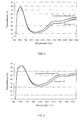
- FIG. 1 shows the spectral transmittance curves obtained in the single glass sheets (with a thickness of 3.9 mm) of Example 1-3 and Comparative Example 1-2.
- FIG. 2 shows the spectral transmittance curves obtained in the single glass sheets (with a thickness of 2.1 mm) of Example 1-5 and Comparative Example 1-4.
- each example had lower transmittance in the wavelength range of approximately 730 nm and longer, particularly, approximately 1100 nm and longer, as compared to each comparative example, respectively.
- Table 3 indicates physical property values that were measured with respect to each laminated glass.
- T G total solar energy transmittance
- T UV ultraviolet transmittance
- T min wavelength at which the minimum transmittance was obtained in the range of 550 to 1700 nm
- T 730 transmittance obtained at a wavelength of 730 nm
- T 1650 transmittance obtained at a wavelength of 1650 nm * "Ex.” denotes Example, while "C.Ex.” denotes Comparative Example.
- each of Examples 2-1 to 2-4 had a visible light transmittance (Y A ) of at least 70%, which satisfied the standard for the visible light transmittance of automobile windshield glass.
- T min was at least 1070 nm and T 1650 was lower than T 730 .
- T min was 1050 nm and T 1650 was higher than T 730 .
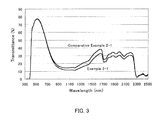
- FIG. 3 shows the spectral transmittance curves obtained in the laminated glasses (with a thickness of 2.1 mm + 2.1 mm) of Example 2-1 and Comparative Example 2-1.
- Example 2-1 had lower transmittance in the wavelength range of approximately 730 nm and longer, particularly, approximately 1100 nm and longer, as compared to Comparative Example 2-1.
- the following description is directed to the effect of reducing the feeling of heat that is caused by direct sunlight when the laminated glass formed using the glass composition of the present invention was used for windshield glass for automobiles.
- a filter was attached in the path of a light beam emitted from a xenon lamp (manufactured by SERIC LTD.; XC-500E), and thereby a light source with an energy distribution that is equivalent to that of sunlight was obtained.
- a panel with a hole whose diameter was 50 mm was placed 416 mm away from the light source.
- the back of a subject's hand was placed on the opposite side to the light source with respect to the hole and then was irradiated with the light.
- the temperature of the back of the subject's hand was measured with a thermoviewer every three seconds.
- the subject reported the feeling of heat that was sensed due to the light irradiation, in five levels; (1) a little warm, (2) warm, (3) a little hot, (4) hot, and (5) considerably hot.
- the feeling of heat was determined by integrating the results of experiments that were carried out with respect to 81 subjects.
- Example 2-1 and Comparative Example 2-1 were disposed in the hole of the above-mentioned panel. Then the quantity by which the temperature of human being's skin was raised due to the irradiation light was evaluated by the above-mentioned method. As a result, in the case of the laminated glass of Example 2-1, the quantity by which the skin temperature was raised after five minutes from the start of irradiation was about 3.2°C, which was at the level in which people did not have a feeling of "(5) considerably hot". On the other hand, in the case of the laminated glass of Comparative Example 2-1, the quantity was about 3.6°C, which was at the level in which people did have a feeling of "(5) considerably hot” or in the higher level.
- the laminated glass (corresponding to Example 3 of Reference 8) including an interlayer film that contained ITO fine particles dispersed therein, which is disclosed in Reference 8 described above.
- the quantity by which the skin temperature was raised was higher than that of the laminated glass of Example 2-1 by approximately 0.2°C.
- the laminated glass of the present invention was able to provide a greater effect of reducing the feeling of heat as compared to the laminated glass including an interlayer film that contained ITO fine particles dispersed therein.
- the present invention can provide an infrared absorbent green glass composition that has improved infrared absorptivity while preventing the visible light transmittance from decreasing excessively.
- a glass composition makes it possible to obtain a glass sheet and laminated glass that allow the feeling of heat, which is sensed by the human being's skin due to the sunlight that has passed through them, to be reduced, for example.
- Such a glass sheet and laminated glass can be used for various uses and are suitable particularly for glass for vehicles such as windshield glass for automobiles, etc.
Landscapes
- Chemical & Material Sciences (AREA)
- Life Sciences & Earth Sciences (AREA)
- Engineering & Computer Science (AREA)
- Chemical Kinetics & Catalysis (AREA)
- General Chemical & Material Sciences (AREA)
- Geochemistry & Mineralogy (AREA)
- Materials Engineering (AREA)
- Organic Chemistry (AREA)
- Glass Compositions (AREA)
Abstract
Description
- The present invention relates generally to an infrared absorbent green glass composition that is excellent in infrared absorptivity and has a high visible light transmittance, and to laminated glass including the same.
- Many of the glass sheets to be used for vehicles and buildings are manufactured by a float process. The base glass composition thereof is so called soda-lime-silica glass. Usually, these glass sheets are installed in the windows of vehicles or buildings. From a viewpoint of energy saving, there is demand for the infrared absorbent glass sheets that have excellent infrared absorptivity. With respect to the glass sheets that are used for vehicles such as automobiles, depending on the special locations where they are to be disposed, the lower limit of visible light transmittance has been specified to ensure visibility and therefore an infrared absorbent glass sheet that has a high visible light transmittance is desired. For example, in Japan, the visible light transmittance of windshield glass of automobiles is specified to be at least 70%.
- In order to improve the infrared absorptivity of soda-lime-silica glass, many techniques of utilizing the absorption by divalent iron (FeO) have been proposed (see, for instance,
JP1(1989 18938A JP3(1991)-187946A - Reference 1 discloses, as Composition No. 4 in Table 1, a glass composition having the following composition and transmittance: COMPOSITION: expressed in mass%, SiO2 71.56%, Na2O 14.19%, K2O 0.05%, CaO 12.85%, MgO 0.16%, Al2O3 0.25%, SO3 0.17%, total iron expressed as Fe2O3 0.606%, FeO expressed as Fe2O3 0.270%, and the ratio of FeO expressed as Fe2O3 to the total iron 0.446; and TRANSMITTANCE (at a thickness of 5 mm): light transmittance (LTA) 68.8%, total solar infrared transmittance (TSIR) 10.8%, total solar energy transmittance (TSET) 37.7%, and total solar ultraviolet transmittance (TSUV) 43.8%.
-
Reference 2 discloses infrared and ultraviolet absorbent soda-lime-silica glass that contains approximately 0.51 to 0.96 wt% of Fe2O3, approximately 0.15 to 0.33 wt% of FeO, and approximately 0.2 to 1.4 wt% of CeO2 as main components. - In order further to advance the energy saving such as, for example, reduction in electric energy that is required for air-conditioning etc., it is effective to reduce "the feeling of heat" that human beings sense on their skin due to the sunlight that passes through a glass sheet to enter a car or a room. The reduction of the feeling of heat can be achieved by increasing the absorption of lights with wavelengths of 1100 nm and longer. Generally, the absorption can be increased by increasing the content of FeO in a glass composition. However, simply increasing the content of FeO causes an increase in absorption in the visible light range at the same time. Accordingly, even if the feeling of heat can be reduced, the uses of the glass composition are limited.
- Hence, attempts have been made to improve the infrared absorptivity of a glass composition by shifting the absorption range of FeO to the longer wavelength side without reducing visible light transmittance excessively.
- For instance,
JP4(1992)-187539A -
JP60(1985)-215546A -
JP8(1996)-500811A WO94/14716A1 - Apart from these glass compositions, the present applicants have disclosed an ultraviolet/infrared absorbent glass that contains 5 to 15 wt% CaO as well as iron oxide and CeO2 as colorants, in
WO99/25660A1 - Furthermore, the present applicants also have disclosed a glass composition that contains 5 to 15 wt% CaO as well as iron oxide and CeO2 as colorants, in
JP2003-119048A - On the other hand,
JP8(1996)-259279A Reference 8 has a configuration in which ITO fine particles with diameters of 0.1 µm or smaller are dispersed in an interlayer thereof, and has a visible light transmittance T V of 76.3% and a solar radiation transmittance T S of 51.5%. However, since the functional fine particles of, for instance, ITO are expensive, the cost for manufacturing the laminated glass disclosed inReference 8 is high. In addition, it is difficult to apply the technique disclosed inReference 8 to a single glass sheet. - Hence, the present invention is intended to provide an infrared absorbent green glass composition that is excellent in practicability and has improved infrared absorptivity while preventing the visible light transmittance from decreasing excessively by employing a different configuration from those of the conventional glass compositions and laminated glasses described above. The present invention also is intended to provide laminated glass including the above-mentioned infrared absorbent green glass composition.
- The infrared absorbent green glass composition of the present invention includes:
the following components, expressed in mass%: 65 < SiO2 ≤ 75; 0 ≤ B2O3 ≤ 5; 0 ≤Al2O3 ≤ 5; 0 ≤ MgO < 2; 10 < CaO ≤ 15; 0 ≤ SrO ≤ 10;0 < BaO ≤ 10; 0 ≤ Li2O ≤ 5; 10 ≤ Na2O ≤ 15; 0 ≤ K2O ≤ 5; and 0 ≤ TiO2 ≤ 0.5, where 10 < MgO + CaO + SrO + BaO ≤ 20 and 10 ≤ Na2O + K2O ≤ 17.5;
the following component, expressed in mass ppm:MnO 0 to 300 ppm; and
the following components as colorants, expressed in mass %: 0.4 ≤ T-Fe2O3 ≤ 1.0, where T-Fe2O3 is total iron oxide expressed as Fe2O3; and 0 ≤ CeO2 ≤ 2.0. The mass ratio of FeO expressed as Fe2O3 to T-Fe2O3 (the FeO ratio: FeO/T-Fe2O3) is 20 to 44%. - In the glass composition of the present invention, the wavelength Tmin at which a minimum transmittance is obtained in the range of 550 to 1700 nm is at least 1065 nm, while the transmittance T 1650 that is obtained at a wavelength of 1650 nm is not higher than the transmittance T 730 that is obtained at a wavelength of 730 nm.
- In the glass composition of the present invention, the basicity of glass is increased as compared to the conventional cases and thereby the wavelength of light that is absorbed by FeO, which is a colorant, is shifted to the longer wavelength side. The basicity of glass can be increased by increasing the content of an alkaline-earth oxide component whose ionic radius is relatively large, for example. In the glass composition of this invention, attention was focused on MgO and CaO, and a part or the whole of MgO is replaced by CaO. The part of CaO further may be replaced by SrO or BaO as required. Specifically, while the content of MgO is 0 mass% or more but less than 2 mass%, the content of CaO, whose ionic radius is larger than that of MgO, exceeds 10 mass% but is 15 mass% or less.
- Such a glass composition makes it possible to improve the infrared absorptivity while preventing the visible light transmittance from decreasing excessively. For example, it is possible to reduce the feeling of heat that human beings sense on their skin due to the sunlight that has passed through glass sheet formed of the above-mentioned glass composition.
- In the glass composition of the present invention, in order to increase the basicity of glass, the content of an alkali oxide component whose ionic radius is relatively large also can be increased. Specifically, a part of Na2O can be replaced by K2O within the range of the above-mentioned composition.
- The glass composition of the present invention may include CeO2 as a colorant within the range of the above-mentioned composition. In this case, a glass composition can be obtained that has further improved ultraviolet absorptivity.
- FIG. 1 is a graph showing the spectral transmittance curves of Example Sample 1-3 and Comparative Example Sample 1-2 that were measured in Examples.
- FIG. 2 is a graph showing the spectral transmittance curves of Example Sample 1-5 and Comparative Example Sample 1-4 that were measured in Examples.
- FIG. 3 is a graph showing the spectral transmittance curves of Example Sample 2-1 and Comparative Example Sample 2-1 that were measured in Examples.
- Both the units "%" and "ppm" that are used for indicating the contents of components are based on mass.
- The reasons for limiting the composition of the glass composition according to the present invention are described below. SiO 2
- SiO2 is a main component forming a skeleton of glass. When the content of SiO2 is 65% or less, the glass has deteriorated durability. On the other hand, the content of SiO2 exceeding 75% results in difficulty in melting the glass. Preferably, the content of SiO2 is 66.5% ≤ SiO2 < 69%. B 2 O 3
- B2O3 is not an essential component but a component that is used for improving the durability of glass or as a melting aid. B2O3 also has an effect of enhancing ultraviolet absorption. When the content of B2O3 exceeds 5%, the effect of decreasing the transmittance extends from the ultraviolet region to the visible region. This causes the glass to tend to assume a yellowish transmission color tone. Furthermore, it also causes a problem in the glass forming process due to, for example, volatilization of B2O3. Accordingly, the upper limit of B2O3 content is 5%. The content of B2O3 is preferably in the range of 0 to less than 2%. Al 2 O 3
- Al2O3 is not an essential component but a component that improves the durability of glass. When the content of Al2O3 exceeds 5%, the glass tends to be difficult to melt. Furthermore, an excessively large content of Al2O3 decreases the average linear expansion coefficient of glass and thereby impairs the strengthening effect. Accordingly, it is preferable that the content thereof be 2.5% or less.
- MgO is not an essential component but is a component that improves the durability of glass and is used for adjusting the devitrification temperature and viscosity in the glass forming process. The glass composition of the present invention may contain less than 2% of MgO. In order to improve the basicity of glass, however, it is preferable that MgO be omitted to the greatest possible extent. Specifically, the content of MgO is preferably 1.5% or less, more preferably 0.75% or less, and further preferably 0.5% or less.
- CaO is an essential component that is used for improving the basicity of glass. CaO also improves the durability of glass while being used for adjusting the devitrification temperature and viscosity in the glass forming process. When the content of CaO is 10% or less, the effect of improving the basicity of glass is poor. On the other hand, CaO content exceeding 15% results in an increase in the devitrification temperature. The content of CaO therefore is preferably at least 11%, more preferably at least 12%.
- In the glass composition of the present invention, in order to improve the basicity of glass satisfactorily, the mass ratio of CaO to MgO (CaO/MgO) is preferably at least 7.5. This mass ratio is more preferably at least 10 and further preferably at least 30. The upper limit of this mass ratio is not particularly limited but can be 80.
- SrO and BaO are not essential components but may be added to improve the basicity of glass and to not only improve the durability of glass but also adjust the devitrification temperature and viscosity in the glass forming process. Since SrO and BaO are expensive materials, it is not preferable that their contents each exceed 10%.
- When the total content of alkaline-earth oxides (MgO + CaO + SrO + BaO) is 10% or less, the required amount of CaO cannot be present. Furthermore, since it is necessary to increase the content of the alkali oxides to maintain the devitrification temperature and viscosity in the glass forming process, the durability of the glass deteriorates. On the other hand, the total exceeding 20% results in an increase in devitrification temperature and an increase in glass density, which cause difficulty in manufacturing the glass. It therefore is preferable that the total be less than 15%.
- Li2O, Na2O, and K2O are alkali oxides and are components that are used as accelerators for melting glass. When the content of Na2O is less than 10% or when the total of the contents of Na2O and K2O is less than 10%, the melting acceleration effect is poor. On the other hand, when the content of Na2O exceeds 15% or when the total of the contents of Na2O and K2O exceeds 17.5%, the durability of the glass deteriorates.
- Preferably, the content of Na2O is 10% ≤ Na2O < 14.5%. In this case, the total of the contents of Na2O and K2O is 11.5% ≤ Na2O + K2O ≤ 15%.
- As described above, in order to increase the basicity of glass, a part of Na2O may be replaced by K2O. However, since K2O is an expensive material as compared to Na2O, it is preferable that the content of K2O not exceed 5%.
- Like K2O, Li2O also is an expensive material as compared to Na2O. It therefore is preferable that the content thereof not exceed 5%. Furthermore, in order to increase the basicity of glass, it is preferable that Li2O be not contained to the possible extent.
- In order to decrease the devitrification temperature of glass, a small amount of TiO2 may be added. TiO2 also is a component that absorbs ultraviolet rays. When the content of TiO2 increases, the glass tends to assume a yellowish tint. Accordingly, the upper limit thereof is 0.5%.
- MnO is not an essential component but may be added in a small amount.
- The glass composition of the present invention includes Fe2O3 and FeO and further may include CeO2 at the same time. Hence, MnO is a component that is effective for adjusting the transmission color tone of glass and adjusting the FeO ratio. Accordingly, it is preferable that the glass composition of the present invention include MnO. However, when the content of MnO is excessively large, the influence of coloring (solarization) of MnO itself is exerted. The upper limit of MnO content therefore is 300 ppm. With respect to MnO, when the content thereof is at least approximately 50 ppm, MnO is considered as being "contained".
- The glass composition of the present invention contains iron oxides as a colorant. The iron oxides are present in the form of Fe2O3 and FeO in glass. Fe2O3 absorbs ultraviolet rays, while FeO absorbs infrared rays.
- The content of T-Fe2O3 that is obtained by expressing the total amount of Fe2O3 and FeO as Fe2O3 is selected from the range of 0.4 to 1.0%. The mass ratio of FeO expressed as Fe2O3 to T-Fe2O3 (the FeO ratio: FeO/T-Fe2O3) is selected from the range of 20 to 44%.
- When the content of T-Fe2O3 is less than 0.4%, infrared and ultraviolet absorption effects cannot be obtained satisfactorily. On the other hand, when the content exceeds 1.0%, the radiant heat of flame is absorbed considerably by the upper surface portion of molten glass in melting glass raw materials and thereby it is difficult to satisfactorily heat glass that is located near the bottom part of the melting furnace in melting the glass, and in addition, the glass would have an excessively high specific gravity. It is preferable that the content of T-Fe2O3 exceed 0.65%.
- When the FeO ratio is lower than 20%, the infrared absorption effect cannot be obtained satisfactorily. From this viewpoint, the FeO ratio is preferably at least 25%, more preferably at least 27%. On the other hand, an excessively high FeO ratio tends to cause silica-rich striae or silica scum. Accordingly, in the glass composition of the present invention, the FeO ratio is 44% or lower. It is preferable that this ratio be lower than 35%.
- The content of T-Fe2O3 and the FeO ratio can be adjusted suitably according to, for example, the thickness of the glass sheet to be formed, with consideration given to other characteristics.
- CeO2 is not an essential component but is a component that is effective for ultraviolet absorption. In addition, it also is used for adjusting the transmission color tone of glass, as a colorant.
- The content of CeO2 is preferably at least 0.1%. On the other hand, when the content of CeO2 exceeds 2.0%, the absorption of visible light on the lower wavelength side increases excessively and thereby desired visible light transmittance and transmission color tone cannot be obtained. From this viewpoint, the content of CeO2 is preferably 1.5% or less, more preferably 1.0% or less.
- Like iron oxides, the content of CeO2 can be adjusted suitably according to, for example, the thickness of the glass sheet to be formed, with consideration given to other characteristics.
- The glass composition of the present invention may include other trace components in addition to the respective components described above. Examples of the trace components include NiO, Cr2O3, Mo2O3, ZnO, SnO2, and La2O3. The total amount of the trace components is 5% or less, preferably 2% or less. The preferred upper limit of the content of each trace component is 0.01% in the case of NiO, Cr2O3, and Mo2O3 and 1% in the case of ZnO, SnO2, and La2O3.
- The glass composition of the present invention makes it possible to provide glass with various solar control properties according to the uses of the glass and the places where the glass is used, by adjusting the whole composition, with iron oxide being contained and other components such as CeO2 being allowed to be contained as required. The total solar energy transmittance and the visible light transmittance depend mainly on iron oxide. The ultraviolet transmittance depends mainly on iron oxide, CeO2, and TiO2. The amount of shift of the absorption range of FeO depends mainly on the basicity of glass. The specific contents of the respective components that are contained in the glass composition of the present invention can be adjusted suitably according to, for example, the thickness of the glass sheet to be formed, with consideration given to other characteristics.
- According to the present invention, an infrared absorbent green glass composition A (an infrared absorbent green glass sheet A) can be obtained that is formed into a sheet shape with a thickness of at least 1.3 mm but less than 2.5 mm and that has a visible light transmittance (YA) of at least 80%, which is measured with the illuminant A, as well as a total solar energy transmittance (TG) of 62% or lower, by adjusting the above-mentioned composition suitably.
- According to the present invention, an infrared absorbent green glass composition B (an infrared absorbent green glass sheet B) can be obtained that is formed into a sheet shape with a thickness between 2.5 mm and 6 mm and that has a visible light transmittance (YA) of at least 70%, which is measured with the illuminant A, as well as a total solar energy transmittance (TG) of 55% or lower and an ultraviolet transmittance (TUV) of 15% or lower, by adjusting the above-mentioned composition suitably
- The above-mentioned infrared absorbent green glass sheets can be formed by a general method of manufacturing a glass sheet.
- With glass sheets containing a glass composition according to the present invention, a laminated glass of the present invention can be formed. In the glass composition of the present invention, the wavelength T min at which the minimum transmittance is obtained in the range of 550 to 1700 nm is at least 1065 nm, while the transmittance T 1650 that is obtained at a wavelength of 1650 nm is not higher than the transmittance T 730 that is obtained at a wavelength of 730 nm. Furthermore, when the above-mentioned composition is adjusted suitably, the wavelength T min can be at least 1070 nm and in some cases, at least 1075 nm or approximately 1100 nm. Such a glass composition is suitable for a large glass sheet to be used for laminated glass for vehicles.
- The laminated glass of the present invention includes at least two glass sheets that are bonded to each other, with a thermoplastic resin layer being interposed therebetween. At least one selected from the glass sheets is formed of an infrared absorbent green glass composition of the present invention. The at least two glass sheets that form the laminated glass may be made of an infrared absorbent green glass composition of the present invention.
- Preferably, at least one selected from the above-mentioned glass sheets is formed of the above-mentioned infrared absorbent green glass composition A or the above-mentioned infrared absorbent green glass composition B. Such laminated glass is suitable as laminated glass for vehicles.
- Preferably, the laminated glass of the present invention has a visible light transmittance (YA) of at least 70%, which is measured with the illuminant A, and a total solar energy transmittance (TG) of 45% or lower.
- The laminated glass of the present invention can be formed by a general method of manufacturing laminated glass.
- Hereinafter, the present invention is described further in detail using examples. The present invention, however, is not limited by the following examples.
- Silica sand, dolomite, limestone, soda ash, salt cake, potassium carbonate, carbon, iron oxide, titanium oxide, cerium oxide, and blast furnace slag were mixed together in such a manner that the compositions of the glass to be obtained were those shown in Tables 1 and 2. Thus batches were prepared. Next, each batch thus prepared was melted with an electric furnace at 1450°C, and the glass melt obtained thereby was poured onto a stainless steel plate. This was cooled gradually to room temperature. Thus a glass sheet was obtained. The glass sheet thus obtained was formed and polished to have predetermined size and thickness so as to be suitable for the measurements of various physical properties thereof.
- Tables 1 and 2 indicate the physical property values that were measured with respect to each glass sheet. In the tables, the total of the contents may not be 100% in some cases. This is because of the difference in number of significant figures.
- In Tables 1 and 2, Y A denotes a visible light transmittance measured with the illuminant A of the standard of International Commission on Illumination (CIE), T G indicates a total solar energy transmittance, and T UV denotes an ultraviolet transmittance. More specifically, Y A and T G are values measured in accordance with the regulation of JIS R3106:1998, while T UV is a value measured in accordance with the regulation of ISO 9050:2003. T UV was measured using the solar spectrum of
air mass 2 reported by Parry Moon and the wavelength range over which the measurement was carried out was 300 to 400 nm. - In Tables 1 and 2, T min denotes the wavelength at which the minimum transmittance was obtained in the range of 550 to 1700 nm, T 730 indicates the transmittance obtained at a wavelength of 730 nm, and T 1650 indicates the transmittance obtained at a wavelength of 1650 nm. T min , T 730 , and T 1650 were determined from the spectral transmittance curve (in the range of 200 to 2500 nm) measured with respect to each glass sheet. The spectral curve was determined using a commercial spectrophotometer.
Table 1 Ex.1-1 Ex.1-2 Ex.1-3 Ex.1-4 Ex.1-5 Ex.1-6 Ex.1-7 Ex.1-8 SiO2 69.5 69.2 69.2 68.7 69.5 69.2 68.7 69.1 Al2O3 1.6 1.5 1.5 1.7 1.6 1.5 1.7 1.5 Na2O 14.1 14.2 14.2 12.3 14.2 14.2 12.3 12.3 MgO 0.4 0.4 0.4 0.4 0.4 0.4 0.4 0.4 CaO 12.0 12.5 12.4 12.3 12.1 12.5 12.3 12.0 K2O 0.5 0.5 0.5 3.0 0.5 0.5 3.0 3.0 TiO2 0.05 0.05 0.05 0.05 0.05 0.05 0.05 0.05 T-Fe2O3 0.95 0.90 0.87 0.74 0.78 0.78 0.78 0.78 CeO2 0.88 0.88 0.88 0.88 0.88 0.88 0.88 0.88 MnO (mass ppm) 200 180 180 190 190 190 180 180 CaO/MgO 30.0 31.3 31.0 30.8 30.3 31.3 30.8 30.0 FeO/T-Fe2O3 (%) 27.9 27.6 2 7.8 27.8 29.7 34.9 31.3 31.3 Sheet Thickness (mm) 3.5 3.9 3.9 4.8 2.1 2.1 2.1 2.1 YA (%) 72.4 71.6 72.3 71.9 81.5 80.4 81.4 81.4 TG (%) 43.2 42.0 42.2 42.0 60.6 57.4 59.6 60.2 TUV (%) 9.6 9.8 9.7 9.6 - - - Tmin (nm) 1070 1075 1075 1100 1070 1075 1100 1100 T730 (%) 40.0 38.5 39.0 38.7 61.2 56.9 60.0 60.0 T1650 (%) 39.8 37.0 37.3 37.1 60.3 55.9 58.8 58.8 * The contents of all the components other than MnO are indicated in mass%. YA: visible light transmittance; TG: total solar energy transmittance; TUV: ultraviolet transmittance; Tmin: wavelength at which the minimum transmittance was obtained in the range of 550 to 1700 nm; T730: transmittance obtained at a wavelength of 730 nm; and T1650: transmittance obtained at a wavelength of 1650 nm * "Ex." denotes Example. Table 2 C.Ex.1-1 C.Ex.1-2 C.Ex.1-3 C.Ex.1-4 C.Ex.1-5 C.Ex.1-6 SiO2 70.0 70.0 70.0 70.0 70.0 69.0 Al2O3 1.5 1.5 1.5 1.5 1.5 2.4 Na2O 14.2 14.3 14.3 14.3 14.3 15.2 MgO 3.2 3.2 3.3 3.2 3.2 1.6 CaO 8.8 8.7 8.8 8.8 8.8 9.2 K2O 0.5 0.5 0.5 0.5 0.5 0.7 TiO2 0.05 0.05 0.05 0.05 0.05 0.03 T-Fe2O3 0.90 0.85 0.70 0.78 0.78 0.78 CeO2 0.88 0.88 0.88 0.88 0.88 0.88 MnO (mass ppm) 170 200 200 180 200 200 CaO/MgO 2.8 2.7 2.7 2.8 2.8 5.8 FeO/T-Fe2O3 (%) 25.6 28.6 28.0 25.6 31.8 25.1 Sheet Thickness (mm) 3.5 3.9 4.8 2.1 2.1 4.0 YA (%) 72.5 71.7 72.0 82.1 80.6 73.3 TG (%) 45.6 44.4 44.3 63.9 59.6 44.9 TUV (%) 8.9 8.3 8.1 - - 9.3 Tmin (nm) 1050 1050 1050 1050 1050 1060 T730 (%) 40.1 40.9 40.6 63.1 57.6 41.2 T1650 (%) 48.5 42.1 41.7 66.4 61.0 43.5 * The contents of all the components other than MnO are indicated in mass%. YA: visible light transmittance; TG: total solar energy transmittance; Tuv: ultraviolet transmittance; Tmin: wavelength at which the minimum transmittance was obtained in the range of 550 to 1700 nm; T730: transmittance obtained at a wavelength of 730 nm; and T1650: transmittance obtained at a wavelength of 1650 nm * "C.Ex." denotes Comparative Example. - All Examples 1-1 to 1-8 contained at least 12% of CaO and had a FeO ratio of at least 27% and a CaO/MgO ratio of at least 30. In all Examples 1-1 to 1-8, Tmin was at least 1070 nm, while T1650 was lower than T730.
- On the other hand, Comparative Examples 1-1 to 1-5 each contained approximately 8.8% of CaO and had a CaO/MgO ratio of approximately 2.8. In all Comparative Examples 1-1 to 1-5, Tmin was 1050 nm, while T1650 was higher than T730.
- Comparative Example 1-6 contained 9.2% of CaO. In Comparative Example 1-6, T min was 1060 nm, which as shifted slightly from 1050 nm to the longer wavelength side. However, T 1650 was higher than T 730 , which was different from the glass compositions of the present invention. Conceivably, this was because the amount of shift in Comparative Example 1-6 was smaller than that in Examples 1-1 to 1-8 and was not sufficient to allow T1650 to be lower than T730.
- FIG. 1 shows the spectral transmittance curves obtained in the single glass sheets (with a thickness of 3.9 mm) of Example 1-3 and Comparative Example 1-2.
- FIG. 2 shows the spectral transmittance curves obtained in the single glass sheets (with a thickness of 2.1 mm) of Example 1-5 and Comparative Example 1-4.
- As shown in FIGs. 1 and 2, each example had lower transmittance in the wavelength range of approximately 730 nm and longer, particularly, approximately 1100 nm and longer, as compared to each comparative example, respectively.
- Next, two glass sheets, each of which had a thickness of 2.1 mm, that were obtained in the above-mentioned manner were bonded to each other with an interlayer film (polyvinyl butyral: PVB) according to a general method for manufacturing laminated glass. Thus, laminated glass was produced. Examples 1-5 to 1-8 correspond to Examples 2-1 to 2-4, while Comparative Examples 1-4 and 1-5 correspond to Comparative Examples 2-1 and 2-2.
- Table 3 indicates physical property values that were measured with respect to each laminated glass.
Table 3 Ex.2-1 Ex.2-2 Ex.2-3 Ex.2-4 C.Ex.2-1 C.Ex.2-2 SiO2 69.5 69.2 68.7 69.1 70.0 70.0 Al2O3 1.6 1.5 1.7 1.5 1.5 1.5 Na2O 14.2 14.2 12.3 12.3 14.3 14.3 MgO 0.4 0.4 0.4 0.4 3.2 3.2 CaO 12.1 12.5 12.3 12.0 8.8 8.8 K2O 0.5 0.5 3.0 3.0 0.5 0.5 TiO2 0.05 0.05 0.05 0.05 0.05 0.05 T-Fe2O3 0.78 0.78 0.78 0.78 0.78 0.78 CeO2 0.88 0.88 0.88 0.88 0.88 0.88 MnO (mass ppm) 190 190 180 180 180 200 CaO/MgO 30.3 31.3 30.8 30.0 2.8 2.8 FeO/T-Fe2O3 (%) 29.7 34.9 31.3 31.3 25.6 31.8 Sheet Thickness (mm) 2.1+2.1 2.1+2.1 2.1+2.1 2.1+2.1 2.1+2.1 2.1+2.1 YA (%) 71.8 70.1 71.6 71.6 72.9 70.2 TG (%) 44.0 40.6 42.1 42.1 45.5 42.3 TUV (%) - - - - - - Tmin (nm) 1070 1075 1100 1100 1050 1050 T730 (%) 40.5 34.9 39.0 39.0 43.3 35.9 T1650 (%) 35.3 32.8 34.2 37.3 47.7 40.2 * The contents of all the components other than MnO are indicated in mass%. YA: visible light transmittance; TG: total solar energy transmittance; TUV: ultraviolet transmittance; Tmin: wavelength at which the minimum transmittance was obtained in the range of 550 to 1700 nm; T730: transmittance obtained at a wavelength of 730 nm; and T1650: transmittance obtained at a wavelength of 1650 nm * "Ex." denotes Example, while "C.Ex." denotes Comparative Example. - As shown in Table 3, each of Examples 2-1 to 2-4 had a visible light transmittance (YA) of at least 70%, which satisfied the standard for the visible light transmittance of automobile windshield glass.
- Furthermore, in each of Examples 2-1 to 2-4, T min was at least 1070 nm and T 1650 was lower than T 730 .
- On the other hand, in both Comparative Examples 2-1 and 2-2, T min was 1050 nm and T 1650 was higher than T 730 .
- FIG. 3 shows the spectral transmittance curves obtained in the laminated glasses (with a thickness of 2.1 mm + 2.1 mm) of Example 2-1 and Comparative Example 2-1.
- As shown in FIG. 3, Example 2-1 had lower transmittance in the wavelength range of approximately 730 nm and longer, particularly, approximately 1100 nm and longer, as compared to Comparative Example 2-1.
- The following description is directed to the effect of reducing the feeling of heat that is caused by direct sunlight when the laminated glass formed using the glass composition of the present invention was used for windshield glass for automobiles.
- First, an evaluation was made with respect to the relationship between the range in which the human being's skin temperature is raised by incident sunlight and the feeling of heat sensed by the human being's skin. This was carried out by the following procedure.
- A filter was attached in the path of a light beam emitted from a xenon lamp (manufactured by SERIC LTD.; XC-500E), and thereby a light source with an energy distribution that is equivalent to that of sunlight was obtained. A panel with a hole whose diameter was 50 mm was placed 416 mm away from the light source. Subsequently, the back of a subject's hand was placed on the opposite side to the light source with respect to the hole and then was irradiated with the light. The temperature of the back of the subject's hand was measured with a thermoviewer every three seconds.
- The subject reported the feeling of heat that was sensed due to the light irradiation, in five levels; (1) a little warm, (2) warm, (3) a little hot, (4) hot, and (5) considerably hot. The feeling of heat was determined by integrating the results of experiments that were carried out with respect to 81 subjects.
- As a result, it was found out that there was a proportional relationship between the quantity by which the skin temperature was raised due to the light irradiation and the feeling of heat that was sensed actually by human beings, and the feeling of heat increased by one level for every increment of about 0.5°C to 0.7°C of the skin temperature. Furthermore, it also was proved that when the quantity by which the skin temperature was raised was set at 3.2°C or lower with respect to the skin temperature measured before the irradiation, people did not have a feeling of "(5) considerably hot".
- Each laminated glass of Example 2-1 and Comparative Example 2-1 was disposed in the hole of the above-mentioned panel. Then the quantity by which the temperature of human being's skin was raised due to the irradiation light was evaluated by the above-mentioned method. As a result, in the case of the laminated glass of Example 2-1, the quantity by which the skin temperature was raised after five minutes from the start of irradiation was about 3.2°C, which was at the level in which people did not have a feeling of "(5) considerably hot". On the other hand, in the case of the laminated glass of Comparative Example 2-1, the quantity was about 3.6°C, which was at the level in which people did have a feeling of "(5) considerably hot" or in the higher level.
- Furthermore, the same evaluation was made with respect to the laminated glass (corresponding to Example 3 of Reference 8) including an interlayer film that contained ITO fine particles dispersed therein, which is disclosed in
Reference 8 described above. As a result, the quantity by which the skin temperature was raised was higher than that of the laminated glass of Example 2-1 by approximately 0.2°C. Thus it was proved that the laminated glass of the present invention was able to provide a greater effect of reducing the feeling of heat as compared to the laminated glass including an interlayer film that contained ITO fine particles dispersed therein. - As described above, the present invention can provide an infrared absorbent green glass composition that has improved infrared absorptivity while preventing the visible light transmittance from decreasing excessively. Such a glass composition makes it possible to obtain a glass sheet and laminated glass that allow the feeling of heat, which is sensed by the human being's skin due to the sunlight that has passed through them, to be reduced, for example. Such a glass sheet and laminated glass can be used for various uses and are suitable particularly for glass for vehicles such as windshield glass for automobiles, etc.
Claims (17)
- An infrared absorbent green glass composition, comprising:the following components, expressed in mass%:
65 < SiO2 ≤ 75;
0 ≤B2O3 ≤ 5;
0≤Al2O3≤5;
0≤MgO<2;
10 < CaO ≤ 15;
0 ≤ SrO ≤ 10;
0≤ BaO ≤ 10;
0 ≤Li2O ≤5;
10 ≤ Na2O ≤ 15;
0 ≤ K2O ≤ 5; and
0 ≤ TiO2 ≤ 0.5,
where 10 < MgO + CaO + SrO + BaO ≤ 20 and 10 ≤ Na2O + K2O ≤ 17.5;
the following component, expressed in mass ppm;
MnO 0 to 300 ppm; and
the following components as colorants, expressed in mass %:
0.4 ≤ T-Fe2O3 ≤ 1.0,
where T-Fe2O3 is total iron oxide expressed as Fe2O3; and
0 ≤ CeO2 ≤ 2.0,
wherein a mass ratio of FeO expressed as Fe2O3 to T-Fe2O3 (FeO/T-Fe2O3) is 20 to 44%,a wavelength at which a minimum transmittance is obtained in a range of 550 to 1700 nm is at least 1065 nm, anda transmittance that is obtained at a wavelength of 1650 nm is not higher than a transmittance that is obtained at a wavelength of 730 nm. - The infrared absorbent green glass composition according to claim 1, wherein a mass ratio of CaO to MgO (CaO/MgO) is at least 7.5.
- The infrared absorbent green glass composition according to claim 2, wherein the mass (CaO/MgO) is at least 30.
- The infrared absorbent green glass composition according to claim 1, wherein the range of MgO, expressed in mass%, is:
0 ≤ MgO ≤ 1.5. - The infrared absorbent green glass composition according to claim 4, wherein the range of MgO, expressed in mass%, is:
0 ≤ MgO ≤ 0.75. - The infrared absorbent green glass composition according to claim 1, wherein the range of CaO, expressed in mass%, is:
11 ≤ CaO ≤ 15. - The infrared absorbent green glass composition according to claim 1, wherein the range of SiO2, expressed in mass%, is:
66.5 ≤ SiO2 < 69. - The infrared absorbent green glass composition according to claim 1, wherein the ranges of Na2O and Na2O + K2O, expressed in mass%, are:
10 ≤ Na2O < 14.5; and
11.5 ≤ Na2O + K2O ≤ 15. - The infrared absorbent green glass composition according to claim 1, wherein the range of T-Fe2O3, expressed in mass%, is:
0.65 < T-Fe2O3 ≤ 1.0. - The infrared absorbent green glass composition according to claim 1, wherein the range of CeO2, expressed in mass%, is:
0.1 ≤ CeO2 ≤ 1.5. - The infrared absorbent green glass composition according to claim 10, wherein the range of CeO2, expressed in mass%, is:
0.1 ≤ CeO2 ≤ 1.0. - The infrared absorbent green glass composition according to claim 1, comprising MnO.
- The infrared absorbent green glass composition according to claim 1, wherein the infrared absorbent green glass composition is formed into a sheet shape with a thickness of at least 1.3 mm but less than 2. 5 mm, and
the infrared absorbent green glass composition has a visible light transmittance (YA) of at least 80%, which is measured with the illuminant A, and a total solar energy transmittance (TG) of 62% or lower. - The infrared absorbent green glass composition according to claim 1, wherein the infrared absorbent green glass composition is formed into a sheet shape with a thickness between 2.5 mm and 6 mm, and
the infrared absorbent green glass composition has a visible light transmittance (YA) of at least 70%, which is measured with the illuminant A, a total solar energy transmittance (TG) of 55% or lower, and an ultraviolet transmittance (TUV) of 15% or lower. - A laminated glass, comprising at least two glass sheets that are bonded to each other, with a thermoplastic resin layer being interposed therebetween,
wherein at least one selected from the at least two glass sheets is formed of an infrared absorbent green glass composition according to claim 1. - The laminated glass according to claim 15, wherein the at least two glass sheets are formed of an infrared absorbent green glass composition according to claim 1.
- The laminated glass according to claim 15, wherein the laminated glass has a visible light transmittance (YA) of at least 70%, which is measured with the illuminant A, and a total solar energy transmittance (TG) of 45% or lower.
Applications Claiming Priority (1)
| Application Number | Priority Date | Filing Date | Title |
|---|---|---|---|
| JP2005081238A JP5000097B2 (en) | 2005-03-22 | 2005-03-22 | Infrared absorbing green glass composition |
Publications (2)
| Publication Number | Publication Date |
|---|---|
| EP1705159A1 true EP1705159A1 (en) | 2006-09-27 |
| EP1705159B1 EP1705159B1 (en) | 2016-04-13 |
Family
ID=36433488
Family Applications (1)
| Application Number | Title | Priority Date | Filing Date |
|---|---|---|---|
| EP06111500.2A Ceased EP1705159B1 (en) | 2005-03-22 | 2006-03-21 | Infrared absorbent green glass composition and laminated glass including the same |
Country Status (5)
| Country | Link |
|---|---|
| US (1) | US7632767B2 (en) |
| EP (1) | EP1705159B1 (en) |
| JP (1) | JP5000097B2 (en) |
| MY (1) | MY144910A (en) |
| TW (1) | TW200704614A (en) |
Cited By (2)
| Publication number | Priority date | Publication date | Assignee | Title |
|---|---|---|---|---|
| CZ302144B6 (en) * | 2009-07-09 | 2010-11-10 | Moravské sklárny Kvetná s.r.o. | Colored glass free of lead and barium compounds |
| CN115637065A (en) * | 2022-09-29 | 2023-01-24 | 包头市安德窑炉科技有限公司 | Application of cerium oxide-containing iron slag in preparation of radiation material |
Families Citing this family (17)
| Publication number | Priority date | Publication date | Assignee | Title |
|---|---|---|---|---|
| MY154486A (en) * | 2007-03-28 | 2015-06-30 | Pilkington Group Ltd | Glass composition |
| GB0810525D0 (en) * | 2008-06-09 | 2008-07-09 | Pilkington Group Ltd | Solar unit glass plate composition |
| KR20140009219A (en) * | 2011-01-25 | 2014-01-22 | 아사히 가라스 가부시키가이샤 | Heat ray-absorbing glass plate and method for producing same |
| JP5929903B2 (en) * | 2011-04-01 | 2016-06-08 | 旭硝子株式会社 | Laminated glass and manufacturing method thereof |
| JPWO2014030682A1 (en) * | 2012-08-24 | 2016-07-28 | 旭硝子株式会社 | Tempered glass |
| GB201505091D0 (en) | 2015-03-26 | 2015-05-06 | Pilkington Group Ltd | Glass |
| CN107428595A (en) * | 2015-04-03 | 2017-12-01 | 旭硝子株式会社 | Glass Article |
| US10823891B2 (en) | 2016-04-01 | 2020-11-03 | Sumitomo Metal Mining Co., Ltd. | Infrared-absorbing material, liquid dispersion of infrared-absorbing material, object including dispersed infrared-absorbing material, transparent base laminated with object including dispersed infrared-absorbing material, and infrared-absorbing transparent base |
| JPWO2019054032A1 (en) * | 2017-09-15 | 2020-08-27 | セントラル硝子株式会社 | Infrared absorbing glass plate |
| CA3117986A1 (en) | 2018-11-26 | 2020-06-04 | Owens Corning Intellectual Capital, Llc | High performance fiberglass composition with improved specific modulus |
| ES2980180T3 (en) | 2018-11-26 | 2024-09-30 | Owens Corning Intellectual Capital Llc | High performance fiberglass composition with improved modulus of elasticity |
| US12151970B2 (en) | 2018-12-06 | 2024-11-26 | Vidrio Plano De México, S.A. De C.V. | Solar control thin green glass composition |
| JP7468528B2 (en) * | 2019-06-27 | 2024-04-16 | Agc株式会社 | Near-infrared cut filter glass, optical filter and imaging device |
| CN114423718A (en) * | 2019-10-07 | 2022-04-29 | 日本电气硝子株式会社 | Ultraviolet ray transmitting glass |
| CN116615347A (en) * | 2020-12-18 | 2023-08-18 | Agc株式会社 | Borosilicate glass, laminated glass, and window glass for vehicle |
| JPWO2024203958A1 (en) | 2023-03-29 | 2024-10-03 | ||
| WO2025151229A1 (en) * | 2024-01-11 | 2025-07-17 | Corning Incorporated | High p 2o 5 copper-containing near-infrared absorbing glass composition and products comprising the same for filter applications |
Citations (5)
| Publication number | Priority date | Publication date | Assignee | Title |
|---|---|---|---|---|
| US2860059A (en) * | 1953-09-03 | 1958-11-11 | Libbey Owens Ford Glass Co | Ultra-violet light absorbing glass |
| EP0488110A1 (en) * | 1990-11-26 | 1992-06-03 | Central Glass Company, Limited | Infrared and ultraviolet ray absorbing glass |
| EP1195359A1 (en) * | 2000-10-03 | 2002-04-10 | Nippon Sheet Glass Co., Ltd. | Glass composition |
| US6524685B1 (en) * | 1998-11-18 | 2003-02-25 | Pilkington Plc | Glass composition |
| WO2005063643A1 (en) * | 2003-12-26 | 2005-07-14 | Nippon Sheet Glass Company, Limited | Near infrared absorbing green glass composition, and laminated glass using the same |
Family Cites Families (23)
| Publication number | Priority date | Publication date | Assignee | Title |
|---|---|---|---|---|
| JPS60215546A (en) | 1984-04-06 | 1985-10-28 | Nippon Sheet Glass Co Ltd | Infrared absorption glass |
| US4792536A (en) | 1987-06-29 | 1988-12-20 | Ppg Industries, Inc. | Transparent infrared absorbing glass and method of making |
| JPS6418938U (en) | 1987-07-24 | 1989-01-31 | ||
| IE63124B1 (en) | 1989-11-16 | 1995-03-22 | Libbey Owens Ford Co | Infrared and ultraviolet radiation absorbing green glass composition |
| US5240886A (en) * | 1990-07-30 | 1993-08-31 | Ppg Industries, Inc. | Ultraviolet absorbing, green tinted glass |
| US5593929A (en) * | 1990-07-30 | 1997-01-14 | Ppg Industries, Inc. | Ultraviolet absorbing green tinted glass |
| JP3025800B2 (en) | 1990-11-22 | 2000-03-27 | 旭硝子株式会社 | Infrared absorbing glass |
| JP2513944B2 (en) * | 1991-06-17 | 1996-07-10 | セントラル硝子株式会社 | Infrared UV absorbing glass |
| JP2528579B2 (en) * | 1991-12-27 | 1996-08-28 | セントラル硝子株式会社 | Frit glass with high iron content and high reduction rate, and ultraviolet / infrared absorbing green glass using it |
| US5830814A (en) | 1992-12-23 | 1998-11-03 | Saint-Gobain Vitrage | Glass compositions for the manufacture of glazings |
| FR2699526B1 (en) | 1992-12-23 | 1995-02-03 | Saint Gobain Vitrage Int | Glass compositions intended for the manufacture of glazing. |
| MY115988A (en) * | 1994-10-26 | 2003-10-31 | Asahi Glass Co Ltd | Glass having low solar radiation and ultraviolet ray transmittance |
| JP3154645B2 (en) | 1995-01-23 | 2001-04-09 | セントラル硝子株式会社 | Automotive laminated glass |
| JPH10101368A (en) * | 1996-10-01 | 1998-04-21 | Nippon Sheet Glass Co Ltd | Ultraviolet ray and infrared ray absorbing glass |
| US5776845A (en) * | 1996-12-09 | 1998-07-07 | Ford Motor Company | High transmittance green glass with improved UV absorption |
| JPH10182183A (en) * | 1996-12-19 | 1998-07-07 | Nippon Sheet Glass Co Ltd | Low ultraviolet and infrared transmission glass |
| EP1029827A4 (en) | 1997-11-13 | 2003-07-09 | Nippon Sheet Glass Co Ltd | Ultraviolet/infrared absorbing glass, ultraviolet/infrared absorbing glass sheet, ultraviolet/infrared absorbing glass sheet coated with colored film, and window glass for vehicles |
| US6784129B2 (en) * | 1998-04-13 | 2004-08-31 | Nippon Sheet Glass Co., Ltd. | Ultraviolet/infrared absorbent low transmittance glass |
| JP2002160938A (en) * | 2000-09-18 | 2002-06-04 | Nippon Sheet Glass Co Ltd | Ultraviolet and infrared absorption green glass |
| US6624102B2 (en) * | 2000-09-18 | 2003-09-23 | Nippon Sheet Glass Co., Ltd. | Ultraviolet and infrared radiation absorbing green glass |
| JP5178977B2 (en) * | 2000-10-03 | 2013-04-10 | 日本板硝子株式会社 | Glass composition |
| US6753280B2 (en) * | 2001-06-21 | 2004-06-22 | Nippon Sheet Glass Co., Ltd. | Ultraviolet/infrared absorbent green glass |
| US7094716B2 (en) * | 2002-10-04 | 2006-08-22 | Automotive Components Holdings, Llc | Green glass composition |
-
2005
- 2005-03-22 JP JP2005081238A patent/JP5000097B2/en not_active Expired - Fee Related
-
2006
- 2006-03-15 TW TW095108661A patent/TW200704614A/en unknown
- 2006-03-15 US US11/375,996 patent/US7632767B2/en not_active Expired - Fee Related
- 2006-03-20 MY MYPI20061216A patent/MY144910A/en unknown
- 2006-03-21 EP EP06111500.2A patent/EP1705159B1/en not_active Ceased
Patent Citations (5)
| Publication number | Priority date | Publication date | Assignee | Title |
|---|---|---|---|---|
| US2860059A (en) * | 1953-09-03 | 1958-11-11 | Libbey Owens Ford Glass Co | Ultra-violet light absorbing glass |
| EP0488110A1 (en) * | 1990-11-26 | 1992-06-03 | Central Glass Company, Limited | Infrared and ultraviolet ray absorbing glass |
| US6524685B1 (en) * | 1998-11-18 | 2003-02-25 | Pilkington Plc | Glass composition |
| EP1195359A1 (en) * | 2000-10-03 | 2002-04-10 | Nippon Sheet Glass Co., Ltd. | Glass composition |
| WO2005063643A1 (en) * | 2003-12-26 | 2005-07-14 | Nippon Sheet Glass Company, Limited | Near infrared absorbing green glass composition, and laminated glass using the same |
Non-Patent Citations (1)
| Title |
|---|
| DATABASE WPI Section Ch Week 200550, Derwent World Patents Index; Class L01, AN 2005-497880, XP002383307 * |
Cited By (3)
| Publication number | Priority date | Publication date | Assignee | Title |
|---|---|---|---|---|
| CZ302144B6 (en) * | 2009-07-09 | 2010-11-10 | Moravské sklárny Kvetná s.r.o. | Colored glass free of lead and barium compounds |
| CN115637065A (en) * | 2022-09-29 | 2023-01-24 | 包头市安德窑炉科技有限公司 | Application of cerium oxide-containing iron slag in preparation of radiation material |
| CN115637065B (en) * | 2022-09-29 | 2023-10-13 | 包头市安德窑炉科技有限公司 | Application of cerium-iron oxide-containing slag in preparation of radiation material |
Also Published As
| Publication number | Publication date |
|---|---|
| EP1705159B1 (en) | 2016-04-13 |
| MY144910A (en) | 2011-11-30 |
| JP5000097B2 (en) | 2012-08-15 |
| JP2006264994A (en) | 2006-10-05 |
| TW200704614A (en) | 2007-02-01 |
| US20060217257A1 (en) | 2006-09-28 |
| US7632767B2 (en) | 2009-12-15 |
Similar Documents
| Publication | Publication Date | Title |
|---|---|---|
| EP1705159B1 (en) | Infrared absorbent green glass composition and laminated glass including the same | |
| US5362689A (en) | Infrared and ultraviolet ray absorbing glass | |
| EP0565882B1 (en) | Neutral gray-colored infrared and ultraviolet radiation absorbing glass | |
| US7820575B2 (en) | Near infrared absorbent green glass composition, and laminated glass using the same | |
| EP0721429B1 (en) | Glass compositions | |
| JP3280266B2 (en) | Infrared and ultraviolet absorbing green glass composition | |
| EP1270524B1 (en) | Low transmittance glass and ultra-violet/infrared absorbent green glass | |
| EP0561337A1 (en) | Bronze-colored infrared and ultraviolet radiation absorbing glass | |
| JP4953504B2 (en) | Infrared and ultraviolet absorbing blue glass composition | |
| EP0842906B1 (en) | Ultraviolet/infrared absorbent low transmittance glass | |
| US9249047B2 (en) | Ultraviolet and infrared absorptive glass | |
| JPH08309930A (en) | Low energy transmittance pane for transport vehicles | |
| CZ296656B6 (en) | Glass sheet and windowpane | |
| WO2015033562A1 (en) | Glass composition and strengthened glass sheet | |
| JP4851006B2 (en) | Blue concealment glass | |
| EP0811581B1 (en) | Infrared radiation absorbing glass | |
| US6998362B2 (en) | Glass compositions | |
| EP0799805A1 (en) | Ultraviolet ray absorbing colored glass | |
| JP3170225B2 (en) | Green concealed glass | |
| JP4459623B2 (en) | Colored soda lime glass | |
| JPH09286632A (en) | Bronze color tone ultraviolet absorbing glass | |
| JP2001019471A (en) | Dark-green glass | |
| JPH0834637A (en) | Ultraviolet ray and infrared ray absorbing green glass |
Legal Events
| Date | Code | Title | Description |
|---|---|---|---|
| PUAI | Public reference made under article 153(3) epc to a published international application that has entered the european phase |
Free format text: ORIGINAL CODE: 0009012 |
|
| AK | Designated contracting states |
Kind code of ref document: A1 Designated state(s): AT BE BG CH CY CZ DE DK EE ES FI FR GB GR HU IE IS IT LI LT LU LV MC NL PL PT RO SE SI SK TR |
|
| AX | Request for extension of the european patent |
Extension state: AL BA HR MK YU |
|
| 17P | Request for examination filed |
Effective date: 20070320 |
|
| AKX | Designation fees paid |
Designated state(s): DE FR |
|
| RAP1 | Party data changed (applicant data changed or rights of an application transferred) |
Owner name: NIPPON SHEET GLASS COMPANY, LIMITED |
|
| RIN1 | Information on inventor provided before grant (corrected) |
Inventor name: NAGASHIMA, YUKIHITO Inventor name: MURAKAMI, HARUNORI |
|
| 17Q | First examination report despatched |
Effective date: 20081014 |
|
| GRAP | Despatch of communication of intention to grant a patent |
Free format text: ORIGINAL CODE: EPIDOSNIGR1 |
|
| INTG | Intention to grant announced |
Effective date: 20151120 |
|
| GRAS | Grant fee paid |
Free format text: ORIGINAL CODE: EPIDOSNIGR3 |
|
| GRAA | (expected) grant |
Free format text: ORIGINAL CODE: 0009210 |
|
| AK | Designated contracting states |
Kind code of ref document: B1 Designated state(s): DE FR |
|
| REG | Reference to a national code |
Ref country code: DE Ref legal event code: R096 Ref document number: 602006048610 Country of ref document: DE |
|
| REG | Reference to a national code |
Ref country code: DE Ref legal event code: R097 Ref document number: 602006048610 Country of ref document: DE |
|
| REG | Reference to a national code |
Ref country code: FR Ref legal event code: PLFP Year of fee payment: 12 |
|
| PLBE | No opposition filed within time limit |
Free format text: ORIGINAL CODE: 0009261 |
|
| STAA | Information on the status of an ep patent application or granted ep patent |
Free format text: STATUS: NO OPPOSITION FILED WITHIN TIME LIMIT |
|
| 26N | No opposition filed |
Effective date: 20170116 |
|
| REG | Reference to a national code |
Ref country code: FR Ref legal event code: PLFP Year of fee payment: 13 |
|
| PGFP | Annual fee paid to national office [announced via postgrant information from national office to epo] |
Ref country code: DE Payment date: 20200310 Year of fee payment: 15 |
|
| REG | Reference to a national code |
Ref country code: DE Ref legal event code: R119 Ref document number: 602006048610 Country of ref document: DE |
|
| PG25 | Lapsed in a contracting state [announced via postgrant information from national office to epo] |
Ref country code: DE Free format text: LAPSE BECAUSE OF NON-PAYMENT OF DUE FEES Effective date: 20211001 |
|
| P01 | Opt-out of the competence of the unified patent court (upc) registered |
Effective date: 20230517 |
|
| PGFP | Annual fee paid to national office [announced via postgrant information from national office to epo] |
Ref country code: FR Payment date: 20240213 Year of fee payment: 19 |
|
| PG25 | Lapsed in a contracting state [announced via postgrant information from national office to epo] |
Ref country code: FR Free format text: LAPSE BECAUSE OF NON-PAYMENT OF DUE FEES Effective date: 20250331 |